Front matter (continued 6)
Reading edition
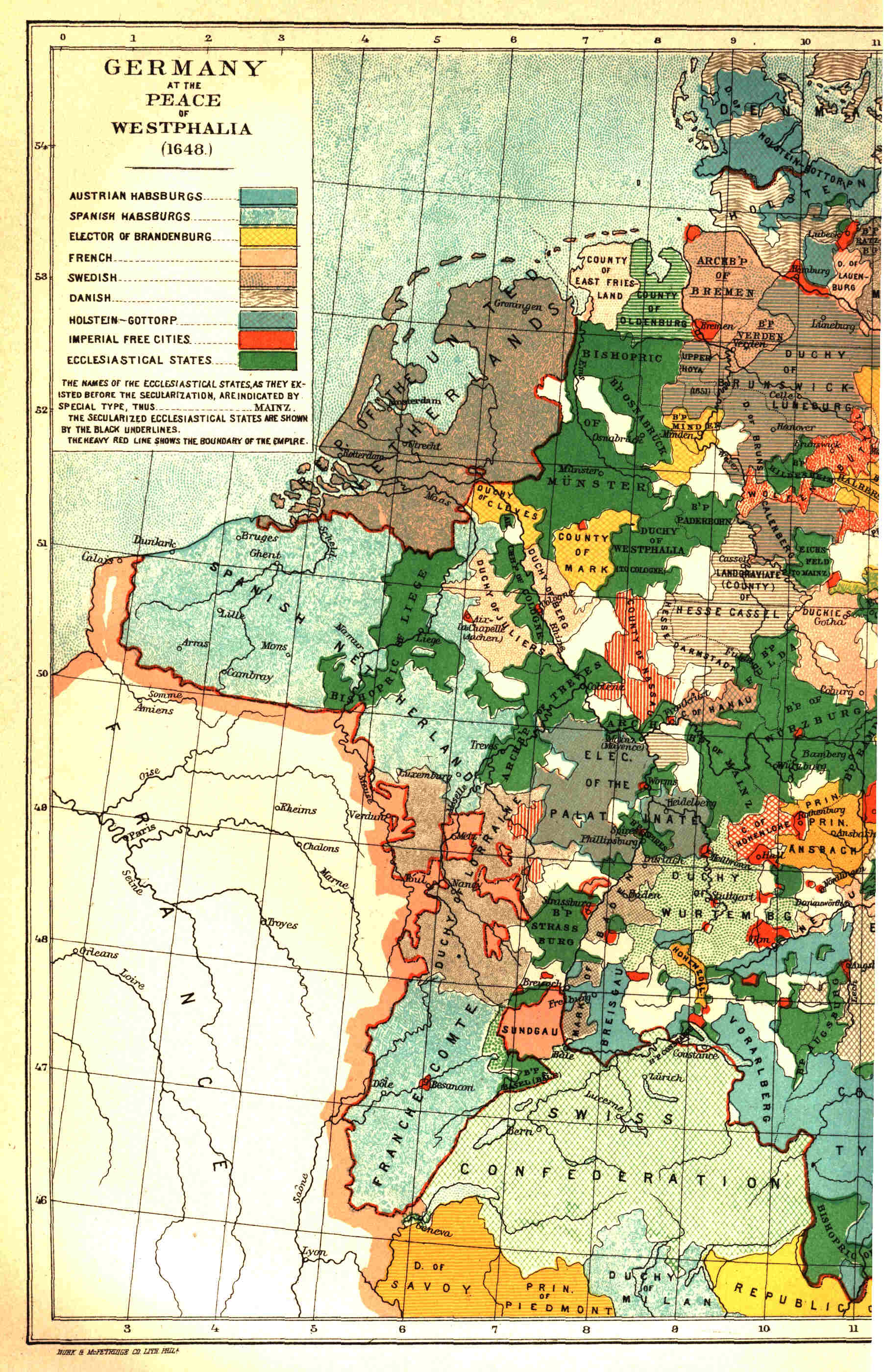
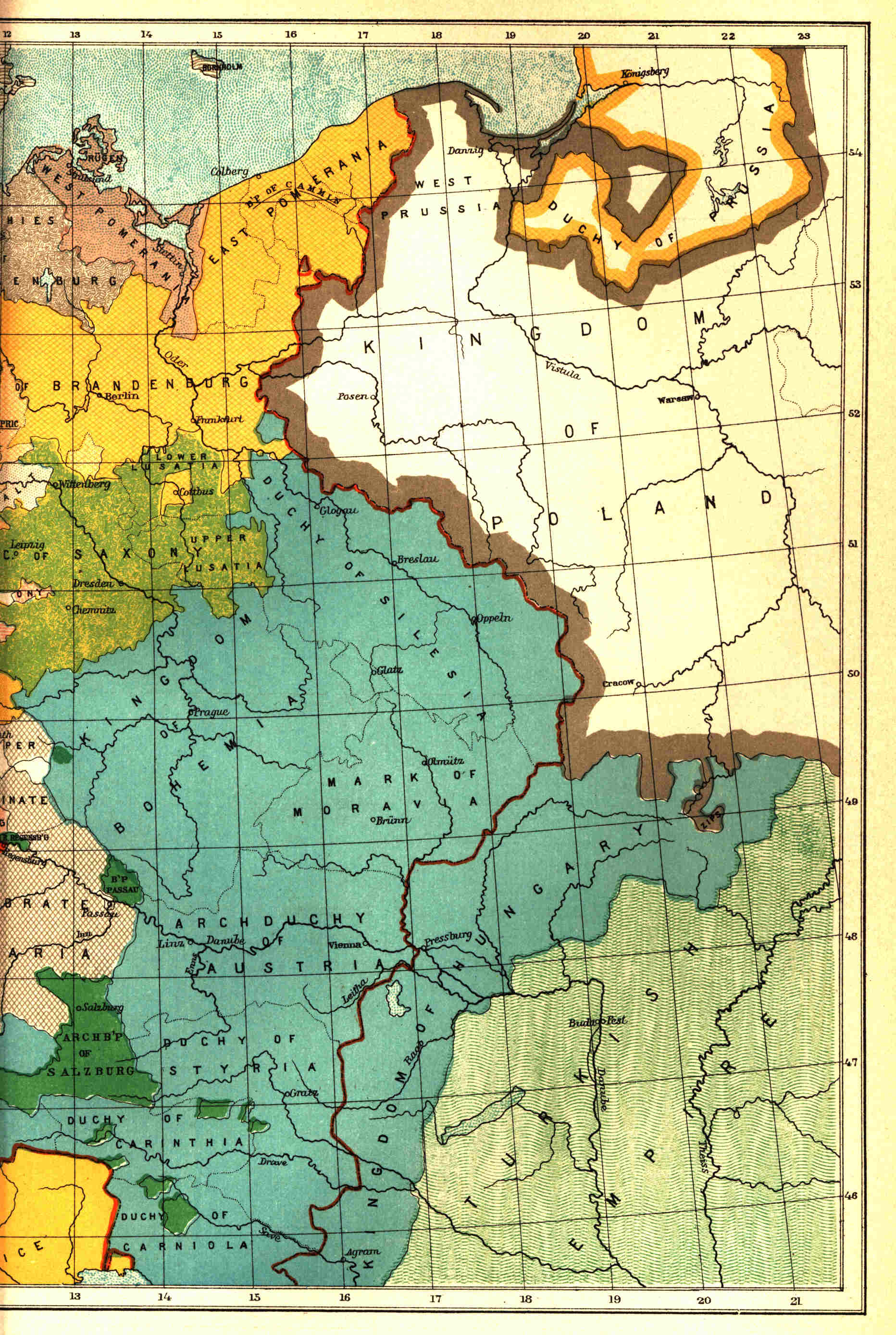
{1487} "Respecting the rights of sovereignty due to the princes and the relations of the states of the empire with the emperor, the Peace of Westphalia contained such regulations as must in the course of time produce a still greater relaxation of those ties, already partially loosened, which held together the empire in one entirety. ... At the Peace of Westphalia the independence of the princes was made completely legal. They received the entire right of sovereignty over their territory, together with the power of making war, concluding peace, and forming alliances among themselves, as well as with foreign powers, provided such alliances were not to the injury of the empire. But what a feeble obstacle must this clause have presented? For henceforward, if a prince of the empire, having formed an alliance with a foreign power, became hostile to the emperor, he could immediately avail himself of the pretext that it was for the benefit of the empire, the maintenance of his rights, and the liberty of Germany. And in order that the said pretext might, with some appearance of right, be made available on every occasion, foreigners established themselves as the guardians of the empire; and accordingly France and Sweden took upon themselves the responsibility of legislating as guarantees, not only for the Germanic constitution, but for everything else that was concluded in the Peace of Westphalia at Münster and Osnaburg. Added to this, in reference to the imperial cities, whose rights had hitherto never been definitively fixed, it was now declared that they should always be included under the head of the other states, and that they should command a decisive voice in the diets; thenceforth, therefore, their votes and those of the other states--the electoral and other princes--should be of equal validity." F. Kohlrausch, History of Germany, chapter 26. Peace between Spain and the United Provinces was embodied in a separate treaty, but negotiated at Münster, and concluded and signed a few months earlier in the same year. The war between Spain and France went on. See NETHERLANDS: A. D. 1646-1648. GERMANY: A. D. 1648. Effects of the Peace of Westphalia on the Empire. It becomes a loose confederacy and purely German. "It may ... be said of this famous peace, as of the other so-called 'fundamental law of the Empire,' the Golden Bull, that it did no more than legalize a condition of things already in existence, but which by being legalized acquired new importance. ... While the political situation, to use a current phrase, had changed within the last two hundred years, the eyes with which men regarded it had changed still more. Never by their fiercest enemies in earlier times, not once by the Popes or Lombard republicans in the heat of their strife with the Franconian and Swabian Cæsars, had the Emperors been reproached as mere German kings, or their claim to be the lawful heirs of Rome denied. The Protestant jurists of the 16th or rather of the 17th century were the first persons who ventured to scoff at the pretended lordship of the world, and declare their Empire to be nothing more than a German monarchy, in dealing with which no superstitious reverence need prevent its subjects from making the best terms they could for themselves, and controlling a sovereign whose religious predilections made him the friend of their enemies. ... It was by these views ... that the states, or rather France and Sweden acting on their behalf, were guided in the negotiations of Osnabrück and Münster. By extorting a full recognition of the sovereignty of all the princes, Catholics and Protestants alike, in their respective territories, they bound the Emperor from any direct interference with the administration, either in particular districts or throughout the Empire. All affairs of public importance, including the rights of making war or peace, of levying contributions, raising troops, building fortresses, passing or interpreting laws, were henceforth to be left entirely in the hands of the Diet. ... Both Lutherans and Calvinists were declared free from all jurisdiction of the Pope or any Catholic prelate. Thus the last link which bound Germany to Rome was snapped, the last of the principles by virtue of which the Empire had existed was abandoned. For the Empire now contained and recognized as its members persons who formed a visible body at open war with the Holy Roman Church; and its constitution admitted schismatics to a full share in all those civil rights which, according to the doctrines of the early Middle Age, could be enjoyed by no one who was out of the communion of the Catholic Church. The Peace of Westphalia was therefore an abrogation of the sovereignty of Rome, and of the theory of Church and State with which the name of Rome was associated. And in this light was it regarded by Pope Innocent X., who commanded his legate to protest against it, and subsequently declared it void by the bull 'Zelo domus Dei.' ... The Peace of Westphalia is an era in imperial history not less clearly marked than the coronation of Otto the Great, or the death of Frederick II. As from the days of Maximilian it had borne a mixed or transitional character, well expressed by the name Romano-Germanic, so henceforth it is in everything but title purely and solely a German Empire. Properly, indeed, it was no longer an empire at all, but a Confederation, and that of the loosest sort. For it had no common treasury, no efficient common tribunals, no means of coercing a refractory member; its states were of different religions, were governed according to different forms, were administered judicially and financially without any regard to each other. ... There were 300 petty principalities between the Alps and the Baltic, each with its own laws, its own courts, ... its little armies, its separate coinage, its tolls and custom-houses on the frontier, its crowd of meddlesome and pedantic officials. ... This vicious system, which paralyzed the trade, the literature, and the political thought of Germany, had been forming itself for some time, but did not become fully established until the Peace of Westphalia, by emancipating the princes from imperial control, had made them despots in their own territories." J. Bryce, The Holy Roman Empire, chapter 19. {1488} GERMANY: A. D. 1648-1705. After the Peace of Westphalia. French influence in the Empire. Creation of the Ninth Elector. After the Peace of Westphalia, the remainder of the reign of Ferdinand III. "passed in tranquillity. ... He caused his son to be elected king of the Romans, under the title of Ferdinand IV.; but the young prince, already king of Bohemia and Hungary, preceded him to the tomb, and left the question of the succession to be decided by a diet. Ferdinand III. died in 1657. ... The interregnum, and, indeed, the century which followed the death of Ferdinand, showed the alarming preponderance of the influence gained by France in the affairs of the empire, and the consequent criminality of the princes who had first invoked the assistance of that power. Her recent victories, her character as joint guarantee of the treaty of Westphalia, and the contiguity of her possessions to the states of the empire, encouraged her ministers to demand the imperial crown for the youthful Louis XIV. Still more extraordinary is the fact that four of the electors were gained, by that monarch's gold, to espouse his views. ... Fortunately for Germany and for Europe, the electors of Treves, Brandenburg, and Saxony, were too patriotic to sanction this infatuated proposal; they threatened to elect a native prince of their own authority,--a menace which caused the rest to co-operate with them; so that, after some fruitless negotiations, Leopold, son of the late emperor, king of Bohemia and of Hungary, was raised to the vacant dignity. His reign was one of great humiliation to his house and to the empire. Without talents for government, without generosity, feeble, bigoted, and pusillanimous, he was little qualified to augment the glory of the country. ... Throughout his long reign [1657-1705], he had the mortification to witness, on the part of Louis XIV., a series of the most unprovoked, wanton, and unprincipled usurpations ever recorded in history. ... Internally, the reign of Leopold affords some interesting particulars. ... Not the least is the establishment of a ninth electoral dignity in favour of Ernest Augustus, Duke of Brunswick Lunenburg, who then became (1692) the first elector of Hanover. This was the act of Leopold, in return for important aid in money and troops from two princes of that house; but it could not be effected without the concurrence of the electoral body, who long resisted it. ... The establishment of a permanent diet, attended, not by the electors in person, but by their representatives, is one of the most striking peculiarities of Leopold's reign." S. A. Dunham, History of the Germanic Empire, book 3, chapter 3 (volume 3). See, DIET, THE GERMANIC. GERMANY: A. D. 1648-1780. The Austrian incubus. "Before the Thirty Years' War the territories of the German Hapsburgs were not very considerable. The greatest part of Hungary was in the hands of the Turks; the Tyrol belonged to a collateral line; and, in the other provinces, the independence of the Nobility was much stronger than the sovereignty of the Archdukes. The Nobles were all zealous protestants, so that a monarchical power could only be created after a victory of the Catholic faith. For the first time since 1621, the crown was seen in these regions to assume a really dominant position. Efforts in this direction had been zealously carried on since 1648; the Tyrolese Estates now lost their most important privileges; and, above all, the Emperor succeeded, by the help of Polish and German troops, in driving out the Turks from Hungary, and at the same time crushing the national freedom of the Magyars with frightful bloodshed. By these victories the Monarchy gained, in the first place, a large increase of territory--which placed it nearly on a level with France. In the second place it acquired at home the power of raising as many taxes and soldiers as were necessary to increase the army to the extent of its wishes; and of distributing its officials and troops--without distinction of nation--as imperial servants, throughout its dominions. And thus it secured submission at home and disposable strength for its operations abroad. Here it stopped short. As it had no national, and, consequently, no warm and natural relation to any of its provinces--which were merely used as passive tools to promote the lofty aims of the Hapsburg family--the Government had no intention of using its power at home for the furtherance of the public good, or the building up of a generally useful Administration. The Nobility had no longer the strength to resist the demands of the Crown for men and money, but it still retained exemption from taxes, the jurisdiction and police among its own peasants, and a multitude of feudal rights, which, often enough, degraded the peasant to the condition of a serf, and everywhere bound down agriculture in the most galling bonds. Of manufactures there were little or none; trade was carried on on the system of guilds. The State officials exercised but little influence over the internal affairs of the Communes, or Provinces; and the privileged orders had full liberty to prosecute their own interests among their inferiors with inconsiderate selfishness. In this aristocracy, the Church, from its wealth and its close internal unity, assumed the first place; and its superior importance was still farther enhanced by the fact of its being the chief bond of unity between the otherwise so loosely compacted portions of the Empire. ... The Church attached the Nobility to the Government; for we must not forget that a very considerable portion of the estates of the Nobles had passed into the hands of new possessors who had received them as a reward for being good catholics. The Church, too, taught all the youth of the Empire--in all its different languages-- obedience to the House of Hapsburg, and received from the Crown, in return, exclusive control of the national education. It formed, in spite of the resistance of nationalities, a sort of public opinion in favour of the unity of the Empire; and the Crown, in return, excluded all non-catholic opinions from the schools, from literature and religion. Austria, therefore, continued to be catholic, even after 1648; and by this we mean, not only that its Princes were personally devout--or that the Catholic clergy were supported in the performance of their spiritual functions--or that the institutions of the Church were liberally supported--but also that the State directed its policy according to ecclesiastical views, made use of the Church for political purposes, and crushed every movement hostile to it in all other spheres of the national life. In Austria, therefore, it was not merely a question of theological differences, but of the deepest and most comprehensive points of distinction between the mediæval and the modern world. Austria was still, in its whole nature, a Mediæval State or Confederacy of States. The consequences of this condition were most strikingly seen in its relation to Germany. In the first place, there was a complete separation, in regard to all mental and spiritual matters, between the great body of the Empire, and its powerful Eastern member. This was the period, in which Germany was awaking to a new intellectual life in modern Europe, and laying the foundation of its modern science in every branch--in History and Statistics, Chemistry and Geology, Jurisprudence and Philosophy--and assuming by its Literature, an equal rank with other nations in national refinement and civilization. {1489} By the works of genius which this period produced Austria remained entirely uninfluenced; and it has been said, that Werther had only been made known to the Viennese in the form of fireworks in the Prater. The literary policy allowed no seed of modern culture to enter the Empire; and the Jesuit schools had rendered the soil unfit for its reception. All the progress of German civilization, at this period, was based on the principle of the independence of the mind in art and science. The education of the Jesuits, on the contrary, though unsurpassed where the object is to prepare men for a special purpose, commences by disowning individual peculiarities, and the right of a man to choose his own career. There was, at this time, no other characteristic of an Austrian than an entire estrangement from the progress of the German mind. ... The progress of the people in science and art, in politics and military strength, was only seen in the larger secular territories, which, after 1648, enjoyed their own sovereignty; and even these were checked in their movements at every step by the remnants of the Imperial Constitution. The Members of the Empire alone, in whom the decaying remains of Mediæval existence still lingered on--the Ecclesiastical Princes--the small Counts--the Imperial Knights and the Imperial Towns,--clung to the Emperor and the Imperial Diet. In these, partly from their small extent of territory, partly from the inefficiency of their institutions, neither active industry, nor public spirit, nor national pride, were to be found. In all which tended to elevate the nation, and raise its hopes for the future, they took, at this period, as little part as Austria herself. ... The Imperial constitution, therefore, was inwardly decayed, and stood in no relation to the internal growth of the nation. ... There was the same divergence between Austria and Germany with respect to their foreign interests, as we have observed in their internal relations. After the Turks had been driven from Hungary, and the Swedes from the half of' Pomerania, Germany had only two neighbours whom it was a matter of vital importance to watch,--the Poles and the French. In the South, on the contrary, it had no interests in opposition to Italy, except the protection of its frontier by the possession or the neutrality of the Alpine passes. And yet it was just towards Italy that the eyes of the House of Hapsburg had been uninterruptedly directed for centuries past. The favourite traditions of the family, and their political and ecclesiastical interest in securing the support of the Pope, and thereby that of the Clergy, constantly impelled them to consolidate and extend their dominion in that country. All other considerations yielded to this; and this is intelligible enough from an Austrian point of view; but it was not on that account less injurious to the German Empire. How strikingly was this opposition of interests displayed at the end of the glorious war of the Spanish succession, when the Emperor rejected a peace which would have restored Strasburg and Alsace to the Empire, because only Naples, and not Sicily also, was offered to Austria! How sharply defined do the same relations present themselves to our view, in the last years of the Hapsburg dynasty, at the peace of Vienna in 1738!--on which occasion the Emperor--in order at least to gain Tuscany, as a compensation for the loss of Naples,--gave up Lorraine to the French, without even consulting the Empire, which he had dragged into the war. Austria thus maintained a predominant influence in Italy; but the Empire, during the whole century after the Peace of Westphalia, did not obtain a single noteworthy advantage over France. How much more was this the case with respect to Poland, which during the whole period of the religious wars had been the most zealous ally of Spain and the Hapsburgs, and which subsequently seemed to threaten no danger to Austrian interests." H. Von Sybel, History of the French Revolution, book 2, chapter 1 (volume 1). GERMANY: A. D. 1658. Election of the Emperor, Leopold I. GERMANY: A. D. 1660-1664. Renewed war with the Turks. Victory of St. Gothard. Transylvania liberated. A twenty years truce. See HUNGARY: A. D. 1660-1664. GERMANY: A. D. 1672-1679. The war of the Coalition against Louis XIV. See NETHERLANDS (HOLLAND): A. D. 1672-1674, and 1674-1678; also NIMEGUEN, PEACE OF. GERMANY: A. D. 1675-1678. War with Sweden. Battle of Fehrbellin. See BRANDENBURG: A.D. 1640-1688; and SCANDINAVIAN STATES (SWEDEN): A. D. 1644-1697. GERMANY: A. D. 1679-1681. The final absorption of Alsace and Les Trois-Evêchés by France, with boundaries widened. Bold encroachments of the French Chambers of Reannexation. The seizure of Strasburg. See FRANCE: A. D. 1679-1681. GERMANY: A. D. 1686. The League of Augsburg against Louis XIV. "The Duke of Orleans, the French King's brother, had married the sister of the Elector Palatine, the last of the House of Simmern, who died in May 1685, when his next relative, the Count Palatine Philip William, Duke of Neuberg, took possession of the Electorate. The Duchess of Orleans had by her marriage contract renounced all her feudal rights to the Palatinate, but not her claims to the allodial property and the moveables of her family." These latter claims, taken in hand by Louis XIV. on behalf of his sister-in-law, were made so formidable that the new Elector appealed to the Empire for protection, "and, thus redoubled the uneasiness felt in Germany, and indeed throughout the greater part of Europe, respecting the schemes of Louis. The Prince of Orange availed himself of these suspicions to forward his plans against Louis. He artfully inflamed the general alarm, and at length succeeded in inducing the Emperor Leopold, the Kings of Spain, and Sweden, as princes of the Empire, the Electors of Saxony and Bavaria, the circles of Suabia, Franconia, Upper Saxony, and Bavaria, to enter into the celebrated League of Augsburg (July 9th 1686). The object of this league was to maintain the Treaties of Münster and Nimeguen and the Truce of Ratisbon. If any of the members of it was attacked he was to be assisted by the whole confederacy; 60,000 men were to be raised, who were to be frequently drilled, and to form a camp during some weeks of every year, and a common fund for their support was to be established at Frankfort. The League was to be in force only for three years, but might be prolonged at the expiration of that term should the public safety require it. The Elector Palatine, who was in fact the party most directly interested, acceded to the League early in September, as well as the Duke of Holstein Gottorp." T. H. Dyer, History of Modern Europe, book 5, chapter 5 (volume 3). {1490} "To Madame's great anger France set up a claim to the Palatinate on her behalf, Louvois persuading the King and the royal family that with a few vigorous measures the Palatinate would be abandoned by the Neubourgs and annexed to France as part of Madame's dowry. This led to the devastation of the states, to which Madame [Charlotte Elizabeth, the Duchess of Orleans] so often and so bitterly alludes during the next ten years. Obliged by Louis XIV. 's policy to represent herself as desirous to recover her rights over her father's and brother's succession, in many documents which she was never even shown, Madame protested in all her private letters against France's action in the matter, and made every one at court thoroughly aware of her grief and disapproval of what the king was doing on her behalf." Life and Letters of Charlotte Elizabeth, Princess Palatine, chapter 2. GERMANY: A. D. 1689-1696. The War of the League of Augsburg, or Grand Alliance, against Louis XIV. See FRANCE: A. D. 1689-1690 to 1695-1696. GERMANY: A. D. 1690. The second Devastation of the Palatinate. See FRANCE: A. D. 1689-1690. GERMANY: A. D. 1700. Interest in the question of the Spanish Succession. See SPAIN: A. D. 1698-1700. GERMANY: A. D. 1700. Prussia raised to the dignity of a kingdom. See PRUSSIA: A. D. 1700. GERMANY: A. D. 1700-1740. The first king of Prussia and his shabby court. The second king, his Brobdingnagian army and his extraordinary character. The up-bringing of Frederick the Great. The "Great Elector" of Brandenburg "left to his son Frederic a principality as considerable as any which was not called a kingdom." See BRANDENBURG: A. D. 1640-1688. "Frederic aspired to the style of royalty. Ostentatious and profuse, negligent of his true interests and of his high duties, insatiably eager for frivolous distinctions, he added nothing to the real weight of the state which he governed: perhaps he transmitted his inheritance to his children impaired rather than augmented in value; but he succeeded in gaining the great object of his life, the title of King. In the year 1700 he assumed this new dignity. He had, on that occasion to undergo all the mortifications which fall to the lot of ambitious upstarts. Compared with the other crowned heads of Europe, he made a figure resembling that which a Nabob or a Commissary, who had bought a title, would make in the company of Peers whose ancestors had been attainted for treason against the Plantagenets. The envy of the class which Frederic quitted, and the civil scorn of the class into which he intruded himself, were marked in very significant ways. ... Frederic was succeeded by his son, Frederic William, a prince who must be allowed to have possessed some talents for administration, but whose character as disfigured by odious vices, and whose eccentricities were such as had never before been seen out of a madhouse. He was exact and diligent in the transacting of business; and he was the first who formed the design of obtaining for Prussia a place among the European powers, altogether out of proportion to her extent and population, by means of a strong military organization. Strict economy enabled him to keep up a peace establishment of 60,000 troops. These troops were disciplined in such a manner, that, placed beside them, the household regiments of Versailles and St. James's would have appeared an awkward squad. The master of such a force could not but be regarded by all his neighbours as a formidable enemy and a valuable ally. But the mind of Frederic William was so ill regulated, that all his inclinations became passions, and all his passions partook of the character of moral and intellectual disease. His parsimony degenerated into sordid avarice. His taste for military pomp and order became a mania, like that of a Dutch burgomaster for tulips, or that of a member of the Roxburghe Club for Caxtons. While the envoys of the Court of Berlin were in a state of such squalid poverty as moved the laughter of foreign capitals; while the food placed before the princes and princesses of the blood-royal of Prussia was too scanty to appease hunger, and so bad that even hunger loathed it, no price was thought too extravagant for tall recruits. The ambition of the king was to form a brigade of giants, and every country was ransacked by his agents for men above the ordinary stature. ... Though his dominant passion was the love of military display, he was yet one of the most pacific of princes. We are afraid that his aversion to war was not the effect of humanity, but was merely one of his thousand whims. His feeling about his troops seems to have resembled a miser's feeling about his money. He loved to collect them, to count them, to see them increase; but he could not find it in his heart to break in upon the precious hoard. He looked forward to some future time when his Patagonian battalions were to drive hostile infantry before them like sheep: but this future time was always receding; and it is probable that, if his life had been prolonged 30 years, his superb army would never have seen any harder service than a sham fight in the fields near Berlin. But the great military means which he had collected were destined to be employed by a spirit far more daring and inventive than his own. Frederic, surnamed the Great, son of Frederic William, was born in January 1712. It may safely be pronounced that he had received from nature a strong and sharp understanding, and a rare firmness of temper and intensity of will. As to the other parts of his character, it is difficult to say whether they are to be ascribed to nature, or to the strange training which he underwent. The history of his boyhood is painfully interesting. Oliver Twist in the parish work-house, Smike at Dotheboys Hall, were petted children when compared with this wretched heir-apparent of a crown. The nature of Frederic William was hard and bad, and the habit of exercising arbitrary power had made him frightfully savage. His rage constantly vented itself to right and left in curses and blows. When his Majesty took a walk, every human being fled before him, as if a tiger had broken loose from a menagerie. ... But it was in his own house that he was most unreasonable and ferocious. His palace was hell, and he the most execrable of fiends. ... Early in the year 1740, Frederic William met death with a firmness and dignity worthy of a better and wiser man; and Frederic, who had just completed his 28th year, became king of Prussia." Lord Macaulay, Frederic the Great (Essays). {1491} "Frederick William I. became ... the founder of the first modern State in Germany. His was a nature in which the repulsive and the imposing, the uncouth and the admirable, were closely united. In his manners a rough and unrefined peasant, in his family a tyrant, in his government a despot, choleric almost to madness, his reign would have been a curse to the country, had he not united with his unlimited power a rare executive ability and an incorruptible fidelity to duty; and from first to last he consecrated all his powers to the common weal. By him effective limitations were put upon the independent action of the provinces, and upon the overgrown privileges of the estates. He did not do away with the guilds of the different orders, but placed them under the strict control of a strongly centralized superintendence, and compelled their members to make every necessary sacrifice for the sake of assisting him in his efforts for the prosperity and power of Prussia. It is astonishing to see with what practical judgment he recognized a needed measure both in general and in detail; how he trained a body of officials, suited in all grades to the requirements of their position; how he disciplined them in activity, prudence, and rectitude, by strict inspection, by encouraging instruction, and by brutal punishments; how he enforced order and economy in the public finances; how he improved the administration of his own domains, so that it became a fruitful example to all proprietors; and how, full of the desire to make the peasants free owners of the soil, although he did not yet venture on such a radical measure, he nevertheless constantly protected the poor against the arbitrariness and oppression of the higher classes. ... There was no department of life to which he did not give encouragement and assistance; it is also true that there was none which he did not render subservient to his own will, and the products of which he did not make conducive to the one great end,--the independence and aggrandizement of the State. So that he who was the ruler of, at most, three million people, created, without exhausting the country, a standing army of eighty thousand men: a remarkably skilful and ready army, which he disciplined with barbarous severity on the slightest occasion, at the same time that he looked out for the welfare of every soldier even in the smallest detail, according to his saying, that 'a king's warrior must live better than a gentleman's servant.' What he had in his mind, almost a hundred years before Scharnhorst, was the universal obligation of military service; but it fared with him in regard to this as in regard to the freedom of the peasants: strong as he was, he could not turn the world he lived in upside down; he contented himself with bequeathing his best ideas to a more propitious future. The foundations of the government rested upon the estates in spite of all monarchical reforms. Thus, beside the federative Empire of the Hapsburgs, arose the small, compact Prussian State, which, by reason of the concentration of its forces, was a match for its five-times-larger rival." H. Von Sybel, The Founding of the German Empire by William I., book 1, chapter 2 (volume 1). ALSO IN: T. Carlyle, History of Frederick II., called the Great, book 3, chapter 19, books 5-10 (volumes 1-2). GERMANY: A. D. 1702. The War of the Spanish Succession: Siege of Landau. Battle of Friedlingen. On the part of the Imperialists, the War of the Spanish Succession was opened on the Rhine frontier in June 1702, by a movement of the army commanded by the Margrave Louis of Baden, which "came over the Rhine and laid siege to the important fortress of Landau,--the bulwark of Alsace as it was then regarded. The Margrave was subsequently joined by the Emperor's eldest son, the young King of the Romans, who desired to share in the glory, though not in the toils of the expected conquest. ... The Maréchal de Catinat, one of the soldiers of whom France has most reason to be proud,--the virtuous Catinat as Rousseau terms him--held command at this period in Alsace. So inferior were his numbers that he could make no attempt to relieve Landau. But after its reduction an opportunity appeared in which by detaching a portion of his army he might retrieve the fortunes of France in another quarter. The Elector of Bavaria, after much irresolution, had openly espoused the cause of Louis. He seized upon the city of Ulm and issued a proclamation in favor of his new ally. To support his movements an enterprising and ambitious officer, the Marquis de Villars, was sent across the Rhine with part of the army of Alsace. The declaration of the Elector of Bavaria and the advance of Villars into Germany disquieted in no slight degree the Prince Louis of Baden. Leaving a sufficient garrison in Landau, he also passed the Rhine. The two armies met at Friedlingen on the 14th of October. Louis of Baden, a ponderous tactician bred in the wars against the Turks, might out-manœuvre some Grand Vizier, but was no match for the quick-witted Frenchman. He was signally defeated with the loss of 3,000 men; soon after which, the season being now far advanced, Villars led back his army to winter quarters in France. His victory of Friedlingen gained for him at Versailles the rank of Maréchal de France." Earl Stanhope (Lord Mahon), History of England: Reign of Queen Anne, chapter 2. ALSO IN: W. Coxe, History of the House of Austria, chapter 68 (volume 2). See, also; NETHERLANDS: A. D. 1702-1704, and SPAIN: A. D. 1702. GERMANY: A. D. 1703. The War of the Spanish Succession: Campaigns on the Upper Rhine and in Bavaria. "Early in June [A. D. 1703], Marshal Tallard assumed the command of the French forces in Alsace, ... took Prissac on the 7th of September, and invested Landau on the 16th of October. The allies, under the Prince of Hesse, attempted to raise the siege, but were defeated with considerable loss; and, soon after, Landau surrendered, thus terminating with disaster the campaign on the Upper Rhine. Still more considerable were the losses sustained in Bavaria. Marshal Villars commanded there, and, at the head of the French and Bavarians, defeated General Stirum, who headed the Imperialists, on the 20th of September. In December, Marshal Marsin, who had succeeded Villars in the command, made himself master of the important city of Augsburg, and in January, 1704, the Bavarians got possession of Passau. Meanwhile, a formidable insurrection had broken out in Hungary, which so distracted the cabinet of Vienna that the capital seemed to be threatened by the combined forces of the French and Bavarians after the fall of Passau. ... Instead of confining the war to one of posts and sieges in Flanders and Italy, it was resolved [by the French] to throw the bulk of their forces at once into Bavaria, and operate against Austria from the heart of Germany, by pouring down the valley of the Danube. {1492} The advanced post held there by the Elector of Bavaria in front, forming a salient angle, penetrating, as it were, into the Imperial dominions, the menacing aspect of the Hungarian insurrection in the rear, promised the most successful issue to this decisive operation. For this purpose, Marshal Tallard, with the French army on the Upper Rhine, received orders to cross the Black Forest and advance into Swabia, and unite with the Elector of Bavaria, which he accordingly did at Donawerth, in the beginning of July. Marshal Villeroy, with forty battalions and thirty-nine squadrons, was to break off from the army in Flanders and support the advance by a movement on the Moselle, so as to be in a condition to join the main army on the Danube, of which it would form, as it were, the left wing; while Vendôme, with the army of Italy, was to penetrate into the Tyrol, and advance by Innspruck on Salzburg. The united armies, which it was calculated, after deducting all the losses of the campaign, would muster 80,000 combatants, was then to move direct by Lintz and the valley of the Danube on Vienna, while a large detachment penetrated into Hungary to lend a hand to the already formidable insurrection in that kingdom. The plan was grandly conceived. ... Marlborough, by means of the secret information which he obtained from the French head-quarters, had got full intelligence of it, and its dangers to the allies, if it succeeded, struck him as much as the chances of great advantage to them if ably thwarted. His line was instantly taken." A. Alison, Military Life of Marlborough, chapter 2, sections 30-33. The measures taken by Marlborough to defeat the plans of the French in this campaign are briefly stated in the account of his first campaigns in the Netherlands. See NETHERLANDS: A. D. 1702-1704. ALSO IN: H. Martin, History of France: Age of Louis XIV. (translated by M. L. Booth), volume 2, chapter 5. W. Coxe, History of the House of Austria, chapter 69 (volume 2). GERMANY: A. D. 1704. The War of the Spanish Succession: Marlborough and Prince Eugene on the Danube. The Battle of Blenheim. "Marlborough, with his motley army of English, Dutch, Danes and Germans, concealing his main purpose, was marching south along the Rhine, with a design to strike his critical blow, by attacking the French armies that were forming for the campaign of the Danube, and thus protect the Emperor and Vienna, and punish the Elector of Bavaria, whose territories would be then exposed. On the route, Marlborough was joined by Prince Eugene and the Margrave of Baden: but as a new French force was approaching, Prince Eugene was sent to keep it in check. Marlborough and the Prince of Baden, with united forces of about 60,000 men, then advanced, in rapid marches, and took, by gallant assault, the fortifications of the Schellenberg in Bavaria, and the old town of Donauworth, a critical and commanding position on the Danube. The allies were now masters of the main passages of the Danube--and had a strong place as a basis of action. The allied leaders thereupon sent troops into the heart of Bavaria, and devastated the country even to the vicinity of Munich--burning and destroying as they marched, and taking several minor fortresses. Marlborough's forces and those of Prince Eugene were distant from each other some forty miles, when came the news of the march of a French army of 25,000 men under Tallard, to form a junction with the others, to succor the Elector, and take revenge for the defeat of the Schellenberg. Two French Marshals, Tallard and Marsin, were now in command: their design was to attack Marlborough and Eugene's armies in detail. By rapid marches, Marlborough crossed the Danube and joined Prince Eugene near Donauworth, and thereupon occurred one of the most important and decisive contests of modern times, fought between the old town of Hochstadt and the village of Blenheim, about fifteen miles south of Donauworth. The skilful tactics of the allied generals precipitated the battle. The allied French and Bavarians numbered 60,000 [56,000; Malleson] men--the English, Dutch and Germans and other allies, about 53,000 [52,000; Malleson]. The allies were allowed to cross an intervening brook without opposition, and form their lines. A great charge, in full force, of the allies was then made; they broke the enemy's extended line; and an ensuing charge of cavalry scattered his forces right and left, and drove many into the Danube. More than 14,000 French and Bavarians, who had not struck a blow, except to defend their position, entrenched and shut up in the village of Blenheim, waiting for orders to move, were then surrounded by the victorious allies, and compelled to surrender as prisoners of war. The scattered remnants of the French and Bavarian army either disbanded, or were driven over the Rhine. The garrison at Ulm capitulated, and the Elector fled into France." J. W. Gerard, The Peace of Utrecht, chapter 16. "The armies of Marchin and of Max Emanuel [of Bavaria] had been defeated; that of Tallard had been annihilated. Whilst the loss of the victors in killed and wounded reached 12,000 men, that of the French and Bavarians exceeded 14,000. In addition, the latter lost 13,000 men taken prisoners, 47 pieces of cannon, 25 standards, and 90 colours. Such was the battle of Blenheim. It was one of the decisive battles of history, and it changed the character of the war. Up to that moment, the action of France against. Germany had been aggressive; thenceforward it became purely defensive. Blenheim, in fact, dashed to the ground the hopes of Louis XIV. and Max Emanuel of Bavaria. It saved the house of Habsburg in Germany, and helped it greatly in Hungary. It showed likewise that it was possible to inflict a crushing defeat on the armies of Louis XIV." Colonel G. B. Malleson, Prince Eugene of Savoy, chapter 6. "Marlborough [after the battle], having detached part of his force to besiege Ulm, drew near with the bulk of his army to the Rhine, which he passed near Philipsburg on the 6th of September, and soon after commenced the siege of Landau, on the French side; Prince Louis, with 20,000 men, forming the besieging force, and Eugene and Marlborough, with 30,000, the covering army. Villeroi, with the French army, abandoned an intrenched camp which he had constructed to cover the town. Marlborough followed, and made every effort to bring the French marshal to battle, but in vain. ... Ulm surrendered on the 16th of September, ... which gave the allies a solid foundation on the Danube, and effectually crushed the power of the Elector of Bavaria, who, isolated now in the midst of his enemies, had no alternative but to abandon his dominions and seek refuge in Brussels, where he arrived in the end of September. ... {1493} The Electress of Bavaria, who had been left regent of that state in the absence of the Elector in Flanders, had now no resource left but submission; and a treaty was accordingly concluded in the beginning of November, by which she agreed to disband all her troops. Trêves and Traerbach were taken in the end of December; the Hungarian insurrection was suppressed; Landau capitulated in the beginning of the same month; a diversion which the enemy attempted toward Trêves was defeated by Marlborough's activity and vigilance, and that city put in a sufficient posture of defense; and, the campaign being now finished, that accomplished commander returned to the Hague and London." A. Alison, Military Life of Marlborough, chapter 2. ALSO IN: G. B. Malleson, Battle-fields of Germany, chapter 10. W. Coxe, Memoirs of Marlborough, chapters 22-26 (volume 1). J. H. Burton, History of the Reign of Queen Anne, chapter 6 (volume 1). H. Martin, History of France: Age of Louis XIV., volume 2, chapter 5. GERMANY: A. D. 1705. The Election of the Emperor Joseph I. GERMANY: A. D. 1705. The War of the Spanish Succession: The dissolution of Bavaria. "The campaign of 1705 was destitute of any important events on the side of Germany. ... In Bavaria, the peasants, irritated by the oppressions of the Austrian government, rose in a body in the autumn, and, could they have been supported by France, would have placed the Emperor in great danger; but without that aid the insurrection only proved fatal to themselves. The insurgents were beaten in detail, and the Emperor now resolved on the complete dissolution of Bavaria as a state. The four elder sons of Maximilian were carried to Klagenfurt in Carinthia, to be there educated under the strictest inspection as Counts of Wittelsbach, while the younger sons were consigned to the care of a court lady at Munich, and the daughters sent to a convent. The Electress, who had been on a visit to Venice, was not permitted to return to her dominions, and the Elector Maximilian, as well as the Elector of Cologne, was, by a decree of the Electoral College, placed under the ban of the Empire. The Upper Palatinate was restored to the Elector Palatine. ... The remaining Bavarian territories were confiscated, and divided among various princes." T. H. Dyer, History of Modern Europe, book 5, chapter 6 (volume 3). W. Coxe, History of the House of Austria, chapter 72 (volume 3). The campaign of 1705 in the Netherlands was unimportant; but in Spain it had brilliant results. See SPAIN: A. D. 1705; and NETHERLANDS: A. D. 1705. GERMANY: A. D. 1706-1711. The War of the Spanish Succession: Successes of the French. During 1706, little was attempted on either side by the forces which watched each other along the Rhine. In 1707 Villars, the French commander, obtained liberty to act. "The Emperor, greatly preoccupied with Hungary, had furnished but indifferent resources to the new general of the army of the Rhine, Brandenburg-Baireuth; the German army was ill paid and in bad condition in its immense lines on the right bank, which extended along the Rhine from Philippsburg as far as Stolhofen, then, in a square, from Stolhofen to the Black Mountains by Bühl. May 22, the lines were attacked simultaneously at four points. ... The success was complete; the enemy fled into the mountains, abandoning artillery, baggage, and munitions, and did not stop till beyond the Neckar. The lines were razed; Swabia and a part of Franconia were put under contribution. Villars marched on Stuttgart, crossed the Neckar, and subjected the whole country to ransom as far as the Danube. The enemies in vain rallied and reinforced themselves with tardy contingents of the Empire; they could not prevent Villars from laying under contribution the Lower Neckar, then the country between the Danube and Lake Constance, and from maintaining himself beyond the Rhine till he went into winter-quarters. French parties scoured the country as conquerors as far as the fatal field of Hochstadt." At the beginning of the campaign of 1708, it was the plan of the allies to make their chief attack on France "by the way of the Rhine and the Moselle, with two armies of 60,000 men each, under the command of the Elector of Hanover and Eugene, whilst Marlborough occupied the great French army in Flanders." But this plan was changed. "Eugene left the Elector of Hanover in the north of Swabia, behind the lines of Etlingen, which the allies had raised during the winter to replace the lines of Bühl at Stolhofen, and, with 24,000 soldiers collected on the Moselle, he marched by the way of Coblentz towards Belgium (June 30). The French forces of the Rhine and the Moselle followed this movement." The campaign then ensuing in the Netherlands was that which was signalized by Marlborough and Eugene's victory at Oudenarde and the siege of Lille. In 1709, "the attention of Europe, as in 1708, was chiefly directed to Flanders; but it was not only on that side that France was menaced. France was to be encroached upon at once on the north and the east. Whilst the great allied army penetrated into Artois, the army of the Rhine and the army of the Alps were to penetrate, the latter into Bresse by the way of Savoy, the former into Franche-Comté by the way of Alsace, and to combine their operations. ... The Germans had not taken the offensive in Alsace till in the month of August. Marshal Harcourt, with over 20,000 men, had covered himself with the lines of the Lauter: the Elector of Hanover, who had crossed the Rhine at Philippsburg with superior forces, did not attack Harcourt, and strove to amuse him whilst 8,000 or 9,000 Germans, left in Swabia with General Merci, moved rapidly on Neuberg ... and established there a tête-du-pont in order to enter Upper Alsace." By swiftly sending a sufficient force to attack and defeat Merci at Neuberg, August 26, Harcourt completely frustrated these plans. "The Elector of Hanover recrossed the river and retired behind the lines of Etlingen." During the two following years the French and German forces on the side of the Rhine did little more than observe one another. H. Martin, History of France: Age of Louis XIV:, volume 2, chapters 5-6. Meantime, Ramillies, Oudenarde and Malplaquet had been fought in the Netherlands; Prince Eugene had won his victory at Turin, and the contest had been practically decided in Spain, at Almanza. See NETHERLANDS: A. D. 1706-1707, 1708-1709, 1710-1712; ITALY: A. D. 1701-1713; SPAIN: A. D. 1706, 1707, and 1707-1710; and ENGLAND: A. D. 1710-1712. ALSO IN: W. Coxe, History of the House of Austria, chapters 75-79 (volume 3). F. P. Guizot, Popular History of France, chapter 45 (volume 5). GERMANY: A. D. 1711. Election of the Emperor Charles VI. {1494} GERMANY: A. D. 1711. The War of the Spanish Succession: Change in the circumstances of the war. See AUSTRIA: A. D. 1711. GERMANY: A. D. 1713-1719. The Emperor's continued differences with the King of Spain. The Triple Alliance. The Quadruple Alliance. See SPAIN: A. D. 1713-1725. GERMANY: A. D. 1714. Ending of the War of the Spanish Succession: The Peace of Utrecht and the Treaty of Rastadt. See UTRECHT: A. D. 1712-1714. GERMANY: A. D. 1732-1733. Interference in the election of the King of Poland. See POLAND: A. D. 1732-1733. GERMANY: A. D. 1733-1735. The War of the Polish Succession. Cession of Lorraine to France. See FRANCE: A. D. 1733-1735. GERMANY: A. D. 1740. The question of the Austrian Succession. The Pragmatic Sanction. See AUSTRIA: A. D. 1718-1738, and 1740. GERMANY: A. D. 1740-1756. Early years of the reign of Frederick the Great in Prussia. The War of the Austrian Succession. When Frederick II., known as Frederick the Great, succeeded his father, in 1740, "nobody had the least suspicion that a tyrant of extraordinary military and political talents, of industry more extraordinary still, without fear, without faith, and without mercy, had ascended the throne." Lord Macaulay, Frederic the Great (Essays). The reign of Frederick II. "was expected to be an effeminate one; but when at the age of twenty-nine he became king, he forgot his pleasures, thought of nothing but glory, and no longer employed himself but in attention to his finances, his army, his policy, and his laws. His provinces were scattered, his resources weak, his power precarious; his army of seventy thousand soldiers was more remarkable for handsomeness of the men, and the elegance of their appearance, than for their discipline. He augmented it, instructed it, exercised it, and fortune began to open the field of glory to him at the moment he was fully prepared to enjoy her favours. Charles XII. was dead, and his station filled by a king without authority. Russia, deprived of Peter the Great, who had only rough-hewn her civilization, languished under the feeble government of the Empress Anne, and of a cruel and ignorant minister. Augustus III. King of Poland and Elector of Saxony, a Prince devoid of character, could not inspire him with any dread. Louis XV., a weak and peaceable king, was governed by Cardinal Fleuri, who loved peace, but always by his weakness suffered himself to be drawn into war. He presented to Frederic rather a support than an obstacle. The court of France had espoused the cause of Charles VII. against Francis I. Maria Theresa, wife of Francis, and Queen of Hungary, saw herself threatened by England, Holland, and France; and whilst she had but little reason to hope the preservation of her hereditary dominions, that arrogant princess wished to place her husband on the Imperial Throne. This quarrel kindled the flames of war in Europe; the genius of Frederic saw by a single glance that the moment was arrived for elevating Prussia to the second order of powers; he made an offer to Maria Theresa to defend her, if she would cede Silesia to him, and threatened her with war in case of refusal. The Empress, whose firmness nothing could shake, impoliticly refused that proposition; war was declared, and Frederic entered Silesia at the head of eighty thousand men. This first war lasted eighteen months. See AUSTRIA: A. D. 1740 to 1741. Frederic, by gaining five battles, shewed that Europe would recognize one great man more in her bloody annals. He had begun the war from ambition, and contrary to strict justice; he concluded it with ability, but by the abandonment of France his ally, without giving her information of it, and he thus put in practice, when he was seated on the throne, the principles of Machiavel, whom he had refuted before he ascended it. Men judge according to the event. The hero was absolved by victory from the wrongs with which justice reproached him; and this brilliant example serves to confirm men in that error, too generally and too lightly adopted, that ability in politics is incompatible with the strict rule of morality. Four years after, in [1744], Frederic again took up arms. See AUSTRIA: A. D. 1743-1744 to 1744-1745. He invaded Bohemia, Upper Silesia, and Moravia. Vienna thought him at her gates; but the defection of the Bavarians, the retreat of the French, and the return of Prince Charles into Bohemia, rapidly changed the face of affairs. The position of Frederic became as dangerous as it had been menacing; he was on the point of being lost, and he saw himself compelled to retire with as much precipitation, as he had advanced with boldness. The gaining the battle of Hohen-Friedberg saved him. That retreat and that victory fixed the seal to his reputation. It was after this action that he wrote to Louis XV. 'I have just discharged in Silesia the bill of exchange which your majesty drew on me at Fontenoy.' A letter so much the more modest, as Frederic had conquered, and Louis had only been witness to a victory. He displayed the same genius and the same activity in the campaign of 1745, and once more abandoned France in making his separate peace at Dresden. By this treaty Francis was peaceably assured of the empire, and the cession of Silesia was confirmed to Frederic. France during this war committed some wrongs, which might palliate the abandonment of Prussia. The French did not keep Prince Charles within bounds, they made no diversion into Germany, and fought no where but in Flanders. ... In 1756, Europe was again in a flame. France and England declared war against each other, and both sought alliances; Frederic ranged himself on the side of England, and by that became the object of the unreflecting vengeance of the French, and of the alliance of that power with Austria; Austria also formed an alliance with the Court of Petersburg by means of a Saxon secretary; Frederic discovered the project of the Courts of Petersburg, Dresden, and Vienna, to invade the Prussian dominions. He was before-hand with them, and began the war by some conquests." L. P. Ségur, the elder, History of the Principal Events of the Reign of Frederic William II., King of Prussia, volume 1, pages 2-6. GERMANY: A. D. 1742. The Elector of Bavaria crowned Emperor (Charles VII.). See AUSTRIA: A. D. 1741 (OCTOBER). GERMANY: A. D. 1745. The consort of Maria Theresa elected Emperor (Francis I.). Rise of the imperial house of Hapsburg-Lorraine. See AUSTRIA: A. D.1745 (SEPTEMBER-OCTOBER); also, 1744-1745. GERMANY: A. D. 1748. End and results of the War of the Austrian Succession. See AIX-LA-CHAPELLE. THE CONGRESS. {1495} GERMANY: A. D. 1755-1756. The Seven Years War: Its causes and provocations. "The great national quarrel between England and the powers which restrained her free movements on the sea and her extension of colonies, had never ceased. England would have the freedom of the sea: and on land she pushed population and ploughs where France paraded soldiers. In such a struggle war must come, but, by laws invariable as the laws of nature, the population will win in the end. After much bickering, blows began in 1754, and at the beginning of 1755 England despatched the ill-fated Braddock with a small force, which was destroyed in July. ... As yet, however, the quarrel was only colonial. England embittered it by seizing French ships without any declaration of war. But why did Frederick [of Prussia] strike in, if indeed he desired peace? In truth there was no choice for him. As early as 1752-53 his secret agents had discovered that Austria, Russia and Saxony were hatching a plot for the destruction of Prussia, and such a partition as afterwards befell unhappy Poland. In 1753 a Saxon official, Mentzel by name, began to supply the Prussian agents with copies of secret documents from the archives at Dresden, which proved that, during the whole of the peace, negotiations had been proceeding for a simultaneous attack on Frederick, though the astute Brühl [Saxon minister], mindful of former defeats, objected to playing the part of jackal to the neighbouring lions. In short, by the end of 1755 the king knew that preparations were already on foot in Austria and Russia, and that he would probably be attacked next year certainly, or, at latest, the year after. A great war was coming between England and France, in which the continental power would attack Hanover, and tread closely on the skirts of Prussia. The situation was dangerous, and became terribly menacing when England bargained with Russia to subsidise a Muscovite army of 55,000 men for defence of Hanover. Russia consented with alacrity. Money was all that the czarina needed for her preparations against Frederick, and in the autumn of 1755 she assembled, not 55,000, but 70,000 men on the Prussian frontier, nominally for the use of England. But throughout the winter all the talk at St. Petersburg was of Frederick's destruction in the coming spring. It was time for him to stir. His first move was one of policy. He offered England a 'neutrality convention' by which the two powers jointly should guarantee the German Reich against all foreign intervention during the coming war. On the 16th of January, 1756, the convention was signed in London, and the Russian agreement thrown over, as it could well be, since it had not been ratified. Europe was now ranking herself for the struggle. In preceding years, the Austrian diplomatist, Kaunitz, had so managed the French court, especially through the medium of Madame de Pompadour, that Louis XV. was now on the side of Maria Theresa, who had bowed her neck so far as to write to the French king's mistress as 'Ma Cousine,' while Frederick forgot policy, and spoke of the Pompadour in slighting terms. 'Je ne la connais pas,' said he once, and was never forgiven. ... The agreement with Russia to partition Prussia had already been made, and Frederick's sharp tongue had betrayed him into calling the czarina that 'Infame catin du nord.' Saxony waited for the appearance of her stronger neighbours in order to join them. England alone was Frederick's ally." Colonel C. B. Brackenbury, Frederick the Great, chapter 9. "The secret sources of the Third Silesian War, since called 'Seven-Years War,' go back to 1745; nay, we may say, to the First Invasion of Silesia in 1740. For it was in Maria Theresa's incurable sorrow at loss of Silesia, and her inextinguishable hope to reconquer it, that this and all Friedrich's other Wars had their origin. ... Traitor Menzel the Saxon Kanzellist ... has been busy for Prussia ever since 'the end of 1752.' Got admittance to the Presses; sent his first Excerpt 'about the time of Easter-Fair 1753,'--time of Voltaire's taking wing. And has been at work ever since. Copying Despatches from the most secret Saxon Repositories; ready always on Excellency Maltzahn's indicating the Piece wanted [Maltzahn being the Prussian Minister at Dresden]. ... Menzel ... lasted in free activity till 1757; and was then put under lock and key. Was not hanged: sat prisoner for twenty-seven years after; over-grown with hair, legs and arms chained together, heavy iron-bar uniting both ankles; diet bread-and-water;--for the rest, healthy; and died, not very miserable it is said, in 1784." T. Carlyle, History of Friedrich II. of Prussia, book 17, chapter 1 (volume 7). ALSO IN: Duc de Broglie, The King's Secret, chapters 1-2 (volume 1). Frederick II., History of the Seven Years War (Posthumous Works, volume 2), chapter 3. H. Tuttle, History of Prussia, 1745-1756 (volume 3), chapters 6-9. F. Von Raumer, Contributions to Modern History: Frederick II. and his Times, chapters 24-28. See, also, ENGLAND: A. D. 1754-1755; and AUSTRIA: A. D. 1755-1763. GERMANY: A. D. 1756. The Seven Years War: Frederick strikes the first blow. Saxony subdued. "Finding that the storm was wholly inevitable, and must burst on him next year, he [Frederick], with bold sagacity, determined to forestall it. First, then, in August, 1756, his ambassador at Vienna had orders to demand of the Empress Queen a statement of her intentions, to announce war as the alternative, and to declare that he would accept no answer 'in the style of an oracle.' The answer, as he expected, was evasive. Without further delay an army of 60,000 Prussians, headed by Frederick in person, poured into Saxony. The Queen of Poland was taken in Dresden: the King of Poland [Augustus III. Elector of Saxony, and, by election, King of Poland] and his troops were blockaded in Pirna. Thus did Frederick commence that mighty struggle which is known to Germans by the name of the Seven Years' War. The first object of the Prussian monarch at Dresden was to obtain possession of the original documents of the coalition against him, whose existence he knew by means of the traitor Menzel. The Queen of Poland, no less aware than Frederick of the importance of these papers, had carried them to her own bed-chamber. She sat down on the trunk which contained the most material ones, and declared to the Prussian officer sent to seize them that nothing but force should move her from the spot. [The official account of this occurrence which Carlyle produces represents the Queen as 'standing before the door' of the 'archive apartment' in which the compromising documents were locked up, she having previously sealed the door.] This officer was of Scottish blood, General Keith, the Earl Marischal's brother. {1496} 'All Europe,' said the Queen, 'would exclaim against this outrage; and then, sir, you will be the victim; depend upon it, your King is a man to sacrifice you to his own honour!' Keith, who knew Frederick's character, was startled, and sent for further orders; but on receiving a reiteration of the first he did his duty. The papers were then made public, appended to a manifesto in vindication of Frederick's conduct; and they convinced the world that, although the apparent aggressor in his invasion of Saxony, he had only acted on the principles of self-defence. Meanwhile, the Prussian army closely blockaded the Saxon in Pirna, but the Austrian, under Marshal Brown, an officer of British extraction, was advancing to its relief through the mountain passes of Bohemia. Frederick left a sufficient force to maintain the blockade, marched against Brown with the remainder, and gave him battle at Lowositz [or Lobositz] on the 1st of October. It proved a hard-fought day; the King no longer found, as he says in one of his letters, the old Austrians he remembered; and his loss in killed and wounded was greater than theirs [3,308 against 2,984]; but victory declared on his side. Then retracing his steps towards Pirna he compelled, by the pressure of famine, the whole Saxon army, 17,000 strong, to an unconditional surrender. The officers were sent home on parole, but the soldiers were induced, partly by force and partly by persuasion, to enlist in the Prussian ranks, and swear fidelity to Frederick. Their former sovereign, King Augustus, remained securely perched on his castle-rock of Königstein, but, becoming weary of confinement, solicited, and was most readily granted, passports to Warsaw. During the whole winter Frederick fixed his head-quarters at Dresden, treating Saxony in all respects as a conquered province, or as one of his own. Troops and taxes were levied throughout that rich and populous land with unsparing rigour, and were directed against the very cause which the sovereign of that land had embraced." Lord Mahon (Earl Stanhope), History of England, 1713-1783, chapter 33 (volume 4). ALSO IN: T. Carlyle, History of Friedrich II., book 17, chapters 4-8 (volume 7). Lord Dover, Life of Frederick IL, volume 2, chapter 1. GERMANY: A.-D. 1756-1757. The Seven Years War: Frederick under the Ban of the Empire. The coalition against Frederick. "All through the winter Austria strained every nerve to consolidate her alliances, and she did not scruple to use her position at the head of the Empire, in order to drag that body into the quarrel that had arisen between two of its members. On his own responsibility, without consulting the electors, princes, and cities, the Emperor passed sentence on Frederick, and condemned him, unheard, as a disturber of the peace. Many of the great cities altogether refused to publish the Emperor's decree, and even among the states generally subservient to Austria there were some that were alarmed at so flagrant a disregard of law and precedent. It may have seemed a sign of what was to be expected should Prussia be annihilated, and no state remain in Germany that dared to lift up its voice against Austria. Nevertheless, in spite of this feeling, and in spite of the opposition of nearly all the Protestant states, Austria succeeded in inducing the Empire to espouse her cause. In all three colleges of electors, princes, and cities she obtained a majority, and at a diet held on January 17, 1757, it was resolved that an army of the Empire should be set on foot for the purpose of making war on Prussia. Some months later Frederick was put to the ban of the Empire. But the use of this antiquated weapon served rather to throw ridicule on those who employed it than to injure him against whom it was launched. ... It has been calculated that the population of the States arrayed against Frederick the Great amounted to 90,000,000, and that they put 430,000 men into the field in the year 1757. The population of Prussia was 4,500,000, her army 200,000 strong; but, after deducting the garrisons of the fortresses, there remained little over 150,000 men available for service in the field. The odds against Frederick were great, but they were not absolutely overwhelming. His territories were scattered and difficult of defence, the extremities hardly defensible at all; but he occupied a central position from which he might, by rapidity of movement, be able to take his assailants in detail, unless their plans were distinguished by a harmony unusual in the efforts of a coalition." F. W. Longman, Frederick the Great and the Seven Years' War, chapter 8, section 3. GERMANY: A. D. 1756-1758. War of Prussia with Sweden in Pomerania. See SCANDINAVIAN STATES (SWEDEN): A. D. 1720-1792. GERMANY: A. D. 1757 (April-June). The Seven Years War: Frederick's, invasion of Bohemia. Victory at Prague and defeat at Kolin. "At the commencement of 1757, the grand confederacy against the king of Prussia was consolidated by the efforts and intrigues of the court of Vienna. The French had drawn together 80,000 men on the Rhine, under the command of marshal d' Etrées; the army of execution was assembling in the empire; the Swedes were preparing to penetrate into Pomerania, and 60,000 Russians were stationed on the frontiers of Livonia, waiting the season of action to burst into the kingdom of Prussia. With this favourable aspect of affairs, the empress prepared for the campaign by augmenting her forces in Hungary and Bohemia to 150,000 men; the main army, stationed in the vicinity of Prague, was commanded by Prince Charles, who was assisted by the skill of marshal Brown, and the other corps intrusted to count Daun. Frederic possessed too much foresight and vigilance to remain inactive while his enemies were collecting their forces; he therefore resolved to carry the war into the heart of the Austrian territories, and by a decisive stroke to shake the basis of the confederacy. He covered this plan with consummate address; he affected great trepidation and uncertainty, and, to deceive the Austrians into a belief that he only intended to maintain himself in Saxony, put Dresden in a state of defence, broke down the bridges, and marked out various camps in the vicinity. In the midst of this apparent alarm three Prussian columns burst into Bohemia, in April, and rapidly advanced towards Prague. ... The Austrians, pressed on all sides, retreated with precipitation under the walls of Prague, on the southern side of the Moldau, while the Prussians advancing towards the capital formed two bodies; one under Schwerin remaining at Jung Bunzlau, and the other, headed by the king, occupying the heights between the Moldau and the Weisseberg. {1497} Expecting to be joined by marshal Daun, who was hastening from Moravia, the Austrians remained on the defensive; but prince Charles took so strong a position as seemed to defy all apprehensions of an attack. ... These obstacles, however, were insufficient to arrest the daring spirit of Frederic, who resolved to attack the Austrians before the arrival of Daun. Leaving a corps under prince Maurice above Prague, he crossed the Moldau near Rostock and Podabe on the 5th of May, with 16,000 men, and on the following morning at break of day was joined by the corps under marshal Schwerin. ... Victory declared on the side of the Prussians, but was purchased by the loss of their best troops, not less than 18,000, even by the avowal of the king, being killed, with many of his bravest officers, and Schwerin, the father of the Prussian discipline, and the guide of Frederic in the career of victory. Of the Austrians 8,000 were killed and wounded, 9,000 made prisoners, and 28,000 shut up within the walls of Prague. ... A column of 16,000 Austrians made good their retreat along the Moldau to join the army of marshal Daun. Prague was instantly blockaded by the victorious army, and not less than 100,000 souls were confined within the walls, almost without the means of subsistence. They were soon reduced to the greatest extremities. ... In this disastrous moment the house of Austria was preserved from impending destruction by the skill and caution of a general, who now, for the first time, appeared at the head of an army. This general was Leopold count Daun, a native of Bohemia. ... Daun had marched through Moravia towards Prague, to effect a junction with prince Charles. On arriving at Boehmischgrod, within a few miles of Prague, he was apprised of the recent defeat, and halted a few days to collect the fugitives, till his corps swelled so considerably that Frederic detached against him the prince of Bevern with 20,000 men." Daun declined battle and retreated, until he had collected an army of 60,000 men and restored their courage. He then advanced, forcing back the prince of Bevern, and when Frederick, joining the latter with reinforcements, attacked him at Kolin, on the 18th of June, he inflicted on the Prussian king a disastrous defeat--the first which Frederick had known. The Prussian troops, "for the first time defeated, gave way to despondency, and in their retreat exclaimed, 'This is our Pultawa.' Daun purchased the victory with the loss of 9,000 men; but on the side of the Prussians not less than 14,000 were killed, wounded, and taken prisoners, and 43 pieces of artillery, with 22 standards, fell into the hands of the Austrians. Maria Theresa ... conveyed in person the news of this important victory to the countess Daun, and instituted the military order of merit, or the Order of Maria Theresa, with which she decorated the commander and officers who had most signalised themselves, and dated its commencement from the æra of that glorious victory. To give repose to the troops, and to replace the magazines which had been destroyed by the Prussians, Daun remained several days on the field of battle; and as he advanced to Prague found that the Prussians had raised the siege on the 20th of June, and were retreating with precipitation towards Saxony and Lusatia." W. Coxe, History of the House of Austria, chapter 112 (volume 3). ALSO IN: Colonel C. B. Brackenbury, Frederick the Great, chapters 11-12. F. Kugler, Pict. History of Germany during the Reign of Frederick the Great, chapter 25. GERMANY: A. D. 1757 (July-December). The Seven Years War: Darkening and brightening of Frederick's career. Closter-Seven. Rossbach. Leuthen. The enemies of the King of Prussia "were now closing upon him from every side. The provinces beyond the Vistula became the prey of Russian hordes, to which only one division of Prussians under Marshal Lehwald was opposed. In the result, however, their own devastations, and the consequent want of supplies, proved a check to their further progress during this campaign. In Westphalia above 80,000 effective French soldiers were advancing, commanded by the Mareschal d'Estrées, a grandson of the famous minister Louvois. The Duke of Cumberland, who had undertaken to defend his father's electorate against them, was at the head of a motley army of scarce 50,000 men. ... His military talents were not such as to supply his want of numbers or of combination; he allowed the French to pass the deep and rapid Weser unopposed; he gave them no disturbance when laying waste great part of the Electorate; he only fell back from position to position until at length the enemy came up with him at the village of Hastenback near Hameln. There, on the 26th of July, an action was fought, and the Duke was worsted with the loss of several hundred men, The only resource of His Royal Highness was a retreat across the wide Lüneberg moors, to cover the town of Stade towards the mouth of the Elbe, where the archives and other valuable effects from Hanover had been already deposited for safety." Intrigue at Versailles having recalled D'Estrées and sent the Duke de Richelieu into his place, the latter pressed the Duke of Cumberland so closely, hemming him in and cutting off his communications, that he was soon glad to make terms. On the 8th of September the English Duke signed, at Closter-Seven, a convention under which the auxiliary troops in his army were sent home, the Hanoverians dispersed, and only a garrison left at Stade. "After the battle of Kolin and the Convention of Closter-Seven, the position of Frederick,-- hemmed in on almost every side by victorious enemies,--was not only most dangerous but well-nigh desperate. To his own eyes it seemed so. He resolved in his thoughts, and discussed with his friends, the voluntary death of Otho as a worthy example to follow. Fully resolved never to fall alive into the hands of his enemies, nor yet to survive any decisive overthrow, he carried about his person a sure poison in a small glass phial. Yet ... he could still, with indomitable skill and energy, make every preparation for encountering the Prince de Soubise. He marched against the French commander at the head of only 22,000 men; but these were veterans, trained in the strictest discipline, and full of confidence in their chief. Soubise, on the other hand, owed his appointment in part to his illustrious lineage, as head of the House of Rohan, and still more to Court-favour, as the minion of Madame de Pompadour, but in no degree to his own experience or abilities. He had under his orders nearly 40,000 of his countrymen, and nearly 20,000 troops of the Empire; for the Germanic diet also had been induced to join the league against Frederick. On the 5th of November the two armies came to a battle at Rosbach [or Rossbach], close to the plain of Lützen, where in the preceding century Gustavus Adolphus conquered and fell. {1498} By the skilful manœvres of Frederick the French were brought to believe that the Prussians intended nothing but retreat, and they advanced in high spirits as if only to pursue the fugitives. Of a sudden they found themselves attacked with all the compactness of discipline, and all the courage of despair. The troops of the Empire, a motley crew, fled at the first fire. ... So rapid was the victory that the right wing of the Prussians, under Prince Ferdinand of Brunswick, was never engaged at all. Great numbers of the French were cut down in their flight by the Prussian cavalry, not a few perished in the waters of the Saale, and full 7,000 were made prisoners, with a large amount of baggage, artillery and standards. ... The battle of Rosbach was not more remarkable for its military results than for its moral influence. It was hailed throughout Germany as a triumph of the Teutonic over the Gallic race. ... So precarious was now Frederick's position that the battle of Rosbach, as he said himself, gained him nothing but leisure to fight another battle elsewhere. During his absence on the Saale, the Austrian armies had poured over the mountains into Silesia; they had defeated the Prussians under the Duke of Bevern; they had taken the main fortress, Schweidnitz, and the capital, Breslau; nearly the whole province was already theirs. A flying detachment of 4,000 cavalry, under General Haddick, had even pushed into Brandenburg, and levied a contribution from the city of Berlin [entering one of the suburbs of the Prussian capital and holding it for twelve hours]. The advancing season seemed to require winter quarters, but Frederick never dreamed of rest until Silesia was recovered. He hastened by forced marches from the Saale to the Oder, gathering reinforcements while he went along. As he drew near Breslau, the Imperial commander, Prince Charles of Lorraine, flushed with recent victory and confident in superior numbers, disregarded the prudent advice of Marshal Daun, and descended from an almost inaccessible position to give the King of Prussia battle on the open plain. ... On the 5th of December, one month from the battle of Rosbach, the two armies met at Leuthen, a small village near Breslau, Frederick with 40,000, Prince Charles of Lorraine with between 60,000 and 70,000 men. For several hours did the conflict rage doubtfully and fiercely. It was decided mainly by the skill and the spirit of the Prussian monarch. 'The battle of Leuthen,' says Napoleon, 'was a master-piece. Did it even stand alone it would of itself entitle Frederick to immortal fame.' In killed, wounded and taken, the Austrians lost no less than 27,000 men; above 50 standards, above 100 cannon, above 4,000 waggons, became the spoil of the victors; Breslau was taken, Schweidnitz blockaded, Silesia recovered; the remnant of the Imperial forces fled back across the mountains; and Frederick, after one of the longest and most glorious campaigns that History records, at length allowed himself and his soldiers some repose." Lord Mahon (Earl Stanhope), History of England, 1713-1783, chapter 34 (volume 4). ALSO IN: T. Carlyle, History of Friedrich II., book 18, chapters 5-10. Lord Dover, Life of Frederick II., volume 2, chapters 3-4. Sir E. Cust, Annals of the Wars of the 18th Century, volume 2, pages 217-240. GERMANY: A. D. 1758. The Seven Years War: Campaign in Hanover. Siege of Olmütz. Russian defeat at Zorndorf. Prussian defeat at Hochkirch. "Before the end of 1757, England began to take a more active part on the Continent. Lord Chatham brought about the rejection of the Convention of Closter-Zeven by Parliament, and the recall of Cumberland by the king. The efficient Prince Ferdinand of Brunswick was proposed by Frederick and made commander of the English and Hanoverian forces. He opened the campaign of 1758 in the winter. The French, under Clermont, being without discipline or control, he drove them in headlong flight out of their winter-quarters in Hanover and Westphalia, to the Rhine and across it; and on June 23 defeated them at the battle of Crefeld. A French army under Soubise afterward crossed the Rhine higher up, and Ferdinand, retreated, but succeeded in protecting the west as far as the Weser against General Contades. Frederick first retook Schweidnitz, April 16. He then, in order to prevent the junction of the Russians and Austrians, ventured to attack Austria, and invaded Moravia. His brother, Prince Henry, had but a small force in Saxony, and Frederick thought that he could best cover that country by an attack on Austria. But the siege of Olmütz detained him from May until July, and his prospects grew more doubtful. The Austrians captured a convoy of 300 wagons of military stores, which Ziethen was to have escorted to him. [Instead of 800, the convoy comprised 3,000 to 4,000 wagons, of which only 200 reached the Prussian camp, and its destruction by General Loudon completely frustrated Frederick's plan of campaign.] Frederick raised the siege, and, by an admirable retreat, brought his army through Bohemia by way of Königgrätz to Landshut. Here he received bad news. The Russians, under Fermor, were again in Prussia, occupying the eastern province, but treating it mildly as a conquered country, where the empress already received the homage of the people. They then advanced, with frightful ravages, through Pomerania and Neumark to the Oder, and were now near Küstrin, which they laid in ashes. Frederick made haste to meet them. He was so indignant at the desolation of the country and the suffering of his people that he forbade quarter to be given. The report of this fact also embittered the Russians. At Zorndorf, Frederick met the enemy, 50,000 strong, August 25, 1758. They were drawn up in a great square or phalanx, in the ancient, half-barbarous manner. A frightfully bloody fight followed, since the Russians would not yield, and were cut down in heaps. Seidlitz, the victor of Rossbach, by a timely charge of his cavalry, captured the Russian artillery, and crushed their right wing. On the second day the Russians were driven back, but not without inflicting heavy loss on the Prussians, who, though they suffered much less than their enemies, left more than one third of their force on the field. The Russians were compelled to withdraw from Prussia. Frederick then hastened to Saxony, where his brother Henry was sorely pressed by Daun and the imperial army. He could not even wait to relieve Silesia, where Neisse, his principal fortress, was threatened. Daun, hearing of his approach, took up a position in his way, between Bautzen and Görlitz. But Frederick, whose contempt for this prudent and slow general was excessive, occupied a camp in a weak and exposed position, at Hochkirch, under Daun's very eyes, against the protest of his own generals. {1499} He remained there three days unmolested; but on October 14, the day fixed for advancing, the Austrians attacked him with twice his numbers. A desperate fight took place in the burning village; the Prussians were driven out, and lost many guns. Frederick himself was in imminent danger, and his friends Keith and Duke Francis of Brunswick fell at his side. Yet the army did not lose its spirit or its discipline. Within eleven days Frederick, who had been joined by his brother Henry, was in Silesia, and relieved Neisse and Kosel. Thus the campaign of 1758 ended favorably to Frederick. The pope sent Daun a consecrated hat and sword, as a testimonial for his victory at Hochkirch." C. T. Lewis, History of Germany, book 5, chapter 23, sections 7-9. ALSO IN: G. B. Malleson, Military Life of Loudon, chapters 7-8. F. Kugler, Pict. History of Germany during the Reign of Frederick the Great, chapters 29-31. Frederick II., History of the Seven Years War (Posthumous Works, volume 2), chapter 8. GERMANY: A. D. 1759 (April-August). The Seven Years War: Prince Ferdinand's Hanoverian campaign. Defeat at Bergen and victory at Minden. In the Hanoverian field of war, where Prince Ferdinand of Brunswick held command, the campaign of 1759 was important, and prosperous in the end for the allies of Prussia. "Besides the Hanoverians and Hessians in British pay, he [Prince Ferdinand] had under his direction 10,000 or 12,000 British soldiers, amongst whom, since the death of the Duke of Marlborough, Lord George Sackville was the senior officer. The French, on their part, were making great exertions, under the new administration of the Duke de Choiseul; large reinforcements were sent into Germany, and early in the year they surprised by stratagem the free city of Frankfort and made it the place of arms for their southern army. No object could be of greater moment to Ferdinand than to dislodge them from this important post." Marching quickly, with 30,000 of his army, he attacked the French, under the Duke de Broglie, at Bergen, on the Nidda, in front of Frankfort, April 13, and was repulsed, after heavy fighting, with a loss of 2,000 men. "This reverse would, it was supposed, reduce Prince Ferdinand to the defensive during the remainder of the campaign. Both De Broglie and Contades eagerly pushed forward, their opponents giving way before them. Combining their forces, they reduced Cassel, Munster, and Minden, and they felt assured that the whole Electorate must soon again be theirs. Already had the archives and the most valuable property been sent off from Hanover to Stade. Already did a new Hastenbeck--a new Closter-Seven--rise in view. But it was under such difficulties that the genius of Ferdinand shone forth. With a far inferior army (for thus much is acknowledged, although I do not find the French numbers clearly or precisely stated), he still maintained his ground on the left of the Weser, and supplied every defect by his superiority of tactics. He left a detachment of 5,000 men exposed, and seemingly unguarded, as a bait to lure De Contades from his strong position at Minden. The French Mareschal was deceived by the feint, and directed the Duke De Broglie to march forward and profit by the blunder, as he deemed it to be. On the 1st of August, accordingly, De Broglie advanced into the plain, his force divided in eight columns." Instead of the small corps expected, he found the whole army of the allies in front of him. De Contades hurried to his assistance, and the French, forced to accept battle in an unfavorable position, were overcome. At the decisive moment of their retreat, "the Prince sent his orders to Lord George Sackville, who commanded the whole English and some German cavalry on the right wing of the Allies, and who had hitherto been kept back as a reserve. The orders were to charge and overwhelm the French in their retreat, before they could reach any clear ground to rally. Had these orders been duly fulfilled, it is acknowledged by French writers that their army must have been utterly destroyed; but Lord George either could not or would not understand what was enjoined on him. ... Under such circumstances the victory of Minden would not have been signal or complete but for a previous and most high-spirited precaution of Prince Ferdinand. He had sent round to the rear of the French a body of 10,000 men, under his nephew--and also the King of Prussia's--the Hereditary Prince of Brunswick. ... Thus Ferdinand became master of the passes, and the French were constrained to continue their retreat in disorder. Upon the whole, their loss was 8,000 men killed, wounded, or taken, 30 pieces of artillery, and 17 standards. ... Great was the rejoicing in England at the victory of Minden"; but loud the outcry against Lord George Sackville, who was recalled and dismissed from all his employments. Lord Mahon (Earl Stanhope), History of England, 1713-1783, chapter 36 (volume 4). ALSO IN: Sir E. Cust, Annals of the Wars of the 18th Century, volume 2, pages 327-333. GERMANY: A. D. 1759 (July-November). The Seven Years War: Disasters of Frederick. Kunersdorf. Dresden. Maxen. "Three years of the war were gone and the ardour of Frederick's' enemies showed no signs of abating. The war was unpopular in the Russian army, but the Czarina thought no sacrifice too great for the gratification of her hatred. France was sick of it too, and tottering on the verge of national bankruptcy, but Louis was kept true to his engagements by domestic influences and by the unbending determination of Maria Theresa never to lay down arms until Prussia was thoroughly humbled. ... Already Frederick was at his wits' end for men and money. Of the splendid infantry which had stormed the heights at Prague, and stemmed the rout of Kollin, very little now remained. ... Moreover, Austria, relying on her vastly larger population, had ceased to exchange prisoners, and after the end of 1759 Russia followed her example. ... Frederick's pecuniary difficulties were even greater still. But for the English subsidy he could hardly have subsisted at all. ... The summer was half gone before there was any serious fighting. Frederick had got together 125,000 men of some sort, besides garrison troops, but he no longer felt strong enough to take the initiative, and the Austrians were equally indisposed to attack without the co-operation of their allies. Towards the middle of July the Russians, under Count Soltikoff, issued from Posen, advanced to the Oder', and, after defeating a weak Prussian corps near Kay, took possession of Frankfort. {1500} It now became necessary for the king to march in person against them, the more especially as Laudon [or Loudon] with 18,000 Austrians was on his way to join Soltikoff. Before he could reach Frankfort, Laudon, eluding with much dexterity the vigilance of his enemies, effected his junction, and Frederick, with 48,000 men, found himself confronted by an army 78,000 strong. The Russians were encamped on the heights of Kunersdorf, east of Frankfort." Frederick attacked them, August 12, with brilliant success at first, routing their left wing and taking 70 guns, with several thousand prisoners. "The Prussian generals then besought the king to rest content with the advantage he had gained. The day was intensely hot; his soldiers had been on foot for twelve hours, and were suffering severely from thirst and exhaustion; moreover, if the Russians were let alone, they would probably go off quietly in the night, as they had done after Zorndorf. Unhappily Frederick refused to take counsel. He wanted to destroy the Russian army, not merely to defeat it; he had seized the Frankfort bridge and cut off its retreat." He persisted in his attack and was beaten off. "The Prussians were in full retreat when Laudon swept down upon them with eighteen fresh squadrons. The retreat became a rout more disorderly than in any battle of the war except Rossbach. The king, stupefied with his disaster, could hardly be induced to quit the field, and was heard to mutter, 'Is there then no cursed bullet that can reach me?' The defeat was overwhelming. Had it been properly followed up, it must have put an end to the war, and Kunersdorf would have ranked among the decisive battles of the world. Berlin lay open to the enemy; the royal family fled to Magdeburg. For the first (and last) time in his life Frederick gave way utterly to despair. 'I have no resources left,' he wrote to the minister Finckenstein the evening after the battle, 'and to tell the truth I hold all for lost. I shall not survive the ruin of my country. Farewell for ever.' The same night he resigned the command of the army to General Finck. Eighteen thousand, five hundred of his soldiers were killed, wounded, or prisoners, and the rest were so scattered that no more than 3,000 remained under his command. All the artillery was lost, and most of his best generals were killed or wounded. ... By degrees, however, the prospect brightened. The fugitives kept coming in, and the enemy neglected to give the finishing stroke. Frederick shook off his despair, and resumed the command of his army. Artillery was ordered up from Berlin, and the troops serving against the Swedes were recalled from Pomerania. Within a week of Kunersdorf he was at the head of 33,000 men, and in a position to send relief to Dresden, which was besieged by an Austrian and Imperialist army. The relief, as it happened, arrived just too late." Dresden was surrendered by its commandant, Schmettau, on the 4th of September, to the great wrath of Frederick. By a wonderful march of fifty-eight miles in fifty hours, Prince Henry, the brother of Frederick, prevented the Austrians from gaining the whole electorate of Saxony. The Russians and the Austrians quarrelled, the former complaining that they were left to do all the fighting, and presently they withdrew into Poland. "With the departure of the Russians, the campaign would probably have ended, had not Frederick's desire to close it with a victory led him into a fresh disaster, hardly less serious and far more disgraceful than that of Kunersdorf. ... With the view of hastening the retreat of the Austrians, and of driving them, if possible, into the difficult Pirna country, he ordered General Finck to take post with his corps at Maxen, to bar their direct line of communications with Bohemia." As the result, Finck, with his whole corps, of 12,000, were overwhelmed and taken prisoners. "The capitulation of Maxen was no less destructive of Frederick's plans than galling to his pride. The Austrians now retained Dresden, a place of great strategical importance, though the king, in the hope of dislodging them, exposed the wrecks of his army to the ruinous hardships of a winter campaign, in weather of unusual severity, and borrowed 12,000 men of Ferdinand of Brunswick to cover his flank while so engaged. The new year had commenced before he allowed his harassed troops to go into winter-quarters." F. W. Longman, Frederick the Great and the Seven Years War, chapter 10, section 2. ALSO IN: T. Carlyle, History of Friedrich II.; book 19, chapters 4-7. Frederick II., History of the Seven Years War (Posthumous Works, volume 3), chapter 10. GERMANY: A. D. 1760. The Seven Years War: Saxony reconquered by Frederick. Dresden bombarded. Battles of Liegnitz, Torgau and Warburg. "The campaign of 1759 had extended far into the winter, and Frederick conceived the bold idea of renewing it while the vigilance of his enemies was relaxed in winter quarters, and of making another effort to drive the Austrians from Saxony. His head-quarters were at Freyberg. Having received reinforcements from Prince Ferdinand, and been joined by 12,000 men under the hereditary prince, he left the latter to keep guard behind the Mulde, and in January 1760, at a time when the snow lay deep upon the ground, he made a fierce spring upon the Austrians, who were posted at Dippoldiswalde; but General Maguire, who commanded there, baffled him by the vigilance and skill with which he guarded every pass, and compelled him to retrace his steps to Freyberg. When the winter had passed and the regular campaign had opened, Laudohn [Loudon], one of the most active of the Austrian generals--the same who had borne a great part in the victories of Hochkirchen and Kunersdorf--entered Silesia, surprised with a greatly superior force the Prussian General Fouqué, compelled him, with some thousands of soldiers, to surrender [at Landshut, June 22], and a few days later reduced the important fortress of Glatz [July 26]. Frederick, at the first news of the danger of Fouqué, marched rapidly towards Silesia, Daun slowly following, while an Austrian corps, under General Lacy, impeded his march by incessant skirmishes. On learning the surrender of Fouqué, Frederick at once turned and hastened towards Dresden. It was July, and the heat was so intense that on a single day more than a hundred of his soldiers dropped dead upon the march. He hoped to gain some days upon Daun, who was still pursuing, and to become master of Dresden before succours arrived. As he expected, he soon outstripped the Austrian general, and the materials for the siege were collected with astonishing rapidity, but General Maguire, who commanded at Dresden, defended it with complete success till the approach of the Austrian army obliged Frederick to retire. {1501} Baffled in his design, he took a characteristic vengeance by bombarding that beautiful city with red-hot balls, slaughtering multitudes of its peaceable inhabitants, and reducing whole quarters to ashes; and he then darted again upon Silesia, still followed by the Austrian general. Laudohn had just met with his first reverse, having failed in the siege of Breslau [an attempted surprise and a brief bombardment]; on August 15, when Daun was still far off, Frederick fell upon him and beat him in the battle of Liegnitz. [The statement that 'Daun was still far off' appears to be erroneous. Loudon and Daun had formed a junction four days before, and had planned a concerted attack on Frederick's camp; Loudon was struck and defeated while making the movement agreed upon, and Daun was only a few miles away at the time.] Soon after, however, this success was counterbalanced by Lacy and Totleben, who; at the head of some Austrians and Russians, had marched upon Berlin, which, after a brave resistance, was once more captured and ruthlessly plundered; but on the approach of Frederick the enemy speedily retreated. Frederick then turned again towards Saxony, which was again occupied by Daun, and on November 3 he attacked his old enemy in his strong entrenchments at Torgau. Daun, in addition to the advantage of position, had the advantage of great numerical superiority, for his army was reckoned at 65,000, while that of Frederick was not more than 44,000. But the generalship of Frederick gained the victory. General Ziethen succeeded in attacking the Austrians in the rear, gaining the height, and throwing them into confusion. Daun was wounded and disabled, and General O'Donnell, who was next in command, was unable to restore the Austrian line. The day was conspicuous for its carnage, even among the bloody battles of the Seven Years' War: 20,000 Austrians were killed, wounded, or prisoners, while 14,000 Prussians were left on the field. The battle closed the campaign for the year, leaving all Saxony in the possession of the Prussians, with the exception of Dresden, which was still held by Maguire. The English and German army, under Prince Ferdinand, succeeded in the meantime in keeping at bay a very superior French army, under Marshal Broglio; and several slight skirmishes took place, with various results. The battle of Warburg, which was the most important, was won chiefly by the British cavalry, but Prince Ferdinand failed in his attempts to take Wesel and Gottingen; and at the close of the year the French took up their quarters at Cassel." W. E. H. Lecky, History of England, 18th Century, chapter 8 (volume 2). ALSO IN: W. Coxe, History of the House of Austria, chapter 115 (volume 3). G. B. Malleson, Military Life of Loudon, chapter 10. T. Carlyle, History of Friedrich II., book 20, chapters 1-6. GERMANY: A. D. 1761-1762. The Seven Years War: The closing campaigns. "All Frederick's exertions produced him only 96,000 men for defence of Silesia and Saxony this year [1761]. Prince Henry had to face Daun in Saxony; the king himself stood in Silesia against Loudon and the Russians under Butterlin. Loudon opened the campaign by advancing against Goltz, near Schweidnitz, in April. Goltz had only 12,000 to his adversary's 30,000, but posted himself so well that Loudon could not attack him. Reinforcements came gradually to Loudon, raising his army to 72,000, but orders from Vienna obliged him to remain inactive till he could be joined near Neisse by the Russians with 60,000. Goltz, manœuvring against the Russians, was taken prisoner. The king himself delayed the junction of his enemies for some time, but could not now offer battle. The junction took place the 18th of August. He then struck at Loudon's communications, but the thrust was well parried, and on the 20th of August, Frederick, for the first time, was reduced to an attitude of pure defence. He formed an intrenched camp at Bunzelwitz, and lay there, blocking the way to Schweidnitz. Loudon's intreaties could not persuade the Russians to join him in full force to attack the position, and on the 9th of September Butterlin's army fell back across the Oder, leaving 20,000 of his men to act under Loudon. Frederick remained a fortnight longer in the camp of Bunzelwitz, but was then forced to go, as his army was eating up the magazines of Schweidnitz. Again he moved against Loudon's magazines, but the Austrian general boldly marched for Schweidnitz, and captured the place by assault on the night of the 30th September--1st October. No fight took place between London and the king. They both went into winter quarters in December--Prussians at Strehlen, Austrians at Kunzendorf, and Russians about Glatz. ... In the western theatre Ferdinand defeated Broglio and Soubise at Vellinghausen [or Wellinghausen, or Kirch-Denkern, as the battle, fought July 15, is differently called], the English contingent again behaving gloriously. ... Prince Henry and Daun manœuvred skilfully throughout the campaign, but never came to serious blows. Frederick is described as being very gloomy in mind this winter. The end of the year left him with but 60,000 men in Saxony, Silesia, and the north. Eugene of Wurtemburg had 5,000 to hold back the Swedes, Prince Henry 25,000 in Saxony, the king himself 30,000. But the agony of France was increasing; Maria Theresa had to discharge 20,000 men from want of money, and Frederick's bitter enemy, 'cette infame Catin du Nord' [the czarina Elizabeth], was failing fast in health. A worse blow to the king than the loss of a battle had been the fall of Pitt, in October, and with him all hope of English subsidies. Still, the enemies of Prussia were almost exhausted. One more year of brave and stubborn resistance, and Prussia must be left in peace. By extraordinary exertions, and a power of administrative organisation which was one of his greatest qualities, Frederick not only kept up his 60, 000, but doubled their number. In the spring he had 70,000 for his Silesian army, 40,000 for Prince Henry in Saxony, and 10,000 for the Swedes or other purposes. Best news of all, the czarina died on the 5th of January, 1762, and Peter, who succeeded her--only for a short time, poor boy--was an ardent admirer of the great king. Frederick at once released and sent home his Russian prisoners, an act which brought back his Prussians from Russia. On the 23rd February Peter declared his intention to be at peace and amity with Frederick, concluded peace on the 5th of May, and a treaty of alliance a month later. The Swedes, following suit, declared peace on the 22nd of May, and Frederick could now give his sole attention to the Austrians." For a few weeks, only, the Prussian king had a Russian contingent of 20,000 in alliance with him, but could make no use of it. {1502} It was recalled in July, by the revolution at St. Petersburg, which deposed the young czar, Peter, in favour of his ambitious consort, Catherine. Frederick succeeded in concealing the fact long enough to frighten Daun by a show of preparations for attacking him, with the Russian troops included in his army, and the Austrian general retired to Glatz and Bohemia. Frederick then took Schweidnitz, and marched on Dresden. "Daun followed heavily. Like a prize-fighter knocked out of time, he had no more fight in him. Prince Henry had two affairs with the Reich's army and its Austrian contingent. Forced to retire from Freyburg on the 15th, he afterwards attacked them on the 29th of October and defeated them by a turning movement. They had 40,000, he 30, 000. The Austrian contingent suffered most. In the western theatre Ferdinand held his own and had his usual successes. His part in the war was to defend only, and he never failed to show high qualities as a general. Thus, nowhere had Frederick's enemies succeeded in crushing his defences. For seven years the little kingdom of Prussia had held her ground against the three great military powers, France, Austria, and Russia. All were now equally exhausted. The constancy, courage, and ability of Frederick were rewarded at last; on the 15th of February, 1763, the treaty of Hubertsburg was signed, by which Austria once more agreed to the cession of Silesia. Prussia was now a Great Power like the rest, her greatness resting on no shams, as she had proved." Colonel C. B. Brackenbury, Frederick the Great, chapter 18. ALSO IN: Sir E. Cust, Annals of the Wars of the 18th Century, volume 3, pages 57-87. Frederick II., History of the Seven Years War (Posthumous Works, volume 3), chapters 14-16. GERMANY: A. D. 1763. The end, results and costs of the Seven Years War. The Peace of Hubertsburg and Peace of Paris. See SEVEN YEARS WAR. GERMANY: A. D. 1763-1790. A period of peace and progress. Intellectual cultivation. Accession of the Emperor Joseph II. His character and his reforms. Accession of Leopold II. "The peace of nearly thirty years which followed the Seven-Years' War in Germany was a time of rich mental activity and growth. Court life itself, if its vanities were not abolished, still acquired a more enlightened and humane tone. The fierce passions of the princes no longer exclusively controlled it: there was something of regard for education, for art and science, and for the public welfare. This is particularly true of courts which were intimately connected with Prussia; as that of Brunswick, where Duke Charles, Frederick II.'s brother-in-law, though personally an extravagant prince, founded an institution of learning which brought together many of the best intellects of Germany (1740 to 1760), or that of Anhalt-Dessau, where the famous 'Philanthropinum' was established. Several princes imitated Frederick's military administration, and that sometimes on a scale so small as to be ludicrous. Prince William of Lippe-Schaumburg founded in his little territory a fortress and a school of war. But this school educated Scharnhorst, and the prince himself won fame in distant lands. He invited Herder to his little court at Bückeburg. Weimar, too, imitated Frederick's example, where the Duchess Amalie, daughter of Charles of Brunswick, and her intellectual son, Charles Augustus, made their little cities Weimar and Jena places of gathering for the greatest men of genius of the time. Among the petty Thuringian princes of this period, there were others of noble character. In 1764 the Saxon throne was ascended by Frederick Augustus, grandson of Augustus III., but, being a minor, he could not be elected king of Poland. This put an end to the union of the two titles, which had been the cause of immeasurable evil to Saxony and to Germany. When the young elector attained his majority, the government of Saxony was greatly improved, and a period of prosperity followed. Duke Charles Eugene of Wirtemberg (1737-1793), during his early years, rivaled Louis XV. in extravagance and immorality, but in after-days was greatly changed. He founded the Charles School, at which Schiller was educated. Baden enjoyed a high degree of prosperity under Charles Frederick (1746-1811). Even the spiritual lords, on the whole, threw their influence in favor of enlightenment and progress. ... The prelates of Cologne, Trèves, Mayence, and Salzburg, strange to say, agreed at Ems in 1786 to renounce the supremacy of Rome, and to found an independent German Catholic Church; but the plan was broken down by the resistance of the inferior clergy and of the Emperor Joseph II. Some of the German states were slow to take part in the general progress. Bavaria was constantly retarded by the influence of the Jesuits. ... The Palatinate, too, was under luxurious and idle rulers, mostly in the pay of France. In some territories the boundless extravagance of the princes was a terrible burden upon their subjects. ... Men who professed enlightenment and humanity were often shamefully tyrannical. The courts of Cassel and Wirtemberg sold their people by regiments to England, to fight against the independence of the North American Colonies. ... See UNITED STATES OF AMERICA: A. D. 1776 (JANUARY-JUNE). Austria shared in the general intellectual awakening of Germany. Maria Theresa was a firm, strong character, with a clear mind and sincere desire for the people's welfare. She found Austria in decay, and was able to introduce many reforms. She alleviated the condition of the peasants, who were still mostly serfs. The nobles had before lived mainly for show, but she provided institutions for their education. ... It was a condition of the Peace of Hubertsburg that Frederick II. should give his electoral vote for the eldest son of Francis I. None of the other electors objected to the choice, and on March 27, 1764, they performed the ceremony of choosing Joseph 'King of the Romans,' but without power to interfere with the government during his father's life. Francis I. died August 18, 1765, and his son Joseph II. (1765-1790) was then crowned emperor in the traditional fashion. He was also associated with his mother in the government of' Austria; but she retained the royal power mainly in her own hands, assigning to her son the executive control of military affairs. Joseph II. was an impetuous and intellectual character, all aglow with the new ideas of enlightenment and progress, and was perhaps more deeply impressed by the example of Frederick II. than any other prince of the age. ... At the same time, Joseph II. was eager to aggrandize Austria, and at least to obtain an equivalent for Silesia. {1503} For a long time Austria had been longing to acquire Bavaria, and there now seemed to be some reason to hope for success, The ancient line of electors of the house of Wittelsbach died out in 1777 with Maximilian Joseph (December 30). The next heir was the Elector Palatine, Charles Theodore, also Duke of Jülich and Berg, who was not eager to obtain Bavaria, since, by the Peace of Westphalia, he must then forfeit the electorate of the Palatinate. ... Under these circumstances Joseph II. made an unfounded claim to Lower Bavaria, under a pretended grant of the Emperor Sigismund in 1426. A secret treaty was made by him with Charles Theodore, by which he was to pay that prince a large sum of money for Lower Bavaria; and soon after Maximilian Joseph's death, Joseph II. occupied the land with troops. Frederick II., who was ever jealous of the growth of Austria, resolved to prevent this acquisition. ... See BAVARIA: A. D. 1777-1779. Thus the war of the Bavarian Succession broke out (1778-79). ... By the death of Maria Theresa, November 29, 1780, her son Joseph II. became sole monarch of Austria. ... Joseph II. was a man of large mind and noble aims. Like Frederick, he was unwearying in labor, accessible to everyone, and eager to assume his share of work or responsibility. The books and the people's memory are full of anecdotes of him, though he was far from popular during his life. But he lacked the strong practical sense and calculating foresight of the veteran Prussian king. In his zeal for reforms he hastened to heap one upon another in confusion. Torture was abolished, and for a time even the death penalty. Rigid equality before the law was introduced, and slavery done away. See SLAVERY, MEDIÆVAL: GERMANY. His reforms in the Church were still more sweeping. He closed more than half of the monasteries, and devoted their estates to public instruction; he introduced German hymns of praise and the German Bible. By his Edict of Toleration, June 22, 1781, he secured to all Protestants throughout the Austrian states their civil rights and freedom of worship, 'in houses of prayer without bells or towers.' ... He zealously followed up Maria Theresa's policy of consolidating Austria into one state; and it was this course which made him enemies. He offended the powerful nobility of Hungary by abolishing serfdom (November 1, 1781), and the whole people by the measures he took to promote the use of the German language. In the Netherlands, he alienated from him the powerful clergy by his innovations; and they stirred up against him the people, already aggrieved by the loss of some of their ancient liberties. A revolution broke out among them in 1788, and was threatening to extend to Hungary and Bohemia, when the emperor suddenly died, still in the full vigor of manhood, at the age of forty-nine, February 20, 1790. ... After his death, the progress of reform was checked in Austria; but he had awakened new and strong forces there, and a complete return to the ancient system was impossible. ... Leopold II. (1790-1792), who succeeded his brother Joseph II., both in Austria and as emperor, was a self-indulgent but prudent ruler." C. T. Lewis, History of Germany, book 5, chapter 24, sections 8-18. GERMANY: A. D. 1772-1773. The first Partition of Poland. See POLAND: A. D. 1763-1773. GERMANY: A. D. 1787. Prussian intervention in Holland. Restoration of the expelled stadtholder. See NETHERLANDS (HOLLAND): A. D. 1746-1787. GERMANY: A. D. 1791. The forming of the Coalition against French democracy. See FRANCE: A. D. 1790-1791; and 1791 (JULY-SEPTEMBER). GERMANY: A. D. 1791-1792. The question of war with France, and the question of the Partition of Poland. Motives and action of Prussia and Austria. "After the acceptance of the Constitution by Louis XVI. [September--see FRANCE: A. D. 1791 (JULY-SEPTEMBER)], the Emperor indulged for a time a confident hope, that the French question was solved, and that he was relieved from all fear of trouble from that quarter. He had cares enough upon him to make him heartily congratulate himself on this result. ... In foreign affairs, the Polish question--the next in importance to the French--was still unsettled, and daily presented fresh difficulties. ... The fact that Russia began to show the greatest favour to the Emigrés, and to preach at Berlin and Vienna a crusade against the wicked Jacobins, only served to confirm the Emperor in his peaceful sentiments. He rightly concluded that Catharine wished to entangle the German Powers in a struggle with France, that she might have her own way in Poland; and he was not at all inclined to be the dupe of so shallow an artifice. ... At the same time he set about bringing his alliance with Prussia to a definite conclusion, in order to secure to himself a firm support for every emergency. On the 17th of November--a week after the enactment of the first edict against the Emigrés--Prince Reuss made a communication on this subject to the Prussian Ministry, and on this occasion declared himself empowered to commence at any moment the formal draft of an alliance. ... 'We are now convinced,' wrote the Ministers to their ambassador at Vienna, 'that Austria will undertake nothing against France.' This persuasion was soon afterwards fully confirmed by Kaunitz, who descanted in the severest terms on the intrigues of the Emigrés on the Rhine, which it was not in the interest of any Power to support. It was ridiculous, he said, in the French Princes, and in Russia and Spain, to declare the acceptance of the constitution by the King compulsory, and therefore void; and still more so to dispute the right of Louis XVI. to alter the constitution at all. He said that they would vainly endeavour to goad Austria into a war, which could only have the very worst consequences for Louis and the present predominance of the moderate party in France. ... Here, again, we see that without the machinations of the Girondists, the revolutionary war would never have been commenced. It is true, indeed, that at this time a very perceptible change took place in the opinions of the second German potentate--the King of Prussia. Immediately after the Congress of Pillnitz, great numbers of French Emigrés, who had been driven from Vienna by the coldness of Leopold, had betaken themselves to Berlin. At the Prussian Court they met with a hospitable reception, and aroused in the King, by their graphic descriptions, a warm interest for the victims of the Revolution. ... He loaded the Emigrés with marks of favour of every kind, and thereby excited in them the most exaggerated hopes. {1504} Yet the King was far from intending to risk any important interest of the State for the sake of his protégés; he had no idea of pursuing an aggressive policy towards France; and the only point in which he differed from Leopold was in the feeling with which he regarded the development of the warlike tendencies of the French. His Ministers, moreover, were, without exception, possessed by the same idea as Prince Kaunitz; that a French war would be a misfortune to all Europe." As the year 1791 drew towards its close, "unfavourable news arrived from Paris. The attempts of the Feuillants had failed; Lafayette had separated himself from them and from the Court; and the zeal and confidence of victory among the Democrats were greater than ever. The Emigrés in Berlin were jubilant; they had always declared that no impression was to be made upon the Jacobins except by the edge of the sword, and that all hopes founded on the stability of a moderate middle party were futile. The King of Prussia agreed with them, and determined to begin the unavoidable struggle as quickly as possible. He told his Ministers that war was certain, and that Bischoffswerder ought to go once more to the Emperor. ... Bischoffswerder, having received instructions from the King himself, left Berlin, and arrived in Vienna, after a speedy journey, on the 28th of February. But he was not destined again to discuss the fate of Europe with his Imperial patron; for on the 29th the smallpox showed itself, of which Leopold died after three days sickness. The greatest consternation and confusion reigned in Vienna. ... No one knew to whom the young King Francis--he was as yet only king of Hungary and Bohemia--would give his confidence, or what course he would take; nay, his weakly and nervous constitution rendered it doubtful whether he could bear--even for a short period--the burdens of his office. For the present he confirmed the Ministers in their places, and expressed to them his wish to adhere to the political system of his father. ... He ... ordered one of his most experienced Generals, Prince Hohenlohe-Kirchberg, to be summoned to Vienna, that he might take council with Bischoffswerder respecting the warlike measures to be adopted by both Powers, in case of a French attack. At the same time, however, the Polish question was, if possible, to be brought to a decision, and Leopold's plan in all its details was to be categorically recommended for adoption, both in Berlin and Petersburg. ... The Austrian Minister, Spielmann, had prepared the memorial on Poland, which Prince Reuss presented at Berlin, on the 10th of March. It represented that Austria and Prussia had the same interest in stopping a source of eternal embarrassment and discussion, by strengthening the cause of peace and order in Poland. That herein lay an especially powerful motive to make the crown of that country hereditary; that for both Powers the Elector of Saxony would be the most acceptable wearer of that crown. ... The important point, the memorial went on to say, was this, that Poland should no longer be dependent on the predominant influence of any one neighbouring Power. ... When the King had read this memorial, in which the Saxon-Polish union was brought forward, not as an idea of the feeble Elector, but as a proposal of powerful Austria; he cried out, 'We must never give our consent to this.' He agreed with his Ministers in the conclusion that nothing would be more dangerous to Prussia, than the formation of such a Power as would result from the proposed lasting union of Poland and Saxony--a Power, which, in alliance with Austria, could immediately overrun Silesia, and in alliance with Russia, might be fatal to East Prussia. ... In the midst of this angry and anxious excitement, which for a moment alienated his heart from Austria, the King received a fresh and no less important despatch from Petersburg. Count Golz announced the first direct communication of Russia respecting Poland. 'Should Poland' [wrote the Russian Vice Chancellor] 'be firmly and lastingly united to Saxony, a Power of the first rank will arise, and one which will be able to exercise the most sensible pressure upon each of its neighbours. We are greatly concerned in this, in consequence of the extension of our Polish frontier; and Prussia is no less so, from the inevitable increase which would ensue of Saxon influence in the German Empire. We therefore suggest, that Prussia, Austria, and Russia, should come to an intimate understanding with one another on this most important subject.' ... This communication sounded differently in the ears of the King from that which he had received from Austria. The fears which agitated his own mind and those of the Russian chancellor were identical. While Austria called upon him to commit a political suicide, Russia offered her aid in averting the most harassing danger, and even opened a prospect of a considerable territorial increase. The King had no doubt to which of the two Powers he ought to incline. He would have come to terms with Russia on the spot, had not an insurmountable obstacle existed in the new path which was opened to the aggrandizement of Prussia,--viz., the Polish treaty of 1790; in which Prussia had expressly bound herself to protect the independence and integrity of Poland. ... He decided that there was no middle course between the Russian and Austrian plans. On the one side was his Polish treaty of 1790, the immediate consequence of which would be a new breach, and perhaps a war, with Russia, and the final result such a strengthening of Poland, as would throw back the Prussian State into that subordinate position, both in Germany and Europe, which it had occupied in the seventeenth century. On the other side there was, indeed, a manifest breach of faith, but also the salvation of Prussia from a perilous dilemma, and perhaps the extension of her boundaries by a goodly Polish Province. If he wavered at all in this conflict of feeling, the Parisian complications soon put an end to his doubts. In quick succession came the announcements that Delessart's peaceful Ministry had fallen; that King Louis had suffered the deepest humiliation; and that the helm of the State had passed into the hands of the Girondist war party. A declaration of war on the part of France against Francis· II. might be daily expected, and the Russian-Polish contest would then only form the less important moiety of the European catastrophe. Austria would now be occupied for a long time in the West; there could be no more question of the formation of a Polish-Saxon State; and Austria could no longer be reckoned upon to protect the constitution of 1791, or even to repel a Russian invasion of Poland. Prussia was bound to aid the Austrians against France, and for many months the King had cherished no more ardent wish than to fulfil this obligation with all his power. {1505} Simultaneously to oppose the Empress Catharine, was out of the question. ... The King wrote on the 12th of March to his Ministers as follows: ... 'Russia is not far removed from thoughts of a new partition; and this would indeed be the most effectual means of limiting the power of a Polish King, whether hereditary or elective. I doubt, however, whether in this case a suitable compensation could be found for Austria; and whether, after such a curtailment of the power of Poland, the Elector of Saxony would accept the crown. Yet if Austria could be compensated, the Russian plan would be the most advantageous for Prussia,--always provided that Prussia received the whole left bank of the Vistula, by the acquisition of which that distant frontier--so hard to be defended--would be well rounded off. This is my judgment respecting Polish affairs.' This was Poland's sentence of death. It was not, as we have seen, the result of a long-existing greed, but a suddenly seized expedient, which seemed to be accompanied with the least evil, in the midst of an unexampled European crisis. ... On the 20th of April the French National Assembly proclaimed war against the King of Hungary and Bohemia. A fortnight later the Prince of Hohenlohe-Kirchberg appeared in Berlin to settle some common plan for the campaign; and at the same time Kaunitz directed Prince Reuss to enter into negociations on the political question of expenditure and compensation. Count Schulenburg ... immediately sent a reply to the Prince, to the effect that Prussia--as it had uniformly declared since the previous summer--could only engage in the war on condition of receiving an adequate compensation. ... Both statesmen well knew with what secret mistrust each of these Powers contemplated the aggrandizement of the other; their deliberations were therefore conducted with slow and anxious caution, and months passed by before their respective demands were reduced to any definite shape." H. von Sybel, History of the French Revolution, book 4, chapter 1 (volume 2). GERMANY: A. D. 1792. Accession of the Emperor Francis II. GERMANY: A. D. 1792-1793. War with Revolutionary France. The Coalition. See FRANCE: A. D. 1791-1792; 1792 (APRIL-.JULY), and (SEPTEMBER-DECEMBER); 1792-1793 (DECEMBER-FEBRUARY); 1793 (FEBRUARY-APRIL), (MARCH-SEPTEMBER), and (JULY-DECEMBER). GERMANY: A. D. 1192-1796. The second and third Partitions of Poland. See POLAND: A. D. 1791-1792; and 1793-1796. GERMANY: A. D. 1794. Withdrawal of Prussia from the Coalition. French conquest of the Austrian Netherlands and successes on the Rhine. See FRANCE: A. D. 1794 (MARCH-JULY). GERMANY: A. D. 1795. Treaty of Basle between Prussia and France. Crumbling of the Coalition. See FRANCE: A. D. 1794-1795 (OCTOBER-MAY). GERMANY: A. D. 1796-1797. Expulsion of Austria from Italy. Bonaparte's first campaigns. Advance of Moreau and Jourdan beyond the Rhine. Their retreat. Peace preliminaries of Leoben. See FRANCE: A. D. 1796 (APRIL-OCTOBER); and 1796-1797 (OCTOBER-APRIL). GERMANY: A. D. 1797 (October). The Treaty of Campo Formio between Austria and France. Austrian cession of the Netherlands and Lombardy and acquisition of Venice. See FRANCE: A. D. 1797 (MAY-OCTOBER). GERMANY: A. D. 1798. The second Coalition against Revolutionary France. Prussia and the Empire withheld from it. See FRANCE: A. D. 1798-1799 (AUGUST-APRIL). GERMANY: A. D. 1799. The Congress at Rastadt. Murder of French envoys. See FRANCE: A. D. 1799 (APRIL-SEPTEMBER). GERMANY: A. D. 1800 (May-December). The disastrous campaigns of Marengo and Hohenlinden. See FRANCE: A. D. 1800-1801 (MAY-FEBRUARY). GERMANY: A. D. 1801-1803. The Peace of Luneville. Territorial cessions and changes. The settlement of indemnities in the Empire. Confiscation and secularization of the ecclesiastical principalities. Absorption of Free Cities. Re-constitution of the Electoral College. "By the treaty of Luneville, which the Emperor Francis was obliged to subscribe, 'not only as Emperor of Austria, but in the name of the German empire,' Belgium and all the left bank of the Rhine were again formally ceded to France; Lombardy was erected into an independent state, and the Adige declared the boundary betwixt it and the dominions of Austria; Venice, with all its territorial possessions as far as the Adige, was guaranteed to Austria; the Duke of Modena received the Brisgau in exchange for his duchy, which was annexed to the Cisalpine republic; the Grand Duke of Tuscany, the Emperor's brother, gave up his dominions to the infant Duke of Parma, a branch of the Spanish family [who was thereupon raised to royal rank by the fiat of Bonaparte, who transformed the grand-duchy of Tuscany into the kingdom of Etruria], on the promise of an indemnity in Germany; France abandoned Kehl, Cassel, and Ehrenbreitstein, on condition that these forts should remain in the situation in which they were when given up; the princes dispossessed by the cession of the left bank of the Rhine were promised an indemnity in the bosom of the Empire; the independence of the Batavian, Helvetic, Cisalpine and Ligurian republics was guaranteed, and their inhabitants declared 'to have the power of choosing whatever form of government they preferred.' These conditions did not differ materially from those contained in the treaty of Campo Formio, or from those offered by Napoleon previous to the renewal of the war. ... The article which compelled the Emperor to subscribe this treaty as head of the empire, as well as Emperor of Austria, gave rise in the sequel ... to the most painful internal divisions in Germany. By a fundamental law of the empire, the Emperor could not bind the electors and states of which he was the head, without either their concurrence or express powers to that effect previously conferred. ... The emperor hesitated long before he subscribed such a condition, which left the seeds of interminable discord in the Germanic body; but the conqueror was inexorable, and no means of evasion could be found. He vindicated himself to the electors in a dignified letter, dated 8th February 1801, the day before that when the treaty was signed. ... The electors and princes of the empire felt the force of this touching appeal; they commiserated the situation of the first monarch in Christendom, compelled to throw himself on his subjects for forgiveness of a step which he could not avoid; and one of the first steps of the Diet of the empire, assembled after the treaty of Luneville was signed, was to give it their solemn ratification, grounded on the extraordinary situation in which the Emperor was then placed. {1506} But the question of indemnities to the dispossessed princes was long and warmly agitated. It continued for above two years to distract the Germanic body; the intervention both of France and Russia was required to prevent the sword being drawn in these internal disputes; and by the magnitude of the changes which were ultimately made, and the habit of looking to foreign protection which was acquired, the foundation was laid of that league to support separate interests which afterwards, under the name of the Confederation of the Rhine, so well served the purposes of French ambition, and broke up the venerable fabric of the German empire." Sir A. Alison, History of Europe, 1789-1815, chapter 32 (volume 7). "Germany: lost by this treaty about 24,000 square miles of its best territory and 3,500,000 of its people; while the princes were indemnified by the plunder of their peers. But the hardest task, the satisfactory distribution of this plunder, remained. While the Diet at Regensburg, after much complaint and management, assigned the arrangement of these affairs to a committee, the princely bargainers were in Paris, employing the most disgraceful means to obtain the favor of Talleyrand and other influential diplomatists. On the 25th of February, 1803, the final decision of the delegation or committee of the empire was adopted by the Diet, and promulgated with the approval of the emperor, Francis II., and of Prussia and Bavaria. It confiscated all the spiritual principalities in Germany, except that the Elector of Mayence, Charles Theodore of Dalberg, received Regensburg, Aschaffenburg, and Wetzlar, as an indemnity, and retained a seat and a voice in the imperial Diet. Of the 48 free cities of the empire, six only remained--Hamburg, Bremen, Lubeck, Frankfort, Nuremburg, and Augsburg. Austria obtained the bishoprics of Trent and Brixen; Prussia, as a compensation for the loss of 1,018 square miles with 122,000 inhabitants west of the Rhine, received 4,875 square miles, with 580,000 inhabitants, including the endowments of the religious houses of Hildesheim and Paderborn, and most of Münster; also Erfurt and Eichsfeld, and the free cities of Nordhausen, Mülhausen, and Goslar; Hanover obtained Osnabruck; to Bavaria, in exchange for the Palatinate, were assigned Würzburg, Bamberg, Freisingen, Augsburg, and Passau, besides a number of cities of the empire, in all about 6,150 square miles, to compensate for 4,240, vastly increasing its political importance. Wirtemberg, too, was richly compensated for the loss of the Mömpelgard by the confiscation of monastery endowments and free cities in Suabia. But Baden made the best bargain of all, receiving about 1,270 square miles of land, formerly belonging to bishops or to the Palatinate, in exchange for 170. After this acquisition, Baden extended, though in patches, from the Neckar to the Swiss border. By building up these three South German states, Napoleon sought to erect a barrier for himself against Austria and Prussia. With the same design, Hesse-Darmstadt and Nassau were much enlarged. There were multitudes of smaller changes, under the name of 'compensations and indemnities.' Four new lay electorates were established in the place of the three secularized prelacies, and were given to Baden, Wirtemberg, Hesse-Cassel, and Salzburg. But they never had occasion to take part in the election of an emperor." C. T. Lewis, History of Germany, chapter 25, sections 26-27. ALSO IN: A. Thiers, History of the Consulate and the Empire, books 7 and 15 (volume 1). J. R. Seeley, Life and Times of Stein, part 1, chapter 4 (volume 1). GERMANY: A. D. 1803. Bonaparte's seizure of Hanover in his war with England. See FRANCE: A. D. 1802-1803. GERMANY: A. D. 1805 (January-April). The third Coalition against France. Prussian Neutrality. See FRANCE: A. D. 1805 (JANUARY-APRIL). GERMANY: A. D. 1805 (September-December). Napoleon's overwhelming campaign. The catastrophes at Ulm and Austerlitz. See FRANCE: A. D. 1805 (MARCH-DECEMBER). GERMANY: A. D. 1805-1806. The Peace of Presburg. Territorial losses of Austria. Aggrandizement of Bavaria and Würtemberg, which become kingdoms, and Baden a grand duchy. The Confederation of the Rhine. End of the Holy Roman Empire. "On the 6th of December, hostilities ceased, and the Russians retired by way of Galicia, but in accordance with the terms of the armistice, the French troops continued to occupy all the lands they had invaded, Austria, Tyrol, Venetia, Carniola, Carinthia, and Styria; within Bohemia they were to have the circle of Tabor, together with Brno and Znoymo in Moravia and Pozsony (Pressburg) in Hungary. The Morava (March) and the Hungarian frontier formed the line of demarcation between the two armies. A definitive peace was signed at Pressburg on the 26th of December, 1805. Austria recognized the conquests of France in Holland and Switzerland and the annexation of Genoa, and ceded to the kingdom of Italy Friuli, Istria, Dalmatia with its islands, and the Bocche di Cattaro. A little later, by the explanatory Act of Fontainebleau, she lost the last of her possessions to the west of the Isonzo, when she exchanged those portions of the counties of Gorico and Gradisca which are situated on the right bank of that river for the county of Montefalcone in Istria. The new kingdoms of Bavaria and Würtemberg [brought into existence by this treaty, through the recognition of them by the Emperor Francis] were aggrandized at the expense of Austria. Bavaria obtained Vorarlberg, the county of Hohenembs, the town of Lindau, and the whole of Tyrol, with Brixen and Trent. Austrian Suabia was given to Würtemberg, while Breisgau and the Ortenau were bestowed on the new grand duke of Baden. One compensation alone, the duchy of Salzburg, fell to Austria for all her sacrifices, and this has remained in her possession ever since. The old bishopric of Würzburg was created an electorate and granted to Ferdinand III. of Tuscany and Salzburg. Altogether the monarchy lost about 25,400 square miles and nearly 3,000,000 of inhabitants. She lost Tyrol with its brave and loyal inhabitants and the Vörlande which had assured Austrian influence in Germany; every possession on the Rhine, in the Black Forest, and on the Lower Danube; she no longer touched either Switzerland or Italy, and she ceased to be a maritime power. Besides all this, she had to pay forty millions for the expenses of the war, while she was exhausted by contributions and requisitions. Vienna had suffered much, and the French army had carried off the 2,000 cannons and the 100,000 guns which had been contained in her arsenals. On the 16th of January, 1806, the emperor Francis returned to his capital. {1507} He was enthusiastically received, and the Viennese returned to the luxurious and easy way of life which has always characterized them. ... Austria seemed no longer to have any part to play in German politics. Bavaria, Würtemberg and Baden had been formed into a separate league--the Confederation of the Rhine--under French protection. On the 1st of August, 1806, these states announced to the Reichstag at Ratisbon that they looked upon the empire as at an end, and on the 6th, Francis II. formally resigned the empire altogether, and released all the Imperial officials from their engagements to him. Thus the sceptre of Charlemagne fell from the hands of the dynasty which had held it without interruption from 1438." L. Leger, History of Austro-Hungary, chapter 25. "Every bond of union was dissolved with the diet of the empire and with the imperial chamber. The barons and counts of the empire and the petty princes were mediatised; the princes of Hohenlohe, Oettingen, Schwarzenberg, Thurn, and Taxis, the Truchsess von Waldburg, Fürstenberg, Fugger, Leiningen, Löwenstein, Solms, Hesse-Homburg, Wied-Runkel, and Orange-Fulda, became subject to the neighbouring Rhenish confederated princes. Of the remaining six imperial free cities, Augsburg and Nuremberg fell to Bavaria; Frankfurt, under the title of grand-duchy, to the ancient elector of Mayence, who was again transferred thither from Ratisbon. The ancient Hanse-towns, Hamburg, Lübeck, and Bremen, alone retained their freedom." W. Menzel, History of Germany, chapter 253 (volume 3). "A swift succession of triumphs had left only one thing still preventing the full recognition of the Corsican warrior as sovereign of Western Europe, and that one was the existence of the old Romano-Germanic Empire. Napoleon had not long assumed his new title when he began to mark a distinction between 'la France' and 'l'Empire Française.' France had, since A. D. 1792, advanced to the Rhine, and, by the annexation of Piedmont, had overstepped the Alps; the French Empire included, besides the kingdom of Italy, a mass of dependent states, Naples, Holland, Switzerland, and many German principalities, the allies of France in the same sense in which the 'socii populi Romani' were allies of Rome. When the last of Pitt's coalitions had been destroyed at Austerlitz, and Austria had made her submission by the peace of Presburg, the conqueror felt that his hour was come. He had now overcome two Emperors, those of Austria and Russia, claiming to represent the old and new Rome respectively, and had in eighteen months created more kings than the occupants of the Germanic throne in as many centuries. It was time, he thought, to sweep away obsolete pretensions, and claim the sole inheritance of that Western Empire, of which the titles and ceremonies of his court presented a grotesque imitation. The task was an easy one after what had been already accomplished. Previous wars and treaties had so redistributed the territories and changed the constitution of the Germanic Empire that it could hardly be said to exist in anything but name. ... The Emperor Francis, partly foreboding the events that were at hand, partly in order to meet Napoleon's assumption of the imperial name by depriving that name of its peculiar meaning, began in A. D. 1805 to style himself 'Hereditary Emperor of Austria,' while retaining at the same time his former title. The next act of the drama was one in which we may more readily pardon the ambition of a foreign conqueror than the traitorous selfishness of the German princes, who broke every tie of ancient friendship and duty to grovel at his throne. By the Act of the Confederation of the Rhine, signed at Paris, July 12th, 1806, Bavaria, Würtemberg, Baden, and several other states, sixteen in all, withdrew from the body and repudiated the laws of the Empire, while on August 1st the French envoy at Regensburg announced to the Diet that his master, who had consented to become Protector of the Confederate princes, no longer recognized the existence of the Empire. Francis II. resolved at once to anticipate this new Odoacer, and by a declaration, dated August 6th, 1806, resigned the imperial dignity. His deed states that finding it impossible, in the altered state of things, to fulfil the obligations imposed by his capitulation, he considers as dissolved the bonds which attached him to the Germanic body, releases from their allegiance the states who formed it, and retires to the government of his hereditary dominions under the title of 'Emperor of Austria.' Throughout, the term 'German Empire' (Deutsches Reich) is employed. But it was the crown of Augustus, of Constantine, of Charles, of Maximilian, that Francis of Hapsburg laid down, and a new era in the world's history was marked by the fall of its most venerable institution. One thousand and six years after Leo the Pope had crowned the Frankish king, eighteen hundred and fifty-eight years after Cæsar had conquered at Pharsalia, the Holy Roman Empire came to its end." J. Bryce, The Holy Roman Empire, chapter 20. GERMANY: A. D. 1806 (January-August). The Confederation of the Rhine. Cession of Hanover to Prussia. Double dealing and weakness of the latter. Her submission to Napoleon's insults and wrongs. Final goading of the nation to war. "The object at which all French politicians had aimed since the outbreak of the Revolutionary War, the exclusion of both Austria and Prussia from influence in Western Germany, was now completely attained. The triumph of French statesmanship, the consummation of two centuries of German discord, was seen in the Act of Federation subscribed by the Western German Sovereigns in the summer of 1806. By this Act the Kings of Bavaria and Würtemberg, the Elector of Baden, and 13 minor princes, united themselves, in the League known as the Rhenish Confederacy, under the protection of the French Emperor, and undertook to furnish contingents, amounting to 63,000 men, in all wars in which the French Empire should engage. Their connection with the ancient Germanic Body was completely severed; the very town in which the Diet of the Empire had held its meetings was annexed by one of the members of the Confederacy. The Confederacy itself, with a population of 8,000,000, became for all purposes of war and foreign policy a part of France. Its armies were organised by French officers; its frontiers were fortified by French engineers; its treaties were made for it at Paris. In the domestic changes which took place within these States the work of consolidation begun in 1801 was carried forward with increased vigour. Scores of tiny principalities which had escaped dissolution in the earlier movement were now absorbed by their stronger neighbours. ... {1508} With the establishment of the Rhenish Confederacy and the conquest of Naples, Napoleon's empire reached, but did not overpass, the limits within which the sovereignty of France might probably have been long maintained. ... If we may judge from the feeling with which Napoleon was regarded in Germany down to the middle of the year 1806, and in Italy down to a much later date, the Empire then founded might have been permanently upheld, if Napoleon had abstained from attacking other States." During the winter of 1806, Count Haugwitz, the Prussian minister, had visited Paris "for the purpose of obtaining some modification in the treaty which he had signed [at the palace of Schönbrunn, near Vienna] on behalf of Prussia after the battle of Austerlitz. The principal feature in that treaty had been the grant of Hanover to Prussia by the French Emperor in return for its alliance. This was the point which above all others excited King Frederick William's fears and scruples; He desired to acquire Hanover, but he also desired to derive his title rather from its English owner [King George III., who was also Elector of Hanover] than from its French invader. It was the object of Haugwitz' visit to Paris to obtain an alteration in the terms of the treaty which should make the Prussian occupation of Hanover appear to be merely provisional, and reserve to the King of England at least a nominal voice in its ultimate transfer. In full confidence that Napoleon would agree to such a change, the King of Prussia, on taking possession of Hanover in January, 1806, concealed the fact of its cession to himself by Napoleon, and published an untruthful proclamation. ... The bitter truth that the treaty between France and Prussia contained no single word reserving the rights of the Elector, and that the very idea of qualifying the absolute cession of Hanover was an afterthought, lay hidden in the conscience of the Prussian Government. Never had a Government more completely placed itself at the mercy of a pitiless enemy. Count Haugwitz, on reaching Paris, was received by Napoleon with a storm of indignation and contempt. Napoleon declared that the ill-faith of Prussia had made an end even of that miserable pact which had been extorted after Austerlitz, and insisted that Prussia should openly defy Great Britain by closing the ports of Northern Germany to British vessels, and by declaring itself endowed by Napoleon with Hanover in virtue of Napoleon's own right of conquest. Haugwitz signed a second and more humiliating treaty [February 15] embodying these conditions; and the Prussian Government, now brought into the depths of contempt, but unready for immediate war, executed the orders of its master. ... A decree was published excluding the ships of England from the ports of Prussia and from those of Hanover itself (March 28, 1806). It was promptly followed by the seizure of 400 Prussian vessels in British harbours, and by the total extinction of Prussian maritime commerce by British privateers. Scarcely was Prussia committed to this ruinous conflict with Great Britain when Napoleon opened negotiations for peace with Mr. Fox's Government. The first condition required by Great Britain was the restitution of Hanover to King George III. It was unhesitatingly granted by Napoleon. Thus was Prussia to be mocked of its prey, after it had been robbed of all its honour. ... There was scarcely a courtier in Berlin who did not feel that the yoke of the French had become past endurance; even Haugwitz himself now considered war as a question of time. The patriotic party in the capital and the younger officers of the army bitterly denounced the dishonoured Government, and urged the King to strike for the credit of his country. ... Brunswick was summoned to the King's council to form plans of a campaign; and appeals for help were sent to Vienna, to St. Petersburg, and even to the hostile Court of London. The condition of Prussia at this critical moment was one which filled with the deepest alarm those few patriotic statesmen who were not blinded by national vanity or by a slavery to routine. ... Early in the year 1806 a paper was drawn up by Stein, exposing, in language seldom used by a statesman, the character of the men by whom Frederick William was surrounded, and declaring that nothing but a speedy change of system could save the Prussian State from utter downfall and ruin. Two measures of immediate necessity were specified by Stein, the establishment of a responsible council of Ministers, and the removal of Haugwitz and all his friends from power. ... The army of Prussia ... was nothing but the army of Frederick the Great grown twenty years older. ... All Southern Germany was still in Napoleon's hands. The appearance of a Russian force in Dalmatia, after that country had been ceded by Austria to the French Emperor, had given Napoleon an excuse for maintaining his troops in their positions beyond the Rhine. As the probability of a war with Prussia became greater and greater, Napoleon tightened his grasp upon the Confederate States. Publications originating among the patriotic circles of Austria were beginning to appeal to the German people to unite against a foreign oppressor. An anonymous pamphlet, entitled 'Germany in its Deep Humiliation,' was sold by various booksellers in Bavaria, among others by Palm, a citizen of Nuremberg. There is no evidence that Palm was even acquainted with the contents of the pamphlet; but ... Napoleon ... required a victim to terrify those who, among the German people, might be inclined to listen to the call of patriotism. Palm was not too obscure for the new Charlemagne. The innocent and unoffending man, innocent even of the honourable crime of attempting to save his country, was dragged before a tribunal of French soldiers, and executed within twenty-four hours of his trial, in pursuance of the imperative orders of Napoleon (August 26). ... Several years later, ... the story of Palm's death was one of those that kindled the bitterest sense of wrong; at the time, it exercised no influence upon the course of political events. Prussia had already resolved upon war." C. A. Fyffe, History of Modern Europe, volume 1, chapters 6-7. ALSO IN: Sir W. Scott, Life of Napoleon, chapters 51-52. J. R. Seeley, Life and Times of Stein, part 2, chapters 4-5 (volume 1). P. Lanfrey, History of Napoleon, volume 2, chapter 15. {1509} GERMANY: A. D. 1806 (October). Napoleon's sudden invasion of Prussia. The decisive battle of Jena. Prostration of the Prussian Kingdom. "The Emperor of Russia ... visited Berlin, when the feelings of Prussia, and indeed of all the neighbouring states, were in this fever of excitement. He again urged Frederick William to take up arms in the common cause, and offered to back him with all the forces of his own great empire. The English government, taking advantage of the same crisis, sent Lord Morpeth to Berlin, with offers of pecuniary supplies--about the acceptance of which, however, the anxiety of Prussia on the subject of Hanover created some difficulty. Lastly, Buonaparte, well informed of what was passing in Berlin, and desirous, since war must be, to hurry Frederick into the field ere the armies of the Czar could be joined with his, now poured out in the 'Moniteur' such abuse on the persons and characters of the Queen, Prince Louis, and every illustrious patriot throughout Prussia, that the general wrath could no longer be held in check. War-like preparations of every kind filled the kingdom during August and September. On the 1st of October the Prussian minister at Paris presented a note to Talleyrand, demanding, among other things, that the formation of a confederacy in the north of Germany should no longer be thwarted by French interference, and that the French troops within the territories of the Rhenish League should recross the Rhine into France, by the 8th of the same month of October. But Napoleon was already in person on the German side of the Rhine; and his answer to the Prussian note was a general order to his own troops, in which he called on them to observe in what manner a German sovereign still dared to insult the soldiers of Austerlitz. The conduct of Prussia, in thus rushing into hostilities without waiting for the advance of the Russians, was as rash as her holding back from Austria during the campaign of Austerlitz had been cowardly. As if determined to profit by no lesson, the Prussian council also directed their army to advance towards the French, instead of lying on their own frontier--a repetition of the great leading blunder of the Austrians in the preceding year. The Prussian army accordingly invaded the Saxon provinces, and the Elector ... was compelled to accept the alliance which the cabinet of Berlin urged on him, and to join his troops with those of the power by which he had been thus insulted and wronged. No sooner did Napoleon know that the Prussians had advanced into the heart of Saxony, than he formed the plan of his campaign; and they, persisting in their advance, and taking up their position finally on the Saale, afforded him, as if studiously, the means of repeating, at their expense, the very manœvres which had ruined the Austrians in the preceding campaign." The flank of the Prussian position was turned,--the bridge across the Saale, at Saalfield, having been secured, after a hot engagement with the corps of Prince Louis of Prussia who fell in the fight,--"the French army passed entirely round them; Napoleon seized Naumburg and blew up the magazines there,--announcing, for the first time, by this explosion, to the King of Prussia and his generalissimo the Duke of Brunswick, that he was in their rear. From this moment the Prussians were isolated, and cut off from all their resources, as completely as the army of Mack was at Ulm, when the French had passed the Danube and overrun Suabia. The Duke of Brunswick hastily endeavoured to concentrate his forces for the purpose of cutting his way back again to the frontier which he had so rashly abandoned. Napoleon, meantime, had posted his divisions so as to watch the chief passages of the Saale, and expected, in confidence, the assault of his outwitted opponent. It was now that he found leisure to answer the manifesto of Frederick William. ... His letter, dated at Gera, is written in the most elaborate style of insult. ... The Prussian King understood well, on learning the fall of Naumburg, the imminent danger of his position; and his army was forthwith set in motion, in two great masses; the former, where he was in person present, advancing towards Naumburg; the latter attempting, in like manner, to force their passage through the French line in the neighbourhood of Jena. The King's march was arrested at Auerstadt by Davoust, who, after a severely contested action, at length repelled the assailant. Napoleon himself, meanwhile, was engaged with the other great body of the Prussians. Arriving on the evening of the 13th October at Jena, he perceived that the enemy were ready to attempt the advance next morning, while his own heavy train was still six-and-thirty hours' march in his rear. Not discouraged with this adverse circumstance, the Emperor laboured all night in directing and encouraging his soldiery to cut a road through the rocks, and draw up by that means such light guns as he had at command to a position on a lofty plateau in front of Jena, where no man could have expected beforehand that any artillery whatever should be planted. ... Lannes commanded the centre, Augereau the right, Soult the left, and Murat the reserve and cavalry. Soult had to sustain the first assault of the Prussians, which was violent--and sudden; for the mist lay so thick on the field that the armies were within half-gunshot of each other ere the sun and wind rose and discovered them, and on that instant Mollendorf charged. The battle was contested well for some time on this point; but at length Ney appeared in the rear of the Emperor with a fresh division; and then the French centre advanced to a general charge, before which the Prussians were forced to retire. They moved for some space in good order; but Murat now poured his masses of cavalry on them, storm after storm, with such rapidity and vehemence that their rout became inevitable. It ended in the complete breaking up of the army--horse and foot all flying together, in the confusion of panic, upon the road to Weimar. At that point the fugitives met and mingled with their brethren flying, as confusedly as themselves, from Auerstadt. In the course of this disastrous day 20,000 Prussians were killed or taken, 300 guns, 20 generals, and 60 standards. The Commander-in-Chief, the Duke of Brunswick, being wounded in the face with a grape-shot, was carried early off the field, never to recover. ... The various routed divisions roamed about the country, seeking separately the means of escape: they were in consequence destined to fall an easy prey. ... The Prince of Hohenlohe at length drew together not less than 50,000 of these wandering soldiers," and retreated towards the Oder; but was forced, in the end, to lay down his arms at Prentzlow. "His rear, consisting of about 10,000, under the command of the celebrated General Blucher, was so far behind as to render it possible for them to attempt escape. Their heroic leader traversed the country with them for some time unbroken, and sustained a variety of assaults, from far superior numbers, with the most obstinate resolution. {1510} By degrees, however, the French, under Soult, hemmed him in on one side, Murat on the other, and Bernadotte appeared close behind him. He was thus forced to throw himself into Lubeck, where a severe action was fought in the streets of the town, on the 6th of November. The Prussian, in this battle, lost 4,000 prisoners, besides the slain and wounded: he retreated to Schwerta, and there, it being impossible for him to go farther without violating the neutrality of Denmark, on the morning of the 7th, Blucher at length laid down his arms. ... The strong fortresses of the Prussian monarchy made as ineffectual resistance as the armies in the field. ... Buonaparte, in person, entered Berlin on the 25th of October; and before the end of November, except Konigsberg--where the King himself had found refuge, and gathered round, him a few thousand troops ... --and a few less important fortresses, the whole of the German possessions of the house of Brandenburg were in the hands of the conqueror. Louis Buonaparte, King of Holland, meanwhile had advanced into Westphalia and occupied that territory also, with great part of Hanover, East Friesland, Embden, and the dominions of Hesse-Cassel." J. G. Lockhart, Life of Napoleon, chapter 20. ALSO IN: C. Adams, Great Campaigns in Europe from 1796 to 1870, chapter. 4. Baron Jomini, Life of Napoleon, chapter 9 (volume 2), Memoirs of Napoleon dictated at St. Helena, volume 6, pages 60-72. Sir A. Alison, History of Europe, 1789-1815, chapter 43 (volume 10). Duke of Rovigo, Memoirs, volume 1, part 2, chapters 21-23. GERMANY: A. D. 1806 (October-December). Napoleon's ungenerous use of his victory. His insults to the Queen of Prussia. The kingdom governed as conquered territory. The French advance into Poland, to meet the Russians. Saxony made a kingdom. "Napoleon made a severe and ungenerous use of his victory. The old Duke of Brunswick, respectable from his age, his achievements under the Great Frederick, and the honourable wounds he had recently received on the field of battle, and who had written a letter to Napoleon, after the battle of Jena, recommending his subjects to his generosity, was in an especial manner the object of invective. His states were overrun, and the official bulletins disgraced by a puerile tirade against a general who had done nothing but discharge his duty to his sovereign. For this he was punished by the total confiscation of his dominions. So virulent was the language employed, and such the apprehensions in consequence inspired, that the wounded general was compelled, with great personal suffering, to take refuge in Altona, where he soon after died. The Queen, whose spirit in prosperous and constancy in adverse fortune had justly endeared her to her subjects, and rendered her the admiration of all Europe, was pursued in successive bulletins with unmanly sarcasms; and a heroic princess, whose only fault, if fault it was, had been an excess of patriotic ardour, was compared to Helen, whose faithless vices had involved her country in the calamities consequent on the siege of Troy. The whole dominions of the Elector of Hesse Cassel were next seized; and that prince, who had not even combated at Jena, but merely permitted, when he could not prevent, the entry of the Prussians into his dominions, was dethroned and deprived of all his possessions. ... The Prince of Orange, brother-in-law to the King of Prussia, ... shared the same fate: while to the nobles of Berlin he used publicly the cruel expression, more withering to his own reputation than theirs,--'I will render that noblesse so poor that they shall be obliged to beg their bread.' ... Meanwhile the French armies, without any further resistance, took possession of the whole country between the Rhine and the Oder; and in the rear of the victorious bands appeared, in severity unprecedented even in the revolutionary armies, the dismal scourge of contributions. Resolved to maintain the war exclusively on the provinces which were to be its theatre, Napoleon had taken only 24,000 francs in specie across the Rhine in the military chest of the army. It soon appeared from whom the deficiency was to be supplied. On the day after the battle of Jena appeared a proclamation, directing the levy of an extraordinary war contribution of 159,000,000 francs (£6,300,000) on the countries at war with France, of which 100,000,000 was to be borne by the Prussian states to the west of the Vistula, 25,000,000 by the Elector of Saxony [who had already detached himself from his alliance with Prussia], and the remainder by the lesser states in the Prussian confederacy. This enormous burden ... was levied with unrelenting severity. ... Nor was this all. The whole civil authorities who remained in the abandoned provinces were compelled to take an oath of fidelity to the French Emperor,--an unprecedented step, which clearly indicated the intention of annexing the Prussian dominions to the great nation. ... Early in November there appeared an elaborate ordinance, which provided for the complete civil organisation and military occupation of the whole country from the Rhine to the Vistula. By this decree the conquered states were divided into four departments; those of Berlin, of Magdeburg, of Stettin, and of Custrin; the military and civil government of the whole conquered territory was intrusted to a governor-general at Berlin, having under him eight commanders of provinces into which it was divided. ... The same system of government was extended to the duchy of Brunswick, the states of Hesse and Hanover, the duchy of Mecklenburg, and the Hanse towns, including Hamburg, which was speedily oppressed by grievous contributions. ... The Emperor openly announced his determination to retain possession of all these states till England consented to his demands on the subject of the liberty of the seas. ... Meanwhile the negotiations for the conclusion of a separate peace between France and Prussia were resumed. ... The severity of the terms demanded, as well as ... express assurances that no concessions, how great soever, could lead to a separate accommodation, as Napoleon was resolved to retain all his conquests until a general peace, led, as might have been expected, to the rupture of the negotiations. Desperate as the fortunes of Prussia were, ... the King ... declared his resolution to stand or fall with the Emperor of Russia [who was vigorously preparing to fulfil his promise of help to the stricken nation]. This refusal was anticipated by Napoleon. It reached him at Posen, whither he had advanced on his road to the Vistula; and nothing remained but to enter vigorously on the prosecution of the war in Poland. {1511} To this period of the war belongs the famous Berlin decree [see FRANCE: A. D. 1806-1810] of the 21st November against the commerce of Great Britain. ... Napoleon ... at Posen, in Prussian Poland, gave audience to the deputies of that unhappy kingdom, who came to implore his support to the remains of its once mighty dominion. His words were calculated to excite hopes which his subsequent conduct never realised. ... While the main body of the French army was advancing by rapid strides from the Oder to the Vistula, Napoleon, ever anxious to secure his communications, and clear his rear of hostile bodies, caused two different armies to advance to support the flanks of the invading force. ... The whole of the north of Germany was overrun by French troops, while 100,000 were assembling to meet the formidable legions of Russia in the heart of Poland. Vast as the forces of Napoleon were, such prodigious efforts, over so great an extent of surface, rendered fresh supplies indispensable. The senate at Paris was ready to furnish them; and on the requisition of the Emperor 80,000 were voted from the youth who were to arrive at the military age in 1807. ... A treaty, offensive and defensive, between Saxony and France, was the natural result of these successes. This convention, arranged by Talleyrand, was signed at Posen, on the 12th December. It stipulated that the Elector of Saxony should be elevated to the dignity of king; he was admitted into the Confederation of the Rhine, and his contingent fixed at 20,000 men. By a separate article, it was provided that the passage of foreign troops across the kingdom of Saxony should take place without the consent of the sovereign: a provision which sufficiently pointed it out as a military outpost of the great nation--while, by a subsidiary treaty, signed at Posen three days afterwards, the whole minor princes of the House of Saxony were also admitted into the Confederacy." Sir A. Alison, History of Europe, 1789-1815, chapter 43, sections 87-99 (volume 10). ALSO IN: P. Lanfrey, History of Napoleon, volume 2, chapter 16. Mrs. S. Austin, Germany from 1760 to 1814, page 294, and after. E. H. Hudson, Life and Times of Louisa, Queen of Prussia, volume 2, chapters 8-9. GERMANY: A. D. 1806-1807. Opening of Napoleon's campaign against the Russians. The deluding of the Poles. indecisive battle of Eylau. The campaign against the Russians "opened early in the winter. The 1st of November, the Russians and French marched towards the Vistula, the former from the Memel, the latter from the Oder. Fifty thousand Russians pressed forward under General Benningsen; a second and equal army followed at a distance with a reserve force. Some of the Russian forces on the Turkish frontier were recalled, but were still remote. The first two Russian armies, with the remaining Prussians, numbered about 120,000. England made many promises and kept few of them, thinking more of conquering Spanish and Dutch colonies than of helping her allies. Her aid was limited to a small reinforcement of the Swedes guarding Swedish Pomerania, the only portion of Northern Germany not yet in French power. Gustavus II., the young King of Sweden, weak and impulsive, rushed headlong, without a motive, into the ... alliance [against Napoleon], destined to be so fatal to Sweden. ... Eighty thousand men under Murat crossed the Oder and entered Prussian Poland, and an equal number stood ready to sustain them. November 9, Davout's division entered Posen, the principal town of the Polish provinces still preserving the national sentiment, and whose people detested Prussian rule and resented the treachery with which Prussia dismembered Poland after swearing alliance with her. All along the road, the peasants hastened to meet the French; and at Posen, Davout was hailed with an enthusiasm which moved even him, cold and severe as he was, and he urged Napoleon to justify the hopes of Poland, who looked to him as her savior. The Russian vanguard reached Warsaw before the French, but made no effort to remain there, and recrossed the Vistula. November 28, Davout and Murat entered the town, and public delight knew no bounds. It would be a mere illusion to fancy that sentiments of right and justice had any share in Napoleon's resolve, and that he was stirred by a desire to repair great wrongs. His only question was whether the resurrection of Poland would increase his greatness or not; and if he told the Sultan that he meant to restore Poland, it was because he thought Turkey would assist him the more willingly against Russia. He also offered part of Silesia to Austria, if she would aid him in the restoration of Poland by the cession of her Polish provinces; but it was not a sufficient offer, and therefore not serious. The truth was that he wanted promises from the Poles before he made any to them. ... Thousands of Poles enlisted under the French flag and joined the Polish legions left from the Italian war. Napoleon established a provisional government of well-known Poles in Warsaw, and required nothing but volunteers of the country. He had seized without a blow that line of the Vistula which the Prussian king would not barter for a truce, and might have gone into winter-quarters there; but the Russians were close at hand on the opposite shore, in two great divisions 100,000 strong, in a wooded and marshy country forming a sort of triangle, whose point touches the union of the Narew and Ukra rivers with the Vistula, a few leagues below Warsaw. The Russians communicated with the sea by a Prussian corps stationed between them and Dantzic. Napoleon would not permit them to hold this post, and resolved to strike a blow, before going into winter-quarters, which should cut them off from the sea and drive them back towards the Memel and Lithuania. He crossed the Vistula, December 23, and attacked the Russians between the Narew and the Ukra. A series of bloody battles followed [the most important being at Pultusk and Golymin, December 26] in the dense forests and deep bogs of the thawing land. Napoleon said that he had discovered a fifth element in Poland,--mud. Men and horses stuck in the swamp and the cannons could not be extricated. Luckily the Russians were in the incompetent hands of General Kamenski, and both parties fought in the dark, the labyrinth of swamps and woods preventing either army from guessing the other's movements. The Russians were finally driven, with great loss, beyond the Narew towards the forests of Belostok, and a Prussian corps striving to assist them was driven back to the sea. ... The grand army did not long enjoy the rest it so much needed; for the Russians, whose losses were more than made up by the arrival of their reserves, suddenly resumed the offensive. {1512} General Benningsen, who gave a fearful proof of his sinister energy by the murder of Paul I., had been put in command in Kamenski's place. Marching round the forests and traversing the line of lakes which divide the basin of the Narew from those watercourses flowing directly to the sea, he reached the maritime part of old Prussia, intending to cross the Vistula and drive the French from their position in Poland. He had hoped to surprise the French left wing, lying between the Passarge and Lower Vistula, but arrived too late. Ney and Bernadotte rapidly concentrated their forces and fought with a bravery which arrested the Russians (January 25 and 27). Napoleon came to the rescue, and having once driven the enemy into the woods and marshes of the interior, now strove to turn those who meant to turn him, by an inverse action forcing them to the sea-coast. ... Benningsen then halted beyond Eylau, and massed his forces to receive battle next day [February 8]. He had about 70,000 men, twice the artillery of Napoleon (400 guns against 200), and hoped to be joined betimes by a Prussian corps. Napoleon could only dispose of 60,000 out of his 300,000 men,--Ney being some leagues away and Bernadotte out of reach. ... The battlefield was a fearful sight next day. Twelve thousand Russians and 10,000 French lay dying and dead on the vast fields of snow reddened with blood. The Russians, besides, carried off 15,000 wounded. 'What an ineffectual massacre" cried Ney, as he traversed the scene of carnage. This was too true; for although Napoleon drove the Russians to the sea, it was not in the way he desired. Benningsen succeeded in reaching Konigsberg, where he could rest and reinforce his army, and Napoleon was not strong enough to drive him from this last shelter." H. Martin, Popular History of France from 1789, volume 2, chapter 11. ALSO IN: Baron Jomini, Life of Napoleon, chapter 10 (volume 2). C. Joyneville, Life and Times of Alexander I., volume 1, chapter 8. J. C. Ropes, The First Napoleon, lecture 3. Baron de Marbot, Memoirs, volume 1, chapters 29-30. GERMANY: A. D. 1806-1810. Commercial blockade by the English Orders in Council and Napoleon's Decrees. See FRANCE: A. D. 1806-1810. GERMANY: A. D. 1807 (February-June). Closer alliance of Prussia and Russia. Treaty of Bartenstein. Napoleon's victory at Friedland. End of the campaign. The effect produced in Europe by the doubtful battle of Eylau "was unlucky for France; in Paris the Funds fell. Bennigsen boldly ordered the Te Deum to be sung. In order to confirm his victory, re-organise his army, reassure France, re-establish the opinion of Europe, encourage the Polish insurrection, and to curb the ill-will of Germany and Austria, Napoleon remained a week at Eylau. He negotiated: on one side he caused Talleyrand to write to Zastrow, the Prussian foreign minister, to propose peace and his alliance; he sent Bertrand to Memel to offer to re-establish the King of Prussia, on the condition of no foreign intervention. He also tried to negotiate with Bennigsen; to which the latter made answer, 'that his master had charged him to fight, and not negotiate.' After some hesitation, Prussia ended by joining her fortunes to those of Russia. By the convention of Bartenstein (25th April, 1807) the two sovereigns came to terms on the following points: 1. The re-establishment of Prussia within the limits of 1805. 2. The dissolution of the Confederation of the Rhine. 3. The restitution to Austria of the Tyrol and Venice. 4. The accession of England to the coalition, and the aggrandisement of Hanover. 5. The co-operation of Sweden. 6. The restoration of the house of Orange, and indemnities to the kings of Naples and Sardinia. This document is important; it nearly reproduces the conditions offered to Napoleon at the Congress of Prague, in 1813. Russia and Prussia proposed then to make a more pressing appeal to Austria, Sweden, and England; but the Emperor Francis was naturally undecided, and the Archduke Charles, alleging the state of the finances and the army, strongly advised him against any new intervention. Sweden was too weak; and notwithstanding his fury against Napoleon, Gustavus III. had just been forced to treat with Mortier. The English minister showed a remarkable inability to conceive the situation; he refused to guarantee the new Russian loan of a hundred and fifty millions, and would lend himself to no maritime diversion. Napoleon showed the greatest diplomatic activity. The Sultan Selim III. declared war against Russia; General Sebastiani, the envoy at Constantinople, put the Bosphorus in a state of defence, and repulsed the English fleet [see TURKS: A. D. 1806-1807]; General Gardane left for Ispahan, with a mission to cause a Persian outbreak in the Caucasus. Dantzig had capitulated [May 24, after a long siege], and Lefèbvre's 40,000 men were therefore ready for service. Masséna took 36,000 of them into Italy, In the spring, Bennigsen, who had been reinforced by 10,000 regular troops, 6,000 Cossacks, and the Imperial Guard, being now at the head of 100,000 men, took the offensive; Gortchakof commanding the right and Bagration the left. He tried, as in the preceding year, to seize Ney's division; but the latter fought, as he retired, two bloody fights, at Gutstadt and Ankendorff. Bennigsen, again in danger of being surrounded, retired on Heilsberg. He defended himself bravely (June 10); but the French, extending their line on his right, marched on Eylau, so as to cut him off from Konigsberg. The Russian generalissimo retreated; but being pressed, he had to draw up at Friedland, on the Alle. The position he had taken up was most dangerous. All his army was enclosed in an angle of the Alle, with the steep bed of the river at their backs, which in case of misfortune left them only one means of retreat, over the three bridges of Friedland. ... 'Where are the Russians concealed?' asked Napoleon when he came up. When he had noted their situation, he exclaimed, 'It is not every day that one surprises the enemy in such a fault.' He put Lannes and Victor in reserve, ordered Mortier to oppose Gortchakof on the left and to remain still, as the movement which 'would be made by the right would pivot on the left.' As to Ney, he was to cope on the right with Bagration, who was shut in by the angle of the river; he was to meet them 'with his head down,' without taking any care of his own safety. Ney led the charge with irresistible fury; the Russians were riddled by his artillery at 150 paces: he successively crushed the chasseurs of the Russian Guard, the Ismaïlovski, and the Horse Guards, burnt Friedland by shells, and cannonaded the bridges which were the only means of retreat. ... The Russian left wing was almost thrown into the river; Bagration, with the Semenovski and other troops, was hardly able to cover the defeat. {1513} On the Russian right, Gortchakof, who had advanced to attack the immovable Mortier, had only time to ford the Alle. Count Lambert retired with 29 guns by the left bank; the rest fled by the right bank, closely pursued by the cavalry. Meanwhile Murat, Davoust, and Soult, who had taken no part in the battle, arrived before Konigsberg. Lestocq, with 25,000 men, tried to defend it, but on learning the disaster of Friedland he hastily evacuated it. Only one fortress now remained to Frederick William--the little town of Memel. The Russians had lost at Friedland from 15,000 to 20,000 men, besides 80 guns (June 14, 1807). ... Alexander had no longer an army. Only one man, Barclay de Tolly, proposed to continue the war; but in order to do this it would be necessary to re-enter Russia, to penetrate into the very heart of the empire, to burn everything on the way, and only present a desert to the enemy. Alexander hoped to get off more cheaply. He wrote a severe letter to Bennigsen, and gave him powers to treat." A. Rambaud, History of Russia, volume 2, chapter 12. ALSO IN: Duke de Rovigo, Memoirs, volume 2, part 1, chapters 4-6. GERMANY: A. D. 1807 (June-July). The Treaty of Tilsit. Its known and its unknown agreements. "Alexander I. now determined to negotiate in person with the rival emperor, and on the 25th of June the two sovereigns met at Tilsit, on a raft which was moored in the middle of the Niemen. The details of the conference are a secret, as Napoleon's subsequent account of it is untrustworthy, and no witnesses were present. All that is certain is that Alexander I., whose character was a curious mixture of nobility and weakness, was completely won over by his conqueror. ... Napoleon, ... instead of attempting to impose extreme terms upon a country which it was impossible to conquer, ... offered to share with Russia the supremacy in Europe which had been won by French arms. The only conditions were the abandonment of the cause of the old monarchies, which seemed hopeless, and an alliance with France against England. Alexander had several grievances against the English government, especially the lukewarm support that had been given in recent operations, and made no objection to resume the policy of his predecessors in this respect. Two interviews sufficed to arrange the basis of an agreement. Both sovereigns abandoned their allies without scruple. Alexander gave up Prussia and Sweden, while Napoleon deserted the cause of the Poles, who had trusted to his zeal for their independence, and of the Turks, whom his envoy had recently induced to make war upon Russia. The Treaty of Tilsit was speedily drawn up; on the 7th of July peace was signed between France and Russia, on the 9th between France and Prussia. Frederick William III. had to resign the whole of his kingdom west of the Elbe, together with all the acquisitions which Prussia had made in the second and third partitions of Poland. The provinces that were left, amounting to barely half of what he had inherited, were burthened with the payment of an enormous sum as compensation to France. The district west of the Elbe was united with Hesse-Cassel, Brunswick, and ultimately with Hanover, to form the kingdom of Westphalia, which was given to Napoleon's youngest brother, Jerome. Of Polish Prussia, one province, Bialystock, was added to Russia, and the rest was made into the grand duchy of Warsaw, and transferred to Saxony. Danzig, with the surrounding territory, was declared a free state under Prussian and Saxon protection, but it was really subject to France, and remained a centre of French power on the Baltic. All trade between Prussia and England was cut off. Alexander I., on his side, recognised all Napoleon's new creations in Europe--the Confederation of the Rhine, the kingdoms of Italy, Naples, Holland, and Westphalia, and undertook to mediate between France and England. But the really important agreement between France and Russia was to be found, not in the formal treaties, but in the secret conventions which were arranged by the two emperors. The exact text of these has never been made public, and it is probable that some of the terms rested upon verbal rather than on written understandings, but the general drift of them is unquestionable. The bribe offered to Alexander was the aggrandisement of Russia in the East. To make him an accomplice in the acts of Napoleon, he was to be allowed to annex Finland from Sweden, and Moldavia and Wallachia from Turkey. With regard to England, Russia undertook to adopt Napoleon's blockade-system, and to obtain the adhesion of those states which still remained open to English trade--Sweden, Denmark, and Portugal." H. Lodge, History of Modern Europe, chapter 24, section 25. "'I thought,' said Napoleon at St. Helena, 'it would benefit the world to drive these brutes, the Turks, out of Europe. But when I reflected what power it would give to Russia, from the number of Greeks in the Turkish dominions who may be considered Russians, I refused to consent to it, especially as Alexander wanted Constantinople, which would have destroyed the equilibrium of power in Europe. France would gain Egypt, Syria, and the islands; but those were nothing to what Russia would have obtained.' This coincides with Savary's [Duke de Rovigo's] statement, that Alexander told him Napoleon said he was under no engagements to the new Sultan, and that changes in the world inevitably changed the relations of states to one another; and again, Alexander said that, in their conversations at Tilsit, Napoleon often told him he did not require the evacuation of Moldavia and Wallachia; he would place things in a train to dispense with it, and it was not possible to suffer longer the presence of the Turks in Europe. 'He even left me,' said Alexander, 'to entertain the project of driving them back into Asia. It is only since that he has returned to the idea of leaving Constantinople to them, and some surrounding provinces.' Due day, when Napoleon was talking to Alexander, he asked his secretary, M. Meneval, for the map of Turkey, opened it, then renewed the conversation; and placing his finger on Constantinople said several times to the secretary, though not loud enough to be heard by Alexander, 'Constantinople, Constantinople, never. It is the capital of the world.' ... It is very evident in their conversations that Napoleon agreed to his [Alexander's] possessing himself of the Turkish Empire up to the Balkan, if not beyond; though Bignon denies that any plan for the actual partition of Turkey was embodied in the treaty of Tilsit. Hardenberg, not always well informed, asserts that it was. {1514} Savary says he could not believe that Napoleon would have abandoned the Turks without a compensation in some other quarter; and he felt certain Alexander had agreed in return to Napoleon's project for the conquest of Spain, 'which the Emperor had very much at heart'" C. Joyneville, Life and Times of Alexander I., volume 1, chapter 8. ALSO IN: Sir A. Alison, History of Europe, 1789-1815, chapter 46 (volume 10). Count Miot de Melito, Memoirs, chapter 24. P. Lanfrey, History of Napoleon, chapters 3-4. Prince de Talleyrand, Memoirs, part 3 (volume 1). A. Thiers, History of the Consulate and the Empire, book 27 (volume 2). GERMANY: A. D. 1807 (July). The collapse of Prussia and its Causes. "For the five years that followed, Prussia is to be conceived, in addition to all her other humiliations, as in the hands of a remorseless creditor whose claims are decided by himself without appeal, and who wants more than all he can get. She is to be thought of as supporting for more than a year after the conclusion of the Treaty a French army of more than 150,000 men, then as supporting a French garrison in three principal fortresses, and finally, just before the period ends, as having to support the huge Russian expedition in its passage through the country. ... It was not in fact from the Treaty of Tilsit, but from the systematic breach of it, that the sufferings of Prussia between 1807 and 1813 arose. It is indeed hardly too much to say that the advantage of the Treaty was received only by France, and that the only object Napoleon can have had in signing it was to inflict more harm on Prussia than he could inflict by simply continuing the war. Such was the downfall of Prussia. The tremendousness of the catastrophe strikes us less because we know that it was soon retrieved, and that Prussia rose again and became greater than ever. But could this recovery be anticipated? A great nation, we say, cannot be dissolved by a few disasters; patriotism and energy will retrieve everything. But precisely these seemed wanting. The State seemed to have fallen in pieces because it had no principle of cohesion, and was only held together by an artificial bureaucracy. It had been created by the energy of its government and the efficiency of its soldiers, and now it appeared to come to an end because its government had ceased to be energetic and its soldiers to be efficient. The catastrophe could not but seem as irremediable as it was sudden and complete." There may be discerned "three distinct causes for it. First, the undecided and pusillanimous policy pursued by the Prussian government since 1803 had an evident influence upon the result by making the great Powers, particularly England and Austria, slow to render it assistance, and also by making the commanders, especially Brunswick, irresolute in action because they could not, even at the last moment, believe the war to be serious. This indecision we have observed to have been connected with a mal-organisation of the Foreign Department. Secondly, the corruption of the military system, which led to the surrender of the fortresses. Thirdly, a misfortune for which Prussia was not responsible, its desertion by Russia at a critical moment, and the formation of a close alliance between Russia and France." J. R. Seeley, Life and Times of Stein, part 2, chapter 5 (volume 1). GERMANY: A. D. 1807-1808. The great Revolutionary Reforms of Hardenberg, Stein and Scharnhorst. Edict of Emancipation. Military reorganization. Beginning of local self-government. Seeds of a new national life. "The work of those who resisted Napoleon--even if no one of them should ever be placed in the highest class of the benefactors of mankind--has in some cases proved enduring, and nowhere so much as in Germany. They began two great works--the reorganisation of Prussia and the revival of the German nationality, and time has deliberately ratified their views. Without retrogression, without mistake, except the mistake which in such matters is the most venial that can be committed, that, namely, of over-caution, of excessive hesitation, the edifice which was then founded has been raised higher and higher till it is near completion. ... Because Frederick-William III. remains quietly seated on the throne through the whole period, we remain totally unaware that a Prussian revolution took place then--a revolution so comprehensive that the old reign and glories of Frederick may fairly be said to belong to another world--to an 'ancien regime' that has utterly passed away. It was a revolution which, though it did not touch the actual framework of government in such a way as to substitute one of Aristotle's forms of government for another, yet went so far beyond government, and made such a transformation both in industry and culture, that it deserves the name of revolution far more, for instance, than our English Revolution of the 17th century. ... In Prussia few of the most distinguished statesmen, few even of those who took the lead in her liberation from Napoleon, were Prussians. Blücher himself began life in the service of Sweden, Scharnhorst was a Hanoverian, so was Hardenberg, and Stein came from Nassau. Niebuhr was enticed to Berlin from the Bank of Copenhagen. Hardenberg served George III. and afterwards the Duke of Brunswick before he entered the service of Frederick-William II.; and when Stein was dismissed by Frederick-William III. in the midst of the war of 1806, though he was a man of property and rank, he took measures to ascertain whether they were in want of a Finance Minister at St. Petersburg. ... We misapprehend the nature of what took place when we say, as we usually do, that some important and useful reforms were introduced by Stein, Hardenberg, and Scharnhorst. In the first place, such a word as reform is not properly applied to changes so vast, and in the second place. the changes then made or at least commenced, went far beyond legislation. We want some word stronger than reform which shall convey that one of the greatest events of modern history now took place in Prussia. Revolution would convey this, but unfortunately we appropriate that word to changes in the form of government, or even mere changes of dynasty, provided they are violent, though such changes are commonly quite insignificant compared to what now took place in Prussia. ... The form of government indeed was not changed. Not merely did the king continue to reign, but no Parliament was created even with powers ever so restricted. Another generation had to pass away before this innovation, which to us seems the beginning of political life, took place. But a nation must be made before it can be made free, and, as we have said, in Prussia there was an administration (in great disorder) and an army, but no nation. {1515} When Stein was placed at the head of affairs in the autumn of 1807, he seems, at first, hardly to have been aware that anything was called for beyond the reform of the administration, and the removal of some abuses in the army. Accordingly he did reform the administration from the top to the bottom, remodelling the whole machinery both of central and local government which had come down from the father of Frederick the Great. But the other work also was forced upon him, and he began to create the nation by emancipating the peasantry, while Scharnhorst and Gneisenau were brooding over the ideas which, five years later, took shape in the Landwehr of East Prussia. Besides emancipating the peasant he emancipated industry,--everywhere abolishing that strange caste system which divided the population rigidly into nobles, citizens, and peasants, and even stamped every acre of land in the country with its own unalterable rank as noble, or citizen, or peasant land. Emancipation, so to speak, had to be given before enfranchisement. The peasant must have something to live for; freewill must be awakened in the citizen; and he must be taught to fight for something before he could receive political liberty. Of such liberty Stein only provided one modest germ. By his Städteordnung he introduced popular election into the towns. Thus Prussia and France set out towards political liberty by different roads. Prussia began modestly with local liberties, but did not for a long time attempt a Parliament. France with her charte, and in imitation of France many of the small German States, had grand popular Parliaments, but no local liberties. And so for a long time Prussia was regarded as a backward State. ... It was only by accident that Stein stopped short at municipal liberties and created no Parliament. He would have gone further, and in the last years of the wartime Hardenberg did summon deliberative assemblies, which, however, fell into disuse again after the peace. ... In spite however of all reaction, the change irrevocably made by the legislation of that time was similar to that made in France by the Revolution, and caused the age before Jena to be regarded as an 'ancien regime.' But in addition to this, a change had been made in men's minds and thoughts by the shocks of the time, which prepared the way for legislative changes which have taken place since. How unprecedented in Prussia, for instance, was the dictatorial authority wielded by Hardenberg early in 1807, by Stein in the latter part of that year and in 1808, and by Hardenberg again from 1810 onwards! Before that time in the history of Prussia we find no subject eclipsing or even approaching the King in importance. Prussia had been made what she was almost entirely by her electors and kings. In war and organisation alike all had been done by the Great Elector or Frederick-William I., or Frederick the Great. But now this is suddenly changed. Everything now turns on the minister. Weak ministers are expelled by pressure put upon the king, strong ones are forced upon him. He is compelled to create a new ministerial power much greater than that of an English Prime Minister, and more like that of a Grand Vizier, and by these dictators the most comprehensive innovations are made. The loyalty of the people was not impaired by this; on the contrary, Stein and Hardenberg saved the Monarchy; but it evidently transferred the Monarchy, though safely, to a lower pedestal." J. R. Seeley, Prussian History (Macmillan's Magazine, volume 36, pages 342-351). ALSO IN: J. R. Seeley, Life and Times of Stein, parts 3-5 (volumes 1-2). R. B. D. Morier, Agrarian Legislation of Prussia (Systems of Land Tenure: Cobden Club Essays, chapter 5). GERMANY: A. D. 1808. The Awakening of the national spirit. Effects of the Spanish rising, and of Fichte's Addresses. The beginnings of the great rising in Spain against Napoleon (see SPAIN: A. D. 1808, and after) "were watched by Stein from Berlin while he was engaged in negotiating with Daru; we can imagine with what feelings! His cause had been, since his ministry began, substantially the same as that of Spain; but he had perhaps understood it himself but dimly, at any rate hoped but faintly to see it prosper. But now he ripens at once into a great nationality statesman; the reforms of Prussia begin at once to take a more military stamp, and to point more decisively to a great uprising of the German race against the foreign oppressor. The change of feeling which took place in Prussia after the beginning of the Spanish troubles is very clearly marked in Stein's autobiography. After describing the negotiations at Paris and Berlin, ... he begins a new paragraph thus: 'The popular war which had broken out in Spain and was attended with good success, had heightened the irritation of the inhabitants of the Prussian State caused by the humiliation they had suffered. All thirsted for revenge; plans of insurrection, which aimed at exterminating the French scattered about the country, were arranged; among others, one was to be carried out at Berlin, and I had the greatest trouble to keep the leaders, who confided their intentions to me, from a premature outbreak. We all watched the progress of the Spanish war and the commencement of the Austrian, for the preparations of that Power had not remained a secret; expectation was strained to the highest point; pains were necessary to moderate the excited eagerness for resistance in order to profit by it in more favourable circumstances. ... Fichte's Addresses to the Germans, delivered during the French occupation of Berlin and printed under the censorship of M. Bignon, the Intendant, had a great effect upon the feelings of the cultivated class.' ... That in the midst of such weighty matters he should remember to mention Fichte's Addresses is a remarkable testimony to the effect produced by them on the public mind, and at the same time it leads us to conjecture that they must have strongly influenced his own. They had been delivered in the winter at Berlin and of course could not be heard by Stein, who was then with the King, but they were not published till April. As affecting public opinion therefore, and also as known to Stein, the book was almost exactly of the same date as the Spanish Rebellion, and it is not unnatural that he should mention the two influences together. ... When the lectures were delivered at Berlin a rising in Spain was not dreamed of, and even when they were published it had not taken place, nor could clearly be foreseen. And yet they teach the same lesson. That doctrine of nationality which was taught affirmatively by Spain had been suggested to Fichte's mind by the reductio ad absurdum which events had given to the negation of it in Germany. {1516} Nothing could be more convincing than the concurrence of the two methods of proof at the same moment, and the prophetic elevation of these discourses (which may have furnished a model to Carlyle) was well fitted to drive the lesson home, particularly to a mind like Stein's, which was quite capable of being impressed by large principles. ... Fichte's Addresses do not profess to have in the first instance nationality for their subject. They profess to inquire whether there exists any grand comprehensive remedy for the evils with which Germany is afflicted. They find such a remedy where Turgot long before had looked for deliverance from the selfishness to which he traced all the abuses of the old regime, that is, in a grand system of national education. Fichte reiterates the favourite doctrine of modern Liberalism, that education as hitherto conducted by the Church has aimed only at securing for men happiness in another life, and that this is not enough, inasmuch as they need also to be taught how to bear themselves in the present life so as to do their duty to the state, to others and themselves. He is as sure as Turgot that a system of national education will work so powerfully upon the nation that in a few years they will not be recognisable, and he explains at great length what should be the nature of this system, dwelling principally upon the importance of instilling a love of duty for its own sake rather than for reward. The method to be adopted is that of Pestalozzi. Out of fourteen lectures the first three are entirely occupied with this. But then the subject is changed, and we find ourselves plunged into a long discussion of the peculiar characteristics which distinguish Germany from other nations and particularly other nations of German origin. At the present day this discussion, which occupies four lectures, seems hardly satisfactory; but it is a striking deviation from the fashion of that age. ... But up to this point we perceive only that the subject of German nationality occupies Fichte's mind very much, and that there was more significance than we first remarked in the title, Addresses to the German Nation; otherwise we have met with nothing likely to seem of great importance to a statesman. But the eighth Lecture propounds the question, 'What is a Nation in the higher signification of the word, and what is patriotism? It is here that he delivers what might seem a commentary on the Spanish Revolution, which had not yet taken place. ... Fichte proclaims the Nation not only to be different from the State, but to be something far higher and greater. ... Applied to Germany this doctrine would lead to the practical conclusion that a united German State ought to be set up in which the separate German States should be absorbed. ... In the lecture before us he contents himself with advising that patriotism as distinguished from loyalty to the State should be carefully inculcated in the new education, and should influence the individual German Governments. It would not indeed have been safe for Fichte to propose a political reform, but it rather appears that he thought it an advantage rather than a disadvantage that the Nation and the State should be distinct. ... I should not have lingered so long over this book if it did not strike me as the prophetical or canonical book which announces and explains a great transition in Modern Europe, and the prophecies of which began to be fulfilled immediately after its publication by the rising in Spain. ... It is this Spanish Revolution which when it has extended to the other countries we call the Anti-Napoleonic Revolution of Europe. It gave Europe years of unparalleled bloodshed, but at the same time years over which there broods a light of poetry; for no conception can be more profoundly poetical than that which now woke up in every part of Europe, the conception of the Nation. Those years also led the way to the great movements which have filled so much of the nineteenth century, and have rearranged the whole central part of the map of Europe on a more natural system." J. R. Seeley, Life and Times of Stein, part 4, chapter 1 (volume 2). GERMANY: A. D. 1808 (January). Kehl, Cassel and Wesel annexed to France. See FRANCE: A. D. 1807-1808 (NOVEMBER-FEBRUARY). GERMANY: A. D. 1808 (April-December). The Tugendbund, and Stein's relations to it. "English people think of Stein almost exclusively in connexion with land laws. But the second and more warlike period of his Ministry has also left a faint impression in the minds of many among us, who are in the habit of regarding him as the founder of the Tugendbund. In August and September [1808], the very months in which Stein was taking up his new position, this society was attracting general attention, and accordingly this is the place to consider Stein's relation to it. That he was secretly animating and urging it on must have seemed at the time more than probable, almost self-evident. It aimed at the very objects which he had at heart, it spoke of him with warm admiration, and in general it used language which seemed an echo of his own. ... Whatever his connexion with the Tugendbund may have been, it cannot have commenced till April, 1808, for it was in that month that the Tugendbund began its existence, and therefore nothing can be more absurd than to represent Stein as beginning to revolutionise the country with the help of the Tugendbund, for his revolutionary edict had been promulgated in the October before. ... In his autobiography ... Stein [says]: 'An effect and not the cause of this passionate national indignation at the despotism of Napoleon was the Tugendbund, of which I was no more the founder than I was a member, as I can assert on my honour and as is well known to its originators. About July, 1808, there was formed at Königsberg a society consisting of several officers, for example, Colonel Gneisenau, Grolmann, &c., and learned men, such as Professor Krug, in order to combat selfishness and to rouse the nobler moral feelings; and according to the requirements of the existing laws they communicated their statutes and the list of their members to the King's Majesty, who sanctioned the former without any action on my part, it being my belief in general that there was no need of any other institute but to put new life into the spirit of Christian patriotism, the germ of which lay already in the existing institutions of State and Church. The new Society held its meetings, but of the proceedings I knew nothing, and when later it proposed to exert an indirect influence upon educational and military institutions I rejected the proposal as encroaching on the department of the civil and ecclesiastical governing bodies. As I was driven soon afterwards out of the public service, I know nothing of the further operations of this Society.' ... {1517} He certainly seems to intend his readers to understand that he had not even any indirect or underhand connexion with it, but from first to last stood entirely aloof, except in one case when he interfered to restrain its action. It is even possible that by telling us that he had nothing to do with the step taken by the King when he sanctioned the statutes of the society he means to hint that; had his advice been taken, the society would not have been even allowed to exist. ... The principal fact affirmed by Stein is indeed now beyond controversy; Stein was certainly not either the founder or a member of the Tugendbund. The society commonly known by that name, which however designated itself as the Moral and Scientific Union, was founded by a number of persons, of whom many were Freemasons, at Konigsberg in the month of April. Professor Krug, mentioned by Stein, was one of them; Gneisenau and Grolmann, whom he also mentions, were not among the first members, and Gneisenau, it seems, was never a member. The statutes were drawn by Krug, Bardeleben and Baersch, and if anyone person can be called the Founder of the Tugendbund, the second of these, Bardeleben, seems best to deserve the title. The Order of Cabinet by which the society was licensed is dated Konigsberg, June 30th, and runs as follows: 'The revival of morality, religion, serious taste and public spirit, is assuredly most commendable; and, so far as the society now being formed under the name of a Virtue Union (Tugendverein) is occupied with this within the limits of the laws of the country and without any interference in politics or public administration, His Majesty the King of Prussia approves the object and constitution of the society.' ... From Konigsberg missionaries went forth who established branch associations, called Chambers, in other towns, first those of the Province of Prussia, Braunsberg, Elbing, Graudenz, Eylau, Hohenstein, Memel, Stallupöhnen; then in August and September Bardeleben spread the movement with great success through Silesia. The spirit which animated the new society could not but be approved by every patriot. They had been deeply struck with the decay of the nation, as shown in the occurrences of the war, and their views of the way in which it might be revived were much the same as those of Stein and Fichte. The only question was whether they were wise in organising a society in order to promulgate these views, whether such a society was likely to do much good, and also whether it might not by possibility do much harm. Stein's view, as he has given it, was that it was not likely to do much good, and that such an organisation was unnecessary. ... It did not follow because he desired Estates or Parliaments that he was prepared to sanction a political club. ... It may well have seemed to him that to suffer a political club to come into existence was to allow the guidance of the Revolution which he had begun to pass out of his hands. There appears, then, when we consider it closely, nothing unnatural in the course which Stein declares himself to have taken." J. R. Seeley, Life and Times of Stein, part 4, chapter 3 (volume 2). ALSO IN: T. Frost, Secret Societies of the European Revolution, volume 1, chapter 4. GERMANY: A. D. 1808 (September-October). Imperial conference and Treaty of Erfurt. See FRANCE: A. D. 1808 (SEPTEMBER-OCTOBER). GERMANY: A. D. 1809 (January-June). Outburst of Austrian feeling against France. Reopening of war. Napoleon's advance to Vienna. His defeat at Aspern and perilous situation. Austrian reverses in Italy and Hungary. "The one man of all the Austrians who felt the least amount of hatred against France, was, perhaps, the Emperor. All his family and all his people--nobles and priests, the middle classes and the peasantry--evinced a feeling full of anger against the nation which had upset Europe. ... By reason of the French, the disturbers and spoilers, the enemies of the human race, despisers of morality and religion alike, Princes were suffering in their palaces, workmen in their shops, business men in their offices, priests in their churches, soldiers in their camps, peasants in their huts. The movement of exasperation was irresistible. Everyone said that it was a mistake to have laid down their arms; that they ought against France to have fought on to the bitter end, and to have sacrificed the last man and the last florin; that they had been wrong in not having gone to the assistance of Prussia after the Jena Campaign; and that the moment had arrived for all the Powers to coalesce against the common enemy and crush him. ... All Europe had arrived at a paroxysm of indignation. What was she waiting for before rising? A signal. That signal Austria was about to give. And this time with what chances of success! The motto was to be 'victory or death.' But they were sure of victory. The French army, scattered from the Oder to the Tagus, from the mountains of Bohemia to the Sierra Morena, would not be able to resist the onslaught of so many nations eager to break their bonds. ... Vienna, in 1809, indulged in the same language, and felt the same passions, that Berlin did in 1806. ... The Landwehr, then only organized a few months, were impatiently awaiting the hour when they should measure themselves against the Veterans of the French army. Volunteers flocked in crowds to the colours. Patriotic subscriptions flowed in. ... Boys wanted to leave school to fight. All classes of society vied with each other in zeal, courage, and a spirit of sacrifice. When the news was made public that the Archduke Charles had, on the 20th of February, 1809, been appointed Generalissimo, there was an outburst of joy and confidence from one end of the Empire to the other." Imbert de Saint-Amand, Memoirs of the Empress Marie Louise, part 1, chapter 2. "On receiving decisive intelligence of these hostile preparations, Napoleon returned with extraordinary expedition from Spain to Paris, in January, 1809, and gave orders to concentrate his forces in Germany, and call out the full contingents of the Confederation of the Rhine. Some further time was consumed by the preparations on either side. At last, on the 8th of April, the Austrian troops crossed the frontiers at once on the Inn, in Bohemia, in the Tyrol and in Italy. The whole burthen of the war rested on Austria alone, for Prussia remained neutral, and Russia, now allied to France, was even bound to make a show at least, though it were no more, of hostility to Austria. On the same day on which the Austrian forces crossed the frontiers, the Tyrol rose in insurrection [see below: A. D. 1809-1810 (APRIL-FEBRUARY)], and was swept clear of the enemy in four days, with the exception of a Bavarian garrison, that still held out in Kufstein. {1518} The French army was at this time dispersed over a line of forty leagues in extent, with numerous undefended apertures between the corps; so that the fairest possible opportunity presented itself to the Austrians for cutting to pieces the scattered forces of the French, and marching in triumph to the Rhine. As usual, however, the archduke's early movements were subjected to most impolitic delays by the Aulic Council; and time was allowed Napoleon to arrive on the theatre of war (April 17), and repair the faults committed by his adjutant-general, Berthier. He instantly extricated his army from its perilous position--almost cut in two by the advance of the Austrians--and, beginning on the 19th, he beat the latter in five battles on five successive days, at Thaun, Abensberg, Landshut, Eckmühl, and Ratisbon. The Archduke Charles retired into Bohemia to collect reinforcements, but General Hiller was, in consequence of the delay in repairing the fortifications of Linz, unable to maintain that place, the possession of which was important, on account of its forming a connecting point between Bohemia and the Austrian Oberland. Hiller, however, at least saved his honour by pushing forward to the Traun, and in a fearfully bloody encounter at Ebersberg, captured three French eagles, one of his colours alone falling into the enemy's hands. He was, nevertheless, compelled to retire before the superior forces of the French, and crossing over at Krems to the left bank of the Danube, he formed a junction with the Archduke Charles. The way was now clear to Vienna, which, after a slight show of defence, capitulated to Napoleon on the 12th of May. The Archduke Charles had hoped to reach the capital before the French, and to give battle to them beneath its walls; but as he had to make a circuit whilst the French pushed forward in a direct line, his plan was frustrated, and he arrived, when too late, from Bohemia. Both armies, separated by the Danube, stood opposed to one another in the vicinity of the imperial city. Both commanders were desirous of coming to a decisive engagement. The French had secured the island of Lobau, to serve as a mustering place, and point of transit across the Danube. The archduke allowed them to establish a bridge of boats, being resolved to await them on the Marchfeld. There it was that Rudolph of Habsburg, in the battle against Ottakar, had laid the foundation of the greatness of the house of Austria; and there the political existence of that house and the fate of the monarchy were now to be decided. Having crossed the river, Napoleon was received on the opposite bank, near Aspern and Esslingen, by his opponent, and, after a dreadful battle [in which Marshal Lannes was killed], that was carried on with unwearied animosity for two days, May 21st and 22nd, 1809, he was completely beaten, and compelled to fly for refuge to the island of Lobau. The rising stream had, meanwhile, carried away the bridge, Napoleon's sole chance of escape to the opposite bank. For two days he remained on the island with his defeated troops, without provisions, and in hourly expectation of being cut to pieces; the Austrians, however, neglected to turn the opportunity to advantage, and allowed the French leisure to rebuild the bridge, a work of extreme difficulty. During six weeks afterwards, the two armies continued to occupy their former positions under the walls of Vienna, on the right and left banks of the Danube, narrowly watching each other's movements, and preparing for a final struggle. Whilst these events were in progress, the Archduke John had successfully penetrated into Italy, where he had totally defeated the Viceroy Eugene at Salice, on the 16th of April. Favoured by the simultaneous revolt of the Tyrolese, he might have obtained the most decisive results from this victory, but the extraordinary progress of Napoleon down the valley of the Danube rendered necessary the concentration of the whole forces of the monarchy for the defence of the capital. Having begun a retreat, he was pursued by Eugene, and defeated on the Piave, with great loss, on the 8th of May. Escaping thence, without further molestation, to Villach, in Carinthia, he received intelligence of the fall of Vienna, together with a letter from the Archduke Charles, of the 15th of May, directing him to move with all his forces upon Lintz, to act on the rear and communications of Napoleon. Instead of obeying these orders, he thought proper to march into Hungary, abandoning the Tyrol and the whole projected operations on the Upper Danube to their fate. His disobedience was disastrous to the fortunes of his house, for it caused the fruits of the victory at Aspern to be lost. He might have arrived, with 50,000 men, on the 24th or 25th, at Lintz, where no one remained but Bernadotte and the Saxons, who were incapable of offering any serious resistance. Such a force, concentrated on the direct line of Napoleon's communications, immediately after his defeat at Aspern, on the 22nd, would have deprived him of all means of extricating himself from the most perilous situation in which he had yet been placed since ascending the consular throne. After totally defeating Jellachich in the valley of the Muhr, Eugene desisted from his pursuit of the army of Italy, and joined Napoleon at Vienna. The Archduke John united his forces at Raab with those of the Hungarian insurrection, under his brother, the Palatine. The viceroy again marched against him, and defeated him at Raab on the 14th of June. The Palatine remained with the Hungarian insurrection in Komorn; Archduke John moved on to Presburg. In the north, the Archduke Ferdinand, who had advanced as far as Warsaw, had been driven back by the Poles: under Poniatowsky, and by a Russian force sent by the Emperor Alexander to their aid, which, on this success, invaded Galicia." W. K. Kelly, History of the House of Austria (Continuation of Coxe), chapter 4. ALSO IN: Sir A. Alison, History of Europe, 1789-1815, chapter 56-57 (volume 12). Duke de Rovigo, Memoirs, volume 2, part 2, chapters 3-12. Baron Jomini, Life of Napoleon, chapter 14 (volume 3). Baron de Marbot, Memoirs, volume 1, chapters 42-48. GERMANY: A. D. 1809 (April-July). Risings against the French in the North. "A general revolt against the French had nearly taken place in Saxony and Westphalia, where the enormous burdens imposed on the people, and the insolence of the French troops, had kindled a deadly spirit of hostility against the oppressors. Everywhere the Tugendbund were in activity; and the advance of the Austrians towards Franconia and Saxony, at the beginning of the war, blew up the flame. The two first attempts at insurrection, headed respectively by Katt, a Prussian officer (April 3), and Dornberg, a Westphalian colonel (April 23), proved abortive; but the enterprise of the celebrated Schill was of a more formidable character. {1519} This enthusiastic patriot, then a colonel in the Prussian army, had been compromised in the revolt of Dornberg; and finding himself discovered, he boldly raised the standard (April 29) at the head of 600 soldiers. His force speedily received accessions, but failing in his attempts on Wittenberg and Magdeburg, he moved towards the Baltic, in hope of succour from the British cruisers, and at last threw himself into Stralsund. Here he was speedily invested; the place was stormed (May 31), and the gallant Schill slain in the assault, a few hours only before the appearance of the British vessels --the timely arrival of which might have secured the place, and spread the rising over all Northern Germany. The Duke of Brunswick-Oels, with his 'black band' of volunteers, had at the same time invaded Saxony from Bohemia; and though then obliged to retreat, he made a second incursion in June, occupied Dresden and Leipsic, and drove the King of Westphalia into France. After the battle of Wagram he made his way across all Northern Germany, and was eventually conveyed, with his gallant followers, still 2,000 strong, to England." Epitome of Alison's History of Europe, sections 525-526. GERMANY: A. D. 1809 (July-September). Napoleon's victory at Wagram. The Peace of Schonbrunn. Immense surrender of Austrian territory. "The operation of establishing the bridges between the French camp and the left bank of the Danube commenced on the night of the 30th of June; and during the night of the 4th of July the whole French army, passing between the villages of Enzersdorf and Muhlleuten, debouched on the Marchfeld, wheeling to their left. Napoleon was on horseback in the midst of them by daylight; all the Austrian fortifications erected to defend the former bridge were turned, the villages occupied by their army taken, and the Archduke Charles was menaced both in flank and rear, the French line of battle appuyed on Enzersdorf being at a right angle to his left wing. Under these circumstances the Archduke, retiring his left, attempted to outflank the French right, while Napoleon bore down upon his centre at Wagram. This village became the scene of a sanguinary struggle, and one house only remained standing when night closed in. The Archduke sent courier after courier to hasten the advance of his brother, between whom and himself was Napoleon, whose line on the night of the 5th extended from Loibersdorf on the right to some two miles beyond Wagram on the left. Napoleon passed the night in massing his centre, still determining to manœuvre by his left in order to throw back the Archduke Charles on that side before the Archduke John could come up on the other. At six o'clock on the morning of the 6th of July he commanded the attack in person. Disregarding all risk, he appeared throughout the day in the hottest of the fire, mounted on a snow-white charger, Euphrates, a present from the Shah of Persia. The Archduke Charles as usual committed the error which Napoleon's enemies had not even yet learned was invariably fatal to them: extending his line too greatly he weakened his centre, at the same time opening tremendous assaults on the French wings, which suffered dreadfully. Napoleon ordered Lauriston to advance upon the Austrian centre with a hundred guns, supported by two whole divisions of infantry in column. The artillery, when within half cannon-shot, opened a terrific fire: nothing could withstand such a shock. The infantry, led by Macdonald, charged; the Austrian line was broken and the centre driven back in confusion. The right, in a panic, retrograded; the French cavalry then bore down upon them and decided the battle, the Archduke still fighting to secure his retreat, which he at length effected in tolerably good order. By noon the whole Austrian army was abandoning the contest. Their defeat so demoralized them that the Archduke John, who came up on Napoleon's right before the battle was over, was glad to retire with the rest, unnoticed by the enemy. That evening the Marchfeld and Wagram were in possession of the French. The population of Vienna had watched the battle from the roofs and ramparts of the city, and saw the retreat of their army with fear and gloom. Between 300,000 and 400,000 men were engaged, and the loss on both sides was nearly equal. About 20,000 dead and 30,000 wounded strewed the ground; the latter were conveyed to the hospitals of Vienna. ... Twenty thousand Austrians were taken prisoners, but the number would have been greater had the French cavalry acted with their usual spirit. Bernadotte, issuing a bulletin, almost assuming to himself the sole merit of the victory, was removed from his command. Macdonald was created a marshal of the empire on the morning after the battle. ... The battle of Wagram was won more by good fortune than skill. Napoleon's strategy was at fault, and had the Austrians fought as stoutly as they did at Aspern, Napoleon would have been signally defeated. Had the Archduke John acted promptly and vigorously, he might have united with his brother's left--which was intact--and overwhelmed the French. ... The defeated army retired to Znaim, followed by the French; but further resistance was abandoned by the Emperor of Austria. The Archduke Charles solicited an armistice on the 9th; hostilities ceased, and Napoleon returned to the palace of Schonbrunn while the plenipotentiaries settled the terms of peace. ... English Ministers displayed another instance of their customary spirit of procrastination. Exactly eight days after the armistice of Znaim, which assured them that Austria was no longer in a position to profit by or co-operate with their proceedings, they sent more than 80,000 fighting men, under the command of Lord Chatham, to besiege Antwerp. ... See ENGLAND: A. D. 1809 (JULY-DECEMBER). Operations against Naples proved equally abortive. ... In Spain alone English arms were successful. Sir Arthur Wellesley won the battle of Talavera on the 28th of July. ... See SPAIN: A. D. 1809 (FEBRUARY-JULY). A treaty of peace, between France and Austria was signed on the 14th of October at Vienna [sometimes called the Treaty of Vienna, but more commonly the Peace of Schonbrunn]. The Emperor of Austria ceded Salzburg and a part of Upper Austria to the Confederation of the Rhine; part of Bohemia, Cracow, and Western Galicia to the King of Saxony as Grand Duke of Warsaw; part of Eastern Galicia to the Emperor of Russia; and Trieste, Carniola, Friuli, Villach, and some part of Croatia and Dalmatia to France: thus connecting the kingdom of Italy with Napoleon's Illyrian possessions, making him master of the entire coast of the Adriatic, and depriving Austria of its last seaport. It was computed that the Emperor Francis gave up territory to the amount of 45,000 square miles, with a population of nearly 4,000,000. He also paid a large contribution in money." R. H. Horne, Life of Napoleon, chapter 32. {1520} "The cessions made directly to Napoleon were the county of Görtz, or Goricia, and that of Montefalcone, forming the Austrian Friuli; the town and government of Trieste, Carniola, the circle of Villach in Carinthia, part of Croatia and Dalmatia, and the lordship of Räzuns in the Grison territory. All these provinces, with the exception of Räzuns, were incorporated by a decree of Napoleon, with Dalmatia and its islands, into a single state with the name of the Illyrian Provinces. They were never united with France, but always governed by Napoleon as an independent state. A few districts before possessed by Napoleon were also incorporated with them: as Venetian Istria and Dalmatia with the Bocca di Cattaro, Ragusa, and part of the Tyrol. ... The only other articles of the treaty of much importance are the recognition by Austria of any changes made, or to be made, in Spain, Portugal, and Italy; the adherence of the Emperor to the prohibitive system adopted by France and Russia, and his engaging to cease all correspondence and relationship with Great Britain. By a decree made at Ratisbon, April 24th, 1809, Napoleon had suppressed the Teutonic Order in all the States belonging to the Rhenish Confederation, reannexed its possessions to the domains of the prince in which they were situated, and incorporated Mergentheim, with the rights, domains, and revenues attached to the Grand Mastership of the Order, with the Kingdom of Würtemberg. These dispositions were confirmed by the Treaty of Schönbrunn. The effect aimed at by the Treaty of Schönbrunn was to surround Austria with powerful states, and thus to paralyse all her military efforts. ... The Emperor of Russia ... was very ill satisfied with the small portion of the spoils assigned to him, and the augmentation awarded to the duchy of Warsaw. Hence the first occasion of coldness between him and Napoleon, whom he suspected of a design to reestablish the Kingdom of Poland." T. H. Dyer, History of Modern Europe, book 7, chapter 14 (volume 4). ALSO IN: Sir A. Alison, History of Europe, 1789-1815, chapters 59-60 (volume 13). General Count M. Dumas, Memoirs, chapter 13 (volume 2). E. Baines, History of the Wars of the French Revolution, book 4, chapter 9 (volume 3). J. C. Ropes, The First Napoleon, lecture 4. GERMANY: A. D. 1809-1810. Humboldt's reform of Public Instruction in Prussia. See EDUCATION, MODERN: EUROPEAN COUNTRIES.-PRUSSIA: A. D. 1809. GERMANY: A. D. 1809-1810 (April-February). The revolt in the Tyrol. Heroic struggle of Andrew Hofer and his countrymen. "The Tyrol, for centuries a possession of Austria, was ceded to Bavaria by the Peace of Presburg in 1805. The Bavarians made many innovations, in the French style, some good and some bad; but the mountaineers, clinging to their ancient ways, resisted them all alike. They hated the Bavarians as foreign masters forced upon them; and especially detested the military conscription, to which Austria had never subjected them. The priests had an almost unlimited influence over these faithful Catholics, and the Bavarians, who treated them rudely, were regarded as innovators and allies of revolutionary France. Thus the country submitted restlessly to the yoke of the Rhine League until the spring of 1809. A secret understanding was maintained with Austria and the Archduke John, and the people never abandoned the hope of returning to their Austrian allegiance. When the great war of 1809 began, the Emperor Francis summoned all his people to arms. The Tyrolese answered the call. ... They are a people trained in early life to the use of arms, and to activity, courage, and ready devices in hunting, and in traveling on their mountain paths. Austria could be sure of the faithfulness of the Tyrol, and made haste to occupy the country. When the first troops were seen entering the passes, the people arose and drove away the Bavarian garrisons. The alarm was soon sounded through the deepest ravines of the land. Never was there a more united people, and each troop or company chose its own officers, in the ancient German style, from among their strongest and best men. Their commanders were hunters, shepherds, priests: the former gamekeeper, Speckbacher; the innkeeper, Martin Teimer; the fiery Capuchin monk, Haspinger, whose sole weapon in the field was a huge ebony crucifix, and many more of like peaceful occupations. At the head of the whole army was a man who, like Saul, towered by a head above all others, while his handsome black beard fell to his girdle--Andrew Hofer, formerly an innkeeper at Passeyr--a man of humble piety and simple faithfulness, who fairly represented the people he led. He regarded the war as dutiful service to his religion, his emperor, and his country. The whole land soon swarmed with little bands of men, making their way to Innsprück (April, 1809), whence the Bavarian garrison fled. Meanwhile a small French corps came from Italy to relieve them. Though fired upon by the peasants from every ravine and hill, they passed the Brenner, and reached the Iselberg, near Innsprück. But here they were surrounded on every side, and forced to surrender. The first Austrian soldiers, under General Chasteler, then reached the capital, and their welcome was a popular festival. The liberators, as the Tyrolese soldiers regarded themselves, committed no cruelties, but carried on their enterprise in the spirit of a national jubilee. The tidings of the disasters at Regensburg [Ratisbon] now came upon them like a thunderbolt. The withdrawal of the Austrian army then left the Tyrol without protection. Napoleon treated the war as a mutiny, and set a price upon Chasteler's head. Neither Chasteler nor any of the Austrian officers with him understood the warfare of the peasantry. The Tyrolese were left almost wholly to themselves, but they resolved to defend their mountains. On May 11 the Bavarians under Wrede again set out, from Salzburg, captured the pass of the Strub after a bloody fight, and then climbed into the valley of the Inn. They practiced frightful cruelties in their way. A fierce struggle took place at the little village of Schwatz; the Bavarians burned the place, and marched to Innsprück. Chasteler withdrew, and the Bavarians and French, under Wrede and Lefevre, entered the capital. The country again appeared to be subdued. But cruelty had embittered the people. Wrede was recalled, with his corps, by Napoleon; and now Hofer, with his South Tyrolese, recrossed the Brenner Pass. Again the general alarm was given, the leaders called to arms, and again every pass, every wall of rock, every narrow road was seized. The struggle took place at the Iselberg. {1521} The Bavarians, 7,000 in number, were defeated with heavy loss. The Tyrol now remained for several months undisturbed, during the campaign around Vienna. After the battle of Aspern, an imperial proclamation formally assured the Tyrolese that they should never be severed from the Austrian Empire; and that no peace should be signed unless their indissoluble union with the monarchy were recognized. The Tyrolese quietly trusted the emperor's promise, until the armistice of Znaim. But in this the Tyrol was not mentioned, and the French and their allies prepared to chastise the loyal and abandoned country." C. T. Lewis, History of Germany, chapter 28. "In the mouth of July, an army of 40,000 French and Bavarians attacked the Tyrol from the German side; while from Italy, General Rusca, with 18,000 men, entered from Clagenfurth, on the southern side of the Tyrolese Alps. Undismayed by this double and formidable invasion, they assailed the invaders as they penetrated into their fastnesses, defeated and destroyed them. The fate of a division of 10,000 men, belonging to the French and Bavarian army, which entered the Upper Innthal, or Valley of the Inn, will explain in part the means by which these victories were obtained. The invading troops advanced in a long column up a road bordered on the one side by the river Inn, there a deep and rapid torrent, where cliffs of immense height overhang both road and river. The vanguard was permitted to advance unopposed as far as Prutz, the object of their expedition. The rest of the army were therefore induced to trust themselves still deeper in this tremendous pass, where the precipices, becoming more and more narrow as they advanced, seemed about to close above their heads. No sound but of the screaming of the eagles disturbed from, their eyries, and the roar of the river, reached the ears of the soldier, and on the precipices, partly enveloped in a hazy mist, no human forms showed themselves. At length the voice of a man was heard calling across the ravine, 'Shall we begin?'--'No,' was returned in an authoritative tone of voice, by one who, like the first speaker, seemed the inhabitant of some upper region. The Bavarian detachment halted, and sent to the general for orders;' when presently was heard the terrible signal, 'In the name of the Holy Trinity, cut all loose!' Huge rocks, and trunks of trees, long prepared and laid in heaps for the purpose, began now to descend rapidly in every direction, while the deadly fire of the Tyrolese, who never throw away a shot, opened from every bush, crag, or corner of rock, which would afford the shooter cover. As this dreadful attack was made on the whole line at once, two-thirds of the enemy were instantly destroyed; while the Tyrolese, rushing from their shelter, with swords, spears, axes, scythes, clubs and all other rustic instruments which could be converted into weapons, beat down and routed the shattered remainder. As the vanguard, which had reached Prutz, was obliged to surrender, very few of the 10,000 invaders are computed to have extricated themselves from the fatal pass. But not all the courage of the Tyrolese, not all the strength of their country, could possibly enable them to defend themselves, when the peace with Austria had permitted Buonaparte to engage his whole immense means for the acquisition of these mountains. Austria too--Austria herself, in whose cause they had incurred all the dangers of war, instead of securing their indemnity by some stipulations in the treaty, sent them a cold exhortation to lay down their arms. Resistance, therefore, was abandoned as fruitless; Hofer, chief commander of the Tyrolese, resigned his command, and the Bavarians regained the possession of a country which they could never have won back by their own efforts. Hofer, and about thirty chiefs of these valiant defenders of their country, were put to death [February, 1810], in poor revenge for the loss their bravery had occasioned. But their fame, as their immortal spirit, was beyond the power of the judge alike and executioner; and the place where their blood was shed, becomes sacred to the thoughts of freedom, as the precincts of a temple to those of religion." Sir W. Scott, Life of Napoleon, volume 2, chapter 7. ALSO IN: Sir A. Alison, History of Europe, 1789-1815, chapter 58 (volume 12). History of Hofer (Quarterly Review, July, 1817). C. H. Hall, Life of Andrew Hofer. GERMANY: A. D. 1810. Annexation of the Hanse Towns and territory on the North Sea to France. See FRANCE: A. D. 1810 (FEBRUARY-DECEMBER). GERMANY: A. D. 1810-1812. Marriage of the Archduchess Marie Louise of Austria to Napoleon. Alliance of German powers with Napoleon against Russia. See FRANCE: A. D. 1810-1812. GERMANY: A. D. 1812. The Russian campaign of Napoleon and its disastrous ending. See RUSSIA: A. D. 1812 (JUNE-SEPTEMBER), (SEPTEMBER), and (OCTOBER-DECEMBER). GERMANY: A. D. 1812-1813. The Teutonic uprising against Napoleon. Beginning of the War of Liberation. Alliance of Prussia and Russia. "During Napoleon's march on Moscow and his fatal return, Macdonald remained on the Lower Dwina, before Riga, with an observation corps of Prussians and Poles, nor had he ever received an order to retreat from Napoleon. Learning of the misfortunes of the grand army, he went from the Dwina towards the Niemen. As he passed through Courland, General York, commander of the Prussian troops, allowed him to lead the way with the Poles, and then signed an agreement of neutrality with the Russians (December 30, 1812). The Prussian troops, from a military spirit of honor, had fought the Russians bravely; they retained some scruples relative to the worthy marshal under whom they served, and forsook without betraying him, that is, they left him time to escape. This was a most important event and the beginning of the inevitable defection of Germany. The attitude of Czar Alexander decided General York; the former was completely dazzled by his triumphs, and aspired to nothing less than to destroy Napoleon and liberate Europe, even France! With mingled enthusiasm and calculation, he promised all things to all men; on returning to Wilna, he granted an amnesty for all acts committed in Poland against Russian authority. On the one hand, he circulated a rumor that he was about to make himself King of Poland, and, on the other hand, he announced to the Prussians that he was ready to restore the Polish provinces taken from them by Napoleon. He authorized ex-Minister Stein to take possession, as we may say, of Old Prussia, just evacuated by the French, and to promise the speedy enfranchisement of Germany, protesting, at the same time, that he would not dispute 'the legitimate greatness' of France. {1522} The French army, on hearing of York's defection, left Königsberg with ten or twelve thousand sick men and eight or ten thousand armed troops, withdrawing to the Vistula and thence to Warta and Posen. General Rapp had succeeded in gathering at Dantzic, the great French depot of stores and reserves, 25,000 men, few of whom had gone through the Russian campaign, and a division of almost equal numbers occupied Berlin. The French had in all barely 80,000 men, from Dantzic to the Rhine, not including their Austrian and Saxon allies, who had fallen back on Warsaw and seemed disposed to fight no more. Murat, to whom Napoleon confided the remains of the grand army, followed the Emperor's example and set out to defend his Neapolitan kingdom, leaving the chief command to Prince Eugene. Great agitation prevailed around the feeble French forces still occupying Germany. The Russians themselves, worn out, did not press the French very hotly; but York and Stein, masters of Königsberg, organized and armed Old Prussia without awaiting authorization from the king, who was not considered as a free agent, being under foreign rule. Pamphlets, proclamations, and popular songs were circulated everywhere, provoking the people to rebellion. The idea of German union ran like wildfire from the Niemen to the Rhine; federal union, not unity in a single body or state, which was not thought of then." H. Martin, Popular History of France from 1789, volume 2, chapter 16. "The king of Prussia had suddenly abandoned Berlin [January, 1813], which was still in the hands of the French, for Breslau, whence he declared war against France. A conference also took place between him and the emperor Alexander at Calisch [Kalisch], and, on the 28th of February, 1813, an offensive and defensive alliance was concluded between them. The hour for vengeance had at length arrived. The whole Prussian nation, eager to throw off the hated yoke of the foreigner, to obliterate their disgrace in 1806, to regain their ancient name, cheerfully hastened to place their lives and property at the service of the impoverished government. The whole of the able-bodied population was put under arms. The standing army was increased: to each regiment were appended troops of volunteers, Jaegers, composed of young' men belonging to the higher classes, who furnished their own equipments: a numerous Landwehr, a sort of militia, was, as in Austria, raised besides the standing army, and measures were even taken to call out, in case of necessity, the heads of families and elderly men remaining at home, under the name of the Landsturm. The enthusiastic people, besides furnishing the customary supplies and paying the taxes, contributed to the full extent of their means towards defraying the immense expense of this general arming. Every heart throbbed high with pride and hope. ... More loudly than even in 1809 in Austria was the German cause now discussed, the great name of the German empire now invoked in Prussia, for in that name alone could all the races of Germany be united against their hereditary foe. The celebrated proclamation, promising external and internal liberty to Germany, was, with this view, published at Calisch by Prussia and Russia. Nor was the appeal vain. It found an echo in every German heart, and such plain demonstrations of the state of the popular feeling on this side the Rhine were made, that Davoust sent serious warning to Napoleon, who contemptuously replied, 'Pah! Germans never can become Spaniards!' With his customary rapidity he levied in France a fresh army 300,000 strong, with which he so completely awed the Rhenish confederation as to compel it once more to take the field with thousands of Germans against their brother Germans. The troops, however, reluctantly obeyed, and even the traitors were but lukewarm, for they doubted of success. Mecklenburg alone sided with Prussia. Austria remained neutral. A Russian corps under General Tettenborn had preceded the rest of the troops and reached the coasts of the Baltic. As early as the 24th of March, 1813, it appeared in Hamburg and expelled the French authorities from the city. The heavily oppressed people of Hamburg, whose commerce had been totally annihilated by the continental system, gave way to the utmost demonstrations of delight, received their deliverers with open arms, revived their ancient rights, and immediately raised a Hanseatic corps destined to take the field against Napoleon. Dörnberg, the ancient foe to France, with another flying squadron took the French division under Morand prisoner, and the Prussian, Major Hellwig (the same who, in 1806, liberated the garrison of Erfurt), dispersed, with merely 120 hussars, a Bavarian regiment 1,300 strong and captured five pieces of artillery. In January, the peasantry of the upper country had already revolted against the conscription, and, in February, patriotic proclamations had been disseminated throughout Westphalia under the signature of the Baron von Stein. In this month, also, Captain Maas and two other patriots, who had attempted to raise a rebellion, were executed. As the army advanced, Stein was nominated chief of the provisional government of the still unconquered provinces of Western Germany. The first Russian army, 17,000 strong, under Wittgenstein, pushed forward to Magdeburg, and, at Mökern, repulsed 40,000 French who were advancing upon Berlin. The Prussians, under their veteran general, Blücher, entered Saxony and garrisoned Dresden, on the 27th of March, 1813, after an arch of the fine bridge across the Elbe [had] been uselessly blown up by the French. Blücher, whose gallantry in the former wars had gained for him the general esteem and whose kind and generous disposition had won the affection of the soldiery, was nominated generalissimo of the Prussian forces, but subordinate in command to Wittgenstein, who replaced Kutusow as generalissimo of the united forces of Russia and Prussia. The Emperor of Russia and the King of Prussia accompanied the army and were received with loud acclamations by the people of Dresden and Leipzig." W. Menzel, History of Germany, chapter 260 (volume 3). Bernadotte, the adopted Crown Prince and expectant King of Sweden, had been finally thrown into the arms of the new Coalition against Napoleon, by the refusal of the latter to take Norway from Denmark and give it to Sweden. "The disastrous retreat of the French from Moscow ... led to the signature of the Treaty of Stockholm on the 2d of March, 1813, by which England acceded to the union of Norway to Sweden, and a Swedish force was sent to Pomerania under General Sandels. On the 18th of May, 1813, Bernadotte landed at Stralsund." Lady Bloomfield, Biographical Sketch of Bernadotte (Memoir of Lord Bloomfield, volume 1, page 31). ALSO IN: J. R. Seeley, Life and Times of Stein, part 7 (volume 3). A. Thiers, History of the Consulate and the Empire, book 47 (volume 4). {1523} GERMANY: A. D. 1813 (April-May). Battle of Lützen. Humiliation of the King of Saxony. "On the 14th April, Napoleon left Paris to assume the command of the army. Previous to his departure, with a view, perhaps, of paying a compliment to the Emperor of Austria, the Empress Marie Louise was appointed regent in his absence; but Prince Schwarzenberg, who had arrived on a special mission from Vienna, was treated only as the commander of an auxiliary corps, to which orders would immediately be transmitted. On the 16th he reached Mayence, where, for the last time, vassal princes assembled courtier-like around him; and on the 20th he was already at Erfurt, in the midst of his newly-raised army. The roads were everywhere crowded with troops and artillery, closing in towards the banks of the Saale. From Italy, Marshal Bertrand joined with 40,000 men, old trained soldiers; the Viceroy brought an equal number from the vicinity of Magdeburg; and Marshal Macdonald having, on the 29th, taken Merseburg by assault, the whole army, which Bade, the ablest and most accurate of the authors who have written on this campaign, estimates at 140,000 men, was assembled for action. With this mighty force Napoleon determined to seek out the enemy, and bring them quickly to battle. The Russian and Prussian armies were no sooner united, after the alliance concluded between the sovereigns, than they crossed the Elbe, occupied Dresden, which the King of Saxony had abandoned, and advanced to the banks of the Saale. General Blücher commanded the Prussians, and Count Wittgenstein the Russian corps; and, death having closed the career of old Marshal Kutusoff, ... the command of both armies devolved upon the last mentioned officer. Informed of the rapid advance of the French, the allied monarchs joined their forces, which were drawn together in the plains between the Saale and the Elbe; their numerous cavalry giving them perfect command of this wide and open country. Napoleon, always anxious for battle, determined to press on towards Leipzig, behind which he expected to find the Allied army, who, as it proved, were much nearer than he anticipated. At the passage of the Rippach, a small stream that borders the wide plain of Lützen, he already encountered a body of Russian cavalry and artillery under Count Winzingerode; and as the French were weak in horse, they had to bring the whole of Marshal Ney's corps into action before they could oblige the Russians to retire. Marshal Bessieres, the commander of the Imperial Guard, was killed. ... On the evening of the 1st of May, Napoleon established his quarters in the small town of Lützen. The Allies, conscious of the vast numerical superiority of the French, did not intend to risk a general action on the left bank of the Elbe; but the length of the hostile column of march, which extended from beyond Naumberg almost to the gates of Leipzig, induced Scharnhorst to propose an advance from the direction of Borna and Pegau against the right flank of the enemy, and a sudden attack on the centre of their line in the plain of Lützen. It was expected that a decisive blow might be struck against this centre, and the hostile army broken before the distant wings could close up and take an effective part in the battle. The open nature of the country, well adapted to the action of cavalry, which formed the principal strength of the Allies, spoke in favour of the plan. ... The bold attempt was immediately resolved upon, and the onset fixed for the following morning. The annals of war can hardly offer a plan of battle more skilfully conceived than the one of which we have here spoken; but unfortunately the execution fell far short of the admirable conception. Napoleon, with his Guards and the corps of Lauriston, was already at the gates of Leipzig, preparing for an attack on the city, when about one o'clock [May 2] the roar of artillery burst suddenly on the ear, and gathering thicker and thicker as it rolled along, proclaimed that a general action was engaged in the plain of Lützen,--proclaimed that the army was taken completely at fault, and placed in the most imminent peril. ... The Allies, who, by means of their numerous cavalry, could easily mask their movement, had advanced unobserved into the plain of Lützen," and the action was begun by a brigade of Blücher's corps attacking the French in the village of Great-Görschen (Gross-Görschen). "Reinforcements ... poured in from both sides, and the narrow and intersected ground between the villages became the scene of a most murderous and closely-contested combat of infantry. ... But no attempt was made to employ the numerous and splendid cavalry, that stood idly exposed, on open plain, to the shot of the French artillery. ... When night put an end to the combat, Great-Görschen was the sole trophy of the murderous fight that remained in the hands of the Allies. ... On the side of the Allies, 2,000 Russians and 8,000 Prussians had been killed or wounded: among the slain was Prince Leopold of Hessen-Homburg; among the wounded was the admirable Scharnhorst, who died a few weeks afterwards. ... The loss sustained by the French is not exactly known; but ... Jomini tells us that the 3d corps, to which he was attached as chief of the staff, had alone 500 officers and 12,000 men 'hors de combat.' Both parties laid claim to the victory: the French, because the Allies retired on the day after the action; the Allies, because they remained masters of part of the captured battlefield, had taken two pieces of artillery, and 800 prisoners. ... The Allies alleged, or pretended perhaps, that it was their intention to renew the action on the following morning: in the Prussian army every man, from the king to the humblest soldier, was anxious indeed to continue the fray; and the wrath of Blücher, who deemed victory certain, was altogether boundless when he found the retreat determined upon. But ... opinion has, by degrees, justified Count Wittgenstein's resolution to recross the Elbe and fall back on the reinforcements advancing to join the army. ... On the 8th of May, Napoleon held his triumphal entrance into Dresden. ... On the advance of the Allies, the Saxon monarch had retired to Ratisbon, and from thence to Prague, intending, as he informed Napoleon, to join his efforts to the mediation of Austria. Orders had, at the same time, been given to General Thielman, commanding the Saxon troops at Torgau, to maintain the most perfect neutrality, and to admit neither of the contending parties within the walls of the fortress. Exasperated by this show of independence, Napoleon caused the following demands to be submitted to the King, allowing him only six hours to determine on their acceptance or refusal; {1524} 1. 'General Thielman and the Saxon troops instantly evacuate Torgau, and form the 7th corps under General Réynier; and all the resources of the country to be at the disposal of the Emperor, in conformity with the principles of the Confederation of the Rhine.' 2. 'The Saxon Cavalry'--some regiments had accompanied the King--'return immediately to Dresden.' 3. 'The King declares, in a letter to the Emperor, that he is still a member of the Confederation of the Rhine, and ready to fulfil all the obligations which it imposes upon him.' 'If these conditions are not immediately complied with,' says Napoleon in the instructions to his messenger, 'you will cause his Majesty to be informed that he is guilty of felony, has forfeited the Imperial protection, and has ceased to reign.' ... Frederick Augustus, finding himself threatened with the loss of his crown by an overbearing conqueror already in possession of his capital, ... yielded in an evil hour to those imperious demands, and returned to Dresden. ... Fortune appeared again to smile upon her spoiled and favoured child; and he resolved, on his part, to leave no expedient untried to make the most of her returning aid. The mediation of Austria, which from the first had been galling to his pride, became more hateful every day, as it gradually assumed the appearance of an armed interference, ready to enforce its demands by military means. ... Tidings having arrived that the allied army, instead of continuing their retreat, had halted and taken post at Bautzen, he immediately resolved to strike a decisive blow in the field, as the best means of thwarting the pacific efforts of his father-in-law." Lieutenant Colonel J. Mitchell, The Fall of Napoleon, book 2, chapter 1 (volume 2). ALSO IN: Sir A. Alison, History of Europe, 1789-1815, chapter 75 (volume 13). Duchess d'Abrantes, Memoirs of Napoleon, volume 2, chapter 44. GERMANY: A. D. 1813 (May-August). Battle of Bautzen. Armistice of Pleswitz. Accession of Austria and Great Britain to the Coalition against Napoleon. "While the Emperor paused at Dresden, Ney made various demonstrations in the direction of Berlin, with the view of inducing the Allies to quit Bautzen; but it soon became manifest that they had resolved to sacrifice the Prussian capital, if it were necessary, rather than forego their position. ... Having replaced by wood-work some arches of the magnificent bridge over the Elbe at Dresden, which the Allies had blown up on their retreat, Napoleon now moved towards Bautzen, and came in sight of the position on the morning of the 21st of May. Its strength was obviously great. In their front was the river Spree: wooded hills supported their right, and eminences well fortified their left. The action began with an attempt to turn their right, but Barclay de Tolly anticipated this movement, and repelled it with such vigour that a whole column of 7,000 dispersed and fled into the hills of Bohemia for safety. The Emperor then determined to pass the Spree in front of the enemy, and they permitted him to do so, rather than come down from their position. He took up his quarters in the town of Bautzen, and his whole army bivouacked in presence of the Allies. The battle was resumed at daybreak on the 22d; when Ney on the right, and Oudinot on the left; attempted simultaneously to turn the flanks of the position; while Soult and Napoleon himself directed charge after charge on the centre. During four hours the struggle was maintained with unflinching obstinacy; the wooded heights, where Blucher commanded, had been taken and retaken several times--the bloodshed on either side had been terrible--ere ... the Allies perceived the necessity either of retiring, or of continuing the fight against superior numbers on disadvantageous ground. They withdrew accordingly; but still with all the deliberate coolness of a parade, halting at every favourable spot and renewing their cannonade. 'What,' exclaimed Napoleon, 'no results! not a gun! not a prisoner!--these people will not leave me so much as a nail.' During the whole day he urged the pursuit with impetuous rage, reproaching even his chosen generals as 'creeping scoundrels,' and exposing his own person in the very hottest of the fire." His closest friend, Duroc, Grand Master of the Palace, was mortally wounded by his side, before he gave up the pursuit. "The Allies, being strongly posted during most of the day, had suffered less than the French; the latter had lost 15,000, the former 10,000 men. They continued their retreat into Upper Silesia; and Buonaparte advanced to Breslau, and released the garrison of Glogau. Meanwhile the Austrian, having watched these indecisive though bloody fields, once more renewed his offers of mediation. The sovereigns of Russia and Prussia expressed great willingness to accept it; and Napoleon also appears to have been sincerely desirous for the moment of bringing his disputes to a peaceful termination. He agreed to an armistice [of six weeks], and in arranging its conditions agreed to fall back out of Silesia; thus enabling the allied princes to reopen communications with Berlin. The lines of country to be occupied by the armies, respectively, during the truce, were at length settled, and it was signed on the 1st of June [at Poischwitz, though the negotiations were mostly carried on at Pleswitz, whence the Armistice is usually named]. The French Emperor then returned to Dresden, and a general congress of diplomatists prepared to meet at Prague. England alone refused to send any representative to Prague, alleging that Buonaparte had as yet signified no disposition to recede from his pretensions on Spain, and that he had consented to the armistice with the sole view of gaining time for political intrigue and further military preparation. It may be doubted whether any of the allied powers who took part in the Congress did so with much hope that the disputes with Napoleon could find a peaceful end. ... But it was of the utmost importance to gain time for the advance of Bernadotte; for the arrival of new reinforcements from Russia; for the completion of the Prussian organization; and, above all, for determining the policy of Vienna. Metternich, the Austrian minister, repaired in person to Dresden, and while inferior diplomatists wasted time in endless discussions at Prague, one interview between him and Napoleon brought the whole question to a definite issue. The Emperor ... assumed at once that Austria had no wish but to drive a good bargain for herself, and asked broadly, 'What is your price? Will Illyria satisfy you? I only wish you to be neutral--I can deal with these Russians and Prussians single-handed.' {1525} Metternich stated plainly that the time in which Austria could be neutral was past; that the situation of Europe at large must be considered; ... that events had proved the impossibility of a steadfast peace unless the sovereigns of the Continent were restored to the rank of independence; in a word, that the Rhenish Confederacy must be broken up; that France must be contented with the boundary of the Rhine, and pretend no longer to maintain her usurped and unnatural influence in Germany. Napoleon replied by a gross personal insult: 'Come, Metternich,' said he, 'tell me honestly how much the English have given you to take their part against me.' The Austrian court at length sent a formal document, containing its ultimatum, the tenor of which Metternich had sufficiently indicated in this conversation. Talleyrand and Fouché, who had now arrived from Paris, urged the Emperor to accede to the proffered terms. They represented to him the madness of rousing all Europe to conspire for his destruction, and insinuated that the progress of discontent was rapid in France itself. Their arguments were backed by intelligence of the most disastrous character from Spain. ... See SPAIN: A. D. 1812-1814. Napoleon was urged by his military as well as political advisers, to appreciate duly the crisis which his affairs had reached. ... He proceeded to insult both ministers and generals ... and ended by announcing that he did not wish for any plans of theirs, but their service in the execution of his. Thus blinded by arrogance and self-confidence, and incapable of weighing any other considerations against what he considered as the essence of his personal glory, Napoleon refused to abate one iota of his pretensions--until it was too late. Then, indeed, ... he did show some symptoms of concession. A courier arrived at Prague with a note, in which he signified his willingness to accede to a considerable number of the Austrian stipulations. But this was on the 11th of August. The day preceding was that on which, by the agreement, the armistice was to end. On that day Austria had to sign an alliance, offensive and defensive, with Russia and Prussia. On the night between the 10th and 11th, rockets answering rockets, from height to height along the frontiers of Bohemia and Silesia, had announced to all the armies of the Allies this accession of strength, and the immediate recommencement of hostilities." J. G. Lockhart, Life of Napoleon Buonaparte, chapters 32-33. "On the 14th of June Great Britain had become a party to the treaty concluded between Russia and Prussia. She had promised assistance in this great struggle; but no aid could have been more effectual than that which she was rendering in the Peninsula." C. Knight, Popular History of England, chapter 32 (volume 7). ALSO IN: G. R. Gleig, The Leipsic Campaign, chapters 7-16. A. Thiers, History of the Consulate and the Empire, book 48-49 (volume 4). Prince Metternich, Memoirs, 1773-1815, book 1, chapter 8 (volume 1). J. R. Seeley, Life and Times of Stein, part 7, chapters 4-5 (volume 3). J. Philippart, Northern Campaign, 1812-1813, volume 2. GERMANY: A. D. 1813 (August). Great battle and victory of Napoleon at Dresden. French defeats at Kulm, Gross-Beeren and the Katzbach. "Dresden, during the armistice, had been converted by Napoleon into such a place of strength that it might be called one citadel. All the trees in the neighbourhood, as well as those which had formed the ornament of the public gardens and walks of that beautiful capital, were cut down and converted into abattis and palisades; redoubts, field-works, and fosses had been constructed. The chain of fortresses garrisoned by French troops secured to Napoleon the rich valley of the Elbe. Hamburg, Dantzic, and many strong places on the Oder and Vistula were in his possession. ... His army assembled at the seat of war amounted to nearly 300,000 men, including the Bavarian reserve of 25,000 under General Wrede, and he had greatly increased his cavalry. This powerful force was divided into eleven army corps, commanded by Vandamme, Victor, Bertrand, Ney, Lauriston, Marmont, Reynier, Poniatowski, Macdonald, Oudinot, and St. Cyr. Murat, who, roused by the news of the victories of Lutzen and Bautzen, had left his capital, was made commander-in-chief of all the cavalry. ... Davoust held Hamburg with 20,000 men. Augereau with 24,000 occupied Bavaria. The armies of the allies were computed at nearly 400,000 men, including the divisions destined to invade Italy. Those ready for action at the seat of war in Germany were divided into three great masses,--the army of Bohemia, consisting mainly of Austrians commanded by Prince Schwartzenburg; the army of Silesia, commanded by Blucher; and the troops under the command of Bernadotte, stationed near Berlin. These immense hosts were strong in cavalry and artillery, and in discipline and experience far exceeded the French soldiers, who were nearly all young conscripts. Two Frenchmen of eminence were leaders in the ranks of the enemies of France,--Bernadotte and Moreau; Jomini, late chief of the engineer department in Napoleon's army, was a Swiss. These three men, well instructed by the great master of the art of war, directed the counsels of the allied Sovereigns and taught them how to conquer. Bernadotte pointed out that Napoleon lay in Dresden with his guard of five-and-twenty thousand men, while his marshals were stationed in various strong positions on the frontiers of Saxony. The moment a French corps d'armée was attacked Napoleon would spring from his central point upon the flank of the assailants, and as such a blow would be irresistible he would thus beat the allied armies in detail. To obviate this danger Bernadotte recommended that the first general who attacked a French division and brought Napoleon into the field should retreat, luring the Emperor onward in pursuit, when the other bodies of allied troops, simultaneously closing upon his rear, should surround him and cut him off from his, base. This plan was followed: Blucher advanced from Silesia, menacing the armies of Macdonald and Ney, and Napoleon, with the activity expected, issued from Dresden on the 15th of August, rapidly reached the point of danger, and assumed the offensive. But he was unable to bring the Prussian general to a decisive action, for Blucher, continuing to retreat before him, the pursuit was only arrested by an estafette reporting on the 23rd that the main body of the allies threatened Dresden. On the 25th, at 4 in the afternoon, 200,000 allied troops led by Schwartzenburg appeared before that city. St. Cyr, who had been left to observe the passes of the Bohemian mountains with 20,000 men, retreated before the irresistible torrent and threw himself into the Saxon capital, which he prepared to defend with his own forces and the garrison left by the Emperor. {1526} It was a service of the last importance. With Dresden Napoleon would lose his recruiting depot and supplies of every kind. ... The Austrian commander-in-chief deferred the attack till the following day, replying to the expostulations of Jomini that Napoleon was engaged in the Silesian passes. Early on the morning of the 26th the allies advanced to the assault in six columns, under cover of a tremendous artillery fire. They carried one great redoubt, then another, and closed with the defenders of the city at every point, shells and balls falling thick on the houses, many of which were on fire. St. Cyr conducted the defence with heroism; but before midday a surrender was talked of. ... Suddenly, from the opposite bank of the Elbe columns of soldiers were seen hastening towards the city. They pressed across the bridges, swept through the streets, and with loud shouts demanded to be led into battle, although they had made forced marches from the frontiers of Silesia. Napoleon, with the Old Guard and cuirassiers, was in the midst of them. His enemies had calculated on only half his energy and rapidity, and had forgotten that he could return as quickly as he left. The Prussians had penetrated the Grosse Garten on the French left, and so close was the Russian fire that Witgenstein's guns enfiladed the road by which Napoleon had to pass; consequently, to reach the city in safety, he was compelled to dismount at the most exposed part, and, according to Baron Odeleben (one of his aides-de-camp), creep along on his hands and knees (ventre à terre). Napoleon halted at the palace to reassure the King of Saxony, and then joined his troops who were already at the gates. Sallies were made by Ney and Mortier under his direction. The astonished assailants were driven back. The Young Guard recaptured the redoubts, and the French army deployed on the plateau lately in possession of their enemies. ... The fury of the fight gradually slackened, and the armies took up their positions for the night. The French wings bivouacked to the right and left of the city, which itself formed Napoleon's centre. The allies were ranged in a semicircle cresting the heights. ... They had not greatly the advantage in numbers, for Klenau's division never came up; and Napoleon, now that Victor and Marmont's corps had arrived, concentrated nearly 200,000 men. ... The next day broke in a tempest of wind and rain. At six o'clock Napoleon was on horseback, and ordered his columns to advance. Their order of battle has been aptly compared to 'a fan when it expands.' Their position could scarcely have been worse. ... Knowing that in case of disaster retreat would be almost an impossibility, Napoleon began an attack on both flanks of the allied army, certain that their defeat would demoralize the centre, which he could overwhelm by a simultaneous concentric attack, supported by the fire of 100 guns. The stormy weather which concealed their movements favoured them; and Murat turning and breaking the Austrian left, and Ney completely rolling up the Austrian right, the result was a decisive victory. By three in the afternoon of the 27th the battle was concluded, and the allies were in full retreat, pursued by the French. The roads to Bohemia and those to the south were barred by Murat's and Vandamme's corps, and the allied Sovereigns were obliged to take such country paths and byways as they could find--which had been rendered almost impassable by the heavy rain. They lost 25,000 prisoners, 40 standards, 60 pieces of cannon, and many waggons. The killed and wounded amounted on each side to seven or eight thousand. The first cannon-shot fired by the guard under the direction of Napoleon mortally wounded Moreau while talking to the Emperor Alexander. ... The French left wing, composed of the three corps of Vandamme, St. Cyr, and Marmont, were ordered to march by their left along the Pirna road in pursuit of the foe, who was retreating into Bohemia in three columns, and had traversed the gorges of the Hartz Mountains in safety, though much baggage, several ammunition waggons, and 2,000 prisoners, fell into the hands of the French. The Russians, under Ostermann, halted on the plain of Culm [or Kulm] for the arrival of Kleist's Prussians; the Austrians hurried along the Prague route. Vandamme marched boldly on, neglecting even the precaution of guarding the defile of Peterswald in his rear. Trusting to the rapid advance of the other French corps, he was lured on by the hope of capturing the allied Sovereigns in their headquarters at Toplitz. Barclay de Tolly, having executed a rapid detour from left to right, brought the bulk of his Russian forces to bear on Vandamme, who, on reaching Culm, was attacked in front and rear [August 29-30], surprised and taken, losing the whole of his artillery and between 7,000 and 8,000 prisoners; the rest of his corps escaped and rejoined the army. This disaster totally deranged Napoleon's plans, which would have led him to follow up the pursuit towards Bohemia in person. Oudinot was ordered to march against Bülow's corps at Berlin and the Swedes commanded by Bernadotte, taking with him the divisions of Bertrand and Reynier--a force of 80,000 men. Reynier, who marched in advance, fell in with the allies at Gross-Beeren, attacked them precipitately and suffered severely, his division, chiefly composed of Saxons, taking flight. Oudinot also sustained considerable losses, and retreated to Torgau on the Elbe. Girard, sallying out of Magdeburg with 5,000 or 6,000 men, was defeated near Leibnitz, with the loss of 1,000 men, and some cannon and baggage. Macdonald encountered Blucher in the plains between Wahlstadt and the Katzbach under disadvantageous circumstances [August 26], and was obliged to retire in disorder." R. H. Horne, History of Napoleon, chapter 37. "The great battle of the Katzbach, the counterpart to that of Hohenlinden, [was] one of the most glorious ever gained in the annals of European fame. Its trophies were immense. ... Eighteen thousand prisoners, 103 pieces of cannon, and 230 caissons, besides 7,000 killed and wounded, presented a total loss to the French of 25,000 men." Sir A. Alison, History of Europe, chapter 80, section 68 (volume 17). "Of the battle of Kulm it is not too much to say that it was the most critical in the whole war of German liberation. The fate of the coalition was determined absolutely by its results. Had Vandamme been strong enough to keep his hold of Bohemia, and to block up from them the mouths of the passes, the allied columns, forced back into the exhausted mountain district through which they were retreating, must have perished for lack of food, or dissolved themselves." G. R. Gleig, The Leipzig Campaign, chapter 27. {1527} ALSO IN: Baron Jomini, Life of Napoleon, chapter 20 (volume 4). Major C. Adams, Great Campaigns in Europe, 1796 to 1870, chapter 5. GERMANY: A. D. 1813 (September-October). French reverse at Dennewitz. Napoleon's evacuation of Dresden. Allied concentration at Leipsic. Preparations for the decisive battle. "The [allied] Army of the North had been nearly idle since the battle of Grossbeeren. The Prussian generals were extremely indignant against Bernadotte, whose slowness and inaction were intolerable to them. It took them, under his orders, a fortnight to advance as far as a good footman could march in a day. They then unexpectedly met a new French army advancing against them from a fortified camp at Wittenberg. Napoleon had now assigned to Marshal Ney--the bravest of the brave'--the work of beating 'the Cossack hordes and the poor militia,' and taking Berlin. Under him were Oudinot, Regnier, Bertrand, and Arrighi, with 70,000 men. On September 6 Tauenzien met their superior forces at Jüterbogk, but sustained himself valiantly through a perilous fight. Bernadotte was but two hours' march away, but as usual disregarded Bülow's request to bring aid. But Bülow himself brought up his corps on the right, and took the brunt of the battle, extending it through the villages south of Jüterbogk, of which Dennewitz was the centre. The Prussians took these villages by storm, and when evening came their victory was complete, though Bernadotte had not stretched out a hand to help them. ... Bülow bore the name of Dennewitz afterward in honor of his victory. Ney reported to his master that he was entirely defeated. Napoleon unwisely ascribed his defeat entirely to the Saxons, who fought well that day for him, but for the last time. By his reproaches he entirely alienated the people from him. The French loss in this battle was 10,000 killed and wounded, and 10,000 prisoners, besides 80 guns. The Prussians lost in killed and wounded more than 5,000. Thus five victories had been won by the Allies in a fortnight, compensating fully for the loss of the battle of Dresden. The way to the Elbe lay open to the Army of the North. But Bernadotte continued to move with extreme slowness. Bülow and Tauenzien seriously proposed to Blücher to leave the Swedish prince, whom they openly denounced as a traitor. Blücher approached the Elbe across the Lausitz from Bohemia, and it would have been easy to cross the river and unite the two armies, threatening Napoleon's rear, and making Dresden untenable for him. Napoleon advanced in vain against Blücher to Bausitz. The Prussian general wisely avoided a battle. Then the emperor turned against the Army of Bohemia, but it was too strong in its position in the valley of Teplitz, with the mountains in its rear, to be attacked. Then again he moved toward Blücher, but again failed to bring about an action. At this time public opinion throughout Europe was undergoing a rapid change, and Napoleon's name was losing its magic. The near prospect of his fall made the nations he had oppressed eager and impatient for it, and his German allies and subjects lost all regard and hope for his cause. On October 8 the Bavarian plenipotentiary, General Wrede, concluded a treaty with Austria at Ried, by the terms of which Bavaria left Napoleon and joined the allies. This important defection, though it had been for some weeks expected, was felt by the French emperor as a severe blow to his prospects. Napoleon's circle of movement around Dresden began to be narrowed. The Russian reserves under Benningsen, 57,000 strong, were also advancing through Silesia toward Bohemia. Blücher was therefore not needed in Bohemia, and he pressed forward vigorously to cross the Elbe. His army advanced along the right bank of the Black Elster to its mouth above Wittenberg. On the opposite bank of the Elbe, in the bend of the stream, stands the village of Wartenburg, and just at the bend Blücher built two bridges of boats without opposition. On October 3 York's corps crossed the river. But now on the west side, among the thickets and swamps before the village, arose a furious struggle with a body of 20,000 French, Italians, and Germans of the Rhine League under Bertrand. York displayed eminent patience, coolness, and judgment, and won a decided victory out of a great danger. Bernadotte, though with much hesitation, also crossed the Elbe at the mouth of the Mulde, and the army of the North and of Silesia were thus united in Napoleon's rear. It was now evident that the successes of these armies had brought the French into extreme danger, and the allied sovereigns resolved upon a concerted attack. Leipsic was designated as the point at which the armies should combine. Napoleon could no longer hold Dresden, lest he should be cut off from France by a vastly superior force. The partisan corps of the allies were also growing bolder and more active far in Napoleon's rear, and on October 1 Czernicheff drove Jerome out of Cassel and proclaimed the kingdom of Westphalia dissolved. This was the work of a handful of Cossacks, without infantry and artillery; but though Jerome soon returned, the moral effect of this sudden and easy overthrow of one of Napoleon's military kingdoms was immense. On October 7 Napoleon left Dresden, and marched to the Mulde. Blücher's forces were arrayed along both sides of this stream, below Düben. But he quietly and successfully retired, on perceiving Napoleon's purpose to attack him, and moved westward to the Saale, in order to draw after him Bernadotte and the Northern army. The plan was successful, and the united armies took up a position behind the Saale, extending from Merseburg to Alsleben, Bernadotte occupying the northern end of the line next to the Elbe. Napoleon, disappointed in his first effort, now formed a plan whose boldness astonished both friend and foe. He resolved to cross the Elbe, to seize Berlin and the Marches, now uncovered, and thus, supported by his fortresses of Magdeburg, Stettin, Dantzic, and Hamburg, where he still had bodies of troops and magazines, to give the war an entirely new aspect. But the murmurs of his worn-out troops, and even of his generals, compelled him to abandon this plan, which was desperate, but might have been effectual. The suggestion of it terrified Bernadotte, whose province of Lower Pomerania would be threatened, and he would have withdrawn in headlong haste across the Elbe had not Blücher persisted in detaining him. Napoleon now resolved to march against the Bohemian army at Leipsic. On October 14, on approaching the city from the north, he heard cannon-shots on the opposite side. It was the advanced guard of the main army, which was descending from the Erz-Gebirge range, after a sharp but indecisive cavalry battle with Murat at the village of Liebertwolkwitz, south of Dresden. {1528} In the broad, thickly settled plains around Leipsic, the armies of Europe now assembled for the final and decisive conflict. Napoleon's command included Portuguese, Spaniards, Neapolitans, and large contingents of Germans from the Rhine League, as well as the flower of the French youth; while the allies brought against him Cossacks and Calmucks, Swedes and Magyars, besides all the resources of Prussian patriotism and Austrian discipline. Never since the awful struggle at Chalons, which saved Western civilization from Attila, had there been a strife so well deserving the name of 'the battle of the nations.' West of the city of Leipsic runs the Pleisse, and flows into the Elster on the northwest side. Above their junction, the two streams run for some distance near one another, inclosing a sharp angle of swampy land. The great highway to Lindenau from Leipsic crosses the Elster, and then runs southwesterly to Lützen and Weissenfels. South of the city and east of the Pleisse lie a number of villages, of which Wachau, Liebertwolkwitz, and Probstheida, nearer the city, were important points during the battle. The little river Partha approaches the city on the east, and then runs north, reaching the Elster at Gohlis. Napoleon occupied the villages north, east and south of the city, in a small circle around it." C. T. Lewis, History of Germany, chapter 30, sections 7-11. ALSO IN: E. Baines, History of the Wars of the French Revolution, book 4, chapter 23 (volume 3). GERMANY: A. D. 1813 (October). "The Battle of the Nations." "The town of Leipsic has four sides and four gates. ... On the south is the rising ground called the Swedish Camp; and another called the Sheep-walk, bordering on the banks of the Pleisse. To this quarter the Grand Army of the Allies was seen advancing on the 15th of October. Buonaparte made his arrangements accordingly. Bertrand and Poniatowski defended Lindenau and the east side of the city, by which the French must retreat. Augereau was posted farther to the left, on the elevated plain of Wachau, and on the south, Victor, Lauriston, and Macdonald confronted the advance of the Allies with the Imperial Guards placed as a reserve. On the north, Marmont was placed between Mœckern and Euterist, to make head against Blücher, should he arrive in time to take part in the battle. On the opposite quarter, the sentinels of the two armies were within musket-shot of each other, when evening fell. ... The number of men who engaged the next morning was estimated at 136,000 French, and 230,000 on the part of the Allies. ... Napoleon remained all night in the rear of his own Guards, behind the central position, facing a village called Gossa, occupied by the Austrians. At daybreak on the 16th of October the battle began, The French position was assailed along all the southern front with the greatest fury. ... The Allies having made six desperate attempts, ... all of them unsuccessful, Napoleon in turn assumed the offensive. ... This was about noon. The village of Gossa was carried by the bayonet. Macdonald made himself master of the Swedish Camp; and the eminence called the Sheep-walk was near being taken in the same manner. The impetuosity of the French had fairly broken through the centre of the Allies, and Napoleon sent the tidings of his success to the King of Saxony, who ordered all the bells in the city to be rung. ... The King of Naples, with Latour-Maubourg and Kellermann, poured through the gap in the enemy's centre at the head of the whole body of cavalry, and thundered forward as far as Magdeburg, a village in the rear of the Allies, bearing down General Rayefskoi with the Grenadiers of the Russian reserve. At this moment, while the French were disordered by their own success, Alexander, who was present, ordered forward the Cossacks of his Guard, who, with their long lances, bore back the dense body of cavalry that had so nearly carried the day. Meantime, as had been apprehended, Blücher arrived before the city, and suddenly came into action with Marmont, being three times his numbers. He in consequence obtained great and decided advantages; and before night-fall had taken the village of Mœckern, together with 20 pieces of artillery and 2,000 prisoners. But on the south side the contest continued doubtful. Gossa was still disputed. ... General Mehrfeldt fell into the hands of the French. The battle raged till night-fall, when it ceased by mutual consent. ... The armies slept on the ground they had occupied during the day. The French on the southern side had not relinquished one foot of their original position, though attacked by such superior numbers. Marmont had indeed been forced back by Blücher, and compelled to crowd his line of defence nearer the walls of Leipsic. Thus pressed on all sides with doubtful issues, Buonaparte availed himself of the capture of General Mehrfeldt to demand an armistice and to signify his acceptance of the terms proposed by the Allies, but which were now found to be too moderate. ... Napoleon received no answer till his troops had recrossed the Rhine; and the reason assigned is, that the Allies had pledged themselves solemnly to each other to enter into no treaty with him 'while a single individual of the French army remained in Germany.' ... The 17th was spent in preparations on both sides, without any actual hostilities. At eight o'clock on the morning of the 18th they were renewed with tenfold fury. Napoleon had considerably contracted his circuit of defence, and the French were posted on an inner line, nearer to Leipsic, of which Probtsheyda was the central point. ... Barclay, Wittgenstein, and Kleist advanced on Probtsheyda, where they were opposed by Murat, Victor, Augereau, and Lauriston, under the eye of Napoleon himself. On the left Macdonald had drawn back his division to a village called Stoetteritz. Along this whole line the contest was maintained furiously on both sides; nor could the terrified spectators, from the walls and steeples of Leipsic, perceive that it either receded or advanced. About two o'clock the Allies forced their way ... into Probtsheyda; the camp-followers began to fly; the tumult was excessive. Napoleon ... placed the reserve of the Old Guard in order, led them in person to recover the village, and saw them force their entrance ere he withdrew to the eminence from whence he watched the battle. ... The Allies, at length, felt themselves obliged to desist from the murderous attacks on the villages which cost them so dear; and, withdrawing their troops, kept up a dreadful fire with their artillery. {1529} The French replied with equal spirit, though they had fewer guns; and, besides, their ammunition was falling short. Still, however, Napoleon completely maintained the day on the south of Leipsic, where he commanded in person. On the northern side, the yet greater superiority of numbers placed Ney in a precarious situation; and, pressed hard both by Blücher and the Crown-Prince, he was compelled to draw nearer the town, and had made a stand on an eminence called Heiterblick, when on a sudden the Saxons, who were stationed in that part of the field, deserted from the French and went over to the enemy. In consequence of this unexpected disaster, Ney was unable any longer to defend himself. It was in vain that Buonaparte dispatched his reserves of cavalry to·fill up the chasm that had been made; and Ney drew up the remainder of his forces close under the walls of Leipsic. The battle once more ceased at all points. ... Although the French army had thus kept its ground up to the last moment on these two days, yet there was no prospect of their being able to hold out much longer at Leipsic. ... All things counselled a retreat, which was destined (like the rest of late) to be unfortunate. ... The retreat was commenced in the night-time; and Napoleon spent a third harassing night in giving the necessary orders for the march. He appointed Macdonald and Poniatowski ... to defend the rear. ... A temporary bridge which had been erected had given way, and the old bridge on the road to Lindenau was the only one that remained for the passage of the whole French army. But the defence of the suburbs had been so gallant and obstinate that time was allowed for this purpose. At length the rear-guard itself was about to retreat, when, as they approached the banks of the river, the bridge blew up by the mistake of a sergeant of a company of sappers who ... set fire to the mine of which he had charge before the proper moment. This catastrophe effectually barred the escape of all those who still remained on the Leipsic side of the river, except a few who succeeded in swimming across, among whom was Marshal Macdonald. Poniatowski ... was drowned in making the same attempt. In him, it might be said, perished the last of the Poles. About 25,000 French were made prisoners of war, with a great quantity of artillery and baggage." W. Hazlitt, Life of Napoleon, chapter 50 (volume 3). "The battle of Leipsic was over. Already had the allied sovereigns entered the town, and forcing, not without difficulty, their way through the crowd, passed on to the market-place. Here, the house in which the King of Saxony had lodged was at once made known to them by the appearance of the Saxon troops whom Napoleon had left to guard their master. ... Moreover, the King himself ... stood bare-headed on the steps of the stairs. But the Emperor of Russia, who appears at once to have assumed the chief direction of affairs, took no notice of the suppliants. ... The battle of Leipsic constitutes one of those great hinges on which the fortunes of the world may be said from time to time to turn. The importance of its political consequence cannot be overestimated. ... As a great military operation, the one feature which forces itself prominently upon our notice is the enormous extent of the means employed on both sides to accomplish an end. Never since the days when Persia poured her millions into Greece had armies so numerous been marshalled against each other. Nor does history tell of trains of artillery so vast having been at any time brought into action with more murderous effect. ... About 1,300 pieces, on the one side, were answered, during two days, by little short of 1,000 on the other. ... We look in vain for any manifestations of genius or military skill, either in the combinations which rendered the battle of Leipsic inevitable, or in the arrangements according to which the attack and defence of the field were conducted. ... It was the triumph, not of military skill, but of numbers." G. R. Gleig, The Leipsic Campaign, chapter 41. "No more here than at Moscow must we seek in the failure of the leader's talents the cause of such deplorable results,-- for he was never more fruitful in resource, more bold, more resolute, nor more a soldier,--but in the illusions of pride, in the wish to regain at a blow an immense fortune which he had lost, in the difficulty of acknowledging to himself his defeat in time, in a word, in all those errors which we may discern in miniature and caricature in an ordinary gambler, who madly risks riches acquired by folly; errors which are found on a large and terrible scale in this gigantic gambler, who plays with human blood as others play with money. As gamblers lose their fortunes twice,--once from not knowing where to stop, and a second time from wishing to restore it at a single cast,--so Napoleon endangered his at Moscow by wishing to make it exorbitantly large, and in the Dresden campaign by seeking to restore it in its full extent. The cause was always the same, the alteration not in the genius, but in the character, by the deteriorating influence of unlimited power and success." A. Thiers, History of the Consulate and the Empire, book 50 (volume 4). ALSO IN: Duke de Rovigo, Memoirs, volume 3, part 2, chapter 17. J. C. Ropes, The First Napoleon. Baron de Marbot, Memoirs, volume 2, chapter 38-39. GERMANY: A. D. 1813 (October-December). Retreat of Napoleon beyond the Rhine. Battle of Hanau. Fall of the kingdom of Westphalia. Surrender of French garrisons and forces. Liberation achieved. "Blucher, with Langeron and Sacken, moved in pursuit of the French army, which, disorganised and dejected, was wending its way towards the Rhine. At the passage of the Unstrutt, at Freyberg, 1,000 prisoners and 18 guns were captured by the Prussian hussars; but on the 23d the French reached Erfurth, the citadels and magazines of which afforded them at once security and relief from their privations. Here Napoleon halted two days, employed in reorganising his army, the thirteen corps of which were now formed into six, commanded by Victor, Ney, Bertrand, Augereau, Marmont, and Macdonald, and amounting in all to less than 90,000 men; while twice that number were left blockaded in the fortresses on the Elbe, the Oder, and the Vistula. On the 25th, after parting for the last time with Murat, who here quitted him and returned to Naples, he resumed his march, retreating with such rapidity through the Thuringian forest, that the Cossacks alone of the pursuing army could keep up with the retiring columns--while the men dropped, exhausted by fatigue and hunger, or deserted their ranks by hundreds; so that when the fugitive host approached the Maine, not more than 50,000 remained effective round their colours--10,000 had fallen or been made prisoners, and at least 30,000 were straggling in the rear. But here fresh dangers awaited them. {1530} After the treaty of the 8th October, by which Bavaria had acceded to the grand alliance, an Austro-Bavarian force under Marshal Wrede had moved in the direction of Frankfort, and was posted, to the number of 45,000 men, in the oak forest near Hanau across the great road to Mayence, and blocking up entirely the French line of retreat. The battle commenced at 11 A. M. on the 30th; but the French van, under Victor and Macdonald, after fighting its way through the forest, was arrested, when attempting to issue from its skirts, by the concentric fire of 70 pieces of cannon, and for four hours the combat continued, till the arrival of the guards and main body changed the aspect of affairs. Under cover of the terrible fire of Drouot's artillery, Sebastiani and Nansouty charged with the cavalry of the guard, and overthrew everything opposed to them, and Wrede at length drew off his shattered army behind the Kinzig. Hanau was bombarded and taken, and Mortier and Marmont, with the rear divisions, cut their way through on the following day, with considerable loss to their opponents. The total losses of the Allies amounted to 10,900 men, of whom 4,000 were prisoners; and the victory threw a parting ray of glory over the long career of the revolutionary arms in Germany. On the 2d of November the French reached Mayence, and Napoleon, after remaining there six days to collect the remains of his army, set out for Paris, where he arrived on the 9th; and thus the French eagles bade a final adieu to the German plains. In the mean time, the Allied troops, following closely on the footsteps of the retreating French, poured in prodigious strength down the valley of the Maine. On the 5th of November the Emperor Alexander entered Frankfort in triumph, at the head of 20,000 horse; and on the 9th the fortified post of Hochheim, in advance of the tête-du-pont of Mayence at Cassel, was stormed by Giulay. From the heights beyond the town the victorious armies of Germany beheld the winding stream of the Rhine; a shout of enthusiasm ran from rank to rank as they saw the mighty river of the Fatherland, which their arms had liberated; those in the rear hurried to the front, and soon a hundred thousand voices joined in the cheers which told the world that the war of independence was ended and Germany delivered. Nothing now remained but to reap the fruits of this mighty victory; yet so vast was the ruin that even this was a task of time and difficulty. The rickety kingdom of Westphalia fell at once, never more to rise; the revolutionary dynasty in Berg followed its fate; and the authority of the King of Britain was re-established by acclamation in Hanover, at the first appearance of Bernadotte and Benningsen. The reduction of Davoust, who had been left in Hamburg with 25,000 French and 10,000 Danes, was an undertaking of more difficulty; and against him Walmoden and Bernadotte moved with 40,000 men. The French marshal had taken up a position on the Stecknitz; but, fearful of being cut off from Hamburg, he retired behind the Bille on the advance of the Allies, separating himself from the Danes, who were compelled to capitulate. The operations of the Crown-Prince against Denmark, the ancient rival of Sweden, were now pushed with a vigour and activity strongly contrasting with his luke-warmness in the general campaign; and the court of Copenhagen, seeing its dominions on the point of being overrun, signed an armistice on the 15th December, on which was soon after based a permanent treaty [of Kiel]. ... See SCANDINAVIAN STATES: A. D. 1813-1814. When Napoleon (Oct. 7) marched northwards from Dresden, he had left St. Cyr in that city with 30,000 men, opposed only by a newly-raised Russian corps under Tolstoi, which St. Cyr, by a sudden attack, routed with the loss of 3,000 men and 10 guns. But no sooner was the battle of Leipsic decided, than Dresden was again blockaded by 50.000 men under Klenau and Tolstoi; and St. Cyr, who was encumbered with a vast number of sick and wounded, and was almost without provisions, was obliged, after a fruitless sortie on the 6th November, to surrender on the 11th, on condition of being sent with his troops to France. The capitulation, however, was disallowed by Schwartzenberg, and the whole were made prisoners of war--a proceeding which the French, not without some justice, declaim against as a gross breach of faith--and thus no less than 32 generals, 1,795 officers, and 33,000 rank and file, with 240 pieces of cannon, fell into the power of the Allies. The fall of Dresden was soon followed by that of the other fortresses on the Vistula and the Oder. Stettin, with 8,000 men and 350 guns, surrendered on the 21st November; and Torgau, which contained the military hospitals and reserve parks of artillery left by the grand army on its retreat from the Elbe, yielded at discretion to Tauenzein (December 26), after a siege of two months. But such was the dreadful state of the garrison, from the ravages of typhus fever, that the Allies dared not enter this great pest-house till the 10th January; and the terrible epidemic which issued, from its walls made the circuit, during the four following years, of every country in Europe. Dantzic, with its motley garrison of 35,000 men, had been blockaded ever since the Moscow retreat; but the blockading corps, which was not of greater strength, could not confine the French within the walls; and Rapp made several sorties in force during the spring and summer, by which he procured abundance of provisions. It was not till after the termination of the armistice of Pleswitz that the siege was commenced in form; and after sustaining a severe bombardment, Rapp, deprived of all hope by the battle of Leipsic, capitulated (November 29) with his garrison, now reduced by the sword, sickness, and desertion, to 16,000 men. Zamosc, with 3,000 men, surrendered on the 22d December, and Modlin, with 1,200, on the 25th; and at the close of the year, France retained beyond the Rhine only Hamburg, Magdeburg, and Wittenberg, on the Elbe; Custrin and Glogau on the Oder; and the citadels of Erfurth and Würtzburg, which held out after the capitulation of the towns." Epitome of Alison's History of Europe, sections 737-742 (chapter 82, volume 17, in complete work). "The princes of the Confederation of the Rhine, with the exception of the captive King of Saxony, and one or two minor princes, deserted Napoleon, and entered into treaties with the Allies." T. H. Dyer, History of Modern Europe, volume 4, page 538. ALSO IN: M. Bourrienne, Private Memoirs of Napoleon, volume 4, chapter 16. The Year of Liberation: Journal of the Defence of Hamburgh. J. Philippart, Campaign in Germany and France, 1813, volume 1, pages 230-278. GERMANY: A. D. 1814. The Allies in France and in possession of Paris. Fall of Napoleon. See FRANCE: A. D. 1814 (JANUARY-MARCH), and (MARCH-APRIL). {1531} GERMANY: A. D. 1814 (May). Readjustment of French boundaries by the Treaty of Paris. See FRANCE: A. D. 1814 (APRIL-JUNE). GERMANY: A. D. 1814-1815. The Congress of Vienna. Its territorial and political readjustments. See VIENNA, THE CONGRESS OF. GERMANY: A. D. 1814-1820. Reconstruction of Germany. The Germanic Confederation and its constitution. "Germany was now utterly disintegrated. The Holy Roman Empire had ceased to exist; the Confederation of the Rhine had followed it; and from the Black Forest to the Russian frontier there was nothing but angry ambitions, vengeances, and fears. If there was ever to be peace again in all these wide regions, it was clearly necessary to create something new. What was to be created was a far more difficult question; but already, on the 30th of May 1814, the powers had come to some sort of understanding, if not with regard to the means to be pursued, at least with regard to the end to be attained. In the Treaty of Paris we find these words: 'Les états de l'Allemagne seront indépendants et unis par un lien fédératif.' But how was this to be effected? There were some who wished the Holy Roman Empire to be restored. ... Of course neither Prussia, Bavaria, nor Wurtemberg, could look kindly upon a plan so obviously unfavourable to them; but not even Austria really wished it, and indeed it had few powerful friends. Then there was a project of a North and South Germany, with the Maine for boundary; but this was very much the reverse of acceptable to the minor princes, who had no idea of being grouped like so many satellites, some around Austria and some around Prussia. Next came a plan of reconstruction by circles, the effect of which would have been to have thrown all the power of Germany into the hands of a few of the larger states. To this all the smaller independent states were bitterly opposed, and it broke down, although supported by the great authority of Stein, as well as by Gagern. If Germany had been in a later phase of political development, public opinion would perhaps have forced the sovereigns to consent to the formation of a really united Fatherland with a powerful executive and a national parliament--but the time for that had not arrived. What was the opposition of a few hundred clear-sighted men with their few thousand followers, that it should prevail over the masters of so many legions? What these potentates cared most about were their sovereign rights, and the dream of German unity was very readily sacrificed to the determination of each of them to be, as far as he possibly could, absolute master in his own dominions. Therefore it was that it soon became evident that the results of the deliberation on the future of Germany would be, not a federative state, but a confederation of states--a Staaten-Bund, not a Bundes-Staat. There is no doubt, however, that much mischief might have been avoided if all the stronger powers had worked conscientiously together to give this Staaten-Bund as national a character as possible. ... Prussia was really honestly desirous to effect something of this kind, and Stein, Hardenberg, William von Humboldt, Count Münster, and other statesmen, laboured hard to bring it about. Austria, on the other hand, aided by Bavaria, Wurtemberg, and Baden, did all she could to oppose such projects. Things would perhaps have been settled better than they ultimately were, if the return of Napoleon from Elba had not frightened all Europe from its propriety, and turned the attention of the sovereigns towards warlike preparations. ... The document by which the Germanic Confederation is created is of so much importance that we may say a word about the various stages through which it passed. First, then, it appears as a paper drawn up by Stein in March 1814, and submitted to Hardenberg, Count Münster, and the Emperor Alexander. Next, in the month of September, it took the form of an official plan, handed by Hardenberg to Metternich, and consisting of forty-one articles. This plan contemplated the creation of a confederation which should have the character rather of a Bundes-Staat than of a Staaten-Bund; but it went to pieces in consequence of the difficulties which we have noticed above, and out of it, and of ten other official proposals, twelve articles were sublimated by the rival chemistry of Hardenberg and Metternich. Upon these twelve articles the representatives of Austria, Prussia, Hanover, and Wurtemberg, deliberated. Their sittings were cut short partly by the ominous appearance which was presented in the autumn of 1814 by the Saxon and Polish questions, and partly by the difficulties from the side of Bavaria and Wurtemberg, which we have already noticed. The spring brought a project of the Austrian statesman Wessenberg, who proposed a Staaten-Bund rather than a Bundes-Staat; and out of this and a new Prussian project drawn up by W. von Humboldt, grew the last sketch, which was submitted on the 23d of May 1815 to the general conference of the plenipotentiaries of all Germany. They made short work of it at the last, and the Federal-Act (Bundes-Acte) bears date June 8th, 1815. This is the document which is incorporated in the principal act of the Congress of Vienna, and placed under the guarantee of eight European powers, including France and England. Wurtemberg, Baden, and Hesse-Homburg, did not form part of the Confederation for some little time--the latter not till 1817; but after they were added to the powers at first consenting, the number of the sovereign states in the Confederation was altogether thirty-nine. ... The following are the chief stipulations of the Federal Act. The object of the Confederation is the external and internal security of Germany, and the independence and inviolability of the confederate states. A diète fédérative (Bundes-Versammlung) is to be created, and its attributions are sketched. The Diet is, as soon as possible, to draw up the fundamental laws of the Confederation. No state is to make war with another on any pretence. All federal territories are mutually guaranteed. There is to be in each state a 'Landständische Verfassung'--'il y aura des assemblées d'états dans tous les pays de la Confedération.' Art. 14 reserves many rights to the mediatised princes. Equal civil and political rights are guaranteed to all Christians in all German States, and stipulations are made in favour of the Jews. The Diet did not actually assemble before the 5th of November 1816. Its first measures, and, above all, its first words, were not unpopular. The Holy Allies, however, pressed with each succeeding month more heavily upon Germany, and got at last the control of the Confederation entirely into their hands. {1532} The chief epochs in this sad history were the Congress of Carlsbad, 1819--the resolutions of which against the freedom of the press were pronounced by Gentz to be a victory more glorious than Leipzig; the ministerial conferences which immediately succeeded it at Vienna; and the adoption by the Diet of the Final Act (Sehluss Acte) of the Confederation on the 8th of June 1820. The following are the chief stipulations of the Final Act:--The Confederation is indissoluble. No new member can be admitted without the unanimous consent of all the states, and no federal territory can be ceded to a foreign power without their permission. The regulations for the conduct of business by the Diet are amplified and more carefully defined. All quarrels between members of the Confederation are to be stopped before recourse is had to violence. The Diet may interfere to keep order in a state where the government of that state is notoriously incapable of doing so. Federal execution is provided for in case any government resists the authority of the Diet. Other articles declare the right of the Confederation to make war and peace as a body, to guard the rights of each separate state from injury, to take into consideration the differences between its members and foreign nations, to mediate between them, to maintain the neutrality of its territory, to make war when a state belonging to the Confederation is attacked in its non-federal territory if the attack seems likely to endanger Germany." M. E. G. Duff, Studies in European Politics, chapter 5. ALSO IN: J. R. Seeley, Life and Times of Stein, part 8 (volume 3). E. Hertslet, The Map of Europe by Treaty, volume 1, number 26 (Text of Federative Constitution). See, also, VIENNA: CONGRESS OF. GERMANY: A. D. 1815. Napoleon's return from Elba. The Quadruple Alliance. The Waterloo campaign and its results. See FRANCE: A. D. 1814-1815. GERMANY: A. D. 1815. Final Overthrow of Napoleon. The Allies again in Paris. Second treaty with France. Restitutions and indemnities. French frontier of 1790 re-established. See FRANCE: A. D. 1815 (JUNE), (JULY-NOVEMBER). GERMANY: A. D. 1815. The Holy Alliance. See HOLY ALLIANCE. GERMANY: A. D. 1817-1820. The Burschenschaft. Assassination of Kotzebue. The Karlsbad Conference. "In 1817, the students of several Universities assembled at the Wartburg in order to celebrate the tercentenary of the Reformation. In the evening, a small number of them, the majority having already left, were carried away by enthusiastic zeal, and, in imitation of Luther, burnt a number of writings recently published against German freedom, together with other emblems of what was considered hateful in the institutions of some of the German States. These youthful excesses were viewed by the Governments as symptoms of grave peril. At the same time, a large number of students united to form one great German Burschenschaft [association of students], whose aim was the cultivation of a love of country, a love of freedom, and the moral sense. Thereupon increased anxiety on the part of the Governments, followed by vexatious police interference. Matters grew worse in consequence of the rash act of a fanatical student, named Sand. It became known that the Russian Government was using all its powerful influence to have liberal ideas suppressed in Germany, and that the play-wright Kotzebue had secretly sent to Russia slanderous and libellous reports on German patriots. Sand travelled to Mannheim and thrust a dagger into Kotzebue's heart. The consequences were most disastrous to the cause of freedom in Germany. The distrust of the Governments reached its height: it was held that this bloody deed must needs be the result of a wide-spread conspiracy: the authorities suspected demagogues everywhere. Ministers, of course at the instigation of Metternich, met at Karlsbad, and determined on repressive measures. These were afterwards adopted by the Federal Diet at Frankfort, which henceforth became an instrument in the hands of the Emperor Francis and his Minister for guiding the internal policy of the German States. Accordingly, the cession of state-constitutions was opposed, and prosecutions were instituted throughout Germany against all who identified themselves with the popular movement; many young men were thrown into prison; gymnastic and other societies were arbitrarily suppressed; a rigid censorship of the press was established, and the freedom of the Universities restrained; various professors, among them Arndt, whose songs had helped to fire the enthusiasm of the Freiheitskämpfer--the soldiers of Freedom--in the recent war, were deprived of their offices; the Burschenschaft was dissolved, and the wearing of their colours, the future colours of the German Empire, black, red, and gold, was forbidden. ... The Universities continued to uphold the national idea; the Burschenschaft soon secretly revived as a private association, and as early as 1820 there again existed at most German Universities, Burschenschaften, which, though their aims were not sharply defined, bore a political colouring and placed the demand for German Unity in the foreground." G. Krause, The Growth of German Unity, chapter 8. GERMANY: A. D. 1819-1847. Arbitrary rulers and discontented subjects. The ferment before revolution. Formation of the Zollverein. "The history of Germany during the thirty years of peace which followed [the Congress of Carlsbad] is marked by very few events of importance. It was a season of gradual reaction on the part of the rulers; and of increasing impatience and enmity on the part of the people. Instead of becoming loving families, as the Holy Alliance designed, the States (except some of the little principalities) were divided into two hostile classes. There was material growth everywhere; the wounds left by war and foreign occupation were gradually healed; there was order, security for all who abstained from politics, and a comfortable repose for such as were indifferent to the future. But it was a sad and disheartening period for the men who were able to see clearly how Germany, with all the elements of a freer and stronger life existing in her people, was falling behind the political development of other countries. The three days' Revolution of 1830, which placed Louis Philippe on the throne of France, was followed by popular uprisings in some parts of Germany. Prussia and Austria were too strong, and their people too well held in check, to be affected; but in Brunswick the despotic Duke, Karl, was deposed, Saxony and Hesse-Cassel were obliged to accept co-rulers (out of their reigning families) and the English Duke, Ernest Augustus, was made viceroy of Hannover. {1533} These four States also adopted a constitutional form of government. The German Diet, as a matter of course, used what power it possessed to counteract these movements, but its influence was limited by its own laws of action. The hopes and aspirations of the people were kept alive, in spite of the system of repression, and some of the smaller States took advantage of their independence to introduce various measures of reform. As industry, commerce and travel increased, the existence of so many boundaries, with their custom-houses, taxes and other hindrances, became an unendurable burden. Bavaria and Würtemberg formed a customs union in 1828, Prussia followed, and by 1836 all of Germany except Austria was united in the Zollverein (Tariff Union) [see TARIFF LEGISLATION (GERMANY): A. D. 1833], which was not only a great material advantage, but helped to inculcate the idea of a closer political union. On the other hand, however, the monarchical reaction against liberal government was stronger than ever. Ernest Augustus of Hannover arbitrarily overthrew the constitution he had accepted, and Ludwig I. of Bavaria, renouncing all his former professions, made his land a very nest of absolutism and Jesuitism. In Prussia, such men as Stein, Gneisenau, and Wilhelm von Humboldt had long lost their influence, while others of less personal renown, but of similar political sentiments, were subjected to contemptible forms of persecution. In March, 1835, Francis II. of Austria died, and was succeeded by his son, Ferdinand I., a man of such weak intellect that he was in some respects idiotic. On the 7th of June, 1840, Frederick William III. of Prussia died, and was also succeeded by his son, Frederick William IV., a man of great wit and intelligence, who had made himself popular as Crown-prince, and whose accession the people hailed with joy, in the enthusiastic belief that better days were coming. The two dead monarchs, each of whom had reigned 43 years, left behind them a better memory among their people than they actually deserved. They were both weak, unstable and narrow-minded; had they not been controlled by others, they would have ruined Germany; but they were alike of excellent personal character, amiable, and very kindly disposed towards their subjects so long as the latter were perfectly obedient and reverential. There was no change in the condition of Austria, for Metternich remained the real ruler, as before. In Prussia a few unimportant concessions were made, an amnesty for political offences was declared, Alexander von Humboldt became the king's chosen associate, and much was done for science and art; but in their main hope of a liberal reorganization of the government, the people were bitterly deceived. Frederick William IV. took no steps towards the adoption of a Constitution; he made the censorship and the supervision of the police more severe; he interfered in the most arbitrary and bigoted manner in the system of religious instruction in the schools; and all his acts showed that his policy was to strengthen his throne by the support of the nobility and the civil service, without regard to the just claims of the people. Thus, in spite of the external quiet and order, the political atmosphere gradually became more sultry and disturbed. ... There were signs of impatience in all quarters; various local outbreaks occurred, and the aspects were so threatening that in February, 1847, Frederick William IV. endeavored to silence the growing opposition by ordering the formation of a Legislative Assembly. But the provinces were represented, not the people, and the measure only emboldened the latter to clamor for a direct representation. Thereupon, the king closed the Assembly, after a short session, and the attempt was probably productive of more harm than good. In most of the other German States, the situation was very similar; everywhere there were elements of opposition, all the more violent and dangerous, because they had been kept down with a strong hand for so many years." B. Taylor, History of Germany, chapter 37. ALSO IN: C. A. Fyffe, History of Modern Europe, volume 2, chapters 5 and 7. See, also, AUSTRIA: A. D.1815-1835. GERMANY: A. D. 1820-1822. The Congresses of Troppau, Laybach and Verona. See VERONA, THE CONGRESS OF. GERMANY: A. D. 1835-1846. Death of the Emperor Francis I. of Austria. Accession of Ferdinand I. Extinction of the Polish republic of Cracow. Its annexation to Austria. See AUSTRIA: A. D. 1815-1846. GERMANY: A. D. 1839-1840. The Turko-Egyptian question and its settlement. Quadruple Alliance. See TURKS: A. D. 1831-1840. GERMANY: A. D. 1848 (March). Revolutionary outbreaks. The King of Prussia heads a national movement. Mistaken battle of soldiers and citizens at Berlin. "The French revolution of February, the flight of Louis Philippe and the fall of the throne of the barricades, and the proclamation of a republic, had kindled from one end to the other of Europe the enthusiasm of the republican party. The conflagration rapidly extended itself. The Rhenish provinces of Prussia, whose near neighbourhood and former connexion with France made them more peculiarly combustible, broke out with a cry for the most extensive reforms; that is to say, for representative institutions, the passion for which had spread over the whole of Germany. ... The reform fever which had attacked the Rhenish provinces quickly spread to the rest of the body politic. The urban populace--a class in all countries rarely incited to agitation--took the lead. They were headed by the students. Breslau, Königsberg, and Berlin, were in violent commotion. In the month of March, a great open air meeting was held at Berlin: it ended in a riot. The troops were called out to act against the mob. For near a week, Berlin was in a state of chronic disturbance. The troops acted with great firmness. The mob gathered together, but did not show much fight; but they were dispersed with difficulty, and continued to offer a passive resistance to the soldiers. On the 15th, ten persons were said to have been killed, and over 100 wounded. At the same time, similar scenes were, being enacted at Breslau and Königsberg, where several persons lost their lives. A deputation from the Rhenish provinces arrived at Berlin on the 18th, bearing a petition from Cologne to the king for reform. He promised to grant it. ... Finding he could not keep the movement in check, he resolved to put himself at the head of it. It was probably the only course open to him, if he would preserve his crown. ... {1534} The king must have previously had the questions which were agitating Germany under careful consideration; for he at once published a proclamation embodying the whole of them: the unity of Germany, by forming it into a federal state, with a federal representation; representative institutions for the separate states; a general military system for all Germany, under one federal banner; a German fleet; a tribunal for settling disputes between the states, and a right for all Germans to settle and trade in any part of Germany they thought fit; the whole of Germany formed into one customs union, and included in the Zollverein; one system of money, weights, and measures; and the freedom of the press. These were the subjects touched upon. ... The popularity of the proclamation with the mob-leaders was unbounded, and the mob shouted. Every line of it contained their own ideas, vigorously expressed. Their delight was proportionate to their astonishment. A crowd got together at the palace to express their gratitude; the king came out of a window, and was loudly cheered. Two regiments of dragoons unluckily mistook the cheering for an attack, and began pushing them back by forcing their horses forward. ... Unfortunately, as the conflict (if conflict it could be called, which was only a bout of which could push hardest) was going forward, two musket-shots were fired by a regiment of infantry. It appears that the muskets went off accidentally. No one was injured by them. It is not clear they were not blank cartridges; but the people took fright. They imagined that there was a design to slaughter them. At once they rushed to arms; barricades were thrown up in every street. ... Sharpshooters placed themselves in the windows and behind the barricades, and opened a fire on the soldiery. These, exasperated by what they thought an unfair species of fighting, were by no means unwilling for the fray. ... The troops carried barricade after barricade, and gave no quarter even to the unresisting. As they took the houses, they slaughtered all the sharpshooters they found in them, not very accurately discriminating those engaged in hostilities from those who were not. Horrible cruelties were committed on both sides. ... The flight raged for fifteen hours. Either the king lost his head when it began, or the troops, having their blood up, would not stop. ... The firing began at two o'clock on the 18th of March, and the authorities succeeded in withdrawing the troops and stopping it the next morning at five o'clock, they having been during that time successful at all points. ... The king put out a manifesto at seven o'clock, declaring that the whole business arose from an unlucky misunderstanding between the troops and the people, as it unquestionably did, and the people appear to have been aware of the fact and ashamed of themselves. ... A general amnesty was proclaimed for all parties concerned, and orders were given to form at once a burgher guard to supply the place of the military, who were to be withdrawn. A new ministry was appointed, of a liberal character. ... The troops were marched out of the town, and were cheered by the people. ... It is estimated that, of the populace, about 200 were killed: 187 received a public funeral. No accurate account of the wounded can be obtained. ... Of the troops, according to the official returns, there fell 3 officers and 17 non-commissioned officers and privates; of wounded there were 14 officers, 14 non-commissioned officers, and 225 privates, and 1 surgeon. ... The king's object was to divert popular enthusiasm into another channel; he therefore assumed the lead in the regeneration of Germany. On the 21st he issued a proclamation, enlarging on these views, and rode through the streets with the proscribed German tricolor on his helmet, and was vociferously cheered as he passed along. Prussia was not the first of the German states where the old order of things was overturned. During the whole of the month of March, Germany underwent the process of revolution. ... On the 3d of March ... the new order of things ... began at Wurtemberg. The Duke of Hesse-Darmstadt abdicated. In Bavaria, things took a more practical turn. The people insisted on the dismissal of the king's mistress, Lola Montez: she was sent away, but, trusting to the king's dotage, she came back, police or no police--was received by the king--he created her Countess of Lansfeldt. This was a climax to which the people were not prepared to submit. ... The king was compelled to expel her, to annul her patent of naturalization, and resume the grant he had made of property in her favour. This was more than he could stand, and he shortly after abdicated in favour of his heir. In Saxony the king gave way, after his troops had refused to act, and the freedom of the press was established, and other popular demands granted. In Vienna, the old system of Metternich was abolished, after a revolution which was little more than a street row. The king of Hanover refused to move, but was eventually induced to receive Stube as one of his ministers, who had been previously in prison for his opinions. However, he was firmer than most of his brother monarchs, and his country suffered less than the rest of Germany in consequence." E. S. Cayley, The European Revolutions of 1848, volume 2: Germany, chapter 2. ALSO IN: C. E. Maurice, The Revolutionary Movement of 1848-9, chapter 7. GERMANY: A. D. 1848 (March-September). Election and meeting of the National Assembly at Frankfort. Resignation of the Diet. Election of Archduke John to be Administrator of Germany. Powerlessness of the new government. Troubles rising from the Schleswig-Holstein question. Outbreak at Frankfort. The setting in of Reaction. "In south-western Germany the liberal party set itself at the head of the movement. ... The Heidelberg assembly of March 5th, consisting of the former opposition leaders in the various Chambers, issued a call to the German nation, and chose a commission of seven men, who were to make propositions with regard to a permanent parliament and to summon a preliminary parliament at Frankfort. This preliminary parliament assembled in St. Paul's church, March 31st. ... The majority, consisting of constitutional monarchists, resolved that an assembly chosen by direct vote of the people ... should meet in the month of May, with full and sovereign power to frame a constitution for all Germany. ... These measures did not satisfy the radical party, whose leaders were Hecker and Struve. As their proposition to set up a sovereign assembly, and republicanize Germany, was rejected, they left Frankfort, and held in the highlands of Baden popular meetings at which they demanded the proclamation of the republic. {1535} A Hesse-Darmstadt corps under Frederic von Gagern ... was sent to disperse them. An engagement took place at Kandern, in which Gagern was shot, but Hecker and his followers were put to flight. ... The disturbances in Odenwald, and in the Main and Tauber districts, once the home of the peasant war, were of a different description. There the country people rose against the landed proprietors, destroyed the archives, with the odious tithe and rental books, and demolished a few castles. The Diet, which in the meantime continued its illusory existence, thought to extricate itself from the present difficulties by a few concessions. It ... invited the governments to send confidential delegates to undertake, along with its members, a revision of the constitution of the confederation. ... These confidential delegates, among them the poet Uhland, from Würtemberg, began their work on the 30th of March. The elections for the National Assembly stirred to their innermost fibres the German people, dreaming of the restoration of their former greatness. May 18th about 320 delegates assembled in the Imperial Hall, in the Römer (the Rathhaus), at Frankfort. ... Never has a political assembly contained a greater number of intellectual and scholarly men--men of character and capable of self-sacrifice; but it certainly was not the forte of these numerous professors and jurists to conduct practical politics. The moderate party was decidedly in the majority. ... It was decided ... that a provisional central executive should be created in the place of the Diet, and created, not by the National Assembly in concert with the princes, but by the National Assembly alone. June 27th, following out the bold conception of its president, the assembly decided to appoint an irresponsible administrator, with a responsible ministry; and June 29th, Archduke John of Austria was chosen Administrator of Germany by 436 votes out of 546. He made his entry into Frankfort July 11th, and entered upon his office on the following day. The hour of the Diet had struck, apparently for the last time. It resigned its authority into the hands of the Administrator, and, after an existence of 32 years, left the stage unmourned. Archduke John was a popular prince, who found more pleasure in the mountain air of Tyrol and Styria than in the perfumed atmosphere of the Vienna court. But, as a novice 66 years of age, he was not equal to the task of governing, and as a thorough Austrian he lacked a heart for all Germany. The main question for him and for the National Assembly was, what force they could apply in case the individual governments refused obedience to the decrees issued in the name of the National Assembly. This was the Achilles's heel of the German revolution. ... Orders were issued by the federal minister of war that all the troops of the Confederation should swear allegiance to the federal administrator on the 6th of August; but Prussia and Austria, with the exception of the Vienna garrison, paid no attention to these orders; Ernest Augustus, in Hanover, successfully set his hard head against them, and only the lesser states obeyed. ... There certainly was no other way out of the difficulty than by the formation of a parliamentary army. ... Instead of meeting these dangers resolutely, and in a common-sense way, the Assembly left matters to go as they would, outside of Frankfort. One humiliation was submitted to after another, while the Assembly, busying itself for months with a theoretical question, as if it were a juristic faculty, entered into a detailed consideration of the fundamental rights of the German people. The Schleswig-Holstein question, which had just entered upon a new phase of its existence, was the first matter of any importance to manifest the disagreement between the central administration and the separate governments; and it opened, as well, a dangerous gulf in the Assembly itself. The question at issue was one of succession [see SCANDINAVIAN STATES (DENMARK): A. D. 1848-1862]. ... The Estates of the duchies [Schleswig and Holstein] established a provisional government, applied at Frankfort for the admission of Schleswig into the German confederation, and besought armed assistance both there and at Berlin. The preliminary parliament [this having occurred in April, before the meeting of the National Assembly] approved the application of Schleswig for admission, and commissioned Prussia, in conjunction with the 10th army corps of the Confederation, to occupy Schleswig and Holstein. On the 21st of April, 1848, General Wrangel crossed the Eider as commander of the forces of the Confederation; and on the 23d, in conjunction with the Schleswig-Holstein troops, he drove the Danes out of the Danewerk. On the following day the Danes were defeated at Oeversee by the 10th army corps, and all Schleswig-Holstein was free. Wrangel entered Jutland and imposed a war tax of 3,000,000 thalers (about $2,250,000). He meant to occupy this province until the Danes--who, owing to the inexcusable smallness of the Prussian navy, were in a position unhindered to injure the commerce of the Baltic--had indemnified Prussia for her losses; but Prussia, touched to the quick by the destruction of her commerce, and intimidated by the threatening attitude of Russia, Sweden, and England, recalled her troops, and concluded an armistice at Malmö, in Sweden, on the 26th of August. All measures of the provisional government were pronounced invalid; a common government for the duchies was to be appointed, one half by Denmark, and the other by the German confederation; the Schleswig troops were to be separated from those of Holstein; and the war was not to be renewed before the 1st of April, 1849--i. e., not in the winter, a time unfavorable for the Danes. This treaty was unquestionably no masterpiece on the part of the Prussians. All the advantage was on the side of the conquered Danes. ... It was not merely the radicals who urged, if not the final rejection, at least a provisional cessation of the armistice, and the countermanding of the order to retreat. ... A bill to that effect, demanded by the honor of Germany, had scarcely been passed by the majority, on the 5th of September, when the moderate party reflected that such action, involving a breach with Prussia, must lead to civil war and revolution, and call into play the wildest passions of the already excited people. In consequence of this the previous vote was rescinded, and the armistice of Malmö accepted by the Assembly, after the most excited debates, September 16th. This gave the radicals a welcome opportunity to appeal to the fists of the lower classes, and imitate the June outbreak of the social democrats in Paris. ... {1536} A collision ensued [September 18]; barricades were erected, but were carried by the troops without much bloodshed. ... General Auerswald and Prince Lichnowsky, riding on horseback near the city, were followed by a mob. They took refuge in a gardener's house on the Bornheimer-heide, but were dragged out and murdered with the most disgraceful atrocities. Thereupon the city was declared in a state of siege, all societies were forbidden, and strong measures were taken for the maintenance of order. The March revolution had passed its season, and reaction was again beginning to bloom. ... Reaction drew moderate men to its side, and then used them as stepping-stones to immoderation." W. Müller, Political History of Recent Times, section 17. ALSO IN: Sir A. Alison, History of Europe, 1815-1852, chapter 53. GERMANY: A. D. 1848-1849. Revolutionary risings in Austria and Hungary. Bombardment of Vienna. The war in Hungary. Abdication of the Emperor Ferdinand. Accession of Francis Joseph. See AUSTRIA: A. D. 1848-1849. GERMANY: A. D. 1848-1850. The Prussian National Assembly, and its dissolution. The work and the failure of the National Assembly of Frankfort. Refusal of the imperial crown by the King of Prussia. End of the movement for Germanic unity. "The elections for the new Prussian Constituent Assembly, as well as for the Frankfort Parliament, were to take place (May 1). The Prussian National Assembly was to meet May 22. The Prussian people, under the new election law, if left to themselves, would have quietly chosen a body of competent representatives; but the revolutionary party thought nothing could be done without the ax and the musket. ... The people of Berlin, from March to October, were ... really in the hands of the mob. ... The newly-elected Prussian National Assembly was opened by the king, May 21. ... One of the first resolutions proceeded from Behrend of the Extreme Left. 'The Assembly recognizes the revolution, and declares that the combatants who fought at the barricades, on March 18 and 19, merit the thanks of the country.' ... The motion was rejected. On issuing from the building into the street, after the sitting, the members who had voted against it, were received by the mob with threats and insults. ... In the evening of the same day, in consequence of the rejection of the Behrend resolution, the arsenal was attacked by a large body of laborers. The burgher-guard were not prepared, and made a feeble defense. There was a great riot. The building was stormed and partially plundered. ... The sketch of a constitution proposed by the king was now laid before the Assembly. It provided two Chambers--a House of Lords, and a House of Commons. The last to be elected by the democratic electoral law; the first to consist of all the princes of the royal house in their own right, and, in addition, 60 members from the wealthiest of the kingdom to be selected by the king, their office hereditary. This constitution was immediately rejected. On the rejection of the constitution the ministry Camphausen resigned. ... The Assembly, elected exclusively to frame a constitution, instead of performing its duty ... attempted to legislate, with despotic power, on subjects over which it had no jurisdiction. As the drama drew nearer its close, the Assembly became more open in its intention to overthrow the monarchy. On October 12 discussions began upon a resolution to strike from the king's title the words, 'By the grace of God,' and to abolish all titles of nobility and distinctions of rank. The Assembly building, during the sitting, was generally surrounded by threatening crowds. ... Of course, during this period business was suspended, and want, beggary, and drunkenness, as well as lawless disorder, increased. ... The writer was one day alone in the diplomatic box, following an excited debate. A speaker in the tribune was urging the overthrow of the monarchy, when suddenly the entire Assembly was struck mute with stupefaction. The Prince of Prussia, the late Emperor William I., supposed to be in England, in terror for his life, appeared at the door, accompanied by two officers, all three in full uniform, and marched directly up to the tribune. The Assembly could not have been more astounded had old Barbarossa himself, with his seven-hundred-years-long beard, marched into the hall out of his mountain cave. ... After a slight delay, the President, Mr. von Grabow, accorded the tribune to the prince. He ascended and made a short address, which was listened to, with breathless attention, by every individual present. He spoke with the assurance of an heir to a throne which was not in the slightest danger of being abolished; but he spoke with the modesty and good sense of a prince who frankly accepted the vast transformation which the government had undergone, and who intended honestly to endeavor to carry out the will of the whole nation. ... This was one of many occasions on which the honesty and superiority of the prince's character made itself felt even by his enemies. ... Berlin was now thoroughly tired of street tumults and the horn of the burgher-guard. ... The Prussian troops which had been engaged in the Schleswig-Holstein war, were now placed under General Wrangel. ... He proceeded without delay to encircle the city with the 25,000 troops. At the same time, a cabinet order of the king (September 21) named a new ministry. ... At this moment, the revolution over all Europe was nearly exhausted. Cavaignac had put down the June insurrection. The Prussian flag waved above the flag of Germany. The Frankfort Parliament was rapidly dying out. ... On November 2, Count Brandenburg stated to the Assembly that the king had requested him to form a new ministry. ... On the same day, Count Brandenburg, with his colleagues, appeared in the hall of the Prussian National Assembly, and announced his desire to read a message from his Majesty the King. ... 'As the debates are no longer free in Berlin, the Assembly is hereby adjourned to November 27. It will then meet, and thereafter hold its meetings, not in Berlin, but in Brandenburg' (fifty miles from Berlin). After reading the message, Count Brandenburg, his colleagues, and all the members of the Right retired. ... The Assembly ... adjourned, and met again in the evening. ... On November 10, the Assembly met again. Their debates were interrupted by General Wrangel, who had entered Berlin by the Brandenburg gate, at the head of 25,000 troops. ... An officer from General Wrangel entered the hall and politely announced that he had received orders to disperse the Assembly. The members submitted, and left the hall. ... {1537} An order was now issued dissolving the burgher-guard. On the 12th, Berlin was declared in a state of siege. ... During the state of siege, the Assembly met again under the presidency of Mr. von Unruh. A body of troops entered the hall, and commanded the persons present to leave it. President von Unruh declared he could not consistently obey the order. There was, he said, no power higher than the Assembly. The soldiers did not fire on him, or cut him down with their sabers; but good-naturedly lifted his chair with him in it, and gently deposited both in the street. ... On November 27, Count Brandenburg went to Brandenburg to open the Assembly; but he could not find any. It had split into two parts. ... There was no longer a quorum. Thus the Prussian National Assembly disappeared. On December 5; appeared a royal decree, dissolving the National Assembly. ... Then appeared a provisional octroyirte electoral law, for the election of two Chambers. ... The new Chambers met February 26, 1849. ... Prussia had thus closed the revolution of 1848, as far as she was concerned. Bismarck was elected member of the Second Chamber." Meantime, in the Frankfort Parliament, "the great question, Austria's position with regard to the new Germany, came up in the early part of November, 1848. Among many propositions, we mention three: I. Austria should abandon her German provinces. ... II. Austria should remain as a separate whole, with all her provinces. ... III. The Austrian plan. All the German States, and all the Austrian provinces (German and non-German), should be united into one gigantic empire ... with Austria at the head. ... Meanwhile, the debates went on upon the questions: What shall be the form, and who shall be the chief of what may be called the Prussian-Germany? Among the various propositions (all rejected) were the following: 1. A Directory, consisting of Austria, Prussia, Bavaria, Würtemberg, and Saxony. II. The King of Prussia and Emperor of Austria to alternate in succession every six years, as Emperor. III. A chief magistracy, to which every German citizen might aspire. IV. Revival of the old Bundestag, with certain improvements. On January 23, 1849, the resolution that one of the reigning German princes should be elected, with the title of Emperor of Germany, was adopted (258 against 211). As it was plain the throne could be offered to no one but Prussia, this was a breach between the Parliament and Austria. ... The first reading of the constitution was completed, February 3, 1849. The middle and smaller German States declared themselves ready to accept it, but the kingdoms remained silent. ... The real question before the Parliament was, whether Prussia or Austria should be leader of Germany. ... On March 27, the hereditability passed by a majority of four. On March 28, the constitution, with the democratic electoral law, universal suffrage, the ballot, and the suspensive veto, was voted and accepted. ... President Simson then called the name of each member to vote upon the question of the Emperor. There were 290 votes for Frederic William IV. ... A deputation, consisting of 30 of the most distinguished members, was immediately sent to Berlin to communicate to the king his election as Emperor. ... To the offer of the crown, his Majesty replied he 'could not accept without the consent of all the governments, and without having more carefully examined the constitution.' ... Austria instantly rejected the constitution, protested against the authority of the Parliament, and recalled all her representatives from Frankfort. The King of Würtemberg accepted; but rejected the House of Hohenzollern as head of the Empire. Bavaria, Hanover, Saxony, rejected; 28 of the smaller German States accepted. In these were included the free-cities Hamburg, Bremen, Lubeck. ... On April 28, Prussia addressed a circular note to the governments, inviting them to send representatives to Berlin, for the purpose of framing a new constitution. The note added: In case of any attempt to force the Frankfort constitution upon the country, Prussia was ready to render to the governments all necessary assistance. ... On May 3, an insurrection broke out in Saxony. ... On May 6, Prussian troops appeared, called by the Saxon government, and attacked the barricades. The battle lasted three days. ... The insurgents abandoned the city. Dresden was declared in a state of siege. ... The King of Prussia now recalled [from the Frankfort Parliament] all the Prussian representatives. ... By the gradual disappearance of most of the moderate members ... the Parliament, now a mere revolutionary committee, dwindled down to about 100 members. A resolution, proposed by Carl Vogt, was passed to transfer the sittings to Stuttgart. ... On June 6, the Rump Parliament in Stuttgart elected a central government of its own. ... The Assembly was then dispersed. ... The German revolutions commenced and ended in the Grand Duchy of Baden. ... By a mutiny in the regular army, it intrenched itself in the first-class fortress, Rastadt. There were, in all, three attempts at revolution in Baden [and one in the Palatinate]. ... A large number of the leaders were tried and shot. ... It was for taking part in this insurrection that Gottfried Kinkel was sentenced to imprisonment for life in the fortress of Spandau. Carl Schurz aided him in escaping." T. S. Fay, The Three Germanys, chapters 25-26 (volume 2). ALSO IN: C. A. Fyffe, History of Modern Europe, volume 3, chapter 2. H. von Sybel, The Founding of the German Empire, books 2-5 (volumes 1-2). See, also, CONSTITUTION OF PRUSSIA. GERMANY: A. D. 1848-1862. Opening of the Schleswig-Holstein question. War with Denmark. See SCANDINAVIAN STATES (DENMARK): A. D. 1848-1862. GERMANY: A. D. 1853-1875. Commercial treaties with Austria and France. Progress towards free trade. See TARIFF LEGISLATION (GERMANY): A. D. 1853-1892. GERMANY: A. D. 1861-1866. Advent of King William I. and Prince Bismarck in Prussia. Reopening of the Schleswig-Holstein question. Conquest of the duchies by Prussia and Austria. Consequent quarrel and war. "King Frederic William IV. [of Prussia], never a man of strong head, had for years been growing weaker and more eccentric. ... In the early part of 1857, symptoms of softening of the brain began to show themselves. That disorder so developed itself that in October, 1857, he gave a delegation to the Prince of Prussia [his brother] to act as regent; but the first commission was only for three months. ... The Prince's temporary commission was renewed from time to time; but it soon became apparent that Frederic William's case was hopeless, and his brother was formally installed as Regent in October, 1858. {1538} Ultimately, the King died in January, 1861, and his brother succeeded to the throne as William I." In September, 1862, Otto von Bismarck became the new King's chief minister, with General Roon for Minister of War, appointed to carry out a reorganization of the Prussian army which King William had determined to effect. Bismarck found his first opportunity for the aggrandizement of Prussia in a reopening of the Schleswig-Holstein question, which came about in November, 1863, when "Frederic of Denmark died, and Prince Christian succeeded to the throne of that kingdom. Already before his accession, the duchies were possessions of the Danish monarchy, but had in certain respects a separate administrative existence. This Denmark, in the year of Christian's accession, had materially infringed in the case of Sleswig, by a law which virtually incorporated that duchy with the Danish monarchy. The German Confederation protested against this 'Danification' of Sleswig, and having pronounced a decree of Federal execution against the new King of Denmark as Duke of Holstein and, in virtue of that duchy, a member of the German Confederation, sent into Holstein Federal troops belonging to the smaller States of the Confederation. The Confederation, as a collective body, favoured the establishment of the independence of the duchies, and had with it the wishes probably of the great mass of the German nation. But the independence of Sleswig and Holstein scarcely suited the views of Bismarck. He desired the annexation to Prussia of at all events Holstein, because in Holstein is the great harbour of Kiel, all important in view of the new fleet with which he purposed equipping Prussia; if Sleswig could be compassed along with Holstein, so much the better. But there were two difficulties in Bismarck's way. Prussia was a co-signatory of the Treaty of London. If he were to grasp at the duchies single-handed, a host of enemies might confront him. England was burning to take up arms in the cause of the father of the beautiful princess she had adopted as her own. The German Confederation would oppose Prussia's naked effort to aggrandise herself; and Austria, in the double character of a party to the Treaty of London and of a member of the Confederation, would rejoice in the opportunity to strike a blow at a power of whose rising pretensions she had begun to be jealous. The wily Bismarck had to dissemble. He made the proposal to Austria that the two states should ignore their participation as individual States in the Treaty of London, and that as corporate members of the German Confederation they should constitute themselves the executors of the Federal decree, and put aside the minor states whose troops had been charged with that office. Austria acceded. It was a bad hour for her when she did, yet she moves no compassion for the misfortunes which befell her as the issue. ... The Diet had to submit. The Austro-Prussian troops marched through Holstein into Sleswig, and on the 2nd of February, 1864, struck at the Danes occupying the Dannewerke. ... The venerable Marshal Wrangel was commander-in-chief of the combined forces until after the fall of Düppel, when Prince Frederic Charles succeeded him in that position; but throughout the campaign the control of the dispositions was mainly exercised by the Red Prince. But neither strategy nor tactics were very strenuously brought into use for the discomfiture of the unfortunate Danes. Their ruin was wrought partly because of the overwhelmingly superior force of their allied opponents, partly because of their own unpreparedness for war in almost everything save the possession of heroic bravery; but most of all by the fire of the needle-gun and the Prussian advantage in the possession of rifled artillery. Only part of the Prussian infantry had used the needle-gun in the reduction of the Baden insurrection in 1848; now, however, the whole army was equipped with it. ... In their retreat from the Dannewerke into the Düppel position, the Danes suffered severely from the inclemency of the weather, and fought a desperate rear-guard engagement with the Austrians. ... The Prussians undertook the task of reducing Düppel; the Austrians marched northward into Jutland, and driving back the Danish troops they encountered in their march, sat down before the fortress of Fredericia, and swept the Little Belt with their cannon. The sieges, both of Düppel and of Fredericia, were conducted with extreme inertness." But the former was taken and the latter abandoned. "The Danish war was terminated by the Treaty of Vienna on the 30th October, 1864, under which the duchies of Sleswig, Holstein, and Lauenburg were handed over to the sovereigns of Austria and Prussia. ... Out of the Danish war of 1864 grew almost inevitably the war of 1866, between Prussia and Austria. The wolves quite naturally wrangled over the carcase, and the astuter wolf had so much the better of the wrangle that the duller one, unless he chose to be partly bullied, partly tricked out of his share, had no alternative but to fight for it, with the result that he clean lost that and a great deal more besides. The future of the Elbe Duchies was played at pitch and toss with between Prussia and Austria for the best part of a year; the details of the game were too intricate to be followed here. The condominium of the two Powers in the duchies produced constant friction, which was probably Bismarck's intention, especially as Prussia had taken care to keep stationed in them twice as many troops as Austria had left there. Relations were becoming very strained when in August, 1865, the Emperor Francis Joseph and King William met at the little watering-place of Gastein, and from their interview originated the short-lived arrangement known as the Convention of Gastein. By that compact, while the two Powers preserved the common sovereignty over the duchies, Austria accepted the administration of Holstein, Prussia undertaking that of Sleswig. Prussia was to have rights of way through Holstein to Sleswig, was given over the right of construction of a North Sea and Baltic Canal; and while Kiel was constituted a Federal harbour, Prussia was authorised to construct there the requisite fortifications and marine establishments, and to maintain an adequate force for the protection of these. Assuming the arrangement to be provisional, as on all hands it was regarded, Prussia clearly had the advantage under it. ... But the Gastein Convention contained another provision--that Austria should sell to Prussia all her rights in the duchy of Lauenburg (an outlying appanage of Holstein) for the sum of 2,500,000 thalers: thus making market of rights of which she was but a trustee for the German Confederation. {1539} The Convention of Gastein pleased nobody, but that mattered little to Bismarck. ... Bickerings recommenced before the year 1865 was out, and early in 1866 Austria began to arm. ... In March, 1866, a secret treaty was formed between Italy and Prussia. ... Prussia threw the Convention of Gastein to the winds by civilly but masterfully turning the Austrian brigade of occupation out of Holstein. Then Austria in the Federal Diet, complaining that by this act Prussia had disturbed the peace of the German Confederation, moved for a decree of Federal execution against that state, to be enforced by the Confederation's armed strength. On the 14th June, Austria's motion was carried by the Diet, its last act; for Prussia next day wrecked the flimsy organisation of the German Confederation, by declaring war against three of its component members, Hanover, Hesse, and Saxony. There was no formal declaration of war between Austria and Prussia, only a notification of intended hostile action sent by the Prussian commanders to the Austrian foreposts. On the 17th the Emperor Francis Joseph published his war manifesto; King William on the 18th emitted his to 'My People;' on the 20th, Italy declared war against Austria and Bavaria." A. Forbes, William of Germany, chapters 7-8. ALSO IN: H. von Sybel, The Founding of the German Empire, books 9-16 (volumes 3-4). C. Lowe, Prince Bismarck, chapters 5-7 (volume 1), and appendices. A, B, C (volume 2). J. G. L. Hesekiel, Life of Bismarck, book 5, chapter 3. Count von Beust, Memoirs, volume 1, chapters 22-28. GERMANY: A. D. 1862. The Schleswig-Holstein question. See SCANDINAVIAN STATES (DENMARK): A. D. 1848-1862. GERMANY: A. D. 1866. The Seven Weeks War. Defeat of Austria. Victory and Supremacy of Prussia. Her Absorption of Hanover, Hesse, Nassau, Frankfort and Schleswig-Holstein. Formation of the North German Confederation. Exclusion of Austria from the Germanic organization. "Prussia had built excellent railroads throughout the country, and quietly placed her troops on the frontier; within 14 days she had 500,000 men under arms. By the end of May they were on the frontiers ready for action, while Austria was only half prepared, and her allies only beginning to arm. On the 14th of June the diet, by a vote of nine to six, had ordered the immediate mobilization of a federal army; whereupon Prussia declared the federal compact dissolved and extinguished. In Vienna and the petty courts men said, 'Within fourteen days after the outbreak of hostilities the allied armies will enter Berlin in triumph and dictate peace; the power of Prussia will be broken by two blows.' The Legitimists were exultant; even the majority of the democracy in South Germany joined with the Ultramontane party in shouting for Austria. On the 10th of June, Bismark laid before the German governments the outlines of a new federal constitution, but was not listened to; on the 15th he made proposals to the states in the immediate neighborhood of Prussia for a peace on these foundations, and demanded their neutrality, adding that if they declined his peaceful offers he would treat them as enemies. The cabinets of Dresden and Hanover, of Cassel and Wiesbaden, declined them. Immediately, on the night of the 15th and 16th of June, Prussian troops entered Hanover, Hesse and Saxony. In four or five days Prussia had disarmed all North Germany, and broken all resistance from the North Sea to the Main. On the 18th of June, the Prussian general Bayer entered Cassel; the Elector was surprised at Wilhelmshöhe. As he still refused all terms he was arrested by the direct order of the king of Prussia and sent as a prisoner to Stettin. On the 17th, General Vogel von Falkenstein entered Hanover. King George with his army of 18,000 men sought to escape to South Germany. After a gallant struggle at Langensalza on the 27th, his brave troops were surrounded. The King capitulated on the 29th. His army was disbanded, he himself allowed to go to Vienna. On the 18th the Prussians were in Dresden; on the 19th, in Leipzig; by the 20th, all Saxony except the fortress of Königstein was in their hands. The king and army of Saxony, on the approach of the Prussians, had left the country by the railroads to Bohemia to form a junction with the Austrians. The Saxon army consisted of 23,000 men and 60 cannon. Everyone had expected Austria to occupy a country of such strategic value as Saxony before the Prussians could touch it. The Austrian army consisted of seven corps, 180,000 infantry, 24,000 cavalry, 762 guns. The popular opinion had forced the emperor to make Benedek the commander-in-chief in Bohemia. Everything there was new to him. The Prussians were divided into three armies: the army of the Elbe, 40,000 men, under Herwarth von Bittenfeld; the first army, 100,000 men, under Prince Frederick Charles; the second or Silesian army under the Crown Prince, 116,000 strong. The reserve consisted of 24,000 Landwehr. The whole force in this quarter numbered 280,000 men and 800 guns. ... The Prussians knew what they were fighting for. To the Austrians the idea of this war was something strange. At Vienna, Benedek had spoken against war; after the first Prussian successes, he had in confidence advised the emperor to make peace as soon as possible. As he was unable, from want of means, to attack, he concentrated his army between Josephstadt and the county of Glatz. He thought only of defence. ... On the 23rd of June the great Prussian army commenced contemporaneously its march to Bohemia from the Riesengebirge, from Lusatia, from Dresden. It advanced from four points to Josephstadt-Koniggrätz, where the junction was to take place. Bismarck had ordered, from financial as well as political reasons, that the war must be short. The Prussian armies had at all points debouched from the passes and entered Bohemia before a single Austrian corps had come near these passes. ... In a couple of days Benedek lost in a series of fights against the three Prussian advancing armies nearly 35,000 men; five of his seven corps had been beaten. He concentrated these seven corps at Koniggrätz in the ground before this fortress; he determined to accept battle between the Elbe and the Bistritz. He had, however, previously reported to the emperor that his army after its losses was not in a condition for a pitched battle. He wished to retire to Moravia and avoid a battle till he had received reinforcements. This telegram of Benedek arrived in the middle of the exultation which filled the court of Vienna after hearing of the victory over the Italians at Custozza. See ITALY: A. D. 1862-1866. {1540} The emperor replied by ordering him briefly to give battle immediately. Benedek, on the 1st of July, again sent word to the emperor, 'Your majesty must conclude peace.' Yet on these repeated warnings came the order to fight at once. Benedek had provided for such an answer by his arrangements for July the 2nd. He had placed his 500 guns in the most favorable positions, and occupied the country between the Elbe and the little river Bistritz for the extent of a league. As soon as the Prussians heard of this movement they resolved to attack the Austrians on the 3d. On the 2d the king, accompanied by Count Bismarck, Von Roon and Von Moltke, had joined the army. He assumed command of the three armies. The Crown Prince and Herwarth were ordered to advance against Königgrätz. Part of the Crown Prince's army were still five German miles from the intended battle ground. Prince Frederick Charles and Herwarth had alone sustained the whole force of Austria in the struggle around Sadowa, which began at 8 o'clock in the morning. Frederick Charles attacked in the centre over against Sadowa; Herwarth on the right at Nechanitz; the Crown Prince was to advance on the left from Königinhof. The Crown Prince received orders at four o'clock in the morning; he could not in all probability reach the field before one or two o'clock after noon. All depended on his arrival in good time. Prince Frederick Charles forced the passage of the Bistritz and took Sadowa and other places, but could not take the heights. His troops suffered terribly from the awful fire of the Austrian batteries. The King himself and his staff came under fire, from which the earnest entreaties of Bismarck induced him to retire. About one o'clock the danger in the Prussian centre was great. After five hours of fighting they could not advance, and began to talk of retreat. On the right, things were better. Herwarth had defeated the Saxons, and threatened the Austrian left. Yet, if the army of the Crown Prince did not arrive, the battle was lost, for the Prussian centre was broken. But the Crown Prince brought the expected succor. About two o'clock came the news that a part of the Crown Prince's army had been engaged since one o'clock. The Austrians, attacked on their right flank and rear, had to give way in front. Under loud shouts of 'Forward,' Prince Frederick Charles took the Wood of Sadowa at three, and the heights of Lipa at four o'clock. At this very time, four o'clock, Benedek had already given orders to retreat. ... From the ... first the Prussians were superior to the Austrians in ammunition, provisions and supplies. They had a better organization, better preparation, and the needle-gun, which proved very destructive to the Austrians. The Austrian troops fought with thorough gallantry. ... Respecting this campaign, an Austrian writes: 'Given in Vienna a powerful coterie which reserves to itself all the high commands and regards the army as its private estate for its own private benefit, and defeat is inevitable.' The Austrians lost at Sadowa, according to the official accounts at Vienna, 174 cannon, 18,000 prisoners. 11 colors, 4,190 killed, 11,900 wounded, 21,400 missing, including the prisoners. The Prussians acknowledged a loss of only 10,000 men. The result of the battle was heavier for Austria than the loss in the action and the retreat. The armistice which Benedek asked for on the 4th of July was refused by the Prussians: a second request on the 10th was also rejected. On the 5th of July the emperor of Austria sought the mediation of France to restore peace. ... All further movements were put a stop to by the five days' armistice, which began on the 22d of July at noon, and was followed by an armistice for four weeks. ... Hostilities were at an end on Austrian territory when the war began on the Main against the allies of Austria. The Bavarian army, under the aged Prince Charles, distinguished itself by being driven by the less numerous forces of Prussia under General Falkenstein across the Saale and the Main. ... The eighth federal army corps of 50,000 men, composed of contingents from Baden, Würtemberg, Electoral Hesse, Hesse-Darmstadt, Nassau, and 12,000 Austrians under Prince Alexander of Hesse, was so mismanaged that the Würtemberg contingent believed itself sold and betrayed. ... On the 16th of July, in the evening, Falkenstein entered Frankfort, and in the name of the king of Prussia took possession of this Free City, of Upper Hesse and Nassau. Frankfort, on account of its Austrian sympathies, had to pay a contribution of six millions of gulden to Falkenstein, and on the 19th of July a further sum of nineteen millions to Manteuffel, the successor of Falkenstein. The latter sum was remitted when the hitherto Free City became a Prussian city. Manteuffel, in several actions from the 23d to the 26th of July, drove the federal army back to Würzburg; Göben defeated the army of Baden at Werbach, and that of Würtemberg at Tauberbischofsheim; before this the eighth federal army corps joined the Bavarian army, and on the 25th and 26th of July the united forces were defeated at Gerschheim and Rossbrunn, and on the 27th, the citadel of Würzburg was invested. The court of Vienna had abandoned its South German allies when it concluded the armistice; it had not included its allies either in the armistice or the truce. ... On the 29th of July, the Baden troops marched off homewards in the night, the Austrians marched to Bohemia, the Bavarians purchased an armistice by surrendering Würzburg to the Prussians. Thus of the eighth army corps, the Würtembergers and Hessians alone kept the field. On the 2d of August these remains of the eighth army corps were included in the armistice of Nicholsburg. ... On the 23d of August peace was signed between Austria and Prussia at Prague. Bismarck treated Austria with great consideration, and demanded only twenty millions of thalers as war indemnity; Würtemberg had to pay eight millions of gulden, Baden six millions, Hesse-Darmstadt three millions, Bavaria thirty millions of gulden. The Würtemberg minister, Varnbüler, and the Baden minister, Freydorf, offered to form an offensive and defensive alliance with Prussia for the purpose of saving the ruling families, and in alarm lest Bavaria and Hesse-Darmstadt might seek in their territories compensation for cessions to Prussia. Bavaria also formed an alliance with Prussia, and ceded a small district in the north. Hesse-Darmstadt ceded Hesse-Homburg and some pieces of territory, and entered the North German Confederation, giving to Prussia the right of keeping a garrison in Mainz. {1541} Austria renounced her claims on Schleswig and Holstein, acknowledged the dissolution of the German Confederation and a modification of Germany by which Austria was excluded. It recognized the creation of the North German Confederation, the union of Venetia to Italy, the territorial alterations in North Germany. Prussia acknowledged the territorial possessions of Austria with the sole exception of Venetia; and also of Saxony; and undertook to obtain the assent of the King of Italy to the peace. Prussia announced the incorporation of Schleswig-Holstein, the Free City of Frankfort, the Kingdom of Hanover, the Electorate of Hesse, and the Duchy of Nassau, subject to the payment of annual incomes to the deposed princes. The Kingdom of Saxony, the two Mecklenburgs, the Hanse-towns, Oldenburg, Brunswick, and the Thuringian states entered the North German Confederation. Prussia now contained twenty-four millions of inhabitants, or including the Northern Confederation, twenty-nine millions. The military forces of the Confederation were placed under the command of Prussia. The states north of the Main were at liberty to form a Southern Confederation, the connection of which with the Northern Confederation was to be a subject of future discussion. Moreover, Bavaria, Baden and Würtemberg had engaged 'in case of war to place their whole military force at the disposal of Prussia,' and Prussia guaranteed their sovereignty and the integrity of their territory. Saxony paid ten millions of thalers as a war indemnity. Prussia received on the whole, as war indemnities, eighty-two millions of gulden. Thus ended in the year 1866 the struggle [known as the Seven Weeks War] between Austria and Prussia for the leadership of Germany." W. Zimmermann, Popular History of Germany, book 6, chapter 3 (v. 4). ALSO IN: H. von Sybel, The Founding of the German Empire, books 17-20 (volume 5). Major C. Adams, Great Campaigns in Europe from 1796 to 1870, chapter 10. Count von Beust, Memoirs, volume 1, chapters 29-34. G. B. Malleson, The Refounding of the German Empire, chapters 6-10.