Front matter (continued 2)
Reading edition
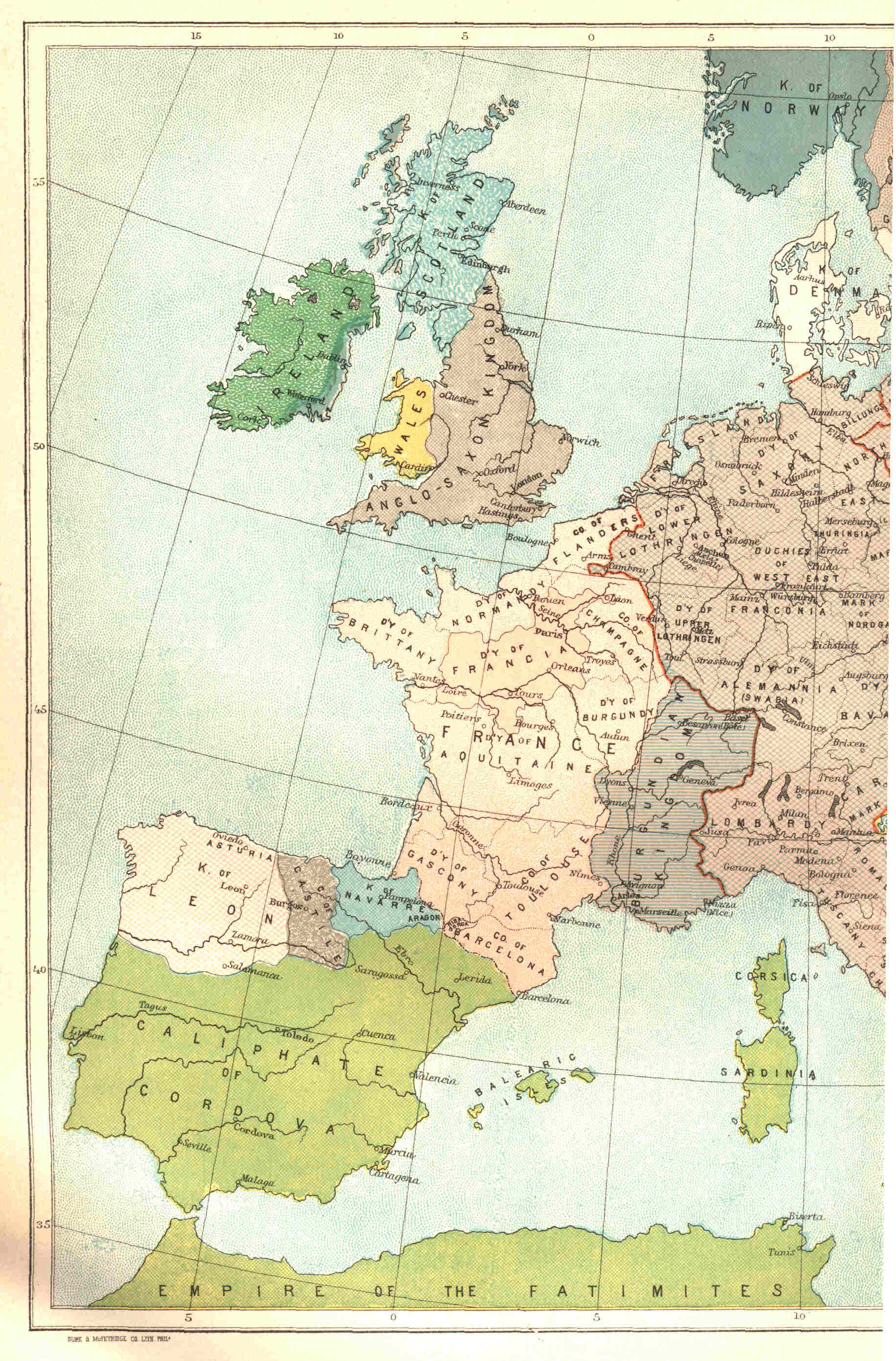
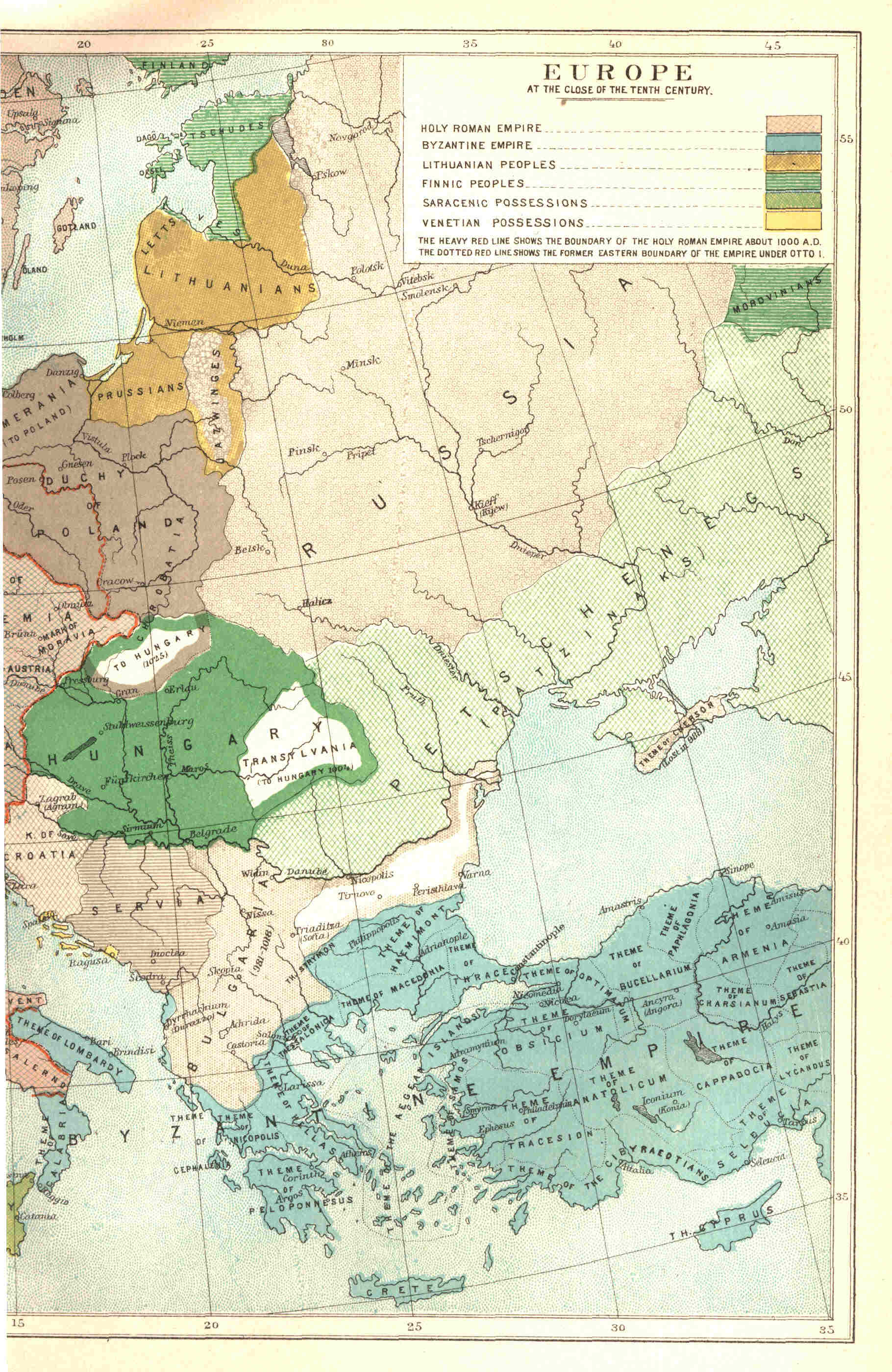
{1021} Germany. In the German kingdom, much the same processes of disintegration had produced much the same results as in France. The great fiefs into which it was divided--the duchies of Saxony, Franconia, Swabia and Bavaria--were even more powerful than the great fiefs of France. When the Carlovingian dynasty came to an end, in 911, the nobles made choice of a king, electing Conrad of Franconia, and, after him (919), Henry the Fowler, Duke of Saxony. The monarchy continued thereafter to be elective, actually as well as in theory, for a long period. Three times the crown was kept in the same family during several successive generations: in the House of Saxony from 919 to 1024; in the House of Franconia from 1024 to 1137; in the House of the Hohenstaufens, of Swabia, from 1137 to 1254: but it never became an acknowledged heritage until long after the Hapsburgs won possession of it; and even to the end the forms of election were preserved. The Holy Roman Empire. The second king of the Saxon dynasty, Otho I., called the Great, recovered the imperial title, which had become extinct again in the West, added the crown of Lombardy to the crown of Germany, and founded anew the Germanic Roman Empire, which Charlemagne had failed to establish enduringly, but which now became one of the conspicuous facts of European history for more than eight hundred years, although seldom more than a shadow and a name. But the shadow and the name were those of the great Rome of antiquity, and the mighty memory it had left in the world gave a superior dignity and rank to these German emperors, even while it diminished their actual power as kings of Germany. It conferred upon them, indeed, more than rank and dignity; it bestowed an "office" which the ideas and feelings of that age could not suffer to remain vacant. The Imperial office seemed to be required, in matters temporal, to balance and to be the complement of the Papal office in matters spiritual. "In nature and compass the government of these two potentates is the same, differing only in the sphere of its working; and it matters not whether we call the Pope a spiritual Emperor, or the Emperor a secular Pope." "Thus the Holy Roman Church and the Holy Roman Empire are one and the same thing, in two aspects; and Catholicism, the principle of the universal Christian society, is also Romanism; that is, rests upon Rome as the origin and type of its universality" (Bryce). These mediæval ideas of the "Holy Roman Empire," as it came to be called (not immediately, but after a time), gave importance to the imperial coronation thenceforth claimed by the German kings. It was a factitious importance, so far as concerned the immediate realm of those kings. In Germany, while it brought no increase to their material power, it tended to alarm feudal jealousies; it tended to draw the kings away from their natural identification with their own country; it tended to distract them from an effective royal policy at home, by foreign ambitions and aims; and altogether it interfered seriously with the nationalization of Germany, and gave a longer play to the disrupting influences of feudalism in that country than in any other. Italy, the Empire and the Papacy. Otto I. had won Italy and the Imperial crown (962) very easily. For more than half a century the peninsula had been in a deplorable state. The elective Lombard crown, quarreled over by the ducal houses of Friuli, Spoleto, Ivrea, Provence, and others, settled nowhere with any sureness, and lost all dignity and strength, though several of the petty kings who wore it had been crowned emperors by the Pope. At Rome, all legitimate government, civil or ecclesiastical, had disappeared. The city and the Church had been for years under the rule of a family of courtesans, who made popes of their lovers and their sons. Southern Italy was being ravaged by the Saracens, who occupied Sicily, and Northern Italy was desolated by the Hungarians. Under these circumstances, Otto I., the German king, listened to an appeal from an oppressed queen, Adelaide, widow of a murdered king, and crossed, the Alps (951), like a gallant knight, to her relief. He chastised and humbled the oppressor, rescued the queen, and married her. A few years later, on further provocation, he entered Italy again, deposed the troublesome King Berengar, caused himself to be crowned King of Italy, and received the imperial crown at Rome (962) from one of the vilest of a vile brood of popes, John XII. Soon afterwards, he was impelled to convoke a synod which deposed this disgraceful pope and elected in his place Leo VIII., who had been Otto's chief secretary. The citizens now conceded to the Emperor an absolute veto on papal elections, and the new pope confirmed their act. The German sovereigns, from that time, for many years, asserted their right to control the filling of the chair of St. Peter, and exercised the right on many occasions, though always with difficulty. Nominally they were sovereigns of Rome and Italy; but during their long absences from the country they scarcely made a show of administrative government in it, and their visits were generally of the nature of expeditions for a reconquest of the land. Their claims of sovereignty were resisted more and more, politically throughout Italy and ecclesiastically at Rome. The Papacy emancipated itself from their control and acquired a natural leadership of Italian opposition to German imperial pretensions. The conflict between these two forces became, as will be seen later on, one of the dominating facts of European history for four centuries--from the eleventh to the fourteenth. {1022} The Italian City-republics. The disorder that had been scarcely checked in Italy since the Goths came into it,--the practical extinction of central authority after Charlemagne dropped his sceptre, and the increasing conflicts of the nobles among themselves,--had one consequence of remarkable importance in Italian history. It opened opportunities to many cities in the northern parts of the peninsula for acquiring municipal freedom, which they did not lack spirit to improve. They led the movement and set the example which created, a little later, so many vigorous communes in Flanders and France, and imperial free cities in Germany at a still later day. They were earlier in winning their liberties, and they pushed them farther,--to the point in many cases of creating, as at Pisa, Genoa, Florence, and Venice, a republican city state. Venice, growing up in the security of her lagoons, from a cluster of fishing villages to a great city of palaces, had been independent from the beginning, except as she acknowledged for a time the nominal supremacy of the Eastern Emperor. Others won their way to independence through struggles that are now obscure, and developed, before these dark centuries reached their close, an energy of life and a splendor of genius that come near to comparison with the power and the genius of the Greeks. But, like the city-republics of Greece, they were perpetually at strife with one another, and sacrificed to their mutual jealousies, in the end, the precious liberty which made them great, and which they might, by a well settled union, have preserved. The Saxon line of Emperors. Such were the conditions existing or taking shape in Italy when the Empire of the West--the Holy Roman Empire of later times--was founded anew by Otho the Great. Territorially, the Empire as he left it covered Germany to its full extent, and two-thirds of Italy, with the Emperor's superiority acknowledged by the subject states of Burgundy, Bohemia, Moravia, Poland, Denmark, and Hungary--the last named with more dispute. Otho the Great died in 972. His two immediate successors, Otho II. (973-983) and Otho III. (983-1002) accomplished little, though the latter had great ambitions, planning to raise Rome to her old place as the capital of the world; but he died in his youth in Italy, and was succeeded by a cousin, Henry II., whose election was contested by rivals in Germany, and repudiated in Italy. In the latter country the great nobles placed Ardoin, marquis of Ivrea, on the Lombard throne; but the factions among them soon caused his overthrow, and, Henry, crossing the Alps, reclaimed the crown. The Franconian Emperors. Henry II. was the last of the Saxon line, and upon his death, in 1024, the House of Franconia came to the throne, by the election of Conrad II., called "the Salic." Under Conrad, the kingdom of Burgundy, afterwards called the kingdom of Arles (which is to be distinguished from the French Duchy of Burgundy--the northwestern part of the old kingdom), was reunited to the Empire, by the bequest of its last king, Rudolph III. Conrad's son, grandson, and great grandson succeeded him in due order; Henry III. from 1039 to 1056; Henry IV. from 1056 to 1106; Henry V. from 1106 to 1125. Under Henry III. the Empire was at the summit of its power. Henry II., exercising the imperial prerogative, had raised the Duke of Hungary to royal rank, giving him the title of king. Henry III. now forced the Hungarian king to acknowledge the imperial supremacy and pay tribute. The German kingdom was ruled with a strong hand and peace among its members compelled. "In Rome, no German sovereign had ever been so absolute. A disgraceful contest between three claimants of the papal chair had shocked even the reckless apathy of Italy. Henry deposed them all and appointed their successor." "The synod passed a decree granting to Henry the right of nominating the supreme pontiff; and the Roman priesthood, who had forfeited the respect of the world even more by habitual simony than by the flagrant corruption of their manners, were forced to receive German after German as their bishop, at the bidding of a ruler so powerful, so severe, and so pious. But Henry's encroachments alarmed his own nobles no less than the Italians, and the reaction, which might have been dangerous to himself, was fatal to his successor. A mere chance, as some might call it, determined the course of history. The great Emperor died suddenly in A. D. 1056, and a child was left at the helm, while storms were gathering that might have demanded the wisest hand" (Bryce). Hildebrand and Henry IV. The child was Henry IV., of unfortunate memory; the storms which beset him blew from Rome. The Papacy, lifted from its degradation by Henry's father and grandfather, had recovered its boldness of tone and enlarged its pretensions and claims. It had come under the influence of an extraordinary man, the monk Hildebrand, who swayed the councils of four popes before he became pope himself (1073), and whose pontifical reign as Gregory VII. is the epoch of greatest importance in the history of the Roman Church. The overmastering ascendancy of the popes, in the Church and over all who acknowledge its communion, really began when this invincible monk was raised to the papal throne. He broke the priesthood and the whole hierarchy of the West to blind obedience by his relentless discipline. He isolated them, as an order apart, by enforcing celibacy upon them; and he extinguished the corrupting practices of simony. Then, when he had marshalled the forces of the Church, he proclaimed its independence and its supremacy in absolute terms. In the growth of feudalism throughout Europe, the Church had become compromised in many ways with the civil powers. Its bishoprics and abbeys had acquired extensively the nature of fiefs, and bishops and abbots were required to do homage to a secular lord before they could receive an "investiture" of the rich estates which had become attached by a feudal tenure to their sees. The ceremony of investiture, moreover, included delivery of the crozier and the pastoral ring, which were the very symbols of their spiritual office. Against this dependence of the Church upon temporal powers, Gregory now arrayed it in revolt, and began the "War of Investitures," which lasted for half a century. The great battle ground was Germany; the Emperor, of necessity, was the chief opponent; and Henry IV., whose youth had been badly trained, and whose authority had been weakened by a long, ill-guardianed minority, was at a disadvantage in the contest. His humiliation at Canossa (1077), when he stood through three winter days, a suppliant before the door of the castle which lodged his haughty enemy, praying to be released from the dread penalties of excommunication, is one of the familiar tableaux of history. He had a poor revenge seven years later, when he took Rome, drove Gregory into the castle St. Angelo, and seated an anti-pope in the Vatican. But his triumph was brief. There came to the rescue of the beleaguered Pope certain new actors in Italian history, whom it is now necessary to introduce. {1023} The Normans in Italy and Sicily. The settlement of predatory Northmen on the Seine, which took the name of Normandy and the constitution of a ducal fief of France, had long since grown into an important half-independent state. Its people--now called Normans in the smoother speech of the South--had lost something of their early rudeness, and had fallen a little under the spell of the rising chivalry of the age; but the goad of a warlike temper which drove their fathers out of Norway still pricked the sons and sent them abroad, in restless search of adventures and gain. Some found their way into the south of Italy, where Greeks, Lombards and Saracens were fighting merrily, and where a good sword and a tough lance were tools of the only industry well-paid. Presently there was banded among them there a little army, which found itself a match for any force that Greek or Lombard, or other opponent, could bring against it, and which proceeded accordingly to work its own will in the land. It seized Apulia (1042) and divided it into twelve countships, as an aristocratic republic. Pope Leo IX. led an army against it and was beaten and taken prisoner (1053). To release himself he was compelled to grant the duchy they had taken to them, as a fief of the Church, and to extend his grant to whatever they might succeed in taking, beyond it. The chiefs of the Normans thus far had been, in succession, three sons of a poor gentleman in the Cotentin, Tancred by name, who now sent a fourth son to the scene. This new comer was Robert, having the surname of Guiscard, who became the fourth leader of the Norman troop (1057), and who, in a few years, assumed the title of Duke of Calabria and Apulia. His duchies comprised, substantially, the territory of the later kingdom of Naples. A fifth brother, Roger, had meantime crossed to Sicily, with a small following of his countrymen; and, between 1060 and 1090, had expelled the Saracens from that island, and possessed it as a fief of his brother's duchy. But in the next generation these relations between the two conquests were practically reversed. The son of Roger received the title of King of Sicily from the Pope, and Calabria and Apulia were annexed to his kingdom, through the extinction of Robert's family. These Normans of Southern Italy were the allies who came to the rescue of Pope Gregory, when the Emperor, Henry IV., besieged him in Castle St. Angelo. He summoned Robert Guiscard as a vassal of the Church, and the response was prompt. Henry and his Germans retreated when the Normans came near, and the latter entered Rome (1084). Accustomed to pillage, they began, soon, to treat the city as a captured place, and the Romans rose against them. They retaliated with torch and sword, and once more Rome suffered from the destroying rage of a barbarous soldiery let loose. "Neither Goth nor Vandal, neither Greek nor German, brought such desolation on the city as this capture by the Normans" (Milman). Duke Robert made no attempt to hold the ruined capital, but withdrew to his own dominions. The Pope went with him, and died soon afterwards (1085), unable to return to Rome. But the imperious temper he had imparted to the Church was lastingly fixed in it, and his lofty pretensions were even surpassed by the pontiffs who succeeded him. He spoke for the Papacy the first syllables of that awful proclamation that was sounded in its finality, after eight hundred years, when the dogma of infallibility was put forth. Norman Conquest of England. The Normans in Italy established no durable power. In another quarter they were more fortunate. Their kinsmen, the Danes, who subjugated England and annexed it to their own kingdom in 1016, had lost it again in 1042, when the old line of kings was restored, in the person of Edward, called the Confessor. But William, Duke of Normandy, had acquired, in the course of these shiftings of the English crown, certain claims which he put forth when Edward died, and when Harold, son of the great Earl Godwine, was elected king to succeed him, in 1066. To enforce his claim, Duke William, commissioned by the Pope, invaded England, in the early autumn of that year, and won the kingdom in the great and decisive battle of Senlac, or Hastings, where Harold was slain. On Christmas Day he was crowned, and a few years sufficed to end all resistance to his authority. He established on the English throne a dynasty which, though shifting sometimes to collateral lines, has held it to the present day. The Norman Conquest, as estimated by its greatest historian, Professor Freeman, wrought more good effects than ill to the English people. It did not sweep away their laws, customs or language, but it modified them all, and not unfavorably; while "it aroused the old national spirit to fresh life, and gave the conquered people fellow-workers in their conquerors." The monarchy was strengthened by William's advantages as a conqueror, used with the wisdom and moderation of a statesman. Feudalism came into England stripped of its disrupting forces; and the possible alternative of absolutism was hindered by potent checks. At the same time, the Conquest brought England into relations with the Continent which might otherwise have arisen very slowly, and thus gave an early importance to the nation in European history. The Crusades. At the period now reached in our survey, all Europe was on the eve of a profounder excitement and commotion than it had ever before known--one which stirred it for the first time with a common feeling and with common thoughts. A great cry ran through it, for help to deliver the holy places of the Christian faith from the infidels who possessed them. The pious and the adventurous, the fanatical and the vagrant, rose up in one motley and tumultuous response to the appeal, and mobs and armies (hardly distinguishable) of Crusaders-- warriors of the Cross--began to whiten the highways into Asia with their bones. The first movement, in 1096, swept 300,000 men, women and children, under Peter the Hermit, to their death, with no other result; but nearly at the same time there went an army, French and Norman for the most part, which made its way to Jerusalem, took the city by assault (1099) and founded a kingdom there, which defended itself for almost a hundred years. Long before it fell, it was pressed sorely by the surrounding Moslems and cried to Europe for help. {1024} A Second Crusade, in 1147, accomplished nothing for its relief, but spent vast multitudes of lives; and when the feeble kingdom disappeared, in 1187, and the Sepulchre of the Saviour was defiled again by unbelievers, Christendom grew wild, once more, with passion, and a Third Crusade was led by the redoubtable Emperor Frederick Barbarossa, of Germany, King Richard Cœur de Lion, of England, and King Philip Augustus of France. The Emperor perished miserably on the way and his army was wasted in its march; the French and English exhausted themselves in sieges which won nothing of durable advantage to the Christian world; the Sultan Saladin gathered most of the laurels of the war. The Turks on the Scene. The armies of Islam which the Crusaders encountered in Asia Minor and the Holy Land were no longer, in their leadership, of the race of Mahomet. The religion of the Prophet was still triumphant in the East, but his nation had lost its lordship, and Western Asia had submitted to new masters. These were the Turks--Turks of the House of Seljuk--first comers of their swarm from the great Aral basin. First they had been disciples, won by the early armed missionaries of the Crescent; then servants and mercenaries, hired to fight its battles and guard its princes, when the vigor of the Arab conquerors began to be sapped, and their character to be corrupted by luxury and pride; then, at last, they were masters. About the middle of the ninth century, the Caliph at Bagdad became a puppet in their hands, and the Moslem Empire in Asia (Africa and Spain being divided between rival Caliphs) soon passed under their control. These were the possessors of Jerusalem and its sacred shrines, whose grievous and insulting treatment of Christian pilgrims, in the last years of the eleventh century, had stirred Europe to wrath and provoked the great movement of the Crusades. The movement had important consequences, both immediate and remote; but its first effects were small in moment compared with those which lagged after. To understand either, it will be necessary to glance back at the later course of events in the Eastern or Byzantine Empire. The Byzantine Empire. The fortunes of the Empire, since it gave up Syria and Egypt to the Saracens, had been, on the whole, less unhappy than the dark prospect at that time. It had checked the onrush of Arabs at the Taurus mountain range, and retained Asia Minor; it had held Constantinople against them through two terrible sieges; it had fought for three centuries, and finally subdued, a new Turanian enemy, the Bulgarians, who had established a kingdom south of the Danube, where their name remains to the present day. The history of its court, during much of the period, had been a black and disgusting record of conspiracies, treacheries, murders, mutilations, usurpations and foul vices of every description; with now and then a manly figure climbing to the throne and doing heroic things, for the most part uselessly; but the system of governmental administration seems to have been so well constructed that it worked with a certain independence of its vile or imbecile heads, and the country was probably better and better governed than its court. At Constantinople, notwithstanding frequent tumults and revolutions, there had been material prosperity and a great gathering of wealth. The Saracen conquests, by closing other avenues of trade between the East and the West, had concentrated that most profitable commerce in the Byzantine capital. The rising commercial cities of Italy--Amalphi, Venice, Genoa, Pisa--seated their enterprises there. Art and literature, which had decayed, began then to revive, and Byzantine culture, on its surface, took more of superiority to that of Teutonic Europe. The conquests of the Seljuk Turks gave a serious check to this improvement of the circumstances of the Empire. Momentarily, by dividing the Moslem power in Asia, they had opened an opportunity to an energetic Emperor, Nicephorus Phocas, to recover northern Syria and Cilicia (961-969). But when, in the next century, they had won a complete mastery of the dominions of the Caliphate of Bagdad, they speedily swept back the Byzantines, and overran and occupied the most of Asia Minor and Armenia. A decisive victory at Manzikert, in 1071, when the emperor of the moment was taken prisoner and his army annihilated, gave them well nigh the whole territory to the Hellespont. The Empire was nearly reduced to its European domain, and suffered ten years of civil war between rivals for the throne. At the end of that time it acquired a ruler, in the person of Alexius Comnenus, who is the generally best known of all the Byzantine line, because he figures notably in the stories of the First Crusade. He was a man of crafty abilities and complete unscrupulousness. He took the Empire at its lowest state of abasement and demoralization. In the first year of his reign he had to face a new enemy. Robert Guiscard, the Norman, who had conquered a dukedom in Southern Italy, thought the situation favorable for an attack on the Eastern Empire, and for winning the imperial crown. Twice he invaded the Greek peninsula (1081-1084) and defeated the forces brought against him by Alexius; but troubles in Italy recalled him on the first occasion, and his death brought the second expedition to naught. Such was the situation of the Byzantines when the waves of the First Crusade, rolling Asia-ward, surged up to the gates of Constantinople. It was a visitation that might well appall them,--these hosts of knights and vagabonds, fanatics and freebooters, who claimed and proffered help in a common Christian war with the infidels, and who, nevertheless, had no Christian communion with them--schismatics as they were, outside the fold of the Roman shepherd. There is not a doubt that they feared the crusading Franks more than they feared the Turks. They knew them less, and the little hearsay knowledge they had was of a lawless, barbarous, fighting feudalism in the countries of the West,--more rough and uncouth, at least, than their own defter methods of murdering and mutilating one another. They received their dangerous visitors with nervousness and suspicion; but Alexius Comnenus proved equal to the delicate position in which he found himself placed. He burdened his soul with lies and perfidies; but he managed affairs so wonderfully that the Empire plucked the best fruits of the first Crusades, by recovering a great part of Asia Minor, with all the coasts of the Euxine and the Ægean, from the weakened Turks. The latter were so far shaken and depressed by the hard blows of the Crusaders that they troubled the Byzantines very little in the century to come. {1025} But against this immediate gain to the Eastern Empire from the early Crusades, there were serious later offsets. The commerce of Constantinople declined rapidly, as soon as the Moslem blockade of the Syrian coast line was broken. It lost its monopoly. Trade ran back again into other reopened channels. The Venetians and Genoese became more independent. Formerly, they had received privileges in the Empire as a gracious concession. Now they dictated the terms of their commercial treaties and their naval alliances. Their rivalries with one another involved the Empire in quarrels with both, and a state of things was brought about which had much to do with the catastrophe of 1204, when the fourth Crusade was diverted to the conquest of Constantinople, and a Latin Empire supplanted the Empire of the Roman-Greeks. Effects of the Crusades. Briefly noted, these were the consequences of the early Crusades in the East. In western Europe they had slower, but deeper and more lasting effects. They weakened feudalism, by sending abroad so many of the feudal lords, and by impoverishing so many more; whereby the towns gained more opportunity for enfranchisement, and the crown, in France particularly, acquired more power. They checked smaller wars and private quarrels for a time, and gave in many countries unwonted seasons of peace, during which the thoughts and feelings of men were acted on by more civilizing influences. They brought men into fellowship who were only accustomed to fight one another, and thus softened their provincial and national antipathies. They expanded the knowledge--the experience--the ideas--of the whole body of those who visited the East and who survived the adventurous expedition; made them acquainted with civilizations at least more polished than their own; taught them many things which they could only learn in those days by actual sight, and sent them back to their homes throughout Europe, to be instructors and missionaries, who did much to prepare Western Christendom for the Renaissance or new birth of a later time. The twelfth century--the century of the great Crusades--saw the gray day-break in Europe after the long night of darkness which settled down upon it in the fifth. In the thirteenth it reached the brightening dawn, and in the fifteenth it stood in the full morning of the modern day. Among all the movements by which it was pushed out of darkness into light, that of the Crusades would appear to have been the most important; important in itself, as a social and political movement of great change, and important in the seeds that it scattered for a future harvest of effects. In both the Byzantine and Arabian civilizations of the East there was much for western Europe to learn. Perhaps there was more in the last named than in the first; for the Arabs, when they came out from behind their deserts, and exchanged the nomadic life for the life of cities, had shown an amazing avidity for the lingering science of old Greece, which they encountered in Egypt and Syria. They had preserved far more of it, and more of the old fineness of feeling that went with it, than had survived in Greece itself, or in any part of the Teutonized empire of Rome. The Crusaders got glimpses of its influence, at least, and a curiosity was wakened, which sent students into Moorish Spain, and opened scholarly interchanges which greatly advanced learning in Europe. Rising Power of the Church. Not the least important effect of the Crusades was the atmosphere of religion which they caused to envelope the great affairs of the time, and which they made common in politics and society. The influence of the Church was increased by this; and its organization was powerfully strengthened by the great monastic revival that followed presently: the rise of purer and more strictly disciplined orders of the "regular" (that is the secluded or monastic) clergy--Cistercians, Benedictines, Franciscans, Dominicans, etc.; as well as the creation of the great military-religious orders--Knights Templars, Knights of the Hospital of St. John, Teutonic Knights, and others, which were immediately connected with the Crusades. To say that the Church gained influence is to say that the clergy gained it, and that the chief of the clergy, the Pope, concentrated the gain in himself. The whole clerical body was making encroachments in every field of politics upon the domain of the civil authority, using shrewdly the advantages of superior learning, and busying itself more and more in temporal affairs. The popes after Gregory VII. maintained his high pretensions and pursued his audacious course. In most countries they encountered resistance from the Crown; but the brunt of the conflict still fell upon the emperors, who, in some respects, were the most poorly armed for it. Guelfs and Ghibellines. Henry IV., who outlived his struggle with Gregory, was beaten down at last--dethroned by a graceless son, excommunicated by a relentless Church and denied burial when he died (1106) by its clergy. The rebellious son, Henry V., in his turn fought the same battle over for ten years, and forced a compromise which saved about half the rights of investiture that his father had claimed. His death (1125) ended the Franconian line, and the imperial crown returned for a few years to the House of Saxony, by the election of the Duke Lothaire. But the estates of the Franconian family had passed, by his mother, to Frederick of Hohenstaufen, duke of Swabia; and now a bitter feud arose between the House of Saxony and the House of Hohenstaufen or Swabia,--a feud that was the most memorable and, the longest lasting in history, if measured by the duration of party strifes which began in it and which took their names from it. For the raging factions of Guelfs and Ghibellines which divided Italy for two centuries had their beginning in this Swabian-Saxon feud, among the Germans. The Guelfs were the partisans of the House of Saxony; the Ghibellines were the party of the Hohenstaufens. The Hohenstaufens triumphed when Lothaire died (1138), and made Conrad of their House Emperor. They held the crown, moreover, in their family for four generations, extending through more than a century; and so it happened that the German name of the German party of the Hohenstaufens came to be identified in Italy with the party or faction in that country which supported imperial interests and claims in the free cities and against the popes. Whereupon the opposed party name was borrowed from Germany likewise and applied to the Italian faction which took ground against the Emperors--although these Italian Guelfs had no objects in common with the partisans of Saxony. {1026} The Hohenstaufens in Italy. The first Hohenstaufen emperor was succeeded (1152) by his nephew Frederick I., called Barbarossa, because of his red beard. The long reign of Frederick, until 1190, was mainly filled with wars and contentions in Italy, where he pushed the old quarrel of the Empire with the Papacy, and where, furthermore, he resolutely undertook to check the growing independence of the Lombard cities. Five times during his reign he led a great army into the peninsula, like a hostile invader, and his destroying marches through the country, of which he claimed to be sovereign, were like those of the barbarians who came out of the North seven centuries before. The more powerful cities, like Milan, were undoubtedly oppressing their weaker neighbors, and Barbarossa assumed to be the champion of the latter. But he smote impartially the weak and the strong, the village and the town, which provoked his arrogant temper in the slightest degree. Milan escaped his wrath on the first visitation, but went down before it when he came again (1158), and was totally destroyed, the inhabitants being scattered in other towns. Even the enemies of Milan were moved to compassion by the savageness of this punishment, and joined, a few years later, in rebuilding the prostrate walls and founding Milan anew. A great "League of Lombardy" was formed by all the northern towns, to defend their freedom against the hated Emperor, and the party of the Ghibellines was reduced for the time to a feeble minority. Meantime Barbarossa had forced his way into Rome, stormed the very Church of St. Peter, and seated an anti-pope on the throne. But a sudden pestilence fell upon his army, and he fled before it, out of Italy, almost alone. Yet he never relaxed his determination to bend both the Papacy and the Lombard republics to his will. After seven years he returned, for the fifth time, and it proved to be the last. The League met him at Legnano (1176) and administered to him an overwhelming defeat. Even his obstinacy was then overcome, and after a truce of six years he made peace with the League and the Pope, on terms which conceded most of the liberties that the cities claimed. It was in the reign of Frederick that the name "Holy Roman Empire" began, it seems, to be used. Frederick died while on a crusade and was succeeded (1190) by his son, Henry VI., who had married the daughter and heiress of the King of Sicily and who acquired that kingdom in her right. His short reign was occupied mostly in subduing the Sicilian possession. When he died (1197) his son Frederick was a child. Frederick succeeded to the crown of Sicily, but his rights in Germany (where his father had already caused him to be crowned "King of the Romans"--the step preliminary to an imperial election) were entirely ignored. The German crown was disputed between a Swabian and a Saxon claimant, and the Saxon, Otho, was King and Emperor in name, until 1218, when he died. But he, too, quarreled with a pope, about the lands of the Countess Matilda, which she gave to the Church; and his quarrel was with Innocent III., a pope who realized the autocracy which Hildebrand had looked forward to, and who lifted the Papacy to the greatest height of power it ever attained. To cast down Otho, Innocent took up the cause of Frederick, who received the royal crown a second time, at Aix-la-Chapelle (1215) and the imperial crown at Rome (1220). Frederick II. (his designation) was one of the few men of actual genius who have ever sprung from the sovereign families of the world; a man so far in advance of his time that he appears like a modern among his mediæval contemporaries. He was superior to the superstitions of his age,--superior to its bigotries and its provincialisms. His large sympathies and cosmopolitan frame of mind were acted upon by all the new impulses of the epoch of the crusades, and made him reflect, in his brilliant character, as in a mirror, the civilizing processes that were working on his generation. Between such an emperor as Frederick II. and such popes as Innocent III. and his immediate successors, there could not fail to be collision and strife. The man who might, perhaps, under other circumstances, have given some quicker movement to the hands which measure human, progress on the dial of time, spent his life in barely proving his ability to live and reign under the anathemas and proscriptions of the Church. But he fought a losing fight, even when he seemed to be winning victories in northern Italy, over the Guelf cities of Lombardy, and when the party of the Ghibellines appeared to be ascendant throughout the peninsula. His death (1250) was the end of the Hohenstaufens as an imperial family. His son, Conrad, who survived him four years, was king of Sicily and had been crowned king of Germany; but he never wore the crown imperial. Conrad's illegitimate brother, Manfred, succeeded on the Sicilian throne; but the implacable Papacy gave his kingdom to Charles of Anjou, brother of King Louis IX. of France, and invited a crusade for the conquest of it. Manfred was slain in battle, Conrad's young son, Conradin, perished on the scaffold, and the Hohenstaufens disappeared from history. Their rights, or claims, in Sicily and Naples, passed to the Spanish House of Aragon, by the marriage of Manfred's daughter to the Aragonese king; whence long strife between the House of Anjou and the House of Aragon, and a troubled history for the Neapolitans and the Sicilians during some centuries. In the end, Anjou kept Naples, while Aragon won Sicily; the kings in both lines called themselves Kings of Sicily, and a subsequent re-union of the two crowns created a very queerly named "Kingdom of the Two Sicilies." {1027} Germany and the Empire. After the death of Frederick II., the German kings, while maintaining the imperial title, practically abandoned their serious attempts to enforce an actual sovereignty in Italy. The Holy Roman Empire, as a political factor comprehending more than Germany, now ceased in reality to exist. The name lived on, but only to represent a flattering fiction for magnifying the rank and importance of the German kings. In Italy, the conflict, as between Papacy and Empire, or between Lombard republican cities and Empire, was at an end. No further occasion existed for an imperial party, or an anti-imperial party. The Guelf and Ghibelline names and divisions had no more the little meaning that first belonged to them. But Guelfs and Ghibellines raged against one another, more furiously than before, and generations passed before their feud died out. While the long, profitless Italian conflict of the Emperors went on, their kingship in Germany suffered sorely. As they grasped at a shadowy imperial title, the substance of royal authority slipped from them. Their frequent prolonged absence in Italy gave opportunities for enlarged independence to the German princes and feudal lords; their difficulties beyond the Alps forced them to buy support from their vassals at home by fatal concessions and grants; their neglect of German affairs weakened the ties of loyalty, and provoked revolts. The result might have been a dissolution of Germany so complete as to give rise to two or three strong states, if another potent influence had not worked injury in a different way. This came from the custom of equalized inheritance which prevailed among the Germans. The law of primogeniture, which already governed hereditary transmissions of territorial sovereignty in many countries, even where it did not give an undivided private estate, as in England, to the eldest son of a family, got footing in Germany very late and very slowly. At the time now described, it was the quite common practice to divide principalities between all the sons surviving a deceased duke or margrave. It was this practice which gave rise to the astonishing number of petty states into which Germany came to be divided, and the forms of which are still intact. It was this, in the main, which prevented the growth of any states to a power that would absorb the rest. On the other hand, the flimsy, half fictitious general constitution which the Empire substituted for such an one as the Kingdom of Germany would naturally have grown into, made an effective centralization of sovereignty--easy as the conditions seemed to be prepared for it--quite impossible. Free Cities in Germany and their Leagues. One happy consequence of this state of things was the enfranchisement, either wholly or nearly so, of many thriving cities. The growth of cities, as centers of industry and commerce, and the development of municipal freedom among them, was considerably later in Germany than in Italy, France and the Netherlands; but the independence gained by some among them was more entire than in the Low Countries or in France, and more lasting than in Italy. Most of the free cities of Germany were directly or immediately subject to the Emperor, and wholly independent of the princes whose territories surrounded them; whence they were called "imperial cities." This relationship bound them to the Empire by strong ties; they had less to fear from it than from the nearer small potentates of their country; and it probably drew a considerable part of such strength as it possessed, in the twelfth and thirteenth centuries, from their support. Their own power was being augmented at this period by the formation of extensive Leagues among them, for common defense, and for the protection, regulation and extension of their trade. In that age of lawless violence, there was so little force in government, everywhere, and so entire a want of co-operation between governments, that the operations of trade were exposed to piracy, robbery, and black-mail, on every sea and in every land. By the organization of their Leagues, the energetic merchants of north-western Europe did for themselves what their half-civilized governments failed to do for them. They not only created effective agencies for the protection of their trade, but they legislated, nationally and internationally, for themselves, establishing codes and regulations, negotiating commercial treaties, making war, and exercising many functions and powers that seem strange to modern times. The great Hansa, or Hanseatic League, which rose to importance in the thirteenth century among the cities in the north of Germany, was the most extensive, the longest lasting and the most formidable of these confederations. It controlled the trade between Germany, England, Russia, the Scandinavian countries, and the Netherlands, and through the latter it made exchanges with southern Europe and the East. It waged successful war with Denmark, Sweden and Norway combined, in defiance of the opposition of the Emperor and the Pope. But the growth of its power engendered an arrogance which provoked enmity in all countries, while the slow crystalizing of nationalities in Europe, with national sentiments and ambitions, worked in all directions against the commercial monopoly of the Hansa towns. By the end of the fifteenth century their league had begun to break up and its power to decline. The lesser associations of similar character--such as the Rhenish and the Swabian--had been shorter-lived. The Great Interregnum. These city-confederations represented in their time the only movement of concentration that appeared in Germany. Every other activity seemed tending toward dissolution. Headship there was none for a quarter of a century after Frederick II. died. The election of the Kings, who took rank and title as Emperors when crowned by the Pope, had now become the exclusive privilege of three prince-bishops and four temporal princes, who acquired the title of Electors. Jealous of one another, and of all the greater lords outside their electoral college, it was against their policy to confer the scepter on any man who seemed likely to wield it with a strong hand. For twenty years--a period in German history known as the Great Interregnum--they kept the throne practically vacant. Part of the Electors were bribed to choose Richard, Earl of Cornwall, brother of the English King Henry III., and the other part gave their votes to Alfonso, King of Castile. Alfonso never came to be crowned, either as King or Emperor; Richard was crowned King, but exercised no power and lived mostly in his own country. The Empire was virtually extinct; the Kingdom hardly less so. Burgundy fell away from the imperial jurisdiction even more than Italy did. Considerable parts of it passed to France. {1028} Rise of the House of Austria. At last, in 1273, the interregnum was ended by the election of a German noble to be King of Germany. This was Rodolph, Count of Hapsburg,--lord of a small domain and of little importance from his own possessions, which explains, without doubt, his selection. But Rodolph proved to be a vigorous king, and he founded a family of such lasting stamina and such self-seeking capability that it secured in time permanent possession of the German crown, and acquired, outside of Germany, a great dominion of its own. He began the aggrandizement of his House by taking the fine duchy of Austria from the kingdom of Bohemia and bestowing it upon his sons. He was energetic in improving opportunities like this, and energetic, too, in destroying the castles of robber-knights and hanging the robbers on their own battlements; but of substantial authority or power he had little enough. He never went to Rome for the imperial crown; nor troubled himself much with Italian affairs. On Rodolph's death (1291), his son Albert of Austria was a candidate for the crown. The Electors rejected him and ejected another poor noble, Adolphus of Nassau; but Adolphus displeased them after a few years, and they decreed his deposition, electing Albert in his place. War followed and Adolphus was killed. Albert's reign was one of vigor, but he accomplished little of permanent effect. He planted one of his sons on the throne of Bohemia, where the reigning family had become extinct; but the new king died in a few months, much hated, and the Bohemians resisted an Austrian successor. In 1308, Albert was assassinated, and the electors raised Count Henry of Luxemburg to the throne, as Henry VII. Henry VII. was the first king of Germany since the Hohenstaufens who went to Italy (1310) for the crown of Lombardy and the crown of the Cæsars, both of which he received. The Ghibelline party was still strong among the Italians. In the distracted state of that country there were many patriots--the poet Dante prominent among them--who hoped great things from the reappearance of an emperor; but the enthusiastic welcome he received was mainly from those furious partisans who looked for a party triumph to be won under the new emperor's lead. When they found that he would not let himself be made an instrument of faction in the unhappy country, they turned against him. His undertakings in Italy promised nothing but failure, when he died suddenly (1313), from poison, as the Germans believed. His successor in Germany, chosen by the majority of the electors, was Lewis of Bavaria; but Frederick the Fair of Austria, supported by a minority, disputed the election, and there was civil war for twelve years, until Frederick, a prisoner, so won the heart of Lewis that the latter divided the throne with him and the two reigned together. France under the Capetians. While Germany and the fictitious Empire linked with it were thus dropping from the foremost place in western Europe into the background, several kingdoms were slowly emerging out of the anarchy of feudalism, and acquiring the organization of authority and law which creates stable and substantial power. France for two centuries, under the first three Capetian kings, had made little progress to that end. At the accession (1103) of the fourth of those kings, namely, Louis VI., it is estimated that the actual possessions of the Crown, over which it exercised sovereignty direct, equalled no more than about five of the modern departments of France; while twenty-nine were in the great fiefs of Flanders, Burgundy, Champagne, Normandy, Brittany, Anjou, Vermandois, and Boulogne, where the royal authority was but nominal; thirty-three, south of the Loire, were hardly connected with the Crown, and twenty-one were then dependent on the Empire. The actual "France," as a kingdom, at that time, was very small. "The real domain of Louis VI. was almost confined to the five towns of Paris, Orleans, Estampes, Melun, and Compiegne, and to estates in their neighbourhood." But the strengthening of the Crown was slightly begun in the reign of this king, by his wise policy of encouraging the enfranchisement of the communes, as noted before, which introduced a helpful alliance between the monarchy and the burgher-class, or third estate, as it came to be called, of the cities, against the feudal aristocracy. But progress in that direction was slight at first and slowly made. Louis VII., who came to the throne in 1137, acquired momentarily the great duchy of Aquitaine, or Guienne, by his marriage with Eleanor, who inherited it; but he divorced her, and she married Henry Plantagenet, who became Henry II., King of England, being at the same time Duke of Normandy, by inheritance from his mother, and succeeding his father in Anjou, Maine and Touraine. Eleanor having carried to him the great Aquitanian domain of her family, he was sovereign of a larger part of modern France than owned allegiance to the French king. French recovery of Normandy and Anjou, But the next king in France, Philip, called Augustus (1180), who was the son of Louis VII., wrought a change of these circumstances. He was a prince of remarkable vigor, and he rallied with rare ability all the forces that the Crown could command. He wrested Vermandois from the Count of Flanders, and extorted submission from the rebellious Duke of Burgundy. Suspending his projects at home for a time, to go crusading to the Holy Land in company with King Richard of England, he resumed them with fresh energy after Richard's death. The latter was succeeded by his mean brother John, who seems to have been hated with unanimity. John was accused of the murder of his young nephew, Arthur of Brittany, who disputed the inheritance from Richard. As Duke of Normandy and Anjou, John, though King of England, was nevertheless a vassal of the King of France. Philip summoned him, on charges, to be tried by his peers. John failed to answer the summons, and the forfeiture of his fiefs was promptly declared. The French king stood well prepared to make the confiscation effective, while John, in serious trouble with his English subjects, could offer little resistance. Thus the Norman realm of the English kings--their original dominion--was lost beyond recovery, and with it Anjou and Maine. They held Guienne and Poitou for some years; but the bases of the French monarchy were broadened immensely from the day when the great Norman and Angevin fiefs became royal domain. {1029} The Albigenses. Events in the south of France, during Philip's reign, prepared the way for a further aggrandisement of the Crown. Ancient Latin civilization had lingered longer there, in spirit, at least, than in the central and northern districts of the kingdom, and the state of society intellectually was both livelier and more refined. It was the region of Europe where thought first showed signs of independence, and where the spiritual despotism of Rome was disputed first. A sect arose in Languedoc which took its name from the district of Albi, and which offended the Church perhaps more by the freedom of opinion that it claimed than by the heresy of the opinions themselves. These Albigeois, or Albigenses, had been at issue with the clergy of their country and with the Papacy for some years before Innocent III., the pontifical autocrat of his age, proclaimed a crusade against them (1208), and launched his sentence of excommunication against Raymond, Count of Toulouse, who gave them countenance if not sympathy. The fanatical Simon de Montfort, father of the great noble of like name who figures more grandly in English history, took the lead of the Crusade, to which bigots and brutal adventurers flocked together. Languedoc was wasted with fire and sword, and after twenty years of intermittent war, in which Peter of Aragon took part, assisting the Albigeois, the Count of Toulouse purchased peace for his ruined land by ceding part of it to the king of France, and giving his daughter in marriage to the king's brother Alphonso,--by which marriage the remainder of the country was transferred, a few years later, to the French crown. The Battle of Bouvines. Philip Augustus, in whose reign this brutal crushing of Provençal France began, took little part in it, but he saw with no unwillingness another too powerful vassal brought low. The next blow of like kind he struck with his own hand. John of England had quarreled with the mighty Pope Innocent III.; his kingdom had been placed under interdict and his subjects absolved from their allegiance. Philip of France eagerly offered to become the executor of the papal decree, and gathered an army for the invasion of England, to oust John from his throne. But John hastened now to make peace with the Church, submitting himself, surrendering his kingdom to the Pope, and receiving it back as a papal fief. This accomplished, the all-powerful pontiff persuaded the French king to turn his army against the Count of Flanders, who had never been reduced to a proper degree of submission to his feudal sovereign. He seems to have become the recognized head of a body of nobles who showed alarm and resentment at the growing power of the Crown, and the war which ensued was quite extraordinary in its political importance. King John of England came personally to the assistance of the Flemish Count, because of the hatred he felt towards Philip of France. Otho, Emperor of Germany, who had been excommunicated and deposed by the Pope, and who was struggling for his crown with the young Hohenstaufen, Frederick II., took part in the melee, because John was his uncle, and because the Pope was for Philip, and because Germany dreaded the rising power of France. So the war, which seemed at first to be a trifling affair in a corner, became in fact a grand clearing storm, for the settlement of many large issues, important to all Europe. The settlement was accomplished by a single decisive battle, fought at Bouvines (1214), not far from Tournay. It established effectively in France the feudal superiority and actual sovereignty of the king. It evoked a national spirit among the French people, having been their first national victory, won under the banners of a definite kingdom, over foreign foes. It was a triumph for the Papacy and the Church and a crushing blow to those who dared resist the mandates of Rome. It sent King John back to England so humbled and weakened that he had little stomach for the contest which awaited him there, and the grand event of the signing of Magna Charta next year was more easily brought about. It settled the fate of Otho of Germany, and cleared the bright opening of the stormy career of Frederick II., his successor. Thus the battle of Bouvines, which is not a famous field in common knowledge, must really be numbered among the great and important battles of the world. When Philip Augustus died in 1223, the regality which he bequeathed to his son, Louis VIII., was something vastly greater than that which came to him from his predecessors. He had enhanced both the dignity and the power, both the authority and the prestige, of the Crown, and made a substantial kingdom of France. Louis VIII. enlarged his dominions by the conquest of Lower Poitou and the taking of Rochelle from the English; but he sowed the seeds of future weakness in the monarchy by creating great duchies for his children, which became as troublesome to later kings as Normandy and Anjou had been to those before him. Saint Louis. Louis IX.--Saint Louis in the calendar of the Catholic Church--who came to the throne in 1226, while a child of eleven years, was a king of so noble a type that he stands nearly alone in history. Marcus Aurelius, the Emperor, and King Alfred of England, are the only sovereigns who seem worthy to be compared with him; and even the purity of those rare souls is not quite so simple and so selfless, perhaps, as that which shines in the beautiful character of this most Christian king. His goodness was of that quality which rises to greatness--above all other measures of greatness in the distinction of men. It was of that quality which even a wicked world is compelled to feel and to bend to as a power, much exceeding the power of state-craft or of the sword. Of all the kings of his line, this Saint Louis was probably the one who had least thought of a royal interest in France distinct from the interest of the people of France; and the one who consciously did least to aggrandize the monarchy and enlarge its powers; but no king before him or after him was so much the true architect of the foundations of the absolute French monarchy of later times. His constant purpose was to give peace to his kingdom and justice to his people; to end violence and wrong-doing. {1030} In pursuing this purpose, he gave a new character and a new influence to the royal courts,--established them in public confidence,--accustomed his subjects to appeal to them; he denounced the brutal senselessness of trials by combat, and commanded their abolition; he gave encouragement to the study and the introduction of Roman law, and so helped to dispel the crude political as well as legal ideas that feudalism rested on. His measures in these directions all tended to the undermining of the feudal system and to the breaking down of the independence of the great vassals who divided sovereignty with the king. At the same time the upright soul of King Louis, devotedly pious son of the Church as he was, yielded his conscience to it, and the just ordinances of his kingdom, no more than he yielded to the haughty turbulence of the great vassals of the crown. The great misfortunes of the reign of Saint Louis were the two calamitous Crusades in which he engaged (1248-1254, and 1270), and in the last of which he died. They were futile in every way--as unwisely conducted as they were unwisely conceived; but they count among the few errors of a noble, great life. Regarded altogether, in the light which after-history throws back upon it, the reign of Louis IX. is more loftily distinguished than any other in the annals of France. Philip the Fair and Pope Boniface. There is little to distinguish the reign of St. Louis' son, Philip III., "le Hardi," "the Rash" (1270-1285), though the remains of the great fief of Toulouse were added in his time to the royal domain; but under the grandson of St. Louis, the fourth Philip, surnamed "le Bel," there was a season of storms in France. This Philip was unquestionably a man of clear, cold intellect, and of powerful, unbending will. There was nothing of the soldier in him, much of the lawyer-like mind and disposition. The men of the gown were his counsellors; he advanced their influence, and promoted the acceptance in France of the principles of the Roman or civil law, which were antagonistic to feudal ideas. In his attitude towards the Papacy--which had declined greatly in character and power within the century past--he was extraordinarily bold. His famous quarrel with Pope Boniface VIII. resulted in humiliations to the head of the Church from which, in some respects, there was no recovery. The quarrel arose on questions connected chiefly with the taxing of the clergy. The Pope launched one angry Bull after another against the audacious king, and the latter retorted with Ordinances which were as effective as the Bulls. Excommunication was defied; the Inquisition was suppressed in France; appeal taken to a General Council of the Church. At last Boniface suffered personal violence at the hands of a party of hired ruffians, in French pay, who attacked him at his country residence, and received such indignities that he expired soon after of shame and rage. The pope immediately succeeding died a few months later, and dark suspicions as to the cause of his death were entertained; for he gave place (1305) to one, Clement V., who was the tool of the French king, bound to him by pledges and guarantees before his election. This Pope Clement removed the papal residence from Rome to Avignon, and for a long period--the period known as "the Babylonish Captivity"--the Holy See was subservient to the monarchy of France. In this contest with the Papacy, Philip threw himself on the support of the whole body of his people, convoking (1302) the first meeting of the Three Estates--the first of the few general Parliaments--ever assembled in France. Destruction of the Templars. A more sinister event in the reign of Philip IV. was his prosecution and destruction of the famous Order of the Knights Templars. The dark, dramatic story has been told many times, and its incidents are familiar. Perhaps there will never be agreement as to the bottom of truth that might exist in the charges brought against the Order; but few question the fact that its blackest guilt in the eyes of the French King was its wealth, which he coveted and which he was resolved to find reasons for taking to himself. The knights were accused of infidelity, blasphemy, and abominable vices. They were tried, tortured, tempted to confessions, burned at the stake, and their lands and goods were divided between the Crown and the Knights of St. John. Flemish Wealth and Independence. The wilful king had little mercy in his cold heart and few scruples in his calculating brain. His character was not admirable; but the ends which he compassed were mostly good for the strength and independence of the monarchy of France, and, on the whole, for the welfare of the people subject to it. Even the disasters of his reign had sometimes their good effect: as in the case of his failure to subjugate the great county of Flanders. Originally a fief of the Kings of France, it had been growing apart from the French monarchy, through the independent interests and feelings that rose in it with the increase of wealth among its singularly industrious and thrifty people. The Low Countries, or Netherlands, on both sides of the Rhine, had been the first in western Europe to develop industrial arts and the trade that goes with them in a thoroughly intelligent and systematic way. The Flemings were leaders in this industrial development. Their country was full of busy cities,--communes, with large liberties in possession,--where prosperous artisans, pursuing many crafts, were organized in gilds and felt strong for the defense of their chartered rights. Ghent exceeded Paris in riches and population at the end of the thirteenth century. Bruges was nearly its equal; and there were many of less note. The country was already a prize to be coveted by kings; and the kings of France, who claimed the rights of feudal superiority over its count, had long been seeking to make their sovereignty direct, while the spirit of the Flemings carried them more and more toward independence. In 1294, Philip IV. became involved in war with Edward I. of England over Guienne. Flanders, which traded largely with England and was in close friendship with the English king and people, took sides with the latter, and was basely abandoned when Philip and Edward made peace, in 1302. The French king then seized his opportunity to subjugate the Flemings, which he practically accomplished for a time, mastering all of their cities except Ghent. His need and his greed made the burden of taxes which he now laid on these new subjects very heavy and they were soon in revolt. By accident, and the folly of the French, they won a fearfully decisive victory at Courtray, where some thousands of the nobles and knights of France charged blindly into a canal, and were drowned, suffocated and slaughtered in heaps. The carnage was so great that it broke the strength of the feudal chivalry of France, and the French crown, while it lost Flanders, yet gained power from the very disaster. {1031} In 1314, Philip IV. died, leaving three sons, who occupied the throne for brief terms in succession: Louis X, surnamed Hutin (disorder), who survived his father little more than a year; Philip V., called "the Long" (1316-1322), and Charles IV., known as "the Fair" (1322-1328). With the death of Charles the Fair, the direct line of the Capetian Kings came to an end, and Philip, Count of Valois, first cousin of the late kings, and grandson of Philip III., came to the throne, as Philip VI.--introducing the Valois line of kings. Claims of Edward III. of England. The so-called Salic law, excluding females, in France, from the throne, had now, in the arrangement of these recent successions, been affirmed and enforced. It was promptly disputed by King Edward III. of England, who claimed the French crown by right of his mother, daughter of Philip IV. and sister of the last three kings. His attempt to enforce this claim was the beginning of the wicked, desolating "Hundred Years War" between England and France, which well-nigh ruined the latter, while it contributed in the former to the advancement of the commons in political power. England after the Norman Conquest. The England of the reign of Edward III., when the Hundred Years War began, was a country quite different in condition from that which our narrative left, at the time it had yielded (about 1071) to William the Norman conqueror. The English people were brought low by that subjugation, and the yoke which the Normans laid upon them was heavy indeed. They were stripped of their lands by confiscation; they were disarmed and disorganized; every attempt at rebellion failed miserably, and every failure brought wider confiscations. The old nobility suffered most and its ranks were thinned. England became Norman in its aristocracy and remained English in its commons and its villeinage. Modified Feudalism in England. Before the Conquest, feudalism had crept into its southern parts and was working a slow change of its old free Germanic institutions. But the Normans quickened the change and widened it. At the same time they controlled it in certain ways, favorably both to the monarchy and the people. They established a feudal system, but it was a system different from that which broke up the unity of both kingdoms of the Franks. William, shrewd statesman that he was, took care that no dangerous great fiefs should be created; and he took care, too, that every landlord in England should swear fealty direct to the king,--thus placing the Crown in immediate relations with all its subjects, permitting no intermediary lord to take their first allegiance to himself and pass it on at second hand to a mere crowned overlord. The effect of this diluted organization of feudalism in England was to make the monarchy so strong, from the beginning, that both aristocracy and commons were naturally put on their defence against it, and acquired a feeling of association, a sense of common interest, a habit of alliance, which became very important influences in the political history of the nation. In France, as we have seen, there had been nothing of this. There, at the beginning, the feudal aristocracy was dominant, and held itself so haughtily above the commons, or Third Estate, that no political cooperation between the two orders could be thought of when circumstances called for it. The kings slowly undermined the aristocratic power, using the communes in the process; and when, at last, the power of the monarchy had become threatening to both orders in the state, they were separated by too great an alienation of feeling and habit to act well together. It was the great good fortune of England that feudalism was curbed by a strong monarchy. It was the greater good fortune of the English people that their primitive Germanic institutions--their folk-moots, and their whole simple popular system of local government--should have had so long and sturdy a growth before the feudal scheme of society began seriously to intrude upon them. The Norman conqueror did no violence to those institutions. He claimed to be a lawful English king, respecting English laws. The laws, the customs, the organization of government, were, indeed, greatly modified in time; but the modification was slow, and the base of the whole political structure that rose in the Anglo-Norman kingdom remained wholly English. Norman Influences in England. The Normans brought with them into England a more active, enterprising, enquiring spirit than had animated the land before. They brought an increase of learning and of the appetite for knowledge. They brought a more educated taste in art, to improve the building of the country and its workmanship in general. They brought a wider acquaintance with the affairs of the outside world, and drew England into political relations with her continental neighbors, which were not happy for her in the end, but which may have contributed for a time to her development. They brought, also, a more powerful organization of the Church, which gave England trouble in later days. The Conqueror's Sons. When the Conqueror died (1087), his eldest son Robert succeeded him in Normandy, but he wished the crown of England to go to his son William, called Rufus, or "the Red." He could not settle the succession by his will, because in theory the succession was subject to the choice or assent of the nobles of the realm. But, in fact, William Rufus became king through mere tardiness of opposition; and when, a few months after his coronation, a formidable rebellion broke out among the Normans in England, who preferred his wayward brother Robert, it was the native English who sustained him and established him on the throne. The same thing occurred again after William Rufus died (1100). The Norman English tried again to bring in Duke Robert, while the native English preferred the younger brother, Henry, who was born among them. They won the day. Henry I., called Beauclerc, the Scholar, was seated on the throne. Unlike William Rufus, who had no gratitude for the support the English gave him, and ruled them harshly, Henry showed favor to his English subjects, and, during his reign of thirty-five years, the two races were so effectually reconciled and drawn together that little distinction between them appears thereafter. {1032} Henry acquired Normandy, as well as England, uniting again the two sovereignties of his father. His thriftless brother, Robert, had pledged the dukedom to William Rufus, who lent him money for a crusading expedition. Returning penniless, Robert tried to recover his heritage; but Henry claimed it and made good the claim. Anarchy in Stephen's Reign. At Henry's death, the succession fell into dispute. He had lost his only son. His daughter, Matilda, first married to the Emperor Henry V., had subsequently wedded Count Geoffrey of Anjou, by whom she had a son. Henry strove, during his life, to bind his nobles by oath to accept Matilda and her son as his successors. But on his death (1135) their promises were broken. They gave the crown to Stephen of Blois, whose mother was Henry's sister; whereupon there ensued the most dreadful period of civil war and anarchy that England ever knew. Stephen, at his coronation, swore to promises which he did not keep, losing many of his supporters for that reason; the Empress Matilda and her young son Henry had numerous partisans; and each side was able to destroy effectually the authority of the other. "The price of the support given to both was the same--absolute licence to build castles, to practise private war, to hang their private enemies, to plunder their neighbours, to coin their money, to exercise their petty tyrannies as they pleased." "Castles innumerable sprang up, and as fast as they were built they were filled with devils; each lord judged and taxed and coined. The feudal spirit of disintegration had for once its full play. Even party union was at an end, and every baron fought on his own behalf. Feudalism had its day, and the completeness of its triumph ensured its fall" (Stubbs). Angevin Kings of England. At length, in 1153, peace was made by a treaty which left Stephen in possession of the throne during his life, but made Henry, already recognized as Duke of Normandy, his heir. Stephen died the following year, and Henry II., now twenty-one years old, came quietly into his kingdom, beginning a new royal line, called the Angevin kings, because of their descent from Geoffrey of Anjou; also taking the name Plantagenets from Geoffrey's fashion of wearing a bit of broom, Planta Genista, in his hat. Henry II. proved, happily, to be a king of the strong character that was needed in the England of that wretched time. He was bold and energetic, yet sagacious, prudent, politic. He loved power and he used it with an unsparing hand; but he used it with wise judgment, and England was the better for it. He struck hard and persistently at the lawlessness of feudalism, and practically ended it forever as a menace to order and unity of government in England. He destroyed hundreds of the castles which had sprung up throughout the land in Stephen's time, to be nests of robbers and strongholds of rebellion. He humbled the turbulent barons. He did in England, for the promotion of justice, and for the enforcement of the royal authority, what Louis IX. did a little later in France: that is, he reorganized and strengthened the king's courts, creating a judicial system which, in its most essential features, has existed to the present time. His organizing hand brought system and efficiency into every department of the government. He demanded of the Church that its clergy should be subject to the common laws of the kingdom, in matters of crime, and to trial before the ordinary courts; and it was this most just reform of a crying abuse--the exemption of clerics from the jurisdiction of secular courts--which brought about the memorable collision of King Henry with Thomas Becket, the inflexible archbishop of Canterbury. Becket's tragical death made a martyr of him, and placed Henry in a penitential position which checked his great works of reform; but, on the whole, his reign was one of splendid success, and shines among the epochs that throw light on the great after-career of the English nation. Aside from his importance as an English statesman, Henry II. figured largely, in his time, among the most powerful of the monarchs of Europe. His dominions on the continent embraced much more of the territory of modern France than was ruled directly by the contemporary French king, though nominally he held them as a vassal of the latter. Normandy came to him from his grandfather; from his father he inherited the large possessions of the House of Anjou; by his marriage with Eleanor of Aquitaine (divorced by Louis VII. of France, as mentioned already) he acquired her wide and rich domain. On the continent, therefore, he ruled Normandy, Maine, Touraine, Anjou, Guienne, Poitou and Gascony. He may be said to have added Ireland to his English kingdom, for he began the conquest. He held a great place, in his century, and historically he is a notable figure in the time. His rebellious, undutiful son Richard, Cœur de Lion, the Crusader, the hard fighter, the knight of many rude adventures, who succeeded Henry II. in 1189, is popularly better known than he; but Richard's noisy brief career shows poorly when compared with his father's life of thoughtful statesmanship. It does not show meanly, however, like that of the younger son, John, who came to the throne in 1199. The story of John's probable murder of his young nephew, Arthur, of Brittany, and of his consequent loss of all the Angevin lands, and of Normandy (excepting only the Norman islands, the Jerseys, which have remained English to our own day) has been briefly told heretofore, when the reign of Philip Augustus of France was under review. {1033} The whole reign of John was ignominious. He quarreled with the Pope--with the inflexible Innocent III., who humbled many kings--over a nomination to the Archbishopric of Canterbury (1205); his kingdom was put under interdict (1208); he was threatened with deposition; and when, in affright, he surrendered, it was so abjectly done that he swore fealty to the Pope, as a vassal to his suzerain, consenting to hold his kingdom as a fief of the Apostolic See. The triumph of the Papacy in this dispute brought one great good to England. It made Stephen Langton Archbishop of Canterbury, and thereby gave a wise and righteous leader to the opponents of the king's oppressive rule. Lords and commons, laity and clergy, were all alike sufferers from John's greed, his perfidy, his mean devices and his contempt of law. Langton rallied them to a sober, stern, united demonstration, which awed King John, and compelled him to put his seal to Magna Charta--the grand Charter of English liberties (1215). A few weeks later he tried to annul what he had done, with encouragement from the Pope, who anathematized the Charter and all who had to do with it. Then certain of the barons, in their rage, offered the English crown to the heir of France, afterwards Louis VIII.; and the French prince actually came to England (1216) with an army to secure it. But before the forces gathered on each side were brought to any decisive battle, John died. Louis' partisans then dropped away from him and the next year, after a defeat at sea, he returned to France. Henry III. and the Barons' War. John left a son, a lad of nine years, who grew to be a better man than himself, though not a good king, for he was weak and untruthful in character, though amiable and probably well-meaning. He held the throne for fifty-six years, during which long time, after his minority was passed, no minister of ability and honorable character could get and keep office in the royal service. He was jealous of ministers, preferring mere administrative clerks; while he was docile to favorites, and picked them for the most part from a swarm of foreign adventurers whom the nation detested. The Great Charter of his father had been reaffirmed in his name soon after he received the crown, and in 1225 he was required to issue it a third time, as the condition of a grant of money; but he would not rule honestly in compliance with its provisions, and sought continually to lay and collect heavy taxes in unlawful ways. He spent money extravagantly, and was foolish and reckless in foreign undertakings, accepting, for example, the Kingdom of Sicily, offered to his son Edmund by the Pope, whose gift could only be made good by force of arms. At the same time he was servile to the popes, whose increasing demands for money from England were rousing even the clergy to resistance. So the causes of discontent grew abundantly until they brought it to a serious head. All classes of the people were drawn together again, as they had been to resist the aggressions of John. The great councils of the kingdom, or assemblies of barons and bishops (which had taken the place of the witenagemot of the old English time, and which now began to be called Parliaments), became more and more united against the king. At last the discontent found a leader of high capacity and of heroic if not blameless character, in Simon de Montfort, Earl of Leicester. Simon de Montfort was of foreign birth,--son of that fanatical crusader of the same name, who spread ruin over the fair country of the Albigeois. The English earldom of Leicester had passed to his family, and the younger Simon, receiving it, came to England and became an Englishman. After some years he threw himself into the struggle with the Crown, and his leadership was soon recognized. In 1258, a parliament held at London compelled the king to consent to the appointment of an extraordinary commission of twenty-four barons, clothed with full power to reform the government. The commission was named at a subsequent meeting of parliament, the same year, at Oxford, where the grievances to be redressed were set forth in a paper known as the Provisions of Oxford. From the twenty-four commissioners there were chosen fifteen to be the King's Council. This was really the creation of a new constitution for the kingdom, and Henry swore to observe it. But ere long he procured a bull from the Pope, absolving him from his oath, and he began to prepare for throwing off the restraints that had been put upon him. The other side took up arms, under Simon's lead; but peace was preserved for a time by referring all questions in dispute to the arbitration of Louis IX. of France. The arbiter decided against the barons (1264) and Montfort's party refused to abide by the award. Then followed the civil conflict known as the Barons' War. The king was defeated and taken prisoner, and was obliged to submit to conditions which practically transferred the administration of the government to three counsellors, of whom Simon de Montfort was the chief. Development of the English Parliament; In January, 1265, a memorable parliament was called together. It was the first national assembly in which the larger element of the English Commons made its appearance; for Montfort had summoned to it certain representatives of borough towns, along with the barons, the bishops and the abbots, and along, moreover, with representative knights, who had been gaining admittance of late years to what now became a convocation of the Three Estates. The parliamentary model thus roughly shaped by the great Earl of Leicester was not continuously followed until another generation came; but it is his glory, nevertheless, to have given to England the norm and principle on which its unexampled parliament was framed. By dissensions among themselves, Simon de Montfort and his party soon lost the great advantage they had won, and on another appeal to arms they were defeated (1265) by the king's valiant and able son, afterwards King Edward I., and Montfort was slain. It was seven years after this before Edward succeeded his father, and nine before he came to the throne, because he was absent on a Crusade; but when he did, it was to prove himself, not merely one of the few statesmen-kings of England, but one large enough in mind to take lessons from the vanquished enemies of the Crown. He, in reality, took up the half-planned constitutional work of Simon de Montfort, in the development of the English Parliament as a body representative of all orders in the nation, and carried it forward to substantial completion. He did it because he had wit to see that the people he ruled could be led more easily than they could be driven, and that their free-giving of supplies to the Crown would be more open-handed than their giving under compulsion. The year 1295 "witnessed the first summons of a perfect and model parliament; the clergy represented by their bishops, deans, archdeacons, and elected proctors; the barons summoned severally in person by the king's special writ, and the commons summoned by writs addressed to the sheriffs, directing them to send up two elected knights from each shire, two elected citizens from each city, and two elected burghers from each borough" (Stubbs). {1034} Two years later, the very fundamental principle of the English Constitution was established, by a Confirmation of the Charters, conceded in Edward's absence by his son, but afterwards assented to by him, which definitely renounced the right of the king to tax the nation without its consent. Thus the reign of Edward I. was really the most important in the constitutional history of England. It was scarcely less important in the history of English jurisprudence; for Edward was in full sympathy with the spirit of an age in which the study and reform of the law were wonderfully awakened throughout Europe. The great statutes of his reign are among the monuments of Edward's statesmanship, and not the least important of them are those by which he checked the encroachments of the Church and its dangerous acquisition of wealth. At the same time, the temper of this vigorous king was warlike and aggressive. He subdued the Welsh and annexed Wales as a principality to England. He enforced the feudal supremacy which the English kings claimed over Scotland, and, upon the Scottish throne becoming vacant, in 1290, seated John Baliol, as a vassal who did homage to him. The war of Scottish Independence then ensued, of which William Wallace and Robert Bruce were the heroes. Wallace perished on an English scaffold in 1305; Bruce, the next year, secured the Scottish crown, and eventually broke the bonds in which his country was held. Edward I. died in 1307, and his kingly capability died with him. He transmitted neither spirit nor wisdom to his son, the second Edward, who gave himself and his kingdom up to foreign favorites, as his grandfather had done. His angry subjects practically took the government out of his hands (1310), and confided it to a body of twenty-one members, called Ordainers. His reign of twenty years was one of protracted strife and disorder; but the constitutional power of Parliament made gains. In outward appearance, however, there was nothing to redeem the wretchedness of the time. The struggle of factions was pushed to civil war; while Scotland, by the great blow struck at Bannockburn (1314), made her independence complete. In 1322, Thomas, Earl of Lancaster, whose descent was as royal as the king's, but who headed the opponents of Edward and Edward's unworthy favorites, was defeated in battle, taken prisoner, and brought to the block. This martyrdom, as it was called, embalmed Lancaster's memory in the hearts of the people. Edward III. and his French Claims. The queen of Edward II., Isabella of France, daughter of Philip the Fair, made, at last, common cause with his enemies. In January, 1327, he was forced to formally resign the crown, and in September of the same year he was murdered, the queen, with little doubt, assenting to the deed. His son, Edward III., who now came to the throne, founded claims to the crown of France upon the rights of his mother, whose three brothers, as we have seen, had been crowned in succession and had died, bringing the direct line of royalty in France to an end. By this claim the two countries were plunged into the miseries of the dreadful Hundred Years War, and the progress of civilization in Europe was seriously checked. Recovery of Christian Spain. Before entering that dark century of war, it will be necessary to go back a little in time, and carry our survey farther afield, in the countries of Europe more remote from the center of the events we have already scanned. In Spain, for example, there should be noticed, very briefly, the turning movement of the tide of Mahometan conquest which drove the Spanish Christians into the mountains of the North. In the eighth century, their little principality of Asturia had widened into the small kingdom of Leon, and the eastern county of Leon had taken the name of Castella (Castile) from the number of forts or castles with which it bristled, on the Moorish border. East of Leon, in the Pyrenees, there grew up about the same time the kingdom of Navarre, which became important in the eleventh century, under an enterprising king, Sancho the Great, who seized Castile and made a separate kingdom of it, which he bequeathed to his son. The same Navarrese king extended his dominion over a considerable part of the Spanish March, which Charlemagne had wrested from the Moors in the ninth century, and out of this territory the kingdom of Aragon was presently formed. These four kingdoms, of Leon, Navarre, Castile, and Aragon, were shuffled together and divided again, in changing combinations, many times during the next century or two; but Castile and Leon were permanently united in 1230. Meantime Portugal, wrested from the Moors, became a distinct kingdom; while Navarre was reduced in size and importance. Castile, Aragon, and Portugal are from that time the Christian Powers in the Peninsula which carried on the unending war with their Moslem neighbors. By the end of the thirteenth century they had driven the Moors into the extreme south of the peninsula, where the latter, thenceforth, held little beyond the small kingdom of Granada, which defended itself for two centuries more. Moorish Civilization and its Decay. The Christians were winners and the Moslems were losers in this long battle, because adversity had disciplined the one and prosperity had relaxed and vitiated the other. Success bred disunion, and the spoils of victory engendered corruption, among the followers of Mahomet, very quickly in their career. The middle of the eighth century was hardly passed when the huge empire they had conquered broke in twain, and two Caliphates on one side of the Mediterranean, imitated the two Roman Empires on the other. We have seen how the Caliphate of the East, with its seat at Bagdad, went steadily to wreck; but fresh converts of Islam, out of deserts at the North, were in readiness, there, to gather the fragments and construct a new Mahometan power. In the West, where the Caliphs held their court at Cordova, the same crumbling of their power befell them, through feuds and jealousies and the decay of a sensuous race; but there were none to rebuild it in the Prophet's name. The Moor gave way to the Castilian in Spain for reasons not differing very much from the reasons which explain the supplanting of the Arab by the Turk in the East. {1035} While its grandeur lasted in Spain,--from the eighth to the eleventh centuries--the empire of the Saracens, or Moors, was the most splendid of its age. It developed a civilization which must have been far finer, in the superficial showing, and in much of its spirit as well, than anything found in Christian Europe at that time. Its religious temper was less fierce and intolerant. Its intellectual disposition was towards broader thinking and freer inquiry. Its artistic feeling was truer and more instinctive. It took lessons from classic learning and philosophy before Germanized Europe had become aware of the existence of either, and it gave the lessons at second hand to its Christian neighbors. Its industries were conducted with a knowledge and a skill that could be found among no other people. Says Dr. Draper: "Europe at the present day does not offer more taste, more refinement, more elegance, than might have been seen, at the epoch of which we are speaking, in the capitals of the Spanish Arabs. Their streets were lighted and solidly paved. Their houses were frescoed and carpeted; they were warmed in winter by furnaces, and cooled in summer with perfumed air brought by underground pipes from flower beds. They had baths, and libraries, and dining halls, fountains of quicksilver and water. City and country were full of conviviality, and of dancing to lute and mandolin. Instead of the drunken and gluttonous wassail orgies of their northern neighbors, the feasts of the Saracens were marked with sobriety." The brilliancy of the Moorish civilization seems like that of some short-lived flower, which may spring from a thin soil of no lasting fertility. The qualities which yielded it had their season of ascendancy over the deeper-lying forces that worked in the Gothic mind of Christian Spain; but time exhausted the one, while it matured the other. Mediæval Spanish Character. There seems to be no doubt that the long conflict of races and religions in the peninsula affected the character of the Spanish Christians more profoundly, both for good and for ill, than it affected the people with whom they strove. It hardened and energized them, preparing them for the bold adventures they were soon to pursue in a new-found world, and for a lordly career in all parts of the rounded globe. It embittered and gave fierceness to a sentiment among them which bore some likeness to religion, but which was, in reality, the partisanship of a church, and not the devotion of a faith. It tended to put bigotry in the place of piety--religious rancor in the place of charity--priests and images in the place of Christ--much more among the Spaniards than among other peoples; for they, alone, were Crusaders against the Moslem for eight hundred years. Early Free Institutions in Spain. The political effects of those centuries of struggle in the peninsula were also remarkable and strangely mixed. In all the earlier stages of the national development, until the close of the mediæval period, there seems to have been as promising a growth of popular institutions, in most directions, as can be found in England itself. Apparently, there was more good feeling between classes than elsewhere in Europe. Nobles, knights and commons fought side by side in so continuous a battle that they were more friendly and familiar in acquaintance with one another. Moreover, the ennobled and the knighted were greatly more numerous in Spain than in the neighboring countries. The kings were lavish of such honors in rewarding valor, on every battlefield and after every campaign. It was impossible, therefore, for so great a distance to widen between the grandee and the peasant or the burgher as that which separated the lord and the citizen in Germany or France. The division of Christian Spain into several petty kingdoms, and the circumstances under which they were placed, retarded the growth of monarchical power, and yet did not tend to a feudal disintegration of society; because the pressure of its perpetual war with the infidels forced the preservation of a certain degree of unity, sufficient to be a saving influence. At the same time, the Spanish cities became prosperous, and naturally, in the circumstances of the country, acquired much freedom and many privileges. The inhabitants of some cities in Aragon enjoyed the privileges of nobility as a body; the magistrates of other cities were ennobled. Both in Aragon and Castile, the towns had deputies in the Cortes before any representatives of boroughs sat in the English Parliament; and the Cortes seems to have been, in the twelfth and thirteenth centuries, a more potent factor in government than any assembly of estates in any other part of Europe. But something was wanting in Spain that was not wanting in England and in the Netherlands, for example, to complete the evolution of a popular government from this hopeful beginning. And the primary want, it would seem, was a political sense or faculty in the people. To illustrate this in one particular: the Castilian Commons did not grasp the strings of the national purse when they had it in their hands, as the practical Englishmen did. They allowed the election of deputies from the towns to slip out of their hands and to become an official function of the municipalities, where it was corrupted and controlled by the Crown. In Aragon, the popular rights were more efficiently maintained, perhaps; but even there the political faculty of the people must have been defective, as compared with that of the nations in the North which developed free government from less promising germs. And, yet, it is possible that the whole subsequent failure of Spain may be fully explained by the ruinous prosperity of her career in the sixteenth century,--by the fatal gold it gave her from America, and the independent power it put into the hands of her kings. Northern and North-eastern Europe. While the Spaniards in their southern peninsula were wrestling with the infidel Moor, their Gothic kindred of Sweden, and the other Norse nations of that opposite extremity of Europe, had been casting off paganism and emerging from the barbarism of their piratical age, very slowly. It was not until the tenth and eleventh centuries that Christianity got footing among them. It was not until the thirteenth century that unity and order, the fruits of firm government, began to be really fixed in any part of the Scandinavian peninsulas. {1036} The same is substantially true of the greater Slavic states on the eastern side of Europe. The Poles had accepted Christianity in the tenth century, and their dukes, in the same century, had assumed the title of kings. In the twelfth century they had acquired a large dominion and exercised great power; but the kingdom was divided, was brought into collision with the Teutonic Knights, who conquered Prussia, and it fell into a disordered state. The Russians had been Christianized in the same missionary century--the tenth; but civilization made slow progress among them, and their nation was being divided and re-divided in shifting principalities by contending families and lords. In the thirteenth century they were overwhelmed by the fearful calamity of a conquest by Mongol or Tartar hordes, and fell under the brutal domination of the successors of Genghis Khan. Latin Conquest of Constantinople. At Constantinople, the old Greek-Roman Empire of the East had been passing through singular changes since we noticed it last. The dread with which Alexius Comnenius saw the coming of the Crusaders in 1097 was justified by the experience of his successors, after little more than a hundred years. In 1204, a crusade, which is sometimes numbered as the fourth and sometimes as the fifth in the crusading series, was diverted by Venetian influence from the rescue of Jerusalem to the conquest of Constantinople, ostensibly in the interest of a claimant of the Imperial throne. The city was taken and pillaged, and the Greek line of Emperors was supplanted by a Frank or Latin line, of which Baldwin, Count of Flanders, was the first. But this Latin Empire was reduced to a fraction of the conquered dominion, the remainder being divided among several partners in the conquest; while two Greek princes of the fallen house saved fragments of the ancient realm in Asia, and throned themselves as emperors at Trebizond and Nicæa. The Latin Empire was maintained, feebly and without dignity, a little more than half a century; and then (1261) it was extinguished by the sovereign of its Nicæan rival, Michael Palæologus, who took Constantinople by a night surprise, helped by treachery within. Thus the Greek or Byzantine Empire was restored, but much shorn of its former European possessions, and much weakened by loss of commerce and wealth. It was soon involved in a fresh struggle for life with the Turks. The Thirteenth Century. We have now, in our general survey of European history, just passed beyond the thirteenth century, and it will be instructive to pause here a moment and glance back over the movements and events which distinguish that remarkable age. For the thirteenth century, while it belongs chronologically to mediæval times, seems nearer in spirit to the Renaissance--shows more of the travail of the birth of our modern mind and life--than the fourteenth, and even more than the greater part of the years of the fifteenth century. For England, it was the century in which the enduring bases of constitutional government were laid down; within which Magna Charta and its Confirmations were signed; within which the Parliament of Simon de Montfort and the Parliaments of Edward I. gave a representative form and a controlling power to the wonderful legislature of the English nation. In France, it was the century of the Albigenses; of Saint Louis and his judicial reforms; and it stretched within two years of the first meeting of the States-General of the kingdom. In Switzerland, it was the century which began the union of the three forest cantons. In Spain, it was the century which gave Aragon the "General Privilege" of Peter III.; in Hungary, it was the century of its Golden Bull. In Italy it was the century of Frederick II.,--the man of modern spirit set in mediæval circumstances; and it was the century, too, which moulded the city-republics that resisted and defeated his despotic pretensions. Everywhere, it was an age of impulses toward freedom, and of mighty upward strivings out of the chaos and darkness of the feudal state. It was an age of vast energies, directed with practical judgment and power. It organized the great league of the Hansa Towns, which surpassed, as an enterprise of combination in commercial affairs, the most stupendous undertakings of the present time. It put the weavers and traders of Flanders on a footing with knights and princes. In Venice and Genoa it crowned the merchant like a king. It sent Marco Polo to Cathay, and inoculated men with the itch of exploration from which they find no ease to this day. It was the century which saw painting revived as a living art in the world by Cimabue and Giotto, and sculpture restored by Niccola Pisano. It was the age of great church-building in Italy, in Germany and in France. It was the century of St. Francis of Assisi, and of the creation of the mendicant orders in the Church,--a true religious reformation in its spirit, however unhappy in effect it may have been. It was the time of the high tide of mediæval learning; the epoch of Aquinas, of Duns Scotus, of Roger Bacon; the true birth-time of the Universities of Paris and Oxford. It was the century which educated Dante for his immortal work. The Fourteenth Century. The century which followed was a period of many wars--of ruinous and deadly wars, and miserable demoralizations and disorders, which depressed all Europe by their effects. In the front of them all was the wicked Hundred Years War, forced on France by the ambition of an English king to wear two crowns; while with it came the bloody insurrection of the Jacquerie, the ravages of the free companies, and ruinous anarchy everywhere. Then, in Italy, there was a duel to the death between Venice and Genoa; and a long, wasting contest of rivals for the possession of Naples. In Germany, a contested imperial election, and the struggle of the Swiss against the Austrian Dukes. In Flanders, repeated revolts under the two Artevelds. In the East, the terrible fight of Christendom with the advancing Turk. And while men were everywhere so busily slaying one another, there came the great pestilence which they called the Black Death, to help them in the grim work, and Europe was half depopulated by it. At the same time, the Church, which might have kindled some beacon lights of faith and hope in the midst of all this darkness and terror, was sinking to its lowest state, and Rome had become an unruled robbers' den. There were a few voices heard, above the wailing and the battle-din of the afflicted age, which charmed and comforted it; voices which preached the pure gospel of Wycliffe and Huss,--which recited the great epic of Dante,--which syllabled the melodious verse of Petrarch and Chaucer,--which told the gay tales of Boccaccio; but the pauses of peace in which men might listen to such messages and give themselves to such delights were neither many nor long. {1037} The Hundred Years War. The conflict between England and France began in Flanders, then connected with the English very closely in trade. Philip VI. of France forced the Count of Flanders to expel English merchants from his territory. Edward III. retaliated (1336) by forbidding the exportation of wool to Flanders, and this speedily reduced the Flemish weavers to idleness. They rose in revolt, drove out their count, and formed an alliance with England, under the lead of Jacob van Arteveld, a brewer, of Ghent. The next year (1337) Edward joined the Flemings with an army and entered France; but made no successful advance, although his fleet won a victory, in a sea-fight off Sluys, and hostilities were soon suspended by a truce. In 1341 they were renewed in Brittany, over a disputed succession to the dukedom, and the scattered sieges and chivalric combats which made up the war in that region for two years are described with minuteness by Froissart, the gossipy chronicler of the time. After a second truce, the grimly serious stage of the war was reached in 1346. It was in that year that the English won the victory at Crécy, which was the pride and boast of their nation for centuries; and the next season they took Calais, which they held for more than two hundred years. Philip died in 1350 and was succeeded by his son John. In 1355, Edward of England repeated his invasion, ravaging Artois, while his son, the Black Prince, from Guienne (which the English had held since the Angevin time), devastated Languedoc. The next year, this last named prince made another sally from Bordeaux, northwards, towards the Loire, and was encountered by the French king, with a splendid army, at Poitiers. The victory of the English in this case was more overwhelming than at Crécy, although they were greatly outnumbered. King John was taken prisoner and conveyed to London. His kingdom was in confusion. The dauphin called together the States-General of France, and that body, in which the commons, or third estate, attained to a majority in numbers, assumed powers and compelled assent to reforms which seemed likely to place it on a footing of equal importance with the Parliament of England. The leader of the third estate in these measures was Etienne or Stephen Marcel, provost of Paris, a man of commanding energy and courage. The dauphin, under orders from his captive father, attempted to nullify the ordinances of the States-General. Paris rose at the call of Marcel and the frightened prince became submissive; but the nobles of the provinces resented these high-handed proceedings of the Parisians and civil war ensued. The peasants, who were in great misery, took advantage of the situation to rise in support of the Paris burgesses, and for the redressing of their own wrongs. This insurrection of the Jacquerie, as it is known, produced horrible deeds of outrage and massacre on both sides, and seems to have had no other result. Paris, meantime (1358), was besieged and hard pressed; Marcel, suspected of an intended treachery, was killed, and with his death the whole attempt to assert popular rights fell to the ground. The state of France at this time was one of measureless misery. It was overrun with freebooters--discharged soldiers, desperate homeless and idle men, and the ruffians who always bestir themselves when authority disappears. They roamed the country in bands, large and small, stripped it of what war had spared, and left famine behind them. At length, in 1360, terms of peace were agreed upon, in a treaty signed at Bretigny, and fighting ceased, except in Brittany, where the war went on for four years more. By the treaty, all French claims upon Aquitaine and the dependencies were given up, and Edward acquired full sovereignty there, no longer owing homage, as a vassal, to the king of France. Calais, too, was ceded to England, and so heavy a ransom was exacted from the captive King John that he failed to collect money for the payment of it and died in London (1364). Charles the Wise. Charles V., who now ruled independently, as he had ruled for some years in his father's name, proved to be a more prudent and capable prince, and his counsellors and captains were wisely chosen. He was a man of studious tastes and of considerable learning for that age, with intelligence to see and understand the greater sources of evil in his kingdom. Above all, he had patience enough to plant better things in the seed and wait for them to grow, which is one of the grander secrets of statesmanship. By careful, judicious measures, he and those who shared the task of government with him slowly improved the discipline and condition of their armies. The "great companies" of freebooters, too strong to be put down, were lured out of the kingdom by an expedition into Spain, which the famous warrior Du Guesclin commanded, and which was sent against the detestable Pedro, called the Cruel, of Castile, whom the English supported. A stringent economy in public expenditure was introduced, and the management of the finances was improved. The towns were encouraged to strengthen their fortifications, and the state and feeling of the whole country were slowly lifted from the gloomy depth to which the war had depressed them. At length, in 1369, Charles felt prepared to challenge another encounter with the English, by repudiating the ignominious terms of the treaty of Bretigny. Before the year closed, Edward's armies were in the country again, but accomplished nothing beyond the havoc which they wrought as they marched. The French avoided battles, and their cities were well defended. Next year the English returned, and the Black Prince earned infamy by a ferocious massacre of three thousand men, women, and children, in the city of Limoges, when he had taken it by storm. It was his last campaign. Already suffering from a mortal disease, he returned to England, and died a few years later. The war went on, with no decisive results, until 1375, when it was suspended by a truce. In 1377, Edward III. died, and the French king began war again with great success. Within three years he expelled the English from every part of France except Bayonne, Bordeaux, Brest, Cherbourg and Calais. If he had lived a little longer, there might soon have been an end of the war. But he died in 1380, and fresh calamities fell upon unhappy France. {1038} Rising Power of Burgundy. The son who succeeded him, Charles VI., was an epileptic boy of twelve years, who had three greedy and selfish uncles to quarrel over the control of him, and to plunder the Crown of territory and treasures. One of these was the Duke of Burgundy, the first prince of a new great house which King John had foolishly created. Just before that fatuous king died, the old line of Burgundian dukes came to an end, and he had the opportunity, which wise kings before him would have improved very eagerly, to annex that fief to the crown. Instead of doing so, he gave it as an appanage to his son Philip, called "the Bold," and thus rooted a new plant of feudalism in France which was destined to cause much trouble. Another of the uncles was Louis, Duke of Anjou, heir to the crown of Naples under a will of the lately murdered Queen Joanna, and who was preparing for an expedition to enforce his claim. The third was Duke of Berry, upon whom his father, King John, had conferred another great appanage, including Berry, Poitou and Auvergne. The pillage and misgovernment of the realm under these rapacious guardians of the young king was so great that desperate risings were provoked, the most formidable of which broke out in Paris. They were all suppressed, and with merciless severity. At the same time, the Flemings, who had again submitted to their count, revolted once more, under the lead of Philip van Arteveld, son of their former leader. The French moved an army to the assistance of the Count of Flanders, and the sturdy men of Ghent, who confronted it almost alone, suffered a crushing defeat at Roosebeke (1382). Philip van Arteveld fell in the battle, with twenty-six thousand of his men. Two years later, the Count of Flanders died, and the Duke of Burgundy, who had married his daughter, acquired that rich and noble possession. This beginning of the union of Burgundy and the Netherlands, creating a power by the side of the throne of France which threatened to overshadow it, and having for its ultimate consequence the casting of the wealth of the Low Countries into the lap of the House of Austria and into the coffers of Spain, is an event of large importance in European history. Burgundians and Armagnacs. When Charles VI. came of age, he took the government into his own hands, and for some years it was administered by capable men. But in 1392 the king's mind gave way, and his uncles regained control of affairs. Philip of Burgundy maintained the ascendancy until his death, in 1404. Then the controlling influence passed to the king's brother, the Duke of Orleans, between whom and the new Duke of Burgundy, John, called the Fearless, a bitter feud arose. John, who was unscrupulous, employed assassins to waylay and murder the Duke of Orleans, which they did in November, 1407. This foul deed gave rise to two parties in France. Those who sought vengeance ranged themselves under the leadership of the Count of Armagnac, and were called by his name. The Burgundians, who sustained Duke John, were in the main a party of the people; for the Duke had cultivated popularity, especially in Paris, by advocating liberal measures and extending the rights and privileges of the citizens. The kingdom was kept in turmoil and terror for years by the war of these factions, especially in and about Paris, where the guild of the butchers took a prominent part in affairs, on the Burgundian side, arming a riotous body of men who were called Cabochiens, from their leader's name. In 1413 the Armagnacs succeeded in recovering possession of the capital and the Cabochiens were suppressed. Second Stage of the Hundred Years War. Meantime, Henry V. of England, the ambitious young Lancastrian king who came to the throne of that country in 1413, saw a favorable opportunity, in the distracted state of France, to reopen the questions left unsettled by the breaking of the treaty of Bretigny. He invaded France in 1415, as the rightful king coming to dethrone a usurper, and began by taking Harfleur at the mouth of the Seine, after a siege which cost him so heavily that he found it prudent to retreat towards Calais. The French intercepted him at Agincourt and forced him to give them battle. He had only twenty thousand men, but they formed a well disciplined and well ordered army. The French had gathered eighty thousand men, but they were a feudal mob. The battle ended, like those of Crécy and Poitiers, in the routing and slaughter of the French, with small loss to Henry's force. His army remained too weak in numbers, however, for operations in a hostile country, and the English king returned home, with a great train of captive princes and lords. He left the Armagnacs and Burgundians still fighting one another, and disabling France as effectually as he could do if he stayed to ravage the land. In 1417 he came back and began to attack the strong cities of Normandy, one by one, taking Caen first. In the next year, by a horrible massacre, the Burgundian mob in Paris overcame the Armagnacs there, and reinstated Duke John of Burgundy in possession of the capital. The latter was already in negotiation with the English king, and evidently prepared to sacrifice the kingdom for whatever might seem advantageous to himself. But in 1419 Henry V. took Rouen, and, when all of Normandy submitted with its capital, he demanded nothing less than that great province, with Brittany, Guienne, Maine, Anjou and Touraine in addition,--or, substantially, the western half of France. Burgundian and English Alliance. Parleyings were brought to an end in September of that year by the treacherous murder of Duke John. The Armagnacs slew him foully, at an interview to which he had been enticed, on the bridge of Montereau. His son, Duke Philip of Burgundy, now reopened negotiations with the invader, in conjunction with Queen Isabella (wife of the demented king), who had played an evil part in all the factious troubles of the time. These two, having control of the king's person, concluded a treaty with Henry V. at Troyes, according to the terms of which Henry should marry the king's daughter Catherine; should be administrator of the kingdom of France while Charles VI. lived, and should receive the crown when the latter died. The marriage took place at once, and almost the whole of France north of the Loire seemed submissive to the arrangement. The States-General and the Parliament of Paris gave official recognition to it; the disinherited dauphin of France, whose own mother had signed away his regal heritage, retired, with his Armagnac supporters, to the country south of the Loire, and had little apparent prospect of holding even that. {1039} Two Kings in France. But a mortal malady had already stricken King Henry V., and he died in August, 1422. The unfortunate, rarely conscious French king, whose crown Henry had waited for, died seven weeks later. Each left an heir who was proclaimed king of France. The English pretender (Henry VI. in England, Henry II. in France) was an innocent infant, ten months old; but his court was in Paris, his accession was proclaimed with due ceremony at St. Denis, his sovereignty was recognized by the Parliament and the University of that city, and the half of France appeared resigned to the lapse of nationality which its acceptance of him signified. The true heir of the royal house of France (Charles VII.) was a young man of nearly mature age and of fairly promising character; but he was proclaimed in a little town of Berry, by a small following of lords and knights, and the nation for which he stood hardly seemed to exist. The English supporters of the English king of France were too arrogant and overbearing to retain very long the good will of their allies among the French people. Something like a national feeling in northern France was aroused by the hostility they provoked, and the strength of the position in which Henry V. left them was steadily but slowly lost. Charles proved incapable, however, of using any advantages which opened to him, or of giving his better counsellors an opportunity to serve him with good effect, and no important change took place in the situation of affairs until the English laid siege, in 1428, to the city of Orleans, which was the stronghold of the French cause. Jeanne d'Arc, the Maid of Orleans. Then occurred one of the most extraordinary episodes in history; the appearance of the young peasant girl of Lorraine, Jeanne d'Arc, whose coming upon the scene of war was like the descent of an angel out of Heaven, sent with a Divine commission to rescue France. Belief in the inspiration of this simple maiden, who had faith in her own visions and voices, was easier for that age than belief in a rational rally of public energies, and it worked like a miracle on the spirit of the nation. But it could not have done so with effect if the untaught country girl of Domremy had not been endowed in a wonderful way, with a wise mind, as well as with an imaginative one, and with courage as well as with faith. When the belief in her inspired mission gave her power to lead the foolish king, and authority to command his disorderly troops, she acted almost invariably with understanding, with good sense, with a clear, unclouded judgment, with straightforward singleness of purpose, and with absolute personal fearlessness. She saw the necessity for saving Orleans; and when that had been done under her own captaincy (1429), she saw how greatly King Charles would gain in prestige if he made his way to Rheims, and received, like his predecessors, a solemn coronation and consecration in the cathedral of that city. It was by force of her gentle obstinacy of determination that this was done, and the effect vindicated the sagacity of the Maid. Then she looked upon her mission as accomplished, and would have gone quietly home to her village; for she seems to have remained as simple in feeling as when she left her father's house, and was innocent to the end of any selfish pleasure in the fame she had won and the importance she had acquired. But those she had helped would not let her go; and yet they would not be guided by her without wrangle and resistance. She wished to move the army straight from Rheims to Paris, and enter that city before it had time to recover from the consternation it was in. But other counsellors retarded the march, by stopping to capture small towns on the way, until the opportunity for taking Paris was lost. The king, who had been braced up to a little energy by her influence, sank back into his indolent pleasures, and faction and frivolity possessed the court again. Jeanne strove with high courage against malignant opposition and many disheartenments, in the siege of Paris and after, exposing herself in battle with the bravery of a seasoned warrior; and her reward was to find herself abandoned at last, in a cowardly way, to the enemy, when she had led a sortie from the town of Compiegne, to drive back the Duke of Burgundy, who was besieging it. Taken prisoner, she was given up to the Duke, and sold by him to the English at Rouen. That the Maid acted with supernatural powers was believed by the English as firmly as by the French; but those powers, in their belief, came, not from Heaven, but from Hell. In their view she was not a saint, but a sorceress. They paid a high price to the Duke of Burgundy for his captive, in order to put her on trial for the witchcraft which they held she had practised against them, and to destroy her mischievous power. No consideration for her sex, or her youth, or for the beauty and purity of character that is revealed in all the accounts of her trial, moved her judges to compassion. They condemned her remorselessly to the stake, and she was burned on the 31st of May, 1431, with no effort put forth on the part of the French or their ungrateful king to save her from that horrible fate. End of the Hundred Years War. After this, things went badly with the English, though some years passed before Charles VII. was roused again to any display of capable powers. At last, in 1435, a general conference of all parties in the war was brought about at Arras. The English were offered Normandy and Aquitaine in full sovereignty, but they refused it, and withdrew from the conference when greater concessions were denied to them. The Duke of Burgundy then made terms with King Charles, abandoning the English alliance, and obtaining satisfaction for the murder of his father. Charles was now able, for the first time in his reign, to enter the capital of his kingdom (May, 1436), and it is said that he found it so wasted by a pestilence and so ruined and deserted, that wolves came into the city, and that forty persons were devoured by them in a single week, some two years later. {1040} Charles now began to show better qualities than had appeared in his character before. He adopted strong measures to suppress the bands of marauders who harassed and wasted the country, and to bring all armed forces in the kingdom under the control and command of the Crown. He began the creation of a disciplined and regulated militia in France. He called into his service the greatest French merchant of the day, Jacques Cœur, who successfully reorganized the finances of the state, and whose reward, after a few years, was to be prosecuted and plundered by malignant courtiers, while the king looked passively on, as he had looked on at the trial and execution of Jeanne d'Arc. In 1449, a fresh attack upon the English in Normandy was begun; and as civil war--the War of the Roses--was then at the point of outbreak in England, they could make no effective resistance. Within a year, the whole of Normandy had become obedient again to the rule of the king of France. In two years more Guienne had been recovered, and when, in October, 1453, the French king entered Bordeaux, the English had been finally expelled from every foot of the realm except Calais and its near neighborhood. The Hundred Years War was at an end. England under Edward III. The century of the Hundred Years War had been, in England, one of few conspicuous events; and when the romantic tale of that war--the last sanguinary romance of expiring Chivalry--is taken out of the English annals of the time, there is not much left that looks interesting on the surface of things. Below the surface there are movements of no little importance to be found. When Edward III. put forward his claim to the crown of France, and prepared to make it good by force of arms, the English nation had absolutely no interest of its own in the enterprise, from which it could derive no possible advantage, but which did, on the contrary, promise harm to it, very plainly, whatever might be the result. If the king succeeded, his English realm would become a mere minor appendage to a far more imposing continental dominion, and he and his successors might easily acquire a power independent and absolute, over their subjects. If he failed, the humiliation of failure would wound the pride and the prestige of the nation, while its resources would have been drained for naught. But these rational considerations did not suffice to breed any discoverable opposition to King Edward's ambitious undertaking. The Parliament gave sanction to it; most probably the people at large approved, with exultant expectations of national glory; and when Crécy and Poitiers, with victories over the hostile Scots, filled the measure of England's glory to overflowing, they were intoxicated by it, and had little thought then of the cost or the consequences. But long before Edward's reign came to an end, the splendid pageantries of the war had passed out of sight, and a new generation was looking at, and was suffering from, the miseries and mortifications that came in its train. The attempt to conquer France had failed; the fruits of the victories of Crécy and Poitiers had been lost; even Guienne, which had been English ground since the days of Henry II., was mostly given up. And England was weak from the drain of money and men which the war had caused. The awful plague of the 14th century, the Black Death, had smitten her people hard and left diminished numbers to bear the burden. There had been famine in the land, and grievous distress, and much sorrow. But the calamities of this bitter time wrought beneficent effects, which no man then living is likely to have clearly understood. By plague, famine and battle, labor was made scarce, wages were raised, the half-enslaved laborer was speedily emancipated, despite the efforts of Parliament to keep him in bonds, and land-owners were forced to let their lands to tenant-farmers, who strengthened the English middle-class. By the demands of the war for money and men, the king was held more in dependence on Parliament than he might otherwise have been, and the plant of constitutional government, which began its growth in the previous century, took deeper root. In the last years of his life Edward III. lost all of his vigor, and fell under the influence of a woman, Alice Perrers, who wronged and scandalized the nation. The king's eldest son, the Black Prince, was slowly dying of an incurable disease, and took little part in affairs; when he interfered, it seems to have been with some leanings to the popular side. The next in age of the living sons of Edward was a turbulent, proud, self-seeking prince, who gave England much trouble and was hated profoundly. This was John, Duke of Lancaster, called John of Gaunt, or Ghent, because of his birth in that city. England under Richard II. The Black Prince, dying in 1376, left a young son, Richard, then ten years old, who was immediately recognized as the heir to the throne, and who succeeded to it in the following year, when Edward III. died. The Duke of Lancaster had been suspected of a design to set Richard aside and claim the crown for himself. But he did not venture the attempt; nor was he able to secure even the regency of the kingdom during the young king's minority. The distrust of him was so general that Parliament and the lords preferred to invest Richard with full sovereignty even in his boyhood. But John of Gaunt, notwithstanding these endeavors to exclude him from any place of authority, contrived to attain a substantial mastery of the government, managing the war in France and the expenditure of public moneys in his own way, and managing them very badly. At least, he was held chiefly responsible for what was bad, and his name was heard oftenest in the mutterings of popular discontent. The peasants were now growing very impatient of the last fetters of villeinage which they wore, and very conscious of their right to complete freedom. Those feelings were strongly stirred in them by a heavy poll-tax which Parliament levied in 1381. The consequence was an outbreak of insurrection, led by one Wat the Tyler, which became formidable and dangerous. The insurgents began by making everybody they encountered swear to be true to King Richard, and to submit to no king named John, meaning John of Gaunt. They increased in numbers and boldness until they entered and took possession of the city of London, where they beheaded the Archbishop of Canterbury, and other obnoxious persons; but permitted no thieving to be done. {1041} The day after this occurred, Wat Tyler met the young king at Smithfield, for a conference, and was suddenly killed by one of those who attended the king. The excuse made for the deed was some word of insolence on the part of the insurgent leader; but there is every appearance of a foul act of treachery in the affair. Richard on this occasion behaved boldly and with much presence of mind, acquiring by his courage and readiness a command over the angry rebels, which resulted in their dispersion. The Wat Tyler rebellion appears to have manifested a more radically democratic state of thinking and feeling among the common people than existed again in England before the seventeenth century. John Ball, a priest, and others who were associated with Wat Tyler in the leadership, preached doctrines of social equality that would nearly have satisfied a Jacobin of the French Revolution. This temper of political radicalism had no apparent connection with the remarkable religious feeling of the time, which the great reformer, Wyclif, had aroused; yet the two movements of the English mind were undoubtedly started by one and the same revolutionary shock, which it took from the grave alarms and anxieties of the age, and for which it had been prepared by the awakening of the previous century. Wyclif was the first English Puritan, and more of the spirit of the reformation of religion which he sought, than the spirit of Luther's reformation, went into the Protestantism that ultimately took form in England. The movement he stirred was a more wonderful anticipation of the religious revolt of the sixteenth century than any other which occurred in Europe; for that of Huss in Bohemia took its impulse from Wyclif and the English Lollards, as Wyclif's followers were called. Richard was a weak but wilful king, and the kingdom was kept in trouble by his fitful attempts at independence and arbitrary rule. He made enemies of most of the great lords, and lost the good will and confidence of Parliament. He did what was looked upon as a great wrong to Henry of Bolingbroke, son of John of Gaunt, by banishing both him and the Duke of Norfolk from the kingdom, when he should have judged between them; and he made the wrong greater by seizing the lands of the Lancastrian house when John of Gaunt died. This caused his ruin. Henry of Bolingbroke, now Duke of Lancaster, came back to England (1399), encouraged by the discontent in the kingdom, and was immediately joined by so many adherents that Richard could offer little resistance. He was deposed by act of Parliament, and the Duke of Lancaster (a grandson of Edward III., as Richard was), was elected to the throne, which he ascended as Henry IV. By judgment of King and Parliament, Richard was presently condemned to imprisonment for life in Pomfret Castle; and, early in the following year, after a conspiracy in his favor had been discovered, he died mysteriously in his prison. England Under Henry IV. The reign of Henry IV., which lasted a little more than thirteen years, was troubled by risings and conspiracies, all originating among the nobles, out of causes purely personal or factious, and having no real political significance. But no events in English history are more commonly familiar, or seem to be invested with a higher importance, than the rebellions of Owen Glendower and the Percys,--Northumberland and Harry Hotspur,--simply because Shakespeare has laid his magic upon what otherwise would be a story of little note. Wars with the always hostile Scots supplied other stirring incidents to the record Of the time; but these came to a summary end in 1405, when the crown prince, James, of Scotland, voyaging to France, was driven by foul winds to the English coast and taken prisoner. The prince's father, King Robert, died on hearing the news, and James, the captive, was now entitled to be king. But the English held him for eighteen years, treating him as a guest at their court, rather than as a prisoner, and educating him with care, but withholding him from his kingdom. To strengthen his precarious seat upon the throne, Henry cultivated the friendship of the Church, and seems to have found this course expedient, even at considerable cost to his popularity. For the attitude of the commons towards the Church during his reign was anything but friendly. They went so far as to pass a bill for the confiscation of Church property, which the Lords rejected; and they seem to have repented of an Act passed early in his reign, under which a cruel persecution of the Lollards was begun. The clergy and the Lords, with the favor of the king, maintained the barbarous law, and England for the first time saw men burned at the stake for heresy. England Under Henry V. and Henry VI. Henry IV. died in 1413, and was succeeded by his spirited and able, but too ambitious son, Henry V., the Prince Hal of Shakespeare, who gave up riotous living when called to the grave duties of government and showed himself to be a man of no common mould. The war in France, which he renewed, and the chief events of which have been sketched already, filled up most of his brief reign of nine years. His early death (1422) left two crowns to an infant nine months old. The English crown was not disputed. The French crown, though practically won by conquest, was not permanently secured, but was still to be fought for; and in the end, as we have seen, it was lost. No more need be said of the incidents of the war which had that result. The infant king was represented in France by his elder uncle, the Duke of Bedford. In England, the government was carried on for him during his minority by a council, in which his younger uncle, Humphrey, Duke of Gloucester, occupied the chief place, but with powers that were jealously restricted. While the war in France lasted, or during most of the thirty-one years through which it was protracted after Henry V.'s death, it engrossed the English mind and overshadowed domestic interests, so that the time has a meagre history. Soon after he came of age, Henry VI. married (1444) Margaret of Anjou, daughter of René, Duke of Anjou, who claimed to be King of Naples and Jerusalem. The marriage, which aimed at peace with France, and which had been brought about by the cession to that country of Maine and Anjou, was unpopular in England. Discontent with the feeble management of the war, and with the general weakness and incapability of the government, grew apace, and showed itself, among other exhibitions, in a rebellion (1450) known as Jack Cade's, from the name of an Irishman who got the lead of it. Jack Cade and his followers took possession of London and held it for three days, only yielding at last to an offer of general pardon, after they had beheaded Lord Say, the most obnoxious adviser of the king. A previous mob had taken the head of the Earl of Suffolk, who was detested still more as the contriver of the king's marriage and of the humiliating policy in France. {1042} The Wars of the Roses. At length, the Duke of York, representing an elder line of royal descent from Edward III., took the lead of the discontented in the nation, and civil war was imminent in 1452; but pacific counsels prevailed for the moment. The king, who had always been weak-minded, and entirely under the influence of the queen, now sank for a time into a state of complete stupor, and was incapable of any act. The Lords in Parliament thereupon appointed the Duke of York Protector of England, and the government was vigorously conducted by him for a few months, until the king recovered. The queen, and the councillors she favored, now regained their control of affairs, and the opposition took arms. The long series of fierce struggles between these two parties, which is commonly called the Wars of the Roses, began on the 22d of May, 1455, with a battle at St. Albans--the first of two that were fought on the same ground. At the beginning, it was a contest for the possession of the unfortunate, irresponsible king, and of the royal authority which resided nominally in his person. But it became, ere long, a contest for the crown which Henry wore, and to which the Duke of York denied his right. The Duke traced his ancestry to one son of Edward III., and King Henry to another son. But the Duke's forefather, Lionel, was prior in birth to the King's forefather, John of Gaunt, and, as an original proposition, the House of York was clearly nearer than the House of Lancaster to the royal line which had been interrupted when Richard II. was deposed. The rights of the latter House were such as it had gained prescriptively by half a century of possession. At one time it was decided by the Lords that Henry should be king until he died, and that the Duke of York and his heirs should succeed him. But Queen Margaret would not yield the rights of her son, and renewed the war. The Duke of York was killed in the next battle fought. His son, Edward, continued the contest, and early in 1461, having taken possession of London, he was declared king by a council of Lords, which formally deposed Henry. The Lancastrians were driven from the kingdom, and Edward held the government with little disturbance for eight years. Then a rupture occurred between him and his most powerful supporter, the Earl of Warwick. Warwick put himself at the head of a rebellion which failed in the first instance, but which finally, when Warwick had joined forces with Queen Margaret, drove Edward to flight. The latter took refuge in the Netherlands (1470), where he received protection and assistance from the Duke of Burgundy, who was his brother-in-law. Henry VI. was now restored to the throne; but for no longer a time than six months. At the end of that period Edward landed again in England, with a small force, professing that he came only to demand his dukedom. As soon as he found himself well received and strongly supported, he threw off the mask, resumed the title of king, and advanced to London, where the citizens gave him welcome. A few days later (April 14, 1471) he went out to meet Warwick and defeated and slew him in the fierce battle of Barnet. One more fight at Tewkesbury, where Queen Margaret was taken prisoner, ended the war. King Henry died, suspiciously, in the Tower, on the very night of his victorious rival's return to London, and Edward IV. had all his enemies under his feet. England under the House of York. For a few years England enjoyed peace within her borders, and the material effects of the protracted civil wars were rapidly effaced. Indeed, the greater part of England appears to have been lightly touched by those effects. The people at large had taken little part in the conflict, and had been less disturbed by it, in their industries and in their commerce, than might have been expected. It had been a strife among the great families, enlisting the gentry to a large extent, no doubt, but not the middle class. Hence its chief consequence had been the thinning and weakening of the aristocratic order, which relatively enhanced the political importance of the commons. But the commons were not yet trained to act independently in political affairs. Their rise in power had been through joint action of lords and commons against the Crown, with the former in the lead; they were accustomed to depend on aristocratic guidance, and to lean on aristocratic support. For this reason, they were not only unprepared to take advantage of the great opportunity which now opened to them, for decisively grasping the control of government, but they were unfitted to hold what they had previously won, without the help of the class above them. As a consequence, it was the king who profited by the decimation and impoverishment of the nobles, grasping not only the power which they lost, but the power which the commons lacked skill to use. For a century and a half following the Wars of the Roses, the English monarchy approached more nearly to absolutism than at any other period before or after. The unsparing confiscations by which Edward IV. and his triumphant party crushed their opponents enriched the Crown for a time and made it independent of parliamentary subsidies. When supply from that source began to fall short, the king invented another. He demeaned himself so far as to solicit gifts from the wealthy merchants of the kingdom, to which he gave the name of "benevolences," and he practiced this system of royal beggary so persistently and effectually that he had no need to call Parliament together. He thus began, in a manner hardly perceived or resisted, the arbitrary and unconstitutional mode of government which his successors carried further, until the nation roused itself and took back its stolen liberties with vengeance and wrath. {1043} Richard III. and the first of the Tudors. Edward IV. died in 1483, leaving two young sons, the elder not yet thirteen. Edward's brother, Richard, contrived with amazing ability and unscrupulousness to acquire control of the government, first as Protector, and presently as King. The young princes, confined in the Tower, were murdered there, and Richard III. might have seemed to be secure on his wickedly won throne; for he did not lack popularity, notwithstanding his crimes. But an avenger soon came, in the person of Henry, Earl of Richmond, who claimed the Crown. Henry's claim was not a strong one. Through his mother, he traced his lineage to John of Gaunt, as the Lancastrians had done; but it was the mistress and not the wife of that prince who bore Henry's ancestor. His grandfather was a Welsh chieftain, Sir Owen Tudor, who won the heart of the widowed queen of Henry V., Catherine of France, and married her. But the claim of Henry of Richmond, if a weak one genealogically, sufficed for the overthrow of the red-handed usurper, Richard. Henry, who had been in exile, landed in England in August, 1485, and was quickly joined by large numbers of supporters. Richard hastened to attack them, and was defeated and slain on Bosworth Field. With no more opposition, Henry won the kingdom, and founded, as Henry VII., the Tudor dynasty which held the throne until the death of Elizabeth. Under that dynasty, the history of England took on a new character, disclosing new tendencies, new impulses, new currents of influence, new promises of the future. We will not enter upon it until we have looked at some prior events in other regions. Germany. If we return now to Germany, we take up the thread of events at an interesting point. We parted from the affairs of that troubled country while two rival Emperors, Louis IV., or Ludwig, of Bavaria, and Frederick of Austria, were endeavoring (1325) to settle their dispute in a friendly way, by sharing the throne together. Before noting the result of that chivalric and remarkable compromise, let us glance backward for a moment at the most memorable and important incident of the civil war which led to it. Birth of the Swiss Confederacy. The three cantons of Switzerland which are known distinctively as the Forest Cantons, namely, Schwytz (which gave its name in time to the whole country), Uri, and Unterwalden, had stood in peculiar relations to the Hapsburg family since long before Rudolph became Emperor and his house became the House of Austria. In those cantons, the territorial rights were held mostly by great monasteries, and the counts of Hapsburg for generations past had served the abbots and abbesses in the capacity of advocates, or champions, to rule their vassals for them and to defend their rights. Authority of their own in the cantons they had none. At the same time, the functions they performed so continually developed ideas in their minds, without doubt, which grew naturally into pretensions that were offensive to the bold mountaineers. On the other hand, the circumstances of the situation were calculated to breed notions and feelings of independence among the men of the mountains. They gave their allegiance to the Emperor--to the high sovereign who ruled over all, in the name of Rome--and they opposed what came between them and him. It is manifest that a threatening complication for them arose when the Count of Hapsburg became Emperor, which occurred in 1273. They had no serious difficulty with Rudolph, in his time; but they wisely prepared themselves for what might come, by forming, or by renewing, in 1291, a league of the three cantons,--the beginning and nucleus of the Swiss Confederation, which has maintained its independence and its freedom from that day to this. The league of 1291 had existed something more than twenty years when the confederated cantons were first called upon to stand together in resistance to the Austrian pretensions. This occurred in 1315, during the war between Louis and Frederick, when Leopold, Duke of Austria, invaded the Forest Cantons and was disastrously beaten in a fight at the pass of Morgarten. The victory of the confederates and the independence secured by it gave them so much prestige that neighboring cities and cantons sought admission to their league. In 1332 Luzern was received as a member; in 1351, 1352, and 1353, Zurich, Glarus, Zug, and Bern came in, increasing the membership to eight. It took the name of the Old League of High Germany, and its members were known as Eidgenossen, or Confederates. Such, in brief, are the ascertained facts of the origin of the Swiss Confederacy. There is nothing found in authentic history to substantiate the popular legend of William Tell. The questions between the league and the Austrian princes, which continued to be troublesome for two generations, were practically ended by the two battles of Sempach and Naefels, fought in 1386 and 1388, in both of which the Austrians were overthrown. The Emperor Louis IV. and the Papacy, While the Swiss were gaining the freedom which they never lost, Germany at large was making little progress in any satisfactory direction. Peace had not been restored by the friendly agreement of 1325 between Ludwig and Frederick. The partisans of neither were contented with it. Frederick was broken in health and soon retired from the government; in 1330 he died. The Austrian house persisted in hostility to Louis; but his more formidable enemies were the Pope and the King of France. The period was that known in papal history as "the Babylonish Captivity," when the popes resided at Avignon and were generally creatures of the French court and subservient to its ambitions or its animosities. Philip of Valois, who now reigned in France, aspired to the imperial crown, which the head of the Church had conferred on the German kings, and which the same supreme pontiff might claim authority to transfer to the sovereigns of France. This is supposed to have been the secret of the relentless hostility with which Louis was pursued by the Papacy--himself excommunicated, his kingdom placed under interdict, and every effort made to bring about his deposition by the princes of Germany. But divided and depressed as the Germans were, they revolted against these malevolent pretensions of the popes, and in 1338 the electoral princes issued a bold declaration, asserting the sufficiency of the act of election to confer imperial dignity and power, and denying the necessity for any papal confirmation whatever. Had Louis been a commanding leader, and independent of the Papacy in his own feelings, he could probably have rallied a national sentiment on this issue that would have powerfully affected the future of German history. {1044} But he lacked the needful character, and his troubles continued until he died (1347). A year before his death, his opponents had elected and put forward a rival emperor, Charles, the son of King John of Bohemia. Charles (IV.) was subsequently recognized as king without dispute, and secured the imperial crown. "It may be affirmed with truth that the genuine ancient Empire, which contained a German kingdom, came to an end with the Emperor Ludwig the Bavarian. None strove again after his death to restore the imperial power. The golden bull of his successor Charles IV. sealed the fate of the old Empire. Through it, and indeed through the entire conduct of Charles IV., King of Bohemia as he really was, and emperor scarcely more than in name, the imperial government passed more and more into the hands of the prince-electors, who came to regard the emperor no longer as their master, but as the president of an assembly in which he shared the power with themselves." "From the time of Charles IV. the main object and chief occupation of the emperors was not the Empire, but the aggrandisement and security of their own house. The Empire served only as the means and instrument of their purpose" (Dollinger). The Golden Bull of Charles IV. The Golden Bull referred to by Dr. Dollinger was an instrument which became the constitution, so to speak, of the Holy Roman or Germanic Empire. It prescribed the mode of the election of the King, and definitively named the seven Electors. It also conferred certain special powers and privileges on these seven princes, which raised them much above their fellows and gave them an independence that may be said to have destroyed every hope of Germanic unity. This was the one mark which the reign of Charles IV. left upon the Empire. His exertions as Emperor were all directed to the aggrandizement of his own family, and with not much lasting result. In his own kingdom of Bohemia he ruled with better effect. He made its capital, Prague, an important city, adorning it with noble buildings and founding in it the most ancient of German universities. This University of Prague soon sowed seeds from which sprang the first movement of religious reformation in Germany. Charles IV., dying in 1378, was succeeded by his son Wenzel, or Wenceslaus, on the imperial throne as well as the Bohemian. Wenceslaus neglected both the Empire and the Kingdom, and the confusion of things in Germany grew worse. Some of the principal cities continued to secure considerable freedom and prosperity for themselves, by the combined efforts of their leagues; but everywhere else great disorder and oppression prevailed. It was at this time that the Swabian towns, to the number of forty-one, formed a union and waged unsuccessful war with a league which the nobles entered into against them. They were defeated, and crushingly dealt with by the Emperor. In 1400 Wenceslaus was deposed and Rupert of the Palatinate was elected, producing another civil war, and reducing the imperial government to a complete nullity. Rupert died in 1410, and, after some contention, Sigmund, or Sigismund, brother of Wenceslaus, was raised to the throne. He was Margrave of Brandenburg and King of Hungary, and would become King of Bohemia when Wenceslaus died. The Reformation of Huss in Bohemia. Bohemia was about to become the scene of an extraordinary religious agitation, which John Huss, teacher and preacher in the new but already famous University of Prague, was beginning to stir. Huss, who drew more or less of his inspiration from Wyclif, anticipated Luther in the boldness of his attacks upon iniquities in the Church. In his case as in Luther's, the abomination which he could not endure was the sale of papal indulgences; and it was by his denunciation of that impious fraud that he drew on himself the deadly wrath of the Roman hierarchy. He was summoned before the great Council of the Church which opened at Constance in 1414. He obeyed the summons and went to the Council, bearing a safe-conduct from the Emperor which pledged protection to him until he returned. Notwithstanding this imperial pledge, he was imprisoned for seven months at Constance, and was then impatiently listened to and condemned to the stake. On the 6th of July, 1415, he was burned. In the following May, his friend and disciple, Jerome of Prague, suffered the same martyrdom. The Emperor, Sigismund, blustered a little at the insolent violation of his safe-conduct; but dared do nothing to make it effective. In Bohemia, the excitement produced by these outrages was universal. The whole nation seemed to rise, in the first wide-spread aggressive popular revolt that the Church of Rome had yet been called upon to encounter. In 1419 there was an armed assembly of 40,000 men, on a mountain which they called Tabor, who placed themselves under the leadership of John Ziska, a nobleman, one of Huss' friends. The followers of Ziska soon displayed a violence of temper and a radicalism which repelled the more moderate Hussites, or Reformers, and two parties appeared, one known as the Taborites, the other as the Calixtines, or Utraquists. The former insisted on entire separation from the Church of Rome; the latter confined their demands to four reforms, namely: Free preaching of the Word of God; the giving of the Eucharistic cup to the laity; the taking of secular powers and of worldly goods from the clergy; the enforcing of Christian discipline by all authorities. So much stress was laid by the Calixtines on their claim to the chalice or cup (communion in both kinds) that it gave them their name. The breach between these parties widened until they were as hostile to each other as to the Catholics, and the Bohemian reform movement was ruined in the end by their division. In 1419, the deposed Emperor Wenceslaus, who had still retained his kingdom of Bohemia, was murdered in his palace, at Prague. His brother, the Emperor Sigismund, was his heir; but the Hussites refused the crown to him, and resisted his pretensions with arms. This added a political conflict to the religious one, and Bohemia was afflicted with a frightful civil war for fifteen years. Ziska fortified mount Tabor and took possession of Prague. The Emperor and the Pope allied themselves, to crush an insurrection which was aimed against both. They summoned Christendom to a new crusade, and Sigismund led 100,000 men against Prague, in 1420. Ziska met him and defeated him, and drove him, with his crusaders, from the country. The Taborites were now maddened by their success, and raged over the land, destroying convents and burning priests. Their doctrines, moreover, began to take on a socialistic and republican character, threatening property in general and questioning monarchy, too. The well-to-do and conservative classes were more and more repelled from them. {1045} In 1421 a second crusading army, 200,000 strong, invaded Bohemia and was scattered like chaff by Ziska (now blind) and his peasant soldiery. The next year they defeated the Emperor again; but in 1424 Ziska died, and a priest called Procopius the Great took his place. Under their new leader, the fierce Taborites were as invincible as they had been under Ziska. They routed an imperial army in 1426, and then carried the war into Austria and Silesia, committing fearful ravages. Still another crusade was set in motion against them by the Pope, and still another disastrous failure was made of it. Then Germany again suffered a more frightful visitation from the vengeful Hussites than before. Towns and villages were destroyed by hundreds, and wide tracks of ruin and death were marked on the face of the land, to its very center. Once more, and for the last time, in 1431, the Germans rallied a great force to retaliate these attacks, and they met defeat, as in all previous encounters, but more completely than ever before. Then the Pope and the Emperor gave up hope of putting down the indomitable revolutionists by force, and opened parleyings. The Pope called a council at Basel for the discussion of questions with the Hussites, and, finally, in 1433, their moderate party was prevailed upon to accept a compromise which really conceded nothing to them except the use of the cup in the communion. The Taborites refused the terms, and the two parties grappled each other in a fierce struggle for the control of the state. But the extremists had lost much of their old strength, and the Utraquists vanquished them in a decisive battle at Lipan, in May, 1434. Two years later Sigismund was formally acknowledged King of Bohemia and received in Prague. In 1437 he died. His son-in-law, Albert of Austria, who succeeded him, lived but two years, and the heir to the throne then was a son, Ladislaus, born after his father's death. This left Bohemia in a state of great confusion and disorder for several years, until a strong man, George Podiebrad, acquired the control of affairs. Meantime, the Utraquists had organized a National Church of Bohemia, considerably divergent from Rome. It failed to satisfy the deeper religious feelings that were widely current among the Bohemians in that age, and there grew up a sect which took the name of "Unitas Fratrum," or "Unity of the Brethren," but which afterwards became incorrectly known as the Moravian Brethren. This sect, still existing, has borne an important part in the missionary history of the Christian world. The Papacy.--The Great Schism. The Papacy, at the time of its conflict with the Hussites, in Bohemia, was rapidly sinking to that lowest level of debasement which it reached in the later part of the fifteenth century. Its state was not yet so abhorrent as it came to be under the Borgias; but it had been brought even more into contempt, perhaps, by the divisions and contentions of "the Great Schism." The so-called "Babylonish Captivity" of the series of popes who resided for seventy years at Avignon (1305-1376), and who were under French influence, had been humiliating to the Church; but the schism which immediately followed (1378-1417), when a succession of rival popes, or popes and antipopes, thundered anathemas and excommunications at one another, from Rome and from Avignon, was even more scandalous and shameful. Christendom was divided by the quarrel. France, Spain, Scotland, and some lesser states, gave their allegiance to the pope at Avignon; England, Germany and the northern kingdoms adhered to the pope at Rome. In 1402, an attempt to heal the schism was made by a general Council of the Church convened at Pisa. It decreed the deposition of both the contending pontiffs, and elected a third; but its authority was not recognized, and the confusion of the Church was only made worse by bringing three popes into the quarrel, instead of two. Twelve years later, another Council, held at Constance,--the same which burned Huss,--had more success. Europe had now grown so tired of the scandal, and so disgusted with the three pretenders to spiritual supremacy, that the action of the Council was backed by public opinion, and they were suppressed. A fourth pope, Martin V., whom the Council then seated in the chair of St. Peter (1417), was universally acknowledged, and the Great Schism was at an end. But other scandals and abuses in the Church, which public opinion in Europe had already begun to cry loudly against, were untouched by these Councils. A subsequent Council at Basel, which met in 1431, attempted some restraints upon papal extortion (ignoring the more serious moral evils that claimed attention); but was utterly beaten in the conflict with Pope Eugenius IV., which this action brought on, and its decrees lost all effect. So the religious autocracy at Rome, sinking stage by stage below the foulest secular courts of the time, continued without check to insult and outrage, more and more, the piety, the common sense, and the decent feeling of Christendom, until the habit of reverence was quite worn out in the minds of men throughout the better half of Europe. Rome and the last Tribune, Rienzi. The city of Rome had fallen from all greatness of its own when it came to be dependent on the fortunes of the popes. Their departure to Avignon had reduced it to a lamentable state. They took with them, in reality, the sustenance of the city; for it lived, in the main, on the revenues of the Papacy, and knew little of commerce beyond the profitable traffic in indulgences, absolutions, benefices, relics and papal blessings, which went to Avignon with the head of the Church. Authority, too, departed with the Pope, and the wretched city was given up to anarchy almost uncontrolled. A number of powerful families--the Colonna, the Orsini, and others--perpetually at strife with one another, fought out their feuds in the streets, and abused and oppressed their neighbors with impunity. Their houses were impregnable castles, and their retainers were a formidable army. {1046} It was while this state of things was at its worst that the famous Cola di Rienzi, "last of the Tribunes," accomplished a revolution which was short-lived but extraordinary. He roused the people to action against their oppressors and the disturbers of their peace. He appealed to them to restore the republican institutions of ancient Rome, and when they responded, in 1347, by conferring on him the title and authority of a Tribune, he actually succeeded in expelling the turbulent nobles, or reducing them to submission, and established in Rome, for a little time, what he called "the Good Estate." But his head was quickly turned by his success; he was inflated with conceit and vanity; he became arrogant and despotic; the people tired of him, and after a few months of rule he was driven from Rome. In 1354 he came back as a Senator, appointed by the Pope, who thought to use him for the restoration of papal authority; but his influence was gone, and he was slain by a-riotous mob. The return of the Pope to Rome in 1376 was an event so long and ardently desired by the Roman people that they submitted themselves eagerly to his government. But his sovereignty over the States of the Church was substantially lost, and the regaining of it was the principal object of the exertions of the popes for a long subsequent period. The Two Sicilies. In Southern Italy and Sicily, since the fall of the Hohenstaufens (1268), the times had been continuously evil. The rule of the French conqueror, Charles of Anjou, was hard and unmerciful, and the power he established became threatening to the Papacy, which gave the kingdom to him. In 1282, Sicily freed itself, by the savage massacre of Frenchmen which bears the name of the Sicilian Vespers. The King of Aragon, Peter III., whose queen was the Hohenstaufen heiress, supported the insurrection promptly and vigorously, took possession of the island, and was recognized by the people as their king. A war of twenty years' duration ensued. Both Charles and Peter died and their sons continued the battle. In the end, the Angevin house held the mainland, as a separate kingdom, with Naples for its capital, and a younger branch of the royal family of Aragon reigned in the island. But both sovereigns called themselves Kings of Sicily, so that History, ever since, has been forced to speak puzzlingly of "Two Sicilies." For convenience it seems best to distinguish them by calling one the kingdom of Naples and the other the kingdom of Sicily. On the Neapolitan throne there came one estimable prince, in Robert, who reigned from 1309 to 1343, and who was a friend of peace and a patron of arts and letters. But after him the throne was befouled by crimes and vices, and the kingdom was made miserable by civil wars. His grand-daughter Joanna, or Jane, succeeded him. Robert's elder brother Caribert had become King of Hungary, and Joanna now married one of that king's sons--her cousin Andrew. At the end of two years he was murdered (1345) and the queen, a notoriously vicious woman, was accused of the crime. Andrew's brother, Louis, who had succeeded to the throne in Hungary, invaded Naples to avenge his death, and Joanna was driven to flight. The country then suffered from the worst form of civil war--a war carried on by the hireling ruffians of the "free companies" who roamed about Italy in that age, selling their swords to the highest bidders. In 1351 a peace was brought about which restored Joanna to the throne. The Hungarian King's son, known as Charles of Durazzo, was her recognized heir, but she saw fit to disinherit him and adopt Louis, of the Second House of Anjou, brother of Charles V. in France. Charles of Durazzo invaded Naples, took the queen prisoner and put her to death. Louis of Anjou attempted to displace him, but failed. In 1383 Louis died, leaving his claims to his son. Charles of Durazzo was called to Hungary, after a time, to take the crown of that kingdom, and left his young son, Ladislaus, on the Neapolitan throne. The Angevin claimant, Louis II., was then called in by his partisans, and civil war was renewed for years. When Ladislaus reached manhood he succeeded in expelling Louis, and he held the kingdom until his death, in 1414. He was succeeded by his sister, Joanna II., who proved to be as wicked and dissolute a woman as her predecessor of the same name. She incurred the enmity of the Pope, who persuaded Louis III., son of Louis II., to renew the claims of his house. The most renowned "condottiere" (or military contractor, as the term might be translated), of the day, Atteridolo Sforza, was engaged to make war on Queen Joanna in the interest of Louis. On her side she obtained a champion by promising her dominions to Alfonso V., of Aragon and Sicily. The struggle went on for years, with varying fortunes. The fickle and treacherous Joanna revoked her adoption of Alfonso, after a time, and made Louis her heir. When Louis died, she bequeathed her crown to his brother René, Duke of Lorraine. Her death occurred in 1435, but still the war continued, and nearly all Italy was involved in it, taking one side or the other. Alfonso succeeded at last (1442) in establishing himself at Naples, and René practically gave up the contest, although he kept the title of King of Naples. He was the father of the famous English Queen Margaret of Anjou, who fought for her weak-minded husband and her son in the Wars of the Roses. While the Neapolitan kingdom was passing through these endless miseries of anarchy, civil war, and evil government, the Sicilian kingdom enjoyed a more peaceful and prosperous existence. The crown, briefly held by a cadet branch of the House of Aragon, was soon reunited to that of Aragon; and under Alfonso, as we have seen, it was once more joined with that of Naples, in a "Kingdom of the Two Sicilies." But both these unions were dissolved on the death of Alfonso, who bequeathed Aragon and Sicily to his legitimate heir, and Naples to a bastard son. The Despots of Northern Italy. In Northern Italy a great change in the political state of many among the formerly free commonwealths had been going on since the thirteenth century. The experience of the Greek city-republics had been repeated in them. In one way and another, they had fallen under the domination of powerful families, who had established a despotic rule over them, sometimes gathering several cities and their surrounding territory into a considerable dominion, and obtaining from the Emperor or the Pope a formally conferred and hereditary title. Thus the Visconti had established themselves at Milan, and had become a ducal house. After a few generations they gave way to the military adventurer, Francesco Sforza, son of the Sforza who made war for Louis III. of Anjou on Joanna II. of Naples. In Verona, the Della Scala family reigned for a time, until Venice overcame them; at Modena and Ferrara, the Estes; at Mantua, the Gonzagas; at Padua, the Carraras. {1047} The Italian Republics. In other cities, the political changes were of a different character. Venice, which grew rich and powerful with extraordinary rapidity, was tyrannically governed by a haughty and exclusive aristocracy. In commerce and in wealth she surpassed all her rivals, and her affairs were more shrewdly conducted. She held large possessions in the East, and she was acquiring an extensive dominion on the Italian mainland. The Genoese, who were the most formidable competitors of Venice in commerce, preserved their democracy, but at some serious expense to the administrative efficiency of their government. They were troubled by a nobility which could only be turbulent and could not control. They fought a desperate but losing fight with the Venetians, and were several times in subjection to the dukes of Milan and the kings of France. Pisa, which had led both Venice and Genoa in the commercial race at the beginning, was ruined by her wars with the latter, and with Florence, and sank, in the fourteenth century, under the rule of the Visconti, who sold their rights to the Florentines. Florence. The wonderful Florentine republic was the one which preserved its independence under popular institutions the longest, and in which they bore the most splendid fruit. For a period that began in the later part of the thirteenth century, the government of Florence was so radically democratic that the nobles (grandi) were made ineligible to office, and could only qualify themselves for election to any place in the magistracy by abandoning their order and engaging in the labor of some craft or art. The vocations of skilled industry were all organized in gilds, called Arti, and were divided into two classes, one representing what were recognized as the superior arts (Arti Major, embracing professional and mercantile callings, with some others); the other including the commoner industries, known as the Arti Minori. From the heads, or Priors, of the Arti were chosen a Signory, changed every two months, which was entrusted with the government of the republic. This popular constitution was maintained in its essential features through the better part of a century, but with continual resistance and disturbance from the excluded nobles, on one side, and from the common laboring people, on the other, who belonged to no art-gild and who, therefore, were excluded likewise from participation in political affairs. Between these two upper and lower discontents, the bourgeois constitution gave way at last. The mob got control for a time; but only, as always happens, to bring about a reactionary revolution, which placed an oligarchy in power; and the oligarchy made smooth the way for a single family of great wealth and popular gifts and graces to rise to supremacy in the state. This was the renowned family which began to rule in Florence in 1435, when Cosimo de' Medici entered on the office of Gonfaloniere. The Medici were not despots, of the class of the Visconti, or the Sforzas, or the Estes. They governed under the old constitutional forms, with not much violation of anything except the spirit of them. They acquired no princely title, until the late, declining days of the house. Their power rested on influence and prestige, at first, and finally on habit. They developed, and enlisted in their own support, as something reflected from themselves, the pride of the city in itself,--in its magnificence,--in its great and liberal wealth,--in its patronage of letters and art,--in its fame abroad and the admiration with which men looked upon it. Through all the political changes in Florence there ran an unending war of factions, the bitterest and most inveterate in history. The control of the city belonged naturally to the Guelfs, for it was the head and front of the Guelfic party in Italy. "Without Florence," says one historian, "there would have been no Guelfs." But neither party scrupled to call armed help from the outside into its quarrels, and the Ghibellines were able, nearly as often as the Guelfs, to drive their opponents from the city. For the ascendancy of one faction meant commonly the flight or expulsion of every man in the other who had importance enough to be noticed. It was thus that Dante, an ardent Ghibelline, became an exile from his beloved Florence during the later years of his life. But the strife of Guelfs with Ghibellines did not suffice for the partisan rancor of the Florentines, and they complicated it with another split of factions, which bore the names of the Bianchi and the Neri, 01' the Whites and the Blacks. For two or three centuries the annals of Florence are naught, one thinks in reading them, but an unbroken tale of strife within, or war without--of tumult, riot, revolution, disorder. And yet, underneath, there is an amazing story to be found, of thrift, industry, commerce, prosperity, wealth, on one side, and of the sublimest genius, on another, giving itself, in pure devotion, to poetry and art. The contradiction of circumstances seems irreconcilable to our modern experience, and we have to seek an explanation of it in the very different conditions of mediæval life. It is with certainty a fact that Florence, in its democratic time, was phenomenal in genius, and in richness of life,--in prosperity both material and intellectual; and it is reasonable to credit to that time the planting and the growing of fruits which ripened surpassingly in the Medicean age. The Ottomans and the Eastern Empire. So little occasion has arisen for any mention of the lingering Eastern Empire, since Michael Palæologus, the Greek, recovered Constantinople from the Franks (1261), that its existence might easily be forgotten. It had no importance until it fell, and then it loomed large again, in history, not only by the tragic impression of its fall upon the imaginations of men, but by the potent consequences of it. For nearly two hundred years, the successors of Palæologus, still calling themselves "Emperors of the Romans," and ruling a little Thracian and Macedonian corner of the old dominion of the Eastern Cæsars, struggled with a new race of Turks, who had followed the Seljuk horde out of the same Central Asian region. One of the first known leaders of this tribe was Osman, or Othman, after whom they are sometimes called Osmanlis, but more frequently Ottoman Turks. They appeared in Asia Minor about the middle of the thirteenth century, attacking both Christian and Mahometan states, and gradually extending their conquest over the whole. About the end of the first century of their career, they passed the straits and won a footing in Europe. In 1361, they took Hadrianople and made it their capital. Their sultan at this time was Amurath. {1048} As yet, they did not attack Constantinople. The city itself was too strong in its fortifications; but beyond the walls of the capital there was no strength in the little fragment of Empire that remained. It appealed vainly to Western Europe for help. It sought to make terms with the Church of Rome. Nothing saved it for the moment but the evident disposition of the Turk to regard it as fruit which would drop to his hand in due time, and which he might safely leave waiting while he turned his arms against its more formidable neighbors. He contented himself with exacting tribute from the emperors, and humiliating them by commands which they dared not disobey. In the Servians, the Bosnians, and the Bulgarians, Amurath found worthier foes. He took Sophia, their principal city, from the latter, in 1382; in 1389 he defeated the two former nations in the great battle of Kossova. At the moment of victory he was assassinated, and his son Bajazet mounted the Ottoman throne. The latter, at Nicopolis (1396), overwhelmed and destroyed the one army which Western Europe sent to oppose the conquering march of his terrible race. Six years later, he himself was vanquished and taken prisoner in Asia by a still more terrible conqueror,--the fiendish Timour or Tamerlane, then scourging the eastern Continent. For some years the Turks were paralyzed by a disputed succession; but under Amurath II., who came to the throne in 1421, their advance was resumed, and in a few years more their long combat with the Hungarians began. Hungary and the Turks. The original line of kings of Hungary having died out in 1301, the influence of the Pope, who claimed the kingdom as a fief of the papal see, secured the election to the throne of Charles Robert, or Caribert, of the Naples branch of the House of Anjou. He and his son Louis, called the Great, raised the kingdom to notable importance and power. Louis added the crown of Poland to that of Hungary, and on his death, leaving two daughters, the Polish crown passed to the husband of one and the Hungarian crown to the husband of the other. This latter was Sigismund of Luxemburg, who afterwards became Emperor, and also King of Bohemia. Under Sigismund, Hungary was threatened on one side by the Turks, and ravaged on the other by the Hussites of Bohemia. He was succeeded (1437) by his son-in-law, Albert of Austria, who lived only two years, and the latter was followed by Wladislaus, King of Poland; who again united the two crowns, though at the cost of a distracting civil war with partisans of the infant son of Albert. It was in the reign of this prince that the Turks began their obstinate attacks on Hungary, and thenceforth, for two centuries and more, that afflicted country served Christendom as a battered bulwark which the new warriors of Islam could beat and disfigure but could not break down. The hero of these first Hungarian wars with the Turks was John Huniades, or Hunyady, a Wallachian, who fought them with success until a peace was concluded in 1444. But King Wladislaus was persuaded the same year by a papal agent to break the treaty and to lead an expedition against the enemy's lines. The result was a calamitous defeat, the death of the king, and the almost total destruction of his army. Huniades now became regent of the kingdom, during the minority of the late King Albert's young son, Ladislaus. He suffered one serious defeat at the hands of the Turks, but avenged it again and again, with help from an army of volunteers raised in all parts of Europe by the exertions of a zealous monk named Capistrano. When Huniades died, in 1456, his enemies already controlled the worthless young king, Ladislaus, and the latter pursued him in his grave with denunciations as a traitor and a villain. In 1458, Ladislaus died, and Mathias, a son of Huniades, was elected king. After he had settled himself securely upon the throne, Mathias turned his arms, not against the Turks, but against the Hussites of Bohemia, in an attempt to wrest the crown of that kingdom from George Podiebrad. The Fall of Constantinople. Meantime, the Turkish Sultan, Mohammed II., had accomplished the capture of Constantinople and brought the venerable Empire of the East--Roman, Greek, or Byzantine, as we choose to name it--to an end. He was challenged to the undertaking by the folly of the last Emperor, Constantine Palæologus, who threatened to support a pretender to Mohammed's throne. The latter began serious preparations at once for a siege of the long coveted city, and opened his attack in April, 1453. The Greeks, even in that hour of common danger, were too hotly engaged in a religious quarrel to act defensively together. Their last preceding emperor had gone personally to the Council of the Western Church, at Florence, in 1439, with some of the bishops of the Greek Church, and had arranged for the submission of the latter to Rome, as a means of procuring help from Catholic Europe against the Turks. His successor, Constantine, adhered to this engagement, professed the Catholic faith and observed the Catholic ritual. His subjects in general repudiated the imperial contract with scorn, and avowedly preferred a Turkish master to a Roman shepherd. Hence they took little part in the defense of the city. Constantine, with the small force at his command, fought the host of besiegers with noble courage and obstinacy for seven weeks, receiving a little succor from the Genoese, but from no other quarter. On the 29th of May the walls were carried by storm; the Emperor fell, fighting bravely to the last; and the Turks became masters of the city of Constantine. There was no extensive massacre of the inhabitants; the city was given up to pillage, but not to destruction, for the conqueror intended to make it his capital. A number of fugitives had escaped, before, or during the siege, and made their way into Italy and other parts of Europe, carrying an influence which was importantly felt, as we shall presently see; but 60,000 captives, men, women and children, were sold into slavery and scattered throughout the Ottoman Empire. Greece and most of the islands of the Ægean soon shared the fate of Constantinople, and the subjugation of Servia and Bosnia was made complete. Mohammed was even threatening Italy when he died, in 1481. {1049} Renaissance. We have now come, in our hasty survey of European history, to the stretch of time within which historians have quite generally agreed to place the ending of the state of things characteristic of the Middle Ages, and the beginning of the changed conditions and the different spirit that belong to the modern life of the civilized world. The transition in European society from mediæval to modern ways, feelings, and thoughts has been called Renaissance, or new birth; but the figure under which this places the conception before one's mind does not seem to be really a happy one. There was no birth of anything new in the nature of the generations of men who passed through that change, nor in the societies which they formed. What occurred to make changes in both was an expansion, a liberation, an enlightenment--an opening of eyes, and of ears, and of inner senses and sensibilities. There was no time and no place that can be marked at which this began; and there is no cause nor chain of causes to which it can be traced. We have found signs of its coming, here and there, in one token of movement and another, all the way through later mediæval times--at least since the first Crusades. In the thirteenth century there was a wonderful quickening of all the many processes which made it up. In the fourteenth century they were checked; but still they went on. In the fifteenth they revived with greater energy than before; and in the sixteenth they rose to their climax in intensity and effect. That which took place in European society was not a re-naissance so much as the re-wakening of men to a day-light existence, after a thousand years of sunless night,--moonlighted at the best. The truest descriptive figure is that which represents these preludes to our modern age as a morning dawn and daybreak. Probably foremost among the causes of the change in Western Europe from the mediæval to the modern state, we must place those influences that extinguished the disorganizing forces in feudalism. Habits and forms of the feudal arrangement remained troublesome in society, as they do in some measure to the present day; but feudalism as a system of social disorder and disintegration was by this time cleared away. We have noted in passing some of the undermining agencies by which it was destroyed: the crusading movements; the growth and enfranchisement of cities; the spread of commerce; the rise of a middle class; the study of Roman law; the consequent increase of royal authority in France,--all these were among the causes of its decline. But possibly none among them wrought such quick and deadly harm to feudalism as the introduction of gunpowder and fire-arms in war, which occurred in the fourteenth century. When his new weapons placed the foot-soldier on a fairly even footing in battle with the mailed and mounted knight, the feudal military organization of society was ruined beyond remedy. The changed conditions of warfare made trained armies, and therefore standing armies, a necessity; standing armies implied centralized authority; with centralized authority the feudal condition disappeared. If these agencies in the generating of the new movement of civilization which we call Modern are placed before the subtler and more powerful influence of the printing press, it is because they had to do a certain work in the world before the printing press could be an efficient educator. Some beginning of a public, in our modern sense, required to be created, for letters to act upon. Until that came about, the copyists of the monasteries and of the few palace libraries existing were more than sufficient to satisfy all demands for the multiplication of ancient writings or the publication of new ones. The printer, if he had existed, would have starved for want of employment. He would have lacked material, moreover, to work upon; for it was the rediscovery of a great ancient literature which made him busy when he came. Invention of Printing. The preparation of Europe for an effective use of the art of printing may be said to have begun in the twelfth and thirteenth centuries, when the great universities of Paris, Bologna, Naples, Padua, Modena, and others, came into existence, to be centers of intellectual irritation--disputation--challenge--groping inquiry. But it was not until the fourteenth century, when the labors and the influence of Petrarch and other scholars and men of genius roused interest in the forgotten literature of ancient Rome and Greece, that the craving and seeking for books grew considerable. Scholars and pretended scholars from the Greek Empire then began to find employment, in Italy more especially, as teachers of the Greek language, and a market was opened for manuscripts of the older Greek writings, which brought many precious ones to light, after long burial, and multiplied copies of them. From Italy, this revival of classic learning crept westward and northward somewhat slowly, but it went steadily on, and the book as a commodity in the commerce of the world rose year by year in importance, until the printer came forward, about the middle of the fifteenth century, to make it abundant and cheap. Whether John Gutenberg, at Mentz, in 1454, or Laurent Coster, at Haarlem, twenty years earlier, executed the first printing with movable types, is a question of small importance, except as a question of justice between the two possible inventors, in awarding a great fame which belongs to one or both. The grand fact is, that thought and knowledge took wings from that sublime invention, and ideas were spread among men with a swift diffusion that the world had never dreamed of before. The slow wakening that had gone on for two centuries became suddenly so quick that scarcely more than fifty years, from the printing of the first Bible, sufficed to inoculate half of Europe with the independent thinking of a few boldly enlightened men. {1050} The Greek Revival. If Gutenberg's printing of Pope Nicholas' letter of indulgence, in 1454, was really the first achievement of the new-born art, then it followed by a single year the event commonly fixed upon for the dating of our Modern Era, and it derived much of its earliest importance indirectly from that event. For the fall of Constantinople, in 1453, was preceded and followed by a flight of Greeks to Western Europe, bearing such treasures as they could save from the Turks. Happily those treasures included precious manuscripts; and among the fugitives was no small number of educated Greeks, who became teachers of their language in the West. Thus teaching and text were offered at the moment when the printing press stood ready to make a common gift of them to every hungering student. This opened the second of the three stages which the late John Addington Symonds defined in the history of scholarship during the Renaissance: "The first is the age of passionate desire; Petrarch poring over a Homer he could not understand, and Boccaccio in his maturity learning Greek, in order that he might drink from the well-head of poetic inspiration, are the heroes of this period. They inspired the Italians with a thirst for antique culture. Next comes the age of acquisition and of libraries. Nicholas V., who founded the Vatican Library in 1453, Cosmo de' Medici, who began the Medicean Collection a little earlier, and Poggio Bracciolani, who ransacked all the cities and convents of Europe for manuscripts, together with the teachers of Greek, who in the first half of the fifteenth century escaped from Constantinople with precious freights of classic literature, are the heroes of this second period." "Then came the third age of scholarship--the age of the critics, philologers, and printers. ... Florence, Venice, Basle, and Paris groaned with printing presses. The Aldi, the Stephani, and Froben, toiled by night and day, employing scores of scholars, men of supreme devotion and of mighty brain, whose work it was to ascertain the right reading of sentences, to accentuate, to punctuate, to commit to the press, and to place beyond the reach of monkish hatred or of envious time, that everlasting solace of humanity which exists in the classics. All subsequent achievements in the field of scholarship sink into insignificance beside the labours of these men, who needed genius, enthusiasm, and the sympathy of Europe for the accomplishment of their titanic task. Virgil was printed in 1470, Homer in 1488, Aristotle in 1498, Plato in 1512. They then became the inalienable heritage of mankind. ... This third age in the history of the Renaissance Scholarship may be said to have reached its climax in Erasmus [1465-1536]; for by this time Italy had handed on the torch of learning to the northern nations" (Symonds). Art had already had its new birth in Italy; but it shared with everything spiritual and intellectual the wonderful quickening of the age, and produced the great masters of the fifteenth and sixteenth centuries: Michael Angelo, Leonardo da Vinci, Raphael, Titian, in Italy, the Brothers Van Eyck in Flanders, Holbein and Dürer, in Germany, and the host of their compeers in that astonishing age of artistic genius. Portuguese Explorations. A ruder and more practical direction in which the spirit of the age manifested itself conspicuously and with prodigious results was that of exploring navigation, to penetrate the unknown regions of the globe and find their secrets out. But, strangely, it was none of the older maritime and commercial peoples who led the way in this: neither the Venetians, nor the Genoese, nor the Catalans, nor the Flemings, nor the Hansa Leaguers, nor the English, were early in the search for new countries and new routes of trade. The grand exploit of "business enterprise" in the fifteenth century, which changed the face of commerce throughout the world, was left to be performed by the Portuguese, whose prior commercial experience was as slight as that of any people in Europe. And it was one great man among them, a younger son in their royal family, Prince Henry, known to later times as "the Navigator," who woke the spirit of exploration in them and pushed them to the achievement which placed Portugal, for a time, at the head of the maritime states. Beginning in 1434, Prince Henry sent expedition following expedition down the western coast of Africa, searching for the southern extremity of the continent, and a way round it to the eastward--to the Indies, the goal of commercial ambition then and long after. In our own day it seems an easy thing to sail down the African coast to the Cape; but it was not easy in the middle of the fifteenth century; and when Prince Henry died, in 1460, his ships had only reached the mouth of the Gambia, or a little way beyond it. His countrymen had grown interested, however, in the pursuit which he began, and expeditions were continued, not eagerly but at intervals, until Bartolomew Diaz, in 1486, rounded the southern point of the continent without knowing it, and Vasco da Gama, in 1497, passed beyond, and sailed to the coast of India. Discovery of America. Five years before this, Columbus, in the service of Ferdinand and Isabella of Spain, had made the more venturesome voyage westward, and had found the New World of America. That the fruits of that surpassing discovery fell to Spain, is one of the happenings of history which one need not try to explain; since (if we except the Catalans among them) there were no people in Europe less inclined to ocean adventure than the Spaniards. But they had just finished the conquest of the Moors; their energies, long exercised in that struggle, demanded some new outlet, and the Genoese navigator, seeking money and ships, and baffled in all more promising lands, came to them at the right moment for a favorable hearing. So Castile won the amazing prize of adventure, which seems to have belonged by more natural right to Genoa, or Venice, or Bruges, or Lubeck, or Bristol. The immediate material effects of the finding of the new way to the Asiatic side of the world were far more important than the effects of the discovery of America, and they were promptly felt. No sooner had the Portuguese secured their footing in the eastern seas, and on the route thither, which they proceeded vigorously to do, than the commerce of Europe with that rich region of spices and silks, and curious luxuries which Europe loved, abandoned its ancient channels and ran quickly into the new one. There were several strong reasons for this: (1) the carriage of goods by the longer ocean route was cheaper than by caravan routes to the Mediterranean; (2) the pestilent Moorish pirates of the Barbary Coast were escaped; (3) European merchants found heavy advantages in dealing directly with the East instead of trading at second hand through Arabs and Turks. So the commerce of the Indies fled suddenly away from the Mediterranean to the Atlantic; fled from Venice, from Genoa, from Marseilles, from Barcelona, from Constantinople, from Alexandria; fled, too, from many cities of the arrogant Hanse league in the North, which had learned the old ways of traffic and were slow to catch the idea of a possible change. At the outset of the rearrangement of trade, the Portuguese won and held, for a time, the first handling of East Indian commodities, while Dutch, English and German traders--especially the first named--met them at Lisbon and took their wares for distribution through central and northern Europe. But, in no long time, the Dutch and English went to India on their own account, and ousted the Portuguese from their profitable monopoly. {1051} Commercially, the discovery of America had little effect on Europe for a century or two. Politically, it had vast consequences in the sixteenth century, which came, in the main, from the power and prestige that accrued to Spain. But perhaps its most important effects were those moral and intellectual ones which may be attributed to the sudden, surprising enlargement of the geographical horizon of men. The lifting of the curtain of mystery which had hung so long between two halves of the world must have compelled every man, who thought at all, to suspect that other curtains of mystery might be hiding facts as simple and substantial, waiting for their Columbus to disclose them; and so the bondage of the mediæval mind to that cowardice of superstition which fears inquiry, must surely have been greatly loosened by the startling event. But the Spaniards, who rushed to the possession of the new-found world, showed small signs of any such effect upon their minds; and perhaps it was the greedy thought of their possession which excluded it. Nationalization of Spain. The Spaniards were one of half-a-dozen peoples in Western Europe who had just arrived, in this fifteenth century, at a fairly consolidated nationality, and were prepared, for the first time in their history, to act with something like organic unity in the affairs of the world. It was one of the singular birth-marks of the new era in history, that so many nations passed from the inchoate to the definite form at so nearly the same time. The marriage of Isabella of Castile to Ferdinand of Aragon, in 1469, effected a permanent union of the two crowns, and a substantial incorporation of the greater part of the Spanish peninsula into a single strong kingdom, made yet stronger in 1491 by the conquest of Grenada and subjugation of the last of the Spanish Moors. Louis XI. and the Nationalizing of France. The nationalizing of France had been a simultaneous but quite different process. From the miserably downfallen and divided state in which it was left by the Hundred Years War, it was raised by a singular king, who employed strange, ignoble methods, but employed them with remarkable success. This was Louis XI., who owes to Sir Walter Scott's romance of "Quentin Durward" an introduction to common fame which he could hardly have secured otherwise; since popular attention is not often drawn to the kind of cunning and hidden work in politics which he did. Louis XI., on coming to the throne in 1461, found himself surrounded by a state of things which seemed much like a revival of the feudal state at its worst, when Philip Augustus and Louis IX. had to deal with great vassals who rivalled or overtopped them in power. The reckless granting of appanages to children of the royal family had raised up a new group of nobles, too powerful and too proud to be loyal and obedient subjects of the monarchy. At the head of them was the Duke of Burgundy, whose splendid dominion, extended by marriage over most of the Netherlands, raised him to a place among the greater princes of Europe, and who quite outshone the King of France in everything but the royal title. It was impossible, under the circumstances, for the crown to establish its supremacy over these powerful lords by means direct and open. The craft and dishonesty of Louis found methods more effectual. He cajoled, beguiled, betrayed and cheated his antagonists, one by one. He played the selfishness and ambitions of each against the others, and he skilfully evoked something like a public opinion in his kingdom against the whole. At the outset of his reign the nobles formed a combination against him which they called the League of the Public Weal, but which aimed at nothing but fresh gains to the privileged class and advantages to its chiefs. Of alliance with the people against the crown, as in England, there was no thought. Louis yielded to the League in appearance, and cunningly went beyond its demands in his concessions, making it odious to the kingdom at large, and securing to himself the strong support of the States-General of France, when he appealed to it. The tortuous policy of Louis was aided by many favoring circumstances and happenings. It was favored not least, perhaps, by the hot-headed character of Charles the Bold, who succeeded his father, Philip, in the Duchy of Burgundy, in 1467. Charles was inspired with a great and not unreasonable ambition, to make his realm a kingdom, holding a middle place between France and Germany. He had abilities, but he was of a passionate and haughty temper, and no match for the cool, perfidious, plotting King of France. The latter, by skilful intrigue, involved him in a war with the Swiss, which he conducted imprudently, and in which he was defeated and killed (1477). His death cleared Louis' path to complete mastery in France, and he made the most of his opportunity. Charles left only a daughter, Mary of Burgundy, and her situation was helpless. Louis lost no time in seizing the Duchy of Burgundy, as a fief of France, and in the pretended exercise of his rights as godfather of the Duchess Mary. He also took possession of Franche Comté, which was a fief of the Empire, and he put forward claims in Flanders, Artois, and elsewhere. But the Netherlanders, while they took advantage of the young duchess' situation, and exacted large concessions of chartered privileges from her, yet maintained her rights; and before the first year of her orphanage closed, she obtained a champion by marriage with the Archduke Maximilian of Austria, son of the Emperor, Frederick III. Maximilian was successful in war with Louis; but the latter succeeded, after all, in holding Burgundy, which was thenceforth absorbed in the royal domain of France and gave no further trouble to the monarchy, while he won some important extensions of the northwestern frontiers of his kingdom. Before the death of Louis XI. the French crown regained Anjou, Maine, and Provence, by inheritance from the last representative of the great second House of Anjou. Thus the kingdom which he left to his son, Charles VIII. (1483), was a consolidated nation, containing in its centralized government the germs of the absolute monarchy of a later day. {1052} Italian Expedition of Charles VIII. Charles VIII. was a loutish and uneducated boy of eight years when his father died. His capable sister Anne carried on the government for some years, and continued her father's work by defeating a revolt of the nobles, and by marrying the young king to the heiress of Brittany--thereby uniting to the crown the last of the great semi-independent fiefs. When Charles came of age, he conceived the idea of recovering the kingdom of Naples, which the House of Anjou claimed, and which he looked upon as part of his inheritance from that House. He was incited to the enterprise, moreover, by Ludovico il Moro, or Louis the Moor, an intriguing uncle of the young Duke of Milan, who conspired to displace his nephew. In 1494 Charles crossed the Alps with a large and well-disciplined army, and met with no effectual opposition. The Medici of Florence and the Pope had agreed together to resist this French intrusion, which they feared; but the invading force proved too formidable, and the Florentines, then under the influence of Savonarola, looked to it for their liberation from the Medicean rule, already oppressive. Accordingly Charles marched triumphantly through the peninsula, making some stay at Rome. On his approach to Naples, the Aragonese King, Alfonso, abdicated in favor of his son, Ferdinand II., and died soon after. Ferdinand, shut out of Naples by an insurrection, fled to Sicily, and Charles entered the city, where the populace welcomed him with warmth. Most of the kingdom submitted within a few weeks, and the conquest seemed complete, as it had been easy. But what they had won so easily the French held with a careless hand, and they lost it with equal ease. While they revelled and caroused in Naples, abusing the hospitality of their new subjects, and gathering plunder with reckless greed, a dangerous combination was formed against them, throughout the peninsula. Before they were aware, it had put them in peril, and Charles was forced to retreat with haste, in the spring of 1495, leaving an inadequate garrison to hold the Neapolitan capital. In Lombardy, he had to fight with the Venetians, and with his protege, Louis the Moor, now Duke of Milan. He defeated them, and regained France in November. Long before that time, the small force he left at Naples had been overcome, and Ferdinand had recovered his kingdom. In one sense, the French had nothing to show for this their first expedition of conquest. In another sense they had much to show and their gain was great. They had made their first acquaintance with the superior culture of Italy. They had breathed the air beyond the Alps, which was then surcharged with the inspirations of the Renaissance. Both the ideas and the spoil they brought back were of more value to France than can be easily estimated. They had returned laden with booty, and much of it was in treasures of art, every sight of which was a lesson to the sense of beauty and the taste of the people among whom they were shown. The experience and the influence of the Italian expedition were undoubtedly very great, and the Renaissance in France, as an artistic and a literary birth, is reasonably dated from it. Italian Wars of Louis XII. Charles VIII. died suddenly in 1498 and was succeeded by his cousin, of the Orleans branch of the Valois family, Louis XII. The new king was weak in character, but not wicked. His first thought on mounting the throne was of the claims of his family to other thrones, in Italy. Besides the standing Angevin claim to the kingdom of Naples, he asserted rights of his own to the duchy of Milan, as a descendant of Valentina Visconti, heiress of the ducal house which the Sforzas supplanted. In 1499 he sent an army against Louis the Moor, and the latter fled from Milan without an attempt at resistance. Louis took possession of the duchy with the greatest good will of the people; but, before half a year had passed, French taxes, French government, and French manners had disgusted them, and they made an attempt to restore their former tyrant. The attempt failed, and Louis the Moor was imprisoned in France for the remainder of his life. Milan secured, Louis XII. began preparations to repeat the undertaking of Charles VIII. against Naples. The Neapolitan crown had now passed to an able and popular king, Frederick, and Frederick had every reason to suppose that he would be supported and helped by his kinsman, Ferdinand of Aragon, the well-known consort of Isabella of Castile. Ferdinand had the power to hold the French king in check; but instead of using it for the defense of the Neapolitan branch of his house, he secretly and treacherously agreed with Louis to divide the kingdom of Naples with him. Under these circumstances, the conquest was easily accomplished (1501). The betrayed Frederick surrendered to Louis, and lived as a pensionary in France until his death. The Neapolitan branch of the House of Aragon came to an end. Louis and Ferdinand speedily quarreled over the division of their joint conquest. The treacherous Spaniard cheated the French king in treaty negotiations, gaining time to send forces into Italy which expelled the French. It was in this war that the Spanish general, Gonsalvo di Cordova, won the reputation which gave him the name of "the Great Captain"; and it was likewise in this war that the chivalric French knight, Bayard, began the winning of his fame. The League of Cambrai and the Holy League. Naples had again slipped from the grasp of France, and this time it had passed to Spain. Louis XII. abandoned the tempting kingdom to his rival, and applied himself to the establishing of his sovereignty over Milan and its domain. Some territory formerly belonging to the Milaness had been ceded to Venice by the Sforzas. He himself had ceded another district or two to the republic in payment for services rendered. Ferdinand of Spain had made payments in the same kind of coin, from his Neapolitan realm, for Venetian help to secure it. {1053} The warlike Pope Julius II. saw Rimini and other towns formerly belonging to the States of the Church now counted among the possessions of the proud mistress of the Adriatic. All of these disputants in Italy resented the gains which Venice had gathered at their expense, and envied and feared her somewhat insolent prosperity. They accordingly suspended their quarrels with one another, to form a league for breaking her down and for despoiling her. The Emperor Maximilian, who had grievances of his own against the Venetians, joined the combination, and Florence was bribed to become a party to it by the betrayal of Pisa into her hands. Thus was formed the shameful League of Cambrai (1508). The French did most of the fighting in the war that ensued, though Pope Julius, who took the field in person, easily proved himself a better soldier than priest. The Venetians were driven for a time from the greater part of the dominion they had acquired on the mainland, and were sorely pressed. But they made terms with the Pope, and it then became his interest, not merely to stop the conquests of his allies, but to press them out of Italy, if possible. He began accordingly to intrigue against the French, and presently had a new league in operation, making war upon them. It was called a Holy League, because the head of the Church was its promoter, and it embraced the Emperor, King Ferdinand of Spain, King Henry VIII. of England, and the Republic of Venice. As the result of the ruthless and destructive war which they waged, Louis XII., before he died, in 1515, saw all that he had won in Lombardy stripped from him and restored to the Sforzas--the old family of the Dukes of Milan; Venice recovered most of her possessions, but never regained her former power, since the discovery of the ocean route to India, round the Cape of Good Hope, was now turning the rich trade of the East, the great source of her wealth, into the hands of the Portuguese; the temporal dominion of the Popes was enlarged by the recovery of Bologna and Perugia and by the addition of Parma and Piacenza; and Florence, which had been a republic since the death of Savonarola, was forced to submit anew to the Medici. The Age of Infamous Popes. The fighting Pope, Julius II., who made war and led armies, while professing to be the vicar of Him who brought the message of good-will and peace to mankind, was very far from being the worst of the popes of his age. He was only worldly, thinking much of his political place as a temporal sovereign in Italy, and little of his spiritual office as the head of the Church of Christ. As the sovereign of Rome and the Papal States, Julius II. ran a brilliant career, and is one of the splendid figures of the Italian renaissance. Patron of Michael Angelo and Raphael, projector of St. Peter's, there is a certain grandeur in his character to be admired, if we could forget the pretended apostolic robe which he smirched with perfidious politics and stained with blood. But the immediate predecessors of Julius II., Sixtus IV. and Alexander VI., had had nothing in their characters to lure attention from the hideous examples of bestial wickedness which they set before the world. Alexander, especially, the infamous Borgia,--systematic murderer and robber, liar and libertine,--accomplished practitioner of every crime and every vice that was known to the worst society of a depraved generation, and shamelessly open in the foulest of his doings,--there is scarcely a pagan monster of antiquity that is not whitened by comparison with him. Yet he sat in the supposed seat of St. Peter for eleven years, to be venerated as the Vicar of Christ, the "Holy Father" of the Christian Church; his declarations and decrees in matters of faith to be accepted as infallible inspirations; his absolution to be craved as a passport to Heaven; his anathema to be dreaded as a condemnation to Hell! This evil and malignant being died in 1503. poisoned by one of his own cups, which he had brewed for another. Julius II. reigned until 1513; and after him came the Medicean Pope, Leo X., son of Lorenzo the Magnificent,--princely and worldly as Julius, but in gentler fashion; loving ease, pleasure, luxury, art, and careless of all that belonged to religion beyond its ceremonies and its comfortable establishment of clerical estates. Is it strange that Christendom was prepared to give ear to Luther? Luther and the Reformation. When Luther raised his voice, he did but renew a protest which many pure and pious and courageous men before him had uttered, against evils in the Church and falsities and impostures in the Papacy. But some of them, like Arnold of Brescia, like Peter Waldo, and the Albigenses, had been too far in advance of their time, and their revolt was hopeless from the beginning. Wyclif's movement had been timed unfortunately in an age of great commotions, which swallowed it up. That of Huss had roused an ignorant peasantry, too uncivilized to represent a reformed Christianity, and had been ruined by the fierceness of their misguided zeal. The Reformation of Savonarola, at Florence, had been nobly begun, but not wisely led, and it had spent its influence at the end on aims less religious than political. But there occurred a combination, when Luther arose, of character in himself, of circumstances in his country, and of temper in his generation, which made his protest more lastingly effective. He had high courage, without rashness. He had earnestness and ardor, without fanaticism. He had the plain good sense and sound judgment which win public confidence. His substantial learning put him on terms with the scholars of his day, and he was not so much refined by it as to lose touch with the common people. A certain coarseness in his nature was not offensive to the time in which he lived, but rather belonged among the elements of power in him. His spirituality was not fine, but it was strong. He was sincere, and men believed in him. He was open, straightforward, manly, commanding respect. His qualities showed themselves in his speech, which went straight to its mark, in the simplest words, moulding the forms and phrases of the German language with more lasting effect than the speech of any other man who ever used it. Not many have lived in any age or any country who possessed the gift of so persuasive a tongue, with so powerful a character to command the hearing for it. {1054} And the generation to which Luther spoke really waited for a bold voice to break into the secret of its thoughts concerning the Church. It had inherited a century of alienation from quarreling popes and greedy, corrupted priests and now there had been added in its feeling the deep abhorrence roused by such villains as the Borgia in the papal chair, and by their creatures and minions in the priesthood of the Church. If it is crediting too much to the common multitude of the time to suppose them greatly sickened by the vices and corruptions of their priests, we may be sure, at least, that they were wearied and angered by the exactions from them, which a vicious hierarchy continually increased. The extravagance of the Papacy kept pace with its degradation, and Christendom groaned under the burden of the taxes that were wrung from it in the name of the lowly Saviour of mankind. Nowhere in Europe were the extortions of the Church felt more severely than in Germany, where the serfdom of the peasants was still real and hard, and where the depressing weight of the feudal system had scarcely been lifted from society at all. Feudalism had given way in that country less than in any other. Central authority remained as weak, and national solidification as far away, as ever. Of organic unity in the heterogeneous bundle of electoral principalities, duchies, margravates and free cities which made up the nominal realm of the King of the Romans, there was no more at the beginning of the sixteenth century than there had been in the twelfth. But that very brokenness and division in the political state of Germany proved to be one of the circumstances which favored the Protestant Reformation of the Church. Had monarchical authority established itself there as in France, then the Austro-Spanish family which wielded it, with the concentrated bigotry of their narrow-minded race, would have crushed the religious revolt as completely in Saxony as they did in Austria and Bohemia. The Ninety-five Theses. The main events of the Reformation in Germany are so commonly known that no more than the slightest sketching of them is needed here. Letters of indulgence, purporting to grant a remission of the temporal and purgatorial penalties of sin, had been sold by the Church for centuries; but none before Pope Leo X. had made merchandize of them in so peddlar-like and shameful a fashion as that which scandalized the intelligent piety of Europe in 1517. Luther, then a professor in the new University of Wittenberg, Saxony, could not hide his indignation, as most men did. He stood forth boldly and challenged the impious fraud, in a series of propositions or theses, which, after the manner of the time, he nailed to the door of Wittenberg Church. Just that bold action was needed to let loose the pent-up feeling of the German people. The ninety-five theses were printed and went broadcast through the land, to be read and to be listened to, and to stir every class with independent ideas. It was the first great appeal made to the public opinion of the world, after the invention of printing had put a trumpet to the mouths of eloquent men, and the effect was too amazing to be believed by the careless Pope and his courtiers. Political Circumstances. But more than possibly--probably, indeed--the popular feeling stirred up would never have accomplished the rupture with Rome and the religious independence to which North Germany attained in the end, if political motives had not coincided with religious feelings to bring certain princes and great nobles into sympathy with the Monk of Wittenberg. The Elector of Saxony, Luther's immediate sovereign, had long been in opposition to the Papacy on the subject of its enormous collections of money from his subjects, and he was well pleased to have the hawking of indulgences checked in his dominions. Partly for this reason, partly because of the pride and interest with which he cherished his new University, partly from personal liking and admiration of Luther, and partly, too, no doubt, in recognition of the need of Church reforms, he gave Luther a quiet protection and a concealed support. He was the strongest and most influential of the princes of the Empire, and his obvious favor to the movement advanced it powerfully and rapidly. At first, there was no intention to break with the Papacy and the Papal Church,--certainly none in Luther's mind. His attitude towards both was conciliatory in every way, except as concerned the falsities and iniquities which he had protested against. It was not until the Pope, in June, 1520, launched against him the famous Bull, "Exurge Domine," which left no alternative between abject submission and open war, that Luther and his followers cast off the authority of the Roman Church and its head, and grounded their faith upon Holy Scripture alone. By formally burning the Bull, Luther accepted the papal challenge, and those who believed with him were ready for the contest. The Diet of Worms. In 1521, the reformer was summoned before a Diet of the Empire, at Worms, where a hearing was given him. The influence of the Church, and of the young Austro-Spanish Emperor, Charles V., who adhered to it, was still great enough to procure his condemnation; but they did not dare to deal with him as Huss had been dealt with. He was suffered to depart safely, pursued by an imperial edict which placed the ban of the Empire on all who should give him countenance or support. His friends among the nobles spirited him away and concealed him in a castle, the Wartburg, where he remained for several months, employed in making his translation of the Bible. Meantime, the Emperor had been called away from Germany by his multifarious affairs, in the Netherlands and Spain, and had little attention to give to Luther and the questions of religion for half-a-dozen years. He was represented in Germany by a Council of Regency, with the Elector of Saxony at the head of, it; and the movement of reformation, if not encouraged in his absence, was at least considerably protected. It soon showed threatening signs of wildness and fanaticism in many quarters; but Luther proved himself as powerful in leadership as he had been in agitation, and the religious passion of the time was controlled effectively, on the whole. {1055} Organization of the Lutheran Church. Before the close of the year 1521, Pope Leo X. died, and his successor, Adrian, while insisting upon the enforcement of the Edict of Worms against Luther and his supporters, yet acknowledged the corruptions of the Church and promised a reformation of them. His promises came too late; his confessions only gave testimony to the independent reformers which their opponents could not impeach. There was no longer any thought of cleansing the Church of Rome, to abide in it. A separated--a restored Church--was clearly determined on, and Luther framed a system of faith and discipline which was adopted in Saxony, and then accepted very generally by the reformed Churches throughout Germany. In 1525, the Elector Frederick of Saxony died. He had quietly befriended the Lutherans and tolerated the reform, but never identified himself with them. His brother, John, who succeeded him, made public profession of his belief in the Lutheran doctrines, and authoritatively established the church system which Luther had introduced. The Landgrave of Hesse Cassel, the Margrave of Brandenburg, and the Dukes of Mecklenburg, Pomerania and Zell, followed his example; while the imperial cities of Frankfort, Nuremberg, Bremen, Strasburg, Brunswick, Nordhausen, and others, formally ranged themselves on the same side. By the year 1526, when a diet at Spires declared the freedom of each state in the Empire to deal with the religious reform according to its own will, the Reformation in Germany was a solidly organized fact. But those of the reform had not yet received their name, of "Protestants." That came to them three years later, when the Roman party had rallied its forces in a new diet at Spires, to undo the declaration of 1526, and the leaders of the Lutheran party recorded their solemn protest. The Austro-Burgundian Marriage. To understand the situation politically, during the period of struggle for and against the Reformation, it will be necessary to turn back a little, for the noting of important occurrences which have not been mentioned. When Albert II., who was King of Hungary and Bohemia, as well as King of the Romans (Emperor-elect, as the title came to be, soon afterwards), died, in 1439, he was succeeded by his second cousin Frederick III., Duke of Styria, and from that time the Roman or imperial crown was held continuously in the Austrian family, becoming practically hereditary. But Frederick did not succeed to the duchy of Austria, and he failed of election to the throne in Hungary and Bohemia. Hence his position as Emperor was peculiarly weak and greatly impoverished, through want of revenue from any considerable possessions of his own. During his whole long reign, of nearly fifty-four years, Frederick was humiliated and hampered by his poverty; the imperial authority was brought very low, and Germany was in a greatly disordered state. There were frequent wars between its members, and between Austria and Bohemia, with rebellions in Vienna and elsewhere; while the Hungarians were left to contend with the aggressive Turks, almost unhelped. But in 1477 a remarkable change in the circumstances and prospects of the family of the Emperor Frederick III. was made by the marriage of his son and heir, Maximilian, to Mary, the daughter and heiress of the wealthy and powerful Duke of Burgundy, Charles the Bold. The bridegroom was so poor that the bride is said to have loaned him the money which enabled him to make a fit appearance at the wedding. She had lost, as we saw, the duchy of Burgundy, but the valiant arm of Maximilian enabled her to hold the Burgundian county, Franche Comté, and the rich provinces of the Netherlands, which formed at that time, perhaps, the most valuable principality in Europe. The Duchess Mary lived only five years after her marriage; but she left a son, Philip, who inherited the Netherlands and Franche Comté, and Maximilian ruled them as his guardian. In 1493, the Emperor Frederick died, and Maximilian, who had been elected King of the Romans some years before, succeeded him in the imperial office. He was never crowned at Rome, and he took the title, not used before, of King of Germany and Emperor-elect. He was Archduke of Austria, Duke of Styria, Carinthia and Carniola, and Count of Tyrol; and, with his guardianship in the Low Countries, he rose greatly in importance and power above his father. But he accomplished less than might possibly have been done by a ruler of more sureness of judgment and fixity in purpose. His plans were generally beyond his means, and the failures in his undertakings were numerous. He was eager to interfere with the doings of Charles VIII. and Louis XIII. in Italy; but the Germanic diet gave him so little support that he could do nothing effective. He joined the League of Cambrai against Venice, and the Holy League against France, but bore no important part in either. His reign was signalized in Germany by the division of the nation into six administrative "Circles," afterwards increased to ten, and by the creation of a supreme court of appeal, called the Imperial Chamber,--both of which measures did something towards the diminution of private wars and disorders. The Austro-Spanish Marriage.--Charles V. But Maximilian figures most conspicuously in history as the immediate ancestor of the two great sovereign dynasties--the Austrian and the Austro-Spanish--which sprang from his marriage with Mary of Burgundy and which dominated Europe for a century after his death. His son Philip, heir to the Burgundian sovereignty of the Netherlands, married (1496) Joanna, daughter of Ferdinand and Isabella of Spain. Two children, Charles and Ferdinand, were the fruit of this marriage. Charles, the elder, inherited more crowns and coronets than were ever gathered, in reality, by one sovereign, before or since. Ferdinand and Isabella had united by their marriage the kingdoms of Aragon and Castile, and, by the conquest of Granada and the partial conquest of Navarre, the entire peninsula, except Portugal, was subsequently added to their joint dominion. Joanna inherited the whole, on the death of Isabella, in 1504, and the death of Ferdinand, in 1516. She also inherited from her father, Ferdinand, the kingdom of the Two Sicilies--which he had reunited--and the island of Sardinia. Philip, on his side, already in possession of the Netherlands and Franche Comté, was heir to the domain of the House of Austria. Both of these great inheritances descended in due course to Charles, and he had not long to wait for them. His father, Philip, died in 1506, and his mother, Joanna, lost her mind, through grief at that event. The death of his Spanish grandfather, Ferdinand, occurred in 1516, and that of his Austrian grandfather, the Emperor Maximilian, followed three years later. {1056} At the age of twenty years (representing his mother in her incapacity) Charles found himself sovereign of Spain, and America, of Sicily, Naples, Sardinia, the Low Countries, Franche Comté, Austria, and the duchies associated with it. The same year (1519) he was chosen King of Germany and Emperor-elect, after a keen contest over the imperial crown, in which Francis I. of France and Henry VIII. of England were his competitors. On attaining this dignity, he conferred the Austrian possessions on his brother Ferdinand. But he remained the most potent and imposing monarch that Europe had seen since Charlemagne. He came upon the stage just as Luther had marshalled, in Germany, the reforming forces of the new era, against intolerable iniquities in the Papal Church. Unfortunately, he came, with his vast armament of powers, to resist the demands of his age, and to be the champion of old falsities and wrongs, both in Church and State. There was nothing in the nature of the man, nor in his education, nor in the influences which bore upon him, from either the Spanish or the Austrian side of his family, to put him in sympathy with lifting movements or with liberal ideas. He never formed a conception of the world in which it looked larger to his eyes, or signified more to him, than the globe upon his scepter. So, naturally enough, this Cæsar of the Renaissance (Charles V. in Germany and Charles I. in Spain) did his utmost, from the day he climbed the throne, to thrust Europe back into the murk of the fourteenth century, which he found it pretty nearly escaped from. He did not succeed; but he gave years of misery to several countries by his exertions, and he resigned the task to a successor whom the world is never likely to tire of abhorring and despising. The end of popular freedom in Spain. The affairs which called Charles V. away from Germany, after launching his ineffectual edict of Worms against Luther and Luther's supporters, grew in part out of disturbances in his kingdom of Spain. His election to the imperial office had not been pleasing to the Spaniards, who anticipated the complications they would be dragged into by it, the foreign character which their sovereign (already foreign in mind by his education in the Netherlands) would be confirmed in, and the indifference with which their grievances would be regarded. For their grievances against the monarchy had been growing serious in the last years of Ferdinand, and since his death. The crown had gained power in the process of political centralization, and its aggrandizement from the possession of America began to loom startlingly in the light of the conquest of Mexico, just achieved. During the absence of Charles in Germany, his former preceptor, Cardinal Adrian, of Utrecht, being in charge of the government as regent, a revolt broke out at Toledo which spread widely and became alarming. The insurgents organized their movement under the name of the Santa Junta, or Holy League, and having obtained possession of the demented Queen, Joanna, they assumed to act for her and with her authority. This rebellion was suppressed with difficulty; but the suppression was accomplished (1521-1522), and it proved to be the last struggle for popular freedom in Spain. The government used its victory with an unsparing determination to establish absolute powers, and it succeeded. The conditions needed for absolutism were already created, in fact, by the deadly blight which the Inquisition had been casting upon Spain for forty years. Since the beginning of the frightful work of Torquemada, in 1483, it had been diligently searching out and destroying every germ of free thought and manly character that gave the smallest sign of fruitfulness in the kingdom; and the crushing of the Santa Junta may be said to have left few in Spain who deserved a better fate than the political, the religious and the intellectual servitude under which the nation sank. Persecution of the Spanish Moriscoes. Charles, whose mind was dense in its bigotry, urged on the Inquisition, and pointed its dreadful engines of destruction against the unfortunate Moriscoes, or Moors, who had been forced to submit to Christian baptism after their subjugation. Many of these followers of Mahomet had afterwards taken up again the prayers and practices of their own faith, either secretly or in quiet ways, and their relapse appears to have been winked at, more or less. For they were a most useful people, far surpassing the Spaniards in industry, in thrift and knowledge of agriculture, and in mechanical skill. Many of the arts and manufactures of the kingdom were entirely in their hands. It was ruinous to interfere with their peaceful labors. But Charles, as heathenish as the Grand Turk when it suited his ends to be so, could look on these well-behaved and useful Moors with no eyes but the eyes of an orthodox piety, and could take account of nothing but their infidel faith. He began, therefore, in 1524, the heartless, senseless and suicidal persecution of the Moriscoes which exterminated them or drove them from the land, and which contributed signally to the making of Spain an exemplary pauper among the nations. Despotism of Charles V. in the Netherlands. In his provinces of the Low Countries, Charles found more than in Spain to provoke his despotic bigotry. The Flemings and the Dutch had been tasting of freedom too much for his liking, in recent years, and ideas, both political and religious, had been spreading among them, which were not the ideas of his august mind, and must therefore, of necessity, be false. They had already become infected with the rebellious anti-papal doctrines of Luther. Indeed, they had been even riper than Luther's countrymen for a religious revolution, when he sounded the signal note which echoed through all northern Europe. In Germany, the elected emperor could fulminate an edict against the audacious reformers, but he had small power to give force to it. In the Netherlands, he possessed a sovereignty more potent, and he took instant measures to exercise the utmost arbitrariness of which he could make it capable. The Duchess Margaret, his aunt, who had been governess of the provinces, was confirmed by him in that office, and he enlarged the powers in her commission. His commands practically superseded the regular courts, and subjected the whole administration of justice to his arbitrary will and that of his representative. At the same time they stripped the States of their legislative functions and reduced them to insignificance. {1057} Having thus trampled on the civil liberties of the provinces, he borrowed the infernal enginery of the Inquisition, and introduced it for the destruction of religious freedom. Its first victims were two Augustine monks, convicted of Lutheranism, who were burned at Brussels, in July, 1523. The first martyr in Holland was a priest who suffered impalement as well as burning, at the Hague, in 1525. From these beginnings the persecution grew crueler as the alienation of the stubborn Netherlanders from the Church of Rome widened; and Charles did not cease to fan its fires with successive proclamations or "placards," which denounced and forbade every reading of Scripture, every act of devotion, every conversation of religion, in public or private, which the priests of the Church did not conduct. "The number of Netherlanders who were burned, strangled, beheaded, or buried alive, in obedience to his edicts, ... have been placed as high as 100,000 by distinguished authorities, and have never been put at a lower mark than 50,000." Charles V. and Francis I. in Italy. These exercises of an autocratic piety in Spain and the Low Countries may be counted, perhaps, among the pleasures of the young Emperor during the earlier years of his reign. His more serious affairs were connected mainly with his interests or ambitions in Italy, which seemed to be threatened by the King of France. The throne in that country was now occupied by Francis I., a cousin of Louis XII., who had succeeded the latter in 1515, and who had taken up anew the Italian projects in which Louis failed. In the first year of his reign, he crossed the Alps with an army, defeated the Swiss whom the Duke of Milan employed against him, and won the whole duchy by that single fight. This re-establishment of the French at Milan was regarded with exceeding jealousy by the Austrian interest, and by the Pope. Maximilian, shortly before his death, had made a futile effort to dislodge them, and Charles V., on coming to the throne, lost no time in organizing plans to the same end. He entered into an alliance with Pope Leo X., by a treaty which bears the same date as the Edict of Worms against Luther, and there can be little doubt that the two instruments were part of one understanding. Both parties courted the friendship of Henry VIII. of England, whose power and importance had risen to a high mark, and Henry's able minister, Cardinal Wolsey, figured notably in the diplomatic intrigues which went on during many years. War began in 1521, and in three months the French were expelled from nearly every part of the Milanese territory. Pope Leo X. lived just long enough to receive the news. His successor was Adrian VI., former tutor of the Emperor, who made vain attempts to arrange a peace. Wolsey had brought Henry VIII. of England into the alliance against Francis, expecting to win the papal tiara through the Emperor's influence; but he was disappointed. Francis made an effort in 1523 to recover Milan; but was crippled at the moment of sending his expedition across the Alps by the treason of the most powerful noble of France, the Constable, Charles, Duke of Bourbon. The Constable had been wronged and affronted by the King's mother, and by intriguers at court, and he revenged himself basely by going over to the enemies of his country. In the campaigns which followed (1523-1524), the French had ill-success, and lost their chivalrous and famous knight, Bayard, in one of the last skirmishes of their retreat. Another change now occurred in the occupancy of the papal throne, and Wolsey's ambitious schemes were foiled again. The new Pope was Giulio de'Medici, who took the name of Clement VII. Once more the King of France, in October, 1524, led his forces personally into Italy and laid siege to Pavia. It was a ruinous undertaking. He was defeated overwhelmingly in a battle fought before Pavia (February 24, 1525) and taken prisoner. After a captivity in Spain of nearly a year, he regained his freedom disgracefully, by signing and solemnly swearing to a treaty which he never intended to observe. By this treaty he not only renounced all claims to Milan, Naples, Genoa, and other Italian territory, but he gave up the duchy of Burgundy. Released in good faith on these terms, in the early part of 1526, he perfidiously repudiated the treaty, and began fresh preparations for war. He found the Italians now as ready to oust the Spaniards from their peninsula with French help, as they had been ready before to expel the French with help from Spain. The papal interest was in great alarm at the power acquired by the Emperor, and Venice and Milan shared the feeling. A new "Holy Alliance" was accordingly formed, with the Pope at its head, and with Henry VIII. of England for its "Protector." But before this League took the field with its forces, Rome and Italy were stricken and trampled, as though by a fresh invasion of Goths. Sack of Rome, by the army of the Constable. The imperial army, quartered in the duchy of Milan, under the command of the Constable Bourbon, was scantily paid and fed. The soldiers were forced to plunder the city and country for their subsistence, and, of course, under those circumstances, there was little discipline among them. The region which they terrorized was soon exhausted, by their robberies and by the stoppage of industries and trade. It then became necessary for the Constable to lead them to new fields, and he moved southwards. His forces were made up in part of Spaniards and in part of Germans--the latter under a Lutheran commander, and enlisted for war with the Pope and for pillage in Italy. He directed the march to Rome, constrained, perhaps, by the demands of his soldiery, but expecting, likewise, to crush the League by seizing its apostolic head. On the 5th of May, 1527, his 40,000 brigands arrived before the city. At daybreak, the next morning, they assaulted the walls irresistibly and swarmed over them. Bourbon was killed in the assault, and his men were left uncontrolled masters of the venerable capital of the world. They held it for seven months, pillaging and destroying, committing every possible excess and every imaginable sacrilege. Rome is believed to have suffered at their hands more lasting defacement and loss of the splendors of its art than from the sacking of Vandals or Goths. The Pope held out in Castle St. Angelo for a month and then surrendered. The hypocritical Charles V., when he learned what his imperially commissioned bandits had done, made haste to express horror and grief, but did not hasten to check or repair the outrage in the least. Pope Clement was not released from captivity until a great money-payment had been extorted from him, with the promise of a general council of the Church to reform abuses and to eradicate Lutheranism. {1058} Spanish Domination in Italy. Europe was shocked by the barbarity of the capture of Rome, and the enemies leagued against Charles were stimulated to more vigorous exertions. Assisted with money from England, Francis sent another army into Italy, which took Genoa and Pavia and marched to Naples, blockading the city by sea and land. But the siege proved fatal to the French army. So many perished of disease that the survivors were left at the mercy of the enemy, and capitulated in September, 1528. The great Genoese Admiral, Andrea Doria, had been offended, meantime, by King Francis, and had excited his fellow citizens to a revolution, which made Genoa, once more, an independent republic, with Doria at its head. Shortly before this occurred, Florence had expelled the Medici and reorganized her government upon the old republican basis. But the defeat of the French before Naples ended all hope of Italian liberty; since the Pope resigned himself after that event to the will of the Emperor, and the papal and imperial despotisms became united as one, to exterminate freedom from the peninsula. Florence was the first victim of the combination. The city was besieged and taken by the Emperor's troops, in compliance with the wishes of the Pope, and the Medici, his relatives, were restored. Francis continued war feebly until 1529, when a peace called the "Ladies Peace" was brought about, by negotiations between the French King's mother and the Emperor's aunt. This was practically the end of the long French wars in Italy. Germany. Such were the events which, in different quarters of the world, diverted the attention of the Emperor during several years from Luther and the Reformation in Germany. The religious movement in those years had been making a steady advance. Yet its enemies gained control of another Diet held at Spires in 1529 and reversed the ordinance of the Diet of 1526, by which each state had been left free to deal in its own manner with the edict of Worms. Against this action of the Diet, the Lutheran princes and the representatives of the Lutheran towns entered their solemn protest, and so acquired the name, "Protestants," which became in time the accepted and adopted name of all, in most parts of the world, who withdrew from the Roman communion. The Peasants' War and the Anabaptists. Before this time, the Reform had passed through serious trials, coming from excesses in the very spirit out of which itself had risen and to which it gave encouragement. The long suffering, much oppressed peasantry of Germany, who had found bishops as pitiless extortioners as lords, caught eagerly at a hope of relief from the overthrow of the ancient Church. Several times within the preceding half-century they had risen in formidable revolts, with a peasants' clog, or bundschuh for their banner. In 1525 fresh risings occurred in Swabia, Franconia, Alsace, Lorraine, Bavaria, Thuringia and elsewhere, and a great Peasants' War raged for months, with ferocity and brutality on both sides. The number who perished in the war is estimated at 100,000. The demands made by the peasants were for measures of the simplest justice--for the poorest rights and privileges in life. But their cause was taken up by half-crazed religious fanatics, who became in some parts their leaders, and such a character was given to it that reasonable reformers were justified, perhaps, in setting themselves sternly against it. The wildest prophet of the outbreak was one Thomas Münzer, a precursor of the frenzied sect of the Anabaptists. Münzer perished in the wreck of the peasants' revolt; but some of his disciples, who fled into Westphalia and the Netherlands, made converts so rapidly in the town of Münster that in 1535 they controlled the city, expelled every inhabitant who would not join their communion, elected and crowned a king, and exhibited a madness in their proceedings that is hardly equalled in history. The experience at Münster may reasonably be thought to have proved the soundness of Luther's judgment in refusing countenance to the cause of the oppressed peasants when they rebelled. At all events, his opposition to them was hard and bitter. And it has been remarked that what may be called Luther's political position in Germany had become by this time quite changed. "Instead of the man of the people, Luther became the man of the princes; the mutual confidence between him and the masses, which had supported the first faltering steps of the movement, was broken; the democratic element was supplanted by the aristocratic; and the Reformation, which at first had promised to lead to a great national democracy, ended in establishing the territorial supremacy of the German princes. ... The Reformation was gradually assuming a more secular character, and leading to great political combinations" (Dyer). Progress of Lutheranism in Germany. By the year 1530, the Emperor Charles was prepared to give more attention to affairs in Germany and to gratify his animosity towards the movement of Reformation. He had effectually beaten his rival, the King of France, had established his supremacy in Italy, had humbled the Pope, and was quite willing to be the zealous champion of a submissive Church. His brother Ferdinand, the Archduke of Austria, had secured, against much opposition, both the Hungarian and the Bohemian crowns, and so firmly that neither was ever again wrested from his family, though they continued for some time to be nominally elective. The dominions of Ferdinand had suffered a great Turkish invasion, in 1529, under the Sultan Solyman, who penetrated even to Vienna and besieged the city, but without success, losing heavily in his retreat. In May, 1530, Charles re-entered Germany from Italy. The following month he opened the sitting of the Diet, which had been convened at Augsburg. His first act at Augsburg was to summon the protesting princes, of Saxony, Hesse, Brandenburg, and other states, before him and to signify to them his imperial command that the toleration of Lutheranism in their dominions must cease. He expected the mandate to suffice; when he found it ineffectual, he required an abstract of the new religions doctrines to be laid before him. This was prepared by Melancthon, and, afterwards known as the Confession of Augsburg, became the Lutheran standard of faith. {1059} The Catholic theologians prepared a reply to it, and both were submitted to the Emperor. He made some attempt to bring about a compromise of the differences, but he demanded of the Protestants that they should submit themselves to the Pope, pending the final decisions of a proposed general Council of the Church. When this was refused, the Diet formally condemned their doctrines and required them to reunite themselves with the Catholic Church before the 15th of April following. The Emperor, in November, issued a decree accordingly, renewing the Edict of Worms and commanding its enforcement. The Protestant princes, thus threatened, assembled in conference at Schmalkald at Christmas, 1530, and there organized their famous armed league. But fresh preparations for war by the Turk now compelled Charles to make terms with his Lutheran subjects. They refused to give any assistance to Austria or Hungary against the Sultan, while threatened by the Augsburg decree. The gravity of the danger forced a concession to them, and by the Peace of Nuremberg (1532) it was agreed that the Protestants should have freedom of worship until the next Diet should meet, or a General Council should be held. This peace was several times renewed, and there were ten years of quiet under it, in Germany, during which time the cause of Protestantism made rapid advances. By the year 1540, it had established an ascendancy in Würtemberg, among the states of the South, and in the imperial cities of Nuremberg, Augsburg, Ulm, Constance, and Strasburg. Its doctrines had been adopted by "the whole of central Germany, Thuringia, Saxony, Hesse, part of Brunswick, and the territory of the Guelphs; in the north by the bishoprics of Magdeburg, Halberstadt, and Naumburg ... ; by East Friesland, the Hanse Towns, Holstein and Schleswig, Pomerania, Mecklenburg, Anhalt, Silesia, the Saxon states, Brandenburg, and Prussia. Of the larger states that were closed against it there remained only Austria, Bavaria, the Palatinate and the Rhenish Electorates" (Hausser). In 1542, Duke Henry of Brunswick, the last of the North German princes who adhered to the Papal Church, was expelled from his duchy and Protestantism established. About the same time the Archbishop-Elector of Cologne announced his conviction of the truth of the Protestant doctrines. The Schmalkaldic War. Charles was still too much involved in foreign wars to venture upon a struggle with the Lutherans; but a few years more sufficed to free his hands. The Treaty of Crespy, in 1544, ended his last conflict with Francis I. In the same year, Pope Paul III. summoned the long promised General Council of the Church to meet at Trent the following spring--by which appointment a term was put to the toleration conceded in the Peace of Nuremberg. The Protestants, though greatly increased in numbers, were now less united than at the time of the formation of the Schmalkaldic League. There was much division among the leading princes. They yielded no longer to the influence of their wisest and ablest chief, Philip of Hesse. Luther, whose counsels had always been for peace, approached his end, and died in 1546. The circumstances were favorable to the Emperor, when he determined to put a stop to the Reformation by force. He secured an important ally in the very heart of Protestant Germany, winning over to his side the selfish schemer, Duke Maurice of Saxony--now the head of the Albertine branch of the Saxon house. In 1546 he felt prepared and war began. The successes were all on the imperial side. There was no energy, no unity, no forethoughtfulness of plan, among the Lutherans. The Elector, John Frederick, of Saxony, and Philip of Hesse, both fell into the Emperor's hands and were barbarously imprisoned. The former was compelled to resign his Electorate, and it was conferred upon the renegade Duke Maurice. Philip was kept in vile places of confinement and inhumanly treated for years. The Protestants of Germany were entirely beaten down, for the time being, and the Emperor imposed upon them in 1548 a confession of faith called "the Interim," the chief missionaries of which were the Spanish soldiers whom he had brought into the country. But if the Lutherans had suffered themselves to be overcome, they were not ready to be trodden upon in so despotic a manner. Even Maurice, now Elector of Saxony, recoiled from the tyranny which Charles sought to establish, while he resented the inhuman treatment of Philip of Hesse, who was his father-in-law. He headed a new league, therefore, which was formed against the Emperor, and which entered into a secret alliance with Henry II. of France (Francis I. having died in 1547). Charles was taken by surprise when the revolt broke out, in 1552, and barely escaped capture. The operations of Maurice were vigorous and ably conducted, and in a few weeks the Protestants had recovered all the ground lost in 1546-7; while the French had improved the opportunity to seize the three bishoprics of Metz, Toul and Verdun. The ultimate result was the so-called "Religious Peace of Augsburg," concluded in 1555, which gave religious freedom to the ruling princes of Germany, but none whatever to the people. It put the two religions on the same footing, but it was simply a footing of equal intolerance. Each ruler had the right to choose his own creed, and to impose it arbitrarily upon his subjects if he saw fit to do so. As a practical consequence, the final division of Germany between Protestantism and Catholicism was substantially determined by the princes and not by the people. The humiliating failure of Charles V. to crush the Reformation in Germany was no doubt prominent among the experiences which sickened him of the imperial office and determined him to abdicate the throne, which he did in the autumn of 1556. Reformation in Switzerland. A generation had now passed since the Lutheran movement of Reformation was begun in Germany, and, within that time, not only had the wave of influence from Wittenberg swept over all western Europe, but other reformers had risen independently and contemporaneously, or nearly so, in other countries, and had co-operated powerfully in making the movement general. The earliest of these was the Swiss reformer, Ulrich Zwingli, who began preaching against indulgences and other flagrant abuses in the Church, at Zurich, in 1519, the same year in which Luther opened his attack. The effect of his preaching was so great that Zurich, four years later, had practically separated itself from the Roman Church. {1060} From that beginning the Reformation spread so rapidly that in half-a-dozen years it had mastered most of the Cantons of Switzerland outside of the five Forest Cantons, where Catholicism held its ground with stubbornness. The two religions were then represented by two parties, which absorbed in themselves all the political as well as the religious questions of the day, and which speedily came to blows. The Catholics allied themselves with Ferdinand of Austria, and the Protestants with several of the imperial cities of Germany. But such an union between the Swiss and the German Protestants as seemed plainly desirable was prevented; mainly, by the dictatorial obstinacy of Luther. Zwingli's reforming ideas were broader, and at the same time more radical, than Luther's, and the latter opposed them with irreconcilable hostility. He still held with the Catholics to the doctrine of transubstantiation, which the Swiss reformer rejected. Hence Zwingli was no less a heretic in Luther's eyes than in the eyes of the pope, and the anathemas launched against him from Wittenberg were hardly less thunderous than those from Rome. So the two contemporaneous reformation movements, German and Swiss, were held apart from one another, and went on side by side, with little help or sympathy from one another. In 1531 the Forest Cantons attacked and defeated the men of Zurich, and Zwingli was slain in the battle. Peace was then concluded on terms which left each canton free to establish its own creed, and each congregation free to do the same in the common territories of the confederation. Reformation in France. In France, the freer ideas of Christianity--the ideas less servile to tradition and to Rome--that were in the upper air of European culture when the sixteenth century began, had found some expression even before Luther spoke. The influence of the new classical learning, and of the "humanists" who imbibed its spirit, tended to that liberation of the mind, and was felt in the greatest center of the learning of the time, the University of Paris. But not sufficiently to overcome the conservatism of the Sorbonne--the theological faculty of the University; for Luther's writings were solemnly condemned and burned by it in 1521, and a persecution of those inclined toward the new doctrines was early begun. Francis I., in whose careless and coarse nature there was some taste for letters and learning, as well as for art, and who patronized in an idle way the Renaissance movements of his reign, seemed disposed at the beginning to be friendly to the religious Reformers. But he was too shallow a creature, and too profoundly unprincipled and false, to stand firmly in any cause of righteousness, and face such a power as that of Rome. His nobler sister, Margaret of Angoulême, who embraced the reformed doctrines with conviction, exerted a strong influence upon the king in their favor while she was by his side; but after her marriage to Henry d'Albret, King of Navarre, and after Francis had suffered defeat and shame in his war with Charles V., he was ready to make himself the servant of the Papacy for whatever it willed against his Protestant subjects, in order to have its alliance and support. So the persecution grew steadily more fierce, more systematic, and more determined, as the spirit of the Reformation spread more widely through the kingdom. Calvin at Geneva. One of the consequences of the persecution was the flight from France, in 1534, of John Calvin, who subsequently became the founder and the exponent of a system of Protestant theology which obtained wider acceptance in Europe than that of Luther. All minor differences were practically merged in the great division between these two theologies--the Lutheran and the Calvinistic--which split the Reformation in twain. After two years of wandering, Calvin settled in the free city of Geneva, where his influence very soon rose to so extraordinary a height that he transformed the commonwealth and ruled it, unselfishly, and in perfect piety, but with iron-handed despotism, for a quarter of a century. The French Court. The reign of Francis I. has one other mark in history, besides that of his persecution of the Reformers, his careless patronage of arts and letters, and his unsuccessful wars with the Emperor. He gave to the French Court--at least more than his predecessors had done--the character which made it in later French history so evil and mischievous a center of dissoluteness, of base intrigue, of national demoralization. It was invested in his time with the fascinations which drew into it the nobles of France and its men of genius, to corrupt them and to destroy their independence. It was in his time that the Court began to seem to be, in its own eyes, a kind of self-centered society, containing all of the French nation which needed or deserved consideration, and holding its place in the order of things quite apart from the kingdom which it helped its royal master to rule. Not to be of the Court was to be non-existent in its view; and thus every ambition in France was invited to push at its fatal doors. Catherine de' Medici and the Guises. Francis I. died in 1547, and was followed on the throne by his son Henry II., whose marriage to Catherine de' Medici, of the renowned Florentine family, was the most important personal act of his life. It was important in the malign fruits which it bore; since Catherine, after his death, gave an evil Italian bend-sinister to French politics, which had no lack of crookedness before. Henry continued the war with Charles V., and was afterwards at war with Philip II., Charles' son, and with England, the latter country losing Calais in the contest,--its last French possession. Peace was made in 1559, and celebrated with splendid tournaments, at one of which the French king received a wound that caused his death. He left three sons, all weaklings in body and character, who reigned successively. The elder, Francis II., died the year following his accession. Although aged but seventeen when he died, he had been married some two years to Mary Stuart, the young queen of Scots. This marriage had helped to raise to great power in the kingdom a family known as the Guises. They were a branch of the ducal House of Lorraine, whose duchy was at that time independent of France, and, although the father of the family, made Duke of Guise by Francis I., had become naturalized in France in 1505, his sons were looked upon as foreigners by the jealous Frenchmen whom they supplanted at Court. {1061} Of the six sons, there were two of eminence, one (the second duke of Guise) a famous general in his day, the other a powerful cardinal. Five sisters completed the family in its second generation. The elder of these, Mary, had married James V. of Scotland (whose mother was the English princess, Margaret, sister of Henry VIII.), and Mary Stuart, queen of Scots, born of that marriage, was therefore a niece of the Guises. They had brought about her marriage to Francis II., while he was dauphin, and they mounted with her to supreme influence in the kingdom when she ascended the throne with her husband. The queen-mother, Catherine de' Medici, was as eager as the Guises to control the government, in what appeared to her eyes the interest of her children; but during the short reign of Francis II. she was quite thrust aside, and the queen's uncles ruled the state. The death of Francis II. (1560) brought a change, and with the accession of Charles IX., a boy of ten years, there began a bitter contest for ascendancy between Catherine and the Guises; and this struggle became mixed and strangely complicated with a deadly conflict of religions, which the steady advance of the Reformation in France had brought at this time to a crisis. The Huguenots. Under the powerful leadership which Calvin assumed, at Geneva, the reformed religion in France had acquired an organized firmness and strength which not only resisted the most cruel persecution, but made rapid headway against it. "Protestantism had become a party which did not, like Lutheranism in Germany, spring up from the depths." "It numbered its chief adherents among the middle and upper grades of society, spread its roots rather among the nobles than the citizens, and among learned men and families of distinction rather than among the people." "Some of the highest aristocracy, who were discontented, and submitted unwillingly to the supremacy of the Guises, had joined the Calvinistic opposition--some undoubtedly from policy, others from conviction. The Turennes, the Rohans, and Soubises, pure nobles, who addressed the king as 'mon cousin,' especially the Bourbons, the agnates of the royal house, had adopted the new faith" (Hausser). One branch of the Bourbons had lately acquired the crown of Navarre. The Spanish part of the old Navarrese kingdom had been subjugated and absorbed by Ferdinand of Aragon; but its territory on the French side of the Pyrenees--Béarn and other counties--still maintained a half independent national existence, with the dignity of a regal government. When Margaret of Angoulême, sister of Francis I., married Henry d'Albret, King of Navarre, as mentioned before, she carried to that small court an earnest inclination towards the doctrines of the Reform. Under her protection Navarre became largely Protestant, and a place of refuge for the persecuted of France. Margaret's daughter, the famous Jeanne d'Albret, espoused the reformed faith fully, and her husband, Antoine de Bourbon, as well as Antoine's brother, Louis de Condé, found it politic to profess the same belief. For the Protestants (who were now acquiring, in some unknown way, the name of Huguenots) had become so numerous and so compactly organized as to form a party capable of being wielded with great effect, in the strife of court factions which the rivalry of Catherine and the Guises produced. Hence politics and religion were inextricably confused in the civil wars which broke out shortly after the death of Francis II. (1560), and the accession of the boy king, Charles IX. These wars belong to a different movement in the general current of European events, and we will return to them after a glance at the religious Reformation, and at the political circumstances connected with it, in England and elsewhere. England. Henry Tudor, Earl of Richmond, made king of England by his victory at Bosworth, established himself so firmly in the seat of power that three successive rebellions failed to disturb him. In one of these (1487) a pretender, Lambert Simnel, was put forward, who claimed to be the Earl of Warwick. In another (1491-1497) a second pretender, Perkin Warbeck, personated one of the young princes whom Richard III. had caused to be murdered in the tower. Neither of the impostures had much success in the kingdom. Henry VII. was not a popular king, but he was able and strong, and he solidified all the bases of monarchical independence which circumstances had enabled Edward IV. to begin laying down. It was in the reign of Henry that America was discovered, and he might have been the patron of Columbus, the beneficiary of the great voyage, and the proprietor and lord of the grand realm which Isabella and Ferdinand secured. But he lacked the funds or the faith--apparently both--and put aside his unequaled opportunity. When the field of westward exploration had been opened, however, he was early in entering it, and sent the Cabots upon those voyages which gave England her claim to the North American coasts. During the reign of Henry VII. there were two quiet marriages in his family which strangely influenced subsequent history. One was the marriage, in 1501, of the king's eldest son, Arthur, to Catherine of Aragon, youngest daughter of Ferdinand and Isabella. The other, in 1503, united the king's daughter, Margaret, to James IV., King of Scotland. It was through this latter marriage that the inheritance of the English crown passed to the Scottish House of Stuart, exactly one hundred years later, upon the failure of the direct line of descent in the Tudor family. The first marriage, of Prince Arthur to Catherine of Aragon, was soon dissolved by the death of the prince, in 1502. Seven years afterwards the widowed Catherine married her late husband's brother, just after he became Henry VIII., King of England, upon the death of his father, in 1509. Whence followed notable consequences which will presently appear. {1062} Henry VIII. and his breach with Rome. It was the ambition of Henry VIII. to play a conspicuous part in European affairs; and as England was rich and strong, and as the king had obtained nearly the absoluteness of the crown in France, the parties to the great contests then going on were all eagerly courting his alliance. His ambitions ran parallel, too, with those of the able minister, Thomas Wolsey, who rose to high influence at his side soon after his reign began. Wolsey aspired to the Papal crown, with the cardinal's cap as a preparatory adornment, and he drew England, as we have seen, into the stormy politics of the sixteenth century in Europe, with no gain, of glory or otherwise, to the nation, and not much result of any kind. When the Emperor Maximilian died, in 1519, Henry entered the lists against Maximilian's grandson, Charles of Spain, and Francis I. of France, as a candidate for the imperial crown. In the subsequent wars which broke out between his two rivals, he took the side of the successful Charles, now Emperor, and helped him to climb to supremacy in Europe over the prostrate French king. He had dreams of conquering France again, and casting the glories of Henry V. in the shade; but he carried his enterprise little beyond the dreaming. When it was too late to check the growth of Charles' overshadowing power, he changed his side and took Francis into alliance. But Henry's motives were always selfish and personal--never political; and the personal motives had now taken on a most despicable character. He had tired of his wife, the Spanish Catherine, who was six years older than himself. He had two pretexts for discontent with his marriage: 1, that his queen had borne him only a daughter, whereas England needed a male heir to the throne; 2, that he was troubled with scruples as to the lawfulness of wedlock with his brother's widow. On this latter ground he began intrigues to win from the Pope, not a divorce in the ordinary sense of the term, but a declaration of the nullity of his marriage. This challenged the opposition of the Emperor, Catherine's nephew, and Henry's alliances were naturally changed. The Pope, Clement VII., refused to annul the marriage, and Henry turned his unreasoning wrath upon Cardinal Wolsey, who had conducted negotiations with the Pope and failed in them. Wolsey was driven from the Court in disgrace and died soon afterwards. He was succeeded in the king's favor by a more unscrupulous man, Thomas Cromwell. Henry had not yet despaired of bringing the Pope to compliance with his wishes; and he began attacks upon the Church and upon the papal revenues which might shake, as he hoped, the firmness of the powers at Rome. With the help of a pliant minister and a subservient Parliament, he forced the clergy (1531-1532) in Convocation to acknowledge him to be the Supreme Head of the English Church, and to submit themselves entirely to his authority. At the same time he grasped the "annates," or first year's income of bishoprics, which had been the richest perquisite of the papal treasury. In all these proceedings, the English king was acting on a line parallel to that of the continental rising against Rome; but it was not in friendliness toward it nor in sympathy with it that he did so. He had been among the bitterest enemies of the Reformation, and he never ceased to be so. He had won from the Pope the empty title of "Defender of the Faith," by a foolish book against Luther, and the faith which he defended in 1521 was the faith in which he died. But when he found that the influence of Charles V. at Rome was too great to be overcome, and that the Pope could be neither bribed, persuaded nor coerced to sanction the putting away of his wife, he resolved to make the English Church sufficient in authority to satisfy his demand, by establishing its ecclesiastical independence, with a pontiff of its own, in himself. He purposed nothing more than this. He contemplated no change of doctrine, no cleansing of abuses. He permitted no one whose services he commanded in the undertaking to bring such changes into contemplation. So far as concerned Henry's initiative, there was absolutely nothing of religious Reformation in the movement which separated the Church of England from the Church of Rome. It accomplished its sole original end when it gave finality to the decree of an English ecclesiastical court, on the question of the king's marriage, and barred queen Catherine's appeal from it. It was the intention of Henry VIII. that the Church under his papacy should remain precisely what it had been under the Pope at Rome, and he spared neither stake nor gibbet in his persecuting zeal against impudent reformers. But the spirit of Reformation which was in the atmosphere of that time lent itself, nevertheless, to King Henry's project, and made that practicable which could hardly have been so a generation before. The influence of Wyclif had never wholly died out; the new learning was making its way in England and broadening men's minds; the voice of Luther and his fellow workers on the continent had been heard, and not vainly. England was ripe for the religious revolution, and her king promoted it, without intention. But while his reign lasted, and his despotism was heavy on the land, there was nothing accomplished but the breaking of the old Church fetters, and the binding of the nation anew with green withes, which, presently, it would burst asunder. The conspicuous events of Henry's reign are familiarly known. Most of them bear the stamp of his monstrous egotism and selfishness. He was the incomparable tyrant of English history. The monarch who repudiated two wives, sent two to the block, and shared his bed with yet two more; who made a whole national church the servant of his lusts, and who took the lives of the purest men of his kingdom when they would not bend their consciences to say that he did well--has a pedestal quite his own in the gallery of infamous kings. Edward VI. and the Reformation. Dying in 1547, Henry left three children: Mary, daughter of Catherine of Aragon, Elizabeth, daughter of Anne Boleyn, and Edward, son of Jane Seymour. The latter, in his tenth year, became King (Edward VI.), and his uncle, the Duke of Somerset, acquired the control of the government, with the title of Protector. Somerset headed a party which had begun before the death of the king to press for more changes in the character of the new Church of England and less adherence to the pattern of Rome. There seems to be little reason to suppose that the court leaders of this party were much moved in the matter by any interest of a religious kind; but the growth of thinking and feeling in England tended that way, and the side of Reformation had become the stronger. They simply gave way to it, and, abandoned the repression which Henry had persisted in. At the same time, their new policy gave them more freedom to grasp the spoils of the old Church, which Henry VIII. had begun to lay hands on, by suppression of monasteries and confiscation of their estates. The wealth thus sequestered went largely into private hands. {1063} It was in the short reign of Edward VI. that the Church of England really took on its organic form as one of the Churches of the Reformation, by the composition of its first prayer-books, and by the framing of a definite creed. Lady Jane Grey. In 1553, the young king died. Somerset had fallen from power the previous year and had suffered death. He had been supplanted by Dudley, Earl of Warwick and Duke of Northumberland, and that minister had persuaded Edward to bequeath his crown to Lady Jane Grey, grand-daughter of the younger sister of Henry VIII. But Northumberland was hated by the people, and few could recognize the right of a boy on the throne to change the order of regal succession by his will. Parliament had formally legitimated both Catherine's daughter, Mary, and Anne Boleyn's daughter, Elizabeth, and had placed them in the line of inheritance. Mary's legal title to the crown was clear. She had adhered with her mother to the Roman Church, and her advent upon the throne would mean the subjection of the English Church to the Papacy anew; since the constitution of the Church armed the sovereign with supreme and indisputable power over it. The Protestants of the kingdom knew what to expect, and were in great fear; but they submitted. Lady Jane Grey was recommended to them by her Protestant belief, and by her beautiful character; but her title was too defective and her supporters too much distrusted. There were few to stand by the poor young girl when Northumberland proclaimed her queen, and she was easily dethroned by the partisans of Mary. A year later she was sent to the block. Catholicism was now ascendant again, and England was brought to share in the great reaction against the Reformation which prevailed generally through Europe and which we shall presently consider. Before doing so, let us glance briefly at the religious state of some other countries not yet touched upon. The Reformation in Scotland. In Scotland, a deep undercurrent of feeling against the corruptions of the Church had been repressed by resolute persecutions, until after the middle of the sixteenth century. Wars with England, and the close connection of the Scottish Court with the Guises of France, had both tended to retard the progress of a reform sentiment, or to delay the manifestation of it. But when the pent-up feeling began to respond to the voice of the great Calvinistic evangelist and organizer, John Knox, it swept the nation like a storm. Knox's first preaching, after his captivity in France and exile to Geneva, was in 1555. In 1560, the authority of the Pope was renounced, the mass prohibited, and the Geneva confession of faith adopted, by the Scottish Estates. After that time the Reformed Church in Scotland--the Church of Presbyterianism--had only to resist the futile hostility of Mary Stuart for a few years, until it came to its great struggle against English Episcopacy, under Mary's son and grandson, James and Charles. The Reformation in the North. In the three Scandinavian nations the ideas of the Reformation, diffused from Germany, had won early favor, both from kings and people, and had soon secured an enduring foothold. They owed their reception quite as much, perhaps, to the political situation as to the religious feeling of the northern peoples. When the ferment of the Reformation movement began, the three crowns were worn by one king, as they had been since the "Union of Calmar," in 1397, and the King of Denmark was the sovereign of the Union. His actual power in Sweden and Norway was slight; his theoretical authority was sufficient to irritate both. In Sweden, especially, the nobles chafed under the yoke of the profitless federation. Christian II., the last Danish king of the three kingdoms, crushed their disaffection by a harsh conquest of the country (1520), and by savage executions, so perfidious and so numerous that they are known in Swedish history as the Massacre of Stockholm. But this brutal and faithless king became so hateful in his own proper kingdom that the Danish nobles rose against him in 1523 and he was driven from the land. The crown was given to his uncle, Frederick, Duke of Schleswig-Holstein. In that German Duchy, Lutheranism had already made its way, and Frederick was in accord with it. On coming to the throne of Denmark, where Catholicism still prevailed, he pledged himself to attempt no interference with it; but he felt no obligation, on the other hand, to protect it. He demanded and established a toleration for both doctrines, and gave to the reformers a freedom of opportunity which speedily undermined the old faith and overthrew it. In the meantime, Sweden had undergone the important revolution of her history, which placed the national hero, Gustavus Vasa, on the throne. Gustavus was a young noble whose title to the crown was not derived from his lineage, but from his genius. After Christian II. had bloodily exterminated the elder leaders of the Swedish state, this young lord, then a hostage and prisoner in the tyrant's hands, made his escape and took upon himself the mission of setting his country free. For three years Gustavus lived a life like that of Alfred the Great in England, when he, too, struggled with the Danes. His heroic adventures were crowned with success, and Sweden, led to independence by its natural king, bestowed the regal title upon him (1523) and seated him upon its ancient throne. The new Danish king, Frederick, acknowledged the revolution, and the Union of Calmar was dissolved. Sweden under Gustavus Vasa recovered from the state of great disorder into which it had fallen, and grew to be a nation of important strength. As a measure of policy, he encouraged the introduction of Lutheranism and promoted the spread of it, in order to break the power of the Catholic clergy, and also, in order, without doubt, to obtain possession of the property of the Church, which secured to the Crown the substantial revenues it required. {1064} Italy. In Italy, the reformed doctrines obtained no popular footing at any time, though many among the cultivated people regarded them with favor, and would gladly have witnessed, not only a practical purging of the Church, but a revision of those Catholic dogmas most offensive to a rational mind. But such little movement as stirred in that direction was soon stopped by the success of the Emperor, Charles V., in his Italian wars with Francis I., and by the Spanish domination in the peninsula which ensued thereon. The Spain of that age was like the bloodless octopus which paralyzes the victim in its clutch, and Italy, gripped in half of its many principalities by the deadly tentacles thrust out from Madrid, showed no consciousness for the next two centuries. The Council of Trent. The long demanded, long promised General Council, for considering the alleged abuses in the Church and the alleged falsities in its doctrine, and generally for discussion and action upon the questions raised by the Reformation, assembled at Trent in December, 1545. The Emperor seems to have desired with sincerity that the Council might be one which the Protestants would have confidence in, and in which they might be represented, for a full discussion of their differences with Rome. But this was made impossible from the beginning. The Protestants demanded that "final appeal on all debated points should be made to the sole authority of Holy Scripture," and this being refused by the Pope (Paul III.), there remained no ground on which the two parties could meet. The Italian prelates who composed the majority of the Council made haste, it would seem, to take action which closed the doors of conciliation against the Reformers. "First, they declared that divine revelation was continuous in the Church of which the Pope was the head; and that the chief written depository of this revelation--namely, the Scriptures--had no authority except in the version of the Vulgate. Secondly, they condemned the doctrine of justification by Faith. ... Thirdly, they confirmed the efficacy and the binding authority of the Seven Sacraments." "The Council terminated in December [1563] with an act of submission, which placed all its decrees at the pleasure of the Papal sanction. Pius [Pius IV. became Pope in 1560] was wise enough to pass and ratify the decrees of the Tridentine fathers by a Bull dated on December 26, 1563, reserving to the Papal sovereign the sole right of interpreting them in doubtful or disputed cases. This he could well afford to do; for not an article had been penned without his concurrence, and not a stipulation had been made without a previous understanding with the Catholic powers. The very terms, moreover, by which his ratification was conveyed, secured his supremacy, and conferred upon his successors and himself the privileges of a court of ultimate appeal. At no previous period in the history of the Church had so wide, so undefined, and so unlimited an authority been accorded to the See of Rome" (Symonds). Some practical reforms in the Church were wrought by the Council of Trent, but its disciplinary decrees were less important than the dogmatic. From beginning to end of its sessions, which, broken by many suspensions and adjournments, dragged through eighteen years, it addressed itself to the task of solidifying the Church of Rome, as left by the Protestant schism,--not of healing the schism itself or of removing the provocations to it. The work which the Council did in that direction was of vast importance, and profoundly affected the future of the Papacy and of its spiritual realm. It gave a firm dogmatic footing to the great reactionary new forces which now came into play, with aggressive enthusiasm and zeal, to arrest the advance of the Reformation and roll it back. The Catholic reaction. The extraordinary revival of Catholicism and thrusting back of Protestantism which occurred in the later half of the sixteenth century had several causes behind it and within it. 1. The spiritual impulse from which the Reformation started had considerably spent itself, or had become debased by a gross admixture of political and mercenary aims. In Germany, the spoils derived from the suppressing of monastic establishments and the secularizing of ecclesiastical fiefs and estates, appeared very early among the potent inducements by which mercenary princes were drawn to the side of the Lutheran reform. Later, as the opposing leagues, Protestant and Catholic, settled into chronic opposition and hostility, the struggle between them took on more and more the character of a great political game, and lost more and more the spirit of a battle for free conscience and a free mind. In France, as we have noticed, the political entanglements of the Huguenot party were such, by this time, that it could not fail to be lowered by them in its religious tone. In England, every breath of spirituality in the movement had so far (to the death of Henry VIII.) been stifled, and it showed nothing but a brazen political front to the world. In the Netherlands, the struggle for religious freedom was about to merge itself in a fight of forty years for self-government, and the fortitude and valor of the citizen were more surely developed in that long war than the faith and fervor of the Christian. And so, generally throughout Europe, Protestantism, in its conflict with the powers of the ancient Church, had descended, ere the sixteenth century ran far into its second half, to a distinctly lower plane than it occupied at first. On that lower plane Rome fronted it more formidably, with stronger arms, than on the higher. 2. Broadly stating the fact, it may be said that Protestantism made all its great inroads upon the Church of Rome before partisanship came to the rescue of the latter, and closed the open mind with which Luther, and Zwingli, and Farel, and Calvin were listened to at first. It happens always, when new ideas, combative of old ones, whether religious or political, are first put forward in the world, they are listened to for a time with a certain disinterestedness of attention--a certain native candor in the mind--which gives them a fair hearing. If they seem reasonable, they obtain ready acceptance, and spread rapidly,--until the conservatism of the beliefs assailed takes serious alarm, and the radicalism of the innovating beliefs becomes ambitious and rampant; until the for and the against stiffen themselves in opposing ranks, and the voice of argument is drowned by the cries of party. That ends all shifting of masses from the old to the new ground. That ends conversion as an epidemic and dwindles it to the sporadic character. 3. Protestantism became bitterly divided within itself at an early stage of its career by doctrinal differences, first between Zwinglians and Lutherans, and then between Lutherans and Calvinists, while Catholicism, under attack, settled into more unity and solidity than before. {1065} 4. The tremendous power in Europe to which the Spanish monarchy, with its subject dominions, and its dynastic relations, had now risen, passed, in 1556, to a dull-brained and soulless bigot, who saw but one use for it, namely, the extinction of all dissent from his own beliefs, and all opposition to his own will. Philip II. differed from his father, Charles V., not in the enormity of his bigoted egotism--they were equals, perhaps, in that--but in the exclusiveness of it. There was something else in Charles, something sometimes faintly admirable. He did have some interests in life that were not purely malignant. But his horrid vampire of a son, the most repulsive creature of his kind in all history, had nothing in him that was not as deadly to mankind as the venom secreted behind the fang of a cobra. It was a frightful day for the world when a despotism which shadowed Spain, Sicily, Italy and the Low Countries, and which had begun to drag unbounded treasure from America, fell to the possession of such a being as this. Nothing substantial was taken away from the potent malevolence of Philip by his failure of election in Germany to the Imperial throne. On the contrary, he was the stronger for it, because all his dominion was real and all his authority might assume to be absolute. His father had been more handicapped than helped by his German responsibilities and embarrassments, which Philip escaped. It is not strange that his concentration of the vast enginery under his hands to one limited aim, of exterminating what his dull and ignorant mind conceived to be irreligion and treason, had its large measure of success. The stranger thing is, that there was fortitude and courage to resist such power, in even one corner of his realm. 5. The Papacy was restored at this time to the purer and higher character of its best ages, by well-guided elections, which raised in succession to the throne a number of men, very different in ability, and quite different, too, in the spirit of their piety, but generally alike in dignity and decency of life, and in qualities which command respect. The fiery Neapolitan zealot, Caraffa, who became Pope in 1555 as Paul IV.; his cool-tempered diplomatic successor, Pius IV., who manipulated the closing labors of the Council of Trent; the austere inquisitor, Pius V.; the more commonplace Gregory XIII., and the powerful Sixtus V., were pontiffs who gave new strength to Catholicism, in their different ways, both by what they did and by what they were. 6. The revival of zeal in the Roman Church, naturally following the attacks upon it, gave rise to many new religious organizations within its elastic fold, some reformatory, some missionary and militant, but all bringing an effectual reinforcement to it, at the time when its assailants began to show faltering signs. Among these was one--Loyola's Society of Jesus--which marched promptly to the front of the battle, and which contributed more than any other single force in the field to the rallying of the Church, to the stopping of retreat, and to the facing of its stubborn columns forward for a fresh advance. The Jesuits took such a lead and accomplished such results by virtue of the military precision of discipline under which they had been placed and to which they were singularly trained by the rules of the founder; and also by effect of a certain subtle sophistry that runs through their ethical maxims and their counsels of piety. They fought for their faith with a sublime courage, with a devotion almost unparalleled, with an earnestness of belief that cannot be questioned; but they used weapons and modes of warfare which the higher moral feeling of civilized mankind, whether Christian or Pagan, has always condemned. It is not Protestant enemies alone who say this. It is the accusation that has been brought against them again and again in their own Church, and which has expelled them from Catholic countries, again and again. In the first century or more of their career, this plastic conscience, moulded by a passionate zeal, and surrendered, with every gift of mind and body, to a service of obedience which tolerated no evasion on one side nor bending on the other, made the Jesuits the most invincible and dangerous body of men that was ever organized for defense and aggression in any cause. The order was founded in 1540, by a bull of Pope Paul III. At the time of Loyola's death, in 1556, it numbered about one thousand members, and under Lainez, the second general of the order, who succeeded Loyola at the head, it advanced rapidly, in numbers, in efficiency of organization, and in wide-spread influence. Briefly stated, these are the incidents and circumstances which help to explain--not fully, perhaps, but almost sufficiently--the check to Protestantism and the restored energy and aggressiveness of the Catholic Church, in the later half of the sixteenth century. The Ruin of Spain. In his kingdoms of Spain, Philip II. may be said to have finished the work of death which his father and his father's grand-parents committed to him. They began it, and appointed the lines on which it was to be done. The Spain of their day had the fairest opportunity of any nation in Europe for a great and noble career. The golden gates of her opportunity were unlocked and opened by good Queen Isabella; but the pure hands of the same pious queen threw over the neck of her country the noose of a strangler, and tightened it prayerfully. Her grandson, who was neither pious nor good, flung his vast weight of power upon it. But the strangling halter of the Spanish Inquisition did not extinguish signs of life in his kingdom fast enough to satisfy his royal impatience, and he tightened other cords upon the suffering body and all its limbs. Philip, when he came to take up the murderous task, found every equipment for it that he could desire. He had only to gather the strands of the infernal mesh into his hands, and bring the strain of his awful sovereignty to bear upon them: then sit and watch the palsy of death creep over his dominions. Of political life, Charles really left nothing for his son to kill. Of positive religious life, there can have been no important survival, for he and his Inquisition had been keenly vigilant; but Philip made much of the little he could discover. As to the industrial life of Spain, father and son were alike active in the murdering of it, and alike ingenious. They paralyzed manufactures, in the first instance, by persecuting and expelling the thrifty and skilful Moriscoes; then they made their work complete by heavy duties on raw materials. To extinguish the agricultural industries of the kingdom, they had happy inspirations. {1066} They prohibited the exportation of one commodity after another--corn, cattle, wool, cloth, leather, and the like--until they had brought Spain practically to the point of being dependent on other countries for many products of skill, and yet of having nothing to offer in exchange, except the treasure of precious metals which she drew from America. Hence it happened that the silver and gold of the Peruvian and Mexican mines ran like quicksand through her fingers, into the coffers of the merchants of the Low Countries and of England; and, probably, no other country in Europe saw so little of them, had so little of benefit from them, as the country they were supposed to enrich. If the killing of Spain needed to be made complete by anything more, Philip supplied the need, in the deadliness of his taxation. Spending vast sums in his attempt to repeat upon the Netherlands the work of national murder he had accomplished in Spain; losing, by the same act, the rich revenues of the thrifty provinces; launching into new expenditures as he pursued, by clumsy warfare, his mission of death into fresh fields, aiming now at the life of France, and now at the life of England,--he squeezed the cost of his armies and armadas from a country in which he had strangled production already, and made poverty the common estate. It was the last draining of the life-blood of a nation which ought to have been strong and great, but which suffered murder most foul and unnatural. We hardly exaggerate even in figure when we say that Spain was a dead nation whim Philip quitted the scene of his arduous labors. It is true that his successors still found something for their hands to do, in the ways that were pleasant to their race, and burned and bled and crushed the unhappy kingdom with indefatigable persistency; but it was really the corpse of a nation which they practised on. The life of Spain, as a breathing, sentient state, came to an end under the hands of Philip II., first of the Thugs. Philip II. and the Netherlands. The hand of Charles V. had been heavy on the Netherlands; but resistance to such a power as that of Spain in his day was hardly dreamed of. It was not easy for Philip to outdo his father's despotism; less easy to drive the laborious Hollanders and Flemings to desperation and force them into rebellious war. But he accomplished it. He filled the country with Spanish troops. He reorganized and stimulated the Inquisition. He multiplied bishoprics in the Provinces, against the wish of even the Catholic population. He scorned the counsels of the great nobles, and gave foreign advisers to the Regent, his half-sister, Margaret of Parma, illegitimate daughter of Charles V., whom he placed at the head of the government. His oppressions were endured, with increasing signs of hidden passion, for ten years. Then, in 1566, the first movement of patriotic combination appeared. It was a league among certain of the nobles; its objects were peaceful, its plans were legal; but it was not countenanced by the wiser of the patriots, who saw that events were not ripe. The members of the league went in solemn procession to the Regent with a petition; whereupon one of her councillors denounced them as "a troop of beggars." They promptly seized the epithet and appropriated it. A beggar's wallet became their emblem; the idea was caught up and carried through the country, and a visible party rose quickly into existence. The religious feeling now gained boldness. Enormous field-meetings began to be held, under arms, in every part of the open country, defying edicts and Inquisition. There followed a little later some fanatical and riotous outbreaks in several cities, breaking images and desecrating churches. Upon these occurrences, Philip despatched to the Netherlands, in the summer of 1567, a fresh army of Spanish troops, commanded by a man who was after his own heart--as mean, as false, as merciless, as little in soul and mind, as himself,--the Duke of Alva. Alva brought with him authority which practically superseded that of the Regent, and secret instructions which doomed every man of worth in the Provinces. At the head of the nobility of the country; by eminence of character, no less than by precedence in rank, stood William of Nassau, Prince of Orange, who derived his higher title from a petty and remote principality, but whose large family possessions were in Flanders, Brabant, Holland and Luxemburg. Associated closely with him, in friendship and in political action, were Count Egmont, and the Admiral Count Horn, the latter of a family related to the Montmorencies of France. These three conspicuous nobles Philip had marked with special malice for the headsman, though their solitary crime had been the giving of advice against his tyrannies. William of Orange-"the Silent," as he came to be known--far-seeing in his wisdom, and well-advised by trusty agents in Spain, withdrew into Germany before Alva arrived. He warned his friends of their danger and implored them to save themselves; but they were blinded and would not listen. The perfidious Spaniard lured them with flatteries to Brussels and thrust them into prison. They were to be the first victims of the appalling sacrifice required to appease the dull rage of the king. Within three months they had eighteen hundred companions, condemned like themselves to the scaffold, by a council in which Alva presided and which the people called "the Council of Blood." In June, 1568, they were brought to the block. Meantime Prince William and his brother, Louis of Nassau, had raised forces in Germany and attempted the rescue of the terrorized Provinces; but their troops were ill-paid and mutinous and they suffered defeat. For the time being, the Netherlands were crushed. As many of the people as could escape had fled; commerce was at a standstill; workshops were idle; the cities, once so wealthy, were impoverished; death, mourning, and terror, were everywhere. Alva had done very perfectly what he was sent to do. The first break in the blackness of the clouds appeared in April, 1572, when a fleet, manned by refugee adventurers who called themselves Sea-Beggars, attacked and captured the town of Brill. From that day the revolt had its right footing, on the decks of the ships of the best sailors in the world. It faced Philip from that day as a maritime power, which would grow by the very feeding of its war with him, until it had consumed everything Spanish within its reach. The taking of Brill soon gave the patriots control of so many places in Holland and Zealand that a meeting of deputies was held at Dort, in July, 1572, which declared William of Orange to be "the King's legal Stadtholder in Holland, Zealand, Friesland and Utrecht," and recommended to the other Provinces that he be appointed Protector of all the Netherlands during the King's absence. {1067} Alva's reign of terror had failed so signally that even he was discouraged and asked to be recalled. It was his boast when he retired that he had put eighteen thousand and six hundred of the Netherlanders to death since they were delivered into his hands, above and beyond the horrible massacres by which he had half depopulated every captured town. Under Alva's successor, Don Louis de Requesens, a man of more justice and humanity, the struggle went on, adversely, upon the whole, to the patriots, though they triumphed gloriously in the famous defense of Leyden. To win help from England, they offered the sovereignty of their country to Queen Elizabeth; but in vain. They made no headway in the southern provinces, where Catholicism prevailed, and where the religious difference drew people more to the Spanish side. But when Requesens died suddenly, in the spring of 1576, and the Spanish soldiery broke into a furious mutiny, sacking Antwerp and other cities, then the nobles of Flanders and Brabant applied to the northern provinces for help. The result was a treaty, called the Pacification of Ghent, which contemplated a general effort to drive the Spaniards from the whole land. But not much came of this confederacy; the Catholic provinces never co-operated with the Protestant provinces, and the latter went their own way to freedom and prosperity, while the former sank back, submissive, to their chains. For a short time after the death of Requesens, Philip was represented in the Netherlands by his illegitimate half-brother, Don John of Austria; but Don John died in October, 1578, and then came the great general, Alexander Farnese, Prince of Parma, who was to try the patriots sorely by his military skill. In 1579, the Prince of Orange drew them more closely together, in the Union of Utrecht, which Holland, Zealand, Gelderland, Zutphen, Utrecht, Overyssel, and Groningen, subscribed, and which was practically the foundation of the Dutch republic, though allegiance to Philip was not yet renounced. This followed two years later, in July, 1581, when the States General, assembled at the Hague, passed a solemn Act of Abjuration, which deposed Philip from his sovereignty and transferred it to the Duke of Anjou, a prince of the royal family of France, who did nothing for the Provinces, and who died soon after. At the same time, the immediate sovereignty of Holland and Zealand was conferred on the Prince of Orange. In March, 1582, Philip made his first deliberate attempt to procure the assassination of the Prince. He had entered into a contract for the purpose, and signed it with his own hand. The assassin employed failed only because the savage pistol wound he inflicted, in the neck and jaw of his victim, did not kill. The master-murderer, at Madrid, was not discouraged. He launched his assassins, one following the other, until six had made their trial in two years. The sixth, one Balthazar Gerard, accomplished that for which he was sent, and William the Silent, wise statesman and admirable patriot, fell under his hand (July 10, 1584). Philip was so immeasurably delighted at this success that he conferred three lordships on the parents of the murderer. William's son, Maurice, though but eighteen years old, was immediately chosen Stadtholder of Holland, Zealand and Utrecht, and High Admiral of the Union. In the subsequent years of the war, he proved himself a general of great capacity. Of the details of the war it is impossible to speak. Its most notable event was the siege of Antwerp, whose citizens defended themselves against the Duke of Parma, with astonishing courage and obstinacy, for many months. They capitulated in the end on honorable terms; but the prosperity of their city had received a blow from which it never revived. Once more the sovereignty of the Provinces was offered to Queen Elizabeth of England, and once more declined; but the queen sent her favorite, the Earl of Leicester, with a few thousand men, to help the struggling Hollanders (1585). This was done, not in sympathy with them or their cause, but purely as a self-defensive measure against Spain. The niggardliness and the vacillations of Elizabeth, combined with the incompetency of Leicester, caused troubles to the Provinces nearly equal to the benefit of the forces lent them. Philip of Spain was now involved in his undertakings with the Guises and the League in France, and in his plans against England, and was weakened in the Netherlands for some years. Parma died in 1592, and Count Mansfield took his place, succeeded in his turn by the Marquis Spinola. The latter, at last, made an honest report, that the subjugation of the United Provinces was impracticable, and, Philip II. being now dead, the Spanish government was induced in 1607 to agree to a suspension of arms. A truce for twelve years was arranged; practically it was the termination of the war of independence, and practically it placed the United Provinces among the nations, although the formal acknowledgment of their independence was not yielded by Spain until 1648. England under Mary. While the Netherlands had offered to Philip of Spain a special field for his malice, there were others thrown open to him which he did not neglect. He may be said, in fact, to have whetted his appetite for blood and for burned human flesh in England, whither he went, as a young prince, in 1554, to marry his elderly second cousin, Queen Mary. We may be sure that he did not check the ardor of his consort, when she hastened to re-establish the supremacy of the Pope, and to rekindle the fires of religious persecution. The two-hundred and seventy-seven heretics whom she is reckoned to have burned may have seemed to him, even then, an insignificant handful. He quickly tired of her, if not of her congenial work, and left her in 1555. In 1558 she died, and the Church of Rome fell once more, never to regain its old footing of authority. {1068} England under Elizabeth. Elizabeth, daughter of Anne Boleyn, who now came to the throne, was Protestant by the necessities of her position, whether doctrinally convinced or no. The Catholics denied her legitimacy of birth, and disputed, therefore, her right to the crown. She depended upon the Protestants for her support, and Protestantism, either active or passive, had become, without doubt, the dominant faith of the nation. But the mild schism which formerly took most of its direction from Luther, had now been powerfully acted upon by the influence of Calvin. Geneva had been the refuge of many ministers and teachers who fled from Mary's fires, and they returned to spread and deepen in England the stern, strong, formidable piety which Calvin evoked. These Calvinistic Protestants now made themselves felt as a party in the state, and were known ere long by that name which the next century rendered famous in English and American history--the great name of the Puritans. They were not satisfied with the stately, decorous, ceremonious Church which Elizabeth reconstructed on the pattern of the Church of Edward VI. At the same time, no party could be counted on more surely for the support of the queen, since the hope of Protestantism in England depended upon her, even as she was dependent upon it. The Catholics, denying legitimacy to Elizabeth, recognized Mary Queen of Scots as the lawful sovereign of England. And Mary was, in fact, the next in succession, tracing her lineage, as stated before, to the elder sister of Henry VIII. If Elizabeth had been willing to frankly acknowledge Mary's heirship, failing heirs of her own body, it seems probable that the partisans of the Scottish queen would have been quieted, to a great extent. But Mary had angered her by assuming, while in France, the arms and style of Queen of England. She distrusted and disliked her Stuart cousin, and, moreover, the whole idea of a settlement of the succession was repugnant to her mind. At the same time, she could not be brought to marry, as her Protestant subjects wished. She coquetted with the notion of marriage through half her reign, but never to any purpose. Such were the elements of agitation and trouble in England under Elizabeth. The history of well-nigh half-a-century was shaped in almost all its events by the threatening attitude of Catholicism and its supporters, domestic and foreign, toward the English queen. She was supported by the majority of her subjects with staunch loyalty and fidelity, even though she treated them none too well, and troubled them in their very defense of her by her whims and caprices. They identified her cause with themselves, and took such pride in her courage that they shut their eyes to the many weaknesses that went with it. She never grasped the affairs she dealt with in a broadly capable way. She never acted on them with well considered judgment. Her ministers, it is clear, were never able to depend upon a reasonable action of her mind. Her vanity or her jealousy might put reason in eclipse at any moment, and a skilful flatterer could make the queen as foolish as a milkmaid. But she had a royal courage and a royal pride of country, and she did make the good and glory of England her aim. So she won the affection of all Englishmen whose hearts were not in the keeping of the Pope, and no monarch so arbitrary was ever more ardently admired. Mary, Queen of Scots. In 1567, Mary Stuart was deposed by her own subjects, or forced to abdicate in favor of her infant son, James. She had alienated the Scottish people, first by her religion, and then by her suspected personal crimes. Having married her second cousin, Henry Stuart, Lord Darnley, she was accused of being false to him. Darnley revenged his supposed wrongs as a husband by murdering her secretary, David Rizzio. In the next year (1567) Darnley was killed; the hand of the Earl of Bothwell appeared quite plainly in the crime, and the queen's complicity was believed. She confirmed the suspicions against herself by marrying Bothwell soon afterwards. Then her subjects rose against her, imprisoned her in Loch Leven Castle, and made the Earl of Murray regent of the Kingdom. In 1568 Mary escaped from her Scottish prison and entered England. From that time until her death, in 1587, she was a captive in the hands of her rival, Queen Elizabeth, and was treated with slender magnanimity. More than before, she became the focus of intrigues and conspiracies which threatened both the throne and the life of Elizabeth, and a growing feeling of hostility to the wretched woman was inevitable. In 1570, Pope Pius V. issued against Elizabeth his formal bull of excommunication, absolving her subjects from their allegiance. This quickened, of course, the activity of the plotters against the queen and set treason astir. Priests from the English Catholic Seminary at Douai, afterwards at Rheims, began to make their appearance in the country; a few Jesuits came over; and both were active agents of the schemes on foot which contemplated the seating of Mary Stuart on the throne of Elizabeth Tudor. Some of these emissaries were executed, and they are counted among the martyrs of the Catholic Church, which is a serious mistake. The Protestantism of the sixteenth century was quite capable of religious persecution, even to death; but it has no responsibilities of that nature in these Elizabethan cases. As a matter of fact, the religion of the Jesuit sufferers in the reign of Elizabeth was a mere incident attaching itself to a high political crime, which no nation has ever forgiven. The plotting went on for twenty years, keeping the nation in unrest; while beyond it there were thickening signs of a great project of invasion in the sinister mind of Philip II. At last, in 1586, the coolest councillors of Elizabeth persuaded her to bring Mary Stuart to trial for alleged complicity in a conspiracy of assassination which had lately come to light. Convicted, and condemned to death, Mary ended her sad life on the scaffold, at Fotheringay, on the 8th of February, 1587. Whether guilty or guiltless of any knowledge of what had been done in her name, against the peace of England and against the life of the English queen, it cannot be thought strange that Protestant England took her life. The Spanish Armada. A great burst of wrath in Catholic Europe was caused by the execution of Mary, and Philip of Spain hastened forward his vast preparations for the invasion and conquest of England. In 1588, the "invincible armada," as it was believed to be, sailed out of the harbors of Portugal and Spain, and wrecked itself with clumsy imbecility on the British and Irish coasts. It scarcely did more than give sport to the eager English sailors who scattered its helpless ships and hunted them down. Philip troubled England no more, and conspiracy ceased. {1069} England at Sea. But the undeclared, half-piratical warfare which private adventurers had been carrying on against Spanish commerce for many years now acquired fresh energy. Drake, Hawkins, Frobisher, Grenvil, Raleigh, were the heroic spirits of this enterprising warfare; but they had many fellows. It was the school of the future navy of England, and the foundations of the British Empire were laid down by those who carried it on. Otherwise, Elizabeth had little war upon her hands, except in Ireland, where the state of misery and disorder had already been long chronic. The first really complete conquest of the island was accomplished by Lord Mountjoy between 1600 and 1603. Intellectual England. But neither the political troubles nor the naval and military triumphs of England during the reign of Elizabeth are of much importance, after all, compared with the wonderful flowering of the genius of the nation which took place in that age. Shakespeare, Spenser, Bacon, Ben Jonson, Marlowe, Hooker, Raleigh, Sidney, are the great facts of Elizabeth's time, and it shines with the luster of their names, the period most glorious in English history. The Religious Wars in France. Wherever the stealthy arm of the influence of Philip II. of Spain could reach, there the Catholic reaction of his time took on a malignant form. In France, it is quite probable that the Catholics and the Huguenots, if left to themselves, would have come to blows; but it is certain that the meddling fingers of the Spanish king put fierceness and fury into the wars of religion, which raged from 1562 to 1596, and that they were prolonged by his encouragement and help. Catherine de' Medici, to strengthen herself against the Guises, after the death of Francis II., offered attentions for a time to the Huguenot nobles, and encouraged them to expect a large and lasting measure of toleration. She went so far that the Huguenot influence at court, surrounding the young king, became very seriously alarming to Catholic onlookers, both at home and abroad. Among the many remonstrances addressed to the queen-regent, the one which appears to have been decisive in its effect came from Philip. He coldly sent her word that he intended to interfere in France and to establish the supremacy of the Catholic Church; that he should give his support for that purpose to any true friend of the Church who might request it. Whether Catherine had entertained an honest purpose or not, in her dealing with the Huguenots, this threat, with what lay behind it, put an end to the hope of justice for them. It is true that an assembly of notables, in January, 1562, did propose a law which the queen put forth, in what is known as the "Edict of January," whereby the Huguenots were given, for the first time, a legal recognition, ceasing to be outlaws, and were permitted to hold meetings, in the daytime, in open places, outside of walled cities; but their churches were taken away from them, they were forbidden to build more, and they could hold no meetings in walled towns. It was a measure of toleration very different from that which they had been led to expect; and even the little meted out by this Edict of January was soon shown to have no guarantee. Within three months, the Duke of Guise had found an opportunity for exhibiting his contempt of the new law, by ordering his armed followers to attack a congregation at Vassy, killing fifty and wounding two hundred of the peaceful worshippers. This outrage drove the Huguenots to arms and the civil wars began. The frivolous Anthony, King of Navarre, had been won back to the Catholic side. His staunch wife, Jeanne d'Albret, with her young son, the future Henry IV., and his brother, Louis, Prince of Condé, remained true to their faith. Condé was the chief of the party. Next to him in rank, and first in real worth and weight, was the noble Admiral Coligny. The first war was brief, though long enough to end the careers of Anthony of Navarre, killed in battle, and the Duke of Guise, assassinated. Peace was made in 1563 through a compromise, which conceded certain places to the Huguenots, wherein they might worship God in their own way. But it was a hollow peace, and the malicious finger of the great master of assassins at Madrid never ceased picking at it. In 1566, civil war broke out a second time, continuing until 1570. Its principal battles were that of Jarnac, in which Condé was taken prisoner and basely assassinated by his captors, and that of Moncontour. The Huguenots were defeated in both. After the death of Condé, young Henry of Navarre, who had reached his fifteenth year, was chosen to be the chief of the party, with Coligny for his instructor in war. Again peace was made, on a basis of slight concessions. Henry of Navarre married the King's sister, Margaret of Valois; prior to which he and his mother took up their residence with the court, at Paris, where Jeanne d'Albret soon sickened and died. The Admiral Coligny acquired, apparently, a marked influence over the mind of the young king; and once more there seemed to be a smiling future for the Reformed. But damnable treacheries were hidden underneath this fair showing. The most hideous conspiracy of modern times was being planned, at the very moment of the ostentatious peace-marriage of the King of Navarre, and the chief parties to it were Catherine de' Medici and the Guises, whose evil inclinations in common had brought them together at last. On the 22d of August, 1572, Coligny was wounded by an assassin, employed by the widow and son of the late Duke of Guise, whose death they charged against him, notwithstanding his protestations of innocence. Two days later, the monstrous and almost incredible massacre of St. Bartholomew's Day was begun. Paris was full of Huguenots--the heads of the party--its men of weight and influence--who had been drawn to the capital by the King of Navarre's marriage and by the supposed new era of favor in which they stood. To cut these off was to decapitate Protestantism in France, and that was the purpose of the infernal scheme. The weak-minded young king was not an original party to the plot. When everything had been planned, he was easily excited by a tale of pretended Huguenot conspiracies, and his assent to summary measures of prevention was secured. A little after midnight, on the morning of Sunday, August 24, the signal was given, by Catherine's order, which let loose a waiting swarm of assassins, throughout Paris, on the victims who had been marked for them. The Huguenots had had no warning; they were taken everywhere by surprise, and they were easily murdered in their beds, or hunted down in their hopeless flight. {1070} The noble Coligny, prostrated by the wound he had received two days before, was killed in his chamber, and his body flung out of the window. The young Duke of Guise stood waiting in the court below, to gloat on the corpse and to basely spurn it with his foot. The massacre in Paris was carried on through two nights and two days; and, for more than a month following, the example of the capital was imitated in other cities of France, as the news of what were called "the Paris Matins" reached them. The total number of victims in the kingdom is estimated variously to have been between twenty thousand and one hundred thousand. Henry of Navarre and the young Prince of Condé escaped the massacre, but they saved their lives by a hypocritical abjuration of their religion. The strongest town in the possession of the Huguenots was La Rochelle, and great numbers of their ministers and people of mark who survived the massacre now took refuge in that city, with a considerable body of armed men. The royal forces laid siege to the city, but made no impression on its defences. Peace was conceded in the end on terms which again promised the Huguenots some liberty of worship. But there was no sincerity in it. In 1574, Charles IX. died, and his brother, the Duke of Anjou, who had lately been elected King of Poland, ran away from his Polish capital with disgraceful haste and secrecy, to secure the French crown. He was the most worthless of the Valois-Medicean brood, and the French court in his reign attained its lowest depth of degradation. The contending religions were soon at war again, with the accustomed result, in 1576, of another short-lived peace. The Catholics were divided into two factions, one fanatical, following the Guises, the other composed of moderate men, calling themselves the Politiques, who hated the Spanish influence under which the Guises were always acting, and who were willing to make terms with the Huguenots. The Guises and the ultra-Catholics now organized throughout France a great oath-bound "Holy League", which became so formidable in power that the king took fright, put himself at the head of it, and reopened war with the Reformed. More and more, the conflict of religions became confused with questions of politics and mixed with personal quarrels. At one time, the king's younger brother, the Duke of Alençon, had gone over to the Huguenot side; but stayed only long enough to extort from the court some appointments which he desired. The king, more despised by his subjects than any king of France before him had ever been, grew increasingly jealous and afraid of the popularity and strength of the Duke of Guise, who was proving to be a man quite superior to his father in capability. Guise, on his side, was made arrogant by his sense of power, and his ambition soared high. There were reasons for believing that he did not look upon the throne itself as beyond his reach. After 1584, when the Duke of Alençon (Duke of Anjou under his later title) died, a new political question, vastly disturbing, was brought into affairs. That death left no heir to the crown in the Valois line, and the King of Navarre, of the House of Bourbon, was now nearer in birth to the throne than any other living person. Henry had, long ere this, retracted his abjuration of 1572, had rejoined the Huguenots and taken his place as their chief. The head of the Huguenots was now the heir presumptive to the crown, and the wretched, incapable king was being impelled by his fear of Guise to look to his Huguenot heir for support. It was a strange situation. In 1588 it underwent a sinister change. Guise and his brother, the Cardinal, were both assassinated by the king's body-guard, acting under the king's orders, in the royal residence at the Castle of Blois. When the murder had been done, the cowardly king spurned his dead enemy with his foot, as Guise, sixteen years before, had spurned the murdered Coligny, and said "I am King at last." He was mistaken. His authority vanished with the vile deed by which he expected to reinvigorate it. Paris broke into open rebellion. The League renewed its activity throughout France. The king, abandoned and cursed on all sides, had now no course open to him but an alliance with Henry of Navarre and the Huguenots. The alliance was effected, and the two Henrys joined forces to subdue insurgent Paris. While the siege of the city was in progress (1589), Henry III. fell a victim, in his turn, to the murderous mania of his depraved age and court. He was assassinated by a fanatical monk. Henry of Navarre. Henry of Navarre now steps into the foreground of French history, as Henry IV., lawful King of France as well as of Navarre, and ready to prove his royal title by a more useful reign than the French nation had known since it buried St. Louis, his last ancestor on the throne. But his title was recognized at first by few outside the party of the Huguenots. The League went openly into alliance with Philip of Spain, who even half-stopped his war in the Netherlands to send money and troops into France. The energies of his insignificant soul were all concentrated on the desire to keep the heretical Béarnese from the throne of France. But happily his powers were no longer equal to his malice; he was still staggering under the blow which destroyed his great Armada. Henry received some help in money from Queen Elizabeth, and 5,000 English and Scotch came over to join his army. He was an abler general than any among his opponents, and he made headway against them. His splendid victory at Ivry, on the 14th of March, 1590, inspirited his followers and took heart from the League. He was driven from his subsequent siege of Paris by a Spanish army, under the Duke of Parma; but the very interference of the Spanish king helped to turn French feeling in Henry's favor. On the 25th of July, 1593, he practically extinguished the opposition to himself by his final submission to the Church of Rome. It was an easy thing for him to do. His religion sat lightly on him. He had accepted it from his mother; he had adhered to it--not faithfully--as the creed of a party. He could give it up, in exchange for the crown of France, and feel no trouble of conscience. But the Reformed religion in France was really benefited by his apostacy. Peace came to the kingdom, as the consequence,--a peace of many years,--and the Huguenots were sheltered in considerable religious freedom by the peace. Henry secured it to them in 1598 by the famous Edict of Nantes, which remained in force for nearly a hundred years. {1071} The reign of Henry IV. was one of the satisfactory periods in the life of France, so far as concerns the material prosperity of the nation. He was a man of strong, keen intellect, with firmness of will and elasticity of temper, but weak on the moral side. He was of those who win admiration and friendship easily, and he remains traditionally the most popular of French kings. He had the genius for government which so rarely coincides with royal birth. A wise minister, the Duke of Sully, gave stability to his measures, and between them they succeeded in remarkably improving and promoting the agricultural and the manufacturing industries of France, effacing the destructive effects of the long civil wars, and bringing economy and order into the finances of the overburdened nation. His useful career was ended by an assassin in 1610. Germany and the Thirty Years War. The reactionary wars of religion in Germany came half-a-century later than in France. While the latter country was being torn by the long civil conflicts which Henry IV. brought to an end, the former was as nearly in the enjoyment of religious peace as the miserable contentions in the bosom of Protestantism, between Lutherans and Calvinists (the latter more commonly called "the Reformed"), would permit. On the abdication of Charles V., in 1556, he had fortunately failed to bring about the election of his son Philip to the imperial throne. His brother Ferdinand, Archduke of Austria and King of Bohemia and Hungary, was chosen Emperor, and that sovereign had too many troubles in his immediate dominions to be willing to invite a collision with the Protestant princes of Germany at large. The Turks had overrun Hungary and established themselves in possession of considerable parts of the country. Ferdinand obtained peace with the redoubtable Sultan Suleiman, but only by payments of money which bore a strong likeness to tribute. He succeeded, through his prudent and skilful policy, in making both the Hungarian and the Bohemian crowns practically hereditary in the House of Austria. Dying in 1564, Ferdinand transmitted both those kingdoms, with the Austrian Archduchy and the imperial office, to his son, Maximilian II., the broadest and most liberal minded of his race. Though educated in Spain, and in companionship with his cousin, Philip II., Maximilian exhibited the most tolerant spirit that appears anywhere in his age. Perhaps it was the hatefulness of orthodox zeal as exemplified in Philip which drove the more generous nature of Maximilian to revolt. He adhered to the Roman communion; but he manifested so much respect for the doctrines of the Lutheran that his father felt called upon at one time to make apologies for him to the Pope. Throughout his reign he held himself aloof from religious disputes, setting an example of tolerance and spiritual intelligence to all his subjects, Lutherans, Calvinists and Catholics alike, which ought to have influenced them more for their good than it did. Under the shelter of the toleration which Maximilian gave it, Protestantism spread quickly over Austria, where it had had no opportunity before; revived the old Hussite reform in Bohemia; made great gains in Hungary, and advanced in all parts of his dominions except the Tyrol. The time permitted to it for this progress was short, since Maximilian reigned but twelve years. He died in 1576, and his son Rudolph, who followed him, brought evil changes upon the country in all things. He, too, had been educated in Spain, but with a very different result. He came back a creature of the Jesuits; but so weakly wilful a creature that even they could do little with him. Authority of government went to pieces in his incompetent hands, and at last, in 1606, a family conclave of princes of the Austrian house began measures which aimed at dispossessing Rudolph of his various sovereignties, so far as possible, in favor of his brother Matthias. Rudolph resisted with some effect, and in the contests which ensued the Protestants of Austria and Bohemia improved their opportunity for securing an enlargement of their rights. Matthias made the concession of complete toleration in Austria, while Rudolph, in Bohemia, granted the celebrated charter, called the Letter of Majesty (1609), which gave entire religious liberty to all sects. These concessions were offensive to two princes, the Archduke Ferdinand of Styria, and Duke Maximilian of Bavaria, who had already taken the lead in a vigorous movement of Catholic reaction. Some proceedings on the part of Maximilian, which the Emperor sanctioned, against the Protestant free city of Donauwörth, had caused certain Protestant princes and cities, in 1608, to form a defensive Union. But the Elector Palatine, who attached himself to the Reformed or Calvinist Church, was at the head of this Union, and the bigoted Lutherans, especially the Elector of Saxony, looked with coldness upon it. On the other hand, the Catholic states formed a counter-organization--a Holy League--which was more compact and effective. The two parties being thus set in array, there rose suddenly between them a political question of the most disturbing character. It related to the right of succession to an important duchy, that of Juliers, Clèves, and Berg. There were several powerful claimants, in both of the Saxon families, and including also the Elector of Brandenburg and the Palsgrave of Neuberg, two members of the Union. As usual, the political question took possession of the religious issue and used it for its own purposes. The Protestant Union opened negotiations with Henry IV. of France, who saw an opportunity to weaken the House of Austria and to make some gains for France at the expense of Germany. A treaty was concluded, and Henry began active preparations for campaigns in both Germany and Italy, with serious intent to humble and diminish the Austrian power. The Dutch came into the alliance, likewise, and James I. of England promised his co-operation. The combination was formidable, and might have changed very extensively the course of events that awaited unhappy Germany, if the whole plan had not been frustrated by the assassination of Henry IV., in 1610. All the parties to the alliance drew back after that event, and both sides waited. {1072} In 1611, Rudolph was deposed in Bohemia, and the following year he died. Matthias, already King of Hungary, succeeded Rudolph in Bohemia and in the Empire. But Matthias was scarcely stronger in mind or body than his brother, and the same family pressure which had pushed Rudolph aside now forced Matthias to accept a coadjutor, in the person of the vigorous Ferdinand, Archduke of Styria. For the remainder of his reign Matthias was a cipher, and all power in the government was exercised by Ferdinand. His bitter opposition to the tolerant policy which had prevailed generally for half-a-century was well understood. Hence, his rise to supremacy in the Empire gave notice that the days of religious peace were ended. The outbreak of civil war was not long in coming. Beginning of the war in Bohemia. It began in Bohemia. A violation of the Protestant rights guaranteed by the Letter of Majesty provoked a rising under Count Thurn. Two of the king's councilors, with their secretary, were flung from a high window of the royal castle, and this act of violence was followed by more revolutionary measures. A provisional government of thirty Directors was set up and the king's authority set wholly aside. The Protestant Union gave prompt support to the Bohemian insurrection and sent Count Mansfield with three thousand soldiers to its aid. The Thirty Years War was begun (1618). Early in these disturbances, Matthias died (1619). Ferdinand had already made his succession secure, in Austria, Bohemia and Hungary, and the imperial crown was presently conferred on him. But the Bohemians repudiated his kingship and offered their crown to Frederick, the Elector Palatine, lately married to the Princess Elizabeth, daughter of James I. of England. The Elector, persuaded, it is said, by his ambitious young wife, unwisely accepted the tempting bauble, and went to Prague to receive it. But he had neither prudence nor energy to justify his bold undertaking. Instead of strengthening himself for his contest with Ferdinand, he began immediately to enrage his new subjects by pressing Calvinistic forms and doctrines upon them, and by arrogantly interfering with their modes of worship. His reign was so brief that he is known in Bohemian annals as "the winter king." A single battle, won by Count Tilly, in the service of the Catholic League and of its chief, Maximilian, Duke of Bavaria, ended his sovereignty. He lost his Electorate as well as his kingdom, and was a wandering fugitive for the remainder of his life. Bohemia was mercilessly dealt with by the victorious Ferdinand. Not only was Protestantism crushed, and Catholicism established as the exclusive religion, but the very life of the country, intellectually and materially, was extinguished; so that Bohemia never again stood related to the civilization of Europe as it had stood before, when Prague was an important center of learning and thought. To a less extent, Austria suffered the same repression, and its Protestantism was uprooted. In this sketch it is unnecessary to follow the details of the frightful Thirty Years War, which began as here described. During the first years it was carried on mainly by the troops of the Catholic League, under Tilly, acting against Protestant forces which had very little coherence or unity, and which were led by Count Mansfield, Christian of Anhalt, and other nobles, in considerable independence of one another. In 1625 the first intervention from outside occurred. Christian IV. of Denmark took up the cause of threatened Protestantism. As Duke of Schleswig-Holstein, he was a prince of the Empire, and he joined with other Protestant princes in condemning the deposition of the Elector-Palatine, whose electorate had been conferred on Maximilian of Bavaria. King Christian entered into an alliance with England and Holland, which powers promised help for the reinstatement of the Elector. But the aid given was trifling, and slight successes which Christian and his German allies obtained against Tilly were soon changed to serious reverses. Wallenstein. For the first time during the war, the Emperor now brought into the field an army acting in his own name, and not in that of the League. It was done in a singular manner--by contract, so to speak, with a great soldier and wealthy nobleman, the famous Wallenstein. Wallenstein offered to the Emperor the services of an army of 50,000 men, which he would raise and equip at his own expense, and which should be maintained without public cost--that is, by plunder. His proposal was accepted, and the formidable body of trained and powerfully handled brigands was launched upon Germany, for the torture and destruction of every region in which it moved. It was the last appearance in European warfare of the "condottiere" of the Middle Ages. Wallenstein and Tilly swept all before them. The former failed only before the stubborn town of Stralsund, which defied his siege. Mansfield and Christian of Anhalt both died in 1627. Peace was forced upon the Danish king. The Protestant cause was prostrate, and the Emperor despised its weakness so far that he issued an "Edict of Restitution," commanding the surrender of certain bishoprics and ecclesiastical estates which had fallen into Protestant hands since the Treaty of Passau. At the same time, he yielded to the jealousy which Wallenstein's power had excited, by dismissing that commander from his service. Gustavus Adolphus. The time was an unfavorable one for such an experiment. A new and redoubtable champion of Protestantism had just appeared on the scene and was about to revive the war. This was Gustavus Adolphus, King of Sweden, who had ambitions, grievances and religious sympathies, all urging him to rescue the Protestant states of Germany from the Austrian-Catholic despotism which seemed to be impending over them. His interference was jealously resented at first by the greater Protestant princes. The Elector of Brandenburg submitted to an alliance with him only under compulsion. The Elector of Saxony did not join the Swedish king until (1631) Tilly had ravaged his territories with ferocity, burning 200 villages. When Gustavus had made his footing in the country secure, he quickly proved himself the greatest soldier of his age. Tilly was overwhelmed in a battle fought on the Breitenfeld, at Leipsic. The following spring he was again beaten, on the Lech, in Bavaria, and died of wounds received in the battle. Meantime, the greater part of Germany was at the feet of the Swedish king; and a sincere co-operation between him and the German princes would probably have ended the war. But small confidence existed between these allies, and Richelieu, the shrewd Cardinal who was ruling France, had begun intrigues which made the Thirty Years War profitable in the end to France. The victories of Gustavus seemed to bear little fruit. Wallenstein was summoned once more to save the Emperor's cause, and reappeared in the field with 40,000 men. The heroic Swede fought him at Lützen, on the 16th of November, 1632, and routed him, but fell in the battle among the slain. {1073} With the death of Gustavus Adolphus, the possibility of a satisfactory conclusion of the war vanished. The Swedish army remained in Germany, under the military command of Duke Bernhard of Saxe Weimar and General Horn, but under the political direction of Axel Oxenstiern, the able Swedish Chancellor. On the Imperial side, Wallenstein again incurred distrust and suspicion. His power was so formidable that his enemies were afraid to let him live. They plotted his death by assassination, and he was murdered on the 25th of February, 1634. The Emperor's son Ferdinand now took the command of the Imperial forces, and, a few months later, having received reinforcements from Spain, he had the good fortune to defeat the Swedes at Nördlingen. The French in the War. The Elector of Saxony, and other Protestant princes, then made peace with the Emperor, and the war was only prolonged by the intrigues of Richelieu and for the aggrandizement of France. In this final stage of it, when the original elements of contention, and most of the original contestants, had disappeared, it lasted for yet fourteen years. Ferdinand II. died in 1637, and was succeeded by his son Ferdinand III. Duke Bernhard died in 1639. In the later years of the war, Piccolomini on the Imperial side, Baner, Torstenson and Wrangel at the head of the Swedes, and Turenne and Condé in command of the French, were the soldiers who made great names. Destructiveness of the War. In 1648, the long suffering of Germany was eased by the Peace of Westphalia. Years of quiet, and of order fairly restored, would be needed to heal the bleeding wounds of the country and revive its strength. From end to end, it had been trampled upon for a generation by armies which plundered and destroyed as they passed. There is nothing more sickening in the annals of war than the descriptions which eye-witnesses have left of the misery, the horror, the desolation of that frightful period in German history. "Especially in the south and west, Germany was a wilderness of ruins; places that were formerly the seats of prosperity were the haunts of wolves and robbers for many a long year. It is estimated that the population was diminished by twenty, by some even by fifty, per cent. The population of Augsburg was reduced from 80,000 to 18,000; of Frankenthal, from 18,000 to 324 inhabitants. In Würtemberg, in 1641, of 400,000 inhabitants, 48,000 remained; in the Palatinate, in 1636, there were 201 peasant farmers; and in 1648, but a fiftieth part of the population remained" (Häusser). The Peace of Westphalia. By the treaties of Westphalia, the religious question was settled with finality. Catholics, Lutherans, and the Reformed (Calvinists), were put on an equal footing of religious liberty. Politically, the effects of the Peace were radical and lasting in their injury to the German people. The few bonds of Germanic unity which had survived the reign of feudalism were dissolved. The last vestige of authority in the Empire was destroyed. "From this time Germany long remained a mere lax confederation of petty despotisms and oligarchies with hardly any national feeling. Its boundaries too were cut short in various ways. The independence of the two free Confederations at the two ends of the Empire, those of Switzerland and the United Provinces, which had long been practically cut off from the Empire, was now formally acknowledged. And, what was far more important, the two foreign kingdoms which had had the chief share in the war, France and Sweden, obtained possessions within the Empire, and moreover, as guarantors or sureties of the peace, they obtained a general right of meddling in its affairs." "The right of France to the 'Three Lotharingian Bishoprics,' which had been seized nearly a hundred years before, was now formally acknowledged, and, besides this, the possessions and rights of the House of Austria in Elsass, the German land between the Rhine and the Vosges, called in France Alsace, were given to France. The free city of Strasburg and other places in Elsass still remained independent, but the whole of South Germany now lay open to France. This was the greatest advance that France had yet made at the expense of the Empire. Within Germany itself the Elector of Brandenburg also received a large increase of territory" (Freeman). Among the treaties which made up the Peace of Westphalia was one signed by Spain, acknowledging the independence of the United Provinces, and renouncing all claims to them. France under Richelieu. The great gains of France from the Thirty Years War were part of the fruit of bold and cunning statesmanship which Richelieu had ripened and plucked for that now rising nation. For a time after the death of Henry IV., chaos had seemed likely to return again in France. His son, Louis XIII., was but nine years old. The mother, Marie de' Medici, who secured the regency, was a foolish woman, ruled by Italian favorites, who made themselves odious to the French people. As soon as the young king approached manhood, he put himself in opposition to his mother and her favorites, under the influence of a set of rivals no more worthy, and France was carried to the verge of civil war by their puerile hostilities. Happily there was something in the weak character of Louis XIII. which bent him under the influence of a really great mind when circumstances had brought him within its reach. Richelieu entered the King's council in 1624. The king was soon an instrument in his hands, and he ruled France, as though the scepter was his own, for eighteen years. He was as pitiless a despot as ever set heel on a nation's neck; but the power which he grasped with what seemed to be a miserly and commonplace greed, was all gathered for the aggrandizement of the monarchy that he served. He believed that the nation needed to have one master, sole and unquestioned in his sovereignty. That he enjoyed being that one master, in reality, while he lived, is hardly doubtful; but his whole ambition is not so explained. He wrought according to his belief for France, and the king, in his eyes, was the embodiment of France. He erected the pedestal on which "the grand monarch" of the next generation posed with theatrical effect. {1074} Three things Richelieu did; 1. He enforced the royal authority, with inexorable rigor, against the great families and personages, who had not learned, even under Henry IV., that they were subjects in the absolute sense. 2. He struck the Huguenots, not as a religious sect, but as a political party, and peremptorily stopped their growth of strength in that character, which had clearly become threatening to the state. 3. He organized hostility in Europe to the overbearing and dangerous Austro-Spanish power, put France at the head of it, and took for her the lion's share of the conquests by which the Hapsburgs were reduced. Mazarin and the Fronde. The great Cardinal died near the close of the year 1642; and Louis XIII. followed him to the grave in the succeeding May, leaving a son, Louis XIV., not yet five years of age, under the regency of his mother, Anne of Austria. The minister, Cardinal Mazarin, who enjoyed the confidence of the queen-regent, and who was supposed to enjoy her affections as well, had been Richelieu's disciple, and took the helm of government on Richelieu's recommendation. He was an adroit politician, with some statesmanlike sagacity, but he lacked the potent spirit by which his master had awed and ruled every circle into which he came, great or small. Mazarin had the Thirty Years War to bring to a close, and he managed the difficult business with success, wasting nothing of the effect of the brilliant victories of Condé and Turenne. But the war had been very costly. Mazarin was no better financier than Richelieu had been before him, and the burdens of taxation were greater than wise management would have made them. There was inevitable discontent, and Mazarin, as a foreigner, was inevitably unpopular. With public feeling in this state, the Court involved itself in a foolish conflict with the Parliament of Paris, and presently there was a Paris revolution and a civil war afoot (1649). It was a strange affair of froth and empty rages--this war of "The Fronde," as it was called--having no depth of earnestness in it and no honesty of purpose anywhere visible in its complications. The men and women who sprang to a lead in it--the women more actively and rancorously than the men--were mere actors of parts in a great play of court intrigue, for the performance of which unhappy France had lent its grand stage. There seems to have been never, in any other civil conflict which history describes, so extraordinary a mixture of treason and libertinism, of political and amorous intrigue, of heartlessness and frivolity, of hot passion and cool selfishness. The people who fought most and suffered most hardly appear as noticeable factors in the contest. The court performers amused themselves with the stratagems and bloody doings of the war as they might have done with the tricks of a masquerade. It was in keeping with the character of the Frondeurs that they went into alliance, at last, with Spain, and that, even after peace within the nation had been restored, "the Great Condé" remained in the Spanish service and fought against his own countrymen. Mazarin regained control of affairs, and managed them on the whole ably and well. He brought about an alliance with England, under Cromwell, and humbled Spain to the acceptance of a treaty which considerably raised the position of France among the European Powers. By this Treaty of the Pyrenees (1659), the northwestern frontier of the kingdom was both strengthened and advanced; Lorraine was shorn of some of its territory and prepared for the absorption which followed after no long time; there were gains made on the side of the Pyrenees; and, finally, Louis XIV. was wedded to the infanta of Spain, with solemn renunciations on her part, for herself and her descendants, of all claims upon the Spanish crown, or upon Flanders, or Burgundy, or Charolais. Not a claim was extinguished by these solemn renunciations, and the Treaty of the Pyrenees is made remarkable by the number of serious wars and important events to which it gave rise. Cardinal Mazarin died in 1661 and the government was assumed personally by Louis XIV., then twenty-three years old. England Under the Stuarts. While Germany and France had, each in turn, been disordered by extremely unlike civil wars, one to the unmitigated devastation and prostration of the land, the other to the plain putting in proof of the nothingness of the nation at large, as against its monarchy and court, the domestic peace of England had been ruffled in a very different way, and with very different effects. The death of Queen Elizabeth united the crown of England with that of Scotland, on the head of James, son of the unhappy Mary Stuart. In England he was James I., in Scotland James VI. His character combined shrewdness in some directions with the most foolish simplicity in others. He was not vicious, he was not in any particular a bad man; but he was exasperating in his opinionated self-conceit, and in his gaucheries of mind and body. The Englishmen of those days did not love the Scots; and, all things considered, we may wonder, perhaps, that James got on so well as he did with his English subjects. He had high notions of kingship, and a superlative opinion of his own king-craft, as he termed the art of government. He scarcely deviated from the arbitrary lines which Elizabeth had laid down, though he had nothing of Elizabeth's popularity. He offended the nation by truckling to its old enemy, the King of Spain, and pressing almost shamefully for a marriage of his elder son to the Spanish infanta. The favorites he enriched and lavished honors upon were insolent upstarts. His treatment of the growing Puritanism in English religious feeling was contemptuous. There was scarcely a point on which any considerable number of his subjects could feel in agreement with him, or entertain towards him a cordial sentiment of loyalty or respect. Yet his reign of twenty-two years was disturbed by nothing more serious than the fatuous "gunpowder plot" (1605) of a few discontented Catholics. But his son had to suffer the retarded consequences of a loyalty growing weak, on one side, while royalty strained its prerogatives on the other. The reign of James I. witnessed the effective beginnings of English colonization in America,--the planting of a durable settlement in Virginia and the migration of the Pilgrim Fathers to New England. The latter movement (1620) was one of voluntary exile, produced by the hard treatment inflicted on those "Separatists" or "Independents" who could not reconcile themselves to a state-established Church. Ten years later, the Pilgrim movement, of Independents, was followed by the greater migration of Puritans--quite different in class, in character and in spirit. {1075} Charles. I. James died in 1625, and the troubled reign of his son, Charles I., began. Charles took over from his father a full measure of popular discontent, along with numerous active springs in operation for increasing it. The most productive of these was the favorite, Buckingham, who continued to be the sole counselor and minister of the young king, as he had been of the older one, and who was utterly hateful to England, for good reasons of incapacity and general worthlessness. In the king himself, though he had virtues, there was a coldness and a falsity of nature which were sure to widen the breach between him and his people. Failing the Spanish marriage, Charles had wedded (1624) a French princess, Henrietta Maria, sister of Louis XIII. The previous subserviency to Spain had then been followed by a war with that country, which came to Charles among his inheritances, and which Buckingham mismanaged, to the shame of England. In 1627 another war began, but this time with France, on account of the Huguenots besieged at La Rochelle. Again the meddlesome hand of Buckingham wrought disaster and national disgrace, and public indignation was greatly stirred. When Parliament endeavored to call the incapable minister to account, and to obtain some security for a better management of affairs, the king dissolved it. Twice was this done, and Charles and his favorite employed every arbitrary and questionable device that could be contrived for them, to raise money without need of the representatives of the people. At length, in 1628, they were driven to face a third Parliament, in order to obtain supplies. By this time the Commons of England were wrought up to a high and determined assertion of their rights, as against the Crown, and the Puritans had gained a majority in the popular representation. In the lower House of Parliament, therefore, the demands of the king for money were met by a counter-demand for guarantees to protect the people from royal encroachments on their liberties. The Commons were resolute, and Charles gave way to them, signing with much reluctance the famous instrument known as the "Petition of Right," which pledged the Crown to abstain in future from forced loans, from taxes imposed without Parliamentary grant, from arbitrary imprisonments, without cause shown, and from other despotic proceedings. In return for his signature to the Petition of Right, Charles received a grant of money; but the Commons refused to authorize his collection of certain customs duties, called Tonnage and Poundage, beyond a single year, and it began attacks on Buckingham,--whereupon the king prorogued it. Shortly afterwards Buckingham was assassinated; a second expedition to relieve Rochelle failed miserably; and early in 1629 Parliament was assembled again. This time the Puritan temper of the House began to show itself in measures to put a stop to some revivals of ancient ceremony which had appeared in certain churches. At the same time officers of the king, who had seized goods belonging to a member of the House, for non-payment of Tonnage and Poundage, were summoned to the bar to answer for it. The king protected them, and a direct conflict of authority arose. On the 2d of March, the king sent an order to the Speaker of the House of Commons for adjournment; but the Speaker was forcibly held in his chair, and not permitted to announce the adjournment, until three resolutions had been read and adopted, denouncing as an enemy to the kingdom every person who brought in innovations in religion, or who advised the levying of Tonnage and Poundage without parliamentary grant, or who voluntarily paid such duties, so levied. This done, the members dispersed; the king dissolved Parliament immediately, and his resolution was taken to govern England thenceforth on his own authority, with no assembly of the representatives of the people to question or criticise him. He held to that determination for eleven years, during which long time no Parliament sat in England, and the Constitution was practically obliterated. The leaders of the Commons in their recent proceedings were arrested and imprisoned. Sir John Eliot, the foremost of them, died in harsh confinement within the Tower, and others were held in long custody, refusing to recognize the jurisdiction of the king's judges over things done in Parliament. Wentworth and Laud. One man, of great ability, who had stood at the beginning with Sir John Eliot, and acted with the party which opposed the king, now went over to the side of the latter and rose high in royal favor, until he came in the end to be held chiefly responsible for the extreme absolutism to which the government of Charles was pushed. This was Sir Thomas Wentworth, made Earl of Strafford at a later day, in the tardy rewarding of his services. But William Laud, Bishop of London, and afterwards Archbishop of Canterbury, was the evil counselor of the king, much more than Wentworth, in the earlier years of the decade of tyranny. It was Laud's part to organize the system of despotic monarchy on its ecclesiastical side; to uproot Puritanism and all dissent, and to cast religion for England and for Scotland in one mould, as rigid as that of Rome. For some years, the English nation seemed terrorized or stupefied by the audacity of the complete overthrow of its Constitution. The king and his servants might easily imagine that the day of troublesome Parliaments and of inconvenient laws was passed. At least in those early years of their success, it can scarcely have occurred to their minds that a time of accounting for broken laws, and for the violated pledges of the Petition of Right, might come at the end. At all events they went their way with seeming satisfaction, and tested, year by year, the patient endurance of a people which has always been slow to move. Their courts of Star Chamber and of High Commission, finding a paramount law in the will and pleasure of the king, imprisoned, fined, pilloried, flogged and mutilated in quite the spirit of the Spanish Inquisition, though they did not burn. {1076} They collected Tonnage and Poundage without parliamentary consent, and servile judges enforced the payment. They invented a claim for "ship-money" (in commutation of an ancient demand for ships to serve in the King's navy) from inland towns and counties, as well as from the commercial ports; and when John Hampden, a squire in Buckinghamshire, refused payment of the unlawful tax, their obedient judges gave judgment against him. And still the people endured; but they were laying up in memory many things, and gathering a store of reasons for the action that would by and by begin. Rebellion in Scotland. At last, it was Scotland, not England, that moved to rebel. Laud and the king had determined to break down Presbyterianism in the northern kingdom and to force a Prayer Book on the Scottish Church. There was a consequent riot at St. Giles, in Edinburgh (1637); Jenny Geddes threw her stool at the bishop, and Scotland presently was in revolt, signing a National Covenant and defying the king. Charles, attempting to frighten the resolute Scots with an army which he could not pay, was soon driven to a treaty with them (1639) which he had not honesty enough to keep. Wentworth, who had been Lord Deputy of Ireland since 1632, and who had framed a model of absolutism in that island, for the admiration of his colleagues in England, now returned to the king's side and became his chief adviser. He counselled the calling of a Parliament, as the only means by which English help could be got for the restoring of royal authority in Scotland. The Parliament was summoned and met in April, 1640. At once, it showed a temper which alarmed the king and he dissolved it in three weeks. Again Charles made the attempt to put down his Scottish subjects without help from an English Parliament, and again the attempt failed. The Long Parliament. Then the desperate king summoned another Parliament, which concentrated in itself, when it came together, the suppressed rebellion that had been in the heart of England for ten years, and which broke his flimsy fabric of absolutism, almost at a single blow. It was the famous Long Parliament of English history, which met in November, 1640, and which ruled England for a dozen years, until it gave way to the Cromwellian dictatorship. It sent Laud and Strafford to the Tower, impeached the latter and brought him to the block, within six months from the beginning of its session; and the king gave up his minister to the vengeance of the angry Commons with hardly one honest attempt to protect him. Laud waited in prison five years before he suffered the same fate. The Parliament declared itself to be indissoluble by any royal command; and the king assented. It abolished the Star Chamber and the Court of High Commission; and the king approved. It swept ship-money, and forest claims, and all of Charles' lawless money-getting devices into the limbo; and he put his signature to its bills. But all the time he was intriguing with the Scots for armed help to overthrow his masterful English Parliament, and he was listening to Irish emissaries who offered an army for the same purpose, on condition that Ireland' should be surrendered to the Catholics. Civil War. Charles had arranged nothing on either of these treacherous plans, nor had he gained anything yet from the division between radicals and moderates that was beginning to show itself in the popular party, when he suddenly brought the strained situation to a crisis, in January, 1642, by his most foolish and arrogant act. He invaded the House of Commons in person, with a large body of armed men, for the purpose of arresting five members--Pym, Hampden, Holles, Hazlerigg and Strode--whom he accused of having negotiated treasonably with the Scots in 1640. The five members escaped; the House appealed to the citizens of London for protection; king and Parliament began immediately to raise troops; the nation divided and arrayed itself on the two sides,--most of the gentry, the Cavaliers, supporting the king, and most of the Puritan middle-class, wearing close-cut hair and receiving the name Roundheads, being ranged in the party of Parliament. They came to blows in October, when the first battle was fought, at Edgehill. In the early period of the war, the parliamentary forces were commanded by the Earl of Essex; and Sir Thomas Fairfax was their general at a later stage; but the true leader on that side, for war and for politics alike, was soon found in Oliver Cromwell, a member of Parliament, whose extraordinary capacity was first shown in the military organization of the Eastern Counties, from which he came. After 1645, when the army was remodeled, with Cromwell as second in rank, his real chieftainship was scarcely disguised. The decisive battle of the war was fought that year at Naseby, where the king's cause suffered an irrecoverable defeat. The Presbyterians of Scotland had now allied themselves with the English Roundheads, on condition that the Church of England should be remodeled in the Presbyterian form. The Puritan majority in Parliament being favorable to that form, a Solemn League and Covenant between the two nations had been entered into, in 1643, and an Assembly of Divines was convened at Westminster to frame the contemplated system of the Church. But the Independents, who disliked Presbyterianism, and who were more tolerantly inclined in their views, had greatly increased in numbers, and some of the stronger men on the Parliament side, including Cromwell, the strongest of all, were among them. This difference brought about a sharp struggle within the popular party for the control of the fruits of the triumph now beginning to seem secure. Under Cromwell, the Army became a powerful organization of religious Independency, while Parliament sustained Presbyterianism, and the two stood against each other as rival powers in the state. {1077} At the beginning of the year 1646 the fortunes of Charles had fallen very low. His partisan, Montrose, in Scotland, had been beaten; his intrigues in Ireland, for the raising of a Catholic army, had only alarmed and disgusted his English friends; he was at the end of his resources, and he gave himself up to the Scots. The latter, in conjunction with the Presbyterian majority in Parliament, were willing to make terms with him, and restore him to his throne; on conditions which included the signing of the Covenant and the establishing of Presbyterianism in the Churches of both kingdoms. He refused the proposal, being deluded by a belief that the quarrel of Independents and Presbyterians would open his way to the recovery of power without any concessions at all. The Scots then surrendered him to the English, and he was held in confinement by the latter for the next two years, scheming and pursuing intrigues in many directions, and convincing all who dealt with him that his purposes were never straightforward--that he was faithless and false to the core. Ill-will and suspicion, meanwhile, were widening the breach between Parliament and the Army. Political and religious agitators were gaining influence in the latter and republican ideas were spreading fast. At length (December, 1648), the Army took matters into its own hands; expelled from Parliament those members who favored a reconciliation with the king, on the basis of a Presbyterian establishment of the Church, and England passed under military rule. The "purged" Parliament (or rather the purged House of Commons, which now set the House of Lords aside, declaring itself to be the sole and supreme power in the state) brought King Charles to trial in the following month, before a High Court of Justice created for the occasion. He was convicted of treason, in making war upon his subjects, and was beheaded on the 30th of January, 1649. The Commonwealth and the Protectorate. The king being thus disposed of, the House of Commons proclaimed England a Commonwealth, "without a King or House of Lords," took to itself the name of Parliament, and appointed an executive Council of State, forty-one in number. The new government, in its first year, had a rebellion in Ireland to deal with, and sent Cromwell to the scene. He crushed it with a merciless hand. The next year Scotland was in arms, for the late king's son, now called Charles II., who had entered the country, accepted Presbyterianism, and signed the Covenant. Again Cromwell was the man for the occasion, and in a campaign of two months he ended the Scottish war, with such decision that he had no more fighting to do on English or Scottish soil while he lived. There was war with the Dutch in 1652, 1653 and 1654, over questions of trade, and the long roll of English naval victories was opened by the great soldier-seaman, Robert Blake. But the power which upheld and carried forward all things at this time was the power of Oliver Cromwell, master of the Army, and, therefore, master of the Commonwealth. The surviving fragment of the Long Parliament was an anomaly, a fiction; men called it "the Rump." In April, 1653, Cromwell drove the members of it from their chamber and formally took to himself the reins of government which in fact he had been holding before. A few months later he received from his immediate supporters the title of Lord Protector, and an Instrument of Government was framed, which served as a constitution during the next three years. Cromwell was as unwilling as Charles had been to share the government with a freely elected and representative Parliament. The first House which he called together was dissolved at the end of five months (1655), because it persisted in discussing a revision of the constitution. His second Parliament, which he summoned the following year, required to be purged by the arbitrary exclusion of about a hundred members before it could be brought to due submission. This tractable body then made certain important changes in the constitution, by an enactment called the "Humble Petition and Advice." It created a second house, to take the place of the House of Lords, and gave to the Lord Protector the naming of persons to be life-members of such upper house. It also gave to the Protector the right of appointing his own successor, a right which Cromwell exercised on his death-bed, in 1658, by designating his son Richard. The responsible rule of Cromwell, from the expulsion of the Rump and his assumption of the dignity of Lord Protector, covered only the period of five years. But in that brief time he made the world respect the power of England as it had never been respected before. His government at home was as absolute and arbitrary as the government of the Stuarts, but it was infinitely wiser and more just. Cromwell was a statesman of the higher order; a man of vast power, in intellect and will. That he did not belong to the yet higher order of commanding men, whose statesmanship is pure in patriotism and uncolored by selfish aims, is proved by his failure to even plan a more promising settlement of the government of England than that which left it, an anomalous Protectorate, to a man without governing qualities, who happened to be his son. Restoration of the Stuarts. Richard Cromwell was brushed aside after eight months of an absurd attempt to play the part of Lord Protector. The officers of the Army and the resuscitated Rump Parliament, between them, managed affairs, in a fashion, for almost a year, and then they too were pushed out of the way by the army which had been stationed in Scotland, under General George Monk. By the action of Monk, with the consent, and with more than the consent, of England at large, the Stuart monarchy was restored. Charles II. was invited to return, and in May, 1660, he took his seat on the re-erected throne. The nation, speaking generally, was tired of a military despotism; tired of Puritan austerity; tired of revolution and political uncertainty;--so tired that it threw itself down at the feet of the most worthless member of the most worthless royal family in its history, and gave itself up to him without a condition or a guarantee. For twenty-five years it endured both oppression and disgrace at his hands. It suffered him to make a brothel of his Court; to empty the national purse into the pockets of his shameless mistresses and debauched companions; to revive the ecclesiastical tyranny of Laud; to make a crime of the religious creeds and the worship of more than half his subjects; to sell himself and sell the honor of England to the king of France for a secret pension, and to be in every possible way as ignoble and despicable as his father had been arrogant and false. When he died, in 1685, the prospects of the English nation were not improved by the accession of his brother, the Duke of York, who became James II. {1078} James had more honesty than his brother or his father; but the narrowness and meanness of the Stuart race were in his blood. He had made himself intolerable; to his subjects, both English and Scotch, by entering the Catholic Church, openly, while Charles was believed to have done the same in secret. His religion was necessarily bigotry, because of the smallness of his nature, and he opposed it to the Protestantism of the kingdom with a kind of brutal aggressiveness. In the first year of his reign there was a rebellion undertaken, in the interest of a bastard son of Charles II., called Duke of Monmouth; but it was savagely put down, first by force of arms, at Sedgemoor, and afterwards by the "bloody assizes" of the ruthless Judge Jeffreys. Encouraged by this success against his enemies James began to ignore the "Test Act," which excluded Catholics from office, and to surround himself by men of his own religion. The Test Act was an unrighteous law, and the "Declaration of Indulgence" which James issued, for the toleration of Catholics and Dissenters, was just in principle, according to the ideas of later times; but the action of the king with respect to both was, nevertheless, a gross and threatening violation of law. England had submitted to worse conduct from Charles II., but its Protestant temper was now roused, and the loyalty of the subject was consumed by the fierceness of the Churchman's wrath. James' daughter, Mary, and her husband, William, Prince of Orange, were invited from Holland to come over and displace the obnoxious father from his throne. They accepted the invitation, November, 1688; the nation rose to welcome them; James fled,--and the great Revolution, which ended arbitrary monarchy in England forever, and established constitutional government on clearly defined and lasting bases, was accomplished without the shedding of a drop of blood. The House of Orange and the Dutch Republic. William of Orange, who thus acquired a place in the line of English kings, held, at the same time, the nearly regal office of Stadtholder of Holland; but the office had not remained continuously in his family since William the Silent, whose great-grandson he was. Maurice, the son of the murdered William the Silent, had been chosen to the stadtholdership after his father's death, and had carried forward his father's work with success, so far as concerned the liberation of the United Provinces from the Spanish yoke. He was an abler soldier than William, but not his equal as a statesman, nor as a man. The greater statesman of the period was John of Barneveldt, between whom and the Stadtholder an opposition grew up which produced jealousy and hostility, more especially on the part of the latter. A shameful religious conflict had arisen at this time between the Calvinists, who numbered most of the clergy in their ranks, and a dissenting body, led by Jacob Hermann, or Arminius, which protested against the doctrine of predestination. Barneveldt favored the Arminians. The Stadtholder, Maurice, without any apparent theological conviction in the matter, threw his whole weight of influence on the side of the Calvinists; and was able, with the help of the Calvinist preachers, to carry the greater part of the common people into that faction. The Arminians were everywhere put down as heretics, barred from preaching or teaching, and otherwise silenced and ill treated. It is a singular fact that, at the very time of this outburst of Calvinistic fury, the Dutch were exhibiting otherwise a far more tolerant temper in religion than any other people in Europe, and had thrown open their country as a place of shelter for the persecuted of other lands,--both Christian sectaries and Jews. We infer, necessarily, that the bitterness of the Calvinists against the Arminians was more political than religious in its source, and that the source is really traceable to the fierce ambition of Prince Maurice, and the passion of the party which supported his suspicious political aims. Barneveldt lost influence as the consequence of the Calvinistic triumph, and was exposed helplessly to the vindictive hatred of Prince Maurice, who did not scruple to cause his arrest, his trial and execution (1619), on charges which none believed. Maurice, whose memory is blackened by this great crime, died in 1625, and was succeeded by his half-brother, Frederic Henry. The war with Spain had been renewed in 1621, at the end of the twelve years truce, and more than willingly renewed; for the merchant class, and the maritime interest in the cities which felt secure, preferred war to peace. Under a hostile flag they pushed their commerce into Spanish and Portuguese seas from which a treaty of peace would undoubtedly exclude them; and, so long as Spanish American silver fleets were afloat, the spoils of ocean war were vastly enriching. It was during these years of war that the Dutch got their footing on the farther sides of the world, and nearly won the mastery of the sea which their slower but stronger English rivals wrested from them in the end. Not until the general Peace of Westphalia, in 1648, was a final settlement of issues between Spain and the United Provinces brought about. The freedom and independence of the Provinces, as sovereign states, was then acknowledged by the humbled Spaniard, and favorable arrangements of trade were conceded to them. The southern, Catholic Provinces, which Spain had held, were retained in their subjection to her. Frederic Henry, the third Stadtholder, was succeeded in 1647 by his son, William II. The latter wasted his short career of less than four years in foolish plotting to revolutionize the government and transform the stadtholdership into a monarchy, supported by France, for the help of which country he seemed willing to pay any base and treasonable price. Dying suddenly in the midst of his scheming, he left an unborn son--the future William III. of England--who came into the world a week after his father had left it. Under these circumstances the stadtholdership was suspended, with strong feelings against the revival of it, resulting from the conduct of William II. The lesser provinces then fell under the domination of Holland--so much so that the name of Holland began soon to be applied to the confederation at large, and is very commonly used with that meaning for a long subsequent time. The chief minister of the Estates of Holland, known as the Grand Pensionary, became the practical head of the federal government. After 1653 the office of Grand Pensionary was filled by a statesman of high ability, John de Witt, the chief end of whose policy appears to have been the prevention of the return of the House of Orange to power. The government thus administered, and controlled by the commercial class, was successful in promoting the general prosperity of the provinces, and in advancing their maritime importance and power. {1079} It conducted two wars with England--one with the Commonwealth and one with the restored monarchy--and could claim at least an equal share of the naval glory won in each. But it neglected the land defense of the country, and was found shamefully unprepared in 1672, when the Provinces were attacked by a villainous combination, formed between Louis XIV. of France and his servile pensioner, Charles II. of England. The republic, humbled and distressed by the rushing conquests of the French, fixed its hopes upon the young Prince of Orange, heir to the prestige of a great historic name, and turned its wrath against the party of De Witt. The Prince was made Stadtholder, despite the opposition of John de Witt, and the latter, with his brother Cornelius, was murdered by a mob at Amsterdam. William of Orange proved both wise and heroic as a leader, and the people were roused to a new energy of resistance by his appeals and his example. They cut their dykes and flooded the land, subjecting themselves to unmeasured loss and distress, but peremptorily stopping the French advance, until time was gained for awakening public feeling in Europe against the aggressions of the unscrupulous French king. Then William of Orange began that which was to be his great and important mission in life,--the organizing of resistance to Louis XIV. Without the foresight and penetration of French designs which he evinced,--without his unflagging exertions for the next thirty years,--without his diplomatic tact, his skill of management, his patience in war, his obstinate perseverance,--it seems to be a certainty that the ambitious "grand monarch," concentrating the whole power of France in himself, would have been able to break the surrounding nations one by one, and they would not have combined their strength for an effective self-protection. The revolution of 1688-9 in England, which gave the crown of that kingdom to William, and his wife Mary, contributed greatly to his success, and was an event nearly as important in European politics at large as it was in the constitutional history of Great Britain. Germany after the Thirty Years War. In a natural order of things, Germany should have supplied the main resistance to Louis XIV. and held his unscrupulous ambition in check. But Germany had fallen to its lowest state of political demoralization and disorder. The very idea of nationality had disappeared. The Empire, even collapsed to the Germanic sense, and even reduced to a frame and a form, had almost vanished from practical affairs. The numerous petty states which divided the German people stood apart from one another, in substantial independence, and were sundered by small jealousies and distrusts. Little absolute principalities they were, each having its little court, which aped, in a little way, the grand court of the grand monarch of France--central object of the admiration and the envy of all small souls in its time. Half of them were ready to bow down to the splendid being at Versailles, and to be his creatures, if he condescended to bestow a nod of patronage and attention upon them. The French king had more influence among them than their nominal Emperor. More and more distinctly the latter drew apart in his immediate dominions as an Austrian sovereign; and more and more completely Austrian interests and Austrian policy became removed and estranged from the interests of the Germanic people. The ambitions and the cares of the House of Hapsburg were increasingly in directions most opposite to the German side of its relations, tending towards Italy and the southeast; while, at the same time, the narrow church influence which depressed the Austrian states widened a hopeless intellectual difference between them and the northern German people. Brandenburg.--Prussia. The most notable movements in dull German affairs after the Peace of Westphalia were those which connected themselves with the settling and centering in Brandenburg of a nucleus of growing power, around which the nationalizing of Germany has been a crystalizing process ever since. The Mark of Brandenburg was one of the earliest conquests (tenth century) of the Germans from the Wends. Prussia, afterwards united with Brandenburg, was a later conquest (thirteenth century) from Wendish or Slavonic and other pagan inhabitants, and its subjugation was a missionary enterprise, accomplished by the crusading Order of Teutonic Knights, under the authority and direction of the Pope. The Order, which held the country for more than two centuries, and ruled it badly, became degenerate, and about the middle of the fifteenth century it was overcome in war by Casimir IV. of Poland, who took away from it the western part of its territory, and forced it to do homage to him for the eastern part, as a fief of the Polish crown. Sixty years later, the Reformation movement in Germany brought about the extinguishment of the Teutonic Order as a political power. The Grand Master of the Order at that time was Albert, a Hohenzollern prince, belonging to a younger branch of the Brandenburg family. He became a Lutheran, and succeeded in persuading the Polish king, Sigismund I., to transfer the sovereignty of the East Prussian fief to him personally, as a duchy. He transmitted it to his descendants, who held it for a few generations; but the line became extinct in 1618, and the Duchy of Prussia then passed to the elder branch of the family and was united with Brandenburg. The Mark of Brandenburg had been raised to the rank of an Electorate in 1356 and had been acquired by the Hohenzollern family in 1417. The superior weight of the Brandenburg electors in northern Germany may be dated from their acquisition of the important Duchy of Prussia; but they made no mark on affairs until the time of Frederick William I., called the Great Elector, who succeeded to the Electorate in 1640, near the close of the Thirty Years War. In the arrangements of the Peace of Westphalia he secured East Pomerania and other considerable additions of territory. In 1657 he made his Duchy of Prussia independent of Poland, by treaty with the Polish king. In 1672 and 1674 he had the courage and the independence to join the allies against Louis XIV., and when the Swedes, in alliance with Louis, invaded his dominions, he defeated and humbled them at Fehrbellen, and took from them the greater part of their Pomeranian territory. When the Great Elector died, in 1688, Brandenburg was the commanding North-German power, and the Hohenzollern family had fully entered on the great career it has since pursued. {1080} Frederick William's son Frederick, with none of his father's talent, had a pushing but shallow ambition. He aspired to be a king, and circumstances made his friendship so important to the Emperor Leopold I. that the latter, exercising the theoretical super-sovereignty of the Cæsars, endowed him with the regal title. He was made King of Prussia, not of Brandenburg, because Brandenburg stood in vassalage to the Empire, while Prussia was an independent state. Poland and Russia. When Brandenburg and Prussia united began to rise to importance, the neighboring kingdom of Poland had already passed the climax of its career. Under the Jagellon dynasty, sprung from the Duke Jagellon of Lithuania, who married Hedwig, Queen of Poland, in 1386, and united the two states, Poland was a great power for two centuries, and seemed more likely than Russia to dominate the Slavonic peoples of Europe. The Russians at that time were under the feet of the Mongols or Tartars, whose terrific sweep westwards, from the steppes of Asia, had overwhelmed them completely and seemed to bring their independent history to an end. Slowly a Russian duchy had emerged, having its seat of doubtful sovereignty at Moscow, and being subject quite humbly to the Mongol Khan. About 1477 the Muscovite duke of that time, Ivan Vasilovitch, broke the Tartar yoke and acquired independence. But his dominion was limited. The Poles and Lithuanians, now united, had taken possession of large and important territories formerly Russian, and the Muscovite state was entirely cut off from the Baltic. It began, however, in the next century, under Ivan the Terrible, first of the Czars, to make conquests southward and south-eastward, from the Tartars, until it had reached the Caspian Sea. The dominion of the Czar stretched northward, at the same time, to the White Sea, at the single port of which trade was opened with the Russian country by English merchant adventurers in the reign of Elizabeth. Late in the sixteenth century the old line of rulers, descended from the Scandinavian Ruric, came to an end, and after a few years Michael Romanoff established the dynasty which has reigned since his time. As between the two principal Slavonic nations, Russia was now gaining stability and weight, while Poland had begun to lose both. It was a fatal day for the Poles when, in 1573, on the death of the last of the Jagellons, they made their monarchy purely elective, abolishing the restriction to one family which had previously prevailed. The election was by the suffrage of the nobles, not the people at large (who were generally serfs), and the government became an oligarchy of the most unregulated kind known in history. The crown was stripped of power, and the unwillingness of the nobility to submit to any national authority, even that of its own assembly, reached a point, about the middle of the seventeenth century, at which anarchy was virtually agreed upon as the desirable political state. The extraordinary "liberum veto," then made part of the Polish constitution, gave to each single member of the assemblies of the nobles, or of the deputies representing them, a right to forbid any enactment, or to arrest the whole proceedings of the body, by his unsupported negative. This amazing prerogative appears to have been exercised very rarely in its fullness; but its theoretical existence effectually extinguished public spirit and paralyzed all rational legislation. Linked with the singular feebleness of the monarchy, it leaves small room for surprise at the ultimate shipwreck of the Polish state. The royal elections at Warsaw came to be prize contests at which all Europe assisted. Every Court set up its candidate for the paltry titular place; every candidate emptied his purse into the Polish capital, and bribed, intrigued, corrupted, to the best of his ability. Once, at least (1674), when the game was on, a sudden breeze of patriotic feeling swept the traffickers out of the diet, and inspired the election of a national hero, John Sobieski, to whom Europe owes much; for it was he who drove back the Turks, in 1683, when their last bold push into central Europe was made, and when they were storming at the gates of Vienna. But when Sobieski died, in 1696, the old scandalous vendue of a crown was re-opened, and the Elector of Saxony was the buyer. During most of the last two centuries of its history, Poland sold its throne to one alien after another, and allowed foreign states to mix and meddle with its affairs. Of real nationality there was not much left to extinguish when the time of extinction came. There were patriots, and very noble patriots, among the Poles, at all periods of their history; but it seems to have been the very hopelessness of the state into which their country had drifted which intensified their patriotic feeling. Russia had acquired magnitude and strength as a barbaric power, in the sixteenth and seventeenth centuries; but it was not until the reign of Peter the Great, which opened in 1682, that the great Slavonic empire began to take on a European character, with European interests and influences, and to assimilate the civilization of the West. Peter may be said to have knotted Russia to Europe at both extremities, by pushing his dominions to the Baltic on the north and to the Black Sea on the south, and by putting his own ships afloat in both. From his day, Russia has been steadily gathering weight in each of the two continents over which her vast bulk of empire is stretched, and moving to a mysterious great destiny in time to come. The Turks. The Turks, natural enemies of all the Christian races of eastern and southeastern Europe, came practically to the end of their threatening career of conquest about the middle of the sixteenth century, when Suleiman the Magnificent died (1566). He had occupied a great part of Hungary; seated a pasha in Buda; laid siege to Vienna; taken Rhodes from the Knights of St. John; attacked them in Malta; made an alliance with the King of France; brought a Turkish fleet into the western Mediterranean, and held Europe in positive terror of an Ottoman domination for half a century. His son Selim added Cyprus to the Turkish conquests; but was humbled in the Mediterranean by the great Christian victory of Lepanto, won by the combined fleets of Spain, Venice and the Pope, under Don John of Austria. After that time Europe had no great fear of the Turk; though he still fought hard with the Venetians, the Poles, the Russians, the Hungarians, and, once more, carried his arms even to Vienna. But, on the whole, it was a losing fight; the crescent was on the wane. {1081} Last glories of Venice. In the whole struggle with the Ottomans, through the fifteenth, sixteenth, and seventeenth centuries, the republic of Venice bore a noble part. She contested with them foot by foot the Greek islands, Peloponnesus, and the eastern shores of the Adriatic. Even after her commerce began to slip from her control, and the strength which came from it sank rapidly, she gave up her eastern possessions but slowly, one by one, and after stout resistance. Crete cost the Turks a war of twenty-four years (1645-1669). Fifteen years afterwards the Venetians gathered their energies afresh, assumed the aggressive, and conquered the whole Peloponnesus, which they held for a quarter of a century. Then it was lost again, and the Ionian Islands alone remained Venetian territory in the East. Rise of the House of Savoy. Of Italy at large, in the seventeenth century, lying prostrate under the heavy hand of Spain, there is no history to claim attention in so brief a sketch as this. One sovereign family in the northwest, long balanced on the Alps, in uncertainty between a cis-Alpine and a trans-Alpine destiny, but now clearly committed to Italian fortunes, had begun to win its footing among the noticeable smaller powers of the day by sheer dexterity of trimming and shifting sides in the conflicts of the time. This was the House of Savoy, whose first possessions were gathered in the crumbling of the old kingdom of Burgundy, and lay on both slopes of the Alps, commanding several important passes. On the western and northern side, the counts, afterwards dukes, of Savoy had to contend, as time went on, with the expanding kingdom of France and with the stout-hearted communities which ultimately formed the Swiss Confederacy. They fell back before both. At one period, in the fifteenth century, their dominion had stretched to the Saone, and to the lake of Neufchatel, on both sides of it, surrounding the free city of Geneva, which they were never able to overcome, and the lake of Geneva entire. After that time, the Savoyards gradually lost territory on the Gallic side and won compensations on the Italian side, in Piedmont, and at the expense of Genoa and the duchy of Milan. The Duke Victor Amadeus II. was the most successful winner for his house, and he made his gains by remarkable manœuvering on both sides of the wars of Louis XIV. One of his acquisitions (1713) was the island kingdom of Sicily, which gave him a royal title. A few years later he exchanged it with Austria for the island kingdom of Sardinia--a realm more desirable to him for geographical reasons only. The dukes of Savoy and princes of Piedmont thus became kings of Sardinia, and the name of the kingdom was often applied to their whole dominion, down to the recent time when the House of Savoy attained the grander kingship of united Italy. First wars of Louis XIV. The wars of Louis XIV. gave little opportunity for western and central Europe to make any other history than that of struggle and battle, invasion and devastation, intrigue and faithless diplomacy, shifting of political landmarks and traffic in border populations, as though they were pastured cattle, for fifty years, in the last part of the seventeenth century and the first part of the eighteenth (1665-1715). It will be remembered that when this King of France married the Infanta of Spain, he joined in a solemn renunciation of all rights on her part and on that of her children to such dominions as she might otherwise inherit. But such a renunciation, with no sentiment of honor behind it, was worthless, of course, and Louis XIV., in his own esteem, stood on a height quite above the moral considerations that have force with common men. When Philip IV. of Spain died, in 1665, Louis promptly began to put forward the claims which he had pledged himself not to make. He demanded part of the Netherlands, and Franche Comté--the old county (not the duchy) of Burgundy--as belonging to his queen. It was his good fortune to be served by some of the greatest generals, military engineers and administrators of the day--by Turenne, Condé, Vauban, Louvois, and others--and when he sent his armies of invasion into Flanders and Franche Comté they carried all before them. Holland took alarm at these aggressions which came so near to her, and formed an alliance with England and Sweden to assist Spain. But the unprincipled English king, Charles II., was easily bribed to betray his ally; Sweden was bought over; Spain submitted to a treaty which gave the Burgundian county back to her, and surrendered an important part of the Spanish Netherlands to France. Louis' first exploit of national brigandage had thus been a glorious success, as glory is defined in the vocabulary of sovereigns of his class. He had stolen several valuable towns, killed some thousands of people, carried misery into the lives of some thousands more, and provoked the Dutch to a challenge of war that seemed promising of more glory of like kind. In 1672 he prepared himself to chastise the Dutch, and his English pensioner, Charles II., with several German princes, joined him in the war. It was this war, as related already, which brought about the fall and the death of John de Witt, Grand Pensionary of Holland; which raised William of Orange to the restored stadtholdership, and which gave him a certain leadership of influence in Europe, as against the French king. It was this war, likewise, which gave the Hohenzollerns their first great battle-triumph, in the defeat of the Swedes, allies of the French, at Fehrbellin. For Frederick William, the Great Elector, had joined the Emperor Leopold and the King of Spain in another league with Holland to resist the aggressions of France; while Sweden now took sides with Louis. England was soon withdrawn from the contest, by the determined action of Parliament, which forced its king to make peace. Otherwise the war became general in western Europe and was frightful in the death and misery it cost. Generally the French had the most success. Turenne was killed in 1675 and Condé retired the same year; but able commanders were found in Luxemburg and Crequi to succeed them. In opposition to William of Orange, the Dutch made peace at Nimegueu, in 1678, and Spain was forced to give up Franche Comté, with another fraction of her Netherland territories; but Holland lost nothing. Again Louis XIV. had beaten and robbed his neighbors with success, and was at the pinnacle of his glory. France, it is true, was oppressed and exhausted, but her king was a "grand monarch," and she must needs be content. {1082} For a few years the grand monarch contented himself with small filchings of territory, which kept his conscience supple and gave practice to his sleight-of-hand. On one pretext and another he seized town after town in Alsace, and, at last, 1681, surprised and captured the imperial free city of Strasburg, in a time of entire peace. He bombarded Genoa, took Avignon from the Pope, bullied and abused feeble Spain, made large claims on the Palatinate in the name of his sister-in-law, but against her will, and did nearly what he was pleased to do, without any effective resistance, until after William of Orange had been called to the English throne. That completed a great change in the European situation. Revocation of the Edict of Nantes. The change had already been more than half brought about by a foul and foolish measure which Louis had adopted in his domestic administration. Cursed by a tyrant's impatience at the idea of free thought and free opinion among his subjects, he had been persuaded by Catholic zealots near his person to revoke the Edict of Nantes and revive persecution of the Huguenots. This was done in 1685. The fatal effects within France resembled those which followed the persecution of the Moriscoes of Spain. The Huguenots formed a large proportion of the best middle class of the kingdom,--its manufacturers, its merchants, its skilled and thrifty artisans. Infamous efforts were made to detain them in the country and there force them to apostacy or hold them under punishment if they withstood. But there was not power enough in the monarchy, with all its absolutism, to enclose France in such a wall. Vast numbers escaped--half a million it is thought--carrying their skill, their knowledge, their industry and their energy into Holland, England, Switzerland, all parts of Protestant Germany, and across the ocean to America. France was half ruined by the loss. The League of Augsburg. At the same time, the Protestant allies in Germany and the North, whom Louis had held in subserviency to himself so long, were angered and alarmed by his act. They joined a new defensive league against him, formed at Augsburg, in 1686, which embraced the Emperor, Spain, Holland, and Sweden, at first, and afterwards took in Savoy and other Italian states, along with Germany almost entire. But the League was miserably unprepared for war, and hardly hindered the march of Louis' armies when he suddenly moved them into the Rhenish electorates in 1688. For the second time in his reign, and under his orders, the Palatinate was fearfully devastated with fire and sword. But this attack on Germany, occupying the arms of France, gave William of Orange his opportunity to enter England unopposed and take the English crown. That accomplished, he speedily brought England into the League, enlarging it to a "grand alliance" of all western Europe against the dangerous monarch of France, and inspiring it with some measure of his own energy and courage. France had now to deal with enemies on every side. They swarmed on all her frontiers, and the strength and valor with which she met them were amazing. For three years the French more than held their own, not only in land-fighting, but on the sea, where they seemed likely, for a time, to dispute the supremacy of the English and the Dutch with success. But the frightful draft made on the resources of the nation, and the strain on its spirit, were more than could be kept up. The obstinacy of the king, and his indifference to the sufferings of his people, prolonged the war until 1697, but with steady loss to the French of the advantages with which they began. Two years before the end, Louis had bought over the Duke of Savoy, by giving back to him all that France had taken from his Italian territories since Richelieu's time. When the final peace was settled, at Ryswick, like surrenders had to be made in the Netherlands, Lorraine, and beyond the Rhine; but Alsace, with Strasburg, was kept, to be a German graft on France, until the sharp Prussian pruning knife, in our own time, cut it away. War of the Spanish Succession. There were three years of peace after the treaty of Ryswick, an then a new war--longer, more bitter, and more destructive than those before it--arose out of questions connected with the succession to the crown of Spain. Charles II., last of the Austro-Spanish or Spanish-Hapsburg kings, died in 1700, leaving no heir. The nearest of his relatives to the throne were the descendants of his two sisters, one of whom had married Louis XIV. and the other the Emperor Leopold, of the Austrian House. Louis XIV., as we know, had renounced all the Spanish rights of his queen and her issue; but that renunciation had been shown already to be wasted paper. Leopold had renounced nothing; but he had required a renunciation of her Spanish claims from the one daughter, Maria, of his Spanish wife, and he put forward claims to the Spanish succession, on his own behalf, because his mother had been a princess of that nation, as well as his wife. He was willing, however, to transfer his own rights to a younger son, fruit of a second marriage, the Archduke Charles. The question of the Spanish succession was one of European interest and importance, and attempts had been made to settle it two years before the death of the Spanish king, in 1698, by a treaty, or agreement, between France, England, and Holland. By that treaty these outside powers (consulting Spain not at all) undertook a partition of the Spanish monarchy, in what they assumed to be the interest of the European balance of power. They awarded Naples, Sicily, and some lesser Italian possessions to a grandson of Louis XIV., the Milanese territory to the Archduke Charles, and the rest of the Spanish dominions to an infant son of Maria, the Emperor's daughter, who was married to the elector of Bavaria. But the infant so selected to wear the crown of Spain died soon afterwards, and a second treaty of partition was framed. This gave the Milanese to the Duke of Lorraine, in exchange for his own duchy, which he promised to cede to France, and the whole remainder of the Spanish inheritance was conceded to the Austrian archduke, Charles. In Spain, these arrangements were naturally resented, by both people and king, and the latter was persuaded to set against them a will, bequeathing all that he ruled to the younger grandson of Louis XIV., Philip of Anjou, on condition that the latter renounce for himself and for his heirs all claims to the crown of France. The inducement to this bequest was the power which the King of France possessed to enforce it, and so to preserve the unity of the Spanish realm. That the argument and the persuasion came from Louis' own agents, while other agents amused England, Holland and Austria with treaties of partition, is tolerably clear. {1083} Near the end of the year 1700, the King of Spain died; his will was disclosed; the treaties were as coolly ignored as the prior renunciation had been, and the young French prince was sent pompously into Spain to accept the proffered crown. For a time, there was indignation in Europe, but no more. William of Orange could persuade neither England nor Holland to war, and Austria could not venture hostilities without their help. But that submissiveness only drew from the grand monarch fresh displays of his dishonesty and his insolence. Philip of Anjou's renunciation of a possible succession to the French throne, while occupying that of Spain, was practically annulled: The government of Spain was guided from Paris like that of a dependency of France. Dutch and English commerce was injured by hostile measures. Movements alarming to Holland were made on the frontiers of the Spanish Netherlands. Finally, when the fugitive ex-king of England, James II., died at St. Germains, in September, 1701, Louis acknowledged James' son, the Pretender, as King of England. This insult roused the war spirit in England which King William had striven so hard to evoke. He had already arranged the terms of a new defensive Grand Alliance with Holland, Austria, and most of the German states. There was no difficulty now in making it an offensive combination. But William, always weak in health, and worn by many cares and harassing troubles, died in March, 1702, before the war which he desired broke out. His death made no pause in the movement of events. Able statesmen, under Queen Anne, his successor, carried forward his policy and a great soldier was found, in the person of John Churchill, Duke of Marlborough, to command the armies of England and the Dutch. Another commander, of remarkable genius, Prince Eugene of Savoy, took service with the Emperor, and these two, acting cordially together, humbled the overweening pride of Louis XIV. in the later years of his reign. He had worn out France by his long exactions. His strong ministers, Colbert, Louvois and others, were dead, and he did not find successors for them. He had able generals, but none equal to Turenne, Condé or Luxemburg,--none to cope with Marlborough and Prince Eugene. The war was widespread, on a stupendous scale, and it lasted for twelve years. Its campaigns were fought in the Low Countries, in Germany, in Italy and in Spain. It glorified the reign of Anne, in English history, by the shining victories of Blenheim, Ramilies, Oudenarde and Malplaquet, and by the capture of Gibraltar, the padlock of the Mediterranean. The misery to which France was reduced in the later years of the war was probably the greatest that the much suffering nation ever knew. The Peace of Utrecht. Louis sought peace, and was willing to go far in surrenders to obtain it. But the allies pressed him too hard in their demands. They would have him not only abandon the Bourbon dynasty that he had set up in Spain, but join them in overthrowing it. He refused to negotiate on such terms, and Fortune approved his resolution, by giving decisive victories to his arms in Spain, while dealing, out disaster and defeat in every other field. England grew weary of the war when it came to appear endless, and Marlborough and the Whigs, who had carried it on, were ousted from power. The Tories, under Harley and Bolingbroke, came into office and negotiated the famous Peace of Utrecht (1713), to which all the belligerents in the war, save the Emperor, consented. The Emperor yielded to a supplementary treaty, signed at Rastadt the next year. These treaties left the Bourbon King of Spain, Philip V., on his throne, but bound him, by fresh renunciations, not to be likewise King of France. They gave to England Gibraltar and Minorca, at the expense of Spain, and Nova Scotia, Newfoundland and Hudson's Bay at the expense of France. They took much more from Spain. They took Sicily, which they gave to the Duke of Savoy, with the title of King; they took Naples, Milan, Mantua and Sardinia, which they gave to Austria, or, more strictly speaking, to the Emperor; and they took the Spanish Netherlands, which they gave to Austria in the main, with some barrier towns to the Dutch. They took from France her conquests on the right bank of the Rhine; but they left her in possession of Alsace, with Strasburg and Landau. The great victim of the war was Spain. France at the death of Louis XIV. Louis XIV. was near the end of his reign when this last of the fearful wars which he caused was brought to a close. He died in September, 1715, leaving a kingdom which had reasons to curse his memory in every particular of its state. He had foiled the exertions of as wise a minister, Jean Colbert, as ever strove to do good to France. He had dried the sources of national life as with a searching and monstrous sponge. He had repressed everything which he could not absorb in his flaunting court, in his destroying armies, and in himself. He had dealt with France as with a dumb beast that had been given him to bestride; to display himself upon, before the gaze of an envious world; to be bridled, and spurred at his pleasure, and whipped; to toil for him and bear burdens as he willed; to tread upon his enemies and trample his neighbors' fields. It was he, more than all others before or after, who made France that dumb creature which suffered and was still for a little longer time, and then began thinking and went mad. {1084} Charles XII. of Sweden. While the Powers of western Europe were wrestling in the great war of the Spanish Succession, the nations of the North and East were tearing each other, at the same time, with equal stubbornness and ferocity. The beginning of their conflict was a wanton attack from Russia, Poland and Denmark, on the possessions of Sweden. Sweden, in the past century, had made extensive, conquests, and her territories, outside of the Scandinavian peninsula, were thrust provokingly into the sides of all these three neighbors. There had been three Charleses on the Swedish throne in succession, following Christina, the daughter of Gustavus Adolphus. Queen Christina, an eccentric character, had abdicated in 1654, in order to join the Catholic Church, and had been succeeded by her cousin, Charles X. The six years reign of this Charles was one of constant war with the Danes and the Poles, and almost uniformly he was the aggressor. His son and successor, Charles XI., suffered the great defeat at Fehrbellin which gave prestige to Brandenburg; but he was shielded by the puissant arm of Louis XIV., his ally, and lost no territory. More successful in his domestic policy than in his wars, he, both practically and formally, established absolutism in the monarchy. Inheriting from his father that absolute power, while inheriting at the same time the ruthless ambition of his grandfather, Charles XII. came to the throne in 1697. In the first two years of his reign, this extraordinary young autocrat showed so little of his character that his royal neighbors thought him a weakling, and Peter the Great, of Russia, conspired with Augustus of Poland and Frederick IV. of Denmark to strip him of those parts of his dominion which they severally coveted. The result was like the rousing of a lion by hunters who went forth to pursue a hare. The young Swede, dropping, instantly and forever, all frivolities, sprang at his assailants before they dreamed of finding him awake, and the game was suddenly reversed. The hunters became the hunted, and they had no rest for nine years from the implacable pursuit of them which Charles kept up. He defeated the Danes and the Russians in the first year of the war (1700). In 1702 he invaded Poland and occupied Warsaw; in 1704 he forced the deposition of the Saxon King of Poland, Augustus, and the election of Stanislaus Leczinski. Not yet satisfied, he followed Augustus into his electorate of Saxony, and compelled him there to renounce the Polish crown and the Russian alliance. In 1708 he invaded Russia, marching on Moscow, but turning aside to meet an expected ally, Mazeppa the Cossack. It was the mistake which Napoleon repeated a century later. The Swedes exhausted themselves in the march, and the Russians bided their time. Peter the Czar had devoted eight years, since Charles defeated him at Narva, to making soldiers, well-trained, out of the mob which that fight scattered. When Charles had worn his army down to a slender and disheartened force, Peter struck and destroyed it at Pultowa. Charles escaped from the wreck and took refuge, with a few hundreds of is guards, in the Turkish province of Bessarabia, at Bender. In that shelter, which the Ottomans hospitably accorded to him, he remained for five years, intriguing to bring the Porte into war with his Muscovite enemy, while all the fruits of his nine years of conquest in the North were stripped from him by the old league revived. Augustus returned to Poland and recovered his crown. Peter took possession of Livonia, Ingria, and a great part of Finland. Frederick IV., of Denmark, attacked Sweden itself. The kingless kingdom made a valiant defense against the crowd of eager enemies; but Charles had used the best of its energies and its resources, and it was not strong. Near the end of 1710, Charles succeeded in pushing the Sultan into war with the Czar, and the latter, advancing into Moldavia, rashly placed himself in a position of great peril, where the Turks had him really at their mercy. But Catherine, the Czarina, who was present, found means to bribe the Turkish vizier in command, and Peter escaped with no loss more serious than the surrender of Azov. That ended the war, and the hopes of the Swedish king. But still the stubborn Charles wearied the Porte with his importunities, until he was commanded to quit the country. Even then he refused to depart,--resisted when force was used to expel him, and did not take his leave until late in November, 1714, when he received intelligence that his subjects were preparing to appoint his sister regent of the kingdom and to make peace with the Czar. That news hurried him homeward; but only for continued war. He was about to make terms with Russia, and to secure her alliance against Denmark, Poland and Hanover, when he was killed during an invasion of Norway, in the siege of Friedrickshall (December, 1718). The crown of Sweden was then conferred upon his sister, but shorn of absolute powers, and practically dependent upon the nobles. All the wars in which Charles XII. had involved his kingdom were brought to an end by great sacrifices, and Russia rose to the place of Sweden as the chief power in the North. The Swedes paid heavily for the career of their "Northern Alexander." Alliance against Spain. Before the belligerents in the North had quieted themselves, those of the West were again in arms. Spain had fallen under the influence of two eager and restless ambitions, that of the queen, Elizabeth of Parma, and an Italian minister, Cardinal Alberoni; and the schemes into which these two drew the Bourbon king, Philip V., soon ruptured the close relations with France which Louis XIV. had ruined his kingdom to bring about. To check them, a triple alliance was formed (1717) between France, England and Holland,--enlarged the next year to a quadruple alliance by the adhesion of Austria. At the outset of the war, Spain made a conquest of Sardinia, and almost accomplished the same in Sicily; but the English crushed her navy and her rising commerce, while the French crossed the Pyrenees with an army which the Spaniards could not resist. A vast combination which Alberoni was weaving, and which took in Charles XII., Peter the Great, the Stuart pretender, the English Jacobites, and the opponents of the regency in France, fell to pieces when the Swedish king fell. Alberoni was driven from Spain and all his plans were given up. The Spanish king withdrew from Sicily and surrendered Sardinia. The Emperor and the Duke of Savoy exchanged islands, as stated before, and the former (holding Naples already) revived the old Kingdom of the Two Sicilies, while the latter became King of Sardinia. {1085} War of the Polish Succession. These disturbances ended, there were a few years of rest in Europe, and then another war, of the character peculiar to the eighteenth century, broke out. It had its cause in the Polish election of a king to succeed Augustus II. As usual, the neighboring nations formed a betting ring of onlookers, so to speak, and "backed" their several candidates heavily. The deposed and exiled king, Stanislaus Leczinski, who received his crown from Charles XII. and lost it after Pultowa, was the French candidate; for he had married his daughter to Louis XV. Frederick Augustus of Saxony, son of the late King Augustus, was the Russian and Austrian candidate. The contest resulted in a double election (1733), and out of that came war. Spain and Sardinia joined France, and the Emperor had no allies. Hence the House of Austria suffered greatly in the war, losing the Two Sicilies, which went to Spain, and were conferred on a younger son of the king, creating a third Bourbon monarchy. Part of the duchy of Milan was also yielded by Austria to the King of Sardinia; and the Duke of Lorraine, husband of the Emperor's daughter, Maria Theresa, gave up his duchy to Stanislaus, who renounced therefor his claim on the crown of Poland. The Duke of Lorraine received as compensation a right of succession to the grand duchy of Tuscany, where the Medicean House was about to expire. These were the principal consequences, humiliating to Austria, of what is known as the First Family Compact of the French and Spanish Bourbons. War of Jenkins' Ear. This alliance between the two courts gave encouragement to hostile demonstrations in the Spanish colonies against English traders, who were accused of extensive smuggling, and the outcome was a petty war (1739), called "the War of Jenkins' Ear." War of the Austrian Succession. Before these hostilities were ended, another "war of succession," more serious than any before it, was wickedly brought upon Europe. The Emperor, Charles VI., died in 1740, leaving no son, but transmitting his hereditary dominions to his eldest daughter, the celebrated Maria Theresa, married to the ex-Duke of Lorraine. Years before his death he had sought to provide against any possible disputing of the succession, by an instrument known as the Pragmatic Sanction, to which he obtained, first, the assent of the estates of all the provinces and kingdoms of the Austrian realm, and, secondly, the guaranty by solemn treaty of almost every European Power. He died in the belief that he had established his daughter securely, and left her to the enjoyment of a peaceful reign. It was a pitiful illusion. He was scarcely in his grave before half the guarantors of the Pragmatic Sanction were putting forward claims to this part and that part of the Austrian territories. The Elector of Bavaria, the Elector of Saxony (in his wife's name) and the King of Spain, claimed the whole succession; the two first mentioned on grounds of collateral lineage, the latter (a Bourbon cuckoo in the Spanish-Hapsburg nest) as being the heir of the Hapsburgs of Spain. While these larger pretensions were still jostling each other in the diplomatic stage, a minor claimant, who said little but acted powerfully, sent his demands to the Court of Vienna with an army following close at their heels. This was Frederick II. of Prussia, presently known as Frederick the Great, who resuscitated an obsolete claim on Silesia and took possession of the province (1740-41) without waiting for debate. If, anywhere, there had been virtuous hesitations before, his bold stroke ended them. France could not see her old Austrian rival dismembered without hastening to grasp a share. She contracted with the Spanish king and the Elector of Bavaria to enforce the latter's claims, and to take the Austrian Netherlands in prospect for compensation, while Spain should find indemnity in the Austro-Italian states. Frederick of Prussia, having Silesia in hand, offered to join Maria Theresa in the defense of her remaining dominions; but his proposals were refused, and he entered the league against her. Saxony did the same. England and Sardinia were alone in befriending Austria, and England was only strong at sea. Maria Theresa found her heartiest support in Hungary, where she made a personal appeal to her subjects, and enlarged their constitutional privileges. In 1742 the Elector of Bavaria was elected Emperor, as Charles VII. In the same year, Maria Theresa, acting under pressure from England, gave up the greater part of Silesia to Frederick, by treaty, as a price paid, not for the help he had offered at first, but barely for his neutrality. He abandoned his allies and withdrew from the war. His retirement produced an immense difference in the conditions of the contest. Saxony made peace at the same time, and became an active ally on the Austrian side. So rapidly did the latter then recover their ground and the French slip back that Frederick, after two years of neutrality, became alarmed, and found a pretext to take up arms again. The scale was now tipped to the side on which he threw himself, but not immediately; and when, in 1745, the Emperor, Charles VII., died suddenly, Maria Theresa was able to secure the election of her husband, Francis of Lorraine (or Tuscany), which founded the Hapsburg-Lorraine dynasty on the imperial throne. This was in September. In the following December Frederick was in Dresden, and Saxony--the one effective ally left to the Austrians, since England had withdrawn from the war in the previous August--was at his feet. Maria Theresa, having the Spaniards and the French still to fight in Italy and the Netherlands, could do nothing but make terms with the terrible Prussian king. The treaty, signed at Dresden on Christmas Day, 1745, repeated the cession of Silesia to Frederick, with Glatz, and restored Saxony to the humbled Elector. Treaty of Aix-la-Chapelle. France and Spain, deserted the second time by their faithless Prussian ally, continued the war until 1748, when the influence of England and Holland brought about a treaty of peace signed at Aix-la-Chapelle. France gained nothing from the war, but had suffered a loss of prestige, distinctly. Austria, besides giving up Silesia to Frederick of Prussia, was required to surrender a bit of Lombardy to the King of Sardinia, and to make over Parma, Piacenza and Guastalla to Don Philip of Spain, for a hereditary principality. Under the circumstances, the result to Maria Theresa was a notable triumph, and she shared with her enemy, Frederick, the fruitage of fame harvested in the war. But antagonism between these two, and between the interests and ambitions which they respectively represented--dynastic on one side and national on the other--was henceforth settled and irreconcilable, and could leave in Germany no durable peace. {1086} Colonial conflicts of France and England. The peace was broken, not for Germany alone, but for Europe and for almost the world at large, in six years after the signing of the Treaty of Aix-la-Chapelle. The rupture occurred first very far from Europe--on the other sides of the globe, in America and Hindostan, where England and France were eager rivals in colonial conquest. In America, they had quarreled since the Treaty of Utrecht over the boundaries of Acadia, or Nova Scotia, which that treaty transferred to England. Latterly, they had come to a more serious collision in the interior of the continent. The English, rooting their possession of the Atlantic seaboard by strong and stable settlements, had been tardy explorers and slow in passing the Alleganies to the region inland. On the other hand, the French, nimble and enterprising in exploration, and in military occupation, but superficial and artificial in colonizing, had pushed their way by a long circuit from Canada, through the great lakes to the head waters of the Ohio, and were fortifying a line in the rear of the British colonies, from the valley of the St. Lawrence to the valley of the Mississippi, before the English were well aware of their intent. Then the colonists, Virginians and Pennsylvanians, took arms, and the career of George Washington was begun as leader of an expedition in 1754 to drive the French from the Ohio. It was not successful, and a strong force of regular troops was sent over next year by the British government, under Braddock, to repeat the attempt. A frightful catastrophe, worse than failure, came of this second undertaking, and open war between France and England, which had not yet been declared, followed soon. This colonial conflict of England and France fired the train, so to speak, which caused a great explosion of suppressed hostilities in Europe. The House of Hanover in England. If the English crown had not been worn by a German king, having a German principality to defend, the French and English might have fought out their quarrel on the ocean, and in the wilderness of America, or on the plains of the Carnatic, without disturbing their continental neighbors. But England was now under a new, foreign-bred line of sovereigns, descended from that daughter of James I., the princess Elizabeth, who married the unfortunate Elector Palatine and was queen of Bohemia for a brief winter term. After William of Orange died, his wife, Queen Mary, having preceded him to the grave, and no children having been born to them, Anne, the sister of Mary, had been called to the throne. It was in her reign that the brilliant victories of Marlborough were won, and in her reign that the Union of Scotland with England, under one parliament as well as one sovereign, was brought about. On Anne's death (1714), her brother, the son of James II., called "the Pretender," was still excluded from the throne, because of his religion, and the next heir was sought and summoned, in the person of the Elector George, of Hanover, whose remote ancestress was Elizabeth Stuart. George I. had reigned thirteen years, and his son, George II., had been twenty-seven years on the throne, when these quarrels with France arose. Throughout the two reigns, until 1742, the English nation had been kept mostly at peace, by the potent influence of a great minister, Sir Robert Walpole, and had made a splendid advance in material prosperity and strength; while the system of ministerial government, responsible to Parliament and independent of the Crown, which has been in later times the peculiar feature of the British constitution, was taking shape. In 1742, Walpole fell from power, and the era of peace for England was ended. But her new dynasty had been firmly settled, and politically, industrially, and commercially, the nation was so sound in its condition as to be well prepared for the series of wars into which it plunged. In the War of the Austrian Succession England had taken a limited part, and with small results to herself. She was now about to enter, under the lead of the high spirited and ambitious Pitt, afterwards Earl of Chatham, the greatest career of conquest in her history.