Front matter (continued 3)
Reading edition
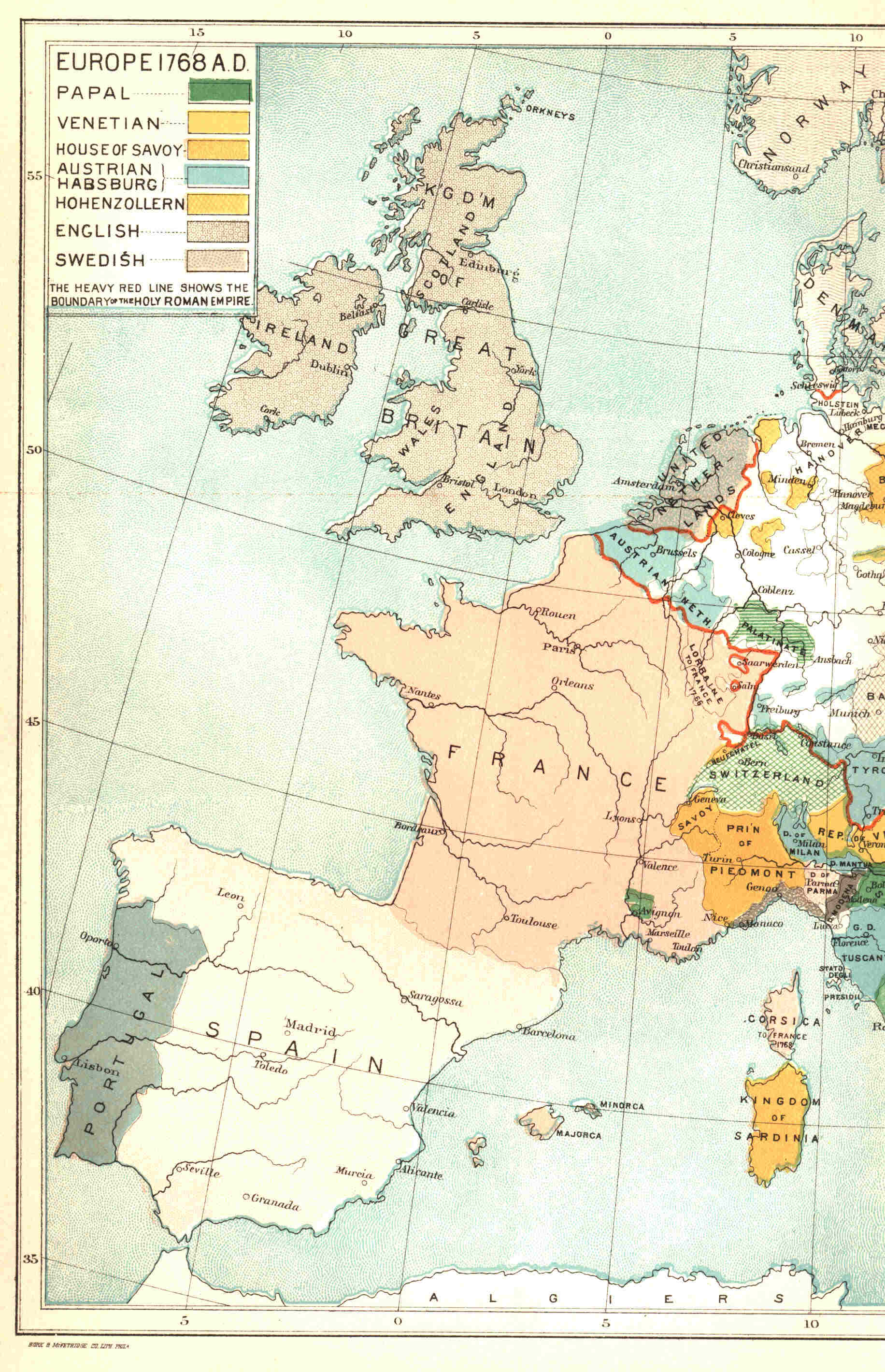
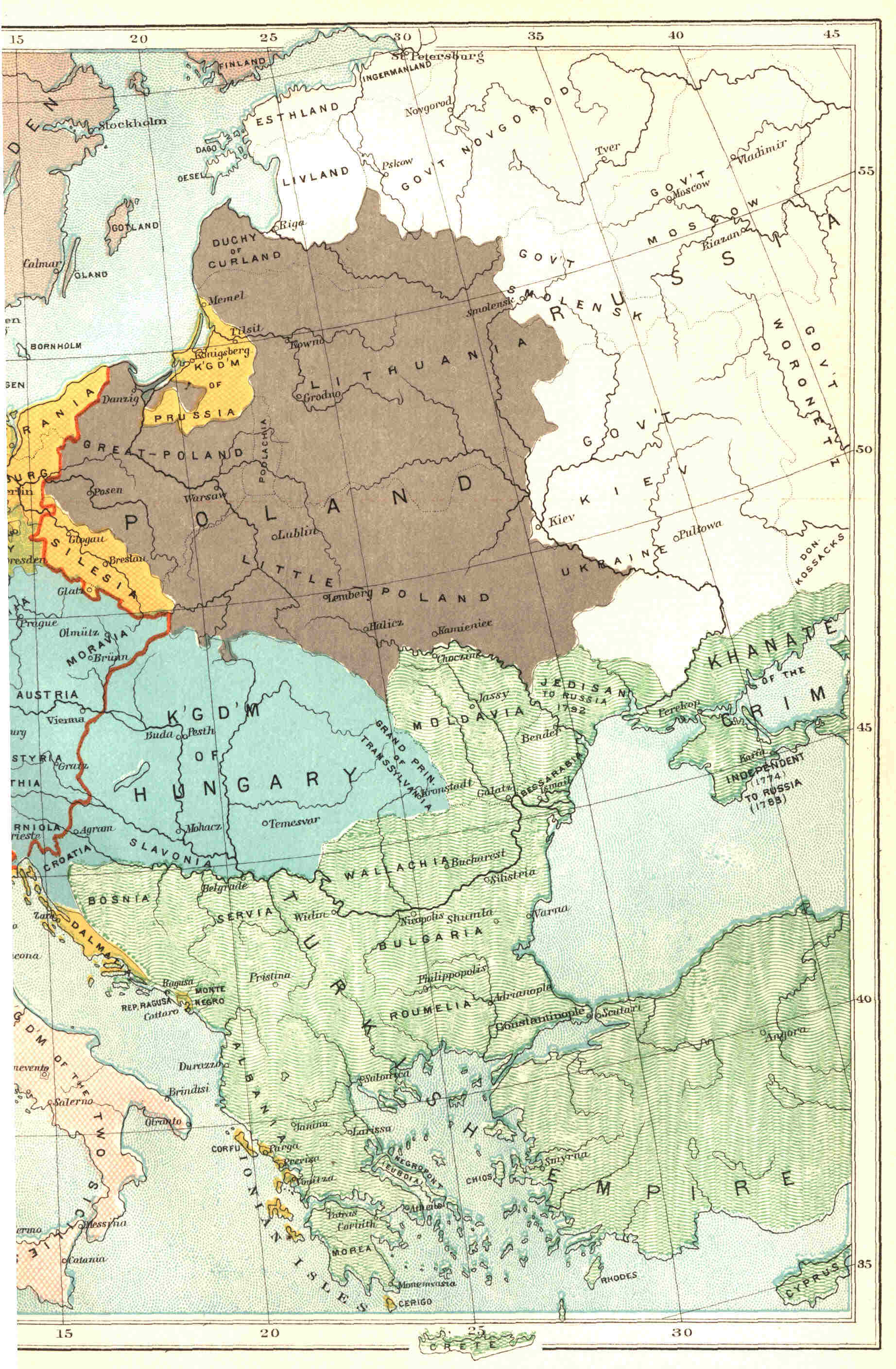
The Seven Years War. As before said, it was the anxiety of George II. for his electorate of Hanover which caused an explosion of hostilities in Europe to occur, as consequence of the remote fighting of French and English colonists in America. For the strengthening of Hanover against attacks from France, he sought an alliance with Frederick of Prussia. This broke the long-standing anti-French alliance of England with Austria, and Austria joined fortunes with her ancient Bourbon enemy, in order to be helped to the revenge which Maria Theresa now promised herself the pleasure of executing upon the Prussian king. As the combination finally shaped itself on the French side, it embraced France, Austria, Russia, Sweden, Poland, Saxony, and the Palatinate, and its inspiring purpose was to break Prussia down and partition her territories, rather than to support France against England. The agreements to this end were made in secret; but Frederick obtained knowledge of them, and learned that papers proving the conspiracy against him were in the archives of the Saxony government, at Dresden. His action was decided with that promptitude which so often disconcerted his enemies. He did not wait to be attacked by the tremendous league formed against him, nor waste time in efforts to dissolve it, but defiantly struck the first blow. He poured his army into Saxony (August, 1756), seized Dresden by surprise, captured the documents he desired, and published them to the world in vindication of his summary precipitation of war. Then, blockading the Saxon army in Pirna, he pressed rapidly into Bohemia, defeated the Austrians at Lowositz, and returned as rapidly, to receive the surrender of the Saxons and to enlist most of them in his own ranks. This was the European opening of the Seven Years War, which raged, first and last, in all quarters of the globe. In the second year of the war, Frederick gained an important victory at Prague and suffered a serious reverse at Kolin, which threw most of Silesia into the hands of the Austrians. Close following that defeat came crushing news from Hanover, where the incompetent Duke of Cumberland, commanding for his father, the English King George, had allowed the French to force him to an agreement which disbanded his army, and left Prussia alone in the terrific fight. Frederick's position seemed desperate; but his energy retrieved it. {1087} He fought and defeated the French at Rossbach, near Lützen, on the 5th of November, and the Austrians, at Leuthen, near Breslau, exactly one month later. In the campaigns of 1758, he encountered the Russians at Zorndorf, winning a bloody triumph, and he sustained a defeat at Hochkirk, in battle with the Austrians. But England had repudiated Cumberland's convention and recalled him; English and Hanoverian forces were again put into the field, under the capable command of Prince Frederick of Brunswick, who turned the tide in that quarter against the French, and the results of the year were generally favorable to Frederick. In 1759, the Hanoverian army, under Prince Ferdinand, improved the situation on that side; but the prospects of the King of Prussia were clouded by heavy disasters. Attempting to push a victory over the Russians too far, at Kunersdorf, he was terribly beaten. He lost Dresden, and a great part of Saxony. In the next year he recovered all but Dresden, which he wantonly and inhumanly bombarded. The war was now being carried on with great difficulty by all the combatants. Prussia, France and Austria were suffering almost equally from exhaustion; the misery among their people was too great to be ignored; the armies of each had dwindled. The opponents of Pitt's war policy in England overcame him, in October, 1761, whereupon he resigned, and the English subsidy to Frederick was withdrawn. But that was soon made up to him by the withdrawal of Russia from the war, at the beginning of 1762, when Peter of Holstein, who admired Frederick, became Czar. Sweden made peace a little later. The remainder of the worn and wearied fighters went on striking at each other until near the end of the year. Meantime, on the colonial and East Indian side of it, this prodigious Seven Years War, as a great struggle for world-empire between England and France, had been adding conquest to conquest and triumph to triumph for the former. In 1759, Wolfe had taken Quebec and died on the Heights of Abraham in the moment of victory. Another twelve months saw the whole of Canada clear of Frenchmen in arms. In the East, to use the language of Macaulay, "conquests equalling in rapidity and far surpassing in magnitude those of Cortes and Pizarro, had been achieved." "In the space of three years the English had founded a mighty empire. The French had been defeated in every part of India. Chandernagore had yielded to Clive, Pondicherry to Coote. Throughout Bengal, Bahar, Orissa, and the Carnatic, the authority of the East India Company was more absolute than that of Acbar or Aurungzebe had ever been." Treaties of Paris and Hubertsburg. In February, 1763, two treaties of peace were concluded, one at Paris, on the 10th, between England, France and Spain (the latter Power having joined France in the war as late as January, 1762); the other at Hubertsburg, on the 15th, between Prussia and Austria. France gave up to England all her possessions in North America, except Louisiana (which passed to Spain,), and yielded Minorca, but recovered the Philippines. She surrendered, moreover, considerable interests in the West Indies and in Africa. The colonial aspirations of the French were cast down by a blow that was lasting in its effect. As between Prussia and Austria, the triumphs of the peace and the glories of the war were won entirely by the former. Frederick came out of it, "Frederick the Great," the most famous man of his century, as warrior and as statesman, both. He had defended his little kingdom for seven years against three great Powers, and yielded not one acre of its territory. He had raised Prussia to the place in Germany from which her subsequent advance became easy and almost inevitable. But the great fame he earned is spotted with many falsities and much cynical indifference to the commonest ethics of civilization. His greatness is of that character which requires to be looked at from selected standpoints. Russia. Another character, somewhat resembling that of Frederick, was now drawing attention on the eastern side of Europe. Since the death of Peter the Great, the interval in Russian history had been covered by six reigns, with a seventh just opening, and the four sovereigns who really exercised power were women. Peter's widow, Catherine I., had succeeded him (1725) for two years. His son, Alexis, he had put to death; but Alexis left a son, Peter, to whom Catherine bequeathed the crown. Peter II. died after a brief reign, in 1730; and the nearest heirs were two daughters of Peter the Great, Anne and Elizabeth. But they were set aside in favor of another Anne--Anne of Courland--daughter of Peter the Great's brother. Anne's reign of ten years was under the influence of German favorites and ministers, and nearly half of it was occupied with a Turkish War, in cooperation with Austria. For Austria the war had most humiliating results, costing her Belgrade, all of Servia, part of Bosnia and part of Wallachia. Russia won back Asov, with fortifications forbidden, and that was all. Anne willed her crown to an infant nephew, who appears in the Russian annals as Ivan VI.; but two regencies were overthrown by palace revolutions within little more than a year, and the second one carried to the throne that Princess Elizabeth, younger daughter of Peter the Great, who had been put aside eleven years before. Elizabeth, a woman openly licentious and intemperate, reigned for twenty-one years, during the whole important period of the War of the Austrian Succession, and almost to the end of the Seven Years War. She was bitterly hostile to Frederick the Great, whose sharp tongue had offended her, and she joined Maria Theresa with eagerness in the great effort of revenge, which failed. In the early part of her reign, war with Sweden had been more successful and had added South Finland to the Russian territories. It is claimed for her domestic government that the general prosperity of the country was advanced. {1088} Catherine II. On the death of Elizabeth, near the end of the year 1761, the crown passed to her nephew, Peter of Holstein, son of her eldest sister, Anne, who had married the Duke of Holstein. This prince had been the recognized heir, living at the Russian court, during the whole of Elizabeth's reign. He was an ignorant boor, and he had become a besotted drunkard. Since 1744 he had been married to a young German princess, of the Anhalt Zerbst family, who took the baptismal name of Catherine when she entered the Greek Church. Catherine possessed a superior intellect and a strong character; but the vile court into which she came as a young girl, bound to a disgusting husband, had debauched her in morals and lowered her to its own vileness. She gained so great an ascendancy that the court was subservient to her, from the time that her incapable husband, Peter III., succeeded to the throne. He reigned by sufferance for a year and a half, and then (July, 1762) he was easily deposed and put to death. In the deposition, Catherine was the leading actor. Of the subsequent murder, some historians are disposed to acquit her. She did not scruple, at least, to accept the benefit of both deeds, which raised her, alone, to the throne of the Czars. Partition of Poland. Peter III., in his short reign, had made one important change in Russian policy, by withdrawing from the league against Frederick of Prussia, whom he greatly admired. Catherine found reasons, quite aside from those of personal admiration, for cultivating the friendship of the King of Prussia, and a close understanding with that astute monarch was one of the earliest objects of her endeavor. She had determined to put an end to the independence of Poland. As she first entertained the design, there was probably no thought of the partitioning afterwards contrived. But her purpose was to keep the Polish kingdom in disorder and weakness, and to make Russian influence supreme in it, with views, no doubt, that looked ultimately to something more. On the death of the Saxon king of Poland, Augustus III., in 1763, Catherine put forward a native candidate for the vacant throne, in the person of Stanislaus Poniatowsky, a Russianized Pole and a former lover of her own. The King of Prussia supported her candidate, and Poniatowsky was duly elected, with 10,000 Russian troops in Warsaw to see that it was properly done. The Poles were submissive to the invasion of their political independence; but when Catherine, who sought to create a Russian party in Poland by protecting the members of the Greek Church and the Protestants, against the intolerance of the Polish Catholics, forced a concession of civil equality to the former (1768), there was a wide-spread Catholic revolt. In the fierce war which followed, a band of Poles was pursued across the Turkish border, and a Turkish town was burned by the Russian pursuers. The Sultan, who professed sympathy with the Poles, then declared war against Russia. The Russo-Turkish war, in turn, excited Austria, which feared Russian conquests from the Turks, and another wide disturbance of the peace of Europe seemed threatening. In the midst of the excitement there came a whispered suggestion, to the ear of the courts of Vienna and St. Petersburg, that they severally satisfy their territorial cravings and mutually assuage each other's jealousy, at the expense of the crumbling kingdom of Poland. The whisper may have come from Frederick II. of Prussia, or it may not. There are two opinions on the point. From whatever source it came, it found favorable consideration at Vienna and St. Petersburg, and between February and August, 1772, the details of the partition were worked out. Poland was not yet extinguished. The kingdom was only shorn of some 160,000 square miles of territory, more than half of which went to Russia, a third to Austria, and the remainder, less than 10,000 square miles, to Prussia. This last mentioned annexation was the old district of West Prussia which the Polish king, Casimir IV., had wrested from the Teutonic Knights in 1466, before Brandenburg had aught to do with Prussian lands or name. After three centuries, Frederick reclaimed it. The diminished kingdom of Poland showed more signs of a true national life, of an earnest national feeling, of a sobered and rational patriotism, than had appeared in its former history. The fatal powers monopolized by the nobles, the deadly "liberum veto," the corrupting elective kingship, were looked at in their true light, and in May, 1791, a new constitution was adopted which reformed those evils. But a few nobles opposed the reformation and appealed to Russia, supplying a pretext to Catherine on which she filled Poland with her troops. It was in vain that the patriot Kosciusko led the best of his countrymen in a brave struggle with the invader. They were overborne (1793-1794); the unhappy nation was put in fetters, while Catherine and a new King of Prussia, Frederick William II., arranged the terms of a second partition. This gave to Prussia an additional thousand square miles, including the important towns of Danzig and Thorn, while Russia took four times as much. A year later, the small remainder of Polish territory was dismembered and divided between Russia, Prussia and Austria, and thus Poland disappeared from the map of Europe as a state. Russia as left by Catherine II. Meantime, in her conflicts with the Turks, Catherine was extending her vast empire to the Dneister and the Caucasus, and opening a passage for her fleets from the Black Sea to the Mediterranean. By treaty in 1774 she placed the Tartars of the Crimea in independence of the Turks, and so isolated them for easy conquest. In 1783 the conquest was made complete. By the same treaty she secured a right of remonstrance on behalf of the Christian subjects of the Sultan, in the Danubian principalities and in the Greek Church at Constantinople, which opened many pretexts for future interference and for war at Russian convenience. The aggressions of the strong-willed and powerful Czarina, and their dazzling success, filled her subjects with pride, and effaced all remembrance of her foreign origin and her want of right to the seat which she filled. She was ambitious to improve the empire, as well as to expand it; for her liberal mind took in the large ideas of that speculative age and was much moved by them. She attempted many reforms; but most things that she tried to do for the bettering of civilization and the lifting of the people were done imperiously, and spoiled by the autocratic method of the doing. In her later years, her inclination towards liberal ideas was checked, and the French Revolution put an end to it. {1089} State of France in the Eighteenth Century. In tracing the destruction of Poland and the aggrandizement of Russia, we have passed the date of that great catastrophe in France which ended the old modern order of things, and introduced a new one, not for France only, but for Europe at large. It was a catastrophe toward which the abused French people had been slowly slipping for generations, pushed unrelentingly to it by blind rulers and a besotted aristocracy. By nature a people ardent and lively in temper, hopeful and brave in spirit, full of intelligence, they had been held down in dumb repression: silenced in voice, even for the uttering of their complaints; the national meeting of their representative States suppressed for nearly two centuries; taxes wrung from them on no measure save the will of a wanton-minded and ignorant king; their beliefs prescribed, their laws ordained, their courts of justice commanded, their industries directed, their trade hedged round, their rights and permissions in all particulars meted out to them by the same blundering and irresponsible autocracy. How long would they bear it? and would their deliverance come by the easing of their yoke, or by the breaking of it?--were the only questions. Their state was probably at its worst in the later years of Louis XIV. That seems to be the conclusion which the deepest study has now reached, and the picture formerly drawn by historians, of a society continually sinking into lower miseries, is mostly put aside. The worst state, seemingly, was passed, or nearly so, when Louis XIV. died. It began to mend under his despicable successor, Louis XV. (1715-1774),-- perhaps even during the regency of the profligate Orleans (1715-1723). Why it mended, no historian has clearly explained. The cause was not in better government; for the government grew worse. It did not come from any rise in character of the privileged classes; for the privileged classes abused their privileges with increasing selfishness. But general influences were at work in the world at large, stimulating activities of all kinds,--industry, trade, speculation, combination, invention, experiment, science, philosophy,--and whatever improvement occurred in the material condition and social state of the common people of France may find its explanation in these. There was an augmentation of life in the air of the eighteenth century, and France took some invigoration from it, despite the many maladies in its social system and the oppressions of government under which it bent. But the difference between the France of Louis XIV. and the France of Louis XVI. was more in the people than in their state. If their misery was a little less, their patience was less, and by not a little. The stimulations of the age, which may have given more effectiveness to labor and more energy to trade, had likewise set thinking astir, on the same practical lines. Men whose minds in former centuries would have labored on riddles dialectical, metaphysical and theological, were now bent on the pressing problems of daily life. The mysteries of economic science began to challenge them. Every aspect of surrounding society thrust questions upon them, concerning its origin, its history, its inequalities, its laws and their principles, its government and the source of authority in it. The so-called "philosophers" of the age, Rousseau, Voltaire and the encyclopædists--were not the only questioners of the social world, nor did the questioning all come from what they taught. It was the intellectual epidemic of the time, carried into all countries, penetrating all classes, and nowhere with more diffusion than in France. After the successful revolt of the English colonies in America, and the conspicuous blazoning of the doctrines of political equality and popular self-government in their declaration of independence and their republican constitution, the ferment of social free-thinking in France was naturally increased. The French had helped the colonists, fought side by side with them, watched their struggle with intense interest, and all the issues involved in the American revolution were discussed among them, with partiality to the republican side. Franklin, most republican representative of the young republic, came among them and captivated every class. He recommended to them the ideas for which he stood, perhaps more than we suspect. Louis XVI. and his reign. And thus, by many influences, the French people of all classes except the privileged nobility, and even in that class to some small extent, were made increasingly impatient of their misgovernment and of the wrongs and miseries going with it. Louis XVI., who came to the throne in 1774, was the best in character of the Bourbon kings. He had no noxious vices and no baleful ambitions. If he had found right conditions prevailing in his kingdom he would have made the best of them. But he had no capacity for reforming the evils that he inherited, and no strength of will to sustain those who had. He accepted an earnest reforming minister with more than willingness, and approved the wise measures of economy, of equitable taxation, and of emancipation for manufactures and trade, which Turgot proposed. But when protected interests, and the privileged order which fattened on existing abuses, raised a storm of opposition, he weakly gave way to it, and dismissed the man (1776) who might possibly have made the inevitable revolution a peaceful one. Another minister, the Genevan banker, Necker, who aimed at less reform, but demanded economy, suffered the same overthrow (1781). The waste, the profligate expenditure, the jobbery, the leeching of the treasury by high-born pensioners and sinecure office-holders, went on, scarcely checked, until the beginnings of actual bankruptcy had appeared. The States-General. Then a cry, not much heeded before, for the convocation of the States-general of the kingdom--the ancient great legislature of France, extinct since the year 1614--became loud and general. The king yielded (1788). The States-general was called to meet on the 1st of May, 1789, and the royal summons decreed that the deputies chosen to it from the third estate--the common people--should be equal in number to the deputies of the nobility and the clergy together. So the dumb lips of France as a nation were opened, its tongue unloosed, its common public opinion, and public feeling made articulate, for the first time in one hundred and seventy-five years. And the word that it spoke was the mandate of Revolution. The States-general assembled at Versailles on the 5th of May, and a conflict between the third estate and the nobles occurred at once on the question between three assemblies and one. Should the three orders deliberate and vote together as one body, or sit and act separately and apart. The commons demanded the single assembly. The nobles and most of the clergy refused the union, in which their votes would be overpowered. {1090} The National Assembly. After some weeks of dead-lock on this fundamental issue, the third estate brought it to a summary decision, by boldly asserting its own supremacy, as representative of the mass of the nation, and organizing itself in the character of the "National Assembly" of France. Under that name and character it was joined by a considerable part of the humbler clergy, and by some of the nobles,--additional to a few, like Mirabeau, who sat from the beginning with the third estate, as elected representatives of the people. The king made a weak attempt to annul this assumption of legislative sufficiency on the part of the third estate, and only hurried the exposure of his own powerlessness. Persuaded by his worst advisers to attempt a stronger demonstration of the royal authority, he filled Paris with troops, and inflamed the excitement, which had risen already to a passionate heat. Outbreak of the Revolution. Necker, who had been recalled to the ministry when the meeting of the States-general was decided upon, now received his second dismissal (July 11), and the news of it acted on Paris like a signal of insurrection. The city next day was in tumult. On the 14th the Bastile was attacked and taken. The king's government vanished utterly. His troops fraternized with the riotous people. Citizens of Paris organized themselves as a National Guard, on which every hope of order depended, and Lafayette took command. The frightened nobility began flight, first from Paris, and then from the provinces, as mob violence spread over the kingdom from the capital. In October there were rumors that the king had planned to follow the "émigrés" and take refuge in Metz. Then occurred the famous rising of the women; their procession to Versailles; the crowd of men which followed, accompanied but not controlled by Lafayette and his National Guards; the conveyance of the king and royal family to Paris, where they remained during the subsequent year, practically in captivity, and at the mercy of the Parisian mob. Meanwhile, the National Assembly, negligent of the dangers of the moment, while actual anarchy prevailed, busied itself with debates on constitutional theory, with enactments for the abolition of titles and privileges, and with the creating of an inconvertible paper money, based on confiscated church lands, to supply the needs of the national treasury. Meantime, too, the members of the Assembly and their supporters outside of it were breaking into parties and factions, divided by their different purposes, principles and aims, and forming clubs,--centers of agitation and discussion,--clubs of the Jacobins, the Cordeliers, the Feuillants and the like,--where fear, distrust and jealousy were soon engendering ferocious conflicts among the revolutionists themselves. And outside of France, on the border where the fugitive nobles lurked, intrigue was always active, striving to enlist foreign help for King Louis against his subjects. The First Constitution. In April, 1791, Mirabeau, whose influence had been a powerful restraint upon the Revolution, died. In June, the king made an attempt to escape from his durance in Paris, but was captured at Varennes and brought back. Angry demands for his deposition were now made, and a tumultuous republican demonstration occurred, on the Champ de Mars, which Lafayette and the mayor of Paris, Bailly, dispersed, with bloodshed. But republicanism had not yet got its footing. In the constitution, which the Assembly completed at this time, the throne was left undisturbed. The king accepted the instrument, and a constitutional monarchy appeared to have quietly taken the place of the absolute monarchy of the past. The Girondists. It was an appearance not long delusive. The Constituent National Assembly being dissolved, gave way to a Legislative Assembly (October, 1791) elected under the new constitution. In the Legislative Assembly the republicans appeared with a strength which soon gave them control of it. They were divided into various groups; but the most eloquent and energetic of these, coming from Bordeaux and the department of the Gironde, fixed the name of Girondists upon the party to which they belonged. The king, as a constitutional sovereign, was forced presently to choose ministers from the ranks of the Girondists, and they controlled the government for several months in the spring of 1792. The earliest use they made of their control was to hurry the country into war with the German powers, which were accused of giving encouragement to the hostile plans of the émigrés on the border. It is now a well-determined fact that the Emperor Leopold was strongly opposed to war with France, and used all his influence for the preservation of peace. It was revolutionary France which opened the conflict, and it was the Girondists who led and shaped the policy of war. Overthrow of the Monarchy. In the first encounters of the war, the undisciplined French troops were beaten, and Paris was in panic. Measures were adopted which the king refused to sanction, and he dismissed his Girondist ministers. Lafayette, who was commanding one division of the army in the field, approved the king's course, and wrote an unwise letter to the Assembly, intimating that the army would not submit to a violation of the constitution. The republicans were enraged. Everything seemed proof to them of a treasonable connivance with the enemies of France, to bring about the subjugation of the country, and a forcible restoration of the old regime, absolutism, aristocratic privilege and all. On the 20th of June there was another rising of the Paris mob, unchecked by those who could, as yet, have controlled it. The rioters broke into the Tuileries and humiliated the king and queen with insults, but did no violence. Lafayette came to Paris and attempted to reorganize his old National Guard, for the defense of the constitution and the preservation of order, but failed. The extremists then resolved to throw down the toppling monarchy at once, by a sudden blow. In the early morning of August 10, they expelled the Council-General of the Municipality of Paris from the Hotel de Ville, and placed the government of the city under the control of a provisional Commune, with Danton at its head. {1091} At the same hour, the mob which these conspirators held in readiness, and which they directed, attacked the Tuileries and massacred the Swiss guard, while the king and the royal family escaped for refuge to the Chamber of the Legislative Assembly, near at hand. There, in the king's presence, on a formal demand made by the new self-constituted Municipality or Commune of Paris, the Assembly declared his suspension from executive functions, and invited the people to elect without delay a National Convention for the revising of the Constitution. Commissioners, hastily sent out to the provinces and the armies in the field, were received everywhere with submission to the change of government, except by Lafayette and his army, in and around Sedan. The Marquis placed them under arrest and took from his soldiers a new oath of fidelity to the constitution and the king. But he found himself unsupported, and, yielding to the sweep of events, he obeyed a dismissal by the new government from his command, and left France, to wait in exile for a time when he might serve his Country with a conscience more assured. The Paris Commune. Pending the meeting of the Convention, the Paris Commune, increased in number to two hundred and eighty-eight, and dominated by Danton and Robespierre, became the governing power in France. The Legislative Assembly was subservient to it; the kingless Ministry, which had Danton in association with the restored Girondists, was no less so. It was the fierce vigor of the Commune which caused the king and the royal family to be imprisoned in the Temple; which instituted a special tribunal for the summary trial of political prisoners; which searched Paris for "suspects," on the night of August 29-30, gathered three thousand men and women into the prisons and convents of the city, planned and ordered the "September Massacres" of the following week, and thus thinned the whole number of these "suspects" by a half. Fall of the Girondists. On the 22d of September the National Convention assembled. The Jacobins who controlled the Commune were found to have carried Paris overwhelmingly and all France largely with them, in the election of representatives. A furious, fanatical democracy, a bloodthirsty anarchism, was in the ascendant. The republican Girondists were now the conservative party in the Convention. They struggled to hold their ground, and very soon they were struggling for their lives. The Jacobin fury was tolerant of no opposition. What stood in its path, with no deadlier weapon than an argument or an appeal, must be, not merely overcome, but destroyed. The Girondists would have saved the king from the guillotine, but they dared not adopt his defense, and their own fate was sealed when they gave votes, under fear, which sent him in January to his death. Five months longer they contended irresolutely, as a failing faction, with their terrible adversaries, and then, in June, 1793, they were proscribed and their arrest decreed. Some escaped and raised futile insurrections in the provinces. Some stayed and faced the death which awaited them in the fast approaching "reign of terror." "The Mountain" and "the Terror." The fall of the Girondists left the Jacobin "Mountain" (so-called from the elevation of the seats on which its deputies sat in the Convention) unopposed. Their power was not only absolute in fact, but unquestioned, and they inevitably ran to riot in the exercise of it. The same madness overcame them in the mass which overcame Nero, Caligula, Caracalla, as individuals; for it is no more strange that the unnatural and awful feeling of unlimited dominion over one's fellows should turn the brain of a suddenly triumphant faction, than that it should madden a single shallow-minded man. The men of "the Mountain" were not only masters of France--except in La Vendée and the neighboring region south of the Loire, where an obstinate insurrection had broken out--but the armies which obeyed them had driven back the invading Germans, had occupied the Austrian Netherlands and taken possession of Savoy and Nice. Intoxicated by these successes, the Convention had proclaimed a crusade against all monarchical government, offering the help of France to every people which would rise against existing authorities, and declaring enmity to those who refused alliance with the Revolution. Holland was attacked and England forced to war. The spring of 1793 found a great European coalition formed against revolutionary France, and justified by the aggressions of the Jacobinical government. For effective exercise of the power of the Jacobins, the Convention as a whole proved too large a body, even when it had been purged of Girondist opposition. Its authority was now gathered into the hands of the famous Committee of Public Safety, which became, in fact, the Revolutionary Government, controlling the national armies, and the whole administration of domestic and foreign affairs. Its reign was the Reign of Terror, and the fearful Revolutionary Tribunal, which began its bloody work with the guillotine in October, 1793, was the chief instrument of its power. Robespierre, Barère, St. Just, Couthon, Billaud-Varennes, Collot d' Herbois and Carnot--the latter devoted to the business of the war--were the controlling members of the Committee. Danton withdrew from it, refusing to serve. In September, the policy of terrorism was avowedly adopted, and, in the language of the Paris Commune, "the Reign of Terror" became "the order of the day." The arraignment of "suspects" before the Revolutionary Tribunal began. On the 14th of October Marie Antoinette was put on trial; on the 16th she met her death. On the 31st the twenty-one imprisoned Girondist deputies were sent to the guillotine; followed on the 10th of November by the remarkable woman, Madame Roland, who was looked upon as the real leader of their party. From that time until the mid-summer following, the blood-madness raged; not in Paris alone, but throughout France, at Lyons, Marseilles, Toulon, Bordeaux, Nantes, and wherever a show of insurrection and resistance had challenged the ferocity of the Commissioners of the Revolutionary Government, who had been sent into the provinces with unlimited death-dealing powers. {1092} But when Jacobinism had destroyed all exterior opposition, it began very soon to break into factions within itself. There was a pitch in its excesses at which even Danton and Robespierre became conservatives, as against Hébert and the atheists of his faction. A brief struggle ensued, and the Hébertists, in March, 1794, passed under the knife of the guillotine. A month later Danton's enemies had rallied and he, with his followers, went down before their attack, and the sharp knife in the Place de la Revolution silenced his bold tongue. Robespierre remained dominant for a few weeks longer in the still reigning Committee of Public Safety; but his domination was already undermined by many fears, distrusts and jealousies among his colleagues and throughout his party. His downfall came suddenly on the 27th of July. On the morning of that day he was the dictator of the Convention and of its ruling committee; at night he was a headless corpse, and Paris was shouting with joy. On the death of Robespierre the Reign of Terror came quickly to an end. The reaction was sudden and swift. The Committee of Public Safety was changed; of the old members only Carnot, indispensable organizer of war, remained. The Revolutionary Tribunal was remodeled. The Jacobin Club was broken up. The surviving Girondist deputies came back to the Convention. Prosecution of the Terrorists for their crimes began. A new struggle opened, between the lower elements in Parisian and French society, the sansculotte elements, which had controlled the Revolution thus far, and the middle class, the bourgeoisie, long cowed and suppressed, but now rallying to recover its share of power. Bourgeoisie triumphed in the contest. The Sansculottes made their last effort in a rising on the 1st Prairial (May 20, 1795) and were put down. A new constitution was framed which organized the government of the Republic under a legislature in two chambers,--a Council of Five Hundred and a Council of Ancients,--with an executive Directory of Five. But only one third of the legislature first assembled was to be freely elected by the people. The remaining two thirds were to be taken from the membership of the existing Convention. Paris rejected this last mentioned feature of the constitution, while France at large ratified it. The National Guard of Paris rose in insurrection on the 13th Vendémiare (October 5), and it was on this occasion that the young Corsican officer, Napoleon Bonaparte, got his foot on the first round of the ladder by which he climbed afterwards to so great a height. Put in command of the regular troops in Paris, which numbered only 5,000, against 30,000 of the National Guards, he crushed the latter in an action of an hour. That hour was the opening hour of his career. The government of the Directory was instituted on the 27th of October following. Of its five members, Carnot and Barras were the only men of note, then or afterwards. The war with the Coalition. While France was cowering under "the Terror," its armies, under Jourdan, Hoche, and Pichegru, had withstood the great European combination with astonishing success. The allies were weakened by ill feeling between Prussia and Austria over the second partition of Poland, and generally by a want of concert and capable leadership in their action. On the other side, the democratic military system of the Republic, under Carnot's keen eyes, was continually bringing forward fresh soldierly talent to the front. The fall of the Jacobins made no change in that vital department of the administration, and the successes of the French were continued. In the summer of 1794 they carried the war into Germany, and expelled the allies from the Austrian Netherlands. Thence they invaded Holland, and before the end of January, 1795, they were masters of the country; the Stadtholder had fled to England, and a Batavian Republic had been organized. Spain had suffered losses in battle with them along the Pyrenees, and the King of Sardinia had yielded to them the passes of the Maritime Alps. In April the King of Prussia made peace with France. Before the close of the year 1795 the revolt in La Vendée was at an end; Spain had made peace; Pichegru had attempted a great betrayal of the armies on the Rhine, and had failed. Napoleon in Italy. This in brief was the situation at the opening of the year 1796, when the "little Corsican officer," who won the confidence of the new government of the Directory by saving its constitution on the 13th Vendemiare, planned the campaign of the year, and received the command of the army sent to Italy. He attacked the Sardinians in April, and a single month sufficed to break the courage of their king and force him to a treaty of peace. On the 10th of May he defeated the Austrians at Lodi; on the 15th he was in Milan. Lombardy was abandoned to him; all central Italy was at his mercy, and he began to act the sovereign conqueror in the peninsula, with a contempt for the government at Paris which he hardly concealed. Two ephemeral republics were created under his direction, the Cisalpine, in Lombardy, and the Cispadane, embracing Modena, Ferrara and Bologna. The Papacy was shorn of part of its territories. Every attempt made by the Austrians to shake the hold which Bonaparte had fastened on the peninsula only fixed it more firmly. In the spring he began movements beyond the Alps, in concert with Hoche on the Rhine, which threatened Vienna itself and frightened Austria into proposals of peace. Preliminaries, signed in April, foreshadowed the hard terms of the treaty concluded at Campo Formio in the following October. Austria gave up her Netherland provinces to France, and part of her Italian territories to the Cisalpine Republic; but received, in partial compensation, the city of Venice and a portion of the dominions of the Venetian state; for, between the armistice and the treaty, Bonaparte had attacked and overthrown the venerable republic, and now divided it with his humbled enemy. France under the Directory. The masterful Corsican, who handled these great matters with the airs of a sovereign, may have known himself already to be the coming master of France. For the inevitable submission again of the many to one was growing plain to discerning eyes. The frightful school-teaching of the Revolution had not impressed practical lessons in politics on the mind of the untrained democracy, so much as suspicions, distrusts, and alarms. All the sobriety of temper, the confidence of feeling, the constraining habit of public order, without which the self-government of a people is impracticable, were yet to be acquired. French democracy was not more prepared for republican institutions in 1797 than it had been in 1789. {1093} There was no more temperance in its factions, no more balance between parties, no more of a steadying potency in public opinion. But it had been brought to a state of feeling that would prefer the sinking of all factions under some vigorous autocracy, rather than another appeal of their quarrels to the guillotine. And events were moving fast to a point at which that choice would require to be made. The summer of 1797 found the members of the Directory in hopeless conflict with one another and with the legislative councils. On the 4th of September a "coup d' état," to which Bonaparte contributed some help, purged both the Directory and the Councils of men obnoxious to the violent faction, and exiled them to Guiana. Perhaps the moment was favorable then for a soldier, with the great prestige that Bonaparte had won, to mount to the seat of power; but he did not so judge. The Expedition to Egypt. He planned, instead, an expedition to Egypt, directed against the British power in the East,--an expedition that failed in every object it could have, except the absence in which it kept him from increasing political disorders at home. He was able to maintain some appearance of success, by his subjugation of Egypt and His invasion of Syria; but of harm done to England, or of gain to France in the Mediterranean, there was none; since Nelson, at the battle of the Nile, destroyed the French fleet, and Turkey was added to the Anglo-Austrian coalition. The blunder of the expedition, as proved by its whole results, was not seen by the French people so plainly, however, as they saw the growing hopelessness of their own political state, and the alarming reverses which their armies in Italy and on the Rhine had sustained since Bonaparte went away. French Aggressions.--The new Coalition. Continued aggressions on the part of the French had provoked a new European coalition, formed in 1798. In Switzerland they had overthrown the ancient constitution of the confederacy, organizing a new Helvetic Republic on the Gallic model, but taking Geneva to themselves. In Italy they had set up a third republic, the Roman, removing the Pope forcibly from his sovereignty and from Rome. Every state within reach had then taken fresh alarm, and even Russia, undisturbed in the distance, was now enlisted against the troublesome democracy of France. The unwise King of Naples, entering rashly into the war before his allies could support him, and hastening to restore the Pope, had been driven (December, 1798) from his kingdom, which underwent transformation into a fourth Italian republic, the Parthenopeian. But this only stimulated the efforts of the Coalition, and in the course of the following year the French were expelled from all Italy, saving Genoa alone, and the ephemeral republics they had set up were extinguished. On the Rhine they had lost ground; but they had held their own in Switzerland, after a fierce struggle with the Russian forces of Suwarrow. Napoleon in power. When news of these disasters, and of the ripeness of the situation at Paris for a new coup d' état, reached Bonaparte, in Egypt, he deserted his army there, leaving it, under Kléber, in a helpless situation, and made his way back to France. He landed at Fréjus on the 9th of October. Precisely a month later, by a combination with Sieyès, a veteran revolutionist and maker of constitutions, he accomplished the overthrow of the Directory. Before the year closed, a fresh constitution was in force, which vested substantially monarchical powers in an executive called the First Consul, and the chosen First Consul was Napoleon Bonaparte. Two associate Consuls, who sat with him, had no purpose but to conceal for a short time the real absoluteness of his rule. From that time, for fifteen years, the history of France--it is almost possible to say the history of Europe--is the story of the career of the extraordinary Corsican adventurer who took possession of the French nation, with unparalleled audacity, and who used it, with all that pertained to it--lives, fortunes, talents, resources--in the most prodigious and the most ruthless undertakings of personal ambition that the modern world has ever seen. He was selfishness incarnate; and he was the incarnation of genius in all those modes of intellectual power which bear upon the mastery of momentary circumstances and the mastery of men. But of the higher genius that might have worthily employed such vast powers,--that might have enlightened and inspired a really great ambition in the man, to make himself an enduring builder of civilization in the world, he had no spark. The soul behind his genius was ignoble, the spirit was mean. And even on the intellectual side, his genius had its narrowness. His projects of selfishness were extraordinary, but never sagacious, never far-sighted, thoughtfully studied, wisely planned. There is no appearance in any part of his career of a pondered policy, guiding him to a well-determined end in what he did. The circumstances of any moment, whether on the battle-field or in the political arena, he could handle with a swift apprehension, a mastery and a power that may never have been surpassed. But much commoner men have apprehended and have commanded in a larger and more successful way the general sweep of circumstances in their lives. It is that fact which belittles Napoleon in the comparison often made between him and Cæsar. He was probably Cæsar's equal in war. But who can imagine Cæsar in Napoleon's place committing the blunders of blind arrogance which ruined the latter in Germany and Spain, or making his fatuous attempt to shut England, the great naval power, out of continental Europe? His domestic administration was beneficial to France in many ways. He restored order, and maintained it, with a powerful hand. He suppressed faction effectually, and eradicated for the time all the political insanities of the Revolution. He exploited the resources of the country with admirable success; for his discernment in such matters was keen and his practical judgment was generally sound. But he consumed the nation faster than he gave it growth. His wars--the wars in which Europe was almost unceasingly kept by the aggression of his insolence and his greed--were the most murderous, the most devouring, that any warrior among the civilized races of mankind has ever been chargeable with. {1094} His blood-guiltiness in these wars is the one glaring fact which ought to be foremost in every thought of them. But it is not. There is a pitiable readiness in mankind to be dazzled and cheated by red battle-lights, when it looks into history for heroes; and few figures have been glorified more illusively in the world's eye than the marvelous warrior, the vulgar-minded adventurer, the prodigy of self-exalting genius, Napoleon Bonaparte. In the first year of his Consulate, Bonaparte recovered Italy, by the extraordinary Marengo campaign, while Moreau won the victory of Hohenlinden, and the Treaty of Luneville was brought about. Austria obtained peace again by renewing the concessions of Campo Formio, and by taking part in a reconstruction of Germany, under Bonaparte's dictation, which secularized the ecclesiastical states, extinguished the freedom of most of the imperial cities, and aggrandized Bavaria, Würtemberg, Baden and Saxony, as protégés and dependencies of France. England was left alone in the war, with much hostile feeling raised against her in Europe and America by the arrogant use she had made of her mastery of the sea. The neutral powers had all been embittered by her maritime pretensions, and Bonaparte now brought about the organization among them of a Northern League of armed neutrality. England broke it with a single blow, by Nelson's bombardment of Copenhagen. Napoleon, however, had conceived the plan of starving English industries and ruining British trade by a "continental system" of blockade against them, which involved the compulsory exclusion of British ships and British goods from all European countries. This impossible project committed him to a desperate struggle for the subjugation of Europe. It was the fundamental cause of his ruin. The First Empire. In 1802 the First Consul advanced his restoration of absolutism in France a second step, by securing the Consulate for life. A short interval of peace with England was arranged, but war broke out anew the following year, and the English for a time had no allies. The French occupied Hanover, and the Germans were quiescent. But in 1804, Bonaparte shocked Europe by the abduction and execution of the Bourbon prince, Duc d'Enghien, and began to challenge again the interference of the surrounding powers by a new series of aggressive measures. His ambition had thrown off all disguises; he had transformed the Republic of France into an Empire, so called, and himself, by title, into an Emperor, with an imposing crown. The Cisalpine or Italian Republic received soon afterwards the constitution of a kingdom, and he took the crown to himself as King of Italy. Genoa and surrounding territory (the Ligurian Republic) were annexed, at nearly the same time, to France; several duchies were declared to be dependencies, and an Italian principality was given to Napoleon's elder sister. The effect produced in Europe by such arbitrary and admonitory proceedings as these enabled Pitt, the younger, now at the head of the English government, to form an alliance (1805), first with Russia, afterwards with Austria, Sweden and Naples, and finally with Prussia, to break the yoke which the French Emperor had put upon Italy, Holland, Switzerland and Hanover, and to resist his further aggressions. Austerlitz and Trafalgar. The amazing energy and military genius of Napoleon never had more astonishing proof than in the swift campaign which broke this coalition at Ulm and Austerlitz. Austria was forced to another humiliating treaty, which surrendered Venice and Venetia to the conqueror's new Kingdom of Italy; gave up Tyrol to Bavaria; yielded other territory to Würtemberg, and raised both electors to the rank of kings, while making Baden a grand duchy, territorially enlarged. Prussia was dragged by force into alliance with France, and took Hanover as pay. But England triumphed at the same time on her own element, and Napoleon's dream of carrying his legions across the Channel, as Cæsar did, was forever dispelled by Nelson's dying victory at Trafalgar. That battle, which destroyed the combined navies of France and Spain, ended hope of contending successfully with the relentless Britons at sea. End of the Holy Roman Empire. France was never permitted to learn the seriousness of Trafalgar, and it put no check on the vaulting ambition in Napoleon which now began to o'erleap itself. He gave free rein to his arrogance in all directions. The King of Naples was expelled from his kingdom and the crown conferred on Joseph Bonaparte. Louis Bonaparte was made King of Holland. Southern Germany was suddenly reconstructed again. The little kingdoms of Napoleon's creation and the small states surrounding them were declared to be separated from the ancient Empire, and were formed into a Confederation of the Rhine, under the protection of France. Warned by this rude announcement of the precarious tenure of his imperial title as the head of the Holy Roman Empire, Francis II. resigned it, and took to himself, instead, a title as meaningless as that which Napoleon had assumed,--the title of Emperor of Austria. The venerable fiction of the Holy Roman Empire disappeared from history on the 6th of August, 1806. Subjugation of Prussia. But while Austria had become submissive to the offensive measures of Napoleon, Prussia became now fired with unexpected, sudden wrath, and declared war in October, 1800. It was a rash explosion of national resentment, and the rashness was dearly paid for. At Jena and Auerstadt, Prussia sank under the feet of the merciless conqueror, as helplessly subjugated as a nation could be. Russia, attempting her rescue, was overcome at Eylau and Friedland; and both the vanquished powers came to terms with the victor at Tilsit (July, 1807). The King of Prussia gave up all his kingdom west of the Elbe, and all that it had acquired in the second and third partitions of Poland. A new German kingdom, of Westphalia, was constructed for Napoleon's youngest brother, Jerome. A free state of Danzig, dependent on France, and a Grand Duchy of Warsaw, were created. The Russian Czar, bribed by some pieces of Polish Prussia, and by prospective acquisitions from Turkey and Sweden, became an ally of Napoleon and an accomplice in his plans for the subjection of Europe. He enlisted his empire in the "continental system" against England, and agreed to the enforcement of the decree which Napoleon issued from Berlin, declaring the British islands in a state of blockade, and prohibiting trade with them. The British government retorted by its "orders in council," which blockaded in the like paper-fashion all ports of France and of the allies and dependencies of France. And so England and Napoleon fought one another for years in the peaceful arena of commerce, to the exasperation of neutral nations and the destruction of the legitimate trade of the world. {1095} The crime against Spain. And now, having prostrated Germany, and captivated the Czar, Napoleon turned toward another field, which had scarcely felt, as yet, his intrusive hand. Spain had been in servile alliance with France for ten years, while Portugal adhered steadily to her friendship with Great Britain, and now refused to be obedient to the Berlin Decree. Napoleon took prompt measures for the punishment of so bold a defiance. A delusive treaty with the Spanish court, for the partition of the small kingdom of the Braganzas, won permission for an army under Junot to enter Portugal, through Spain. No resistance to it was made. The royal family of Portugal quitted Lisbon, setting sail for Brazil, and Junot took possession of the kingdom. But this accomplished only half of Napoleon's design. He meant to have Spain, as well; and he found, in the miserable state of the country, his opportunity to work out an ingenious, unscrupulous scheme for its acquisition. His agents set on foot a revolutionary movement, in favor of the worthless crown prince, Ferdinand, against his equally worthless father, Charles IV., and pretexts were obtained for an interference by French troops. Charles was first coerced into an abdication; then Ferdinand was lured to an interview with Napoleon, at Bayonne, was made prisoner there, and compelled in his turn to relinquish the crown. A vacancy on the Spanish throne having been thus created, the Emperor gathered at Bayonne a small assembly of Spanish notables, who offered the seat to Joseph Bonaparte, already King of Naples. Joseph, obedient to his imperial brother's wish, resigned the Neapolitan crown to Murat, his sister's husband, accepted the crown of Spain, and was established at Madrid with a French army at his back. This was one of the two most ruinous of the political blunders of Napoleon's life. He had cheated and insulted the whole Spanish nation, in a way too contemptuous to be endured even by a people long cast down. There was a revolt which did not spring from any momentary passion, but which had an obstinacy of deep feeling behind that made effective suppression of it impossible. French armies could beat Spanish armies, and disperse them, but they could not keep them dispersed; and they could not break up the organization of a rebellion which organized itself in every province, and which went on, when necessary, without any organization at all. England sent forces to the peninsula, under Wellington, for the support of the insurgent Spaniards and Portuguese; and thenceforward, to the end of his career, the most inextricable difficulties of Napoleon were those in which he had entangled himself on the southern side of the Pyrenees. The chastening of Germany. The other cardinal blunder in Napoleon's conduct, which proved more destructive to him than the crime in Spain, was his exasperating treatment of Germany. There was neither magnanimity on the moral side of him nor real wisdom on the intellectual side, to restrain him from using his victory with immoderate insolence. He put as much shame as he could invent into the humiliations of the German people. He had Prussia under his heel, and he ground the heel upon her neck with the whole weight of his power. The consequence was a pain and a passion which wrought changes like a miracle in the temper and character of the abused nation. There were springs of feeling opened and currents of national life set in motion that might never have been otherwise discovered. Enlightened men and strong men from all parts of Germany found themselves called to Prussia and to the front of its affairs, and their way made easy for them in labors of restoration and reform. Stein and Hardenburg remodeled the administration of the kingdom, uprooted the remains of serfdom in it, and gave new freedom to its energies. Scharnhorst organized the military system on which rose in time the greatest of military powers. Humboldt planned the school system which educated Prussia beyond all her neighbors, in the succeeding generations. Even the philosophers came out of their closets and took part, as Fichte did, in the stirring and uplifting of the spirit of their countrymen. So it was that the outrages of Napoleon in Germany revenged themselves, by summoning into existence an unsuspected energy that would be turned against him to destroy him in the end. But the time of destruction was not yet come. He had a few years of triumph still before him,--of triumph everywhere except in Portugal and Spain. Austria, resisting him once more (1809), was once more crushed at Wagram, and to such submissiveness that it gave a daughter of the imperial house in marriage to the parvenu sovereign of France, next year, when he divorced his wife Josephine. He was at the summit of his renown that year, but already declining from the greatest height of his power. In 1811 there was little to change the situation. The fall of Napoleon. In 1812 the downfall of Napoleon was begun by his fatal expedition to Russia. The next year Prussia, half regenerated within the brief time since Jena and Tilsit, went into alliance with Russia, and the War of Liberation was begun. Austria soon joined the alliance; and at Leipzig (Oct. 18, 1813) the three nations shattered at last the yoke of oppression that had bound Europe so long. At the same time, the French armies in Spain were expelled, and Wellington entered France through the Pyrenees, to meet the allies who pursued Napoleon across the Rhine. Forced to abdicate and retire to the little island of Elba (the sovereignty of which was ceded to him), he remained there in quiet from May, 1814, until March, 1815, when he escaped and reappeared in France. Army and people welcomed him. The Bourbon monarchy, which had been restored by the allies, fell at his approach. The king, Louis XVIII., fled. Napoleon recovered his throne and occupied it for it few weeks. But the alliance which had expelled him from it refused to permit his recovery of power. The question was settled finally at Waterloo, on the 18th of June, when a British army under Wellington and a Prussian army under Blücher won a victory which left no hope to the beaten Emperor. He surrendered himself to the commander of a British vessel of war, and was sent to confinement for the remainder of his life on the remote island of St. Helena. {1096} The Congress of Vienna. But Europe, delivered from one tyrannical master, was now given over to several of them, in a combination which oppressed it for a generation. The sovereigns who had united to dethrone Napoleon, with the two emperors, of Austria and Russia, at their head, and with the Austrian minister, Metternich, for their most trusted counselor, assumed first, in the Congress of Vienna, a general work of political rearrangement, to repair the Revolutionary and Napoleonic disturbances, and then, subsequently, an authoritative supervision of European politics which proved as meddlesome as Napoleon's had been. Their first act, as before stated, was to restore the Bourbon monarchy in France, indifferent to the wishes of the people. In Spain, Ferdinand had already taken the throne, when Joseph fled. In Italy, the King of Sardinia was restored and Genoa transferred to him; Lombardy and Venetia were given back to Austria; Tuscany, Modena and some minor duchies received Hapsburg princes; the Pope recovered his States, and the Bourbons returned to Naples and Sicily. In Germany, the Prussian kingdom was enlarged again by several absorptions, including part of Saxony, but some of its Polish territory was given to the Czar; Hanover became a kingdom; Austria resumed the provinces which Napoleon had conveyed to his Rhenish proteges; and, finally, a Germanic Confederation was formed, to take the place of the extinct Empire, and with no more efficiency in its constitution. In the Netherlands, a new kingdom was formed, to bear the Netherland name, and to embrace Holland and Belgium in union, with the House of Orange on the throne. The Holy Alliance. Between the Czar, the Emperor of Austria, and the King of Prussia, there was a personal agreement that went with these arrangements of the Congress of Vienna, and which was prolonged for a number of years. In the public understanding, this was associated, perhaps wrongly, with a written declaration, known as the Holy Alliance, in which the three sovereigns set forth their intention to regulate their foreign and domestic policy by the precepts of Christianity, and invited all princes to join their alliance for the maintenance of peace and the promotion of brotherly love. Whether identical as a fact with this Holy Alliance or secreted behind it, there was, and long continued to be, an undoubted league between these sovereigns and others, which had aims very different from the promotion of brotherly love. It was wholly reactionary, hostile to all political liberalism, and repressive of all movements in the interest of the people. Metternich was its skilful minister, and the deadly, soulless system of beaureaucratic absolutism which he organized in Austria was the model of government that it strove to introduce. In Italy, the governments generally were reduced to the Austrian model, and the political state of the peninsula, for forty years, was scarcely better, if at all, than it had been under the Spanish rule in the sixteenth and seventeenth centuries. Germany, as divided as ever, under a federal constitution which federated nothing else so much as the big and little courts and their reactionary ideas, was profoundly depressed in political spirit, while prospering materially and showing notable signs of intellectual life. France was not slow in finding that the restored Bourbons and the restored émigrés had forgotten nothing and learned nothing, in the twenty-five years of their exile. They put all their strength into the turning back of the clock, trying to make it strike again the hours in which the Revolution and Napoleon had been so busy. It was futile work; but it sickened and angered the nation none the less. After all the stress and struggle it had gone through, there was a strong nation yet to resist the Bourbonism brought back to power. It recovered from the exhaustion of its wars with a marvellous quickness. The millions of peasant land-owners, who were the greatest creation of the Revolution, dug wealth from its soil with untiring free arms, and soon made it the most prosperous land in Europe. Through country and city, the ideas of the Revolution were in the brains of the common people, while its energies were in their brawn, and Bourbonism needed more wisdom than it ever possessed to reconcile them to its restoration. Revolutions of 1820-1821. It was not in France, however, but in Spain, that the first rising against the restored order of things occurred. Ferdinand VII., when released from his French imprisonment in 1814, was warmly received in Spain, and took the crown with quite general consent. He accepted the constitution under which the country had been governed since 1812, and made large lying promises of a liberal rule. But when seated on the throne, he suppressed the constitution, restored the Inquisition, revived the monasteries, called back the expelled Jesuits, and opened a deadly persecution of the liberals in Spanish politics. No effective resistance to him was organized until 1820, when a revolutionary movement took form which forced the king, in March, to reestablish the constitution and call different men to his council. Portugal, at the same time, adopted a similar constitution, and the exiled king, John VI., returning now from Brazil, accepted it. The revolution in Spain set fire to the discontent that had smouldered in Italy. The latter broke forth, in the summer of 1820, at Naples, where the Bourbon king made no resistance to a sudden revolt of soldiers and citizens, but yielded the constitution they demanded at once. Sardinia followed, in the next spring, with a rising of the Piedmontese, requiring constitutional government. The king, Victor Emmanuel I., who was very old, resigned the crown to his brother, Charles Felix. The latter refused the demands of the constitutionalists and called upon Austria for help. {1097} These outbreaks of the revolutionary spirit were alarming to the sovereigns of the Holy Alliance and excited them to a vigorous activity. They convened a Congress, first at Troppau, in October, 1820, afterwards at Laybach, and finally at Verona, to plan concerted action for the suppressing of the popular movements of the time. As the result of these conferences, the congenial duty of restoring absolutism in the Two Sicilies, and of helping the King of Sardinia against his subjects, was imposed upon Austria and willingly performed; while the Bourbon court of France was solicited to put an end to the bad example of constitutional government in Spain. Both commissions were executed with fidelity and zeal. Italy was flung down and fettered again; French troops occupied Spain from 1823 until 1827. England, alone, protested against this flagrant policing of Europe by the Holy Alliance. Canning, its spirited minister, "called in the New World," as he described his policy, "to redress the balance of the old," by recognizing the independence of the Spanish colonies in America, which, Cuba excepted, were now separated forever from the crown of Spain. Brazil in like manner was cut loose from the Portuguese crown, and assumed the constitution of an empire, under Dom Pedro, the eldest son of John VI. Greek War of Independence. These stifled revolutions in western Europe failed to discourage a more obstinate insurrection which began in the East, among the Christian subjects of the Turks, in 1821. The Ottoman government had been growing weaker and more vicious for many years. The corrupted and turbulent Janissaries were the masters of the empire, and a sultan who attempted, as Selim III. (1789-1807) had done, to introduce reforms, was put to death. Russia, under Alexander I., had been continuing to gain ground at the expense of the Turks, and assuming more and more of a patronage of the Christian subjects of the Porte. There seems to be little doubt that the rising begun in 1821, which had its start in Moldavia, and its first leader in a Greek, Ypsilanti, who had been an officer in the Russian service, received encouragement from the Czar. But Alexander turned his back on it when the Greeks sprang to arms and seriously appealed to Europe for help in a war of national independence. The Congress of Verona condemned the Greek rising, in common with that of Spain. Again, England alone showed sympathy, but did nothing as a government, and left the struggling Greeks to such help as they might win from individual friends. Lord Byron, with others, went to Greece, carrying money and arms; and, generally, these volunteers lost much of their ardor in the Greek cause when they came into close contact with its native supporters. But the Greeks, however lacking in high qualities, made an obstinate fight, and held their ground against the Turks, until the feeling of sympathy with them had grown too strong in England and in France for the governments of those countries to be heedless of it. Moreover, in Russia, Alexander I. had been succeeded (1825) by the aggressive Nicholas, who had not patience to wait for the slow crumbling of the Ottoman power, but was determined to break it as summarily as he could. He joined France and England, therefore, in an alliance and in a naval demonstration against the Turks (1827), which had its result in the battle of Navarino. The allies of Nicholas went no farther; but he pursued the undertaking, in a war which lasted until the autumn of 1829. Turkey at the end of it conceded the independence of Greece, and practically that of Wallachia and Moldavia. In 1830, a conference at London established the Greek kingdom, and in 1833 a Bavarian prince, Otho I., was settled on the throne. Revolutions of 1830. Before this result was reached, revolution in western Europe, arrested in 1821-23, had broken out afresh. Bourbonism had become unendurable to France. Charles X., who succeeded his brother Louis XVIII; in 1824, showed not only a more arbitrary temper, but a disposition more deferential to the Church than his predecessor. He was fond of the Jesuits, whom his subjects very commonly distrusted and disliked. He attempted to put shackles on the press, and when elections to the chamber of deputies went repeatedly against the government, he undertook practically to alter the suffrage by ordinances of his own. A revolution seemed then to be the only remedy that was open to the nation, and it was adopted in July, 1830, the veteran Lafayette taking the lead. Charles X. was driven to abdication, and left France for England. The crown was transferred to Louis Philippe, of the Orleans branch of the Bourbon family,--son of the Philip Égalité who joined the Jacobins in the Revolution. The July Revolution in France proved a signal for more outbreaks in other parts of Europe than had followed the Spanish rising of ten years before. Belgium broke away from the union with Holland, which had never satisfied its people, and, after some struggle, won recognized independence, as a new kingdom, with Leopold of Saxe Coburg raised to the throne. Russian Poland, bearing the name of a constitutional kingdom since 1815, but having the Czar for its king and the Czar's brother for viceroy, found no lighter oppression than before, and made a hopeless, brave attempt to escape from its bonds. The revolt was put down with unmerciful severity, and thousands of the hapless patriots went to exile in Siberia. In Germany, there were numerous demonstrations in the smaller states, which succeeded more or less in extorting constitutional concessions; but there was no revolutionary movement on a larger scale. Italy remained quiet in both the north and the south, where disturbances had arisen before; but commotions occurred in the Papal states, and in Modena and Parma, which required the arms of Austria to suppress. In England, the agitations of the continent hastened forward a revolution which went far beyond all other popular movements of the time in the lasting importance of its effects, and which exhibited in their first great triumph the peaceful forces of the Platform and the Press. {1098} England under the last two Georges. But we have given little attention to affairs in Great Britain during the past half century or more, and need to glance backward. Under the third of the Georges, there was distinctly a check given to the political progress which England had been making since the Revolution of 1688. The wilfulness of the king fairly broke down, for a considerable period, the system of responsible cabinet government which had been taking shape and root under the two earlier Hanoverians, and ministers became again, for a time, mere mouthpieces of the royal will. The rupture with the American colonies, and the unsuccessful war which ended in their independence, brought in another influence, adverse, for the time being, to popular claims in government. For it was not King George, alone, nor Lord North, nor any small Tory faction, that prosecuted and upheld the attempt to make the colonists in America submissive to "taxation without representation." The English nation at large approved the war; English national sentiment was hostile to the Americans in their independent attitude, and the Whigs--the liberals then in English politics--were a discredited and weakened party for many years because of their leaning to the American side of the questions in dispute. Following close upon the American war, came the French Revolution, which frightened into Toryism great numbers of people who did not by nature belong there. In England, as everywhere else, the reaction lasted long, and government was more arbitrary and repressive than it could possibly have continued to be under different circumstances. Meantime extraordinary social changes had taken place, which tended to mark more strongly the petrifying of things in the political world. The great age of mechanical invention had been fully opened. Machines had begun to do the work of human hands in every industry, and steam had begun to move the machines. The organization of labor, too, had assumed a new phase. The factory system had arisen; and with it had appeared a new growth of cities and towns. Production was accelerated; wealth was accumulating more rapidly, and the distribution of wealth was following different lines. The English middle class was rising fast as a money-power and was gathering the increased energies of the kingdom into its hands. Parliamentary Reform in England. But while the tendency of social changes had been to increase vastly the importance of this powerful middle class, the political conditions had actually diminished its weight in public affairs. In Parliament, it had no adequate representation. The old boroughs, which sent members to the House of Commons as they had sent them for generations before, no longer contained a respectable fraction of the "commons of England," supposed to be represented in the House, and those who voted in the boroughs were not at all the better class of the new England of the nineteenth century. Great numbers of the boroughs were mere private estates, and the few votes polled in them were cast by tenants who elected their landlords' nominees. On the other hand, the large cities and the numerous towns of recent growth had either no representation in Parliament, or they had equal representation with the "rotten boroughs" which cast two or three or half-a-dozen votes. That the commons of England, with all the gain of substantial strength they had been making in the last half of the eighteenth century and the first quarter of the nineteenth, endured this travesty of popular representation so long as until 1832, is proof of the potency of the conservatism which the French Revolution induced. The subject of parliamentary reform had been now and then discussed since Chatham's time; but Toryism had always been able to thrust it aside and bring the discussion to naught. At last there came the day when the question would no longer be put down. The agitations of 1830, combined with a very serious depression of industry and trade, produced a state of feeling which could not be defied. King and Parliament yielded to the public demand, and the First Reform Bill was passed. It widened the suffrage and amended very considerably the inequities of the parliamentary representation; but both reforms have been carried much farther since, by two later bills. Repeal of the English Corn Laws. The reform of Parliament soon brought a broader spirit into legislation. Its finest fruits began to ripen about 1838, when an agitation for the repeal of the foolish and wicked English "corn-laws" was opened by Cobden and Bright. In the day of the "rotten boroughs," when the landlords controlled Parliament, they imagined that they had "protected" the farming interest, and secured higher rents to themselves, by laying heavy duties on the importation of foreign bread-stuffs. A famous "sliding scale" of such duties had been invented, which raised the duties when prices in the home market dropped, and lowered them proportionately when home prices rose. Thus the consumers were always deprived, as much as possible, of any cheapening of their bread which bountiful Nature might offer, and paid a heavy tax to increase the gains of the owners and cultivators of land. Now that other "interests" besides the agricultural had a voice in Parliament, and had become very strong, they began to cry out against this iniquity, and demand that the "corn laws" be done away with. The famous "anti-corn-law league," organized mainly by the exertions of Richard Cobden, conducted an agitation of the question which brought about the repeal of the laws in 1846. But the effect of the agitation did not end there. So thorough and prolonged a discussion of the matter had enlightened the English people upon the whole question between "protection" and free trade. The manufacturers and mechanics, who had led the movement against protective duties on food-stuffs, were brought to see that they were handicapped more than protected by duties on imports in their own departments of production. So Cobden and his party continued their attacks on the theory of "protection" until every vestige of it was cleared from the English statute books. The Revolutions of 1848. Another year of revolutions throughout Europe came in 1848, and the starting point of excitement was not, this time, at Paris, but, strangely enough, in the Vatican, at Rome. Pius IX. had been elected to the papal chair in 1846, and had immediately rejoiced the hearts and raised the hopes of the patriots in misgoverned Italy by his liberal measures of reform and his promising words. The attitude of the Pope gave encouragement to popular demonstrations in various Italian states during the later part of 1847; and in January 1848 a formidable rising occurred in Sicily, followed in February by another in Naples. King Ferdinand II. was compelled to change his ministers and to concede a constitution, which he did not long respect. {1099} Lombardy was slow this time in being kindled; but when the flame of revolution burst out it was very fierce. The Austrians were driven first from Milan (March, 1848), and then from city after city, until they seemed to be abandoning their Italian possessions altogether. Venice asserted its republican independence under the presidency of Daniel Manin. Charles Albert, King of Sardinia, thought the time favorable for recovering Lombardy to himself, and declared war against Austria. The expulsion of the Austrians became the demand of the entire peninsula, and even the Pope, the Grand Duke of Tuscany, and the King of Naples were forced to join the patriotic movement in appearance, though not with sincerity. But the King of Sardinia brought ruin on the whole undertaking, by sustaining a fatal defeat in battle at Custozza, in July, 1848. France had been for some time well prepared for revolt, and was quick to be moved by the first whisper of it from Italy. The short-lived popularity of Louis Philippe was a thing of the past. There was widespread discontent with many things, and especially with the limited suffrage. The French people had the desire and the need of something like that grand measure of electoral reform which England secured so peacefully in 1832; but they could not reach it in the peaceful way. The aptitude and the habit of handling and directing the great forces of public opinion effectively in such a situation were alike wanting among them. There was a mixture, moreover, of social theories and dreams in their political undertaking, which heated the movement and made it more certainly explosive. The Parisian mob took arms and built barricades on the 23d of February. The next day Louis Philippe signed an abdication, and a week later he was an exile in England. For the remainder of the year France was strangely ruled: first by a self-constituted provisional government, Lamartine at its head, which opened national workshops, and attempted to give employment and pay to 125,000 enrolled citizens in need; afterwards by a Constituent National Assembly, and an Executive Commission, which found the national workshops a devouring monster, difficult to control and hard to destroy. Paris got rid of the shops in June, at the cost of a battle which lasted four days, and in which more than 8,000 people were wounded or slain. In November a republican constitution, framed by the Assembly, was adopted, and on the 10th of December Louis Napoleon Bonaparte, son of Louis Bonaparte, once King of Holland, and of Hortense Beauharnais, daughter of the Empress Josephine, was elected President of the Republic by an enormous popular vote. The revolutionary shock of 1848 was felt in Germany soon after the fall of the monarchy in France. In March there was rioting in Berlin and a collision with the troops, which alarmed the king so seriously that he yielded promises to almost every demand. Similar risings in other capitals had about the same success. At Vienna, the outbreak was more violent and drove both Metternich and the Emperor from the city. In the first flush of these popular triumphs there came about a most hopeful-looking election of a Germanic National Assembly, representative of all Germany, and gathered at Frankfort, on the invitation of the Diet, for a revision of the constitution of the Confederation. But the Assembly contained more learned scholars than practical statesmen, and its constitutional work was wasted labor. A Constituent Assembly elected in Prussia accomplished no more, and was dispersed in the end without resistance; but the king granted a constitution of his own framing. The revolutionary movement in Germany left its effects, in a general loosening of the bonds of harsh government, a general broadening of political ideas, a final breaking of the Metternich influence, even in Austria; but it passed over the existing institutions of the much-divided country with a very light touch. In Hungary the revolution, stimulated by the eloquence of Kossuth, was carried to the pitch of serious war. The Hungarians had resolved to be an independent nation, and in the struggle which ensued they approached very near the attainment of their desire; but Russia came to the help of the Hapsburgs, and the armies of the two despotisms combined were more than the Hungarians could resist. Their revolt was abandoned in August, 1849, and Kossuth, with other leaders, escaped through Turkish territory to other lands. The suppression of the Hungarian revolt was followed by a complete restoration of the despotism and domination of the Austrians in Italy. Charles Albert, of Sardinia, had taken courage from the struggle in Hungary and had renewed hostilities in March, 1849. But, again, he was crushingly defeated, at Novara, and resigned, in despair, the crown to his son, Victor Emmanuel II. Venice, which had resisted a long siege with heroic constancy, capitulated in August of the same year. The whole of Lombardy and Venetia was bowed once more under the merciless tyranny of the Austrians, and savage revenges were taken upon the patriots who failed to escape. Rome, whence the Pope--no longer a patron of liberal politics--had fled, and where a republic had been once more set up, with Garibaldi and Mazzini in its constituent assembly, was besieged and taken, and the republic overturned, by troops sent from republican France. The Neapolitan king restored his atrocious absolutism without help, by measures of the greatest brutality. A civil war in Switzerland, which occurred simultaneously with the political collisions in surrounding countries, is hardly to be classed with them. It was rather a religious conflict, between the Roman Catholics and their opponents. The Catholic cantons, united in a League, called the Sonderbund, were defeated in the war; the Jesuits were expelled from Switzerland in consequence, and, in September, 1848, a new constitution for the confederacy was adopted. {1100} The Second Empire in France. The election of Louis Napoleon to the Presidency of the French Republic was ominous of a disposition among the people to bring back a Napoleonic regime, with all the falsities that it might imply. He so construed the vote which elected him, and does not seem to have been mistaken. Having surrounded himself with unprincipled adventurers, and employed three years of his presidency in preparations for the attempt, he executed a coup d' état on the 2d of December, dispersing the National Assembly, arresting influential republicans, and submitting to popular vote a new constitution which prolonged his presidency to ten years. This was but the first step. A year later he secured a "plébiscite" which made him hereditary Emperor of the French. The new Empire--the Second Empire in France--was more vulgar, more false, more fraudulent, more swarmingly a nest of self-seeking and dishonest adventurers, than the First had been, and with nothing of the saving genius that was in the First. It rotted for eighteen years, and then it fell, France with it. The Crimean War. A certain respectability was lent to this second Napoleonic Empire by the alliance of England with it in 1854, against Russia. The Czar, Nicholas, had determined to defy resistance in Europe to his designs against the Turks. He first endeavored to persuade England to join him in dividing the possessions of "the sick man," as he described the Ottoman, and, that proposal being declined, he opened on his own account a quarrel with the Porte. France and England joined forces in assisting the Turks, and the little kingdom of Sardinia, from motives of far-seeing policy, came into the alliance. The principal campaign of the war was fought in the Crimea, and its notable incident was the long siege of Sebastopol, which the Russians defended until September, 1855. An armistice was concluded the following January, and the terms of peace were settled at a general conference of powers in Paris the next March. The results of the war were a check to Russia, but an improvement of the condition of the Sultan's Christian subjects. Moldavia and Wallachia were soon afterwards united under the name of Roumania, paying tribute to the Porte, but otherwise independent. Liberation and Unification of Italy. The part taken by Sardinia in the Crimean War gave that kingdom a standing in European politics which had never been recognized before. It was a measure of sagacious policy due to the able statesman, Count Cavour, who had become the trusted minister of Victor Emmanuel, the Sardinian king. The king and his minister were agreed in one aim--the unification of Italy under the headship of the House of Savoy. By her participation in the war with Russia, Sardinia won a position which enabled her to claim and secure admission to the Congress of Paris, among the greater powers. At that conference, Count Cavour found an opportunity to direct attention to the deplorable state of affairs in Italy, under the Austrian rule and influence. No action by the Congress was taken; but the Italian question was raised in importance at once by the discussion of it, and Italy was rallied to the side of Sardinia as the necessary head of any practicable movement toward liberation. More than that: France was moved to sympathy with the Italian cause, and Louis Napoleon was led to believe that his throne would be strengthened by espousing it. He encouraged Cavour and Victor Emmanuel, therefore, in an attitude toward Austria which resulted in war (1859), and when the Sardinians were attacked he went to their assistance with a powerful force. At Magenta and Solferino the Austrians were decisively beaten, and the French emperor then abruptly closed the war, making a treaty which ceded Lombardy alone to Sardinia, leaving Venetia still under the oppressor, and the remainder of Italy unchanged in its state. For payment of the service he had rendered, Louis Napoleon exacted Savoy and Nice, and Victor Emmanuel was compelled to part with the original seat of his House. There was bitter disappointment among the Italian patriots over the meagerness of the fruit yielded by the splendid victories of Magenta and Solferino. Despite the treaty of Villafranca, they were determined to have more, and they did. Tuscany, Parma, Modena and Romagna demanded annexation to Sardinia, and, after a plébiscite, they were received (March, 1860) into the kingdom and represented in its parliament. In the Two Sicilies there was an intense longing for deliverance from the brutalities of the Neapolitan Bourbons. Victor Emmanuel could not venture an attack upon the rotten kingdom, for fear of resentments in France and elsewhere. But the adventurous soldier, Garibaldi, now took on himself the task of completing the liberation of Italy. With an army of volunteers, he first swept the Neapolitans out of Sicily, and then took Naples itself, within the space of four months, between May and September, 1860. The whole dominion was annexed to what now became the Kingdom of Italy, and which embraced the entire peninsula except Rome, garrisoned for the Pope by French troops, and Venetia, still held in the clutches of Austria. In 1862, Garibaldi raised volunteers for an attack on Rome; but the unwise movement was suppressed by Victor Emmanuel. Two years later, the King of Italy brought about an agreement with the French emperor to withdraw his garrison from Rome, and, after that had been done, the annexation of Rome to the Italian kingdom was a mere question of time. It came about in 1870, after the fall of Louis Napoleon, and Victor Emmanuel transferred his capital to the Eternal City. The Pope's domain was then limited to the precincts of the Vatican. The Austro-Prussian War. The unification of Italy was the first of a remarkable series of nationalizing movements which have been the most significant feature of the history of the last half of the nineteenth century. The next of these movements to begin was in Germany--the much divided country of one peculiarly homogeneous and identical race. Influences tending toward unification had been acting on the Germans since Prussia rose to superiority in the north. By the middle of the century, the educated, military Prussia that was founded after 1806 had become a power capable of great things in capable hands; and the capable hands received it. In 1861, William I. succeeded his brother as king; in 1862, Otto von Bismarck became his prime minister. It was a remarkable combination of qualities and talents, and remarkable results came from it. {1101} In 1864, Prussia and Austria acted together in taking Schleswig and Holstein, as German states, from Denmark. The next year they quarreled over the administration of the duchies. In 1866, they fought, and Austria was entirely vanquished in a "seven weeks war." The superiority of Prussia, organized by her great military administrator and soldier, Moltke, was overpowering. Her rival was left completely at her mercy. But Bismarck and his king were wisely magnanimous. They refrained from inflicting on the Austrians a humiliation that would rankle and keep enmities alive. They foresaw the need of future friendship between the two powers of central Europe, as against Russia on the one side and France on the other, and they shaped their policy to secure it. It sufficed them to have put Austria out of the German circle, forever; to have ended the false relation in which the Hapsburgs--rulers of an essentially Slavonic and Magyar dominion--had stood towards Germany so long. Prussia now dominated the surrounding German states so commandingly that the mode and the time of their unification may be said to have been within her own control. Hanover, Hesse-Cassel, Nassau, Schleswig-Holstein, and Frankfort were incorporated in the Prussian kingdom at once. Saxony and the other states of the north were enveloped in a North German Confederation, with the King of Prussia for its hereditary president and commander of its forces. The states of southern Germany were left unfederated for the time being, but bound themselves by treaty to put their armies at the disposal of Prussia. Thus Germany as a whole was already made practically one power, under the control of King William and his great minister. Final Expulsion of Austria from Italy. The same war which unified Germany carried forward the nationalization of Italy another step. Victor Emmanuel had shrewdly entered into an alliance with Prussia before the war began, and attacked Austria in Venetia simultaneously with the German attack on the Bohemian side. The Italians were beaten at Custozza, and their navy was defeated in the Adriatic; but the victorious Prussians exacted Venetia for them in the settlement of peace, and Austria had no more footing in the peninsula. Austria-Hungary. It is greatly to the credit of Austria, long blinded and stupefied by the narcotic of absolutism, that the lessons of the war of 1866 sank deep into her mind and produced a very genuine enlightenment. The whole policy of the court of Vienna was changed, and with it the constitution of the Empire. The statesmen of Hungary were called into consultation with the statesmen of Austria, and the outcome of their discussions was an agreement which swept away the old Austria, holding Hungary in subjection, and created in its place a new power--a federal Austria-Hungary--equalized in its two principal parts, and united under the same sovereign with distinct constitutions. The Franco-German War. The surprising triumph of Prussia in the Seven Weeks War stung Louis Napoleon with a jealousy which he could not conceal. He was incapable of perceiving what it signified,--of perfection in the organization of the Prussian kingdom and of power in its resources. He was under illusions as to the strength of his own Empire. It had been honeycombed by the rascalities that attended and surrounded him, and he did not know it. He imagined France to be capable of putting a check on Prussian aggrandizement; and he began very early after Sadowa to pursue King William with demands which were tolerably certain to end in war. When the war came, in July, 1870, it was by his own declaration; yet Prussia was prepared for it and France was not. In six weeks time from the declaration of war,--in one month from the first action,--Napoleon himself was a prisoner of war in the hands of the Germans, surrendered at Sedan, with the whole army which he personally commanded; the Empire was in collapse, and a provisional government had taken the direction of affairs. On the 20th of September Paris was invested; on the 28th of October Baznine, with an army of 150,000 men, capitulated at Metz. A hopeless attempt to rally the nation to fresh efforts of defence in the interior, on the Loire, was valiantly made under the lead of Gambetta; but it was too late. When the year closed, besieged Paris was at the verge of starvation and all attempts to relieve the city had failed. On the 28th of January, 1871, an armistice was sought and obtained; on the 30th, Paris was surrendered and the Germans entered it. The treaty of peace negotiated subsequently ceded Alsace to Germany, with a fifth of Lorraine, and bound France to pay a war indemnity of five milliards of francs. The Paris Commune. In February, 1871, the provisional "Government of National Defense" gave way to a National Assembly, duly elected under the provisions of the armistice, and an executive was instituted at Bordeaux, under the presidency of M. Thiers. Early in March, the German forces were withdrawn from Paris, and control of the city was immediately seized by that dangerous element--Jacobinical, or Red Republican, or Communistic, as it may be variously described--which always shows itself with promptitude and power in the French capital, at disorderly times. The Commune was proclaimed, and the national government was defied. From the 2d of April until the 28th of May Paris was again under siege, this time by forces of the French government, fighting to overcome the revolutionists within. The proceedings of the latter were more wantonly destructive than those of the Terrorists of the Revolution, and scarcely less sanguinary. The Commune was suppressed in the end with great severity. The Third French Republic. M. Thiers held the presidency of the Third Republic in France until 1873, when he resigned and was succeeded by Marshal MacMahon. In 1875 the constitution which has since remained, with some amendments, in force, was framed and adopted. In 1878 Marshal MacMahon gave place to M. Jules Grévy, and the latter to M. Sadi Carnot in 1887. Republican government seems to be firmly and permanently established in France at last. The country is in a prosperous state, and nothing but its passionate desire to recover Alsace and to avenge Sedan appears threatening to its future. {1102} The new German Empire. While the army of the Germans was still besieging Paris, and King William and Prince Bismarck were at Versailles, in January, 1871, the last act which completed the unification and nationalization of Germany was performed. This was the assumption of the title of Emperor by King William, in response to the prayer of the princes of Germany and of the North German Parliament. On the 16th of the following April, a constitution for the German Empire was proclaimed. The long and extraordinary reign of the Emperor William I. was ended by his death in 1888. His son, Frederick III., was dying at the time of an incurable disease, and survived his father only three months. The son of Frederick III., William II., signalized the beginning of his reign by dismissing, after a few months, the great minister, Count Bismarck, on whom his strong grandfather had leaned, and who had wrought such marvels of statesmanship and diplomacy for the German race. What may lie at the end of the reign which had this self-sufficient beginning is not to be foretold. The Russo-Turkish War. Since the Franco-German War of 1870-1871, the peace of Europe has been broken but once by hostilities within the European boundary. In 1875 a rising against the unendurable misrule of the Turks began in Bosnia and Herzegovina, and was imitated the next year in Bulgaria. Servia and Montenegro declared war against Turkey and were overcome. Russia then espoused the cause of the struggling Slavs, and opened, in 1877, a most formidable new attempt to crush the Ottoman power, and to accomplish her coveted extension to the Mediterranean. From May until the following January the storm of war raged fiercely along the Balkans. The Turks fought stubbornly, but they were beaten back, and nothing but a dangerous opposition of feeling among the other powers in Europe stayed the hand of the Czar from being laid upon Constantinople. The powers required a settlement of the peace between Russia and Turkey to be made by a general Congress, and it was held at Berlin in June, 1878. Bulgaria was divided by the Congress into two states, one tributary to the Turk, but freely governed, the other subject to Turkey, but under a Christian governor. This arrangement was set aside seven years later by a bloodless revolution, which formed one Bulgaria in nominal relations of dependence upon the Porte. This was the third important nationalizing movement within a quarter of a century, and it is likely to go farther in southeastern Europe, until it settles, perhaps, "the Eastern question," so far as the European side of it is concerned. Bosnia and Herzegovina were given to Austria by the Congress of Berlin; the independence of Roumania, Servia, and Montenegro was made more complete; the island of Cyprus was turned over to Great Britain for administration. Spain in the last half Century. A few words will tell sufficiently the story of Spain since the successor of Joseph Bonaparte quitted the scene. Ferdinand VII. died in 1833, and his infant daughter was proclaimed queen, as Isabella II., with her mother, Christina, regent. Isabella's title was disputed by Don Carlos, the late king's brother, and a civil war between Carlists and Christinos went on for years. When Isabella came of age she proved to be a dissolute woman, with strong proclivities toward arbitrary government. A liberal party, and even a republican party, had been steadily gaining ground in Spain, and the queen placed herself in conflict with it. In 1868 a revolution drove her into France. The revolutionists offered the crown to a prince distantly related to the royal family of Prussia. It was this incident that gave Louis Napoleon a pretext for quarreling with the King of Prussia in 1870 and declaring war. Declined by the Hohenzollern prince, the Spanish crown was then offered to Amadeo, son of the King of Italy, who accepted it, but resigned it again in 1873, after a reign of two years, in disgust with the factions which troubled him. Castelar, the distinguished republican orator, then formed a republican government which held the reins for a few months, but could not establish order in the troubled land. The monarchy was restored in December, 1874, by the coronation of Alfonso XII., son of the exiled Isabella. Since that time Spain has preserved a tolerably peaceful and contented state. England and Ireland. In recent years, the part which Great Britain has taken in Continental affairs has been slight; and, indeed, there has been little in those affairs to bring about important international relations. In domestic politics, a single series of questions, concerning Ireland and the connection of Ireland with the British part of the United Kingdom, has mastered the field, overriding all others and compelling the statesmen of the day to take them in hand. The sudden imperiousness of these questions affords a peculiar manifestation of the political conscience in nations which the nineteenth century has wakened and set astir. Through all the prior centuries of their subjection, the treatment of the Irish people by the English was as cruel and as heedless of justice and right as the treatment of Poles by Russians or of Greeks by Turks. They were trebly oppressed: as conquered subjects of an alien race, as religious enemies, as possible rivals in production and trade. They were deprived of political and civil rights; they were denied the ministrations of their priests; the better employments and more honorable professions were closed to them; the industries which promised prosperity to their country were suppressed. A small minority of Protestant colonists became the recognized nation, so far as a nationality in Ireland was recognized at all. When Ireland was said to have a Parliament, it was the Parliament of the minority alone. No Catholic sat in it; no Catholic was represented in it. When Irishmen were permitted to bear arms, they were Protestant Irishmen only who formed the privileged militia. Seven-tenths of the inhabitants of the island were politically as non-existent as actual serfdom could have made them. For the most part they were peasants and their state as such scarcely above the condition of serfs. They owned no land; their leases were insecure; the laws protected them in the least possible degree; their landlords were mostly of the hostile creed and race. No country in Europe showed conditions better calculated to distress and degrade a people. {1103} This was the state of things in Ireland until nearly the end of the eighteenth century. In 1782 legislative independence was conceded; but the independent legislature was still the Parliament in which Protestants sat alone. In 1793 Catholics were admitted to the franchise; but seats in Parliament were still denied to them and they must elect Protestants to represent them. In 1800 the Act of Union, creating the United Kingdom of Great Britain and Ireland, extinguished the Parliament at Dublin and provided for the introduction of Irish peers and members to represent Irish constituencies in the greater Parliament at London; but still no Catholic could take a seat in either House. Not until 1829, after eighteen years of the fierce agitation which Daniel O'Connell stirred up, were Catholic disabilities entirely removed and the people of that faith placed on an equal footing with Protestants in political and civil rights. O'Connell's agitation was not for Catholic emancipation alone, but for the repeal of the Act of Union and the restoration of legislative independence and national distinctness to Ireland. That desire has been hot in the Irish heart from the day the Union was accomplished. After O'Connell's death, there was quiet on the subject for a time. The fearful famine of 1845-7 deadened all political feeling. Then there was a recurrence of the passionate animosity to British rule which had kindled unfortunate rebellions in 1798 and 1803. It produced the Fenian conspiracies, which ran their course from about 1858 to 1867. But soon after that time Irish nationalism resumed a more politic temper, and doubled the energy of its efforts by confining them to peaceful and lawful ways. The Home Rule movement, which began in 1873, was aimed at the organization of a compact and well-guided Irish party in Parliament, to press the demand for legislative independence and to act with united weight on lines of Irish policy carefully laid down. This Home Rule party soon acquired a powerful leader in Mr. Charles Parnell, and was successful in carrying questions of reform in Ireland to the forefront of English politics. Under the influence of its great leader, Mr. Gladstone, the Liberal party had already, before the Home Rule party came into the field, begun to adopt measures for the redress of Irish wrongs. In 1869, the Irish branch of the Church of England, calling itself the Church of Ireland, was disestablished. The membership of that church was reckoned to be one-tenth of the population; but it had been supported by the taxation of the whole. The Catholics, the Presbyterians and other dissenters were now released from this unjust burden. In 1870, a Land Bill--the first of several, which restrict the power of Irish landlords to oppress their tenants, and which protect the latter, while opening opportunities of land-ownership to them--was passed. The land question became for a time more prominent than the Home Rule question, and the party of Mr. Parnell was practically absorbed in an Irish National Land League, formed to force landlords to a reduction of rents. The methods of coercion adopted brought the League into collision with the Liberal Government, notwithstanding the general sympathy of the latter with Irish complaints. For a time the Irish Nationalists went into alliance with the English Conservatives; but in 1886 Mr. Gladstone became convinced, and convinced the majority of his party, that just and harmonious relations between Ireland and Great Britain could never be established without the concession of Home Rule to the former. A bill which he introduced to that end was defeated in the House of Commons and Mr. Gladstone resigned. In 1892 he was returned to power, and in September of the following year he carried in the House of Commons a bill for the transferring of Irish legislation to a distinct Parliament at Dublin. It was defeated, however, in the House of Lords, and the question now rests in an unsettled state. Mr. Gladstone's retirement from the premiership and from the leadership of his party, which occurred in March, 1894, may affect the prospects of the measure; but the English Liberals are committed to its principle, and it appears to be certain that the Irish question will attain some solution within no very long time. Conclusion. The beginning of the year 1894, when this is written, finds Europe at peace, as it has been for a number of years. But the peace is not of friendship, nor of honorable confidence, nor of good will. The greater nations are lying on their arms, so to speak, watching one another with strained eyes and with jealous hearts. France, Germany, Italy, Austria, Russia, are marshaling armies in the season of peace that, not many years ago, would have seemed monstrous for war. Exactions of military service and taxation for military expenditure are pressed upon their people to the point of last endurance. The preparation for battle is so vast in its scale, so unceasing, so increasing, so far in the lead over all other efforts among men, that it seems like a new affirmation of belief that war is the natural order of the world. And yet, the dread of war is greater in the civilized world than ever before. The interests and influences that work for peace are more powerful than at any former time. The wealth which war threatens, the commerce which it interrupts, the industry which it disturbs, the intelligence which it offends, the humanity which it shocks, the Christianity which it grieves, grow stronger to resist it, year by year. The statesman and the diplomatist are under checks of responsibility which a generation no older than Palmerston's never felt. The arbitrator and the tribunal of arbitration have become familiar within a quarter of a century. The spirit of the age opposes war with rising earnestness and increasing force; while the circumstance and fact of the time seem arranged for it as the chief business of mankind. It is a singular and a critical situation; the outcome from it is impenetrably hidden. Within itself, too, each nation is troubled with hostilities that the world has not known before. Democracy in politics is bringing in, as was inevitable, democracy in the whole social system; and the period of adjustment to it, which we are passing through, could not fail to be a period of trial and of many dangers. The Anarchist, the Nihilist, the Socialist in his many variations--what are they going to do in the time that lies before us? Europe, at the present stage of its history, is in the thick of many questions; and so we leave it. {1104} EURYMEDON, Battles of the (B. C. 466). See ATHENS: B. C. 470-466. EUSKALDUNAC. See BASQUES. EUTAW SPRINGS, Battle of(1781). See UNITED STATES OF AMERICA: A. D. 1780-1781. EUTHYNI, The. See LOGISTÆ. EUTYCHIAN HERESY. See NESTORIAN AND MONOPHYSITE CONTROVERSY. EUXINE, The. Euxinus Pontus, or Pontus Euxinus, the Black Sea, as named by the Greeks. EVACUATION DAY. The anniversary of the evacuation of New York by the British, Nov. 25, 1783. See UNITED STATES OF AMERICA: A. D. 1783 (NOVEMBER-DECEMBER). EVANGELICAL UNION OF GERMANY, The. See GERMANY: A. D. 1608-1618. EVER VICTORIOUS ARMY, The. See CHINA: A. D. 1850-1864. EVESHAM, Battle of (1265). The battle which finished the civil war in England known as the Barons' War. It was fought Aug. 3, 1265, and Earl Simon de Montfort, the soul of the popular cause, was slain, with most of his followers. Prince Edward, afterwards Edward I., commanded the royal forces. See ENGLAND: A. D. 1216-1274. EVICTIONS, Irish. See IRELAND: A. D. 1886. EXARCHS OF RAVENNA. See ROME: A. D. 554-800. EXARCHS OF THE DIOCESE. See PRIMATES. EXCHEQUER.--EXCHEQUER ROLLS.--EXCHEQUER TALLIES. "The Exchequer of the Norman kings was the court in which the whole financial business of the country was transacted, and as the whole administration of justice, and even the military organisation, was dependent upon the fiscal officers, the whole framework of society may be said to have passed annually under its review. It derived its name from the chequered cloth which covered the table at which the accounts were taken, a name which suggested to the spectator the idea of a game at chess between the receiver and the payer, the treasurer and the sheriff. ... The record of the business was preserved in three great rolls; one kept by the Treasurer, another by the Chancellor, and a third by an officer nominated by the king, who registered the matters of legal and special importance. The rolls of the Treasurer and Chancellor were duplicates; that of the former was called from its shape the great roll of the Pipe, and that of the latter the roll of the Chancery. These documents are mostly still in existence. The Pipe Rolls are complete from the second year of Henry II. and the Chancellor's Rolls nearly so. Of the preceding period only one roll, that of the thirty-first year of Henry I., is preserved, and this with Domesday book is the most valuable store of information which exists for the administrative history of the age. The financial reports were made to the barons by the sheriffs of the counties. At Easter and Michælmas each of these magistrates produced his own accounts and paid in to the Exchequer such an instalment or proffer as he could afford, retaining in hand sufficient money for current expenses. In token of receipt a tally was made; a long piece of wood in which a number of notches were cut, marking the pounds, shillings, and pence received; this stick was then split down the middle, each half contained exactly the same number of notches, and no alteration could of course be made without certain detection. ... The fire which destroyed the old Houses of Parliament is said to have originated in the burning of the old Exchequer tallies." W. Stubbs, Constitutional History of England, chapter 11, section 126. "The wooden 'tallies' on which a large notch represented £1,000, and smaller notches other sums, while a halfpenny was denoted by a small round hole, were actually in use at the Exchequer until the year 1824."-- Sir J. Lubbock, Preface to Hall's "Antiquities and Curiosities of the Exchequer." ALSO IN: E. F. Henderson, Select Historical Documents of the Middle Ages, book 1, number 5. See, also, CURIA REGIS and CHESS. EXCHEQUER, Chancellor of the. In the reign of Henry III., of England, "was created the office of Chancellor of the Exchequer, to whom the Exchequer seal was entrusted, and who with the Treasurer took part in the equitable jurisdiction of the Exchequer, although not in the common law jurisdiction of the barons, which extended itself as the legal fictions of pleading brought common pleas into this court." W. Stubbs, Constitutional History of England, chapter 15, section 237. EXCLUSION BILL, The. See ENGLAND: A. D. 1679-1681. EXCOMMUNICATIONS AND INTERDICTS. "Excommunication, whatever opinions may be entertained as to its religious efficacy, was originally nothing more in appearance than the exercise of a right which every society claims, the expulsion of refractory members from its body. No direct temporal disadvantages attended this penalty for several ages; but as it was the most severe of spiritual censures, and tended to exclude the object of it, not only from a participation in religious rites, but in a considerable degree from the intercourse of Christian society, it was used sparingly and upon the gravest occasions. Gradually, as the church became more powerful and more imperious, excommunications were issued upon every provocation, rather as a weapon of ecclesiastical warfare than with any regard to its original intention. ... Princes who felt the inadequacy of their own laws to secure obedience called in the assistance of more formidable sanctions. Several capitularies of Charlemagne denounce the penalty of excommunication against incendiaries or deserters from the army. Charles the Bald procured similar censures against his revolted vassals. Thus the boundary between temporal and spiritual offences grew every day less distinct; and the clergy were encouraged to fresh encroachments, as they discovered the secret of rendering them successful. ... The support due to church censures by temporal judges is vaguely declared in the capitularies of Pepin and Charlemagne. It became in later ages a more established principle in France and England, and, I presume, in other countries. By our common law an excommunicated person is incapable of being a witness or of bringing an action; and he may be detained in prison until he obtains absolution. By the Establishments of St. Louis, his estate or person might be attached by the magistrate. These actual penalties were attended by marks of abhorrence and ignominy still more calculated to make an impression on ordinary minds. They were to be shunned, like men infected with leprosy, by their servants, their friends, and their families. ... {1105} But as excommunication, which attacked only one and perhaps a hardened sinner, was not always efficacious, the church had recourse to a more comprehensive punishment. For the offence of a nobleman she put a county, for that of a prince his entire kingdom, under an interdict or suspension of religious offices. No stretch of her tyranny was perhaps so outrageous as this. During an interdict the churches were closed, the bells silent, the dead unburied, no rite but those of baptism and extreme unction performed. The penalty fell upon those who had neither partaken nor could have prevented the offence; and the offence was often but a private dispute, in which the pride of a pope or bishop had been wounded. Interdicts were so rare before the time of Gregory VII., that some have referred them to him as their author; instances may however be found of an earlier date." H. Hallam, The Middle Ages, chapter 7, part 1. ALSO IN: M. Gosselin, The Power of the Pope in the Middle Ages, part 2, chapter 1, article 3. H. C. Lea, Studies in Church History, part 3. P. Schaff, History of the Christian Church, volume 4, chapter 8, section 86. EXECUTIVE SESSIONS. See CONGRESS OF THE UNITED SESSIONS. EXEGETÆ, The. A board of three persons in ancient Athens "to whom application might be made in all matters relating to sacred law, and also, probably, with regard to the significance of the Diosemia, or celestial phenomena and other signs by which future events were foretold." G. F. Schömann, Antiquities of Greece: The State, part 3, chapter 3. EXETER, Origin of. "Isca Damnoniorum, Caer Wisc, Exanceaster, Exeter, keeping essentially the same name under all changes, stands distinguished as the one great English city which has, in a more marked way than any other, kept its unbroken being and its unbroken position throughout all ages. The City on the Exe, in all ages and in all tongues keeping its name as the City on the Exe, allows of an easy definition. ... It is the one city [of England] in which we can feel sure that human habitation and city life have never ceased from the days of the early Cæsars to our own." At the Norman conquest, Exeter did not submit to William until after a siege of 18 days, in 1068. E. A. Freeman, Exeter, chapters 1-2. EXILARCH, The. See JEWS: 7TH CENTURY. EXODUS FROM EGYPT, The. See JEWS: THE ROUTE OF THE EXODUS. EYLAU, Battle of (1807). See GERMANY: A. D. 1806-1807. EYRE, Governor, and the Jamaica insurrection. See JAMAICA: A. D. 1865. EYSTEIN I., King of Norway, A. D. 1116-1122. Eystein II., 1155--1157. EZZELINO, OR ECCELINO DI ROMANO, The tyranny of, and the crusade against. See VERONA: A. D. 1236-1259. F. FABIAN POLICY.-FABIAN TACTICS. The policy pursued by Q. Fabius Maximus, the Roman Dictator, called "the Cunctator" or Lingerer, in his campaigns against Hannibal. See PUNIC WAR, THE SECOND. FACTORY LEGISLATION, English. "During the 17th and 18th centuries, when the skill of the workmen had greatly improved, and the productiveness of labour had increased, various methods were resorted to for the purpose of prolonging the working day. The noontide nap was first dispensed with, then other intervals of rest were curtailed, and ultimately artificial light was introduced, which had the effect of abolishing the difference between the short days of winter and the long days of summer, thus equalising, the working day throughout the year. The opening of the 19th century was signalised by a new cry, namely, for a reduction in the hours of labour; this was in consequence of the introduction of female and child labour into the factories, and the deterioration of the workers as a result of excessive overwork. ... The overwork of the young, and particularly the excessive hours in the factories, became such crying evils that in 1801 the first Act was passed to restrict the hours of labour for apprentices, who were prohibited from working more than 12 hours a day, between six A. M. and nine P. M., and that provision should be made for teaching them to read and write, and other educational exercises. This Act further provided that the mills should be whitewashed at least once a year; and that doors and windows should be made to admit fresh air. This Act was followed by a series of commissions and committees of inquiry, the result being that it was several times amended. The details of the evidence given before the several commissions and committees of inquiry are sickening in the extreme; the medical testimony was unanimous in its verdict that the children were physically ruined by overwork; those who escaped with their lives were so crippled and maimed that they were unable to maintain themselves in after life, and became paupers. It was proven that out of 4,000 who entered the factory before they were 30 years of age, only 600 were to be found in the mills after that age. By Sir Robert Peel's Bill in 1819 it was proposed to limit the hours to 11 per day with one and a half for meals, for those under 16 years of age. But the mill-owners prophesied the ruin of the manufacturers of the country--they could not compete with the foreign markets, it was an interference with the freedom of labour, the spare time given would be spent in debauchery and riot, and that if passed, other trades would require the same provisions. The Bill was defeated, and the hours fixed at 72 per week; the justices, that is to say the manufacturers, were entrusted with the enforcement of the law. In 1825 a new law was passed defining the time when breakfast and dinner was to be taken, and fixing the time to half an hour for the first repast, and a full hour for dinner; the traditional term of apprentices was dropped and the modern classification of children and young persons was substituted, and children were once more prohibited from working more than 12 hours a day. But every means was adopted to evade the law. ... After thousands of petitions, and numerous angry debates in Parliament, the Act of 1833 was passed, which limited the working hours of children to 48 hours per week, and provided that each child should have a certain amount of schooling, and with it factory inspectors were appointed to enforce the law. {1106} But the law was not to come into operation until March 1, 1836, during which time it had to be explained and defended in one session, amended in a second, and made binding in a third. After several Royal Commissions and inquiries by select committees, this Act has been eight times amended, until the working hours of children are now limited to six per day, and for young persons and women to 56 per week; these provisions with certain modifications are now extended to workshops, and the whole law is being consolidated and amended. ... The whole series of the Factory Acts, dating from 42 George III., c. 73, to the 37 and 38 Victoria 1874, forms a code of legislation, in regard to working people, unexampled in any age and unequalled in any country in the world. . . . Outside Parliament efforts have been constantly made to further reduce the working hours." G. Howell, The Conflicts of Capital and Labour, pages 298-301. "The continental governments, of course, have been obliged to make regulations covering kindred subjects, but rarely have they kept pace with English legislation. America has enacted progressive laws so far as the condition of factory workers has warranted. It should be remembered that the abuses which crept into the system in England never existed in this country in any such degree as we know they did in the old country. Yet there are few States in America where manufactures predominate or hold an important position in which law has not stepped in and restricted either the hours of labor, or the conditions of labor, and insisted upon the education of factory children, although the laws are usually silent as to children of agricultural laborers. It is is not wholly in the passage of purely factory acts that the factory system has influenced the legislation of the world. England may have suffered temporarily from the effects of some of her factory legislation, and the recent reduction of the hours of labor to nine and one-half per day, less than in any other country, has had the effect of placing her works at a disadvantage; but, in the long run, England will be the gainer on account of all the work she has done in the way of legislative restrictions upon labor. In this she has changed her whole policy. Formerly trade must be restricted and labor allowed to demoralize itself under the specious plea of being free; now, trade must be free and labor restricted in the interests of society, which means in the interest of good morals. The factory system has not only wrought this change, but has compelled the economists to recognize the distinction between commodities and services. There has been greater and greater freedom of contract in respect to commodities, but the contracts which involve labor have become more and more completely under the authority and supervision of the State. 'Seventy-five years ago scarcely a single law existed in any country for regulating the contract for services in the interest of the laboring classes. At the same time the contract for commodities was everywhere subject to minute and incessant regulations' [Hon. F. A. Walker]. Factory legislation in England, as elsewhere, has had for its chief object the regulation of the labor of children and women; but its scope has constantly increased by successive and progressive amendments until they have attempted to secure the physical and moral well-being of the working-man in all trades, and to give him every condition of salubrity and of personal safety in the workshops. The excellent effect of factory legislation has been made manifest throughout the whole of Great Britain. 'Physically, the factory child can bear fair comparison with the child brought up in the fields,' and, intellectually, progress is far greater with the former than with the latter. Public opinion, struck by these results, has demanded the extension of protective measures for children to every kind of industrial labor, until parliament has brought under the influence of these laws the most powerful industries. To carry the factory regulations and those relative to schooling into effect, England has an efficient corps of factory inspectors. The manufacturers of England are unanimous in acknowledging that to the activity, to the sense of impartiality, displayed by these inspectors, is due the fact that an entire application of the law has been possible without individual interests being thereby jeopardized to a very serious extent. ... In no other country is there so elaborate a code of factory laws as the 'British factory and workshop act' of 1878 (41 Vict., chapter 16), it being an act consolidating all the factory acts since Sir Robert Peel's act of 1802." C. D. Wright, Factory Legislation (Tenth Census of the United States, volume 2). ALSO IN: First annual Report of the Factory Inspectors of the State of New York, 1886, appendix. C. Knight, Popular History of England, volume 8, chapters 22 and 27. H. Martineau, History of the Thirty Years' Peace, volume 2, pages 512-515. See, also, ENGLAND: A. D. 1832-1833. FADDILEY, Battle of. Fought successfully by the Britons with the West Saxons, on the border of Cheshire, A. D. 583. J. R. Green, The Making of England, page 206. FAENZA, Battle of (A. D. 542). See ROME: A. D. 535-553. FÆSULÆ. See FLORENCE, ORIGIN AND NAME. FAGGING. See EDUCATION, MODERN: EUROPEAN COUNTRIES. ENGLAND.--THE GREAT PUBLIC SCHOOLS. FAGGIOLA, Battle of (1425). See ITALY: A. D. 1412-1447. FAINÉANT KINGS. See FRANKS: A. D. 511-752. FAIR OAKS, Battle of. See UNITED STATES OF AMERICA: A. D. 1862 (MAY: VIRGINIA). FAIRFAX AND THE PARLIAMENTARY ARMY. See ENGLAND: A. D. 1645 (JANUARY-APRIL), and (JUNE); 1647 (APRIL-AUGUST); 1648 (NOVEMBER); 1649 (FEBRUARY). FALAISE. "The Castle [in Normandy] where legend fixes the birth of William of Normandy, and where history fixes the famous homage of William of Scotland, is a vast donjon of the eleventh or twelfth century. One of the grandest of those massive square keeps which I have already spoken of as distinguishing the earliest military architecture of Normandy crowns the summit of a precipitous rock, fronted by another mass of rock, wilder still, on which the cannon of England were planted during Henry's siege. To these rocks, these 'felsen,' the spot owes its name of Falaise. ... Between these two rugged heights lies a narrow dell. ... The den is crowded with mills and tanneries, but the mills and tanneries of Falaise have their share in the historic interest of the place. ... In every from which the story has taken in history or legend, the mother of the Conqueror appears as the daughter of a tanner of Falaise." E. A. Freeman, Norman Conquest, chapter 8, section 1. {1107} FALAISE, Peace of (1175). See SCOTLAND: A. D. 1174-1189. FALK LAWS, The. See GERMANY: A. D. 1873-1887. FALKIRK, Battles of (1298 and 1746). See SCOTLAND: A. D. 1290-1305; and 1745-1746. FAMAGOSTA: A. D. 1571. Taken by the Turks. See TURKS: A. D. 1566-1571. FAMILIA. The slaves belonging to a master were collectively called familia among the Romans. E. Guhl and W. Koner, Life of the Greeks and Romans, section 100. FAMILY COMPACT, The First Bourbon. See FRANCE: A. D. 1733. The Second. See FRANCE: A. D. 1743 (OCTOBER). The Third. See FRANCE: A. D. 1761 (AUGUST). FAMILY COMPACT IN CANADA, The. See CANADA: A. D.1820-1837. FAMINE, The Cotton. See, ENGLAND: A. D. 1861-1865, FAMINE, The Irish. See IRELAND: A. D. 1845-1847. FANARIOTS. See PHANARIOTS. FANEUIL HALL. "The fame of Faneuil Hall [Boston, Mass.] is as wide as the country itself. It has been called the 'Cradle of Liberty,' because dedicated by that early apostle of freedom, James Otis, to the cause of liberty, in a speech delivered in the hall in March, 1763. ... Its walls have echoed to the voices of the great departed in times gone by, and in every great public exigency the people, with one accord, assembled together to take counsel within its hallowed precincts. ... The Old Market-house ... existing in Dock Square in 1734, was demolished by a mob in 1736-37. There was contention among the people as to whether they would be served at their houses in the old way, or resort to fixed localities, and one set of disputants took this summary method of settling the question. ... In 1740, the question of the Market-house being revived, Peter Faneuil proposed to build one at his own cost on the town's land in Dock Square, upon condition that the town should legally authorize it, enact proper regulations, and maintain it for the purpose named. Mr. Faneuil's noble offer was courteously received, but such was the division of opinion on the subject that it was accepted by a majority of only seven votes, out of 727 persons voting. The building was completed in September, 1742, and three days after, at a meeting of citizens, the hall was formally accepted and a vote of thanks passed to the donor. ... The town voted that the hall should be called Faneuil Hall forever. ... The original size of the building was 40 by 100 feet, just half the present width; the hall would contain 1,000 persons. At the fire of January 13, 1763, the whole interior was destroyed, but the town voted to rebuild in March, and the State authorized a lottery in aid of the design. The first meeting after the rebuilding was held on the 14th March, 1763, when James Otis delivered the dedicatory address. In 1806 the Hull was enlarged in width to 80 feet, and by the addition of a third story." S. A. Drake, Old Landmarks of Boston, chapter 4. FANNIAN LAW, The. See ORCHIAN, FANNIAN, DIDIAN LAWS. FARM. See FERM. FARMERS' ALLIANCE. See UNITED STATES OF AMERICA: A. D. 1877-1891. FARMER'S LETTERS, The. See UNITED STATES OF AMERICA: A. D. 1767-1768. FARNESE, Alexander, Duke of Parma, in the Netherlands. See NETHERLANDS: A. D. 1577-1581, to 1588-1593. FARNESE, The House of. See PARMA: A. D. 1545-1592. FARRAGUT, Admiral David G. Capture of New Orleans. See UNITED STATES OF AMERICA: A. D. 1862 (APRIL: ON THE MISSISSIPPI). Attack on Vicksburg. See UNITED STATES OF AMERICA: A. D. 1862 (MAY-JULY: ON THE MISSISSIPPI). Victory in Mobile Bay. See UNITED STATES OF AMERICA: A. D.1864 (AUGUST: ALABAMA). FARSAKH, OR FARSANG, The. See PARASANG. FASCES. See LICTORS. FASTI. "Dies Fasti were the days upon which the Courts of Justice [in ancient Rome] were open, and legal business could be transacted before the Praetor; the Dies Nefasti were those upon which the Courts were closed. ... All days consecrated to the worship of the Gods by sacrifices, feasts or games, were named Festi. ... For nearly four centuries and a-half after the foundation of the city the knowledge of the Calendar was confined to the Pontifices alone. ... These secrets which might be, and doubtless often were, employed for political ends, were at length divulged in the year B. C. 314, by Cn. Flavius, who drew up tables embracing all this carefully-treasured information, and hung them up in the Forum for the inspection of the public. From this time forward documents of this description were known by the name of Fasti. ... These Fasti, in fact, corresponded very closely to a modern Almanac. ... The Fasti just described have, to prevent confusion, been called Calendaria, or Fasti Calendares, and must be carefully distinguished from certain compositions also named Fasti by the ancients. These were regular chronicles in which were recorded each year the names of the Consuls and other magistrates, together with the remarkable events, and the days on which they occurred. The most important were the Annales Maximi, kept by the Pontifex Maximus." W. Ramsay, Manual of Roman Antiquities, chapter 11. FATIMITE CALIPHS, The. See MAHOMETAN CONQUEST AND EMPIRE: A. D. 908-1171; Also, ASSASSINS. FAVILA, King of Leon and the Asturias, or Oviedo, A. D. 737-739. FEAST OF LIBERTY. See GREECE: B. C. 479: PERSIAN WARS. PLATÆA. FEAST OF REASON, The. See FRANCE: A. D. 1793 (NOVEMBER). FEAST OF THE FEDERATION, The. See FRANCE: A. D. 1789-1791. FEAST OF THE SUPREME BEING, The. See FRANCE: A. D. 1793-1794 (NOVEMBER-JUNE). FECIALES.--FETIALES. See FETIALES. FEDELI. See CATTANI. FEDERAL CITY, The. See WASHINGTON (CITY): A. D. 1791. FEDERAL CONSTITUTION OF SWITZERLAND. See CONSTITUTION OF THE SWISS CONFEDERATION. {1108} FEDERAL CONSTITUTION OF THE UNITED STATES OF AMERICA. See CONSTITUTION OF THE UNITED STATES. FEDERAL GOVERNMENT.--FEDERATIONS. "Two requisites seem necessary to constitute a Federal Government in ... its most perfect form. On the one hand, each of the members of the Union must be wholly independent in those matters which concern each member only. On the other hand, all must be subject to a common power in those matters which concern the whole body of members collectively. Thus each member will fix for itself the laws of its criminal jurisprudence, and even the details of its political constitution. And it will do this, not as a matter of privilege or concession from any higher power, but as a matter of absolute right, by virtue of its inherent powers as an independent commonwealth. But in all matters which concern the general body, the sovereignty of the several members will cease. Each member is perfectly independent within its own sphere; but there is another sphere in which its independence, or rather its separate existence, vanishes. It is invested with every right of sovereignty on one class of subjects, but there is another class of subjects on which it is as incapable of separate political action as any province or city of a monarchy or of an indivisible republic. ... Four Federal Commonwealths ... stand out, in four different ages of the world, as commanding, above all others, the attention of students of political history. Of these four, one belongs to what is usually known as 'ancient,' another to what is commonly called 'mediæval' history; a third arose in the period of transition between mediæval and modern history; the creation of the fourth may have been witnessed by some few of those who are still counted among living men, ... These four Commonwealths are, First, the Achaian League [see GREECE: B. C. 280-146] in the later days of Ancient Greece, whose most flourishing period comes within the third century before our era. Second, the Confederation of the Swiss Cantons [see CONSTITUTION OF THE SWISS CONFEDERATION], which, with many changes in its extent and constitution, has lasted from the thirteenth century to our own day. Third, the Seven United Provinces of the Netherlands [see NETHERLANDS: A. D. 1577-1581, and after], whose Union arose in the War of Independence against Spain, and lasted, in a republican form, till the war of the French Revolution. Fourth, the United States of North America [see CONSTITUTION OF THE UNITED STATES OF AMERICA], which formed a Federal Union after their revolt from the British Crown under George the Third, and whose destiny forms one of the most important, and certainly the most interesting, of the political problems of our own time. Of these four, three come sufficiently near to the full realization of the Federal idea to be entitled to rank among perfect Federal Governments. The Achaian League, and the United States since the adoption of the present Constitution, are indeed the most perfect developments of the Federal principle which the world has ever seen. The Swiss Confederation, in its origin a Union of the loosest kind, has gradually drawn the Federal bond tighter and tighter, till, within our own times, it has assumed a form which fairly entitles it to rank beside Achaia and America. The claim of the United Provinces is more doubtful; their union was at no period of their republican being so close as that of Achaia, America, and modern Switzerland." E. A. Freeman, History of Federal Government, volume 1, pages 3-6. FEDERAL GOVERNMENT: Classification of Federal Governments. "To the classification of federal governments publicists have given great attention with unsatisfactory results. History shows a great variety of forms, ranging from the lowest possible organization, like that of the Amphictyonic Council [see AMPHIKTYONIC COUNCIL] to the highly centralized and powerful German Empire. Many writers deny that any fixed boundaries can be described. The usual classification is, however, into three divisions,--the Staatenstaat, or state founded on states; the Staatenbund, or union of states--to which the term Confederacy nearly corresponds; and the Bundesstaat, or united state, which answers substantially to the term federation as usually employed. The Staatenstaat is defined to be a state in which the units are not individuals, but states, and which, therefore, has no operation directly on individuals, but deals with and legislates for its corporate members; they preserve undisturbed their powers of government over their own subjects. The usual example of a Staatenstaat is the Holy Roman Empire [see ROMAN EMPIRE, THE HOLY]. This conception ... is, however, illogical in theory, and never has been carried out in practice. ... Historically, also, the distinction is untenable. The Holy Roman Empire had courts, taxes, and even subjects not connected with the states. In theory it had superior claims upon all the individuals within the Empire; in practice it abandoned control over the states. The second category is better established. Jellinek says: "When states form a permanent political alliance, of which common defence is at the very least the purpose, with permanent federal organs, there arises a Staatenbund.' This form of government is distinguished from an alliance by the fact that it has permanent federal organs; from a commercial league by its political purpose; from a Bundesstaat by its limited purpose. In other words, under Staatenbund are included the weaker forms of true federal government, in which there is independence from other powers, and, within the purposes of the union, independence from the constituent states. ... The Staatenbund form includes most of the federal governments which have existed. The Greek confederations (except perhaps the Lycian and Achæan) and all the mediæval leagues were of this type: even the strong modern unions of the United States, Germany, and Switzerland, have gone through the Staatenbund stage in their earlier history. Between the Staatenbund and the more highly developed form, the Bundesstaat, no writer has described an accurate boundary. There are certain governments, notably those of Canada, Germany, Switzerland, and the United States, in which is found an elaborate and powerful central organism, including federal courts; to this organism is assigned all or nearly all the common concerns of the nation; within its exclusive control are war, foreign affairs, commerce, colonies, and national finances; and there is an efficient power of enforcement against states. Such governments undoubtedly are Bundesstaaten." A. B. Hart, Introduction to the Study of Federal Government (Harvard Historical Monographs, number 2), chapter 1. {1109} FEDERAL GOVERNMENT: Greek Federations. "Under the conditions of the Græco-Roman civic life there were but two practicable methods of forming a great state and diminishing the quantity of warfare. The one method was conquest with incorporation, the other method was federation. ... Neither method was adopted by the Greeks in their day of greatness. The Spartan method of extending its power was conquest without incorporation: when Sparta conquered another Greek city, she sent a harmost to govern it like a tyrant; in other words she virtually enslaved the subject city. The efforts of Athens tended more in the direction of a peaceful federalism. In the great Delian confederacy [see GREECE: B. C. 478-477, and ATHENS: B. C. 466-454], which developed into the maritime empire of Athens, the Ægean cities were treated as allies rather than subjects. As regards their local affairs they were in no way interfered with, and could they have been represented in some kind of a federal council at Athens, the course of Grecian history might have been wonderfully altered. As it was, they were all deprived of one essential element of sovereignty,--the power of controlling their own military forces. ... In the century following the death of Alexander, in the closing age of Hellenic independence, the federal idea appears in a much more advanced stage of elaboration, though in a part of Greece which had been held of little account in the great days of Athens and Sparta. Between the Achaian federation, framed in 274 B. C., and the United States of America, there are some interesting points of resemblance which have been elaborately discussed by Mr. Freeman, in his 'History of Federal Government.' About the same time the Ætolian League [see ÆTOLIAN LEAGUE] came into prominence in the north. Both these leagues were instances of true federal government, and were not mere confederations; that is, the central government acted directly upon all the citizens and not merely upon the local governments. Each of these leagues had for its chief executive officer a General elected for one year, with powers similar to those of an American President. In each the supreme assembly was a primary assembly at which every citizen from every city of the league had a right to be present, to speak, and to vote; but as a natural consequence these assemblies shrank into comparatively aristocratic bodies. In Ætolia, which was a group of mountain cantons similar to Switzerland, the federal union was more complete than in Achaia, which was a group of cities. ... In so far as Greece contributed anything towards the formation of great and pacific political aggregates, she did it through attempts at federation. But in so low a state of political development as that which prevailed throughout the Mediterranean world in pre-Christian times, the more barbarous method of conquest with incorporation was more likely to be successful on a great scale. This was well illustrated in the history of Rome,--a civic community of the same generic type with Sparta and Athens, but presenting specific differences of the highest importance. ... Rome early succeeded in freeing itself from that insuperable prejudice which elsewhere prevented the ancient city from admitting aliens to a share in its franchise. And in this victory over primeval political ideas lay the whole secret of Rome's mighty career." FEDERAL GOVERNMENT: Mediæval Leagues in Germany. "It is hardly too much to say that the Lombard League led naturally to the leagues of German cities. The exhausting efforts of the Hohenstaufen Emperors to secure dominion in Italy compelled them to grant privileges to the cities in Germany; the weaker emperors, who followed, bought support with new charters and privileges. The inability of the Empire to keep the peace or to protect commerce led speedily to the formation of great unions of cities, usually commercial in origin, but very soon becoming political forces of prime importance. The first of these was the Rhenish League, formed in 1254. The more important cities of the Rhine valley, from Basle to Cologne, were the original members; but it eventually had seventy members, including several princes and ruling prelates. The league had Colloquia, or assemblies, at stated intervals; but, beyond deciding upon a general policy, and the assignment of military quotas, it had no legislative powers. There was, however, a Kommission, or federal court, which acted as arbiter in disputes between the members. The chief political service of the league was to maintain peace during the interregnum in the Empire (1256-1273). During the fourteenth century it fell apart, and many of its members joined the Hansa or Suabian League. ... In 1377 seventeen Suabian cities, which had been mortgaged by the Emperor, united to defend their liberties. They received many accessions of German and Swiss cities; but in 1388 they were overthrown by Leopold III. of Austria, and all combinations of cities were forbidden. A federal government they cannot be said to have possessed; but political, almost federal relations continued during the fifteenth century. The similar leagues of Frankfort and Wetterau were broken up about the same time. Other leagues of cities and cantons were in a like manner formed and dissolved,--among them the leagues of Hauenstein and Burgundy; and there was a confederation in Franche Comté, afterward French territory. All the mediæval leagues thus far mentioned were defensive, and had no extended relations beyond their own borders. The great Hanseatic League [see HANSA TOWNS], organized as a commercial union, developed into a political and international power, which negotiated and made war on its own account with foreign and German sovereigns; and which was for two centuries one of the leading powers of Europe." A. B. Hart, Introduction to the Study of Federal Government (Harvard Historical Monographs, number 2), chapter 3. FEDERAL GOVERNMENT: Mediæval League of Lombardy. When Frederick Barbarossa entered Italy for the fifth time in 1163, to enforce the despotic sovereignty over that country which the German kings, as emperors, were then claiming (see ITALY: A. D. 961-1039), a league of the Lombard cities was formed to resist him. "Verona, Vicenza, Padua, and Treviso, the most powerful towns of the Veronese marches, assembled their consuls in congress, to consider of the means of putting an end to a tyranny which overwhelmed them. The consuls of these four towns pledged themselves by oath in the name of their cities to give mutual support to each other in the assertion of their former rights, and in the resolution to reduce the imperial prerogatives to the point at which they were fixed under the reign of Henry IV. Frederick, informed of this association; returned hastily into Northern Italy, to put it down ... but he soon perceived that the spirit of liberty had made progress in the Ghibeline cities as well as in those of the Guelphs. ... {1110} Obliged to bend before a people which he considered only as revolted subjects, he soon renounced a contest so humiliating, and returned to Germany, to levy an army more submissive to him. Other and more pressing interests diverted his attention from this object till the autumn of 1166. ... When Frederick, in the month of October, 1166, descended the mountains of the Grisons to enter Italy by the territory of Brescia, he marched his army directly to Lodi, without permitting any act of hostility on the way. At Lodi, he assembled, towards the end of November, a diet of the kingdom of Italy, at which he promised the Lombards to redress the grievances occasioned by the abuses of power by his podestas, and to respect their just liberties; ... to give greater weight to his negotiation, he marched his army into Central Italy. ... The towns of the Veronese marches, seeing the emperor and his army pass without daring to attack them, became bolder: they assembled a new diet, in the beginning of April, at the convent of Pontida, between Milan and Bergamo. The consuls of Cremona, of Bergamo, of Brescia, of Mantua and Ferrara met there, and joined those of the marches. The union of the Guelphs and Ghibelines, for the common liberty, was hailed with universal joy. The deputies of the Cremonese, who had lent their aid to the destruction of Milan, seconded those of the Milanese villages in imploring aid of the confederated towns to rebuild the city of Milan. This confederation was called the League of Lombardy. The consuls took the oath, and their constituents afterwards repeated it, that every Lombard should unite for the recovery of the common liberty; that the league for this purpose should last twenty years; and, finally, that they should aid each other in repairing in common any damage experienced in this sacred cause, by any one member of the confederation: extending even to the past this contract for reciprocal security, the league resolved to rebuild Milan. ... Lodi was soon afterwards compelled, by force of arms, to take the oath to the league; while the towns of Venice, Placentia, Parma, Modena, and Bologna voluntarily and gladly joined the association." J. C. L. de Sismondi, History of the Italian Republics, chapter 2. In 1226 the League was revived or renewed against Frederick II. See ITALY: A. D. 1183-1250. "Milan and Bologna took the lead, and were followed by Piacenza, Verona, Brescia, Faenza, Mantua, Vercelli, Lodi, Bergamo, Turin, Alessandria, Vicenza, Padua, and Treviso. ... Nothing could be more unlike, than the First and the Second Lombard Leagues, that of 1167, formed against Frederick the First after the most cruel provocation, was sanctioned by the Pope, and had for its end the deliverance of Lombardy. That of 1226, formed against Frederick the Second, after no provocation received, was discountenanced by the Pope, and resulted in the frustration of the Crusade and in sowing the germ of endless civil wars. This year is fixed upon by the Brescian Chronicler as the beginning of 'those plaguy factions of Guelf and Ghibelline, which were so engrained into the minds of our forefathers, that they have handed them down as an heir-loom to their posterity, never to come to an end.'" T. L. Kington, History of Frederick the Second, volume 1, pages 265-266. FEDERAL GOVERNMENT: Modern Federations. "A remarkable phenomenon of the last hundred years is the impetus that has been given to the development of Federal institutions. There are to-day contemporaneously existing no less than eight distinct Federal Governments. First and foremost is the United States of America, where we have an example of the Federal Union in the most perfect form yet attained. Then comes Switzerland, of less importance than the United States of America, but most nearly approaching it in perfection. Again we have the German Empire [see CONSTITUTION OF GERMANY], that great factor in European politics, which is truly a Federal Union, but a cumbrous one and full of anomalies. Next in importance comes the Dominion of Canada [see CONSTITUTION OF CANADA], which is the only example of a country forming a Federal Union and at the same time a colony. Lastly come the Argentine Republic, Mexico, and the States of Colombia and Venezuela [see CONSTITUTIONS]. This is a very remarkable list when we consider that never before the present century did more than two Federal Unions ever coexist, and that very rarely, and that even those unions were far from satisfying the true requirements of Federation. Nor is this all. Throughout the last hundred years we can mark a growing tendency in countries that have adopted the Federal type of Government to perfect that Federal type and make it more truly Federal than before. In the United States of America, for instance, the Constitution of 1789 was more truly Federal than the Articles of Confederation, and certainly since the Civil War we hear less of State Rights, and more of Union. It has indeed been remarked that the citizens of the United States have become fond of applying the words 'Nation' and 'National' to themselves in a manner formerly unknown. We can mark the same progress in Switzerland. Before 1789, Switzerland formed a very loose system of Confederated States--in 1815, a constitution more truly Federal was devised; in 1848, the Federal Union was more firmly consolidated; and lastly, in 1874, such changes were made in the Constitution that Switzerland now presents a very fairly perfect example of Federal Government. In Germany we may trace a similar movement. In 1815, the Germanic Confederation was formed; but it was only a system of Confederated States, or what the Germans call Staatenbund; but after various changes, amongst others the exclusion of Austria in 1866, it became, in 1871, a composite State or, in German language, a Bundestaat. Beyond this, we have to note a further tendency to Federation. In the year 1886, a Bill passed the Imperial Parliament to permit of the formation of an Australasian Council for the purposes of forming the Australasian Colonies into a Federation. Then we hear of further aspirations for applying the Federal system, as though there were some peculiar virtue or talismanic effect about it which rendered it a panacea for all political troubles. There has, also, been much talk about Imperial Federation. Lastly, some people think they see a simple solution of the Irish Question in the application of Federation, particularly the Canadian form of it, to Ireland." Federal Government (Westminster Rev., May, 1888, pages 573-574). {1111} "The federal is one of the oldest forms of government known, and its adaptability to the largest as well as to the smallest states is shown in all political formations of late years. States in the New and in the Old World, all in their aggregation, alike show ever a stronger tendency to adopt it. Already all the central states of Europe are federal--Switzerland, Germany, Austria [see AUSTRIA: A. D. 1866-1867, and 1866-1887]; and if ever the various Sclav principalities in south-eastern Europe--the Serb, the Albanian, the Rouman, the Bulgar, and the Czech--are to combine, it will probably be (as Mr. Freeman so long ago as 1862 remarked) under a federal form,--though whether under Russian or Austrian auspices, or neither, remains to be seen. ... In the German lands from early ages there has existed an aggregation of tribes and states, some of them even of non-German race, each of which preserved for domestic purposes its own arrangements and laws, but was united with the rest under one supreme head and central authority as regards its relation to all external powers. Since 1871 all the states of Germany 'form an eternal union for the protection of the realm and the care of the welfare of the German people.' For legislative purposes, under the Emperor as head, are the two Houses of Assembly; first, the Upper House of the Federated States, consisting of 62 members, who represent the individual States, and thus as the guardian of State rights, answers very closely to the Senate of the American Union, except that the number of members coming from each state is not uniform, but apportioned. ... Each German state has its own local constitution and home rule for its internal affairs. Generally there are two chambers, except in some of the smallest states, the population of which does not much exceed in some cases that of our larger towns. ... Since 1867 the Austro-Hungarian monarchy has been a political Siamese twin, of which Austria is the one body, and Hungary the other; the population of the Austrian half is 24 millions, and that of Hungary about 16 millions. Each of the two has its own parliament; the connecting link is the sovereign (whose civil list is raised half by one and half by the other) and a common army, navy, and diplomatic service, and another Over-parliament of 120 members, one-half chosen by the legislature of Hungary, and the other half by the legislature of Austria (the Upper House of each twin returns twenty, and the Lower of each forty delegates from their own number, who thus form a kind of Joint Committee of the Four Houses). The jurisdiction of this Over-parliament is limited to foreign affairs and war. ... The western or Austrian part of the twin ... is a federal government in itself. ... Federated Austria consists of seventeen distinct states. The German element constitutes 36 per cent. of the inhabitants of these, and the Sclav 57 per cent. There are a few Magyars, Italians, and Roumanians. Each of these seventeen states has its own provincial parliament of one House, partly composed of ex-officio members (the bishops and archbishops of the Latin and Greek Churches, and the chancellors of the universities), but chiefly of representatives chosen by all the inhabitants who pay direct taxation. Some of these are elected by the landowners, others by the towns, others by the trade-guilds and boards of commerce; the representatives of the rural communes, however, are elected by delegates, as in Prussia. They legislate concerning all local matters, county taxation, land laws and farming, education, public worship, and public works. ... Turning next to the oldest federation in Europe, that of Switzerland, which with various changes has survived from 1308, though its present constitution dates only from 1874, we find it now embraces three nationalities--German, French, Italian. The original nucleus of the State, however, was German, and even now three-fourths of the population are German. The twenty-two distinct states are federated under one president elected annually, and the Federal Assembly of two chambers. ... Each of the cantons is sovereign and independent, and has its own local parliament, scarcely any two being the same, but all based on universal suffrage. Each canton has its own budget of revenue and expenditure, and its own public debt." J. N. Dalton, The Federal States of the World (Nineteenth Century, July, 1884). FEDERAL GOVERNMENT: Canadian Federation. "A convention of thirty-three representative men was held in the autumn of 1864 in the historic city of Quebec, and after a deliberation of several weeks the result was the unanimous adoption of a set of seventy-two resolutions embodying the terms and conditions on which the provinces through their delegates agreed to a federal union in many respects similar in its general features to that of the United States federation, and in accordance with the principles of the English constitution. These resolutions had to be laid before the various legislatures and adopted in the shape of addresses to the queen whose sanction was necessary to embody the wishes of the provinces in an imperial statute. ... In the early part of 1867 the imperial parliament, without a division, passed the statute known as the 'British North America Act, 1867,' which united in the first instance the province of Canada, now divided into Ontario and Quebec, with Nova Scotia and New Brunswick and made provisions for the coming in of the other provinces of Prince Edward Island, Newfoundland, British Columbia, and the admission of Rupert's Land and the great North-west. Between 1867 and 1873 the provinces just named, with the exception of Newfoundland, which has persistently remained out of the federation, became parts of the Dominion and the vast Northwest Territory was at last acquired on terms eminently satisfactory to Canada and a new province of great promise formed out of that immense region, with a complete system of parliamentary government. ... When the terms of the Union came to be arranged between the provinces in 1864, their conflicting interest had to be carefully considered and a system adopted which would always enable the Dominion to expand its limits and bring in new sections until it should embrace the northern half of the continent, which, as we have just shown, now constitutes the Dominion. It was soon found, after due deliberation, that the most feasible plan was a confederation resting on those principles which experience of the working of the federation of the United States showed was likely to give guarantees of elasticity and permanency. The maritime provinces had been in the enjoyment of an excellent system of laws and representative institutions for many years, and were not willing to yield their local autonomy in its entirety. The people of the province of Quebec, after experience of a union that lasted from 1841 to 1867, saw decidedly great advantages to themselves and their institutions in having a provincial government under their own control. The people of Ontario recognized equal advantages in having a measure of local government, apart from French Canadian influences and interference. The consequence was the adoption of the federal system, which now, after twenty-six years' experience, we can truly say appears on the whole well devised and equal to the local and national requirements of the people." J. G. Bourinot, Federal Government in Canada (Johns Hopkins University Studies, 7th Series, numbers 10-13), lectures 1-2. {1112} FEDERAL GOVERNMENT: Britannic Federation, Proposed. "The great change which has taken place in the public mind in recent years upon the importance to the Empire of maintaining the colonial connection found expression at a meeting held at the Westminster Palace Hotel in July 1884, under the guidance of the Right Hon. W. E. Forster, who occupied the chair. At that meeting--which was attended by a large number of members of Parliament of both parties, and representatives of the colonies--it was moved by the Right Hon. W. H. Smith: 'That, in order to secure the permanent unity of the Empire, some form of federation is essential.' That resolution was seconded by the Earl of Rosebery, and passed unanimously. In November of the same year the Imperial Federation League was formed to carry out the objects of that resolution; and the subject has received considerable attention since. ... I believe all are agreed that the leading objects of the Imperial Federation League are to find means by which the colonies, the outlying portions of the Empire, may have a certain voice and weight and influence in reference to the foreign policy of this country, in which they are all deeply interested, and sometimes more deeply interested than the United Kingdom itself. In the next place, that measures may be taken by which all the power and weight and influence that these great British communities in Australasia, in South Africa, and in Canada possess shall be brought into operation for the strengthening and defence of the Empire. The discussion of these questions has led to a great deal of progress. We have got rid of a number of fallacies that obtained in the minds of a good many persons in relation to the means by which those objects are to be attained. Most people have come to the conclusion stated by Lord Rosebery at the Mansion House, that a Parliamentary Federation, if practicable, is so remote, that during the coming century it is not likely to make any very great advance. We have also got rid of the fallacy that it was practicable to have a common tariff throughout the Empire. It is not, in my opinion, consistent with the constitution either of England or of the autonomous colonies. The tariff of a country must rest of necessity mainly with the Government of the day, and involves such continual change and alteration as to make uniformity impracticable. ... I regard the time as near at hand when the great provinces of Australasia will be confederated under one Government. ... When that has been done it will be followed, I doubt not, at a very early day, by a similar course on the part of South Africa, and then we shall stand in the position of having three great dominions, commonwealths, or realms, or whatever name is found most desirable on the part of the people who adopt them--three great British communities, each under one central and strong Government. When that is accomplished, the measure which the Marquis of Lorne has suggested, of having the representatives of these colonies during the term of their office here in London, practically Cabinet Ministers, will give to the Government of England an opportunity of learning in the most direct and complete manner the views and sentiments of each of those great British communities in regard to all questions of foreign policy affecting the colonies. I would suggest that the representatives of those three great British communities here in London should be leading members of the Cabinet of the day of the country they represent, going out of office when their Government is changed. In that way they would always represent the country, and necessarily the views of the party in power in Canada, in Australasia, and in South Africa. That would involve no constitutional change; it would simply require that whoever represented those dominions in London should have a seat in their own Parliament, and be a member of the Administration." C. Tupper, Federating the Empire (Nineteenth Century, October, 1891). "Recent expensive wars at the Cape, annexations of groups of islands in the neighbourhood of Australia, the Fishery and other questions that have arisen, and may arise, on the North American continent, have all compelled us to take a review of our responsibilities in connection with our Colonies and to consider how far, in the event of trouble, we may rely upon their assistance to adequately support the commercial interests of our scattered Empire. It is remarkable that, although the matters here indicated are slowly coming to the surface, and have provoked discussion, they have not been forced upon the public attention suddenly, or by any violent injury or catastrophe. The review men are taking of our position, and the debates as to how best we can make our relationships of standing value, have been the natural outcome of slowly developing causes and effects. Politicians belonging to both of the great parties in the State have joined the Federation League. The leaders have expressly declared that they do not desire at the present moment to propound any definite theories, or to push any premature scheme for closer union of the Empire. The society has been formed for the purpose of discussing any plans proposed for such objects. The suggestions actually made have varied in importance from comprehensive projects of universal commercial union and common contributions for a world-wide military and naval organization, to such a trivial proposal as the personal recognition of distinguished colonists by a nomination to the peerage." The Marquis of Lorne, Imperial Federation, chapter 1. {1113} "Many schemes of federation have been propounded, and many degrees of federal union are possible. Lord Rosebery has not gone further, as yet, than the enunciation of a general principle. 'The federation we aim at (he has said) is the closest possible union of the various self-governing States ruled by the British Crown, consistently with that free development which is the birthright of British subjects all over the world--the closest union in sympathy, in external action, and in defence.' ... The representation of the Colonies in the Privy Council has been viewed with favour, both by statesmen and by theoretical writers. Earl Grey has proposed the appointment of a Federal Committee, selected from the Privy Council, to advise with the Secretary of State for the Colonies. The idea thus shadowed forth has been worked out with greater amplitude of detail by Mr. Creswell, in an essay to which the prize offered by the London Chamber of Commerce was awarded. 'The Imperial assembly which we want,' says Mr. Creswell, 'must be an independent body, constitutional in its origin, representative in its character, and supreme in its decisions. Such a body we have already in existence in the Privy Council. Its members are chosen, irrespective of party considerations, from among the most eminent of those who have done service to the State. To this body colonists of distinguished public service could be elected. In constituting the Imperial Committee of the Privy Council, representation might be given to every part of the empire, in proportion to the several contributions to expenditure for Imperial defence.' The constitution of a great Council of the Empire, with similar functions in relation to foreign affairs to those which are exercised in the United States by a Committee of the Senate, is a step for which public opinion is not yet prepared. In the meanwhile the utmost consideration is being paid at the Foreign Office to Colonial feelings and interests. No commitments or engagements are taken which would not be approved by Colonial opinion. Another proposal which has been warmly advocated, especially by the Protectionists, is that for a customs-union between the Mother-country and the Colonies. It cannot be said that at the present time proposals for a customs-union are ripe for settlement, or even for discussion, at a conference of representatives from all parts of the empire. The Mother-country has been committed for more than a generation to the principle of Free-trade. By our policy of free imports of food and raw materials we have so cheapened production that we are able to compete successfully with all comers in the neutral markets of the world. ... It would be impossible to entertain the idea of a reversal of our fiscal policy, in however restricted a sense, without careful and exhaustive inquiry. ... Lord Rosebery has recently declared that in his opinion it is impracticable to devise a scheme of representation for the Colonies in the House of Commons and House of Lords, or in the Privy Council. The scheme of an Imperial customs-union, ably put forward by Mr. Hoffmeyer at the last Colonial Conference, he equally rejects. Lord Rosebery would limit the direct action of the Imperial Government for the present to conferences, summoned at frequent intervals. Our first conference was summoned by the Government at the instance of the Imperial Federation League. It was attended by men of the highest distinction in the Colonies. Its deliberations were guided by Lord Knutsford with admirable tact and judgment; it considered many important questions of common interest to the different countries of the empire; it arrived at several important decisions, and it cleared the air of not a few doubts and delusions. The most tangible, the most important, and the most satisfactory result of that conference was the recognition by the Australian colonies of the necessity for making provision for the naval defence of their own waters by means of ships, provided by the Government of the United Kingdom, but maintained by the Australian Governments. Lord Rosebery holds that the question of Imperial Federation depends for the present on frequent conferences. In his speech at the Mansion House he laid down the conditions essential to the success of conferences in the future. They must be held periodically and at stated intervals. The Colonies must send the best men to represent them. The Government of the Mother-country must invest these periodical congresses with all the authority and splendour which it is in their power to give. The task to be accomplished will not be the production of statutes, but the production of recommendations. Those who think that a congress that only meets to report and recommend has but a neutral task before it, have a very inadequate idea of the influence which would be exercised by a conference representing a quarter of the human race, and the immeasurable opulence and power that have been garnered up by the past centuries of our history. If we have these conferences, if they are allowed to discuss, as they must be allowed to discuss, all topics which any parties to these conferences should recommend to be discussed, Lord Rosebery cannot apprehend that they would be wanting in authority or in weight. Lord Salisbury, in his speeches recently delivered in reply to the Earl of Dunraven in the House of Lords, and in reply to the deputation of the Imperial Federation League at the Foreign Office, has properly insisted on the chief practical obstacle to a policy of frequent conferences. Attendance at conferences involves grave inconvenience to Colonial statesmen. ... In appealing to the Imperial Federation League for some practical suggestions as to the means by which the several parts of the British Empire may be more closely knit together, Lord Salisbury threw out some pregnant hints. To make a united empire both a Zollverein and a Kriegsverein must be formed. In the existing state of feeling in the Mother-country a Zollverein would be a serious difficulty. The reasons have been already stated. A Kriegsverein was, perhaps, more practicable, and certainly more, urgent. The space which separates the Colonies from possible enemies was becoming every year less and less a protection. We may take concerted action for defence without the necessity for constitutional changes which it would be difficult to carry out." Lord Brassey, Imperial Federation: An English View (Nineteenth Century, September., 1891). "The late Mr. Forster launched under the high-sounding title of the 'Imperial Federation League,' a scheme by which its authors proposed to solve all the problems attending the administration of our colonial empire. From first to last the authors of this scheme have never condescended on particulars. 'Imperial federation,' we were always told, was the only specific against the disintegration of the Empire, but as to what this specific really was, no information was vouchsafed. ... It is very natural that the citizens of a vast but fragmentary empire, whose territorial atoms (instead of forming, like those of the United States, a 'ring-fence' domain) are scattered over the surface of the globe, should cast about for some artificial links to bind together the colonies we have planted, and 'the thousand tribes nourished on strange religions and lawless slaveries' which we have gathered under our rule. {1114} This anxiety has been naturally augmented by a chronic agitation for the abandonment of all colonies as expensive and useless. For though there may be little to boast of in the fact that Great Britain has in the course of less than three centuries contrived by war, diplomacy, and adventure, to annex about a fifth of the globe, it can hardly be expected that she should relinquish without an effort even the nominal sway she still holds over her colonial empire. Hence it comes to pass that any scheme which seems to supply the needed links is caught up by those who, possessing slight acquaintance with the past history or the present aspirations of our colonists, are simply looking out for some new contrivance by which they may hope that an enduring bond of union may be provided. 'Imperial federation' is the last new 'notion' which has cropped up in pursuance of this object. ... Some clue ... to its objects and aims may be gained by a reference to the earliest exposition by Mr. Forster of his motives contained in his answer five years ago to the question, 'Why was the League formed at all?' 'For this reason,' says Mr. Forster, 'because in giving self-government to our colonies we have introduced a principle which must eventually shake off from Great Britain, Greater Britain, and divide it into separate states, which must, in short, dissolve the union unless counteracting measures be taken to preserve it.' Believing, as we do, that it has only been by conceding to our larger groups of colonies absolute powers of self-government that we have retained them at all, and that the secret of our protracted empire lies in the fact of this abandonment of central arbitrary power, the retention of which has caused the collapse of all the European empires which preceded us in the path of colonisation, we are bound to enter our emphatic protest against an assumption so utterly erroneous as that propounded by Mr. Forster. So far from believing that the permanent union of the British Empire is to be secured by 'measures which may counteract the workings of colonial self-government,' we are convinced that the only safety for our Empire lies in the unfettered action of that self-government which we have ourselves granted to our colonies. It would almost seem that for Lord Rosebery and his fellow workers the history of the colonial empires of Portugal, Spain, Holland, and France had been written in vain. For if we ask why these colonial empires have dwindled and decayed, the answer is simply because that self-government which is the life of British colonies was never granted to their dependencies. There was a time when one hundred and fifty sovereign princes paid tribute to the treasury of Lisbon. For two hundred years, more than half the South American continent was an appanage of Spain. Ceylon, the Cape, Guiana, and a vast cluster of trade factories in the East were at the close of the seventeenth century colonies of Holland; while half North America, comprising the vast and fertile valleys of the St. Lawrence, the Mississippi, and the Ohio, obeyed, a little more than a century ago, the sceptre of France. Neither Portugal, nor Spain, nor Holland, nor France, has lacked able rulers or statesmen, but the colonial empire of all these states has crumbled and decayed. The exceptional position of Great Britain in this respect can only be ascribed to the relinquishment of all the advantages, political and commercial, ordinarily presumed to result to dominant states from the possession of dependencies. ... The romantic dreams of the Imperial Federation League were in fact dissipated beforehand by the irrevocable grant of independent legislatures to all our most important colonies, and Lord Rosebery may rest assured that, charm he never so wisely, they will not listen to his blandishments at the cost of one iota of the political privileges already conferred on them." Imperial Federation (Edinburgh Review, July, 1889). "'Britannic Confederation' is defined to be an union of 'the United Kingdom of Great Britain and Ireland, British North America, 'British South Africa, and Australasia.' The West Indies and one or two other British Dependencies seem here to be shut out; but, at any rate, with this definition we at least know where we are. The terms of the union we are not told; but, as the word 'confederation' is used, I conceive that they are meant to be strictly federal. That is to say, first of all, the Parliament of the United Kingdom will give up its right to legislate for British North America, British South Africa, and Australasia. Then the United Kingdom, British North America, British South Africa and Australasia will enter into a federal relation with one another. They may enter either as single members (States or Cantons) 'or as groups of members. That is, Great Britain and Ireland might enter as a single State of the Confederation, or England, Scotland, Ireland, Wales--or possibly smaller divisions again--might enter as separate States. Or Great Britain, Australia, Canada, &c., might enter as themselves Leagues, members of a greater League, as in the old state of things in Graubünden. I am not arguing for or against any of these arrangements. I am only stating them as possible. But whatever the units are to be--Great Britain and Australia, England and Victoria, or anything larger or smaller--if the confederation is to be a real one, each State must keep some powers to itself, and must yield some powers to a central body. That Central body, in which all the States must be represented in some way or other, will naturally deal with all international matters, all matters that concern the Britannic Confederation as a whole. The legislatures of Great Britain and Australia, England and Victoria, or whatever the units fixed on may be, will deal only with the internal affairs of those several cantons. Now such a scheme as this is theoretically possible. That is, it involves no contradiction in terms, as the talk about Imperial Federation does. It is purely federal; there is nothing 'imperial' about it. It is simply applying to certain political communities a process which has been actually gone through by certain other political communities. It is proposing to reconstruct a certain political constitution after the model of certain other political constitutions which are in actual working. It is therefore something better than mere talk and theory. But, because it is theoretically possible, it does not follow that it is practically possible, that is, that it is possible in this particular case. ... Of the federations existing at this time the two chief are Switzerland and the United States of America. They differ in this point, that one is very large and the other very small; they agree in this, that the territory of both is continuous. But the proposed Britannic Confederation will be scattered, scattered over every part of the world. {1115} I know of no example in any age of a scattered confederation, a scattered Bundesstaat. The Hanse Towns were not a Bundesstaat; they were hardly a Staatenbund. Of the probable working of such a body as that which is now proposed the experience of history can teach us nothing; we can only guess what may be likely. The Britannic Confederation will have its federal congress sitting somewhere, perhaps at Westminster, perhaps at Melbourne, perhaps at some Washington called specially into being at some point more central than either. ... For a while their representatives will think it grand to sit at Westminster; presently, as the spirit of equality grows, they are not unlikely to ask for some more central place; they may even refuse to stir out of their own territory. That is to say, they will find that the sentiment of national unity, which they undoubtedly have in no small measure, needs some physical and some political basis to stand on. It is hard to believe that States which are united only by a sentiment, which have so much, both political and physical, to keep them asunder, will be kept together for ever by a sentiment only. And we must further remember that that sentiment is a sentiment for the mother-country, and not for one another. ... Canada and Australia care a great deal for Great Britain; we may doubt whether, apart from Great Britain, Canada and Australia care very much for one another. There may be American States which care yet less for one another; but in their case mere continuity produces a crowd of interests and relations common to all. We may doubt whether the confederation of States so distant as the existing colonies of Great Britain, whether the bringing them into closer relations with one another as well as with Great Britain, will at all tend to the advance of a common national unity among them. We may doubt whether it will not be likely to bring out some hidden tendencies to disunion among them. ... In the scattered confederation all questions and parties are likely to be local. It is hard to see what will be the materials for the formation of great national parties among such scattered elements." E. A. Freeman, The Physical and Political Bases of National Unity (Britannic Confederation, edited by A. S. White). "I have the greatest respect for the aspirations of the Imperial Federationists, and myself most earnestly desire the moral unity of our race and its partnership in achievement and grandeur. But an attempt at formal Federation, such as is now proposed, would in the first place exclude the people of the United States, who form the largest portion of the English-speaking race, and in the second place it would split us all to pieces. It would, I am persuaded, call into play centrifugal forces against which the centripetal forces could not contend for an hour. What interests of the class with which a Federal Parliament would deal have Australia and Canada in common? What enemy has either of them whom the other would be inclined to fight? Australia, it seems, looks forward to a struggle with the Chinese for ascendency in that quarter of the globe. Canada cares no more about a struggle between the Australians and the Chinese at the other extremity of the globe than the Australians would care about a dispute between Canada and her neighbours in the United States respecting Canadian boundaries or the Fisheries Question. The circumstances of the two groups of colonies, to which their policy must conform, are totally different. Australia lies in an ocean by herself: Canada is territorially interlocked and commercially bound up, as well as socially almost fused, with the great mass of English-speaking population which occupies the larger portion of her continent. Australia again is entirely British. Canada has in her midst a great block of French population, constituting a distinct nationality, which instead of being absorbed is daily growing in intensity; and she would practically be unable to take part in any enterprise or support any policy, especially any policy entailing an increase of taxation, to which the French Canadians were opposed. Of getting Canada to contribute out of her own resources to wars or to the maintenance of armaments, for the objects of British diplomacy in Europe or in the East, no one who knows the Canadians can imagine that there would be the slightest hope. The very suggestion, at the time of the Soudan Expedition, called forth emphatic protests on all sides. The only results of an experiment in formal Federation, I repeat, would be repudiation of Federal demands, estrangement and dissolution." Goldwin Smith, Straining the Silken Thread (Macmillan's Magazine. August, 1888). FEDERAL GOVERNMENT: European Federation. "While it is obvious that Imperial Federation of the British Empire would cover many of the defects in our relationship with the colonies, it is equally apparent that it is open to the fatal objection of merely making us a more formidable factor in the field of international anarchy. Suppose the colonies undertook to share equitably the great cost of imperial defence in the present state of things throughout Europe--and that is a very large assumption--England would be entirely dependent, in case of war, for the supply of food on the fleet, any accident to which would place us at the enemy's mercy. Even without actual hostilities, however, our additional strength would cause another increase of foreign armaments to meet the case of war with us. This process has taken place invariably on the increase of armaments of any European state, and may be taken to be as certain as that the sun will rise to-morrow. But all the benefits accruing from Imperial Federation may be secured by European Federation, plus a reduction of military liability, which Imperial Federation would not only not reduce, but increase. There is nothing to prevent the self-governing colonies from joining in a European Federation, and thus enlarging the basis of that institution enormously, and cutting off in a corresponding degree the chance of an outbreak of violence in another direction, which could not fail to have serious consequences to the colonies at any rate." C. D. Farquharson, Federation, the Polity of the Future (Westminster Review, December, 1891), pages 602-603. ----------FEDERAL GOVERNMENT: End---------- FEDERALIST, The. See UNITED STATES OF AMERICA: A. D. 1787-1789. FEDERALISTS; The party of the. See UNITED STATES OF AMERICA: A. D. 1789-1792; also 1812; and 1814 (DECEMBER): THE HARTFORD CONVENTION. FEDS.--CONFEDS. See BOYS IN BLUE. FEE. See FEUDALISM. FEHDERECHT. The right of private warfare, or diffidation, exercised in mediæval Germany. See LANDDFRIEDE. {1116} FEHRBELLIN, Battle of (1675). See BRANDENBURG: A. D. 1640-1688; and SCANDINAVIAN STATES (SWEDEN): A. D. 1644-1697. FEIS OF TARA. See TARA. FELICIAN HERESY. See ADOPTIANISM. FELIX V., Pope, A. D. 1439-1449 Elected by the Council of Basle. FENIAN MOVEMENT, The. See IRELAND: A. D. 1858-1867; and CANADA: A. D. 1866-1871. FENIAN: Origin of the Name. An Irish poem of the ninth century called the Duan Eireannach, or Poem of Ireland, preserves a mythical story of the origin of the Irish people, according to which they sprang from one Fenius Farsaidh who came out of Scythia. Nel, or Niul, the son of Fenius, travelled into Egypt and married Scota, a daughter of Forann (Pharaoh). "Niul had a son named Gaedhuil Glas, or Green Gael; and we are told that it is from him the Irish are called Gaedhil (Gael) or Gadelians, while from his mother is derived the name of Scoti, or Scots, and from Fenius that of Feni or Fenians." M. Haverty, History of Ireland, page 10. From this legend was derived the name of the Fenian Brotherhood, organized in Ireland and America for the liberation of the former from British rule, and which played a disturbing but unsuccessful part in Irish affairs from about 1865 to 1871. FEODORE. See THEODORE. FEODUM. See FEUDALISM. FEOF. See FEUDALISM. FEORM FULTUM. See FERM. FERDINAND, King of Portugal, A. D. 1367-1383. Ferdinand 1., Emperor of Austria and King of Hungary and Bohemia, 1835-1848. Ferdinand I., Germanic Emperor, 1558-1564; Archduke of Austria, and King of Hungary and Bohemia, 1526-1564; King of the Romans, 1531-1558. Ferdinand I., King of Aragon and Sicily, 1412-1416. Ferdinand I., King of Castile, 1035-1065; King of Leon, 1037-1065. Ferdinand I., King of Naples, 1458-1494. Ferdinand II., Germanic Emperor and King of Bohemia and Hungary, 1619-1637. Ferdinand II., King of Aragon, 1479-1516; V. of Castile (King-Consort of Isabella of Castile and Regent), 1474-1516; II. of Sicily, 1479-1516; and III. of Naples, 1503-1516. Ferdinand II., King of Leon, 1157-1188. Ferdinand II., King of Naples, 1495-1496. Ferdinand II., called Bomba, King of the Two Sicilies, 1830-1859. Ferdinand III., Germanic Emperor, and King of Hungary and Bohemia, 1637-1657. Ferdinand III., King of Castile, 1217-1230; King of Leon and Castile, united, 1230-1252. Ferdinand IV., King of Leon and Castile, 1295-1312. Ferdinand IV., King of Naples, and I. of the Two Sicilies, 1759-1806; and 1815-1825. Ferdinand VI., King of Spain, 1746-1759. Ferdinand VII., King of Spain, 1808; and 1814-1833. FERIÆ. See LUDI. FERM.--FIRMA.--FARM. "A sort of composition for all the profits arising to the king [in England, Norman period] from his ancient claims on the land and from the judicial proceedings of the shire-moot; the rent of detached pieces of demesne land, the remnants of the ancient folk-land; the payments due from corporate bodies and individuals for the primitive gifts, the offerings made in kind, or the hospitality--the feorm-fultum--which the kings had a right to exact from their subjects, and which were before the time of Domesday generally commuted for money; the fines, or a portion of the fines, paid in the ordinary process of the county courts, and other small miscellaneous incidents. These had been, soon after the composition of Domesday, estimated at a fixed sum, which was regarded as a sort of rent or composition at which the county was let to the sheriff and recorded in the 'Rotulus Exactorious'; for this, under the name of ferm, he answered annually; if his receipts were in excess, he retained the balance as his lawful profit, the wages of his service; if the proceeds fell below the ferm, he had to pay the difference from his own purse. ... The farm, ferm, or firma, the rent or composition for the ancient feorm-fultum, or provision payable in kind to the Anglo-Saxon kings. The history of the word in its French form would be interesting. The use of the word for a pecuniary payment is traced long before the Norman Conquest." W. Stubbs, Constitutional History of England, chapter 11, section 126, and note. FERNANDO. See FERDINAND. FEROZESHUR, Battle of (1845) See INDIA: A. D. 1845-1849. FERRARA: The House of Este. See ESTE. FERRARA: A. D. 1275. Sovereignty of the Pope confirmed by Rodolph of Hapsburg. See GERMANY: A. D. 1273-1308. FERRARA: A. D. 1597. Annexation to the states of the Church. End of the house of Este. Decay of the city and duchy. See PAPACY: A. D. 1597. FERRARA: A. D. 1797. Joined to the Cispadine Republic. See FRANCE: A. D. 1796-1797 (OCTOBER-APRIL). ----------FERRARA: End---------- FERRY BRIDGE, Battle of (1461). See ENGLAND: A. D. 1455-1471, FETIALES.--FECIALES. "The duties of the feciales, or fetiales [among the Romans]. extended over every branch of international law. They gave advice on all matters of peace or war, and the conclusion of treaties and alliances. ... They fulfilled the same functions as heralds, and, as such, were frequently entrusted with important communications. They were also sent on regular embassies. To them was entrusted the reception and entertainment of foreign envoys. They were required to decide on the justice of a war about to commence, and to proclaim and consecrate it according to certain established formalities. ... The College of Feciales consisted of nearly twenty members, with a president, who was called Pater Patratus, because it was necessary that he should have both father and children living, that he might be supposed to take greater interest in the welfare of the State, and look backwards as well as forwards. ... The name of Feciales ... still existed under the emperors, as well as that of Pater Patratus, though only as a title of honour, while the institution itself was for ever annihilated; and, after the reign of Tiberius, we cannot find any trace of it." E. C. G. Murray, Embassies and Foreign Courts, pages 8-10. See, also, AUGURS. {1117} FEUDAL TENURES. "After the feudal system of tenure had been fully established, all lands were held subject to certain additional obligations, which were due either to the King (not as sovereign, but as feudal lord) from the original grantees, called tenants-in-chief (tenentes in capite), or to the tenants-in-chief themselves from their under tenants. Of these obligations the most honourable was that of knight-service. This was the tenure by which the King granted out fiefs to his followers, and by which they in turn provided for their own military retainers. The lands of the bishops and dignified ecclesiastics, and of most of the religious foundations, were also held by this tenure. A few exceptions only were made in favour of lands which had been immemorially held in frankalmoign, or free-alms. On the grant of a fief, the tenant was publicly invested with the land by a symbolical or actual delivery, termed livery of seisin. He then did homage, so called from the words used in the ceremony: 'Je deveigne votre homme' ['I become your man']. ... In the case of a sub-tenant (vavassor), his oath of fealty was guarded by a reservation of the faith due to his sovereign lord the King. For every portion of land of the annual value of £20, which constituted a knight's fee [in England], the tenant was bound, whenever required, to render the services of a knight properly armed and accoutred, to serve in the field forty days at his own expense. ... Tenure by knight-service was also subject to several other incidents of a burdensome character. ... There was a species of tenancy in chief by Grand Serjeanty, ... whereby the tenant was bound, instead of serving the King generally in his wars, to do some special service in his own proper person, as to carry the King's banner or lance, or to be his champion, butler, or other officer at his coronation. ... Grants of land were also made by the King to his inferior followers and personal attendants, to be held by meaner services. ... Hence, probably, arose tenure by Petit Serjeanty, though later on we find that term restricted to tenure 'in capite' by the service of rendering yearly some implement of war to the King. ... Tenure in Free Socage (which still subsists under the modern denomination of Freehold, and may be regarded as the representative of the primitive alodial ownership) denotes, in its most general and extensive signification, a tenure by any certain and determinate service, as to pay a fixed money rent, or to plough the lord's land for a fixed number of days in the year. ... Tenure in Burgage was a kind of town socage. It applied to tenements in any ancient borough, held by the burgesses, of the King or other lord, by fixed rents or services. ... This tenure, which still subsists, is subject to a variety of local customs, the most remarkable of which is that of borough-English, by which the burgage tenement descends to the youngest instead of to the eldest son. Gavelkind is almost confined to the county of Kent. ... The lands are held by suit of court and fealty, a service in its nature certain. The tenant in Gavelkind retained many of the properties of alodial ownership: his lands were devisable by will; in case of intestacy they descended to all his sons equally; they were not liable to escheat for felony ... and they could be aliened by the tenant at the age of fifteen. Below Free Socage was the tenure in Villeinage, by which the agricultural labourers, both free and servile, held the land which was to them in lieu of money wages." T. P. Taswell-Langmead, English Constitutional History, pages 58-65. FEUDALISM. "Feudalism, the comprehensive idea which includes the whole governmental policy of the French kingdom, was of distinctly Frank growth. The principle which underlies it may be universal; but the historic development of it with which the constitutional history of Europe is concerned may be traced step by step under Frank influence, from its first appearance on the conquered soil of Roman Gaul to its full development in the jurisprudence of the Middle Ages. In the form which it has reached at the Norman Conquest, it may be described as a complete organisation of society through the medium of land tenure, in which from the king down to the lowest landowner all are bound together by obligation of service and defence: the lord to protect his vassal, the vassal to do service to his lord; the defence and service being based on and regulated by the nature and extent of the land held by the one of the other. In those states which have reached the territorial stage of development, the rights of defence and service are supplemented by the right of jurisdiction. The lord judges as well as defends his vassal; the vassal does suit as well as service to his lord. In states in which feudal government has reached its utmost growth, the political, financial, judicial, every branch of public administration, is regulated by the same conditions. The central authority is a mere shadow of a name. This institution had grown up from two great sources--the beneficium, and the practice of commendation,--and had been specially fostered on Gallic soil by the existence of a subject population which admitted of any amount of extension in the methods of dependence. The beneficiary system originated partly in gifts of land made by the kings out of their own estates to their kinsmen and servants, with a special undertaking to be faithful; partly in the surrender by landowners of their estates to churches or powerful men, to be received back again and held by them as tenants for rent or service. By the latter arrangement the weaker man obtained the protection of the stronger, and he who felt himself insecure placed his title under the defence of the church. By the practice of commendation, on the other hand, the inferior put himself under the personal care of a lord, but without altering his title or divesting himself of his right to his estate; he became a vassal and did homage. ... The union of the beneficiary tie with that of commendation completed the idea of feudal obligation; the two-fold hold on the land, that of the lord and that of the vassal, was supplemented by the two-fold engagement, that of the lord to defend, and that of the vassal to be faithful. A third ingredient was supplied by the grants of immunity by which in the Frank empire, as in England, the possession of land was united with the right of judicature: the dwellers on a feudal property were placed under the tribunal of the lord, and the rights which had belonged to the nation or to its chosen head were devolved upon the receiver of a fief. The rapid spread of the system thus originated, and the assimilation of all other tenures to it, may be regarded as the work of the tenth century; but as early as A. D. 877 Charles the Bald recognised the hereditary character of all benefices; and from that year the growth of strictly feudal jurisprudence may be held to date. The system testifies to the country and causes of its birth. {1118} The beneficium is partly of Roman, partly of German origin. ... Commendation on the other hand may have had a Gallic or Celtic origin, and an analogy only with the Roman clientship. ... The word feudum, fief, or fee, is derived from the German word for cattle (Gothic 'faihu'; Old High German 'fihu'; Old Saxon 'fehu'; Anglo-Saxon 'feoh'); the secondary meaning being goods, especially money: hence property in general. The letter d is perhaps a mere insertion for sound's sake; but it has been interpreted as part of a second root, od, also meaning property, in which case the first syllable has a third meaning, that of fee or reward, and the whole word means property given by way of reward for service. But this is improbable. ... The word feodum is not found earlier than the close of the ninth century." W. Stubbs, Constitutional History of England, chapter 9, section 93, and notes (volume 1). "The regular machinery and systematic establishment of feuds, in fact, may be considered as almost confined to the dominions of Charlemagne, and to those countries which afterwards derived it from thence. In England it can hardly be thought to have existed in a complete state, before the Conquest. Scotland, it is supposed, borrowed it soon after from her neighbour. The Lombards of Benevento had introduced feudal customs into the Neapolitan provinces, which the Norman conquerors afterwards perfected. Feudal tenures were so general in the kingdom of Aragon, that I reckon it among the monarchies which were founded upon that basis. Charlemagne's empire, it must be remembered, extended as far as the Ebro. But in Castile and Portugal they were very rare, and certainly could produce no political effect. Benefices for life were sometimes granted in the kingdoms of Denmark and Bohemia. Neither of these, however, nor Sweden, nor Hungary, come under the description of countries influenced by the feudal system." H. Hallam, The Middle Ages, chapter 2. "Hardly any point in the whole history of European institutions has been the subject of so violent controversy as this of the origin of Feudalism. It was formerly supposed that Feudalism was only a somewhat more developed form of the ancient Germanic 'following' transplanted to Roman soil, but a more critical examination of the documents of the early period soon showed that there was more to it than this. It became evident that Feudalism was not so simple as had at first appeared. ... When, however, scholars had come to see this, they then found themselves at variance upon the details of the process by which the popular monarchical arrangements of the early Franks were converted into the aristocratic forms of the later Feudalism. While they agreed upon the essential fact that the Germans, at the time of their emergence from their original seats and their occupation of the Roman lands, were not mere wandering groups of freebooters, as the earlier school had represented them, but well-organized nations, with a very distinct sense of political organization, they found themselves hopelessly divided on the question how this national life had, in the course of time, come to assume forms so very different from those of the primitive German. The first person to represent what we may call the modern view of the feudal system was Georg Waitz, in the first edition of his History of the German Constitution, in the years 1844-47. Waitz presented the thing as a gradual growth during several centuries, the various elements of which it was composed growing up side by side without definite chronological sequence. This view was met by Paul Roth in his History of the Institution of the Benefice, in the year 1850. He maintained that royal benefices were unknown to the Merovingian Franks, and that they were an innovation of the earliest Carolingians. They were, so he believed, made possible by a grand confiscation of the lands of the Church, not by Charles Martel, as the earlier writers had believed, but by his sons, Pippin and Karlmann. The first book of Roth was followed in the year 1863 by another on Feudalism and the Relation of the Subject to the State, (Feudalität und Unterthanenverband), in which he attempted to show that the direct subjection of the individual to the government was not a strange idea to the early German, but that it pervaded all forms of Germanic life down to the Carolingian times, and that therefore the feudal relation was a something entirely new, a break in the practice of the Germans. In the years 1880-1885 appeared a new edition of Waitz's History of the German Constitution, in which, after acknowledging the great services rendered by Roth to the cause of learning, he declares himself unable to give up his former point of view, and brings new evidence in support of it. Thus for more than thirty years this question has been before the world of scholars, and may be regarded as being quite as far from a settlement as ever." E. Emerton, An Introduction to the Study of the Middle Ages, page 236 (foot-note). ALSO IN: F. P. Guizot, History of Civilization: Second Course, lecture 2. See, also, FRANCE: A. D. 987-1327. FEUILLANTS, Club and Party of the. See FRANCE: A. D. 1790, and 1791 (OCTOBER). FEZ: Founding of the city and kingdom. See EDRISITES. FIANNA EIRINN. The ancient militia of Erin, famous in old Irish romance and song. T. Moore, History of Ireland, volume 1, chapter 7. FIDENÆ. An ancient city on the left bank of the Tiber, only five miles from Rome, originally Latin, but afterwards containing a mixed Latin and Etruscan population. It was at war with Rome until the latter destroyed it, B. C. 426. W. Ihne, History of Rome, book 2, chapter 15. FIEFS. See FEUDAL TENURES; and FEUDALISM. FIELD OF LIES, The. Ludwig, or Louis, the Pious, son and successor of Charlemagne, was a man of gentle character, and good intentions--too amiable and too honest in his virtues for the commanding of a great empire in times so rude. He lost the control of his state, and his family, alike. His own sons headed a succession of revolts against his authority. The second of these insurrections occurred in the year 833. Father and sons confronted one another with hostile armies, on the plain of Rothfeld, not far from Colmar in Alsace. Intrigue instead of battle settled the controversy, for the time being. The adherents of the old emperor were all enticed away from him, and he found himself wholly deserted and alone. To signify the treacherous methods by which this defection was brought about, the "Rothfeld" (Red-field) on which it occurred received the name of "Lügenfeld," or Field of Lies. J. C. L. de Sismondi, The French under the Carlovingians; translated by Bellingham, chapter 7. {1119} FIELD OF THE CLOTH OF GOLD, The. The place of the famous meeting of Henry VIII. of England with Francis I. of France, which took place in the summer of 1520 [see FRANCE: A. D. 1520-1523], is notable in history, from the magnificence of the preparations made for it, as The Field of the Cloth of Gold. It was at Guisnes, or between Guisnes and Arde, near Calais (then English territory). "Guisnes and its castle offered little attraction, and if possible less accommodation, to the gay throng now to be gathered within its walls. ... But on the castle green, within the limits of a few weeks, and in the face of great difficulties, the English artists of that day contrived a summer palace, more like a vision of romance, the creation of some fairy dream (if the accounts of eye-witnesses of all classes may be trusted), than the dull every-day reality of clay-born bricks and mortar. No 'palace of art' in these beclouded climates of the West ever so truly deserved its name. ... The palace was an exact square of 328 feet. It was pierced on every side with oriel windows and clerestories curiously glazed, the mullions and posts of which were overlaid with gold. An embattled gate, ornamented on both sides with statues representing men in various attitudes of war, and flanked by an embattled tower, guarded the entrance. From this gate to the entrance of the palace arose in long ascent a sloping daïs or hall-pace, along which were grouped 'images of sore and terrible countenances,' in armour of argentine or bright metal. At the entrance, under an embowed landing place, facing the great doors, stood 'antique' (classical) figures girt with olive branches. The passages, the roofs of the galleries from place to place and from chamber to chamber, were ceiled and covered with white silk, fluted and embowed with silken hanging of divers colours and braided cloths, 'which showed like bullions of fine burnished gold.' The roofs of the chambers were studded with roses, set in lozenges, and diapered on a ground of fine gold. Panels enriched with antique carving and gilt bosses covered the spaces between the windows; whilst all along the corridors and from every window hung tapestry of silk and gold, embroidered with figures. ... To the palace was attached a spacious chapel, still more sumptuously adorned. Its altars were hung with cloth of gold tissue embroidered with pearls; cloth of gold covered the walls and desks. ... Outside the palace gate, on the greensward, stood a gilt fountain, of antique workmanship, with a statue of Bacchus 'birlying the wine.' Three runlets, fed by secret conduits hid beneath the earth, spouted claret, hypocras, and water into as many silver cups, to quench the thirst of all comers. ... In long array, in the plain beyond, 2,800 tents stretched their white canvas before the eyes of the spectator, gay with the pennons, badges, and devices of the various occupants; whilst miscellaneous followers, in tens of thousands, attracted by profit or the novelty of the scene, camped on the grass and filled the surrounding slopes, in spite of the severity of provost-marshal and reiterated threats of mutilation and chastisement. ... From the 4th of June, when Henry first entered Guisnes, the festivities continued with unabated splendour for twenty days. ... The two kings parted on the best of terms, as the world thought." J. S. Brewer, Reign of Henry VIII., chapter 12. ALSO IN: Lady Jackson, The Court of France in the 16th Century, volume 1, chapters 11-12. Miss Pardoe, The Court and Reign of Francis I., volume 1, chapter 14. FIESCO, Conspiracy of. See GENOA: A. D. 1528-1559. FIESOLE. See FLORENCE: ORIGIN AND NAME. FIFTEEN, The (Jacobite Rebellion), See SCOTLAND: A. D. 1715. FIFTEENTH AMENDMENT, The. See UNITED STATES OF AMERICA: A. D. 1869-1870. FIFTH MONARCHY MEN. One of the most extremely fanatical of the politico-religious sects or factions which rose in England during the commonwealth and the Protectoral reign of Cromwell, was that of the so-called Fifth Monarchy Men, of whom Major-General Harrison was the chief. Their belief is thus described by Carlyle: "The common mode of treating Universal History, ... not yet entirely fallen obsolete in this country, though it has been abandoned with much ridicule everywhere else for half a century now, was to group the Aggregate Transactions of the Human Species into Four Monarchies: the Assyrian Monarchy of Nebuchadnezzar and Company; the Persian of Cyrus and ditto; the Greek of Alexander; and lastly the Roman. These I think were they; but am no great authority on the subject. Under the dregs of this last, or Roman Empire, which is maintained yet by express name in Germany, 'Das heilige Römische Reich,' we poor moderns still live. But now say Major-General Harrison and a number of men, founding on Bible Prophecies, Now shall be a Fifth Monarchy, by far the blessedest and the only real one,--the Monarchy of Jesus Christ, his Saints reigning for Him here on Earth,--if not He himself, which is probable or possible,--for a thousand years, &c., &c.--O Heavens, there are tears for human destiny; and immortal Hope itself is beautiful because it is steeped in Sorrow, and foolish Desire lies vanquished under its feet! They who merely laugh at Harrison take but a small portion of his meaning with them." T. Carlyle, Oliver Cromwell's Letters and Speeches, part 8, speech 2. The Fifth Monarchy fanaticism, sternly repressed by Oliver Cromwell, gave some signs of turbulence during Richard Cromwell's protectorate, and broke out in a mad way the year after the Restoration. The attempted insurrection in London was headed by one Venner, and was called Venner's Insurrection. It was easily put down. "It came as the expiring flash of a fanatical creed, which had blended itself with Puritanism, greatly to the detriment of the latter; and, dying out rather slowly, it left behind the quiet element of Millenarianism." J. Stoughton, History of Religion in England, volume 3, chapter 4. ALSO IN: D. Masson, Life of John Milton, volume 5, page 16. "FIFTY-FOUR FORTY OR FIGHT." See OREGON: A. D. 1844-1846. FILI. A class of poets among the early Irish, who practiced originally certain rites of incantation. Their art was called Filidecht. "The bards, who recited poems and stories, formed at first a distinct branch from the Fili. According as the true Filidecht fell into desuetude, and the Fili became simply a poet, the two orders practically coalesced and the names Fili and bard became synonymous. ... In Pagan times and during the Middle Ages the Irish bards, like the Gaulish ones, accompanied their recitation of poems on a stringed instrument called a crut. ... The bard was therefore to the Fili, or poet, what the Jogler was to the Troubadour." W. K. Sullivan, Article, Celtic Literature, Encyclopedia Brittanica. {1120} FILIBUSTER. "The difference between a filibuster and a freebooter is one of ends rather than of means. Some authorities say that the words have a common etymology; but others, including Charlevoix, maintain that the filibuster derived his name from his original occupation, that of a cruiser in a 'flibote,' or 'Vly-boat,' first used on the river Vly, in Holland. Yet another writer says that the name was first given to the gallant followers of Dominique de Gourgues, who sailed from Finisterre, or Finibuster, in France, on the famous expedition against Fort Caroline in 1567 [see FLORIDA: A. D. 1567-1568]. The name, whatever its origin, was long current in the Spanish as 'filibustero' before it became adopted into the English. So adopted, it has been used to describe a type of adventurer who occupied a curious place in American history during the decade from 1850 to 1860." J. J. Roche, The Story of the Filibusters, chapter 1. See, also, AMERICA: A: D. 1639-1700. FILIBUSTERING EXPEDITIONS OF LOPEZ AND WALKER. See CUBA: A. D. 1845-1860; and NICARAGUA: A. D. 1855-1860. FILIOQUE CONTROVERSY, The. "The Council of Toledo, held under King Reccared, A. D. 589, at which the Visigothic Church of Spain formally abjured Arianism and adopted the orthodox faith, put forth a version of the great creed of Nicæa in which they had interpolated an additional clause, which stated that the Holy Ghost proceeded from the Father 'and from the Son' (Filioque). Under what influence the council took upon itself to make an addition to the creed of the universal Church is unknown. It is probable that the motive of the addition was to make a stronger protest against the Arian denial of the co-equal Godhead of the Son. The Spanish Church naturally took a special interest in the addition it had made to the symbol of Nicæa, and sustained it in subsequent councils. ... The Frankish Church seems to have early adopted it from their Spanish neighbours. ... The question was brought before a council held at Aix in A. D. 809. ... The council formally approved of the addition to the creed, and Charles [Charlemagne] sent two bishops and the abbot of Corbie to Rome to request the pope's concurrence in the decision. Leo, at a conference with the envoys, expressed his agreement with the doctrine, but strongly opposed its insertion into the creed. ... Notwithstanding the pope's protest, the addition was adopted throughout the Frankish Empire. When the Emperor Henry V. was crowned at Rome, A. D. 1014, he induced Pope Benedict VIII. to allow the creed with the filioque to be chanted after the Gospel at High Mass; so it came to be generally used in Rome; and at length Pope Nicholas I. insisted on its adoption throughout the West. At a later period the controversy was revived, and it became the ostensible ground of the final breach (A. D. 1054) between the Churches of the West and those of the East." E. L. Cutts, Charlemagne, chapter 23. "The Filioque controversy relates to the eternal procession of the Holy Spirit, and is a continuation of the trinitarian controversies of the Nicene age. It marks the chief and almost the only important dogmatic difference between the Greek and Latin churches, ... and has occasioned, deepened, and perpetuated the greatest schism in Christendom. The single word Filioque keeps the oldest, largest and most nearly related churches divided since the ninth century, and still forbids a reunion." P. Schaff, History of the Christian Church, volume 4, chapter 11, section 107. ALSO IN: G. B. Howard, The Schism between the Oriental and Western Churches. See, CHRISTIANITY: A. D. 330-1054. FILIPPO MARIA, Duke of Milan, A. D. 1412-1447. FILLMORE, Millard. Vice-Presidential Election. Succession to the Presidency. Administration. See UNITED STATES OF AMERICA: A. D. 1848 to 1852. FINÉ, The. A clan or sept division of the tribe in ancient Ireland. FINGALL. See NORMANS. NORTHMEN: 8TH-9TH CENTURIES; also, IRELAND: 9TH-10TH CENTURIES. FINLAND: A. D. 1808-1810. Conquest by and peculiar annexation to Russia. Constitutional independence of the Finnish grand duchy confirmed by the Czar. See SCANDINAVIAN STATES: A. D. 1807-1810. FINN GALLS. See IRELAND: 9TH-10TH CENTURIES. FINNS. See HUNGARIANS. FIODH-INIS. See IRELAND, THE NAME. FIRBOLGS, The. One of the races to which Irish legend ascribes the settlement of Ireland; said to have come from Thrace. See NEMEDIANS, and IRELAND: THE PRIMITIVE INHABITANTS. FIRE LANDS, The. See OHIO: A. D. 1786-1796. FIRMA. See FERM. FIRST CONSUL OF FRANCE, The. See FRANCE: A. D. 1799 (NOVEMBER-DECEMBER). FIRST EMPIRE (FRENCH), The. See FRANCE: A. D. 1804-1805, to 1815. FIRST-FRUITS. See ANNATES. FIRST REPUBLIC (FRENCH), The. See FRANCE: A. D. 1792 (SEPTEMBER-NOVEMBER), to 1804-1805. FISCALINI. See SLAVERY, MEDIÆVAL: FRANCE. FISCUS, The. "The treasury of the senate [in the early period of the Roman empire] retained the old republican name of the ærarium; that of the emperor was denominated the fiscus, a term which ordinarily signified the private property of an individual. Hence the notion rapidly grew up, that the provincial resources constituted the emperor's private purse, and when in process of time the control of the senate over the taxes gave way to their direct administration by the emperor himself, the national treasury received the designation of fiscus, and the idea of the empire being nothing else than Cæsar's patrimony became fixed ineradicably in men's minds." C. Merivale, History of the Romans, chapter 32. FISHER, Fort, The capture of. See UNITED STATES OF AMERICA: A. D. 1864-1865 (DECEMBER-JANUARY: NORTH CAROLINA). FISHERIES, North American: A. D. 1501-1578. The Portuguese, Norman, Breton and Basque fishermen on the Newfoundland Banks. See NEWFOUNDLAND: A. D. 1501-1578. {1121} FISHERIES: A. D. 1610-1655. Growth of the English interest. See NEWFOUNDLAND: A. D. 1610-1655. FISHERIES: A. D. 1620. Monopoly granted to the Council for New England. See NEW ENGLAND: A. D. 1620-1623. FISHERIES: A. D. 1660-1688. The French gain their footing in Newfoundland. See NEWFOUNDLAND: A. D. 1660-1688. FISHERIES: A. D. 1713. Newfoundland relinquished to England, with fishing rights reserved to France, by the Treaty of Utrecht. See NEWFOUNDLAND: A. D. 1713. FISHERIES: A. D. 1720-1745. French interests protected by the fortification of Louisbourg. See CAPE BRETON: A. D. 1720-1745. FISHERIES: A. D. 1748. St. Pierre and Michelon islands on the Newfoundland coast ceded to France. See NEW ENGLAND: A. D. 1745-1748. FISHERIES: A. D. 1763. Rights secured to France on the island of Newfoundland and in the Gulf of St. Lawrence by the Treaty of Paris. Articles V. and VI. of the Treaty of Paris (1763), which transferred Canada and all its islands from France to England, are in the following language: "The subjects of France shall have the liberty of fishing and drying, on a part of the coasts of the island of Newfoundland, such as it is specified in the 13th Article of the Treaty of Utrecht; which article is renewed and confirmed by the present treaty (except what relates to the island of Cape Breton, as well as to the other islands and coasts, in the mouth and in the gulph of St. Laurence): and his Britannic majesty consents to leave to the subjects of the most Christian king the liberty of fishing in the gulph of St. Laurence, on condition that the subjects of France do not exercise the said fishery, but at the distance of three leagues from all the coasts belonging to Great Britain, as well those of the continent, as those of the islands situated in the said gulph of St. Laurence. And as to what relates to the fishery on the coasts of the island of Cape Breton out of the said gulph, the subjects of the most Christian king shall not be permitted to exercise the said fishery, but at the distance of 15 leagues from the coasts of the island of Cape Breton; and the fishery on the coasts of Nova Scotia or Acadia, and everywhere else out of the said gulph, shall remain on the foot of former treaties. Article VI. The King of Great Britain cedes the islands of St. Peter and Miquelon, in full right, to his most Christian majesty, to serve as a shelter to the French fishermen: and his said most Christian majesty engages not to fortify the said islands; to erect no buildings upon them, but merely for the convenience of the fishery; and to keep upon them a guard of 50 men only for the police." Text of the Treaty (Parliamentary History, volume 15, page 1295). FISHERIES: A. D. 1778. French fishery rights recognized in the treaty between France and the United States. See UNITED STATES OF AMERICA: A. D. 1778 (FEBRUARY). FISHERIES: A. D. 1783. Rights secured to the United States by the Treaty of Paris. See UNITED STATES OF AMERICA: A. D. 1783 (SEPTEMBER). FISHERIES: A. D. 1814-1818. Disputed rights of American fishermen after the War of 1812. Silence of the Treaty of Ghent. The Convention of 1818. Under the Treaty of Paris (1783) "we claimed that the liberty which was secured to the inhabitants of the United States to take fish on the coasts of Newfoundland, under the limitation of not drying or curing the same on that island, and also on the other coasts, bays, and creeks, together with the limited rights of drying or curing fish on the coasts of Nova Scotia, Magdalen Islands, and Labrador, were not created or conferred by that treaty, but were simply recognized by it as already existing. They had been enjoyed before the Revolution by the Americans in common with other subjects of Great Britain, and had, indeed, been conquered, from the French chiefly, through the valor and sacrifices of the colonies of New England and New York. The treaty was therefore considered analogous to a deed of partition. It defined the boundaries between the two countries and all the rights and privileges belonging to them. We insisted that the article respecting fisheries was therefore to be regarded as identical with the possession of land or the demarcation of boundary. We also claimed that the treaty, being one that recognized independence, conceded territory, and defined boundaries, belonged to that class which is permanent in its nature and is not affected by subsequent suspension of friendly relations. The English, however, insisted that this treaty was not a unity; that while some of its provisions were permanent, other stipulations were temporary and could be abrogated, and that, in fact, they were abrogated by the war of 1812; that the very difference of the language used showed that while the rights of deep-sea fishing were permanent, the liberties of fishing were created and conferred by that treaty, and had therefore been taken away by the war. These were the two opposite views of the respective governments at the conferences which ended in the treaty of Ghent, of 1814." No compromise appearing to be practicable, the commissioners agreed, at length, to drop the subject from consideration. "For that reason the treaty of Ghent is entirely silent as to the fishery question. See UNITED STATES OF AMERICA: A. D. 1814 (DECEMBER). In consequence of conflicts arising between our fishermen and the British authorities, our point of view was very strongly maintained by Mr. Adams in his correspondence with the British Foreign Office, and finally, on October 20, 1818, Mr. Rush, then our minister at London, assisted by Mr. Gallatin, succeeded in signing a treaty, which among other things settled our rights and privileges by the first article, as follows: ... 'It is agreed between the high contracting parties that the inhabitants of the said United States shall have forever, in common with the subjects of his Britannic Majesty, the liberty of taking fish of any kind on that part of the southern coast of Newfoundland which extends from Cape Ray to the Rameau Islands; on the western and northern coasts of Newfoundland from the said Cape Ray to the Qurpon Islands; on the shores of the Magdalen Islands, and also on the coasts, bays, harbors, and creeks from Mont Joly, on the southern coast of Labrador, to and through the straits of Belle Isle, and thence northwardly indefinitely along the coast. And that the American fishermen shall have liberty forever to dry and cure fish in any of the unsettled bays, harbors, and creeks in the southern part of Newfoundland herein-before described, and of the coasts of Labrador; but as soon as the same, or any portion thereof, shall be settled, it shall not be lawful for said fishermen to dry or cure fish at such portion, so settled, without previous agreement for such purpose with the inhabitants, proprietors, or possessors of the ground. {1122} And the United States hereby renounces forever any liberty heretofore enjoyed, claimed by the inhabitants thereof to take, dry, or cure fish on or within three marine miles of any of the coasts, bays, creeks, or harbors of his Britannic Majesty's dominions in America not included in the above-mentioned limits. Provided, however, That the American fishermen shall be permitted to enter such bays or harbors for the purpose of shelter, of repairing damages therein, of purchasing wood, and obtaining water, and for no other purpose whatever. But they shall be under such restrictions as shall be necessary to prevent their taking, drying, or curing fish therein, or in any other manner whatever abusing the privileges hereby secured to them.' The American plenipotentiaries evidently labored to obtain as extensive a district of territory as possible for in-shore fishing, and were willing to give up privileges, then apparently of small amount, but now much more important, than of using other bays and harbors for shelter and kindred purposes. For that reason they acquiesced in omitting the word 'bait' in the first sentence of the proviso after water.' ... The power of obtaining bait for use in the deep-sea fisheries is one which our fishermen were afterward very anxious to secure. But the mackerel fisheries in those waters did not begin until several years later. The only contention then was about the cod fisheries." E. Schuyler, American Diplomacy, chapter 8. Treaties and Conventions between the United States and other Powers (edition of 1889), pages 415-418. FISHERIES: A. D. 1854-1866. Privileges defined under the Canadian Reciprocity Treaty. See TARIFF LEGISLATION (UNITED STATES AND CANADA): A. D. 1854-1866. FISHERIES: A. D. 1871. Reciprocal privileges adjusted between Great Britain and the United States by the Treaty of Washington. See ALABAMA CLAIMS: A. D. 1871. FISHERIES: A. D. 1877-1888. The Halifax award. Termination of the Fishery articles of the Treaty of Washington. The rejected Treaty of 1888. In accordance with the terms of articles 22 and 23 of the Treaty of Washington (see ALABAMA CLAIMS: A.. D. 1871), a Commission appointed to award compensation to Great Britain for the superior value of the fishery privileges conceded to the citizens of the United States by that treaty, met at Halifax on the 5th of June, 1877. The United States was represented on the Commission by Hon. E. H. Kellogg, of Massachusetts, and Great Britain by Sir Alexander F. Gault, of Canada. The two governments having failed to agree in the selection of the third Commissioner, the latter was named, as the Treaty provided, by the Austrian Ambassador at London, who designated M. Maurice Delfosse, Belgian Minister at Washington. The award was made November 27, 1877, when, "by a vote of two to one, the Commissioners decided that the United States was to pay $5,500,000 for the use of the fishing privileges for 12 years. The decision produced profound astonishment in the United States." Dissatisfaction with the Halifax award, and generally with the main provisions of the Treaty of Washington relating to the fisheries, was so great in the United States that, when, in 1878, Congress appropriated money for the payment of the award, it inserted in the bill a clause to the effect that "Articles 18 and 21 of the Treaty between the United States and Great Britain concluded on the 8th of May, 1871, ought to be terminated at the earliest period consistent with the provisions of Article 33 of the same Treaty." "It is a curious fact that during the time intervening between the signing of the treaty of Washington and the Halifax award an almost complete change took place in the character of the fisheries. The method of taking mackerel was completely revolutionized by the introduction of the purse-seine, by means of which vast quantities of the fish were captured far out in the open sea by enclosing them in huge nets. ... This change in the method of fishing brought about a change in the fishing grounds. ... The result of this change was very greatly to diminish the value of the North-eastern Fisheries to the United States fishermen." On the 1st of July, 1883, "in pursuance of instructions from Congress, the President gave the required notice of the desire of the United States to terminate the Fishery Articles of the Treaty of Washington, which consequently came to an end the 1st of July, 1885. The termination of the treaty fell in the midst of the fishing season, and, at the suggestion of the British Minister, Secretary Bayard entered into a temporary arrangement whereby the American fishermen were allowed the privileges of the treaty during the remainder of the season, with the understanding that the President should bring the question before Congress at its next session and recommend a joint Commission by the Governments of the United States and Great Britain." This was done; but Congress disapproved the recommendation. The question of rights under former treaties, especially that of 1818, remained open, and became a subject of much irritation between the United States and the neighboring British American provinces. The local regulations of the latter were enforced with stringency and harshness against American fishermen; the latter solicited and procured retaliatory legislation from Congress. To end this unsatisfactory state of affairs, a treaty was negotiated at Washington in February, 1888, by Thomas F. Bayard, Secretary of State, William L. Putnam and James B. Angell, plenipotentiaries on the part of the United States, and Joseph Chamberlain, M. P., Sir L. S. Sackville West and Sir Charles Tupper, plenipotentiaries on the part of Great Britain, which treaty was approved by the President and sent to the Senate, but rejected by that body on the 21st of August, by a negative vote of 30, against 27 in its favor. C. B. Elliott, The United States and the North-eastern Fisheries, pages 79-100. ALSO IN: E. Schuyler, American Diplomacy, chapter 8. J. H. De Ricci, The Fisheries Dispute (1888). Annual Cyclopedia, volume 13 (1888), pages 217-226. Annual Report of United States Commission of Fish and Fisheries for 1886. Correspondence relative to proposed Fisheries Treaty (Senate Ex. Doc., Number 113, 50th Congress, 1st Session). Documents and Proceedings of Halifax Commission (H. R. Ex. Doc., Number 89, 45th. Congress, 2d Session). ----------FISHERIES: End---------- FISHER'S HILL, Battle of. See UNITED STATES OF AMERICA: A. D. 1864 (AUGUST-OCTOBER: VIRGINIA). FISHING CREEK, Battle of. See UNITED STATES OF AMERICA: A. D. 1862 (JANUARY-FEBRUARY: KENTUCKY-TENNESSEE). {1123} FITCH, John, and the beginnings of steam navigation. See STEAM NAVIGATION. FITZGERALD'S (LORD THOMAS) REBELLION IN IRELAND. See IRELAND: A. D. 1535-1553. FIVE ARTICLES OF PERTH, The. See SCOTLAND: A. D. 1618. FIVE BLOODS, The. See IRELAND; 13TH-14TH CENTURIES. FIVE BOROUGHS, The. A confederation of towns occupied by the Danes in England, including Derby, Lincoln, Leicester, Nottingham and Stamford, which played a part in the events of the tenth and eleventh centuries. It afterwards became Seven Boroughs by addition of York and Chester. FIVE FORKS, Battle of. See UNITED STATES OF AMERICA: A. D. 1865 (MARCH-APRIL: VIRGINIA). FIVE HUNDRED, The French Council of. See FRANCE: A. D. 1795 (JUNE-SEPTEMBER). FIVE HUNDRED AT ATHENS, The. See ATHENS: B. C. 510-507. FIVE MEMBERS, King Charles' attempt against the. See ENGLAND: A. D. 1642 (JANUARY). FIVE MILE ACT, The. See ENGLAND: A. D. 1662-1665. FIVE NATIONS OF INDIANS, The. The five original tribes of the Iroquois Confederacy,--the Mohawks, Oneidas, Onondagas, Cayugas, and Senecas,--were commonly called by the English the Five Nations. Subsequently, in 1715, a sixth tribe, the Tuscaroras, belonging to the same stock, was admitted to the confederacy, and its members were then known as the Six Nations. See AMERICAN ABORIGINES: IROQUOIS CONFEDERACY, and IROQUOIS TRIBES OF THE SOUTH. FIVE THOUSAND, The See ATHENS: B. C. 413-411. FIVE YEARS' TRUCE, The. The hostilities between Athens and Sparta which preceded the Peloponnesian War, being opened by the battle of Tanagra, B. C. 457, were suspended B. C. 451, by a truce called the Five Years' Truce, arranged through the influence of the soldier-statesman Cimon. Thucydides, History, book 1, section 112. ALSO IN: E. Curtius, History of Greece, book 3, chapter 2. FLAGELLANTS. "Although the Church's forgiveness for sin might now [14th century] be easily obtained in other ways: Still Flagellation was not only greatly admired among the religious, but was also held in such high estimation by the common people, that in case of any calamity or plague, they thought they could propitiate the supposed wrath of God in no more effectual manner than by scourging, and processions of scourgers; just as though the Church's ordinary means of atonement were insufficient for extraordinary cases. A decided mistrust of the Church's intercession, and the clergy who dispensed it, prevailed among the societies of Flagellants; roused to action by the plague that past over from Asia into Europe in the year 1348, and spread devastation everywhere, ever since the beginning of the year 1349 they diffused themselves from the Hungarian frontier over the whole of Germany, and found entrance even into the neighbouring countries. ... They practised this penance according to a fixed rule, without the co-operation of the clergy, under the guidance of Masters, Magistri, and made no secret of the fact, that they held the Church's way of salvation in much lower estimation than the penance by the scourge. Clement VI. put an end to the public processions of Flagellants, which were already widely prevalent: but penance by the scourge was only thus forced into concealment. In Thuringia, Conrad Schmidt, one of their masters, gave the form of a connected system of heretical doctrine to their dislike of the Church. ... Thus there now rose heretical Flagellants, called also by the common name of Beghards; they existed down to the time of the Reformation, especially in Thuringia, as an heretical sect very dangerous to the Church. This warning example, as well as the mistrust natural to the Hierarchy of all spiritual impulses which did not originate from itself, decided the destiny of the later societies of Flagellants. When the Whitemen (Bianchi) [see WHITE PENITENTS], scourging themselves as they went, descended from the Alps into Italy, they were received almost everywhere with enthusiasm by the clergy and the people; but in the Papal territory death was prepared for their leader, and the rest accordingly dispersed themselves." J. C. L. Gieseler, Compendium of Ecclesiastical History, section 123 (volume 4). "Divided into companies of male and female devotees, under a leader and two masters, they stripped themselves naked to the waist, and publicly scourged themselves, or each other, till their shoulders were covered with blood. This expiatory ceremony was repeated every morning and afternoon for thirty-three days, equal in number to the years which Christ is thought to have lived upon earth; after which they returned to their former employments, cleansed from sin by the baptism of blood.' The flagellants appeared first in Hungary; but missionary societies were soon formed, and they hastened to impart the knowledge of the new gospel to foreign nations. They spread with rapidity over Poland, Germany and the Low Countries. From France they were excluded at the request of the pope, who had issued a severe constitution against them; but a colony reached England, and landed in London, to the number of 120 men and women. ... The missionaries made not a single proselyte." J. Lingard, History of England, volume 4, chapter 1. ALSO IN: W. M. Cooper, Flagellation and the Flagellants. G. Waddington, History of the Church, note appendix to chapter 23. FLAMENS.--FLAMINES. "The pontifices, like several other priestly brotherhoods [of ancient Rome] ... had sacrificial priests (flamines) attached to them, whose name was derived from 'flare' (to blow the fire). The number of flamines attached to the pontifices was fifteen, the three highest of whom, ... viz., the Flamen Dialis, Martialis, and Quirinalis, were always chosen from old patrician families. ... Free from all civil duties, the Flamen Dialis, with his wife and children, exclusively devoted himself to the service of the deity. His house ... lay on the Palatine hill. His marriage was dissoluble by death only; he was not allowed to take an oath, mount a horse, or look at an army. He was forbidden to remain a night away from his house, and his hand touched nothing unclean, for which reason he never approached a corpse or a burial-place. ... In the daytime the Flamen Dialis was not allowed to take off his head-dress, and he was obliged to resign his office in case it fell off by accident. In his belt he carried the sacrificial knife, and in his hand he held a rod, in order to keep off the people on his way to the sacrifice. For the same purpose he was preceded by a lictor, who compelled everybody on the way to lay down his work, the flamen not being allowed to see the business of daily life." E. Guhl and W. Koner, Life of the Greeks and Romans, section 103. See AUGURS. {1124} FLAMINIAN WAY. See ROME: B. C. 295-191. FLAMINIUS, The defeat of. See PUNIC WAR, THE SECOND. FLANDERS: A. D. 863. Creation of the County. Judith, daughter of Charles the Bald, of France (not yet called France), and a twice widowed queen of England, though hardly yet out of her girlhood (she had wedded Ethelwulf and Ethelbald, father and son, in succession), took a mate, at last, more to her liking, by a runaway match with one of her father's foresters, named Baudouin, or Baldwin, Bras-de-fer. This was in 862. King Charles, in his wrath, caused the impudent forester to be outlawed and excommunicated, both; but after a year of intercession and mediation he forgave the pair and established them in a suitable fief. Baudouin was made Count or Marquis of Flanders. "Previously to Baudouin's era, Flanders or 'Flandria' is a designation belonging, as learned men conjecture, to a Gau or Pagus, afterwards known as the Franc de Bruges, and noticed only in a single charter. Popularly, the name of Flanders had obtained with respect to a much larger surrounding Belgic country. ... The name of 'Flanders' was thus given to the wide, and in a degree indefinite tract, of which the Forester Baudouin and his predecessors had the official range or care. According to the idiom of the Middle Ages, the term 'Forest' did not exactly convey the idea which the word now suggests, not being applied exclusively to wood-land, but to any wild and unreclaimed region. ... Any etymology of the name of Flamingia, or Flanders, which we can guess at, seems intended to designate that the land was so called from being half-drowned. Thirty-five inundations, which afflicted the country at various intervals from the tenth to the sixteenth century, have entirely altered the coast-line; and the interior features of the country, though less affected, have been much changed by the diversions which the river-courses have sustained. ... Whatever had been the original amplitude of the districts over which Baudouin had any control or authority, the boundaries were now enlarged and defined. Kneeling before Charles-le-Chauve, placing his hands between the hands of the Sovereign, he received his 'honour':--the Forester of Flanders was created Count or Marquis. All the countries between the Scheldt, the Somme and the sea, became his benefice; so that only a narrow and contested tract divided Baudouin's Flanders from Normandy. According to an antient nomenclature, ten counties, to wit, Theerenburch, Arras, Boulogne, Guisnes, Saint-Paul, Hesdin, Blandemont, Bruges, Harlebec, and Tournay, were comprehended in the noble grant which Baudouin obtained from his father-in-law." Sir F. Palgrave, History of Normandy and of England, book 1, chapter 4. FLANDERS: A. D. 1096. The Crusade of Count Robert. See CRUSADES: A. D. 1096-1099. FLANDERS: A. D. 1201-1204. The diverted Crusade of Count Baldwin and the imperial crown he won at Constantinople. See CRUSADES: A. D. 1201-1203; and BYZANTINE EMPIRE: A. D. 1204-1205. FLANDERS: A. D. 1214. Humbled at the battle of Bouvines. See BOUVINES. FLANDERS: 13th Century. The industry, commerce and wealth of the Flemings. "In the 13th century, Flanders was the most populous and the richest country in Europe. She owed the fact to the briskness of her manufacturing and commercial undertakings, not only amongst her neighbours, but throughout Southern and Eastern Europe. ... Cloth, and all manner of woolen stuffs, were the principal articles of Flemish production, and it was chiefly from England that Flanders drew her supply of wool, the raw material of her industry. Thence arose between the two countries commercial relations which could not fail to acquire political importance. As early as the middle of the 12th century, several Flemish towns formed a society for founding in England a commercial exchange, which obtained great privileges, and, under the name of the Flemish hanse of London, reached rapid development. The merchants of Bruges had taken the initiative in it; but soon all the towns of Flanders--and Flanders was covered with towns--Ghent, Lille, Ypres, Courtrai, Furnes, Alost, St. Omer, and Douai, entered the confederation, and made unity as well as extension of liberties in respect of Flemish commerce the object of their joint efforts. Their prosperity became celebrated; and its celebrity gave it increase. It was a burgher of Bruges who was governor of the hanse of London, and he was called the Count of the Hanse. The fair of Bruges, held in the month of May, brought together traders from the whole world. 'Thither came for exchange,' says the most modern and most enlightened historian of Flanders (Baron Kervyn de Lettenhove, 'Histoire de Flandre,' t. ii., page 300), 'the produce of the North and the South, the riches collected in the pilgrimages to Novgorod, and those brought over by the caravans from Samarcand and Bagdad, the pitch of Norway and the oils of Andalusia, the furs of Russia and the dates from the Atlas, the metals of Hungary and Bohemia, the figs of Granada, the honey of Portugal, the wax of Morocco, and the spice of Egypt; whereby, says an ancient manuscript, no land is to be compared in merchandise to the land of Flanders.' ... So much prosperity made the Counts of Flanders very puissant lords. 'Marguerite II., called "the Black," Countess of Flanders and Hainault, from 1244 to 1280, was extremely rich,' says a chronicler, 'not only in lands, but in furniture, jewels, and money; ... insomuch that she kept up the state of queen rather than countess.' Nearly all the Flemish towns were strongly organised communes, in which prosperity had won liberty, and which became before long small republics, sufficiently powerful not only for the defence of their municipal rights against the Counts of Flanders, their lords, but for offering an armed resistance to such of the sovereigns their neighbours as attempted to conquer them or to trammel them in their commercial relations, or to draw upon their wealth by forced contributions or by plunder." F. P. Guizot, Popular History of France, chapter 18. ALSO IN: J. Hutton, James and Philip Van Arteveld, part 1, chapter 2. {1125} FLANDERS: A. D. 1299-1304. The war with Philip the Fair. As the Flemings advanced in wealth and consequence, the feudal dependence of their country upon the French crown grew increasingly irksome and oppressive to them, and their attitude towards France became one of confirmed hostility. At the same time, they were drawn to a friendly leaning towards England by common commercial interests. This showed itself decisively on the occasion of the quarrel that arose (A. D. 1295) between Philip IV., called the Fair, and Edward I. of England, concerning the rule of the latter in Aquitaine or Guienne. The French king found allies in Scotland; the English king found allies in Flanders. An alliance of marriage, in fact, had been arranged to take place between king Edward and the daughter of Guy de Dampierre, count of Flanders; but Philip contrived treacherously to get possession of the persons of the count and his daughter and imprisoned them both at Paris, declaring the states of the count to be forfeited. In 1299 the two kings settled their quarrel and abandoned their allies on both sides--Scotland to the tender mercies of Edward, and Flanders to the vengeance of the malignant king Philip the Fair. The territory of the Flemings was annexed to the crown of France, and Jacques de Châtillon, uncle of the queen, was appointed governor. Before two years had passed the impatient Flemings were in furious revolt. The insurrection began at Bruges, May 18, 1302, and more than 3,000 Frenchmen in that city were massacred in the first rage of the insurgents. This massacre was called the Bruges Matins. A French army entered Flanders to put down the rising and was confronted at Courtrai (July 11, A. D. 1302) by the Flemish militia. The latter were led by young Guy of Dampierre and, a few knights, who dismounted to fight on equal terms with their fellows. "About 20,000 militia, armed only with pikes, which they employed also as implements of husbandry, resolved to abide the onset of 8,000 Knights of gentle blood, 10,000 archers, and 30,000 foot-soldiers, animated by the presence and directed by the military skill of Robert Count of Artois, and of Raoul de Nesle, Constable of France. Courtrai was the object of attack, and the Flemings, anxious for its safety, arranged themselves on a plain before the town, covered in front by a canal." An altercation which occurred between the two French commanders led to the making of a blind and furious charge on the part of the French horsemen, ignorant and heedless of the canal, into which they plunged, horses and riders together, in one inextricable mass, and where, in their helplessness, they were slain without scruple by the Flemings. "Philip had lost his most experienced Generals, and the flower of his troops; but his obstinacy was unbending." In repeated campaigns during the next two years, Philip strove hard to retrieve the disaster of Courtrai. He succeeded, at last (A. D. 1304), in achieving, with the help of the Genoese, a naval victory in the Zuruck-Zee, followed by a victory, personally his own, at Mons-en-Puelle, in September of the same year. Then, finding the Flemings as dauntlessly ready as ever to renew the fight, he gave up to their obstinacy and acknowledged the independence of the county. A treaty was signed, in which "the independence of Flanders was acknowledged under its Count, Robert de Bethune (the eldest son of Guy de Dampierre), who, together with his brothers and all the other Flemish prisoners, was to be restored to liberty. The Flemings, on the other hand, consented to surrender those districts beyond the Lys in which the French language was vernacularly spoken; and to this territory were added the cities of Douai, Lille, and their dependencies. They engaged, moreover, to furnish by instalments 200,000 livres in order to cover the expenses which Philip had incurred by their invasion." E. Smedley, History of France, part 1, chapter 7. ALSO IN: J. Hutton, James and Philip Van Arteveld, part 1, chapters 2-3. J. Michelet, History of France, book 5, chapter 2. FLANDERS: A. D. 1314. Dishonesty of Philip of France. Philip was one of the most treacherous of princes, and his treaty with the Flemings did not secure them against him. "The Flemings, who had paid the whole of the money stipulated by the treaty of 1305, demanded the restitution of that part of Flanders which had been given up as a pledge; but Philippe refused to restore it on the plea that it had been given to him absolutely and not conditionally. He commenced hostilities [A. D. 1314] by seizing upon the counties of Nevers and Réthel, belonging to the count of Flanders and his eldest son, who replied by laying siege to Lille." Philippe was making great exertions to raise money for a vigorous prosecution of the war, when he died suddenly, Nov. 25, 1314, as the result of an accident in hunting. T. Wright, History of France, volume 1, book 2, chapter 2. FLANDERS: A. D. 1328. The Battle of Cassel. The first act of Philip of Valois, King of France, after his coronation in 1328, was to take up the cause of his cousin, Louis de Nevers, Count of Flanders, who had been driven from his territories by the independent burghers of Bruges, Ypres, and other cities, and who had left to him no town save Ghent, in which he dared to appear. The French king "gathered a great host of feudal lords, who rejoiced in the thought of Flemish spoil, and marched to Arras, and thence onwards into Flanders. He pitched his tent under the hill of Cassel, 'with the fairest and greatest host in the world' around him. The Flemish, under Claus Dennequin, lay on the hill-top: thence they came down all unawares in three columns on the French camp in the evening, and surprised the King at supper and all but took him. The French soon recovered from the surprise; 'for God would not consent that lords should be discomfitted by such riffraff': they slew the Flemish Captain Dennequin, and of the rest but few escaped; 'for they deigned not to flee,' so stubborn were those despised weavers of Flanders. This little battle, with its great carnage of Flemish, sufficed to lay all Flanders at the feet of its count." G. W. Kitchin, History of France, book 4, chapter 1. "Sixteen thousand Flemings had marched to the attack in three divisions. Three heaps of slain were counted on the morrow in the French lines, amounting altogether to 13,000 corpses; and it is said that Louis ... inflicted death upon 10,000 more of the rebels." E. Smedley, History of France, part 1, chapter 8. ALSO IN: Froissart (Johnes), Chronicles, book 1, chapters 21-22. {1126} FLANDERS: A. D. 1335-1337. The revolt under Jacques Van Arteveld. The alliance with England. The most important measure by which Edward III. of England prepared himself for the invasion of France, as a claimant of the French crown [See FRANCE: A. D. 1328-1339] was the securing of an alliance with the Flemish burghers. This was made easy for him by his enemies. "The Flemings happened to have a count who was wholly French--Louis de Nevers--who was only count through the battle of Cassel and the humiliation of his country, and who resided at Paris, at the court of Philippe de Valois. Without consulting his subjects, he ordered a general arrest of all the English throughout Flanders; on which Edward had all the Flemings in England arrested. The commerce, which was the life-blood of each country, was thus suddenly broken off. To attack the English through Guyenne and Flanders was to wound them in their most sensible parts, to deprive them of cloth and wine. They sold their wool at Bruges, in order to buy wine at Bordeaux. On the other hand, without English wool, the Flemings were at a stand-still. Edward prohibited the exportation of wool, reduced Flanders to despair, and forced her to fling herself into his arms. At first, a crowd of Flemish workmen emigrated into England, whither they were allured at any cost, and by every kind of flattery and caress. ... I take it that the English character has been seriously modified by these emigrations, which went on during the whole of the fourteenth century. Previously, we find no indications of that patient industry which now distinguishes the English. By endeavouring to separate Flanders and England the French king only stimulated Flemish emigration, and laid the foundation of England's manufactures. Meanwhile, Flanders did not resign herself. The towns burst into insurrection. They had long hated the count, either because he supported the country against the monopoly of the towns, or because he admitted the foreigners, the Frenchmen, to a share of their commerce. The men of Ghent, who undoubtedly repented of having withheld their aid from those of Ypres and of Bruges at the battle of Cassel, chose, in 1337, as their leader, the brewer, Jacquemart Artaveld. Supported by the guilds, and, in particular, by the fullers and clothiers, Artaveld organized a vigorous tyranny. He assembled at Ghent the men of the three great cities, 'and showed them that they could not live without the king of England; for all Flanders depended on cloth-making, and, without wool, one could not make cloth; therefore he recommended them to keep the English king their friend.'" J. Michelet, History of France, book 6, chapter 1. ALSO IN F. P. Guizot, Popular History of France, chapter 20. J. Hutton, James and Philip Van Altevelde, part 3. J. Froissart, Chronicles (Johnes's translation), book 1, chapter 29. FLANDERS: A. D. 1345. The end of Jacques Van Artaveld. "Jacob von Artaveld, the citizen of Ghent that was so much attached to the king of England, still maintained the same despotic power over all Flanders. He had promised the king of England, that he would give him the inheritance of Flanders, invest his son the prince of Wales with it, and make it a duchy instead of an earldom. Upon which account the king was, at this period, about St. John the Baptist's day, 1345, come to Sluys, with a numerous attendance of barons and knights. He had brought the prince of Wales with him, in order that Jacob von Artaveld's promises might be realized. The king remained on board his fleet in the harbour of Sluys, where he kept his court. His friends in Flanders came thither to see and visit him; and there were many conferences between the king and Jacob Von Artaveld on one side, and the councils from the different capital towns on the other, relative to the agreement before mentioned. ... When on his return he [Van Artaveld] came to Ghent about midday, the townsmen who were informed of the hour he was expected, had assembled in the street that he was to pass through; as soon as they saw him, they began to murmur, and put their heads close together, saying, 'Here comes one who is too much the master, and wants to order in Flanders according to his will and pleasure, which must not be longer borne.' With this they had also spread a rumour through the town, that Jacob von Artaveld had collected all the revenues of Flanders, for nine years and more. ... Of this great treasure he had sent part into England. This information inflamed those of Ghent with rage; and, as he was riding up the streets, he perceived that there was something in agitation against him; for those who were wont to salute him very respectfully, now turned their backs, and went into their houses. He began therefore to suspect all was not as usual; and as soon as he had dismounted, and entered his hotel, he ordered the doors and windows to be shut and fastened. Scarcely had his servants done this, when the street which he inhabited was filled from one end to the other with all sorts of people, but especially by the lowest of the mechanics. His mansion was surrounded on every side, attacked and broken into by force. Those within did all they could to defend it, and killed and wounded many: but at last they could not hold out against such vigorous attacks, for three parts of the town were there. When Jacob von Artaveld saw what efforts were making, and how hardly he was pushed, he came to a window; and, with his head uncovered, began to use humble and fine language. ... When Jacob von Artaveld saw that he could not appease or calm them, he shut the window, and intended getting out of his house the back way, to take shelter in a church adjoining; but his hotel was already broke into on that side, and upwards of four hundred were there calling out for him. At last he was seized by them, and slain without mercy: his death-stroke was given him by a sadler, called Thomas Denys. In this manner did Jacob von Artaveld end his days, who in his time had been complete master of Flanders. Poor men first raised him, and wicked men slew him." J. Froissart (Johnes), Chronicles, book 1, chapter 115 (volume 1). {1127} FLANDERS: A. D. 1379-1381. The revolt of the White Hoods. "We will ... speak of the war in Flanders, which began about this time [A. D. 1379]. The people were very murderous and cruel, and multitudes were slain or driven out of the country. The country itself was so much ruined, that it was said a hundred years would not restore it to the situation it was in before the war. Before the commencement of these wars in Flanders, the country was so fertile, and everything in such abundance, that it was marvellous to see; and the inhabitants of the principal towns lived in very grand state. You must know that this war originated in the pride and hatred that several of the chief towns bore to each other: those of Ghent against Bruges, and others, in like manner, vying with each other through envy. However, this could not have created a war without the consent of their lord, the earl of Flanders, who was so much loved and feared that no one dared anger him." It is in these words that the old court chronicler, Froissart, begins his fully detailed and graphic narrative of the miserable years, from 1379 to 1384, during which the communes of Flanders were at war with one another and at war with their worthless and oppressive count, Luis de Maele. The picturesque chronicle is colored with the prejudices of Froissart against the Flemish burghers and in favor of their lord; but no one can doubt that the always turbulent citizens were jealous of rights which the always rapacious lord never ceased to encroach upon. As Froissart tells the story, the outbreak of war began with an attempt on the part of the men of Bruges, to dig a canal which would divert the waters of the river Lys. When those of Ghent had news of this unfriendly undertaking, they took counsel of one John Yoens, or John Lyon, a burgher of much cunning, who had formerly been in favor with the count, but whom his enemies had supplanted. "When he [John Lyon] was prevailed on to speak, he said: 'Gentlemen, if you wish to risk this business, and put an end to it, you must renew an ancient custom that formerly subsisted in the town of Ghent: I mean, you must first put on white-hoods, and choose a leader, to whom everyone may look, and rally at his signal.' This harangue was eagerly listened to, and they all cried out, 'We will have it so, we will have it so! now let us put on white-hoods.' White-hoods were directly made, and given out to those among them who loved war better than peace, and had nothing to lose. John Lyon was elected chief of the White Hoods. He very willingly accepted of this office, to avenge himself on his enemies, to embroil the towns of Ghent and Bruges with each other and with the earl their lord. He was ordered, as their chief, to march against the pioneers and diggers from Bruges, and had with him 200 such people as preferred rioting to quiet." Froissart (Johnes), Chronicles, book 2, chapters 36-102. When the White Hoods had driven the ditchers of Bruges from their canal, they returned to Ghent, but not to disband. Presently the jealous count required them to lay aside the peculiar badge of their association, which they declined to do. Then Count Louis sent his bailiff into Ghent with 200 horsemen, to arrest John Lyon, and some others of his band. The White Hoods rallied, slew the bailiff and drove his posse from the town; after which unmistakable deed Ghent and the count were distinctly at war. The city of the White Hoods took prompt measures to secure the alliance and support of its neighbors. Some nine or ten thousand of its citizens marched to Bruges, and partly by persuasion, partly by force, partly by the help of the popular party in the town, they effected a treaty of friendship and alliance--which did not endure, however, very long. Courtray, Damme, Ypres and other cities joined the league and it soon presented a formidable array. Oudenarde, strongly fortified, by the count, became the key of the situation, and was besieged by the citizen-militia. In the midst of the siege, the Duke of Burgundy, son-in-law of the count, made successful efforts to bring about a peace (December 1379). "The count promised to forget the past and return to his residence in Ghent. This peace, however, was of short duration; and the count, after passing only two or three days in Ghent, alleged some cause of dissatisfaction and returned to Lille, to recommence hostilities, in the course of which, with the assistance of the richer citizens, he made himself master of Bruges. Another peace was signed in the August of 1380, which was no more durable than the former, and the count reduced Ypres; and, at the head of an army of 60,000 men, laid siege to Ghent itself, the chief and soul of the popular confederacy, in the month of September. But the citizens of Ghent defended themselves so well that he was obliged to raise the siege in the middle of November, and agree to a truce. This truce also was broken by the count's party, the war renewed in the beginning of the year 1381, and the men of Ghent experienced a disastrous defeat in the battle of Nevelle towards the middle of May. It was a war of extermination, and was carried on with extreme ferocity. ... Ghent itself, now closely blockaded by the count's troops, was only saved by the great qualities of Philip Van Artevelde [son of Jacques Van Arteveld, of the revolution of 1337], who, by a sort of peaceful revolution, was placed at the head of affairs [January 25, 1381]. The victory of Beverholt, in which the count was defeated with great slaughter, and only escaped with difficulty, made the town of Ghent again master of Flanders." T. Wright, History of France, book 2, chapter 8. ALSO IN J. Hutton, James and Philip Van Arteveld, chapters 14-16. W. C. Taylor, Revolutions, Insurrections and Conspiracies of Europe, volume 2, chapters 7-9. FLANDERS: A. D. 1382. The rebellion crushed. By the marriage of Philip, Duke of Burgundy, to the daughter and heiress of the Count of Flanders, that powerful French prince had become interested in the suppression of the revolt of the Flemish burghers and the restoration of the count to his lordship. His nephew, the young king of France, Charles VI., was easily persuaded to undertake a campaign to that end, and an army of considerable magnitude was personally led northwards by the monarch of fourteen years. "The object of the expedition was not only to restore to the Count of Flanders his authority, but to punish the turbulent commons, who stirred up those of France to imitate their example. Froissart avows it to have been a war between the commons and the aristocracy. The Flemings were commanded by Artaveldt, son of the famous brewer, the ally of Edward III. The town of Ghent had been reduced to the extreme of distress and famine by the count and the people of Bruges, who supported him. Artaveldt led the people of Ghent in a forlorn hope against Bruges, defeated the army of the count, and broke into the rival town, which he took and plundered. After this disaster, the count had recourse to France. The passage of the river Lys, which defended Flanders, was courageously undertaken, and effected with some hazard by the French. {1128} The Flemings were rather dispirited by this first success: nevertheless, they assembled their forces; and the two armies of French knights and Flemish citizens met at Rosebecque [or Roosebeck], between Ypres and Courtray. The 27th of November, 1382, was the day of battle. Artaveldt had stationed his army on a height, to await the attack of the French, but their impatience forced him to commence. Forming his troops into one solid square, Artaveldt led them against the French centre. Froissart compares their charge to the headlong rush of a wild boar. It broke the opposite line, penetrating into its ranks: but the wings of the French turned upon the flank of the Flemings, which, not having the advantage of a charge or impulse, were beaten by the French men at arms. Pressed upon one another, the Flemings had not room to fight: they were hemmed in, surrounded, and slaughtered: no quarter was asked or given; nearly 30,000 perished. The 9,000 Ghentois that had marched under their banner were counted, to a man, amongst the slain: Artaveldt, their general, was among the foremost who had fallen. Charles ordered his body to be hung upon a tree. It was at Courtray, very near to the field where this battle was fought, that Robert of Artois, with a French army, had perished beneath the swords of the Flemings, nearly a century previous. The gilded spurs of the French knights still adorned the walls of the cathedral of Courtray. The victory of Rosebecque in the eyes of Charles had not sufficiently repaid the former defeat: the town of Courtray was pillaged and burnt; its famous clock was removed to Dijon, and formed the third wonder of this kind in France, Paris and Sens alone possessing similar ornaments. The battle of Rosebecque proved more unfortunate for the communes of France than for those of Flanders. Ghent, notwithstanding her loss of 9,000 slain, did not yield to the conqueror, but held out the war for two years longer; and did not finally submit until the Duke of Burgundy, at the death of their count, guaranteed to the burghers the full enjoyment of their privileges. The king avenged himself on the mutinous city of Paris; entered it as a conqueror; took the chains from the streets and unhinged the gates: one hundred of the citizens were sent to the scaffold; the property of the rich was confiscated; and all the ancient and most onerous taxes, the gabelle, the duty on sales, as well as that of entry, were declared by royal ordinance to be established anew. The principal towns of the kingdom were visited with the same punishments and exactions. The victory of Rosebecque overthrew the commons of France, which were crushed under the feet of the young monarch and his nobles." E. E. Crowe, History of France, chapter 4. ALSO IN Sir J. Froissart (Johnes), Chronicles, book 2, chapters 111-130. J. Michelet, History of France, book 7, chapter 1 (volume 2). F. P. Guizot, Popular History of France, chapter 23 (volume 3). FLANDERS: A. D. 1383. The Bishop of Norwich's Crusade. The crushing defeat of the Flemings at Roosebeke produced alarm in England, where the triumph of the French was quickly felt to be threatening. "English merchants were expelled from Bruges, and their property was confiscated. Calais even was in danger. The French were at Dunkirk and Gravelines, and might by a sudden dash on Calais drive the English out." There had been aid from England promised to Van Artevelde, but the promise had only helped on the ruin of the Ghent patriot by misleading him. No help had come when he needed it. Now, when it was too late, the English bestirred themselves. For some months there had been on foot among them a Crusade, which Pope Urban VI. had proclaimed against the supporters of the rival Pope Clement VII.--the "Schismatics." France took the side of the latter and was counted among the Schismatics. Accordingly, Pope Urban's Crusade, so far as the English people could be moved to engage in it, was now directed against the French in Flanders. It was led by the Bishop of Norwich, who succeeded in rousing a very considerable degree of enthusiasm in the country for the movement, despite the earnest opposition of Wyclif and his followers. The crusading army assembled at Calais in the spring of 1383, professedly for a campaign in France; but the Bishop found excuses for leading it into Flanders. Gravelines was first attacked, carried by storm, and its male defenders slaughtered to a man. An army of French and Flemings, encountered near Dunkirk, was routed, with fearful carnage, and the whole coast, including Dunkirk, fell into the hands of the English. Then they laid siege to Ypres, and there their disasters began. The city held out with stubbornness from the 9th of June until the 10th of August, when the baffled besiegers--repulsed in a last desperate assault which they had made on the 8th--marched away. "Ypres might rejoice, but the disasters of the long siege proved final. Her stately faubourgs were not rebuilt, and she has never again taken her former rank among the cities of Flanders." In September a powerful French army entered Flanders, and the English crusaders could do nothing but retreat before it, giving up Cassel (which the French burned), then Bergues, then Bourbourg, after a siege, and, finally, setting fire to Gravelines and abandoning that place. "Gravelines was utterly destroyed, but the French soon began to rebuild it. It was repeopled from the surrounding country, and fortified strongly as a menace to Calais." The Crusaders returned to England "'dripping with blood and disgracing their country. Blessed be God who confounds the proud,' says one sharp critic, who appears to have been a monk of Canterbury." G. M. Wrong, The Crusade of MCCCLXXXIII. ALSO IN Sir J. Froissart, (Johnes), Chronicles book 2, chapters 130-145 (volumes 1-2). FLANDERS: A. D. 1383 Joined to the Dominions of the Duke of Burgundy. "Charles V. [of France] had formed the design of obtaining Flanders for his brother Philip, Duke of Burgundy, afterwards known as Philip the Bold--by marrying him to Margaret [daughter and heiress of Louis de Maele, count of Flanders]. To gain the good will of the Communes, he engaged to restore the three bailiwicks of Lille, Douai, and Orchies as a substitute for the 10,000 livres a year promised to Louis de Maele and his successors in 1351, as well as the towns of Peronne, Crèvecœur, Arleux and Château-Chinon, assigned to him in 1358. ... On the 13th May, 1369, the 'Lion of Flanders' once more floated, after an interval of half a century, over the walls of Lille, Douai, and Orchies, and at the same time Flemish garrisons marched into St. Omer, Aire, Bethune and Hesdin. The marriage ceremony took place at Ghent on the 19th of June." The Duke of Burgundy waited fourteen years for the heritage of his wife. In January, 1383, Count Louis died, and Flanders was added to the great and growing dominion of the new Burgundian house. J. Hutton, James and Philip van Arteveld, chapters 14 and 18. See BURGUNDY (THE FRENCH DUKEDOM): A. D. 1364. {1129} FLANDERS: A. D. 1451-1453. Revolt against the Burgundian Gabelle. See GHENT: A. D. 1451-1453. FLANDERS: A. D. 1477. Severance from Burgundy. Transference to the Austrian House by marriage of Mary of Burgundy. See NETHERLANDS: A. D. 1477. FLANDERS: A. D. 1482-1488. Resistance to Maximilian. See NETHERLANDS: A. D. 1482-1493. FLANDERS: A. D. 1494-1588. The Austro-Spanish sovereignty and its oppressions. The great revolt and its failure in the Flemish provinces. See NETHERLANDS: A. D. 1494-1519, and after. FLANDERS: A. D. 1529. Pretensions of the king of France to Suzerainty resigned. See ITALY: A. D. 1527-1529. FLANDERS: A. D. 1539-1540. The unsupported revolt of Ghent. See GHENT: A. D. 1539-1540. FLANDERS: A. D. 1594-1884. Later history. See NETHERLANDS: A. D. 1594-1609, to 1830-1884. ----------FLANDERS: End---------- FLATHEAD INDIANS, The. See AMERICAN ABORIGINES: FLATHEADS. FLAVIA CÆSARIENSIS. See BRITAIN: A. D. 323-337. FLAVIAN AMPHITHEATRE, The. See COLOSSEUM. FLAVIAN FAMILY, The. "We have designated the second period of the [Roman] Empire by the name of the Flavian family--the family of Vespasian [Titus Flavius Vespasian]. The nine Emperors who were successively invested with the purple, in the space of the 123 years from his accession, were not all, however, of Flavian race, even by the rites of adoption, which in Rome was become a second nature; but the respect of the world for the virtues of Flavius Vespasian induced them all to assume his name, and most of them showed themselves worthy of such an affiliation. Vespasian had been invested with the purple at Alexandria, on the 1st of July, A. D. 69; he died in 79. His two sons reigned in succession after him; Titus, from 79 to 81; Domitian, from 81 to 96. The latter having been assassinated, Nerva, then an old man, was raised to the throne by the Senate (A. D. 96-98). He adopted Trajan (98-117); who adopted Adrian (117-138). Adrian adopted Antoninus Pius (138-161); who adopted Marcus Aurelius (161-180); and Commodus succeeded his father, Marcus Aurelius (180-192). No period in history presents such a succession of good and great men upon any throne: two monsters, Domitian and Commodus, interrupt and terminate it." J. C. L. Sismondi, Fall of the Roman Empire, chapter 2. FLEETWOOD, OR BRANDY STATION, Battle of. See UNITED STATES OF AMERICA: A. D. 1863 (JUNE: VIRGINIA). FLEIX, The Peace of. See FRANCE: A. D. 1578-1580. FLEMINGS.--FLEMISH. See FLANDERS. FLEMISH GUILDS. See GUILDS OF FLANDERS. FLEURUS, Battle of (1622). See NETHERLANDS: A. D. 1621-1633. FLEURUS, Battle of (1690). See FRANCE: A. D. 1689-1690. FLEURUS, Battle of (1794). See FRANCE: A. D. 1794 (MARCH-JULY). FLODDEN, Battle of (A. D. 1513). See SCOTLAND: A. D. 1513. FLORALIA, The. See LUDI. FLORÉAL, The month. See FRANCE: A. D. 1793 (OCTOBER). FLORENCE: Origin and Name: "Fæsulre was situated on a hill above Florence. Florentine traditions call it the metropolis of Florence, which would accordingly be a colony of Fæsulre; but a statement in Machiavelli and others describes Florence as a colony of Sulla, and this statement must have been derived from some local chronicle. Fæsulre was no doubt an ancient Etruscan town, probably one of the twelve. It was taken in the war of Sulla [B. C. 82-81]. ... My conjecture is, that Sulla not only built a strong fort on the top of the hill of Fæsulre, but also the new colony of Florentia below, and gave to it the 'ager Fæsulanus.'" B. G. Niebuhr, Lectures on Ancient Ethnography and Geography. volume 2, page 228. "We can reasonably suppose that the ancient trading nations may have pushed their small craft up the Arno to the present site of Florence, and thus have gained a more immediate communication with the flourishing city of Fiesole than they could through other ports of Etruria, from whatever race its people might have sprung. Admitting the high antiquity of Fiesole, the imagined work of Atlas, and the tomb of his celestial daughter, we may easily believe that a market was from very early times established in the plain, where both by land and water the rural produce could be brought for sale without ascending the steep on which that city stood. Such arrangements would naturally result from the common course of events, and a more convenient spot could scarcely be found than the present site of Florence, to which the Arno is still navigable by boats from its mouth, and at that time perhaps by two branches. ... 'There were,' says Villani, 'inhabitants round San Giovanni, because the people of Fiesole held their market there one day in the week, and it was called the Field of Mars, the ancient name: however it was always, from the first, the market of the Fiesolines, and thus it was called before Florence existed.' {1130} And again: 'The Pæetor Florinus, with a Roman army, encamped beyond the Arno towards Fiesole and had two small villages there, ... where the people of Fiesole one day in the week held a general market with the neighbouring towns and villages. ... On the site of this camp, as we are also assured by Villani, was erected the city of Florence, after the capture of Fiesole by Pompey, Cæsar, and Martius; but Leonardo Aretino, following Malespini, asserts that it was the work of Sylla's legions, who were already in possession of Fiesole. ... The variety of opinions almost equals the number of authors. ... It may be reasonably concluded that Florence, springing originally from Fiesole, finally rose to the rank of a Roman colony and the seat of provincial government; a miniature of Rome, with its Campus Martius, its Capitol, Forum, temple of Mars, aqueducts, baths, theatre and amphitheatre, all erected in imitation of the 'Eternal City;' for vestiges of all these are still existing either in name or substance. The name of Florence is as dark as its origin, and a thousand derivations have confused the brains of antiquarians and their readers without much enlightening them, while the beautiful Giagiolo or Iris, the city's emblem, still clings to her old grey walls, as if to assert its right to be considered as the genuine source of her poetic appellation. From the profusion of these flowers that formerly decorated the meads between the rivers Mugnone and Arno, has sprung one of the most popular opinions on the subject; for a white plant of the same species having shown itself amongst the rising fabrics, the incident was poetically seized upon and the Lily then first assumed its station in the crimson banner of Florence." H. E. Napier, Florentine History, book 1, chapter 1. FLORENCE: A. D. 406. Siege by Radagaisus. Deliverance by Stilicho. See ROME: A. D. 404-408. FLORENCE: 12th Century. Acquisition of republican independence. "There is ... an assertion by Villani, that Florence contained twenty-two thousand fighting men, without counting the old men and children,' about the middle of the sixth century; and modern statisticians have based on this statement an estimate which would make the population of the city at that period about sixty-one thousand. There are reasons too for believing that very little difference in the population took place during several centuries after that time. Then came the sudden increase arising from the destruction, more or less entire, of Fiesole, and the incorporation of its inhabitants with those of the newer city, which led to the building of the second walls. ... An estimate taking the inhabitants of the city at something between seventy and eighty thousand at the period respecting which we are inquiring [beginning of the 12th century] would in all probability be not very wide of the mark. The government of the city was at that time lodged in the hands of magistrates exercising both legislative and administrative authority, called Consuls, assisted by a senate composed of a hundred citizens of worth--buoni uomini. These Consuls 'guided everything, and governed the city, and decided causes, and administered justice.' They remained in office for one year. How long this form of government had been established in Florence is uncertain. It was not in existence in the year 897; but it was in activity in 1102. From 1138 we have a nearly complete roll of the names of the consuls for each year down to 1219. ... The first recorded deeds of the young community thus governed, and beginning to feel conscious and proud of its increasing strength, were characteristic enough of the tone of opinion and sentiment which prevailed within its walls, and of the career on which it was entering. 'In the year 1107,' says Malispini, 'the city of Florence being much increased, the Florentines, wishing to extend their territory, determined to make war against any castle or fortress which would not be obedient to them. And in that year they took by force Monte Orlando, which belonged to certain gentlemen who would not be obedient to the city. And they were defeated, and the castle was destroyed.' These 'gentlemen,' so styled by the civic historian who thus curtly records the destruction of their home, in contradistinction to the citizens who by no means considered themselves such, were the descendants or representatives of those knights and captains, mostly of German race, to whom the Emperors had made grants of the soil according to the feudal practice and system. They held directly of the Empire, and in no wise owed allegiance or obedience of any sort to the community of Florence. But they occupied almost all the country around the rising city; and the citizens' wanted to extend their territory.' Besides, these territorial lords were, as has been said, gentlemen, and lived as such, stopping wayfarers on the highways, levying tolls in the neighbourhood of their strongholds, and in many ways making themselves disagreeable neighbours to peaceable folks. ... The next incident on the record, however, would seem to show that peaceful townsfolk as well as marauding nobles were liable to be overrun by the car of manifest destiny, if they came in the way of it. 'In the same year,' says the curt old historian, 'the men of Prato rebelled against the Florentines; wherefore they went out in battle against it, and took it by siege and destroyed it.' Prato rebelled against Florence! It is a very singular statement; for there is not the shadow of a pretence put forward, or the smallest ground for imagining that Florence had or could have claimed any sort of suzerainty over Prato. ... The territorial nobles, however, who held castles in the district around Florence were the principal objects of the early prowess of the citizens; and of course offence against them was offence against the Emperor. ... In 1113, accordingly, we find an Imperial vicar residing in Tuscany at St. Miniato; not the convent-topped hill of that name in the immediate neighbourhood of Florence, but a little mountain city of the same name, overlooking the lower Valdarno, about half way between Florence and Pisa. ... There the Imperial Vicars perched themselves hawk-like, with their Imperial troops, and swooped down from time to time to chastise and bring back such cities of the plain as too audaciously set at naught the authority of the Emperor. And really these upstart Florentines were taking the bit between their teeth, and going on in a way that no Imperial Vicar could tolerate. ... So the indignant cry of the harried Counts Cadolingi, and of several other nobles holding of the Empire, whose houses had been burned over their heads by these audacious citizens, went up to the ears of 'Messer Ruberto,' the Vicar, in San Miniato. {1131} Whereupon that noble knight, indignant at the wrong done to his fellow nobles, as well as at the offence against the authority of his master the Emperor, forthwith put lance in rest, called out his men, and descended from his mountain fortress to take summary vengeance on the audacious city. On his way thither he had to pass through that very gorge where the castle of Monte Orlando had stood, and under the ruins of the house from which the noble vassals of the Empire had been harried. ... There were the leathern-jerkined citizens on the very scene of their late misdeed, come out to oppose the further progress of the Emperor's Vicar and his soldiers. And there, as the historian writes, with curiously impassible brevity, 'the said Messer Ruberto was discomfited and killed.' And nothing further is heard of him, or of any after consequences resulting from the deed. Learned legal antiquaries insist much on the fact, that the independence of Florence and the other Communes was never 'recognised' by the Emperors; and they are no doubt perfectly accurate in saying so. One would think, however, that that unlucky Vicar of theirs, Messer Ruberto, must have 'recognised' the fact, though somewhat tardily." T. A. Trollope, History of the Commonwealth of Florence, book 1, chapter 1 (volume 1). Countess Matilda, the famous friend of Pope Gregory VII., whose wide dominion included Tuscany, died in 1115, bequeathing her vast possessions to the Church. See PAPACY: A. D. 1077-1102. "In reality she was only entitled thus to bequeath her allodial lands, the remainder being imperial fiefs. But as it was not always easy to distinguish between the two sorts, and the popes were naturally anxious to get as much as they could, a fresh source of contention was added to the constant quarrels between the Empire and the Church. 'Henry IV. immediately despatched a representative into Tuscany, who under the title of Marchio, Judex, or Praeses, was to govern the Marquisate in his name.' 'Nobody,' says Professor Villari, 'could legally dispute his right to do this: but the opposition of the Pope, the attitude of the towns which now considered themselves independent and the universal confusion rendered the Marquis's authority illusory. The imperial representatives had no choice but to put themselves at the head of the feudal nobility of the contado and unite it into a Germanic party hostile to the cities. In the documents of the period the members of this party are continually described as Teutonici.' By throwing herself in this juncture on the side of the Pope, and thus becoming the declared opponent of the empire and the feudal lords, Florence practically proclaimed her independence. The grandi, having the same interests with the working classes, identified themselves with these; became their leaders, their consuls in fact if not yet in name. Thus was the consular commune born, or, rather, thus did it recognize itself on reaching manhood; for born, in reality, it had already been for some time, only so quietly and unconsciously that nobody had marked its origin or, until now, its growth. The first direct consequence of this self-recognition was that the rulers were chosen out of a larger number of families. As long as Matilda had chosen the officers to whom the government of the town was entrusted, the Uberti and a few others who formed their clan, their kinsmen, and their connections had been selected, to the exclusion of the mass of the citizens. Now more people were admitted to a share in the administration: the offices were of shorter duration, and out of those selected to govern each family had its turn. But those who had formerly been privileged--the Uberti and others of the same tendencies and influence--were necessarily discontented with this state of things, and there are indications in Villani of burnings and of tumults such as later, when the era of faction fights had fairly begun, so often desolated the streets of Florence." B. Duffy, The Tuscan Republics, chapter 6. See ITALY: A. D. 1056-1152. FLORENCE: A. D. 1215-1250. The beginning, the causes and the meaning of the strife of the Guelfs and Ghibellines. Nearly from the beginning of the 13th century, all Italy, and Florence more than other Italian communities, became distracted and convulsed by a contest of raging factions. "The main distinction was that between Ghibellines and Guelphs--two names in their origin far removed from Italy. They were first heard in Germany in 1140, when at Winsberg in Suabia a battle was fought between two contending claimants of the Empire; the one, Conrad of Hohenstauffen, Duke of Franconia, chose for his battle-cry 'Waiblingen,' the name of his patrimonial castle in Würtemburg; the other, Henry the Lion, Duke of Saxony, chose his own family name of 'Welf,' or 'Wölf.' Conrad proved victorious, and his kindred to the fourth ensuing generation occupied the imperial throne; yet both war-cries survived the contest which gave them birth, lingering on in Germany as equivalents of Imperialist and anti-Imperialist. By a process perfectly clear to philologists, they were modified in Italy into the forms Ghibellino and Guelfo; and the Popes being there the great opponents of the Emperors, an Italian Guelph was a Papalist. The cities were mainly Guelph; the nobles most frequently Ghibelline. A private feud had been the means of involving Florence in the contest." M. F. Rossetti, A Shadow of Dante, chapter 3. "The Florentines kept themselves united till the year 1215, rendering obedience to the ruling power, and anxious only to preserve their own safety. But, as the diseases which attack our bodies are more dangerous and mortal in proportion as they are delayed, so Florence, though late to take part in the sects of Italy, was afterwards the more afflicted by them. The cause of her first division is well known, having been recorded by Dante and many other writers; I shall, however, briefly notice it. Amongst the most powerful families of Florence were the Buondelmonti and the Uberti; next to these were the Amidei and the Donati. Of the Donati family there was a rich widow who had a daughter of exquisite beauty, for whom, in her own mind, she had fixed upon Buondelmonti, a young gentleman, the head of the Buondelmonti family, as her husband; but either from negligence, or because she thought it might be accomplished at any time, she had not made known her intention, when it happened that the cavalier betrothed himself to a maiden of the Amidei family. This grieved the Donati widow exceedingly; but she hoped, with her daughter's beauty, to disturb the arrangement before the celebration of the marriage; and from an upper apartment, seeing Buondelmonti approach her house alone, she descended, and as he was passing she said to him, 'I am glad to learn you have chosen a wife, although I had reserved my daughter for you'; and, pushing the door open, presented her to his view. {1132} The cavalier, seeing the beauty of the girl, ... became inflamed with such an ardent desire to possess her, that, not thinking of the promise given, or the injury he committed in breaking it, or of the evils which his breach of faith might bring upon himself, said, 'Since you have reserved her for me, I should be very ungrateful indeed to refuse her, being yet at liberty to choose'; and without any delay married her. As soon as the fact became known, the Amidei and the Uberti, whose families were allied, were filled with rage," and some of them, lying in wait for him, assassinated him as he was riding through the streets. "This murder divided the whole city; one party espousing the cause of the Buondelmonti, the other that of the Uberti; and ... they contended with each other for many years, without one being able to destroy the other. Florence continued in these troubles till the time of Frederick II., who, being king of Naples, endeavoured to strengthen himself against the church; and, to give greater stability to his power in Tuscany, favoured the Uberti and their followers, who, with his assistance, expelled the Buondelmonti; thus our city, as all the rest of Italy had long time been, became divided into Guelphs and Ghibellines." N. Machiavelli, History of Florence, book 2, chapter 1. "Speaking generally, the Ghibellines were the party of the emperor, and the Guelphs the party of the Pope; the Ghibellines were on the side of authority, or sometimes of oppression, the Guelphs were on the side of liberty and self-government. Again, the Ghibellines were the supporters of an universal empire of which Italy was to be the head, the Guelphs were on the side of national life and national individuality. ... If these definitions could be considered as exhaustive, there would be little doubt as to the side to which our sympathies should be given. ... We should ... expect all patriots to be Guelphs, and the Ghibelline party to be composed of men who were too spiritless to resist despotic power, or too selfish to surrender it. But, on the other hand, we must never forget that Dante was a Ghibelline." O. Browning, Guelphs and Ghibellines, chapter 2. See, also, ITALY: A. D. 1215. FLORENCE: A. D. 1248-1278. The wars of a generation of the Guelfs and Ghibellines. In 1248, the Ghibellines, at the instigation of Frederick II., and with help from his German soldiery, expelled the Guelfs from the city, after desperate fighting for several days, and destroyed the mansions of their chiefs, to the number of 38. In 1250 there was a rising of the people--of the under-stratum which the cleavage of parties hardly penetrated--and a popular constitution of government was brought into force. At the same time, the high towers, which were the strongholds of the contending nobles, were thrown down. An attempt was then made by the leaders of the people to restore peace between the Ghibellines and the Guelfs, but the effort was vain; whereupon the Guelfs (in January, 1251) came back to the city, and the Ghibellines were either driven away or were shut up in their city castles, to which they had retired when the people rose. In 1258 the restless Ghibellines plotted with Manfred, King of the Two Sicilies, to regain possession of Florence. The plot was discovered, and the enraged people drove the last lingerers of the faction from their midst and pulled down their palaces. The great palace of the Uberti family, most obnoxious of all, was not only razed, but a decree was made that no building should ever stand again on its accursed site. The exiled Ghibellines took refuge at Siena, and there plotted again with King Manfred, who sent troops to aid them. The Florentines did not wait to be attacked, but marched out to meet them on Sienese territory, and suffered a terrible defeat at Montaperti (September 4, 1260), in the battle that Dante refers to, "which coloured the river Arbia red." "'On that day,' says Villani, ... 'was broken and destroyed the old popular government of Florence, which had existed for ten years with so great power and dignity, and had won so many victories.' Few events have ever left a more endurable impression on the memory of a people than this great battle between two cities and parties animated both of them by the most unquenchable hatred. The memory of that day has lasted through 600 years, more freshly perhaps in Siena than in Florence." As a natural consequence of their defeat at Montaperti, the Guelfs were again forced to fly into exile from Florence, and this expatriation included a large number of even the commoner people. "So thorough had been the defeat, so complete the Ghibelline ascendency resulting from it, that in every city the same scene on a lesser scale was taking place. Many of the smaller towns, which had always been Guelph in their sympathies, were now subjected to Ghibelline despotism. One refuge alone remained in Tuscany--Lucca. ... And thither the whole body of the expatriated Guelphs betook themselves. ... The Ghibellines entered Florence in triumph on the 16th of September, three days after their enemies had left it. ... The city seemed like a desert. The gates were standing open and unguarded; the streets were empty; the comparatively few inhabitants who remained, almost entirely of the lowest class of the populace, were shut up in their obscure dwellings, or were on their knees in the churches. And what was worse, the conquerors did not come back alone. They had invited a foreign despot to restore order;" and so King Manfred's general, Giordano da Anglona, established Count Guido Novello in Florence as Manfred's vicar. "All the constitutional authorities established by the people, and the whole frame-work of the former government, were destroyed, and the city was ruled entirely by direction transmitted from the King's Sicilian court." There were serious proposals, even, that Florence itself should be destroyed, and the saving of the noble city from that untimely fate is credited to one patriotic noble, of the Uberti family, who withstood the proposition, alone. "The Ghibelline army marched on Lucca, and had not much more difficulty in reducing that city. The government was put into Ghibelline hands, and Lucca became a Ghibelline city like all the rest of Tuscany. The Lucchese were not required by the victors to turn their own Guelphs out of the city. But it was imperatively insisted on that every Guelph not a native citizen should be thrust forth from the gates." The unfortunate Florentines, thus made homeless again, now found shelter at Bologna, and presently helped their friends at Modena and Reggio to overcome the Ghibellines in those cities and recover control. But for five years their condition was one of wretchedness. Then Charles of Anjou was brought into Italy (1265) by the Pope, to snatch the crown of the Two Sicilies from King Manfred, and succeeded in his undertaking. See ITALY (SOUTHERN): A. D. 1250-1268. {1133} The prop of the Ghibellines was broken. Guido Novello and his troopers rode away from Florence; 800 French horsemen, sent by the new Angevine king, under Guy de Montfort, took their places; the Guelfs swarmed in again--the Ghibellines swarmed out; the popular constitution was restored, with new features more popular than before. In 1273 there was a great attempt made by Pope Gregory X. in person, to reconcile the factions in Florence; but it had so little success that the Holy Father left the city in disgust and pronounced it under interdict for three years. In 1278 the attempt was renewed with somewhat better success. "'And now, says Villani, 'the Ghibellines were at liberty to return to Florence, they and their families. ... And the said Ghibellines had back again their goods and possessions; except that certain of the leading families were ordered, for the safety of the city, to remain for a certain time beyond the boundaries of the Florentine territory.' In fact, little more is heard henceforward of the Ghibellines as a faction within the walls of Florence. The old name, as a rallying cry for the Tory or Imperialist party, was still raised here and there in Tuscany; and Pisa still called herself Ghibelline. But the stream of progress had run past them and left them stranded." T. A. Trollope, History of the Commonwealth of Florence, book 1, chapters 4-5, and book 2, chapter 1 (volume 1). ALSO IN N. Machiavelli, Florentine Histories, book 1. J. C. L. de Sismondi, History of the Italian Republics, chapter 4. FLORENCE: A. D. 1250-1293. Development of the popular constitution of the Commonwealth. When it became clear that the republic was to rule itself henceforth untrammelled by imperial interference, the people [in 1250] divided themselves into six districts, and chose for each district two Ancients, who administered the government in concert with the Potestà and the Captain of the People. The Ancients were a relic of the old Roman municipal organization. ... The body of the citizens, or the popolo, were ultimately sovereigns in the State. Assembled under the banners of their several companies, they formed a parlamento for delegating their own power to each successive government. Their representatives, again, arranged in two councils, called the Council of the People and the Council of the Commune, under the presidency of the Captain of the People and the Potestà, ratified the measures which had previously been proposed and carried by the executive authority or signoria. Under this simple State system the Florentines placed themselves at the head of the Tuscan League, fought the battles of the Church, asserted their sovereignty by issuing the golden florin of the republic, and flourished until 1266. In that year an important change was effected in the Constitution. The whole population of Florence consisted, on the one hand, of nobles or Grandi, as they were called in Tuscany, and on the other hand of working people. The latter, divided into traders and handicraftsmen, were distributed in guilds called Arti; and at that time there were seven Greater and five Lesser Arti, the most influential of all being the Guild of the Wool Merchants. These guilds had their halls for meeting, their colleges of chief officers, their heads, called Consoli or Priors, and their flags. In 1266 it was decided that the administration of the commonwealth should be placed simply and wholly in the hands of the Arti, and the Priors of these industrial companies became the lords or Signory of Florence. No inhabitant of the city who had not enrolled himself as a craftsman in one of the guilds could exercise any function of burghership. To be scioperato, or without industry, was to be without power, without rank or place of honour in the State. The revolution which placed the Arts at the head of the republic had the practical effect of excluding the Grandi altogether from the government. ... In 1293, after the Ghibellines had been defeated in the great battle of Campaldino, a series of severe enactments, called the Ordinances of Justice, were decreed against the unruly Grandi. All civic rights were taken from them; the severest penalties were attached to their slightest infringement of municipal law; their titles to land were limited; the privilege of living within the city walls was allowed them only under galling restrictions; and last not least, a supreme magistrate, named the Gonfalonier of Justice, was created for the special purpose of watching them and carrying out the penal code against them. Henceforward Florence was governed exclusively by merchants and artisans. The Grandi hastened to enroll themselves in the guilds, exchanging their former titles and dignities for the solid privilege of burghership. The exact parallel to this industrial constitution for a commonwealth, carrying on wars with emperors and princes, holding haughty captains in its pay, and dictating laws to subject cities, cannot, I think, be elsewhere found in history. It is as unique as the Florence of Dante and Giotto is unique." J. A. Symonds, Florence and the Medici (Sketches and Studies in Italy, chapter 5). ALSO IN C. Balbo, Life and Times of Dante, volume 1, Introduction. A. Von Reumont, Lorenzo de Medici, book 1, chapter 1. FLORENCE: A. D. 1284-1293. War with Pisa. See PISA: A. D. 1063-1293. FLORENCE: A. D. 1289. The victory of Campaldino, and the jealousy among its heroes. In 1289 the Ghibellines of Arezzo having expelled the Guelfs from that city, the Florentines made war in the cause of the latter and won a great victory at Campaldino. This "raised the renown and the military spirit of the Guelf party, for the fame of the battle was very great; the hosts contained the choicest chivalry of either side, armed and appointed with emulous splendour. The fighting was hard, there was brilliant and conspicuous gallantry, and the victory was complete. It sealed Guelf ascendency. The Ghibelline warrior-bishop of Arezzo fell, with three of the Uberti, and other Ghibelline chiefs. ... In this battle the Guelf leaders had won great glory. The hero of the day was the proudest, handsomest, craftiest, most winning, most ambitious, most unscrupulous Guelf noble in Florence--one of a family who inherited the spirit and recklessness of the proscribed Uberti, and did not refuse the popular epithet of 'Malefami'--Corso Donati. {1134} He did not come back from the field of Campaldino, where he had won the battle by disobeying orders, with any increased disposition to yield to rivals, or court the populace, or respect other men's rights. Those rivals, too--and they also had fought gallantly in the post of honour at Campaldino--were such as he hated from his soul--rivals whom he despised, and who yet were too strong for him [the family of the Cerchi]. His blood was ancient, they were upstarts; he was a soldier, they were traders; he was poor, they the richest men in Florence. ... They had crossed him in marriages, bargains, inheritances. ... The glories of Campaldino were not as oil on these troubled waters. The conquerors flouted each other all the more fiercely in the streets on their return, and ill-treated the lower people with less scruple." R. W. Church, Dante and Other Essays, pages 27-31. ALSO IN C. Balbo, Life and Times of Dante, part 1, chapter 6 (volume 1). FLORENCE: A. D. 1295-1300. New factions in the city, and Dante's relations to them. The Bianchi and the Neri (Whites and Blacks). Among the Nobles "who resisted the oppression of the people, Corso Donati must have been the chief, but he did not at first come forward; with one of his usual stratagems, however, he was the cause of a new revolution [January, 1295], which drove Giano della Bella, the leader of the people, from the city. ... Notwithstanding the fall of Giano, the Nobles did not return into power. He was succeeded as a popular leader by one much his inferior, one Pecora, surnamed, from his trade, the Butcher. New disputes arose between the nobles and the people, and between the upper and lower ranks of the people itself. Villani tells us that, in the year 1295, 'many families, who were neither tyrannical nor powerful, withdrew from the order of the nobles, and enrolled themselves among the people, diminishing the power of the nobles and increasing that of the people.' Dante must have been precisely one of those nobles 'who were neither tyrannical nor powerful;' and ... it is certain that he was among those who passed over from their own order to that of the Popolani, by being matriculated in one of the Arts. In a register from 1297 to 1300, of the Art of the physicians and druggists, the fifth of the seven major Arts, he is found matriculated in these words: 'Dante d'Aldighiero degli Aldighieri poeta fiorentino.' ... Dante, by this means, obtained office under the popular government. ... The new factions that arose in Florence, in almost all Tuscany, and in some of the cities in other parts of Italy, were merely subdivisions of the Guelf party; merely what, in time, happens to every faction after a period of prosperity, a division of the ultras and of the moderates, or of those who hold more or less extravagant views. ... All this happened to the Guelf party in a very few years, and the Neri and Bianchi, the names 'Of the two divisions of that party, which had arisen in 1300, were no longer mentioned ten years afterwards, but were again lost in the primitive appellations of Guelfs and Ghibellines. Thus this episode would possess little interest, and would be scarcely mentioned in the history of Italy, or even of Florence, had not the name of our sublime Poet been involved in it; and, after his love, it is the most important circumstance of his life, and the one to which he most frequently alludes in his Commedia. It thus becomes a subject worthy of history. ... Florentine historians attribute Corso Donati's hatred towards Vieri de Cerchi to envy. ... This envy arose to such a height between Dante's neighbours in Florence that he has rendered it immortal. 'Through envy,' says Villani, 'the citizens began to divide into factions, and one of the principal feuds began in the Sesto dello Scandalo, near the gate of St. Pietro, between the families of the Cerchi and the Donati [from which latter family came Dante's wife]. ... Messer Vieri was the head of the House of the Cerchi, and he and his house were powerful in affairs, possessing a numerous kindred; they were very rich merchants, for their company was one of the greatest in the world.'" The state of animosity between these two families "was existing in Florence in the beginning of 1300, when it was increased by another rather similar family quarrel that had arisen in Pistoia. . . . 'There was in Pistoia a family which amounted to more than 100 men capable of bearing arms; it was not of great antiquity, but was powerful, wealthy, and numerous; it was descended from one Cancellieri Notaio, and from him they had preserved Cancellieri as their family name. From the children of the two wives of this man were descended the 107 men of arms that have been enumerated; one of the wives having been named Madonna Bianca, her descendants were called Cancellieri Bianchi (White Cancellieri); and the descendants of the other wife, in opposition, were called Cancellieri Neri (Black Cancellieri).'" Between these two branches of the family of the Cancellieri there arose, some time near the end of the thirteenth century, an implacable feud. "Florence ... exercised a supremacy over Pistoia ... and fearing that these internal dissensions might do injury to the Guelf party, she took upon herself the lordship or supremacy of that city. The principal Cancellieri, both Bianchi and Neri, were banished to Florence itself; 'the Neri took up their abode in the house of the Frescobaldi, beyond the Arno; the Bianchi at the house of the Cerchi, in the Garbo, from being connected with them by kindred. But as one sick sheep infects another, and is injurious to the flock, so this cursed seed of discord, that had departed from Pistoia and had now entered Florence, corrupted all the Florentines, and divided them into two parties.' ... The Cerchi, formerly called the Forest party (parte selvaggia), now assumed the name of Bianchi; and those who followed the Donati were now called Neri. ... 'There sided with [the Bianchi, says Villani] the families of the Popolani and petty artisans, and all the Ghibellines, whether Nobles or Popolani.' ... Thus the usual position in which the two parties stood was altered; for hitherto the Nobles had almost always been Ghibellines, and the Popolani Guelfs; but now, if the Popolani were not Ghibellines, they were at least not such strong Guelfs as the nobles. Sometimes these parties are referred to as White Guelfs and Black Guelfs." C. Balbo, Life and Times of Dante, chapter 10. ALSO IN H. E. Napier, Florentine History, book 1, chapter 14 (volume l). N. Machiavelli, The Florentine Histories, book 2. {1135} FLORENCE: A. D. 1301-1313. Triumph of the Neri. Banishment of Dante and his party. Downfall and death of Corso Donati. "In the year 1301, a serious affray took place between the two parties [the Bianchi and the Neri]; the whole city was in arms; the law, and the authority of the Signoria, among whom was the poet Dante Alighieri, was set at naught by the great men of each side, while the best citizens looked on with fear and trembling. The Donati, fearing that unaided they would not be a match for their adversaries, proposed that they should put themselves under a ruler of the family of the king of France. Such a direct attack on the independence of the state was not to be borne by the Signoria, among whom the poet had great influence. At his instigation they armed the populace, and with their assistance compelled the heads of the contending parties to lay down their arms, and sent into exile Messer Donati and others who had proposed the calling in of foreigners. A sentence of banishment was also pronounced against the most violent men of the party of the Bianchi, most of whom, however, were allowed, under various pretences, to return to their country. The party of the Donati in their exile carried on those intrigues which they had commenced while at home. They derived considerable assistance from the king of France's brother, Charles of Valois, whom Pope Boniface had brought into Italy. That prince managed, by means of promises, which he subsequently violated, to get admission for himself, together with several of the Neri, and the legate of the pope, into Florence. He then produced letters, generally suspected to be forgeries, charging the leaders of the Bianchi with conspiracy. The popularity of the accused party had already been on the wane, and after a violent tumult, the chief men among them, including Dante, were obliged to leave the city; their goods were confiscated, and their houses destroyed. ... From this time Corso Donati, the head of the faction of the Neri, became the chief man at Florence. The accounts of its state at this period, taken from the most credible historians, warrant us in thinking that the severe invectives of Dante are not to be ascribed merely to indignation or resentment at the harsh treatment he had received. ... The city was rent by more violent dissensions than ever. There were now three distinct sources of contention--the jealousy between the people and the nobles, the disputes between the Bianchi and the Neri, and those between the Ghibellines and the Guelfs. It was in vain that the legate of Pope Benedict, a man of great piety, went thither for the sake of trying to restore order. The inhabitants showed how little they respected him by exhibiting a scandalous representation of hell on the river Arno; and, after renewing his efforts without success, he cursed the city and departed [1302]. The reign of Corso Donati ended like that of most of those who have succeeded to power by popular violence. Six years after the banishment of his adversaries he was suspected, not without reason, of endeavouring to make himself independent of constitutional restraints. The Signori declared him guilty of rebellion. After a protracted resistance he made his escape from the city, but was pursued and taken at Rovesca [1308]. When he was led captive by those among whom his authority had lately been paramount, he threw himself under his horse, and, after having been dragged some distance, he was dispatched by one of the captors. ... The party that had been raised by Corso Donati continued to hold the chief power at Florence even after the death of their chief. The exiled faction, in the words of one of their leaders, ... had not learned the art of returning to their country as well as their adversaries. Four years after the events alluded to, the Emperor, Henry VII., made some negotiations in their favour, which but imperfectly succeeded. The Florentines, however, were awed when he approached their city at the head of his army; and in the extremity of their danger they implored the assistance of King Robert of Naples, and made him Lord of their city for the space of five years. The Emperor's mysterious death [August 24, 1313], at Buonconvento freed them from their alarm." W. P. Urquhart, Life and Times of Francesco Sforza, book 1, chapter 3 (volume 1). ALSO IN Mrs. Oliphant, The Makers of Florence, chapter 2. B. Duffy, The Tuscan Republics, chapter 12. FLORENCE: A. D. 1310-1313. Resistance to the Emperor, Henry VII. Siege by the imperial army. See ITALY: A. D, 1310-1313, FLORENCE: A. D. 1313-1328. Wars with Pisa and with Castruccio Castracani, of Lucca. Disastrous battles of Montecatini and Altopascio. See ITALY: A. D. 1313-1330. FLORENCE: A. D. 1336-1338. Alliance with Venice against Mastino della Scala. See VERONA: A. D. 1260-1338. FLORENCE: A. D. 1341-1343. Defeat by the Pisans before Lucca. The brief tyranny of the Duke of Athens. In 1341, Mastino della Scala, of Verona, who had become master of Lucca in 1335 by treachery, offered to sell that town to the Florentines. The bargain was concluded; "but it appeared to the Pisans the signal of their own servitude, for it cut off all communication between them and the Ghibelines of Lombardy. They immediately advanced their militia into the Lucchese states to prevent the Florentines from taking possession of the town; vanquished them in battle, on the 2d of October, 1341, under the walls of Lucca; and, on the 6th of July following, took possession of that city for themselves. The people of Florence attributed this train of disasters to the incapacity of their magistrates. ... At this period, Gauttier [Walter] de Brienne, duke of Athens, a French noble, but born in Greece, passed through Florence on his way from Naples to France; The duchy of Athens had remained in his family from the conquest of Constantinople till it was taken from his father in 1312. ... It was for this man the Florentines, after their defeat at Lucca, took a sudden fancy. ... On the 1st of August, 1342, they obliged the signoria to confer on him the title of captain of justice, and to give him the command of their militia." A month later, the duke, by his arts, had worked such a ferment among the lower classes of the population that they "proclaimed him sovereign lord of Florence for his life, forced the public palace, drove from it the gonfalonier and the priori, and installed him there in their place. ... Happily, Florence was not ripe for slavery: ten months sufficed for the duke of Athens to draw from it 400,000 golden florins, which he sent either to France or Naples; but ten months sufficed also to undeceive all parties who had placed any confidence in him," and by a universal rising, in July, 1343, he was driven from the city. J. C. L. de Sismondi, History of the Italian Republics, chapter 6. ALSO IN: T. A. Trollope, History of the Commonwealth of Florence, book 3, chapter 4 (volume 2). {1136} FLORENCE: 14th Century. Industrial Prosperity of the City. "John Villani has given us an ample and precise account of the state of Florence in the earlier part of the 14th century. The revenue of the Republic amounted to 300,000 florins, a sum which, allowing for the depreciation of the precious metals, was at least equivalent to 600,000 pounds sterling; a larger sum than England and Ireland, two centuries ago, yielded annually to Elizabeth--a larger sum than, according to any computation which we have seen, the Grand Duke of Tuscany now derives from a territory of much greater extent. The manufacture of wool alone employed 200 factories and 30,000 workmen. The cloth annually produced sold, at an average, for 1,200,000 florins; a sum fairly equal, in exchangeable value, to two millions and a half of our money. Four hundred thousand florins were annually coined. Eighty banks conducted the commercial operations, not of Florence only, but of all Europe. The transactions of these establishments were sometimes of a magnitude which may surprise even the contemporaries of the Barings and the Rothschilds. Two houses advanced to Edward the Third of England upwards of 300,000 marks, at a time when the mark contained more silver than 50 shillings of the present day, and when the value of silver was more than quadruple of what it now is. The city and its environs contained 170,000 inhabitants. In the various schools about 10,000 children were taught to read; 1,200 studied arithmetic; 600 received a learned education. The progress of elegant literature and of the fine arts was proportioned to that of the public prosperity. ... Early in the 14th century came forth the Divine Comedy, beyond comparison the greatest work of imagination which had appeared since the poems of Homer. The following generation produced indeed no second Dante: but it was eminently distinguished by general intellectual activity. The study of the Latin writers had never been wholly neglected in Italy. But Petrarch introduced a more profound, liberal, and elegant scholarship; and communicated to his countrymen that enthusiasm for the literature, the history, and the antiquities of Rome, which divided his own heart with a frigid mistress and a more frigid Muse. Boccaccio turned their attention to the more sublime and graceful models of Greece." Lord Macaulay, Machiavelli (Essays, volume 1). FLORENCE: A. D. 1348. The Plague. "In the year then of our Lord 1348, there happened at Florence, the finest city in all Italy, a most terrible plague; which, whether owing to the influence of the planets, or that it was sent from God as a just punishment for our sins, had broken out some years before in the Levant, and after passing from place to place, and making incredible havoc all the way, had now reached the west. There, spite of all the means that art and human foresight could suggest, such as keeping the city clear from filth, the exclusion of all suspected persons, and the publication of copious instructions for the preservation of health; and notwithstanding manifold humble supplications offered to God in processions and otherwise; it began to show itself in the spring of the aforesaid year, in a sad and wonderful manner. Unlike what had been seen in the east, where bleeding from the nose is the fatal prognostic, here there appeared certain tumours in the groin or under the armpits, some as big as a small apple, others as an egg; and afterwards purple spots in most parts of the body; in some cases large and but few in number, in others smaller and more numerous--both sorts the usual messengers of death. To the cure of this malady, neither medical knowledge nor the power of drugs was of any effect. ... Nearly all died the third day from the first appearance of the symptoms, some sooner, some later, without any fever or other accessory symptoms. What gave the more virulence to this plague, was that, by being communicated from the sick to the hale, it spread daily, like fire when it comes in contact with large masses of combustibles. Nor was it caught only by conversing with, or coming near the sick, but even by touching their clothes, or anything that they had before touched. ... These facts, and others of the like sort, occasioned various fears and devices amongst those who survived, all tending to the same uncharitable and cruel end; which was, to avoid the sick, and everything that had been near them, expecting by that means to save themselves. And some holding it best to live temperately, and to avoid excesses of all kinds, made parties, and shut themselves up from the rest of the world. ... Others maintained free living to be a better preservative, and would baulk no passion or appetite they wished to gratify, drinking and revelling incessantly from tavern to tavern, or in private houses (which were frequently found deserted by the owners, and therefore common to everyone), yet strenuously avoiding, with all this brutal indulgence, to come near the infected. And such, at that time, was the public distress, that the laws, human and divine, were no more regarded; for the officers to put them in force being either dead, sick, or in want of persons to assist them, everyone did just as he pleased. ... I pass over the little regard that citizens and relations showed to each other; for their terror was such that a brother even fled from a brother, a wife from her husband, and, what is more uncommon, a parent from his own child. ... Such was the cruelty of Heaven, and perhaps of men, that between March and July following, according to authentic reckonings, upwards of 100,000 souls perished in the city only; whereas, before that calamity, it was not supposed to have continued so many inhabitants. What magnificent dwellings, what noble palaces, were then depopulated to the last inhabitant!" G. Boccaccio, The Decameron, introd. See, also, BLACK DEATH. FLORENCE: A. D. 1358. The captains of the Guelf Party and the "Ammoniti." "The magistracy called the 'Capitani di Parte Guelfa,'--the Captains of the Guelph party,--was instituted in the year 1267; and it was remarked, when the institution of it was recorded, that the conception of a magistracy avowedly formed to govern a community, not only by the authority of, but in the interest of one section only of its members, was an extraordinary proof of the unfitness of the Florentines for self-government, and a forewarning of the infallible certainty that the attempt to rule the Commonwealth on such principles would come to a bad ending. In the year 1358, a little less than a century after the first establishment of this strange magistracy, it began to develop the mischievous capabilities inherent in the nature of it, in a very alarming manner. ... {1137} In 1358 this magistracy consisted of four members. ... These men, 'born,' says Ammirato, 'for the public ruin, under pretext of zeal for the Guelph cause' ... caused a law to be passed, according to which any citizen or Florentine subject who had ever held, or should thereafter hold, any office in the Commonwealth, might be either openly or secretly accused before the tribunal of the Captains of the Guelph Party of being Ghibelline, or not genuine Guelph. If the accusation was supported by six witnesses worthy of belief, the accused might be condemned to death or to fine at the discretion of the Captains. ... It will be readily conceived that the passing of such a law, in a city bristling with party hatreds and feuds, was the signal for the commencement of a reign of terror." The citizens proscribed were "said to be 'admonished'; and the condemnations were called 'admonitions'; and henceforward for many years the 'ammonizioni' [or 'ammoniti'] play a large part in the domestic history and political struggles of Florence." T. A. Trollope, History of the Commonwealth of Florence, book 3, chapter 7 (volume 2). ALSO IN: H. E. Napier, Florentine History, chapter 23 (volume 2). FLORENCE: A. D. 1359-1391. The Free Company of Sir John Hawkwood and the wars with Pisa, with Milan, and with the Pope. See ITALY: A. D. 1343-1393. FLORENCE: A. D. 1375-1378. War with the Pope in support of the oppressed States of the Church. The Eight Saints of War. A terrible excommunication. In 1375, the Florentines became engaged in war with Pope Gregory XI., supporting a revolt of the States of the Church, which were heavily oppressed by the representatives of their papal sovereign See PAPACY: A. D. 1352-1378. "Nevertheless, so profoundly reverenced was the church that even the sound of war against a pope appeared to many little less than blasphemy: numbers opposed on this pretence, but really from party motives alone." But "a general council assembled and declared the cause of liberty paramount to every other consideration; the war was affirmed to be rather against the injustice and tyranny of foreign governors than the church itself. ... All the ecclesiastical cities then groaning under French oppression were to be invited to revolt and boldly achieve their independence. These spirited resolutions were instantly executed, and on the 8th of August 1375 Alessandro de' Bardi [and seven other citizens] ... were formed into a supreme council of war called 'Gli Otto della Guerra'; and afterwards, from their able conduct, 'Gli Otto Santi della Guerra' [The Eight Saints of War]; armed with the concentrated power of the whole Florentine nation in what regarded war." A terrible sentence of excommunication was launched against the Florentines by the Pope. "Their souls were solemnly condemned to the pains of hell; fire and water were interdicted; their persons and property outlawed in every Christian land, and they were finally declared lawful prey for all who chose to sell, plunder, or kill them as though they were mere slaves or infidels." H. E. Napier, Florentine History, book 1, chapter 26 (volume 2). FLORENCE: A. D. 1378-1427. Complete democratizing of the commonwealth. The Tumult of the Ciompi. First appearance of the Medici in Florentine history. Though the reign of the Duke of Athens lasted rather less than a year, "it bore important fruits; for the tyrant, seeking to support himself upon the favour of the common people, gave political power to the Lesser Arts at the expense of the Greater, and confused the old State-system by enlarging the democracy. The net result of these events for Florence was, first, that the city became habituated to rancorous party-strife, involving exiles and proscriptions, and, secondly, that it lost its primitive social hierarchy of classes. ... Civil strife now declared itself as a conflict between labour and capital. The members of the Lesser Arts, craftsmen who plied trades subordinate to those of the Greater Arts, rose up against their social and political superiors, demanding a larger share in the government, a more equal distribution of profits, higher wages, and privileges that should place them on an absolute equality with the wealthy merchants. It was in the year 1378 that the proletariate broke out into rebellion. Previous events had prepared the way for this revolt. First of all, the republic had been democratised through the destruction of the Grandi and through the popular policy pursued to gain his own ends by the Duke of Athens. Secondly, society had been shaken to its very foundation by the great plague of 1348 ... nor had 30 years sufficed to restore their relative position to grades and ranks confounded by an overwhelming calamity. ... Rising in a mass to claim their privileges, the artisans ejected the Signory from the Public Palace, and for awhile Florence was at the mercy of the mob. It is worthy of notice that the Medici, whose name is scarcely known before this epoch, now come for one moment to the front. Salvestro de' Medici was Gonfalonier of Justice at the time when the tumult first broke out. He followed the faction of the handicraftsmen, and became the hero of the day. I cannot discover that he did more than extend a sort of passive protection to their cause. Yet there is no doubt that the attachment of the working classes to the house of Medici dates from this period. The rebellion of 1378 is known in Florentine history as the Tumult of the Ciompi. The name Ciompi strictly means the Wool-Carders. One set of operatives in the city, and that the largest, gave its title to the whole body of the labourers. For some months these craftsmen governed the republic, appointing their own Signory and passing laws in their own interest; but, as is usual, the proletariate found itself incapable of sustained government. The ambition and discontent of the Ciompi foamed themselves away, and industrious workingmen began to see that trade was languishing and credit on the wane. By their own act at last they restored the government to the Priors of the Greater Arti. Still the movement had not been without grave consequences. It completed the levelling of classes, which had been steadily advancing from the first in Florence. After the Ciompi riot there was no longer not only any distinction between noble and burgher, but the distinction between greater and lesser guilds was practically swept away. ... The proper political conditions had been formed for unscrupulous adventurers. Florence had become a democracy without social organisation. ... The time was come for the Albizzi to attempt an oligarchy, and for the Medici to begin the enslavement of the State. {1138} The Constitution of Florence offered many points of weakness to the attacks of such intriguers. In the first place it was in its origin not a political but an industrial organisation--a simple group of guilds invested with the sovereign authority. ... It had no permanent head, like the Doge of Venice, no fixed senate like the Venetian Grand Council; its chief magistrates, the Signory, were elected for short periods of two months, and their mode of election was open to the gravest criticism. Supposed to be chosen by lot, they were really selected from lists drawn up by the factions in power from time to time. These factions contrived to exclude the names of all but their adherents from the bags, or 'borse,' in which the burghers eligible for election had to be inscribed. Furthermore, it was not possible for this shifting Signory to conduct affairs requiring sustained effort and secret deliberation; therefore recourse was being continually had to dictatorial Commissions. The people, summoned in parliament upon the Great Square, were asked to confer plenipotentiary authority upon a committee called Balia [see BALIA OF FLORENCE], who proceeded to do what they chose in the State; and who retained power after the emergency for which they were created passed away. ... It was through these [and other specified] defects that the democracy merged gradually into a despotism. The art of the Medici consisted in a scientific comprehension of these very imperfections, a methodic use of them for their own purposes, and a steady opposition to any attempts made to substitute a stricter system. ... Florence, in the middle of the 14th century, was a vast beehive of industry. Distinctions of rank among burghers, qualified to vote and hold office, were theoretically unknown. Highly educated men, of more than princely wealth, spent their time in shops and counting-houses, and trained their sons to follow trades. Military service at this period was abandoned by the citizens; they preferred to pay mercenary troops for the conduct of their wars. Nor was there, as in Venice, any outlet for their energies upon the seas. Florence had no navy, no great port--she only kept a small fleet for the protection of her commerce. Thus the vigour of the commonwealth was concentrated on itself; while the influence of citizens, through their affiliated trading-houses, correspondents, and agents, extended like a network over Europe. ... Accordingly we find that out of the very bosom of the people a new plutocratic aristocracy begins to rise. ... These nobles of the purse obtained the name of 'Popolani Nobili'; and it was they who now began to play at high stakes for the supreme power. ... The opening of the second half of the 14th century had been signalised by the feuds of two great houses, both risen from the people. These were the Albizzi and the Ricci." The Albizzi triumphed, in the conflict of the two houses, and became all-powerful for a time in Florence; but the wars with the Visconti, of Milan, in which they engaged the city, made necessary a heavy burden of taxation, which they rendered more grievous by distributing it unfairly. "This imprudent financial policy began the ruin of the Albizzi. It caused a clamour in the city for a new system of more just taxation, which was too powerful to be resisted. The voice of the people made itself loudly heard; and with the people on this occasion sided Giovanni de' Medici. This was in 1427. It is here that the Medici appear upon that memorable scene where in the future they are to play the first part. Giovanni de' Medici did not belong to the same branch of his family as the Salvestro who favoured the people at the time of the Ciompi Tumult. But he adopted the same popular policy. To his sons Cosimo and Lorenzo he bequeathed on his death-bed the rule that they should invariably adhere to the cause of the multitude, found their influence on that, and avoid the arts of factious and ambitious leaders." J. A. Symonds, Florence and the Medici (Sketches and Studies in Italy, chapter 5). ALSO IN: A. von Reumont, Lorenzo de' Medici, book 1, chapter 2 (volume l). T. A. Trollope, History of the Commonwealth of Florence, books 4-5 (volume 2). FLORENCE: A. D. 1390-1402. War with Gian Galeazzo Visconti, Duke of Milan. "Already in 1386, the growing power of Giangaleazzo Visconti, the tenth duke of Milan of that family, began to give umbrage, not only to all the sovereign princes: his neighbours, but also to Florence [see MILAN: A. D. 1277-1447]. ... Florence ... had cause enough to feel uneasy at the progress of such a man in his career of successful invasion and usurpation;--Florence, no more specially than other of the free towns around her, save that Florence seems always to have thought that she had more to lose from the loss of her liberty than any of the other cities ... and felt always called upon to take upon herself the duty of standing forward as the champion and supporter of the principles of republicanism and free government. ... The Pope, Urban VI., added another element of disturbance to the condition of Italy. For in his anxiety to recover sundry cities mainly in Umbria and Romagna ... he was exceedingly unscrupulous of means, and might at any moment be found allying himself with the enemies of free government and of the old Guelph cause in Italy. Venice, also, having most improvidently and unwisely allied herself with Visconti, constituted another element of danger, and an additional cause of uneasiness and watchfulness to the Florentine government. In the spring of 1388, therefore, a board of ten, 'Dieci di Balia,' was elected for the general management of 'all those measures concerning war and peace which should be adopted by the entire Florentine people.'" The first war with Visconti was declared by the republic in May, 1390, and was so successfully conducted for the Florentines by Sir John Hawkwood that it terminated in a treaty signed January 26, 1392, which bound the Duke of Milan not to meddle in any way with the affairs of Tuscany. For ten years this agreement seems to have been tolerably well adhered to; but in 1402 the rapacious Duke entered upon new encroachments, which forced the Florentines to take up arms again. Their only allies were Bologna and Padua (or Francesco Carrara of Padua), and the armies of the three states were defeated in a terribly bloody battle fought near Bologna on the 26th of June. "Bologna fell into the hands of Visconti. Great was the dismay and terror in Florence when the news ... reached the city. It was neither more nor less than the fall, as the historian says, of the fortress which was the bulwark of Florence. Now she lay absolutely open to the invader." But the invader did not come. He was stricken with the plague and died, in September, and Florence and Italy were saved from the tyranny which he had seemed able to extend over the whole. T. A. Trollope, History of the Commonwealth of Florence, book 4, chapters 4-5 (volume 2). {1139} FLORENCE: 14th-15th Centuries. Commercial enterprise, industrial energy, wealth and culture of the city. "During the 14th and 15th centuries Florentine wealth increased in an extraordinary degree. Earlier generations had compelled the powerful barons of the district to live in the city; and even yet the exercise of the rights of citizenship was dependent on having a residence there. The influx of outsiders was, however, much more owing to the attractions offered by the city, whether in business, profession, or pleasure, than to compulsion. ... The situation of the city is not favorable to the natural growth of commerce, especially under the conditions which preceded the building of railroads. At a considerable distance from the sea, on a river navigable only for very small craft, and surrounded by hills which rendered difficult the construction of good roads,--the fact that the city did prosper so marvellously is in itself proof of the remarkable energy and ability of its people. They needed above all things a sea-port, and to obtain a good one they waged some of their most exhausting wars. Their principal wealth, however, came through their financial operations, which extended throughout Europe, and penetrated even to Morocco and the Orient. Their manufactures also, especially of wool and silk, brought in enormous returns, and made not only the fortunes but also, in one famous case at least, the name of the families engaged in them. Their superiority over the rest of Christendom in these pursuits was but one side of that remarkable, universal talent which is the most astonishing feature of the Florentine life of that age. With the hardihood of youth, they were not only ready but eager to engage in new enterprises, whether at home or abroad. ... As a result of their energy and ability, riches poured into their coffers,--a mighty stream of gold, in the use of which they showed so much judgment, that the after world has feasted to our day, and for centuries to come, will probably continue to feast without satiety on the good things which they caused to be made, and left behind them. Of all the legacies for which we have to thank Florence, none are so well known and so universally recognized as the treasures of art created by her sons, many of which yet remain within her walls, the marvel and delight of all who behold them. As the Florentines were ready to try experiments in politics, manufactures, and commerce, so also in all branches of the fine arts they tried experiments, left the old, beaten paths of their forefathers, and created something original, useful, and beautiful for themselves. Christian art from the time of the Roman Empire to Cimabue had made comparatively little progress; but a son of the Florentine fields was to start a revolution which should lead to the production of some of the most marvellous works which have proceeded from the hand of man. The idea that the fine arts are more successfully cultivated under the patronage of princes than under republican rule is very widespread, and is occasionally accepted almost as a dogma; but the history of Athens and of Florence teaches us without any doubt that the two most artistic epochs in the history of the world have had their rise in republics. ... Some writers, dazzled by the splendors of the Medici, entirely lose sight of the fact that both Dante and Petrarch were dead before the Medici were even heard of, and that the greatest works, at least in architecture, were all begun long before they were leaders in Florentine affairs. That family did much, yes very much, for the advancement of art and letters; but they did not do all or nearly all that was done in Florence. ... Though civil discord and foreign war were very frequent, Florentine life is nevertheless an illustration rather of what Herbert Spencer calls the commercial stage of civilization, than of the war-like period. Her citizens were above all things merchants, and were generally much more willing to pay to avoid a war than to conduct one. They strove for glory, not in feats of arms, but in literary contests and in peaceful emulation in the encouragement of learning and the fine arts." W. B. Scaife, Florentine Life during the Renaissance, pages 16-19. FLORENCE: A. D. 1405-1406. Purchase and conquest of Pisa. See ITALY: A. D. 1402-1406. FLORENCE: A. D. 1409-1411. League against and war with Ladislas, King of Naples. See ITALY (SOUTHERN): A. D. 1386-1414. FLORENCE: A. D. 1423-1447. War with the Duke of Milan. League with Venice, Naples, and other States. See ITALY: A. D. 1412-1447. FLORENCE: A. D. 1433-1464. The ascendancy of Cosimo de' Medici. In 1433, Cosmo, or Cosimo de' Medici, the son of Giovanni de' Medici, was the recognized leader of the opposition to the oligarchy controlled by Rinaldo de' Albizzi. Cosmo inherited from his father a large fortune and a business as a merchant and banker which he maintained and increased. "He lived splendidly; he was a great supporter of all literary men, and spent and distributed his great wealth amongst his fellow citizens. He was courteous and liberal, and was looked upon with almost unbounded respect and affection by a large party in the state. Rinaldo was bent upon his ruin, and in 1433, when he had a Signoria devoted to his party, he cited Cosmo before the Council, and shut him up in a tower of the Public Palace. Great excitement was caused by this violent step, and two days after the Signoria held a parliament of the people. The great bell of the city was tolled, and the people gathered round the Palace. Then the gates of the Palace were thrown open, and the Signoria, the Colleges of Arts, and the Gonfaloniere came forth, and asked the people if they would have a Balia. So a Balia was appointed, the names being proposed by the Signoria, to decide on the fate of Cosmo. At first it was proposed to kill him, but he was only banished, much against the will of Rinaldo, who knew that, if he lived, he would some day come back again. The next year the Signoria was favourable to him; another Balia was appointed; the party of the Albizzi was banished, and Cosmo was recalled. He was received with a greeting such as men give to a conqueror, and was hailed as the 'Father of his Country.' This triumphant return gave the Medici a power in the Republic which they never afterwards lost. The banished party fled to the court of the Duke of Milan, and stirred him up to war against the city." W. Hunt, History of Italy, chapter 6, section 5. {1140} "Cosimo de' Medici did not content himself with rendering his old opponents harmless; he took care also that none of his adherents should become too powerful and dangerous to him. Therefore, remarks Francesco Guicciardini, he retained the Signoria, as well as the taxes, in his hand, in order to be able to promote or oppress individuals at will. In other things the citizens enjoyed greater freedom and acted more according to their own pleasure than later, in the days of his grandson, for he let the reins hang loose if he was only sure of his own position. It was just in this that his great art lay, to guide things according to his will, and yet to make his partisans believe that he shared his authority with them. ... 'It is well known' remarks [Guicciardini] ... 'how much nobility and wealth were destroyed by Cosimo and his descendants by taxation. The Medici never allowed a fixed method and legal distribution, but always reserved to themselves the power of bearing heavily upon individuals according to their pleasure. ... He [Cosimo] maintained great reserve in his whole manner of life. For a quarter of a century he was the almost absolute director of the State, but he never assumed the show of his dignity. ... The ruler of the Florentine State remained citizen, agriculturist, and merchant. In his appearance and bearing there was nothing which distinguished him from others. ... He ruled the money market, not only in Italy, but throughout Europe. He had banks in all the western countries, and his experience and the excellent memory which never failed him, with his strong love of order, enabled him to guide everything from Florence, which he never quitted after 1438." The death of Cosimo occurred on the 1st day of August, 1464. A. von Reumont, Lorenzo de' Medici, book. 1, chapters 6 and 8 (volume 1). "The last troubled days of the Florentine democracy had not proved quite unproductive of art. It was the time of Giotto's undisputed sway. Many works of which the 15th century gets the glory because it finished them were ordered and begun amidst the confusion and terrible agitation of the demagogy. ... Under the oligarchy, in the relative calm that came with oppression, a taste for art as well as for letters began to develop in Florence as elsewhere." But "Cosimo de' Medicis had rare good fortune. In his time, and under his rule, capricious chance united at Florence talents as numerous as they were diverse--the universal Brunelleschi, the polished and elegant Ghiberti, the rough and powerful Donatello, the suave Angelico, the masculine Masaccio. ... Cosimo lived long enough to see the collapse of the admirable talent which flourished upon the banks of the Arno, and soon spread throughout Italy, and to feel the void left by it. It is true his grandson saw a new harvest, but as inferior to that which preceded it, as it was to that which followed it." F. T. Perrens, History of Florence, 1434-1531, book 1, chapter 6. FLORENCE: A. D. 1450-1454. Alliance with Francesco Sforza, of Milan, and war with Venice, Naples, Savoy, and other States. See MILAN: A. D. 1447-1454. FLORENCE: A. D. 1458-1469. Lucas Pitti, and the building of the Pitti Palace. Piero de' Medici and the five agents of his tyranny. Until 1455, Cosmo de' Medici shared the government of Florence in some degree with Neri Capponi, an able statesman, who had taken an eminent part in public affairs for many years--during the domination of the Albizzi, as well as afterwards. "When Neri Capponi died, the council refused to call a new parliament to replace the balia, whose power expired on the 1st of July, 1455. ... The election of the signoria was again made fairly by lot, ... the contributions were again equitably apportioned,--the tribunals ceased to listen to the recommendations of those who, till then, had made a traffic of distributive justice." This recovery of freedom in Florence was enjoyed for about three years; but when, in 1458, Lucas Pitti, "rich, powerful, and bold," was named gonfalonier, Cosmo conspired with him to reimpose the yoke. "Pitti assembled the parliament; but not till he had filled all the avenues of the public square with soldiers or armed peasants. The people, menaced and trembling within this circle, consented to name a new balia, more violent and tyrannical than any of the preceding. It was composed of 352 persons, to whom was delegated all the power of the republic. They exiled a great number of the citizens who had shown the most attachment to liberty, and they even put some to death." When, in 1463, Cosmo's second son, Giovanni, on whom his hopes were centered, died, Lucas Pitti "looked on himself henceforth as the only chief of the state. It was about this time that he undertook the building of that magnificent palace which now [1832] forms the residence of the grand-dukes. The republican equality was not only offended by the splendour of this regal dwelling; but the construction of it afforded Pitti an occasion for marking his contempt of liberty and the laws. He made of this building an asylum for all fugitives from justice, whom no public officer dared pursue when once he [they?] took part in the labour. At the same time individuals, as well as communities, who would obtain some favour from the republic, knew that the only means of being heard was to offer Lucas Pitti some precious wood or marble to be employed in the construction of his palace. When Cosmo de' Medici died, at his country-house of Careggi, on the 1st of August, 1464, Lucas Pitti felt himself released from the control imposed by the virtue and moderation of that great citizen. ... His [Cosmo's] son, Pietro de' Medici, then 48 years of age, supposed that he should succeed to the administration of the republic, as he had succeeded to the wealth of his father, by hereditary right: but the state of his health did not admit of his attending regularly to business, or of his inspiring his rivals with much fear. To diminish the weight of affairs which oppressed him, he resolved on withdrawing a part of his immense fortune from commerce; recalling all his loans made in partnership with other merchants; and laying out this money in land. But this unexpected demand of considerable capital occasioned a fatal shock to the commerce of Florence; at the same time that it alienated all the debtors of the house of Medici, and deprived it of much of its popularity. The death of Sforza, also, which took place on the 8th of March, 1466, deprived the Medicean party of its firmest support abroad. ... The friends of liberty at Florence soon perceived that Lucas Pitti and Pietro de' Medici no longer agreed together; and they recovered courage when the latter proposed to the council the calling of a parliament, in order to renew the balia, the power of which expired on the 1st of September, 1465; his proposition was rejected. {1141} The magistracy began again to be drawn by lot from among the members of the party victorious in 1434. This return of liberty, however, was but of short duration. Pitti and Medici were reconciled: they agreed to call a parliament, and to direct it in concert; to intimidate it, they surrounded it with foreign troops. But Medici, on the nomination of the balia, on the 2d of September, 1466, found means of admitting his own partisans only, and excluding all those of Lucas Pitti. The citizens who had shown any zeal for liberty were all exiled. ... Lucas Pitti ruined himself in building his palace. His talents were judged to bear no proportion to his ambition: the friends of liberty, as well as those of Medici, equally detested him; and he remained deprived of all power in a city which he had so largely contributed to enslave. Italy became filled with Florentine emigrants: every revolution, even every convocation of parliament, was followed by the exile of many citizens. ... At Florence, the citizens who escaped proscription trembled to see despotism established in their republic; but the lower orders were in general contented, and made no attempt to second Bartolomeo Coleoni, when he entered Tuscany, in 1467, at the head of the Florentine emigrants, who had taken him into their pay. Commerce prospered; manufactures were carried on with great activity; high wages supported in comfort all who lived by their labour; and the Medici entertained them with shows and festivals, keeping them in a sort of perpetual carnival, amidst which the people soon lost all thought of liberty. Pietro de' Medici was always in too bad a state of health to exercise in person the sovereignty he had usurped over his country; he left it to five or six citizens, who reigned in his name. ... They not only transacted all business, but appropriated to themselves all the profit; they sold their influence and credit; they gratified their cupidity or their vengeance; but they took care not to act in their own names, or to pledge their own responsibility; they left that to the house of Medici. Pietro, during the latter months of his life, perceived the disorder and corruption of his agents. He was afflicted to see his memory thus stained, and he addressed them the severest reprimands; he even entered into correspondence with the emigrants, whom he thought of recalling, when he died, on the 2d of December, 1469. His two sons, Lorenzo and Giuliano, the elder of whom was not 21 years of age, ... given up to all the pleasures of their age, had yet no ambition. The power of the state remained in the hands of the five citizens who had exercised it under Pietro." J. C. L. de Sismondi, History of the Italian Republics, chapter 11. FLORENCE: A. D. 1469-1492. The conspiracy of the Pazzi. The government of Lorenzo the Magnificent. The death of liberty. The golden age of letters and art. "Lorenzo inherited his grandfather's political sagacity and far surpassed him in talent and literary culture. In many respects too he was a very different man. Cosimo never left his business office; Lorenzo neglected it, and had so little commercial aptitude that he was obliged to retire from business, in order not to lose his abundant patrimony. Cosimo was frugal in his personal expenses and lent freely to others; Lorenzo loved splendid living, and thus gained the title of the Magnificent; he spent immoderately for the advancement of literary men; he gave himself up to dissipation which ruined his health and shortened his days. His manner of living reduced him to such straits, that he had to sell some of his possessions and obtain money from his friends. Nor did this suffice; for he even meddled with the public money, a thing that had never happened in Cosimo's time. Very often, in his greed of unlawful gain, he had the Florentine armies paid by his own bank; he also appropriated the sums collected in the Monte Comune or treasury of the public debt, and those in the Monte delle Fanciulle where were marriage portions accumulated by private savings--money hitherto held sacred by all. Stimulated by the same greed, he, in the year 1472 joined the Florentine contractors for the wealthy alum mines of Volterra, at the moment in which that city was on the verge of rebellion in order to free itself from a contract which it deemed unjust. And Lorenzo, with the weight of his authority, pushed matters to such a point that war broke out, soon to be followed by a most cruel sack of the unhappy city, a very unusual event in Tuscany. For all this he was universally blamed. But he was excessively haughty and cared for no man; he would tolerate no equals, would be first in everything--even in games. He interfered in all matters, even in private concerns and in marriages: nothing could take place without his consent. In overthrowing the powerful and exalting men of low condition, he showed none of the care and precaution so uniformly observed by Cosimo. It is not then surprising if his enemies increased so fast that the formidable conspiracy of the Pazzi broke out on the 26th April 1478. In this plot, hatched in the Vatican itself where Sixtus IV. was Lorenzo's determined enemy, many of the mightiest Florentine families took part. In the cathedral, at the moment of the elevation of the Host, the conspirators' daggers were unsheathed. Giuliano dei Medici was stabbed to death, but Lorenzo defended himself with his sword and saved his own life. The tumult was so great that it seemed as though the walls of the church were shaken. The populace rose to the cry of 'Palle! Palle!' the Medici watchword, and the enemies of the Medici were slaughtered in the streets or hung from the windows of the Palazzo Veechio. There, among others, were seen the dangling corpses of Archbishop Salviati and of Francesco Pazzi, who in their last struggles had gripped each other with their teeth and remained thus for some time. More than seventy persons perished on that day, and Lorenzo, taking advantage of the opportunity, pushed matters to extremity by his confiscations, banishments, and sentences of death. Thereby his power would have been infinitely increased if Pope Sixtus IV., blinded by rage, had not been induced to excommunicate Florence, and make war against it, in conjunction with Ferdinand of Aragon. On this Lorenzo, without losing a moment, went straight to Naples, and made the king understand how much better it served his interests that Florence should have but one ruler instead of a republican government, always liable to change and certainly never friendly to Naples. So he returned with peace re-established and boundless authority and popularity. Now indeed he might have called himself lord of the city, and it must have seemed easy to him to destroy the republican government altogether. {1142} With his pride and ambition it is certain that he had an intense desire to stand on the same level with the other princes and tyrants of Italy; the more so as at that moment success seemed entirely within his grasp. But Lorenzo showed that his political shrewdness was not to be blinded by prosperity, and knowing Florence well, he remained firm to the traditional policy of his house, that of dominating the Republic, while apparently respecting it. He was well determined to render his power solid and durable; but to that end he had recourse to a most ingenious reform, by means of which, without abandoning the old road, he thoroughly succeeded in his object. In place of the usual five-yearly Balia, he instituted, in 1480, the Council of Seventy, which renewed itself and was like a permanent Balia with still wider power. This, composed of men entirely devoted to his cause, secured the government to him forever. By this Council, say the chroniclers of the time, liberty was wholly buried and undone, but certainly the most important affairs of the State were carried on in it by intelligent and cultivated men, who largely promoted its material prosperity. Florence still called itself a republic, nominally the old institutions were still in existence, but all this seemed and was nothing but an empty mockery. Lorenzo, absolute lord of all, might certainly be called a tyrant, surrounded by lackeys and courtiers. ... Yet he dazzled all men by the splendour of his rule, so that [Guicciardini] observes, that though Lorenzo was a tyrant, 'it would be impossible to imagine a better and more pleasing tyrant.' Industry, commerce, public works had all received a mighty impulse. In no city in the world had the civil equality of modern States reached the degree to which it had attained not merely in Florence itself, but in its whole territory and throughout all Tuscany. Administration and secular justice proceeded regularly enough in ordinary cases, crime was diminished, and, above all, literary culture had become a substantial element of the new State. Learned men were employed in public offices, and from Florence spread a light that illuminated the world. ... But Lorenzo's policy could found nothing that was permanent. Unrivalled as a model of sagacity and prudence, it promoted in Florence the development of all the new elements of which modern society was to be the outcome, without succeeding in fusing them together; for his was a policy of equivocation and deceit, directed by a man of much genius, who had no higher aim than his own interest and that of his family, to which he never hesitated to sacrifice the interests of his people." P. Villari, Machiavelli and his Times, chapter 2, section 2 (volume 1). "The state of Florence at this period was very remarkable. The most independent and tumultuous of towns was spellbound under the sway of Lorenzo de' Medici, the grandson of Cosimo who built San Marco; and scarcely seemed even to recollect its freedom, so absorbed was it in the present advantages conferred by 'a strong government,' and solaced by shows, entertainments, festivals, pomp, and display of all kinds. It was the very height of that classic revival so famous in the later history of the world, and the higher classes of society, having shaken themselves apart with graceful contempt from the lower, had begun to frame their lives according to a pagan model, leaving the other and much bigger half of the world to pursue its superstitions undisturbed. Florence was as near a pagan city as it was possible for its rulers to make it. Its intellectual existence was entirely given up to the past; its days were spent in that worship of antiquity which has no power of discrimination, and deifies not only the wisdom but the trivialities of its golden epoch. Lorenzo reigned in the midst of a lettered crowd of classic parasites and flatterers, writing poems which his courtiers found better than Alighieri's, and surrounding himself with those eloquent slaves who make a prince's name more famous than arms or victories, and who have still left a prejudice in the minds of all literature-loving people in favour of their patron. A man of superb health and physical power, who can give himself up to debauch all night without interfering with his power of working all day, and whose mind is so versatile that he can sack a town one morning and discourse upon the beauties of Plato the next, and weave joyous ballads through both occupations--gives his flatterers reason when they applaud him. The few righteous men in the city, the citizens who still thought of Florence above all, kept apart, overwhelmed by the tide which ran in favour of that leading citizen of Florence, who had gained the control of the once high-spirited and freedom-loving people. Society had never been more dissolute, more selfish, or more utterly deprived of any higher aim. Barren scholarship, busy over grammatical questions, and elegant philosophy, snipping and piecing its logical systems, formed the top dressing to that half-brutal, half-superstitious ignorance which in such communities is the general portion of the poor. The dilettante world dreamed hazily of a restoration of the worship of the pagan gods; Cardinal Bembo bade his friend beware of reading St. Paul's epistles, lest their barbarous style should corrupt his taste; and even such a man as Pico della Mirandola declared the 'Divina Commedia' to be inferior to the 'Canti Carnascialeschi' of Lorenzo de' Medici. ... Thus limited intellectually, the age of Lorenzo was still more hopeless morally, full of debauchery, cruelty, and corruption, violating oaths, betraying trusts, believing in nothing but Greek manuscripts, coins, and statues, caring for nothing but pleasure. This was the world in which Savonarola found himself." Mrs. Oliphant, The Makers of Florence, chapter 9. "Terrible municipal enmities had produced so much evil as to relax ancient republican energy. After so much destruction repose was necessary. To antique sobriety and gravity succeed love of pleasure and the quest of luxury. The belligerent class of great nobles were expelled and the energetic class of artisans crushed. Bourgeois rulers were to rule, and to rule tranquilly. Like the Medicis, their chiefs, they manufacture, trade, bank and make fortunes in order to expend them in intellectual fashion. War no longer fastens its cares upon them, as formerly, with a bitter and tragic grasp; they manage it through the paid bands of condottieri, and these as cunning traffickers, reduce it to cavalcades; when they slaughter each other it is by mistake; historians cite battles in which three, and sometimes only one soldier remains on the field. Diplomacy takes the place of force, and the mind expands as character weakens. Through this mitigation of war and through the establishment of principalities or of local tyrannies, it seems that Italy, like the great European monarchies, had just attained to its equilibrium. {1143} Peace is partially established and the useful arts germinate in all directions upon an improved social soil like a good harvest on a cleared and well-ploughed field. The peasant is no longer a serf of the glebe, but a metayer; he nominates his own municipal magistrates, possesses arms and a communal treasury; he lives in enclosed bourgs, the houses of which, built of stone and cement, are large, convenient, and often elegant. Near Florence he erects walls, and near Lucca he constructs turf terraces in order to favor cultivation. Lombardy has its irrigations and rotation of crops; entire districts, now so many deserts around Lombardy and Rome, are still inhabited and richly productive. In the upper class the bourgeois and the noble labor since the chiefs of Florence are hereditary bankers and commercial interests are not endangered. Marble quarries are worked at Carrara, and foundry fires are lighted in the Maremmes. We find in the cities manufactories of silk, glass, paper, books, flax, wool and hemp; Italy alone produces as much as all Europe and furnishes to it all its luxuries. Thus diffused commerce and industry are not servile occupations tending to narrow or debase the mind. A great merchant is a pacific general, whose mind expands in contact with men and things. Like a military chieftain he organizes expeditions and enterprises and makes discoveries. ... The Medicis possess sixteen banking-houses in Europe; they bind together through their business Russia and Spain, Scotland and Syria; they possess mines of alum throughout Italy, paying to the Pope for one of them a hundred thousand florins per annum; they entertain at their court representatives of all the powers of Europe and become the councillors and moderators of all Italy. In a small state like Florence, and in a country without a national army like Italy, such an influence becomes ascendant in and through itself; a control over private fortunes leads to a management of the public funds, and without striking a blow or using violence, a private individual finds himself director of the state. ... These banking magistrates are liberal as well as capable. In thirty-seven years the ancestors of Lorenzo expend six hundred and sixty thousand florins in works of charity and of public utility. Lorenzo himself is a citizen of the antique stamp, almost a Pericles, capable of rushing into the arms of his enemy, the king of Naples, in order to avert, through personal seductions and eloquence, a war which menaces the safety of his country. His private fortune is a sort of public treasury, and his palace a second hotel-de-ville. He entertains the learned, aids them with his purse, makes friends of them, corresponds with them, defrays the expenses of editions of their works, purchases manuscripts, statues and medals, patronizes promising young artists, opens to them his gardens, his collections, his house and his table, and with that cordial familiarity and that openness, sincerity and simplicity of heart which place the protected on a footing of equality with the protector as man to man and not as an inferior in relation to a superior. This is the representative man whom his contemporaries all accept as the accomplished man of the century, no longer a Farinata or an Alighieri of ancient Florence, a spirit rigid, exalted and militant to its utmost capacity, but a balanced, moderate and cultivated genius, one who, through the genial sway of his serene and beneficent intellect, binds up into one sheaf all talents and all beauties. It is a pleasure to see them expanding around him. On the one hand writers are restoring and, on the other, constructing. From the time of Petrarch Greek and Latin manuscripts are sought for, and now they are to be exhumed in the convents of Italy, Switzerland, Germany and France. They are deciphered and restored with the aid of the savants of Constantinople. A decade of Livy or a treatise by Cicero, is a precious gift solicited by princes; some learned man passes ten years of travel in ransacking distant libraries in order to find a lost book of Tacitus, while the sixteen authors rescued from oblivion by the Poggios are counted as so many titles to immortal fame. ... Style again becomes noble and at the same time clear, and the health, joy and serenity diffused through antique life re-enters the human mind with the harmonious proportions of language and the measured graces of diction. From refined language they pass to vulgar language, and the Italian is born by the side of the Latin. ... Here in the restored paganism, shines out Epicurean gaiety, a determination to enjoy at any and all hours, and that instinct for pleasure which a grave philosophy and political sobriety had thus far tempered and restrained. With Pulci, Berni, Bibiena, Ariosto, Bandelli, Aretino, and so many others, we soon see the advent of voluptuous debauchery and open skepticism, and later a cynical unbounded licentiousness. These joyous and refined civilizations based on a worship of pleasure and intellectuality--Greece of the fourth century, Provence of the twelfth, and Italy of the sixteenth--were not enduring. Man in these lacks some checks. After sudden outbursts of genius and creativeness he wanders away in the direction of license and egotism; the degenerate artist and thinker makes room for the sophist and the dilettant. But in this transient brilliancy his beauty was charming. ... It is in this world, again become pagan, that painting revives, and the new tastes she is to gratify show beforehand the road she is to follow; henceforth she is to decorate the houses of rich merchants who love antiquity and who desire to live daintily." H. Taine, Italy, Florence and Venice, book 3, chapter 2. ALSO IN: A. von Reumont, Lorenzo de' Medici. W. Roscoe, Life of Lorenzo de' Medici. F. T. Perrens, History of Florence, 1434-1531, book 2, chapters 2-6. FLORENCE: A. D. 1490-1498. The preaching of Savonarola. The coming of Charles VII. of France, and expulsion of the Medici. The great religious revival and Christianization of the Commonwealth. Conflict with the Church and fall of Savonarola. Girolamo, or Jerome Savonarola, a Dominican monk, born at Ferrara in 1452, educated to be a physician, but led by early disgust with the world to renounce his intended profession and give himself to the religious life, was sent to the convent of St. Mark, in Florence, in 1490, when he had reached the age of 37. "He began his career as a reader and lecturer, and his lectures, though only intended for novices, drew a large audience. He then lectured in the garden of the cloister, under a large rosebush, where many intellectual men came from the city to hear him. {1144} At length he began to preach in the Church of St. Mark's, and his subject was the Apocalypse, out of which he predicted the restoration of the Church in Italy, which he declared God would bring about by a severe visitation. Its influence upon his hearers was overpowering; there was no room in the church for the brethren; his fame spread abroad, and he was next appointed to preach the sermons in the cathedral. ... Amid the luxurious, æsthetic, semi-pagan life of Florence, in the ears of the rich citizens, the licentious youth, the learned Platonists, he denounced the revival of paganism, the corruptions of the Church; the ignorance and consequent slavery of the people, and declared that God would visit Italy with some terrible punishment, and that it would soon come. He spoke severe words about the priests, declared to the people that the Scriptures were the only guides to salvation; that salvation did not come from external works, as the Church taught, but from faith in Christ, from giving up the heart to Him, and if He forgave sin, there was no need for any other absolution. Scarcely had he been a year in Florence when he was made prior of the monastery. There was a custom in vogue, a relic of the old times, for every new prior to go to the king or ruler and ask his favour. This homage was then due to Lorenzo di Medici, but Savonarola declared he would never submit to it, saying--'From whom have I received my office, from God or Lorenzo? Let us pray for grace to the Highest.' Lorenzo passed over this slight, being anxious to acquire the friendship of one whom he clearly saw would exert great influence over the Florentines. Burlamachi, his contemporary biographer, tells us that Lorenzo tried all kinds of plans to win the friendship of Savonarola: he attended the church of St. Mark; listened to his sermons; gave large sums of money to him for the poor; loitered in the garden to attract his attention--but with little success. Savonarola treated him with respect, gave his money away to the poor, but avoided him and denounced him. Another plan was tried: five distinguished men waited on Savonarola, and begged him to spare such elevated persons in his sermons, to treat more of generalities; and not to foretell the future. They received a prophetic answer: 'Go tell your master, Lorenzo, to repent of his sins, or God will punish him and his. Does he threaten me with banishment? Well, I am but a stranger, and he is the first citizen in Florence, but let him know that I shall remain and he must soon depart!' What happened shortly after caused the people to begin to regard Savonarola as a prophet, and won him that terrible fame which caused his downfall. ... Lorenzo died on the 8th April, 1492, and from that time Savonarola becomes more prominent. He directed his exertions to the accomplishment of three objects--the reformation of his monastery, the reformation of the Florentine State, and the reformation of the Church. He changed the whole character of his monastery. ... Then he proceeded to State matters, and in this step we come to the problem of his life--was he a prophet or a fanatic? Let the facts speak for themselves. Lorenzo was succeeded by his son Pietro, who was vastly inferior to his father in learning and statesmanship. His only idea appears to have been a desire to unite Florence and Naples into one principality; this created for him many enemies, and men began to fancy that the great house of Medici would terminate with him. So, it appears, thought Savonarola, and announced the fact at first privately amongst his friends; in a short time, however, he began to prophecy their downfall publicly. During the years 1492 and 1494, he was actively engaged in preaching. In Advent of the former year, he began his thirteen sermons upon Noah's Ark. In 1493 he preached the Lent sermons at Bologna, and upon his return he began preaching in the cathedral. In these sermons he predicted the approaching fall of the State to the astonishment of all his hearers, who had not the slightest apprehension of danger: 'The Lord has declared that His sword shall come upon the land swiftly and soon.' This was the burden of a sermon preached on Advent Sunday, 1492. At the close of 1493, and as the new year approached, he spoke out more plainly and definitely. He declared that one should come over the Alps who was called, like Cyrus, of whom Jeremiah wrote; and he should, sword in hand, wreak vengeance upon the tyrants of Italy. ... His preaching had always exerted a marvellous influence upon people, as we shall hereafter note, but they could not understand the cause of these predictions. The city was at peace; gay and joyous as usual, and no fear was entertained; but towards the end of the year came the fulfilment. Charles VIII., King of France, called into Italy by Duke Ludovico of Milan, came over the Alps with an immense army, took Naples, and advanced on Florence. The expulsion of the Medici from Florence soon followed: Pietro, being captured, signed an agreement to deliver up all his strongholds to Charles VIII., and to pay him 200,000 ducats. See ITALY: A. D. 1494-1496. The utmost indignation seized the Florentines when they heard of this treaty. The Signori sent heralds to Charles, to negotiate for milder terms, and their chief was Savonarola, who addressed the King like a prophet, begged him to take pity on Italy, and save her. His words had the desired effect. Charles made more easy terms, and left it to the Florentine people to settle their own State. In the meantime Pietro returned, but he found Florence in the greatest excitement--the royal palace was closed; stones were thrown at him; he summoned his guards, but the people took to arms, and he was compelled to fly to his brothers Giovanni and Giuliano. The Signori declared them to be traitors, and set a price upon their heads. Their palace and its treasures fell into the hands of the people. The friends of the Medici, however, were not all extinct; and as a discussion arose which was likely to lead to a struggle, Savonarola summoned the people to meet under the dome of St. Mark. ... In fact, the formation of the new State fell upon Savonarola, for the people looked up to him as an inspired prophet. He proposed that 3,200 citizens should form themselves into a general council. Then they drew lots for a third part, who for six months were to act together as an executive body and represent the general council, another one-third for the next three months, and so on; so that every citizen had his turn in the council every eighteen months. They ultimately found it convenient to reduce the number to 80--in fact, Savonarola's Democracy was rapidly becoming oligarchic. Each of these 80 representatives was to be 40 years of age; they voted with black and white beans, six being a legal majority. {1145} But the Chief of the State was to be Christ; He was to be the new monarch. His next step was to induce them to proclaim a general amnesty, in which he succeeded only through vigorously preaching to them that forgiveness was sweeter than vengeance--that freedom and peace were more loving than strife and hatred. ... He was now at the height of his power; his voice ruled the State; he is the only instance in Europe of a monk openly leading a republic. The people regarded him as something more than human: they knew of his nights spent in prayer; of his long fasts; of his unbounded charity. ... Few preachers ever exerted such influence upon the minds of crowds, such a vitalizing influence; he changed the whole character of Florentine society. Libertines abandoned their vices; the theatres and taverns were empty; there was no card playing, nor dice throwing; the love of fasting grew so general, that meat could not be sold; the city of Florence was God's city, and its government a Theocracy. There was a custom in Florence, during Carnival time, for the children to go from house to house and bid people give up their cherished pleasures; and so great was the enthusiasm at this period that people gave up their cards, their dice and backgammon boards, the ladies their perfumed waters, veils, paint-pots, false hair, musical instruments, harps, lutes, licentious tales, especially those of Boccaccio, dream books, romances, and popular songs. All this booty was gathered together in a heap in the market place, the people assembled, the Signori took their places, and children clothed in white, with olive branches on their heads, received from them the burning torches, and set fire to the pile amid the blast of trumpets and chant of psalms, which were continued till the whole was consumed. ... His fame had now reached other countries; foreigners visited Florence solely for the purpose of seeing and hearing him. The Sultan of Turkey allowed his sermons to be translated and circulated in his dominions. But in the midst of his prosperity his enemies were not idle: as he progressed their jealousy increased: his preaching displeased them, terrified them, and amongst these the most bitter and virulent were the young sons of the upper classes: they called his followers 'howlers' (piagnoni), and so raged against him that they gained the name, now immortalised in history, of the Arrabiati (the furies): this party was increased by the old friends of the Medici, who called him a rebel and leader of the lower classes. Dolfo Spini, a young man of position and wealth, commanded this party, and used every effort to destroy the reputation of Savonarola, to incite the people against him, and to ruin him. They bore the name of 'Compagnacci'; they wrote satires about the Piagnoni; they circulated slanders about the monk who was making Florence the laughing stock of Europe: but Savonarola went on his way indifferent to the signs already manifesting themselves amongst his countrymen, ever most sensitive to ridicule. He also strove to reform the Church: he delineated the Apostolic Church as a model upon which he would build up that of Florence. ... By this time, the intelligence of his doings, and the gist of his preaching and writing, which had been carefully transmitted to Rome by his enemies, began to attract the attention of the Pope, Alexander VI., who tried what had frequently proved an infallible remedy, and offered Savonarola a Cardinal's hat, which he at once refused. He was then invited to Rome, but thought it prudent to excuse himself. When the controversy between him and the Pope appeared to approach a crisis, Savonarola took a step which somewhat hurried the catastrophe. He wrote to the Kings of France and Spain, and the Emperor of Germany, to call a General Council to take into consideration the Reform of the Church. One of these letters reached the Pope, through a spy of Duke Ludovico Moro, of Milan, whom Savonarola had denounced. The result was the issue of a Breve (October, 1496), which forbade him to preach. The Pope then ordered the Congregation of St. Mark to be broken up and amalgamated with another. For a time Savonarola, at the advice of his friends, remained quiet; but at this last step, to break up the institution he had established, he was aroused to action. He denounced Rome as the source of all the poison which was undermining the constitution of the Church; declared that its evil fame stunk in men's nostrils. The Pope then applied to the Signori to deliver up this enemy of the Church, but to no purpose. The Franciscans were ordered to preach against him, but they made no impression. Then came the last thunderbolt: a Bann was issued (12th May, 1497), which was announced by the Franciscans. During the time of his suspension and his excommunication, many things happened which tended to his downfall, although his friends gathered round him, the rapid change of ministry brought in turn friends of the Medici to the helm; they introduced the young, Compagnacci into the Council, and gradually his enemies were increasing in the Government to a strong party." The fickle Florentine mob now took sides with them against the monk whom it had recently adored, and on the 7th of April, 1498, in the midst of a raging tumult, Savonarola was taken into custody by the Signori of the city. With the assent of the Pope, he was subjected seven times to torture upon the rack, to force from him a recantation of all that he had taught and preached, and on the 23d of May he was hanged and burned, in company with two of his disciples. O. T. Hill, Introduction to Savonarola's "Triumph of the Cross." ALSO IN: P. Villari, History of Savonarola and his times. Mrs. Oliphant, The Makers of Florence. H. H. Milman, Savonarola, Erasmus, and other Essays. George Eliot, Romola. H. Grimm, Life of Michael Angelo, volume 1, chapters 3-4. FLORENCE: A. D. 1494-1509. The French deliverance of Pisa and the long war of reconquest. See PISA: A. D. 1404-1509. FLORENCE: A. D. 1498-1500. Threatened by the Medici, on one side, and Cæsar Borgia on the other. A new division of parties. "After the death of Savonarola things changed with such a degree of rapidity that the Arrabbiati had not time to consider in what manner they could restrict the government; but they soon became convinced that the only salvation for the Republic was to adopt the course which had been recommended by the Friar. Piero and Giuliano dei Medici were in fact already in the neighbourhood of Florence, supported by a powerful Venetian army. It became, therefore, absolutely necessary for the Arrabbiati to unite with the Piagnoni, in order to defend themselves against so many dangers and so many enemies. {1146} By great good fortune, the Duke of Milan, from jealousy of the Venetians, came to their assistance to ward off the danger; but who could trust to his friendship--who could place any reliance on his fidelity? As to Alexander Borgia, he who had held out such great hopes, and had made so many promises, in order to get Savonarola put to death, no sooner was his object attained than he gave full sway to his unbridled passions. It seemed as if the death of the poor Friar had released both the Pope and his son, Duke Valentino, from all restraints upon their lusts and ambition. The Pope formed intimate alliances with Turks and Jews, a thing hitherto unheard of. He, in one year, set up twelve cardinals' hats for sale. The history of the incests and murders of the family of Borgia is too well known to render it necessary for us to enter into any detailed account of them here. The great object of the Pope was to form a State for his son in the Romagna; and so great was the ambition of Duke Valentino, that he contemplated extending his power over the whole of Italy, Tuscany being the first part he meant to seize upon. With that view he was always endeavouring to create new dangers to the Republic; at one time he caused Arezzo to rise against it; at another time he threatened to bring back Piero de' Medici; and he was continually ravaging their territory. The consequence was, that the Florentines were obliged to grant him an annual subsidy of 36,000 ducats, under the name of condotta (military pay); but even that did not restrain him from every now and then, under various pretexts, overrunning and laying waste their territory. Thus did Alexander Borgia fulfil those promises to the Republic by which they had been induced to murder Savonarola. The Arrabbiati were at length convinced that to defend themselves against the Medici and Borgia, their only course was to cultivate the alliance with France, and unite in good faith with the Piagnoni. Thus they completely adopted the line of policy which Savonarola had advised; and the consequence was, that their affairs got order and their exertions were attended with a success far beyond what could have been anticipated." P. Villari, History of Savonarola and of his Times, volume 2, conclusion. "A new division of parties may be said to have taken place under the three denominations of 'Palleschi' [a name derived from the watchword of the Mediceans, 'palle, palle,' which alluded to the well-known balls in the coat of arms of the Medici family], 'Ottimati,' and 'Popolani.' The first ... were for the Medici and themselves. ... The 'Ottomati' were in eager search for a sort of visionary government where a few of the noblest blood, the most illustrious connexions and the greatest riches, were to rule Florence without any regard to the Medici. ... The Popolani, who formed the great majority, loved civic liberty, therefore were constantly watching the Medici and other potent and ambitious men." H. E. Napier, Florentine History, book. 2, chapter 8 (volume 4). FLORENCE: A. D. 1502-1569. Ten years under Piero Soderini. Restoration of the Medici and their second expulsion. Siege of the city by the imperial army. Final surrender to Medicean tyranny. Creation of the Grand Duchy of Tuscany. "In 1502, it was decreed that the Gonfalonier should hold office for life--should be in fact a Doge. To this important post of permanent president Piero Soderini was appointed; and in his hands were placed the chief affairs of the republic. ... During the ten years which elapsed between 1502 and 1512, Piero Soderini administered Florence with an outward show of great prosperity. He regained Pisa, and maintained an honourable foreign policy in the midst of the wars stirred up by the League of Cambray. Meanwhile the young princes of the house of Medici had grown to manhood in exile. The Cardinal Giovanni was 37 in 1512. His brother Giuliano was 33. Both of these men were better fitted than their brother Piero to fight the battles of the family. Giovanni, in particular, had inherited no small portion of the Medicean craft. During the troubled reign of Julius II. he kept very quiet, cementing his connection with powerful men in Rome, but making no effort to regain his hold on Florence. Now the moment for striking a decisive blow had come. After the battle of Ravenna in 1512, the French were driven out of Italy, and the Sforzas returned to Milan [see ITALY: A. D. 1510-1513]; the Spanish troops, under the Viceroy Cardona, remained masters of the country. Following the camp of these Spaniards, Giovanni de' Medici entered Tuscany in August, and caused the restoration of the Medici to be announced in Florence. The people, assembled by Soderini, resolved to resist to the uttermost. ... Yet their courage failed on August 29th, when news reached them of the capture and the sack of Prato. Prato is a sunny little city a few miles distant from the walls of Florence, famous for the beauty of its women, the richness of its gardens, and the grace of its buildings. Into this gem of cities the savage soldiery of Spain marched in the bright autumnal weather, and turned the paradise into a hell. It is even now impossible to read of what they did in Prato without shuddering. Cruelty and lust, sordid greed for gold, and cold delight in bloodshed, could go no further. Giovanni de' Medici, by nature mild and voluptuous, averse to violence of all kinds, had to smile approval, while the Spanish Viceroy knocked thus with mailed hand for him at the door of Florence. The Florentines were paralysed with terror. They deposed Soderini and received the Medici. Giovanni and Giuliano entered their devastated palace in the Via Larga, abolished the Grand Council, and dealt with the republic as they listed. ... It is not likely that they would have succeeded in maintaining their authority--for they were poor and ill-supported by friends outside the city--except for one most lucky circumstance: that was the election of Giovanni de' Medici to the Papacy in 1513. The creation of Leo X. spread satisfaction throughout Italy. ... Florence shared in the general rejoicing. ... It seemed as though the Republic, swayed by him, might make herself the first city in Italy, and restore the glories of her Guelf ascendency upon the platform of Renaissance statecraft. There was now no overt opposition to the Medici in Florence. How to govern the city from Rome, and how to advance the fortunes of his brother Giuliano and his nephew Lorenzo (Piero's son, a young man of 21), occupied the Pope's most serious attention. For Lorenzo, Leo obtained the Duchy of Urbino and the hand of a French princess. Giuliano was named Gonfalonier of the Church. He also received the French title of Duke of Nemours and the hand of Filiberta, Princess of Savoy. ... {1147} Giulio, the Pope's bastard cousin, was made cardinal. ... To Lorenzo, Duke of Urbino, the titular head of the family, was committed the government of Florence. ... Florence now for the first time saw a regular court established in her midst, with a prince, who, though he bore a foreign title, was in fact her master. The joyous days of Lorenzo the Magnificent returned. ... But this prosperity was no less brief than it was brilliant. A few years sufficed to sweep off all the chiefs of the great house. Giuliano died in 1516, leaving only a bastard son, Ippolito. Lorenzo died in 1519, leaving a bastard son, Alessandro, and a daughter, six days old, who lived to be the Queen of France. Leo died in 1521. There remained now no legitimate male descendants from the stock of Cosimo. The honours and pretensions of the Medici devolved upon three bastards,--on the Cardinal Giulio, and the two boys, Alessandro and Ippolito. Of these, Alessandro was a mulatto, his mother having been a Moorish slave in the Palace of Urbino; and whether his father was Giulio, or Giuliano, or a base groom, was not known for certain. To such extremities were the Medici reduced. ... Giulio de' Medici was left in 1521 to administer the State of Florence single-handed. He was archbishop, and he resided in the city, holding it with the grasp of an absolute ruler. ... In 1523, the Pope, Adrian VI., expired after a short papacy, from which he gained no honour and Italy no profit. Giulio hurried to Rome, and, by the clever use of his large influence, caused himself to be elected with the title of Clement VII." Then followed the strife of France and Spain--of Francis I. and Charles V.--for the possession of Italy, and the barbarous sack of Rome in 1527. See ITALY: A. D. 1523-1527, 1527, and 1527-1529. "When the Florentines knew what was happening in Rome, they rose and forced the Cardinal Passerini [whom the Pope had appointed to act as his vicegerent in the government of Florence] to depart with the Medicean bastards from the city. ... The whole male population was enrolled in a militia. The Grand Council was reformed, and the republic was restored upon the basis of 1495. Niccolo Capponi was elected Gonfalonier. The name of Christ was again registered as chief of the commonwealth--to such an extent did the memory of Savonarola still sway the popular imagination. The new State hastened to form an alliance with France, and Malatesta Baglioni was chosen as military Commander-in-Chief. Meanwhile the city armed itself for siege--Michel Angelo Buonarroti and Francesco da San Gallo undertaking the construction of new forts and ramparts. These measures were adopted with sudden decision, because it was soon known that Clement had made peace with the Emperor, and that the army which had sacked Rome was going to be marched on Florence. ... On September 4 [1529], the Prince of Orange appeared before the walls, and opened the memorable siege. It lasted eight months, at the end of which time, betrayed by their generals, divided among themselves, and worn out with delays, the Florentines capitulated. ... The long yoke of the Medici had undermined the character of the Florentines. This, their last glorious struggle for liberty, was but a flash in the pan--a final flare up of the dying lamp. ... What remains of Florentine history may be briefly told. Clement, now the undisputed arbiter of power and honour in the city, chose Alessandro de' Medici to be prince. Alessandro was created Duke of Cività di Penna, and married to a natural daughter of Charles V. Ippolito was made a cardinal." Ippolito was subsequently poisoned by Alessandro, and Alessandro was murdered by another kinsman, who suffered assassination in his turn. "When Alessandro was killed in 1539, Clement had himself been dead five years. Thus the whole posterity of Cosimo de' Medici, with the exception of Catherine, Queen of France [daughter of Lorenzo, Duke of Urbino, the son of Piero de' Medici], was utterly extinguished. But the Medici had struck root so firmly in the State, and had so remodelled it upon the type of tyranny, that the Florentines were no longer able to do without them. The chiefs of the Ottimati selected Cosimo," a descendant from Lorenzo, brother of the Cosimo who founded the power of the House. "He it was who obtained [1569] the title of Grand Duke of Tuscany from the Pope--a title confirmed by the Emperor, fortified by Austrian alliances, and transmitted through his heirs to the present century." J. A. Symonds, Sketches and studies in Italy, chapter 5 (Florence and the Medici). ALSO IN: H. Grimm, Life of Michael Angelo, chapters 8-15 (volumes 1-2). T. A. Trollope, History of the Commonwealth of Florence, book 9, chapter 10, book 10 (volume 4). H. E. Napier, Florentine History, volumes 4-5. W. Roscoe, Life and Pontificate of Leo X, chapters 9-23 (volumes 1-2). P. Villari, Machiavelli and his Times, volumes 3-4. FLORENCE: A. D. 1803. Becomes the capital of the kingdom of Etruria. See GERMANY: A. D. 1801-1803. FLORENCE: A. D. 1865. Made temporarily the capital of the kingdom of Italy. See ITALY: A. D. 1862-1866. ----------FLORENCE: End---------- FLORIANUS, Roman Emperor, A. D. 276. FLORIDA: The aboriginal inhabitants. See AMERICAN ABORIGINES: APALACHES; MUSKHOGEAN FAMILY; SEMINOLES; TIMUQUANAN FAMILY. FLORIDA: A. D. 1512. Discovery and Naming by Ponce de Leon. See AMERICA: A. D. 1512. FLORIDA: A. D. 1528-1542. The expeditions of Narvaez and Hernando de Soto. Wide Spanish application of the name Florida. "The voyages of Garay [1519-1523] and Vasquez de Ayllon [1520-1526] threw new light on the discoveries of Ponce, and the general outline of the coasts of Florida became known to the Spaniards. Meanwhile, Cortes had conquered Mexico, and the fame of that iniquitous but magnificent exploit rang through all Spain. Many an impatient cavalier burned to achieve a kindred fortune. To the excited fancy of the Spaniards the unknown land of Florida seemed the seat of surpassing wealth, and Pamphilo de Narvaez essayed to possess himself of its fancied treasures. Landing on its shores [1528], and proclaiming destruction to the Indians unless they acknowledged the sovereignty of the Pope and the Emperor, he advanced into the forests with 300 men. Nothing could exceed their sufferings. Nowhere could they find the gold they came to seek. The village of Appalache, where they hoped to gain a rich booty, offered nothing but a few mean wigwams. The horses gave out and the famished soldiers fed upon their flesh. {1148} The men sickened, and the Indians unceasingly harassed their march. At length, after 280 leagues of wandering, they found themselves on the northern shore of the Gulf of Mexico, and desperately put to sea in such crazy boats as their skill and means could construct. Cold, disease, famine, thirst, and the fury of the waves, melted them away. Narvaez himself perished, and of his wretched followers no more than four escaped, reaching by land, after years of vicissitude, the Christian settlements of New Spain. ... Cabeça de Vaca was one of the four who escaped, and, after living for years among the tribes of Mississippi, crossed the River Mississippi near Memphis, journeyed westward by the waters of the Arkansas and Red River to New Mexico and Chihuahua, thence to Cinaloa on the Gulf of California, and thence to Mexico. The narrative is one of the most remarkable of the early relations. ... The interior of the vast country then comprehended under the name of Florida still remained unexplored. ... Hernando de Soto ... companion of Pizarro in the conquest of Peru ... asked and obtained permission [1537] to conquer Florida. While this design was in agitation, Cabeça de Vaca, one of those who had survived the expedition of Narvaez, appeared in Spain, and for purposes of his own spread abroad the mischievous falsehood that Florida was the richest country yet discovered. De Soto's plans were embraced with enthusiasm. Nobles and gentlemen contended for the privilege of joining his standard; and, setting sail with an ample armament, he landed [May, 1539] at the Bay of Espiritu Santo, now Tampa Bay, in Florida, with 620 chosen men, a band as gallant and well appointed, as eager in purpose and audacious in hope, as ever trod the shores of the New World. ... The adventurers began their march. Their story has been often told. For month after month and year after year, the procession of priests and cavaliers, cross-bowmen, arquebusiers, and Indian captives laden with the baggage, still wandered on through wild and boundless wastes, lured hither and thither by the ignis-fatuus of their hopes. They traversed great portions of Georgia, Alabama, and Mississippi, everywhere inflicting and enduring misery, but never approaching their phantom El Dorado. At length, in the third year of their journeying, they reached the banks of the Mississippi, 132 years before its second [or third?] discovery by Marquette. ... The Spaniards crossed over at a point above the mouth of the Arkansas. They advanced westward, but found no treasures,--nothing indeed but hardships, and an Indian enemy, furious, writes one of their officers, 'as mad dogs.' They heard of a country towards the north where maize could not be cultivated because the vast herds of wild cattle devoured it. They penetrated so far that they entered the range of the roving prairie-tribes. ... Finding neither gold nor the South Sea, for both of which they had hoped, they returned to the banks of the Mississippi. De Soto ... fell into deep dejection, followed by an attack of fever, and soon after died miserably [May 21, 1542]. To preserve his body from the Indians his followers sunk it at midnight in the river, and the sullen waters of the Mississippi buried his ambition and his hopes. The adventurers were now, with few exceptions, disgusted with the enterprise, and longed only to escape from the scene of their miseries. After a vain attempt to reach Mexico by land, they again turned back to the Mississippi, and labored, with all the resources which their desperate necessity could suggest, to construct vessels in which they might make their way to some Christian settlement. ... Seven brigantines were finished and launched; and, trusting their lives on board these frail vessels, they descended the Mississippi, running the gauntlet between hostile tribes who fiercely attacked them. Reaching the Gulf, though not without the loss of eleven of their number, they made sail for the Spanish settlement on the River Panuco, where they arrived safely, and where the inhabitants met them with a cordial welcome. Three hundred and eleven men thus escaped with life, leaving behind them the bones of their comrades, strewn broadcast through the wilderness. De Soto's fate proved an insufficient warning, for those were still found who begged a fresh commission for the conquest of Florida; but the Emperor would not hear them. A more pacific enterprise was undertaken by Cancello [or Cancer], a Dominican monk, who with several brother-ecclesiastics undertook to convert the natives to the true faith, but was murdered in the attempt. ... Not a Spaniard had yet gained foothold in Florida. That name, as the Spaniards of that day understood it, comprehended the whole country extending from the Atlantic on the east to the longitude of New Mexico on the west, and from the Gulf of Mexico and the River of Palms indefinitely northward towards the polar Sea. This vast territory was claimed by Spain in right of the discoveries of Columbus, the grant of the Pope, and the various expeditions mentioned above. England claimed it in light of the discoveries of Cabot, while France could advance no better title than might be derived from the voyage of Verrazano and vague traditions of earlier visits of Breton adventurers." F. Parkman, Pioneers of France in the New World, chapter 1. ALSO IN: T. Irving, Conquest of Florida by De Soto. Discovery and Conquest of Terra Florida; written by a Gentleman of Elvas (Hakluyt Society). J. W. Monette, Discovery and Settlement of the Mississippi Valley, chapters 1-4. J. G. Shea, Ancient Florida (Narrative and Critical History of America, volume 2, chapter 4). FLORIDA: A. D. 1562-1563. First colonizing attempt of the French Huguenots. About the middle of the 16th century, certain of the Protestants of France began to turn their thoughts to the New World as a possible place of refuge from the persecutions they were suffering at home. "Some of the French sea-ports became strong-holds of the Huguenots. Their most prominent supporter, Coligny, was high admiral of France. These Huguenots looked toward the new countries as the proper field in which to secure a retreat from persecution, and to found a new religious commonwealth. Probably many of the French 'corsarios' following the track of the Portuguese and Spaniards to the West Indies and the coasts of Brazil, were Huguenots. ... The first scheme for a Protestant colony in the new world was suggested by Admiral Coligny in 1554, and intended for the coast of Brazil, to which an expedition, under Durand de Villegagnon, was sent with ships and colonists. This expedition arrived at the Bay of Rio de Janeiro in 1555, and founded there the first European settlement. {1149} It was followed the next year by another expedition. But the whole enterprise came to an end by divisions among the colonists, occasioned by the treacherous, despotic, and cruel proceedings of its commander, a reputed Catholic. The colony was finally subverted by the Portuguese, who, in 1560, sent out an armament against it, and took possession of the Bay of Rio de Janeiro. ... After the unfortunate end of the French enterprise to South America, Admiral Coligny, who may be styled the Raleigh of France, turned his attention to the eastern shores of North America; the whole of which had become known in France from the voyage of Verrazano, and the French expeditions to Canada and the Banks of Newfoundland." In February, 1562, an expedition, fitted out by Coligny, sailed from Havre de Grace, under Jean Ribault, with Réné de Laudonnière forming one of the company. Ribault arrived on the Florida coast in the neighborhood of the present harbor of St. Augustine, and thence sailed north. "At last, in about 32° 30' North he found an excellent broad and deep harbor, which he named Port Royal, which probably is the present Broad River, or Port Royal entrance. ... He found this port and the surrounding country so advantageous and of such 'singular beauty,' that he resolved to leave here a part of his men in a small fort. ... A pillar with the arms of France was therefore erected, and a fort constructed, furnished with cannon, ammunition, and provisions, and named 'Charlesfort.' Thirty volunteers were placed in it, and it became the second European settlement ever attempted upon the east coast of the United States. Its position was probably not far from the site of the present town of Beaufort, on Port Royal River. Having accomplished this, and made a certain captain, Albert de la Pieria, 'a soldier of great experience,' commander of Charlesfort, he took leave of his countrymen, and left Port Royal on the 11th day of June," arriving in France on the 20th of July. "On his arrival in France, Ribault found the country in a state of great commotion. The civil war between the Huguenots and the Catholics was raging, and neither the king nor the admiral had time to listen to Ribault's solicitations, to send relief to the settlers left in 'French Florida.' Those colonists remained, therefore, during the remainder of 1562, and the following winter, without assistance from France; and after many trials and sufferings, they were at last forced, in 1563, to abandon their settlement and the new country." Having constructed a ship, with great difficulty, they put to sea; but suffered horribly on the tedious voyage, from want of food and water, until they were rescued by an English vessel and taken to England. J. G. Kohl, History of the Discovery of Maine (Maine Historical Society Collection, 2d series, volume 1), chapter 11. ALSO IN: F. Parkman, Pioneers of France in the New World, chapter 3. Father Charlevoix, History of New France; translated by J. G. Shea, book 3 (volume 1). T. E. V. Smith, Villegaignon (American Society of Church History, volume 3). FLORIDA: A. D. 1564-1565. The second Huguenot colony, and the cry in Spain against it. "After the treacherous peace between Charles IX. and the Huguenots, Coligny renewed his solicitations for the colonization of Florida. The king gave consent; in 1564 three ships were conceded for the service; and Laudonnière, who, in the former voyage, had been upon the American coast, a man of great intelligence, though a seaman rather than a soldier, was appointed to lead forth the colony. ... A voyage of 60 days brought the fleet, by the way of the Canaries and the Antilles, to the shores of Florida in June. The harbor of Port Royal, rendered gloomy by recollections of misery, was avoided; and, after searching the coast, and discovering places which were so full of amenity that melancholy itself could not but change its humor as it gazed, the followers of Calvin planted themselves on the banks of the river May [now called the St. John's], near St. John's bluff. They sung a psalm of thanksgiving, and gathered courage from acts of devotion. The fort now erected was called Carolina. ... The French were hospitably welcomed by the natives; a monument, bearing the arms of France, was crowned with laurels, and its base encircled with baskets of corn. What need is there of minutely relating the simple manners of the red men, the dissensions of rival tribes, the largesses offered to the strangers to secure their protection or their alliance, the improvident prodigality with which careless soldiers wasted the supplies of food; the certain approach of scarcity; the gifts and the tribute levied from the Indians by entreaty, menace or force? By degrees the confidence of the red men was exhausted; they had welcomed powerful guests, who promised to become their benefactors, and who now robbed their humble granaries. But the worst evil in the new settlement was the character of the emigrants. Though patriotism and religious enthusiasm had prompted the expedition, the inferior class of the colonists was a motley group of dissolute men. Mutinies were frequent. The men were mad with the passion for sudden wealth; and in December a party, under the pretence of desiring to escape from famine, compelled Laudonnière to sign an order permitting their embarkation for New Spain. No sooner were they possessed of this apparent sanction of the chief than they began a career of piracy against the Spaniards. The act of crime and temerity was soon avenged. The pirate vessel was taken, and most of the men disposed of as prisoners or slaves. The few that escaped in a boat sought shelter at Fort Carolina, where Laudonnière sentenced the ringleaders to death. During these events the scarcity became extreme; and the friendship of the natives was forfeited by unprofitable severity. March of 1565 was gone, and there were no supplies from France; April passed away, and the expected recruits had not arrived; May brought nothing to sustain the hopes of the exiles, and they resolved to attempt a return to Europe. In August, Sir John Hawkins, the slave merchant, arrived from the West Indies. He came fresh from the sale of a cargo of Africans, whom he had kidnapped with signal ruthlessness; and he now displayed the most generous sympathy, not only furnishing a liberal supply of provisions, but relinquishing a vessel from his own fleet. The colony was on the point of embarking when sails were descried. Ribault had arrived to assume the command, bringing with him supplies of every kind, emigrants with their families, garden-seeds, implements of husbandry, and the various kinds of domestic animals. The French, now wild with joy, seemed about to acquire a home, and Calvinism to become fixed in the inviting regions of Florida. {1150} But Spain had never abandoned her claim to that territory, where, if she had not planted colonies, she had buried many hundreds of her bravest sons. ... There had appeared at the Spanish court a commander well fitted for reckless acts. Pedro Melendez [or Menendez] de Aviles ... had acquired wealth in Spanish America, which was no school of benevolence, and his conduct there had provoked an inquiry, which, after a long arrest, ended in his conviction. ... Philip II. suggested the conquest and colonization of Florida; and in May, 1565, a compact was framed and confirmed by which Melendez, who desired an opportunity to retrieve his honor, was constituted the hereditary governor of a territory of almost unlimited extent. On his part he stipulated, at his own cost, in the following May, to invade Florida with 500 men; to complete its conquest within three years; to explore its currents and channels, the dangers of its coasts, and the depth of its havens; to establish a colony of at least 500 persons, of whom 100 should be married men; with 12 ecclesiastics, besides four Jesuits. ... Meantime, news arrived, as the French writers assert through the treachery of the court of France, that the Huguenots had made a plantation in Florida, and that Ribault was preparing to set sail with re-enforcements. The cry was raised that the heretics must be extirpated; and Melendez readily obtained the forces which he required." G. Bancroft, History of the United States (author's last revision), part 1, chapter 4. ALSO IN: G. R. Fairbanks, History of Florida, chapters 7-8. W. G. Simms, History of South Carolina, book 1. FLORIDA: A. D. 1565. The Spanish capture of Fort Caroline and massacre of the Huguenots. Founding of St. Augustine. "The expedition under Menendez consisted of an army of 2,600 soldiers and officers. He sailed straight for Florida, intending to attack Fort Caroline with no delay. In fact he sighted the mouth of the port [Sept. 4, 1565] two months after starting; but, considering the position occupied by the French ships, he judged it prudent to defer the attack, and make it, if possible, from the land. A council of war was held in Fort Caroline, presided over by Ribaut. Laudonnière proposed that, while Ribaut held the fort with the ships, he, with his old soldiers, who knew the country well, aided by the Floridans as auxiliaries, should engage the Spaniards in the woods, and harass them by perpetual combats in labyrinths to which they were wholly unaccustomed. The advice was good, but it was not followed. Ribaut proposed to follow the Spanish fleet with his own--lighter and more easily handled--fall on the enemy when the soldiers were all disembarked, and, after taking and burning the ships, to attack the army. In the face of remonstrances from all the officers, he persisted in this project. Disaster followed the attempt. A violent gale arose. The French ships were wrecked upon the Floridan coast; the men lost their arms, their powder, and their clothes; they escaped with their bare lives. There was no longer the question of conquering the Spaniards, but of saving themselves. The garrison of Caroline consisted of 150 soldiers, of whom 40 were sick. The rest of the colony was composed of sick and wounded Protestant ministers, workmen, royal commissioners,' and so forth. Laudonnière was in command. They awaited the attack for several days, yet the Spaniards came not. They were wading miserably through the marshes in the forests, under tropical rains, discouraged, and out of heart." But when, at length, the exhausted and despairing Spaniards, toiling through the marshes, from St. Augustine, where they had landed and established their settlement, reached the French fort (Sept. 20), "there was actually no watch on the ramparts. Three companies of Spaniards simultaneously rushed from the forest, and attacked the fortress on the south, the west and the south-west. There was but little resistance from the surprised garrison. There was hardly time to grasp a sword. About 20 escaped by flight, including the Captain, Laudonnière; the rest were every one massacred. None were spared except women and children under fifteen; and, in the first rage of the onslaught, even these were murdered with the rest. There still lay in the port three ships, commanded by Jacques Ribaut, brother [son] of the unfortunate Governor. One of these was quickly sent to the bottom by the cannon of the fort; the other two cut their cables, and slipped out of reach into the roadstead, where they lay, waiting for a favourable wind, for three days. They picked up the fugitives who had been wandering half-starved in the woods, and then set sail from this unlucky land. ... There remained, however, the little army, under Ribaut, which had lost most of its arms in the wreck, and was now wandering along the Floridan shore." When Ribaut and his men reached Fort Caroline and saw the Spanish flag flying, they turned and retreated southward. Not many days later, they were intercepted by Menendez, near St. Augustine, to which post he had returned. The first party of the French who came up, 200 in number, and who were in a starving state, surrendered to the Spaniard, and laid down their arms. "They were brought across the river in small companies, and their hands tied behind their backs. On landing, they were asked if they were Catholics. Eight out of the 200 professed allegiance to that religion; the rest were all Protestants.' Menendez traced out a line on the ground with his cane. The prisoners were marched up one by one to the line; on reaching it, they were stabbed. Next day, Ribaut arrived with the rest of the army. The same pourparlers began. But this time a blacker treachery was adopted." An officer, sent by Menendez, pledged his honor to the French that the lives of all should be spared if they laid down their arms. "It is not clear how many of the French accepted the conditions. A certain number refused them, and escaped into the woods. What is certain is, that Ribaut, with nearly all his men, were tied back to back, four together. Those who said they were Catholics, were set on one side; the rest were all massacred as they stood. ... Outside the circle of the slaughtered and the slaughterers stood the priest, Mendoza, encouraging, approving, exhorting the butchers." W. Besant, Gaspard de Coligny, chapter 7. The long dispatch in which Menendez reported his fiendish work to the Spanish king has been brought to light in the archives at Seville, and there is this endorsement on it, in the hand-writing of Philip II.: "Say to him that, as to those he has killed, he has done well; and as to those he has saved, they shall be sent to the galleys." F. Parkman, Pioneers of France in the New World, chapters 7-8. {1151} ALSO IN: C. W. Baird, History of the Huguenot Emigration to America, volume 1, introduction. FLORIDA: A. D. 1567-1568. The vengeance of Dominic de Gourgues. "As might have been expected, all attempts to rouse the French court into demanding redress were vain. Spain, above all other nations, knew the arts by which a corrupt court might be swayed, and the same intrigues which, fifty years later, sent Raleigh to the block and well-nigh ended the young colony of Virginia, now kept France quiet. But though the court refused to move, an avenger was not wanting. Dominic de Gourgues had already known as a prisoner of war the horrors of the Spanish galleys. Whether he was a Huguenot is uncertain. Happily in France, as the history of that and all later ages proved, the religion of the Catholic did not necessarily deaden the feelings of the patriot. Seldom has there been a deed of more reckless daring than that which Dominic de Gourgues now undertook. With the proceeds of his patrimony he bought three small ships, manned by eighty sailors and a hundred men-at-arms. He then obtained a commission as a slaver on the coast of Guinea, and in the summer of 1567 set sail. With these paltry resources he aimed at overthrowing a settlement which had already destroyed a force of twenty times his number, and which might have been strengthened in the interval. ... To the mass of his followers he did not reveal the true secret of his voyage till he had reached the West Indies. Then he disclosed his real purpose. His men were of the same spirit as their leader. Desperate though the enterprise seemed, De Gourgues' only difficulty was to restrain his followers from undue haste. Happily for their attempt, they had allies on whom they had not reckoned. The fickle savages had at first welcomed the Spaniards, but the tyranny of the new comers soon wrought a change, and the Spaniards in Florida, like the Spaniards in every part of the New World, were looked on as hateful tyrants. So when De Gourgues landed he at once found a ready body of allies. ... Three days were spent in making ready, and then De Gourgues, with a hundred and sixty of his own men and his Indian allies, marched against the enemy. In spite of the hostility of the Indians, the Spaniards seem to have taken no precaution against a sudden attack. Menendez himself had left the colony. The Spanish force was divided between three forts, and no proper precautions were taken for keeping up the communications between them. Each was successively seized, the garrison slain or made prisoners, and, as each fort fell, those in the next could only make vague guesses as to the extent of the danger. Even when divided into three the Spanish force outnumbered that of De Gourgues, and savages with bows and arrows would have counted for little against men with fire arms and behind walls. But after the downfall of the first fort a panic seemed to seize the Spaniards, and the French achieved an almost bloodless victory. After the death of Ribault and his followers nothing could be looked for but merciless retaliation, and De Gourgues copied the severity, though not the perfidy of his enemies. The very details of Menendez' act were imitated, and the trees on which the prisoners were hung bore the inscription: 'Not as Spaniards, but as traitors, robbers, and murderers.' Five weeks later De Gourgues anchored under the walls of Rochelle. ... His attack did not wholly extirpate the Spanish power in Florida. Menendez received the blessing of the Pope as a chosen instrument for the conversion of the Indians, returned to America and restored his settlement. As before, he soon made the Indians his deadly enemies. The Spanish settlement held on, but it was not till two centuries later that its existence made itself remembered by one brief but glorious episode in the history of the English colonies." J. A. Doyle, The English in America: Virginia, &c., chapter 5. ALSO IN: W. W. Dewhurst, History of St. Augustine, Florida, chapter 9. FLORIDA: A. D. 1628. Claimed by France, and placed, with New France, under the control of the Company of the Hundred Associates. See CANADA: A. D. 1616-1628. FLORIDA: A. D. 1629. Claimed in part by England and embraced in the Carolina grant to Sir Robert Heath. See AMERICA: A. D. 1629. FLORIDA: A. D. 1680. Attack on the English of Carolina. See SOUTH CAROLINA: A. D. 1680. FLORIDA: A. D. 1702. Adjustment of western boundary with the French of Louisiana. See LOUISIANA: A. D. 1698-1712. FLORIDA: A. D. 1740. Unsuccessful attack on St. Augustine by the English of Georgia and Carolina. See GEORGIA: A. D. 1738-1743. FLORIDA: A. D. 1763 (February). Ceded to Great Britain by Spain in the Treaty of Paris. See SEVEN YEARS WAR. FLORIDA: A. D. 1763 (July). Possession taken by the English. "When, in July [1763], possession was taken of Florida, its inhabitants, of every age and sex, men, women, children, and servants, numbered but 3,000; and, of these, the men were nearly all in the pay of the Catholic king. The possession of it had cost him nearly $230,000 annually; and now it was accepted by England as a compensation for Havana. Most of the people, receiving from the Spanish treasury indemnity for their losses, had migrated to Cuba, taking with them the bones of their saints and the ashes of their distinguished dead. The western province of Florida extended to the Mississippi, on the line of latitude of 31°. On the 20th of October, the French surrendered the post of Mobile, with its brick fort, which was fast crumbling to ruins. A month later, the slight stockade at Tombigbee, in the west of the Chocta country, was delivered up. In a congress of the Catawbas, Cherokees, Creeks, Chicasas, and Choctas, held on the 10th of November, at Augusta, the governors of Virginia and the colonies south of it were present, and the peace with the Indians of the South and South-west was ratified." G. Bancroft, History of the United States (Author's last revision.), volume 3, page 64. FLORIDA: A. D. 1763 (October). English provinces, East and West, constituted by the King's proclamation. See NORTHWEST TERRITORY OF THE UNITED STATES OF AMERICA: A. D. 1763. {1152} FLORIDA: A. D. 1779-1781. Reconquest of West Florida by the Spanish commander at New Orleans. "In the summer of 1779 Spain had declared war against Great Britain. Galvez [the Spanish commander at New Orleans] discovered that the British were planning the surprise of New Orleans, and, under cover of preparations for defense, made haste to take the offensive. Four days before the time he had appointed to move, a hurricane destroyed a large number of houses in the town, and spread ruin to crops and, dwellings up and down the 'coast,' and sunk his gun flotilla. ... Repairing his disasters as best he could, and hastening his ostensibly defensive preparations, he marched, on the 22d of August, 1779, against the British forts on the Mississippi. His ... little army of 1,434 men was without tents, other military furniture, or a single engineer. The gun fleet followed in the river abreast of their line of march along its shores, carrying one 24-pounder, five 18-pounders, and four 4-pounders. With this force, in the space of about three weeks, Fort Bute on bayou Manchac, Baton Rouge and Fort Panmure. 8 vessels, 556 regulars, and a number of sailors, militia-men, and free blacks, fell into the hands of the Spaniards. The next year, 1780, re-enforced from Havana, Galvez again left New Orleans by way of the Balize with 2,000 men, regulars, militia, and free blacks, and on the 15th of March took Fort Charlotte on Mobile river. Galvez next conceived the much larger project of taking Pensacola. Failing to secure re-enforcements from Havana by writing for them, he sailed to that place in October, to make his application in person, intending to move with them directly on the enemy. After many delays and disappointments he succeeded, and early in March, 1781, appeared before Pensacola with a ship of the line, two frigates, and transports containing 1,400 soldiers well furnished with artillery and ammunition. Here he was joined by such troops as could be spared from Mobile, and by Don Estevan Mirò from New Orleans, at the head of the Louisiana forces, and on the afternoon of the 16th of March, though practically unsupported by the naval fleet, until dishonor was staring its jealous commanders in the face, moved under hot fire, through a passage of great peril, and took up a besieging position. ... It is only necessary to state that, on the 9th of May, 1781, Pensacola, with a garrison of 800 men, and the whole of West Florida, were surrendered to Galvez. Louisiana had heretofore been included under one domination with Cuba, but now one of the several rewards bestowed upon her governor was the captain-generalship of Louisiana and West Florida." G. E. Waring, Jr., and G. W. Cable, History of New Orleans (United States Tenth Census, volume 19). ALSO IN: C. Gayarré, History of Louisiana: Spanish Domination, chapter 3. FLORIDA: A. D. 1783-1787. The question of boundaries between Spain and the United States, and the question of the navigation of the Mississippi. "By the treaty of 1783 between Great Britain on the one part and the United States and her allies, France and Spain, on the other, Great Britain acknowledged the independence of the colonies, and recognized as a part of their southern boundary a line drawn due east from a point in the Mississippi River, in latitude 31° north, to the middle of the Appalachicola; and at the same time she ceded to Spain by a separate agreement the two Floridas, but without defining their northern boundaries. This omission gave rise to a dispute between Spain and the United States as to their respective limits. On the part of Spain it was contended that by the act of Great Britain, of 1764, the northern boundary of West Florida had been fixed at the line running due east from the mouth of the Yazoo to the Chattahoochee, and that all south of that line had been ceded to her; whilst on the other hand, the United States as strenuously maintained that the act fixing and enlarging the limits of West Florida was superseded by the recent treaty, which extended their southern boundary to the 31st degree of north latitude, a hundred and ten miles further south than the line claimed by Spain. Spain, however, had possession of the disputed territory by right of conquest, and evidently had no intention of giving it up. She strengthened her garrisons at Baton Rouge and Natchez, and built a fort at Vicksburg, and subsequently one at New Madrid, on the Missouri side of the Mississippi, just below the mouth of the Ohio; and of the latter she made a port of entry where vessels from the Ohio were obliged to land and declare their cargoes. She even denied the right of the United States to the region between the Mississippi and the Alleghany Mountains, which had been ceded to them by Great Britain, on the ground that the conquests made by Governor Galvez, of West Florida, and by Don Eugenio Pierre, of Fort St. Joseph, 'near the sources of the Illinois,' had vested the title to all this country in her; and she insisted that what she did not own was possessed by the Indians, and could not therefore belong to the United States. Even as late as 1795, she claimed to have bought from the Chickasaws the bluffs which bear their name, and which are situated on the east bank of the Mississippi some distance north of the most northerly boundary ever assigned by Great Britain to West Florida. Here, then, was cause for 'a very pretty quarrel,' and to add to the ill feeling which grew out of it, Spain denied the right of the people of the United States to the 'free navigation of the Mississippi,'--a right which had been conceded to them by Great Britain with all the formalities with which she had received it from France. ... What was needed to make the right of any value to the people of the Ohio valley was the additional right to take their produce into a Spanish port, New Orleans, and either sell it then and there, or else store it, subject to certain conditions, until such time as it suited them to transfer it to sea-going vessels. This right Spain would not concede; and as the people of the Ohio valley were determined to have it, cost what it might, it brought on a series of intrigues between the Spanish governors of Louisiana and certain influential citizens west of the Alleghanies which threatened the stability of the American Union almost before it was formed." L. Carr, Missouri, chapter 4. ALSO IN: E. Schuyler, American Diplomacy, chapter 6. FLORIDA: A. D. 1810-1813. Continued occupation of West Florida by the Spaniards. Revolt of the inhabitants. Possession taken by the Americans from the Mississippi to the Perdido. "The success of the French in Spain, and the probability of that kingdom being obliged to succumb, had given occasion to revolutionary movements in several of the Spanish American provinces. This example ... had been followed also in that portion of the Spanish province of West Florida bordering on the Mississippi. The inhabitants, most of whom were of British or American birth, had seized the fort at Baton Rouge, had met in convention, and had proclaimed themselves independent, adopting a single star for their flag, the same symbol afterward assumed by the republic of Texas. {1153} Some struggles took place between the adherents of the Spanish connection and these revolutionists, who were also threatened with attack from Mobile, still held by a Spanish garrison. In this emergency they applied, through Holmes, governor of the Mississippi Territory, for aid and recognition by the United States. ... The president, however, preferred to issue a proclamation, taking possession of the east bank of the Mississippi, occupation of which, under the Louisiana treaty, had been so long delayed, not, it was said, from any defect of title, but out of conciliatory views toward Spain. ... Claiborne, governor of the Orleans Territory, then at Washington, was dispatched post-haste to take possession." The following January Congress passed an act in secret session "authorizing the president to take possession as well of East as of West Florida, under any arrangement which had been or might be entered into with the local authorities; or, in case of any attempted occupation by any foreign government, to take and to maintain possession by force. Previously to the passage of this act, the occupation of the east bank of the Mississippi had been already completed by Governor Claiborne; not, however, without some show of resistance. ... Captain Gaines presently appeared before Mobile with a small detachment of American regulars, and demanded its surrender. Colonel Cushing soon arrived from New Orleans with several gun-boats, artillery, and a body of troops. The boats were permitted to ascend the river toward Fort Stoddard without opposition. But the Spanish commandant refused to give up Mobile, and no attempt was made to compel him." By an act of Congress passed in April, 1812, "that part of Florida recently taken possession of, as far east as Pearl River, was annexed to the new state [of Louisiana]. The remaining territory, as far as the Perdido, though Mobile still remained in the hands of the Spaniards, was annexed, by another act, to the Mississippi Territory." A year later, in April, 1813, General Wilkinson was instructed to take possession of Mobile, and to occupy all the territory claimed, to the Perdido, which he accordingly did, without bloodshed. R. Hildreth, History of the United States, 2d series, chapters 23, 24, 26 (volume 3). FLORIDA: A. D. 1816-1818. The fugitive negroes and the first Seminole War. Jackson's campaign. "The tranquillity of Monroe's administration was soon seriously threatened by the renewal of trouble with the Southern Indians [the Seminoles, and the refugee Creeks]. ... The origin of the difficulty was twofold: first, the injustice which has always marked the treatment of Indian tribes whose lands were coveted by the whites; and secondly, the revival of the old grievance, that Florida was a refuge for the fugitive slaves of Georgia and South Carolina. ... The Seminoles had never withheld a welcome to the Georgia negro who preferred their wild freedom to the lash of an overseer on a cotton or rice plantation. The Georgians could never forget that the grand-children of their grandfathers' fugitive slaves were roaming about the Everglades of Florida. ... So long as there were Seminoles in Florida, and so long as Florida belonged to Spain, just so long would the negroes of Georgia find an asylum in Florida with the Seminoles. ... A war with the Indians of Florida, therefore, was always literally and emphatically a slave-hunt. A reclamation for fugitives was always repulsed by the Seminoles and the Spaniards, and, as they could be redeemed in no other way, Georgia was always urging the Federal Government to war." W. C. Bryant and S. H. Gay, Popular History of the United States, volume 4, chapter 10. During the War of 1812-14, the English, who were permitted by Spain to make use of Florida with considerable freedom, and who received no little assistance from the refugee negroes and Creek Indians, "had built a fort on the Appalachicola River, about 15 miles from its mouth, and had collected there an immense amount of arms and ammunition. ... When the war ended, the English left the arms and ammunition in the fort. The negroes seized the fort, and it became known as the 'Negro Fort.' The authorities of the United States sent General Gaines to the Florida frontier with troops, to establish peace on the border. The Negro Fort was a source of anxiety both to the military authorities and to the slave-owners of Georgia," and a pretext was soon found--whether valid or not seems uncertain--for attacking it. "A hot shot penetrated one of the magazines, and the whole fort was blown to pieces, July 27, 1816. There were 300 negro men, women and children, and 20 Choctaws in the fort; 270 were killed. Only three came out unhurt, and these were killed by the allied Indians. ... During 1817 there were frequent collisions on the frontiers between Whites and Indians. ... On the 20th of November, General Gaines sent a force of 250 men to Fowltown, the headquarters of the chief of the 'Redsticks,' or hostile Creeks. They approached the town in the early morning, and were fired on. An engagement followed. The town was taken and burned. ... The Indians of that section, after this, began general hostilities, attacked the boats which were ascending the Appalachicola, and massacred the persons in them. ... In December, on receipt of intelligence of the battle at Fowltown and the attack on the boats, Jackson was ordered to take command in Georgia. He wrote to President Monroe: 'Let it be signified to me through any channel (say Mr. J. Rhea) that the possession of the Floridas would be desirable to the United States, and in sixty days it will be accomplished.' Much was afterwards made to depend on this letter. Monroe was ill when it reached Washington, and he did not see or read it until a year afterwards, when some reference was made to it. Jackson construed the orders which he received from Calhoun with reference to this letter. ... He certainly supposed, however, that he had the secret concurrence of the administration in conquering Florida. ... He advanced through Georgia with great haste and was on the Florida frontier in March, 1818. He ... immediately advanced to St. Mark's, which place he captured. On his way down the Appalachicola he found the Indians and negroes at work in the fields, and unconscious of any impending attack. Some of them fled to St. Mark's. His theory, in which he supposed that he was supported by the administration, was that he was to pursue the Indians until he caught them, wherever they might go; that he was to respect Spanish rights as far as he could consistently with that purpose; and that the excuse for his proceedings was that Spain could not police her own territory, or restrain the Indians. {1154} Jackson's proceedings were based on two positive but arbitrary assumptions: (1) That the Indians got aid and encouragement from St. Mark's and Pensacola. (This the Spaniards always denied, but perhaps a third assumption of Jackson might be mentioned: that the word of a Spanish official was of no value.) (2) That Great Britain kept paid emissaries employed in Florida to stir up trouble for the United States. This latter assumption was a matter of profound belief generally in the United States." Acting upon it with no hesitation, Jackson caused a Scotch trader named Arbuthnot, whom he found at St. Mark's, and an English ex-lieutenant of marines, Ambrister by name, who was taken prisoner among the Seminoles, to be condemned by court martial and executed, although no substantial evidence of their being in any way answerable for Indian hostilities was adduced. "It was as a mere incident of his homeward march that Jackson turned aside and captured Pensacola, May 24, 1818, because he was told that some Indians had taken refuge there. He deposed the Spanish government, set up a new one, and established a garrison. He then continued his march homewards. "Jackson's performances in Florida were the cause of grave perplexities to his government, which finally determined "that Pensacola and St. Mark's should be restored to Spain, but that Jackson's course should be approved and defended on the grounds that he pursued his enemy to his refuge, and that Spain could not do the duty which devolved on her." W. G. Sumner, Andrew Jackson as a public man, chapter 3. ALSO IN: J. Parton, Life of Andrew Jackson, volume 2, chapters 31-39. J. R. Giddings, The Exiles of Florida, chapters 1-4. FLORIDA: A. D. 1819-1821. Cession by Spain to the United States. "Jackson's vigorous proceedings in Florida would seem not to have been without effect. Pending the discussion in Congress on his conduct, the Spanish minister, under new instructions from home, signed a treaty for the cession of Florida, in extinction of the various American claims, for the satisfaction of which the United States agreed to pay to the claimants $5,000,000. The Louisiana boundary, as fixed by this treaty, was a compromise between the respective offers heretofore made, though leaning a good deal to the American side: the Sabine to the 32d degree of north latitude; thence a north meridian line to the Red River; the course of that river to the 100th degree of longitude east [? west] from Greenwich; thence north by that meridian to the Arkansas; up that river to its head, and to the 42d degree of north latitude; and along that degree to the Pacific. This treaty was immediately ratified by the Senate," but it was not until February, 1821, that the ratification of the Spanish government was received. R. Hildreth, History of the United States, 2d series, chapters 31-32 (volume 3). ALSO IN: J. T. Morse, John Quincy Adams, pages 109-125. Treaties and Conventions between the United States and other countries (edition of 1880), pages 1016-1022. FLORIDA: A. D. 1835-1843. The Second Seminole War. "The conflict with the Seminoles was one of the legacies left by Jackson to Van Buren; it lasted as long as the Revolutionary War, cost thirty millions of dollars, and baffled the efforts of several generals and numerous troops, who had previously shown themselves equal to any in the world. ... As is usually the case in Indian wars there had been wrong done by each side; but in this instance we were the more to blame, although the Indians themselves were far from being merely harmless and suffering innocents. The Seminoles were being deprived of their lands in pursuance of the general policy of removing all the Indians [to] west of the Mississippi. They had agreed to go, under pressure, and influenced, probably, by fraudulent representations; but they declined to fulfill their agreement. If they had been treated wisely and firmly they might probably have been allowed to remain without serious injury to the surrounding whites. But no such treatment was attempted, and as a result we were plunged in one of the most harassing Indian wars we ever waged. In their gloomy, tangled swamps, and among the unknown and untrodden recesses of the everglades, the Indians found a secure asylum; and they issued from their haunts to burn and ravage almost all the settled parts of Florida, fairly depopulating five counties. ... The great Seminole leader, Osceola, was captured only by deliberate treachery and breach of faith on our part, and the Indians were worn out rather than conquered. This was partly owing to their remarkable capacities as bush-fighters, but infinitely more to the nature of their territory. Our troops generally fought with great bravery; but there is very little else in the struggle, either as regards its origin or the manner in which it was carried on, to which an American can look back with any satisfaction." T. Roosevelt, Life of Thomas H. Benton, chapter 10. ALSO IN: J. R. Giddings, The Exiles of Florida, chapters 7-21. J. T. Sprague, The Florida War. See also, AMERICAN ABORIGINES: SEMINOLES. FLORIDA: A. D. 1845. Admission into the Union. See UNITED STATES OF AMERICA: A. D. 1845. FLORIDA: A. D. 1861 (JANUARY). Secession from the Union. See UNITED STATES OF AMERICA: A. D. 1861 (JANUARY-FEBRUARY). FLORIDA: A. D. 1862 (February-April). Temporary Union conquests and occupation. Discouragement of Unionists. See UNITED STATES OF AMERICA: A. D. 1862 (FEBRUARY-APRIL: GEORGIA--FLORIDA). FLORIDA: A. D. 1864. Unsuccessful National attempt to occupy the State. Battle of Olustee. See UNITED STATES OF AMERICA: A. D. 1864 (JANUARY-FEBRUARY: FLORIDA). FLORIDA: A. D. 1865 (JULY). Provisional government set up under President Johnson's plan of Reconstruction. See UNITED STATES OF AMERICA: A. D. 1865 (MAY-JULY). FLORIDA: A. D. 1865-1868. Reconstruction. See UNITED STATES OF AMERICA: A. D. 1865 (MAY-JULY), and after, to 1868-1870. ----------FLORIDA: End---------- FLORIN, The. "The Republic of Florence, in the year 1252, coined its golden florin, of 24 carats fine, and of the weight of one drachm. It placed the value under the guarantee of publicity, and of commercial good faith; and that coin remained unaltered, as the standard for all other values, as long as the republic itself endured." J. C. L. de Sismondi, History of the Italian Republics, chapter 4. FLOTA, The. See PERU: A. D. 1550-1816. FLOYD, JOHN B., Treachery of. See UNITED STATES OF AMERICA: A. D. 1860 (DECEMBER). FLUSHING: A. D. 1807. Ceded to France. See FRANCE: A. D. 1807-1808 (NOVEMBER-FEBRUARY). {1155} FLUSHING: A. D. 1809. Taken and abandoned by the English. See ENGLAND: A. D. 1809 (JULY-DECEMBER). FOCKSHANI, Battle of (1789). See TURKS: A. D. 1776-1792. FODHLA. See IRELAND: THE NAME. FŒDERATI OF THE ROMAN EMPIRE. The bodies of barbarians who were taken in the military service of the Roman empire, during the period of its decline, serving "under their hereditary chiefs, using the arms which were proper to them, from preserving their language, their manners and their customs, were designated by the name of frederati" (confederates or allies). J. C. L. de Sismondi, The French under the Merovingians, chapter 2. ALSO IN: T. Hodgkin, The dynasty of Theodosius, chapter 4. FOIX, Rise of the Counts of. See BURGUNDY: A. D. 1032. FOIX, The house in Navarre. See NAVARRE: A. D. 1442-1521. FOLCLAND.--FOLKLAND. Public land, among the early English. "It comprised the whole area that was not at the original allotment assigned to individuals or communities, and that was not subsequently divided into estates of bookland [bocland]. The folkland was the standing treasury of the country; no alienation of any part of it could be made without the consent of the national council; but it might be allowed to individuals to hold portions of it subject to rents and other services to the state." W. Stubbs, Constitutional History of England, chapter 5, section 36. The theory here stated is questioned by Prof. Vinogradoff, who says: "I venture to suggest that folkland need not mean the land owned by the people. Bookland is land that is held by bookright; folkland is land that is held by folkright. The folkland is what our scholars have called ethel, and alod, and family-land, and yrfeland; it is land held under the old restrictive common-law, the law which keeps land in families, as contrasted with land which is held under a book, under a 'privilegium,' modelled on Roman precedents, expressed in Latin words, armed with ecclesiastical sanctions, and making for free alienation and individualism." P. Vinogradoff, Folkland (English History Rev., January, 1893). ALSO IN: J. M. Kemble, The Saxons in England, book 1, chapter 11. See, also, ALOD. FOLIGNO, Treaty of. See FRANCE: A. D. 1800-1801 (JUNE-FEBRUARY). FOLKLAND. See FOLCLAND. FOLKMOOT. See HUNDRED: also SHIRE; also WITENAGEMOT; also TOWNSHIP AND TOWN-MEETING, THE NEW ENGLAND. FOLKTHING.--FOLKETING, The. See SCANDINAVIAN STATES (DENMARK--ICELAND): A. D. 1849-1874. FOLKUNGAS, The. See SCANDINAVIAN STATES: A. D. 1018-1397. FOMORIANS, OR FORMORIANS, The. A people mentioned in Irish legends as sea-rovers. Mr. Sullivan, in his article on "Celtic Literature" in the Encyclopædia Britannica advances the opinion that the Romans were the people alluded to; but the general view is quite different. See IRELAND: THE PRIMITIVE INHABITANTS; also, NEMEDIANS. FONTAINE FRANĆAISE, Battle of (1595). See FRANCE: A. D. 1593-1598. FONTAINEBLEAU: A. D. 1812-1814. Residence of the captive Pope. See PAPACY: A. D. 1808-1814. FONTAINEBLEAU, Treaties of (1807). See PORTUGAL: A. D. 1807, and SPAIN: A. D.1807-1808. FONTAINEBLEAU, Treaties of (1814). See FRANCE: A. D. 1814 (MARCH-APRIL). FONTAINEBLEAU DECREE, The. See FRANCE: A. D. 1806-1810. FONTARABIA, Siege and Battle (1638). See SPAIN: A. D. 1637-1640. FONTENAILLES, OR FONTENAY, Battle of, A. D. 841. In the civil war between the three grandsons of Charlemagne, which resulted in the partition of his empire and the definite separation of Germany and France, the decisive battle was fought, June 25, 841, at Fontenailles, or Fontenay (Fontanetum), near Auxerre. It was one of the fiercest and bloodiest fights of mediæval times, and 80,000 men are said to have died on the field. Sir F. Palgrave, History of Normandy and England, book 1, chapter 2. See FRANKS (CAROLINGIAN EMPIRE): A. D. 814-962. FONTENOY, Battle of(1745). See NETHERLANDS (AUSTRIAN PROVINCES): A. D. 1745. FOOT, The Roman. "The unit of lineal measure [with the Romans] was the Pes, which occupied the same place in the Roman system as the Foot does in our own. According to the most accurate researches, the Pes was equal to, about 11.64 inches imperial measure, or .97 of an English foot. The Pes being supposed to represent the length of the foot in a well proportioned man, various divisions and multiples of the Pes were named after standards derived from the human frame. Thus: Pes=16 Digiti, i. e. finger-breadths, [or] 4 Palmi, i. e. hand-breadths; Sesquipes=l cubitus, i. e. length from elbow to extremity of middle finger. The Pes was also divided into 12 Pollices, i. e. thumb-joint-lengths, otherwise called Unciae (whence our word 'inch')." W. Ramsay, Manual of Roman Antiquity, chapter 13. FOOTE, Commodore. Gun-boat campaign on the western rivers. See UNITED STATES OF AMERICA: A. D. 1862 (JANUARY-FEBRUARY: KENTUCKY-TENNESSEE); (MARCH-APRIL: ON THE MISSISSIPPI). FORBACH, OR SPICHERN, Battle of. See FRANCE: A. D. 1870 (JULY-AUGUST). FORCE BILL, The. See UNITED STATES OF AMERICA: A. D. 1871 (APRIL). FORESTS, Charter of. See ENGLAND: A. D. 1216-1274. FORLI, Battle of (1423). See ITALY: A. D. 1412-1447. FORMORIANS. See FOMORIANS. FORMOSUS, Pope, A. D. 891-896. FORNUOVA, Battle of (1495). See ITALY: A. D. 1494-1496. FORT EDWARD.--FORT ERIE.--FORT FISHER, ETC. See EDWARD, FORT; ERIE, FORT, ETC. FORTRENN, Men of. A Pictish people who figure in early Scottish history, and whom Mr. Rhys derives from the tribe known to the Romans as Verturiones. The western part of Fife was embraced in their kingdom. J. Rhys, Celtic Britain, pages 158-159. FORTUNATE ISLANDS. See CANARY ISLANDS, DISCOVERY OF. {1156} FORTY-FIVE, The. The Jacobite rebellion of 1745 is often referred to as "the Forty-five." See SCOTLAND: A. D. 1745. FORTY-SHILLING FREEHOLDERS. See ENGLAND: A. D. 1884-1885. FORUM, The Julian, and its extensions. "From the entrance of the Suburra branched out the long streets which penetrated the hollows between the Quirinal, Viminal, and Esquiline to the gates pierced in the mound of Servius. It was in this direction that Cæsar effected the first extension of the Forum, by converting the site of certain streets into an open space which he surrounded with arcades, and in the centre of which he erected his temple of Venus. By the side of the Julian Forum, or perhaps in its rear, Augustus constructed a still ampler inclosure, which he adorned with the temple of Mars the Avenger. Succeeding emperors ... continued to work out the same idea, till the Argiletum on the one hand, and the saddle of the Capitoline and Quirinal, excavated for the purpose, on the other, were both occupied by these constructions, the dwellings of the populace being swept away before them; and a space running nearly parallel to the length of the Roman Forum, and exceeding it in size, was thus devoted to public use, extending from the pillar of Trajan to the basilica of Constantine." C. Merivale, History of the Romans, chapter 40. FORUM BOARIUM AND VELABRUM OF ANCIENT ROME, The. "The Velabrum, the Forum Boarium, the Vicus Tuscus, and the Circus Maximus are names rich in reminiscences of the romantic youth and warlike manhood of the Roman people. The earliest dawn of Roman history begins with the union of the Capitoline and Palatine hills into one city. In those far-distant times, however, no population was settled in the Velabrum or Circus valley; for, as we have seen, until the drainage was permanently provided for by the cloacæ, these districts were uninhabited swamps; and the name Velabrum itself is said to have been derived from the boats used in crossing from one hill to the other. Perhaps such may not have been the case with the Forum Boarium, which lay between the Velabrum and the river. ... The limits of the Forum Boarium can be clearly defined. It was separated from the Velabrum at the Arch of the Goldsmiths. ... On the south-eastern side the Carceres of the Circus, and the adjoining temple on the site of S. Maria in Cosmedin, bounded the district, on the western the Tiber, and on the north western the wall of Servius. ... The immediate neighbourhood of the river, the Forum, the Campus Martius, and the Palace of the Cæsars would naturally render this quarter one of the most crowded thoroughfares of Rome. ... The Forum itself, which gave the name to the district, was probably an open space surrounded by shops and public buildings, like the Forum Romanum, but on a smaller scale. In the centre stood the bronze figure of a bull, brought from Ægina, either as a symbol of the trade in cattle to which the place owed its name, or, as Tacitus observes, to mark the supposed spot whence the plough of Romulus, drawn by a bull and a cow, first started in tracing out the Palatine pomœrium." R. Burn, Rome and the Campagna, chapter 12. FORUM GALLORUM, Battle of (B. C. 43). See ROME: B. C. 44-42. FORUM JULII. A Roman colony and naval station (modern Frejus) founded on the Mediterranean coast of Gaul by Augustus. FORUM ROMANUM, The. "The older Forum, or Forum Romanum, as it was called, to distinguish it from the later Fora, which were named after their respective builders [Forum of Julius Cæsar, of Augustus, of Nerva, of Vespasian, of Trajan, etc.], was an open space of an oblong shape, which extended in a south-easterly direction from near the depression or intermontium between the two summits of the Capitoline hill to a point opposite the still extant temple of Antoninus and Faustina. ... Round this confined space were grouped the most important buildings of Republican Rome." R. Burn, Rome and the Campagna, chapter 6, part 1. "Forum, in the literal sense of the word merely a marketplace, derives its name 'á ferendo,' (from bringing, getting, purchasing). ... Narrow is the arena on which so great a drama was enacted in the Republican and Imperial City! the ascertainable measurements of this region, according to good authorities, being 671 English feet in the extreme length; 202 in the extreme breadth, and 117 feet at the narrower, the south-eastern, side. A wildly picturesque marshy vale, overshadowed by primæval forests, and shut in by rugged heights, was that low ground between the Palatine and Capitoline hills when the 'Roma Quadrata,' ascribed to Romulus, was founded about seven centuries and a half before our era. After the wars and finally confirmed alliance between Romans and Sabines ... the colonists agreed to unite under the same government, and to surround the two cities and two hills with a wider cincture of fortifying walls than those the still extant ruins of which are before us on the Palatine. Now was the swampy waste rendered serviceable for civic purposes; the forest was cut down; the stagnant marshes were drained, the clayey hollows filled up; the wild valley became the appointed arena for popular assemblage; though Dionysius tells us it was for some time on a spot sacred to Vulcan (the 'Vulcanale'), probably a terrace on the slope of the Palatine overlooking the Forum, that the people used to meet for political affairs, elections, etc. During many ages there were, it appears, no habitations save on the hills. ... The Forum, as an enclosed public place amidst buildings, and surrounded by graceful porticos, may be said to have owed its origin to Tarquinius Priscus, between the years 616 and 578 B. C. That king (Livius tells us) was the first who erected porticos around this area, and also divided the ground into lots, where private citizens might build for their own uses. Booths, probably wooden (the 'tabernæ veteres'), were the first rude description of shops here seen. ... Uncertain is the original place of the 'Rostra Veteres'--the ancient tribunal for orators. No permanent tribunal for such purpose is known to have been placed in the Forum till the year of the city 417. ... In the year 336 B. C., the Romans having gained a naval victory over the citizens' of Antium, several of those enemies' ships were burnt, others transported to the Roman docks, and the bronzed prows of the latter were used to decorate a pulpit, now raised for public speaking, probably near the centre of the Forum." C. I. Hemans, Historic and Monumental Rome, chapter 6. ALSO IN: R. Lanciani, Ancient Rome, pages 75-82. {1157} FORUM TREBONII, Battle of (A. D. 251). See GOTHS, FIRST INVASIONS OF THE ROMAN EMPIRE. FOSI, The. See CHAUCI. FOSSA. See CASTRA. FOSSE, The. One of the great Roman roads in Britain, which ran from Lincoln southwestwardly into Cornwall. See ROMAN ROADS IN BRITAIN. FOSTAT. The original name of Cairo, Egypt, signifying "the Encampment." See MAHOMETAN CONQUEST: A. D. 640-646. FOTHERINGAY CASTLE, Mary Stuart's execution at. See SCOTLAND: A. D. 1561-1568; and ENGLAND: A. D. 1585-1587. FOUNTAIN OF YOUTH, Ponce de Leon's quest of the. See AMERICA: A. D. 1512. FOUR HUNDRED AND FIVE THOUSAND AT ATHENS. See ATHENS: B. C. 413-411. FOUR HUNDRED AT ATHENS, The. See ATHENS: B. C. 594. FOUR MASTERS, The. Four Irish antiquaries of 17th century, who compiled the mixed collection of legend and history called the "Annals of the Kingdom of Ireland," are commonly known as the Four Masters. They were Michael O'Clery, a lay brother of the order of St. Francis; Conaire O'Clery, brother of Michael; Cucogry or Peregrine O'Clery, head of the Tirconnell sept of the O'Clerys, to which Michael and Conaire belonged; and Ferfeasa O'Mulconry, of whom nothing is known, except that he was a native of the county of Roscommon. The "Annals" of the Four Masters have been translated into English from the Irish tongue by John O'Donovan. J. O'Donovan, Introduction to Annals of the Kingdom of Ireland by the Four Masters. FOUR MILE STRIP, Cession of the. See PONTIAC'S WAR. FOURMIGNY, Battle of (1449). See FRANCE: A. D. 1431-1453. FOURTEENTH AMENDMENT. See UNITED STATES OF AMERICA: A. D. 1865-1866 (DECEMBER-APRIL); 1866 (JUNE); 1866-1867 (OCTOBER-MARCH). FOURTEENTH AMENDMENT: The enforcement of. See UNITED STATES OF AMERICA: A. D. 1871 (APRIL). ----------FOURTEENTH AMENDMENT: End---------- FOURTH OF JULY. The anniversary of the adoption of the American Declaration of Independence. See UNITED STATES OF AMERICA: A. D. 1776 (JULY). FOWEY, Essex's surrender at. See ENGLAND: A. D. 1644 (AUGUST-SEPTEMBER). FOWLTOWN, Battle of (1817). See FLORIDA: A. D. 1816-1818. FOX AND NORTH COALITION, The. See ENGLAND: A. D. 1782; 1783; and 1783-1787. FOX INDIANS, The. See AMERICAN ABORIGINES: ALGONQUIAN FAMILY, and SACS, &c. For an account of the massacre of Fox Indians at Detroit in 1712, See CANADA: A. D. 1711-1713. For an account of the Black Hawk War, See ILLINOIS: A.. D. 1832. FRANCE: Gallic and Roman. See GAUL. A. D. 481-843. FRANCE: Under the Franks, to the division of the Empire of Charlemagne. See FRANKS. FRANCE: A. D. 841-911. Ravages and settlements of the Northmen. See NORMANS: A. D. 841 to 876-911. FRANCE: 9th Century. Introduction of the modern name. At the time of the division of the empire of Charlemagne between his three grand-sons, which was made a definite and lasting political separation by the Treaty of Verdun, A. D. 843, "the people of the West [western Europe] had come to be divided, with more and more distinctness, into two classes, those composed of Franks and Germans, who still adhered to the Teutonic dialects, and those, composed of Franks, Gallo-Romans, and Aquitanians, who used the Romance dialects, or the patois which had grown out of a corrupted Latin. The former clung to the name of Germans, while the latter, not to lose all share in the glory of the Frankish name, began to call themselves Franci, and their country Francia Nova, or New France. ... Francia was the Latin name of Frankenland, and had long before been applied to the dominions of the Franks on both sides of the Rhine. Their country was then divided into East and West Francia; but in the time of Karl the Great [Charlemagne] and Ludwig Pious, we find the monk of St. Gall using the terms Francia Nova, in opposition to the Francia, 'quæ dicitur antiqua.'" P. Godwin, History of France: Ancient Gaul, chapter 18, with note. "As for the mere name of Francia, like other names of the kind, it shifted its geographical use according to the wanderings of the people from whom it was derived. After many such changes of meaning, it gradually settled down as the name for those parts of Germany and Gaul where it still abides. There are the Teutonic or Austrian [or Austrasian] Francia, part of which still keeps the name of Franken or Franconia, and the Romance or Neustrian Francia, which by various annexations has grown into modern France." E. A. Freeman, Historical Geography of Europe, volume 1, page 121. "As late as the reign of Frederick Barbarossa, the name of Frank was still used, and used too with an air of triumph, as equivalent to the name of German. The Kings and kingdoms of this age had indeed no fixed titles, because all were still looked on as mere portions of the great Frankish realm. Another step has now been taken towards the creation of modern France; but the older state of things has not yet wholly passed away. Germany has no definite name; for a long time it is 'Francia Orientalis,' 'Francia Teutonica'; then it becomes 'Regnum Teutonicum,' 'Regnum Teutonicorum.' But it is equally clear that, within the limits of that Western or Latin France, Francia and Francus were fast getting their modern meanings of France and Frenchmen, as distinguished from Frank or German." E. A. Freeman, The Franks and the Gauls (Historical Essays, 1st series, number 7). {1158} FRANCE: A. D. 843. The kingdom of Charles the Bald. The first actual kingdom of France (Francia Nova--Francia Occidentalis), was formed in the partition of the empire of Charlemagne between his three grandsons, by the Treaty of Verdun, A. D. 843. It was assigned to Charles, called "the Bald," and comprised the Neustria of the older Frank divisions, together with Aquitaine. It "had for its eastern boundary, the Meuse, the Saône and the Rhone; which, nevertheless, can only be understood of the Upper Meuse, since Brabant was certainly not comprised in it"; and it extended southwards beyond the Pyrenees to the Ebro. H. Hallam, The Middle Ages, chapter 1, part 1, footnote. "Charles and his successors have some claim to be accounted French. They rule over a large part of France, and are cut away from their older connexion with Germany. Still, in reality they are Germans and Franks. They speak German, they yearn after the old imperial name, they have no national feeling at all. On the other hand, the great lords of Neustria, as it used to be called, are ready to move in that direction, and to take the first steps towards a new national life. They cease to look back to the Rhine, and occupy themselves in a continual struggle with their kings. Feudal power is founded, and with it the claims of the bishops rise to their highest point. But we have not yet come to a kingdom of France. ... It was no proper French kingdom; but a dying branch of the Empire of Charles the Great. ... Charles the Bald, entering on his part of the Caroling Empire, found three large districts which refused to recognise him. These were Aquitaine, whose king was Pippin II.; Septimania, in the hands of Bernard; and Brittany under Nominoë. He attempted to reduce them; but Brittany and Septimania defied him, while over Aquitaine he was little more than a nominal suzerain." G. W. Kitchin, History of France, volume 1, book 2, part 2, chapter 5. ALSO IN: E. A. Freeman, Historical Geography of Europe, chapter 6, section 1. See, also, FRANKS (CAROLINGIAN EMPIRE): A. D. 814-962. ---------------------------------------- A Logical Outline of French History (Red) Physical or material. (Blue) Ethnologilcal. (Green) Social and political. (Brown) Intellectual, moral and religious. (Black) Foreign. IN WHICH THE DOMINANT CONDITIONS AND INFLUENCES ARE DISTINGUISHED BY COLORS. The country known anciently as Gaul, and in modern times as France, is distinguished by no physical characteristics that will go far towards explaining its history. Lying within the middle degrees of the northern temperate zone, greatly diversified in its superficial features, and varied in the qualities of its soil, it represents a fair average of the more favorable conditions of human life. The Gauls. The inhabitants of the land when the Romans subdued it were a Celtic people, belonging to the race which has survived to the present day with least admixture or modification in the Bretons, the Welsh, the Celtic Irish and the Highland Scotch. The peculiar traits of the race in mind and temper are so visible in French history as to show that the nation has never ceased to be essentially Gallic in blood. B. C. 51-A. D. 406; Roman Gaul. Under the control and the teaching of Rome for four centuries and a half, the Gauls were perfected in her civilization and corrupted by the vices of her decay. 5th Century; Frank Conquest. When the invasion of Teutonic barbarism broke the barrier of the Rhine, they were easily but not quickly overwhelmed, and sank under a conquest more complete than that from Rome had been; since the whole body of the conquerors came to dwell within the land, and to be neighbors and masters, at once. For the most part, these invaders preferred country to town, and carved estates for themselves in all the districts that were fertile and fair. The Gallo-Romans, or Romanized Gauls, were left to more freedom in their cities than outside; but their cities were blighted in industry and in trade by the common ruin around them. In the rural districts, few liberties or rights were preserved for the subjugated race. Feudalism. The form of society which the German conquerors brought with them into Gaul was broken by the change of circumstance, quite as much as the form of society which they overthrew. The camp gave place to the castle; the wandering war-chief acquired the firmer superiority of a great land-proprietor and lord; his warriors slipped in station from free followers to dependents, in divers degrees; the greater chiefs won the title of kings; the fiercer kings destroyed their rivals; and four or five centuries shaped, by slow processes that are traceable, indistinctly, the military structure of society called Feudal, which organized lawlessness with picturesque and destructive effects. A. D. 481-752. Merovingian monarchy. A. D. 768-814. Empire of Charlemagne. All authority withered, except the spiritual authority of the Church, which steadily grew. The royalty that had thrived for a time upon the distribution of lands, dignities and powers, lost prestige when it had expended the domains at its disposal, and when offices and estates were clutched in hereditary possession. Before it actually expired, there arose a family of remarkable men--great in four successive generations--who put its crown upon their own heads and made it powerful again. The last and greatest of these expanded the Frank kingdom into a new Roman Empire; but the energy of the achievement was wholly his own, and his empire fell to pieces when he died. A. D. 987. Kingdom of Hugh Capet. 11th-12th centuries. Enfranchisement of the Communes. In the part which became France, royalty dwindled once more; the great dukes and counts nominally subject to it, in the feudal sense, renewed and increased their power; until one of their number took the throne, and bequeathed it to his heirs. This new line of kings won back by degrees the ascendancy of the crown. The small actual dominion, surrounding Paris, with which they began, was widened slowly by the strong, authoritative arm. They made themselves, in rude fashion, the champions of order and law. They took the people of the towns into alliance with them; for the towns were beginning to catch the spirit of the free cities of Italy, and the sturdy temper of the Flemish burghers, and to assume the name of "communes," or commons, casting off the feudal yoke that had been laid upon them. The kings lent their countenance to the communes, and the communes strengthened the hands of the kings. Between them and much helped by the stir of the Crusades, they loosened the roots of feudalism, until its decay set in. The king's courts and the king's officers pushed their jurisdiction into a widening realm, until the king's authority had become supreme, in fact as well as in name. Even the measureless misery of a hundred years of war with English kings brought power, in the end, to the crown, by weakening the greater lords, and by bringing into existence a fixed military force. A. D. 1337-1453. Hundred Years War. Happy accidents, shrewd marriages, and cunning intrigues gathered the great dukedoms, one by one, into the royal domain, and the solidarity of modern France was attained. 16th-17th centuries. Aggrandisement of the Monarchy. But People and King stood no longer side by side. The league of King and Commons against the Lords had proved less happy than the alliance in England of Commons and Lords against the King. Royalty emerged from the patient struggle alone in possession of sovereign power. It had used the communes and then abused them, breaking their charters--their liberties--their courage--their hopes--and widening the distance between class and class. The "estates" of the realm became a memory and a name. During five hundred years, while the Parliament of England grew in majesty and might, the States-General of France were assembled but thirteen times. The Court. When royalty, at last, invented the fatal enchantments of a "Court," then the blighting of all other powers was soon complete. It drew within its spell, from all the provinces of France, their nobles, their men of genius, their aspiring spirits, and assembled them to corrupt and debase them together--to make them its pensioners and hirelings, its sycophants, its jesters, its knaves. Suppression of the Huguenots. Neither Renaissance nor Reformation could undo the spell. Ideas from the one and a great faith from the other joined in league for the liberty of both, and the thoughtful among the people were rallied to them with craving eagerness. But bigotry and frivolity ruled the Court, and the Court proved stronger than France. Freedom of conscience, and every species of freedom with it, were destroyed; by massacre, by civil war, by oppressive government, by banishment, by corrupting bribes. 18th century. The "Ancien Régime." And always the grandeur of the monarchy increased; its rule grew more absolute; its Court sucked the life-blood of the State more remorselessly. The People starved, that the King might be magnificent; they perished in a thousand battles, that his name might be "glorious;" they went into exile, carrying away the arts of France, that the piety of the King might not be shocked by their heresies. But always, too, there was growing in the world, around France and in France, a knowledge,--an understanding,--a modern spirit,--that rebelled against these infamies. A. D. 1789-1799. Revolution. A. D. 1799-1815. Napoleon. In due time there came an end. Court, and King, and Church, and all that even seemed to be a part of the evil old regime, were whirled into a red gulf of Revolution and disappeared. The people, unused to Liberty, were made drunken by it, and went mad. In breaking the gyves of feudalism they broke every other restraint, and wrecked society in all its forms. Then, in the stupor of their debauch, they gave themselves to a new despot--mean, conscienceless, detestable, but transcendent in the genius and the energy of his selfishness--who devoured them like a dragon, in the hunger of his insatiate ambition, and persuaded them to be proud of their fate. A. D. 1815-1830. Bourbon Restoration. A. D. 1830-1848. Louis Phillippe A. D. 1848-1851. Second Republic. A. D. 1852-1870. Second Empire. A. D. 1870-. Third Republic. Europe suppressed the intolerable adventurer, and France, for three-fourths of a century since, has been under an apprenticeship of experience, slowly learning the art of self-government by constitutional modes. Two monarchies, one republic, and a sham empire are the spoiled samples of her work. A third republic, now in hand, is promising better success. It rests with seeming stability on the support of the great class of peasant landowners, which the very miseries of her misgoverned past have created for France. Trained to pinching frugality by the hard conditions of the old regime; unspoiled by any ruinous philanthropy, like that of the English poor-laws; stimulated to land-buying by opportunities which came, first, from the impoverishment of extravagant nobles, and, later, from revolutionary confiscations; encouraged to the same acquisition by favorable laws of transfer and equal inheritance,--the landowning peasants of France constitute a Class powerful in numbers, invincible in conservatism, an profoundly interested in the preservation of social order. --------End: A Logical Outline of French History----------- FRANCE: A. D. 861. Origin of the duchy and of the house of Capet. In 861, Charles the Bald, king of that part of the dismembered empire of Charlemagne which grew into the kingdom of France, was struggling with many difficulties: defending himself against the hostile ambition of his brother, Louis the German; striving to establish his authority in Brittany and Aquitaine; harried and harassed by Norse pirates; surrounded by domestic treachery and feudal restiveness. All of his many foes were more or less in league against him, and the soul of their combination appears to have been a certain bold adventurer--a stranger of uncertain origin, a Saxon, as some say--who bore the name of Robert the Strong. In this alien enemy, King Charles, who never lacked shrewdness, discovered a possible friend. He opened negotiations with Robert the Strong, and a bargain was soon made which transferred the sword and the energy of the potent mercenary to the service of the king. "Soon after, a Placitum or Great Council was held at Compiègne. In this assembly, and by the assent of the Optimates, the Seine and its islands, and that most important island Paris, and all the country between Seine and Loire, were granted to Robert, the Duchy of France, though not yet so called, moreover the Angevine Marches, or County of Outre-Maine, all to be held by Robert-le-Fort as barriers against Northmen and Bretons, and by which cessions the realm was to be defended. Only a portion of this dominion owned the obedience of Charles: the Bretons were in their own country, the Northmen in the country they were making their own; the grant therefore was a license to Robert to win as much as he could, and to keep his acquisitions should he succeed. ... Robert kept the Northmen in check, yet only by incessant exertion. He inured the future kings of France, his two young sons, Eudes and Robert, to the tug of war, making them his companions in his enterprises. The banks of the Loire were particularly guarded by him, for here the principal attacks were directed." Robert the Strong fought valiantly, as he had contracted to do, for five years, or more, and then, in an unlucky battle with the Danes, one summer day in 866, he fell. "Thus died the first of the Capets." All the honors and possessions which he had received from the king were then transferred, not to his sons, but to one Hugh, Count of Burgundy, who became also Duke or Marquis of France and Count of Anjou. Twenty years later, however, the older son of Robert, Eudes, turns up in history again as Count of Paris, and nothing is known of the means by which the family, soon to become royal, had recovered its footing and its importance. Sir F. Palgrave, History of Normandy and England, book 1, chapter 3 (volume 1). FRANCE: A. D. 877-987. The end of the Carolingian monarchy and the rise of the Capetian. Charles the Bald died in 877 and was succeeded by his son Louis, called "the Stammerer," who reigned only two years. His two sons, Louis and Carloman, were joint kings for a short space, struggling with the Northmen and losing the provinces out of which Duke Boson of Provence, brother-in-law of Charles the Bald, formed the kingdom of Arles. Louis died in 882 and Carloman two years afterwards; thereupon Charles, surnamed "the Fat," king of Lombardy and Germany, and also emperor (nephew of Charles the Bald), became likewise king of France, and briefly reunited under his feebly handled sceptre the greater part of the old empire of Charlemagne: When he died, in 888, a party of the nobles, tired of his race, met and elected Count Eudes (or Odo), the valiant Count of Paris, who had just defended his city with obstinate courage against the Northmen, to be their king. The sovereignty of Eudes was not acknowledged by the nation at large. His opponents found a Carling to set up against him, in the person of the boy Charles,--youngest son of Louis "the Stammerer," born after his father's death,--who appears in history as Charles "the Simple." Eudes, after some years of war, gave up to Charles a small domain, between the Seine and the Meuse, acknowledged his feudal superiority and agreed that the whole kingdom should be surrendered to him on his (Eudes') death. In accordance with this agreement, Charles the Simple became sole king in 898, when Eudes died, and the country which acknowledged his nominal sovereignty fell into a more distracted state than ever. The Northmen established themselves in permanent occupation of the country on the lower Seine, and Charles, in 911, made a formal cession of it to their duke, Rollo, thus creating the great duchy of Normandy. In 922 the nobles grew once more disgusted with the feebleness of their king and crowned Duke Robert, brother of the late king Eudes, driving Charles into his stronghold of Laon. The Normans came to Charles' help and his rival Robert was killed in a battle. {1159} But Charles was defeated, was inveigled into the hands of one of the rebel Lords.--Herbert of Venmandois--and kept a prisoner until he died, in 929. One Rodolf of Burgundy had been chosen king, meantime, and reigned until his death, in 936. Then legitimacy triumphed again, and a young son of Charles the Simple, who had been reared in England, was sent for and crowned. This king--Louis IV.--his son, Lothair, and his grandson, Louis V., kept possession of the shaking throne for half-a-century; but their actual kingdom was much of the time reduced to little more than the royal city of Laon and its immediate territories. When Louis died, in 987, leaving no nearer heir than his uncle, Charles, Duke of Lorraine, there was no longer any serious attempt to keep up the Carolingian line. Hugh, Duke of France--whose grandfather Robert, and whose grand-uncle Eudes had been crowned kings, before him, and whose father, "Hugh the Great," had been the king-maker of the period since--was now called to the throne and settled himself firmly in the seat which a long line of his descendants would hold. He was known as Hugh Capet to his contemporaries, and it is thought that he got the name from his wearing of the hood, cap, or cape of St. Martin--he being the abbot of St. Martin at Tours, in addition to his other high dignities. G. W. Kitchin, History of France, volume 1, book 2, part 2, chapter 5; book 3, chapter 1. ALSO IN: Sir F. Palgrave, History of Normandy and England, book 1, chapter 5 (volume l). C. F. Keary, The Vikings in Western Christendom, chapters 11 and 13-15. See, also, LAON. FRANCE: A. D. 987. Accession of Hugh Capet. The kingdom of the early Capetians. "On the accession of the third race [the Capetians], France, properly so called, only comprised the territory between the Somme and the Loire; it was bounded by the counties of Flanders and Vermandois on the north; by Normandy and Brittany on the west; by the Champagne on the east; by the duchy of Aquitaine on the south. The territory within these bounds was the duchy of France, the patrimonial possession of the Capets, and constituted the royal domain. The great fiefs of the crown, in addition to the duchy of France, were the duchy of Normandy, the duchy of Burgundy, nearly the whole of Flanders, formed into a county, the county of Champagne, the duchy of Aquitaine, and the county of Toulouse. ... The sovereigns of these various states were the great vassals of the crown and peers of France; Lorraine and a portion of Flanders were dependent on the Germanic crown, while Brittany was a fief of the duchy of Normandy. ... The county of Barcelona beyond the Alps was also one of the great fiefs of the crown of France." E. de Bonnechose, History of France: second epoch, book 1, chapter 2. "With the exception of the Spanish March and of part of Flanders, all these states have long been fully incorporated with the French monarchy. But we must remember that, under the earlier French Kings, the connexion of most of these provinces with their nominal suzerain was even looser than the connexion of the German princes after the Peace of Westphalia with the Viennese Emperors. A great French Duke was as independent within his own dominions as an Elector of Saxony or Bavaria, and there were no common institutions, no Diet or assembly of any kind, to bring him into contact either with his liege lord or with his fellow-vassals. Aquitaine and Toulouse ... seem almost to have forgotten that there was any King of the French at all, or at all events that they had anything to do with him. They did not often even pay him the compliment of waging war upon him, a mode of recognition of his existence which was constantly indulged in by their brethren of Normandy and Flanders." E. A. Freeman, The Franks and the Gauls (Historical Essays, 1st series, number 7). "When France was detached from the Empire in the ninth century, of all three imperial regions she was the one which seemed least likely to form a nation. There was no unity in the country west of the Scheldt, the Meuse, and the Rhone. Various principalities, duchies, or counties were here formed, but each of them was divided into secular fiefs and ecclesiastical territories. Over these fiefs and territories the authority of the duke or the count, which was supposed to represent that of the king, was exercised only in case these seigneurs had sufficient power, derived from their own personal estates. Destitute of domains and almost starving, the king, in official documents, asked what means he might find on which to live with some degree of decency. From time to time, amid this chaos, he discussed the theory of his authority. He was a lean and solemn phantom, straying about among living men who were very rude and energetic. The phantom kept constantly growing leaner, but royalty did not vanish. People were accustomed to its existence, and the men of those days could not conceive of a revolution. By the election of Hugh Capet, in 987, royalty became a reality, because the king, as Duke of Francia, had lands, money, and followers. It would be out of place to seek a plan of conduct and a methodical line of policy in the actions of the Capetians, for they employed simultaneously every sort of expedient. During more than three centuries they had male offspring; thus the chief merit of the dynasty was that it endured. As always happens, out of the practice developed a law; and this happy accident produced a lawful hereditary succession, which was a great element of strength. Moreover the king had a whole arsenal of rights: old rights of Carolingian royalty, preserving, the remembrance of imperial power, which the study of the Roman law was soon to resuscitate, transforming these apparitions into formidable realities; old rights conferred by the coronation, which were impossible to define, and hence incontestable; and rights of suzerainty, newer and more real, which were definitely determined and codified as feudalism developed and which, joined to the other rights mentioned above, made the king proprietor of France. These are the elements that Capetian royalty contributed to the play of fortuitous circumstances." E. Lavisse, General View of the Political History of Europe, chapter 3. See, also, TWELVE PEERS OF FRANCE. {1160} FRANCE: A. D. 987-1327. The Feudal Period. "The period in the history of France, of which we are about to write, began with the consecration of Hugues Capet, at Reims, the 3rd of July, 987, but it is a period which would but improperly take its name from the Capetians; for throughout this time royalty was, as it were, annihilated in France; the social bond was broken, and the country which extends from the Rhine to the Pyrenees, and from the English Channel to the Gulf of Lyon, was governed by a confederation of princes rarely under the influence of a common will, and united only by the Feudal System. While France was confederated under feudal administration, the legislative power was suspended. Hugues Capet and his successors, until the accession of St. Louis, had not the right of making laws; the nation had no diet, no regularly constituted assemblies whose authority it acknowledged. The Feudal System, tacitly adopted, and developed by custom, was solely acknowledged by the numerous sovereigns who divided the provinces among themselves. It replaced the social bond, the monarch, and the legislator. ... The period ... is therefore like a long interregnum, during which the royal authority was suspended, although the name of king was always preserved. He who bore this title in the midst of a republic of princes was only distinguished from them by some honorary prerogative, and he exercised over them scarcely any authority. Until very near the end of the 11th century, these princes were scarcely less numerous than the castles which covered France. No authority was acknowledged at a distance, and every fortress gave its lord rank among the sovereigns. The conquest of England by the Normans broke the equilibrium between the feudal lords; one of the confederate princes, become a king in 1066, gradually extended, until 1179, his domination over more than half of France; and although it was not he who bore the title of king of the French, it may be imagined that in time the rest of the country would also pass under his yoke. Philip the August and his son, during the forty-six last years of the same period, reconquered almost all the fiefs which the English kings had united, brought the other great vassals back to obedience, and changed the feudal confederation which had ruled France into a monarchy, which incorporated the Feudal System in its constitution." J. C. L. de Sismondi, France Under the Feudal System (translated by W. Bellingham), chapter 1. "The feudal period, that is, the period when the feudal system was the dominant fact of our country, ... is comprehended between Hugh Capet and Philippe de Valois, that is, it embraces the 11th, 12th and 13th centuries. ... At the end of the 10th century, royalty and the commons were not visible, or at all events scarcely visible. At the commencement of the 14th century, royalty was the head of the state, the commons were the body of the nation. The two forces to which the feudal system was to succumb had then attained, not, indeed, their entire development, but a decided preponderance. ... With the 14th century, the character of war changed. Then began the foreign wars; no longer a vassal against suzerain, or vassal against vassal, but nation against nation, government against government. On the accession of Philippe de Valois, the great wars between the French and the English broke out--the claims of the kings of England, not upon any particular fief, but upon the whole land, and upon the throne of France--and they continued up to Louis XI. They were no longer feudal, but national wars; a certain proof that the feudal period stopped at this limit, that another society had already commenced." F. P. Guizot, History of Civilization, 2d course, lecture 1. FRANCE: A. D. 996. Accession of King Robert II. FRANCE: A. D. 1031. Accession of King Henry I. FRANCE: A. D. 1060. Accession of King Philip I. FRANCE: A. D. 1070-1125. Enfranchisement of Communes. "The establishment of the commune of Mans, towards the year 1070, was not a fact, isolated, and without respect to what passed in the rest of France; it was, on the contrary, a symptom of the great revolution which was working in the opinions, the manners, and the condition of the mass of the people; a symptom which, bearing a certain date, must serve to establish the epoch of a crowd of analogous efforts made in the other towns of France. History has not preserved the memory of these different efforts, but it has shown us the results. During the two following centuries, the cities ceased not to obtain charters, to found or secure by legitimate authority, the immunities and franchises which constituted the communal rights. ... All, or nearly all had, however, already conquered liberty; they had experienced how advantageous it was to be governed by themselves, and the high price which they put upon the favor they solicited, bears witness to their experience. The enfranchisement of the communes is almost universally reported in the ... reign ... of Louis the Fat; and the honor of this great revolution, which created the third estate [tiers-état], and liberty in France, has been given either to the generosity or the wise policy of that prince. There is doubtless some truth in this opinion, since we find in France no communal charter anterior to the reign of Louis VI., and he is also the first king who was seen to ally himself with the burgesses, to make war on the nobility. However, the idea which is formed of this event, when one attributes it to the act of the monarch's will, or the effect of his system, is completely erroneous. The French people owed whatever degree of liberty it enjoyed in the middle ages, to its own valor; it acquired it as liberty must always be acquired, at the sword's point; it profitted by the divisions, the imprudence, the weakness, or the crimes of its lords, lay or ecclesiastic, to seize it from and in spite of them. ... The origin of every commune was, as indicated by the different names by which they are designated, a communion, a conjuration, or confederation, of the inhabitants of a town who were mutually engaged to defend each other. The first act of the commune was the occupation of a tower in which was set up a clock or belfry; and the first clause of the oath of all the communers, was to repair in arms, when the bell sounded, at the place assigned them, to defend each other. From this first engagement resulted that of submitting to magistrates named by the communers: it was the mayors, echevins, and juries, in northern France, and consuls or syndics in southern France, to whom the consent of all abandoned the sole right of directing the common efforts. Thus the militia was first created; the magistracy came afterwards. ... The reign of Phillip I. had been but a long anarchy. During those forty-eight years the royal government had not existed, and no other had efficaciously taken its place. At the same time, greatly differing from the other feudal monarchies, all legislative power was suspended in France. There were no diets like those of the kingdoms of Germany and Italy, no parliament like that of England, no cortes like those of Spain, no field of March like that of the antient Frankish kings, no assemblages, in fine, which bound by their acts the great vassals and their subjects, and which could submit them to common laws. {1161} The French had not desired a participation in the sovereignty which they could only acquire by sacrificing their independence. Thus, two great vassals, or the subjects of two great vassals, could scarcely believe themselves compatriots. ... The anarchy which was found in the great state of the French monarchy, because all the relations between the king and the count were relaxed, was found also in the petty state of the county of Paris, or of the duchy of France; for the lords and barons of the crown's domains no better obeyed or respected more the prerogatives of their lord, than the great vassals those of the suzerain. The anarchy was complete, the disorder seemed carried to its height, and never had the social bond in France been nearer to being broken: yet never had France made so real a progress as during these forty-eight years. Phillip, at his death, left his son quite another people to that which he had received from his father: the most active monarch would never have done so much for France as she had without him done for herself during his sleep. The towns were more numerous, more populous, more opulent, and more industrious; property had acquired a security unknown in the preceding centuries; justice was distributed between equals, and by equals; and the liberty of the burgesses, conquered by arms, was defended with energy." J. C. L. S. de Sismondi, France under the Feudal System, chapters 9 and 12. "Liberty ... was to have its beginning in the towns, in the towns of the centre of France, which were to be called privileged towns, or communes, and which would either receive or extort their franchises. ... All coveted a few franchises or privileges, and offered to purchase them; for, needy and wretched as they were, poor artisans, smiths and weavers, suffered to cluster for shelter at the foot of a castle, or fugitive serfs crowding round a church, they could manage to find money; and men of this stamp were the founders of our liberties. They willingly starved themselves to procure the means of purchase; and king and barons rivalled each other in selling charters which fetched so high a price. This revolution took place all over the kingdom under a thousand different forms, and with but little disturbance; so that it has only attracted notice with regard to some towns of the Oise and the Somme, which, placed in less favorable circumstances, and belonging to two different lords, one a layman, the other ecclesiastical, resorted to the king for a solemn guarantee of concessions often violated, and maintained a precarious liberty at the cost of several centuries of civil war. To these towns the name of communes has been more particularly applied; and the wars they had to wage form a slight but dramatic incident in this great revolution, which was operating silently and under different forms in all the towns of the north of France. 'Twas in brave and choleric Picardy, whose commons had so soundly beaten the Normans--in the country of Calvin, and of so many other revolutionary spirits--that these explosions took place. Noyon, Beauvais, Laon, three ecclesiastical lordships, were the first communes; to these may be added St. Quentin. Here the Church had laid the foundations of a powerful democracy. ... The king has been said to be the founder of the communes; but the reverse is rather the truth: it is the communes that established the king. Without them, he could not have beaten off the Normans; and these conquerors of England and the Two Sicilies would probably have conquered France. It was the communes, or, to use a more general and exact term, the bourgeoisies, which, under the banner of the saint of the parish, enforced the common peace between the Oise and the Loire; while the king, on horseback, bore in front the banner of the abbey of St. Denys." M. Michelet, History of France, book 4, chapter 4. See, also, COMMUNES. The following comments on the passages quoted above are made by a good authority: "The general view taken of this subject of the enfranchisement of the communes by historians who wrote at the middle of the century is now being seriously modified. The studies of Luchaire have shown, I think, that such statements as Sismondi's, which attribute everything to the people, are exaggerations. 'Liberty,' as it existed in the communes, was only corporate or aristocratic privilege. As for the national assemblages, there were great councils held, such as those which existed under the Norman monarchs in England, and they issued the 'assizes,' which was a common form of legislation in the Middle Ages. It was not, of course, legislation, in its modern sense. Michelet is quite too flowery, poetical, democratic, to be safely followed." FRANCE: A. D. 1096. Departure of the First Crusaders. See CRUSADES: A. D. 1096-1099. FRANCE: A. D. 1100. The extent of the kingdom. "When Louis [VI.] was adopted by his father in 1100, the crown had as its own domain only the county of Paris, Hurepoix, the Gatinais, the Orléanis, half the county of Sens, the French Vexin, and Bourges, together with some ill-defined rights over the episcopal cities of Rheims, Beauvais, Laon, Noyon, Soissons, Amiens. And even within these narrow limits the royal power was but thinly spread over the surface. The barons in their castles were in fact independent, and oppressed the merchants and poor folk as they would. The king had also acknowledged rights of suzerainty over Champagne, Burgundy, Normandy, Brittany, Flanders, and Boulogne; but, in most cases, the only obedience the feudal lords stooped to was that of duly performing the act of homage to the king on first succession to a fief. He also claimed suzerainty, which was not conceded, over the South of France; over Provence and Lorraine he did not even put forth a claim of lordship." G. W. Kitchin, History of France, volume 1, book 3, chapter 5. FRANCE: A. D. 1101. Disastrous Crusade of French princes and knights. See CRUSADES: A. D. 1101-1102. FRANCE: A. D. 1106-1119. War with Henry I. of England and Normandy. See ENGLAND: A. D. 1087-1135. {1162} FRANCE: A. D. 1108-1180. The reigns of Louis VI., Louis VII. and accession of Philip II. Gain and loss of Aquitaine. "Louis VI., or 'the Fat' was the first able man whom the line of Hugh Capet had produced since it mounted the throne. He made the first attempt at curbing the nobles, assisted by Suger, the Abbot of St. Denys. The only possibility of doing this was to obtain the aid of one party of nobles against another; and when any unusually flagrant offence had been committed, Louis called together the nobles, bishops, and abbots of his domain, and obtained their consent and assistance in making war on the guilty man, and overthrowing his castle, thus, in some degree, lessening the sense of utter impunity which had caused so many violences and such savage recklessness. He also permitted a few of the cities to purchase the right of self-government. ... The royal authority had begun to be respected by 1137, when Louis VI. died, having just effected the marriage of his son, Louis VII., with Eleanor, the heiress of the Dukes of Aquitaine--thus hoping to make the crown really more powerful than the great princes who owed it homage. At this time lived the great St. Bernard, Abbot of Clairvaux, who had a wonderful influence over men's minds. ... Bernard roused the young king Louis VII., to go on the second crusade [see CRUSADES: A. D. 1147-1149], which was undertaken by the Emperor and the other princes of Europe to relieve the distress of the kingdom of Palestine. ... Though Louis did reach Palestine, it was with weakened forces; he could effect nothing by his campaign, and Eleanor, who had accompanied him, seems to have been entirely corrupted by the evil habits of the Franks settled in the East. Soon after his return, Louis dissolved his marriage; and Eleanor became the wife of Henry, Count of Anjou, who soon after inherited the kingdom of England as our Henry II., as well as the duchy of Normandy, and betrothed his third son to the heiress of Brittany [see AQUITAINE: A. D. 1137-1152]. Eleanor's marriage seemed to undo all that Louis VI. had done in raising the royal power; for Henry completely overshadowed Louis, whose only resource was in feeble endeavours to take part against him in his many family quarrels. The whole reign of Louis the Young, the title that adhered to him on account of his simple, childish nature, is only a record of weakness and disaster, till he died in 1180. ... Powerful in fact as Henry II. was, it was his gathering so large a part of France under his rule which was, in the end, to build up the greatness of the French kings. What had held them in check was the existence of the great fiefs or provinces, each with its own line of dukes or counts, and all practically independent of the king. But now nearly all the provinces of southern and western France were gathered into the hand of a single ruler; and though he was a Frenchman in blood, yet, as he was King of England, this ruler seemed to his French subjects no Frenchman, but a foreigner. They began therefore to look to the French king to free them from a foreign ruler; and the son of Louis VII., called Philip Augustus, was ready to take advantage of their disposition." C. M. Yonge, History of France (History Primers), chapter 1, sections 6-7. FRANCE: A. D. 1180-1224. The kingdom extended by Philip Augustus. Normandy, Maine and Anjou recovered from the English kings. "Louis VII. ascended the throne [A. D. 1137] with better prospects than his father. He had married Eleanor, heiress of the great duchy of Guienne [or Aquitaine]. But this union, which promised an immense accession of strength to the crown, was rendered unhappy by the levities of that princess. Repudiated by Louis, who felt rather as a husband than a king, Eleanor immediately married Henry II. of England, who, already inheriting Normandy from his mother and Anjou from Ins father, became possessed of more than one-half of France, and an over-match for Louis, even if the great vassals of the crown had been always ready to maintain its supremacy. One might venture perhaps to conjecture that the sceptre of France would eventually have passed from the Capets to the Plantagenets, if the vexatious quarrel with Becket at one time, and the successive rebellions fomented by Louis at a later period, had not embarrassed the great talents and ambitious spirit of Henry. But the scene quite changed when Philip Augustus, son of Louis VII., came upon the stage [A. D. 1180]. No prince comparable to him in systematic ambition and military enterprise had reigned in France since Charlemagne. From his reign the French monarchy dates the recovery of its lustre. He wrested from the count of Flanders the Vermandois (that part of Picardy which borders on the Isle of France and Champagne), and, subsequently, the County of Artois. But the most important conquests of Philip were obtained against the kings of England. Even Richard I., with all his prowess, lost ground in struggling against an adversary not less active, and more politic, than himself: But when John not only took possession of his brother's dominions, but confirmed his usurpation by the murder, as was very probably surmised, of the heir, Philip, artfully taking advantage of the general indignation, summoned him as his vassal to the court of his peers. John demanded a safe-conduct. Willingly, said Philip; let him come unmolested. And return? inquired the English envoy. If the judgment of his peers permit him, replied the king. By all the saints of France, he exclaimed, when further pressed, he shall not return unless acquitted. The bishop of Ely still remonstrated that the duke of Normandy could not come without the king of England; nor would the barons of that country permit their sovereign to run the risk of death or imprisonment. What of that, my lord bishop? cried Philip. It is well known that my vassal the duke of Normandy acquired England by force. But if a subject obtains any accession of dignity, shall his paramount lord therefore lose his rights? ... John, not appearing at his summons, was declared guilty of felony, and his fiefs confiscated. The execution of this sentence was not intrusted to a dilatory arm. Philip poured his troops into Normandy, and took town after town, while the king of England, infatuated by his own wickedness and cowardice, made hardly an attempt at defence. In two years [A. D. 1203-1204] Normandy, Maine, and Anjou were irrecoverably lost. Poitou and Guienne resisted longer; but the conquest of the first was completed [A. D. 1224] by Louis VIII., successor of Philip." H. Hallam, The Middle Ages, chapter 1, part 1. ALSO IN: K. Norgate, England under the Angevin Kings, volume 2, chapter 9. See, also, ENGLAND: A. D. 1205; and ANJOU: A. D. 1206-1442. FRANCE: A. D. 1188-1190. Crusade of Philip Augustus. See CRUSADES: A. D. 1188-1192. FRANCE: A. D. 1201-1203. The Fifth Crusade, and its diversion against Constantinople. See CRUSADES: A. D. 1201-1203. A. D. 1209-1229. The Albigensian wars and their effects. See ALBIGENSES. FRANCE: A. D. 1212. The Children's Crusade. See CRUSADES: A. D. 1212. FRANCE: A. D. 1214. Nationalizing effects of the Battle of Bouvines. See BOUVINES. FRANCE: A. D. 1223. Accession of King Louis VIII. {1163} FRANCE: A. D. 1226-1270. Reign and character of Louis IX. (Saint Louis). His great civilizing work and influence. "Of the forty-four years of St. Louis' reign, nearly fifteen, with a long interval of separation, pertained to the government of Queen Blanche of Castille, rather than that of the king her son. Louis, at his accession in 1226, was only eleven; and he remained a minor up to the age of twenty-one, in 1236, for the time of majority in the case of royalty was not yet specially and rigorously fixed. During those ten years Queen Blanche governed France; not at all, as is commonly asserted, with the official title of regent, but simply as guardian of the king her son. With a good sense really admirable in a person so proud and ambitious, she saw that official power was ill suited to her woman's condition, and would weaken rather than strengthen her; and she screened herself from view behind her son. He it was who, in [1236], wrote to the great vassals bidding them to his consecration; he it was who reigned and commanded; and his name alone appeared on royal decrees and on treaties. It was not until twenty-two years had passed, in 1248, that Louis, on starting for the crusade, officially delegated to his mother the kingly authority, and that Blanche, during her son's absence, really governed with the title of regent. ... During the first period of his government, and so long as her son's minority lasted, Queen Blanche had to grapple with intrigues, plots, insurrections, and open war; and, what was still worse for her, with the insults and calumnies of the crown's great vassals, burning to seize once more, under a woman's government, the independence and power which had been effectually disputed with them by Philip Augustus. Blanche resisted their attempts, at one time with open and persevering energy, at another dexterously with all the tact, address, and allurements of a woman. Though she was now forty years of age she was beautiful, elegant, attractive, full of resources and of grace. ... The malcontents spread the most odious scandals about her. ... Neither in the events nor in the writings of the period is it easy to find anything which can authorize the accusations made by the foes of Queen Blanche. ... She continued her resistance to the pretensions and machinations of the crown's great vassals, whether foes or lovers, and she carried forward, in the face and in the teeth of all, the extension of the domains and the power of the kingship. We observe in her no prompting of enthusiasm, of sympathetic charitableness, or of religious scrupulousness; that is, none of those grand moral impulses which are characteristic of Christian piety and which were predominant in St. Louis. Blanche was essentially politic and concerned with her temporal interests and successes; and it was not from her teaching or her example that her son imbibed those sublime and disinterested feelings which stamped him the most original and the rarest on the roll of glorious kings. What St. Louis really owed to his mother, and it was a great deal, was the steady triumph which, whether by arms or by negotiation, Blanche gained over the great vassals, and the preponderance which, amidst the struggles of the feudal system, she secured for the kingship of her son in his minority. ... When Louis reached his majority, his entrance upon personal exercise of the kingly power produced no change in the conduct of public affairs. ... The kingship of the son was a continuance of the mother's government. Louis persisted in struggling for the preponderance of the crown against the great vassals; succeeded in taming Peter Mauclerc, the turbulent count of Brittany; wrung from Theobald IV., count of Champagne, the rights of suzerainty in the countships of Chartres, Blois, and Sancerre, and the viscountship of Châteaudun; and purchased the fertile countship of Mâcon from its possessor. It was almost always by pacific procedure, by negotiations ably conducted, and conventions faithfully executed, that he accomplished these increments of the kingly domain; and when he made war on any of the great vassals, he engaged therein only on their provocation, to maintain the rights or honour of his crown, and he used victory with as much moderation as he had shown before entering upon the struggle. ... When war was not either a necessity or a duty, this brave and brilliant knight, from sheer equity and goodness of heart, loved peace rather than war. The successes he had gained in his campaign of 1242 [against the count of La Marche and Henry III., of England, whose mother had become the wife of La Marche] were not for him the first step in an endless career of glory and conquest; he was anxious only to consolidate them whilst securing, in Western Europe, for the dominions of his adversaries as well as for his own, the benefits of peace. He entered into negotiations, successively, with the count of la Marche, the king of England, the count of Toulouse, the king of Aragon, and the various princes and great feudal lords who had been more or less engaged in the war; and in January, 1243, says the latest and most enlightened of his biographers [M. Felix Faure], 'the treaty of Lorris marked the end of feudal troubles for the whole duration of St. Louis' reign. He drew his sword no more, save only against the enemies of the Christian faith and Christian civilization, the Mussulmans.'" G. Masson, Saint Louis and the Thirteenth Century, pages 44-56. "St. Louis ... by this war of 1242 finished those contests for the crown with its vassals which had been going on since the time of his ancestor, Louis the Fat. But it was not by warfare that he was to aid in breaking down the strongholds of feudalism. The vassals might have been beaten time and again, and yet the spirit of feudalism, still surviving, would have raised up new champions to contend against the crown. St. Louis struck at the spirit of the Middle Age, and therein insured the downfall of its forms and whole embodiment. He fought the last battles against feudalism, because, by a surer means than battling, he took, and unconsciously, the life-blood from the opposition to the royal authority. Unconsciously, we say; he did not look on the old order of things as evil, and try to introduce a better; he did not selfishly contend for the extension of his own power; he was neither a great reformer, nor a (so-called) wise king. He undermined feudalism, because he hated injustice; he warred with the Middle Age, because he could not tolerate its disregard of human rights; and he paved the way for Philip-le-bel's struggle with the papacy, because he looked upon religion and the church as instruments for man's salvation, not as tools for worldly aggrandizement. {1164} He is, perhaps, the only monarch on record who failed in most of what he undertook of active enterprise, who was under the control of the prejudices of his age, who was a true conservative, who never dreamed of effecting great social changes,--and who yet, by his mere virtues, his sense of duty, his power of conscience, made the mightiest and most vital reforms. One of these reforms was the abolition of the trial by combat. ... It is not our purpose to follow Louis either in his first or second crusade. If the great work of his life was not to be done by fighting at home, still less was it to be accomplished by battles in Egypt or Tunis. His mission was other and greater than he dreamed of, and his service to Christendom was wholly unlike that which he proposed to himself. ... In November, 1244, he took the cross; but it was June of 1248 before he was able to leave Paris to embark upon his cherished undertaking. ... See CRUSADES: A. D. 1248-1254. On the fifth of June, 1249, he landed in Egypt, which was to be conquered before Palestine could be safely attacked. On the seventh of June, Damietta was entered, and there the French slept and feasted, wasting time, strength, and money, until the twentieth of the following November. Then came the march southward; the encampment upon the Nile; the terrors of the Greek fire; the skirmishes which covered the plain with dead; the air heavy with putridity and pestilence; the putrid water; the fish fat with the flesh of the dead; sickness, weakness, retreat, defeat, captivity. On the sixth of April, 1250, Louis and his followers were prisoners to the Mussulmans; Louis might have saved himself, but would not quit his followers; he had been faithful thus far, and would be till death. ... On the eighth of May, 1250, Louis was a freeman, and it was not until the twenty-fifth of April, 1254, that he set sail to return to his native shores, where Blanche, who had been regent during his absence, had some months since yielded up her breath. On the seventh of September, he entered Paris, sad and worn. ... And scarce had he landed, before he began that course of legislation which continued until once more he embarked upon the crusade. ... In his first legislative action, Louis proposed to himself these objects,--to put an end to judicial partiality, to prevent needless and oppressive imprisonment for debt, to stop unfounded criminal prosecutions, and to mitigate the horrors of legalized torture. In connection with these general topics, he made laws to bear oppressively upon the Jews, to punish prostitution and gambling, and to diminish intemperance. And it is worthy of remark, that this last point was to be attained by forbidding innkeepers to sell to any others than travellers,--a measure now (six hundred years later) under discussion in some parts of our Union, with a view to the same end. But the wish which this rare monarch had to recompense all who had been wronged by himself and forefathers was the uppermost wish of his soul. He felt that to do justice himself was the surest way to make others willing to do it. Commissioners were sent into every province of the kingdom to examine each alleged case of royal injustice, and with power in most instances to make instant restitution. He himself went forth to hear and judge in the neighborhood of his capital, and as far north as Normandy. ... As he grew yet older, the spirit of generosity grew stronger daily in his bosom. He would have no hand in the affairs of Europe, save to act, wherever he could, as peacemaker. Many occasions occurred where all urged him to profit by power and a show of right, a naked legal title, to possess himself of valuable fiefs; but Louis shook his head sorrowfully and sternly, and did as his inmost soul told him the law of God directed. ... There had been for some reigns back a growing disposition to refer certain questions to the king's tribunals, as being regal, not baronial, questions. Louis the Ninth gave to this disposition distinct form and value, and, under the influence of the baron-hating legists, he so ordained, in conformity with the Roman law, that, under given circumstances, almost any case might be referred to his tribunal. This, of course, gave to the king's judgment-seat and to him more of influence than any other step ever taken had done. It was, in substance, an appeal of the people from the nobles to the king, and it threw at once the balance of power into the royal hands. ... It became necessary to make the occasional sitting of the king's council or parliament, which exercised certain judicial functions, permanent; and to change its composition, by diminishing the feudal and increasing the legal or legist element. Thus everywhere, in the barons' courts, the king's court, and the central parliament, the Roman, legal, organized element began to predominate over the German, feudal, barbaric tendencies, and the foundation-stones of modern society were laid. But the just soul of Louis and the prejudices of his Romanized counsellors were not arrayed against the old Teutonic barbarism alone, with its endless private wars and judicial duels; they stood equally opposed to the extravagant claims of the Roman hierarchy. ... The first calm, deliberate, consistent opposition to the centralizing power of the great see was that offered by its truest friend and most honest ally, Louis of France. From 1260 to 1268, step by step was taken by the defender of the liberties of the Gallican church, until, in the year last named, he published his 'Pragmatic Sanction' [see below], his response, by advice of his wise men, to the voice of the nation, the Magna Charta of the freedom of the church of France, upon whose vague articles, the champions of that freedom could write commentaries, and found claims, innumerable. ... But the legislation of Louis did not stop with antagonism to the feudal system and to the unauthorized claims of the church; it provided for another great grievance of the Middle Age, that lying and unequal system of coinage which was a poison to honest industry and commercial intercourse. ... And now the great work of Louis was completed; the barons were conquered, the people protected, quiet prevailed through the kingdom, the national church was secured in her liberties. The invalid of Egypt, the sojourner of Syria, had realized his dreams and purposes of good to his own subjects, and once again the early vision of his manhood, the recovery of Palestine, haunted his slumbering and his waking hours. ... On the sixteenth of March, 1270, he left Paris for the seashore; on the first of July, he sailed from France. The sad, sad story of this his last earthly doing need not be here repeated." See CRUSADES: A.. D. 1270-1271. Saint Louis of France (North American Review, April, 1846). On the part performed by Louis IX. in the founding of absolutism in France, See PARLIAMENT OF PARIS. {1165} FRANCE: A. D. 1252. The Crusading movement of the Pastors. See CRUSADES: A. D. 1252. FRANCE: A. D. 1266. Acquisition of the kingdom of Naples or the Two Sicilies by Charles of Anjou, the king's brother. See ITALY (SOUTHERN): A. D. 1250-1268. FRANCE: A. D. 1268. The Pragmatic Sanction of St. Louis. Assertion of the rights of the Gallican Church. "The continual usurpations of the popes produced the celebrated Pragmatic Sanction of St. Louis [about A.. D. 1268]. This edict, the authority of which, though probably without cause, has been sometimes disputed, contains three important provisions; namely, that all prelates and other patrons shall enjoy their full rights as to the collation of benefices, according to the canons; that churches shall possess freely their rights of election; and that no tax or pecuniary exaction shall be levied by the pope, without consent of the king and of the national church. We do not find, however, that the French government acted up to the spirit of this ordinance." H. Hallam, The Middle Ages, chapter 7, part 2. "This Edict appeared either during the last year of Clement IV., ... or during the vacancy in the Pontificate. ... It became the barrier against which the encroachments of the ecclesiastical power were destined to break; nor was it swept away till a stronger barrier had arisen in the unlimited power of the French crown." It "became a great Charter of Independence to the Gallican Church." H. H. Milman, History of Latin Christianity, book 11, chapter 4 (volume 5). FRANCE: A. D. 1270-1285. The sons of St. Louis. Origin of the Houses of Valois and Bourbon. St. Louis left several sons, the elder of whom succeeded him as Philippe III., and his youngest son was Robert, Count of Clermont and Lord of Bourbon, the ancestor of all the branches of the House of Bourbon. Philippe III. died in 1285, when he was succeeded by his son, Philippe IV. A younger son, Charles, Count of Valois, was the ancestor of the Valois branch of the royal family. FRANCE: A. D. 1285-1314. Reign of Philip IV. His conflict with the Pope and his destruction of the Templars. Philippe IV., called "le Bel" (the Handsome), came to the throne on the death of his father, Philippe "le Hardi," in 1285. He was presently involved in war with Edward I. of England, who crossed to Flanders in 1297, intending to invade France, but was recalled by the revolt in Scotland, under Wallace, and peace was made in 1303. The Flemings, who had provoked Philippe by their alliance with the English, were thus left to suffer his resentment. They bore themselves valiantly in a war which lasted several years, and inflicted upon the knights of France a fearful defeat at Courtrai, in 1302. In the end, the French king substantially failed in his designs upon Flanders. See FLANDERS: A. D. 1299-1304. "It is probable that this long struggle would have been still protracted, but for a general quarrel which had sprung up some time before its close, between the French king and Pope Boniface VIII., concerning the [taxation of the clergy and the] right of nomination to vacant bishoprics within the dominions of Philippe. The latter, on seeing Bernard Saissetti thrust into the Bishopric of Pamiers by the pontiff's sole authority, caused the Bishop to be arrested by night, and, after subjecting him to various indignities, consigned him to prison on a charge of treason, heresy, and blasphemy. Boniface remonstrated against this outrage and violence in a bull known in history, by its opening words 'Ausculta, fili,' in which he asserted his power 'over nations and kingdoms, to root out and to pull down, to destroy and to throw down, to build and to plant,' and concluded by informing Philippe that he had summoned all the superior clergy of France to an assembly at Rome on the 1st of the following November, in order to deliberate on the remedies for such abuses as those of which the king had been guilty. Philippe, by no means intimidated by this measure, convoked a full and early assembly of the three estates of his kingdom, to decide upon the conduct of him whom the orthodox, up to that time, had been in the habit of deeming infallible. This (10th April 1302) was the first meeting of a Parliament, properly so called, in France. ... The chambers unanimously approved and applauded the conduct of the king, and resolved to maintain the honour of the crown and the nation from foreign insult or domination; and to mark their decision more conclusively, they concurred with the sovereign in prohibiting the clergy from attending the Pope's summons to Rome. The papal bull was burned as publicly as possible. ... The Pope, alarmed at these novel and bold proceedings, sought instantly to avert their consequences by soothing explanations; but Philippe would not now be turned aside from his course. He summoned a convocation of the Gallican prelates, in which by the mouth of William de Nogaret, his chancellor, he represented the occupier of St. Peter's chair as the father of lies and an evil-doer; and he demanded the seizure of this pseudo-pope, and his imprisonment until he could be brought before a legitimate tribunal to receive the punishment due to his numerous crimes. Boniface now declared that the French king was excommunicated, and cited him by his confessor to appear in the papal court at Rome within three months, to make submission and atonement for his contumacy. ... While this unseemly quarrel ... seemed to be growing interminable in its complexities, the daring of a few men opened a shorter path to its end than could have been anticipated. William of Nogaret associating to him Sciarra Colonna, a noble Roman, who, having been driven from his native city by Boniface and subjected to various hardships, had found refuge in Paris, passed, with a train of three hundred horsemen, and a much larger body of picked infantry, secretly into Italy, with the intention of surprising the Pope at his summer residence in his native town of Anagni. ... The papal palace was captured after a feeble resistance, and the cardinals and personal attendants of the Pontiff fled for their lives. ... The Condottieri ... dragged the Pope from his throne, and conveying him into the street, mounted him upon a lean horse without saddle or bridle, with his head to the animal's tail, and thus conducted him in a sort of pilgrimage through the town. He was then consigned prisoner to one of the chambers of his palace and placed under guard; while the body of his captors dispersed themselves through the splendid apartments in eager pursuit of plunder. Three days were thus occupied; but at the end of that time the ... people of Anagni ... took arms in behalf of their fellow-townsman and spiritual father, and falling upon the French while still indulging in the licence of the sack, drove Nogaret and Colonna from their quarters, and either expelled or massacred the whole of their followers." {1166} The Pope returned to Rome in so great a rage that his reason gave way, and soon afterwards he was found dead in his bed. "The scandal of these proceedings throughout Christendom was immense; and Philippe adopted every precaution to avert evil consequences from himself by paying court to Benedict XI. who succeeded to the tiara. This Pope, however, though he for some time temporised, could not be long deaf to the loud voices of the clergy which called for punishment upon the oppressors of the church. Ere he had reigned nine months he found himself compelled to excommunicate the plunderers of Anagni; and a few days afterwards he perished, under circumstances which leave little doubt of his having been poisoned. ... The king of France profitted largely by the crime; since, besides gaining time for the subsidence of excitement, he was subsequently enabled, by his intrigues, to procure the election of a person pledged not only to grant him absolution for all past offences, but to stigmatise the memory of Boniface, to restore the deposed Colonna to his honours and estates, to nominate several French ecclesiastics to the college of cardinals, and to grant to the king the tenths of the Gallican church for a term of five years. The pontiff who thus seems to have been the first of his race to lower the pretensions of his office, was Bertrand de Goth, originally a private gentleman of Bazadors, and subsequently promoted to the Archiepiscopal See of Bordeaux. He assumed the title of Clement V., and after receiving investiture at Lyons, fixed the apostolic residence at Avignon, where it continued, under successive occupants, for a period, the length of which caused it to be denominated by the Italians the Babylonian captivity. This quarrel settled, Philippe engaged in another undertaking, the safe-conduct of which required all his skill and unscrupulousness. This important enterprise was no less than the destruction and plunder of the military order of Knights Templars. ... Public discontent ... had, by a variety of circumstances, been excited throughout the realm. Among the number of exactions, the coin had been debased to meet the exigencies of the state, and this obstructing the operations of commerce, and inflicting wrongs to a greater or less extent upon all classes, everyone loudly complained of injustice, robbery and oppression, and in the end several tumults occurred, in which the residence of the king himself was attacked, and the whole population were with difficulty restrained from insurrection. In Burgundy, Champagne, Artois and Forez, indeed, the nobles, and burgess class having for the first time made common cause of their grievances, spoke openly of revolt against the royal authority, unless the administration should be reformed, and equity be substituted in the king's courts for the frauds, extortions and malversations, which prevailed. The sudden death of Philippe--owing to a fall from his horse while hunting the wild boar in the forest of Fontainebleau--on the 29th of November, 1314, delivered the people from their tyrant, and the crown from the consequences of a general rebellion. Pope Clement, the king's firm friend, had gone to his last account on the 20th of the preceding April. Louis X., le Hutin (the Quarrelsome), ascended the throne at the mature age of twenty-five." G. M. Bussey and T. Gaspey, Pictorial History of France, volume 1, chapter 4. See, also, PAPACY: A.D. 1294-1348, and TEMPLARS: A.D. 1307-1314. FRANCE: A. D. 1314-1328. Louis X., Philip V., Charles IV. Feudal reaction. Philip-le-Bel died in 1314. "With the accession of his son, Louis X., so well surnamed Hutin (disorder, tumult), comes a violent reaction of the feudal, local, provincial spirit, which seeks to dash in pieces the still feeble fabric of unity, demands dismemberment, and claims chaos. The Duke of Brittany arrogates the right of judgment without appeal; so does the exchequer of Rouen. Amiens will not have the king's sergeants subpœna before the barons, or his provosts remove any prisoner from the town's jurisdiction. Burgundy and Nevers require the king to respect the privileges of feudal justice. ... The common demand of the barons is that the king shall renounce all intermeddling with their men. ... The young monarch grants and signs all; there are only three points to which he demurs, and which he seeks to defer. The Burgundian barons contest with him the jurisdiction over the rivers, roads, and consecrated places. The nobles of Champagne doubt the king's right to lead them to war out of their own province. Those of Amiens, with true Picard impetuosity, require without any circumlocution, that all gentlemen may war upon each other, and not enter into securities, but ride, go, come, and be armed for war, and pay forfeit to one another. ... The king's reply to these absurd and insolent demands is merely: 'We will order examination of the registers of my lord St. Louis, and give to the said nobles two trustworthy persons, to be nominated by our council, to verify and inquire diligently into the truth of the said article.' The reply was adroit enough. The general cry was for a return to the good customs of St. Louis: it being forgotten that St. Louis had done his utmost to put a stop to private wars. But by thus invoking the name of St. Louis, they meant to express their wish for the old feudal independence--for the opposite of the quasi-legal, the venal, and pettifogging government of Philippe-le-Bel. The barons set about destroying, bit by bit, all the changes introduced by the late king. But they could not believe him dead so long as there survived his Alter Ego, his mayor of the palace, Enguerrand de Marigny, who, in the latter years of his reign, had been coadjutor and rector of the kingdom, and who had allowed his statue to be raised in the palace by the side of the king's. His real name was Le Portier; but along with the estates he bought the name of Marigny. ... It was in the Temple, in the very spot where Marigny had installed his master for the spoliation of the Templars, that the young king Louis repaired to hear the solemn accusation brought against him. His accuser was Philippe-le-Bel's brother, the violent Charles of Valois, a busy man, of mediocre abilities, who put himself at the head of the barons. ... To effect his destruction, Charles of Valois had recourse to the grand accusation of the day, which none could surmount. {1167} It was discovered, or presumed, that Marigny's wife or sister, in order to effect his acquittal, or bewitch the king, had caused one Jacques de Lor to make certain small figures: 'The said Jacques, thrown into prison, hangs himself in despair, and then his wife, and Enguerrand's sisters are thrown into prison, and Enguerrand himself, condemned before the knights ... is hung at Paris on the thieves' gibbet.' ... Marigny's best vengeance was that the crown, so strong in his care, sank after him into the most deplorable weakness. Louis-le-Hutin, needing money for the Flemish war, treated as equal with equal, with the city of Paris. The nobles of Champagne and Picardy hastened to take advantage of the right of private war which they had just reacquired, and made war on the countess of Artois, without troubling themselves about the judgment rendered by the king, who had awarded this fief to her. All the barons had resumed the privilege of coining; Charles of Valois, the king's uncle, setting them the example. But instead of coining for their own domains only, conformably to the ordinances of Philippe-le-Hardi and Philippe-le-Bel, they minted coin by wholesale, and gave it currency throughout the kingdom. On this, the king had perforce to arouse himself, and return to the administration of Marigny and of Philippe-le-Bel. He denounced the coinage of the barons, (November the 19th, 1315;) ordained that it should pass current on their own lands only; and fixed the value of the royal coin relatively to thirteen different coinages, which thirty-one bishops or barons had the right of minting on their own territories. In St. Louis's time, eighty nobles had enjoyed this right. The young feudal king, humanized by the want of money, did not disdain to treat with serfs and with Jews. ... It is curious to see the son of Philippe-le-Bel admitting serfs to liberty [see SLAVERY, MEDIÆVAL: FRANCE]; but it is trouble lost. The merchant vainly swells his voice and enlarges on the worth of his merchandise; the poor serfs will have none of it. Had they buried in the ground some bad piece of money, they took care not to dig it up to buy a bit of parchment. In vain does the king wax wroth at seeing them dull to the value of the boon offered. At last, he directs the commissioners deputed to superintend the enfranchisement, to value the property of such serfs as preferred 'remaining in the sorriness (chétiveté) of slavery,' and to tax them 'as sufficiently and to such extent as the condition and wealth of the individuals may conveniently allow, and as the necessity of our war requires.' But with all this it is a grand spectacle to see proclamation made from the throne itself of the imprescriptible right of every man to liberty. The serfs do not buy this right, but they will remember both the royal lesson, and the dangerous appeal to which it instigates against the barons. The short and obscure reign of Philippe-le-Long [Philip V., 1316-1322] is scarcely less important as regards the public law of France, than even that of Philippe-le-Bel. In the first place, his accession to the throne decides a great question. As Louis Hutin left his queen pregnant, his brother Philippe is regent and guardian of the future infant. This child dies soon after its birth, and Philippe proclaims himself king to the prejudice of a daughter of his brother's; a step which was the more surprising from the fact that Philippe-le-Bel had maintained the right of female succession in regard to Franche-Comté and Artois. The barons were desirous that daughters should be excluded from inheriting fiefs, but that they should succeed to the throne of France; and their chief, Charles of Valois, favored his grand-niece against his nephew Philippe. Philippe assembled the States, and gained his cause, which, at bottom, was good, by absurd reasons. He alleged in his favor the old German law of the Franks, which excluded daughters from the Salic land; and maintained that the crown of France was too noble a fief to fall into hands used to the distaff ('pour tomber en quenouille')--a feudal argument, the effect of which was to ruin feudality. ... By thus rejecting the right of the daughters at the very moment it was gradually triumphing over the fiefs, the crown acquired its character of receiving always without ever giving; and a bold revocation, at this time, of an donations made since St. Louis's day, seems to contain the principle of the inalienableness of the royal domain. Unfortunately, the feudal spirit which resumed strength under the Valois in favor of private wars, led to fatal creations of appanages, and founded, to the advantage of the different branches of the royal family, a princely feudality as embarrassing to Charles VI. and Louis XI., as the other had been to Philippe-le-Bel. This contested succession and disaffection of the barons force Philippe-le-Long into the paths of Philippe-le-Bel. He flatters the cities, Paris, and, above all, the University,--the grand power of Paris. He causes his barons to take the oath of fidelity to him, in presence of the masters of the university, and with their approval. He wishes his good cities to be provided with armories; their citizens to keep their arms in a sure place; and appoints them a captain in each bailiwick or district, (March the 12th, 1316). ... Praiseworthy beginnings of order and of government brought no relief to the sufferings of the people. During the reign of Louis Hutin, a horrible mortality had swept off, it was said, the third of the population of the North. The Flemish war had exhausted the last resources of the country. ... Men's imaginations becoming excited, a great movement took place among the people. As in the days of St. Louis, a multitude of poor people, of peasants, of shepherds or pastoureaux, as they were called, flock together and say that they seek to go beyond the sea, that they are destined to recover the Holy Land. ... They wended their way towards the South, everywhere massacring the Jews; whom the king's officers vainly tried to protect. At last, troops were got together at Toulouse, who fell upon the Pastoureaux, and hanging them up by twenties and thirties the rest dispersed. ... Philippe-le-Long ... was seized with fever in the course of the same year, (A. D. 1321,) in the month of August, without his physicians being able to guess its cause. He languished five months, and died. ... His brother Charles [Charles IV., 1322-1328] succeeded him, without bestowing a thought more on the rights of Philippe's daughter; than Philippe had done to those of Louis's daughter. The period of Charles's reign is as barren of facts with regard to France, as it is rich in them respecting Germany, England, and Flanders. The Flemings imprison their count. The Germans are divided between Frederick of Austria and Lewis of Bavaria, who takes his rival prisoner at Muhldorf. In the midst of the universal divisions, France seems strong from the circumstance of its being one. Charles-le-Bel interferes in favor of the count of Flanders. {1168} He attempts, with the pope's aid, to make himself emperor; and his sister, Isabella, makes herself actual queen of England by the murder of Edward II. ... Charles-le-Bel ... died almost at the same time as Edward, leaving only a daughter; so that he was succeeded by a cousin of his. All that fine family of princes who had sat near their father at the Council of Vienne was extinct. In the popular belief, the curses of Boniface had taken effect. ... This memorable epoch, which depresses England so low, and in proportion, raises France so high, presents, nevertheless, in the two countries two analogous events: In England, the barons have overthrown Edward II. In France, the feudal party places on the throne the feudal branch of the Valois." J. Michelet, History of France, books 5-6 (volume l). See, also, VALOIS, THE HOUSE OF. FRANCE: A. D. 1314-1347. The king's control of the Papacy in its contest with the emperor. See GERMANY: A. D. 1314-1347. FRANCE: A. D. 1328. The extent of the royal domain. The great vassals. The possessions of foreign princes in France. On the accession of the House of Valois to the French throne, in the person of Philip VI. (A. D. 1328), the royal domain had acquired a great increase of extent. In the two centuries since Philip I. it had gained, "by conquest, by confiscation, or by inheritance, Berry, or the Viscounty of Bourges, Normandy, Maine, Anjou, Poitou, Valois, Vermandois, the counties of Auvergne, and Boulogne, a part of Champagne and Brie, Lyonnais, Angoumois, Marche, nearly the whole of Languedoc, and, lastly, the kingdom of Navarre, which belonging in her own right to queen Jeanne, mother of the last three Capetians [Jeanne, heiress of the kingdom of Navarre and of the counties of Champagne and Brie, was married to Philip IV., and was the mother of Louis X., Philip V. and Charles IV.], Charles IV. united with the crown. But the custom among the kings of giving apanages or estates to the princes of their house detached afresh from the domain a great part of the reunited territories, and created powerful princely houses, of which the chiefs often made themselves formidable to the monarchs. Among these great houses of the Capetian race, the most formidable were: the house of Burgundy, which traced back to king Robert; the house of Dreux, issue of a son of Louis the Big, and which added by a marriage the duchy of Brittany to the county of that name; the house of Anjou, issue of Charles, brother of Saint Louis, which was united in 1290 with that of Valois; the house of Bourbon, descending from Robert, Count of Clermont, sixth son of Saint Louis; and the house of Alençon, which traced back to Philip III., and possessed the duchy of Alençon and Perche. Besides these great princely houses of Capetian stock, which owed their grandeur and their origin to their apanages, there were many others which held considerable rank in France, and of which the possessions were transmissible to women; while the apanages were all masculine fiefs. The most powerful of these houses were those of Flanders, Penthièvre, Châtillon, Montmorency, Brienne, Coucy, Vendôme, Auvergne, Foix, and Armagnac. The vast possessions of the two last houses were in the country of the Langue d'Oc. The counts of Foix were also masters of Bearn, and those of Armagnac possessed Fezensac, Rouergue, and other large seigniories. Many foreign princes, besides, had possessions in France at the accession of the Valois. The king of England was lord of Ponthieu, of Aunis, of Saintonge, and of the duchy of Aquitaine; the king of Navarre was count of Evreux, and possessor of many other towns in Normandy; the king of Majorca was proprietor of the seigniory of Montpellier; the duke of Lorraine, vassal of the German empire, paid homage to the king of France for many fiefs that he held in Champagne; and, lastly, the Pope possessed the county Venaissin, detached from Provence." E. de Bonnechose, History of France, volume 1, page 224. FRANCE: A. D. 1328. Accession of King Philip VI. FRANCE: A. D. 1328. The splendor of the Monarchy on the eve of the calamitous wars. "Indisputably, the king of France [Philip VI., or Philip de Valois] was at this moment [A. D. 1328] a great king. He had just reinstated Flanders in its state of dependence on him. The king of England had done him homage for his French provinces. His cousins reigned at Naples and in Hungary. He was protector of the king of Scotland. He was surrounded by a court of kings--by those of Navarre, Majorca, Bohemia; and the Scottish monarch was often one of the circle. The famous John of Bohemia, of the house of Luxembourg, and father to the emperor Charles IV., declared that he could not live out of Paris, 'the most chivalrous residence in the world.' He fluttered over all Europe, but ever returned to the court of the great king of France--where was kept up one constant festival, where jousts and tournaments ever went on, and the romances of chivalry, king Arthur and the round table, were realized." J. Michelet, History of France, book 6, chapter 1. FRANCE: A. D. 1328-1339. The claim of Edward III. of England to the French crown. "History tells us that Philip, king of France, surnamed the Fair, had three sons, beside his beautiful daughter Isabella, married to the king of England [Edward II.]. These three sons were very handsome. The eldest, Lewis, king of Navarre during the lifetime of his father, was called Lewis Hutin [Louis X.]; the second was named Philip the Great, or the Long [Philip V.]; and the third, Charles [Charles IV.]. All these were kings of France, after their father Philip, by legitimate succession, one after the other, without having by marriage any male heirs; yet, on the death of the last king, Charles, the twelve peers and barons of France did not give the kingdom to Isabella, the sister, who was queen of England, because they said and maintained, and still do insist, that the kingdom of France is so noble that it ought not to go to a woman; consequently neither to Isabella, nor to her son, the king of England [Edward III.]; for they hold that the son of a woman cannot claim any right of succession, where that woman has none herself. For these reasons the twelve peers and barons of France unanimously gave the kingdom of France to the lord Philip of Valois, nephew to king Philip, and thus put aside the queen of England, who was sister to Charles, the late king of France, and her son. Thus, as it seemed to many people, the succession went out of the right line; which has been the occasion of the most destructive wars and devastations of countries, as well in France as elsewhere, as you will learn hereafter; the real object of this history being to relate the great enterprises and deeds of arms achieved in these wars, for from the time of good Charlemagne, king of France, never were such feats performed." J. Froissart, Chronicles (Johnes'), book 1, chapter 4.