Front matter (continued 4)
Reading edition
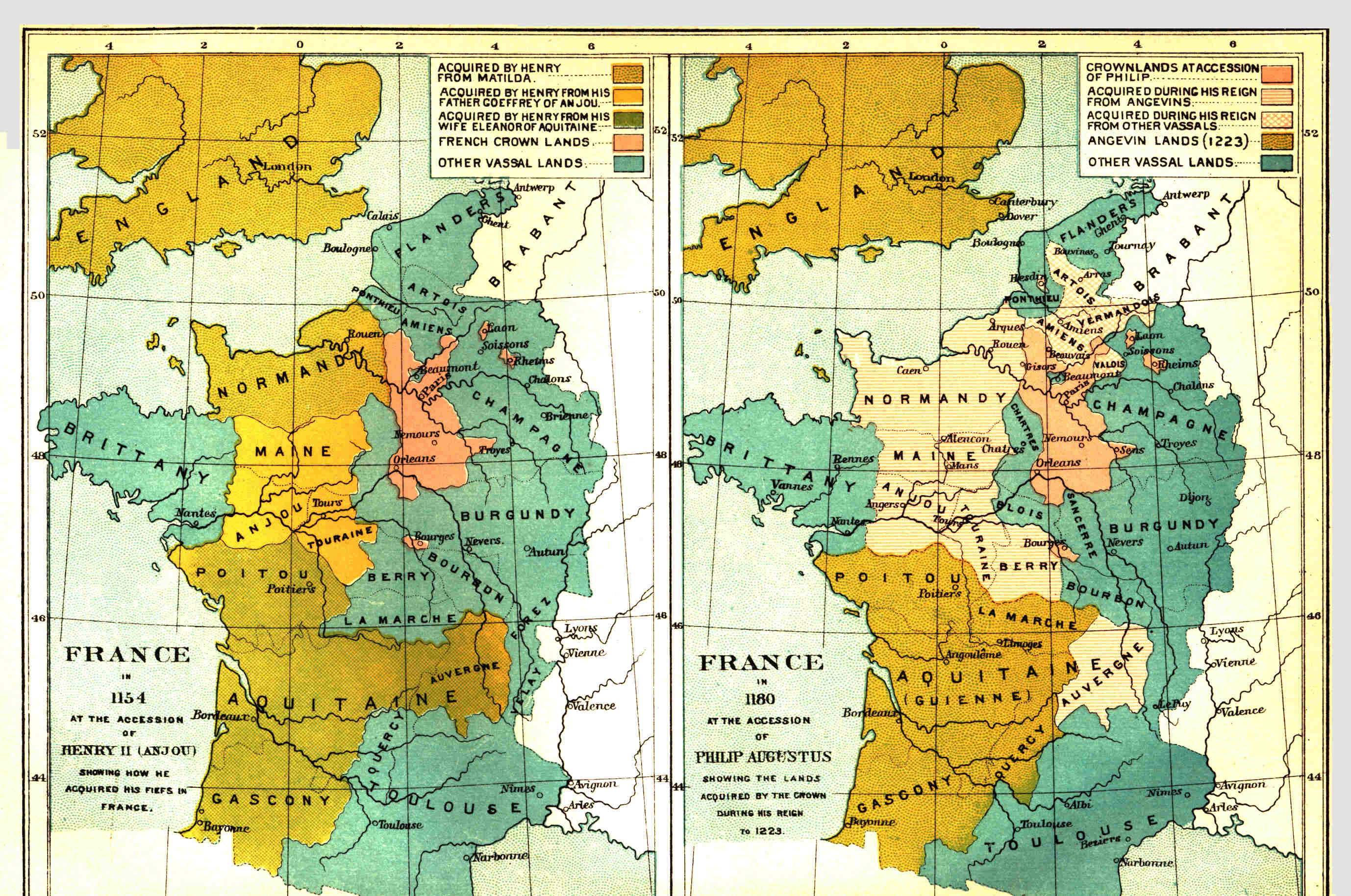
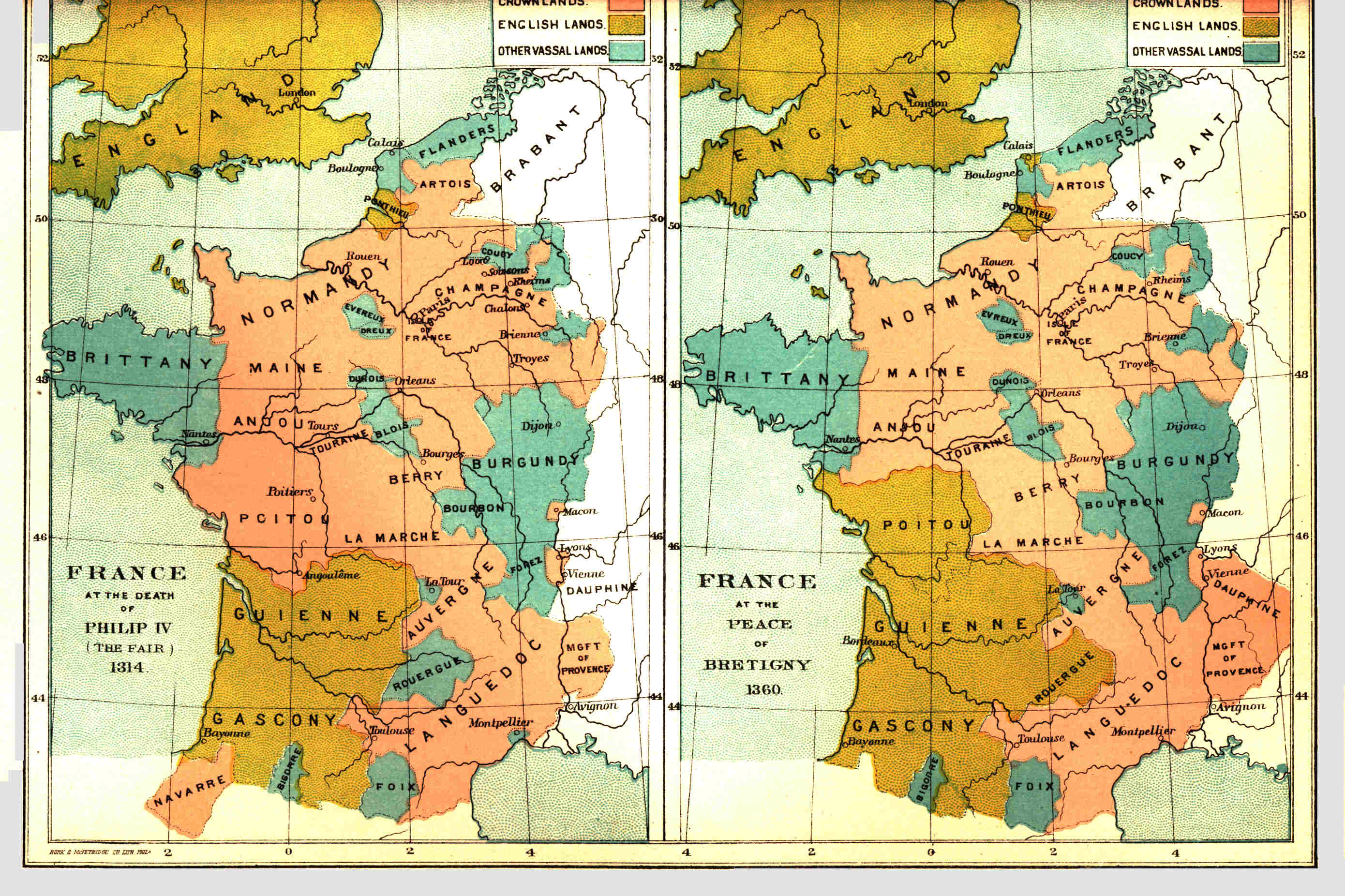
France in 1154 At the Accession of Henry II. (Anjou) Showing how he Acquired his fiefs in France. Acquired By Henry From Matilda. Acquired By Henry From His Father Goeffrey Of Anjou. Acquired By Henry From His Wife Eleanor Of Aquitaine French Crown Lands Other Vassal Lands. ------------------ France in 1180 At The Accession Of Philip Augustus Showing The Lands Acquired By The Crown During His Reign. Crown Lands At Accession Of Philip Acquired During His Reign Form Angevins Acquired During His Reign From Other Vassals Angevin Lands (1223) Other Vassal Lands ------------------ France at the death of Philip IV (The Fair) 1314 ------------------ France at the Peace of Bretigny -------End: Maps of France---------------- {1169} "From the moment of Charles IV.'s death [A. D. 1328], Edward III. of England buoyed himself up with a notion of his title to the crown of France, in right of his mother Isabel, sister to the three last kings. We can have no hesitation in condemning the injustice of this pretension. Whether the Salic law were or were not valid, no advantage could be gained by Edward. Even if he could forget the express or tacit decision of all France, there stood in his way Jane, the daughter of Louis X., three [daughters] of Philip the Long, and one of Charles the Fair. Aware of this, Edward set up a distinction, that, although females were excluded from succession, the same rule did not apply to their male issue; and thus, though his mother Isabel could not herself become queen of France, she might transmit a title to him. But this was contrary to the commonest rules of inheritance; and if it could have been regarded at all, Jane had a son, afterwards the famous king of Navarre [Charles the Bad], who stood one degree nearer to the crown than Edward. It is asserted in some French authorities that Edward preferred a claim to the regency immediately after the decease of Charles the Fair, and that the States-General, or at least the peers of France, adjudged that dignity to Philip de Valois. Whether this be true or not, it is clear that he entertained projects of recovering his right as early, though his youth and the embarrassed circumstances of his government threw insuperable obstacles in the way of their execution. He did liege homage, therefore, to Philip for Guienne, and for several years, while the affairs of Scotland engrossed his attention, gave no signs of meditating a more magnificent enterprise. As he advanced in manhood, and felt the consciousness of his strength, his early designs grew mature, and produced a series of the most important and interesting revolutions in the fortunes of France." H. Hallam, The Middle Ages, chapter 1, part l. See, also, SALIC LAW: APPLICATION TO THE REGAL SUCCESSION IN FRANCE. FRANCE: A. D. 1337-1360. The beginning of the "Hundred Years War." It was not until 1337 that Edward III. felt prepared to assert formally his claim to the French crown and to assume the title of King of France. In July of the following year he began undertakings to enforce his pretended right, by crossing with a considerable force to the continent. He wintered at Antwerp, concerting measures with the Flemings, who had espoused his cause, and arranging an alliance with the emperor-king of Germany, whose name bore more weight than his arms. In 1339 a formal declaration of hostilities was made and the long war--the Hundred Years War, as it has been called--of English kings for the sovereignty of France, began. "This great war may well be divided into five periods. The first ends with the Peace of Bretigny in 1360 (A. D. 1337-1360), and includes the great days of Crécy [1346] and Poitiers [1356], as well as the taking of Calais: the second runs to the death of Charles the Wise in 1380; these are the days of Du Guesclin and the English reverses: the third begins with the renewal of the war under Henry V. of England, and ends with the Regency of the Duke of Bedford at Paris, including the field of Azincourt [1415] and the Treaty of Troyes (A. D. 1415-1422): the fourth is the epoch of Jeanne Darc and ends with the second establishment of the English at Paris (A. D. 1428-1431): and the fifth and last runs on to the final expulsion of the English after the Battle of Castillon in 1453. Thus, though it is not uncommonly called the Hundred Years War, the struggle really extended over a period of a hundred and sixteen years." G. W. Kitchin, History of France, book 4, chapters 1-7. "No war had broken out in Europe, since the fall of the Roman Empire, so memorable as that of Edward III. and his successors against France, whether we consider its duration, its object, or the magnitude and variety of its events. It was a struggle of one hundred and twenty years, interrupted but once by a regular pacification, where the most ancient and extensive dominion in the civilised world was the prize, twice lost and twice recovered in the conflict. ... There is, indeed, ample room for national exultation at the names of Crecy, Poitiers and Azincourt. So great was the disparity of numbers upon those famous days, that we cannot, with the French historians, attribute the discomfiture of their hosts merely to mistaken tactics and too impetuous valour. ... These victories, and the qualities that secured them, must chiefly be ascribed to the freedom of our constitution, and to the superior condition of the people. Not the nobility of England, not the feudal tenants, won the battles of Crecy and Poitiers; for these were fully matched in the ranks of France; but the yeomen who drew the bow with strong and steady arms, accustomed to use it in their native fields, and rendered fearless by personal competence and civil freedom. ... Yet the glorious termination to which Edward was enabled, at least for a time, to bring the contest, was rather the work of fortune than of valour and prudence. Until the battle of Poitiers [A. D. 1356] he had made no progress towards the conquest of France. That country was too vast, and his army too small, for such a revolution. The victory of Crecy gave him nothing but Calais. ... But at Poitiers he obtained the greatest of prizes, by taking prisoner the king of France. Not only the love of freedom tempted that prince to ransom himself by the utmost sacrifices, but his captivity left France defenceless and seemed to annihilate the monarchy itself. ... There is no affliction which did not fall upon France during this miserable period. ... Subdued by these misfortunes, though Edward had made but slight progress towards the conquest of the country, the regent of France, afterwards Charles V., submitted to the peace of Bretigni [A. D. 1360]. By this treaty, not to mention less important articles, all Guienne, Gascony, Poitou, Saintonge, the Limousin, and the Angoumois, as well as Calais, and the county of Ponthieu, were ceded in full sovereignty to Edward; a price abundantly compensating his renunciation of the title of France, which was the sole concession stipulated in return." H. Hallam, The Middle Ages, chapter 1, part 2. ALSO IN: J. Froissart, Chronicles (Johnes' translation), book 1, chapters 1-212. W. Longman, History of Edward III., volume 1, chapters 6-22. F. P. Guizot, Popular History of France, chapter 20. D. F. Jamison, Life and Times of Bertrand du Guesclin, volume 1, chapters 4-10. See, also, POITIERS, BATTLE OF. {1170} FRANCE: A. D. 1347-1348. The Black Plague. "Epochs of moral depression are those, too, of great motality. ... In the last years of Philippe de Valois' reign, the depopulation was rapid. The misery and physical suffering which prevailed were insufficient to account for it; for they had not reached the extreme at which they subsequently arrived. Yet, to adduce but one instance, the population of a single town, Narbonne, fell off in the space of four or five years from the year 1399, by 500 families. Upon this too tardy diminution of the human race followed extermination,--the great black plague, or pestilence, which at once heaped up mountains of dead throughout Christendom. It began in Provence, in the year 1347, on All Saints' Day, continued sixteen months, and carried off two-thirds of the inhabitants. The same wholesale destruction befell Languedoc. At Montpellier, out of twelve consuls, ten died. At Narbonne, 30,000 persons perished. In several places, there remained only a tithe of the inhabitants. All that the careless Froissart says of this fearful visitation, and that only incidentally, is--'For at this time there prevailed throughout the world generally a disease called epidemy, which destroyed a third of its inhabitants.' This pestilence did not break out in the north of the kingdom until August, 1348, where it first showed itself at Paris and St. Denys. So fearful were its ravages at Paris, that, according to some, 800, according to others, 500, daily sank under it. ... As there was neither famine at the time nor want of food, but, on the contrary great abundance, this plague was said to proceed from infection of the air and of the springs. The Jews were again charged with this, and the people cruelly fell upon them." J. Michelet, History of France, book 6, chapter 1. See BLACK DEATH. FRANCE: A. D. 1350. Accession of King John II. FRANCE: A. D. 1356-1358. The States-General and Etienne Marcel. "The disaster of Poitiers [1356] excited in the minds of the people a sentiment of national grief, mixed with indignation and scorn at the nobility who had fled before an army so inferior in number. Those nobles who passed through the cities and towns on their return from the battle were pursued with imprecations and outrages. The Parisian bourgeoisie, animated with enthusiasm and courage, took upon itself at all risks the charge of its own defense; whilst, the eldest son of the king, a youth of only nineteen, who had been one of the first to fly, assumed the government as lieutenant of his father. It was at the summons of this prince that the states assembled again at Paris before the time which they had appointed. The same deputies returned to the number of 800, of whom 400 were of the bourgeoisie; and the work of reform, rudely sketched in the preceding session, was resumed under the same influence, with an enthusiasm which partook of the character of revolutionary impulse. The assembly commenced by concentrating its action in a committee of twenty-four members, deliberating, as far as appears, without distinction of orders; it then intimated its resolutions under the form of petitions, which were as follow: The authority of the states declared supreme in all affairs of administration and finance, the impeachment of all the counsellors of the king, the dismissal in a body of the officers of justice, and the creation of a council of reformers taken from the three orders; lastly, the prohibition to conclude any truce without the assent of the three states, and the right on their part to re-assemble at their own will without a royal summons. The lieutenant of the king, Charles Duke of Normandy, exerted in vain the resources of a precocious ability to escape these imperious demands: he was compelled to yield everything. The States governed in his name; but dissension, springing from the mutual jealousy of the different orders, was soon introduced into their body. The preponderating influence of the bourgeois appeared intolerable to the nobles, who, in consequence, deserted the assembly and retired home. The deputies of the clergy remained longer at their posts, but they also withdrew at last; and, under the name of the States-General, none remained but the representatives of the cities, alone charged with all the responsibilities of the reform and the affairs of the kingdom. Bowing to a necessity of central action, they submitted of their own accord to the deputation of Paris; and soon, by the tendency of circumstances, and in consequence of the hostile attitude of the Regent, the question of supremacy of the states became a Parisian question, subject to the chances of a popular émeute and the guardianship of the municipal power. At this point appears a man whose character has grown into historical importance in our days from our greater facilities of understanding it, Etienne [Stephen] Marcel, 'prévôt des marchands'--that is to say, mayor of the municipality of Paris. This échevin of the 14th century, by a remarkable anticipation, designed and attempted things which seem to belong only to recent revolutions. Social unity, and administrative uniformity; political rights, co-extensive and equal with civil rights; the principle of public authority transferred from the crown to the nation; the States-General changed, under the influence of the third order, into a national representation; the will of the people admitted as sovereign in the presence of the depositary of the royal power; the influence of Paris over the provinces, as the head of opinion and centre of the general movement; the democratic dictatorship, and the influence of terror exercised in the name of the common weal; new colours assumed and carried as a sign of patriotic union and symbol of reform; the transference of royalty itself from one branch of the family to the other, with a view to the cause of reform and the interest of the people--such were the circumstances and the scenes which have given to our own as well as the preceding century their political character. It is strange to find the whole of it comprised in the three years over which the name of the Prévôt Marcel predominates. His short and stormy career was, as it were, a premature attempt at the grand designs of Providence, and the mirror of the bloody changes of fortune through which those designs were destined to advance to their accomplishment under the impulse of human passions. Marcel lived and died for an idea--that of hastening on, by the force of the masses, the work of gradual equalisation commenced by the kings themselves; but it was his misfortune and his crime to be unrelenting in carrying out his convictions. To the impetuosity of a tribune who did not shrink even from murder he added the talent of organization; he left in the grand city, which he had ruled with a stern and absolute sway, powerful institutions, noble works, and a name which two centuries afterwards his descendants bore with pride as a title of nobility." A. Thierry, Formation and Progress of the Tiers Etat, volume 1, chapter 2. See, also, STATES-GENERAL OF FRANCE IN THE 14th CENTURY. {1171} FRANCE: A. D. 1358. The insurrection of the Jacquerie. "The miseries of France weighed more and more heavily on the peasantry; and none regarded them. They stood apart from the cities, knowing little of them; the nobles despised them and robbed them of their substance or their labour. ... At last the peasantry (May, 1358), weary of their woes, rose up to work their own revenge and ruin. They began in the Beauvais country and there fell on the nobles, attacking and destroying castles, and slaying their inmates: it was the old unvarying story. They made themselves a kind of king, a man of Clermont in the Beauvoisin, named William Callet. Froissart imagines that the name 'Jacques Bonhomme' meant a particular person, a leader in these risings. Froissart however had no accurate knowledge of the peasant and his ways. Jacques Bonhomme was the common nickname, the 'Giles' or 'Hodge' of France, the name of the peasant generally; and from it such risings as this of 1358 came to be called the 'Jacquerie,' or the disturbances of the 'Jacques.' The nobles were soon out against them, and the whole land was full of anarchy. Princes and nobles, angry peasants with their 'iron shod sticks and knives,' free-lances, English bands of pillagers, all made up a scene of utter confusion: 'cultivation ceased, commerce ceased, security was at an end.' The burghers of Paris and Meaux sent a force to help the peasants, who were besieging the fortress at Meaux, held by the nobles; these were suddenly attacked and routed by the Captal de Buch and the Count de Foix, 'then on their return from Prussia.' The King of Navarre also fell on them, took by stratagem their leader Callet, tortured and hanged him. In six weeks the fire was quenched in blood." G. W. Kitchin, History of France, chapter 2, section 3. "Froissard relates the horrible details of the Jacquerie with the same placid interest which characterises his descriptions of battles, tournaments, and the pageantry of chivalry. The charm and brilliancy of his narrative have long popularised his injustice and his errors, which are self-apparent when compared with the authors and chroniclers of his time. ... The chronicles contemporary of the Jacquerie confine themselves to a few words on the subject, although, with the exception of the Continuator of Nangis, they were all hostile to the cause of the peasants. The private and local documents on the subject say very little more. The Continuator of Nangis has drawn his information from various sources. He takes care to state that he has witnessed almost all he relates. After describing the sufferings of the peasants, he adds that the laws of justice authorised them to rise in revolt against the nobles of France. His respected testimony reduces the insurrection to comparatively small proportions. The hundred thousand Jacques of Froissard are reduced to something like five or six thousand men, a number much more probable when it is considered that the insurrection remained a purely local one, and that, in consequence of the ravages we have mentioned, the whole open country had lost about two-thirds of its inhabitants. He states very clearly that the peasants killed indiscriminately, and without pity, men and children, but he does not say anything of those details of atrocity related by Froissard. He only alludes once to a report of some outrages offered to some noble ladies; he speaks of it as a vague rumour. He describes the insurgents, after the first explosion of their vindictive fury, as pausing--amazed at their own boldness, and terrified at their own crimes, and the nobles, recovering from their terror, taking immediate advantage of this sudden torpor and paralysis--assembling and slaughtering all, innocent and guilty, burning houses and villages. If we turn to other writers contemporary with the Jacquerie, we find that Louvet, author of the 'History of the District of Beauvais,' does not say much on the subject, and evinces also a sympathy for the peasants: the paucity of his remarks on a subject represented by Froissard as a gigantic, bloody tragedy, raises legitimate doubts as to the veracity of the latter. There is another authority on the events of that period, which may be considered as more weighty, in consequence of its ecclesiastical character; it is the 'cartulaire,' or journal of the Abbot of Beauvais. ... There is no trace in it of the horror and indescribable terror ... [the rising] must have inspired if the peasants had committed the atrocities attributed to them by the feudal historian, Froissard. On the contrary, the vengeance of the peasants falls into the shade, as it were, in contrast with the merciless reaction of the nobles, along with the sanguinary oppression of the English. The writer of the 'Abbey of Beauvais,' and the anonymous monk, 'Continuator of Nangis,' concur with each other in their account of the Jacquerie. Their judgments are similar, and they manifest the same moderation. Their opinions, moreover, are confirmed by a higher authority, a testimony that must be considered as indisputable, namely, the letters of amnesty of the Regent of France, which are all preserved; they bear the date of 10th August 1358, and refer to all the acts committed on the occasion of the Jacquerie. In these he proves himself more severe upon the reaction of the nobles than on the revolt of the peasants. ... There is not the slightest allusion to the monstrosities related by Froissard, which the Regent could not have failed to stigmatise, as he is well known for having entertained an unscrupulous hatred to any popular movement, or any claims of the people. The manner, on the contrary, in which the Jacquerie are represented in this official document, is full of signification; it represents the men of the open country assembling spontaneously in various localities, in order to deliberate on the means of resisting the English, and suddenly, as with a mutual agreement, turning fiercely on the nobles, who were the real cause of their misery, and of the disgrace of France, on the days of Crecy and Poitiers. ... It has also been forgotten that many citizens took an active part in the Jacquerie. The great chronicles of France state that the majority were peasants, labouring people, but that there were also among them citizens, and even gentlemen, who, no doubt, were impelled by personal hatred and vengeance. Many rich men joined the peasants, and became their leaders. The bourgeoisie, in its struggles with royalty, could not refuse to take advantage of such a diversion; and Beauvais, Senlis, Amiens, Paris, and Meaux accepted the Jacquerie. Moreover, almost all the poorer classes of the cities sympathised with the revolted peasants. {1172} The Jacquerie broke out on the 21st of May 1358, and not in November 1357, as erroneously stated by Froissard, in the districts around Beauvais and Clermont-sur-Oise. The peasants, merely armed with pikes, sticks, fragments of their ploughs, rushed on their masters, murdered their families, and burned down their castles. The country comprised between Beauvais and Melun was the principal scene of this war of extermination. ... The Jacquerie had commenced on the 21st of May. On the 9th of June ... it was already terminated. It was, therefore, in reality, an insurrection of less than three weeks' duration. The reprisals of the nobles had already commenced on the 9th of June, and continued through the whole of July, and the greater part of August. Froissard states that the Jacquerie lasted over six weeks, thus comprising in his reckoning three weeks of the ferocious vengeance of the nobles, and casting on Jacques Bonhomme the responsibility of the massacres of which he had been the victim, as well as those he had committed in his furious despair." Prof. De Vericour, The Jacquerie (Royal Historical Society, Transactions, volume 1). ALSO IN: Sir J. Froissart, Chronicles (Johnes' translation), book 1, chapter 181. FRANCE: A. D. 1360-1380. English conquests recovered. The Peace of Bretigny brought little peace to France or little diminution of the troubles of the kingdom. In some respects there was a change for the worse introduced. The armies which had ravaged the country dissolved into plundering bands which afflicted it even more. Great numbers of mercenaries from both sides were set free, who gathered into Free Companies, as they were called, under leaders of fit recklessness and valor, and swarmed over the land, warring on all prosperity and all the peaceful industries of the time, seeking booty wherever it might be found. See ITALY: A. D. 1343-1393. Civil war, too, was kept alive by the intrigues and conspiracies of the Navarrese king, Charles the Bad; and war in Brittany, over a disputed succession to the dukedom, was actually stipulated for, by French and English, in their treaty of general peace. But when the chivalric but hapless King John died, in 1364, the new king, Charles V., who had been regent during his captivity, developed an unexpected capacity for government. He brought to the front the famous Breton warrior Du Guesclin-rough, ignorant, unchivalric--but a fighter of the first order in his hard-fighting day. He contrived with adroitness to rid France, mostly, of the Free Companies, by sending them, with Du Guesclin at their head, into Spain, where they drove Peter the Cruel from the throne of Castile, and fought the English, who undertook, wickedly and foolishly, to sustain him. The Black Prince won a great battle, at Najara or Navarette (A. D. 1367), took Du Guesclin prisoner and restored the cruel Pedro to his throne. But it was a victory fatal to English interests in France. Half the army of the English prince perished of a pestilent fever before he led it back to Aquitaine, and he himself was marked for early death by the same malady. He had been made duke of Aquitaine, or Guienne, and held the government of the country. The war in Spain proved expensive; he taxed his Gascon and Aquitanian subjects heavily. He was ill, irritable, and treated them harshly. Discontent became widely spread, and the king of France subtly stirred it up until he felt prepared to make use of it in actual war. At last, in 1368, he challenged a rupture of the Peace of Bretigny by summoning King Edward, as his vassal, to answer complaints from Aquitaine. In April of the next year he formally declared war and opened hostilities the same day. His cunning policy was not to fight, but to waste and wear the enemy out. Its wisdom was well-proved by the result. Day by day the English lost ground; the footing they had gained in France was found to be everywhere insecure. The dying Black Prince achieved one hideous triumph at Limoges, where he fouled his brilliant fame by a monstrous massacre; and thence he was carried home to end his days in England. In 1376 he died, and one year later his father, King Edward, followed him to the grave, and a child of eleven (Richard II.) came to the English throne. But the same calamity befell France in 1380, when Charles the Wise died, leaving an heir to the throne only twelve years of age. In both kingdoms the minority of the sovereign gave rise to factious intrigues and distracting feuds. The war went on at intervals, with frequent truces and armistices, and with little result beyond the animosities which it kept alive. But the English possessions, by this time, had been reduced to Calais and Guines, with some small parts of Aquitaine adjoining the cities of Bordeaux and Bayonne. And thus, it may be said, the situation was prolonged through a generation, until Henry V. of England resumed afresh the undertaking of Edward III. F. P. Guizot, Popular History of France, chapter 22. ALSO IN: J. Michelet, History of France, book 6, chapter 4. T. Wright, History of France, book 2, chapter 6. E. A. Freeman, Historical Geography of Europe, chapter 9. D. F. Jamison, Life and Times of Du Guesclin. Froissart, Chronicles (Johnes' translation), book 1. See SPAIN: A. D. 1366-1369. FRANCE: A. D. 1364. Accession of King Charles V. FRANCE: A. D. 1378. Acquisitions in the Rhone valley legal conferred by the Emperor. See BURGUNDY: A. D. 1127-1378. FRANCE: A. D. 1380. Accession of King Charles VI. FRANCE: A. D. 1380-1415. The reign of the Dukes. The civil war of Armagnacs and Burgundians. "Charles VI. had arrived at the age of eleven years and some months when his father died [A. D. 1380]. His three paternal uncles, the Dukes of Anjou, Berry, and Burgundy, and his maternal uncle, the Duke of Bourbon, disputed among themselves concerning his guardianship and the regency. They agreed to emancipate the young King immediately after his coronation, which was to take place during the year, and the regency was to remain until that period in the hands of the eldest, the Duke of Anjou." But the Duke of Anjou was soon afterwards lured into Italy by the fatal gift of a claim to the crown of Naples [see ITALY: A. D. 1343-1389.], and perished in striving to realize it. The surviving uncles misgoverned the country between them until 1389, when the young king was persuaded to throw off their yoke. The nation rejoiced for three years in the experience and the prospect of administrative reforms; but suddenly, in July, 1392, the young king became demented, and "then commenced the third and fatal epoch of that disastrous reign. The faction of the dukes again seized power," but only to waste and afflict the kingdom by dissensions among themselves. {1173} The number of the rival dukes was now increased by the addition of the Duke of Orleans, brother of the king, who showed himself as ruthless and rapacious as any. "Charles was still considered to be reigning; each one sought in turn to get possession of him, and each one watched his lucid moments in order to stand well in power. His flashes of reason were still more melancholy than his fits of delirium. Incapable of attending to his affairs, or of having a will of his own, always subservient to the dominant party, he appeared to employ his few glimmerings of reason only in sanctioning the most tyrannical acts and the most odious abuses. It was in this manner that the kingdom of France was governed during twenty-eight years." In 1404, the Duke of Burgundy, Philip the Bold, having died, the Duke of Orleans acquired supreme authority and exercised it most oppressively. But the new Duke of Burgundy, John the Fearless, made his appearance on the scene ere long, arriving from his county of Flanders with an army and threatening civil war. Terms of peace, however, were arranged between the two dukes and an apparent reconciliation took place. On the very next day the Duke of Orleans was assassinated (A. D. 1407), and the Duke of Burgundy openly proclaimed his instigation of the deed. Out of that treacherous murder sprang a war of factions so deadly that France was delivered by it to foreign conquest, and destroyed, we may say, for the time being, as a nation. The elder of the young princes of Orleans, sons of the murdered duke, had married a daughter of Count Bernard of Armagnac, and Count Bernard became the leader of the party which supported them and sought to avenge them, as against the Duke of Burgundy and his party. Hence the former acquired the name of Armagnacs; the latter were called Burgundians. Armagnac led an army of Gascons [A. D. 1410] and threatened Paris, "where John the Fearless caressed the vilest populace. Burgundy relied on the name of the king, whom he held in his power, and armed in the capital a corps of one hundred young butchers or horse-knackers, who, from John Caboche, their chief, took the name of Cabochiens. A frightful war, interrupted by truces violated on both sides, commenced between the party of Armagnac and that of Burgundy. Both sides appealed to the English, and sold France to them. The Armagnacs pillaged and ravaged the environs of Paris with unheard of cruelties, while the Cabochiens caused the capital they defended to tremble. The States-General, convoked for the first time for thirty years, were dumb--without courage and without strength. The Parliament was silent, the university made itself the organ of the populace, and the butchers made the laws. They pillaged, imprisoned and slaughtered with impunity, according to their savage fury, and found judges to condemn their victims. ... The reaction broke out at last. Tired of so many atrocities, the bourgeoisie took up arms, and shook off the yoke of the horse-knackers. The Dauphin was delivered by them. He mounted on horseback, and, at the head of the militia, went to the Hôtel de Ville, from which place he drove out Caboche and his brigands. The counter revolution was established. Burgundy departed, and the power passed to the Armagnacs. The princes re-entered Paris, and King Charles took up the oriflamme (the royal standard of France), to make war against John the Fearless, whose instrument he had been a short time before. His army was victorious. Burgundy submitted, and the treaty of Arras [A. D. 1415] suspended the war, but not the executions and the ravages. Henry V., King of England, judged this a propitious moment to descend upon France, which had not a vessel to oppose the invaders." E. de Bonnechose, History of France, volume 1, pages 266-279. ALSO IN: E. de Monstrelet, Chronicles (Johnes' translation), volume 1, book 1, chapters 1-140. T. Wright, History of France, book 2, chapters 8-9. FRANCE: A. D. 1383. Pope Urban's Crusade against the Schismatics. See FLANDERS: A. D. 1383. FRANCE: A. D. 1396. The sovereignty of Genoa surrendered to the king. See GENOA: A. D. 1381-1422. FRANCE: A. D. 1415. The Hundred Years War renewed by Henry V. of England. "When Henry V. resolved to recover what he claimed as the inheritance of his predecessors, he had to begin, it may be said, the work of conquest over again. Allies, however, he had, whose assistance he was to find very useful. The dynasty of De Montfort had been established in possession of the dukedom of Britanny in a great measure by English help, and though the relations between the two countries had not been invariably friendly since that time, the sense of this obligation, and, still more powerfully, a jealous fear of the French king, inclined Britanny to the English alliance. The Dukes of Burgundy, though they had no such motives of gratitude towards England, felt a far stronger hostility towards France. The feud between the rival factions which went by the names of Burgundians and Armagnacs had now been raging for several years; and though the attitude of the Burgundians varied--at the great struggle of Agincourt they were allies, though lukewarm and even doubtful allies, of the French--they ultimately ranked themselves decidedly on Henry's side. In 1414, then, Henry formally demanded, as the heir of Isabella, mother of his great-grandfather Edward, the crown of France. This claim the French princes wholly refused to consider. Henry then moderated his demands so far, at least, as to allow Charles to remain in nominal possession of his kingdom; but ... France was to cede to England, no longer as a feudal superior making a grant to a vassal, but in full sovereignty, the provinces of Normandy, Maine, and Anjou, together with all that was comprised in the ancient duchy of Aquitaine. Half, too, of Provence was claimed, and the arrears of the ransom of King John, amounting to 1,200,000 crowns, were also to be paid. Finally, the French king was to give his youngest daughter, Katharine, in marriage to Henry, with a portion of 2,000,000 crowns. The French ministers offered, in answer, to yield the duchy of Aquitaine, comprising the provinces of Anjou, Gascony, Guienne, Poitou, and to give the hand of the princess Katharine with a dowry of 600,000 crowns. "Negotiations went on through several months, with small chance of success, while Henry prepared for war. His preparations were completed in the summer of 1415, and on the 11th of August in that year he set sail from Southampton, with an army of 6,000 men-at-arms and 24,000 archers, very completely equipped, and accompanied with cannon and other engines of war. {1174} Landing in the estuary of the Seine, the invaders first captured the important Norman seaport of Harfleur, after a siege of a month, and expelled the inhabitants from the town. It was an important acquisition; but it had cost the English heavily. They were ill-supplied with food; they had suffered from much rain; 2,000 had died of an epidemic of dysentery. The army was in no condition for a forward movement. "The safest course would now have been to return at once; and this seems to have been pressed upon the king by the majority of his counsellors. But this prudent advice did not approve itself to Henry's adventurous temper. ... He determined ... to make what may be called a military parade to Calais. This involved a march of not less than 150 miles through a hostile country, a dangerous, and, but that one who cherishes such designs as Henry's must make a reputation for daring, a useless operation; but the king's determined will overcame all opposition." Leaving a strong garrison at Harfleur, Henry set out upon his march. Arrived at the Somme, his further progress was disputed, and he was forced to make a long detour before he could effect a crossing of the river. On the 24th of October, he encountered the French army, strongly posted at the village of Azincour or Agincourt, barring the road to Calais; and there, on the morning of the 25th, after a night of drenching rain, the great battle, which shines with so dazzling a glory in English history, was fought. There seems to be no doubt that the English were greatly outnumbered by the French--according to Monstrelet they were but one to six; but the masses on the French side were unskilfully handled and no advantage was got from them. The deadly shafts of the terrible English archers built such a rampart of corpses in their front that it actually sheltered them from the charge of the French cavalry. "Everywhere the French were routed, slain, or taken. The victory of the English was complete. ... The French loss was enormous. Monstrelet gives a long list of the chief princes and nobles who fell on that fatal field. ... We are disposed to trust his estimate, which, including princes, knights and men-at-arms of every degree, he puts at 10,000. ... Only 1,600 are said to have been 'of low degree.' ... The number of knights and gentlemen taken prisoners was 1,500. Among them were Charles, Duke of Orleans, and the Duke of Bourbon, both princes of the blood-royal. ... Brilliant as was the victory which Henry had won at Agincourt, it had, it may be said, no immediate results. ... The army resumed its interrupted march to Calais, which was about forty miles distant. At Calais a council of war was held, and the resolution to return to England unanimously taken. A few days were allowed for refreshment, and about the middle of November the army embarked." A. J. Church, Henry the Fifth, chapters 6-10. ALSO IN: E. de Monstrelet, Chronicles (Johnes' translation), volume 1, book 1, chapters 140-149. J. E. Tyler, Henry of Monmouth, chapters 19-23. G M. Towle, History of Henry V., chapters 7-8. Lord Brougham, History of England and France under the House of Lancaster. C. M. Yonge, Cameos from English History: second series, chapters 24-26. FRANCE: A. D. 1415-1419. Massacre of Armagnacs. The murder of the Duke of Burgundy. "The captivity of so many princes of the blood as had been taken prisoner at Agincourt might have seemed likely at least to remove some of the elements of discord; but it so happened that the captives were the most moderate and least ambitious men. The gentle, poetical Duke of Orleans, the good Duke of Bourbon, and the patriotic and gallant Arthur de Richemont, had been taken, while the savage Duke of Burgundy and the violent Gascon Count of Armagnac, Constable of France, remained at the head of their hostile factions. ... The Count d'Armagnac now reigned supreme; no prince of the blood came to the councils, and the king and dauphin were absolutely in his hands. ... The Duke of Burgundy was, however, advancing with his forces, and the Parisians were always far more inclined to him than to the other party. ... For a whole day's ride round the environs of the city, every farmhouse had been sacked or burnt. Indeed, it was said in Paris a man had only to be called a Burgundian, or anywhere else in the Isle of France an Armagnac, to be instantly put to death. All the soldiers who had been posted to guard Normandy and Picardy against the English were recalled to defend Paris against the Duke of Burgundy; and Henry V. could have found no more favourable moment for a second expedition." The English king took advantage of his opportunity and landed in Normandy August 1, 1417, finding nobody to oppose him in the field. The factions were employed too busily in cutting each other's throats,-- especially after the Burgundians had regained possession of Paris, which they did in the following spring. Thereupon the Parisian mob rose and ferociously massacred all the partisans of Armagnac, while the Burgundians looked and approved. "The prison was forced; Armagnac himself was dragged out and slain in the court. ... The court of each prison became a slaughter-house; the prisoners were called down one by one, and there murdered, till the assassins were up to their ankles in blood. The women were as savage as the men, and dragged the corpses about the streets in derision. The prison slaughter had but given a passion for further carnage; and the murderers broke open the houses in search of Armagnacs, killing not only men, but women, children, and even new-born babes, to whom in their diabolical frenzy they refused baptism, as being little Armagnacs. The massacre lasted from four o'clock on Sunday morning to ten o'clock on Monday. Some say that 3,000 perished, others 1,600, and the Duke of Burgundy's servants reported the numbers as only 400." Meantime Henry V. was besieging Rouen, and starving Paris by cutting off the supplies for which it depended on the Seine. In August there was another rising of the Parisian mob and another massacre. In January, 1419, Rouen surrendered, and attempts at peace followed, both parties making a truce with the English invader. The imperious demands of King Henry finally impelled the two French factions to draw together and to make a common cause of the deliverance of the kingdom. At least that was the profession with which the Dauphin and the Duke of Burgundy met, in July, and went through the forms of a reconciliation. Perhaps there were treacherous intentions on both sides. On one side the treachery was consummated a month later (September 10, 1419), when, a second meeting between Duke John the Fearless and the Dauphin taking place at the Bridge of Montereau, the Duke was basely assassinated in the Dauphin's presence. {1175} This murder, by which the Armagnacs, who controlled the young Dauphin, hoped to break their rivals down, only kindled afresh the passions which were destroying France and delivering it an easy prey to foreign conquest. C. M. Yonge, Cameos from English History, second series, chapters 28-29. ALSO IN: E. de Monstrelet, Chronicles (Johnes' translation), volume 1, book 1, chapters 150-211. J. Michelet, History of France, book 9, chapter 2. FRANCE: A. D. 1417-1422. Burgundy's revenge. Henry the Fifth's triumph. Two kings in Paris. The Treaty of Troyes. Death of Henry. "Whilst civil war was ... penetrating to the very core of the kingship, foreign war was making its way again into the kingdom. Henry V., after the battle of Agincourt, had returned to London, and had left his army to repose and reorganize after its sufferings and its losses. It was not until eighteen months afterwards, on the 1st of August, 1417, that he landed at Touques, not far from Honfleur, with fresh troops, and resumed his campaign in France. Between 1417 and 1419 he successively laid siege to nearly all the towns of importance in Normandy, to Caen, Bayeux, Falaise, Evreux, Coutances, Laigle, St. Lô, Cherbourg, &c., &c. Some he occupied after a short resistance, others were sold to him by their governors; but when, in the month of July, 1418, he undertook the siege of Rouen, he encountered there a long and serious struggle. Rouen had at that time, it is said, a population of 150,000 souls, which was animated by ardent patriotism. The Rouennese, on the approach of the English, had repaired their gates, their ramparts, and their moats; had demanded reinforcements from the King of France and the Duke of Burgundy; and had ordered every person incapable of bearing arms or procuring provisions for ten months to leave the city. Twelve thousand old men, women and children were thus expelled, and died either round the place or whilst roving in misery over the neighbouring country. ... Fifteen thousand men of city-militia, 4,000 regular soldiers, 300 spearmen and as many archers from Paris, and it is not quite known how many men-at-arms sent by the Duke of Burgundy, defended Rouen for more than five months amidst all the usual sufferings of strictly-besieged cities." On the 13th of January, 1419, the town was surrendered. "It was 215 years since Philip Augustus had won Rouen by conquest from John Lackland, King of England." After this great success there were truces brought about between all parties, and much negotiation, which came to nothing--except the treacherous murder of the Duke of Burgundy, as related above. Then the situation changed. The son and successor of the murdered duke, afterwards known as Philip the Good, took sides, at once, with the English king and committed himself to a war of revenge, indifferent to the fate of France. "On the 17th of October [1419] was opened at Arras a congress between the plenipotentiaries of England and those of Burgundy. On the 20th of November a special truce was granted to the Parisians, whilst Henry V., in concert with Duke Philip of Burgundy, was prosecuting the war against the dauphin. On the 2d of December the bases were laid of an agreement between the English and the Burgundians. The preliminaries of the treaty, which was drawn up in accordance with these bases, were signed on the 9th of April, 1420, by King Charles VI. [now controlled by the Burgundians], and on the 20th communicated at Paris by the chancellor of France to the parliament." On the 20th of May following, the treaty, definitive and complete, was signed by Henry V. and promulgated at Troyes. By this treaty of Troyes, Princess Catherine, daughter of the King of France, was given in marriage to King Henry; Charles VI. was guaranteed his possession of the French crown while he lived; on his death, "the crown and kingdom of France, with all their rights and appurtenances," were solemnly conveyed to Henry V. of England and his heirs, forever. "The revulsion against the treaty of Troyes was real and serious, even in the very heart of the party attached to the Duke of Burgundy. He was obliged to lay upon several of his servants formal injunctions to swear to this peace, which seemed to them treason. ... In the duchy of Burgundy the majority of the towns refused to take the oath to the King of England. The most decisive and the most helpful proof of this awakening of national feeling was the ease experienced by the dauphin, who was one day to be Charles VII., in maintaining the war which, after the treaty of Troyes, was, in his father's and his mother's name, made upon him by the King of England and the Duke of Burgundy. This war lasted more than three years. Several towns, amongst others, Melun, Crotoy, Meaux, and St. Riquier, offered an obstinate resistance to the attacks of the English and Burgundians. ... It was in Perche, Anjou, Maine, on the banks of the Loire, and in Southern France, that the dauphin found most of his enterprising and devoted partisans. The sojourn made by Henry V. at Paris, in December, 1420, with his wife, Queen Catherine, King Charles VI., Queen Isabel, and the Duke of Burgundy, was not, in spite of galas and acclamations, a substantial and durable success for him. ... Towards the end of August, 1422, Henry V. fell ill; and, too stout-hearted to delude himself as to his condition, he ... had himself removed to Vincennes, called his councillors about him, and gave them his last royal instructions. ... He expired on the 31st of August, 1422, at the age of thirty-four." F. P. Guizot, Popular History of France, chapter 23. At Paris, "the two sovereigns [Henry V. and Charles VI.] kept distinct courts. That of Henry was by far the most splendidly equipped and numerously attended of the two. He was the rising sun, and all men looked to him. All offices of trust and profit were at his disposal, and the nobles and gentlemen of France flocked into his ante-chambers." A. J. Church, Henry the Fifth, chapter 15. ALSO IN: E. de Monstrelet, Chronicles (Johnes' translation), volume 1, book 1, chapters 171-264. J. Michelet, History of France, book 9, chapters 2-3. FRANCE: A. D. 1422. Accession of King Charles VII. {1176} FRANCE: A. D. 1429-1431. The Mission of the Maid. "France divided--two kings, two regencies, two armies, two governments, two nations, two nobilities, two systems of justice--met face to face: father, son, mother, uncles, nephews, citizens, and strangers, fought for the right, the soil, the throne, the cities, the spoil and the blood of the nation. The King of England died at Vincennes [August 31, 1422], and was shortly followed [October 22] by Charles VI., father of the twelve children of Isabel, leaving the kingdom to the stranger and to ruin. The Duke of Bedford insolently took possession of the Regency in the name of England, pursued the handful of nobles who wished to remain French with the dauphin, defeated them at the battle of Verneuil [August 17,1424], and exiled the queen, who had become a burden to the government after having been an instrument of usurpation. He then concentrated the armies of England, France and Burgundy round Orleans, which was defended by some thousands of the partisans of the dauphin, and which comprised almost all that remained of the kingdom of France. The land was everywhere ravaged by the passing and repassing of these bands--sometimes friends, sometimes enemies--driving each other on, wave after wave, like the billows of the Atlantic; ravaging crops, burning towns, dispersing, robbing, and ill-treating the population. In this disorganization of the country, the young dauphin, sometimes awakened by the complaints of his people, at others absorbed in the pleasures natural to his age, was making love to Agnes Sorel in the castle of Loches. ... Such was the state of the nation when Providence showed it a savior in a child." The child was Jeanne D'Arc, or Joan of Arc, better known in history as the Maid of Orleans,--daughter of a peasant who tilled his own few acres at the village of Domrémy, in Upper Lorraine. Of the visions of the pious young maiden--of the voices she heard--of the conviction which came upon her that she was called by God to deliver her country--and of the enthusiasm of faith with which she went about her mission until all people bent to her as the messenger and minister of God--the story is a familiar one to all. In April, 1429, Joan was sent by the king, from Blois, with 10,000 or 12,000 men, to the succour of Orleans, where Dunois, the Bastard of Orleans, was in command. She reformed the army, purged it of all vile followers, and raised its confidence to that frenzied pitch which nothing can resist. On the 8th of May the English abandoned the siege and Orleans was saved. "Joan wasted no time in vain triumphs. She brought back the victorious army to the dauphin, to assist him in reconquering city after city of his kingdom. The dauphin and the queens received her as the messenger of God, who had found and recovered the lost keys of the kingdom. 'I have only another year,' she remarked, with a sad presentiment, which seemed to indicate that her victory led to the scaffold; 'I must therefore set to work at once.' She begged the dauphin to go and be crowned at Rheims, although that city and the intermediate provinces were still in the power of the Burgundians, Flemings, and English." Counsellors and generals opposed; but the sublime faith of the Maid overcame all opposition and all difficulties. The king's route to Rheims was rapidly cleared of his enemies. At Patay (June 18, 1429) the English suffered a heavy defeat and their famous soldier, Lord Talbot, was taken prisoner. Troyes, Chalons and Rheims opened their gates. "The Duke of Bedford, the regent, remained trembling in Paris. 'All our misfortunes,' he wrote to the Cardinal of Winchester, 'are owing to a young witch, who, by her sorcery, has restored the courage of the French.' ... The king was crowned [July 17, 1429], and Joan's mission was accomplished. 'Noble king,' said she, embracing his knees in the Cathedral after the coronation, 'now is accomplished the will of God, which commanded me to bring you to this city of Rheims to receive your holy unction--now that you at last are king, and that the kingdom of France is yours.' ... From that moment a great depression, and a fatal hesitation seem to have come over her. The king, the people, and the army, to whom she had given victory, wished her to remain always their prophetess, their guide, and their enduring miracle. But she was now only a weak woman, lost amid courts and camps, and she felt her weakness beneath her armor. Her heart alone remained courageous, but had ceased to be inspired." She urged an attack on Paris (Sept. 8, 1429) and experienced her first failure, being grievously wounded in the assault. The following spring, Compiègne being besieged, she entered the town to take part in the defence. The same evening (May 24, 1430) she led a sortie which was repulsed, and she was taken prisoner in the retreat. Some think she was betrayed by the commandant of the town, who ordered the raising of the drawbridge just as her horse was being spurred upon it. Once in the hands of her enemies, the doom of the unfortunate Maid was sealed. Sir Lionel de Ligny, her captor, gave his prisoner to the count of Luxembourg, who yielded her to the Duke of Burgundy, who surrendered her to the English, who delivered her to the Inquisition, by which she was tried, condemned and burned to death, at Rouen, as a witch (May 30, 1431). "It was a complex crime, in which each party got rid of responsibility, but in which the accusation rests with Paris [the University of Paris was foremost among the pursuers of the wonderful Maid], the cowardice with Luxembourg, the sentence with the Inquisition, the blame and punishment with England, and the disgrace and ingratitude with France. This bartering about Joan by her enemies, of whom the fiercest were her countrymen, had lasted six months. ... During these six months, the influence of this goddess of war upon the troops of Charles VII.--her spirit, which still guided the camp and council of the king--the patriotic, though superstitious, veneration of the people, which her captivity only doubled,--and, lastly, the absence of the Duke of Burgundy, ... all these causes had brought reverse after reverse upon the English, and a series of successes to Charles VII. Joan, although absent, triumphed everywhere." A. de Lamartine, Memoirs of Celebrated Characters: Joan of Arc. "It seems natural to ask what steps the King of France had taken ... to avert her doom. If ever there had been a sovereign indebted to a subject, that sovereign was Charles VII., that subject Joan of Arc. ... Yet, no sooner was she captive than she seems forgotten. We hear nothing of any attempt at rescue, of any proposal for ransom; neither the most common protest against her trial, nor the faintest threat of reprisals; nay, not even after her death, one single expression of regret! Charles continued to slumber in his delicious retreats beyond the Loire, engrossed by dames of a very different character from Joan's, and careless of the heroine to whom his security in that indolence was due. Her memory on the other hand was long endeared to the French people, and long did they continue to cherish a romantic hope that she might still survive. {1177} So strong was this feeling, that in the year 1436 advantage was taken of it by a female imposter, who pretended to be Joan of Arc escaped from her captivity. She fixed her abode at Metz, and soon afterwards married a knight of good family, the Sire des Armoises. Strange to say, it appears from a contemporary chronicle, that Joan's two surviving brothers acknowledged this woman as their sister. Stranger still, other records prove that she made two visits to Orleans, one before and one after her marriage, and on each occasion was hailed as the heroine returned. ... The brothers of Joan of Arc might possibly have hopes of profit by the fraud; but how the people of Orleans, who had seen her so closely, who had fought side by side with her in the siege, could be deceived as to the person, we cannot understand, nor yet what motive they could have in deceiving. The interest which Joan of Arc inspires at the present day extends even to the house where she dwelt, and to the family from which she sprung. Her father died of grief at the tidings of her execution; her mother long survived it, but fell into great distress. Twenty years afterwards we find her in receipt of a pension from the city of Orleans; three francs a month; 'to help her to live.' Joan's brothers and their issue took, the name of Du Lis from the Lily of France, which the King had assigned as their arms. ... It will be easy to trace the true character of Joan. ... Nowhere do modern annals display a character more pure--more generous--more humble amidst fancied visions and undoubted victories--more free from all taint of selfishness--more akin to the champions and martyrs of old times. All this is no more than justice and love of truth would require us to say. But when we find some French historians, transported by an enthusiasm almost equal to that of Joan herself, represent her us filling the part of a general or statesman--as skilful in leading armies, or directing councils--we must withhold our faith. Such skill, indeed, from a country girl, without either education or experience, would be, had she really possessed it, scarcely less supernatural than the visions which she claimed. But the facts are far otherwise. In affairs of state, Joan's voice was never heard; in affairs of war, all her proposals will be found to resolve themselves into two--either to rush headlong upon the enemy, often in the very point where he was strongest, or to offer frequent and public prayers to the Almighty. We are not aware of any single instance in which her military suggestions were not these, or nearly akin to these. ... Of Joan's person no authentic resemblance now remains. A statue to her memory had been raised upon the bridge at Orleans, at the sole charge ... of the matrons and maids of that city: this probably preserved some degree of likeness, but unfortunately perished in the religious wars of the sixteenth century. There is no portrait extant; the two earliest engravings are of 1606 and 1612, and they greatly differ." Lord Mahon, Historical Essays, pages 53-57. "A few days before her death, when urged to resume her woman's dress, she said: 'When I shall have accomplished that for which I was sent from God, I will take the dress of a woman.' Yet, in one sense her mission did end at Rheims. The faith of the people still followed her, but her enemies--not the English, but those in the heart of the court of Charles--began to be too powerful for her. We may, indeed, conceive what a hoard of envy and malice was gathering in the hearts of those hardened politicians at seeing themselves superseded by a peasant girl. They, accustomed to dark and tortuous ways, could not comprehend or coalesce with the divine simplicity of her designs and means. A successful intrigue was formed against her. It was resolved to keep her still in the camp as a name and a figure, but to take from her all power, all voice in the direction of affairs. So accordingly it was done. ... Her ways and habits during the year she was in arms are attested by a multitude of witnesses. Dunois and the Duke of Alençon bear testimony to what they term her extraordinary talents for war, and to her perfect fearlessness in action; but in all other things she was the most simple of creatures. She wept when she first saw men slain in battle, to think that they should have died without confession. She wept at the abominable epithets which the English heaped upon her; but she was without a trace of vindictiveness. 'Ah, Glacidas, Glacidas!' she said to Sir William Glasdale at Orleans, 'you have called me foul names; but I have pity upon your soul and the souls of your men. Surrender to the King of Heaven!' And she was once seen, resting the head of a wounded Englishman on her lap, comforting and consoling him. In her diet she was abstemious in the extreme, rarely eating until evening, and then for the most part, only of bread and water sometimes mixed with wine. In the field she slept in her armour, but when she came into a city she always sought out some honourable matron, under whose protection she placed herself; and there is wonderful evidence of the atmosphere of purity which she diffused around her, her very presence banishing from men's hearts all evil thoughts and wishes. Her conversation, when it was not of the war, was entirely of religion. She confessed often, and received communion twice in the week. 'And it was her custom,' says Dunois, 'at twilight every day, to retire to the church and make the bells be rung for half an hour, and she gathered the mendicant religious who followed the King's army, and made them sing an antiphon of the Blessed Mother of God.' From presumption, as from superstition, she was entirely free. When women brought her crosses and chaplets to bless, she said: 'How can I bless them? Your own blessing would be as good as mine.'" J. O'Hagan, Joan of Arc, pages 61-66. "What is to be thought of her? What is to be thought of the poor shepherd girl from the hills and forests of Lorraine, that--like the Hebrew shepherd boy from the hills and forests of Judea--rose suddenly out of the quiet, out of the safety, out of the religious inspiration, rooted in deep pastoral solitudes, to a station in the van of armies, and to the more perilous station at the right hand of kings? The Hebrew boy inaugurated his patriotic mission by an act, by a victorious act, such as no man could deny. But so did the girl of Lorraine, if we read her story as it was read by those who saw her nearest. Adverse armies bore witness to the boy as no pretender; but so they did to the gentle girl. Judged by the voices of all who saw them from a station of good-will, both were found true and loyal to any promises involved in their first acts. Enemies it was that made the difference between their subsequent fortunes. {1178} The boy rose to a splendour, and a noonday prosperity, both personal and public, that rang through the records of his people, and became a by-word amongst his posterity for a thousand years, until the sceptre was departing from Judah. The poor, forsaken girl, on the contrary, drank not herself from that cup of rest which she had secured for France. ... This pure creature--pure from every suspicion of even a visionary self-interest, even as she was pure in senses more obvious--never once did this holy child, as regarded herself, relax from her belief in the darkness that was travelling to meet her. She might not prefigure the very manner of her death; she saw not in vision, perhaps, the aerial altitude of the fiery scaffold, the spectators without end on every road pouring into Rouen as to a coronation, the surging smoke, the volleying flames, the hostile faces all around, the pitying eye that lurked but here and there, until nature and imperishable truth broke loose from artificial restraints;--these might not be apparent through the mists of the hurrying future. But the voice that called her to death, that she heard for ever." T. De Quincey, Joan of Arc (Collected Writings, volume 5). A discussion of doubts that have been raised concerning the death of Joan at the stake will be found in Octave Delepierre's Historical Difficulties and Contested Events, chapter 8. ALSO IN: J. Michelet, History of France, book 10. E. de Monstrelet, Chronicles (Johnes' translation), book 2, chapters 57-105. H. Parr, Life and Death of Joan of Arc. J. Tuckey, Joan of Arc. Mrs. A. E. Bray, Joan of Arc. FRANCE: A. D. 1431-1453. The English expelled. "In Joan of Arc the English certainly destroyed the cause of their late reverses. But the impulse had been given, and the crime of base vengeance could not stay it. Fortune declared every where and in every way against them. In vain was Henry VI. brought to Paris, crowned at Notre Dame, and made to exercise all the functions of royalty in court and parliament. The duke of Burgundy, disgusted with the English, became at last reconciled to Charles; who spared no sacrifice to win the support of so powerful a subject. The amplest possible amends were made for the murder of the late duke. The towns beyond the Somme were ceded to Burgundy, and the reigning duke [but not his successors] was exempted from all homage towards the king of France. Such was the famous treaty of Arras [September 21, 1435], which restored to Charles his throne, and deprived the English of all hopes of retaining their conquests in the kingdom. The crimes and misrule of the Orleans faction were forgotten; popularity ebbed in favour of Charles. ... One of the gates of Paris was betrayed by the citizens to the constable and Dunois [April, 1436]. Willoughby, the governor, was obliged to shut himself up in the Bastile with his garrison, from whence they retired to Rouen. Charles VII. entered his capital, after twenty years' exclusion from it, in November, 1437. Thenceforward the war lost its serious character. Charles was gradually established on his throne, and the struggle between the two nations was feebly carried on, broken merely by a few sieges and enterprises, mostly to the disadvantage of the English. ... There had been frequent endeavours and conferences towards a peace between the French and English. The demands on either side proved irreconcilable. A truce was however concluded, in 1444, which lasted four years; it was sealed by the marriage of Henry VI. with Margaret of Anjou, daughter of Réné, and granddaughter of Louis, who had perished while leading an army to the conquest of Naples. ... In 1449 the truce was allowed to expire. The quarrels of York and Lancaster had commenced, and England was unable to defend her foreign possessions. Normandy was invaded. The gallant Talbot could not preserve Rouen with a disaffected population, and Charles recovered without loss of blood [1449] the second capital of his dominions. The only blow struck by the English for the preservation of Normandy was at Fourmigny near Bayeux. ... Normandy was for ever lost to the English after this action or skirmish. The following year Guyenne was invaded by the count de Dunois. He met with no resistance. The great towns at that day had grown wealthy, and their maxim was to avoid a siege at all hazards." Lord Talbot was killed in an engagement at Castillon (1450), and "with that hero expired the last hopes of his country in regard to France. Guyenne was lost [A. D. 1453] as well as Normandy, and Calais remained to England the only fruit of so much blood spilt and so many victories achieved." E. E. Crowe, History of France, volume 1, chapter 4. ALSO IN: J. Michelet, History of France, book 11. E. de Monstrelet, Chronicles (Johnes' translation), book 2, chapter 109, book 3, chapter 65. See, also, AQUITAINE: A. D. 1360-1453. FRANCE: A. D. 1438. Pragmatic Sanction of Charles VII. Reforming decrees of the Council of Basel adopted for the Gallican church. After the rupture between the reforming Council of Basel and Pope Eugenius IV. (see PAPACY: A. D. 1431-1448), Charles VII. of France "determined to adopt in his own kingdom such of the decrees of the Council as were for his advantage, seeing that no opposition could be made by the Pope. Accordingly a Synod was summoned at Bourges on May 1, 1438. The embassadors of Pope and Council urged their respective causes. It was agreed that the King should write to Pope and Council to stay their hands in proceeding against one another; meanwhile, that the reformation be not lost, some of the Basel decrees should be maintained in France by royal authority. The results of the synod's deliberation were laid before the King, and on July 7 were made binding as a pragmatic sanction on the French Church. The Pragmatic Sanction enacted that General Councils were to be held every ten years, and recognised the authority of the Council of Basel. The Pope was no longer to reserve any of the greater ecclesiastical appointments, but elections were to be duly made by the rightful patrons. Grants to benefices in expectancy, 'whence all agree that many evils arise,' were to cease, as well as reservations. In all cathedral churches, one prebend was to be given to a theologian who had studied for ten years in a university, and who was to lecture or preach at least once a week. Benefices were to be conferred in future, one-third on graduates, two-thirds on deserving clergy. Appeals to Rome, except for important causes, were forbidden. The number of Cardinals was to be 24, each of the age of 30 at least. Annates and first-fruits were no longer to be paid to the Pope, but only the necessary legal fees on institution. Regulations were made for greater reverence in the conduct of Divine service; prayers were to be said by the priest in an audible voice; mummeries in churches were forbidden, and clerical concubinage was to be punished by suspension for three months. Such were the chief reforms of its own special grievances, which France wished to establish. It was the first step in the assertion of the rights of national Churches to arrange for themselves the details of their own ecclesiastical organisation." M. Creighton, History of the Papacy during the Period of the Reformation, book 3, chapter 9 (volume 2). {1179} FRANCE: A. D. 1447. Origin of the claims of the house of Orleans to the duchy of Milan. See MILAN: A. D. 1447-1454. FRANCE: A. D. 1453-1461. The reconstructed kingdom. The new plant of Absolutism. "At the expulsion of the English, France emerged from the chaos with an altered character and new features of government. The royal authority and supreme jurisdiction of the parliament were universally recognised. Yet there was a tendency towards insubordination left among the great nobility, arising in part from the remains of old feudal privileges, but still more from that lax administration which, in the convulsive struggles of the war, had been suffered to prevail. In the south were some considerable vassals, the houses of Foix, Albret, and Armagnac, who, on account of their distance from the seat of empire, had always maintained a very independent conduct. The dukes of Britany and Burgundy were of a more formidable character, and might rather be ranked among foreign powers than privileged subjects. The princes, too, of the royal blood, who, during the late reign, had learned to partake or contend for the management, were ill-inclined towards Charles VII., himself jealous, from old recollections of their ascendancy. They saw that the constitution was verging rapidly towards an absolute monarchy, from the direction of which they would studiously be excluded. This apprehension gave rise to several attempts at rebellion during the reign of Charles VII., and to the war, commonly entitled, for the Public Weal ('du bien public'), under Louis XI. Among the pretenses alleged by the revolters in each of these, the injuries of the people were not forgotten; but from the people they received small support. Weary of civil dissension, and anxious for a strong government to secure them from depredation, the French had no inducement to intrust even their real grievances to a few malcontent princes, whose regard for the common good they had much reason to distrust. Every circumstance favoured Charles VII. and his son in the attainment of arbitrary power. The country was pillaged by military ruffians. Some of these had been led by the dauphin to a war in Germany, but the remainder still infested the high roads and villages. Charles established his companies of ordonnance, the basis of the French regular army, in order to protect the country from such depredators. They consisted of about nine thousand soldiers, all cavalry, of whom fifteen hundred were heavy-armed; a force not very considerable, but the first, except mere body-guards, which had been raised in any part of Europe as a national standing army. These troops were paid out of the produce of a permanent tax, called the taille; an innovation still more important than the former. But the present benefit cheating the people, now prone to submissive habits, little or no opposition was made, except in Guienne, the inhabitants of which had speedy reason to regret the mild government of England, and vainly endeavoured to return to its protection. It was not long before the new despotism exhibited itself in its harshest character. Louis XI., son of Charles VII., who during his father's reign, had been connected with the discontented princes, came to the throne greatly endowed with those virtues and vices which conspire to the success of a king." H. Hallam, The Middle Ages, chapter 1, part 2. FRANCE: A. D. 1458-1461. Renewed submission of Genoa to the King, and renewed revolt. See GENOA: A. D. 1458-1464. FRANCE: A. D. 1461. Accession of King Louis XI. Contemporary portrait of him by Commines. "Of all the princes that I ever knew, the wisest and most dexterous to extricate himself out of any danger or difficulty in time of adversity, was our master King Louis XI. He was the humblest in his conversation and habit, and the most painful and indefatigable to win over any man to his side that he thought capable of doing him either mischief or service: though he was often refused, he would never give over a man that he wished to gain, but still pressed and continued his insinuations, promising him largely, and presenting him with such sums and honours as he knew would gratify his ambition; and for such as he had discarded in time of peace and prosperity, he paid dear (when he had occasion for them) to recover them again; but when he had once reconciled them, he retained no enmity towards them for what had passed, but employed them freely for the future. He was naturally kind and indulgent to persons of mean estate, and hostile to all great men who had no need of him. Never prince was so conversable, nor so inquisitive as he, for his desire was to know everybody he could; and indeed he knew all persons of any authority or worth in England, Spain, Portugal and Italy, in the territories of the Dukes of Burgundy and Bretagne, and among his own subjects; and by those qualities he preserved the crown upon his head, which was in much danger by the enemies he had created to himself upon his accession to the throne. But above all, his great bounty and liberality did him the greatest service: and yet, as he behaved himself wisely in time of distress, so when he thought himself a little out of danger, though it were but by a truce, he would disoblige the servants and officers of his court by mean and petty ways, which were little to his advantage; and as for peace, he could hardly endure the thoughts of it. He spoke slightingly of most people, and rather before their faces, than behind their backs, unless he was afraid of them, and of that sort there were a great many, for he was naturally somewhat timorous. When he had done himself any prejudice by his talk, or was apprehensive he should do so, and wished to make amends, he would say to the person whom he had disobliged, 'I am sensible my tongue has done me a great deal of mischief; but, on the other hand, it has sometimes done me much good; however, it is but reason I should make some reparation for the injury.' And he never used this kind of apologies to any person, but he granted some favour to the person to whom he made it, and it was always of considerable amount. It is certainly a great blessing from God upon any prince to have experienced adversity as well as prosperity, good as well as evil, and especially if the good outweighs the evil, as it did in the king our master. {1180} I am of opinion that the troubles he was involved in, in his youth, when he fled from his father, and resided six years together with Philip Duke of Burgundy, were of great service to him; for there he learned to be complaisant to such as he had occasion to use, which was no slight advantage of adversity. As soon as he found himself a powerful and crowned king, his mind was wholly bent upon revenge; but he quickly found the inconvenience of this, repented by degrees of his indiscretion, and made sufficient reparation for his folly and error, by regaining those he had injured, as shall be related hereafter. Besides, I am very confident that if his education had not been different from the usual education of such nobles as I have seen in France, he could not so easily have worked himself out of his troubles; for they are brought up to nothing but to make themselves ridiculous, both in their clothes and discourse; they have no knowledge of letters; no wise man is suffered to come near them, to improve their understandings; they have governors who manage their business, but they do nothing themselves."--Such is the account of Louis XI. which Philip de Commines gives in one of the early chapters of his delightful Memoirs. In a later chapter he tells naively of the king's suspicions and fears, and of what he suffered, at the end of his life, as the penalty of his cruel and crafty dealings with his subjects: "Some five or six months before his death, he began to suspect everybody, especially those who were most capable and deserving of the administration of affairs. He was afraid of his son, and caused him to be kept close, so that no man saw or discoursed with him, but by his special command. At last he grew suspicious of his daughter, and of his son-in-law the Duke of Bourbon, and required an account of what persons came to speak with them at Plessis, and broke up a council which the Duke of Bourbon was holding there, by his order. ... Behold, then, if he had caused many to live under him in continual fear and apprehension, whether it was not returned to him again; for of whom could he be secure when he was afraid of his son-in-law, his daughter, and his own son? I speak this not only of him, but of all other princes who desire to be feared, that vengeance never falls on them till they grow old, and then, as a just penance, they are afraid of everybody themselves; and what grief must it have been to this poor King to be tormented with such terrors and passions? He was still attended by his physician, Master James Coctier, to whom in five months' time he had given fifty-four thousand crowns in ready money, besides the bishopric of Amiens for his nephew, and other great offices and estates for himself and his friends; yet this doctor used him very roughly indeed; one would not have given such outrageous language to one's servants as he gave the King, who stood in such awe of him, that he durst not forbid him his presence. It is true he complained of his impudence afterwards, but he durst not change him as he had done all the rest of his servants; because he had told him after a most audacious manner one day, 'I know well that some time or other you will dismiss me from court, as you have done the rest; but be sure (and he confirmed it with a great oath) you shall not live eight days after it'; with which expression the King was so terrified, that ever after he did nothing but flatter and bribe him, which must needs have been a great mortification to a prince who had been humbly obeyed all his life by so many good and brave men. The King had ordered several cruel prisons to be made; some were cages of iron, and some of wood, but all were covered with iron plates both within and without, with terrible locks, about eight feet wide and seven high; the first contriver of them was the Bishop of Verdun, who was immediately put in the first of them that was made, where he continued fourteen years. Many bitter curses he has had since for his invention, and some from me as I lay in one of them eight months together in the minority of our present King. He also ordered heavy and terrible fetters to be made in Germany, and particularly a certain ring for the feet, which was extremely hard to be opened, and fitted like an iron collar, with a thick weighty chain, and a great globe of iron at the end of it, most unreasonably heavy, which engines were called the King's Nets. ... As in his time this barbarous variety of prisons was invented, so before he died he himself was in greater torment, and more terrible apprehension than those whom he had imprisoned; which I look upon as a great mercy towards him, and as it part of his purgatory; and I have mentioned it here to show that there is no person, of what station or dignity soever, but suffers some time or other, either publicly or privately, especially if he has caused other people to suffer. The King, towards the latter end of his days, caused his castle of Plessis-les-Tours to be encompassed with great bars of iron in the form of thick grating, and at the four corners of the house four sparrow-nests of iron, strong, massy, and thick, were built. The grates were without the wall on the other side of the ditch, and sank to the bottom. Several spikes of iron were fastened into the wall, set as thick by one another as was possible, and each furnished with three or four points. He likewise placed ten bow-men in the ditches, to shoot at any man that durst approach the castle before the opening of the gates; and he ordered they should lie in the ditches, but retire to the sparrow-nests upon occasion. He was sensible enough that this fortification was too weak to keep out an army, or any great body of men, but he had no fear of such an attack; his great apprehension was, that some of the nobility of his kingdom, having intelligence within, might attempt to make themselves masters of the castle by night. ... Is it possible then to keep a prince (with any regard to his quality) in a closer prison than he kept himself? The cages which were made for other people were about eight feet square; and he (though so great a monarch) had but a small court of the castle to walk in, and seldom made use of that, but generally kept himself in the gallery, out of which he went into the chambers on his way to mass, but never passed through the court. ... I have not recorded these things merely to represent our master as a suspicious and mistrustful prince; but to show, that by the patience which he expressed in his sufferings (like those which he inflicted on other people), they may be looked upon, in my judgment, as a punishment which our Lord inflicted upon him in this world, in order to deal more mercifully with him in the next, as well in regard to those things before-mentioned as to the distempers of his body, which were great and painful, and much dreaded by him before they came upon him; and, likewise, that those princes who may be his successors, may learn by his example to be more tender and indulgent to their subjects, and less severe in their punishments than our master had been: although I will not censure him, or say I ever saw a better prince; for though he oppressed his subjects himself he would never see them injured by anybody else." Philip de Commines, Memoirs, book 1, chapter 10, and book 6, chapter 11. {1181} FRANCE: A. D. 1461-1468. The character and reign of Louis XI. The League of the Public Weal. "Except St. Louis, he [Louis XI.] was the first, as, indeed (with the solitary exception of Louis Philippe), he is still the only king of France whose mind was ever prepared for the duties of that high station by any course of severe and systematic study. Before he ascended the throne of his ancestors he had profoundly meditated the great Italian authors, and the institutions and maxims of the Italian republics. From those lessons he had derived a low esteem of his fellowmen, and especially of those among them upon whom wealth, and rank, and power had descended as an hereditary birthright. ... He clearly understood, and pursued with inflexible steadfastness of purpose the elevation of his country and the grandeur of his own royal house and lineage; but he pursued them with a torpid imagination, a cold heart, and a ruthless will. He regarded mankind as a physiologist contemplates the living subjects of his science, or as a chess-player surveys the pieces on his board. ... It has been said of Louis XI., that the appearance of the men of the Revolution of 1789 first made him intelligible. ... Louis was the first of the terrible Ideologists of France--of that class of men who, to enthrone an idolized idea, will offer whole hecatombs of human sacrifices at the shrine of their idol. The Idea of Louis was that of levelling all powers in the state, in order that the administration of the affairs, the possession of the wealth, and the enjoyment of the honours of his kingdom might be grasped by himself and his successors as their solitary and unrivalled dominion. ... Before his accession to the throne, all the great fiefs into which France had been divided under the earlier Capetian kings had, with the exception of Bretagne, been either annexed to the royal domain, or reduced to a state of dependence on the crown. But, under the name of Apanages, these ancient divisions of the kingdom into separate principalities had reappeared. The territorial feudalism of the Middle Ages seemed to be reviving in the persons of the younger branches of the royal house. The Dukes of Burgundy had thus become the rulers of a state [see BURGUNDY: A. D. 1467] which, under the government of more politic princes, might readily, in fulfillment of their desires, have attained the rank of an independent kingdom. The Duke of Bretagne, still asserting the peculiar privileges of his duchy, was rather an ally than a subject of the king of France. Charles, Duke of Berri, the brother of Louis, aspired to the possession of the same advantages. And these three great territorial potentates, in alliance with the Duc de Bourbon and the Comte de St. Pol, the brothers-in-law of Louis and of his queen, united together to form that confederacy against him to which they gave the very inappropriate title of La Ligue du Bien Public. It was, however, a title which recognized the growing strength of the Tiers Étât, and of that public opinion to which the Tiers Étât at once gave utterance and imparted authority. Selfish ambition was thus compelled to assume the mask of patriotism. The princes veiled their insatiable appetite for their own personal advantages under the popular and plausible demands of administrative reforms--of the reduction of imposts--of the government of the people by their representatives--and, consequently, of the convocation of the States-General. To these pretensions Louis was unable to make any effectual resistance." An indecisive but bloody battle was fought at Montlehery, near Paris (July 16, 1465), from which both armies retreated with every appearance of defeat. The capital was besieged ineffectually for some weeks by the League; then the king yielded, or seemed to do so, and the Treaty of Conflans was signed. "He assented, in terms at least, to all the demands of his antagonists. He granted to the Duke of Berri the duchy of Normandy as an apanage transmissible in perpetuity to his male heirs. ... The confederates then laid down their arms. The wily monarch bided his time. He had bestowed on them advantages which he well knew would destroy their popularity and so subvert the basis of their power, and which he also knew the state of public opinion would not allow them to retain. To wrest those advantages from their hands, it was only necessary to comply with their last stipulation, and to convene the States-General. They met accordingly, at Tours, on the 6th of April, 1468." As Louis had anticipated--or, rather, as he had planned--the States-General cancelled the grant of Normandy to the Duke of Berri (which the king had been able already to recover possession of, owing to quarrels between the dukes of Berri and Brittany) and, generally, took away from the princes of the League nearly all that they had extorted in the Treaty of Conflans. On the express invitation of the king they appointed a commission to reform abuses in the government--which commission "attempted little and effected nothing"--and, then, having assisted the cunning king to overcome his threatening nobles, the States-General were dissolved, to meet no more while Louis XI. occupied the throne. In a desperate situation he had used the dangerous weapon against his enemies with effect; he was too prudent to draw it from the sheath a second time. Sir J. Stephen, Lectures on the History of France, lecture 11. "The career of Louis XI. presents a curious problem. How could a ruler whose morality fell below that of Jonathan Wild yet achieve some of the greatest permanent results of patriotic statesmanship, and be esteemed not only by himself but by so calm an observer as Commines the model of kingly virtue? As to Louis's moral character and principles, or want of principle, not a doubt can be entertained. To say he committed the acts of a villain is to fall far short of the truth. ... He possessed a kind of religious belief, but it was a species of religion which a respectable heathen would have scorned. He attempted to bribe heaven, or rather the saints, just as he attempted to win over his Swiss allies--that is, by gifts of money. ... Yet this man, who was daunted by no cruelty, and who could be bound by no oath save one, did work which all statesmen must admire, and which French patriots must fervently approve. {1182} He was the creator of modern France. When he came to the throne it seemed more than likely that an utterly selfish and treacherous nobility would tear the country in pieces. The English still threatened to repeat the horrors of their invasions. The House of Burgundy overbalanced the power of the crown, and stimulated lawlessness throughout the whole country. The peasantry were miserably oppressed, and the middle classes could not prosper for want of that rule of law which is the first requisite for civilization. When Louis died, the existence of France and the power of the French crown was secured: 'He had extended the frontiers of his kingdom; Picardy, Provence, Burgundy, Anjou, Maine, Roussillon had been compelled to acknowledge the immediate authority of the crown.' He had crushed the feudal oligarchy; he had seen his most dangerous enemy destroyed by the resistance of the Swiss; he had baffled the attempt to construct a state which would have imperilled the national existence of France; he had put an end to all risk of English invasion; and he left France the most powerful country in Europe. Her internal government was no doubt oppressive, but, at any rate, it secured the rule of law; and his schemes for her benefit were still unfinished. He died regretting that he could not carry out his plans for the reform of the law and for the protection of commerce; and, in the opinion of Commines, if God had granted him the grace of living five or six years more, he would greatly have benefited his realm. He died commending his soul to the intercession of the Virgin, and the last words caught from his lips were: 'Lord, in thee have I trusted; let me never be confounded.' Nor should this be taken as the expression of hopeless self-delusion or gratuitous hypocrisy. In the opinion of Commines, uttered after the king's death, 'he was more wise, more liberal, and more virtuous in all things than any contemporary sovereign.' The expressions of Commines were, it may be said, but the echo of the low moral tone of the age. This, no doubt, is true; but the fact that the age did not condemn acts which, taken alone, seem to argue the utmost depravity, still needs explanation. The matter is the more worthy of consideration because Louis represents, though in an exaggerated form, the vices and virtues of a special body of rulers. He was the incarnation, so to speak, of kingcraft. The word and the idea it represents have now become out of date, but for about two centuries--say, roughly, from the middle of the seventeenth century--the idea of a great king was that of a monarch who ruled by means of cunning, intrigue, and disregard of ordinary moral rules. We here come across the fact which explains both the career and the reputation of Louis and of others, such as Henry VII. of England, who were masters of kingcraft. The universal feeling of the time, shared by subjects no less than by rulers, was that a king was not bound by the rules of morality, and especially by the rules of honesty, which bind other men. Until you realize this fact, nothing is more incomprehensible than the adulation lavished by men such as Bacon or Casaubon on a ruler such as James I. ... The real puzzle is to ascertain how this feeling that kings were above the moral law came into existence. The facts of history afford the necessary explanation. When the modern European world was falling into shape the one thing required for national prosperity was the growth of a power which might check the disorders of the feudal nobility, and secure for the mass of the people the blessings of an orderly government. The only power which, in most cases, could achieve this end, was the crown. In England the monarchs put an end to the wars of the nobility. In France the growth of the monarchy secured not only internal quiet, but protection from external invasion. In these and in other cases the interest of the crown and the interest of the people became for a time identical. ... Acts which would have seemed villainous when done to promote a purely private interest, became mere devices of statesmanship when performed in the interest of the public. The maxims that the king can do no wrong, and that the safety of the people is the highest law, blended together in the minds of ambitious rulers. The result was the production of men like Louis XI." A. V. Dicey, Willert's Louis XI. (The Nation, December 7, 1876). "A careful examination of the reign of Louis the Eleventh has particularly impressed upon me one fact, that the ends for which he toiled and sinned throughout his whole life were attained at last rather by circumstances than by his labours. The supreme object of all his schemes was to crush that most formidable of all his foes, Burgundy. And yet had Charles confined his ambition within reasonable limits, had he possessed an ordinary share of statecraft, and, above all, could he have controlled those fiery passions, which drove him to the verge of madness, he would have won the game quite easily. Louis lacked one of the essential qualities of statecraft--patience; and was wholly destitute of that necessity of ambition--boldness. An irritable restlessness was one of the salient points of his character. His courtiers and attendants were ever intriguing to embroil him in war, 'because,' says Comines, 'the nature of the King was such, that unless he was at war with some foreign prince, he would certainly find some quarrel or other at home with his servants, domestics, or officers, for his mind must be always working.' His mood was ever changing, and he was by turns confiding, suspicious, avaricious, prodigal, audacious, and timid. He frequently nullified his most crafty schemes by impatience for the result. He would sow the seed with the utmost care, but he could not wait for the fructification. In this he was false to the practice of those Italian statesmen who were avowedly his models. It was this irritable restlessness which brought down upon him the hatred of all classes, from the noble to the serf; for we find him at one time cunningly bidding for popularity, and immediately afterwards destroying all he had gained by some rash and inconsiderate act. His extreme timidity hampered the execution of all his plans. He had not even the boldness of the coward who will fight when all the strength is on his own side. Constantly at war, during a reign of twenty-two years there were fought but two battles, Montlehéry and Guingette, both of which, strange to say, were undecided, and both of which were fought against his will and counsel. ... He left France larger by one-fourth than he had inherited it; but out of the five provinces which he acquired, Provence was bequeathed him, Roussillon was pawned to him by the usurping King of Navarre, and Burgundy was won for him by the Swiss. His triumphs were much more the result of fortune than the efforts of his own genius." Louis the Eleventh (Temple Bar, volume 46, pages 523-524). ALSO IN: J. Michelet, History of France, book 13. P. F. Willert, The Reign of Louis XI. J. F. Kirk, History of Charles the Bold, book 1, chapters 4-6. P. de Commines, Memoirs, book 1. E. de Monstrelet, Chronicles (Johnes' translation), book 3, chapters 99-153. {1183} FRANCE: A. D. 1467-1477. The troubles of Louis XI. with Charles the Bold, of Burgundy. Death of the Duke and Louis' acquisition of Burgundy. See BURGUNDY: A. D. 1467-1468, to 1477. FRANCE: A. D. 1483. The kingdom as left by Louis XI. Louis XI., who died Aug. 30, A. D. 1483, "had joined to the crown Berry, the apanage of his brother, Provence, the duchy of Burgundy, Anjou, Maine, Ponthieu, the counties of Auxerre, of Mâcon, Charolais, the Free County, Artois, Marche, Armagnac, Cerdagne, and Roussilon. ... The seven latter provinces did not yet remain irrevocably united with France: one part was given anew in apanage, and the other part restored to foreign sovereigns, and only returned one by one to the crown of France. ... The principal work of Louis XI. was the abasement of the second feudality, which had raised itself on the ruins of the first, and which, without him, would have replunged France into anarchy. The chiefs of that feudality were, however, more formidable, since, for the most part, they belonged to the blood royal of France. Their powerful houses, which possessed at the accession of that prince a considerable part of the kingdom, were those of Orleans, Anjou, Burgundy, and Bourbon. They found themselves much weakened at his death, and dispossessed in great part, as we have seen in the history of the reign, by confiscations, treaties, gifts or heritages. By the side of these houses, which issued from that of France, there were others whose power extended still, at this period, in the limits of France proper, over vast domains. Those of Luxembourg and La Mark possessed great wealth upon the frontier of the north; that of Vaudemont had inherited Lorraine and the duchy of Bar; the house of La Tour was powerful in Auvergne; in the south the houses of Foix and Albert ruled, the first in the valley of Ariége, the second between the Adour and the Pyrenees. In the west the house of Brittany had guarded its independence; but the moment approached when this beautiful province was to be forever united with the crown. Lastly, two foreign sovereigns held possessions in France; the Pope had Avignon and the county Venaissin; and the Duke of Savoy possessed, between the Rhone and the Saône, Bugey and Valromey. The time was still distant when the royal authority would be seen freely exercised through every territory comprised in the natural limits of the kingdom. But Louis XI. did much to attain this aim, and after him no princely or vassal house was powerful enough to resist the crown by its own forces, and to put the throne in peril." E. de Bonnechose, History of France, volume 1, pages 315-318, and foot-note. FRANCE: A. D. 1483. Accession of King Charles VIII. FRANCE: A. D. 1485-1487. The League of the Princes. Charles VIII., son and successor of Louis XI., came to the throne at the age of thirteen, on the death of his father in 1483. His eldest sister, Anne, married to the Lord of Beaujeu, made herself practically regent of the kingdom, by sheer ability and force of character; and ruled during the minority, pursuing the lines of her father's policy. The princes of the blood-royal, with the Dukes of Orleans and Bourbon at their head, formed a league against her. They were supported by many nobles, including Philip de Commines, the Count of Dunois and the Prince of Orange. They also received aid from the Duke of Brittany, and from Maximilian of Austria, who now controlled the Netherlands. Anne's general, La Trémouille, defeated the league in a decisive battle (A. D. 1487) near St. Aubin du Cormier, where the Duke of Orleans, the Prince of Orange, and many nobles and knights were made prisoners. The Duke and the Prince were sent to Anne, who shut them up in strong places, while most of their companions were summarily executed. E. de Bonnechose, History of France, volume 1, book 3, chapter 3. ALSO IN: F. P. Guizot, Popular History of France, ch. 26. FRANCE: A. D. 1491. Brittany, the last of the great fiefs, united to the crown. The end of the Feudal System. See BRITTANY: A. D. 1491. FRANCE: A. D. 1492-1515. The reigns of Charles VIII. and Louis XII. Their Italian Expeditions and Wars. The effects on France. Beginning of the Renaissance. Louis XI. was succeeded by his son, Charles VIII., a boy of thirteen years, whose elder sister Anne governed the kingdom ably until he came of age. She dealt firmly with a rebellion of the nobles and suppressed it. She frustrated an intended marriage of Anne of Brittany with Maximilian of Austria, which would have drawn the last of the great semi-independent fiefs into a dangerous relationship, and she made Charles instead of his rival the husband of the Breton heiress. When Charles, who had little intelligence, assumed the government, he was excited with dreams of making good the pretensions of the Second House of Anjou to the Kingdom of Naples. Those pretensions, which had been bequeathed to Louis XI., and which Charles VIII. had now inherited, had the following origin: "In the eleventh century, Robert Guiscard, of the Norman family of Hauteville, at the head of a band of adventurers, took possession of Sicily and South Italy, then in a state of complete anarchy. Roger, the son of Robert, founded the Kingdom of the Two Sicilies under the Pope's suzerainty. In 1189 the Guiscard family became extinct, whereupon the German Emperor laid claim to the kingdom in right of his wife Constance, daughter of one of the Norman kings. The Roman Pontiffs, dreading such powerful neighbours, were adverse to the arrangement, and in 1254 King Conrad, being succeeded by his son Conradin, still a minor, furnished a pretext for bestowing the crown of the Two Sicilies on Charles d' Anjou, brother of St. Louis. Manfred, guardian of the boy Conradin, and a natural son of the Emperor Frederick II., raised an army against Charles d' Anjou, but was defeated, and fell in the encounter of 1266. Two years later, Prince Conradin was cruelly beheaded in Naples. Before his death, however, he made a will, by which he invested Peter III. of Aragon, son-in-law of Manfred, with full power over the Two Sicilies, exhorting him to avenge his death [see ITALY: A. D. 1250-1268]. {1184} This bequest was the origin of the rivalry between the houses of Aragon and Anjou, a rivalry which developed into open antagonism when the island of Sicily was given up to Peter of Aragon and his descendants, while Charles d' Anjou still held Naples for himself and his heirs [see ITALY: A. D. 1282-1300]. In 1435 Joan II., Queen of Naples, bequeathed her estates to Alfonso V. of Aragon, surnamed the Magnanimous, to the exclusion of Louis III. of Anjou. After a long and bloody struggle, Alfonso succeeded in driving the Anjou dynasty out of Naples [see ITALY: A. D. 1343-1389, and 1386-1414]. Louis III. was the last representative of this once-powerful family. He returned to France, survived his defeat two-and-twenty years, and by his will left all his rights to the Count of Maine, his nephew, who, on his death, transferred them to Louis XI. The wily Louis was not tempted to claim this worthless legacy. His successor, Charles VIII., less matter-of-fact, and more romantic, was beguiled into a series of brilliant, though sterile, expeditions, disastrous to national interests, neglecting the Flemish provinces, the liege vassals of France, and thoroughly French at heart. Charles VIII. put himself at the head of his nobles, made a triumphal entry into Naples and returned without having gained an inch of territory [see ITALY: A. D. 1492-1494, and 1494-1496]. De Commines judges the whole affair a mystery; it was, in fact, one of those dazzling and chivalrous adventures with which the French delighted to astonish Europe. Louis XII., like Charles VIII. [whom he succeeded in 1498], proclaimed his right to Naples, and also to the Duchy of Milan, inherited from his grandmother, Valentine de Visconti. These pretended rights were more than doubtful. The Emperor Wenceslas, on conferring the duchy on the Viscontis, excluded women from the inheritance, and both Louis XI. and Charles VIII. recognised the validity of the Salic law in Milan by concluding an alliance with the Sforzas. The seventeen years of Louis XII.'s reign was absorbed in these Italian wars, in which the French invariably began by victory, and as invariably ended in defeat. The League of Cambrai, the Battles of Agnadel, Ravenna, Novara, the Treaties of Grenada and Blois, are the principal episodes of this unlucky campaign." C. Coignet, Francis the First and His Times, chapter 3. See, also, ITALY: A. D. 1499-1500. "The warriors of France came back from Italy with the wonders of the South on their lips and her treasures in their hands. They brought with them books and paintings, they brought with them armour inlaid with gold and silver, tapestries enriched with precious metals, embroidered clothing, and even household furniture. Distributed by many hands in many different places, each precious thing became a separate centre of initiative power. The châteaux of the country nobles boasted the treasures which had fallen to the share of their lords at Genoa or at Naples; and the great women of the court were eager to divide the spoil. The contagion spread rapidly. Even in the most fantastic moment of Gothic inspiration, the French artist gave evidence that his right hand obeyed a national instinct for order, for balance, for completeness, and that his eye preferred, in obedience to a national predilection, the most refined harmonies of colour. Step by step he had been feeling his way; now, the broken link of tradition was again made fast; the workmen of Paris and the workmen of Athens joined hands, united by the genius of Italy. It must not, however, be supposed that no intercourse had previously existed between France and Italy. The roads by Narbonne and Lyons were worn by many feet. The artists of Tours and Poitiers, the artists of Paris and Dijon, were alike familiar with the path to Rome. But an intercourse, hitherto restricted, was rendered by the wars of Charles VIII. all but universal. ... Cruelly as the Italians had suffered at the hands of Charles VIII. they still looked to France for help; they knew that though they had been injured they had not been betrayed. But the weak and generous impulses of Charles VIII. found no place in the councils of his successors. ... The doom of Italy was pronounced. Substantially the compact was this. Aided by Borgia, the French were to destroy the free cities of the north, and in return France was to aid Borgia in breaking the power of the independent nobles who yet resisted Papal aggression in the south. In July 1499 the work began. At first the Italians failed to realise what had taken place. When the French army entered the Milanese territory the inhabitants fraternised with the troops, Milan, Genoa, Pavia opened their gates with joy. But in a few months the course of events, in the south, aroused a dread anxiety. There, Borgia, under the protection of the French king, and with the assistance of the French arms, was triumphantly glutting his brutal rage and lust, whilst Frenchmen were forced to look on helpless and indignant. Milan, justly terrified, made an attempt to throw herself on the mercy of her old ruler. To no purpose. Louis went back over the Alps, leaving a strong hand and a strong garrison in Milan, and dragging with him the unfortunate Louis Sforza, a miserable proof of the final destruction of the most brilliant court of Upper Italy. ... By the campaign of 1507, the work, thus begun, was consummated. The ancient spirit of independence still lingered in Genoa, and Venice was not yet crushed. There were still fresh laurels to be won. In this Holy War the Pope and the Emperor willingly joined forces with France. ... The deathblow was first given to Genoa. She was forced, Marot tells us, 'la corde au coul, la glaive sous la gorge, implorer la clémence de ce prince.' Venice was next traitorously surprised and irreparably injured. Having thus brilliantly achieved the task of first destroying the lettered courts, and next the free cities of Italy, Louis died, bequeathing to François I. the shame of fighting out a hopeless struggle for supremacy against allies who, no longer needing help, had combined to drive the French from the field. There was, indeed, one other duty to be performed. The shattered remains of Italian civilisation might be collected, and Paris might receive the men whom Italy could no longer employ. The French returned to France empty of honour, gorged with plunder, satiated with rape and rapine, boasting of cities sacked, and garrisons put to the sword. They had sucked the lifeblood of Italy, but her death brought new life to France. The impetus thus acquired by art and letters coincided with a change in political and social constitutions. The gradual process of centralisation which had begun with Louis XI. transformed the life of the whole nation. ... The royal court began to take proportions hitherto unknown. {1185} It gradually became a centre which gathered together the rich, the learned, and the skilled. Artists, who had previously been limited in training, isolated in life, and narrowed in activity by the rigid conservative action of the great guilds and corporations, were thus brought into immediate contact with the best culture of their day. For the Humanists did not form a class apart, and their example incited those with whom they lived to effort after attainments as varied as their own, whilst the Court made a rallying point for all, which gave a sense of countenance and protection even to those who might never hope to enter it. ... Emancipation of the individual is the watchword of the sixteenth century; to the artist it brought relief from the trammels of a caste thraldom, and the ceaseless efforts of the Humanists find an answer even in the new forms seen slowly breaking through the sheath of Gothic art." Mrs. Mark Pattison, The Renaissance of Art in France, volume 1, chapter 1. FRANCE: 16th Century. Renaissance and Reformation. "The first point of difference to be noted between the Renaissance in France and the Renaissance in Italy is one of time. Roughly speaking it may be said that France was a hundred years behind Italy. ... But if the French Renaissance was a later and less rapid growth, it was infinitely hardier. The Renaissance literature in Italy was succeeded by a long period of darkness, which remained unbroken, save by fitful gleams of light, till the days of Alfieri. The Renaissance literature in France was the prelude to a literature, which, for vigour, variety, and average excellence, has in modern times rarely, if ever, been surpassed. The reason for this superiority on the part of France, for the fact that the Renaissance produced there more abiding and more far-reaching results, may be ascribed partly to the natural law that precocious and rapid growths are always less hardy than later and more gradual ones, partly to the character of the French nation, to its being at once more intellectual and less imaginative than the Italian, and therefore more influenced by the spirit of free inquiry than by the worship of beauty; partly to the greater unity and vitality of its political life, but in a large measure to the fact that in France the Renaissance came hand in hand with the Reformation. ... We must look upon the Reformation as but a fresh development of the Renaissance movement, as the result of the spirit of free inquiry carried into theology, as a revolt against the authority of the Roman Church. Now the Renaissance in Italy preceded the Reformation by more than a century. There is no trace in it of any desire to criticise the received theology. ... In France on the other hand the new learning and the new religion, Greek and heresy, became almost controvertible terms. Lefèvre d' Étaples, the doyen of French humanists, translated the New Testament into French in 1524: the Estiennes, the Hebrew scholar François Vatable, Turnèbe, Ramus, the great surgeon Ambroise Paré, the artists Bernard Palissy and Jean Goujon were all avowed protestants; while Clement Marot, Budé, and above all Rabelais, for a time at least, looked on the reformation with more or less favour. In fact so long as the movement appeared to them merely as a revolt against the narrowness and illiberality of monastic theology, as an assertion of the freedom of the human intellect, the men of letters and culture with hardly an exception joined hands with the reformers. It was only when they found that it implied a moral as well as an intellectual regeneration, that it began to wear for some of them a less congenial aspect. This close connexion between the Reformation and the revival of learning was, on the whole, a great gain to France. It was not as in Germany, where the stronger growth of the Reformation completely choked the other. In France they met on almost equal terms, and the result was that the whole movement was thereby strengthened and elevated both intellectually and morally. ... French humanism can boast of a long roll of names honourable not only for their high attainments, but also for their integrity and purity of life. Robert Estienne, Turnèbe, Ramus, Cujas, the Chancellor de l'Hôpital, Estienne Pasquier, Thou, are men whom any country would be proud to claim for her sons. And as with the humanists, so it was with the Renaissance generally in France. On the whole it was a manly and intelligent movement. ... The literature of the French Renaissance, though in point of form it is far below that of the Italian Renaissance, in manliness and vigour and hopefulness is far superior to it. It is in short a literature, not of maturity, but of promise. One has only to compare its greatest name, Rabelais, with the greatest name of the Italian Renaissance, Ariosto, to see the difference. How formless! how crude! how gross! how full of cumbersome details and wearisome repetitions is Rabelais! How limpid! how harmonious is Ariosto! what perfection of style, what delicacy of touch! He never wearies us, he never offends our taste. And yet one rises from the reading of Rabelais with a feeling of buoyant cheerfulness, while Ariosto in spite of his wit and gaiety is inexpressibly depressing. The reason is that the one bids us hope, the other bids us despair; the one believes in truth and goodness and in the future of the human race, the other believes in nothing but the pleasures of the senses, which come and go like many-coloured bubbles and leave behind them a boundless ennui. Rabelais and Ariosto are true types of the Renaissance as it appeared in their respective countries." A. Tilley, The Literature of the French Renaissance, chapter 2. FRANCE: A. D. 1501-1504. Treaty of Louis XII. with Ferdinand of Aragon for the partition of Naples. French and Spanish conquest. Quarrel of the confederates, and war. The Spaniards in possession of the Neapolitan domain. See ITALY: A. D. 1501-1504. FRANCE: A. D. 1504. Norman and Breton fishermen on the Newfoundland banks. See NEWFOUNDLAND: A. D. 1501-1578. FRANCE: A. D. 1504-1506. The treaties of Blois, with Ferdinand and Maximilian, and the abrogation of them. Relinquishment of claims on Naples. See ITALY: A. D. 1504-1506. FRANCE: A. D. 1507. Revolt and subjugation of Genoa. See GENOA: A. D. 1500-1507. FRANCE: A. D. 1508-1509. The League of Cambrai against Venice. See VENICE: A. D. 1508-1509. FRANCE: A. D. 1510-1513. The breaking up of the League of Cambrai. The Holy League formed by Pope Julius II. against Louis XII. The French expelled from Milan and all Italy. See ITALY: A. D. 1510-1513. {1186} FRANCE: A. D. 1513-1515. English invasion under Henry VIII. The Battle of the Spurs. Marriage of Louis XII. with Mary of England. The King's death. Accession of Francis I. "The long preparations of Henry VIII. of England for the invasion of France [in pursuance of the 'Holy League' against Louis XII., formed by Pope Julius II. and renewed by Leo X.,--see ITALY: A. D. 1510-1513] being completed, that king, in the summer of 1513, landed at Calais, whither a great part of his army had already been transported. The offer of 100,000 golden crowns easily persuaded the Emperor to promise his assistance, at the head of a body of Swiss and Germans. But at the moment Henry was about to penetrate into France, he received the excuses of Maximilian, who, notwithstanding a large advance received from England, found himself unable to levy the promised succours. Nothing disheartened by this breach of faith, the King of England had already advanced into Artois; when the Emperor, attended by a few German nobles, appeared in the English camp, and was cordially welcomed by Henry, who duly appreciated his military skill and local knowledge. A valuable accession of strength was also obtained by the junction of a large body of Swiss, who, encouraged by the victory of Novara, had already crossed the Jura, and now marched to the seat of war. The poverty of the Emperor degraded him to the rank of a mercenary of England; and Henry consented to grant him the daily allowance of 100 crowns for his table. But humiliating as this compact was to Maximilian, the King of England reaped great benefit from his presence. A promiscuous multitude of Germans had flocked to the English camp, in hopes of partaking in the spoil; and the arrival of their valiant Emperor excited a burst of enthusiasm. The siege of Terouenne was formed: but the bravery of the besieged baffled the efforts of the allies; and a month elapsed, during which the English sustained severe loss from frequent and successful sorties. By the advice of the Emperor, Henry resolved to risk a battle with the French, and the plain of Guinegate was once more the field of conflict [August 18, 1513]. This spot, where Maximilian had formerly struck terror into the legions of Louis XI., now became the scene of a rapid and undisputed victory. The French were surprised by the allies, and gave way to a sudden panic; and the shameful flight of the cavalry abandoned the bravest of their leaders to the hands of their enemies. The Duke of Longueville, La Palisse, Imbercourt, and the renowned Chevalier Bayard, were made prisoners; and the ridicule of the conquerors commemorated the inglorious flight by designating the rout as the Battle of the Spurs. The capture of Terouenne immediately followed; and the fall of Tournay soon afterwards opened a splendid prospect to the King of England. Meanwhile the safety of France was threatened in another quarter. A large body of Swiss, levied in the name of Maximilian but paid with the gold of the Pope, burst into Burgundy; and Dijon was with difficulty saved from capture. From this danger, however, France was extricated by the dexterous negotiation of Trémouille; and the Swiss were induced to withdraw. ... Louis now became seriously desirous of peace. He made overtures to the Pope, and was received into favour upon consenting to renounce the Council of Pisa. He conciliated the Kings of Aragon and England by proposals of marriage; he offered his second daughter Renée to the young Charles of Spain; and his second Queen, Anne of Bretainy, being now dead, he proposed to unite himself with Mary of England, the favourite sister of Henry. ... But though peace was made upon this footing, the former of the projected marriages never took place: the latter; however, was magnificently solemnized, and proved fatal to Louis. The amorous King forgot his advanced age in the arms of his young and beautiful bride; his constitution gave way under the protracted festivities consequent on his nuptials; and on the 1st of January, 1515, Louis XII. was snatched from his adoring people, in his 53d year. He was succeeded by his kinsman and son-in-law, Francis, Count of Angoulême, who stood next in hereditary succession, and was reputed one of the most accomplished princes that ever mounted the throne of France." Sir R. Comyn, History of the Western Empire, chapter 38 (volume 2). ALSO IN: J. S. Brewer, The Reign of Henry VIII., chapter 1. L. von Ranke, History of the Latin and Teutonic Nations from 1494 to 1514, book 2, chapter 4, sections 7-8. FRANCE: A. D. 1515. Accession of Francis I. His invasion of Italy. The Battle of Marignano. "François I. was in his 21st year when he ascended the throne of France. His education in all manly accomplishments was perfect, and ... he manifested ... an intelligence which had been carefully cultivated. ... Unfortunately his moral qualities had been profoundly corrupted by the example of his mother, Louise of Savoy, a clever and ambitious woman, but selfish, unscrupulous, and above all shamelessly licentious. Louise had been an object of jealousy to Anne of Britany, who had always kept her in the shade, and she now snatched eagerly at the prospect of enjoying power and perhaps of reigning in the name of her son, whose love for his mother led him to allow her to exercise an influence which was often fatal to the interests of his kingdom. ... Charles duke of Bourbon, who was notoriously the favoured lover of Louise, was appointed to the office of constable, which had remained vacant since 1488; and one of her favourite ministers, Antoine Duprat, first president of the parliament of Paris, was entrusted with the seals. Both were men of great capacity; but the first was remarkable for his pride, and the latter for his moral depravity. The first cares of the new king of France were to prepare for war. ... Unfortunately for his country, François I. shared in the infatuation which had dragged his predecessors into the wars in Italy; and all these warlike preparations were designed for the reconquest of Milan. He had already intimated his design by assuming at his coronation the titles of king of France and duke of Milan. ... He entered into an alliance with Charles of Austria, prince of Castile, who had now reached his majority and assumed the government of the Netherlands. ... A treaty between these two princes, concluded on the 24th of March, 1515, guaranteed to each party not only the estates they held or which might subsequently descend to them, but even their conquests. ... The republic of Venice and the king of England renewed the alliances into which they had entered with the late king, but Ferdinand of Aragon refused even to prolong the truce unless the whole of Italy were included in it, and he entered into a separate alliance with the emperor, the duke of Milan, and the Swiss, to oppose the designs of the French king. {1187} The efforts of François I. to gain over the Swiss had been defeated by the influence of the cardinal of Sion. Yet the pope, Leo X., hesitated, and avoided compromising himself with either party. In the course of the month of July [1515], the most formidable army which had yet been led from France into Italy was assembled in the district between Grenoble and Embrun, and the king, after entrusting the regency to his mother, Louise, with unlimited powers, proceeded to place himself at its head." T. Wright, History of France, book 3, chapter 1 (volume 1). "The passes in Italy had already been occupied by the Swiss under their captain general Galeazzo Visconti. Galeazzo makes their number not more than 6,000. ... They were posted at Susa, commanding the two roads from Mont Cenis and Geneva, by one of which the French must pass or abandon their artillery. In this perplexity it was proposed by Triulcio to force a lower passage across the Cottian Alps leading to Saluzzo. The attempt was attended with almost insurmountable difficulties. ... But the French troops with wonderful spirits and alacrity ... were not to be baffled. They dropped their artillery by cables from steep to steep; down one range of mountains and up another, until five days had been spent in this perilous enterprise, and they found themselves safe in the plains of Saluzzo. Happily the Swiss, secure in their position at Susa, had never dreamed of the possibility of such a passage. ... Prosper Colonna, who commanded in Italy for the Pope, was sitting down to his comfortable dinner at Villa Franca, when a scout covered with dust dashed into his apartment announcing that the French had crossed the Alps. The next minute the town was filled with the advanced guard, under the Sieur d'Ymbercourt and the celebrated Bayard. The Swiss at Susa had still the advantage of position, and might have hindered the passage of the main body of the French; but they had no horse to transport their artillery, were badly led, and evidently divided in their councils. They retired upon Novara," and to Milan, intending to effect a junction with the viceroy of Naples, who advanced to Cremona. On the morning of the 13th of September, Cardinal Scheimer harangued the Swiss and urged them to attack the French in their camp, which was at Marignano, or Melignano, twelve miles away. His fatal advice was acted on with excitement and haste. "The day was hot and dusty. The advanced guard of the French was under the command of the Constable of Bourbon, whose vigilance defeated any advantage the Swiss might otherwise have gained by the suddenness and rapidity of their movements. At nine o'clock in the morning, as Bourbon was sitting down at table, a scout, dripping with water, made his appearance. He had left Milan only a few hours before, had waded the canals, and came to announce the approach of the enemy. ... The Swiss came on apace; they had disencumbered themselves of their hats and caps, and thrown off their shoes, the better to fight without slipping. They made a dash at the French artillery, and were foiled after hard fighting. ... It was an autumnal afternoon; the sun had gone down; dust and night-fall separated and confused the combatants. The French trumpets sounded a retreat; both, armies crouched down in the darkness within cast of a tennis-ball of each other. ... Where they fought, there each man laid down to rest when darkness came on, within hand-grip of his foe." The next morning, "the autumnal mist crawled slowly away, and once more exposed the combatants to each other's view. The advantage of the ground was on the side of the French. They were drawn up in a valley protected by a ditch full of water. Though the Swiss had taken no refreshment that night, they renewed the fight with unimpaired animosity and vigour. ... Francis, surrounded by a body of mounted gentlemen, performed prodigies of valour. The night had given him opportunity for the better arrangement of his troops; and as the day wore on, and the sun grew hot, the Swiss, though 'marvellously deliberate, brave, and obstinate,' began to give way. The arrival of the Venetian general, D'Alviano, with fresh troops, made the French victory complete. But the Swiss retreated inch by inch with the greatest deliberation, carrying off their great guns on their shoulders. ... The French were too exhausted to follow. And their victory had cost them dear; for the Swiss, with peculiar hatred to the French gentry and the lance-knights, had shown no mercy. They spared none, and made no prisoners. The glory of the battle was great. ... The Swiss, the best troops in Europe, and hitherto reckoned invincible ... had been the terror and scourge of Italy, equally formidable to friend and foe, and now their prestige was extinguished. But it was not in these merely military aspects that the battle of Marignano was important. No one who reads the French chronicles of the times, can fail to perceive that it was a battle of opinions and of classes even more than of nations; of a fierce and rising democratical element, now rolled back for a short season, only to display itself in another form against royalty and nobility;--of the burgher classes against feudality. ... The old romantic element, overlaid for a time by the political convulsions of the last century, had once more gained the ascendant. It was to blaze forth and revive, before it died out entirely, in the Sydneys and Raleighs of Queen Elizabeth's reign; it was to lighten up the glorious imagination of Spenser before it faded into the dull prose of Puritan divinity, and the cold grey dawn of inductive philosophy. But its last great battle was the battle of Marignano." J. S. Brewer, The Reign of Henry VIII., volume 1, chapter 3. ALSO IN: Miss Pardoe, Court and Reign of Francis I., volume 1, chapters 6-7. L. Larchey, History of Bayard, book 3, chapters 1-2. FRANCE: A. D. 1515-1518. Francis I. in possession of Milan. His treaties with the Swiss and the Pope. Nullification of the Pragmatic Sanction of Charles VII. The Concordat of Bologna. "On the 15th of September, the day after the battle [of Marignano], the Swiss took the road back to their mountains. Francis I. entered Milan in triumph. Maximilian Sforza took refuge in the castle, and twenty days afterwards on the 4th of October, surrendered, consenting to retire to France, with a pension of 30,000 crowns, and the promise of being recommended for a cardinal's hat, and almost consoled for his downfall 'by the pleasure of being delivered from the insolence of the Swiss, the exactions of the Emperor Maximilian, and the rascalities of the Spaniards.' Fifteen years afterwards, in June, 1530, he died in oblivion at Paris. {1188} Francis I. regained possession of all Milaness, adding thereto, with the pope's consent, the duchies of Parma and Piacenza, which had been detached from it. ... Two treaties, one of November 7, 1515, and the other of November 29, 1516, re-established not only peace, but perpetual alliance, between the King of France and the thirteen Swiss Cantons, with stipulated conditions in detail. Whilst these negotiations were in progress, Francis I. and Leo X., by a treaty published at Viterbo, on the 13th of October, proclaimed their hearty reconciliation. The pope guaranteed to Francis I. the duchy of Milan, restored to him those of Parma and Piacenza, and recalled his troops which were still serving against the Venetians." At the same time, arrangements were made for a personal meeting of the pope and the French king, which took place at Bologna in December, 1515. "Francis did not attempt to hide his design of reconquering the kingdom of Naples, which Ferdinand the Catholic had wrongfully usurped, and he demanded the pope's countenance. The pope did not care to refuse, but he pointed out to the king that everything foretold the very near death of King Ferdinand; and 'Your Majesty,' said he, 'will then have a natural opportunity for claiming your rights; and as for me, free, as I shall then be, from my engagements with the King of Arragon in respect of the crown of Naples, I shall find it easier to respond to your majesty's wish.' The pope merely wanted to gain time. Francis, putting aside for the moment the kingdom of Naples, spoke of Charles VII.'s Pragmatic Sanction [see above: A. D. 1438], and the necessity of putting an end to the difficulties which had arisen on this subject between the court of Rome and the Kings of France, his predecessors. 'As to that,' said the pope, 'I could not grant what your predecessors demanded; but be not uneasy; I have a compensation to propose to you which will prove to you how dear your interests are to me.' The two sovereigns had, without doubt, already come to an understanding on this point, when, after a three days' interview with Leo X., Francis I. returned to Milan, leaving at Bologna, for the purpose of treating in detail the affair of the Pragmatic Sanction, his chancellor, Duprat, who had accompanied him during all this campaign as his adviser and negotiator. ... The popes ... had all of them protested since the days of Charles VII. against the Pragmatic Sanction as an attack upon their rights, and had demanded its abolition. In 1461, Louis XI. ... had yielded for a moment to the demand of Pope Pius II., whose countenance he desired to gain, and had abrogated the Pragmatic; but, not having obtained what he wanted thereby, and having met with strong opposition in the Parliament of Paris to his concession, he had let it drop without formally retracting it. ... This important edict, then, was still vigorous in 1515, when Francis I., after his victory at Melegnano and his reconciliation with the pope, left Chancellor Duprat at Bologna to pursue the negotiation reopened on that subject. The 'compensation,' of which Leo X., on redemanding the abolition of the Pragmatic Sanction, had given a peep to Francis I., could not fail to have charms for a prince so little scrupulous, and for his still less scrupulous chancellor. The pope proposed that the Pragmatic, once for all abolished, should be replaced by a Concordat between the two sovereigns, and that this Concordat, whilst putting a stop to the election of the clergy by the faithful, should transfer to the king the right of nomination to bishoprics and other great ecclesiastical offices and benefices, reserving to the pope the right of presentation of prelates nominated by the king. This, considering the condition of society and government in the 16th century, in the absence of political and religious liberty, was to take away from the church her own existence, and divide her between two masters, without giving her, as regarded either of them, any other guarantee of independence than the mere chance of their dissensions and quarrels. ... Francis I. and his chancellor saw in the proposed Concordat nothing but the great increment of influence it secured to them, by making all the dignitaries of the church suppliants at first and then clients of the kingship. After some difficulties as to points of detail, the Concordat was concluded and signed on the 18th of August, 1516. Five months afterwards, on the 5th of February, 1517, the king repaired in person to Parliament, to which he had summoned many prelates and doctors of the University. The Chancellor explained the points of the Concordat. ... The king ordered its registration, 'for the good of his kingdom and for quittance of the promise he had given the pope.'" For more than a year the Parliament of Paris resisted the royal order, and it was not until the 22d of March, 1518, that it yielded to the king's threats and proceeded to registration of the Concordat, with forms and reservations "which were evidence of compulsion. The other Parliaments of France followed with more or less zeal ... the example shown by that of Paris. The University was heartily disposed to push resistance farther than had been done by Parliament." F. P. Guizot, Popular History of France, chapter 28 (volume 4). "The execution of the Concordat was vigorously contested for years afterwards. Cathedrals and monastic chapters proceeded to elect bishops and abbots under the provisions of the Pragmatic Sanction; and every such case became a fresh source of exasperation between the contending powers. ... But the Parliament, though clamouring loudly for the 'Gallican liberties,' and making a gallant stand for national independence as against the usurpations of Rome, was unable to maintain its ground against the overpowering despotism of the Crown. The monarchical authority ultimately achieved a complete triumph. In 1527 a peremptory royal ordinance prohibited the courts of Parliament from taking further cognisance of causes affecting elections to consistorial benefices and conventual priories; and all such matters were transferred to the sole jurisdiction of the Council of State. After this the agitation against the Concordat gradually subsided. But although, in virtue of its compulsory registration by the Parliament, the Concordat became part of the law of the land, it is certain that the Gallican Church never accepted this flagrant invasion of its liberties." W. H. Jervis, History of the Church of France, volume 1, pages 109-110. {1189} FRANCE: A. D. 1515-1547. The institution of the Court. Its baneful influence. "Francis I. instituted the Court, and this had a decisive influence upon the manners of the nobility. Those lords, whose respect royalty had difficulty in keeping when they were at their castles, having come to court, prostrated themselves before the throne, and yielded obedience with their whole hearts. A few words will describe this Court. The king lodged and fed in his own large palace, which was fitted for the purpose, the flower of the French nobility. Some of these lords were in his service, under the title of officers of his household--as chamberlains, purveyors, equerries, &c. Large numbers of domestic offices were created solely as an excuse for their presence. Others lived there, without duties, simply as guests. All these, besides lodging and food, had often a pension as well. A third class were given only a lodging, and provided their own table; but all were amused and entertained with various pleasures, at the expense of the king. Balls, carousals, stately ceremonials, grand dinners, theatricals, conversations inspired by the presence of fair women, constant intercourse of all kinds, where each could choose for himself, and where the refined and literary found a place as well as the vain and profligate,--such was court life, a truly different thing from the monotonous and brutal existence of the feudal lord at his castle in the depths of his province. So, from all sides, nobles flocked to court, to gratify both the most refined tastes and the most degraded passions. Some came hoping to make their fortune, a word from the king sufficing to enrich a man; others came to gain a rank in the army, a lucrative post in the finance department, an abbey, or a bishopric. From the time kings held court, it became almost a law, that nothing should be granted to a nobleman who lived beyond its pale. Those lords who persisted in staying on their own estates were supposed to rail against the administration, or, as we of the present would express it, to be in opposition. 'They must indeed be men of gross minds who are not tempted by the polish of the court; at all events it is very insolent in them to show so little wish to see their sovereign, and enjoy the honor of living under his roof.' Such was almost precisely the opinion of the king in regard to the provincial nobility. ... Ambition drew the nobles to court; ambition, society, and dissipation kept them there. To incur the displeasure of their master, and be exiled from court was, first, to lose all hope of advancement, and then to fall from paradise into purgatory. It killed some people. But life was much more expensive at court than in the castles. As in all society where each is constantly in the presence of his neighbor, there was unbounded rivalry as to who should be most brilliant, most superb. The old revenues did not suffice, while, at the same time, the inevitable result of the absence of the lords was to decrease them. Whilst the expenses of the noblemen at Chambord or Versailles were steadily on the increase, his intendant, alone and unrestrained upon the estate, filled his own pockets, and sent less money every quarter, so that, to keep up the proper rank, the lord was forced to beg a pension from the king. Low indeed was the downfall of the old pride and feudal independence! The question was how to obtain these pensions, ranks, offices, and favors of all kinds. The virtues most prized and rewarded by the kings were not civic virtues,--capacity, and services of value for the public good; what pleased them was, naturally, devotion to their person, blind obedience, flattery, and subservience." P. Lacombe, A Short History of the French People, chapter 23. FRANCE: A. D. 1516-1517. Maximilian's attempt against Milan. Diplomatic intrigues. The Treaty of Noyon. After Francis I. had taken possession of Milan, and while Pope Leo X. was making professions of friendship to him at Bologna, a scheme took shape among the French king's enemies for depriving him of his conquest, and the pope was privy to it. "Henry VIII. would not openly break the peace between England and France, but he offered to supply Maximilian with Swiss troops for an attack upon Milan. It was useless to send money to Maximilian, who would have spent it on himself"; but troops were hired for the emperor by the English agent, Pace, and "at the beginning of March [1516] the joint army of Maximilian and the Swiss assembled at Trent. On March 24 they were within a few miles of Milan, and their success seemed sure, when suddenly Maximilian found that his resources were exhausted and refused to proceed; next day he withdrew his troops and abandoned his allies. ... The expedition was a total failure; yet English gold had not been spent in vain, as the Swiss were prevented from entirely joining the French, and Francis I. was reminded that his position in Italy was by no means secure. Leo X., meanwhile, in the words of Pace, 'had played marvellously with both hands in this enterprise.' ... England was now the chief opponent of the ambitious schemes of France, and aimed at bringing about a league with Maximilian, Charles [who had just succeeded Ferdinand of Spain, deceased January 23, 1516], the Pope, and the Swiss. But Charles's ministers, chief of whom was Croy, lord of Chievres, had a care above all for the interests of Flanders, and so were greatly under the influence of France. ... France and England entered into a diplomatic warfare over the alliance with Charles. First, England on April 19 recognised Charles as King of Spain, Navarre, and the Two Sicilies; then Wolsey strove to make peace between Venice and Maximilian as a first step towards detaching Venice from its French alliance." On the other hand, negotiations were secretly carried on and (August 13) "the treaty of Noyon was concluded between Francis I. and Charles. Charles was to marry Louise, the daughter of Francis I., an infant of one year old, and receive as her dower the French claims on Naples; Venice was to pay Maximilian 200,000 ducats for Brescia and Verona; in case he refused this offer and continued the war, Charles was at liberty to help his grandfather, and Francis I. to help the Venetians, without any breach of the peace now made between them. ... In spite of the efforts of England, Francis I. was everywhere successful in settling his difficulties. On November 29 a perpetual peace was made at Friburg between France and the Swiss Cantons; on December 3 the treaty of Noyon was renewed, and Maximilian was included in its provisions. Peace was made between him and Venice by the provision that Maximilian was to hand over Verona to Charles, who in turn should give it up to the King of France, who delivered it to the Venetians; Maximilian in return received 100,000 ducats from Venice and as much from France. The compact was duly carried out: 'On February 8, 1517,' wrote the Cardinal of Sion, 'Verona belonged to the Emperor; on the 9th to the King Catholic; on the 15th to the French; on the 17th to the Venetians.' Such was the end of the wars that had arisen from the League of Cambrai. After a struggle of eight years the powers that had confederated to destroy Venice came together to restore her to her former place. Venice might well exult in this reward of her long constancy, her sacrifices and her disasters." M. Creighton, History of the Papacy, during the Period of the Reformation, book 5, chapter 19 (volume 4). ALSO IN: J. S. Brewer, The Reign of Henry VIII., chapters 4-6 (volume 1). {1190} FRANCE: A. D. 1519. Candidacy of Francis I. for Imperial crown. See GERMANY: A. D. 1519. FRANCE: A. D. 1520-1523. Rivalry of Francis I. and Charles V. The Emperor's successes in Italy and Navarre. Milan again taken from France. The wrongs and the treason of the Constable of Bourbon. "With their candidature for the Imperial crown, burst forth the inextinguishable rivalry between Francis I. and Charles V. The former claimed Naples for himself and Navarre for Henry d'Albret: the Emperor demanded the Milanese as a fief of the Empire, and the Duchy of Burgundy. Their resources were about equal. If the empire of Charles were more extensive the kingdom of France was more compact. The Emperor's subjects were richer, but his authority more circumscribed. The reputation of the French cavalry was not inferior to that of the Spanish infantry. Victory would belong to the one who should win over the King of England to his side. ... Both gave pensions to his Prime Minister, Cardinal Wolsey; they each asked the hand of his daughter Mary, one for the dauphin, the other for himself. Francis I. obtained from him an interview at Calais, and forgetting that he wished to gain his favour, eclipsed him by his elegance and magnificence [see FIELD OF THE CLOTH OF GOLD]. Charles V., more adroit, had anticipated this interview by visiting Henry VIII. in England. He had secured Wolsey by giving him hopes of the tiara. ... Everything succeeded with the Emperor. He gained Leo X. to his side and thus obtained sufficient influence to raise his tutor, Adrian of Utrecht, to the papacy [on the death of Leo, Dec. 1, 1521]. The French penetrated into Spain, but arrived too late to aid the rising there [in Navarre, 1521]. The governor of the Milanese, Lautrec, who is said to have exiled from Milan nearly half its inhabitants, was driven out of Lombardy [and the Pope retook Parma and Placentia]. He met with the same fate again in the following year: the Swiss, who were ill-paid, asked either for dismissal or battle, and allowed themselves to be beaten at La Bicoque [April 29, 1522]. The money intended for the troops had been used for other purposes by the Queen-mother, who hated Lautrec. At the moment when Francis I. was thinking of re-entering Italy, an internal enemy threw France into the utmost danger. Francis had given mortal offence to the Constable of Bourbon, one of those who had most contributed to the victory of Marignan. Charles, Count of Montpensier and Dauphin of Auvergne, held by virtue of his wife, a granddaughter of Louis XI., the Duchy of Bourbon, and the counties of Clermont, La Marche and other domains, which made him the first noble in the kingdom. On the death of his wife, the Queen-mother, Louise of Savoy, who had wanted to marry the Constable and had been refused by him, resolved to ruin him. She disputed with him this rich inheritance and obtained from her son that the property should be provisionally sequestered. Bourbon, exasperated, resolved to pass over to the Emperor (1523). Half a century earlier, revolt did not mean disloyalty. The most accomplished knights in France, Dunois and John of Calabria, had joined the 'League for the public weal.' ... But now it was no question of a revolt against the king; such a thing was impossible in France at this time. It was a conspiracy against the very existence of France that Bourbon was plotting with foreigners. He promised Charles V. to attack Burgundy as soon as Francis I. had crossed the Alps, and to rouse into revolt five provinces of which he believed himself master; the kingdom of Provence was to be re-established in his favour, and France, partitioned between Spain and England, would have ceased to exist as a nation. He was soon able to enjoy the reverses of his country." J. Michelet, Summary of Modern History, chapter 6. "Henry VIII. and Charles V. were both ready to secure the services of the ex-Constable. He decided in favour of Charles as the more powerful of the two. ... These secret negotiations were carried on in the spring of 1523, while Francis I. (having sent a sufficient force to protect his northern frontier) was preparing to make Italy the seat of war. With this object the king ordered a rendezvous of the army at Lyons, in the beginning of September, and having arranged to pass through Moulins on his way to join the forces, called upon the Constable to meet him there and to proceed with him to Lyons. Already vague rumours of an understanding between the Emperor and Bourbon had reached Francis, who gave no credence to them; but on his way M. de Brézé, Seneschal of Normandy, attached to the Court of Louise of Savoy, sent such precise details of the affair by two Norman gentlemen in the Constable's service that doubt was no longer possible." Francis accordingly entered Moulins with a considerable force, and went straight to Bourbon, who feigned illness. The Constable stoutly denied to the king all the charges which the latter revealed to him, and Francis, who was strongly urged to order his arrest, refused to do so. But a few days later, when the king had gone forward to Lyons, Bourbon, pretending to follow him, rode away to his strong castle of Chantelles, from whence he wrote letters demanding the restitution of his estates. As soon as his flight was known, Francis sent forces to seize him; but the Constable, taking one companion with him, made his way out of the kingdom in disguise. Escaping to Italy, he was there placed in command of the imperial army. C. Coignet, Francis I. and his Times, chapter 4. ALSO IN: Miss Pardoe, The Court and Reign of Francis I., volume 1, chapters 14-19. See, also, AUSTRIA: A. D. 1519-1555. FRANCE: A. D. 1521. Invasion of Navarre. See NAVARRE: A. D. 1442-1521. FRANCE: A. D. 1521-1525. Beginning of the Protestant Reform movement. See PAPACY: A. D. 1521-1535. FRANCE: A. D. 1523-1524. First undertakings in the New World. Voyages of Verrazano. See AMERICA: A. D. 1523-1524. {1191} FRANCE: A. D. 1523-1525. The death of Bayard. Second invasion of Italy by Francis I. His defeat and capture at Pavia. "Bonnivet, the personal enemy of Bourbon, was now entrusted with the command of the French army. He marched without opposition into the Milanese, and might have taken the capital had he pushed on to its gates. Having by irresolution lost it, he retreated to winter quarters behind the Tesino. The operations of the English in Picardy, of the imperialists in Champagne, and of the Spaniards near the Pyrenees, were equally insignificant. The spring of 1524 brought on an action, if the attack of one point can be called such, which proved decisive for the time. Bonnivet advanced rashly beyond the Tesino. The imperialists, commanded by four able generals, Launoi, Pescara, Bourbon, and Sforza, succeeded in almost cutting off his retreat. They at the same time refused Bonnivet's offer to engage. They hoped to weaken him by famine. The Swiss first murmured against the distress occasioned by want of precaution. They deserted across the river; and Bonnivet, thus abandoned, was obliged to make a precipitate and perilous retreat. A bridge was hastily flung across the Sessia, near Romagnano; and Bonnivet, with his best knights and gensdarmerie, undertook to defend the passage of the rest of the army. The imperialists, led on by Bourbon, made a furious attack. Bonnivet was wounded, and he gave his place to Bayard, who, never entrusted with a high command, was always chosen for that of a forlorn hope. The brave Vandenesse was soon killed; and Bayard himself received a gun-shot through the reins. The gallant chevalier, feeling his wound mortal, caused himself to be placed in a sitting posture beneath a tree, his face to the enemy, and his sword fixed in guise of a cross before him. The constable Bourbon, who led the imperialists, soon came up to the dying Bayard, and expressed his compassion. 'Weep not for me,' said the chevalier, 'but for thyself. I die in performing my duty; thou art betraying thine.' Nothing marks more strongly the great rise, the sudden sacro-sanctity of the royal authority in those days, than the general horror which the treason of Bourbon excited. ... The fact is, that this sudden horror of treason was owing, in a great measure, to the revived study of the classics, in which treason to one's country is universally mentioned as an impiety and a crime of the deepest dye. Feudality, with all its oaths, had no such horror of treason. ... Bonnivet had evacuated Italy after this defeat at Romagnano. Bourbon's animosity stimulated him to push his advantage. He urged the emperor to invade France, and recommended the Bourbonnais and his own patrimonial provinces as those most advisable to invade. Bourbon wanted to raise his friends in insurrection against Francis; but Charles descried selfishness in this scheme of Bourbon, and directed Pescara to march with the constable into the south of France and lay siege to Marseilles. ... Marseilles made an obstinate resistance," and the siege was ineffectual. "Francis, in the meantime, alarmed by the invasion, had assembled an army. He burned to employ it, and avenge the late affront. The king of England, occupied with the Scotch, gave him respite in the north; and he resolved to employ this by marching, late as the season was, into Italy. His generals, who by this time were sick of warring beyond the Alps, opposed the design; but not even the death of his queen, Claude, could stop Francis. He passed Mount Cenis; marched upon Milan, whose population was spiritless and broken by the plague, and took it without resistance. It was then mooted whether Lodi or Pavia should be besieged. The latter, imprudently, as it is said, was preferred. It was at this time that Pope Clement VII., of the house of Medici, who had lately succeeded Adrian, made the most zealous efforts to restore peace between the monarchies. He found Charles and his generals arrogant and unwilling to treat. The French, said they, must on no account be allowed a footing in Italy. Clement, impelled by pique towards the emperor, or generosity to Francis, at once abandoned the prudent policy of his predecessors, and formed a league with the French king, to whom, after all, he brought no accession of force. This step proved afterwards fatal to the city of Rome. The siege of Pavia was formed about the middle of October [1524]. Antonio de Leyva, an experienced officer, supported by veteran troops, commanded in the town. The fortifications were strong, and were likely to hold for a considerable time. By the month of January the French had made no progress; and the impatient Francis despatched a considerable portion of his army for the invasion of Naples, hearing that the country was drained of troops. This was a gross blunder, which Pescara observing, forbore to send any force to oppose the expedition. He knew that the fate of Italy would be decided before Pavia. Bourbon, in the mean time, disgusted with the jealousies and tardiness of the imperial generals, employed the winter in raising an army of lansquenets on his own account. From the duke of Savoy he procured funds; and early in the year 1525 the constable joined Pescara at Lodi with a fresh army of 12,000 mercenaries. They had, besides, some 7,000 foot, and not more than 1,500 horse. With these they marched to the relief of Pavia. Francis had a force to oppose to them, not only inferior in numbers, but so harassed with a winter's siege, that all the French generals of experience counselled a retreat. Bonnivet and his young troop of courtiers were for fighting; and the monarch hearkened to them. Pavia, to the north of the river, was covered in great part by the chateau and walled park of Mirabel. Adjoining this, and on a rising ground, was the French camp, extending to the Tesino. Through the camp, or through the park, lay the only ways by which the imperialists could reach Pavia. The camp was strongly entrenched and defended by artillery, except on the side of the park of Mirabel, with which it communicated." On the night of February 23, the imperialists made a breach in the park wall, through which they pressed next morning, but were driven back with heavy loss. "This was victory enough, could the French king have been contented with it. But the impatient Francis no sooner beheld his enemies in rout, than he was eager to chase them in person, and complete the victory with his good sword. He rushed forth from his entrenchments at the head of his gensdarmerie, flinging himself between the enemy and his own artillery, which was thus masked and rendered useless. The imperialists rallied as soon as they found themselves safe from the fire of the cannon," and the French were overwhelmed. "The king ... behind a heap of slain, defended himself valiantly; so beaten and shattered, so begrimed with blood and dust, as to be scarcely distinguishable, notwithstanding his conspicuous armour. He had received several wounds, one in the forehead; and his horse, struck with a ball in the head, reared, fell back, and crushed him with his weight: still Francis rose, and laid prostrate several of the enemies that rushed upon him." But presently he was recognized and was persuaded to surrender his sword to Lannoi, the viceroy of Naples. "Such was the signal defeat that put an end to all French conquests and claims in Italy." E. E. Crowe, History of France, volume 1, chapter 6. ALSO IN: W. Robertson, History of the Reign of Charles V., book 4 (volume 2). J. S. Brewer, Reign of Henry VIII., chapter 21 (volume 2). H. G. Smith, Romance of History, chapter 6. {1192} FRANCE: A. D. 1525-1526. The captivity of Francis I. and his deliberate perfidy in the Treaty of Madrid. The captive king of France was lodged in the castle at Pizzighitone. "Instead of bearing his captivity with calmness and fortitude, he chafed and fretted under the loss of his wonted pleasures; at one moment he called for death to end his woes, while at another he was ready to sign disastrous terms of peace, meaning to break faith so soon as ever he might be free again. ... France, at first stupefied by the mishap, soon began to recover hope. The Regent, for all her vices and faults, was proud and strong; she gathered what force she could at Lyons, and looked round for help. ... Not only were there anxieties at home, but the frontiers were also threatened. On the side of Germany a popular movement ['the Peasant War'], closely connected with the religious excitement of the time, pushed a fierce and cruel rabble into Lorraine, whence they proposed to enter France. But they were met by the Duke of Guise and the Count of Vaudemont, his brother, at the head of the garrisons of Burgundy and Champagne, and were easily dispersed. It was thought that during these troubles Lannoy would march his army, flushed with victory, from the Po to the Rhone. ... But Lannoy had no money to pay his men, and could not undertake so large a venture. Meanwhile negotiations began between Charles V. and the King; the Emperor demanding, as ransom, that Bourbon should be invested with Provence and Dauphiny, joined to his own lands in Auvergne, and should receive the title of king; and secondly that the Duchy of Burgundy should be given over to the Emperor as the inheritor of the lands and rights of Charles the Bold. But the King of France would not listen for a moment. And now the King of England and most of the Italian states, alarmed at the great power of the Emperor, began to change sides. Henry VIII. came first. He signed a treaty of neutrality with the Regent, in which it was agreed that not even for the sake of the King's deliverance should any part of France be torn from her. The Italians joined in a league to restore the King to liberty, and to secure the independence of Italy: and Turkey was called on for help. ... The Emperor now felt that Francis was not in secure keeping at Pizzighitone. ... He therefore gave orders that Francis should at once be removed to Spain." The captive king "was set ashore at Valencia, and received with wonderful welcome: dances, festivals, entertainments of every kind, served to relieve his captivity; it was like a restoration to life! But this did not suit the views of the Emperor, who wished to weary the King into giving up all thought of resistance: he trusted to his impatient and frivolous character; his mistake, as he found to his cost, lay in thinking that a man of such character would keep his word. He therefore had him removed from Valencia to Madrid, where he was kept in close and galling confinement, in a high, dreary chamber, where he could not even see out of the windows. This had the desired effect. The King talked of abdicating; he fell ill of ennui, and was like to die: but at last he could hold out no longer, and abandoning all thought of honourable action, agreed to shameful terms, consoling himself with a private protest against the validity of the deed, as having been done under compulsion." G. W. Kitchin, History of France, volume 2, book 2, chapter 5. "By the Treaty of Madrid, signed January 14th, 1526, Francis 'restored' to the Emperor the Duchy of Burgundy, the county of Charolais, and some other smaller fiefs, without reservation of any feudal suzerainty, which was also abandoned with regard to the counties of Flanders and Artois, the Emperor, however, resigning the towns on the Somme, which had been held by Charles the Bold. The French King also renounced his claims to the kingdom of Naples, the Duchy of Milan, the county of Asti, and the city of Genoa. He contracted an offensive and defensive alliance with Charles, undertaking to attend him with an army when he should repair to Rome to receive the Imperial crown, and to accompany him in person whenever he should march against the Turks or heretics. He withdrew his protection from the King of Navarre, the Duke of Gelderland, and the La Marcks; took upon himself the Emperor's debt to England, and agreed to give his two eldest sons as hostages for the execution of the treaty. Instead, however, of the independent kingdom which Bourbon had expected, all that was stipulated in his favour was a free pardon for him and his adherents, and their restoration in their forfeited domains. ... The provisions of the above treaty Francis promised to execute on the word and honour of a king, and by an oath sworn with his hand upon the holy Gospels: yet only a few hours before he was to sign this solemn act, he had called his plenipotentiaries, together with some French nobles, secretaries, and notaries, into his chamber, where, after exacting from them an oath of secrecy, he entered into a long discourse touching the Emperor's harshness towards him, and signed a protest, declaring that, as the treaty he was about to enter into had been extorted from him by force, it was null and void from the beginning, and that he never intended to execute it: thus, as a French writer has observed, establishing by an authentic notarial act that he was going to commit a perjury." Treaties have often been shamefully violated, yet it would perhaps be impossible to parallel this gross and deliberate perjury. In March, Francis was conducted to the Spanish frontier, where, on a boat in mid-stream of the Bidassoa, "he was exchanged for his two sons, Francis and Henry, who were to remain in Spain, as hostages for the execution of the treaty. The tears started to his eyes as he embraced his children, but he consigned them without remorse to a long and dreary exile." As speedily as possible after regaining his liberty, Francis assembled the states of his kingdom and procured from them a decision "that the King could not alienate the patrimony of France, and that the oath which he had taken in his captivity did not abrogate the still more solemn one which had been administered to him at his coronation." After which he deemed himself discharged from the obligations of his treaty, and had no thought of surrendering himself again a prisoner, as he was honourably bound to do. T. H. Dyer, History of Modern Europe, book 2, chapter 5 (volume 1). ALSO IN: A. B. Cochrane, Francis I. in Captivity. W. Robertson, History of the Reign of Charles V., book 4 (volume 2). C. Coignet, Francis I. and his Times, chapters 5-8. {1193} FRANCE: A. D. 1526-1527. Holy League with Pope Clement VII. against Charles V. Bourbon's attack on Rome. See ITALY: A. D. 1523-1527, and 1527. FRANCE: A. D. 1527-1529. New alliance against Charles V. Early successes in Lombardy. Disaster at Naples. Genoa and all possessions in Italy lost. The humiliating Peace of Cambrai. See ITALY: A. D. 1527-1529. FRANCE: A. D. 1529-1535. Persecution of the Protestant Reformers and spread of their doctrines. See PAPACY: A. D. 1521-1535. FRANCE: A. D. 1531. Alliance with the Protestant princes of the German League of Smalkalde. See GERMANY: A. D. 1530-1532. FRANCE: A. D. 1532. Final reunion of Brittany with the crown. See BRITTANY: A. D. 1532. FRANCE: A. D. 1532-1547. Treaty with the Pope. Marriage of Prince Henry with Catherine de' Medici. Renewed war with Charles V. Alliance with the Turks. Victory at Cerisoles. Treaty of Crespy. Increased persecution of Protestants. Massacre of Waldenses. War with England. Death of Francis I. "The 'ladies' peace' ... lasted up to 1536; incessantly troubled, however, by far from pacific symptoms, proceedings and preparations. In October, 1532, Francis I. had, at Calais, an interview with Henry VIII., at which they contracted a private alliance, and undertook 'to raise between them an army of 80,000 men to resist the Turk.'" But when, in 1535, Charles V. attacked the seat of the Barbary pirates, and took Tunis, Francis "entered into negotiations with Soliman II., and concluded a friendly treaty with him against what was called 'the common enemy.' Francis had been for some time preparing to resume his projects of conquest in Italy; he had effected an interview at Marseilles, in October, 1533, with Pope Clement VII., who was almost at the point of death, and it was there that the marriage of Prince Henry of France with Catherine de' Medici [daughter of Lorenzo, Duke of Urbino, and granddaughter of Piero de' Medici] was settled. Astonishment was expressed that the pope's niece had but a very moderate dowry. 'You don't see, then,' said Clement VII.'s ambassador, 'that she brings France three jewels of great price, Genoa, Milan and Naples?' When this language was reported at the court of Charles V., it caused great irritation there. In 1536 all these combustibles of war exploded; in the month of February, a French army entered Piedmont, and occupied Turin; and, in the month of July, Charles V. in person entered Provence at the head of 50,000 men. Anne de Montmorency, having received orders to defend southern France, began by laying it waste in order that the enemy might not be able to live in it. ... Montmorency made up his mind to defend, on the whole coast of Provence, only Marseilles and Aries; he pulled down the ramparts of the other towns, which were left exposed to the enemy. For two months Charles V. prosecuted this campaign without a fight, marching through the whole of Provence an army which fatigue, shortness of provisions, sickness, and ambuscades were decimating ingloriously. At last he decided upon retreating. ... On returning from his sorry expedition, Charles V. learned that those of his lieutenants whom he had charged with the conduct of a similar invasion in the north of France, in Picardy, had met with no greater success than he himself in Provence." A truce for three months was soon afterwards arranged, and in June, 1538, through the mediation of Pope Paul III., a treaty was signed at Nice which extended the truce to ten years. Next month the two sovereigns met at Aigues-Mortes and exchanged many assurances of friendship." F. P. Guizot, Popular History of France, chapter 28 (volume 4). In August, 1539, a revolt at Ghent "called Charles V. into Flanders; he was then in Spain, and his shortest route was through France. He requested permission to cross the kingdom, and obtained it, after having promised the Constable Montmorency that he would give the investiture of Milan to the second son of the King. His sojourn in France was a time of expensive fêtes, and cost the treasury four millions; yet, in the midst of his pleasures, the Emperor was not without uneasiness. ... Francis, however, respected the rights of hospitality; but Charles did not give to his son the investiture of Milan. The King, indignant, exiled the constable for having trusted the word of the Emperor without exacting his signature, and avenged himself by strengthening his alliance with the Turks, the most formidable enemies of the empire. ... The hatred of the two monarchs was carried to its height by these last events; they mutually outraged each other by injurious libels, and submitted their differences to the Pope. Paul III. refused to decide between them, and they again took up arms [1542]. The King invaded Luxembourg, and the Dauphin Rousillon; and while a third army in concert with the Mussulmans besieged Nice [1542], the last asylum of the dukes of Savoy, by land, the terrible Barbarossa, admiral of Soliman, attacked it by sea. The town was taken, the castle alone resisted, and the siege of it was raised. Barbarossa consoled himself for this check by ravaging the coasts of Italy, where he made 10,000 captives. The horror which he inspired recoiled on Francis I., his ally, whose name became odious in Italy and Germany. He was declared the enemy of the empire, and the Diet raised against him an army of 24,000 men, at the head of which Charles V. penetrated into Champagne, while Henry VIII., coalescing with the Emperor, attacked Picardy with 10,000 English. The battle of Cerisoles, a complete victory, gained during the same year [April 14,1544], in Piedmont, by Francis of Bourbon, Duke d'Enghien, against Gast, general of the Imperial troops, did not stop this double and formidable invasion. Charles V. advanced almost to Château-Thierry. But discord reigned in his army; he ran short of provisions, and could easily have been surrounded; he then again promised Milan to the Duke of Orleans, the second son of the King. This promise irritated the Dauphin Henry, who was afraid to see his brother become the head of a house as dangerous for France as had been that of Burgundy; he wished to reject the offer of the Emperor and to cut off his retreat. A rivalry among women, it is said, saved Charles V. ... {1194} The war was terminated almost immediately afterwards [1544] by the treaty of Crespy in Valois. The Emperor promised his daughter to the Duke of Orleans, with the Low Countries and Franche-Comté, or one of his nieces, with Milan. Francis restored to the Duke of Savoy the greater part of the places that he held in Piedmont; he renounced all ulterior pretensions to the kingdom of Naples, the duchy of Milan, and likewise to the sovereignty of Flanders and Artois; Charles, on his part, gave up the duchy of Burgundy. This treaty put an end to the rivalry of the two sovereigns, which had ensanguined Europe for 25 years. The death of the Duke of Orleans freed the Emperor from dispossessing himself of Milan or the Low Countries; he refused all compensation to the King, but the peace was not broken. Francis I. profited by it to redouble his severity with regard to the Protestants. A population of many thousands of Waldenses, an unfortunate remnant from the religious persecutions of the 13th century, dwelt upon the confines of Provence, and the County Venaissin, and a short time back had entered into communion with the Calvinists. The King permitted John Mesnier, Baron d'Oppède, first president of the Parliament of Aix, to execute [1546] a sentence delivered against them five years previously by the Parliament. John d'Oppède himself directed this frightful execution. Twenty-two towns or villages were burned and sacked; the inhabitants, surprised during the night, were pursued among the rocks by the glare of the flames which devoured their houses. The men perished by executions, but the women were delivered over to terrible violences. At Cabrières, the principal town of the canton, 700 men were murdered in cold blood, and all the women were burnt; lastly, according to the tenor of the sentence, the houses were rased, the woods cut down, the trees in the gardens torn up, and in a short time this country, so fertile and so thickly peopled, became a desert and a waste. This dreadful massacre was one of the principal causes of the religious wars which desolated France for so long a time. ... The war continued between [Henry VIII.] and Francis I. The English had taken Boulogne, and a French fleet ravaged the coasts of England, after taking possession of the Isle of Wight [1545]. Hostilities were terminated by the treaty of Guines [1547], which the two kings signed on the edge of their graves, and it was arranged that Boulogne should be restored for the sum of 2,000,000 of gold crowns. ... Henry VIII. and Francis I. died in the same year [1547]." E. de Bonnechose, History of France, volume 1, pages 363-367. ALSO IN: W. Robertson, History of the Reign of Charles V., book 6-9 (volume 2). J. A. Froude, History of England, chapters 20-23 (volume 4). FRANCE: A. D. 1534-1535. The voyages of Jacques Cartier and the taking possession of Canada. See AMERICA: A. D. 1534-1535. FRANCE: A. D. 1534-1560. Persecution of the Protestants. Their organization. Their numbers. "Francis I. had long shrunk from persecution, but having once begun he showed no further hesitation. During the remainder of his reign and the whole of that of his son Henry II. (1534-1559) the cruelty of the sufferings inflicted on the Reformers increased with the number of the victims. At first they were strangled and burnt, then burnt alive, then hung in chains to roast over a slow fire. ... The Edict of Chateaubriand (1551), taking away all right of appeal from those convicted of heresy, was followed by an attempt to introduce an Inquisition on the model of that of Spain, and when this failed owing to the opposition of the lawyers, the Edict of Compiègne (1557) denounced capital punishment against all who in public or private professed any heterodox doctrine. It is a commonplace that persecution avails nothing against the truth--that the true Church springs from the blood of martyrs. Yet the same cause which triumphed over persecution in France was crushed by it in Spain and in the Walloon Netherlands. Was it therefore not the truth? The fact would rather seem to be, that there is no creed, no sect which cannot be extirpated by force. But that it may prevail, persecution must be without respect of persons, universal, continuous, protracted. Not one of these conditions was fulfilled in France. The opinions of the greater nobles and princes, and of those who were their immediate followers, were not too narrowly scanned, nor was the persecution equally severe at all times and in all places. Some governors and judges and not a few of the higher clergy inclined to toleration. ... The cheerful constancy of the French martyrs was admirable. Men, women and children walked to execution singing the psalms of Marot and the Song of Simeon. This boldness confounded their enemies. Hawkers distributed in every part of the country the books issued from the press of Geneva and which it was a capital offence even to possess. Preachers taught openly in the streets and market-places. ... The increasing numbers of their converts and the high position of some among them gave confidence to the Protestants. Delegates from the reformed congregations of France were on their way to Paris to take part in the deliberations of the first national Synod on the very day (April 2, 1559) when the peace of Cateau Cambresis was signed, a peace which was to be the prelude to a vigorous and concerted effort to root out heresy on the part of the kings of France and Spain. The object of the meeting was twofold: first to draw up a detailed profession of faith, which was submitted to Calvin--there was, he said, little to add, less to correct--secondly to determine the 'ecclesiastical discipline' of the new Church. The ministers were to be chosen by the elders and deacons, but approved by the whole congregation. The affairs of each congregation were placed under the control of the Consistory, a court composed of the pastors, elders and deacons; more important matters were reserved for the decision of the provincial 'colloques' or synods, which were to meet twice a year, and in which each church was represented by its pastor and at least one elder. Above all was the national Synod also composed of the clergy and of representative laymen. This organisation was thoroughly representative and popular, the elected delegates of the congregations, the elders and deacons, preponderated in all the governing bodies, and all ministers and churches were declared equal. The Reformed churches, which, although most numerous in the South, spread over almost the whole country, are said at this time to have counted some 400,000 members (1559). These were of almost all classes, except perhaps the lowest, although even among the peasantry there were some martyrs for the faith." {1195} On the accession of Charles IX., in 1560, "a quarter of the inhabitants of France were, it was said, included in the 2,500 reformed congregations. This is certainly an exaggeration, but it is probable that the number of the Protestants was never greater than during the first years of the reign of Charles IX. ... The most probable estimate is that at the beginning of the wars of religion the Huguenots with women and children amounted to some 1,500,000 souls out of a population of between fifteen and twenty millions. But in this minority were included about one-fourth of the lesser nobility, the country gentlemen, and a smaller proportion of the great nobles, the majority of the better sort of townspeople in many of the most important towns, such as Caen, Dieppe, Havre, Nantes, La Rochelle, Nimes, Montpellier, Montauban, Châlons, Mâcon, Lyons, Valence, Limoges and Grenoble, and an important minority in other places, such as Rouen, Orleans, Bordeaux and Toulouse. The Protestants were most numerous in the South-west, in Poitou, in the Marche, Limousin, Angoumois and Perigord, because in those districts, which were the seats of long-established and flourishing manufactures, the middle classes were most prosperous, intelligent and educated. It is doubtful whether the Catholics were not in a large majority, even where the superior position, intelligence and vigour of the Huguenots gave them the upper hand. Only in some parts of the South-west and of Dauphiny do the bulk of the population appear to have been decidedly hostile to the old religion. During the course of the Civil War the Protestants came to be more and more concentrated in certain parts of the country, as for instance between the Garonne and the Loire." P. F. Willert, Henry of Navarre and the Huguenots in France, chapter 1. FRANCE: A. D. 1541-1543. Jacques Cartier's last explorations in Canada. See AMERICA: A. D. 1541-1603. FRANCE: A. D. 1541-1564. The rise and influence of Calvinism. See GENEVA: A. D. 1536-1564. FRANCE: A. D. 1547. Accession of King Henry II. FRANCE: A. D. 1547-1559. The rise of the Guises. Alliance with the German Protestants. Wars with the emperor, and with Spain and England. Acquisition of Les Trois Evêchés, and of Calais. Unsuccessful campaign in Italy. Battle and siege of St. Quentin. Treaty of Cateau-Cambresis. "The son of Francis I., who in 1547 ascended the throne under the title of Henry II., was told by his dying father to beware of the Guises. ... The Guises were a branch of the ducal House of Lorraine, which, although the dukedom was a fief of the German empire, had long stood in intimate relations with the court and nobility of France. The founder of the family was Claude, a younger son of René II., Duke of Lorraine, who, being naturalised in France in 1505, rendered himself conspicuous in the wars of Francis I., and was created first Duke of Guise. He died in 1550, leaving five daughters and six sons. His eldest daughter, Mary, became the wife of James V. of Scotland, and mother of Mary Queen of Scots. The sons were all men of extraordinary energy and ambition, and their united influence was, for a number of years, more than a match for that of the crown. Francis, second Duke of Guise, acquired, while still a young man, extraordinary renown as a military commander, by carrying out certain ambitious designs of France on a neighbouring territory. ... As is well known, French statesmen have for many centuries cherished the idea that the natural boundary of France on the east is the Rhine, from its mouth to its source, and thence along the crest of the Alps to the Mediterranean. ... To begin the realisation of the idea, advantage was taken of the war which broke out between the Emperor Charles V. and his Protestant subjects in North Germany [see GERMANY: A. D. 1546-1552]. Although the Protestants of France were persecuted to the death, Henry II., with furtively ambitious designs, offered to defend the Protestants of Germany against their own emperor; and entered into an alliance in 1551 with Maurice of Saxony and other princes, undertaking to send an army to their aid. As bases of his operations, it was agreed that he might take temporary military possession of Toul, Verdun, and Metz, three bishoprics [forming a district called the Trois Évêchés], each with a portion of territory lying within the area of the duchy of Lorraine, but held as distinct fiefs of the German empire-- such, in fact, being fragments of Lothair's kingdom, which fell to Germany, and had in no shape been incorporated with France. It was stipulated that, in occupying these places, the French were not to interfere with their old connection with the empire. The confidence reposed in the French was grievously abused. All the stipulations went for nothing. In 1552, French troops took possession of Toul and Verdun, also of Nancy, the capital of Lorraine, treating the duchy, generally, as a conquered country. Seeing this, Metz shut her gates and trusted to her fortifications. To procure an entrance and secure possession, there was a resort to stratagems which afford a startling illustration of the tricks that French nobles at that time could be guilty of in order to gain their ends. The French commander, the Constable Montmorency, begged to be allowed to pass through the town with a few attendants, while his army made a wide circuit on its route. The too credulous custodiers of the city opened the gates, and, to their dismay, the whole French forces rushed in, and began to rule in true despotic fashion. ... Thus was Metz secured for France in a way which modern Frenchmen, we should imagine, can hardly think of without shame. Germany, however, did not relinquish this important fortress without a struggle. Furious at its loss, the Emperor Charles V. proceeded to besiege it with a large army. The defence was undertaken by the Duke of Guise, assisted by a body of French nobility. After an investment of four months, and a loss of 30,000 men, Charles was forced to raise the siege, January 1, 1553, all his attempts at the capture of the place being effectually baffled." W. Chambers, France: its History and Revolutions, chapter 6. {1196} "The war continued during the two following years; but both parties were now growing weary of a contest in which neither achieved any decisive superiority"; and the emperor, having negotiated an armistice, resigned all his crowns to his son, Philip II., and his brother Ferdinand (October, 1555). "Meantime Pope Paul IV., who detested the Spaniards and longed for the complete subversion of their power in the Peninsula, entered into a league with the French king against Philip; Francis of Guise was encouraged in his favorite project of effecting a restoration of the crown of Naples to his own family, as the descendants of René of Anjou; and in December, 1556, an army of 16,000 men, commanded by the Duke of Guise, crossed the Alps, and, marching direct to Rome, prepared to attack the Spanish viceroy of Naples, the celebrated Duke of Alva. In April, 1557, Guise advanced into the Abruzzi, and besieged Civitella; but here he encountered a determined resistance, and, after sacrificing a great part of his troops, found it necessary to abandon the attempt. He retreated toward Rome, closely pursued by the Duke of Alva; and the result was that the expedition totally failed. Before his army could recover from the fatigues and losses of their fruitless campaign, the French general was suddenly recalled by a dispatch containing tidings of urgent importance from the north of France. The Spanish army in the Netherlands, commanded by the Duke of Savoy, having been joined by a body of English auxiliaries under the Earl of Pembroke, had invaded France and laid siege to St. Quentin. This place was badly fortified, and defended by a feeble garrison under the Admiral de Coligny. Montmorency advanced with the main army to re-enforce it, and on the 10th of August rashly attacked the Spaniards, who outnumbered his own troops in the proportion of more than two to one, and inflicted on him a fatal and irretrievable defeat. The loss of the French amounted, according to most accounts, to 4,000 slain in the field, while at least an equal number remained prisoners, including the Constable himself. The road to Paris lay open to the victors. ... The Duke of Savoy was eager to advance; but the cautious Philip, happily for France, rejected his advice, and ordered him to press the siege of St. Quentin. That town made a desperate resistance for more than a fortnight longer, and was captured by storm on the 27th of August [1557]. ... Philip took possession of a few other neighbouring fortresses, but attempted no serious movement in prosecution of his victory. ... The Duke of Guise arrived from Italy early in October, to the great joy of the king and the nation, and was immediately created lieutenant-general of the kingdom, with powers of almost unlimited extent. Be applied himself, with his utmost ability and perseverance, to repair the late disasters; and with such success, that in less than two months he was enabled to assemble a fresh and well-appointed army at Compiègne. Resolving to strike a vigorous blow before the enemy could reappear in the field, he detached a division of his army to make a feint in the direction of Luxemburg; and, rapidly marching westward with the remainder, presented himself on the 1st of January, 1558, before the walls of Calais. ... The French attack was a complete surprise; the two advanced forts commanding the approaches to the town were bombarded, and surrendered on the 3d of January; three days later the castle was carried by assault; and on the 8th, the governor, Lord Wentworth, was forced to capitulate. ... Guines, no longer tenable after the fall of Calais, shared the same fate on the 21st of January; and thus, within the short space of three weeks, were the last remnants of her ancient dominion on the Continent snatched from the grasp of England--possessions which she had held for upward of 200 years. ... This remarkable exploit, so flattering to the national pride, created universal enthusiasm in France, and carried to the highest pitch the reputation and popularity of Guise. From this moment his influence became paramount; and the marriage of the dauphin to the Queen of Scots, which was solemnised on the 24th of April, 1558, seemed to exalt the house of Lorraine to a still more towering pinnacle of greatness. It was stipulated by a secret article of the marriage-contract that the sovereignty of Scotland should be transferred to France, and that the two crowns should remain united forever, in case of the decease of Mary without issue. Toward the end of the year negotiations were opened with a view to peace." They were interrupted, however, in November, 1558, by the death of Queen Mary of England, wife of Philip of Spain. "When the congress reassembled at Le Cateau-Cambresis, in February, 1559, the Spanish ministers no longer maintained the interests of England; and Elizabeth, thus abandoned, agreed to an arrangement which virtually ceded Calais to France, though with such nominal qualifications as satisfied the sensitiveness of the national honour. Calais was to be restored to the English at the end of eight years, with a penalty, in case of failure, of 500,000 crowns. At the same time, if any hostile proceedings should take place on the part of England against France within the period specified, the queen was to forego all claim to the fulfillment of the article." The treaty between France and England was signed April 2, 1559, and that between France and Spain the following day. By the latter, "the two monarchs mutually restored their conquests in Luxemburg, the Netherlands, Picardy, and Artois; France abandoned Savoy and Piedmont, with the exception of Turin and four other fortresses [restoring Philibert Emanuel, Duke of Savoy, to his dominions--see SAVOY AND PIEDMONT: A. D. 1559-1580]; she evacuated Tuscany, Corsica, and Montferrat, and yielded up no less than 189 towns or fortresses in various parts of Europe. By way of compensation, Henry preserved the district of the 'Trois Évêchés'--Toul, Metz, and Verdun--and made the all-important acquisition of Calais. This pacification was sealed, according to custom, by marriages"--Henry's daughter Elizabeth to Philip of Spain, and his sister Marguerite to the Duke of Savoy. In a tournament, at Paris, which celebrated these marriages, Henry received an injury from the lance of Montgomery, captain of his Scottish guards, which caused his death eleven days afterwards--July 10, 1559. W. H. Jervis, Student's History of France, chapter 15. ALSO IN: J. L. Motley, The Rise of the Dutch Republic, part 1, chapters 2-3 (volume l). Lady Jackson, The Court of France in the 16th Century, volume 2, chapters 9-20. L. von Ranke, Civil Wars and Monarchy in France, 16th and 17th Centuries, chapter 6 (volume 1). FRANCE: A. D. 1548. Marriage of Antoine de Bourbon to Jeanne d'Albret, heiress of Navarre. See NAVARRE: A. D. 1528-1563. FRANCE: A. D. 1552. Alliance with the Turks. See ITALY (SOUTHERN): A. D. 1528-1570. FRANCE: A. D. 1554-1565. Huguenot attempts at colonization in Brazil and in Florida, and their fate. See FLORIDA: A. D. 1562-1563; 1564-1565; 1565, and 1567-1568. FRANCE: A. D. 1558-1559. Aid given to revolt in Corsica. See GENOA: A. D. 1528-1559. FRANCE: A. D. 1559. Accession of King Francis. II. {1197} FRANCE: A. D. 1559-1561. Francis II., Charles IX., the Guises and Catharine de' Medici. The Conspiracy of Amboise. Rapid spread and organization of Protestantism. Rise of the Huguenot party. Disputed origin of its name. Henry II. "had been married from political motives to the niece of Clement VII., Catharine de Medici. This ambitious woman came to France conscious that the marriage was a political one, mentally a stranger to her husband; and such she always remained. This placed her from the first in a false position. The King was influenced by anyone rather than by his wife; and a by no means charming mistress, Diana of Poitiers, played her part by the side of and above the Queen. ... Immediately after the death of her husband, in 1559, she [Catharine] greedily grasped at power. The young King, Francis II., was of age when he entered his fourteenth year. There could therefore be no legal regency, though there might be an actual one, for a weakly monarch of sixteen was still incompetent to govern. But she was thwarted in her first grasp at power. Under Francis I., a family [the Guises--see above] previously unknown in French history had begun to play a prominent part. ... The brothers succeeded in bringing about a political marriage which promised to throw the King, who was mentally a child, entirely into their hands. Their sister Mary had been married to James V. of Scotland, whose crown was then rather an insignificant one, but was now beginning to gain importance. The issue of this marriage was a charming girl, who was destined for the King's wife. She was betrothed to him without his consent when still a child. The young Queen was Mary Stuart. Her misfortunes, her beauty, and her connection with European history, have made her a historical personage, more conspicuous indeed for what she suffered than for what she did; her real importance is not commensurate with the position she occupies. This, then, was the position of the brothers Guise at court. The King was the husband of their niece; both were children in age and mind, and therefore doubly required guidance. The brothers, Francis and Charles, had the government entirely in their hands; the Duke managed the army, the Cardinal the finances and foreign affairs. Two such leaders were the mayors of the palace. The whole constitution of the court reminds us of the 'rois fainéants' and the office of major-domo under the Carlovingians. Thus, just when Catharine was about to take advantage of a favourable moment, she saw herself once more eclipsed and thrust aside, and that by insolent upstarts of whom one thing only was certain, that they possessed unusual talents, and that their consciences were elastic in the choice of means. It was not only from Catharine that the supremacy of the Guises met with violent opposition, but also from Protestantism, the importance of which was greatly increasing in France. ... In the time of Henry II., in spite of all the edicts and executions, Protestantism had made great progress. ... In the spring of 1559, interdicted Protestantism had secretly reviewed its congregations, and at the first national synod drawn up a confession of faith and a constitution for the new Church. Preachers and elders had appeared from every part of France, and their eighty articles of 28th May, 1559, have become the code of laws of French Protestantism. The Calvinistic principle of the Congregational Church, with choice of its own minister, deacons, and elders; a consistory which maintained strict discipline in matters of faith and morals ... was established upon French soil, and was afterwards publicly accepted by the whole party. The more adherents this party gained in the upper circles, the bolder was its attitude; there was, indeed, no end to the executions, or to the edicts against heresy, but a spirit of opposition, previously unknown, had gradually gained ground. Prisoners were set free, the condemned were rescued from the hands of the executioners on the way to the scaffold, and a plan was devised among the numerous fugitives in foreign lands for producing a turn in the course of events by violent means. La Rénaudie, a reformed nobleman from Perigord, who had sworn vengeance on the Guises for the execution of his brother, had, with a number of other persons of his own way of thinking, formed a plan for attacking the Guises, carrying off the King, and placing him under the guardianship of the Bourbon agnates. ... The project was betrayed; the Guises succeeded in placing the King in security in the Castle of Amboise; a number of the conspirators were seized, another troop overpowered and dispersed on their attack upon the castle, on the 17th of March, 1560; some were killed, some taken prisoners and at once executed. It was then discovered, or pretended, that the youngest of the Bourbon princes [see BOURBON, HOUSE OF], Louis of Condé, was implicated in the conspiracy [known as the Conspiracy or Tumult of Amboise]. ... The Guises now ventured, in contempt of French historical traditions, to imprison this prince of the blood, this agnate of the reigning house; to summon him before an arbitrary tribunal of partisans, and to condemn him to death. ... This affair kept all France in suspense. All the nobles, although strongly infected with Huguenot ideas, were on Condé's side; even those who condemned his religious opinions made his cause their own. They justly thought that if he fell none of them would be safe. In the midst of this ferment, destiny interposed. On the 5th of December, 1560, Francis II. died suddenly, and a complete change took place. His death put an end to a net-work of intrigues, which aimed at knocking the rebellion, political and religious, on the head. ... During this confusion one individual had been watching the course of events with the eagerness of a beast ready to seize on its prey. Catharine of Medici was convinced that the time of her dominion had at length arrived. ... Francis II. was scarcely dead when she seized upon the person and the power of Charles IX. He was a boy of ten years old, not more promising than his eldest brother, sickly and weakly like all the sons of Henry II., more attached to his mother than the others, and he had been neglected by the Guises. ... One of her first acts was to liberate Condé; this was a decided step towards reconciliation with the Bourbons and the Protestants. The whole situation was all at once changed. The court was ruled by Catharine; her feverish thirst for power was satisfied. The Guises and their adherents were, indeed, permitted to remain in their offices and posts of honour, in order not fatally to offend them; but their supremacy was destroyed, and the new power was based upon the Queen's understanding with the heads of the Huguenot party." L. Häusser, The Period of the Reformation, 1517 to 1648, chapter 25. {1198} "The recent commotion had disclosed the existence of a body of malcontents, in part religious, in part also political, scattered over the whole kingdom and of unascertained numbers. To its adherents the name of Huguenots was now for the first time given. What the origin of this celebrated appellation was, it is now perhaps impossible to discover. ... It has been traced back to the name of the Eidgenossen or 'confederates,' under which the party of freedom figured in Geneva when the authority of the bishop and duke was overthrown; or to the 'Roy Huguet,' or 'Huguon,' a hobgoblin supposed to haunt the vicinity of Tours, to whom the superstitious attributed the nocturnal assemblies of the Protestants; or to the gate 'du roy Huguon' of the same city, near which those gatherings were wont to be made. Some of their enemies maintained the former existence of a diminutive coin known as a 'huguenot,' and asserted that the appellation, as applied to the reformed, arose from their 'not being worth a huguenot,' or farthing; And some of their friends, with equal confidence and no less improbability, declared that it was invented because the adherents of the house of Guise secretly put forward claims upon the crown of France in behalf of that house as descended from Charlemagne, whereas the Protestants loyally upheld the rights of the Valois sprung from Hugh Capet. In the diversity of contradictory statements, we may perhaps be excused if we suspend our judgment. ... Not a week had passed after the conspiracy of Amboise before the word was in everybody's mouth. Few knew or cared whence it arose. A powerful party, whatever name it might bear, had sprung up, as it were, in a night. ... No feature of the rise of the Reformation in France is more remarkable than the sudden impulse which it received during the last year or two of Henry II.'s life, and especially within the brief limits of the reign of his eldest son. ... There was not a corner of the kingdom where the number of incipient Protestant churches was not considerable. Provence alone contained 60, whose delegates this year met in a synod at the blood-stained village of Mérindol. In large tracts of country the Huguenots had become so numerous that they were no longer able or disposed to conceal their religious sentiments, nor content to celebrate their rites in private or nocturnal assemblies. This was particularly the case in Normandy, in Languedoc, and on the banks of the Rhone." H. M. Baird, History of the Rise of the Huguenots, book 1, chapter 10 (volume 1). ALSO IN: C. M. Yonge, Cameos from English History, 4th series, chapter 29. FRANCE: A. D. 1560. Accession of King Charles IX. FRANCE: A. D. 1560-1563. Changed policy of Catharine de' Medici. Delusive favors to the Huguenots. The Guises and the Catholics again ascendant. The massacre of Vassy. Outbreak of civil war. Battle of Dreux. Assassination of Guise. Peace and the Edict of Amboise. "Catherine de Medici, now regent, thought it wisest to abandon the policy which had till then prevailed under the influence of the Guises, and while she confirmed the Lorraine princes in the important offices they held, she named, on the other hand, Antoine de Bourbon [king of Navarre] lieutenant-general of the kingdom, and took Michel de l'Hôpital as her chief adviser. ... Chancellor de l'Hôpital, like the Regent, aimed at the destruction of the parties which were rending the kingdom asunder; but his political programme was that of an honest man and a true liberal. A wise system of religious toleration and of administrative reform would, he thought, restore peace and satisfy all true Frenchmen. 'Let us,' he said, 'do away with the diabolical party-names which cause so many seditions--Lutherans, Huguenots, and Papists; let us not alter the name of Christians.' ... The edicts of Saint Germain and of January (1562) were favourable to the Huguenots. Religious meetings were allowed in rural districts; all penalties previously decreed against Dissenters were suspended on condition that the old faith should not be interfered with: finally, the Huguenot divines, with Theodore de Bèze at their head, were invited to meet the Roman Catholic prelates and theologians in a conference (colloque) at Poissy, near Paris. Theodore de Bèze, the faithful associate and coadjutor of Calvin in the great work of the Reformation, both at Geneva and in France, is justly and universally regarded as the historian of the early Huguenots. ... The speech he delivered at the opening of the colloque is an eloquent plea for liberty and mutual forbearance. Unfortunately, the conciliatory measures he proposed satisfied no one." G. Masson, The Huguenots, chapter 2. "The edict of January ... gave permission to Protestants to hold meetings for public worship outside the towns, and placed their meetings under the protection of the law. ... The Parliament of Paris refused to register the edict until after repeated orders from the Queen-mother. The Parliament of Dijon refused to register it. ... The Parliament of Aix refused. Next, Antoine de Navarre, bribed by a promise of the restoration of the Spanish part of his little kingdom, announced that the colloquy of Poissy had converted him, dismissed Beza and the reformed preachers, sent Jeanne back to Beárn, demanded the dismissal of the Chatillons from the court, and invited the Duke of Guise and his brother, the Cardinal, who were at their château of Joinville, to return to Paris. Then occurred--it was only six weeks after the Edict of January--the massacre of Vassy. Nine hundred out of 3,000--the population of that little town--were Protestants. Rejoicing in the permission granted them by the new law, they were assembled on the Sunday morning, in a barn outside the town, for the purpose of public service. The Duke of Guise and the Cardinal, with their armed escort of gentlemen and soldiers, riding on their way to Paris, heard the bells which summoned the people, and asked what they meant. Being told that it was a Huguenot 'prêche,' the Duke swore that he would Huguenot them to some purpose. He rode straight to the barn and entered the place, threatening to murder them all. The people relying on the law, barred the doors. Then the massacre began. The soldiers burst open the feeble barrier, and began to fire among the perfectly unarmed and inoffensive people. Sixty-four were killed--men, women, and children; 200 were wounded. This was the signal for war. Condé, on the intelligence, immediately retired from the court to Meaux, whence he issued a proclamation calling on all the Protestants of the country to take up arms. Coligny was at Chatillon, whither Catharine addressed him letter after letter, urging upon him, in ambiguous terms, the defence of the King. {1199} It seems, though this is obscure, that at one time Condé might have seized the royal family and held them. But if he had the opportunity, he neglected it, and the chance never came again. Henceforward, however, we hear no more talk about Catharine becoming a Protestant. That pretence will serve her no more. Before the clash of arms, there was silence for a space. Men waited till the last man in France who had not spoken should declare himself. The Huguenots looked to the Admiral, and not to Condé. It was on him that the real responsibility lay of declaring civil war. It was a responsibility from which the strongest man might shrink. ... The Admiral having once made up his mind, hesitated no longer, and, with a heavy heart, set off the next day to join Condé. He wrote to Catharine that he took up arms, not against the King, but against those who held him captive. He wrote also to his old uncle, the Constable [Montmorency]. ... The Constable replied. There was no bitterness between uncle and nephew. The former was fighting to prevent the 'universal ruin' of his country, and for his 'petits maitres,' the boys, the sons of his old friend, Henry II. Montmorency joined the Guises in perfect loyalty, and with the firm conviction that it was the right thing for him to do. The Chatillon fought in the name of law and justice, and to prevent the universal massacre of his people. ... Then the first civil war began with a gallant exploit--the taking of Orleans [April 1562]. Condé rode into it at the head of 2,000 cavalry, all shouting like schoolboys, and racing for six miles who should get into the city first. They pillaged the churches, and turned out the Catholics. 'Those who were that day turned outside the city wept catholicly that they were dispossessed of the magazines of the finest wines in France.' Truly a dire misfortune, for the Catholics to lose all the best claret districts! Orleans taken, the Huguenots proceeded to issue protestations and manifestoes, in all of which the hand of the Admiral is visible. They are not fighting against the King, who is a prisoner; the war was begun by the Guises. ... They might have added, truly enough, that Condé and the Admiral held in their hands letters from Catharine, urging them to carry on the contest for the sake of the young King. The fall of Orleans was quickly followed by that of Rouen, Tours, Blois, Bourges, Vienne, Valence, and Montauban. The civil war was fairly begun. The party was now well organized. Condé was commander-in-chief by right of his birth; Coligny was real leader by right of his reputation and wisdom. It was by him that a Solemn League and Covenant was drawn up, to be signed by everyone of the Calvinist chiefs. These were, besides Condé and the Chatillons, La Rochefoucauld, ... Coligny's nephew and Condé's brother-in-law--he was the greatest seigneur in Poitou; Rohan, from Dauphine, who was Condé's cousin; the Prince of Porcian, who was the husband of Condé's niece. Each of these lords came with a following worthy of his name. Montgomery, who had slain Henry II., brought his Normans; Genlis, the Picards. ... With Andelot came a troop of Bretons; with the Count de Grammont came 6,000 Gascons. Good news poured in every day. Not only Rouen, but Havre, Caen, and Dieppe submitted in the North. Angers and Nantes followed. The road was open in the end for bringing troops from Germany. The country in the southwest was altogether in their hands. Meantime, the enemy were not idle. They began with massacres. In Paris they murdered 800 Huguenots in that first summer of the war. From every side fugitives poured into Orleans, which became the city of refuge. There were massacres at Amiens, Senlis, Cahors, Toulouse, Angoulême--everywhere. Coligny advised a march upon Paris, where, he urged, the Guises had but a rabble at their command. His counsels when war was once commenced, were always for vigorous measures. Condé preferred to wait. Andelot was sent to Germany, where he raised 3,000 horse. Calvin despatched letters in every direction, urging on the churches and the Protestant princes to send help to France. Many of Coligny's old soldiers of St. Quentin came to fight under his banner. Elizabeth of England offered to send an army if Calais were restored; when she saw that no Frenchman would give up that place again, she still sent men and money, though with grudging spirit. At length both armies took the field. The Duke of Guise had under him 8,000 men; Condé 7,000. They advanced, and met at the little town of Vassodun, where a conference was held between the Queen-mother and Navarre on the one hand, and Condé and Coligny on the other. Catharine proposed that all the chiefs of both sides--Guise, the Cardinal de Lorraine, St. Andre, Montmorency, Navarre, Condé, and the Chatillon brothers--should all alike go into voluntary exile. Condé was nearly persuaded to accept this absurd proposal. Another conference was held at Taley. These conferences were only delays. An attempt was made by Catharine to entrap Condé, which was defeated by the Admiral's prompt rescue. The Parliament of Paris issued a decree commanding all Romanists in every parish to rise in arms at the sound of the bell and to slay every Huguenot. It was said that 50,000 were thus murdered. No doubt the numbers were grossly exaggerated. ... These cruelties naturally provoked retaliation. ... An English army occupied Havre. English troops set out for Rouen. Some few managed to get within the walls. The town was taken by the Catholics [October 25, 1562], and, for eight days, plundered. Needless to say that Guise hanged every Huguenot he could find. Here the King of Navarre was killed. The loss of Rouen, together with other disasters, greatly discouraged the Huguenots. Their spirits rose, however, when news came that Andelot, with 4,000 reiters, was on his way to join them. He brought them in safety across France, being himself carried in a litter, sick with ague and fever. The Huguenots advanced upon Paris, but did not attack the city. At Dreux [December 19, 1562], they met the army of Guise. Protestant historians endeavor to show that the battle was drawn. In fact both sides sustained immense losses. St. André was killed, Montmorency and Condé were taken prisoners. Yet Coligny had to retire from the field--his rival had outgeneralled him. It was characteristic of Coligny that he never lost heart. ... With his German cavalry, a handful of his own infantry, and a small troop of English soldiers, Coligny swept over nearly the whole of Normandy. It is true that Guise was not there to oppose him. Every thing looked well. He was arranging for a 'splendid alliance' with England, when news came which stayed his hand. {1200} Guise marched southwards to Orleans. ... There was in Orleans a young Huguenot soldier named Jean Poltrot de Méré. He was a fanatic. ... He waited for an opportunity, worked himself into the good graces of the Duke, and then shot him with three balls, in the shoulder. Guise died three days later. ... Then a peace was signed [and ratified by the Edict of Amboise, March 19, 1563]. Condé, won over and seduced by the sirens of the Court, signed it. It was a humiliating and disastrous peace. Huguenots were to be considered loyal subjects; foreign soldiers should be sent out of the country; churches and temples should be restored to their original uses; the suburbs of one town in every bailiwick, were to be used for Protestant worship (this was a great reduction on the Edict of January, which allowed the suburbs of every town); and the nobility and gentry were to hold worship in their own houses after their own opinions. The Admiral was furious at this weakness. 'You have ruined,' he said to Condé, 'more churches by one stroke of the pen than the enemy could have done in ten years of war.'" W. Besant, Gaspard de Coligny. chapter 8. ALSO IN: Duc d' Aumale, History of the Princes de Condé, book 1, chapter 3 (volume l). E. Bersier, Earlier Life of Coligny, chapter 21-26. FRANCE: A. D. 1563-1564. Recovery of Havre from the English. The Treaty of Troyes. Under the terms on which the Huguenot leaders procured help from Elizabeth, the English queen held Havre, and refused to restore it until after the restoration of Calais to England, and the repayment of a loan of 140,000 crowns. The Huguenots, having now made peace with their Catholic fellow countrymen, were not prepared to fulfill the English contract, according to Elizabeth's claims, but demanded that Havre should be given up. The Queen refusing, both the parties, lately in arms against each other, joined forces, and laid siege to Havre so vigorously that it was surrendered to them on the 28th of July, 1563. Peace with England was concluded in the April following, by a treaty negotiated at Troyes, and the Queen lost all her rights over Calais. Duc d'Aumale, History of the Princes of Condé, volume 1, chapter 4. ALSO IN: J. A. Froude, History of England: Reign of Elizabeth, chapters 6 and 8 (volume 1-2). FRANCE: A. D. 1563-1570. The conference at Bayonne. Outbreak of the Second Civil War. Battle of St. Denis. Peace of Longjumeau. The Third Civil War. Huguenot rally at La Rochelle. Appearance of the Queen of Navarre. Battle of Jarnac. Death of Condé. Henry of Navarre chosen to command. Battle of Moncontour. Peace of St. Germain. The religious peace established under the Edict of Amboise lasted four years. "Not that the Huguenots enjoyed during these years anything like security or repose. The repeated abridgment even of those narrow liberties conferred by the Edict of Amboise, and the frequent outbreaks of popular hatred in which numbers of them perished, kept them in perpetual alarm. Still more alarming was the meeting at Bayonne [of Catherine de' Medici, the young king, her son, and the Duke of Alva, representing Philip II. of Spain] in the summer of 1565. ... Amid the Court festivities which took place, it was known that there had been many secret meetings between Alva, Catherine, and, Charles. The darkest suspicions as to their objects and results spread over France. It was generally believed--falsely, as from Alva's letters it now appears--that a simultaneous extermination of all heretics in the French and Spanish dominions had been agreed upon. To anticipate this stroke, Coligni proposed that the person of the King should be seized upon. The Court, but slenderly guarded, was then at Monceaux. The project had almost succeeded. Some time, however, was lost. The Court got warning and fled to Meaux. Six thousand Swiss arrived, and by a rapid march carried the King to Paris. After such a failure, nothing was left to the Huguenots but the chances of a second civil war. Condé entered boldly on the campaign. Though he had with him but 1,500 horse and 1,200 infantry, he marched to Paris, and offered battle to the royal troops beneath its walls. The Constable [Montmorency], who had 18,000 men at his command, accepted the challenge, and on the 10th of November 1567, the battle of St. Denis was fought. ... Neither party could well claim the victory, as both retired from the field. The royal army had to mourn the loss that day of its aged and gallant commander, the Constable. Condé renewed next day the challenge, which was not accepted. The winter months were spent by the Huguenots in effecting a junction with some German auxiliaries, and in the spring they appeared in such force upon the field that, on the 23d March 1568, the Peace of Longjumeau was ratified, which re-established, free from all modifications and restrictions, the Edict of Amboise. It was evident from the first that this treaty was not intended to be kept; that it had been entered into by the government solely to gain time, and to scatter the ranks of the Huguenots. Coligni sought Condé at his château of Noyers in Burgundy. He had scarcely arrived when secret intelligence was given them of a plot upon their lives. They had barely time to fly, making many a singular escape by the way, and reaching Rochelle, which from this time became the head-quarters of the Huguenots, on the 15th September 1568. During the first two religious wars ... the seat of war was so remote from her dominions that the Queen of Navarre [Jeanne d'Albret,--see NAVARRE: A.D. 1528-1563] had satisfied herself with opening her country as an asylum for those Huguenots driven thither out of the southern counties of France. But when she heard that Condé and Coligni ... were on their way to Rochelle, to raise there once more the Protestant banner, convinced that the French Court meditated nothing short of the extermination of the Huguenots, she determined openly to cast in her lot with her co-religionists, and to give them all the help she could. Dexterously deceiving Montluc, who had received instructions to watch her movements, and to seize upon her person if she showed any intention of leaving her own dominions, after a flight as precipitous and almost as perilous as that of Condé and Coligni, she reached Rochelle on the 29th September, ten days after their arrival. This town, for nearly a century the citadel of Protestantism in France, having by its own unaided power freed itself from the English dominion [in the period between 1368 and 1380] had had extraordinary municipal privileges bestowed on it in return--among others, that of an entirely independent jurisdiction, both civil and military. {1201} Like so many of the great commercial marts of Europe, in which the spirit of freedom was cherished, it had early welcomed the teaching of the Reformers, and at the time now before us nearly the whole of its inhabitants were Huguenots. ... About the very time that the Queen of Navarre entered Rochelle a royal edict appeared, prohibiting, under pain of death, the exercise of any other than the Roman Catholic religion in France, imposing upon all the observance of its rites and ceremonies; and banishing from the realm all preachers of the doctrine of Calvin, fifteen days only being allowed them to quit the kingdom. It was by the sword that this stern edict was to be enforced or rescinded. Two powerful armies of nearly equal strength mustered speedily. One was nominally under the command of the Duke of Anjou, but really led by Tavannes, Biron, Brissac, and the young Duke of Guise, the last burning to emulate the military glory of his father; the other under the command of Condé and Coligni. The two armies were close upon one another; their generals desired to bring them into action; they were more than once actually in each other's presence; but the unprecedented inclemency of the weather prevented an engagement, and at last, without coming into collision, both had to retire to winter quarters. The delay was fatal to the Huguenots." In the following spring (March 13, 1569), while their forces were still scattered and unprepared, they were forced into battle with the better-generaled Royalists, at Jarnac, and were grievously defeated. Condé, wounded and taken prisoner, was treated at first with respect by the officers who received his sword. But "Montesquiou, captain of the Swiss Guard of the Duke of Anjou, galloped up to the spot, and, hearing who the prisoner was, deliberately levelled his pistol at him and shot him through the head. The Duke passed no censure on his officer, and expressed no regret at his deed. The grossest indignities were afterwards, by his orders, heaped upon the dead body of the slain. The defeat of Jarnac, and still more the death of Condé, threw the Huguenot army into despair. ... The utter dissolution of the army seemed at hand. The Admiral sent a messenger to the Queen of Navarre at Rochelle, entreating her to come to the camp. She was already on her way. On arrival, and after a short consultation with the Admiral, the army was drawn up to receive her. She rode along the ranks--her son Henry on one side, the son of the deceased Condé on the other." Then she addressed to the troops an inspiring speech, concluding with these heroic words: "Soldiers, I offer you everything I have to give,--my dominions, my treasures, my life, and, what is dearer to me than all, my children. I make here solemn oath before you all--I swear to defend to my last sigh the holy cause which now unites us." "The soldiers crowded around the Queen, and unanimously, as if by sudden impulse, hailed young Henry of Navarre as their future general. The Admiral and La Rochefoucauld were the first to swear fidelity to the Prince; then came the inferior officers and the whole assembled soldiery; and it was thus that, in his fifteenth year, the Prince of Béarn was inaugurated as general-in-chief of the army of the Huguenots." In June the Huguenot army effected a junction at St. Yriex with a division of German auxiliaries, led by the Duc de Deux-Ponts, and including among its chiefs the Prince of Orange and his brother Louis of Nassau. They attacked the Duke of Anjou at La Roche-Abeille and gained a slight advantage; but wasted their strength during the summer, contrary to the advice of the Admiral Coligny, in besieging Poitiers. The Duke of Anjou approached with a superior army, and, again in opposition to the judgment of Coligny, the Huguenots encountered him at Moncontour (October 3, 1569), where they suffered the worst of their defeats, leaving 5,000 dead and wounded on the field. Meanwhile a French army had entered Navarre, had taken the capital and spread destruction everywhere through the small kingdom; but the Queen sent Count de Montgomery to rally her people, and the invaders were driven out. Coligny and Prince Henry wintered their troops in the far south, then moved rapidly northwards in the spring, up the valley of the Rhone, across the Cevennes, through Burgundy, approaching the Loire, and were met by the Marshal de Cosse at Arnay-le-Duc, where Henry of Navarre won his first success in arms--Coligny being ill. Though it was but a partial victory it brought about a breathing time of peace. "This happened in the end of June, and on the 8th of August [1570] the Peace of St. Germain-en-Laye was signed, and France had two full years of quiet." W. Hanna, The Wars of the Huguenots, chapter 4. ALSO IN: Duc d'Aumale, History of the Princes de Condé, book 1, chapter 4-5 (volume 1-2). M. W. Freer, Life of Jeanne d'Albret, chapters 8-10. C. M. Yonge, Cameos of English History, 5th series, chapter 8. FRANCE: A. D. 1570-1572. Coligny at court and his influence with the King. Projected war with Spain. The desperate step of Catharine de' Medici, and its consequence in the plot of Massacre. "After the Peace of 1570, it appeared as if a complete change of policy was about to take place. The Queen pretended to be friendly with the Protestants; her relations with the ambitious Guises were distant and cold, and the project of uniting the Houses of Bourbon and Valois by marriage [the marriage of Henry of Navarre with the king's sister, Marguerite] really looked as if she was in earnest. The most distinguished leader of the Huguenot party was the Admiral Caspar de Coligny. It is quite refreshing at this doleful period to meet with such a character. He was a nobleman of the old French school and of the best stamp; lived upon his estates with his family, his little court, his retainers and subjects, in ancient patriarchal style, and on the best terms, and regularly went with them to the Protestant worship and the communion; a man of unblemished morality and strict Calvinistic views of life. Whatever this man said or did was the result of his inmost convictions; his life was the impersonation of his views and thoughts. In the late turbulent times he had become an important person as leader and organizer of the Protestant armies. At his call, thousands of noblemen and soldiers took up arms, and they submitted under his command to very strict discipline. He could not boast of having won many battles, but he was famous for having kept his resources together after repeated defeats, and for rising up stronger than before after every lost engagement. ... Now that peace was made, 'why,' he asked, 'excite further dissensions for the benefit of our common enemies? Let us direct our undivided forces against the real enemy of France--against Spain, who stirs up intrigues in our civil, wars. Let us crush this power, which condemns us to ignominious dependence.' {1202} The war against Spain was Coligny's project. It was the idea of a good Huguenot, for it was directed against the most blindly fanatical and dangerous foe of the new doctrines; but it was also that of a good Frenchman, for a victory over Spain would increase the power of France in the direction of Burgundy. ... From September, 1571, Coligny was at court. On his first arrival he was heartily welcomed by the King, embraced by Catharine, and loaded with honours and favours by both. I am not of opinion that this was a deeply laid scheme to entrap the guileless hero, the more easily to ruin him. Catharine's ideas did not extend so far. Still less do I believe that the young King was trained to play the part of a hypocrite, and regarded Coligny as a victim to be cherished until the fête day. I think, rather, that Catharine, in her changeableness and hatred of the Guises, was now really disposed to make peace with the Protestants, and that the young King was for the time impressed by this superior personage. No youthful mind is so degraded as to be entirely inaccessible to such influence. ... I believe that the first and only happy day in the life of this unfortunate monarch was when he met Coligny, who raised him above the degradation of vulgar life; and I believe further, that this relation was the main cause of the massacre of St. Bartholomew. A new influence was threatening to surround the King and to take deep root, which Catharine, her son Henry of Anjou, and the strict Catholic party, must do their utmost to avert; and it was quite in accordance with the King's weak character to allow the man to be murdered whom he had just called 'Father.' ... It appears that about the middle of the year [1572] the matter [of war with Spain and help to the revolting Netherlands] was as good as decided. The King willingly acceded to Coligny's plan ... [and] privately gave considerable sums for the support of the Flemish patriots, for the equipment of an army of 4,000 men, composed of Catholics and Protestants, who marched towards Mons, to succour Louis of Nassau. When in July this army was beaten, and the majority of the Huguenots were in despair, Coligny succeeded in persuading the King to equip a fresh and still larger army; but the opposition then bestirred itself. ...The Queen ... had been absent, with her married daughter in Lorraine, and on her return she found everything changed; the Guises without influence, herself thrust on one side. Under the impression of the latest events in Flanders, which made it likely that the war with Spain would be ruinous, she hastened to the King, told him with floods of tears that it would be his ruin; that the Huguenots, through Coligny, had stolen the King's confidence, unfortunately for himself and the country. She made some impression upon him, but it did not last long, and thoughts of war gained the upper hand again. The idea now (August, 1572), must have been matured in Catharine's mind of venturing on a desperate step, in order to save her supremacy and influence. ... The idea ripened in her mind of getting rid of Coligny by assassination. ... Entirely of one mind with her son Henry, she turned to the Guises, with whom she was at enmity when they were in power, but friendly when they were of no more consequence than herself. They breathed vengeance against the Calvinists, and were ready at once to avenge the murder of Francis of Guise by a murderous attack upon Coligny. An assassin was hired, and established in a house belonging to the Guises, near Coligny's dwelling, and as he came out of the palace, on the 22nd of August, a shot was fired at him, which wounded but did not kill him. Had Coligny died of his wound, Catharine would have been content. ... But Coligny did not die; the Huguenots defiantly demanded vengeance on the well-known instigator of the deed; their threats reached the Queen and Prince Henry of Anjou, and the personal fascination which Coligny had exercised over King Charles appeared rather to increase than to diminish. Thus doubtless arose, during the anxious hours after the failure of the assassination, the idea of an act of violence on a large scale, which should strike a blow at Coligny and his friends before they had time for revenge. It certainly had not been in preparation for months, not even since the time that Coligny had been at Court; it was conceived in the agony of these hours." L. Hausser, The Period of the Reformation, chapter 27. ALSO IN: J. L. Motley, The Rise of the Dutch Republic, part 3, chapters 6-7 (volume 2). L. von Ranke, Civil Wars and Monarchy in France, chapter 15. FRANCE: A. D. 1572 (August). The Massacre of St. Bartholomew's Day. "With some proofs, forged or real, in her hand that he was in personal danger, the Queen Mother [August 24] presented herself to her son. She told him that at the moment she was speaking the Huguenots were arming. Sixteen thousand of them intended to assemble in the morning, seize the palace, destroy herself, the Duke of Anjou, and the Catholic noblemen, and carry off Charles. The conspiracy, she said, extended through France. The chiefs of the congregations were waiting for a signal from Coligny to rise in every province and town. The Catholics had discovered the plot, and did not mean to sit still to be murdered. If the King refused to act with them, they would choose another leader; and whatever happened he would be himself destroyed. Unable to say that the story could not be true, Charles looked enquiringly at Tavannas and De Nevers, and they both confirmed the Queen Mother's words. Shaking his incredulity with reminders of Amboise and Meaux, Catherine went on to say that one man was the cause of all the troubles in the realm. The Admiral aspired to rule all France, and she--she admitted, with Anjou and the Guises, had conspired to kill him to save the King and the country. She dropped all disguise. The King, she said, must now assist them or all would be lost. ... Charles was a weak, passionate boy, alone in the dark conclave of iniquity. He stormed, raved, wept, implored, spoke of his honour, his plighted word; swore at one moment that the Admiral should not be touched, then prayed them to try other means. But clear, cold and venomous, Catherine told him it was too late. If there was a judicial enquiry, the Guises would shield themselves by telling all that they knew. They would betray her; they would betray his brother; and, fairly or unfairly, they would not spare himself. ... For an hour and a half the King continued to struggle. 'You refuse, then,' Catherine said at last. ... 'Is it that you are afraid, Sire?' she hissed in his ear. 'By God's death,' he cried, springing to his feet, 'since you will kill the Admiral, kill them all. {1203} Kill all the Huguenots in France, that none may be left to reproach me. Mort Dieu! Kill them all.' He dashed out of the cabinet. A list of those who were to die was instantly drawn up. Navarre and Condé were first included; but Catherine prudently reflected that to kill the Bourbons would make the Guises too strong. Five or six names were added to the Admiral's, and these Catherine afterwards asserted were all that it was intended should suffer. ... Night had now fallen. Guise and Aumale were still lurking in the city, and came with the Duke of Montpensier at Catherine's summons. The persons who were to be killed were in different parts of the town. Each took charge of a district. Montpensier promised to see to the Palace; Guise and his uncle undertook the Admiral; and below these, the word went out to the leaders of the already organised sections, who had been disappointed once, but whose hour was now come. The Catholics were to recognise one another in the confusion by a white handkerchief on the left arm and a white cross in their caps. The Royal Guard, Catholics to a man, were instruments ready made for the work. Guise assembled the officers: he told them that the Huguenots were preparing to rise, and that the King had ordered their instant punishment. The officers asked no questions, and desired no better service. The business was to begin at dawn. The signal would be the tolling of the great bell at the Palace of Justice, and the first death was to be Coligny's. The soldiers stole to their posts. Twelve hundred lay along the Seine, between the river and the Hotel de Ville; other companies watched at the Louvre. As the darkness waned, the Queen Mother went down to the gate. The stillness of the dawn was broken by an accidental pistol-shot. Her heart sank, and she sent off a messenger to tell Guise to pause. But it was too late. A minute later the bell boomed out, and the massacre of St. Bartholomew had commenced." The assassins broke into the Admiral's dwelling and killed him as he lay wounded in bed. "The window was open. 'Is it done?' cried Guise from the court below, 'is it done? Fling him out that we may see him.' Still breathing, the Admiral was hurled upon the pavement. The Bastard of Angoulême wiped the blood from his face to be sure of his identity, and then, kicking him as he lay, shouted, 'So far well. Courage, my brave boys! now for the rest.' One of the Duc de Nevers's people hacked off the head. A rope was knotted about the ankles, and the corpse was dragged out into the street amidst the howling crowd. Teligny, ... Rochefoucault, and the rest of the Admiral's friends who lodged in the neighbourhood were disposed of in the same way, and so complete was the surprise that there was not the most faint attempt at resistance. Montpensier had been no less successful in the Louvre. The staircases were all beset. The retinues of the King of Navarre and the Prince had been lodged in the palace at Charles's particular desire. Their names were called over, and as they descended unarmed into the quadrangle they were hewn in pieces. There, in heaps, they fell below the Royal window, under the eyes of the miserable King, who was forced forward between his mother and his brother that he might be seen as the accomplice of the massacre. Most of the victims were killed upon the spot. Some fled wounded up the stairs, and were slaughtered in the presence of the Princesses. ... By seven o'clock the work which Guise and his immediate friends had undertaken was finished with but one failure. The Count Montgomery and the Vidame of Chartres ... escaped to England. The mob meanwhile was in full enjoyment. ... While dukes and lords were killing at the Louvre, the bands of the sections imitated them with more than success; men, women, and even children, striving which should be the first in the pious work of murder. All Catholic Paris was at the business, and every Huguenot household had neighbours to know and denounce them. Through street and lane and quay and causeway, the air rang with yells and curses, pistol-shots and crashing windows; the roadways were strewed with mangled bodies, the doors were blocked by the dead and dying. From garret, closet, roof, or stable, crouching creatures were torn shrieking out, and stabbed and hacked at; boys practised their hands by strangling babies in their cradles, and headless bodies were trailed along the trottoirs. ... Towards midday some of the quieter people attempted to restore order. A party of the town police made their way to the palace. Charles caught eagerly at their offers of service, and bade them do their utmost to put the people down; but it was all in vain. The soldiers, maddened with plunder and blood, could not be brought to assist, and without them nothing could be done. All that afternoon and night, and the next day and the day after, the horrible scenes continued, till the flames burnt down at last for want of fuel. The number who perished in Paris was computed variously from 2,000 to 10,000. In this, as in all such instances, the lowest estimate is probably the nearest to the truth. The massacre was completed--completed in Paris--only, as it proved, to be continued elsewhere. ... On the 24th, while the havoc was at its height, circulars went round to the provinces that a quarrel had broken out between the Houses of Guise and Coligny; that the Admiral and many more had been unfortunately killed, and that the King himself had been in danger through his efforts to control the people. The governors of the different towns were commanded to repress at once any symptoms of disorder which might show themselves, and particularly to allow no injury to be done to the Huguenots." But Guise, when he learned of these circulars, which threw upon him the odium of the massacre, forced the King to recall them. "The story of the Huguenot conspiracy was revived. ... The Protestants of the provinces, finding themselves denounced from the throne, were likely instantly to take arms to defend themselves. Couriers were therefore despatched with second orders that they should be dealt with as they had been dealt with at Paris; and at Lyons, Orleans, Rouen, Bordeaux, Toulon, Meaux, in half the towns and villages of France, the bloody drama was played once again. The King, thrown out into the hideous torrent of blood, became drunk with frenzy, and let slaughter have its way, till even Guise himself affected to be shocked, and interposed to put an end to it; not, however, till, according to the belief of the times, 100,000 men, women and children had been miserably murdered. ... The number again may be hoped to have been prodigiously exaggerated; with all large figures, when unsupported by exact statistics, it is safe to divide at least by ten." J. A. Froude, History of England: Reign of Elizabeth, chapter 23 (volume 4). ALSO IN: H. White, The Massacre of St. Bartholomew, chapters 12-14. Duke of Sully, Memoirs, book 1. G. P. Fisher, The Massacre of St. Bartholomew (New Englander, January, 1880). {1204} FRANCE: A. D. 1572 (August-October). The king's avowal of responsibility for the Massacre, and celebration of his "victory." Rejoicings at Rome and Madrid. General horror of Europe. The effects in France. Changed character of the Protestant party. "On the morning of the 26th of August, Charles IX. went to hold a 'bed of justice' in the parliament, carrying with him the king of Navarre, and he then openly avowed that the massacre had been perpetrated by his orders, made ... excuse for it, grounded on a pretended conspiracy of the Huguenots against his person, and then directed the parliament to commence judicial proceedings against Coligni and his accomplices, dead or alive, on the charge of high treason. The parliament obeyed, and, after a process of two months, which was a mere tissue of falsehoods, they not only found all the dead guilty, but they included in the sentence two of the principal men who had escaped--the old captain Briquemaut, and Arnaud de Cavaignes. ... Both were hanged at the Place de Grève, in the presence of the king, who compelled the king of Navarre also to be a witness of their execution. Having once assumed the responsibility of the massacre of the protestants, Charles IX. began to glory in the deed. On the 27th of August, he went with the whole court to Montfaucon, to contemplate the mutilated remains of the admiral. ... Next day, a grand jubilee procession was headed by the king in celebration of his so-called victory. ... The 'victory' was also celebrated by two medals. ... Nevertheless, the minds of Charles and his mother were evidently ill at ease, and their misgivings as to the effect which would be produced at foreign courts by the news of these proceedings are very evident in the varying and often contradictory orders which they dispatched into the provinces. ... The news of these terrible events caused an extreme agitation in all the courts throughout Christian Europe. Philip of Spain, informed of the massacres by a letter from the king and the queen-mother, written on the 29th of August, replied by warm congratulations and expressions of joy. The cardinal of Lorraine, who was ... at Rome, gave a reward of 1,000 écus of gold to the courier who brought the despatches, and the news was celebrated at Rome by the firing of the cannons of the castle of St. Angelo, and by the lighting of bon-fires in the streets. The pope (Gregory XIII.) and the sacred college went in grand procession to the churches to offer their thanks to God. ... Not content with these demonstrations, the pope caused a medal to be struck. ... Gregory dispatched immediately to the court of France the legate Fabio d'Orsini, with a commission to congratulate the king and his mother for the vigour they had shown in the repression of heresy, to demand the reception in France of the council of Trent, and the establishment of the Inquisition. ... But the papal legate found the court of France in a different temper from that which he anticipated. Catherine, alarmed at the effect which these great outrages had produced on the protestant sovereigns, found it necessary to give him private intimations that the congratulations of the pontiff were untimely, and could not be publicly accepted. ... The policy of the French court at home was no less distasteful to the papal legate than its relations abroad. The old edicts against the public exercise of the protestant worship were gradually revived, and the Huguenots were deprived of the offices which they had obtained during the short period of toleration, but strict orders were sent round to forbid any further massacres, with threats of punishment against those who had already offended. On the 8th of October, the king published a declaration, inviting such of the protestants as had quitted the kingdom in consequence of the massacres to return, and promising them safety; but this was soon followed by letters to the governors of the provinces, directing them to exhort the Huguenot gentry and others to conform to the catholic faith, and declaring that he would tolerate only one religion in his kingdom. Many, believing that the protestant cause was entirely ruined in France, complied, and this defection was encouraged by the example of the two princes of Bourbon [Henry, now king of Navarre, his mother, Jeanne d'Albret, having died June 9, 1572, and Henry, the young prince of Condé], who, after some weeks of violent resistance, submitted at the end of September, and, at least in outward form, became catholics. It has been remarked that the massacre of St. Bartholomew's-day produced an entire change in the character of the protestant party in France. The Huguenots had hitherto been entirely ruled by their aristocracy, who took the lead and direction in every movement; but now the great mass of the protestant nobility had perished or deserted the cause, and from this moment the latter depended for support upon the inhabitants of some of the great towns and upon the un-noble class of the people; and with this change it took a more popular character, in some cases showing even a tendency to republicanism. In the towns where the protestants were strong enough to offer serious resistance, such as La Rochelle, Nimes, Sancerre, and Montauban, the richer burghers, and a part at least of the municipal officers, were in favour of submission, and they were restrained only by the resolution and devotion of the less wealthy portion of the population." T. Wright, History of France, book 3, chapter 7 (volume 1). ALSO IN: H. M. Baird, History of the Rise of the Huguenots, chapter 19 (volume 2). A. de Montor, Lives and Times of the Roman Pontiffs, volume 1, pages 810-812. {1205} FRANCE: A. D. 1572-1573. The Fourth Religious War. Siege and successful defence of La Rochelle. A favorable peace. "The two Reformer-princes, Henry of Navarre and Henry de Condé, attended mass on the 29th of September, and, on the 3d of October, wrote to the pope, deploring their errors and giving hopes of their conversion. Far away from Paris, in the mountains of the Pyrenees and of Languedoc, in the towns where the Reformers were numerous and confident ... the spirit of resistance carried the day. An assembly, meeting at Milhau, drew up a provisional ordinance for the government of the Reformed church, 'until it please God, who has the hearts of kings in His keeping, to change that of King Charles IX. and restore the state of France to good order, or to raise up such neighboring prince as is manifest marked out, by his virtue and by distinguishing signs, for to be the liberator of this poor afflicted people.' In November, 1572, the fourth religious war broke out. The siege of La Rochelle was its only important event. Charles IX. and his councillors exerted themselves in vain to avoid it. There was everything to disquiet them in this enterprise: so sudden a revival of the religious war after the grand blow they had just struck, the passionate energy manifested by the Protestants in asylum at La Rochelle, and the help they had been led to hope for from Queen Elizabeth, whom England would never have forgiven for indifference in this cause. ... The king heard that one of the bravest Protestant chiefs, La Noue, 'Ironarm,' had retired to Mons with Prince Louis of Nassau. The Duke of Longueville ... induced him to go to Paris. The king received him with great favor ... and pressed him to go to La Rochelle and prevail upon the inhabitants to keep the peace. ... La Noue at last consented, and repaired, about the end of November, 1572, to a village close by La Rochelle, whither it was arranged that deputies from the town would come and confer with him. ... After hearing him, the senate rejected the pacific overtures made to them by La Noue. 'We have no mind [they said] to treat specially and for ourselves alone; our cause is that of God and of all the churches of France; we will accept nothing but what shall seem proper to all our brethren.'" They then offered to trust themselves under La Noue's command, notwithstanding the commission by which he was acting for the king. "La Noue did not hesitate; he became, under the authority of the mayor, Jacques Henri, the military head of La Rochelle, whither Charles IX. had sent him to make peace. The king authorized him to accept this singular position. La Noue conducted himself so honorably in it, and everybody was so convinced of his good faith as well as bravery, that for three months he commanded inside La Rochelle, and superintended the preparations for defence, all the while trying to make the chances of peace prevail. At the end of February, 1573, he recognized the impossibility of his double commission, and he went away from La Rochelle, leaving the place in better condition than that in which he had found it, without either king or Rochellese considering that they had any right to complain of him. Biron first and then the Duke of Anjou in person took the command of the siege. They brought up, it is said, 40,000 men and 60 pieces of artillery. The Rochellese, for defensive strength, had but 22 companies of refugees or inhabitants, making in all 3,100 men. The siege lasted from the 26th of February to the 13th of June, 1573; six assaults were made on the place. ... La Rochelle was saved. Charles IX. was more and more desirous of peace; his brother, the Duke of Anjou, had just been elected King of Poland; Charles IX. was anxious for him to leave France and go to take possession of his new kingdom. Thanks to these complications, the peace of La Rochelle was signed on the 6th of July, 1573. Liberty of creed and worship was recognized in the three towns of La Rochelle, Montauban, and Nimes. They were not obliged to receive any royal garrison, on condition of giving hostages to be kept by the king for two years. Liberty of worship throughout the extent of their jurisdiction continued to be recognized in the case of lords high-justiciary. Everywhere else the Reformers had promises of not being persecuted for their creed, under the obligation of never holding an assembly of more than ten persons at a time. These were the most favorable conditions they had yet obtained. Certainly this was not what Charles IX, had calculated upon when he consented to the massacre of the Protestants." F. P. Guizot, Popular History of France, chapter 33. FRANCE: A. D. 1573-1576. Escape of Condé and Navarre. Death of Charles IX. Accession of Henry III. The Fifth Civil War. Navarre's repudiation of Catholicism. The Peace of Monseur. The King's mignons and the nation's disgust. "Catherine ... had the address to procure the crown of Poland for the son of her predilection, Henry duke of Anjou. She had lavished her wealth upon the electors for this purpose. No sooner was the point gained than she regretted it. The health of Charles was now manifestly on the decline, and Catherine would fain have retained Henry; but the jealousy of the king forbade. After conducting the duke on his way to Poland the court returned to St. Germain, and Charles sunk, without hope or consolation, on his couch of sickness. Even here he was not allowed to repose. The young king of Navarre formed a project of escape with the prince of Condé. The duc d' Alençon, youngest brother of the king, joined in it. ... The vigilance of the queen-mother discovered the enterprise, which, for her own purposes, she magnified into a serious plot. Charles was informed that a huguenot army was coming to surprise him, and he was obliged to be removed into a litter, in order to escape. ... Condé was the only prince that succeeded in making his escape. The king of Navarre and the duc d' Alençon were imprisoned." The young king of Navarre "had already succeeded by his address, his frankness, and high character, in rallying to his interests the most honourable of the noblesse, who dreaded at once the perfidious Catherine and her children; who had renounced their good opinion of young Guise after the day of St. Bartholomew; and who, at the same time professing Catholicism, were averse to huguenot principles and zeal. This party, called the Politiques, professed to follow the middle or neutral course, which at one time had been that of Catherine of Medicis; but she had long since deserted it, and had joined in all the sanguinary and extreme measures of her son and of the Guises. Hence she was especially odious to the new and moderate party of the Politiques, among whom the family of Montmorency held the lead. Catherine feared their interference at the moment of the king's death, whilst his successor was absent in a remote kingdom; and she swelled the project of the princes' escape into a serious conspiracy, in order to be mistress of those whom she feared. ... In this state of the court Charles IX. expired on the 30th of May, 1574, after having nominated the queen-mother to be regent during his successor's absence. ... The career of the new king [Henry III.], while duke of Anjou, had been glorious. Raised to the command of armies at the age of 15, he displayed extreme courage as well as generalship. {1206} He had defeated the veteran leader of the protestants at Jarnac and at Moncontour; and the fame of his exploits had contributed to place him on the elective throne of Poland, which he now occupied. Auguring from his past life, a brilliant epoch might be anticipated; and yet we enter upon the most contemptible reign, perhaps, in the annals of France. ... Henry was obliged to run away by stealth from his Polish subjects [see POLAND: A. D. 1574-1590]. When overtaken by one of the nobles of that kingdom, the monarch, instead of pleading his natural anxiety to visit France and secure his inheritance, excused himself by drawing forth the portrait of his mistress, ... and declared that it was love which hastened his return. At Vienna, however, Henry forgot both crown and mistress amidst the feasts that were given him; and he turned aside to Venice, to enjoy a similar reception from that rich republic. ... The hostile parties were in the meantime arming. The Politiques, or neutral catholics, for the first time showed themselves in the field. They demanded the freedom of Cossé and of Montmorency, and at length formed a treaty of alliance with the Huguenots. Henry, after indulging in the ceremony of being crowned, was obliged to lead an army into the field. Sieges were undertaken on both sides, and what is called the fifth civil war raged openly. It became more serious when the king's brother joined it. This was the duke of Alençon, a vain and fickle personage, of whom it pleased the king to become jealous. Alençon fled and joined the malcontents. The reformers, however, waited but languidly. Both parties were without active and zealous leaders; and the only notable event of this war was a skirmish in Champagne [the battle of Dormans, in which both sides lost heavily], where the duke of Guise received a slight wound in the cheek. From hence came his surname of 'Le Balafré.'" In February, 1576, the king of Navarre made his escape from court. "He bent his course towards Guienne, and at Niort publicly avowed his adherence to the reformed religion, declaring that force alone had made him conform to the mass. It was about this time that the king, in lieu of leading an army against the malcontents, despatched the queen-mother, with her gay and licentious court, to win back his brother. She succeeded, though not without making large concessions [in a treaty called the 'Peace of Monsieur']. The duke of Alençon obtained Anjou, and other provinces in appanage, and henceforth was styled duke of Anjou. More favourable terms were granted to the Huguenots: they were allowed ten towns of surety in lieu of six, and the appointment of a certain number of judges in the parliament. Such weakness in Henry disgusted the body of the catholics; and the private habits of his life contributed still more, if possible, than his public measures, to render him contemptible. He was continually surrounded by a set of young and idle favourites, whose affectation it was to unite ferocity with frivolity. The king showed them such tender affection as he might evince towards woman; they even had the unblushing impudence to adopt feminine habits of dress; and the monarch passed his time in adorning them and himself with robes and ear-rings. ... The indescribable tastes and amusements of Henry and his mignons, as his favourites were called, ... raised up throughout the nation one universal cry of abhorrence and contempt." E. E. Crowe, History of France, chapters 8-9 (volume 1). ALSO IN: Lady Jackson, The Last of the Valois, volume 2, chapters 2-6. S. Menzies, Royal Favourites, volume 1, chapter 5. FRANCE: A. D. 1576-1585. The rise of the League. Its secret objects and aims. Its alliance with Philip II. of Spain. The Pope's Bull against Navarre and Condé. "The famous association known as the 'Catholic League' or 'Holy Union,' took its rise from the strangely indulgent terms granted to the Huguenots by the 'Peace of Monsieur,' in April, 1576. Four years had scarcely elapsed since the bloodstained Eve of St. Bartholomew. It had been hoped that by means of that execrable crime the Reformation would have been finally crushed and extinguished in France; but instead of this, a treaty was concluded with the heretics, which placed them in a more favourable situation than they had ever occupied before. ... It was regarded by the majority of Catholics as a wicked and cowardly betrayal of their most sacred interests. They ascribed it to its true source, namely, the hopeless incapacity of the reigning monarch, Henry III.; a prince whose monstrous vices and gross misgovernment were destined to reduce France to a state of disorganization bordering on national ruin. The idea of a general confederation of Catholics for the defence of the Faith against the inroads of heresy had been suggested by the Cardinal of Lorraine during the Council of Trent, and had been favourably entertained at the Court of Rome. The Duke of Guise was to have been placed at the head of this alliance; but his sudden death changed the face of affairs, and the project fell into abeyance. The Cardinal of Lorraine was now no more; he died at Avignon, at the age of 50, in December, 1574. ... Henry, the third Duke of Guise, inherited in their fullest extent the ambition, the religious ardour, the lofty political aspirations, the enterprising spirit, the personal popularity, of his predecessors. The League of 1576 was conceived entirely in his interest. He was the leader naturally pointed out for such a movement;--a movement which, although its ulterior objects were at first studiously concealed, aimed in reality at substituting the family of Lorraine for that of Valois on the throne of France. The designs of the confederates, as set forth in the original manifesto which was circulated for signature, seemed at first sight highly commendable, both with regard to religion and politics. According to this document, the Union was formed for three great purposes: to uphold the Catholic Church; to suppress heresy; and to maintain the honour, the authority and prerogatives of the Most Christian king and his successors. On closer examination, however, expressions were detected which hinted at less constitutional projects. ... Their secret aims became incontestably manifest soon afterwards, when one of their confidential agents, an advocate named David, happened to die suddenly on his return from Rome, and his papers fell into the hands of the Huguenots, who immediately made them public. ... A change of dynasty in France was the avowed object of the scheme thus disclosed. It set forth, in substance, that the Capetian monarchs were usurpers,--the throne belonging rightfully to the house of Lorraine as the lineal descendants of Charlemagne. ... {1207} The Duke of Guise, with the advice and permission of the Pope, was to imprison Henry for the rest of his days in a monastery, after the example of his ancestor Pepin when he dethroned the Merovingian Childeric. Lastly, the heir of the Carlovingians was to be proclaimed King of France; and, on assuming the crown, was to make such arrangements with his Holiness as would secure the complete recognition of the sovereignty of the Vicar of Christ, by abrogating for ever the so-called 'liberties of the Gallican Church.' ... This revolutionary plot ... unhappily, was viewed with cordial sympathy, and supported with enthusiastic zeal, by many of the prelates, and a large majority of the parochial clergy, of France. ... The death of the Duke of Anjou, presumptive heir to the throne, in 1584, determined the League to immediate action. In the event of the king's dying without issue, which was most probable,--the crown would now devolve upon Henry of Bourbon [the King of Navarre], the acknowledged leader of the Huguenots. ... In January, 1585, the chiefs of the League signed a secret treaty at Joinville with the King of Spain, by which the contracting parties made common cause for the extirpation of all sects and heresies in France and the Netherlands, and for excluding from the French throne princes who were heretics, or who 'treated heretics with public impunity.' ... Liberal supplies of men and money were to be furnished to the insurgents by Philip from the moment that war should break out. ... The Leaguers lost no time in seeking for their enterprise the all-important sanction of the Holy See. For this purpose they despatched as their envoy to Rome a Jesuit named Claude Matthieu. ... The Jesuit fraternity in France had embraced with passionate ardour the anti-royalist cause. ... His Holiness [Gregory XIII.], however, was cautious and reserved. He expressed in general terms his consent to the project of taking up arms against the heretics, and granted a plenary indulgence to those who should aid in the holy work. But he declined to countenance the deposition of the king by violence. ... At length, however [September 9, 1585], Sixtus was persuaded to fulminate a bull against the King of Navarre and the Prince of Condé, in which ... both culprits, together with their heirs and posterity were pronounced for ever incapable of succeeding to the throne of France or any other dignity; their subjects and vassals were released from their oath of homage, and forbidden to obey them." W. H. Jervis, History of the Church of France, volume 1, chapter 3. ALSO IN: L. von Ranke, Civil Wars and Monarchy in France, chapter 21. FRANCE: A. D. 1577-1578. Rapid spread of the League. The Sixth Civil War and the Peace of Bergerac. Anjou in the Netherlands. The League "spread like lightning over the whole face of France; Condé could find no footing in Picardy or even in Poitou; Henry of Navarre was refused entrance into Bordeaux itself; the heads of the League, the family-party of the Dukes of Guise, Mayenne and Nemours, seemed to carry all before them; the weak King leant towards them; the Queen Mother, intriguing ever, succeeded in separating Anjou from the Politiques, and began to seduce Damville. She hoped once more to isolate the Huguenots and to use the League to weaken and depress them. ... The Court and the League seemed to be in perfect harmony, the King ... in a way, subscribed to the League, though the twelve articles were considerably modified before they were shown to him. ... The Leaguers had succeeded in making war [called the Sixth Civil War--1577], and winning some successes: but on their heels came the Court with fresh negotiations for peace. The heart's desire of the King was to crush the stubborn Huguenots and to destroy the moderates, but he was afraid to act; and so it came about that, though Anjou was won away from them, and compromised on the other side, and though Damville also deserted them, and though the whole party was in the utmost disorder and seemed likely to disperse, still the Court offered them such terms that in the end they seemed to have even recovered ground. Under the walls of Montpellier, Damville, the King's general, and Chatillon, the Admiral's son, at the head of the Huguenots, were actually manœuvring to begin a battle, when La Noue came up bearing tidings of peace, and at the imminent risk of being shot placed himself between the two armies, and stayed their uplifted hands. It was the Peace of Bergerac [confirmed by the Edict of Poitiers--Sept. 17, 1577], another ineffectual truce, which once more granted in the main what that of Chastenoy [or the 'Peace of Monseur'] had already promised: it is needless to say that the League would have none of it; and partisan-warfare, almost objectless, however oppressive to the country, went on without a break: the land was overrun by adventurers and bandits, sure sign of political death. Nothing could be more brutalising or more brutal: but the savage traits of civil war are less revolting than the ghastly revelries of the Court. All the chiefs were alike--neither the King, nor Henry of Navarre, nor Anjou, nor even the strict Catholic Guise, disdained to wallow in debauch." Having quarreled with his brother, the King, "Anjou fled, in the beginning of 1578, to Angers, where, finding that there was a prospect of amusement in the Netherlands, he turned his back on the high Catholics, and renewed friendship with the Huguenot chiefs. He was invited to come to the rescue of the distressed Calvinists in their struggle against Philip, and appeared in the Netherlands in July 1578." See NETHERLANDS: A. D. 1577-1581, and 1581-1584. G. W. Kitchin, History of France, volume 2, pages 370-373. FRANCE: A. D. 1578-1580. Treaty of Nérac. The Seventh Civil War, known as the War of the Lovers. The Peace of Fleix. "The King, instead of availing himself of this interval of repose [after the Peace of Bergerac] to fortify himself against his enemies, only sank deeper and deeper into vice and infamy. ... The court resembled at once a slaughter-house and a brothel, although, amid all this corruption, the King was the slave of monks and Jesuits whom he implicitly obeyed. It was about this time (December 1578) that he instituted the military order of the Holy Ghost, that of St. Michael having fallen into contempt through being prostituted to unworthy objects. Meanwhile the Guises were using every effort to rekindle the war, which Catherine, on the other hand, was endeavouring to prevent. With this view she travelled, in August, into the southern provinces, and had an interview with Henry of Navarre at Nérac, bringing with her Henry's wife, her daughter Margaret; a circumstance, however, which did not add to the pleasure of their meeting. {1208} Henry received the ladies coldly, and they retired into Languedoc, where they passed the remainder of the year. Nevertheless the negotiations were sedulously pursued; for a peace with the Hugonots was, at this time, indispensable to the Court. ... In February 1579, a secret treaty was signed at Nérac, by which the concessions granted to the Protestants by the peace of Bergerac were much extended. ... Catherine spent nearly the whole of the year 1579 in the south, endeavouring to avert a renewal of the war by her intrigues, rather than by a faithful observance of the peace. But the King of Navarre saw through her Italian artifices, and was prepared to summon his friends and captains at the shortest notice. The hostilities which he foresaw were not long in breaking out, and in a way that would seem impossible in any other country than France. When the King of Navarre fled from Court in 1576, he expressed his indifference for two things he had left behind, the mass and his wife; Margaret, the heroine of a thousand amours, was equally indifferent, and though they now contrived to cohabit together, it was because each connived at the infidelities of the other. Henry was in love with Mademoiselle Fosseuse, a girl of fourteen, while Margaret had taken for her gallant the young Viscount of Turenne, who had lately turned Hugonot. ... The Duke of Anjou being at this time disposed to renew his connection with the Hugonots, Margaret served as the medium of communication between her brother and her husband; while Henry III., with a view to interrupt this good understanding, wrote to the king of Navarre to acquaint him of the intrigues of his wife with Turenne. Henry was neither surprised nor afflicted at this intelligence; but he laid the letter before the guilty parties, who both denied the charge, and Henry affected to believe their protestations. The ladies of the Court of Nérac were indignant at this act of Henry III., 'the enemy of women'; they pressed their lovers to renew hostilities against that discourteous monarch; Anjou added his instances to those of the ladies; and in 1580 ensued the war called from its origin 'la guerre des amoureux,' or war of the lovers: the seventh of what are sometimes styled the wars of 'religion'! The Prince of Condé, who lived on bad terms with his cousin, had already taken the field on his own account, and in November 1579 had seized on the little town of La Fère in Picardy. In the spring of 1580 the Protestant chiefs in the south unfurled their banners. The King of Navarre laid the foundation of his military fame by the bravery he displayed at the capture of Cahors; but on the whole the movement proved a failure. Henry III. had no fewer than three armies in the field, which were generally victorious, and the King of Navarre found himself menaced in his capital of Nérac by Marshal Biron. But Henry III., for fear of the Guises, did not wish to press the Hugonots too hard, and at length accepted the proffered mediation of the Duke of Anjou, who was at this time anxious to enter on the protectorate offered to him by the Flemings. Anjou set off for the south, accompanied by his mother and her 'flying squadron' [of seductive nymphs]; conferences were opened at the castle of Fleix in Périgord, and on November 26th 1580 a treaty was concluded which was almost a literal renewal of that of Bergerac. Thus an equivocal peace, or rather truce, was re-established, which proved of some duration." T. H. Dyer, History of Modern Europe, book 3, chapter 8 (volume 2). ALSO IN: Duc d'Aumale, History of the Princes de Condé, book 2, chapter 1 (volume 2). FRANCE: A. D. 1584-1589. Henry of Navarre heir apparent to the throne. Fresh hostility of the League. The Edict of Nemours. The Pope's Brutum Fulmen. War of the Three Henrys. Battle of Coutras. The Day of Barricades at Paris. Assassination of Guise. Assassination of Henry III. "The Duc d'Anjou ... died in 1584; Henri III. was a worn-out and feeble invalid; the reports of the doctors and the known virtue of the Queen forbad the hope of direct heirs. The King of Navarre was the eldest of the legitimate male descendants of Hugues Capet and of Saint-Louis [see BOURBON, HOUSE OF]. But on the one hand he was a relapsed heretic; on the other, his relationship to the King was so distant that he could never have been served heir to him in any civil suit. This last objection was of small account; the stringent rules which govern decisions in private affairs cannot be made applicable to matters affecting the tranquillity and well-being of nations. ... His religion was the only pretext on which Navarre could be excluded. France was, and wished to remain, Catholic; she could not submit to a Protestant King. The managers of the League understood that this very wide-spread and even strongly cherished feeling might some day become a powerful lever, but that, in order to use it, it was very needful for them to avoid offending the national amour-propre; and they thought that they had succeeded in finding the means of effecting their object. Next to Navarre, the eldest of the Royal House was his uncle the Cardinal de Bourbon; the Guises acknowledged him as heir to the throne and first Prince of the Blood, under the protection of the Pope and of the King of Spain. ... The feeble-minded old man, whom no one respected, was a mere phantom, and could offer no serious resistance, when it should be convenient to set him aside. ... In every class throughout the nation the majority were anxious to maintain at once French unity and Catholic unity, disliking the Reformation, but equally opposed to ultramontane pretensions and to Spanish ambition. ... But ... this great party, already named the 'parti politique,' hung loosely together without a leader, and without a policy. For the present it was paralyzed by the contempt in which the King was held; while the dislike which was entertained for the religious opinions of the rightful heir to the throne seemed to deprive it of all hope for the future. Henry III. stood in need of the assistance of the King of Navarre; he would willingly have cleared away the obstacle which kept them apart, and he made an overture with a view to bring back that Prince to the Catholic religion. But these efforts could not be successful. The change of creed on the part of the Béarnais was to be a satisfaction offered to France, the pledge of a fresh agreement between the nation and his race, and not a concession to the threats of enemies. He was not an unbeliever; still less was he a hypocrite; but he was placed between two fanatical parties, and repelled by the excesses of both; so he doubted, honestly doubted, and as his religious indecision was no secret, his conversion at the time of which we are now speaking would have been ascribed to the worst motives." {1209} As it was, he found it necessary to quiet disturbing rumors with regard to the proposals of the King by permitting a plain account of what had occurred to be made public. "Henry III., having no other answer to make to this publication, which justified all the complaints of the Catholics, replied to it by the treaty of Nemours and by the edict of July [1585]. These two acts annulled all the edicts in favour of toleration; and placed at the disposal of the League all the resources and all the forces of the monarchy." Soon afterwards the Pope issued against Navarre and Condé his bull of excommunication. By this "the Pontiff did not deprive the Bourbons of a single friend, and did not give the slightest fresh ardour to their opponents; but he produced a powerful reaction among a portion of the clergy, among the magistracy, among all the Royalists; wounded the national sensibility, consolidated that union between the two Princes which he wished to break off, and rallied the whole of the Reformed party round their leaders. The Protestant pamphleteers replied with no less vehemence, and gave to the Pontiff's bull that name of 'Brutum fulmen' by which it is still known. ... Still the sentence launched from the Vatican had had one very decided result--it had fired the train of powder; war broke out at once." Duc d'Aumale, History of the Princes of Condé, book 2, chapter 1. "The war, called from the three leading actors in it [Henry of Valois, Henry of Navarre, and Henry of Guise] the War of the Three Henrys, now opened in earnest. Seven powerful armies were marshalled on the part of the King of France and the League. The Huguenots were weak in numbers, but strong in the quality of their troops. An immense body of German 'Reiter' had been enrolled to act as an auxiliary force, and for some time had been hovering on the frontiers. Hearing that at last they had entered France, Henry of Navarre set out from Rochelle to effect a junction with them. The Duke of Joyeuse, one of the French King's chief favourites, who had the charge of the army that occupied the midland counties, resolved to prevent their junction. By a rapid movement he succeeded in crossing the line of Henry's march and forcing him into action. The two armies came in front of each other on a plain near the village of Coutras, on the 19th of October, 1587. The Royalist army numbered from 10,000 to 12,000, the Huguenot from 6,000 to 7,000--the usual disparity in numbers; but Henry's skilful disposition did more than compensate for his numerical inferiority. ... The struggle lasted but an hour, yet within that hour the Catholic army lost 3,000 men, more than 400 of whom were members of the first families in the kingdom; 3,000 men were made prisoners. Not more than a third part of their entire army escaped. The Huguenots lost only about 200 men. ... Before night fell he [Navarre] wrote a few lines to the French King, which run thus: 'Sire, my Lord and Brother,--Thank God, I have beaten your enemies and your army.' It was but too true that the poor King's worst enemies were to be found in the very armies that were marshalled in his name." W. Hanna, The Wars of the Huguenots, chapter 6. "The victory [at Coutras] had only a moral effect. Henry lost time by going to lay at the feet of the Countess of Grammont the flags taken from the enemy. Meantime the Duke of Guise, north of the Loire, triumphed over the Germans under the Baron of Dohna at Vimory, near Montargis, and again near Auneau (1587). Henry III. was unskilful enough to leave to his rival the glory of driving them out of the country. Henry III. re-entered Paris. As he passed along, the populace cried out, 'Saul has killed his thousands, and David his ten thousands'; and a few days after, the Sorbonne decided that 'the government could be taken out of the hands of princes who were found incapable.' Henry III., alarmed, forbade the Duke of Guise to come to Paris, and quartered in the faubourgs 4,000 Swiss and several companies of the guards. The Sixteen [chiefs of sixteen sections of Paris, who controlled the League in that city] feared that all was over; they summoned the 'Balafré' and he came [May 9, 1588]. Cries of 'Hosannah to the Son of David!' resounded throughout Paris, and followed him to the Louvre. ... The king and the chief of the League fortified themselves, one in the Louvre, the other in the Hotel Guise. Negotiations were carried on for two days. On the morning of the 11th the duke, well attended, returned to the Louvre, and in loud tones demanded of the king that he should send away his counsellors, establish the Inquisition, and push to the utmost the war against the heretics. That evening the king ordered the companies of the city guards to hold several positions, and the next morning he introduced into the city the Swiss and 2,000 men of the French guards. But the city guards failed him. In two hours all Paris was under arms, all the streets were rendered impassable, and the advancing barricades soon reached the positions occupied by the troops [whence the insurrection became known as 'the Day of Barricades']. At this juncture Guise came out of his hôtel, dressed in a white doublet, with a small cane in his hand; saved the Swiss, who were on the point of being massacred, sent them back to the king with insulting scorn, and quieted everything as if by magic. He demanded the office of lieutenant-general of the kingdom for himself, the convocation of the States at Paris, the forfeiture of the Bourbons, and, for his friends, provincial governments and all the other offices. The queen-mother debated these conditions for three hours. During this time the attack was suspended, and Henry III. was thus enabled to leave the Louvre and make his escape. The Duke of Guise had made a mistake; but if he did not have the king, he had Paris. There was now a king of Paris and a king of France; negotiations were carried on, and to the astonishment of all, Henry III. at length granted what two months before he had refused in front of the barricades. He swore that he would not lay down his arms until the heretics were entirely exterminated; declared that any non-Catholic prince forfeited his rights to the throne, appointed the Duke of Guise lieutenant-general, and convoked the States at Blois [October, 1588]. The States of Blois were composed entirely of Leaguers," and were wholly controlled by the Duke of Guise. The latter despised the king too much to give heed to repeated warnings which he received of a plot against his life. {1210} Summoned to a private interview in the royal cabinet, at an early hour on the morning of the 23d of December, he did not hesitate to present himself, boldly, alone, and was murdered as he entered, by eight of the king's body-guard, whom Henry III. had personally ordered to commit the crime. "Killing the Duke of Guise was not killing the League. At the news of his death Paris was stunned for a moment; then its fury broke forth. ... The Sorbonne decreed 'that the French people were set free from the oath of allegiance taken to Henry III.' ... Henry III. had gained nothing by the murder; ... but he had helped the fortunes of the king of Navarre, into whose arms he was forced to cast himself. ... The junction of the Protestant and the royal armies under the same standard completely changed the nature of the war. It was no longer feudal Protestantism, but the democratic League, which threatened royalty; monarchy entered into a struggle with the Catholic masses in revolt against it. Henry III. called together, at Tours, his useless Parliament, and issued a manifesto against Mayenne and the chiefs of the League. Henry of Navarre carried on the war energetically. In two months he was master of the territory between the Loire and the Seine, and 15,000 Swiss and lanzknechts joined him. On the evening of July 30th, 1589, the two kings, with 40,000 men, appeared before Paris. The Parisians could see the long line of the enemies' fires gleaming in a vast semi-circle on the left bank of the Seine. The king of Navarre established his headquarters at Meudon; Henry III. at Saint-Cloud. The great city was astounded; the people had lost energy; but the fury was concentrated in the hearts of the chiefs and in the depths of the cloisters. ... The arm of a fanatic became the instrument of the general fury, and put into practice the doctrine of tyrannicide more than once asserted in the schools and the pulpit. The assault was to be made on August 2d. On the morning of the previous day a young friar from the convent of the Dominicans, Jacques Clément, came out from Paris," obtained access to the king by means of a forged letter, and stabbed him in the abdomen, being, himself, slain on the spot by the royal guards. Henry III. "died the same night, and with him the race of Valois became extinct. The aged Catherine de' Medici had died six months before." V. Duruy, History of France (abridged), chapter 45. ALSO IN: L. von Ranke, Civil Wars and Monarchy in France, 16th and 17th Centuries, chapters 22-25. W. S. Browning, History of the Huguenots, chapters 35-42. FRANCE: A. D. 1585. Proffered sovereignty of the United Netherlands declined by Henry III. See NETHERLANDS: A. D. 1585-1586. FRANCE: A. D. 1589-1590. Henry of Navarre as Henry IV. of France. His retreat to Normandy. The battles at Arques. Battle of Ivry. "On being made aware that all hope was over, this King [Henry III.], whose life had been passed in folly, vanity and sensuality ... prepared for death like a patriot king and a martyr. He summoned his nobles to his bedside, and told them that his only regret in dying was that he left the kingdom in disorder, and as the best mode of remedying the evil he recommended them to recognize the King of Navarre, to whom the kingdom belonged of right; making no account of the religious difference, because that king, with his sincere and earnest nature, must finally return to the bosom of the Church. Then turning to Henry, he solemnly warned him: 'Cousin,' he said, 'I assure you that you will never be King of France if you do not become Catholic, and if you do not make your peace with the Church.' Directly afterwards he breathed his last, reciting the 'Miserere.' This account is substantially confirmed by Perefixe. According to Sully, Henry, hearing that the King had been stabbed, started for St. Cloud, attended by Sully, but did not arrive till he was dead; and D'Aubigny says: 'When the King of Navarre entered the chamber where the body was lying, he saw amidst the howlings some pulling their hats down upon their brows, or throwing them on the ground, clenching their fists, plotting, clasping each other's hands, making vows and promises.' ... Henry's situation was embarrassing in the extreme, for only a small number of the Catholic nobles gave in an unqualified adhesion: a powerful body met and dictated the conditions upon which alone they would consent to his being proclaimed King of France: the two first being that within six months he would cause himself to be instructed in the Holy Catholic Apostolic Faith; and that during this interval he would nominate no Huguenot to offices of State. He replied that he was no bigot, and would readily seek instruction in the tenets of the Romish faith, but declined pledging himself to any description of exclusion or intolerance. M. Guadet computes that nine-tenths of his French subjects were Catholic, and the temper of the majority may be inferred from what was taking place in Paris, where the news of the late King's death was the signal for the most unseemly rejoicing. ... Far from being in a condition to reduce the refractory Parisians, Henry was obliged to abandon the siege, and retire towards Normandy, where the expected succours from England might most easily reach him. Sully says that this retreat was equally necessary for the safety of his person and the success of his affairs. He was temporarily abandoned by several of the Huguenot leaders, who, serving at their own expense, were obliged from time to time to go home to recruit their finances and their followers. Others were made lukewarm by the prospect of his becoming Catholic; so that he was no longer served with enthusiasm by either party; and when, after making the best arrangements in his power, he entered Normandy, he had with him only 3,000 French foot, two regiments of Swiss and 1,200 horse; with which, after being joined by the Due de Montpensier with 200 gentlemen and 1,500 foot, he drew near to Rouen, relying on a secret understanding within the walls which might give him possession of the place. Whilst preparations were making for the siege, sure intelligence was brought that the Duc de Mayenne was seeking him with an army exceeding 30,000; but, resolved to make head against them till the last extremity, Henry entrenched himself before Arques, which was only accessible by a causeway." A series of engagements ensued, beginning September 15, 1589; but finding that he could not dislodge his antagonist, Mayenne withdrew after some ten days of fighting, moving his army towards Picardy and leaving the road to Paris open. "Being too weak to recommence the siege or to occupy the city if taken by assault, Henry resolved to give the Parisians a sample of what they might expect if they persevered in their contumacy, and gave orders for attacking all the suburbs at once. {1211} They were taken and sacked. Davila states that the plunder was so abundant that the whole camp was wonderfully relieved and sustained." From this attack on the Parisian suburbs, Henry proceeded to Tours, where he held his court for a time. Early in March, 1590, he laid siege to Dreux. "The Duc de Mayenne, reinforced by Spanish troops from the Low Countries under Count Egmont, left Paris to effect a diversion, and somewhat unexpectedly found himself compelled to accept the battle which was eagerly pressed upon him. This was the renowned battle of Ivry. The armies presented much the same contrast as at Coutras. The numerical superiority on one side, the Catholic, was more than compensated by the quality of the troops on the other. Henry's soldiers, as described by De Thou, were armed to the teeth. 'They displayed neither scarf nor decoration, but their accoutrements inspired grim terror. The army of the Duc, on the contrary, was magnificent in equipment. The officers wore bright-coloured scarves, while gold glittered upon their helmets and lances.' The two armies were confronted on the 13th of March, 1590, but it was getting dark before the dispositions were completed, and the battle was deferred till the following morning. The King passed the night like Henry V. at Agincourt, and took only a short rest in the open air on the field. ... At daybreak he mounted his horse, and rode from rank to rank, pausing from time to time to utter a brief exhortation or encouragement. Prayers were offered up by the Huguenot ministers at the head of each division, and the bishop [Perefixe] gives the concluding words of that in which Divine aid was invoked by the King: 'But, Lord, if it has pleased Thee to dispose otherwise, or Thou seest that I ought to be one of those kings whom Thou punishest in Thy wrath, grant that I may be this day the victim of Thy Holy will: so order it that my death may deliver France from the calamities of war, and that my blood be the last shed in this quarrel.' Then, putting on his helmet with the white plume, before closing the vizor, he addressed the collected leaders:--'My friends, if you share my fortune this day, I also share yours. I am resolved to conquer or to die with you. Keep your ranks firmly, I beg; if the heat of the combat compels you to quit them, think always of the rally; it is the gaining of the battle. You will make it between the three trees which you see there [pointing to three pear-trees on an eminence], and if you lose your ensigns, pennons and banners, do not lose sight of my white plume: you will find it always on the road of honour and victory.' It so chanced that his white plume was the actual rallying-point at the most critical moment. ... His standard-bearer fell: a page bearing a white pennon was struck down at his side; and the rumour was beginning to spread that he himself was killed, when the sight of his bay horse and white plume, with the animating sound of his voice, gave fresh courage to all around and brought the bravest of his followers to the front. The result is told in one of his own missives. After stating that the battle began between 11 and 12, he continues: 'In less than an hour, after having discharged all their anger in two or three charges which they made and sustained, all their cavalry began to shift for themselves, abandoning their infantry, which was very numerous. Seeing which, their Swiss appealed to my pity and surrendered--colonels, captains, soldiers, and colours. The lansquenets and French had no time to form this resolution, for more than 1,200 were cut to pieces, and the rest dispersed into the woods at the mercy of the peasants.' He urged on the pursuers, crying 'Spare the French, and down with the foreigners.' ... Instead of pushing on towards Paris, which it was thought would have opened its gates to a conqueror in the flush of victory, Henry lingered at Mantes, where he improvised a Court, which his female favourites were summoned to attend." Henry IV. of France (Quarterly Review, October, 1879). ALSO IN: H. M. Baird, The Huguenots and Henry of Navarre, chapter 11 (volume 2). Duke of Sully, Memoirs, book 3 (volume l). G. P. R. James, Life of Henry IV., books 11-12 (volume 2). FRANCE: A. D. 1590. The siege of Paris and its horrors. Relief at the hands of the Spaniards under Parma. Readiness of the League to give the crown to Philip II. "The king, yielding to the councils of Biron and other catholics, declined attacking the capital, and preferred waiting the slow, and in his circumstances eminently hazardous, operations of a regular siege. ... Whatever may have been the cause of the delay, it is certain that the golden fruit of victory was not plucked, and that although the confederate army had rapidly dissolved, in consequence of their defeat, the king's own forces manifested as little cohesion. And now began that slow and painful siege, the details of which are as terrible, but as universally known, as those of any chapters in the blood-stained history of the century. Henry seized upon the towns guarding the rivers Seine and Marne, twin nurses of Paris. By controlling the course of those streams as well as that of the Yonne and Oise-- especially by taking firm possession of Lagny on the Marne, whence a bridge led from the Isle of France to the Brie country--great thoroughfare of wine and corn--and of Corbeil at the junction of the little river Essonne with the Seine--it was easy in that age to stop the vital circulation of the imperial city. By midsummer, Paris, unquestionably the first city of Europe at that day, was in extremities. ... Rarely have men at any epoch defended their fatherland against foreign oppression with more heroism than that which was manifested by the Parisians of 1590 in resisting religious toleration, and in obeying a foreign and priestly despotism. Men, women, and children cheerfully laid down their lives by thousands in order that the papal legate and the king of Spain might trample upon that legitimate sovereign of France who was one day to become the idol of Paris and of the whole kingdom. A census taken at the beginning of the siege had showed a population of 200,000 souls, with a sufficiency of provisions, it was thought, to last one month. But before the terrible summer was over--so completely had the city been invested--the bushel of wheat was worth 360 crowns. ... The flesh of horses, asses, dogs, cats, rats, had become rare luxuries. There was nothing cheap, said a citizen bitterly, but sermons. And the priests and monks of every order went daily about the streets, preaching fortitude in that great resistance to heresy. ... Trustworthy eye-witnesses of those dreadful days have placed the number of the dead during the summer at 30,000. ... {1212} The hideous details of the most dreadful sieges recorded in ancient or modern times were now reproduced in Paris. ... The priests ... persuaded the populace that it was far more righteous to kill their own children, if they had no food to give them, than to obtain food by recognizing a heretic king. It was related, too, and believed, that in some instances mothers had salted the bodies of their dead children and fed upon them, day by day, until the hideous repast would no longer support their own life. ... The bones of the dead were taken in considerable quantities from the cemeteries, ground into flour, baked into bread, and consumed. It was called Madame Montpensier's cake, because the duchess earnestly proclaimed its merits to the poor Parisians. 'She was never known to taste it herself, however,' bitterly observed one who lived in Paris through that horrible summer. She was right to abstain, for all who ate of it died. ... Lansquenets and other soldiers, mad with hunger and rage, when they could no longer find dogs to feed on, chased children through the streets, and were known in several instances to kill and devour them on the spot. ... Such then was the condition of Paris during that memorable summer of tortures. What now were its hopes of deliverance out of this Gehenna? The trust of Frenchmen was in Philip of Spain, whose legions, under command of the great Italian chieftain [Alexander Farnese, Duke of Parma, commander of the Spanish forces in the Netherlands], were daily longed for to save them from rendering obedience to their lawful prince. For even the king of straw--the imprisoned cardinal [Cardinal de Bourbon, whom the League had proclaimed king, under the title of Charles X., on the death of Henry III.]--was now dead, and there was not even the effigy of any other sovereign than Henry of Bourbon to claim authority in France. Mayenne, in the course of long interviews with the Duke of Parma at Condé and Brussels, had expressed his desire to see Philip king of France, and had promised his best efforts to bring about such a result." Parma, who was struggling hard with the obstinate revolt in the Netherlands, having few troops and little money to pay them with, received orders from his Spanish master to relieve Paris and conquer France. He obeyed the command to the best of his abilities. He left the Netherlands at the beginning of August, with 12,000 foot and 3,000 horse; effected a junction with Mayenne at Meaux, ten leagues from Paris, on the 22d, and the united armies--5,000 cavalry and 18,000 foot--arrived at Chelles on the last day of summer. "The two great captains of the age had at last met face to face. ... The scientific duel which was now to take place was likely to task the genius and to bring into full display the peculiar powers and defects of the two." The winner in the duel was the Duke of Parma, who foiled Henry's attempts to bring him to battle, while he captured Lagny under the king's eyes. "The bridges of Charenton and St. Maur now fell into Farnese's hands without a contest. In an incredibly short space of time provisions and munitions were poured into the starving city, 2,000 boat-loads arriving in a single day. Paris was relieved. Alexander had made his demonstration and solved the problem. ... The king was now in worse plight than ever. His army fliers, cheated of their battle, and having neither food nor forage, rode off by hundreds every day." He made one last attempt, by a midnight assault on the city, but it failed. Then he followed the Spaniards--whom Parma led back to the Netherlands early in November--but could not bring about a battle or gain any important advantage. But Paris, without the genius of Alexander Farnese in its defence, was soon reduced to as complete a blockade as before. Lagny was recovered by the besieging royalists, the Seine and the Marne were again fast-locked, and the rebellious capital deprived of supplies. J. L. Motley, History of the United Netherlands, chapter 23 (volume 3). ALSO IN: M. W. Freer, History of the Reign of Henry IV., book 1. C. D. Yonge, History of France under the Bourbons, chapter 2. FRANCE: A. D. 1591-1593. The siege of Rouen and Parma's second interference. General advancement of Henry's cause. Restiveness of the Catholics. The King's abjuration of Protestantism. "It seemed as if Henri IV. had undertaken the work of Penelope. After each success, fresh difficulties arose to render it fruitless. ... Now it was the Swiss who refused to go on without their pay; or Elizabeth who exacted seaports in return for fresh supplies; or the Catholics who demanded the conversion of the King; or the Protestants who complained of not being protected. Depressed spirits had to be cheered, some to be satisfied, others to be reassured or restrained, allies to be managed, and all to be done with very little money and without any sacrifice of the national interests. Henri was equal to all, both to war and to diplomacy, to great concerns and to small. ... His pen was as active as his sword. The collection of his letters is full of the most charming notes. ... Public opinion, which was already influential and thirsting for news, was not neglected. Every two or three months a little publication entitled 'A Discourse,' or 'An Authentic Narrative,' or 'Account of all that has occurred in the King's Army,' was circulated widely. ... Thus it was that by means of activity, patience, and tact, Henri V. was enabled to retrieve his fortunes and to rally his party; so that by the end of the year 1591, he found himself in a position to undertake an important operation. ... The King laid siege to Rouen in December, 1591. He was at the head of the most splendid army he had ever commanded; it numbered upwards of 25,000 men. This was not too great a number; for the fortifications were strong, the garrison numerous, well commanded by Villars, and warmly supported by the townspeople. The siege had lasted for some months when the King learned that Mayenne had at last made the Duke of Parma to understand the necessity of saving Rouen at all hazards. Thirty thousand Spanish and French Leaguers had just arrived on the Somme. Rouen, however, was at the last gasp; Henri could not make up his mind to throw away the fruits of so much toil and trouble; he left all his infantry under the walls, under the command of Biron, and marched off with his splendid cavalry." He attacked the enemy imprudently, near Aumale, February 5, met with a repulse, was wounded and just missed being taken prisoner in a precipitate retreat. But both armies were half paralyzed at this time by dissensions among their chiefs. {1213} That of the Leaguers fell back to the Somme; but in April it approached Rouen again, and Parma was able, despite all Henri's efforts, to enter the town. This last check to the King "was the signal for a general desertion. Henri, left with only a small corps of regular troops and a few gentlemen, was obliged to retire rapidly upon Pont de l'Arche. The Duke of Parma did not follow him. Always vigilant, he wished before everything to establish himself on the Lower Seine, and laid siege to Caudebec, which was not likely to detain him long. But he received during that operation a severe wound, which compelled him to hand over the command to Mayenne." The incompetence of the latter soon lost all the advantages which Parma had gained. Henri's supporters rallied around him again almost as quickly as they had dispersed. "The Leaguers were pushed back upon the Seine and confined in the heart of the Pays de Caux. They were without provisions; Mayenne was at his wits' end; he had to resort for suggestions and for orders to the bed of suffering on which the Duke of Parma was held down by his wound." The great Italian soldier, dying though he was, as the event soon proved, directed operations which baffled the keen watchfulness and penetration of his antagonist, and extricated his army without giving to Henri the chance for battle which he sought. The Spanish army retired to Flemish territory. In the meantime, Henri's cause was being advanced in the northeast of his kingdom by the skill and valor of Turenne, then beginning his great career, and experiencing vicissitudes in the southeast, where Lesdiguières was contending with the mercenaries of the Pope and the Duke of Savoy, as well as with his countrymen of the League. He had defeated them with awful slaughter at Pontcharra, September 19, 1591, and he carried the war next year into the territories of the Duke of Savoy, seeking help from the Italian Waldenses which he does not seem to have obtained. "Nevertheless the king had still some formidable obstacles to overcome. Three years had run their course since he had promised to become instructed in the Catholic religion, and there were no signs as yet that he was preparing to fulfil this undertaking. The position in which he found himself, and the importance and activity of his military operations, had hitherto been a sufficient explanation of his delay. But the war had now changed its character. The King had gained brilliant successes. There was no longer any large army in the field against him. Nothing seemed to be now in the way to hinder him from fulfilling his promise. And yet he always evaded it. He had to keep on good terms with Elizabeth and the Protestants; he wished to make his abjuration the occasion for an agreement with the Court of Rome, which took no steps to smooth over his difficulties; and lastly, he shrank from taking a step which is always painful when it is not the fruit of honest conviction. This indecision doubled the ardour of his enemies, prevented fresh adhesions, discouraged and divided his old followers. ... A third party, composed of bishops and Royalist noblemen, drew around the cousins of Henri IV., the Cardinal de Vendôme and the Comte de Soissons. ... The avowed object of this third party was to raise one of these two Princes to the throne, if the Head of their House did not forthwith enter the bosom of the Catholic Church. And finally, the deputies of the cities and provinces who had been called to Paris by Mayenne were assembling there for the election of a king. 'The Satire of Ménippée' has handed down the States of the League to immortal ridicule; but however decried that assembly has been, and deserved to be, 'it decided the conversion of Henri IV.: he does not attempt in his despatches to deny this. ... In order to take away every excuse for such an election, he entered at once into conference with the Catholic theologians. After some very serious discussion, much deeper than a certain saying which has become a proverb [that 'Paris is certainly worth a Mass'] would seem to imply, he abjured the Protestant religion on the 25th of July, 1593, before the Archbishop of Bourges. The League had received its death-blow." Duc d'Aumale, History of the Princes de Condé, book 2, chapter 2 (volume 2). "The news of the abjuration produced in the minds of honest men, far and near, the most painful impression. Politicians might applaud an act intended to conciliate the favor of the great majority of the nation, and extol the astuteness of the king in choosing the most opportune moment for his change of religion--the moment when he would secure the support of the Roman Catholics, fatigued by the length of the war and too eager for peace to question very closely the sincerity of the king's motives, without forfeiting the support of the Huguenots. But men of conscience, judging Henry's conduct by a standard of morality immutable and eternal, passed a severe sentence of condemnation upon the most flagrant instance of a betrayal of moral convictions which the age had known." H. M. Baird, The Huguenots and Henry of Navarre, chapter 13 (volume 2). "What the future history of France would have been if Henry had clung to his integrity, is known only to the Omniscient; but, with the annals of France in our hands, we have no difficulty in perceiving that the day of his impious, because pretended conversion, was among the 'dies nefasti' of his country. It restored peace indeed to that bleeding land, and it gave to himself an undisputed reign of seventeen years; but he found them years replete with cares and terrors, and disgraced by many shameful vices, and at last abruptly terminated by the dagger of an assassin. It rescued France, indeed, from the evils of a disputed succession, but it consigned her to two centuries of despotism and misgovernment. It transmitted the crown, indeed, to seven in succession of the posterity of Henry; but of them one died on the scaffold, three were deposed by insurrections of their subjects, one has left a name pursued by unmitigated and undying infamy, and another lived and died in a monastic melancholy, the feeble slave of his own minister." Sir J. Stephen, Lectures on the History of France, lecture 16. ALSO IN: P. F. Willert, Henry of Navarre and the Huguenots of France, chapters 5-6. {1214} FRANCE: A. D. 1593-1598. Henry's winning of Paris. The first attempt upon his life. Expulsion of Jesuits from Paris. War with Spain. The Peace of Vervins. "A truce of three months had been agreed upon [August 1, 1593], during which many nobles and several important towns made their submissions to the King. Many, however, still held out for the League, and among them Paris, as well as Rheims, by ancient usage the city appropriated to the coronation of the kings of France. Henry IV. deemed that ceremony indispensable to sanctify his cause in the eyes of the people, and he therefore caused it to be performed at Chartres by the bishop of that place, February 27th 1594. But he could hardly look upon himself as King of France so long as Paris remained in the hands of a faction which disputed his right, and he therefore strained every nerve to get possession of that capital. ... As he wished to get possession of the city without bloodshed, he determined to attempt it by corrupting the commandant. This was Charles de Cossé, Count of Brissac. ... Henry promised Brissac, as the price of his admission into Paris, the sum of 200,000 crowns and an annual pension of 20,000, together with the governments of Corbeil and Mantes, and the continuance to him of his marshal's bâton. To the Parisians was offered an amnesty from which only criminals were to be excepted; the confirmation of all their privileges; and the prohibition of the Protestant worship within a radius of ten leagues. ... Before daybreak on the morning of the 22nd March 1594 Brissac opened the gates of Paris to Henry's troops, who took possession of the city without resistance, except at one of the Spanish guard-houses, where a few soldiers were killed. When all appeared quiet, Henry himself entered, and was astonished at being greeted with joyous cheers. ... He gave manifold proofs of forbearance and good temper, fulfilled all the conditions of his agreement, and allowed the Spaniards [4,000] to withdraw unmolested." In May, 1594, Henry laid siege to Laon, which surrendered in August. "Its' example was soon followed by Chateau Thierry, Amiens, Cambrai and Noyon. The success of the King induced the Duke of Lorraine and the Duke of Guise to make their peace with him." In November, an attempt to kill the King was made by a young man named Jean Chatel, who confessed that he attended the schools of the Jesuits. "All the members of that order were arrested, and their papers examined. One of them, named Jean Guignard, on whom was found a treatise approving the murder of Henry III., and maintaining that his successor deserved a like fate, was condemned to the gallows: and the remainder of the order were banished from Paris, January 8th 1595, as corrupters of youth and enemies of the state. This example, however, was followed only by a few of the provincial cities. The irritation caused by this event seems to have precipitated Henry IV. into a step which he had been some time meditating: a declaration of war against his ancient and most bitter enemy Philip II. (January 17th 1595). The King of Spain, whom the want of money had prevented from giving the League much assistance during the two preceding years, was stung into fury by this challenge; and he immediately ordered Don Fernando de Velasco, constable of Castile, to join Mayenne in Franche Comté with 10,000 men. Velasco, however, was no great captain, and little of importance was done. The only action worth mentioning is an affair of cavalry at Fontaine Française (June 6th 1595), in which Henry displayed his usual bravery, or rather rashness, but came off victorious. He then overran nearly all Franche Comté without meeting with any impediment from Velasco, but retired at the instance of the Swiss, who entreated him to respect the neutrality of that province. Meanwhile Henry had made advances to Mayenne, who was disgusted with Velasco and the Spaniards, and on the 25th September Mayenne, in the name of the League, signed with the King a truce of three months, with a view to regulate the conditions of future submission. An event had already occurred which placed Henry in a much more favourable position with his Roman Catholic subjects; he had succeeded [September, 1595] in effecting his reconciliation with the Pope. ... The war on the northern frontiers had not been going on so favourably for the King." In January, 1595, "Philip II. ordered the Spaniard Fuentés, who, till the arrival of Albert [the Archduke], conducted the government of the Netherlands, to invade the north of France; and Fuentés ... having left Mondragone with sufficient forces to keep Prince Maurice in check, set off with 15,000 men, with the design of recovering Cambrai. Catelet and Doullens yielded to his arms; Ham was betrayed to him by the treachery of the governor, and in August Fuentés sat down before Cambrai. ... The Duke of Anjou had made over that place to his mother, Catherine de'Medici, who had appointed Balagni to be governor of it. During the civil wars of France, Balagni had established himself there as a little independent sovereign, and called himself Prince of Cambrai; but after the discomfiture of the League he had been compelled to declare himself, and had acknowledged his allegiance to the King of France. His extortion and tyranny having rendered him detested by the inhabitants, they ... delivered Cambrai to the Spaniards, October 2nd. Fuentés then returned into the Netherlands. ... The Cardinal Archduke Albert arrived at Brussels in February 1596, when Fuentés resigned his command. ... Henry IV. had been engaged since the winter in the siege of La Fère, a little town in a strong situation at the junction of the Serre and Oise. He had received reinforcements from England as well as from Germany and Holland. ... Albert marched to Valenciennes with about 20,000 men, with the avowed intention of relieving La Fère; but instead of attempting that enterprise, he despatched De Rosne, a French renegade ... with the greater part of the forces, to surprise Calais; and that important place was taken by assault, April 17th, before Henry could arrive for its defence. La Fère surrendered May 22nd; and Henry then marched with his army towards the coast of Picardy, where he endeavoured, but in vain, to provoke the Spaniards to give him battle. After fortifying Calais and Ardres, Albert withdrew again into the Netherlands. ... Elizabeth, alarmed at the occupation by the Spaniards of a port which afforded such facilities for the invasion of England, soon afterwards concluded another offensive and defensive alliance with Henry IV. (May 24th), in which the contracting parties pledged themselves to make no separate peace or truce with Philip II." The Dutch joined in this treaty; but the Protestant princes of Germany refused to become parties to it. "The treaty, however, had little effect." Early in 1597, the Spaniards dealt Henry an alarming blow, by surprising and capturing the city of Amiens, gaining access to it by an ingenious stratagem. But Henry recovered the place in September, after a vigorous siege. He also put down a rising, under the Duke de Mercœur, in Brittany, defeating the rebels at Dinan, while his lieutenant, Lesdiguières, in the southeast, invaded Savoy once more, taking Maurienne, and paralyzing the hostile designs of its Duke. {1215} The malignant Spanish king, suffering and near his end, discouraged and tired of the war, now sought to make peace. Both the Dutch and the English refused to treat with him; but Henry IV., notwithstanding the pledges given in 1596 to his allies, entered into negotiations which resulted in the Treaty of Vervins, signed May 2, 1598. "By the Peace of Vervins the Spaniards restored to France Calais, Ardres, Doullens, La Capelle, and Le Câtelet in Picardy, and Blavet (port Louis) in Brittany, of all their conquests retaining only the citadel of Cambrai. The rest of the conditions were referred to the treaty of Câteau-Cambresis, which Henry had stipulated should form the basis of the negotiations. The Duke of Savoy was included in the peace." While this important treaty was pending, in April, 1598, Henry quieted the anxieties of his Huguenot subjects by the famous Edict of Nantes. T. H. Dyer, History of Modern Europe, book 3, chapters 10-11 (volume 2). ALSO IN: Lady Jackson, The First of the Bourbons, volume 1, chapters 14-18, and volume 2, chapters 1-7. J. L. Motley, History of the United Netherlands, chapters 29-35 (volume 3). R. Watson, History of the Reign of Philip II., books 23-24. FRANCE: A. D. 1598-1599. The Edict of Nantes. For the purpose of receiving the submission of the Duke of Mercœur and the Breton insurgents, the king proceeded down the Loire, and "reached the capital of Brittany, the commercial city of Nantes, on the 11th of April, 1598. Two days later he signed the edict which has come to be known as the Edict of Nantes [and which had been under discussion for some months with representatives of a Protestant assembly in session at Châtellerault]. ... The Edict of Nantes is a long and somewhat complicated document. Besides the edict proper, contained in 95 public articles, there is a further series of 56 'secret' articles, and a 'brevet' or patent of the king, all of which were signed on the 13th of April; and these documents are supplemented by a second set of 23 'secret' articles, dated on the last day of the same month. The first of these four papers is expressly declared to be a 'perpetual and irrevocable edict.' ... Our chief concern being with the fortunes of the Huguenots, the provisions for the re-establishment of the Roman Catholic worship, wherever in the course of the events of the last 30 years that worship had been interfered with or banished, need not claim our attention. For the benefit of the Protestants the cardinal concession was liberty to dwell anywhere in the royal dominions, without being subjected to inquiry, vexed, molested, or constrained to do anything contrary to their conscience. As respects public worship, while perfect equality was not established, the dispositions were such as to bring it within the power of a Protestant in any part of the kingdom to meet his fellow-believers for the holiest of acts, at least from time to time. To every Protestant nobleman enjoying that extensive authority known as 'haute justice,' and to noblemen in Normandy distinguished as possessors of 'fiefs de haubert,' the permission was granted to have religious services on all occasions and for all comers at their principal residence, as well as on other lands whenever they themselves were present. Noblemen of inferior jurisdiction were allowed to have worship on their estates, but only for themselves and their families. In addition to these seigniorial rights, the Protestant 'people' received considerable accessions to the cities where they might meet for public religious purposes. The exercise of their worship was authorized in all cities and places where such worship had been held on several occasions in the years 1596 and 1597, up to the month of August; and in all places in which worship had been, or ought to have been, established in accordance with the Edict of 1577 [the edict of Poitiers--see above: A. D. 1577-1578], as interpreted by the Conference of Nérac and the Peace of Fleix [see above: A. D. 1578-1580]. But in addition to these, a fresh gift of a second city in every bailiwick and sénéchaussée of the kingdom greatly increased the facilities enjoyed by the scattered Huguenots for reaching the assemblies of their fellow-believers. ... Scholars of both religions were to be admitted without distinction of religion to all universities, colleges, and schools throughout France. The same impartiality was to extend to the reception of the sick in the hospitals, and to the poor in the provision made for their relief. More than this, the Protestants were permitted to establish schools of their own in all places where their worship was authorized. ... The scandal and inhumanity exhibited in the refusal of burial to the Protestant dead, as well in the disinterment of such bodies as had been placed in consecrated ground, was henceforth precluded by the assignment of portions of the public cemeteries or of new cemeteries of their own to the Protestants. The civil equality of the Protestants was assured by an article which declared them to be admissible to all public positions, dignities, offices, and charges, and forbade any other examination into their qualifications, conduct, and morals than those to which their Roman Catholic brethren were subjected. ... Provision was made for the establishment of a 'chamber of the edict,' as it was styled, in the Parliament of Paris, with six Protestants among its sixteen counsellors, to take cognizance of cases in which Protestants were concerned. A similar chamber was promised in each of the parliaments of Rouen and Rennes. In Southern France three 'chambres mi-parties' were either continued or created, with an equal number of Roman Catholic and Protestant judges." In the "brevet" or patent which accompanied the edict, the king made a secret provision of 45,000 crowns annually from the royal treasury, which was understood to be for the support of Protestant ministers, although that purpose was concealed. In the second series of secret articles, the Protestants were authorized to retain possession for eight years of the "cautionary cities" which they held under former treaties, and provision was made for paying the garrisons. "Such are the main features of a law whose enactment marks an important epoch in the history of jurisprudence. ... The Edict of Nantes was not at once presented to the parliaments; nor was it, indeed, until early in the following year that the Parliament of Paris formally entered the document upon its registers. ... There were obstacles from many different quarters to be overcome. The clergy, the parliaments, the university, raised up difficulty after difficulty." But the masterful will of the king bore down all opposition, and the Edict was finally accepted as the law of the land. "On the 17th of March [1599] Henry took steps for its complete execution throughout France, by the appointment of commissioners--a nobleman and a magistrate from each province --to attend to the work." H. M. Baird, The Huguenots and Henry of Navarre, chapter 14 (volume 2). ALSO IN: C. M. Yonge, Cameos from English History, 5th series, chapter 36. {1216} The full text of the Edict of Nantes will be found in the following named works: C. Weiss, History of French Protestant Refugees, volume 2, appendix. A. Maury, Memoirs of a Huguenot Family (J. Fontaine), appendix. FRANCE: A. D. 1599-1610. Invasion of Savoy. Acquisition of the Department of Aisne. Ten years of peace and prosperity. The great works of Henry IV. His foreign policy. His assassination. "One thing only the peace of Vervins left unsettled. In the preceding troubles a small Italian appanage, the Marquisate of Saluces, had been seized by Charles Emmanuel, Duke of Savoy, and remained still in his possession. The right of France to it was not disputed, did not admit indeed of dispute; but the Duke was unwilling to part with what constituted one of the keys of Italy. He came to Paris in December 1599 to negotiate the affair in person," but employed his opportunity to intrigue with certain disaffected nobles, including the Duke of Biron, marshal of France and governor of Burgundy. "Wearied with delays, whose object was transparent, Henry at last had recourse to arms. Savoy was speedily overrun with French troops, and its chief strongholds taken. Spain was not prepared to back her ally, and the affair terminated by Henry's accepting in lieu of the Marquisate that part of Savoy which now constitutes the Department of Aisne in France." Biron, whom the King tried hard to save by repeated warnings which were not heeded, paid the penalty of his treasonable schemes at last by losing his head. "The ten years from 1600 to 1610 were years of tranquillity, and gave to Henry the opportunity he had so ardently longed for of restoring and regenerating France." He applied his energies and his active mind to the reorganization of the disordered finances of the kingdom, to the improvement of agriculture, to the multiplication of industries, to the extending of commerce. He gave the first impulse to silk culture and silk manufacture in France; he founded the great Gobelin manufactory of tapestry at Paris; he built roads and bridges, and encouraged canal projects; he began the creation of a navy; he promoted the colonization of Canada. "It was, however, in the domain of foreign politics that Henry exhibited the acuteness and comprehensiveness of his genius, and his marvellous powers of contrivance, combination, execution. ... The great political project, to the maturing of which Henry IV. devoted his untiring energies for the last years of his life, was the bringing of the ... half of Europe into close political alliance, and arming it against the house of Austria, and striking when the fit time came, such a blow at the ambition and intolerance of that house that it might never be able to recover. After innumerable negotiations ... he had succeeded in forming a coalition of twenty separate States, embracing England, the United Provinces, Denmark, Sweden, Northern Germany, Switzerland. At last the time for action came. The Duke of Cleves died, 25th March 1609. The succession was disputed. One of the claimants of the Dukedom was supported by the Emperor, another by the Protestant Princes of Germany [see GERMANY: A. D. 1608-1618]. The contest about a small German Duchy presented the opportunity for bringing into action that alliance which Henry had planned and perfected. In the great military movements that were projected he was himself to take the lead. Four French armies, numbering 100,000, were to be launched against the great enemy of European liberty. One of these Henry was to command; even our young Prince of Wales was to bring 6,000 English with him, and make his first essay in arms under the French King. By the end of April, 1610, 35,000 men and 50 pieces of cannon had assembled at Chalons. The 20th May was fixed as the day on which Henry was to place himself at its head." But on the 16th of May (1610) he was struck down by the hand of an assassin (François Ravaillac), and the whole combination fell to pieces. W. Hanna, The Wars of the Huguenots, chapter 8. "The Emperor, the King of Spain, the Queen of France, the Duke d'Epernon, the Jesuits, were all in turn suspected of having instigated the crime, because they all profited by it; but the assassin declared that he had no accomplices. ... He believed that the King was at heart a Huguenot, and thought that in ridding France of this monarch he was rendering a great service to his country." A. de Bonnechose, History of France, volume 1, page 450. ALSO IN: M. W. Freer, The Last Decade of a Glorious Reign. Duke of Sully, Memoirs, volumes 2-5. Sir N. W. Wraxall, History of France, 1574-1610, volume 5, chapter 7-8, and volume 6. FRANCE: A. D. 1603-1605. First settlements in Acadia. See CANADA: A. D. 1603-1605; and 1606-1608. FRANCE: A. D. 1605-1616. Champlain's explorations and settlements in the Valley of the St. Lawrence. See CANADA: A. D. 1608-1611; 1611-1616; 1616-1628. FRANCE: A. D. 1610. Accession of King Louis XIII. FRANCE: A. D. 1610-1619. The regency of Marie de Medicis. The reign of favorites and the riot of factions. Distractions of the kingdom. The rise of Richelieu. "After the death of Henry IV. it was seen how much the power, credit, manners, and spirit of a nation frequently depend upon a single man. This prince had by a vigorous, yet gentle administration, kept all orders of the state in union, lulled all factions to sleep, maintained peace between the two religions, and kept his people in plenty. He held the balance of Europe in his hands by his alliance, his riches, and his arms. All these advantages were lost in the very first year of the regency of his widow, Mary of Medicis [whom Henry had married in 1600, the pope granting a divorce from his first wife, Margaret of Valois]. ... Mary of Medicis ... appointed regent [during the minority of her son, Louis XIII.], though not mistress of the kingdom, lavished in making of creatures all that Henry the Great had amassed to render his nation powerful. The army he had raised to carry the war into Germany was disbanded, the princes he had taken under his protection were abandoned. Charles Emanuel, duke of Savoy, the new ally of Henry IV., was obliged to ask pardon of Philip III. of Spain for having entered into a treaty with the French king, and sent his son to Madrid to implore the mercy of the Spanish court, and to humble himself as a subject in his father's name. {1217} The princes of Germany, whom Henry had protected with an army of 40,000 men, now found themselves almost without assistance. The state lost all its credit abroad, and was distracted at home. The princes of the blood and the great nobles filled France with factions, as in the times of Francis II., Charles IX. and Henry III., and as afterwards, during the minority of Lewis XIV. At length [1614] an assembly of the general estates was called at Paris, the last that was held in France [prior to the States General which assembled on the eve of the Revolution of 1789]. ... The result of this assembly was the laying open all the grievances of the kingdom, without being able to redress one. France remained in confusion, and governed by one Concini, a Florentine, who rose to be marechal of France without ever having drawn a sword, and prime minister without knowing anything of the laws. It was sufficient that he was a foreigner for the princes to be displeased with him. Mary of Medicis was in a very unhappy situation, for she could not share her authority with the prince of Condé, chief of the malcontents, without being deprived of it altogether; nor trust it in the hands of Concini, without displeasing the whole kingdom. Henry prince of Condé, father of the great Condé, and son to him who had gained the battle of Coutras in conjunction with Henry IV., put himself at the head of a party, and took up arms. The court made a dissembled peace with him; and afterwards clapt him up in the Bastile. This had been the fate of his father and grandfather, and was afterwards that of his son. His confinement encreased the number of the male contents. The Guises, who had formerly been implacable enemies to the Condé family, now joined with them. The duke of Vendome, son to Henry IV., the duke of Nevers, of the house of Gonzaga, the marechal de Bouillon, and all the rest of the male contents, fortified themselves in the provinces, protesting that they continued true to their king, and made war only against the prime minister. Concini, marechal d'Anere, secure of the queen regent's protection, braved them all. He raised 7,000 men at his own expense, to support the royal authority. ... A young man of whom he had not the least apprehension, and who was a stranger like himself, caused his ruin, and all the misfortunes of Mary of Medicis. Charles Albert of Luines, born in the county of Avignon, had, with his two brothers, been taken into the number of gentlemen in ordinary to the king, and the companions of his education. He had insinuated himself into the good graces and confidence of the young monarch, by his dexterity in bird-catching. It was never supposed that these childish amusements would end in a bloody revolution. The marechal d'Ancre had given him the government of Amboise, thinking by that to make him his creature; but this young man conceived the design of murdering his benefactor, banishing the queen, and governing himself; all which he accomplished without meeting with any obstacle. He soon found means of persuading the king that he was capable of reigning alone, though he was not then quite 17 years old, and told him that the queen-mother and Concini kept him in confinement. The young king, to whom in his childhood they had given the name of Just, consented to the murder of his prime minister; the marquis of Vitri, captain of the king's guards, du Hallier his brother, Persan, and others, were sent to dispatch him, who, finding him in the court of the Louvre, shot him dead with their pistols [April 24, 1617]: upon this they cried out, 'Vive le roi', as if they had gained a battle, and Lewis XIII., appearing at a window, cried out, 'Now I am king.' The queen-mother had her guards taken from her, and was confined to her own apartment, and afterwards banished to Blois. The place of marechal of France, held by Concini, was given to the marquis of Vitri, his murderer." Concini's wife, Eleanor Galigai, was tried on a charge of sorcery and burned, "and the king's favourite, Luines, had the confiscated estates. This unfortunate Galigai was the first promoter of cardinal Richelieu's fortune; while he was yet very young, and called the abbot of Chillon, she procured him the bishopric of Luçon, and at length got him made secretary of state in 1616. He was involved in the disgrace of his protectors, and ... was now banished ... to a little priory at the farther end of Anjou. ... The duke of Epernon, who had caused the queen to be declared regent, went to the castle of Blois [February 22, 1619], whither she had been banished, and carried her to his estate in Angoulême, like a sovereign who rescues his ally. This was manifestly an act of high treason; but a crime that was approved by the whole kingdom." The king presently "sought an opportunity of reconciliation with his mother, and entered into a treaty with the duke of Epernon, as between prince and prince. ... But the treaty of reconciliation was hardly signed when it was broken again; this was the true spirit of the times. New parties took up arms in favour of the queen, and always to oppose the duke of Luines, as before it had been to oppose the marechal d'Ancre, but never against the king. Every favourite at that time drew after him a civil war. Lewis and his mother in fact made war upon each other. Mary was in Anjou at the head of a small army against her son; they engaged each other on the bridge of Cé, and the kingdom was on the point of ruin. This confusion made the fortune of the famous Richelieu. He was comptroller of the queen-mother's household, and had supplanted all that princess's confidants, as he afterwards did all the king's ministers. His pliable temper and bold disposition must necessarily have acquired for him the first rank everywhere, or have proved his ruin. He brought about the accommodation between the mother and son; and a nomination to the purple, which the queen asked of the king for him, was the reward of his services. The duke of Epernon was the first to lay down arms without making any demands, whilst the rest made the king pay them for having taken up arms against him. The queen-mother and the king her son had an interview at Brisac, where they embraced with a flood of tears, only to quarrel again more violently than ever. The weakness, intrigues, and divisions of the court spread anarchy through the kingdom. All the internal defects with which the state had for a long time been attacked were now encreased, and those which Henry IV. had removed were revived anew." Voltaire, Ancient and Modern History, chapter 145 (works translated by Smollett, volume 5). ALSO IN: C. D. Yonge, History of France under the Bourbons, volume 1, chapters 5-6. A. Thierry, Formation and Progress of the Tiers État in France, volume 1, chapter 7. S. Menzies, Royal Favourites, volume 1, chapter 9. {1218} FRANCE: A. D. 1620-1622. Renewed jealousy of the Huguenots. Their formidable organization and its political pretensions. Restoration of Catholicism in Navarre and Béarn. Their incorporation with France. The Huguenot revolt. Treaty of Montpelier. "The Huguenot question had become a very serious one, and the bigotry of some of the Catholics found its opportunity in the insubordination of many of the Protestants. The Huguenots had undoubtedly many minor causes for discontent. ... But on the whole the government and the majority of the people were willing to carry out in good faith the provisions of the edict of Nantes. The Protestants, within the limits there laid down, could have worshipped after their own conscience, free from persecution and subject to little molestation. It was, perhaps, all that could be expected in a country where the mass of the population were Catholic, and where religious fanaticism had recently supported the League and fostered the wars of religion. But the Protestant party seem to have desired a separate political power, which almost justifies the charge made against them, that they sought to establish a state within a state, or even to form a separate republic. Their territorial position afforded a certain facility for such endeavors. In the northern provinces their numbers were insignificant. They were found chiefly in the southwestern provinces--Poitou, Saintonge, Guienne, Provence, and Languedoc,--while in Béarn and Navarre they constituted the great majority of the population, and they held for their protection a large number of strongly fortified cities. ... Though there is nothing to show that a plan for a separate republic was seriously considered, the Huguenots had adopted an organization which naturally excited the jealousy and ill-will of the general government. They had long maintained a system of provincial and general synods for the regulation of their faith and discipline. ... The assembly which met at Saumur immediately after Henry's death, had carried still further the organization of the members of their faith. From consistories composed of the pastors and certain of the laity, delegates were chosen who formed local consistories. These again chose delegates who met in provincial synods, and from them delegates were sent to the national synod, or general assembly of the church. Here not only matters of faith, but of state, were regulated, and the general assembly finally assumed to declare war, levy taxes, choose generals, and act both as a convocation and a parliament. The assembly of Saumur added a system of division into eight great circles, covering the territory where the Protestants were sufficiently numerous to be important. All but two of these were south of the Loire. They were subsequently organized as military departments, each under the command of some great nobleman. ... The Huguenots had also shown a willingness to assist those who were in arms against the state, had joined Condé, and contemplated a union with Mary de Medici in the brief insurrection of 1620. A question had now arisen which was regarded by the majority of the party as one of vital importance. The edict of Nantes, which granted privileges to the Huguenots, had granted also to the Catholics the right to the public profession of their religion in all parts of France. This had formerly been prohibited in Navarre and Béarn, and the population of those provinces had become very largely Protestant. The Catholic clergy had long petitioned the king to enforce the rights which they claimed the edict gave them in Béarn, and to compel also a restitution of some portion of the property, formerly held by their church, which had been taken by Jeanne d'Albret, and the revenues of which the Huguenot clergy still assumed to appropriate entirely to themselves. On July 25, 1617, Louis finally issued an edict directing the free exercise of the Catholic worship in Béarn and the restitution to the clergy of the property that had been taken from them. The edict met with bitter opposition in Béarn and from all the Huguenot party. The Protestants were as unwilling to allow the rites of the Catholic Church in a province which they controlled, as the Catholics to suffer a Huguenot conventicle within the walls of Paris. The persecutions which the Huguenots suffered distressed them less than the toleration which they were obliged to grant. ... In the wars of religion the Huguenots had been controlled, not always wisely or unselfishly, by the nobles who had espoused their faith, but these were slowly drifting back to Catholicism. ... The Condés were already Catholics. Lesdiguières was only waiting till the bribe for his conversion should be sufficiently glittering. [He was received into the Church and was made Constable of France in July, 1622.] Bouillon's religion was but a catch-weight in his political intrigues. The grandson of Coligni was soon to receive a marshal's baton for consenting to a peace which was disastrous to his party. Sully, Rohan, Soubise, and La Force still remained; but La Force's zeal moderated when he also was made a marshal, and one hundred years later Rohans and the descendants of Sully wore cardinal's hats. The party, slowly deserted by the great nobles, came more under the leadership of the clergy ... and under their guidance the party now assumed a political activity which brought on the siege of La Rochelle and which made possible the revocation of the edict of Nantes. Béarn was not only strongly Protestant, but it claimed, with Navarre, to form no part of France, and to be governed only by its own laws. Its States met and declared their local rights were violated by the king's edict; the Parliament of Pau refused to register it, and it was not enforced in the province. ... The disturbances caused by Mary de Medici had delayed any steps for the enforcement of the edict, but these troubles were ended by the peace of Ponts-de-Cé in 1620. ... In October, 1620, Louis led his army in Béarn, removed various Huguenot officials, and reëstablished the Catholic clergy. ... On October 20th, an edict was issued by which Navarre and Béarn were declared to be united to France, and a parliament was established for the two provinces on the same model as the other parliaments of the kingdom. ... A general assembly of Protestants, sympathizing with their brethren of these provinces, was called for November 26, 1620, at La Rochelle. The king declared those guilty of high treason who should join in that meeting. ... The meeting was held in defiance of the prohibition, and it was there resolved to take up arms. ... The assembly proceeded in all respects like the legislative body of a separate state. {1219} The king prepared for the war with vigor. ... He now led his forces into southern France, and after some minor engagements he laid siege to Montauban. A three months' siege resulted disastrously; the campaign closed, and the king returned to Paris. The encouragement that the Huguenots drew from this success proved very brief. The king's armies proceeded again into the south of France in 1622, and met only an irregular and inefficient opposition. ... Chatillon and La Force each made a separate peace, and each was rewarded by the baton of marshal from the king and by charges of treachery from his associates. ... The siege of Montpelier led to the peace called by that name, but on terms that were unfavorable to the Huguenots. They abandoned all the fortified cities which they had held for their security except La Rochelle and Montauban; no assemblies could meet without permission of the king, except the local synods for ecclesiastical matters alone, and the interests of Béarn and Navarre were abandoned. In return the edict of Nantes was again confirmed, and their religious privileges left undisturbed. Rohan accepted 800,000 livres for his expenses and governments, and the king agreed that the Fort of St. Louis, which had been built to overawe the turbulence of La Rochelle, should be dismantled. La Rochelle, the great Huguenot stronghold, continued hostilities for some time longer, but at last it made terms. The party was fast losing its power and its overthrow could be easily foretold. La Rochelle was now the only place capable of making a formidable resistance. ... In the meantime the career of Luines reached its end." He had taken the great office of Constable to himself, incurring much ridicule thereby. "The exposures of the campaign and its disasters had worn upon him; a fever attacked him at the little town of Monheur, and on December 14, 1621, he died." J. B. Perkins, France under Mazarin, with a Review of the Administration of Richelieu, chapter 3 (volume 1). ALSO IN: W. S. Browning, History of the Huguenots, chapters 54-56. FRANCE: A. D. 1621. Claims in North America conflicting with England. See NEW ENGLAND: A. D. 1621-1631. FRANCE: A. D. 1624-1626. Richelieu in power. His combinations against the Austro-Spanish ascendancy. The Valtelline War. Huguenots again in revolt. The second Treaty of Montpelier. Treaty of Monzon with Spain. "The King was once more without a guide, without a favourite, but his fate was upon him. A few months more of uncertain drifting and he will fall into the hands of the greatest politician France has ever seen, Cardinal Richelieu; under his hand the King will be effaced, his cold disposition and narrow intelligence will accept and be convinced by the grandeur of his master's views; convinced, he will obey, and we shall enter on the period in which the disruptive forces in France will be coerced, and the elements of freedom and constitutional life stamped down; while patriotism, and a firm belief in the destinies of the nation will be fostered and grow strong; France will assert her high place in Europe. Richelieu, who had already in 1622 received the Cardinal's hat, entered the King's Council on the 29th of April, 1624. ... [Transcriber's note: The date printed is "19/29th of April". Wikipedia gives the date as "appointed to the royal council of ministers on 29 April 1624, (Lodge & Ketcham, 1903, p. 85.)".] La Vieuville, under whose patronage he had been brought forward, welcomed him into the Cabinet. ... But La Vieuville was not fitted by nature for the chief place; he was rash, violent, unpopular and corrupt. He soon had to give place to Richelieu, henceforth the virtual head of the Council. La Vieuville, thus supplanted, had been the first to reverse the ruinous Spanish policy of the Court; ... he had promised help to the Dutch, to Mansfield, to the Elector Frederick; in a word, his policy had been the forecast of that of the Cardinal, who owed his rise to him, and now stepped nimbly over his head into his place. England had declared war on Spain: France joined England in renewing the old offensive and defensive alliance with the Dutch, England promising men and France money. ... The Austro-Spanish power had greatly increased during these years: its successes had enabled it to knit together all the provinces which owed it allegiance. The Palatinate and the Lower Rhine secured their connexion with the Spanish Netherlands, as we may now begin to call them, and threatened the very existence of the Dutch: the Valtelline forts [commanding the valley east of Lake Como, from which one pass communicates with the Engadine and the Grisons, and another with the Tyrol] ... were the roadway between the Spanish power at Milan and the Austrians on the Danube and in the Tyrol. Richelieu now resolved to attack this threatening combination at both critical points. In the North he did not propose to interfere in arms: there others should fight, and France support them with quiet subsidies and good will. He pressed matters on with the English, the Dutch, the North German Princes; he negotiated with Maximilian of Bavaria and the League, hoping to keep the South German Princes clear of the Imperial policy. ... The French ambassador at Copenhagen, well supported by the English envoy, Sir Robert Anstruther, at this time organised a Northern League, headed by Christian IV. of Denmark [see GERMANY: A. D. 1624-1626]. ... The Lutheran Princes, alarmed at the threatening aspect of affairs, were beginning to think that they had made a mistake in leaving the Palatinate to be conquered; and turned a more willing ear to the French and English proposals for this Northern League. ... By 1625 the Cardinal's plans in the North seemed to be going well: the North-Saxon Princes, though with little heart and much difference of opinion, specially in the cities, had accepted Christian IV. as their leader; and the progress of the Spaniards in the United Provinces was checked. In the other point to which Richelieu's attention was directed, matters had gone still better. [The inhabitants of the Valtelline were mostly Catholics and Italians. They had long been subject to the Protestant Grisons or Graubunden. In 1620 they had risen in revolt, massacred the Protestants of the valley, and formed an independent republic, supported by the Spaniards and Austrians. Spanish and German troops occupied the four strong Valtelline forts, and controlled the important passes above referred to. The Grisons resisted and secured the support of Savoy, Venice and finally France. In 1623 an agreement had been reached, to hand over the Valtelline forts to the pope, in deposit, until some terms could be settled. But in 1625 this agreement had not been carried out, and Richelieu took the affair in hand.] ... {1220} Richelieu, never attacking in full face if he could carry his point by a side-attack, allied himself with Charles Emmanuel, Duke of Savoy, and with Venice; he easily persuaded the Savoyard to threaten Genoa, the port by which Spain could penetrate into Italy, and her financial mainstay. Meanwhile, the Marquis of Cœuvres had been sent to Switzerland, and, late in 1624, had persuaded the Cantons to arm for the recovery of the Valtelline; then, heading a small army of Swiss and French, he had marched into the Grisons. The upper districts held by the Austrians revolted: the three Leagues declared their freedom, the Austrian troops hastily withdrew. Cœuvres at once secured the Tyrolese passes, and descending from the Engadine by Poschiavo, entered the Valtelline: in a few weeks the Papal and Spanish troops were swept out of the whole valley, abandoning all their forts, though the French general had no siege-artillery with which to reduce them. ... Early in 1625, the Valtelline being secured to the Grisons and French, the aged Lesdiguières was sent forward to undertake the rest of the plan, the reduction of Genoa. But just as things were going well for the party in Europe opposed to Spain and Austria, an unlucky outburst of Huguenot dissatisfaction marred all: Soubise in the heart of winter had seized the Isle of Ré, and had captured in Blavet harbour on the Breton coast six royal ships; he failed however to take the castle which commanded the place, and was himself blockaded, escaping only with heavy loss. Thence he seized the Isle of Oléron: in May the Huguenots were in revolt in Upper Languedoc, Querci, and the Cevennes, led by Rohan on land, and Soubise by sea. Their rash outbreak [provoked by alleged breaches of the treaty of Montpelier, especially in the failure of the king to demolish Fort Louis at La Rochelle] came opportunely to the aid of the distressed Austrian power, their true enemy. Although very many of the Huguenots stood aloof and refused to embarrass the government, still enough revolted to cause great uneasiness. The war in the Ligurian mountains was not pushed on with vigour; for Richelieu could not now think of carrying out the large plans which, by his own account, he had already formed, for the erection of an independent Italy. ... He was for the present content to menace Genoa, without a serious siege. At this time James I. of England died, and the marriage of the young king [Charles I.] with Henriette Marie was pushed on. In May Buckingham went to Paris to carry her over to England; he tried in vain to persuade Richelieu to couple the Palatinate with the Valtelline question. ... After this the tide of affairs turned sharply against the Cardinal; while Tilly with the troops of the Catholic League, and Wallenstein, the new general of the Emperor, who begins at this moment his brief and marvellous career, easily kept in check the Danes and their halfhearted German allies, Lesdiguières and the Duke of Savoy were forced by the Austrians and Spaniards to give up all thoughts of success in the Genoese country, and the French were even threatened in Piedmont and the Valtelline. But the old Constable of France was worthy of his ancient fame; he drove the Duke of Feria out of Piedmont, and in the Valtelline the Spaniards only succeeded in securing the fortress of Riva. Richelieu felt that the war was more than France could bear, harassed as she was within and without. ... He was determined to free his hands in Italy, to leave the war to work itself out in Germany, and to bring the Huguenots to reason. ... The joint fleets of, Soubise and of La Rochelle had driven back the king's ships, and had taken Ré and Oléron; but in their attempt to force an entrance into the harbour of La Rochelle they were defeated by Montmorency, who now commanded the royal fleet: the islands were retaken, and the Huguenots sued for peace. It must be remembered that the bulk of them did not agree with the Rochellois, and were quiet through this time. Early in 1626 the treaty of Montpellier granted a hollow peace on tolerable terms to the reformed churches; and soon after ... peace was signed with Spain at Monzon in May, 1626. All was done so silently that the interested parties, Savoy, the Venetians, the Grisons, knew nothing of it till all was settled: on Buckingham ... the news fell like a thunderclap. ... The Valtelline remained under the Grisons, with guarantees for Catholic worship; France and Spain would jointly see that the inhabitants of the valleys were fairly treated: the Pope was entrusted with the duty of razing the fortresses: Genoa and Savoy were ordered to make peace. It was a treacherous affair; and Richelieu comes out of it but ill. We are bound, however, to remember ... the desperate straits into which the Cardinal had come. ... He did but fall back in order to make that wonderful leap forward which changed the whole face of European politics." G. W. Kitchin, History of France, book 4, chapters 3 and 4 (volumes 2-3). ALSO IN: F. P. Guizot, Popular History of France, chapters 40-41. J. B. Perkins, France under Mazarin [and Richelieu], volume 1, chapters 4-5. G. Masson, Richelieu, chapter 5. FRANCE: A. D. 1627-1628: War with England, and Huguenot revolt. Richelieu's siege and capture of La Rochelle. His great example of magnanimity and toleration. The end of political Huguenotism. "Richelieu now found himself dragged into a war against his will, and that with the very power with which, for the furtherance of his other designs, he most desired to continue at peace. James I. of England had been as unable to live except under the dominion of a favourite as Louis. Charles ... had the same unfortunate weakness; and the Duke of Buckingham, who had long been paramount at the court of the father, retained the same mischievous influence at that of the son. ... In passing through France in 1623 he [Buckingham] had been presented to the queen [Anne of Austria], and had presumed to address her in the language of love. When sent to Paris to conduct the young Princess Henrietta Maria to England, he had repeated this conduct. ... There had been some little unpleasantness between the two Courts shortly after the marriage ... owing to the imprudence of Henrietta," who paraded her Popery too much in the eyes of Protestant England; and there was talk of a renewed treaty, which Buckingham sought to make the pretext for another visit to Paris. But his motives were understood; Louis "refused to receive him as an ambassador, and Buckingham, full of disappointed rage, instigated the Duke de Soubise, who was still in London, to rouse the Huguenots to a fresh outbreak, promising to send an English fleet to Rochelle to assist them. Rochelle was at this time the general head-quarters not only of the Huguenots, but of all those who, on any account, were discontented with the Government. ... {1221} Soubise ... embraced the duke's offer with eagerness; and in July, 1627, without any previous declaration of war, an English fleet, with 16,000 men on board, suddenly appeared off Rochelle, and prepared to attack the Isle of Rhé. The Rochellois were very unwilling to co-operate with it"; but they were persuaded, "against their judgment, to connect themselves with what each, individually, felt to be a desperate enterprise; and Richelieu, to whom the prospect thus afforded him of having a fair pretence for crushing the Huguenot party made amends for the disappointment of being wantonly dragged into a war with England, gladly received the intelligence that Rochelle was in rebellion. At first the Duke d'Anjou was sent down to command the army, Louis being detained in Paris by illness; but by October he had recovered, his fondness for military operations revived, and he hastened to the scene of action, accompanied by Richelieu, whose early education had been of a military kind. ... He at once threw across reinforcements into the Isle of Rhé, where M. Thoiras was holding out a fort known as St. Martin with great resolution, though it was unfinished and incompletely armed. In the beginning of November, Buckingham raised the siege, and returned home, leaving guns, standards and prisoners behind him; and Richelieu, anticipating a renewal of the attack the next year ... undertook a work designed at once to baffle foreign enemies and to place the city at his mercy. Along the whole front of the port he began to construct a vast wall ... having only one small opening in the centre which was commanded by small batteries. The work was commenced in November, 1627; and, in spite of a rather severe winter, was carried on with such ceaseless diligence, under the superintending eye of the cardinal himself, that before the return of spring a great portion of it was completed. ... When, in May, 1628, the British fleet, under Lord Denbigh, the brother-in-law of Buckingham, returned to the attack, they found it unassailable, and returned without striking a blow." C. D. Yonge, History of France under the Bourbons, volume 1, chapter 7. "Richelieu ... was his own engineer, general, admiral, prime-minister. While he urged on the army to work upon the dike, he organized a French navy, and in due time brought it around to that coast and anchored it so as to guard the dike and be guarded by it. Yet, daring as all this work was, it was but the smallest part of his work. Richelieu found that his officers were cheating his soldiers in their pay and disheartening them; in face of the enemy he had to reorganize the army and to create a new military system. ... He found, also, as he afterward said, that he had to conquer not only the Kings of England and Spain, but also the King of France. At the most critical moment of the siege Louis deserted him,--went back to Paris,--allowed courtiers to fill him with suspicions. Not only Richelieu's place, but his life, was in danger, and he well knew it; yet he never left his dike and siege-works, but wrought on steadily until they were done; and then the King, of his own will, in very shame, broke away from his courtiers, and went back to his master. And now a Royal Herald summoned the people of La Rochelle to surrender. But they were not yet half conquered. Even when they had seen two English fleets, sent to aid them, driven back from Richelieu's dike, they still held out manfully. ... They were reduced to feed on their horses,--then on bits of filthy shell-fish,--then on stewed leather. They died in multitudes. Guiton, the Mayor, kept a dagger on the city council-table to stab any man who should speak of surrender. ... But at last even Guiton had to yield. After the siege had lasted more than a year, after 5,000 were found remaining out of 15,000, after a mother had been seen to feed her child with her own blood, the Cardinal's policy became too strong for him. The people yielded [October 27, 1628], and Richelieu entered the city as master. And now the victorious statesman showed a greatness of soul to which all the rest of his life was as nothing. ... All Europe ... looked for a retribution more terrible than any in history. Richelieu allowed nothing of the sort. He destroyed the old franchises of the city, for they were incompatible with that royal authority which he so earnestly strove to build. But this was all. He took no vengeance,--he allowed the Protestants to worship as before,--he took many of them into the public service,--and to Guiton he showed marks of respect. He stretched forth that strong arm of his over the city, and warded off all harm. ... For his leniency Richelieu received the titles of Pope of the Protestants and Patriarch of the Atheists. But he had gained the first great object of his policy, and he would not abuse it: he had crushed the political power of the Huguenots forever." A. D. White, The Statesmanship of Richelieu (Atlantic Monthly, May, 1862). "Whatever the benefit to France of this great feat, the locality was permanently ruined. Two hundred and fifty years after the event the Poitevin peasant is fanatic and superstitious as the Bretons themselves. Catholic Rochelle is still to be seen, with almost one-third less inhabitants to-day than it had in 1627. The cardinal's dyke is still there, but the insects have seized on the city. A plague of white ants, imported from India, have fastened on its timbers." R. Heath, The Reformation in France, volume 1, book 2, chapter 12. ALSO IN: S. R. Gardiner, History of England, 1603 to 1642, chapters 56, 59-60, and 65. FRANCE: A. D. 1627-1631. War with Spain, Savoy and the Empire over the succession to the duchy of Mantua. Successes of Richelieu. See ITALY: A. D. 1627-1631. FRANCE: A. D. 1628. New France placed under the Company of the Hundred Associates. See CANADA: A. D. 1616-1628. FRANCE: A. D. 1628-1632. Loss and recovery of New France. See CANADA: A. D. 1628-1635. FRANCE: A. D. 1630-1632. The Day of Dupes, and after. On the return of Richelieu and the king from their Italian expedition, in the beginning of August, 1630, "both the monarch and his minister had passed in safety through a whole tract infected with the plague; but, shortly after their arrival at Lyons, Louis XIII. fell ill, and in a few days his physicians pronounced his case hopeless. It was now that all the hatred which his power had caused to hide its head, rose up openly against Richelieu; and the two queens [Marie de Medicis, the queen-mother, and Anne of Austria, the king's wife], united only in their enmity towards the minister, never quitted the bedside of the king but to form and cement the party which was intended to work the cardinal's destruction as soon as the monarch should be no more. ... {1222} The bold and the rash joined the faction of the queens; and the prudent waited with wise doubt till they saw the result they hoped for. Happy was it for those who did conceal their feelings; for suddenly the internal abscess, which had nearly reduced the king to the tomb, broke, passed away, and in a very few days he appeared perfectly convalescent. Richelieu might now have triumphed securely; ... but he acted more prudently. He remembered that the queen-mother, the great mover of the cabal against him, had formerly been his benefactress; and though probably his gratitude was of no very sensitive nature, yet he was wise enough to affect a virtue that he did not possess, and to suffer the offence to be given by her. ... At Paris [after the return of the court] ... the queen-mother herself, unable to restrain any longer the violent passions that struggled in her bosom, seemed resolved to keep no terms with the cardinal." At an interview with him, in the king's presence, "the queen forgot the dignity of her station and the softness of her sex, and, in language more fit for the markets than the court, called him rogue, and traitor, and perturber of the public peace; and, turning to the king, she endeavoured to persuade him that Richelieu wished to take the crown from his head, in order to place it on that of the count de Soissons. Had Richelieu been as sure of the king's firmness as he was of his regard, this would have been exactly the conduct which he could have desired the queen to hold; but he knew Louis to be weak and timid, and easily ruled by those who took a tone of authority towards him; and when at length he retired at the command of the monarch ... he seems to have been so uncertain how the whole would end, that he ordered his papers and most valuable effects to be secured, and preparations to be made for immediate departure. All these proceedings had been watched by the courtiers: Richelieu had been seen to quit the queen's cabinet troubled and gloomy, his niece in tears; and, some time after, the king himself followed in a state of excessive agitation, and ... left Paris for Versailles without seeing his minister. The whole court thought the rule of Richelieu at an end, and the saloons of the Luxembourg were crowded with eager nobles ready to worship the rising authority of the queen-mother." But the king, when he reached Versailles, sent this message to his minister: "'Tell the cardinal de Richelieu that he has a good master, and bid him come hither to me without delay.' Richelieu felt that the real power of France was still in his hands; and setting off for Versailles, he found Louis full of expressions of regard and confidence. Rumours every moment reached Versailles of the immense concourse that was flocking to pay court to the queen-mother: the king found himself nearly deserted, and all that Richelieu had said of her ambition was confirmed in the monarch's mind; while his natural good sense told him that a minister who depended solely upon him, and who under him exercised the greatest power in the realm, was not likely to wish his fall. ... In the mean time, the news of these ... events spread to Paris: the halls of the Luxembourg, which the day before had been crowded to suffocation, were instantly deserted; and the queen-mother found herself abandoned by all those fawning sycophants whose confidence and disappointment procured for the day of St. Martin, 1630, the title in French history of The Day of Dupes." G. P. R. James, Eminent Foreign Statesmen, volume 2, pages 88-92. The ultimate outcome of The Day of Dupes was the flight of Marie de Medicis, who spent the remainder of her life in the Netherlands and in England; the trial and execution of Marshal de Marillac; the imprisonment or exile and disgrace of Bassompierre and other nobles; a senseless revolt, headed by Gaston, Duke of Orleans, the king's brother, which was crushed in one battle at Castlenaudari, September 1, 1632, and which brought the Duke de Montmorency to the block. C. D. Yonge, History of France under the Bourbons, volume 1, chapters 7-8. ALSO IN: M. W. Freer, Married Life of Anne of Austria, volume 1, chapter 4. C. M. Yonge, Cameos of English History, 6th series, chapter 20. Miss Pardoe, Life of Marie de Medicis, book 3, chapters 7-13 (volume 3). FRANCE: A. D. 1631. Treaty and negotiations with Gustavus Adolphus in Germany. Promotion of the Protestant Union. See GERMANY: A.D. 1631 (JANUARY); 1631-1632; and 1632-1634. FRANCE: A. D. 1632-1641. War in Lorraine. Occupation and possession of the duchy. See LORRAINE: A. D. 1624-1663. FRANCE: A. D. 1635-1638. Campaigns on the Flemish frontier. Invasion by the Spaniards. Paris in Peril. See NETHERLANDS: A. D. 1635-1638. FRANCE: A. D. 1635-1639. Active participation in the Thirty Years War. Treaties with the Germans, Swedes, and Dutch. Campaigns of Duke Bernhard in Lorraine, Alsace and Franche-Comté. The fruit gathered by Richelieu. Alsace secured. See GERMANY: A. D. 1634-1639. FRANCE: A. D. 1635-1642. The war in northern Italy. See ITALY: A. D. 1635-1659. FRANCE: A. D. 1637-1642. The war in Spain. Revolt of Catalonia. Siege and capture of Perpignan. Conquest of Roussillon. See SPAIN: A. D. 1637-1640, and 1640-1642. FRANCE: A. D. 1640-1645. Campaigns in Germany. See GERMANY: A. D. 1640-1645, and 1643-1644. FRANCE: A. D. 1641-1642. The conspiracies of Count de Soissons and Cinq Mars. Extinction of the Principality of Sedan. "There were revolts in various quarters to resist [the yoke of Richelieu], but they were quelled with uniform success. Once, and once only, the fate of the Cardinal seemed finally sealed. The Count de Soissons, a prince of the blood, headed the discontented gentry in open war in 1641, and established the headquarters of revolt in the town of Sedan. The Empire and Spain came to his support with promises and money. Twelve thousand men were under his orders, all influenced with rage against Richelieu, and determined to deliver the king from his degrading tutelage. Richelieu was taken unprepared; but delay would have been ruin. He sent the Marshal Chatillon to the borders of Sedan, to watch the proceedings of the confederates, and requested the king to summon fresh troops and go down to the scene of war. While his obedient Majesty was busied in the commission, Chatillon advanced too far. Soissons assaulted him near the banks of the Meuse, at a place called Marfée, and gave him a total and irremediable overthrow. The cavalry on the royalist side retreated at an early part of the fight, and forced their way through the infantry, not without strong suspicions of collusion with their opponents." {1223} Paris itself was in dismay. The King and Cardinal expected to hear every hour of the advance of the rebels; but no step was taken. It was found, when the hurry of battle was over, that Soissons was among the slain. The force of the expedition was in that one man; and the defeat was as useful to the Cardinal as a victory would have been. The malcontents had no leaders of sufficient rank and authority to keep the inferiors in check; for the scaffold had thinned the ranks of the great hereditary chiefs, and no man could take his first open move against the Court without imminent risk to his head. Great men, indeed, were rising into fame, but of a totally different character from their predecessors. Their minds were cast in a monarchical mould from their earliest years. ... From this time subserviency to the king became a sign of noble birth. ... Richelieu has the boast, if boast it can be called, of having crushed out the last spark of popular independence and patrician pride. ... One more effort was made [1642] to shake off the trammels of the hated Cardinal. A conspiracy was entered into to deliver the land by the old Roman method of putting the tyrant to death; and the curious part of the design is, that it was formed almost in presence of the king. His favourite friend, young Cinq Mars, son of the Marshal d'Effiat, his brother Gaston of Orleans, and his kinsman the Duke de Bouillon, who were round his person at all hours of the day, were the chief agents of the perilous undertaking. Others, and with them de Thou, the son of the great French historian, entered into the plan, but wished the assassination to be left out. They would arrest and imprison him; but this was evidently not enough. While Richelieu lived, no man could be safe, though the Cardinal were in the deepest dungeon of the Bastile. Death, however, was busy with their victim, without their aid. He was sinking under some deep but partially-concealed illness when the threads of the plot came into his skilful hands. He made the last use of his strength and intelligence in unravelling [it] and punishing the rebels, as he called them, against the king's authority. The paltry and perfidious Gaston was as usual penitent and pardoned, but on Cinq Mars and de Thou the vengeance of the law and the Cardinal had its full force. The triumphant but failing minister reclined in a state barge upon the Rhone, towing his prisoners behind him to certain death. On their arrival at Lyons the process was short and fatal. The young men were executed together, and the account of their behaviour at the block is one of the most affecting narratives in the annals of France." J. White, History of France, chapter 12. The Duke de Bouillon, implicated in both these conspiracies--that of the Count de Soissons and that of Cinq Mars--saved his life on the latter occasion by surrendering to the crown the sovereignty of Sedan, which belonged to him, and which had been the headquarters of the Soissons revolt. This small independent principality--the town and a little territory around it--had formerly been in the possession of the powerful and troublesome family of La Marck, the last heiress of whom brought it, together with the Duchy of Bouillon, into the family of La Tour d'Auvergne. The Prince and Duke who lost it was the second of that family who bore the titles. He was the elder brother of the great soldier, Turenne. The Principality of Sedan was extinguished from that time. T. O. Cockayne, Life of Turenne. ALSO IN: W. Robson, Life of Richelieu, chapters 11-12. M. W. Freer, Married Life of Anne of Austria, volume 2, chapter 3. Miss Pardoe, Life of Marie de Medicis, book 3, chapter 13 (volume 3). FRANCE: A. D. 1642-1643. The death of Richelieu and of Louis XIII. Regency of Anne of Austria. Cardinal Mazarin and the party of the Importants. The victory at Rocroi. Cardinal Richelieu died on the 4th of December, 1642. "He was dead, but his work survived him. On the very evening of the 3d of December, Louis XIII. called to his council Cardinal Mazarin [whom Richelieu had commended to him]. ... Scarcely had the most powerful kings yielded up their last breath when their wishes had been at once forgotten: Cardinal Richelieu still governed in his grave." But now, after two and a half centuries, "the castle of Richelieu is well-nigh destroyed; his family, after falling into poverty, is extinct; the Palais-Cardinal [his splendid residence, which he built, and which he gave to the crown] has assumed the name of the Palais-Royal; and pure monarchy, the aim of all his efforts and the work of his whole life, has been swept away by the blast of revolution. Of the cardinal there remains nothing but the great memory of his power and of the services he rendered his country. ... Richelieu had no conception of that noblest ambition on which a human soul can feed, that of governing a free country, but he was one of the greatest, the most effective, and the boldest, as well as the most prudent servants that France ever had." Louis XIII. survived his great minister less than half a year, dying May 14, 1643. He had never had confidence in Anne of Austria, his wife, and had provided, by a declaration which she had signed and sworn to, for a council (which included Mazarin) to control the queen's regency during the minority of their son, Louis XIV. But the queen contrived very soon to break from this obligation, and she made Cardinal Mazarin her one counsellor and supreme minister. "Continuing to humor all parties, and displaying foresight and prudence, the new minister was even now master. Louis XIII., without any personal liking, had been faithful to Richelieu to the death. With different feelings, Anne of Austria was to testify the same constancy towards Mazarin. A stroke of fortune came at the very first to strengthen the regent's position. Since the death of Cardinal Richelieu, the Spaniards, but recently overwhelmed at the close of 1642, had recovered courage and boldness; new counsels prevailed at the court of Philip IV., who had dismissed Olivarez; the House of Austria vigorously resumed the offensive; at the moment of Louis XIII.'s death, Don Francisco de Mello, governor of the Low Countries, had just invaded French territory by way of the Ardennes, and laid siege to Rocroi, on the 12th of May [1643]. The French army was commanded by the young Duke of Enghien [afterwards known as the Great Condé], the prince of Condé's son, scarcely 22 years old; Louis XIII. had given him as his lieutenant and director the veteran Marshal de l'Hôpital; and the latter feared to give battle. {1224} The Duke of Enghien, who 'was dying with impatience to enter the enemy's country, resolved to accomplish by address what he could not carry by authority. He opened his heart to Gassion alone. As he [Gassion, one of the boldest of Condé's officers] was a man who saw nothing but what was easy even in the most dangerous deeds, he had very soon brought matters to the point that the prince desired. Marshal de l'Hôpital found himself imperceptibly so near the Spaniards that it was impossible for him any longer to hinder an engagement.' ... The army was in front of Rocroi, and out of the dangerous defile which led to the place, without any idea on the part of the marshal and the army that Louis XIII. was dead. The Duke of Enghien, who had received the news, had kept it secret. He had merely said in the tone of a master 'that he meant to fight, and would answer for the issue.'" The battle, which was fought May 19, 1643, resulted in the destruction, almost total, of the Spanish army. Of 18,000 men who formed its infantry, nearly 9,000 were killed and 7,000 were made prisoners. The whole of the Spanish artillery and 300 of their standards fell into the hands of the victors, who lost, according to their own reports, only 2,000 men, killed and wounded. "'The prince was a born captain,' said Cardinal de Retz. And all France said so with him on hearing of the victory of Rocroi. The delight was all the keener in the queen's circle, because the house of Condé openly supported Cardinal Mazarin, bitterly attacked as he was by the Importants [a court faction or party so called, which was made up of 'those meddlers of the court at whose head marched the Duke of Beaufort, all puffed up with the confidence lately shown to him by her Majesty,' and all expecting to count importantly among the queen's favorites], who accused him of reviving the tyranny of Richelieu. ... And, indeed, on pretext offered by a feminine quarrel [August, 1643] between the young Duchess of Longueville, daughter of the prince of Condé, and the Duchess of Montbazon, the Duke of Beaufort and some of his friends resolved to assassinate the cardinal. The attempt was a failure, but the Duke of Beaufort, who was arrested on the 2d of September, was taken to the castle of Vincennes. Madame de Chevreuse, recently returned [after being exiled by Richelieu] to court, where she would fain have exacted from the queen the reward for her services and her past sufferings, was sent into exile, as well as the Duke of Vendôme. Madame d'Hautefort, but lately summoned by Anne of Austria to be near her, was soon involved in the same disgrace. ... The party of the Importants was dead, and the power of Cardinal Mazarin seemed to be firmly established. 'It was not the thing just then for any decent man to be on bad terms with the court,' says Cardinal de Retz." F. P. Guizot, Popular History of France, chapters 41-43. "Cardinal Richelieu was not so much a minister, in the precise sense of the word, as a person invested with the whole power of the crown. His preponderating influence in the council suspended the exercise of the hereditary power, without which the monarchy must cease to exist; and it seems as if that may have taken place in order that the social progress, violently arrested since the last reign, might resume its course at the instigation of a kind of dictator, whose spirit was free from the influences which the interest of family and dynasty exercises over the characters of kings. By a strange concurrence of circumstances, it happened that the weak prince, whose destiny it was to lend his name to the reign of the great minister, had in his character, his instincts, his good or bad qualities, all that could supply the requirements of such a post. Louis XIII., who had a mind without energy but not without intelligence, could not live without a master; after having possessed and lost many, he took and kept the one, who he found was capable of conducting France to the point, which he himself had a faint glimpse of, and to which he vaguely aspired in his melancholy reveries. ... In his attempts at innovation, Richelieu, as simple minister, much surpassed the great king who had preceded him, in boldness. He undertook to accelerate the movement towards civil unity and equality so much, and to carry it so far, that hereafter it should be impossible to recede. ... The work of Louis XI. had been nearly lost in the depth of the troubles of the sixteenth century; and that of Henry IV. was compromised by fifteen years of disorder and weakness. To save it from perishing, three things were necessary: that the high nobility should be constrained to obedience to the king and to the law; that Protestantism should cease to be an armed party in the State; that France should be able to choose her allies freely in behalf of her own interest and in that of European independence. On this triple object the king-minister employed his powerful intellect, his indefatigable activity, ardent passions, and an heroic strength of mind. His daily life was a desperate struggle against the nobles, the royal family, the supreme courts, against all that existed of high institutions, and corporations established in the country. For the purpose of reducing all to the same level of submission and order, he raised the royal power above the ties of family and the tie of precedent; he isolated it in its sphere as a pure idea, the living idea of the public safety and the national interest. ... He was as destitute of mercy as he was of fear, and trampled under foot the respect due to judicial forms and usages. He had sentences of death pronounced by commissioners of his own selection: at the very foot of the throne he struck the enemies of the public interest, and at the same time of his own fortune, and confounded his personal hatreds with the vengeance of the State. No one can say whether or not there was deceit in that assurance of conscience which he manifested in his last moments: God alone could look into the depth of his mind. We who have gathered the fruit of his labours and of his patriotic devotion at a distance of time--we can only bow, before that man of revolution, by whom the ways which led to our present state of society were prepared. But something sad is still attached to his glory: he sacrificed everything to the success of his undertaking; he stifled within himself and crushed down in some noble spirits the eternal principles of morality and humanity. When we look at the great things which he achieved, we admire him with gratitude; we would, but we cannot, love his character." A. Thierry, Formation and Progress of the Tiers État or Third Estate in France, chapter 8. ALSO IN: V. Cousin, Secret History of the French Court under Richelieu and Mazarin, chapters 3-4. V. Cousin, The Youth of Madame de Longueville. Lord Mahon, Life of Louis, Prince of Condé, chapter 1. Cardinal de Retz, Memoirs, books 1-2. M'lle de Montpensier, Memoirs, chapter 2-3. {1225} FRANCE: A. D. 1643. Accession of Louis XIV. FRANCE: A. D. 1643. Enghien's (Condé's) campaign on the Moselle. Siege and capture of Thionville. "On the 20th of May ... Enghien made his triumphal entry into Rocroy. He allowed his troops to repose for two days, and then it was towards Guise that he directed his steps. He soon heard that Don Francisco de Melo had taken shelter at Phillipeville, that he was trying to rally his cavalry, but that of all his infantry not above 2,000 men remained to him, and they disarmed and nearly naked. No army any longer protected Flanders, and the youthful courage of Enghien already meditated its conquest. But the Court, which had expected to sustain war in its own provinces, was not prepared to carry it into foreign countries. It became necessary to give up all idea of an invasion of Maritime Flanders and the siege of Dunkirk, with which Enghien had at first flattered himself. Then finding that the Spaniards had drawn off their troops from the fortifications on the Moselle, Enghien proposed to march thither, and take possession of them. ... Although this project was very inferior to his first, its greatness surprised the Council of Ministers: they at first refused their consent, but the Duke insisted--and what could they refuse to the victor of Rocroy? Thionville was at that time considered to be one of the best fortresses in Europe. On arriving before its walls, after a seven days' march, Enghien ... established his lines, erected bridges, raised redoubts, and opened a double line of trenches on the 25th of June. The French were several times repulsed, but always rallied; and everywhere the presence of Enghien either prevented or repaired the disorder. ... The obstinate resistance of the garrison obliged the French to have recourse to mines, which, by assiduous labor, they pushed forward under the interior of the town. Then Enghien, wishing to spare bloodshed, sent a flag of truce to the governor, and allowed him a safe conduct to visit the state of the works. This visit convinced the Spaniards of the impossibility of defending themselves any longer. ... They evacuated the town on the 22d of August. Thionville was then little more than a heap of ruins and ashes. ... By this conquest Enghien soon became master of the whole course of the Moselle down to the gates of Trèves. Sierch alone ventured to resist him, but was reduced in 24 hours. Then, disposing his army in autumn quarters, he set off for Paris." Lord Mahon, Life of Louis, Prince of Condé, chapter 1. FRANCE: A. D. 1644-1646. Campaigns in Catalonia. The failures at Lerida. See SPAIN: A. D. 1644-1646. FRANCE: A. D. 1645-1648. Campaigns in Flanders. Capture of Dunkirk. Loss of the Dutch alliance. Conde's victory at Lens. See NETHERLANDS: A. D. 1634-1646; 1646-1648; 1647-1648. FRANCE: A. D. 1646-1648. The last campaigns of the Thirty Years War. Turenne and the Swedes in Germany. See GERMANY: A. D. 1646-1648. FRANCE: A. D. 1646-1654. Hostility to the Pope. Siege of Orbitello. Attempts to take advantage of the insurrection in Naples. See ITALY: A. D. 1646-1654. FRANCE: A. D. 1647-1648. Conflict between Court and Parliament. The question of the Paulette. Events leading to the First Fronde. "The war was conducted with alternate success and failure, but with an unintermitted waste of the public revenue; and while Guébriant, Turenne, and Condé were maintaining the military renown of France, D'Emery, the superintendent of finance, was struggling with the far severer difficulty of raising her ways and means to the level of her expenditure. The internal history of the first five years of the regency is thenceforward a record of the contest between the court and the Parliament of Paris; between the court, promulgating edicts to replenish the exhausted treasury, and the Parliament, remonstrating in angry addresses against the acceptance of them." Of the four sovereign courts which had their seat at that time in the Palais de Justice of Paris, and of which the Parliament was the most considerable--the other three being the Chamber 'des Comptes,' the Cour des Aides, and the Grand Conseil--the counselors or stipendiary judges held their offices for life. "But, in virtue of the law called Paulette [named from Paulet, its originator, in the reign of Henry IV.] ... they also held them as an inheritance transmissible to their descendants. The Paulette ... was a royal ordinance which imposed an annual tax on the stipend of every judge. It was usually passed for a term of nine years only. If the judge died during that term, his heir was entitled to succeed to the vacant office. But if the death of the judge happened when the Paulette was not in force, his heir had no such right. Consequently, the renewal of the tax was always welcome to the stipendiary counselors of the sovereign courts; and, by refusing or delaying to renew it, the king could always exercise a powerful influence over them. In April, 1647, the Paulette had expired, and the queen-mother proposed the revival of it. But, to relieve the necessities of the treasury, she also proposed to increase the annual per centage which it imposed on the stipends of the counselors of the Chamber 'des Comptes,' of the Cour des Aides, and of the Grand Conseil. To concert measures of resistance to the contemplated innovation, those counselors held a meeting in the Great Hall of St. Louis; and at their request the Parliament, though not personally and directly interested in the change, joined their assembly." The queen sarcastically replied to their remonstrances that the "king would not only withdraw his proposal for an increase in the rate of the annual tax on their stipends, but would even graciously relieve them from that burden altogether. ... Exasperated by the threatened loss of the heritable tenure of their offices, and still more offended by the sarcastic terms in which that menace was conveyed, the judges assembled in the hall of St. Louis with increased zeal, and harangued there with yet more indignant eloquence. Four different times the queen interdicted their meetings, and four different times they answered her by renewed resolutions for the continuance of them. She threatened severe punishments, and they replied by remonstrances. A direct collision of authority had thus occurred, and it behooved either party to look well to their steps." The queen began to adopt a conciliatory manner. "But the associated magistrates derived new boldness from the lowered tone and apparent fears of the government. {1226} Soaring at once above the humble topic on which they had hitherto been engaged into the region of general politics, they passed at a step from the question of the Paulette to a review of all the public grievances under which their fellow subjects were labouring. After having wrought during four successive days in this inexhaustible mine of eloquence, they at length, on the 30th of June, 1648, commenced the adoption of a series of resolutions, which, by the 24th of July, had amounted in number to 27, and which may be said to have laid the basis of a constitutional revolution. ... Important as these resolutions were in themselves, they were still more important as the assertion, by the associated magistrates, of the right to originate laws affecting all the general interests of the commonwealth. In fact, a new power in the state had suddenly sprung into existence. ... That was an age in which the minds of men, in every part of Europe, had been rudely awakened to the extent to which the unconstitutional encroachments of popular bodies might be carried. Charles I. was at that time a prisoner in the hands of the English Parliament. Louis XIV. was a boy, unripe for an encounter with any similar antagonists. ... The queen-mother, therefore, resolved to spare no concessions by which the disaffected magistracy might be conciliated. D'Emery was sacrificed to their displeasure; the renewal of the Paulette on its ancient terms was offered to them; some of the grievances of which they complained were immediately redressed; and the young king appeared before them in person, to promise his assent to their other demands. In return, he stipulated only for the cessation of their combined meetings, and for their desisting from the further promulgation of arrêts, to which they ascribed the force and authority of law. But the authors of this hasty revolution were no longer masters of the spirits whom they had summoned to their aid. ... With increasing audacity, therefore, they persevered in defying the royal power, and in requiring from all Frenchmen implicit submission to their own. Advancing from one step to another, they adopted, on the 28th of August, 1648, an arrêt in direct conflict with a recent proclamation of the king, and ordered the prosecution of three persons for the offense of presuming to lend him money. At that moment their debates were interrupted by shouts and discharges of cannon, announcing the great victory of Condé at Lens. During the four following days religious festivals and public rejoicings suspended their sittings. But in those four days, the court had arranged their measures for a coup d'état. As the Parliament retired from Notre Dame, where they had attended at a solemn thanksgiving for the triumph of the arms of France, they observed that the soldiery still stood to the posts which, in honour of that ceremonial, had been assigned to them in different quarters of the city. Under the protection of that force, one of the presidents of the Chamber 'des Enquêtes,' and De Broussel, the chief of the parliamentary agitators, were arrested and consigned to different prisons, while three of their colleagues were exiled to remote distances from the capital. At the tidings of this violence, the Parisian populace were seized with a characteristic paroxysm of fury. ... In less than three hours, Paris had become an entrenched camp. ... They dictated their own terms. The exiles were recalled and the prisoners released. ... Then, at the bidding of the Parliament, the people laid aside their weapons, threw down the barricades, re-opened their shops, and resumed the common business of life as quietly as if nothing had occurred. ... It was, however, a short-lived triumph. The queen, her son, and Mazarin effected their escape to St. Germains; and there, by the mediation of Condé and of Gaston, duke of Orleans, the uncle of the king, a peace was negotiated. The treaty of St. Germains was regarded by the court with shame, and by the Parliament with exultation." Fresh quarrels over it soon arose. "Condé was a great soldier, but an unskillful and impatient peacemaker. By his advice and aid, the queen-mother and the king once more retired to St. Germains, and commanded the immediate adjournment of the Parliament from Paris to Montargis. To their remonstrances against that order they could obtain no answer, except that if their obedience to it should be any longer deferred, an army of 25,000 men would immediately lay, siege to the city. War was thus declared." Sir J. Stephen, Lectures on the History of France, lecture 21. ALSO IN: Cardinal De Retz, Memoirs, book 2 (volume 1). FRANCE: A. D. 1648. The Peace of Westphalia. Acquisition of Alsace, etc. See GERMANY: A. D. 1648. FRANCE: A. D. 1649. The First Fronde. Doubtful origin of the name. Siege of Paris by Condé. Dishonorable conduct of Turenne. Deserted by his army. The Peace of Reuil. "The very name of this movement is obscure, and it is only certain that it was adopted in jest, from a child's game. It was fitting that the struggle which became only a mischievous burlesque on a revolution should be named from the sport of gamins and school-boys. Fronde is the name of a sling, and the boys of the street used this weapon in their mimic contests. How it came to be applied to the opponents of the government is uncertain. Some claimed it was because the members of the Parliament, like the young frondeurs, hurled their weapons at Mazarin, but were ready to fly when the officers of the police appeared. Others said the term had been used by chance by some counsellor, and had been adopted by the writers of epigrams and mazarinades. However derived, it was not ill applied." J. B. Perkins, France Under Mazarin, chapter 9 (volume 1). "Paul de Gondi, Coadjutor of Paris [Coadjutor, that is, of the Archbishop of Paris, who was his uncle], famous afterwards under the name of Cardinal de Retz, placed himself at the head of the revolution. ... The Prince of Conti, brother of Condé, the Duke of Longueville, the Duke of Beaufort, and the Duke of Bouillon adopted the party of the coadjutor and the parliament. Generals were chosen for an army with which to resist the court. Although taxes levied by Mazarin had been resisted, taxes were freely paid to raise troops--12,000 men were raised; Condé [commanding for the queen] had 8,000 soldiers. These he threw around Paris, and invested 100,000 burgesses, and threatened to starve the town. The citizens, adorned with feathers and ribbons, made sorties occasionally, but their manœuvres were the subject of scorn by the soldiers. ... As Voltaire says, the tone of the civil discords which afflicted England at the same time mark well the difference between the national characters. {1227} The English had thrown into their civil war a balanced fury and a mournful determination. ... The French on the other hand threw themselves into their civil strife with caprice, laughter, dissolution and debauchery. Women were the leaders of factions--love made and broke cabals. The Duchess of Longueville urged Turenne, only a short time back appointed Marshal of France, to encourage his army to revolt, which he was commanding for his king. Nothing can justify Turenne's action in this matter. Had he laid down his command and taken the side of his brother [the Duke de Bouillon], on account of his family grievance [the loss of the principality of Sedan--see above, A. D. 1641-1642], the feudal spirit which in those days held affection for family higher than affection for country, might have excused him; but, while in the service of a sovereign and intrusted with the command of an army, to endeavour to lead his troops over to the enemy can be regarded as nothing short of the work of a traitor. He himself pleads as his apology that Condé was starving the population of Paris by the investment. ... As it was he sacrificed his honour, and allowed his fair fame to be tarnished for the sake of a worthless woman who secretly jeered at his passion, and cared nothing for his heart, but merely for his sword for her own worldly advantage. As it was he endeavoured to persuade his army to declare for the parliament, and purposed taking it into Champagne, and marching for the relief of the capital; but the treachery of the marshal was no match for the subtlety of the cardinal. Before Turenne issued his declaration to his troops the colonels of his regiment had already been tampered with. The cardinal's emissaries had promised them pensions, and distributed £800,000 among the officers and soldiers. This was a decisive argument for mercenaries, who taught Turenne by forsaking him that mercenary services can only be commanded by money. D'Erlach had also stood firm. The regiments of Turenne, six German regiments, called by d'Erlach, marched one night to join him at Brisach. Three regiments of infantry threw themselves under the guns of Philipsburg. Only a small force was left to Turenne, who, finding the blow he intended hopeless, sent the troops still with him to join d'Erlach at Brisach, and retired himself with fifteen or twenty of his friends to Heilbron, thence to Holland, where he awaited the termination of the civil war. The news of the abandonment of Turenne was received with despair at Paris, with wild joy at St. Germain. His banishment, however, was not long. The leaders of the parliament became aware that the princes of the Fronde were trying to obtain foreign assistance to overturn the monarchy; that their generals were negotiating a treaty with Spain. They felt that order, peace, and the independence of parliament, which would in this case become dependent upon the nobility, was in danger. They took the patriotic resolution quickly to act of their own accord. A conference had been opened between the parliament and the Court. Peace was concluded at Reuil, which, notwithstanding the remonstrances of Conti [brother of Condé, the family being divided in the First Fronde], Bouillon, and the other nobles of the Fronde, was accepted by the whole parliament. Peace was proclaimed in Paris to the discontent of the populace. ... Turenne, on the conclusion of the treaty of Reuil, embarked in Zeeland, landed at Dieppe, and posted to Paris." H. M. Hozier, Turenne, chapter 6. "After the signing of the peace, the Château of St. Germain became the resort of many Frondeurs; the Duchess de Longueville, the Prince of Conti, and nearly all the other chiefs of the party, hastened to pay their respects to the Queen. She received everybody without bitterness, some even with friendship; and the Minister on his part affected much general good-will. ... One of the first effects of the peace between the parties was a reconciliation in the House of Condé. The Princess Dowager employed herself with zeal and success in reestablishing harmony between her children. Condé, who despised his brother too much to hate him, readily agreed to a reconciliation with him. As to his sister, he had always felt for her great affection and confidence, and she no less for him: these sentiments were revived at their very first interview at Ruel, and he not only gave her back his friendship, but began to enter into her views, and even to be guided by her counsels. The Prince's policy was to make Royalty powerful and respected, but not absolute. He said publicly that he had done what he ought in upholding Mazarin, because he had promised to do so: but for the future, if things took a different line, he should not be bound by the past. ... A prey to a thousand conflicting feelings, and discontented with everybody, and perhaps with himself, he took the resolution of retiring for several months to his government in Burgundy. On returning from Dijon in the month of August, the Prince found the Queen and the Cardinal at Compiègne, and very much dejected. ... He ... pressed her to return to Paris with her Minister, answering for Mazarin's safety, at the risk of his own head. ... Their entry into Paris took place a few days after." Lord Mahon, Life of Louis, Prince of Condé, chapter 3-4. ALSO IN: Guy Joli, Memoirs, volume 1. Cardinal De Retz, Memoirs, book 2. Miss Pardoe, Louis XIV., chapters 9-11. FRANCE: A. D. 1650-1651. The New Fronde, or the Petits Maitres. Its alliance with Spain and defeat at Rethel. Revolt, siege and reduction of Bordeaux. "Faction, laid asleep for one night, woke again fresh and vigorous next morning. There was a Parliamentary party, a De Retz party, and a Condé party, and each party plotted and schemed unceasingly to discredit the others and to evoke popular feeling against all except itself. ... Neither of the leaders, each pretending fear of assassination, ever stirred abroad unless in the company of 400 or 500 gentlemen, thus holding the city in hourly peril of an 'émeute.' Condé's arrogance and insolence becoming at last totally unbearable, the Court proceeded to the bold measure of arresting him. New combinations: De Retz and Orleans coalesce once more; De Retz coquets with Mazarin and is promised a cardinal's hat. Wily Mazarin strongly supports De Retz's nomination in public, and privately urges every member of the council to vote against it and to beseech the Queen to refuse the dignity. It was refused; upon which De Retz turned his energies upon a general union of parties for the purpose of effecting the release of Condé and the overthrow of the minister.' De Retz and the Fronde (Temple Bar, volume 38, pages 535-536). {1228} Condé, his brother Conti, and his brother-in-law Longueville, were arrested and conducted to Vincennes on the 18th of January, 1650. "This was the second crisis of the sedition. The old Fronde had expired; its leaders had sold themselves to the Court; but in its place sprang up the New Fronde, called also, from the affected airs of its leaders, the Petits Maîtres. The beautiful Duchess of Longueville was the soul of it, aided by her admirer, Marsillac, afterwards Duke de la Rochefoucauld, and by the Duke of Bouillon. On the arrest of her husband and her brother, the duchess had fled to Holland, and afterwards to Stenai; where she and Bouillon's brother, Turenne, who styled himself the 'King's Lieutenant-General for the liberation of the Princes,' entered into negotiations with the Archduke Leopold. Bouillon himself had retired into Guienne, which province was alienated from the Court because Mazarine maintained as its governor the detested Epernon. In July Bouillon and his allies publicly received a Spanish envoy at Bordeaux. Condé's wife and infant son had been received in that city with enthusiasm. But on the approach of Mazarine with the royal army, the inhabitants of Guienne, alarmed for their vintage, now approaching maturity, showed signs of submission; after a short siege Bordeaux surrendered, on condition of an amnesty, in which Bouillon and La Rochefoucauld were included; and the Princess of Condé was permitted to retire (October 1st 1650). In the north, the Frondeurs, with their Spanish allies, seemed at first more successful. In the summer Leopold had entered Champagne, penetrated to Ferté Milon, and some of his marauding parties had even reached Dammartin. Turenne tried to persuade the Archduke to march to Vincennes and liberate the princes; but while he was hesitating, Gaston transferred the captives to Marcoussis, whence they were soon after conveyed to Havre. Leopold and Turenne, after a vain attempt to rouse the Parisians, retreated to the Meuse and laid siege to Mouzon. The Cardinal himself, like his master Richelieu, now assumed the character of a general. Uniting with his troops in the north the army of Guienne, he took up his quarters at Rethel, which had been captured by Du Plessis Praslin. Hence he ordered an attack to be made on the Spaniards. In the battle which ensued, these were entirely defeated, many of their principal officers were captured, and even Turenne himself narrowly escaped the same fate (December 15th 1650). The Cardinal's elation was unbounded. It was a great thing to have defeated Turenne, and though the victory was Du Plessis', Mazarine assumed all the credit of it. His head began to turn. He forgot that he owed his success to the leaders of the old Fronde, and especially to the Coadjutor; he neglected his promises to that intriguing prelate, though Gondi plainly declared that he must either be a prince of the Church or the head of a faction. Mazarine was also imprudent enough to offend the Parliament; and he compared them with that sitting at London--which indeed was doing them too much honour. The Coadjutor went over to the party of the princes, dragging with him the feeble-minded Orleans, who had himself been insulted by the Queen. Thus was produced a third phase of this singular sedition--the union of the old Fronde with the new. The Parliament now clamoured for the liberation of the princes. As the Queen hesitated, Gaston bluntly declared that the dismissal of Mazarine was necessary to the restoration of peace; while the Parliament added to their former demand another for the Cardinal's banishment. Mazarine saw his mistake and endeavoured to rectify it. He hastened to Havre in order to liberate the princes in person, and claim the merit of a spontaneous act. But it was too late; it was plain that he was acting only by constraint. The princes were conducted back in triumph to Paris by a large retinue sent to escort them. On February 25th 1651, their innocence was established by a royal declaration, and they were restored to all their dignities and charges. Mazarine, meanwhile, who saw that for the present the game was lost, retired into exile; first into Bouillon, and afterwards to Brühl on the Rhine, where the Elector of Cologne offered him an asylum. From this place he corresponded with the Queen, and continued to direct her counsels. The anarchy and confusion that had ensued in France were such as promised him a speedy return." T. H. Dyer, History of Modern Europe, book 5, chapter 1 (volume 3). ALSO IN: T. Wright, History of France, book 4, chapter 4 (volume 2). Miss Pardoe, Louis XIV. and the Court of France, volume 1, chapter 13-15. FRANCE: A. D. 1651-1652. The loss of Catalonia. See SPAIN: A. D. 1648-1652. FRANCE: A. D. 1651-1653. The arrogance of Condé and his renewal of civil war. The King's majority proclaimed. General changing of sides. Battle of Porte St. Antoine and massacre of the Hôtel de Ville. End of the Fronde. Condé in the service of Spain. "The liberated captives were received with every demonstration of joy by all Paris and the Frondeurs, including the Duke of Orleans. The Queen, melancholy, and perhaps really ill, lay in bed to receive their visit of cold ceremony; but the Duke of Orleans gave them a grand supper, and there was universal joy at being rid of Mazarin. ... There was a promise to assemble the States General, while Condé thought himself governing the kingdom, and as usual his arrogance gave offence in various quarters. One article in the compact which had gained his liberty was that the Prince of Conti should marry Mademoiselle de Chevreuse, but this alliance offended the pride of the elder brother, and he broke the marriage off hastily and haughtily. Madame de Chevreuse, much offended, repented of the aid she had given, went over to the Queen's party, and took with her the coadjutor, who was devoted to the rejected daughter, and could always sway the mob of Paris. So many persons had thus come to desert the cause of the Prince that Anne of Austria thought of again arresting him." Condé, supposing himself in danger, fled from the city on the 6th of July, and "went to his château of St. Maur, where his family and friends joined him; and he held a kind of court. Queen and Parliament both sent entreaties to him to return, but he disdained them all, and made the condition of his return the dismissal of the secretaries whom Mazarin had left. The Queen, most unwillingly, made them retire, and Condé did return for a short time; but he was haughtier than ever, and openly complained of Mazarin's influence, making every preparation for a civil war. Strangely violent scenes took place," between the Prince and the Coadjutor and their respective adherents; and presently the Prince "quitted Paris, went to Chantilly, and decided on war. {1229} Mazarin wrote to the Queen that the most prudent course would be to ally herself with the Parliament to crush the Princes. After they should have been put down the Parliament would be easily dealt with. She acted on this advice. The elections for the States General were beginning, but in order to quash them, and cancel all her promises, the Queen decided on proclaiming the majority of the King, and thus the close of her own regency. It was of course a farce, since he had only just entered his fourteenth year, and his mother still conducted the Government; but it made a new beginning, and was an occasion for stirring up the loyalty of the people. ... Condé was unwilling to begin a civil war, and was only driven into it by his sister's persuasions and those of his friends. 'Remember,' he said, 'if I once draw the sword, I shall be the last to return it to the scabbard.' On the other side, Anne of Austria said, 'Monsieur le Prince shall perish, or I will.' From Montrond, Condé directed his forces to take possession of the cities in Guyenne, and he afterwards proceeded to Bordeaux. On the other hand, Mazarin repaired to Sedan, and contrived to raise an army in the frontier cities, with which he marched to join the King and Queen at Poitiers. War was raging again, still as the Fronde, though there had been a general change of sides, the Parliament being now for the Court, and the Princes against it, the Duke of Orleans in a state of selfish agitation between the two. Learning that the royal army was advancing to his own appanage of Orleans, and fearing that the city might open its gates to them, he sent off his daughter, Mademoiselle [de Montpensier], to keep the citizens to what he called their duty to himself. She went with only two ladies and her servants ... and found the gates closed against her." The persevering Mademoiselle succeeded, however, in gaining admission to the town, despite the orders of the magistrates, and she kept out of it the soldiers of both factions in the war. But her own inclinations were strongly towards Condé and his side. "She went out to a little inn to hold a council with the Dukes of Beaufort and Nemours, and had to mediate between them in a violent quarrel. ... Indeed, Condé's party were ill-agreed; he had even quarreled with his sister, and she had broken with De la Rochefoucauld! The Duke de Bouillon and his brother Turenne were now on the Queen's side, and the command of the royal army was conferred on the Viscount. Condé, with only eight persons, dashed across France, to take the command of the army over which Beaufort and Nemours were disputing. The very morning after he arrived, Turenne saw by the disposition of the troops who must be opposed to him. 'M. le Prince is come,' he said. They were the two greatest captains of the age, and they fought almost in sight of the King and Queen at Bleneau. But though there were skirmishes [including, at the outset, the serious defeat of a division of the royal forces under Hocquincourt], no decisive engagement took place. It was a struggle of manœuvres, and in this Condé had the disadvantage. ... Week after week the two armies ... watched one another, till at last Condé was driven up to the walls of Paris, and there the gates were closed against both armies. Condé was at St. Cloud, whence, on the 2nd of July [1652], he endeavoured to lead his army round to Charenton at the confluence of the Seine and the Loire; but when he came in front of the Porte St. Antoine, he found that a battle was inevitable and that he was caught in a trap, where, unless he could escape through the city, his destruction was inevitable. He barricaded the three streets that met there, heaping up his baggage as a protection, and his friends within, many of them wives of gentlemen in his army, saw the situation with despair." The only one who had energy to act was Mademoiselle. She extorted from her hesitating father an order, by virtue of which she persuaded the magistrates of the city, not only to open the gates to Condé, but to send 2,000 men to the Faubourg St. Antoine. "Mademoiselle now repaired to the top of the great square tower of the Bastille, whence she could see the terrible conflict carried on in the three suburban streets which converged at the Porte St. Antoine." Seeing an opportunity to turn the cannon of the Bastille on the pursuing troops, she did so with effect. "Turenne was obliged to draw back, and at last Condé brought his army into the city, where they encamped in the open space of the Pré des Clercs. ... Condé unworthily requited the hospitality wrung from the city. He was resolved to overcome the neutrality of the Parliament, and, in concert with Beaufort, instigated the mob to violence. Many soldiers were disguised as artizans, and mingled with the rabble, when, on the 4th of July, he went to the Hotel de Ville, ostensibly to thank, the magistrates, but really to demand their support against the Crown. These loyal men, however, by a majority of votes, decided on a petition to the King to return without Mazarin. On this Condé exclaimed publicly, 'These gentlemen will do nothing for us. They are Mazarinists. Treat them as you please.' Then he retired to the Luxembourg with Gaston, while Beaufort let loose the mob. The Hotel de Ville was stormed, the rabble poured in at doors and windows, while the disguised soldiers fired from the opposite houses, and the magistrates were threatened and pursued on all sides. They had one advantage, that they knew their way through the intricate passages and the mob did not. The first who got out rushed to the Luxembourg to entreat the Duke and Prince to stop the massacre; but Monsieur only whistled and beat his tattoo, and Condé said he knew nothing about sedition. Nor would Beaufort interfere till the disturbance had lasted many hours; but after all many more of the rabble were killed than of the magistrates. It was the last remarkable scene in the strange drama of the Fronde. The Parliament suspended its sittings, and the King transferred it to Pontoise, whither Molé and all the other Presidents proceeded, leaving Paris in disguise. This last ferocious proceeding of Condé's, though he tried to disavow it, had shocked and alienated everyone, and he soon after fell sick of a violent fever. Meanwhile, his castle of Montrond was taken after a year's siege, Nemours was killed in a duel by the Duke of Beaufort, and the party was falling to pieces. ... Mazarin saw the opportunity, and again left the Court for the German frontier. This was all that was wanting to bring back the malcontents. Condé offered to make terms, but was haughtily answered that it was no time for negotiation, but for submission. Upon this, he proceeded to the Low Countries, and offered his sword to the Spaniards. {1230} The King entered Paris in state and held a bed of justice, in which he proclaimed an amnesty, excepting from it Condé and Conti, and some others of their party, and forbidding the Parliament to interfere in State affairs. The Coadjutor, who had become a Cardinal, was arrested, and imprisoned until he made his escape, dislocating his shoulder in his fall from the window, but finally reaching Rome, where he lived till the Fronde was forgotten, but never becoming Archbishop of Paris. ... When all was quiet, Mazarin returned, in February, 1653, without the slightest opposition, and thus ended the Fronde, in the entire triumph of the Crown. ... The misery, distress and disease caused by these wars of the Fronde were unspeakable. There was nothing to eat in the provinces where they had raged but roots, rotten fruit, and bread made of bran. ... Le misère de la Fronde' was long a proverbial expression in France." C. M. Yonge, Cameos from English History, chapter 15. ALSO IN: Lord Mahon, Life of Condé, chapters 8-9. G. P. R. James, Life and Times of Louis XIV., chapters 11-12. Cardinal de Retz, Memoirs, books 3-4 (volumes 2-3). M'lle de Montpensier, Memoirs, volume 1, chapters 11-17. FRANCE: A. D. 1652. Loss of Gravelines and Dunkirk. Spanish invasion of Picardy. "In the spring of 1652, the Spanish forces, under the command of the archduke had undertaken the siege of Gravelines, which was obliged to capitulate on the 18th of May. The archduke next undertook the siege of Dunkirk, but, at the earnest desire of the princes, he merely blockaded the place, and sent Fuensaldaña with about 14,000 men into Picardy to their assistance. ... The court, in great alarm, sought first a retreat in Normandy, but the Duke of Longueville, who still held the government of that province, refused to receive Mazarin. The fears of the court were not lessened by this proceeding, and it was even proposed to carry the king to Lyons; but the wiser counsels of Turenne finally prevailed, and it was resolved to establish the army at Compiègne, and lodge the court at Pontoise. Fuensaldaña forced the passage of the Oise at Chauni, and then joined the duke of Lorraine at Fismes, on the 29th of July, when their joint forces amounted to full 20,000 men, while Turenne had not more than 11,000 to oppose to them. But the Spaniards were, as usual, only pursuing a selfish policy, and Fuensaldaña, in pursuance of the archduke's orders, left a body of 3,000 cavalry to reinforce the duke of Lorraine, and returned with the rest of his troops to assist in the siege of Dunkirk," which soon surrendered to his arms. T. Wright, History of France, volume 2, page 89. FRANCE: A. D. 1652-1653. Last phase of the Fronde at Bordeaux. Attempted revolution by the Society of the Ormée. See BORDEAUX: A. D. 1652-1653. FRANCE: A. D. 1653-1656. Condé's campaigns against his own country, in the service of Spain. "Condé, unfortunately for his fame, made no attempts at reconciliation, and retired to the Spaniards--an enemy of his country! He captured several small places on the [Flemish] frontier, and hoped to return in spring victorious. A few days after the entry into Paris, Turenne set out to oppose him; and, retaking some towns, had the satisfaction, of compelling him to seek winter quarters beyond the limits of France. ... Condé persuaded the Spanish to bring 30,000 men into the field for the next campaign: Turenne and La Ferté had but 13,000. To paralyze the plans of the enemy, the Viscount proposed, and his proposal was allowed, to be always threatening their rear and communications; to occupy posts they would not dare to attack, and so to avoid fighting, at the same time hindering them from all important undertakings. He began by throwing himself between two corps of their army, at the point where they expected to effect a junction; and in the eight or nine days thus gained, he recovered Rhétel, without which it would have been, as he declares himself, impossible to defend Picardy and Champagne. Rhétel, so much an object of anxiety, was taken in three days. Baffled in their original purposes, and at a loss, the Spanish expected a large convoy from Cambray, escorted by 3,000 horse. Turenne got news of this, and, posting himself near Peronne to intercept it, drove it back to Cambray [August 11, 1653]. There Condé and Fuensaldaña turned upon him; but he took up a position, which they watched for three or four days, and there defied their attack. They refused the challenge. Thence the enemy drew off," with designs on Guise, which Turenne frustrated. "Condé then laid siege to Rocroi, where his own first glory had been gained; and this place is so hemmed in by woods and defiles, that the relief of it was impossible. But Turenne compensated for the loss of it by the equally valuable recapture, of Mouson. Thus the whole year was spent in marches and countermarches, in gains and losses, which had no influence on events. By this time the malcontents were so prostrate that Condé's brother, the Prince de Conti, and his sister, the Duchesse de Longueville, made their peace with the court. ... The year 1654 opened with the siege of Stenay by the young king in person, who was carried thither by Mazarin, to overawe Condé's governor with the royal name and majesty. That officer was more true to his trust than to his allegiance, and Stenay cost a siege. ... Condé could do no better than imitate Turenne's policy of the previous year, and besiege Arras as an equivalent for Stenay; to which end he mustered 32,000 men. Arras was a town of some value. Condé had caught it at disadvantage; the governor, Mondejeu ... was put on his defence with 2,500 foot and 100 horse. To reinforce this slender garrison was the first care of Turenne. ... Mazarin was anxious for Arras, and offered Turenne to break up the siege of Stenay, for the sake of reinforcing the army of relief. This proposal the Viscount declined. He must have been very confident of his own capacity; for he could collect only 14,000 men to hover around the enemy's camp. ... He proposed no attempt upon the intrenchments till he had the aid of the troops from Stenay ... ; but he disposed his parties around so as to prevent the enemy's convoys from reaching them." Stenay surrendered on the 6th of August, and Turenne, with reinforcements from its besiegers, attacked the Spanish lines at Arras on the night of the 24th, with complete success. The Spaniards raised the siege and retreated to Cambray, leaving 3,000 prisoners and 63 pieces of cannon in the hands of the French. "The capture of Quesnoy and Binches filled up the rest of the year; the places were weak and the garrisons feeble. {1231} Nor did the next season, 1655, offer anything of interest. Turenne reduced Landrecies, Condé, and Guislain, while his active opponent was sometimes foiled by his precautions, and sometimes baffled by the absurd behaviour of the Spanish authorities. ... The great event of 1656 was the siege of Valenciennes. This place ... was invested by Turenne about the middle of June: but hardly had his camp been intrenched before he repented of his undertaking. The Scheldt flows through the town, and by reservoirs and sluices was flooded at the will of the enemy. Turenne's camp was largely inundated. ... He had overestimated his means: so great was the circle of his circumvallation that he had not men enough to guard it adequately, when Condé and the Spanish appeared with 20,000 men to the relief of the place." They broke through his lines and forced him to retreat, with a heavy loss of prisoners taken. "The Viscount retrieved his credit by the bold stand he made after the defeat." T. O. Cockayne, Life of Marshal Turenne, pages 58-69. ALSO IN: Lord Mahon, Life of Condé, chapter 10. J. B. Perkins, France under Mazarin, chapters 16-17 (volume 2). FRANCE: A. D. 1653-1660. First persecution of the Jansenists. See PORT ROYAL AND THE JANSENISTS. FRANCE: A. D. 1655-1658. Alliance with the English Commonwealth against Spain. The taking of Dunkirk for England and Gravelines for France. End of the war. "Mazarin was now bent upon an enterprise which, if successful, must finish the war. A deadly blow would be struck at the strength of Spain if Dunkirk, Mardyck, and Gravelines--the possession of which was of vital importance to her communication with Flanders, as well as enabling her to ruin French commerce on that coast--could be wrested from her. For this the cooperation of some maritime power was necessary, and Mazarin determined at all costs to secure England. With Cromwell, the only diplomatist by whose astuteness he confessed himself baffled, he had been negotiating since 1651. ... At length on November 3, 1655, a treaty was signed at Westminster, based upon freedom of commerce and an engagement that neither country should assist the enemies or rebels of the other; Mazarin consented to expel Charles II., James, and twenty named royalists from France. Cromwell similarly agreed to dismiss from England the emissaries of Condé. But Mazarin was soon anxious for a more effectual bond. ... Cromwell had equally good reasons for drawing closer to France, for Spain was preparing actively to assist Charles II. French and English interests thus coinciding, an alliance was signed at Paris on March 23, 1657 See ENGLAND: A. D. 1655-1658. Gravelines and Dunkirk were to be at once besieged both by land and sea. England was to send 6,000 men to assist the French army. Gravelines was to become French and Dunkirk English; should the former fall first it was to be held by England until Dunkirk too was taken. ... The alliance was not a moment too soon. The campaign of 1657 had opened disastrously. The tide was however turned by the arrival of the English contingent. Montmédy was immediately besieged, and capitulated on August 4. The effect was again to make Mazarin hang back from further effort, since it seemed possible now to make peace with Spain, and thereby avoid an English occupation of Dunkirk. But Cromwell would stand no trifling, and his threats were so clear that Mazarin determined to act loyally and without delay. On September 30, Turenne laid siege to Mardyck, which protected Dunkirk, and took it in four days. It was at once handed over to the English." In the spring of 1658 the siege of Dunkirk was begun. The Spaniards, under Don John of Austria and Condé, attempting to relieve the place, were defeated (June 13) in the battle of the Dunes, by Turenne and Cromwell's Ironsides (see ENGLAND: A. D.1655-1658). "Dunkirk immediately surrendered, and on the 25th was in Cromwell's possession. Two months later Gravelines also fell. A short and brilliant campaign followed, in which Don John and Condé, shut up in Brussels and Tournai respectively, were compelled to remain inactive while fortress after fortress fell into French hands. A few days after the fall of Gravelines Cromwell died; but Mazarin was now near his goal. Utterly defeated on her own soil, beaten, too, by the Portuguese at Elvas, and threatened in Milan, her army ruined, her treasury bankrupt, without a single ally in Europe, Spain stood at last powerless before him." O. Airy, The English Restoration and Louis XIV., chapter 6. FRANCE: A. D. 1657. Candidacy of Louis XIV. for the imperial crown. See GERMANY: A. D. 1648-1705. FRANCE: A. D. 1659-1661. The treaty of the Pyrenees. Marriage of Louis XIV. to the Spanish Infanta. "The Spaniards could struggle no longer: they sued for peace. Things were prepared for it on every hand: Spain was desperate; matters far from settled or safe in France; in England the Protector's death had come very opportunely for Mazarin; the strong man was no longer there to hold the balance between the European powers. Questions as to a Spanish marriage and the Spanish succession had been before men since 1648; the Spaniards had disliked the match, thinking that in the end it must subject them to France. But things were changed; Philip IV. now had an heir, so that the nations might hope to remain under two distinct crowns; moreover, the needs of Spain were far greater than in 1648, while the demands of France were less. So negociation between Mazarin and Louis de Haro on the little Isle of Pheasants in the Bidassoa, under the very shadow of the Pyrenees, went on prosperously; even the proposal that Louis XIV. should espouse the Infanta of Spain, Maria Theresa, was at last agreed to at Madrid. The only remaining difficulty arose from" the fact that the young King, Louis XIV., had fallen in love with Maria Mancini, Cardinal Mazarin's niece, and wished to marry her. "The King at last abandoned his youthful and pure passion, and signed the Treaty of the Pyrenees [concluded November 7, 1659], condemning himself to a marriage of state, which exalted high the dignity of the French Crown, only to plunge it in the end into the troubles and disasters of the Succession War. The treaty of peace begins with articles on trade and navigation: then follow cessions, restitutions, and exchanges of territories. {1232} 1. On the Northern frontier Spain ceded all she had in Artois, with exception of Aire and S. Omer; in Flanders itself France got Gravelines and its outer defences. In Hainault she became mistress of the important towns, Landrecies, Quesnoy, and Avesnes, and also strengthened her position by some exchanges: in Luxemburg she retained Thionville, Montmédy, and several lesser places; so that over her whole northern border France advanced her frontier along a line answering to her old limits. ... In return she restored to Spain several of her latest conquests in Flanders: Ypres, Oudenarde, Dixmüden, Furnes, and other cities. In Condé's country France recovered Rocroy, Le Câtelet and Linchamp, occupied by the Prince's soldiers; and so secured the safety and defences of Champagne and Paris. 2. More to the East, the Duke of Lorraine, having submitted with such good grace as might be, was reinstated in his Duchy. ... But France received her price here also, the Duchy of Bar, the County of Clermont on the edge of Champagne, Stenay, Dun, Jametz, Moyenvic, became hers. The fortifications of Nancy were to be rased for ever; the Duke of Lorraine bound himself to peace, and agreed to give France free passage to the Bishopricks and Alsace. This was the more necessary, because Franche-Comté, the other highway into Alsace, was left to the Spaniards, and such places in it as were in the King's hands were restored to them. Far out in Germany Louis XIV. replaced Jülich in the hands of the Duke of Neuberg; and that element of controversy, the germ or pretext of these long wars, was extinct for ever. On the Savoyard border France retained Pinerolo, with all the means and temptations of offence which it involved: she restored to the Duke her other conquests within his territories, and to the Spaniards whatever she held in Lombardy; she also honourably obtained an amnesty for those subjects of Spain, Neapolitans or Catalans, who had sided with France. Lastly, the Pyrenees became the final, as it was the natural, boundary between the two Latin kingdoms. ... Roussillon and Conflans became French: all French conquests to the south of the Pyrenees were restored to Spain. The Spanish King renounced all claims on Alsace or Breisach: on the other hand the submission of the great Condé was accepted; he was restored to all his domains; his son, the young Duke of Enghien, being made Grand Master of France, and he himself appointed Governor of Burgundy and Bresse: his friends and followers were included in the amnesty. Some lesser stipulations, with a view to the peace of Europe, for the settlement of the differences between Spain and Portugal, between the Dukes of Savoy and Mantua, between the Catholic and the Protestant Cantons of Switzerland, and an agreement to help forward peace between the Northern Courts, worthily close this great document, this weighty appendix to the Treaties of Westphalia. A separate act, as was fitting, regulated all questions bearing on the great marriage. It contains a solemn renunciation, intended to bar for ever the union of the two Crowns under one sceptre, or the absorption into France of Flanders, Burgundy, or Charolais. It was a renunciation which, as Mazarin foresaw long before, would never hold firm against the temptations and exigencies of time. The King's marriage with the Infanta Maria Theresa of Spain did not take place till the next year, by which time Mazarin's work in life seemed well nigh over; racked with gout, he had little enjoyment of his triumphs. ... He betook himself to the arrangement of his own affairs: his physicians giving him, early in 1661, no hopes of recovery. ... These things arranged, the Cardinal resigned himself to die 'with a serenity more philosophic than Christian'; and passed away on the 8th of March, 1661." G. W. Kitchin, History of France, book 4, chapter 8 (volume 3). "The Treaty of the Pyrenees, which completed the great work of pacification that had commenced at Munster, is justly celebrated as having put an end to such bitter and useless animosities. But, it is more famous, as having introduced a new æra in European politics. In its provisions all the leading events of a century to come had their origin--the wars which terminated with the Treaties of Aix-la-Chapelle, Nimeguen, and Ryswick, and that concerning the Spanish succession. So great an epoch in history has the Pyrenean Treaty been accounted by politicians, that Lord Bolingbroke was of opinion, 'That the only part of history necessary to be thoroughly studied, goes no farther back than this treaty, since, from that period, a new set of motives and principles have prevailed all over Europe.'" J. Dunlop, Memoirs of Spain during the Reigns of Philip IV. and Charles II., volume 1. chapter 11. FRANCE: A. D. 1660-1688. A footing gained in Newfoundland. See NEWFOUNDLAND: A. D. 1660-1688. FRANCE: A. D. 1661. Personal assumption of the government by Louis XIV. The extraordinary characteristics of the reign of the Grand Monarch, now begun. On the death of Mazarin Louis XIV., then twenty-three years old, announced to his council his intention of taking the government solely upon himself. His ministers were henceforward to receive instructions from him in person; there was to be no premier at their head. The reign which then began "was the culminating epoch in the history of the French Monarchy. What the age of Pericles was in the history of the Athenian Democracy, what the age of the Scipios was in the history of the Roman Republic, that was the reign of Louis XIV. in the history of the old Monarchy of France. ... It is not only the most conspicuous reign in the history of France--it is the most conspicuous reign in the history of Monarchy in general. Of the very many kings whom history mentions, who have striven to exalt the monarchical principle, none of them achieved a success remotely comparable to his. ... They may have ruled over wider dominions, but they never attained the exceptional position of power and prestige which he enjoyed for more than half a century. They never were obeyed so submissively at home, nor so dreaded, and even respected, abroad. For Louis XIV. carried off that last reward of complete success, that he for a time silenced even envy, and turned it into admiration. We who can examine with cold scrutiny the make and composition of this Colossus of a French Monarchy; who can perceive how much the brass and clay in it exceeded the gold; who know how it afterwards fell with a resounding ruin, the last echoes of which have scarcely died away, have difficulty in realising the fascination it exercised upon contemporaries who witnessed its first setting up. Louis XIV.'s reign was the very triumph of commonplace greatness, of external magnificence and success, such as the vulgar among mankind can best and most sincerely appreciate. ... His qualities were on the surface, visible and comprehensible to all. ... {1233} He was indefatigably industrious: worked on an average eight hours a day for fifty-four years; had, great tenacity of will; that kind of solid judgment which comes of slowness of brain, and withal a most majestic port and great dignity of manners. He had also as much kindliness of nature as the very great can be expected to have. ... He must have had great original fineness of tact, though it was in the end nearly extinguished by adulation and incense. His court was an extraordinary creation, and the greatest thing he achieved. He made it the microcosm of all that was most brilliant and prominent in France. Every order of merit was invited there, and received courteous welcome. To no circumstance did he so much owe his enduring popularity. By its means he impressed into his service that galaxy of great writers, the first and the last classic authors of France, whose calm and serene lustre will for ever illumine the epoch of his existence. It may even be admitted that his share in that lustre was not so accidental and undeserved as certain king-haters have supposed. That subtle critic, M. Ste. Beuve, thinks he can trace a marked rise even in Bossuet's style from the moment he became a courtier of Louis XIV. The king brought men together, placed them in a position where they were induced and urged to bring their talents to a focus. His Court was alternately a high-bred gala and a stately university. ... But Louis XIV.'s reign has better titles than the adulations of courtiers and the eulogies of wits and poets to the attention of posterity. It marks one of the most memorable epochs in the annals of mankind. It stretches across history like a great mountain-range, separating ancient France from the France of modern times. On the farther slope are Catholicism and feudalism in their various stages of splendour and decay--the France of crusade and chivalry, of St. Louis and Bayard. On the hither side are free-thought, industry, and centralization--the France of Voltaire, Turgot and Condorcet. When Louis came to the throne, the Thirty Years' War still wanted six years of its end, and the heat of theological strife was at its intensest glow. When he died, the religious temperature had cooled nearly to freezing-point, and a new vegetation of science and positive inquiry was overspreading the world. This amounts to saying that his reign covers the greatest epoch of mental transition through which the human mind has hitherto passed, excepting the transition we are witnessing in the day which now is. We need but recall the names of the writers and thinkers who arose during Louis XIV.'s reign, and shed their seminal ideas broadcast upon the air, to realise how full a period it was, both of birth and decay; of the passing away of the old and the uprising of the new forms of thought. To mention only the greatest;--the following are among the chiefs who helped to transform the mental fabric of Europe in the age of Louis XIV.:--Descartes, Newton, Leibnitz, Locke, Boyle. ... But the chief interest which the reign of Louis XIV. offers to the student of history has yet to be mentioned. It was the great turning-point in the history of the French people. The triumph, of the Monarchical principle was so complete under him, independence and self-reliance were so effectually crushed, both in localities and individuals, that a permanent bent was given to the national mind--a habit of looking to the Government for all action and initiative permanently established. Before the reign of Louis XIV. it was a question which might fairly be considered undecided, whether the country would be able or not, willing or not, to co-operate with its rulers in the work of the Government and the reform of abuses. On more than one occasion such co-operation did not seem entirely impossible or improbable. ... After the reign of Louis' XIV. such co-operation of the ruler and the ruled became impossible. The Government of France had become a machine depending upon the action of a single spring. Spontaneity in the population at large was extinct, and whatever there was to do must be done by the central authority. As long as the Government could correct abuses it was well; if it ceased to be equal to this task they must go uncorrected. When at last the reform of secular and gigantic abuses presented itself with imperious urgency, the alternative before the Monarchy was either to carry the reform with a high hand, or perish in the failure to do so. We know how signal the failure was, and could not help being, under the circumstances; and through having placed the Monarchy between these alternatives, it is no paradox to say that Louis XIV. was one of the most direct ancestors of the Great Revolution." J. C. Morison, The Reign of Louis XIV. (Fortnightly Review, March, 1874). ALSO IN: J. I. von Döllinger, The Policy of Louis XIV. (Studies in European History, chapter 11). FRANCE: A. D. 1661-1680. Revived and growing persecution of the Huguenots. "One of the King's first acts, on assuming the supreme control of affairs at the death of Mazarin, was significant, of his future policy with regard to the Huguenots. Among the representatives of the various public bodies who came to tender him their congratulations, there appeared a deputation of Protestant ministers, headed by their president Vignole; but the King refused to receive them, and directed that they should be ordered to leave Paris forthwith. Louis was not slow to follow up this intimation by measures of a more positive kind, for he had been carefully taught to hate Protestantism; and, now that he possessed unrestrained power, he flattered himself with the idea of compelling the Huguenots to abandon their convictions and adopt his own. His minister Louvois wrote to the governors throughout the provinces that 'his majesty will not suffer any person in his kingdom but those who are of his religion.' ... A series of edicts was accordingly published with the object of carrying the King's purposes into effect. The conferences of the Protestants were declared to be suppressed. Though worship was still permitted in their churches, the singing of psalms in private dwellings was declared to be forbidden. ... Protestant children were invited to declare themselves against the religion of their parents. Boys of fourteen and girls of twelve years old might, on embracing Roman Catholicism, become enfranchised and entirely free from parental control. ... The Huguenots were again debarred from holding public offices, though a few, such as Marshal Turenne and Admiral Duquesne, who were Protestants, broke through this barrier by the splendor of their services to the state. In some provinces, the exclusion was so severe that a profession of the Roman Catholic faith was required from simple artisans. ... {1234} Colbert, while, he lived, endeavored to restrain the King, and to abate these intolerable persecutions. ... He took the opportunity of cautioning the King lest the measures he was enforcing might tend, if carried out, to the impoverishment of France and the aggrandizement of her rivals. ... But all Colbert's expostulations were in vain; the Jesuits were stronger than he was, and the King was in their hands; besides, Colbert's power was on the decline. ... In 1666 the queen-mother died, leaving to her son, as her last bequest, that he should suppress and exterminate heresy within his dominions. ... The Bishop of Meaux exhorted him to press on in the path his sainted mother had pointed out to him. ... The Huguenots had already taken alarm at the renewal of the persecution, and such of them as could readily dispose of their property and goods were beginning to leave the kingdom in considerable numbers for the purpose of establishing themselves in foreign countries. To prevent this, the King issued an edict forbidding French subjects from proceeding abroad without express permission, under penalty of confiscation of their goods and property. This was followed by a succession of severe measures for the conversion or extirpation of such of the Protestants--in numbers about a million and a half--as had not by this time contrived to make their escape from the kingdom. The kidnapping of Protestant children was actively set on foot by the agents of the Roman Catholic priests, and their parents were subjected to heavy penalties if they ventured to complain. Orders were issued to pull down the Protestant places of worship, and as many as eighty were shortly destroyed in one diocese. ... Protestants were forbidden to print books without the authority of magistrates of the Romish communion. Protestant teachers were interdicted from teaching children any thing more than reading, writing, and arithmetic. ... Protestants were only allowed to bury their dead at daybreak or at nightfall. They were prohibited from singing psalms on land or on water, in workshops or in dwellings. If a priestly procession passed one of their churches while the psalms were being sung, they must stop instantly on pain of the fine or imprisonment of the officiating minister. In short, from the pettiest annoyance to the most exasperating cruelty, nothing was wanting on the part of the 'Most Christian King' and his abettors." S. Smiles, The Huguenots, chapter 7. ALSO IN: A. Maury, Memoirs of a Huguenot Family (Fontaine), chapters 4-7. W. S. Browning, History of the Huguenots, chapters 59-60. FRANCE: A. D. 1661-1683. The administration of Colbert. His economic system and its results. "With Colbert the spirit of the great Cardinal came back to power. Born at Reims on the 29th of August, 1619, Colbert was educated by the Jesuits, and at the early age of nineteen entered the War Office, in which department Le Tellier, a connection of his family by marriage, filled the post of Under-Secretary of State. From the first Colbert distinguished himself by his abnormal powers of work, by his extraordinary zeal in the public service, and by an equal devotion to his own interests. His Jesuit training showed fruit in his dealings with all those who, like Le Tellier or Mazarin, could be of use to him on his road to power, whilst the old tradition of his Scotch blood is favoured by a certain 'dourness' of character which rendered him in general difficult of access. His marvellous strength of brain, seconded by rare powers of endurance, enabled him to work habitually fourteen hours a day to enter into every detail of every branch of the administration, whilst at the same time he never lost sight of that noble project of universal reform which he had conceived, and which embraced both Church and State. ... Qualified in every way for the work of administration, absolutely indifferent to popularity, Colbert seemed destined by nature to lead the final charge against the surviving forces of the feudal system. After the troubles of the Fronde had died away and the death of Mazarin had left Louis XIV. a king in deed as well as in name, these forces of the past were personified by Fouquet, and the duel between Fouquet and Colbert was the dramatic close of a struggle predestined to end in the complete triumph of absolutism. The magnificent and brilliant Fouquet, who for years past had taken advantage of his position as 'Surintendant des Finances' to lavish the resources of the State on his private pleasures, was plainly marked out as the object of Colbert's hostility. ... On the losing side were ranged all the spendthrift princes and facile beauties of the Court, all the greedy recipients of Fouquet's ostentatious bounties. He had reckoned that the greatest names in France would be compromised by his fall, and that by their danger his own safety was assured. He had reckoned without Colbert; he had reckoned without that power which had been steadily growing throughout all vicissitudes of fate during the last two generations, and which was now centred in the King. No stranger turn of fortune can be pictured than that which, on the threshold of the modern era, linked the nobles of France in their last struggle for independence with the fortunes of a rapacious and fraudulent financier, nor can anything be more suggestive of the character of the coming epoch than the sight of this last battle fought, not in the field of arms, but before a court of law. To Colbert, the fall of Fouquet was but the necessary preliminary to that reform of every branch of the administration which had been ripening in his mind ever since he had entered the public service. To bring the financial situation into order, it was necessary first to call Fouquet to account. ... The fall of the chief offender, Fouquet, having been brought about, it was easy to force all those who had been guilty of similar malversations on a minor scale to run the gauntlet of the High Commission. Restitution and confiscation became the order of the day, and when the Chamber of Justice was finally dissolved in 1669, far beyond any advantage which might be reckoned to the Treasury from these sources was the gain to the nation in the general sense of security and confidence. It was felt that the days of wholesale dishonesty and embezzlement were at an end. ... Colbert went forward from this moment without hesitation, devoting his whole energies to the gigantic task of re-shaping the whole internal economy of France. ... Backed by despotic power, his achievements in these directions have to an incredible extent determined the destinies of modern industry, and have given origin to the whole system of modern administration, not only in France, but throughout Europe. {1235} In the teeth of a lavish expenditure which he was utterly unable to check, once and again did Colbert succeed in establishing a financial equilibrium when the fortunes of France seemed desperate. ... He aimed ... at the fostering of home production by an elaborate system of protection, whilst at the same time the markets of other countries were to be forced open and flooded with French goods. Any attempt on the part of a weaker power to imitate his own policy, such for instance as that made in the papal states by Alexander VII. and Clement IX., was instantly repressed with a high hand. ... His leading idea was to lower all export dues on national produce and manufactures, and, whilst diminishing import duties on such raw materials as were required for French manufactures, to raise them until they became prohibitive on all foreign goods. See TARIFF LEGISLATION: A. D. 1664-1667 (FRANCE). The success of the tariff of 1664 misled Colbert. That tariff was a splendidly statesmanlike attempt to put an end to the conflict and confusion of the duties, dues, and customs then existing in the different provinces and ports of France, and it was in effect a tariff calculated for purely fiscal purposes. Far other were the considerations embodied in the tariff of 1667, which led to the Dutch and English wars, and which, having been enacted in the supposed interests of home industry, eventually stimulated production in other countries. ... If, however, the industrial policy of Colbert cannot be said to have realised his expectations, since it neither brought about a great increase in the number of home manufactures nor succeeded in securing a larger share of foreign trade, there is not a doubt that, in spite even of the disastrous wars which it provoked, it powerfully contributed, on the whole, to place France in the front rank as a commercial nation. ... The pitiless and despotic Louvois, who had succeeded his father, Colbert's old patron Le Tellier, as Secretary of State for War, played on the imperious vanity of King Louis, and engaged him in wars big and little, which in most cases wanted even the shade of a pretext. ... All the zeal of the great Minister's strict economy could only stay for a while the sure approach of national distress. ... When Colbert died, on 6th September, 1683, the misery of France, exhausted by oppressive taxation, and depopulated by armies kept constantly on foot, cried out against the Minister who, rather than fall from power, had lent himself to measures which he heartily condemned. For the moment men forgot how numerous were the benefits which he had conferred ... and remembered only the harshness with which he had dealt justice and stinted mercy. Yet order reigned where, before his advent, all had been corruption and confusion; the navy of France had been created, her colonies fostered, her forests saved from destruction; justice and the authority of the law had been carried into the darkest corners of the land; religious toleration, socially if not politically, had been advocated; whilst the encroachments of the Church had been more or less steadfastly opposed. To the material prosperity of the nation--even after we have made all possible deductions for the evils arising from an exaggerated system of protection--an immense and enduring impulse had been given; and although it is true that, with the death of Colbert, many parts of his splendid scheme fell to the ground, yet it must be confessed that the spirit in which it was originated and improved still animates France." Lady Dilke, France under Colbert (Fortnightly Rev., February, 1886). ALSO IN: H. Martin, History of France: Age of Louis XIV., volume 1, chapters 1-7. See, also, TAILLE AND GABELLE. FRANCE: A. D. 1662. The purchase of Dunkirk from Charles II. See ENGLAND: A. D. 1662. FRANCE: A. D. 1663-1674. New France made a Royal Province. The French West India Company. See CANADA: A. D. 1663-1674. FRANCE: A. D. 1664. Aid given to Austria against the Turks. The victory of St. Gothard. See HUNGARY: A. D. 1660-1664. FRANCE: A. D. 1664-1666. War with the piratical Barbary States. The Jijeli expedition. Treaties with Tunis and Algiers. See BARBARY STATES: A. D. 1664-1684. FRANCE: A. D. 1664-1690. The building of Versailles. See VERSAILLES. FRANCE: A. D. 1665. The Great Days of Auvergne. "We must read the curious account of the Great Days of Auvergne, written by Fléchier in his youth, if we would form an idea of the barbarism in which certain provinces of France were still plunged, in the midst of the brilliant civilization of the 17th century, and would know how a large number of those seigniors, who showed themselves so gallant and tender in the boudoirs of Paris, lived on their estates, in the midst of their subjects: we might imagine ourselves in the midst of feudalism. A moment bewildered by the hammer of the great demolisher [Richelieu], which had battered down so many Chateaux, the mountain squires of Auvergne, Limousin, Marche and Forez had resumed their habits under the feeble government of Mazarin. Protected by their remoteness from Paris and the parliament, and by the nature of the country they inhabited, they intimidated or gained over the subaltern judges, and committed with impunity every species of violence and exaction. A single feature will enable us to comprehend the state of these provinces. There were still, in the remoter parts of Auvergne, seigniors who claimed to use the wedding right (droit de jambage), or, at the least, to sell exemption from this right at a high price to bridegrooms. Serfhood of the glebe still existed in some districts. August 31, 1665, a royal declaration, for which ample and noble reasons were given, ordered the holding of a jurisdiction or court 'commonly called the Great Days,' in the city of Clermont, for Auvergne, Bourbonnais, Nivernais, Forez, Beaujolais, Lyonnais, Combrailles, Marche, and Berry. A president of parliament, a master of requests, sixteen councillors, an attorney-general, and a deputy procurator-general, were designated to hold these extraordinary assizes. Their powers were almost absolute. They were to judge without appeal all civil and criminal cases, to punish the 'abuses and delinquencies of officers of the said districts,' to reform bad usages, as well in the style of procedure as in the preparation and expedition of trials, and to try all criminal cases first. It was enjoined on bailiffs, seneschals, their lieutenants and all other judges, to give constant information of all kinds of crimes, in order to prepare matter for the Great Days. A second declaration ordered that a posse should be put into the houses of the contumacious, that the chateaux where the least resistance was made to the law should be razed; and forbade, under penalty of death, the contumacious to be received or assisted. {1236} The publication of the royal edicts, and the prompt arrival of Messieurs of the Great Days at Clermont, produced an extraordinary commotion in all those regions. The people welcomed the Parisian magistrates as liberators, and a remarkable monument of their joy has been preserved, the popular song or Christmas hymn of the Great Days. Terror, on the contrary, hovered over the châteaux; a multitude of noblemen left the province, and France, or concealed themselves in the mountains; others endeavored to conciliate their peasants. ... The Great Days at least did with vigor what it was their mission to do: neither dignities, nor titles, nor high connections preserved the guilty. ... The Court of Great Days was not content with punishing evil; it undertook to prevent its return by wise regulations: first, against the abuses of seigniorial courts; second, against the vexations of seigniors on account of feudal service due them; third, concerning the mode and abbreviation of trials; and lastly, concerning the reformation of the clergy, who had no less need of being reformed than the nobility. The Great Days were brought to a close after three months of assizes (end of October, 1665--end of January, 1666), and their recollection was consecrated by a medal." H. Martin, History of France: The Age of Louis XIV:, volume 1, chapter 2. FRANCE: A. D.1665-1670. The East India Company. See INDIA: A. D. 1665-1743. FRANCE: A. D. 1666. Alliance with Holland against England. See NETHERLANDS (HOLLAND): A. D. 1665-1666. FRANCE: A. D. 1667. The War of the Queen's Rights. Conquests in the Spanish Netherlands. See NETHERLANDS (SPANISH PROVINCES): A. D. 1667. FRANCE: A. D. 1668. The king's conquests in Flanders checked by the Triple Alliance. See NETHERLANDS (HOLLAND): A. D. 1668. FRANCE: A. D. 1670. The secret treaty of Dover. The buying of the English king. See ENGLAND: A. D. 1668-1670. FRANCE: A. D. 1672-1678. War with Holland and the Austro-Spanish Coalition. See AUSTRIA: A. D. 1672-1714; and NETHERLANDS (HOLLAND): A. D. 1672-1674, and 1674-1678. FRANCE: A. D. 1673-1682. Discovery and exploration of the Mississippi by Marquette and La Salle. Possession taken of Louisiana. See CANADA: A. D. 1634-1673, and 1669-1687. FRANCE: A. D. 1678-1679. The Peace of Nimeguen. See NIMEGUEN. PEACE OF. FRANCE: A. D. 1679-1681. Complete absorption of Les Trois-Evêchés and Alsace. Assumption of entire sovereignty by Louis XIV. Encroachments of the Chambers of Reannexation. The seizure of Strasburg. "The Lorraine Trois-Evêchés, recovered by France from the Holy Roman Empire, had remained in an equivocal position, as to public law, during nearly a century, between their old and new ties: the treaty of Westphalia had cut the knot by the formal renunciation of the Empire to all rights over these countries; difficulties nevertheless still subsisted relative to the fiefs and the pendencies of Trois-Evêchés possessed by members of the Empire. Alsace, in its turn, from the treaty of Westphalia to the peace of Nimeguen, had offered analogous and still greater difficulties, this province of Teutonic tongue not having accepted the annexation to France as easily as the Walloon province of Trois-Evêchés, and the treaty of Westphalia presenting two contradictory clauses, one of which ceded to France all the rights of the Emperor and the Empire, and the other of which reserved the 'immediateness' of the lords and the ten cities of the prefecture of Alsace towards the Empire. ... See GERMANY: A. D. 1648. At last, on the complaints carried to the Germanic Diet by the ten Alsacian cities, joined by the German feudatories of Trois-Evêchés, Louis, who was then very conciliatory towards the Diet, consented to take for arbiters the King of Sweden and some princes and towns of Germany (1665). The arbitration was protracted for more than six years. In the beginning of 1672, the arbiters rendered an ambiguous decision which decided nothing and satisfied no one. War with Holland broke out meanwhile and changed all the relations of France with Germany. ... Louis XIV. disarmed or took military occupation of the ten cities and silenced all opposition. ... In the conferences of Nimeguen, the representatives of the Emperor and the Empire endeavored to return to the 'immediateness,' but the King would not listen to a renewal of the arbitration, and declared all debate superfluous. 'Not only,' said the French plenipotentiaries, 'ought the King to exercise, as in fact he does exercise, sovereign domain over the ten cities, but he might also extend it over Strasburg, for the treaty of Münster furnishes to this city no special title guaranteeing its independence better than that of the other cities.' It was the first time that Louis had disclosed this bold claim, resting on an inaccurate assertion. The Imperialists, terrified, yielded as regarded the ten cities, and Alsace was not called in question in the treaty of Nimeguen. Only the Imperialists protested, by a separate act, against the conclusions which might be drawn from this omission. The ten cities submitted and took to the King an oath of fidelity, without reservation towards the Empire; their submission was celebrated by a medal bearing the device: 'Alsatia in provinciam reducta' (1680). The treaty of Nimeguen was followed by divers measures destined to win the Alsacian population. ... This wise policy bore its fruits, and Alsace, tranquillized, gave no more cause of anxiety to the French government. France was thenceforth complete mistress of the possessions which had been ceded to her by the Empire; this was only the first part of the work; the point in question now was, to complete these possessions by joining to them their natural appendages which the Empire had not alienated. The boundaries of Lower Alsace and the Messin district were ill defined, encroached upon, entangled, on the Rhine, on the Sarre, and in the Vosges, by the fiefs of a host of petty princes and German nobles. This could not be called a frontier. Besides, in the very heart of Alsace, the great city of Strasburg preserved its independence towards France and its connection with the Empire. A pacific method was invented to proceed to aggrandizements which it would seem could only be demanded by arms; a pacific method, provided that France could count on the weakness and irresolution of her neighbors; this was to investigate and revendicate everything which, by any title and at any epoch whatsoever, had been dependent on Alsace and Trois-Evêchés. {1237} We may comprehend whither this would lead, thanks to the complications of the feudal epoch; and it was not even designed to stop at the feudal system, but to go back to the times of the Frankish kings! Chambers of 'reannexation' were therefore instituted, in 1679, in the Parliament of Metz, and in the sovereign council of Alsace, with a mission which their title sufficiently indicated. ... Among the nobles summoned, figured the Elector of Treves, for Oberstein, Falkenburg, etc.; the Landgrave of Hesse, for divers fiefs; the Elector Palatine, for Seltz and the canton situated between the Lauter and the Keich (Hogenbach, Germersheim, etc.); another prince palatine for the county of Veldentz: the Bishop of Speyer, for a part of his bishopric; the city of Strasburg, for the domains which it possessed beyond the Rhine (Wasselonne and Marlenheim); lastly, the King of Sweden, for the duchy of Deux-Ponts or Zweibrücken, a territory of considerable extent and of irregular form, which intersected the cis-Rhenish Palatinate. ... By divers decrees rendered in March, August, and October, 1680, the sovereign council of Alsace adjudged to the King the sovereignty of all the Alsacian seigniories. The nobles and inhabitants were summoned to swear fidelity to the King, and the nobles were required to recognize the sovereign council as judge in last resort. The chamber of Metz acted on a still larger scale than the chamber of Breisach. April 12, 1680, it united to Trois-Evêchés more than 80 fiefs, the Lorraine marquisate of Pont-à-Mousson, the principality of Salm, the counties of Saarbourg and Veldentz, the seigniories of Sarrebourg, Bitche, Homburg, etc. The foundation of the new town of Sarre-Louis and the fortification of Bitche consolidated this new frontier; and not only was the course of the Sarre secured to France, but France, crossing the Sarre, encroached deeply on the Palatinate and the Electorate of Treves, posted herself on the Nahe and the Blies, and threw, as an advance-guard, on a peninsula of the Moselle, the fortress of Mont-Royal, half-way from Treves to Coblentz, on the territories of the county of Veldentz. The parliament of Franche-Comté, newly French as it was, zealously followed the example of the two neighboring courts. There was also a frontier to round towards the Jura. ... The Duke of Würtemberg was required to swear allegiance to the King for his county of Montbéliard. ... The acquisitions made were trifling compared with those which remained to be made. He [Louis XIV.] was not sure of the Rhine, not sure of Alsace, so long as he had not Strasburg, the great city always ready to throw upon the French bank of the river the armies of the Empire. France had long aimed at this conquest. As soon as she possessed Metz she had dreamed of Strasburg. ... Though the King and Louvois had prevented Créqui from besieging the place during the war, it was because they counted on surprising it after peace. This great enterprise was most ably manœuvred." The members of the regency of the city were gained over, one by one. "The Imperial troops had evacuated the city pursuant to the treaty of Nimeguen; the magistrates dismissed 1,200 Swiss which the city had in its pay; then, on the threatening demands of the French, they demolished anew Fort Kehl, which they had rebuilt since its destruction by Créqui. When the fruit seemed ripe, Louis stretched out his hand to gather it. In the latter part of September, 1681, the garrisons of Lorraine, Franche-Comté, and Alsace put themselves in motion. ... The 28th, 35,000 men were found assembled before the city; Baron de Montclar, who commanded this army, informed the magistrates that 'the sovereign chamber of Breisach having adjudged to the king the sovereignty of all Alsace, of which Strasburg was a member, his Majesty desired that they should recognize him as their sovereign lord, and receive a garrison." On the 30th the capitulation of the city was signed; on the 23d of October the King entered Strasburg in person and was received as its sovereign. H. Martin, History of France: Age of Louis XIV., volume 1, chapter 7. FRANCE: A. D. 1680. Imprisonment of the "Man in the Iron Mask." See IRON MASK. FRANCE: A. D. 1681-1684. Threatening relations with the Turks. War with the Barbary States. Destructive bombardment of Algiers. See BARBARY STATES: A. D. 1664-1684. FRANCE: A. D. 1681-1698. Climax of the persecution of the Huguenots. The Dragonnades. The revocation of the Edict of Nantes. The great exodus of French Protestants and the consequent national loss. "Love and war suspended for a considerable time" the ambition of the king to extinguish heresy in his dominions and establish uniformity of religious worship; "but when Louis became satiated at once with glory and pleasure, and when Madame de Maintenon, the Duke de Beauvilliers, the Duke de Montausier, Bossuet, the Archbishop of Rheims, the Chancellor Letellier, and all the religious portion of the court, began to direct his now unoccupied and scrupulous mind to the interests of religion, Louis XIV. returned to his plans with renewed ardor. From bribery they proceeded to compulsion. Missionaries, escorted by dragoons, spread themselves at the instigation of Bossuet, and even of Fénelon, over the western, southern and eastern provinces, and particularly in those districts throughout which Protestantism, more firmly rooted among a more tenacious people, had as yet resisted all attempts at conversion by preaching. ... Children from above seven years of age were authorized to abjure legally the religion of their fathers. The houses of those parents who refused to deliver up their sons and daughters were invaded and laid under contributions by the royal troops. The expropriation of their homes, and the tearing asunder of families, compelled the people to fly from persecution. The king, uneasy at this growing depopulation, pronounced the punishment of the galleys against those who sought liberty in flight; he also ordered the confiscation of all the lands and houses which were sold by those proprietors who were preparing to quit the kingdom. ... Very soon the proscription was organized en masse: all the cavalry in the kingdom, who, on account of the peace, were unemployed, were placed at the disposal of the preachers and bishops, to uphold their missions [known as the dragonnades] with the sabre. ... Bossuet approved of these persecutions. Religious and political faith, in his eyes, justified their necessity. His correspondence is full of evidence, while his actions prove that he was an accomplice: even his eloquence ... overflowed with approbation of, and enthusiasm for, these oppressions of the soul and terrors of heresy." A. de Lamartine, Memoirs of Celebrated Characters, volume 3: Bossuet. {1238} "The heroism of conviction, it has been truly said, was now displayed, not in resistance, but, if the paradox may be admitted, in flight. The outflow was for the moment arrested at the remonstrance of Colbert, now for the last time listened to in the royal councils, and by reason of the sympathy aroused by the fugitives in England: but not before 3,000 families had left the country. The retirement and death of the great minister were the signal for revived action, wherever an assembly of Huguenots larger than usual might warrant or colour a suspicion of rebellion. In such excuses, not as yet an avowed crusade, the troopers of the duke de Noailles were called in at Grenoble, Bourdeaux, and Nimes. Full forty churches were demolished in 1683, more than a hundred in 1684. But the system of military missions was not organized until in 1685 the defence of the Spanish frontier offered the opportunity for a final subjugation of the Huguenots of Bearn. The dragonnade passed through the land like a pestilence. From Guienne to Dauphine, from Poitou to Upper Languedoc, no place was spared. Then it pervaded the southeast country, about the Cevennes and Provence, and ravaged Lyons and the Pays de Gex. In the end, the whole of the north was assailed, and the failing edict of Nantes was annulled on the 1st of October. The sombre mind of Madame de Maintenon had postulated the Recall as a preliminary to the marriage which the king had already conceded. On the 21st of the month the great church at Charenton was doomed; and on the 22nd the 'unadvised and precipitate' Edict of Revocation was registered in the Chambre des Vacations. ... The year 1685 is fitly identified with the depopulation of France. And yet, with a blindness that appears to us incredible, the government refused to believe in the desire or the possibility of escape. The penalties attached to capture on the road,--the galleys or the nunnery,--the vigilant watch at the frontier, the frigates cruising by every coast, all these difficulties seem to have persuaded Louvois that few would persist in risking flight. What these measures actually effected was doubtless to diminish the exodus, but in no marked degree. At length, it came to be thought that the emigration was due to its prohibition, as though the Huguenots must do a thing from mere perverseness. The watch was relaxed, and a result unlooked for issued. It was the signal of the greatest of the emigrations, that of 1688. ... In the statistical question [as to the total number of the Huguenot exiles from France after the revocation of the edict of Nantes] it is impossible to arrive at a certain result; and the range which calculation or conjecture has allowed to successive historians may make one pause before attempting a dogmatic solution. Basnage, a year after the Recall, reckoned the emigrants above 150,000: next year Jurieu raised the total above 200,000. Writing later Basnage found between 300,000 and 400,000; and the estimate has been accepted by Sismondi. Lastly Voltaire, followed in our own day by Hase, counted 500,000. These are a few of the sober calculations, and their mean will perhaps supply the ultimate figure. I need only mention, among impossible guesses, that of Limiers, which raises the account to 800,000, because it has been taken up by the Prussian statesman Von Dohm. ... The only historian who professes to have pursued the enquiry in exact detail is Capefigue; and from his minute scrutiny of the cartons des généralités, as prepared in the closing years of the 17th century, he obtains a computation of 225,000 or 230,000. Such a result must be accepted as the absolute minimum; for it was the plain interest of the intendants who drew up the returns, to put all the facts which revealed the folly of the king's action at the lowest cipher. And allowing the accuracy of Capefigue's work, there are other reasons for increasing his total. ... We cannot set the emigration at a lower fraction than one-fifth of the total Huguenot society. If the body numbered two millions, the outflow will be 400,000. If this appear an extreme estimate, it must be remembered that one-fifth is also extreme on the other side. Reducing the former aggregate to 1,500,000, it will be clearly within the bounds of moderation to leave the total exodus a range between 300,000 and 350,000. How are we to distribute this immense aggregation? Holland certainly claims near 100,000; England, with Ireland and America, probably 80,000. Switzerland must have received 25,000; and Germany, including Brandenburg, thrice that number. The remainder will be made up from the north of Europe, and from the exiles whom commerce or other causes carried in isolated households elsewhere, and of whom no record is preserved to us. ... The tale then of the emigrants was above 300,000. It follows to ask what was the material loss involved in their exodus. Caveirac is again the lowest in his estimate: he will not grant the export of more than 250,000 livres. He might have learnt from Count d'Avaux himself, that those least likely to magnify the sum confessed that by the very year of the Recall twenty million livres had gone out of the country; and it is certain that the wealthier merchants deferred their departure in order to carry as much as they could with them. Two hundred and fifty traders are said to have quitted Rouen in 1687 and 1688. Probably the actual amount was very far in excess of these twenty millions: and a calculation is cited by Macpherson which even affirms that every individual refugee in England brought with him on an average money or effects to the value of £60. ... It will be needless to add many statistics of the injury caused by their withdrawal from France. Two great instances are typical of the rest. Lyons which had employed 18,000 silk-looms had but 4,000 remaining by the end of the century. Tours with the same interest had had 800 mills, 80,000 looms, and perhaps 4,000 work-people. Of its 3,000 ribbon-factories only sixty remained: Equally significant was the ruin of the woollen trade of Poitou. Little was left of the drugget-manufacture of Coulonges and Châtaigneraie, or of the industry in serges and bombazines at Thouars; and the export traffic between Châtaigneraie and Canada, by way of La Rochelle, was in the last year of the century absolutely extinct." R. L. Poole, History of the Huguenots of the Dispersion, chapters 3 and 15. ALSO IN: C. Weiss, History of the French Protestant Refugees. N. Peyrat, The Pastors in the Wilderness, volume 1, chapters 5-7. A. Maury, Memoirs of a Huguenot Family (Fontaine), chapters 4-9. J. I. von Döllinger, Studies in European History, chapters 11-12. C. W. Baird, History of the Huguenot Emigration to America, chapters 4-8 (volumes 1-2). FRANCE: A. D. 1686. Claims upon the Palatinate. Formation of the League of Augsburg. See GERMANY: A. D. 1686. {1239} FRANCE: A. D. 1689-1690. War of the League of Augsburg. The second devastation of the Palatinate. "The interference of Lewis in Ireland on behalf of James [the Second, the dethroned Stuart king] caused William [prince of Orange, now King of England] to mature his plans for a great Continental confederacy against France. On May 12, 1689, William, as Stadtholder of the United Provinces, had entered into an offensive and defensive alliance with the Emperor against Lewis. On May 17, as King of England, he declared war against France; and on December 30 joined the alliance between the Emperor and the Dutch. His example was followed on June 6, 1690, by the King of Spain, and on October 20 of the same year by Victor Amadeus, Duke of Savoy. This confederation was called the 'Grand Alliance.' Its main object was declared to be to curb the power and ambition of Lewis XIV.; to force him to surrender his conquests, and to confine his territories to the limits agreed upon between him and the Emperor at the treaty of Westphalia (1648), and between France and Spain at the treaty of the Pyrenees (1659). The League of Augsburg, which William had with so much trouble brought about, had now successfully developed into the Grand Alliance." E. Hale, The Fall of the Stuarts and Western Europe, chapter 14, section 5. "The work at which William had toiled indefatigably during many gloomy and anxious years was at length accomplished. The great coalition was formed. It was plain that a desperate conflict was at hand. The oppressor of Europe would have to defend himself against England allied with Charles the Second King of Spain, with the Emperor Leopold, and with the Germanic and Batavian federations, and was likely to have no ally except the Sultan, who was waging war against the House of Austria on the Danube. Lewis had, towards the close of the preceding year, taken his enemies at a disadvantage, and had struck the first blow before they were prepared to parry it. But that blow, though heavy, was not aimed at the part where it might have been mortal. Had hostilities been commenced on the Batavian frontier, William and his army would probably have been detained on the continent, and James might have continued to govern England. Happily, Lewis, under an infatuation which many pious Protestants confidently ascribed to the righteous judgment of God, had neglected the point on which the fate of the whole civilised world depended, and had made a great display of power, promptitude, and energy, in a quarter where the most splendid achievements could produce nothing more than an illumination and a Te Deum. A French army under the command of Marshal Duras had invaded the Palatinate and some of the neighbouring principalities. But this expedition, though it had been completely successful, and though the skill and vigour with which it had been conducted had excited general admiration, could not perceptibly affect the event of the tremendous struggle which was approaching. France would soon be attacked on every side. It would be impossible for Duras long to retain possession of the provinces which he had surprised and overrun. An atrocious thought rose in the mind of Louvois, who, in military affairs, had the chief sway at Versailles. ... The ironhearted statesman submitted his plan, probably with much management and with some disguise, to Lewis; and Lewis, in an evil hour for his fame, assented. Duras received orders to turn one of the fairest regions of Europe into a wilderness. Fifteen years had elapsed since Turenne had ravaged part of that fine country. But the ravages committed by Turenne, though they have left a deep stain on his glory, were mere sport in comparison with the horrors of this second devastation. The French commander announced to near half a million of human beings that he granted them three days of grace, and that, within that time, they must shift for themselves. Soon the roads and fields, which then lay deep in snow, were blackened by innumerable multitudes of men, women, and children flying from their homes. Many died of cold and hunger: but enough survived to fill the streets of all the cities of Europe with lean and squalid beggars, who had once been thriving farmers and shopkeepers. Meanwhile the work of destruction began. The flames went up from every marketplace, every hamlet, every parish church, every country seat, within the devoted provinces. The fields where the corn had been sown were ploughed up. The orchards were hewn down. No promise of a harvest was left on the fertile plains near what had once been Frankenthal. Not a vine, not an almond tree, was to be seen on the slopes of the sunny hills round what had once been Heidelberg. No respect was shown to palaces, to temples, to monasteries, to infirmaries, to beautiful works of art, to monuments of the illustrious dead. The far-famed castle of the Elector Palatine was turned into a heap of ruins. The adjoining hospital was sacked. The provisions, the medicines, the pallets on which the sick lay, were destroyed. The very stones on which Manheim had been built were flung into the Rhine. The magnificent Cathedral of Spires perished, and with it the marble sepulchres of eight Cæsars. The coffins were broken open. The ashes were scattered to the winds. Treves, with its fair bridge, its Roman baths and amphitheatre, its venerable churches, convents, and colleges, was doomed to the same fate. But, before this last crime had been perpetrated, Lewis was recalled to a better mind by the execrations of all the neighbouring nations, by the silence and confusion of his flatterers, and by the expostulations of his wife. ... He relented; and Treves was spared. In truth he could hardly fail to perceive that he had committed a great error. The devastation of the Palatinate, while it had not in any sensible degree lessened the power of his enemies, had inflamed their animosity, and had furnished them with inexhaustible matter for invective. The cry of vengeance rose on every side. Whatever scruple either branch of the House of Austria might have felt about coalescing with Protestants was completely removed." Lord Macaulay, History of England, chapter 11. ALSO IN: H. Martin, History of France: Age of Louis XIV. (translated by M. L. Booth), volume 2, chapter 2. S. A. Dunham, History of the German Empire, book 3, chapter 3 (volume. 3). See, also, CANADA: A. D. 1689-1690. FRANCE: A. D. 1689-1691. Aid to James II. in Ireland. See IRELAND: A. D. 1689-1691. {1240} FRANCE: A. D. 1689-1691. Campaigns in the Netherlands and in Savoy. "Our limits will not permit us to describe at any length the war between Louis XIV. and the Grand Alliance, which lasted till the Peace of Ryswick, in 1697, but only to note some of the chief incidents of the different campaigns. The Imperialists had, in 1689, notwithstanding the efforts it was still necessary to make against the Turks, brought an army of 80,000 men into the field, which was divided into three bodies under the command of the Duke of Lorraine, the Elector of Bavaria, and the Elector of Brandenburg; while the Prince of Waldeck, in the Netherlands, was at the head of a large Dutch and Spanish force, composed, however, in great part of German mercenaries. In this quarter, Marshal d'Humières was opposed to Waldeck, while Duras commanded the French army on the Rhine. In the south, the Duke of Noailles maintained a French force in Catalonia. Nothing of much importance was done this year; but on the whole the war went in favour of the imperialists, who succeeded in recovering Mentz and Bonn. 1690: This year, Marshal d'Humières was superseded by the Duke of Luxembourg, who infused more vigour into the French operations. ... Catinat was sent this year into Dauphiné to watch the movements of the Duke of Savoy, who was suspected by the French Court, and not without reason, of favouring the Grand Alliance. The extravagant demands of Louis, who required Victor Amadeus to unite his troops with the army of Catinat, and to admit a French garrison into Vercelli, Verrua, and even the citadel of Turin itself, till a general peace should be effected, caused the Duke to enter into treaties with Spain and the Emperor, June 3d and 4th; and on October 20th, he joined the Grand Alliance by a treaty concluded at the Hague with England and the States-General. This last step was taken by Victor Amadeus in consequence of his reverses. He had sustained from Catinat in the battle of Staffarda (August 17th) a defeat which only the skill of a youthful general, his cousin the Prince Eugene, had saved from becoming a total rout. As the fruits of this victory, Catinat occupied Saluzzo, Susa, and all the country from the Alps to the Tanaro. During these operations another French division had reduced, without much resistance, the whole of Savoy, except the fortress of Montmélian. The only other event of importance during this campaign was the decisive victory gained by Luxembourg over Prince Waldeck at Fleurus, July 1st. The captured standards, more than a hundred in number, which Luxembourg sent to Paris on this occasion, obtained for him the name of the 'Tapassier de Notre Dame.' Luxembourg was, however, prevented from following up his victory by the orders of Louvois, who forbade him to lay siege to Namur or Charleroi. Thus, in this campaign, France maintained her preponderance on land as well as at sea by the victory off Beachy Head. ... See ENGLAND: A. D. 1690. The Imperialists had this year lost one of their best leaders by the death of the Duke of Lorraine (April). He was succeeded as commander-in-chief by Maximilian Emanuel, Elector of Bavaria; but nothing of importance took place upon the Rhine. 1691: The campaign of this year was singularly barren of events, though both the French and English kings took a personal part in it. In March, Louis and Luxembourg, laid siege to Mons, the capital of Hainault, which surrendered in less than three weeks. King William, who was in the neighbourhood, could not muster sufficient troops to venture on its relief. Nothing further of importance was done in this quarter, and the campaign in Germany was equally a blank. On the side of Piedmont, Catinat took Nice, but, being confronted by superior numbers, was forced to evacuate Piedmont; though, by way of compensation, he completed the conquest of Savoy by the capture of Montmélian. Noailles gained some trifling successes in Spain; and the celebrated French corsair, Jean Bart, distinguished himself by his enterprises at sea. One of the most remarkable events of the year was a domestic occurrence, the death of Louvois." T. H. Dyer, History of Modern Europe, book 5, chapter 5 (volume 3). ALSO IN: F. P. Guizot, Popular History of France, chapter 44 (volume 5). FRANCE: A. D. 1692. The taking of Namur and the victory of Steinkirk, or Steenkerke. Never perhaps in the whole course of his unresting life were the energies of William [of Orange] more severely taxed, and never did his great moral and intellectual qualities shine forth with a brighter lustre, than in the years 1692-93. See ENGLAND: A. D. 1692. The great victory of La Hogue and the destruction of the flower of the French fleet did, it is true, relieve England of any immediate dread either of insurrection or invasion, and so far the prospect before him acquired a slight improvement towards the summer of 1692. But this was the only gleam of light in the horizon. ... The great coalition of Powers which he had succeeded in forming to resist the ambition of Louis was never nearer dissolution than in the spring of 1692. The Scandinavian states, who had held aloof from it from the first, were now rapidly changing the benevolence of their neutrality into something not easily distinguishable from its reverse. The new Pope Innocent XII. showed himself far less amicably disposed towards William than his two predecessors. The decrepitude of Spain and the arrogant self-will of Austria were displaying themselves more conspicuously than ever. Savoy was ruled by a duke who was more than half suspected of being a traitor. ... William did succeed in saving the league from dissolution, and in getting their armies once more into the field. But not, unfortunately, to any purpose. The campaign of the present year was destined to repeat the errors of the last, and these errors were to be paid for at a heavier cost. ... The French king was bent upon the capture of the great stronghold of Namur, and the enemy, as in the case of Mons, were too slow in their movements and too ineffective in their dispositions to prevent it. Marching to the assault of the doomed city, with a magnificence of courtly pageantry which had never before been witnessed in warfare, Louis sat down before Namur, and in eight days its faint-hearted governor, the nominee of the Spanish viceroy of the Netherlands, surrendered at discretion. Having accomplished, or rather having graciously condescended to witness the accomplishment of this feat of arms, Louis returned to Versailles, leaving his army under the command of Luxembourg. The fall of Namur was a severe blow to the hopes of William, but yet worse disasters were in store for him. He was now pitted against one who enjoyed the reputation of the greatest general of the age, and William, a fair but by no means brilliant strategist, was unequal to the contest with his accomplished adversary. {1241} Luxembourg lay at Steinkirk, and William approaching him from a place named Lambeque, opened his attack upon him by a well-conceived surprise which promised at first to throw the French army into complete disorder. Luxembourg's resource and energy, however, were equal to the emergency. He rallied and steadied his troops with astonishing speed, and the nature of the ground preventing the allies from advancing as rapidly as they had expected, they found the enemy in a posture to receive them. The British forces were in the front, commanded by Count Solmes, the division of Mackay, a name now honourable for many generations in the annals of continental, no less than of Scottish, warfare, leading the way. These heroes, for so, though as yet untried soldiers, they approved themselves, were to have been supported by Count Solmes with a strong body of cavalry and infantry, but at the critical moment he failed them miserably, and his failure decided the fortunes of the day. ... The division was practically annihilated. Its five regiments, 'Cutt's, Mackay's, Angus's, Graham's, and Leven's, all,' as Corporal Trim relates pathetically, cut to pieces, and so had the English Life-guards been too, had it not been for some regiments on the right, who marched up boldly to their relief, and, received the enemy's fire in their faces, before anyone of their own platoons discharged a musket.' Bitter was the resentment in the English army at the desertion of these gallant troops by Count de Solmes, and William gave vent to one of his rare outbursts of anger at the sight. We have it indeed on the authority above quoted--unimpeachable as first-hand tradition, for Sterne had heard the story of these wars at the knees of an eye-witness of and actor in them--that the King 'would not suffer the Count to come into his presence for many months after.' The destruction of Mackay's division had indeed decided the issue of the struggle. Luxembourg's army was being rapidly strengthened by reinforcements from that of Boufflers, and there was nothing for it but retreat. The loss on both sides had been great, but the moral effect of the victory was still greater. William's reputation for generalship, perhaps unduly raised by his recent exploits in Ireland, underwent a serious decline." H. D. Traill, William the Third, chapter 10. On the Rhine and on the Spanish frontier nothing of importance occurred during 1692. The Duke of Savoy gained some advantages on his side and invaded Dauphiny, without any material result. The invasion called into action a young heroine, Mademoiselle de La Tour-du-Pin, whose portrait has a place at Saint-Denis by the side of that of Jeanne D'Arc. H. Martin, History of France: Age of Louis XIV., volume 2, chapter 2. ALSO IN: W. H. Torriano, William the Third, chapter 20. FRANCE: A. D. 1693 (July). The Battle of Neerwinden, or Landen. "Lewis had determined not to make any advance towards a reconciliation with the new government of England till the whole strength of his realm had been put forth in one more effort. A mighty effort in truth it was, but too exhausting to be repeated. He made an immense display of force at once on the Pyrenees and on the Alps, on the Rhine and on the Meuse, in the Atlantic and in the Mediterranean. That nothing might be wanting which could excite the martial ardour of a nation eminently high-spirited, he instituted, a few days before he left his palace for the camp, a new military order of knighthood, and placed it under the protection of his own sainted ancestor and patron. The cross of Saint Lewis shone on the breasts of the gentlemen who had been conspicuous in the trenches before Mons and Namur, and on the fields of Fleurus and Steinkirk. ... On the 18th of May Lewis left Versailles. Early in June he was under the walls of Namur. The Princesses, who had accompanied him, held their court within the fortress. He took under his immediate command the army of Boufflers, which was encamped at Gembloux. Little more than a mile off lay the army of Luxemburg. The force collected in that neighbourhood under the French lilies did not amount to less than 120,000 men. Lewis had flattered himself that he should be able to repeat in 1693 the stratagem by which Mons had been taken in 1691 and Namur in 1692; and he had determined that either Liege or Brussels should be his prey. But William had this year been able to assemble in good time a force, inferior indeed to that which was opposed to him, but still formidable. With this force he took his post near Louvain, on the road between the two threatened cities, and watched every movement of the enemy. ... Just at this conjuncture Lewis announced his intention to return instantly to Versailles, and to send the Dauphin and Boufflers, with part of the army which was assembled near Namur, to join Marshal Lorges who commanded in the Palatinate. Luxemburg was thunderstruck. He expostulated boldly and earnestly. Never, he said, was such an opportunity thrown away. ... The Marshal reasoned: he implored: he went on his knees: but all was vain; and he quitted the royal presence in the deepest dejection. Lewis left the camp a week after he had joined it, and never afterwards made war in person. ... Though the French army in the Netherlands had been weakened by the departure of the forces commanded by the Dauphin and Boufflers, and though the allied army was daily strengthened by the arrival of fresh troops, Luxemburg still had a superiority of force; and that superiority he increased by an adroit stratagem." He succeeded by a feint in inducing William to detach 20,000 men from his army and to send them to Liege. He then moved suddenly upon the camp of the allies, with 80,000 men, and found but 50,000 to oppose him. "It was still in the [English] King's power, by a hasty retreat, to put between his army and the enemy the narrow, but deep, waters of the Gette, which had lately been swollen by rains. But the site which he occupied was strong; and it could easily be made still stronger. He set all his troops to work. Ditches were dug, mounds thrown up, palisades fixed in the earth. In a few hours the ground wore a new aspect; and the King trusted that he should be able to repel the attack even of a force greatly outnumbering his own. ... On the left flank, the village of Romsdorff rose close to the little stream of Landen, from which the English have named the disastrous day. On the right was the village of Neerwinden. Both villages were, after the fashion of the Low Countries, surrounded by moats and fences. "Notwithstanding the strength of the position held by the allies, and the valor with which they defended it, they were driven out of Neerwinden [July 29]--but only after the shattered village had been five times taken and retaken--and across the Gette, in confusion and with heavy loss. {1242} "The French were victorious: but they had bought their victory dear. More then 10,000 of the best troops of Lewis had fallen. Neerwinden was a spectacle at which the oldest soldiers stood aghast. The streets were piled breast high with corpses. Among the slain were some great lords and some renowned warriors. ... The region, renowned as the battle field, through many ages, of the greatest powers of Europe, has seen only two more terrible days, the day of Malplaquet and the day of Waterloo. ... There was no pursuit, though the sun was still high in the heaven when William crossed the Gette. The conquerors were so much exhausted by marching and fighting that they could scarcely move. ... A very short delay was enough for William. ... Three weeks after his defeat he held a review a few miles from Brussels. The number of men under arms was greater than on the morning of the bloody day of Landen: their appearance was soldierlike; and their spirit seemed unbroken. William now wrote to Heinsius that the worst was over. 'The crisis,' he said, 'has been a terrible one. Thank God that it has ended thus.' He did not, however, think it prudent to try at that time the event of another pitched field. He therefore suffered the French to besiege and take Charleroi; and this was the only advantage which they derived from the most sanguinary battle fought in Europe during the seventeenth century." Lord Macaulay, History of England, chapter 20 (volume 4). ALSO IN: G. Burnet, History of My Own Time, book 5 (1693), volume 4. Duc de Saint-Simon, Memoirs (translated by St. John), volume 1, chapter 4. FRANCE: A. D. 1693 (October). Defeat of the Duke of Savoy at Marsaglia. "The great efforts made by Louis in the north prevented him from strengthening the army of Catinat sufficiently to act with energy against the Savoyard prince, and it was determined to restrict the campaign of 1693 to the defensive on the part of France. The forces of the duke had in the meantime been reinforced from Germany, and he opened the campaign with a brilliant and successful movement against Pignerol. ... He is said to have entertained hopes of carrying the war in that one campaign to the very gates of Lyons; but the successes which inspired him with such expectations alarmed the court of France, and Louis detached in haste a large body of cavalry to reinforce Catinat. That general marched at once to fight the Duke of Savoy, who, presuming on his strength, suffered the French to pour out from the valley of Suza into the plain of Piedmont, abandoned the heights, and was consequently defeated at Marsaglia on the 4th of October. Catinat, however, could not profit by his victory; he was too ill supplied in every respect to undertake the siege of Coni, and the state of the French armies at this time marks as plainly that Louvois was dead, as the state of the finances speaks the loss of Colbert." G. P. R. James, Life and Times of Louis XIV., volume 2, chapter 11. FRANCE: A. D. 1694. Campaigns without battles. Operations at sea. In 1694, King William was "in a position to keep an army afoot in the Netherlands stronger than any had hitherto been. It was reckoned at 31,800 horse, including a corps of dragoons, and 58,000 foot; so great a force had never been seen within the memory of man. All the best-known generals, who had hitherto taken part in the wars of western Europe, were gathered round him with their troops. The French army, with which the Dauphin, but not the King, was present, was not much smaller; it was once more led by Marshal Luxembourg. These two hosts lay over against one another in their camps for a couple of months; neither offered battle to the other. ... This campaign is notable in the annals of the art of war for the skill with which each force pursued or evaded the other; but the results were limited to the recovery by the allies of that unimportant place, Huy. William had thought himself fortunate in having come out of the previous campaign without disaster: in this campaign the French were proud to have held their lines in presence of a superior force. On the coast also the French were successful in repelling a most vehement and perilous attack. They had been warned that the English were going to fall on Brest, and Vauban was sent down there in haste to organise the defence; and in this he was thoroughly successful. When the English landed on the coast in Camaret Bay (for the fort of that name had first to be taken) they were saluted by two batteries, which they had never detected, and which were so well placed that every shot told, and the grape-shot wounded almost every man who had ventured ashore. The gallant General, Talmash, was also hit, and ere long died of his wounds. The English fleet, which had come to bombard Brest, was itself bombarded from the walls. But though this great effort failed, the English fleet still held the mastery of the Channel: it also blockaded the northern coast of France. After Brest it attacked Dieppe, laying it almost entirely in ashes; thence it sailed to Havre, and St. Malo, to Calais, and Dunkirk. This was of great use in the conduct of the war. King William observes that had not the coasts been kept in a state of alarm, all the forces detained there for defensive purposes would have been thrown on the Netherlands. ... But the most important result of the maritime war lay on another side. In May, 1694, Noailles pushed into Catalonia, supported by Tourville, who lay at anchor with the fleet in the Bay of Rosas. ... It was of incalculable importance to Spain to be in alliance with the maritime powers. Strengthened by a Dutch fleet and some Spanish ships, Admiral Russell now appeared in the Mediterranean. He secured Barcelona from the French, who would never have been kept out of the city by the Spaniards alone. The approach of the English fleet had at this time the greatest influence in keeping the Duke of Savoy staunch to the confederation. In Germany the rise of the house of Hanover to the Electoral dignity had now caused most unpleasant complications. A shoal of German princes, headed by the King of Denmark, as a Prince of the Empire, and offended by the preference shown to Hanover, inclined, if not to alliance with France, at least to neutrality. ... We can have no conception, and in this place we cannot possibly investigate, with what unbroken watchfulness King William, supported by Heinsius, looked after the German and the Northern courts, so as to keep their irritation from reacting on the course of the great war. ... When the French, in June, 1694, crossed the Rhine, meaning, as they boasted with true Gallic arrogance, soon to dip their swords in the Danube, they found the Prince of Baden so well prepared, and posted so strongly near Wisloch, that they did not venture to attack him. ... The general result is this: neither side was as yet really superior to the other: but the French power was everywhere checked and held within bounds by the arms and influence of William III." L. von Ranke, History of England, 17th Century, book 20, chapter 6 (volume 5). {1243} FRANCE: A. D. 1695-1696. The end of the War of the League of Augsburg. Loss of Namur. Terms with Savoy. The Peace of Ryswick. "Military and naval efforts were relaxed on all sides: on the Rhine the Prince of Baden and the Marechal de Lorges, both ill in health, did little but observe each other; and though the Duke of Savoy made himself master of Casal on the 11th July, 1695, no other military event of any consequence took place on the side of Italy, where Louis entered into negotiations with the duke, and succeeded, in the following year, in detaching him from the league of Augsburg. As the price of his defection the whole of his territories were to be restored to him, with the exception of Suza, Nice, and Montmeillan, which were promised to be delivered also on the signature of a general peace. Money was added to render the consent of a needy prince more ready. ... The duke promised to obtain from the emperor a pledge that Italy should be considered as neutral ground, and if the allies refused such a pledge, then to join the forces of Savoy to those of France, and give a free passage to the French through his dominions. In consequence of this treaty ... he applied to the emperor for a recognition of the neutrality of Italy, and was refused. He then hastened, with a facility which distinguished him through life, to abandon his friends and join his enemies, and within one month was generalissimo for the emperor in Italy fighting against France, and generalissimo for the King of France in Italy fighting against the emperor. Previous to this change, however, the King of England opened the campaign of 1695 in the Netherlands by the siege of Namur. The death of Luxemburg had placed the French army of Flanders under the command of the incapable Marshal Villeroi: and William, feeling that his enemy was no longer to be much respected, assumed at once the offensive. He concealed his design upon Namur under a variety of manœuvres which kept the French generals in suspense; and, then leaving the Prince of Vaudemont to protect the principal Spanish towns in Flanders, he collected his troops suddenly; and while the Duke of Bavaria invested Namur, he covered the operations of the siege with a considerable force. Villeroi now determined to attack the Prince of Vaudemont, but twice suffered him to escape: and then, after having apparently hesitated for some time how to drive or draw the King of England from the attack upon Namur, he resolved to bombard the city of Brussels, never pretending to besiege it, but alleging as his motive for a proceeding which was merely destructive, the bombardment of the maritime towns of France by the English. During three days he continued to fire upon the city, ruining a great part thereof, and then withdrew to witness the surrender of the citadel of Namur on the 2nd September, the town itself having capitulated on the 4th of the preceding month. As some compensation, though but a poor one, for the loss of Namur, and the disgrace of the French arms in suffering such a city to be captured in the presence of 80,000 men, Montal took Dixmude and Deynse in the course of June. ... The only after-event of any importance which occurred in Flanders during this war, was the capture of Ath by the French, in the year 1697, while negotiations for peace were going on with activity at Ryswick. ... Regular communications regarding peace having been once established, Ryswick, near the Hague, was appointed for the meeting of plenipotentiaries; and Harlay, Torci, and Callières appeared at that place as representatives of Louis. The articles which had been formerly sketched out at Utrecht formed the base of the treaties now agreed upon; and Louis yielded far more than could have been expected from one so proud and so successful." G. P. R. James, Life and Times of Louis XIV., volume 2, chapter 11. ALSO IN: T. H. Dyer, History of Modern Europe, volume 3, chapter 5. Sir J. Dalrymple, Memoirs of Great Britain and Ireland, part 3, book 4 (volume 3). FRANCE: A. D. 1697 (April). The sacking of Carthagena. See CARTHAGENA: A. D. 1697. FRANCE: A. D. 1697. The Peace of Ryswick. "The Congress for the treaty or series of treaties that was to terminate the great European war, which had now lasted for upwards of nine years, was held at Ryswick, a château near the Hague. The conferences were opened in May, 1697. Among the countries represented were Sweden, Austria, France, Spain, England, Holland, Denmark and the various States of the German Empire. The treaties were signed, in severalty, between the different States, except Austria, in September and October, 1697, and with the Emperor, in November. The principal features of the treaty were, as between France and Spain, that, the former country was to deliver to Spain Barcelona, and other places in Catalonia; also various places which France had taken in the Spanish Netherlands, during the war, including Luxembourg and its Duchy, Charleroi, Mons and Courtrai. Various others were excepted, to be retained by France, as dependencies of French possessions. The principal stipulations of the treaty, as between France and Great Britain, were that France formally recognized William III. as lawful king of Great Britain, and agreed not to trouble him in the possession of his dominions, and not to assist his enemies, directly or indirectly. This article had particular relation to the partisans of the exiled Stuart king, then living in France. By another article, all places taken by either country in America, during the war, were to be relinquished, and the Principality of Orange and its estates situated in the south of France were to be restored to William. In the treaty with Holland, certain possessions in the East Indies were to be restored to the Dutch East India Company: and important articles of commerce were appended, among which the principle was laid down that free ships should make free goods, not contraband of war. By the treaty with the Emperor and the German States, the Treaties of Westphalia and Nymeguen were recognized as the basis of the Treaty of Ryswick, with such exceptions only as were to be provided in the latter treaty. France also was to give up all territory she had occupied or controlled before or during the war under the name of 'reunions,' outside of Alsace, but the Roman Catholic religion was to be preserved in Alsace as it then existed. {1244} This concession by France included among other places Freiburg, Brisach, and Treves; and certain restitutions were to be made by France, in favor of Spire, the Electors of Treves, and Brandenburg and the Palatinate; also, others in favor of certain of the smaller German Princes. The city of Strasburg, in return, was formally ceded to France, ... and the important fort of Kehl was yielded to the Empire. The navigation of the Rhine was to be free to all persons. The Duke of Lorraine was to be restored to his possessions with such exceptions as were provided in the treaty. By the terms of this treaty, a more advantageous peace was given to Spain than she had any expectation of. ... Not only were the places taken in Spain, including the numerous fortified places in Catalonia, yielded up, but also, with some exceptions, those in the Spanish Netherlands, and also the important territory of Luxembourg; some places were even yielded to Spain that France had gained under former treaties." J. W. Gerard, The Peace of Utrecht, chapter 4. "The restitutions and cessions [from France to Germany] comprised Treves, Germersheim, Deux-Ponts, Veldentz, Montbéliard, Kehl, Freiburg, Breisach, Philippsburg, the Emperor and the Empire ceding in exchange Strasbourg to the King of France in complete sovereignty. ... Louis XIV. had consented somewhat to relax the rigor of the treaty of Nimeguen towards the heir of the Duchy of Lorraine, nephew of the Emperor by his mother; he restored to the young Duke Leopold his inheritance in the condition in which Charles IV. had possessed it before the French conquest of 1670; that is to say, he restored Nancy, allowing only the ramparts of the Old Town to remain, and razing all the rest of the fortifications without the power of restoring them; he kept Marsal, an interior place calculated to hold Lorraine in check, and also Sarre-Louis, a frontier-place which separated Lorraine from the Germanic provinces; he restored Bitche and Homburg dismantled, without power to reestablish them, and kept Longwy in exchange for a domain of similar value in one of the Trois-Evêchés; finally, he no longer demanded, as at Nimeguen, four great strategic routes through Lorraine, and consented that the passage should always be open to his troops. The House of Lorraine was thus reestablished in its estates after twenty-seven years of exile." H. Martin, History of France: Age of Louis XIV., volume 2, chapter 2. ALSO IN: L. von Ranke, History of England, 17th Century, book 20, chapter 11 (volume 5). See, also, CANADA: A. D. 1692-1697; and NEWFOUNDLAND: A. D. 1694-1697. FRANCE: A. D. 1698-1712. The colonization of Louisiana. Broad claims to the whole valley of the Mississippi. See LOUISIANA: A. D. 1698-1712. FRANCE: A. D. 1700. Bequest of the Spanish crown to a French royal prince. See SPAIN: A. D. 1698-1700. FRANCE: A. D. 1701-1702. Provocation of the Second Grand Alliance and War of the Spanish Succession. See SPAIN: A. D. 1701-1702, and ENGLAND: A. D. 1701-1702. FRANCE: A. D. 1702-1710. The Camisard rising of the French Protestant's in the Cévennes. "The movement known as the War of the Camisards is an episode of the history of Protestantism in France which, though rarely studied in detail and perhaps but partially understood, was not devoid of significance. When it occurred, in the summer of 1702, a period of little less than 17 years had elapsed since Louis XIV., by his edict of Fontainebleau, October, 1685, solemnly revoked the great and fundamental law enacted by his grandfather, Henry IV., for the protection of the adherents of the Reformed faith, known in history as the Edict of Nantes. During the whole of that period the Protestants had submitted, with scarcely an attempt at armed resistance, to the proscription of their tenets: ... The majority, unable to escape from the land of oppression, remained at home ... nearly all of them cherishing the confident hope that the king's delusion would be short-lived, and that the edict under which they and their ancestors had lived for three generations would, before long, be restored to them with the greater part, if not the whole, of its beneficent provisions. Meanwhile, all the Protestant ministers having been expelled from France by the same law that prohibited the expatriation of any of the laity, the people of the Reformed faith found themselves destitute of the spiritual food they craved. True, the new legislation affected to regard that faith as dead, and designated all the former adherents of Protestantism, without distinction, as the 'New Converts,' 'Nouveaux Convertis.' And, in point of fact, the great majority had so far yielded to the terrible pressure of the violent measures brought to bear upon them ... that they had consented to sign a promise to be 're-united' to the Roman Catholic Church, or had gone at least once to mass. But they were still Protestants at heart. ... Under these circumstances, feeling more than ever the need of religious comfort, now that remorse arose for a weak betrayal of conscientious conviction, the proscribed Protestants, especially in the south of France, began to meet clandestinely for divine worship in such retired places as seemed most likely to escape the notice of their vigilant enemies. ... It was not strange that in so exceptional a situation, a phase of religious life and feeling equally exceptional should manifest itself. I refer to that appearance of prophetic inspiration which attracted to the province of Vivarais and to the Cévennes Mountains the attention of all Europe. ... Historically ... the influence of the prophets of the Cévennes was an important factor in the Protestant problem of the end of the 17th and the commencement of the 18th centuries. ... Various methods were adopted to put an end to the prophets with their prophecies, which were for the most part denunciatory of Rome as Antichrist and foreshadowed the approaching fall of the papacy. But this form of enthusiasm had struck a deep root and it was hard to eradicate it. Imprisonment, in convent or jail, was the most common punishment, especially in the case of women. Not infrequently to imprisonment was, added corporal chastisement, and the prophets, male and female, were flogged until they might be regarded as fully cured of their delusion. ... But no utterances of prophets, however fervid and impassioned, would have sufficed to occasion an uprising of the inhabitants of the Cévennes Mountains, had it not been for the virulent persecution to which the latter found themselves exposed at the hands of the provincial authorities directly instigated thereto by the clergy of the established church. {1245} For it must be noticed that a large part of the population of the Cévennes was still Protestant, and made no concealment of the fact, even though the king's ministers affected to call them 'New Catholics,' or 'New Converts.' The region over which the Camisard war extended with more or less violence comprised six episcopal dioceses, which, in 1698, had an aggregate population of about two-thirds of a million of souls. Of these souls, though Protestantism had been dead in the eye of the law for 13 years, fully one-fourth were still Protestant. ... The war may be said to have begun on the 24th of July, 1702, when the Abbé du Chayla, a noted persecutor, was killed in his house, at Pont de Montvert, by a band of 40 or 50 of the 'Nouveaux Convertis,' whom he had driven to desperation by his cruelty to their fellow believers. If we regard its termination to be the submission of Jean Cavalier, the most picturesque, in the month of May, 1704, the war lasted a little less than two years. But, although the French government had succeeded, rather by craft than by force, in getting rid of the most formidable of its opponents ... it was not until five or six years later--that is, until 1709 or 1710--that ... comparative peace was finally restored. ... During the first months of the insurrection the exploits of the malcontents were confined to deeds of destruction accomplished by companies of venturesome men, who almost everywhere eluded the pursuit of the enemy by their superior knowledge of the intricacies of the mountain woods and paths. The track of these companies could easily be made out; for it was marked by the destruction of vicarages and rectories, by the smoke of burned churches, too often by the corpses of slain priests. The perpetrators of these acts of violence soon won for themselves some special designations, to distinguish them from the more passive Protestants who remained in their homes, taking no open part in the struggle. ... About the close of 1702, however, or the first months of 1703, a new word was coined for the fresh emergency, and the armed Protestants received the appellation under which they have passed into history--the Camisards. Passing by all the strange and fanciful derivations of the word which seem to have no claim upon our notice, unless it be their evident absurdity, we have no difficulty in connecting it with those nocturnal expeditions which were styled 'Camisades'; because the warriors who took advantage of the darkness of the night to ride out and explore or force the enemy's entrenchments, sometimes threw over their armor a shirt that might enable them to recognize each other. Others will have it that, though the name was derived from the same article of apparel--the 'camisa' or shirt--it was applied to the Cévenol bands for another reason, namely," that when they found opportunities, they carried off clean linen from the villages and left their soiled garments in exchange. The final overthrow of the Camisards "was not accomplished without the employment of 100,000 troops, certainly far more than ten times the total number ever brought into the field by the Camisards. ... Not less than three officers of the highest grade in the service, marshals of France, were successively appointed to put down a revolt which it might have been expected a simple colonel could suffice to quell--M. de Broglie being succeeded by the Marshal de Montrevel, the Marshal de Montrevel by the Marshal de Villars, and the Marshal de Villars by the Marshal de Berwick." H. M. Baird, The Camisard Uprising (Papers of the American Society of Church History, volume 2, pages 13-34). ALSO IN: Mrs. Bray, The Revolt of the Protestants of the Cevennes. N. Peyrat, The Pastors in the Wilderness. S. Smiles, The Huguenots in France after the Revocation of the Edict of Nantes, chapters 5-8. FRANCE: A. D. 1702-1711. The War of the Spanish Succession in America (called Queen Anne's War). See NEW ENGLAND: A. D. 1702-1710; and CANADA: A. D. 1711-1713. FRANCE: A. D. 1702-1713. The War of the Spanish Succession in Europe. See ITALY: A. D. 1701-1713; SPAIN: A.D. 1702, to 1707-1710; GERMANY: A. D. 1702, to 1706-1711; NETHERLANDS: A. D. 1702-1704, to 1710-1712. FRANCE: A. D. 1702-1715. Renewed Jesuitical persecution of the Jansenists. The odious Bull Unigenitus and its tyrannical enforcement. See PORT ROYAL AND THE JANSENISTS: A. D. 1702-1715. A. D. 1710. The War of the Spanish Succession: Misery of the nation. Overtures for Peace. Conferences at Gertruydenberg. "France was still reduced to extreme and abject wretchedness. Her finances were ruined. Her people were half starving. Marlborough declared that in the villages through which he passed in the summer of 1710, at least half the inhabitants had perished since the beginning of the preceding winter, and the rest looked as if they had come out of their graves. All the old dreams of French conquests in the Spanish Netherlands, in Italy, and in Germany were dispelled, and the French generals were now struggling desperately and skilfully to defend their own frontier. ... In 1710, while the Whig ministry [in England] was still in power, but at a time when it was manifestly tottering to its fall, Lewis had made one more attempt to obtain peace by the most ample concessions. The conferences were held at the Dutch fortress of Gertruydenberg. Lewis declared himself ready to accept the conditions exacted as preliminaries of peace in the preceding year, with the exception of the article compelling Philip within two months to cede the Spanish throne. He consented, in the course of the negotiations, to grant to the Dutch nearly all the fortresses of the French and Spanish Netherlands, including among others Ypres, Tournay, Lille, Furnes, and even Valenciennes, to cede Alsace to the Duke of Lorraine, to destroy the fortifications of Dunkirk, and those on the Rhine from Bale to Philipsburg. The main difficulty was on the question of the Spanish succession. ... The French troops had already been recalled from Spain, and Lewis consented to recognise the Archduke as the sovereign, to engage to give no more assistance to his grandchild, to place four cautionary towns in the hands of the Dutch as a pledge for the fulfilment of the treaty, and even to pay a subsidy to the allies for the continuance of the war against Philip. The allies, however, insisted that he should join with them in driving his grandson by force of arms from Spain, and on this article the negotiations were broken off." W. E. H. Lecky, History of England in the 18th Century, chapter 1. See ENGLAND: A. D. 1710-1712. {1246} FRANCE: A. D. 1713-1714. Ending of the War of the Spanish Succession. The Peace of Utrecht and the Treaty of Rastadt. See UTRECHT: A. D. 1712-1714. FRANCE: A. D. 1714. The desertion of the Catalans. See SPAIN: A. D. 1713-1714. FRANCE: A. D. 1715. Death of Louis XIV. The character of his reign. Louis XIV. died September 1, 1715, at the age of 77 years, having reigned 72 years. "Richelieu, and after him Mazarin, governing as if they had been dictators of a republic, had extinguished, if I may use the expression, their personality in the idea and service of the state. Possessing only the exercise of authority, they both conducted themselves as responsible agents towards the sovereign and before the judgment of the country; while Louis XIV., combining the exercise with the right, considered himself exempted from all rule but that of his own will, and acknowledged no responsibility for his actions except to his own conscience. It was this conviction of his universal power, a conviction genuine and sincere, excluding both scruples and remorse, which made him upset one after the other the twofold system founded by Henry IV., of religious liberty at home, and abroad of a national preponderance resting upon a generous protection of the independence of states and European civilisation. At the personal accession of Louis XIV., more than fifty years had passed since France had pursued the work of her policy in Europe, impartial towards the various communions of Christians, the different forms of governments, and the internal revolutions of the states. Although France was catholic and monarchical, her alliances were, in the first place, with the Protestant states of Germany and with republican Holland; she had even made friendly terms with regicide England. No other interest but that of the well-understood development of the national resources had weight in her councils, and directed the internal action of her government. But all was changed by Louis XIV., and special interests, the spawn of royal personality, of the principle of the hereditary monarchy, or that of the state religion, were admitted, soon to fly upward in the scale. Thence resulted the overthrow of the system of the balance of power in Europe, which might be justly called the French system, and the abandonment of it for dreams of an universal monarchy, revived after the example of Charles V. and Philip II. Thence a succession of enterprises, formed in opposition to the policy of the country, such as the war with Holland, the factions made with a view to the Imperial crown, the support given to James II. and the counter-revolution in England, the acceptance of the throne of Spain for a son of France, preserving his rights to the Crown. These causes of misfortune, under which the kingdom was obliged to succumb, all issued from the circumstance applauded by the nation and conformable to the spirit of its tendencies, which, after royalty had attained its highest degree of power under two ministers, delivered it unlimited into the hands of a prince endowed with qualities at once brilliant and solid, an object of enthusiastic affection and legitimate admiration. When the reign, which was to crown under such auspices the ascendant march of the French monarchy, had falsified the unbounded hopes which its commencement had excited; when in the midst of fruitless victories and continually increasing reverses, the people beheld progress in all the branches of public economy changed into distress,--the ruin of the finances, industry, and agriculture--the exhaustion of all the resources of the country,--the impoverishment of all classes of the nation, the dreadful misery of the population, they were seized with a bitter disappointment of spirit, which took the place of the enthusiasm of their confidence and love." A. Thierry, Formation and Progress of the Tiers État or Third Estate in France, chapter 9. FRANCE: A. D. 1715. Accession of King Louis XV. FRANCE: A. D. 1715-1723. State of the kingdom at the death of Louis XIV. The minority of Louis XV. and Regency of the Duke of Orleans. "Louis XIV. ... left France excessively exhausted. The State was ruined, and seemed to have no resource but bankruptcy. This trouble seemed especially imminent in 1715, after the war, during which the government had been obliged to borrow at 400 per cent., to create new taxes, to spend in advance the revenue of two years, and to increase the public debt to 2,400 millions. The acquisition of two provinces (Flanders, Franche-Comté) and a few cities (Strassburg, Landau, and Dunkirk) was no compensation for such terrible poverty. Succeeding generations have remembered only the numerous victories, Europe defied, France for twenty years preponderant, and the incomparable splendor of the court of Versailles, with its marvels of letters and arts, which have given to the 17th century the name of the age of Louis XIV. It is for history to show the price which France has paid for her king's vain attempts abroad to rule over Europe, and at home to enslave the wills and consciences of men. ... The weight of the authority of Louis XIV. had been crushing during his last years. When the nation felt it lifted, it breathed more freely; the court and the city burst into disrespectful demonstrations of joy; the very coffin of the great king was insulted. The new king [Louis XV., great-grandson of Louis XIV.] was five years old. Who was to govern? Louis XIV. had indeed left a will, but he had not deceived himself with regard to the value of it. 'As soon as I am dead, it will be disregarded; I know too well what became of the will of the king, my father!' As after the death of Henry IV. and Louis XIII. there was a moment of feudal reaction; but the decline of the nobility may be measured by the successive weakening of its efforts in each case. Under Mary de'Medici it was still able to make a civil war; under Anne of Austria it produced the Fronde; after Louis XIV. it only produced memorials. The Duke of Saint-Simon desired that the first prince of the blood, Philip of Orleans, to whom the will left only a shadow of power, should demand the regency from the dukes and peers, as heirs and representatives of the ancient grand vassals. But the Duke of Orleans convoked Parliament in order to break down the posthumous despotism of the old king, feigning that the king had committed the government to his hands. The regency, with the right to appoint the council of regency as he would, was conferred upon him, and the command of the royal household was taken from the Duke of Maine [one of the bastard sons of Louis XIV.], who yielded this important prerogative only after a violent altercation. {1247} As a reward for the services of his two allies, the Duke of Orleans called the high nobility into affairs, by substituting for the ministries six councils; in which they occupied almost all the places, and accorded to Parliament the right of remonstrance. But two years had hardly passed when the ministries were re-established, and the Parliament again condemned to silence. It was plain that neither nobility nor Parliament were to be the heirs of the absolute monarchy. ... Debauchery had, until then, kept within certain limits; cynicism of manners as well as of thought was now adopted openly. The regent set the example. There had never been seen such frivolity of conduct nor such licentious wit as that exhibited in the wild meetings of the roués of the Duke of Orleans. There had been formerly but one salon in France, that of the king; a thousand were now open to a society which, no longer occupied with religious questions, or with war, or the grave futilities of etiquette, felt that pleasure and change were necessities. ... Louis XV. attained his majority February 13, 1723, being then 13 years old. This terminated the regency of the Duke of Orleans. But the king was still to remain a long time under tutelage; the duke, in order to retain the power after resigning the regency, had in advance given [Cardinal] Dubois the title of prime minister. At the death of the wretched Dubois he took the office himself, but held it only four months, dying of apoplexy in December, 1723." V. Duruy, History of France, chapters 52 and 55. ALSO IN: W. C. Taylor, Memoirs of the House of Orleans, volume 1, chapters 11-17, and volume 2, chapters 1-3. F. Rocquain, The Revolutionary Spirit preceding the French Revolution, chapter 1. J. B. Perkins, France under the Regency. FRANCE: A. D. 1717-1719. The Triple Alliance. The Quadruple Alliance. War with Spain. See SPAIN: A. D. 1713-1725; also, ITALY: A. D. 1715-1735. FRANCE: A. D. 1717-1720. John Law and his Mississippi Scheme. "When the Regent Orleans assumed the government of France, he found its affairs in frightful confusion. The public debt was three hundred millions; putting the debt on one side, the expenditure was only just covered by the revenue. St. Simon advised him to declare a national bankruptcy. De Noailles, less scrupulous, proposed to debase the coinage. ... In such desperate circumstances, it was no wonder that the regent was ready to catch eagerly at any prospect of success. A remedy was proposed to him by the famous John Law of Lauriston. This new light of finance had gambled in, and been banished from, half the courts of Europe; he had figured in the English 'Hue and Cry,' as 'a very tall, black, lean man, well-shaped, above six feet high, large pock-holes in his face, big-nosed, speaks broad and loud.' He was a big, masterful, bullying man, one of keen intellect as well; the hero of a hundred romantic stories. ... He studied finance at Amsterdam, then the great school of commerce, and offered his services and the 'system' which he had invented, first to Godolphin, when that nobleman was at the head of affairs in England, then to Victor Amadeus, duke of Savoy, then to Louis XIV., who, as the story goes, refused any credit to a heretic. He invented a new combination at cards, which became the despair of all the croupiers in Europe; so successful was this last invention, that he arrived for the second time at Versailles, in the early days of the regency, with upwards of £120,000 at his disposal, and a copy of his 'system' in his pocket. ... There was a dash of daring in the scheme which suited well with the regent's peculiar turn of mind; it was gambling on a gigantic scale. ... Besides, the scheme was plausible and to a certain point correct. The regent, with all his faults, was too clever a man not to recognize the genius which gleamed in Law's dark eyes. Law showed that the trade and commerce of every country was crippled by the want of a circulating medium; specie was not to be had in sufficient quantities; paper, backed by the credit of the state, was the grand secret. He adduced the examples of Great Britain, of Genoa, and of Amsterdam to prove the advantage of a paper currency; he proposed to institute a bank, to be called the 'Bank of France,' and to issue notes guaranteed by the government and secured on the crown lands, exchangeable at sight for specie, and receivable in payment of taxes; the bank was to be conducted in the king's name, and to be managed by commissioners appointed by the States-General. The scheme of Law was based on principles which are now admitted as economical axioms; the danger lay in the enormous extent to which it was intended to push the scheme. ... While the bank was in the hands of Law himself, it appears to have been managed with consummate skill; the notes bore some proportion to the amount of available specie; they contained a promise to pay in silver of the same standard and weight as that which existed at the time. A large dividend was declared; then the regent stepped in. The name of the bank was changed to that of the Royal Bank of France, the promise to pay in silver of a certain weight and standard was dropped, and a promise substituted to pay 'in silver coin.' This omission, on the part of a prince who had already resorted to the expedient of debasing the currency, was ominous, and did much to shake public confidence; the intelligence that in the first year of the new bank 1,000,000,000 of livres were fabricated, was not calculated to restore it. But these trifles were forgotten in the mad excitement which followed. Law had long been elaborating a scheme which is for ever associated with his name, and beside which the Bank of France sank into insignificance. In 1717, the year before the bank had been adopted by the regent, the billets d'état of 500 livres each were worth about 160 livres in the market. Law, with the assent of the regent, proposed to establish a company which should engross all the trade of the kingdom, and all the revenues of the crown, should carry on the business of merchants in every part of the world, and monopolize the farming of the taxes and the coining of money; the stock was to be divided into 200,000 shares of 500 livres each. The regent nearly marred the scheme at starting by inserting a proviso that the depreciated billets d'état were to be received at par in payment for the new stock, on which four per cent. was guaranteed by the State." Law's company was formed, under the name of the Company of the West, and obtained for the basis of its operations a monopoly of the trade of that vast territory of France in the valley of the Mississippi which bore the name of Louisiana. The same monopoly had been held for five years by one Crozat, who now resigned it because he found it unprofitable; but the fact received little attention. See LOUISIANA: A. D. 1717-1718. {1248} "Louisiana was described as a paradise. ... Shareholders in the company were told that they would enjoy the monopoly of trade throughout French North America, and the produce of a country rich in every kind of mineral wealth. Billets d'état were restored to their nominal value; stock in the Mississippi scheme was sold at fabulous prices; ingots of gold, which were declared to have come from the mines of St. Barbe, were taken with great pomp to the mint; 6,000 of the poor of Paris were sent out as miners, and provided with tools to work in the new diggings. New issues of shares were made; first 50,000, then 50,000 more; both at an enormous premium. The jobbers of the rue Quincampoix found ordinary language inadequate to express their delight: they invented a new slang for the occasion, and called the new shares 'les filles,' and, 'les petites filles,' respectively. Paris was divided between the 'Anti-system' party who opposed Law, and the Mississippians who supported him. The State borrowed from the company fifteen hundred millions; government paid its creditors in warrants on the company. To meet them, Law issued 100,000 new shares; which came out at a premium of 1,000 per cent. The Mississippians went mad with joy--they invented another new slang phrase; the 'cinq cents' eclipsed the filles and the petites filles in favour. The gates of Law's hotel had to be guarded by a detachment of archers; the cashiers were mobbed in their bureaux; applicants for shares sat in the ante-rooms; a select body slept for several nights on the stairs; gentlemen disguised themselves in Law's livery to obtain access to the great man. ... By this time the charter of the company of Senegal had been merged in the bank, which also became sole farmer of the tobacco duties; the East India Company had been abolished, and the exclusive privilege of trading to the East Indies, China, and the South Seas, together with all the possessions of Colbert's company were transferred to Law. The bank now assumed the style of the Company of the Indies. Before the year [1719] was out the regent had transferred to it the exclusive privilege of the mint, and the contract of all the great farms. Almost every branch of industry in France, its trade, its revenue, its police, were now in the hands of Law. Every fresh privilege was followed by a new issue of shares. ... The shares of 500 franks were now worth 10,000. The rue Quincampoix became impassable, and an army of stockjobbers camped in tents in the Place Vendome. ... The excitement spread to England [where the South Sea Bubble was inflated by the madness of the hour]. See SOUTH SEA BUBBLE. ... Law's system and the South Sea scheme both went down together. Both were calculated to last so long, and so long only, as universal confidence existed; when it began to be whispered that those in the secret were realizing their profits and getting out of the impending ruin, the whole edifice came down with a crash. ... No sooner was it evident that the system was about to break down, than Law, the only man who could at least have mitigated the blow, was banished." Viscount Bury, Exodus of the Western Nations, volume 2, chapter 5. ALSO IN: C. Mackay, Memoirs of Extraordinary Popular Delusions, volume 1, chapter 1. A. Thiers, The Mississippi Bubble. W. C. Taylor, Memoirs of the House of Orleans, volume 2, chapter 2. C. Gayarre, History of Louisiana, second series, lecture 1. Duke de Saint-Simon, Memoirs: abridged translation by St. John, volume 3, chapter 25, and volume 4, chapters 4, and 13-15. FRANCE: A. D. 1720. The fortifying of Louisbourg. See CAPE BRETON ISLAND: A. D. 1720-1745. FRANCE: A. D. 1723-1774. Character and reign of Louis XV. The King's mistresses and their courtiers who conducted the government. State and feeling of the nation. After the death of the Duke of Orleans, "a short period of about two years and a-half comprehends the administration of the Duke of Bourbon, or rather of his mistress, la Marquise de Prie. Fleury [Cardinal] then appears on the stage, and dies in 1743. He was, therefore, minister of France for seventeen years. On his death, the king (Louis XV.) undertook to be his own prime minister; an unpromising experiment for a country at any time. In this instance the result was only that the king's mistress, Madame de Chateauroux, became the ruler of France, and soon after Madame de Pompadour, another mistress, whose reign was prolonged from 1745 to 1768. Different courtiers and prelates were seen to hold the first offices of the state during this apparent premiership of the monarch. The ladies seem to have chosen or tolerated Cardinal Tençin, Argençon, Orsy, Mauripaux, and Amelot, who, with the Dukes Noailles and Richelieu, succeeded to Fleury. Afterwards, we have Argençon and Machault, and then come the most celebrated of the ministers or favourites of Madame de Pompadour, the Abbé de Bemis and the Duc de Choiseul. The last is the most distinguished minister after Fleury. He continued in favour from 1758, not only to 1763, when Madame de Pompadour died, but for a few years after. He was at length disgraced by la Comtesse Dubarri, who had become the king's mistress soon after the death of Madame de Pompadour, and remained so, nearly to the death of the monarch himself, in 1774." W. Smyth, Lectures on the History of the French Revolution, lecture 3. "The regency of the Duke of Orleans lasted only eight years, but it was not without a considerable effect upon the destinies of the country. It was a break in the political and the religious traditions of the reign of Louis XIV. The new activity imparted to business during this period was an event of equal importance. Nothing is more erroneous than to suppose that constantly increasing misery at last excited revolt against the government and the institutions of the old regime. The Revolution in France at the close of the eighteenth century was possible, not because the condition of the people had grown worse, but because it had become better. The material development of that country, during the fifty years that preceded the convocation of the States General, had no parallel in its past history. Neither the weight of taxation, nor the extravagance of the court, nor the bankruptcy of the government, checked an increase in wealth that made France in 1789 seem like a different land from France in 1715. The lot of large classes was still miserable, the burden of taxation upon a large part of the population was still grievous, there were sections where Arthur Young could truly say that he found only poverty and privileges, but the country as a whole was more prosperous than Germany or Spain; it was far more prosperous than it had been under Louis XIV. ... {1249} Such an improvement in material conditions necessitated both social and political changes. ... But while social conditions had altered, political institutions remained unchanged. New wine had been poured in, but the old bottles were still used. Tailles and corvées were no more severe in the eighteenth than in the fifteenth century, but they were more odious. A feudal privilege, which had then been accepted as a part of the law of nature, was now regarded as contrary to nature. ... A demand for social equality, for the abolition of privileges and immunities by which any class profited at the expense of others, was fostered by economical changes. It received an additional impetus from the writings of theorists, philosophers, and political reformers. The influence of literature in France during the eighteenth century was important, yet it is possible to overestimate it. The seed of political and social change was shown by the writers of the period, but the soil was already prepared to receive it. ... The course of events, the conduct of their rulers, prepared the minds of the French people for political change, and accounted for the influence which literature acquired. The doctrines of philosophers found easy access to the hearts of a people with whom reverence for royalty and a tranquil acceptance of an established government had been succeeded by contempt for the king and hatred for the regime under which they lived. We can trace this change of sentiment during the reign of Louis XV. The popular affection which encircled his cradle accompanied him when he had grown to be a man. ... Few events are more noticeable in the history of the age than the extraordinary expressions of grief and affection that were excited by the illness of Louis XV. in 1744. ... A preacher hailed him as Louis the well beloved, and all the nation adopted the title. 'What have I done to be so loved?' the king himself asked. Certainly he had done nothing, but the explanation was correctly given. 'Louis XV. is dear to his people, without having done anything for them, because the French are, of all nations, most inclined to love their king.' This affection, the result of centuries of fidelity and zeal for monarchical institutions, and for the sovereigns by whom they were personified, was wholly destroyed by Louis's subsequent career. The vices to which he became addicted were those which arouse feelings not only of reprehension, but of loathing. They excited both aversion and contempt. The administration of the country was as despicable as the character of the sovereign. Under Louis XIV. there had been suffering and there had been disaster, but France had always preserved a commanding position in Europe. ... But now defeat and dishonor were the fate of a people alike powerful and proud. ... The low profligacy into which the king had sunk, the nullity of his character, the turpitude of his mistress, the weakness of his administration, the failure of all his plans, went far toward destroying the feelings of loyalty that had so long existed in the hearts of the French people. Some curious figures mark the decline in the estimation in which the king was held. In 1744, six thousand masses were said at Nôtre Dame for the restoration of Louis XV. to health; in 1757, after the attempted assassination by Damiens, there were six hundred; when the king actually lay dying, in 1774, there were only three. The fall from six thousand to three measures the decline in the affection and respect of the French people for their sovereign. It was with a public whose sentiments had thus altered that the new philosophy found acceptance." J. B. Perkins, France under the Regency, chapter 1. ALSO IN: F. Rocquain, The Revolutionary Spirit preceding the French Revolution, chapters 2-8. J. Murray, French Finance and Financiers under Louis XV. FRANCE: A. D. 1725. The alliance of Hanover. See SPAIN: A. D. 1713-1725. FRANCE: A. D. 1727-1731. Ineffectual congress at Soissons. The Treaty of Seville, with Spain and England. The Second Treaty of Vienna. See SPAIN: A. D. 1726-1731. FRANCE: A. D. 1733. The First Family Compact of the Bourbons (France and Spain). "The two lines of the house of Bourbon [in France and in Spain] once more became in the highest degree prominent. ... As early as November 1733 a Family Compact (the first of the series) was concluded between them, in which they contemplated the possibility of a war against England, but without waiting for it entered into an agreement against the maritime supremacy of that power. ... The commercial privileges granted to the English in the Peace of Utrecht seemed to both courts to be intolerable." L. von Ranke, History of England, book 22, chapter 4 (volume 5). "It is hardly too much to say that the Family Compact of 1733, though even yet not generally known to exist, is the most important document of the middle period of the 18th century and the most indispensable to history. If that period seems to us confused, if we lose ourselves in the medley of its wars--war of the Polish election, war of Jenkins's ears, war of the Austrian succession, colonial war of 1756--the simple reason is that we do not know this treaty, which furnishes the clue. From it we may learn that in this period, as in that of Louis XIV. and in that of Napoleon, Europe struggled against the ambitious and deliberately laid design of an ascendant power, with this difference, that those aggressors were manifest to all the world and their aims not difficult to understand, whereas this aggression proceeded by ambuscade, and, being the aggression not of a single state but of an alliance, and a secret alliance, did not become clearly manifest to Europe even when it had to a considerable extent attained its objects. ... The first two articles define the nature of the alliance, that it involves a mutual guarantee of all possessions, and has for its object, first, the honour, glory, and interests of both powers, and, secondly, their defence against all damage, vexation, and prejudice that may threaten them." The first declared object of the Compact is to secure the position of Don Carlos, the Infant of Spain, afterwards Charles III., in Italy, and "to obtain for him the succession in Tuscany, protecting him against any attack that may be attempted by the Emperor or by England. Next, France undertakes to 'aid Spain with all her forces by land or sea, if Spain should suspend England's enjoyment of commerce and her other advantages, and England out of revenge should resort to hostilities and insults in the dominions and states of the crown of Spain, whether within or outside of Europe.'" {1250} Further articles provide for the making of efforts to induce Great Britain to restore Gibraltar to Spain; set forth "that the foreign policy of both states is to be guided exclusively by the interests of the house"; denounce the Austrian Pragmatic as "opposed to the security of the house of Bourbon." "The King of France engages to send 32,000 infantry and 8,000 cavalry into Italy, and to maintain other armies on his other frontiers; also to have a squadron ready at Toulon, either to join the Spanish fleet or to act separately, and another squadron at Brest, 'to keep the English in fear and jealousy'; also, in case of war with England breaking out, to commission the largest possible number of privateers. Spain also promises a fixed number of troops. The 11th and 12th articles lay the foundation of a close commercial alliance to be formed between France and Spain. Article 13 runs as follows:--'His Catholic majesty, recognising all the abuses which have been introduced into commerce, chiefly by the British nation, in the eradication of which the French and Spanish nations are equally interested, has determined to bring everything back within rule and into agreement with the letter of treaties'"--to which end the two kings make common cause. "Finally the 14th article provides that the present treaty shall remain profoundly secret as long as the contracting parties shall judge it agreeable to their interests, and shall be regarded from this day as an eternal and irrevocable Family Compact. ... Here is the explanation of the war which furnished the immediate occasion of the first Compact, a war most misleadingly named from the Polish election which afforded an ostensible pretext for it, and deserving better to be called the Bourbon invasion of Italy. Here too is sketched out the course which was afterwards taken by the Bourbon courts in the matter of the Pragmatic Sanction. Thirdly, here most manifestly is the explanation of that war of Jenkins's ears, which we have a habit of representing as forced upon Spain by English commercial cupidity, but which appears here as deliberately planned in concert by the Bourbon courts in order to eradicate the 'abuses which have been allowed to creep into trade.'" J. R. Seeley, The House of Bourbon (English History Review, January, 1886). ALSO IN: J. McCarthy, History of the Four Georges, chapter 22 (volume 2). FRANCE: A. D. 1733-1735. War with Austria, in Germany and Italy. Final acquisition of Lorraine. Naples and Sicily transferred to Spain. In the war with Austria which was brought about by the question of the Polish succession (see POLAND: A. D. 1732-1733), the French "struck at the Rhine and at Italy, while the other powers looked on unmoved; Spain watching her moment, at which she might safely interfere for her own interests in Italy. The army of the Rhine, which reached Strasburg in autumn 1733, was commanded by Marshal Berwick, who had been called away from eight years of happy and charming leisure at Fitz-James. With him served for the first time in the French army their one great general of the coming age, and he too a foreigner, Maurice, son of Augustus II. of Poland and the lovely Countess of Königsmark. ... He is best known to us as Marshal Saxe. It was too late to accomplish much in 1733, and the French had to content themselves with the capture of Kehl: in the winter the Imperialists constructed strong lines at Ettlingen, a little place not far from Carlsruhe, between Kehl, which the French held, and Philipsburg, at which they were aiming. In the spring of 1734 French preparations were slow and feeble: a new power had sprung up at Paris in the person of Belle-Isle, Fouquet's grandson, who had much of the persuasive ambition of his grandfather. He was full of schemes, and induced the aged Fleury to believe him to be the coming genius of French generalship; the careful views of Marshal Berwick suited ill his soaring spirit; he wanted to march headlong into Saxony and Bohemia. Berwick would not allow so reckless a scheme to be adopted; still Belle-Isle, as lieutenant-general with an almost independent command, was sent to besiege Trarbach on the Moselle, an operation which delayed the French advance on the Rhine. At last, however, Berwick moved forwards. By skilful arrangements he neutralised the Ettlingen lines, and without a battle forced the Germans to abandon them. Their army withdrew to Heilbronn, where it was joined by Prince Eugene. Berwick, freed from their immediate presence, and having a great preponderance in force, at once sat down before Philipsburg. There, on the 12th of June, as he visited the trenches, he was struck by a ball and fell dead. So passed away the last but one of the great generals of Louis XIV.: France never again saw his like till the genius of the Revolution evoked a new race of heroes. It was thought at first that Berwick's death, like Turenne's, would end the campaign, and that the French army must get back across the Rhine. The position seemed critical, Philipsburg in front, and Prince Eugene watching without. The Princes of the Empire, however, had not put out any strength in this war, regarding it chiefly as an Austrian affair; and the Marquis d'Asfeld, who took the command of the French forces, was able to hold on, and in July to reduce the great fortress of Philipsburg. Therewith the campaign of the Rhine closed. In Italy things had been carried on with more vigour and variety. The veteran Villars, now 81 years old, was in command, under Charles-Emmanuel, King of Sardinia. ... Villars found it quite easy to occupy all the Milanese: farther he could not go; for Charles-Emmanuel, after the manner of his family, at once began to deal behind his back with the Imperialists and the campaign dragged. The old Marshal, little brooking interference and delay, for he still was full of fire, threw up his command, and started for France: on the way he was seized with illness at Turin, and died there five days after Berwick had been killed at Philipsburg. With them the long series of the generals of Louis XIV. comes to an end. Coigny and the Duke de Broglie succeeded to the command. Not far from Parma they fought a murderous battle with the Austrians, hotly contested, and a Cadmean victory for the French: it arrested their forward movement, and two months were spent in enforced idleness. In September 1734 the Imperialists inflicted a heavy check on the French at the Secchia; afterwards however emboldened by this success, they fought a pitched battle at Guastalla, in which, after a fierce struggle, the French remained masters of the field. Their losses, the advanced time of the year, and the uncertainty as to the King of Sardinia's movements and intentions, rendered the rest of the campaign unimportant. {1251} As however the Imperialists, in order to make head against the French in the valley of the Po, had drawn all their available force out of the Neapolitan territory, the Spaniards were able to slip in behind them, and to secure that great prize. Don Carlos landed at Naples and was received with transports of joy: the Austrians were defeated at Bitonto; the Spaniards then crossed into Sicily, which also welcomed them gladly; the two kingdoms passed willingly under the rule of the Spaniards. In 1735 Austria made advances in the direction of peace; for the French had stirred up their old friend the Turk, who, in order to save Poland, proposed to invade Hungary. Fleury, no lover of war, and aware that England's neutrality could not last forever, was not unwilling to treat: a Congress at Vienna followed, and before the end of 1735 peace again reigned in Europe. The terms of the Treaty of Vienna (3 October 1735) were very favourable to France. Austria ceded Naples and Sicily, Elba, and the States degli Presidii to Spain, to be erected into a separate kingdom for Don Carlos: France obtained Lorraine and Bar, which were given to Stanislaus Leczinski on condition that he should renounce all claim to the Polish Crown; they were to be governed by him under French administration: Francis Stephen the former Duke obtained, as an indemnity, the reversion of Tuscany, which fell to him in the following year. Parma and Piacenza returned to the Emperor, who also obtained from France a guarantee of the Pragmatic Sanction. Thus France at last got firm hold of the much-desired Lorraine country, though it was not absolutely united to her till the death of Stanislaus in 1766." G. W. Kitchin, History of France, book 6, chapter 2. ALSO IN: F. P. Guizot, Popular History of France, chapter 52 (volume 6). FRANCE: A. D. 1738-1740. The Question of the Austrian Succession. Guarantee of the Pragmatic Sanction. See AUSTRIA: A. D. 1718-1738, and 1740. FRANCE: A. D. 1740-1741. Beginning of the War of the Austrian Succession. Seizure of Silesia by Frederick the Great. French responsibility for the war. See AUSTRIA: A. D. 1740-1741; and 1741 (APRIL-MAY), (MAY-JUNE). FRANCE: A. D. 1741-1743. The War of the Austrian Succession in Italy. See ITALY: A. D. 1741-1743; and AUSTRIA: A. D. 1741, to 1743. FRANCE: A. D. 1743 (October). The Second Family Compact of the Bourbon kings. "France and Spain signed a secret treaty of perpetual alliance at Fontainebleau, October 25th, 1743. The treaty is remarkable as the precursor of the celebrated Family Compact between the French and Spanish Bourbons. The Spaniards, indeed, call it the Second Family Compact, the first being the Treaty of November 7th, 1733, of which, with regard to colonial affairs, it was a renewal. But this treaty had a more special reference to Italy. Louis XV. engaged to declare war against Sardinia, and to aid Spain in conquering the Milanese. Philip V. transferred his claims to that duchy to his son, the Infant Don Philip, who was also to be put in possession of Parma and Piacenza. All the possessions ceded by France to the King of Sardinia, by the Treaty of Utrecht, were to be again wrested from him. A public alliance was to be formed, to which the Emperor Charles VII. was to accede; whose states, and even something more, were to be recovered for him. Under certain circumstances war was to be declared against England; in which case France was to assist in the recovery of Gibraltar, and also, if possible, of Minorca. The new colony of Georgia was to be destroyed, the Asiento withdrawn from England, &c." T. H. Dyer, History of Modern Europe, book 6, chapter 4 (volume 3). FRANCE: A. D. 1743-1752. Struggle of French and English for supremacy in India. See INDIA: A. D. 1743-1752. FRANCE: A. D. 1744-1745. The War of the Austrian Succession in America. See NEW ENGLAND: A. D. 1744, and 1745. A. D. 1741-1747. War of the Austrian Succession in Italy, Germany and the Netherlands. See ITALY: A. D. 1744, to 1746-1747; AUSTRIA: A. D. 1743-1744; and NETHERLANDS: A. D. 1745, and 1746-1747. FRANCE: A. D. 1748 (October). Termination and results of the War of the Austrian Succession. See AIX-LA-CHAPELLE: A. D. 1748; and NEW ENGLAND: A. D. 1745-1748. FRANCE: A. D. 1748-1754. Active measures in America to fortify possession of the Ohio valley and the West. See OHIO (VALLEY): A. D. 1748-1754. FRANCE: A. D. 1749-1755. Unsettled boundary disputes in America. Preludes of the last contest with England for dominion in the New World. See NOVA SCOTIA: A. D. 1749-1755; CANADA: A. D. 1750-1753; OHIO (VALLEY): A. D. 1754. FRANCE: A. D. 1755. Causes and provocations of the Seven Years War. See GERMANY: A.D. 1755-1756; and ENGLAND: A. D. 1754-1755. FRANCE: A. D. 1755. Naval reverse on the Newfoundland coast. See CANADA: A. D. 1755 (JUNE). FRANCE: A. D. 1755-1762. The Seven Years War: Campaigns in America. See CANADA: A. D. 1750-1753, to 1760; NOVA SCOTIA: A. D. 1749-1755, and 1755; OHIO (VALLEY): A. D. 1748-1754, 1754, and 1755; CAPE BRETON ISLAND: A. D. 1758-1760. FRANCE: A. D. 1756 (May). The Seven Years War: Minorca wrested from England. See MINORCA: A. D. 1756. FRANCE: A. D. 1757-1762. The Seven Years War: Campaigns in Germany. See GERMANY: A. D. 1757 (JULY-DECEMBER), to 1759 (APRIL-AUGUST); 1760; and 1761-1762. FRANCE: A. D. 1758-1761. The Seven Years War: Loss of footing and influence in India. Count Lally's failure. See INDIA: A. D. 1758-1761. FRANCE: A. D. 1760. The Seven Years War: The surrender of Canada. See CANADA: A. D. 1760. FRANCE: A. D. 1761 (August). The Third Family Compact of the Bourbon kings. "On the 15th of August [1761] ... Grimaldi [Spanish ambassador at the French court] and Choiseul [the ruling minister, at the time, in France] signed the celebrated Family Compact. By this treaty the Kings of France and Spain agreed for the future to consider every Power as their enemy which might become the enemy of either, and to guarantee the respective dominions in all parts of the world which they might possess at the next conclusion of peace. Mutual succours by sea and land were stipulated, and no proposal of peace to their common enemies was to be made, nor negotiation entered upon, unless by common consent. The subjects of each residing in the European dominions of the other were to enjoy the same commercial privileges as the natives. {1252} Moreover, the King of Spain stipulated the accession of his son, the King of Naples, to this alliance; but it was agreed that no prince or potentate, except of the House of Bourbon, should ever be admitted to its participation. Besides this treaty, which in its words at least applied only to future and contingent wars, and which was intended to be ultimately published, there was also signed on the same day a special and secret convention. This imported, that in case England and France should still be engaged in hostilities on the 1st of May 1762 Spain should on that day declare war against England, and that France should at the same period restore Minorca to Spain. ... Not only the terms but the existence of a Family Compact were for some time kept scrupulously secret. Mr. Stanley, however, gleaned some information from the scattered hints of the Duke de Choiseul, and these were confirmed to Pitt from several other quarters." As the result of the Family Compact, England declared war against Spain on the 4th of January, 1762. Pitt had gone out of office in October because his colleagues and the King would not then consent to a declaration of war against the Spanish Bourbons. See ENGLAND: A. D. 1760-1763. The force of circumstances soon brought them to the measure. Lord Mahon (Earl Stanhope), History of England, 1713-1783, chapter 37 (volume 4). FRANCE: A. D. 1761-1764. Proceedings against the Jesuits. Their expulsion from the kingdom. See JESUITS: A. D. 1761-1769. FRANCE: A. D. 1763. The end and results of the Seven Years War. The Peace of Paris. America lost, nothing gained. See SEVEN YEARS WAR: A. D. 1763. FRANCE: A. D. 1763. Rights in the North American fisheries secured by the Treaty of Paris. See FISHERIES, NORTH AMERICAN: A. D. 1763. FRANCE: A. D. 1768. Acquisition of Corsica. See CORSICA: A. D. 1729-1769. FRANCE: A. D. 1774-1788. The Court and Government of Louis XV!., his inheritance of troubles, his vacillations, his helpless ministers. Turgot, Necker, Calonne, Brienne. Blind selfishness of the privileged orders. The Assembly of Notables. The Parliament of Paris. "Louis XVI., an equitable prince, moderate in his propensities, carelessly educated, but naturally of a good disposition, ascended the throne [May 11, 1774] at a very early age. He called to his side an old courtier, and consigned to him the care of his kingdom; and divided his confidence between Maurepas and the Queen, an Austrian princess [Marie Antoinette], young, lively, and amiable, who possessed a complete ascendency over him. Maurepas and the Queen were not good friends. The King, sometimes giving way to his minister, at others to his consort, began at an early period the long career of his vacillations. ... The public voice, which was loudly expressed, called for Turgot, one of the class of economists, an honest, virtuous man, endowed with firmness of character, a slow genius, but obstinate and profound. Convinced of his probity, delighted with his plans of reform, Louis XVI. frequently repeated: 'There are none besides myself and Turgot who are friends of the people.' Turgot's reforms were thwarted by the opposition of the highest orders in the state, who were interested in maintaining all kinds of abuses, which the austere minister proposed to suppress. Louis XVI. dismissed him [1776] with regret. During his whole life, which was only a long martyrdom, he had the mortification to discern what was right, to wish it sincerely, but to lack the energy requisite for carrying it into execution. The King, placed between the court, the parliaments, and the people, exposed to intrigues and to suggestions of all sorts, repeatedly changed his ministers. Yielding once more to the public voice, and to the necessity for reform, he summoned to the finance department Necker, a native of Geneva, who had amassed wealth as a banker, a partisan and disciple of Colbert, as Turgot was of Sully; an economical and upright financier, but a vain man, fond of setting himself up for arbitrator in everything. ... Necker re-established order in the finances, and found means to defray the heavy expenses of the American war. ... But it required something more than financial artifices to put an end to the embarrassments of the exchequer, and he had recourse to reform. He found the higher orders not less adverse to him than they had been to Turgot; the parliaments, apprised of his plans, combined against him, and obliged him to retire [1781]. The conviction of the existence of abuses was universal; everybody admitted it. ... The courtiers, who derived advantage from these abuses, would have been glad to see an end put to the embarrassments of the exchequer, but without its costing them a single sacrifice. ... The parliaments also talked of the interests of the people, loudly insisted on the sufferings of the poor, and yet opposed the equalization of the taxes, as well as the abolition of the remains of feudal barbarism. All talked of the public weal, few desired it; and the people, not yet knowing who were its true friends, applauded all those who resisted power, its most obvious enemy. By the removal of Turgot and Necker, the state of affairs was not changed: the distress of the treasury remained the same. ... An intrigue brought forward M. de Calonne [in 1783, after brief careers in office of M. de Fleury and M. d'Ormesson]. ... Calonne, clever, brilliant, fertile in resources, relied upon his genius, upon fortune, and upon men, and awaited the future with the most extraordinary apathy. ... That future which had been counted upon now approached: it became necessary at length to adopt decisive measures. It was impossible to burden the people with fresh imposts, and yet the coffers were empty. There was but one remedy which could be applied; that was to reduce the expenses by the suppression of grants; and if this expedient should not suffice, to extend the taxes to a greater number of contributors, that is, to the nobility and clergy. These plans, attempted successively by Turgot and Necker, and resumed by Calonne, appeared to the latter not at all likely to succeed, unless the consent of the privileged classes themselves could be obtained. Calonne, therefore, proposed to collect them together in an assembly, to be called the Assembly of the Notables, in order to lay his plans before them, and to gain their consent either by address or by conviction. The assembly [which met February 22, 1787] was composed of distinguished members of the nobility, clergy, and magistracy, of a great number of masters of requests and some magistrates of the provinces. ... Very warm discussions ensued." The Notables at length "promised to sanction the plans of Calonne, but on condition that a minister more moral and more deserving of confidence should be appointed to carry them into execution." {1253} Calonne, consequently, was dismissed, and replaced by M. de Brienne, Archbishop of Toulouse. "The Notables, bound by the promises which they had made, readily consented to all that they had at first refused: land-tax, stamp-duty, suppression of the gratuitous services of vassals ('corvées'), provincial assemblies, were all cheerfully granted. ... Had M. de Brienne known how to profit by the advantages of his position; had he actively proceeded with the execution of the measures assented to by the Notables; had he submitted them all at once and without delay to the parliament, at the instant when the adhesion of the higher orders seemed to be wrung from them--all would probably have been over; the parliament, pressed on all sides, would have consented to everything. ... Nothing of the kind, however, was done. By imprudent delays occasion was furnished for relapses; the edicts were submitted only one after another; the parliament had time to discuss, to gain courage, and to recover from the sort of surprise by which the Notables had been taken. It registered, after long discussions, the edict enacting the second abolition of the 'corvées,' and another permitting the free exportation of corn. Its animosity was particularly directed against the land-tax; but it feared lest by a refusal it should enlighten the public, and show that its opposition was entirely selfish. It hesitated, when it was spared this embarrassment by the simultaneous presentation of the edict on the stamp-duty and the land-tax, and especially by opening the deliberations with the former. The parliament had thus an opportunity of refusing the first without entering into explanations respecting the second; and, in attacking the stamp-duty, which affected the majority of the payers of taxes, it seemed to defend the interest of the public. At a sitting which was attended by the peers, it denounced the abuses, the profligacy, and the prodigality of the court, and demanded statements of expenditure. A councillor, punning upon the 'états' (statements) exclaimed ... --'It is not statements, but States-General that we want.' ... The utterance of a single word presented an unexpected direction to the public mind: it was repeated by every mouth, and States-General were loudly demanded." A. Thiers, History of the French Revolution (American edition), volume 1, pages 17-21. "There is no doubt that the French administrative body, at the time when Louis XVI. began to reign, was corrupt and self-seeking. In the management of the finances and of the army, illegitimate profits were made. But this was not the worst evil from which the public service was suffering. France was in fact governed by what in modern times is called 'a ring.' The members of such an organization pretend to serve the sovereign, or the public, and in some measure actually do so; but their rewards are determined by intrigue and favor, and are entirely disproportionate to their services. They generally prefer jobbery to direct stealing, and will spend a million of the state's money in a needless undertaking, in order to divert a few thousands into their own pockets. They hold together against all the world, while trying to circumvent each other. Such a ring in old France was the court. By such a ring will every country be governed, where the sovereign who possesses the political power is weak in moral character or careless of the public interest; whether that sovereign be a monarch, a chamber, or the mass of the people. Louis XVI., king of France and of Navarre, was more dull than stupid, and weaker in will than in intellect. ... He was ... thoroughly conscientious, and had a high sense of the responsibility of his great calling. He was not indolent, although heavy, and his courage, which was sorely tested, was never broken. With these virtues he might have made a good king, had he possessed firmness of will enough to support a good minister, or to adhere to a good policy. But such strength had not been given him. Totally incapable of standing by himself, he leant successively, or simultaneously, on his aunt, his wife, his ministers, his courtiers, as ready to change his policy as his adviser. Yet it was part of his weakness to be unwilling to believe himself under the guidance of any particular person; he set a high value on his own authority, and was inordinately jealous of it. No one, therefore, could acquire a permanent influence. Thus a well-meaning man became the worst of sovereigns. ... Louis XV. had been led by his mistresses; Louis XVI. was turned about by the last person who happened to speak to him. The courtiers, in their turn, were swayed by their feelings, or their interests. They formed parties and combinations, and intrigued for or against each other. They made bargains, they gave and took bribes. In all these intrigues, bribes, and bargains, the court ladies had a great share. They were as corrupt as the men, and as frivolous. It is probable that in no government did women ever exercise so great an influence. The factions into which the court was divided tended to group themselves round certain rich and influential families. Such were the Noailles, an ambitious and powerful house, with which Lafayette was connected by marriage; the Broglies, one of whom had held the thread of the secret diplomacy which Louis XV. had carried on behind the backs of his acknowledged ministers; the Polignacs, new people, creatures of Queen Marie Antoinette; the Rohans, through the influence of whose great name an unworthy member of the family was to rise to high dignity in the church and the state, and then to cast a deep shadow on the darkening popularity of that ill-starred princess. Such families as these formed an upper class among nobles. ... It is not easy, in looking at the French government in the eighteenth century, to decide where the working administration ended, and where the useless court that answered no real purpose began. ... There was the department of hunting and that of buildings, a separate one for royal journeys, one for the guard, another for police, yet another for ceremonies. There were five hundred officers 'of the mouth,' table-bearers distinct from chair-bearers. There were tradesmen, from apothecaries and armorers at one end of the list to saddle-makers, tailors and violinists at the other. ... The military and civil households of the king and of the royal family are said to have consisted of about fifteen thousand souls, and to have cost forty-five million francs per annum. The holders of many of the places served but three months apiece out of every year, so that four officers and four salaries were required, instead of one. With such a system as this we cannot wonder that the men who administered the French government were generally incapable and self-seeking. Most of them were politicians rather than administrators, and cared more for their places than for their country. Of the few conscientious and patriotic men who obtained power, the greater number lost it very speedily." E. J. Lowell, The Eve of the French Revolution, chapter 2. ALSO IN: F. Rocquain, The Revolutionary Spirit preceding the French Revolution, chapters 9-11. Mme. de Stael, Considerations on the Principal Events of the French Revolution, chapters 3-10 (volume 1). J. Necker, On the French Revolution, part. 1, section 1 (volume 1). Condorcet, Life of Turgot, chapters 5-6. L. Say, Turgot, chapters 5-7. C. D. Yonge, Life of Marie Antoinette, chapters 8-21. {1254} FRANCE: A. D. 1778 (February). Treaty with the United States of America. See UNITED STATES OF AMERICA: A. D. 1776-1778, and 1778 (FEBRUARY). FRANCE: A. D. 1780 (July). Fresh aid to the United States of America. See UNITED STATES OF AMERICA: A. D. 1780 (July). FRANCE: A. D. 1782. Disastrous naval defeat by Rodney. Unsuccessful siege of Gibraltar. See ENGLAND: A. D. 1780-1782. FRANCE: A. D. 1782. The negotiation of Peace between Great Britain and the United States of America. Dissatisfaction of the French minister. See UNITED STATES OF AMERICA: A. D. 1782 (SEPTEMBER), and (SEPTEMBER-NOVEMBER). FRANCE: A. D. 1784-1785. The affair of the Diamond Necklace. The chief actor in the affair of the diamond necklace, which caused a great scandal and smirched the queen's name, was an adventuress who called herself the Comtesse de Lamotte, and claimed descent from Henry II., but who had been half servant, half companion, to a lady of quality, and had picked up a useful acquaintance with the manners and the gossip of court society. "Madame de Lamotte's original patroness had a visiting acquaintance with the Cardinal Prince Louis de Rohan, and in her company her protégée learned to know him also. Prince Louis, who had helped to receive Marie Antoinette at Strasburg, had been the French ambassador at Vienna, where he had disgusted and incensed Maria Theresa by his worldliness, profligacy, and arrogance. She had at last procured his withdrawal, and her letters expressing a positive terror lest he should come near Marie Antoinette and acquire an influence over her, were not without their effect. He was not allowed to appear at Court, and for ten long years fretted and fumed under a sense of the royal displeasure. ... He was now a man bordering on fifty, grey-headed, rosy, 'pursy,' with nothing save his blue blood and the great offices which he disgraced to recommend him. Madame de Lamotte, hovering about Paris and Versailles, where she had lodgings in La Belle Inage, tried to make her own of backstairs gossip, and picked up a hint or two. Suddenly a great idea struck her, founded on the history of a magnificent necklace dangled before bright eyes, over which many an excitable imagination gloated. The Queen had a court jeweller, Bœhmer, who had formerly been jeweller to the King of Saxony at Dresden. ... For a period of years he had been collecting and assorting the stones which should form an incomparable necklace, in row upon row, pendants and tassels of lustrous diamonds, till the price reached the royal pitch of from eighty to ninety thousand pounds English money. This costly 'collar,' according to rumour, was ... meant, in the beginning, for the Comtesse du Barry. In the end, it ... was offered with confidence to the Queen. ... She declined to buy--she had enough diamonds. ... There was nothing for it but that Bœhmer should 'hawk' his necklace in every Court of Europe, without success, till the German declared himself ruined, and passionately protested that, if the Queen would not buy the diamonds, there was no resource for him save to throw himself into the Seine. But there was a resource, unhappily for Bœhmer, unhappily for all concerned, most so for the poor Queen. Madame de Lamotte, in keeping up her acquaintance with Prince Louis de Rohan, began to hint darkly that there might be ways of winning the royal favour. She threw out cunning words about the degree of importance and trust to which she had attained in the highest quarters at Versailles; about the emptiness of the Queen's exchequer, with consequent difficulties in the discharge of her charities; about the secret royal desire for the famous necklace, which the King would not enable Marie Antoinette to obtain. The blinded and besotted Cardinal drank in these insinuations. The black art was called in to deepen his convictions. In an age when many men, especially many churchmen, believed in nothing, in spite of their professions, naturally they were given over to believe a lie. Cagliostro, astrologer and modern magician, was flourishing in Paris, and by circles and signs he promised the priest, De Rohan, progress in the only suit he had at heart. Still the dupe was not so infatuated as to require no proof of the validity of these momentous implications, and proof was not wanting; notes were handed to him, to be afterwards shown to Bœhmer, graciously acknowledging his devotion, and authorising him to buy for the Queen the diamond necklace. These notes were apparently written in the Queen's hand (that school-girl's scrawl of which Maria Theresa was wont to complain); but they were signed 'Marie Antoinette de France,' a signature which so great a man as the Cardinal ought to have known was never employed by the Queen, for the very good reason that the termination 'de France' belonged to the children and not to the wife of the sovereign. Even a further assurance that all was right was granted. The Cardinal, trembling in a fever of hope and expectation, was told that a private interview with the Queen would be vouchsafed to him at midnight in the Park of Versailles. At the appointed hour, on the night of the 28th of July, 1784, De Rohan, in a blue greatcoat and slouched hat, was stationed, amidst shrouding, sultry darkness, in the neighbourhood of the palace. Madame de Lamotte, in a black domino, hovered near to give the signal of the Queen's approach. The whisper was given, 'In the Hornbeam Arbour,' and the Cardinal hurried to the spot, where he could dimly descry a tall lady in white, with chestnut hair, blue eyes, and a commanding air, if he could really have seen all these well-known attributes. He knelt, but before he could do more than mutter a word of homage and gratitude, the black domino was at his side again with another vehement whisper, 'On vient' (They come). {1255} The lady in white dropped a rose, with the significant words, 'Vous savez ce que cela veut dire' (You know what that means), and vanished before the 'Vite, vite' ('Quick, quick ') of the black domino, for the sound of approaching footsteps was supposed to indicate the approach of Madame and the Comtesse d'Artois, and the Cardinal, in his turn, had to flee from detection. What more could be required to convince a man of the good faith of the lady. ... Bœhmer received a hint that he might sell his necklace, through the Prince Cardinal Louis de Rohan, to one of the great ones of the earth, who was to remain in obscurity. The jeweller drew out his terms--sixteen hundred thousand livres, to be paid in five equal instalments over a year and a-half--to which he and Prince Louis affixed their signatures. This paper Madame de Lamotte carried to Versailles, and brought it back with the words written on the margin, 'Bon Marie Antoinette de France.' In the meantime, Bœhmer, the better to keep the secret, gave out that he had sold the necklace to the Grand Turk for his favourite Sultana. The necklace was, in fact, delivered to Prince Louis and by him entrusted to Madame Lamotte, from whose hands it passed --not into the Queen's. Having been taken to pieces, it was sent in all haste out of the kingdom, while the Cardinal, according to his own account, was still played with. ... It goes without saying that no payment, except a small offer of interest on the thirty thousand, was forthcoming. The Cardinal and Bœhmer were betrayed into wrath, dismay, and despair. Bœhmer took it upon him to apply, in respectful terms, to her Majesty for payment; and when she said the whole thing was a mistake, the man must be mad, and caused her words to be written to him, he sought an interview with Madame Campan, the first woman of the bedchamber, at her house at Crespy, where he had been dining, and in the gardens there, in the middle of a thunder-shower, astounded her with his version of the story. ... The Cardinal was taken to the Bastille. More arrests followed, including those of Madame de Lamotte, staying quietly in her house at Bar-sur-Aube, and the girl Gay d'Oliva, an unhappy girl, tall and fair haired, taken from the streets of Paris, and brought to the park of Versailles to personate the Queen. It was said the Queen wept passionately over the scandal--well she might. The court in which the case was tried might prove the forgery, as in fact it did, though not in the way she expected; but every Court in Europe would ring with the story, and she had made deadly enemies, if not of the Church itself, of the great houses of De Rohan, De Soubise, De Guéménée, De Marsan, and their multitude of allies. The process lasted nine months, and every exertion was made for the deliverance of the princely culprit. ... The result of the trial was that, though the Queen's signature was declared false, Madame de Lamotte was sentenced to be whipped, branded, and imprisoned for life, her husband was condemned to the galleys, and a man called Villette de Retaux, who was the actual fabricator of the Queen's handwriting, was sentenced to be banished for life. The Cardinal Prince Louis de Rohan was fully acquitted, with permission to publish what defence he chose to write of his conduct. When he left the court, he was escorted by great crowds, hurrahing over his acquittal, because it was supposed to cover the Court with mortification." Sarah Tytler, Marie Antoinette, chapter 12. ALSO IN: T. Carlyle, The Diamond Necklace (Critical and Miscellaneous Essays, volume 5). H. Vizetelly, The Story of the Diamond Necklace. FRANCE: A. D. 1787-1789. Struggle of the Crown with the Parliament of Paris. The demand for a meeting of the States-General yielded to. Double representation of the Third Estate conceded. The make-up of the States-General as elected by the three Estates. Banished to Troyes (August, 1787), in consequence of its refusal to register two edicts relating to the stamp-duty and the land-tax, the Parliament of Paris "grew weary of exile, and the minister recalled it on condition that the two edicts should be passed. But this was only a suspension of hostilities; the necessities of the crown soon rendered the struggle more obstinate and violent. The minister had to make fresh applications for money; his existence depended on the issue of several successive loans to the amount of 440,000,000. It was necessary to obtain the enrolment of them. Brienne, expecting opposition from the parliament, procured the enrolment of this edict, by a 'bed of justice,' and to conciliate the magistracy and public opinion, the protestants were restored to their rights in the same sitting, and Louis XVI. promised an annual publication of the state of finances, and the convocation of the states-general before the end of five years. But these concessions were no longer sufficient: parliament refused the enrolment, and rose against the ministerial tyranny. Some of its members, among others the duke of Orleans, were banished. Parliament protested by a decree against 'lettres de cachet,' and required the recall of its members. This decree was annulled by the king, and confirmed by parliament. The warfare increased. The magistracy of Paris was supported by all the magistracy of France, and encouraged by public opinion. It proclaimed the rights of the nation, and its own incompetence in matters of taxation; and, become liberal from interest, and rendered generous by oppression, it exclaimed against arbitrary imprisonment, and demanded regularly convoked states-general. After this act of courage, it decreed the irremovability of its members, and the incompetence of any who might usurp their functions. This bold manifesto was followed by the arrest of two members, d'Eprémenil and Goislard, by the reform of the body, and the establishment of a plenary court. Brienne understood that the opposition of the parliament was systematic, that it would be renewed on every fresh demand for subsidies, or on the authorization of every loan. Exile was but a momentary remedy, which suspended opposition, without destroying it. He then projected the reduction of this body to judicial functions. ... All the magistracy of France was exiled on the same day, in order that the new judicial organization might take place. The keeper of the seals deprived the Parliament of Paris of its political attributes, to invest with them a plenary court, ministerially composed, and reduced its judicial competence in favour of bailiwicks, the jurisdiction of which he extended. Public opinion was indignant; the Châtelet protested, the provinces rose, and the plenary court could neither be formed nor act. Disturbances broke out in Dauphiné, Brittany, Provence, Flanders, Languédoc, and Béarn; the ministry, instead of the regular opposition of parliament, had to encounter one much more animated and factious. {1256} The nobility, the third estate, the provincial states, and even the clergy, took part in it. Brienne, pressed for money, had called together an extraordinary assembly of the clergy, who immediately made an address to the king, demanding the abolition of his plenary court, and the recall of the states-general: they alone could thenceforth repair the disordered state of the finances, secure the national debt, and terminate these disputes for power. ... Obtaining neither taxes nor loans, unable to make use of the plenary court, and not wishing to recall the parliaments, Brienne, as a last resource, promised the convocation of the states-general. By this means he hastened his ruin. ... He succumbed on the 25th August, 1788. The cause of his fall was a suspension of the payment of the interest on the debt, which was the commencement of bankruptcy. This minister has been the most blamed because he came last. Inheriting the faults, the embarrassments of past times, he had to struggle with the difficulties of his position with inefficient means. He tried intrigue and oppression; he banished, suspended, disorganized parliament; everything was an obstacle to him, nothing aided him. After a long struggle, he sank under lassitude and weakness; I dare not say from incapacity, for had he been far stronger and more skilful, had he been a Richelieu or a Sully, he would still have fallen. It no longer appertained to anyone arbitrarily to raise money or to oppress the people. ... The states-general had become the only means of government, and the last resource of the throne. They had been eagerly demanded by parliament and the peers of the kingdom, on the 13th of July, 1787; by the states of Dauphiné, in the assembly of Vizille; by the clergy in its assembly at Paris. The provincial states had prepared the public mind for them; and the notables were their precursors. The king after having, on the 18th of December, 1787, promised their convocation in five years, on the 8th of August, 1788, fixed the opening for the 1st of May, 1789. Necker was recalled, parliament re-established, the plenary court abolished, the bailiwicks destroyed, and the provinces satisfied; and the new minister prepared everything for the election of deputies and the holding of the states. At this epoch a great change took place in the opposition, which till then had been unanimous. Under Brienne, the ministry had encountered opposition from all the various bodies of the state, because it had sought to oppress them. Under Necker, it met with resistance from the same bodies, which desired power for themselves and oppression for the people. From being despotic, it had become national, and it still had them all equally against it. Parliament had maintained a struggle for authority, and not for the public welfare; and the nobility had united with the third estate, rather against the government than in favour of the people. Each of these bodies had demanded the states-general: the parliament, in the hope of ruling them as it had done in 1614; and the nobility, in the hope of regaining its lost influence. Accordingly, the magistracy proposed as a model for the states-general of 1789, the form of that of 1614, and public opinion abandoned it; the nobility refused its consent to the double representation of the third estate, and a division broke out between these two orders. This double representation was required by the intellect of the age, the necessity of reform, and by the importance which the third estate had acquired. It had already been admitted into the the provincial assemblies. ... Opinion became daily more decided, and Necker wishing, yet fearing, to satisfy it, and desirous of conciliating all orders, of obtaining general approbation, convoked a second assembly of notables on the 6th of November, 1788, to deliberate on the composition of the states-general, and the election of its members. ... Necker, having been unable to make the notables adopt the [double] representation of the third estate, caused it to be adopted by the council. The royal declaration of the 27th of November decreed, that the deputies in the states-general should amount to at least a thousand, and that the deputies of the third estate should be equal in number to the deputies of the nobility and clergy together. Necker moreover obtained the admission of the curés into the order of the clergy, and of protestants into that of the third estate. The district assemblies were convoked for the elections; every one exerted himself to secure the nomination of members of his own party, and to draw up manifestoes setting forth his views. Parliament had but little influence in the elections, and the court none at all. The nobility selected a few popular deputies, but for the most part devoted to the interests of their order, and as much opposed to the third estate as to the oligarchy of the great families of the court. The clergy nominated bishops and abbés attached to privilege, and cures favourable to the popular cause, which was their own; lastly, the third estate selected men enlightened, firm and unanimous in their wishes. The deputation of the nobility was comprised of 242 gentlemen, and 28 members of the parliament; that of the clergy, of 48 archbishops or bishops, 35 abbés or deans, and 208 curés; and that of the communes, of two ecclesiastics, 12 noblemen, 18 magistrates of towns, 200 county members, 212 barristers, 16 physicians, and 216 merchants and agriculturists. The opening of the states-general was fixed for the 5th of May, 1789." F. A. Mignet, History of the French Revolution, introd. ALSO IN: W. Smyth, Lectures on the History of the French Revolution, lecture 6 (volume 1). J. Necker, On the French Revolution, part 1, section 1. FRANCE: A. D. 1789. The condition of the people on the eve of the great Revolution. The sources and causes of its destructive fury. "In 1789 three classes of persons, the Clergy, the Nobles, and the King occupied the most prominent position in the State, with all the advantages which it comports; namely, authority, property, honors, or, at the very least, privileges, immunities, favors, pensions, preferences, and the like. ... The privileged classes number about 270,000 persons, comprising of the nobility 140,000 and of the clergy 130,000. This makes from 25,000 to 30,000 noble families; 23,000 monks in 2,500 monasteries, and 37,000 nuns in 1,500 convents, and 60,000 curates and vicars in as many churches and chapels. Should the reader desire a more distinct impression of them, he may imagine on each square league of territory, and to each thousand of inhabitants, one noble family in its weathercock mansion, in each village a curate and his church, and, every six or seven leagues, a conventual body of men or of women. ... {1257} A fifth of the soil belongs to the crown and the communes, a fifth to the third estate, a fifth to the rural population, a fifth to the nobles and a fifth to the clergy. Accordingly, if we deduct the public lands, the privileged classes own one half of the kingdom. This large portion, moreover, is at the same time the richest, for it comprises almost all the large and handsome buildings, the palaces, castles, convents, and cathedrals, and almost all the valuable movable property. ... Such is the total or partial exemption from taxation. The tax-collectors halt in their presence, because the king well knows that feudal property has the same origin as his own; if royalty is one privilege seigniory is another; the king himself is simply the most privileged among the privileged. ... After the assaults of 450 years, taxation, the, first of fiscal instrumentalities, the most burdensome of all, leaves feudal property almost intact. ... The privileged person avoids or repels taxation, not merely because it despoils him, but because it belittles him; it is a mark of plebeian condition, that is to say, of former servitude, and he resists the fisc as much through pride as through interest. ... La Bruyère wrote, just a century before 1789, 'Certain savage-looking beings, male and female, are seen in the country, black, livid and sunburnt, and belonging to the soil which they dig and grub with invincible stubbornness. They seem capable of articulation, and, when they stand erect they display human lineaments. They are, in fact, men. They retire at night into their dens, where they live on black bread, water and roots. They spare other human beings the trouble of sowing, ploughing and harvesting, and thus should not be in want of the bread they have planted.' They continue in want of it during 25 years after this, and die in herds. I estimate that in 1715 more than one-third of the population, six millions, perish with hunger and of destitution. The picture, accordingly, for the first quarter of the century preceding the Revolution, far from being overdrawn, is the reverse; we shall see that, during more than half a century, up to the death of Louis XV., it is exact; perhaps, instead of weakening any of its points, they should be strengthened. . . . Undoubtedly the government under Louis XVI. is milder; the intendants are more humane, the administration is less rigid, the 'taille' becomes less unequal, and the 'corvée' is less onerous through its transformation, in short, misery has diminished, and yet this is greater than human nature can bear. Examine administrative correspondence for the last thirty years preceding the Revolution. Countless statements reveal excessive suffering, even when not terminating in fury. Life to a man of the lower class, to an artisan, or workman, subsisting on the labor of his own hands, is evidently precarious; he obtains simply enough to keep him from starvation and he does not always get that. Here, in four districts, 'the inhabitants live only on buckwheat,' and for five years, the apple crop having failed, they drink only water. There, in a country of vineyards, 'the vine-dressers each year are reduced, for the most part, to begging their bread during the dull season.' ... In a remote canton the peasants cut the grain still green and dry it in the oven, because they are too hungry to wait. ... Between 1750 and 1760, the idlers who eat suppers begin to regard with compassion and alarm the laborers who go without dinners. Why are the latter so impoverished, and by what chance, on a soil as rich as that of France, do those lack bread who grow the grain? In the first place, many farms remain uncultivated, and, what is worse, many are deserted. According to the best observers 'one-quarter of the soil is absolutely lying waste. ... Hundreds and hundreds of arpents of heath and moor form extensive deserts.' ... This is not sterility but decadence. The régime invented by Louis XIV. has produced its effect; the soil for a century past is reverting back to a wild state. ... In the second place, cultivation, when it does take place, is carried on according to mediæval modes. Arthur Young, in 1789, considers that French agriculture has not progressed beyond that of the 10th century. Except in Flanders and on the plains of Alsace, the fields lie fallow one year out of three and oftentimes one year out of two. The implements are poor; there are no ploughs made of iron; in many places the plough of Virgil's time is still in use. ... Arthur Young shows that in France those who lived on field labor, and they constituted the great majority, are 76 per cent. less comfortable than the same laborers in England, while they are 76 per cent. less well fed and well clothed, besides being worse treated in sickness and in health. The result is that, in seven-eighths of the kingdom, there are no farmers but simply métayers. ['The poor people,' says Arthur Young, 'who cultivate the soil here are métayers, that is, men who hire the land without ability to stock it; the proprietor is forced to provide cattle and seed, and he and his tenants divide the product.'] ... Misery begets bitterness in a man; but ownership coupled with misery renders him still more bitter"; and, strange as it appears, the acquisition of land by the French peasants, in small holdings, went on steadily during the 18th century, despite the want and suffering which were so universal. "The fact is almost incredible, but it is nevertheless true. We can only explain it by the character of the French peasant, by his sobriety, his tenacity, his rigor with himself, his dissimulation, his hereditary passion for property and especially for that of the soil. He had lived on privations and economized sou after sou. ... Towards 1760, one-quarter of the soil is said to have already passed into the hands of agriculturists. ... The small cultivator, however, in becoming a possessor of the soil assumed its charges. Simply as day-laborer, and with his arms alone, he was only partially affected by the taxes; 'where there is nothing the king loses his dues.' But now, vainly is he poor and declaring himself still poorer; the fisc has a hold on him and on every portion of his new possessions. ... In 1715, the 'taille' [see TAILLE AND GABELLE] and the poll-tax, which he alone pays, or nearly alone, amounts to 66,000,000 livres, the amount is 93,000,000 in 1759 and 110,000,000 in 1789. ... 'I am miserable because too much is taken from me. Too much is taken from me because not enough is taken from the privileged. Not only do the privileged force me to pay in their place, but, again, they previously deduct from my earnings their ecclesiastical and feudal dues. When, out of my income of 100 francs, I have parted with 53 francs, and more, to the collector, I am obliged again to give 14 francs to the seignior, also more than 14 for tithes, and, out of the remaining 18 or 19 francs, I have additionally to satisfy the excise-men. {1258} I alone, a poor man, pay two governments, one, the old government [the seigniorial government of the feudal regime], local and now absent, useless, inconvenient and humiliating, and active only through annoyances, exemptions and taxes; and the other [the royal government], recent, centralized, everywhere present, which, taking upon itself all functions, has vast needs and makes my meagre shoulders support its enormous weight.' These, in precise terms, are the vague ideas beginning to ferment in the popular brain and encountered on every page of the records of the States-General. ... The privileged wrought their own destruction. ... At their head, the king, creating France by devoting himself to her as if his own property, ended by sacrificing her as if his own property; the public purse is his private purse, while passions, vanities, personal weaknesses, luxurious habits, family solicitudes, the intrigues of a mistress and the caprices of a wife, govern a state of 26,000,000 men with an arbitrariness, a heedlessness, a prodigality, an unskilfulness, an absence of consistency, that would scarcely be overlooked in the management of a private domain. The king and the privileged excel in one direction, in good-breeding, in good taste, in fashion, in the talent for self-display and in entertaining, in the gift of graceful conversation, in finesse and in gayety, in the art of converting life into a brilliant and ingenious festivity. ... Through the habit, perfection and sway of polished intercourse they stamped on the French intellect a classic form, which, combined with recent scientific acquisitions, produced the philosophy of the 18th century, the ill-repute of tradition, the ambition of recasting all human institutions according to the sole dictates of reason, the appliance of mathematical methods to politics and morals, the catechism of the rights of man, and other dogmas of anarchical and despotic character in the 'Contrat Social.'--Once this chimera is born they welcome it as a drawing-room fancy; they use the little monster as a plaything, as yet innocent and decked with ribbons like a pastoral lambkin; they never dream of it becoming a raging, formidable brute; they nourish it, and caress it, and then, opening their doors, they let it descend into the streets.--Here, amongst a middle class which the government has rendered ill-disposed by compromising its fortunes, which the privileged have offended by restricting its ambition, which is wounded by inequality through injured self-esteem, the revolutionary theory gains rapid accessions, a sudden asperity, and, in a few years, it finds itself undisputed master of public opinion.--At this moment, and at its summons, another colossal monster rises up, a monster with millions of heads, a blind, startled animal, an entire people pressed down, exasperated and suddenly loosed against the government whose exactions have despoiled it, against the privileged whose rights have reduced it to starvation." H. A. Taine, The Ancient Régime, book 1, chapters 1, 2, and book 5, chapters 1, 2, 5. "When the facts of history are fully and impartially set forth, the wonder is rather that sane men put up with the chaotic imbecility, the hideous injustices, the shameless scandals, of the 'Ancien Regime,' in the earlier half of the century, many years before the political 'Philosophes' wrote a line,--why the Revolution did not break out in 1754 or 1757, as it was on the brink of doing, instead of being delayed, by the patient endurance of the people, for another generation. It can hardly be doubted that the Revolution of '89 owed many of its worst features to the violence of a populace degraded to the level of the beasts by the effect of the institutions under which they herded together and starved; and that the work of reconstruction which it attempted was to carry into practice the speculations of Mably and of Rousseau. But, just as little, does it seem open to question that, neither the writhings of the dregs of the populace in their misery, nor the speculative demonstrations of the Philosophers, would have come to much, except for the revolutionary movement which had been going on ever since the beginning of the century. The deeper source of this lay in the just and profound griefs of at least 95 per cent. of the population, comprising all its most valuable elements, from the agricultural peasants to the merchants and the men of letters and science, against the system by which they were crushed, or annoyed, whichever way they turned. But the surface current was impelled by the official defenders of the 'Ancien Régime' themselves. It was the Court, the Church, the Parliaments, and, above all, the Jesuits, acting in the interests of the despotism of the Papacy, who, in the first half of the 18th century, effectually undermined all respect for authority, whether civil or religious, and justified the worst that was or could be said by the 'Philosophes' later on." See PORT ROYAL AND THE JANSENISTS: A. D. 1702-1715; and JESUITS: A.D. 1761-1767. Prof. T. H. Huxley, Introduction to F. Rocquain's "The Revolutionary Spirit preceding the French Revolution" "I took part in the opening of the States-General, and, in spite of the pomp with which the royal power was still surrounded, I there saw the passing away of the old regime. The regime which preceded '89, should, it seems to me, be considered from a two-fold aspect: the one, the general condition of the country, and the other, the relations existing between the government and the country. With regard to the former, I firmly believe that, from the earliest days of the monarchy, France had at no period been happier than she was then. She had not felt the effects of any great misfortune since the crash which followed Law's system. The long lasting ministry of Cardinal de Fleury, doubtless inglorious, but wise and circumspect, had made good the losses and lightened the burdens imposed at the end of the reign of Louis XV. If, since that time, several wars undertaken with little skill, and waged with still less, had compromised the honor of her arms and the reputation of her government; if they had even thrown her finances into a somewhat alarming state of disorder, it is but fair to say that the confusion resulting therefrom had merely affected the fortune of a few creditors, and had not tapped the sources of public prosperity; on the contrary, what is styled the public administration had made constant progress. If, on the one hand, the state had not been able to boast of any great ministers, on the other, the provinces could show many highly enlightened and clever intendants. Roads had been opened connecting numerous points, and had been greatly improved in all directions. It should not be forgotten that these benefits are principally due to the reign of Louis XV. Their most important result had been a progressive improvement in the condition of agriculture. {1259} The reign of Louis XVI. had continued favoring this wise policy, which had not been interrupted by the, maritime war undertaken on behalf of American independence. Many cotton-mills had sprung, up, while considerable progress had been made in the manufacture of printed cotton fabrics, and of steel, and in the preparing of skins. ... I saw the splendors of the Empire. Since the Restoration I see daily new fortunes spring up and consolidate themselves; still nothing so far has, in my eyes, equalled the splendor of Paris during the years which elapsed between 1783 and 1789. ... Far be it from me to shut my eyes to the reality of the public prosperity which we are now [1822] enjoying. I am cognizant of the improvement in the condition of the country districts, and I am aware of the fact that all that rests on this solid foundation, even though its appearance may be somewhat more humble, is much to be preferred to a grander exterior that might hide a less assured solidity. I do not seek to disparage the present time--far from it. I am ready to admit the advantages which have accrued, in many respects, as the results of the Revolution; as, for instance, the partition of landed property, so often assailed, and which, so long as it does not go beyond certain limits, tends to increase wealth, by introducing into many families a well-being hitherto unknown to them. But, nevertheless, when I question my reason and my conscience as to the possible future of the France of 1789, if the Revolution had not burst, if the ten years of destruction to which it gave birth had not weighed heavily upon that beautiful country ... I am convinced that France, at the time I am writing, would be richer and stronger than she is to-day." Chancellor Pasquier, Memoirs, pages 44-47. "In the spring of 1789 who could have foreseen the bloody catastrophe? Everything was tinged with hopefulness; the world was dreaming of the Golden Age. ... Despite the previous disorders, and seeds of discord contained in certain cahiers, the prevailing sentiment was confidence. ... The people everywhere hailed with enthusiasm the new era which was dawning. With a firm king, with a statesman who knew what he wished, and was determined to accomplish it, this confidence would have been an incomparable force. With a feeble prince like Louis XVI., with an irresolute minister like Necker, it was an appalling danger. The public, inflamed by the anarchy that had preceded the convocation of the States, disposed, through its inexperience, to accept all Utopias, and impelled by its peculiar character to desire their immediate realization, naturally grew more exacting in proportion as they were promised more, and more impatient and irritable as their hopes became livelier and appeared better founded. In the midst of this general satisfaction there was but one dark spot,--the queen. The cheers which greeted the king were silent before his wife. Calumny had done its work; and all the nobles from the provinces, the country curates, the citizens of the small towns, came from the confines of France imbued with the most contemptible prejudices against this unfortunate princess. Pamphlets, poured out against her by malicious enemies; vague and mysterious rumours, circulated everywhere, repeated in whispers, without giving any clew to their source,--the more dangerous because indefinite, and the more readily believed because infamous and absurd,--had so often reiterated that the queen was author of all the evil, that the world had come to regard her as the cause of the deficit, and the only serious obstacle to certain efficacious reforms. 'The queen pillages on all sides; she even sends money, it is said, to her brother, the emperor,' wrote a priest of Maine, in his parochial register, in 1781; and he attributed the motive of the reunion of the Notables to these supposed depredations. If, in 1781, such reports had penetrated to the remotest parts of the country, and found credence with such enlightened men as the Curé Boucher, one can judge what it must have been two years later, when the convocation of the States-General had inflamed the minds of the people. If the States should encounter any inevitable obstacle in their path; if certain imprudent promises should be unfulfilled; if promised reforms should fail,--public resentment and ill-will, always on the alert, would be sure to blame Marie Antoinette; they would impute to her all the evil done, and all the good left undone. The symptoms of this distrust were manifest at the outset. 'The deputies of the Third Estate,' Madame Campan observes, 'arrived at Versailles with the strongest prejudice against the court. The evil sayings in Paris never failed to be spread through the provinces: they believed that the king indulged in the pleasures of the table to a most shameful excess; they were persuaded that the queen exhausted the State treasury to gratify her inordinate love of luxury; almost all wished to visit Little Trianon. As the extreme simplicity of this pleasure-house did not correspond with their ideas, they insisted on being shown even the smallest closets, saying that richly furnished apartments were being concealed from them. Finally they designated one, which according to their account was ornamented with diamonds, and twisted columns studded with sapphires and rubies. The queen was amused at these mad fancies, and told the king of them.'" M. de la Rocheterie, Life of Marie Antoinette, volume 2, chapter 1. ALSO IN: A. de Tocqueville, On the State of Society in France before the Revolution. A. Young, Travels in France, 1787-89. R. H. Dabney, Causes of the French Revolution. E. J. Lowell, The Eve of the French Revolution. FRANCE: A. D. 1789 (May). Meeting of the States-General. Conflict between the three Estates. The question of three Houses or one. "The opening of the States-general was fixed for the 5th of May, 1789, and Versailles was chosen as the place of their meetings. On the 4th, half Paris poured into that town to see the court and the deputies marching in procession to the solemn religious ceremony, which was to inaugurate the important epoch. ... On the following day, the States-general, to the number of 1,200 persons, assembled in the spacious and richly decorated 'salle des menus plaisirs.' The King appeared, surrounded by his family, with all the magnificence of the ancient court, and was greeted by the enthusiastic applause of the deputies and spectators." The king made a speech, followed by Barentin, the keeper of the great seal, and by Necker. The latter "could not prevail upon himself to avow to the Assembly the real state of affairs. He announced an annual deficit of 56,000,000 francs, and thereby confused the mind of the public, which, since the meeting of the Notables, had always been discussing a deficit of from 120,000,000 to 140,000,000. {1260} He was quite right in assuming that those 56,000,000 might be covered by economy in the expenditure; but it was both irritating and untrue, when he, on this ground, denied the necessity of summoning the States-general, and called their convocation a free act of royal favour. ... The balance of income and expenditure might, indeed, easily be restored in the future, but the deficit of former years had been heedlessly allowed to accumulate, and by no one more than by Necker himself. A floating debt of 550,000,000 had to be faced--in other words, therefore, more than a whole year's income had been expended in advance. ... The real deficit of the year, therefore, at the lowest calculation, amounted to more than 200,000,000, or nearly half the annual income. ... These facts, then, were concealed, and thus the ministry was necessarily placed in a false position towards the States-general; the continuance of the former abuses was perpetuated, or a violent catastrophe made inevitable. ... For the moment the matter was not discussed. Everything yielded to the importance of the constitutional question--whether the three orders should deliberate in common or apart--whether there should be one single representative body, or independent corporations. This point was mooted at once in its full extent on the question, whether the validity of the elections should be scrutinised by each order separately, or by the whole Assembly. We need not here enter into the question of right; but of this there can be no doubt, that the government, which virtually created the States-general afresh [since there had been no national meeting of the Estates since the States-general of 1614-see above: A. D. 1610-1619], had the formal right to convoke them either in one way or the other, as it thought fit. ... They [the government] infinitely lowered their own influence and dignity by leaving a most important constitutional question to the decision and the wrangling of the three orders; and they frustrated their own practical objects, by not decidedly declaring for the union of the orders in one assembly. Every important measure of reform, which had in view the improvement of the material and financial condition of the country, would have been mutilated by the clergy and rejected by the nobles. This was sufficiently proved by the 'cahiers' of the electors ['written instructions given by the electors to the deputies']. The States themselves had to undertake what the government had neglected. That which the government might have freely and legally commanded, now led to violent revolution. But there was no choice left; the commons would not tolerate the continuance of the privileged orders; and the state could not tolerate them if it did not wish to perish. The commons, who on this point were unanimous, considered the system of a single Assembly as a matter of course. They took care not to constitute themselves as 'tiers état,' but remained passive, and declared that they would wait until the Assembly should be constituted as a whole. Thus slowly and cautiously did they enter on their career. ... Indisputably the most important and influential among them was Count Mirabeau, the representative of the town of Aix in Provence, a violent opponent of feudalism, and a restless participator in all the recent popular commotions. He would have been better able than any man to stimulate the Assembly to vigorous action; but even he hesitated, and kept back his associates from taking any violent steps, because he feared that the inconsistency and inexperience of the majority would bring ruin on the state. ... It was only very gradually that the 'tiers état' began to negotiate with the other orders. The nobles shewed themselves haughty, dogmatical, and aggressive; and the clergy cautious, unctuous, and tenacious. They tried the efficacy of general conferences; but as no progress was found to have been made after three weeks, they gave up their consultations on the 25th of May. The impatience of the public, and the necessities of the treasury, continually increased; the government, therefore, once more intervened, and Necker was called upon to propose a compromise," which was coldly rejected by the nobles, who "declared that they had long ago finished their scrutiny, and constituted themselves as a separate order. They thus spared the commons the dreaded honour of being the first to break with the crown. The conferences were again closed on the 9th of June. The leaders of the commons now saw that they must either succumb to the nobility, or force the other orders to submission." H. von Sybel, History of the French Revolution., book 1, chapter 2 (volume 1). ALSO IN: W. Smyth, Lectures on the History of the French Revolution, lecture 8 (volume 1). Prince de Talleyrand, Memoirs, part 1 (volume 1). FRANCE: A. D. 1789 (June). The Third Estate seizes the reins, proclaims itself the National Assembly, and assumes sovereign powers. The passionate excitement of Paris. Dismissal of Necker. Rising of the mob. "At last ... on the proposal of Sieyès [the Abbé, deputy for Paris] and amid a storm of frantic excitement, the Third Estate alone voted themselves 'the National Assembly,' invited the other two orders to join them, and pushing their pretensions to sovereignty to the highest point, declared that the existing taxes, not having been consented to by the nation, were all illegal. The National Assembly, however, allowed them to be levied till its separation, after which they were to cease if not formally regranted. This great revolution was effected on June 17, and it at once placed the Third Order in a totally new relation both to the other orders and to the Crown. There were speedy signs of yielding among some members of the privileged orders, and a fierce wave of excitement supported the change. Malouet strongly urged that the proper course was to dissolve the Assembly and to appeal to the constituencies, but Necker declined, and a feeble and ineffectual effort of the King to accomplish a reunion, and at the same time to overawe the Third Order, precipitated the Revolution. The King announced his intention of holding a royal session on June 22, and he summoned the three orders to meet him. It was his design to direct them to unite in order to deliberate in common on matters of common interest, and to regain the royal initiative by laying down the lines of a new constitution. ... On Saturday, the 20th, however, the course of events was interrupted by the famous scene in the tennis court. Troops had lately been pouring to an alarming extent into Paris, and exciting much suspicion in the popular party, and the Government very injudiciously selected for the royal session on the following Monday the hall in which the Third Order assembled. The hall was being prepared for the occasion, and therefore no meeting could be held. {1261} The members, ignorant of the fact, went to their chamber and were repelled by soldiers. Furious at the insult, they adjourned to the neighbouring tennis court [Jeu-de-Paume]. A suspicion that the King meant to dissolve them was abroad, and they resolved to resist such an attempt. With lifted hands and in a transport of genuine, if somewhat theatrical enthusiasm, they swore that they would never separate 'till the constitution of the kingdom and the regeneration of public order were established on a solid basis.' ... One single member, Martin d'Auche, refused his assent. The Third Estate had thus virtually assumed the sole legislative authority in France, and like the Long Parliament in England had denied the King's power to dissolve them. ... Owing to the dissension that had arisen, the royal session was postponed till the 23rd, but on the preceding day the National Assembly met in a church, and its session was a very important one, for on this occasion a great body of the clergy formally joined it. One hundred and forty-eight members of the clergy, of whom 134 were curés, had now given their adhesion. Two of the nobles, separating from their colleagues, took the same course. Next day the royal session was held. The project adopted in the council differed so much from that of Necker that this minister refused to give it the sanction of his presence. Instead of commanding the three orders to deliberate together in the common interest, it was determined in the revised project that the King should merely invite them to do so. ... It was ... determined to withdraw altogether from the common deliberation 'the form of the constitution to be given to the coming States-General,' and to recognise fully the essential distinction of the three orders as political bodies, though they might, with the approval of the Sovereign, deliberate in common. Necker had proposed ... that the King should decisively, and of his own authority, abolish all privileges of taxation, but in the amended article the King only undertook to give his sanction to this measure on condition of the two orders renouncing their privileges. On the other hand, the King announced to the Assembly a long series of articles of reform which would have made France a thoroughly constitutional country, and have swept away nearly all the great abuses in its government. ... He annulled the proceedings of June 17, by which the Third Estate alone declared itself the Legislature of France. He reminded the Assembly that none of its proceedings could acquire the force of law without his assent, and he asserted his sole right as French Sovereign to the command of the army and police. He concluded by directing the three orders to withdraw and to meet next day to consider his proposals. The King, with the nobles and the majority of the clergy, at once withdrew, but the Third Order defiantly remained. It was evident that the attempt to conciliate, and the attempt to assert the royal authority, had both failed. The Assembly proclaimed itself inviolable. It confirmed the decrees which the King had annulled. Sieyès declared, in words which excited a transport of enthusiasm, that what the Assembly was yesterday it still was to-day; and two days later, the triumph of the Assembly became still more evident by the adhesion of 47 of the nobility. After this defection the King saw the hopelessness of resistance, and on the 27th he ordered the remainder of the nobles to take the same course. ... In the mean time the real rulers of the country were coming rapidly to the surface. ... Groups of local agitators and of the scum of the Paris mob began to overawe the representatives of the nation, and to direct the course of its policy. Troops were poured into Paris, but their presence was an excitement without being a protection, for day after day it became more evident that their discipline was gone, and that they shared the sympathies and the passions of the mob. ... At the same time famine grew daily more intense, and the mobs more passionate and more formidable. The dismissal of Necker on the evening of July 11 was the spark which produced the conflagration that had long been preparing. Next day Paris flew to arms. The troops with few exceptions abandoned the King." W. E. H. Lecky, History of England in the 18th Century, chapter 20 (volume 5). ALSO IN: E. Dumont, Recollections of Mirabeau, chapters 4-5. FRANCE: A. D. 1789 (July). The mob in arms. Anarchy in Paris. The taking of the Bastille. "On the 12th of July, near noon, on the news of the dismissal of Necker, a cry of rage arises in the Palais-Royal; Camille Desmoulins, mounted on a table, announces that the Court meditates 'a St. Bartholomew of patriots.' The crowd embrace him, adopt the green cockade which he has proposed, and oblige the dancing-saloons and theatres to close in sign of mourning: they hurry off to the residence of Curtius [a plaster-cast master], and take the busts of the Duke of Orleans and of Necker and carry them about in triumph. Meanwhile, the dragoons of the Prince de Lambesc, drawn up on the Place Louis-Quinze, find a barricade of chairs at the entrance of the Tuilleries, and are greeted with a shower of stones and bottles. Elsewhere, on the Boulevard, before the Hôtel Montmorency, some of the French Guards, escaped from their barracks, fired on a loyal detachment of the 'Royal Allemand.' The tocsin is sounding on all sides, the shops where arms are sold are pillaged, and the Hôtel-de-Ville is invaded; 15 or 16 well-disposed electors, who meet there, order the districts to be assembled and armed.--The new sovereign, the people in arms and in the street, has declared himself. The dregs of society at once come to the surface. During the night between the 12th and 13th of July, 'all the barriers, from the Faubourg Saint-Antoine to the Faubourg Saint-Honoré, besides those of the Faubourgs Saint-Marcel and Saint-Jacques, are forced and set on fire.' There is no longer an 'octroi'; the city is without a revenue just at the moment when it is obliged to make the heaviest expenditures. ... 'During this fearful night, the bourgeoisie kept themselves shut up, each trembling at home for himself and those belonging to him.' On the following day, the 13th, the capital appears to be given up to bandits and the lowest of the low. ... During these two days and nights, says Bailly, 'Paris ran the risk of being pillaged, and was only saved from the marauders by the national guard.' ... Fortunately the militia organized itself, and the principal inhabitants and gentlemen enrol themselves; 48,000 men are formed into battalions and companies; the bourgeoisie buy guns of the vagabonds for three livres apiece, and sabres or pistols for twelve sous. At last, some of the offenders are hung on the spot, and others disarmed, and the insurrection again becomes political. {1262} But, whatever its object, it remains always wild, because it is in the hands of the populace. ... There is no leader, no management. The electors who have converted themselves into the representatives of Paris seem to command the crowd, but it is the crowd which commands them. One of them, Legrand, to save the Hôtel-de-Ville, has no other resource but to send for six barrels of gun-powder, and to declare to the assailants that he is about to blow everything into the air. The commandant whom they themselves have chosen, M. de Salles, has twenty bayonets at his breast during a quarter of an hour, and, more than once, the whole committee is near being massacred. Let the reader imagine, on the premises where the discussions are going on, and petitions are being made, 'a concourse of 1,500 men pressed by 100,000 others who are forcing an entrance,' the wainscoting cracking, the benches upset one over another ... a tumult such as to bring to mind 'the day of judgment,' the death-shrieks, songs, yells, and 'people beside themselves, for the most part not knowing where they are nor what they want.' Each district is also a petty centre, while the Palais-Royal is the main centre. ... One wave gathers here and another there, their strategy consists in pushing and in being pushed. Yet, their entrance is effected only because they are let in. If they get into the Invalides it is owing to the connivance of the soldiers.--At the Bastille, firearms are discharged from ten in the morning to five in the evening against walls 40 feet high and 30 feet thick, and it is by chance that one of their shots reaches an 'invalide' on the towers. They are treated the same as children whom one wishes to hurt as little as possible. The governor, on the first summons to surrender, orders the cannon to be withdrawn from the embrasures; he makes the garrison swear not to fire if it is not attacked; he invites the first of the deputations to lunch; he allows the messenger dispatched from the Hôtel-de-Ville to inspect the fortress; he receives several discharges without returning them, and lets the first bridge be carried without firing a shot. When, at length, he does fire, it is at the last extremity, to defend the second bridge, and after having notified the assailants that he is going to do so. ... The people, in turn, are infatuated with the novel sensations of attack and resistance, with the smell of gunpowder, with the excitement of the contest; all they can think of doing is to rush against the mass of stone, their expedients being on a level with their tactics: A brewer fancies that he can set fire to this block of masonry by pumping over it spikenard and poppy-seed oil mixed with phosphorus. A young carpenter, who has some archæological notions, proposes to construct a catapult. Some of them think that they have seized the governor's daughter, and want to burn her in order to make the father surrender. Others set fire to a projecting mass of buildings filled with straw, and thus close up the passage. 'The Bastille was not taken by main force,' says the brave Elie, one of the combatants; 'it was surrendered before even it was attacked,' by capitulation, on the promise that no harm should be done to anybody. The garrison, being perfectly secure, had no longer the heart to fire on human beings while themselves risking nothing, and, on the other hand, they were unnerved by the sight of the immense crowd. Eight or nine hundred men only were concerned in the attack, most of them workmen or shopkeepers belonging to the faubourg, tailors, wheelwrights, mercers, and wine-dealers, mixed with the French Guards. The Place de la Bastille, however, and all the streets in the vicinity, were crowded with the curious who came to witness the sight; 'among them,' says a witness, 'were a number of fashionable women of very good appearance, who had left their carriages at some distance.' To the 120 men of the garrison, looking down from their parapets, it seemed as though all Paris had come out against them. It is they, also, who lower the drawbridge and introduce the enemy; everybody has lost his head, the besieged as well as the besiegers, the latter more completely because they are intoxicated with the sense of victory. Scarcely have they entered when they begin the work of destruction, and the latest arrivals shoot at random those that come earlier; 'each one fires without heeding where or on whom his shot tells.' Sudden omnipotence and the liberty to kill are a wine too strong for human nature. ... Elie, who is the first to enter the fortress, Cholat, Hulin, the brave fellows who are in advance, the French Guards who are cognizant of the laws of war, try to keep their word of honour; but the crowd pressing on behind them know not whom to strike, and they strike at random. They spare the Swiss soldiers who have fired on them, and who, in their blue smocks, seem to them to be prisoners; on the other hand, by way of compensation, they fall furiously on the 'invalides' who opened the gates to them; the man who prevented the governor from blowing up the fortress has his wrist severed by the blow of a sabre, is twice pierced with a sword and is hung, and the hand which had saved one of the districts of Paris is promenaded through the streets in triumph. The officers are dragged along and five of them are killed, with three soldiers, on the spot, or on the way." M. de Launay, the governor, after receiving many wounds, while being dragged to the Hotel-de-Ville, was finally killed by bayonet thrusts, and his head, cut from his body, was placarded and borne through the streets upon a pitchfork. H. A. Taine, The French Revolution, book 1, chapter 2 (volume 1). "I was present at the taking of the Bastille. What has been styled the fight was not serious, for there was absolutely no resistance shown. Within the hold's walls were neither provisions nor ammunition. It was not even necessary to invest it. The regiment of gardes françaises which had led the attack, presented itself under the walls on the rue Saint Antoine side, opposite the main entrance, which was barred by a drawbridge. There was a discharge of a few musket shots, to which no reply was made, and then four or five discharges from the cannon. It has been claimed that the latter broke the chains of the drawbridge. I did not notice this, and yet I was standing close to the point of attack. What I did see plainly was the action of the soldiers, invalides, or others, grouped on the platform of the high tower, holding their muskets stock in the air, and expressing by all means employed under similar circumstances their desire of surrendering. The result of this so-called victory, which brought down so many favors on the heads of the so-called victors, is well-known. The truth is, that this great fight did not for a moment frighten the numerous spectators who had flocked to witness its result. Among them were many women of fashion, who, in order to be closer to the scene, had left their carriages some distance away." Chancellor Pasquier, Memoirs, pages 55-56. ALSO IN: D. Bingham, The Bastille, volume 2, chapters 9-12. R. A. Davenport, History of the Bastile, chapter 12. J. Claretie, Camille Desmoulins and his Wife, chapter 1, section 4. {1263} FRANCE: A. D. 1789 (July). Practical surrender of authority by the king. Organization of the National Guard with Lafayette in command. Disorder and riot in the provinces. Hunger in the capital. The murder of Foulon and Berthier. "The next morning the taking of the Bastille bore its intended fruit. Marshal de Broglie, who had found, instead of a loyal army, only disaffected regiments which had joined or were preparing to join the mob, sent in his resignation. ... The king, deserted by his army, his authority now quite gone, had no means of restoring order except through the Assembly. He begged that body to undertake the work, promising to recall the dismissed ministers. ... The power of the king had now passed from him to the National Assembly. But that numerous body of men, absorbed in interminable discussions on abstract ideas, was totally incapable of applying its power to the government of the country. The electors at the Hotel de Ville, on the 15th of July, resolved that there must be a mayor to direct the affairs of Paris, and a National Guard to preserve order. Dangers threatened from every quarter. When the question arose as to who should fill these offices, Moreau de Saint Méry, the president of the electors, pointed to the bust of Lafayette, which had been sent as a gift to the city of Paris by the State of Virginia, in 1784. The gesture was immediately understood, and Lafayette was chosen by acclamation. Not less unanimous was the choice of Bailly for mayor. Lafayette was now taken from the Assembly to assume the more active employment of commanding the National Guard. While the Assembly pursued the destruction of the old order and the erection of a new, Lafayette, at the age of 82, became the chief depositary of executive power. ... Throughout France, the deepest interest was exhibited in passing events. ... The victory of the Assembly over the king and aristocracy led the people of the provinces to believe that their cause was already won. A general demoralization ensued." After the taking of the Bastille, "the example of rebellion thus set was speedily followed. Rioting and lawlessness soon prevailed everywhere, increased and imbittered by the scarcity of food. In the towns, bread riots became continual, and the custom-houses, the means of collecting the exorbitant taxes, were destroyed. In the rural districts, châteaux were to be seen burning on all sides. The towers in which were preserved the titles and documents which gave to the nobleman his oppressive rights were carried by storm and their contents scattered. Law and authority were fast becoming synonymous with tyranny; the word 'liberty,' now in every mouth, had no other signification than license. Into Paris slunk hordes of gaunt foot-pads from all over France; attracted by the prospect of disorder and pillage. ... From such circumstances naturally arose the National Guard. "The king had been asked, on the 13th, by a deputation from the Assembly, "to confide the care of the city to a militia," and had declined. The military organization of citizens was then undertaken by the electors at the Hotel de Ville, without his consent, and its commander designated without his appointment. "The king was obliged to confirm this choice, and he was thus deprived even of the merit of naming the chief officer of the guard whose existence had been forced upon him." On the 17th the king was persuaded to visit the city, for the effect which his personal presence would have, it was thought, upon the anxious and excited public mind. Lafayette had worked with energy to prepare his National Guard for the difficult duty of preserving order and protecting the royal visitor on the occasion. "So intense was the excitement and the insurrectionary spirit of the time, so uncertain were the boundaries between rascality and revolutionary zeal, that it was difficult to establish the fact that the new guard was created to preserve order and not to fight the king and pillage the aristocracy. The great armed mob, now in process of organization, had to be treated with great tact, lest it should refuse to submit to authority in any shape." But short as the time was, Lafayette succeeded in giving to the powerless monarch a safe and orderly reception. "The king made his will and took the sacraments before leaving Versailles, for ... doubts were entertained that he would live to return." He was met at the gates of Paris by the new mayor, Bailly, and escorted through a double line of National Guards to the Hotel de Ville. There he was obliged to fix on his hat the national cockade, just brought into use, and to confirm the appointments of Lafayette and Bailly. "Louis XVI. then returned to Versailles, on the whole pleased, as the day had been less unpleasant than had been expected. But the compulsory acceptation of the cockade and the nominations meant nothing less than the extinction of his authority. ... Lafayette recruited his army from the bourgeois class, for the good reason that, in the fever then raging for uncontrolled freedom, that class was the only one from which the proper material could be taken. The importance of order was impressed on the bourgeois by the fact that they had, shops and houses which they did not wish to see pillaged. ... The necessity for strict police measures was soon to be terribly illustrated. For a week past a large crowd composed of starving workmen, country beggars, and army deserters, had thronged the streets, angrily demanding food. The city was extremely short of provisions, and it was impossible to satisfy the demands made upon it. ... On July 22, an old man named Foulon, It member of the late ministry, who had long been the object of public dislike, and was now detested because it was rumored that he said that 'the people might eat' grass,' was arrested in the country, and brought to the Hotel de Ville, followed by a mob who demanded his immediate judgment." Lafayette exerted vainly his whole influence and his whole authority to protect the wretched old man until he could be lodged in prison. The mob tore its victim from his very hands and destroyed him on the spot. The next day, Foulon's son-in-law, Berthier, the Intendant of Paris, was arrested in the country, and the tragedy was re-enacted. "Shocked by these murders and disgusted by his own inability to prevent them, Lafayette sent his resignation to the electors, and for some time persisted in his refusal to resume his office. But no other man could be found in Paris equally fitted for the place; so that on the personal solicitation of the electors and a deputation from the 60 districts of the city, he again took command." B. Tuckerman, Life of General Lafayette, volume 1, chapters 9-10. ALSO IN: J. Michelet, Historical View of the French Revolution, book 2, chapters 1-2. {1264} FRANCE: A. D. 1789 (July-August). Cause and character of the "Emigration." "Everything, or nearly everything, was done by the party opposed to the Revolution in the excitement of the moment; nothing was the result of reasoning. Who, for instance, reasoned out the emigration? It has oftentimes been asked how so extraordinary a resolution came to be taken; how it had entered the minds of men gifted with a certain amount of sense that there was any advantage to be derived from abandoning all the posts where they could still exercise power; of giving over to the enemy the regiments they commanded, the localities over which they had control; of delivering up completely to the teachings of the opposite party the peasantry, over whom, in a goodly number of provinces, a valuable influence might be exerted, and among whom they still had many friends; and all this, to return for the purpose of conquering, at the sword's point, positions, a number of which at least could be held without a fight. No doubt it has been offered as an objection, that the peasantry set fire to châteaux, that soldiers mutinied against their officers. This was not the case at the time of what has been called the first emigration, and, at any rate, such doings were not general; but does danger constitute sufficient cause for abandoning an important post? ... What is the answer to all this? Merely what follows. The voluntary going into exile of nearly the whole nobility of France, of many magistrates who were never to unsheath a sword, and lastly, of a large number of women and children,--this resolve, without a precedent in history, was not conceived and determined upon as a State measure; chance brought it about. A few, in the first instance, followed the princes who had been obliged, on the 14th of July, to seek safety out of France, and others followed them. At first, it was merely in the nature of a pleasant excursion. Outside of France, they might freely enjoy saying and believing anything and everything. ... The wealthiest were the first to incur the expense of this trip, and a few brilliant and amiable women of the Court circle did their share to render most attractive the sojourn in a number of foreign towns close to the frontier. Gradually the number of these small gatherings increased, and it was then that the idea arose of deriving advantage from them. It occurred to the minds of a few men in the entourage of the Comte d'Artois, and whose moving spirit was M. de Calonne, that it would be an easy matter for them to create a kingdom for their sovereign outside of France, and that if they could not in this fashion succeed in giving him provinces to reign over, he would at least reign over subjects, and that this would serve to give him a standing in the eyes of foreign powers, and determine them to espouse his cause. ... Thus in '89, '90, and '91, there were a few who were compelled to fly from actual danger; a small number were led away by a genuine feeling of enthusiasm; many felt themselves bound to leave, owing to a point of honor which they obeyed without reasoning it out; the mass thought it was the fashion, and that it looked well; all, or almost all, were carried away by expectations encouraged by the wildest of letters, and by the plotting of a few ambitious folk, who were under the impression that they were building up their fortunes." Chancellor Pasquier, Memoirs, pages 64-66. FRANCE: A. D. 1789 (August). The Night of Sacrifices. The sweeping out of Feudalism. "What was the Assembly doing at this period, when Paris was waiting in expectation, and the capture of the Bastille was being imitated all over France; when châteaux were burning, and nobles flying into exile; when there was positive civil war in many a district, and anarchy in every province? Why, the Assembly was discussing whether or not the new constitution of France should be prefaced by a Declaration of the Rights of Man. In the discussion of this extremely important question were wasted the precious days which followed July 17. ... The complacency of these theorists was rudely shaken on August 4, when Salomon read to the Assembly the report of the Comité des Recherches, or Committee of Researches, on the state of France. A terrible report it was. Châteaux burning here and there; millers hung; tax-gatherers drowned; the warehouses and depots of the gabelle burnt; everywhere rioting, and nowhere peace. ... Among those who listened to the clear and forcible report of Salomon were certain of the young liberal noblesse who had just been dining with the Duc de la Roehefoucauld-Liancourt, a wise and enlightened nobleman. At their head was the Vicomte de Noailles, a young man of thirty-three, who had distinguished himself at the head of his regiment under his cousin, Lafayette, in America. ... The Vicomte de Noailles was the first to rush to the tribune. 'What is the cause of the evil which is agitating the provinces?' he cried; and then he showed that it arose from the uncertainty under which the people dwelt, as to whether or not the old feudal bonds under which they had so long lived and laboured were to be perpetuated or abolished, and concluded an impassioned speech by proposing to abolish them at once. One after another the young liberal noblemen, and then certain deputies of the tiers état, followed him with fresh sacrifices. First the old feudal rights were abolished; then the rights of the dovecote and the game laws; then the old copyhold services; then the tithes paid to the Church, in spite of a protest from Siéyès; then the rights of certain cities over their immediate suburbs and rural districts were sacrificed; and the contention during that feverish night was rather to remember something or other to sacrifice than to suggest the expediency of maintaining anything which was established. In its generosity the Assembly even gave away what did not belong to it. The old dues paid to the pope were abolished, and it was even declared that the territory of Avignon, which had belonged to the pope since the Middle Ages, should be united to France if it liked; and the sitting closed with a unanimous decree that a statue should be erected to Louis XVI., 'the restorer of French liberty.' Well might Mirabeau define the night of August 4 as a mere 'orgie.' ... Noble indeed were the intentions of the deputies. ... {1265} Yet the results of this night of sacrifices were bad rather than good. As Mirabeau pointed out, the people of France were told that all the feudal rights, dues, and tithes had been abolished that evening, but they were not told at the same time that there must be taxes and other burdens to take their place. It was of no use to issue a provisional order that all rights, dues, and taxes remained in force for the present, because the poor peasant would refuse to pay what was illegal, and would not understand the political necessity of supporting the revenue. ... This ill-considered mass of resolutions was what was thrown in the face of France in a state of anarchy to restore it to a state of order." H. M. Stephens, History of the French Revolution, volume 1, chapter 5. ALSO IN: A. Thiers, History of the French Revolution, (American edition), volume 1, pages 81-84. FRANCE: A. D. 1789 (August-October). Constitution-making and the Rights of Man. The first emigration of nobles. Famine in Paris. Rumors of an intended flight of the King. "One may look upon the peculiarity of the Assembly as being a singular faith in the power of ideas. That was its greatness. It firmly believed that truth shaped into laws would be invincible. Two months--such was the calculation--would suffice to construct the constitution. That constitution by its omnipotent virtue would convince all men and bend them to its authority, and the revolution would be completed. Such was the faith of the National Assembly. The attitude of the people was so menacing that many of the courtiers fled. Thus commenced the first emigration. ... As if the minds of men were not sufficiently agitated, there now were heard cries of a great conspiracy of the aristocrats. The papers announced that a plot had been discovered which was to have delivered Brest to the English. Brest, the naval arsenal, wherein France for whole centuries had expended her millions and her labours: this given up to England! England would once more overrun France! ... It was amidst these cries of alarm--with on one hand the emigration of the nobility, on the other the hunger of a maddened people; with here an irresolute aristocracy, startled at the audacity of the 'canaille,' and there a resolute Assembly, prepared, at the hazard of their lives, to work out the liberty of France; amidst reports of famine, of insurrections, and wild disorders of all sorts, that we find the National Assembly debating upon the rights of man, discussing every article with metaphysical quibbling and wearisome fluency, and, having finally settled each article, making their famous Declaration. This Declaration, which was solemnly adopted by the Assembly, on the 18th of August, was the product of a whole century of philosophical speculation, fixed and reduced to formulas, and bearing unmistakeable traces of Rousseau. It declared the original equality of mankind, and that the ends of social union are liberty, property, security, and resistance to oppression. It declared that sovereignty resides in the nation, from whence all power emanates; that freedom consists in doing everything which does not injure another; that law is the expression of the general will; that public burdens should be borne by all the members of the state in proportion to their fortunes; that the elective franchise should be extended to all; that the exercise of natural rights has no other limit than their interference with the rights of others; that no man should be persecuted for his religious opinions, provided he conform to the laws and do not disturb the religion of the state; that all men have the right of quitting the state in which they were born, and of choosing another country, by renouncing their rights of citizenship; that the liberty of the press is the foremost support of public liberty, and the law should maintain it, at the same time punishing those who abuse it by distributing seditious discourses, or calumnies against individuals." Having adopted its Declaration of the rights of man, the Assembly proceeded to the drawing up of a constitution which should embody the principles of the Declaration, and soon found itself in passionate debate upon the relations to be established between the national legislature and the king. Should the king retain a veto upon legislation? Should he have any voice in the making of laws? "The lovers of England and the English constitution all voted in favour of the veto. Even Mirabeau was for it." Robespierre, just coming into notice, bore a prominent part in the opposition. "The majority of the Assembly shared Robespierre's views; and the King's counselors were at length forced to propose a compromise in the shape of a suspensive veto; namely, that the King should not have the absolute right of preventing any law, but only the right of suspending it for two, four, or six years. ... It was carried by a large majority." Meantime, in Paris, "vast and incalculable was the misery: crowds of peruke-makers, tailors, and shoemakers, were wont to assemble at the Louvre and in the Champs Elysées, demanding things impossible to be granted; demanding that the old regulations should be maintained, and that new ones should be made; demanding that the rate of daily wages should be fixed; demanding ... that all the Savoyards in the country should be sent away, and only Frenchmen employed. The bakers' shops were besieged, as early as five o'clock in the morning, by hungry crowds who had to stand 'en queue'; happy when they had money to purchase miserable bread, even in this uncomfortable manner. ... Paris was living at the mercy of chance: its subsistence dependent on some arrival or other: dependent on a convoy from Beauce, or a boat from Corbeuil. The city, at immense sacrifices, was obliged to lower the price of bread: the consequence was that the population for more than ten leagues round came to procure provisions at Paris. The uncertainty of the morrow augmented the difficulties. Everybody stored up, and concealed provisions. The administration sent in every direction, and bought up flour, by fair means, or by foul. It often happened that at midnight there was but half the flour necessary for the morning market. Provisioning Paris was a kind of war. The National Guard was sent to protect each arrival; or to secure certain purchases by force of arms. Speculators were afraid; farmers would not thrash any longer; neither would the miller grind. 'I used to see,' says Bailly, 'good tradesmen, mercers and goldsmiths, praying to be admitted among the beggars employed at Montmartre, in digging the ground.' Then came fearful whispers of the King's intention to fly to Metz. What will become of us if the King should fly? He must not fly; we will have him here; here amongst us in Paris! This produced the famous insurrection of women ... on the 5th October." G. H. Lewes, Life of Robespierre, chapter 9. H. von Sybel, History of the French Revolution, book 1, chapters 3-4 (volume 1). {1266} FRANCE: A. D. 1789 (October). The Insurrection of Women. Their march to Versailles. "A thought, or dim raw-material of a thought, was fermenting all night [October 4-5], universally in the female head, and might explode. In squalid garret, on Monday morning Maternity awakes, to hear children weeping for bread. Maternity must forth to the streets, to the herb-markets and Bakers'-queues; meets there with hunger-stricken Maternity, sympathetic, exasperative. O we unhappy women! But, instead of Bakers'-queues, why not to Aristocrats' palaces, the root of the matter? Allons! Let us assemble. To the Hôtel-de-Ville; to Versailles; to the Lanterne! In one of the Guard houses of the Quartier Saint-Eustache, 'a young woman' seizes a drum,--for how shall National Guards give fire on women, on a young woman? The young woman seizes the drum; sets forth, beating it, 'uttering cries relative to the dearth of grains.' Descend, O mothers; descend, ye Judiths, to food and revenge!--All women gather and go; crowds storm all stairs, force out all women: the female Insurrectionary Force, according to Camille, resembles the English Naval one; there is a universal 'Press of women.' Robust Dames of the Halle, slim Mantua-makers, assiduous, risen with the dawn; ancient Virginity tripping to matins; the Housemaid, with early broom; all must go. Rouse ye, O, women; the laggard men will not act; they say, we ourselves may act! And so, like snowbreak from the mountains, for every staircase is a melted brook, it storms; tumultuous, wild-shrilling, towards the Hôtel-de-Ville. Tumultuous; with or without drum-music: for the Faubourg Saint-Antoine also has tucked-up its gown; and with besom-staves, fire-irons, and even rusty pistols (void of ammunition), is flowing on. Sound of it flies, with a velocity of sound, to the utmost Barriers. By seven o'clock, on this raw October morning, fifth of the month, the Townhall will see wonders. ... Grand it was, says Camille, to see so many Judiths, from eight to ten thousand of them in all, rushing out to search into the root of the matter! Not unfrightful it must have been; ludicro-terrific, and most unmanageable. At such hour the overwatched Three Hundred are not yet stirring: none but some Clerks, a company of National Guards; and M. de Gouvion, the Major-general. Gouvion has fought in America for the cause of civil Liberty; a man of no inconsiderable heart, but deficient in head. He is, for the moment, in his back apartment; assuaging Usher Maillard, the Bastille-sergeant, who has come, as too many do, with 'representations.' The assuagement is still incomplete when our Judiths arrive. The National Guards form on the outer stairs, with levelled bayonets; the ten thousand Judiths press up, resistless; with obtestations, with outspread hands,--merely to speak to the Mayor. The rear forces them; nay from male hands in the rear, stones already fly: the National Guard must do one of two things; sweep the Place de Greve with cannon, or else open to right and left. They open: the living deluge rushes in. Through all rooms and cabinets, upwards to the topmost belfry: ravenous; seeking arms, seeking Mayors, seeking justice;-- while, again, the better-dressed speak kindly to the Clerks; point out the misery of these poor women; also their ailments, some even of an interesting sort. Poor M. de Gouvion is shiftless in this extremity;--a man shiftless, perturbed: who will one day commit suicide. How happy for him that Usher Maillard the shifty was there, at the moment, though making representations! Fly back, thou shifty Maillard: seek the Bastille Company; and O return fast with it; above all, with thy own shifty head! For, behold, the Judiths can find no Mayor or Municipal; scarcely, in the topmost belfry, can they find poor Abbé Lefèvre the Powder-distributor. Him, for want of a better, they suspend there: in the pale morning light; over the top of all Paris, which swims in one's failing eyes:--a horrible end? Nay the rope broke, as French ropes often did; or else an Amazon cut it. Abbe Lefèvre falls, some twenty feet, rattling among the leads; and lives long years after, though always with 'a tremblement in the limbs.' And now doors fly under hatchets; the Judiths have broken the Armory; have seized guns and cannons, three money-bags, paper-heaps; torches flare: in few minutes, our brave Hôtel-de-Ville, which dates from the Fourth Henry, will, with all that it holds, be in flames! In flames, truly,--were it not that Usher Maillard, swift of foot, shifty of head, has returned! Maillard, of his own motion,--for Gouvion or the rest would not even sanction him,--snatches a drum: descends the Porch-stairs, ran-tan, beating sharp, with loud rolls, his Rogues'-march: To Versailles! Allons; à Versailles! As men beat on kettle or warming-pan, when angry she-bees, or say, flying desperate wasps, are to be hived; and the desperate insects hear it, and cluster round it,--simply as round a guidance, where there was none: so now these Menads round shifty Maillard, Riding-Usher of the Châtelet. The axe pauses uplifted; Abbé Lefèvre is left half-hanged: from the belfry downwards all vomits itself. What rub-a-dub is that? Stanislas Maillard, Bastille hero, will lead us to Versailles? Joy to thee, Maillard; blessed art thou above Riding-Ushers! Away, then, away! The seized cannon are yoked with seized cart-horses: brown-locked Demoiselle Théroigne, with pike and helmet, sits there as gunneress. ... Maillard (for his drum still rolls) is, by heaven-rending acclamation, admitted General. Maillard hastens the languid march. ... And now Maillard has his Menads in the Champs Elysées (Fields Tartarean rather); and the Hôtel-de-Ville has suffered comparatively nothing. ... Great Maillard! A small nucleus of Order is round his drum; but his outskirts fluctuate like the mad Ocean: for Rascality male and female is flowing in on him, from the four winds: guidance there is none but in his single head and two drum-sticks. ... On the Elysian Fields there is pause and fluctuation; but, for Maillard, no return. He persuades his Menads, clamorous for arms and the Arsenal, that no arms are in the Arsenal; that an unarmed attitude, and petition to a National Assembly, will be the best: he hastily nominates or sanctions generalesses, captains of tens and fifties;--and so, in loosest-flowing order, to the rhythm of some 'eight drums' (having laid aside his own), with the Bastille Volunteers bringing up his rear, once more takes the road. Chaillot, which will promptly yield baked loaves, is not plundered; nor are the Sèvres Potteries broken. ... The press of women still continues, for it is the cause of all Eve's Daughters, mothers that are, or that ought to be. No carriage-lady, were it with never such hysterics, but must dismount, in the mud roads, in her silk shoes, and walk. In this manner, amid wild October weather, they, a wild unwinged stork-flight, through the astonished country wend their way." T. Carlyle, The French Revolution, volume 1, book 7, chapters 4-5. {1267} FRANCE: A. D. 1789 (October). The mob of men at Versailles, with Lafayette and the National Guard. The king and royal family brought to Paris. Before the memorable 5th day of October closed, the movement of the women upon Versailles was followed by an outpouring, in the same direction, of the masculine mob of Paris, headed by the National Guard. "The commander, Lafayette, opposed their departure a long time, but in vain; neither his efforts nor his popularity could overcome the obstinacy of the people. For seven hours he harangued and retained them. At length, impatient at this delay, rejecting his advice, they prepared to set forward without him; when, feeling that it was now his duty to conduct as it had previously been to restrain them, he obtained his authorisation from the corporation, and gave the word for departure about seven in the evening. "Meantime the army of the amazons had arrived at Versailles, and excited the terrors of the court. "The troops of Versailles flew to arms and surrounded the château, but the intentions of the women were not hostile. Maillard, their leader, had recommended them to appear as suppliants, and in that attitude they presented their complaints successively to the assembly and to the king. Accordingly, the first hours of this turbulent evening were sufficiently calm. Yet it was impossible but that causes of hostility should arise between an excited mob and the household troops, the objects of so much irritation. The latter were stationed in the court of the château opposite the national guard and the Flanders regiment. The space between was filled by women and volunteers of the Bastille. In the midst of the confusion, necessarily arising from such a juxtaposition, a scuffle arose; this was the signal for disorder and conflict. An officer of the guards struck a Parisian soldier with his sabre, and was in turn shot in the arm. The national guards sided against the household troops; the conflict became warm, and would have been sanguinary, but for the darkness, the bad weather, and the orders given to the household troops, first to cease firing and then to retire. ... During this tumult, the court was in consternation; the flight of the king was suggested, and carriages prepared; a piquet of the national guard saw them at the gate of the orangery, and having made them go back, closed the gate: moreover, the king, either ignorant of the designs of the court, or conceiving them impracticable, refused to escape. Fears were mingled with his pacific intentions, when he hesitated to repel the aggression or to take flight. Conquered, he apprehended the fate of Charles I. of England; absent, he feared that the duke of Orleans would obtain the lieutenancy of the kingdom. But, in the meantime, the rain, fatigue, and the inaction of the household troops, lessened the fury of the multitude, and Lafayette arrived at the head of the Parisian army. His presence restored security to the court, and the replies of the king to the deputation from Paris satisfied the multitude and the army. In a short time, Lafayette's activity, the good sense and discipline of the Parisian guard, restored order everywhere. Tranquillity returned. The crowd of women and volunteers, overcome by fatigue, gradually dispersed, and some of the national guard were entrusted with the defence of the château, while others were lodged with their companions in arms at Versailles. The royal family, re-assured after the anxiety and fear of this painful night, retired to rest about two o'clock in the morning. Towards five, Lafayette, having visited the outposts which had been confided to his care, and finding the watch well kept, the town calm, and the crowds dispersed or sleeping, also took a few moments repose. About six, however, some men of the lower class, more enthusiastic than the rest, and awake sooner than they, prowled round the château. Finding a gate open, they informed their companions, and entered. Unfortunately, the interior posts had been entrusted to the household guards, and refused to the Parisian army. This fatal refusal caused all the misfortunes of the night. The interior guard had not even been increased; the gates scarcely visited, and the watch kept as negligently as on ordinary occasions. These men, excited by all the passions that had brought them to Versailles, perceiving one of the household troops at a window, began to insult him. He fired, and wounded one of them. They then rushed on the household troops, who defended the château breast to breast, and sacrificed themselves heroically. One of them had time to warn the queen, whom the assailants particularly threatened; and, half dressed, she ran for refuge to the king. The tumult and danger were extreme in the château. Lafayette, apprised of the invasion of the royal residence, mounted his horse, and rode hastily to the scene of danger. On the square he met some of the household troops surrounded by an infuriated mob, who were on the point of killing them. He threw himself among them, called some French guards who were near, and, having rescued the household troops and dispersed their assailants, he hurried to the château. He found it already secured by the grenadiers of the French guard, who, at the first noise of the tumult, had hastened and protected the household troops from the fury of the Parisians. But the scene was not over; the crowd assembled again in the marble court under the king's balcony, loudly called for him, and he appeared. They required his departure for Paris; he promised to repair thither with his family, and this promise was received with general applause. The queen was resolved, to accompany him; but the prejudice against her was so strong that the journey was not without danger; it was necessary to reconcile her with the multitude. Lafayette proposed to her to accompany him to the balcony; after some hesitation, she consented. They appeared on it together, and to communicate by a sign with the tumultuous crowd, to conquer its animosity, and awaken its enthusiasm, Lafayette respectfully kissed the queen's hand; the crowd responded with acclamations. It now remained to make peace between them and the household troops. Lafayette advanced with one of these, placed his own tricoloured cockade on his hat, and embraced him before the people, who shouted 'Vivent les gardes-du-corps!' Thus terminated this scene; the royal family set out for Paris, escorted by the army and its guards mixed with it." F. A. Mignet, History of the French Revolution, chapter 2. ALSO IN: B. Tuckerman, Life of Lafayette, volume 1, chapter 11. {1268} FRANCE: A. D. 1789-1791. The new constitution. Appropriation and sale of Church property. Issue of Assignats. Abolition of titles of honor. Civil constitution of the clergy. The Feast of the Federation. The Émigrés on the border and their conduct. "The king was henceforth at the mercy of the mob. Deprived of his guards, and at a distance from his army, he was in the centre of the revolution; and surrounded by an excited and hungry populace. He was followed to Paris by the Assembly; and, for the present, was protected from further outrages by Lafayette and the national guards. Mirabeau, who was now in secret communication with the court, warned the king of his danger, in the midst of the revolutionary capital. 'The mob of Paris,' he said, 'will scourge the corpses of the king and queen.' He saw no hope of safety for them, or for the State, but in their withdrawal from this pressing danger, to Fontainebleau or Rouen, and in a strong government, supported by the Assembly, pursuing liberal measures, and quelling anarchy. His counsels were frustrated by events; and the revolution had advanced too far to be controlled by this secret and suspected adviser of the king. Meanwhile, the Assembly was busy with further schemes of revolution and desperate finance. France was divided into departments: the property of the Church was appropriated to meet the urgent necessities of the State; the disastrous assignats were issued: the subjection of the clergy to the civil power was decreed: the Parliaments were superseded, and the judicature of the country was reconstituted, upon a popular basis: titles of honour, orders of knighthood, armorial bearings--even liveries--were abolished: the army was reorganised, and the privileges of birth were made to yield to service and seniority. All Frenchmen were henceforth equal, as 'citoyens': and their new privileges were wildly celebrated by the planting of trees of liberty. The monarchy was still recognised, but it stood alone, in the midst of revolution." Sir T. E. May, Democracy in Europe, chapter 13 (volume 2). "The monarchy was continued and liberally endowed; but it was shorn of most of its ancient prerogatives, and reduced to a very feeble Executive; and while it obtained a perilous veto on the resolutions and acts of the Legislature, it was separated from that power, and placed in opposition to it, by the exclusion of the Ministers of the Crown from seats and votes in the National Assembly. The Legislature was composed of a Legislative Assembly, formed of a single Chamber alone, in theory supreme, and almost absolute; but, as we have seen, it was liable to come in conflict with the Crown, and it had less authority than might be supposed, for it was elected by a vote not truly popular, and subordinate powers were allowed to possess a very large part of the rights of Sovereignty which it ought to have divided with the King. This last portion of the scheme was very striking, and was the one, too, that most caused alarm among distant political observers. Too great centralization having been one of the chief complaints against the ancient Monarchy, this evil was met with a radical reform. ... The towns received extraordinary powers; their municipalities had complete control over the National Guards to be elected in them, and possessed many other functions of Government; and Paris, by these means, became almost a separate Commonwealth, independent of the State, and directing a vast military force. The same system was applied to the country; every Department was formed into petty divisions, each with its National Guards, and a considerable share of what is usually the power of the government. ... Burke's saying was strictly correct, 'that France was split into thousands of Republics, with Paris predominating and queen of all.' With respect to other institutions of the State, the appointment of nearly all civil functionaries, judicial and otherwise, was taken from the Crown, and abandoned to a like popular election; and the same principle was also applied to the great and venerable institution of the Church, already deprived of its vast estates, though the election of bishops and priests by their flocks interfered directly with Roman Catholic discipline, and probably, too, with religious dogma. ... Notwithstanding the opposition of Necker, who, though hardly a statesman, understood finance, it was resolved to sell the lands of the Church to procure funds for the necessities of the State; and the deficit, which was increasing rapidly, was met by an inconvertible currency of paper, secured on the lands to be sold. This expedient ... was carried out with injudicious recklessness. The Assignats, as the new notes were called, seemed a mine of inexhaustible wealth, and they were issued in quantities which, from the first moment, disturbed the relations of life and commerce, though they created a show of brisk trade for a time. In matters of taxation the Assembly, too, exceeded the bounds of reason and justice; exemptions previously enjoyed by the rich were now indirectly extended to the poor; wealthy owners of land were too heavily burdened, while the populace of the towns went scot free. ... Very large sums, also, belonging to the State, were advanced to the Commune of Paris, now rising into formidable power. ... The funds so obtained were lavishly squandered in giving relief to the poor of the capital in the most improvident ways--in buying bread dear and reselling it cheap, and in finding fanciful employment for artizans out of work. The result, of course, was to attract to Paris many thousands of the lowest class of rabble, and to add them to the scum of the city. ... On the first anniversary [July 14, 1790] of the fall of the Bastille, and before the Constitution had been finished ... a great national holiday [called the Feast of the Federation] was kept; and, amidst multitudes of applauding spectators, deputations from every Department in France, headed by the authorities of the thronging capital, defiled in procession to the broad space known as the Field of Mars, along the banks of the Seine. An immense amphitheatre had been constructed [converting the plain into a valley, by the labor of many thousands, in a single week], and decorated with extraordinary pomp; and here, in the presence of a splendid Court, of the National Assembly, and of the municipalities of the realm, and in the sight of a great assemblage surging to and fro with throbbing excitement, the King took an oath that he would faithfully respect the order of things that was being established, while incense streamed from high-raised altars, and the ranks of 70,000 National Guards burst into loud cheers and triumphant music; and even the Queen, sharing in the passion of the hour, and radiant with beauty, lifted up in her arms the young child who was to be the future chief of a disenthralled and regenerate people. ... {1269} The following week was gay with those brilliant displays which Paris knows how to arrange so well; flowery arches covered the site of the Bastille, fountains ran wine, and the night blazed with fire; and the far-extending influence of France was attested by enthusiastic deputations of 'friends of liberty' from many parts of Europe, hailing the dawn of an era of freedom and peace. The work, however, of the National Assembly developed some of its effects ere long. The abolition of titles of honor filled up the measure of the anger of the Nobles; the confiscation of the property of the Church, above all, the law as to the election of priests, known as the Civil Constitution of the Clergy, shocked all religious or superstitious minds. ... The emigration of the Nobles, which had become very general from the 5th and 6th of October, went on in daily augmenting numbers; and, in a short time, the frontiers were edged with bands of exiles breathing vengeance and hatred. In many districts the priests denounced as sacrilege, what had been done to the Church, divided the peasantry, and preached a crusade against what they called the atheist towns; and angry mutinies broke out in the Army, which left behind savage and relentless feelings. The relations between the King and the Assembly, too, became strained, if not hostile, at every turn of affairs, to the detriment of anything like good government; and while Louis sunk into a mere puppet, the Assembly, controlled in a great measure by demagogues and the pampered mobs of Paris, felt authority gradually slipping from it." To all the many destructive and revolutionary influences at work was now added "the pitiful conduct of those best known by the still dishonorable name of 'Émigrés.' In a few months the great majority of the aristocracy of France had fled the kingdom, abandoned the throne around which they had stood, breathing maledictions against a contemptuous Nation, as arrogant as ever in the impotence of want, and thinking only of a counter-revolution that would cover the natal soil with blood. ... Their utter want of patriotism and of sound feeling made thousands believe that the state of society which had bred such creatures ought to be swept away." W. O'C. Morris, The French Revolution and First Empire, chapter 3. ALSO IN: H. Van Sybel, History of the French Revolution, book 1, chapter 5, and book 2, chapters 3-5. M'me de Stael, Considerations on the French Revolution, part 2, chapters 12-19 (volume l). E. Burke, Reflections on the Revolution in France. A. F. Bertrand de Moleville, Annals of the French Revolution, part 1, chapters 22-35 (volumes 2-3). Duchess de Tourzell, Memoirs, volume 1, chapters 3-11. W. H. Jervis, The Gallican Church and the Revolution., chapters 1-4. FRANCE: A. D. 1790. The rise of the Clubs. Jacobins, Cordeliers, Feuillants, Club Monarchique, and Club of '89. "Every party sought to gain the people; it was courted as sovereign. After attempting to influence it by religion, another means was employed, that of the clubs. At that period, clubs were private assemblies, in which the measures of government, the business of the state, and the decrees of the assembly, were discussed; their deliberations had no authority, but they exercised a certain influence. The first club owed its origin to the Breton deputies, who already met together at Versailles to consider the course of proceeding they should take. When the national representatives were transferred from Versailles to Paris, the Breton deputies and those of the assembly who were of their views held their sittings in the old convent of the Jacobins, which subsequently gave its name to their meetings. It did not at first cease to be a preparatory assembly, but as all things increase in time, the Jacobin Club did not confine itself to influencing the assembly; it sought also to influence the municipality and the people, and received as associates members of the municipality and common citizens. Its organization became more regular, its action more powerful; its sittings were regularly reported in the papers; it created branch clubs in the provinces, and raised by the side of legal power another power which first counselled and then conducted it. The Jacobin Club, as it lost its primitive character and became a popular assembly, had been forsaken by part of its founders. The latter established another society on the plan of the old one, under the name of the Club of '89. Siéyes, Chapelier, Lafayette, La Rochefoucauld, directed it, as Lameth and Barnave directed that of the Jacobins. Mirabeau belonged to both, and by both was equally courted. These clubs, of which the one prevailed in the assembly, and the other amongst the people, were attached to the new order of things, though in different degrees. The aristocracy sought to attack the revolution with its own arms; it opened royalist clubs to oppose the popular clubs. That first established, under the name of the Club des Impartiaux, could not last because it addressed itself to no class opinion. Reappearing under the name of the Club Monarchique, it included among its members all those whose views it represented. It sought to render itself popular with the lower classes, and distributed bread; but, far from accepting its overtures, the people considered such establishments as a counter-revolutionary movement. It disturbed their sittings, and obliged them several times to change their place of meeting. At length, the municipal authority found itself obliged, in January, 1791, to close this club, which had been the cause of several riots." F. A. Mignet, History of the French Revolution, chapter 3. "At the end of 1790 the number of Jacobin Clubs was 200, many of which--like the one in Marseilles--contained more than a thousand members. Their organization extended through the whole kingdom, and every impulse given at the centre in Paris was felt at the extremities. ... It was far indeed from embracing the majority of adult Frenchmen, but even at that time it had undoubtedly become--by means of its strict unity--the greatest power in the kingdom." H. von Sybel, History of the French Revolution, book 1, chapter 5 (volume 1). "This Jacobin Club soon divided itself into three other clubs: first, that party which looked upon the Jacobins as lukewarm patriots left it, and constituted themselves into the Club of the Cordeliers, where Danton's voice of thunder made the halls ring; and Camille Desmoulins' light, glancing wit played with momentous subjects. The other party, which looked upon the Jacobins as too fierce, constituted itself into the 'Club of 1789; friends of the monarchic constitution;' and afterwards named Feuillant's Club, because it met in the Feuillant Convent. Lafayette was their chief; supported by the 'respectable' patriots. These clubs generated many others, and the provinces imitated them." G. H. Lewes, Life of Robespierre, chapter 10. {1270} "The Cordeliers were a Parisian club; the Jacobins an immense association extending throughout France. But Paris would stir and rise at the fury of the Cordeliers; and Paris being once in motion, the political revolutionists were absolutely obliged to follow. Individuality was very powerful among the Cordeliers. Their journalists, Marat, Desmoulins, Fréron, Robert, Hébert and Fabre d'Églantine, wrote each for himself. Danton, the omnipotent orator, would never write; but, by way of compensation, Marat and Desmoulins, who stammered or lisped, used principally to write, and seldom spoke. ... The Cordeliers formed a sort of tribe, all living in the neighbourhood of the club." J. Michelet, Historical View of the French Revolution, book 4, chapters 7 and 5. ALSO IN: T. Carlyle, The French Revolution, volume 2, book 1, chapter 5. H. A. Taine, The French Revolution, book 4 (volume 2). FRANCE: A. D. 1790-1791. Revolution at Avignon. Reunion of the old Papal province with France decreed. "The old residence of the Popes [Avignon] remained until the year 1789 under the papal government, which, from its distance, exercised its authority with great mildness, and left the towns and villages of the country in the enjoyment of a great degree of independence. The general condition of the population was, however, much the same as in the neighbouring districts of France--agitation in the towns and misery in the country. It is not surprising, therefore, that the commotion of August 4th should extend itself among the subjects of the Holy see. Here, too, castles were burned, black mail levied on the monasteries, tithes and feudal rights abolished. The city of Avignon soon became the centre of a political agitation, whose first object was to throw off the papal yoke, and then to unite the country with France. ... In June, 1790, the people of Avignon tore down the papal arms, and the Town Council sent a message to Paris, that Avignon wished to be united to France." Some French regiments were sent to the city to maintain order; but "the greater part of them deserted, and marched out with the Democrats of the town to take and sack the little town of Cavaillon, which remained faithful to the Pope. From this time forward civil war raged without intermission. ... The Constituent Assembly, on the 14th of September, 1791, decreed the reunion of the country with France. Before the new government could assert its authority, fresh and more dreadful atrocities had taken place," ending with the fiendish massacre of 110 prisoners, held by a band of ruffians who had taken possession of the papal castle. H. von Sybel, History of the French Revolution, book 3, chapter 2 (volume 1). FRANCE: A. D. 1790-1791. The oath of the clergy. First movements toward the European coalition against French democracy. Death of Mirabeau. The King's flight and arrest at Varennes. Rise of a Republican Party. "By a decree of November 27th, 1790, the Assembly required the clergy to take an oath of fidelity to the nation, the law and the king, and to maintain the constitution. This oath they were to take within a week, on pain of deprivation. The King, before assenting to this measure, wished to procure the consent of the Pope, but was persuaded not to wait for it, and gave his sanction, December 3rd. ... Of 300 prelates and priests, who had seats in the Assembly, those who sat on the right unanimously refused to take the oath, while those who sat on the left anticipated the day appointed for that purpose. Out of 138 archbishops and bishops, only four consented to swear, Talleyrand, Loménie de Brienne (now Archbishop of Sens), the Bishop of Orleans, and the Bishop of Viviers. The oath was also refused by the great majority of the curés and vicars, amounting, it is said, to 50,000. Hence arose the distinction of 'prêtres sermentés' and 'insermentés,' or sworn and non-juring priests. The brief of Pius VI., forbidding the oath, was burnt at the Palais Royal, as well as a mannikin representing the Pope himself in his pontificals. Many of the deprived ecclesiastics refused to vacate their functions, declared their successors intruders and the sacraments they administered null, and excommunicated all who recognised and obeyed them. Louis XVI., whose religious feelings were very strong, was perhaps more hurt by these attacks upon the Church than even by those directed against his own prerogative. The death of Mirabeau, April 2nd 1791, was a great loss to the King, though it may well be doubted whether his exertions could have saved the monarchy. He fell a victim to his profligate habits, assisted probably by the violent exertions he had recently made in the Assembly. ... He was honoured with a sumptuous funeral at the public expense, to which, says a contemporary historian, nothing but grief was wanting. In fact, to most of the members of the Assembly, eclipsed by his splendid talents and overawed by his reckless audacity, his death was a relief. ... After Mirabeau's death, Duport, Barnave, and Lameth reigned supreme in the Assembly, and Robespierre became more prominent. The King had now begun to fix his hopes on foreign intervention. The injuries inflicted by the decrees of the Assembly on August 4th 1789, on several princes of the Empire, through their possessions in Alsace, Franche Comté, and Lorraine, might afford a pretext for a rupture between the German Confederation and France. ... The German prelates, injured by the Civil Constitution of the clergy, were among the first to complain. By this act the Elector of Mentz was deprived of his metropolitan rights over the bishoprics of Strasburg and Spires; the Elector of Trèves of those over Metz, Toul, Verdun, Nanci and St. Diez. The Bishops of Strasburg and Bale lost their diocesan rights in Alsace. Some of these princes and nobles had called upon the Emperor and the German body in January 1790, for protection against the arbitrary acts of the National Assembly. This appeal had been favourably entertained, both by the Emperor Joseph II. and by the King of Prussia; and though the Assembly offered suitable indemnities, they were haughtily refused. ... The Spanish and Italian Bourbons were naturally inclined to support their relative, Louis XVI. ... The King of Sardinia, connected by intermarriages with the French Bourbons, had also family interests to maintain. Catherine II. of Russia had witnessed, with humiliation and alarm, the fruits of the philosophy which she had patronised, and was opposed to the new order of things in France. ... {1271} All the materials existed for an extensive coalition against French democracy. In this posture of affairs the Count d'Artois, accompanied by Calonne, who served him as a sort of minister, and by the Count de Durfort, who had been despatched from the French Court, had a conference with the Emperor, now Leopold II., at Mantua, in May 1791, in which it was agreed that, towards the following July, Austria should march 35,000 men towards the frontiers of Flanders; the German Circles 15,000 towards Alsace; the Swiss 15,000 towards the Lyonnais; the King of Sardinia 15,000 towards Dauphiné; while Spain was to hold 20,000 in readiness in Catalonia. This agreement, for there was not, as some writers have supposed, any formal treaty, was drawn up by Calonne, and amended with the Emperor's own hand. But the large force to be thus assembled was intended only as a threatening demonstration, and hostilities were not to be actually commenced without the sanction of a congress. ... The King's situation had now become intolerably irksome. He was, to all intents and purposes, a prisoner at Paris. A trip, which he wished to make to St. Cloud during the Easter of 1791, was denounced at the Jacobin Club as a pretext for flight; and when he attempted to leave the Tuileries, April 18th, the tocsin was rung, his carriage was surrounded by the mob, and he was compelled to return to the palace. ... A few days after ... the leaders of the Revolution, who appear to have suspected his negociations abroad, exacted that he should address a circular to his ambassadors at foreign courts, in which he entirely approved the Revolution, assumed the title of 'Restorer of French liberty,' and utterly repudiated the notion that he was not free and master of his actions." But the King immediately nullified the circular by despatching secret agents with letters "in which he notified that any sanction he might give to the decrees of the Assembly was to be reputed null; that his pretended approval of the constitution was to be interpreted in an opposite sense, and that the more strongly he should seem to adhere to it, the more he should desire to be liberated from the captivity in which he was held. Louis soon after resolved on his unfortunate flight to the army of the Marquis de Bouillé at Montmédy. ... Having, after some hair-breadth escapes, succeeded in quitting Paris in a travelling berlin, June 20th, they [the King, Queen, and family] reached St. Menehould in safety. But here the King was recognised by Drouet, the son of the postmaster, who, mounting his horse, pursued the royal fugitives to Varennes, raised an alarm, and caused them to be captured when they already thought themselves out of danger. In consequence of their being rather later than was expected, the military preparations that had been made for their protection entirely failed. The news of the King's flight filled Paris with consternation. The Assembly assumed all the executive power of the Government, and when the news of the King's arrest arrived, they despatched Barnave, Latour, Maubourg and Pétion to conduct him and his family back to Paris. ... Notices had been posted up in Paris, that those who applauded the King should be horsewhipped, and that those who insulted him should be hanged; hence he was received on entering the capital with a dead silence. The streets, however, were traversed without accident to the Tuileries, but as the royal party were alighting, a rush was made upon them by some ruffians, and they were with difficulty saved from injury. The King's brother, the count of Provence, who had fled at the same time by a different route, escaped safely to Brussels. This time the King's intention to fly could not be denied; he had, indeed, himself proclaimed it, by sending to the Assembly a manifest, in which he explained his reasons for it, declared that he did not intend to quit the kingdom, expressed his desire to restore liberty and establish a constitution, but annulled all that he had done during the last two years. ... The King, after his return, was provisionally suspended from his functions by a decree of the Assembly, June 25th. Guards were placed over him and the Queen; the gardens of the Tuileries assumed the appearance of a camp; sentinels were stationed on the roof of the Palace, and even in the Queen's bedchamber. ... From the period of the King's flight to Varennes must be dated the first decided appearance of a republican party in France. During his absence the Assembly had been virtually sovereign, and hence men took occasion to say, 'You see the public peace has been maintained, affairs have gone on, in the usual way in the King's absence.' The chief advocates of a republic were Brissot, Condorcet, and the recently-established club of the Cordeliers. ... The arch-democrat, Thomas Payne, who was now at Paris, also endeavoured to excite the populace against the King. The Jacobin Club had not yet gone this length; they were for bringing Louis XVI. to trial and deposing him, but for maintaining the monarchy." T. H. Dyer, History of Modern Europe, book 7, chapters 2-3 (volume 4). ALSO IN: J. Michelet, Historical View of the French Revolution, book 4, chapters 8-14. M'me Campan, Memoirs of Marie Antoinette, volume 2, chapters 5-7. Marquis de Bouillé, Memoirs, chapters 8-11. Duchess de Tourzel, Memoirs, volume 1, chapter 12. A. B. Cochrane, Francis I., and other Historical Studies, volume 2 (The Flight of Varennes). FRANCE: A. D. 1791 (July-September). Attitude of Foreign Powers. Coolness of Austria towards the Émigrés. The Declaration of Pilnitz. Completion of the Constitution. Restoration of the King. Tumult in the Champs de Mars. Dissolution of the Constituent National Assembly. "On the 27th of July, Prince Reuss presented a memorial [from the Court of Austria] to the Court of Berlin, in which the Emperor explained at length his views of a European Concert. It was drawn up, throughout, in Leopold's usual cautious and circumspect manner. ... In case an armed intervention should appear necessary--they would take into consideration the future constitution of France; but in doing so they were to renounce, in honour of the great cause in which they were engaged, all views of selfish aggrandizement. We see what a small part the desire for war played in the drawing up of this far-seeing plan. The document repeatedly urged that no step ought to be taken without the concurrence of all the Powers, and especially of England; and as England's decided aversion to every kind of interference was well known, this stipulation alone was sufficient to stamp upon the whole scheme, the character of a harmless demonstration." {1272} At the same time Catharine II. of Russia, released from war with the Turks, and bent upon the destruction of Poland, desired "to implicate the Emperor as inextricably as possible in the French quarrel, in order to deprive Poland of its most powerful protector; she therefore entered with the greatest zeal into the negociations for the support of Louis XVI. Her old opponent, the brilliant King Gustavus of Sweden, declared his readiness--on receipt of a large subsidy from Russia--to conduct a Swedish army by sea to the coast of Flanders, and thence, under the guidance of Bouillé, against Paris. ... But, of course, every word he uttered was only an additional warning to Leopold to keep the peace. ... Under these circumstances he [the Emperor] was most disagreeably surprised on the 20th of August, a few days before his departure for Pillnitz, by the sudden and entirely unannounced and unexpected arrival in Vienna of the Count d'Artois. It was not possible to refuse to see him, but Leopold made no secret to him of the real position of affairs. ... He asked permission to accompany the Emperor to Pillnitz, which the latter, with cool politeness, said that he had no scruple in granting, but that even there no change of policy would take place. ... Filled with such sentiments, the Emperor Leopold set out for the conference with his new ally; and the King of Prussia came to meet him with entirely accordant views. ... The representations of d'Artois, therefore, made just as little impression at Pillnitz, as they had done, a week before, at Vienna. ... On the 27th, d'Artois received the joint answer of the two Sovereigns, the tone and purport of which clearly testified to the sentiments of its authors. ... The Emperor and King gave their sanction to the peaceable residence of individual Émigrés in their States, but declared that no armed preparations would be allowed before the conclusion of an agreement between the European Powers. To this rejection the two Monarchs added a proposal of their own--contained in a joint declaration--in which they spoke of the restoration of order and monarchy in France as a question of the greatest importance to the whole of Europe. They signified their intention of inviting the coöperation of all the European Powers. ... But as it was well ascertained that England would take no part, the expressions they chose were really equivalent to a declaration of non-intervention, and were evidently made use of by Leopold solely to intimidate the Parisian democrats. ... Thus ended the conference of Pillnitz, after the two Monarchs had agreed to protect the constitution of the Empire, to encourage the Elector of Saxony to accept the crown of Poland, and to afford each other friendly aid in every quarter. The statement, therefore, which has been a thousand times repeated, that the first coalition for an attack on the French Revolution was formed on this occasion, has been shown to be utterly without foundation. As soon as the faintest gleam of a reconciliation between Louis and the National Assembly appeared, the cause of the Emigrés was abandoned by the German Courts." H. Von Sybel, History of the French Revolution, book 2, chapter 6. (volume l). At Paris, meantime, "the commissioners charged to make their report on the affair of Varennes presented it on the 16th of July. In the journey, they said, there was nothing culpable; and even if there were, the King was inviolable. Dethronement could not result from it, since the King had not staid away long enough, and had not resisted the summons of the legislative body. Robespierre, Buzot, and Pétion repeated all the well known arguments against the inviolability. Duport, Barnave, and Salles answered them, and it was at length resolved that the King could not be brought to trial on account of his flight. ... No sooner was this resolution passed than Robespierre rose, and protested strongly against it, in the name of humanity. On the evening preceding this decision, a great tumult had taken place at the Jacobins. A petition to the Assembly was there drawn up, praying it to declare that the King was deposed as a perfidious traitor to his oaths, and that it would seek to supply his place by all the constitutional means. It was resolved that this petition should be carried on the following day to the Champ de Mars, where everyone might sign it on the altar of the country. Next day, it was accordingly carried to the place agreed upon, and the crowd of the seditious was reinforced by that of the curious, who wished to be spectators of the event. At this moment the decree was passed, so that it was now too late to petition. Lafayette arrived, broke down the barricades already erected, was threatened and even fired at, but ... at length prevailed on the populace to retire. ... But the tumult was soon renewed. Two invalids, who happened to be, nobody knows for what purpose, under the altar of the country, were murdered, and then the uproar became unbounded. The Assembly sent for the municipality, and charged it to preserve public order. Bailly repaired to the Champ de Mars, ordered the red flag to be unfurled, and, by virtue of martial law, summoned the seditious to retire. ... Lafayette at first ordered a few shots to be fired in the air: the crowd quitted the altar of the country, but soon rallied. Thus driven to extremity, he gave the word, 'Fire!' The first discharge killed some of the rioters. Their number has been exaggerated. Some have reduced it to 30, others have raised it to 400, and others to several thousand. The last statement was believed at the moment, and the consternation became general. ... Lafayette and Bailly were vehemently reproached for the proceedings in the Champ de Mars; but both of them, considering it their duty to observe the law, and to risk popularity and life in its execution, felt neither regret nor fear for what they had done. The factions were overawed by the energy which they displayed. ... About this time the Assembly came to a determination which has since been censured, but the result of which did not prove so mischievous as it has been supposed. It decreed that none of its members should be re-elected. Robespierre was the proposer of this resolution, and it was attributed to the envy which he felt against his colleagues, among whom he had not shone. ... The new Assembly was thus deprived of men whose enthusiasm was somewhat abated, and whose legislative science was matured by an experience of three years. ... The constitution was ... completed with some haste, and submitted to the King for his acceptance. From that moment his freedom was restored to him; or, if that expression be objected to, the strict watch kept over the palace ceased. ... After a certain number of days he declared that he accepted the constitution. ... He repaired to the Assembly, where he was received as in the most brilliant times. Lafayette, who never forgot to repair the inevitable evils of political troubles, proposed a general amnesty for all acts connected with the Revolution, which was proclaimed amidst shouts of joy, and the prisons were instantly thrown open. At length, on the 30th of September [1791], Thouret, the last president, declared that the Constituent Assembly had terminated its sittings." A. Thiers, History of the French Revolution (American edition), volume 1, pages 186-193. ALSO IN: M'me de Stael, Considerations on the French Revolution, part 2, chapters 22-23, and part 3, chapters 1-2. H. C. Lockwood, Constitutional History of France, chapter 1., and appendix 1. {1273} FRANCE: A. D. 1791 (August). Insurrection of slaves in San Domingo. See HAYTI: A. D. 1632-1803. FRANCE: A. D. 1791 (September). Removal of all disabilities from the Jews. See JEWS: A. D. 1791. FRANCE: A. D. 1791 (October). The meeting of the Legislative Assembly. Its party divisions. The Girondists and their leaders. The Mountain. "The most glorious destiny was predicted for the Constitution, yet it did not live a twelve month; the Assembly that was to apply it was but a transition between the Constitutional Monarchy and the Republic. It was because the Revolution partook much more of a social than of a political overthrow. The Constitution had done all it could for the political part, but the social fabric remained to be reformed; the ancient privileged classes had been scotched, but not killed. ... The new Legislative Assembly [which met October 1, its members having been elected before the dissolution of the Constituent Assembly] was composed of 745 deputies, mostly chosen from the middle classes and devoted to the Revolution; those of the Right and Extreme Right going by the name of Feuillants, those of the Left and Extreme Left by the name of Jacobins. The Right was composed of Constitutionalists, who counted on the support of the National Guard and departmental authorities. Their ideas of the Revolution were embodied in the Constitution. ... They kept up some relations with the Court by means of Barnave and the Lameths, but their pillar outside the Assembly, their trusty counsellor, seems to have been Lafayette. ... The Left was composed of men resolved at all risks to further the Revolution, even at the expense of the Constitution. They intended to go as far as a Republic, only they lacked common unity of views, and did not form a compact body. ... They reckoned among their numbers Vergniaud, Guadet, and Gensonné, deputies of the Gironde [the Bordeaux region, on the Garonne], powerful and vehement orators, and from whom their party afterwards took the name of 'Girondins'; also Brissot [de Warville] (born 1754), a talented journalist, who had drawn up the petition for the King's deposition; and Condorcet (born 1743), an ultra-liberal, but a brilliant philosopher. Their leader outside the Assembly was Pétion (born 1753), a cold, calculating, and dissembling Republican, enjoying great popularity with the masses. The Extreme Left, occupying in small numbers the raised seats in the Assembly, from which circumstance they afterwards took the name of 'the Mountain,' were auxiliaries of the 'Girondins' in their attempts to further a Revolution which should be entirely in the interest of the people. Their inspirers outside the Assembly were Robespierre (born 1759), who controlled the club of the Jacobins by his dogmatic rigorism and fame for integrity; and Danton (born 1759), surnamed the Mirabeau of the 'Breechless' (Sansculottes), a bold and daring spirit, who swayed the new club of the Cordeliers. The Centre was composed of nonentities, their moderation was inspired by fear, hence they nearly always voted with the Left." H. Van Laun, The French Revolutionary Epoch, book 1, chapter 2, section 3 (volume 1). "The department of the Gironde had given birth to a new political party in the twelve citizens who formed its deputies. ... The names (obscure and unknown up to this period), of Ducos, Guadet, Lafond-Ladebat, Grangeneuve, Gensonné, Vergniaud, were about to rise into notice and renown with the storms and disasters of their country; they were the men who were destined to give that impulse to the Revolution that had hitherto remained in doubt and indecision, before which it still trembled with apprehension, and which was to precipitate it into a republic. Why was this impulse fated to have birth in the department of the Gironde and not in Paris? Nought but conjectures can be offered on this subject. ... Bordeaux was a commercial city, and commerce, which requires liberty through interest, at last desires it through a love of freedom. Bordeaux was the great commercial link between America and France, and their constant intercourse with America had communicated to the Gironde their love for free institutions. Moreover Bordeaux ... was the birthplace of Montaigne and Montesquieu, those two great republicans of the French school." A. de Lamartine, History of the Girondists, book 4, section 1 (volume 1). "In the new National Assembly there was only one powerful and active party--that of the Gironde. ... When we use the term 'parties' in reference to this Assembly, nothing more is meant by it than small groups of from 12 to 20 persons, who bore the sway in the rostra and in the Committees, and who alternately carried with them the aimless crowd of Deputies. It is true, indeed, that at the commencement of their session, 130 Deputies entered their names among the Jacobins, and about 200 among the Feuillants, but this had no lasting influence on the divisions, and the majority wavered under the influence of temporary motives. The party which was regarded as the 'Right' had no opportunity for action, but saw themselves, from the very first, obliged to assume an attitude of defence. ... Outside the Chamber the beau ideal of this party,--General Lafayette,--declared himself in favour of an American Senate, but without any of the energy of real conviction. As he had defended the Monarchy solely from a sense of duty, while all the feelings of his heart were inclined towards a Republic, so now, though he acknowledged the necessity of an upper Chamber, the existing Constitution appeared to him to possess a more ideal beauty. He never attained, on this point, either to clear ideas or decided actions; and it was at this period that he resigned his command of the National guard in Paris, and retired for a while to his estate in Auvergne. ... The Girondist Deputies ... were distinguished among the new members of the Assembly by personal dignity, regular education, and natural ability; and were, moreover, as ardent in their radicalism as any Parisian demagogue. They consequently soon became the darlings of all those zealous patriots for whom the Cordeliers were too dirty and the Feuillants too luke warm. {1274} External advantages are not without their weight, even in the most terrible political crises, and the Girondists owe to the magic of their eloquence, and especially to that of Vergniaud, an enduring fame, which neither their principles nor their deeds would have earned for them. ... The representatives of Bordeaux had never occupied a leading position in the Girondist party, to which they had given its name. The real leadership of the Gironde fell singularly enough into the hands of an obscure writer, a political lady, and a priest who carried on his operations behind the scenes. It was their hands that overthrew the throne of the Capets, and spread revolution over Europe. ... The writer in this trio was Brissot, who on the 16th of July had wished to proclaim the Republic, and who now represented the capital in the National Assembly, as a constitutional member. ... While Brissot shaped the foreign policy of the Girondist party, its home affairs were directed by Marie Jeanne Roland, wife of the quondam Inspector of Factories at Lyons, with whom she had come the year before to Paris, and immediately thrown herself into the whirlpool of political life. As early as the year 1789, she had written to a friend, that the National Assembly must demand two illustrious heads, or all would be lost. ... She was ... 36 years old, not beautiful, but interesting, enthusiastic and indefatigable; with noble aims, but incapable of discerning the narrow line which separates right from wrong. ... When warned by a friend of the unruly nature of the Parisian mob, she replied, that bloodhounds were after all indispensable for starting the game. ... A less conspicuous, but not less important, part in this association, was played by the Abbé Sieyès. He did what neither Brissot nor Mad. Roland could have done by furnishing his party with a comprehensive and prospective plan of operations. ... Their only clearly defined objects were to possess themselves of the reins of government, to carry on the Revolution, and to destroy the Monarchy by every weapon within their reach." H. von Sybel, History of the French Revolution, book 3, chapter 1 (volume 1). ALSO IN: H. A. Taine, The French Revolution, book 4, (volume 2). See, also, below. FRANCE: A. D. 1791-1792. Growth and spread of anarchy and civil war. Activity of the Emigrés and the ejected priests. Decrees against them vetoed by the King. The Girondists in control of the government. War with the German powers forced on by them. "It was an ominous proof of the little confidence felt by serious men in the permanence of the new Constitution, that the funds fell when the King signed it. All the chief municipal posts in Paris were passing into the hands of Republicans, and when Bailly, in November, ceased to be Mayor of Paris, he was succeeded in that great office by Pétion, a vehement and intolerant Jacobin. Lafayette had resigned the command of the National Guard, which was then divided under six commanders, and it could no longer be counted on to support the cause of order. Over a great part of France there was a total insecurity of life and property, such as had perhaps never before existed in a civilised country, except in times of foreign invasion or successful rebellion. Almost all the towns in the south--Marseilles, Toulon, Nîmes, Arles, Avignon, Montpellier, Carpentras, Aix, Montauban--were centres of Republicanism, brigandage, or anarchy. The massacres of Jourdain at Avignon, in October, are conspicuous even among the horrors of the Revolution. Caen in the following month was convulsed by a savage and bloody civil war. The civil constitution of the clergy having been condemned by the Pope, produced an open schism, and crowds of ejected priests were exciting the religious fanaticism of the peasantry. In some districts in the south, the war between Catholic and Protestant was raging as fiercely as in the 17th century, while in Brittany, and especially in La Vendée, there were all the signs of a great popular insurrection against the new Government. Society seemed almost in dissolution, and there was scarcely a department in which law was observed and property secure. The price of corn, at the same time, was rising fast under the influence of a bad harvest in the south, aggravated by the want of specie, the depreciation of paper money, and the enormously increased difficulties of transport. The peasantry were combining to refuse the paper money. It was falling rapidly in value. ... In the mean time the stream of emigrants continued unabated, and it included the great body of the officers of the army who had been driven from the regiments by their own soldiers. ... At Brussels, Worms, and Coblentz, emigrants were forming armed organisations." W. E. H. Lecky, History of England in the 18th century, chapter 21 (volume 5). "The revolution was threatened by two dangerous enemies, the emigrants, who were urging on a foreign invasion, and the non-juring bishops and priests who were doing all in their power to excite domestic rebellion. The latter were really the more dangerous. ... The Girondists clamoured for repressive measures. On the 30th of October it was decreed that the count of Provence, unless he returned within two months, should forfeit all rights to the regency. On the 9th of November an edict threatened the emigrants with confiscation and death unless they returned to their allegiance before the end of the year. On the 29th of November came the attack upon the non-jurors. They were called upon to take the oath within eight days, when lists were to be drawn up of those who refused; these were then to forfeit their pensions, and if any disturbance took place in their district they were to be removed from it, or if their complicity were proved they were to be imprisoned for two years. The king accepted the decree against his brother, but he opposed his veto to the other two. The Girondists and Jacobins eagerly seized the opportunity for a new attack upon the monarchy. ... Throughout the winter attention was devoted almost exclusively to foreign affairs. It has been seen that the emperor was really eager for peace, and that as long as he remained in that mood there was little risk of any other prince taking the initiative. At the same time it must be acknowledged that Leopold's tone towards the French government was often too haughty and menacing to be conciliatory, and also that the open preparations of the emigrants in neighbouring states constituted an insult if not a danger to France. The Girondists, the most susceptible of men, only expressed the national sentiment in dwelling upon this with bitterness, and in calling for vengeance. At the same time they had conceived the definite idea that their own supremacy could best be obtained and secured by forcing on a foreign war. {1275} This was expressly avowed by Brissot, who took the lead of the party in this matter. Robespierre, on the other hand, partly through temperament and partly through jealousy of his brilliant rivals, was inclined to the maintenance of peace. But on this point the Feuillants were agreed with the Gironde, and so a vast majority was formed to force the unwilling king and ministers into war. The first great step was taken when Duportail, who had charge of military affairs, was replaced by Narbonne, a Feuillant. Louis XVI. was compelled to issue a note (14 December, 1791) to the emperor and to the archbishop of Trier to the effect that if the military force of the emigrants were not disbanded by the 15th of January hostilities would be commenced against the elector. The latter at once ordered the cessation of the military preparations, but the emigrants not only refused to obey but actually insulted the French envoy. Leopold expressed his desire for peace, but at the same time declared that any attack on the electorate of Trier would be regarded as an act of hostility to the empire. These answers were unsatisfactory, and Narbonne collected three armies on the frontiers, under the command of Rochambeau, Lafayette, and Luckner, and amounting together to about 150,000 men. On the 25th of January an explicit declaration was demanded from the emperor, with a threat that war would be declared unless a satisfactory answer was received by the 4th of March. Leopold II. saw all his hopes of maintaining peace in western Europe gradually disappearing, and was compelled to bestir himself. ... On the 7th of February he finally concluded a treaty with the king of Prussia. ... On the 1st of March, while still hoping to avoid a quarrel, Leopold II. died of a sudden illness, and with him perished the last possibility of peace. His son and successor, Francis II., who was now 24, had neither his father's ability nor his experience, and he was naturally more easily swayed by the anti-revolutionary spirit. ... The Girondists combined all their efforts for an attack upon the minister of foreign affairs, Delessart, whom they accused of truckling to the enemies of the nation. Delessart was committed to prison, and his colleagues at once resigned. The Gironde now came into office. The ministry of home affairs was given to Roland; of war to Servan; of finance to Clavière. Dumouriez obtained the foreign department, Duranthon that of justice, and Lacoste the marine. Its enemies called it 'the ministry of the Sansculottes.' ... On the 20th of April [1792] Louis XVI. appeared in the assembly and read with trembling voice a declaration of war against the king of Hungary and Bohemia." R. Lodge, History of Modern Europe, chapter 22, section 20-21. The sincere desire of the Emperor Leopold II. to avoid war with France, and the restraining influence over the King of Prussia which he exercised up to the time when Catherine II. of Russia overcame it by the Polish temptation, are set forth by H. von Sybel in passages quoted elsewhere. See GERMANY: A. D. 1791-1792. ALSO IN: A. de Lamartine, History of the Girondists, books 6-14 (volume l). A. F. Bertrand de Moleville, Annals of the French Revolution, part 2. chapters 1-14 (volume 5-6). F. C. Schlosser, History of the Eighteenth Century, 5th period, 2d division, chapter 1 (volume 6). FRANCE: A. D. 1792 (April). Fête to the Soldiers of Chateauvieux. See LIBERTY CAP. FRANCE: A. D. 1792 (April-July). Opening of the war with Austria and Prussia. French reverses. "Hostilities followed close upon the declaration of war. At this time the forces destined to come into collision were posted as follows: Austria had 40,000 men in Belgium, and 25,000 on the Rhine. These numbers might easily have been increased to 80,000, but the Emperor of Austria did no more than collect 7,000 or 8,000 around Brisgau, and some 20,000 more around Rastadt. The Prussians, now bound into a close alliance with Austria, had still a great distance to traverse from their base to the theatre of war, and could not hope to undertake active operations for a long time to come. France, on the other hand, had already three strong armies in the field. The Army of the North, under General Rochambeau, nearly 50,000 strong, held the frontier from Philippeville to Dunkirk; General Lafayette commanded a second army of about the same strength in observation from Philippeville to the Lauter; and a third army of 40,000 men, under Marshal Luckner, watched the course of the Rhine from Lauterbourg to the confines of Switzerland. The French forces were strong, however, on paper only. The French army had been mined, as it seemed, by the Revolution, and had fallen almost to pieces. The wholesale emigration of the aristocrats had robbed it of its commissioned officers, the old experienced leaders whom the men were accustomed to follow and obey. Again, the passion for political discussion, and the new notions of universal equality had fostered a dangerous spirit of license in the ranks. ... While the regular regiments of the old establishment were thus demoralised, the new levies were still but imperfectly organised, and the whole army was unfit to take the field. It was badly equipped, without transport, and without those useful administrative services which are indispensable for mobility and efficiency. Moreover, the prestige of the French arms was at its lowest ebb. A long and enervating peace had followed since the last great war, in which the French armies had endured only failure and ignominious defeat. It is not strange, then, that the foes whom France had so confidently challenged, counted upon an easy triumph over the revolutionary troops. The earliest operations fully confirmed these anticipations. ... France after the declaration of war had at once assumed the initiative, and proceeded to invade Belgium. Here the Duke Albert of Saxe-Teschen, who commanded the Imperialist forces, held his forces concentrated in three principal corps: one covered the line from the sea to Tournay; the second was at Leuze; the third and weakest at Mons. The total of these troops rose to barely 40,000, and Mons, the most important point in the general line of defence, was the least strongly held. All able strategist gathering together 30,000 men from each of the French armies of the Centre and North, would have struck at Mons with all his strength, cut Duke Albert's communications with the Rhine, turned his inner flank, and rolled him up into the sea. But no great genius as yet directed the military energies of France. ... By Dumouriez's advice, the French armies were ordered to advance against the Austrians by several lines. Four columns of invasion were to enter Belgium; one was to follow the sea coast, the second to march on Tournay, the third to move from Valenciennes on Mons, and the fourth, under Lafayette, on Givet or Namur. {1276} Each, according to the success it might achieve, was to reinforce the next nearest to it, and all, finally, were to converge on Brussels. At the very outset, however, the French encountered the most ludicrous reverses. Their columns fled in disorder directly they came within sight of the enemy. Lafayette alone continued his march boldly towards Namur; but he was soon compelled to retire by the news of the hasty flight of the columns north of him. The French troops had proved as worthless as their leaders were incapable; whole brigades turned tail, crying that they were betrayed, casting away their weapons as they ran, and displaying the most abject cowardice and terror. Not strangely, after this pitiful exhibition, the Austrians--all Europe, indeed--held the military power of France in the utmost contempt. ... But now the national danger stirred France to its inmost depths. French spirit was thoroughly roused. The country rose as one man, determined to offer a steadfast, stubborn front to its foes. Stout-hearted leaders, full of boundless energy and enthusiasm, summoned all the resources of the nation to stem and roll back the tide of invasion. Immediate steps were taken to put the defeated and disgraced armies of the frontier upon a new footing. Lafayette replaced Rochambeau, with charge from Longwy to the sea, his main body about Sedan; Luckner took the line from the Moselle to the Swiss mountains, with head-quarters at Metz. A third general, destined to come speedily to the front, also joined the army as Lafayette's lieutenant. This was Dumouriez, who, wearied and baffled by Parisian politics, sought the freedom of the field." A. Griffiths, French Revolutionary Generals, chapter 1. FRANCE: A. D. 1792 (June-August). The King's dismissal of Girondist ministers. Mob demonstration of June 20. Lafayette in Paris. His failure. The Country declared to be in Danger. Gathering of volunteers in Paris. Brunswick's manifesto. Mob attack on the Tuileries, August 10. Massacre of the Swiss. "Servan, the minister of war, proposed the formation of an armed camp for the protection of Paris. Much opposition was, however, raised to the project, and the Assembly decreed (June 6) that 20,000 volunteers, recruited in the departments, should meet at Paris to take part in the celebration of a federal festival on July 14, the third anniversary of the fall of the Bastille. The real object of those who supported the decree was to have a force at Paris with which to maintain mastery over the city should the Allies penetrate into the interior. Louis left the decree unsanctioned, as he had the one directed against nonjurors. The agitators of the sections sought to get up an armed demonstration against this exercise of the King's constitutional prerogative. Though armed demonstrations were illegal, the municipality offered but a perfunctory and half-hearted resistance. ... Louis, irritated at the pressure put on him by Roland, Clavière, and Servan, to sanction the two decrees, dismissed the three ministers from office (June 13). Dumouriez, who had quarreled with his colleagues, supported the King in taking this step, but in face of the hostility of the Assembly himself resigned office (June 15). Three days later a letter from Lafayette was read in the Assembly. The general denounced the Jacobins as the authors of all disorders, called on the Assembly to maintain the prerogatives of the crown, and intimated that his army would not submit to see the constitution violated (June 18). Possibly the dismissal of the ministers and the writing of this letter were measures concerted between the King and Lafayette. In any case the King's motive was to excite division between the constitutionalists and the Girondists, so as to weaken the national defence. The dismissal of the ministers was, however, regarded by the Girondists as a proof of the truth of their worst suspicions, and no measures were taken to prevent an execution of the project of making an armed, and therefore illegal, demonstration against the royal policy. On June 20, thousands of persons, carrying pikes or whatever weapon came to hand, and accompanied by several battalions of the national guard, marched from St. Antoine to the hall of the Assembly. A deputation read an address demanding the recall of the ministers. Afterwards the whole of the procession, men, women and children, dancing, singing, and carrying emblems, defiled through the chamber. Instigated by their leaders they broke into the Tuileries. The King, who took his stand on a window seat, was mobbed for four hours. To please his unwelcome visitors, he put on his head a red cap, such as was now commonly worn at the Jacobins as an emblem of liberty, in imitation of that which was once worn by the emancipated Roman slave. He declared his intention to observe the constitution, but neither insult nor menace could prevail on him to promise his sanction to the two decrees. The Queen, separated from the King, sat behind a table on which she placed the Dauphin, exposed to the gaze and taunts of the crowds which slowly traversed the palace apartments. At last, but not before night, the mob left the Tuileries without doing further harm, and order was again restored. This insurrection and the slackness, if not connivance, of the municipal authorities, excited a widespread feeling of indignation amongst constitutionalists. Lafayette came to Paris, and at the bar of the Assembly demanded in person what he had before demanded by letter (June 28). With him, as with other former members of the constituent Assembly, it was a point of honour to shield the persons of the King and Queen from harm. Various projects for their removal from Paris were formed, but policy and sentiment alike forbade Marie Antoinette to take advantage of them. ... The one gleam of light on the horizon of this unhappy Queen was the advance of the Allies. 'Better die,' she one day bitterly exclaimed, 'than be saved by Lafayette and the constitutionalists.' There was, no doubt, a possibility of the Allies reaching Paris that summer, but this enormously increased the danger of the internal situation. ... To rouse the nation to a sense of peril the Assembly [July 11] caused public proclamation to be made in every municipality that the country was in danger. The appeal was responded to with enthusiasm, and within six weeks more than 60,000 volunteers enlisted. The Duke of Brunswick, the commander-in-chief of the allied forces, published a manifesto, drawn up by the emigrants. If the authors of this astounding proclamation had deliberately intended to serve the purpose of those Frenchmen who were bent on kindling zeal for the war, they could not have done anything more likely to serve their purpose. {1277} The powers required the country to submit unconditionally to Louis's mercy. All who offered resistance were to be treated as rebels to their King, and Paris was to suffer military execution if any harm befell the royal family. ... Meanwhile, a second insurrection, which had for its object the King's deposition, was in preparation. The Assembly, after declaring the country in danger, had authorised the sections of Paris, as well as the administrative authorities throughout France, to meet at any moment. The sections had, in consequence, been able to render themselves entirely independent of the municipality. In each of the sectional or primary assemblies from 700 to 3,000 active citizens had the right to vote, but few cared to attend, and thus it constantly happened that a small active minority spoke and acted in the name of an apathetic constitutional majority. Thousands of volunteers passed through Paris on their way to the frontier, some of whom were purposely retained to take part in the insurrection. The municipality of Marseilles, at the request of Barbaroux, a young friend of the Rolands, sent up a band of 500 men, who first sung in Paris the verses celebrated as the 'Marseillaise' [see MARSEILLAISE]. The danger was the greater since every section had its own cannon and a special body of cannoneers, who nearly to a man were on the side of the revolutionists. The terrified and oscillating Assembly made no attempt to suppress agitation, but acquitted (August 8) Lafayette, by 406 against 280 votes, of a charge of treason made against him by the left, on the ground that he had sought to intimidate the Legislature. This vote was regarded as tantamount to a refusal to pass sentence of deposition on Louis. On the following night the insurrection began. Its centre was in the Faubourg of St. Antoine, and it was organised by but a small number of men. Mandat, the commander-in-chief of the national guard, was an energetic constitutionalist, who had taken well-concerted measures for the defence of the Tuileries. But the unscrupulousness of the conspirators was more than a match for his zeal. Soon after midnight commissioners from 28 sections met together at the Hotel de Ville, and forced the Council-General of the Municipality to summon Mandat before it, and to send out orders to the officers of the guard in contradiction to those previously given. Mandat, unaware of what was passing, obeyed the summons, and on his arrival was arrested and murdered. After this the commissioners dispersed the lawful council and usurped its place. At the Tuileries were about 950 Swiss and more than 4,000 national guards. Early in the morning the first bands of insurgents appeared. On the fidelity of the national guards it was impossible to rely; and the royal family, attended by a small escort, left the palace, and sought refuge with the Assembly [which held its sessions in the old Riding-School of the Tuileries, not far from the palace, at one side of the gardens]. Before their departure orders had been given to the Swiss to repel force by force, and soon the sound of firing spread alarm through Paris. The King sent the Swiss instructions to retire, which they punctually obeyed. One column, passing through the Tuileries gardens, was shot down almost to a man. The rest reached the Assembly in safety, but several were afterwards massacred on their way to prison. For 24 hours the most frightful anarchy prevailed. Numerous murders were committed in the streets. The assailants, some hundreds of whom had perished, sacked the palace, and killed all the men whom they found there." B. M. Gardiner, The French Revolution, chapter 5. "Terror and fury ruled the hour. The Swiss, pressed on from without, paralysed from within, have ceased to shoot; but not to be shot. What shall they do? Desperate is the moment. Shelter or instant death: yet How, Where? One party flies out by the Rue de l'Echelle; is destroyed utterly, 'en entier.' A second, by the other side, throws itself into the Garden; 'hurrying across a keen fusillade'; rushes suppliant into the National Assembly; finds pity and refuge in the back benches there. The third, and largest, darts out in column, 300 strong, towards the Champs Elysées: 'Ah, could we but reach Courbevoye, where other Swiss are!' Wo! see, in such fusillade the column 'soon breaks itself by diversity of opinion,' into distracted segments, this way and that;--to escape in holes, to die fighting from street to street. The firing and murdering will not cease: not yet for long. The red Porters of Hotels are shot at, be they 'Suisse' by nature, or Suisse only in name. The very Firemen, who pump and labour on that smoking Carrousel [which the mob had fired]; are shot at; why should the Carrousel not burn? Some Swiss take refuge in private houses; find that mercy too does still dwell in the heart of man. The brave Marseillese are merciful, late so wroth; and labour to save. ... But the most are butchered, and even mangled. Fifty (some say Fourscore) were marched as prisoners, by National Guards, to the Hôtel-de-Ville: the ferocious people bursts through on them, in the Place-de-Greve; massacres them to the last man. 'O Peuple, envy of the universe!' Peuple, in mad Gaelic effervescence! Surely few things in the history of carnage are painfuler. What ineffaceable red streak, flickering so sad in the memory, is that, of this poor column of red Swiss, 'breaking itself in the confusion of opinions'; dispersing, into blackness and death! Honour to you, brave men; honourable pity, through long times! Not martyrs were ye; and yet almost more. He was no King of yours, this Louis; and he forsook you like a King of shreds and patches: ye were but sold to him for some poor sixpence a-day; yet would ye work for your wages, keep your plighted word: The work now was to die; and ye did it. Honour to you, O Kinsmen; and may the old Deutsch 'Biederkeit' and' Tapferkeit,' and Valour which is Worth and Truth, be they Swiss, be they Saxon, fail in no age!" T. Carlyle, The French Revolution, volume 2, book 6, chapter 7. ALSO IN: A. Thiers, History of the French Revolution (American edition), volume 1, pages 266-330. Madame Campan, Memoirs of Marie Antoinette, volume 2, chapters 9-10. J. Claretie, Camille Desmoulins and his Wife, chapter 3, sections 4-5. A. F. Bertrand de Moleville, Annals of the French Revolution, part 2, chapters 18-28 (volumes 6-7). Duchess de Tourzel, Memoirs, volume 2, chapters 8-10. Count M. Dumas, Memoirs, chapter 4 (volume 1). {1278} FRANCE: A. D. 1792 (August). Power seized by the insurrectionary Commune of Paris. Dethronement and imprisonment of the King. Conflict between the Girondins of the Assembly and the Jacobins of the Commune. Alarm at the advance of the Prussians. The searching of the city for suspects. Arrest of 3,000. "While the Swiss were being murdered, the Legislative Assembly were informed that a deputation wished to enter. At the head of this deputation appeared Huguenin, who announced that a new municipality for Paris had been formed, and that the old one had resigned. This was, indeed, the fact. On the departure of Santerre the commissioners of the sections had given orders to the legitimate council-general of the municipality to resign, and the council-general, startled by the events which were passing, consented. The commissioners then called themselves the new municipality, and proceeded, as municipal officers, to send a deputation to the Assembly. The deputation almost ordered that the Assembly should immediately declare the king's dethronement, and, in the presence of the unfortunate monarch himself, Vergniaud mounted the tribune, and proposed, on behalf of the Committee of Twenty-one, that the French people should be invited to elect a National Convention to draw up a new Constitution, and that the chief of the executive power, as he called the king, should be provisionally suspended from his functions until the new Convention had pronounced what measures should be adopted to establish a new government and the reign of liberty and equality. The motion was carried, and was countersigned by one of the king's ministers, De Joly; and thus the old monarchy of the Bourbons in France came to an end. But the Assembly had not yet completed its work. The ministry was dismissed, as not having the confidence of the people, and the Minister of War, d'Abancourt, was ordered to be tried by the court at Orleans for treason, in having brought the Swiss Guards to Paris. The Assembly then prepared to elect new ministers. Roland, Clavière, and Servan were recalled by acclamation to their former posts. ... Danton was elected Minister of Justice by 222 votes against 60; Gaspard Monge, the great mathematician, was elected Minister of Marine, on the nomination of Condorcet; and Lebrun-Tondu, a friend of Brissot and Dumouriez, and a former abbé, to the department of Foreign Affairs. At the bidding of the self-elected municipality of Paris the king had been suspended, and a new ministry inaugurated, and this new municipality, which, it must be remembered, only represented 28 sections of Paris, next proceeded to send its decrees all over France. It was joined on this very day by some of the extreme men who hoped through its means to force a republic on France--notably by Camille Desmoulins and Dubois-Dubais; and on the 11th it was still further reinforced by the presence of Robespierre, Billaud-Varenne, and Marat. The Legislative Assembly had become a mere instrument in the hands of the Committee of Twenty-one [a committee specially charged with watchfulness over the safety of the public, and which foreshadowed the later famous Committee of Public Safety]. The majority of the deputies either left Paris, or, if they belonged to the right, hid themselves, while those of the left had to obey every order of their leaders, and left the transaction of temporary business to the Committee of Twenty-one. This committee practically ruled France for forty days, until the meeting of the Convention; the Assembly always accepted its propositions and sent the deputies it nominated on important missions; its only rival was the insurrectionary commune, and the internecine warfare between the Jacobins and the Girondins was foreshadowed in the struggle between this Commune and the Committee of Twenty-one. For, while the extreme Jacobins filled the new Commune of Paris, the Committee of Twenty-one consisted of Girondins and Feuillants, Brissot was its president, Vergniaud its reporter, and Gensonné, Condorcet, Lasource, Guadet, Lacépède, Lacuèe, Pastoret, Muraire, Delmas, and Guyton-Morveau were amongst its members. On the evening of August 10 the Assembly decreed that the difference between active and passive citizens should be abolished, and that every Frenchman of the age of 25 should have a vote for the Convention. ... The last sight the king might have seen on the night of August 10 was his palace of the Tuileries in flames, where, for mischief, fire had been set to the stables. It spread from building to building, and the Assembly only took steps to check it when it threatened to spread to the houses of the Rue Saint Honoré. ... On the day after this terrible night the king was informed that rooms had been found for him in the Convent of the Feuillants; and to four monastic cells, which had not been inhabited since the dissolution of the monastery two years before, the royal family was led, and round them was placed a strong guard. Yet they were no more prisoners in the Convent of the Feuillants than they had been in the splendid palace of the Tuileries. ... The king's nominal authority was annihilated; but though the course of events left him a prisoner, it cannot be said that his influence was diminished, for he had none left to diminish. It was to the Girondins, rather than to the king, that the results of August 10 brought unpleasant surprises. ... The real power had gone to the Commune of Paris, and this was very clearly perceived by Robespierre and by Marat. ... Though Marat was received with the loudest cheers by the insurrectionary commune, Robespierre was the man who really became its leader. He had long expected the shock which had just taken place, and had prepared himself for the crisis. The first requisition was, of course, for a Convention. This had been granted on the very first day. The second demand of the Commune was the safe custody of the king, so that he should not be able to escape to the army. This was conceded by the Assembly on August 12, when they ordered that the king and royal family should be taken to the old tower of the Temple, and there strictly guarded under the superintendence of the insurrectionary commune. Lafayette's sudden flight greatly strengthened the position of the Commune of Paris. ... Relieved from the fear of Lafayette's turning against them, both the Girondins in the Legislative Assembly and the Jacobins in the insurrectionary commune turned to the pursuit of their own special plans, and naturally soon came into violent collision. ... The Girondins were, above all things, men of ideas; the Jacobins, above all things, practical men: and of the issue of a struggle between them there could be little doubt, though, at this period the Girondins had the advantage of the best position. On August 15 the final blow was struck at the unfortunate Feuillants, or Constitutionalists. The last ministers of the king, as well Duport du Tertre, Bertrand de Moleville, and Duportail, were all ordered to be arrested, with Barnave and Charles de Lameth. The Assembly followed up this action by establishing the special tribunal of August 17, which held its first sitting on the same evening at the Hotel de Ville. {1279} Robespierre was elected president, and refused the office. ... The new tribunal was too slow to satisfy the leaders of the Commune of Paris, for its first prisoner, Laporte, the old intendant of the civil list, was not judged until August 21, and then acquitted. This news made the Commune lose all patience, and they determined to urge the Assembly to more energetic measures. Under the pressure of the Commune the Assembly took vigorous measures indeed. All the leaders of the émigrés were sequestrated; all ecclesiastics who would not take the oath were to be transported to French Guiana, and it was decreed that the National Guard should enlist every man, whether an active or a passive citizen. Much of this vigour on the part of the Assembly was due, not only to the pressure of the Commune, but to the rapid advance of the Prussians. ... The Assembly ... decreed that an army of 30,000 men should be raised in Paris, and that every man who had a musket issued to him should be punished with death if he did not march at once. ... On August 28, on the motion of Danton, now Minister of Justice, a general search for arms and suspects was ordered. The gates of the city were closed on August 30; every street was ordered to be illuminated; bodies of national guards entered each house and searched it from top to bottom. Barely 1,000 muskets were seized, but more than 8,000 prisoners were taken and shut up, not only in the prisons, but in all the largest convents of Paris, which were turned into houses of detention. Who should be arrested as a suspect depended entirely on the municipal officer who happened to examine the house, and these men acted under the orders of a special committee established by the Commune, at the head of which sat Marat. ... The residents in Paris at the time of the Revolution seem to have been more struck by this house-to-house visitation than by many other events which were far more horrible." H. M. Stephens, History of the French Revolution, volume 2, chapter 4. ALSO IN: Grace D. Elliot, Journal of My Life during the French Revolution, chapter 4. Gouverneur Morris, Life and Correspondence., edited by Sparks, volume 2, pages 203-217. G. Long, France and its Revolutions, chapter 29. FRANCE: A. D. 1792 (August). Lafayette's unsuccessful resistance to the Jacobins. His withdrawal from France. "The news of the 10th of August was carried to Lafayette by one of his own officers who happened to be in Paris on business. He learned that the throne was overturned and the Assembly in subjection, but he could not believe that the cause of the constitutional monarchy was abandoned without a struggle. He announced to the army the events that had taken place, and conjured the men to remain true to the king and constitution. The commissioners despatched by the Commune of Paris to announce to the different armies the change of government and to exact oaths of fidelity to it soon arrived at Sedan within Lafayette's command. The general had them brought before the municipality of Sedan and interrogated regarding their mission. Convinced, from their own account, that they were the agents of a faction which had unlawfully seized upon power, he ordered their arrest and had them imprisoned. Lafayette's moral influence in the army and the country was still so great that the Jacobins knew that they must either destroy him or win him over to their side. The latter course was preferred. ... The imprisoned commissioners, therefore, requested a private conference with Lafayette, and offered him, on the part of their superiors in Paris, whatever executive power he desired in the new government. It is needless to say that Lafayette, whose sole aim was to establish liberty in his country, refused to entertain the idea of associating himself with the despotism of the mob. He caused his own soldiers to renew their oath of fidelity to the king, and communicated with Luckner on the situation. ... Meanwhile, emissaries from the Commune were sent to Sedan to influence the soldiers by bribes and threats to renounce their loyalty to their commander. All the other armies and provinces to which commissioners had been sent had received them and taken the new oaths. Lafayette found himself alone in his resistance. His attitude acquired, every day, more the appearance of rebellion against authorities recognized by the rest of France. New commissioners arrived, bringing with them his dismissal from command. The army was wavering between attachment to their general and obedience to government. On the 19th of August, the Jacobins, seeing that they could not win him over, caused the Assembly to declare him a traitor. Lafayette had now to take an immediate resolution. France had declared for the Paris Commune. The constitutional monarchy was irretrievably destroyed. For the general to dispute with his appointed successor the command of the army was to provoke further disorders in a cause that had ceased to be that of the nation and become only his own. Three possible courses remained open to him,--to accept the Jacobin overtures and become a part of their bloody despotism; to continue his resistance and give his head to the guillotine; to leave the country. He resolved to seek an asylum in a neutral territory with the hope, as he himself somewhat naively expressed it, 'some day to be again of service to liberty and to France.' Lafayette made every preparation for the safety of his troops, placing them under the orders of Luckner until the arrival of Dumouriez, the new general in command. He publicly acknowledged responsibility for the arrest of the commissioners and the defiance of Sedan to the Commune, in order that the municipal officers who had supported him might escape punishment. He included in his party his staff-officers, whose association with him would have subjected them to the fury of the Commune, and some others who had also been declared traitors on account of obedience to his orders. He then made his way to Bouillon, on the extreme frontier. There, dismissing the escort, and sending back final orders for the security of the army, he rode with his companions into a foreign land." B. Tuckerman, Life of Lafayette, volume 2, chapter 3. {1280} FRANCE: A. D. 1792 (August-September). The September Massacres in the Paris prisons. The house-to-house search for suspects was carried on during the night of August 29 and the following day. "The next morning, at daybreak, the Mairie, the sections, the ancient prisons of Paris, and the convents that had been converted into prisons, were crowded with prisoners. They were summarily interrogated, and half of them, the victims of error or precipitation, were set at liberty, or claimed by their sections. The remainder were distributed in the prisons of the Abbaye Saint Germain, the Conciergerie, the Châtelet, La Force, the Luxembourg, and the ancient monasteries of the Bernardins, Saint Firmin, and the Carmes; Bicêtre and the Salpêtrière also opened their gates to receive fresh inmates. The three days that followed this night were employed by the commissaries in making a selection of the prisoners. Already their death was projected. ... "We must purge the prisons, and leave no traitors behind us when we hasten to the frontiers.' Such was the cry put into the mouth of the people by Marat and Danton. Such was the attitude of Danton on the brink of these crimes. As for the part of Robespierre, it was the same as in all these crises--on the debate concerning war, on the 20th of June, and on the 10th of August. He did not act, he blamed; but he left the event to itself, and when once accomplished he accepted it as a progressive step of the Revolution. ... On Sunday, the 2d of September, at three o'clock in the afternoon, the signal for the massacre was given by one of those accidents that seem so perfectly the effect of chance. Five coaches, each containing six priests, started from the Hôtel-de-Ville to the prison of the Abbaye ... escorted by weak detachments of Avignonnais and Marseillais, armed with pikes and sabers. ... Groups of men, women and children insulted them as they passed, and their escort joined in the invective threats and outrages of the populace. ... The émeute, increasing in number at every step across the Rue Dauphine, was met by another mob, that blocked up the Carrefour Bussy, where municipal officers received enrolments in the open air. The carriages stopped; and a man, forcing his way through the escort, sprung on the step of the first carriage, plunged his saber twice into the body of one of the priests, and displayed it reeking with blood: the people uttered a cry of horror. 'This frightens you, cowards!' said the assassin, with a smile of disdain; 'You must accustom yourselves to look on death.' With these [words] he again plunged his saber into the carriage and continued to strike. ... The coaches slowly moved on, and the assassin, passing from one to the other, and clinging with one hand to the door, stabbed at random at all he could reach; while the assassins of Avignon, who formed part of their escort, plunged their bayonets into the interior; and the pikes, pointed against the windows, prevented any of the priests from leaping into the street. The long line of carriages moving slowly on, and leaving a bloody trace behind them, the despairing cries and gestures of the priests, the ferocious shouts of their butchers, the yells of applause of the populace, announced from a distance their arrival to the prisoners of the Abbaye. The cortège stopped at the door of the prison, and the soldiers of the escort dragged out by the feet eight dead bodies. The priests who had escaped, or who were only wounded, precipitated themselves into the prison; four of them were seized and massacred on the threshold. ... The prisoners ... cooped up in the Abbaye heard this prelude to murder at their gates. ... The internal wickets were closed on them, and they received orders to return to their chambers, as if to answer the muster-roll. A fearful spectacle was visible in the outer court: the last wicket opening into it had been transformed into a tribunal; and around a large table--covered with papers, writing materials, the registers of the prisons, glasses, bottles, pistols, sabers, and pipes--were seated twelve judges, whose gloomy features and athletic proportions stamped them men of toil, debauch or blood. Their attire was that of the laboring classes. ... Two or three of them attracted attention by the whiteness of their hands and the elegance of their shape; and that betrayed the presence of men of intellect, purposely mingled with these men of action to guide them. A man in a gray coat, a saber at his side, pen in his hand, and whose inflexible features seemed as though they were petrified, was seated at the center of the table, and presided over the tribunal. This was the Huissier Maillard, the idol of the mobs of the Faubourg Saint Marceau ... an actor in the days of October, the 20th of June, and the 10th of August. ... He had just returned from the Carmes, where he had organized the massacre. It was not chance that had brought him to the Abbaye at the precise moment of the arrival of the prisoners, and with the prison registers in his hand. He had received, the previous evening, the secret orders of Marat, through the members of the Comité de Surveillance. Danton had sent for the registers to the prison, and gone through them; and Maillard was shown those he was to acquit and condemn. If the prisoner was acquitted, Maillard said, 'Let this gentleman be set at liberty'; if condemned, a voice said, 'A la Force.' At these words the outer door opened, and the prisoner fell dead as he crossed the threshold. The massacre commenced with the Swiss, of whom there were 150 at the Abbaye, officers and soldiers. ... They fell, one after another, like sheep in a slaughter-house. The tumbrils were not sufficient to carry away the corpses, and they were piled up on each side of the court to make room for the rest to die: their commander, Major Reding, was the last to fall. ... After the Swiss, the king's guards, imprisoned in the Abbaye, were judged en masse. ... Their massacre lasted a long time, for the people, excited by what they had drank--brandy mingled with gun-powder-and intoxicated by the sight of blood, prolonged their tortures. ... The whole night was scarcely enough to slay and strip them." A. de Lamartine, History of the Girondists, book 25 (volume 2). "To moral intoxication is added physical intoxication, wine in profusion, bumpers at every pause, revelry over corpses. ... They dance ... and sing the 'carmagnole'; they arouse the people of the quarter 'to amuse them,' and that they may have their share of 'the fine fête.' Benches are arranged for 'gentlemen' and others for 'ladies': the latter, with greater curiosity, are additionally anxious to contemplate at their ease 'the aristocrats' already slain; consequently, lights are required, and one is placed on the breast of each corpse. Meanwhile, slaughter continues, and is carried to perfection. A butcher at the Abbaye complains that 'the aristocrats die too quick, and that those only who strike first have the pleasure of it'; henceforth they are to be struck with the backs of the swords only, and made to run between two rows of their butchers, like soldiers formerly running a gauntlet. ... {1281} All the unfettered instincts that live in the lowest depths of the heart start from the human abyss at once, not alone the heinous instincts with their fangs, but likewise the foulest with their slaver, while both packs fall furiously on women whose noble or infamous repute brings them before the world; on Madame de Lamballe, the Queen's friend; on Madame Desrues, widow of the famous prisoner; on the flower-girl of the Palais-Royal, who, two years before, had mutilated her lover, a French guardsman, in a fit of jealousy. Ferocity here is associated with lubricity to add profanation to torture, while life is attacked through attacks on modesty. In Madame de Lamballe, killed too quickly, the libidinous butchers could only outrage a corpse, but for the widow, and especially the flower-girl, they imagine the same as a Nero the fire-circle of the Iroquois. ... At La Force, Madame de Lamballe is cut to pieces. I cannot transcribe what Charlot, the hair-dresser, did with her head. I merely state that another wretch, in the Rue Saint-Antoine, bore off her heart and 'ate it.' They kill and they drink, and drink and kill again. ... As the prisons are to be cleaned out, it is as well to clean them all out, and do it at once. After the Swiss, priests, the aristocrats, and the 'white-skin gentlemen,' there remain convicts and those confined through the ordinary channels of justice, robbers, assassins, and those sentenced to the galleys in the Conciergerie, in the Châtelet, and in the Tour St. Bernard, with branded women, vagabonds, old beggars and boys confined in Bicêtre and the Salpétrière. They are good for nothing, cost something to feed, and, probably, cherish evil designs. ... This time, as the job is more foul, the broom is wielded by fouler hands. ... At the Salpétrière, 'all the bullies of Paris, former spies, ... libertines, the rascals of France and all Europe, prepare beforehand for the operation,' and rape alternates with massacre. ... At Bicêtre, however, it is crude butchery, the carnivorous instinct alone satisfying itself. Among other prisoners are 43 youths of the lowest class, from 17 to 19 years of age, placed there for correction by their parents, or by those to whom they are bound. ... These the band falls on, beating them to death with clubs. ... There are six days and five nights of uninterrupted butchery, 171 murders at the Abbaye, 169 at La Force, 223 at the Châtelet, 328 at the Conciergerie, 73 at the Tour-Saint-Bernard, 120 at the Carmelites, 79 at Saint-Firmin, 170 at Bicêtre, 35 at the Salpétrière; among the dead, 250 priests, 3 bishops or archbishops, general officers, magistrates, one former minister, one royal princess, belonging to the best names in France, and, on the other side, one negro, several low class women, young scape-graces, convicts, and poor old men. ... Fournier, Lazowski, and Bécard, the chiefs of robbers and assassins, return from Orleans with 1,500 cut-throats. On the way they kill M. de Brissac, M. de Lessart, and 42 others accused of 'lèse-nation,' whom they arrested from their judges' hands, and then, by way of surplus, 'following the example of Paris,' 21 prisoners taken from the Versailles prisons. At Paris the Minister of Justice thanks them, the Commune congratulates them, and the sections feast them and embrace them. ... All the journals approve, palliate, or keep silent; nobody dares offer resistance. Property as well as lives belong to whoever wants to take them. ... Like a man struck on the head with a mallet, Paris, felled to the ground, lets things go; the authors of the massacre have fully attained their ends. The faction has fast hold of power, and will maintain its hold. Neither in the Legislative Assembly nor in the Convention will the aims of the Girondists be successful against its tenacious usurpation. ... The Jacobins, through sudden terror, have maintained their illegal authority; through a prolongation of terror they are going to establish their legal authority. A forced suffrage is going to put them in office at the Hotel-de-Ville, in the tribunals, in the National Guard, in the sections, and in the various administrations." H. A. Taine, The French Revolution, book 4, chapter 9 (volume 2). ALSO IN: A. Thiers, History of the French Revolution, (American edition.), volume 1, pages 350-368. Sergent Marceau, Reminiscences of a Regicide, chapter 9. A. Dobson, The Princess de Lamballe ("Four Frenchwomen," chapter 3). The Reign of Terror: A collection of Authentic Narratives, volume 2. J. B. Cléry, Journal of Occurrences at the Temple. Despatches of Earl Gower, pages 225-229. FRANCE: A. D. 1792 (September-November). Meeting of the National Convention. Abolition of royalty. Proclamation of the Republic. Adoption of the Era of the Republic. Establishment of absolute equality. The losing struggle of the Girondists with the Jacobins of the Mountain. "It was in the midst of these horrors [of the September massacres] that the Legislative Assembly approached its termination. ... The National Convention began [September 22] under darker auspices. ... The great and inert mass of the people were disposed, as in all commotions, to range themselves on the victorious side. The sections of Paris, under the influence of Robespierre and Marat, returned the most revolutionary deputies; those of most other towns followed their example. The Jacobins, with their affiliated clubs, on this occasion exercised an overwhelming influence over all France. ... At Paris, where the elections took place on the 2d September, amidst all the excitement and horrors of the massacres in the prisons, the violent leaders of the municipality, who had organized the revolt of August 10th, exercised an irresistible sway over the citizens. Robespierre and Danton were the first named, amidst unanimous shouts of applause; after them Camille Desmoulins, Tallien, Osselin, Freron, Anacharsis Clootz, Fabre d'Eglantine, David, the celebrated painter, Collot d'Herbois, Billaud Varennes, Legendre, Panis, Sergent, almost all implicated in the massacres in the prisons, were also chosen. To these was added the Duke of Orleans, who had abdicated his titles, and was called Philippe Égalité. ... The most conservative part of the new Assembly were the Girondists who had overturned the throne. From the first opening of the Convention, the Girondists occupied the right, and the Jacobins the seats on the summit of the left; whence their designation of 'The Mountain' was derived. The former had the majority of votes, the greater part of the departments having returned men of comparatively moderate principles. But the latter possessed a great advantage, in having on their side all the members of the city of Paris, who ruled the mob, ... and in being supported by the municipality, which had already grown into a ruling power in the state, and had become the great centre of the democratic party. {1282} A neutral body, composed of those members whose principles were not yet declared, was called the Plain, or, Marais; it ranged itself with the Girondists, until terror compelled its members to coalesce with the victorious side. ... The two rival parties mutually indulged in recriminations, in order to influence the public mind. The Jacobins incessantly reproached the Girondists with desiring to dissolve the Republic; to establish three-and-twenty separate democratic states, held together, like the American provinces, by a mere federal union. ... Nothing more was requisite to render them in the highest degree unpopular in Paris, the very existence of which depended on its remaining, through all the phases of government, the seat of the ruling power. The Girondists retorted upon their adversaries charges better founded, but not so likely to inflame the populace. They reproached them with endeavouring to establish in the municipality of Paris a power superior to the legislature of all France, with overawing the deliberations of the Convention by menacing petitions, or the open display of brute force; and secretly preparing for their favourite leaders, Danton, Robespierre, and Marat, a triumvirate of power, which would speedily extinguish all the freedom which had been acquired. The first part of the accusation was well-founded even then; of the last, time soon afforded an ample confirmation. The Convention met at first in one of the halls of the Tuileries, but immediately adjourned to the Salle du Ménage, where its subsequent sittings were held. Its first step was, on the motion of the Abbé Gregoire, and amidst unanimous transports, to declare Royalty abolished in France, and to proclaim a republic; and by another decree it was ordered, that the old calendar taken from the year of Christ's birth should be abandoned, and that all public acts should be dated from the first year of the French republic. This era began on the 22d September 1792. [See, also, below: A. D. 1793 (OCTOBER).] ... A still more democratic constitution than that framed by the Constituent and Legislative Assemblies was at the same time established. All the requisites for election to any office whatever were, on the motion of the Duke of Orleans, abolished. It was no longer necessary to select judges from legal men, nor magistrates from the class of proprietors. All persons, in whatever rank, were declared eligible to every situation; and the right of voting in the primary assemblies was conferred on every man above the age of 21 years. Absolute equality, in its literal sense, was universally established. Universal suffrage was the basis on which government rested." The leaders of the Girondists soon opened attacks upon Robespierre and Marat, accusing the former of aspiring to a dictatorship, and also holding him responsible, with Marat and Danton, for the September massacres; but Louvet and others who made the attack were feebly supported by their party. Louvet "repeatedly appealed to Pétion, Vergniaud, and the other leaders, to support his statements; but they had not the firmness boldly to state the truth. Had they testified a fourth part of what they knew, the accusation must have been instantly voted, and the tyrant crushed at once. As it was, Robespierre, fearful of its effects, demanded eight days to prepare for his defence. In the interval, the whole machinery of terror was put in force. The Jacobins thundered out accusations against the intrepid accuser, and all the leaders of the Mountain were indefatigable in their efforts to strike fear into their opponents. ... By degrees the impression cooled, fear resumed its sway, and the accused mounted the tribune at the end of the week with the air of a victor. ... It was now evident that the Girondists were no match for their terrible adversaries. The men of action on their side, Louvet, Barbaroux, and Lanjuinais, in vain strove to rouse them to the necessity of vigorous measures in contending with such enemies. Their constant reply was, that they would not be the first to commence the shedding of blood. Their whole vigour manifested itself in declamation, their whole wisdom in abstract discussion. They had now become humane in intention, and moderate in counsel, though they were far from having been so in the earlier stages of the Revolution. ... They were too honourable to believe in the wickedness of their opponents, too scrupulous to adopt the measures requisite to disarm, too destitute of moral courage to be able to crush them. ... The Jacobins ... while they were daily strengthening and increasing the armed force of the sections at the command of the municipality, ... strenuously resisted the slightest approach towards the establishment of any guard or civic force for the defence of the Convention. ... Aware of their weakness from this cause, the Girondists brought forward a proposal for an armed guard for the Convention. The populace was immediately put in motion," and the overawed Convention abandoned the measure. "In the midst of these vehement passions, laws still more stringent and sanguinary were passed against the priests and emigrants. ... First, it was decreed that every Frenchman taken with arms in his hands against France should be punished with death; and soon after, that 'the French emigrants are forever banished from the territory of France, and those who return shall be punished with death.' A third decree directed that all their property, movable and immovable, should be confiscated to the service of the state. These decrees were rigidly executed: and though almost unnoticed amidst the bloody deeds which at the same period stained the Revolution, ultimately produced the most lasting and irremediable effects. At length the prostration of the Assembly before the armed sections of Paris had become so excessive, that Buzot and Barbaroux, the most intrepid of the Girondists, brought forward two measures which, if they could have been carried, would have emancipated the legislature from this odious thraldom. Buzot proposed to establish a guard, specially for the protection of the Convention, drawn from young men chosen from the different departments. Barbaroux at the same time brought forward four decrees. ... By the first, the capital was to cease to be the seat of the legislature, when it lost its claim to their presence by failing to protect them from insult. By the second, the troops of the Fédérés and the national cavalry were to be charged, along with the armed sections, with the protection of the legislature. By the third, the Convention was to constitute itself into a court of justice, for the trial of all conspirators against its authority. By the fourth, the Convention suspended the municipality of Paris. ... The Jacobins skilfully availed themselves of these impotent manifestations of distrust, to give additional currency to the report that the Girondists intended to transport the seat of government to the southern provinces. This rumour rapidly gained ground with the populace, and augmented their dislike at the ministry. ... All these preliminary struggles were essays of strength by the two parties, prior to the grand question which was now destined to attract the eyes of Europe and the world. This was the trial of Louis XVI." Sir A. Alison, History of Europe, chapter 8 (volume 3). ALSO IN: G. H. Lewes, Life of Robespierre, chapter 16. A. de Lamartine, History of the Girondists, books 29-31. C. D. Yonge, History of France under the Bourbons, chapter 43 (volume 4). J. Moore, Journal in France, 1792, volume 2. {1283} FRANCE: A. D. 1792 (September-December). The war on the northern frontier. Battle of Valmy. Retreat of the invading army. Custine in Germany and Dumouriez in the Netherlands. Annexation of Savoy and Nice. The Decree of December 15. Proclamation of a republican crusade. "The defence of France rested on General Dumouriez. ... Happily for France the slow advance of the Prussian general permitted Dumouriez to occupy the difficult country of the Argonnes, where, while waiting for his reinforcements, he was able for some time to hold the invaders in check. At length Brunswick made his way past the defile which Dumouriez had chosen for his first line of defence; but it was only to find the French posted in such strength on his flank that any further advance would imperil his own army. If the advance was to be continued, Dumouriez must be dislodged. Accordingly, on the 20th of September, Brunswick, facing half-round from his line of march, directed his artillery against the hills of Valmy, where Kellermann and the French left were encamped. The cannonade continued for some hours, but it was followed by no general attack. Already, before a blow had been struck, the German forces were wasting away with disease. ... The King of Prussia began to listen to the proposals of peace which were sent to him by Dumouriez. A week spent in negotiations served only to strengthen the French and to aggravate the scarcity and sickness within the German camp. Dissensions broke out between the Prussian and Austrian commanders; a retreat was ordered; and, to the astonishment of Europe, the veteran forces of Brunswick fell back before the mutinous soldiery and unknown generals of the Revolution. ... In the meantime the Legislative Assembly had decreed its own dissolution ... and had ordered the election of representatives to frame a constitution for France. ... The Girondins, who had been the party of extremes in the Legislative Assembly, were the party of moderation and order in the Convention. ... Monarchy was abolished, and France declared a Republic (September 21). Office continued in the hands of the Gironde; but the vehement, uncompromising spirit of their rivals, the so-called party of the Mountain, quickly made itself felt in all the relations of France to foreign powers. The intention of conquest might still be as sincerely disavowed as it had been five months before; but were the converts to liberty to be denied the right of uniting themselves to the French people by their own free will? ... The scruples which had lately condemned all annexation of territory vanished in that orgy of patriotism which followed the expulsion of the invader and the discovery that the Revolution was already a power in other lands than France. ... Along the entire frontier, from Dunkirk to the Maritime Alps, France nowhere touched a strong united, and independent people; and along this entire frontier, except in the country opposite Alsace, the armed proselytism of the French Revolution proved a greater force than the influences on which the existing order of things depended. In the Low Countries, in the Principalities of the Rhine, in Switzerland, in Savoy, in Piedmont itself, the doctrines of the Revolution were welcomed by a more or less numerous class, and the armies of France appeared for a moment as the missionaries of liberty and right rather than as an invading enemy. No sooner had Brunswick been brought to a stand by Dumouriez at Valmy than a French division under Custine crossed the Alsatian frontier and advanced upon Spires, where Brunswick had left large stores of war. The garrison was defeated in an encounter outside the town; Spires and Worms surrendered to Custine. In the neighbouring fortress of Mainz, the key to western Germany, Custine's advance was watched with anxious satisfaction by a republican party among the inhabitants, from whom the French general learnt that he had only to appear before the city to become its master. ... At the news of the capture of Spires, the Archbishop retired into the interior of Germany, leaving the administration to a board of ecclesiastics and officials, who published a manifesto calling upon their 'beloved brethren' the citizens to defend themselves to the last extremity, and then followed their master's example. A council of war declared the city to be untenable; and, before Custine had brought up a single siege-gun, the garrison capitulated, and the French were welcomed into Mainz by the partisans of the Republic (October 20). ... Although the mass of the inhabitants held aloof, a Republic was finally proclaimed, and incorporated with the Republic of France. The success of Custine's raid into Germany did not divert the Convention from the design of attacking Austria in the Netherlands, which Dumouriez had from the first pressed upon the Government. It was not three years since the Netherlands had been in full revolt against the Emperor Joseph. ... Thus the ground was everywhere prepared for a French occupation. Dumouriez crossed the frontier. The border fortresses no longer existed: and after a single battle won by the French at Jemappes on the 6th November, the Austrians, finding the population universally hostile, abandoned the Netherlands without a struggle. The victory of Jemappes, the first pitched battle won by the Republic, excited an outburst of revolutionary fervour in the Convention which deeply affected the relations of France to Great Britain, hitherto a neutral spectator of the war. A decree was passed for the publication of a manifesto in all languages, declaring that the French nation offered its alliance to all peoples who wished to recover their freedom, and charging the generals of the Republic to give their protection to all persons who had suffered or might suffer in the cause of liberty. (November 19.) A week later Savoy and Nice were annexed to France, the population of Savoy having almost unanimously declared in favour of France on the outbreak of war between France and Sardinia. {1284} On the 15th December the Convention proclaimed that a system of social and political revolution was henceforth to accompany every movement of its armies on foreign soil. 'In every country that shall be occupied by the armies of the French Republic'--such was the substance of the Decree of December 15th--'the generals shall announce the abolition of all existing authorities; of nobility, of serfage, of every feudal right and every monopoly; they shall proclaim the sovereignty of the people. ... The French nation will treat as enemies any people which, refusing liberty and equality, desires to preserve its prince and privileged castes, or to make any accommodation with them.' This singular announcement of a new crusade caused the Government of Great Britain to arm." C. A. Fyffe, History of Modern Europe, volume 1, chapter 2. ALSO IN: F. C. Schlosser, History of the 18th Century, volume 6, division 2, chapter 2, section 1. E. Baines, History of the Wars of the French Revolution, book 1, chapters 3-5 (volume 1). FRANCE: A.D. 1792 (November-December). Charges against the King. Jacobin clamor for his condemnation. The contest in Convention. "There were, without a doubt, in this conjuncture, a great number of Mountaineers who, on this occasion, acted with the greatest sincerity, and only as republicans, in whose eyes Louis XVI. appeared guilty with respect to the revolution; and a dethroned king was dangerous to a young democracy. But this party would have been more clement, had it not had to ruin the Gironde at the same time with Louis XVI. ... Party motives and popular animosities combined against this unfortunate prince. Those who, two months before, would have repelled the idea of exposing him to any other punishment than that of dethronement, were stupefied; so quickly does man lose in moments of crisis the right to defend his opinions! ... After the 10th of August, there were found in the offices of the civil list documents which proved the secret correspondence of Louis XVI. with the discontented princes, with the emigration, and with Europe. In a report, drawn up at the command of the legislative assembly, he was accused of intending to betray the state and overthrow the revolution. He was accused of having written, on the 16th April, 1791, to the bishop of Clermont, that if he regained his power he would restore the former government, and the clergy to the state in which they previously were; of having afterwards proposed war, merely to hasten the approach of his deliverers; ... of having been on terms with his brothers, whom his public measures had discountenanced; and, lastly, of having constantly opposed the revolution. Fresh documents were soon brought forward in support of this accusation. In the Tuileries, behind a panel in the wainscot, there was a hole wrought in the wall, and closed by an iron door. This secret closet was pointed out by the minister, Roland, and there were discovered proofs of all the conspiracies and intrigues of the court against the revolution; projects with the popular leaders to strengthen the constitutional power of the king, to restore the ancient regime and the aristocrats; the manœuvres of Talon, the arrangements with Mirabeau, the propositions accepted by Bouillé, under the constituent assembly, and some new plots under the legislative assembly. This discovery increased the exasperation against Louis XVI. Mirabeau's bust was broken by the Jacobins, and the convention covered the one which stood in the hall where it held its sittings. For some time there had been a question in the assembly as to the trial of this prince, who, having been dethroned, could no longer be proceeded against. There was no tribunal empowered to pronounce his sentence, no punishment which could be inflicted on him: accordingly, they plunged into false interpretations of the inviolability granted to Louis XVI., in order to condemn him legally. ... The committee of legislation, commissioned to draw up a report on the question as to whether Louis XVI. could be tried, and whether he could be tried by the convention, decided in the affirmative. ... The discussion commenced on the 13th of November, six days after the report of the committee. ... This violent party [the Mountain], who wished to substitute a coup d'etat for a sentence, to follow no law, no form, but to strike Louis XVI. like a conquered prisoner, by making hostilities even survive victory, had but a very feeble majority in the convention; but without, it was strongly supported by the Jacobins and the commune. Notwithstanding the terror which it already inspired, its murderous suggestions were repelled by the convention; and the partisans of inviolability, in their turn, courageously asserted reasons of public interest at the same time as rules of justice and humanity. They maintained that the same men could not be judges and legislators, the jury and the accusers. ... In a political view, they showed the consequences of the king's condemnation, as it would affect the anarchical party of the kingdom, rendering it still more insolent; and with regard to Europe, whose still neutral powers it would induce to join the coalition against the republic. But Robespierre, who during this long debate displayed a daring and perseverance that presaged his power, appeared at the tribune to support Saint Just, to reproach the convention with involving in doubt what the insurrection had decided, and with restoring, by sympathy and the publicity of a defence, the fallen royalist party. 'The assembly,' said Robespierre, 'has involuntarily been led far away from the real question. Here we have nothing to do with trial: Louis is not an accused man; you are not judges, you are, and can only be statesmen. You have no sentence to pronounce for or against a man, but you are called on to adopt a measure of public safety; to perform an act of national precaution. A dethroned king is only fit for two purposes, to disturb the tranquillity of the state, and shake its freedom, or to strengthen one or the other of them. Louis was king; the republic is founded; the famous question you are discussing is decided in these few words. Louis cannot be tried; he is already tried, he is condemned, or the republic is not absolved.' He required that the convention should declare Louis XVI. a traitor towards the French, criminal towards humanity, and sentence him at once to death, by virtue of the insurrection. The Mountaineers, by these extreme propositions, by the popularity they attained without, rendered condemnation in a measure inevitable. By gaining an extraordinary advance on the other parties, it obliged them to follow it, though at a distance. The majority of the convention, composed in a large part of Girondists, who dared not pronounce Louis XVI. inviolable, and of the Plain, decided, on Pétion's proposition, against the opinion of the fanatical Mountaineers and against that of the partisans of inviolability, that Louis XVI. should be tried by the convention. Robert Lindet then made, in the name of the commission of the twenty-one, his report respecting Louis XVI. The arraignment, setting forth the offences imputed to him, was drawn up, and the convention summoned the prisoner to its bar." F. A. Mignet, History of the French Revolution, chapter 6. ALSO IN: G. H. Lewes, Life of Robespierre, chapter 17. A. de Lamartine, History of the Girondists, books 32-33 (volume 2). A. de Beauchesne, Louis XVII.: His Life, his Suffering, his Death, book 9. {1285} FRANCE: A. D. 1792-1793 (December-January). The King's Trial and death sentence. "On December 11, the ill-fated monarch, taken from his prison to his former palace, appeared at the bar of his republican judges, was received in silence and with covered heads, and answered interrogatories addressed to him as 'Louis Capet,' though with an air of deference. His passive constancy touched many hearts. ... On the 26th the advocates of the King made an eloquent defence for their discrowned client, and Louis added, in a few simple words, that the 'blood of the 10th of August should not be laid to his charge.' The debates in the Assembly now began, and it soon became evident that the Jacobin faction were making the question the means to further their objects, and to hold up their opponents to popular hatred. They clamored for immediate vengeance on the tyrant, declared that the Republic could not be safe until the Court was smitten on its head, and a great example had been given to Europe, and denounced as reactionary and as concealed royalists all who resisted the demands of patriotism. These ferocious invectives were aided by the expedients so often employed with success, and the capital and its mobs were arrayed to intimidate any deputies who hesitated in the 'cause of the Nation.' The Moderates, on the other hand, were divided in mind; a majority, perhaps, condemning the King, but also wishing to spare his life: and the Gironde leaders, halting between their convictions, their feelings, their desires, and their fears, shrank from a courageous and resolute course. The result was such as usually follows when energy and will encounter indecision. On January 14 [the 15th, according to Thiers and others], 1793, the Convention declared Louis XVI. guilty, and on the following day [the speaking and voting lasted through the night of the 16th and the day after it] sentence of immediate death was pronounced by a majority of one [but the minority, in this view, included 26 votes that were cast for death but in favor of a postponement of the penalty, on grounds of political expediency], proposals for a respite and an appeal to the people having been rejected at the critical moment. The votes had been taken after a solemn call of the deputies at a sitting protracted for days; and the spectacle of the vast dim hall, of the shadowy figures of the awestruck judges meting out the fate of their former Sovereign, and tier upon tier of half-seen faces, looking, as in a theatre, on the drama below, and breaking out into discordant clamor, made a fearful impression on many eye-witnesses. One vote excited a sensation of disgust even among the most ruthless chiefs of the Mountain, though it was remarked that many of the abandoned women who crowded the galleries shrieked approbation. The Duke of Orleans, whose Jacobin professions had caused him to be returned for Paris, with a voice in which effrontery mingled with terror, pronounced for the immediate execution of his kinsman. The minister of justice--Danton had resigned--announced on the 20th the sentence to the King. The captive received the message calmly, asked for three days to get ready to die (a request, however, at once refused), and prayed that he might see his family and have a confessor." W. O'C. Morris, The French Revolution, and First Empire, chapter 5. ALSO IN: A. Thiers, History of the French Revolution (American edition), volume 2, pages 44-72. A. F. Bertrand de Moleville, Private Memoirs, relative to the last year of Louis XVI., chapters 39-40. J. B. Cléry, Journal of Occurrences at the Temple. FRANCE: A. D. 1792-1793 (December-February). Determination to incorporate the Austrian Netherlands and to attack Holland. Pitt's unavailing struggle for peace. England driven to arms. War with the Maritime Powers declared by the French. "Since the beginning of December, the French government had contracted their far-reaching schemes within definite limits. They were compelled to give up the hope of revolutionizing the German Empire and establishing a Republic in the British Islands; but they were all the more determined in the resolve to subject the countries which had hitherto been occupied in the name of freedom, to the rule of France. This object was more especially pursued in Belgium by Danton and three other deputies, who were sent as Commissioners of the Convention to that country on the 30th of November. They were directed to enquire into the condition of the Provinces, and to consider Dumouriez's complaints against Pache [the Minister at War] and the Committee formed to purchase supplies for the army." Danton became resolute in the determination to incorporate Belgium and pressed the project inexorably. "It was a matter of course that England would interpose both by word and deed directly France prepared to take possession of Belgium. ... England had guaranteed the possession of Belgium to the Emperor in 1790--and the closing of the Scheldt to the Dutch, and its political position in Holland to the House of Orange in 1788. Under an imperative sense of her own interests, she had struggled to prevent the French from gaining a footing in Antwerp and Ostend. Prudence, fidelity to treaties, the retrospect of the past and the hopes of the future--all called loudly upon her not to allow the balance of Europe to be disturbed, and least of all in Belgium." H. von Sybel, History of the French Revolution, book 5, chapter 5 (volume 2). "The French Government resolved to attack Holland, and ordered its generals to enforce by arms the opening of the Scheldt. To do this was to force England into war. Public opinion was already pressing every day harder upon Pitt [see ENGLAND: A. D. 1793-1796]. ... Across the Channel his moderation was only taken for fear. ... The rejection of his last offers indeed made a contest inevitable. Both sides ceased from diplomatic communications, and in February 1793 France issued her Declaration of War." J. R. Green, History of the English People, book 9, chapter 4 (volume 4). ALSO IN: W. E. H. Lecky, History of England in the 18th Century, chapter 22 (volume 6). Earl Stanhope, Life of Pitt, chapter 16 (volume 2). Despatches of Earl Gower, page 256-309. {1286} FRANCE: A. D. 1793 (January). The execution of the king. "To this conclusion, then, hast thou come, O hapless Louis! The Son of Sixty Kings is to die on the Scaffold by form of Law. Under Sixty Kings this same form of law, form of Society, has been fashioning itself together these thousand years; and has become, one way and other, a most strange Machine. Surely, if needful, it is also frightful, this Machine: dead, blind: not what it should be: which with swift stroke, or by cold slow torture, has wasted the lives and souls of innumerable men. And behold now a King himself or say rather Kinghood in his person, is to expire here in cruel tortures;--like a Phalaris shut in the belly of his own red-heated Brazen Bull! It is ever so; and thou shouldst know it, O haughty tyrannous man: injustice breeds injustice: curses and falsehoods do verily return 'always home,' wide as they may wander. Innocent Louis bears the sins of many generations: he too experiences that man's tribunal is not in this Earth: that if he had no higher one, it were not well with him. A King dying by such violence appeals impressively to the imagination; as the like must do, and ought to do. And yet at bottom it is not the King dying, but the man! Kingship is a coat: the grand loss is of the skin. The man from whom you take his Life, to him can the whole combined world do more? ... A Confessor has come; Abbé Edgeworth, of Irish extraction, whom the King knew by good report, has come promptly on this solemn mission. Leave the Earth alone, then, thou hapless King; it with its malice will go its way, thou also canst go thine. A hard scene yet remains: the parting with our loved ones. Kind hearts, environed in the same grim peril with us; to be left here! Let the reader look with the eyes of Valet Cléry through these glass-doors, where also the Municipality watches: and see the cruelest of scenes: 'At half-past eight, the door of the ante-room opened: the Queen appeared first, leading her Son by the hand: then Madame Royale and Madame Elizabeth: they all flung themselves into the arms of the King. Silence reigned for some minutes; interrupted only by sobs.' ... For nearly two hours this agony lasts; then they tear themselves asunder. 'Promise that you will see us on the morrow.' He promises: --Ah yes, yes: yet once; and go now, ye loved ones: cry to God for yourselves and met!--It was a hard scene, but it is over. He will not see them on the morrow. The Queen in passing through the ante-room, glanced at the Cerberus Municipals; and, with woman's vehemence, said through her tears, 'Vous étes tous des scélérats.' King Louis slept sound, till five in the morning, when Cléry, as he had been ordered, awoke him. Cléry dressed his hair: while this went forward, Louis took a ring from his watch, and kept trying it on his finger: it was his wedding-ring, which he is now to return to the Queen as a mute farewell. At half-past six, he took the Sacrament, and continued in devotion, and conference with Abbé Edgeworth. He will not see his family: it were too hard to bear. At eight the Municipals enter: the King gives them his Will, and messages and effects; which they, at first, brutally refuse to take charge of: he gives them a roll of gold pieces, a hundred and twenty-five louis; these are to be returned to Malesherbes, who had lent them. At nine, Santerre says the hour is come. The King begs yet to retire for three minutes. At the end of three minutes, Santerre again says the hour is come. 'Stamping on the ground with his right-foot, Louis answers: Partons, Let us go.'--How the rolling of those drums comes in, through the Temple bastions and bulwarks, on the heart of a queenly wife; soon to be a widow! He is gone, then, and has not seen us? ... At the Temple Gate were some faint cries, perhaps from voices of pitiful women: Grace! Grace! Through the rest of the streets there is silence as of the grave. No man not armed is allowed to be there: the armed, did any even pity, dare not express it, each man overawed by all his neighbours. All windows are down, none seen looking through them. All shops are shut. No wheel-carriage rolls, this morning, in these streets but one only. 80,000 armed men stand ranked, like armed statues of men; cannons bristle, cannoneers with match burning, but no word or movement: it is as a city enchanted into silence and stone: one carriage with its escort, slowly rumbling, is the only sound. Louis reads, in his Book of Devotion, the Prayers of the Dying: clatter of this death-march falls sharp on the ear, in the great silence; but the thought would fain struggle heavenward, and forget the Earth. As the clock strikes ten, behold the Place de la Revolution, once Place de Louis Quinze: the Guillotine, mounted near the old Pedestal where once stood the Statue of that Louis! Far round, all bristles with cannons and armed men: spectators crowding in the rear; D'Orléans Egalité there in cabriolet. ... Heedless of all Louis reads his Prayers of the Dying; not till five minutes yet has he finished: then the Carriage opens. What temper he is in? Ten different witnesses will give ten different accounts of it. He is in the collision of all tempers; arrived now at the black Mahlstrom and descent of Death: in sorrow, in indignation, in resignation struggling to be resigned. 'Take care of M. Edgeworth,' he straitly charges the Lieutenant who is sitting with them: then they two descend. The drums are beating: 'Taisez-vous, Silence!' he cries 'in a terrible voice, d'une voix terrible.' He mounts the scaffold, not without delay; he is in puce coat, breeches of gray, white stockings. He strips off the coat; stands disclosed in a sleeve-waistcoat of white flannel. The executioners approach to bind him: he spurns, resists; Abbé Edgeworth has to remind him how the Saviour, in whom men trust, submitted to be bound. His hands are tied, his head bare; the fatal moment is come. He advances to the edge of the Scaffold, 'his face very red,' and says: 'Frenchmen, I die innocent: it is from the Scaffold and near appearing before God that I tell you so. I pardon my enemies; I desire that France--' A General on horseback, Santerre or another, prances out with uplifted hand: 'Tambours!' The drums drown the voice. 'Executioners, do your duty!' The Executioners, desperate lest themselves be murdered (for Santerre and his Armed Ranks will strike, if they do not), seize the hapless Louis: six of them desperate, him singly desperate, struggling there; and bind him to their plank. Abbé Edgeworth, stooping, bespeaks him: 'Son of Saint Louis, ascend to Heaven.' The Axe clanks down; a King's Life is shorn away. It is Monday the 21st of January 1793. He was aged 38 years four months and 28 days. {1287} Executioner Samson shows the Head: fierce shouts of Vive la République rises, and swells; caps raised on bayonets, hats waving: students of the College of Four Nations take it up, on the far Quais; fling it over Paris. D'Orléans drives off in his cabriolet: the Townhall Councillors rub their hands, saying, 'It is done, It is done.' ... In the coffee-houses that evening, says Prudhomme, Patriot shook hands with Patriot in a more cordial manner than usual. Not till some days after, according to Mercier, did public men see what a grave thing it was. A grave thing it indisputably is; and will have consequences. ... At home this Killing of a King has divided all friends; and abroad it has united all enemies. Fraternity of Peoples, Revolutionary Propagandism; Atheism, Regicide; total destruction of social order in this world! All Kings, and lovers of Kings, and haters of Anarchy, rank in coalition; as in a war for life." T. Carlyle, The French Revolution, volume 3, book 2, chapter 8. FRANCE: A. D. 1793 (February-April). Increasing anarchy. Degradation of manners. Formation of the terrible Revolutionary Tribunal. Treacherous designs of Dumouriez. His invasion of Holland. His defeat at Neerwinden and retreat. His flight to the enemy. "While the French were ... throwing down the gauntlet to all Europe, their own country seemed sinking into anarchical dissolution. Paris was filled with tumult, insurrection and robbery. At the denunciations of Marat against 'forestallers,' the shops were entered by the mob, who carried off articles at their own prices, and sometimes without paying at all. The populace was agitated by the harangues of low itinerant demagogues. Rough and brutal manners were affected, and all the courtesies of life abolished. The revolutionary leaders adopted a dress called the 'carmagnole,' consisting of enormous black pantaloons, a short jacket, a three-coloured waistcoat, and a Jacobite wig of short black hair, a terrible moustache, the 'bonnet rouge,' and an enormous sabre. [The name Carmagnole was also given to a tune and a dance; it is supposed to have borne originally some reference not now understood to Carmagnola in Piedmont.] Moderate persons of no strong political opinions were denounced as 'suspected,' and their crime stigmatised by the newly coined word of 'moderantisme.' The variations of popular feeling were recorded like the heat of the weather, or the rising of a flood. The principal articles in the journals were entitled 'Thermometer of the Public Mind;' the Jacobins talked of ... being 'up to the level.' Many of the provinces were in a disturbed state. A movement had been organising in Brittany ever since 1791, but the death of the Marquis de la Rouarie, its principal leader, had for the present suspended it. A more formidable insurrection was preparing in La Vendée. ... It was in the midst of these disturbances, aggravated by a suspicion of General Dumouriez's treachery, which we shall presently have to relate, that the terrible court known as the Revolutionary Tribunal was established. It was first formally proposed in the Convention March 9th, by Carrier, the miscreant afterwards notorious by his massacres at Nantes, urged by Cambacérès on the 10th, and completed that very night at the instance of Danton, who rushed to the tribune, insisted that the Assembly should not separate, till the new Court had been organised. ... The extraordinary tribunal of August 1792 had not been found to work fast enough, and it was now superseded by this new one, which became in fact only a method of massacring under the form of law. The Revolutionary Tribunal was designed to take cognisance of all counter-revolutionary attempts, of all attacks upon liberty, equality, the unity and indivisibility of the Republic, the internal and external safety of the State. A commission of six members of the Convention was to examine and report upon the cases to be brought before it, to draw up and present the acts of accusation. The tribunal was to be composed of a jury to decide upon the facts, five judges to apply the law, a public accuser, and two substitutes; from its sentence there was no appeal. Meanwhile Dumouriez had returned to the army, very dissatisfied that he had failed in his attempts to save the King and baffle the Jacobins. He had formed the design of invading Holland, dissolving the Revolutionary Committee in that country, annulling the decree of December 15th, offering neutrality to the English, a suspension of arms to the Austrians, reuniting the Belgian and Batavian republics, and proposing to France a re-union with them. In case of refusal, he designed to march upon Paris, dissolve the Convention, extinguish Jacobinism; in short, to play the part of Monk in England. This plan was confided to four persons only, among whom Danton is said to have been one. ... Dumouriez, having directed General Miranda to lay siege to Maestricht, left Antwerp for Holland, February 22nd, and by March 4th had seized Breda, Klundert and Gertruydenberg. Austria, at the instance of England, had pushed forward 112,000 men under Prince Josias of Saxe-Coburg. Clairfait, with his army, at this time occupied Berghem, where he was separated from the French only by the little river Roer and the fortress of Juliers. Coburg, having joined Clairfait, March 1st, crossed the Roer, defeated the French under Dampierre at Altenhoven, and thus compelled Miranda to raise the siege of Maestricht, and retire towards Tongres. Aix-la-Chapelle was entered by the Austrians after a smart contest, and the French compelled to retreat upon Liege, while the divisions under Stengel and Neuilly, being cut off by this movement, were thrown back into Limburg. The Austrians then crossed the Meuse, and took Liege, March 6th. Dumouriez was now compelled to concentrate his forces at Louvain. From this place he wrote a threatening letter to the Convention, March 11th, denouncing the proceedings of the ministry, the acts of oppression committed in Belgium, and the decree of December 15th. This letter threw the Committee of General Defence into consternation. It was resolved to keep it secret, and Danton and Lacroix set off for Dumouriez's camp, to try what they could do with him, but found him inflexible. His proceedings had already unmasked his designs. At Antwerp he had ordered the Jacobin Club to be closed, and the members to be imprisoned, at Brussels he had dissolved the legion of 'sans-culottes.' Dumouriez was defeated by Prince Coburg at Neerwinden, March 18th, and again on the 22nd at Louvain. In a secret interview with the Austrian Colonel Mack, a day or two after, at Ath, he announced to that officer his intention to march on Paris and establish a constitutional monarchy, but nothing was said as to who was to wear the crown. {1288} The Austrians were to support Dumouriez's advance upon Paris, but not to show themselves except in case of need, and he was to have the command of what Austrian troops he might select. The French now continued their retreat, which, in consequence of these negociations, was unmolested. The Archduke Charles and Prince Coburg entered Brussels March 25th, and the Dutch towns were shortly after retaken. When Dumouriez arrived with his van at Courtrai, he was met by three emissaries of the Jacobins, sent apparently to sound him. He bluntly told them that his design was to save France, whether they called him Cæsar, Cromwell or Monk, denounced the Convention as an assembly of tyrants, said that he despised their decrees. ... At St. Amand he was met by Beurnonville, then minister of war, who was to supersede him in the command, and by four commissaries despatched by the Convention." Dumouriez arrested these, delivered them to Clairfait, and they were sent to Maestricht. "The allies were so sanguine that Dumouriez's defection would put an end to the Revolution, that Lord Auckland and Count Stahremberg, the Austrian minister, looking upon the dissolution and flight of the Convention as certain, addressed a joint note to the States-General, requesting them not to shelter such members of it as had taken any part in the condemnation of Louis XVI. But Dumouriez's army was not with him. On the road to Condé he was fired on by a body of volunteers and compelled to fly for his life (April 4th)." The day following he abandoned his army and went over to the Austrian quarters at Tournay, with a few companions, thus ending his political and military career. "The situation of France at this time seemed almost desperate. The army of the North was completely disorganised through the treachery of Dumouriez; the armies of the Rhine and Moselle were retreating; those of the Alps and Italy were expecting an attack; on the eastern side of the Pyrenees the troops were without artillery, without generals, almost without bread, while on the western side the Spaniards were advancing towards Bayonne. Brest, Cherbourg, the coasts of Brittany, were threatened by the English. The ocean ports contained only six ships of the line ready for sea, and the Mediterranean fleet was being repaired at Toulon. But the energy of the revolutionary leaders was equal to the occasion." T. H. Dyer, History of Modern Europe, book 7, chapter 5 (volume 4). ALSO IN A. Griffiths, French Revolutionary Generals, chapter 5. F. C. Schlosser, History of the 18th Century, volume 6, division 2, chapter 2, section 1-2. C. MacFarlane, The French Revolution, volume 3, chapter 11. FRANCE: A. D: 1793 (March-April). The insurrection in La Vendee. "Ever since the abolition of royalty and the constitution of 1790, that is, since the 10th of August, a condemnatory and threatening silence had prevailed in Normandy. Bretagne exhibited still more hostile sentiments, and the people there were engrossed by fondness for the priests and the gentry. Nearer to the banks of the Loire, this attachment amounted to insurrection; and lastly, on the left bank of that river, in the Bocage, Le Loroux, and La Vendée, the insurrection was complete, and large armies of ten and twenty thousand men were already in the field. ... It was particularly on this left bank, in Anjou, and Upper and Lower Poitou, that the famous war of La Vendée had broken out. It was in this part of France that the influence of time was least felt, and that it had produced least change in the ancient manners. The feudal system had there acquired a truly patriarchal character; and the Revolution, instead of operating a beneficial reform in the country, had shocked the most kindly habits and been received as a persecution. The Bocage and the Marais constitute a singular country, which it is necessary to describe, in order to convey an idea of the manners of the population, and the kind of society that was formed there. Setting out from Nantes and Saumur and proceeding from the Loire to the sands of Olonne, Lucon, Fontenay, and Niort, you meet with an unequal undulating soil, intersected by ravines and crossed by a multitude of hedges, which serve to fence in each field, and which have on this account obtained for the country the name of the Bocage. As you approach the sea the ground declines, till it terminates in salt marshes, and is everywhere cut up by a multitude of small canals, which render access almost impossible. This is what is called the Marais. The only abundant produce in this country is pasturage, consequently cattle are plentiful. The peasants there grew only just sufficient corn for their own consumption, and employed the produce of their herds and flocks as a medium of exchange. It is well known that no people are more simple than those subsisting by this kind of industry. Few great towns had been built in these parts. They contained only large villages of two or three thousand souls. Between the two high-roads leading, the one from Tours to Poitiers, and the other from Nantes to La Rochelle, extended a tract thirty leagues in breadth, where there were none but cross-roads leading to villages and hamlets. The country was divided into a great number of small farms paying a rent of from five to six hundred francs, each let to a single family, which divided the produce of the cattle with the proprietor of the land. From this division of farms, the seigneurs had to treat with each family, and kept up a continual and easy intercourse with them. The simplest mode of life prevailed in the mansions of the gentry: they were fond of the chase, on account of the abundance of game; the gentry and the peasants hunted together, and they were all celebrated for their skill and vigour. The priests, men of extraordinary purity of character, exercised there a truly paternal ministry. ... When the Revolution, so beneficent in other quarters, reached this country, with its iron level, it produced profound agitation. It had been well if it could have made an exception there, but that was impossible. ... When the removal of the non-juring priests deprived the peasants of the ministers in whom they had confidence, they were vehemently exasperated, and, as in Bretagne, they ran into the woods and travelled to a considerable distance to attend the ceremonies of a worship, the only true one in their estimation. From that moment a violent hatred was kindled in their souls, and the priests neglected no means of fanning the flames. The 10th of August drove several Poitevin nobles back to their estates; the 21st of January estranged them, and they communicated their indignation to those about them. They did not conspire, however, as some have conceived. {1289} The known dispositions of the country had incited men who were strangers to it to frame plans of conspiracy. One had been hatched in Bretagne, but none was formed in the Bocage; there was no concerted plan there; the people suffered themselves to be driven to extremity. At length, the levy of 300,000 men excited in the month of March a general insurrection. ... Obliged to take arms, they chose rather to fight against the republic than for it. Nearly about the same time, that is, at the beginning of March, the drawing was the occasion of an insurrection in the Upper Bocage and in the Marais. On the 10th of March, the drawing was to take place at St. Florent, near Ancenis, in Anjou. The young men refused to draw. The guard endeavoured to force them to comply. The military commandant ordered a piece of cannon to be pointed and fired at the mutineers. They dashed forward with their bludgeons, made themselves masters of the piece, disarmed the guard, and were, at the same time, not a little astonished at their own temerity. A carrier, named Cathelineau, a man highly esteemed in that part of the country, possessing great bravery and powers of persuasion, quitting his farm on hearing the tidings, hastened to join them, rallied them, roused their courage, and gave some consistency to the insurrection by his skill in keeping it up. The very same day he resolved to attack a republican post consisting of eighty men. The peasants followed him with their bludgeons and their muskets. After a first volley, every shot of which told, because they were excellent marksmen, they rushed upon the post, disarmed it, and made themselves master of the position. Next day, Cathelineau proceeded to Chemillé, which he likewise took, in spite of 200 republicans and three pieces of cannon. A gamekeeper at the château of Maulevrier, named Stofflet, and a young peasant of the village of Chanzeau, had on their part collected a band of peasants. These came and joined Cathelineau, who conceived the daring design of attacking Chollet, the most considerable town in the country, the chief place of a district, and guarded by 500 republicans. ... The victorious band of Cathelineau entered Chollet, seized all the arms that it could find, and made cartridges out of the charges of the cannon. It was always in this manner that the Vendeans procured ammunition. ... Another much more general revolt had broken out in the Marais and the department of La Vendée. At Machecoul and Challans, the recruiting was the occasion of a universal insurrection. ... Three hundred republicans were shot by parties of 20 or 30. ...In the department of La Vendée, that is, to the south of the theatre of this war, the insurrection assumed still more consistence. The national guards of Fontenay, having set out on their march for Chantonnay, were repulsed and beaten. Chantonnay was plundered. General Verteuil, who commanded the 11th military division, on receiving intelligence of this defeat, dispatched General Marcé with 1,200 men, partly troops of the line, and partly national guards. The rebels who were met at St. Vincent, were repulsed. General Marcé had time to add 1,200 more men and nine pieces of cannon to his little army. In marching upon St. Fulgent, he again fell in with the Vendeans in a valley and stopped to restore a bridge which they had destroyed. About four in the afternoon of the 18th of March, the Vendeans, taking the initiative, advanced and attacked him ... and made themselves masters of the artillery, the ammunition, and the arms, which the soldiers threw away that they might be the lighter in their flight. These more important successes in the department of La Vendée properly so called, procured for the insurgents the name of Vendeans, which they afterwards retained, though the war was far more active out of La Vendée. The pillage committed by them in the Marais caused them to be called brigands, though the greater number did not deserve that appellation. The insurrection extended into the Marais from the environs of Nantes to Les Sables, and into Anjou and Poitou, as far as the environs of Vihiers and Parthenay. ... Easter recalled all the insurgents to their homes, from which they never would stay away long. To them a war was a sort of sporting excursion of several days; they carried with them a sufficient quantity of bread for the time, and then returned to inflame their neighbours by the accounts which they gave. Places of meeting were appointed for the month of April. The insurrection was then general and extended over the whole surface of the country. It might be comprised in a line which, commencing at Nantes, would pass through Pornic, the Isle of Noirmoutiers, Les Sables, Luçon, Fontenay, Niort, and Parthenay, and return by Airvault, Thouar, Doué, and St. Florent, to the Loire. The insurrection, begun by men who were not superior to the peasants whom they commanded, excepting by their natural qualities, was soon continued by men of a higher rank. The peasants went to the mansions and forced the nobles to put themselves at their head. The whole Marais insisted on being commanded by Charette. ... In the Bocage, the peasants applied to Messrs. de Bonchamps, d'Elbée, and de Laroche-Jacquelein, and forced them from their mansions to place them at their head." These gentlemen were afterwards joined by M. de Lescure, a cousin of Henri de Laroche-Jacquelin. A. Thiers, History of the French Revolution (American edition), volume 2, pages 146-152. ALSO IN Sir A. Alison, History of Europe, chapter 12, (volume 3). Marquise de Larochejaquelein, Memoirs. Henri Larochejaquelein and the War in La Vendée, (Chambers Miscellany, volume 2). L. I. Guiney, Monsieur Henri (de La Rochejaquelein.) FRANCE: A. D. 1793 (March-June). Vigorous measures of the Revolutionary government. The Committee of Public Safety. The final struggle of Jacobins and Girondins. The fall of the Girondins. The news of the defeat of Dumouriez at Neerwinden, which reached Paris on the 21st, "brought about two important measures. Jean Debry, on behalf of the Diplomatic Committee, proposed that all strangers should be expelled from France within eight days who could not give a good reason for their residence, and on the same evening the Committee of General Defence was reorganized and placed on another footing. This committee had come into existence in January, 1793. It originally consisted of 21 members, who were not directly elected by the Convention, but were chosen from the seven most important committees. {1290} But now, after the news of Neerwinden, a powerful committee was directly elected. It consisted of 24 members, and the first committee contained nine Girondins, nine deputies of the Plain, and six Jacobins, including every representative man in the Convention. ... The new Committee was given the greatest powers, and after first proposing to the Convention that the penalty of death should be decreed against every emigre over fourteen, and to everyone who protected an emigre, it proposed that Dumouriez should be summoned to the bar of the Convention." Early in April, news of the desertion of Dumouriez and the retreat of Custine, "made the Convention decide on yet further measures to strengthen the executive. Marat, who, like Danton and Robespierre, was statesman enough to perceive the need of strengthening the executive, proposed that enlarged powers should be given to the committees; and Isnard, as the reporter of the Committee of General Defence, proposed the establishment of a smaller committee of nine, with supreme and unlimited executive powers--a proposal which was warmly supported by every statesman in the Convention. ... It is noticeable that every measure which strengthened the terror when it was finally established was decreed while the Girondins could command a majority in: the Convention, and that it was a Girondin, Isnard, who proposed the immense powers of the Committee of Public Safety [Comité de Salut Public]. Upon April 6 Isnard brought up a decree defining the powers of the new committee. It was to consist of nine deputies; to confer in secret; to have supreme executive power, and authority to spend certain sums of' money without accounting for them, and it was to present a weekly report to the Convention. These immense powers were granted under the pressure of news from the frontier, and it was obvious that it would not be long before such a powerful executive could conquer the independence of the Convention. Isnard's proposals were opposed by Buzot, but decreed; and on April 7 the first Committee of Public Safety was elected. It consisted of the following members:--Barère, Delmas, Bréard, Cambon, Danton, Guyton-Morveau, Treilhard, Lacroix, and Robert Lindet. The very first proposal of the new committee was that it should appoint three representatives with every army from among the deputies of the Convention, with unlimited powers, who were to report to the committee itself. This motion was followed by a very statesmanlike one from Danton. He perceived the folly of the decree of November 18, which declared universal war against all kings. ... On his proposition the fatal decree ... was withdrawn, and it was made possible for France again to enter into the comity of European nations. It is very obvious that it was the foreign war which had developed the progress of the Revolution with such astonishing rapidity in France. It was Brunswick's manifesto which mainly caused the attack on the Tuileries on August 10; it was the surrender of Verdun which directly caused the massacres of September. It was the battle of Neerwinden which established the Revolutionary Tribunal, and that defeat and the desertion of Dumouriez which brought about the establishment of the Committee of Public Safety. The Girondins were chiefly responsible for the great war, and its first result was to destroy them as a party. ... Their early influence over the deputies of the Plain rested on a belief in their statesmanlike powers, but as time went on that influence steadily diminished. It was in vain for Danton to attempt to make peace in the Convention; bitter words on both sides had left too strong an impression ever to be effaced. The Jacobin leaders despised the Girondins; the Girondins hated the Jacobins for having won away power from them. The Jacobins formed a small but very united body, of which every member knew its own mind; they were determined to carry on the Republic at all costs, and to destroy the Girondins as quickly as they could. ... The desertion of Dumouriez had caused strong measures to be taken by the Convention, ... and all parties had concurred. ... But as soon as these important measures had been taken, which the majority of the Convention believed would enable France once more to free her frontiers from the invaders, the Girondins and Jacobins turned upon each other with redoubled ardour, and the death-struggle between them recommenced. The Girondins reopened the struggle with an attack upon Marat. Few steps could have been more foolish, for Marat, though in many ways a real statesman, had from the exaggeration of his language never obtained the influence in the Convention to which his abilities entitled him. ... But he remained the idol of the people of Paris, and in attacking him the Girondins exasperated the people of Paris in the person of their beloved journalist. On April 11 Guadet read a placard in the Convention, which Marat had posted on the walls of Paris, full of his usual libellous abuse of the Girondins. It was referred to the Committee of Legislation with other writings of Marat," and two days later, on the report of the Committee, it was voted by the Convention (half of its members being absent), that Marat should be sent before the Tribunal for trial. This called out immediate demonstrations from Marat's Parisian admirers. "On April 15, in the name of 35 sections of Paris, Pache and Hébert demanded the expulsion from the Convention of 22 of the leading Girondists as 'disturbers of the public peace,' including Brissot, Guadet, Vergniaud, Gensonné, Buzot, Barbaroux, Louvet, Petion, and Lanjuinais. ... On April 22 the trial of Marat took place. He was unanimously acquitted, although most of the judges of the Revolutionary Tribunal sympathized with the Girondins. ... The acquittal of Marat was a fearful blow to the Girondin party; they had in no way discredited the Jacobins, and had only made themselves unpopular in Paris. ... The Commune of Paris steadily organized the more advanced republicans of the city for an open attack upon the Girondins. ... Throughout the month of May, preparations for the final struggle went on; it was recognized by both parties that they must appeal to force, and arrangements for appealing to force were made as openly for the coup d'état of May 31 as they had been for that of August 10. On the one side, the Commune of Paris steadily concentrated its armed strength and formed its plan of action; on the other, the leading Girondins met daily at the house of Valazé, and prepared to move decrees in the Convention.'" But the Girondins were still divided among themselves. {1291} Some wished to appeal to the provinces, against Paris, which meant civil war; others opposed this as unpatriotic. On the 31st of May, and on the two days following, the Commune of Paris called out its mob to execute the determined coup d'état. On the last of these three days (June 2), the Convention surrounded, imprisoned and terrorized by armed ruffians, led by Henriot, lately appointed Commander of the National Guard, submissively decreed that the proscribed Girondin deputies, with others, to the number altogether of 31, should be placed under arrest in their own houses. This "left the members of the Mountain predominant in the Convention. The deputies of the Marsh or Plain were now docile to the voice of the Jacobin leaders," whose supremacy was now without dispute. On the preceding day, an attempt had been made, on the order of the Commune, to arrest M. Roland and two others of the ministers. Roland escaped, but Madame Roland, the more important Girondist leader, was taken and consigned to the Abbaye. H. M. Stephens, History of the French Revolution, volume 2, chapters 7-8. ALSO IN H. A. Taine, The French Revolution, book 4, chapter 13. W. Smyth, Lectures on the History of the French Revolution, lecture 37 (volume 2). H. Von Sybel, History of the French Revolution, book 7, chapters 1-3 (volume 3). FRANCE: A. D. 1793 (March-September). Formation of the great European Coalition against Revolutionary France. The seeds of dissension and weakness in it. "The impression made at St. Petersburg by the execution of Louis was fully as vivid as at London: already it was evident that these two capitals were the centres of the great contest which was approaching. ... An intimate and confidential correspondence immediately commenced between Count Woronzoff, the Russian ambassador at London, and Lord Grenville, the British secretary of state for foreign affairs, which terminated in a treaty between the powers, signed in London on the 25th of March. By this convention, which laid the basis of the grand alliance which afterwards brought the war to a glorious termination, it was provided that the two powers should 'employ their respective forces, as far as circumstances shall permit, in carrying on the just and necessary war in which they find themselves engaged against France; and they reciprocally engage not to lay down their arms without restitution of all the conquests which may have been made upon either of the respective powers, or upon such other states or allies to whom, by common consent, they shall extend the benefit of this treaty.' ... Shortly after [April 25], a similar convention was entered into between Great Britain and Sardinia, by which the latter power was to receive an annual subsidy of £200,000 during the whole continuance of the war, and the former to keep on foot an army of 50,000 men; and the English government engaged to procure for it entire restitution of its dominions as they stood at the commencement of the war. By another convention, with the cabinet of Madrid, signed at Aranjuez on the 25th of May, they engaged not to make peace till they had obtained full restitution for the Spaniards 'of all places, towns, and territories which belonged to them at the commencement of the war, and which the enemy may have taken during its continuance.' A similar treaty was entered into with the court of the Two Sicilies, and with Prussia [July 12 and 14], in which the clauses, prohibiting all exportation to France, and preventing the trade of neutrals with it, were the same as in the Russian treaty. Treaties of the same tenor were concluded in the course of the summer with the Emperor of Germany [August 30], and the King of Portugal [September 26]. Thus was all Europe arrayed in a great league against Republican France, and thus did the regicides of that country, as the first fruits of their cruel triumph, find themselves excluded from the pale of civilized nations. ... But while all Europe thus resounded with the note of military preparation against France, Russia had other and more interested designs in view. Amidst the general consternation at the triumphs of the French republicans, Catharine conceived that she would be permitted to pursue, without molestation, her ambitious designs against Poland [See POLAND: A. D. 1793-1796]. She constantly represented the disturbances in that kingdom as the fruit of revolutionary propagandism, which it was indispensable to crush in the first instance. ... The ambitious views of Prussia were also ... strongly turned in the same direction. ... Nor was it only the ambitious projects of Russia and Prussia against the independence of Poland which already gave ground for gloomy augury as to the issue of the war. Its issue was more immediately affected by the jealousy of Austria and Prussia, which now broke out in the most undisguised manner, and occasioned such a division of the allied forces as effectually prevented any cordial or effective co-operation continuing to exist between them. The Prussian cabinet, mortified at the lead which the Imperial generals took in the common operations, insisted upon the formation of two independent German armies; one composed of Prussians, the other of Austrians, to one or other of which the forces of all the minor states should be joined: those of Saxony, Hanover, and Hesse being grouped around the standards of Prussia; those of Bavaria, Wirtemburg, Swabia, the Palatinate, and Franconia, following the double-headed eagles of Austria. By this means, all unity of action between the two grand allied armies was broken up. ... Prince Cobourg was appointed generalissimo of the allied Armies from the Rhine to the German ocean." In April, a corps of 20,000 English had been landed in Holland, "under the command of the Duke of York, and being united to 10,000 Hanoverians and Hessians, formed a total of 30,000 men in British pay." Holland, as an ally of England, was already in the Coalition, the French having declared war, in February, against the two maritime powers, simultaneously. Sir A. Alison, History of Europe, chapter 13 (volume 4). ALSO IN F. C. Schlosser, History of the 18th Century, volume 6, division 2, chapter 2, section 3. FRANCE: A. D. 1793 (April-August): Minister Genet in America. Washington's proclamation of neutrality. See UNITED STATES OF AMERICA: A. D. 1793. {1292} FRANCE: A. D. 1793 (June). Flight of most of the Girondists. Their appeal to the country. Insurrection in the provinces. The rising at Lyons, Marseilles, Bordeaux, Toulon. Progress of the Vendean revolt. "After this day [of the events which culminated on the 2d of June, but which are commonly referred to as being of 'the 31st of May,' when they began], when the people made no other use of their power than to display and to exercise the pressure of Paris over the representation, they separated without committing any excess. ... La Montaigne caused the committees to be reinstated on the morrow, with the exception of that of public safety. They threw into the majority their most decided members. ... They deposed those ministers suspected of attachment to the' conquered; sent commissioners into the doubtful departments; annulled the project of the constitution proposed by the Girondists; and charged the committee of safety to draw up in eight days a project for the constitution entirely democratical. They pressed forward the recruiting and armament of the revolutionary army--that levy of patriotism en masse. They decreed a forced loan of a million upon the rich. They sent one after the other, accused upon accused, to the revolutionary tribunal. Their sittings were no longer deliberation, but cursory motions, decreed on the instant by acclamation, and sent immediately to the different committees for execution. They stripped the executive power of the little independence and responsibility it heretofore retained. Continually called into the bosom of their committees, ministers became no more than the passive executors of the measures they decreed. From this day, also, discussion was at an end; action was all. The disappearance of the Girondists deprived the Revolution of its voice. Eloquence was proscribed with Vergniaud, with the exception of those few days when the great party chiefs, Danton and Robespierre, spoke, not to refute opinions, but to intimate their will, and promulgate their orders. The Assemblies became almost mute. A dead silence reigned henceforth in the Convention. In the meanwhile the 22 Girondists [excepting Vergniaud, Gensonné, Ducos, Tonfrède, and a few others, who remained under the decree of arrest, facing all consequences], the members of the Commission of Twelve, and a certain number of their friends, warned of their danger by this first blow of ostracism, fled into their departments, and hurried to protest against the mutilation of the country. ... Robespierre, Danton, the Committee of Public Safety, and even the people themselves, seemed to shut their eyes to these evasions, as if desirous to be rid of victims whom it would pain them to strike. Buzot, Barbaroux, Guadet, Louvet, Salles, Pétion, Bergoing, Lesage, Cressy, Kervélégan and Lanjuinais, threw themselves into Normandy; and after having traversed it, inciting all the departments between Paris and the Ocean, established at Caen the focus and centre of insurrection against the tyranny of Paris. They gave themselves the name of the Central Assembly of Resistance to Oppression. Biroteau and Chasset had arrived at Lyons. The armed sections of this town were agitated with contrary and already bloody commotion [the Jacobin municipality having been overthrown, after hard fighting, and its chief, Chalier, put to death]. Brissot fled to Moulins, Robaut St. Etienne to Nismes. Grangeneuve, sent by Vergniaud, Tonfrède, and Ducos, to Bordeaux, raised troops ready to march upon the capital. Toulouse followed the same impulse of resistance to Paris. The departments of the west were on fire, and rejoiced to see the republic, torn into contending factions, offer them the aid of one of the two parties for the restoration of royalty. The mountainous centre of France ... was agitated. ... Marseilles enrolled 10,000 men at the voice of Rebecqui and the young friends of Barbaroux. They imprisoned the commissioners of the Convention, Roux and Antiboul. Royalty, always brooding in the south, insensibly transformed this movement of patriotism into a monarchical insurrection. Rebecqui, in despair ... at seeing loyalty avail itself of the rising in the south, escaped remorse by suicide, throwing himself into the sea. Lyons and Bordeaux likewise imprisoned the envoys of the Convention as Maratists. The first columns of the combined army of the departments began to move in all directions; 6,000 Marseillais were already at Avignon, ready to reascend the Rhone, and form a junction with the insurgents of Nismes and of Lyons. Brittany and Normandy uniting, concentrated their first forces at Evreux." A de Lamartine, History of the Girondists, book 43 (volume 3). The royalists of the west, "during this almost general rising of the departments, continued to extend their enterprises. After their first victories, the Vendeans seized on Bressure, Argenton, and Thouars. Entirely masters of their own country, they proposed getting possession of the frontiers, and opening the way to revolutionary France, as well as communications with England. On the 6th of June, the Vendean army, composed of 40,000 men, under Cathelineau, Lescure, Stofflet, and La Rochejacquelin, marched on Saumur, which it took by storm. It then prepared to attack and capture Nantes, to secure the possession of its own country, and become masters of the course of the Loire. Cathelineau, at the head of the Vendean troops, left a garrison in Saumur, took Angers, crossed the Loire, pretended to advance upon Tours and Lemans, and then rapidly threw himself upon Nantes, which he attacked on the right bank, while Charette was to attack it on the left." F. A. Mignet, History of the French Revolution, chapter 8. FRANCE: A. D. 1793 (June-October). The new Jacobin Constitution postponed. Concentration of power in the Committee of Public Safety. The irresistible machine of revolutionary government. "It was while affairs were in this critical condition that the Mountain undertook the sole conduct of the government in France. They had hitherto resisted all attempts of the Girondists to establish a new constitution in place of that of 1791. They now undertook the work themselves, and in four days drew up a constitution, as simple as it was democratic, which was issued on the 24th of June. Every citizen of the age of 21 could vote directly in the election of deputies, who were chosen for a year at a time and were to sit in a single assembly. The assembly had the sole power of making laws, but a period was fixed during which the constituents could protest against its enactments. The executive power was entrusted to 24 men, who were chosen by the assembly from candidates nominated by electors chosen by the original voters. Twelve out of the 24 were to be renewed every six months. But this constitution was intended merely to satisfy the departments, and was never put into practice. The condition of France required a greater concentration of power, and this was supplied by the Committee of Public Safety. {1293} Ever since the 6th of April the original members of the Committee had been re-elected, but on the 10th of July its composition was changed. Danton ceased to be a member, and Barère was joined by Robespierre, St. Just, Couthon, Billaud-Varennes, Collot d'Herbois, and, in a short time, Carnot. These men became the absolute rulers of France. The Committee had no difficulty in carrying their measures in the Convention, from which the opposition party had disappeared. All the state obligations were rendered uniform and inscribed in 'the great book of the national debt.' The treasury was filled by a compulsory loan from the rich. Every income between 1,000 and 10,000 francs had to pay ten per cent., and every excess over 10,000 francs had to be contributed in its entirety for one year. To recruit the army a levee en masse was decreed. 'The young men shall go to war; the married men shall forge arms and transport supplies; the wives shall make tents and clothes and serve in the hospitals; the children shall tear old linen into lint; the aged shall resort to the public places to excite the courage of the warriors and hatred against kings.' Nor were measures neglected against domestic enemies. On the 6th of September a revolutionary army, consisting of 6,000 men and 1,200 artillery men, was placed at the disposal of the Committee to carry out its orders throughout France. On the 17th the famous 'law of the suspects' was carried. Under the term 'suspect' were included all those who by words, acts or writings had shown themselves in favour of monarchy or of federalism, the relatives of the emigrants, etc., and they were to be imprisoned until the peace. As the people were in danger of famine, a maximum price, already established for corn, was decreed for all necessaries; if a merchant gave up his trade he became a suspect, and the hoarding of provisions was punished by death. On the 10th of October the Convention definitely transferred its powers to the Committee, by subjecting all officials to its authority and by postponing the trial of the new constitution until the peace." R. Lodge, History of Modern Europe, chapter 23, section 11. The Committee of Public Safety--the "Revolutionary Government," as Danton had named it, on the 2d of August, when he demanded the fearful powers that were given to it--"disposed of all the national forces; it appointed and dismissed the ministers, generals, Representatives on Mission, the judges and juries of the Revolutionary Tribunal. The latter instrument became its strong arm; it was, in fact, a court martial worked by civil magistrates. By its agents it directed the departments and armies, the political situation without and within, striking down at the same time the rebels within and the enemies without: for, together with the constitution were, of course, suspended the municipal laws and the political machinery of the communes; and thus cities and villages hitherto indifferent or opposed to the Revolution were republicanized. By the Tribunal it disposed of the persons of individuals; by requisition and the law of maximum (with which we are going to be better acquainted) it disposed of their fortunes. It can, indeed, be said that the whole of France was placed in a state of siege; but that was the price of its salvation. ... But Danton has committed, a great mistake,--one that he and especially France, will come to rue. He has declined to become a member of the Revolutionary Government, which has been established on his motion. 'It is my firm resolve not to be a member of such a government,' he had said. In other words, he has declined re-election as a member of the Committee de Salut Public, now it has been erected into a dictatorship. He unfortunately lacked all ambition. ... When afterwards, on September 8, one Gaston tells the Convention, 'Danton has a mighty revolutionary head. No one understands so well as he to execute what he himself proposes. I therefore move that he be added to the Revolutionary Government, in spite of his protest,' and it is so unanimously ordered, he again peremptorily declines. 'No, I will not be a member; but as a spy on it I intend to work.' A most fateful resignation! for while he still for a short time continues to exercise his old influence on the government, both from the outside, in his own person, and inside the Committee, in the person of Hérault de Sechelles, selected in his place, he very soon loses ground more and more,--so much so even that Hérault, his friend, is 'put in quarantine,' as was said in the Committee. And very natural. A statesman cannot have power when he shirks responsibility, and without power he soon loses all influence with the multitude. Those who now succeed him in power are Robespierre, Barère, Billaud-Varennes, and Carnot,--the two last very good working members, good men of the second rank, but after Danton not a single man is left fit to be leader." L. Gronlund, Ça Ira! or Danton in the French Revolution, chapter 4. ALSO IN C. A. Fyffe, History of Modern Europe, volume 1, chapter 2. H. M. Stephens, History of the French Revolution. volume 2, chapter 9. H. C. Lockwood, Constitutional History of France, chapter 1, and appendix 2. FRANCE: A. D. 1793 (July). The assassination of Marat. "Amongst those who had placed faith in the Girondists and their ideals was a young woman of Normandy, Charlotte Corday. ... When the mob of Paris rose and drove with insult from the Convention those who in her eyes were the heroic defenders of the universal principles of truth and justice, she bitterly resented the wrong that had been done, not only to the men themselves, but to that France of which she regarded them as the true representatives. Owing to Marat's persistent cry for a dictatorship and for shedding of blood, it was he who, in the departments, was accounted especially responsible both for the expulsion of the Girondists and for the tyranny which now began to weigh as heavily upon the whole country as it had long weighed upon the capital. Incapable as all then were of comprehending the causes which had brought about the fall of the Girondists, Charlotte Corday imagined that by putting an end to this man's life, she could also put an end to the system of government which he advocated. Informing her friends that she wished to visit England, she left Caen and travelled in the diligence to Paris. On her arrival she purchased a knife, and afterwards obtained entrance into Marat's house on the pretext that she brought news which she desired to communicate to him. She knew that he would be eager to obtain intelligence of the movements of the Girondist deputies still in Normandy. Marat was ill at the time, and in a bath when Charlotte Corday was admitted. {1294} She gave him the names of the deputies who were at Caen. 'In a few days,' he said, as he wrote them hastily down, 'I will have them all guillotined in Paris.' As she heard these words she plunged the knife into his body and killed him on the spot. The cry uttered by the murdered man was heard, and Charlotte, who did not attempt to escape, was captured and conveyed to prison amid the murmurs of an angry crowd. It had been from the first her intention to sacrifice her life for the cause of her country, and, glorying in her deed, she met death with stoical indifference. 'I killed one man,' she said, when brought before the revolutionary court, 'in order to save the lives of 100,000 others.' ... His [Marat's] murder brought about contrary results to those which the woman who ignorantly and rashly had flung away her life hoped by the sacrifice to effect. ... He was regarded as a martyr by no small portion of the working population of Paris. ... His murder excited indignation beyond the comparatively narrow circle of those who took an active part in political life, while at the same time it added a new impulse to the growing cry for blood." B. M. Gardiner, The French Revolution, chapter 7. ALSO IN C. Mac Farlane, The French Revolution, volume 3, chapter 13. J. Michelet, Women of the French Revolution, chapter 18-19. Mrs. R. K. Van Alstine, Charlotte Corday. A. Dobson, Four French Women, chapter 1. FRANCE: A. D. 1793 (July-December). The civil war. Sieges of Lyons and Toulon. Submission of Caen, Marseilles and Bordeaux. Crushing of the Vendeans. "The insurgents in Calvados [Normandy] were easily suppressed; at the very first skirmish at Vernon [July 13], the insurgent troops fled. Wimpfen endeavoured to rally them in vain. The moderate class, those who had taken up the defence of the Girondists, displayed little ardour or activity. When the constitution was accepted by the other departments, it saw the opportunity for admitting that it had been in error, when it thought it was taking arms against a mere factious minority. This retractation was made at Caen, which had been the headquarters of the revolt. The Mountain commissioners did not sully this first victory with executions. General Carteaux on the other hand, marched at the head of some troops against the sectionary army of the south; he defeated its force, pursued it to Marseilles, entered the town [August 23] after it, and Provence would have been brought into subjection like Calvados, if the royalists, who had taken refuge at Toulon, after their defeat, had not called in the English to their aid, and placed in their hands this key to France. Admiral Hood entered the town in the name of Louis XVII., whom he proclaimed king, disarmed the fleet, sent for 8,000 Spaniards by sea, occupied the surrounding forts, and forced Carteaux, who was advancing against Toulon, to fall back on Marseilles. Notwithstanding this check, the conventionalists succeeded in isolating the insurrection, and this was a great point. The Mountain commissioners had made their entry into the rebel capitals; Robert Lindet into Caen; Tallien into Bordeaux; Barras and Fréron into Marseilles. Only two towns remained to be taken Toulon and Lyons. A simultaneous attack from the south, west, and centre was no longer apprehended, and in the interior the enemy was only on the defensive. Lyons was besieged by Kellermann, general of the army of the Alps; three corps pressed the town on all sides. The veteran soldiers of the Alps, the revolutionary battalions and the newly levied troops, reinforced the besiegers every day. The people of Lyons defended themselves with all the courage of despair. At first, they relied on the assistance of the insurgents of the south; but these having been repulsed by Carteaux, the Lyonnese placed their last hope in the army of Piedmont, which attempted a diversion in their favour, but was beaten by Kellermann. Pressed still more energetically, they saw their first position carried. Famine began to be felt, and courage forsook them. The royalist leaders, convinced of the inutility of longer resistance, left the town, and the republican army entered the walls [October 9], where they awaited the orders of the convention. A few months after, Toulon itself [in the siege of which Napoleon Bonaparte commanded the artillery], defended by veteran troops and formidable fortifications, fell into the power of the republicans. The battalions of the army of Italy, reinforced by those which the taking of Lyons left disposable, pressed the place closely. After repeated attacks and prodigies of skill and valour, they made themselves masters of it, and the capture of Toulon finished what that of Lyons had begun [December 19]. Everywhere the convention was victorious. The Vendeans had failed in their attempt upon Nantes, after having lost many men, and their general-in-chief, Cathelineau. This attack put an end to the aggressive and previously promising movement of the Vendean insurrection. The royalists repassed the Loire, abandoned Saumur, and resumed their former cantonments. They were, however, still formidable; and the republicans, who pursued them, were again beaten in La Vendée. General Biron, who had succeeded General Berruyer, unsuccessfully continued the war with small bodies of troops; his moderation and defective system of attack caused him to be replaced by Canclaux and Rossignol, who were not more fortunate than he. There were two leaders, two armies, and two centres of operation; ... The committee of public safety soon remedied this, by appointing one sole general-in-chief, Lechelle, and by introducing war on a large scale into La Vendée. This new method, aided by the garrison of Mayence, consisting of 17,000 veterans, who, relieved from operations against the coalesced powers after the capitulation, were employed in the interior, entirely changed the face of the war. The royalists underwent four consecutive defeats, two at Châtillon, two at Cholet [the last being October 17]. Lescure, Bonchamps, and d'Elbée were mortally wounded: and the insurgents, completely beaten in Upper Vendée, and fearing that they should be exterminated if they took refuge in Lower Vendée, determined to leave their country to the number of 80,000 persons. This emigration through Brittany, which they hoped to arouse to insurrection, became fatal to them. Repulsed before Granville, utterly routed at Mons [Le Mans, December 12], they were destroyed at Savenay [December 23], and barely a few thousand men, the wreck of this vast emigration, returned to Vendée. These disasters, irreparable for the royalist cause, the taking of their land of Noir-moutiers from Charette, the dispersion of the troops of that leader, the death of Laroche jacquelin, rendered the republicans masters of the country. {1295} The committee of public safety, thinking, not without reason, that its enemies were beaten but not subjugated, adopted a terrible system of extermination to prevent them from rising again. General Thurreau surrounded Vendée with sixteen entrenched camps; twelve movable columns, called the infernal columns, overran the country in every direction, sword and fire in hand, scoured the woods, dispersed the assemblies, and diffused terror throughout this unhappy country." F. A. Mignet, History of the French Revolution, chapter 8. ALSO IN A. Thiers, History of the French Revolution (American edition), volume 2, pages 328-335, and 398-410. Marchioness de Larochejaquelain, Memoirs. A. des Echerolles, Early Life, volume 1, chapters 5-7. FRANCE: A. D. 1793 (July-December). Progress of the war of the Coalition. Dissensions among the Allies. Unsuccessful siege of Dunkirk. French Victories of Hondschotten and Wattignies. Operations on the Rhine and elsewhere. "The civil war in which France for a moment appeared engulfed was soon confined to a few narrowing centres. What, in the meantime, had been the achievements of the mighty Coalition of banded Europe? Success, that might have been great, was attained on the Alpine and Pyrenean frontiers; and had the Piedmontese and Spaniards been well led they could have overrun Provence and Rousillon, and made the insurrection of the South fatal. But here, as elsewhere, the Allies did little; and, though defeated in almost every encounter, the republican levies held their ground against enemies who nowhere advanced. It was, however, in the North and the North-east that the real prize of victory was placed; and no doubt can exist that had unanimity in the councils of the Coalition prevailed, or had a great commander been in its camp, Paris might have been captured without difficulty, and the Revolution been summarily put down. But the Austrians, the Prussians, and the English, were divided in mind; they had no General capable of rising above the most ordinary routine of war; and the result was that the allied armies advanced tardily on an immense front, each leader thinking of his own plans only, and no one venturing to press forward boldly, or to pass the fortresses on the hostile frontiers, though obstacles like these could be of little use without the aid of powerful forces in the field. In this manner half the summer was lost in besieging Mayence, Valenciennes, and Condé; and when, after the fall of these places [July-August], an attempt was made to invade Picardy, dissensions between the Allies broke out, and the British contingent was detached to besiege Dunkirk, while the Austrians lingered in French Flanders, intent on enlarging by conquest Belgium, at that period an Austrian Province. Time was thus gained for the French armies, which, though they had made an honorable resistance, had been obliged to fall back at all points, and were in no condition to oppose their enemy; and the French army in the North, though driven nearly to the Somme, within a few marches of the capital, was allowed an opportunity to recruit its strength, and was not, as it might have been easily, destroyed. A part of the hastily raised levies was now incorporated in its ranks; and as these were largely composed of seasoned men from the old army of the Bourbon Monarchy, and from the volunteers of Valmy and Jemmapes, a respectable force was before long mustered. At the peremptory command of the Jacobin Government, this was at once directed against the invaders, who did not know what an invasion meant. The Duke of York, assailed with vigor and skill, was compelled to raise the siege of Dunkirk [by the French victory at Hondschotten, September 8]; and, to the astonishment of Europe, the divided forces of the halting and irresolute Coalition began to recede before the enemies, who saw victory yielded to them, and who, feeble soldiers as they often were, were nevertheless fired by ardent patriotism. As the autumn closed the trembling balance of fortune inclined decidedly on the side of the Republic. The French recruits, hurried to the frontier in masses, became gradually better soldiers, under the influence of increasing success. Carnot, a man of great but overrated powers, took the general direction of military affairs; and though his strategy was not sound, it was much better than the imbecility of his foes. At the same time, the Generals of the fallen Monarchy having disappeared, or, for the most part, failed, brilliant names began to emerge from the ranks, and to lead the suddenly raised armies; and though worthless selections were not seldom made, more than one private and sergeant gave proof of capacity of no common order. Terror certainly added strength to patriotism, for thousands were driven to the camp by force, and death was the usual penalty of a defeated chief; but it was not the less a great national movement, and high honor is justly due to a people which, in a situation that might have seemed hopeless, made such heroic: and noble efforts, even though it triumphed through the weakness of its foe. Owing to a happy inspiration of Carnot, a detachment was rapidly marched from the Rhine, where the Prussians remained in complete inaction; and with this reinforcement Jourdan gained a victory at Wattignies [October 16] over the Austrians, and opened the way into the Low Countries. At the close of the year the youthful Hoche, once a corporal, but a man of genius, who had given studious hours to the theory of war, divided Brunswick from the Austrian Würmser by a daring and able march through the Vosges; and the baffled Allies were driven out of Alsace, the borders of which they had just invaded. By these operations the great Northern frontier, the really vulnerable part of France, was almost freed from the invaders' presence; and, though less was achieved on the Southern frontier, the enemies of the Republic began to lose courage." W. O'C. Morris, The French Revolution, chapter 6. "The Prussians had remained wholly inactive for two months after the fall of Mayence, contenting themselves with watching the French in their lines at Weissenburg. Wearied at length by the torpor of his opponents, Moreau assumed the initiative, and attacked the Prussian corps at Pirmasens. This bold attempt was repulsed (September 14) with the loss of 4,000 men; but it was not till a month later (October 13) that the Allies resumed the offensive, when the Weissenburg lines were stormed by a mixed force of Austrians and Prussians, and the French fled in confusion almost to Strasburg. But this important advantage led to no results, though the defeat of the Republican movement was hailed by a royalist movement in Alsace. {1296} The Austrians, immovable in their plans of conquest, refused to occupy Strasburg in the name of Louis XVII.; and the unfortunate royalists, abandoned to Republican vengeance, were indiscriminately consigned to the guillotine by a decree of the Convention, while the confederate army was occupied in the siege of Landau. But the lukewarmness of the Prussians had now become so evident, that it was only by the most vehement remonstrances of the Austrian cabinet that they were prevented from seceding altogether from the league; and the Republicans, taking advantage of the disunion of their enemies, again attacked the Allies (December 26), who were routed and driven over the Rhine [abandoning the siege of Landau]; while the victors, following up their success, retook Spires, and advanced to the gates of Mannheim. The operations in the Pyrenees and on the side of Savoy, during this campaign, led to no important results. On the western extremity of the Pyrenees, the Spaniards [had] entered France in the middle of April, routed their opponents in several encounters, and drove them into St. Jean Pied-de-Poet. An invasion of Roussillon, at the same time, was equally successful; and the Spaniards maintained themselves in the province till the end of the year, taking the fortresses of Bellegarde and Collioure, and routing two armies which attempted to dislodge them, at Truellas (September 22) and Boulon (December 7). An attempt of the Sardinians to expel the French from their conquests in Savoy was less fortunate; and, at the close of the campaign, both parties remained in their former position." A. Alison, Epitome of History of Europe, pages 58-59 (chapter 13, volume 4 of complete work). ALSO IN: H. Von Sybel, History of the French Revolution, book 8, chapter 2 (volume 3). E. Baines, History of the Wars of the French Revolution, volume 1, chapters 9-11. FRANCE: A. D. 1793 (August). Emancipation in San Domingo proclaimed. See HAYTI: A. D. 1632-1803. FRANCE: A. D. 1793 (September-December). The "Reign of Terror" becomes the "Order of the Day." Trial and execution of Marie Antoinette, Madame Roland, and the Girondists. "On the 16th of September, the Faubourg Saint-Antoine surrounded the Hôtel de Ville, clamoring for 'Bread.' Hébert and Chaumette appeased the mob by vociferous harangues against rich men and monopolists, and by promising to raise a revolutionary army with orders to scour the country, empty the granaries, and put the grain within reach of the people. 'The next thing will he a guillotine for the monopolists,' added Hébert. This had been demanded by memorials from the most ultra provincial Jacobins. The next day the Convention witnessed the terrible reaction of this scene. At the opening of the session Merlin de Douai proposed and carried a vote for the division of the revolutionary tribunal into four sections, in order to remedy the dilatoriness complained of by Robespierre and the Jacobins. The municipality soon arrived, followed by a great crowd; Chaumette, in a furious harangue, demanded a revolutionary army with a travelling guillotine. The ferocious Billaud-Varennes declared that this was not enough, and that all suspected persons must be arrested immediately. Danton interposed with the powerful eloquence of his palmy days; he approved of an immediate decree for the formation of a revolutionary army, but made no mention of the guillotine. ... Danton's words were impetuous, but his ideas were politic and deliberate. His motions were carried, amid general acclamation. But the violent propositions of Billaud-Varennes and others were also carried. The decree forbidding domiciliary visits and night arrests, which had been due to the Girondists, was revoked. A deputation from the Jacobins and the sections demanded the indictment of the 'monster' Brissot with his accomplices, Vergniaud, Gensonné, and other 'miscreants.' 'Lawgivers,' said the spokesman of the deputation, 'let the Reign of Terror be the order of the day!' Barère, in the name of the Committee of Public Safety, obtained the passage of a decree organizing an armed force to restrain counter-revolutionists and protect supplies. Fear led him to unite with the most violent, and to adopt the great motto of the Paris Commune, 'Let the Reign of Terror be the order of the day!' 'The royalists are conspiring,' he said; 'they want blood. Well they shall have that of the conspirators, of the Brissots and Marie Antoinettes!' The association of these two names shows what frenzy prevailed in the minds of the people. The next day September 6, two of the most formidable Jacobins, the cold, implacable Billaud-Varennes and the fiery Collot d'Herbois, were added to the Committee of Public Safety. Danton persisted in his refusal to return to it. This proves how mistaken the Girondists had been in accusing him of aspiring to the dictatorship. He kept aloof from the Committee chiefly because he knew that they were lost, and did not wish to contribute to their fall. Before leaving the ministry Garat had tried to prevent the Girondists from being brought to trial; upon making known his wish to Robespierre and Danton, he found Robespierre implacable, while Danton, with tears coursing down his rugged cheeks replied, 'I cannot save them!' ... On the 10th of October Saint-Just, in the name of the Committee of Public Safety, read to the Assembly an important report upon the situation of the Republic. It was violent and menacing to others beside the enemies of the Mountain; Hébert and his gang might well tremble. He inveighed not only against those who were plundering the government, but against the whole administration. ... Saint-Just's report had been preceded on the 3d of October by a report from the new Committee of Public Safety, concluding with the indictment of 40 deputies; 39 were Girondists or friends of the Gironde; the fortieth was the ex-Duke of Orleans. Twenty-one of these 39 were now in the hands of their enemies, and of these 21 only 9 belonged to the first deputies indicted on the 2d of June; the remainder had left Paris hoping to organize outside resistance, and had been declared outlawed. The deputies subsequently added to this number were members of the Right who had signed protests against the violation of the national representation on that fatal day. ... It was decided at the same session to bring the 40 deputies, together with Marie Antoinette, to trial. The Jacobins and the commune had long been demanding the trial of the unhappy queen, and were raising loud clamors over the plots for her deliverance. {1297} She might perhaps have escaped from the Temple if she would have consented to leave her children. During July a sorrow equal to that of the 21st of January had been inflicted on her; she had been separated from her young son under the pretence that she treated him like a king, and was bringing him up to make 'a tyrant of him.' The child was placed in another part of the Temple, and his education was intrusted to a vulgar and brutal shoemaker, named Simon. Nevertheless the fate of Marie Antoinette at this epoch was still doubtful; neither the Committee of Public Safety nor the ministry desired her death. While Lebrun, the friend of the Girondists, was minister of foreign affairs, a project had been formed which would have saved her life. Danton knew of it and aided it. ... This plan was a negotiation with Venice, Tuscany, and Naples, the three Italian States yet neutral, who were to pledge themselves to maintain their wavering neutrality, in consideration of a guaranty of the safety of Marie Antoinette and her family. Two diplomatic agents who afterwards held high posts in France, Marat and Sémonville, were intrusted with this affair. As they were crossing from Switzerland into Italy, they were arrested, in violation of the law of nations, upon the neutral territory of the Grisons by an Austrian detachment (July 25). ... At tidings of the arrest of the French envoys, Marie Antoinette was separated from her daughter and sister-in-law Elizabeth, and transferred to the Conciergerie. On the 14th of October she appeared before the revolutionary tribunal. To the accusation of the public prosecutor, Fouquier-Tinville, made up of calumnies against her private life, and for the most part well-founded imputations against her political conduct, she opposed a plausible defence, which effaced as far as possible her part in the late government. ... The following questions were put to the jurors: 'Has Marie Antoinette aided in movements designed to assist the foreign enemies of the Republic to open French territory to them and to facilitate the progress of their arms? Has she taken part in a conspiracy tending to incite civil war?' The answer was in the affirmative, and the sentence of death was passed on her. The decisive portions which we now possess of the queen's correspondence with Austria had not then been made public; but enough was known to leave no doubt of her guilt, which had the same moral excuses as that of her husband. ... She met death [October 16] with courage and resignation. The populace who had hated her so much did not insult her last moments. ... A week after the queen's death the Girondists were summoned before the revolutionary tribunal. Brissot and Lasource alone had tried to escape this bloody ordeal, and to stir up resistance against it in the South. Vergniaud, Gensonné, and Valazé remained unshaken in their resolve to await trial. Gensonné, who had been placed in the keeping of a Swiss whose life he had saved on the 10th of August, and who had become a gendarme, might have escaped, but he refused to profit by this man's gratitude. ... The act of indictment drawn up by the ex-Feuillant Amar was only a repetition of the monstrous calumnies which had circulated through the clubs and the journals. Brissot was accused of having ruined the colonies by advocating the liberation of slaves, and of having drawn foreign arms upon France by declaring war on kings. The whole trial corresponded to this beginning. ... On the 29th the Jacobins appeared at the bar of the Convention, and called for a decree giving the jurors of the revolutionary tribunal the right to bring the proceedings to a close as soon as they believed themselves sufficiently enlightened. Robespierre and Barère supported the Jacobin demand. Upon Robespierre's motion it was decreed that after three days' proceedings, the jurors might declare themselves ready to render their verdict. The next day the jurors availed themselves of their privilege, and declared themselves sufficiently informed, although they had not heard the evidence for acquittal, neither the accused nor their counsel having been allowed to plead their cause. Brissot, Vergniaud, Gensonné, Valazé, Bishop Fauchet, Ducos, Boyer-Fonfrède, Lasource, and their friends were declared guilty of having conspired against the unity and indivisibility of the Republic, and against the liberty and safety of the French people. ... Danton, who had not been an accomplice in their death, had retired to his mother's home at Arcis-sur-Aube, that he might not be a witness thereof. The condemned were brought back to hear their sentence. The greater part of them rose up with a common impulse, and cried, 'We are innocent! People, they are deceiving you!' The crowd remained motionless and silent. ... At midnight they partook of a last repast, passing the rest of the night in converse about their native land, their remnant of life being cheered by news of victory and pleasant sallies from young Ducos, who might have escaped, but preferred to share his friend Fonfréde's fate. Vergniaud had been given a subtle poison by Condorcet, but threw it away, choosing to die with his companions. One of his noble utterances gives us the key to his life. 'Others sought to consummate the Revolution by terror; I would accomplish it by love.' Next day, October 31, at noon, the prisoners were led forth, and as the five carts containing them left the Conciergerie, they struck up the national hymn ... and shouts of 'Long live the Republic.' The sounds died away as their number decreased, but did not cease until the last of the 21 mounted the fatal platform. ... The murderers of the Girondists were not likely to spare the illustrious woman who was at once the inspiration and the honor of that party, and the very same day Madame Roland who had been for five months a prisoner at St. Pelagie and the Abbaye, was transferred to the Conciergerie. Hébert and his followers had long clamored for her head. During her captivity she wrote her Memoirs, which unfortunately have not been preserved complete; no other souvenir of the Revolution equals this, although it is not always reliable, for Madame Roland had feminine weaknesses of intellect, despite her masculine strength of soul; she was prejudiced against all who disagreed with her, and regarded caution and compromise with a noble but impolitic scorn. ... The 18th Brumaire (November 10), she was summoned before the revolutionary tribunal; when she left her cell, clad in white, her dark hair, floating loosely over her shoulders, a smile on her lips and her face sparkling with life and animation. ... {1298} She was condemned in advance, not being allowed a word in her own defence, and was declared guilty of being an author or accomplice 'of a monstrous conspiracy against the unity and indivisibility of the Republic.' She heard her sentence calmly, saying to the judges: 'You deem me worthy the fate of the great men you have murdered. I will try to display the same courage on the scaffold.' She was taken directly to the Place de la Revolution, a man condemned for treason being placed in the same cart, who was overwhelmed with terror. She passed the mournful journey in soothing him, and on reaching the scaffold bid him mount first, that his sufferings might not be prolonged. As she took her place in turn, her eye fell on a colossal statue of Liberty, erected August 10, 1793. 'O Liberty,' she cried, 'what crimes are committed in thy name!' Some say that she said, 'O Liberty, how they have deceived thee!' Thus died the noblest woman in history since the incomparable Joan, who saved France! ... The bloody tribunal never paused; famous men of every party succeeded each other at the fatal bar, the ex-Duke of Orleans among them, but four days earlier than Madame Roland. ... The day after Madame Roland's trial began that of the venerable Bailli, ex-mayor of Paris and ex-president of the Constituent Assembly, a man who played a great part early in the Revolution, but faded out of sight with the constituent power." Henry Martin, Popular History of France, 1789-1877, volume 1, chapter 16. ALSO IN A. de Lamartine, History of the Girondists, chapters 46-52 (volume 3). C. D. Yonge, Life of Marie Antoinette, chapter 39. Madame Campan, Memoirs of the Private Life of Marie Antoinette, volume 2, conclusion. S. Marceau, Reminiscences of a Regicide, chapter 11. Count Beugnot, Life, volume 1, chapter 6. Lord R. Gower, Last Days of Marie Antoinette. FRANCE: A. D. 1793 (October). Life in Paris during the Reign of Terror. Gaiety in the Prisons. The Tricoteuses, or knitting women. Revolutionary costumes and modes of speech. The guillotine as plaything and ornament. "By the end of October, 1793, the Committee of General Security had mastered Paris, and established the Reign of Terror there by means of the Revolutionary Tribunal, and could answer to the Great Committee of Public Safety for the tranquillity of the capital. There were no more riots; men were afraid even to express their opinions, much less to quarrel about them; the system of denunciation made Paris into a hive of unpaid spies, and ordinary crimes, pocket-picking and the like, vanished as if by magic. Yet it must not be supposed that Paris was gloomy or dull; on the contrary, the vast majority of citizens seemed glad to have an excuse to avoid politics, of which they had had a surfeit during the last four years, and to turn their thoughts to the literary side of their favourite journals, to the theatres, and to art. ... The dull places of Paris were the Revolutionary Committees, the Jacobin Club, the Convention, the Hôtel de Brienne, where the Committee of General Security sat, and the Pavillon de l'Egalité, formerly the Pavillon de Flore, in the Tuileries, where the Great Committee of Public Safety laboured. ... Elsewhere men were lighthearted and gay, following their usual avocations, and busy in their pursuit of pleasure or of gain. It is most essential to grasp the fact that there was no particular difference, for the vast majority of the population, in living in Paris during the Reign of Terror and at other times. The imagination of posterity, steeped in tales of the tumbrils bearing their burden to the guillotine, and of similar stories of horror, has conceived a ghastly picture of life at that extraordinary period, and it is only after living for months amongst the journals, memoirs, and letters of the time that one can realize the fact that to the average Parisian the necessity of getting his dinner or his evening's amusement remained the paramount thought of his daily life. ... Strange to say, nowhere was life more happy and gay than in the prisons of Paris, where the inmates lived in the constant expectation that the haphazard chance of being brought before the Revolutionary Tribunal and condemned to death might befall them at any moment. ... A little more must be said about the market-women, the tricoteuses, or knitting-women of infamous memory. These market-women had been treated as heroines ever since their march to Versailles in October, 1789. ... They formed their societies after the fashion of the Jacobin Club, presided over by Renée Audu, Agnès Lefevre, Marie Louise Bouju, and Rose Lacombe, and went about the streets of Paris insulting respectably dressed people, and hounding on the sans-culottes to deeds of atrocity. These Mænads were encouraged by Marat, and played an important part in the street history of Paris, up to the Reign of Terror, when their power was suddenly taken from them. On May 21, 1793, they were excluded by a decree from the galleries of the Convention; on May 26 they were forbidden to form part of any political assembly; and when they appealed from the Convention to the Commune of Paris, Chaumette abruptly told them 'that the Republic had no need of Joans of Arc.' Thus deprived of active participation in politics, the market-women became the tricoteuses, or knitting-women, who used to take their seats in the Place de la Revolution, and watch the guillotine as they knitted. Their active power for good or harm was gone. ... Life during the Terror in Paris ... differed in little things, in little affectations of liberty and equality, which are amusing to study. The fashions of dress everywhere betrayed the new order of things. A few men, such as Robespierre, might still go about with powdered hair and in knee-breeches, but the ordinary male costume of the time was designed to contrast in every way with the costume of a dandy of the 'ancien régime.' Instead of breeches, the fashion was to wear trousers; instead of shoes, top-boots; and instead of shaving, the young Parisian prided himself on letting his moustache grow. In female costume a different motive was at work. Only David's art disciples ventured to imitate the male apparel of ancient Greece and Rome, but such imitation became the fashion among women. Waists disappeared; and instead of stiffened skirts and narrow bodices, women wore short loose robes, which they fancied resembled Greek chitons; sandals took the place of high-heeled shoes; and the hair, instead of being worked up into elaborate edifices, was allowed to flow down freely. For ornaments, gun-metal and steel took the place of gold, silver and precious stones. ... The favourite design was the guillotine. {1299} Little guillotines were worn as brooches, as earrings and as clasps, and the women of the time simply followed the fashion without realizing what it meant. Indeed, the worship of the guillotine was one of the most curious features of the epoch. Children had toy guillotines given them; models were made to cut off imitation heads, when wine or sweet syrup flowed in place of blood; and hymns were written to La Sainte Guillotine, and jokes made upon it, as the 'national razor.' ... It is well known that the desire to emphasize the abolition of titles was followed by the abolition of the terms 'Monsieur' and 'Madame,' and that their places were taken by 'Citizen' and 'Citizeness;' and also how the use of the second person plural was dropped, and it was considered a sign of a good republican to tutoyer everyone, that is, to call them 'thou' and 'thee.' ... The Reign of Terror in Paris seems to us an age of unique experiences, a time unparalleled in the history of the world; yet to the great majority of contemporaries it did not appear so; they lived their ordinary lives, and it was only in exceptional cases that the serenity of their days was interrupted, or that their minds were exercised by anything more than the necessity of earning their daily bread." H. M. Stephens, History of the French Revolution, volume 2, chapter 10. ALSO IN J. Michelet, Women of the French Revolution, chapters 20-30. FRANCE: A. D. 1793 (October). The new republican calendar. "Before the year ended the legislators of Paris voted that there was no God, and destroyed or altered nearly everything that had any reference to Christianity. Robespierre, who would have stopped short at deism, and who would have preserved the external decencies, was overruled and intimidated by Hébert and his frowsy crew, who had either crept into the governing committees or had otherwise made themselves a power in the state. ... All popular journalists, patriots, and public bodies, had begun dating 'First Year of Liberty,' or 'First Year of the Republic;' and the old calendar had come to be considered as superstitious and slavish, as an abomination in the highest degree disgraceful to free and enlightened Frenchmen. Various petitions for a change had been presented; and at length the Convention had employed the mathematicians Romme and Monge, and the astronomer Laplace, to make a new republican calendar for the new era. These three philosophers, aided by Fabre d'Eglantine, who, as a poet, furnished the names, soon finished their work, which was sanctioned by the Convention and decreed into universal use as early as the 5th of October. It divided the year into four equal seasons, and twelve equal months of 30 days each. The five odd days which remained were to be festivals, and to bear the name of 'Sansculottides.' ... One of these five days was to be consecrated to Genius, one to Industry, the third to Fine Actions, the fourth to Rewards, the fifth to Opinion. ... In leap-years, when there would be six days to dispose of, the last of those days or Sansculottides was to be consecrated to the Revolution, and to be observed in all times with all possible solemnity. The months were divided into three decades, or portions of ten days each, and, instead of the Christian sabbath, once in seven days, the décadi, or tenth day, was to be the day of rest. ... The decimal method of calculation ... was to preside over all divisions: thus, instead of our twenty-four hours to the day, and sixty minutes to the hour, the day was divided into ten parts, and the tenth was to be subdivided by tens and again by tens to the minutest division of time. New dials were ordered to mark the time in this new way, but, before they were finished, it was found that the people were puzzled and perplexed by this last alteration, and therefore this part of the calendar was adjourned for a year, and the hours, minutes and seconds were left as they were. As the republic commenced on the 21st of September close on the [autumnal] equinox, the republican year was made to commence at that season. The first month in the year (Fabre d'Eglantine being god-father to them all) was called Vendémiaire, or the vintage month, the second Brumaire, or the foggy month, the third Frimaire, or the frosty month. These were the three autumn months. Nivôse, Pluviôse, and Ventôse, or the snowy, rainy and windy, were the three winter months. Germinal, Floreal, and Prairial, or the bud month, the flower month, and the meadow month, formed the spring season. Messidor, Thermidor and Fructidor, or reaping month, heat month, and fruit month, made the summer, and completed the republican year. In more ways than one all this was calculated for the meridian of Paris, and could suit no other physical or moral climate. ... But the strangest thing about this republican calendar was its duration. It lasted till the 1st of January, 1806." C. Mac Farlane, The French Revolution, volume 4, volume 3. The Republican Calendar for the Year Two of the Republic (September 22, 1793-Sept. 21, 1794) is synchronized with the Gregorian Calendar as follows: 1 Vendémiaire = September 22; 1 Brumaire = October 22; 1 Frimaire = November 21; 1 Nivôse = December 21; 1 Pluviôse = January 20; 1 Ventôse = February 19; 1 Germinal = March 21; 1 Floreal = April 20; 1 Prairial = May 20; 1 Messidor = June 19; 1 Thermidor = July 19; 1 Fructidor= August 18; 1st to 5th Sansculottides = September 17-21. H. M. Stephens, History of the French Revolution, volume 2, appendix 12. ALSO IN A. Thiers, History of the French Revolution (American edition), volume 2, pages 364-365. FRANCE: A. D. 1793 (November). Abandonment of Christianity. The Worship of Reason instituted. "The earliest steps towards a public abandonment of Christianity appear to have been taken by Fouché, the future minister of Police, and Duke of Otranto. ... He published at Nevers (October 10, 1793) a decree" ordaining that "no forms of religious worship be practised except within their respective temples;" that "ministers of religion are forbidden, under pain of imprisonment, to wear their official costumes in any other places besides their temples;" and that the inscription, "Death is an eternal sleep," should be placed over the entrance to the cemetery. "This decree was reported to the municipality of Paris by Chaumette, the fanatical procureur of the Commune, and was warmly applauded. ... The atheistical cabal of which he was the leader (his chief associates being the infamous Hébert, the Prussian baron Anacharsis Clootz, and Chabot, a renegade priest), now judged that public feeling was ripe for an avowed and combined onslaught on the profession of Christianity. ... They decreed that on the 10th of November the 'Worship of Reason' should be inaugurated at Notre Dame. {1300} On that day the venerable cathedral was profaned by a series of sacrilegious outrages unparalleled in the history of Christendom. A temple dedicated to 'Philosophy' was erected on a platform in the middle of the choir. A motley procession of citizens of both sexes, headed by the constituted authorities, advanced towards it; on their approach, the Goddess of Reason, impersonated by Mademoiselle Maillard, a well known figurante of the opera, took her seat upon a grassy throne in front of the temple; a hymn, composed in her honour by the poet Chenier, was sung by a body of young girls dressed in white and bedecked with flowers; and the multitude bowed the knee before her in profound adoration. It was the 'abomination of desolation sitting in the holy place.' At the close of this grotesque ceremony the whole cortège proceeded to the hall of the Convention, carrying with them their 'goddess,' who was borne aloft in a chair of state on the shoulders of four men. Having deposited her in front of the president, Chaumette harangued the Assembly. ... He proceeded to demand that the ci-devant metropolitical church should henceforth be the temple of Reason and Liberty; which proposition was immediately adopted. The 'goddess' was then conducted to the president, and he and other officers of the House saluted her with the 'fraternal kiss,' amid thunders of applause. After this, upon the motion of Thuriot, the Convention in a body joined the mass of the people, and marched in their company to the temple of Reason, to witness a repetition of the impieties above described. These demonstrations were zealously imitated in the other churches of the capital. ... The interior of St. Eustache was transformed into a 'guinguette,' or place of low public entertainment. ... At St. Gervais a ball was given in the chapel of the Virgin. In other churches theatrical spectacles took place. ... Representatives of the people thought it no shame to quit their curule chairs in order to dance the 'carmagnole' with abandoned women in the streets attired in sacerdotal garments. On Sunday, the 17th of November, all the parish churches of Paris were closed by authority, with three exceptions. ... Chaumette, at a sitting of the Commune on the 26th of November, called for further measures for the extermination of every vestige of Christian worship;" and the Council of the Commune, on his demand, ordered the closing of all churches and temples, of every religious denomination; made priests and ministers of religion responsible for any troubles that might arise from religious opinions, and commanded the arrest as a "suspect" of any person who should ask for the reopening of a church. "The example set by Paris, at this melancholy period, was faithfully repeated, if not surpassed in atrocity, throughout the provinces. Religion was proscribed, churches closed, Christian ordinances interdicted; the dreary gloom of atheistical despotism overspread the land. ... These infamies were too monstrous to be tolerated for any length of time. ... Robespierre, who had marked the symptoms of a coming reaction, boldly seized the opportunity, and denounced without mercy the hypocritical faction which disputed his own march towards absolute dictatorship." W. H. Jervis, The Gallican Church and the Revolution, chapter 7. ALSO IN A. de Lamartine, History of the Girondists, book 52 (volume 3). T. Carlyle, The French Revolution, book 5, chapter 4 (volume 3). E. de Pressense, Religion and the Reign of Terror, book 2, chapter 2. FRANCE: A. D. 1793-1794 (October-April). The Terror in the Provinces. Republican vengeance at Lyons, Marseilles, Toulon, Bordeaux, Nantes. Fusillades and Noyades. "The insurgents of Lyons, Marseilles, Toulon, and Bordeaux, were punished with pitiless severity. Lyons had revolted, and the convention decreed [October 12] the destruction of the city, the confiscation of the property of the rich, for the benefit of the patriots, and the punishment of the insurgents by martial law. Couthon, a commissioner well tried in cruelty, hesitated to carry into execution this monstrous decree, and was superseded by Collot d'Herbois and Fouché. Thousands of workmen were employed in the work of destruction: whole streets fell under their pickaxes: the prisons were gorged: the guillotine was too slow for revolutionary vengeance, and crowds of prisoners were shot, in murderous 'mitraillades.' ... At Marseilles, 12,000 of the richest citizens fled from the vengeance of the revolutionists, and their property was confiscated, and plundered. When Toulon fell before the strategy of Bonaparte, the savage vengeance and cruelty of the conquerors were indulged without restraint. ... The dockyard labourers were put to the sword: gangs of prisoners were brought out and executed by fusillades: the guillotine also claimed its victims: the sans-culottes rioted in confiscation and plunder. At Bordeaux, Tallien threw 15,000 citizens into prison. Hundreds fell under the guillotine; and the possessions and property of the rich were offered up to outrage and robbery. But all these atrocities were far surpassed in La Vendee. ... The barbarities of warfare were yet surpassed by the vengeance of the conquerors, when the insurrection was, at last, overcome. At Nantes, the monster Carrier outstripped his rivals in cruelty and insatiable thirst for blood. Not contented with wholesale mitraillades, he designed that masterpiece of cruelty, the noyades; and thousands of men, women and children who escaped the muskets of the rabble soldiery were deliberately drowned in the waters of the Loire. In four months, his victims reached 15,000. At Angers, and other towns in La Vendee, these hideous noyades were added to the terrors of the guillotine and the fusillades." Sir T. E. May, Democracy in Europe, chapter 14. "One begins to be sick of 'death vomited in great floods.' Nevertheless, hearest thou not, O Reader (for the sound reaches through centuries), in the dead December and January nights, over Nantes Town,--confused noises, as of musketry and tumult, as of rage and lamentation; mingling with the everlasting moan of the Loire waters there? Nantes Town is sunk in sleep; but Représentant Carrier is not sleeping, the wool-capped Company of Marat is not sleeping. Why unmoors that flatbottomed craft, that 'gabarre'; about eleven at night; with Ninety Priests under hatches? They are going to Belle Isle? In the middle of the Loire stream, on signal given, the gabarre is scuttled; she sinks with all her cargo. 'Sentence of Deportation,' writes Carrier, 'was executed vertically.' The Ninety Priests, with their gabarre-coffin, lie deep! It is the first of the Noyades [November 16], what we may call 'Drownages' of Carrier; which have become famous forever. {1301} Guillotining there was at Nantes, till the Headsman sank worn out: then fusillading 'in the Plain of Saint-Mauve;' little children fusilladed, and women with children at the breast; children and women, by the hundred and twenty; and by the five hundred, so hot is La Véndee: till the very Jacobins grew sick, and all but the Company of Marat cried, Hold! Wherefore now we have got Noyading; and on the 24th night of Frostarious year 2, which is 14th of December 1793, we have a second Noyade; consisting of '138 persons.' Or why waste a gabarre, sinking it with them? Fling them out; fling them out, with their hands tied: pour a continual hail of lead over all the space, till the last struggler of them be sunk! Unsound sleepers of Nantes, and the Sea-Villages there-abouts, hear the musketry amid the night-winds; wonder what the meaning of it is. And women were in that gabarre; whom the Red Nightcaps were stripping naked; who begged, in their agony, that their smocks might not be stript from them. And young children were thrown in, their mothers vainly pleading: 'Wolflings,' answered the Company of Marat, 'who would grow to be wolves.' By degrees, daylight itself witnesses Noyades: women and men are tied together, feet and feet, hands and hands; and flung in: this they call Mariage Républicain, Republican Marriage. Cruel is the panther of the woods, the she-bear bereaved of her whelps: but there is in man a hatred crueler than that. Dumb, out of suffering now, as pale swollen corpses, the victims tumble confusedly seaward along the Loire stream; the tide rolling them back: clouds of ravens darken the River; wolves prowl on the shoal-places: Carrier writes, 'Quel torrent révolutionnaire, What a torrent of Revolution!' For the man is rabid; and the Time is rabid. These are the Noyades of Carrier; twenty-five by the tale, for what is done in darkness comes to be investigated in sunlight: not to be forgotten for centuries. ... Men are all rabid; as the Time is. Representative Lebon, at Arras, dashes his sword into the blood flowing from the Guillotine; exclaims, 'How I like it!' Mothers, they say, by his orders, have to stand by while the Guillotine devours their children: a band of music is stationed near; and, at the fall of every head, strikes up its 'Ça-ira.'" T. Carlyle, The French Revolution, volume 3, book 5, chapter 3. ALSO IN H. M. Stephens, History of the French Revolution, volume 2, chapter 11. H. A. Taine, The French Revolution, book 5, chapter 1, section 9 (volume 3). Horrors of the Prison of Arras ("The Reign of Terror: A Collection of Authentic Narratives," volume 2). Duchesse de Duras, Prison Journals during the French Revolution A. des Echerolles, Early Life, volume 1, chapters 7-13, and volume 2, chapter l. See, also, FRANCE: 1794 (JUNE-JULY). FRANCE: A. D. 1793-1794 (November-June). The factions of the Mountain devour one another. Destruction of the Hebertists. Danton and his followers brought to the knife. Robespierre and the Committee of Public Safety. The Feast of the Supreme Being. "Robespierre was unutterably outraged by the proceedings of the atheists. They perplexed him as a politician intent upon order, and they afflicted him sorely as an ardent disciple of the Savoyard Vicar. Hébert, however, was so strong that it needed some courage to attack him, nor did Robespierre dare to withstand him to the face. But he did not flinch from making an energetic assault upon atheism and the excesses of its partisans. His admirers usually count his speech of the 21st of November one of the most admirable of his oratorical successes. ... 'Atheism [he said] is aristocratic. The idea of a great being who watches over oppressed innocence and punishes triumphant crime is essentially the idea of the people. This is the sentiment of Europe and the Universe; it is the sentiment of the French nation. That people is attached neither to priests, nor to superstitions, nor to ceremonies; it is attached only to worship in itself, or in other words to the idea of an incomprehensible Power, the terror of wrong-doers, the stay and comfort of virtue, to which it delights to render words of homage that are all so many anathemas against injustice and triumphant crime.' This is Robespierre's favourite attitude, the priest posing as statesman. ... Danton followed practically the same line, though saying much less about it. 'If Greece,' he said in the Convention, 'had its Olympian games, France too shall solemnize her sans-culottid days. ... If we have not honoured the priest of error and fanaticism, neither do we wish to honour the priest of incredulity: we wish to serve the people. I demand that there shall be an end of these anti-religious masquerades in the Convention.' There was an end of the masquerading, but the Hébertists still kept their ground. Danton, Robespierre, and the Committee were all equally impotent against them for some months longer. The revolutionary force had been too strong to be resisted by any government since the Paris insurgents had carried both king and assembly in triumph from Versailles in the October of 1789. It was now too strong for those who had begun to strive with all their might to build a new government out of the agencies that had shattered the old to pieces. For some months the battle which had been opened by Robespierre's remonstrance against atheistic intolerance, degenerated into a series of masked skirmishes. ... Collot D'Herbois had come back in hot haste from Lyons. ... Carrier was recalled from Nantes. ... The presence of these men of blood gave new courage and resolution to the Hébertists. Though the alliance was informal, yet as against Danton, Camille Desmoulins, and the rest of the Indulgents, as well as against Robespierre, they made common cause. Camille Desmoulins attacked Hébert in successive numbers of a journal ['Le Vieux Cordelier'] that is perhaps the one truly literary monument of this stage of the revolution. Hébert retaliated by impugning the patriotism of Desmoulins in the Club, and the unfortunate wit, notwithstanding the efforts of Robespierre on his behalf, was for a while turned out of the sacred precincts. ... Even Danton himself was attacked (December, 1793) and the integrity of his patriotism brought into question. Robespierre made an energetic defence of his great rival in the hierarchy of revolution. ... Robespierre, in whom spasmodical courage and timidity ruled by rapid turns, began to suspect that he had been premature; and a convenient illness, which some supposed to have been feigned, excused his withdrawal for some weeks from a scene where he felt that he could no longer see clear. We cannot doubt that both he and Danton were perfectly assured that the anarchic party must unavoidably roll headlong into the abyss. {1302} But the hour of doom was uncertain. To make a mistake in the right moment, to hurry the crisis, was instant death. Robespierre was a more adroit calculator than Danton. ... His absence during the final crisis of the anarchic party allowed events to ripen, without committing him to that initiative in dangerous action which he had dreaded on the 10th of August, as he dreaded it on every other decisive day of this burning time. The party of the Commune became more and more daring in their invectives against the Convention and the Committees. At length they proclaimed open insurrection. But Paris was cold, and opinion was divided. In the night of the 13th of March, Hébert, Chaumette, Clootz, were arrested. The next day Robespierre recovered sufficiently to appear at the Jacobin Club. He joined his colleagues of the Committee of Public Safety in striking the blow. On the 24th of March the Ultra-Revolutionist leaders were beheaded. The first bloody breach in the Jacobin ranks was speedily followed by the second. The Right wing of the opposition to the Committee soon followed the Left down the ways to dusty death, and the execution of the Anarchists only preceded by a week the arrest of the Moderates. When the seizure of Danton had once before been discussed in the Committee, Robespierre resisted the proposal violently. We have already seen how he defended Danton at the Jacobin Club. ... What produced this sudden tack? ... His acquiescence in the ruin of Danton is intelligible enough on the grounds of selfish policy. The Committee [of Public Safety] hated Danton for the good reason that he had openly attacked them, and his cry for clemency was an inflammatory and dangerous protest against their system. Now Robespierre, rightly or wrongly, had made up his mind that the Committee was the instrument by which, and which only, he could work out his own vague schemes of power and reconstruction. And, in any case, how could he resist the Committee? ... All goes to show that Robespierre was really moved by nothing more than his invariable dread of being left behind, of finding himself on the weaker side, of not seeming practical and political enough. And having made up his mind that the stronger party was bent on the destruction of the Dantonists, he became fiercer than Billaud himself. ... Danton had gone, as he often did, to his native village of Arcis-sur-Aube, to seek repose and a little clearness of sight in the night that wrapped him about. He was devoid of personal ambition; he never had any humour for mere factious struggles. ... It is not clear that he could have done anything. The balance of force, after the suppression of the Hébertists, was irretrievably against him, as calculation had already revealed to Robespierre. ... After the arrest, and on the proceedings to obtain the assent of the Convention to the trial of Danton and others of its members, one only of their friends had the courage to rise and demand that they should be heard at the bar. Robespierre burst out in cold rage; he asked whether they had undergone so many heroic sacrifices, counting among them these acts of 'painful severity,' only to fall under the yoke of a band of domineering intriguers; and he cried out impatiently that they would brook no claim of privilege, and suffer no rotten idol. The word was felicitously chosen, for the Convention dreaded to have its independence suspected, and it dreaded this all the more because at this time its independence did not really exist. The vote against Danton was unanimous, and the fact that it was so is the deepest stain on the fame of this assembly. On the afternoon of the 16th Germinal (April 5, 1794), Paris in amazement and some stupefaction saw the once dreaded Titan of the Mountain fast bound in the tumbril, and faring towards the sharp-clanging knife [with Camille Desmoulins and others]. 'I leave it all in a frightful welter,' Danton is reported to have said. 'Not a man of them has an idea of government. Robespierre will follow me; he is dragged down by me. Ah, better be a poor fisherman than meddle with the governing of men!' ... After the fall of the anarchists and the death of Danton, the relations between Robespierre and the Committees underwent a change. He, who had hitherto been on the side of government, became in turn an agency of opposition. He did this in the interest of ultimate stability, but the difference between the new position and the old is that he now distinctly associated the idea of a stable republic with the ascendency of his own religious conceptions. ... The base of Robespierre's scheme of social reconstruction now came clearly into view; and what a base! An official Supreme Being and a regulated Terror. ... How can we speak with decent patience of a man who seriously thought that he should conciliate the conservative and theological elements of the society at his feet, by such an odious opera-piece as the Feast of the Supreme Being. This was designed as a triumphant ripost to the Feast of Reason, which Chaumette and his friends had celebrated in the winter. ... Robespierre persuaded the Convention to decree an official recognition of the Supreme Being, and to attend a commemorative festival in honour of their mystic patron. He contrived to be chosen president for the decade in which the festival would fall. When the day came (20th Prairial, June 8, 1794), he clothed himself with more than even his usual care. As he looked out from the windows of the Tuileries upon the jubilant crowd in the gardens, he was intoxicated with enthusiasm. 'O Nature,' he cried, 'how sublime thy power, how full of delight! How tyrants must grow pale at the idea of such a festival as this!' In pontifical pride he walked at the head of the procession, with flowers and wheat-ears in his hand, to the sound of chants and symphonies and choruses of maidens. On the first of the great basins in the gardens, David, the artist, had devised an allegorical structure for which an inauspicious doom was prepared. Atheism, a statue of life size, was throned in the midst of an amiable group of human Vices, with Madness by her side, and Wisdom menacing them with lofty wrath. Great are the perils of symbolism. Robespierre applied a torch to Atheism, but alas, the wind was hostile, or else Atheism and Madness were damp. They obstinately resisted the torch, and it was hapless Wisdom who took fire. ... The whole mummery was pagan. ... It stands as the most disgusting and contemptible anachronism in history." J. Morley, Robespierre (Critical Miscellanies, Second Series). ALSO IN T. Carlyle, The French Revolution, volume 3, book 6. G. H. Lewes, Life of Robespierre, chapters 19-20. L. Gronlund, Ça ira: or Danton in the French Revolution, chapter 6. J. Claretie, Camille Desmoulins and his Wife, chapters 5-6. {1303} FRANCE: A. D. 1794 (March-July). Withdrawal of Prussia from the European Coalition as an ally, to become a mercenary. Successes of the Republic. Conquest of the Austrian Netherlands. Advance to the Rhine. Loss of Corsica. Naval defeat off Ushant. "While the alliance of the Great Powers was on the point of dissolution from selfishness and jealousy, the French, with an energy and determination, which, considering their unparalleled difficulties, were truly heroic, had assembled armies numbering nearly a million of men. The aggregate of the allied forces did not much exceed 300,000. The campaign on the Dutch and Flemish frontiers of France was planned at Vienna, but had nearly been disconcerted at the outset by the refusal of the Duke of York to serve under General Clairfait. ... The Emperor settled the difficulty by signifying his intention to take the command in person. Thus one incompetent prince who knew little, was to be commanded by another incompetent prince who knew nothing, about war; and the success of a great enterprise was made subservient to considerations of punctilio and etiquette. The main object of the Austrian plan was to complete the reduction of the frontier fortresses by the capture of Landrecy on the Sambre, and then to advance through the plains of Picardy on Paris;--a plan which might have been feasible the year before. ... The King of Prussia formally withdrew from the alliance [March 13]; but condescended to assume the character of a mercenary. In the spring of the year, by a treaty with the English Government, his Prussian Majesty undertook to furnish 62,000 men for a year, in consideration of the sum of £1,800,000, of which Holland, by a separate convention, engaged to supply somewhat less than a fourth part. The organisation of the French army was effected under the direction of Carnot. ... The policy of terror was nevertheless applied to the administration of the army. Custine and Houchard, who had commanded the last campaign, ... were sent to the scaffold, because the arms of the republic had failed to achieve a complete triumph under their direction. ... Pichegru, the officer now selected to lead the hosts of France, went forth to assume his command with the knife of the executioner suspended over his head. His orders were to expel the invaders from the soil and strongholds of the republic, and to reconquer Belgium. The first step towards the fulfilment of this commission was the recovery of the three great frontier towns, Condé, Valenciennes, and Quesnoy. The siege of Quesnoy was immediately formed; and Pichegru, informed of or anticipating the plans of the Allies, disposed a large force in front of Cambray, to intercept the operations of ... the allied army upon Landrecy. ... On the 17th [of April] a great action was fought in which the allies obtained a success, sufficient to enable them to press the siege of Landrecy. ... Pichegru, a few days after [April 26, at the redoubts of Troisville] sustained a signal repulse from the British, in an attempt to raise the siege of Landrecy; but by a rapid and daring movement, he improved his defeat, and seized the important post of Moucron. The results were, that Clairfait was forced to fall back on Tournay; Courtray and Menin surrendered to the French; and thus the right flanks of the Allies were exposed. Landrecy, which, about the same time, fell into the hands of the Allies, was but a poor compensation for the reverses in West Flanders. The Duke of York, at the urgent instance of the Emperor, marched to the relief of Clairfait; but, in the meantime, the Austrian general, being hard pressed, was compelled to fall back upon a position which would enable him for a time to cover Bruges, Ghent, and Ostend. The English had also to sustain a vigorous attack near Tournay; but the enemy were defeated with the loss of 4,000 men. It now became necessary to risk a general action to save Flanders, by cutting off that division of the French army which had outflanked the Allies. By bad management and want of concert this movement, which had been contrived by Colonel Mack, the chief military adviser of the Emperor, was wholly defeated [at Tourcoign, May 18]. ... The French took 1,500 prisoners and 60 pieces of cannon. A thousand English soldiers lay dead on the field, and the Duke [of York] himself escaped with difficulty. Four days after, Pichegru having collected a great force, amounting, it has been stated, to 100,000 men, made a grand attack upon the allied army [at Pont Achin]. ... The battle raged from five in the morning until nine at night, and was at length determined by the bayonet. ... In consequence of this check, Pichegru fell back upon Lisle." It was after this repulse that "the French executive, on the flimsy pretence of a supposed attempt to assassinate Robespierre, instigated by the British Government, procured a decree from the Convention, that no English or Hanoverian prisoners should be made. In reply to this atrocious edict, the Duke of York issued a general order, enjoining forbearance to the troops under his command. Most of the French generals ... refused to become assassins. ... The decree was carried into execution in a few instances only. ... The Allies gained no military advantage by the action of Pont Achin on the 22nd of May. ... The Emperor ... abandoned the army and retired to Vienna. He left some orders and proclamations behind him, to which nobody thought it worth while to pay any attention. On the 5th of June, Pichegru invested Ypres, which Clairfait made two attempts to retain, but without success. The place surrendered on the 17th; Clairfait retreated to Ghent; Walmoden abandoned Bruges; and the Duke of York, forced to quit his position at Tournay, encamped near Oudenarde. It was now determined by the Prince of Coburg, who resumed the chief command after the departure of the Emperor, to risk the fate of Belgium on a general action, which was fought at Fleurus on the 26th of June. The Austrians, after a desperate struggle, were defeated at all points by the French army of the Sambre under Jourdan. Charleroi having surrendered to the French ... and the Duke of York being forced to retreat, any further attempt to save the Netherlands was hopeless. Ostend and Mons, Ghent, Tournay, and Oudenarde, were successively evacuated; and the French were established at Brussels. When it was too late, the English army was reinforced. ... It now only remained for the French to recapture the fortresses on their own frontier which had been taken from them in the last campaign. ... {1304} Landrecy ... fell without a struggle. Quesnoy ... made a gallant [but vain] resistance. ... Valenciennes and Condé ... opened their gates. ... The victorious armies of the Republic were thus prepared for the conquest of Holland. ... The Prince of Orange made an appeal to the patriotism of his countrymen; but the republicans preferred the ascendancy of their faction to the liberties of their country. ... The other military operation's of the year, in which England was engaged, do not require prolonged notice. The Corsicans, under the guidance of their veteran chief, Paoli, ... sought the aid of England to throw off the French yoke, and offered in return allegiance of his countrymen to the British Crown. ... A small force was despatched, and, after a series of petty operations, Corsica was occupied by British troops, and proclaimed a part of the British dominions. An expedition on a greater scale was sent to the West Indies. Martinique, St. Lucie and Guadaloupe were easily taken; but the large island of St. Domingo, relieved by a timely arrival of succours from France, offered a formidable [and successful] resistance. ... The campaign on the Rhine was undertaken by the Allies under auspices ill calculated to inspire confidence, or even hope. The King of Prussia, not content with abandoning the cause, had done everything in his power to thwart and defeat the operations of the Allies. ... On the 22d of May, the Austrians crossed the Rhine and attacked the French in their intrenchments without success. On the same day, the Prussians defeated a division of the Republican army [at Kaiserslautern], and advanced their head-quarters to Deux-Ponts. Content with this achievement, the German armies remained inactive for several weeks, when the French, having obtained reinforcements, attacked the whole line of the German posts. ... Before the end of the year the Allies were in full retreat, and the Republicans in their turn had become the invaders of Germany. They occupied the Electorate of Treves, and they captured the important fort of Mannheim. Mentz also was placed under a close blockade. ... At sea, England maintained her ancient reputation. The French had made great exertions to fit out a fleet, and 26 ships of the line were assembled in the port of Brest," for the protecting of a merchant fleet, laden with much needed food-supplies, expected from America. Lord Howe, with an English fleet of 25 ships of the line, was on the watch for the Brest fleet when it put to sea. On the 1st of June he sighted and attacked it off Ushant, performing the celebrated manœuvre of breaking the enemy's line. Seven of the French ships were taken, one was sunk during the battle, and 18, much crippled, escaped. The victory caused great exultation in England, but it was fruitless, for the American convoy was brought safely into Brest. W. Massey, History of England during the reign of George III., chapter 35 (volume 3). ALSO IN Sir A. Alison, History of Europe, 1789-1815, chapter 16 (volume 4). F. C. Schlosser, History of the 18th Century, volume 6, division 2, chapter 2, section 3. Capt. A. T. Mahan, Influence of Sea Power upon the French Revolution and Empire, chapter 8 (volume 1). FRANCE: A. D. 1794 (June-July). The monstrous Law of the 22d Prairial. The climax of the Reign of Terror. A summary of its horrors. "On the day of the Feast of the Supreme Being, the guillotine was concealed in the folds of rich hangings. It was the 20th of Prairial. Two days later Couthon proposed to the Convention the memorable Law of the 22d Prairial [June 10]. Robespierre was the draftsman, and the text of it still remains in his own writing. This monstrous law is simply the complete abrogation of all law. Of all laws ever passed in the world it is the most nakedly iniquitous. ... After the probity and good judgment of the tribunal, the two cardinal guarantees in state trials are accurate definition, and proof. The offence must be capable of precise description, and the proof against an offender must conform to strict rule. The Law of Prairial violently infringed all three of these essential conditions of judicial equity. First, the number of the jury who had power to convict was reduced. Second, treason was made to consist in such vague and infinitely elastic kinds of action as inspiring discouragement, misleading opinion, depraving manners, corrupting patriots, abusing the principles of the Revolution by perfidious applications. Third, proof was to lie in the conscience of the jury; there was an end of preliminary inquiry, of witnesses in defence, and of counsel for the accused. Any kind of testimony was evidence, whether material or moral, verbal or written, if it was of a kind 'likely to gain the assent of a man of reasonable mind.' Now, what was Robespierre's motive in devising this infernal instrument? ... To us the answer seems clear. We know what was the general aim in Robespierre's mind at this point in the history of the Revolution. His brother Augustin was then the representative of the Convention with the army of Italy, and General Bonaparte was on terms of close intimacy with him. Bonaparte said long afterwards ... that he saw long letters from Maximilian to Augustin Robespierre, all blaming the Conventional Commissioners [sent to the provinces]--Tallien, Fouché, Barras, Collot, and the rest--for the horrors they perpetrated, and accusing them of ruining the Revolution by their atrocities. Again, there is abundant testimony that Robespierre did his best to induce the Committee of Public Safety to bring those odious malefactors to justice. The text of the Law ... discloses the same object. The vague phrases of depraving manners and applying revolutionary principles perfidiously, were exactly calculated to smite the band of violent men whose conduct was to Robespierre the scandal of the Revolution. And there was a curious clause in the law as originally presented, which deprived the Convention of the right of preventing measures against its own members. Robespierre's general design in short was to effect a further purgation of the Convention. ... If Robespierre's design was what we believe it to have been, the result was a ghastly failure. The Committee of Public Safety would not consent to apply his law against the men for whom he had specially designed it. The frightful weapon which he had forged was seized by the Committee of General Security, and Paris was plunged into the fearful days of the Great Terror. The number of persons put to death by the Revolutionary Tribunal before the Law of Prairial had been comparatively moderate. From the creation of the Tribunal in April 1793, down to the execution of the Hébertists in March 1794, the number of persons condemned to death was 505. {1305} From the death of the Hébertists down to the death of Robespierre, the number of the condemned was 2,158. One-half of the entire number of victims, namely, 1,356, were guillotined after the Law of Prairial. ... A man was informed against; he was seized in his bed at five in the morning; at seven he was taken to the Conciergerie; at nine he received information of the charge against him; at ten he went into the dock; by two in the afternoon he was condemned; by four his head lay in the executioner's basket." J. Morley, Robespierre (Critical Miscellanies: Second Series). "Single indictments comprehended 20 or 30 people taken promiscuously--great noblemen from Paris, day labourers from Marseilles, sailors from Brest, peasants from Alsace--who were accused of conspiring together to destroy the Republic. All examination, discussion, and evidence were dispensed with; the names of the victims were hardly read out to the jury, and it happened, more than once, that the son was mistaken for the father--an entirely innocent person for the one really charged--and sent to the guillotine. The judges urged the jury to pass sentences of death, with loud threats; members of the Government committees attended daily, and applauded the bloody verdicts with ribald jests. On this spot at least the strife of parties was hushed." H. von Sybel, History of the French Revolution, book 10, chapter 1 (volume 4). "The first murders committed in 1793 proceeded from a real irritation caused by danger. Such perils had now ceased; the republic was victorious; people now slaughtered not from indignation, but from the atrocious habit which they had contracted. ... According to the law, the testimony of witnesses was to be dispensed with only when there existed material or moral proofs; nevertheless no witnesses were called, as it was alleged that proofs of this kind existed in every case. The jurors did not take the trouble to retire to the consultation room. They gave their opinions before the audience, and sentence was immediately pronounced. The accused had scarcely time to rise and to mention their names. One day, there was a prisoner whose name was not upon the list of the accused, and who said to the Court, 'I am not accused; my name is not on your list.' 'What signifies that?' said Fouquier, 'give it quick!' He gave it, and was sent to the scaffold like the others. ... The most extraordinary blunders were committed. ... More than once victims were called long after they had perished. There were hundreds of acts of accusation quite ready, to which there was nothing to add but the designation of the individuals. ... The printing-office was contiguous to the hall of the tribunal: the forms were kept standing, the title, the motives, were ready composed; there was nothing but the names to be added. These were handed through a small loop-hole to the overseer. Thousands of copies were immediately worked off and plunged families into mourning and struck terror into the prisons. The hawkers came to sell the bulletin of the tribunal under the prisoners' windows, crying, 'Here are the names of those who have gained prizes in the lottery of St. Guillotine.' The accused were executed on the breaking up of the court, or at latest on the morrow, if the day was too far advanced. Ever since the passing of the Law of the 22d of Prairial, victims perished at the rate of 50 or 60 a day. 'That goes well,' said Fouquier-Tinville; 'heads fall like tiles:' and he added, 'It must go better still next decade; I must have 450 at least.'" A. Thiers, History of the French Revolution (American edition), volume 3, pages 63-66. "One hundred and seventy-eight tribunals, of which 40 are ambulatory, pronounce in every part of the territory sentences of death which are immediately executed on the spot. Between April 6, 1793, and Thermidor 9, year II. [July 27, 1794], that of Paris has 2,625 persons guillotined, while the provincial judges do as much work as the Paris judges. In the small town of Orange alone, they guillotine 331 persons. In the single town of Arras they have 299 men and 93 women guillotined. At Nantes, the revolutionary tribunals and military committees have, on the average, 100 persons a day guillotined, or shot, in all 1971. In the city of Lyons the revolutionary committee admit 1684 executions, while Cadillot, one of Robespierre's correspondents, advises him of 6,000.--The statement of these murders is not complete, but 17,000 have been enumerated. ... Even excepting those who had died fighting or who, taken with arms in their hands, were shot down or sabred on the spot, there were 10,000 persons slaughtered without trial in the province of Anjou alone. ... It is estimated that, in the eleven western departments, the dead of both sexes and of all ages exceeded 400,000.--Considering the programme and principles of the Jacobin sect, this is no great number; they might have killed a good many more. But time was wanting; during their short reign they did what they could with the instrument in their hands. Look at their machine. ... Organised March 30 and April 6,1793, the Revolutionary Committees and the Revolutionary Tribunal had but seventeen months in which to do their work. They did not drive ahead with all their might until after the fall of the Girondists, and especially after September, 1793, that is to say for a period of eleven months. Its loose wheels were not screwed up and the whole was not in running order under the impulse of the central motor until after December, 1793, that is to say during eight months. Perfected by the Law of Prairial 22, it works for the past two months faster and better than before. ... Baudot and Jean Bon St. Andre, Carrier, Antonelle and Guffroy had already estimated the lives to be taken at several millions, and, according to Collot d'Herbois, who had a lively imagination, 'the political perspiration should go on freely, and not stop until from twelve to fifteen million Frenchmen had been destroyed.'" H. A. Taine, The French Revolution, book 8, chapter 1 (volume 3). ALSO IN W. Smyth, Lectures on the History of the French Revolution, Lectures 39-42 (volume 2). Abbé Dumesnil, Recollections of the Reign of Terror. Count Beugnot, Life, volume 1, chapters 7-8. J. Wilson, The Reign of Terror and its Secret Police (Studies in Modern Mind, etc.), chapter 7. The Reign of Terror: A collection of authentic narratives, 2 volumes. {1306} FRANCE: A. D. 1794 (July). The Fall of Robespierre. End of the Reign of Terror. Robespierre "was already feeling himself unequal to the task laid upon him. He said himself on one occasion: 'I was not made to rule, I was made to combat the enemies of the Revolution;' and so the possession of supreme power produced in him no feeling of exultation. On the contrary, it preyed upon his spirits, and made him fancy himself the object of universal hatred. A guard now slept nightly at his house, and followed him in all his walks. Two pistols lay ever at his side. He would not eat food till some one else had tasted from the dish. His jealous fears were awakened by every sign of popularity in another. Even the successes of his generals filled him with anxiety, lest they should raise up dangerous rivals. He had, indeed ... grounds enough for anxiety. In the Committee of Public Safety every member, except St. Just and Couthon, viewed him with hatred and suspicion. Carnot resented his interferences. The Terrorists were contemptuous of his religious festivals, and disliked his decided supremacy. The friends of Mercy saw with indignation that the number of victims was increasing. The friends of Disorder found themselves restrained, and were bored by his long speeches about virtue and simplicity of life. He was hated for what was good and for what was evil in his government; and meanwhile the national distress was growing, and the cry of starvation was heard louder than ever. Fortunately there was a splendid harvest in 1794; but before it was gathered in Robespierre had fallen. A somewhat frivolous incident did much to discredit him. A certain old woman named Catherine Théot, living in an obscure part of Paris, had taken to seeing visions. Some of the Terrorists produced a paper, purporting to be written by her, and declaring that Robespierre was the Messiah. The paper was a forgery, but it served to cover Robespierre with ridicule, and to rouse in him a fierce determination to suppress those whom he considered his enemies in the Committee and the Convention. For some time he had taken little part in the proceedings of either of these bodies. His reliance was chiefly on the Jacobin Club, the reorganized Commune, and the National Guards, still under the command of Henriot. But on July 26th [8th Thermidor] Robespierre came to the Convention and delivered one of his most elaborate speeches, maintaining that the affairs of France had been mismanaged; that the army had been allowed to become dangerously independent; that the Government must be strengthened and simplified; and that traitors must be punished. He made no definite proposals, and did not name his intended victims. The real meaning of the speech was evidently that he ought to be made Dictator, but that in order to obtain his end, it was necessary to conceal the use he meant to make of his power. The members of the Convention naturally felt that some of themselves were aimed at. Few felt themselves safe; but Robespierre's dominance had become so established that no one ventured at first to criticize. It was proposed, and carried unanimously, that the speech should be printed and circulated throughout France. Then at length a deputy named Cambon rose to answer Robespierre's attacks on the recent management of the finances. Finding himself favourably listened to, he went on to attack Robespierre himself. Other members of the hitherto docile Convention now took courage; and it was decided that the speech should be referred to the Committees before it was printed. The crisis was now at hand. Robespierre went down as usual to the Jacobin Club, where he was received with the usual enthusiasm. The members swore to die with their leader, or to suppress his enemies. On the following day [9th Thermidor] St. Just attacked Billaud and Collot. Billaud [followed and supported by Tallien] replied by asserting that on the previous night the Jacobins had pledged themselves to massacre the deputies. Then the storm burst. A cry of horror and indignation arose; and as Billaud proceeded to give details of the alleged conspiracy, shouts of 'Down with the tyrant!' began to rise from the benches. Robespierre vainly strove to obtain a hearing. He rushed about the chamber, appealing to the several groups. As he went up to the higher benches on the Left, he was met with the cry, 'Back, tyrant, the shade of Danton repels you!' and when he sought shelter among the deputies on the Right, and actually sat down in their midst, they indignantly exclaimed, 'Wretch, that was Vergniaud's seat!' Baited on all sides, his attempts to speak became shrieks, which were scarcely audible, however, amid the shouts and interruptions that rose from all the groups. His voice grew hoarser ... till at length it failed him altogether. Then one of the Mountain cried, 'The blood of Danton chokes him!' Amid a scene of indescribable excitement and uproar, a decree was passed that Robespierre and some of his leading followers should be arrested. They were seized by the officers of the Convention, and hurried off to different prisons; so that, in case of a rescue, only one of them might be released. There was room enough for fear. The Commune organized an insurrection, as soon as they heard what the Convention had done; and by a sudden attack the prisoners were all delivered from the hands of their guards. Both parties now hastily gathered armed forces. Those of the municipality were by far the most numerous, and Henriot confidently ordered them to advance. But the men refused to obey. The Sections mostly declared for the Convention, and thus by an unexpected reaction the Robespierian leaders found themselves almost deserted. A detachment of soldiers forced their way into the room where the small band of fanatics were drawing up a Proclamation. A pistol was fired; and no one knows with certainty whether Robespierre attempted suicide, or was shot by one of his opponents. At any rate his jaw was fractured, and he was laid out, a ghastly spectacle, on an adjacent table. The room was soon crowded. Some spat at the prostrate form. Others stabbed him with their knives. Soon he was dragged [along with Couthon, St. Just, Henriot, and others] before the Tribunal which he himself had instituted. The, necessary formalities were hurried through, and the mangled body was borne to the guillotine, where what remained to him of life was quickly extinguished. Then, from the crowd, a man stepped quickly up to the blood-stained corpse, and uttered over him the words, 'Yes, Robespierre, there is a God!'" J. E. Symes. The French Revolution, chapter 13. {1307} "Samson's work done, there bursts forth shout on shout of applause. Shout, which prolongs itself not only over Paris, but over France, but over Europe, and down to this generation. Deservedly, and also undeservedly. O unhappiest Advocate of Arras, wert thou worse than other Advocates? Stricter man, according to his Formula, to his Credo and his Cant, of probities, benevolences, pleasures-of-virtue, and suchlike, lived not in that age. A man fitted, in some luckier settled age, to have become one of those incorruptible barren Pattern-Figures, and have had marble-tablets and funeral-sermons. His poor landlord, the Cabinet-maker in the Rue Saint-Honorè, loved him; his Brother died for him. May God be merciful to him and to us! This is the end of the Reign of Terror; new glorious Revolution named 'of Thermidor'; of Thermidor 9th, year 2; which being interpreted into old slave-style means 27th of July, 1794." T. Carlyle, The French Revolution, book 6, chapter 7 (volume 3). "He [Robespierre] had qualities, it is true, which we must respect; he was honest, sincere, self-denying and consistent. But he was cowardly, relentless, pedantic, unloving, intensely vain and morbidly envious. ... He has not left the legacy to mankind of one grand thought, nor the example of one generous and exalted action." G. H. Lewes, Life of Robespierre. Conclusion. "The ninth of Thermidor is one of the great epochs in the history of Europe. It is true that the three members of the Committee of Public Safety [Billaud, Collot, and Barère], who triumphed were by no means better men than the three [Robespierre, Couthon, and St. Just], who fell. Indeed, we are inclined to think that of these six statesmen the least bad were Robespierre and St. Just, whose cruelty was the effect of sincere fanaticism operating on narrow understandings and acrimonious tempers. The worst of the six was, beyond all doubt, Barère, who had no faith in any part of the system which he upheld by persecution." Lord Macaulay, Barère's Memoirs (Essays, volume 5). ALSO IN G. Everitt, Guillotine the Great, chapter 2. J. W. Croker, Robespierre (Quarterly Review, September, 1835, volume 34). W. Chambers, Robespierre (Chambers' Edin. Journal, 1852). FRANCE: A. D. 1794-1795 (July-April). Reaction against the Reign of Terror. The Thermidorians and the Jeunesse Doree. End of the Jacobin Club. Insurrection of Germinal 12. Fall of the Montagnards. The White Terror in the Provinces. "On the morning of the 10th of Thermidor all the people who lived near the prisons of Paris crowded on the roofs of their houses and cried, 'All is over! Robespierre is dead!' The thousands of prisoners, who had believed themselves doomed to death, imagined themselves rescued from the tomb. Many were set free the same day, and all the rest regained hope and confidence. Their feeling of deliverance was shared throughout France. The Reign of Terror had become a sort of nightmare that stifled the nation, and the Reign of Terror and Robespierre were identical in the sight of the great majority. ... The Convention presented a strange aspect. Party remnants were united in the coalition party called the 'Thermidorians.' Many of the Mountaineers and of those who had been fiercest in their missions presently took seats with the Right or Centre; and the periodic change of Committees, so long contested, was determined upon. Lots were drawn, and Barère, Lindet, and Prieur went out; Carnot, indispensable in the war, was re-elected until the coming spring; Billaud and Collot, feeling out of place in the new order of things, resigned. Danton's friends now prevailed; but, alas! the Dantonists were not Danton." H. Martin, Popular History of France from the First Revolution, chapter 22 (volume l). "The Reign of Terror was practically over, but the ground-swell which follows a storm continued for some time longer. Twenty-one victims suffered on the same day with Robespierre, 70 on the next; altogether 114 were condemned and executed in the three days which followed his death. ... A strong reaction against the 'Terreur' now set in. Upwards of 10,000 'suspects' were set free, and Robespierre's law of the 22 Prairial was abolished. Fréron, a leading Thermidorien, organized a band of young men who called themselves the Jeunesse Dorée [gilded youth], or Muscadins, and chiefly frequented the Palais Royal. They wore a ridiculous dress, 'a la Victime' [large cravat, black or green collar, and crape around the arm, signifying relationship to some of the victims of the revolutionary tribunal.--Thiers], and devoted themselves to punishing the Jacobins. They had their hymn, 'Le réveil du Peuple.' which they sang about the street, often coming into collision with the sans-culottes shouting the Marseillaise. On the 11th of November the Muscadins broke open the hall of the celebrated club, turned out the members, and shut it up for ever. ... The committees of Salut Public and Sureté Générale were entirely remodelled and their powers much restrained; also the Revolutionary Tribunal was reorganized on the lines advocated by Camille Desmoulins in his proposal for a Comité de Clémence--which cost him his life. Carrier and Lebon suffered death for their atrocious conduct in La Vendée and [Arras]; 73 members who had protested against the arrest of the Girondins were recalled, and the survivors of the leading Girondists, Louvet, Lanjuinais, Isnard, Larévillière-Lépeaux and others, 22 in number, were restored to their seats in the Convention." Sergent Marceau, Reminiscences of a Regicide, part 2, chapter 12. "Billaud, Collot, and other marked Terrorists, already denounced in the Convention by Danton's friends, felt that danger was every day drawing nearer to themselves. Their fate was to all appearance sealed by the readmission to the Convention (December 8) of the 73 deputies of the right, imprisoned in 1793 for signing protests against the expulsion of the Girondists. By the return of these deputies the complexion of the Assembly was entirely altered. ... They now sought to undo the work of the Convention since the insurrection by which their party had been overwhelmed. They demanded that confiscated property should be restored to the relatives of persons condemned by the revolutionary courts; that emigrants who had fled in consequence of Terrorist persecutions should be allowed to return; that those deputies proscribed on June 2,1793, who yet survived, should be recalled to their seats. The Mountain, as a body, violently opposed even the discussion of such questions. The Thermidorians split into two divisions. Some in alarm rejoined the Mountain; while others, headed by Tallien and Fréron, sought their safety by coalescing with the returned members of the right. A committee was appointed to report on accusations brought against Collot, Billaud, Barère, and Vadier (December 27, 1794). In a few weeks the survivors of the proscribed deputies entered the Convention amidst applause (March 8, 1795). ... There was at this time great misery prevalent in Paris, and imminent peril of insurrection. {1308} After Robespierre's fall, maximum prices were no longer observed, and assignats were only accepted in payment of goods at their real value compared with coin. The result was a rapid rise in prices, so that in December prices were double what they had been in July, and were continuing to rise in proportion as assignats decreased in value. ... The maximum laws, already a dead letter, were repealed (December 24). The abolition of maximum prices and requisitions increased the already lavish expenditure of the Government, which, to meet the deficit in its revenues, had no resource but to create more assignats, and the faster these were issued the faster they fell in value and the higher prices rose. In July 1794, they had been worth 34 per cent. of their nominal value. In December they were worth 22 per cent., and in May 1795 they were worth only 7 per cent. ... At this time a pound of bread cost eight shillings, of rice thirteen, of sugar seventeen, and other articles were all proportionately dear. It is literally true that more than half the population of Paris was only kept alive by occasional distributions of meat and other articles at low prices, and the daily distribution of bread at three half-pence a pound. In February, however, this source of relief threatened to fail. ... On April 1, or Germinal 12, bread riots, begun by women, broke out in every section. Bands collected and forced their way into the Convention, shouting for bread, but offering no violence to the deputies. ... The crowd was already dispersing when forces arrived from the sections and cleared the House. The insurrection was a spontaneous rising for bread, without method or combination. The Terrorists had sought, but vainly, to obtain direction of it. Had they succeeded, the Mountain would have had an opportunity of proscribing the right. Their failure gave the right the opportunity of proscribing the left. The transportation to Cayenne of Billaud, Collot, Barère, and Vadier was decreed, and the arrest of fifteen other Montagnards, accused without proof, in several cases without probability, of having been accomplices of the insurgents. ... The insurrection of Germinal 12 gave increased strength to the party of reaction. The Convention, in dread of the Terrorists, was compelled to look to it for support. ... In the departments famine, disorder, and crime prevailed, as well as in Paris. ... From the first the reaction proceeded in the departments with a more rapid step and in bolder form than in Paris. ... In the departments of the south-east, where the Royalists had always possessed a strong following, emigrants of all descriptions readily made their way back; and here the opponents of the Republic, instigated by a desire for vengeance, or merely by party spirit, commenced a reaction stained by crimes as atrocious as any committed during the course of the revolution. Young men belonging to the upper and middle classes were organised in bands bearing the names of companies of Jesus and companies of the Sun, and first at Lyons, then at Aix, Toulon, Marseilles, and other towns, they broke into the prisons and murdered their inmates without distinction of age or sex. Besides the Terrorist and the Jacobin, neither the Republican nor the purchaser of State lands was safe from their knives; and in the country numerous isolated murders were committed. This lawless and brutal movement, called the White Terror in distinction to the Red Terror preceding Thermidor 9, was suffered for weeks to run its course unchecked, and counted its victims by many hundreds, spreading over the whole of Provence, besides the departments of Rhone, Gard, Loire, Ain, and Jura." B. M. Gardiner, The French Revolution, chapter 10. ALSO IN A. Thiers, History of the French Revolution (American edition), volume 3, pages 109-136; 149-175; 193-225. H. von Sybel, History of the French Revolution, book 12, chapters 1-3. J. Mallet du Pan, Memoirs and Correspondence, volume 2, chapters 5. A. des Echerolles, Early Life, volume 2, chapter 8. FRANCE: A. D. 1794-1795 (October-May). Subjugation of Holland. Overthrow of the Stadtholdership. Establishment of the Batavian Republic. Peace of Basle with Prussia. Successes on the Spanish and Italian frontiers. Crumbling of the Coalition. "Pichegru having taken Bois le Duc, October 9th, the Duke of York retreated to the Ar, and thence beyond the Waal. Venloo fell October 27th, Maestricht November 4th, and the capture of Nimeguen on the 9th, which the English abandoned after the fall of Maestricht, opened to the French the road into Holland. The Duke of York resigned the command to General Walmoden, December 2nd, and returned into England. His departure showed that the English government had abandoned all hope of saving Holland. It had, indeed, consented that the States-General should propose terms of accommodation to the French; and two Dutch envoys had been despatched to Paris to offer to the Committee of Public Welfare the recognition by their government of the French Republic, and the payment of 200,000,000 florins within a year. But the Committee, suspecting that these offers were made only with the view of gaining time, paid no attention to them. The French were repulsed in their first attempt to cross the Waal by General Duncan with 8,000 English; but a severe frost enabled them to pass over on the ice, January 11th, 1795. Nothing but a victory could now save Holland. But Walmoden, instead of concentrating his troops for the purpose of giving battle, retreated over the Yssel, and finally over the Ems into Westphalia, whence the troops were carried to England by sea from Bremen. ... General Alvinzi, who held the Rhine between Emmerich and Arnheim, having retired upon Wesel, Pichegru had only to advance. On entering Holland, he called upon the patriots to rise, and his occupation of the Dutch towns was immediately followed by a revolution. The Prince of Orange, the hereditary Stadtholder, embarked for England, January 19th, on which day Pichegru's advanced columns entered Amsterdam. Next day the Dutch fleet, frozen up in the Texel, was captured by the French hussars. Before the end of January the reduction of Holland had been completed, and a provincial [provisional?] government established at the Hague. The States-General, assembled February 24th, 1795, having received, through French influence, a new infusion of the patriot party, pronounced the abolition of the Stadtholderate, proclaimed the sovereignty of the people and the establishment of the Batavian Republic. A treaty of Peace with France followed, May 16th, and an-offensive alliance against all enemies whatsoever till the end of the war, and against England for ever. {1309} The sea and land forces to be provided by the Dutch were to serve under French commanders. Thus the new republic became a mere dependency of France. Dutch Flanders, the district on the left bank of the Hondt, Maestricht, Venloo, were retained by the French as a just indemnity for the expenses of the war, on which account the Dutch were also to pay 100,000,000 florins; but they were to receive, at the general peace, an equivalent for the ceded territories. By secret articles, the Dutch were to lend the French seven ships of war, to support a French army of 25,000 men, &c. Over and above the requisitions of the treaty, they were also called upon to reclothe the French troops, and to furnish them with provisions. In short, though the Dutch patriots had 'fraternised' with the French, and received them with open arms, they were treated little better than a conquered people. Secret negotiations had been for some time going on between France and Prussia for a peace. ... Frederick William II., ... satisfied with his acquisitions in Poland, to which the English and Dutch subsidies had helped him, ... abandoned himself to his voluptuous habits," and made overtures to the French. "Perhaps not the least influential among Frederick William's motives, was the refusal of the maritime Powers any longer to subsidise him for doing nothing. ... The Peace of Basle, between the French Republic and the King of Prussia, was signed April 5th 1795. The French troops were allowed to continue the occupation of the Rhenish provinces on the left bank. An article, that neither party should permit troops of the enemies of either to pass over its territories, was calculated to embarrass the Austrians. France agreed to accept the mediation of Prussia for princes of the Empire. ... Prussia should engage in no hostile enterprise against Holland, or any other country occupied by French troops; while the French agreed not to push their enterprises in Germany beyond a certain line of demarcation, including the Circles of Westphalia, Higher and Lower Saxony; Franconia, and that part of the two Circles of the Rhine situate on the right bank of the Main. ... Thus the King of Prussia, originally the most ardent promoter of the Coalition, was one of the first to desert it. By signing the Peace of Basle, he sacrificed Holland, facilitated the invasion of the Empire by the French, and thus prepared the ruin of the ancient German constitution." In the meantime the French had been pushing war with success on their Spanish frontier, recovering the ground which they had lost in the early part of 1794. In the eastern Pyrenees, Dugommier "retook Bellegarde in September, the last position held by the Spaniards in France, and by the battle of the Montagne Noire, which lasted from November 17th to the 20th, opened the way into Catalonia. But at the beginning of this battle Dugommier was killed. Figuières surrendered November 24th, through the influence of the French democratic propaganda. On the west, Moncey captured St. Sebastian and Fuentarabia in August, and was preparing to attack Pampeluna, when terrible storms ... compelled him to retreat on the Bidassoa, and closed the campaign in that quarter. On the side of Piedmont, the French, after some reverses, succeeded in making themselves masters of Mont Cenis and the passes of the Maritime Alps, thus holding the keys of Italy; but the Government, content with this success, ventured not at present to undertake the invasion of that country." The King of Sardinia, Victor Amadeus, remained faithful to his engagements with Austria, although the French tempted him with an offer of the Milanese, "and the exchange of the island of Sardinia for territory more conveniently situated. With the Grand Duke of Tuscany they were more successful. ... On February 9th 1795, a treaty was signed by which the Grand Duke revoked his adhesion to the Coalition. ... Thus Ferdinand was the first to desert the Emperor, his brother. The example of Tuscany was followed by the Regent of Sweden." T. H. Dyer, History of Modern Europe, book 7, chapter 7 (volume 4). ALSO IN C. M. Davies, History of Holland, part 4, chapter 3 (volume 3). L. P. Segur, History of the Reign of Frederick William II. of Prussia, volume 3. FRANCE: A. D. 1794-1796. Brigandage in La Vendée. Chouannerie in Brittany. The Disastrous Quiberon expedition. End of the Vendean War. "Since the defeat at Savenay, the Vendée was no longer the scene of grand operations, but of brigandage and atrocities without result. The peasants, though detesting the Revolution, were anxious for peace; but, as there were still two chiefs, Charette and Stoffiet, in the field, who hated each other, this wish could scarcely be gratified. General Thurieu, sent by the former Revolutionary Committee, had but increased this detestation by allowing pillage and incendiarism. After the death of Robespierre he was replaced by General Clancaux, who had orders to employ more conciliatory measures. The defeat of the rebel troops at Savenay, and their subsequent dispersion, had led to a kind of guerilla warfare throughout the whole of Brittany, known by the name of Chouannerie. ['A poor peasant, named Jean Cottereau, had distinguished himself in this movement above all his companions, and his family bore the name of Chouans (Chat-huans) or night-owls. ... The name of Chouan passed from him to all the insurgents of Bretagne, although he himself never led more than a few hundred peasants, who obeyed him, as they said, out of friendship.'] H. Von Sybel, History of the French Revolution, volume 4, page 238. The Chouans attacked the public conveyances, infested the high roads, murdered isolated bands of soldiers and functionaries. Their chiefs were Scepeaux, Bourmont, Cadoudal, but especially Puisaye ... formerly general of the Girondins, and who wanted to raise a more formidable insurrection than had hitherto been organised. Against them was sent Hoche [September, 1794], who accustomed his soldiers to pacify rather than destroy, and taught them to respect the habits, but above all the religion, of the inhabitants. After some difficult negotiations with Charette peace was concluded (15th February), but the suppression of the Chouans was more difficult still, and Hoche ... displayed in this ungrateful mission all the talents and humanity for which he was ever celebrated. Puisaye himself was in England, having obtained Pitt's promise of a fleet and an army, but his aide-de-camp concluded in his absence a treaty similar to that of Charette. ... Stoffiet surrendered the last. {1310} Not much dependence could be placed on either of these pacifications, Charette himself having confessed in a letter to the Count de Provence that they were but a trap for the Republicans; but they proved useful, nevertheless, by accustoming the country to peace." This deceptive state of peace came to an end early in the summer of 1795. "The conspiracy organised in London by Puisaye, assisted and subsidised by Pitt, ... fitted out a fleet, which harassed the French naval squadron, and then set sail for Brittany, where the expedition made itself master of the peninsula of Quiberon and the fort Penthièvre (27th June). The Brittany peasants, suspicious of the Vendeans and hating the English, did not respond to the call for revolt, and occasioned a loss of time to the invaders, of which Hoche took advantage to bring together his troops and to march on Quiberon, where he defeated the vanguard of the émigrés, and surrounded them in the peninsula. Puisaye [who had, it is said, about 10,000 men, émigrés and Chouans] attempted to crush Hoche by an attack in the rear, but was eventually out-manœuvred, Fort Penthièvre was scaled during the night, and the émigrés were routed; whilst the English squadron was caught in a hurricane and could not come to their assistance, save with one ship, which fired indiscriminately on friend and foe alike. Most of the Royalists rushed into the sea, where nearly all of them perished. Scarcely a thousand men remained, and these fought heroically. It is said that a promise was given to them that if they surrendered their lives should be spared, and, accordingly, 711 laid down their arms (21st July). By order of the Convention ... these 711 émigrés were shot. ... From his camp at Belleville, Charette, one of the insurgent generals, responded to this execution by the massacre of 2,000 Republican prisoners." In the following October another expedition of Royalists, fitted out in England under the auspices of Pitt, "landed at the Ile Dieu ... a small island about eight miles from the mainland of Poitou, and was composed of 2,500 men, who were destined to be the nucleus of several regiments; it also had on board a large store of arms, ammunition, and the Count d'Artois. Charette, named general commander of the Catholic forces, was awaiting him with 10,000 men. The whole of the Vendée was ready to rise the moment the prince touched French soil, but frivolous and undecided, he waited six weeks in idleness, endeavouring to obtain from England his recall. Hoche, to whom the command of the Republican forces had been entrusted, took advantage of this delay to cut off Charette from his communications, while he held Stoffiet and the rest of the Brittany chiefs in check, and occupied the coast with 30,000 men. The Count d'Artois, whom Pitt would not recall, entreated the English commander to set sail for England (December 17th, 1795), and the latter, unable to manage his fleet on a coast without shelter, complied with his request, leaving the prince on his arrival to the deserved contempt of even his own partisans. Charette in despair attempted another rising, hoping to be seconded by Stofflet, but he was beaten on all sides by Hoche. This general, who combined the astuteness of the statesman with the valour of the soldier, succeeded in a short time in pacifying the country by his generous but firm behaviour towards the inhabitants. Charette, tracked from shelter to shelter, was finally compelled to surrender, brought to Nantes, and shot (March 24th). The same lot had befallen Stofflet a month before at Angers. After these events Hoche led his troops into Brittany, where he succeeded in putting an end to the 'Chouannerie.' The west returned to its normal condition." H. Van Laun, The French Revolutionary Epoch, book 2, chapter 2, and book 3, chapter 1 (volume 1). ALSO IN: A. Thiers, History of the French Revolution (American edition), volume 3, pages 144-145; 188-193; 230-240; 281-305; 343-345; 358-363; 384-389. FRANCE: A. D. 1795 (April). The question of the Constitution. Insurrection of the 1st Prairial and its failure. Disarming of the Faubourgs. End of Sansculottism. Bourgeoisie dominant again. "The events of the 12th of Germinal decided nothing. The faubourgs had been repulsed, but not conquered. ... After so many questions decided against the democratists, there still remained one of the utmost importance--the constitution. On this depended the ascendancy of the multitude or of the bourgeoisie. The supporters of the revolutionary government then fell back on the democratic constitution of '93, which presented to them the means of resuming the authority they had lost. Their opponents, on the other hand, endeavoured to replace it by a constitution which would secure all the advantage to them, by concentrating the government a little more, and giving it to the middle class. For a month, both parties were preparing for this last contest. The constitution of 1793, having been sanctioned by the people, enjoyed a great prestige. It was accordingly attacked with infinite precaution. At first its assailants engaged to carry it into execution without restriction; next they appointed a commission of eleven members to prepare the 'lois organiques' which were to render it practicable; by and by, they ventured to suggest objections to it on the ground that it distributed power too loosely, and only recognised one assembly dependent on the people, even in its measures of legislation. At last, a sectionary deputation went so far as to term the constitution of '93 a decemviral constitution, dictated by terror. All its partisans, at once indignant and filled with fears, organized an insurrection to maintain it. ... The conspirators, warned by the failure of the risings of the 1st and 12th Germinal, omitted nothing to make up for their want of direct object and of organization. On the 1st Prairial (20th of May) in the name of the people, insurgent for the purpose of obtaining bread and their rights, they decreed the abolition of the revolutionary government, the establishment of the democratic constitution of '93, the dismissal and arrest of the members of the existing government, the liberation of the patriots, the convocation of the primary assemblies on the 25th Prairial, the convocation of the legislative assembly, destined to replace the convention, on the 25th Messidor, and the suspension of all authority not emanating from the people. They determined on forming a new municipality, to serve as a common centre; to seize on the barriers, telegraph, cannon, tocsins, drums, and not to rest till they had secured repose, happiness, liberty, and means of subsistence for all the French nation. They invited the artillery, gendarmes, horse and foot soldiers, to join the banners of the people, and marched on the convention. Meantime, the latter was deliberating on the means of preventing the insurrection. ... {1311} The committees came in all haste to apprise it of its danger; it immediately declared its sitting permanent, voted Paris responsible for the safety of the representatives of the republic, closed its doors, outlawed all the leaders of the mob, summoned the citizens of the sections to arms, and appointed as their leaders eight commissioners, among whom were Legendre, Henri la Riviere, Kervelegan, &c. These deputies had scarcely gone, when a loud noise was heard without. An outer door had been forced, and numbers of women rushed into the galleries, crying 'Bread and the constitution of '93!' ... The galleries were ... cleared; but the insurgents of the faubourgs soon reached the inner doors, and, finding them closed, forced them with hatchets and hammers, and then rushed in amidst the convention. The Hall now became a field of battle. The veterans and gendarmes, to whom the guard of the assembly was confided, cried 'To arms!' The deputy Auguis, sword in hand, headed them, and succeeded in repelling the assailants, and even made a few of them prisoners. But the insurgents, more numerous, returned to the charge, and again rushed into the house. The deputy Feraud entered precipitately, pursued by the insurgents, who fired some shots in the house. They took aim at Boissy d'Anglas, who was occupying the president's chair. ... Feraud ran to the tribune, to shield him with his body; he was struck at with pikes and sabres, and fell dangerously wounded. The insurgents dragged him into the lobby, and, mistaking him for Freron, cut off his head and placed it on a pike. After this skirmish they became masters of the Hall. Most of the deputies had taken flight. There only remained the members of the Crête [the 'Crest'--a name now given to the remnant of the party of 'The Mountain'] and Boissy d'Anglas, who, calm, his hat on, heedless of threat and insult, protested in the name of the convention against this popular violence. They held out to him the bleeding head of Feraud; he bowed respectfully before it. They tried to force him, by placing pikes at his breast, to put the propositions of the insurgents to the vote; he steadily and courageously refused. But the Crêtois, who approved of the insurrection, took possession of the bureaux and of the tribune, and decreed, amidst the applause of the multitude, all the articles contained in the manifesto of the insurrection." Meantime "the commissioners despatched to the sections had quickly gathered them together. ... The aspect of affairs then underwent a change; Legendre, Kervelagan, and Auguis besieged the insurgents, in their turn, at the head of the sectionaries," and drove them at last from the hall of the convention. "The assembly again became complete; the sections received a vote of thanks, and the deliberations were resumed. All the measures adopted in the interim were annulled, and fourteen representatives, to whom were afterwards joined fourteen others, were arrested, for organizing the insurrection or approving it in their speeches. It was then midnight; at five in the morning the prisoners were already six leagues from Paris. Despite this defeat, the Faubourgs did not consider themselves beaten; and the next day they advanced en masse with their cannon against the convention. The sections, on their side, marched for its defence." But a collision was averted by negotiations, and the insurgents withdrew, "after having received an assurance that the Convention would assiduously attend to the question of provisions, and would soon publish the organic laws of the constitution of '93. ... Six democratic Mountaineers, Goujon, Bourbotte, Romme, Duroy, Duquesnoy, and Soubrany were brought before a military commission ... and ... condemned to death. They all stabbed themselves with the same knife, which was transferred from one to the other, exclaiming, 'Vive la République!' Romme, Goujon, and Duquesnoy were fortunate enough to wound themselves fatally; the other three were conducted to the scaffold in a dying state, but faced death with serene countenances. Meantime, the Faubourgs, though repelled on the 1st, and diverted from their object on the 2nd of Prairial, still had the means of rising," and the convention ordered them to be disarmed. "They were encompassed by all the interior sections. After attempting to resist, they yielded, giving up some of their leaders, their arms, and artillery. ... The inferior class was entirely excluded from the government of the state; the revolutionary committees which formed its assemblies were destroyed; the cannoneers forming its armed force were disarmed; the constitution of '93, which was its code, was abolished; and here the rule of the multitude terminated. ... From that period, the middle class resumed the management of the revolution without, and the assembly was as united under the Girondists as it had been, after the 2nd of June, under the Mountaineers." F. A. Mignet, History of the French Revolution, chapter 10. ALSO IN: Duchesse d'Abrantes, Memoirs, chapters 12-14 (volume l). T. Carlyle, The French Revolution, volume 3, book 7, chapters 4-6. G. Long, France and its Revolutions, chapter 53. FRANCE: A. D. 1795 (June-September). Framing and adoption of the Constitution of the Year III. Self-renewing decrees of the Convention. Hostility in Paris to them. Intrigues of the Royalists. "The royalist party, beaten on the frontiers, and deserted by the court of Spain, on which it placed most reliance, was now obliged to confine itself to intrigues in the interior; and it must be confessed that, at this moment, Paris offered a wide field for such intrigues. The work of the constitution was advancing; the time when the Convention was to resign its powers, when France should meet to elect fresh representatives, when a new Assembly should succeed that which had so long reigned, was more favourable than any other for counter-revolutionary manœuvres. The most vehement passions were in agitation in the sections of Paris. The members of them were not royalists, but they served the cause of royalty without being aware of it. They had made a point of opposing the Terrorists; they had animated themselves by the conflict; they wished to persecute also; and they were exasperated against the Convention, which would not permit this persecution to be carried too far. They were always ready to remember that Terror had sprung from its bosom; they demanded of it a constitution and laws, and the end of the long dictatorship which it had exercised. ... Behind this mass the royalists concealed themselves. ... The constitution had been presented by the commission of eleven. It was discussed during the three months of Messidor, Thermidor, and Fructidor [June-August], and was successively decreed with very little alteration." {1312} The principal features of the constitution so framed, known as the Constitution of the Year III., were the following: "A Council, called 'The Council of the Five Hundred,' composed of 500 members, of, at least, thirty years of age, having exclusively the right of proposing laws, one-third to be renewed every year. A Council called 'The Council of the Ancients,' composed of 250 members, of, at least, forty years of age, all either widowers or married, having the sanction of the laws, to be renewed also by one-third. An executive Directory, composed of five members, deciding by a majority, to be renewed annually by one-fifth, having responsible ministers. ... The mode of nominating these powers was the following: All the citizens of the age of twenty-one met of right in primary assembly on every first day of the month of Prairial, and nominated electoral assemblies. These electoral assemblies met every 20th of Prairial, and nominated the two Councils; and the two Councils nominated the Directory. ... The judicial authority was committed to elective judges. ... There were to be no communal assemblies, but municipal and departmental administrations, composed of three, five, or more members, according to the population: they were to be formed by way of election. ... The press was entirely free. The emigrants were banished for ever from the territory of the republic; the national domains were irrevocably secured to the purchasers; all religions were declared free, but were neither acknowledged nor paid by the state. ... One important question was started. The Constituent Assembly, from a parade of disinterestedness, had excluded itself from the new legislative body [the Legislative Assembly of 1791]; would the Convention do the same?" The members of the Convention decided this question in the negative, and "decreed, on the 5th of Fructidor (August 22d), that the new legislative body should be composed of two-thirds of the Convention, and that one new third only should be elected. The question to be decided was, whether the Convention should itself designate the two-thirds to be retained, or whether it should leave that duty to the electoral assemblies. After a tremendous dispute, it was agreed on the 13th of Fructidor (August 30), that this choice should be left to the electoral assemblies. It was decided that the primary assemblies should meet on the 20th of Fructidor (September 6th), to accept the constitution and the two decrees of the 5th and the 13th of Fructidor. It was likewise decided that, after giving their votes upon the constitution and the decrees, the primary assemblies should again meet and proceed forthwith, that is to say, in the year III. (1795), to the elections for the 1st of Prairial in the following year." The right of voting upon the constitution was extended, by another decree, to the armies in the field. "No sooner were these resolutions adopted, than the enemies of the Convention, so numerous and so diverse, were deeply mortified by them. ... The Convention, they said, was determined to cling to power; ... it wished to retain by force a majority composed of men who had covered France with scaffolds. ... All the sections of Paris, excepting that of the Quinze-Vingts, accepted the Constitution and rejected the decrees. The result was not the same in the rest of France. ... On the 1st of Vendémiaire, year IV. (September 23, 1795), the general result of the votes was proclaimed. The constitution was accepted almost unanimously, and the decrees by an immense majority of the voters." The Convention now decreed that the new legislative body should be elected in October and meet November 6. A. Thiers, History of the French Revolution (American edition), volume 3, pages 305-315. ALSO IN: H. Von Sybel, History of the French Revolution, book 12, chapter 4 (volume 4). H. C. Lockwood, Constitutional History of France, chapter 1, and appendix 3. J. Mallet du Pan, Memoirs and Correspondence, volume 2, chapter 8. FRANCE: A. D. 1795 (June-December). Death of the late King's son (Louis XVII.) Treaty of Basle with Spain. Acquisition of Spanish San Domingo. Ineffectual campaign on the Rhine. Victory at Loano. "The Committees had formed great plans for the campaign of 1795; meaning to invade the territories of the allies, take Mayence, and enter Southern Germany, go down into Italy, and reach the very heart of Spain. But Carnot, Lindet, and Prieur were no longer on the Committee, and their successors were not their equals; army discipline was relaxed; a vulgar reactionist had replaced Carnot in the war department and was working ruin. ... The attack in Spain was to begin with the Lower Pyrenees, by the capture of Pampeluna and a march upon Castile, but famine and fever decimated the army of the Western Pyrenees, and General Moncey was forced to postpone all serious action till the summer. At the other end of the Pyrenees, the French and Spaniards were fighting aimlessly at the entry to Catalonia. The war was at a standstill; but the negotiations went on between the two countries. The king of Spain, as in honor bound, made the liberation of his young kinsman, the son of Louis XVI., a condition of peace. This the Republic would not grant, but the prisoner's death (June 8, 1795) removed the obstacle. The counter-revolutionists accused the Committees of poisoning the child styled by the royalist party Louis XVII. This charge was false; the poor little prisoner died of scrofula, developed by inaction, ennui, and the sufferings of a pitiless imprisonment, increased by the cruel treatment of his jailers, a cobbler named Simon and his wife. A rumor was also spread that the child was not dead, but had been taken away and an impostor substituted, who had died. Only one of the royal family now remained in the Temple, Louis XVI.'s daughter, afterwards the Duchesse d'Angoulême. Spain interceded for her, and she was exchanged. ... Peace with Spain was also hastened by French successes beyond the Pyrenees; General Marceau, being reinforced, took Vittoria and Bilboa, and pushed on to the Ebro. On the 22d of July, Barthelémi, the able French diplomatist, signed a treaty of peace with Spain at Basle, restoring her Biscayan and Catalonian provinces, and accepting Spanish mediation in favor of the king of Naples, Duke of Parma, king of Portugal, and 'the other Italian powers,' including, though not mentioning, the Pope; and Spain yielded her share of San Domingo, which put a brighter face on French affairs in America. ... Guadeloupe, Santa Lucia, and St. Eustache were restored to the French. ... Spain soon made overtures for an alliance with France, wishing to put down the English desire to rule the seas; and, before the new treaty was signed, the army of the Eastern Pyrenees was sent to reinforce the armies of the Alps and Italy, who had only held their positions in the Apennines and on the Ligurian coast against the Austrians and Piedmontese by sheer force of will; but in the autumn of 1795 the face of affairs was changed. {1313} Now that Prussia had left the coalition, war on the Rhine went on between France and Austria, sustained by the South German States; France had to complete her mastery of the left bank by taking Mayence and Luxembourg; and Austria's aim was to dispute them with her. The French government charged Marceau to besiege Mayence during the winter of 1794-95, but did not furnish him the necessary resources, and, France not holding the right bank, Kléber could only partially invest the town, and both his soldiers and those blockading Luxembourg suffered greatly from cold and privation. Early in March, 1795, Pichegru was put in command of the armies of the Rhine and Moselle, and Jourdan was ordered to support him on the left (the Lower Rhine) with the army of Sambre-et-Meuse. Austria took no advantage of the feeble state of the French troops, and Luxembourg, one of the strongest posts in Europe, receiving no help, surrendered (June 24) with 800 cannon and huge store of provisions. The French now had the upper hand, Pichegru and Jourdan commanding 160,000 men on the Rhine. One of these men was upright and brave, but the other had treason in his soul; though everybody admired Pichegru, 'the conqueror of Holland.' ... In August, 1795, an agent of the Prince of Condé, who was then at Brisgau, in the Black Forest, with his corps of emigrants, offered Pichegru, who was in Alsace, the title of Marshal of France and Governor of Alsace, the royal castle of Chambord, a million down, an annuity of 200,000 livres, and a house in Paris, in the 'king's' name, thus flattering at once his vanity and his greed. ... He was checked by no scruples; utterly devoid of moral sense, he hoped to gain his army by money and wine, and had no discussion with the Prince of Condé save as to the manner of his treason." In the end, Pichegru was not able to make his treason as effective as he had bargained to do; but he succeeded in spoiling the campaign of 1795 on the Rhine. Jourdan crossed the river and took Dusseldorf, with 168 cannon, on the 6th of September, expecting a simultaneous movement on the part of Pichegru, to occupy the enemy in the latter's front. But Pichegru, though he took Mannheim, on the 18th of September, threw a corps of 10,000 men into the hands of the Austrians, by placing it where it could be easily overwhelmed, and permitted his opponent, Wurmser, to send reinforcements to Clairfait, who forced Jourdan, in October, to retreat across the Rhine. "Pichegru's perfidy had thwarted a campaign which must have been decisive, and Jourdan's retreat was followed by the enemy's offensive return to the left bank [retaking Mannheim and raising the siege of Mayence], and by reverses which would have been fatal had they coincided with the outburst of royalist and reactionary plots and insurrections in the West, and in Paris itself; but they had luckily been stifled some time since, and as the Convention concluded its career, the direction of the war returned to the hands which guided it so well in 1793 and 1794." H. Martin, Popular History of France from the First Revolution, chapter 24 (volume 1). "The peace with Spain ... enabled the government to detach the whole Pyrenean army to the support of General Scherer, who had succeeded Kellermann in the command of the army of Italy. On the 23d of November, the French attacked the Austrians in their position at Loano, and, after a conflict of two days, the enemy's centre was forced by Massena and Augereau, and the Imperialists fled with the loss of 7,000 men, 80 guns, and all their stores. But the season was too far advanced to prosecute this success, and the victors took up winter quarters on the ground they had occupied. ... The capture of the Cape of Good Hope (September 16) by the British under Sir James Craig, was the only other important event of this year." Epitome of Alison's History of Europe, sections 154 and 157 (chapter 18 of the complete work). ALSO IN: A. Griffiths, French Revolutionary Generals, chapter 13. E. Baines, History of the Wars of the French Revolution, book. 1, chapters 19-20 (volume l). A. de Beauchesne, Louis XVII.: His Life, his Sufferings, his Death. FRANCE: A. D. 1795 (October-December). The Insurrection of the 13th Vendemiare, put down by Napoleon Bonaparte. Dissolution of the National Convention. Organization of the government of the Directory. Licentiousness of the time. "The Parisians ... proclaimed their hostility to the Convention and its designs. The National Guard, consisting of armed citizens, almost unanimously sided with the enemies of the Convention; and it was openly proposed to march to the Tuilleries, and compel a change of measures by force of arms. The Convention perceiving their unpopularity and danger, began to look about them anxiously for the means of defence. There were in and near Paris 5,000 regular troops, on whom they thought they might rely, and who of course contemned the National Guard as only half soldiers. They had besides some hundreds of artillery men; and they now organised what they called 'the Sacred Band,' a body of 1,500 ruffians, the most part of them old and tried instruments of Robespierre. With these means they prepared to arrange a plan of defence; and it was obvious that they did not want materials, provided they could find a skilful and determined head. The insurgent sections placed themselves under the command of Danican, an old general of no great skill or reputation. The Convention opposed to him Menou; and he marched at the head of a column into the section Le Pelletier to disarm the National Guard of that district--one of the wealthiest of the capital. The National Guard were found drawn up in readiness to receive him at the end of the Rue Vivienne; and Menou, becoming alarmed, and hampered by the presence of some of the' Representatives of the People,' entered into a parley, and retired without having struck a blow. The Convention judged that Menou was not master of nerves for such a crisis; and consulted eagerly about a successor to his command. Barras, one of their number, had happened to be present at Toulon and to have appreciated the character of Buonaparte. He had, probably, been applied to by Napoleon in his recent pursuit of employment. Deliberating with Tallien and Carnot, his colleagues, he suddenly said, 'I have the man whom you want; it is a little Corsican officer, who will not stand upon ceremony.' These words decided the fate of Napoleon and of France. Buonaparte had been in the Odeon Theatre when the affair of Le Pelletier occurred, had run out, and witnessed the result. He now happened to be in the gallery, and heard the discussion concerning the conduct of Menou. {1314} He was presently sent for, and asked his opinion as to that officer's retreat. He explained what had happened, and how the evil might have been avoided, in a manner which gave satisfaction. He was desired to assume the command, and arranged his plan of defence as well as the circumstances might permit; for it was already late at night, and the decisive assault on the Tuilleries was expected to take place next morning. Buonaparte stated that the failure of the march of Menou had been chiefly owing to the presence of the 'Representatives of the People,' and refused to accept the command unless he received it free from all such interference. They yielded: Barras was named commander-in-chief; and Buonaparte second, with the virtual control. His first care was to despatch Murat, then a major of chasseurs, to Sablons, five miles off, where fifty great guns were posted. The Sectionaries sent a stronger detachment for these cannon immediately afterwards; and Murat, who passed them in the dark, would have gone in vain had he received his orders but a few minutes later. On the 4th of October (called in the revolutionary almanac the 13th Vendemiaire) the affray accordingly occurred. Thirty thousand National Guards advanced about two P. M., by different streets, to the siege of the palace: but its defence was now in far other hands than those of Louis XVI. Buonaparte, having planted artillery on all the bridges, had effectually secured the command of the river, and the safety of the Tuilleries on one side. He had placed cannon also at all the crossings of the streets by which the National Guard could advance towards the other front; and having posted his battalions in the garden of the Tuilleries and Place du Carousel, he awaited the attack. The insurgents had no cannon; and they came along the narrow streets of Paris in close and heavy columns. When one party reached the church of St. Roche, in the Rue St. Honoré, they found a body of Buonaparte's troops drawn up there, with two cannons. It is disputed on which side the firing began; but in an instant the artillery swept the streets and lanes, scattering grape-shot among the National Guards, and producing such confusion that they were compelled to give way. The first shot was a signal for all the batteries which Buonaparte had established; the quays of the Seine, opposite to the Tuilleries, were commanded by his guns below the palace and on the bridges. In less than an hour the action was over. The insurgents fled in all directions, leaving the streets covered with dead and wounded; the troops of the Convention marched into the various sections, disarmed the terrified inhabitants, and before nightfall everything was quiet. This eminent service secured the triumph of the Conventionalists. ... Within five days from the Day of the Sections Buonaparte was named second in command of the army of the interior; and shortly afterwards, Barras finding his duties as Director sufficient to occupy his time, gave up the command-in-chief of the same army to his 'little Corsican officer.'" J. G. Lockhart, Life of Napoleon Buonaparte, chapter 3. The victory of the 13th Vendemiaire "enabled the Convention immediately to devote its attention to the formation of the Councils proposed by it, two-thirds of which were to consist of its own members. The first third, which was freely elected, had already been nominated by the Reactionary party. The members of the Directory were chosen, and the deputies of the Convention, believing that for their own interests the regicides should be at the head of the Government, nominated La Réveillère-Lepeaux, Sièyes, Rewbel, Le Tourneur, and Barras. Sièyes refused to act, and Carnot was elected in his place. Immediately after this, the Convention declared its session at an end, after it had had three years of existence, from the 21st September, 1792, to the 28th October, 1795 (4th Brumaire, Year IV.). ... The Directors were all, with the exception of Carnot, of moderate capacity, and concurred in rendering their own position the more difficult. At this period there was no element of order or good government in the Republic; anarchy and uneasiness everywhere prevailed, famine had become chronic, the troops were without clothes, provisions or horses; the Convention had spent an immense capital represented by assignats, and had sold almost half of the Republican territory, belonging to the proscribed classes ...; the excessive degree of discredit to which paper money had fallen, after the issue of thirty-eight thousand millions, had destroyed all confidence and all legitimate commerce. ... Such was the general poverty, that when the Directors entered the palace which had been assigned to them as a dwelling, they found no furniture there, and were compelled to borrow of the porter a few straw chairs and a wooden table, on the latter of which they drew up the decree by which they were appointed to office. Their first care was to establish their power, and they succeeded in doing this by frankly following at first the rules laid down by the Constitution. In a short time industry and commerce began to raise their heads, the supply of provisions became tolerably abundant, and the clubs were abandoned for the workshops and the fields. The Directory exerted itself to revive agriculture, industry, and the arts, re-established the public exhibitions, and founded primary, central, and normal schools. ... This period was distinguished by a great licentiousness in manners. The wealthy classes, who had been so long forced into retirement by the Reign of Terror, now gave themselves up to the pursuit of pleasure without stint, and indulged in a course of unbridled luxury, which was outwardly displayed in balls, festivities, rich costumes and sumptuous equipages. Barras, who was a man of pleasure, favoured this dangerous sign of the reaction, and his palace soon became the rendezvous of the most frivolous and corrupt society. In spite of this, however, the wealthy classes were still the victims, under the government of the Directory, of violent and spoliative measures." E. de Bonnechose, History of France, volume 2. pages 270-273. {1315} FRANCE: A. D. 1796 (April-October). Triple attack on Austria. Bonaparte's first campaign in Italy. Submission of Sardinia. Armistice with Naples and the Pope. Pillage of art treasures. Hostile designs upon Venice. Expulsion of the Austrians from Lombardy. Failure of the campaign beyond the Rhine. "With the opening of the year 1796 the leading interest of European history passes to a new scene. ... The Directory was now able ... to throw its whole force into the struggle with Austria. By the advice of Bonaparte a threefold movement was undertaken against Vienna, by way of Lombardy, by the valley of the Danube, and by the valley of the Main. General Jourdan, in command of the army that had conquered the Netherlands, was ordered to enter Germany by Frankfort; Moreau, a Breton law-student in 1792, now one of the most skilful soldiers in Europe, crossed the Rhine at Strasburg; Bonaparte himself, drawing his scanty supplies along the coast-road from Nice, faced the allied forces of Austria and Sardinia upon the slopes of the Maritime Apennines, forty miles to the west of Genoa. ... Bonaparte entered Italy proclaiming himself the restorer of Italian freedom, but with the deliberate purpose of using Italy as a means of recruiting the exhausted treasury of France. His correspondence with the Directory exposes with brazen frankness this well·considered system of plunder and deceit, in which the general and the Government were cordially at one. ... The campaign of 1796 commenced in April, in the mountains above the coast-road connecting Nice and Genoa. ... Bonaparte ... for four days ... reiterated his attacks at Montenotte and at Millesimo, until he had forced his own army into a position in the centre of the Allies [Austrians and Piedmontese]; then, leaving a small force to watch the Austrians, he threw the mass of his troops upon the Piedmontese, and drove them back to within thirty miles of Turin. The terror-stricken Government, anticipating an outbreak in the capital itself, accepted an armistice from Bonaparte at Cherasco (April 28). ... The armistice, which was soon followed by a treaty of peace between France and Sardinia, ceding Savoy to the Republic, left him free to follow the Austrians, untroubled by the existence of some of the strongest fortresses of Europe behind him. In the negotiations with Sardinia, Bonaparte demanded the surrender of the town of Valenza, as necessary to secure his passage over the river Po. Having thus artfully led the Austrian Beaulieu to concentrate his forces at this point, he suddenly moved eastward along the southern bank of the river, and crossed at Piacenza, 50 miles below the spot where Beaulieu was awaiting him. ... The Austrian general, taken in the rear, had no alternative but to abandon Milan and all the country west of it, and to fall back upon the line of the Adda. Bonaparte followed, and on the 10th of May attacked the Austrians at Lodi. He himself stormed the bridge of Lodi at the head of his Grenadiers. The battle was so disastrous to the Austrians that they could risk no second engagement, and retired upon Mantua and the line of the Mincio. Bonaparte now made his triumphal entry into Milan (May 15). ... In return for the gift of liberty, the Milanese were invited to offer to their deliverers 20,000,000 francs, and a selection from the paintings in their churches and galleries. The Dukes of Parma and Modena, in return for an armistice, were required to hand over forty of their best pictures, and a sum of money proportioned to their revenues. The Dukes and the townspeople paid their contributions with a good grace: the peasantry of Lombardy, whose cattle were seized in order to supply an army that marched without any stores of its own, rose in arms, and threw themselves into Pavia, after killing all the French soldiers who fell in their way. The revolt was instantly suppressed, and the town of Pavia given up to pillage. ... Instead of crossing the Apennines, Bonaparte advanced against the Austrian positions upon the Mincio. ... A battle was fought and lost by the Austrians at Borghetto. ... Beaulieu's strength was exhausted; he could meet the enemy no more in the field, and led his army out of Italy into the Tyrol, leaving Mantua to be invested by the French. The first care of the conqueror was to make Venice pay for the crime of possessing territory intervening between the eastern and western extremes of the Austrian district. Bonaparte affected to believe that the Venetians had permitted Beaulieu to occupy Peschiera before he seized upon Brescia himself. ... 'I have purposely devised this rupture,' he wrote to the Directory (June 7th), 'in case you should wish to obtain five or six millions of francs from Venice. If you have more decided intentions, I think it would be well to keep up the quarrel.' The intention referred to was the disgraceful project of sacrificing Venice to Austria in return for the cession of the Netherlands. ... The Austrians were fairly driven out of Lombardy, and Bonaparte was now free to deal with Southern Italy. He advanced into the States of the Church, and expelled the Papal Legate from Bologna. Ferdinand of Naples ... asked for a suspension of hostilities against his own kingdom ... and Bonaparte granted the king an armistice on easy terms. The Pope, in order to gain a few months' truce, had to permit the occupation of Ferrara, Ravenna, and Ancona, and to recognise the necessities, the learning, the taste, and the virtue of his conquerors by a gift of 20,000,000 francs, 500 manuscripts, 100 pictures, and the busts of Marcus and Lucius Brutus. ... Tuscany had indeed made peace with the French Republic a year before, but ... while Bonaparte paid a respectful visit to the Grand Duke at Florence, Murat descended upon Leghorn, and seized upon everything that was not removed before his approach. Once established in Leghorn, the French declined to quit it. Mantua was meanwhile invested, and thither Bonaparte returned. Towards the end of July an Austrian relieving army, nearly double the strength of Bonaparte's, descended from the Tyrol. It was divided into three corps: one, under Quasdanovich, advanced by the road on the west of Lake Garda; the others, under Wurmser, the commander-in-chief, by the roads between the lake and the river Adige. ... Bonaparte ... instantly broke up the siege of Mantua, and withdrew from every position east of the river. On the 30th July, Quasdanovich was attacked and checked at Lonato. ... Wurmser, unaware of his colleague's repulse, entered Mantua in triumph, and then set out, expecting to envelop Bonaparte between two fires. But the French were ready for his approach. Wurmser was stopped and defeated at Castiglione (Aug. 3), while the western Austrian divisions were still held in check at Lonato. ... In five days the skill of Bonaparte and the unsparing exertions of his soldiery had more than retrieved all that appeared to have been lost. The Austrians retired into the Tyrol, leaving 15,000 prisoners in the hands of the enemy. Bonaparte now prepared to force his way into Germany by the Adige, in fulfilment of the original plan of the campaign. In the first days of September he again routed the Austrians, and gained possession of Roveredo and Trent. {1316} Wurmser hereupon attempted to shut the French up in the mountains by a movement southwards; but, while he operated with insufficient forces between the Brenta and the Adige, with a view of cutting Bonaparte off from Italy, he was himself [defeated at Bassano, September 8, and] cut off from Germany, and only escaped capture by throwing himself into Mantua with the shattered remnant of his army. The road into Germany through the Tyrol now lay open; but in the midst of his victories Bonaparte learnt that the northern armies of Moreau and Jourdan, with which he had intended to co-operate in an attack upon Vienna, were in full retreat. Moreau's advance into the valley of the Danube had, during the months of July and August, been attended with unbroken military and political success. The Archduke Charles, who was entrusted with the defence of the Empire," fell back before Moreau, in order to unite his forces with those of Wartensleben, who commanded an army which confronted Jourdan. "The design of the Archduke succeeded in the end, but it opened Germany to the French for six weeks, and revealed how worthless was the military constitution of the Empire, and how little the Germans had to expect from one another. ... At length the retreating movement of the Austrians stopped [and the Archduke fought an indecisive battle with Moreau at Neresheim, August 11]. Leaving 30,000 men on the Lech to disguise his motions from Moreau, Charles turned suddenly northwards from Neuberg on the 17th August, met Wartensleben at Amberg, and attacked Jourdan ... with greatly superior numbers. Jourdan was defeated [September 3, at Würtzburg] and driven back in confusion towards the Rhine. The issue of the campaign was decided before Moreau heard of his colleague's danger. It only remained for him to save his own army by a skilful retreat," in the course of which he defeated the Austrian general Latour at Biberach, October 2, and fought two indecisive battles with the Archduke, at Emmendingen, October 19, and at Huningen on the 24th. C. A. Fyffe, History of Modern Europe, volume 1, chapter 3. ALSO IN: A. Griffiths, French Revolutionary Generals, chapters 14-15. General Jomini, Life of Napoleon, volume 1, chapter 2. E. Baines, History of the Wars of the French Revolution, book 1, chapter 22 (volume 1). C. Adams, Great Campaigns, 1796-1870, chapter 1. FRANCE: A. D. 1796 (September). Evacuation of Corsica by the English. Its reoccupation by the French. "Corsica, which had been delivered to the English by Paoli, and occupied by them as a fourth kingdom annexed to the crown of the King of Great Britain, had just been evacuated by its new masters. They had never succeeded in subduing the interior of the island, frequent insurrections had kept them in continual alarm, and free communication between the various towns could only be effected by sea. The victories of the French army in Italy, under the command of one of their countrymen, had redoubled this internal ferment in Corsica, and the English had decided on entirely abandoning their conquest. In September 1796 they withdrew their troops, and also removed from Corsica their chief partisans, such as General Paoli, Pozzo di Borgo, Beraldi and others, who sought an asylum in England. On the first intelligence of the English preparations for evacuating the island, Buonaparte despatched General Gentili thither at the head of two or three hundred banished Corsicans, and with this little band Gentili took possession of the principal strongholds. ... On the 5th Frimaire, year V. (November 25, 1796), I received a decree of the Executive Directory ... appointing me Commissioner-Extraordinary of the Government in Corsica, and ordering me to proceed thither at once." Count Miot de Melito, Memoirs, chapter 4. FRANCE: A. D. 1796 (October). Failure of peace negotiations with England. Treaties with Naples and Genoa. "It was France itself, more even than Italy, which was succumbing under the victories in Italy, and was falling rapidly under the military despotism of Bonaparte; while what had begun as a mere war of defence was already becoming a war of aggression against everybody. ... The more patriotic members of the legislative bodies were opposed to what they considered only a war of personal ambitions, and were desirous of peace, and a considerable peace party was forming throughout the country. The opportunity was taken by the English government for making proposals for peace, and a pass-port was obtained from the directory for lord Malmesbury, who was sent to Paris as the English plenipotentiary. Lord Malmesbury arrived in Paris on the 2nd of Brumaire (the 23rd of October, 1796), and next day had his first interview with the French minister Delacroix, who was chosen by the directory to act as their representative. There was from the first an evident want of cordiality and sincerity on the part of the French government in this negotiation; and the demands they made, and the political views entertained by them, were so unreasonable, that, after it had dragged on slowly for about a month, it ended without a result. The directory were secretly making great preparations for the invasion of Ireland, and they had hopes of making a separate and very advantageous peace with Austria. Bonaparte had, during this time, become uneasy on account of his position in Italy," and "urged the directory to enter into negotiations with the different Italian states in his rear, such as Naples, Rome, and Genoa, and to form an offensive and defensive alliance with the king of Sardinia, so that he might be able to raise reinforcements in Italy. For this purpose he asked for authority to proclaim the independence of Lombardy and of the states of Modena; so that, by forming both into republics, he might create a powerful French party, through which he might obtain both men and provisions. The directory was not unwilling to second the wishes of Bonaparte, and on the 19th of Vendemiaire (the 10th of October) a peace was signed with Naples, which was followed by a treaty with Genoa. This latter state paid two millions of francs as an indemnity for the acts of hostility formerly committed against France, and added two millions more as a loan." The negotiation for an offensive alliance with Sardinia failed, because the king demanded Lombardy. T. Wright, History of France, volume 2, page 758. ALSO IN: W. E. H. Lecky, History of England in the 18th Century, chapter 27 (volume 7). E. Burke, Letters on a Regicide Peace. {1317} FRANCE: A. D. 1796-1797 (October-April). Bonaparte's continued victories in Italy. His advance into Carinthia and the Tyrol. Peace preliminaries of Leoben. "The failure of the French invasion of Germany ... enabled the Austrians to make a fresh effort for the relief of [Würmser] in Mantua. 40,000 men under Alvinzi and 18,000 under Davidowich entered Italy from the Tyrol and marched by different routes towards Verona. Bonaparte had employed the recent interlude in consolidating French influence in Italy. Against the wishes of the Directors he dethroned the duke of Modena, and formed his territories into the Cispadane Republic. Then he tried to induce Piedmont and Venice to join France, but both states preferred to retain their neutral position. This was another of the charges which the general was preparing against Venice. On the news of the Austrian advance, Bonaparte marched against Alvinzi, and checked him at Carmignano (6 November). But meanwhile Davidowich had taken Trent and was approaching Rivoli. Bonaparte, in danger of being surrounded, was compelled to give way, and retreated to Verona, while Alvinzi followed him. Never was the French position more critical, and nothing but a very bold move could save them. With reckless courage Bonaparte attacked Alvinzi at Arcola, and after three days' hard fighting [November 15-17, on the dykes and causeways of a marshy region] won a complete victory. He then forced Davidowich to retreat to the Tyrol. The danger was averted, and the blockade of Mantua was continued. But Austria, as if its resources were inexhaustible, determined on a fourth effort in January, 1797. Alvinzi was again entrusted with the command, while another detachment under Provera advanced from Friuli. Bonaparte collected all his forces, marched against Alvinzi, and crushed him at Rivoli (15 January). But meanwhile Provera had reached Mantua, where Bonaparte, by a forced march, overtook him, and won another complete victory in the battle of La Favorita. The fate of Mantua was at last decided, and the city surrendered on the 2nd of February. With a generosity worthy of the glory which he had obtained, Bonaparte allowed Würmser and the garrison to march out with the honours of war. He now turned to Romagna, occupied Bologna and terrified the Pope into signing the treaty of Tolentino. The temporal power was allowed to exist, but within very curtailed limits. Not only Avignon, but the whole of Romagna, with Ancona, was surrendered to France. Even these terms, harsh as they were, were not so severe as the Directors had wished. But Bonaparte was beginning to play his own game; he saw that Catholicism was regaining ground in France, and he wished to make friends on what might prove after all the winning side. Affairs in Italy were now fairly settled: two republics, the Cisalpine in Lombardy, and the Cispadane, which included Modena, Ferrara, and Bologna, had been created to secure French influence in Italy. ... The French had occupied the Venetian territory from Bergamo to Verona, and had established close relations with those classes who were dissatisfied with their exclusion from political power. When the republic armed against the danger of a revolt, Bonaparte treated it as another ground for that quarrel which he artfully fomented for his own purposes. But at present he had other objects more immediately pressing than the oppression of Venice. Jourdan's army on the Rhine had been entrusted to Hoche, whose ambition had long chafed at the want of an opportunity, and who was burning to acquire glory by retrieving the disasters of the last campaign. Bonaparte, on the other hand, was eager to anticipate a possible rival, and determined to hurry on his own invasion of Austria, in order to keep the war and the negotiations in his own hands. The task of meeting him was entrusted to the archduke Charles, who had won such a brilliant reputation in 1796, but who was placed at a great disadvantage to his opponent by having to obey instructions from Vienna. The French carried all before them, Joubert occupied Tyrol, Masséna forced the route to Carinthia, and Bonaparte himself, after defeating the archduke on the Tagliamento, occupied Trieste and Carniola. The French now marched over the Alps, driving the Austrians before them. At Leoben, which they reached on 7th April, they were less than eighty miles from Vienna. Here Austrian envoys arrived to open negotiations. They consented to surrender Belgium, Lombardy, and the Rhine frontier, but they demanded compensation in Bavaria. This demand Bonaparte refused, but offered to compensate Austria at the expense of a neutral state, Venice. The preliminaries of Leoben, signed on the 18th April, gave to Austria, Istria, Dalmatia, and the Venetian provinces between the Oglio, the Po, and the Adriatic. At this moment, Hoche and Moreau, after overcoming the obstacles interposed by a sluggish government, were crossing the Rhine to bring their armies to bear against Austria. They had already gained several successes when the unwelcome news reached them from Leoben, and they had to retreat. Bonaparte may have failed to extort the most extreme terms from Austria, but he had at any rate kept both power and fame to himself." R. Lodge, English of Modern Europe, chapter 23. ALSO IN: F. Lanfrey, History of Napoleon I., volume 1, chapters 5-7. Memoirs of Napoleon dictated at St. Helena, volume 4, chapters 1-4. FRANCE: A. D. 1796-1797 (December-January): Hoche's expedition to Ireland. See IRELAND: A. D. 1791-1798. FRANCE: A. D. 1797 (February-October). British naval victories of Cape St. Vincent and Camperdown. See ENGLAND: A. D. 1797. FRANCE: A. D. 1797 (April-May). The overthrow of Venice by Bonaparte. When Napoleon, in March, entered upon his campaign against the Archduke Charles, "the animosity existing between France and Venice had ... attained a height that threatened an open rupture between the two republics, and was, therefore, of some advantage to Austria. The Signoria saw plainly what its fate would be should the French prove victorious; but though they had 12,000 or 15,000 Slavonian troops ready at hand, and mostly assembled in the capital, they never ventured to use them till the moment for acting was past. On the Terra Firma, the citizens of Brescia and Bergamo had openly renounced the authority of St. Mark, and espoused the cause of France; the country people, on the other hand, were bitterly hostile to the new Republicans. Oppressed by requisitions, plundered and insulted by the troops, the peasants had slain straggling and marauding French soldiers; the comrades of the sufferers had retaliated, and an open revolt was more than once expected. General Battaglia, the Venetian providatore, remonstrated against the open violence practised on the subjects of Venice; Buonaparte replied by accusing the government of partiality for Austria, and went so far as to employ General Andrieux to instigate the people to rise against the senate. The Directory, however, desired him to pause, and not to 'drive the Venetians to extremity, till the opportunity, should have arrived for carrying into effect the future projects entertained against that state.' {1318} Both parties were watching their time, but the craven watches in vain, for he is struck down long before his time to strike arrives." A month later, when Napoleon was believed to be involved in difficulties in Carinthia and the Tyrol, Venice "had thrown off the mask of neutrality; the tocsin had sounded through the communes of the Terra Firma, and a body of troops had joined the insurgents in the attack on the citadel of Verona. Not only were the French assailed wherever they were found in arms, but the very sick were inhumanly slain in the hospitals by the infuriated peasantry; the principal massacre took place at Verona on Easter Monday [April 17], and cast a deep stain on the Venetian cause and character." But even while these sinister events were in progress, Bonaparte had made peace with the humiliated Austrians, and had signed the preliminary treaty of Leoben, which promised to give Venice to them in exchange for the Netherlands. And now, with all his forces set free, he was prepared to crush the venerable Republic, and make it subservient to his ambitious schemes. He "refused to hear of any accommodation: and, unfortunately, the base massacre of Verona blackened the Venetian cause so much as almost to gloss over the unprincipled violence of their adversaries. 'If you could offer me the treasures of Peru,' said Napoleon to the terrified deputies who came to sue for pardon and offer reparation, 'if you could cover your whole dominions with gold, the atonement would be insufficient. French blood has been treacherously shed, and the Lion of St. Mark must bite the dust.' On the 3d of May he declared war against the republic, and French troops immediately advanced to the shores of the lagunes. Here, however, the waves of the Adriatic arrested their progress, for they had not a single boat at command, whereas the Venetians had a good fleet in the harbour, and an army of 10,000 or 15,000 soldiers in the capital: they only wanted the courage to use them. Instead of fighting, however, they deliberated; and tried to purchase safety by gold, instead of maintaining it by arms. Finding the enemy relentless, the Great Council proposed to modify their government,--to render it more democratic, in order to please the French commander,--to lay their very institutions at the feet of the conqueror; and, strange to say, only 21 patricians out of 690 dissented from this act of national degradation. The democratic party, supported by the intrigues of Vittelan, the French secretary of legation, exerted themselves to the utmost. The Slavonian troops were disbanded, or embarked for Dalmatia; the fleet was dismantled, and the Senate were rapidly divesting themselves of every privilege, when, on the 31st of May, a popular tumult broke out in the capital. The Great Council were in deliberation when shots were fired beneath the windows of the ducal palace. The trembling senators thought that the rising was directed against them, and that their lives were in danger, and hastened to divest themselves of every remnant of power and authority at the very moment when the populace were taking arms in their favour. 'Long live St. Mark, and down with foreign dominion!' was the cry of the insurgents, but nothing could communicate one spark of gallant fire to the Venetian aristocracy. In the midst of the general confusion, while the adverse parties were firing on each other, and the disbanded Slavonians threatening to plunder the city, these unhappy legislators could only delegate their power to a hastily assembled provisional government, and then separate in shame and for ever. The democratic government commenced their career in a manner as dishonourable as that of the aristocracy had been closed." They "immediately despatched the flotilla to bring over the French troops. A brigade under Baraguai d'Hilliers soon landed [May 15] at the place of St. Mark; and Venice, which had braved the thunders of the Vatican, the power of the emperors, and the arms of the Othmans, ... now sunk for ever, and without striking one manly blow or firing one single shot for honour and fame! Venice counted 1300 years of independence, centuries of power and renown, and many also of greatness and glory, but ended in a manner more dishonourable than any state of which history makes mention. The French went through the form of acknowledging the new democratic government, but retained the power in their own hands. Heavy contributions were levied, all the naval and military stores were taken possession of, and the fleet, having conveyed French troops to the Ionian islands, was sent to Toulon." T. Mitchell, Principal Campaigns in the Rise of Napoleon, chapter 6 (Fraser's Magazine, April, 1846). ALSO IN: E. Flagg, Venice: The City of the Sea, part 1, chapters 1-4 (volume 1). Memoirs of Napoleon dictated at St. Helena, volume 4, chapter 5. FRANCE: A. D. 1797 (May-October). Napoleon's political work in Italy. Creation of the Ligurian and Cisalpine Republics. Dismemberment of the Graubunden. The Peace of Campo-Formio. Venice given over to Austria, and Lombardy and the Netherlands taken away. "The revolution in Venice was soon followed by another in Genoa, also organised by the plots of the French minister there, Faypoult. The Genoese had in general shown themselves favourable to France; but there existed among the nobles an anti-French party; the Senate, like that of Venice, was too aristocratic to suit Bonaparte's or the Directory's notions; and it was considered that Genoa, under a democratic constitution, would be more subservient to French interests. An insurrection, prepared by Faypoult, of some 700 or 800 of the lowest class of Genoese, aided by Frenchmen and Lombards, broke out on May 22nd, but was put down by the great mass of the real Genoese people. Bonaparte, however, was determined to effect his object. He directed a force of 12,000 men on Genoa, and despatched Lavalette with a letter to the Doge. ... Bonaparte's threats were attended by the same magical effects at Genoa as had followed them at Venice. The Senate immediately despatched three nobles to treat with him, and on June 6th was concluded the Treaty of Montebello. The Government of Genoa recognised by this treaty the sovereignty of the people, confided the legislative power to two Councils, one of 300, the other of 500 members, the executive power to a Senate of twelve, presided over by the Doge. Meanwhile a provisional government was to be established. By a secret article a contribution of four millions, disguised under the name of a loan, was imposed upon Genoa. {1319} Her obedience was recompensed with a considerable augmentation of territory, and the incorporation of the districts known as the 'imperial fiefs.' Such was the origin of the Ligurian Republic. Austrian Lombardy, after its conquest, had also been formed into the 'Lombard Republic'; but the Directory had not recognised it, awaiting a final settlement of Italy through a peace with Austria. Bonaparte, after taking possession of the Duchy of Modena and the Legations, had, at first, thought of erecting them into an independent state under the name of the 'Cispadane Republic'; but he afterwards changed his mind and united these states with Lombardy under the title of the Cisalpine Republic. He declared, in the name of the Directory, the independence of this new republic, June 29th 1797; reserving, however, the right of nominating, for the first time, the members of the Government and of the legislative body. The districts of the Valteline, Chiavenna, and Bormio, subject to the Grison League, in which discontent and disturbance had been excited by French agents, were united in October to the new state; whose constitution was modelled on that of the French Republic. Bonaparte was commissioned by the Directory to negociate a definitive peace with Austria, and conferences were opened for that purpose at Montebello, Bonaparte's residence near Milan. The negociations were chiefly managed by himself, and on the part of Austria by the Marquis di Gallo, the Neapolitan ambassador at Vienna, and Count Meerfeld. ... The negociations were protracted six months, partly through Bonaparte's engagements in arranging the affairs of the new Italian republics, but more especially by divisions and feuds in the French Directory." The Peace of Campo Formio was concluded October 17. "It derived this name from its having been signed in a ruined castle situated in a small village of that name near Udine; a place selected on grounds of etiquette in preference to the residence of either of the negociators. By this treaty the Emperor ceded the Austrian Netherlands to France; abandoned to the Cisalpine Republic, which he recognised, Bergamo, Brescia, Crema, Peschiera, the town and fortress of Mantua with their territories, and all that part of the former Venetian possessions to the south and west of a line which, commencing in the Tyrol, traversed the Lago di Garda, the left bank of the Adige, but including Porto Legnago on the right bank, and thence along the left bank of the Po to its mouth. France was to possess the Ionian Islands, and all the Venetian settlements in Albania below the Gulf of Lodrino; the French Republic agreeing on its side that the Emperor should have Istria, Dalmatia, the Venetian isles in the Adriatic, the mouths of the Cattaro, the city of Venice, the Lagoons, and all the former Venetian terra firma to the line before described. The Emperor ceded the Breisgau to the Duke of Modena, to be held on the same conditions as he had held the Modenese. A congress composed of the plenipotentiaries of the German Federation was to assemble immediately, to treat of a peace between France and the Empire. To this patent treaty was added another secret one, by the principal article of which the Emperor consented that France should have the frontier of the Rhine, except the Prussian possessions, and stipulated that the Imperial troops should enter Venice on the same day that the French entered Mentz. He also promised to use his influence to obtain the accession of the Empire to this arrangement; and if that body withheld its consent, to give it no more assistance than his contingent. The navigation of the Rhine to be declared free. If, at the peace with the Empire, the French Republic should make any acquisitions in Germany, the Emperor was to obtain an equivalent there, and vice versa. The Dutch Stadtholder to have a territorial indemnity. To the King of Prussia were to be restored his possessions on the left bank of the Rhine, and he was consequently to have no new acquisitions in Germany. Princes and States of the Empire, damnified by this treaty, to obtain a suitable indemnity. ... By the Treaty of Campo Formio was terminated not only the Italian campaign, but also the first continental war of the Revolution. The establishment of Bonaparte's prestige and power by the former was a result still more momentous in its consequences for Europe than the fall of Venice and the revolutionising of Northern Italy." T. H. Dyer, History of Modern Europe, book 7, chapter 8 (volume 4). ALSO IN: A. Thiers, History of the French Revolution (American edition), volume 4, pages 214-225. Sir W. Scott, Life of Napoleon Buonaparte, chapter 28. Memoirs of Napoleon dictated at St. Helena, chapters 6-8. FRANCE: A. D. 1797 (September). Conflict of the Directory and the two Councils. The Revolutionary Coup d'État of the 18th of Fructidor. Suppression of the Royalists and Moderates. Practical overthrow of the Constitution. "The inevitable dissension between the executive power and the electoral power had already displayed itself at the conclusion of the elections of the Year V. The elections were made for the most part under the influence of the reactionary party, which, whilst it refrained from conspiring for the overthrow of the new Constitution, saw with terror that the executive power was in the hands of men who had taken part in the excesses and crimes of the Convention. Pichegru, whose intrigues with the princes of the House of Bourbon were not yet known, was enthusiastically made President of the Council of Five Hundred, and Barbé-Marbois was made President of the Ancients. Le Tourneur having become, by lot, the retiring member of the Directory, Barthélemy, an upright and moderate man, was chosen in his place. He, as well as his colleague, Carnot, were opposed to violent measures; but they only formed in the Directorate a minority which was powerless against the Triumvirs Barras, Rewbel, and La Réveillère, who soon entered upon a struggle with the two Councils. ... There were, doubtless, amongst [their opponents] in the two Councils, some Royalists, and ardent reactionists, who desired with all their hearts the restoration of the Bourbons; but, according to the very best testimony, the majority of the names which were drawn from the electoral urn since the promulgation of the Constitution of the Year III. were strangers to the Royalist party. 'They did not desire,' to use the words of an eminent and impartial historian of our own day [De Barante, 'Life of Royer-Collard'], 'a counter-revolution, but the abolition of the revolutionary laws which were still in force. They wished for peace and true liberty, and the successive purification of a Directorate which was the direct heir of the Convention. ... But the Directorate was as much opposed to the Moderates as to the Royalists.' {1320} It pretended to regard these two parties as one, and falsely represented them as conspiring in common for the overthrow of the Republic and the re-establishment of monarchy. ... If there were few Royalists in the two Councils, there were also few men determined to provoke on the part of the Directors a recourse to violence against their colleagues. But as a great number of their members had sat in the Convention, they naturally feared a too complete reaction, and, affecting a great zeal for the Constitution, they founded at the Hotel Salm, under the name of the Constitutional Club, an association which was widely opposed in its spirit and tendency to that of the Hotel Clichy, in which were assembled the most ardent members of the reactionary party [and hence called Clichyans]. ... The Council of Five Hundred, on the motion of a member of the Clichy Club, energetically demanded that the Legislative power should have a share in determining questions of peace or war. No general had exercised, in this respect, a more arbitrary power than had Bonaparte, who had negotiated of his own mere authority several treaties, and the preliminaries of the peace of Campo Formio. He was offended at these pretensions on the part of the Council of Five Hundred, and entreated the Government to look to the army for support against the Councils and the reactionary press. He even sent to Paris, as a support to the policy of the Directors, General Augereau, one of the bravest men of his army, but by no means scrupulous as to the employment of violent means, and disposed to regard the sword as the supreme argument in politics, whether at home or abroad. The Directory gave him the command of the military division of Paris. ... Henceforth a coup d'état appeared inevitable. The Directors now marched some regiments upon the capital, in defiance of a clause of the Constitution which prohibited the presence of troops within a distance of twelve leagues of Paris, unless in accordance with a special law passed in or near Paris itself. The Councils burst forth into reproaches and threats against the Directors, to which the latter replied by fiery addresses to the armies, and to the Councils themselves. It was in vain that the Directors Carnot and Barthélemy endeavoured to quell the rising storm; their three colleagues refused to listen to them, and fixed the 18th Fructidor [September 4] for the execution of their criminal projects. During the night preceding that day, Augereau marched 12,000 men into Paris, and in the morning these troops, under his own command, supported by 40 pieces of cannon, surrounded the Tuileries, in which the Councils held their sittings. The grenadiers of the Councils' guard joined Augereau, who arrested with his own hand the brave Ramel, who commanded that guard, and General Pichegru, the President of the Council of Five Hundred. ... The Directors ... published a letter written by Moreau, which revealed Pichegru's treason; and at the same time nominated a Committee for the purpose of watching over the public safety. ... Forty-two members of the Council of Five Hundred, eleven members of that of the Ancients, and two of the Directors, Carnot [who escaped, however, into Switzerland] and Barthélemy, were condemned to be transported to the fatal district of Sinnamari. ... The Directors also made the editors of 35 journals the victims of their resentment. They had the laws passed in favour of the priests and emigrants reversed, and annulled the elections of 48 departments. Merlin de Douai and François de Neufchâteau were chosen as successors to Carnot and Barthélemy, who had been banished and proscribed by their colleagues. That which took place on the 18th Fructidor ruined the Constitutional and Moderate party, whilst it resuscitated that of the Revolution." E. de Bonnechose, History of France, 4th period, book 2, chapter 4 (volume 2). "During these two days, Paris continued perfectly quiet. The patriots of the fauxbourgs deemed the punishment of transportation too mild. ... These groups, however, which were far from numerous, disturbed not in the least the peace of Paris. The sectionaries of Vendemiaire ... had no longer sufficient energy to take up arms spontaneously. They suffered the stroke of policy to be carried into effect without opposition. For the rest, public opinion continued uncertain. The sincere republicans clearly perceived that the royalist faction had rendered an energetic measure inevitable, but they deplored the violation of the laws and the intervention of the military power. They almost doubted the culpability of the conspirators on seeing such a man as Carnot mingled in their ranks. They apprehended that hatred had too strongly influenced the determinations of the Directory. Lastly, even, though considering its determinations as necessary, they were sad, and not without reason: for it became evident that that constitution, on which they had placed all their hope, was not the termination of our troubles and our discord. The mass of the population submitted and detached itself much on that day from political events. ... From that day, political zeal began to cool. Such were the consequences of the stroke of policy accomplished on the 18th of Fructidor. It has been asserted that it had become useless at the moment when it was executed; that the Directory, in frightening the royalist faction, had already succeeded in overawing it; that, by persisting in this stretch of power, it paved the way to military usurpation. ... But ... the royalist faction ... on the junction of the new third ... would infallibly have overturned everything, and mastered the Directory. Civil war would then have ensued between it and the armies. The Directory, in foreseeing this movement and timely repressing it, prevented a civil war; and, if it placed itself under the protection of the military, it submitted to a melancholy but inevitable necessity." A. Thiers, History of the French Revolution (American edition), volume 4, pages 205-206. FRANCE: A. D. 1797-1798 (December-May). Revolutionary intrigues in Rome. French troops in possession of the city. Formation of the Roman Republic. Removal of the Pope. "At Rome a permanent conspiracy was established at the French Embassy, where Joseph Bonaparte, as the ambassador of the Republic, was the centre of a knot of conspirators. On the 28th of December, 1797, came the first open attempt at insurrection. General Duphot, a hot-headed young man, one of the military attaches of the French Embassy, put himself at the head of a handful of the disaffected, and led them to the attack of one of the posts of the pontifical troops. In the ensuing skirmish a chance shot struck down the French general, and the rabble which followed him dispersed in all directions. It was just the opportunity for which the Directory had been waiting in order to break the treaty of Tolentino and seize upon Rome. {1321} Joseph Bonaparte left the city the morning after the émeute, and a column of troops was immediately detached from his brother's army in the north of Italy and ordered to march on Rome. It consisted of General Berthier's division and 6,000 Poles under Dombrowski, and it received the ominous title of l'armée vengeresse--the avenging army. As they advanced through the Papal territory they met with no sympathy, no assistance, from the inhabitants, who looked upon them as invaders rather than deliverers. 'The army,' Berthier wrote to Bonaparte, 'has met with nothing but the most profound consternation in this country, without seeing one glimpse of the spirit of independence; only one single patriot came to me, and offered to set at liberty 2,000 convicts.' This liberal offer of a re-inforcement of 2,000 scoundrels the French general thought it better to decline. ... At length, on the 10th of February, Berthier appeared before Rome. ... Wishing to avoid a useless effusion of blood, Pius VI. ordered the gates to be thrown open, contenting himself with addressing, through the commandant of St. Angelo, a protest to the French general, in which he declared that he yielded only to overwhelming force. A few days after, a self-elected deputation of Romans waited upon Berthier, to request him to proclaim Rome a republic, under the protection of France. As Berthier had been one of the most active agents in getting up this deputation, he, of course, immediately yielded to their request. The French general then demanded of the Pope that he should formally resign his temporal power, and accept the new order of things. His reply was the same as that of every Pope of whom such a demand has been made: 'We cannot--we will not!' In the midst of a violent thunder-storm he was torn from his palace, forced into a carriage, and carried away to Viterbo, and thence to Siena, where he was kept a prisoner for three months. Rome was ruled by the iron hand of a military governor. ... Meanwhile, alarmed at the rising in Italy, the Directory were conveying the Pope to a French prison. ... After a short stay at Grenoble he was transferred to the fortress of Valence, where, broken down by the fatigues of his journey, he died on August 19th, 1799, praying for his enemies with his last breath." Chevalier O'Clery. History of the Italian Revolution, chapter 2, section 1. ALSO IN: C. A. Fyffe, History of Modern Europe, volume 1, chapter 4. J. Miley, History of the Papal States, book 8, chapter 3 (volume 3). J. E. Darras, History of the Catholic Church, 8th period, chapter 6 (volume 4). T. Roscoe, Memoirs of Scipio de Ricci. volume 2, chapter 4. FRANCE: A. D. 1797-1798 (December-September). Invasion and subjugation of Switzerland. Creation of the Helvetic Republic. See SWITZERLAND: A. D. 1792-1798. FRANCE: A. D. 1797-1799. Hostile attitude toward the United States. The X, Y, Z correspondence. Nearness of war. See UNITED STATES OF AMERICA: A. D. 1797-1799. FRANCE: A. D. 1798 (May-August). Bonaparte's expedition to Egypt. His seizure of Malta. Pursuit by the English fleet under Nelson. The Battle of the Nile. "The treaty of Campo Formio, by which Austria obtained terms highly advantageous to her interests, dissolved the offensive and defensive alliance of the continental powers, and left England alone in arms. The humiliation of this country was to be the last and the greatest achievement of French ambition. ... During the autumn and winter of this year [1797-8], preparations for a great armament were proceeding at Toulon, and other harbours in possession of the French. The army of Italy, clamorous for a promised donation of 1,000,000,000 francs, which the Directory were unable to pay, had been flattered by the title of the army of England, and appeased by the prospect of the plunder of this country. But whatever might be the view of the Directory, or the expectation of the army, Bonaparte had no intention of undertaking an enterprise so rash as a descent upon the coast of England, while the fleets of England kept possession of the seas. There was another quarter from which the British Empire might be menaced with a better chance of success. India could never be secure while Egypt and the great eastern port of the Mediterranean were in the possession of one of the great maritime powers. Egypt had been an object of French ambition since the time of Louis XIV. ... It was for Egypt, therefore, that the great armament of Toulon was destined. The project was not indeed considered a very hopeful one at Paris; but such was the dread and hatred of the ruling faction for the great military genius which had sprung out of the anarchy of France, and of the 30,000 creditors whom they were unable to satisfy, that the issue of the expedition which they most desired was, that it might never return from the banks of the Nile. ... The fleet, consisting of thirteen ships of the line, with several frigates, smaller vessels, and transports conveying 28,000 picked troops, with the full equipment for every kind of military service, set sail on the 14th of May. Attached to this singular expedition, destined for the invasion of a friendly country, and the destruction of an unoffending people, was a staff of professors, furnished with books, maps, and philosophical instruments for prosecuting scientific researches in a land which, to a Christian and a philosopher, was the most interesting portion of the globe. The great armament commenced its career of rapine by seizing on the important island of Malta. Under the shallow pretence of taking in water for a squadron which had left its anchorage only two days, a portion of the troops were landed, and, after a show of resistance, the degenerate knights, who had already been corrupted, surrendered Malta, Gozo, and Cumino, to the French Republic. A great amount of treasure and of munitions of war, besides the possession of the strongest place in the Mediterranean, were thus acquired without loss or delay. A conquest of such importance would have amply repaid and justified the expedition, if no ulterior object had been pursued. But Bonaparte suffered himself to be detained no more than twenty-four hours by this achievement; and having left a garrison of 4,000 men in the island, and established a form of civil government, after the French pattern, he shaped his course direct for Alexandria. On the 1st of July, the first division of the French troops were landed at Marabou, a few miles from the city. Aboukir and Rosetta, which commanded the mouths of the Nile, were occupied without difficulty. Alexandria itself was incapable of any effectual defence, and, after a few skirmishes with the handful of Janissaries which constituted the garrison, the French entered the place; and for several hours the inhabitants were given up to an indiscriminate massacre. {1322} Bonaparte pushed forward with his usual rapidity, undeterred by the horrors of the sandy desert, and the sufferings of his troops. After two victories over the Mamelukes, one of which was obtained within sight of the Pyramids [and called the Battle of the Pyramids], the French advanced to Cairo; and such was the terror which they had inspired, that the capital of Egypt was surrendered without a blow. Thus in three weeks the country had been overrun. The invaders had nothing to fear from the hostility of the people; a rich and fertile country, the frontier of Asia, was in their possession; but, in order to hold the possession secure, it was necessary to retain the command of the sea. The English Government, on their side, considered the capture of the Toulon armament an object of paramount importance; and Earl St. Vincent, who was still blockading the Spanish ports, was ordered to leave Cadiz, if necessary, with his whole fleet, in search of the French; but at all events, to detach a squadron, under Sir Horatio Nelson, on that service. ... Nelson left Gibraltar on the 8th of May, with three ships of the line, four frigates, and a sloop. ... He was reinforced, on the 5th of June, with ten sail of the line. His frigates had parted company with him on the 20th of May, and never returned." Suspecting that Egypt was Bonaparte's destination, he made sail for Alexandria, but passed the French expedition, at night, on the way, arrived in advance of it, and, thinking his surmise mistaken, steered away for the Morea and thence to Naples. It was not until the 1st of August that he reached the Egyptian coast a second time, and found the French fleet, of sixteen sail, "at anchor in line of battle, in the Bay of Aboukir. Nelson, having determined to fight whenever he came up with the enemy, whether by day or by night, immediately made the signal for action. Although the French fleet lay in an open roadstead, they had taken up a position so strong as to justify their belief that they could not be successfully attacked by a force less than double their own. They lay close in shore, with a large shoal in their rear; in the advance of their line was an island, on which a formidable battery had been erected; and their flanks were covered by numerous gun-boats. ... The general action commenced at sunset, and continued throughout the night until six o'clock the following morning, a period of nearly twelve hours. But in less than two hours, five of the enemy's ships had struck; and, soon after nine o'clock, the sea and shore, for miles around, were illuminated by a fire which burst from the decks of the 'Orient,' the French flag-ship, of 120 guns. In about half an hour she blew up, with an explosion so appalling that for some minutes the action was suspended, as if by tacit consent. At this time the French Admiral Brueys was dead, ... killed by a chain-shot before the ship took fire. Nelson also had been carried below, with a wound which was, at first, supposed to be mortal. He had been struck in the head with a fragment of langridge shot, which tore away a part of the scalp. ... At three o'clock in the morning four more of the French ships were destroyed or taken. There was then an interval of two hours, during which hardly a shot was fired on either side. At ten minutes to seven another ship of the line, after a feeble attempt at resistance, hauled down her colours. The action was now over. Of the thirteen French ships of the line, nine had been taken, and two had been burnt." Two ships of the line and two frigates escaped. "The British killed and wounded were 895. The loss of the French, including prisoners, was 5,225. Such was the great battle of the Nile." W. Massey, History of England during the Reign of George III., chapter 39 (volume 4). ALSO IN: E. J. De La Gravière, Sketches of the Last Naval War, volume 1, part 3. R. Southey, Life of Nelson, chapter 5. Despatches and Letters of Lord Nelson, volume 3. Bonaparte, Memoirs Dictated at St. Helena, volume 2. A. T. Mahan, Influence of Sea Power upon the French Revolution and Empire, chapter 9 (volume 1). FRANCE: A. D. 1798-1799 (August-April). Arming against the Second European Coalition. The conscription. Overthrow of the Neapolitan kingdom. Seizure of Piedmont. Campaigns in Switzerland, Italy, and on the upper Danube. Early successes and final reverses. "The Porte declared war against the French, and, entered into an alliance with Russia and England (12th August). A Russian fleet sailed from Sebastopol, and blockaded the Ionian Islands; the English vessels found every Turkish port open to them, and gained possession of the Levant trade, to the detriment of France. Thus the failure of the Egyptian expedition delivered the Ottoman Empire into the hands of two Powers, the one intent upon its dismemberment, the other eager to make itself master of its commerce; it gave England the supremacy in the Mediterranean; it inaugurated the appearance of Russia in southern Europe; it was the signal for a second coalition." Russia, "under Catherine, had but taken a nominal part in the first coalition, being too much occupied with the annihilation of Poland. ... But now Catherine was dead, Paul I., her son and successor, took the émigrés in his pay, offered the Pretender an asylum at Mittau, promised his protection to the Congress at Rastadt, and fitted out 100,000 troops. Naples had been in a great ferment since the creation of the Roman Republic. The nobles and middle classes, imbued with French ideas, detested a Court sold to the English, and presided over by the imbecile Ferdinand, who left the cares of his government to his dissolute Queen. She hated the French, and now solicited Tuscany and Piedmont to unite with her to deliver Italy from the sway of these Republicans. The Austrian Court, of which Bonaparte had been the conscious or unconscious dupe, instead of disarming after the Treaty of Campo-Formio, continued its armaments with redoubled vigour, and now demanded indemnities, on the pretext that it had suffered from the Republican system which the French introduced into Switzerland and Italy. The Directory very naturally refused to accede to this; and thereupon Austria prepared for war, and endeavoured to drag Prussia and the German Empire into it. ... But Frederick William's successor and the princess of the empire declined to recommence hostilities with France, of which they had reason to fear the enmity, though at present she was scarcely able to resist a second coalition. The French nation, in fact, was sincerely eager for peace. ... {1323} Nevertheless, and though there was little unity amongst them, the Councils and the Directory prepared their measures of defence; they increased the revenue, by creating a tax on doors and windows; they authorised the sale of national property to the amount of 125,000,000 francs; and finally, on the report of Jourdan, they passed the famous law of conscription (5th September), which compelled every Frenchman to serve in the army from the age of 20 to that of 25, the first immediate levy to consist of 200,000 troops. When the victory of the Nile became known at Naples the court was a prey to frenzied excitement. Taxes had already been doubled, a fifth of the population called to arms, the nobles and middle classes were tortured into submission. And when the report spread that the Russians were marching through Poland, it was resolved to commence hostilities by attacking the Roman Republic, and to rouse Piedmont and Tuscany to rebellion. Forty thousand Neapolitans, scarcely provided with arms, headed by the Austrian general Mack, made their way into the Roman states, guarded only by 18,000 French troops, dispersed between the two seas (12th November). Championnet, their commander, abandoned Rome, took up a position on the Tiber, near Civita-Castellana, and concentrated all his forces on that point. The King of Naples entered Rome, while Mack went to encounter Championnet. The latter beat him, routed or captured the best of his troops, and compelled him to retire in disorder to the Neapolitan territory. Championnet, now at the head of 25,000 men, returned to Rome, previous to marching on Naples, where the greatest disorder prevailed. At the news of his approach the Court armed the lazzaroni, and fled with its treasures to the English fleet, abandoning the town to pillage and anarchy (20th December, 1798). Mack, seeing his army deserting him, and his officers making common cause with the Republicans, concluded an armistice with Championnet, but his soldiers revolted and compelled him to seek safety in the French camp. On Championnet's appearance before Naples, which the lazzaroni defended with fury, a violent battle ensued, lasting for three days; however, some of the citizens delivered the fort of St. Elmo to the French, and then the mob laid down its arms (23rd January, 1799). The Parthenopeian Republic [so called from one of the ancient names of the city of Naples] was immediately proclaimed, a provisional government organised, the citizens formed themselves into a National Guard, and the kingdom accepted the Revolution. The demand of Championnet for a war contribution of 27,000,000 francs roused the Calabrians to revolt; anarchy prevailed everywhere; commissioners were sent by the Directory to re-establish order. The French general had them arrested, but he was deposed and succeeded by Macdonald. In commencing its aggression the court of Naples had counted on the aid of the King of Sardinia and the Grand Duke of Tuscany. But Piedmont, placed between three republics, was herself sharing the Revolutionary ferment; the King, who had concluded an alliance with Austria, proscribed the democrats, who, in their turn, declared war against him by means of the Ligurian Republic, whither they had fled. When Championnet was compelled to evacuate Rome, the Directory, afraid that Sardinia would harass the French rear, had ordered Joubert, commanding the army of Italy, to occupy Piedmont. The Piedmontese troops opened every place to the French, entered into their ranks, and the King [December 8, 1798] was forced to give up all claims to Piedmont, and to take refuge in Sardinia ... [retaining the latter, but abdicating the sovereignty of Piedmont]. Tuscany being also occupied by the Republican troops, the moment war was declared against Austria, Italy was virtually under French dominion. These events but increased the enmity of the Coalition, which hurried its preparations, while the Directory, cheered by its successes, resolved to take the offensive on all points. ... In the present struggle, however, the conditions of warfare were changed. The lines of invasion were no longer, as formerly, short and isolated, but stretched from the Zuyder Zee to the Gulf of Tarentum, open to be attacked in Holland from the rear, and at Naples by the English fleet. ... Seventy thousand troops, under the Archduke Charles, occupied Bavaria; General Hotze occupied the Vorarlberg with 25,000 men; Bellegarde was with 45,000 in the Tyrol; and 70,000 guarded the line of the Adige, headed by Marshal Kray. Eighty thousand Russians, in two equal divisions, were on their way to join the Austrians. The division under Suwarroff was to operate with Kray, that one under Korsakoff with the Archduke. Finally, 40,000 English and Russians were to land in Holland, and 20,000 English and Sicilians in Naples. The Directory, instead of concentrating its forces on the Adige and near the sources of the Danube, divided them. Fifteen thousand troops were posted in Holland, under Brune; 8,000 at Mayence, under Bernadotte; 40,000 from Strasburg to Bâle, under Jourdan; 30,000 in Switzerland, under Masséna; 50,000 on the Adige, under Schérer; 30,000 at Naples, under Macdonald. These various divisions were in reality meant to form but one army, of which Massena was the centre, Jourdan and Schérer the wings, Brune and Macdonald the extremities. To Massena was confided the principal operation, namely, to possess himself of the central Alps, in order to isolate the two imperial armies of the Adige and Danube and to neutralise their efforts. The Coalition having hit upon the same plan as the Directory, ordered the Austrians under Bellegarde to invade the Grisons, while on the other side a division was to descend into the Valteline." Masséna's right wing, under Lecourbe, defeated Bellegarde, crossed the upper Rhine and made its way to the Inn. Schérer also advanced by the Valteline to the upper Adige and joined operations with Lecourbe. "While these two generals were spreading terror in the Tyrol, Masséna made himself master of the Rhine from its sources to the lake of Constance, receiving but one check in the fruitless siege of Feldkirch, a position he coveted in order to be able to support with his right wing the army of the Danube, or with his left that of Italy. This check compelled Lecourbe and Dessoles to slacken their progress, and the various events on the Danube and the Po necessitated their recall in a short time. Jourdan had crossed the Rhine at Kehl, Bâle, and Schaffhausen (1st March), penetrated into the defile of the upper Danube, and reached the village of Ostrach, where he was confronted by the Archduke Charles, who had passed the Iller, and who, after a sanguinary battle [March 21], compelled him to retreat upon Tutlingen. The tidings of Masséna's success having reached Jourdan, he wished to support it by marching to Stockach, the key to the roads of Switzerland and Germany; but he was once more defeated (25th March), and retreated, not into Switzerland, whence he could have joined Masséna, but to the Rhine, which he imagined to be threatened. ... {1324} In Italy the Directory had given orders to Schérer to force the Adige, and to drive the Austrians over the Piave and the Brenta." He attacked and carried the Austrian camp of Pastrengo, near Rivoli, on the 25th of March, 1799, inflicting a loss of 8,000 on the enemy; but on the 5th of April, when moving to force the lower Adige, he was defeated by Kray at Magnano. "Schérer lost his head, fled precipitately, and did not stop until he had put a safe distance between himself and the enemy. ... The army of Switzerland, under Masséna, dispersed in the mountains, with both its flanks threatened, had no other means of salvation than to fall back behind the Rhine." H. Van Laun, The French Revolutionary Epoch, book 3, chapter 1, section 2 (volume 1). ALSO IN: R Southey, Life of Nelson, chapter 6 (volume 2). A. Griffiths, French Revolutionary Generals, chapter 18. A. Gallenga, History of Piedmont, volume 3, chapter 5. P. Colletta, History of the Kingdom of Naples, book 3, chapter 2; book 4, chapter 1 (volume 1). FRANCE: A. D. 1798-1799 (August-August). Bonaparte's organization of government in Egypt. His advance into Syria and repulse at Acre. His victory at Aboukir and return to France. "On hearing of the battle of Aboukir [better known as 'the battle of the Nile'], a solitary sigh escaped from Napoleon. 'To France,' said he, 'the fates have decreed the empire of the land--to England that of the sea.' He endured this great calamity with the equanimity of a masculine spirit. He gave orders that the seamen landed at Alexandria should be formed into a marine brigade, and thus gained a valuable addition to his army; and proceeded himself to organise a system of government, under which the great natural resources of the country might be turned to the best advantage. ... He was careful to advance no claim to the sovereignty of Egypt, but asserted, that having rescued it from the Mameluke usurpation, it remained for him to administer law and justice, until the time should come for restoring the province to the dominion of the Grand Seignior. He then established two councils, consisting of natives, principally of Arab chiefs and Moslem of the church and the law, by whose advice all measures were, nominally, to be regulated. They formed of course a very subservient senate. ... The virtuosi and artists in his train, meanwhile, pursued with indefatigable energy their scientific researches; they ransacked the monuments of Egypt, and laid the foundation, at least, of all the wonderful discoveries which have since been made concerning the knowledge, arts, polity (and even language), of the ancient nation. Nor were their objects merely those of curiosity. They, under the General's direction, examined into the long-smothered traces of many an ancient device for improving the agriculture of the country. Canals that had been shut up for centuries were reopened; the waters of the Nile flowed once more where they had been guided by the skill of the Pharaohs or the Ptolemies. Cultivation was extended; property secured; and it cannot be doubted that the signal improvements since introduced in Egypt, are attributable mainly to the wise example of the French administration. ... In such labours Napoleon passed the autumn of 1798. ... General Dessaix, meanwhile, had pursued Mourad Bey into Upper Egypt, where the Mamelukes hardly made a single stand against him, but contrived by the excellence of their horses, and their familiarity with the deserts, to avoid any total disruption of their forces. ... The General, during this interval of repose, received no communication from the French Government; but rumours now began to reach his quarters which might well give him new anxieties. The report of another rupture with Austria gradually met with more credence; and it was before long placed beyond a doubt, that the Ottoman Porte, instead of being tempted into any recognition of the French establishment in Egypt, had declared war against the Republic, and summoned all the strength of her empire to pour in overwhelming numbers on the isolated army of Buonaparte. ... The General despatched a trusty messenger into India, inviting Tippoo Saib to inform him exactly of the condition of the English army in that region, and signifying that Egypt was only the first post in a march destined to surpass that of Alexander! 'He spent whole days,' writes his secretary, 'in lying flat on the ground stretched upon maps of Asia.' At length the time for action came. Leaving 15,000 in and about Cairo, the division of Dessaix in Upper Egypt, and garrisons in the chief towns,--Buonaparte on the 11th of February 1799 marched for Syria at the head of 10,000 picked men, with the intention of crushing the Turkish armament in that quarter, before their chief force (which he now knew was assembling at Rhodes) should have time to reach Egypt by sea. Traversing the desert which divides Africa from Asia, he took possession of the fortress El-Arish (February 15), whose garrison, after a vigorous assault, capitulated on condition that they should be permitted to retreat into Syria, pledging their parole not to serve again during the war. Pursuing his march, he took Gazah (that ancient city of the Philistines) without opposition; but at Jaffa (the Joppa of holy writ), the Moslem made a resolute defence. The walls were carried by storm, 3,000 Turks died with arms in their hands, and the town was given up during three hours to the fury of the French soldiery--who never, as Napoleon confessed, availed themselves of the license of war more savagely than on this occasion. A party of the garrison--amounting, according to Buonaparte, to 1,200 men, but stated by others as nearly 3,000 in number--held out for some hours longer in the mosques and citadel; but at length, seeing no chance of rescue, grounded their arms on the 7th of March. ... On the 10th--three days after their surrender--the prisoners were marched out of Jaffa, in the centre of a battalion under General Bon. When they had reached the sand-hills, at some distance from the town, they were divided into small parties, and shot or bayoneted to a man. They, like true fatalists, submitted in silence; and their bodies were gathered together into a pyramid, where, after the lapse of thirty years, their bones are still visible whitening the sand. Such was the massacre of Jaffa, which will ever form one of the darkest stains on the name of Napoleon. He admitted the fact himself;--and justified it on the double plea, that he could not afford soldiers to guard so many prisoners, and that he could not grant them the benefit of their parole, because they were the very men who had already been set free on such terms at' El-Arish. ... {1325} Buonaparte had now ascertained that the Pacha of Syria, Achmet-Djezzar, was at St. Jean D'Acre (so renowned in the history of the crusades), and determined to defend that place to extremity, with the forces which had already been assembled for the invasion of Egypt. He in vain endeavoured to seduce this ferocious chief from his allegiance to the Porte, by holding out the hope of a separate independent government, under the protection of France. The first of Napoleon's messengers returned without an answer; the second was put to death; and the army moved on Acre in all the zeal of revenge, while the necessary apparatus of a siege was ordered to be sent round by sea from Alexandria. Sir Sidney Smith was then cruising in the Levant with two British ships of the line, the Tigre and the Theseus; and, being informed by the Pacha of the approaching storm, hastened to support him, in the defence of Acre. Napoleon's vessels, conveying guns and stores from Egypt, fell into his hands, and he appeared off the town two days before the French army came in view of it. He had on board his ship Colonel Philippeaux, a French royalist of great talents (formerly Buonaparte's school-fellow at Brienne); and the Pacha willingly permitted the English commodore and this skilful ally to regulate for him, as far as was possible, the plan of his defence. The loss of his own heavy artillery, and the presence of two English ships, were inauspicious omens; yet Buonaparte doubted not that the Turkish garrison would shrink before his onset, and he instantly commenced the siege. He opened his trenches on the 18th of March. 'On that little town' said he to one of his generals, as they were standing together on an eminence, which still bears the name of Richard Cœur-de-Lion--'on yonder little town depends the fate of the East. Behold the Key of Constantinople, or of India.' ... Meanwhile a vast Mussulman army had been gathered among the mountains of Samaria, and was preparing to descend upon Acre, and attack the besiegers in concert with the garrison of Djezzar. Junot, with his division, marched to encounter them, and would have been overwhelmed by their numbers, had not Napoleon himself followed and rescued him (April 8) at Nazareth, where the splendid cavalry of the Orientals were, as usual, unable to resist the solid squares and well-directed musketry of the French. Kleber with another division, was in like manner endangered, and in like manner rescued by the general-in-chief at Mount Tabor (April 15). The Mussulmans dispersed on all hands; and Napoleon, returning to his siege, pressed it on with desperate assaults, day after day, in which his best soldiers were thinned, before the united efforts of Djezzar's gallantry, and the skill of his allies." On the 21st of May, when the siege had been prosecuted for more than two months, Napoleon commanded a final assault. "The plague had some time before this appeared in the camp; every day the ranks of his legions were thinned by this pestilence, as well as by the weapons of the defenders of Acre. The hearts of all men were quickly sinking. The Turkish fleet was at hand to reinforce Djezzar; and upon the utter failure of the attack of the 21st of May, Napoleon yielded to stern necessity, and began his retreat upon Jaffa. ... The name of Jaffa was already sufficiently stained; but fame speedily represented Napoleon as having now made it the scene of another atrocity, not less shocking than that of the massacre of the Turkish prisoners. The accusation, which for many years made so much noise throughout Europe, amounts to this: that on the 27th of May, when it was necessary for Napoleon to pursue his march from Jaffa for Egypt, a certain number of the plague-patients in the hospital were found to be in a state that held out no hope whatever of their recovery; that the general, being unwilling to leave them to the tender mercies of the Turks, conceived the notion of administering opium, and so procuring for them at least a speedy and an easy death; and that a number of men were accordingly taken off in this method by his command. ... Whether the opium was really administered or not--that the audacious proposal to that effect was made by Napoleon, we have his own admission; and every reader must form his opinion--as to the degree of guilt which attaches to the fact of having meditated and designed the deed. ... The march onwards was a continued scene of misery; for the wounded and the sick were many, the heat oppressive, the thirst intolerable; and the ferocious Djezzar was hard behind, and the wild Arabs of the desert hovered round them on every side, so that he who fell behind his company was sure to be slain. ... Having at length accomplished this perilous journey [June 14], Buonaparte repaired to his old head-quarters at Cairo, and re-entered on his great functions as the establisher of a new government in the state of Egypt. But he had not long occupied himself thus, ere new rumours concerning the beys on the Upper Nile, who seemed to have some strong and urgent motive for endeavouring to force a passage downwards, began to be mingled with, and by degrees explained by, tidings daily repeated of some grand disembarkation of the Ottomans, designed to have place in the neighbourhood of Alexandria. Leaving Dessaix, therefore, once more in command at Cairo, he himself descended the Nile, and travelled with all speed to Alexandria, where he found his presence most necessary. For, in effect, the great Turkish fleet had already run into the bay of Aboukir; and an army of 18,000, having gained the fortress, were there strengthening themselves, with the view of awaiting the promised descent and junction of the Mamelukes, and then, with overwhelming superiority of numbers, advancing to Alexandria, and completing the ruin of the French invaders. Buonaparte, reaching Alexandria on the evening of the 24th of July, found his army already posted in the neighbourhood of Aboukir, and prepared to anticipate the attack of the Turks on the morrow. ... The Turkish outposts were assaulted early next morning, and driven in with great slaughter; but the French, when they advanced, came within the range of the batteries and also of the shipping that lay close by the shore, and were checked. Their retreat might have ended in a route, but for the undisciplined eagerness with which the Turks engaged in the task of spoiling and maiming those that fell before them--thus giving to Murat the opportunity of charging their main body in flank with his cavalry, at the moment when the French infantry, profiting by their disordered and scattered condition, and rallying under the eye of Napoleon, forced a passage to the entrenchments. From that moment the battle was a massacre. ... Six thousand surrendered at discretion: 12,000 perished on the field or in the sea. ... Napoleon once more returned to Cairo on the 9th of August; but it was only to make some parting arrangements as to the administration, civil and military; for, from the moment of his victory at Aboukir, he had resolved to entrust Egypt to other hands, and Admiral Gantheaume was already preparing in secret the means of his removal to France." J. G. Lockhart, Life of Napoleon Buonaparte, chapter 12. ALSO IN: Duke of Rovigo, Memoirs, volume 1, chapters 9-11. Memoirs of Napoleon dictated at St. Helena, volume 2. Letters from the army of Bonaparte in Egypt. M. de Bourrienne, Private Memoirs of Napoleon, volume 1. chapter 15-23. {1326} FRANCE: A. D. 1799 (April-September). Murder of the French envoys at Rastadt. Disasters in North Italy. Suwarroff's victories. Anglo-Russian invasion of Holland and capture of the Dutch Fleet. "While the French armies were thus humiliated in the field, the representatives of the republic at the congress of Rastadt [where peace negotiations with the states of the empire had been in progress for months] became the victims of a sanguinary tragedy. As France had declared war against the emperor [as sovereign of Austria], and not against the empire, the congress had not necessarily been broken off; but the representatives of the German states were withdrawn one after another, until the successes of the Austrians rendered the position of the French ministers no longer secure. At length they received notice, from the nearest Austrian commander, to depart within twenty-four hours; and the French ministers--Jean Debry, Bonnier, and Roberjeot--left Rastadt with their families and attendants late in the evening of the 8th of Floréal (the 28th of April). The night was very dark, and they appear to have been apprehensive of danger. At a very short distance from Rastadt they were surrounded by a troop of Austrian hussars, who stopped the carriages, dragged the three ministers out, and massacred them in the presence of their wives and children. The hussars then plundered the carriages, and took away, especially, all the papers. Fortunately for Jean Debry, he had been stunned, but not mortally wounded; and after the murderers were gone the cold air of the night restored him to life. This crime was supposed to have been perpetrated at the instigation of the imperial court, for reasons which have not been very clearly explained; but the representatives of the German states proclaimed loudly their indignation. The reverses of the republican arms, and the tragedy of Rastadt, were eagerly embraced by the opposition in France as occasions for raising a violent outcry against the directory. ... It was in the midst of this general unpopularity of the directors that the elections of the year VII. of the republic took place, and a great majority of the patriots obtained admission to the councils, and thus increased the numerical force of the opposition. ... The directory had made great efforts to repair the reverses which had marked the opening of the campaign. Jourdain had been deprived of the command of the army of the Danube, which had been placed, along with that of Switzerland, under the orders of Masséna. The command of the army of Italy had been transferred from Scherer to Moreau; and Macdonald had received orders to withdraw his forces from Naples and the papal states, in order to unite them with the army in Upper Italy. The Russians under Suwarrow had now joined the Austrian army in Italy; and this chief, who was in the height of his reputation as a military leader, was made commander-in-chief of the combined Austro-Russian forces, Melas commanding the Austrians under him. Suwarrow advanced rapidly upon the Adda, which protected the French lines; and, on the 8th of Floreal (the 27th of April), forced the passage of that river in two places, at Brivio and Trezzo, above and below the position occupied by the division of Serrurier, which formed the French left, and which was thus cut off from the rest of the army. Moreau, who took the command of the French forces on the evening of the same day, made a vain attempt to drive the enemy back over the Adda at Trezzo, and thus recover his communication with Serrurier; and that division was surrounded, and, after a desperate resistance, obliged to lay down its arms, with the exception of a small number of men who made their way across the mountains into Piedmont. Victor's division effected its retreat without much loss, and Moreau concentrated his forces in the neighbourhood of Milan. This disastrous engagement, which took place on the 9th of Floreal, was known as the battle of Cassano. Moreau remained at Milan two days to give the members of the government of the Cisalpine republic, and all the Milanese families who were politically compromised, time to make their escape in his rear; after which he continued his retreat. ... He was allowed to make this retreat without any serious interruption; for Suwarrow, instead of pursuing him actively, lost his time at Milan in celebrating the triumph of the anti-revolutionary party." Moreau first "established his army in a strong position at the confluence of the Tanaro and the Po, covered by both rivers, and commanding all the roads to Genoa; so that he could there, without great danger, wait the arrival of Macdonald." But soon, finding his position made critical by a general insurrection in Piedmont, he retired towards the mountains of Genoa. "On the 6th of Prairial (the 25th of May), Macdonald was at Florence; but he lost much time there; and it was only towards the end of the republican month (the middle of June), that he at length advanced into the plains of Piacenza to form his junction with Moreau." On the Trebbia he encountered Suwarrow's advance, under General Ott, and rashly attacked it. Having forced back Ott's advanced guard, the French suddenly found themselves confronted by Suwarrow himself and the main body of his army. "Macdonald now resolved to unite all his forces behind the Trebbia, and there risk a battle; but he was anticipated by Suwarrow, who attacked him next morning, and, after a very severe and sanguinary engagement, the French were driven over the Trebbia. The combat was continued next day, and ended again to the disadvantage of the French; and their position had become so critical, that Macdonald found it necessary to retreat upon the river Nura, and to make his way round the Apennines to Genoa. The French, closely pursued, experienced considerable loss in their retreat, until Suwarrow, hearing Moreau's cannon in his rear, discontinued the pursuit, in order to meet him." Moreau routed Bellegarde, in Suwarrow's rear, and took 3,000 prisoners; but no further collision of importance occurred during the next two months of the summer. {1327} "Suwarrow had been prevented by the orders of the Aulic Council from following up with vigour his victory on the Trebbia, and had been obliged to occupy himself with sieges which employed with little advantage valuable time. Recruits were reaching the French armies in Italy, and they were restored to a state of greater efficiency. It was already the month of Thermidor (the middle of July), and Moreau saw the necessity of assuming the offensive and attacking the Austro-Russians while they were occupied with the sieges; but he was restrained by the orders of the directory to wait the arrival of Joubert. The latter, who had just contracted an advantageous marriage, by which the moderate party had hoped to attach him to their cause, lost an entire month in the celebration of his nuptial festivities, and only reached the army of Italy in the middle of Thermidor (the beginning of August), where he immediately succeeded Moreau in the command; but he prevailed upon that able general to remain with him, at least until after his first battle. The French army had taken a good position in advance of Novi, and were preparing to act against the enemy while he was still occupied in the sieges, when news arrived that Alessandria and Mantua had surrendered, and that Suwarrow was preparing to unite against them the whole strength of his forces. Joubert immediately resolved to fall back upon the Apennines, and there act upon the defensive; but it was already too late, for Suwarrow had advanced with such rapidity that he was forced to accept battle in the position he occupied, which was a very strong one. The battle began early in the morning of the 28th of Thermidor (the 15th of August); and very early in the action Joubert received a mortal wound from a ball which struck him near the heart. The engagement continued with great fury during the greater part of the day, but ended in the entire defeat of the French, who retreated from the field of battle in great confusion. The French lost about 10,000 men in killed and wounded, and a great number of prisoners. The news of this reverse was soon followed by disastrous intelligence from another quarter. The English had prepared an expedition against Holland, which was to be assisted by a detachment of Russian troops. The English forces, under Abercromby, landed near the mouth of the Helder in North Holland, on the 10th of Fructidor (the 27th of August), and defeated the French and Dutch republican army, commanded by Brune, in a decisive engagement [at the English camp, established on a well-drained morass, called the Zyp] on the 22nd of Fructidor (the 8th of September). Brune retreated upon Amsterdam; and the Russian contingent was thus enabled to effect its junction with the English without opposition. As one of the first consequences of this invasion, the English obtained possession of the whole Dutch fleet, upon the assistance of which the French government had counted in its designs against England. This succession of ill news excited the revolutionary party to a most unusual degree of violence." T. Wright, History of France, book 6, chapters 22-23 (volume 2). ALSO IN: H. Spalding, Suvóroff, chapters 7-8. L. M. P. de Laverne, Life of Field-Marshal Souvarof, chapter 6. E. Vehse, Memoirs of the Court of Austria, chapter 15, section 2 (volume 2). J. Adolphus, History of England: Reign of George III., chapter 108 (volume 7). Gen. Sir H. Bunbury, Narratives of the Great War with France, pages 1-58. FRANCE: A. D. 1799 (August-December). Campaign in Switzerland. Battle of Zurich. Defeat of the Russians. Suwarroff's retreat across the Alps. Reverses in Italy, and on the Rhine. Fall of the Parthenopean and Roman Republics. Since the retreat of Massena in June, the Archduke Charles had been watching the French on the Limmat and expecting the arrival of Russian reinforcements under Korsakoff; "but the Aulic Council, with unaccountable infatuation, ordered him at this important juncture to repair with the bulk of his army to the Rhine, leaving Switzerland to Korsakoff and the Russians. Before these injudicious orders, however, could be carried into effect, Massena had boldly assumed the offensive (August 14) by a false attack on Zurich, intended to mask the operations of his right wing, which meanwhile, under Lecourbe, was directed against the St. Gothard, in order to cut off the communication between the allied forces in Switzerland and in Italy. These attacks proved completely successful, ... a French detachment ... seizing the St. Gothard, and establishing itself at Airolo, on the southern declivity. Lecourbe's left had meanwhile cleared the banks of the lake of Zurich of the enemy, who were driven back into Glarus. To obtain these brilliant successes on the right, Massena had been obliged to weaken his left wing; and the Archduke, now reinforced by 20, 000 Russians, attempted to avail himself of this circumstance to force the passage of the Limmat, below Zurich (August 16 and 17); but this enterprise, the success of which might have altered the fate of the war, failed from the defective construction of the pontoons; and the positive orders of the Aulic Council forbade his remaining longer in Switzerland. Accordingly, leaving 25,000 men under Hotze to support Korsakoff, he marched for the Upper Rhine, where the French, at his approach, abandoned the siege of Philipsburg, and retired to Mannheim; but this important post, the defences of which were imperfectly restored, was carried by a coup-de-main (September 18), and the French driven with severe loss over the Rhine. But this success was dearly bought by the disasters in Switzerland, which followed the Archduke's departure. It had been arranged that Suwarroff was to move from Bellinzona (September 21), and after retaking the St. Gothard combine with Korsakoff in a front attack on Massena, while Hotze assailed him in flank. But Massena, who was now the superior in numbers, determined to anticipate the arrival of Suwarroff by striking a blow, for which the presumptuous confidence of Korsakoff gave him increased facility. On the evening of 24th September, the passage of the river was surprised below Zurich, and the heights of Closter-Fahr carried by storm; and, in the course of the next day, Korsakoff, with his main army, was completely hemmed in at Zurich by the superior generalship of the French commander, who summoned the Russians to surrender. But the bravery shown by Korsakoff in these desperate circumstances equalled his former arrogance: on the 28th the Russian columns, issuing from the town, forced their way with the courage of despair through the surrounding masses of French, while a slender rear-guard defended the ramparts of Zurich till the remainder had extricated themselves. {1328} The town was at length entered, and a frightful carnage ensued in the streets, in the midst of which the illustrious Lavater was barbarously shot by a French soldier: while Korsakoff, after losing 8,000 killed and wounded, 5,000 prisoners, 100 pieces of cannon, and all his ammunition, stores, and military chest, succeeded in reaching Schaffhausen. The attack of Soult above the lake (September 25) was equally triumphant. The gallant Hotze, who commanded in that quarter, was killed in the first encounter; and the Austrians, giving way in consternation, were driven over the Thur, and at length over the Rhine, with the loss of 20 guns and 3,000 prisoners. Suwarroff in the meantime was gallantly performing his part of the plan. On the 23d of September, the French posts at Airolo and St. Gothard were carried, after a desperate resistance, by the Russian main force, while their flank was turned by Rosenberg; and Lecourbe, hastily retreating, broke down the Devil's Bridge to check the advance of the enemy. A scene of useless butchery followed, the two parties firing on each other from the opposite brinks of the impassable abyss; but the flank of the French was at length turned, the bridge repaired, and the Russians, pressing on in triumph, joined the Austrian division of Auffenberg, at Wasen, and repulsed the French beyond Altdorf. But this was the limit of the old marshal's success. After effecting with severe loss the passage of the tremendous defiles and ridges of the Schachenthal, between Altdorf and Mutten, he found that Linken and Jellachich, who were to have moved from Coire to co-operate with him, had again retreated on learning the disaster at Zurich; and Suwarroff found himself in the midst of the enemy, with Massena on one side and Molitor on the other. With the utmost difficulty the veteran conqueror was prevailed upon, for the first time in his life, to order a retreat; which had become indispensable, and the heads of his columns were turned towards Glarus and the Grisons. But though the attack of Massena on their rear in the Muttenthal was repulsed with the loss of 2,000 men, their onward route was barred at Naefels by Molitor, who defied all the efforts of Prince Bagrathion to dislodge him; and in the midst of a heavy fall of snow, which obliterated the mountain paths, the Russian army wound its way (October 5) in single file over the rugged and sterile peaks of the Alps of Glarus. Numbers perished of cold, or fell over the precipices; but nothing could overcome the unconquerable spirit of the soldiers: without fire or stores, and compelled to bivouac on the snow, they still struggled on through incredible hardships, till the dreadful march terminated (October 10) at Ilantz. Such was the famous, passage of the Alps by Suwarroff. Korsakoff in the meanwhile (October 1-7) had maintained a desperate conflict near Constance, till the return of the Archduke checked the efforts of the French; and the Allies, abandoning the St. Gothard, and all the other posts they still held in Switzerland, concentrated their forces on the Rhine, which became the boundary of the two armies. ... In Italy, after the disastrous battle of Novi, the Directory had given the leadership of the armies, both of Italy and Savoy, to the gallant Championnet, but he could muster only 54,000 troops and 6,000 raw conscripts to oppose Melas, who had succeeded Suwarroff in the command, and who had 68,000, besides his garrisons and detachments. The proposition of Championnet had been to fall back, with his army still entire, to the other side of the Alps: but his orders were positive to attempt the relief of Coni, then besieged by the Austrians; and after a desultory warfare for several weeks, he commenced a decisive movement for that purpose at the end of October, with 35,000 men. But before the different French columns could effect a junction, they were separately assailed by Melas: the divisions of Grenier and Victor were overwhelmed at Genola (November 4), and defeated with the loss of 7,000 men; and though St. Cyr repulsed the Imperialists (November 10) on the plateau of Novi, Coni was left to its fate, and surrendered with all its garrison (December 4). An epidemic disorder broke out in the French army, to which Championnet himself, and numerous soldiers, fell victims: the troops giving way to despair, abandoned their standards by hundreds and returned to France; and it was with difficulty that the eloquent exhortations of St. Cyr succeeded in keeping together a sufficient number to defend the Bochetta pass, in front of Genoa, the loss of which would have entailed destruction on the whole army. The discomfited Republicans were driven back on their own frontiers; and, excepting Genoa, the tricolor flag was everywhere expelled from Italy. At the same time the campaign on the Rhine was drawing to a close. The army of Massena was not strong enough to follow up the brilliant success at Zurich, and the jealousies of the Austrians and Russians, who mutually laid on each other the blame of the late disasters, prevented their acting cordially in concert against him. Suwarroff at length, in a fit of exasperation, drew off his troops to winter quarters in Bavaria, and took no further share in the war; and a fruitless attempt in November against Philipsburg, by Lecourbe, who had been transferred to the command on the lower Rhine, closed the operations in that quarter." Epitome of Alison's History of Europe, sections 245-251 (chapter 28, volume 7 of complete work). Meantime, the French had been entirely expelled from southern Italy. On the withdrawal of Macdonald, with most of his army, from Naples, "Cardinal Ruffo, a soldier, churchman, and politician, put himself at the head of a numerous body of insurgents, and commenced war against such French troops as had been left in the south and in the middle of Italy. This movement was actively supported by the British fleet. Lord Nelson recovered Naples; Rome surrendered to Commodore Trowbridge. Thus the Parthenopean and Roman republics were extinguished forever. The royal family returned to Naples, and that fine city and country were once more a kingdom. Rome, the capital of the world, was occupied by Neapolitan troops." Sir W. Scott, Life of Napoleon, chapter 38. ALSO IN: L. M. P. de Laverne, Life of Souvarof, chapter 6. H. Spalding, Suvoroff. P. Colletta, History of the Kingdom of Naples, book 4, chapter 2 and book 5, chapters 1-2 (volume 1). T. J. Pettigrew, Memoirs of Lord Nelson, volume 1, chapters 8-9. {1329} FRANCE: A. D. 1799 (September-October). Disastrous ending of the Anglo-Russian invasion of Holland. Capitulation of the Duke of York. Dissolution of the Dutch East India Company. "It is very obvious that the Duke of York was selected in an unlucky hour to be the commander-in-chief of this Anglo-Russian expedition, when we compare the time in which Abercrombie was alone on the marshy promontory of the Helder ... with the subsequent period. On the 10th of September Abercrombie successfully repulsed the attack of General Brune, who had come for the purpose from Haarlem to Alkmar; on the 19th the Duke of York landed, and soon ruined everything. The first division of the Russians had at length arrived on the 15th, under the command of General Herrmann, for whom it was originally destined, although unhappily it afterwards came into the hands of General Korsakoff. The duke therefore thought he might venture on a general attack on the 19th. In this attack Herrmann led the right wing, which was formed by the Russians, and Abercrombie, with whom was the Prince of Orange, the left, whilst the centre was left to the Duke of York, the commander-in-chief. This decisive battle was fought at Bergen, a place situated to the north of Alkmar. The combined army was victorious on both wings; and Horn, on the Zuyder Zee, was occupied; the Duke of York, who was only a general for parades and reviews, merely indulged the centre with a few manœuvres hither and thither. ... The Russians, therefore, who were left alone in impassible marshes, traversed by ditches, and unknown to their officers, lost many men, and were at length surrounded, and even their general taken prisoner. The duke concerned himself very little about the Russians, and had long before prudently retired into his trenches; and, as the Russians were lost, Abercrombie and the Crown Prince were obliged to relinquish Horn." The incapacity of the commander-in-chief held the army paralyzed during the fortnight following, suffering from sickness and want, while it would still have been practicable to push forward to South Holland. "A series of bloody engagements took place from the 2nd till the 6th of October, and the object of the attack upon the whole line of the French and Batavian army would have been attained had Abercrombie alone commanded. The English and Russians, who call this the battle of Alkmar, were indisputably victorious in the engagements of the 2nd and 3rd of October. They even drove the enemy before them to the neighbourhood of Haarlem, after having taken possession of Alkmar; but on the 6th, Brune, who owes his otherwise very moderate military renown to this engagement alone, having received a reinforcement of some thousands on the 4th and 5th, renewed the battle. The fighting on this day took place at Castricum, on a narrow strip of land between the sea and the lake of Haarlem, a position favourable to the French. The French report is, as usual, full of the boasts of a splendid victory; the English, however, remained in possession of the field, and did not retire to their trenches behind Alkmar and to the marshes of Zyp till the 7th. ... In not more than eight days afterwards, the want in the army and the anxiety of its incapable commander-in-chief became so great, the number of the sick increased so rapidly, and the fear of the difficulties of embarkation in winter so grew and spread, that the duke accepted the most shameful capitulation that had ever been offered to an English general, except at Saratoga. This capitulation, concluded on the 19th of October, was only granted because the English, by destroying the dykes, had it in their power to ruin the country." F. C. Schlosser, History of the Eighteenth Century, volume 7, pages 149-151. "For the failure in accomplishing the great objects of emancipating Holland and restoring its legitimate ruler; for the clamorous joy with which her enemies, foreign and domestic, hailed the event; the government of Great Britain had many consolations. ... The Dutch fleet, which, in the hands of an enterprising enemy, might have been so injuriously employed, was a capture of immense importance: if Holland was ever to become a friend and ally, we had abundant means of promoting her prosperity and re-establishing her greatness; if an enemy, her means of injury and hopes of rivalship were effectually suppressed. Her East-India Company, ... long the rival of our own in power and prosperity, whose dividends in some years had risen to the amount of 40 per cent., now finally closed its career, making a paltry final payment in part of the arrears of dividends for the present and three preceding years." J. Adolphus, History of England: Reign of George III., chapter 109 (volume 7). ALSO IN: G. R. Gleig, Life of General Sir R. Abercromby (Eminent British Military Commanders, volume 3). FRANCE: A. D. 1799 (November). Return of Bonaparte from Egypt. The first Napoleonic Coup d'État. Revolution of the 18th Brumaire. End of the First Republic. Creation of the Consulate. "When Bonaparte, by means of the bundle of papers which Sidney Smith caused to find their way through the French lines, learned the condition of affairs in Europe, there was but one course consistent with his character for him to pursue. There was nothing more to be done in Egypt; there was everything to be done in France. If he were to lead his army back, even in case he should, by some miracle, elude the eager eyes of Lord Nelson, the act would be generally regarded as a confession of disaster. If he were to remain with the army, he could, at best, do nothing but pursue a purely defensive policy; and if the army were to be overwhelmed, it was no part of Napoleonism to be involved in the disaster. ... It would be far shrewder to throw the responsibility of the future of Egypt on another, and to transfer himself to the field that was fast ripening for the coveted harvest. Of course Bonaparte, under such circumstances, did not hesitate as to which course to pursue. Robbing the army of such good officers as survived, he left it in command of the only one who had dared to raise his voice in opposition to the work of the 18th Fructidor ... the heroic but indignant Kléber. Was there ever a more exquisite revenge? ... On the arrival of Bonaparte in Paris everything seemed ready to his hand. ... The policy which, in the seizure of Switzerland and the Papal States, he had taken pains to inaugurate before his departure for Egypt had borne its natural fruit. As never before in the history of Europe, England, Holland, Russia, Austria, Naples, and even Turkey had joined hands in a common cause, and as a natural consequence the Directory had been defeated at every point. Nor was it unnatural for the people to attribute all these disasters to the inefficiency of the government. The Directory had really fallen into general contempt, and at the new election on the 30th Prairial it had been practically overthrown. {1330} Rewbell, who by his influence had stood at the head of affairs, had been obliged to give way," and Sieyès had been put in his place. "By the side of this fantastic statesman ... Barras had been retained, probably for no other reason than that he was sure to be found with the majority, while the other members, Gohier, Moulins, and Roger-Ducos were men from whose supposed mediocrity no very decided opposition could be anticipated. Thus the popular party was not only revenged for the outrages of Fructidor, but it had also made up the new Directory of men who seemed likely to be nothing but clay in the hands of Bonaparte. ... The manner in which the General was received can have left no possible doubt remaining in his mind as to the strength of his hold on the hearts of the people. It must have been apparent to all that he needed but to declare himself, in order to secure a well-nigh unanimous support and following of the masses. But with the political leaders the case, for obvious reasons, was far different. ... His popularity was so overwhelming, that in his enmity the leaders could anticipate nothing but annihilation, in his friendship nothing but insignificance. ... The member of the government who, at the time, wielded most influence, was Sieyès, a man to whom personally the General had so unconquerable an aversion, that Josephine was accustomed to refer to him as her husband's béte noir. It was evident that Sieyès was the most formidable obstacle to the General's advance." As a first movement, Bonaparte endeavored to bring about the removal of Sieyès from the Directory and his own election to the place. Failing this, his party attempted the immediate creation of a dictatorship. When that, too, was found impracticable, Sieyès was persuaded to a reconciliation and alliance with the ambitious soldier, and the two, at a meeting, planned the proceedings "which led to that dark day in French history known as the 18th Brumaire [November 9, 1799]. It remained only to get absolute control of the military forces, a task at that time in no way difficult. The officers who had returned with Bonaparte from Egypt were impatient to follow wherever their master might lead. Moreau, who, since the death of Hoche, was regarded as standing next to Bonaparte in military ability, was not reluctant to cast in his lot with the others, and Macdonald as well as Serurier soon followed his example. Bernadotte alone would yield to neither flattery nor intimidation. ... While Bonaparte was thus marshalling his forces in the Rue de la Victoire, the way was opening in the Councils. A commission of the Ancients, made up of the leading conspirators, had worked all night drawing up the proposed articles, in order that in the morning the Council might have nothing to do but to vote them. The meeting was called for seven o'clock, and care was taken not to notify those members whose opposition there was reason to fear. ... The articles were adopted without discussion. Those present voted, first, to remove the sessions of the Councils from Paris to Saint Cloud (a privilege which the constitution conferred upon the Ancients alone), thus putting them at once beyond the power of influencing the populace and of standing in the way of Bonaparte. They then passed a decree giving to Bonaparte the command of the military forces, at the same time inviting him to come to the Assembly for the purpose of taking the oath of allegiance to the Constitution." Bonaparte appeared, accordingly, before the Council; but instead of taking an oath of allegiance to the constitution, he made a speech which he closed by declaring: "We want a Republic founded on true liberty and national representation. We will have it, I swear; I swear it in my own name and that of my companions in arms." "Thus the mockery of the oath-taking in the Council of Ancients was accomplished. The General had now a more difficult part to perform in the Council of Five Hundred. As the meeting of the Assembly was not to occur until twelve o'clock of the following day, Bonaparte made use of the intervening time in posting his forces and in disposing of the Directory. ... There was one locality in the city where it was probable aggressive force would be required. The Luxembourg was the seat of the Directory, and the Directory must at all hazards be crushed. ... Bonaparte knew well how to turn all such ignominious service to account. In close imitation of that policy which had left Kleber in Egypt, he placed the Luxembourg in charge of the only man in the nation who could now be regarded as his rival for popular favor. Moreau fell into the snare, and by so doing lost a popularity which he was never afterwards able to regain. Having thus placed his military forces, Bonaparte turned his attention to the Directors. The resignations of Sieyès and of Roger-Ducos he already had upon his table. It remained only to procure the others. Barras, without warning, was confronted by Talleyrand and Bruix, who asked him without circumlocution to resign his office," which he did, after slight hesitation. Gohier and Moulins were addressed by Bonaparte in person, but firmly resisted his importunities and his threats. They were then made prisoners by Moreau. "The night of the 18th passed in comparative tranquillity. The fact that there was no organized resistance is accounted for by Lanfrey with a single mournful statement, that 'nothing of the kind could be expected of a nation that had been decapitated. All the men of rank in France for the previous ten years, either by character or genius or virtue, had been mown down, first by the scaffolds and proscriptions, next by war.'" On the morrow, the 19th of Brumaire (November 10) the sitting of the two councils began at two o'clock. In the Council of Five Hundred the partisans of Bonaparte were less numerous than in that of the Ancients, and a powerful indignation at the doings of the previous day began quickly to show itself. In the midst of a warm debate upon the resignation of Barras, which had just been received, "the door was opened, and Bonaparte, surrounded by his grenadiers, entered the hall. A burst of indignation at once arose. Every member sprang to his feet. 'What is this?' they cried, 'swords here! armed men! Away! we will have no dictator here.' Then some of the deputies, bolder than the others, surrounded Bonaparte and overwhelmed him with invectives. 'You are violating the sanctity of the laws; what are you doing, rash man?' exclaimed Bigonnet. 'Is it for this that you have conquered?' demanded Destrem, advancing towards him. Others seized him by the collar of his coat, and, shaking him violently, reproached him with treason. This reception, though the General had come with the purpose of intimidating the Assembly, fairly overwhelmed him. {1331} Eye-witnesses declare that he turned pale, and fell fainting into the arms of his soldiers, who drew him out of the hall." His brother Lucien, who was President of the Council, showed better nerve. By refusing to put motions that were made to vote, and finally by resigning his office and quitting the chair, he threw the Council into confusion. Then, appearing to the troops outside, who supposed him to be still President of the Council, he harangued them and summoned them to clear the chamber. "The grenadiers poured into the hall. A last cry of 'Vive la République' was raised, and a moment later the hall was empty. Thus the crime of the conspirators was consummated, and the First French Republic was at an end. After this action it remained only to put into the hands of Bonaparte the semblance of regular authority. ... A phantom of the Council of Five Hundred--Cornet, one of them, says 30 members--met in the evening and voted the measures which had been previously agreed upon by the conspirators. Bonaparte, Sieyès, and Roger-Ducos were appointed provisional consuls; 57 members of the Council who had been most prominent in their opposition were excluded from their seats; a list of proscriptions was prepared; two commissioners chosen from the assemblies were appointed to assist the consuls in their work of organization; and, finally, ... they adjourned the legislative body until the 20th of February." C. K. Adams, Democracy and Monarchy in France, chapter 4. ALSO IN: P. Lanfrey, History of Napoleon I. A. Thiers, History of the French Revolution (American edition), volume 4, pages 407-430. M. de Bourrienne, Private Memoirs of Napoleon, volume l, chapter 24-27. Count Miot de Melito, Memoirs, chapter 9. FRANCE: A. D. 1799 (November-December). The constitution of the consulate. Bonaparte as First Consul. "During the three months which followed the 18th Brumaire, approbation and expectation were general. A provisional government had been appointed, composed of three consuls, Bonaparte, Siéyes, and Roger-Ducos, with two legislative commissioners, entrusted to prepare the constitution and a definitive order of things. The consuls and the two commissioners were installed on the 21st Brumaire. This provisional government abolished the law respecting hostages and compulsory loans; it permitted the return of the priests proscribed since the 18th Fructidor; it released from prison and sent out of the republic the emigrants who had been ship-wrecked on the coast of Calais, and who for four years were captives in France, and were exposed to the heavy punishment of the emigrant army. All these measures were very favourably received. But public opinion revolted at a proscription put in force against the extreme republicans. Thirty-six of them were sentenced to transportation to Guiana, and twenty-one were put under serveillance in the department of Charante-Inférieure, merely by a decree of the consuls on the report of Fouché, minister of police. The public viewed unfavourably all who attacked the government, but at the same time it exclaimed against an act so arbitrary and unjust. The consuls, accordingly, recoiled before their own act; they first commuted transportation into surveillance, and soon withdrew surveillance itself. It was not long before a rupture broke out between the authors of the 18th Brumaire. During their provisional authority it did not create much noise, because it took place in the legislative commissions. The new constitution was the cause of it. Siéyes and Bonaparte could not agree on this subject: the former wished to institute France, the latter to govern it as a master. ... Bonaparte took part in the deliberations of the constituent committee, with his instinct of power, he seized upon everything in the ideas of Siéyes which was calculated to serve his projects, and caused the rest to be rejected. ... On the 24th of December, 1799 (Nivose, year VIII.), forty-five days after the 18th Brumaire, was published the constitution of the year VIII.; it was composed of the wrecks of that of Siéyes, now become a constitution of servitude." F. A. Mignet, History of the French Revolution, chapter 14. "The new constitution was still republic in name and appearance, but monarchical in fact, the latter concealed, by the government being committed, not to the hand of one individual, but of three. The three persons so fixed upon were denominated consuls, and appointed for ten years;--one of them, however, was really ruler, although he only obtained the modest name of First Consul. The rights which Bonaparte caused to be given to himself made all the rest nothing more than mere deception. The First Consul was to invite the others merely to consultation on affairs of state, whilst he himself, either immediately or through the senate, was to appoint to all places of trust and authority, to decide absolutely upon questions of peace or war, and to be assisted by a council of state. ... In order to cover and conceal the power of the First Consul, especially in reference to the appointment of persons to offices of trust and authority, a senate was created, which neither belonged to the people nor to the government, but immediately from the very beginning was an assembly of courtiers and placemen, and at a later period became the mere tool of every kind of despotism, by rendering it easy to dispense with the legislative body. The senate consisted of eighty members, a part of whom were to be immediately nominated from the lists of notability, and the senate to fill up its own body from persons submitted to them by the First Consul, the tribunate, and the legislative body. Each senator was to have a salary of 25,000 f.; their meetings were not public, and their business very small. From the national lists the senate was also to select consuls, legislators, tribunes, and judges of the Court of Cassation. Large lists were first presented to the communes, on which, according to Roederer, there stood some 500,000 names, out of which the communes selected 50,000 for the departmental lists, from which again 5,000 were to be chosen for the national list. From these 5,000 names, selected from the departmental list, or from what was termed the national list, the senate was afterwards to elect the members of the legislature and the high officers of government. The legislature was to consist of two chambers, the tribunate and the legislative body--the former composed of 100, and the latter of 300 members. The chambers had no power of taking the initiative, that is, they were obliged to wait till bills were submitted to them, and could of themselves originate nothing: they were, however, permitted to express wishes of all kinds to the government. Each bill (projet de loi) was introduced into the tribunate by three members of the council of state, and there defended by them, because the tribunate alone had the right of discussion, whilst the mere power of saying Yea or Nay was conferred upon the members of the legislative body. {1332} The tribunate, having accepted the bill, sent three of its members, accompanied by the members from the council of state, to defend the measure in the assembly of the legislative body. Every year one-fifth of the members of the legislative body was to retire from office, being, however, always re-eligible as long as their names remained on the national list. The sittings of the legislative body alone were public, because they were only permitted to be silent listeners to the addresses of the tribunes or councillors of state, and to assent to, or dissent from, the proposed law. Not above 100 persons were, however, allowed to be present as auditors; the sittings were not allowed to continue longer than four months; both chambers, however, might be summoned to an extraordinary sitting. ... When the constitution was ready to be brought into operation, Sieyes terminated merely as he had begun, and Bonaparte saw with pleasure that he showed himself both contemptible and venal. He became a dumb senator, with a yearly income of 25,000 f.; and obtained 800,000 f. from the directorial treasury, whilst Roger Ducos was obliged to go away contented with a douceur of 120,000 f.; and, last of all, Sieyes condescended to accept from Bonaparte a present of the national domain of Crosne, which he afterwards exchanged for another estate. For colleagues in his new dignity Bonaparte selected very able and skilful men, but wholly destitute of all nobility of mind, and to whom it never once occurred to offer him any opposition; these were Cambacérès and Lebrun. The former, a celebrated lawyer, although formerly a vehement Jacobin, impatiently waited till Bonaparte brought forth again all the old plunder; and then, covered with orders, he strutted up and down the Palais Royal like a peacock, and exhibited himself as a show. Lebrun, who was afterwards created a duke, at a later period distinguished himself by being the first to revive the use of hair powder; in fact, he was completely a child and partisan of the olden times, although for a time he had played the part of a Girondist. ... As early as the 25th and 26th of December the First Consul took up his abode in the Tuileries. There the name of citizen altogether disappeared, for the consul's wife caused herself again to be addressed as Madame. Everything which concerned the government now began to assume full activity, and the adjourned legislative councils were summoned for the 1st of January, in order that they might be dissolved." F. C. Schlosser, History of the Eighteenth Century, volume 7, pages 189-192. ALSO IN: P. Lanfrey, History of Napoleon I., volume 1, chapters 13-14. A. Thiers, History of the Consulate and Empire, books 1-2 (volume 1). H. C. Lockwood, Constitutional History of France, chapter 2 and appendix 4. FRANCE: A. D. 1800. Convention with the United States. See UNITED STATES OF AMERICA: A. D. 1800. FRANCE: A. D. 1800 (January-June). Affairs in Egypt. The repudiated Treaty of El Arish. Kléber's victory at Heliopolis. His assassination. "Affairs in Egypt had been on the whole unfavourable to the French, since that army had lost the presence of the commander-in-chief. Kléber, on whom the command devolved, was discontented both at the unceremonious and sudden manner in which the duty had been imposed upon him, and with the scarcity of means left to support his defence. Perceiving himself threatened by a large Turkish force, which was collecting for the purpose of avenging the defeat of the vizier at Aboukir, he became desirous of giving up a settlement which he despaired of maintaining. He signed accordingly a convention with the Turkish plenipotentiaries, and Sir Sidney Smith on the part of the British [at El Arish, January 28, 1800], by which it was provided that the French should evacuate Egypt, and that Kléber and his army should be transported to France in safety, without being molested by the British fleet. When the British government received advice of this convention they refused to ratify it, on the ground that Sir Sidney Smith had exceeded his powers in entering into it. The Earl of Elgin having been sent out as plenipotentiary to the Porte, it was asserted that Sir Sidney's ministerial powers were superseded by his appointment. ... The truth was that the arrival of Kléber and his army in the south of France, at the very moment when the successes of Suwarrow gave strong hopes of making some impression on her frontier, might have had a most material effect upon the events of the war. ... The treaty of El Arish was in consequence broken off. Kléber, disappointed of this mode of extricating himself, had recourse to arms. The Vizier Jousseff Pacha, having crossed the Desert and entered Egypt, received a bloody and decisive defeat from the French general, near the ruins of the ancient city of Heliopolis, on the 20th of March, 1800 [following which Kléber crushed with great slaughter a revolt that had broken out in Cairo]. The measures which Kléber adopted after this victory were well calculated to maintain the possession of the country, and reconcile the inhabitants to the French government. ... While busied in these measures, he was cut short by the blow of an assassin. A fanatic Turk, called Soliman Haleby, a native of Aleppo, imagined he was inspired by Heaven to slay the enemy of the Prophet and the Grand Seignior. He concealed himself in a cistern, and springing out on Kléber when there was only one man in company with him, stabbed him dead [June 14]. ... The Baron Menou, on whom the command now devolved, was an inferior person to Kléber. ... Menou altered for the worse several of the regulations of Kléber, and, carrying into literal execution what Buonaparte had only written and spoken of, he became an actual Mahommedan." Sir W. Scott, Life of Napoleon Buonaparte, chapter 40. ALSO IN: A. Thiers, History of the Consulate and Empire, book 5 (volume 1). {1333} FRANCE: A. D. 1800-1801 (May-February). Bonaparte's second Italian campaign. The crossing of the Alps. The Battle of Marengo. Moreau in Germany. Hohenlinden. Austrian siege of Genoa. "Preparations for the new campaign in spring were completed. Moreau was made commander-in-chief of the army of the Rhine, 150,000 strong. The plan of the campaign was concerted between the First Consul and Carnot, who had superseded Berthier as Minister at War. The operations were conducted with the utmost secrecy. Napoleon had determined to strike the decisive blow against Austria in Italy, and to command there in person. By an article in the Constitution the First Consul was forbidden to take command of an army. To this interdiction he cheerfully assented; but he evaded it, as soon as the occasion was ripe, by giving the nominal command of the army of Italy to Berthier. He began to collect troops at Dijon, which were, he publicly announced, intended to advance upon Italy. They consisted chiefly of conscripts and invalids, with a numerous staff, and were called 'the army of reserve.' Meantime, while caricatures of some ancient men with wooden legs and little boys of twelve years old, entitled 'Bonaparte's Army of Reserve,' were amusing the Austrian public, the real army of Italy was formed in the heart of France, and was marching by various roads towards Switzerland. ... The artillery was sent piecemeal from different arsenals; the provisions necessary to an army about to cross barren mountains were forwarded to Geneva, embarked on the lake, and landed at Villeneuve, near the entrance to the valley of the Simplon. The situation of the French army in Italy had become critical. Massena had thrown himself into Genoa with 12,000 men, and was enduring all the rigours of a siege, pressed by 30,000 Austrians under General Ott, seconded by the British fleet. Suchet, with the remainder of the French army, about 10,000 strong, completely cut off from communication with Massena, had concentrated his forces on the Var, was maintaining an unequal contest with Melas, the Austrian commander-in-chief, and strenuously defending the French frontier. Napoleon's plan was to transport his army across the Alps, plant himself in the rear of the Austrians, intercept their communications, then manœuvre so as to place his own army and that of Massena on the Austrian right and left flanks respectively, cut off their retreat, and finally give them battle at the decisive moment. While all Europe imagined that the multifarious concerns of the Government held the First Consul at Paris, he was travelling at a rapid rate towards Geneva, accompanied only by his secretary. He left Paris on the 6th of May, at two in the morning, leaving Cambacérès to preside until his return, and ordering Fouché to announce that he was about to review the army at Dijon, and might possibly go as far as Geneva, but would return in a fortnight. 'Should anything happen,' he significantly added, 'I shall be back like a thunderbolt.' ... On the 13th the First Consul reviewed the vanguard of his army, commanded by General Lannes, at Lausanne. The whole army consisted of nearly 70,000 men. Two columns, each of about 6,000 men, were put in motion, one under Tureau, the other under Chabran, to take the routes of Mont Cenis and the Little St. Bernard. A division consisting of 15,000 men, under Moncey, detached from the army of the Rhine, was to march by St. Gothard. Moreau kept the Austrian army of the Rhine, under General Kray, on the defensive before Ulm [to which he had forced his way in a series of important engagements, at Engen, May 2, at Moeskirch, May 4, at Biberach, May 9, and at Hochstadt, June 19], and held himself in readiness to cover the operations of the First Consul in Italy. The main body of the French army, in numbers about 40,000, nominally commanded by Berthier, but in fact by the First Consul himself, marched on the 15th from Lausanne to the village of St. Pierre, at the foot of the Great St. Bernard, at which all trace of a practicable road entirely ceased. General Marescot, the engineer who had been sent forward from Geneva to reconnoitre, reported the paths to be 'barely passable.' 'Set forward immediately!' wrote Napoleon. Field forges were established at St. Pierre to dismount the guns, the carriages and wheels were slung on poles, and the ammunition-boxes carried by mules. A number of trees were felled, then hollowed out, and the pieces, being jammed into these rough cases, 100 soldiers were attached to each and ordered to drag them up the steeps. ... The whole army effected the passage of the Great St. Bernard in three days." R. H. Horne, History of Napoleon Bonaparte, chapter 18. "From May 16 to May 19, the solitudes of the vast mountain track echoed to the din and tumult of war, as the French soldiery swept over its heights to reach the valley of the Po and the plains of Lombardy. A hill fort, for a time, stopped the daring invaders, but the obstacle was passed by an ingenious stratagem; and before long Bonaparte, exulting in hope, was marching from the verge of Piedmont on Milan, having made a demonstration against Turin, in order to hide his real purpose. By June 2 the whole French army, joined by the reinforcement sent by Moreau, was in possession of the Lombard capital, and threatened the line of its enemy's retreat, having successfully accomplished the first part of the brilliant design of its great leader. While Bonaparte was thus descending from the Alps, the Austrian commander had been pressing forward the siege of Genoa and his operations on the Var. Masséna, however, stubbornly held out in Genoa; and Suchet had defended the defiles of Provence with a weak force with such marked skill that his adversary had made little progress. When first informed of the terrible apparition of a hostile army gathering upon his rear, Melas disbelieved what he thought impossible; and when he could no longer discredit what he heard, the movements by Mont Cenis and against Turin, intended to perplex him, had made him hesitate. As soon, however, as the real design of the First Consul was fully revealed, the brave Austrian chief resolved to force his way to the Adige at any cost; and, directing Ott to raise the siege of Genoa, and leaving a subordinate to hold Suchet in check, he began to draw his divided army together, in order to make a desperate attack on the audacious foe upon his line of retreat. Ott, however, delayed some days to receive the keys of Genoa, which fell [June 4] after a defence memorable in the annals of war; and, as the Austrian forces had been widely scattered, it was June 12 [after a severe defeat at Montebello, on the 9th, by Lannes] before 50,000 men were assembled for an offensive movement round the well-known fortresses of Alessandria. Meanwhile, the First Consul had broken up from Milan; and, whether ill-informed of his enemy's operations, or apprehensive that, after the fall of Genoa, Melas would escape by a march southwards, he had advanced from a strong position he had taken between the Ticino, the Adda, and the Po, and had crossed the Scrivia into the plains of Marengo, with forces disseminated far too widely. Melas boldly seized the opportunity to escape from the weakened meshes of the net thrown round him; and attacked Bonaparte on the morning of June 14 with a vigor and energy which did him honor. {1334} The battle raged confusedly for several hours; but the French had begun to give way and fly, when the arrival of an isolated division on the field [that of Desaix, who had been sent southward by Bonaparte, and who turned back, on his own responsibility, when he heard the sounds of battle] and the unexpected charge of a small body of horsemen, suddenly changed defeat into a brilliant victory. The importance was then seen of the commanding position of Bonaparte on the rear of his foe; the Austrian army, its retreat cut off, was obliged to come to terms after a single reverse; and within a few days an armistice was signed by which Italy to the Mincio was restored to the French, and the disasters of 1799 were effaced. ... While Italy had been regained at one stroke, the campaign in Germany had progressed slowly; and though Moreau was largely superior in force, he had met more than one check near Ulm, on the Danube. The stand, however, made ably by Kray, could not lessen the effects of Marengo; and Austria, after that terrible reverse, endeavored to negotiate with the dreaded conqueror. Bonaparte, however, following out a purpose which he had already made a maxim of policy, and resolved if possible to divide the Coalition, refused to treat with Austria jointly with England, except on conditions known to be futile; and after a pause of a few weeks hostilities were resumed with increased energy. By this time, however, the French armies had acquired largely preponderating strength; and while Brune advanced victoriously to the Adige--the First Consul had returned to the seat of government--Moreau in Bavaria marched on the rivers which, descending from the Alps to the Danube, form one of the bulwarks of the Austrian Monarchy. He was attacked incautiously by the Archduke John--the Archduke Charles, who ought to have been in command, was in temporary disgrace at the Court--and soon afterwards [December 3] he won a great battle at Hohenlinden, between the Iser and the Inn, the success of the French being complete and decisive, though the conduct of their chief has not escaped criticism. This last disaster proved overwhelming, and Austria and the States of the Empire were forced to submit to the terms of Bonaparte. After a brief delay peace was made at Luneville in February 1801." W. O'C. Morris, The French Revolution and First Empire, chapter 10. ALSO IN: C. Botta, Italy during the Consulate and Empire of Napoleon, chapters 1-2. Baron Jomini, Life of Napoleon, chapter 6 (volume l). C. Adams, Great Campaigns in Europe from 1796 to 1870, chapter 2. Duke de Rovigo, Memoirs, volume 1, chapters 19-20. FRANCE: A. D. 1800-1801 (June-February). The King of Naples spared at the intercession of the Russian Czar. The Czar won away from the Coalition. The Pope befriended. "Replaced in his richest territories by the allies, the King of Naples was bound by every tie to assist them in the campaign of 1800. He accordingly sent an army into the march of Ancona, under the command of Count Roger de Damas. ... Undeterred by the battle of Marengo, the Count de Damas marched against the French general Miollis, who commanded in Tuscany, and sustained a defeat by him near Sienna. Retreat became now necessary, the more especially as the armistice which was entered into by General Melas deprived the Neapolitans of any assistance from the Austrians, and rendered their whole expedition utterly hopeless. They were not even included by name in the armistice, and were thus left exposed to the whole vengeance of the French. ... At this desperate crisis, the Queen of the Two Sicilies took a resolution which seemed almost as desperate, and could only have been adopted by a woman of a bold and decisive character. She resolved, notwithstanding the severity of the season, to repair in person to the court of the Emperor Paul, and implore his intercession with the First Consul, in behalf of her husband and his territories." The Russian autocrat was more than ready to accede to her request. Disgusted and enraged at the discomfiture of Suwarrow in Switzerland, dissatisfied with the conduct of Austria in that unfortunate campaign, and equally dissatisfied with England in the joint invasion of the Batavian republic, he made prompt preparations to quit the coalition and to ally himself with the First Consul of France. Bonaparte welcomed his overtures and gave them every flattering encouragement, conceding instantly the grace which he asked on behalf of the King and Queen of Naples. "The respect paid by the First Consul to the wishes of Paul saved for the present the royal family of Naples; but Murat [who commanded the army sent to central and southern Italy], nevertheless, made them experience a full portion of the bitter cup which the vanquished are generally doomed to swallow. General Damas was commanded in the haughtiest terms to evacuate the Roman States, and not to presume to claim any benefit from the armistice which had been extended to the Austrians. At the same time, while the Neapolitans were thus compelled hastily to evacuate the Roman territories, general surprise was exhibited when, instead of marching to Rome, and re-establishing the authority of the Roman Republic, Murat, according to the orders which he had received from the First Consul, carefully respected the territory of the Church, and reinstalled the officers of the Pope in what had been long termed the patrimony of St. Peter's. This unexpected turn of circumstances originated in high policy on the part of Buonaparte. ... Besides evacuating the Ecclesiastical States, the Neapolitans were compelled by Murat to restore various paintings, statues, and other objects of art, which they had, in imitation of Buonaparte, taken forcibly from the Romans,--so captivating is the influence of bad example. A French army of about 18,000 men was to be quartered in Calabria. ... The harbours of the Neapolitan dominions were of course to be closed against the English. A cession of part of the isle of Elba, and the relinquishment of all pretensions upon Tuscany, summed up the sacrifices of the King of Naples [stipulated in the treaty of Foligno, signed in February, 1801], who, considering how often he had braved Napoleon, had great reason to thank the Emperor of Russia for his effectual mediation." Sir W. Scott, Life of Napoleon, chapter 38. FRANCE: A. D. 1801 (February). The Peace of Luneville. The Rhine boundary confirmed. See GERMANY: A. D. 1801-1803. FRANCE: A. D. 1801 (March). Recovery of Louisiana from Spain. See LOUISIANA: A. D. 1798-1803. FRANCE: A. D. 1801. Expedition against the Blacks of Hayti. See HAYTI: A. D. 1632-1803. {1335} FRANCE: A. D. 1801-1802. The import of the Peace of Luneville. Bonaparte's preparations for conflict with England. The Northern Maritime League. English bombardment of Copenhagen and summary crushing of the League. Murder of the Russian Czar. English expedition to Egypt. Surrender of the French army. Peace of Amiens. "The treaty of Luneville was of far greater import than the treaties which had ended the struggle of the first coalition. ... The significance then of the Peace of Luneville lay in this, not only that it was the close of the earlier revolutionary struggle for supremacy in Europe, the abandonment by France of her effort to 'liberate the peoples,' to force new institutions on the nations about her by sheer dint of arms; but that it marked the concentration of all her energies on a struggle with Britain for the supremacy of the world. For England herself the event which accompanied it, the sudden withdrawal of William Pitt from office, which took place in the very month of the treaty, was hardly less significant. ... The bulk of the old Ministry returned in a few days to office with Mr. Addington at their head, and his administration received the support of the whole Tory party in Parliament. ... It was with anxiety that England found itself guided by men like these. ... The country stood utterly alone; while the peace of Luneville secured France from all hostility on the Continent. ... To strike at England's wealth had been among the projects of the Directory: it was now the dream of the First Consul. It was in vain for England to produce, if he shut her out of every market. Her carrying-trade must be annihilated if he closed every port against her ships. It was this gigantic project of a 'Continental System' that revealed itself as soon as Buonaparte became finally master of France. From France itself and its dependencies in Holland and the Netherlands English trade was already excluded. But Italy also was shut against her after the Peace of Luneville [and the Treaty of Foligno with the King of Naples], and Spain not only closed her own ports but forced Portugal to break with her English ally. In the Baltic, Buonaparte was more active than even in the Mediterranean. In a treaty with America, which was destined to bring this power also in the end into his great attack, he had formally recognized the rights of neutral vessels which England was hourly disputing. ... The only powers which now possessed naval resources were the powers of the North. ... Both the Scandinavian states resented the severity with which Britain enforced that right of search which had brought about their armed neutrality at the close of the American war; while Denmark was besides an old ally of France; and her sympathies were still believed to be French. The First Consul therefore had little trouble in enlisting them in a league of Neutrals, which was in effect a declaration of war against England, and which Prussia as before showed herself ready to join. Russia indeed seemed harder to gain." But Paul, the Czar, afraid of the opposition of England to his designs upon Turkey, dissatisfied with the operations of the coalition, and flattered by Bonaparte, gave himself up to the influence of the latter. "It was to check the action of Britain in the East that the Czar now turned to the French Consul, and seconded his efforts for the formation of a naval confederacy in the North, while his minister, Rostopchin, planned a division of the Turkish Empire in Europe between Russia and her allies. ... A squabble over Malta, which had been blockaded since its capture by Buonaparte, and which surrendered at last [September, 1800] to a British fleet, but whose possession the Czar claimed as his own on the ground of an alleged election as Grand Master of the Order of St. John, served as a pretext for a quarrel with England; and at the close of· 1800 Paul openly prepared for hostilities. ... The Danes, who throughout the year had been struggling to evade the British right of search, at once joined this neutral league, and were followed by Sweden in their course. ... But dexterous as the combination was, it was shattered at a blow. On the 1st of April, 1801, a British fleet of 18 men-of-war [under Sir Hyde Parker, with Nelson second in command] forced the passage of the Belt; appeared before Copenhagen, and at once attacked the city and its fleet. In spite of a brave resistance from the Danish batteries and gunboats six Danish ships were taken, and the Crown Prince was forced to conclude an armistice which enabled the English ships to enter the Baltic. ... But their work was really over. The seizure of English goods and the declaration of war had bitterly irritated the Russian nobles, whose sole outlet for the sale of the produce of their vast estates was thus closed to them; and on the 24th of March, nine days before the battle of Copenhagen, Paul fell in a midnight attack by conspirators in his own palace. With Paul fell the Confederacy of the North. ... At the very moment of the attack on Copenhagen, a stroke as effective wrecked his projects in the East. ... In March, 1801, a force of 15,000 men under General Abercrombie anchored in Aboukir Bay. Deserted as they were by Buonaparte, the French had firmly maintained their hold on Egypt. ... But their army was foolishly scattered, and Abercrombie was able to force a landing five days after his arrival on the coast. The French however rapidly concentrated; and on the 21st of March their general attacked the English army on the ground it had won, with a force equal to its own. The battle [known as the battle of Alexandria] was a stubborn one, and Abercrombie fell mortally wounded ere its close; but after six hours' fighting the French drew off with heavy loss; and their retreat was followed by the investment of Alexandria and Cairo. ... At the close of June the capitulation of the 13,000 soldiers who remained closed the French rule over Egypt." Threatening preparations for an invasion of England were kept up, and gunboats and flatboats collected at Boulogne, which Nelson attacked unsuccessfully in August, 1801. "The First Consul opened negotiations for peace at the close of 1801. His offers were at once met by the English Government. ... The negotiations which went on through the winter between England and the three allied Powers of France, Spain, and the Dutch, brought about in March, 1802, the Peace of Amiens." The treaty secured "a pledge on the part of France to withdraw its forces from Southern Italy, and to leave to themselves the republics it had set up along its border in Holland, Switzerland, and Piedmont. In exchange for this pledge, England recognized the French government, restored all the colonies which they had lost, save Ceylon and Trinidad, to France and its allies [including the restoration to Holland of the Cape of Good Hope and Dutch Guiana, and of Minorca and the citadel of Port Mahon to Spain, while Turkey regained possession of Egypt], acknowledged the Ionian Islands as a free republic, and engaged to restore Malta within three months to its old masters, the Knights of St. John." J. R. Green, History of the English People, book 9, chapter 5 (volume 4). ALSO IN: R. Southey, Life of Nelson, chapter 7 (volume 2). J. Gifford, Political Life of Pitt, chapter 47 (volume 6). C. Joyneville, Life and Times of Alexander I., volume 1, chapter 4. A. Rambaud, History of Russia, volume 2, chapter 11-12. G. R. Gleig, Life of General Sir R. Abercromby (Eminent British Military Commanders, volume 3). {1336} FRANCE: A. D. 1801-1803. Domestic measures of Bonaparte. His Legion of Honor. His wretched educational scheme. He is made First Consul for life. His whittling away of the Constitution. Revolutions instigated and dictated in the Dutch, Swiss, and Cisalpine Republics. Bonaparte president of the Italian Republic. "The concordat was succeeded by the emigrants' recall, which resolution was presented and passed April 26. The irrevocability of the sale of national property was again established, and amnesty granted to all emigrants but the leaders of armed forces, and some few whose offences were specially grave. The property of emigrants remaining unsold was restored, excepting forests, which Bonaparte reserved to be gradually returned as bribes to great families. ... Two important projects were presented to the Tribunal and Legislative Corps, the Legion of Honor, and free schools. The Convention awarded prizes to the troops for special acts of daring, and the First Consul increased and arranged the distribution, but that was not enough: he wanted a vast system of rewards, adapted to excite amour propre, repay service, and give him a new and potent means of influencing civilians as well as soldiers. He therefore conceived the idea of the Legion of Honor, embracing all kinds of service and title to public distinction. ... But this plan for forming an order of chivalry was contested even by the Council of State as offensive to that equality which its members were to defend [under the oath prescribed to the Legion], and as a renewal of aristocracy. It only passed the Tribunal and Legislative Corps by a very small majority, and this after the removal of so many of the opposition party. The institution of the Legion of Honor was specious, and, despite the opposition it met within its early days, suits a people who love distinction, despite their passion for equality, provided it be not hereditary. As for the educational scheme, it was wretched, doing absolutely nothing for the primary schools. The state had no share in it. The Commune was to provide the buildings when the pupils could pay a teacher, thus forsaking the plans of the great assemblies. The wisest statesmen desired to sustain in an improved form the central schools founded by the Convention; but Bonaparte meant to substitute barracks to educate young men for his service. ... He diminished scientific study; suppressed history and philosophy, which were incompatible with despotism; and completed his system of secondary instruction by creating 6,000 scholarships, to be used as means of influence, like the ribbon of the Legion of Honor. ... All his measures succeeded, and yet he was not content: he wanted to extend his power. ... Cambacérès ... , when the Amiens treaty was presented to the Tribunal and Legislature, ... proposed, through the president of the former, that the Senate should be invited to give the First Consul some token of national gratitude (May 6, 1802). ... The Senate only voted to prolong the First Consul's power for ten years (May 8), with but one protesting voice, that of Lanjuinais, who denounced the flagrant usurpation that threatened the Republic. This was the last echo of the Gironde ringing through the tame assemblies of the Consulate. Bonaparte was very angry, having expected more; but Cambacérès' calmed him and suggested a mode of evading the question, namely, to reply that an extension of power could only be granted by the people, and then to make the Council of State dictate the formula to be submitted to the people, substituting a life consulate for ten years. This was accordingly done. ... The Council of State even added the First Consul's right to name his successor. This he thought premature and likely to make trouble, and therefore erased it. ... Registers were opened at the record offices and mayoralties to receive votes, and there were three million and a half votes in the affirmative; a few thousand only daring to refuse, and many abstaining from voting. La Fayette registered a 'no' ... and sent the First Consul a noble letter. ... La Fayette then ceased the relations he had hitherto maintained with the First Consul since his return to France. ... The Senate counted the popular vote on the proposal they did not make, and carried the result to the Tuileries in a body, August 8, 1802; and the result was proclaimed in the form of a Senatus-Consultum, in these terms: 'The French people name and the Senate proclaim Napoleon Bonaparte First Consul for life.' This was the first official use of the prenomen Napoleon, which was soon, in conformity with royal custom, to be substituted for the family name of Bonaparte. ... The next day various modifications of the Constitution were offered to the Council of State. ... The Senate were given the right to interpret and complete the Constitution, to dissolve the Legislature and Tribunal, and, what was even more, to break the judgment of tribunals, thus subordinating justice to policy. But these extravagant prerogatives could only be used at the request of the government, The Senate was limited to 120 members, 40 of whom the First Consul was to elect. The Tribunal was reduced to 50 members, and condemned to discuss with closed doors, divided into sections. ... Despotism concentrated more and more. Bonaparte took back his refusal to choose his successor, and now claimed that right. He also formed a civil list of six millions. ... The Senate agreed to everything, and the Senatus-Consultum was published August 5. ... The Republic was now but a name; ... Early in 1808 things grew dark on the English shore," and "the loss of San Domingo [to which Bonaparte had sent an expedition at the beginning of 1801] seemed inevitable [see HAYTI: A. D. 1682-1808]. While making this expedition, doomed to so fatal an end, Bonaparte continued his haughty policy on the European continent. By article second of the Luneville treaty France and Austria mutually guaranteed the independence of the Dutch, Swiss, Cisalpine, and Ligurian republics, and their freedom in the adoption of whatever form of government they saw fit to choose. {1337} Bonaparte interpreted this article by substituting for independence his own more or less direct rule in those republics. ... During the negotiations preceding the Amiens treaty he stirred up a revolution in Holland. That country had a Directory and two Chambers, as in the French Constitution of year III., and he wished to impose a new constitution on the Chambers, putting them more into his power; they refused, and he expelled them by means of the Directory, whom he had won over to his side. The Dutch Directory, in this imitation of November 9, was sustained by French troops, occupying Holland under Augereau, now reconciled to Bonaparte (September, 1801). The new Constitution was put to popular vote. A certain number voted against it. The majority did not vote. Silence was taken for consent, and the new Constitution was proclaimed October 17, 1801. ... The English government protested, but did not resist. At the same time he [Bonaparte] imposed on the Cisalpine republic, but without conflict or opposition, a constitution even more anti-liberal than the French one of year VIII.; the president who there replaced the First Consul having supreme power. But who was to be that President? The Cisalpines for an instant were simple enough to think that they could choose an Italian: they decided on Count Melzi, well known in the Milanese. They were soon undeceived, when Bonaparte called Cisalpine delegates to Lyons in midwinter. These delegates were landowners, scholars, and merchants, some hundreds in number, and his agents explained to them that none but Bonaparte 'was worthy to govern their republic or able to maintain it.' They eagerly offered him the presidency, which he accepted in lofty terms, and took Melzi for vice-president (January 25, 1802). Italian patriots were consoled for this subjection by the change of name from Cisalpine to Italian Republic, which seemed to promise the unity of Italy. Bonaparte threw out this hope, never meaning to gratify it. ... He acted as master in Switzerland as well as Italy and Holland. Since Switzerland had ceased to be the scene of war, she had been given over to agitation, fluctuating between revolutionary democracy and the old aristocracy joined to the retrograde democracy of the small Catholic cantons. Modern democracy was at strife with itself. ... Bonaparte encouraged the strife, that Switzerland might call him in as arbiter. Suddenly, late in July, 1802, he withdrew his troops, which had occupied Switzerland ever since 1798. Civil war broke out at once; the smaller Catholic cantons and the aristocrats of Berne and Zurich overthrew the government established at Berne by the moderate democrats. The government retired to Lausanne, and the country was thus divided. Bonaparte then announced that he would not suffer a Swiss counter-revolution, and that if the parties could not agree he must mediate between them. He summoned the insurrectional powers of Berne to dissolve, and invited all citizens who had held office in the central Swiss government within three years, to meet at Paris and confer with him, announcing that 30,000 men under General Ney were ready to support his mediation. The democratic government at Lausanne were willing to receive the French; the aristocratic government at Berne, anxious to restore the Austrians, appealed to European powers, who replied by silence, England only protesting against French interference. ... Bonaparte responded to the English protest by so extraordinary a letter that his charge d'Affaires at London dared not communicate it verbatim. It said that, if England succeeded in drawing the continental powers into her cause, the result would be to force France to 'conquer Europe! Who knows how long it would take the First-Consul to revive the Empire of the West?' (October 23, 1802). ... There was slight resistance to Ney's troops in Switzerland. All the politicians of the new democracy and some of the aristocrats went to Paris at the First Consul's summons. He did not treat their country as he had Holland and Italy, but gave her, instead, a vain show of institutions, a constitution imposing on the different parties a specious compromise. ... Switzerland was dependent on France in regard to general policy, and was bound to furnish her with troops; but, at least, she administered her own affairs (January, 1803)." H. Martin, Popular History of France from the First Revolution, volume 2, chapters 8-9. ALSO IN: F. C. Schlosser, History of the 18th Century, volume 7, pages 286-302. Mrs. L. Hug and R. Stead, Story of Switzerland, chapters 30-31. C. Botta, Italy during the Consulate and Empire of Napoleon, chapter 3. M. Bourrienne, Private Memoirs of Napoleon, volume 2, chapters 20-26. Duchess D' Abrantes, Memoirs of Napoleon, volume 1, chapter 80. Count M. Dumas, Memoirs, chapter 9 (volume 2). H. A. Taine, The Modern Regime, volume 1, book 3, chapter 3. FRANCE: A. D. 1801-1804. The Civil Code and the Concordat. "Four years of peace separated the Treaty of Luneville from the next outbreak of war between France and any Continental Power. They were years of the extension of French influence in every neighbouring State; in France itself, years of the consolidation of Bonaparte's power, and of the decline of everything that checked his personal rule. ... Among the institutions which date from this period, two, equally associated with the name of Napoleon, have taken a prominent place in history, the Civil Code and the Concordat. Since the middle of the 18th century the codification of law had been pursued with more or less success by almost every Government in the western continent. The Constituent Assembly of 1789 had ordered the statutes by which it superseded the variety of local customs in France to be thus cast into a systematic form. ... Bonaparte instinctively threw himself into a task so congenial to his own systematizing spirit, and stimulated the efforts of the best jurists in France by his own personal interest and pride in the work of legislation. A Commission of lawyers, appointed by the First Consul, presented the successive chapters of a Civil Code to the Council of State. In the discussions in the Council of State Bonaparte himself took an active, though not always a beneficial, part. ... In March, 1804, France received the Code which, with few alterations, has formed from that time to the present the basis of its civil rights. ... It is probable that a majority of the inhabitants of Western Europe believe that Napoleon actually invented the laws which bear his name. As a matter of fact, the substance of these laws was fixed by the successive Assemblies of the Revolution; and, in the final revision which produced the Civil Code, Napoleon appears to have originated neither more nor less than several of the members of his Council whose names have long been forgotten. {1338} He is unquestionably entitled to the honour of a great legislator, not, however, as one who, like Solon or like Mahomet, himself created a new body of law. ... Four other Codes, appearing at intervals from the year 1804 to the year 1810, embodied, in a corresponding form, the Law of Commerce, the Criminal Law, and the Rules of Civil and of Criminal Process. ... Far more distinctively the work of Napoleon himself was the reconciliation with the Church of Rome effected by the Concordat [July, 1801]. It was a restoration of religion similar to that restoration of political order which made the public service the engine of a single will. The bishops and priests, whose appointment the Concordat transferred from their congregations to the Government, were as much instruments of the First Consul as his prefects and his gensdarmes. ... An alliance with the Pope offered to Bonaparte the means of supplanting the popular organisation of the Constitutional Church by an imposing hierarchy, rigid in its orthodoxy and unquestioning in its devotion to himself. In return for the consecration of his own rule, Bonaparte did not shrink from inviting the Pope to an exercise of authority such as the Holy See had never even claimed in France. The whole of the existing French Bishops, both the exiled non-jurors and those of the Constitutional Church, were summoned to resign their sees into the hands of the Pope; against all who refused to do so sentence of deposition was pronounced by the Pontiff. ... The sees were reorganised, and filled up by nominees of the First Consul. The position of the great body of the clergy was substantially altered in its relation to the Bishops. Episcopal power was made despotic, like all other powers in France. ... In the greater cycle of religious change, the Concordat of Bonaparte appears in another light. ... It converted the Catholicism of France from a faith already far more independent than that of Fénélon and Bossuet into the Catholicism which in our day has outstripped the bigotry of Spain and Austria in welcoming the dogma of Papal infallibility." C. A. Fyffe, History of Modern Europe, volume 1, chapter 5. "It is ... easy, from the official reports which have been preserved, to see what part the First Consul took in the framing of the Civil Code. While we recognise that his intervention was advantageous on some minor points, ... we must say that his views on the subjects of legislation in which this intervention was most conspicuous, were most often inspired by suggestions of personal interest, or by political considerations which ought to have no weight with the legislator. ... Bonaparte came by degrees to consider himself the principal creator of a collective work to which he contributed little more than his name, and which probably would have been much better if the suggestions of a man of action and executive authority had not been blended with the views, necessarily more disinterested, larger and more humane, of the eminent jurisconsults whose glory he tried to usurp." P. Lanfrey, History of Napoleon, volume 2, chapter 5. ALSO IN: A. Thiers, History of the Consulate and the Empire, volume 1, books 12-14. W. H. Jervis, History of the Church of France, volume 2, chapter 11. J. E. Darras, General History of the Catholic Church, volume 4, pages 547-554. The Code Napoleon, translated by Richards. FRANCE: A. D. 1802. Fourcroy's education law. See EDUCATION, MODERN: EUROPEAN COUNTRIES, FRANCE: A. D. 1565-1802. FRANCE: A. D. 1802 (August-September). Annexation of Piedmont, Parma, and the Isle of Elba. A "flagrant act of the First Consul's at this time was the seizure and annexation of Piedmont. Although that country was reconquered by the Austro-Russian army in 1799, the-King of Sardinia had not been restored when, by the battle of Marengo, it came again into the possession of the French. Bonaparte then united part of it to the Cisalpine Republic, and promised to erect the rest into a separate State; but he afterwards changed his mind; and by a decree of April 20th 1801, ordered that Piedmont should form a military division of France. ... Charles Emanuel, disgusted with the injustice and insults to which he was exposed, having abdicated his throne in favour of his brother Victor Emanuel, Duke of Aosta, June 4th 1802, Bonaparte ... caused that part of Piedmont which had not been united to the Italian Republic to be annexed to France, as the 27th Military Department, by a formal Senatus-Consulte of September 11th 1802. A little after, October 11th, on the death of Ferdinand de Bourbon, Duke of Parma, father of the King of Etruria, that duchy was also seized by the rapacious French Republic. The isle of Elba had also been united to France by a Senatus-Consulte of August 26th." T. H. Dyer, History of Modern Europe, book 7, chapter 11 (volume 4). ALSO IN: A. Gallenga, History of Piedmont, volume 3, chapter 5. FRANCE: A. D. 1802-1803. Complaints against the English press. The Peltier trial. The First Consul's rage. War declared by Great Britain. Detention of all the English in France, Italy, Switzerland and the Netherlands. Occupation of Hanover. "Mr. Addington was wont to say in after years that the ink was scarcely dry, after the signature of the treaty of Amiens, when discontents arose which perilled the new peace. On the 24th of May [1802], M. Otto told Lord Glenbervie that if the English press were not controlled from censuring Napoleon, there must be a war to the death: and in the course of the summer, six requisitions were formally made to the British government, the purport of which was that the press must be controlled; the royal emigrants sent to Warsaw; the island of Jersey cleared of persons disaffected to the French government; and all Frenchmen dismissed from Great Britain who wore the decorations of the old monarchy. The reply was, that the press was free in England; and that if any of the emigrants broke the laws, they should be punished; but that otherwise they could not be molested. The government, however, used its influence in remonstrance with the editors of newspapers which were abusive of the French. Cobbet was pointed out by name by Napoleon, as a libeller who must be punished; and Peltier, a royalist emigrant, who had published some incentives to the assassination of the French ruler, or prophecies which might at such a crisis be fairly regarded as incentives. M. Peltier's object was to use his knowledge of the tools of Napoleon, and his great political and literary experience, in laying bare the character and policy of Napoleon; and he began, in the summer of 1802, a journal, the first number of which occasioned the demand for his punishment. {1339} He was prosecuted by the Attorney-General, and defended by Sir James Mackintosh, in a speech which was translated into nearly all the languages of Europe, and universally considered one of the most prodigious efforts of oratory ever listened to in any age. The Attorney-General, Mr. Percival, declared in Court, that he could hardly hope for an impartial decision from a jury whose faculties had been so roused, dazzled and charmed. ... M. Peltier was found guilty; but the Attorney-General did not call for judgment on the instant. War was then--at the close of February [1808]--imminent; and the matter was dropped. M: Peltier was regarded as a martyr, and, as far as public opinion went, was rather rewarded than punished in England. He was wont to say that he was tried in England and punished in France. His property was confiscated by the consular agents; and his only near relations, his aged father and his sister, died at Nantes, through terror at his trial. By this time the merchants of Great Britain were thoroughly disgusted with France. Not only had Napoleon prevented all commercial intercourse between the nations throughout the year, but he had begun to, confiscate English merchant vessels, driven by stress of weather into his ports. By this time, too, the Minister's mind was made up as to the impossibility of avoiding war. ... Napoleon had published [January 30, 1803] a Report of an official agent of his, Sebastiani, who had explored the Levant, striving as he went to rouse the Mediterranean States to a desertion of England and an alliance with France. He, reported of the British force at Alexandria, and of the means of attack and defence there; and his employer put forth this statement in the 'Moniteur,' his own paper, while complaining of the insults of the English press towards himself. Our ambassador at Paris, Lord Whitworth, desired an explanation: and the reception of his demand by the First Consul ... was characteristic. ... He sent for Lord Whitworth to wait on him at nine in the morning of the 18th; made him sit down; and then poured out his wrath 'in the style of an Italian bully,' as the record has it: and the term is not too strong; for he would not allow Lord Whitworth to speak. The first impression was, that it was his design to terrify England: but Talleyrand's anxiety to smooth matters afterwards, and to explain away what his master had said, shows that the ebullition was one of mere temper. And this was presently confirmed by his behaviour to Lord Whitworth at a levee, when the saloon was crowded with foreign ambassadors and their suites, as well as with French courtiers. The whole scene was set forth in the newspapers of every country. Napoleon walked about, transported with passion: asked Lord Whitworth if he did not know that a terrible storm had arisen between the two governments; declared that England was a violator of treaties; took to witness the foreigners present that if England did not immediately surrender Malta, war was declared; and condescended to appeal to them whether the right was not on his side; and, when Lord Whitworth would have replied, silenced him by a gesture, and observed that, Lady Whitworth being out of health, her native air would be of service to her; and she should, have it, sooner than she expected.--After this, there could be little hope of peace in the most sanguine mind. ... Lord Whitworth left Paris on the 12th of May; and at Dover met General Andreossi, on his way to Paris. On the 16th, it became publicly known that war was declared: and on the same day Admiral Cornwallis received telegraphic orders which caused him to appear before Brest on the 18th. On the 17th, an Order in Council, directing reprisals, was issued; and with it the proclamation of an embargo being laid on all French and Dutch ships in British ports. ... On the next day, May 18th, 1803, the Declaration of War was laid before parliament, and the feverish state, called peace, which had lasted for one year and sixteen days, passed into one of open hostility. The reason why the vessels of the Dutch were to be seized with those of the French was that Napoleon had filled Holland with French troops, and was virtually master of the country. ... In July, the militia force amounted to 173,000 men; and the deficiency was in officers to command them. The minister proposed, in addition to all the forces actually in existence, the formation of an army of reserve, amounting to 50,000 men: and this was presently agreed to. There was little that the parliament and people of England would not have agreed to at this moment, under the provocation of Napoleon's treatment of the English in France. His first act was to order the detention, as prisoners of war, of all the English then in the country, between the ages of 18 and 60. The exasperation caused by this cruel measure was all that he could have expected or desired. Many were the young men thus doomed to lose, in wearing expectation or despair, twelve of the best years of their lives, cut off from family, profession, marriage, citizenship--everything that young men most value. Many were the parents separated for twelve long years from the young creatures at home, whom they had left for a mere pleasure trip: and many were the grey-haired fathers and mothers at home who went down to the grave during those twelve years without another sight of the son or daughter who was pining in some small provincial town in France, without natural occupation, and well nigh without hope. In June, the English in Rouen were removed to the neighbourhood of Amiens; those in Calais to, Lisle; those at Brussels to Valenciennes. Before the month was out, all the English in Italy and Switzerland, in addition to those in Holland, were made prisoners. How many the whole amounted to does not appear to have been ascertained: but it was believed at the time that there were 11,000 in France, and 1,800 in Holland. The first pretence was that these travellers were detained as hostages for the prizes which Napoleon accused us of taking before the regular declaration of war; but when proposals were made for an exchange, he sent a savage answer that he would keep his prisoners till the end of the war. It is difficult to conceive how there could be two opinions about the nature of the man after this act. The naval captures of which Napoleon complained, as made prior to a declaration of war, were of two merchant Ships taken by English frigates: and we find notices of such being brought into port on the 25th of May. Whether they were captured before the 18th, there is no record that we can find. ... On the sea, our successes seemed a matter of course; but meantime a blow was struck at Great Britain, and especially at her sovereign, which proved that the national exasperation against France was even yet capable of increase. {1340} On the breaking out of the war; George III. issued a proclamation, as Elector of Hanover, declaring to Germany that the Germanic states had nothing to fear in regard to the new hostilities, as he was entering into war as King of Great Britain, and not as Elector of Hanover. Whatever military preparations were going forward in Hanover were merely of a defensive character. Napoleon, however, set such defence at defiance. On the 13th of June, news arrived of the total surrender of Hanover to the French. ... Government resolved to declare the Elbe and the Weser, and all the ports of Western Germany, in a state of blockade; as the French had now command over all the intermediate rivers. It was calculated that this would annoy and injure Napoleon effectually, as it would cause the ruin of foreign merchants trading from the whole series of ports. English merchants would suffer deeply; but it was calculated that English capital and stock would hold out longer than those of foreign merchants. Thus was the sickening process of private ruin, as a check to public aggression, entered upon, before war had been declared a month." H. Martineau, History of England, 1800-1815, book l, chapter 4. ALSO IN: M. de Bourrienne, Private Memoirs of Napoleon, volume 2, chapters 28-30. Sir J. Mackintosh, Speech in Defense of Jean Peltier (Miscellaneous Works). J. Ashton, English Caricature and Satire on Napoleon I., volume 1, chapters 24-87. FRANCE: A. D. 1803 (April-May). Sale or Louisiana to the United States of America. See LOUISIANA: A. D. 1798-1808; and UNITED STATES OF AMERICA: A. D. 1803. FRANCE: A. D. 1803. Loss of San Domingo, or Hayti. See HAYTI: A. D. 1682-1803. FRANCE: A. D. 1804-1805. Royalist plots and Bonaparte's use or them. The abduction and execution or the Duc d'Enghien. The First Consul becomes Emperor. His coronation by the Pope. His acceptance of the crown or Italy. Annexation of Genoa to France. The rupture with England furnished Bonaparte "with the occasion of throwing off the last disguise and openly restoring monarchy. It was a step which required all his audacity and cunning. He had crushed Jacobinism, but two great parties remained. There was first the more moderate republicanism, which might be called Girondism, and was widely spread among all classes and particularly in the army. Secondly, there was the old royalism, which after many years of helpless weakness had revived since Brumaire. These two parties, though hostile to each other, were forced into a sort of alliance by the new attitude of Bonaparte, who was hurrying France at once into a new revolution at home and into an abyss of war abroad. England, too, after the rupture, favoured the efforts of these parties. Royalism from England began to open communications with moderate republicanism in France. Pichegru acted for the former, and the great representative of the latter was Moreau, who had helped to make Brumaire in the tacit expectation probably of rising to the consulate in due course when Bonaparte's term should have expired, and was therefore hurt in his personal claims as well as in his republican principles. Bonaparte watched the movement through his ubiquitous police, and with characteristic strategy determined not merely to defeat it but to make it his stepping-stone to monarchy. He would ruin Moreau by fastening on him the stigma of royalism; he would persuade France to make him emperor in order to keep out the Bourbons. He achieved this with the peculiar mastery which he always showed in villainous intrigue. ... Pichegru [who had returned secretly to France from England some time in January, 1804] brought with him wilder partisans, such as Georges [Cadoudal] the Chouan. No doubt Moreau would gladly have seen and gladly have helped an insurrection against Bonaparte. ... But Bonaparte succeeded in associating him with royalist schemes and with schemes of assassination. Controlling the Senate, he was able to suppress the jury; controlling every avenue of publicity, he was able to suppress opinion; and the army, Moreau's fortress, was won through its hatred of royalism. In this way Bonaparte's last personal rival was removed. There remained the royalists, and Bonaparte hoped to seize their leader, the Comte d'Artois, who was expected, as the police knew, soon to join Pichegru and Georges at Paris. What Bonaparte would have done with him we may judge from the course he took when the Comte did not come. On March 15, 1804, the Duc d'Enghien, grandson of the Prince de Condé, residing at Ettenheim in Baden, was seized at midnight by a party of dragoons, brought to Paris, where he arrived on the 20th, confined in the castle of Vincennes, brought before a military commission at two o'clock the next morning, asked whether he had not borne arms against the republic, which he acknowledged himself to have done, conducted to a staircase above the moat, and there shot and buried in the moat. ... That the Due d'Enghien was innocent of the conspiracy, was nothing to the purpose; the act was political, not judicial; accordingly he was not even charged with complicity. That the execution would strike horror into the cabinets, and perhaps bring about a new Coalition, belonged to a class of considerations which at this time Bonaparte systematically disregarded. This affair led immediately to the thought of giving heredity to Bonaparte's power. The thought seems to have commended itself irresistibly even to strong republicans and to those who were most shocked by the murder. To make Bonaparte's position more secure seemed the only way of averting a new Reign of Terror or new convulsions. He himself felt some embarrassment. Like Cromwell, he was afraid of the republicanism of the army, and heredity pure and simple brought him face to face with the question of divorcing Josephine. To propitiate the army, he chose from the titles suggested to him--consul, stadtholder, &c.--that of emperor, undoubtedly the most accurate, and having a sufficiently military sound. The other difficulty after much furious dissension between the two families of Bonaparte and Beauharnais, was evaded by giving Napoleon himself (but none of his successors) a power of adoption, and fixing the succession, in default of a direct heir, natural or adoptive, first in Joseph and his descendants, then in Louis and his descendants. Except abstaining from the regal title, no attempt was made to conceal the abolition of republicanism. ... The change was made by the constituent power of the Senate, and the Senatus-Consulte is dated May 18, 1804. The title of Emperor had an ulterior meaning. {1341} Adopted at the moment when Napoleon began to feel himself master both in Italy and Germany, it revived the memory of Charles the Great. To himself it was the more satisfactory on that account, and, strange to say, it gave satisfaction rather than offence to the Head of the Holy Roman Empire, Francis II. Since Joseph, the Habsburg Emperors had been tired of their title, which, being elective, was precarious. They were desirous of becoming hereditary emperors in Austria, and they now took this title (though without as yet giving up the other). Francis II. bartered his acknowledgement of Napoleon's new title against Napoleon's acknowledgement of his own. It required some impudence to condemn Moreau for royalism at the very moment that his rival was re-establishing monarchy. Yet his trial began on May 15th. The death of Pichegru, nominally by suicide, on April 6th, had already furnished the rising sultanism with its first dark mystery. Moreau was condemned to two years' imprisonment, but was allowed to retire to the United States." J. R. Seeley, Short History of Napoleon I., chapter 8, section 4. C. C. Fauriel, The Last Days of the Consulate. Chancellor Pasquier, in his Memoirs, narrates the circumstances of the seizure of the Duc d'Enghien at considerable length, and says: "This is what really occurred, according to what I have been told by those better situated to know. A council was held on the 9th of March: It is almost certain that previous to this council, which was a kind of official affair, a more secret one had been held at the house of Joseph Bonaparte. At the first council, to which were convened only a few persons, all on a footing of family intimacy, it was discussed by order of the First Consul, what would be proper to do with a prince of the House of Bourbon, in case one should have him in one's power, and the decision reached was that if he was captured on French territory, one had the right to take his life, but not otherwise. At the council held on the 9th, and which was composed of the three Consuls, the Chief Justice, the Minister of Foreign Affairs, and M. Fouché, although the latter had not then resumed the post of Minister of Police, the two men who expressed contrary opinions were M. de Talleyrand and M. de Cambacérès. M. de Talleyrand declared that the prince should be sent to his death. M. Lebrun, the Third Consul, contented himself with saying that such an event would have a terrible echo throughout the world. M. de Cambacérès contended earnestly that it would be sufficient to hold the prince as hostage for the safety of the First Consul. The latter sided with M. de Talleyrand, whose counsels then prevailed. The discussion was a heated one, and when the meeting of the council was over, M. de Cambacérès thought it his duty to make a last attempt, so he followed Bonaparte into his study, and laid before him with perhaps more strength than might be expected from his character, the consequences of the deed he was about to perpetrate, and the universal horror it would excite. ... He spoke in vain. In the privacy of his study, Bonaparte expressed himself even with greater violence than he had done at the council. He answered that the death of the duke would seem to the world but a just reprisal for what was being attempted against him personally; that it was necessary to teach the House of Bourbon that the blows struck with its sanction were liable to recoil on its own head; that this was the only way of compelling it to abstain from its dastardly schemes, and lastly, that matters had gone too far to retrace one's steps. M. de Talleyrand supplied this last argument." Chancellor Pasquier, Memoirs, volume 1, pages 190-191. "Bonaparte's accession to the Empire was proclaimed with the greatest pomp, without waiting to inquire whether the people approved of his promotion or otherwise. The proclamation was coldly received, even by the populace, and excited little enthusiasm. ... The Emperor was recognised by the soldiery with more warmth. He visited the encampments at Boulogne," and, afterwards, "accompanied with his Empress, who bore her honours both gracefully and meekly, visited Aix-la-Chapelle and the frontiers of Germany. They received the congratulations of all the powers of Europe, excepting England, Russia, and Sweden, upon their new exaltation. ... But the most splendid and public recognition of his new rank was yet to be made, by the formal act of coronation, which, therefore, Napoleon determined should take place with circumstances of solemnity which had been beyond the reach of any temporal prince, however powerful, for many ages. ... Though Charlemagne had repaired to Rome to receive inauguration from the hands of the Pontiff of that day, Napoleon resolved that he who now owned the proud, and in Protestant eyes profane, title of Vicar of Christ, should travel to France to perform the coronation. ... The Pope, and the cardinals whom he consulted, implored the illumination of Heaven upon their councils; but it was the stern voice of necessity which assured them that, except at the risk of dividing the Church by a schism, they could not refuse to comply with Buonaparte's requisition. The Pope left Rome on the 5th November. ... On the 2d December [1804] the coronation took place in the ancient cathedral of Notre Dame. ... The crown having been blessed by the Pope, Napoleon took it from the altar with his own hands, and placed it on his brows. He then put the diadem on the head of his Empress, as if determined to show that his authority was the child of his own actions. ... The northern states of Italy had followed the example of France through all her change of models. ... The authorities of the Italian (late Cisalpine) Republic, had a prescient guess of what was expected of them. A deputation appeared at Paris to declare the absolute necessity which they felt, that their government should assume a monarchical and hereditary form. On the 17th March [1805], they obtained an audience of the Emperor, to whom they intimated the unanimous desire of their countrymen that Napoleon, founder of the Italian Republic, should be monarch of the Italian Kingdom. ... Buonaparte granted the petition of the Italian States, and ... upon the 11th April, ... with his Empress, set off to go through the form of coronation as King of Italy. ... The new kingdom was, in all respects, modeled on the same plan with the French Empire. An order, called 'of the Iron Crown,' was established on the footing of that of the Legion of Honour. A large French force was taken into Italian pay, and Eugene Beauharnais, the son of Josephine by her former marriage, who enjoyed and merited the confidence of his father-in-law, was created viceroy, and appointed to represent, in that character, the dignity of Napoleon. Napoleon did not leave Italy without further extension of his empire. Genoa, once the proud and the powerful, resigned her independence, and her Doge presented to the Emperor a request that the Ligurian Republic ... should be considered in future as a part of the French nation." Sir W. Scott, Life of Napoleon, chapter 48 (Paris edition, 1828). {1342} "Genoa and the Ligurian Republic were incorporated with France, June 3d 1805. ... The Duchies of Parma and Piacenza, which, together with Guastalla, had been already seized, were declared dependencies of the French Empire by an imperial decree of July 21st. The principality of Piombino was bestowed on Napoleon's sister Eliza, wife of the Senator Bacciocchi, but on conditions which retained it under the Emperor's suzerainty: and the little state was increased by the addition of the Republic of Lucca." T. H. Dyer, History of Modern Europe, book 1, chapter 11 (volume 4). ALSO IN: C. Botta, Italy during the Consulate and Empire of Napoleon, chapters 3-4. Memoirs dictated by Napoleon to his Generals at St. Helena, volume 6, pages 219-225. J. Fouché, Memoirs, pages 260-274. Count Miot de Melito, Memoirs, chapters 16-17. W. Hazlitt, Life of Napoleon, chapters 38-34 (volume 2). Madame de Rémusat, Memoirs, book 1, chapters 4-10 (volume 1). P. Lanfrey, History of Napoleon, volume 2, chapters 9-10. M. de Bourrienne, Private Memoirs of Napoleon, volume 3, chapters 1-12. FRANCE: A. D. 1805 (January-April). The Third European Coalition. "In England Pitt returned to office in May, 1804, and this in itself was an evil omen for France. He enjoyed the confidence, not only of his own nation but of Europe, and he at once set to work to resume the threads of that coalition of which England had formerly directed the resources. Alexander I. of Russia had begun to see through the designs of Napoleon; he found that he had been duped in the joint mediation in Germany, he resented the occupation of Hanover and he ordered his court to put on mourning for the duke of Enghien. Before long he broke off diplomatic relations with France (September 1804), and a Russian war was now only a question of time. Austria was the power most closely affected by Napoleon's assumption of the imperial title. ... While hastening to acknowledge Napoleon, Austria was busied in military preparations and began to resume its old connection with England. Prussia was the power on which France was accustomed to rely with implicit confidence. But the occupation of Hanover and the interference with the commerce of the Elbe had weakened Frederick William III.'s belief in the advantages of a neutral policy, and, though he could not make up his mind to definite action, he began to open negotiations with Russia in view of a rupture with France. The fluctuations of Prussian policy may be followed in the alternating influence of the two ministers of foreign affairs, Haugwitz and Hardenberg. Meanwhile Napoleon, ignorant or reckless of the growing hostility of the great powers, continued his aggressions at the expense of the lesser states. ... These acts gave the final impulse to the hostile powers, and before Napoleon quitted Italy the Coalition had been formed. On the 11th of April, 1805, a final treaty was signed between Russia and England. The two powers pledged themselves to form an European league against France, to conclude no peace without mutual consent, to settle disputed points in a congress at the end of the war, and to form a federal tribunal for the maintenance of the system which should, then be established. The immediate objects of the allies were the abolition of French rule in Italy, Holland, Switzerland, and Hanover; the restoration of Piedmont to the king of Sardinia; the protection of Naples; and the erection of a permanent barrier against France by the union of Holland and Belgium under the House of Orange. The coalition was at once joined by Gustavus IV. of Sweden, who inherited his father's devotion to the cause of legitimate monarchy, and who hoped to recover power in Pomerania. Austria, terrified for its Italian possessions by Bonaparte's evident intention to subdue the whole peninsula, was driven into the league. Prussia, in spite of the attraction of recovering honour and independence, refused to listen to the solicitations of England and Russia, and adhered to its feeble neutrality. Of the other German states Bavaria, Baden, and Wurtemberg were allies of France. As far as effective operations were concerned, the coalition consisted only of Austria and Russia. Sweden and Naples, which had joined secretly, could not make efforts on a great scale, and England was as yet content with providing subsidies and the invaluable services of its fleet. It was arranged that, one Austrian army under the archduke Charles should invade Lombardy, while Mack, with a second army and the aid of Russia, should occupy Bavaria and advance upon the Rhine." R. Lodge, History of Modern Europe, chapter 24, sections 13-15. ALSO IN: Sir A. Alison, History of Europe, 1789-1815, chapter 39 (volume 9). FRANCE: A. D. 1805 (March-December). Napoleon's plans and preparations for the invasion of England. Nelson's long pursuit of the French fleets. His victory and death at Trafalgar. Napoleon's rapid march to the Danube. Capitulation of Mack at Ulm. The French in Vienna. The great battle of Austerlitz. "While the coalition was forming, and Napoleon seemed wantonly to be insulting Europe and ignoring the danger of exciting fresh enemies, he was in fact urging on with all rapidity his schemes for the invasion of England, which he probably hoped might be so successful as to paralyse all action on the part of the European powers. The constantly repeated representations of his naval officers had forced him, much against his will, to believe that his descent upon England would be impracticable unless secured by the presence of his fleet. In spite of the general voice of those who knew the condition of the French navy, he determined to act with his fleet on the same principles as he would have acted with his army; a gigantic combination of various squadrons was to be effected, and a fleet great enough to destroy all hope of opposition to sweep the Channel. For this purpose the 18 ships of the line at Brest under Admiral Gantheaume, the squadron at Rochefort under Villeneuve, and the Toulon fleet under Latouche-Tréville, were to unite. The last mentioned admiral was intrusted with the chief command. Sailing up the coast of France, he was to liberate from their blockade the squadrons of Rochefort and Brest, and with their combined fleets appear before Boulogne. But Latouche-Tréville died, and Napoleon intrusted his plans to Villeneuve. {1343} Those plans, all of them arranged without regard to the bad condition of the French ships, or to the uncertainty of the weather, were frequently changed; at one time Villeneuve from Toulon, and Missiessy, his successor, at Rochefort, were to proceed to the West Indies, drawing the English fleet thither; then Gantheaume was to appear from Brest, throw troops into Ireland, and thus cover the flotilla. At another time, all the fleets were to assemble at the West Indies, and, joining with the Spanish fleet at Ferrol, appear in the Straits of Calais. To complete this last measure Villeneuve set sail from Toulon on the 30th of March 1805, joined Gravina at Cadiz, and reached Martinique on the 13th of May with 20 ships of the line, and 7 frigates. His voyage was so slow that Missiessy had returned from the West Indies to France, and the junction failed. In hot pursuit of Villeneuve, Nelson, who had at length found out his destination, had hurried. At Martinique Gantheaume, with the Brest fleet, should have joined Villeneuve; unfortunately for him, Admiral Cornwallis blockaded his fleet. Villeneuve therefore had to return to Europe alone, sailing for Ferrol to pick up a squadron of 15 ships. He was then, at the head of 35 ships, ordered to appear before Brest, liberate Gantheaume, and appear in the Channel. Back again in pursuit of him Nelson sailed, but supposed that he would return to the Mediterranean and not to Ferrol; he therefore again missed him; but as he had found means to inform the English Government that Villeneuve was returning to Europe, Calder, with a fleet of 15 ships, was sent to intercept him. The fleets encountered off Cape Finisterre [Northwest corner of Spain]. The French had 27 vessels, Calder but 18, and after an indecisive battle, in which two Spanish ships were taken, he was afraid to renew the engagement; and Villeneuve was thus enabled to reach Ferrol in safety. However, all the operations towards concentration had led to absolutely nothing, and the English fleets, which the movements towards the West Indies were to have decoyed from the Channel, were either still off the coast of France or in immediate pursuit of the fleet of Villeneuve. Nelson returned to Gibralter, and as soon as he found out where Villeneuve was, he joined his fleet to that of Cornwallis before Brest, and himself returned to England. ... Meanwhile Villeneuve had not been able to get ready for sea till the 11th of August. ... He was afraid to venture northwards, and with the full approbation of his Spanish colleague Gravina, determined to avail himself of a last alternative which Napoleon had suggested, and sailed to Cadiz. This was a fatal blow to the gigantic schemes of Napoleon. Up till the 22nd of August he still believed that Villeneuve would make his appearance, and in fact wrote to him that day at Brest, closing his letter with the words, 'England is ours.' As the time for his great stroke drew near he grew nervously anxious, constantly watching the Channel for the approach of the fleet, and at last, when his Minister of Marine, Decrès, told him that the fleet had gone to Cadiz, he broke forth in bitter wrath against both his Minister and Villeneuve, whom he accused of the most shameful weakness. But Napoleon was not a man who let his success be staked upon one plan alone. Though studiously hiding from his people the existence of the coalition, and not scrupling to have recourse to forged letters and fabricated news for the purpose, he was fully aware of its existence. ... Without much difficulty, therefore, he at once resigned his great plans upon England, and directed his army towards the eastern frontier." J. F. Bright, History of England, period 3, pages 1261-1264. "In the first days of September, 1805, Napoleon's great army was in full march across France and Germany, to attain the Danube. ... The Allies ... had projected four separate and ill-combined attacks; the first on Hanover and Holland by a Russian and British force; the second, on Lower Italy by a similar body; the third, by a great Austrian army on Upper Italy; and the fourth, by a United Austrian and Russian army, moving across Southern Germany to the Rhine. ... By this time, the Austrian Mack had drawn close to the Inn, in order to compel Bavaria to join the Allies, and was even making his way to the Iller, but his army was far distant from that of the Russian chief, Kutusoff, and still further from that of Buxhöwden, the one in Galicia, the other in Poland. ... Napoleon had seized this position of affairs, with the comprehensive knowledge of the theatre of war, and the skill of arranging armies upon it, in which he has no equals among modern captains. He opposed Masséna to the Archdukes, with a much weaker force, confident that his great lieutenant could hold them in check. He neglected the attacks from the North Sea, and the South; but he resolved to strike down Mack, in overwhelming strength, should he advance without his Russian supports. ... The great mass of the Grand Army had reached the Main and Rhine by the last week of September. The left wing, joined by the Bavarian forces, and commanded by Bernadotte and Marmont, had marched from Hanover and Holland, and was around Würtzburg; the centre, the corps of Soult, and Davoust, moved from the channel, was at Spire and Mannheim, and the right wing, formed of the corps of Ney and Lannes, with the Imperial Guard, and the horse of Murat, filled the region between Carlsruhe and Strasburg, the extreme right under Augereau, which had advanced from Brittany, being still behind but drawing towards Huningen. By this time Mack was upon the Iller, holding the fortress of Ulm on the upper Danube, and extending his forces thence to Memmingen. ... By the first days of October the great French masses ... were in full march from the Rhine to the Main, across Würtemberg and the Franconian plains; and cavalry filled the approaches to the Black Forest, in order to deceive and perplex Mack. ... The Danube ere long was reached and crossed, at Donauwörth, Ingolstadt, and other points; and Napoleon already stood on the rear of his enemy, interposing between him and Vienna, and cut him off from the Russians, even now distant. The net was quickly drawn round the ill-fated Mack. ... By the third week of October, the Grand Army had encompassed the Austrians on every side, and Napoleon held his quarry in his grasp. Mack ... had not the heart to strike a desperate stroke, and to risk a battle; and he capitulated at Ulm on the 19th of October. Two divisions of his army had contrived to break out; but one was pursued and nearly destroyed by Murat, and the other was compelled by Augereau to lay down its arms, as it was on its way to the hills of the Tyrol. An army of 85,000 men had thus, so to speak, been well-nigh effaced; and not 20,000 had effected their escape. France meanwhile had met a crushing disaster on the element which England had made her own. {1344} We have seen how Villeneuve had put into Cadiz, afraid to face the hostile fleets off Brest; and how this had baffled the project of the descent. Napoleon was indignant with his ill-fated admiral. ... At a hint of disgrace the susceptible Frenchman made up his mind, at any risk, to fight. By this time Nelson had left England, and was off Cadiz with a powerful fleet; and he actually weakened his force by four sail-of-the-line, in order to lure his adversary out. On the 20th of October, 1805, the allied fleet was in the open sea; it had been declared at a council of war, that a lost battle was almost certain, so bad was the condition of many of the crews; but Villeneuve was bent on challenging Fate; and almost courted defeat, in his despair. ... On the morning of the 21st, the allied fleet, 33 war ships, and a number of frigates, was off Cape Trafalgar [25 miles west of Gibraltar on the coast of Spain], making for the Straits. ... Nelson advanced slowly against his doomed enemy, with 27 ships and their attendant frigates; the famous signal floated from his mast, 'England expects every man to do his duty'; and, at about noon, Collingwood pierced Villeneuve's centre; nearly destroying the Santa Anna with a single broadside. Ere long Nelson had, broken Villeneuve's line, with the Victory, causing frightful destruction; and as other British ships came up by degrees they relieved the leading ships from the pressure of their foes, and completed the ruin already begun. At about one, Nelson met his death wound, struck by a shot from the tops of the Redoutable. ... Pierced through and through, the shattered allied centre was soon a collection of captured wrecks. ... Only 11 ships out of 33 escaped; and the burning Achille, like the Orient at the Nile, added to the grandeur and horrors of an appalling scene. Villeneuve, who had fought most honourably in the Bucentaure, was compelled to strike his flag before the death of Nelson. The van of the allies that had fled at Trafalgar, was soon afterwards captured by a British squadron. Though dearly bought by the death of Nelson, the victory may be compared to Lepanto; and it blotted France out as a great Power on the ocean; Napoleon ... never tried afterwards to meet England at sea. ... His success, at this moment, had been so wonderful, that what he called 'the loss of a few ships at sea,' seemed a trifling and passing rebuff of fortune. ... He had discomfitted the whole plan of the Allies; and the failure of the attack on the main scene of the theatre had caused all the secondary attacks to fail. ... Napoleon, throwing out detachments to protect his flanks, had entered Vienna on the 14th of November. ... The House of Hapsburg and its chief had fled. ... Extraordinary as his success had been, the position of the Emperor had, in a few days, become grave. ... Napoleon had not one hundred thousand men in hand--apart from the bodies that covered his flanks--to make head against his converging enemies. Always daring, however, he resolved to attack the Allies before they could receive aid from Prussia; and he marched from Vienna towards the close of November; having taken careful precautions to guard his rear. ... By this time the Allies were around Olmütz, the Archdukes were not many marches away, and a Prussian army was nearly ready to move. Had the Russians and Austrians fallen back from Olmütz and effected their junction with the Archdukes, they could, therefore, have. opposed the French with a force more than two-fold in numbers. ... But the folly and presumption which reigned among the young nobles surrounding the Czar--Alexander was now at the head of his army--brought on the Coalition deserved punishment, and pedantry had its part in an immense disaster. The force of Napoleon appeared small, his natural line of retreat was exposed, and a theorist in the Austrian camp persuaded the Czar and the Austrian Emperor, who was at the head of his troops at Olmütz, to consent to a magnificent plan of assailing Napoleon by the well-known method of Frederick the Great, in the Seven Years' War, of turning his right wing, by an attack made, in the oblique order, in great force, and of cutting him off from his base at Vienna, and driving him, routed, into, Bohemia. This grand project on paper, which involved a march across the front of the hostile army within reach of the greatest of masters of war, was hailed with exultation. ... The Allies were soon in full march from Olmütz, and preparations were made for the decisive movement in the night of the 1st December, 1805. Napoleon had watched the reckless false step being made by his foes with unfeigned delight; 'that army is mine,' he proudly exclaimed. ... The sun of Austerlitz rose on the 2nd, the light of victory often invoked by Napoleon. ... The dawn of the winter's day revealed three large columns, succeeded by a fourth at no great distance, toiling through a tract of marshes and frozen lakes, to outflank Napoleon's right on the Goldbach, the allied centre, on the tableland of Prätzen, immediately before the French front, having been dangerously weakened by this great turning movement. The assailants were opposed by a small force only, under Davoust, one of the best of the marshals. ... Ere long Napoleon, who, like a beast of prey, had reserved his strength until it was time to spring, launched Soult in force against the Russian and Austrian centre, enfeebled by the detachment against the French right and exposed to the whole weight of Napoleon's attacks; and Prätzen was stormed after a fierce struggle, in which Bernadotte gave the required aid to Soult. The allied centre was thus rent asunder. Lannes meanwhile had defeated the allied right. ... Napoleon now turned with terrible energy and in overwhelming strength against the four columns, that had assailed his right, but had begun to retreat. His victorious centre was aided by his right, now set free; the Russians and Austrians were struck with panic, a horrible scene of destruction followed, the flying troops were slain or captured in thousands; and multitudes perished, engulfed in the lakes, the French artillery shattering their icy surface. The rout was decisive, complete, and appalling; about 80,000 of the Allies were engaged; they lost all their guns and nearly half their numbers, and the remains of their army were a worthless wreck. Napoleon had only 60,000 men in the fight. ... The memorable campaign of 1805 is, perhaps, the grandest of Napoleon's exploits in war." W. O'C. Morris, Napoleon, chapter 7. ALSO IN: A. Thiers, History of the Consulate and Empire, book 22 (volume 2). R. Southey, Life of Nelson, chapters 8-9 (volume 2). W. C. Russell, Nelson and the Naval Supremacy of England, chapters 17-20. Lord Nelson, Dispatches and Letters, volumes 6-7. Capt. E. J. de la Gravière, Sketches of the last Naval War, part 6 (volume 2). C. Adams, Great Campaigns in Europe, from 1796 to 1870, chapter 3. Baron de Marbot, Memoirs, volume 1, chapters 20-23. A. T. Mahan, Influences of Sea Power upon the French Revolution, chapters 15-16 (volume 2). {1345} FRANCE: A. D. 1805-1806 (December-August). The Peace of Presburg. Humiliation of Austria. Formation of the Confederation of the Rhine. Extinction of the Holy Roman Empire. The goading of Prussia to war. See GERMANY: A. D. 1805-1806; and 1806 (JANUARY-AUGUST). FRANCE: A. D. 1805-1806 (December-September). Dethronement of the dynasty of Naples. Bestowal of the crown upon Joseph Bonaparte. The treaty of Presburg was "immediately followed by a measure hitherto unprecedented in European history--the pronouncing a sentence of dethronement against an independent, sovereign, for no other cause than his having contemplated hostilities against the French Emperor; On the 26th December [1805] a menacing proclamation proceeded from Presburg ... which evidently bore marks of Napoleon's composition, against the house of Naples. The conqueror announced that Marshal St. Cyr would advance by rapid strides to Naples, 'to punish the treason of a criminal queen, and precipitate her from the throne. We have pardoned that infatuated king, who thrice has done everything to ruin himself. Shall we pardon him a fourth time? ... No! The dynasty of Naples has ceased to reign--its existence is incompatible with the repose of Europe and the honour of my crown.' ... The ominous announcement, made from the depths of Moravia, that the dynasty of Naples had ceased to reign, was not long allowed to remain a dead letter. Massena was busily employed, in January, in collecting his forces in the centre of Italy, and before the end of that month 50,000 men, under the command of Joseph Buonaparte, had crossed the Pontifical States and entered the Neapolitan territory in three columns, which marched on Gaeta, Capua, and Itri. Resistance was impossible; the feeble Russian and English forces which had disembarked to support the Italian levies, finding the whole weight of the war likely to be directed against them, withdrew to Sicily; the court, thunderstruck by the menacing proclamation of 27th December, speedily followed their example. ... In vain the intrepid Queen Caroline, who still remained at Naples, armed the lazzaroni, and sought to infuse into the troops a portion of her own indomitable courage; she was seconded by none; Capua opened its gates; Gaeta was invested; the Campagna filled with the invaders; she, vanquished but not subdued, compelled to yield to necessity, followed her timid consort to Sicily; and, on the 15th February, Naples beheld its future sovereign, Joseph Buonaparte, enter its walls. ... During the first tumult of invasion, the peasantry of Calabria ... submitted to the enemy. ... But the protraction of the siege of Gaeta, which occupied Massena with the principal army of the French, gave them time to recover from their consternation. ... A general insurrection took place in the beginning of March, and the peasants stood firm in more than one position; but they were unable to withstand the shock of the veterans of France, and in a decisive action in the plain of Campo-Tenese their tumultuary levies, though 15,000 strong, were entirely dispersed. The victorious Reynier penetrated even to Reggio, and the standards of Napoleon waved on its towers, in sight of the English videtts on the shores of Sicily. When hostilities had subsided, Joseph repaired in person to the theatre of war. ... He received at Savigliano, the principal town of the province, the decree, by which Napoleon created him king of the two Sicilies. By so doing, however, he was declared not to lose his contingent right of succession to the throne of France; but the two crowns were never to be united." Sir A. Alison, History of Europe, 1789-1815, chapter 40, section 150, and chapter 42, sections 21-23,(volume 9). "Joseph's tenure of his new dominion was yet incomplete. The fortress of Gaeta still held out, ... and the British in Sicily (who had already taken the Isle of Capri, close to the capital) sent 5,000 men to their aid under Sir John Stuart, who encountered at Maida (July 6) a French corps of 7.500, under Reynier. The battle presented one of the rare instances in which French and British troops have actually crossed bayonets; but French enthusiasm sank before British intrepidity, and the enemy were driven from the field with the loss of half their number. The victory of Maida had a prodigious moral effect in raising the spirits and self-confidence of the British soldiery; but its immediate results were less considerable. The French were indeed driven from Calabria, but the fall of Gaeta (July 18th), after the loss of its brave governor, the Prince of Hesse-Philipsthal, released the main army under Massena: the British exposed to be attacked by overwhelming numbers, re-embarked (September 5) for Palermo, and the Calabrian insurrection was suppressed with great bloodshed. But an amnesty was at length ... published by Joseph, who devoted himself with great zeal and admirable judgment to heal the wounds of his distracted kingdom." Epitome of Alison's History of Europe, section 398. ALSO IN: P. Colletta, History of the Kingdom of Naples, book 5, chapter 4, and book 6, chapters 1-3. C. Botta, Italy during the Consulate and Empire of Napoleon, chapter 4. FRANCE: A. D. 1806 (January-October). Napoleon's triumphant return to Paris. Death of Pitt. Peace negotiations with England. King making and prince making by the Corsican Cæsar. ON the 27th of December, the day after the signing of the Treaty of Presburg, Napoleon left Vienna for Paris. "En route for Paris he remained a week at Munich to be present at the marriage of Eugene Beauharnais to the Princess Augusta, daughter of the King of Bavaria. Josephine joined him, and the whole time was passed in fêtes and rejoicings. On this occasion he proclaimed Eugene his adopted son, and, in default of issue of his own, his successor in the kingdom of Italy. Accompanied by Josephine, Napoleon re-entered Paris on the 26th of January, 1806, amidst the most enthusiastic acclamations. The national vanity was raised to the highest pitch by the glory and extent of territory he had acquired. The Senate at a solemn audience besought him to accept the title of 'the Great'; and public rejoicings lasting many days attested his popularity. An important political event in England opened new views of security and peace to the empire, William Pitt, the implacable enemy of the Revolution, had died on the 23rd of January, at the early age of 47; and the Government was entrusted to the hands of his great opponent, Charles James Fox. {1346} The disastrous results of the war of which Pitt had been the mainstay probably hastened his death. After the capitulation of Ulm he never rallied. The well-known friendship of Fox for Napoleon, added to his avowed principles, afforded the strongest hopes that England and France were at length destined to cement the peace of the world by entering into friendly relations. Aided by Talleyrand, who earnestly counselled peace, Napoleon made overtures to the English Government through Lord Yarmouth, who was among the détenus. He offered to yield the long-contested point of Malta--consenting to the continued possession of that island, the Cape of Good Hope, and other conquests in the East and West Indies by Great Britain, and proposing generally that the treaty should be conducted on the uti possidetis principle: that is, allowing each party to retain whatever it had acquired in the course of the war. Turkey acknowledged Napoleon as Emperor and entered into amicable relations with the French nation; and what was still more important, Russia signed a treaty of peace in July, influenced by the pacific inclinations of the English Minister. Napoleon resolved to surround his throne with an order of nobles, and to place members of his family on the thrones of the conquered countries adjoining France in order that they might become parts of his system and co-operate in his plans. Two decrees of the 31st of March declared Joseph Bonaparte King of Naples, and Murat Grand Duke of Berg and Cleves. Louis Bonaparte was made King of Holland a few months afterwards, and Jerome King of Westphalia in the following year. The Princess Pauline received the principality of Guastalla, and Talleyrand, Bernadotte, and Berthier those of Benevento, Ponte-Corvo, and Neufchâtel. Fifteen dukedoms were created and bestowed on the most distinguished statesmen and generals of the empire, each with an income amounting to a fifteenth part of the revenue of the province attached to it. These became grand fiefs of the empire. Cambacérès and Lebrun were made Dukes of Parma and Placenza; Savary, Duke of Rovigo; Junot, of Abrantes; Lannes, of Montebello, &c. The manners of some of these Republican soldiers were ill adapted to courtly forms, and afforded amusement to the members of the ancient and legitimate order. ... Napoleon's desire to conciliate and form alliances with the established dynasties and aristocracies of Europe kept pace with his daring encroachments on their hitherto exclusive dignity. Besides the marriage of Eugene Beauharnais to a Princess of Bavaria, an alliance was concluded between the hereditary Prince of Baden and Mademoiselle Stephanie Beauharnais, a niece of the Empress. The old French noblesse were also encouraged to appear at the Tuileries. During the Emperor's visit at Munich the Republican calendar was abolished and the usual mode of computing time restored in France. ... The negotiations with England went on tardily, and the news of Fox's alarming state of health excited the gravest fears in the French Government. Lord Lauderdale arrived in Paris, on the part of England, in the month of August; but difficulties were continually started, and before anything was decided the death of Fox gave the finishing blow to all hope of peace. Lord Lauderdale demanded his passports and left Paris in October. Napoleon wished to add Sicily to his brother's new kingdom of Naples; but British ships were able to protect the King and Queen of Naples in that insular position, and the English Government refused to desert their allies on this occasion or to consent to any compensation or adjustment offered. On this point principally turned the failure of the attempt at peace as far as can be discovered from the account of the negotiations." R. H. Horne, History of Napoleon, chapter 26. ALSO IN: Madame de Rémusat, Memoirs, chapters 16-21 (volume 2). Duke of Rovigo, Memoirs, volume 1, part 2, chapters 18-21. P. Lanfrey, History of Napoleon, volume 2, chapter 15. FRANCE: A. D. 1806 (October). The subjugation of Prussia at Jena. See GERMANY: A. D. 1806 (OCTOBER). FRANCE: A. D. 1806-1807. Napoleon's campaign against the Russians. Eylau and Friedland. See GERMANY: A. D. 1806-1807; and 1807 (FEBRUARY-JUNE). FRANCE: A.D. 1806-1810. Commercial warfare with England. British Orders in Council and Napoleon's Berlin and Milan Decrees. The "Continental System." "As the war advanced, after the Peace of Amiens, the neutrals became bolder and more aggressive. "American ships were constantly arriving at Dutch and French ports with sugar, coffee, and other productions of the French and Spanish West Indies. And East India goods were imported by them into Spain, Holland, and France. ... By the rivers and canals of Germany and Flanders goods were floated into the warehouses of the enemy, or circulated far the supply of his customers in neutral countries. ... It was a general complaint, therefore, that the enemy carried on colonial commerce under the neutral flag, cheaply as well as safely; that he was enabled not only to elude British hostilities, but to rival British merchants and planters in the European markets; that by the same means the hostile treasuries were filled with a copious stream of revenue; and that by this licentious use of the neutral flag, the enemy was enabled to employ his whole military marine for purposes of offensive war, without being obliged to maintain a squadron or a ship for the defence of his colonial ports. ... Such complaints made against neutral states found a powerful exposition in a work entitled 'War in Disguise and the Frauds of the Neutral Flag,' supposed to have been written by Mr. James Stephen, the real author of the orders in Council. The British Government did not see its way at once to proceed in the direction of prohibiting to neutral ships the colonial trade, which they had enjoyed for a considerable time; but the first step was taken to paralyse the resources of the enemy, and to restrict the trade of neutrals, by the issue of an order in Council in May 1806, declaring that all the coasts, ports, and rivers from the Elbe to Brest should be considered blockaded, though the only portion of those coasts rigorously blockaded was that included between the Ostend and the mouth of the Seine, in the ports of which preparations were made for the invasion of England. The northern ports of Germany and Holland were left partly open, and the navigation of the Baltic altogether free. Napoleon, then in the zenith of his power, saw, in this order in Council, a fresh act of wantonness, and he met it by the issue of the Berlin decree of November 21, 1806. In that document, remarkable for its boldness and vigour, Napoleon charged England with having set at nought the dictates of international law, with having made prisoners of war of private individuals, and with having taken the crews out of merchant ships. {1347} He charged this country with having captured private property at sea extended to commercial parts the restrictions of blockade applicable only to fortified places, declared as blockaded places which were not invested by naval forces, and abused the right of blockade in order to benefit her own trade at the expense of the commerce of Continental states. He asserted the right of combating the enemy with the same arms used against himself, especially when such enemy ignored all ideas of justice and every liberal sentiment which civilisation imposes. He announced his resolution to apply to England the same usages which she had established in her maritime legislation. He laid dawn the principles which France was resolved to act upon until England should recognise that the rights of war are the same on land as on sea. ... And upon these premises the decree ordered, 1st, That the British islands should be declared in a state of blockade. 2nd, That all commerce and correspondence with the British islands should be prohibited; and that letters addressed to England or Englishmen, written in the English language, should be detained and taken. 3rd, That every British subject found in a country occupied by French troops, or by those of their allies, should be made a prisoner of war. 4th, That all merchandise and property belonging to British subjects should be deemed a good prize. 5th, That all commerce in English merchandise should be prohibited, and that all merchandise belonging to England or her colonies, and of British manufacture, should be deemed a good prize. And 6th, That no vessel coming direct from England or her colonies be allowed to enter any French port, or any port subject to French authority; and that every vessel which, by means of a false declaration, should evade such regulations, should at once be captured. The British Government lost no time in retaliating against France far so bald a course; and, on January 7, 1807, an order in Council was issued, which, after reference to the orders issued by France, enjoined that no vessel should be allowed to trade from one enemy's port to another, or from one port to another of a French ally's coast shut against English vessels; and ordered the commanders of the ships of war and privateers to warn every neutral vessel coming from any such port, and destined to another such port, to discontinue her voyage, and that any vessel, after being so warned, which should be found proceeding to another such port should be captured and considered as lawful prize. This order in Council having reached Napoleon at Warsaw, he immediately ordered the confiscation of all English merchandise and colonial produce found in the Hanseatic Towns. ... But Britain, in return, went a step further, and, by order in Council of November 11, 1807, declared all the ports and places of France, and those of her allies, and of all countries where the English flag was excluded, even though they were not at war with Britain, should be placed under the same restrictions for commerce and navigation as if they were blockaded, and consequently that ships destined to those ports should be liable to the visit of British cruisers at a British station, and there subjected to a tax to be imposed by the British Parliament. Napoleon was at Milan when this order in Council was issued, and forthwith, on December 17, the famous decree appeared, by which he imposed on neutrals just the contrary of what was prescribed to them by England, and further declared that every vessel, of whatever nation, that submitted to the order in Council of November 11, should by that very act become denationalised, considered as British property, and condemned as a good prize. The decree placed the British islands in a state of blockade, and ordered that every ship, of whatever nation, and with whatever cargo, proceeding from English ports or English colonies to countries occupied by English troops, or going to England, should be a good prize. This England answered by the order in Council of April 26, 1809, which revoked the order of 1807 as regards America, but confirmed the blockade of all the parts of France and Holland, their colonies and dependencies. And then France, still further incensed against England, issued the tariff of Trianon, dated August 5, 1810, completed by the decree of St. Cloud of September 12, and of Fontainebleau of October 19, which went the length of ordering the seizure and burning of all British goods found in France, Germany, Holland, Italy, Spain, and in every place occupied by French troops. ... The princes of the Rhenish Confederation hastened to execute it, same for the purpose of enriching themselves by the wicked deed, same out of hatred towards the English, and some to show their devotion towards their master. From Carlsruhe to Munich, from Cassel to Dresden and Hamburg, everywhere, bonfires were made of English goods. And so exacting were the French that when Frankfort exhibited the least hesitation in carrying out the decree, French troops were sent to execute the order. By means such as these [known as the Continental System of Napoleon] the commerce of the world was greatly deranged, if not destroyed altogether, and none suffered more from them than England herself." L. Levi, History of British Commerce, part 2, chapter 4 (with appended text of Orders and Decrees). "The object of the Orders in Council was ... twofold: to embarrass France and Napoleon by the prohibition of direct import and export trade, of all external commerce, which for them could only be carried on by neutrals; and at the same time to force into the Continent all the British products or manufactures that it could take. ... The whole system was then, and has since been, roundly abused as being in no sense a military measure, but merely a gigantic exhibition of commercial greed; but this simply begs the question. To win her fight Great Britain was obliged not only to weaken Napoleon, but to increase her own strength. The battle between the sea and the land was to be fought out on Commerce. England had no army wherewith to meet Napo lean; Napoleon had no navy to cope with that of his enemy. As in the case of an impregnable fortress, the only alternative for either of these contestants was to reduce the other by starvation. On the common frontier, the coast line, they met in a deadly strife in which no weapon was drawn. The imperial soldiers were turned into coast-guards-men to shut out Great Britain from her markets; the British ships became revenue cutters to prohibit the trade of France. The neutral carrier, pocketing his pride, offered his service to either for pay, and the other then regarded him as taking part in hostilities. {1348} The ministry, in the exigencies of debate, betrayed some lack of definite conviction as to their precise aim. Sometimes the Orders were justified as a military measure of retaliation; sometimes the need of supporting British commerce as essential to her life and to her naval strength was alleged; and, their, opponents in either case taunted them with inconsistency. Napoleon, with despotic simplicity, announced clearly his purpose of ruining England through her trade, and the ministry really needed no other arguments than his avowals. 'Salus civitatis suprema lex.' To call the measures of either not military, is as inaccurate as it would be to call the ancient practice of circumvallation, unmilitary, because the only weapon used for it was the spade. ... The Orders in Council received various modifications, due largely to the importance to Great Britain of the American market, which absorbed a great part of her manufactures; but these modifications, though sensibly lightening the burden upon neutrals and introducing some changes of form, in no sense departed from the spirit of the originals. The entire series was finally withdrawn in June, 1812, but too late to avert the war with the United States, which was declared in the same month. Napoleon never revoked his Berlin and Milan decrees, although by a trick he induced an over-eager President of the United States to believe that he had done so. ... The true function of Great Britain in this long struggle can scarcely be recognized unless there be a clear appreciation of the fact that a really great national movement, like the French Revolution, or a really great military power under an incomparable general, like the French Empire under Napoleon, is not to be brought to terms by ordinary military successes, which simply destroy the organized force opposed. ... If the course of aggression which Bonaparte had inherited from the Revolution was to continue, there were needed, not the resources of the Continent only, but of the world. There was needed also a diminution of ultimate resistance below the stored-up aggressive strength of France; otherwise, however procrastinated, the time must come when the latter should fail. On both these points Great Britain withstood Napoleon. She shut him off from the world, and by the same act prolonged her own powers of endurance beyond his power of aggression. This in the retrospect of history was the function of Great Britain, in the Revolutionary and Napoleonic period; and that the successive ministries of Pitt and his followers pursued the course best fitted, upon the whole, to discharge that function, is their justification to posterity." Capt. A. T. Mahan, The Influence of Sea Power upon the French Revolution and Empire, chapters 18-19 (volume 2). ALSO IN: H. Adams, History of the United States, volume 3, chapters 4 and 16, and volume 4, chapter 4. Lord Brougham, Life and Times, by himself, chapter 10 (volume 2). See also: UNITED STATES OF AMERICA: A. D. 1804-1809. FRANCE: A. D. 1807 (February-September). The Turkish alliance. Ineffective attempts of England against Constantinople and in Egypt. See TURKS: A. D. 1806-1807. FRANCE: A. D. 1807 (June-July). The Treaties of Tilsit with Russia and Prussia. The latter shorn of half her territory. Formation of the kingdom of Westphalia. Secret understandings between Napoleon and the Czar. See GERMANY. A. D. 1807 (JUNE-JULY). FRANCE: A. D. 1807 (July-December). The seeming power and real weakness of Napoleon's empire. "The dangers ... that lay hid under the new arrangement of the map of Europe [by, the Treaty of Tilsit], and in the results of French conquests, were as yet withdrawn from almost every eye; and the power of Napoleon was now at its height, though his empire was afterwards somewhat enlarged. ... If England still stood in arms against it, she was without an avowed ally on the Continent; and, drawing to itself the great Power of the North, it appeared to threaten the civilized world with that universal and settled domination which had not been seen since the fall of Rome. The Sovereign of France from the Scheldt to the Pyrenees, and of Italy from the Alps to the Tiber, Napoleon held under his immediate sway the fairest and most favored part of the Continent; and yet this was only the seat and centre of that far-spreading and immense authority. One of his brothers, Louis, governed the Batavian Republic, converted into the kingdom of Holland; another, Joseph wore the old Crown of Naples; and a third, Jerome, sat on the new throne of Westphalia; and he had reduced Spain to a simple dependency, while, with Austria humbled and Prussia crushed, he was supreme in Germany from the Rhine to the Vistula, through his confederate, subject, or allied States. This enormous Empire, with its vassal appendages, rested on great and victorious armies in possession of every point of vantage from the Niemen to the Adige and the Garonne, and proved as yet to be irresistible; and as Germany, Holland, Poland, and Italy swelled the forces of France with large contingents, the whole fabric of conquest seemed firmly cemented. Nor was the Empire the mere creation of brute force and the spoil of the sword; its author endeavoured, in some measure, to consolidate it through better and more lasting influences. Napoleon, indeed, suppressed the ideas of 1789 everywhere, but he introduced his Code and large social reforms into most of the vassal or allied States; he completed the work of destroying Feudalism which the Revolution had daringly begun and he left a permanent mark on the face of Europe, far beyond the limit of Republican France, in innumerable monuments of material splendour. ... Nor did the Empire at this time appear more firmly established abroad than within the limits of the dominant State which had become mistress of Continental Europe. The prosperity of the greater part of France was immense; the finances, fed by the contributions of war, seemed overflowing and on the increase; and if sounds of discontent were occasionally heard, they were lost in the universal acclaim which greeted the author of the national greatness, and the restorer of social order and welfare. ... In the splendour and success of the Imperial era, the animosities and divisions of the past disappeared, and France seemed to form a united people. If, too, the cost of conquest was great, and exacted a tribute of French blood, the military power of the Empire shone with the brightest radiance of martial renown; Marengo, Austerlitz, Jena, and Friedland could in part console even thinned households. ... {1349} The magnificent public works with which Napoleon adorned this part of his reign increased this sentiment of national grandeur; it was now that the Madeleine raised its front, and the Column, moulded from captured cannon; ... and Paris, decked out with triumphal arches, with temples of glory, and with stately streets, put on the aspect of ancient Rome, gathering into her lap the gorgeous spoils of subjugated and dependent races. ... Yet, notwithstanding its apparent strength, this structure of conquest and domination was essentially weak, and liable to decay. The work of the sword, and of new-made power, it was in opposition to the nature of things. ... The material and even social benefits conferred by the Code, and reform of abuses, could not compensate vanquished but martial races for the misery and disgrace of subjection; and, apart from the commercial oppression [of the Continental System, which destroyed commerce in order to do injury to England], ... the exasperating pressure of French officials, the exactions of the victorious French armies, and the severities of the conscription introduced among them, provoked discontent in the vassal States on which the yoke of the Empire weighed. ... The prostration, too, of Austria and Prussia ... had a direct tendency to make these powers forget their old discords in common suffering, and to bring to an end the internal divisions through which France had become supreme in Germany. ... The triumphant policy of Tilsit contained the germs of a Coalition against France more formidable than she had yet experienced. At the same time, the real strength of the instrument by which Napoleon maintained his power was being gradually but surely impaired; the imperial armies were more and more filled with raw conscripts and ill-affected allies, as their size increased with the extension of his rule; and the French element in them, on which alone reliance could be placed in possible defeat, was being dissipated, exhausted, and wasted. ... Nor was the Empire, within France itself, free from elements of instability and decline. The finances, well administered as they were, were so burdened by the charges of war that they were only sustained by conquest; and flourishing as their condition seemed, they had been often cruelly strained of late, and were unable to bear the shock of disaster. The seaports were beginning to suffer from the policy adopted to subdue England. ... Meanwhile, the continual demands on the youth of the nation for never-ceasing wars were gradually telling on its military power; Napoleon, after Eylau, had had recourse to the ruinous expedient of taking beforehand the levies which the conscription raised; and though complaints were as yet rare, the anticipation of the resources of France, which filled the armies with feeble boys, unequal to the hardships of a rude campaign, had been noticed at home as well as abroad. Nor were the moral ills of this splendid despotism less certain than its bad material results. ... The inevitable tendency of the Empire, even at the time of its highest glory, was to lessen manliness and self-reliance, to fetter and demoralize the human mind, and to weaken whatever public virtue and mental independence France possessed; and its authority had already begun to disclose some of the harsher features of Cæsarian despotism." W. O'C. Morris, The French Revolution and First Empire, chapter 12. "Notwithstanding so many brilliant and specious appearances, France did not possess either true prosperity or true greatness. She was not really prosperous; for not only was there no feeling of security, a necessary condition for the welfare of nations, but all the evils produced by so many years of war still weighed heavily on her. ... She was not really great, for all her great men had either been banished or put to silence. She could still point with pride to her generals and soldiers, although the army, which, if brave as ever, had gradually sunk from the worship of the country and liberty to that of glory, and from the worship of glory to that of riches, was corrupt and degenerate; but where were her great citizens? Where were her great orators, her great politicians, her great philosophers, her great writers of every kind? Where, at least, were their descendants? All who had shown a spark of genius or pride had been sacrificed for the benefit of a single man. They had disappeared; some crushed under the wheels of his chariot, others forced to live obscurely in some unknown retreat, and, what was graver still, their race seemed extinct. ... France was imprisoned, as it were, in an iron net, and the issues were closed to all the generous and ardent youth that had either intellectual or moral activity." P. Lanfrey, History of Napoleon, volume 3, chapter 5. ALSO IN: H. A. Taine; The Modern Regime, book 1, chapter 2, and book 3, chapter 3 (volume 1). FRANCE: A. D. 1807 (September-November). Forcible seizure of the Danish fleet by the English. Frustration of Napoleon's plans. Alliance with Denmark. War with Sweden. See SCANDINAVIAN STATES: A. D. 1807-1810. FRANCE: A. D. 1807 (October-November). French invasion and occupation of Portugal. Flight of the royal family to Brazil. Delusive treaty of partition with Spain. See PORTUGAL: A. D. 1807. FRANCE: A. D. 1807-1808. Napoleon's alienation of Talleyrand and others. Charles Maurice Talleyrand de Perigord, made Bishop of Autun by King Louis XVI:, in 1789, and Prince of Benevento by Napoleon, in 1806, had made his first appearance in public life as one of the clerical deputies in the States-General of 1789, and had taken the popular side. He was the only bishop having a benefice in France who took the new oath required of the clergy, and he proposed the appropriation of church property to the wants of the public treasury. He subsequently consecrated the first French bishops appointed under the new constitution, and was excommunicated therefor by the Pope. On the approach of the Terror he escaped from France and took refuge first in England, afterwards in the United States. In 1795 he was permitted to return to Paris, and he took an important part in the revolution of the 18th Brumaire which overthrew the Directory and made Napoleon First Consul. In the new government he received the post of Minister of Foreign Affairs, which he retained under the Empire, until 1807, when he obtained permission to retire, with the title of "vice-grand electeur." "M. de Talleyrand, the Empire once established and fortunate, had attached himself to it with a sort of enthusiasm. The poesy of victory, and the eloquence of an exalted imagination, subdued for a time the usual nonchalance and moderation of his character. He entered into all Napoleon's plans for reconstituting an empire of the Francs, and reviving the system of fiefs and feudal dignitaries. ... {1350} 'Any other system,' he said, 'but a military one, is in our circumstances at present impossible. I am, then, for making that system splendid, and compensating France for her liberty by her grandeur.' The principality he enjoyed, though it by no means satisfied him, was a link between him and the policy under which he held it. ... But he had a strong instinct for the practical; all governments, according to his theory, might be made good, except an impossible one. A government depending on constant success in difficult undertakings, at home and abroad, was, according to his notions, impossible. This idea, after the Peace of Tilsit, more or less haunted him. It made him, in spite of himself, bitter against his chief--bitter at first, more because he liked him than because he disliked him. He would still have aided to save the Empire, but he was irritated because he thought he saw the Empire drifting into a system which would not admit of its being saved. A sentiment of this kind, however, is as little likely to be pardoned by one who is accustomed to consider that his will must be law, as a sentiment of a more hostile nature. Napoleon began little by little to hate the man for whom he had felt at one time a predilection, and if he disliked anyone, he did that which it is most dangerous to do, and most useless; that is, he wounded his pride without diminishing his importance. It is true that M. de Talleyrand never gave any visible sign of being irritated. But few, whatever the philosophy with which they forgive an injury, pardon an humiliation; and thus, stronger and stronger grew by degrees that mutual dissatisfaction which the one vented at times in furious reproaches, and the other disguised under a studiously respectful indifference. This carelessness as to the feelings of those whom it would have been wiser not to offend, was one of the most fatal errors of the conqueror. ... He had become at this time equally indifferent to the hatred and affection of his adherents; and ... fancied that everything depended on his own merits, and nothing on the merits of his agents. The victory of Wagram, and the marriage with Marie-Louise, commenced, indeed, a new era in his history. Fouché was dismissed, though not without meriting a reprimand for his intrigues; and Talleyrand fell into unequivocal disgrace, in some degree provoked by his witticisms; whilst round these two men gathered a quiet and observant opposition, descending with the clever adventurer to the lowest classes, and ascending with the dissatisfied noble to the highest. ... M. de Talleyrand's house then (the only place, perhaps, open to all persons, where the government of the day was treated without reserve) became a sort of 'rendezvous' for a circle which replied to a victory by a bon mot, and confronted the borrowed ceremonies of a new court by the natural graces and acknowledged fashions of an old one." Sir H. L. Bulwer, Historical Characters, volume 1: Talleyrand, part 4, sections 9-10. ALSO IN: C. K. McHarg, Life of Prince Talleyrand, chapters 1-13. Memoirs of Talleyrand, volume 1. FRANCE: A. D. 1807-1808. Napoleon's over-ingenious plottings in Spain for the theft of the crown. The popular rising. See SPAIN: A. D. 1807-1808. FRANCE: A. D. 1807-1808 (November-February). Napoleon in Italy. His arbitrary changes in the Italian constitution. His annexation of Tuscany to France. His quarrel with the Pope and seizure of the Papal States. "Napoleon ... set out for Italy, where great political changes were in progress. Destined, like all the subordinate thrones which surrounded the great nation, to share in the rapid mutations which its government underwent, the kingdom of Italy was soon called upon to accept a change in its constitution. Napoleon, in consequence, suppressed the legislative body, and substituted in its room a Senate, which was exclusively intrusted with the power of submitting observations to government on the public wants, and of superintending the budget and public expenditure. As the members of this Senate were nominated and paid by government; this last shadow of representative institutions became a perfect mockery. Nevertheless Napoleon was received with unbounded adulation by all the towns of Italy; their deputies, who waited upon him at Milan, vied with each other in elegant flattery. He was the Redeemer of France, but the Creator of Italy: they had supplicated heaven for his safety, for his victories; they offered him the tribute of their eternal love and fidelity. Napoleon received their adulation in the most gracious manner; but he was careful not to lose sight of the main object of his policy, the consolidation of his dominions, the rendering them all dependent on his imperial crown, and the fostering of a military spirit among his subjects. ... From Milan the Emperor travelled by Verona and Padua to Venice; he there admired the marble palaces, varied scenery, and gorgeous architecture of the Queen of the Adriatic, which appeared to extraordinary advantage amidst illuminations, fireworks, and rejoicings; and returning to Milan, arranged, with an authoritative hand, all the affairs of the peninsula. The discontent of Melzi, who still retained a lingering partiality for the democratic institutions which he had vainly hoped to see established in his country, was stifled by the title of Duke of Lodi. Tuscany was taken from the King of Etruria, on whom Napoleon had settled it, and united to France by the title of the department of Taro; while magnificent public works were set on foot at Milan to dazzle the ardent imagination of the Italians, and console them for the entire loss of their national independence and civil liberty. The cathedral was daily adorned with fresh works of sculpture; its exterior decorated and restored to its original purity, while thousands of pinnacles and statues rose on all sides, glittering in spotless brilliancy in the blue vault of heaven. The Forum of Buonaparte was rapidly advancing; the beautiful basso-relievos of the arch of the Simplon already entranced the admiring gaze of thousands; the roads of the Simplon and Mount Cenis were kept in the finest order, and daily attracted fresh crowds of strangers to the Italian plains. But in the midst of all this external splendour, the remains of which still throw a halo round the recollection of the French domination in Italy, the finances of all the states were involved in hopeless embarrassment, and suffering of the most grinding kind pervaded all classes of the people. ... The encroachments thus made on the Italian peninsula were not the only ones which Napoleon effected, in consequence of the liberty to dispose of western Europe acquired by him at the treaty of Tilsit. The territory of the great nation was rounded also on the side of Germany and Holland. {1351} On the 11th of November, the important town and territory of Flushing were ceded to France by the King of Holland, who obtained, in return, merely an elusory equivalent in East Friesland. On the 21st of January following, a decree of the senate united to the French empire, besides these places, the important towns of Kehl Cassel, and Wesel, on the right bank of the Rhine. Shortly after, the French troops, who had already taken possession of the whole of Tuscany, in virtue of the resignation forced upon the Queen of Etruria, invaded the Roman territories, and made themselves masters of the ancient capital of the world. They immediately occupied the castle of St. Angelo, and the gates of the city, and entirely dispossessed the papal troops [see PAPACY: A. D. 1808-1814]. ... France now, without disguise, assumed the right of annexing neutral and independent states to its already extensive dominions, by no other authority than the decree of its own legislature." Sir A. Alison, History of Europe, 1789-1815, chapter 51, sections 51-53 (volume 11). ALSO IN: C. Botta, Italy during the Consulate and Empire of Napoleon, chapter 5. FRANCE: A. D. 1807-1809. The American embargo and non-intercourse laws. See UNITED STATES OF AMERICA: A. D. 1804-1809, and 1808. FRANCE: A.D. 1808 (May-September). Bestowal of the Spanish crown on Joseph Bonaparte. The national revolt. French reverses. Flight of Joseph Bonaparte from Madrid. Landing of British forces in the Peninsula. See SPAIN: A. D. 1808 (MAY-SEPTEMBER). FRANCE: A. D. 1808 (September-October). Imperial conference and Treaty of Erfurt. The assemblage of kings. "Napoleon's relations with the Court of Russia, at one time very formal, became far more amicable, according as Spanish affairs grew complicated. After the capitulation of Baylen they became positively affectionate. The Czar was too clear-sighted not to understand the meaning of this gradation. He quickly understood that the more difficulties Napoleon might create for himself in Spain, the more would he be forced to make concessions to Russia. ... The Russian alliance, which at Tilsit had only been an arrangement to flatter Napoleon's ambition, had now become a necessity to him. Each side felt this; hence the two sovereigns were equally impatient to meet again; the one to strengthen an alliance so indispensable to the success of his plans, the other to derive from it all the promised advantages. It was settled, therefore, that the desired interview should take place at Erfurt towards the end of September, 1808. ... The two Emperors met on the 27th of September, on the road between Weimar and Erfurt. They embraced each other with that air of perfect cordiality of which kings alone possess the secret, especially when their intention is rather to stifle than to embrace. They made their entry into the town on horseback together, amidst an immense concourse of people. Napoleon had wished by its magnificence to render the reception worthy of the illustrious guests who had agreed to meet at Erfurt. He had sent thither from the storehouses of the crown, bronzes, porcelain, the richest hangings, and the most sumptuous furniture. He desired that the Comédie-Française should heighten the brilliant effects of these fêtes by performing the chief masterpieces of our stage, from 'Cinna' down to 'La Mort de César,' before this royal audience. ... All the natural adherents of Napoleon hastened to answer his appeal by flocking to Erfurt, for he did not lose sight of his principal object, and his desire was to appear before Europe surrounded by a court composed of kings. In this cortege were to be seen those of Bavaria, of Wurtemburg, of Saxony, of Westphalia, and Prince William of Prussia; and beside these stars of first magnitude twinkled the obscure Pleiades of the Rhenish Confederation. The reunion, almost exclusively German, was meant to prove to German idealists the vanity of their dreams. Were not all present who had any weight in Germany from their power, rank, or riches? Was it not even hinted that the Emperor of Austria had implored the favour, without being able to obtain it, of admission to the conferences of Erfurt? This report was most improbable. ... The kings of intellect came in their turn to bow down before Cæsar. Goethe and Wieland were presented to Napoleon; they appeared at his court, and by their glory adorned his triumph. German patriotism was severely tried at Erfurt; but it may be said that of all its humiliations the one which the Germans most deeply resented was that of beholding their greatest literary genius decking himself out with Napoleon's favours [the decoration of the Legion of Honour, which Goethe accepted]. ... The theatrical effect which Napoleon had in view in this solemn show at Erfurt having once been produced, his principal object was attained, for the political questions which remained for settlement with Alexander could not raise any serious difficulty. In view of the immediate and certain session of two such important provinces as those of Wallachia and Moldavia, the Czar, without much trouble, renounced that division of the Ottoman Empire with which he had been tantalised for more than a year. ... He bound himself ... by the Treaty of Erfurt to continue his co-operation with Napoleon in the war against England (Article 2), and, should it so befall, also against Austria (Article 10); but the affairs in Spain threw every attack upon England into the background. ... The only very distinct engagement which the treaty imposed on Alexander was the recognition of the new order of things established by France in Spain.'" P. Lanfrey, History of Napoleon, volume 3, chapter 10. ALSO IN: Prince Talleyrand, Memoirs, volume 1. FRANCE: A. D. 1808-1809. Reverses in Portugal. Napoleon in the field. French victories resumed. The check at Corunna. See SPAIN: A. D. 1808-1809 (AUGUST-JANUARY). FRANCE: A. D. 1809 (January-September). Reopened war with Austria. Napoleon's advance to Vienna. His defeat at Aspern and victory at Wagram. The Peace of Schönbrunn. Fresh acquisitions of territory. See GERMANY: A. D. 1809 (JANUARY-JUNE), and (JULY-SEPTEMBER). FRANCE: A. D. 1809 (February-July). Wellington's check to the French in Spain and Portugal. His passage of the Douro. Battle of Talavera. See SPAIN: A. D. 1809 (FEBRUARY-JULY). FRANCE: A. D. 1809 (May). Annexation of the States of the Church. Removal of the Pope to Savona. See PAPACY: A. D. 1808-1814. FRANCE: A. D. 1809 (December). Withdrawal of the English from Spain into Portugal. See SPAIN: A. D. 1809 (AUGUST-DECEMBER). {1352} FRANCE: A. D. 1810 (February-December). Annexations of territory to the empire. Holland, the Hanse Towns, and the Valais in Switzerland. Other reconstructions of the map of Germany. "It was not till December 10th 1810 [after the abdication of King Louis--see NETHERLANDS (HOLLAND): A. D. 1806-1810] that Holland was united to France by a formal senatus-consulte. By the first article of the same law, the Hanse Towns [Hamburg, Bremen, and Lubeck], the Duchy of Lauenburg, and the countries situated between the North Sea and a line drawn from the confluence of the Lippe with the Rhine to Halteren, from Halteren to the Ems above Telgte, from the Ems to the confluence of the Werra with the Weser, and from Stolzenau on that river to the Elbe, above the confluence of the Stecknitz, were at the same time incorporated with the French Empire. ... The line described would include the northern part of Westphalia and Hanover, and the duchy of Oldenburg. ... The Duke of Oldenburg having appealed to the Emperor of Russia, the head of his house, against this spoliation, Napoleon offered to compensate him with the town and territory of Erfurt and the lordship of Blankenheim, which had remained under French administration since the Peace of Tilsit. But this offer was at once rejected, and Alexander reserved, by a formal protest, the rights of his relative. This annexation was only the complement of other incorporations with the French Empire during the year 1810. Early in the year, the Electorate of Hanover had been annexed to the Kingdom of Westphalia. On February 16th Napoleon had erected the Grand Duchy of Frankfort, and presented it to the Prince Primate of the Confederation of the Rhine, with a reversal in favour of Eugene Beauharnais. On November 12th the Valais in Switzerland was also annexed to France, with the view of securing the road over the Simplon. Of all these annexations, that of the Hanse Towns and the districts on the North Sea was the most important, and one of the principal causes of the war that ensued between France and Russia. These annexations were made without the slightest negociation with any European cabinet, and it would be superfluous to add, without even a pretext of right, though the necessity of them from the war with England was alleged as the motive." T. H. Dyer, History of Modern Europe, book 7, chapter 15, with foot-note (volume 4). "'The English,' said Napoleon, 'have torn asunder the public rights of Europe; a new order of things governs the universe. Fresh guarantees having become necessary to me, the annexation of the mouths of the Scheldt, of the Meuse, of the Rhine, of the Ems, of the Weser, and of the Elbe to the Empire appears to me to be the first and the most important. ... The annexation of the Valais is the anticipated result of the immense works that I have been making for the past ten years in that part of the Alps.' And this was all. To justify such violence he did not condescend to allege any pretext--to urge forward opportunities that were too long in developing, or to make trickery subserve the use of force--he consulted nothing but his policy; in other words, his good pleasure. To take possession of a country, it was sufficient that the country suited him: he said so openly, as the simplest thing in the world, and thought proper to add that these new usurpations were but a beginning, the first, according to his own expression, of those which seemed to him still necessary. And it was Europe, discontented, humbled, driven wild by the barbarous follies of the continental system, that he thus defied, as though he wished at any cost to convince every one that no amicable arrangement or conciliation was possible; and that there was but one course for governments or men of spirit to adopt, that of fighting unto death." P. Lanfrey, History of Napoleon, volume 4, chapter 2. FRANCE: A. D. 1810-1812. Continued hostile attitude towards the United States of America. See UNITED STATES OF AMERICA: A. D. 1810-1812. FRANCE: A. D. 1810-1812. The War in the Peninsula. Wellington's Lines of Torres Vedras. French retreat from Portugal. English advance into Spain. See SPAIN: A. D. 1809-1810 (OCTOBER-SEPTEMBER), and 1810-1812. FRANCE: A. D. 1810-1812. Napoleon's divorce from Josephine and marriage to Marie-Louise of Austria. His rupture with the Czar and preparations for war with Russia. "Napoleon now revived the idea which he had often entertained before, of allying himself with one of the great ruling families. A compliant senate and a packed ecclesiastical council pronounced his separation from Josephine Beauharnais, who retired with a magnificent pension to Malmaison, where she died. As previous marriage proposals to the Russian court had not been cordially received, Napoleon now turned to Austria. The matter was speedily arranged with Metternich, and in March, 1810, the archduchess Maria Louisa arrived in France as the emperor's wife. The great importance of the marriage was that it broke the last links which bound Russia to France, and thus overthrew the alliance of Tilsit. Alexander had been exasperated by the addition of Western Galicia to the grand-duchy of Warsaw, which he regarded as a step towards the restoration of Poland, and therefore as a breach of the engagement made at Tilsit. The annexation of Oldenburg, whose duke was a relative of the Czar, was a distinct personal insult. Alexander showed his irritation by formally deserting the continental system, which was more ruinous to Russia than to almost any other country, and by throwing his ports open to British commerce (December 1810). ... The chief grievance to Russia was the apparent intention of Napoleon to do something for the Poles. The increase of the grand-duchy of Warsaw by the treaty of Vienna was so annoying to Alexander, that he began to meditate on the possibility of restoring Poland himself, and making it a dependent kingdom for the Czar, in the same way as Napoleon had treated Italy. He even went so far as to sound the Poles on the subject; but he found that they had not forgotten the three partitions of their country, and that their sympathies were rather with France than with Russia. At the same time Napoleon was convinced that until Russia was subdued his empire was unsafe, and all hopes of avenging himself upon England were at an end. All through the year 1811 it was known that war was inevitable, but neither power was in a hurry to take the initiative. Meanwhile the various powers that retained nominal independence had to make up their minds as to the policy they would pursue. For no country was the decision harder than for Prussia. Neutrality was out of the question, as the Prussian territories, lying between the two combatants, must be occupied by one or the other. {1353} The friends and former Colleagues of Stein were unanimous for a Russian alliance and a desperate struggle for liberty. But Hardenberg, who had become chancellor in 1810, was too prudent to embark in a contest, which at the time was hopeless. The Czar had not been so consistent in his policy as to be a very desirable ally; and, even with Russian assistance, it was certain that the Prussian frontiers could not be defended against the French, who had already garrisons in the chief fortresses. Hardenberg fully sympathised with the patriots, but he sacrificed enthusiasm to prudence, and offered the support of Prussia to France. The treaty was arranged on the 24th of February, 1812. Frederick William gave the French a free passage through his territories, and undertook to furnish 20,000 men for service in the field, and as many more for garrison duty. In return for this Napoleon guaranteed the security of the Prussian kingdom as it stood, and held out the prospect of additions to it. It was an unnatural and hollow alliance, and was understood to be so by the Czar. Scharnhorst, Gneisenau, and other friends of Stein resigned their posts, and many Prussian officers entered the service of the Czar. Austria, actuated by similar motives, adopted the same policy, but with less reluctance. After this example had been set by the two great powers, none of the lesser states of Germany dared to disobey the peremptory orders of Napoleon. But Turkey and Sweden, both of them old allies of France, were at this crisis in the opposition. ... The Swedes were threatened with starvation by Napoleon's stern command to close their ports not only against English, but against all German vessels. Bernadotte, who had just been adopted as the heir of the childless Charles XIII.; determined to throw in his lot with his new country, rather than with his old commander. He had also hopes of compensating Sweden for the loss of Finland by wresting Norway from the Danes, and this would never be agreed to by France. Accordingly Sweden prepared to support the cause of Alexander." R. Lodge, History of Modern Europe, chapter 24, sections 88 and 41. "Napoleon's Russian expedition should not be regarded as an isolated freak of insane pride. He himself regarded it as the unfortunate effect of a fatality, and he betrayed throughout an unwonted reluctance and perplexity. 'The war must take place,' he said, 'it lies in the nature of things.' That is, it arose naturally, like the other Napoleonic wars, out of the quarrel with England. Upon the Continental system he had staked everything. He had united all Europe in the crusade against England, and no state, least of all such a state as Russia, could withdraw from the system without practically joining England. Nevertheless, we may wonder that, if he felt obliged to make war on Russia, he should have chosen to wage it in the manner he did, by an overwhelming invasion. For an ordinary war his resources were greatly superior to those of Russia. A campaign on the Lithuanian frontier would no doubt have been unfavourable to Alexander, and might have forced him to concede the points at issue. Napoleon had already experienced in Spain the danger of rousing national spirit. It seems, however, that this lesson had been lost on him." J. R. Seeley, Short History of Napoleon, chapter 5, section 3. "Warnings and cautions were not ... wanting to him. He had been at several different times informed of the desperate plans of Russia and her savage resolve to destroy all around him, provided he could be involved in the destruction of the Empire. He was cautioned, with even more earnestness, of the German conspiracies. Alquier transmitted to him from Stockholm a significant remark of Alexander's: 'If the Emperor Napoleon should experience a reverse, the whole of Germany will rise to oppose his retreat, or to prevent the arrival of his reinforcements.' His brother Jerome, who was still better situated for knowing what was going on in Germany, informed him, in the month of January, 1811, of the proposal that had been made to him to enter into a secret league against France, but the only thanks he received from Napoleon was reproach for having encouraged such overtures by his equivocal conduct. ... Marshal Davout and General Rapp transmitted him identically the same information from Hamburg and Dantzig. But far from encouraging such confidential communications, Napoleon was irritated by them. ... 'I do not know why Rapp meddles in what does not concern him [he wrote]. ... I beg you will not place such rhapsodies under my eyes. My time is too precious to waste on such twaddle.' ... In presence of such hallucination, caused by pride and infatuation, we seem to hear Macbeth in his delirium insulting the messengers who announced to him the approach· of the enemy's armies." P. Lanfrey, History of Napoleon, volume 4, chapter 6. "That period ought to have been esteemed the happiest of Napoleon's life. What more could the wildest ambition desire? ... All obeyed him. Nothing was wanting to make him happy! Nothing, if he could be happy who possessed not a love of justice. ... The being never existed who possessed ampler means for promoting the happiness of mankind. Nothing was required but justice and prudence. The nation expected these from him, and granted him that unlimited confidence which he afterwards so cruelly abused. ... Instead of considering with calmness and moderation how he might best employ his vast resources, he ruminated on projects beyond the power of man to execute; forgetting what innumerable victims must be sacrificed in the vain attempt. ... He aspired at universal despotism, for no other reason than because a nation, isolated from the continent and profiting by its happy situation, had refused to submit to his intolerable·yoke. ... In the hope of conquering that invincible enemy, he vainly endeavoured to grasp the extremities of Europe. ... Misled by his rash and hasty temper, he adopted a false line of politics, and converted in the north, as he had done before in the south, the most useful and powerful of his allies into a dangerous enemy." E. Labaume, Circumstantial Narrative of the Campaign in Russia, part 1, book 1. ALSO IN: C. Joyneville, Life and Times of Alexander I., volume 2, chapter 3. Imbert de Saint Amand, Memoirs of the Empress Marie Louise. FRANCE: A. D. 1812 (June). The captive Pope brought to Fontainebleau. See PAPACY: A. D. 1808-1814. FRANCE: A. D. 1812 (June-August). Defeat by the English in Spain at Salamanca. Abandonment of Madrid by King Joseph. See SPAIN: A. D. 1812 (JUNE-AUGUST). {1354} FRANCE: A. D. 1812 (June-December). Napoleon's Russian campaign. The advance to Moscow. The burning of the city. The retreat and its horrors. See RUSSIA: A. D. 1812. FRANCE: A. D. 1812-1813 (December-March) Napoleon's return from Russia. His measures for creating a new army. "Whilst Europe, agitated at once by hope, by fear, and by hatred, was inquiring what had become of Napoleon, whether he had perished or had been saved, he was crossing in a sledge--accompanied by the Duke of Vicenza, the Grand Marshal Duroc, Count Lobau, General Lefevre-Desnouettes, and the Mameluke Rustan--the vast, plains of Lithuania, of Poland, and of Saxony, concealed by thick furs; for if his name had been imprudently uttered, or his countenance recognised, a tragical catastrophe would have instantly ensued. The man who had so greatly excited the admiration of nations, who was the object of their ... superstition, would not at that moment have escaped their fury. In two places only did he allow himself to be known, Warsaw and Dresden. ... That he might not occasion too great surprise, he caused himself to be preceded by an officer with a few lines for the 'Moniteur,' saying that on December 5 he had assembled his generals at Smorgoni, had delegated the command to King Murat, only so long as military operations were interrupted by the cold, that he had traversed Warsaw and Dresden, and that he was about to arrive in Paris to take in hand the affairs of the Empire. ... Napoleon followed close on the steps of the officer who was to announce his arrival. On December 18, at half-past 11 P. M., he entered the Tuileries. ... On the next morning, the 19th, he received the ministers and grandees of the court ... with extreme hauteur, maintaining a tranquil but severe aspect, appearing to expect explanations instead of affording them himself, treating foreign affairs as of minor consequence, and those of a domestic nature as of principal import, demanding some light upon these last,--in short, questioning others in order to avoid being questioned himself. ... On Sunday, the 20th of December, the second day after his arrival, Napoleon received the Senate, the Council of State, and the principal branches of the administration," which severally addressed to him the most fulsome flatteries and assurances of support. "After an infuriated populace basely outraging vanquished princes, nothing can be seen more melancholy than these great bodies prostrating themselves at the feet of a power, bestowing upon it a degree of admiration which increases with its errors, speaking with ardour of their fidelity, already about to expire, and swearing to die in its cause when they are on the eve of hailing the accession of another. Happy are those countries whose established Constitutions spare them these humiliating spectacles!" As speedily as possible, Napoleon applied himself to the recreation of his lost army, by anticipating the conscription for 1814, and by making new calls upon the classes which had already furnished their contingents. All his measures were submissively sanctioned by the obsequious Senate; but many murmurs of discontent were heard among the people, and some movements of resistance needed to be put down. "However, when the enlightened classes of a country approve a measure, their support is extremely efficacious. In France, all those classes perceiving that it was necessary energetically to defend the country against a foreign enemy, though the Government had been still more in the wrong than they were, the levies were effected, and the high functionaries, sustained by a moral acquiescence which they had not always obtained, fulfilled their duty, though in heart full of sad and sinister forebodings." A. Thiers, History of the Consulate and the Empire, book 47 (volume 4). ALSO IN: Duchess d'Abrantes, Memoirs of Napoleon, volume 2, chapter 43. FRANCE: A. D. 1812-1813. Germanic rising against Napoleon. War of Liberation. Lützen. Bautzen. Dresden. Leipsic. The retreat of the French from beyond the Rhine. See GERMANY: A. D. 1812-1813, to 1813 (OCTOBER-DECEMBER). FRANCE: A. D. 1813 (February-March). The new Concordat signed and retracted by the Pope. See PAPACY: A. D. 1808-1814. FRANCE: A. D. 1813 (June-November). Defeat at Vittoria and in the Pyrenees. Retreat from Spain. See SPAIN: A. D. 1812-1814. FRANCE: A. D. 1813 (November-December). Dutch independence regained. See NETHERLANDS (HOLLAND): A. D. 1813. FRANCE: A. D. 1814 (January). The Pope set free to return to Rome. See PAPACY: A. D. 1808-1814. FRANCE: A. D. 1814 (January-March). The allied invasion. Napoleon's campaign of defense. His cause lost. Surrender of Paris. "The battle of Leipzig was the overthrow of the French rule in Germany; there only remained, as evidence of what they had lost, 150,000 men, garrisons of the fortresses of the Vistula, the Oder, and the Elbe. Each success of the allies had been marked by the desertion of one of the peoples that had furnished its contingent to the Grand Army of 1812: after Prussia, Austria; at Leipzig the Saxons: the French had not been able to regain the Rhine except by passing over the bodies of the Bavarians at Hanau. Baden, Wurtemberg, Hesse, and Darmstadt declared their defection at nearly the same time; the sovereigns were still hesitating whether to separate themselves from Napoleon, when their people and regiments, worked upon by the German patriots, had already passed into the allied camp. Jerome Bonaparte had again quitted Cassel; Denmark found Itself forced to adhere to the Coalition. Napoleon had retired to the left bank of the Rhine. Would Alexander cross this natural frontier of revolutionary France? 'Convinced,' says M. Bogdanovitch, 'by the experience of many years, that neither losses inflicted on Napoleon, nor treaties concluded with him, could check his insatiable ambition, Alexander would not stop at setting free the involuntary allies of France, and resolved to pursue the war till he had overthrown his enemy.' The allied sovereigns found themselves reunited at Frankfort, and an immediate march to Paris was discussed. Alexander, Stein. Blücher, Gneisenau, and all the Prussians were on the side of decisive action. The Emperor Francis and Metternich only desired Napoleon to be weakened, as his downfall would expose Austria to another danger, the preponderance of Russia on the Continent. Bernadotte insisted on Napoleon's dethronement, with the ridiculous design of appropriating the crown of France, traitor as he was to her cause. England would have preferred a solid and immediate peace to a war which would exhaust her in subsidies, and augment her already enormous debt. These divergencies, these hesitations, gave Napoleon time to strengthen his position. {1355} After Hanau, in the opinion of Ney, 'the allies might have counted their stages to Paris.' Napoleon had re-opened the negotiations. The relinquishment of Italy (when Murat on his side negotiated the preservation of his kingdom of Naples), of Holland, of Germany, and of Spain, and the confinement of France between her natural boundaries of the Rhine and the Alps; such were the 'Conditions of Frankfort.' Napoleon sent an answer to Metternich, 'that he consented to the opening of a congress at Mannheim: that the conclusion of a peace which would insure the independence of all the nations of the earth had always been the aim of his policy.' This reply seems evasive, but could the proposals of the allies have been serious? Encouraged by disloyal Frenchmen, they published the declaration of Frankfort, by which they affirmed 'that they did not make war with France, but against the preponderance which Napoleon had long exercised beyond the limits of his empire.' Deceitful assurance, too obvious snare, which could only take in a nation weary of war, enervated by twenty-two years of sterile victories, and at the end of its resources! During this time Alexander, with the deputies of the Helvetian Diet summoned at Frankfort, discussed the basis of a new Swiss Confederation. Holland was already raised by the partisans of the house of Orange, and entered by the Prussians. The campaign of France began. Alexander issued at Freiburg a proclamation to his troops. ... He refused to receive Caulaincourt at Freiburg, declaring that he would only treat in France. 'Let us spare the French negotiator the trouble of the journey,' he said to Metternich. 'It does not seem to me a matter of indifference to the allied sovereigns, whether the peace with France is signed on this side of the Rhine, or on the other, in the very heart of France. Such an historical event is well worth a change of quarters.' Without counting the armies of Italy and the Pyrenees, Napoleon had now a mere handful of troops, 80,000 men, spread from Nimeguen to Bâle, to resist 500,000 allies. The army of the North (Wintzingerode) invaded Holland, Belgium, and the Rhenish provinces; the army of Silesia (Blücher) crossed the Rhine between Mannheim and Coblentz and entered Nancy; the army of Bohemia (Schwartzenberg) passed through Switzerland, and advanced on Troyes, where the Royalists demanded the restoration of the Bourbons. Napoleon was still able to bar for some time the way to his capital. He first attacked the army of Silesia; he defeated the vanguard, the Russians of Sacken, at St. Didier, and Blücher at Brienne; but at La Rothière he encountered the formidable masses of the Silesian and Bohemian armies, and after a fierce battle (1st February, 1814) had to fall back on Troyes. After this victory had secured their junction, the two armies separated again, the one to go down the Marne, the other the Seine, with the intention of reuniting at Paris. Napoleon profited by this mistake. He threw himself on the left flank of the army of Silesia, near Champeaubert, where he dispersed the troops of Olsoufief and Poltaratski, inflicting on them a loss of 2,500 men, and took the generals prisoners. At Montmirail, in spite of the heroism of Zigrote and Lapoukhine, he defeated Sacken; the Russians alone lost 2,800 men and five guns (11th February). At Château Thierry, he defeated Sacken and York reunited, and again the Russians lost 1,500 men and five guns. At Vauchamp it was the turn of Blücher, who lost 2,000 Russians, 4,000 Prussians, and fifteen guns. The army of Silesia was in terrible disorder. 'The peasants, exasperated by the disorder inseparable from a retreat, and excited by exaggerated rumours of French successes, took up arms, and refused supplies. The soldiers suffered both from cold and hunger, Champagne affording no wood for bivouac fires. When the weather became milder, their shoes wore out, and the men, obliged to make forced marches with bare feet, were carried by hundreds into the hospitals of the country' (Bogdanovitch). Whilst the army of Silesia retreated in disorder on the army of the North, Napoleon, with 50,000 soldiers full of enthusiasm, turned on that of Bohemia, crushed the Bavarians and Russians at Mormans, the Wurtembergers at Montereau, the Prussians at Méry: these Prussians made part of the army of Blücher, who had detached a corps to hang on the rear of Napoleon. This campaign made a profound impression on the allies. Castlereagh expressed, in Alexander's presence, the opinion that peace should be made before they were driven across the Rhine. The military chiefs began to feel uneasy. Sesslavine sent news from Joigny that Napoleon had 180,000 men at Troyes. A general insurrection of the eastern provinces was expected in the rear of the allies. It was the firmness of Alexander which maintained the Coalition, it was the military energy of Blücher which saved it. Soon after his disasters he received reinforcements from the army of the North, and took the offensive against the marshals; then, hearing of the arrival of Napoleon at La Ferté Gaucher, he retreated in great haste, finding an unexpected refuge at Soissons, which had just been taken by the army of the North. At Craonne (March 7) and at Laon (10th to 12th March), with 100,000 men against 80,000, and with strong positions, he managed to repulse all the attacks of Napoleon. At Craonne, however, the Russian loss amounted to 5,000 men, the third of their effective force. The battle of Laon cost them 4,000 men. Meanwhile, De Saint Priest, a general in Alexander's service, had taken Rheims by assault, but was dislodged by Napoleon after a fierce struggle, where the émigré commander was badly wounded, and 4,000 of his men were killed (13th, March). The Congress of Châtillon-sur-Seine was opened on the 28th of February. Russia was represented by Razoumovski and Nesselrode, Napoleon by Caulaincourt, Austria by Stadion and Metternich. The conditions proposed to Napoleon were the reduction of France to its frontiers of 1792, and the right of the allies to dispose, without reference to him, of the reconquered countries. Germany was to be a confederation of independent States, Italy to be divided into free States, Spain to be restored to Ferdinand, and Holland to the house of Orange. Leave France smaller than I found her? Never!' said Napoleon. Alexander and the Prussians would not hear of a peace which left Napoleon on the throne. Still, however, they negotiated. Austria and England were both agreed not to push him to extremities, and many times proposed to treat. After Napoleon's great success against Blücher, Castlereagh declared for peace. 'It would not be a peace,' cried the Emperor of Russia; 'it would be a truce which would not allow us to disarm one moment. I cannot come 400 leagues every day to your assistance. {1356} No peace, as long as Napoleon is on the throne.' Napoleon, in his turn, intoxicated by his success, enjoined Caulaincourt only to treat on the basis of Frankfort--natural frontiers. ... As fortune returned· to the allies, the congress was dissolved (19th of March). The Bourbon princes were already in France; Louis XVIII. was on the point of being proclaimed. Alexander, tired of seeing the armies of Bohemia and Silesia fly in turn before thirty or forty thousand French, caused the allies to adopt the fatal plan of a march on Paris, which was executed in eight days. Blücher and Schwartzenberg united, with 200,000 men, were to bear down all opposition on their passage. The first act in the drama was the battle of Arcissur-Aube, where the Russians took six guns from Napoleon. The latter conceived a bold scheme, which perhaps might have saved him if Paris could have resisted, but which was his ruin. He threw himself on the rear of the allied army, abandoning to them the route to Paris, but reckoning on raising Eastern France, and cutting off their retreat to the Rhine. The allies, uneasy for one moment, were reassured by an intercepted letter of Napoleon's, and by the letters of the Parisian royalists, which revealed to them the weakness of the capital. 'Dare all!' writes Talleyrand to them. They, in their turn, deceived Napoleon, by causing him to be followed by a troop of cavalry, continued their march, defeated Marmont and Mortier, crushed the National Guards of Pacthod (battle of La Fère-Champenoise); and arrived in sight of Paris. Barclay de Tolly, forming the centre, first attacked the plateau of Romainville, defended by Marmont; on his left, the Prince of Wurtemberg threatened Vincennes; and on his right, Blücher deployed before Montmartre, which was defended by Mortier. The heights of Chaumont and those of Montmartre were taken; Marmont and Mortier with Moncey were thrown back on the ramparts. Marmont obtained an armistice from Colonel Orlof, to treat for the capitulation of Paris. King Joseph, the Empress Marie-Louise, and all the Imperial Government had already fled to the Loire. Paris was recommended to the generosity of the allied monarchs'; the army could retire on the road to Orleans. Such was the battle of Paris; it had cost, according to M. Bogdanovitch, 8,400 men to the allies, and 4,000 to the French (30th March). ... The allied troops maintained a strict discipline, and were not quartered on the inhabitants. Alexander had not come as a friend of the Bourbons--the fiercest enemy of Napoleon, was least bitter against the French; he intended leaving them the choice of their government. He had not favoured any of the intrigues of the émigrés, and had scornfully remarked to Jomini, 'What are the Bourbons to me?'" A. Rambaud, History of Russia, volume 2, chapter 12. ALSO IN: C. Joyneville, Life and Times of Alexander I., volume 3, chapter 1. M. de Beauchamp, Narrative of the Invasions of France, 1814-15. Duke de Rovigo, Memoirs, volume 3, part 2, chapters 20-32. J. Philippart, Campaign in Germany and France, 1818, volume 1, pages 279 and after, and volume 2. FRANCE: A. D. 1814 (January-May). Desertion of Napoleon by Murat. Murat's treaty with the allies. French evacuation of Italy. See ITALY: A. D. 1814. FRANCE: A. D. 1814 (February-April). Reverses in the south. Wellington's invasion. See SPAIN: A. D. 1812-1814. FRANCE: A. D. 1814 (March-April). Friendly reception of the Allies in Paris. Collapse of the empire. Abdication of Napoleon. Treaty of Fontainebleau. "At an early hour in the morning [of the 31st of March], the Allied troops had taken possession of the barriers, and occupied the principal avenues leading to the city. Picquets of the Cossacks of the Guard were stationed at the corners of the principal streets. Vast multitudes thronged the Boulevards, in anxious and silent expectation of pending events. The royalists alone were active. The leaders, a small band indeed, had early assembled in the Place Louis XV., whence, with Bourbon banners displayed, they proceeded along the principal streets, haranguing the people and National Guard; but though not interfered with by the police,--for all seemed to feel that the Imperial government was at an end,--they were listened to with such perfect indifference, that many began to think their cause absolutely hopeless. It was between ten and eleven o'clock when the procession began to enter the city. Light horsemen of the Russian Guard opened the march; at the head of the main column rode the Emperor of Russia and the King of Prussia. ... Then followed 35,000 men, cavalry, infantry, and artillery, the elite of the armies, in all the pride and circumstance of war and conquest. At first the multitude looked on in silent amazement; but the affability of the officers, above all, the condescending manner of the Czar, dispelled any fear they might still entertain; and shouts of 'Vive Alexander!' began to be heard; cries of 'Vive le Roi de Prusse!' were soon added. ... The shouts of welcome increased at every step. The conquerors were now hailed as liberators; 'Vivent les Allies!' 'Vivent nos liberateurs!' sounded through the air, mingled at last with the long-forgotten cry of 'Vive le Roi!' 'Vivent les Bourbons!' ... The Emperor Alexander had no sooner seen the troops file past on the Place Louis XV., than he repaired to the hôtel of Talleyrand, where in the evening, a council was assembled to deliberate on the important step next to be taken, and, on the best mode of turning the glorious victories achieved to an honourable and beneficial account. ... The points discussed were: I. The possibility, on sufficient guarantees, of a peace with Napoleon; II. The plan of regency under Marie Louise; and, III. The restoration of the Bourbons. The choice was not without difficulties. The first plan was easily dismissed; as the reception of the Allies proved clearly that the power of Napoleon was broken. The second seemed more likely to find favour, as promising to please the Emperor of Austria; but was finally rejected, as being, in fact, nothing more than a continuance of the Imperial reign under a different title. Against the restoration of the Bourbons, it was urged that the nation at large had evinced no desire for their recall, and seemed to have almost forgotten them. This, Talleyrand said, was owing entirely to the Congress of Chatillon, and the negotiations carried on with Napoleon; introducing at the same time, the Abbé de Pradt and Baron Louis, who fully confirmed the assertion. On being asked how he expected to obtain a declaration in favour of the exiled family, Talleyrand replied, that he was certain of the Senate; and that their vote would influence Paris, the example of which would be followed by all France. {1357} Alexander having on this assurance taken the opinion of the King of Prussia and Prince Schwarzenberg, signed a declaration to the effect that 'the Allies would treat no more with Napoleon Bonaparte, or with any member of his family.' A proclamation was issued at the same time, calling on the conservative Senate to assemble and form a provisional government, for the purpose of drawing up a constitution suitable to the wishes of the French people. This the Allies promised to guarantee; as it was their wish, they said, to see France 'powerful, happy, and prosperous.' A printer was ready in attendance; and before dark, this memorable decree was seen placarded in all the streets of Paris. The inconstant populace had not even waited for such a sig nal, and had been already engaged in destroying the emblems of the Imperial government; an attempt had even been made to pull down the statue of Napoleon from the summit of the column of Austerlitz, in the Place Vendome! The decisive impulse thus given, events moved rapidly forward. Caulaincourt's zealous efforts in favour of his master could effect nothing after the declaration already noticed. On the 2d, he took his departure for Fontainbleau; having, however, received the assurance that Napoleon would be suitably provided for. ... The funds rose five per cent., and all other public securities in proportion, on the very day after the occupation of the capital; and wherever the Allied Sovereigns appeared in public, they were loudly cheered and hailed as liberators. From the first, officers of the Allied armies filled the public walks, theatres, and coffee-houses, and mixed with the people as welcome guests rather than as conquering invaders. The press, so long enslaved by Napoleon, took the most decided part against its oppressor; and from every quarter injurious pamphlets, epigrams, and satires, now poured upon the fallen ruler. Madame de Staël had characterised him as 'Robespierre on horseback'; De Pradt had more wittily termed him 'Jupiter Scapin'; and these sayings were not forgotten. But by far the most vivid sensation was produced by Chateaubriand's tract of 'Bonaparte and the Bourbons'; 30,000 copies of which are said to have been sold in two days. In proportion as the popular hatred of the Emperor evinced itself, grew the boldness of his adversaries. On the first of April, the Municipal Council of Paris met and already declared the throne vacant; on the next day, the Conservative Senate formed a Provisional Government, and issued a decree, declaring, first,'That Napoleon Bonaparte had forfeited the throne and the right of inheritance established in his family; 2d, That the people and army of France were disengaged and freed from the oath of fidelity which they had taken to him and his constitution.' ... The members of the Legislative Assembly who happened to be in Paris, followed the example of the Senate. The Assembly had been dissolved in January, and could not meet constitutionally unless summoned by the Sovereign; this objection was, however, set aside, and the Assembly having met, ratified the act of deposition passed by the Senate. All the public functionaries, authorities and constituted bodies in and near Paris, hastened to send in their submission to the new powers: it was a general race in which honour was not always the prize of speed; for every address, every act of submission sent in to the new government, teemed with invectives against the deposed ruler. ... It was in the night between the 2d and 3d, that Caulaincourt returned from his mission, and informed Napoleon of the events which had passed. ... In what manner the Emperor received these fatal tidings we are not told. ... At first it would seem that he entertained, or affected to entertain, thoughts of resorting to arms; for in the morning he reviewed his Guard, and addressed them in the following terms:--'Officers and soldiers of my Old Guard, the enemy has gained three marches on us, and outstripped us at Paris. Some factious men, emigrants whom I had pardoned, have surrounded the Emperor Alexander; they have mounted the white cockade, and would force us to do the same. In a few days I shall attack the enemy, and force them to quit the capital. I rely on you: am I right?' The troops readily replied with loud cheers to this address, calling out 'To Paris! 'to Paris!' but the Marshals and senior officers were by no means so zealous in the cause. ... The Generals and Marshals ... followed the Emperor to his apartments after the review; and having advised him to negotiate with the Allies, on the principle of a personal abdication, ended by informing him, that they would not accompany him if he persisted in the proposed attack on Paris. The scene which followed seems to have been of a very undignified description. Napoleon was almost convulsed with rage; he tore and trampled under foot the decree of the Senate; vowed vengeance against the whole body, who should yet, he said, be made to pay for their deed of 'felony'; but ended, nevertheless, by ignobly signing the abdication demanded of him. We say ignobly; for nothing can be more debasing in character, than to sink down from a very tempest of passion to tame submission. ... The act of abdication was worded in the following terms: 'The Allied powers having proclaimed that the Emperor Napoleon is the sole obstacle to the re-establishment of peace in Europe, the Emperor Napoleon, faithful to his oath, declares that he is ready to descend from the throne, to quit France, and even to relinquish life, for the good of the country, which is inseparable from the rights of his son, from those of the regency in the person of the Empress, and from the maintenance of the laws of the empire. Done at our Palace of Fontainbleau, 4th April 1814. Napoleon.' Caulaincourt, Marshals Ney and M'Donald, were appointed to carry this conditional abdication to Paris. ... The commissioners on returning to Fontainbleau found the Emperor in his cabinet, impatiently awaiting the result of their mission. Marshal Ney was the first to speak; and in that abrupt, harsh and not very respectful tone which he had lately assumed towards his falling sovereign, told him at once, that 'France, the army and the cause of peace, demanded his unconditional abdication.' Caulaincourt added, that the full sovereignty of the Isle of Elba, with a suitable establishment, had been offered by the Emperor Alexander; and Marshal M'Donald, who had so zealously defended the cause of his master, confirmed the statement,--declaring also that, 'in his opinion, the Imperial cause was completely lost, as they had all three'--the commissioners--'failed against a resolution irrevocably fixed.' 'What!' exclaimed Napoleon, 'not only my own abdication, but that of Marie Louise, and of my son? This is rather too much at once.' {1358} And with these words he delayed the answer till next day, intending, he said, to consider the subject, and consult the army; ... Words ran high between the fallen chieftain and his former subordinates; there were altercations, recriminations, and painful scenes, and it was only when Napoleon had signed the following unconditional abdication that perfect calm was restored:--'The Allied Sovereigns having declared that the Emperor Napoleon is the only obstacle to the re-establishment of a general peace, the Emperor Napoleon, faithful to his oath, declares, that he renounces, for himself and his heirs, the throne of France and Italy; and that there is no personal sacrifice, not even that of life itself, which he is not willing to make for the interest of France. Napoleon. Fontainbleau, 6th April 1814.' This deplorable document is written in so agitated and faltering a hand as to be almost illegible. ... According to the treaty signed at Paris on the 10th, and usually called the Treaty of Fontainbleau, Napoleon, from being Emperor of France and King of Italy, became Emperor of Elba! He was to have a guard and a navy suited to the extent of his dominions, and to receive from France a pension of six millions of francs annually. The Duchies of Parma, Placentia and Guastala, were to be conferred in sovereignty on Marie Louise and her heirs. Two millions and a half of francs were further to be paid annually by the French government to the Empress Josephine and other members of the Bonaparte family. Splendid as these terms were for a dethroned and defenceless monarch, Napoleon ratified the treaty with reluctance, and delayed the signature as long as possible; still clinging, it would seem, to some vague hope of returning fortune. It is even related by Fain, Norvins, Constant, and in the pretended Memoirs of Caulaincourt, that he attempted to commit suicide by taking poison, 'and was only saved by the weakness of the dose, and the remedies administered by his attendants, who, hearing his groans, hastened to his bedside. It is certain that he was very unwell on the following morning, the 18th April, a circumstance easily accounted for by the anxiety he had undergone; but there can be little difficulty in rejecting the tale of poison, for, it is mentioned in none of the St. Helena Memoirs." Lieutenant-Colonel J. Mitchell, The Fall of Napoleon, book 8, chapter 8 (volume 2). ALSO IN: M. de Bourrienne, Private Memoirs of Napoleon, volume 4, chapters 20-23. Duke of Rovigo, Memoirs, volume 4, part 1, chapters 4-10. Prince Talleyrand, Memoirs, part 7 (volume 2). FRANCE: A. D. 1814 (April-June). Departure of Napoleon for Elba. Louis XVIII. called to the throne. Settlement of the constitution. Evacuation of France by the Allies. The Treaty of Paris. Determination of the new boundaries of the kingdom. "April 20, everything being ready for Napoleon's journey, and the commissioners of the four great powers who were to accompany him having arrived, the former drew up the imperial guard in the grand courtyard at Fontainebleau to take leave of them. 'Soldiers,' said he, 'I have one mission left to fulfil in life,--to recount to posterity the glorious deeds we have done together.' Would to Heaven he had kept his word and done nothing else! He kissed the flag, and his brave soldiers, who only saw the man who so often led them on to victory, burst into tears. Seven or eight hundred of them were to form the army left to him who had had a million soldiers at his command, and they were sent in advance, Napoleon going by another road, unescorted save by General Drouot, Bertrand, and the four foreign commissioners with their people. In the first departments through which they passed ... the people who had been eye-witnesses of the invasion forgot the evil wrought by Napoleon, and only saw the defender of his country. They shouted 'Long live the Emperor! Down with foreigners!' But beyond Lyons, where the foe never penetrated, the population became hostile: old royalist and Catholic passions were revived in proportion as they went farther south; the mob cried 'Long live the King! down with the tyrant!' and others howled 'Long live the allies!' At Avignon and Organ a furious rabble attacked the carriages, demanding that the tyrant should be handed over to them to be hung or thrown into the Rhone. The man who braved the storm of shot and shell with utter indifference gave way before these ignoble perils, and disguised himself; otherwise the commissioners could scarcely have saved his life at Orgon. The sad journey closed at the Gulf of St. Raphael, on the coast of Provence. ... An English frigate awaited him and bore him to Elba, where he landed at Porto-Ferraio, May 4. While the Empire was crumbling to dust ... and the fallen Emperor went into exile, the new government was working hard to hold its own at Paris. The royalists were at sword's points with the national sovereignty party in the commission chosen by the senate to draw up a constitution. The pretender's agent, Abbé de Montesquiou, failed to win acceptance of the principle that royal right is superior to the nation's will; and the formula adopted was as follows: 'The French people freely call to the throne of France, Louis Stanislas Xavier de France, brother of the late king, and, after him, the other members of the house of Bourbon.' Thus they did not recognize in the king whom they elected the title of Louis XVIII., and did not admit that between him and his brother, Louis XVI., there had been a rightful king, the poor child who died in the Temple and whom royalists called Louis XVII. The reign of Louis Stanislas Xavier was to date from the day when he swore allegiance to the Constitution: the executive power was vested in the king, who shared the legislative power with the Senate and a Chamber of Deputies. The Constitution sanctioned individual liberty, freedom of worship and the press, the sale of national goods, the public debt, and proclaimed oblivion of all acts committed since the beginning of the Revolution. The principles of 1789 were maintained, and in the sad state of France there was nothing better to be done than to rally round this Constitution, which was voted by the Senate, April 6, and accepted by the Legislature. ... The Senate's lack of popularity gave the royalist party hope that the act of April 6 might be retracted, and at this time that party won a faint success in a matter on which they laid great stress. Count d' Artois was on his way to Paris, and declared that he would not lay aside the white cockade on entering. The temporary government ordered the national guard to assume the white cockade, and let Count d'Artois in without conditions (April 12), He was received in solemn state, the marshals marching before him, still wearing their tri-colored cockades and plumes, which the government dared not attack. {1359} The rabble was cold, but the middle classes received the prince favorably and he proved gracious to every one. ... D'Artois ... insisted on being recognized, unconditionally, as lieutenant-general of the kingdom, as he had entered Paris without making terms; but this time the Senate and temporary government did not yield. They intended that the prince should make a solemn promise, in his brother's name, in regard to the Constitution. The czar interfered and explained to D' Artois that the allies were pledged to the Senate and the nation, and he was forced to submit and receive the lieutenant-generalcy of the kingdom from the Senate, 'until Louis Stanislas Xavier of France should accept the Constitutional Charter.' ... The day after his proclamation as lieutenant-general, the white cockade was finally adopted, and ... imposed upon the army and various public buildings, though the national cockade was still worn by many French soldiers from the Garonne to the Elbe, and many warlike deeds still signalized the final efforts of their arms, even after Napoleon had laid aside his sword. ... By degrees the truce became universal, and the next question was to fix the terms of peace. ... The enemy held nothing but Paris and the unfortified towns, French garrisons still occupying all the strongholds of France, old and new, and several important places far beyond the Rhine. ... This was a powerful means of gaining, not the preservation of the natural frontiers, which could no longer be hoped for, but at least an important advance on the limits of the ancient monarchy. Unluckily a movement, natural but hasty, broke out all over France, to claim the immediate evacuation of her soil by foreign armies;"--an impatience which allowed no time for bargaining in the matter, and which precipitated an agreement (April 23) with the allied powers "to leave the French dominion as it had been on the 1st of January, 1792, in proportion as the places still occupied beyond those limits by French troops should be evacuated and restored to the allies. ... This compact surrendered to the allies, without any compensation, 58 strongholds, 12,600 pieces of ordnance, arsenals and magazines filled with vast supplies." The new king, calling himself Louis XVIII., arrived in Paris on the 3d of May, from England, where he had latterly resided. He had offended the czar, ruffled public feeling in France, even before he arrived, by saying publicly to the English people that he owed his restoration, under Providence, to them. Negotiations for a definite treaty of peace were opened at once. "At Metternich's suggestion, the allies decided to conclude their arrangements with France in Paris, and to reserve general arrangements with Europe for a congress at Vienna. See VIENNA: THE CONGRESS OF. Talleyrand did not object, although this plan was evidently unfavorable to France. ... The royal council directed Talleyrand to try to win for the northern frontier those million people promised beyond the old limits; but Louis X VIII., by angering the czar, completed the sad work of April 23. Alexander thought of renewing with the Bourbons the alliance that he had planned with Napoleon, and marrying to the Duke de Berri, Louis's nephew, that one of his sisters to whom Napoleon preferred Marie Louise. Louis ... responded churlishly to the czar's advances. Accordingly, when France demanded a solid frontier, including the South of Belgium, ... Lord Castlereagh absolutely refused, and was supported by Prussia, hostile to France, and by Austria, indifferent on that score, but disposed to follow England in everything. Russia did not side with France. ... The allies were willing to grant, in place of the old dominion of the monarchy, on the Rhine side, the line of the Queich, which opened communication with Landau, and to the southeast the department of Vaucluse (once County Venaissin) given up by the Pope, besides Chambéry and a part of Savoy; finally, in the Jura region, Montbéliard. This made nearly 600,000 people. As for the colonies, England reluctantly returned Martinique, Guadeloupe, and the Isle of Bourbon, but refused to restore the Isle de France [or Mauritius, captured in 1810], that great military post which is to the Indian Ocean what Malta is to the Mediterranean. This island was bravely defended for some years by its governor. ... The English declared that they would also keep Malta, taken from France, and the Cape of Good Hope, wrested from Holland, saying that all these belonged to them, being on the road to India. ... Secret articles provided that Holland, under the rule of the House of Orange, should be increased by the countries ceded by France, between the sea, the French frontier of 1790, and the Meuse (Austrian Netherlands and Liége). The countries ceded by France on the left bank of the Rhine were to be divided as 'compensation' among the German states. Austria was to have the country bounded by the Po, Ticino, and Lake Maggiore, that is, the old Venetian states, Milan, and Mantua. The territory of the former Republic of Genoa was to be given to the King of Sardinia. Such was the end of the wars of the Empire. Republican France reached the goal of the old monarchy, the natural limits of ancient Gaul; the Empire lost them." H. Martin, Popular History of France, volume 2, chapter 17. "The Peace of Paris [signed May 30] was followed by some subsidiary treaties. ... By a Convention of June 3rd between Austria and Bavaria, Maximilian Joseph restored to Austria the Tyrol with the Vorarlberg, the principality of Salzburg, the district of the Inn and the Hausrück. During the visit of the Emperor Alexander and the King of Prussia to London in June, it was agreed that the Article of the Peace of Paris stipulating the aggrandisement of Holland, should, be carried out by the annexation of Belgium to that country, an arrangement which was accepted by the Sovereign of the Netherlands, July 21st 1814." T. H. Dyer, History of Modern Europe, book 7, chapter 16. ALSO IN: A. de Lamartine, History of the Restoration, books 13-14 and 16 (volumes 1-2). E. E. Crowe, History of the Reigns of Louis XVIII. and Charles X., volume 1, chapter 3. {1360} FRANCE: A. D. 1814-1815. Ten months of Bourbon rule and its follies. Return of Napoleon from Elba. Flight of the King. The Hundred Days. Preparations for war. "The peace of Paris did not endure a year. Ten months of Bourbon rule, vengeful, implacable, stupid; alike violent in act and in language; sufficed to bring France once more to the brink of revolution. Two acts alone are sufficient to demonstrate the folly of the royalists--the resumption of the white flag, and the changing of the numbers of the regiments. A prudent king would have adopted the tricolour when he agreed to a constitutional charter, and would have refrained from wounding military sensibility by destroying the numbers of the regiments. But more stupid than these acts was the political policy pursued, a policy which aroused on all sides suspicions of what was worse than the grinding but gilded despotism of Napoleon--namely, that the Government favoured a forcible resumption of the confiscated lands, the restoration of tithes, and of the abolished exactions and imposts of feudalism. It has been surmised, and with much reason, that had Napoleon not reappeared a popular movement would have extorted from the king a really constitutional government. In that case France might have taken some real steps towards a free government, and the bases of liberty rather than of equality might have been laid. But while the Powers were wrangling at Vienna, and the Bourbons were irritating France, Napoleon was watching from Elba for the opportunity of resuming empire. It was not in the nature of the man to yield passively to anything, even to the inevitable. So long as a chance remained he looked out keenly for the propitious hour. He selected Elba as a residence because thence 'he could keep an eye upon France and upon the Bourbons.' It was his duty, he said, to guard the throne of France for his family and for his son. Thus, in making peace at Fontainebleau, he only bowed to a storm he could not then resist, and cherished in his mind the project of an imperial restoration. The hour for which he waited came at length. February, 1815, he had arrived at the conclusion that with the aid of the army he could overthrow the Bourbons, whose government, he said, was good for priests, nobles, and countesses of the old time, but worth nothing to the living generation. The army, he knew, was still, and would be always, devoted to him. ... He had weighed all the chances for and against the success of his enterprise, and he had arrived at the conclusion that he should succeed; for, 'Fortune had never deserted him on great occasions.' It has been said that his departure was precipitated by a report of the dissolution of the Congress of Vienna. ... It is possible, indeed, that the rumour of an intention to confine him upon an island in the Atlantic may have exercised some influence over him; but the real reasons for the selection of the 26th of February were that he was tired of inactivity, and convinced that the favourable moment had arrived. Therefore, instructing Murat to second him by assuming a strong position in front of Ancona, he embarked his faithful Thousand, and set sail for France. On the 1st of March he landed on the shores of the Gulf of Juan, and on the 20th he entered the Tuileries. As he had predicted, the army rallied to the tricolour; the generals could neither restrain nor guide their soldiers; the Bourbon dukes and princes, and the brave Duchess of Angoulême--'the only man of the family'--were utterly powerless before the universal military disaffection; and one after the other they were chased out of France. The army had restored Napoleon. Louis XVIII. drove out of Paris by the road to St. Denis on the 19th, a few hours before Napoleon, on the 20th, drove in by the Barrier of Italy; and on the 23rd, after a short stay at Lille, the King was safe in Ghent. 'The great question is,' wrote Lord Castlereagh to the Duke of Wellington three days afterwards, while yet in ignorance of the event, 'can the Bourbons get Frenchmen to fight for them against Frenchmen?' The result showed that they could not. In the then state of France the army was master of France. Louis and his ministers had done nothing to conciliate, and almost everything to irritate, the people; and even so early as November, 1814, Wellington did not see what means the King had of resisting the attack of a few hundred officers determined to risk everything. During the period occupied by Napoleon in passing from Elba to Paris, the conduct of' the sovereigns and diplomatists assembled at Vienna offered a striking contrast to the weakness and inaptitude of the Bourbons. ... That there was fear in Vienna is manifest, but the acts of the Allied Powers show that fear speedily gave place to resolution. For, as early as the 12th of' March, before the Allies knew where Napoleon was, or anything about him, except that he was somewhere at large in France, they drew up that famous declaration, and signed it the next day, in which they declared that he had broken the sole legal tie to which his existence was attached, and that it was possible to keep with him 'neither peace nor truce.' 'The Powers, in consequence,' so runs this document, 'declare that Napoleon Buonaparte is placed beyond the pale of civil and social relations, and that, as a common enemy and disturber of the peace of the world, he has delivered himself over to public justice.' This declaration, which has been the subject of vehement criticism, was the natural consequence of the prevailing and correct appreciation of Napoleon's character. There was not a nation in Europe which felt the slightest particle of confidence or trust in him. Hence this declaration, made so promptly, was drawn up in ignorance of any professions he might make, because, beforehand, Europe felt that no professions of his could be relied on. The news of his success was followed by a treaty, adopted on the 25th of March, renewing the alliance of Chaumont, whereby Great Britain, Russia, Austria, and Prussia bound themselves to provide each 150,000 men; to employ, in addition, all their resources, and to work together for the common end--the maintenance of the Treaty of Paris, and of the stipulations determined on and signed at the Congress of Vienna. Further, they engaged not to lay down their arms but by common consent; nor before the object of the war should have been attained; nor, continues the document, 'until Buonaparte shall have been rendered absolutely unable to create disturbance, and to renew attempts for possessing himself of supreme power in France.' All the Powers of Europe generally, and Louis XVIII. specially, were invited to accede to the treaty; but, at the instance of Lord Castlereagh, the Four Great Powers declared in the most solemn manner that, although they desired to see his Most Christian Majesty restored to the throne, and also to contribute to that 'auspicious result,' yet that their 'principles' would not permit them to prosecute the war 'with a view of imposing any particular Government on France.' With Napoleon they refused to hold any communication whatever; and when he sent couriers to announce that he intended to observe existing treaties, they were stopped on the frontiers. ... {1361} Wellington, on his own responsibility, acted for England, signed treaties, undertook heavy engagements in her name, and agreed to command an army to be assembled in Belgium; and having satisfied, as well as he could, the clamour of 'all' for subsidies from England, he took his departure from Vienna on the 29th of March, and arrived in Brussels on the 4th of April. The British Parliament and nation confirmed readily the proceedings of the Government and of the Duke of Wellington at Vienna. ... Napoleon had formed a Ministry on the very evening of his return to the Tuileries. ... He felt certain that war would ensue. Knowing that at the moment when he returned from Elba a large part of the best troops of England were in America, that the German force on the Rhine was weak, and that the Russian armies were in Poland, he calculated that the Allied Powers would not be in a position to open the campaign, at the earliest, until the middle of July; and, for a moment, he hoped that, by working on the feelings of his father-in-law, the Emperor of Austria, and by rousing the anger of the Emperor Alexander against his allies, he would be able, if not to reduce his enemies to two, England and Prussia, at least to defer the period of hostilities until the autumn. ... Before his great schemes of military preparation were half complete he found himself compelled by events to begin the war. What he actually did accomplish between March and June has been the subject of fierce controversy. His friends exaggerate, his enemies undervalue, his exertions and their results. But no candid inquirer can fail to see, that if his energetic activity during this period is far below that of the Convention when threatened by Europe, it is far above the standard fixed by his passionate crimes. The real reason why he failed to raise a larger military force during the hundred days was that his genius worked upon exhausted materials. The nation, to use an expressive vulgarism, was 'used up.' ... The proper conscription for 1815 had been levied in the autumn of 1813. The drafts on the rising generation had been anticipated, and hence there remained little available except the old soldiers. ... The result of Napoleon's prodigious exertions to augment the military force of France appears to be this: Napoleon found ready to his hand a force of 228,972 men of all arms, officers included, giving a disposable effective of 155,000 men ready to take the field. By the 18th of June he had raised this force to 276,982 men, officers included: that is 247,609 of the line, and 29,373 of the Imperial Guard. The number disposable for war was 198,180; and it therefore follows that Napoleon had increased the general effective by 53,010 men, and that part of it disposable for war by 48, 180." G. Hooper, Waterloo, book 1, chapter 1. ALSO IN: Imbert de Saint-Amand, The Duchess of Angouléme and the two Restorations, part 1. F. P. Guizot, Memoirs of My Time, volume 1, chapter 3. J. C. Ropes, The First Napoleon, lecture 6. E. E. Crowe, History of the Reigns of Louis XVIII. and Charles X., volume 1, chapters 4-6. R. H. Horne, Life of Napoleon, chapters 41-42. General Sir N. Campbell, Napoleon at Fontainebleau and Elba. FRANCE: A. D. 1814-1815. The Congress of Vienna and the fruits of its labors. See VIENNA, THE CONGRESS OF. FRANCE: A. D. 1815 (June). Napoleon's last campaign. His final defeat and overthrow at Waterloo. "The nearest troops of the allies were the Prussian army in the Rhenish provinces, and the army of British, Dutch, Belgians, Bunswickers, and Hanoverians, occupying Belgium. Napoleon's scheme, the best in his desperate circumstances, was to expel the British and Prussians, who were moving west, from Belgium, win the Rhine frontier--to arouse the enthusiasm of all France--before the Austrians were ready, and carry the war out of France. The Duke of Wellington proceeded to Belgium, for the first and last time to measure his skill with Napoleon's, and Marshal Blücher took over from Kleist the command of the Prussians. The two armies, the Prussian and the British, took up a line extending from Liege to the sea. The country on this line was open along the west, affording by nature little means of resisting an invasion, but most of the fortresses commanding the roads had been put in a state of moderate repair. The Prussians held the line of the Meuse and Sambre to beyond Charleroi, the head-quarters being at Namur. They numbered about 117,000 men ... with 312 guns. ... The motley mass of the British and their allies numbered 106,000 men ... with 196 guns. ... So entirely ignorant were the allies of Napoleon's movements, that on the very day on which he burst across the frontier, Wellington wrote to the Czar, who was at Vienna, respecting the general invasion of France. At that time the frontier of France approached within six miles of Charleroi (which is itself but 34 miles by the main road from Brussels). The Charleroi road was not only the most direct to Brussels, but was unprotected by fortresses; and the line of the allied armies was weakest here at the point of junction between them. ... It was against the central weak point that Napoleon resolved to move, down the basins of the Sambre and the Meuse. ... The mass of the troops was being assembled within a league of the frontier, but behind some small hills which completely screened them from the enemy's outposts. To conceal his designs to the last moment, the line of sentries along the frontier was tripled, and any attempt to pass the line was forbidden under pain of death. The arrangements were being carried out by Soult, who on the 2nd June had been appointed chief of the staff. ... The army concentrated on the frontier consisted (according to Colonel Chesney) of 90,000 infantry and 22,000 cavalry--in all 112,000 men--344 guns. ... Napoleon, accompanied by his brother Jerome, arrived in the camp, and in the evening of the 14th his soldiers, already elated by his presence, were excited to the highest pitch of enthusiasm by an address from Napoleon. ... A general order fixed the attack upon the allies' position for three o'clock in the following morning (15th)." At the appointed time "the French left was in motion, Reille proceeding from Solre down the right bank of the Sambre. He was soon brought into collision with the Prussian outposts near Thuin: he drove them back and secured at ten o'clock the bridge of Marchiennes." The movements of other corps were delayed by various causes. Nevertheless, "of the Prussians only Ziethen's corps, and of Wellington's army only Perponcher's Dutch-Belgians, were as yet near the menaced position; while 40,000 French had passed the Sambre at Marchiennes and 70,000 more were entering Charleroi. When Reille deployed in front of Gosselies, the Prussians called in their detachments and retired from it, upon Fleurus, ... leaving open the road through Quatre Bras to Brussels. {1362} Ney, who had just come up, then took command of the left, ... which was now directed upon Quatre Bras; and Napoleon galloped off to the road between Charleroi and Fleurus, where the retiring Prussians were concentrating. ... At dark Ziethen [with the First Prussian corps] still held Fleurus with his advanced guard, and the wood on its south, the bulk of his troops lay for the night upon the hill of Ligny, above the village of Bry. His loss during the day's manœuvring has been estimated at 2,000. On the French left, Ney... had come in contact with the advance guard of Wellington's army, a battalion of Nassauers and a light battery, in front of the village of Frasnes, two miles from Quatre Bras, the name applied to the farm-buildings at the intersection of the four main roads,--Brussels, Nivelles, Charleroi, Namur. ... After a few cannon-shots the outpost fell back from Frasnes to Quatre Bras." Ney, after a reconnoissance, postponed attack until morning. "It had been intended by Napoleon that the whole army should have crossed the Sambre before noon; but from the several delays ... when night fell on the 15th, half of the cavalry of the guard, two of Grouchy's reserve divisions, Lobau's corps, and one-half of Gérard's corps were still on the south of the river. Apparently relying on secret information from Paris--which contradicted the rumours that Napoleon was about to join the army--Wellington had been lulled into a false security, and the reports as to the concentration had been neglected. News of the enemy's advance across the Sambre did not reach him till three o'clock in the afternoon of the 15th, when the Prince of Orange in person reported the skirmish at Thuin. As he did not yet know the point of concentration, the British general, 'never precipitate or nervous' (Hooper), merely issued orders for all the troops to be in readiness. ... At night intelligence was received from Mons that the French concentration was at Charleroi, and orders were issued for the immediate movement of the troops. ... Wellington and the Prince of Orange, with several of the staff' officers, went--it is said, to prevent a panic in Brussels--to the Duchess of Richmond's ball, where 'Belgium's capital had gathered then her beauty and her chivalry,' and, 'while all went merry as a marriage bell,' the staff officers stole away one by one. The Duke himself, 'throwing away golden minutes' (Hamley), as if to show his confidence in his fortunes, remained to a late hour to return thanks after supper for the health of the Prince Regent of Great Britain, which the Prince of Orange proposed. ... Blücher had received, at his head-quarters at Namur, news on the morning of the 14th of the French concentration, and he had ordered forward the corps of Pirch and Thielemann. ... Napoleon did not foresee Blücher's promptitude, and nothing was done in the early morning of the 16th to proceed with the execution of the intended surprise. . . .... No orders were issued by the Emperor till eight, when Napoleon's resolution was taken,--to strike at the Prussians, who would, he believed, if defeated, retire upon their natural base of communications, through Namur and Liege, and he would thus be left to deal separately with the British, who could not move from their base, the sea. The French army was to advance in two wings, the left under Ney, the right under Grouchy, with the reserve under the Emperor himself. Ney was to capture Quatre Bras, reconnoitre the Brussels road, and hold himself in readiness to march to Brussels, which Napoleon hoped to be able to enter the following morning. ... Napoleon had 64,000 men to attack the position at Ligny; Ney on the left wing had 45,000 for Quatre Bras; Lobau had 10,000 to support either wing of the Grand Army; 5,000 troops were in the rear; and the victorious wing, whether Ney's or Grouchy's, was to wheel round and manœuvre in the direction of the other. Thielemann having come up before the French delivered their attack, Blücher had 85,000 men on the field. Wellington arrived at Quatre Bras (which is 20 miles from Brussels) at 11 o'clock in the forenoon. As Marshal Ney gave no sign of an imminent attack, Wellington galloped over, about seven miles, to confer with Blücher. ... Wellington, after some discussion, in which he expressed his disapproval of Blücher's position, agreed to move to the rear of the Prussians, to act as a reserve, if his own position at Quatre Bras were not attacked. ... He reached Quatre Bras when his own position was being assailed, and no help could be sent to Blücher. ... At about three o'clock, when the heavy cannonade a few miles to the west intimated that a desperate battle was in progress at Quatre Bras, the signal for attack [on the Prussians, at Ligny] was given. The French left sped forward with impetuosity; the resistance was vigorous but futile, and the enemy streamed through the village. Blücher immediately moved forward fresh troops and re-took the village, but was unable to retain it. ... Thrice the Grenadiers forced their way into and through the village, but only to be driven back again." But "Blücher gradually exhausted his reserves, and when, in the dusk, Napoleon saw the last battalion moved forward and the ground behind Ligny vacant, he exclaimed, 'they are lost!' The Guards and the Cuirassiers were immediately ordered to attack," and the wearied Prussian infantry were broken by their onset. "The fugitives led precipitately over the fields and along the roads to the east, and the order for the whole to retire was immediately given. ... Blücher himself gathered a few of his squadrons to check the hot pursuit near Sombreffe, and thrice led them to the charge. His squadrons were broken, and after the last charge his horse fell dead, and the veteran marshal lay under it. His aid-de-camp, Nostitz, stood by him, and covered him with a cloak; the Cuirassiers galloped past without noticing him. ... Gneisenau, who took temporary command from the accident to Blücher, ordered a retreat upon Wavre, with the view of joining Bülow's corps and keeping open the communications with Wellington. ... The loss on each side has been very variously estimated. Napoleon put his own loss at 7,000 men, Charras puts it at 11,000, and the loss of the Prussians at 18,000. The retreat upon Wavre abandoned the communications with Namur and Liege, through which the Prussian supplies came from the lower Rhine, for a new line by Louvain, but it kept the Prussians on a line parallel to the road on which Wellington must retreat, and thus still enabled the two armies to aid each other. 'This noble daring at once snatched from Napoleon the hoped-for fruits of his victory, and the danger Ligny had for a few hours averted was left impending over him' (Chesney)." H. R. Clinton, The War in the Peninsula and Wellington's Campaigns in France and Belgium, chapter 12. {1363} On Wellington's return to Quatre Bras from his interview with Blücher, he found, as stated above, that the Prince of Orange had already became desperately engaged with the superior forces of Ney. "The Duke's presence gave new life to the battle, and when Picton's division, followed by the Brunswickers and Van Merle's Belgian horse, arrived, he took the offensive, pushing forward right up to the edge of the farm of Gemioncourt. Ney, reinforced by the rest of Reille's corps and part of Kellerman's cavalry, violently retorted, and in the charge, which partially broke into spray before the squares, Wellington ran the risk of death or capture. But he leaped his horse over the 92d Highlanders lining the ditch on the Namur road, while his gallant pursuers, cut up by the infantry fire, were killed or driven off. Ney was further reinforced by more guns and cavalry, and Wellington's brigades continued to arrive in parcels. The Marshal was always superior in horsemen and cannon, but after 5 o'clock his opponent had larger numbers of foot. Holding firmly to the cross-roads and, the highway to Namur, Wellington became the stronger as the day waned; and when the Guards emerged from the Nivelles road and the Allies pressed forward, Ney, who had no fresh troops, was driven back, and his antagonist remained at sundown master of the whole field of battle. The position was maintained, but the cost was great, for there were no fewer than 4,600 killed and wounded, more than half being British soldiers. The thunder of cannon to the eastward had also died away, but none knew as yet at Quatre Bras how Blücher had fared at the hands of his redoubtable foe. Wellington, who slept at his head-quarters in Genappe, was on the field and scrutinising his outposts at daybreak an the 17th. Soon after came a report, confirmed a little later, that the Prussians had retreated on Wavre. ... Napoleon had a belief that Blücher would retreat upon Liège, which caused him at a late hour in the day to despatch Grouchy to that side, and thus touch was lost. While the French were cooking and Napoleon was pondering, definite intelligence was brought to Wellington, who, learning for certain that Blücher was at Wavre, promised to stand fast himself at Mont St. Jean and fight, if Blücher would support him with two corps. The intrepid Marshal replied that he would came with his whole army, and Wellington got the famous answer before night. Thus was made, between generals who thoroughly trusted each other, that combination which led to the Battle of Waterloo. It was no chance combat, but the result of a deliberate design, rendered capable of execution, even when Blücher was wounded, by his resolve to retreat upon Wavre, and by Napoleon, who acted on conjecture that the Prussians would hurry towards their base at Liege. The morning at Quatre Bras was peaceful; the Allies cooked their food before starting rearward. Wellington, it is said, lay down for a moment, and snatched perhaps a little sleep. There was no stir in front or on the exposed left flank; and, covered by a strong display of horsemen, the Allied divisions tramped steadily towards Mont St. Jean. ... The retreat continued all day. A thunderstorm, so often a precursor of Wellington's battles, deluged the fields with rain, and pursuer and pursued struggling through the mire, were drenched to the skin by nightfall. ... The results of two days' warfare may be thus summed up. Napoleon had inflicted a defeat, yet not a decisive defeat, upon the Prussians, who escaped from his ken to Wavre. He had then, at a late hour on the 17th, detached Grouchy with 33,000 men to follow them, and Grouchy at night from Gembloux reported that they had retired in three directions. Moving himself in the afternoon, Napoleon, uniting with Ney, had pursued Wellington to Mont St. Jean, and slept in the comfortable belief that he had separated the Allies. At that very time Wellington, who had assembled his whole force except 17,000 men, ... was in close communication with Blücher, and intended on the 18th to stop Napoleon by delivering battle, and to hold him fast until Blücher could cut in on his right flank and rear. Thus it was the Allies who were united practically, and the French army which was separated into two groups unable to support each other. ... The tempest which burst over the retreating columns on the 17th followed them to their bivouacs and raged all night, and did not cease until late on the fateful Sunday. Wellington, mounting his faithful Copenhagen at break of day, rode from the village of Waterloo to the field, where the armies on both sides, protected by watchful sentries, were still contending with the mischiefs inflicted by the storm. The position was the crest of a gentle slope stretching from Smohain to the Nivelles road, having upon and in advance of its right the château, garden, and wood of Hougoumont, and in the centre, where the Charleroi road cut through the little ridge, the farm of La Haye Sainte. Both these posts were occupied, but the latter, unfortunately, not so solidly as Hougoumont. ... The position was well filled by the 69,000 men of all arms and 156 guns which were present that day. Napoleon, who slept at the farm of Caillou, and who had been out on foot to the front during the night, was also early in the field, and glad of the gift which he thought fortune had placed in his hands. When Reille had joined him from Genappe, he had 72,000 men, all admirable soldiers, and 240 guns, with which to engage in combat, and he reckoned that the chances were ninety to ten in his favour. He mounted his charger, reconnoitred his opponent's position, and then gave the orders which, promptly and finely obeyed, disclosed the French array. ... It was now nearly eleven o'clock, and, although his opponent knew it not, Wellington had got news of the march from Wavre of Bulow, whose leading troops were actually, at that time, close to the wood of St. Lambert on the French right; while Grouchy was at Sart les Walhain, between Gembloux and Wavre. It is not practicable here to give a full account of the battle of Waterloo; we can only describe its broad outlines. The first gun was fired about twenty or thirty minutes past eleven, and preluded a dashing and sustained attack an Hougoumont, which failed to carry the house, garden, or orchard, but did gain the wood. It was probably intended to divert attention from the attack on the left and centre, which Ney, massing his guns opposite the British left, was preparing to execute. Wellington watched and in some measure controlled the fight for Hougoumont, and then rode off to the centre, taking post at a solitary tree which grew near the Charleroi road above La Haye Sainte. {1364} Ney at half past one sent forward the whole of D'Erlon's corps, and although some of them pushed close up to and over the Wavre road, stormed the orchard of La Haye Sainte and took the Pappelotte farm, yet at the critical moment Sir William Ponsonby's Union Brigade of horse charged into the French infantry, already shattered by the fire of Picton's troops, and the net result of the combined operation was that two eagles and 3,000 prisoners were captured, while nearly that number of killed and wounded remained on the ground. On the other side of La Haye Sainte the Household Brigade, led by Lord Anglesea in person, charged in upon and routed a large body of French cuirassiers. The grand attack thus completely failed, and the centre, like the right, remained intact. It was just before this combat began that Napoleon saw something like troops towards St. Lambert and despatched two brigades of light cavalry to reconnoitre. A Prussian staff officer was caught beyond Planchenoit, and from him came the unexpected and unwelcome information that the whole Prussian army was approaching. ... The signs of danger on his right flank, the punishment of D'Erlon's corps, the ineffectual attempt upon the British Guards in and about Hougoumont, were followed by a kind of pause and the combat reverted to cannonading and skirmishing. But towards four o'clock Napoleon, increasing the fire of his artillery, threw forward a mass of cavalry, forty squadrons, and then began that series of reiterated onsets of horse which lasted for two hours. ... Twice they were driven down the slope, and the third time, when they came on, they were strengthened by Kellerman and Guyot until they reached a force of 77 squadrons, or 12,000 men; but these also were repulsed, the British horse, what remained of them, charging when the French were entangled among the squares and disordered by the musketry and guns. Four times these fine troopers charged, yet utterly failed to penetrate or move a single foot battalion. But some time before the final effort, Ney by a fierce attack got possession of La Haye Sainte, and thus, just as the cavalry were exhausted, the French infantry were established within sixty yards of the Allied centre. And although the Emperor was obliged to detach one-half of his Guard to the right, because Blucher had brought into play beyond Planchenoit against Lobau nearly 80,000 men, still the capture of La Haye Sainte was justly regarded as a grave event. Wellington during the cavalry fight had moved three brigades on his right nearer to Hougoumont, and had called up Chassé and his Belgians to support them; and it was a little before this time that he cried out to Brigadier-General Adam, 'By G--, Adam, I think we shall beat them yet! ... The crisis of the battle had come for Napoleon. Unable after eight hours' conflict to do more than capture La Haye Sainte; hardly pressed by the Prussians, now strong and aggressive; owing such success as he had obtained to the valour and discipline of his soldiers--the Emperor delivered his last stroke, not for victory--he could no longer hope to win--but for safety. He sent forward the last ten battalions of his Guard to assail the British right, and directed the whole remaining infantry force available to attack all along the line. The Guard marched onward in two columns, which came successively in contact with their opponents. Napier's guns and the British Guards, who rising from the ground showed across the head of the first column, fired heavily and charging drove them in confusion back towards La Belle Alliance; and the second column, struck in flank by the musketry of the 52nd and 95th was next broken by a bayonet charge and pursued by Colonel Colborne to and beyond the Charleroi road. As Ziethen's Prussians were falling upon the French near Pappelotte, and Pirch and Bulow wrestling with the Imperial Guard in Planchenoit, Wellington ordered the whole of the British line to advance. The cheers arising on the right where he was, extended along the front and gave new strength to the wearied soldiers. He led the way. As he neared the Charleroi road, the riflemen, full of Peninsular memories, began to cheer him as he galloped up, but he called out, 'No cheering, my lads; forward and complete your victory.' He found that good soldier, Colborne, halted for a moment before three squares of the rallied Imperial Guard. 'Go on, Colborne,' he said; 'better attack them, they won't stand.' Nor did they. Wellington then turned to the right, where Vivian's Light Cavalry were active in the gloom, and we next find him once more with the 52nd near Rossomme, the farthest point of the advance, where that regiment halted after its grand march over the battlefield. Somewhere on the highway he met Blucher, who had so nobly kept his word, and it was then that Gneisenau undertook to chase the fugitives over the frontier. The French, or perhaps we should say the Napoleonic army, was destroyed, and the power which its mighty leader had built up on the basis of its astonishing successes was gone for ever." G. Hooper, Wellington, chapter 9. ALSO IN: D. Gardner, Quatre Bras, Ligny, and Waterloo. Lieutenant Colonel C. C. Chesney, Waterloo Lectures. W. Siborne, History of the War in France and Belgium in 1819. General Sir J. S. Kennedy, Notes on the Battle of Waterloo. W. H. Maxwell, Life of Wellington, volume 8, chapters 28-32. G. R. Gleig, Story of the Battle of Waterloo. W. O'C. Morris, Great Commanders of Modern Times, and the Campaign of 1815. FRANCE: A. D. 1815 (June-August). Napoleon's return to Paris. His final abdication. His surrender of himself to the English. His captivity at St. Helena. "The vanquished army had lost 200 pieces of ordnance, and 80,000 men hors de combat or prisoners; as many more remained, independently of Grouchy's 85,000 men; but the difficulty was to rally them in presence of an enemy, that had taken lessons in audacity and activity from Napoleon himself. The loss of the allies was not less considerable, but there remained to them 150,000 men, the confidence of victory, and the certainty of being seconded by 300,000 allies, who were crossing the Rhine from Mentz to Bäle. Such was the issue of this struggle, commenced under such happy auspices, and which resulted more fatal to France than the battles of Poitiers and Azincourt. It must be admitted, that this disaster was the work of a multitude of unheard-of circumstances: if Napoleon can be reproached for certain faults, it must be allowed that fortune dealt cruelly with him in the lesser details, and that his enemies, in return, were as fortunate as they showed themselves skillful. {1365} However unjust be the spirit of party, we are forced to render homage to the merits of two generals, who, unexpectedly attacked in their cantonments extending from Dinant and Liège to Renaix, near Tournay, had taken such wise measures as to be in condition next morning for giving battle to equal forces, and for afterwards conquering by an able concentration of the two armies. ... In the very battle of Waterloo, the French might be censured for having attempted the first attack in masses too deep. This system was never successful against the murderous fire of English infantry and artillery. ... There were likewise extraordinary charges of cavalry, which, being devoid of support, became heroic but useless struggles. Notwithstanding all this, it is almost certain that Napoleon would have remained master of the field of battle, but for the arrival of 65,000 Prussians on his rear; a decisive and disastrous circumstance, that to prevent was not entirely in his power. As soon as the enemy led 130,000 men on the battle-field, with scarcely 50,000 to oppose them, all was lost. ... Napoleon had but one course left him, which was to direct Grouchy through the Ardennes on Laon; to collect at this point all that could be drawn from the interior, from Metz and from Rapp's corps, leaving but garrisons in Lorraine and Alsace. The imperial cause was very much shaken, put not entirely lost; should all Frenchmen determine on opposing Europe with the courage of the Spartans of Leonidas, the energy of the Russians in 1812, or of the Spaniards of Palafox. Unfortunately for them, as·for Napoleon, opinion was very much divided on this subject, and the majority still believing that the struggle interested only the power of the emperor and his family, the fate of the country seemed of little consequence. Prince Jerome had collected 25,000 men in rear of Avesnes: he was ordered to lead them to Laon; there remained 200 pieces of artillery, beside those of Grouchy. ... Reaching Loon on the 19th, where he had at first resolved to await the junction of Grouchy and Jerome, the emperor discussed, with the small number of the trustworthy who had followed him, the course he should adopt after this frightful disaster. Should he repair to Paris, and concert with the chambers and his ministers, or else remain with the army, demanding of the chambers to invest him with dictatorial power and an unlimited confidence, under the conviction that he would obtain from them the most energetic measures, for saving France and conquering her independence, on heaps of ruins? As it always happens, his generals were divided in opinion; some wished him to proceed to Paris, and deposit the crown into the hands of the nation's delegates, or receive it from them a second time, with the means of defending it. Others, with a better appreciation of the views of the deputies, affirmed, that far from sympathizing with Napoleon, and seconding him, they would accuse him of having lost France, and would endeavor to save the country by losing the emperor. ... Lastly, the most prudent thought that Napoleon should not go to Paris, but remain at the head of the army, in order to treat with the sovereigns himself, by offering to abdicate in favor of his son. It is said, that Napoleon inclined to the idea of remaining at Laon with the army; but the advice of the greatest number determined him, and he departed for Paris." Baron de Jomini, History of the Campaign of Waterloo, pages 184-189. "It was a moment of unrelieved despair for the public men who gathered round him on his return to Paris, and among these were several whose fame was of earlier date than his own. La Fayette, the man of 1789; Carnot, organizer of victory to the Convention; Lucien, who had decided the revolution of Brumaire,--all these met in that comfortless deliberation. Carnot was for a dictatorship of public safety, that is, for renewing his great days of 1793; Lucien too liked the Roman sound of the word dictator. 'Dare!' he said to his brother, but the spring of that terrible will was broken at last. 'I have dared too much already;' said Napoleon. Meanwhile, in the Chamber of Representatives the, word was not dictatorship but liberty. Here La Fayette caused the assembly to vote itself permanent, and to declare guilty of high treason whoever should attempt to dissolve it. He hinted that, if the word abdication were not soon pronounced on the other side, he would himself pronounce the word 'dechéance.' The second abdication took place on June 22d. 'I offer myself a sacrifice to the hatred of the enemies of France. My public life is finished, and I proclaim my son, under the title of Napoleon II., Emperor of the French.' On the 25th he retired to Malmaison, where Josephine had died the year before. He had by no means yet ceased to hope. When his son was passed over by the Chamber of Representatives, who named an executive commission of five, he protested that he had not intended to make way for a new Directory. ... On the 27th he went so far as to offer his services once more as general, 'regarding myself still as the first soldier of the nation;' He was met by a refusal, and left Malmaison on the 29th for Rochefort, well furnished with books on the United States. France was by this time entering upon another Reign of Terror. Massacre had begun at Marseilles as early as the 25th. What should Napoleon do? He had been formerly the enemy of every other nation, and now he was the worst enemy, if not of France, yet of the triumphant faction in France. He lingered some days at Rochefort, where he had arrived on July 3d, and then, finding it impossible to escape the vigilance of the English cruisers, went on the 15th on board the 'Bellerophon' and surrendered himself to Captain Maitland. It was explained to him that no conditions could be accepted, but that he would be 'conveyed to England to be received in such manner as the Prince Regent should deem expedient:' He had written at the Île d'Aix the following characteristic letter to the Prince Regent:--'Royal Highness,--A prey to the factions which divide my country and to the enmity of the powers of Europe, I have terminated my public career, and I come, like Themistocles, to seat myself at the hearth of the British people. I place myself under the protection of its laws, which I claim from your Royal Highness as the most powerful, the most constant, and the most generous of my enemies.' It was perhaps the only course open to him. In France his life could scarcely have been spared, and Blücher talked of executing him on the spot where the Duc d'Enghien had fallen. He therefore could do nothing but what he did. His reference to Themistocles shows that he was conscious of being the worst enemy that England had ever had. {1366} Perhaps he remembered that at the rupture of the treaty of Amiens he had studied to envenom the contest by detaining the English residents in France. Still he might reflect, on the other hand, that England was the only great country which had not been trampled down and covered with massacre by his soldiers. It would have been inexcusable if the English Government had given way to vindictive feelings, especially as they could well afford to be magnanimous, having just won the greatest of all victories. But it was necessary to deprive him of the power of exciting new wars, and the experiment of Elba had shown that this involved depriving him of his liberty. The frenzy which had cost·the lives of millions must be checked. This was the principle laid down in the declaration of March 15th, by which he had been excommunicated as a public enemy. It was therefore necessary to impose some restraint upon him. He must be separated from his party and from all the revolutionary party in Europe. So long as he remained in Europe this would involve positive imprisonment. The only arrangement therefore which would allow him tolerable personal comfort and enjoyment of life, was to send him out of Europe. From these considerations grew the decision of the Government to send him to St. Helena. An Act of Parliament was passed 'for the better detaining in custody Napoleon Bonaparte,' and another Act for subjecting St. Helena to a special system of government. He was kept on board the 'Bellerophon' till August 4th, when he was transferred to the 'Northumberland.' On October 15th he arrived at St. Helena, accompanied by Counts Montholon, Las Cases, and Bertrand, with their families, General Gourgaud, and a number of servants. In April, 1816, arrived Sir Hudson Lowe, an officer who had been knighted for bringing the news of the capture of Paris in 1814, as governor. The rest of his life, which continued till May 5, 1821, was occupied partly in quarrels with this governor, which have now lost their interest, partly in the task he had undertaken at the time of his first abdication, that of relating his past life. He did not himself write this narrative, nor does it appear that he even dictated it word for word. It is a report made partly by General Gourgaud, partly by Count Montholon, of Napoleon's impassioned recitals; but they assure us that this report, as published, has been read and corrected throughout by him. It gives a tolerably complete account of the period between the siege of Toulon and the battle of Marengo. On the later period there is little, except a memoir on the campaign of 1815, to which the editors of the Correspondence have been able to add another on Elba and the Hundred Days." J. R. Seeley, Short History of Napoleon I., chapter 6, section 5. ALSO IN: Count de Las Cases, Life, Exile and Conversations of Napoleon. General Count Montholon, History of the Captivity of Napoleon. W. Forsyth, History of the Captivity of Napoleon. B. E. O'Meara, Napoleon in Exile. Sir W. Scott, Life of Napoleon, volume 2, chapters 49-56. A. Thiers, History of the Consulate and the Empire, chapters 61-62 (volume 5). FRANCE: A. D. 1815 (July-November). English and Prussian armies in Paris. Return of Louis XVIII. Restoration of the art-spoils or Napoleon. Indemnities demanded. Russian, Austrian and Spanish armies on French soil. The second Treaty or Paris. "The 7th of July was the proudest day in the annals of England. On that day her victorious army, beaded by Wellington, made their public entry, along with the Prussians, into Paris, where an English drum had not been heard for nearly four hundred years. ... The French regarded them with melancholy hearts and anxious looks. Few persons were to be seen in the streets. ... The English established themselves in the Bois de Boulogne in a regular camp; the Prussians bivouacked in the churches, on the quays, and in the principal streets. On the following day Louis, who had followed in the rear of the English army from Ghent, made his public entrance, escorted by the national guard. But his entry was attended by still more melancholy circumstances, and of sinister augury to the future stability of his dynasty. Even the royalists were downcast; their patriotic feelings were deeply wounded by the defeat of France. ... There was something in the restoration of the monarch by the arms of the old rivals and enemies of France which added inexpressibly to its bitterness. ... The reality of subjugation was before their eyes. Blucher kept aloof from all intercourse with the court, and haughtily demanded a contribution of 100,000,000 francs ... for the pay of his troops, as Napoleon had done from the Prussians at Berlin. Already the Prussian soldiers insisted with loud cries that the pillar of Austerlitz should be pulled down, as Napoleon had destroyed the pillar of Rosbach; and Blucher was so resolute to destroy the bridge of Jena, that he had actually begun operations by running mines under the arches for blowing it up. ... Wellington as steadily resisted the ruthless act, but he had great difficulty in maintaining his point; and it was only by his placing a sentinel on the bridge, and repeated and earnest remonstrances, that the destruction of that beautiful monument was prevented. ... A still more melancholy humiliation than they had yet experienced ere long befell the French nation. The Allied sovereigns now arrived in Paris, and insisted upon the restoration of the objects of art in the museum of the Louvre, which had been pillaged from their respective states by the orders of Napoleon. The justice of this demand could not be contested: it was only wresting the prey from the robber. ... Nothing wounded the French so profoundly as this breaking up of the trophies of the war. It told them, in language not to be misunderstood, that conquest had now reached their doors: the iron went into the soul of the nation. A memorial from all the artists of Europe at Rome claimed for the Eternal City the entire restoration of the immortal works of art which had once adorned it. The Allied sovereigns acceded to the just demand; and Canova, impassioned for the arts and the city of his choice, hastened to Paris to superintend the removal. It was most effectually done. The bronze horses ... [from Venice] were restored to their old station in front of the Church of St. Mark. The Transfiguration and the Last Communion of St. Jerome resumed their place in the halls of the Vatican; the Apollo and the Laocoon again adorned the precincts of St. Peter's; the Venus was enshrined anew amidst beauty in the Tribune of Florence; and the Descent from the Cross by Rubens was restored to the devout worship of the Flemings in the cathedral of Antwerp. ... {1367} The claims preferred by the different Allied powers for restitution not merely of celebrated objects of art, but of curiosities and valuable articles of all kinds, which had been carried off by the French during their occupation of the different countries of Europe, especially under Napoleon, were immense, and demonstrated at once the almost incredible length to which the system of spoliation and robbery had been carried by the republican and imperial authorities. Their amount may be estimated by one instance from an official list, prepared by the Prussian authorities in 1815, It appears that, during the years 1806 and 1807, there had been violently taken from the Prussian states, on the requisition of M. Donore, and brought to Paris,--statues, paintings, antiquities, cameos, manuscripts, maps, gems, antiques, rarities, and other valuable articles, the catalogue of which occupies 53 closely printed pages of M. Schoell's valuable Recueil. Among them are 127 paintings, many of them of the very highest value, taken from the palaces of Berlin and Potsdam alone; 187 statues, chiefly antique, taken from the same palaces during the same period; and 86 valuable manuscripts and documents seized in the city of Aix-la-Chapelle, on the occupation of that city, then a neutral power, in 1803, by the armies of the First Consul on the invasion of Hanover. The total articles reclaimed by the Prussians exceeded two thousand. ... The claims of states and cities for indemnity on account of' the enormous exactions made from them by the French generals, under the authority of the Convention and the Emperor, were still more extraordinary. ... The vast amount of these claims for indemnities in money or territories, and the angry feelings with which they were urged, were of sinister augury to the French nation, and augmented, in a most serious degree, the difficulties experienced by those who were intrusted with the conduct of the negotiations. But, be they what they may, the French had no means of resisting them; all they could trust to was the moderation or jealousies of their conquerors. The force which, during the months of July and August, advanced from all quarters into their devoted territory, was immense, and such as demonstrated that, if Napoleon had not succeeded in dissolving the alliance by an early victory in the Netherlands, the contest, even without the battle of Waterloo, would have been hopeless. The united armies of Russians and Austrians, 350,000 strong, under Schwartzenberg and Barclay de Tolly, crossed the Rhine in various places from Bâle to Coblentz, and, pressing rapidly forward, soon occupied the whole eastern provinces of France. The Austrians and Piedmontese, a hundred thousand more; passed Mont Cenis, or descended the Rhone, from Geneva to Lyons. The Spaniards made their appearance in Bearn or Roussillon. The armies of Blucher and Wellington, now reinforced to 200,000 effective men, occupied Paris, its environs, Normandy, and Picardy. Eighty thousand Prussians and Germans, in addition, were advancing through the Rhenish provinces and Belgium. Before the Allied sovereigns returned to Paris, in the middle of July, the French territory was occupied by 800,000 men, to oppose which no considerable force remained but the army beyond the Loire, which mustered 65,000 combatants. ... Austria insisted upon getting back Lorraine and Alsace; Spain put in a claim to the Basque provinces; Prussia alleged that her security would be incomplete unless Mayence, Luxembourg, and all the frontier provinces of France adjoining her territory, were ceded to her; and the King of the Netherlands claimed the whole of the French fortresses of the Flemish barrier. The monarchy of Louis seemed on the eve of dissolution; and so complete was the prostration of the vanquished, that there appeared no power capable of preventing it. It was with no small difficulty, and more from the mutual jealousies of the different powers than any other cause, that these natural reprisals for French rapacity were prevented from taking place. The negotiation was protracted at Paris till late in autumn; Russia, which had nothing to gain by the proposed partition, took part with France throughout its whole continuance; and the different powers, to support their pretensions in this debate, maintained their armies, who had entered on all sides, on the French soil; so that above 800,000 foreign troops were quartered on its inhabitants for several months. At length, however, by the persevering efforts of Lord Castlereagh, M. Nesselrode, and M. Talleyrand, all difficulties were adjusted, and the second treaty of Paris was concluded in November 1815, between France and the whole Allied powers. By this treaty, and the relative conventions which were signed the same day, conditions of a very onerous kind were imposed upon the restored government. The French frontier was restored to the state in which it stood in 1790, by which means the whole of the territory, far from inconsiderable, gained by the treaty of 1814, was resumed by the Allies. In consequence of this, France lost the fortresses of Landau, Sarre-Louis, Philipville, and Marienburg, with the adjacent territory of each. Versoix, with a small district round it, was ceded to the canton of Geneva; the fortress of Huningen was to be demolished; but the little country of the Venaisin, the first conquest of the Revolution, was preserved to France. Seven hundred millions of francs (£28,000,000 sterling) were to be paid to the Allied powers for the expenses of the war; in addition to which it was stipulated that an army of 150,000 men, composed of 80,000 from each of the great powers of England, Russia, Austria, and Prussia, and the lesser powers of Germany, was to occupy, for a period not less than three, or more than five years, the whole frontier fortresses of France; ... and this large force was to be maintained entirely at the expense of the French government. In addition to this, the different powers obtained indemnities for the spoliations inflicted on them by France during the Revolution, which amounted to the enormous sum of 735,000,000 of francs more (£29,400,000 sterling). A hundred millions of francs were also provided to the smaller powers as an indemnity for the expenses of the war; so that the total sums which France had to pay, besides maintaining the army of occupation, amounted to no less than fifteen hundred and thirty-five millions of francs, or £61,400,000 sterling. ... Great Britain, in a worthy spirit, surrendered the whole sum falling to her out of the indemnity for the war, amounting to nearly £5,000,000 sterling, to the King of the Netherlands, to restore the famous barrier against France which Joseph II. had so insanely demolished." Sir A. Alison, History of Europe, 1789-1815, chapter 95 (volume 20). ALSO IN: Prince de Talleyrand, Memoirs, part 9 (volume 8). E. Hertslet, The Map of Europe by Treaty, Number 40 (volume 1). {1368} FRANCE: A. D. 1815 (September). The Holy Alliance. See HOLY ALLIANCE. FRANCE: A. D. 1815-1830. The restored monarchy. Louis XVIII. and Charles X. Career of the Reactionaries. Conquest of Algiers. Ordinances of July. Revolution. Abdication and exile of the king. "France was defeated but not crushed. Indeed she had gained Avignon and some districts of Alsace since 1792, and she had gained social and political stability by having millions of peasants as small proprietors in the soil; moreover, as Napoleon always waged his wars at the expense of his conquered foes, the French national debt was after all the wars only one-sixth of the debt of Great Britain. So France soon rose to a position of strength and prosperity hardly equalled in all Europe, in spite of bad harvests, political unrest, and the foreign occupation which ended in 1818. The royalists, after a quarter of a century of repression, now revenged themselves with truly French vehemence. In France a victorious party generally crushes its opponents; and the elections, held during the full swing of the royalist reaction, sent up to Paris a Legislative Assembly 'more royalist than the king himself.' Before it assembled, Louis XVIII., in spite of his promise only to punish those who were declared by the Assembly to be traitors, proscribed fifty-seven persons who had deserted to Napoleon in the 'Hundred Days.' ... Of the proscribed men thirty-eight were banished and a few were shot. Among the latter the most illustrious was Marshal Ney, whose past bravery did not shield him from the extreme penalty for the betrayal of the military oath. ... This impolitic execution rankled deep in the breasts of all Napoleon's old soldiers, but for the present all opposition was swept away in the furious tide of reaction. Brune, one of Napoleon's marshals, was killed by the royalist populace of Avignon; and the Protestants of the south, who were suspected of favouring Napoleon's home policy, suffered terrible outrages at Nimes and Uzès in this 'white terror.' The restored monarchy had far stronger executive powers than the old system wielded before 1789, for it now drew into its hands the centralised powers which, under the Directory and the Empire, had replaced the old cumbrous provincial system; but even this gain of power did not satisfy the hot-headed royalists of the Chamber. They instituted judicial courts under a provost (prévôt), which passed severe sentences without right of appeal. Dismissing the comparatively Liberal ministers Talleyrand and Fouché, Louis in September 1816 summoned a more royalist ministry under the Duc de Richelieu, which was itself hurried on by the reactionaries. Chateaubriand fanned the flames of royalist passion by his writings, until the king even found it necessary to dissolve this mischievous Chamber, and the new deputies who assembled (February 1817) showed a more moderate spirit. France was soon delivered from the foreign armies of occupation, for the sovereigns of Russia, Austria, and Prussia, meeting at Aix-la-Chapelle (September 1818), in order to combat revolutionary attempts, decided that an early evacuation of French territory would strengthen the Bourbon rule in France; and they renewed the Quadruple Alliance, which aimed at upholding existing treaties. The discontent in Germany and Italy awakened a sympathetic echo in France, which showed itself in the retirement of the Duc de Richelieu and the accession of a more progressive minister, Decazes (November 1819). This check to the royalist reaction was soon swept away by an event of sinister import. The Duc de Berry, second son of the Comte d'Artois, was assassinated (February 1820), as he was leaving the opera-house, by a fanatic who aimed at cutting off the direct Bourbon line (February 1820). His design utterly failed, for a posthumous son, the celebrated Comte de Chambord, was born in September 1820; and the only result was a new outburst of royalist fury. Liberty of the press was suspended, and a new complicated electoral system restricted the franchise to those who paid at least 1,000 francs a year in direct taxation: the, Chamber of Deputies, a fifth part of which was renewed every year by an electorate now representing only the wealthy, became every year more reactionary, while the Left saw its numbers decline. The Ultra-royalist ministry of Villèle soon in its turn aroused secret conspiracies, for the death of Napoleon (May 5, 1821) was now awakening a feeling of regret for the comparative liberty enjoyed in France during the Empire. Military conspiracies were formed, only to be discovered and crushed, and the veteran republican Lafayette was thought to be concerned in a great attempt projected in the eastern departments with its headquarters at Belfort; and the terrible society of the Carbonari secretly spread its arms through the south of France, where it found soil as favourable as in Italy itself. ... A revolution in Spain held Ferdinand a prisoner in his palace at Madrid. Louis determined to uphold the throne of his Bourbon relative, and sent an army which quickly effected its object (1823). 'The Pyrenees no longer exist,' exclaimed Louis XVIII. In fact, everywhere in Europe absolutism seemed to be triumphant, and the elections of December 1823 sent up a further reinforcement to the royalist party; also the approaching end of the sensible old king foreshadowed a period of still more violent reaction under his hot-headed brother Charles. Louis XVIII. died on September 16, 1824, At his death the restoration seemed firmly established. ... France had quickly recovered from twenty years of warfare, and was thought to have the strongest government in Europe. Always the chief of the reactionary nobles, Charles had said, 'It is only Lafayette and I who have not changed since 1789.' Honest, sincere, and affable as the new king was, yet his popularity soon vanished when it was seen how entirely he was under the control of his confessor; and the ceremonies of his coronation at Rheims showed that he intended to revive the almost forgotten past. In Guizot's words, 'Louis XVIII was a moderate of the old system and a liberal-minded inheritor of the 18th century: Charles X. was a true Émigré, and a submissive bigot' Among the first bills which Charles proposed to the Chambers was one to indemnify those who had lost their lands in the Revolution. To give these lands back would have caused general unsettlement among thousands of small cultivators; but the former landowners received an indemnity of a milliard of francs, which they exclaimed against for its insufficiency just as loudly as the radicals did for its extravagance: by this tardy act of justice the State endeavoured to repair some of the unjust confiscations of the revolutionary era. ... {1369} The attempts made by the Jesuits to regain their legal status in France, in spite of the prohibition dating from before the fall of the old regime, aroused further hostility to the king, who was well known to favour their cause. Nothing, however, so strengthened the growing opposition in the Chambers and in the country at large as a rigorous measure aimed at the newspapers, pamphlets, and books which combated the clerical reaction. These publications were to pay a stamp duty per page, while crushing fines were devised to ruin the offending critics. One of the leaders of the opposition, Casimir Périer, exclaimed against this measure as ruinous to trade: 'Printing would be suppressed in France and transferred to Belgium.' The king persevered in his mad enterprise: he refused to receive a petition from the most august literary society in Europe, the Académie Française, and cashiered its promoters as if they were clerks under his orders. Strange to say, the Chamber of Deputies passed the measure, while that of the Peers rejected it--an event greeted by illuminations all over Paris (April 1827). A few days afterwards, at a review of the National Guards in Paris, the troops raised cries for the liberty of the press and for the charter granted in 1815. The next day they were disbanded by royal command, but were foolishly allowed to retain their arms, which were soon to be used against the government. Charles next created seventy-six new peers to outvote his opponents in the Upper House. He also dissolved the Chamber of Deputies, but found the new members less pliable. Finally, Charles had to give way for the time, and accept a more moderate ministry under Martignac in place of the reactionary Villèle Cabinet. ... Charles was soon able to dismiss this ministry, the last hope of conciliation, and formed (August 1829) a ministry under Count Polignac, one of whose colleagues was the General Bourmont who had deserted to the allies the day before Waterloo. The king's speech at the opening of the next session (March 1830) was curt and threatening, and the Chamber was soon prorogued. Reform banquets, a custom which the French borrowed from English reformers, increased the agitation, which the Polignac ministry vainly sought to divert by ambitious projects of invasion and partition of some neighbouring States. The only practical outcome of these projects was the conquest of the pirate stronghold of Algiers. This powerful fortress had been bombarded and reduced by Lord Exmouth with the British fleet in 1816, and the captives, mostly Italians, were released from that den of slave-dealers; but the Dey of Algiers had resumed his old habits, complaints from the French were met by defiance, and at last the French envoy quitted the harbor amid a shower of bullets. A powerful expedition effected a landing near the strongly-fortified harbour, and easily beat back the native attack; and then from the land side soon battered down the defences of the city. See BARBARY STATES: A. D. 1830. Thus the city which had long been the terror of Mediterranean sailors became the nucleus of the important French colony of Algeria (July 4,1830). The design of Charles X. and of his reactionary Polignac ministry to divert the French people from domestic grievances to foreign conquest needed the genius and strength of a Napoleon to ensure success. The mere fact of the expedition being Under the command of the hated General Bourmont had made it unpopular. ... So, although the victory was triumphantly announced throughout France, yet the elections sent up a majority hostile to the king. Nevertheless, with his usual blind obstinacy, Charles on the 25th July 1830 issued the famous ordinances which brought matters to a crisis. The first suspended the liberty of the press, and placed books under a strict censorship; the second dissolved the newly-elected Chamber of Deputies; the third excluded licensed dealers (patentés) from the franchise; the fourth summoned a new Chamber under the new conditions, every one of which violated the charter granted by the late king. The Parisians at once flew to arms, and raised barricades in the many narrow streets which then favoured street-defence. Marmont, hated by the people as being the first of Napoleon's marshals who had treated with the allies, was to quell the disturbances with some 20,000 troops of the line; but on the second day's fighting (July 28) the insurgents, aided by the disbanded National Guards, and veterans of the empire, beat back the troops; and on the third day the royal troops, cut off from food and supplies, and exhausted by the heat, gave way before the tri-colour flag; the defection of two line regiments left the Louvre unguarded; a panic spread among other regiments, and soon the tri-colour floated above the Tuileries. Charles thereupon set the undignified example, soon to be followed by so many kings and, princes, of giving way when it was too late. He offered to withdraw the hated ordinances, but was forced to flee from St. Cloud. He then tried the last expedient, also doomed to failure, of abdicating in favour of his little grandson the Duc de Bordeaux, since better known as the Comte de Chambord. Retiring slowly with his family to Cherbourg, the baffled monarch set out for a second and last exile, spent first at Holyrood Palace, Edinburgh, and ended at Göritz in Bohemia. More than 5,000 civilians and 700 soldiers were killed or wounded in these terrible 'three days' of July 1830, which ended all attempts to re-establish the tyranny of the old régime. The victims were appropriately buried in the Place de la Bastille. They freed not France alone, but dealt a fierce blow at the system of Metternich." J. H. Rose, Century of Continental History, chapter 23. ALSO IN: D. Turnbull, The French Revolution of 1830. A. de Lamartine, The Restoration of Monarchy in France, books 32-50 (volumes 3-4). E. E. Crowe, History of the Reigns of Louis XVIII. and Charles X. Prince de Talleyrand, Memoirs, part 10 (volumes 3-4). G. L. Dickinson, Revolution and Reaction in Modern France, chapter 3. FRANCE: A. D. 1822: The Congress of Verona. French intervention in Spain approved. See VERONA: THE CONGRESS OF. FRANCE: A. D. 1823-1827. Interference in Spain to suppress the revolution and reinstate King Ferdinand. See SPAIN: A. D. 1814-1827. FRANCE: A. D. 1827-1829. Intervention on behalf of Greece. Battle of Navarino. See GREECE: A. D. 1821-1829. {1370} FRANCE: A. D. 1830-1840. The monarchy renewed under Louis Philippe. Its steady drift from the constitutional course. "The Constitutional party set their hopes on Louis Philippe, Duke of Orleans. This prince, born in 1773, was the son of that notorious 'Egalité' who during the revolution had ended his checkered career under the guillotine. His grandmother was the noble Elizabeth Charlotte, a native of the Palatinate, who had the misfortune to be the wife of the effeminate Duke of Orleans, brother of Louis XIV. Louis Philippe was a Bourbon, like King Charles; but the opposition of several members of this Orleans branch of the royal house had caused it to be regarded as a separate family. From his youth up he had displayed a great deal of popular spirit and common-sense. ... Seemingly created by his nature and career to be a citizen king, he had long since, as early as 1814, determined to accept the throne in case it were offered him." The offer came in 1830 with the revolution of July. On the 31st of that month he accepted the office of lieutenant-general of the kingdom, conferred by the vote of a meeting of fifty delegates. "The 'Society of the Friends of the People' [an organization of the pronounced republicans], not very well pleased with this result of the 'great week' [as the week of the revolution was called], laid before Lafayette, on the following day," their programme, "and commissioned him to make the duke guarantee the popular rights therein set forth by his signature. With this document in his pocket, Lafayette made his ... visit to Louis Philippe in the Palais Royal. In the course of conversation he said to him, 'You know that I am a republican, and consider the American constitution the most perfect.' 'I am of the same opinion,' replied the duke; 'no one could have been two years in America and not share that view. But do you think that that constitution could be adopted in France in its present condition--with the present state of popular opinion?' 'No,' said Lafayette; 'what France needs is a popular monarchy surrounded by republican--thoroughly republican--institutions.' 'There I quite agree with you,' rejoined Louis Philippe. Enchanted with this political harmony, the old general considered it unnecessary to present the programme, and went security to the republicans for the duke, the patriot, of 1789. ... On the 3d of August the Chamber was opened by the Duke of Orleans, and the abdication of the king and dauphin announced. ... The question whether the constitution was to be changed, and how, gave rise to an animated contest between radicals and liberals. The confidence in Louis Philippe was so great, that they were content with a few improvements. The throne was declared vacant, and Louis Philippe proclaimed king of the French. ... August 8th, Louis Philippe appeared in the Palais Bourbon, took the oath to the constitution, and was thereupon proclaimed king. ... None of the great monarchs had so difficult a task as Louis Philippe. If he attached himself to the majority of his people and showed himself in earnest with 'the republican institutions which ought to surround the throne,' he had all the continental powers against him; if he inclined toward the absolute system of the latter, then not alone the extreme parties, but also the men of the constitutional monarchy, ... rose against him. ... His system, which he himself named a happy medium (juste milieu), would have been a happy medium if he had struck the middle and kept it; but he gradually swerved so much toward the right that the middle was far to his left. From the outset he had three parties against him--Legitimists, Bonapartists, and Republicans." At intervals, there were demonstrations and insurrections undertaken in the interest of each of these. In July, 1835, the assassination of the king was attempted, by the explosion of an infernal machine, which killed and wounded sixty people. "The whole Republican party was unjustly made responsible for this attempt, and new blows were struck at the juries and the Press. Every Press offence involving a libel of the king or the administration was to be tried from this time on before the Court of Peers, and the composition of that body rendered conviction certain. With these September laws' the reaction was complete, the power of the Republicans was broken. Their activity did not cease, however. Their numerous societies continued to exist in secret, and to the political affiliated themselves the social societies, which ... demanded, among other impossibilities, the abolition of private property. It was these baleful excrescences which deprived republicanism of all credit, and outbreaks like that of May 12th, 1839, where a few hundred members of the 'Society of the Seasons,' with Barbès and Blanqui at their head, disarmed military posts and proclaimed the republic, found not the slightest response. The repeated attempts which were made on the king's life were also unsuccessful." The relations of Louis Philippe "to foreign powers became better the more he approximated to their system, putting restraints upon societies, the Press, and juries, and energetically crushing popular revolts. Naturally he was by this very means constantly further estranging the mass of the people. ... What the Legitimists and Republicans had not effected--a change of government--the Napoleonids now took in hand." Louis Napoleon Bonaparte, son of ex-king Louis of Holland and Hortense Beauharnais, made his appearance among the soldiers of the garrison at Strasburg, October 30, 1836, with the expectation that they would proclaim him emperor and set the example of a rising in his favor. But the attempt was a wretched failure; Louis Napoleon was arrested and contemptuously sent out of the country, to America, without punishment. In 1840 he repeated his undertaking, at Boulogne, more abortively than in the first instance; was again made prisoner, and was consigned, this time, to the castle of Ham, from which he escaped six years later. "All the world laughed at his folly; but without the scenes of Strasburg and Boulogne, and the martyrdom of a six years' imprisonment, his name certainly would not have produced such an effect in the year 1848." W. Miller, Political History of Recent Times, sections 7 and 14. ALSO IN: L. Blanc, History of Ten Years, 1830-1840. F. P. Guizot, Memoirs to Illustrate the History of My Own Time, volumes 3-4. FRANCE: A. D. 1831-1832. Intervention in the Netherlands. Siege of Antwerp. See NETHERLANDS: A. D. 1830-1832. FRANCE: A. D. 1833-1840. The Turko-Egyptian question and its settlement. See TURKS: A. D. 1831-1840. FRANCE: A. D. 1833-1846. The subjugation of Algeria. War with Abd-el-Kader. See BARBARY STATES: A. D.1830-1846. {1371} FRANCE: A. D. 1841-1848. The limited electoral body and its corruption. Agitation for reform. The suppressed banquet at Paris and the revolution which followed. Abdication and flight of the king. "The monarchy of Louis Philippe lasted for 18 years. But the experiment was practicable only so long as the throne rested on a small body of obedient electors. The qualification for the franchise was so high that it was held only by 200,000 people. So small a constituency could, be 'managed' by the skill of M. Guizot and M. Thiers [who were the chief rivals of the time in political leadership]. It could be 'managed' through gifts of places, bribes, the influence of local magnates, and the pressure of public officials. There was never perhaps so corrupt an electoral body. ... M. Guizot, who was an austere puritan at home, and who has entered into a competition with Saint Augustin as a writer of religious meditations, raised many sneers to the lips of worldlings, not only by lending his hand to the infamous intrigue of the Spanish Marriages, but by allowing his subordinates to traffic in places for the sake of getting votes. His own hands, of course, were clean; no one spoke a whisper against his personal purity. But he seemed to have much practical sympathy with the advice which Pitt, in one of Landor's 'Imaginary Conversations,' gives to his young disciple Canning. Pecuniary corruption was the very breath of life to the constitutional monarchy. The voters were bought as freely as if they had stood in the market-place. The system admirably suited the purpose of the little family party of princes and parliamentary chiefs who ruled the country. But it was as artificial and fleeting as the sand castles which a child builds on the edge of the advancing tide." J. Macdonell, France since the First Empire, pages 172-174. "The population of France was then 34,000,000, and the privilege of the political franchise was vested exclusively in those who paid in direct taxes a sum not less than £8. This class numbered little more than 200,000. ... The government had 130,000 places at its disposal, and the use which was made of these during the 18 years of Louis Philippe's reign was productive of corruption more widespread and shameless than France had known since the first revolution. In the scarcely exaggerated language used by M. de Lamartine, the government had 'succeeded in making of a nation of citizens a vile band of beggars.' It was obvious to all who desired the regeneration of France that reform must begin with the representation of the people. To this end the liberals directed much effort. They did not as yet propose universal suffrage, and their leaders were divided between an extension of the franchise to all who paid £2 of direct taxes and an extension, which went no lower than £4. The demand for reform was resisted by the government. ... Among the leaders of the liberal party were men of high character and commanding influence. Arago, Odillon Barrot, Louis Blanc, Thiers, Lamartine, were formidable assailants for the strongest government to encounter. Under their guidance the agitation for reform assumed dimensions exceedingly embarrassing and even alarming. For once France borrowed from England her method of political agitation. Reform banquets, attended by thousands of persons, were held in all the chief towns, and the pressure of a peaceful public opinion was employed to obtain the remedy of a great wrong. The police made feeble attempts to prevent such gatherings, but were ordinarily unsuccessful. But the king and M. Guizot, strong in the support of the army and a purchased majority of the deputies, and apparently little aware of the vehemence of the popular desire, made no effort to satisfy or propitiate. Louis Philippe had wisely set a high value on the maintenance of cordial relations with England. ... The Queen of England gratified him by a visit [1843], which he returned a few months after. ... During these visits there was much conversation regarding a Spanish matter which was then of some interest. The Spanish government was looking around to find suitable husbands for their young queen and her sister. The hands of the princesses were offered to two sons of Louis Philippe. But ... England looked with disfavour upon a close alliance between the crowns of France and Spain. The king would not offend England. He declined the hand of the Spanish queen, but accepted that of her sister for his fourth son, the Duc de Montpensier. Queen Victoria and her ministers approved of that marriage on the condition voluntarily offered by King Louis, that it should not take place till the Spanish queen was married and had children. But in a few years the king violated his pledge, and pressed upon Spain an arrangement under which the two marriages were celebrated together [1846]. ... To Louis Philippe himself the transaction was calamitous. He had broken his kingly word, and he stood before Europe and before his own people a dishonoured man. ... Circumstances made it easy for the opposition to enhance the general discontent. Many evidences of shameless corruption were at this time brought to light. ... The crops failed in 1845 and 1846, and prices rose to a famine point. ... The demand for parliamentary reform became constantly more urgent; but M. Guizot heeded it not. The reformers took up again their work of agitation. They announced a great procession and reform banquet. The police, somewhat hesitatingly, interdicted the demonstration, and its promoters resolved to submit; but the people, insufficiently informed of these movements, gathered for the procession in the early morning. All that day [February 22, 1848] the streets were thronged, and the excitement of the people increased from hour to hour; but few soldiers were seen, and consequently no conflict occurred. Next morning the strategic points of the city were garrisoned by a strong force of soldiers and national guards, and the people saw that the government feared them. Business was suspended, and the constantly rising agitation foretold irrepressible tumults. The men of the faubourgs appeared once more. Towards evening a few barricades were thrown up, and a few gunsmiths' shops were plundered. Worst of all, the national guard appeared to sympathize with the people. ... To appease the angry mob, no measure seemed so hopeful as the sacrifice of the ministry. Guizot resigned. Thiers and Odillon Barrot, chiefs of the liberal party, were received into the cabinet. Marshal Bugeaud was appointed to command the troops. But before the day closed a disaster had occurred which made all concession vain. Before one of the public offices there was stationed a battalion of infantry, around which there surged an excited crowd. A shot came from the crowd, and was promptly responded to by a volley which killed or wounded 50 persons. {1372} The bodies of the victims were placed on waggons and drawn along the streets, that the fury of the people might be excited to the highest pitch. During that sleepless night, Marshal Bugeaud, skilfully directing the forces which he commanded, had taken the barricades and effectively checked the rioters. But in early morning the new ministers ordered him to desist and withdraw his troops. They deemed it useless to resist. Concession was, in their view, the only avenue to tranquillity. The soldiers retired; the crowds pressed on to the Tuileries." The king, terrified by their approach, was persuaded to sign an abdication in favor of his grandson, the Comte de Paris, and to fly in haste, with his family, from the palace and from Paris. A week later the royal family "reached the coast and embarked for England, ... their majesties travelling under the lowly but well-chosen incognito of Mr. and Mrs. Smith. ... Immediately on the departure of the king, a provisional government was organized, with M. Lamartine at its head." R. Mackenzie, The Nineteenth Century, book 3, chapter 1. ALSO IN: F. P. Guizot, France under Louis Philippe. M. Caussidière, Memoirs, volume 1. FRANCE: A. D. 1848 (February-May). The three months of Provisional Government. Its extraordinary measures. Its absolutism. Creation or the Ateliers Nationaux. The consequences. On the morning of February 24th--the morning of the king's flight--M. de Lamartine, entering the Palais Bourbon, where the Chamber of Deputies held its meetings, found in the vestibule seven or eight persons waiting for him. "Who they were we are not told--or what they were, except that they belonged to the newspaper press. Even the names of the papers with which they were connected are not expressly stated--though the 'National' and 'Réforme' are indicated. They demanded a secret conference. Lamartine took them into a distant apartment." There they "proposed to him to substitute for Louis-Philippe the Comte de Paris as king, and the Duchess of Orleans as regent, and to place him [Lamartine] over them minister." "Lamartine does not appear to have been surprised at the proposal. He does not appear to have doubted the power of seven or eight journalists to dethrone a king, create a regent, and appoint a minister! And he was right. The 'National' and the 'Réforme,' whose representatives stood before him, did more than all this, a couple of hours after. ... He objected to their scheme that such an arrangement would not last, and declared himself in favour of a republic, based on universal suffrage; ... they expressed their conviction, and separated, agreed, apparently, on the course of action to be pursued.' A few hours later, the Chamber was invaded by a body of rioters, fresh from the sack of the Tuileries. The Duchess of Orleans, who had presented herself at the Chamber with her two children, fled before them. "M. Sauzet, the President, disappeared. Lamartine [who was speaking] remained in the tribune, and desired Dupont de l'Eure to take the vacant chair." Thereupon a Provisional Government was appointed, in some fashion not clearly detailed. It underwent certain changes, by unexplained additions, within the following day or two, but "in the 'Moniteur' of February 27 (the third day of the existence of the Provisional Government), its members are arranged thus:--MM. Arago, Dupont de l'Eure, Albert (ouvrier), F. Marrast, F. Flocon, Lamartine, Marie, L. Blanc, Crémieux, Ledru Rollin, Garnier Pagès. ... Within two days after its formation it was on the brink of ruin under an attack from the Terrorists [or Red Republicans, who assumed the red flag as their standard]. ... The contest had left the members of the government in a state of mind which M. de Lamartine thinks peculiarly favourable to wise legislation. ... 'Every member of the Council sought [he says], in the depths of his heart and of his intellect, for some great reform, some great legislative, political, or moral improvement. Some proposed the instantaneous abolition of negro slavery. Others, the abolition of the restrictions imposed by the laws of September upon the press. Some, the proclamation of fraternity among nations, in order to abolish war by abolishing conquest. Some, the abolition of the qualification of electors. And all, the principles of mutual charity among all classes of citizens. As quickly as these great democratic truths, rather felt than discussed, were converted into decrees, they were printed in a press set up at the door of the council-room, thrown from the windows to the crowd, and despatched by couriers through the departments.' ... The important decrees, which actually bear date February 25 or 26, and which may therefore be referred to this evening of instinct, inspiration, and enthusiasm, are these:--The 18th, which sets at liberty all persons detained on political grounds. The 19th, by which the government-- 1, Engages to secure the existence of the operative (ouvrier) by employment: 2, Engages to secure employment (garantir du travail) to all citizens: 3, Admits that operatives ought to combine in order to enjoy the fruits of their labour: 4, And promises to return to the operatives, whose property it is, the million which will fall in from the civil list. The 22nd, which dissolves the Municipal Guards. The 26th, which declares that the actual government of France is republican, and that the nation will immediately be called on to ratify by its votes this resolution of the government and of the people of Paris. The 29th, which declares that Royalty, under any name whatever, ... is abolished. ... And the 30th, which directs the immediate establishment of national workshops (ateliers natlonaux). We confess that, we agree with Lamartine in thinking that they bear the stamp of instinct much more than that of reason. ... The declaration that the actual government of France was republican ... was palpably untrue. The actual government of France at that time was as far removed from republicanism as it was possible for a government to be. It was a many-headed Dictatorship--a despotic oligarchy. Eleven men--some appointed in the offices of a newspaper, and the others by a mob which had broken into the Chamber of Deputies--ruled France, during three months, with an absoluteness of which there is no other example in history. ... They dissolved the Chamber of Deputies; they forbade the peers to meet; they added 200,000 men to the regular army, and raised a new metropolitan army of 20,000 more at double the ordinary pay; to meet this expense they added 45 centimes to the direct taxes; they restricted the Bank from cash payments; they made its paper a legal tender, and then required it to lend them fifty millions; ... they altered the hours of labour throughout France, and, subjected to heavy fines any master who should allow his operatives to remain at work for the accustomed period. ... {1373} The necessary consequence of the 19th decree, promising employment to all applicants, was the creation of the ateliers nationaux by the 30th. These workshops were immediately opened in the outskirts Of Paris. A person who wished to take advantage of the offers of the Government took from the person with whom he lodged a certificate that he was an inhabitant of the Department de la Seine. This certificate he carried to the mairie of his arrondissement, and obtained an order of admission to an atelier. If he was received and employed there, he obtained an order on his mairie for forty sous. If he was not received, after having applied at all of them, and found them all full, he received an order for thirty sous. Thirty sous is not high pay; but it was to be had for doing nothing; and hopes of advancement were held out. Every body of eleven persons formed an escouade; and their head, the escouadier, elected by his companions, got half a franc a day extra. Five escouades formed a brigade; and the brigadier, also elected by his subordinates, received three francs a day. Above these again were the lieutenants, the chefs de compagnie, the chefs de service, and the chefs d'arrondissement, appointed by the Government, and receiving progressively higher salaries. Besides this, bread was distributed to their families in proportion to the number of children. The hours supposed to be employed in labour were nine and a half. ... This semi-military organisation, regular payment, and nominal work produced results which we cannot suppose to have been unexpected by the Government. M. Emile Thomas tells us that in one mairie, that containing the Faubourg St.-Antoine, a mere supplemental bureau enrolled, from March 12 to 20, more than 1,000 new applicants every day. We have before us a list of those who had been enrolled on May 19, and it amounts to 87,942. A month later it amounted to 125,000--representing, at 4 to a family, 600,000 persons--more than one half of the population of Paris. To suppose that such an army as this could be regularly organised, fed, and paid, for months in idleness, and then quietly disbanded, was a folly of which the Provisional Government was not long guilty. They soon saw that the monster which they had created could not be subdued, if it could be subdued at all, by any means short of civil war. ... 'A thunder-cloud (says M. de Lamartine) was always before our eyes. It was formed by the ateliers nationaux; This army of 120,000 work-people, the great part of whom were idlers and agitators, was the deposit of the misery, the laziness, the vagrancy, the vice, and the sedition which the flood of the revolution had cast up and left on its shores.' ... As they were managed, the ateliers nationaux, it is now admitted, produced or aggravated the very evils which they professed to cure or to palliate. They produced or continued the stagnation of business which they were to remedy; and, when they became absolutely intolerable, the attempt to put an end to them occasioned the civil war which they were to prevent." N. W. Senior, Journals kept in France and Italy, 1848-1852, volume 1, pages 14-59. ALSO IN: Marquis of Normandy, A Year of Revolution, chapters 8-11 (volume l). L. Blanc, Historical Revelations, 1848. A. de Lamartine, History of the Revolution of 1848. J. P. Simpson, Pictures from Revolutionary Paris. FRANCE: A. D. 1848 (April-December). The Constituent National Assembly, and the Constitution of the Second Republic. Savage and terrible insurrection of the workmen of the Ateliers Nationaux. Vigorous dictatorship of Cavaignac. Appearance of Louis Napoleon. His election to the Presidency of the Republic. The election by universal suffrage of a Constituent National Assembly, twice deferred on account of fears of popular turbulence, took place on the 23d of April, and resulted in the return of a very Conservative majority, largely composed of Napoleonists, Legitimists and Orleanists. The meeting of the Assembly was opened on the 7th of May. "The moderates were anxious to invest M. de Lamartine with a dictatorial authority," which he declined. "Eventually an executive commission of five was appointed. ... The commission consisted of Arago, Garnier Pagès, Marie, Lamartine, and Ledru Rollin. ... This conciliatory executive commission was elected by the Assembly on the 10th of May. On the 15th, the 'concilliated' mob broke into the chamber, insulted the deputies, turned them out, proclaimed a provisional government, and then marched to the Hôtel de Ville, where they were installed with due revolutionary solemnity;" but the National Guard rallied to the support of the government, and the insurrection was promptly suppressed. "Eleven vacancies in the Assembly had to be filled in the department of the Seine, on account of double returns. These elections produced fresh uneasiness in Paris. Eighth on the list stood Louis Napoleon Bonaparte; and among the names mentioned as candidates was that of Prince de Joinville, the most popular of the Orleans princes. The executive commission appears to have been more afraid of the latter than of the former; and to prevent the disagreeable circumstance of France returning him to the Assembly as one of her representatives, they thought themselves justified in declaring the whole Orleans family incapable of serving France in any capacity. ... Louis Napoleon, on the first proclamation of the Republic, had at once offered his services; but was by the Provisional Government requested to withdraw, as his great name might trouble the republic. ... Two Bonapartes had been elected members for Corsica, and three sat in the Assembly; but, as the next heir of the Emperor, Louis Napoleon caused them much uneasiness. ... Already mobs had gone about the Boulevard crying 'Vive l'Empereur.' The name of Bonaparte was not unpopular with the bourgeoisie; it was a guarantee of united and strong government to all. On his election, Louis Napoleon wrote to the President of the Assembly: a phrase in his letter gave considerable offence. Some days before, Lamartine had proposed his exclusion from the Assembly and the country; but, as it appeared he was in no way implicated in the seditious cries, they voted his admission by a large majority. The phrase which gave umbrage was: 'If the country imposes duties upon me, I shall know how to fulfill them.' ... However, by a subsequent letter, dated the 15th, he restored confidence by saying he would resign rather than be a cause of tumult. But the real difficulties of the government arose from a different cause. {1374} The National Assembly bore with impatience the expense of the Ateliers Nationaux: It was enough to submit to the factious spirit of those bodies; but it was too much to pay them for keeping on foot an organized insurrection, ever ready to break out and deluge the capital in blood. The executive commission had been desirous of finding means gradually to lessen the numbers receiving wages; and on the 12th of May, it was resolved to close the lists. The commission foresaw that if the Ateliers were at once abolished, it would produce a rebellion in Paris; and they hoped, first, by preventing any more being inscribed, and then by setting them to task-work, that they should gradually get the numbers reduced. ... But the Assembly would not wait; they ordered all the workmen between 18 and 25 years old, and unmarried, to be drafted into the army, or to be discharged; and they were breaking them up so rapidly, that if the workmen wanted to fight it was evident that it must be done at once or not at all. ... General Cavaignac, who had been sent for from Africa, was on his arrival in Paris named Minister at War, and had command of the troops. ... Preparations for the conflict commenced on Thursday the 22nd of June; but it was noon of the following day ere the first shot was fired. It is said, that had the executive commission known what they were about, the heads of the insurrection might have been all arrested in the meantime, for they were walking about all day, and at one time met in the Jardin des Plantes. The fighting on the 23d continued all day, with much slaughter, and little practical result. ... The extent of the insurgent lines swallowed up the troops, so that, though great numbers were in Paris, there appeared to be a deficiency of them, and loud complaints were made against the inefficiency of the executive commission. During the night the fighting ceased, and both parties were occupied in strengthening their positions. The Assembly was sitting in permanence; they were highly incensed against the executive commission, and wished them to send in their resignations; but the latter refused, saying it was cowardly to do so in the face of insurrection. The Assembly then formally deposed the commission, and appointed Cavaignac dictator; to which arrangement the executive commission at once assented. The General instantly ordered the National Guards to prevent assemblages in the streets, and that no one should go out without a pass: anyone going about, out of uniform, without permission, was walked home. In this manner many persons carrying ammunition to the insurgents were arrested. At noon, he sent a flag of truce with a proclamation, offering an amnesty to the rebels, at the suggestion of the ex-prefect Caussidière; but it was unhesitatingly rejected. This latter personage, though he was not among the barricades, was by many thought to be the head of the insurrection. The troops of the insurgents were managed with great military skill, showing that persons of military knowledge must have had the command; though no one knew who were their leaders. ... During the early part of the day, the fighting was mainly on the southern side of the river. The church of St. Gervais and the bridges were carried with great slaughter, as well as the church of St. Severin, and their great head-quarters the Pantheon; and by four o'clock, the troops had conquered the whole of the south bank of the Seine. On the other side, a hot engagement was going on in the Faubourgs Poissonnière and St. Denis: these were carried with great loss at a late hour, whence the insurrection was forced back to its great stronghold, the Clos St. Lazare; which defied every effort of General Lamoricière to take it on Saturday. An unfinished hospital served as a citadel, and several churches and public buildings as out-posts; while the old city wall, which they had loop-holed, enabled them to fire on the troops in comparative security; but the buildings were breached with cannon, and the insurgents by four o'clock on Sunday were dispersed. ... A desperate struggle was going on at a late hour in the Faubourg du Temple; and on the Monday morning the insurgents made a stand behind the Canal St. Martin, where they sent to treat on condition of retaining their arms. But Cavaignac would hear of no terms. It was thought, at one time, that they had surrendered; when some soldiers, going within the lines, were surprised and murdered. Hostilities at once began again, and the insurgents were finally subdued by one o'clock on Monday the 26th. The victory was dearly bought: 8,000 were ascertained to have been killed or wounded; and, as many bodies were thrown into the Seine unrecognised, this is much under the number. Nearly 14,000 prisoners were taken, and 3,000 of these died of gaol fever. ... The excellent Archbishop of Paris, Denis Auguste Affre, fell a sacrifice to his Christian benevolence. Horrified at the slaughter, he, attended by two of his vicars carrying the olive-branch of peace, passed between the combatants. The firing ceased at his appearance; but, from the discharge of a single musket, it began again: he, nevertheless, mounted the barricade and descended into the midst of the insurgents, and was, in the act of addressing them, when some patriot, fearing the effect of his exhortations, shot him from a window. ... General Cavaignac, immediately after the pacification of Paris, laid down the temporary dictatorship with which he had been invested by the Assembly; but their gratitude for the salvation of society led them to appoint him President of the Council, with the power to name his own Ministry. He at once sent adrift all the red republican party, and chose a Ministry from among the moderate class of republicans; to which he afterwards added some members of the old opposition. ... Prince Louis Napoleon was again thrust upon the Assembly, by being elected for Corsica; but he wrote a letter on the 8th of July, saying, that though he did not renounce the honour of one day sitting as a representative of the people, he would wait till the time when his return to France could not in any way serve as a pretext to the enemies of the republic. ... On Tuesday, the 26th of September, shortly after the president had taken his seat, Louis Napoleon appeared quietly in the chamber, and placed himself on one of the back benches. ... The discussion of the constitution, which had been referred to a committee, was the only subject of interest, except the important question of how the president should be elected. It was proposed by some that the assembly itself should elect a president, a proposition which was eventually negatived by a large majority. {1375} The real object was to exclude Louis Napoleon, whose great name gave him every chance of success, if an appeal were made to the universal suffrage of the nation, which the republicans distrusted. Another amendment was moved to exclude all pretenders to the throne; on which, allusion being made to Louis Napoleon, he mounted the rostrum, and denied that he was a pretender. ... The red republicans were desirous of having no president, and that the constituent assembly itself should name the ministers. It was not the only constitutional point in dispute: for weeks and months, the debate on the constitution dragged its weary length along; amendments were discussed, and the work when turned out was, as might have been expected, a botch after all. ... It was eventually agreed, that to give validity to the election of a president it should be necessary that he should have more than a half of all the votes given; that is to say, more votes than all the other candidates put together; if not, the assembly was to choose between the highest candidate on the list and his competitors, by which means they hoped to be able to get rid of Bonaparte. ... The constitution was proclaimed on the 10th of November. ... The legitimist and Orleanist parties refused to start a candidate for fear of weakening Bonaparte, and thus throwing the choice into the hands of the assembly, who would choose General Cavaignac. Both these parties gave the former at least a negative support; and as M. Thiers declared that nine-tenths of the country were opposed to the General as too revolutionary, it was clear that in the country itself reaction was going on faster than in the assembly. ... Louis Napoleon's chief support was from the inhabitants of the country districts, the peasantry. ... On the 10th of December, 5,534,520 votes were recorded for Louis Napoleon. General Cavaignac had 1,448,302. Then came Ledru Rollin; then Raspail. Lamartine got 17,914; 23,219 were disallowed, as being given for some of the banished royal family. The total number of voters was 7,449,471." E. S. Cayley, The European Revolution of 1848, volume 1, chapters 4-5. ALSO IN: J. F. Corkran, History of the Constituent National Assembly from May, 1848. Marquis of Normanby, A Year of Revolution, chapters 13-15(volume 2). H. C. Lockwood, Constitutional History of France, chapter 5, and appendix 8. FRANCE: A. D. 1849. Intervention at Rome, to crush the revolutionary republic and restore the Pope. French capture and occupation of the city. See ITALY: A. D. 1848-1849. FRANCE: A. D. 1849-1850. Disagreement with England in Greece. The Don Pacifico affair. See GREECE: A. D.1846-1850. FRANCE: A. D.1851. The plot of the Coup d'État. "In the beginning of the winter of 1851 France was still a republic; but the Constitution of 1848 had struck no root. There was a feeling that the country had been surprised and coerced into the act of declaring itself a republic, and that a monarchical system of government was the only one adapted for France. The sense of instability which sprang from this belief was connected with an agonising dread of insurrections. ... Moreover, to those who watched and feared, it seemed that the shadow on the dial was moving on with a terrible steadiness to the hour when a return to anarchy was, as it were, pre-ordained by law; for the constitution requited that a new president should be chosen in the spring of the following year. ... In general, France thought it best that, notwithstanding the Rule of the Constitution, which stood in the way, the then President should be quietly re-elected; and a large majority of the Assembly, faithfully representing this opinion, had come to a vote which sought to give it effect; but their desire was baffled by an unwise provision of the Republican Charter which had laid it down that no constitutional change should take place without the sanction of three-fourths of the Assembly. By this clumsy bar the action of the State system was hampered, and many whose minds generally inclined them to respect legality were forced to acknowledge that the Constitution wanted a wrench." The President of the republic, Prince Louis Napoleon Bonaparte, "had always wished to bring about a change in the constitution, but, originally, he had hoped to be able to do this with the aid and approval of some at least of the statesmen and eminent generals of the country." But, "although there were numbers in France who would have been heartily glad to see the Republic crushed by some able dictator, there were hardly any public men who believed that in the President of the Republic they would find the man they wanted. Therefore his overtures to the gentlemen of France were always rejected. Every statesman to whom he applied refused to entertain his proposals. Every general whom he urged always said that for whatever he did he must have 'an order from the Minister of War.' The President being thus rebuffed, his plan of changing the form of government with the assent of some of the leading statesmen and generals of the country degenerated into schemes of a very different kind; and at length he fell into the hands of persons of the quality of Persigny, Morny, and Fleury. ... The President had been a promoter of the law of the 31st of May, restricting the franchise, but he now became the champion of universal suffrage. To minds versed in politics this change might have sufficed to disclose the nature of the schemes upon which the Chief of the State was brooding; but, from first to last, words tending to allay suspicion had been used with great industry and skill. From the moment of his coming before the public in February 1848, the Prince laid hold of almost every occasion he could find for vowing, again and again, that he harbored no schemes against the Constitution. ... It was natural that in looking at the operation which changed the Republic into an Empire, the attention of the observer should be concentrated upon the person who, already the Chief of the State, was about to attain to the throne; and there seems to be no doubt, that what may be called the literary part of the transaction was performed by the President in person. He was the lawyer of the confederacy. He no doubt wrote the Proclamations, the Plebiscites, and the Constitutions, and all such like things; but it seems that the propelling power which brought the plot to bear was mainly supplied by Count de Morny, and by a resolute Major, named Fleury. M. Morny was a man of great daring, and gifted with more than common powers of fascination. He had been a member of the Chamber of Deputies in the time of the monarchy; but he was rather known to the world as a speculator than as a politician. He was a buyer and seller of those fractional and volatile interests in trading adventures, which go by the name of 'Shares.' ... {1376} He knew how to found a 'company,' and he now undertook to establish institutions which were destined to be more lucrative to him than any of his former adventures; ... It seems, however, that the man who was the most able to make the President act, to drive him deep into his own plot, and fiercely carry him through it, was Major Fleury. ... He was daring and resolute, and his daring was of the kind which holds good in the moment of danger. If Prince Louis Bonaparte was bold and ingenious in designing, Fleury was the man to execute. ... The language held by the generals who declared that they would act under the authority of the Minister of War and not without it, suggested the contrivance which was resorted to. Fleury determined to find a military man capable of command, capable of secrecy, and capable of a great venture. The person chosen was to be properly sounded, and if he seemed willing, was to be admitted into the plot. He was then to be made Minister of War, in order that through him the whole of the land forces should be at the disposal of the plotters. Fleury went to Algeria to find the instrument required, and he so well performed his task that he hit upon a general officer who was christened, it seems, Jacques Arnaud Le Roy, but was known at this time as Achille St. Arnaud. ... He readily entered into the plot. From the moment that Prince Louis Bonaparte and his associates had entrusted their secret to the man of Fleury's selection, it was perhaps hardly possible for them to flinch, for the exigencies of St. Arnaud, formerly Le Roy, were not likely to be on so modest a scale as to consist with the financial arrangements of a Republic governed by law, and the discontent of a person of his quality with a secret like that in his charge would plainly bring the rest of the brethren into danger. He was made Minister of War. This was on the 27th of October. At the same time M. Maupas or de Maupas was brought into the Ministry. ... Persigny, properly Fialin, was in the plot. He was descended on one side of an ancient family, and disliking his father's name he seems to have called himself for many years after the name of his maternal grandfather. ... It was necessary to take measures for paralyzing the National Guard, but the force was under the command of General Perrot, a man whose honesty could not be tampered with. To dismiss him suddenly would be to excite suspicion. The following expedient was adopted: the President appointed as Chief of the Staff of the National Guard, a person named Vieyra. The past life and the then repute of this person were of such a kind, that General Perrot, it seems, conceived himself insulted by the nomination, and instantly resigned. That was what the brethren of the Elysée wanted. On Sunday, the 30th, General Lawæstine was appointed to the command. ... His function was--not to lead the force of which he took the command but--to prevent it from acting. ... Care had been taken to bring into Paris and its neighborhood the regiments most likely to serve the purpose of the Elysée, and to give the command to generals who might be expected to act without scruples. The forces in Paris and its neighborhood were under the orders of General Magnan. ... From time to time the, common soldiery were gratified with presents of food and wine, as well, as with an abundance of flattering words, and their exasperation against civilians was so well kept alive that men used to African warfare were brought into the humor for calling the Parisians 'Bedouins.' There was massacre in the very sound. The army of Paris was in the temper required. It was necessary for the plotters to have the concurrence of M. St. Georges, the director Of the state printing-office. M. St. Georges was suborned. Then all was ready. On the Monday night between the 1st and 2d of December, the President had his usual assembly at the Elysée. Ministers who were loyally ignorant of what was going on were mingled with those who were in the plot. ... At the usual hour the assembly began to disperse, and by eleven o'clock there were only three guests who remained. These were Morny (who had previously taken care to show himself at one of the theatres), Maupas, and St. Arnaud, formerly Le Roy. There was, besides, an orderly officer of the President, called Colonel Beville, who was initiated in the secret. ... They were to strike the blow that night. ... By and by they were apprised that an order which had been given for the movement of a battalion of gendarmerie, had duly taken effect without exciting remark. ... The President entrusted a packet of manuscripts to Colonel Beville, and despatched him to the state printing office. It was in the streets which surround this building that the battalion of gendarmerie had been collected. When Paris was hushed in sleep, the battalion came quietly out, and folded round the state printing-office. From that moment until their work was done the printers were all close captives, for no one of them was suffered to go out. ... It is said that there was something like resistance, but in the end, if not at first, the printers obeyed. Each compositor stood whilst he worked between two policemen, and, the manuscript being cut into many pieces, no one could make out the sense of what he was printing. By these proclamations the President asserted that the Assembly was a hot-bed of plots; declared it dissolved; pronounced for universal suffrage; proposed a new constitution; vowed anew that his duty was to maintain the Republic; and placed Paris and the twelve surrounding departments under martial law. In one of the proclamations, he appealed to the army, and strove to whet its enmity against civilians, by reminding it of the defeats inflicted upon the troops in 1830 and 1848. The President wrote letters dismissing the members of the government who were not in the plot; but he did not cause these letters to be delivered until the following morning. He also signed a paper appointing Morny to the Home Office. ... The order from the Minister of War was probably signed by half-past two in the morning, for at three it was in the hands of Magnan. At the same hour Maupas (assigning for pretext the expected arrival of foreign refugees), caused a number of Commissaries to be summoned in all haste to the Prefecture of Police. At half-past three in the morning these men were in attendance. ... It was then that, for the first time, the main secret of the confederates passed into the hands of a number of subordinate agents. During some hours of that night every one of those humble Commissaries had the destinies of France in his hands; for he might either obey the Minister, and so place his country in the power of the Elysée, or he might obey the law, denounce the plot, and bring its contrivers to trial. Maupas gave orders for the seizure at the same minute of the foremost Generals of France, and several of her leading Statesmen. {1377} Parties of the police, each under the orders of a Commissary, were to be at the doors of the persons to be arrested some time beforehand, but the seizures were not to take place until a quarter past six. ... At the appointed minute, and whilst it was still dark, the designated houses were entered. The most famous generals of France were seized. General Changarnier, General Bedeau, General Lamoricière, General Cavaignac, and General Leflô were taken from their beds, and carried away through the sleeping city and thrown into prison. In the same minute the like was done with some of the chief members and officers of the Assembly, and amongst others with Thiers, Miot, Baze, Colonel Charras, Roger du Nord, and several of the democratic leaders. Some men believed to be the chiefs of secret societies were also seized. The general object of these night arrests was that, when morning broke, the army should be without generals inclined to observe the law, that the Assembly should be without the machinery for convoking it, and that all the political parties in the State should be paralyzed by the disappearance of their chiefs. The number of men thus seized in the dark was seventy-eight. Eighteen of these were members of the Assembly. Whilst it was still dark, Morny, escorted by a body of infantry, took possession of the Home Office, and prepared to touch the springs of that wondrous machinery by which a clerk can dictate to a nation. Already he began to tell 40,000 communes of the enthusiasm with which the sleeping city had received the announcement of measures not hitherto disclosed. When the light of the morning dawned, people saw the Proclamations on the walls, and slowly came to hear that numbers of the foremost men of France had been seized in the night-time, and that every General to whom the friends of law and order could look for help was lying in one or other of the prisons. The newspapers, to which a man might run in order to know truly what others thought and intended, were all seized and stopped. The gates of the Assembly were closed and guarded, but the Deputies, who began to flock thither, found means to enter by passing through one of the official residences which formed Part of the building. They had assembled in the Chamber in large numbers, and some of them having caught Dupin, their reluctant President, were forcing him to come and take the chair, when a body of infantry burst in and drove them out, striking some of them with the butt-ends of their muskets. ... Driven from their Chamber, the Deputies assembled at the Mayoralty of the 10th arrondissement. There, upon the motion of the illustrious, Berryer, they resolved that the act of Louis Bonaparte was a forfeiture of the Presidency, and they directed the judges of the Supreme Court to meet and proceed to the judgment of the President and his accomplices. These resolutions had just been voted, when a battalion of the Chasseurs de Vincennes entered the courtyard. ... An aide-de-camp of General Magnan came with a written order directing the officer in command of the battalion to clear the hall, to do this if necessary by force, and to carry off to the prison of Mazas any Deputies offering resistance. ... The number of Deputies present at this moment was 220. The whole Assembly declared that they resisted, and would yield to nothing short of force. ... They were carried off, some to the Fort of Mount Valerian, some to the fortress of Vincennes, and some to the prison of Mazas. ... By the laws of the Republic, the duty of taking cognizance of offences against the Constitution was cast upon the Supreme Court. The Court was sitting, when an armed force entered the hall, and the judges were driven from the bench, but not until they had made a judicial order for the impeachment of the President." A. W. Kinglake, The Invasion of the Crimea, volume 1, chapter 14. ALSO IN: E. Tênot, Paris in December, 1851, chapters 1-4. V. Hugo, Napoleon the Little. M. de Maupas, The Story of the Coup d'État. B. Jerrold, Life of Napoleon III., book 8 (volume 3). FRANCE: A. D. 1851. The bloody Triumph of the Coup d'État. Destruction of the Second Republic. "The second part of the Coup d'État, which drenched the boulevards with innocent blood, has cast a shade of horror over the whole transaction that time has been unable to efface. Paris is never so reduced in a crisis, whether the cause be just or unjust, that she is bereft of hands to erect and defend barricades in her streets. In the Faubourg St. Antoine an incipient rising on the 2d was suppressed immediately by the troops. The volcanic district from the Hôtel de Ville northward to the boulevards also showed signs of uneasiness, and throughout the morning of the 3d the military were busy pulling down partially completed barricades and dispersing small bodies of insurgents. There seems to be little question that the army was embittered against the populace. If this were so, the proclamation circulated by the president through the ranks on the 2d was not calculated to appease it. He styled the soldiers as the 'flower of the nation.' He pointed out to them that his interests and theirs were the same, and that they had suffered together in the past from the course of the Assembly. He reminded them of the years 1830 and 1848, when the army had fought the people in the streets of Paris, and concluded by an allusion to the military grandeur of the Bonapartes. During the afternoon of the 3d and morning of the 4th the troops remained inactive; pending orders from the minister of war, and in this interval several strong barricades were erected in the restless quarters. On the afternoon of the 4th the boulevards, from the Madeleine to the Rue du Sentier, were occupied by a great body of troops awaiting orders to move east through the Boulevard Bonne Nouvelle upon the barricaded district. The soldiers stood at ease, and the officers lounged about, smoking their cigars. The sidewalks, windows, and balconies were crowded with men, women, and children, thoughtless onlookers of the great military display. Suddenly a single shot was heard. It was fired from a window near the Rue du Sentier. The troops at the head of the column faced sharply to the south, and commenced a deliberate fusillade upon the crowded walks and balconies. The battalions farther west caught the murderous contagion, until the line of fire extended into the Boulevard des Italiens. In a few moments the beautiful boulevards were converted into a bloody pandemonium. The sidewalks were strewn with corpses and stained with blood. The air was rent with shrieks and groans and the breaking of glass, while the steady, incessant rattling of the musketry was intensified by an occasional cannon-shot, that brought down with a crash the masonry from some fine façade. {1378} This continued for nearly twenty minutes, when a lack of people to kill seems to have restrained the mad volleys of the troops. If any attempt was made by officers to check their men, it was wholly unavailing, and in some cases miserable fugitives were followed into buildings and massacred. Later in the day the barricades were attacked, and their defenders easily overcome. By night-fall insurgent Paris was thoroughly cowed. These allegations, though conflicting with sworn statements of Republicans and Imperialists, can hardly be refuted. The efforts of the Napoleonic faction to portray the thoughtless crowd of the boulevards as desperate and bloody-minded rebels have never been successful, while the opposition so brilliantly represented by the author of 'Histoire d'un Crime' have been too fierce and immoderate in their accusations to win public credence. The questions as to who fired the first shot, and whether it was fired as a signal for, or a menace against the military, are points on which Frenchmen of different political parties still debate. It is charitable to accept M. Hugo's insinuation that the soldiery were drunk with the president's wine, even though the fact implies a low state of discipline in the service. To what extent was the president responsible for the boulevard horror? M. Victor Hugo and M. de Maupas do not agree upon this point, and it seems useless to discuss it. Certain facts are indisputable. We know the army bore small love toward the Parisians, and we know it was in the streets by order of the president. We know that the latter was in bad company, and playing a dangerous game. We may discard M. Victor Hugo's statement as to the orders issued by the president from the Elysée on the fatal day, but we cannot disguise the fact that the boulevard horror subdued Paris, and crowned his cause with success. In other words, Louis Napoleon was the gainer by the slaughter of unoffending men, women, and children, and in after-years, when referring to the 4th of December, he found it for his interest to distort facts, and make figures lie. ... Louis Napoleon had expressly stated in the proclamation that astonished Paris on the 2d that he made the people judge between him and the Assembly. The citizens of France were called upon to vote on the 20th and 21st of December 'Yes' or 'No' to the question as to whether the president should be sustained in the measures he had taken, should be empowered to draw up a new constitution, and should retain the presidential chair for a period of ten years." H. Murdock, The Reconstruction of Europe, chapter 2. ALSO IN: V. Hugo, History of a Crime. E. Tênot, Paris in December, 1851, chapters 5-6. M. de Maupas, Story of the Coup d'État, chapters 18-24 (volume 2). Count H. de Viel Castel, Memoirs, volume 1, chapter 4. FRANCE: A. D. 1851-1852. Transportation and exile of republicans. The dictator's constitution for France. Rapid progress of despotism. The Second Empire ordained. Elevation of Napoleon III. to the throne. "The struggle was over: terror of the victors followed. Thirty-two departments were in a state of siege. More than 100,000 citizens were languishing in prison. Trial followed trial in rapid succession, the cases being classed under three heads: 1st, persons found armed, or against whom serious charges existed; 2d, persons charged with minor offences; 3d, dangerous persons. The first class was judged at once by a council of war, the second sent to various tribunals, the third transported without trial. Many prisoners were not even questioned. Numbers were set free; but multitudes were still held. Under these conditions the date of the plebiscite, December 20 and 21, approached. Notices were posted to the effect that 'any person seeking to disturb the polls or to question the result of the ballot would be tried by a council of war.' All liberty of choice was taken from the electors, many of whom were arrested on suspicion of exciting others to vote against the president of the republic. When the lists were published it was found that the 'ayes' had carried the day, although many did not vote at all. Indubitably the figures were notably swelled by violence and fraud. ... December 31, ex-Minister Baroche presented the result of the ballots to the prince-president,--a strange title now given to Louis Napoleon, for the time being, in lieu of another. ... Next day, January 1, 1852, Archbishop Sibour celebrated a Te Deum in Notre Dame, the prince-president sitting under a canopy. ... While the man of December 2 lodged in the palace of kings, the chief representatives of the republic were cast into exile. The executors of the plot treated the captive representatives very differently according as they were conservative or republican. When the prisoners were told that a distinction was to be made among them, they honorably refused to give their names, but they were betrayed by an usher of the Assembly. The republicans were then sent to Mazas, and treated like common thieves, M. Thiers alone being allowed a bed instead of the ordinary hammock. The other party were soon set free, with but few exceptions, and on the 8th of January the generals imprisoned at Ham, with their companion, Questor Baze, were sent to Belgium. Next day a series of proscriptions came out. All persons 'convicted of taking part in the recent insurrections' were to be transported, some to Guiana, some to Algiers. A second decree expelled from France, Algiers, and the French colonies, 'as a measure of public safety,' sixty representatives of the Left, including Victor Hugo and certain others, for whom it was reserved to aid in the foundation of a third republic. A third decree commanded the temporary absence from France and Algiers of eighteen other representatives, including the generals, with Thiers, De Rémusat, and several members of the Left, among them Edgar Quinet and Emile de Girardin. ... The next step was to establish the famous 'mixed commissions' in every province. These commissions were to try the numerous prisoners still held captive. ... The mixed commissions of 1852, as the historian of the coup d'état (M. Eugène Ténot) declares, 'decided, without legal proceedings, without hearing of witnesses, without public trial, the fate of thousands and thousands of republicans.' They have left the indelible memory of one of the most monstrous events known in history. An act equally extraordinary in another way was the promulgation of the new constitution framed by the dictator alone (January 14, 1852). ... The constitution of 1852 began by a 'recognition, confirmation, and guarantee of the great principles proclaimed in 1789, which are the foundation of the public rights and laws of France.' {1379} But it did not say one word about the freedom of the press, nor about freedom of clubs and association. ... 'The government of the French republic is intrusted to Prince Louis Napoleon Bonaparte for the term of ten years.' In the preface Louis Napoleon threw aside the fiction of irresponsibility 'which deceives public sentiment'; the constitution therefore declares the leader of the state responsible to the French people, but omits to say how this responsibility may be realized; the French people have no resource save revolution. ... The legislative body was to consist of 262 members (one for each 3,500 electors), chosen for five years by universal suffrage. This body would vote upon the laws and taxes. Louis Napoleon, having profited so largely by the repeal of the law of May 31, could scarcely refuse to retain direct universal suffrage, but he essentially altered its character by various modifications. He also so reduced the importance of the only great body still elective, that he had little or nothing to fear from it. Another assembly, the Senate, was to be composed of eighty members, which number might be increased to 150. The senators were irremovable, and were to be chosen by the president of the republic, with the exception of cardinals, marshals, and admirals, who were senators by right. The president might give each senator an income of 80,000 francs. The Senate was the guardian of the constitution and of 'the public liberty.' ... The executive power chose all mayors, and was at liberty to select them outside the town council. In fact, the constitution of 1852 surpassed the constitution of the year VIII. as a piece of monarchic reaction. It entailed no consulate, but an empire,--dictatorship and total confiscation of public liberty. ... Despotism spread daily in every direction. On the 17th of February the liberty of the press was notably reduced, and severe penalties were affixed to any infraction. In fact, the press was made dependent on the good-will of the president. Education was next attacked, a decree of March 9, 1852, stripping the professors of the University of all the pledges and principles granted by the First Empire. ... The new power, in 1852, labored to turn all the forces of the country to material interests, while it stifled all moral interests. It suppressed education and the press, and constantly stimulated the financial and industrial movement. ... Numberless railroad companies now sprang to life, and roads were rapidly built upon a grand scale. The government adopted the system of grants on a long term of years,--say ninety-nine,--plus the guarantee of a small rate of interest. In everything the cry was for instant success, at any cost. Great financial operations followed on the heels of the first grants to railroad companies. ... This year's budget, like the constitution, was the work of a single man. The dictator settled it by a decree; then, having ordered the elections for his Chamber of Deputies, just before his constitution went into operation, he raised the universal state of siege (March 28). This was only a feint, for his government was a permanent state of siege. ... The official candidates presented, or rather imposed, were generally elected; the republicans failed to vote throughout a great part of the country. ... March 29, the prince-president proceeded to install the great state bodies at the Tuileries. It was thought that he would hint in his speech that he expected the title of Emperor, but he left that point vague, and still talked of preserving the republic. ... During the session a rumor was current that Louis Napoleon was to be proclaimed emperor on the 10th of May, after the distribution of eagles to the army; but this was not carried out. The dictator had no desire to be made emperor in this fashion. He meant to do it more artfully, and to make it seem that the nation forced the accomplishment of his wishes upon him. He therefore undertook a fresh journey through the provinces. ... The watchword was everywhere given by the authorities and influential persons, whose example was imitated by the crowd, irreconcilable opponents keeping silent. ... He returned to Paris, October 16, and was received in state at the Orleans station. The official bodies greeted him with shouts of 'Long live the Emperor!' ... Next day, the following paragraph appeared in the 'Moniteur': 'The tremendous desire for the restoration of the empire manifested throughout France, makes it incumbent upon the president to consult the Senate upon the subject.' The Senate and Legislature were convened November 4; the latter was to verify the votes, should the Senate decide that the people must be consulted in regard to a change in the form of government, which no one doubted would be the case. ... The Senate ... passed a decree for the submission of the restoration of the hereditary empire for popular acceptance (November 7); the senators then went in a body to St. Cloud to inform the prince-president of this decision. ... The people were then called upon to vote for the plebiscite decreed by the Senate (November 20 and 21). Republican and legitimist protests were circulated in despite of the police, the government publishing them in the official organ, the 'Moniteur,' as if in defiance, thinking that the excessive violence of the republican proscripts of London and Guernsey would alarm the peace-loving public. The result of the vote was even greater than that of December 20, 1851; the authenticity of the figures may indeed be doubted, but there is not a doubt that there was really a large majority in favor of the plebiscite. France abandoned the struggle! On the evening of December 1, the three great state bodies, the two Chambers and the State Council, went to St. Cloud, and the president of the Legislature presented the result of the ballot to the new emperor, who sat enthroned, between his uncle Jerome and his cousin Napoleon." H. Martin, Popular History of France, 1789-1878, volume 3, chapter 15. ALSO IN: H. C. Lockwood, Constitutional History of France, chapter 6, and appendix 9. FRANCE: A. D. 1853-1856. The Crimean war. See RUSSIA: A. D. 1853-1854, to 1854-1856. FRANCE: A. D. 1857-1860. Allied operations with England in China. See CHINA: A. D. 1856-1860. FRANCE: A. D. 1858. The Orsini attempt to assassinate Napoleon III. Complaints against England. See ENGLAND: A. D. 1858-1859. FRANCE: A. D. 1859. Alliance with Sardinia and war with Austria. Victories of Magenta and Solferino. Liberation of Lombardy. Peace of Villafranca. Acquisition of Savoy and Nice. See ITALY: A. D. 1856-1859, and 1859-1861. {1380} FRANCE: A. D. 1860. The Chevalier-Cobden commercial treaty with England. See TARIFF LEGISLATION (FRANCE): A. D. 1858-1860. FRANCE: A. D.1860-1870. Modifications of the imperial constitution. "Originally ... the power of the Legislative Body was limited to voting and rejecting as a whole the laws submitted to it by the Executive; there was no such thing as criticism or control of the general policy of the reign: but the year 1860 opened a period of development in the direction of liberty; by a decree of the November of that year the Emperor permitted the Deputies to draw up an address in answer to his speech, giving them thereby the opportunity to criticise his policy; by that of December 1861 he allowed them to vote the budget by sections, that is to say, to discuss and, if desirable, reject its items; by that of January 1867 he substituted for the Address the right of questioning the Ministers, who might be delegated to the Chamber by the Emperor to take part in certain definite discussions; lastly, by that of September 1869 he gave to the Legislative Body the right of initiating laws, removed the restrictions hitherto retained on the right of amendment and of questions, and made the Ministers responsible to the Chamber. Thus the Constitution was deliberately modified, by the initiative of the Emperor himself, from the form of imperial despotism to that of parliamentary monarchy: this modified Constitution was submitted to a plebiscite in May 1870, and once more the people ratified the Empire by over seven million votes against a million and a half." G. L. Dickinson, Revolution and Reaction in Modern France, chapter 7, section 8. FRANCE: A. D.1861-1867. Intervention in Mexico and its humiliating failure. See MEXICO: A. D. 1861-1867. FRANCE: A. D. 1862. Commercial treaty with Germany. See TARIFF LEGISLATION (GERMANY): A. D. 1853-1892. FRANCE: A. D. 1866. Withdrawal of troops from Rome. See ITALY: A. D. 1862-1866. FRANCE: A. D. 1866-1870. Territorial concessions demanded from Germany. The Luxemburg question. War temporarily averted. See GERMANY. A.D. 1866-1870. FRANCE: A. D. 1867. Last defense of Papal sovereignty at Rome. Defeat of Garibaldi at Mentana. See ITALY: A.D. 1867-1870. FRANCE: A. D. 1870 (June-July). "The Hohenzollern incident." Unjustifiable declaration of war against Prussia. "Towards the last of June, 1870, there arose what is known as the 'Hohenzollern incident,' which assumed so much importance, as it led up to the Franco-German War. In June, 1868, Queen Isabella had been chased from Spain, and had sought refuge in France. The Spanish Cortes, maintaining the monarchical form, offered the Crown of Spain to Prince Hohenzollern, a relation of the King of Prussia. See SPAIN: A. D. 1866-1878. The French Minister at Madrid telegraphed that Prince Leopold Hohenzollern had been nominated to the throne of Spain, and had accepted. This produced the utmost excitement and indignation among the French people. The Paris press teemed with articles more or less violent, calling on the government to prevent this outrage, even at the cost of war. The journals of all shades were unanimous in the matter, contending that it was an insult and a peril to France, and could not be tolerated. The Opposition in the Chamber made the incident an occasion for attacking the government, alleging that it was owing to its weak and vacillating policy that France was indebted to her fresh humiliation. The government journals, however, laid the whole blame upon the ambition of Count Bismarck, who had become to them a bête noire. ... Both parties vied with each other in showing the extent of their dislike to the great Prussian Chancellor. Much pressure was soon brought to bear in the proper quarters; the result of this was the withdrawal of the Hohenzollern candidacy. Explanations were made, better counsels seemed to prevail, and all immediate trouble appeared averted. It seemed quite certain that all danger of a war between France and Germany was at an end, and all being quiet on the banks of the Seine, on the 3d of July I left Paris in pursuit of health and recreation at the healing waters of Carlsbad, of far-off Bohemia. I was in excellent relations with the Duke de Gramont, and everything appeared to be serene. I had hardly reached Carlsbad, when scanty news was received of a somewhat threatening character. I could hardly believe that anything very serious was likely to result; yet I was somewhat uneasy. Going to drink the water at one of the health-giving springs, early in the morning of July 15th, my Alsatian valet brought me the startling news, that a private telegram, received at midnight, gave the intelligence that France had declared war against Germany. The news fell upon the thousands of visitors and the people of Carlsbad, like a clap of thunder in a cloudless sky, and the most intense excitement prevailed. The nearest railroad station to Carlsbad, at that time, was Eger. ... I rode all night from Carlsbad to Eger. Taking the railroad from Eger to Paris, and passing through Bavaria, Baden, Darmstadt and the valley of the Rhine, the excitement was something prodigious, recalling to me the days at home of the firing upon Sumter, in 1861. The troops were rushing to the depots; the trains were all blocked, and confusion everywhere reigned supreme. After great delays, and much discomfort, and a journey of fifty-two hours, I reached Paris at ten o'clock at night, July 18th. The great masses of people, naturally so excitable and turbulent, had been maddened by the false news so skilfully disseminated, that King William, at Ems, had insulted the French nation through its Ambassador. ... It soon turned out that all the reports which had been spread over Paris, that King William had insulted the French Ambassador were utterly false, and had not the slightest foundation. The French Ambassador, M. Benedetti, denied that he had received the least indignity from the Emperor. The plain truth seemed to be that the French Ambassador courteously approached the Emperor, while walking in the garden of the Kursaal, and spoke to him in relation to the pending difficulties then existing between the two countries. The good old king was kind and polite, as he always is to every one with whom he comes in contact, and when M. Benedetti commenced talking in relation to matters of such a grave character, he politely stated that he would have to talk upon such questions with the German Foreign Office. All that was very proper, and nobody thought of it, or supposed that there was any indignity, as there was not the slightest intended. ... {1381} The exaggerations in Paris and France of this simple incident surpassed all bounds, and they were apparently made to inflame the people still more. It really appeared that the Government of France had determined to have war with Germany, coûte que coûte [at all costs]. The alleged causes growing out of the talk that Germany was to put a German prince on the throne of Spain were but a mere pretext. The Hohenzollern candidature had been withdrawn, and there was no necessity or sense in any further trouble. But the truth was that, after eighteen years of peace, the courtiers and adventurers who surrounded the Emperor seemed to think that it was about time to have a war, to awaken the martial spirit of the French people, to plant the French eagles in triumph in the capital of some foreign country, and, as a consequence, to fix firmly on the throne the son of Napoleon the Third, and restore to the Imperial crown the lustre it had lost." E. B. Washburne, Recollections of a Minister to France, volume 1, chapter 2. ALSO IN: W. Müller, Political History of Recent Times, section 25. G. B. Malleson, The Refounding of the German Empire, chapter 11; W. Rüstow, The War for the Rhine Frontier, 1870, chapter 6 (volume 1). FRANCE: A. D. 1870 (July-August). Disastrous opening of the war. Defeats at Wörth, Spichern and Gravelotte. Bazaine's army shut up in Metz. "July 23d Napoleon intrusted the regency to the empress for the period of his absence from Paris. ... On the 28th, ... accompanied by his son, [he] left for Metz, to assume command of the army. ... The army consisted of eight corps. Of these, the 1st, under Marshal MacMahon, was stationed at Strasburg; the 2d, under General Frossard, at St. Avold; the 3d, under Marshal Bazaine, at Metz; the 4th, under General Ladmirault, at Diedenhofen (Thionville); the 5th, under General Failly, at Bitsch; the 6th, under Marshal Canrobert, in the camp at Châlons; the 7th, under General Felix Douay, at Belfort; the 8th,--the Imperial Guard--under General Bourbaki, at Nancy. Accordingly, the French forces were divided into two groups, the larger stationed on the Moselle, and the smaller in Alsace. To the latter belonged the 1st and 7th corps, both of which were placed under the command of Marshal MacMahon, with orders to prevent the crown prince's army from entering Alsace. The larger group comprised the 2d, 3d, and 4th corps. ... The 6th and 8th were to have formed the reserve; but the greatly superior numbers of Prince Frederic Charles and Steinmetz, who were advancing against this larger group, necessitated the immediate bringing of those corps to the front. The connection between the two groups was to be maintained by the 5th corps, stationed at Bitsch. Skirmishing of the advanced posts and collisions between reconnoitering parties began on the 19th of July. The most important of these minor engagements was that at Saarbrücken, on the 2d of August [the French claiming a victory]. ... August 4th the crown prince crossed the French frontier and attacked the town of Weissenburg, on the little river Lauter. ... Weissenburg was successfully carried by Prussian and Bavarian battalions combined, and the Geisberg by sixteen battalions of Prussians alone. ... August 5th MacMahon with his corps took up his position at Wörth, fortifying the heights westward from Sauerbach, together with the villages of Froschweiler and Elsasshausen, in the intention of meeting at that place the advancing columns of the crown prince, whose attack he expected on the 7th. To strengthen his army sufficiently for the task required of it he endeavored to bring up General Felix Douay's corps from Belfort and Mühlhausen, and that of General Failly from Bitsch; but only one division of the former arrived in time, and a division of the latter which was sent to his support did not reach the neighborhood of the battle-field until the evening of the 6th, in time to afford a partial protection on the retreat. Consequently, MacMahon was left with not more than 45,000 men to face the crown prince's whole army. ... On the morning of the 6th the advance guard of the 5th corps became involved in a sharp action with the enemy," and "from a mere skirmish of the advance guard resulted the decisive battle of Wörth. ... After Wörth itself had been carried, the fighting was most severe around the fortified village of Froschweiler. This was finally taken, and a desperate charge of the French cuirassiers repulsed. Thereupon MacMahon's army broke and fled in wild confusion, some toward the passes of the Vosges, others to Strasburg or Bitsch. ... The trophies of victory were numerous and valuable: 200 officers and 9,000 men prisoners. ... The French lost 6,000 dead and wounded; the German loss was 489 officers and 10,153 men--a loss greater than that of Sadowa. ... MacMahon, with about 15,000 of his defeated troops, reached Zabern on the morning of the 7th, and set out thence for Châlons, whither Generals Douay and Failly were also directed to lead their forces. A new army was to be formed at that point, and northern Alsace was abandoned to the crown prince's victorious troops. The Badish division received orders to march against Strasburg, and by the 9th the whole corps was assembled before that city, Hagenau having been taken by the cavalry on the way. ... Preparations for a siege were made, a regular siege corps being formed ... and placed under the command of General Werder. With the remainder of the third army the crown prince left Wörth on the 8th of August, marched through the unguarded passes of the Vosges, and entered Nancy on the 16th. ... Detachments were left behind to blockade Bitsch and Pfalzburg. At Nancy the prince rested for a few days and waited for decisive news from the Saar and Moselle. A second victory was won on the 6th of August at Spichern [or Forbach]. Like the battle of Wörth, this action was not the result of a strategical combination, but rather of a misunderstanding. ... Frossard [whose corps was encountered at Spichern] fell back on Metz by way of Saargemünd. Bazaine, who, although not more than seven or eight miles from the field of battle, had made no attempt to come to Frossard's assistance, led his corps to the same place. In this battle, owing to the unfavorable nature of the ground, the losses of the conquerors were heavier than those of the conquered. The Germans had 223 officers and 4,648 men dead, wounded, and missing; while the French, according to their own reports, lost 249 officers and 3,829 men, 2,000 of whom were taken prisoners. August 7th the victors continued their forward march, capturing great stores of provisions in Forbach. On the 9th St. Avold was taken, and foraging parties advanced almost to Metz. {1382} Marching through the Rhenish Palatinate, part of Prince Frederic Charles's army directed its course toward Metz by way of Saarbrücken, and part through Saargemünd. ... In the imperial head-quarters at Metz the greatest consternation prevailed. ... It was [finally] decided to concentrate five army corps on the right bank of the Moselle, at Metz, and to form a second army, consisting of four corps, under MacMahon's command, in the camp at Châlons. The first line of defence on the Rhine and Saar had been abandoned, and France was to be defended on the Moselle. By this decision Alsace and Lorraine were surrendered to the foe at the very outset." On the 9th of August the French emperor transferred the chief command from himself to Marshal Bazaine, while Lebœuf at the same time withdrew from the direction of the staff. Simultaneously, at Paris, the Grammont-Ollivier ministry resigned, and was succeeded by a cabinet formed under the presidency of Count Palikao (General Montauban). "New levies were called into the field, comprising all unmarried men between the ages of 25 and 30 not already enrolled in the 'garde mobile.' ... In the German head-quarters ... it was resolved in some way to make Bazaine's army harmless, either by shutting him up in Metz or by pushing him northward to the Belgian frontier. ... The task was a difficult one. ... All depended upon what course Bazaine might conclude to pursue, and the energy with which he executed his plans. It was his purpose to leave Metz with the field army and join MacMahon at Châlons. There would then be 300,000 French at that place to block the German march to Paris. In that event the Germans would have to leave 60,000 men before Metz ... and Diedenhofen, and would not have enough left to venture an attack on the united and well-intrenched armies at Châlons. Accordingly, the union of those two armies must be prevented at any price, and Bazaine be attacked before Metz. The execution of this plan led to the severe fighting near that city--the battle of Colombey-Nouilly (Borny), on the 14th, Vionville on the 16th, and Gravelotte on the 18th." The battle of Gravelotte was "the first battle in the war in which a pre-arranged plan [Moltke's] was actually carried out. ... It was a brilliant victory, and followed by important results. Bazaine's army was shut up in the fortress and among the outlying forts, and rendered unavailable for further service in the field. The losses of the French amounted to about 13,000 men, including 600 officers; the German loss was 899 officers and 19,260 men, of whom 328 officers and 4,909 men were killed outright. The number of combatants on the side of the French was about 140,000, on the side of the Germans 178,818, the former having 550, and the latter 822 cannon. It must be remembered, however, that the French occupied a position very much of the nature of a fortress, which had to be carried by storm." W. Müller, Political History of Recent Times, section 25. ALSO IN: Count H. von Moltke, The Franro-German War of 1870-71, section 1. Colonel A. Borbstaedt and Major F. Dwyer, The Franco-German War, chapters 10-29. FRANCE: A. D. 1870 (August-September). Investment of Metz by the Germans. Disastrous attempt of MacMahon to rescue Bazaine. The catastrophe at Sedan. "The huge, stubborn, vehement and bloody conflict waged in the rural tract between the northern edges of the Bois de Vaux and the Forest of Jaumont, which the French Marshal called the 'Defence of the Lines of Amanvillers,' the French Army, 'the Battle of St. Privat,' and the Germans the battle of 'Gravelotte--St. Privat,' established the mastery of the latter over 'the Army of the Rhine.' Marshal Bazaine had not proved strong enough to extricate the Army he was suddenly appointed to command from the false position in which it had been placed by the errors and hesitations of the Emperor and Marshal Lebœuf. ... The German leaders forthwith resolved, and acted on the resolve, to take the largest advantage of success. When the broadening day showed that the French were encamped under the guns of the fort, and that they did not betray the faintest symptom of fighting for egress on any side, the place was deliberately invested. ... Soon the blockade was so far completed that only adventurous scouts were able at rare intervals to work their way through the German lines. As early as the forenoon of the 19th, the King had decided to form what came to be called the 'Army of the Meuse' out of the Corps which were not needed to uphold the investment of Metz, and thus place himself in a condition to assail the French Army collecting at Chalons. ... This formidable force was put under the command of the Crown Prince of Saxony, who had shown himself to be an able soldier. Consequently, there remained behind to invest Bazaine, seven Corps d'Armée and a Division of Reserve under General von Kummer. ... One Army had been literally imprisoned, another remained at large, and behind it were the vast resources of France. Three Marshals were cooped up in the cage on the Moselle; one, MacMahon, and the Emperor were still in the field; and upon the forces with them it was resolved to advance at once, because prudence required that they should be shattered before they could be completely organized, and while the moral effect of the resounding blows struck in Alsace and Lorraine had lost none of its terrible power. Therefore the King and General von Moltke started on the morrow of victory to march on Paris through the plains of Champagne." G. Hooper, The Campaign of Sedan, chapter 10. "While the German invasion had thus been rolling from Lorraine into the flats of Champagne, the shattered right wing of the army of the Rhine, with reinforcements sent off from Paris, had been drawn together in the well-known plains made memorable by the defeat of Attila. By 20 August the first and fifth French corps marched rapidly from the Upper Moselle to the Marne, had been joined by the seventh corps from Belfort and by the twelfth formed in and despatched from Paris; and this force, numbering perhaps 130,000 men, with from 400 to 500 guns, had been concentrated round the great camp of Châlons. Macmahon was given the supreme command, and the first operations of the experienced chief showed that he understood the present state of affairs, and were in accord with the rules of strategy. Bazaine, he knew, was in peril near Metz, and certainly had not attained the Meuse; and he was at the head of the last army which France could assemble for the defence of her capital. {1383} In these circumstances, impressed perhaps by the grand memories of the campaign of 1814, he most properly resolved to fall back towards Paris; but as Bazaine was possibly not far distant, and a position on the flank of the German advance might afford a favourable opportunity to strike, he withdrew northwards on the 21st to Rheims, in the double hope that he would approach his colleague and threaten the communications of the advancing enemy. This, we repeat, was following the art of war, and had Macmahon firmly adhered to his purpose, there would have been no Sedan and no treaty of Frankfort. Unhappily the marshal, a hero in the field, was deficient in real strength of character, and at this critical moment evil counsels and false information shook, and at last changed, a resolve that ought to have never faltered. A new administration had been formed in Paris, and Palikao, the minister of war, devoted to the Empire, and especially bent on satisfying the demands of the excited capital, which passionately insisted on the relief of Bazaine, had conceived a project by which he hoped that this great object would be effected and the 'dynasty' be restored in popular opinion. The army of the Meuse, he argued, was near that stream, round Verdun; the third army was far away to the south; there was a considerable interval between the two masses; and the army of Châlons, then at Rheims, was not far from the Upper Meuse. In those circumstances it was quite practicable, should Macmahon rapidly advance to the Meuse, to overpower with his largely superior force the army of the Meuse before support could be sent from the distant third army; and the enemy in his path being swept aside, the marshal could then descend on Metz, fall with the collected strength of the army of Châlons on the divided fragments of the investing force, and triumphantly effect his junction with Bazaine, having routed, perhaps, the first and second armies before the third could appear on the scene. The defiles and woods of the Argonne and the Ardennes, stretching between the French and the German armies, Palikao insisted, would form a screen to conceal the advance of the army of Chãlons, and would greatly facilitate the proposed movement. This project reached Macmahon on 21 August, and may be pronounced one of the most reckless ever designed by a desperate gambler in war. ... Macmahon at first refused to listen to what he condemned as a hopeless project; but bad advisers found their way to him, and his resolution was already yielding when a calamitous event fixed his shifting purpose. A despatch from Bazaine, obscure and untrue, announced that he was on his way northward. Macmahon inferred that his beleaguered colleague had left Metz and eluded his foes, and, thinking that he would reach Bazaine before long, in an evil hour for France and for himself, he consented to attempt the march to the Meuse." W. O'C. Morris, The Campaign of Sedan (English Historical Review., April, 1888). "It was not until the afternoon of August 23 that MacMahon's army passed through Rheims. Anxious, and knowing that everything depended on speed, he addressed some columns as they toiled onwards, reminding them that French soldiers had marched thirty miles a day under the sun of Africa. The difference, however, was great between raids made by a few light regiments and the advance of a raw unwieldy mass; and though the marshal endeavoured to hurry them forward, he was confronted with almost insurmountable obstacles. Scarcely had the army made a march towards establishing itself at Bethniville, on the Suippe, when commissariat difficulties obliged him to re-approach the line of the railway. He made a movement on his left, and reached Rethel on the 24th, in order to obtain for his troops several days' subsistence. This distribution occupied the whole of the 25th. ... As the direction of the French movement could not now be concealed, at this point MacMahon made arrangements for marching with all possible rapidity. It may be doubted, however, whether Napoleon himself, at the head of the grand army could have made the haste which the marshal designed with his raw and partly demoralized troops. ... His army was altogether unequal to forced marches, and moved at this critical moment with the sluggishness inherent in its defective organization. Encumbered with stragglers, badly pioneered, and checked by hindrances of every kind, it made hardly ten miles a day; and it was the 27th of August before its right column, still far from the Meuse, passed through Vouziers, and the left reached Le Chêne. ... On the 27th it was openly boasted of in Paris that MacMahon had gained at least forty-eight hours' start of the Crown Prince, and his coming success was firmly counted on by the imperialist cabinet, whereas, in reality, the whole scheme was foiled beforehand by Von Moltke's and General Blumenthal's prompt combination. ... If in fighting, in the boldness of their cavalry, the activity of their staff, the cool firing of their infantry, and the skilful tactical use of their guns, the superiority of the Germans to their antagonists had been already proved; it only required the contrast now presented between the movements of the two armies to show, that in no point had the difference of training and moral feeling told more in favour of the invaders than in that of the marching, on which the elder Napoleon so often relied for his advantage over these very Germans. ... Between the 27th and the morning of the 29th, the right column of the French army had only its outposts at Buzancy, while the left, though its outposts touched Stenay, was only at Stonne and Beaumont, both columns spreading a long way backward; in other words, they were still a march from the Meuse, which they ought to have passed three days before, and their rearward divisions were yet distant. The German armies, from the 26th to the 29th, made astonishing exertions to close on MacMahon as he crossed towards the Meuse, and success was already within their grasp. The force of the Crown Prince of Saxony, in two columns, had reached the Meuse at Dun on the 27th, and was thus in a position to arrest and retard the vanguard of the French whenever it attempted to cross the river. Meanwhile the army of the Crown Prince of Prussia, hastening forward by Varennes and Grand Prè, and to the left by Senuc and Suippe, had arrived close to the line of march of MacMahon's right column, and by the evening of the 28th had occupied it about Vouziers. A step farther, and this immense army would be upon the positions of the luckless French, who, assailed in flank and rear by superior numbers, could not fail to be involved in terrible disaster. ... MacMahon [on the 27th], observing that the enemy so completely surrounded him, felt more than ever satisfied that it would be impossible to carry out the plan which had been prescribed to him at Paris; and to save, if possible, the sole army which France had at her disposal, he accordingly resolved to turn back in a westerly direction. ... {1384} The same evening he sent ... [a] telegram to the Count Palikao, at Paris. ... In reply to this, the government sent a telegram to the emperor at eleven o'clock the same night, telling him that if they abandoned Bazaine there would certainly be a revolution in Paris, and they would themselves be attacked by all the enemy's forces. ... The emperor admits that he could unquestionably have set this order aside, but 'he was resolved not to oppose the decision of the regency, and had resigned himself to submit to the consequences of the fatality which attached itself to all the resolutions of the government.' 'As for MacMahon, he again bowed to the decision intimated to him from Paris, and once more turned towards Metz. These orders and counter-orders naturally occasioned further delay, and the French headquarters had reached no farther than Stonne on the 28th. ... On Monday, August 29, De Failly occupied the country between Beaumont and Stonne, on the left bank of the Meuse; while the main body of the French army, under MacMahon in person, had crossed the river, and were encamped on the right bank at Vaux, between Mouzon and Carignan, and on the morning of the 30th the emperor telegraphed to Paris that a brilliant victory might be expected. MacMahon's position was in a sharp wedge of country formed by the confluence of the rivers Meuse and Chiers, and it was his intention to advance towards Montmèdy. The other part of his army was close to the river on its left bank. ... The battle--or rather series of battles, for the fighting extended over three days--which was to decide whether or not he would reach Metz and liberate Bazaine, began in earnest a little before noon on Tuesday, August 30." H. M. Hozier, The Franco-Prussian War, volume 1, chapter 13. "The retreating French were concentrated, or rather massed, under the walls of Sedan, in a valley commonly called the Sink of Givonne. The army consisted of twenty-nine brigades, fifteen divisions, and four corps d'armée, numbering ninety thousand men. 'It was there,' says Victor Hugo, 'no one could guess what for, without order, without discipline, a mere crowd of men, waiting, as it seemed, to be seized by an immensely powerful hand. It seemed to be under no particular anxiety. The men who composed it knew, or thought they knew, that the enemy was far away. Calculating four leagues as a day's march, they believed the Germans to be at three days' distance. The commanders, however, towards nightfall, made some preparations for safety. The whole army formed a sort of horse-shoe, its point turning towards Sedan. This disposition proved that its chiefs believed themselves in safety. The valley was one of those which the Emperor Napoleon used to call a "bowl," and which Admiral Van Tromp designated by a less polite name. No place could have been better calculated to shut in an army. Its very numbers were against it. Once in, if the way out were blocked, it could never leave it again. Some of the generals,--General Wimpfen among them--saw this, and were uneasy; but the little court around the emperor was confident of safety. "At worst," they said, "we can always reach the Belgian frontier." The commonest military precautions were neglected. The army slept soundly on the night of August 31. At the worst they believed themselves to have a line of retreat open to Mézières, a town on the frontier of Belgium. No cavalry reconnoissance was made that night; the guards were not doubled. The French believed themselves more than forty miles from the German army. They behaved as if they thought that army unconcentrated and ill-informed, attempting vaguely several things at once, and incapable of converging on one point, namely, Sedan. They thought they knew that the column under the Prince of Saxony was marching upon Châlons, and that the Crown Prince of Prussia was marching upon Metz. But that night, while the French army, in fancied security, was sleeping at Sedan, this is what was passing among the enemy. By a quarter to two A. M. the army of the Prince of Saxony was on its march eastward with orders not to fire a shot till five o'clock, and to make as little noise as possible. They marched without baggage of any kind. At the same hour another division of the Prussian army marched, with equal noiselessness, from another direction on Sedan, while the Würtemburgers secured the road to Mézières, thereby cutting off the possibility of a retreat into Belgium. At the same moment, namely, five o'clock,--on all the hills around Sedan, at all points of the compass, appeared a dense dark mass of German troops, with their commanders and artillery. Not one sound had been heard by the French army, not even an order. Two hundred and fifty thousand men were in a Circle on the heights round the Sink of Givonne. They had come as stealthily and as silently as serpents. They were there when the sun rose, and the French army were prisoners.' Victor Hugo, Choses Vues. The battle was one of artillery. The German guns commanded every part of the crowded valley. Indeed the fight was simply a massacre. There was no hope for the French, though they fought bravely. Their best troops, the Garde Impériale, were with Bazaine at Metz. Marshal MacMahon was wounded very early in the day. The command passed first to General Ducrot, who was also disabled, and afterwards to Wimpfen, a brave African general who had hurried from Algeria just in time to take part in this disastrous day. He told the emperor that the only hope was for the troops to cut their way out of the valley; but the army was too closely crowded, too disorganized, to make this practicable. One Zouave regiment accomplished this feat, and reached Belgium. That night--the night of September 1--an aide-de-camp of the Emperor Napoleon carried this note to the camp of the king of Prussia:--Monsieur Mon Frère,--Not having been able to die in midst of my troops, it only remains for me to place my sword in the hands of your Majesty. I am your Majesty's good brother, Napoleon. ... With Napoleon III. fell not only his own reputation as a ruler, but the glory of his uncle and the prestige of his name. The fallen emperor and Bismarck met in a little house upon the banks of the Meuse. Chairs were brought out, and they talked in the open air. It was a glorious autumn morning. The emperor looked care-worn, as well he might. He wished to see the king of Prussia before the articles of capitulation were drawn up: but King William declined the interview. When the capitulation was signed, however, he drove over to visit the captive emperor at a château where the latter had taken refuge. {1385} Their interview was private; only the two sovereigns were present. The French emperor afterwards expressed to the Crown Prince of Prussia his deep sense of the courtesy shown him. He was desirous of passing as unnoticed as possible through French territory, where, indeed, exasperation against him, as the first cause of the misfortunes of France, was so great that his life would have been in peril. The next day he proceeded to the beautiful palace at Cassel called Wilhelmshöhe, or William's Rest. It had been built at ruinous expense by Jerome Bonaparte while king of Westphalia, and was then called Napoleon's Rest. ... Thus eighty thousand men capitulated at Sedan, and were marched as prisoners into Germany; one hundred and seventy-five thousand French soldiers remained shut up in Metz, besides a few thousand more in Strasburg, Phalsbourg, Toul, and Belfort. But the road was open to Paris, and thither the various German armies marched, leaving the Landwehr, which could not be ordered to serve beyond the limits of Germany, to hold Alsace and Lorraine, already considered a part of the Fatherland." E. W. Latimer, France in the Nineteenth Century, chapter 12. "The German army had lost in the battle of Sedan about 460 officers and 8,500 men killed and wounded. On the French side the loss sustained in the battle and at the capitulation amounted according to their returns to the following: Killed 3,000 men; wounded 14,000; prisoners (in the battle) 21,000; prisoners (at the capitulation) 83,000; disarmed in Belgium 3,000; total 124,000." The Franco-German War: German Official Account, part 1, volume 2, page 408. ALSO IN: Capt. G. Fitz-George, Plan of the battle of Sedan, with Memoir. A. Forbes, My Experiences of the War between France and Germany, part 1, chapter 4 (volume l). Colonel. A. Borbstaedt and Major F. Dwyer, The Franco-German War, chapters 30-40. G. B. Malleson, The Refounding of the German Empire, chapter 14. FRANCE: A. D. 1870 (September). Revolution at Paris. Collapse of the empire. Self-constitution of the Government of National Defense. At Paris, the whole truth of the tremendous disaster at Sedan was but slowly learned. On the afternoon of Saturday, September 3, Count de Palikao intimated a little part of it, only, "in a statement to the Corps Législatif, announcing that Marshal Bazaine, after a vigorous sally, had been obliged to retire again under the walls of Metz, and that Macmahon, after a series of combats, attended by reverses and successes-- having at the outset driven a part of the enemy's army into the Meuse--had been compelled to retreat to Sedan and Mézières, a portion of his army having taken refuge in Belgium. The junction of the two armies had therefore not been made. The situation was serious, calmly observed the Minister of War, but not hopeless. Not hopeless! when the truth was that one army was blockaded and the other prisoner, and that there were no reserves. ... At a midnight sitting Count de Palikao, still determined to conceal a portion of the truth, intimated that part of Marshal Macmahon's army had been driven back into Sedan, that the remainder had capitulated, and that the Emperor had been made prisoner. M. Jules Favre met this announcement of fresh disasters by a motion, declaring the Emperor and his dynasty to have forfeited all rights conferred by the Constitution, demanding the appointment of a Parliamentary Committee invested with the governing power, and having for its special mission the expulsion of the enemy from French territory, and further maintaining General Trochu in his post as Governor of Paris. The Chamber then adjourned till the morrow. But Paris had touched one of those crises when, as Pascal says, a grain of sand will give a turn to history and change the life of nations, and the morrow brought with it the downfall of the Ministry, of the dynasty, of the Empire, and of that bizarre constitutional edifice which had been kept waiting so long for its complemental crown. ... It had been intimated that the Corps Législatif would reassemble at noon, before which time numerous groups collected on the Place de la Concorde, and eventually swelled to a considerable crowd. The bridge leading to the Palais Bourbon was guarded by a detachment of mounted gendarmes, and numerous sergents-de-ville. ... Battalions of National Guards having, however, arrived, the gendarmes, after flourishing their swords, opened their ranks and allowed them to pass, followed by a considerable portion of the crowd, shouting 'Vive la République!' and singing the 'Chant du Départ.' The iron gates of the Palais Bourbon having been opened to admit a deputation of National Guards, the crowd precipitated itself forward, and in a few minutes the steps and courtyard were alike invaded. Cries of 'Vive la Garde Nationale!' 'Vive la Ligne!' 'Vive la République!' resounded on all sides, and the soldiers who occupied the court of the Palais Bourbon, after making a show of resistance, ended by hoisting the butt ends of their rifles in the air in sign of sympathy, joining at the same time in the shouts of the crowd, while the latter, encountering no further opposition, proceeded to invade the passages of the Chamber, at the moment Count de Kératry was attacking the Ministry for surrounding the Corps Législatif with troops and sergents-de-ville, contrary to the orders of General Trochu. Count de Palikao, having explained the relative positions of the Governor of Paris and the Minister of War, introduced a bill instituting a Council of Government and National Defence, composed of five members elected by the Legislative Body, the ministers to be appointed with the approval of the members of this Council, and he, Count de Palikao, to occupy the post of Lieutenant-General. M. Jules Favre having claimed priority for the motion which he had introduced the day before, M. Thiers, pleading the necessity for union, next moved that:--'In view of existing circumstances, the Chamber appoints a Commission of Government and National Defence. A Constituent Assembly will be convoked as soon as circumstances permit.' The Chamber having declared in favour of their urgency, these several propositions were eventually referred to the Bureau, and the sitting was suspended. It was during this period that the crowd penetrated into the Salles des Quatre Colonnes and de la Paix. ... At half-past two, when the sitting was resumed, the galleries were crowded and very noisy. The members of the Left only were in their places. It was in vain the President attempted to obtain silence, in vain the solemn huissiers commanded it. MM. Gambetta and Crémieux appeared together at the tribune, and the former begged of the people to remain quiet. ... {1386} A partial silence having been secured, Count de Palikao, followed by a few members of the majority, entered the Chamber, but did not essay to speak. ... A minute or two afterwards, the clamour arose again, and a noisy multitude commenced invading the floor of the hall. ... Nothing was left to the President but to put on his hat and retire, which he did, together with Count de Palikao and the members by whom the latter had been accompanied. By this time the Chamber was completely invaded by National and Mobile Guards, in company with an excited crowd, whose advance it was in vain now to attempt to repel. M. Jules Favre, having mounted the tribune, obtained a moment's silence. 'No scenes of violence,' cried he; 'let us reserve our arms for our enemies.' Finding it utterly impossible to obtain any further hearing inside the Chamber, M. Gambetta, accompanied by the members of the Left, proceeded to the steps of the peristyle, and there announced the dethronement of the Emperor to the people assembled outside. Accompanied by one section of the crowd, they now hurried to the Hôtel de Ville, and there installed themselves as a Provisional Government, whilst another section took possession of the Tuileries--whence the Empress had that morning taken flight--as national property. A select band of Republicans, mindful of what Count--now Citoyen--Henri Rochefort had done to bring Imperialism into disrepute, proceeded to the prison of Sainte Pélagie and conducted the author of the Lanterne, and other political prisoners, in triumph to the Hôtel de Ville. The deputies who quitted the Chamber when it was invaded by the mob, met that same afternoon at the President's residence, and sent a deputation to the Hôtel de Ville, with a proposal to act in common with the new Government. This proposition was, however, declined, on the score of the Republic having been already proclaimed and accepted by the population of Paris. At an evening meeting of nearly two hundred deputies, held under the presidency of M. Thiers, MM. Jules Favre and Simon attended on the part of the Provisional Government to explain that they were anxious to secure the support of the deputies, whom they hinted, however, could best serve their country in the departments. After this unequivocal rebuff, the deputies, who had in the meantime been apprised that seals had been placed on the doors of the Corps Législatif, saw that nothing remained to them but to protest, and protest they accordingly did against the events of the afternoon. ... Not one of the two hundred deputies present so much as dared suggest the breaking of the seals and the assembling in the Legislative Chamber. ... The Government which grasped the reins of power on the utter collapse of Imperial institutions was a mob-named one in the fullest sense of the term, the names having been chalked by the populace on the pillars of the portico of the Palais Bourbon during that invasion of the Chamber on the Sunday afternoon which resulted in the overthrow of the Imperial regime. The list appears to have been accepted by the principal members of the Left, who, although they would have preferred disassociating themselves from M. Rochefort, nevertheless felt that it was impossible to leave him out of the combination, and therefore adroitly--and not inappropriately, as the safety of Paris was especially in their keeping--made it embrace all the deputies for Paris, save, as M. Jules Simon observed, the most illustrious --meaning M. Thiers, who refused to join it. ... The Government of National Defence, as it elected to style itself, on M. Rochefort's suggestion, was composed of the following members:--General Trochu, president; Jules Favre, Vice President and Minister for Foreign Affairs; Emanuel Arago; Crémieux, Minister of Justice; Jules Ferry, Secretary; Leon Gambetta, Minister of the Interior; Garnier-Pagès; Glais-Bizoin; Eugene Pelletan; Ernest Picard, Minister of Finance; Henri Rochefort; and Jules Simon, Minister of Public Instruction. Subsequently it associated with it General Le Flô, Minister of War; Admiral Fourichon, Minister of Marine; M. Dorian, Minister of Public Works; and M. Magnin, Minister of Agriculture and Commerce. These, with Count de Kératry, charged with the Prefecture of Police, M. Etienne Arago, appointed Mayor of Paris, composed altogether no less than eighteen members, upwards of two-thirds of whom were Bretons, advocates, or journalists. ... For some days the new Government was prodigal of proclamations and decrees. Its first acts were to close the doors of the Palais Bourbon and the Palais du Luxembourg, and dissolve the Corps Législatif and abolish the Senate as bouches inutiles politiques, to issue proclamations to the army, or rather the debris of one, justifying the Revolution and appealing to the troops to continue their heroic efforts for the defence of the country, and to the National Guard, thanking them for their past, and asking for their future patriotism. It released all functionaries from their oaths, dismissed the ambassadors at foreign courts, appointed prefects in all the departments, and new mayors in the twenty arrondissements of the capital, proclaimed the complete liberty of the press, ordered all Germans not provided with special permission to remain, to quit the departments of the Seine and Seine-et-Oise within four-and-twenty hours. ... It pressed forward the provisioning of the city and its works of defence, increased the herds of sheep and oxen and the stores of corn and flour, provisionally abolished all local customs and octroi dues, and fixed the price of butcher's meat, armed the outer forts and the enceinte, blew up or mined all the bridges and fired all the woods in the environs, razed thousands of houses to the ground, felled roadside trees, and constructed huge barricades with them; laid in fact all the beautiful suburbs in waste; listened to the thousand and one wild schemes put forth by patriotic madmen for exterminating the invaders, and launched a huge captive balloon, which hovered daily over Paris to give timely notice of their dreaded arrival." H. Vizetelly, editor, Paris in Peril, chapter 1. ALSO IN: J. Favre, The Government of the National Defence, June-October. W. Rüstow, The War for the Rhine Frontier, chapter 22 (volume 2). {1387} FRANCE: A. D. 1870 (September-October). Futile striving for allies and for peace without territorial sacrifices. Investment of Paris. Gambetta's organization of defense in the provinces. Bazaine's surrender at Metz. "The Government of National Defence ... imagined that the fall of the Empire would simplify the cruel position of France towards the enemy. The Dynasty which had declared war being reversed, and the men now in power having been throughout opposed to war and in favour of German unity, and now demanding nothing but peace, what motive could the King of Prussia have to continue the invasion of France? It was further to be considered that free France would defend her integrity to the last drop of her blood; that she would voluntarily give up neither an inch of her territory nor a stone of her fortresses. Such were the ideas which the new Minister of Foreign Affairs, M. Jules Favre, expressed on the 6th of September, in a circular addressed to the French agents in foreign countries. The Cabinet of Berlin was not slow in disabusing him of these convictions. Far from accepting the view that the Emperor Napoleon was the sole promoter of war, Count Bismarck, in two despatches of the 13th and of the 16th of September, threw the responsibility of the conflict on the French nation. He stated that the vast majority of the Chambers had voted for war, and that the Emperor was justified in assuring the King that he had been forced into a war to which he was personally averse. ... In order to be secure against future aggression, Germany would ask for guarantees from the French nation itself, and not from a transitory Government. ... In any case, Germany would require Strasburg and Metz. Thus the accession to power of the Republican Government did not modify the reciprocal positions of the two belligerents. Nevertheless, hope was entertained in Paris that the friendly intervention of the great powers might induce the victor to soften his rigour;" but intervention was declined by the Berlin Cabinet and not undertaken. "On the 19th of September the investment of Paris was completed. At the desire of the French Government, the English Cabinet applied to the German head-quarters, with the object of obtaining for M. Jules Favre an interview with Count Bismarck. This request having been granted, the two statesmen held conferences, on the 19th and 20th of September, at Ferrières, a castle of Baron Rothschild near Meaux. During these interviews the French Minister was sentimental and the German Minister coldly logical. They could not come to an agreement on any single point. ... The Government of Paris ... again proclaimed that France would not cede an inch of her territory. Meanwhile, in consequence of the investment of Paris, the Government of National Defence was divided into two parts; some of its Delegates withdrew to Tours, forming a delegation of the central Government which remained in Paris. The German armies had continued their onward march, as well as their operations against the fortresses. Toul capitulated on the 23rd and Strasburg on the 28th of September. On the 5th of October, King William had established his headquarters at Versailles." Meantime "the Government of National Defence made a last attempt to secure allies, or at least the help of powerful mediators. With this object M. Thiers, who had placed himself at the disposal of the Administration of the 4th of September, was sent on a mission to the European Courts. From the 12th of September till the 20th of October, the old statesman visited in succession London, Vienna, St. Petersburg, and Florence. In none of these cities were his measures attended with happy results." At St. Petersburg and at London he was told--and he was himself convinced--"that the King of Prussia was compelled to consider the public opinion of Germany, and that France would have to resign herself to territorial sacrifices." He returned to France to advise, and to procure authority for, a conference with the German Chancellor. But events had already occurred which aggravated the forlorn condition of France. "The youngest and most enterprising member of the Government of Paris, M. Gambetta, had left the Capital on the 8th of October in a balloon for Tours. It was his intention to organise national defence in the Provinces. The day after his arrival at Tours, he issued a fiery Proclamation to the French people. ... With an energy that called forth universal admiration, the Government of Tours, over which Gambetta presided as Dictator, organised resistance, formed a new army, and gathered together every possible resource for defence both in men and in materials. All these efforts could not arrest the progress of the invasion. From the 11th to the 31st of October, the Germans took successively Orleans, Soissons, Schlestadt and Dijon. Round Paris they repulsed the sallies of Malmaison, Champigny, and le Bourget. But all these defeats of heroic soldiers waned when compared to the appalling and decisive catastrophe of Metz. After the battle of Gravelotte, Marshal Bazaine had unsuccessfully attempted several sallies. ... On the 7th of October, after an unfortunate battle at Woippy, lasting nine hours, Bazaine considered the situation desperate. His only thought was to obtain the most favourable conditions he could, and with this object he sent General Boyer to the headquarters at Versailles." After two weeks of negotiation, "on the 21st of October, the army encamped within the walls of Metz found itself without provisions. ... Negotiations with Prince Frederick Charles, nephew of the King and Commander-in-chief of the besieging Army, were opened on the 25th, and terminated on the 27th of October. The conditions were identical with those of Sedan: capitulation of the town and its forts with all the material of war, all the army of the Rhine to be prisoners and the officers to be liberated on parole." E. Simon, The Emperor William and his Reign, chapter 13 (volume 2). "The French Army of the Rhine at the time of the surrender still numbered 173,000 men, inclusive of 6,000 officers and 20,000 men remaining temporarily in Metz as sick or convalescent." The Franco-German War: German Official Account, part 2, volume 1, page 201. ALSO IN: A. Forbes, My Experiences of the War between France and Germany, part 2 (volume 1). FRANCE: A. D. 1870-1871. The war in the provinces. Unsuccessful attempts to relieve the capital. Distress in Paris. Capitulation and armistice. "The surrender of Metz and the release of the great army of Prince Frederick Charles by which it was besieged fatally changed the conditions of the French war of national defence. Two hundred thousand of the victorious troops of Germany under some of their ablest generals were set free to attack the still untrained levies on the Loire and in the north of France, which, with more time for organisation, might well have forced the Germans to raise the siege of Paris. The army once commanded by Steinmetz was now reconstituted, and despatched under General Manteuffel towards Amiens; Prince Frederick Charles moved with the remainder of his troops towards the Loire. Aware that his approach could not long be delayed, Gambetta insisted that Aurelle de Paladines should begin the march on Paris. {1388} The general attacked Tann at Coulmiers on the 9th of November, defeated him, and re-occupied Orleans, the first real success that the French had gained in the war. There was great alarm at the German headquarters at Versailles; the possibility of a failure of the siege was discussed; and 40,000 troops were sent southwards in haste to the support of the Bavarian general. Aurelle, however, did not move upon the capital: his troops were still unfit for the enterprise; and he remained stationary on the north of Orleans, in order to improve his organisation, to await reinforcements, and to meet the attack of Frederick Charles in a strong position. In the third week of November the leading divisions of the army of Metz approached, and took post between Orleans and Paris. Gambetta now insisted that the effort should be made to relieve the capital. Aurelle resisted, but was forced to obey. The garrison of Paris had already made several unsuccessful attacks upon the lines of their besiegers, the most vigorous being that of Le Bourget on the 30th of October, in which bayonets were crossed. It was arranged that in the last days of November General Trochu should endeavour to break out on the southern side, and that simultaneously the army of the Loire should fall upon the enemy in front of it and endeavour to force its way to the capital. On the 28th the attack upon the Germans on the north of Orleans began. For several days the struggle was renewed by one division after another of the armies of Aurelle and Prince Frederick Charles. Victory remained at last with the Germans; the centre of the French position was carried; the right and left wings of the army were severed from one another and forced to retreat, the one up the Loire, the other towards the west. Orleans on the 5th of December passed back into the hands of the Germans. The sortie from Paris, which began with a successful attack by General Ducrot upon Champigny beyond the Marne, ended after some days of combat in the recovery by the Germans of the positions which they had lost, and in the retreat of Ducrot into Paris. In the same week Manteuffel, moving against the relieving army of the north, encountered it near Amiens, defeated it after a hard struggle, and gained possession of Amiens itself. After the fall of Amiens, Manteuffel moved upon Rouen. This city fell into his hands without resistance. ... But the Republican armies, unlike those which the Germans had first encountered, were not to be crushed at a single blow. Under the energetic command of Faidherbe the army of the north advanced again upon Amiens. Goeben, who was left to defend the line of the Somme, went out to meet him, defeated him on the 23rd of December, and drove him back to Arras. But again, after a week's interval, Faidherbe pushed forward. On the 3rd of January he fell upon Goeben's weak division at Bapaume, and handled it so severely that the Germans would on the following day have abandoned their position, if the French had not themselves been the first to retire. Faidherbe, however, had only fallen back to receive reinforcements. After some days' rest he once more sought to gain the road to Paris, advancing this time by the eastward line through St. Quentin. In front of this town Goeben attacked him. The last battle of the army of the North was fought on the 19th of January. The French general endeavoured to disguise his defeat, but the German commander had won all that he desired. Faidherbe's army was compelled to retreat northwards in disorder; its part in the war was at an end. During the last three weeks of December there was a pause in the operations of the Germans on the Loire. ... Gambetta ... had ... determined to throw the army of Bourbaki, strengthened by reinforcements from the south, upon Germany itself. The design was a daring one, and had the ... French armies been capable of performing the work which Gambetta required of them, an inroad into Baden, or even the reconquest of Alsace, would most seriously have affected the position of the Germans before Paris. But Gambetta miscalculated the power of young, untrained troops, imperfectly armed, badly fed, against a veteran army. In a series of hard-fought struggles the army of the Loire under General Chanzy was driven back at the beginning of January from Vendôme to Le Mans. On the 12th, Chanzy took post before this city and fought his last battle. While he was making a vigorous resistance in the centre of the line, the Breton regiments stationed on his right gave way; the Germans pressed round him, and gained possession of the town. Chanzy retreated towards Laval, leaving thousands of prisoners in the hands of the enemy, and saving only the debris of an army. Bourbaki in the meantime, with a numerous but miserably equipped force, had almost reached Belfort. ... Werder had evacuated Dijon and fallen back upon Vesoul; part of his army was still occupied in the siege of Belfort. As Bourbaki approached he fell back with the greater part of his troops in order to cover the besieging force, leaving one of his lieutenants to make a flank attack upon Bourbaki at Villersexel. This attack, one of the fiercest in the war, delayed the French for two days, and gave Werder time to occupy the strong positions that he had chosen about Montbéliard. Here, on the 15th of January, began a struggle which lasted for three days. The French, starving and perishing with cold, though far superior in number to their enemy, were led with little effect against the German entrenchments. On the 18th Bourbaki began his retreat. Werder was unable to follow him; Manteuffel with a weak force was still at some distance, and for a moment it seemed possible that Bourbaki, by a rapid movement westwards, might crush this isolated foe. Gambetta ordered Bourbaki to make the attempt: the commander refused to court further disaster with troops who were not fit to face an enemy, and retreated towards Pontarlier in the hope of making his way to Lyons. But Manteuffel now descended in front of him; divisions of Werder's army pressed down from the north; the retreat was cut off; and the unfortunate French general, whom a telegram from Gambetta removed from his command, attempted to take his own life. On the 1st of February, the wreck of his army, still numbering 85,000 men, but reduced to the extremity of weakness and misery, sought refuge beyond the Swiss frontier. The war was now over. Two days after Bourbaki's repulse at Montbéliard the last unsuccessful sortie was made from Paris. There now remained provisions only for another fortnight; above 40,000 of the inhabitants had succumbed to the privations of the siege; all hope of assistance from the relieving armies before actual famine should begin disappeared. {1389} On the 23rd of January Favre sought the German Chancellor at Versailles in order to discuss the conditions of a general armistice and of the capitulation of Paris. The negotiations lasted for several days; on the 28th an armistice was signed with the declared object that elections might at once be freely held for a National Assembly, which should decide whether the war should be continued, or on what conditions peace should be made. The conditions of the armistice were that the forts of Paris and all their material of war should be handed over to the German army; that the artillery of the enceinte should be dismounted; and that the regular troops in Paris should, as prisoners of war, surrender their arms. The National Guard were permitted to retain their weapons and their artillery. Immediately upon the fulfilment of the first two conditions all facilities were to be given for the entry of supplies of food into Paris. The articles of the armistice were duly executed, and on the 30th of January the Prussian flag waved over the forts of the French capital." C. A. Fyffe, History of Modern Europe, volume 3, chapter 6. ALSO IN: H. Murdock, The Reconstruction of Europe, chapters 29-30. Daily News Correspondence of the War chapters 13-21. Cassell's History of the War, volume 1, chapter 36, volume 2; chapters 1-18. Comte d'Herrison, Journal of a Staff Officer in Paris. E. B. Washburne, Recollections of a Minister to France, volume 1, chapters 5-10. J. A. O'Shea, An Iron-bound City. F. T. Marzials, Life of Gambetta, chapter 5. H. von Moltke, The Franco-German War of 1870-71, sections 3-7. T. G. Bowles, The Defence of Paris. W. Rüstow, The War for the Rhine Frontier, 1870, volume 3. FRANCE: A. D. 1871 (January-May). Preliminaries of Peace signed at Versailles. The Treaty of Frankfort. Cession of Alsace and one-fifth of Lorraine. Five milliards of indemnity. "On the afternoon of January 28 [1871] the capitulation of Paris was signed, and an armistice agreed upon to expire on February 19 at noon. The provinces occupied by the armies of Bourbaki and Munteuffel were alone excluded from this agreement. On January 29 the German troops quietly took possession of the Paris forts. The regulars and mobiles became prisoners of war, with the exception of 12,000 men who were left under arms to preserve order. At the earnest request of Favre the National Guard were allowed to retain their arms. If Favre urged this as a measure to counteract the imperialistic ideas supposed to be still cherished by the prisoners returning from Germany, it was a political crime as well as a military folly. The National Guard became the armed Commune. ... While the armies withdrew to the lines stipulated in the armistice, the elections went quietly forward. The assembly convened at Bordeaux, and manifested a spirit that won for it universal respect. On February 17 M. Thiers was appointed chief of the executive power, and having named his ministry, he repaired to Versailles to arrange the preliminaries of peace. The conferences that followed with the German chancellor were perhaps the most trying ordeals to which the Frenchman had ever been subjected. No peace was possible save on the basis of the cession of miles of territory and the strongest of fortresses. France must also pay a war indemnity of no less than five milliards of francs. Bismarck, it is true, thought Thiers 'too sentimental for business, ... hardly fit indeed to buy or sell a horse,' but no diplomatist, however astute, could have made better terms for stricken France. So thought the assembly at Bordeaux; and when Thiers announced the result of his mission with a quivering lip, he had its sympathy and support. On the 2d of March the assembly formally ratified the peace preliminaries by a vote of 546 to 107. It had been stipulated in the armistice that the German troops should not occupy Paris. The extension of time granted by the Germans entitled them to some compensation, and the entry of Paris was the compensation claimed. The troops detailed for this purpose were not chosen at random. To the Frenchman who on the 1st day of March beheld them pass along the Avenue de Malakoff or the Champs Elysées it was an ominous pageant. It was a German and not a Prussian army that he beheld. ... That night the Hessians smoked their pipes on the Trocadéro, and the Bavarians stacked their arms in the Place de la Concorde, while the lights blazing from the palace of the Elysée announced the German military headquarters. On the third day of the month, the Bordeaux Assembly having ratified the peace preliminaries, the German troops marched out, and Paris was left to herself again. The war was over. Beyond the Rhineland, in Bavaria and Würtemberg as well as in the north, all was joy and enthusiasm over the return of the army that had answered before the world the question, 'What is the German Fatherland?' On the 10th of May the definite treaty of peace was signed at Frankfort by which France ceded Alsace and a portion of Lorraine, including the fortresses of Metz and Strasburg, to her conqueror." H. Murdock, The Reconstruction of Europe, chapter 30. The following are the heads of the Preliminary Treaty concluded at Versailles, to which the final Treaty of Frankfort conformed: "1. France renounces in favour of the German Empire the following rights: the fifth part of Lorraine including Metz and Thionville, and Alsace less Belfort. 2. France will pay the sum of five milliards of francs, of which one milliard is to be paid in 1871 and the remaining four milliards by instalments extending over three years. 3. The German troops will begin to evacuate the French territory as soon as the Treaty is ratified. They will then evacuate the interior of Paris and some departments lying in the western region. The evacuation of the other departments will take place gradually after payment of the first milliard, and proportionately to the payment of the other four milliards. Interest at the rate of five per cent. per annum will be paid on the amount remaining due from the date of the ratification of the Treaty. 4. The German troops will not levy any requisitions in the departments occupied by them, but will be maintained at the cost of France. A delay will be granted to the inhabitants of the territories annexed to choose between the two nationalities. 6. Prisoners of war will be immediately set at liberty. 7. Negotiations for a definitive Treaty of Peace will be opened at Brussels after the ratification of this Treaty. 8. The administration of the departments occupied by the German troops will be entrusted to French officials, but under the control of the chiefs of the German Corps of occupation. 9. The present Treaty confers upon the Germans no rights whatever in the portions of territories not occupied. 10. This Treaty will have to be ratified by the National Assembly of France." C. Lowe, Prince Bismarck, volume 1, chapter 9. ALSO IN: E. Hertslet, The Map of Europe by Treaty, volume 3, numbers 438 and 446. {1390} FRANCE: A. D. 1871 (March-May). Insurrection of the Communists of Paris. Second siege and reduction of the capital. "On the 3d of March the German army of occupation--which had been in the assigned part of the city since the 1st--marched off through the Arc de Triomphe, and on the 7th the German headquarters were moved from Versailles. The great Franco-Prussian War was over. ... But before ... peace could be attained, the country had yet to suffer from the so-called patriots of the Red Republicans worse outrage than it had endured at the hands of the German invaders. When the negotiations for the capitulation of Paris were in progress, Count Bismarck had warned M. Favre of the danger of allowing, as he proposed, the National Guard to retain their arms; and the members of the Government of National Defence might themselves have seen the risk they were incurring, had they calmly considered the various émeutes that had taken place during the siege, and in which the National Guard had always played such a conspicuous part on the side of disaffection. Now, in the full consciousness of their strength--somewhere about 100,000--and in their possession of a powerful artillery,--for during the German occupation they had, on the pretext of keeping them safe, got a large number of cannon into their hands,--they seemed determined to attempt the revival of the Reign of Terror. ... The appointment of General d'Aurelle de Paladines as their commander gave great offence, and on the 9th March an attempt to place the tricolor on the column in the Place de la Bastille instead of the red flag of revolution led to an outbreak. A promise in the event of the cannon being given up, of the continuance of pay till 'ordinary work was resumed,' was disregarded, and the dismissal of D'Aurelle and the full recognition of the right of the National Guard to elect its own officers demanded. An effort of the government to seize the cannon in the Place des Vosges failed, and it was now clear enough that more energetic action than negotiations must take place. On the morning of the 18th March a large force of regular troops under Generals Vinoy and Lecomte proceeded to Montmarte and took possession of the guns; but the want of horses for their immediate removal gave time for the Reds to assemble and frustrate the effort, while, worst of all, a large number of the regular troops fraternized with the insurgents. General Lecomte and General Clement Thomas were taken prisoners and almost immediately shot. The outbreak, thus begun, spread rapidly; for, through some unaccountable timidity of the government, the government forces were withdrawn from the city, and the insurgents left free to act as they pleased. They seized General Chanzy at the Orleans railway station, took possession of the Ministry of Justice and the Hôtel de Ville, and threw up barricades round all the revolutionary quarters. The Central Committee of the National Guard, the leading man of which was Assi, ... summoned the people of Paris to meet 'in their comitia for the communal elections,' and declared their intention of resigning their power into the hands of the Commune thus chosen. The National Assembly removed from Bordeaux and held its sittings at Versailles: but bitter as was the feeling of the majority of the Deputies against the new turbulence, the position of affairs prevented any action from being taken against the insurgents. The removal of General d'Aurelle and the appointment of Admiral Saisset in his place was of no avail. A number of the inhabitants of Paris, styling themselves 'Men of Order,' attempted to influence affairs by a display of moral force, but they were fired on and dispersed. The Assembly was timid, and apparently quite unable to bring its troops into play. ... Through Admiral Saisset concessions were offered, but the demands of the Communists increased with the prospect of obtaining anything. They now modestly demanded that they should supersede the Assembly wherever there was any prospect of collision of power, and be allowed to control the finances; and as a very natural consequence the negotiations were abandoned. This was on the 25th of March, and on the 26th the Commune was elected, the victory of the Reds being very easily gained, as hardly any of those opposed to them voted. Two days afterwards the Commune was proclaimed at the Hôtel de Ville, the members who had been elected being seated on a platform in red arm-chairs. The leading man of the new system was the honest but hot-headed and utopian Deleseluze; Cluseret, a man of considerable military genius, who had led a life of a very wild nature in America, and who was the soul of the resistance when the actual fighting began, was Delegate of War; Grousset, of Foreign Affairs; and Rigault, of Public Safety. The new government applied itself vigorously to changes; conscription was abolished, and the authority of the Versailles government declared 'null and void.' Seeing that a desperate struggle must inevitably ensue, a very large number of the inhabitants of Paris quitted the city, and the German authorities allowed the prisoners from Metz and Sedan to return so as to swell the forces at the disposal of M. Thiers. They also intimated that, in view of the altered circumstances, it might again become necessary for them to occupy the forts they had already evacuated. The first shot in the second siege of Paris, in which Frenchmen were arrayed against Frenchmen, was fired on the 2d April, when a strong division of the Versailles army advanced against the National Guards posted at Courbevoie, and drove them into Paris across the Pont de Neuilly. During the ensuing night a large force of insurgents gathered, and were on the morning of the 3d led in three columns against Versailles. Great hopes had been placed on the sympathy of the regular troops, but they were doomed to disappointment. ... The expedition ... not only failed, but it ... cost the Commune two of its leading men,--Duval, and that Flourens who had already made himself so conspicuous in connection with revolutionary outbreaks under the Empire and the Government of National Defence,--both of whom were taken and promptly shot by the Versailles authorities. The failure and the executions proved so exasperating that the 'Commune of Paris' issued a proclamation denouncing the Versailles soldiers as banditti. ... They had ample means of gratifying their passion for revenge, for they had in their hands a number of leading men, including Darboy, Archbishop of Paris, and M. Bonjean, President of the Court of Cassation, and these--two hundred in all--they proclaimed their intention of holding as hostages. {1391} M. Thiers was still hesitating, and waiting for a force sufficiently powerful to crush all opposition; and in this he was no doubt right, for any success of the Communists, even of the most temporary character, would have proved highly dangerous. The Germans had granted permission to the government to increase their original 30,000 troops to 150,000, and prisoners of Metz and Sedan had been pouring steadily back from Germany for this purpose. On the 8th April Marshal MacMahon took command of the forces at Versailles. A premature attack on the forts of Issy, Vanves, and Montrouge on the 11th failed, but on the 17th and 19th several of the insurgent positions were carried; on the 25th the bombardment of Issy and Vanves was begun, and from that time onwards operations against the city were carried on with the greatest activity, the insurgents being on all occasions put to the sword in a most merciless manner. Issy was taken on the 8th May, and Vanves on the 4th, and the enceinte laid bare. Inside Paris all this time there was nothing but jealousy. ... First one leader, and then another, was tried, found wanting, and disgraced. ... On the 21st May the defenders of the wall at the gate of St. Cloud were driven from their positions by the heavy artillery fire, and the besieging army, having become aware of the fact, pushed forward and secured this entrance to the city; and by the evening of the 22d there were 80,000 Versaillists within the walls. Next day they gained fresh ground, and were ready to re-occupy the Tuileries and the Hôtel de Ville; but before this was possible the Communists, mad with despair, had resolved on that series of outrages against humanity that will make their names detested and their cause distrusted as long as the story of their crimes stands recorded in the annals of history. They had already perpetrated more than one act of vandalism. ... On the 12th May, in accordance with a public decree, they had destroyed the private residence of M. Thiers with all its pictures and books; on the 16th the magnificent column erected in the Place Vendome in memory of Napoleon I., and crowned by his statue, was undermined at one side and then pulled to the ground by means of ropes and utterly destroyed; and now on the 24th, in the last efforts of despairing rage, bands of men and women, still more frantic and eager for blood than were those of the Reign of Terror, rushed through the doomed city. Early in the morning the Tuileries, the Hôtel de Ville, the Ministry of Finance, the Palais d'Orsay, and other public and private buildings were seen to be on fire. The Louvre, too, with all its inestimable treasures, was in flames, and was saved with the greatest difficulty. If the Commune was to perish, it had clearly resolved that the city was to perish with it. Men and women marched about in bands with petroleum, and aided the spread of the conflagration by firing the city in different places. Heedless of the flames, the Versailles troops pressed on, eager, if possible, to save the lives of the 200 hostages, but, alas, in vain. A passion for blood had seized on the Commune, and its last expiring effort was to murder in cold blood, not only a large number of the hostages, but also batches of fresh victims, seized indiscriminately about the streets by bands of men and women, and dragged off to instant death. On the 26th Belleville was captured, and on the 27th and 28th the Cemetery of Père la Chaise was the scene of the final struggle,--a struggle of such a desperate nature--for there was no quarter--that, for days after, the air of the district was literally fraught with pestilence. Many of the leaders of the Commune had fallen in the final contest, and all the others who were captured by the Versailles troops during the fighting were at once shot. Of the 30,000 prisoners who had fallen into the hands of the government, a large number, both men and women, were executed without mercy, and the rest distributed in various prisons to await trial, as also were Rossel, Assi, Grousset, and others, who were captured after the resistance was at an end. Cluseret succeeded in making good his escape. ... Of the prisoners, about 10,000 were set free without trial, and the others were sentenced by various courts-martial during the following months and on through the coming year, either to death, transportation or imprisonment." H. Martin, Popular History of France from the First Revolution, volume 3, chapter 24. ALSO IN: E. B. Washburne, Recollections of a Minister to France, volume 2, chapters 5-7. P. Vésinier, History of the Commune of Paris. P. O. Lissagaray, History of the Commune of 1871. W. P. Fetridge, Rise and Fall of the Paris Commune. J. Leighton, Paris under the Commune. FRANCE: A. D. 1871 (April-May). The government of the Commune in Paris. "For the conduct of affairs the Communal Council divided itself into ten 'commissions,' of finance, war, public safety, external relations, education, justice, labour and exchange, provisions, the public service, and the general executive. Of these the most efficient appears to have been that of finance; by advances from the bank and by the revenues of the post, the telegraph, the octrois, &c., means were found to provide for the current expenditure. The other commissions were admittedly inefficient, and especially the one which was most important for the moment, that of war:--'as to a general plan,' says Lissagaray, 'there never was one: the men were abandoned to themselves, being neither cared for nor controlled;' 'at the Ministry,' says Gastyne, 'no one is at his place. They pass their time in running after one another. The most insignificant Lieutenant will take orders from nobody, and wants to give them to everybody. They smoke, chat and chaff. They dispute with the contractors. They buy irresponsibly right and left because the dealers give commissions or have private relations with the officials;' 'in the army of Versailles,' said a member of the Commune, 'they don't get drunk: in ours they are never sober;' 'the administration of war,' said another, 'is the organisation of disorganisation;' 'I feel myself,' said Rossel, on resigning his command, 'incapable of any longer bearing the responsibility of a command where everyone deliberates and no one obeys. The central committee of artillery has deliberated and prescribed nothing. The Commune has deliberated and resolved upon nothing. The Central Committee deliberates and has not yet known how to act. ... My predecessor committed the fault of struggling against this absurd situation. I retire, and have the honour to ask you for a cell at Mazas.' The same incompetence, leading to the same result of anarchy, was displayed by the Executive Commission:--'in less than a fortnight,' said Grosset, 'conflicts of every kind had arisen; the Executive Commission gave orders which were not executed; each particular commission, thinking itself sovereign in its turn, gave orders too, so that the Executive Commission could have no real responsibility.' {1392} On April 20 the Executive Commission was replaced by a committee, composed of a delegate from each of the nine other commissions; still efficiency could not be secured, and at the end of the month it was proposed to establish a Committee of Public Safety. This proposition was prompted by the traditions of 1793, and brought into overt antagonism the two conflicting tendencies of the Commune: there were some of its members who were ready to save the movement by a despotism, to secure at every cost a strong administration, and impose the Commune, if need be by terror, upon Paris and the provinces. ... On the other hand there was a strong minority which opposed the proposal, on the ground that it was tantamount to an abdication on the part of the Communal Council. ... The appointment of the Committee was carried by forty-five votes to twenty-three; many of those who voted for it regarded it as merely another 'Executive Commission,' subordinate to, and at any moment subject to dismissal by, the Commune; and so, in effect, it proved; it was neither more terrible nor more efficient than the body to which it succeeded; it came into existence on the 1st of May, and on the 9th the complaint was already advanced that 'your Committee of Public Safety has not answered our expectations; it has been an obstacle, instead of a stimulus;' on the 10th a new committee was appointed, with similar results; all that the innovation achieved was to bring into clear relief the fact that there existed in the Commune a Jacobin element ready to recur to the traditions of 1793, and to make Paris the mistress of France by the guillotine or its modern equivalent." G. L. Dickinson, Revolution and Reaction in Modern France, pages 267-270. FRANCE: A. D. 1871-1876. The Assembly at Bordeaux. Thiers elected Chief of the Executive Power. The founding of the Republic. The recovery of order and prosperity. Resignation of Thiers. Election of Marshal MacMahon. Plans of the Monarchists defeated. Adoption of the Constitution of 1875. "The elections passed off more quietly than was to be expected, and the Assembly which came together at Bordeaux on the 13th of February exactly represented the sentiment of the nation at that particular moment. France being eager for peace, the Assembly was pacific. It was also somewhat unrepublican, for the Republic had been represented in the provinces only by Gambetta, the promoter of war to the knife, who had sacrificed the interests of the Republic to what he conceived to be the interests of the national honor. Politics had, in truth, been little thought of, and Thiers was elected in 27 departments upon very diverse tickets, rather on account of his opposition to the war and his efforts in favor of peace than on account of his fame as a liberal orator and historian. Moved by the same impulse, the Assembly almost unanimously appointed him Chief of the Executive Power of the French Republic, and intrusted to him the double task of governing the country and of treating with the German Emperor. ... It was apparently in the name of the Republic that peace was negotiated and the Government gradually reconstructed. ... The Assembly, however, which was all-powerful, held that to change the form of government was one of its rights. It might have been urged that the electors had scarcely contemplated this, and that the Monarchists were in the majority simply because they represented peace, while in the provinces the Republic had meant nothing but war to the hilt. But these distinctions were not thought of in the press of more urgent business, namely, the treaty which was to check the shedding of blood, and the rudiments of administrative reconstruction. No monarchy would have been willing to assume the responsibility of this Treaty. ... The Right accordingly consented to accept the name of Republic as a makeshift, provided it should be talked about as little as possible. Thiers had come to think, especially since the beginning of the war, that the Republic was the natural heir of Napoleon III. ... He had, however, been struck with the circumstance that so many Legitimists had been elected to the Assembly, and he was no more eager than they to stop to discuss constitutions. ... He was the more disposed to wait, inasmuch as he saw in the Chamber the very rapid formation and growth of a group in which he had great confidence. Of these deputies M. Jules Simon has given a better definition than they could themselves formulate,--for this political philosopher has written a masterly history of these years. ... Here is what Simon says of this party in the Assembly: 'There were in this body some five-score firm spirits who were alike incapable either of forsaking the principles whereon all society rests, or of giving up freedom. Of all forms of government they would have preferred constitutional monarchy, had they found it established, or could they have restored it by a vote without resort to force. But they quickly perceived that neither the Legitimists nor the Bonapartists would consent to the constitutional form; that such a monarchy could obtain a majority neither in the Parliament nor among the people. ... Some of these men entertained for the Republic a distrust which, at first, amounted to aversion. Being persuaded, however, that they must choose between the Republic and the Empire ... they did not despair of forming a Republic at once liberal and conservative. In a word, they thrust aside the Legitimate Monarchy as chimerical, Republican and Cæsarian dictatorship as alike hateful. ... Of this party M. Thiers was not merely the head, but the body also.' ... But there was another party, which, although the least numerous in the Assembly and split into factions at that, was the most numerous in the country,--the Republican party." P. de Rémusat, Thiers, chapters 6-7. {1393} "In the wake of Thiers followed such men as Rémusat, Casimir Périer, Leon Say, and Lafayette. This added strength made the Republicans the almost equal rivals of the other parties combined. So great was Thiers' influence that, despite his conversion to Republicanism, he was still able to control the Monarchical Assembly. A threat of resignation, so great was the dread of what might follow it, and so jealous were the Monarchists of two shades and the Imperialists of each other, was enough to bring the majority to the President's terms. It was under such political conditions that the infant Republic, during its first year, undertook the tasks of preserving peace, of maintaining internal order, of retrieving disaster, of tempting back prosperity and thrift to the desolated land, of relieving it of the burdens imposed by war, and, at the same time, of acquiring for itself greater security and permanency. The recovery of France was wonderfully rapid; her people began once more to taste sweet draughts of liberty; the indemnity was almost half diminished; and her industries, at the end of the year, were once more in full career. But the Republic was a long way from complete and unquestioned recognition. The second year of the Republic (1872-73) was passed amid constant conflicts between the rival parties. Thiers still maintained his ascendency, and stoutly adhered to his defence of Republican institutions; but the Assembly was restive under him, and energetic attempts were made to bring about a fusion between the Legitimists and the Orleanists. These attempts were rendered futile by the obstinacy of the Count of Chambord, who would yield nothing, either of principle or even of symbol, to his cousin of Orleans. The want of harmony among the Monarchists postponed the consideration of what should be the permanent political constitution of France until November of the year 1872, when a committee of thirty was chosen to recommend constitutional articles. Against this the Republicans protested. They declared that the Assembly had only been elected to make peace with Germany; ... that dissolution was the only further act that the Assembly was competent to perform. This indicated the confidence of the Republicans in their increased strength in the country; and the fact that the Monarchists refused to dissolve shows that they were not far from holding this opinion of their opponents. Despite the rivalries and bitterness of the factions, the Republic met with no serious blow from the time of its provisional establishment in February, 1871, until May, 1873. Up to the latter period two thirds of the enormous indemnity had been paid, and the German force of occupation had almost entirely retired from French territory. ... But in Italy, 1873, a grave misfortune, alike to France and to the Republican institutions, occurred. At last the Monarchical reactionists of the Assembly had gathered courage to make open war upon President Thiers. Perceiving that his policy was having the effect of nourishing and adding ever new strength to the Republican cause, and that every month drifted them further from the opportunity and hope of restoring Monarchy or Empire ... they now forgot their own differences, and resolved, at all hazards, to get rid of the Republic's most powerful protector. ... The Duc de Broglie, the leader of the reactionary Monarchists, offered a resolution in the Assembly which was tantamount to a proposition of want of confidence in President Thiers. After an acrimonious debate, in which Thiers himself took part, De Broglie's motion was passed by a majority of fourteen. The President had no alternative but to resign; and thus the executive power, at a critical moment, passed out of Republican into Monarchical hands. Marshal MacMahon was at once chosen President. ... MacMahon was strongly Catholic in religion; and so far as he was known to have any political opinions, they wavered between Legitimism and Imperialism--they were certainly as far as possible from Republicanism. Now was formed and matured a deliberate project to overthrow the young Republic, and to set up Monarchy in its place. All circumstances combined to favor its success. The new President was found to be at least willing that the thing should, if it could, be done. His principal minister, De Broglie, entered warmly into the plot. The Orleanist princes agreed to waive their claims, and the Count of Paris was persuaded to pay a visit to the Count of Chambord at his retreat at Frohsdorf, to acknowledge the elder Bourbon's right to the throne, and to abandon his own pretensions. The Assembly was carefully canvassed, and it was found that a majority could be relied upon to proclaim, at the ripe moment, Chambord as king, with the title of Henry V. The Republic was now, in the early autumn of 1873, in the most serious and real peril. It needed but a word from the Bourbon pretender to overthrow it, and to replace it by the throne of the Capets and the Valois. Happily, the old leaven of Bourbon bigotry existed in 'Henry V.' He conceded the point of reigning with parliamentary institutions, but he would not accept the tricolor as the flag of the restored monarchy. He insisted upon returning to France under the white banner of his ancestors. To him the throne was not worth a piece of cloth. To his obstinacy in clinging to this trifle of symbolism the Republic owed its salvation. The scheme to restore the monarchy thus fell through. The result was that the two wings of Monarchists flew apart again, and the Republicans, being now united and patient under the splendid leadership of Gambetta, once more began to wax in strength. It only remained to the Conservatives to make the best of the situation--to proceed to the forming of a Constitution, and to at least postpone to as late a period as possible the permanent establishment of the Republic. The first step was to confirm MacMahon in the Presidency for a definite period; and 'the Septennate,' giving him a lease of power for seven years--that is, until the autumn of 1880--was voted. ... It was not until late in the year 1875 that the Constitution which is now the organic law of France was finally adopted. See CONSTITUTION OF FRANCE. The chief circumstance which impelled a majority of the Assembly to take this decisive step was the alarming revival of Imperialism in the country. This was shown in the success of Bonapartists in isolated elections to fill vacancies. Much as the Royalists distrusted a Republic, they dreaded yet more the restoration of the Empire; and the rapid progress made by the partisans of the Empire forced them to adopt what was really a moderate Republican Constitution. This Constitution provided that the President of the Republic should be elected by a joint convention of the Senate and the Chamber of Deputies; that the Senate should consist of 300 members, of whom 75 were to be elected for life by the Assembly, and the remaining 225 by electoral colleges, composed of the deputies, the councillors-general, the members of the councils d'arrondissement, and delegates chosen from municipal councils; that the vacancies in the life senatorships should be filled by the Senate itself, while the term of the Senators elected by the colleges should be nine years, one third retiring every three years; that the Chamber of Deputies should consist of 533 members, and that the deputies should be chosen by single districts, instead of, as formerly, in groups by departments: that the President could only dissolve the Chamber of Deputies with the consent of the Senate; that money bills should originate in the Lower Chamber, and that the President should have the right of veto. {1394} The 'Septennate' organized and the Constitution adopted, the Assembly, which had clung to power for about five years, had no reason for continued existence, and at last dissolved early in 1876, having provided that the first general election under the new order of things should take place in February. ... The result of the elections proved three things--the remarkable growth of Republican sentiment; the great progress made, in spite of the memory of Sedan, by the Bonapartist propaganda; and the utter hopelessness of any attempt at a Royalist restoration." G. M. Towle, Modern France, chapter 4. ALSO IN: J. Simon, The Government of M. Thiers. F. Le Goff, Life of Thiers, chapters 8-9. FRANCE: A. D. 1872-1889. Reform of Public Instruction. See EDUCATION, MODERN: EUROPEAN COUNTRIES. FRANCE: A. D. 1833-1889. FRANCE: A. D. 1875-1889. Stable settlements of the Republic. Presidencies of MacMahon and Grevy. Military operations in Tunis, Madagascar and Tonquin. Revision of the constitution. Expulsion of the princes. Boulangerism. Election of M. Sadi Carnot to the presidency. "The last day of the year 1875 saw a final prorogation of this monarchist assembly which had established the Republic. It had been in existence nearly five years. The elections to the Senate gave a small majority to the Republicans. Those to the Chamber of Deputies (February, 1876) gave about two-thirds of its 532 seats to Republicans, mostly moderate Republicans. The ministry to which the leadership of this assembly was soon confided, was therefore naturally a ministry of moderate Republicans. M. Dufaure was prime minister, and M. Léon Say minister of finance. ... The Dufaure ministry was not long-lived, being succeeded before the year 1876 closed, by a ministry led by M. Jules Simon, a distinguished orator and writer. The tenure of French cabinets in general has been so little permanent under the Third Republic, that in the nineteen years which have elapsed since the fall of the Empire, twenty-five cabinets have had charge of the executive government. ... Few events had marked the history of the Simon ministry when, suddenly, in May, 1877, the President of the Republic demanded its resignation. Much influenced of late by Monarchist advisers, he had concluded that the moderate Republican cabinets did not possess the confidence of the chambers, and, feeling that the responsibility of maintaining the repose and security of France rested upon him, had resolved, rather than allow the management of the affairs of the country to fall into the hands of M. Gambetta and the Radicals, to appoint a ministry of conservatives, trusting that the country would ratify the step. A ministry was organized under the Duke of Broglie, and the Chamber of Deputies was first prorogued, and then, with the consent of the Senate, dissolved. The death of M. Thiers in September caused a great national demonstration in honor of that patriotic statesman, 'the liberator of the territory.' The result of the ensuing elections was a complete victory for the Republicans, who secured nearly three-fourths of the seats in the new Chamber. The Marshal, appointing a ministry composed of adherents of his policy who were not members of the Assembly, attempted to make head against the majority, but was forced in December to yield to the will of the people and of their representatives, and to recall M. Dufaure and the moderate Republicans to office. The year 1878 therefore passed off quietly, being especially distinguished by the great success of the universal exhibition held at Paris. ... At the beginning of 1879 elections were held in pursuance of the provisions of the constitution, for the renewal of a portion of the Senate. ... Elections were held for the filling of 82 seats. Of these the Republicans won 66, the Monarchist groups 16. This was a loss of 42 seats on the part of the latter, and assured to the Republicans a full control of the Senate. It had also the effect of definitively establishing the Republic as the permanent government of France. The Republican leaders therefore resolved to insist upon extensive changes in the personnel of the Council of State and the judiciary body. ... When they also proposed to make extensive changes in other departments, Marshal MacMahon, who foresaw the impossibility of maintaining harmonious relations with the cabinets which the Republican majority would now demand, took these new measures as a pretext, and, on January 30, 1879, resigned the office of President of the Republic. On the same day the Senate and Chamber, united in National Assembly, elected as his successor, for the constitutional term of seven years, M. Jules Grevy, president of the Chamber of Deputies a moderate Republican who enjoyed general respect. M. Grévy was 71 years old. M. Gambetta was chosen to succeed him as president of the Chamber. The cabinet was remodelled, M. Dufaure resigning his office and being succeeded by M. Waddington. In the reorganized ministry one of the most prominent of the new members was M. Jules Ferry, its minister of education. He soon brought forward two measures which excited violent discussion: the one dealing with the regulation of superior education, the other with the constitution of the Supreme Council of Public Instruction. ... In March, 1880, the Senate rejected the bill respecting universities. The ministry, now composed of members of the 'pure Left' (instead of a mixture of these and the Left Centre) under M. de Freycinet, resolved to enforce the existing laws against non-authorized congregations. The Jesuits were warned to close their establishments; the others, to apply for authorization. Failing to carry out these decrees, M. de Freycinet was forced to resign, and was succeeded as prime minister by M. Ferry, under whose orders the decrees were executed in October and November, establishments of the Jesuits and others, to the number of nearly 300, being forcibly closed and their inmates dispersed. Laws were also passed in the same year and in 1881 for the extension of public education, and a general amnesty proclaimed for persons engaged in the insurrection of the commune. In April and May, 1881, on pretext of chastising tribes on the Tunisian frontier of Algeria, who had committed depredations on the French territories in Northern Africa, a military force from Algeria entered Tunis, occupied the capital, and forced the Bey to sign a treaty by which he put himself and his country under the protectorate of France. ... {1395} The elections, in August, resulted in a Chamber composed of 467 Republicans, 47 Bonapartists, and 43 Royalists, whereas its predecessor had consisted of 387 Republicans, 81 Bonapartists, and 61 Royalists. In response to a general demand, M. Gambetta became prime minister on the meeting of the new Assembly in the autumn. ... But his measures failed to receive the support of the Chamber, and he was forced to resign after having held the office of prime minister but two months and a half (January, 1882). On the last day of that year M. Gambetta, still the most eminent French statesman of the time, died at Paris, aged forty-four. ... The death of Gambetta aroused the Monarchists to renewed activity. Prince Napoleon issued a violent manifesto, and was arrested. Bills were brought in which were designed to exclude from the soil of France and of French possessions all members of families formerly reigning in France. Finally, however, after a prolonged contest, a decree suspending the dukes of Aumale, Chartres, and Alençon from their functions in the army was signed by the President. Some months later, August, 1883, the Count of Chambord ('Henry V.') died at Frohsdorf; by this event the elder branch of the house of Bourbon became extinct and the claims urged by both Legitimists and Orleanists were united in the person of the Count of Paris. During the year 1882 alleged encroachments upon French privileges and interests in the northwestern portion of Madagascar had embroiled France in conflict with the Hovas, the leading tribe of that island. The French admiral commanding the squadron in the Indian Ocean demanded in 1883 the placing of the northwestern part of the island under a French protectorate, and the payment of a large indemnity. These terms being refused by the queen of the Hovas, Tamatave was bombarded and occupied, and desultory operations continued until the summer of 1883, when an expedition of the Hovas resulted in a signal defeat of the French. A treaty was then negotiated, in accordance with which the foreign relations of the island were put under the control of France, while the queen of Madagascar retained the control of internal affairs and paid certain claims. A treaty executed in 1874 between the emperor of Annam and the French had conceded to the latter a protectorate over that country. His failure completely to carry out his agreement, and the presence of Chinese troops in Tonquin, were regarded as threatening the security of the French colony of Cochin China. A small expedition sent out [1882] under Commander Rivière to enforce the provision of the treaty was destroyed at Hanoi. Reinforcements were sent out. But the situation was complicated by the presence of bands of 'Black Flags,' brigands said to be unauthorized by the Annam government, and by claims on the part of China to a suzerainty over Tonquin. A treaty was made with Annam in August, 1883, providing for the cession of a province to France, and the establishment of a French protectorate over Annam and Tonquin. This, however, did not by any means wholly conclude hostilities in that province. Sontay was taken from the Black Flags in December, and Bacninh occupied in March, 1884. The advance of the French into regions over which China claimed suzerainty, and which were occupied by Chinese troops, brought on hostilities with that empire. In August, 1884, Admiral Courbet destroyed the Chinese fleet and arsenal at Foo-chow; in October he seized points on the northern end of the island of Formosa, and proclaimed a blockade of that portion of the island. On the frontier between Tonquin and China the French gained some successes, particularly in the capture of Lang-Sön; yet the climate, and the numbers and determination of the Chinese troops, rendered it impossible for them to secure substantial results from victories. Finally, after a desultory and destructive war, a treaty was signed in June, 1885, which arranged that Formosa should be evacuated, that Annam should in future have no diplomatic relations except through France, and that France should have virtually complete control over both it and Tonquin, though the question of Chinese suzerainty was left unsettled. ... It was not felt that the expeditions against Madagascar, Annam, and China had achieved brilliant success. They had, moreover, been a source of much expense to France; at first popular, they finally caused the downfall of the ministry which ordered them. That ministry, the ministry of M. Jules Ferry, ... remained in power an unusual length of time,--a little more than two years. Its principal achievement in domestic affairs consisted in bringing about the revision of the constitution, which, framed by the Versailles Assembly in 1875, was felt by many to contain an excessive number of Monarchical elements. ... In 1885, after the fall of the Ferry cabinet, a law was passed providing for scrutin de liste; each department being entitled to a number of deputies proportioned to the number of its citizens, the deputies for each were to be chosen on a general or departmental ticket. In the same year a law was passed declaring ineligible to the office of President of the Republic, senator or deputy, any prince of families formerly reigning in France. ... In December the National Assembly re-elected M. Grévy President of the Republic. In the ministry led by M. de Freycinet, which held office during the year 1886, great prominence was attained by the minister of war, General Boulanger, whose management of his department and political conduct won him great popularity. ... The increasing activity of the agents of the Monarchist party, the strength which that party had shown in the elections of the preceding year, and the demonstrations which attended the marriage of the daughter of the Count of Paris to the crown prince of Portugal, incited the Republican leaders to more stringent measures against the princes of houses formerly reigning in France. The government was intrusted by law with discretionary power to expel them all from France, and definitely charged to expel actual Claimants of the throne and their direct heirs. The Count of Paris and his son the Duke of Orleans, Prince Napoleon and his son Prince Victor, were accordingly banished by presidential decree in June, 1886. General Boulanger struck off from the army-roll the names of all princes of the Bonaparte and Bourbon families. The Duke of Aumale, indignantly protesting, was also banished; in the spring of 1889 he was permitted to return. Meanwhile, within the Republican ranks, dissensions increased. The popularity of General Boulanger became more and more threatening to the cabinets of which he was a member. An agitation in his favor, conducted with much skill, caused fear lest he were aspiring to a military dictatorship of France. ... {1396} In the autumn of 1887, an inquiry into the conduct of General Caffarel, deputy to the commander-in-chief, accused of selling decorations, implicated by Daniel Wilson, son-in-law of M. Grévy, who was alleged to have undertaken to obtain appointments to office and lucrative contracts in return for money. M. Grévy's unwise attempts to shield his son-in-law brought about his own fall. The chambers, determined to force his resignation, refused to accept any ministry proposed by him. After much resistance and irritating delays he submitted, and resigned the presidency of the Republic on December 2, 1887. On the next day the houses met in National Assembly at Versailles to chose the successor of M. Grévy. ... The most prominent candidates for the Republicans were M. Ferry and M. de Freycinet; the former, however, was unpopular with the country. The followers of both, finding their election impossible, resolved to cast their votes for M. Sadi Carnot, a Republican of the highest integrity and universally respected. M. Carnot, a distinguished engineer, grandson of the Carnot who had, as minister of war, organized the victories of the armies of the Revolution, was accordingly elected President of the French Republic. ... The chief difficulties encountered by the cabinet arose out of the active propagandism exercised in behalf of General Boulanger. ... His name ... became the rallying-point of those who were hostile to the parliamentary system, or to the Republican government in its present form. Alarmed both by his singular popularity and by his political intrigues, the government instituted a prosecution of him before the High Court of Justice; upon this he fled from the country, and the dangers of the agitation in his favor were, for the time at least, quieted. On May 5, 1889, the one-hundredth anniversary of the assembly of the States-General was held at Versailles. On the next day, President Carnot formally opened the Universal Exhibition at Paris, the greatest of the world's fairs which have been held in that city." V. Duruy, History of France, pages 666-677. ALSO IN: H. C. Lockwood, Constitutional History of France, chapter 7, and appendix 10. J. G. Scott, France and Tonkin. F. T. Marzials, Life of Gambetta. E. W. Latimer, France in the 19th Century, chapters 18-20. Annals of the American Academy of Political and Social Science, March, 1893, supplement. FRANCE: A. D. 1877-1882. Anglo-French control of Egyptian finances. See EGYPT: A. D. 1875-1882 and 1882-1883. FRANCE: A. D. 1884-1885. Territorial claims in Africa. The Berlin Conference. See AFRICA: A. D. 1884-1889. FRANCE: A. D. 1892-1893. The Panama Canal scandal. See PANAMA CANAL. FRANCE: A. D. 1893. Election of Deputies. Elections for a new Chamber of Deputies were held in France, ending on Sunday, September 3, 1893. The resulting division of parties in the Chamber is stated as follows: "Opportunists [those, that is, who would shape political action by circumstances--by opportunities--and not by hard and fast principles], 292; Converted Monarchists [who accept the Republic as a fixed fact], 35; Unconverted Monarchists, 58; and Radicals, including Socialists, 187. As the Converted Monarchists will vote with the Government, there will be a heavy Government majority to begin with; but ... it is not perfectly reliable, and is singularly deficient in marked men." Spectator, Sept. 9, 1893. ----------FRANCE: End---------- FRANCESCO MARIA, Duke of Milan, A. D. 1521-1535. FRANCESCO SFORZA, Duke of Milan, A. D. 1450-1466. FRANCHE COMTÉ. In the dissolution of the last kingdom of Burgundy (see BURGUNDY, THE LAST KINGDOM: A. D. 1032), its northern part maintained a connection with the Empire, which had then become Germanic, much longer than the southern. It became divided into two chief states--the County Palatine of Burgundy, known afterwards as Franche Comté, or the "free county," and Lesser Burgundy, which embraced western Switzerland and northern Savoy. "The County Palatine of Burgundy often passed from one dynasty to another, and it is remarkable for the number of times that it was held as a separate state by several of the great princes of Europe. It was held by the Emperor Frederick Barbarossa in right of his wife; the marriage of one of his female descendants carried it to Philip the Fifth of France. Then it became united with the French duchy of Burgundy under the dukes of the House of Valois. Saving a momentary French occupation after the death of Charles the Bold, it remained with them and their Austrian and Spanish representatives. ... But, through all these changes of dynasty, it remained an acknowledged fief of the Empire, till its annexation to France under Lewis the Fourteenth. The capital of this county, it must be remembered, was Dole. The ecclesiastical metropolis of Besançon, though surrounded by the county, remained a free city of the Empire from the days of Frederick Barbarossa [A. D. 1152-1190] to those of Ferdinand the Third [A. D. 1637-1657]. It was then merged in the county, and along with the county it passed to France." E. A. Freeman, Historical Geography of Europe, chapter 8, section 5. FRANCHE COMTÉ: A. D. 1512. Included in the Circle of Burgundy. See GERMANY: A. D. 1493-1519. FRANCHE COMTÉ: A. D. 1648. Still held to form a part of the Empire. See GERMANY: A. D. 1648. FRANCHE COMTÉ: A. D. 1659. Secured to Spain. See FRANCE: A. D. 1659-1661. FRANCHE COMTÉ: A. D. 1674. Final conquest by Louis XIV. and incorporation with France. See NETHERLANDS (HOLLAND): A. D. 1674-1678; also, NIMEGUEN, PEACE OF. ----------FRANCHE COMTÉ: End---------- FRANCHISE, Elective, in England. See ENGLAND: A. D. 1884-1885. FRANCIA, Doctor, The dictatorship of. See PARAGUAY: A. D. 1608-1873. FRANCIA. See FRANCE: 9TH CENTURY. also, GERMANY: A. D. 843-962. FRANCIS (called Phœbus), King of Navarre, A. D. 1479-1503. Francis I. (of Lorraine), Germanic Emperor, 1745-1765. Francis I., King of France, 1515-1547. Francis I., King of Naples or the Two Sicilies, 1825-1830. Francis II., Germanic Emperor, 1792-1806; Emperor of Austria, 1806-1835; King of Hungary and Bohemia, 1792-1835. Francis II., King of France, 1559-1560. Francis II., King of Naples or the Two Sicilies, A. D. 1859-18.61. Francis Joseph I., Emperor of Austria, 1848; King of Hungary and Bohemia, 1848-. {1397} FRANCISCANS. See MENDICANT ORDERS, also, BEGUINES, ETC. FRANCO-GERMAN, OR FRANCO-PRUSSIAN WAR, The. See FRANCE: A.. D. 1870 (JUNE-JULY), to 1870-1871. FRANCONIA: The Duchy and the Circle. "Among the great duchies [of the old Germanic kingdom or empire of the ninth, tenth and eleventh centuries], that of Eastern Francia, Franken, or Franconia, is of much less importance in European history than that of Saxony. It gave the ducal title to the bishops of Würzburg; but it cannot be said to be in any sense continued in any modern state. Its name gradually retreated, and the circle of Franken or Franconia took in only the most eastern part of the ancient duchy. See GERMANY: A. D. 1493--1519. The western and northern part of the duchy, together with a good deal of territory which was strictly Lotharingian, became part of the two Rhenish circles. Thus Fulda, the greatest of German abbeys, passed away from the Frankish name. In north-eastern Francia, the Hessian principalities grew up to the north-west. Within the Franconian circle lay Würzburg, the see of the bishops who bore the ducal title, the other great bishopric of Bamberg, together with the free city of Nürnberg, and various smaller principalities. In the Rhenish lands, both within and without the old Francia, one chief characteristic is the predominance of the ecclesiastical principalities, Mainz, Köln, Worms, Speyer, and Strassburg. The chief temporal power which arose in this region was the Palatinate of the Rhine, a power which, like others, went through many unions and divisions, and spread into four circles, those of Upper and Lower Rhine, Westfalia and Bavaria. This last district, though united with the Palatine Electorate, was, from the early part of the fourteenth century, distinguished from the Palatinate of the Rhine as the Oberpfalz or Upper Palatinate." E. A. Freeman, Historical Geography of Europe, chapter 8, section 1. See, also, ALEMANNI: A. D. 496-504. FRANCONIA, The Electorate of. See GERMANY: A. D. 1125-1152. FRANCONIAN OR SALIC IMPERIAL HOUSE. The emperors, Conrad II., Henry III., Henry IV., and Henry V., who reigned from 1024 until 1125, over the Germanic-Roman or Holy Roman Empire, were of the Salic or Franconian house. See GERMANY: A. D. 973--1122. FRANKALMOIGN. See FEUDAL TENURES. FRANKFORT, Treaty of. See FRANCE: A. D. 1871 (JANUARY-MAY). FRANKFORT ON THE MAIN, Origin of. See ALEMANNI: A. D. 496-504. FRANKFORT ON THE MAIN: A. D. 1287. Declared an imperial city. See CITIES, IMPERIAL AND FREE, OF GERMANY. FRANKFORT ON THE MAIN: A. D. 1525. Formal establishment of the Reformed Religion. See PAPACY: A. D. 1522-1525. FRANKFORT ON THE MAIN: A. D. 1744. The "Union" formed by Frederick the Great. See AUSTRIA: A. D. 1743-1744. FRANKFORT ON THE MAIN: A. D. 1759. Surprised by the French. See GERMANY: A. D. 1759 (APRIL-AUGUST). FRANKFORT ON THE MAIN: A. D. 1801-1803. One of six free cities which survived the Peace of Luneville. See GERMANY: A. D. 1801-1803. FRANKFORT ON THE MAIN: A. D. 1806. Loss of municipal freedom. Transfer, as a grand duchy, to the ancient Elector of Mayence. See GERMANY: A. D. 1805-1806. FRANKFORT ON THE MAIN: A. D. 1810. Erected into a grand duchy by Napoleon. See FRANCE: A. D. 1810 (FEBRUARY-DECEMBER). FRANKFORT ON THE MAIN: A. D. 1810-1815. Loss and recovery of autonomy as a "free city." See CITIES, IMPERIAL AND FREE, OF GERMANY; and VIENNA, THE CONGRESS OF. FRANKFORT ON THE MAIN: A. D. 1848-1849. Meeting of the German National Assembly. Its work, its failure, and its end. Riotous outbreak in the city. See GERMANY: A. D. 1848 (MARCH-SEPTEMBER) and 1848-1850. FRANKFORT ON THE MAIN: A. D. 1866. Absorption by Prussia. See GERMANY: A. D. 1866. ----------FRANKFORT ON THE MAIN: End---------- FRANKLIN, Benjamin, and the early American Press. See PRINTING: A. D. 1704-1729. FRANKLIN, Benjamin: His plan of Union in 1754. See UNITED STATES OF AMERICA: A. D. 1754. FRANKLIN, Benjamin: Colonial representative in England. Return to America. See PENNSYLVANIA: A.D. 1757-1762; and UNITED STATES OF AMERICA: A. D. 1765-1768, 1766, 1775 (JANUARY-MARCH), and (APRIL-JUNE). FRANKLIN, Benjamin: Signing of the Declaration of Independence. See UNITED STATES OF AMERICA: A. D. 1776 (JULY). FRANKLIN, Benjamin: Mission to France: See UNITED STATES OF AMERICA: A. D. 1776-1778, 1778 (FEBRUARY), 1782 (SEPTEMBER-NOVEMBER). FRANKLIN, Benjamin: Framing of the Federal Constitution. See UNITED STATES OF AMERICA: A. D. 1787. FRANKLIN, The ephemeral state of. See TENNESSEE: A. D. 1785; and 1785-1796. FRANKLIN, Tennessee, Battles at and near. See UNITED STATES OF AMERICA: A. D. 1863 (FEBRUARY-APRIL: TENNESSEE), and 1864 (NOVEMBER: TENNESSEE). FRANKLIN, OR FRANKLEYN, The. "'There is scarce a small village,' says Sir John Fortescue [15th century] 'in which you may not find a knight, an esquire, or some substantial householder (paterfamilias) commonly called a frankleyn, possessed of considerable estate; besides others who are called freeholders, and many yeomen of estate sufficient to make a substantial jury.' ... By a frankleyn in this place we are to understand what we call a country squire, like the frankleyn of Chaucer; for the word esquire in Fortescue's time was only used in its limited sense, for the sons of peers and knights, or such as had obtained the title by creation or some other legal means." H. Hallam, The Middle Ages, chapter 8, part 3, with note (volume 3). FRANKPLEDGE. An old English law required all men to combine in associations of ten, and to become standing sureties for one another, --which was called "frankpledge." W. Stubbs, Constitutional History of England, chapter 5, section 41. {1398} FRANKS: Origin and earliest history. "It is well known that the name of 'Frank' is not to be found in the long list of German tribes preserved to us in the 'Germania' of Tacitus. Little or nothing is heard of them before the reign of Gordian III. In A. D. 240 Aurelian, then a tribune of the sixth legion stationed on the Rhine, encountered a body of marauding Franks near Mayence and drove them back into their marshes. The word 'Francia' is also found at a still earlier date, in the old Roman chart called the 'Charta Peutingeria,' and occupies on the map the right bank of the Rhine from opposite Coblentz to the sea. The origin of the Franks has been the subject of frequent debate, to which French patriotism has occasionally lent some asperity. ... At the present day, however, historians of every nation, including the French, are unanimous in considering the Franks as a powerful confederacy of German tribes, who in the time of Tacitus inhabited the north-western parts of Germany bordering on the Rhine. And this theory is so well supported by many scattered notices, slight in themselves, but powerful when combined, that we can only wonder that it should ever have been called in question. Nor was this aggregation of tribes under the new name of Franks a singular instance; the same took place in the case of the Alemanni and Saxons. ... The etymology of the name adopted by the new confederacy is also uncertain. The conjecture which has most probability in its favour is that adopted long ago by Gibbon, and confirmed in recent times by the authority of Grimm, which connects it with the German word Frank (free). ... Tacitus speaks of nearly all the tribes, whose various appellations were afterwards merged in that of Frank, as living in the neighbourhood of the Rhine. Of these the principal were the Sicambri (the chief people of the old Iscævonian tribe), who, as there is reason to believe, were identical with the Salian Franks. The confederation further comprised the Bructeri, the Chamavi, Ansibarii, Tubantes, Marsi, and Chasuarii, of whom the five last had formerly belonged to the celebrated Cheruscan league, which, under the hero Arminius, destroyed three Roman legions in the Teutoburgian Forest. The strongest evidence of the identity of these tribes with the Franks, is the fact that, long after their settlement in Gaul, the distinctive names of the original people were still occasionally used as synonymous with that of the confederation. ... The Franks advanced upon Gaul from two different directions, and under the different names of Salians, and Ripuarians, the former of whom we have reason to connect more particularly with the Sicambrian tribe. The origin of the words Salian and Ripuarian, which are first used respectively by Ammianus Marcellinus and Jornandes, is very obscure, and has served to exercise the ingenuity of ethnographers. There are, however, no sufficient grounds for a decided opinion. At the same time it is by no means improbable that the river Yssel, Isala or Sal (for it has borne all these appellations), may have given its name to that portion of the Franks who lived along its course. With still greater probability may the name Ripuarii, or Riparii, be derived from 'Ripa,' a term used by the Romans to signify the Rhine. These dwellers on 'the Bank' were those that remained in their ancient settlements while their Salian kinsmen were advancing into the heart of Gaul." W. C. Perry, The Franks, chapter 2. ALSO IN: P. Godwin, History of France: Ancient Gaul, book 3, chapters 9 and 11. T. Smith, Arminius, part 2, chapter 3. FRANKS: A. D. 253. First appearance in the Roman world. "When in the year 253 the different generals of Rome were once more fighting each other for the imperial dignity, and the Rhine-legions marched to Italy to fight out the cause of their emperor Valerianus against ... Aemilianus of the Danube-army, this seems to have been the signal for the Germans pushing forward, especially towards the lower Rhine. These Germans were the Franks, who appear here for the first time, perhaps new opponents only in name; for, although the identification of them, already to be met with in later antiquity, with tribes formerly named on the lower Rhine--partly, the Chamavi settled beside the Bructeri, partly the Sugambri formerly mentioned subject to the Romans--is uncertain and at least inadequate, there is here greater probability than in the case of the Alamanni that the Germans hitherto dependent on Rome, on the right bank of the Rhine, and the Germanic tribes previously dislodged from the Rhine, took at that time--under the collective name of the 'Free'--the offensive in concert against the Romans." T. Mommsen, History of Rome, book 8, chapter 4. FRANKS: A. D. 277. Repulse from Gaul, by Probus. See GAUL: A. D. 277. FRANKS: A. D. 279. Escape from Pontus. See SYRACUSE: A. D. 279. FRANKS: A. D. 295-297. In Britain. See BRITAIN: A. D. 288-297. FRANKS: A. D. 306. Defeat by Constantine. Constantine the Great, A. D. 306, fought and defeated the Salian Franks in a great battle and "carried off a large number of captives to Treves, the chief residence of the emperor, and a rival of Rome itself in the splendour of its public buildings. It was in the circus of this city, and in the presence of Constantine, that the notorious 'Ludi Francici' were celebrated; at which several thousand Franks, including their kings Regaisus and Ascaricus, were compelled to fight with wild beasts, to the inexpressible delight of the Christian spectators." W. C. Perry, The Franks, chapter 2. FRANKS: A. D. 355. Settlement in Toxandria. See GAUL: A. D. 355-361; also, TOXANDRIA. FRANKS: 5th-10th Centuries. Barbarities of the conquest of Gaul. State of society under the rule of the conquerors. Evolution of Feudalism. See GAUL: 5TH-8TH, and 5TH-10TH CENTURIES. FRANKS: A. D. 406-409. Defense of Roman Gaul. See GAUL: A. D. 406-409. FRANKS: A. D. 410-420. The Franks join in the attack on Gaul. After vainly opposing the entrance of Vandals, Burgundians and Sueves into Gaul, A. D. 406, "the Franks, the valiant and faithful allies of the Roman republic, were soon [about A. D. 410-420] tempted to imitate the invaders whom they had so bravely resisted. Treves, the capital of Gaul, was pillaged by their lawless bands; and the humble colony which they so long maintained in the district of Toxandria, in Brabant, insensibly multiplied along the banks of the Meuse and Scheldt, till their independent power filled the whole extent of the Second, or Lower, Germany. ... The ruin of the opulent provinces of Gaul may be dated from the establishment of these barbarians, whose alliance was dangerous and oppressive, and who were capriciously impelled, by interest or passion, to violate the public peace." E. Gibbon, Decline and Fall of the Roman Empire, chapter 31. {1399} "They [the Franks] resisted the great invasion of the Vandals in the time of Stilicho, but did not scruple to take part in the subsequent ravages. Among the confusions of that disastrous period, indeed, it is not improbable that they seized the cities of Spires, Strasburg, Amiens, Arras, Therouane and Tournai, and by their assaults on Trèves compelled the removal of the præfectural government to Arles. Chroniclers who flourished two centuries later refer to the year 418 large and permanent conquests in Gaul by a visionary king called Pharamund, from whom the French monarchy is usually dated. But history seeks in vain for any authentic marks of his performances." P. Godwin, History of France: Ancient Gaul, book 3, chapter 11, section 5. FRANKS: A. D. 448-456. Origin of the Merovingian dynasty. The royal dynasty of the kingdom of the Franks as founded by Clovis is called the Merovingian. "It is thought that the kings of the different Frankish people were all of the same family, of which the primitive ancestor was Meroveus (Meer-wig, warrior of the sea). After him those princes were called Merovingians (Meer-wings); they were distinguished by their long hair, which they never cut. A Meroveus, grandfather of Clovis, reigned, it is said, over the Franks between 448 and 456; but only his name remains, in some antient historians, and we know absolutely nothing more either of his family, his power, or of the tribe which obeyed him: so that we see no reason why his descendants had taken his name. ... The Franks appear in history for the first time in the year 241. Some great captain only could, at this period, unite twenty different people in a new confederation; this chief was, apparently, the Meroveus, whose name appeared for such a long time as a title of glory for his descendants, although tradition has not preserved any trace of his victories." J. C. L. S. de Sismondi, The French under the Merovingians, chapter 3. FRANKS: A. D. 451. At the battle of Châlons. See HUNS: A. D. 451. FRANKS: A. D. 481-511. The kingdom of Clovis. "The Salian Franks had ... associated a Roman or a Romanized Gaul, Aegidius, with their native chief in the leadership of the tribe. But, in the year 481, the native leadership passed into the hands of a chief who would not endure a Roman colleague, or the narrow limits within which, in the general turmoil of the world, his tribe was cramped. He is known to history by the name of Clovis, or Chlodvig, which through many transformations, became the later Ludwig and Louis. Clovis soon made himself feared as the most ambitious, the most unscrupulous, and the most energetic of the new Teutonic founders of states. Ten years after the fall of the Western empire [which was in 476], seven years before the rise of the Gothic kingdom of Theoderic, Clovis challenged the Roman patrician, Syagrius of Soissons, who had succeeded to Aegidius, defeated him in a pitched field, at Nogent, near Soissons (486), and finally crushed Latin rivalry in northern Gaul. Ten years later (496), in another famous battle, Tolbiac (Zülpich), near Cologne, he also crushed Teutonic rivalry, and established his supremacy over the kindred Alamanni of the Upper Rhine. Then he turned himself with bitter hostility against the Gothic power in Gaul. The Franks hated the Goths, as the ruder and fiercer of the same stock hate those who are a degree above them in the arts of peace, and are supposed to be below them in courage and the pursuits of war. There was another cause of antipathy. The Goths were zealous Arians; and Clovis, under the influence of his wife Clotildis, the niece of the Burgundian Gundobad, and in consequence, it is said, of a vow made in battle at Tolbiac, had received Catholic baptism from St. Remigius of Rheims. See CHRISTIANITY: A. D. 496-800. The Frank king threw his sword into the scale against the Arian cause, and became the champion and hope of the Catholic population all over Gaul. Clovis was victorious. He crippled the Burgundian kingdom (500), which was finally destroyed by his sons (534). In a battle near Poitiers, he broke the power of the West Goths in Gaul; he drove them out of Aquitaine, leaving them but a narrow slip of coast, to seek their last settlement and resting-place in Spain; and, when he died, he was recognized by all the world, by Theoderic, by the Eastern emperor, who honoured him with the title of the consulship, as the master of Gaul. Nor was his a temporary conquest. The kingdom of the West Goths and the Burgundians had become the kingdom of the Franks. The invaders had at length arrived who were to remain. It was decided that the Franks, and not the Goths, were to direct the future destinies of Gaul and Germany, and that the Catholic faith, and not Arianism, was to be the religion of these great realms." R. W. Church, Beginning of the Middle Ages, chapter 2. ALSO IN: W. C. Perry, The Franks, chapter 2. J. C. L. S. de Sismondi, The French under the Merovingians, translated by Bellingham, chapters 4-5. See, also, GOTHS (VISIGOTHS): A. D. 507-509. FRANKS: A. D. 481-768. Supremacy in Germany, before Charlemagne. See GERMANY: A. D. 481-768. FRANKS: A. D. 496. Conversion to Christianity. See above: A. D. 481-511; also, ALEMANNI: A. D. 496-504. FRANKS: A. D. 496-504. Overthrow of the Alemanni. See ALEMANNI: A. D. 496-504; also, SUEVI: A. D. 460-500. FRANKS: A. D. 511-752. The house of Clovis. Ascendancy of the Austrasian Mayors of the Palace. On the death of Clovis, his dominion, or, speaking more strictly, the kingly office in his dominion, was divided among his four sons, who were lads, then, ranging in age from twelve to eighteen. The eldest reigned in Metz, the second at Orleans, the third in Paris, and the youngest at Soissons. These princes extended the conquests of their father, subduing the Thuringians (A. D. 515-528), overthrowing the kingdom of the Burgundians (A. D. 523-534), diminishing the possessions of the Visigoths in Gaul (A. D. 531-532), acquiring Provence from the Ostrogoths of Italy and securing from the Emperor Justinian a clear Roman-imperial title to the whole of Gaul. The last survivor of the four brother-kings, Clotaire I., reunited the whole Frank empire under his own sceptre, and on his death, A. D. 561, it was again divided among his four sons. Six years later, on the death of the elder, it was redivided among the three survivors. Neustria fell to Chilperic, whose capital was at Soissons, Austrasia to Sigebert, who reigned at Metz, and Burgundia to Guntram, who had his seat of government at Orleans. Each of the kings took additionally a third of Aquitaine, and Provence was shared between Sigebert and Guntram. "It was agreed on this occasion that Paris, which was rising into great importance, should be held in common by all, but visited by none of the three kings without the consent of the others." The reign of these three brothers and their sons, from 561 to 613, was one long revolting tragedy of civil war, murder, lust, and treachery, made horribly interesting by the rival careers of the evil Fredegunda and the great unfortunate Brunhilda, queens of Neustria and Austrasia, respectively. {1400} In 613 a second Clotaire surviving his royal kin, united the Frank monarchy once more under a single crown. But power was fast slipping from the hands of the feeble creature who wore the crown, and passing to that one of his ministers who succeeded in making himself the representative of royalty--namely, the Mayor of the Palace. There was a little stir of energy in his son, Dagobert, but from generation to generation, after him, the Merovingian kings sank lower into that character which gave them the name of the fainéant kings ("rois fainéans")--the slothful or lazy kings--while the mayors of the palace ruled vigorously in their name and tumbled them, at last, from the throne. "While the Merovingian race in its decline is notorious in history as having produced an unexampled number of imbecile monarchs, the family which was destined to supplant them was no less wonderfully prolific in warriors and statesmen of the highest class. It is not often that great endowments are transmitted even from father to sou, but the line from which Charlemagne sprang presents to our admiring gaze an almost uninterrupted succession of five remarkable men, within little more than a single century. Of these the first three held the mayoralty of Austrasia [Pepin of Landen, Pepin of Heristal, and Carl, or Charles Martel, the Hammer]; and it was they who prevented the permanent establishment of absolute power on the Roman model, and secured to the German population of Austrasia an abiding victory over that amalgam of degraded Romans and corrupted Gauls which threatened to leaven the European world. To them, under Providence, we owe it that the centre of Europe is at this day German, and not Gallo-Latin." Pepin of Heristal, Mayor in Austrasia, broke the power of a rival Neustrian family in a decisive battle fought near the village of Testri, A. D. 687, and gathered the reins of the three kingdoms (Burgundy included) into his own hands. His still more vigorous son, Charles Martel, won the same ascendancy for himself afresh, after a struggle which was signalized by three sanguinary battles, at Amblève (A. D. 716), at Vinci, near Cambrai (717) and at Soissons (718). When firm in power at home, he turned his arms against the Frisians and the Bavarians, whom he subdued, and against the obstinate Saxons, whose country he harried six times without bringing them to submission. His great exploit in war, however, was the repulse of the invading Arabs and Moors, on the memorable battle-field of Tours (A. D.732), where the wave of Mahommedan invasion was rolled back in western Europe, never to advance beyond the Pyrenees again. Karl died in 741, leaving three sons, among whom his power was, in the Frank fashion, divided. But one of them resigned, in a few years, his sovereignty, to become a monk; another was deposed, and the third, Pepin, surnamed "The Little," or "The Short," became supreme. He contented himself, as his father, his grandfather, and his great grandfather had done, with the title of Mayor of the Palace, until 752, when, with the approval of the Pope and by the act of a great assembly of leudes and bishops at Soissons, he was lifted on the shield and crowned and anointed king of the Franks, while the last of the Merovingians was shorn of his long royal locks and placed in a monastery. The friendliness of the Pope in this matter was the result and the cementation of an alliance which bore important fruits. As the champion of the church, Pepin made war on the Lombards and conquered for the Papacy the first of its temporal dominions in Italy. In his own realm, he completed the expulsion of the Moors from Septimania, crushed an obstinate revolt in Aquitaine, and gave a firm footing to the two thrones which, when he died in 768, he left to his sons, Carl and Carloman, and which became in a few years the single throne of one vast empire, under Carl--Carl the Great-- Charlemagne. W. C. Perry, The Franks, chapters 3-6. ALSO IN: P. Godwin, History of France: Ancient Gaul, chapters 12-15. J. C. L. S. de Sismondi, The French under the Merovingians, chapters 6-13. See, also, AUSTRASIA AND NEUSTRIA, and MAYOR OF THE PALACE. FRANKS: A. D. 528. Conquest of Thuringia. See THURINGIANS, THE. FRANKS: A. D. 539-553. Invasion of Italy. Formal relinquishment of Gaul to them. During the Gothic war in Italy,--when Belisarius was reconquering the cradle of the Roman Empire for the Eastern Empire which still called itself Roman, although its seat was at Constantinople,--both sides solicited the help of the Franks. Theudebert, who reigned at Metz, promised his aid to both, and kept his word. "He advanced [A. D. 539, with 100,000 men] toward Pavia, where the Greeks and Goths were met, about to encounter, and, with an unexpected impartiality, attacked the astonished Goths, whom he drove to Ravenna, and then, while the Greeks were yet rejoicing over his performance, fell upon them with merciless fury, and dispersed them through Tuscany." Theudebert now became fired with an ambition to conquer all Italy; but his savage army destroyed everything in its path so recklessly, and pursued so unbridled a course, that famine and pestilence soon compelled a retreat and only one-third of its original number recrossed the Alps. Notwithstanding, this treachery, the emperor Justinian renewed his offers of alliance with the Franks (A.D. 540), and "pledged to them, as the price of their fidelity to his cause, besides the usual subsidies, the relinquishment of every lingering claim, real or pretended, which the empire might assert to the sovereignty of the Gauls. The Franks accepted the terms, and 'from that time,' say the Byzantine authorities, 'the German chiefs presided at the games of the circus, and struck money no longer, as usual, with the effigy of the emperors, but with their own image and superscription. Theudebert, who was the principal agent of these transactions, if he ratified the provisions of the treaty, did not fulfill them in person, but satisfied himself with sending a few tributaries to the aid of his ally. But his first example proved to be more powerful than his later, and large swarms of Germans took advantage of the troubles in Italy to overrun the country and plunder and slay at will. For twelve years, under various leaders, but chiefly under two brothers of the Alemans, Lutherr and Bukhelin, they continued to harass the unhappy object of all barbaric resentments, till the sword of Narses finally exterminated them [A. D. 553]." P. Godwin, History of France: Ancient Gaul, book 3, chapter 12. ALSO IN: E. Gibbon, Decline and Fall of the Roman Empire, chapter 41. {1401} FRANKS: A. D. 547. Subjugation of Bavarians and Alemanni. See BAVARIA: A. D. 547. FRANKS: A. D. 768-814. Charlemagne, Emperor of the Romans. As a crowned dynasty, the Carlovingians or Carolingians or Carlings begin their history with Pepin the Short. As an established sovereign house, they find their founder in 'King Pepin's father, the great palace mayor, Carl, or Charles Martel, if not in his grandfather, Pepin Heristal. But the imperial splendor of the house came to it from the second of its kings, whom the French call 'Charlemagne,' but whom English readers ought to know as Charles the Great. The French form of the name has been always tending to represent 'Charlemagne' as a king of France, and modern historians object to it for that reason. "France, as it was to be and as we know it, had not come into existence in his [Charlemagne's] days. What was to be the France of history was then but one province of the Frank kingdom, and one with which Charles was personally least connected. ... Charles, king of the Franks, was, above all things, a German. ... It is entirely to mistake his place and his work to consider him in the light of a specially 'French' king, a predecessor of the kings who reigned at Paris and brought glory upon France. ... Charles did nothing to make modern France. The Frank power on which he rose to the empire was in those days still mainly German; and his characteristic work was to lay the foundations of modern and civilized Germany, and, indirectly, of the new commonwealth of nations, which was to arise in the West of Europe." R. W. Church, The Beginnings of the Middle Ages, chapter 7. "At the death of King Pippin the kingdom of the Franks was divided into two parts, or rather ... the government over the kingdom was divided, for some large parts of the territory seem to have been in the hands of the two brothers together. The fact is, that we know next to nothing about this division, and hardly more about the joint reign of the brothers. The only thing really clear is, that they did not get along very well together, that Karl was distinctly the more active and capable of the two, and that after four years the younger brother, Karlmann, died, leaving two sons. Here was a chance for the old miseries of division to begin again; but fortunately the Franks seem by this time to have had enough of that, and to have seen that their greatest hope for the future lay in a united government. The widow and children of Karlmann went to the court of the Lombard king Desiderius and were cared for by him. The whole Frankish people acknowledged Charlemagne as their king. Of course he was not yet called Charlemagne, but simply Karl, and he was yet to show himself worthy of the addition 'Magnus.' ... The settlement of Saxony went on, with occasional military episodes, by the slower, but more certain, processes of education and religious conversion. It appears to us to be anything but wise to force a religion upon a people at the point of the sword; but the singular fact is, that in two generations there was no more truly devout Christian people, according to the standards of the time, than just these same Saxons. A little more than a hundred years from the time when Charlemagne had thrashed the nation into unwilling acceptance of Frankish control, the crown of the Empire he founded was set upon the head of a Saxon prince. The progress in friendly relations between the two peoples is seen in the second of the great ordinances by which Saxon affairs were regulated. This edict, called the 'Capitulum Saxonicum,' was published after a great diet at Aachen, in 797, at which, we are told, there came together not only Franks, but also Saxon leaders from all parts of their country, who gave their approval to the new legislation. The general drift of these new laws is in the direction of moderation. ... The object of this legislation was, now that the armed resistance seemed to be broken, to give the Saxons a government which should be as nearly as possible like that of the Franks. The absolute respect and subjection to the Christian Church is here, as it was formerly, kept always in sight. The churches and monasteries are still to be the centres from which every effort at civilization is to go out. There can be no doubt that the real agency in this whole process was the organized Church. The fruit of the great alliance between Frankish kingdom and Roman papacy was beginning to be seen. The papacy was ready to sanction any act of her ally for the fair promise of winning the great territory of North Germany to its spiritual allegiance. The most solid result of the campaigns of Charlemagne was the founding of the great bishoprics of Minden, Paderborn, Verden, Bremen, Osnabrück, and Halberstadt. ... About these bishoprics, as, on the whole, the safest places, men came to settle. Roads were built to connect them; markets sprang up in their neighborhood; and thus gradually, during a development of centuries, great cities grew up, which came to be the homes of powerful and wealthy traders, and gave shape to the whole politics of the North. Saxony was become a part of the Frankish Empire, and all the more thoroughly so, because there was no royal or ducal line there which had to be kept in place." E. Emerton, Introduction to the Study of the Middle Ages, chapter 13. Between 768 and 800 Charlemagne extinguished the Lombard kingdom and made himself master of Italy, as the ally and patron of the Pope, bearing the old Roman title of Patrician; he crossed the Pyrenees, drove the Saracens southward to the Ebro, and added a "Spanish March" to his empire (see SPAIN: A. D. 778); he broke the obstinate turbulence of the Saxons, in a series of bloody campaigns which (see SAXONS: A. D. 772-804) consumed a generation; he extirpated the troublesome Avars, still entrenched along the Danube, and he held with an always firm hand the whole dominion that came to him by inheritance from his father. "He had won his victories with Frankish arms, and he had taken possession of the conquered countries in the name of the Frankish people. Every step which he had taken had been with the advice and consent of the nation assembled in the great meetings of the springtime, and his public documents carefully express the share of the nation in his great achievements. Saxony, Bavaria, Lombardy, Aquitaine, the Spanish Mark, all these great countries, lying outside the territory of Frankland proper, had been made a part of its possession by the might of his arm and the wisdom of his counsel. But when this had all been done, the question arose, by what right he should hold all this power, and secure it so that it should not fall apart as soon as he should be gone. {1402} As king of the Franks it was impossible that he should not seem to the conquered peoples, however mild and beneficent his rule might be, a foreign prince; and though he might be able to force them to follow his banner in war, and submit to his judgment in peace, there was still wanting the one common interest which should bind all these peoples, strangers to the Franks and to each other, into one united nation. About the year 800 this problem seems to have been very much before the mind of Charlemagne. If we look at the boundaries of his kingdom, reaching from the Eider in the north to the Ebro and the Garigliano in the south, and from the ocean in the west to the Elbe and the Enns in the east, we shall say as the people of his own time did, 'this power is Imperial.' That word may mean little to us, but in fact it has often in history been used to describe just the kind of power which Charlemagne in the year 800 really had. ... The idea of empire includes under this one term, kingdoms, duchies, or whatever powers might be in existence; all, however, subject to some one higher force, which they feel to be necessary for their support. ... But where was the model upon which Charlemagne might build his new empire? Surely nowhere but in that great Roman Empire whose western representative had been finally allowed to disappear by Odoacer the Herulian in the year 476. ... After Odoacer the Eastern Empire, with its capital at Constantinople, still lived on, and claimed for itself all the rights which had belonged to both parts. That Eastern Empire was still alive at the time of Charlemagne. We have met with it once or twice in our study of the Franks. Even Clovis had been tickled with the present of the title of Consul, sent him by the Eastern Emperor; and from time to time, as the Franks had meddled with the affairs of Italy, they had been reminded that Italy was in name still a part of the Imperial lands. ... But now, when Charlemagne himself was thinking of taking the title of Emperor, he found himself forced to meet squarely the question, whether there could be two independent Christian Emperors at the same time. ... On Christmas Day, in the year 800, Charlemagne was at Rome. He had gone thither at the request of the Pope Leo, who had been accused of dreadful crimes by his enemies in the city, and had been for a time deprived of his office. Charlemagne had acted as judge in the case, and had decided in favor of Leo. According to good Teutonic custom, the pope had purified himself of his charges by a tremendous oath on the Holy Trinity, and had again assumed the duties of the papacy. The Christmas service was held in great state at St. Peter's. While Charlemagne was kneeling in prayer at the grave of the Apostle, the pope suddenly approached him, and, in the presence of all the people, placed upon his head a golden crown. As he did so, the people cried out with one voice, 'Long life and victory to Charles Augustus, the mighty Emperor, the Peace-bringer, crowned by God!' Einhard, who ought to have known, assures us that Charles was totally surprised by the coronation, and often said afterward that if he had known of the plan he would not have gone into the church, even upon so high a festival. It is altogether probable that the king had not meant to be crowned at just that moment and in just that way; but that he had never thought of such a possibility seems utterly incredible. By this act Charlemagne was presented to the world as the successor of the ancient Roman Emperors of the West, and so far as power was concerned, he was that. But he was more. His power rested, not upon any inherited ideas, but upon two great facts: first, he was the head of the Germanic Race; and second, he was the temporal head of the Christian Church. The new empire which he founded rested on these two foundations." E. Emerton, Introduction to the Study of the Middle Ages, chapter 14. The great empire which Charles labored, during all the remainder of his life, to organize in this Roman imperial character, was vast in its extent. "As an organized mass of provinces, regularly governed by imperial officers, it seems to have been nearly bounded, in Germany, by the Elbe, the Saale, the Bohemian mountains, and a line drawn from thence crossing the Danube above Vienna, and prolonged to the Gulf of Istria. Part of Dalmatia was comprised in the duchy of Friuli. In Italy the empire extended not much beyond the modern frontier of Naples, if we exclude, as was the fact, the duchy of Benevento from anything more than a titular subjection. The Spanish boundary ... was the Ebro." H. Hallam, The Middle Ages, chapter 1, part 1. "The centre of his realm was the Rhine; his capitals Aachen [or Aix-la-Chapelle] and Engilenheim [or Ingelheim]; his army Frankish; his sympathies as they are shewn in the gathering of the old hero-lays, the composition of a German grammar, ... were all for the race from which he sprang. ... There were in his Empire, as in his own mind, two elements; those two from the union and mutual action and reaction of which modern civilization has arisen. These vast domains, reaching from the Ebro to the Carpathian mountains, from the Eyder to the Liris, were all the conquests of the Frankish sword, and were still governed almost exclusively by viceroys and officers of Frankish blood. But the conception of the Empire, that which made it a State and not a mere mass of subject tribes, ... was inherited from an older and a grander system, was not Teutonic but Roman--Roman in its ordered rule, in its uniformity and precision, in its endeavour to subject the individual to the system--Roman in its effort to realize a certain limited and human perfection, whose very completeness shall exclude the hope of further progress." With the death of Charles in 814 the territorial disruption of his great empire began. "The returning wave of anarchy and barbarism swept up violent as ever, yet it could not wholly obliterate the past: the Empire, maimed and shattered though it was, had struck its roots too deep to be overthrown by force." The Teutonic part and the Romanized or Latinized part of the empire were broken in two, never to unite again; but, in another century, it was on the German and not the Gallo-Latin side of the line of its disruption that the imperial ideas and the imperial titles of Charlemagne came to life again, and his Teutonic Roman Empire--the "Holy Roman Empire," as it came to be called--was resurrected by Otto the Great, and established for eight centuries and a half of enduring influence in the politics of the world. J. Bryce, The Holy Roman Empire, chapter 5. {1403} "Gibbon has remarked, that of all the heroes to whom the title of 'The Great' has been given, Charlemagne alone has retained it as a permanent addition to his name. The reason may perhaps be, that in no other man were ever united, in so large a measure, and in such perfect harmony, the qualities which, in their combination, constitute the heroic character, such as energy, or the love of action; ambition, or the love of power; curiosity, or the love of knowledge; and sensibility, or the love of pleasure--not, indeed, the love of forbidden, of unhallowed, or of enervating pleasure, but the keen relish for those blameless delights by which the burdened mind and jaded spirits recruit and renovate their powers. ... For the charms of social intercourse, the play of a buoyant fancy, the exhilaration of honest mirth, and even the refreshment of athletic exercises, require for their perfect enjoyment that robust and absolute health of body and of mind which none but the noblest natures possess, and in the possession of which Charlemagne exceeded all other men. His lofty stature, his open countenance, his large and brilliant eyes, and the dome-like structure of his head, imparted, as we learn from Eginhard, to all his attitudes the dignity which becomes a king, relieved by the graceful activity of a practiced warrior. ... Whether he was engaged in a frolic or a chase-- composed verses or listened to homilies--fought or negotiated--cast down thrones or built them up--studied, conversed, or legislated, it seemed as if he, and he alone, were the one wakeful and really living agent in the midst of an inert, visionary, and somnolent generation. The rank held by Charlemagne among great commanders was achieved far more by this strange and almost superhuman activity than by any pre-eminent proficiency in the art or science of war. He was seldom engaged in any general action, and never undertook any considerable siege, excepting that of Pavia, which, in fact, was little more than a protracted blockade. But, during forty-six years of almost unintermitted warfare, he swept over the whole surface of Europe, from the Ebro to the Oder, from Bretagne to Hungary, from Denmark to Capua, with such a velocity of movement, and such a decision of purpose, that no power, civilized or barbarous, ever provoked his resentment without rapidly sinking beneath his prompt and irresistible blows. And though it be true, as Gibbon has observed, that he seldom, if ever, encountered in the field a really formidable antagonist, it is not less true that, but for his military skill, animated by his sleepless energy, the countless assailants by whom he was encompassed must rapidly have become too formidable for resistance. For to Charlemagne is due the introduction into modern warfare of the art by which a general compensates for the numerical inferiority of his own forces to that of his antagonists--the art of moving detached bodies of men along remote but converging lines with such mutual concert as to throw their united forces at the same moment on any meditated point of attack. Neither the Alpine marches of Hannibal nor those of Napoleon were combined with greater foresight, or executed with greater precision, than the simultaneous passages of Charlemagne and Count Bernard across the same mountain ranges, and their ultimate union in the vicinity of their Lombard enemies." Sir J. Stephen, Lectures on the History of France, lecture 3. ALSO IN: E. Gibbon, Decline and Fall of the Roman Empire, chapter 49. See, also, GERMANY: A. D. 800. FRANKS: A. D. 814-962. Dissolution of the Carolingian Empire. Charlemagne, at his death, was succeeded by his son Ludwig, or Louis the Pious--the single survivor of three sons among whom he had intended that his great empire should be shared. Mild in temper, conscientious in character, Louis reigned with success for sixteen years, and then lost all power of control, through the turbulence of his family and the disorders of his times. He "tried in vain to satisfy his sons (Lothar, Lewis, and Charles) by dividing and redividing: they rebelled; he was deposed, and forced by the bishops to do penance, again restored, but without power, a tool in the hands of contending factions. On his death the sons flew to arms, and the first of the dynastic quarrels of modern Europe was fought out on the field of Fontenay. In the partition treaty of Verdun [A. D. 843] which followed, the Teutonic principle of equal division among heirs triumphed over the Roman one of the transmission of an indivisible Empire: the practical sovereignty of all three brothers was admitted in their respective territories, a barren precedence only reserved to Lothar, with the imperial title which he, as the eldest, already enjoyed. A more important result was the separation of the Gaulish and German nationalities. ... Modern Germany proclaims the era of A. D. 843 the beginning of her national existence and celebrated its thousandth anniversary [in 1843]. To Charles the Bald was given Francia Occidentalis; that is to say, Neustria and Aquitaine; to Lothar, who as Emperor must possess the two capitals, Rome and Aachen, a long and narrow kingdom stretching from the North Sea to the Mediterranean, and including the northern half of Italy; Lewis (surnamed, from his kingdom, the German) received all east of the Rhine, Franks, Saxons, Bavarians, Austria, Carinthia, with possible supremacies over Czechs and Moravians beyond. Throughout these regions German was spoken; through Charles's kingdom a corrupt tongue, equally removed from Latin and from modern French. Lothar's, being mixed and having no national basis, was the weakest of the three, and soon dissolved into the separate sovereignties of Italy, Burgundy and Lotharingia, or, as we call it, Lorraine. On the tangled history of the period that follows it is not possible to do more than touch. After passing from one branch of the Carolingian line to another, the imperial sceptre was at last possessed and disgraced by Charles the Fat, who united all the dominions of his great-grandfather. This unworthy heir could not avail himself of recovered territory to strengthen or defend the expiring monarchy. He was driven out of Italy in A. D. 887 and his death in 888 has been usually taken as the date of the extinction of the Carolingian Empire of the West. ... From all sides the torrent of barbarism which Charles the Great had stemmed was rushing down upon his empire. ... Under such strokes the already loosened fabric swiftly dissolved. No one thought of common defence or wide organization: the strong built castles, the weak became their bondsmen, or took shelter under the cowl: the governor--count, abbot, or bishop--tightened his grasp, turned a delegated into an independent, a personal into a territorial authority, and hardly owned a distant and feeble suzerain. ... In Germany, the greatness of the evil worked at last its cure. [1404 moved to end of FRANKS.] {1405} When the male line of the eastern branch of the Carolingians had ended in Lewis (surnamed the Child), son of Arnulf [A. D. 911], the chieftains chose and the people accepted Conrad the Franconian, and after him Henry the Saxon duke, both representing the female line of Charles. Henry laid the foundations of a firm monarchy, driving back the Magyars and Wends, recovering Lotharingia, founding towns to be centres of orderly life and strongholds against Hungarian irruptions. He had meant to claim at Rome his kingdom's rights, rights which Conrad's weakness had at least asserted by the demand of tribute; but death overtook him, and the plan was left to be fulfilled by Otto his son." J. Bryce, The Holy Roman Empire, chapter 6. "The division of 888 was really the beginning of the modern states and the modern divisions of Europe. The Carolingian Empire was broken up into four separate kingdoms: the Western Kingdom, answering roughly to France, the Eastern Kingdom or Germany, Italy, and Burgundy. Of these, the three first remain as the greatest nations of the Continent: Burgundy, by that name, has vanished; but its place as a European power is occupied, far more worthily than by any King or Cæsar, by the noble confederation of Switzerland." E. A. Freeman, The Franks and the Gauls. (Historical Essays, 1st series, number 7.) ALSO IN: E. F. Henderson, Select Historical Documents of the Middle Ages, book 2, numbers 3. P. Godwin, History of France: Ancient Gaul, chapter 18. R. W. Church, The Beginning of the Middle Ages, chapter 8. F. Guizot, History of Civilization, lecture 24. Sir F. Palgrave, History of Normandy and France, volumes 1-2. See, also, GERMANY: A. D. 843-962; and FRANCE: A. D. 843, and after. FRANKS: A. D. 843-962. Kingdom of the East Franks. See GERMANY: A. D. 843-962. ----------End: FRANKS ----------