POPULAR FOOTBALL BOOKS
Reading edition
A PRIMER OF COLLEGE FOOTBALL
By W. H. Lewis. Illustrated from Instantaneous Photographs and with Diagrams. 16mo, Paper, 75 cents.
There is probably no other man in America who has had as much football experience or who knows more about the game than Mr. Lewis.... Of value not only to beginners, but to any one who wishes to learn more about football.... We heartily recommend it as the best practical guide to football we have yet discovered.—Harvard Crimson, Cambridge.
Written by a man who has a most thorough knowledge of the game, and is in language any novice may understand.—U. of M. Daily, University of Michigan.
Will be read with enthusiasm by countless thousands of boys who have found previous works on the subject too advanced and too technical for beginners.—Evangelist, N. Y.
Beginners will be very grateful for the gift, for no better book than this of Mr. Lewis's could be placed in their hands.—Saturday Evening Gazette, Boston.
NEW EDITION OF
CAMP'S AMERICAN FOOTBALL
By Walter Camp. New and Enlarged Edition. 16mo, Cloth, $1.25.
The progress of the sport of football in this country, and a corresponding growth of inquiry as to the methods adopted by experienced teams, have prompted the publication of an enlarged edition of this book. Should any of the suggestions herein contained conduce to the further popularity of the game, the object of the writer will be attained.—Author's Preface.
BY THE SAME AUTHOR:
FOOTBALL FACTS AND FIGURES. Post 8vo, Paper, 75 cents.
HARPER & BROTHERS, Publishers, New York
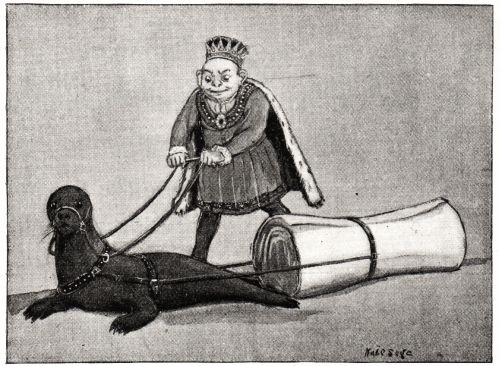
THE KING ATTACHES HIS ROYAL SEAL TO A DOCUMENT.
REST YOUR PEN.
Here is a hint for boys and girls who write. A correspondent of an English newspaper asked, the other day, if it improved a steel pen to give it a period of rest. The answer was:
Yes. Rest for a steel pen is not only good, but at times absolutely necessary, as it is for all steel tools if they are to continue in first-class order. A member of a well-known firm of steel-pen makers advised that if a pen gets scratchy and does not write well, it is not necessarily finished and fit for throwing away, but is probably only tired and in need of a rest. "Give it," said he, "a rest for a day or two, then hold it in a gas-light for fifteen seconds, not longer, and you will find it almost as good as new." Keeping steel pens in water when not in use, or converting a potato into a pen-wiper, is said to prevent corrosion and to preserve them for a long period.
Apropos of the steel pen, it is interesting to note that the earliest notice of steel pens is one by Wordsworth. In 1806 he and his family were occupying the house at Colerton during the absence of Sir George and Lady Beaumont, and in the month of December the poet wrote to the latter what he calls "the longest letter I ever wrote in my life," and with reason, as it fills eighteen pages. He begins: "My dear Lady Beaumont,—There's penmanship for you! I shall not be able to keep it up to the end in this style, notwithstanding I have the very great advantage of writing with one of your best steel pens, with which Miss Hutchinson has just kindly furnished me."
The next mention noted is one by Dr. Kitchiner, in 1824. When speaking of a friend above sixty, he says, "This strain of the eye and occasion for spectacles of a high magnifying power is particularly found in mending pens (this was when the goose-quill was the most generally accepted tool in the trade of authorship), so that he has a sufficient number of pens to prevent the necessity of mending any of them until he has finished writing." To this there is appended a note: "To those who find the mending of pens rather a difficult job, I recommend the occasional use of the steel pen, especially when they wish to write very small and neatly."
AN INDESTRUCTIBLE PRESENT.
Joe is a boy who, through the beneficence of his grandparents, is singularly blessed with uncles and aunts, and Christmas and birthdays he realizes it most. They give him so many toys that his father and mother, on such occasions, usually make their presents consist in carrying out some cherished plan of Joe's.
"Actually," his father remarked, on his most recent birthday, "Joe has more presents now than he can break in a year."
"Oh no, papa!" said Joe, with an injured air, "there's one present I won't break."
"Well, Joe," replied his father, "I'm glad there's one. Which is it—the cast-iron train of cars Uncle Bill gave you?"
"Oh no!" cried Joe; "I can break that easily enough. I mean I won't break your promise to send me to dancing-school."
"THE FUNNIEST THING HE EVER SAW."