PERIODICALS
Reading edition
MAGAZINE, $4.00 a Year
WEEKLY, $4.00 a Year
BAZAR, $4.00 a Year
ROUND TABLE, $2.00 a Year
PIGEONS!—Send 25c. for "Pigeon Queries," a book of 200 questions and answers on Pigeons. "Possum Creek Poultry Club," humorous, 25c. Fanciers' Review, Chatham, N. Y.
This Department is conducted in the interest of Bicyclers, and the Editor will be pleased to answer any question on the subject. Our maps and tours contain many valuable data kindly supplied from the official maps and road-books of the League of American Wheelmen. Recognizing the value of the work being done by the L.A.W., the Editor will be pleased to furnish subscribers with membership blanks and information so far as possible.
Copyright, 1896, by Harper & Brothers.
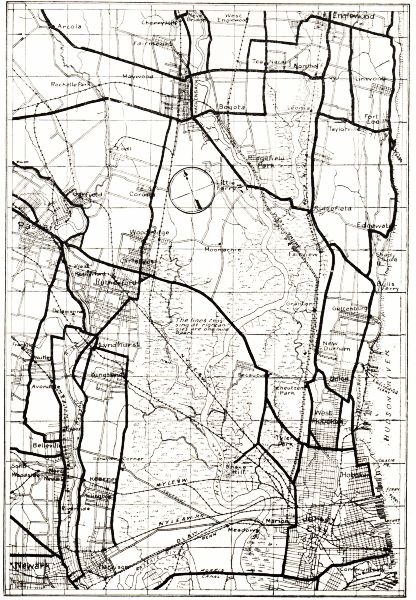
The difficulty of getting out of New York city by proceeding directly north, and the fact that there are only two suitable roads, which makes bicycling out of New York in time monotonous, can be obviated by crossing the Hudson and proceeding by several good roads up its western bank. For the next few weeks, therefore, we shall give in this Department maps of the country along the Hudson as far as Newburg.
The map this week includes Hoboken, Jersey City, the marshes back of these cities, and the roads as far north as Englewood. There are several ways of starting from New York into this country. You can cross the Hoboken Ferry at either Barclay, Christopher, or Fourteenth Street to Hoboken, and go out of the city direct to the Hudson County Boulevard, which is the best road running north. By an examination of the map the rider will easily pick out the different ways to reach the boulevard. It is perhaps wiser to cross from Fourteenth Street, as the ferry lands in Hoboken further uptown; but it is possible to ride from any of the ferries northward, keeping generally to the left into West Hoboken; thence to the boulevard, by Scheutzen Park, leaving Union on the eastward, passing through New Durham and by Guttenburg to Fairview, and thence to Ridgefield. The Northern Railroad of New Jersey should always be to the westward, and the road itself runs along the side of the hill, which rises to the Palisades. The Hackensack marshes are across the river to the left going north. At Ridgefield the rider may either continue on through Leonia and Nordhoff, running direct into Englewood, or he may turn to the left across the Northern road, crossing a branch of the Hackensack afterwards, and running along its bank, finally crossing the West Shore road and the main river, keeping to the right at Little Ferry, and running direct into Hackensack. It is then possible to proceed northward from Hackensack through Fairmount and Cherry Hill, or to run eastward through Tea Neck to Nordhoff, thence turning to the left northward on the boulevard, and running into Englewood. From Hoboken the rider, if he is going westward towards Passaic, should cross the West Shore road at Tyler Park or at Scheutzen Park, running direct to Secaucus, and thence cross the marshes and the river into Rutherford and direct to Passaic.
It is also possible to cross the ferry at Fort Lee, but there is a long hill which it is foolish for any one to ride, rising for something over a mile. The rider may either follow the bank of the river and run along a good road through Linwood, turning to the left to run into Englewood, or he may proceed to Leonia, and there turn northward to Englewood. The black roads on the map are in almost every case good roads, and especially in and around Englewood, Tea Neck, Nordhoff, and to the north of these towns the roads are in capital condition. Of course time may be saved, if the wheelman lives uptown in New York, by crossing at Fort Lee, but he must remember that he has to rise between 250 and 300 feet above the river at once, and this necessitates a long walk. The Fort Lee Ferry leaves New York at 125th Street.
Thebe is still another way of crossing, which is from the 42d Street Ferry to Weehawken. On arriving at the Weehawken Ferry the rider should make at once by the shortest roads for the Hudson County Boulevard, as it is distinctly the best wheeling road in that vicinity.
THE UNEXPECTED.
At a country-school examination one day, a visitor noticing the great promptness and correctness with which the questions were answered by the scholars, suspected that the children were only given such questions as the teacher was sure of their knowing. So requesting the privilege of asking a few himself, the gentleman addressed a small child thus, "Where is Turkey, my dear?"
The little girl was greatly confused for a minute, then suddenly a bright look came into her little face, and she piped forth, "In the back yard with the poultry, sir!"
Any questions in regard to photograph matters will be willingly answered by the Editor of this column, and we should be glad to hear from any of our club who can make helpful suggestions.
HINTS ON MAKING FIGURE STUDIES.
In photographic exhibits, as well as in exhibits of paintings, what are called character studies always attract the most attention, and usually receive higher marks than a simple portrait study.
There are many picturesque characters which make fine studies for the amateur photographer, and our young amateurs are requested to bear them in mind when in search of subjects for our coming contest. There is the old veteran with his faded blue army coat, to which he clings as long as it preserves a remnant of respectability; the shoemaker or cobbler at work on his bench; a sailor who bears marks of his tussle with wind and wave; a ruddy farmer engaged in some one of his many duties; a woman weaving at a hand-loom or spinning on a flax or wool wheel; a sturdy blacksmith at his forge; an old colored uncle or aunty, relics of the sunny South—these and many other types or characters may be found by the amateur photographer, and their likenesses preserved in gelatine.
One common fault with nine out of ten of the amateur character studies is that the subject looks as if he were sitting for his picture. This is the one thing to be avoided, for the charm of this style of picture is the natural and easy position of the subject, who must look as if such a thing as a camera had never come within his observation.
Suppose one wished to make a picture of a cobbler on his bench. If you went to him with your camera and told him you wished to take his picture, while you were getting your camera ready he would probably begin to tuck away the bits of litter on his bench, straighten his tools, close the half-open drawers, put away his last, and then taking out his pocket-comb, smooth his hair so that not a lock should be out of place. This done, he would sit up and announce that he was ready. If you should take his picture thus, you would have a subject with every natural line crossed out, leaving simply a stiff uncomfortable victim sitting for his picture.
The proper way to do is to tell the cobbler that you wish to make a picture of him at his work, and that you would like to have him go on working the same as if you were not there, and that when you are all ready you will tell him. Arrange your camera, focus sharply, take out the slide, and set the shutter ready to open. Watch for a favorable attitude, ask the man to hold still for a moment, and expose the plate. Make three or four studies, for it is better to do this than to take but one and, in case it should not be good, be obliged to go again. Do not let the subject look toward the camera, but insist on his looking at the piece of work on which he is engaged. If he is tapping a shoe, take the picture when he has the hammer raised to drive a peg, if he is sewing a seam, take it when he is either putting in the threads or has them partly drawn out. A cobbler hammering a piece of leather on a lapstone is an easy position to catch, and another is where he is examining a ragged shoe to see if it is past mending.
Whatever vocation you may choose to picture, bear this in mind, that the subject must not be allowed to pose himself, and if, while you are getting your camera in readiness for the picture, you talk with him on some subject in which he is interested, you will stand a good chance of getting an easy, natural picture of him. If you are not successful the first time trying, remember the old couplet,
If at first you don't succeed, Try, try again.
George H. says that he has a pocket kodak which makes very good pictures, but in nearly all the negatives there is a black cloud in the one corner, and asks the reason; how to make the title of the picture on the print in white letters; and if the "Quad" and "Vive" cameras are reliable; and how to join the Camera Club. The black cloud on the negative is due to the fact that there is undoubtedly a tiny pin-hole either in the bellows or lens-holder which admits light to the film and fogs it. Take the camera to the place where it was purchased, and have the defect remedied. Letter the title on the negative on the film side with India-ink, going over the letters carefully in order that they may be uniform in density, and when the print is made from the negative the letters will appear white, as the ink is nonactinic, and shields the paper from the light. The title must be reversed when printed on the negative. Both the "Quad" and the "Vive" are made by reliable firms, and either will give satisfactory returns for the money invested. Sir George says that he discovered in a back number of the Round Table the use of blue paper, and encloses prints made on the first paper which he experimented with. Sir George must have followed the directions closely, for the paper is very evenly coated, and the blues clear and brilliant.