IMPORTANT "TRIFLES" ON WAR-SHIPS.
Reading edition
BY FRANKLIN MATTHEWS.
I.
Suppose that a state of war exists between the United States and some other country well supplied with modern war-ships. Suppose, also, that one of our best battle-ships—like the Kentucky, soon to be built—is cruising off New York Harbor. A monster battle-ship of the enemy appears, and the ships are to fight until one is sunk or conquered. The alarm for general quarters has sounded. Every gun is loaded; the decks are cleared; ammunition is ready for instant use. The captain has taken his place in the conning-tower. The enemy approaches. The signal runs through the ship, "Stand by to fire!"
When the enemy gets within 3000 yards, the Kentucky's 13-inch forward guns will each hurl a monster bullet, weighing more than a thousand pounds, at the other vessel. Not a shot must be fired until the enemy is exactly 3000 yards away. Both ships are moving swiftly. In less than one second the enemy will be exactly 3000 yards off. An awful roar follows. A tongue of fire, followed by a rolling, bounding ball of smoke, darts from a great cannon. Nearly a quarter of a mile away the eye can see the half-ton projectile darting straight toward the other ship. It hits the very place it was intended to hit. Half a dozen such shots, or perhaps fewer, may send the other vessel to the bottom. The battle rages. Shot after shot is fired, and finally one vessel hoists the white flag, or careens, and the order is given for every man to save himself as she plunges to the bottom.
THE RANGE-FINDER.
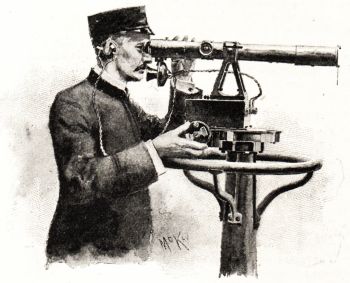
Marvellous as the shooting has been, still more marvellous is the way it has been done. The gunners have fired without seeing, or even looking to see, the other ship. They have fired by looking rather at little dials close by each gun. They have aimed each gun without trying to see the enemy. Still, each shot goes straight to the mark, and the havoc is terrific. How is it all done? Long before the firing began you might have observed a sailor-man, half-way up each mast of the battle-ship, looking at the enemy through a telescope. Attached to each telescope are a telephone-receiver and mouth-piece. The receiver is fitted to the sailor-man's head, and the mouth-piece comes close to his lips as he looks through the telescope. One of the sailor-men says to the other, through the telephone:
"I am looking at the forward smoke-pipe. Keep your eye on that until I tell you to change."
DIAGRAM SHOWING TELEPHONIC CONNECTIONS BETWEEN RANGE-FINDERS AND GUNNERS. A.—Central Telephone Station. B.—Dial on which Distance is conveyed to Gunners from A. C.—Range-finder who conveys Angle to A. D.—Gun-firer who presses Firing-button when Range is Found.
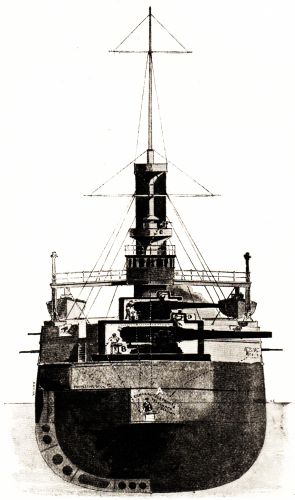
"All right," comes the answer; and then, as the enemy nears the Kentucky, these two telescopes follow the ship, turning gradually as the vessel comes nearer. Down at each gun there is another man looking at the enemy through a telescope. He is the gun-firer. Another man at the gun, the gunner, has turned a wheel to elevate the gun so as to shoot a certain number of yards, as marked on the dial in front of him. The vessel is rolling from side to side. The gun now points high in the air, and now down into the water. It is known that the enemy is the exact distance away to be hit by the projectile if the Kentucky did not roll. The gun-firer watches as his ship comes to a level. He sees the other ship exactly in the centre of his telescope, or at the juncture of the cross-hairs on the glass. Not a tenth of a second must be lost. The gunner has already pressed down a button, showing that his aim is all right for a certain distance. The gun-firer presses his button as the target shows itself in the centre of the cross-hairs; an electric current flashes through the primer of the projectile, and a thunder-bolt of war speeds through the air at the rate of about 2000 feet a second. The gun cannot be fired unless both gunner and gun-firer press down the buttons in front of them. How do they know when to do this? Who tells them when to fire? The answer is that no one tells them when to fire after they have received their general orders. It all results from those two sailor-men on the masts following the path of the enemy.
Those men on the masts are working the range-finders. There are electrical instruments that tell automatically the exact distance from them of any object. All that the men have to do is to keep looking at the enemy, and the guns will keep on hitting the mark if fired at that instant in the roll or plunge that the target comes at the centre of the gun-firer's telescope. All that is absolutely essential, as a first requisite, is that the two men at the range-finders shall be looking at the same spot on the enemy's ship. Electricity does most of the rest of the work. Now you must know that there are instruments in navigation by which distances of objects from a ship can be reckoned accurately. A sextant is one of these instruments. It requires a lot of figuring, however, to fix the distance. It would be useless to try to use these instruments in a battle. Long before the distance of an enemy could be computed his ship, and your own as well, would have changed its position, going as war-ships in time of conflict do at the rate of more than a quarter of a mile a minute. A shot fired at the distance computed would perhaps be a mile wide of the mark.
Nor will it do to fire at an enemy in the old hit-or-miss style that used to be followed. In the old days the gunner sighted the gun, made an allowance as best he could for the distance the ship would go before he fired, and when the roll or plunge of his own vessel was favorable he pulled a string, as he turned away his head, and took chances of hitting the other ship. He had to guess the distance largely. He first tried a certain range, and then another, until he gradually got the right distance, and then he fired, whenever he got the right chance. Those were the days of the old smooth-bore cannon; the days when a captain could make himself heard by a speaking-trumpet anywhere on deck, and almost anywhere below-deck by shouting down a hatchway. All that is changed now. The roar on a war-ship in battle is like that on a mountain-top encased in a violent thunder-storm. Then, too, ammunition is too costly and too limited nowadays to be wasted by experiments in finding the range of the enemy, and in taking chances on hitting him. One shot from one of these guns of modern times may win the battle by piercing the vitals of the enemy's ship, and not even the smallest chance must be taken to miss that target. It is for that reason that the wonderful aid of electricity has been called into use on war-ships in many devices. Probably the most wonderful of all these devices is the range-finder.
RANGE-FINDERS AT WORK ON THE ENEMY FROM THE FORE AND MAIN TOPS.
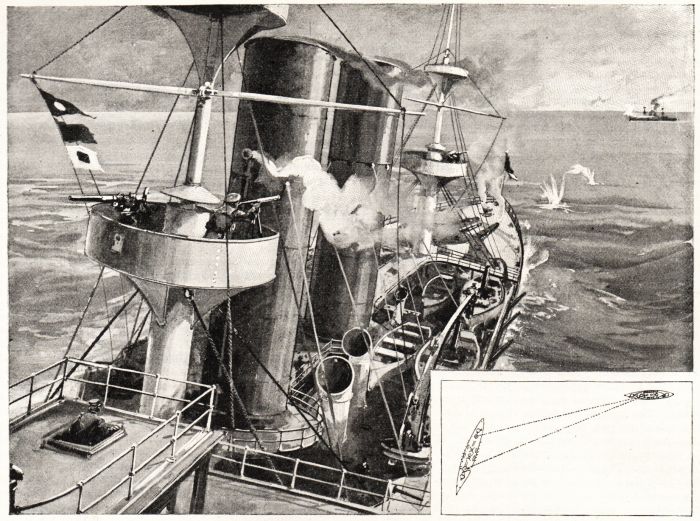
It isn't necessary for us to go deep into electrical science to understand how this instrument does its work. Electricity itself is a great mystery, and a puzzle in many ways to those who understand it best. Most of us have not been able to grasp its simpler puzzles until we studied them in college, and even then it would not be well for us to boast of what we knew. All we need to know, however, to understand the range-finder is a little problem in geometry. Most of you understand that if we have a triangle, and know the length of one side and the size of the angles at the ends of that side, we can figure exactly the length of the other two sides and the distance of the point where those two sides meet. Well, that explains just how the range-finder works. The exact distance between the two men looking through the telescopes is known and fixed. Each man looks, as we have seen, at the same point out in the distance on the enemy's ship. That point is where the two unknown sides of the triangle come together. There is no time to figure the distance. A tenth of a second in these days is too much time to be lost. We must use electricity to do our figuring. This is the way it is done: The telescopes are turned about on electric circuits; that is, they are attached to a metal circle charged with electricity. The wires from these circles run to a little dial down in the hold. The Wheatstone bridge or electrical balance system is used. That means that the resistance of a current through a wire through a given distance is measured finally by a dial on a marking-instrument.
Now it is impossible to turn one or both of those telescopes on the range-finders without moving the dial on the marking-instrument. Electricity has progressed so far that to the exact foot the dial will indicate the distance an object is away from the base of the line connecting the range-finding instruments. At any instant that dial will tell how many yards off the enemy is. The men at the telescopes know nothing of what the dial is doing. The dial is down in the central telephone exchange of the ship. One man is stationed there to do nothing else than to watch what it records. He has a little instrument beside him called a range-indicator. The dial of the range-finder says that the enemy is so many yards away. He simply presses a button on the range-indicator, which sends a current to other range-indicators in ten different places on a battle-ship like the Kentucky. The needles of these ten instruments, one at each of the guns of the main battery, and at some of the guns of the secondary battery, tell the gunner how far off the enemy is. The indicators have simply transmitted the news to the gunners which the range-finders have discovered automatically.
Every gunner knows, by the sliding-scale attached to his gun, just how far to elevate the gun so as to carry its projectile a certain number of yards. He does not look along his gun. He pays no attention to the enemy himself. He keeps one hand on a little wheel, which he turns with his fingers, and the slightest twist alters the range of the piece. In a twinkling he can change the range a hundred yards. Suppose, now, the dial of the range-finder in front of the man in the telephone central indicates 2580 yards. He presses his button on the range-indicator, and in ten places on board the Kentucky the gunners know that the enemy is 2580 yards away. Previous warnings have fixed that distance approximately. With a quick twist of the wrist the range of each gun in action is fixed for 2580 yards. The gunner keeps his eye on the range-indicator, and when his gun is pointed to carry its projectile that distance he presses down his firing-button. But it will not do, perhaps, to fire at that instant. The ship may be rolling or pitching. The gun-firer is looking through his telescope. Suddenly the ship is shown to be on an even keel, because the cross-hairs of the telescope centre on the enemy. The gun-firer presses his button, and the gun is discharged.
Suppose, now, that the range has changed between the time that the gun is aimed and the time the Kentucky has reached an even keel. Of course the gun-firer at the telescope can know nothing of it. He presses his button, and perhaps is surprised to find that the gun does not fire. That simply means that the gunner has taken his finger off his firing-button while he is changing the range of the gun to the new figures just telegraphed to him from the range-finder. The gun cannot be fired unless the buttons of both gunner and gun-firer are pressed down at the same time. This is done to avoid waste of ammunition. The gunner keeps his finger on his firing-button all the time the range remains fixed. During that time the man at the telescope can fire the gun whenever the cross-hairs of his instrument tell him it is the proper time to fire. If the range is being changed, the gun does not go off. If the range is set, the gun does go off. In either case the man at the telescope has nothing to do with the range. All he has to do is to watch the enemy and press his button. All the gunner has to do is to see that the range of his gun is the same as the range-indicator registers, and to keep his button pressed down so long as the range is fixed. All the man in the central telegraph and telephone exchange on ship has to do is to see what range the range-finders are indicating and telegraph it to the gunners. All the men at the range-finders have to do is to keep pointing their telescopes at the enemy, and let the rest of the work take care of itself.
All this seems like a complicated bit of mechanism. So it is; but, as with all electrical appliances, it is difficult to understand and extremely simple to use them. It may surprise you to know that from the time that the range-finder sailors fix their telescopes on the enemy less than one second need elapse before the guns are fired. Of course every man is at his station. Each gun is already fixed at near the proper range. The range-finders give the exact distance. The man in the central office telegraphs it to the gunners. The gunners adjust their weapons and press down their buttons. The gun-firers wait to get the proper sight, probably in the same twinkling of an eye that all this information is being sent over the ship, and he finally fires the gun. Of course, where the ship is rolling or pitching considerably, the time between fixing the range and firing the gun may be longer. After the gun is all ready for firing, however, even the fifth of a second may make the difference between a hit and a miss, and hence the need for the lightning quickness of electricity.
The range-finder and the other appliances used with it are the inventions of Lieutenant Bradley A. Fiske, of the United States navy. No other navy than ours has them, although the naval authorities of other nations are thinking of adopting them. If we should have a war right away, we should have an advantage over an enemy. Constant experience has shown their complete success.
In another article we shall consider some more of these "trifles" that are used in connection with electricity on war-ships.