LITTLE MEN AND WOMEN
Reading edition
The only Magazine
edited especially for
CHILDREN from 7 to 11
$1.00 A YEAR. Specimen Free.
THREE SPLENDID SERIALS:
JOHNNY, JACK, AND JOHN. By Margaret Compton.
JO AND BETTY; or, Out in the World. By Sophie Swett.
GOING WITH THE BIG BOYS. By Kate Upson Clark.
BOY HEROES OF THE WAR. By Mrs. A. R. Watson. Pathetic, humorous, thrilling. A dozen stories of young heroes of our Civil War—six of the South, six of the North.
THE TALKING BIRDS. By M. C. Crowley. A series of amusing and marvellous parrot stories—true stories.
Notable Articles,
Short Stories, Poems,
Beautiful Pictures,
Children's Songs.
ALPHA PUBLISHING CO., Boston.
Quite Different.
The importance of correct pronunciation is nowhere more imperative than in a religious service. A soloist in a Philadelphia surpliced boy choir was heard on a recent Sunday morning in a certain well-known anthem. After the service another boy, a member of the choir, excitedly caught hold of the skirt of the choir-master's vestment, and asked, "Will you tell me, sir, what Jack Mahaffy [the boy soloist] meant by 'a consecrated cross-eyed bear'?"
"A what?" demanded the astonished leader.
The lad, badly frightened, repeated the question.
The soloist was called, and when he spoke the words, instead of singing them, the boy got the correct version, "a consecrated cross I'd bear."
Second Largest Church in America.
Will some reader of the Round Table please give me a description of the Church of Notre Dame, Montreal, Canada? I will be very thankful for information on this subject.
Rupert Forbes. Montowese, Conn.
We quote the following from an article on "Montreal," in Harper's Magazine for June, 1889:
"Here"—in Montreal—"among a Roman Catholic population, noted chiefly for their lack of wealth, is building a cathedral one-third the size of St. Peter's at Rome, and of the same shape, excepting that this one has a pointed roof to shed snow. Montreal has already the great Notre Dame de Lourdes, the largest in America, excepting the Cathedral of Mexico. It seats 10,000, and will hold 15,000 people. The official poster at the door asserts that the bell is the largest in the world. It is the eighth in size, weighing 24,780 pounds. In the interior, vast but harsh and gaudy, you may see an ornate spiral pulpit and a bronze statue of St. Peter, of which the toes are well polished.
"In Montreal you can continue to visit churches all day. They reveal a religious life of the Middle Ages kept up with marvellous force in this nineteenth century. One of the pleasantest scenes of this religious life may be witnessed in the city of the dead. In the cemetery on the mountain, along the streets of tombs, are erected little grottos, each having in colored tableau the stations of the cross. A priest leads slowly the flock from station to station, and explains to the kneeling people the dogmatic value of the sufferings portrayed. The trees, birds, plants, sunshine, and the murmuring winds, all combine to make the ceremony touching. The route ends on a knoll where three huge crosses and figures represent most realistically the final agony. When I visited the place, on a fine June day, a company of convent girls and nuns were holding a merry picnic at this spot. After their picnic they knelt for prayer and went away rejoicing. On many of the graves are evidences of tender regard to the departed—plaster figures of saints, photographs of the deceased, and little altars with candles and crucifixes, set up in glass-covered boxes that look like toy chapels."
Some Montreal reader may give us a short description of the exterior of Notre Dame.
Kinks.
No. 55.—A Riddle.
I'm not employed by Uncle Sam, And yet I carry mail. I'm swift as many a telegram; I'm seldom known to fail. Around and 'round, then straight I go; The shortest route I always know.
No. 56.—Historical Questions.
1. What battle was fought October 13, 1812?
2. How did Du Plessis Mauduit help America?
3. Who was Sir Guy Carleton?
4. Who put this clause into his will: "I enjoin and require that no ecclesiastic, missionary, or minister of any sect whatever, shall be admitted for any purpose whatever, or as visitor, within the premises appropriated for said ——." And of what did he speak?
No. 57.—Rhyming Charade.
My first moon, in her regal car, In thronely pomp rides past; She trips a silver serenade Round my secluded last. My last has borne the pelting blasts Two hundred years twice told; Its loop-holed battlements to-day Rear grandly as of old. Our first laid schemes we plumb and build In sorrow, be it known; Like fabled last high-poised in air Are quickly levelled down. My dual parts will rightly sketch, If roughly scribbled down, A city in an English shire And in a Delaware town. J. E. Bennett. New York.
No. 58.—Word Square.
1. To blight so as to destroy.
2. A machine for turning.
3. A collection of maps.
4. Anything long and straight.
5. Easily irritated or fretful.
A. E. T. Chicago.
Answers to Kinks.
No. 50.—Diagonal Acrostic.
March—April, thus:
MODEL
OASIS
FARCE
EPOCH
ASAPH
No. 51.—Double Progressive Magic Square.
128 x 1 x 32 = 4096
x
4 x 16 x 64 = 4096
x
8 x 256 x 2 = 4096
And the same with the perpendiculars and diagonals.
No. 52.—A Sentence Hunt.
St. Paul's Epistle to the Ephesians, iv, 27.
No. 53.—Phonetic Charade.
Ant—elope. Antelope.
No. 54.—A Geography Lesson.
1. Skaara. 2. Kars. 3. Don—the Spanish equivalent of Lord. 4. Bhore. 5. Kabul—Atlantic cable. 6. Save—because, if true to its name, it would rescue you. 7. Koping.
Young Newspaper-Makers.
Janey Crow, 13 Birch Crescent, Rochester, N. Y., publishes, with a friend to help, The Acorn, a monthly of twenty-eight pages. It is not printed from types, but written, and sent round for reading. These young editors and publishers desire to receive sample copies of other amateur papers, either written or printed ones. So also do Frank G. Davis, Vermillion, S. D., and Edward F. Daas, 1717 Cherry St., Milwaukee, Wis. The last-named desires also to form a corresponding Chapter, whose members may live in any part of the world, exchange specimens of shells, minerals, ferns, and bugs, and prepare round-robin descriptive letters.
Questions and Answers.
Polly Pemberton Morris.—You are quite right in your contention, and your friend is wrong. Queen Elizabeth did not live as well as does the average family of to-day whom we call poor. Comparatively she lived well—and walked on a cloak. But she suffered many discomforts which the gallantry of all the Raleighs of her reign but badly recompensed. Indeed, her household was so poor that few of the laboring-people of to-day would endure one like it. For instance, her table service was what we would call scarcely fit for animals. Huge joints of meat were brought to the table on the roasting-spits. There were no dishes such as we have. Earthenware with a china finish was unknown. The meat-carvers held the meat with one hand while they cut it with the other, and the guests helped themselves with their fingers. Cats and dogs were allowed around and under the table—and to them were thrown the bones. Fancy the condition of the floor—there was not always a floor—after the meal. There were no forks and no plates. Fingers served for the former and huge slices of bread for the latter.
Irving Kenyon asks: "Is there on exhibition in some city in each State the articles patented in that State? If so, in what city of Connecticut can I see them? Are authors privileged to use the plan of another author, which has appeared in a pamphlet some time previous, without permission? If permission is necessary, to whom do I apply?" There is no such exhibition. In the Patent Office at Washington may be seen a vast number of models, but they come from every State. Even these models are no longer required by law. Authors' privileges are not easily defined. Do you mean "plan" or "plot"? We should say that the least one could do who wished to use the plot of another would be to ask permission. If permission cannot be obtained from any cause, get another plan or plot or else forego writing.
This Department is conducted in the interest of stamp and coin collectors, and the Editor will be pleased to answer any question on these subjects so far as possible. Correspondents should address Editor Stamp Department.
Fig. 4.
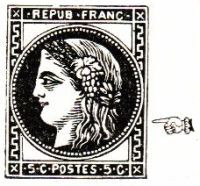
Although all German and foreign catalogues list the varieties of the 1870 20c. blue of France in three types, still few are seen in collections, probably on account of the difficulty heretofore felt in explaining the differences.
The cuts I., II., and III. illustrate exactly the differences of the Greek ornaments at the lower light side of the frame (compare with Figure IV.).
Even in the very poorly printed specimens these varieties in the lines of the Greek ornaments are prominent, and in the very heavy impressions where the shadings of the main lines are invisible, the distinguishing points are still plain.
TYPE I.
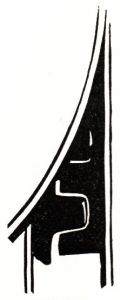
TYPE II.
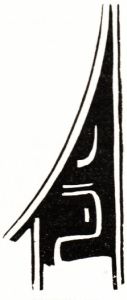
TYPE III.
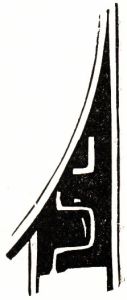
It will be simple for everybody to now distinguish these types with the aid of the illustrations. In addition the main points will be easy to memorize.
Type I. has, as we know, only points at the neck and eyes for shading purposes; the circle of pearls is very irregular.
Type II. The shading at the neck consists of fine lines, and under the eyes are long drawn points. A fine white line runs around the entire top of the head.
In Type III. the white line at the top of the head is almost invisible; under the eye are points similar to Type II., but in larger numbers. At the neck there are only lines. The points between the inscriptions, both at top and bottom, are hardly to be seen and often disappear altogether.
A Type IV. is also listed in few catalogues, but its existence has been clearly established. The peculiar break in the Greek ornaments, as is the case in the other types, is not found, but in other respects it resembles Type III., except in the inscription.
It is probable that after the plate of the third type was worn out the inscription was repaired, and for the third time enlarged, which is sufficient evidence to accept as a fourth type. As to the grade of rarity of these different types the following is probably correct (the lowest number being the commonest).
Used.Unused.
Type I.Seventh.Fifth.
Type II.Fourth.Second.
Type III.Third.First.
Type IV.Eighth.Sixth.
Early impressions of these four plates are very desirable.
A. E. Drake, 198 Marcy Avenue, Brooklyn wishes to exchange stamps. The last Peru issue are very common. Any dealer can supply at a fair price.
F. Rich.—The 90c. 1851 issue, unperforated, is probably a proof. The 24c. same issue is well authenticated.
J. B. Bryan.—To restore colors of stamps which have oxidized, or changed color, owing to chemical or atmospheric changes, to their original color, apply peroxide of hydrogen to the stamp with a small camel's-hair brush. After repeating several times soak the stamp in water and dry between blotters.
A. A. Hall.—In purchasing hinges, be careful to secure those having a gum known to be harmless. Some hinges have a gum that will eventually injure the stamp to which they are affixed, changing the color or causing the paper to turn yellow. For fifteen cents a thousand you can get the best hinges from any responsible dealer. You will probably not use over a million during your career as a collector, and the amount you save in purchasing an inferior grade is insignificant, while the proper preservation of your stamps will be materially aided in using those you know are reliable.
E. L. Smith, 64 Sparks Street, Cambridge, Mass., wishes to exchange stamps.
C. Rawson.—The 3c. Proprietary is worth 10c. perforated, several dollars if unperforated, with wide margins.
F. D. W. Laneland.—Your Chile stamp is probably a Revenue stamp. You do not give all the lettering, and I am therefore unable to say positively.
Philatus.