Chapter IV
Reading edition
WHEREIN I FALL IN LOVE WITH THE SEA.
On the twelfth day of November, 1811, my new life began. But before I go on I should explain that on the outside of the paper which the lawyer had saved, and which I had deciphered on the day of the burning of Marshwood House (and which has staid in my mind, as I transcribed it also), an address had been found. In some way it had been overlooked upon the first reading. It was important, however, as it gave the address of my uncle, Monsieur Henri Amedee Lovalle de Brienne, as Miller's Falls, near Stonington, Connecticut.
The lawyer had written to this place a letter at some length, but we had waited in vain for a reply; letters often went astray in those days, and in some way, as I afterwards discovered, this one was most likely lost. In the mean time I had become a member of Mr. Edgerton's family. I was treated with kindness, but of course it was not expected of him to take charge of my maintenance, and the proposition for a change came from my own lips. In walking along the water-front one day I discovered that a little brig, the Minetta, was about to sail for Stonington, and I proposed to Mr. Edgerton to take passage in her and search out my relative, if he were living.
The lawyer, who I could see felt himself responsible in some way for the beginning of my misfortune, exacted a promise that should I fail in finding M. de Brienne, I would return to him, and I should have done so had affairs terminated otherwise than as they did.
The consultation in which this decision was arrived at took place on the evening of the tenth of the month; and it was two days later, as I have written, that my new life began. For bright and early that morning I was standing at the taffrail of the little brig that was being warped out into midstream.
Mr. Edgerton and his family, consisting of a maiden sister and a grown daughter (he had been a widower for some ten years), together with Mr. Thompson, the school-master, the major, the kind doctor, and some of my boy companions, were on the dock. And I must not forget that Aunt Sheba, Ann Martha, and Ol' Peter were there also, all three of them in tears.
The lawyer had promised to take care of Peter, and the doctor had taken Aunt Sheba and Ann Martha into his household. I am glad to say that I had not sold the old people, although I had a perfect right to do so, as they were my property, but had given them their freedom, and knew they were left in kind hands and keeping.
Soon the faces on shore became indistinct. The brig took in her kedge anchors, the trilling of her capstan falls ceased, her jibs rattled up the stays, the yards creaked aslant, and we caught the light westerly breeze. The tide was setting out, and we made good travelling of it.
I was not the only passenger. There was a Virginian, by the name of Chaffee, a tobacco-planter, who was going on the voyage as a sort of supercargo, and his wife (a slight, black-eyed woman of much spirit) accompanied him.
The Captain and first mate were both New Bedford men, and tiptop sailors, as circumstances proved afterwards. The crew of eight men were Americans also, so far as I could judge, three of them being negroes—great, deep-chested black fellows, worth large sums of money in the market; but they were free men, and held themselves differently from slaves, although one, Pompey, waited on the cabin table.
Whether the Minetta's crew was a picked one or not I do not know, but no man would have felt ashamed of being over them. I can say that much. As for the brig, she was something over one hundred and eighty tons burden, and loaded with tobacco, sole-leather, and turpentine; she was light in ballast, and in good trim for fast sailing.
The crew for the most part slept in a tall deck-house on the forecastle, built around the foremast, and the cabin was given up to Mr. Chaffee and his wife; the two officers and myself bunked in a little cubby-hole forward of the after-skylight.
The Minetta was old-fashioned, and her high poop and top sides gave her a clumsy look; her spars and masts were very heavy for her tonnage, and I think had been built for a larger vessel; but she spread a great show of canvas, and the way she boiled the water up in front of her proved she was no laggard.
We kept well to the eastern shore as we went down the bay, but, nevertheless, I soon made out the mouth of the Gunpowder River, and could see the stark walls of my old home standing out against the trees.
Here I was, scarce fourteen years of age, and starting into the wide world alone, verily with my bridges burned behind me! Mr. Chaffee had entered into conversation with me, and he and his wife displaying great interest, I told him as much of my story as I thought proper. So far as the Captain and first mate went, I might not have existed.
That night as I lay on my narrow little shelf, I was so full of thinking that at first I could not sleep. I longed for comfort, and would have given worlds to have rested my head on Aunt Sheba's shoulder. I half sobbed aloud from loneliness, but at last I dozed off, and was awakened some hours afterwards by feeling the vessel pitching heavily.
THE SOUND OF A SCURRYING ON DECK CAUSED ME TO START UP SUDDENLY.
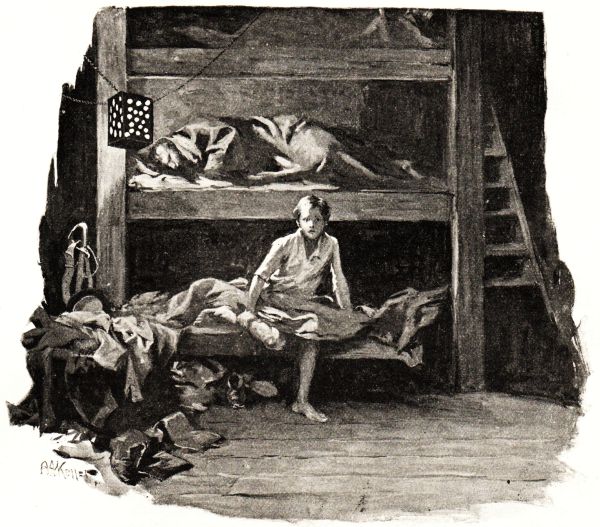
Strange noises sounded all about me. Every plank overhead and on each side seemed to have a voice of its own. It was the first time I heard these sounds. Some loud bawling and the sound of scurrying from on deck caused me to start up suddenly, and I almost cracked my skull against a beam. After that I could not sleep, and lowering myself from the bunk I dressed and climbed out to the air.
I had imagined, from the patter of many feet, that I should find the whole crew trying to save the ship from some distress, and I was not prepared for the calm sight which met my eyes. It was moonlight, and all sail was set. The brig rose and fell steadily, occasionally taking a sea-chug under her broad bows with a jar which made her quiver, and the water would fly up in a gleaming sprinkle and scatter along the wet rail. Only four men were in sight—one at the wheel, two gathered in the lee of the forward deck-house, and the first mate leaning back against the skylight, smoking a long clay pipe.
(Oh, I have forgotten to mention that I had noticed the captain snoring in his bunk as I left the cabin, which had been reassuring.) The cool breeze and the damp on my cheeks were grateful to me, and then and there I fell in love with the sea (and I have truly never lost it). I staid on deck breathing a strange freedom until the morning watch.
About noon of this day the breeze had freshened, and we were carrying only our lower sails. The planter and his wife both kept the cabin, suffering much from the unusual motion, but as for myself I can here record I have never felt a touch of that sickness which is expected to accompany a first voyage or to follow a long stay ashore. I revelled in the swinging of the vessel, and wished it would blow harder, which it did.
At four o'clock in the afternoon a sail was made out to the northward, and holding the course that we already were we would have passed close by her, as she was bearing down on us before the wind. I noticed, however, that as the stranger became clearer, and her lower courses could be seen, the first mate went aloft with a glass, and hurrying down held consultation with Captain Morrison. In pursuance to orders, the brig's course was altered a few points, and we stood to the eastward to give the approaching vessel a wider berth. But no sooner had we done so than the latter held up a trifle, as if it were her intention to intercept us, and an hour's more sailing brought her into plain view.
She was a vessel the like of which I had never seen up to that day. Her hull appeared as large as one of the many-windowed warehouses of the wharves of Baltimore, and her towering tiers of canvas gleamed white in the sunlight. A smother of foam rolled under her forefoot.
A few more turns of the wheel now, and we were holding a course due east, sailing close on the wind.
"She means to head us off," said Captain Morrison, looking about with a scowl.
Why he should have any cause for alarm I did not know; but I could see that the crew were much disturbed, and were gathered in a whispering cluster at the break of the forecastle, watching the vessel with anxious eyes. I timidly approached Mr. Norcross, the mate.
"Is she a pirate?" I inquired, half fearing.
"Yes, about that," was the gruff return. "She's a British line-of-battle ship, and keeps the seas, with all her kind, by robbery."
"Will she harm us?" I inquired again.
"Not you, my son," he answered. "But she would like to get her clutches on some of our brave lads yonder." He nodded his head toward the group of seamen.
Slowly but surely we were nearing the huge vessel now holding the same course as our own. It was a grand sight! As she heeled over, the gleam of her copper showed in the hollows of the waves that swept past her, and the shadows on her white sails were as blue as the sky overhead. Her ports were open, and the muzzles of the black guns could be made out plainly. The red coats of a party of marines on her forecastle made a bright patch of color, and some men sprawling out on her great yard-arms were no bigger to the eye than ants.
The Captain was giving nervous glances at our shaking foresail. Then he took a look across the water, as if measuring the distance and the rate of the other's travelling. Suddenly a smile wrinkled his cheeks.
"We're outpointing the old whale, Mr. Norcross," he said, grinning.
"Ay, sir; given the wind hold as it is and she will pass astern of us."
The crew by this time had noticed this fact, and a movement began amongst them. One, a tall fellow with light hair and a well set up figure, took a few steps of a horn-pipe.
"Not this time, Johnny Bull; not this time," he laughed, slapping one of his companions on the shoulder. "I know her; it's the Plantaganet; and I'd go overboard with a shot at my heels before I put a foot on her deck. She reeks of the cat!"
I was soon to learn why this man, whose name was Dash, knew so much. As soon as he had finished his dancing, the tall sailor and another man ran aft.
"Shall we show our colors, sir?" the former asked of Captain Morrison.
"Ay; toss them out," replied the Captain, whose good humor had now returned.
A minute later the stars and stripes were crackling at our peak. The line-of-battle ship was almost even with us by this time. Faces could be seen above her bulwarks. Suddenly a puff of white smoke burst out from one of her forward ports, and a ball skipped and plashed across our bows—so close that we heard the slap of it against the water; then the report came to us. The Captain mounted the bulwarks, and taking off his hat, made an elaborate bow.
"Sorry I cannot stop, you great big hog," he said; and then standing there bareheaded, he burst into such a torrent of cursing that Mrs. Chaffee, who had come out of the cabin, and was anxious to see the sight, sought its refuge again. But we had outpointed the battle-ship, and crossed athwart her bows.
Not three hundred yards astern of us she roared past.
"She dassent fire a broadside at us, or she'd do it in a minute," muttered Mr. Norcross, looking back over his shoulder.
He had taken the wheel himself during the last few minutes, and had handled it amazingly, I can tell you.
As if afraid to acknowledge her discomfiture, the three-decker went on in silence, like she had not seen us, and our men, who were now all in the rigging of the brig, burst out into a cheer.
But they were cheering too early in the game, and this was soon to be proved.
Somehow, despite Captain Morrison's excited profanity, I had begun to admire him hugely.