BOXING FOR BOYS.
Reading edition
BY S. SCOVILLE, JUN.
There are two reasons why a boy should understand and practise boxing. First, because in the life of every one there come times when it is necessary to defend one's self or others. There are very few occasions when a boy need ever fight on his own account. Sometimes, of course, it is absolutely necessary, but more often it only seems so, and the older a boy becomes, the more he is convinced that in boys' affairs, as well as in those of nations, arbitration is the only sensible and civilized way of settling disputes. Occasionally, however, there comes a crisis when a boy must defend another weaker than himself, and then it is that a boxer knows what to do and does it, while an untrained boy either shirks his duty or, if very brave, tries to interfere, and usually makes matters worse by being hurt himself.
At a Yale-Harvard football game in Springfield, the writer noticed an incident which illustrates very forcibly the advantage of knowing how to box. Some rows ahead of the writer in the grand stand, a slim young fellow, certainly not more than eighteen years old, was sitting with a lady in the aisle seats. During the intermission between the halves he stepped some distance down the aisle to speak to a friend. Just then a rough-looking character, who had been drinking enough to be quarrelsome, pushed his way into the row, insisting that the lady was in his seat, and seizing her by the shoulder, tried to pull her out into the aisle. The boy turned at her call and sprang back. As the rough faced him the other stepped easily forward, and like a flash his left shot out from the shoulder and landed just under his opponent's chin—a clean scientific lead with all his weight back of it. The rough went down, striking his head heavily against the boards, lay there a moment, and then climbing unsteadily to his feet, slunk off without a word. There were no police officers nearer than the field, the lady was in the boy's care, was insulted, and in danger of being injured. In time the crowd would have interfered, but it was a case for immediate action. To protect a woman at any cost is the duty of every American boy. This one had developed and trained his strength so as to make it effectual for exactly such an emergency. He knew just how and where to strike, and—the thing was over. Altogether the incident convinced the writer more than ever that boys owe it to themselves and their manhood, as protectors of all things weak, to learn to use their strength most effectively. And it is wonderful how effective a knowledge of boxing will make a very small amount of strength. The writer remembers seeing a skilled light-weight boxer in a college boxing-room easily best the stroke oar of a class crew—a man of tremendous strength and weight, but one who had never learned to box.
The second reason why a boy should learn to box is because boxing not only teaches him how to utilize the strength that he has, but before long it tremendously increases that same strength. Nearly every muscle of the body is brought into play. The triceps, or pushing muscles on the back of the arm, the shoulder and back muscles, are the ones especially developed in boxing. The bare back of a boxer is a perfect mass of muscle. Great knots and coils appear between and across the shoulders with every movement, while the ridges stand out clear down to the base of the spine. Let a boy practise a single left-hand lead in front of a mirror in gymnastic costume, and note how many muscles are used. Besides the above-mentioned ones, the leg, thigh, fore-arm, stomach, and breast muscles are all called upon indirectly. Besides strengthening all the muscles, boxing trains the eye, gives quickness and a lithe, easy carriage, broadens and deepens the chest, and enlarges the lungs, and, best of all, teaches self-control, and gives a certain indefinable feeling of strength and safety that comes only with a strong well-trained body.
So much for the advantages of boxing. It is not the writer's purpose in this article to do more than give the most general hints in regard to the actual blows and parries. Boxing cannot be taught on paper, and a boy can learn more in one lesson from a good teacher than by reading volumes. But a few brief hints may aid those who are not fortunate enough to be under an instructor.
And first, as to the selection of a teacher. Above all things, get one that is a scientific boxer, not some strapping bruiser that will knock you around at so much an hour. Every town has some veteran boxer who will be glad to give boys a start in sparring. The first principles should be learned thoroughly and correctly, or the pupil will always be bothered by some clumsy habit picked up as a beginner. It was only this winter that the writer broke his thumb by a wrong blow learned ten years back from his first teacher, and which, in the excitement of a hard-fought bout, is only too apt to crop out in spite of years of warning from half a dozen instructors.
FIG. 1.
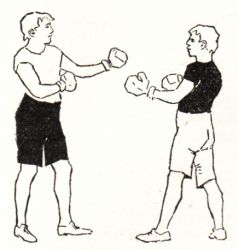
FIG. 2.
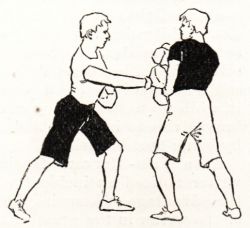
The first important thing to learn in boxing is the position. Figure 1. represents what the writer considers an ideal position. The left foot should be in front, with the right foot from fifteen to eighteen inches in the rear and from six to eight inches to the right. The left hip should point nearly front. By that position the whole body can be protected from any right-hand blows by simply dropping the left arm as shown in illustration No. 2. The right arm should rest across the chest, with the glove on the left nipple, while the left arm should be held as in the illustration. In connection with the subject of position comes the management of the feet. The weight should rest equally on both feet, and in breaking ground, as movement to one side or the other is termed, or in advancing or retreating, the feet should never be raised from the ground as in walking. Advance first the front foot some six inches, and then the back foot, so as to always keep the same relative distance between them.
Always "counter" (i.e., give a return blow with the hand not used in parrying) every lead of your opponent. Remember that a straight line is the shortest distance between two points, and always lead a straight blow. It comes more natural for every one to hit "round"—i.e., swinging—blows. But a straight hard lead is the more effective. Swing, if swing you must, when countering, never when leading. Try as much as possible to avoid blows at the face by ducking.
The left hand lead, either at the face or the body, is the most important lead of all, the first taught, and by far the hardest to learn. One of the best boxers the writer has ever met was not allowed by his teacher to practise anything else for a whole year, until it was almost impossible to avoid or parry his left-hand lead or counter, so quick did he become.
FIG. 3.
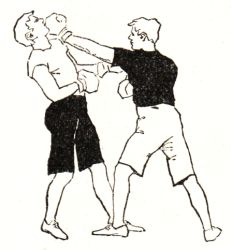
Illustration No. 3 shows a left-hand lead at the face getting home. Observe the tremendous force and drive that the blow has, while the boxer can step back instantly into perfect position, and is not thrown at all off his balance, as is the case with swinging blows. The requisites of a good left-hand lead either at face or body are:
First, that the left foot shall be advanced in a perfectly straight line with the hit (notice how straight the toe is in the illustration), otherwise the blow is apt to be pulled across in the parry and leave one desperately exposed.
FIG. 4.
Second, the weight of the body should follow the lead. This is what gives the "kick" to the blow, and more than anything else shows the difference between the veteran and the novice.
Third, the wrist should be held perfectly straight, and the blow be struck by that portion of the hand between the knuckles and the second joints of the fingers. Practise this lead constantly, either in actual boxing or at a punching-bag as it swings from you, and the instant the blow lands get away and back into position. The left-hand lead once learned, the straight left-hand counters will come easily.
FIG. 5.
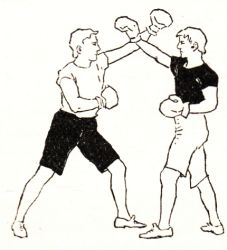
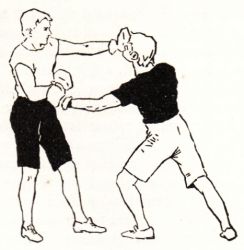
Next in importance to the left-hand lead—for in our modern boxing offence is of much more importance than defence—come the parries. The guard for a right-hand body blow has already been shown in illustration No. 2. The safest parry for a left-hand body blow is by "barring"—i.e., laying the right hand across the body and letting the blow land on the rigid muscles of the fore arm—at the same time countering with the left, as shown in illustration No. 4.
FIG. 6.
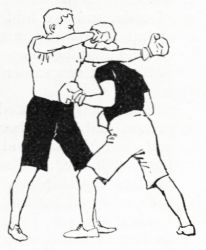
The best answer to a lead at the face is to duck to one side or the other and counter either on the face or on the body, as shown in illustration No. 6. But sometimes it is necessary to parry it in the regulation manner. This should be done by shooting the arm out perfectly straight as if leading. This will make the blow glide easily off the wrist or arm, as shown in illustration No. 5.
Never parry with the arm bent, as is often done, for then the arm receives the full concussion of the blow, and may be badly bruised. The left-hand lead and the different parries form the first principles of boxing. Practise them again and again until they come instinctively. With these well learned a boy can do much towards defending himself, even before mastering the counters, cross-counters, upper cuts, side-steps, and all the more complicated part of boxing which can only be taught effectively by a teacher.
A last piece of advice—practise continually. Spar with everybody and anybody who will put the gloves on. By so doing one perfects what has already been learned, besides continually picking up new ideas from the different styles of his various opponents.
One of the most important of recent events in the world of interscholastic sport is the reconciliation between Exeter and Andover, and the renewal of athletic relations between these two great schools. The first meeting of the two old rivals occurred on the football field at Andover last Saturday; which was too late for any comment to get into this issue of the Round Table. Next week, however, we hope to be able to devote to the game the space due to so important an event.
It was decided on November 5 that there should be an Exeter-Andover game. On that day Andover sent a challenge to Exeter, and Exeter at once accepted. Two days later the Exonian confirmed the news of the reconciliation, and spoke editorially as follows:
It is now three years since these contests were broken off, and this thought, taken with the history of the years which went before, may well give us cause for sober reflection. We, the school of to-day, stand far enough apart from the school of '93 to consider calmly the events which then took place, and to draw from them such lessons as shall help us in the conduct of our athletics in the future. We are able now to see that the spirit of rivalry between the two schools, which was at first but a healthy stimulus to all forms of athletics, had grown to such unhealthy proportions as to cause a doubt in the minds of thinking people as to the beneficial results of such athletics, not only to those who took part but to the larger school bodies.
The "Exonian" then goes on to say that the students at Exeter now realize that their predecessors allowed their excitement and rivalry to carry them too far, and it asserts that it may be that the three years in which the two great schools have stood apart may not have been without their usefulness. It is to be hoped that this is true, and it is to be hoped that both Exeter and Andover will go into the new contests with a firm determination to respect not only the letter of the law of amateur sport, but likewise the spirit.
The game with Exeter, however, will not be Andover's last match of the year. They play Lawrenceville day after to-morrow. Although at the present writing the Lawrenceville team is not so strong as it was last year at this time, it is probable that with the coming days of practice, and the games with outsiders that are to be played in the meantime, the men will improve very materially. Dana's work at centre has improved considerably of late, but much of this is due to the assistance he gets from Richards and Cadwalader. There is still room for progress in his method of snapping the ball back. Another weak position is that of full-back, where Kafer is weak on catching punts.
Some of the schools of the Cook County League are still keeping up their great game of "protest." Their capacity for this sort of thing has become so great that the Chicago newspapers have even commented upon it. It would seem as if almost every team that loses a game immediately protests, with the result that most of the League matches have to be repeated. Next to protesting, the Cook County football teams seem to be ablest at forfeiting. On November 1 Northwest Division failed to meet its obligations toward Hyde Park. Northwest Division has little to be proud of in its football record this year. It has not won a game in the High-School League, and it does not seem likely that it will if it continues to forfeit.
Because a football team is weak is no excuse for not fulfilling its agreement to play another team—an obligation which it assumed when it became a member of the League. The Oak Park team is a weak eleven, but it won a victory nevertheless when it met the West Division eleven. Oak Park started in boldly and scored, and her players were so surprised at this success that they kept right on, and closed the game with a score of 32-0.
But this same game afforded an excellent illustration of the disease of "protest" which is afflicting Cook County just at present. At one point of the play, just as Hyman of Oak Park was being forced over the goal-line for a touch-down, he lost the ball, which rolled twenty feet away from him. Holdrich and Brown both made long dives for the ball, and both, falling upon it at about the same moment, claimed the leather. The referee decided in favor of Holdrich of Oak Park, and immediately the captain of the West Division team made great objections, and said that he would protest the game. Fortunately, however, better judgment prevailed later in the afternoon, and this particular game was, after all, not protested. But some of the Cook County League games have been carried before the Executive Committee on smaller grounds than these.
A close and interesting match was that between North Division and Manual Training, which resulted in favor of Manual, 6-0. For the first time in any of the League games this fall there was not a single dispute of any kind during the entire game. That is undoubtedly the principal reason why the players put up such an excellent game of football. Men cannot play football and quarrel among themselves at the same time, and, consequently, when they are weak enough to allow their tempers to get the better of them, the sport invariably suffers. Manual Training was superior in line-bucking, and made most of its games in that way.
In the game between Englewood and Evanston the former was victorious, 12-0. Evanston forced the ball to within two or three yards of Englewood's goal twice, but lost the leather on a fumble the first time, and on downs the second time. Excepting perhaps Teetzel, the two elevens were very evenly matched. Prather had the better of Fowler, and occasionally made a hole through his position. Englewood's tackles, Ryden and Prentiss, were weak at times, and allowed several gains to be made through them.
The game between Hyde Park and Oak Park, resulting in a victory of 16-0 to the former, was of no particular interest, as the sport was marred by disputes between the players and the umpire over slugging. There must be something radically wrong with the officials of the Cook County League. Fully half the games played so far have been marred, in some way or another, by misunderstandings between the players and the field officers.
BERKELEY'S FOUR BACKS. Pell, Bien, Rice, Wiley.
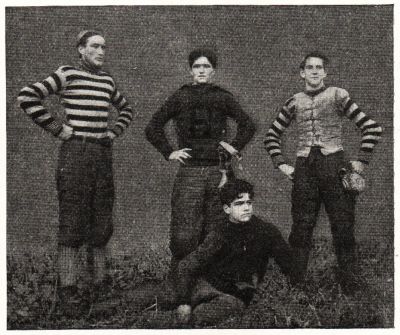
The Berkeley School team has made considerable progress within the last two weeks. Hasbrouck is putting up a strong game at left end, and is developing a good capacity for breaking into opposing interference. Both he and Boyesen are learning rapidly to get down the field after punts. Hasbrouck runs well with the ball, and is being depended upon a good deal in tricks. He is making an excellent Captain for the team, and although he does not insist quite strongly enough upon his rights against opposing teams sometimes, this is a shortcoming which will promote rather than injure the welfare of amateur sport. Boyesen is a new man to the game, and a trifle light, but he tackles splendidly and has good grit.
Huntington, who has been playing right tackle, is a trifle careless in his work; he is a powerful player, however, and runs well, and can tackle when he sets his mind on it. Granberry and Thomas have been candidates for the tackle positions; Granberry has been doing hard work and has improved steadily, but Thomas has the advantage over him in stature and physical strength. With the exception of Hasbrouck, Gilson, who plays right guard, is probably the best man in the line. He is well-developed, and is as strong a player as any in the New York League. He knows the game well, but unfortunately, owing to his class-room work, he has not been able to devote as much time to field practice as is necessary to keep him in tiptop shape. Irvine, at left guard, has been running considerably with the ball; he is better in this position than he was at tackle, where he played early in the season. One of the weakest men in the line is Walker, at centre; he has the strength, but he is very slow, and does not seem able to catch the knack of putting the ball into play properly.
The backs are putting up a higher quality of football than the line-men. They are natural athletes, and all except Rice were members of last spring's baseball team. Their experience in catching seems to stand them in good stead now. Pell has been making rapid strides in his knowledge of the game. He is a clever dodger when running with the ball, but needs to overcome a slight timidity against being tackled. He punts fairly well, and is the best drop-kicker on the team. On the offensive he plays close up to the line and breaks through well, but his eagerness sometimes leads him to run too far, thus putting himself out of the play.
The best football-player that Berkeley ever boasted is undoubtedly Bien, at full-back. He is as good a man in that position as there is in the New York League this year. He is a first-rate ground-gainer and knows the game thoroughly. He is a strong tackler; and as for kicking goals, it is asserted that he has not missed one this season. Wiley puts up a hard game, but does not use his head enough. He punts pretty well, and may be counted on to catch every ball that comes his way. He is a sandy player, and sometimes plunges too boldly into the scrimmage.
Rice at quarter can hardly be ranked on a par with the other backs. He interferes well at the kick-off, but does not keep up this standard in close plays. He is a sandy tackler, but being a new man at the game frequently wastes his energy. He is badly handicapped by his centre rush.
THE ST. PAUL'S SCHOOL, GARDEN CITY, FOOTBALL SQUAD.
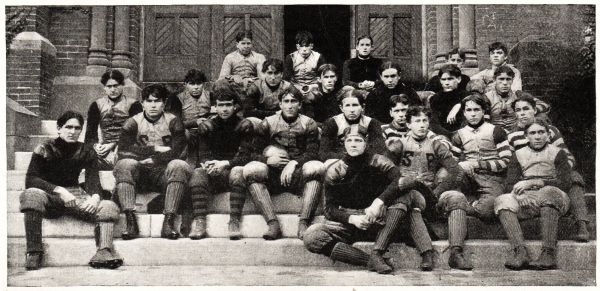
Considerable improvement is to be noticed in the work of the Garden City football-players. Lorraine is doing all that can be required at end. Since my last criticism of his play he has gone into the game with more vim and dash, and is playing good hard football all the time. Symonds, until the Lawrenceville game, was playing a miserable game at tackle; since then, however, he has improved greatly, particularly in defensive play.
Everett Starr is heavier than he was last year, although he is still the lightest man in the line. His experience, however, makes him as reliable a man as there is on the team. Cluett as snap-back and in attacks on the centre is first rate, but he seems to have the idea that his work ends there, as he very seldom breaks through and is slow in following the ball. Kinney is new at the game this year, but nevertheless he is playing as good football as any of the older members on the team. He is strong and exceptionally quick for his size. He makes many tackles and sure ones, is generally to be found where the ball is, and when he runs with the ball is pretty sure of making a gain.
Thus far Brown has not by any means played the game he is capable of. He has met no opponents of his own weight. He is fairly quick, and has a good knowledge of the game. With these conditions his work should be of the brilliant order, but, on the contrary, it has been even at the best mediocre, and at times lamentably weak.
White is probably the best end on any school team about New York. Very seldom is a gain made around his end, and an attempt usually results in a loss. Owing to an injury to Goldsboro, he has taken the latter's place at right half in offensive play, and has done exceptionally good work, getting down the field on kicks in good style. Goldsboro may not be able to play again this year.
Blount, who last year was only a substitute on the second eleven, is a fixture at quarter-back. He gives the signals, and is playing his position and handling the team like a veteran. The chief fault he has to overcome is in missing tackles. Weller is a good runner and a sure hard tackler. He interferes and follows interference well.
Captain Starr is showing rare form at full-back this year. He has developed into an exceptionally good punter and place-kicker; moreover, in the games with Cutler and Poly. Prep. he dropped in each a pretty goal from the field. As a line-bucker and an interferer he can be relied upon thoroughly. In defensive play he plays rush-line half-back. His work is often brilliant. Temple is a fast runner, but owing to lack of experience he has a tendency not to make the best use of his interference. This was particularly noticeable in the Poly. Prep. game. He made some good runs, but with a good end he would have been downed for a loss in nearly every case.
By the time this number of the Round Table reaches the reader the deciding game of the Connecticut League championship series will have been played, and as the match will probably be a close one I hardly dare hazard the guess that the banner will go to New Britain. The New Britain team defeated Norwich Free Academy last week to the tune of 50-0, and although Brinley was seriously injured in the game, and may not be able to play any more this season, the eleven will still be a strong one without him.
On the same day that New Britain played Norwich, Meriden H.-S. took Bridgeport into camp, 20-12. It is evident that this year the smaller schools turned out the better teams. Hillhouse, Hartford, and Bridgeport all got defeated in the race for the Yale Cup.
Andrew T., Rochester.—The "halves" in a football game may be of any duration agreed upon beforehand. In championship games, however, they must be thirty-five minutes each.
J. C. Finch, Fort Anne, New York.—See Harper's Round Table for September 22, or for fuller particulars see W. H. Lewis's A Primer of College Football.
"A PRIMER OF COLLEGE FOOTBALL."—By W. H. Lewis.—16mo, Paper, 75 Cents.
The Graduate.