TYPICAL ENGLISH SCHOOLS.
Reading edition
BY JOHN CORBIN.
WINCHESTER.
The English public schools are not what we should call public schools at all—that is, they are not kept up at the public expense, and you can't go to them without paying. What we call public schools the English call free schools, and only poor children go to them. The kind of schools I am going to write about are attended by the sons of the richer people and of the nobility. They are not unlike the big American schools which prepare fellows for college—Exeter, Andover, St. Paul's, St. Mark's, Groton, and others—though they are all much older, and have many quaint and interesting customs inherited from the Middle Ages. I shall give an article to each of three of these schools—Winchester, Eton, and Rugby—and then shall add an article on athletics at public schools in general.
The oldest of all the schools is Winchester. Fellows at Andover sometimes tell you that their fathers and grandfathers went there before them. At Winchester this is a common case; and since the quadrangles of the college were built, there has been time not for one grandfather but for fifteen in a line. The prim and charming buildings look every day as old as they are; but if you were to go into the dormitories and see the rows of little iron bedsteads, each with a boy sleeping in it, you would find it hard to realize that grandfathers of these boys have slept at Winchester for five hundred years back, and that all our grandfathers began by being young and small enough to sleep in these cots.
The founder of the school was William of Wykeham, Bishop of the See of Winchester, who was not only a great bishop and a great statesman, but one of the greatest builders of the Middle Ages. His purpose in founding a school was to prepare boys to enter a college he had just founded at Oxford—New College, as it was called, and is still called after more than five hundred years. At both Winchester and New College the scholars are proud to call themselves Wykehamists; and when a fellow has been through both he is apt to tell you that he is a Wykehamist of the Wykehamists—which means more than you can ever understand until you hear and see a man say it. The first result of preparing boys to enter the university was to make them too far advanced for the teaching they found when they got there. To carry on their education Wykeham had to have a special body of tutors at New College. This was the beginning of the English custom of having a complete set of teachers at each of the score of colleges that make up a university. Thus Winchester is not only the father of all preparatory schools, but of the English university system of instruction by colleges.
Wykeham intended that all his scholars should be too poor to pay for their own education, and left funds to support them. Within the last generation, however, the masters have changed this. In order to get the cleverest possible pupils, they examine all boys between twelve and fourteen, and admit the best ones each year. About eight usually fail for one who gets in. The boys who succeed are, of course, those who have had the best training; and thus the fellows who get the benefit of Wykeham's money are usually sons of university graduates, and are often rich. Many people object strongly to this, and with good reason; yet the method has one great virtue. Fellows get almost as much credit in school for being studious and able, as for playing football; so that many of the richest fellows study hardest. In our schools, and even in our universities, there is still a stupid prejudice against being a first-rate scholar.
Within the school also there is keen competition. The five or six best students each year get scholarships at New College, which enable them to go through the university without expense to themselves. This is called "getting New," and is perhaps the greatest achievement of a Wykehamist. That such has been the case for at least two hundred years may be seen in the epitaph of a boy who died in 1676 from being hit by a stone, "In this school he stood first, and we hope he is not the last in heaven, where he went, instead of Oxford." When such is the case, there would seem to be little need of the motto on the wall of the old school, which Wykehamists translate, "Work, walk, or be wopped."
Beside the members of the "college" Wykeham founded, another kind of pupils has grown up, called commoners, who pay for lodging, board, and tuition—about $700 a year. These, at first few and unimportant, have increased so greatly of late that they are usually regarded as the characteristic kind of school-boy. They live in nine communities, or houses, of about thirty-five each, under separate masters. The life of the commoners is almost exactly the same as that of the collegians; but the division into those who are and those who are not supported by the college is worth remembering, for a similar distinction exists not only in all public schools, but in the colleges at Oxford and Cambridge. It does not happen everywhere, however, that the best scholars all live together; and many Wykehamists maintain that both scholars and commoners would gain by being mingled. Before many years the old college will doubtless be broken up, and the "scholars" proportioned among the various "houses."
The discipline is not so strict as at many public schools, yet quite strict enough, according to American standards. The boys—or men, as they are always called—are not allowed to enter the town, and have to get special "leave out" to go far into the country. The school day begins at seven o'clock, and bed-time comes at nine or ten. Constant attendance at prayers is required, morning and night; and there are four services on Sunday. For breaches of discipline the boys are still flogged. One is tempted to say that such a system is not modern; but as a matter of fact, it did not exist, among the commoners, at least, until the present century; and no true Wykehamist would think of changing it. Even the boys like it sincerely, in spite of some few breaches of discipline. Certainly the strictness has no more faults than the great freedom granted by certain of our large preparatory schools; and though we should hardly want to live just as English boys do, we can learn a great deal from them.
The main idea of the discipline of an English school is that as much of it as possible shall be carried on by the boys themselves. At Winchester it was ordained from the beginning that eighteen of the older boys should, in Wykeham's own words, "oversee their fellows, and from time to time certify the masters of their behavior and progress in study." These eighteen are called Prefects, and are chosen from the men who stand highest in studies. To an American boy, I am afraid, it wouldn't seem much fun to have to take care of his schoolmates' behavior. He would probably look upon himself more or less as a spy. Yet everything I saw at Winchester went to prove that to be a Prefect was almost as great an honor as to be an athlete. Five of the Prefects have special titles, such as Prefect of Chapel, Prefect of Hall, etc. These are generally chosen from the five best scholars. The Prefect of Hall has charge not only of his special duties, but of the other Prefects. If any disturbance takes place, he quells it. If the boys have any favors to ask, he is their spokesman. He is thus the head of the whole school, and a far more important person, I should say, than the Captain of the cricket team.
An incident occurred in 1838 which well illustrates the power of a Prefect. A peddler insisted on bringing various contraband articles, among them liquor, to sell to the boys on their recreation-grounds. The Prefects remonstrated time and again, with no effect. At last five of them seized him and threw him, basket and all, into the river. The peddler had the Prefects arrested and tried for assault with intent to kill, and the magistrate fined them fifty dollars each. This fine the college paid willingly, complimenting the Prefects for their zeal and common-sense. The spirit which prompted both masters and pupils exists to-day, not only at Winchester, but at all public schools. The result is that not only is order maintained without ill feeling between masters and pupils, but the eighteen Prefects of each year learn to fill posts requiring unusual tact, common-sense, and courage.
The duty of a Prefect which an American would least envy is that of inflicting bodily punishment—"tunding," as it is called in Winchester slang. This consists in beating the culprit across the back of his waistcoat with a ground-ash the size of one's finger. The art of "tunding," an old Prefect of Hall informed me, was to catch the edge of the shoulder-blade with the rod, and strike in the same spot everytime. In this way, he said, it was possible to cut the back of a waistcoat into strips. In the early part of the century flogging was of more than daily occurrence. An old Wykehamist states that on the day of his arrival at school there were 198 boys in residence and 279 names reported for punishment. Nowadays, however, only a score or so of cases occur each year; and many boys go through the school without being tunded.
A characteristic case occurred during my stay at Winchester. A party of small boys had been invited to a strawberry feast in the rooms of one of the dons, and seeing a group of Prefects in the court below, had been unable to resist the temptation. First a rotten strawberry splashed on the flint at the feet of the Prefects, and then a storm descended. This was too much for Prefectorial dignity to bear. The good don's strawberry feast ended in a general tunding. The Prefect of Hall described this to me next day with quiet satisfaction; and, later, the don spoke of the case as characteristic of the best effects of the Prefectorial system. As host, he said, he had not been able to interfere; and except for school-boy discipline, the culprits would have escaped. The wife of one of the masters, however, said it was a brutal shame, and that if she had her way with those Prefects, she would throw strawberries at them.
Such a system leaves little for the masters to do, yet a boy sometimes carries his case to the higher court, though he does it at the risk of great unpopularity. Some years ago two Seniors, having a grudge against another boy, employed two Juniors, at ninepence a head, to give him a beating. The Prefects very naturally objected to this method of doing one's dirty work, and ordered all four to be tunded. One of the Senior culprits lost courage when he found how hard it was going with his companion, and appealed to the master on the plea that the ground-ash was too large. The master declared that the ground-ashes were "proper good ground-ashes," and proceeded to wear them out on him.
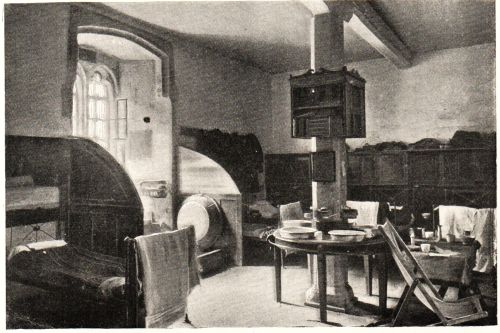
A DORMITORY.
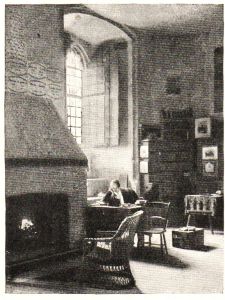
A STUDENT'S STUDY.
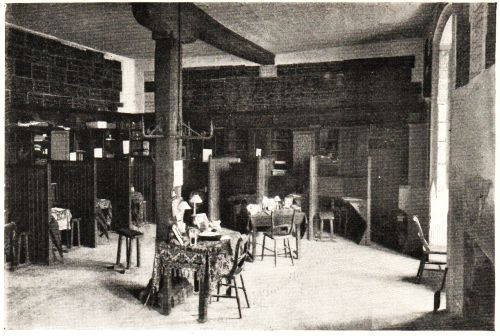
"HORSE-BOXES" AND "WASHING-STOOLS."
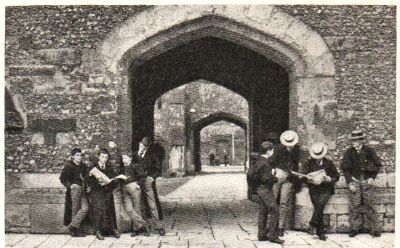
AT THE GATE OF CHAMBER COURT.
CHAPEL AND PART OF DORMITORIES.
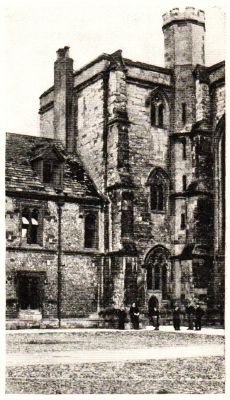
The details of daily life at Winchester are not easy to understand. The "college," as, in fact, each of the "houses," is divided into chambers or "shops," as the boys call them. In each of these lives a community of say a dozen boys, over which three Prefects preside. The sleeping-rooms are locked up, except at night. In the study-room each boy has a desk, which he calls his "horse-box." The Prefects have tables, placed in commanding positions. These are called "washing-stools." In the college there are seven chambers, occupying "Chamber Court," the main quadrangle; and all about are ranged the domestic buildings belonging to the college—the slaughter-house, the bake-house, the kitchen, and the brew-house. In Chamber Court also are the rooms occupied by the masters and their families, and the magnificent college dining-hall and chapel. All these buildings stand to-day almost precisely as they were built five hundred years ago—that is, a hundred years before Columbus discovered America—with this difference, that the flint walls are so stained by time that they reflect the sunshine in many subdued and mellow shades.
There are, however, a few relics of dead customs. At one side of the court you will find the remains of the ancient conduit. Here, on the stone pavement and in the open air, five centuries of boys have taken their morning baths, summer and winter. Bathing could not always, however, be as regular as in these days when travelling Englishmen pack their clothes in leather-covered bath-tubs instead of in a trunk. A dozen years ago bath-rooms were fitted up within-doors, in rooms formerly occupied by learned Fellows of the College. On a wall is the painting of the "Trusty Servant," with its verses.
The old lavatory of the college was called "Moab," while the shoe-blacking place was called "Edom." I wonder how many American school-boys are as familiar as those old English boys must have been with the Psalm that says "Moab is my wash-pot; over Edom will I cast out my shoe." The ancient brew-house in outer court is still used, but when I took luncheon in Hall with the Prefects they rather sniffed at the beer made in it. Under King William, however, it inspired this song:
Now let us all, both great and small, With voice both loud and clear, Right merrily sing, Live Billy our King! For 'bating the tax upon beer. For I likes my drop of good beer; For I likes my drop of good beer. So whene'er I goes out I carries about My little pint bottle of beer.
To my taste the beer was very good, and not too strong. Perhaps it is a sign of the good sense of Wykehamists that they preferred water or milk.
One might also class fagging, with which all readers of Tom Brown are familiar, with the dead and dying customs. It is limited to a few simple offices. A Senior still sends small boys on errands, and sometimes makes him cook and wash bottles at private feasts in chambers. Every evening, too, when the post comes in, the porter of the college brings it to Chambers Court, and at a signal the junior of each chamber to get what belongs to his fellows. In olden times, in order to accustom the fags to handling hot dishes, the Seniors would sometimes score their hands with glowing fagots. This provided them with "tin gloves." A more amusing bit of barbarity was the "toe fittee," pronounced tofy-tie. This consisted in tying a string about a boy's great toe while he lay asleep. Then the string was violently pulled, and the boy was drawn out of his bed to his tormentor's side. Sometimes two or three would be brought from different parts of a chamber to the same point. In America I have often known a boy to tie a string about his own toe, and hang it out of the window so that a friend might wake him up to go out fishing; but that is a different thing.
For pure ingenuity the so-called "scheme" bears the palm. It was always the duty of a certain luckless Junior to wake the Prefect at an early hour every morning, and if he overslept he was of course tunded. Noticing that the night candle always burned to a certain point at this hour, some nameless fag invented the plan of hanging a hat-box over his head by a string, and connecting the string with this point of the candle by a rude fuse. He thus made sure that the hat-box would fall on his head at the required hour. Under this sword of Damocles he could, of course, sleep in peace without fear of flogging.
The terrible stories of flogging and fagging, however, really belong to the past. Unless I am very much mistaken, life at Winchester, in spite of an occasional tunding, is much pleasanter and better regulated than in most of our schools. The fact that the Prefects enforce most of the discipline makes it possible for the masters to get very near to the hearts of their pupils; and, above all, the English boys are fortunate in the fact that the wives and daughters of the Masters live with them in the same quadrangle. To speak of Winchester without telling about the wife of the second Head Master, and how fond of her big boys and little boys, good boys and bad boys are, would be to leave the part of Hamlet out of the play. Many are the gawky boys whom she has put at ease among people, and many the bad boys whom she has set right. One of the pleasantest things I saw at Winchester was a lot of Oxford men who had come back to her during vacation just to hear her call them Smith, Brown, and Robinson.
The stamp of men Winchester produces is as distinct from all others as a St. Paul's man is different from one from Exeter. The ideal toward which the school is working was well expressed by one of the Head Masters. "I consider that those boys who issue from the top of the school—i.e., those upon whom the highest influences of the school have been brought to bear—are boys who ... carry into life a stamp, not of a very showy kind, but distinguished by a self-reliance, a modesty, a practical good sense, and strong religious feeling—that religious feeling being of a very moderate traditional and sober kind which, in my judgment, is beyond all price."