A SCHOOL OF SHARKS.
Reading edition
BY CHARLES LEWIS SHAW.
A boy—that is, the ordinary every-day sort of boy, which is, after all, the best kind—is supposed to cause sufficient mischief not only to keep himself but his parents and guardians and a large circle of relatives in considerable hot water. And when you mix up two healthy boys and a school of sharks, and incidentally throw in a ship's boat, a heavy sea, and a sudden squall, there is bound to be trouble. And there was.
Philosophers to the contrary notwithstanding, there is such a thing as luck in this world. It was pure unadulterated luck when the firm of Henderson, Burt, & Co., let us call them, manufacturers of fire-arms, had turned out 5000 rifles of what they supposed was the most improved pattern, at a time when the market was dull, that an obscure German chemist should invent a gunpowder requiring a cartridge which relegated those rifles to the catalogue of ancient weapons. And it was luck that the Captain of the schooner Hecuba happened to be asleep one afternoon off the coast of Cuba, and his son and the ship's apprentice were boys, and had a boyish desire to catch a shark, or the firm of Henderson, Burt, & Co. would have been bankrupt, and a considerable portion of General Maceo's army would have had to struggle for freedom this summer with their fists. And even Spanish conscripts cannot be beaten with fists. This is how it happened:
When the news of that German's discovery reached us, for I was the junior partner—the "Co." part—of the firm of Henderson, Burt, &. Co., it looked very much like ruin. The Orient, our hoped-for market, was not only too far away and uncertain, but our agent in Alexandria had already advised us that the Oriental was becoming more and more fastidious regarding his fire-arms. In our desperation I thought of Cuba, which, on account of the poverty of the insurgents, we had hitherto not considered. The details of the transaction do not matter. Sufficient to say that in a few days after the suggestion was made, an agreement was entered into with the Cuban agents that if 2000 stand of arms were delivered at a specified point on the coast of Cuba at a certain time, we would be paid in gold then, and not before. It was a strange contract. The sale was illegal, as the belligerency of the insurgents was not recognized, and the risk of total loss by capture either by our own revenue-boats or Spanish cruisers was great. To me was assigned the entire conduct of the affair.
I didn't relish the task. All halcyon dreams about the Spanish main, coral islands, and hidden treasures, all latent admiration for picturesque pirates, low raking schooners with tapering masts, snow-white decks, and "Long Toms" secreted under the long-boats had evaporated. I was a business man, and assuming the rôle of the filibustering blockade-runner wasn't exactly in my line. And as the Hecuba, favored at last by a land breeze, crept out of the harbor of Tampa, Florida, in the darkness of the June night, I watched the lights of the revenue-steamer ahead, and thoughts of capture, jail, the disgrace of a trial, either in an American court or before a Spanish court martial, possessed me, and I wondered why it was that ten years ago I had a wild longing to pace quarter-decks arrayed in a slashed doublet, a velveteen cloak, and a pair of uncomfortable big jack-boots, and yell in a voice of thunder, "Man the tops'l yards. Port your helm. Run out Long Tom and send a shot across her bows." It occurred to me that there was just a little bit too much eighteenth-century Captain Kidd, Sir Henry Morgan sort of romance being mixed up in this business transaction. I confessed to myself that I had outgrown all interest in the blockade-running business beyond seeing 2000 rifles safely delivered to a customer, and $40,000 received therefor. But in the words of the ship's boy, a runaway street arab from New York, there were others. And he and the Captain's son, for they were sworn friends by this time, discussed the chances of the trip from the vantage-ground of the ship's boat, into which they had clambered.
"D'ye t'ink they'll see us, Chimmie?" asked the Bowery boy, anxiously, for it had been impossible to conceal the object of the trip from the crew.
"I don't know. I hope they do," answered the youngster, who had often been on voyages with his father, and knew the sailing-qualities of the Hecuba. "This breeze is going to freshen, and we're nearly out of the bay. Father will show those revenue-steamers a thing or two."
"If dey catch us, will we be hung to de yard-arm, way dey say in de books?" inquired the street arab, whose first voyage it was.
"Perhaps," cheerfully answered Jimmie; and with a son's unbounded faith in his father, he continued: "But they won't catch us. The worst is that they may get close enough to see who we are, and then there will be trouble when we come back."
"Den yer old man had better be a pirate. Dat's de way dey allus does—get into trouble in dere own country, and den go piratin' in de Spanish main after gold gallons," suggested the ex-newsboy.
Jimmie said, in an apologetic tone, as if it were a blight on the character of his parent, that the skipper, as he called his father, in imitation of the sailors, wasn't exactly cut out for a pirate. He wasn't blood-thirsty enough, and mentioned several other drawbacks, much to the credit of Captain Wade. And then there was an intense discussion as to what they would do if they were captain and mate of the schooner Hecuba. How they would get a beautiful coral island with only savages on it, whom they would first kill, and then utilize the island for burying treasure, imprisoning captive maidens of ancient Castilian lineage, and holding rich grandees for ransom. The blood-thirsty little wretches had just determined that I should be their first prisoner, and was to be held for a ransom that would have bankrupted half the arms factories of Connecticut, when the voice of the Captain could be heard in sharp command:
"Ease her off and lay low. Cover up the binnacle light!" And in the darkness we could see the point of the land we were hugging over the port bow.
"They see us. They see us!" excitedly said Jimmie.
I looked, and felt a sick feeling in my heart as I saw the lights of the revenue-steamer slowly moving toward us.
"We're right at the mouth of the harbor," I could hear Jimmie whisper. "With this wind, she's a good one if she catches us."
In a few seconds I could feel the heavy swell of the Gulf of Mexico; and the Hecuba, with her canvas spread like huge wings that looked weirdlike in the darkness, sped before the wind. I felt, indeed, that Jimmie was right—the steamer would be a good one if she caught us. And she didn't catch us. But Yankee revenue-steamers are not easily run away from, and it was only after we had steered a course that led the government boat to believe that we were making for Jamaica did she abandon the chase. We were then far out of our course, and I now had the additional anxiety as to whether we would be able to make Cuba in the appointed time. Slowly we beat up against adverse winds, practically retracing our course for miles, until at last we sighted the war-stricken island, with only two days left to make the little bay named as the rendezvous with the Cuban agents. The elements then seemed to rise up against us, for a storm came up in the evening with tropical vehemence, and the sturdy little Hecuba was compelled, with infinite peril, to seek the shelter of one of the numerous bays along the Cuban coast. For two days and nights the storm raged with such fury that it would have been madness to venture forth. We saw on the second night far out to sea an ironclad, which the Captain's night glass showed to be one of the fastest of the Spanish cruisers guarding the coast. We took the small crumb of comfort that it was an ill wind that blew nobody good.
'Twas the afternoon of the second day. The violence of the gale had spent itself that morning, and by noon had moderated into a gentle breeze, although a heavy sea was still running. It was the day that I was to have met the Cuban agents, and it was maddening to think that the place of meeting was only a few hours' run from where we were idly lying. I begged the Captain to venture forth, but he gravely handed me his powerful glass and pointed to a speck on the horizon. I looked, and saw the funnels of the Spanish cruiser that had passed us the night before.
"We shall have to wait for darkness," he said. "It would be worse than folly to try it now. I must turn in for a spell. I haven't had a wink of sleep for forty-eight hours," and he disappeared into his cabin.
I was not the only discontented being on board the Hecuba. The two boys resented the delay also, and having been kept below during the storm like prisoners, longed for action. They soon had excitement enough, however, to suit even their temperaments.
"Sharks!" screamed Jimmie, disturbing the drowsy sailor of the dog-watch, as he eagerly looked over the rail at a lot of plashing fins and swaying tails.
"S' help me!" said his companion. "Is dem de t'ings dat follies ships and swallers people?"
"No," said the sailor, coming up and contemptuously looking at the school of sharks, whose long tails were making the water boil and bubble as if a submerged volcano were in active operation. "They're just thrasher sharks, and they're playin'."
"But they'd eat a fellow," said the ship's boy, and he threw a piece of wood at one under the bow.
"No, they won't," said the sailor. "A swingle-tail, as some calls 'em, won't hurt anybody. Though some says a whole school will sometimes tackle a whale and kill it; but I don't believe it. A thrasher shark is all play. The only trouble they make is when they get into fishermen's nets, and with those long tails of theirs slash around and tear and tangle everything up. They look big, but, you see, they run mostly to tail. Tail and all, they're between twelve and fifteen feet long, and weigh about 400 pounds. They make a good fight if caught on the hook."
It must have been half an hour afterwards when my absorbing thoughts about the affairs of Henderson, Burt, & Co., the undelivered rifles, and impending ruin were interrupted by a sudden splash at the stern. I looked over and saw that the two young scapegraces, taking advantage of the Captain's absence and the sleepiness of the watch, had lowered one of the Hecuba's boats.
"What are you doing?" I asked.
"Going to fish for sharks," answered Jimmie. "They are over there"—pointing a few hundred yards away. "We've got a shark hook and line, and the cook gave us a piece of pork for bait." And he held up a most portentous-looking hook, with about three feet of chain attached to prevent the teeth of the shark from severing it. In my ignorance of the ways of the sea, I didn't realize the danger. The big rolling waves made the Hecuba roll and pitch as she tugged at her anchor-chains, and I anxiously watched the daring young fishermen. When clear of the schooner they shipped the mast, and in a few minutes they were in pursuit of the sharks under full sail. I saw Jimmie throw out the line, but still they scudded on in the heavy sea. What happened then will never be accurately known. Whether it was that the tremendous tug at the line when the shark swallowed the hook made the youngsters lose their heads and forget everything—sail, sea, and a sudden puff of wind that came up—in their intense desire to secure it, neither can say. The probabilities are that the tiller being abandoned, as both boys held on to the line, the boat swung into the trough of the sea, the sheet got caught in some way, and the sudden puff of wind capsized the boat in the midst of the exciting struggle.
I had watched the accident, and soon Captain and crew were on deck. As I looked into the pale, tense features of the Captain as he quickly gave his orders, I thought he was going on a hopeless errand. But no! Two figures appeared on the bottom of the capsized boat, and a cheer went forth from every throat. They would be saved yet. As if to add intensity to the scene, the wind rose in fitful gusts and a huge bank of clouds rolled up in the sky. Something had gone wrong with the gearing or tackle of the second boat, which was seldom, if ever, used; and I fairly trembled with anxiety as the valuable minutes passed, and looked at the boys clinging to the bottom of the boat as it was tossed on a huge wave. But, in Heaven's name! what were the boys doing? What did it mean? Were they mad? By everything that was sane, they were still holding on to the line.
OUT OF THE GATHERING DARKNESS CAME A YAWL MANNED BY TWO MEN.
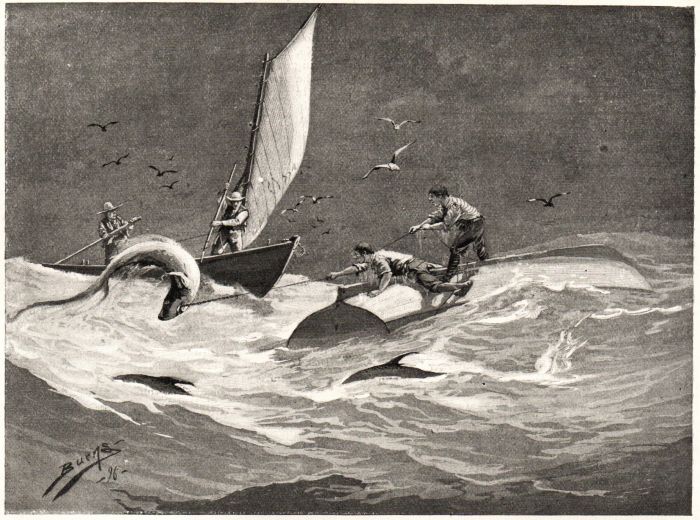
"Cut away the tackle!" at last roared the Captain, maddened by the delay, and noting the actions of the boys. It was done, and with a rush the boat went down almost stern first, and half filled with water. I felt that the fate of the boys was now sealed. With a water-logged boat in that sea it would be impossible to cover the four hundred yards to where the boys were still clinging tenaciously to the line. Jimmie was standing up holding the line with both hands, in the position almost of "the anchor" in a tug-of-war, and the ship's boy, extended on his stomach along and astride the boat, held the line with his right hand, while his left grasped the keel. Shark-fishing may be exciting, but that the excitement was so great that one should court certain death was hard to understand. I could hardly believe the evidence of my eyes, and I screamed at the top of my voice, "Let go! Let go!" in the vain hope that I might be heard. It was only a few minutes, but it seemed hours, as the crew alongside bailed out the water. It would be too late. The positions of the two lads showed they were almost exhausted. They couldn't hold out much longer. If they let go there was yet time, but they seemed to hold on as if their lives depended upon it. The end couldn't be far off. The eyes of every one on deck were fixed on the boys, when off to the left we saw, coming out of the gathering darkness, a yawl manned by two men. It seemed almost ghostlike. But with split-sail bellowing out before the wind, she raced on. The men bailing in the boat relinquished their efforts as they watched the yawl steer straight for the capsized boat. As they approached we saw one man move forward to the bow. There was some weapon in his hand. And as the boys apparently gave one last despairing tug at the line, the thrasher shark in its agony gave a leap out of the water, but before its somersault was completed a harpoon quivered in its side. Almost at the same time the sail was lowered, the yawl was run alongside the capsized boat, and men and boys helped to manage the dying struggles of the shark. Instead of making immediately for the Hecuba, the Cubans, for such we could see they were, seemed to be questioning the lads as they anxiously pointed to the schooner. In a few minutes one of the men threw his cap in the air, and a cry that sounded like "Cuba libre!" was wafted on the breeze. It was too heavy a sea to tow the capsized boat, so, hoisting sail, they ran under the stern of the Hecuba.
"Well, we got the shark," said Jimmie, in a more cheerful tone than his dilapidated appearance warranted, as the boys and one of their rescuers clambered on deck. Captain Wade walked up to the Cuban, and there was a moist look in his eyes as he took his hand. "He is my only child," we heard him say, and everybody understood.
"Oh!" said Jimmie, turning to me as he went below. "That gentleman from Cuba says he knows you. He wanted to know all about the Hecuba before he would come on board. You see, the Spanish flag we're flying made him nervous like," and Jimmie and his accomplice in trouble-making disappeared. When Captain Wade presented me to the Cuban—who seemed by his bearing to be a man of consequence—as the agent of the patriots whom I was to meet, I thought that if there was such a thing as luck in the affairs of Henderson, Burt, & Co., it was not all necessarily bad. And I inwardly blessed troublesome boys and distinguished Cuban rebels who would run risk of capture and execution by rescuing a pair of youngsters from drowning in sight of what they supposed was a Spanish revenue-schooner. They told me that what with the presence of the Spanish cruiser and no sign of our schooner, they had thought that further waiting at the rendezvous was both useless and dangerous, and it explains their appearance at such an opportune moment.
When the arms were landed and hidden in a dense jungle, and several bags of gold were snugly lying in the Captain's locker, my views on blockade-running, boys, and things in general underwent a radical change. I even began to have a tender feeling towards sharks, particularly thrasher sharks who lure boys into getting rescued by Cuban officers. And I mentally retracted all the then harsh things I had thought about the folly of holding on to a shark from the bottom of an upturned boat in a heavy sea. I asked the ragged young ship's boy why he held on so long.
"Hold on!" he said. "Why, I couldn't help it. When we upset, Chimmie's foot got tangled in de line, and it tied round his ankle. Hold on? Guess I did. Chimmie'u'd be voyagin' round after dat shark now as dead as a Baxter Street herrin' if we hadn't. Course I held on!"