SAWDUST WILL TELL.
Reading edition
BY JOHN KENDRICK BANGS.
I ne'er could understand just how the trouble came about, But two of Mollie's dolls one day had quite a falling out. They were not ordinary dolls, with dresses and all that, But boy dolls both, and one was tall, the other short and fat. The way the story comes to me, the rumpus that arose, Came from the short doll's stepping on the taller fellow's nose; And when he said, "I'm sorry, and regret the episode," The tall doll he retorted: "Oh, your sorriness be blowed! Keep both your feet where they belong, and let my nose alone! I feel as if I had been hit upon it with a stone; And if you'd had a bit of sense, it's plain beyond a doubt, The horrible catastrophe could not have come about." This made the short doll angry. He apologized, and yet The taller would not take a bit of stock in his regret; And so he lost his temper, and retorted, very mad, "To step upon your nose again I'd really be quite glad." The answer was a pair of cuffs upon the short doll's ear. The short doll he retorted, without any sign of fear. He whacked the tall doll on the eye—I do not claim 'twas right— And then there started up a really fearful sort of fight. And all the toys were very sure the short doll would be licked, He was so very fat, you know; but, oh, how they were tricked! The tall one was not in it for a second, and in three The short was crowned with laurel, for he'd won the victory. And then the secret came out. When they looked about they saw The tall one'd never had a chance by any natural law. They both were stuffed with sawdust, as are dolls of yours and mine; The short was oaken sawdust, and the tall was Georgia pine! And in doll-land, as in our land, 'tis always safe to say The stronger wins the laurels, he will always wear the bay. We say that blood will tell; and in this world of dolls we see The sawdust that is best of all will win the victory!

The Hartford High-School suffered its worst defeat of the season at the hands of the Hotchkiss School eleven two weeks ago Saturday. Not only did the Hartford men fail to score against 50 points made by their opponents, but in the first few moments of play Bush and Strong were injured so that they were unable to continue in the game. Bush was the more seriously injured of the two, and will probably not be able to appear again this season.
HOTCHKISS SCHOOL FOOTBALL ELEVEN.
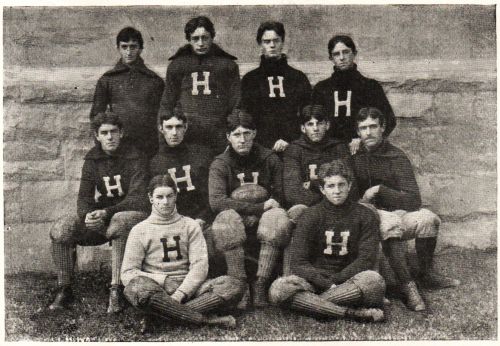
Hotchkiss put up a beautiful game. The eleven played so snappily and with such excellent team-work that Hartford was unable to withstand the attack, and even if the visitors had not lost their two half-backs, it is not probable that they could have won, although there is no doubt that the score would have been smaller. The best gains for Hotchkiss were made around the ends, their interference being of fine quality.
There seems very little chance now for Hartford in the Connecticut championship series. Besides the two men laid up in the Lakeville game, Hartford has also lost Morris, tackle. Marsh will take his place. Captain Sturtevant will go in as half-back, and Ballerstein will take Sturtevant's place at quarter. Ballerstein is a good player, but he lacks weight, and is considerable of an unknown factor for the new position.
The Hotchkiss School team is an unusually good one this year. Noyes at full-back plays a steady game and interferes well; he does not buck the centre quite hard enough, however—a style of play which is being greatly developed at Hotchkiss this year. Adams and Reynolds are the half-backs. The former runs well with the ball, plunges strongly through the centre, and interferes well, but he fumbles on catching kicks. Reynolds was a substitute on last year's team, and is doing good work this season. If he could train himself to start more quickly, his running around the end would be of double value. Fincke at quarter-back plays a good sharp game, and is considerable of a strategist. He interferes well, although he is not quite fast enough for the backs.
The line men are all in pretty good condition. Of the two ends, Savage is the better. He plays a good offensive game, but has the inexcusable fault of running backward at times when given the ball. His offensive work is good, and on the defence he is clever at getting into the interference, but does not always tackle his man. Coy, at right end, is a new man on the first team, and has not yet learned how to put his opponent out of the plays every time. He runs well with the ball, but is only a fair tackler. Montague at right tackle is a veteran; he is still somewhat slow, however, and does not block fiercely enough, but he may generally be depended upon to make a good hold when occasion demands.
BERKELEY SCHOOL (N. Y.) FOOTBALL TEAM.
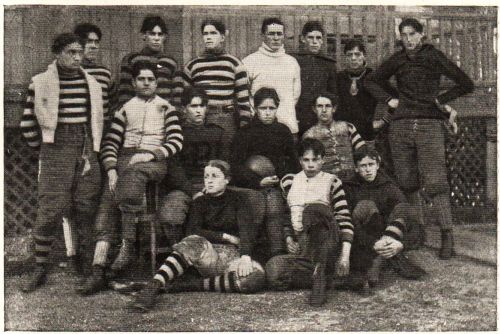
The weakest spot in the line is probably centre, which is looked after by Dix, a player who has had no experience until this year, but is doing remarkably well for a novice. With coaching and practice he will develop into a strong player. Cook, at right tackle, is good at breaking through, but is not a capable tackler. His line-work is good; he runs fairly well with the ball, but he runs too high. Hixon, the captain, has played on the Hotchkiss team, alternately at guard and centre, ever since he entered school; his strongest point is in making holes, and a play put through him by his backs is practically sure of a gain. He runs powerfully, but too high. He is a conscientious commander, and has good control of his men.
Following close upon the defeat by Hotchkiss, Hartford was beaten a week ago Saturday by New Britain, 42-6. The Hartford men started out well, and scored their first touch-down in the first few minutes of play; but when New Britain kicked off, Hartford, instead of rushing down the field, returned the kick, which gave New Britain the opportunity of scoring within a very few moments. The New Britain men then scored again, and as soon as they were ahead Hartford seemed to lose all spirit.
Hartford's offensive work was pretty nearly as good as New Britain's, but on the defense they seemed to be absolutely powerless. The best work of the defeated eleven was done by Gillette and Sturtevant. For New Britain, Brinley and Flannery were giants. Of course much of Hartford's weakness was due to the crippled condition of the whole team, the loss of Bush and Morris. Strong, who was injured in the Hotchkiss game, tried to play against New Britain, but his condition did not allow of very good work. This is undoubtedly an unfortunate year for Hartford in football.
The other games played on the same day were by Hillhouse against Meriden, which resulted in a victory of 54-15 for the latter; Bridgeport defeated Waterbury, 12-8. Connecticut Literary Institute forfeited to Norwich Free Academy.
One of the most interesting school football games ever played in Cleveland was undoubtedly that between the University School and the South High-School on October 25. The score was 4-0. This touch-down was made by Roby, University School, after a run of thirty-five yards; he got started through a big hole in the South High line, and there was no stopping him until he had scored the only points made that afternoon.
The teams were evenly matched, although the South High men were much heavier than their opponents. The University players made up for this inequality by opposing skill to brawn. At the University School there are eight football elevens which practise daily, and from these very good material is to be had for the first team. At South High, on the other hand, there is a scarcity of players for a scrub team, but the men are all heavier than the University players. The feature of the play was the excellent punting of Perkins. Most of the gains, however, were made through South High line, and a few by good plays around the end.
The Academic Athletic League of San Francisco held its autumn field-day a few weeks ago with the usual success, seven records being broken. The figures that went in the 120-yard hurdle, which Hoffman, O.H.-S., reduced from 17-4/5 to 17-1/5 sec. Woolsey, B.H.-S., won the 220-yard dash in 23-2/5 sec., which is one second better than the former record. Spencer, B.H.-S., reduced the 220-yard hurdles from 29½ sec. to 28½ sec. Pitchford, B.H.-S., ran the 880-yard race in 2 min. 7-1/5 sec. Hoffman, O.H.-S., cleared 5 ft. 6-5/8 in. in the high jump. Smith of Hoitt's School broke the 12-pound hammer-throw record by sending the weight 133 ft. 9 in., which beats by 4 ft. 1 in. the National I.S. record made by Ingalls of the Hartford High-School.
Hoffman's work at this field-day was of the first order; he won the three events in which he entered, and in these broke two of the League records. Following is a table of the points made by schools:
1st Place.2d Place.3d Place.Points.
O.H.-S.56346
B.H.-S.46442
P.H.-S.21316
L.H.-S.1119
S.H.-S.1-27
Hoitt's School1--5
Points: 1st place—5; 2d place—3; 3d place—1. In relay: 1st place—10; 2d place—6; 3d place—2.
The desire to resume relations in sport seems to be growing among the students both of Andover and of Exeter. Only recently one of the Andover publications, the Mirror, printed an editorial upon the subject, urging that a school meeting be held to consider the question of opening negotiations with their old rivals. "Who is there in school now," says the Mirror, "who has any grudge against our old-time rival? The majority of the fellows only know that there was trouble; that somebody was naughty, and somebody else said they wouldn't play with them any more. As a matter of fact, the make-up of neither of those memorable teams would bear the scrutiny that is now being turned against amateur athletics, nor can Andover be entirely upheld for protesting a game which she ought not to have played."
There is no dispute of the statement that there were men on the Exeter eleven, during the game which caused trouble, who had no right to play for the school. It seems now that Andover was also to some extent in the wrong in regard to the eligibility of players. But that is a point which it is not necessary to go into at this late date. The Mirror admits that Andover knew that Exeter was going to play individuals who had no right upon the team, but instead of refusing to meet them, Andover, on the other hand, "rather sought glory in the hope of defeating them, whether or no."
The "Mirror" then goes on very wisely to say that now, after the personnel of the two schools has changed completely from what it was at the time of the trouble, there is nothing to be gained by cherishing the old grudge. "There is everything to lose by it, on the other hand," continues the editorial. "Our present opponents are true sportsmen, and play good football and baseball, but they live too far away." This is about what this Department contended a few weeks ago—that Lawrenceville and Worcester, and those schools which Andover has been seeking for close games of late are not her natural rivals, being at too great a distance from the home grounds. There is a great deal more in this argument than may appear at first sight.
It is therefore sincerely to be hoped that the Andover men will have the school meeting suggested by the Mirror. Good will surely come of it. "We feel sure," says the Mirror, "that a discussion shared by the whole school, and led by intelligent speakers instead of demagogues, as was the previous one, would be the greatest gratification to every true Phillips man, whether from Andover or Exeter, and would clear up one of the most unfortunate affairs that has occurred in a long time."
The victory of the Cheltenham Military Academy football team over Penn Charter makes it look as though the soldiers would capture the championship of the Academic League this year. The game was played at Ogontz, and consequently Cheltenham had a small advantage over the visiting team, but they put up a game which Penn Charter would find hard to beat on any field. Play had only been under way five minutes when Boyd, C.M.A., broke through the line and scored. There was no goal, and soon afterwards Boyd scored again.
Toward the close of the first half it looked as if Penn Charter might score, but misjudging the situation, a try for goal from the field was ordered, and the visitors lost the ball. In the second half, Cheltenham scored another touch-down almost at the start. This made the score 16-0, and that ended the point-making for the game. Just before the whistle sounded, Dolson got a good start and made a long run, ending by placing the ball behind the goal posts; but the referee refused to allow the points, the Penn Charter man having run out of bounds.
The Chicago interscholastic football teams kept up their forfeiting procedure on October 24—only two games being played. Hyde Park defeated North Division by fast playing and good interference. The score was 42-6. Trude did good work, and made the finest run of the day by shooting through a hole in the line and making a run of ninety yards. Miller has developed into one of the strongest tackles in the League, and in every game he makes sure gains when he takes the ball. Friedlander's tackling was one of the features of the Hyde Park-North Division match.
The game between Evanston and West Division was a one-sided affair, Evanston winning, 28-0. The three centre men of the winning team are as good as any in the Cook County League. Praether is the best man in his position; he weighs 210 pounds, and does his work with thoroughness and intelligence.
North Division and English High had an ugly misunderstanding in their game, and the whole thing will have to be done over again some time later. Part of the trouble resulted from playing in the dark. A decision by the referee was the immediate cause. A competent referee should have ordered play stopped as soon as it grew so dark that decisions must be difficult to arrive at.
"A PRIMER OF COLLEGE FOOTBALL."—By W. H. Lewis.—16mo, Paper, 75 Cents.
The Graduate.
This Department is conducted in the interest of stamp and coin collectors, and the Editor will be pleased to answer any question on these subjects so far as possible. Correspondents should address Editor Stamp Department.
The following new issues are on the market:
Fernando Po.
½ centimo, yellow-brown.
6 centimo, violet.
12½ centimo, brown.
20 centimo, blue.
25 centimo, carmine.
5c. on 10c. surch. per.
Montenegro, on September 1, two cards.
1novtch, blue and brown.
2novtch, lilac and orange.
3novtch, brown and green.
5novtch, green and brown.
10novtch, yellow and blue.
15novtch, blue and green.
20novtch, green and ultramarine.
25novtch, blue and yellow.
50novtch, red and blue.
1novtch, rose and blue.
2novtch, brown and green.
Some of the Tobago stamps have been seen in different colors from those catalogued, and in some instances these stamps have been offered as "errors" in color. It turns out that a new issue is to be made from the same dies, but in new colors.
A collector in San Francisco lately was given access to the papers of a merchant who was in business during 1861-1865. It is said that he found U.S. Revenue stamps to a face value of $20,000. Most of the stamps were common, but a good number of rarities repaid the collector for his trouble.
Endicott C. Allen, High Street, Brookline, Mass., and L. T. Brodstane, Superior, Neb., wish to exchange stamps.
A. Greene.—No premium.
Harold Weaver.—Your stamps are locals from Finland.
W. Benedict.—"Correos" is Spanish for postage, España is Spanish for Spain. You can obtain the Belgium dominical stamps from any dealer from 1c. to 25c., nine varieties for 25c.; the 50c. 1 F. and 2 F. are worth 25c. each.
A. B. C.—The Columbian half-dollar of 1893 is worth face only.
E. V. Sullivan.—No premium on the coin. I believe there is a philatelic society in Hoboken, but I do not know the address. The Cuban republic stamps have been seen in New York on letters, but it has not yet been shown to the satisfaction of philatelists that these stamps are used for postal purposes in any part of Cuba. Of course, should the Cubans win their independence, they would establish regular post-offices, and probably would use the present Cuban republic stamps for some time at least.
P. A. N.—Unused Würtemberg stamps previous to 1869 issue are very scarce. In many instances the used copy is worth 10c. or 15c., and the unused $10 or $15, and even more.
Constant Reader.—Your coins are still current in England and Prince Edward Island respectively, consequently there is no premium.
A. Gillow, Main Street, Zeehan, Tasmania, offers Australian stamps in exchange for American and West Indian stamps.
P. Dreier, Ridley Park, Pa., wishes to exchange stamps.
C. H. V.—Encased postage-stamps are sold at $1 each and upward. Some varieties are very scarce.
E. Brigham.—No dealer will buy any stamps or collections of stamps without previous examination, and common stamps catalogued at 1c. to 10c. each are unsaleable (to dealers) except in lots of one hundred or more of each kind at one time. You can probably dispose of your collection to some of your friends who collect stamps.
A. M. Stebbins.—No premium.
C. Williston.—Continental and Colonial currency is well worth collecting. Many varieties are very common, and as yet it has not become fashionable to collect these interesting souvenirs of American history. Probably when they become scarcer there will be a greater demand than at present.
A. B. Taylor.—The first issue of Tuscany stamps were printed on a sheet bearing twelve crowns as a water-mark—i.e., four horizontal rows of three each. It takes about eight stamps to show a complete crown, consequently individual stamps have a few irregular water-mark lines only.
Philatus.