Chapter II
Reading edition
A DEFERRED SOLUTION.
It was very early the next morning when we started northward along the turnpike. The doctor and I were driving in a tall chaise that swayed on its hinges like a small-boat in a tide-rip.
Mr. Edgerton followed on horseback. The sun had not risen when I had been awakened, and the morning chill was in the air; a mist hung low over the marshes, and the waters of the bay looked dull and cold. I had begun to shiver, and the kind physician threw a heavy cape around me, and tucked me in carefully beside him.
We had not spoken, except for a morning's greeting, but now he began a fire of questions, and I could not answer even the simplest. I had never heard that my mother was a widow before her marriage to the man whose name I bore; I did not know her maiden name, nor where she came from; and if I was not born at the plantation on the Gunpowder, my birthplace was a mystery to me; for, as I have said, my first recollection was the warm day on the beach.
My mother had told me nothing from which I could formulate a suggestion or give a reply that would throw any light upon my family history. What was to become of me I did not know. Apparently my mother had left no will, and my appearance upon the day of her conversation with Mr. Edgerton had interrupted, probably, any disclosures which she had intended making.
The lawyer had ridden alongside of the chaise as we slowly ascended a slight hill.
"Know you anything, Master Hurdiss, of a large iron-bound chest in a room on the second story of Marshwood House?" (I have forgotten to say that the estate upon which we lived was known in the neighborhood as the "Marshwood plantation," whether from the name of a previous owner or its location, I have never been able to ascertain.)
To the lawyer's question I could only reply that I had often seen the box and had once caught a glimpse of the interior, that it was full of papers, and I had noticed it must have contained some money, for I saw my mother take some gold pieces from a heavy leather bag that she had afterwards replaced.
"Never mind; we will solve it all," continued the man of law, "so soon as we get there. I have the keys. Come, doctor, press ahead!"
The horses lurched forward into a trot—we had now reached the top of the hill—and tired and sleepy, I leaned back on my kind friend's shoulder and fell asleep.
When I awakened the sun was high, but the chill was yet in the air, and a damp breeze had sprung up from the eastward that presaged rain. Aloft against the heavy clouds a V-shaped line of wild-geese were winging their way to the south; their coarse honking fell down to us. The sound caused me to look upward, and I followed the steady flight. I have always been well versed in the signs of nature, and there is nothing so sure to judge by as the flight of wild-fowl.
"We are going to have cold weather," I remarked to the doctor.
"Yes, the old gander is setting a pace for them as if the snow were after him," he replied.
To my surprise, as I gazed about near to hand, I saw that we were almost at the cross-roads, where it was our intention to stop and procure something to eat, as we had had nothing since the gray of morning.
Two or three new houses had been added to the group that lined the road-side, and a new sign-post waved its arms at the corner. A number of negroes hurried out and took the horses.
As we entered the low-ceilinged front room of the tavern I overheard the talk that the doctor and lawyer were having together. "It was certainly most careless to leave such property unguarded," the latter was saying. This made me listen.
"But no one would suspect anything in the way of treasure, and they are honest people hereabouts," returned the doctor reassuringly.
For some reason I could scarcely swallow a mouthful of the meal that was served for us, although it smelt most savory. As a special honor the landlord himself insisted upon waiting upon the table, and I shrewdly suspect, putting things together, that he was of a curious nature, and longed for a chance to listen to the conversation; but if this was his desire, it was not gratified, as the doctor and the lawyer were most reserved in his presence.
At last, however, we were on the move again, a fresh horse having been placed in the shafts of the old rattle-trap (upon the possession of which, by-the-way, I found that the doctor prided himself most mightily). Well, off we went at a tremendous pace, the new horse charging down the road in a clumsy, heedless fashion, and the chaise rocking behind him fit to capsize us.
The doctor at last succeeded in pulling the nag down to a steadier gait, and Mr. Edgerton, coughing and choking, came trotting up beside us through the trailing cloud of dust that, despite the damp, hung in our wake. For two miles we drove on in silence, and then turned from the main road into the lane that led to Marshwood. The old-fields on either hand were grown breast-high with brambles, and the lane wheel-rucks were almost hidden in the tall grass that swished softly and quietly under the box of the chaise.
Marshwood House was built partly of brick and partly of wood. The brick had come from England at the time when the colonies, because of the tax on industries mayhap, brought even their building material from over the water. It had once been very handsome, but during the Revolution the outbuildings had been destroyed, and the right wing of the house had fallen into sad decay. By the expenditure of some not inconsiderable sum, however, the whole estate could have been restored to the beauty it must once have possessed (but alas! that never has or never will happen, I suppose). Now, at the time of which I speak, ruin was writ on everything.
When the horses had been tied to two rusty staples driven into the trunk of an oak-tree that stood before the door, we all stepped up on to the piazza. The boards were sagged so badly that they had fallen away from the body of the house, and even the stone-work had crumbled along the foundations.
It appeared like the old place, and yet it was not; but there was the same hornets' nest that I had watched building up (ages and ages ago, it seemed to me); and there, hanging on a nail, was a fishing-rod with a rusty iron hook dangling from a bit of rotten fish-line. I had stood on tiptoe and put it there; now I could touch it with my elbow.
The lawyer had some difficulty in opening the door. However, at last he succeeded, and gave a sigh of relief as he saw that there were no traces of any one having preceded him.
"Come in, doctor," he said, cheerily, his voice echoing oddly down the empty hallway.
"Come on, John, my son," reiterated the physician to me.
I turned, before I crossed the threshold, and looked out over the sloping meadow and the stretch of yellow marsh to the blue-gray waters of the Chesapeake. The rain that had been threatening all the morning had begun to fall with that depressing, sun-filtered drizzle that promises hours of it.
It was on such a day that I used to lie with my head in my mother's lap while she read to me. I remembered this with a certain calmness, for there had settled upon me a firmly assured belief that I should never be happy again, and I accepted the feeling with a stoicism that now I wonder at. But my pen runs from the main task of putting facts on paper. To return:
I entered the house, and insensibly caught the doctor's great hand in mine.
There was a musty, locked-up odor greeting us that checked full breathing. The big room on the right smelt like a cellar, dank and unhealthy.
The doctor drew aside a chair, and, opening a window and the shutters, admitted some light. Dust was all about, everywhere; the heavy oak centre table was littered with dead, starved flies; the whole place was so chill and unhomelike that I shuddered. The doctor closed the window.
"By Jove, it grows cold!" he said.
The lawyer, who had deposited a pair of large empty saddle-bags on the floor, stamped his feet.
"Heigho!" he cried, "let's cheer things up a bit. Here's a fire all ready for the lighting; that's a godsend."
In the wide fireplace were some good-sized logs and a handful of fat-wood. Drawing a flint and steel, he struck a light, and soon a tiny blaze crept up the old chimney, and broadened with a burst of flame at last into a cheerful, roaring, warming glow. It cleared the room of its unhealthiness, and all three of us spread our hands out to it as if it had been winter.
"I think the look of things has made us exaggerate the weather," said the doctor, with an attempt at a laugh. "Come, let's set to work."
The lawyer drew from his pocket a small bunch of keys. "We will have to try for it—they're not numbered," he replied, thrusting one into the keyhole of the desk in the chimney-corner.
He tried them all before he found one that would fit. Then he turned the bolt with a sharp click, and lowered the lid. I began to feel excited, and I could see that the others were and did not conceal it.
"Ah, no one has been here, that's evident!" exclaimed the doctor.
Plain to view in a neat pile were some French coins, a shining little tower of gold. The lawyer opened one of the drawers on the left. It was empty. Then another, with the same result. In the bottom one, on the right hand, however, was a paper and a miniature on ivory. I remembered the last—the side face of a large, heavy man in a white wig. His nose was very prominent, and despite the massive jowl he had an air that suggested the effect of a noble presence. His costume was magnificent. From beneath a broad sash that crossed his breast peeped a great diamond star, and lace and jewels decked him.
"An excellent likeness, I judge," said the doctor, looking at the portrait with one eye shut.
"I should know it across the room," replied the lawyer.
"Who is it?" I asked, for I had seen it once in my mother's hands.
"It is the French King who lost his head by the guillotine," answered the doctor—"Louis the Sixteenth."
"Did your mother never speak to you about this portrait?" asked the lawyer, who was untying the ribbon with which the paper had been fastened.
"Once I saw her looking at it," I replied, "and I asked her. But I never did so again, because she began to talk so fast and in such strange words that I could not follow. Then she began to weep, and her hair fell down all about her. Aunt Sheba came running in and held her in her arms. It was a long time before she grew calm again. She never told me who it was."
By this the lawyer had spread the document on his knee. He gave a grunt of vexation.
"This is Greek to me," he muttered. "See what you can make out of it."
He handed the paper to the doctor. The latter wrinkled his brows and shrugged his shoulders.
"I give it up," he replied, half smiling.
I peeped beneath his elbow.
"Why, it's French," I said, "and my mother's writing, sir!"
"Can you read it?" asked the doctor, spreading it out on the desk lid.
In reply I began without hesitation:
"'To Monsieur Henri Amedee Laralle de Brienne.
"'Dear Brother,—Although I have not written you and have received no word from you, I am writing these lines, trusting and intending that they will meet your eye should you survive me. My husband, whose memory I cherish, is dead—lost at sea. Despite the injustice with which you have treated him, and me also since my second marriage, I recommend to you my son, who bears the name of his step-father.'"
I started and read the last words over twice.
"Go on!" interjected the lawyer, rapping the mantelpiece sharply with his knuckles.
I continued, with my face burning and my lips atremble:
"'For the sake of the name that he might claim, and all that it may mean, you may receive him. I have told him little of the past. In my judgment it was not needed, nor could it now produce anything to his favor. If circumstances should alter, you may divulge the secret; but I pray you not to do so unless this happens. This I beseech you for the sake of her whom you have loved. My son will bear with him the chest that contains the papers that I brought from the château at A. They will be unopened and addressed to you. There is enough money in the two bags to pay for my Jean's education. I have never been able to bring myself to talk about the dreadful happenings. I cannot even think of them, or I should go mad. Somehow it has appeared that silence has been the better part; but to your discretion I leave this, and to you I intrust my son's future. May God watch over him and direct you! It is evident to me from your letter that you were uncertain which one of your sisters was writing to you. I am H. de B., who inscribes here what will be carved upon her tombstone, "Madam John Hurdiss, widow of Captain John Hurdiss, merchant and trader, of Cornwall, England."'"
This was all the letter contained. It did not seem to lessen any mystery that existed, and for some minutes neither the doctor nor Mr. Edgerton spoke a word. Suddenly the latter kicked back one of the logs in the fireplace with his foot.
"Confound the fire, it smokes like a smudge!" he grumbled. "So we are not to open the papers, after all! But there may be something lying loose. Let us up."
"HARK! WHAT NOISE IS THAT?"
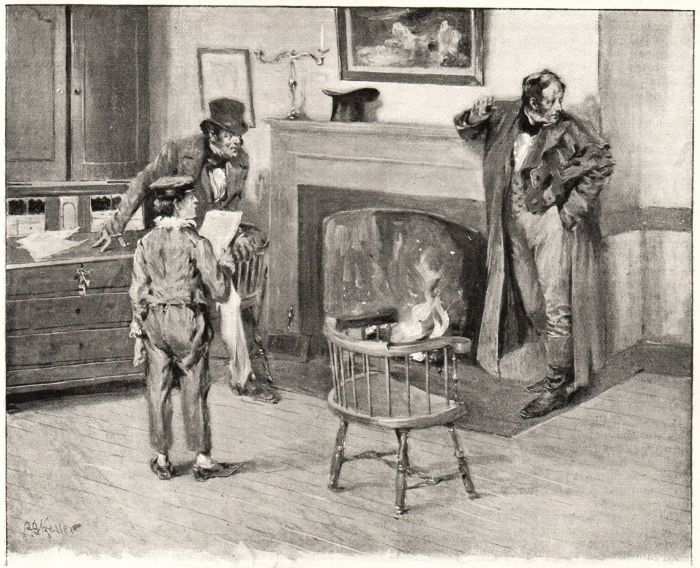
All at once the doctor raised his hand. "Hark! What noise is that?" he exclaimed.
A roaring crackling sound came from overhead. Something fell heavily on the floor of the hallway outside. The two men sprang to the door and pulled it open. The hall and the other rooms were filled with stifling smoke. The old portrait (the one with the long brown curls) had fallen, and a blazing bit of wainscoting burned through the canvas that had smouldered to the frame.
"The strong-box!" shrieked the lawyer, and he plunged up the stairs.
"It's in the room on the right!" I cried, as the doctor and I followed him, feeling our way with the aid of the banisters.