DEPORTMENT.
Reading edition
Half this windy day I've watched them, In the breeze, Those long slender tasselled branches On the trees, Bowing, courtesying politely, Doing their deportments rightly, As modestly, as brightly As you please. Why, I never saw such manners, Not till now, Such beautiful deportment; But I vow All the people that I see Are as rude as they can be, Not to stop before each tree And make a bow. Arthur Willis Colton.

he following morning we left the village at daylight, each one carrying about twenty pounds of boiled smoked elephant meat. We were soon in the forest, and tramped and tramped along without seeing any game. Towards four o'clock we met a great many fresh elephant tracks. The animals seemed to be just ahead of us. The footprints after a while began to be so plentiful that evidently there had been several herds of elephants. At about five o'clock we came to a beautiful prairie which seemed like a lovely island on that big sea of trees. There were many fields of plantain-trees along the borders of the forest, growing in the midst of trees that had been felled and burned.
Okili said to me: "We have seen, Moguizi, many elephants' tracks on our way here. I am almost certain they will come here to-night, for they are fond of plantains."
So we resolved to go no further that day, for we were on good elephant-hunting ground, and made preparations to spend the night on the border of the forest and wait for the huge beasts. We only spoke in whispers, for we thought the elephants might not be far off.
Okili then said, pointing to a spot where the forest advanced on the prairie, forming, so to speak, a cape:
"It would be wise, I think, for some of us to go to that place, for there also is another large field of plantain-trees, and the chances are that some of the elephants will go there, for there are very many."
Then Ogoola, pointing to another field of plantain-trees south of us, said, "To make sure, some of us ought to go there also."
We all assented.
"We have chosen," said I, "three places where we are going to lie in wait for elephants, so we must divide ourselves into three parties."
I had hardly said these words than they all cried with one voice, "I am going with you, Moguizi."
I replied, "Hunters, if you all go with me, then there will be only one party, and we will be too many together."
"That is so," they all answered. There was a pause.
Okili got up and said, "The Moguizi, Okili, and Niamkala will make one party. You know that the King said that I must be always by the side of the Moguizi."
"Yes," they all answered. "The King said so."
Then Okili spoke again, and said, "Obindji, Mbango, and Macondai will make the second party. Ogoola, Makooga, and Fasiko will make the third party."
Okili, who had much experience in hunting elephants, said, "Now listen to what I am going to tell you, and act accordingly. The great thing in elephant-hunting is for one to have a cool head, otherwise he had better stay at home. Often elephants, when wounded, charge those who fire at them. In that case, if the hunter runs away, he is lost, for the elephant is sure to overtake him, tramp over him, and one of his feet upon the hunter's body is quite enough to kill him instantly. The elephant may prefer to impale him on one of his tusks, or seize him with his trunk and dash him to the ground or against a tree.
"The only way to escape the elephant when he makes his furious charge upon you is to keep perfectly calm, then when you are sure of the direction of the huge beast, instead of facing him, move sideways; then when he is five or six yards from you, take three steps backward as quickly as you possibly can. His pace is then so rapid that he cannot deviate from his course, and he passes by you, and you are safe."
"Yes, Okili, you are right," I said. "I have been three times in the same predicament, and I did exactly what you tell us to do, and there are no other ways to escape the fury of the elephant."
"We will do so," all the hunters said, with one voice, "but we hope to kill the elephants on the spot," and as they said this they looked at the charms which hung on their guns.
We separated, as we had agreed, into three separate parties, but not before we had taken our dinner of elephant meat. Each party went into the prairie to reach the fields, and one and all disappeared in the midst of them.
I had just looked at my watch for the tenth time, which marked one o'clock, when lo! I saw through the dim moonlight, emerging from the forest on the opposite side of the prairie, something like a big black spot, which was moving. Soon I saw it was a huge bull elephant. He walked for a while, then stood still and looked all around, as if to see if there was danger ahead.
Okili and Niamkala had their backs turned to me, and were watching in another direction. I gave the cluck of danger—cluck, cluck! They turned toward me, and I pointed the bull elephant to them. Then the big bull gave a shrill, piercing trumpeting, which evidently meant there was no danger, for immediately afterwards elephant after elephant emerged from the forest into the prairie. I counted one, two, five, seven, ten, thirteen, seventeen, twenty, twenty-three, twenty-seven, when appeared behind them all a cow followed by a baby elephant. No more elephants came out of the forest; the herd was all there. They all came by the bull elephant and stood still in a bunch. Were they mistrustful of danger, or were they taking counsel together before moving?
Fortunately for us the wind blew in the right direction; it blew from the elephants towards us, so they could not possibly detect our scent.
After a while the herd nearest to us, headed by the big bull, marched in our direction. Their keen eyes had evidently detected the plantains. They walked slowly. We could hear their heavy footsteps.
Soon they entered the plantation not one hundred yards from us, and then the destruction began. Plantain-tree after plantain-tree was brought down by them. They were making such a havoc!
Before we moved from our hiding-place we waited until they were so far in among the trees that they could not possibly see us when we crossed that bit of the prairie that stood between us.
The time came at last when we left our place. Okili gave the small cluck, to draw our attention, and made the sign to follow him. We left our hiding-place, and as soon as we reached the grass we lay low, creeping towards the place where the beasts were. We entered the plantation; tree after tree had been pulled down. Fortunately they were making such a noise continually pulling down the trees that they could not hear us.
We three were close together, and advanced slowly towards the game, when, to our consternation, the wind shifted suddenly; if it shifted two or three more points of the compass, then the elephants would be aware of our presence.
After emerging from a cluster of plantain-trees, Okili suddenly stood still, put his finger on his mouth—a sign of danger. Looking around, we saw within twenty yards of us the bull elephant feeding on a bunch of plantains. How big he looked!
Niamkala, Okili, and I looked at one another, as if to say, now danger is before us; let our hearts not fail us. Then slowly we pressed forward towards the big bull.
Of course he was the most dangerous of the whole herd. It was certain that he would charge if we did not kill him on the spot. Then we must look out for our lives. Okili looked at his old-fashioned gun once more; Niamkala did likewise. I gave a look also at Bull-dog, and I said to myself, "Paul, if you let this elephant tramp on you or toss you or impale you, it will be all over with you; you will never see home again."
We were getting dangerously near. Niamkala had left us, and crept towards the elephant in such a manner that he could send a shot behind his left shoulder without the danger of his iron plug coming in our direction if it missed the animal. There was no danger of that, for Niamkala was a splendid shot, but then he might only wound him.
THE ATTACK ON THE BULL ELEPHANT.
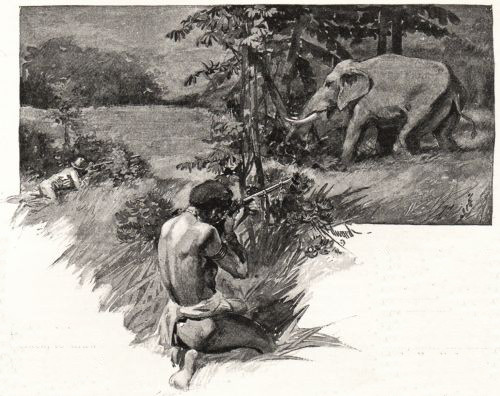
Okili and I had approached within twelve or fifteen yards; we were facing each other; circumstance had favored us. The moon was hidden under a cloud, and just as the cloud disappeared we raised our guns. We were to fire between the elephant's eyes. Niamkala also raised his gun, and we all fired at the same time. We were upon our feet at once, and waited for the effect of our shots. The elephant seemed to stagger, then suddenly he made a plunge towards Okili and me, charging at full speed. We turned instantly sidewise to let him pass in front of us. In a moment he was near; we made three steps backwards and he passed us. I fired another shot; we heard a thumping noise on the ground; the big beast had fallen dead.
Of course the whole herd decamped after we had fired. They went through the jungle, breaking every small sapling that came in their way and barred their flight. For quite a while we could hear them, until the noise gradually died away in the distance.
Then we left the dead bull and went on the prairie, and saw some men running in our direction. As they came in sight they shouted, despite their being out of breath, "We have killed two elephants and wounded one that has run away."
We shouted back, "We have killed the big bull elephant."
We embraced one another, and shouted in the wildest manner, "We are men! We are men!" Then they all danced round the bull elephant, and exclaimed, "You wanted to kill our people; you charged them, but you got killed instead." And they had a war-dance round the dead animal, after which we went to their camp and saw the two cow elephants. They danced round them, after which they cut a piece off each elephant, and took these into the wood and left them there upon large leaves, for the spirits Mombo and Olombo, who ruled over the hunting, to feed upon.
One of the bull elephant's tusks weighed sixty-nine pounds, the other one sixty-one. The four tusks of the cow elephants weighed one hundred and eleven pounds.
The following morning, Mbango, Macondai, Niamkala, and Fasiko left us to go back to the village to fetch people to carry the elephant meat and the tusks of ivory.
After they had left, we eagerly followed the tracks the elephants had made during their flight. For hours we followed these. Fortunately Okili was well acquainted with this part of the forest. A number of peculiar-shaped trees were his landmarks. During the day we crossed over several hunting-paths.
"The elephants must have gone far away," said Okili. "Their leader, the big bull elephant we have killed, is not with them to direct them. The other bull elephants in the herd were too young. Some big bull elephant will scent them, and then become their leader. We had better leave their tracks and follow one of the hunting-paths. I know the path will lead us to the place where we are to meet Ogoola and Niamkala."
We slept in the woods, surrounded by big blazing fires. The following day, towards evening, after walking without intermission for twelve hours, with the exception of half an hour for our noon meal, we reached the shore of a little river, and came to the big koola-tree where we were to meet Ogoola and Niamkala. Okili and I were delighted to see so many koola nuts on the ground, for both of us were very fond of koola nuts.
We built our camp at some distance from the big koola-tree, and lighted big fires, then lay upon our backs and put the soles of our sore and lame feet as near the fire as we could. It is wonderful how this great heat takes away the soreness.
The next morning I thought I would take a stroll by myself and look for elephants, as Okili was not feeling very well.
One hour after I left our camp, and as I was walking along the bank of the river, I spied, on the opposite side, a big bull elephant by himself, evidently old, and the kind that is called by the natives a "rogue elephant." The big beast was looking at the water, as if he had not made up his mind to cross the river or not, or to take a bath. After some hesitation he plunged into the river. The sun was very hot. He threw water with his trunk in the air. He took his bath leisurely, then began to swim across to a sandy island, upon which he landed, then stood still for a few moments. He had all the appearance of a "rogue elephant." I did not like his looks, and I was sure he would charge if not killed on the spot. I looked at Bull-dog carefully, and made sure that the steel-pointed bullets were near. I kept watching the beast, hidden by the thick jungle, when suddenly he lay down and began to roll himself in the sand. This was his sand bath, and he seemed to enjoy it thoroughly. Then he got up, stood still for a while, and suddenly plunged into the water and swam in my direction. I saw that he would land about opposite to where I stood. "Goodness gracious!" said I to myself, "I am in a pretty fix; I have no choice of position; I have to face the huge beast, and I must aim right between his eyes before he lands."
"I TOOK AIM RIGHT BETWEEN HIS EYES AND FIRED."
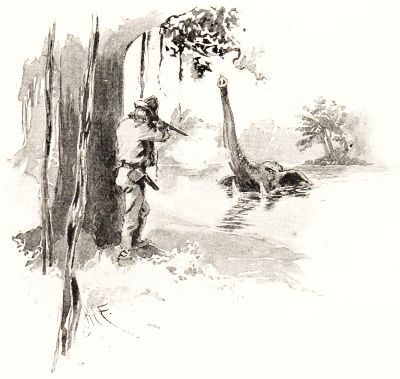
I placed myself by a big tree, which could protect me in case the elephant charged.
I took aim right between his two eyes, and fired, reserving the other shot. When I fired he was on the point of landing. As the bullet struck him he gave a shrill cry; then he landed and charged. I dodged by going to the other side of the tree, and well I did, for as he passed the tree he moved his trunk in my direction. Then he disappeared, and I heard a big crash in the jungle, and all became silent. I went in that direction, but looked very sharp, and then I saw the huge beast breathing his last. I approached very carefully, for I was not sure that he had not strength enough at sight of me to get up and charge. I did not want to waste more of my steel-pointed bullets. I waited for a while; the elephant kept still; then I ventured nearer and I found that he was dead.
Okili, who had heard the report of the gun, started down the stream with a raft he had made, and gave a war-whoop when he saw me by the shore. Soon after he was in sight of the big rogue elephant. We cut his tail off as a trophy, and went back to the camp, for Ogoola and Niamkala were to be with us that day.
There was great rejoicing with the animal. They were hardly seated when Okili said to them, "We have great news to tell you."
"What is it?" they said, with great eagerness.
"The Moguizi has killed this morning a rogue elephant; there is his tail."
Paul du Chaillu.