POPULAR FOOTBALL BOOKS
Reading edition
A PRIMER OF COLLEGE FOOTBALL
By W. H. Lewis. Illustrated from Instantaneous Photographs and with Diagrams. 16mo, Paper, 75 cents.
There is probably no other man in America who has had as much football experience or who knows more about the game than Mr. Lewis.... Of value not only to beginners, but to any one who wishes to learn more about football.... We heartily recommend it as the best practical guide to football we have yet discovered.—Harvard Crimson, Cambridge.
Written by a man who has a most thorough knowledge of the game, and is in language any novice may understand.—U. of M. Daily, University of Michigan.
Will be read with enthusiasm by countless thousands of boys who have found previous works on the subject too advanced and too technical for beginners.—Evangelist, N. Y.
Beginners will be very grateful for the gift, for no better book than this of Mr. Lewis's could be placed in their hands.—Saturday Evening Gazette, Boston.
NEW EDITION OF
CAMP'S AMERICAN FOOTBALL
By Walter Camp. New and Enlarged Edition. 16mo, Cloth, $1.25.
The progress of the sport of football in this country, and a corresponding growth of inquiry as to the methods adopted by experienced teams, have prompted the publication of an enlarged edition of this book. Should any of the suggestions herein contained conduce to the further popularity of the game, the object of the writer will be attained.—Author's Preface.
BY THE SAME AUTHOR:
FOOTBALL FACTS AND FIGURES. Post 8vo, Paper, 75 cents.
HARPER & BROTHERS, Publishers, New York
JUST A TRIFLE UNDER THE WEATHER.
NOW SHE KNOWS.
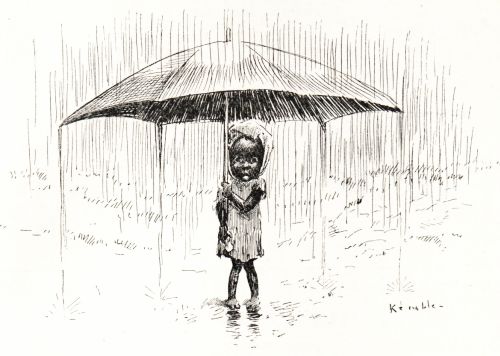
Hattie is no longer in doubt. She has often heard good people declare that it was "raining cats and dogs," and for a time believed that they were romancing, or, at least, prevaricating. Now she thinks they were speaking the truth. "If it doesn't rain cats and dogs sometimes," says Hattie, "how do the Skye-terriers get here? That's what I want to know."
"Where did you go last summer, Jacky?"
"We didn't go," said Jacky. "We staid home."
AN ITEM FOR SAILORS.
Here is an important statement—if true—for those interested in sailing. An English newspaper says that while it is hard to believe that the speed of a sailing-vessel can be increased by boring holes in her sails, an Italian sea-captain nevertheless claims to have conducted experiments which go a long way towards proving it. His theory is that the force of the wind cannot fairly take effect on an inflated sail, because of the cushion of immovable air which fills up the hollow. To prevent the formation of this cushion, the captain bored a number of holes in the sail. These holes let through the air which would otherwise have been retained in the hollow of the sail, and allowed the wind to exercise its whole power by striking fairly against the sail itself. Several trials of this device have been made, and it has been found that in a light wind a boat with ordinary sails made four knots, while with the perforated sails she covered five and a quarter knots. In a fresh breeze she made seven knots with the ordinary and eight and three-quarter knots with the perforated sails; and in a strong wind she made eight knots with the old and ten knots with the new sails. This gain—from twenty to twenty-five per cent.—is of so much importance that the experiments will be repeated on a larger scale.
THE JOCUND WIND.
For a practical joker there is nothing like the wind. It blows clothing hung out to dry from one neighbor's yard into another; it will whisk your hat off in a jiffy, and compel you to make yourself a spectacle chasing after it; it is worse than the small boy who removes gates on All-Halloween, for it not only removes gates, but sky-lights and window-shutters. Worst of all, it is no respecter of persons. It will prank with a King as readily as with a beggar, and years ago in France it had its joke with no less a person than the Prince-President himself—the one who subsequently overthrew the republic and proclaimed the empire, with himself as Emperor, Napoleon III. According to the chronicles, the way of it was this:
When the Prince-President, on his journey through France, came to Bordeaux, a triumphal arch had been erected for him by the prefect at the entrance to the town. A wreath suspended by a rope was to be let down on his head as he passed under it, and the arch bore this inscription: "He has well deserved it." But a gust of wind carried off the wreath, so there was nothing left but the rope with this legend—"He has well deserved it."
This is a true story of Peter Apple, of Oakland, Marion County, Indiana. He was a raw recruit when his company took part in an attempt to storm a battery at Vicksburg. The fire of the rebels was so hot, however, that the Union troops were forced to retreat. Private Apple was so excited, however, that he did not hear the command to retreat, and in the disorder of the contest rushed over the breastworks unharmed and grabbed a gunner by the collar. Then he turned about and dragged the man back to the retreating Indianians, and cried out:
"Boys, why did you not come on? Every fellow might have had one!"
Mrs. Hope. "Ethel, Miss Nerfus is coming to-day, and I want you to be mamma's good little girl."
Ethel (aged five). "Oh yes, indeed, mamma! I'm always very particular about what I do when visitors are here."
AUNT SAMANTHA. "Now I see why that youngster gave me these felt slippers for Christmas."