THE SOAPY SEA.
Reading edition
When first beside the turquoise sea Stood Mabel, fair and sweet, And saw the billows breaking free Like snow-drifts at her feet, She murmured, "Do these soapsuds leap And roll from morn till night, Way up the shore, to wash and keep, It always silver white?"
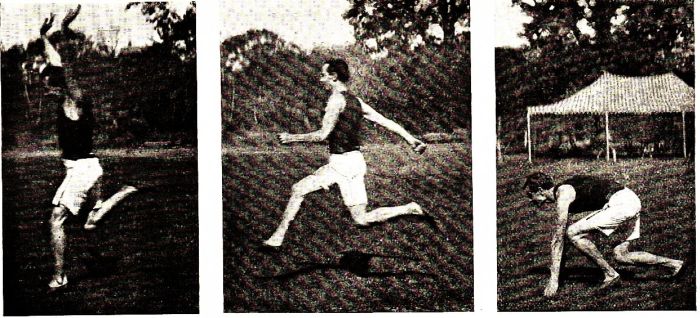
3. The Finish. 2. The Stride. 1. The Start. From instantaneous Photographs of B. J. Wefers, Amateur Champion of the World.
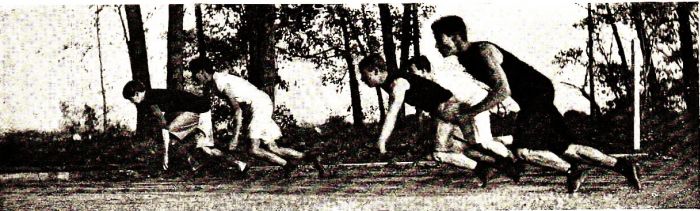
The Start of a Handicap 100-yard dash. SHORT-DISTANCE RUNNING.

Of all track-athletic events the sprints are the hardest to train for, yet the easiest to perform. Being the easiest, there are consequently many more athletes running the 100 and the 220 than there are competing in any other single event; but of all the competitors there are comparatively few really first-class men. To become such requires long and patient and careful training, and a greater mastery of form than in almost anything else.
It is a difficult task to tell on paper just what a man should do who wishes to make a specialty of sprinting. There are so many small points of importance that vary with individuals, that only a general description and a few broad suggestions can be given here. At the same time, whoever accepts these suggestions and heeds them may feel confident that he is working along the right lines, and that if he will follow the advice here set down he will put himself into condition to make rapid strides of progress as soon as he comes under the management of a trainer.
It has already been said in this Department that no one ought to begin to train for any athletic event much under the age of sixteen. Until that time few boys are sufficiently developed physically to be able to stand the strain of regular athletic work. At that age and afterward, however, the muscles become firm, and are amenable to development and capable of continuous careful exercise. You will hear a great deal of talk about "wind" and "breathing" and "lungs" and kindred subjects when you first begin to train as a runner. Pay no attention to these "wind" advisers. Your wind and lungs will take care of themselves. In the first place, the lungs are not at all the organs that you want to think of in this connection; it is the heart. The heart is the organ that is affected by running. Run a hundred yards, and you will find your heart beating faster than when you started. The exertion of sending the blood more rapidly through the body is the cause of this. Therefore a sprinter should first feel confident that he has a strong heart, and then he may set to work with no misgivings about his wind.
It is not the lungs that are affected by cigarette-smoking. It is the heart. Take any smoker, and you will find that his heart beats to a different measure from that of an abstainer. For this reason sprinters should avoid tobacco. Another old-fashioned and exploded theory is that the athlete should run with his mouth shut. That is not necessary at all. In fact, sprinters are taught nowadays to run with their mouths open, and every first-class man in the event does so. It must be plain to every one that a man can get more air into his lungs, and thus facilitate the working of the heart, by inhaling through his mouth than through his nostrils. Of late all the best long-distance runners have adopted this breathing method, and find it best, and in the illustrations of long-distance runners to be published in an early issue of the Round Table these men will all be seen to have their mouths open as they run.
The training for the 100 yards and that for the 220 are almost identical, for an athlete who runs one of these events almost invariably becomes proficient in the other. In fact, the 220 is a long sprint—the word sprint meaning to run at full speed the entire distance of a race. The most important feature of sprinting, of course, is the start, and no runner can become too proficient in this. Up to within five or six years the standing start was universal, but in 1889 or 1890 Lee of the New York Athletic Club introduced the crouching start, and since then that has become the standard in America. In England some of the professionals use it, but not until the London Athletic Club men came over here last fall did British amateurs recognize the value of the crouch and adopt it. But they did adopt it after the international games, and no doubt the crouching start will soon become general among English amateurs.
The position for this start is somewhat difficult to acquire and master, but once this is accomplished an athlete is certain to knock off one-fifth of a second from his best previous record. The first thing of importance is to fall into an easy position, with the hands on the scratch-line and the starting foot from six to nine inches back. The other foot should be from 2 ft. 6 in. to 2 ft. 9 in. further back. The runner should be raised up on his toes in an easy, springy attitude. The first illustration shows exactly how that position is taken. Many runners lean on their knuckles, but a better way is to have the hands open, and to rest on the extended fingers. This gives more spring. In order to do this and to keep hold of the running corks, fasten a rubber band at each end of these, and slip this over the back of the hands.
When the starter gives the word to "set," the runner should lean forward as far as he can without losing his balance, his head lifted so that he can get a full and clear view of the track ahead of him. When the pistol sounds he shoots ahead with all the force of both legs, but his first two strides are taken in a crouching position. Do not attempt to stand erect at the very start. Let the head and shoulders rise along a slanting line to their proper altitude, or there will be an infinitesimal but still noticeable loss of time. As soon as the runner has got into an erect position, however, and into his pace, he should run with only the very slightest forward inclination of the body, but with the chin thrust well out. The second illustration shows this well. The arms should be swung across the body rather than alongside of it. This gives better form and makes an easier stride.
Never look backward while running. Many a race has been lost by that very act. Pay no attention at all to the other competitors, but go it for all you are worth, regardless of your rivals. Breathe naturally. Do not begin to stop until you have passed the finish-line, but, this done, throw up your hands and try to run up into the air. The third illustration demonstrates that idea. The man who naturally has a long stride has an advantage over his fellows, but the man who has not a long stride need not attempt to increase his spread of pace. An athlete can run much better with his natural stride than with an adopted gait. Of course, when jogging for practice, it is best to lift the legs as well up as possible, and thus develop whatever capabilities for a long stride you may have, but do not strain yourself by trying to overdo the thing. The foot should always come down straight upon the ground—that is, flat. I do not mean by this that the heel should touch, for it must not by any means. Yet a man does not run on his toes; he runs on the ball of his foot; and in order that the spikes of his shoes may enter the track to the best advantage the sole should strike flat, that the nails may dig well in and secure a firm hold.
For a beginner who has never undertaken any systematic training in sprinting, and who desires to become proficient in it, I should recommend the following schedule, to be carefully carried out for three weeks:
Monday.—Practise the start six times, running at speed only about twenty yards from the scratch. Rest between each attempt, and end up by jogging fifty yards, finishing up the hundred at speed.
Tuesday.—Jog a quarter of a mile for the purpose of developing the stride.
Wednesday.—Run seventy-five yards at speed; rest, and then run fifty yards at speed.
Thursday.—Practise the start ten times, running as before, not further than twenty yards each time; jog 220 yards slowly for stride.
Friday.—Run fifty yards at speed twice, with a rest between.
Saturday.—Run a trial 100 yards on time, and, after a rest, jog around the track for 220 yards.
To an ambitious young athlete who feels he is a future record-holder this schedule may seem altogether too light. There are no words strong enough, however, with which I can urge him not to attempt to do a bit more at the beginning. What is more, at the slightest sign of fatigue at this work, quit for the day.
For practising starts, where a pistol is unavailable, get some one to snap two boards together. Don't start by oral command. Get in the habit of getting off the mark at the crack of a pistol, or to a sound as nearly similar as possible. The jogging around the track should be taken very slowly, and is intended purely as a leg exercise and to develop the muscles of the calves and thighs. A long loose jog will lengthen the stride. When preparing for a contest lay off altogether the day immediately preceding it, and don't run your distance against time for three or four days previously. Run only fifty yards at those times if you are going into the 100, and try 150 if you intend entering the 220. In a 220 race you will find that you can make a stronger finish if you ease up a trifle for 5 or 10 yards at the 200-yard mark—although this is merely comparatively speaking, for this race is a dash from start to finish. It will be better not to experiment with this suggestion until you become a pretty good judge of your pace.
The proper costume for a runner is a light jersey shirt with no sleeves, and china-silk running trousers that barely reach to the knees. If china silk is unavailable, cambric or cotton will do very well. Corks may be purchased of any dealer in sporting goods. Working shoes should be made of horse-hide, with no heels, and six spikes in the toes. The athlete should also have a pair of calf-skin shoes of the lightest possible make for use only in competition. While at work it is well to wear light socks, as these make the shoe fit more snugly; but in a race wear "pushers"; these are made of chamois, and cover the toes from the instep downward.
The interest in the big in-door games to be held at the Madison Square Garden on March 28th seems to be increasing every day. Not only have most of the prominent athletes of the New York schools already entered or signified their intention of entering, but many sportsmen from a distance will be on hand to try their powers against the home talent. The Hartford High-School will send three representatives to the meeting. Luce, the Captain of their track-athletic team, will enter the half, the quarter, and the 220. He won the quarter in the Connecticut H.-S.A.A. games of 1894, but only took second in the event last year on account of having gone stale. His best time is 51-2/5 seconds; his records for the half-mile and the 220 are 2 minutes 7 seconds, and 23-2/5 seconds. These, of course, are out-door records. F. R. Sturtevant will enter the pole vault and the running high jump. He has an in-door record of 9 feet 8 inches in the former event, and can clear 5 feet 7 inches in the jump. He has held the championship of the Connecticut H.-S.A.A. in these events for the past two years. J. W. Bradin, the third Hartford man, has not made a very strong showing in athletics as yet, but he is full of promise. He took third in the quarter at the Connecticut H.-S.A.A. games last year, and will enter that event in the Madison Square Garden games.
The baseball schedule of the New York Interscholastic League has been formulated, and was announced at the last regular meeting of the association. As was the case last year, the competing teams will play in two sections, and the games will be held on the following dates:
FIRST SECTION.
April 6—Drisler vs. Barnard.
April 10—Condon vs. Cutler.
April 15—Barnard vs. De La Salle Institute.
April 20—Condon vs. Drisler.
April 24—Cutler vs. De La Salle.
April 29—De La Salle vs. Drisler.
May 4—Barnard vs. Condon.
May 8—Cutler vs. Barnard.
May 13—Condon vs. De La Salle.
May 18—Cutler vs. Drisler.
SECOND SECTION.
April 8—Woodbridge vs. Hamilton Institute.
April 13—Columbia Grammar vs. Trinity.
April 17—Hamilton vs. Berkeley.
April 22—Columbia Grammar vs. Woodbridge.
April 27—Woodbridge vs. Berkeley.
May 1—Berkeley vs. Trinity.
May 6—Hamilton vs. Columbia Grammar.
May 11—Trinity vs. Hamilton.
May 15—Columbia Grammar vs. Berkeley.
May 20—Trinity vs. Woodbridge.
The winner of the first section will play the winner of the second for the League championship on May 27th, and all games will be played at the Berkeley Oval. Should there be a tie in any section, the Baseball Committee will assign a date for the deciding game.
The Graduate.