Chapter XX
Reading edition
MISGIVINGS.
It was two days later a small brown horse crunched his way through the deep fall of snow that lay upon the hills to the westward of the Passaic River.
His rider drew up at the foot of a hill, and slapped his thigh, to start the circulation in his half-frozen fingers. "I know the country hereabouts," he said. "Seven miles further on lies the Hewes estate, and beyond that Stanham Manor. From the crest of yonder hill I can look down upon the dear old place. And what if they should recognize me?" he went on. "What foolishness it was to undertake a trip like this! All the information I have obtained so far I could put into a thimble." He was sickening of the adventure. If it were not for the Frothingham stamina he would have backed out and tried his best to retrace his steps. "I will be surely able to pick up something worth hearing at the Hewes place," he went on, half aloud. "If I could only find out the number of the American forces at Princeton or Morristown it would pay me well for my trouble."
The horse, with its flanks steaming, had halted knee-deep in the snow during this soliloquy. William drew his cloak about him and dug his heels into the ribs of his steed. After plunging for half an hour through the heavy unbroken road he reached the top of the hill. Below him stretched the land that had belonged to the old rival company. His eye first sought the country further on. Above the little hill he could see the tall chimney that his own father had built in the old colony days. The smoke was pouring upward, and floated out in the higher air in a thin cloud much in the shape of an open mushroom; not a breeze was stirring; and further to the south another column of smoke marked the position of the Hewes foundries in the hollow.
Yes, and there it was, the old Manor House. He could see the dark patches of the pines about it, and almost imagine he could hear the roar of the water-fall. His eyes traversed the woods and the hill-side nearer. To the right should be the large mansion of Colonel Hewes. The panting horse was again reined in suddenly. There was nothing there where the Hewes house had stood but blackened walls and some stark timbers, whose outlines were softened by the new-fallen snow.
William felt a sense of sorrow besides one of fear and astonishment. He had intended to make his first venture of obtaining news at the house of Colonel Hewes. Now there was nothing to do but to press on and make a bold stroke. He would have to go to Stanham Mills. It would be impossible, weary as he was, to turn back. It would soon be dusk.
Once more he struck the colt with his heels, and descended the hill-side. At the bottom a small stream had to be forded. The tired horse plunged in, and had gone but a little way through the shallow when he stumbled and pitched forward. William flew over his head amongst the rocks and ice. Angry and stunned, he rose to his feet. There was a numb feeling at the elbow-joint of his right arm.
"Fortune is not smiling on me," he said, grimly, feeling the joint with his fingers. "Here is a nice mess if I have broken anything."
It was merely a serious dislocation, but by placing his hand between his knees he pulled the joint back into place. It caused him great agony, and if he had not been above the average in strength it would have been impossible for him to straighten it. His head hurt him also from its contact with a stone, and he felt sore and miserable as he managed to clamber back into the saddle. He had ridden but a little way when the pain in his arm necessitated another stop. With his handkerchief he made a sling, and hooked it about his neck.
"I would give a great deal for some of Aunt Clarissa's liniment," he murmured, grimly.
Just as he came across the well-travelled road that led to the Hewes foundries a man on horseback came toward him from out of the hollow. The snow flew from his horse's heels, and as soon as he caught sight of William he waved his hand.
"Hilloa!" he shouted. "Welcome back!" It was Colonel Hewes's cousin, the renowned rifleshot. When he was quite near he pulled his horse down to a walk. "George, dear boy," he said, "Lord knows I am glad to see you safe."
There was nothing else for him to do, although William's face flushed hotly at the idea of the deception he would have to practise.
"Are they all well?" he asked.
"Yes, marvellously so," was the rejoinder; "and there is much to tell about."
William controlled himself with an effort.
"Did you notice that our house was burned?" Mr. Hewes went on. "It caught fire at night. We narrowly escaped with our lives. Now we are guests at Stanham Manor, and are having very pleasant times. What a royal welcome you will have! But tell me, how did you escape? What news do you bring? What is Howe going to do with his army, and do our good friends in the city prosper?"
William smiled. "You are asking more questions than I can answer all at once," he said. "Now, one at a time. I escaped with little difficulty."
"But you are wounded!"
"It is nothing. It will be all right in a few days. There is little news, for I was placed in a position to gather nothing worth relating, as you may know. What Howe is going to do with his army is more than I can conjecture. In fact, I do not think he has made up his mind. There are comfortable quarters in New York."
"They are living on the fat of the land, I hear," said Mr. Hewes.
"Yes, and our friends are prospering."
"Well, it is good to have you home again," said the tall man. "My cousin, the Colonel, is away at Morristown, but we will have as a guest to-night—your guest, I might better say—a young officer, who is on his way from the army of the north to General Washington. He is carrying despatches of great moment."
William's heart leaped. Luck might be changing. Here at last would be an opportunity to gain reliable information that would help the royal forces.
"You are looking tired and worn, my boy, and I will promise to ask you no more until you have had a rest and something cheering," said Mr. Hewes. "That nag of yours is about done for, I should say."
"The roads are very bad," returned William, who, to tell the truth, was feeling the effects of his fall, and was dizzy and uncomfortable. "You are hard at work, I see," he added, turning the subject, and nodding in the direction of the smoking furnaces.
"Yes, yes, indeed," was the rejoinder. "Making good Yankee cannon-balls, and even your own foundry has been turning them out every day. We have pleased the Commander-in-chief mightily, I can tell you."
They had entered the familiar lane. The water was roaring under the ice at the edge of the dam. A group of workmen caught sight of the two riders from the doorway of the mill, and set up a cheer. They had been sighted from the house also, and a cluster of figures was waiting at the foot of the big white wooden pillars. Aunt Clarissa was there, and his sister Grace, and a broad-shouldered young man in a uniform of blue and buff. The servants ran out from the big wing and clustered about the roadway. Old Cato, hatless, came running down the road. When he approached within a few feet he stopped and faltered.
"Wy, Mas'r William! you, you—"
"CATO," SAID MR. HEWES, "WHAT'S THE MATTER?"
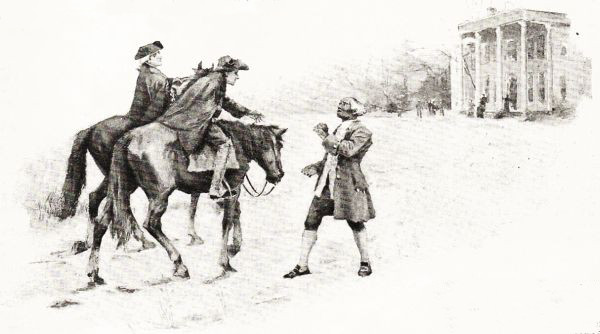
"Cato," said Mr. Hewes, "what's the matter?"
"Wy, it's Mas'r George, ob course; dis ol' nigger's goin' plumb crazy." Cato laughed.
Still something had happened to dampen the old colored man's effusion, and he grasped the hand extended to him with an assumption of being too much overcome for words.
As William slid from the saddle his dizziness had increased. He had had nothing to eat all that day, and the fall had been heavier than he had at first supposed. The sight of his little sister Grace, grown to this tall beautiful young creature, unnerved him, and when she turned her face up to his and put her arms around his neck, tears came into his eyes and he sobbed weakly.
"Poor boy!" said Aunt Clarissa, coming up, as he rested his head on Grace's shoulder and walked towards the door. "He has suffered much. Oh, those prisons! The stories I have heard. Dear George, forgive me. I have been both hard and wrong."
It was evident that Aunt Clarissa had suffered also, and her face had softened in a wonderful degree. William was almost tempted to make a clean breast of everything there and then, when the horror of his real position struck him forcibly. Words would not come; he felt a strange sinking at his heart; he stumbled, and would have fallen but for Mr. Hewes's extended arm. For the first time in his life he fainted.
He awoke, he knew not how long afterwards, feeling warm and comfortable, in a great high bed in what had been his uncle Nathan's room. A candle was burning dimly at his side, and faithful Aunt Polly was sitting fast asleep in a great rocking-chair. Well he knew how soundly Aunt Polly slept. Again he almost sickened at his false position. He could not stand it. What meant Aunt Clarissa's welcome? And how things had changed! One thing was left to him, and but one—flight. Anything rather than to sail under wrong colors and to deceive those who loved and trusted him.
He arose, and taking his clothes from the chair, stepped softly into the hallway and dressed quickly. Then he stole down stairs. The moonlight from the outside flooded the great hall. With a frightening start he saw hanging over the back of a great chair a pair of heavy saddle-bags. They belonged to the transient guest—the young American officer, most probably. He lifted the flap. Heavy papers tied and sealed with great blotches of red wax were there.
Was it dishonest? His hands fairly trembled. "'Tis for the King," he said, beneath his breath; but he stopped suddenly and slipped the papers back into the pouch. "I could not touch them if they contained secrets worth all kingdoms," he said. "I will go back empty-handed. I had rather fail."
There was a stir over in the direction of the fireplace, and to his surprise he saw old Cato shuffling noiselessly toward him. The old man picked up the saddle-bags without a word.
"Where are you going with that, Cato?" said William, astonished that the latter had not spoken.
"Jes goin' to take care ob dem, sah," was the reply.
"Leave them here. They are safe enough," said William, feeling half ashamed of himself, as he spoke the words.
"No, sah; scuse me," was the old man's reply. "If Mas'r William Frothingham asks dis ol' nigger fur his head he ken have it, but old Cato ain't goin' to give dese 'spatches to no British officer."
William leaned back against the mantel-piece. Had the others found out also?