IF WE COULD MOVE TO MARS.
Reading edition
BY GARRETT P. SERVISS.
THE FIRST ELECTRIC LINER SENT OUT BY THE U. C. T. AND S. D. CO., MARS DIVISION.
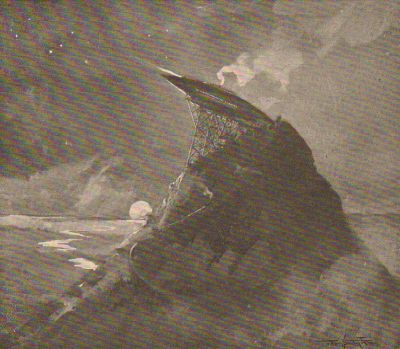
It is not necessary to consider the various reasons that would impel many inhabitants of the earth to go to Mars if they had the opportunity. But no one can doubt that the first train for Mars, or the first balloon, or the first electric liner sent out by the Universal Celestial Transportation and Safe-Delivery Company, Mars Division, would be booked to its utmost capacity. Curiosity alone would suffice to crowd it, and it is certain that the Anglo-Saxon race, which has furnished most of the great travellers, would be fully represented in the throng of adventurers bound for another world.
When Mars is nearest to the earth its distance is no less than 36,000,000 miles. But if we set our speed to match that of an electric impulse flying through the Atlantic cable—say 15,000 miles per second—we should be there in just forty minutes. Good enough for time, but how about guide-books?
Well, as to that, explorers must expect to find their own way about. Marco Polo had no Baedeker. And, besides, we are not altogether left without guidance, such as it is. We have to thank Signor Schiaparelli for some very beautiful charts of Mars, which he has made with the aid of his telescope at Milan; and other astronomers have drawn charts of Mars also. It is true that all these are filled with glittering generalities, and in some respects are contradictory; yet upon the whole they really form a more complete map of the entire surface of Mars than anybody had of the earth in the time of Columbus.
MARS AS YOU APPROACH IT, SHOWING THE CANALS.
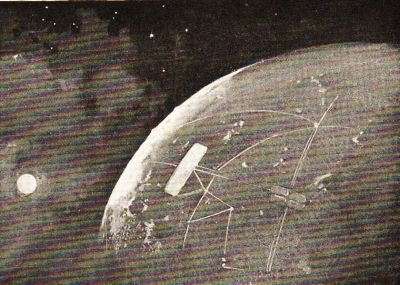
On approaching Mars we should behold a world looking in some respects remarkably like the earth, having seasons resembling ours, with torrid, temperate, and frigid zones; turning on its axis like our globe, and in nearly the same time; showing in winter broad white caps, as of snow, covering its polar regions, and presenting many appearances suggestive of continents, oceans, islands, and peninsulas. As we watched it slowly turning under our eyes, we should see on one side, south of its equator, a huge, staring eyelike-spot, which Schiaparelli has named the "Lake of the Sun," and on the opposite side, reaching from the southern hemisphere into the northern, a great, dark, crooked area, somewhat resembling North America in shape, and known to astronomers as the "Hour-glass Sea." And then all the globe beneath us would appear to be mapped with delicate reds and yellows and grays and blues; long waving curves and sharper indentations would make their appearance in what look like coast-lines; and presently, running east and west and south and north, and passing "beyond the horizon's utmost rim," a network of dark-colored lines, like a vast web covering the planet, would be seen. These are the famous "canals."
But while we were wondering what this could mean, we should be struck by another unearthlike thing. Being accustomed to dwell on a globe three-fourths of whose surface is covered with water, it could not escape our notice that the world we were approaching had far more land than water. Indeed, it is likely that we should find that the "Hour-glass Sea," and many of the other so-called seas of Mars, are only part of the time filled with water, and that even then they are not like terrestrial oceans, but rather vast swamps, choked with rank vegetation suddenly awakened to life by periodical inundations supplying moisture to their roots. Visiting them at another time, we should find only deserts with cracked soil baking in the sun. At any rate, some of the discoveries made with great telescopes in 1894 suggest these things.
In the equatorial regions, where the earth is richest in all forms of life, it is not improbable that we should find Mars covered with one vast Sahara. We should have to go to the poles to discover anything like seas. When the snow-fields around the south pole began to melt away with the on-coming of summer, an opportunity would be given us to behold a spectacle that the earth cannot match. As the snow melted, the water thus formed would collect into a shallow sea, which would constantly tend to empty itself by flowing off toward the equator. Very likely Mars is a remarkably flat world, and the water from the pole would encounter little opposition to its movement.
Then would come a sight that would open our eyes with amazement. Looking toward the equator, we should see only barren red lands and the dry and dusty basins of ancient seas; but the wave of snow-water from the antarctic circle, running through ready channels and percolating the thirsty soil, would be like the spirit of life moving upon the face of a dying world. At its touch vegetation would sprout and spring and wax great, with the magic rapidity that we sometimes see exhibited on the earth; the hard soil at its roots would fall apart and dissolve with moisture, and in a few weeks, where only the naked bones of the planet had been visible before, we should be able to wade neck-deep in seas of verdure, with long grasses waving softly in the vernal wind, and sweet flowers stroking our faces.
The observations made by Mr. Percival Lowell and Professor W. H. Pickering during the last opposition of Mars seem to lend probability not only to such conjectures, but to others which are now to follow.
We have imagined ourselves watching on Mars the progress of the life-giving water spreading from the south pole during the spring and early summer of that hemisphere of the planet. But we have noticed its effects only in the great depressed regions that may once have been actual seas. How about the still greater regions which nobody has ever supposed to be seas, and which appear on the charts of Schiaparelli and others under the name of continents? If Mars has not water enough to keep its sea-beds permanently covered, its dry lands must thirst indeed! Let us go, then, to that strange region where lies the so-called "Lake of the Sun."
As we cross the red continents, hot and blazing in the merciless sunshine, we begin to meet the "canals," but, behold! they are not canals! They are broad streaks or belts of vegetation, intersected with numerous tiny water-channels, like the valley of the river Po or the flat meadows of Holland, and the water comes from the vast swamps formed, as we saw, by the polar inundation.
Now our interest rises to the dramatic pitch, for here is the work of hands, here are evidences of intelligent design, and here, if anywhere on this distant world, we must expect to meet its inhabitants. I shall not undertake at this point to describe the appearance that those inhabitants might present. But let us imagine that we put ourselves under their guidance.
It is probable, for a reason which I shall mention presently, that our Martian friends would turn out to be exceptionally intelligent. They might guess, then, that we would have a rather poor opinion of their world of floods and deserts, and for that reason they would lead us at once to its finest scenes. Through the corn-land and the vine-land of their irrigated belts, traversing the sandy wastes with strips of green, they would doubtless conduct us along magnificent shady roads to one of the numerous crossing-places where two or more of the fertile bands meet, and where our astronomers on the earth have noticed that there is always an oval dark spot, which some of them have thought must mark the site of a lake.
But as we approach one of these spots the spires and roofs (or what answer on Mars for spires and roofs) of a town make their appearance. And quickly we find ourselves in strange streets and avenues, surrounded by throngs of such people as the wildest traveller's tale has never pictured on the earth. We are led to a lofty outlook, from which we can see far across the level country, and behold the radiating belts, along which alone the land is fruitful, stretching away in every direction, and at each crossing-place widening into an island of green dotted with the dwellings of a town or city. The red glare of the leafless and waterless wilderness, contrasting with the emerald lines that intersect it, makes a scene of overwhelming strangeness. In the remote distance our guides point out to us the metropolis of this part of Mars, placed in the broadest of the verdant spots, where our charts show the "Lake of the Sun," and surrounded by an immense system of irrigated belts, running out across the desert to the distant sea-swamps on all sides like the spokes of an enormous wheel, and so conspicuous that the Lick telescope and other telescopes have shown them from the earth. Every one of those lines is sucking moisture from the polar overflow, and storing up subsistence for the great city and all the inhabitants of the land.
For this is not merely the harvest season on Mars; it is the time when every thought is on the future, and every energy is bent to the preservation of life upon the planet. Did we think that we had learned how to make the earth yield to us the full measure of its fertility? Bah! We had to come to Mars to find out that science. If we should return to this scene in a few months the story would be plain. Then the desert would have resumed its sway uninterrupted; the swamp oceans, half water and half leaves, would have returned to dust; the irrigating ditches would have dried up, and the productive belts would be like so many narrow bands of prairie that had been swept with fire. At such a time the "canals" of the planet Mars disappear from the sight of terrestrial astronomers, and the so-called "oceans" turn pale.
Then we may imagine the inhabitants of that most singular planet reaping the fruit of their foresight and industry; then is the season of social joys in the Martian metropolis on the site of the "Lake of the Sun"; then men go no longer forth to the fields to toil for the future, because that future for which they worked has come, and there is to be no more toil, until once again, with the slow swing of the seasons, the southern pole, burdened under its accumulated winter snows, beholds the sun, and at its touch dissolves into life-giving water.
So much for some of the broad features of life on Mars as recent discoveries permit us to picture them, although it should be borne in mind that astronomy, as a science, does not assert—though it does not deny—that there is life at all on Mars. It allows us to draw our own conclusions. Now, then, continuing the supposition that there may be inhabitants on Mars, let us consider some other queer things that we should probably behold and experience on paying them a visit.
Mars is small compared with our world, its diameter being only about 4200 miles, and its surface between one-third and one-fourth as extensive as the earth's. Knowing its size and density, we can calculate how great its gravitation is—in other words, how much bodies weigh on its surface. If we tip the scales at 150 pounds on the earth, we should find that our weight had been reduced, in going to Mars, to about 67 pounds. It is hardly possible to tell exactly how we should behave in such circumstances. Doubtless we should feel as if we were walking on air, or as if we could jump over a house, for our muscular strength would remain the same. Imagine the feelings of an elephant suddenly removed to Mars!
But the most singular effect that we should behold of this comparative lack of weight on Mars might be upon its own inhabitants. The chances are not small that we should find ourselves amid a lot of giants there, averaging about fifteen feet tall. It is easy to prove that on Mars a man of that height would, in proportion to his muscular strength, be no heavier or clumsier than our average descendant of Adam is. Yet he would be absolutely stronger and able to perform harder work. Then, too, the things he had to lift would be far lighter, bulk for bulk, than similar things on the earth. Accordingly, during our visit to one of those "irrigation belts" that Mr. Lowell has imagined, we might behold feats of strength in the digging of ditches and the garnering of the fruits of the soil that would fill us with astonishment.
And that leads us to something else rather queer. There are reasons for thinking that a small globe like Mars might, because it would cool faster, get into a habitable condition sooner than the earth. If so, the people of Mars may have family trees that would put our longest genealogies completely into the shade, and their history as a race may exceed ours by an enormous length of time.