HOW MAGIC IS MADE.
Reading edition
BY HENRY HATTON.
II.
Another trick with handkerchiefs is that known as "Easily seen Through," from the transparent box which plays an important part in it.
As this box is of glass, top, bottom, and sides, it hardly seems possible that anything could be concealed in it, and yet— But let me describe the trick in full.
The box, which is about four inches square, is held up so that it may be seen, and is then placed on a table and covered with a large handkerchief. Taking a piece of newspaper of the size of a sheet of foolscap, the performer twists it into a cornucopia, or paper cone, such as the grocer wraps sugar in for his customers, and gives it to one of the audience, who has volunteered to assist on the stage, to hold. Seated on a chair, the assistant holds the cornucopia at arm's length. The performer drops into its open mouth three small squares of silk—red, white, and blue, respectively—and with a borrowed cane or umbrella pushes them well down; he then closes the paper horn by folding over the mouth. To do this necessitates taking it from the assistant for an instant, and when it is returned, the larger end is given to him. With the injunction to keep it well away from his body lest he be suspected of collusion, the performer announces: "I shall now pass the handkerchiefs invisibly from the paper horn, which the gentleman holds, to the little glass box." Here he stops abruptly, and pretending to have heard a remark from the audience, continues, "Oh no, they are not there yet," and removes the handkerchiefs from the box to show it is still empty, and almost immediately covers it again. A moment later, however, when he whisks off the handkerchief, the three squares of colored silk are seen in the box, while the cornucopia, on being opened, is found to be empty.
Although some address on the part of the performer is necessary in order to give brilliancy to the trick, the secret lies in the box and the cornucopia.
"EASILY SEEN THROUGH."
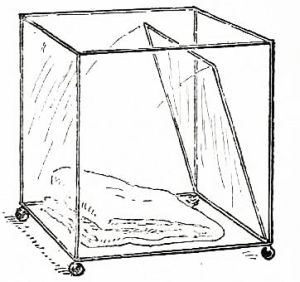
The box is made with a double bottom of glass, and between this and the real bottom are duplicate squares of silk. This silk—and this remark applies to most of the "handkerchiefs" used in conjuring—is of a very light, flimsy character, either marcelline or a thin quality of Japanese, and takes up but little room. A catch at the back of the box, worked from the outside, which the performer touches when covering the box, releases the false bottom, and this, impelled by a spiral spring attached to the hinge, instantly flies up, and lies flat against one side, while the elasticity of the silk squares causes them to fly up and partly fill the box.
The cornucopia is made of two sheets folded in the centre, as shown by the dotted lines in the diagram, and glued together at three sides, A, B, and C. Picking up the paper with his left hand, so that the bottom part B comes between the thumb and fingers, the performer catches the corner F with his right hand, and brings it over to the point D. Then the half, E, A, F, is drawn over till the corner E touches G, as in Fig. 2, and finally the corner H is thrown round the other parts; the point is given a twist, and the cornucopia is complete, as in Fig. 3.
fig. 1.
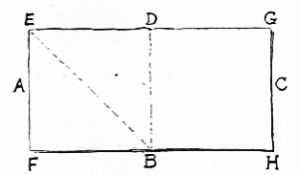
fig. 2.
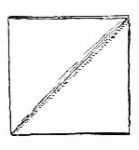
fig. 3.
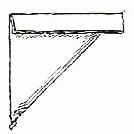
Placing his hand inside, the performer opens the space between the inner and the outer paper, smoothing it down so as to appear like the proper opening. It is in this opening (between the papers) the silk squares are placed and pushed down. The performer folds the top once over, and gives it to the assistant to hold, with his fingers over the fold. When the time arrives, the performer unrolls the cornucopia from the bottom point, and spreading out the paper, it appears to be empty, the thin texture of the silks concealed between the paper making them inconspicuous.
There are two pretty variations of this trick. In one, the last handkerchief of the three is passed from the hands to the box; in the second, two cornucopias are used, dispensing with the box.
As in the first there is no resort either to the short cord used in the "Evanescent Handkerchief," or the hand-bag of the "Mission of a Plate," it may prove of interest to the amateur.
The handkerchief—preferably the red one—is first gathered into both hands, and then, to allow of the performer turning up his sleeves, is transferred to the left hand. All this time an end is seen protruding, yet when the hand is opened it is empty, and the handkerchief has vanished.
The solution is simple: a small loose piece of silk about two inches square is picked up with the handkerchief; the latter is carried off with the right hand in the act of apparently transferring it to the left, into which only the little piece is put. In turning up the left sleeve the handkerchief is wrapped in the fold, and finally the piece of silk is rolled into a tiny ball and concealed between the fingers, and dropped on the table at the first opportunity. The trick is not generally known, and is useful as a change from older methods.
In the second variation the cornucopia into which the handkerchiefs are passed is made by pasting together two sheets of paper at all four sides. Between these papers are hidden the duplicate handkerchiefs. Instead of opening this cornucopia at the conclusion of the trick, the performer merely tears it in two and pulls out the handkerchiefs. As I have known a performer of long experience to be puzzled by this trick, I can conscientiously recommend it. It has the advantage, too, of doing away with the glass box, which, when properly made, costs four or five dollars.
Guibal generally follows the trick just described with "The Transit of the Cards." In this he is assisted by two of the audience, one of whom he dubs "the glass box," and the other "the paper horn," claiming that the trick, though done with cards instead of handkerchiefs, is virtually the same as the preceding one.
To one of these assistants, who must not be confounded with confederates, he hands a pack of cards to be counted aloud. This operation concluded, he asks: "How many cards did you say there are—thirty-two? I knew it, but I want my audience to know it too."
He gathers up the cards, and as he takes them in his hands he passes the little finger of his left hand between the five top ones and the rest of the pack.
"Now, sir," addressing the glass box, that is the assistant on his right, "be good enough to empty the outer breast pocket of your coat. Good. Cut this pack."
As he says this he palms the five top cards, and lays the rest of the pack on the table, which is between him and the audience.
When the pack is cut, the performer requests the assistant to put the cut in his breast pocket, to cover the pocket with his hand, and on no account to remove it.
Pointing to the remainder of the pack lying on the table, he requests the paper horn, the assistant on his left, to count it. Let us suppose there proves to be nineteen cards. "Good," he exclaims. "You, sir, will please put these in your pocket." At these words he bunches the cards together with the right hand, adding the five palmed ones.
When the paper horn has emptied his pocket, and placed the cards therein, the performer continues: "You, the paper horn, have nineteen cards, and you, the glass box, necessarily have thirteen, since the sum of nineteen and thirteen equals thirty-two. Now, gentlemen, keep your hands on your pockets, and see that not a card enters or leaves without your knowing it."
"Will you, madam," addressing a lady, "select one of the three mystic numbers, 4, 5, or 6?"
Should 5 be the number chosen, the trick is done, for the performer has only to command five cards to pass from the pocket of the glass box to that of the paper horn.
But if 4 or 6 is selected a little subterfuge is necessary. Let us suppose 4 is chosen.
Turning to the lady, the performer says: "You take number 4? You are sure you would not prefer 5 or 6? No? Be it so. See what I shall do. I shall cause four of the cards which are in the pocket of the glass box to pass invisibly into the pocket of the paper horn. To do this, however, I must ask this gentleman on my left to give me one card from his pocket that the others may learn the road they are to follow."
Taking this card, he gives it to the assistant on his right to put into his pocket. "Now," he proceeds, "one, two, three, four, pass! Count your cards, sir"—to the paper horn—"and see if you have not twenty-three, as you certainly ought to have, since nineteen which you had and the four which have passed make exactly that number."
Of course this proves to be right. Then the glass box is asked to count his cards, and he is found to have nine, since, as the performer explains, four of his original thirteen have left his pocket and gone over to the majority.
Had number 6 been chosen instead of 4, one card would have been taken from the glass box and given to the paper horn "to show the others the way."
Here is a clever little trick which will pass very well for "Thought-Reading" and is quite puzzling. I believe it has also the advantage of never having been explained in print.
Before beginning, the performer gives three sealed envelopes to one of the audience to hold. He then borrows a watch, a ring, and a knife. Three of the audience are asked to act as a committee, and to them are given the borrowed articles, with a request that they leave the room, when each is to select one of the articles and hide it in his pocket. Before they go, however, the performer takes a number of cards from a pack, gives one card to one of the committee, two to a second, and none to the third. These they are to put in their pockets, each remembering how many cards have been handed to him.
When they return to the room, the performer, without asking a question, collects the sealed envelopes, and hands one to each of the committee. On opening them, each finds inside his envelope a card bearing the name of the article he has selected.
With careful attention and a fair memory any one can do this trick—provided he knows how.
In the first place, he must be able to distinguish in which of the envelopes is each of the three cards; this may be done by pricking with a pin one corner of one envelope for the watch, two corners of a second for the ring, and leaving the third envelope intact. The advantage of this system is that the marks are not noticeable, and may be recognized by the touch.
In taking the cards from the pack, the performer, although apparently choosing at haphazard, is really careful to take exactly twelve. These are placed on top of the pack before beginning the trick, and the thirteenth card has a tiny corner clipped off, so that there may be no mistake about the number, as the success of the trick depends upon having it exact. The committee-men are numbered, mentally, 1, 2, and 3 by the performer, who must remember their respective numbers.
To No. 1 he gives one card, to No. 2, two cards, and to No. 3, none. Over the remaining nine cards he slips a rubber band, so that they may not get mixed with the others, and hands them to No. 1 to keep.
When the committee-men have retired and selected the articles, the performer calls to them: "From the cards secured by the elastic let him who has the watch take as many as I gave him originally; let the one who has selected the ring take twice as many as I gave him, but the one who has the knife is to take none."
When the committee returns the performer collects the cards bound together by the elastic, and sees at a glance just how many are left.
Then he refers—mentally again—to the following, which, though it means nothing, in this case means much.
123567
AnteDiemDeaIstaEstinArmis
1 23 22 13 12 31 3
The upper row of numbers refer to the cards left in the elastic; the lower row shows the borrowed articles according to their value, that is, 1=watch, 2=ring, 3=knife. The words show the numerical value of the vowels, a, e, i.
If one card is left, the performer knows that the watch has been chosen by committee-man 1, the ring by No. 2, and the knife, consequently, by No. 3. Should there be five cards left, the knife has gone to No. 1, the watch to No. 2, the ring to No. 3.
Having found out just how the articles are distributed, the performer gives out the sealed envelopes, makes his bow, and gracefully retires.
BY GASTON V. DRAKE.
IV.—FROM BOB TO JACK.
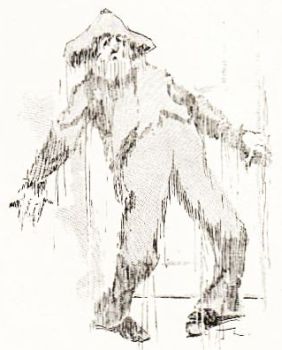
DEAR JACK,—I guess this letter will reach you about the same time as the other. We did pass the Paris but it was after dark and I couldn't catch the Captain's eye, so the other letter won't be mailed to you a bit earlier. This will be just a P.S. to that. I've had a fearfully exciting time since I wrote to you last. I didn't see Chesterfield for two whole days after that morning and I began to get kind of worried about him, but this morning, which is very rough he turned up again dripping wet. I thought it was one of the waves that have been breaking over us all the time that had wet him, but he said no, it was falling overboard. He was fixing one of the ropes down by the stern yesterday morning when the ship gave a fearful lurch and sent him flying head over heels into the ocean, but he fortunately had enough presence of mind to grab hold of the lead line that runs astern in connection with a little dial to show how many knots an hour the boat goes. It's a funny sort of machine. It's so fixed that being pulled through the water makes the rope revolve, and the faster the boat goes the faster the rope goes around, and every time it goes around it registers a point on the dial on the stern-rail. It was this bit of rope that Chesterfield caught when he fell, but it was an awful prediggerment for him to be placed in because he had to revolve with it, and he got so dizzy that he nearly had to let go, but when he realized that if he let go he'd be drowned he held on and gradually hauled himself up the rope until he got himself aboard again. Of course when he got on board again he'd been whizzed about so much that he couldn't stand up or walk straight, and when the Captain saw him staggering up the deck he falsely accused him of having had too much brandy in his mince pie and ordered him below for twenty-four hours in irons, which is an awful disgrace, and Chesterfield is too much of a gentleman to stand unjust disgrace, so this morning when he was allowed to go free again he felt so badly that he went up into the bow and jumped overboard, preferring to die. But just as he jumped another big wave came along and washed him back on board again, and he has decided to live, which I am glad of because he is a very fine fellow.
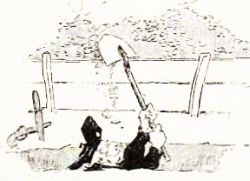
He says this is his last trip on this boat. As soon as we land he's going down to Venezuela where he has ten millions of hoarded treasure buried in a swamp. He's going to dig it up and buy the whole of some Island out in the Pacific Ocean and settle down as a King and he's promised if I ever visit him to give me a reception worthy of an Emperor. There is only one trouble, he says, about it all. With all his millions buried in Venezuela he hasn't got enough money with him to pay his fare, but I fixed that. I've lent him the two gold pounds papa gave me, which he says, will help him out with what he hopes to get for looking after the chairs—most people give him fifty dollars, he says, for doing that, and there are six hundred passengers on board, which makes $30,000. I think that's a good deal of money, but he says it's only a bagatelle for a man who wants to go to Venezuela. He's going to pay me back my two pounds after he's dug up his money in Venezuela, and he told me not to say anything to dad about it but surprise him next winter when I get the money back with a thousand pounds interest besides.
There's one nice thing about travelling at sea. Coming this way we gain a half an hour everyday. That is, at this time to-morrow morning it will be half an hour later and that's first rate when you wake up on a rough morning at eight o'clock and find out that it isn't eight o'clock at all, but half past, and you can get your breakfast right away. The idea of it is that travelling East the sun goes down earlier every night and of course it always sets on time wherever you are and you've got to fix your watch according to it. Chesterfield knows a man who kept on going around and around the world until he'd shoved Christmas forward six months, and didn't realize what had happened until he was wakened up by the boys celebrating the Fourth of July. It sounds like a queer story, but Chesterfield says it's true, and the way ships' time is arranged it seems to prove it. It takes a trip all the way round the world to knock off a day though, so it's not as easy a thing to upset the calendar as you'd think. Chesterfield says that if a man could live long enough to go around the world three thousand six hundred and fifty times going west he'd be ten years younger than his own twin brother at the end of that time. I asked dad if that was so and he said he guessed it was, but he really didn't know and to find out he put the question to a very extinguished editor of a Brooklyn paper who is on board and he said of course it was, that he knew a man who had done it. He said that the man was an editor of a Philadelphia paper and that that was why that particular paper was ten years behind the times. Dad laughed at this, and so did I, though I don't know why. Maybe it was a joke—though the extinguished Brooklyn editor said it very solemnly.
We expect to come in sight of land to-morrow and I must say I'm glad of it. The sea is all very fine, but the rough weather you're apt to get makes what you eat disagree with you and I want to get some place where you can eat a dinner and enjoy thinking about it afterwards.
As soon as we get to London I'll write again and tell you all about everything.
Yours ever, Bob.
P.S. Chesterfield says he thinks Sandboys would make a good Prime Minister for his new Kingdom in the Pacific. He says he'll give him ten dollars a week and Saturdays off if he'll do his Prime Ministering for him. You might speak to Sandboys about it.