ANOTHER PRIZE MUSIC COMPOSITION.
Reading edition
We have already announced the prizes for the best song settings to Mrs. Sangster's charming verses, "Our Little Echo." Here are awards for the Hymn Competition, "For Sowing and Reaping." We give the first-prize composition and the additional verses. The winner of the first prize of $5 is Mr. E. S. Hosmer, of Bristol, Conn., and of the second, Mr. W. H. Squires, of Philadelphia, both Round Table Patrons. Those whose compositions deserve special praise are: Christine R. Benedict, Harvey Reese, Blanche Elizabeth Wade, H. Hamilton Craig, Thacher H. Guild, Alice C. Banning, Helen H. Sohst, Harry R. Patty. Additional verses of "A Thanksgiving Song."
Music for A Thanksgiving Song.
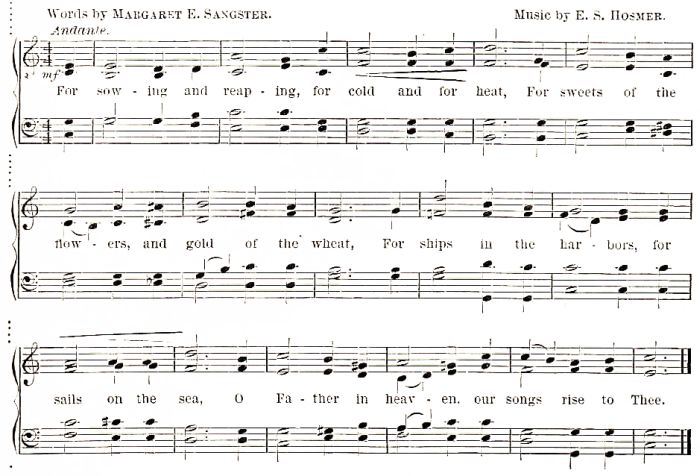
For parents who care for us day after day, For sisters and brothers, for work and for play, For dear little babies so helpless and fair, O Father, we send Thee our praise and our prayer. For teachers who guide us so patiently on, For frolics with mates when our lessons are done, For shelter and clothing, for every day's food, We bless Thee, our Father, the giver of good. For peace and for plenty, for freedom, for rest, For joy in the land from the east to the west, For the dear starry flag, with its red, white, and blue, We thank Thee from hearts that are honest and true. For waking and sleeping, for blessings to be, We children would offer our praises to Thee; For God is our Father, and bends from above To keep the round world in the smile of His love.
Awards for Best Stories.
The most successful story contest the Table has ever had closed some weeks ago. Competition was restricted to those who had not passed their eighteenth birthday, and the limit of length, first announced at 1500 words, was raised to 2500. The prizes, three of $25 each, were increased by the addition of five $5 prizes. The success of the contest lies in the fact that the stories received were a great deal better than we ever received before, while the slightly changed conditions, without working injustice to any one, made the competition both easier and more liberal.
Conscientious judges read every word of every story submitted. Some stories of unusual merit were read half a dozen times. The number of well-written, probable, and interesting stories was most creditably large, and the making of awards correspondingly difficult. The three highest prizes are equal in value, but we place at the top, in point of excellence, "A Story of Strife," by Sir Knight F. M. McNaughton, aged sixteen, who lives in Quebec, Canada. Next, in rank we put "How Hector Saved the Train," by Sir Knight S. O. Rittenhouse, aged sixteen, of Lynn, Mass., and the third to "The Duke of Alva's Humiliation," by Sir Knight George C. Hirst, aged seventeen, of Philadelphia. Each is sent $25 in money.
Proofs of these stories have just been mailed to nearly three hundred persons, all under eighteen, who are to try to illustrate them. We want one illustration, and offer $10 for the best. Artists select their own subject after reading the stories. We allow them three stories in order to give them the best possible chance. We shall print the prize story that we happen to receive the best illustration for, and perhaps the other two. This Illustration Contest ends March 21th, but entries for it have now closed.
The five $5 prizes we award to the following, their excellence in the opinion of the judges standing in the order named—the best first, etc.:
"Quailin," by Lady Olive Arnold Dame, aged thirteen, of Medford, Mass.; "A Tale of the Football Field," by Sir Knight Lucien Memminger, aged sixteen, of Charleston, S. C.; "Putnam's Wolf," by Sir Knight Charles Frederick Hoffman, aged fifteen, of New York City; "A Wild-Goose Chase," by Sir Knight Harry T. Trowber, aged sixteen, of South Haven, Mich.; and "A Profitable Adventure," by Sir Knight Marion R. Gilbert, of Harrisburg, Pa.
Stories deserving, in our opinion, special commendation are: "A Last Chance," by Lady Frances S. C. James, of Mich.; "The Old Water-mill," by Lady Dell Whitney, of Wisconsin; "Three Chums and a Buffalo," by Sir Knight Egbert B. Heyser, of Missouri; "A Day's Fishing," by Sir Knight Preston K. Smalley, of Michigan; "Saving the Papers," by Sir Knight Rupert S. Holland, of Pennsylvania; "Balloon Voyage Round the World," by Sir Knight William Swanson, of Canada; and "The Little Cripple," by Sir Knight Edwin H. Andrews, of California.
The prizes, with our congratulations, have been forwarded, and the manuscripts of all stories returned to writers.
Answers to the Prize Puzzle.
Here are answers to Sir John R. Moreland's new-ideas puzzle. They are in two parts, 1, the numbers, and 2, the arithmetic:
1. A. D. 1572. 2, Raphael. 3, A. D. 70. 4, A. D. 1156. 5, Toucan (2). 6, Lincoln and Garfield. 7, A. D. 1015. 8, A. D. 1670. 9, Spina, a monk of Pisa. 10, Paulding, Van Wart, Williams. 11, "Jesus wept," "Rejoice evermore." 12, Drebel, a Dutchman. 13, King of Bourges. 14, 146. 15, 56. 16, "Citizen King." 17, John Hancock. 18, Francis Marion. 19, Stubb. 20, Deborah Simpson. 21, Paul Blouet. 22, Devil River. 23, Hamlet, Prince of Denmark. 24, B. C. 31. 25, "Sailor King."
1572x7=11,004+70=11,074-1156=9918x2=19,836÷2=9918-1015=8903+1670=10,573+5=10,578÷3=3526+4=3530+6= 3536-13=3523-146=3377+56=8433-11=3422+11=3433-13=3420÷5=684-14=670+10=680-5=675-21=654-31=623-10= 613—that is, 6.13=the sixth day of the week (Friday), and the 13th of the month—the proverbial unlucky figure.
Questions and Answers.
Henry W. Ticknor, R. T. K., Clanton, Ala., makes the following kind offer: "As I live 'way down South in the land of cotton,' I will send to any one who sends me five cents to pay postage some cotton seeds and instructions how to plant and tend them. Should any members respond who live outside the United States and Canada, they should send at least fifteen cents for postage."
Several members who have recently asked to have their names published as wanting correspondents are reminded that we cannot print such requests, since unscrupulous persons not infrequently use such addresses. We would be glad to grant you the favor were it possible to do so, and avoid this annoying consequence. Reader: The Table rarely prints poems on this page, and prefers not to criticise young "poets" publicly. Jos. L. Dwyer, 103 Porter Street, Detroit, Mich., wants to receive sample copies of amateur papers.
Who?—When?—Where?—What?—Why?
I wonder if you would like to try the game of "The Five W's, or Biographical Jumbles?" Provide each player with a pencil and a slip of paper (a half sheet of commercial note is a good size), then request each one to write at the top of the paper the first W, the name of some well-known historical character; fold the paper over to conceal the name, and pass it to his right-hand neighbor. Then each player writes on the folded sheet the second W, when did he live, and folding it again, passes it on as before. The third W, written in the same way, tells where he lived and died; the fourth, what he did; the fifth, why he did it; and the sixth and last folding gives the results or consequences of his life.
The paper must be folded at each writing, and no player must know what the others have written till the results are given, when each player in turn unfolds his paper and reads it aloud. Of course there are all sorts of incongruities and lots of fun over them, besides a grand chance to furbish up forgotten history, in straightening out the tangles, and setting matters right. Should the sheet of paper at first supplied prove insufficient, another may be easily attached with a convenient pin without unfolding. Of course, the more items of interest brought in the better. A prize may be given to the one who corrects the most mistakes, a tally being kept for the purpose.
A game of Geographical Jumbles may be played in the same way, by making an arrangement like this:
1. What—Name of country, city, river, mountain, etc.
2. Who—Inhabitants, celebrated people, etc.
3. Where—Situation.
4. When—Founded, antiquity, etc.
5. Why—Importance, productions, climate, historical associations
Try these games and you will like them.
H. E. Banning. Newport, R. I.
This Department is conducted in the interest of stamp and coin collectors, and the Editor will be pleased to answer any question on these subjects so far as possible. Correspondents should address Editor Stamp Department.
The number of intelligent inquiries I receive each week is so large that all of them cannot be answered in the narrow limits of this column. Inquirers sending a stamped and addressed envelope will be answered direct. Inquiries without prepaid and addressed envelopes will have to wait their turn.
The upper left-hand pane of 100-stamp sheet No. 170 contains both varieties of triangles (II. and III.). The first discovery was made in San Francisco, and dealers have been buying these sheets all over the country at $3 each. Several collectors managed to find a number of sheets in New York city, which they bought at face, and sold at fifty per cent. profit.
D. H. S.—I would advise you to ask your postmaster.
Mrs. Maud G. F.—The red stamps are the common 1851 issue. Millions were used every day for over five years. The blue ones are 1869 issue worth 25c. each. The Brattleboro, Vt., has the name of the town and initials of the postmaster. It is printed on buff paper in black ink.
Mrs. E. V. B.—The $1 Colombian can be purchased for $8.
P. F. Lisk.—I do not purchase stamps.
Robert Peltier, Lycee Janson de Sailly, Paris, France, wants to exchange French stamps for U.S. stamps and others.
W. T. Helm.—The "Postal Service" envelopes are not stamps; they are franks. The one described is worth 20c.
Elias Alter, New York City (gives no street address), and Burette Snyder, Cape Girardeau, Mo.—Wish to exchange stamps.
R. C. Megrue.—All the proof specimens of U. S. stamps are more or less valuable. The "Department" proofs are worth more than the proofs of the regular issues.
G. G. Stone.—The 1c. Columbians can still be bought at many post-offices, hence there is no premium. Treasury Department used set is worth about $8.
E. L. Davis.—There is no way to restore the color of a stamp except where the color has oxydized. In that case a chemical which can be bought of stamp-dealers for 25c. per bottle, will restore the original color. Put your stamps on hinges, and you can change easily as often as you want. Hinges cost 10 to 15 cents per 1000.
G. R. Moffitt.—Your stamp is from Montenegro, which has issued sets in 1874, 1880, 1893, and 1894.
F. S. Perkins.—It is a medal or token, not a coin. No value.
S. C. R. of K. B. K.—I cannot keep on repeating values of coins given in back numbers of the present volume. See the Round Table for December 17, 1895, and January 14, 1896. The rare pink is a 3c., not a 2c. stamp.
Sergeant.—See answer to S. C. R.
L. B. Hershey.—The 3c. 1869 unused is worth 25c.; used, 2c.—that is, dealers ask those prices. They buy much cheaper.
D. Barnum.—Your list of inquiries is too long for answer in this column. You have some very nice stamps, but there are no rarities in the list.
Mrs. W. H. H.—See Round Table of December 17, 1895, and January 14, 1896, for prices asked by dealers for U. S. coins. What dealers pay I do not know.
H. Merritt.—What you describe are not postage-stamps or stamped postage-envelopes. Before postage-stamps were used almost every postmaster had a hand stamp to mark "Paid," "Paid 5 cents," or "Paid 10 cents," etc., on letters for which he received postage in advance. Where not so marked the person to whom the letter was addressed had to pay the postage. I know very few collectors of these postmarks, as they have no money value.
G. M. Ross.—The prices quoted in this column are those asked by dealers, not what they pay. That, of course, I do not know.
A. Schmengler.—The 1861 3c. U.S. comes in hundreds of shades, from a pale washed-out color to a deep scarlet. Only one of these varieties has any value; that one is the "Pink," which is a brilliant color on a bluish background. It is very scarce. I have looked over tens of thousands of this stamp, and never found a copy of the true "Pink."
Philatus.
Some persons insist on having the costliest of everything. They do not buy Ivory Soap. Those who want the best do.
The Procter & Gamble Co., Cin'ti.
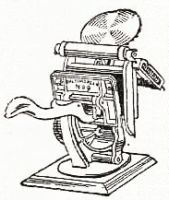
THE
BALTIMOREAN PRINTING-PRESS
has earned more money for boys than all other presses in the market. Boys, don't idle away your time when you can buy a self-inking printing-press, type, and complete outfit for $5.00. Write for particulars, there is money in it for you.