Volume 1 — SOLDIERS AND SAILORS (continued 7)
Reading edition
It is customary to credit the final success of the Pilgrims of Plymouth to the religious element that held sway over them, making them patient, persistent, uncompromising, faithful, and earnest. But the wisdom of Carver, the genius of Bradford, the fervor of Brewster, the zeal of Winslow, would have been of small avail had they not been backed by the decision, the resolution, the courage, the constancy, and the forethought of their brave captain, Miles Standish, "the John Smith of New England" as he has been called, the man of helpful measures and of iron nerves, who could "hew down forests and live on crumbs."
From first to last he was the loyal supporter and trusty defender of the Plymouth colony. No danger unnerved him, no duty staggered him. With but eight men he started out, in 1623, to overawe and subdue the Indians of Massachusetts—then an unknown and perplexing quantity; single-handed he checked the conspiracy at Weymouth and turned the tables upon the savage plotters, by himself assassinating the assassins—a deed that saved the colony from Indian massacre, but called forth the mild protest of the Pilgrim preacher at Leyden, Mr. Robinson, who wrote of it: "Concerning the killing of these poor Indians, oh! how happy a thing had it been, if you had converted some before you had killed any.... Let me be bold to exhort you seriously to consider of the disposition of your captain, whom I love. There is cause to fear that by occasion, especially of provocation, there may be wanting (in him) that tenderness of the life of man which is meet." But the Pilgrims of Plymouth seem not to have questioned the decisive measures of the man who knew when and how to act in their defence. Alone he faced the roystering Morton at Merrymount, unarming that vaporing rebel and putting his riotous colony upon its good behavior. He led out the forty men of Plymouth enlisted for the Pequot War, headed the expedition that in 1635, sailed against the encroaching French in Penobscot Bay, and, as late as 1653, when "very auncient and full of dolorous paines," expressed himself as ready to take the command intrusted to him when the colony forces were about to enter upon a struggle for the right of occupation of the Connecticut country with the Dutch colonists of Manhattan.
He never refused any burden however heavy nor shirked any duty however onerous; he cheerfully yielded obedience to the civil power, never exceeding his orders, nor rashly assuming responsibilities, nor leading his men upon unwise ventures. While always the military commander of the colony, his counsel and help were counted as equally valuable in matters of administration. He served repeatedly as one of the governor's council; he was at one time assistant-governor or deputy, and, from 1644 to 1649, was treasurer of the Plymouth colony. He went to England as the envoy of the colonists in 1625, and in the midst of plague, of evil times and of bitter jealousies, withstood the tyranny of the London traders who owned the Pilgrims' labor; and braving both heavy debt and the possibility of censure, bought out the traders' rights in the name of his associates.
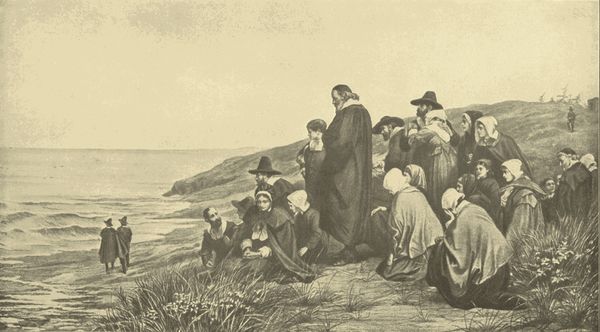
Departure of the Mayflower.
The personal descriptions of this remarkable man that have come down to us, show him as a man of small stature, quick-tempered, choleric, sturdy and bluff. "As a little chimney is soon fired," wrote the Puritan historian Hubbard, "so was the Plymouth captain, a man of very little stature, yet of a very hot and angry temper." And yet his relations with such men as the noble Bradford, the blameless Brewster, the politic Winslow, were so close and of so personal a character that one can hardly accept unquestioningly the story of his hot and unreasoning temper. He was a soldier and a fighter; but he loved peace and quiet, and his life was full of friendly offices and of kindly deeds. On Nantasket Beach he built the first "house of refuge" and life-saving station in America. He was a gentle nurse in the winter of sickness, a friend and adviser to those in trouble or distress, a loving father in the days when parents were not unfrequently tyrants, and a forgiving spirit, as the old story of his famous "courtship" (with sufficient foundation to warrant its acceptance) amply proves.
The communism of the early Pilgrim days gave place in time to personal possession and, as the colony grew, certain of those who had been leaders desired more extended holdings. Captain Standish was one of these, and despite his friend Bradford's protests, he moved across the bay and in 1632 occupied a large and fertile stretch north of Plymouth, to which, still clinging to his old claim of a stolen heritage, he gave the name of Duxbury. Here in the midst of peaceful pursuits, but ever ready to obey the colony's call for counsel or for leadership, he lived for over twenty years, dying October 3, 1656, at the age of seventy-two.
A notable figure in American history, Miles Standish is a type of that mingled spirit of adventure, liberty, and distrust that impelled emigration across the sea and, combined with the uncompromising stand for freedom of conscience, founded and up-built the Pilgrim Colony of Plymouth.
His existence among these Pilgrims is in itself an anomaly. But it is one of those strange associations and unfaltering friendships that have left their mark for good upon the world since the days when the Roman fighting-man stood stanchly by the side of the Christian proselyte even to the death.
Tradition says that Miles Standish was buried between two pointed stones in the graveyard of South Duxbury, but the question of his burial-place is still unsettled. The tall shaft, rising from the crest of Captain's Hill in Duxbury, and surmounted with a statue of the famous colonial captain, fitly commemorates a life that has won a place in the American heart that only grows stronger and more enduring as time goes on.[Back to Contents]
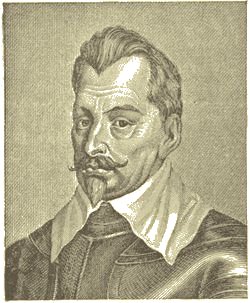
ALBRECHT VON WALLENSTEIN By Henry G. Hewlett (1583-1634)
The declaration of the great founder of Christianity that he "came not to bring peace, but a sword," receives its completest justification in the history of Europe during the sixteenth and seventeenth centuries. Ignorant of the constitution of the human mind, and blind to the absurdity of attempting to enforce opinion, the adherents of the old and of the reformed faith, during these two hundred years, scarcely sheathed their swords. The offenders, it is just to say, were generally, but by no means invariably, the Catholics; and the retaliation of the Protestants was seldom inferior in ferocity to the offence received. The "Thirty Years' War" was the bloodiest, as happily it was the last, scene in this great religious tragedy. The greatest Catholic leader of this period was Wallenstein.
After a term of peace, consequent on the Diet of Augsburg in 1555, which secured toleration to Protestantism in Germany, persecution recommenced in 1578, under the weak Emperor Rudolph II. His cousin Ferdinand, Duke of Styria, a pupil of the Jesuits, was the most deadly foe of Protestantism, which had taken deepest root in Bohemia and Transylvania. The incapacity and bigotry of the emperor at last provoked his subjects to bring about his deposition, and, in 1610, he was forced to abdicate in favor of his brother Matthias. He, though himself tolerant, unwisely committed the government to Ferdinand, whose tyranny in ordering the destruction of the Protestant churches in Bohemia, led to the expulsion of his officers and the Jesuits, in May, 1618, and the commencement of the Thirty Years' War. Matthias died in the following year, and Ferdinand was elected emperor.
In 1619 the name of Wallenstein first became prominent. Albrecht von Waldstein, as he was properly called, was the third son of a Bohemian baron, of old family, and was born in September, 1583. As a boy, he displayed signs of a singularly proud and independent temper, and foreshowed his bent by the delight which he took in the society of military men. His family was Protestant; but having lost his parents when quite young, he was educated, by the wish of his guardians, at the Jesuit college of Olmutz, and soon changed his faith. In Italy, where he next studied, he made great advances in mathematics, law, languages, and the delusive science of astrology, in which he was a firm believer ever afterward. On his return to Germany, he fought in the imperial army against the Turks, who invaded Hungary. He had considerable estates in Bohemia, which were increased by his marriage, in 1606, with a rich Moravian widow, who died in 1614, and left him her property. In the peaceful occupation of farming he spent several years, and acquired great wealth by his skill and economy. In 1617, he took part in a campaign against the republic of Venice, with which Ferdinand had quarreled, and, on the termination of the war in the same year, was ennobled as Count. The lavish generosity of Wallenstein during this war greatly endeared him to the army.
Such was his popularity that in 1619, on the Bohemian revolution breaking out, he was offered by the insurgents the command of their army, although a Catholic. But he steadily refused the offer, and warmly espoused the imperial cause, upon which the Bohemians confiscated his estates. He, however, soon retrieved his fortunes by a second rich marriage, and the favor of the emperor. The Bohemians, under their heroic leaders, the Counts von Mansfeldt and Thurn, ventured to march upon Vienna, and threaten Ferdinand in his capital; but Wallenstein, on June 10, 1619, gained a signal victory over their army, and saved his master's throne. In the following year the Bohemians and Hungarians formally renounced their allegiance; the former setting up Frederick, Elector-Count Palatine of the Rhine, as their king; and the latter, Bethlem Gabor, Prince of Transylvania. Frederick, who was the son-in-law of James I. of England, was as unfit to govern as his father-in-law, and spent his time in a frivolous parade of his rank. He obtained but a doubtful support from the Protestant princes in Germany, who were jealous of his popularity. Ferdinand, assisted by Spain and other Catholic powers, sent a large force into Bohemia, under the command of Maximilian, Duke of Bavaria, and totally routed Frederick's army at Prague,—the king fleeing to Breslau, and thence to Holland. The Palatinate was then declared forfeited to the Empire, and was devastated by the Spanish commander, Spinola. Wallenstein, during this campaign, spent his treasures in the imperial cause with the utmost readiness and liberality, and obtained as a reward the lordship of Friedland, which brought him a large revenue. To this he added by the purchase of several forfeited estates in Bohemia, and thus became possessed of immense wealth. In 1621-23 he distinguished himself by defeating Bethlem Gabor, the new King of Hungary, and forcing him to surrender his claim to the crown. For this service Wallenstein was created Duke of Friedland.
A cruel persecution of the Protestants in Bohemia and Silesia dishonored the emperor's success; and the attempt of his officers in Austria to suppress Lutheranism by force, produced a revolution in 1625. It was put down by the energy of Tilly and Pappenheim, two of the greatest generals of their day. The Count von Mansfeldt gallantly upheld the Protestant cause in Westphalia, and other parts of Germany, but was defeated by Tilly, who imposed Catholicism upon all the revolted provinces. In their despair the German Protestants applied for aid to their northern brethren. Gustavus Adolphus, the young and brave King of Sweden, an ardent champion of the Reformed faith, and Christian, King of Denmark, responded to their appeal,—the latter immediately invading the Empire. The imperial finances being considerably reduced by the war, Ferdinand was glad to avail himself of an offer made at this crisis by Wallenstein, to levy an army at his own cost. This offer was abundantly fulfilled. In a few months an army of 30,000 men was collected, as if by magic. Wallenstein was enviously suspected of being in league with the devil, but the secret of his sway was the fascination of his bold and generous nature. He maintained at once thorough toleration, and strict discipline in his ranks. These results, however, were not attained without injustice. Contributions were levied on the most fertile districts, as yet undesolated by war, to the extent, as it is said, of $60,000,000 in seven years. His popularity with the army procured him the jealousy of Tilly, who, in the campaign of 1625-26, outrivalled him, by successfully combating the invasion of Christian and his Danish forces, and driving them beyond the Elbe. Wallenstein, nevertheless, in the following campaign, won his laurels, both as a statesman and a general, by his intrigues and conquests. Displaying the greatest ardor in the cause of the Empire, he attempted to render it an absolute despotism. After routing Count Mansfeldt on the Elbe, he marched into Hungary, and defeated the united armies of the count and Bethlem Gabor. Christian of Denmark having assembled a new army in 1628, Wallenstein marched to meet it; and, by a series of brilliant successes, recaptured all the towns garrisoned by the Danes, and forced the king to sue for peace. At the Congress of Lubeck, in May, 1629, this was accorded on favorable terms to Denmark. Wallenstein during these campaigns astonished his compeers, and excited their envy, by the wondrous rapidity of his movements, and the skill with which he surmounted difficulties that seemed insuperable. He was rewarded with the duchy of Mecklenburg, which was forfeited to the Empire by the treason of its former owner.
The envious schemes of Tilly and Maximilian, Duke of Bavaria, induced Ferdinand to remove Wallenstein from his rank of commander in 1630. He had hardly withdrawn to his Bohemian estates, when Gustavus Adolphus, who had been hitherto prevented from affording active assistance to the Protestant party, landed in Pomerania with a small but highly disciplined army. This illustrious monarch, eminent for virtue and piety, no less than for political wisdom and military skill, was now the sole hope of the Reformation in Germany. The princes who professed its tenets were lukewarm and unready,—divided by jealousies among themselves, and careless of all but their own worldly interests. He, on the contrary, was devoted to the cause of his faith, and his solemn disavowal of personal ambition in undertaking its championship is stamped with sincerity.
He soon commenced a career of conquest. New Brandenburg and other districts yielded to his arms, and he formed an alliance with France, now under the sway of Cardinal Richelieu, which the emperor had vainly negotiated to prevent. The rich city of Magdeburg declared for him, and was accordingly besieged by Tilly. The selfishness of the Lutheran leaders, the Electors of Brandenburg and Saxony, in not responding to the appeal of the Protestants in the city, led to its fall in 1631, before Gustavus could reach it. The most atrocious cruelties were perpetrated by the Catholics at the sack; no consideration of age or sex availing to prevent the massacre, which lasted for two days, and extended to 30,000 of the inhabitants. This monstrous crime was severely avenged by the indignant Gustavus. He forced the Electors of Brandenburg and Saxony to render him assistance, and, with an augmented army, hesitated not to give battle to Tilly at Leipsic, and defeated him September 7, 1631. The Protestants took courage and joined Gustavus in great numbers. He continued his victorious march, defeating the enemy at Merseberg, capturing Wurzburg, then advancing on the Rhine, and reducing on the way Frankfort-on-the-Main, Mentz, Spires, Mannheim, and other cities. He next turned to Bavaria, where Tilly and Maximilian entrenched themselves at Rain-on-the-Lech. The former was killed by a cannon-ball during the siege, in 1632. Gustavus marched through Augsburg, where the citizens did him homage, and besieged Munich, which speedily surrendered. He now threatened to subdue Bavaria and Austria, when his progress was stopped from an unexpected quarter.
The emperor, justly mistrusting the loyalty of Maximilian, who was in league with France, now saw himself deprived of his ablest generals, and felt his power failing. He turned to Wallenstein as the only man who could save the Empire. That leader was meantime living in retirement, and secretly glad of the success of Gustavus. He refused at first to take the command of the imperial army, and only consented at last on condition of having sole and absolute authority, with the right of disposing as he pleased of his conquests. These humiliating terms were accepted by Ferdinand, and in a few months after the death of Tilly, Wallenstein was in the field with a large and powerful army, raised, as before, by his own exertions. He drove the Saxons from Bohemia, and thence marched to Leipsic, which capitulated. At Nuremberg, where Gustavus offered him battle, he wisely refused, and for three months the two camps remained close to each other, each general trying to exhaust the patience of his adversary, and relying on the destructive effects of famine and pestilence. Gustavus was forced to withdraw, after losing 20,000 men; a yet heavier loss, nevertheless, having befallen Wallenstein, whose numbers were better able to bear it.
Gustavus marched southward, but soon returned to attack Wallenstein, who had moved northward, and was pillaging the neighborhood of Leipsic. The two armies met at Lutzen on November 6, 1632. A dense fog shrouded the movements of each side from the other, and created a fearful confusion. Wallenstein ranged his infantry in squares, having a ditch in front, and flanked by his cavalry. Gustavus headed his men and charged the enemy across the ditch. But his own infantry was borne down by the black cuirassiers of Wallenstein, and, as he turned to attack them, the thick fog concealed their approach. His horse was wounded, and he himself had his arm broken. In moving off the field he was shot in the back, and falling from his saddle was dragged in the stirrup. He fell into the hands of the cuirassiers, one of whom, as the Swedes came up to the succor of their king, shot him through the head. His corpse was discovered after the battle, and honorably buried. The death of their king caused the deepest affliction to the Swedes, but aroused instead of enfeebling their courage. A charge of the Duke of Weimar, one of the Protestant leaders, threw Wallenstein's infantry and cavalry into disorder. An attempt of the Imperialist General Pappenheim, who now came up with a reserve to retrieve the battle, was for a time successful. But as the tide of fortune seemed turning against the Swedes, a reserve of their own army made a last desperate charge, carried the ditch which protected Wallenstein's infantry, and won the day; the Imperialists fleeing in all directions and their great leader escaping into Bohemia.
This defeat was the death-blow to Wallenstein's fortunate career. The Swedes continued to carry on the war successfully under the able minister of Gustavus, Oxenstiern, and the valiant Duke of Weimar. Meantime Wallenstein, after some slight victories in Saxony and Silesia, remained inactive. He at the same time assumed an air of extreme pride and self-sufficiency, which exasperated his enemies and gave occasion for their slanders. He was accused to Ferdinand of designing to seize the Empire,—a charge which seemed the more credible, on account of an offer having been made by France to assist him in obtaining the Bohemian crown. This proposition, however, he had firmly refused. The emperor's intention of removing him from the command of the army having reached his ears, he declared he would resign, but was persuaded to remain by his officers, who at a great banquet, all, with wild and perhaps drunken enthusiasm, signed a promise of inviolable attachment to his person. This, too, was interpreted by his enemies as a conspiracy against the emperor. His destruction was resolved on by the Duke of Bavaria and others, among whom an Italian mercenary general, named Piccolomini, was the most perfidious and savage. A plot was formed against him by certain traitors among his own officers,—the names of Devereaux, Butler, Gordon, and Leslie, to the shame of their nations, appearing in the list.
On February 25, 1634, an entertainment was given to the whole body of officers by Gordon, who commanded the castle of Eger, where Wallenstein was residing. He himself being indisposed, had retired from the table to his chamber. He was roused by loud cries proceeding from the mess-room, where his faithful officers were being murdered by the traitors. He opened the window to inquire the cause of the disturbance, when Devereaux entered, with thirty Irishmen at his back. The cowards shrank at the sight of their great general, standing calm and stern, unarmed, and at their mercy. But Devereaux, a callous and brutal soldier, in a moment stepped forward, and cried: "Art thou the traitor who wilt ruin the Empire?" Wallenstein did not speak, but opened his arms, as if to accept the blow which was aimed at his heart. He was slain at the age of fifty-one. His wealth was chiefly shared among his enemies.
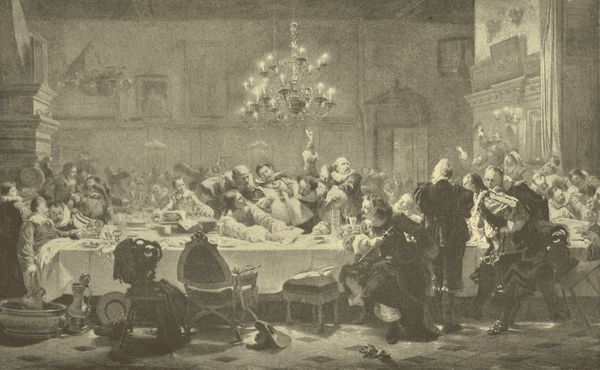
Wallenstein's last banquet.
Though undoubtedly ambitious and intriguing, Wallenstein's alleged treachery to the emperor, whom he kept informed of all his schemes, has never been proved, and by many recent historians is disbelieved. He fell a victim to the jealousy of his rivals, which he augmented by his own pride. His fall, however, reflects lasting disgrace on the character of the Emperor Ferdinand, and was justly avenged by the subsequent humiliation of the German Empire.[Back to Contents]
GUSTAVUS ADOLPHUS[20] By Hjalmar Hjorth Boyesen (1594-1632)
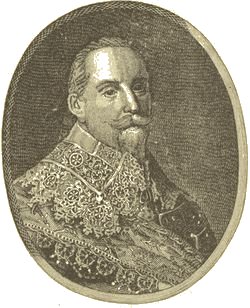
There is a theory which has much currency nowadays, that the great man, being a product of his century, exerts an influence upon his age which is but vanishing, compared to the influence which the age exerts upon him. The great man is, according to this view, personally of small account, except in so far as the tendencies and ideas which are fermenting in the age find their expression in him. He does not so much shape the events as he is shaped and moulded by them.
There is scarcely a hero to be found in all the annals of history who is better qualified to refute this theory than the Swedish king, Gustavus Adolphus. It would be futile to assert, of course, that he was an isolated phenomenon, who sprang like Jonah's luxuriant gourd out of the arid sands of the desert. No, he had deep and intricate roots in the past of his race and in the soil of his fatherland. But yet, how far are all the influences which we can trace, from accounting for the forceful energy, the clear-sighted sagacity, and the dominant genius of the man! As far as we can judge at this distance, his personality was the mightiest element that entered into the dénouement of that bloody world-drama, the Thirty Years' War. Had he been other than he was, had he been a man of less heroic mould, it would seem that Protestantism must have perished in Central Europe, or been confined, at least, to England and the Scandinavian North. The rights of conscience and individual judgment, for which Luther and his co-reformers had fought so valiantly, would then have succumbed to the power of authority, as embodied in the Papacy and the Catholic League; and Germany, after its mighty effort at release, would have lapsed back into the Middle Ages. To few men the opportunity is offered to exercise such a far-reaching influence upon the history of mankind; but fewer still are those who see its full significance, and seeing it, seize it, and without one look behind march into the storm and stress of world-shaping events.
Gustavus Adolphus was born December 9, 1594. He was the son of King Charles IX. of Sweden, and the grandson of the renowned Gustavus Vasa. He was a precocious child, and it is told (though it appears rather incredible) that at the age of twelve he spoke Latin, French, German, Dutch, and Italian with great fluency, besides having a superficial acquaintance with Polish and Russian. There can be no doubt, however, that he was well taught, and that he possessed a remarkable facility in acquiring languages. For all that, he was far from being a bookish boy. In riding, fencing, and all chivalrous accomplishments he took a lively interest and exhibited much skill. It was in stormy times that his boyhood fell, Sweden being at that time involved in frequent wars, and his father, in order to train him in the duties of a military commander, took him early into his camp and made him share his campaigns. Many of the famous captains of that day who had fought in the Low Countries and in France, were made welcome at the Swedish court; and the favorite pastime of the young Gustavus was to question them concerning the battles, sieges, and military exploits in which they had been engaged.
When Charles IX. died, in 1611, Gustavus, being then seventeen years old, was declared to be of age and succeeded to the throne. There was need of an able and resolute man to cope with the many difficulties which sprang up round about him. In the first place there was one war with Denmark, already raging; the strained relations with Russia and Poland threatened to precipitate two more. Norway, which was then united with Denmark under the same king, was also jealous of Sweden; and the Norwegian peasantry destroyed at Kringelen, in Guldbrandsdal, an army of Scottish mercenaries, under the command of Colonel Sinclair, which was marching to the relief of Gustavus. The Danes had occupied two important Swedish cities, Calmar and Elfsborg, and being determined to utilize their advantages to the full, repelled all overtures for peace. It was of no avail that Gustavus renounced his title of King of the Laplanders, the assumption of which by his father had been one of the causes of the war. Christian IV., of Denmark, continued to push hostilities with unflagging vigor, and several battles were fought with varying fortunes. In 1612, he set sail with a fleet of thirty-six vessels for Stockholm, intending to capture the city. The Swedish fleet, being much inferior in numbers, was forced to retire under shelter of the fortress of Waxholm, which guards the access to the capital. In this dire dilemma, Gustavus strained every nerve to avert the threatened disaster. With a small force, chiefly of Dalecarlians, he marched day and night, and hastened to Waxholm in the hope of surprising the Danish fleet which had been detained by adverse winds. But the enemy, being probably informed of his approach, saw that their opportunity for capturing the capital was gone, and returned again to their own coast. Negotiations were now resumed and peace was concluded in 1613. The Danes were to surrender Calmar immediately and Elfsborg at the end of six years; the Swedes agreeing to pay a war indemnity of one million thalers.
The war with Russia, which Gustavus had inherited from his father, had of late been in a state of suspension. The Swedes had occupied a large amount of Russian territory, in which were several strong fortresses. In the confusion which reigned as to the succession, after the extinction of the ancient house of Rurik, there was a capital chance of fishing in troubled waters. A strong party in Russia desired to elect a Swedish prince as sovereign, and actually sent an embassy to Stockholm to offer the throne to Charles Philip, a younger brother of Gustavus. But the king did not favor this plan. For four years he continued the war and secured important advantages. But what was more valuable than territorial gains, he acquired a wide experience in strategy and the conduct of campaigns, a habit of dealing promptly with large questions, and a sharpened judgment of men. In February, 1617, the treaty of peace was signed, Russia ceding to Sweden a large territory on the east of the Baltic. Gustavus was now in a position to prosecute with greater energy the war with Poland. Sigismund III., of Poland, was the only son of King John III., of Sweden, and was, therefore, as a scion of the ancient royal house, the legitimate heir to the Swedish throne. But in the first place he was a Catholic; and in the second place, the house of Vasa, had by force of arms and with the support of the people, successfully asserted its right to the crown which Gustavus I. had won.
After repeated extensions of the armistice which by common consent prevailed, the King of Sweden resumed hostilities in July, 1621; and the war raged with varying success until September, 1629, when another armistice was concluded for six years. The chief result of this exhausting warfare was the stipulation which was agreed to, that liberty of conscience should be granted to Protestants and Catholics, and that the commerce between Poland and Sweden was declared free.
The renown of these wars, two of which had been brought to a triumphant issue, spread far over Europe; and the Protestant princes of Germany became aware that there was a great military captain of their own faith in the Scandinavian North. They were at that time sorely oppressed, the success of the imperial arms, under Tilly and Wallenstein, seeming to threaten the very existence of the Reformed Faith. The Emperor Ferdinand II. was carrying everything with a high hand after the defeat of King Christian IV. of Denmark, who, with more courage than success, had undertaken to champion the Protestant cause. It was in this desperate strait that all eyes turned toward the young King of Sweden. An appeal was sent to him for aid, in the name of their common religion; and Gustavus, after a brief hesitation, accepted the call. He had long watched with deep concern the war of devastation by which Wallenstein and the scarcely less terrible Tilly were seeking to destroy the fruits of the Reformation; and it is said that he had a clear presentiment that sooner or later he would be drawn into the struggle. Leaving his domestic affairs in the hands of his friend, the Chancellor Oxenstiern, he embarked in June, 1630, with a force of but fifteen thousand men, for Germany, and landed on midsummer day on the island of Usedom, on the coast of Pomerania.
The Emperor Ferdinand professed to be much amused when he heard that Gustavus Adolphus had invaded his dominions.
"So we have got another kingling on our hands," he exclaimed mockingly. He was far from foreseeing what trouble he was to have for eighteen years to come, in getting that kingling and his troops off his hands.
Gustavus was the first to step upon the German soil, at the disembarkation; and in the sight of all his army he fell upon his knees and prayed for the blessing of God upon the vast enterprise which had been confided to him. As he arose from his prayer, he seized a spade and began instantly the work upon the intrenchments of the camp.
If his troops were few in number, it is not to be denied that they were excellent in quality. Many were hardened veterans from the king's earlier campaigns; among his recently acquired mercenaries there was a Scotch brigade, from which he drew many of his best officers. We hear much during the following years, of Hepburn, Seaton, Leslie, Mackay, and Monroe, whose names betray their Caledonian origin. You would have supposed now that the Protestant princes, having secured the aid of Gustavus, would have made haste to identify themselves with his cause and to reinforce him with money and troops. But, strange to relate, no sooner had he landed than they began to grow afraid of him and to ask themselves whether they might not after all, be able to make more tolerable terms with the emperor by the sacrifice of their religion, than with this foreign invader, who, if he was victorious, might dictate his own terms. Had they not, in other words, jumped from the frying-pan into the fire?
The two princes who had hitherto been the most prominent champions of Protestantism in Germany (though both half-hearted and pusillanimous shufflers) were Gustavus's brother-in-law, the Elector of Brandenburg, and the Elector of Saxony. They were now doing their best to wriggle out of their obligations, and by a shameful neutrality avert the emperor's displeasure. But they had reckoned without their host if they supposed that Gustavus would lend himself to such a scheme. The reply which he gave to Herr von Wilmerstorff, who had been sent to him by the Elector to urge an armistice, was refreshingly plain, while the argument which accompanied it was completely unanswerable. When nevertheless the Elector continued to resort to shilly-shallying and all sorts of ambiguous tactics, Gustavus lost his patience, marched his army to the gates of Berlin, and compelled him to make his choice of party once, for all. The treaty of alliance was then signed, on the Elector's part reluctantly and with a heavy heart; for these two brothers-in-law were so vastly different, that it was scarcely to be expected that they would be congenial. Gustavus, though he was not without personal ambition, was fired with noble zeal for the Protestant cause, and believed it worthy of any sacrifice, however great; while the Elector was only bent on saving his own precious skin and extricating himself with the least possible damage from the dangerous situation in which he had been caught.
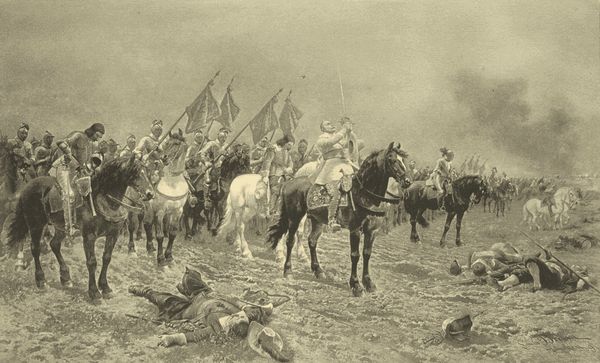
Gustavus Adolphus before the battle of Lutzen.
With the same promptness with which he had brought his brother-in-law of Brandenburg to terms, Gustavus forced the hand of the Elector of Saxony, who now overcame his scruples and sent him the needed reinforcements. An imperial army of forty thousand men, under the command of an Italian adventurer named Torquato Conti, had been sent against him, immediately on his landing in Pomerania, but no battle had been fought, and beyond laying waste the country the Imperialists had so far accomplished nothing. The emperor, who had predicted that "the Snow-king would melt under the rays of the Imperial sun," became alarmed at his successes and selected Tilly to stay his southward advance. This able and experienced general promptly assumed the command of the forces of the Catholic League, and in order to strike terror into the hearts of the Protestant princes, sacked and pillaged the city of Magdeburg in Lower Saxony, giving it over without restraint to devastation and ruin by the brutal soldiery. The horrors which were here enacted beggar description, and leave a hideous stain upon the page of history. Tilly himself, in announcing his success to the emperor, wrote: "Since the destruction of Troy and Jerusalem never has such a siege been seen."
Gustavus had, indeed, come too late to relieve Magdeburg, but the report of the unspeakable atrocities which that unhappy city had witnessed, fired his generous heart with wrath and an eager determination to punish a general so devoid of humanity. And the opportunity was soon to present itself. Advancing rapidly into Saxony, he met Tilly on the plains of Breitenfeld, near Leipsic, September 7, 1631; and not only defeated him, but utterly annihilated his army, scattering it like dust before the storm. He was now, until a new army could be raised, master of all Germany. Nothing apparently could have hindered him from marching on Vienna and dictating to the emperor his own terms of peace. It has been and is yet a matter of speculation, why Gustavus did not relentlessly follow up the results of this great victory, instead of going into winter quarters and affording Ferdinand and the discomfited princes of the League a chance of recovering from their utter demoralization. The answer is, no doubt, that he did not feel himself strong enough to lay siege to Vienna, without covering his rear and securing his base of supplies. He had always, like the good general he was, been careful to keep open a possible line of retreat. For the moment he was indeed irresistible. At Merseburg two thousand Imperialists were cut to pieces. Cities opened their gates to receive him. The Protestant population, in their ecstacy at his victories, were ready to worship him as a demigod. Proceeding southward to Nuremberg and Munich, he was met again by Tilly at the river Lech, where a brief battle was fought; Gustavus was again victorious and Tilly lost his life. This feat of crossing the Lech in the face of a hostile force is by military experts regarded as the greatest strategic feat of Gustavus.
In the meanwhile the emperor had not been idle. There was but one man whose name was potent enough to summon an army adequate for so perilous a situation; and that man was Albrecht von Wallenstein. He was himself, too, fully aware of his preciousness and the terms which he exacted of Ferdinand were hard, not to say extortionate. Ferdinand II., however, had no choice but to accept them. It was not long before Gustavus became aware that Wallenstein, with an army which seemed to have risen out of the ground, was moving in his rear, resolved, apparently, to cut him off from his communication with Sweden. He had no alternative then but to return northward to face this new enemy. On the field of Lutzen in Saxony they met November 6, 1632. A thick mist covered the battle-field, and both armies tarried with the attack in the hope that it would lift. Toward noon, however, Gustavus made a brief address to his soldiers and knelt in prayer before them, whereupon all sang Luther's hymn, "Our God he is a fortress strong." Then the signal was given for the attack. The army of Gustavus, including his German allies, numbered from twenty to twenty-five thousand, and the Imperialists about thirty thousand. The king, who suffered from an imperfectly healed wound which he had received in the Polish war, found it painful to wear a cuirass; and on the morning of the day of Lutzen refused to put it on. "God is my armor," he said, and mounted his horse.
It was this sublime confidence in divine Providence which led him perhaps to expose himself overmuch. He led the attack in person. Before the battle was far advanced, a report reached him that his left wing was wavering. With prompt resolution he started across the field, but, mistaking the direction in the fog, found himself in the midst of a detachment of imperial cuirassiers. A pistol shot pierced his arm; but he still pressed on. Growing faint from pain and loss of blood, he turned to one of the German princes who accompanied him and said: "Cousin, lead me out of this tumult; for I am hurt."
But scarcely had he spoken, when a second shot hit him between the shoulders and he fell from his horse, dead.
The rumor instantly spread through the Swedish army that the king had been taken prisoner. The troops rushed like an avalanche upon the Imperialists, who wavered and gave way. In the end the victory was claimed by both sides, the advantage remaining however with the Swedes.
Gustavus Adolphus was a man of handsome appearance, tall of stature, and of most impressive presence. He was hot-tempered; but at the same time kindly, generous, and affable. He possessed all the qualities required of a military leader, and has justly been accounted one of the world's greatest generals. He was thirty-eight years old at the time of his death. Having no son, he was succeeded on the Swedish throne by his daughter Christina.[Back to Contents]