Volume 1 — SOLDIERS AND SAILORS (continued 6)
Reading edition
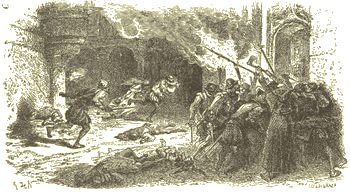
Pizarro felt that a crisis in his audacious business was close at hand; and endured the deepest anxiety until late the next afternoon, that of November 16th, when, after long delays and apparent waverings on the part of the Inca, which severely tried the patience of the Spaniards lying in wait with their heavy armor on, he at length appeared, borne in a gorgeous palanquin, and accompanied by an immense and magnificent procession.
With ferocious satisfaction Pizarro beheld his august victim advancing to his doom. The procession entered the grand plaza of Caxamalca, on three sides of which, under cover of low buildings opening into it, spearmen and horsemen stood to their arms. Not a Spaniard was to be seen, until a priest with interpreters advanced to meet the monarch, and to confuse him with an astonishing harangue concerning the true faith and the supremacy of Spain. Pizarro saw that his opportunity had come. He waved his scarf; from the fortress sounded a signal-gun; and with fierce battle-cries the Spaniards rushed from all sides upon the Peruvians.
The shouts, the blaze and smoke of fire-arms, the terrible detonations, the sight of plunging horses and their riders, with the sudden fury of the onset, paralyzed with terror the multitude of unarmed attendants, who fell the victims of a horrible massacre. The Inca was seized and borne off a captive. And yet the pursuit and slaughter did not cease until thousands of the panic-stricken and defenceless Peruvians had been slain, and more prisoners had been taken than were required to provide every Spaniard with a retinue of servants.
Pizarro treated his captive with the consideration due to a great but fallen potentate; he granted him ample apartments, and the society of his favorite wives and nobles. He at the same time endeavored to save his soul, by enforcing upon his mind the truths of the Catholic faith. Atahualpa accepted with dignity the fortunes of war; and as a ransom offered to fill a large room in which he one day was, with vessels of gold, as high as he could reach. Pizarro agreed to the proposal, and by the Inca's orders messengers were despatched to Cuzco and other important cities of the empire, for the required booty.
This arrangement reached the ears of Huascar, then a prisoner in the hands of his younger brother's adherents; he thereupon sent word to the Spaniards that he would pay a much larger reward if they would espouse his cause and set him free. Unfortunately for both him and Pizarro, the offer reached the ears of Atahualpa, who secretly caused Huascar to be put to death.
The golden treasure soon began to come in, borne on the backs of Indians,—goblets, vases, salvers, massy plates and tiles from the walls of palaces and temples, and images of plants and animals. Some of these objects weighed individually several pounds; and the art displayed in their manufacture was often admirable. But they were all ruthlessly melted down into ingots, to be divided among the conquerors. Gold to the value of more than seventeen million dollars, measured by our modern standard, was thus secured, besides a vast amount of silver. Certainly no prince in all the world's history had ever paid such a ransom.
The treasure was a long while coming in; and Pizarro had ample time to consider how he should keep his part of the contract. He could never have had any intention of giving the Inca his liberty; nor was he deep enough in his craft to perceive the immense advantage he might gain by holding him a captive. He resolved upon his death. The unhappy prince was tried by a military court of his enemies, charged with the usurpation of the empire, with the murder of his brother, and with attempts to incite an insurrection against the Spaniards. He was condemned, received as a convert to the Catholic faith, baptized, and executed. This event occurred August 29, 1533.
Meanwhile Almagro had arrived with a much-needed reinforcement; and adventurers of all sorts, from Spain and her western colonies, soon began to flock to the newly opened land of gold. Pizarro marched upon Cuzco, which he took after a fierce battle, and pillaged of what gold had not been already removed for Atahualpa's ransom. He caused Manco Capae, a young prince of the royal blood, to be proclaimed Inca; drove him by his oppressions to revolt; and was besieged by him in Cuzco. The Peruvians assaulted the city in countless numbers, set fire to the houses with flaming arrows and red-hot stones, and might have starved or destroyed the Spaniards, had not they themselves been forced by starvation to raise the siege.
In June, 1538, the old feud between Pizarro and Almagro culminated in a battle between their two factions, and Almagro was defeated and killed. Pizarro now ruled the country with red-handed despotism. The benignant laws of the Incas were replaced by the rapine of the conquerors. Not only gold and silver, but the land itself and its former peaceful occupants, were apportioned among them; and slavery and concubinage prevailed in their most revolting forms. The rumors of these wrongs reached Spain, and a commissioner was sent out to inquire into them; but before his arrival Pizarro died by violence in his own Ciudad de los Reyes, "City of the Kings,"—now Lima,—which he had founded in 1535.
His death was worthy of his life. Attacked in his own house by the avengers of Almagro, he fought furiously, and cut down three of his assailants; but fell, overcome by numbers, and pierced by as many blades as met in the body of Cæsar. His last word was "Jesu!" and his last act, to stoop and kiss the symbol of a cross which he traced with his finger on the bloody floor.
Thus lived and died one of the most extraordinary men of his time, indeed of all times. It is hard to sum up briefly the good and evil of such a character. He was said to be of a pleasing and dignified presence, simple and self-reliant. We know that he was possessed of indomitable courage, endurance, and persistency of purpose; avaricious, perfidious, devout; and conspicuous for his cruelty even in a cruel age. Greedy as he was of gold, he spent little of it upon himself, and seemed to desire it chiefly for the power and honor it would command. He founded settlements and cities, and was lavish in his expenditures upon public works; no doubt ambitious of building up a new empire on the ruins of the one he had destroyed. But he exhibited none of the great qualities of a born ruler and lawgiver; in the coarseness of his moral nature, a swineherd to the last. He never married, but by a daughter of Atahualpa he had a daughter, who survived him. In his native town of Truxillo her descendants are still to be found, with the mingled blood of the conqueror and of the last of the Incas in their veins.[Back to Contents]

GASPARD DE COLIGNI By Professor Creasy (1517-1572)
There was a time, when the doctrines of the Reformation seemed destined to achieve far ampler conquests over the dominion of Papal Rome than they have ultimately realized. France, in particular, at the commencement of the second half of the sixteenth century, appeared to be almost won over to Protestantism. The Huguenots (as the followers of the Reformed Faith in that country were termed) formed the most influential, if not the largest part of the population of many of the principal provinces, and of nearly all the provincial capitals; they were numerous in Paris; nor was there a single district or town in France in which they had not obtained converts and power, before the war of 1562.
The history of the Reformation in France is a mournful one; but it presents names to our notice which every good heart must delight to honor; and foremost of these is the name of Gaspard de Coligni, the statesman, the soldier, and the saint; who long was the stoutest champion of the Protestant cause, and finally became the most glorious of its many martyrs. Unlike his comrade Condé, he was proof against the vicious blandishments of the enemy's court, as well as against the terrors of their camps. Familiar with defeat, he never learned despair. Hallam has well compared his indomitable energy to the
"Atrocem animam Catonis;"
but the Huguenot chief, while fully equal to the ancient Roman in probity, in self-reliance, and in unflinching fortitude, was far superior to him in comprehensiveness of judgment and in fertility of resources; and moreover, the affectionate gentleness which marked the private life of Coligni, contrasts favorably with the stoic coarseness by which the character of Cato was deformed.
The father of Coligni was head of an ancient and noble house, and was the seigneur of Châtillon-sur-Lion. At his death, in 1522, he left three sons, then of tender years, all of whom became eminent in French history, and all of whom embraced the Protestant doctrines, though trained up in the Romish Church. The elder brother, who is known as the Cardinal de Châtillon, was raised to that high ecclesiastical dignity by Clement VII., in 1533. Chiefly through the influence which his younger brother exerted over him, he became a convert to the tenets of the Reformers in his middle age, and took part in the early scenes of the civil wars. After the reverse which his party sustained at the battle of St. Denys, he fled to England, where he died in 1571. The younger brother, Dandelot, was the first of the three who became a Protestant. He was a skilful and gallant soldier, and signalized himself repeatedly by his enterprise, his inexhaustible resources, and undaunted spirit, as a commander of the Huguenot forces from the first outbreak of the religious wars until his death soon after the battle of Jarnac, in 1569. Gaspard, the great Coligni, or the Admiral (as he is often termed, from having held the titular office of Admiral of France), was the middle one of the three brothers, and was born at Châtillon-sur-Lion, February 16, 1517. He served with distinction in the later wars of Francis I. against Spain; and with his brother Dandelot received knighthood on the field of battle at Cerisoles. He was afterward raised to the important post of colonel-general of the French infantry, and in 1552 was nominated by Henry II. Admiral of France. He was taken prisoner at St. Quentin by the Spaniards, and underwent a long captivity in Spain before he regained his liberty by payment of a heavy ransom.
During the long hours of solitude and compulsory inaction which he passed in his Spanish prison, he meditated deeply and earnestly on religious subjects; and after his return to France, the conversation of his brother Dandelot, who had already joined the Huguenots, confirmed the bias to the Protestant doctrines, which his own studies and deliberations had created. Coligni now resigned all his appointments and preferments, except the nominal rank of admiral, and retired to his estates, where he passed his time in fervent devotion, and in the enjoyment of the calm happiness of domestic life. But the cry of suffering which rose from his fellow-Protestants, against whom the pernicious influence of the Princes of Lorraine in the French court kindled the fires of persecution throughout France, soon drew him from his blameless and cherished repose. He at first sought to provide for them a refuge from oppression, by founding colonies of French Protestants in America; but his projects proved unsuccessful; and as the tyranny of the violent party among the French Catholics grew more and more alarming, Coligni deemed that both honor and conscience required him to stand openly forward in behalf of his co-religionists.
No class of men ever were more long-suffering, or showed more unwillingness to rise in arms against their domestic tyrants, than the much-calumniated Huguenots of France. When we read the hideous edicts that were promulgated against them, and which were not mere empty threats, but were carried into execution throughout the land with unrelenting and strenuous ferocity, we feel that if ever the right of self-defence can make an appeal to arms justifiable, it was so in their instance. Extermination or apostasy formed the only choice that their rulers offered them. Mackintosh, in his "History of the English Revolution of 1688," has truly termed the question of when subjects are justified in making war on their sovereign, "a tremendous problem." But the same admirable writer has bequeathed to us a full and luminous code of the rules and principles of immutable morality, by which this awful issue must be tried, and no one who is familiar with these principles can hesitate in pronouncing that the war on the part of the French Huguenots was lawful and laudable before God and man.
Coligni is peculiarly free from the heavy imputation, which insurrectionary leaders incur, however great their provocation, who introduce the appeal of battle in civil controversy, and, to use the emphatic language of Milton, "let loose the sword of intestine war, soaking the land in her own gore," before every other possible mode of obtaining protection from further enormous wrong has been attempted, and attempted in vain. He was wholly unconnected with the enterprise (known in French history as the conspiracy of Amboise) by which some of the Protestant chiefs designed to withdraw the young king, Francis II., forcibly from the influence of the Guises, and which may be considered the first overt act of insurrection. Not that Condé is to be condemned for that effort, but the Admiral's exceeding loyalty is proved by his having kept aloof from it. Coligni continued to seek security for his co-religionists by peaceable means, for two years after that unsuccessful enterprise, from the savage reprisals of the Court upon its authors. He seemed at one time to be successful in his blameless exertions; and in the Assembly of Notables, held in January, 1562, an edict was issued, called the "Edict of Pacification," giving a partial toleration of the Protestant creed, and suspending all penal proceedings on the ground of religion.
This was all that Coligni strove for. He said at the time to some of his adherents: "If we have our religion, what do we want more?" But those who had made this concession were treacherous as they were cruel, and the fair promise which France seemed to have acquired of tranquillity was destined to be soon destroyed.
Two powerful parties were arrayed against the Huguenots, one of which consisted of their avowed and implacable enemies. This was headed by the Guises, with whom the Constable Montmorenci, and the Maréchal St. André had been induced to enter into league. Less fanatically violent, but far more formidable, through its false show of moderation and favor, was the party of the Queen-mother, Catherine de Medici. Catherine dreaded the power of the house of Guise; and was often glad to avail herself of the Protestant interest as a counterpoise against them. But though the jealousy which animated herself and her sons against the Princes of Lorraine was great, their hatred of the Huguenots was greater; and their occasional simulation of friendship enabled them to wreak it more malignantly and more completely.
They had sided with Coligni and Condé and the other Protestant chiefs in enacting the Edict of Pacification, and had thereby given a check to the power of the Duke of Guise and his confederates. But when their temporary purpose was served, the wise provisions of that edict were set at naught; the Protestants were again exposed to outrage and slaughter at the hands of their foes, nor could any redress be obtained from the royal tribunals. At length occurred the massacre of Vassi, where the armed followers of the Duke of Guise attacked a defenceless body of Protestants, while engaged in the services of their church, and slaughtered several hundreds of them under the eye of Guise, if not by his orders. Reeking from this carnage, the bands of the Lorraines entered Paris, where they were enthusiastically received by the fanatic populace, which was devoted to the Catholic cause.
Condé now left the capital, and summoned the Protestant nobility and gentry to rally round him in defence of their lives and their creed. Coligni long delayed joining him, and evinced a hesitation and a reluctance to embark in civil war, which emphatically attest the goodness while they in no degree detract from the greatness of his character. His wife, who naturally thought that anxiety on her account aided in restraining him, exhorted him in words of more than Roman magnanimity to arm in defence of the thousand destined victims, who looked up to him for guidance and protection. Coligni urged on her and on the friends who thronged round him, the fearful risks of the enterprise, and his earnest desire to wait in patience for better times, and rest upon the public faith rather than justify persecution by having recourse to violence. Unconvinced and undaunted, the heroine renewed her entreaties to the lingering hero. She told him that such prudence was not wisdom toward God. D'Aubigné professes to report this remarkable conversation from the lips of those who were present; and he states that she proceeded to urge on him these words:—
"God has bestowed on you the genius of a great captain—will you refuse the use of it to his children? You have confessed to the justice of their cause—is not the knightly sword you bear pledged to the defence of the oppressed? Sir, my heart bleeds for our slaughtered brethren—and their blood cries out to God and Heaven against you as the murderer of those whom you might have saved."
"Since," replied the Admiral, "the reasons which I have this evening alleged against an ineffectual resistance have made so little impression upon your mind, lay your hand upon your heart and answer me this question, Could you, without murmuring against Providence and the husband to whom Heaven has united you, receive the news of a general defeat? Are you prepared to endure the opprobrium of your enemies—the reproaches of your friends—the treachery of partisans—the curses of the people—confiscation, flight, exile—the insolence of the English, the quarrels of the Germans—shame, nakedness, hunger—and, what is worse, to suffer all this in your children? Are you prepared to see your husband branded as a rebel and dragged to a scaffold; while your children, disgraced and ruined, are begging their bread at the hands of their enemies? I give you eight days to reflect upon it, and when you shall be well prepared for such reverses, I will be ready to set forward, and perish with you and our mutual friends."
"The eight days are already expired!" she cried. "Go, sir, where your duty calls you. Heaven will not give the victory to our enemies. In the name of God, I call upon you to resist no longer, but to save our brethren, or die in the attempt."
On the next morning Coligni was on horseback, with all his retainers round him; and with a heavy heart but a clear conscience, he rode on his way to join Condé at Meaux, which was now, in the early spring of 1562, the head-quarters of the insurgent Huguenots.
The high rank of the Prince of Condé, as well as his brilliant abilities and chivalrous courage, caused him to be acknowledged as chief of the Protestant party; but Coligni was looked on by friends and foes as the main pillar of their cause; and it was he that gave organization to the volunteers who flocked around himself and the prince, first at Meaux, and afterward in greater numbers at Orleans, when toward the end of March they succeeded in occupying that important city, and making it a centre of operations for the Huguenot confederacy. Like Cromwell in after times, Coligni relied on the religious enthusiasm as well as the natural bravery of his troops. He exercised them by preaching and prayer as well as by drilling and manœuvring. He inspired them with his own spirit of austere devotion to their cause; and the Huguenot army was in its first campaigns as conspicuous for good order and morality as for valor; though by degrees it became tainted with a tendency to marauding and to brutal violence.
The Roman Catholic party now sought support from Philip II. of Spain, from the Duke of Savoy, the emperor and other foreign princes of their creed, and the Huguenots, to the deep regret of Coligni, were compelled to strengthen themselves by similar negotiations. The English queen, Elizabeth, promised succors in men and money, on condition of Havre (which city, like most of the other strong places in Normandy, was devoted to the Protestant cause) being placed in her power as a security for repayment. The German Lutheran princes permitted a large auxiliary force of lansquenets and heavy-armed cavalry to be raised among their subjects in behalf of the French Protestants; and Dandelot was despatched into Germany to place himself at their head, and lead them across the Rhine; a difficult operation, which he accomplished with great skill, and joined his brothers and Condé at Pluviers, near Orleans, late in the year, and at a crisis when the fortunes of the Protestant party appeared reduced to a very low ebb, as in the interval which had elapsed since the commencement of the war, though there had been no engagement between the main armies, the Royalists had gained numerous advantages, and had captured many towns, both in the South and in Normandy, which had originally declared for the insurgents.
Coligni and Condé with their own troops and their German allies now (December, 1562) marched upon Paris; but finding it hopeless to attempt the storm or siege of the capital, they led their army toward Normandy, desiring to form a junction with the English troops at Havre. The Royal forces, commanded nominally by the Constable Montmorenci and the Maréchal de St. André, but in which the Duke of Guise was also present, marched for some days on their flank, till the two armies came into collision on December 19th at Dreux, where the first battle of the civil wars was fought. In this action, after many vicissitudes of fortune, the Duke of Guise secured the victory for the Roman Catholics, and Condé was taken prisoner. Coligni led the remains of the Protestant army back to Orleans; whither the Duke of Guise, at the head of a largely recruited army, flushed by their recent victory, soon advanced, with the intention of crushing insurrection and Protestantism, by the capture of their stronghold.
Coligni's situation now seemed desperate. His German mercenaries in arrear of pay, threatened to desert him; the funds which he had been able to collect for the conduct of the war were exhausted; and he was utterly unable to encounter the numerous and well-appointed forces of Guise. In this emergency he formed the bold plan of leaving his brother, Dandelot, with the bulk of the infantry to defend Orleans, while he himself led the cavalry and a few companies of foot again to Normandy, and again attempted to avail himself of the English supplies of money and troops. In spite of the mutinous murmurings of the German reisters, in spite of the attempts which the Roman Catholic commanders made to intercept him, Coligni executed his daring scheme. Havre was reached. The English subsidies were secured, and the rich and powerful city of Caen voluntarily placed itself in Coligni's power. Meanwhile Orleans had been well defended by Dandelot; and the great chief of the Roman Catholics, the Duke of Guise, had died by the hand of an assassin. Some attempts were made to implicate Coligni in the guilt of this murder, but the Admiral indignantly denied the charge; nor is there any ground for believing him to have had the least cognizance of Poltrot's crime.
The death of Guise made a temporary pacification easy; and the edict of Amboise, on March 19, 1563, by which a narrow and restricted permission for the exercise of the Protestant religion was allowed, closed the first war.
This peace on the part of the Royalists was only a hollow and a treacherous truce. Fresh communications with Philip II. were opened; and an interview took place in 1564 at Bayonne, between Catherine, her son Charles IX., and the Duke of Alva. There is every reason to believe that at that meeting the destruction of the Protestants by craft or by force was concerted. The treaty of Amboise was now openly and repeatedly violated by the fanatic party of the French Roman Catholics; and the Huguenots were again driven to take up arms in self-defence. Condé and Coligni advanced upon Paris, and fought on November 10, 1567, the sanguinary battle of St. Denys against the Royalist forces. The Huguenots were beaten, but Coligni rallied them, and marching toward the Meuse, effected a junction with fresh bands of German auxiliaries. The war now raged with redoubled horror in every district of France. Alarmed at the strength of the Huguenot army, Catherine tried and successfully exerted her powers of persuasion and deceit over Condé, and a second faithless peace, called the treaty of Longjumeau, was concluded; but when the Huguenot forces were disbanded, and their German auxiliaries dismissed, the Royalists renewed the war.
In 1569, the indiscreet spirit of Condé brought the Protestants into action at Jarnac, under heavy disadvantages, against the flower of the Catholic army. Condé was killed in the battle, and a large part of his forces routed with heavy slaughter; but Coligni was again the Ajax of the cause, covered the retreat, and reorganized the fugitives for fresh exertions. But the waves of calamity were not yet spent. The hostile armies met again at Moncontour, and the Protestants sustained the most complete and murderous overthrow that had been dealt to them throughout the war. Coligni's brother, the gallant Dandelot, was mortally wounded in this disastrous field; many of his stanchest friends had fallen; many abandoned him; and he found himself a fugitive, with only a few bands of mutineers around him, the wreck of the gallant army that he had lately led.
But it was in this depth of gloom that the true heroic lustre of his soul was seen. Fearless himself of what man could do unto him, he calmed the panic of his followers, and inspired them with his own energy. He who has innate strength to stand amid the storm, will soon find others flock around and fortify him while they seek support for themselves. When it was known that Coligni's banner still was flying, the Protestants of France and Eastern Germany, who at first had been stunned by the report of Moncontour, thronged to him as to a strong tower in the midst of trouble. While the Royalists were exulting at the fancied annihilation of their foe, they suddenly learned that Coligni was approaching the capital, at the head of the largest army that the Huguenots had yet sent into the field. Again the device of a treacherous pacification was attempted, and again it prevailed. Coligni was warned of the personal danger that he incurred by trusting the faith of a Medici and a Guise; but he replied that he would rather lay down his life, than see France continue the victim of the woes of civil war.
The treaty of St. Germains was signed on August 8, 1570, and on August 24, 1572, the Massacre of St. Bartholomew attested with what worse than Punic faith the crowned conspirators of the French Court had planned it. In the interval, the most detestable and elaborate hypocrisy was employed to lull the suspicions of the Huguenot chiefs, and to bring them defenceless into the power of their enemies. At last, in the summer of 1572, they were collected in Paris, under the pretence of being the honored guests of the French king, at the nuptials of his sister with Henry of Navarre. An attempt was made on the life of Coligni by an assassin, in which the Admiral was severely wounded. The king and his courtiers affected the utmost indignation at this crime, and the warmest sympathy with the suffering veteran. But in the early dawn of the day appointed for the most unchristian carnage that ever defiled the earth, a party of murderers, headed by the young Duke of Guise himself, broke open the doors of the house where Coligni lay, and Besme, one of the duke's domestics, entered with a drawn sword, into the room where the Admiral was sitting in an arm-chair.
"Young man," said he, undisturbed, "you ought to respect my gray hairs; but do as you please, you can only shorten my life a few days."
Besme thrust him through in many places, and then threw his body, still breathing, out of the window into the court, where it fell at the feet of the Duke of Guise. The minions of the Louvre flocked around in hideous glee, to insult the lifeless form of him, before whom they had so long quailed and trembled. They gibbeted their own infamy in vainly seeking to dishonor the illustrious dead. His memory is at once the glory and the shame of France: and the very land of the St. Bartholomew is, to some extent, hallowed by having been the birthplace of Coligni, and the scene of his heroic career.
I do not pause to describe the tardy homage which his countrymen afterward paid to the name and relics of the fallen great. These obsequies and panegyrics may be looked on as some small expiation for the national guilt of France, but Coligni needed them not.[Back to Contents]
HENRY IV. OF FRANCE (1553-1610)
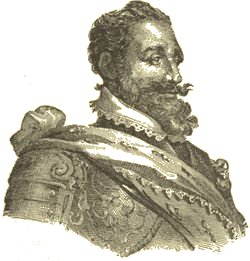
Henry IV., the most celebrated, the most beloved, and perhaps, in spite of his many faults, the best of the French monarchs, was born at Pau, the capital of Béarn, in 1553. His parents were Antoine de Bourbon, Duke of Vendôme, and in right of his wife, titular king of Navarre, and Jeanne d'Albert, the heiress of that kingdom. On the paternal side he traced his descent to Robert of Clermont, fifth son of Louis IX., and thus, on the failure of the elder branches, became heir to the crown of France. Educated by a Protestant mother in the Protestant faith, he was for many years the rallying point and leader of the Huguenots. In boyhood the prince of Béarn displayed sense and spirit above his years. Early inured to war, he was present and exhibited strong proofs of military talent at the battle of Jarnac, and that of Moncontour, both fought in 1569. In the same year he was declared chief of the Protestant League. The treaty of St. Germain, concluded in 1570, guaranteed to the Huguenots the civil rights for which they had been striving; and, in appearance, to cement the union of the two parties, a marriage was proposed between Henry, who, by the death of his mother, had just succeeded to the throne of Navarre, and Margaret of Valois, sister of Charles IX. This match brought Condé, Coligni, and all the leaders of their party, to Paris. The ceremony took place August 17, 1572, and a week later came the massacre of St. Bartholomew. For three years afterward Henry, who to save his life had conformed to the established religion, was kept as a kind of state-prisoner. He escaped in 1576, and put himself at the head of the Huguenot party. In the war which ensued, with the sagacity and fiery courage of the high-born general, he showed the indifference to hardships of the meanest soldier. Content with the worst fare and meanest lodging, in future times the magnificent monarch of France could recollect when his wardrobe could not furnish him with a change of linen. He shared all fortunes with his followers, and was rewarded by their unbounded devotion.
Upon the extinction of the house of Valois, by the assassination of Henry III. in 1589, Henry of Navarre became the rightful owner of the French throne. But his religion interfered with his claims. The League was strong in force against him: he had few friends, few fortresses, no money, and a small army. But his courage and activity made up for the scantiness of his resources. With five thousand men he withstood the Duc de Mayenne, who was pursuing him with twenty-five thousand, and gained the battle of Arques, in spite of the disparity. This extraordinary result may probably be ascribed in great measure to the contrast of personal character in the two generals. Mayenne was slow and indolent. Of Henry it was said, that he lost less time in bed than Mayenne lost at table; and that he wore out very little broad-cloth, but a great deal of boot-leather. A person was once extolling the skill and courage of Mayenne in Henry's presence. "You are right," said Henry, "he is a great captain, but I have always five hours' start of him." Henry got up at four in the morning, and Mayenne about ten.
The battle of Arques was fought in the year of his accession. In the following year, 1590, he gained a splendid victory at Ivri, over the Leaguers commanded by Mayenne, and a Spanish army superior in numbers. On this occasion he made that celebrated speech to his soldiers before the battle: "If you lose sight of your standards, rally round my white plume; you will always find it in the path of honor and glory." Nor is his exclamation to his victorious troops less worthy of record: "Spare the French!"
Paris was soon blockaded, but the Parliament swore on the Gospels, in the presence of the Legate and the Spanish Ambassador, to refuse all proposals of accommodation. The siege was pushed to such extremities, and the famine became so cruel, that bread was made of human bones ground to powder. That Henry did not then master the capital, where two hundred thousand men were maddened with want, was owing to his own lenity. He declared that he had rather lose Paris, than gain possession of it by the death of so many persons. He gave a free passage through his lines to all who were not soldiers, and allowed his own troops to send in refreshments to their friends. By this paternal kindness he lost the fruit of his labors to himself; but he also prolonged the civil war, and the calamities of the kingdom at large.
The approach of the Duke of Parma with a Spanish army obliged Henry to raise the siege of Paris. It was not the policy of the Spanish court to render the Leaguers independent of its assistance, and the duke, satisfied with having relieved the metropolis, avoided an engagement, and returned to his government in the Low Countries, followed by Henry as far as the frontiers of Picardy. In 1591 Henry received succors from England and Germany, and laid siege to Rouen; but his prey was again snatched from him by the Duke of Parma. Again battle was offered and declined; and the retiring army passed the Seine in the night on a bridge of boats; a retreat the more glorious, as Henry believed it to be impossible. The duke once said of his adversary, that other generals made war like lions or wild boars; but that Henry hovered over it like an eagle.
During the siege of Paris, some conferences had been held between the chiefs of the two parties, which ended in a kind of accommodation. The Catholics of the king's party began to complain of his perseverance in Calvinism; and some influential men who were of the latter persuasion, especially his confidential friend and minister Rosny, represented to him the necessity of a change. Even some of the reformed ministers softened the difficulty, by acknowledging salvation to be possible in the Roman Church. In 1593 the ceremony of abjuration was performed at St. Denis, in presence of a multitude of the Parisians. If, as we cannot but suppose, the monarch's conversion was owing to political motives, the apostacy must be answered for at a higher than any human tribunal; politically viewed, it was perhaps one of the most beneficial steps ever taken toward the pacification and renewal of prosperity of a great kingdom. In the same year he was crowned at Chartres, and in 1594 Paris opened her gates to him. He had just been received into the capital, where he was conspicuously manifesting his beneficence and zeal for the public good, when he was wounded in the throat by John Châtel, a young fanatic. When the assassin was questioned, he avowed the doctrine of tyrannicide, and quoted the sermons of the Jesuits in his justification. That society therefore was banished by the Parliament.
For two years after his ostensible conversion, the king was obliged daily to perform the most humiliating ceremonies, by way of penance; and it was not till 1594 that he was absolved by Clement VIII. The Leaguers then had no further pretext for rebellion, and the League necessarily was dissolved. Its chiefs exacted high terms for their submission; but the civil wars had so exhausted the kingdom, that tranquillity could not be too dearly purchased; and Henry was faithful to all his promises, even after his authority was so firmly established, that he might have broken his word with safety to all but his own conscience and honor. Although the obligations which he had to discharge were most burdensome, he found means to relieve his people, and make his kingdom prosper. The Duke de Mayenne, in Burgundy, and the Duke de Mercœur in Brittany, were the last to protract an unavailing resistance; but the former was reduced in 1596, and the latter in 1598, and thenceforth France enjoyed almost uninterrupted peace till Henry's death. But the Protestants gave him almost as much uneasiness as the Catholic Leaguers. He had granted liberty of conscience to the former; a measure which was admitted to be necessary by the prudent even among the latter. Nevertheless, either from vexation at his having abjured their religion, from the violence of party zeal, or disgust at being no longer the objects of royal preference, the Calvinists preferred their demands in so seditious a tone, as stopped little short of a rebellious one. While on the road to Brittany, he determined to avoid greater evils by timely compromise. The edict of Nantes was then promulgated, authorizing the public exercise of their religion in several towns, granting them the right of holding offices, putting them in possession of certain places for eight years, as pledges for their security, and establishing salaries for their ministers. The clergy and preachers demurred, but to no purpose; the Parliament ceased to resist the arguments of the Prince, when he represented to them as magistrates, that the peace of the state and the prosperity of the Church must be inseparable. At the same time he endeavored to convince the bigots among the priesthood on both sides, that the love of country and the performance of civil and political duties may be completely reconciled with difference of worship.
But it would be unjust to attribute these enlightened views to Henry, without noticing that he had a friend as well as minister in Rosny, best known as the Duke de Sully, who probably suggested many of his wisest measures, and at all events superintended their execution, and did his best to prevent or retrieve his sovereign's errors by uncompromising honesty of advice and remonstrance. The allurements of pleasure were powerful over the enthusiastic and impassioned temperament of Henry; it was love that most frequently prevailed over the claims of duty. The beautiful Gabrielle d'Estrées became the absolute mistress of his heart; and he entertained hopes of obtaining permission from Rome to divorce Margaret de Valois, from whom he had long lived in a state of separation. Had he succeeded time enough, he contemplated the dangerous project of marrying the favorite; but her death saved him both from the hazard and disgrace. The sentence of divorce, so long solicited, was at last granted, and the king married Mary de Medici, who bore Louis XIII. to him in 1601. The match, however, contributed little to his domestic happiness.
While France was flourishing under a vigilant and paternal administration, while her strength was beginning to keep pace with her internal happiness, new conspiracies were incessantly formed against the king. Henriette d'Entragues, another favorite, not only exasperated the Queen's peevish humor against him, but was ungrateful enough to combine with her father, the Count d'Auvergne, and the Spanish Court, in a plot which was timely discovered. Spite of the many virtues and conciliatory manners of Henry, the fanatics could never pardon his former attachment to the Protestant cause. He was continually surrounded with traitors and assassins; almost every year produced some attempt on his life, and he fell at last by the weapon of a misguided enthusiast.
Shortly before his untimely end, Henry is said by some historians to have disclosed a project for forming a Christian republic. The proposal is stated to have been, to divide Europe into fifteen fixed powers, none of which should be allowed to make any new acquisition, but should together form an association for maintaining a mutual balance, and preserving peace. This political reverie, impossible to be realized, is not likely ever to have been actually divulged, even if meditated by Henry, nor is there any trace of it to be found in the history, or among the state-papers of England, Venice, or Holland, the supposed co-operators in the scheme. His more rational design in arming went no further than to set bounds to the ambition and power of the house of Austria, both in Germany and Italy. Whatever may have been the motive, his means of success were imposing. He was to march into Germany at the head of forty thousand excellent troops. The army, provisions, and every other necessary were in readiness. Money no longer failed; Sully had laid up forty millions of livres in the treasury, which were destined for this war. His alliances were already assured, his generals had been formed by himself, and all seemed to forebode such a storm as must probably have overwhelmed an emperor devoted to the search after the philosopher's stone, and a king of Spain under the dominion of the Inquisition. Henry was impatient to join his army; but his mind had become harassed with sinister forebodings, and his chagrin was increased by a temporary alienation from his faithful minister. He was on his way to pay a visit of reconciliation to Sully, when his coach was entangled as it passed along the street. His attendants left the carriage to remove the obstruction, and during the delay thus caused he was stabbed to the heart by Francis Ravaillac, a native of Angoulême. This calamitous event took place on May 14, 1610, in the fifty-seventh year of his age. The Spaniards, who had the strongest interest in the catastrophe, were supposed to have been the instigators; but the fear of implicating other powers, and plunging France into greater evils than those from which their hero had rescued them, deterred not only statesmen, but even the judges on Ravaillac's trial, from pressing for the names of accomplices. Hardouin de Perefixe, in his "History of Henry the Great," says, "If it be asked who inspired the monster with the thought, history answers that she does not know; and that in so mysterious an affair, it is not allowable to vent suspicions and conjectures as assured truths; that even the judges who conducted the examinations opened not their mouths, and spoke only with their shoulders."
The assertions of Ravaillac, as far as they have any weight, discountenance the belief of an extended political conspiracy. The house of Austria, Mary de Medici his wife, Henriette d'Entragues his mistress, as well as the Duke d'Epernon, have been subjected to the hateful conjectures of Mazarin and other historians; but he who actually struck the blow invariably affirmed that he had no accomplice, and that he was carried forward by an uncontrollable instinct. If his mind were at all acted on from without, it was probably by the epidemic fanaticism of the times, rather than by personal influence.
Henry left three sons and three daughters by Mary de Medici. Of no prince recorded in history, probably, are so many personal anecdotes related, as of Henry IV. These are for the most part well known, and of easy access. Among them stands out prominently the tale of the Spanish ambassador who to his astonishment, found Henry on the floor playing hobby-horse for his children. "Are you a father?" asked Henry, looking up without any apparent embarrassment. "Yes, your majesty." "Then we will finish our game," said the king. And he did so, before taking up his business with the ambassador.
The whole tenor of Henry's life exhibits a lofty, generous, forgiving temper, the fearless spirit which loves the excitement of danger, and that suavity of feeling and manners, which, above all qualities, wins the affection of those who come within its sphere: it does not exhibit high moral or religious principle. But his weaknesses were those which the world most readily pardons, especially in a great man. If Henry had emulated the pure morals and fervent piety of his noble ancestor, Louis IX., he would have been a far better king, as well as a better man; yet we doubt whether in that case his memory would have been cherished with such enthusiastic attachment by his countrymen.[Back to Contents]
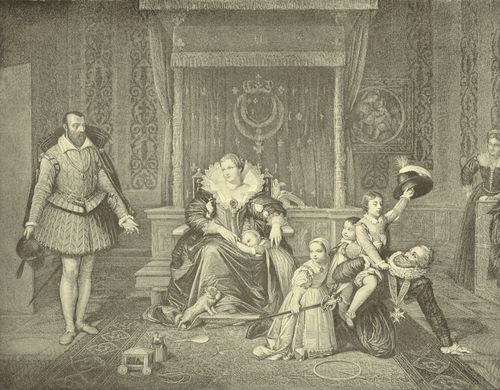
Henry IV. of France at home.
SIR FRANCIS DRAKE (1540-1596)
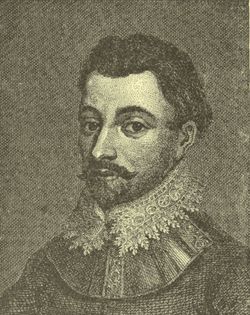
Francis Drake, the first British circumnavigator of the globe, was born in Devonshire, of humble parents. So much is admitted; with respect to the date of his birth, and the method of his nurture, the annalists, Camden and Stowe, are not agreed. By the latter we are told that Drake was born at Tavistock, about 1545, and brought up under the care of a kinsman, the well-known navigator, Sir John Hawkins. Camden, on the other hand, anticipates his birth by several years, and says that he was bound apprentice to a small shipowner on the coast of Kent, who, dying unmarried, in reward of his industry bestowed his bark upon him as a legacy. Both accounts agree that in 1567 he went with Hawkins to the West Indies on a trading voyage, which gave its color to the rest of his life. Their little squadron was obliged by stress of weather to put into St. Juan de Ulloa, on the coast of Mexico; where, after being received with a show of amity, it was beset and attacked by a superior force, and only two vessels escaped. To make amends for his losses in this adventure, in the quaint language of the biographer Prince, in his "Worthies of Devon," "Mr. Drake was persuaded by the minister of his ship that he might lawfully recover the value of the King of Spain by reprisal, and repair his losses upon him anywhere else. The case was clear in sea divinity; and few are such infidels as not to believe in doctrines which make for their profit. Whereupon Drake, though then a poor private man, undertook to revenge himself upon so mighty a monarch."
In the years 1570-71 Drake made two voyages to the West Indies, apparently to gain a more precise acquaintance with the seas, the situation, strength, and wealth of the Spanish settlements. In 1572 he sailed with two ships, one of seventy-five tons, the other of twenty-five tons, their united crews mustering only seventy-three men and boys, all volunteers. His object was to capture the now ruined city of Nombre de Dios, situated on the Isthmus of Panama, a few miles east of Porto Bello, then the great repository of all the treasure conveyed from Mexico to Spain. Off this coast of America his little armament was augmented by an English bark, with thirty men on board; so that, deducting those whom it was necessary to leave in charge of the ships, his available force fell short of a hundred men. This handful of bold men attacked the town, which was unwalled, on the night of July 22d, and found their way to the marketplace, where the captain received a severe wound. He concealed his hurt until the public treasury was reached; but before it could be broken open, he became faint from loss of blood, and his disheartened followers abandoned the attempt, and carried him perforce on board ship. Such at least, is the account of the English; there is a Portuguese statement in "Hakluyt's Voyages," vol. iii., p. 525, less favorable both to the daring and success of the assailants.
Failing in this attempt, Drake continued for some time on the coast, visiting Carthagena and other places, and making prize of various ships; and if we wonder at his hardihood in adventuring with such scanty means to remain for months in the midst of an awakened and inveterate enemy, how much more surprising is it that the wealthy, proud, and powerful monarchy of Spain should so neglect the care of its most precious colonies, as to leave them unable to crush so slight a foe! The English appear to have felt perfectly at their ease; they cruised about, formed an intimate alliance with an Indian tribe, named Symerons, the bond of union being a common hatred of the Spaniards, and built a fort on a small island of difficult access, at the mouth of a river, where they remained from September 24 to February 3, 1573. On the latter day, Drake set forth with one portion of his associates, under the conduct of the Symerons, to cross the isthmus. On the fourth day they reached a central hill, where stood a remarkable "goodly and great high tree, in which the Indians had cut and made divers steps to ascend up neere unto the top, where they had also made a convenient bower, wherein ten or twelve men might easily sitt; and from thence wee might without any difficulty plainly see the Atlantic Ocean, whence now wee came, and the South Atlantic (i.e., Pacific), so much desired. After our captain had ascended to this bower with the chief Symeron, and having, as it pleased God at that time, by reason of the brize, a very faire day, had seen that sea of which he had heard such golden reports, he besought Almighty God of his goodness to give him life and leave to sayle once in an English ship in that sea." We quote from a tract entitled "Sir Francis Drake Revived," written by some of Drake's companions, corrected, it is said, by himself, and published by his nephew in 1626, which contains a full and interesting account of this adventurous expedition. Drake's present object was to intercept a convoy of treasure on the way from Panama to Nombre de Dios. By this route the treasures of Peru and Chili, as well as Mexico, were brought to Europe, for the passage round Cape Horn was then unknown, and no ship but Magellan's had yet accomplished the passage round the world to Europe. Guided by the Symerons, the English approached Panama, learned that a valuable treasure was expected to pass, and beset the lonely forest road which it had to travel. But the haste of one drunken man gave a premature alarm, in consequence of which the march of the caravan was stopped; and Drake with his party, their golden hopes being thus defeated, forced their way through Venta Cruz, and returned by a shorter route to their encampment, after a toilsome and fruitless journey of three weeks. It was not till April 1st, that the long-desired opportunity presented itself, on which day they took a caravan of mules laden with silver and a small quantity of gold. They carried off part of the spoil, and buried about fifteen tons of silver; but on returning for it, they found that it had been recovered by the Spaniards.
Drake returned to England, August 9, 1573. In dividing the treasure he showed the strictest honor, and even generosity; yet his share was large enough to pay for fitting out three ships, with which he served as a volunteer in Ireland, under the Earl of Essex, and "did excellent service both by sea and land in the winning of divers strong forts." In 1577, he obtained a commission from Queen Elizabeth to conduct a squadron into the South Seas. What was the purport of the commission we do not find; it appears from subsequent passages that it gave to Drake the power of life and death over his followers; but it would seem from the queen's hesitation in approving his proceedings, that it was not intended to authorize (at least formally) his depradations on Spanish property.
With five ships, the largest the Pelican, of one hundred tons burden, the smallest a pinnace of fifteen tons, manned in all with only 164 men, Drake sailed from Plymouth, November 15, 1577, to visit seas where no English vessel had ever sailed. Without serious loss, or adventure worthy of notice, the fleet arrived at Port St. Julian, on the coast of Patagonia, June 20, 1578. Here the discoverer Magellan had tried and executed his second in command on the charge of mutiny, and the same spot did Drake select to perform a similar tragedy. He accused the officer next to himself, Thomas Doughty, of plots to defeat the expedition and take his life; plots undertaken, he said, before they had left England. "Proofs were required and alleged, so many and so evident, that the gentleman himself, stricken with remorse, acknowledged himself to have deserved death;" and of three things presented to him, either immediate execution, or to be set on shore on the main, or to be sent home to answer for his conduct, he chose the former; and having at his own request received the sacrament, together with Drake, and dined with him in further token of amity, he cheerfully laid his head on the block, according to the sentence pronounced by forty of the chiefest persons in the fleet. Such is the account published by Drake's nephew, in "The World Encompassed," of which we shall only observe, without passing judgment on the action, that Drake's conduct in taking out a person whom he knew to be ill affected to him, was as singular as is the behavior and sudden and acute penitence attributed to Doughty. But we have no account from any friend of the sufferer. It is fair to state the judgment of Camden, who says, "that the more unprejudiced men in the fleet thought Doughty had been guilty of insubordination, and that Drake in jealousy removed him as a rival. But some persons, who thought they could see farther than others, said that Drake had been ordered by the Earl of Leicester to take off Doughty, because he spread a report that Leicester had procured the death of the Earl of Essex."
Having remained at Port St. Julian until August 15th, they sailed for the Straits, reached them August 20th, and passed safely into the Pacific, September 6th, with three ships, having taken out the men and stores, and abandoned the two smaller vessels. But there arose on the 7th a dreadful storm, which dispersed the ships. The Marigold was no more heard of, while the dispirited crew of the Elizabeth returned to England, being the first who ever passed back to the eastward through Magellan's Strait. Drake's ship was driven southward to the fifty-sixth degree, where he ran in among the islands of the extreme south of America. He fixes the farthest land to be near the fifty-sixth degree of south latitude, and thus appears to claim the honor of having discovered Cape Horn. From September 7th to October 28th, the adventurers were buffeted by one continued and dreadful storm; and in estimating the merits of our intrepid seamen, it is to be considered that the seas were utterly unknown, and feared by all, those who had tried to follow in Magellan's course having seldom succeeded, and then with much pain and loss, and little fruit of their voyage; that their vessels were of a class which is now hardly used for more than coasting service; and that the imperfection of instruments and observations laid them under disadvantages which are now removed by the ingenuity of our artists. Add to this, that as the Spaniards gave out that it was impossible to repass the Straits, there remained no known way to quit the hostile shores of America, but by traversing the unexplored Pacific.
The storm at length ceased, and the lonely Pelican (which Drake, however, had renamed the Golden Hind) ran along the coast of Lima and Peru, reaping a golden harvest from the careless security of those who never thought to see an enemy on that side of the globe. There is something rather revolting, but very indicative of the temper of the age, in the constant reference to the guidance and protection of God, mixed with a quiet jocularity with which "Master Francis Fletcher, preacher in this employment," from whose notes the "World Encompassed," which is a narrative of this voyage, was compiled, speaks of acts very little different from highway robbery, such as would now be held disgraceful in open war; as for instance, on meeting a Spaniard driving eight llamas, each laden with one hundred pounds' weight of silver, "they offered their service without entreaty, and became drovers, not enduring to see a gentleman Spaniard turned carrier." Enriched by the most valuable spoil, jewels, gold, and silver, Drake steered to the northward, hoping to discover a homeward passage in that quarter. In the forty-eighth degree of north latitude, in what is now the State of Washington, he was stopped by the cold; and, determining to traverse the Pacific, he landed, careened his ship, and, in the queen's name, took possession of the country, which he named New Albion, September 29, 1579; he sailed again, and reached the Molucca Islands November 4th. In his passage thence to the island of Celebes, he incurred the most imminent danger of the whole voyage. The ship struck, as they were sailing before a fair wind, on a reef of rocks, so precipitous that it was impossible to lay out an anchor to heave her off. They stuck fast in this most hazardous situation for eight hours. At the end of that time the wind shifted, and the ship, lightened of part of her guns and cargo, reeled off into deep water, without serious injury. Had the sea risen, she must have been wrecked. This was Drake's last mishap. He reached Plymouth in the autumn of 1580, after nearly three years' absence. Accounts differ as to the exact date of his arrival.
Since Drake had for this voyage the queen's commission, by which we must suppose the license to rob the Spaniards to have been at least tacitly conceded, he seems to have been rather hardly used, in being left from November to April in ignorance how his bold adventure was received at court. Among the people it created a great sensation, with much diversity of opinion; some commending it as a notable instance of English valor and maritime skill, and a just reprisal upon the Spaniards for their faithless and cruel practices; others styling it a breach of treaties, little better than piracy, and such as it was neither expedient nor decent for a trading nation to encourage. During this interval, Drake must have felt his situation unpleasant and precarious; but the queen turned the scale in his favor by going, April 4, 1581, to dine on board his ship at Deptford, on which occasion she declared her entire approbation of his conduct, and conferred on him the honor, and such it then was, of knighthood. His ship she ordered to be preserved as a monument of his glory. Having fallen to decay, it was at length broken up: a chair, made out of its planks, was presented to the University of Oxford, and probably is still to be seen in the Bodleian Library. Cowley wrote a Pindaric ode upon it.
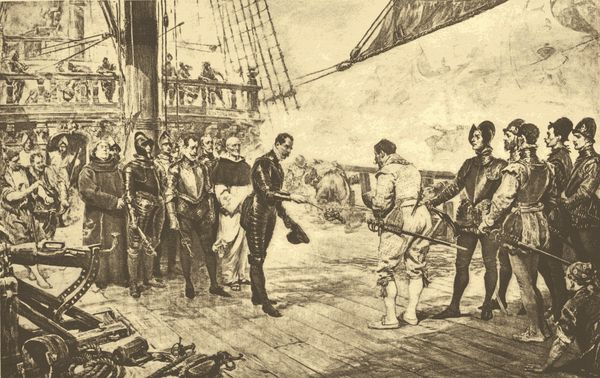
The admiral of the Spanish Armada surrenders to Drake.
Drake had now established his reputation as the first seaman of the day; and in 1585 the queen, having resolved on war, intrusted him with the command of an expedition against the Spanish colonies. He burnt or put to ransom the cities of St. Jago, near Cape Verde, St. Domingo, Carthagena, and others, and returned to England, having fully answered the high expectations which were entertained of him. He was again employed with a larger force of thirty ships, in 1587, with which he entered the port of Cadiz, burnt ten thousand tons of shipping, which were to form part of the Armada, took the castle of Cape St. Vincent, and sailing to the Azores, made prize of a large and wealthy ship on its way from the Indies. Still more eminent were his services against the Armada in the following year, in which he served as vice-admiral under Lord Howard of Effingham. But these are well-known passages of history, and we have shortened our account of them, to relate at more length the early incidents of Drake's adventurous life.
In 1589 Sir Francis Drake and Sir John Norris were joined in the command of an expedition, meant to deliver Portugal from the dominion of Spain. This failed, as many expeditions have done in which the sea and land services were meant to act together; and as usual, each party threw the blame on the other. Drake's plan appears to have been most judicious: it was at least accordant with his character, downright and daring. He wished to sail straight for Lisbon and surprise the place; but Norris was bent on landing at Corunna, where he did indeed some harm to the Spaniards, but no service toward the real objects of the expedition. When the land forces did at last besiege Lisbon, Drake was unwilling or unable to force his way up the Tagus to co-operate with them, and for this he was afterward warmly blamed by Norris. He defended himself by stating that the time misspent by the English at Corunna, had been well employed by the Spaniards in fortifying Lisbon; and we fully believe that neither fear nor jealousy would have made him hesitate at anything which he thought to be for the good of the service. This miscarriage, though for a time it cast something of a cloud upon Drake's fame, did not prevent his being again employed in 1595, when the queen, at the suggestion of himself and Sir John Hawkins, determined to send out another expedition against Spanish America, under those two eminent navigators, the expenses of which were in great part to be defrayed by themselves and their friends. Great hope was naturally conceived of this expedition, the largest which had yet been sent against that quarter, for it consisted of thirty vessels and 2,500 men. The chief object was to sail to Nombre de Dios, march to Panama, and there seize the treasure from Peru. But the blow, which should have been struck immediately, was delayed by a feint on the part of the Spaniards to invade England; the Plate fleet arrived in safety, and the Spanish colonies were forewarned. Hawkins died, it was said of grief at the ruined prospects of the expedition, November 12th, while the fleet lay before Porto Rico; and on the same evening Drake had a narrow escape from a cannon-ball, which carried the stool from under him as he sat at supper and killed two of his chief officers. Repulsed from Porto Rico, the admiral steered for the Spanish main, where he burnt several towns, and among them Nombre de Dios. He then sent a strong detachment of 750 men against Panama; but they found the capture of that city impracticable. Soon afterward he fell sick of a fever, and died January 28, 1596. His death, like that of his coadjutor, is attributed to mental distress, and nothing is more probable than that disappointment may have made that noxious climate more deadly. Hints of poisoning were thrown out, but this is a surmise easily and often lightly made. "Thus," says Fuller, in his "Holy State," "an extempore performance, scarce heard to be begun before we hear it is ended, comes off with better applause, or miscarries with less disgrace, than a long-studied and openly premeditated action. Besides, we see how great spirits, having mounted up to the highest pitch of performance, afterward strain and break their credits in trying to go beyond it. We will not justify all the actions of any man, though of a tamer profession than a sea-captain, in whom civility is often counted preciseness. For the main, we say that this our captain was a religious man toward God, and his houses, generally speaking, churches, where he came chaste in his life, just in his dealings, true of his word, and merciful to those that were under him, hating nothing so much as idleness." To these good qualities we may add that he was kind and considerate to his sailors, though strict in the maintenance of discipline; and liberal on fit occasions, though a strict economist. He cut a water-course from Buckland Abbey to Plymouth, a distance of seven miles in a straight line, and thirty by the windings of the conduit, to supply the latter town with fresh water, which before was not to be procured within the distance of a mile. He is honorably distinguished from the atrocious race of buccaneers, to whom his example in some sort gave rise, by the humanity with which he treated his prisoners. And it should be mentioned, as a proof of his judicious benevolence, that in conjunction with Sir John Hawkins, he procured the establishment of the Chest at Chatham for the relief of aged or sick seamen, out of their own voluntary contributions. The faults ascribed to him are ambition, inconstancy in friendship, and too much desire of popularity.
In person Drake was low, but strongly made, "well favoured, fayre, and of a cheerefull countenance." He left no issue: his nephew was created a baronet by James I., and the title is still extant.[Back to Contents]
SIR WALTER RALEIGH (1552-1618)
Very little is known concerning the youth of Sir Walter Raleigh. He was a younger son, descended of an ancient family, and was born at a farm called Hayes, near the mouth of the river Otter, in Devonshire, in the year 1552. He went to Oriel College, Oxford, at an early age, and gained high praise for the quickness and precocity of his talents. In 1569 he began his military career in the civil wars of France, as a volunteer in the Protestant cause. It is conjectured that he remained in France for more than six years, and returned to England in 1576. Soon after he repaired to the Netherlands, and served as a volunteer against the Spaniards. In such schools, and under such leaders as Coligni and the Prince of Orange, Raleigh's natural aptitude for political and military science received the best nurture; but he was soon drawn from the war in Holland by a pursuit which had captivated his imagination from an early age—the prosecution of discovery in the New World. In conjunction with his half-brother, Sir Humphrey Gilbert, a man of courage and ability, and a skilful sailor, he made an unsuccessful attempt to establish a colony in North America. Returning home in 1579, he immediately entered the Queen's army in Ireland, and served with good esteem for personal courage and professional skill, until the suppression of the rebellion in that country. He owed his introduction to court, and the personal favor of Elizabeth, as is traditionally reported, to a fortunate and well-improved accident, which is too familiar to need repetition here. It is probable, however, that his name and talents were not unknown, for we find him employed almost immediately in certain matters of diplomacy.
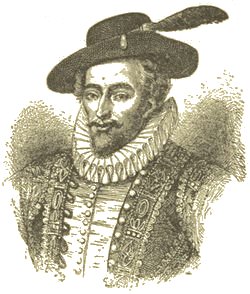
Among the cares and pleasures of a courtier's life, Raleigh preserved his zeal for American discovery. He applied his own resources to the fitting out of another expedition in 1583, under command of Sir Humphrey Gilbert, which proved more unfortunate than the former one; two out of five vessels returned home in consequence of sickness, and two were wrecked, including that in which the admiral sailed; and the only result of the enterprise was the taking possession of Newfoundland in the name of England. Still Raleigh's desire for American adventure was not damped. The continent northward of the Gulf of Florida was at this time unknown. But Raleigh, upon careful study of the best authorities, had concluded that there was good reason for believing that a considerable tract of land did exist in that quarter; and with the assent of the Queen in council, from whom he obtained letters patent, granting to himself and his heirs, under certain reservations, property in such countries as he should discover, with a right to provide for their protection and administration, he fitted out two ships, which sailed in April, 1584. The first land which they made was an island named Okakoke, running parallel to the coast of North Carolina. They were well received by the natives, and returned to England in the following autumn, highly pleased. Nor was less satisfaction felt by Raleigh, or even by the Queen, who conferred on him the honor of knighthood, a title which was then in high esteem, inasmuch as it was bestowed by that wise princess with a most frugal and just discrimination. She also gave him a very lucrative mark of favor, in the shape of a patent for licensing the selling of wine throughout the kingdom; and she directed that the new country, in allusion to herself, should be called Virginia. Raleigh did not think it politic, perhaps was not allowed, to quit the court to take charge in person of his undertaking; and those to whom he entrusted the difficult task of directing the infant colony, appear to have been unequal to their office. It is not necessary to pursue the history of an enterprise which proved unsuccessful, and in which Sir Walter personally bore no share. He showed his earnestness by fitting out several expeditions, which must have been a heavy drain upon his fortune. But he is said to have derived immense wealth from prizes captured from the Spaniards; and we may here observe that the lavish magnificence in dress, especially in jewels, for which Raleigh was remarkable, even in the gorgeous court of Elizabeth (his state dress is said to have been enriched with jewels to the value of £60,000), may be considered less as an extravagance, than as a safe and portable investment of treasure. A mind less active might have found employment more than enough in the variety of occupations which pressed upon it at home. He possessed a large estate, granted out of forfeited lands in Ireland; but this was always a source rather of expense than of profit, until, in 1601, he sold it to the Earl of Cork. He was Seneschal of the Duchies of Cornwall and Exeter, and held the wardenship of the Stannaries; and in 1586, as well as formerly in 1584, we find that he possessed a seat in Parliament. In 1587, the formidable preparation of the Spanish Armada withdrew the mind of Raleigh, as of all Englishmen, from objects of minor importance, to the defence of their country. He was a member of the council of war directed to prepare a general scheme of defence, and held the office of Lieutenant-General of Cornwall, in addition to the charge of the Isle of Portland; but as on this occasion he possessed no naval command, he was not actively engaged in the destruction of that mighty armament. In 1589 he served as a volunteer in the expedition of Norris and Drake to Portugal, of which some account has been given in the life of the latter. Nor were his labors unrewarded even in that unfortunate enterprise; for he captured several prizes, and received the present of a gold chain from the Queen, in testimony of her approbation of his conduct.
Soon after these events, Raleigh retired to his Irish property, being driven from court, according to some authorities, by the enmity of the Earl of Essex, then a young man just rising into favor. He there renewed a former intimacy with the poet Spenser, who, like himself, had been rewarded with a grant of land out of forfeited estates, and then resided at Kilcolman Castle. Spenser has celebrated the return of his friend in the beautiful pastoral, "Colin Clout's come home again;" and in that, and various passages of his works, has made honorable mention of the highly poetic spirit which enabled the "Shepherd of the Ocean," as he is there denominated, to appreciate the merit of the "Fairy Queen," and led him to promote the publication of it by every means in his power. The loss of Raleigh's court-favor, if such there were, could not have been of long duration on this occasion But he incurred more serious displeasure in consequence of a private marriage contracted with Elizabeth Throgmorton, one of the Queen's maids of honor, a lady of beauty and accomplishments, who proved her worth and fidelity in the long train of misfortunes which beset the latter years of Raleigh's life. In consequence of this intrigue, he was committed to the Tower. One or two amusing anecdotes are related of the devices which he employed to obtain forgiveness, by working on that vanity which was the Queen's chief foible. He succeeded in appeasing his indignant mistress so far as to procure his release; and about the same time, in 1594, she granted to him the valuable manor of Sherborne, in Dorsetshire; but though she requited his services, she still forbade his appearance at court, where he now held the office of Captain of the Yeomen of the Guard. Raleigh was peculiarly fitted to adorn a court by his imposing person, the graceful magnificence of his taste and habits, the elegance of his manners, and the interest of his conversation. These accomplishments were sure passports to the favor of Elizabeth; and he improved to the utmost the constant opportunities of intercourse with her which his post afforded, insomuch that, except the Earls of Leicester and Essex, no one ever seems to have stood higher in her graces. But Elizabeth's jealousy on the subject of her favorites' marriages is well known, and her anger was lasting, in proportion to the value which she set on the incense of Raleigh's flattery. He retired, on his disgrace, to his new estate, in the improvement and embellishment of which he felt great interest. But though deeply alive to the beauties of nature, he had been too long trained to a life of ambition and adventure to rest contented in the tranquil routine of a country life; and during this period of seclusion he again turned his thoughts to his favorite subject of American adventure, and laid the scheme of his first expedition to Guiana, in search of the celebrated El Dorado, the fabled seat of inexhaustible wealth. Having fitted out, with the assistance of other private persons, a considerable fleet, Raleigh sailed from Plymouth, February 6, 1595. He left his ships in the mouth of the river Orinoco, and sailed 400 miles into the interior in boats. It is to be recorded to his honor, that he treated the Indians with great kindness; which, contrasted with the savage conduct of the Spaniards, raised so friendly a feeling toward him, that for years his return was eagerly expected, and at length was hailed with delight. The hardships of the undertaking, and the natural advantages of the country which he explored, are eloquently described in his own account of the "Discovery of Guiana." But the setting in of the rainy season rendered it necessary to return, without having reached the promised land of wealth; and Raleigh reaped no other fruit of his adventure than a certain quantity of geographical knowledge, and a full conviction of the importance of colonizing and taking possession of the newly discovered region. This continued through life to be his favorite scheme; but neither Elizabeth nor her successor could be induced to view it in the same favorable light.
On reaching England, he found the Queen still unappeased; nor was he suffered to appear at court, and he complains in pathetic terms of the cold return with which his perils and losses were requited. But he was invested with a high command in the expedition of 1596, by which the Spanish fleet was destroyed in the harbor of Cadiz; and to his judgment and temper in overruling the faulty schemes proposed by others, the success of that enterprise was chiefly due. Indeed, his services were perhaps too important, and too justly appreciated by the public, for his own interests; for the great and general praise bestowed on him on this occasion tended to confirm a jealousy of long standing on the part of the commander-in-chief, the Earl of Essex; and it was probably owing to that favorite's influence that Raleigh was still forbidden the Queen's presence. Essex, and the Secretary of State, Sir Robert Cecil, regarded each other with mutual distrust and dislike. Cecil and Raleigh were connected by ties of common interest, and, as the latter supposed, of friendship. Still Raleigh found the interest of the minister too weak to serve his purpose, while the interest of the favorite was employed against him; and, as the only method of effecting his own restoration to the Queen's favor, he undertook to work a reconciliation between these two powerful rivals. In this he succeeded, to the great admiration of all spectators; and the fruit of his policy was seen in his re-admission to the execution of his official duties at court, June 1, 1597. In the following August he was appointed Rear Admiral in the expedition called the Island Voyage, of which Essex held the chief command. The slight successes which were obtained were again due to the military talents of Raleigh; the main objects of the voyage were lost through the Earl's inexperience.
From this time to the death of the Queen, Raleigh enjoyed an uninterrupted course of favor. Elizabeth was now old; Cecil took no steps to diminish the high esteem in which she held Sir Walter Raleigh, but he secretly labored to prejudice her successor against him, and he succeeded to his wish. Very soon after the accession of James I., Raleigh's post of captain of the guard was taken from him; and his patent of wines was revoked, though not without a nominal compensation being made. To complete his ruin, it was contrived to involve him in a charge of treason. Most writers have concurred in speaking of this passage of history as inexplicable; it is the opinion of the last historian of Raleigh, Mr. Tytler, that he has found sufficient evidence for regarding the whole plot as a device of Cecil, and he has supported this opinion by cogent arguments. Lord Cobham, a violent and ambitious but weak man, had engaged in private dealings with the Spanish ambassador, which brought him under the suspicion of the government. By a device of Cecil's (we here follow the account of Mr. Tytler) he was induced, in a fit of anger, and in the belief that Raleigh had given information against him, to accuse Sir Walter himself of being privy to a conspiracy against the government. This charge Cobham retracted, confirmed, and retracted again, behaving in so equivocal a manner, that no reliance whatever can be placed on any of his assertions. But as the King was afraid of Raleigh as much as the secretary hated him, this vague charge, unsupported by other evidence, was made sufficient to commit him to the Tower; and, after being plied with private examinations, in which nothing criminal could be elicited, he was brought to trial, November 17, 1603. For an account of that memorable scene we shall refer to Mr. Jardine's "Criminal Trials," Vol. I. It is reported to have been said by one of the judges who presided over it, on his death-bed, that "the justice of England had never been so degraded and injured as by the condemnation of Sir Walter Raleigh." The behavior of the victim himself was the object of universal admiration, for the tempered mixture of patience and noble spirit with which he bore the oppressive measure dealt to him. He had before been unpopular; but it was recorded by an eye-witness that "he behaved himself so worthily, so wisely, and so temperately, that in half a day the mind of all the company was changed from the extremest hate to the extremest pity."
The sentence of death thus unfairly and disgracefully obtained was not immediately carried into execution. James was not satisfied with the evidence adduced on the trial; and believing at the same time that Raleigh had been plotting against him, he set his royal wit to dive into the mystery. Of the singular scene which the British Solomon devised it is not necessary to speak, since Raleigh was not an actor in it. But as no more evidence could be obtained against him, even by the King's sagacity, he was reprieved, and remanded to the Tower, where the next twelve years of his life were spent in confinement. Fortunately, he had never ceased to cultivate literature with a zeal not often found in the soldier and politician, and he now beguiled the tedium of his lot by an entire devotion to those studies which before had only served to diversify his more active and engrossing pursuits. Of his poetical talents we have already made short mention; to the end of life he continued the practice of pouring out his mind in verse, and there are several well-known and beautiful pieces expressive of his feelings in prison, and in the anticipation of immediate death; especially "The Lie," and the beautiful little poem called "The Pilgrimage." He also possessed a strong turn for mathematics, and studied them with much success in the society and under the guidance of his friend, Thomas Hariot, one of the most accomplished mathematicians of the age. Chemistry was another favorite pursuit, in which, according to the standard of his contemporaries, he made great progress. But the most important occupation of his imprisonment was the composition of the "History of the World." The work extends from the creation to the end of the second Macedonian war. Raleigh meant to bring it down to modern times; but the untimely death of Henry, Prince of Wales, for whose use it was composed, deprived him of the spirit to proceed with so laborious an undertaking. He enjoyed the confidence of that generous youth in a remarkable degree, and maintained a close correspondence with him on civil, military, and naval subjects. Several discourses on these topics, addressed to the prince, will be found in the editions of Raleigh's works. Henry repaid these services with sincere friendship and admiration; and we may presume that his adviser looked forward to that friendship, not only for a cessation of misfortune, but for a more brilliant period of favor and power than he had yet enjoyed. Fortunately, however, his patron's death was preceded by that of his arch-enemy, Cecil; and through the mediation of the Duke of Buckingham, Raleigh was released from the Tower in March, 1615; and obtained permission to follow up his long-cherished scheme of establishing a colony in Guiana, and working a gold mine, of which he had ascertained the existence and situation.
The results of this disastrous voyage must be shortly given. Raleigh sailed March 28, 1617, and reached the coast of Guiana in November following. Being himself disabled by sickness from proceeding farther, he despatched a party to the mine under the command of Captain Keymis, an officer who had served in the former voyage to Guiana. But during the interval which had elapsed since Raleigh's first discovery of that country, the Spaniards had extended their settlements into it, and in particular had built a town called Santa Thome in the immediate neighborhood of the mine in question. James, with his usual duplicity, while he authorized the expedition, revealed every particular connected with it to the Spanish ambassador. The English, therefore, were expected in the Orinoco, and preparation had been made for repelling them by force. Keymis and his men were unexpectedly attacked by the garrison of Santa Thome, and a sharp contest ensued, in which the English gained the advantage, and burnt the town. In this action Raleigh's eldest son was killed. The Spaniards still occupied the passes to the mine, and after an unsuccessful attempt to dislodge them, Keymis abandoned the enterprise and returned to the ships. Raleigh's correspondence expresses in affecting terms his grief and indignation at this double misfortune: the loss of a brave and promising son, and the destruction of the hopes which he had founded on this long-cherished adventure. On his return to England, he found himself marked out for a victim to appease the resentment of the Spanish Court, to which he had long been an object of fear and hatred.
His conduct abroad had already been closely scrutinized, in the hope of finding some act of piracy, or unauthorized aggression against Spain, for which he might be brought to trial. Both these hopes failing, and his death, in compliment to Spain, being resolved on, it was determined to carry into effect the sentence passed fifteen years before, from which he had never been legally released; and a warrant was accordingly issued to the judges, requiring them to order execution. He insisted on the nature of his late commission, and on that plea being overruled, submitted with his usual calmness and dignity. The execution, with indecent haste, was ordered to take place on the following morning. In this last stage of life, his greatness of mind shone with even more than its usual lustre. Calm, and fearless without bravado, his behavior and speech expressed the piety and resignation of a Christian, with the habitual coolness of one who has braved death too often to shrink at its approach. His farewell to his faithful wife was manly, tender, and most affecting. The accounts of his deportment on the scaffold effectually refute the charges of irreligion and atheism, which some writers have brought against him, unless we make up our minds to believe him an accomplished hypocrite. He spoke at considerable length, and his dying words have been faithfully reported. They contain a denial of all the serious offences laid to his charge, and express his forgiveness of those even who had betrayed him under the mask of friendship. After delivering this address, and spending some time in prayer, he laid his head on the block, and breathing a short private prayer, gave the signal to the executioner. Not being immediately obeyed, he partially raised his head, and said, "What dost thou fear? Strike, man!" and underwent the fatal blow without shrinking or alteration of position. He died in his sixty-sixth year.
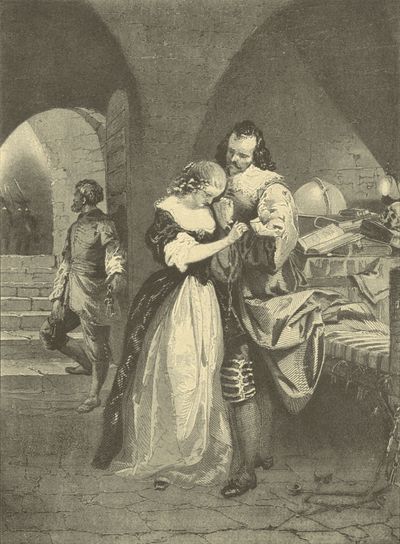
Raleigh parting from his wife.
Raleigh sat in several Parliaments, and took an active part in the business of the house. His speeches, preserved in the Journals, are said by Mr. Tytler to be remarkable for an originality and freedom of thought far in advance of the time. His expression was varied and animated, and his powers of conversation remarkable. His person was dignified and handsome, and he excelled in bodily accomplishments and martial exercises. He was very fond of paintings, and of music; and, in literature as in art, he possessed a cultivated and correct taste. He was one of those rare men who seem qualified to excel in all pursuits alike; and his talents were set off by an extraordinary laboriousness and capacity of application. As a navigator, soldier, statesman, and historian, his name is intimately and honorably linked with one of the most brilliant periods of British history.[Back to Contents]
MILES STANDISH[19] By Elbridge S. Brooks (1584-1656)
Relics of Miles Standish.
Three hundred years ago the house of Standish was a notable one in England. The family had numerous possessions; their Lancashire estate of Duxbury Hall, in the shadow of Rivington Pike and the Pennine Hills, was pleasant and extensive, and there they had lived for generations, as there they live to-day. Of this Lancashire home was that John Standish, "squire to the king," who killed Wat Tyler, the agitator, on that memorable June day of 1381 when the boy-king of England, Richard the Second, so pluckily faced his rebellious subjects on the plain of Smithfield; of it was that Sir John Standish who fought under the leopard-banner of King Edward at the stone mill of Crécy; and of it was that gallant soldier Miles Standish, the Puritan captain, the first commissioned military officer of New England, famous in American history, song, and story, as the stay and bulwark of the Pilgrims of Plymouth in their days of struggle and beginning.
Miles Standish (or Myles, as the old spelling has it) was born in Lancashire, presumably in the family manor house of Duxbury Hall, in the year 1584. The story of his life is simple. The absolute facts upon which it is based are meagre, but enough is known to warrant the assertion that Miles Standish was heir to the name and estates of the Standishes of Lancashire, from which, by some device not on record, he was, as he sturdily maintained in his will, "surreptitiously" defrauded.
At the beginning of the seventeenth century the provinces of the Netherlands were battling for life against the tyranny of Spain. The Protestant Elizabeth of England gave help and support to the Protestant Stadtholder Maurice, and many of her fighting men carried pike or arquebus at the sack of Cadiz, fought at Nieuport and Ostend, or served the guns in the great sea-fight off Gibraltar that, in 1607, broke the power of Spain. Among these fighting-men was young Miles Standish, and he fought so stoutly and to such good purpose that, before he was twenty-one he had attained the rank and title of captain, and was known to Englishmen in the Low Countries as a brave and gallant soldier. In 1609 came the twelve years' truce between tired Spain and not less wearied Holland, that gave way in 1621 to the stubborn and bloody Thirty Years' War. It was, probably, in the early years of this truce that Captain Miles Standish, a born fighter, went back to England to battle for his heritage. Not being the match for the law men in England that he was for Spanish dons in Holland, he was forced to retire from the unequal contest, defeated but not conquered. This belief in his rights to the inheritance of the Standishes he sturdily maintained to the last; for, dying forty years after in the new land his sword had helped to conquer and his wisdom to found, he left by his last will and testament unto his son and heir, Alexander: "Ormistic, Bonsconge, Wrightington, Maudeslay, and the estates in the Isle of Man"—none of which he nor his descendants were ever to occupy or hold.
It was after this unsuccessful struggle for his heritage that he crossed again to Holland and, from some cause not apparent—perhaps his disgust at English law, perhaps the attractions of one who, later, became Mistress Rose Standish, may supply the motive—settled among the self-exiled English folk in Leyden who, because of religious differences with the established Church, had left their English homes and, calling themselves Pilgrims because of their wanderings, had made a settlement in the Dutch city of Leyden, "fair and beautiful and of a sweet situation."
Although not of the religious faith and following of the Pilgrims of Leyden—indeed the story runs that the fiery little captain had been, at one time, a Romanist—he must have been settled among them for years, for, on the eve of their emigration to America, we find him as one of their leaders, accepted and commissioned as the military adviser of the colonists. The time of his life in Leyden was one of religious unrest in Europe; and in Holland, during that twelve years' truce with Spain, the theological disputes between Calvinists and Arminians ran so high as to bring John of Barneald to the scaffold, and to drive Grotius the scholar into exile. These days of stern dispute may have had their influence on the sturdy English soldier living in the midst of Dutch life and Dutch disputations, and made him lean to the side of Puritanism, even if never openly avowing it as his religious faith. It is, indeed, a singular fact that the mainstay and chief protector of the first Puritan colonists of America was neither of their communion nor of their connection, and is openly censured by Puritan writers as one who, so says Hubbard, "had been a soldier in the Low Countries and had never entered the school of our Saviour Christ or of John the Baptist." But his companions and associates seem not to have permitted the dissociation to have had special weight with them. They gladly welcomed Captain Standish and his wife, Rose, among the little company of exiles that set out from Delft Haven for Virginia, and gave their names place on that memorable passenger list of the little schooner Mayflower, which, leaving the harbor of old Plymouth, in England, in September, 1620, finally dropped anchor in the harbor of new Plymouth, in New England, in December following.
From the outset of this novel "adventure"—itself a turning-point in American history—this soldier of fortune was given place and prominence in the councils of a community which seems to have enlisted his support, not so much on its religious as on its adventurous side; and to this "dissenter from dissent" was intrusted the defence of a company of religious enthusiasts, sailing upon what they deemed a divine mission, only in the practical side of which did their military adviser find occupation or interest.
The up-bringing of Miles Standish had been such as to fit him for leadership, and this he assumed early in the history of the enterprise. Even on the deck of the Mayflower, he was recognized as one whose counsels were wise and whose actions were inspiring, and when in the cabin of the Mayflower, in the harbor of Provincetown, the famous compact was drawn up, said to be "the first written constitution in the world," the bold signature of "Myles Standish" was the clearest of the forty-one Pilgrim autographs that were affixed to that famous document. It was Captain Standish who, with his sixteen "well-armed men," made a thorough exploration of the Provincetown peninsula; he organized and headed the party of observation which, later, sailed the shallop and marched with watchful eyes along the shores of Cape Cod, seeking the best place for settlement; and, on December 6th following, he sailed with a picked party across Massachusetts Bay and, in much peril and with many adventures, spied out the land and determined upon the harbor of Plymouth as the best spot for permanent settlement. It was to Captain Standish's knowledge as to the best locations and to his skill as a surveyor, that the colonists were indebted for the selection of their town site and the laying-out of their town; as, later, the same skill came in play when were laid out the new towns that followed after the Plymouth beginnings. Through all that dreary and dreadful first winter, when half their number died, Captain Standish was their mainstay, as one whose word was ever reassuring and whose arm was as ready for protection as was his brain for planning methods of defence. Though his wife, Mistress Rose Standish, was one of the early victims of that bitter winter of death, his courage never faltered, his vigilance never slackened. And when, in the midst of all the peril and suffering, in February, 1621, Miles Standish was appointed military captain of the colony, confidence was restored and courage renewed in the bosoms of that suffering but heroic and indomitable band; so that when spring came and the Mayflower sailed for England, not one of the settlers returned in her, nor would desert the cause to which they had pledged themselves.