Volume 1 — SOLDIERS AND SAILORS (continued 4)
Reading edition
After a sojourn of some time at Constantinople, the Crusaders, now formed into one army, crossed the Bosphorus, and entered Bithynia. Here the sight of the carnage which the Turks had inflicted on the weak and disorderly body that Peter had led forth, stimulated the zeal and indignation of the Christian host. Its passage through the Turkish kingdom of Roum was not unresisted. David, then Sultan, a valiant prince, had already prepared an army, and fortified his capital of Nice,—a position of great natural strength.
The Crusaders advanced in excellent order, and, after twice routing the Turkish army of defence, commenced the siege. Godfrey is said to have distinguished himself by a feat of skill on one occasion during this assault. A gigantic Turk, who was the hero of the Moslem army, had greatly harassed the Christians by his wondrous success in the use of the javelin. Having spent his shafts one day, he ascended a tower, and showered masses of rock on the besiegers, whom he at the same time abused and defied to combat. The Christian archers played upon his person, without bringing him down; until Godfrey grasped a cross-bow, and at one shot pierced the giant's heart. The siege lasted seven weeks; and was prosecuted with such vigor and ingenuity by the Crusaders that the Turks were on the point of yielding, when Alexius, who had sent a body of Greeks with the army, craftily procured to himself the glory of conquest by instructing his general to intrigue with the enemy secretly, and persuade them to yield to his power, on condition of protection. The Greek general so worked upon the fears and hopes of the garrison, that his advice was accepted; and, to the surprise and anger of the Franks, the emperor's flag one day appeared on the towers of Nice, and the city surrendered. This act of perfidy reopened the jealousy between the Eastern and Western Christians, which Godfrey had labored to extinguish; and from this time may be dated the rise of those internal divisions which eventually proved so fatal to the Crusaders.
Leaving Nice, the Crusaders advanced in two divisions, both without guides, and through a hostile and desert country. The Turks, in great numbers, followed in their rear. Godfrey and the Count of Toulouse headed one division; Bohemond, Prince of Tarentum, and Robert, Duke of Normandy (son of William the Conqueror), the other. The latter body had separated from the former at some distance, and was traversing the plains near Dorylæum, in Phrygia, when a sudden attack was made upon it by a powerful army of Turks. The Christians were taken by surprise, while exhausted with heat and fatigue, and in an unfavorable situation. In spite of the heroic valor of Bohemond, Robert, and other knights, the battle was turning against them, when Godfrey's division, to which a message had been despatched, came up. He shouted aloud the Crusaders' war-cry: "It is God's will!" and the whole army, echoing the shout, by a gallant charge retrieved the fortunes of the day and completely routed the Turks. After this success the Crusaders resolved to march in a single body, and thus prevent a recurrence of the hazard which they had escaped. The Turks preceded them, burning the crops as they went, and the Christians, in consequence, suffered fearful privations from famine during the march. Hundreds perished from exhaustion. The horses died for want of sufficient food and water; and knights were seen either walking on foot, or riding on oxen and asses, carrying their own armor. In passing through Pisidia, an anecdote is related of Godfrey which is characteristic of his courage and gallantry. He was wandering among the recesses of a forest in pursuit of game, which was needed for the supply of the troops, when he came upon a private soldier of the army, who was defending himself from the attack of a bear. Godfrey struck at the beast, which at once turned on its new assailant, inflicting a deep wound in his thigh. Another stroke from the skilful hunter's arm terminated the contest; but the blood streamed from his wound so rapidly, that he scarcely reached the camp alive. The grief of his soldiers was intense, as they beheld their beloved leader stretched on a litter, and borne into his tent as if dead. The skill of his physicians and a long interval of rest triumphed over the weakness occasioned by the loss of blood, and Godfrey once more appeared at the head of his army.
Antiochetta, the capital of Pisidia, attempted no resistance; and here the main body of the Christians recruited for some time. Meanwhile, a party of Crusaders, headed by Baldwin, brother of Godfrey, and a famous knight named Tancred, had been sent forward to clear a passage for the army. Tancred subdued the city of Tarsus; but his victory was usurped by Baldwin, whose ambitions and covetous nature bore no resemblance to that of his brother. Tancred, a man after Godfrey's heart, surrendered this conquest for the sake of peace; but, when Baldwin showed symptoms of repeating his injustice, resisted by force. Tancred was defeated, but a reconciliation took place between the combatants. Baldwin, who had no real interest in the success of the Crusade, soon afterwards turned aside into Mesopotamia, where he made himself master of Edessa, and formed a Christian state there. Though founded by merely personal ambition, this eventually proved of great assistance to the Crusaders, by checking the progress of the Turkish arms in Asia.
The main body now crossed the Taurus, after a tedious and painful passage, and presented itself before the walls of Antioch, then ruled by an independent Turkish emir named Accien. This city was especially dear to the Christians, as the first in which their title had been assumed; and the sight of its walls roused their flagging spirits. Some of the generals advised that the siege should be deferred for some months, until reinforcements arrived, and the winter was over; but the majority of the chiefs, among whom Godfrey was conspicuous, confident of success, and dreading the depressing influences of delay, urged an immediate attack, which was accordingly made. The Turks adopted the stratagem of apparently neglecting to defend the city; and the Christians, falling into the snare, scattered their forces. The licentiousness of some of their number, moreover, proved fatal to their vigilance, and a sudden sortie of the garrison inflicted deadly havoc. The siege was then commenced in earnest; but the city was so strongly guarded, that months elapsed without any impression being made upon its walls; and disease, famine, and the inclemency of the season, united with the missiles of the Turks to weaken the Christian force. Many of the leaders (Robert, Duke of Normandy, among them), withdrew in cowardly disgust at the failure of the siege and the pressure of want; while despair drove many of those who remained to courses of reckless vice. Godfrey, firm to his duty and strong in faith, aided the exertions of the clergy in encouraging the spirits of his troops, and restraining their profligate excesses. A timely supply of provisions from some of the Armenian monasteries, and a brilliant victory obtained by Bohemond and the Count of Toulouse over an army which the Sultans of Aleppo and Damascus had sent to the succor of Antioch, rewarded Godfrey's confidence and infused new vigor into the hearts of his army. This was needed to sustain the brunt of a desperate encounter which shortly afterward took place between the besieged and their besiegers. A reinforcement of Italian Crusaders having arrived, it was suddenly attacked by a large Turkish force, and thrown into disorder. Godfrey, who had been engaged on the siege, rapidly marshalled his men, and fell upon the enemy. A sortie of the garrison was immediately made, and a fearful conflict ensued under the walls of the city. The Turks were put to flight with immense loss, and the Christians pursued them up to the very gates. In this scene of carnage, Godfrey's recorded feats of valor approached the incredible. His sword clave the stoutest armor asunder at a blow. A gigantic Arab horseman offered him single combat, and broke his shield by way of challenge. Godfrey rose in his stirrups, and smote the Arab on the shoulder with such tremendous force as to split his whole body in twain; half of which, with the head, fell into the river Orontes, while the remainder, yet clinging to the terrified horse, was carried back into the city.
Notwithstanding all these exploits, the Turks held out, and were only defeated at last by stratagem. This was achieved by the skill of Bohemond, who intrigued with Phirous, one of the leaders of the garrison, for the surrender of the city, upon favorable terms to himself. Bohemond stipulated with his fellow-chiefs that the principality of Antioch should be granted him in return for his services; and, after some opposition, this was conceded. Phirous managed the perilous task of admitting the Crusaders with the utmost adroitness. At the dead of night the walls were scaled by Bohemond and his followers, and Antioch was taken, in June, 1098, after a siege of eight months. Accien, its prince, and 6,000 Turks, are said to have fallen on this eventful night.
The Crusaders had no sooner obtained this signal success than they were in their turn besieged by an army raised by the Sultans of Mossoul and other cities. Antioch had just sustained so long a siege, that the Christians found scarcely any provisions on their entrance, and their besiegers now cut off all supplies from without. Famine soon raged in the city to such an extent, that horses, roots, leaves, leathern shoes, and even human bodies, were eagerly devoured by the starving soldiers. Godfrey shared his scanty meals with his comrades, and is related to have slain his last charger for food. Desertion from the ranks now occurred in great numbers, and despair led many to blaspheme who were ashamed to fly. To add to the misery of the Christians, they learned that the Emperor Alexius, who was advancing with reinforcements, had judged their case hopeless, and retraced his steps. The city was now scarcely defended, and many proposed to surrender it, even on degrading terms, so that their lives were spared.
Godfrey and the clergy again exerted themselves successfully. They ventured to challenge the Turkish army to a combat of picked troops; and when the proposal was spurned, boldly advanced to attack the whole force. The appearance of the Crusaders, as they marched out of the city, must have been indeed pitiable. Privations had so reduced them, that many had no clothing. Some were nearly fainting from weakness. The barons and knights proceeded chiefly on foot, and camels and asses supplied the place of horses to most of those who rode. Yet the burning zeal of the Christians made the march seem like a triumphal procession; and while the clergy sang hymns of consolation and victory, the soldiers responded with the war-cry, "It is God's will! It is God's will!" The Turkish general, fearing nothing from an army so scantily provided with the means of war, was taken by surprise, but hastily arranged his troops in order of battle. The sight of several natural prodigies, such as the sudden appearance of a meteor, and the favorable direction of the wind, acting upon the superstitious fancy of the Christians, impelled them to extraordinary exertions. The Moslem forces, on the other hand, were weakened by the existence of rivalries and discords in their midst, and lacked the stimulus which the Christians derived from desperation. The attack was commenced by a volley of arrows, followed by a charge of the Turkish and Arabian archers, which the Crusaders not only steadily sustained, but vigorously returned. Godfrey, who commanded their right wing, broke the left wing of the Moslem; but the latter had encompassed the river with a large force, and attacked the Christians in the rear. In spite of the heroism of Godfrey and Tancred, who slaughtered all that ventured to compete with them, and the brave resistance of the whole army, the enemy was evidently gaining ground, when (according to the historians) three horsemen, in brilliant armor, suddenly appeared at the head of a reinforcement descending from the adjacent mountains. Some of the clergy seized on this circumstance to reanimate the Crusaders. "Behold your heavenly succor!" cried a bishop. "Heaven has sent the holy martyrs, George, Demetrius, and Theodore to fight for you!" As he spoke, the whole army seemed inspired with irresistible strength; and, shouting the well-known war-cry, made another vigorous charge which broke the Moslem ranks. The Sultan of Mossoul fled, and his immense force dispersed in the utmost disorder. The extravagant number of 100,000 is said to have fallen in this engagement.
The Crusaders, instead of proceeding at once to Jerusalem, remained for several months in Antioch, employing the time in re-establishing Christianity in that city, and sending to their brethren in the West for further aid. The delay was prejudicial, as the disputes between the rival chiefs, which the din of war had silenced, again broke out, and disease committed terrible ravages in the camp. Certain expeditions, however, were made in the neighborhood, and several towns fell into the hands of the Christians. Meantime, news arrived that an army of Egyptian Arabs—who acknowledged the Fatimite caliphs, and had as yet resisted the attempt of the Turks to usurp dominion over all the followers of the Prophet—had captured Jerusalem. The Crusaders, filled with indignation, resumed their march to the Holy City, conquering on their way several towns. Embassadors were sent from the Caliph of Cairo with superb presents to the Christian leaders, and proposals of peace between them and the Egyptians. But Godfrey would not be bribed to accept the humiliating terms proposed; one of which was, that only unarmed Christians should be admitted into the city. The embassadors were sent back with the answer that the Crusaders were on their march, and, if opposed, might extend their conquests even to the Nile.
By daybreak on June 10, 1099, the Christian army came in sight of Jerusalem. The spectacle transported all with mingled feelings of joy, reverence, and remorse. Some fell on their knees and prayed; others kissed the sacred soil; many wept for their sins; and the air ever and anon resounded with the shout: "It is God's will!" The siege was commenced at once, Godfrey fixing his camp on Mount Calvary. The Egyptians had prepared for a protracted defence, by strengthening the fortifications and furnishing the garrison with ample provisions. They had likewise ravaged the neighboring country, and filled up the cisterns so as to harass the besiegers as much as possible. Owing to these impediments the Christians made slow progress. After various disappointments, however, they at length manufactured engines of great size and strength, shaped like towers, which were to be wheeled up to the walls, so as to enable the besiegers to enter by means of drawbridges. On July 14, 1099, at daybreak, the Crusaders were in arms, and at the same moment the assault was made on various points. Godfrey stood on his wooden tower, which was stationed near one of the gates, and by voice and action stimulated his soldiers to deeds of daring. His death-dealing javelin never missed its aim. The Egyptians employed every possible agent of defence,—showering down boiling oil, combustible materials, and various descriptions of missile, on the heads of their assailants. During the first day the Crusaders were repulsed at every point; but on the morrow fortune turned. The first half of the day was with the Egyptians, who cast lighted torches against the wooden engines of the Crusaders, and effected the destruction of many. Godfrey was, as usual, conspicuous, and became the mark of repeated attacks,—the cross of gold which surmounted his tower especially enraging the Moslem. An incident, supposed to be supernatural, was the immediate cause of the Christians' success. Godfrey and the Count of Toulouse at the same time observed the figure of a knight on the Mount of Olives, who with his buckler signalled to the Christians that they should enter the city. The two leaders, animated by a common feeling, cried out, "Behold St. George!" The enthusiasm of the Crusaders from this moment was irresistible. Godfrey's tower was first pushed close beside the walls, and in spite of flame and missile the drawbridge was lowered. Then, accompanied by several of his bravest knights, he dashed into the city. Others followed at the same point; the gates were broken down, and Jerusalem was taken. A horrible carnage of the Moslem ensued, in which Godfrey, although unable to check, refused to share. His first act was to retire from his comrades, and with three attendants to repair, unarmed and barefooted, to the Church of the Sepulchre. His vow was accomplished, and the desecration of one holy site atoned for by the preservation of another yet holier. This act of devotion, so worthy of the true Crusader, recalled from carnage those who had forgotten their vows in the thirst for vengeance, and the whole army, led by the clergy, followed him to the same church in penitential procession.
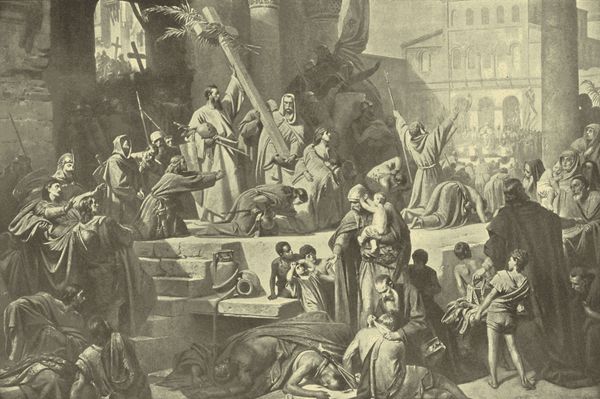
Godfrey De Bouillon entering Jerusalem.
Godfrey's work was now nearly ended, and his reward came. The leaders of the army, soon after the capture of the city, held a council for the purpose of deciding to whom should be given the crown of Jerusalem. No decision was arrived at; so many various opinions being expressed, and so many interests at stake. Ten of the most esteemed chiefs were then formed into an elective body, and proceeded to make careful inquiries into the fitness of those who were proposed for the kingly office. Godfrey took no part, it would seem, in either discussion or inquiry, and displayed no sort of anxiety as to his own claims. But the clergy and the mass of the soldiers were devoted to him,—endeared as he was by a thousand memories of his piety, courage, and generosity. On all hands the electors heard his praises sounded, and, to the joy of the whole army, they concluded their labors by announcing the choice to have fallen upon him. But, to the surprise of all, he declined the offered rank. "I will not wear a golden crown," said he, "in a city where my king and Saviour has been only crowned with thorns." All that his fellow-chiefs could persuade him to accept was the title of Defender and Baron of the Holy Sepulchre, though he did not deem it right to refuse the kingly authority. He soon had occasion to exert his power, for the Caliph of Cairo had by this time collected a large army, and was on his march to Jerusalem. The Crusaders, though unfitted for a fresh campaign, prepared to defend their conquest, and, at the head of his troops, Godfrey advanced toward Ascalon, where the enemy was stationed. A battle took place on the adjoining plains, in which the Moslem force was routed with terrific slaughter. The city itself would have fallen but for the covetous spirit displayed by the Count of Toulouse, who, unable to obtain a promise that the possession of the place should be given him, deserted Godfrey with all his men. A quarrel ensued between the two leaders, but was terminated through the influence of their brothers in arms,—Godfrey being ready to forgive any injury to himself for the sake of the common cause.
The Crusade was now completed, but Godfrey's duties as king were yet to commence. He set about fulfilling them with activity, fortifying various important positions, subduing revolts of hostile tribes, dividing the conquered territories equally among his generals, according to the feudal system, and summoning an Assize, or Assembly of his wisest councillors to draw up a code of laws. This code, which long remained in operation, amply testified to the legislative wisdom of the Crusaders. But the new state was not long favored with his presence to enforce and exemplify its constitution. In returning from a successful expedition against some Arabs of Galilee, he was met by the Emir of Cæsarea, who offered him a present of fruits. Godfrey tasted a cedar apple, and immediately was seized with illness. He died, not without suspicion of poison having been thus administered, shortly after reaching Jerusalem, commending to his comrades the care of the holy places, and the state which he had founded. His age scarcely exceeded forty years.
One of the most celebrated and beautiful Italian poems, the "Jerusalem Delivered" of Tasso, has "the pious Godfrey" for the presiding hero of the glorious scenes which it narrates. But there are no grounds for supposing that his fame belongs to romance rather than history. Contemporary writers have painted his portrait in no less flattering colors than Tasso has used, and the poet's affectionate fancy has scarcely exaggerated the tribute which the soberest historian may feel warranted in rendering to the memory of the great and good Crusader, Godfrey de Bouillon.[Back to Contents]
SALADIN[13] By Walter Besant (1137-1192)
Yûssuf ibn Ayûb—Joseph the son of Job—was by descent a Kurd. His father was a retainer or follower of the celebrated Nûr-ed-Din (Light of Religion), Sultan of Syria, the prince who, after many years of humiliation, recovered some of the lost prestige of the Mohammedan name, wrested many of their outlying strongholds from the Christians, and prepared the way for his more illustrious successor.
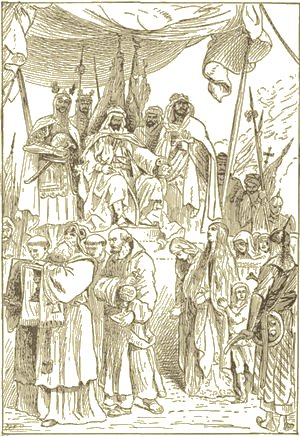
The caliphate was then divided into the Fatimite line, which reigned at Cairo, and the Abbaside, which reigned at Baghdad. Both branches had by this time fallen into a mere semblance of authority. The bitterness of theological differences survived, and though for the re-establishment of Moslem power, it was absolutely necessary that the schism should cease, there seemed no likelihood whatever of any change. The weaker of the two, since the rise of Nûr-ed-Din, was undoubtedly the Egyptian house. The last of the Fatimite caliphs were mere tools in the hands of rival ministers, and passed their ignoble lives—Rois Fainéants—in their luxurious palaces. Syria, which had been theirs, was lost to them, and occupied partly by Mohammedans of the rival sect, and partly by the Christians. Their final fall, however, was caused by internal dissensions and the quarrels of two candidates for the post of Grand Vizier. Their names were Shawer and Dargham. The former, unable to contend against his rival, applied for assistance to Nûr-ed-Din, offering for reward a third of the Egyptian revenues. The expedition which was sent in reply was the first chance of distinction which young Yûssuf had obtained. The army, commanded by his uncle Shirkoh, easily defeated Dargham and reinstated Shawer. Then followed the reluctance to keep the terms of the agreement which is so common in history; and when Shirkoh in return seized the city of Balbek and held it as security, Shawer sent to Amaury, King of Jerusalem, for succor. Amaury, the bravest if not the wisest of the Crusader kings, thinking that here was a chance of striking a double blow, readily acceded, and joining the Fatimite army forced Shirkoh to retire. It was, however, only in order to collect new forces. Next year he was back again. Alexandria was taken by his nephew, and held for three months against the combined forces of Christians and Fatimites. At last a peace was agreed upon: both Christians and Damascenes were to retire, each party to have a share in the revenues of Egypt. The first part of the contract was faithfully carried out; the second part neither Syrian nor Christian expected to be obeyed. And now the same ambition possessed the mind both of Amaury and of Nûr-ed-Din. This was nothing less than the conquest of Egypt. Both perceived that the Fatimite power was gone. Both realized the fact that the country could easily be overrun. As for the Christian king, he had dreams of a splendid and luxurious capital, grander than his own narrow city set in the midst of the mountains; his knights, orientals now and fallen from the old western rudeness, looked on with envy at the luxuries of these weak Mohammedans; it would be a fine thing to transfer the capital of the Christian kingdom in the East to Cairo, leaving Jerusalem as a Christian Mecca, a city for the priests. And the Syrian sultan, for his part, would restore the unity of Islam, would unite Egypt with Syria, and by the strength of that union would destroy the Christian and recover the Holy Places. These were schemes worthy of statesman or of soldier. The only question was—how were they to be realized?
The point which Amaury failed to understand was this. He who moved first was bound to lose. For he would draw upon himself the other two. Amaury moved first. We cannot follow the Christian king on his disastrous attempt. It is sufficient to say that Shirkoh, after a brief struggle, remained master of the field and of Egypt, and that the fall of the Latin kingdom, thus rendered possible, was only delayed until the consolidation of the new power was complete.
Immediately after his final victory Shirkoh died, and was succeeded by his nephew Yûssuf ibn Ayûb, now called Salah-ed-Din (Shield of Religion), el Melek el Mansûr (the Victorious King), and Emir el Jayûsh (Commander-in-chief of the Forces). The Fatimite caliph, not yet deposed, made him Grand Vizier. In other words this soldier of fortune was master of Egypt and of the Fatimite caliphate. More important still, if the King of Jerusalem understood the importance of the fact, he acknowledged himself to be the vassal of Nûr-ed-Din, Sultan of Syria.
The first step taken by Saladin, a coup d'état which restored Egypt to the orthodox sect, was the substitution of the Abbaside caliph's name for that of their own prince in the Friday prayers. This was done without the slightest opposition; contempt for the head of their religion could not be more effectually shown; Saladin therefore boldly proclaimed the name of the Baghdad caliph. It was received so quietly, as the Arab historian says, "that not a brace of goats butted over it." The last of the Fatimite caliphs died a few days after: it was one of those deaths, so frequent in history, which occur so exactly at the moment most convenient. Did Saladin order him to be bowstrung? Probably. Such an act would be regarded as perfectly legitimate and in accordance with the rules of the game.
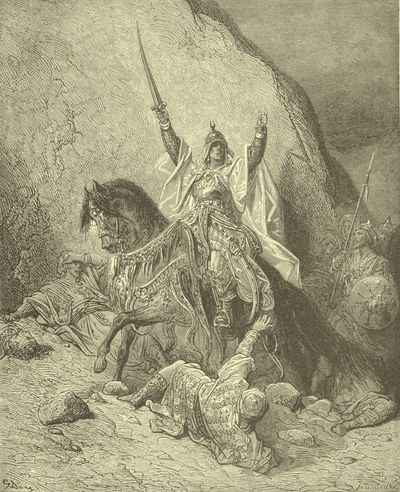
Saladin.
How the victorious emir, on the death of Nûr-ed-Din, succeeded in making himself master of Syria and succeeding his lord; how he carried on the war with the Christians unceasingly, would require in the telling volumes. Many volumes indeed have been devoted to this history. His two great achievements were the reunion of Islam and the destruction of the Latin kingdom of Jerusalem. The latter at least, he effectually accomplished. Western Europe was incapable of a second effort so great as that mighty wave of enthusiasm which won back the Holy Land and covered the plains of Asia Minor with the bones of Crusaders. Richard Cœur de Lion and Philip Augustus, Frederick II., the kings of Cyprus, the Knights of St. John, carried on the long, interminable struggle, but Jerusalem was lost.
Of the chivalry and honor of Saladin his biographers are never weary. When, for instance, the Christians took Jerusalem they slaughtered every soul in the place; their horses were knee-deep in blood. When Saladin took the city he suffered none to be slain; when there was no more money for ransom he suffered thousands to go free; to the weeping widows and fatherless girls he gave purses of money and suffered no outrage to be done to them. He divided them into three bands and assigned an escort to each company. And then was seen the strange spectacle, when the women and children grew fatigued, of the victors placing them on their horses and walking afoot, or even carrying the children in their arms. Again, why has no one painted that famous scene when Richard Cœur de Lion wanted no oaths, but instead gave his hand to Saladin in token of respect for his enemy and his own loyalty?
Such is the brief history of Saladin, a soldier first, always a soldier, spending his whole life on the battle-field; the perfect knight of the Mohammedans, fierce in fight, generous in victory, faithful to his word, true to his religion, of a larger heart and nobler soul than Cœur de Lion, the only antagonist who can be named with him; one of the few out of the countless millions of humanity, whose name lives and whose memory will never die; his life an example; his history a monument.[Back to Contents]

EDWARD I. OF ENGLAND By Thomas Davidson (1239-1307)
Edward I., King of England, was the elder of the two sons of Henry III., by his queen, Eleanor, daughter of Count Raymond Berenger of Provence, and was born at Westminster, June 17, 1239. His name was given him by his father out of reverence for the memory of Edward the Confessor, and in its English sound, as well as in the honest English temper, no less than the yellow hair and stalwart figure with which the young prince grew up, Englishmen might well have read the promise, that once more, after two hundred years, England would be ruled by a native English king. Edward was brought up at Windsor, was given by his father in 1252 the government of Gascony, and in 1254 married, in the monastery of Las Huelgas, Eleanor, sister of Alfonso X. of Castile, receiving immediately thereafter from his father Gascony, Ireland, and the Welsh march betwixt the Conway and the Dee, where, in fighting with the turbulent Welshmen, he learned his first lessons in warfare.
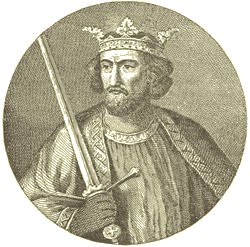
At the Parliament of Oxford (1258) he took part with his father in his contest with his troublesome nobles, but thereafter appears to have at first sided with the great Earl Simon de Montfort, the leader of the barons or national party, without, however, impairing his own personal loyalty and affection for his father, with whom ere long he was reconciled. It was his rash eagerness in pursuing an advantage gained over the Londoners, who were devoted to the party of Simon, that lost the battle of Lewes (1264), one immediate consequence of which was the prince's imprisonment as a hostage for his father's pledges. Conditions for his liberation, discussed at Simon's famous parliament of 1265, were frustrated through Edward's escape by a stratagem from Hereford Castle; and at the final battle at Evesham (August 4), where Simon recognized in the skilful disposition of his enemy's forces a fatal lesson learned from himself, the struggle practically ended with the great popular champion's death on the battle-field. Edward gained much influence by the wise prudence and moderation with which he stamped out the last embers of rebellion.
In 1270 he started, at the instigation of Louis IX. of France, to join the last of the Crusades, but when he reached Tunis, found that king dead, and the expedition already desperate of success. He went on to Acre, and won great renown as a knight, but failed to save the Frankish kingdom in the East from its inevitable fate. In June, 1272, while sitting alone on his bed, his own strength and energy saved him from being murdered by one of the infamous sect of the Assassins. Hastily guarding himself with his arms, and receiving a desperate wound, from which he afterward suffered much, he tore the knife from his assailant's hand, and buried it in his heart. The ancient story that his queen Eleanor, who had followed him in his pilgrimage, saved his life at the risk of her own by sucking the poison from the wound, unfortunately lacks historical support, but fits well with the romantic temper of the times, as well as with the deep affection that survived throughout life betwixt husband and wife.
Two months later he started for home, and at Capua, in the January of 1273, heard of his father's death two months before. Meantime he had been quietly proclaimed king, and as things went well in England, he visited the pope, did homage at Paris for his French provinces, and did not return to his kingdom till the August of 1274. At his coronation he received the homage of Alexander III. of Scotland for his lands in England, but Prince Llewelyn of Wales neglected the summons to attend, and only did his homage in 1276, under the combined terrors of excommunication and the royal army. Edward at once commenced that wise and large policy of domestic consolidation and financial as well as legal reform, that has shed such lustre upon the reign of the English Justinian, as he has been called, and made it almost the most important epoch in the constitutional history of England.
His first warfare was with the turbulent and disaffected Welshmen, who had profited by the intestine turmoil of the preceding reign, and intrigued perpetually with the rebellious nobles of Henry III. for their own ends. The forced peace of 1277, and the national dissatisfaction at the stringent terms granted by Edward, which was not abated by the personal favors he heaped upon the princes Llewelyn and his brother David, were but the preludes to the final struggle which commenced three years later, and ended in the complete suppression of Welsh nationalism, with the defeat and death of Llewelyn, near Builth, in Brecknockshire, and the cruel execution of David at Shrewsbury, as a traitor, in 1284. By the famous Statute of Wales in the same year, the ancient principality was finally annexed to the English crown, while English laws and English institutions were forced upon the conquered people.
Edward devoted the next year to legislation, then went abroad to mediate, without success, in the quarrel between France and Aragon. He had soon to return to quell fresh disturbances in Wales, and even in England, where the great Statute of Winchester, which had been passed in 1285 to place the defence of the country on a really national basis, had not yet had time to effect its end. Finding that most of his judges had been corrupting justice, he punished them with an iron hand, next banished in 1290 all the Jews to the number of over sixteen thousand from the kingdom, on the plea of extortionate usury. Earlier in the reign he had hanged 280 for money-clipping and forgery.
Just at this time the death of the young Scottish queen, the Maid of Norway, whom Edward had caused to be betrothed to his eldest surviving son, Edward of Caernarvon, opened up a fatal contest for the Scottish crown, which gave Edward his opportunity to assert anew the old but somewhat shadowy claim of the English crown to the over-lordship of Scotland. The southern half of that composite kingdom was inhabited by people of English blood and English institutions; its southeastern part, the Lothians, had undoubtedly once formed part of the Anglian kingdom of Northumbria; while its southwestern, Strathclyde or Scottish Cumbria, the population of which was in great part Celtic, had in 945 been given by the English king Edmund I. to Malcolm as a fief. The northern portion of the kingdom was purely Celtic in blood, and had at no time been subject to English influences, but though the reigning family was itself of Celtic origin, its authority hardly extended effectively beyond the region inhabited by men of English blood. Undoubtedly the Scottish king in 921 chose Edward the Elder "to father and to lord," and the right then acknowledged was claimed successively by William the Conqueror, Rufus, and other English kings. Moreover, from the twelfth century it had been customary for the Scottish kings or their sons to receive English earldoms, and do homage for them, but it continued to remain somewhat vague whether such homage was understood to be extended beyond these earldoms, so as to include the Lowland provinces and the whole Scottish kingdom. William the Lion, taken prisoner at Alnwick in 1174, for his freedom acknowledged the supremacy of Henry II. in the treaty concluded at Felaise on December 7; but on his return found his subjects ill-disposed to accede to his cowardly submission; and fifteen years later the claim founded on this special act of submission was formally renounced for a sum of 10,000 merks by Richard I., who was eager to raise money for his Crusade. Such was the ill-defined position of this ancient controversy, when fate seemed to fling into Edward's hands the opportunity of defining it anew with all the clearness dear to his legal mind. It was easy for him to secure a recognition of his superiority from the selfish and eager candidates for the crown, and meantime he secured the Scottish castles, and after a deliberate examination of the rival claims, decided in favor of John Baliol, who, on his accession, paid homage distinctly for the whole kingdom of Scotland. He soon found his position as a vassal-king intolerable, betwixt the unruly turbulence of his subjects and the imperious demands of his overlord, who allowed appeals to be led from Baliol's subjects to himself.
Meantime the ambitious projects of the new King of France, Philip IV., involved Edward in anxieties for the safety of Guienne and his other possessions in France. Ere long the high-handed conduct of the French king made war necessary, and Edward, with characteristic energy, at once began his preparations, and summoned in 1295 an assembly of the estates of the realm, which was practically the beginning of the modern parliaments.
The ever-increasing exasperation of the Scots at length broke out into open warfare in 1296. Edward at once marched northward, captured Berwick, and carried his victorious arms as far north as Aberdeen, Banff, and Elgin, taking the great castles on the way, formally accepted Baliol's surrender of the crown at Montrose, and returned to Berwick (August 22), carrying with him the famous coronation-stone from Scone, after having subdued the whole kingdom in about five months. Here, six days later, he received the fealty of the clergy, barons, and gentry of Scotland, whose names fill the thirty-five skins of parchment known as the "Ragman Roll."
At length he was at liberty to turn to France, but the great cost of his late expenditure had already driven him to make such heavy demands upon the revenues of the Church, that the clergy now refused fresh subsidies, headed by Archbishop Winchelsea and supported by the bull "Clericis Laicos" of Pope Boniface VIII. The king retaliated by placing the clergy of the kingdom in outlawry. At the Salisbury parliament in February, 1297, the great barons also refused to take part in foreign war, while the merchants were exasperated because their wool had been seized. A compromise was soon effected with the clergy, and a temporary illegal grant for the immediate purposes of the war was procured from the nobles and commons who were with him. Edward sailed for Flanders, and at Ghent confirmed the Charter with such supplementary clauses as were demanded by his refractory nobles, thus finally establishing the right of the people themselves to determine taxation.
This is only second in importance to Magna Charta itself as a landmark in the history of England. The suspicious fears of his people compelled Edward to repeat the confirmation at London in 1300, and again at Lincoln in 1301—an insult to his honesty which the king never forgave, and to which his subsequent banishment of Winchelsea was due. In 1303, and again the year after, Edward, in desperate straits for money, levied, by agreement with the foreign merchants, some new customs—the beginning of import duties, without consent of the estates, and collected a tallage from the royal demesne; and again, in 1305, he obtained from Clement V. a formal absolution from the obligations of 1297. It is true that the first two measures were contrary to the spirit rather than the letter of his promise, and that he never sought to avail himself of the dangerous power granted him by the papal absolution, yet these three facts, says Bishop Stubbs, "remain on record as illustrations of Edward's chief weakness, the legal captiousness, which was the one drawback on his greatness."
It was the dangerous aspect of affairs in Scotland that forced the king to submit so easily to the demands of his barons. Already, in the spring of 1297, Wallace, without any countenance from the Scottish nobility, had commenced a guerilla warfare, and his handful of desperate men soon increased into an army, which completely defeated Earl Warenne and Cressingham at Cambuskenneth (Stirling Bridge), in September, 1297, and ravaged England, with the most atrocious cruelties, from Newcastle to Carlisle. Edward's expedition to Flanders had been a failure, but he hastened to conclude a truce, so as to find time to chastise the Scots, cementing it by his betrothal to Philip's sister Margaret. The good Queen Eleanor had been already dead nine years.
Meantime, Wallace's success had merely earned him the bitter jealousy of the Scottish nobles, and his power was finally broken in the disastrous defeat by Edward's army at Falkirk in July, 1298. The king had two of his ribs broken by a kick from his horse on the morning of the battle, but rode throughout the day as if unhurt. The struggle lingered on some years under various leaders, as Edward found his energy paralyzed the while by the intrigues of Philip, and the constitutional struggle with his barons. Pope Boniface, in 1301, put forth a claim to the over-lordship of Scotland, which was repudiated by the whole body of the estates at Lincoln. It was not till the June of 1303 that the king was able to resume his conquest. Accompanied by a fleet carrying his supplies, he penetrated again into the far North, tarried a while in Dunfermline, and settled the kingdom after the reduction of Stirling, the last place of strength that held out. In 1305 Wallace was betrayed into his hands, sent to London, and cruelly executed as a traitor. The fate of this noble-hearted patriot is a fatal blot upon his conqueror's memory, but it should not be forgotten that Edward was profoundly convinced of the legality of his own claims over Scotland, and that Wallace to him was merely a pestilent rebel, who had earned his doom by treason to his lord and by the cruelties he had inflicted upon Englishmen. The same year the king prepared a new constitution for the conquered kingdom, divided it into sheriffdoms like the English counties, and made arrangements for the representation of the Scots in the English parliament—a measure which, had it been successful, might have anticipated by four centuries the benefits of the union.
It might now have been expected that Scotland was effectively subdued, but ere long Robert Bruce, who had hitherto played a dubious game, raised a revolt in the beginning of 1306, got rid of the regent Comyn, his most serious rival, by a foul murder in Dumfries church, was crowned king at Scone, and kept up an incessant but varying struggle during the winter of 1306 and the spring of 1307. The treachery of those who had sworn fealty to him, and whom he had trusted implicitly, roused Edward to the pitch of exasperation, and at the knighting of Prince Edward at Westminster, he swore a solemn vow to be revenged upon Bruce. He at once despatched a force to Scotland, and though now old and infirm, began preparations for his fourth expedition; but he was attacked with dysentery on the march, and his malady increased so much upon him that he died on the 7th of July, 1307, at Burgh-on-Sands, near Carlisle, within sight of Scotland, leaving for his son Edward the dying command not to bury his body till he had utterly subdued the Scots, but to carry his bones with the army until the victory was complete. Eleven days later the young prince reached Carlisle, but returned a few weeks after to London, and buried his father's body in Westminster, where it still rests under a slab, with the simple but truly descriptive inscription: "Eduardus primus, Scotorum malleus, hic est."[Back to Contents]
EDWARD III. OF ENGLAND (1312-1377)
Edward III., King of England, the eldest son of Edward II. and of Isabella, was born at Windsor, November 13, 1312. He was appointed guardian of the kingdom, October 26, 1326, and received the crown February 1, 1327. On January 24, 1328, he was married to Philippa, daughter of the Count of Hainault. During his minority the government of the kingdom was intrusted to a body of guardians with Henry of Lancaster at their head, but was virtually usurped by Roger Mortimer, until the king, irritated by his arrogance, caused him to be seized at Nottingham on October 15, 1330, and conveyed to the Tower. He was executed at Tyburn on November 29.
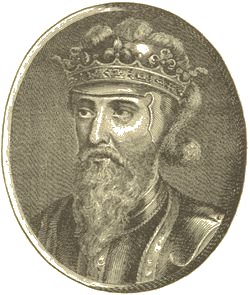
The overthrow of Mortimer made Edward, at the age of eighteen, a king in fact as well as in name. In person he was graceful; and his face was 'as the face of a god.' His manners were courtly and his voice winning. He was strong and active, and loved hunting, hawking, the practice of knightly exercises, and, above all, war itself. Considerable care must have been spent on his education, for he certainly spoke English as well as French, and evidently understood German. He was fearless in battle, and, though over-fond of pleasure was, until his later years, energetic in all his undertakings. Although according to modern notions his ambition is to be reckoned a grave defect in his character, it seemed in his day a kingly quality. Nor were his wars undertaken without cause, or indeed, according to the ideas of the time, without ample justification. His attempts to bring Scotland under his power were at first merely a continuation of an inherited policy that it would have been held shameful to repudiate, and later were forced upon him by the alliance between that country and France. And the French War was in the first instance provoked by the aggressions of Philip, though Edward's assumption of the title of King of France, a measure of political expediency, rendered peace impossible. He was liberal in his gifts, magnificent in his doings, profuse in his expenditure, and, though not boastful, inordinately ostentatious. No sense of duty beyond what was then held to become a knight influenced his conduct. Although the early glories of his reign were greeted with applause, he never won the love of his people; they groaned under the effects of his extravagance, and fled at his coming lest his officers should seize their goods. His commercial policy was enlightened, and has won him the title of the "father of English commerce" but it was mainly inspired by selfish motives, and he never scrupled to sacrifice the interests of the English merchants, to obtain a supply of money or secure an ally. In foreign politics he showed genius; his alliances were well devised and skilfully obtained, but he seems to have expected more from his allies than they were likely to do for him, for England still stood so far apart from continental affairs, that her alliance was not of much practical importance, except commercially. As a leader in war Edward could order a battle and inspire his army with his own confidence, but he could not plan a campaign; he was rash, and left too much to chance. During the first part of his reign he paid much attention to naval administration; he successfully asserted the maritime supremacy of the country, and was entitled by parliament the "king of the sea;" he neglected the navy in his later years. Little as the nation owed him in other respects, his achievements by sea and land made the English name respected.
It is said to have been chiefly through Mortimer's influence that, on April 24, 1328, a peace was concluded between England and Scotland, the chief provisions of which were that the Scots agreed to pay the sum of £20,000, and that Edward agreed to recognize the independence of the Scotch crown.
The treaty was very unpopular in England, and it is not surprising, therefore, that, when Edward Baliol in 1332 made his attempt to mount the Scotch throne, Edward III. gave him indirect assistance, and that after Baliol's dethronement in 1333 an invasion of Scotland was resolved on. On July 19 Edward defeated the Scots at the battle of Halidon Hill. His army was in great danger, and was hemmed in by the sea, the Tweed, the garrison of Berwick, and the Scottish host, which far outnumbered the English. On the 20th he drew up his men in four battles, placing his archers on the wings of each; all fought on foot, and he himself in the van. The English archers began the fight; the Scots fell in great numbers, and others fled, the rest charged up the hill and engaged the enemy hand to hand. They were defeated with tremendous loss; many nobles were slain, and it was commonly said in England that the war was over, for that there was not a Scot left to raise a force or lead it to battle. Edward ordered a general thanksgiving for this victory. Receiving as the result of his victory the submission of the principal Scotch nobles, he annexed the whole of Scotland south of the Forth to his own crown, and allowed Baliol to reign over the remainder as titular king. Soon after, Baliol was again a fugitive, but was again aided by Edward to mount a nominal throne.
After a short period of peace Edward, in July, 1336, ravaged and burned Scotland as far as Aberdeen, but growing complications with France compelled him in the same year to return to England. Though he professed to have a claim, through his mother, on the French throne against Philip of Valois, that claim was left in abeyance until several acts of aggression on the part of Philip brought about a rupture between the two kings. The Count of Flanders, at Philip's instigation, had broken off commercial relations with England; French privateers were daily committing ravages on English commerce; Aquitaine was continually threatened by desultory attacks; and Philip, though he hesitated to accept the responsibility of being the first to declare war, scarcely attempted to conceal his endeavors to throw that responsibility on Edward. Edward sailed for Flanders July 16, 1338, and at Coblentz held a conference with the Emperor Louis V., at which the latter appointed him his vicar-general, and gave orders for all the princes of the Low Countries to follow him in war for the space of seven years. In 1339 Edward laid siege to Cambrai, but soon afterward raised the siege and invaded France. Philip advanced to meet him, but declined battle, and Edward concluded his first campaign without achieving anything to compensate him for its cost.
In 1340 he defeated the French fleet before Sluys. The French fleet of one hundred and ninety galleys and great barges was superior to his in strength, for many of his ships were small. Nineteen of their ships were the biggest that had ever been seen, and grandest of all was the Christopher that had been taken from the English. Edward's fleet seems to have been "to the leeward and westward" of the enemy, and about noon he ordered his ships to sail on the starboard tack, so as to get the wind which presumably was north-east, and avoid having the sun in the faces of the archers. Then, having made their tack and got the wind, his ships entered the port and engaged just inside it. The French ships seem to have hugged the shore, and could not manœuvre, for they were lashed together in four lines. All in three of the lines were taken or sunk, the Christopher and other English ships being retaken; the fourth line escaped in the darkness, for the battle lasted into the night. The king's victory was complete, and the naval power of France was destroyed.
One more great sea-fight there was in 1349, when the Spanish fleet was defeated, and now, indeed, the English were masters of the sea. From this time Edward, as a warrior, retires somewhat into the background, his place being taken by the Prince of Wales, who in 1356 won the battle of Poitiers, and took King John prisoner. In 1359 Edward again invaded France, and in 1360 he signed the peace of Bretigny, according to which the French agreed to pay for King John a ransom of three million crowns, and Edward renounced his title to the throne of France, but retained his full sovereignty over the whole of the ancient duchy of Aquitaine, the counties of Ponthieu and Guignes, and the town of Calais. Peace was again broken in 1369 by Charles of France, and when he concluded a truce with England in 1375 all of France that remained in Edward's hands was Bayonne and Bordeaux in the south, and Calais in the north. The last years of Edward's reign form a sad and gloomy close to a career which had had a vigorous and energetic commencement, and had afterward been rendered illustrious by great achievements. His empire in France was virtually overthrown; the vast expenditure which had had such a fruitless result was sorely burdening his subjects, and awakening increasing discontent; and he himself, through the gradual decay of his mental faculties, had become a mere tool in the hands of Anne Travers, and of ministers whose only aim was their own aggrandizement. In 1367 the "Good Parliament" virtually seized the helm of the state from the hands of the king and his ministers. The Black Prince was the chief agent in urging these reforms, but his death, in the midst of the Parliament's deliberations, for a time rendered almost abortive the good work he had begun. Edward died June 21, 1377. Both in his home and foreign relations he showed considerable prudence and sagacity, and he may be allowed the merit of having endeavored as much as possible to keep on good terms with his subjects. His expeditions were planned on a scale of great magnificence, but he entered on his campaigns without any definite aim, and his splendid victories were mere isolated achievements, won partly by good fortune, but chiefly by the valor of Welsh and Irish yeomen and the skill of English archers.
It has been observed, in regard to Edward III., by Sir James Mackintosh, that "though his victories left few lasting acquisitions, yet they surrounded the name of his country with a lustre which produced strength and safety; which perhaps also gave a loftier tone to the feelings of England, and a more vigorous activity to her faculties."
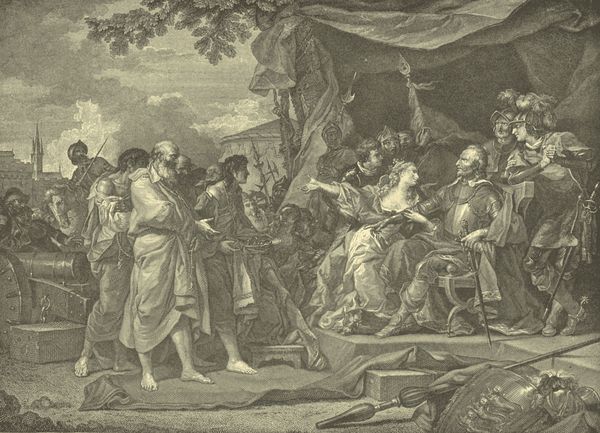
Edward III. and the burghers of Calais.
"During a reign of fifty years," it is added, "Edward III. issued writs of summons, which are extant to this day, to assemble seventy parliaments or great councils: he thus engaged the pride and passions of the parliament and the people so deeply in support of his projects of aggrandizement, that they became his zealous and enthusiastic followers. His ambition was caught by the nation, and men of the humblest station became proud of his brilliant victories. To form and keep up this state of public temper was the mainspring of his domestic administration, and satisfactorily explains the internal tranquillity of England during the forty years of his effective reign. It was the natural consequence of so long and watchful a pursuit of popularity that most grievances were redressed as soon as felt, that parliamentary authority was yearly strengthened by exercise, and that the minds of the turbulent barons were exclusively turned toward a share in their sovereign's glory. Quiet at home was partly the fruit of fame abroad."[Back to Contents]
EDWARD THE BLACK PRINCE By L. Drake (1330-1376)
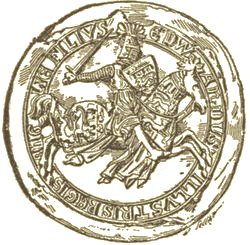
Edward, Prince of Wales, commonly called the Black Prince, was born in 1330. He was the eldest son of Edward III., and a model of the highest virtues of his times, a loyal son, and a brave, yet merciful, warrior. He sailed with his father to attack the French in 1346, and though only sixteen was knighted by the king immediately on reaching France. He "made a right good beginning," for he rode with a small force on a daring foray, and then distinguished himself at the taking of Caen and in the engagement with the force under Gondemar du Fay, which endeavored to prevent the English army from crossing the Somme. King Edward and his small army compelled to face a far larger French force, made some of the most daring and successful marches on record in the annals of warfare.
At length they encamped in a forest, a little to the west of the small town of Crécy. The French army, outnumbering them some say as four, some say as twelve to one, was not far distant; but, confident in his troops and himself, and animated by the memory of many triumphs, the English king resolved to make a stand. The field of Crécy, from the capabilities of the ground, was made choice of for the expected battle; and the plan being drawn out by Edward and his counsellors, the king, as the greatest and most chivalrous favor he could confer, determined to yield the place of danger and of honor to the prince, and in his own words, "to let the day be his."
To insure his success, most of the famous knights were placed in the division which the Black Prince (as he was now called, from the sable suit of armor he usually wore) was to command; while the Earl of Warwick and the celebrated Sir John Chandos were ordered not to quit his side, but be ever ready to direct and aid him.
Early on the morning of August 26, 1346, the trumpets sounded, and the army marched to take up the position which had been selected on the previous day. The ground was an irregular slope, looking toward the south and east—the quarters from which the army were expected. The prince's division, composed of 800 men-at-arms, 4,000 archers, and 6,000 Welsh foot, was stationed nearly at the bottom of the hill; the archers, as usual, in front, the light troops next, and then the men-at-arms, in the midst of whom was the prince himself, with twelve earls and lords, as his staff. To the left of this, and higher on the slope, appeared the second division, of about 7,000 men, commanded by the Earls of Arundel and Northampton. On a rising ground, surmounted by a windmill, aloof from the rest, was King Edward himself, with 12,000 men, as a reserve. The wagons and baggage were in the rear of the prince, under the charge of a small body of archers. As the battle was to be fought entirely on foot, all the horses were also left with these.
Mounted on a palfrey, with a white staff in his hand, the king, with a smiling and cheerful countenance, rode from rank to rank. By noon he had passed through all the lines exhorting the men to do their duty gallantly, and defend his honor and right.
The soldiers now had permission to refresh themselves, while waiting the enemy's approach. They accordingly ate and drank at ease, and afterward lay down in ranks on the long grass, with their bows and steel caps beside them.
Meantime the French army had approached very near. Four knights had ridden forward, and observed King Edward's plan of battle; when, having seen how fresh and vigorous the English troops appeared, they advised Philip, the French king, to delay the engagement till next day, by which time his troops, now hungry and wearied, would be refreshed. Philip at once saw the wisdom of this counsel, and one of his marshals immediately galloped to the front, and the other to the rear.
"Halt your banners, in the name of God, the king, and St. Denis!" was the command given to the leaders. The advanced troops instantly obeyed; but the others pressed on, hoping to be among the foremost. This obliged the soldiers in front to move on again. In vain the king commanded, and the marshals threatened; hurrying forward in disgraceful confusion, the French, passing through a small wood, suddenly found themselves in the presence of the English. The surprise caused the first line to fall back, and thus increase the confusion.
The English soldiers now rose steadily from the grass, and stood in fair and martial order on the hillside, with the standard of the Black Prince in their front.
The sky had by this time become clouded; a thunder-storm came on, and torrents of rain soon fell—slackening the strings of the cross-bows of the Genoese archers, who had advanced to break the firm front of the English bowmen. The clouds cleared quickly away, and the western sun soon shone out bright and clear, full in the faces of the French. At the moment the Genoese drew their arbalists, and commenced their discharge, each English archer stepped forward a single pace, as he took his bow from the case in which it had been protected from the rain; and a flight of arrows fell among the Genoese, piercing their heads, arms, and faces, and causing them instantly to retreat in confusion among the horsemen in their rear.
The passionate French king, instead of trying to rally the fugitives, at once ordered the men-at-arms to fall upon them. The cavalry, the heavy troops, and the cross-bow men, soon formed a wild and reeling crowd, amid which the English poured a continued flight of unerring arrows, and not a single bowstring was drawn in vain.
Meantime the Count of Alençon, dividing his men into two parties, swept round on one side of this scene of confusion; while the Count of Flanders did the same on the other side, and, avoiding the archers, furiously attacked the men-at-arms around the prince. England's chivalry, headed by the gallant boy, met the impetuous charge with equal valor and with greater success; and as each headlong effort of the French deranged the ranks for a moment, they were formed anew, each man fighting where he stood, none quitting his place to make a prisoner, while growing piles of dead told of their courage and vigor. The two counts were slain, and terror began to spread through their troops. A large body of German cavalry now bore down on the prince's archers, and, in spite of the terrible flight of arrows, cut their way through, and charged the men-at-arms. By this time nearly forty thousand men were pressing round the little English phalanx; but the combat was renewed, hand to hand, with more energy than ever, while the Earls of Northampton and Arundel moved up with their division, to repel the tremendous attack.
King Edward still remained with his powerful reserve, viewing the battle from the windmill above. The Earl of Warwick now called a knight, named Thomas of Norwich, and despatched him to the king.
"Sir Thomas," demanded Edward, "is my son killed, or overthrown, or wounded beyond help?"
"Not so, my liege," answered the knight; "yet he is in a rude shock of arms, and much does he need your aid."
"Go back, Sir Thomas, to those who sent you," rejoined the king, "and tell them from me, that whatever happens, to require no aid from me, so long as my son is in life. Tell them, also, that I command them to let the boy win his spurs; for, God willing, the day shall be his, and the honor shall rest with him, and those into whose charge I have given him."
The prince, and those around him, seemed inspired with fresh courage by this message; and efforts surpassing all that had preceded were made by the English soldiers. The French men-at-arms, as they still dashed down on the ranks, met the same fate as their predecessors; and, hurled wounded from their dying horses, were thrust through by the short lances of the half-armed Welshmen, who rushed hither and thither through the midst of the fight. Charles of Luxembourg, who led the German cavalry, seeing his banner down, his friends slain, his troops routed, and himself wounded severely in three places, fled, casting off his rich surcoat, to avoid recognition.
This prince's father, the veteran King of Bohemia, was seated on horseback at a little distance from the fight. The old man had fought in almost every quarter of Europe; but, though still full of valor, he was now blind. Unable himself to mark the progress of the fight, he continued to inquire anxiously, and soon discovered that the day was lost.
"My son," demanded the veteran monarch of his attendants; "my son!—can you still see my son?"
"The King of the Romans is not in sight, sire," was the reply; "but doubtless he is somewhere engaged in the mêlée."
"Lords," continued the old king,—drawing his own conclusions from what he heard, and resolved not to quit the field alive—"Lords, you are my vassals, my friends, and my companions; and on this day, I command and beseech you to lead me forward so far that I may deal one blow of my sword in the battle."
They linked their horses' bridles to one another, and placing their venerable lord in the centre, galloped down into the field. Entering the thickest strife, they advanced directly against the Prince of Wales. Here the blind monarch was seen fighting valiantly for some time; but at length his banner went down. Next day he was found dead on the field of Crécy—his friends around him—their horses still linked to each other by the bridles.
It was growing dark ere the angry Philip could force his way through the confusion he had himself chiefly caused by the imprudent command he gave at the commencement of the battle. The unremitting arrows of the English still continued to pour like hail; and his followers fell thickly around him. Many fled, leaving him to his fate; and presently his own horse was killed by an arrow.
One of his attendants, John of Hainault, who had remained by his side the whole day, mounted him on one of his own chargers, and entreated him to quit the field. Philip refused; and, making his way into the thickest battle, fought for some time with great courage. At length—his troops almost annihilated, himself wounded in two places—he suffered John to half force him from the field; and, with a few of his lords, and only sixty men-at-arms, reached his nearest castle of Broye in safety. At midnight he again set out, and did not slacken his flight till he reached Amiens.
The gallant Prince of Wales still held his station firmly in the battle; the utmost efforts of the French had not made him yield a single step. By degrees, as night fell, the assailants decreased in numbers, the banners disappeared, and the shouts of the knights and the clang of arms died away. Silence at last crept over the field, and told that victory was completed by the flight of the enemy. Torches were then lighted, in immense numbers, along the English lines to dispel the darkness.
King Edward now first quitted his station on the hill; he hastily sought his conquering boy, and clasped him proudly to his bosom.
"God give you perseverance in your course, my child!" cried the king, as he still held him. "You are indeed my son! Nobly have you acquitted yourself, and worthy are you of the place you hold!"
The youthful hero had hitherto, in the excitement and energy of the battle, felt only the necessity of immense exertion, and had been unmindful of all but the immediate efforts of the moment; but now, the thought of his great victory—which his father's praise seemed first to bring fully to his mind—overcame him, and he sank on his knees before the king, and entreated his blessing, after a day of such glory and peril. And thus ended the battle of Crécy.
The prince had now fully established his character as a warrior. Two or three years afterward, he showed that he could display equal courage at sea as on land; this was in an engagement with the Spaniards.
Peter the Cruel—as he was termed—was at that time King of Castile, and encouraged, to a great extent, the pirates who infested the English seas. His own fleet even, in passing through the British Channel, had captured a number of English merchantmen, returning from Bordeaux, and after putting into Sluys, were preparing to sail back in triumph with the prizes and merchandise.
King Edward determined to oppose their return, and collected his fleet off the coast of Sussex, near Winchelsea. When he heard that the Spaniards were about putting to sea, he immediately embarked to command the expedition in person. The Black Prince, now in his twentieth year, accompanied him, and commanded one of the largest vessels. The day on which the Spanish fleet would make its appearance had been nicely calculated. Edward waited impatiently for its approach, and, to beguile the time, made the musicians play an air which the famous Chandos, who was now with him, had brought from Germany. During the concert, the king, from time to time, turned his eye to the watcher at the masthead. In a short time the music was interrupted by the cry of—"A sail!" Ordering wine to be brought, Edward drank one cup with his knights, and, throwing off the cap he had worn till now, put on his casque, and closed his visor for the day.
The Spanish ships came on in gallant trim. The number of fighting men which they contained was, compared with the English, as ten to one; and their vessels were of a much greater size. They had also large wooden towers on board, filled with cross-bowmen, and were further provided with immense bars of iron, with which to sink the ships of their opponents. They approached, with their tops filled with cross-bowmen and engineers, the decks covered with men-at-arms, and with the banners and pennons of different knights and commanders flying from every mast. They came up, in order of battle, a few hours before night. King Edward immediately steered direct against a large Spanish ship; endeavoring, according to the custom of ancient naval warfare, to run her down with his prow. The vessel, which was much superior to his own in magnitude, withstood the tremendous shock—both ships recoiling from each other. The king now found his ship had sprung a leak, and was sinking fast. In the confusion the Spanish vessel passed on; but Edward immediately ordering his ship to be lashed to another of the enemy, after a desperate struggle, made himself master of a sound vessel.
The battle now raged on all sides. Showers of bolts and quarrels from the cross-bows, and immense stones, hurled by powerful engines, were poured upon the English. The Black Prince, imitating the example of his father, had fixed on one of the largest ships of the enemy; but, while steering toward her, the missiles she discharged pierced his own vessel in several places. The speedy capture of his enemy was now necessary; for, as he came alongside, his barque was absolutely sinking. The sides of his opponent's vessel being much higher than his own rendered the attempt very hazardous; and while, sword in hand, he attempted to force his way, bolts and arrows poured on his head from every quarter. The Earl of Lancaster, sweeping by to engage one of the enemy, saw the situation of the prince, and immediately dashed to the other side of the antagonist, and after a fierce but short struggle, the Spanish ship remained in the hands of the prince; and scarcely had he and his crew left their own vessel, before she filled and went down.
Twenty-four of the enemy's ships had by this time been captured; the rest were sunk, or in full flight; and, night having fallen, King Edward measured back the short distance to the shore. Father and son, then mounting horse, rode to the Abbey of Winchelsea, where Queen Philippa had been left, and soon turned the suspense she had suffered, since darkness had hidden the battle from her sight, into joy and gratitude.
The French king, Philip, was now dead, and had been succeeded by his eldest son John. Some proceedings, on the part of the new monarch, were regarded as a signal to break the truce which had subsisted for a short time between the English and the French. Various displays of hostilities followed, and many negotiations were entered into without success. The Black Prince, being appointed captain-general, sailed for Bordeaux in August, 1355, and arrived there after an easy passage. His first movements were always successful; and, even when winter set in, the judicious manner in which he employed his troops enabled him to add five fortified towns and seventeen castles to the English possessions.
Spring and summer passed by—the prince still continuing active. At length, the French king collected an immense army, and marched to intercept him. Though well aware that John was endeavoring to cut off his retreat, the Black Prince was ignorant of the exact position of the French army, until, one day, a small foraging party fell in with a troop of three hundred horsemen, who, pursuing the little band across some bushes, suddenly found themselves under the banner of the Black Prince. After a few blows they surrendered, and from them the prince learned that King John was a day's march in advance of him.
A party, despatched to reconnoitre, brought back intelligence that an army of eight times his force lay between him and Poitiers. Though without fear, the prince felt all the difficulties of his situation; yet his simple reply was—"God be our help!—now let us think how we may fight them to the best advantage."
A high ground, commanding the country toward Poitiers, defended by the hedges of a vineyard, and accessible from the city only by a hollow way scarcely wide enough to admit four men abreast, presented to him a most defensible position. Here he encamped, and early next morning, disposed his troops for battle. He dismounted his whole force; placed a body of archers, drawn up in the form of a harrow, in front, the men-at-arms behind, and stationed strong bodies of bowmen along the hedges, on each side of the hollow way. Thus, while climbing the hill, the French would be exposed to the galling flights of arrows, while the nature of the ground would further render their superiority in numbers of little avail.
The French host now began to advance;—yet, as its ocean of waving plumes rolled up the hill, the prince, in the same firm tone which had declared the day before, that England should never have to pay his ransom, now spoke the hope of victory.
Three hundred chosen horsemen soon reached the narrow way, and, putting their horses at full gallop, poured in to charge the harrow of archers. The instant they were completely within the banks, the English bowmen along the hedges poured a flight of arrows, which threw them at once into confusion.
The bodies of the slain men and horses soon blocked up the way; but a considerable number, forcing a path through every obstacle, nearly approached the first line of archers. A gallant knight, named James Audley, with his four squires, rushed against them; and thus, almost single-handed, he fought during the whole day, hewing a path through the thickest of the foe, until late in the evening; when, covered with many wounds, and fainting from loss of blood, he was borne from the field.
Meantime the shower of arrows continued to pour death, while the English men-at-arms, passing between the lines of the archers, drove back the foremost of the enemy, and the hollow soon became one scene of carnage. One of Edward's officers, named the Captal de Buch, at the same time issued from a woody ravine situated near the foot of the hill,—where, with three hundred men-at-arms and three hundred archers on horseback, he had lain concealed,—and attacked the flank of one of the divisions of the French army, commanded by the Dauphin, as it commenced the ascent. This, with the confusion in front, and a rumor that part of the army was beaten, carried terror into the rear ranks, and vast numbers, who had hardly seen an enemy, galloped madly from the field. The arrows discharged by the horse-archers now began to tell on the front line of the enemy:—the quick eye of Sir John Chandos marked it waver and open.
"Now, sir," he exclaimed, turning to the prince, "ride forward, and the day is yours. Let us charge right upon the King of France, for there lies the fate of the day. His courage, I know well, will not let him fly; but he shall be well encountered."
"On! on! Chandos," replied the prince, "you shall not see me tread one step back, but ever in advance. Bear on my banner! God and St. George be with us!"
The horses had been kept in readiness; and each man now springing into saddle, the army bore down on the enemy with levelled lances, the Captal de Buch forcing his way onward to regain the main body. The hostile forces met with a terrible shock, while the cries of "Denis Mountjoye!" "St. George, Guienne!" mingled with the clashing of steel, the shivering of lances, and the sound of the galloping steeds. The sight of the conflict struck terror into a body of sixteen thousand men, who had not yet drawn a sword. Panic seemed to seize them; and these fresh troops, instead of aiding their companions, fled disgracefully with their commander, the Duke of Orleans. This probably decided the day.
King John was now seen advancing with his reserve, in numbers still double the force of the English at the commencement of the battle. He saw his nobles flying, but though indignant, felt no alarm; then, dismounting with all his men, he led them, battle-axe in hand, against the English charge. The black armor of the young leader of the English rendered him also conspicuous; and, while the French king did feats of valor enough to win twenty battles if courage could have done all, the prince was seen raging like a young lion amid the thickest of the enemy. Knight to knight, and hand to hand, the battle was now fought. The French were driven back, step by step, till John found himself nearly at the gates of Poitiers, now shut against him. While, however, the oriflamme waved over his head, he would not believe the day lost; but, at length it went down, and his hopes fell with it. Surrounded on every side by foes eager to make him prisoner, he still wielded his battle-axe, clearing at each stroke the space around him and his little son, who had accompanied him through the fatal field. A knight of Artois, of gigantic height, who had been outlawed and had taken service with England, seeing that the monarch's life would be lost if he protracted his resistance, suddenly rushed into the circle.
"Yield, sire, yield!" he exclaimed in French.
"Who art thou?" inquired John.
"I am Denis de Mortbec, a poor knight of Artois," answered the outlaw, "but now in the service of England, because a banished man from my own country."
"Well, I yield me to you," cried the king, giving him in sign of surrender, his right gauntlet.
By this time nothing was seen but dead and dying on the field, with groups of prisoners, and parties of fugitives escaping over the distant country. The prince, by the advice of Chandos, now pitched his banner on a high spot; and, while the trumpets sounded a recall to the standard he dismounted, and, unbracing his helmet, took a draught of wine with the band of knights who had accompanied him throughout the arduous day.
The unfortunate French king was soon brought to him by the Earl of Warwick and Lord Cobham. The prince received his vanquished adversary with deep and touching respect. Bending his knee before John, he called for wine, and, with his own hands, presented the cup to the unhappy king.
By mid-day the battle was over; but, as the pursuing parties did not return till evening, it was only then that the prince learned the greatness of his victory. With eight thousand men he had vanquished more than sixty thousand, and the captives were double the number of the conquerors.
At night a sumptuous entertainment was served in the tent of the Black Prince to the King of France and the principal prisoners. John, his son, and six of his chief nobles, were seated at a table raised higher than the rest; but no place was reserved for the prince himself. Great was the surprise when the victor appeared to officiate as page. This in the days of chivalry implied no degradation, though it showed the generous humility of the young hero. John repeatedly entreated the prince to seat himself beside him, and could scarcely be persuaded to taste the food while his vanquisher remained standing, or handed him the cup on bended knee. The respectful manner in which the prince conducted himself, and the feeling he expressed for the misfortunes of his foe, so touched John, that at last the tears burst from his eyes, and mingled with the marks of blood on his checks.
The example of their leader was followed throughout the English camp; every one treating his prisoners as friends, and admitting them to ransom on terms named, in most cases, by the vanquished themselves.
After this event the prince again distinguished himself in France, for the claims of his father, which the treaty had in part recognized, were again disputed. Many battles were fought, and much negotiation was carried on, extending over several years; while in the midst of these harassments, the prince, who had long been ill, became worse. His surgeons advised his return to England. He complied; but day after day his strength failed him, and fainting fits of long continuance often led those around him to suppose him dead. At length, on Sunday, June 8, 1376, he closed a life which for years had been one sad scene of suffering. He was interred with due pomp in Canterbury Cathedral, his favorite suit of black armor being suspended over his tomb. Thus, scarcely past his prime, died "the valiant and gentle Prince of Wales, the flower of all chivalry in the world at that time."[Back to Contents]
BERTRAND DU GUESCLIN (1314-1380)
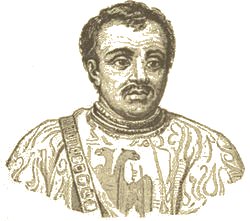
Bertrand du Guesclin, Constable of France, the most famous French warrior of his age, was born of an ancient but undistinguished family, at the castle of La Motte-Broon, near Rennes, about 1314. The date is doubtful, the authorities varying between 1311 and 1324. The name is spelt in various ways in contemporary records, e.g., Claquin, Klesquin, Guescquin, Glayaquin, etc. The familiar form is found on his monument at St. Denis, and in some legal documents of the time. In his boyhood Bertrand was a dull learner, spending his time in open-air sports and exercises, and could never read or write. He was remarkable for ugliness, and was an object of aversion to his parents. He first made himself a name as a soldier at the tournament held at Rennes in 1338 to celebrate the marriage of Charles of Blois with Jeanne de Penthièvere, at which he unseated the most famous competitors.
But this playing at fighting was not enough for his ambition; and in the war which followed between Charles of Blois and John de Montfort, for the possession of the Duchy of Brittany, he served his apprenticeship as a soldier. As he was not a great baron with a body of vassals at his command, he put himself at the head of a band of adventurers, and fought on the side of Charles and of France. He distinguished himself by a brilliant action at the siege of Vannes in 1342; and after that he disappears from history for some years. In 1351, having shortly before been made a knight, he was sent into England with the lords of Brittany to treat for the ransom of Charles of Blois, who had been defeated and captured by the English in 1347. When Rennes was besieged by the Duke of Lancaster, in 1356, Du Guesclin forced his way with a handful of men into the town, and successfully defended it till June, 1357, when the siege was raised in pursuance of the truce of Bordeaux. For this service he was rewarded with the lordship of Roche d'Airien.
At the expiration of the truce he distinguished himself by the defence of Dinan, and here he engaged in single combat with Sir Thomas Canterbury. Shortly afterward he married; and about the same time he passed into the service of France, and greatly distinguished himself at the siege of Melun (1359). In April, 1364, in conjunction with Boucicault, he recovered Mantes and Meulan from the King of Navarre; and in May he defeated the Navarrese under Captal de Buch at Cocherel, and took their leader prisoner. The king now created him Marshal of Normandy and Count of Longueville. At the battle of Auray, in September of the same year, Charles of Blois was defeated and killed, and Du Guesclin taken prisoner, by Sir John Chandos.
The grand companies beginning, after the close of the war, to play the part of brigands in France, it was necessary to get rid of them. Du Guesclin was ransomed for 100,000 crowns, and was charged to lead them out of France. He marched with them into Spain, visiting Avignon on the way, and extorting from the Pope a large sum of money and his absolution. Du Guesclin now supported Henry of Trastamare against Peter the Cruel, set the former upon the throne of Castile (1366), and was made Constable of Castile and Count of Trastamare. In the following year he was defeated and captured by the Black Prince, ally of Peter the Cruel, at Najara, but was soon released for a heavy ransom. Once more he fought for Henry, reinstated him on the throne (1369), and was created Duke of Molinas.
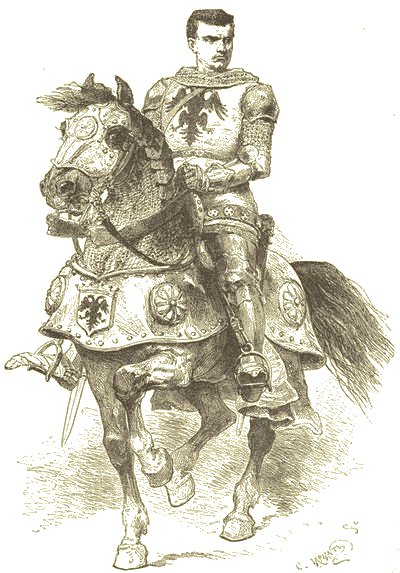
Bertrand du Guesclin.
In May, 1370, at the command of Charles V., who named him Constable of France, he returned to France. War had just been declared against England, and Du Guesclin was called to take part in it. For nearly ten years he was engaged in fighting against the English in the south and the west of France, recovering from them the provinces of Poitou, Guienne, and Auvergne, and thus powerfully contributing to the establishment of a united France. In 1373, when the Duke of Brittany sought English aid against a threatened invasion by Charles V., Du Guesclin was sent at the head of a powerful army to seize the duchy, which he did; and two years later he frustrated, by a defensive policy, the attempt of the duke with an English army to recover it. Finding, in 1379, that the king entertained suspicions of his fidelity to him, he resolved to give up his constable's sword and retire to Spain. His resolution was at first proof against remonstrance; but ultimately he received back the sword, and continued in the service of France.
In 1380 he was sent into Languedoc to suppress disturbances and brigandage provoked by the harsh government of the Duke of Anjou. His first act was to lay siege to the fortress of Châteauneuf-Randou, held by the English, strongly garrisoned and well provisioned. A day was fixed conditionally for capitulation. Meanwhile the great warrior was smitten with a mortal illness, and died, July 13, 1380. The commander led out the garrison and deposited the keys of the castle on the coffin of the hero. Du Guesclin lost his first wife in 1371, and married a second in 1373. His remains were interred, by order of the king, in the church of St Denis.[Back to Contents]
HENRY V. OF ENGLAND Extracts from "Memoirs of Great Commanders," by G. P. R. James (1388-1422)
Henry, the fifth English monarch of that name, was born at Monmouth, on the banks of the pleasant Wye, in the year 1388. He was the eldest son of Henry, Earl of Derby, and of Mary de Bohun, daughter of the Earl of Hereford. During his infancy reverses and successes passed rapidly over his father's head, and at the age of thirteen years he found himself the eldest son of the King of England, and was created by his father Prince of Wales, Duke of Cornwall, and Earl of Chester. The early education of Henry the Fifth is unknown; but it may be inferred, that during the life of his mother, principles of high honor and virtue had been instilled into his bosom, which became dormant, though not extinct, as rising toward manhood, evil companions took advantage of idleness and indulgence to call into action the passions of the young prince, in order to lead him to their own purposes.
The tales of his debauchery, and the depravity of his taste, while a youth, have been doubted and contradicted, but not disproved by modern historians; but the positive assertions of older writers, whose means of information was great and immediate, must always be more valuable than the theoretical doubts of persons who live when a thousand sources of knowledge have been buried under the lumber of ages. It is therefore more than probable that, in his youth, Henry the Fifth gave himself up to low companions, unworthy a prince and a gentleman, and yielded to his passions indulgences which were forbidden by his reason. Nevertheless, through the whole course of his youthful errors, as portrayed by those least favorable in their account, there is to be seen the gleaming forth of those better principles, that nobler soul, which rendered him in after years one of the greatest and best of English monarchs.
Out of a multitude of events which might be brought forward to prove this fact, one of the best authenticated, and the most striking, is his submission to Chief-justice Gascoigne. Henry, it would appear, had entered the Court of Justice in support of one of his dissolute companions, who had rendered himself amenable to the laws of his country. Notwithstanding the presence and influence of the prince, the magistrate did his duty toward the offender, without fear or favor, and in the heat of the moment, Henry struck the judge upon the judgment-seat. Still unmoved and unruffled, the chief-justice, without a hesitation on the score of the prince's rank or power, at once committed him for contempt of court.
Time had been given for the better spirit to assume her influence, and struck with the conscientious courage of the judge, the heir-apparent of the British throne submitted to the punishment he had merited, and suffered himself without opposition to be led to prison, thus setting a noble example of obedience to the laws. His father was of a mind well qualified to appreciate the conduct both of his son and of his son's judge, and when the news was brought him—probably by those who sought to inflame the monarch's mind against the punisher of his son—he exclaimed, with joy: "Blessed is the king whose magistrates possess courage to execute the laws upon such an offender; and still more happy is he who has for a son a prince willing to endure such wholesome chastisement."
Although from all accounts it would appear that many parts of the prince's conduct gave great pain and offence to his father, yet we find that Henry IV. never scrupled to entrust to his care some of the greatest and most important military operations of his reign. Whether the prince had already displayed the qualities of a soldier, in a degree sufficient to attract the notice of his father, or whether the king sought only to habituate him early to that inevitable career of arms which was in those days one of the misfortunes of royalty, we are not informed; but so early as his sixteenth or seventeenth year he fought at the battle of Shrewsbury, in which Henry Hotspur was slain. What was the part assigned to the prince on this occasion I do not find stated precisely; but all accounts agree that he proved of infinite assistance and service to his father, and fought long in the thickest of the battle, after having been severely wounded by an arrow in the face.
The death of Percy spread dismay among his soldiers and allies, and after a fight of nearly four hours the party of Northumberland fled, leaving the king master of the field of battle, and a number of noble prisoners. Many of these were executed either at Shrewsbury or London; and the Earl of Northumberland, the chief support of the rebellion, made his peace for the time to meditate his rebellions.
Owen Glendower, however, one of the confederates, was still in arms in Wales; and while Henry IV. returned in triumph to London, he despatched his eldest son, at the head of considerable forces, to reduce the Principality to obedience. The unhappy Glendower, unable to oppose the army led against him, was forced to fly, and, abandoned by his friends and followers, is said to have died of starvation among the caves and wildernesses in which he sought refuge. In the meanwhile the Prince of Wales conducted his expedition with skill and wisdom; the whole country submitted to his power; and having re-established order and tranquillity, he returned to London with honor and praise.
Little further occurs in the history of Henry as Prince of Wales which is interesting in itself, if stripped of the embellishments added to it by the fancy of our great poet. A project of marriage between the heir of the British crown and a daughter of the Duke of Burgundy, was entertained for some time, but died away, and the opposite, or Orleans party in France, was afterward supported by the English Crown. At length Henry the Fourth, on the eve of an expedition to the Holy Land, undertaken, it is said, in expiation of his usurpation of the throne, was struck with apoplexy; and a tale, in regard to his death, is current among the historians of the period, on which Shakespeare has founded one of the most beautiful scenes in his historical dramas. The poet, however, is far more indebted for the splendor of his materials to his own imagination, than any historical record. The facts, as related by the best authorities, are simply as follows.
After the first attack of apoplexy the king was carried to a chamber in the house of the Abbot of Westminster, and put to bed, and at his own desire the crown was laid upon his pillow. He languished in a state of great weakness for some time, and at length, after a second attack, appeared to those who were watching him to have yielded the spirit. The chamberlain immediately spread a linen cloth over the face of the king, and hastened to communicate his supposed death to the heir-apparent, who, entering the room to take a last look at his father's body, removed the crown from his pillow, and carried it into another apartment. After a short time the monarch revived, and sending for his son demanded, angrily, why he had removed the crown. The prince replied that all men had thought him dead, and therefore he had taken the symbol of royalty as his by right.