Volume 1 — SOLDIERS AND SAILORS (continued 3)
Reading edition
The expedition sailed from Heraclea in June, 533, and one of the first acts of the general showed his sternness of discipline. A murder was committed in a drunken fit by two Huns, and he immediately hung them both, and silenced the murmurs of the rest by a speech in which he declared that Roman arms must be carried in pure hands, and that no courage would obtain pardon for violence or insubordination.
He landed in September at Caput Vadas, five days' distance from Carthage, without opposition and with an eager welcome from the natives, who rejoiced to be delivered from the Vandal oppression, and Belisarius preserved their goodwill by hindering his soldiers from committing any act of plunder or violence. Indeed Gelimer, king of the Vandal horde, was only like an enemy occupying the place; there had been no amalgamation, and persecution had sown seeds of bitter hatred. Gelimer, however, marched out to meet the invaders, and at ten miles from Carthage was totally defeated, and his brother and nephew killed. He fled into the deserts of Numidia, recalling his brother who was putting down a revolt in Sardinia, and leaving the city to Belisarius, who entered on the feast of the great Carthaginian martyr, St. Cyprian, amid the extreme joy of the populace. When the brother of Gelimer returned from Sardinia there was still another battle to fight, but as usual Belisarius conquered. Gelimer submitted and received an estate in Galatia, and lived there in honor and prosperity for the rest of his days. The bravest of his warriors took service in the Roman army under their victor! Gelimer had, however, first to march in the triumph of Belisarius, the only one ever held at Constantinople! Justinian had recalled the general, though it would have been far wiser to have left him to consolidate his conquest; but no Roman emperor could be free from the suspicion that a victorious general might become his rival, nor could the scrupulous loyalty of Belisarius disarm him. It is said that Gelimer marched along, repeating, "Vanity of vanities, all is vanity."
The next scheme of Justinian was the recovery of Italy from the Goths. This people had never shown the same savage cruelty as the Vandals, but had settled amicably among the Italians, and adopted much of their civilization and learning. They had recently had a truly great monarch, Theodoric, who deserves to rank with Alfred or Charlemagne, but he had left only a daughter, Amalasanta, a noble woman, and an ally of Justinian. She was stifled in her bath by Theodatus, the husband whom she had raised to the throne. The Gothic kingdom was convulsed by the crime, and Justinian saw both motive and opportunity for conquest. Yet he only gave Belisarius 4,500 horse and 3,000 infantry when this great enterprise was begun in 535, besides some choice troops of the imperial guard.
Sailing to Sicily he met no resistance except at Panormis (Palermo), but observing that his masts overtopped the walls, he hung up small rafts full of archers, whose arrows disconcerted the inhabitants so that they surrendered, and the whole island was restored to the Roman power. Theodatus tried to treat with Justinian, and while the negotiations were going on, Belisarius crossed over to the African province, which was threatened by the Moors of Mount Atlas. Strong measures were needed, but for the time the incursions were repressed, and by the time the bad faith of Theodatus had disgusted the Greeks, Belisarius was ready to cross into Italy and besiege Naples. As usual, the native inhabitants were his friends, but were in terror of the Gothic garrison, and these, on their side, were afraid of treating with the Greek general because Theodatus had their wives and children as hostages.
Theodatus, however, shut himself up in Rome and gave no aid to Naples, and Belisarius had made up his mind to raise the siege and attack Rome itself, when one of his soldiers came to tell him that in exploring an aqueduct which had been stopped, he had found that the passage for the water could easily be enlarged so as to admit armed men. Once more he summoned the native magistrates, but the inhabitants would not submit, and he sent on the bravest of his men, with two trumpets and with lanterns, while he made an attack to divert the attention of the Goths. The way was long, and the soldiers found themselves in the very heart of Naples, in a basin with very steep sides, impossible, as it seemed, to climb. One man however, scrambled up and found himself in a hovel, where he obtained a rope and pulled up his companions. The Goths who were resisting the escalade, threw down their arms when they were attacked from behind. Belisarius did his utmost to stop slaughter and plunder, but could not entirely succeed, for many of his soldiers were savage Huns, barely kept under restraint at any time.
Theodatus remained in Rome, and appointed a brave general called Vetiges by the Greeks, but whose name was probably Wittich, to the command. The army suspected treachery, raised Wittich on their shields and proclaimed him king. Theodatus fled, and was murdered on his way, in 536. Wittich thought it better to draw off to Ravenna to reorganize his army, so the way to Rome was left open to Belisarius, who had only to summon a small garrison to submit. He gained it in the March of 537, and immediately repaired the defences; and indeed there was need, for Wittich besieged him there for a whole year, and he had terrible difficulties to contend with. The Roman populace had lost all their spirit of patriotism, and murmured from the first that with a mere handful of soldiers, he should bring down the Goths upon them, and when the distresses of a protracted siege came on them, they loudly complained, though all the useless mouths were safely sent off by sea to the fertile fields about Naples.
It is impossible to dwell at length on the events of the siege and the gallant deeds on either side. The Goths, under Wittich, were gallant enemies, but the diseases of the Campagna reduced their numbers, and finally, late in the March of 538, Wittich broke up his camp and retreated to Ravenna. There he called the Franks to his assistance, but they were mere barbarians, who plundered Goths as well as Italians and added to the general misery of the country. At last, in 539, Wittich yielded Ravenna to Belisarius who sent him to Constantinople, where he lived in honor and prosperity.
Justinian recalled his general, always fearing the result of his success. The city of Pavia was still left to the Goths, and here they chose as king, a kinsman of Wittich, called Totila, young, gallant, and generous. The utter incapacity and greed of Justinian's governors left the country open to him, and he traversed the whole peninsula collecting Goths again to his standard, till their kingdom was restored. Indeed the whole of the land was so desolate that hardly any opposition was offered. In 544 Justinian was obliged to send Belisarius back to Italy, but most insufficiently supplied with men and money. He had in the meantime been fighting on the Persian frontier, with the great King Chosroës, and with more success than could have been hoped for with such means as were at his disposal. He came to Ravenna, but his forces were too scanty to enable him to undertake any enterprise, and where he did not command in person, the so-called Roman captains were uniformly beaten. Totila occupied Rome in 546, and tried to destroy it, overthrowing the walls and beginning to ruin the ancient buildings. Belisarius wrote to him a remonstrance, telling him how after-ages would regard such destruction, and he actually thanked the great general for his advice and spared the churches and monuments, but carried off all the inhabitants, so that when, forty days later, Belisarius re-entered the city not a man was found there. He tried to rebuild the defences, but Justinian would not send him money or men, and when Totila again advanced, he was forced to abandon the beloved and honored city. Justinian then recalled him, preferring to leave Italy to its fate rather than trust to his unswerving loyalty. An unwarlike despot, who knew that the will of an army might at any time raise a popular captain in his stead, could hardly fail to dread the one man who was beloved by his soldiers and always successful. The Empress Theodora was dead, and no honors awaited Belisarius, only undeserved suspicion.
Once again, however, the great man was called for. The Bulgarians were desolating Thrace. There was an outcry that none but Belisarius could save the Empire. He was placed at the head of only 300 old soldiers, and found the peasants helpless and incapable, yet he succeeded in repulsing the enemy and driving them beyond the Danube. The outcries of admiration alarmed the emperor, now in his eightieth year, and the notion that Belisarius, almost as old, must be a traitor, haunted him. There was a real conspiracy, and the enemies of the general accused him of sharing in it. The acts of accusation were read to the old man, but he stood, listening and not answering a single word, no doubt in his disdain. The emperor caused the brave old man's eyes to be put out, and he was stripped of all his possessions. It is said that he stood in front of his former palace with a wooden dish for alms. "Date obolum Belisario," give a penny to Belisarius, has become a proverb. However, Justinian seems to have repented, and he restored to Belisarius his wealth and his palace, in which, shortly after, the old man died on the 13th of March, 565, only eight months before his ungrateful sovereign.[Back to Contents]

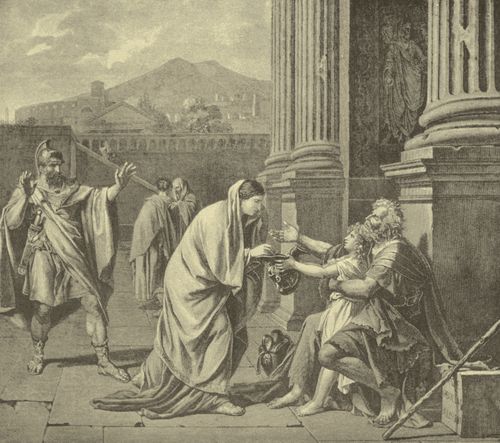
Belisarius receiving alms.
CHARLES MARTEL By Henry G. Hewlett (694-741)
Toward the close of the seventh century of our era, the kingdom which we now name France was peopled by a half-barbarous, professedly Christian race, of mixed tribes, the ruling portion of which originally sprang from Germany. The Frankish kingdom, as it was called, had risen upon the ruins of the Roman Empire, and for about a century was remarkable for the ability of its sovereigns. But after the death of King Dagobert I., in A.D. 638, the royal family seemed devoid of any mental or moral strength whatsoever, and the kings of this line have been always known as fainéants—weak idlers. The real power of the government was held by a succession of chief officers of the household, styled "Mayors of the Palace." The most distinguished of these noblemen was Pepin d'Héristal, who, from the year 688 to his death in 715, was virtually king of France—the nominal sovereigns being but puppets in his hands. The country was then divided into two great districts—the eastern, known as Austrasia; and the western, as Neustria. At his death Pepin left the reins of government to his grandson, Theodebald, an infant under the guardianship of his mother, Plectrude. The lawful king, Dagobert III., was also a child. It was clear that a fierce race of warriors required a strong arm to keep them in check, and could not long brook an infant's sway. The Neustrians commenced the revolt by expelling Theodebald and his mother, and choosing for their ruler a Mayor of the Palace named Raginfred. They then attacked Austrasia, which had not joined in the revolt. It was without fitting defences, and had no able man to direct its resistance against this assault. What course should the Austrasians take? Pepin, as we have said, left the government of France to a grandson; but he had a natural son, Charles, then in the flower of his youth. Whether on account of his not having been born in wedlock, or his having offended Pepin by some misconduct, Charles had been slighted, and even hated, by his father, who banished him to a monastery at Cologne, far from the intrigues of statecraft and the tumult of war. "Here," said the Austrasians, "is the likeliest man for our leader; a son of the wisest and firmest ruler the kingdom has yet acknowledged." It was agreed, therefore, by the people, that he should be invited to come, and a summons was sent from Metz, the then capital of the district, to the cloister at Cologne. Young and brave, pining in uncongenial society, and debarred from the employment of his talents, Charles seized this opportunity of release. Eagerly accepting the invitation, he hastened to return with the messengers, and soon, amidst the shouts of the delighted Austrasians, put himself at their head, under the title of Duke. The family of Pepin was not royal, and Charles doubtless saw the wisdom of yielding to the popular reverence for the ancient race of kings. The Neustrians had the same prejudice; and, accordingly, while Charles in the one district, and Raginfred in the other, virtually governed, their respective tools were Clothaire IV., King of Austrasia, and Chilperic II., King of Neustria, two descendents of the old dynasty. These events took place in A.D. 716.
The two countries now prepared for war. The Franks of Neustria were not so thoroughly and habitually warlike as their brethren of Austrasia, whose military system was better developed, in consequence of their position near the Rhine continually exposing them to conflicts with bands of Germans, which crossed the river in hopes of conquest. Nevertheless, the Austrasian Franks were now at a disadvantage, by reason of the unprepared state in which the Neustrian attack found them. Charles and Raginfred collected each an army, and marched at its head. The encounter was for some time doubtful, but the Neustrians gained a considerable advantage in the first campaign, and Charles was obliged to seek an asylum in the forests of the Ardennes region. Here, however, he did not long remain in concealment. Issuing forth at the head of a fresh body of men, he came upon the Neustrian army by surprise. A fearful slaughter took place, which he followed up by a vigorous pursuit. The Neustrians made a stand at Vincy, near Cambray. Charles met them here, and after a gallant struggle completely routed the force of Raginfred. This victory decided the fate of Neustria, and the crown of both countries was, in the year 719, placed on the head of Chilperic II. Either from motives of policy or of generosity, Charles did not abuse his success by the punishment of his rival, Raginfred, on whom he conferred the earldom and province of Anjou. He himself was content to remain sole Mayor of the Palace, under a show of obedience to a powerless king.
A brave, iron-willed man, this Charles Martel appears to us—dimly as the light of historic tradition permits us to behold him. He made his army the sole engine of his power, and cultivated it to the fullest extent then possible to him. Even the Church was not able to resist him; and at his pleasure he seized on benefices which he deemed too important to be placed in priestly hands, and bestowed them on his warriors. A rebellion among the nobles of Aquitaine demanded his attention; and thither he marched with ruthless determination, stemming revolt and establishing order. But he had a work to do in his generation far more important to Europe than any he had yet performed.
The Arab tribes, which in the last century had been converted, by the genius of Mohammed, from idolatry to the worship of God, and from lawless bandits into disciplined soldiers, were at this period pursuing their career of religious conquest into the heart of Christendom. The Gothic monarchy of Spain, under its last king, Roderick, had fallen beneath the invading force, which now threatened France. The Duchy of Aquitaine, which considered itself independent of France, but which Charles had reduced to comparative submission, opposed the only barrier to Arabian aggression. Eudes (or Eudin), then Duke, was a gallant prince, and did all that in him lay to resist the claim which the new lords of Spain asserted to his province of Septimania (Languedoc). He defeated one invading army before Toulouse in the year 721; but the tide of invasion still flowed in. He then tried intrigue, and bestowed his daughter on Musa, a revolted general of the great Arabian leader, Abd-er-rahman. But all was in vain. In 732 the Moslem once more appeared, in tremendous force, all over the south of France, ravaging as they came, finally besieging Arles and defeating its relieving army.
The wives and children of the invaders followed in their train, as though they intended to settle in the country. Abd-er-rahman was advancing yet farther on his victorious way, when Eudes, as a last resource, applied for aid to his enemy, Charles. What were personal enmities now? This common, national danger must be averted at all hazards. So thought Eudes when he sent to Charles. So thought Charles when he quickly summoned an army, and marched toward the plains between Poitiers and Tours, where the Arabs were quartered. The importance of the struggle that ensued cannot well be over-estimated. Christianity and Mohammedanism were at issue for the possession of Europe. The difficulties that lay in the way of the success of Charles were very great. The Arabs were animated with the fanatical zeal of a new faith, and a greedy desire of domination. The Franks, on the other hand, were probably not at all conscious of, or concerned for, the religious interests which were at stake, and aimed at no more than a vigorous rebuff of an unprovoked assault. They had the advantage of familiarity with the country and climate; but were outmatched, beyond comparison, in numbers. The old monkish chronicles tell us that the battle lasted seven days. The Arab army was mainly composed of cavalry and bowmen, and the Franks suffered greatly from the charges of the former and the unerring shots of the latter. But on the seventh day the combatants closed with each other. Heavily fell the iron hands of the sturdy Franks upon the sinewy, but slender frames of their Asiatic opponents. Nevertheless, Charles had no cavalry; and the swift steeds of Arabia, with their daring riders, trampled down his battalions. Suddenly there was a cry in the rear of the Moslem army that the infidels were spoiling the camp. More eager to save their treasure than to slay their foes, the Arabs turned in this direction. Skilfully interpreting the movement as a flight, Charles cheered on his men to pursue. The crisis was fatal to Abd-er-rahman. He tried to rally his cavalry. It was too late; and he fell, pierced through with many a Frankish spear. Night separated the contestants, and when in the morning the Franks would have renewed the battle, they found that their foes had stolen away in the night, fled, leaving their treasure and their dead upon the field. The incredible number of 300,000 Arabs is said to have fallen in this memorable defeat. The remainder fled through Aquitaine before the avenging sword of Charles. Well was he named "Martel," from the hammer-like might of his good arm! Who can say whether France and Germany, ay, England and all Europe, might not at this hour be sunk in such poverty and degradation of moral and intellectual life as Turkey now exhibits, had Charles Martel and his bold Franks fought less valiantly and enduringly at Tours?
History tells us but little more of Charles. He carried his arms into the Netherlands, conquered the Frisians and other tribes which then dwelt there, made them Christians by force, and vassals of the Frankish crown. In Saxony, and other parts of Germany also, his power was feared and obeyed. Pope Gregory II. offered to transfer to him the allegiance due from Rome to the Greek emperor, but the scheme was ended by the death of Charles. After the decease of King Chilperic II., in 720, Thierry IV. reigned in the same feeble manner as the other kings of his degenerate race. On his death, in 736, the people did not care to appoint a successor, being satisfied with the government which Charles continued to exercise under the title of "Duke of the Franks." He died in 741, at the age of forty-seven, leaving the monarchy to his three sons, Pepin, Carloman, and Griffo. Of the elder of these, we shall hear more anon. Charles Martel is the first hero who succeeded in stamping his image upon the surface of European history, after the chaos of the broken Roman empire had in some measure yielded to the spirit of order. He was chieftain of an unruly tribe, rather than king of a settled state. In this light we must regard him if we would judge his character fairly; and thus considered, he may be said to have governed France wisely and well. If his memory cannot be cleared from the reproach of certain deeds of violence, we can afford to pardon him when we remember the good service that his strong hammer once wrought for Europe.[Back to Contents]
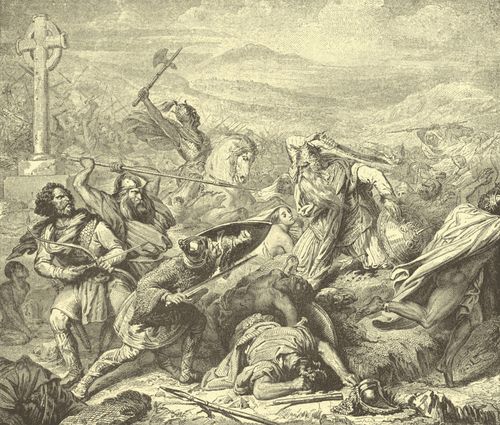
Charles Martel at Tours.
PEPIN THE SHORT By Henry G. Hewlett (714-768)
Charles Martel, as we have seen, was never king of the Franks, and his sons were too politic to assume the title on his death. Griffo, the third son, may be dismissed from our notice at once, as he was from the government of the kingdom, his brothers, Carloman and Pepin, taking advantage of his weakness to dispossess him. After this act of supremacy they were for some time content to act as Mayors of the Palace, in the districts of Neustria and Austrasia respectively, under the nominal sovereignty of Childeric III., the last of the fainéant kings, whom they set up as a puppet. Carloman distinguished himself by attacking the Saxons and other tribes which threatened aggression; and in 744 Pepin severely punished a revolt of his father's old enemy (Eudes, Duke of Aquitaine), who, as already stated, had been compelled to do homage to the Frankish crown. Pepin soon had no sharer in his power or fame. Carloman was not made for a soldier, and, under the sudden impulse of devotional feeling, resigned his office in 747, and retired into a Roman monastery.
Pepin, thus left sole lord of France, did not hastily attempt to cut prejudice against the grain. Feeling his way gradually, he sounded popular opinion for three years, on the subject of changing the royal dynasty, and placing the crown on the head of one who had a good right arm to defend it. Finding himself strong enough at last to take decided measures, he quietly dethroned Childeric III.; and shaving off his long hair, the symbol of royalty among the early Frankish kings, sent him to one monastery at St. Omer, and his son Thierry to another at Fontenelle. This accomplished, Pepin proceeded to obtain justification for his acts from the Pope. This was a novel step; for although the bishops of Rome had great spiritual influence over Christendom, in virtue of their alleged descent from St. Peter, their temporal authority was by no means admitted out of their own diocese. Pepin was a wise man in his generation, though short-sighted as far as posterity was concerned. He saw clearly enough that no sanction which he could obtain for his acts was likely to be so binding upon the minds of his subjects, and the world at large, as that pronounced by a power which had already fastened its yoke on the soul and conscience. The Pope, Zachariah, was not insensible to the importance of the Frankish monarchy, being at the time of Pepin's accession especially in need of help against Astolpho, king of the Lombards, who threatened to seize on the Eternal City itself. When, therefore, Pepin's envoys arrived at Rome, and conveyed their master's application, the pontiff did not hesitate to answer that it was truly fitting for one to be king in name who was king in deed. Thus fortified against opposition, Pepin proceeded to fulfil all the ceremonies attaching to the kingly dignity. He and his queen, Bertha, were duly crowned and consecrated by Boniface, the "Apostle of Germany," and Bishop of Mainz. This rite was performed at Soissons, in 752, with all the pomp that the Jewish kings had been wont to employ on such occasions. The national assembly was summoned; and in presence of the great Frank nobles Boniface produced a phial of oil, announcing it as that which had fallen from heaven on the day when the first king of the Franks (Clovis) had received baptism. The sacred oil was then poured upon the head of Pepin, and amid the acclamations of nobles, soldiers, and peasants, he was crowned their king.
He was a man, like his father, well fitted to rule over a warlike and rude people. What was most admired in a king at that period was personal courage, and, what was most needed, strength of will. Pepin had both; but he had one defect which, though to us it may seem a trifle, to men who prized the body far more than soul or mind, was a serious matter. He was of small stature, and acquired the name of "the Short" in consequence. Fully conscious that this was a disadvantage to him, and, indeed, hearing his name once derided by his courtiers, Pepin took a speedy opportunity of proving that what he lacked in height he more than made up in strength and bravery. It was common in those days to exhibit animal fights at the Frankish court, as indeed, to her shame be it spoken, is common in Spain to this day. On one of these occasions a lion and a bull were engaged in a savage and mortal struggle. Pepin and his courtiers were seated round the arena looking on, when suddenly the king started up, and cried: "Who will dare to separate those beasts?" There was a dead silence. The attempt was madness—certain destruction. Unsheathing his sword, and glancing scornfully round upon his courtiers, Pepin leapt into the arena, and drew the attention of the combatants upon himself. Raging with fury, they turned to attack him; but with cool and measured steps he evaded their onset, and by a succession of well-aimed blows struck off, one after the other, the heads of lion and bull. Then, throwing down his streaming sword, he accosted the astonished courtiers: "Am I worthy to be your king?" A deafening shout was the reply, and the name of "Pepin the Short" was no longer a term of derision but of honor.
Having thus established his reputation for those qualities which were most essential to his influence, Pepin took measures to render it permanent by acts of wisdom and liberality. He frequently called together the national assemblies, and included in the summons bishops as well as chieftains. Consulting with them as to the most prudent course of action, he preserved their affection to his person and obedience to his orders. He especially courted the favor of the Church, and showed his gratitude for the sanction which Pope Zachariah had given to his accession, by assisting the next Pope, Stephen III., in a serious contest which broke out in 753 with the Lombards. Their king, Astolpho, took an active part in the great religious quarrel which then agitated Christendom, with respect to the worship of images, espousing the cause of the image-breakers, while Pope Stephen supported the opposite side. Threatened with invasion, the Pope flew to the court of Pepin, who received him with much reverence, and in return was crowned king for the second time. Stephen even pronounced sentence of excommunication against all who should dare to choose a king of France from any other than Pepin's family. At the Pope's request the king assembled an army, and marched against Astolpho. The war lasted for two years, but eventually terminated in the success of Pepin, who compelled Astolpho to yield up to the Pope the exarchate of Ravenna, the last relic of the great Roman empire in Italy, and of which the Lombards had deprived the Eastern emperors.
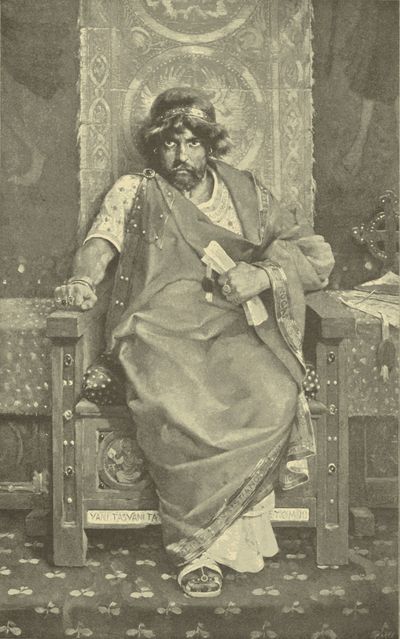
Pepin after the murder of Duke Waifre.
Pepin, however, had in view a more national war than this. The duchy of Aquitaine was perpetually in a state of resistance to the authority of the Frankish kings. This was owing, in some measure, to the difference of language and civilization which prevailed between the people of the duchy and those of the kingdom. A spirit of hostility was also fostered by the increase of population which Aquitaine obtained from the Gascons, a tribe from the Pyrenees, not subject to the Franks. After a long period of uncertain warfare, Pepin determined to decide the struggle by active operations. He accordingly, in 759, took advantage of a rising of the people of Septimania against their Arabian rulers. He made himself master of Narbonne and other towns, and freed the Septimanians. Then turning upon Waifre, Duke of Aquitaine, he summoned him to disgorge the spoils which he had seized from the Aquitanian lands of certain churches of France. Waifre replied in defiant terms, and for nine years resisted the attempts of Pepin to reduce him to submission. It was a sanguinary and desolating war. The fairest districts of Auvergne, Limousin, and Berry, were laid waste and burnt by Pepin; and in the Frankish territories Waifre levied an equally terrible retribution. He was murdered at last by some of his own subjects, at the instigation of the Frankish king. This is the one instance of actual crime which we find recorded against Pepin; and legend tells that its shadow rested heavily upon his mind. Aquitaine was annexed to the kingdom.
It was Pepin's last achievement. He did not, as we might have expected he would, die in harness on the battle-field, but of dropsy, at the age of fifty-four. This event occurred in 768, at St. Denis. Long before his death he had obtained the coronation of his two sons, Charles and Carloman, jointly with his own, and directed his territories to be divided between them.
To be the successful founder of a new dynasty demands a genius which we may justly entitle heroic, expressive as that word is of strength of character merely, without regard to moral worth. Pepin, however, was not devoid of the latter, to a limited extent, and has left a memory which, if not remarkable for virtue, is at least not disfigured by vice.[Back to Contents]
CHARLEMAGNE By Sir J. Bernard Burke (742-814)
The birthplace of Charlemagne is unknown, but from various data we may infer that he was born somewhere about the year 742, nearly seven years before his father, Pepin the Short, assumed the title of king. His mother was Bertha, daughter of Charibert, Count of Leon.
Of his boyhood we know as little as of his birth, but he seems at an early age to have mingled in the real business of life, for when only twelve years old we find him despatched to receive and welcome the sovereign pontiff who came to implore his father's aid against the barbarians that threatened Rome. From the usual habits of the Franks, it is also probable that he accompanied Pepin in his campaigns at an early age; but the first time that we really see him in the field, is on the renewal of the war with the rebellious Duke of Aquitaine.
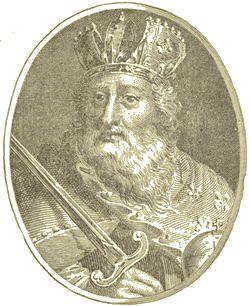
Upon the death of Pepin, 768, Charlemagne and his younger brother, Carloman, succeeded to equal portions of one of the most powerful European kingdoms, bounded by the Pyrenees, the Alps, the Mediterranean, and the ocean. But this would hardly have enabled the monarchs, even had they been united, to resist successfully the incursions of the barbarous tribes on the German frontiers of France, which had commenced with the first establishment of the Frankish dominion in Gaul; and which was kept alive by the constant pouring out of fresh hordes from the overpopulated North. The situation of Charlemagne was rendered yet more perilous by the passive enmity of his brother, and the rebellion of Hunald, the turbulent Duke of Aquitaine. But fortunately, Charlemagne had a genius equal to the difficulties of his situation; though his brother refused to aid him, he defeated Hunald; and no less illustrious by his clemency than by his valor and military skill, he forgave the vanquished rebel.
Desiderius, the king of Lombardy, had made large encroachments upon the states of the Roman pontiff, whose cause was taken up by Charlemagne. This led to feuds, which Bertha, the mother of the Frankish king, endeavored to appease by bringing about a union between her son and the daughter of the Lombard. But Charlemagne soon took a disgust to the wife thus imposed upon him, and repudiated her, that he might marry Hildegarde, the daughter of a noble family in Suabia.
In 771 Carloman died, and Charlemagne was elected to the vacant throne, to the exclusion of his nephews, whose extreme youth, indeed, made them incapable of wearing the crown in such troubled times. Gilberga, the widow of Carloman, immediately fled, and sought an asylum with Desiderius, the common place of refuge for all who were hostile to the Frankish monarch. But the attention of Charlemagne was called off to a more immediate danger from the Saxons, of whom the Frisons were either a branch or the perpetual allies. Had the tribes of which this people were composed been united under one head, instead of being governed by various independent chiefs, the result would probably have been fatal to France. Such a day, however, might come; a second Attila might arise; and with a full conviction of these perils, Charlemagne, when he marched against the barbarians, determined to put them down effectually. He took and destroyed the famous temple of the Irminsule, the great idol of their nation—that is, the Hermansaule, or Pillar of Hermann, which had originally been raised to commemorate the defeat of the Roman Varus by that hero, though in time the name had got corrupted, and the cause of its erection been forgotten. The Saxons were too wise to meet their powerful opponent in the field, and when, as often happened, they were brought to bay, they made a feigned submission, and obtained mercy by vows they never meant to keep. Meanwhile events had been taking place in another quarter, that called away Charlemagne, and obliged him to leave his generals to watch over them.
The Lombard king, Desiderius, had made use of his absence to plunder the papal see, to which Adrian had now succeeded. With some difficulty the Pope contrived to give his friend notice of his danger, when Charlemagne assembled a vast army, one division of which he himself led into Italy over the Alps by Mount Cenis, while the other was conducted to the same ground by his uncle, Duke Bernard, over the Mons Jovis, or Mount Joux, which from this event received the name it has borne ever since, of the Great Saint Bernard. Although surprised by an invasion from a quarter so unexpected, Desiderius marched out to meet his enemy, but his flank being turned, he fled hastily to Pavia, without having struck a blow; Charlemagne pursued the fugitives, but finding the city too strong to be taken by storm, he blockaded it with one portion of his army, while with the other he proceeded against Verona, having reduced which, he returned to the siege of Pavia. Month after month passed, till at length Easter approached, when, leaving the city blockaded as before, he determined to visit Rome in his capacity of patrician or governor. His march through the Italian towns was one of uninterrupted triumph; everywhere he was met with acclamations, and at Rome he was received by the Pope, as well as the people, with the liveliest expressions of gratitude for having freed them from the tyranny of the Lombards. The friendship then cemented between Adrian and his young deliverer lasted through the remainder of their lives without any serious interruption.
Having thus asserted his rights of Patrician or Exarch, Charlemagne was liberal in his donations to the Church, and soon afterward returned to the siege of Pavia, which it now became important for him to bring to a speedy conclusion, the Saxons having again taken advantage of his absence to ravage his frontiers. About the middle of the year, the city surrendered, and he was crowned with the iron crown of Lombardy. He then marched against the Saxons, defeating them whenever they ventured to make a stand, till they found their best resource was in submission.
It was not long before a fresh revolt amongst the Lombards recalled him to their country. Once more he was victorious and once more he was summoned from his career of conquest to meet the Saxons. As usual, they were beaten out of the field, and so completely, that many of them, seeming to have lost all faith in their gods, from repeated defeats, presented themselves with their wives and children to receive baptism.
Amid all these fatigues and battles, which might appear sufficient to have occupied the attention of any one man, Charlemagne retained in his own hands the general government of the state. The local administration was distributed among twelve provincial officers, with the title of Dukes, each of them having the command of a county. Subordinate to these officers were the Counts, who, in fact, were the judges of the land, and had full authority to decide and punish within their jurisdiction. To secure the faithful performance of their duties by these Dukes and Counts, certain officers, under the name of Missi Dominici, were sent in visitations from time to time to inquire into their conduct. In great ecclesiastical questions, or those affecting the more powerful vassals of the crown, either the king himself, or the count of his palace, sat as judge.
Spain next demanded his attention. That country had been subdued by the Arabs, but the descendants of the first conquerors quarrelled among themselves, and Ibn al Arabi, a powerful chief, sought aid of Charlemagne, who marched thither, and being, as usual, victorious, secured to himself a barrier against the Saracens and Gascons. This was seen with ill-will by Lupo, Duke of Gascony, who when the Frankish king was leaving Spain to meet fresh dangers on the Rhine, treacherously laid an ambush for his destruction in the gorges of the Pyrenees. The monarch himself was allowed to pass with the first division of his army, the second was assailed and destroyed in the valley of Roncesvalles, and the conquerors secreting themselves in their mountain fastnesses, presented no object for the vengeance of the indignant monarch. Besides, the barbarians were again ravaging his frontiers, under the command of Witikind, with a fierceness that went far beyond even the worst of their earlier incursions. Their cruelty, however, was retaliated by their almost total annihilation while attempting to retreat across the Adern, and in the ensuing season Charlemagne reduced them, as it seemed, to a state of total submission. But no sooner had he set out for Italy, whither he was called by many pressing affairs, than Witikind, the great leader of the Westphalians, started forth from his retreat in Denmark and stimulated all Saxony to a renewed contest. The time was well chosen. Witikind, who appears to have been as superior to the generals of Charlemagne as he was inferior to the king himself, gave the Franks a complete overthrow.
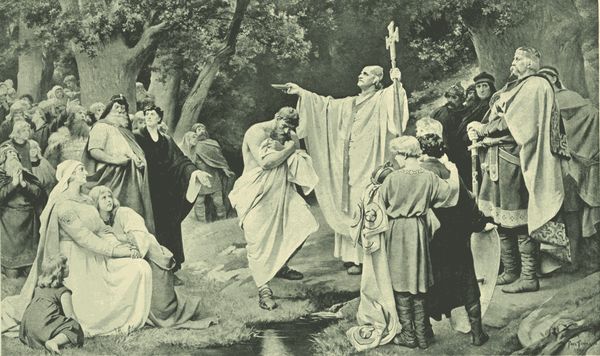
Charlemagne at Witikind's baptism.
Hildegarde, the wife of Charlemagne, had now been dead some short time, when he married Fastrada, the daughter of a Frankish noble. It is said that from this union there arose a spirit of discontent among some of the leading men of his nation, who in consequence rebelled against him; but, finding themselves too weak to contend with him, dispersed, and endeavored to find safety in concealment. They did not, however, escape their merited punishment. Being sooner or later taken, some had their eyes put out, others were degraded from their rank, none were condemned to death, but all to exile. Even these severe examples did not prevent the rise of many petty revolts, the different parts of which the Frankish kingdom was composed not being as yet sufficiently amalgamated; but they were suppressed by the united wisdom and vigor of the monarch.
The short interval of peace now allowed him, Charlemagne employed in endeavoring to educate and civilize his people. He made a tour through his dominions, spreading local and general improvement, reforming laws, advancing knowledge, and building churches and monasteries, Christianity being one of the chief means to which he trusted for the attainment of his grand objects. In this he was no less successful than he had before been in war. With the exception of the Eastern Empire, France was now the most cultivated nation in Europe, even Rome herself sending thither for skilful workmen, while commerce, roads, and mechanics must have been much advanced, as we may infer from the facility with which marble columns and immense stone crosses were often carried through the whole extent of France upon carriages of native construction. Luxury, too, with its attendant arts, had made considerable strides. Vases of gold and silver richly carved, silver tables brightly wrought, bracelets, rings, and table-cloths of fine linen, might be seen in the houses of the nobles. The people must have been dexterous in working iron, for their superiority in this respect is evinced by the severe laws forbidding the exportation of arms.
The calm, thus wisely employed, did not last long. Charlemagne was soon aroused from his peaceful occupations to put down a revolt of Tassilo, Duke of Bavaria, as well as a meditated attack upon Italy by Adalgisus, the son of the deposed Lombard king, Desiderius, who was assisted underhand by the Greek empress, Irene, and had besides formed a secret alliance with the Duke of Beneventum. Tassilo, being seized, was condemned to death by the great council. He appealed to the clemency of the king, who, ever averse to shed blood, mitigated the sentence into a lifelong seclusion from the world in a cloister. Adalgisus was met by the Duke of Beneventum, not to assist him, as he had expected, but to oppose him, for the duke had in good time discovered that loyalty was more likely to prosper than treason. He therefore joined the army of France under Grimwold, and in the battle which succeeded the Greek forces were entirely routed, and Adalgisus disappears from the busy scene.
The empire of Charlemagne was next to be assailed by the Huns, not the same people whose fathers had fought under Attila, though probably descended from the same stock. Upon the death of that ferocious conqueror, the tribes whom his talents had kept united, again sundered. Shortly afterward a warlike nation, calling themselves Avars, approached the northern parts of Europe, having been driven from their native country by the Turks. They spread rapidly, acquiring territory and power, until they were invited by Tassilo to aid him in his meditated treachery. They lost more than one battle against the Franks, but neither their own defeat, nor the total overthrow of their ally, made any change in their purposes. They persisted; fought a hard battle, and were so utterly routed, that they drew back and remained quiet for a while, in order to collect their strength before venturing upon a fresh contest with their tremendous adversary, who, on his part, was no less desirous of a respite for the same object. Little rest, however, was allowed him. No sooner had he beaten back these Huns, than he had to contend with a new enemy, the Weletabes, a Slavonian tribe inhabiting the northern part of Germany, near Brandenburg and Pomerania, from the Elbe to the Baltic. In themselves they might not have excited much alarm, but, if they met with only a temporary success, their example might have been fatal, by rousing the Saxons, who still with reluctance submitted to the yoke imposed upon them. The king, therefore, without loss of time, met and defeated the Weletabes; when he received them into grace, and ever afterward found them faithful.
Having freed himself from this peril, Charlemagne next found that he must turn his arms against the Huns of Hungary, which appears to have been defended by them after a singular fashion. The whole country was surrounded by nine circles of double palisading, formed of trunks of trees twenty feet in height. The interstices of the palisade were twenty feet wide, filled with stone and lime compacted, the top being covered with earth, and planted with shrubs. At the distance of twenty Teutonic, or forty Italian miles, was a second fortified line of the same kind; and thus the circles were repeated, the circumference always narrowing till you came to the innermost, or ring, in which the Avars kept all their wealth, the accumulation of centuries of rapine. Such, at least, is the account, however improbable, handed down to us by an historian of the day.
In the outset fortune favored Charlemagne as usual. He took the first three of the defensive circles sword in hand, and laid waste the country to the junction of the Raab with the Danube, while his son Pepin had met and routed their army in another quarter. But unhappily a pestilential disease broke out among the horses, who died by thousands, and he was obliged to retreat, unpursued, however, by the Avars, their surprise and terror not having yet subsided.
In the doubtful lull that followed, a conspiracy was raised against the life and throne of the monarch, in which his natural son, Pepin the Hunchback, was implicated. It was discovered in time, and all the conspirators were put to death, with the exception of Pepin, who was confined for life within a monastery.
Scarcely had the king escaped this danger, than he was alarmed by news that the Saxons had revolted, and uniting themselves with the Huns, had given a bloody defeat to his cousin, Theodoric. Close upon this came other tidings of equally evil import. In the late campaign against the Huns, Charlemagne had called to his aid his son Pepin, King of Italy, who, notwithstanding he was himself embroiled with Grimbald, Duke of Beneventum, did not hesitate to obey. To reward this prompt obedience, Charlemagne early in the winter had despatched another son, Louis, King of Aquitaine, to the help of his brother, when the Saracens took advantage of the latter's absence to attack his frontiers, and even penetrated to Narbonne before any forces were ready to oppose them. From this expedition they returned home laden with plunder, and satisfied with this success, remained for a while in quiet. Charles therefore had a brief respite to turn against the Saxons; and as he had hitherto found all his precautions unavailing to keep them within the bounds of good order, he broke up the nation, and transported an immense number of the most turbulent to a distance from their own country. Multitudes of men, women, and children were dispersed over France, and not a few were transported to Brabant and various parts of Flanders.
About this time, 793, the first collision took place between the Franks and the piratical Northmen.
It would be alien from our present purpose to follow Charlemagne step by step in his march of conquest and civilization. We need only say in general terms, that he drove back the Arabs, reduced the Huns, became the friend of Haroun al Raschid, his only rival in the paths of greatness, and effectually protected his long line of coast from the attempted incursion of the Northmen. It is said that upon one occasion he arrived at a certain port just as the pirates were preparing to land; but the moment they by some means learnt the presence of the monarch, they immediately fled in terror at his mere name. He remained gazing on the departing vessels, while the tears rolled down his cheeks. His nobles could not help showing surprise at such unusual emotion in the monarch, which being observed by him he exclaimed, "I weep not, my friends, because I myself fear these miserable savages; but I weep that they should dare to show themselves upon my coast while I am living, for I foresee the evils they will bring upon my people when I am dead."
It was always an object of first importance with Charlemagne to support the papal authority, as holding out the only means of spreading Christianity, which he justly considered the most effectual instrument he could employ to enlighten and civilize the world. An attempt had been made to mutilate the Pope, and thus disqualify him for his office, by Campulus and Paschal, two disappointed aspirants to the papacy; but he escaped from their hands and brought his complaints before Charlemagne. The conspirators then attempted to justify the deed, by accusing the Pope of atrocious crimes; and the king calling to his aid certain of the Roman prelates, proceeded to sit in judgment on him. The prelates, however, declared that by all the canonical rules they could not judge their superior; and Leo therefore was allowed, according to an old custom, to purge himself, by a solemn oath, of the crimes which had been laid to his charge.
Many motives of policy at this time induced the Pope to set up an emperor of the West in opposition to the Eastern Empire. It was Christmas-day, when, with the rest of the Catholic world, Charlemagne presented himself in the church of St. Peter. At the desire of the Romans he was dressed in the long robe of the patrician, and unsuspicious, it is said, of the honor intended him, knelt at the high altar; but, just as he was about to rise, Leo advanced, and suddenly placed upon his head the crown of the Western world, amidst the popular acclamations, "Long life and victory to Charles Augustus, crowned by God, great and pacific Emperor of the Romans!"
To end the long-existing feuds between the Western and Eastern Empires, Charlemagne now proposed to marry Irene, who, having deposed her son and put out his eyes, had usurped the throne of Constantinople. Irene herself was not unwilling to accept the offer; but she was overruled by a faction, and a treaty of peace was substituted for a treaty of marriage. But while the negotiations were going on, Irene herself was deposed by the great treasurer, Nicephorus, who even refused to grant her the smallest pittance, so that the degraded empress was obliged to support herself by the labors of the distaff. He was, however, glad to conclude a peace with Charlemagne.
Though troubled from time to time by disputes among the neighboring barbarians, the Frankish monarch might now be said to enjoy peace; and while still in the possession of robust health, he resolved to prepare for death, by allotting among his children such portions of territory as he wished them to possess when he should be removed from the scene. Both his sons and the people willingly consented to the proposed arrangements, which, indeed, bore the stamp of his usual wisdom and justice. But the advanced age which he attained, brought with it the usual evils of protracted life. He saw his friends and children swept away before him. His son Louis alone remained to inherit his vast dominions. With this single drawback the remainder of his time was as prosperous as his earlier career had been; till at length, being suddenly attacked with pleurisy, he expired, after a short illness, in the seventy-second year of his age and the forty-seventh of his reign, January 28, 814.[Back to Contents]
OLAF TRYGGVESON Extracts from "Early Kings of Norway," by Thomas Carlyle (955-1000)
Grown to manhood, Tryggveson, now become acquainted with his birth, and with his, alas! hopeless claims, left Russia for the one profession open to him, that of sea-robbery; and did feats without number in that questionable line in many seas and scenes,—in England latterly, and most conspicuously of all. In one of his courses thither, after long labors in the Hebrides, Man, Wales, and down the western shores to the very Land's End and farther, he paused at the Scilly Islands for a little while. He was told of a wonderful Christian hermit living strangely in these sea-solitudes; had the curiosity to seek him out, examine, question, and discourse with him; and, after some reflection, accepted Christian baptism from the venerable man. In Snorro the story is involved in miracle, rumor, and fable; but the fact itself seems certain, and is very interesting; the great, wild, noble soul of fierce Olaf opening to this wonderful gospel of tidings from beyond the world, tidings which infinitely transcended all else he had ever heard or dreamt of! It seems certain he was baptized here; date not fixable; shortly before poor heart-broken Dunstan's death, or shortly after; most English churches, monasteries especially, lying burnt, under continual visitation of the Danes. Olaf, such baptism notwithstanding, did not quit his viking profession; indeed, what other was there for him in the world as yet?
We mentioned his occasional copartneries with Svein of the Double-beard, now become King of Denmark, but the greatest of these, and the alone interesting at this time, is their joint invasion of England, and Tryggveson's exploits and fortunes there some years after that adventure of baptism in the Scilly Isles. Svein and he "were above a year in England together," this time: they steered up the Thames with three hundred ships and many fighters; siege, or at least furious assault, of London was their first or main enterprise, but it did not succeed. The "Saxon Chronicle" gives date to it, A.D. 994, and names expressly, as Svein's copartner, "Olaus, King of Norway,"—which he was as yet far from being; but in regard to the Year of Grace the "Saxon Chronicle" is to be held indisputable, and, indeed, has the field to itself in this matter. But finding London impregnable for the moment (no ship able to get athwart the bridge, and many Danes perishing in the attempt to do it by swimming), Svein and Olaf turned to other enterprises; all England in a manner lying open to them, turn which way they liked. They burnt and plundered over Kent, over Hampshire, Sussex; they stormed far and wide; world lying all before them where to choose. Wretched Ethelred, as the one invention he could fall upon, offered them Danegelt (£16,000 of silver this year, but it rose in other years as high as £48,000); the desperate Ethelred, a clear method of quenching fire by pouring oil on it! Svein and Olaf accepted; withdrew to Southampton—Olaf at least did—till the money was got ready. Strange to think of, fierce Svein of the Double-beard, and conquest of England by him; this had at last become the one salutary result which remained for that distracted, down-trodden, now utterly chaotic and anarchic country. A conquering Svein, followed by an ably and earnestly administrative, as well as conquering, Knut (whom Dahlmann compares to Charlemagne), were thus by the mysterious destinies appointed the effective saviours of England.
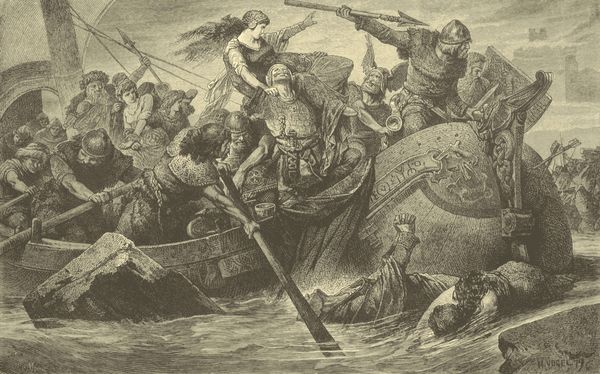
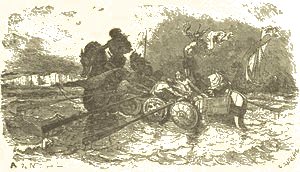
A Norse raid under Olaf.
Tryggveson made a stout, and, in effect, victorious and glorious struggle for himself as king. Daily and hourly vigilant to do so, often enough by soft and even merry methods,—for he was a witty, jocund man, and had a fine ringing laugh in him, and clear pregnant words ever ready,—or if soft methods would not serve, then by hard, and even hardest, he put down a great deal of miscellaneous anarchy in Norway; was especially busy against heathenism (devil-worship and its rites): this, indeed, may be called the focus and heart of all his royal endeavor in Norway, and of all the troubles he now had with his people there. For this was a serious, vital, all-comprehending matter: devil-worship, a thing not to be tolerated one moment longer than you could by any method help! Olaf's success was intermittent, of varying complexion; but his effort, swift or slow, was strong and continual; and on the whole he did succeed. Take a sample or two of that wonderful conversion process:
At one of his first Things he found the Bonders all assembled in arms; resolute to the death seemingly, against his proposal and him. Tryggveson said little; waited impassive, "What your reasons are, good men?" One zealous Bonder started up in passionate parliamentary eloquence; but after a sentence or two broke down; one, and then another, and still another, and remained all three staring in open-mouthed silence there! The peasant-proprietors accepted the phenomenon as ludicrous, perhaps partly as miraculous withal, and consented to baptism this time.
On another occasion of a Thing, which had assembled near some heathen temple to meet him,—temple where Hakon Jarl had done much repairing, and set up many idol figures and sumptuous ornaments, regardless of expense, especially a very big and splendid Thor, with massive gold collar round the neck of him, not the like of it in Norway,—King Tryggveson was clamorously invited by the Bonders to step in there, enlighten his eyes, and partake of the sacred rites. Instead of which he rushed into the temple with his armed men; smashed down, with his own battle-axe, the god Thor prostrate on the floor at one stroke, to set an example; and in a few minutes had the whole Hakon Pantheon wrecked; packing up, meanwhile, all the gold and preciosities accumulated there (not forgetting Thor's illustrious gold collar, of which we shall hear again), and victoriously took the plunder home with him for his own royal uses and behoof of the state.
By unwearied industry of this and better kinds, Tryggveson had trampled down idolatry, so far as form went,—how far in substance may be greatly doubted. But it is to be remembered withal, that always on the back of these compulsory adventures there followed English bishops, priests, and preachers; whereby to the open-minded, conviction, to all degrees of it, was attainable, while silence and passivity became the duty or necessity of the unconvinced party.
In about two years Norway was all gone over with a rough harrow of conversion. Heathenism at least constrained to be silent and outwardly conformable. Tryggveson next turned his attention to Iceland, sent one Thangbrand, priest from Saxony, of wonderful qualities, military, as well as theological, to try and convert Iceland. Thangbrand made a few converts; for Olaf had already many estimable Iceland friends, whom he liked much, and was much liked by; and conversion was the ready road to his favor. Thangbrand, I find, lodged with Hall of Sida (familiar acquaintance of "Burnt Njal," whose Saga has its admirers among us even now). Thangbrand converted Hall and one or two other leading men; but in general he was reckoned quarrelsome and blusterous rather than eloquent and piously convincing. Two skalds of repute made biting lampoons upon Thangbrand, whom Thangbrand, by two opportunities that offered, cut down and did to death because of their skaldic quality. Another he killed with his own hand, I know not for what reason. In brief, after about a year, Thangbrand returned to Norway and King Olaf, declaring the Icelanders to be a perverse, satirical, and inconvertible people, having himself, the record says, been "the death of three men there." King Olaf was in high rage at this result; but was persuaded by the Icelanders about him to try farther, and by a milder instrument. He accordingly chose one Thormod, a pious, patient, and kindly man, who, within the next year or so, did actually accomplish the matter; namely, get Christianity, by open vote, declared at Thingvalla by the general Thing of Iceland there; the roar of a volcanic eruption at the right moment rather helping the conclusion, if I recollect. Whereupon Olaf's joy was no doubt great.
One general result of these successful operations was the discontent, to all manner of degrees, on the part of many Norse individuals, against this glorious and victorious, but peremptory and terrible king of theirs. Tryggveson, I fancy, did not much regard all that; a man of joyful, cheery temper, habitually contemptuous of danger. Another trivial misfortune that befell in these conversion operations, and became important to him, he did not even know of, and would have much despised if he had. It was this: Sigrid, queen-dowager of Sweden, thought to be among the most shining women of the world, was also known for one of the most imperious, revengeful, and relentless, and had got for herself the name of Sigrid the Proud. In her high widowhood she had naturally many wooers; but treated them in a manner unexampled.
In spite of which, however, there went from Tryggveson, who was now a widower, some incipient marriage proposals to this proud widow; by whom they were favorably received; as from the brightest man in all the world, they might seem worth being. Now, in one of these anti-heathen onslaughts of King Olaf's on the idol temples of Hakon—(I think it was that case where Olaf's own battle-axe struck down the monstrous refulgent Thor, and conquered an immense gold ring from the neck of him, or from the door of his temple)—a huge gold ring, at any rate, had come into Olaf's hands; and this he bethought him might be a pretty present to Queen Sigrid, the now favorable, though the proud. Sigrid received the ring with joy; fancied what a collar it would make for her own fair neck; but noticed that her two goldsmiths, weighing it on their fingers, exchanged a glance. "What is that?" exclaimed Queen Sigrid. "Nothing," answered they, or endeavored to answer, dreading mischief. But Sigrid compelled them to break open the ring; and there was found, all along the inside of it, an occult ring of copper, not a heart of gold at all! "Ha," said the proud queen, flinging it away, "he that could deceive in this matter can deceive in many others!" And was in hot wrath with Olaf; though, by degrees, again she took milder thoughts.
Milder thoughts, we say; and consented to a meeting next autumn at some half-way station, where their great business might be brought to a happy settlement and betrothment. Both Olaf Tryggveson and the high dowager appear to have been tolerably of willing mind at this meeting; but Olaf interposed, what was always one condition with him, "Thou must consent to baptism, and give up thy idol-gods." "They are the gods of all my forefathers," answered the lady; "choose thou what gods thou pleasest, but leave me mine." Whereupon an altercation; and Tryggveson, as was his wont, towered up into shining wrath, and exclaimed at last, "Why should I care about thee then, old faded heathen creature?" And impatiently wagging his glove, hit her, or slightly switched her, on the face with it, and contemptuously turning away, walked out of the adventure. "This is a feat that may cost thee dear one day," said Sigrid. And in the end it came to do so, little as the magnificent Olaf deigned to think of it at the moment.
Olaf Tryggveson, though his kingdom was the smallest of the Norse Three, had risen to a renown over all the Norse world which neither he of Denmark nor he of Sweden could pretend to rival. A magnificent, far-shining man; more expert in all "bodily exercises," as the Norse called them, than any man had ever been before him, or after was. Could keep five daggers in the air, always catching the proper fifth by its handle, and sending it aloft again; could shoot supremely, throw a javelin with either hand; and, in fact, in battle usually threw two together. These, with swimming, climbing, leaping, were the then admirable Fine Arts of the North; in all which Tryggveson appears to have been the Raphael and the Michael Angelo at once. Essentially definable, too, if we look well into him, as a wild bit of real heroism, in such rude guise and environment; a high, true, and great human soul. A jovial burst of laughter in him, too; a bright, airy, wise way of speech; dressed beautifully and with care; a man admired and loved exceedingly by those he liked; dreaded as death by those he did not like. "Hardly any king," says Snorro, "was ever so well obeyed, by one class out of zeal and love, by the rest out of dread." His glorious course, however, was not to last long.
King Svein of the Double-beard had not yet completed his conquest of England,—by no means yet, some thirteen horrid years of that still before him!—when, over in Denmark, he found that complaints against him and intricacies had arisen, on the part principally of one Burislav, King of the Wends (far up the Baltic), and in a less degree with the King of Sweden and other minor individuals. Svein earnestly applied himself to settle these, and have his hands free. Burislav, an aged heathen gentleman, proved reasonable and conciliatory; so, too, the King of Sweden, and Dowager Queen Sigrid, his managing mother. Bargain in both these cases got sealed and crowned by marriage. Svein, who had become a widower lately, now wedded Sigrid; and might think, possibly enough, he had got a proud bargain, though a heathen one. Burislav also insisted on marriage with Princess Thyri, the Double-beard's sister. Thyri, inexpressibly disinclined to wed an aged heathen of that stamp, pleaded hard with her brother; but the Double-bearded was inexorable; Thyri's wailings and entreaties went for nothing. With some guardian foster-brother, and a serving-maid or two, she had to go on this hated journey. Old Burislav, at sight of her, blazed out into marriage feast of supreme magnificence, and was charmed to see her, but Thyri would not join the marriage party, refused to eat with it or sit with it at all. Day after day, for six days, flatly refused; and after nightfall of the sixth, glided out with her foster-brother into the woods, into by-paths and inconceivable wanderings; and, in effect, got home to Denmark. Brother Svein was not for the moment there; probably enough gone to England again. But Thyri knew too well he would not allow her to stay here, or anywhere that he could help, except with the old heathen she had just fled from.
Thyri, looking round the world, saw no likely road for her, but to Olaf Tryggveson in Norway; to beg protection from the most heroic man she knew of in the world. Olaf, except by renown, was not known to her; but by renown he well was. Olaf, at sight of her, promised protection and asylum against all mortals. Nay, in discoursing with Thyri Olaf perceived more and more clearly what a fine handsome being, soul and body, Thyri was; and in a short space of time winded up by proposing to Thyri, who, humbly, and we may fancy with what secret joy, consented to say yes, and become Queen of Norway. In the due months they had a little son, Harald; who, it is credibly recorded, was the joy of both his parents; but who, to their inexpressible sorrow, in about a year died, and vanished from them. This, and one other fact now to be mentioned, is all the wedded history we have of Thyri.
The other fact is, that Thyri had, by inheritance or covenant, not depending on her marriage with old Burislav, considerable properties in Wendland, which she often reflected might be not a little behooveful to her here in Norway, where her civil-list was probably but straitened. She spoke of this to her husband; but her husband would take no hold, merely made her gifts, and said, "Pooh, pooh, can't we live without old Burislav and his Wendland properties?" So that the lady sank into ever deeper anxiety and eagerness about this Wendland object; took to weeping; sat weeping whole days; and when Olaf asked, "What ails thee, then?" would answer, or did answer once, "What a different man my father Harald Gormson was" (vulgarly called Blue-tooth), "compared with some that are now kings! For no King Svein in the world would Harald Gormson have given up his own or his wife's just rights!" Whereupon Tryggveson started up, exclaiming, in some heat, "Of thy brother Svein I never was afraid; if Svein and I meet in contest, it will not be Svein, I believe, that conquers;" and went off in a towering fume. Consented, however, at last, had to consent, to get his fine fleet equipped and armed, and decide to sail with it to Wendland to have speech and settlement with King Burislav.
Tryggveson had already ships and navies that were the wonder of the North. Especially in building war-ships—the Crane, the Serpent, last of all the Long Serpent—he had, for size, for outward beauty, and inward perfection of equipment, transcended all example.
This new sea expedition became an object of attention to all neighbors; especially Queen Sigrid the Proud and Svein Forkbeard, her now king, were attentive to it.
"This insolent Tryggveson," Queen Sigrid would often say, and had long been saying, to her Svein, "to marry thy sister without leave had or asked of thee; and now flaunting forth his war navies, as if he, king only of paltry Norway, were the big hero of the North! Why do you suffer it, you kings really great?"
King Olaf Tryggveson, unacquainted with all this, sailed away in summer, with his splendid fleet; went through the Belts with prosperous winds, under bright skies, to the admiration of both shores. Such a fleet, with its shining Serpents, long and short, and perfection of equipment and appearance, the Baltic never saw before. Jarl Sigwald joined with new ships by the way. "Had," he too, "a visit to King Burislav to pay; how could he ever do it in better company?" and studiously and skilfully ingratiated himself with King Olaf. Old Burislav, when they arrived, proved altogether courteous, handsome, and amenable; agreed at once to Olaf's claims for his now queen, did the rites of hospitality with a generous plenitude to Olaf; who cheerily renewed acquaintance with that country, known to him in early days (the cradle of his fortunes in the viking line), and found old friends there still surviving, joyful to meet him again. Jarl Sigwald encouraged these delays, King Svein & Co. not being yet quite ready. "Get ready!" Sigwald directed them, and they diligently did. Olaf's men their business now done, were impatient to be home, and grudged every day of loitering there; but, till Sigwald pleased, such his power of flattering and cajoling Tryggveson, they could not get away.
At length, Sigwald's secret messengers reporting all ready on the part of Svein & Co., Olaf took farewell of Burislav and Wendland, and all gladly sailed away. Svein, Eric, and the Swedish king, with their combined fleets, lay in wait behind some cape in a safe little bay of some island, then called Svolde, but not in our time to be found: the Baltic tumults in the fourteenth century having swallowed it, as some think, and leaving us uncertain whether it was in the neighborhood of Rugen Island or in the Sound of Elsinore. There lay Svein, Eric & Co. waiting till Tryggveson and his fleet came up, Sigwald's spy messengers daily reporting what progress he and it had made. At length, one bright summer morning, the fleet made appearance, sailing in loose order, Sigwald, as one acquainted with the shoal places, steering ahead, and showing them the way.
Snorro rises into one of his pictorial fits, seized with enthusiasm at the thought of such a fleet, and reports to us largely in what order Tryggveson's winged Coursers of the Deep, in long series, for perhaps an hour or more, came on, and what the three potentates, from their knoll of vantage, said of each as it hove in sight. Svein thrice over guessed this and the other noble vessel to be the Long Serpent; Eric always correcting him: "No, that is not the Long Serpent yet" (and aside always), "Nor shall you be lord of it, King, when it does come." The Long Serpent itself did make appearance. Eric, Svein, and the Swedish king hurried on board, and pushed out of their hiding-place into the open sea. Treacherous Sigwald, at the beginning of all this, had suddenly doubled that cape of theirs, and struck into the bay out of sight, leaving the foremost Tryggveson ships astonished, and uncertain what to do, if it were not simply to strike sail and wait till Olaf himself with the Long Serpent arrived.
Olaf's chief captains, seeing the enemy's huge fleet come out, and how the matter lay, strongly advised King Olaf to elude this stroke of treachery, and, with all sail, hold on his course, fight being now on so unequal terms. Snorro says, the king, high on the quarter-deck where he stood, replied, "Strike the sails! never shall men of mine think of flight. I never fled from battle. Let God dispose of my life; but flight I will never take." And so the battle arrangements immediately began, and the battle with all fury went loose, and lasted hour after hour, till almost sunset, if I well recollect. "Olaf stood on the Serpent's quarter-deck," says Snorro, "high over the others. He had a gilt shield and a helmet inlaid with gold; over his armor he had a short red coat, and was easily distinguished from other men." Snorro's account of the battle is altogether animated, graphic, and so minute that antiquaries gather from it, if so disposed (which we but little are), what the methods of Norse sea-fighting were; their shooting of arrows, casting of javelins, pitching of big stones, ultimately boarding, and mutual clashing and smashing, which it would not avail us to speak of here. Olaf stood conspicuous all day, throwing javelins, of deadly aim, with both hands at once; encouraging, fighting, and commanding like a highest sea-king.
The Danish fleet, the Swedish fleet, were, both of them, quickly dealt with, and successively withdrew out of shot-range. And then Jarl Eric came up, and fiercely grappled with the Long Serpent, or, rather, with her surrounding comrades; and gradually, as they were beaten empty of men, with the Long Serpent herself. The fight grew ever fiercer, more furious. Eric was supplied with new men from the Swedes and Danes; Olaf had no such resource, except from the crews of his own beaten ships; and at length this also failed him; all his ships, except the Long Serpent, being beaten and emptied. Olaf fought on unyielding. Eric twice boarded him, was twice repulsed. Olaf kept his quarter-deck; unconquerable, though left now more and more hopeless, fatally short of help. A tall young man, called Einar Tamberskelver, very celebrated and important afterward in Norway, and already the best archer known, kept busy with his bow. Twice he nearly shot Jarl Eric in his ship. "Shoot me that man," said Jarl Eric to a bowman near him; and, just as Tamberskelver was drawing his bow the third time, an arrow hit it in the middle and broke it in two. "What is this that has broken?" asked King Olaf. "Norway from thy hand, King," answered Tamberskelver. Tryggveson's men, he observed with surprise, were striking violently on Eric's; but to no purpose; nobody fell. "How is this?" asked Tryggveson. "Our swords are notched and blunted, King; they do not cut." Olaf stept down to his arm-chest; delivered out new swords; and it was observed as he did it, blood ran trickling from his wrist; but none knew where the wound was. Eric boarded a third time. Olaf, left with hardly more than one man, sprang overboard (one sees that red coat of his still glancing in the evening sun), and sank in the deep waters to his long rest.
Rumor ran among his people that he still was not dead; grounding on some movement by the ships of that traitorous Sigwald, they fancied Olaf had dived beneath the keels of his enemies, and got away with Sigwald, as Sigwald himself evidently did. "Much was hoped, supposed, spoken," says one old mourning Skald; "but the truth was, Olaf Tryggveson was never seen in Norseland more." Strangely he remains still a shining figure to us; the wildly beautifullest man, in body and in soul, that one has ever heard of in the North.[Back to Contents]
WILLIAM THE CONQUEROR By G. W. Prothero (1027-1087)
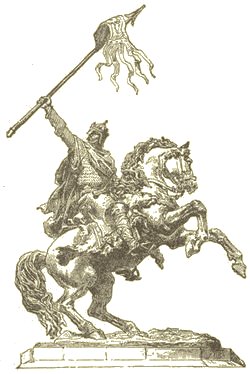
William I., King of England, surnamed the Conqueror, was born in 1027 or 1028. He was the son of Robert, Duke of Normandy and Herleva, daughter of Fulbert, a tanner of Falaise. When he was about seven years old his father, intending to go on pilgrimage and having no legitimate sons, proposed him as his heir. The great men of the duchy did homage to the child, and a year later (1035) his father's death left him to make good his claim. Anarchy was the natural result of a minority. William's life was on more than one occasion in danger, and several of his guardians perished in his service. At the earliest possible age he received knighthood from the hands of Henry I. of France, and speedily began to show signs of his capacity for government.
In 1042 he insisted that the "truce of God" should be proclaimed and observed in Normandy. When he was about twenty years old his authority was threatened by a general conspiracy, which spread through the western half of his duchy. An attempt was made to seize him at Valognes, and he only escaped by riding hard all night to his own castle at Falaise. Bessin and Cotentin, the most Norman parts of Normandy, rose in rebellion. William sought and obtained aid from King Henry, and completely defeated the rebels at Val-es-Dunes near Caen (1047). The battle was but a combat of horse, but it decided the fate of the war and left William master of his duchy. The debt which he owed to Henry was repaid next year. War broke out between Geoffrey, Count of Anjou, and Henry (1048), and William came to his suzerain's assistance. Alençon, one of the chief border fortresses between Normandy and Maine, which had received an Angevin garrison, was captured by the duke. The inhabitants had taunted him with his birth, and William, who had dealt leniently with the rebels after Val-es-Dunes, took a cruel revenge. Soon afterward Domfront, another important border fortress, fell into his hands.
In 1051 William visited England. Two years later he married Matilda, daughter of Baldwin, Earl of Flanders, and a descendant of Alfred. The marriage had been forbidden by a council at Rheims as uncanonical, and was opposed by Lanfranc, Prior of Bec. This produced a quarrel between Lanfranc and William, who ravaged the lands of the abbey and ordered the banishment of its prior. Lanfranc, however, soon came to terms with the duke, and engaged to obtain a dispensation from Rome, which, however, was not granted till 1059.
Strengthened by this alliance with Flanders, William showed himself more than a match for all his enemies. Henry, who had hitherto been for the most part friendly, now turned against him. After the suppression of some isolated revolts, William was threatened in 1054 by a great confederacy. His dominions were invaded by the forces of the French king, in combination with those of Geoffrey of Anjou, Theobald of Blois, and others. William remained at first on the defensive; then, falling suddenly on one of the French armies at Mortemer, in the north-eastern corner of his duchy, he cut it to pieces. This blow put an end to the war; Henry made peace (1055), and William took the opportunity of extending his dominions in a southerly direction. He built fresh fortresses and exacted homage from Count Geoffrey of Mayenne.
In 1058 Henry and Count Geoffrey made a final effort to crush their dangerous neighbor; but the effort failed, like those which preceded it. William again allowed the allies to enter and ravage his territory; but, while the French army was crossing the Dive at Varaville, he attacked and completely destroyed their rear-guard, which was cut off from the van by the advancing tide. Henry again made peace, and soon afterward died (1060). The death of Geoffrey of Anjou in the same year relieved William of his most formidable rival for the possession of Maine. Herbert Wake-Dog, the lawful ruler of that territory, who had been dispossessed by Geoffrey, recovered his dominions on the latter's death. He at once "commended" himself to William, thus making the duke his heir. On his death in 1063, William took possession of Le Mans and the county of which it was the capital—an acquisition which extended his southern frontier nearly to the Loire, almost severed Brittany from the rest of France, and paved the way for the subsequent junction with Anjou.
It was apparently soon after this event, in the year 1064, that Harold, then Earl of Wessex, visited Normandy, and, according to legend, was entrapped into an oath to support William as heir to the English throne. When Harold was elected and crowned King of England (1066), William's first step was to send an embassy to him demanding the fulfilment of his promise. The purport of the demand is as uncertain as that of the pledge; but, whatever it was, Harold rejected it. The duke thereupon summoned a council of his supporters, who advised him to call together an assembly representing the whole duchy. This assembly, a typical feudal parliament, met at Lillebonne. While acting together it appears to have opposed the scheme for the conquest of England which William laid before it, but its members were won over singly. He then made a compact with Tostig, the banished brother of Harold; he came to terms with the Emperor Henry; he conciliated Philip, King of France, by offering to hold England as his vassal; and—most important of all—he obtained the sanction of Rome.
Pope Alexander II., not only issued a bull declaring William to be the rightful heir to the throne, but sent him a ring and a banner as symbols that the blessing of heaven was on his claim. Embarking at St. Valéry, William landed, on 28th of September, at Pevensey. The battle of Senlac or Hastings (October 14, 1066), was a decisive victory for the Duke of Normandy; but it took five years more to complete the conquest of England.
Early in 1067 William made a progress through the eastern and central parts of his new dominions. All that had as yet submitted to him was comprised in the old kingdoms of Wessex and East Anglia, and a small portion of Mercia. He at once secured his hold over these districts by the erection of fortresses in London, Norwich, and elsewhere. He received homage from the great men; he confiscated the lands of those who had resisted him; and, while keeping a large number of manors for himself, he granted others to his followers. Even those who had not resisted were regarded as having legally forfeited their title and had to submit to a re-grant on less advantageous terms. In March, 1067, William returned to Normandy, taking with him as hostages the Earls Eadwine, Morkere, and Waltheof.
The revolts which broke out in the north and southwest compelled him to return to England in December. Early in 1068 he marched on Exeter, as the centre of the western revolt. He took the town and built a castle, after which he subdued Cornwall, and then marching northward forced Bristol to submit. In the summer of 1068 there was a general rising of the North, of which Eadgar was the nominal head; but Eadwine and Morkere were the moving spirits. The insurgents were aided by Malcolm, King of Scotland. William had, however, only to show himself in order to put down the insurrection. He journeyed northward, by way of Warwick and Nottingham, to York, received the submission of Eadwine, Morkere, and Malcolm, and returned by way of Lincoln and Cambridge. His march was accompanied by heavy confiscations, and great castles, rising in places of vantage, rendered the Norman power at once visible and secure.
In the spring of 1069 a fresh revolt broke out. Robert of Comines, the newly appointed Earl of Northumberland, was slain at Durham; a Danish fleet entered the Humber, and a Danish army, joined by Eadgar and Waltheof, seized and burned York. The sons of Harold attacked Devon, while other isolated outbreaks took place in the west. These were speedily put down by William's lieutenants; and in the autumn the king himself, going northward a second time, recovered York, and harried Northumberland with ruthless deliberation. Returning to keep Christmas at York, he set out again in January, 1070, to oppose Malcolm, who had crossed the border in aid of the insurgents. He forced Waltheof to submit, and drove the Scottish king back into his own country; then, marching over pathless fells in the depth of winter, he reached Chester, took the town, and founded another castle.
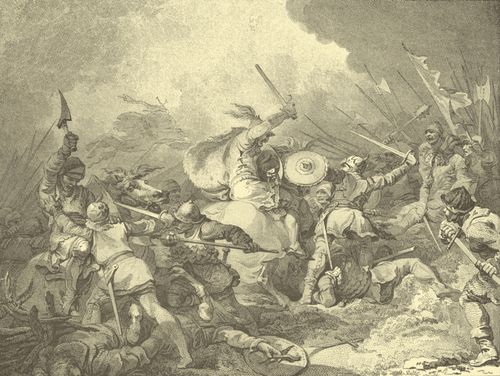
William at Hastings.
Northumbria, exhausted and ruined, gave up the struggle, and the omission of the northern counties from the Domesday survey throws a grim light on the completeness of the Conquest. In one district only, the fens of Cambridgeshire, where Hereward still held out, the spirit of resistance survived. In April, 1071, William arrived at Cambridge and commenced a regular blockade. Advancing cautiously by means of a causeway through the fens, he entered Ely in October, and therewith the last flicker of independence died out. The conquest of England was completed. To guard against any fresh incitements to rebellion from Scotland, William in 1072 invaded that country and forced Malcolm to do him homage—an event which had an important effect on the subsequent relations of the two countries.
Henceforward such trouble as William met with came, not from the English, but from his Norman vassals or his own family. In 1073 the citizens of Le Mans took advantage of his absence to set up a "commune," and invited Fulk of Anjou to protect them. William was soon in the field, this time assisted by English troops. He harried the country, recovered Le Mans, and made an advantageous peace with the count. By a skilful compromise he recognized Fulk as overlord of Maine, but kept actual possession of the district, for which his son Robert did homage. A year later a formidable revolt broke out in England. Two of William's great vassals, Ralph, Earl of Norfolk, and Roger, Earl of Hereford, rebelled, and a Danish fleet, probably in alliance with them, appeared in the Humber. William returned at once to England and put down the insurrection. A great meeting of the witan was summoned to try Roger and Waltheof, for the latter, though he took no part in the rebellion, had undoubtedly been privy to it. Roger was imprisoned for life and Waltheof was condemned to death.
This was the last instance of opposition to William in England; but the remaining ten years of his life were occupied with almost continuous troubles on the Continent. In 1076 he was engaged in a war with Brittany, which the interference of Philip of France forced him to bring to an unsuccessful conclusion. Next year he quarrelled with his son Robert. Matilda took the young man's side against her husband, and Philip lent him his assistance. In 1080 William was at open war with his son. While besieging him at Gerberoi he received a wound and was forced to raise the siege. A temporary reconciliation followed, soon to give way to another and a final quarrel. Three years later Matilda died, and troubles thickened upon William. A rebellious vassal, Hubert of Beaumont, seems to have held him at bay for nearly three years. Rival claims to Vexin, a district on the eastern frontier of Normandy, involved him in another war with France. He was growing old and weary, and, as he lay sick at Rouen in the summer of 1087, the French army harried his territories with impunity. When he had recovered sufficiently to take the field, he invaded Vexin and burned the town of Mantes. But his horse, plunging in the burning cinders, inflicted on him an internal injury, which proved his death-wound He was carried to St. Gervais, where, on September 9, 1087, he died. His body was conveyed to Caen and buried in the great minster which he had built.
The career of William as a warrior and conqueror occupies of necessity the largest space in his life; but his fame as a statesman and administrator is not less than that which he won on the battle-field. This is not the place to discuss the results of the Conquest, but the policy of the Conqueror in regard to Church and State cannot be overlooked. An orthodox churchman, a supporter of union under the successor of Peter against the schismatic tendencies of the English Church, he nevertheless repelled any claim on the part of Rome to interference with his political sovereignty. He allowed Peter's pence to be collected, but refused to pay tribute to the Pope. While recognizing him as head of the Church, he declined to hold his kingdom as his vassal, nor would he permit papal bulls to enter England or excommunications to be issued against any of his subjects without his leave. He controlled all appointments to important ecclesiastical dignities; he made laws for the Church; he dealt justice to ecclesiastics, high and low, in his own courts. At the same time he had no desire to humiliate the Church; on the contrary, he sought to elevate it to a higher position in the State, to make it a more potent agent of civilization. A weaker statesman might have seen his own advantage in encouraging the rivalry between Canterbury and York; William strengthened the Church by forcing the younger to give way to the elder see. With the same object, that of increasing the efficiency of ecclesiastical organization, he severed the temporal and spiritual jurisdictions and furthered the enforcement of clerical celibacy. Finally, the trust which he reposed in Lanfranc from the time of his appointment to the see of Canterbury in 1070 shows not only his insight into character but his respect for the head of the English Church.
In regard to temporal affairs William was rather an administrator than a lawgiver. His reign is not marked by a series of legislative acts like those of Henry II. or Edward I.; but his work was the indispensable preliminary to theirs, for a strong monarchy was the first requisite of the state. To establish the power of the crown was William's principal care. The disintegrating tendencies of feudalism had already been visible under the Anglo-Saxon kings. William, while he established fully developed feudalism as a social, territorial, and military system in his new dominions, took measures to prevent it from undermining his own authority. He scattered the estates of his great vassals, so as to hinder them from building up provincial principalities; he maintained the higher popular courts against the encroachments of manorial jurisdictions; he prevented the claims of feudal lordship from standing between himself and the mass of his subjects, by exacting an oath from every landholder at the meeting of Salisbury plain; finally, by the great survey which resulted in "Domesday Book" he not only asserted his right to make a general inquisition into property, but laid the firm basis of knowledge which was indispensable to centralized government and taxation.
The care which he took to maintain English laws and institutions is part of the same policy. He balanced the two nationalities over which he ruled, and obliged each to depend upon him as its leader or protector against the other. He ruled as an English king; his feudal council was the witenagemot with a new qualification; but at the same time he was lord of the land as no king had been before him, and he enjoyed not only all the income of his predecessors but in addition all the dues which came to him as feudal sovereign. He was thus perhaps the strongest and most absolute monarch that has ever sat upon the English throne.
In character William was stern, self-reliant, and imperious in a high degree. He was not naturally cruel; but he was ruthless if it served his purpose, and could take pitiless vengeance for an insult or a wrong. He was too strong to prefer deceit when force would serve as well, but his diplomacy was subtle and guileful, and no scruple turned him aside from his aim. His temper, originally forgiving, was soured by opposition toward the end of his life, and his tyrannical tendencies were strengthened by the long exercise of uncontrolled power. His passionate devotion to the chase is only too clearly shown in the harshness of his forest laws. In private life he displayed domestic virtues, and his fidelity to his wife was exceptional in the annals of his house and time.[Back to Contents]
GODFREY DE BOUILLON By Henry G. Hewlett (1060-1100)
In the year 1094 the Turks besieged the Holy City of Jerusalem, then ruled by the Fatimite caliphs, and took it. Pilgrims were then subjected to every form of violence and insult. The Greek emperor Alexius Comnenus, whom the Turks had recently defeated, implored the assistance of the great Christian states against this new and formidable foe. Pope Urban, to whom the letter was addressed, summoned a council of nobles and prelates in Auvergne and, with solemn and weighty words, appealed to the princes and soldiers of France who were seated before him. He reminded them of the national exploits of their fathers, whom Charles Martel and Charlemagne led against the Saracens, and called on the sons of such fathers to achieve yet greater deeds. As the burning words dropped from his lips they lighted a flame in every heart, and the whole assembly suddenly rose, and shouted with one voice, "It is God's will! It is God's will!" Urban caught up the cry: "Yes, without doubt, it is God's will. He has dictated to you the words, let them be your war-cry, and be this your badge!" As he spoke he held up a crucifix. The great meeting was moved like one man; and, falling on their knees, all confessed their sins, received absolution, and took vows of service in the Holy War. A red cross, embroidered on the right shoulder, was the common sign assumed by all the soldiers, who thence acquired the name of "Crusaders." Estates were pawned and sold to obtain money for the expenses of the undertaking, and many commercial cities purchased important liberties from their lords at this favorable opportunity. The chief of one of three great divisions into which the Christian army was formed was a man whom we have taken as the very type and model of a true Crusader,—Godfrey de Bouillon.
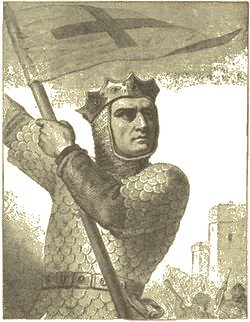
He was the son of Gustavus, Count of Bouillon, or Boulogne, in the district of Ardennes and province of Luxembourg, and was born about the year 1060. His profession had been from his youth that of arms, and his earliest services in the field were rendered to his lord, the Emperor of Germany. In the war of Investiture he had taken an active part against Gregory VII., and bore the Imperial standard at the battle of Merseberg. By his hand the usurper, Rudolph, Duke of Suabia, fell in that decisive encounter. Godfrey's sword, swayed by his young and powerful wrist, is said to have shorn off the right arm of Rudolph at a single stroke. For this valiant deed, Henry IV. created Godfrey Duke of his province of Bouillon; or, according to some historians, Lower Lorraine. At the subsequent siege of Rome, Godfrey made himself again prominent by scaling the city walls among the first. This action colored his whole life. All his contemporaries portray his nature as displaying the loftiest integrity and deepest piety. Sound and clear as his intellect was, he yet shared in the superstition of his times, and was led by reflection to believe that, in bearing arms against God's vicegerent, and attacking a city where so many apostles and martyrs lay buried, he had been guilty of a heinous sin. Remorse worked on his mind so heavily that he took a vow to join in the Crusade, from a conviction that his glaring crime could only be blotted out by a heroism equally conspicuous. His noble birth, and yet nobler character, won for him so high a place in the estimation of his fellows, that, on announcing his intention of undertaking the Crusade, hundreds flocked to his standard. A worthy general, truly, of soldiers thus ardent in a cause which they deemed divine! To the qualities of bodily strength and beauty, which in those days were chiefly valued in the head of an army, Godfrey happily united the more durable strength of intellect and beauty of soul. His knightly heart and statesman's mind never ran counter, and whatever generous policy the one dictated, was carried into effect by the wisdom of the other. Although averse to distinction, it was thrust upon him by the votes of his fellow-chiefs, and their decision was gladly hailed by the common soldiers, who loved Godfrey as a father. He would not, therefore, refuse the post of general, but applied himself to its duties with activity. He first set an example of unselfish zeal to his brother nobles, by disposing of his duchy for the purpose of his expedition,—an example faithfully followed by the leading nobility of France and the Rhine. He then summoned his army to join him in August, 1096, on the banks of the rivers Meuse and Moselle. At the appointed time, a force of 80,000 foot and 10,000 horse assembled under his banner, and set out on its march through Germany,—the two other divisions of the Christian army taking a different route. On reaching Hungary, Carloman, who then ruled that country, showed some signs of objection to the passage of so formidable a body,—remembering the licentious excesses that had been committed by the rabble which followed Peter the Hermit. Here Godfrey's wisdom was admirably displayed. By his firm measures of restraint on the impetuosity of his troops he first proved that they were under the influence of strict discipline. Then, confiding himself to the justice and good faith of Carloman, he disarmed that monarch's suspicions by frankness and simplicity. The result was that, instead of opposition, the Hungarian prince gave him help, and escorted the Crusaders with a body of cavalry into the territories of Greece. Alexius Comnenus was by this time alarmed at the eagerness with which the Christian states had responded to his appeal for aid against the infidel. He mistrusted, not without reason, the intentions of some of the chiefs of the expedition,—mere adventurers, like the Norman Bohemond of Tarentum for example, who was his avowed foe,—and therefore deemed it politic to guard against danger to himself by demanding homage from all the Crusaders who entered his dominions. The two other divisions of the Christian army were now on their way to Constantinople, by a different road from that taken by Godfrey. One of the French nobles, the Count de Vermandois, was shipwrecked on the coast of Epirus, and Alexius unjustifiably detained him as a prisoner or hostage for the good faith of the other leaders. On learning these tidings, Godfrey, who was now in Thrace, sent to the emperor, requiring the count's release. This was not accorded, and Godfrey therefore treated the country as hostile, levying contributions on the people as he marched through. The emperor immediately saw his error, and promised to grant the count's release on the arrival of the French army. This promise satisfied Godfrey, and his march was once more peaceful. The wily emperor, in the meanwhile, obtained from his prisoner an oath of homage, hoping to induce the other Crusaders to follow the example. Godfrey, on his arrival, at first refused this, as unbecoming the rank and character which he bore; but, finding that the act would appease the jealousies which had already broken out between the Greeks and Franks, and put a check on the schemes of those leaders in the crusading ranks whom Alexius especially dreaded, he at last consented. The other chieftains made a like submission; and this sacrifice of pride, by healing internal discords, served for a season to promote the success of the Crusade.