Volume 1 — SOLDIERS AND SAILORS (continued 2)
Reading edition
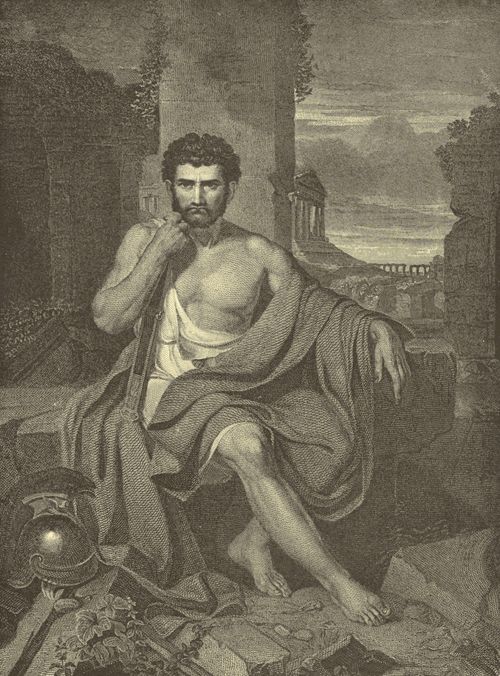
Marius on the ruins of Carthage.
When Sulla crushed the Marian party Cæsar had just arrived at manhood. Though of an old patrician house, he had yet a family connection with the democratic party, Marius having married his aunt. He himself had married a daughter of the democratic leader Cinna, and for refusing to divorce her he was proscribed by Sulla, but managed to keep in hiding till the storm was past. After the death of the great reactionist (B.C. 78), he seized every opportunity of reviving the spirit of the popular party; as, for instance, by publicly honoring the memory of Marius, bringing to justice murderers of the proscription, and courageously raising his single voice in the Senate against the illegal execution of Catiline's partisans (B.C. 63). Clearly seeing the necessity for personal government, at a time when his own services and distinctions were not such as to entitle him to aspire to it, Cæsar did his best to secure it for Pompey, then far the foremost man in Rome, by strenuously supporting measures which virtually placed the empire at his absolute disposal for an indefinite period. A fairly good soldier, but a most vain, unreliable, and incompetent statesman, Pompey after five years let these powers slip through his hands.
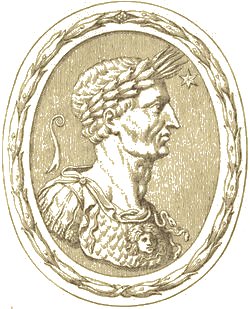
Cæsar was by this time thirty-eight (B.C. 62). He had steadily risen in influence and official rank; and it was, no doubt, now that he determined to take the great task into his own hands. He was the recognized chief of the popular party, which aimed at concentrating Republican government in the hands of a single person, as the only means of bridling the oligarchy. But this was not to be accomplished merely by popular votes, as many a democratic leader had found to his cost. Cæsar needed an army and a military reputation, and with rare patience he set himself to acquire both. By a coalition with Pompey—now obliged to treat him as an equal—he obtained the consulship (B.C. 59), which on its expiration entitled him to a great military command.
Roman generals had of late preferred to extend their conquests eastward, and to win comparatively easy and lucrative triumphs in Asia, over people who had possessed for long ages a type of civilization suited to them, and who therefore could never thoroughly assimilate Western manners and institutions. All this time Gaul, lying at the gates of Italy, was neglected (only the district between the Cevennes and the Alps having been reduced), because the people were more warlike, and less booty was to be gained. Yet, till that conquest should be effected, Rome's work of civilizing the world was standing still; nay, it was always menaced by northern invasions. This field of action, then, Cæsar marked out for himself, in which he could prepare the means for assuming power at home, and at the same time render the highest service to his country and humanity. His ardent spirit, his incredible energy in all circumstances of his life, astonished his contemporaries. Time pressed, for he was no longer young. While he was absent from Rome, what revolutions might not mar his plans! Yet, ten continuous years did he devote to this great task, which, if he had achieved nothing else, would make his name one of the greatest in history. In those ten years he conquered Gaul, from the Pyrenees to the Rhine and the British Channel; conquered her so thoroughly, and treated her so sensibly, that when the fierce struggle was over, she frankly and even proudly accepted her new position. The culture, the institutions, even the language of the victors, were eagerly adopted. The grandsons of the men who had fought so gallantly against Cæsar, won full citizenship, took their seats in the Senate, and commanded Roman armies.
These ten years decided the future of the West, and therefore of Humanity. It is not merely the central position and natural advantages of France, nor yet the admirable qualities of her people, which have made her throughout mediæval and modern history, the foremost of European states. It is even more the result of her rapid and thorough acceptance of Roman civilization. This made her the heir of Rome. This enabled her, long afterward, to Romanize Germany and England in some degree, and as it were at second-hand, by the arms of Charlemagne and William.
It had been arranged between Cæsar and Pompey, that during the absence of the former in Gaul, the latter should act with the popular party, and keep the nobility in the condition of impotence to which it had been reduced in the consulship of Cæsar. Partly from jealousy of Cæsar, partly from sheer incapacity, Pompey, after much vacillation and duplicity, finally allied himself with the nobles, thinking with their aid to crush his rival and thereafter to be supreme. The nobles, for their part, thought they would know how to deal with Pompey if once Cæsar was out of the way. In the negotiations which preceded the civil war, Cæsar showed a moderation and fairness in striking contrast with the unscrupulous and headstrong violence of the nobles, who had not even formal legality on their side. But when he was finally summoned to hand over his province and army to a nominee of the Senate, on pain of being declared a public enemy, and when the tribunes who had reversed the resolution of the Senate were obliged to fly for their lives to his camp, he suddenly crossed the river Rubicon, the boundary of his province, and marched on Rome (B.C. 49).
He had but one legion with him; the bulk of his army was far away in its Gallic cantonments. The forces of Pompey were overwhelmingly superior in numbers. But the rapid and daring advance of Cæsar prevented their concentration. He came, not merely the adored general of a veteran army, but the long-tried and consistent leader of the liberal party, who had never swerved from his principles, never betrayed his friends, never flinched from dangers. Fascinated by his success and encouraged by his clemency, towns everywhere opened their gates and Pompeian levies joined him, swelling his army at every stage as he swept down Italy.
Pompey, for his part, was not sorry to have a pretext for moving eastward toward the scene of his early triumphs, where his military prestige and his personal influence would cause all the client states to rally round him, and the sulky and suspicious nobles would find themselves overshadowed. So he crossed the Adriatic, leaving the large veteran army in Spain, which was under his orders, to take care of itself. Thither Cæsar proceeded as soon as he had secured Italy, bent on making sure of the West before doing anything else. When the Spanish legions were beaten, he lost no time in following Pompey, who had found the respite all too short for drilling his large but raw force of Romans, and organizing the masses of Asiatics whom he had summoned to his standard. In the campaign that ensued, the conqueror of the East fully maintained his old military reputation; but at length, driven by the clamor of the nobles to risk a pitched battle, he suffered a crushing defeat on the field of Pharsalia (B.C. 48). Flying to Egypt, still an independent kingdom, he was assassinated by order of the government.
The beaten party rallied again, first in Africa, then in Spain; and of the three years and nine months of life that remained to Cæsar, much the greater portion was spent at the head of his army. He, therefore, had not time to give any complete organization to his new government. But his intentions are clearly discernible in outline. Supreme power, legislative as well as executive, was to be vested in a single ruler, governing not by divine right, but as the representative of the community, and in its interest. This was indeed an ideal by no means novel to Romans. Scipio had brooded over it. Caius Gracchus had for a moment realized it. The oldest institutions and traditions told of it. It was the power of the ancient kings theoretically continued to, and in grave emergencies actually exercised by, the magistrates of the Republic during its best days. It had been increasingly overshadowed by the Senate. That body was now to be reduced to its original consultative office. The functions of the executive had been gradually divided among several magistrates. They were now to be re-concentrated. Above all, annual election—the cherished institution of all oligarchies, open or disguised—was to be replaced by life-tenure, with power to name a successor. The subjects of Rome were to be admitted to citizenship, wherever and whenever fit for it; and there is reason to believe that Cæsar intended to move much faster in this direction than his successor did. Rome itself, from the mistress of the Empire, was to become its capital and most dignified municipality. All old parties—Cæsar's own included—were to consider themselves at an end. "To the victors the spoils!" was a cry rebuked from the first. For the vanquished of Pharsalia there was not only amnesty, but admission to the highest grades of the public service, if they would bury their old grudge and recognize the government. Pauperism among the lower class, and insolvency among the upper—ulcers not admitting of a radical cure—were treated with judicious palliatives. Taxation was reduced, expenditure was increased, and yet the balance in the treasury at Cæsar's death was tenfold what it had ever been before—a proof of the frightful waste and corruption from which the Roman world was rescued by the overthrow of the oligarchy.
Of the administrative work of Cæsar it is impossible here to give any adequate idea. A reform of the calendar, which served the West till 1582, and serves Russia still; a recasting of the whole provincial administration; a codification of Roman law; a census of the Empire; a uniform gold coinage; a public library; a metropolitan police; building regulations; sanitary regulations; an alteration of the course of the Tiber, which would have drained the marshes—all these grand projects, and more, some carried to completion, some only sketched out, teemed from the active brain of the great organizer, in the brief moments he could spare from military cares in these last months of his life—a devouring activity, an all-embracing capacity, such as perhaps never shone forth in man before or since. What Roman incorporation meant for the ancient world was at last revealed. The war havoc of seven centuries had found its justification.
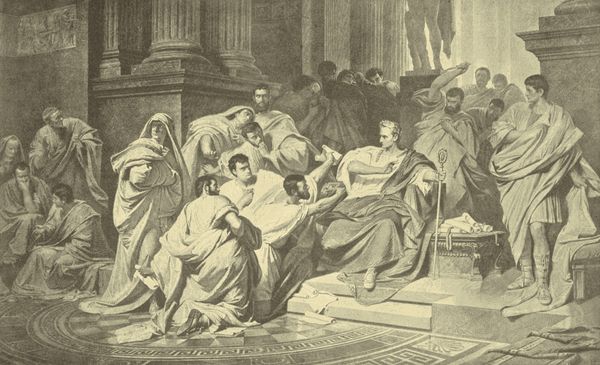
The Ides of March.
In the midst of this glorious and beneficent career, at the age of fifty-five (57?), Cæsar, whose frank and fearless spirit disdained suspicion or precaution, was assassinated by a knot of rancorous, perfidious aristocrats, whom he had pardoned and promoted. Their purblind spite was powerless to avert the inevitable advent of monocracy. What they did effectually extinguish for more than a century, was the possibility of amnesty, conciliation, and mutual confidence. Careless as usual of historical truth, the great English poet has glorified the murderers of Cæsar. Dante, never forgetting the moral responsibility of art, has reserved the lowest circle of hell for Brutus, Cassius, and Judas Iscariot.
It imports little to the greatness of such a one as Cæsar, to add that in an age of oratory he stood in the first rank of orators; that his historical writings are an unrivalled model of vigor, lucidity, and elegance; that he carried his scientific culture to a point very unusual among his countrymen; and that his personal prowess and feats of endurance were the admiration of veteran soldiers. Women loved him, and he loved them. Enjoying life thoroughly, he was temperate in all things. To no man has it been given to approach more nearly to the perfection of human nature—complete, evenly balanced, and self-controlled.[Back to Contents]
MARC ANTONY (83-30 B.C.)
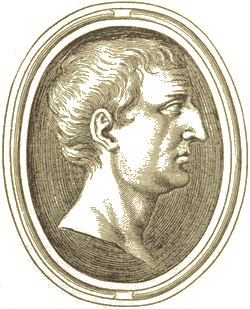
Marcus Antonius, or Marc Antony, grandson of Antonius the orator, and son of Antonius Creticus, seems to have been born about 83 B.C. While still a child he lost his father, whose example however, had he been spared, would have done little for the improvement of his character. Brought up under the influence of the disreputable Cornelius Lentulus Sura, whom his mother had married, Antony spent his youth in profligacy and extravagance. For a time he co-operated with the reprobate Clodius in his political plans, chiefly, it is supposed, through hostility to Cicero, who had caused Lentulus, his stepfather, to be put to death as one of the Catiline conspirators; but he soon withdrew from the connection, on account of a disagreement which, appropriately enough, arose in regard to his relations to his associate's wife, Flavia. Not long after, in 58 B.C., he fled to Greece, to escape the importunity of his creditors; and at length, after a short time spent in attendance on the philosophers at Athens, found an occasion for displaying some of the better features of his character, in the wars that were being carried on by Gabinius against Aristobulus in Palestine, and in support of Ptolemy Auletes in Egypt.
A new chapter in his life was opened by the visit which he made to Julius Cæsar in Gaul (54 B.C.). Welcomed by the victorious general as a valuable assistant in his ambitious designs, and raised by his influence to the offices of quæstor, augur, and tribune of the plebes, he displayed admirable boldness and activity in the maintenance of his patron's cause, in opposition to the violence and intrigues of the oligarchical party. At length his antagonists prevailed, and expelled him from the curia; and the political contest became a civil war. The Rubicon was crossed; Cæsar was victorious, and Antony shared in his triumph. Deputy-governor of Italy during Cæsar's absence in Spain (49), second in command in the decisive battle of Pharsalia (48), and again deputy-governor of Italy while Cæsar was in Africa (47), Antony was now inferior in power only to the dictator himself, and eagerly seized the opportunity of indulging in the most extravagant excesses of luxurious licentiousness—excesses which Cicero depicted in the "Philippics" with all the elaborate eloquence of political hatred. In 46 he seems to have taken offence at Cæsar, because he insisted on payment for the property of Pompey which Antony professedly had purchased, but had merely appropriated. But the estrangement was not of long continuance, for we find Antony meeting the dictator at Narbo the following year, and rejecting the advances of Trebonius, who endeavored to discover if there was any hope of getting Antony to join in the conspiracy that was already on foot. In 44 he was consul along with Cæsar, and seconded his ambition by the famous offer of the crown on the 15th of February, thus unconsciously preparing the way for the tragedy on the 15th of March. To the sincerity of his adherence to Cæsar, the conspirators themselves bore witness on that memorable day, by the care which they took to keep him engaged without, while the daggers were doing their work within.
This was the second great epoch in Antony's life. A brighter prospect than ever was then opened to his ambition. By his eloquence—a hereditary gift—he managed to stir up the minds of the populace against the assassins of Cæsar, and drove them from the city. He made peace with the remaining representatives of the senatorial party, and seemed almost to have succeeded to the power and position of his unfortunate patron. But the youthful Octavius, whom Cæsar had adopted as his son, arrived from Illyria, and claimed the inheritance of his "father." Agreement was impossible, and war ensued. Octavius obtained the support of the Senate and of Cicero; and the veteran troops of the dictator flocked to his standard. Antony was denounced as a public enemy; and the city gave its loudest applause to the tirades of his most eloquent accuser. His cause gradually lost ground, and seemed to be totally ruined when his army was defeated in the siege of Mutina (43 B.C.). But escaping to Cisalpine Gaul, he formed a junction with Lepidus, and they marched toward Rome with 17 legions and 10,000 cavalry.
The wily Octavius now betrayed his party, and entered into terms with Antony and Lepidus. It was agreed that they three should adopt the title—so beautifully ironical—of Triumviri reipublicæ constituendæ, and share the power and the provinces among them. Gaul was to be Antony's; Spain fell to the lot of Lepidus, and Africa, Sardinia, and Sicily were to belong to Octavius. A conjunct proscription followed, each of the partners in the villanous design bartering the life of his friends, for the pleasure of destroying his foes. The detested author of the "Philippics" was given up to Antony's revenge; and, according to Appian, the number of the victims amounted to 300 senators and 2,000 knights. In the following year Antony and Octavius proceeded against the conspirators, Cassius and Brutus, who still maintained themselves in Macedonia; and, in the battles of Philippi, stamped out the last embers of republican Rome.
While Octavius returned to Italy, Antony proceeded to Greece, and thence to Asia Minor, for the sake of recruiting his funds, completing the subjugation of the Eastern provinces, and obtaining satisfaction about the conduct of the Egyptian queen during the recent contest. On his passage through Cilicia, in 41, he was visited by Cleopatra, who came to answer the charges in person. She sailed up the Cydnus in a gorgeous bark, with a fantastic and brilliant equipage, and brought all her allurements to bear on the heart of the voluptuous Roman. Her success was complete; and he who was to have been her judge, was led captive to Alexandria as her slave. All was forgotten in the fascination and delight of the passing hour; and feasting and revelry found perpetual and ever-varying renewal.
At length Antony was aroused by the Parthian invasion of Syria, and the report of an outbreak between Fulvia, his wife, and Lucius, his brother, on the one hand, and Octavius on the other. On arriving in Italy he found that the war was over, and Octavius the victor; and the chief cause of disagreement being soon after removed by the death of Fulvia, a reconciliation was speedily effected between the triumvirs, and cemented by the marriage of Antony with Octavia, the sister of his colleague. A new division of the Roman world was agreed on at Brundusium, Lepidus receiving Africa, Octavius the West, and Antony the East.
Returning to his province, Antony was for a time successful; his general, Ventidius, beating the Parthians, and Socius capturing Jerusalem and conquering Antigonus. But after another visit to Italy, during which the triumvirate was prolonged for five years, Antony sent away his wife, yielded himself completely to the evil influence of Cleopatra, indulged not only in licentiousness, but in tyranny, and allowed his affairs to be neglected or delayed. An expedition against the Parthians was a failure; but for this, his success against Artavasdes, the Armenian king, in some measure compensated. Octavius at length determined to get rid of Antony, and had little need of invention to bring charges sufficient against him. About two years were spent in preparations and delays on both sides, and it was not till the year 31 that the fate of Antony was decided by the battle of Actium.
Defeated and deserted, he once more sought refuge and repose in the society of Cleopatra, but was followed even there by his relentless rival. At first he made a gallant effort to defend himself, and partially succeeded. But convinced of the hopelessness of his position, and assured of the suicide of his mistress, he followed the example which he was falsely informed she had given (30 B.C.). Antony had been married in succession to Fadia, Antonia, Fulvia, and Octavia, and left behind him a number of children. A short but vivid sketch of Antony is given by De Quincey in his "Essay on the Cæsars."[Back to Contents]
HERMANN (16 B.C.-21 A.D.)
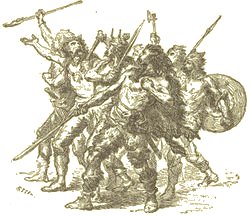
Hermann, the Arminius of the Roman historians, the son of Sigimer, chief of the Cherusci, was born about B.C. 16 or 17. Being sent in early youth as a hostage to Rome, probably in consequence of the victories of Drusus, which had established the supremacy of Rome over the Catti, Cherusci, and other tribes of North Germany, he obtained the favor of Augustus, and was inscribed among the Roman knights. On his return to his native country, he resolved to deliver it from the Romans, whose oppression had become intolerable. Quintilius Varus, a rapacious man, was then the Roman governor in Germany. He had held office in Syria, where he had ruled with great harshness; and fancying that he might act in the same way toward the fierce tribes of the North, he roused among them a bitter hatred of the Romans.
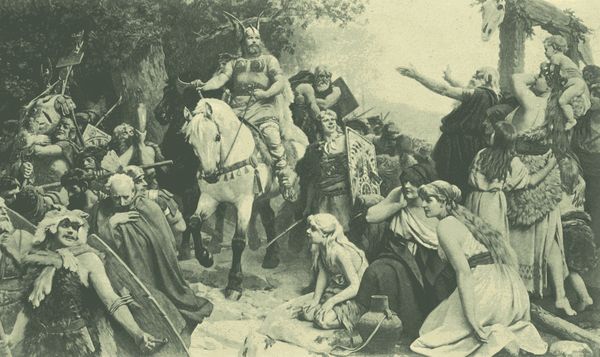
Hermann's triumph over the Romans.
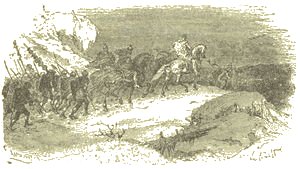
They found in Hermann a leader of extraordinary bravery and resource. He laid his plans with the chiefs of the Catti, Bructeri, and other tribes that lived between the Rhine and the Albis (Elbe), some of which broke out into insurrection. Hermann then offered Varus his assistance in reducing them to subjection, and thus led him to advance some distance from the Rhine into the interior. Varus began his march with three legions, six cohorts, and a body of cavalry, and Hermann served him as a guide through the wilds. The Romans were thus drawn into an ambuscade in the Teutoburg forest, and found themselves all at once surrounded by numerous bodies of Germans, who were directed by Hermann himself. The Romans fought desperately; but being unacquainted with the localities, and unable to form their ranks owing to the thickness of the forests and the marshy nature of the ground, they were defeated after a three days' battle, by the Germans, who destroyed them in detail. At last, Varus, being wounded and seeing no chance of escape, fell upon his sword, and the other chief officers followed his example.
The legions were entirely destroyed, and the cavalry alone cut their way through the enemy and regained the banks of the Rhine. By this defeat the Romans lost all their conquests beyond that river; and although Germanicus some years after again carried their arms to the Weser, they never established anything like a solid dominion over those regions. The defeat of Varus occurred, according to various chronologists, in the year 763 of Rome (A.D. 9). The scene of the defeat is conjectured to have been in the country of the Bructeri, near the sources of the Ems and the Lippe. The news of this calamity, the greatest that had befallen the Roman arms since the defeat of Crassus, was received with universal amazement and terror. The despairing cry of Augustus, "Varus, Varus, give me back my legions!" testified to the consternation even at Rome, where it was expected that the barbarians would take a terrible revenge for the wrongs they had suffered.
The fears of invasion, however, were not realized. L. Asprena guarded the banks of the Rhine, and the Germans were too little united among themselves to attack the Empire. Augustus in the following year sent Tiberius to the Rhine with a fresh army; but he does not seem to have effected anything of importance. Hermann meantime quarrelled with Segestes, chief of the Catti, whose daughter Tusnelda, he had carried off and married against her father's consent. When Germanicus, after the death of Augustus, marched into the interior of Germany to avenge the defeat of Varus, he was assisted by Segestes, and also by the Chauci and other tribes. In the first battle against Hermann, his wife Tusnelda, was taken prisoner by the Romans, and she afterward figured in the triumph of Germanicus. Germanicus, having reached the scene of Varus's defeat, paid funeral honors to the remains of the legions; but Hermann, who was hovering about his line of march, without coming to a pitched battle, harassed him in his retreat, and occasioned a great loss to Cæcina, the lieutenant of Germanicus.
In the following year, Germanicus advanced again as far as the Visurgis, or Weser, where he found Hermann encamped ready for battle. A desperate fight took place, in which Hermann, after performing prodigies of valor, was defeated, and escaped with difficulty. But the victory was gained at such cost that Germanicus and his army had to take refuge in their ships, nor did the Romans ever again attempt the conquest of the fiercer German tribes.
When Tiberius recalled Germanicus, he observed that the Cherusci, Bructeri, and other unsubdued tribes, might be left to their own internal dissensions. He seems to have guessed right.
No sooner had the Romans been driven off, than Hermann had to protect his people against an internal danger. Maroboduus, the chief of the Marcomanni, a man of great ambition, had by treachery or by open fighting, made himself master of several neighboring tribes. Hermann began to fear his designs, and after the defeat of Varus, warned him of his peril by sending him the Roman general's head. When Germanicus finally left the country, Hermann declared war against Maroboduus, and, being joined by the Semnones and Longobards, defeated him on the borders of the Hercynian forest, broke up his kingdom, and drove him from Germany. The fugitive applied to Rome for assistance. Tiberius then sent his son Drusus into the Illyricum; but the Romans did not advance beyond the Danube, and Hermann remained unmolested in Northern Germany. Shortly after, however, Hermann was killed by his own relatives, being accused, as it would seem, of aspiring to absolute dominion. He died at the age of thirty-seven, in the twenty-first year of our era, after being for twelve years the leader and champion of Germany.[Back to Contents]
TRAJAN By J. S. Reid, Litt.D. (53-117)
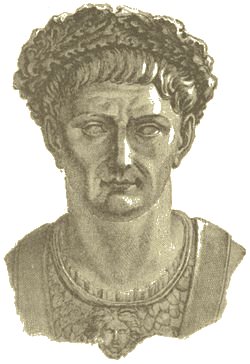
The Roman Empire reached its greatest extent under Marcus Ulpius Traianus, the fourteenth emperor. Of him it was said that he "built the world over," and the Romans themselves regarded him as the best, and perhaps the greatest of their emperors. He was a native of Italica, in Spain. The family to which he belonged was probably Italian, and not Iberian, by blood. His father began life as a common legionary soldier, and fought his way up to the consulship and the governorship of Asia. He was one of the hardest fighters in Judæa under Vespasian and Titus; he served, too, against the Parthians, and won the highest military distinction open to a subject, the grant of the triumphal insignia. Thus he acquired a prominent place among the brand new patricians created by the Flavians as substitutes for the nobles of old descent who had succumbed to the cruelty and rapacity of the emperors from Tiberius to Nero.
The younger Trajan was rigorously trained by his father, and deeply imbued with the same principles and tastes. He was a soldier born and bred. No better representative of the true old hardy Roman type, little softened either by luxury or education, had come to the head of affairs since the days of Marius. The date of his birth was probably 53 A.D. His training was almost exclusively military, but his experience as an officer gave him an acquaintance with almost every important province of the empire, which was of priceless value to him when he came to the throne. For ten years he held a commission as military tribune, which took him to many lands far asunder; then he filled important posts in Syria and Spain. How much actual warfare Trajan saw in those days we can hardly tell; he certainly went through some severe service under his father's command against the Parthians. By the year 89 he had achieved a considerable reputation. At that time L. Antonius Saturninus headed a rebellion in Germany, which threatened seriously to bring Domitian's rule to an end. Trajan was ordered in hot haste from Farther Spain to the Rhine. Although he carried his troops over that long and arduous march with almost unexampled rapidity, he only arrived after the insurrection had been put down. But his promptitude raised him higher in the favor of Domitian, and he was advanced to the consulship in 91. Of the next five years of his life we know nothing positively. It is not unlikely that they were spent at Rome or in Italy in the fulfilment of some official duties.
When the revolution of 96 came, and Nerva replaced the murdered Domitian, Trajan had conferred upon him one of the most important posts in the Empire, that of consular legate of Upper Germany. An officer whose nature, as the event showed, was interpenetrated with the spirit of legality, was a fitting servant of a revolution whose aim it was to substitute legality for personal caprice, as the dominant principle of affairs. The short reign of Nerva really did start the Empire on a new career, which lasted more than three-quarters of a century. But it also demonstrated how impossible it was for any one to govern at all who had no claim, either personal or inherited, to the respect of the legions. Nerva saw that if he could not find an Augustus to control the army, the army would find another Domitian to trample the Senate under foot. In his difficulties he took counsel with L. Licinius Sura, a lifelong friend of Trajan, and in October, 97, he ascended the Capitol, and with all due solemnity proclaimed that he adopted Trajan as his son.
The Senate confirmed the choice, and acknowledged the emperor's adopted son as his successor. In a letter which Nerva sent at once to Trajan, he quoted most significantly a line from the beginning of the "Iliad," where Chryses, insulted by Achilles, prays to Apollo: "May thy shafts afford me vengeance on the Greeks for my tears." After a little hesitation Trajan accepted the position, which was marked by the titles of Imperator, Cæsar, and Germanicus, and by the tribunician authority. He immediately proceeded to Lower Germany, to assure himself of the fidelity of the troops in that province, and while at Cologne he received news of Nerva's death (January, 98).
The authority of the new emperor was recognized at once all the Empire over. The novel fact that a master of the Romans should have been born on Spanish soil seems to have passed with little remark, and this very absence of notice is significant. Trajan's first care as emperor was to write to the Senate an assurance like that which had been given by Nerva, that he would neither kill nor degrade any senator. He ordered the establishment of a temple and cult in honor of his adoptive father, but he did not present himself at Rome for nearly two years after his accession. Possibly he had taken measures before Nerva's death to secure the revenge which Nerva craved, but probably did not live to see. In his dealings with the mutinous prætorians the strength of the new emperor's hand was shown at once. He ordered a portion of the force to Germany. They did not venture to disobey, and were distributed among the legions there. Those who remained at Rome were easily overawed and reformed. It is still more surprising that the soldiers should have quietly submitted to a reduction in the amount of the donative or gift which it was customary for them to receive from a new emperor, though the civil population of the capital were paid their largess (congiarium) in full. By politic management Trajan was able to represent the diminution as a sort of discount for immediate payment, while the civilians had to wait a considerable time before their full due was handed to them.
The secret of Trajan's power lay in his close personal relations with the officers and men of the army, and in the soldierly qualities which commanded their esteem. He possessed courage, justice, and frankness to a high degree. Having a good title to military distinction himself, he could afford, as the unwarlike emperors could not, to be generous to his officers. The common soldiers, on the other hand, were fascinated by his personal prowess and his somewhat ostentatious camaraderie. His features were firm and clearly cut; his figure was tall and soldierly, and exhibited the sinewy hard health of a veteran campaigner. His hair was already gray before he came to the throne, though he was not more than forty-four years old. The stoutness of the emperor's arm had been proved in the face of his men in many a hard fight. When on service he used the mean fare of the common private, dining on salt pork, cheese, and sour wine. Nothing pleased him better than to take part with the centurion, or the soldier in fencing or other military exercise, and he would applaud any shrewd blow which fell upon his own helmet. He loved to display his acquaintance with the career of distinguished veterans, and to talk with them of their battles and their wounds. Probably he lost nothing of his popularity with the army by occasional free indulgence in sensual pleasures, with which, as Bacon remarks, the soldier is apt to pay himself for the perils he encounters. Yet every man felt and knew that no detail of military duty, however minute, escaped the emperor's eye, and that any relaxation of discipline would be rigidly punished, yet with unwavering justice.
Trajan emphasized at once his personal control and the constitutionality of his sway, by bearing on his campaigns the actual title of "proconsul," which no other emperor had done. All things considered, it is not surprising that he was able, without serious opposition from the army, to remodel the whole military institutions of the empire, and to bring them into a shape from which there was comparatively little departure so long as the army lasted. In disciplinary matters no emperor since Augustus had been able to keep so strong a control over the troops. Pliny rightly praises Trajan as the lawgiver and the founder of discipline, and Vegetius classes Augustus, Trajan, and Hadrian together as restorers of the morale of the army. The confidence which existed between Trajan and his army finds expression in some of the coins of his reign.
For nearly two years after his election Trajan did not appear in Rome. He had decided already what the great task of his reign should be—the establishment of security upon the dangerous north-eastern frontier. Before visiting the capital he determined to put affairs in train for the attainment of this great object. He made a thorough inspection of the great lines of defence between the Danube and the Rhine, and framed, and partly carried out, a vast scheme for strengthening and securing them. The policy of opposing uncivilized tribes by the construction of the limes, a raised embankment of earth or other material, intersected here and there by fortifications, was not his invention, but it owed in great measure its development to him. This grand work, which would have excited the envy of Augustus, is traceable in its main extent at the present day. Among a people of roadmakers, Trajan was one of the greatest, and we have definite evidence from inscriptions that some of the military roads in this region were constructed by him. The more secure control which the Romans now maintained over the territory within the limes, tended to its rapid civilization, and the Roman influence, if not the Roman arms, soon began to affect powerfully the regions beyond.
After his careful survey of the Rhine end of the great defensive barrier, Trajan proceeded to consider it and plan it from the Danube. From the age of Tiberius onward, the Romans possessed the whole southern bank of the river from its source to the Euxine. But the precarious tenure of their possession, had been deeply impressed on them by the disasters and humiliations they had undergone in these districts during the reign of Domitian. A prince had arisen among the Dacians, Decebalus by name, worthy to be placed at the head of all the great barbarian antagonists of Rome. Like Maroboduus, he was able to combine the forces of tribes commonly hostile to each other, and his military ability almost went the length of genius. After he had swept the province of Mœsia bare, he was defeated by one of Domitian's lieutenants, but the position of affairs on the Danubio-Rhenish border was still so threatening, that the emperor was glad to conclude a treaty which conferred extraordinary advantages on his foe. Not only did the Romans stipulate to pay to Decebalus an annual subsidy, which he must have regarded as a tribute, but they agreed to supply him with engineers and craftsmen skilled in all kinds of construction, but particularly in the erection of fortifications and defensive works. During the nine or ten years which had elapsed since the conclusion of this remarkable treaty, the Dacian prince had immensely strengthened the approaches to his kingdom from the Roman side. He had also equipped and drilled his formidable army after the Roman fashion. It was impossible for a soldier like Trajan to endure the conditions laid down by Domitian; but the conquest of Dacia had become one of the most formidable tasks that had ever confronted the Empire. Trajan, no doubt, planned a war before he left the Danube for Rome late in 99.
The arrival of the emperor had been awaited in the capital with an impatience which is expressed by Pliny and by Martial. All that had happened since Trajan's elevation to the throne had raised high at Rome the hope of a prosperous and glorious reign. As he entered the city and went on foot to the Capitol, the plaudits of the people were unmistakably genuine. During his stay in the city he riveted more firmly still the affections both of the Senate and of the people. The reconciliation of the Empire with liberty, inaugurated, as Tacitus says, by Nerva, seemed now to be securely achieved. Trajan was absolutely open and simple, and lived with men at Rome as he had lived with his soldiers while on service. He realized the Senate's ideal of the citizen ruler. The assurance that no senator should suffer was renewed by oath. All the old republican formalities were most punctiliously observed—even those attendant on the emperor's election to the consulate, so far as they did not involve a restoration of the old order of voting at the comitia. The veneration for republican tradition is curiously attested by the reproduction of many republican types of coin struck by senatorial officers.
Trajan seized every opportunity for emphasizing his view that the princeps was merely the greatest of the magistrates, and so was not above but under the laws. He was determined, he said, to be to his subjects such a ruler as he had desired for himself when a subject. There is a pretty story to the effect that he handed the commander of the prætorians his sword, and said, "Use it for me if I do well, but against me if I do ill." Martial, who had called Domitian his lord and his god, now cried, "In him we have no lord, but an imperator!" Real power and influence were accorded to the Senate, which had now, by the incorporation of members whose origin was provincial, become in a manner representative of the whole empire. Trajan associated with the senators on equal terms, and enjoyed in their company every kind of recreation. All pomp was distasteful to him, and discarded by him. There was practically no court, and no intrigues of any kind were possible. The approach to his house was free, and he loved to pass through the city unattended, and to pay unexpected visits to his friends. He thirsted for no senator's blood, and used severity against the delatores alone. There was but one insignificant conspiracy against him during his whole reign.
Though not literary himself, Trajan conciliated the literary men, who at all times had close relations with the Senate. His intimate, M. Licinius, played an excellent Mæcenas to his Augustus. In his efforts to win the affections of Roman society, Trajan was excellently aided by his wife Plotina, who was as simple as her husband, benevolent, pure in character, and entirely unambitious. The hold which Trajan acquired over the people was no less firm than that which he maintained upon the army and the Senate. His largesses, his distributions of food, his public works, and his spectacles were all on a generous scale. The exhibitions in the arena were perhaps at their zenith during his tenure of power. Though, for some unexplained reason, he abolished the mimes, so beloved of the populace, at the outset of his reign, he availed himself of the occasion of his first triumph to restore them again. The people were delighted by the removal of the imperial exedra in the circus, whereby five thousand additional places were provided. Taxation was in many directions reduced, and the financial exactions of the imperial officers controlled by the erection of a special court. Elaborate precautions were taken to save Italy from famine; it is said that corn for seven years' consumption at the capital was retained in the granaries. Special encouragement was given to merchants to import articles of food. The corporation of bakers was organized, and made more effective for the service of the public. The internal trade of Italy was powerfully stimulated by the careful maintenance and extension of the different lines of road.
But the most striking evidence of Trajan's solicitude for his people's welfare is found in his institution of the alimenta, whereby means were provided for the rearing of poor and orphan children in Italy. The method had been sketched out by Nerva, but its great development was due to Trajan. The moneys allotted by the emperor were in many cases supplemented by private benevolence. As a soldier, Trajan realized the need of men for the maintenance of the Empire against the outer barbarians, and he preferred that these men should be of Italian birth. He was only carrying a step further the policy of Augustus, who by a system of rewards and penalties had tried to encourage marriage and the nurture of children. The annual effect of Trajan's regulations is hard to measure; they were probably more effectual for their object than those of Augustus. The foundations were confiscated by Pertinax, after they had existed less than a century.
Toward the end of 100, or early in 101, Trajan left Rome for the Danube. Pretexts for a Dacian war were not difficult to find. Although there was no lack of hard fighting, victory in this war depended largely on the work of the engineer. The great military road connecting the posts in Upper Germany with those on the Danube, which had been begun by Tiberius, was now extended along the right bank of the river as far as the modern Orsova. The year 101 was spent mainly in roadmaking and fortification. In the following campaign, after desperate fighting to the north of the Danube in the mountainous region of Transylvania, such as Cæsar never encountered in all his Gaulish wars, the capital of Decebalus was taken, and he was forced to terms. He agreed to raze all fortresses, to surrender all weapons, prisoners, and Roman deserters, and to become a dependent prince under the suzerainty of Rome. Trajan came back to Italy with Dacian envoys, who in ancient style begged the Senate to confirm the conditions granted by the commander in the field. The emperor now enjoyed his first Dacian triumph, and assumed the title of Dacicus. At the same time he royally entertained the people, and no less royally rewarded his brave officers.
But the Dacian chief could not school his high spirit to endure the conditions of the treaty, and Trajan soon found it necessary to prepare for another war. A massive stone bridge was built across the Danube, near the modern Turn Severin, by Apollodorus, the gifted architect who afterward designed the forum of Trajan. In 105 began the new struggle, which on the side of Decebalus could now only lead to victory or to destruction. The Dacians fought their ground inch by inch, and their army as a whole may be said to have bled to death. The prince put an end to his own life. His kingdom became an imperial province; in it many colonies were founded, and peopled by settlers drawn from different parts of the empire. The work done by Trajan in the Danubian regions left a lasting mark upon their history. The emperor returned to the capital in 106, laden with captured treasure. His triumph outdid in splendor all those that went before it. Games are said to have been held continuously for four months. The chariot races were the grandest ever seen. Ten thousand gladiators contended in the arena, and eleven thousand beasts were killed in the contests. Congratulatory embassies came from all lands, even from India. The grand and enduring monument of the Dacian wars is the noble pillar which still stands on the site of Trajan's forum at Rome. The end of the Dacian wars was followed by seven years of peace.
Many details in the administration of the law, and particularly of the criminal law, were improved. To cure corruption in the Senate the ballot was introduced at elections to magistracies. The finances of the state were economically managed, and taxpayers were most carefully guarded from oppression. Trajan never lacked money to expend on great works of public utility; as a builder, he may fairly be compared with Augustus. His forum and its numerous appendages were constructed on a magnificent scale. Many regions of Italy and the provinces, besides the city itself, benefited by the care and munificence which the emperor bestowed on such public improvements. His attitude toward religion was, like that of Augustus, moderate and conservative. The famous letter to Pliny about the Christians is, according to Roman ideas, merciful and considerate. It was impossible, however, for a Roman magistrate of the time to rid himself of the idea that all forms of religion must do homage to the civil power. Hence the conflict which made Trajan appear in the eyes of Christians like Tertullian, the most infamous of monsters. On the whole, Trajan's civil administration was sound, careful, and sensible, rather than brilliant or epoch-making.
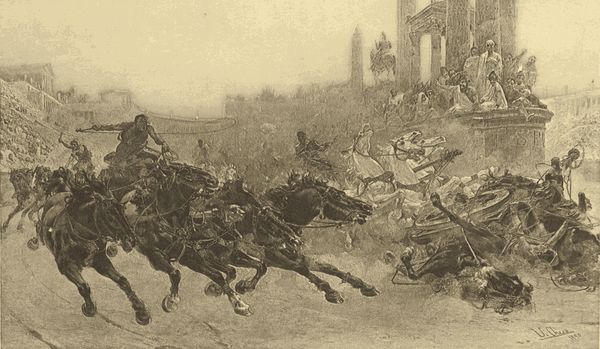
Rome under Trajan—A chariot race.
In 113 or 114 Trajan left Italy to make war in the East. The never-ending Parthian problem confronted him, and with it were more or less connected a number of minor difficulties. Already by 106 the position of Rome in the East had been materially improved by the peaceful annexation of districts bordering on the province of Syria. The district of Damascus, hitherto a dependency, and the last remaining fragment of the Jewish kingdom, were incorporated with Syria; Bostra and Petra were permanently occupied, and a great portion of the Nabathæan kingdom was constituted the Roman province of Arabia. Rome thus obtained mastery of the most important positions lying on the great trade-routes from East to West. These changes could not but affect the relations of the Roman with the Parthian empire, and the affairs of Armenia became, in 114, the occasion of war. Trajan's campaigns in the East ended in complete though brilliant failure. In the retreat from Ctesiphon (117), the old emperor tasted for almost the first time the bitterness of defeat in the field. He attacked the desert city of Hatra, westward of the Tigris, whose importance is still attested by grand ruins. The want of water made it impossible to maintain a large force near the city, and the brave Arabs routed the Roman cavalry. Trajan, who narrowly escaped being killed, was forced to withdraw.
A more alarming difficulty lay before him. Taking advantage of the absence of the emperor in the far East, and possibly by an understanding with the leaders of the rising in Armenia and the annexed portions of Parthia, the Jews all over the East had taken up arms at the same moment, and at a given signal. The massacres they committed were portentous. In Cyprus 240,000 men are said to have been put to death, and at Cyrene 220,000. At Alexandria, on the other hand, many Jews were killed. The Romans punished massacre by massacre, and the complete suppression of the insurrection was long delayed, but the Jews made no great stand against disciplined troops. Trajan still thought of returning to Mesopotamia, and of avenging his defeat at Hatra, but he was stricken with sickness and compelled to take ship for Italy. His illness increasing, he landed in Cilicia, and died at Selinus in that country about the end of July, 117.
Trajan, who had no children, had continually delayed to settle the succession to the throne, though Pliny, in the "Panegyric" had pointedly drawn his attention to the matter, and it must have caused the Senate much anxiety. Whether Hadrian, the cousin of Trajan, was actually adopted by him or not, is impossible to determine; certainly Hadrian had not been advanced to any great honors by Trajan. Even his military service had not been distinguished. Plotina asserted the adoption, and it was readily and most fortunately accepted, if not believed, as a fact.
The Senate had decreed to Trajan as many triumphs as he chose to celebrate. For the first time a dead general triumphed. When Trajan was deified, he appropriately retained, alone among the emperors, a title he had won for himself in the field, that of "Parthicus." He was a patient organizer of victory rather than a strategic genius. He laboriously perfected the military machine, which when once set in motion went on to victory. Much of the work he did was great and enduring, but the last year of his life forbade the Romans to attribute to him that felicitas which they regarded as an inborn quality of the highest generals. Each succeeding emperor was saluted with the wish that he might be "better than Trajan and more fortunate than Augustus." Yet the breach made in Trajan's felicitas by the failure in the East was no greater than that made in the felicitas of Augustus by his retirement from the right bank of the Rhine.[Back to Contents]
DIOCLETIAN (245-313)
Caius Valerius Diocletianus, one of the most famous of the Roman emperors, was, as De Quincey says, "doubtless that man of iron whom the times demanded." He was born at Dioclea, in Dalmatia, some say at Salona, about A.D. 245 according to some, but others make him ten years older. His original name was Diocles, which he afterward changed into Diocletianus. He is said by some to have been the son of a notary, by others the freedman of a senator named Anulinus. He entered the army at an early age, and rose gradually to rank; he served in Gaul, in Mœsia, under Probus, and was present at the campaign against the Persians, in which Carus, then emperor, perished in a mysterious manner. Diocletian commanded the household or imperial body-guards when young Numerianus, the son of Carus, was secretly put to death by Aper his father-in-law, while travelling in a close litter on account of illness, on the return of the army from Persia. The death of Numerianus being discovered after several days by the soldiers near Calchedon, they arrested Aper and proclaimed Diocletian emperor, who addressing the soldiers from his tribunal in the camp, protested his innocence of the death of Numerianus, and then upbraiding Aper for the crime, plunged his sword into the traitor's body.
The new emperor observed to a friend that "he had now killed the boar," punning on the word Aper, which means a boar, and alluding to the prediction of a soothsayer in Gaul, who had told him that he would become emperor after having killed a boar (Vopiscus, in "Hist. Aug."). Diocletian, self-composed and strong-minded in other respects, was all his life an anxious believer in divination, which superstition led him probably to inflict summary punishment upon Aper with his own hands. He made his solemn entrance into Nicomedia in September, 284, which town he afterward chose for his favorite residence.
Carinus, the other son of Carus, who had remained in Italy, having collected a force to attack Diocletian, the two armies met at Margum, in Mœsia, where the soldiers of Carinus had the advantage at first, but Carinus himself being killed during the battle by his officers, who detested him for his cruelty and debauchery, both armies joined in acknowledging Diocletian emperor in 285. Diocletian was generous after his victory, and, contrary to the common practice, there were no executions, proscriptions, or confiscations of property; he even retained most of the officers of Carinus in their places.
Diocletian, on assuming the imperial power, found the Empire assailed by enemies in various quarters—on the Persian frontiers, on the side of Germany and of Illyricum, and in Britain; besides which a serious revolt had broken out in Gaul among the rural population, under two leaders who had assumed the title of emperor. To quell the disturbance in Gaul, Diocletian sent his old friend Maximianus, a native of Pannonia, and a brave but rude uncultivated soldier. Maximianus defeated the Bagaudi, for such was the name the rustic insurgents had assumed. In the year 286, Diocletian chose Maximianus as his colleague in the Empire, under the name of Marcus Valerius Maximianus Augustus, and it is to the credit of both that the latter continued ever after faithful to Diocletian and willing to follow his advice. Maximianus was stationed in Gaul and on the German frontier to repel invasion; Diocletian resided chiefly in the East to watch the Persians, though he appears to have visited Rome in the early part of his reign. About 287 the revolt of Carausius took place. In the following year Maximianus defeated the Germans near Treviri, and Diocletian himself marched against other tribes on the Rhætian frontier; the year after he defeated the Sarmatians on the lower Danube. In the same year, 289, peace was made between Carausius and the two emperors, Carausius being allowed to retain possession of Britain. In 290 Maximianus and Diocletian met at Milan to confer together on the state of the Empire, after which Diocletian returned to Nicomedia. The Persians soon after again invaded Mesopotamia and threatened Syria; the Quinquegentiani, a federation of tribes in the Mauritania Cæsariensis, revolted; another revolt under one Achillæus broke out in Egypt; another in Italy under a certain Julianus.
Diocletian thought it necessary to increase the number of his colleagues in order to face the attacks in the various quarters. On the 1st of March, 292, or 291, according to some chronologists, he appointed Galerius as Cæsar, and presented him to the troops at Nicomedia. At the same time Maximianus adopted on his part Constantius called Chlorus. The two Cæsars repudiated their respective wives; Galerius married Valeria, Diocletian's daughter, adding to his name that of Valerianus; and Constantius married Theodora, daughter of Maximianus. Galerius was a native of Dacia, and a good soldier, but violent and cruel; he had been a herdsman in his youth, for which he has been styled, in derision, Armentarius. The two Cæsars remained subordinate to the two Augusti, though each of the four was entrusted with the administration of a part of the Empire. Diocletian kept to himself Asia and Egypt; Maximianus had Italy and Africa; Galerius, Thrace and Illyricum; and Constantius had Gaul and Spain. But it was rather an administrative than a political division. At the head of the edicts of each prince were put the names of all the four, beginning with that of Diocletian.
Diocletian resorted to this arrangement probably as much for reasons of internal as of external policy. For nearly a hundred years before, ever since the death of Commodus, the soldiers had been in the habit of giving or selling the imperial crown, to which any general might aspire. Between thirty and forty emperors had been thus successively made and unmade many of whom only reigned a few months. By fixing upon four colleagues, one in each of the great divisions of the Empire, each having his army, and all mutually checking one another, Diocletian put a stop to military insolence and anarchy. The Empire was no longer put up to sale, the immediate and intolerable evil was effectually cured, though another danger remained, that of disputes and wars between the various sharers of the imperial power; still it was a smaller danger and one which did not manifest itself so long as Diocletian remained at the helm. Writers have been very free of their censure upon this emperor for parcelling, as they call it, the Empire; but this was the only chance there was of preventing its crumbling to pieces. Italy, and Rome in particular, lost by the change: they no longer monopolized the wealth and power of the world, but the other provinces gained. The Empire was much too large for one single man or a single central administration, under the dwindled influence of the Roman name, and amidst the numerous causes of local dissension and discontent, private ambition, social corruption, and foreign hostility, that had accumulated for three centuries, since the time of Augustus.
The new Cæsars justified Diocletian's expectations. Constantius defeated the Franks and the Alemanni, and soon after reconquered Britain. Galerius subjugated the Carpi, and transported the whole tribe into Pannonia. In the year 296, the Persians, under their king Narses, again invaded Mesopotamia and part of Syria. Galerius marched against them, but being too confident was defeated by superior numbers, and obliged to retire. On his meeting Diocletian, the emperor showed his dissatisfaction by letting Galerius walk for a mile, clad in purple as he was, by the side of his car. The following year Galerius again attacked the Persians, and completely defeated them, taking an immense booty. The wives and children of Narses, who were among the prisoners, were treated by Galerius with humanity and respect. Narses sued for peace, which was granted by Diocletian on condition of the Persians giving up all the territory on the right or western bank of the Tigris. This peace was concluded in 297, and lasted forty years.
At the same time Diocletian marched into Egypt against Achillæus, whom he besieged in Alexandria, which he took after a siege of eight months, when the usurper and his chief adherents were put to death. Diocletian is said to have behaved on this occasion with unusual sternness. Several towns of Egypt, among others Busiris and Coptos, were destroyed. Constantine, the son of Constantius, who was educated at Nicomedia, accompanied the emperor in this expedition. Diocletian fixed the limits of the Empire on that side at the island of Elephantina, where he built a castle, and made peace with the neighboring tribes, called by some Nubæ and by others Nabatæ, to whom he gave up the strip of territory which the Romans had conquered, of seven days' march above the first cataract, on condition that they should prevent the Blemmyes and Ethiopians from attacking Egypt. Maximianus in the meantime was engaged in putting down the revolt in Mauritania, which he effected with full success.
For several years after this the empire enjoyed peace, and Diocletian and his colleagues were chiefly employed in framing laws and administrative regulations, and in constructing forts on the frontiers. Diocletian kept a splendid court at Nicomedia, which town he embellished with numerous structures. He, or rather Maximianus by his order, caused the magnificent Thermæ at Rome to be built, the remains of which still bear Diocletian's name, and which contained, besides the baths, a library, a museum, public walks, and other establishments.
In February, 303, Diocletian issued an edict against the Christians, ordering their churches to be pulled down, their sacred books to be burnt, and all Christians to be dismissed from offices civil or military, with other penalties, exclusive however of death. Various causes have been assigned for this measure. It is known that Galerius had always been hostile to the Christians, while Diocletian had openly favored them, had employed them in his armies and about his person; and Eusebius speaks of the prosperity, security, and protection which the Christians enjoyed under his reign. They had churches in most towns, and one at Nicomedia in particular under the eye of the emperor. Just before the edict was issued, Galerius had repaired to Nicomedia to induce Diocletian to proscribe the Christians. He filled the emperor's mind with reports of conspiracies and seditions. The imperial palace took fire, Constantine ("Oratio ad Cœtum Sanctorum") says, from lightning, and Galerius suggested to the emperor that it was a Christian plot.
The heathen priests on their part exerted themselves for the same purpose. It happened that on the occasion of a solemn sacrifice in presence of the emperor, while priests were consulting the entrails of the victims, the Christian officers in the imperial retinue crossed themselves; upon which the priests declared that the presence of profane men prevented them from discovering the auspices. Diocletian, who was very anxious to pry into futurity, became irritated, and ordered all his Christian officers to sacrifice to the gods under pain of flagellation and dismissal, which many of them underwent. Several oracles which he consulted gave answers unfavorable to the Christians. The church of Nicomedia was the first pulled down by order of the emperor. The rashness of a Christian who publicly tore down the imperial edict exasperated Diocletian still more: the culprit was put to a cruel death. Then came a second edict, ordering all magistrates to arrest the Christian bishops and presbyters, and compel them to sacrifice to the gods. This was giving to their enemies power over their lives, and it proved, in fact, the beginning of a cruel persecution, whose ravages were the more extensive in proportion to the great diffusion of Christianity during a long period of toleration. This was the last persecution under the Roman Empire, and it has been called by the name of Diocletian. But that emperor issued the two edicts reluctantly and after long hesitation, according to Lactantius's acknowledgment: he fell ill a few months after, and on recovering from his long illness he abdicated. Galerius, who had instigated the persecution, was the most zealous minister of it; the persecution raged with most fury in the provinces subject to his rule, and he continued it for several years after Diocletian's abdication, so that it might with more propriety be called the Galerian persecution. Legend says that he died of a horrible disease, filled with remorse and imagining himself haunted by the martyred spirits. The countries under the government of Constantius suffered the least from it.
In November of that year (303) Diocletian repaired to Rome, where he and Maximianus enjoyed the honor of a triumph, followed by festive games. This was the last triumph that Rome saw. The populace of that city complained of the economy of Diocletian on the occasion, who replied that moderation and temperance were most required when the censor was present. They vented their displeasure in jibes and sarcasms, which so hurt Diocletian that he left Rome abruptly in the month of December for Ravenna, in very cold weather. In this journey he was seized by an illness which affected him the whole of the following year, which he spent at Nicomedia. At one time he was reported to be dead. He rallied, however, in the spring of 305, and showed himself in public, but greatly altered in appearance. Galerius soon after came to Nicomedia, and it is said that he persuaded Diocletian to abdicate. Others say that Diocletian did it spontaneously.
On the 1st of May he repaired with his guards to a spot three miles out of Nicomedia, where he had thirteen years before proclaimed Galerius as Cæsar, and there addressing his officers and court, he said that the infirmities of age warned him to retire from power, and to deliver the administration of the state into stronger hands. He then proclaimed Galerius as Augustus, and Maximinus Daza as the new Cæsar. Constantine, who has given an account of the ceremony, which is quoted by Eusebius in his life of that prince, was present, and the troops fully expected that he would be the new Cæsar; when they heard another mentioned, they asked each other whether Constantine had changed his name. But Galerius did not leave them long in suspense; he pushed forward Maximinus and showed him to the assembly, and Diocletian clothed him with the purple vest, after which the old emperor returned privately in his carriage to Nicomedia, and immediately after set off for Salona in Dalmatia, near which he built himself an extensive palace by the sea-shore, in which he lived for the rest of his life, respected by the other emperors, without cares and without regret.
Part of the external walls which inclosed the area belonging to his palace and other buildings still remain, with three of the gates, as well as a temple, which is now a church at Spalatro, or Spalato, in Dalmatia, a comparatively modern town, grown out of the decay of the ancient Salona, and built in great part within the walls of Diocletian's residence, from the name of which, "Palatium," it is believed that "Spalato" is derived.
At the same time that Diocletian abdicated at Nicomedia, Maximianus, according to an agreement between them, performed a similar ceremony at Milan, proclaiming Constantius as Augustus, and Severus as Cæsar. Both Severus and Maximinus Daza were inferior persons, and creatures of Galerius, who insisted upon their nomination in preference to that of Maxentius and Constantine, whom Diocletian had at first proposed. Maximianus retired to his seat in Lucania, but not being endowed with the firmness of Diocletian he tried some time after to recover his former power, and wrote to his old colleague to induce him to do the same. "Were you but to come to Salona," answered Diocletian, "and see the vegetables which I grow in my garden with my own hands, you would no longer talk to me of empire." In his retirement he used to observe to his associates how difficult it is, even for the best-intentioned man, to govern well, as he cannot see everything with his own eyes, but must trust to others, who often deceive him.
Once only he left his retirement to meet Galerius in Pannonia for the purpose of appointing a new Cæsar, Licinius, in the place of Severus, who had died. Licinius, however, did not prove grateful, for after the death of Galerius, in 311, he ill-treated his widow, Valeria, Diocletian's daughter, who then, with her mother, Prisca, took refuge in the territories of Maximinus Daza. The latter offered to marry Valeria, but on her refusal exiled both her and her mother into the deserts of Syria, and put to death several of their attendants. Diocletian remonstrated in favor of his wife and daughter, but to no purpose, and his grief on this occasion probably hastened his death, which took place at his residence near Salona in July, 313. In the following year his wife and daughter were put to death by order of Licinius.
Diocletian ranks among the most distinguished emperors of Rome; his reign of twenty-one years was upon the whole prosperous for the empire, and creditable to the Roman name. He was severe, but not wantonly cruel, and we ought to remember that mercy was not a Roman virtue. His conduct after his abdication shows that his was no common mind. The chief charge against him is his haughtiness in introducing the Oriental ceremonial of prostration into the Roman court. The Christian writers, and especially Lactantius, have spoken unfavorably of him; but Lactantius cannot be implicitly trusted. Of the regular historians of his reign we have only the meagre narratives of Eutropius and Aurelius Victor, the others being now lost; but notices of Diocletian's life are scattered about in various authors, Libanius, Vopiscus, Eusebius, Julian in his "Cæsars," and the contemporary panegyrists, Eumenes and Mamertinus. His laws or edicts are in the "Code." Among other useful reforms, he abolished the frumentarii, or licensed informers, who were stationed in every province to report any attempt at mutiny or rebellion, and who basely enriched themselves by working on the fears of the inhabitants. He also reformed and reduced the number of the insolent Prætorians, who were afterward totally disbanded by Constantine.[Back to Contents]
ALARIC THE BOLD By Archdeacon Farrar, D.D., F.R.S. (360-410)
Alaric had already found the way to Italy when he accompanied Theodosius in his campaign against the usurper Maximus in 394. In 400 he descended into Italy, not with an army only, but with the migration of his entire people. He defeated the Romans under the walls of Aquileia, and in 401 besieged Honorius in Milan. In 402 a vast army under Stilicho met him at Pollentia; and when an old chieftain advised him to retire, Alaric, with fierce indignation, silenced his timid counsellor, and told him that he had been assured by a voice which came from the grave and said to him, "Thou shalt penetrate to the City" (ad Urbem). But the oracle on this occasion had "paltered" with him in a double sense. He penetrated indeed ad Urbem, not however "to the City" but to the little river Urbis (or Borbo), near Pollenzo. On Good Friday, April 4, 402, the Western army, under a dwarfish Hun chieftain named Saulus, attacked and routed Alaric, recovering the splendid spoils of Greece, freeing his captives, and winning back the purple robes which the Emperor Valens had lost in the battle of Adrianople. In that disastrous defeat even the wife of Alaric, if we may believe the poet Claudian, was taken prisoner.
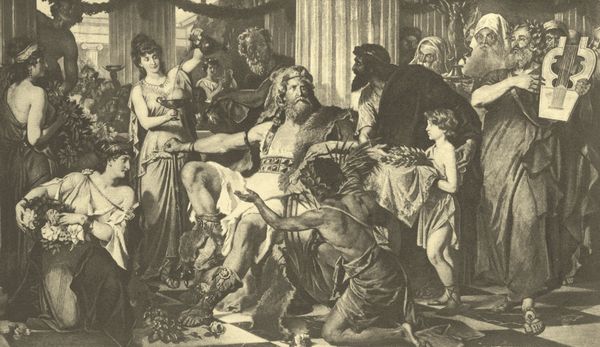
Alaric in Athens.
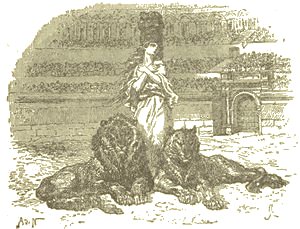
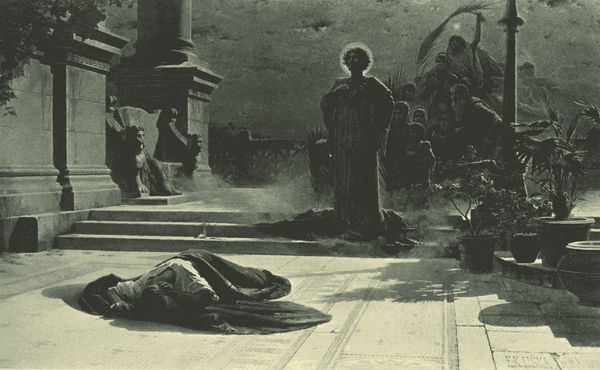
Alaric retreated through Lombardy, and the feeble Emperor Honorius—"a crowned nothingness"—celebrated at Rome, in 404, that triumph which was signalized by the last display of the brutal gladiatorial games. No sooner had the first blood been shed than the Eastern monk Telemachus sprang down into the arena to part the combatants. His life paid the price of his glorious temerity. He was hewn and stoned to death. But that death was not in vain. The horrid massacres, at which not only men but women gazed in demoniac pleasure and excitement, had been condemned centuries before by the genius of Christianity. It was monstrous that an emperor calling himself a Christian should preside at such a spectacle. But the martyrdom of Telemachus at last touched the callous and torpid consciences of nominal Christians. Thenceforth the games of the amphitheatre were abolished. But it was too late for repentance. Alike "the incomparable wickedness and the incomparable splendor" of the Imperial City were doomed to destruction. Even the blood of a Christian martyr voluntarily shed would not atone for the blood of hundreds of brave barbarians who, in that huge Flavian amphitheatre, had been
"Butchered to make a Roman holiday."
The day was near at hand when the Goths would arise and glut their ire.
Alaric, though he had retreated, was still in a position to dictate terms to Stilicho. He fixed his camp at Æmona, and was promised large pay and the government of a Western province under nominal allegiance to the Western Emperor. But the pledges made to him were broken, and their fulfilment delayed. In 408 the promise of the oracle was fulfilled, for he led his troops under the walls of Rome. The feeble and timid Honorius had retired to Ravenna, where he was safe behind the marshes, the pine-woods, and the stone walls against which Alaric said that he did not fight. In 408 the wretched court filled to the full the brimming cup of its iniquities—first by a massacre of barbarian auxiliaries at Pavia, and then by the foul, ungrateful murder of Stilicho himself, at the command of Honorius. No army barred the path of Alaric, but an Italian hermit denounced on him the wrath of heaven. This might have awoke the superstitious terrors of the Gothic soldiers if Alaric had not assured them, with confidence, that he was obeying a divine and irresistible command. The Goths encamped under the walls which for six hundred and nineteen years had never been threatened by a foreign enemy. The wealthy, effeminate, corrupted nobles, and people of the Eternal City thought to terrify Alaric back by boasts of their numbers. His scornful answer simply was, "The thicker the hay, the easier it is mowed." He demanded all their gold, silver, movables, and barbarian slaves. "What then, O King, will you leave us?" He grimly said, "Your lives."
He was content, however, this time to accept a ransom, of which the most curious element was three thousand pounds of pepper.
The folly, pride, and braggadocio of Honorius, or rather of his miserable court, brought Alaric a second time to Rome in 409. The city capitulated, and he raised Attalus to the purple as a rival to Honorius. But Attalus proved utterly incompetent, and the next year Alaric publicly and insultingly degraded him to a private position. In 410 a fresh insult and wrong inflicted on the Goths by Honorius brought Alaric once more to Rome. He burst in by the Salarian gate, and sacked the city, which was only saved from irretrievable destruction by the respect of the Goths for the churches, which they regarded as inviolable asylums. The pillage and conflagration of Rome, and the resultant ruin and misery, came on the world like a shock of earthquake; but the Pagans saw that the catastrophe would have been yet more awful if the conquerors had not been Christians as well as the conquered.
It seemed as if even the Imperial City could not fall without some circumstance of irony and insult. Paganism may be said to have perished in two bursts of laughter: one when in Alexandria the Christian mob burst into merriment to see the rats scurry out of the rotten head of the shattered statue of Serapis; and again when Theodosius and his soldiers laughed at the golden thunderbolts torn from the uplifted arms of the menacing statue of Jupiter. And Honorius managed to invest even the fall of Rome with ludicrous associations. He was a great fancier of fowls, and had a particularly large hen, which, out of compliment, he called Roma. When the agitated eunuch entered to tell him that "Rome had perished," "What!" cried the Emperor, in a voice of deep concern, "why, she was feeding out of my hand only an hour ago!" "It is the city of Rome that has fallen, sire!" "Oh, my friend," said the Emperor, with a sigh of relief, "but I thought you meant that my hen 'Roma' had died."
Laden with spoils of priceless value, the creaking wagons of the Gauls went southward. Alaric meant to lead them to the conquest first of Sicily, then of Africa. But death overtook him amid the schemes of his ambition. He died after a short illness, and was buried in the bed of the river which washes the walls of Cosentia. The captives who reared the tomb were massacred, that none might know where the hero lay. The Visigothic kingdom of Spain, founded by the warrior tribe which he first led into the West, is one of the most permanent results of his invasion.[Back to Contents]
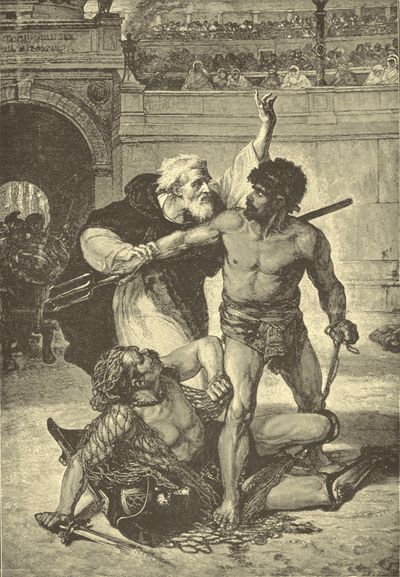
The Last Gladiatorial Contest.
ATTILA By Archdeacon Farrar, D.D., F.R.S. (REIGNED 434-453)
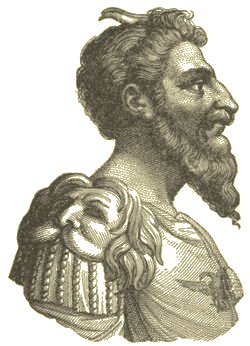
The Goths were "improvable barbarians;" but the Huns whom Attila led to ravage the fair peninsula were mere Tartar savages of the lowest stamp.
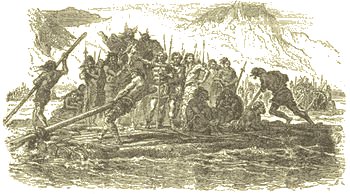
All the other invaders of Italy were of Teutonic origin, but the Huns were Mongols—of such perfect hideousness that Jornandes regarded them as the offspring of witches and demons. Attila, son of Mundzuk, "the scourge of God," resembled his soldiers in his flat, swarthy features, deep-set, fierce, rolling black eyes, and stunted figure. The Huns were uncivilizable savages, who might harry a continent, but neither under Attila, nor Genghis, nor Timour, could ever found an organized kingdom. This terrific and brutal little Kalmuck, with his bead-like eyes, this skin-clad devourer of raw flesh, delighted to lay waste whole empires with fire and sword, and to terrify the world. In 434 he became king of the Huns with his brother Bleda. In 445 Bleda died, possibly by murder; and in 445 Attila, now sole king of the Huns, invaded the Eastern Empire, and ravaged it even to the gates of Constantinople. He was only bought off from destroying it by an enormous tribute. The infamous plot to assassinate him by the treachery of Edecon, who was one of his counsellors, was discovered and foiled, and Attila sent message after message filled with insults to Theodosius II. In 451 his vast army moved westward, and devastated Gaul. It was met in the Mauriac plain and defeated by Ætius in the tremendous battle of Chalons, after a carnage among the most frightful that the world has ever seen. The Huns were only saved from final destruction by the heroic boldness of Attila. He had a vast hill of saddles and other spoils erected, and declared his determination to burn himself alive rather than be taken captive. He led back his shattered host to Pannonia, and there in his wooden palace meditated revenge. In the one authentic glimpse which we get of his mode of life, we see him at a banquet, while his nobles and warriors caroused and burst into peals of laughter at the buffooneries of an idiot and a jester. But the Hunnish king sat grave and silent, caressing the cheeks of the boy Ernak, his favorite son, whom the augur pointed out as the heir of his destinies.
In 452 he once more put his myriads in motion and invaded Italy. Every where the land was as the garden of Eden before him; behind him it was a desolate wilderness. Encouraged by the omen of some storks leaving their nest, he stormed and destroyed Aquileia, and, razing city after city into heaps of blackened ruins, advanced to Milan, boasting that "where his horses' hoofs trod the grass never grew." Rome awaited with trembling a fate which seemed to threaten unprecedented catastrophe. But in this awful crisis the Pope, Leo I., showed himself the true Defensor civitatis. He headed a splendid embassy to the camp of Attila. Already Leo had helped to trace with firm hand the deep lines of Christian orthodoxy which were accepted by the Church at the fourth great Œcumenical Council of Chalcedon in 451 as her final utterance as to the true Godhead, the perfect Manhood, the invisible yet distinct union of both Godhead and Manhood, in the person of her Lord. Now Leo showed what miracle could be achieved by the irresistible might of weakness. Attila's god was a naked iron sword of gigantic size, which had been accidentally found by a herdsman and presented to him, but which he palmed off on his nation as the authentic sword of the Scythian war-god. Yet he was easily overawed by the majesty of religion. He scorned the guilty, corrupt courtiers of Constantinople, but he almost trembled before a holy man. Already in 451 he had spared the defenceless city of Troyes at the entreaty of its bishop, St. Lupus, and had asked the benefit of his prayers. And when he gazed on the calm countenance, noble presence, and dauntless demeanor of Pope Leo, an awful dread fell upon him. Alaric had conquered Rome, but Alaric had died immediately afterward. How if it would be so with Attila? He yielded, he retired; he said—or perhaps he said—that he could conquer men, but that the wolf (Lupus) and the lion (Leo) had learnt how to conquer him. The tide of brutal and barbarous invasion was rolled back again, and the world and the city saw that while the Emperor Valentinian had been ready to fly, the Pope Leo was not afraid to advance, and that "when the successor of Cæsar had been proved useless, the successor of St. Peter had been a very present help." Indirectly Attila was the strengthener of the Papacy, and the founder of Venice. That stately and gorgeous city owes its origin to the Italians who fled in terror before the brutal Huns from ruined Padua to the islands and lagoons at the mouth of the Piave.
In retiring, Attila had demanded once more the hand and dower of Honoria, the disgraced sister of Theodosius II. But in 453 he added a beautiful maiden, Ildico, to his innumerable wives. He retired from the banquet after a deep carouse, and in the morning was found dead amid a flood of gore by which he had been suffocated, while Ildico sat weeping beneath her veil by the dead king's bedside. He died as a fool dieth; and his warriors gashed their cheeks and wept tears of blood, and gave him a splendid burial. And his name passed into legend as the King Etzel of the Niebelungen Lied, and Alti of the Saga. But his "loutish sons" quarrelled among themselves. The Teutons, Goths, Gepidæ, Alani, and Heruli reasserted their independence in the great victory of Netad in Pannonia in 454; and though the Huns left their name in Hungary, henceforth the empire of Attila became mere "drift-wood, on its way to inevitable oblivion."[Back to Contents]
CLOVIS THE FIRST By Thomas Wyatt, A.M. (465-511)
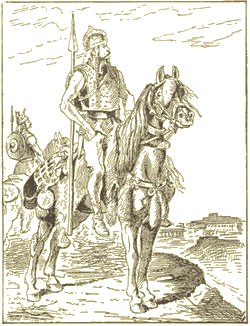
The honor of having established the French monarchy and the French nation, of having raised himself from his position as chief of a petty and turbulent tribe to be the ruler of a powerful and permanent kingdom, unquestionably belongs to Clovis the First, who was born in the year 465. The multitude of petty kingdoms subsisting in Gaul at this time, forms, says an illustrious historian, one of the greatest difficulties in the ancient history of France. In a manuscript work, still preserved in the King's library at Paris, it is imputed to the disorders which prevailed after the expulsion of Childeric, father of Clovis, when such as were sufficiently powerful took advantage of the anarchy in which the nation was involved, to establish independent monarchies of their own. Clovis ascended the throne at the age of fifteen, and at the early age of twenty began to show his jealousy toward those whom he considered usurpers of his territories. His courtiers, ever ready to fan into a flame the spark they had discovered in the breast of their master, incited him to challenge Syagrius, a Roman who still had possession of Soissons and a part of the adjacent country.
The challenge was accepted by this self-made prince, and a bloody battle was the result. Syagrius saved himself by flight, taking refuge among the Visigoths; but Alaric II., then king, fearing the threats of Clovis delivered the refugee into his power, who caused him to be beheaded.
The Frankish leader was now a man of note in the world; but he was still nothing more than the leader of a band of warriors, often retaining his authority only by brute force. At one time, his band having stormed the Christian city of Rheims and carried off from its church a vase "of marvellous size and beauty," the bishop sent word to their leader entreating him to return it. "That will I," responded Clovis to the envoy, "if when we divide our spoil the vase falls to my lot." In his desire to gratify the bishop, who was an old friend, the chieftain went a step beyond his promise and requested his companions to give him the great vase as his share. Then cried one of their number, striking the trophy angrily with his axe, "No, you shall draw lots with the rest of us, and take what comes honestly to you." His comrades, however, felt that this was going too far. The vase was given to their leader, and by him returned to Rheims. A year passed, and Clovis gave no sign that he remembered the affront. Then, having called his band together for a review, he passed them one by one, examining and approving their arms, till, last of all, he reached the warrior who had opposed him; and he eyed this man sternly. "Your weapons suit you poorly," he said, "none of them are fit for service." And, snatching the man's axe from him he threw it to the ground. The other stooped to recover it, when, whirling up his own axe, Clovis crashed it through the rebel's skull. "'Twas so you struck my vase," he cried.
Such a leader, who could so long await a fitting opportunity, and then so sternly avenge an insult to his power, was well calculated to wield great authority among these stern and hardy warriors. He had enjoyed several years of uninterrupted tranquillity, when Basinus, King of Thuringia, made a sudden irruption into that part of the dominions of Clovis situated beyond the Rhine. Clovis was no sooner informed of this invasion, than he assembled his army, and entering the enemy's country, laid it waste with fire and sword, and imposed a perpetual tribute on the offending monarch.
Clovis now bent his thoughts on the formation of an alliance by marriage with some of the neighboring princes. He accordingly despatched his ambassadors to the King of Burgundy, asking for the hand of the Princess Clotildis, his niece, the accounts of whose extraordinary piety and beauty had made a deep impression on his heart. The court of Burgundy, fearful of offending a young and powerful prince, whose arms had hitherto been everywhere victorious, complied with his request.
Great preparations were made for the departure of the queen elect, and she began her journey in a kind of wagon, called basterne, drawn by oxen, which was the most elegant vehicle then in use. The marriage was celebrated at Soissons, amid the joyful acclamations of the people.
Heaven smiled on this propitious union; Clotildis became mother of a prince, who received baptism with the king's consent, and was named Ingomer. The subsequent death of this child, on whom Clovis had so firmly set his affections, inspired him, notwithstanding the prayers and remonstrances of his affectionate and pious princess, with an aversion to the Christian religion. He was prevailed on, however, to suffer his second son to undergo the ceremony of baptism. He also was attacked by a severe indisposition, but the prayers of this pious woman were heard and answered, the young prince restored to health, and the anxiety of his father dispelled.
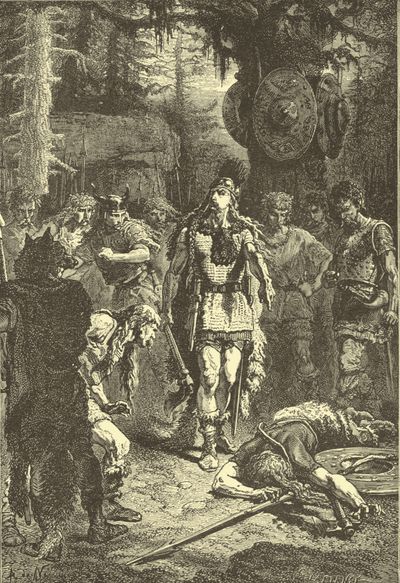
Clovis punishing a rebel.
The conversion to Christianity of Clovis, soon after this, is thus related by historians: The Germans had commenced preparing for incursions into the dominions of Clovis; he, being apprised of their intentions, hastened to impede their progress, and met them on the plains of Tolbiac, not far from Cologne, where a bloody battle was fought. Clovis, perceiving that the strength of his army was diminishing, lifted up his eyes to Heaven, and exclaimed, "God of my Queen Clotildis, grant me victory, and I here vow to worship none other than you." He immediately rallied his yielding forces, again led the charge, pierced with irresistible ardor the enemy's battalions, and entirely put them to flight. He then followed them into Germany, where he dispersed the remains of the vanquished army, reduced to obedience a nation hitherto invincible, and compelled them to pay him an annual tribute.
Faithful to his vow, he requested to be made acquainted with the mysteries of the Christian religion; and on Christmas-day, 496, received baptism at the church of St. Martin, in Paris, from Remigius, Bishop of Rheims, a prelate equally distinguished for his birth and piety. His sister Albofleda, and about three thousand of his subjects, followed his example. An improbable legend prevails, that during the ceremony of the baptism of Clovis, a dove descended from Heaven, bringing a phial of balsam, with which he was consecrated. This is what is now called La Sainte Ampoule, the Holy Phial; which was kept with extreme care, and contained the oil used by the monarchs of France at their coronation.
The conversion of Clovis had not repressed his warlike ambition. Brabant, the country of Liege, and that part of Flanders which was situated on the sea-coast, had not yet submitted to the new conqueror of Gaul.
The most considerable of these small states was the Arborici, a Christian nation, firmly attached to the Christian religion, and thence maintaining an enmity against the French, who were pagans. But the recent conversion to Christianity of Clovis and so many of his subjects, diminished the aversion of the people of this peaceful nation; they were induced to consent to an alliance with him, acknowledge him for their sovereign, and became subjects of the French kingdom. The Roman garrisons, following the example, capitulated and gave up all the places that were still in their possession, toward the ocean and on the banks of the Rhine.
Clovis did not as yet consider his victories complete; the conquest of Brittany was soon followed by that of Alaric II., King of the Visigoths. Before the French set out on this latter expedition, they made a vow not to shave themselves till they had subdued their enemies. Vows of this kind were very common at that period. It was the custom of those times to draw an omen from the verse that was chanting, when a person entered the church. The king's envoys, at their entrance into the church of St. Martin, heard these words from the Psalms: "Thou hast endued me with strength for the wars; thou hast supplanted those that had risen up against me; and hast put mine enemies to flight." This fortunate prognostic was confirmed on the banks of the Vienne. The army was at a loss where to pass that river, when a hind plunged into the stream in sight of the whole camp, and showed them a ford which still retains the name of the Passage of the Hind.
The two armies met in the plains of Vouille, near Poictiers. Soon after the commencement of the battle, the monarchs of either nation perceiving each other, rushed forward at the same instant, and engaged in single combat, when the superior skill and strength of Clovis decided the victory in his favor; he dismounted his adversary, and slew him on the spot. Nothing now remained to impede the progress of the conqueror, who extended his empire from the banks of the Loire to the Pyrenean mountains. Clovis then withdrew to Paris, and fixed his residence in a palace in the southern part of the capital, which had formerly been inhabited by the emperors Julian and Valentinian the First. Success had hitherto attended all the plans of Clovis, and allowing for the ferocious and martial spirit which then prevailed, he had preserved his fame from any material pollution.
The assembling of the Council of Orleans was the last remarkable event of the reign of Clovis, who died the same year, A.D. 511, at the age of forty-five, and was buried in the church of Saint Peter and Saint Paul, which he had caused to be built. It has been a subject of dispute with historians, whether the military or the political talents of this prince were the most eminent. Gaul, subdued by his arms, preserved by his prudence, affords a proof that he was equally skillful in the cabinet and formidable in the field.[Back to Contents]
BELISARIUS[8] By Charlotte M. Yonge (505-565)
Few men have performed greater achievements than this general, to whom it was given to be conqueror again and again over nations hitherto invincible, and to arrest, during his own lifetime, the disintegration of the Roman Empire. He lived in the early part of the sixth century of the Christian era, though the date of his birth is not certainly known, and he was in the prime of life about 530. He is believed to have been the son of a peasant of Thrace, probably of Slavonian descent, as his name, stripped of its classical form, would belong to that language and would be Beli-than, or the White Prince. Apparently he began life as a common soldier, and gradually rose by courage and ability. His master, the Emperor Justinian, was an equally remarkable personage, capable of conceiving and accomplishing magnificent designs, yet withal of a mean, ungenerous, ungrateful character. The codification under Christian conditions of the old Roman law, so as to serve as the foundation of jurisprudence to all the European nations except the English; the building of the church of St. Sophia, and the rolling back for a time the flood that on all sides was overwhelming the ancient Empire of Rome were all due to this prince.
For the last two centuries the East and the West had been separated, though sometimes coalescing under one head, but in 476, the last titular Emperor of the West had been deposed. Italy had been the prey of successive swarms of Teutonic nations. Vandals and Ostro-or Eastern Goths had burst upon Rome, and while the Vandals proceeded to devastate the great Roman province of Northern Africa and set up a kingdom there, the Goths had established another in Italy. Constantinople still held its ground as the magnificent capital of the Eastern Empire, maintaining the old civilization, but her dominions were threatened by the vigorous Persians on the east, and on the north by the Bulgarians, a nation chiefly Slavonic and very savage and formidable.
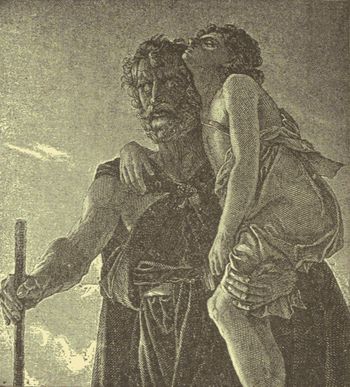
This was the inheritance to which Justinian succeeded, in right of his uncle Justin, a successful soldier. He was forty-five years old at the time, 527, having had an entirely civil and literary training, and though warfare continued through the thirty-eight years of his reign, he never once appeared at the head of his armies. Yet his foresight and ambition were great, and he had not long been on the throne before he decided on an endeavor to recover the African provinces. The Vandals were Arian heretics, denying the Godhead and Eternity of our Blessed Lord, and they had cruelly persecuted and constantly oppressed the Catholics, who entreated the Eastern Empire to deliver them, so that religious zeal added strength to Justinian's ambition. The luxuries of Carthage and the other African cities had in a couple of generations done much to destroy the vigor of the Vandals, so that the conjuncture was favorable.
Belisarius had proved his abilities in a dangerous retreat in the Persian war, but he probably owed his appointment to the African expedition to his wife Antonina. She was the daughter of a charioteer in the exhibitions of the hippodrome, which were loved to a passionate, almost incredible degree, by the people of the Eastern cities; and Theodora, the wife of the emperor was likewise the child of one of these competitors in the races. Both ladies were devotedly loved by their husbands, though scarcely worthy of their affection, and it was thus that Belisarius obtained the opportunity for his career, a curious parallel in this, as in other respects, to the great Duke of Marlborough.
Belisarius only took on this expedition 10,000 foot and 6,000 horse, picked men, with carefully selected officers, bred in the old Roman discipline, for he much preferred a small army whom he could trust, to a large and unwieldy host; and his fleet amounted to 500 vessels of different sizes.