Volume 1 — SOLDIERS AND SAILORS (continued 5)
Reading edition
"What right I have to it myself, God knows," replied the king, "and how I have enjoyed it."
"Of that," replied the prince, "it is not for me to judge; but if you die king, my father, I will have the garland, and will defend it with my sword against all enemies as you have done."
Not long after this conversation Henry IV. expired, and his son, the Prince of Wales, was immediately proclaimed king by the title of Henry V. But his change was not alone in name or station; his vices and his follies he cast from him, as an unworthy garment, and assumed with royalty a royal mind. The debauched companions of his youth were banished from his presence and his counsels, and forbidden to approach within ten miles of his dwelling. But at the same time we are assured that they were not left in indigence or necessity. Wisdom and virtue became the only recommendations which raised any one to his service, and those who had proved themselves most worthy, under the government of the former monarch, found themselves most readily welcomed by the new king.
No sooner was the truce at an end which then existed between France and England, than Henry himself proceeded to Southampton to take the command of his army in person. The English armament put to sea, and notwithstanding great preparations which had been made for defending the French coast, Henry landed his troops in safety at the mouth of the Seine, and immediately laid siege to Harfleur, at that time the principal sea-port of Normandy.
The Dauphin himself advanced to Vernon on the Seine, and the famous Marshal Boucicault, one of the most celebrated knights of his time, gathered together a large force, and advanced toward the English army.
Nevertheless Henry did not suffer his courage to fail, and the siege was continued with unabated vigor. At length the means of defence began to fail within the town. Two wagons of powder, which the French attempted to introduce, fell into the hands of the English; the walls were ruined by the effects of the artillery, and at length the governor agreed to surrender, if he remained unrelieved at the end of three days. The three days expired without succor, and Harfleur was surrendered to the King of England.
[Here follows a long and glowing account of Henry's retreat in the face of the overwhelming French forces, and of his greatest victory, the famous battle of Agincourt.]
Shortly after his return to England, Henry was visited by Sigismund, Emperor of Germany, accompanied by French ambassadors commissioned to treat for peace under his mediation. But while Henry continued to exact severe terms, the French gave him constant excuses for proceeding in the war, by their efforts to recover Harfleur, which, however, were constantly defeated by the activity of the English monarch and his officers.
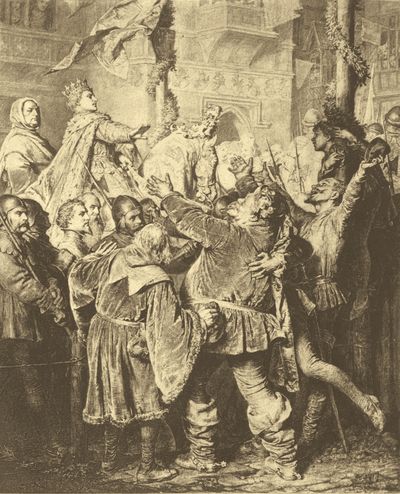
Henry V. rejects Falstaff.
To conquer the former patrimony of the British kings seemed the monarch's first object, and in a very short time he made himself master of almost all the principal cities of the duchy. Caen, indeed, resisted with devoted courage, and, after a severe siege, was taken by assault; but the governors of the other fortified places in Normandy, divided between the Armagnac and the Burgundian parties, had no confidence in their soldiers or each other, and one after another submitted to the power of the conqueror. Nor, indeed, did Henry spare any means to obtain his purpose in such a bloodless manner. All his proclamations announced that those who submitted should be safe in person and property; and his address to all the French people holds out to them that prospect of peace and protection which had long been unknown amongst the dissensions of their nobles. The first person of great influence, however, who joined the forces of the English king, was the Duke of Brittany; and, though Henry exacted no very great exertions from his new ally, the example of such a defection from the crown of France was greatly in behalf of the invader. Rouen, the capital of Normandy, however, still resolutely closed her gates against the English.
The attack and capture of the Pont de l'Arche announced to the people of Rouen, and to the King of France, that the war was about to approach the gates of the Norman capital, and every exertion was made, both by the Burgundian faction, who now held the king in their hands, and the burghers of the city itself, to repel the English in the attempt. A number of famous knights and commanders were thrown into the city, which was, besides, garrisoned by upward of four thousand men-at-arms, and fifteen thousand armed citizens, all eager in the cause.
Immense efforts were now made by the English to force an entrance, but the defences of the place were so strong, and the defenders so resolute, that no hope appeared of effecting a practicable breach in the walls. Many a sally took place, and many an assault, and many a feat of arms was performed between the two armies. But in the meanwhile the provisions of the people of the town began to decrease, and a smaller and smaller portion of food became the allowance of each day. At length the inhabitants, by murmurs and threats, compelled the garrison to treat; and, after a long and painful negotiation, Rouen capitulated, upon terms which could hardly be called unfavorable, in the situation to which its defenders were reduced.
The news of the fall of Rouen had the greatest effect on the rest of Normandy, and twenty-seven towns, or castles, immediately made submission to the King of England, without even being summoned to surrender. Nor was this immediate benefit the only advantage which followed from the capture of Rouen. Dismay and doubt spread through all France, and thoughts of peace and concession were entertained by those who had hitherto breathed nothing but war and defiance to the King of England.
Pontoise was almost immediately taken by surprise, Gisors and Chateau Gaillard fell after a short siege, and the terrific news of the advance of the English reached Paris, and induced the King, the Queen, and the Duke of Burgundy to abandon the capital and retire to Troyes.
Henry's ambassadors, according to the desire of the French court, were instantly sent to Troyes—where the weak king remained under the guidance of his evil wife and her counsellors—and they soon sketched out a treaty by which, on marrying the Princess Catharine, the English monarch should be declared heir to the crown of France, to the exclusion of the Dauphin and his lineage. This hasty treaty was as hastily ratified, and Henry, with fifteen thousand men departed from Rouen, and marching with all speed to Troyes, put the seal to an arrangement which conveyed to him the throne for which he had fought, by marrying the daughter of the French monarch. To the first articles proposed was now added, at the request of Henry, that the Regency of the kingdom, to the government of which Charles was totally incompetent, should be entrusted to him, and no sooner was the solemnity of his marriage completed, than he instantly took the field against the Dauphin, leading the unhappy King of France and his whole court against the natural heir to his throne. The town of Sens first fell before the arms of England and Burgundy, and immediately after siege was laid to Montereau, where the assassination of John the Bold had been committed.
Henry also now took upon him the whole executive power of the government. The governors of towns, the officers of state, the magistrates and the dignitaries, were placed and displaced at his pleasure. The currency of the country was altered at his suggestion, and his counsels swayed everything in France. However, England was still at his heart, and leaving a country that his sword and his policy had conquered, as soon as he could do so with any security, he carried his beautiful bride to be crowned in London.
The moment, however, that his foot was out of France, his interests in that country declined; and the rashness of his officers brought confusion and ruin into his affairs. Town after town was taken by the Dauphin; and at length the Duke of Clarence, the English monarch's brother, with all the chivalry that accompanied him, were defeated at Baugé, in Anjou, and the duke himself, as well as three thousand of his men, remained dead upon the field. This news, accompanied by the further tidings that the Dauphin was advancing to besiege Chartres, called upon the king imperatively to return to France; and leaving the queen to follow at a future time, Henry set out for Calais accompanied by four thousand men-at-arms and twenty-four thousand archers.
His coming gave new courage to the Burgundian faction, and struck fear into the followers of the Dauphin. Scarcely pausing at all in the capital, the English monarch advanced direct toward Chartres, before which the Dauphin had already been encamped three weeks; but long ere the English reached the town the gates were free, and the adverse army with all speed retreated toward Touraine. Thither the English monarch followed, breathing revenge for the death of his brother. Dreux and Beaugency-sur-Loire were conquered by the way; but after pursuing the Dauphin ineffectually for some time, the scarcity of provisions obliged him to return toward Normandy. On his march back, he is said to have fallen in with a party of the Armagnac faction, who retreated before him into a castle called Rougemont, which was instantly assailed and taken by the English. All who were within, the French historians assert, to the number of sixty persons, were, by the king's order, drowned in the Loire, a fact which accords too well with the manners of the time and some parts of the monarch's own character. The town of Meaux was the next object of attack, and a long and courageous defence was made by the Dauphinois within.
The fall of Meaux, like that of Rouen, brought with it the surrender of an immense number of other places, but this was the last great military undertaking which Henry conducted in person. From Meaux he went direct to Vincennes to meet his queen, who was at this time on her journey from Calais, and thence proceeded with the King and Queen of France to Paris, where various transactions took place relative to the internal policy of the country. The court soon removed thence to Senlis, where Henry continued to make his principal abode, till news from the banks of the Loire roused him from inactivity.
The Dauphin, now finding the English monarch removed from his immediate neighborhood, again advanced with all the forces he could gather, and laid siege to Cône-sur-Loire, then garrisoned by the troops of Burgundy. The town, hard pressed, was obliged to treat, and agreed to surrender, without the Duke of Burgundy should give battle to the Dauphin in its defence, before the sixteenth day of August ensuing. The tidings were communicated to the duke by the garrison, and at the same time a herald from the Dauphin defied him to the field the day named. The duke instantly accepted the challenge, and sent to all his allies, as customary on such occasions, begging their aid and support in the day of battle. Among the rest he demanded the assistance of forces from the King of England, to be led by such of his famous leaders as he could well spare. Henry, however, though already unwell, declared that he would send no one to the aid of his good cousin of Burgundy, but go himself, and, accordingly, commanding his brother the Duke of Bedford, to lead his troops from Paris and that neighborhood, he himself set out from Senlis on horseback. At Melun, however, his sickness had so far increased, that, no longer able to sit on his horse, he attempted to proceed on a litter, but at length was obliged to turn toward Vincennes, where each day brought him nearer to the tomb.
The Duke of Bedford, led the English forces to Cône, from which the Dauphin had already retreated, and the English prince returned just in time to witness the death of his brother.
Henry already felt his danger, and calling his relations around him, made those dispositions which he thought necessary for securing his dominions to his child. He then insisted upon his physicians informing him how long he had to live, and being told that his life could not last much more than two hours, he prepared to meet death with the same courage which he had evinced during life. After going through all the ceremonial duties of the Catholic religion, he commanded some particular psalms to be sung in his chamber, and died very nearly the time his physicians had predicted.
Henry V. was a great conqueror, and a wise, prudent, and politic prince. His two greatest faults seem to have been ambition and cruelty; the first was an inheritance, and the second, perhaps, was less an effect of a harsh nature than of hasty passion. We seldom find that he committed any deliberate act of barbarity, and those things which most stain his name were generally done under feelings of great irritation. His conduct to the Earl of March, the heir of Richard II., and the respect he paid to the memory of that unhappy king himself, are proofs of a generous nature; and of all his conquests, the greatest he ever achieved was the first—that over himself.[Back to Contents]
JOHN HUNIADES[16] By Professor A. Vambéry (1388-1456)
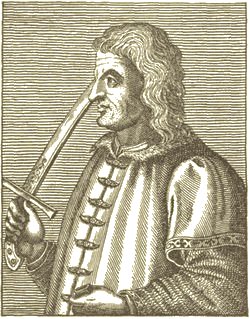
Of his grandfather we do not know even the name; his father was a Wallach, a common soldier; yet he himself was the greatest of Hungarian heroes, the Grand Marshal, and later on the "Governor" or Regent of Hungary; and his son king of that country. At the present day, in the age of democracy, such rapid elevation is no such rare phenomenon, but in the aristocratic middle ages it was really a miracle, one that points to exceptional circumstances and an exceptional man.
In Europe at that time the circumstances were indeed exceptional. A new power pulsating with youthful life had arrived from somewhere in the interior of Asia with the intention of conquering the world. This power was the Turk—not merely a single nation, but a whole group of peoples clustered round a nation, inspired by one single idea which urged them ever forward. "There is no God but God, and Mohammed is the Apostle of God."
The Mohammedan flood already beat upon the bounds of Catholic Christendom, in the forefront of which stood Hungary. Hungary's king, Sigismund, was able for a moment in 1396 to unite the nations of Europe against the common danger, but the proud array of mail-clad knights were swept away like chaff before the steady ranks of the janissaries.
And herewith began the long series of desolating inroads into Hungary, for the Turk was wont to suck the blood of the nation he had marked down as his prey. He took the country by surprise, secretly, suddenly, like a summer storm, appearing in overwhelming numbers, burning, murdering, robbing, especially, men in the hopes of a rich ransom, or children whom they might bring up as Mohammedans and janissaries. This body, the flower of the Turkish armies, owed its origin for the most part to the Christian children thus stolen from their parents and their country. This infantry of the janissaries was the first standing army in Europe. Living constantly together under a common discipline, like the inmates of a cloister, they rushed blindly forward to the cry of "God and his Prophet" like some splendid, powerful wild beast, eager for prey. The Turkish sultans published the proud order: "Forward, let us conquer the whole world, wheresoever we tie up our horses' heads that land is our own."
To resist such a nation, that would not listen to negotiation, but only thirsted for war and conquest, seemed already an impossibility. Europe trembled with fear at the reports of the formidable attacks designed against her, and listened anxiously for news from distant Hungary which lay, so to say, in the lion's very mouth.
Against such an enemy a soldier of the modern type was useless, one who slays only in defence of his own life and at the word of command, whose force consists in the high development of the military art and the murderous instruments of modern technical science. What was wanted was an heroic soul, inspired by a burning faith like to that which impelled the Mohammedan soldier.
This heroic soul, this burning faith, united to the tenacious energy of youth, were all found united in the greatest Hungarian hero, John Huniades, accompanied withal by a singular talent for leadership in war. He could not rely for support upon the haughty magnates who could trace their descent back for centuries and despised the parvenu with a shorter pedigree and a smaller estate. He was consequently obliged to cast in his lot with the mass of the lesser nobility, individually weaker, it is true, but not deficient in spirit and a consciousness of their own worth. Of this class he soon became the idolized leader. Around him gathered the hitherto latent forces of Hungarian society, especially from Transylvania and South Hungary and the Great Hungarian Plain (Alföld), which suffered most from the incursions of the Turks and were therefore most impressed with the necessity of organizing a system of defence. It was these who were the first to be inspired by Huniades' heroic spirit.
Before commencing his career as independent commander he, following his father's example, attached himself to the court of Sigismund, the Emperor-king, in whose train he visited the countries of Western Europe, Germany, England, and Italy, till he at length returned home, his mind enriched by experience but with the fervor of his first faith unchilled.
He had thus passed the flower of his age when nearly sixty years old, he repaired at his sovereign's command to the south of Hungary to organize the resistance to the Turks. At first he was appointed Ban of Severin, and as such had the chief command of the fortified places built by the Hungarians for the defence of the Lower Danube. After that he became Voyvode of Transylvania, the civil and military governor of the southeastern corner of the Hungarian kingdom.
Before, however, he had reached these dignities he had fought a succession of battles and skirmishes with such success that for the fanatical Turkish soldiery his form, nay, his very name was an object of terror. It was Huniades alone whom they sought to slay on the field of battle, well persuaded that he once slain they would easily deal with the rest of Hungary. Thus in 1442 a Turkish leader, named Mezid Bey, burst into Transylvania at the head of 80,000 men in pursuance of the sultan's commands, with no other aim than to take Huniades dead or alive.
Nor indeed did Huniades keep them waiting for him. He hurried at the head of his troops to attack the Turkish leader who was laying siege to Hermannstadt. Upon this Mezid Bey, calling his bravest soldiers around him, described to them once more Huniades' appearance, his arms, his dress, his stature, and his horse, that they might certainly recognize him. "Slay him only," he exclaimed; "and we shall easily deal with the rest of them; we shall drive them like a flock of sheep into the presence of our august master."
On that occasion was seen with what self-sacrificing enthusiasm his soldiers loved their heroic leader. When they learned from their spies the purpose of the Turks, they took all possible measures to secure his precious life. One of their number, Simon Kemeny, who bore a striking resemblance to Huniades, determined to sacrifice himself for his leader. He announced that he would put on Huniades' clothes and armor. The Turks would then attack him under the belief that he was the celebrated chief, and while they were thus engaged the real Huniades would fall upon them unexpectedly and put them to flight. At first Huniades would by no means consent to this plan, as he did not wish to expose Kemeny to such mortal danger; but at last seeing the great military advantages likely to accrue from it he consented.
And so indeed it fell out. As soon as the battle began, the Turks, perceiving Simon Kemeny in the garb of Huniades, directed all their force against him. Kemeny, after a stout defence, fell together with a great number of his followers, and the Turks, seeing him fall, set up a general cry of triumph and exultation. Just at this critical moment they were hotly attacked in the flank by the genuine Huniades. Thus attacked in the very moment when they imagined that they had already gained the day, the Turks were thrown into confusion and took wildly to flight. Twenty thousand corpses were left on the battle-field; among them were Mezid Bey himself, together with his sons.
Fearful was the rage of the Turkish sultan when he heard of the defeat and death of Mezid Bey, and he at once despatched another army against Huniades, which like the first numbered 80,000 men. This time, however, Huniades did not let them enter Transylvania, but waited for them at the pass, known as the Iron Gate, among the high mountains on the southern boundary of Hungary.
The Hungarian army was not more than 15,000 men, so that the Turks were at least five times as strong. But the military genius of Huniades made up for the small number of his followers. He posted them in a strong position in the rough pass, and attacked the enemy in places where it was impossible for him to make use of his strength. Thus more than half the Turkish army perished miserably in the battle. Again their commander-in-chief fell on the field together with six subordinate commanders, while two hundred horse-tail standards fell into Huniades' hands as trophies of his victory.
These two splendid victories filled all Europe with joy and admiration. Christendom again breathed freely; for she felt that a champion, sent by a special Providence, had appeared, who had both the courage and the ability to meet and to repel the haughty and formidable foe. But Huniades was not content with doing so much. He thought that by this time he might carry the war into the enemy's country. The plan of operations was exceptionally daring, yet Huniades had not resolved on it without careful consideration. In the meantime through Huniades' exertions, Vladislaus, the young King of Poland, had been elected King of Hungary. Huniades gained the new king over to his plans, and by this means secured the co-operation of the higher aristocracy and the armed bands which they were bound to lead into the field at the king's summons. Huniades counted besides on the assistance of Europe; in the first place on the Popes, who were zealous advocates of the war against the Mohammedans; next on Venice, which as the first commercial city and state at that time had suffered severe losses owing to the spread of Turkish dominions; on the gallant Poles whose king now wore the Hungarian crown; and lastly upon the peoples of Christendom in general, whose enthusiasm for a war against the infidels had been quickened by the report of Huniades' victories. And indeed at his request the Pope sent some small sums of money, the Poles furnished an auxiliary force, while numerous volunteers from the rest of Europe flocked to serve under his banner. Although the assistance thus furnished was comparatively unimportant, it nevertheless served to increase his zeal for the daring undertaking. He and his heroic companions were not only proud of defending their own native country, but felt that they were the champions of all Christendom against Ottoman aggression, and their religious enthusiasm kept pace with their patriotism. If they did not get regiments sent to their aid, they felt that the eyes of all Europe were upon them, ready to grieve at their possible ill success, while their victories would be celebrated by Te deums in the cathedrals of every capital in Europe.
The aggressive campaign was commenced without delay; Huniades' resolves were at once translated into fact; he would not allow the beaten foe time to recover breath. His plan was to cross the Danube, and penetrate through the passes of the Balkan to Philippopolis, at that time the capital of the sultan's dominions, where he kept the main body of his army. About Christmas, a season in which the Turk does not like to fight, amid heavy snow and severe cold, the Hungarian army of about thirty thousand men pressed forward. Huniades marched in advance with the vanguard of 12,000 picked men; after him the king and the Pope's legate, with the rest of the army. The sultan, however, with a large body of men had occupied the passes of the Balkans and prevented their farther advance. This impediment, coupled with the cold and severe weather, depressed the spirits of the troops, worn out with fatigue. Huniades, however, raised their spirits by gaining a victory; lighting one night upon a body of the enemy, 20,000 in number, he attacked them at once and after a few hours' struggle succeeded in dispersing them. Later on he took two large towns with their citadels; and in three engagements triumphed over three separate divisions of the enemy. Learning that a still larger body of Turks was attempting to cut off his communications with the king's army he attacked that also and put it to flight. After that he joined his corps with the main army under the king; and indeed none too soon. Sultan Murad suddenly arrived with the main body of his forces, which he strongly intrenched in the narrowest passes of the Balkans. Huniades saw that these intrenchments could not be forced, and did all he could to entice his enemy down into the plain. This he succeeded in doing. In the battle that ensued the king too played a conspicuous part and received a wound. In the end, however, the Hungarians gained the victory, and the younger brother of the Grand Vizier was taken prisoner. So much success was sufficient for Huniades for the time, especially as the natural obstacles had proved insurmountable. The Hungarian army returned home in good order, and the young king made a triumphal entry into his capital, preceded by a crowd of Turkish prisoners and captured Turkish ensigns. These last trophies of victory were deposited in the Coronation Church in the fortress of Buda.
And now something happened which had hitherto been deemed incredible; the Sultan sued for peace, a true believer and a sovereign, from an unbelieving giaour. The peace was concluded, and Hungary again became possessed of those dependent (South Slavonic) provinces, which lay between the territories of the Sultan and the kingdom of Hungary in the narrower sense of the word. In three short years Huniades had undone the work of years on the part of the Turks. The Sultan, however, soon repented of what he had done, and continually delayed the fulfilment of his promise to evacuate certain frontier fortresses. For this cause the young king, especially incited thereto by the Pope, determined to renew the war. Huniades at first opposed the king's resolution, and wished to wait; later on he was gained over to the king's view, and took up the matter with his whole soul. The opportunity was inviting, for the Sultan with his main army was engaged somewhere in Asia, and the Venetians promised to prevent with their fleet his return to Europe across the narrow seas in the neighborhood of Constantinople.
The Hungarian army indeed set out (1444) on its expedition, and continually expecting the arrival of the troops of their allies—the Emperor of Constantinople and the Princes of Albania—penetrated ever farther and farther into the hostile territory. They were to be joined by their allies at the town of Varna on the shores of the Black Sea. When, however, the Hungarians had arrived at that town, they found no trace of their expected allies, but on the contrary learned with certainty that the Sultan had succeeded in eluding the vigilance of the Venetians, had brought his army in small boats over into Europe, and was now following fast on their track.
Thus all hope of aid from allies was at an end, the brave general and his small Hungarian force had to rely on their own resources, separated as they were by some weeks' journey from their own country, while the enemy would be soon upon them in numbers five times their own. Yet even so Huniades' faith and courage did not desert him. The proverb says: "If thy sword be short, lengthen it by a step forward." And Huniades boldly, but yet with the caution that behoved a careful general, took up his position before the Sultan's army. Both he and his Hungarians fought with dauntless courage, availing themselves of every advantage and beating back every assault. Already victory seemed to be assured. A few hours after the battle had begun both the Turkish wings had been broken, and even the Sultan and the brave janissaries were thinking of flight, when the young king, the Pole Vladislaus, whom Huniades had adjured by God to remain in a place of safety, until the combat should be decided, was persuaded by his Polish suite to fling himself with the small band in immediate attendance upon him right on the centre of the janissaries, so that he too might have a share in the victory and not leave it all to Huniades. The janissaries wavered for a moment under this new and unexpected attack, but soon perceiving that they had to do with the King of Hungary they closed round his band which had penetrated far into their ranks. The king's horse was first hamstrung, and, as it fell, the king's head was severed from his body, stuck upon the point of a spear and exposed to the view of both armies. The Hungarians, shocked at the unexpected sight, wavered and, feeling themselves lost, began to fly. All the entreaties and exhortations of Huniades were in vain. Such was the confusion that he could be neither seen nor heard, and in a few minutes the whole Hungarian army was in confused flight.
Huniades, left to himself, had too to seek safety in flight. Alone, deserted by all, he had to make his way from one place of concealment to another till after some weeks' wandering he arrived in Hungary. The bad news had preceded him; and in consequence everything was in confusion. Again arose that difficult question: Who should be the new king under such difficult circumstances? The Sultan's army had, however, suffered so much in the battle of Varna that for the time he left the Hungarians unmolested.
The nation was disposed to choose for its king the child, Ladislaus, son of King Albert, the predecessor of Vladislaus. The child, however, was in the power of the neighboring prince, Frederick, the Archduke of Austria, who was not disposed to let him go out of his hands without a heavy ransom. Under these circumstances the more powerful nobles in Hungary took advantage of the confusion to strengthen each his own position at the expense of the nation. At first the government of the country was entrusted to a number of captains, but this proved so evidently disastrous that the better sort of people succeeded in having them abolished and Huniades established as sole governor. For all that, however, Huniades had a good deal of trouble with the chief aristocrats, Garay, Czillei, Ujlaki, who, envying the parvenu his sudden promotion and despising his obscure origin, took up arms to resist his authority. Thus Huniades, instead of blunting the edge of his sword upon foreign foes, had to bridle the insubordination of his own countrymen. Luckily it did not take long to force the discontented to own the weight of his arm and his superiority as a military leader.
Order being thus to some extent re-established at home, Huniades was again able to turn his attention to the Turks. He felt that he had in fact gained the battle of Varna, which was only lost through the jealous humor of a youthful king; that it behoved him not to stop half way; that it was his duty to continue offensive operations. But in so doing he had to rely upon his own proper forces. It is true that he was governor of the country, but for the purpose of offensive warfare beyond the frontier he could not gain the consent of the great nobles.
Luckily his private property had enormously increased by this time. The Hungarian Constitution ordered the king to bestow the estates of such noblemen, as died without male heirs or had been condemned for any offence, on such noblemen as had approved themselves valiant defenders of the country. Now where could be found a more worthy recipient of such estates than Huniades, to whom the public treasury was besides a debtor on account of the sums he disbursed for the constant warfare he maintained against the Turks? Especially in the south of Hungary a whole series of lordly estates, many of them belonging to the crown, had come into Huniades' hands, either as pledges for the repayment of the money he had paid his soldiers, or as his own private property.
The yearly revenue arising from these vast estates was employed by Huniades not in personal expenditure but in the defence of his country. He himself lived as simply as anyone of his soldiers, and recognized no other use of money than as a weapon to be used for the defence of Christendom against Islam. In the early morn while all his suite still slept he passed hours in prayer before the altar in the dimly lighted church, imploring the help of the Almighty for the attainment of his sole object in life—the destruction of the Turkish power. At last (1448) he set out against the Sultan with a picked army of 24,000 of his most trusty soldiers.
This time it was on the frontier of Servia, on the so-called Field of Blackbirds, that Huniades encountered Sultan Murad, as before with an army of 150,000 men—more than five times the number of the Christians. Huniades at first withdrew himself into his intrenched camp, but in a few days felt himself strong enough to engage with the enemy on the open field. The battle lasted without interruption for two days and a night. Huniades himself was several times in deadly peril. Once his horse was shot under him. He was to be found wherever assistance, support, encouragement were needed. At last on the morning of the third day as the Turks who had received reinforcements were about to renew the attack, the Voyvode of Wallachia passed over to the side of the Turks. The voyvode belonged to the Orthodox Eastern Church. He had joined Huniades on the way, and his desertion transferred 6,000 men from one side to the other, and decided the battle in favor of the Turks. The Hungarians, worn out by fatigue, fell into a discouragement, while Huniades had no fresh troops to bring up to their support. The battle came to a sudden end. Seventeen thousand Hungarian corpses strewed the field, but the loss of the Turks was more than 30,000 men.
Huniades again left to himself had again to make his escape. At first he only dismissed his military suite; afterwards he separated from his faithful servant in the hope that separately they might more easily baffle their pursuers. Next he had to turn his horse adrift, as the poor animal was incapable of continuing his journey. Thus he made his way alone and on foot toward the frontiers of his native land. After a while looking down from the top of a piece of elevated ground he perceived a large body of Turks from whom he hid himself in a neighboring lake. He thus escaped this danger, but only to encounter another. At a turn of the road he came so suddenly upon a party of Turkish plunderers as to be unable to escape from them, and thus became their prisoner. But the Turks did not recognize him, and leaving him in the hands of two of their number the rest went on in search of more prey. His two guards soon came to blows with one another about a heavy gold cross which they had found on the person of their captive, and, while they were thus quarrelling, Huniades suddenly wrenched his sword out of the hand of one of the two Turks and cut off his head, upon which the other took to flight, and Huniades was again free.
In the meantime, however, George, the Prince of Servia, who took part with the aristocratic malcontents, and out of pure hatred to Huniades had, in spite of his being a Christian, gone over to the side of the Turks, had given strict orders that all Hungarian stragglers were to be apprehended and brought before him. In this way Huniades fell into the hands of some Servian peasants who delivered him to their prince. Nor did he regain his liberty without the payment of a heavy ransom, leaving his son, Ladislaus, as hostage in his stead.
He thus returned home amid a thousand perils and with the painful experience that Europe left him to his own resources to fight as he best could against the ever-advancing Turks. The dependencies of the Hungarian crown, Servia and Wallachia, on whose recovery he had spent so much blood and treasure, instead of supporting him as might be expected of Christian countries threw themselves in a suicidal manner into the arms of the Turks. They hoped by their ready submission to find favor in the eyes of the irresistible conquerors, by whom, however, they were a little later on devoured.
After these events Huniades continued to act as Governor or Regent of Hungary for five years more, by which time the young Ladislaus, son of King Albert, attained his majority. In 1453 he finally laid down his dignity as governor, and gave over the power into the hands of the young king, Ladislaus V., whom Huniades had first to liberate by force of arms from his uncle, Frederick of Austria, before he could set him on the throne of Hungary. The young king, of German origin had, however, hardly become emancipated from his guardian, when he fell under the influence of his other uncle, Ulric Czillei. This Czillei was a great nobleman of Styria, but was withal possessed of large estates in Hungary. As a foreigner and as a relative of King Sigismund, he had long viewed with an evil eye Huniades' elevation. On one occasion Huniades had to inflict punishment on him. He consequently now did everything he could to induce the young king, his nephew, to hate the great captain as he himself did. He sought to infuse jealousy into his mind and to lead him to believe that Huniades aimed at the crown. His slanders found the readier credence in the mind of the youthful sovereign as he was completely stupefied by an uninterrupted course of debauchery. At last the king was brought to agree to a plan for ensnaring the great man who so often jeoparded his life and his substance in the defence of his country and religion. They summoned him in the king's name to Vienna, where Ladislaus as an Austrian prince was then staying, with the intention of waylaying and murdering him. But Huniades got wind of the whole plot, and, when he arrived at the place of ambush, it was at the head of 2,000 picked Hungarian warriors. Thus it was Czillei who fell into the snare. "Wretched creature!" exclaimed Huniades; "thou hast fallen into the pit thou diggedst for me; were it not that I regard the dignity of the king and my own humanity, thou shouldst suffer a punishment proportioned to thy crime. As it is, I let thee off this time, but come no more into my sight or thou shalt pay for it with thy life."
Such magnanimity, however, did not disarm the hostility of those who surrounded the king. On the pretence of treason against the king Huniades was deprived of all his offices and all his estates. The document is still to be seen in the Hungarian State Archives, in which the king, led astray by the jealousies that prevailed among his councillors, represents every virtue of the hero as a crime, and condemns him to exile.
Fortunately Czillei himself soon fell into disfavor; the Germans themselves overthrew him; and the king, now better informed, replaced Huniades in the post of Captain-General of the Kingdom.
Huniades, who had been living meanwhile retired in one of his castles, now complied with the king's wish without difficulty or hesitation, and again assumed the highest military command. Instead of seeking how to revenge himself after the manner of ordinary men, he only thought of the great enemy of his country, the Turk. And indeed, as it was, threatening clouds hung over the horizon in the southeast.
A new sultan had come to the throne, Mohammed II., one of the greatest sovereigns of the house of Othman. He began his reign with the occupation of Constantinople (1453), and thus destroyed the last refuge of the Byzantine Empire. At the news of this event all Europe burst into a chorus of lamentation. The whole importance of the Eastern Question at once presented itself before the nations of Christendom. It was at once understood that the new conqueror would not remain idle within the crumbling walls of Constantinople. And indeed in no long time was published the proud mot d'ordre "As there is but one God in heaven, so there shall be but one master upon earth."
Huniades looked toward Constantinople with heavy heart. He foresaw the outburst of the storm which would in the first place fall upon his own country, threatening it with utter ruin. Huniades, so it seemed, was again left alone in the defence of Christendom.
The approaching danger was delayed for a few years, but in 1456 Mohammed, having finally established himself in Constantinople, set out with the intention of striking a fatal blow against Hungary. On the borders of that country, on the bank of the Danube, on what was, properly speaking Servian territory, stood the fortress of Belgrade. When the danger from the Turks became imminent, the kings of Hungary purchased the place from the despots of Servia, giving them in exchange several extensive estates in Hungary, and had at great expense turned it into a vast fortress, at that time supposed to be impregnable. Mohammed determined to take the place, and to this end made the most extensive preparations. He led to the walls of Belgrade an army of not less than 150,000 men. The approach of this immense host so terrified the young king that he left Hungary and took refuge in Vienna along with his uncle and counsellor, Czillei.
Huniades alone remained at his post, resolute like a lion attacked. The energy of the old leader—he was now sixty-eight years old—was only steeled by the greatness of the danger; his forethought and his mental resources were but increased. As he saw that it would be impossible to do anything with a small army, he sent his friend, John Capistran, an Italian Franciscan, a man animated by a burning zeal akin to his own, to preach a crusade against the enemies of Christendom through the towns and villages of the Great Hungarian Plain. This the friar did to such effect that in a few weeks he had collected 60,000 men, ready to fight in defence of the Cross. This army of Crusaders—the last in the history of the nations—had for its gathering cry the bells of the churches, for its arms, scythes and axes, Christ for its leader, and John Huniades and John Capistran for his lieutenants.
The two greatest leaders in war of that day contended for the possession of Belgrade. The same army now surrounded that fortress which a few years before had stormed Constantinople reputed impregnable. The same hero defended it who had so often in the course of a single decennium defeated the Turkish foe in an offensive war, who now, regardless of danger, with a small but faithful band of followers, was prepared to do all that courage, resolution, and prudence might effect.
Many hundred large cannon began to break down the stone ramparts; many hundred boats forming a river flotilla covered the Danube, so as to cut off all communication between the fortress and Hungary. During this time Huniades' son Ladislaus, and his brother-in-law Michael Szilágyi, were in command in the fortress. Huniades' first daring plan was to force his way through the blockading flotilla, and enter Belgrade before the eyes of the whole Turkish army, taking with him his own soldiers and Capistran's crusaders. The plan completely succeeded. With his own flotilla of boats he broke through that of the Turks and made his entrance into the fortress in triumph. After this the struggle was continued with equal resolution and ability on both sides; such advantage as the Christians derived from the protection afforded by the fortifications being fully compensated by the enormous superiority in numbers both of men and cannon on the part of the Turks. Without example in the history of the storming of fortresses was the stratagem practised by Huniades when he permitted the picked troops of the enemy, the janissaries, to penetrate within the fortification and there destroyed them in the place they thought they had taken. Ten thousand janissaries had already swarmed into the town and were preparing to attack the bridges and gates of the citadel, when Huniades ordered fagots soaked in pitch and sulphur and other combustibles to be flung from the ramparts into the midst of the crowded ranks of the janissaries. The fire seized on their loose garments, and in a short time the whole body was a sea of fire. Every one sought to fly. Then it was that Huniades sallied out with his picked band, while Capistran with a tall cross in his hand and the cry of "Jesus" on his lips followed with his crowd of fanatics, the cannon of the fortress played upon the Turkish camp, the Sultan himself was wounded and swept along by the stream of fugitives. Forty thousand Turks were left dead upon the field, four thousand were taken prisoners and three thousand cannon were captured.
According to the opinion of Huniades himself the Turks had never suffered such a severe defeat. Its value as far as the Hungarians were concerned was heightened by the fact that the ambitious Sultan was personally humiliated. There was now great joy in Europe. At the news of the brilliant victory Te deum was sung in all the more important cities throughout Europe, and the Pope wished to compliment Huniades with a crown.
Alas! a crown of another character awaited him—that of his Redeemer, in whose name he lived, fought, and fell. The exhalations from the vast number of unburied or imperfectly buried bodies, festering in the heat of summer, gave rise to an epidemic in the Christian camp, and to this the great leader fell a victim. Huniades died August 11, 1456, in the sixty-eighth year of his age. He died amid the intoxication of his greatest victory, idolized by his followers, having once more preserved his country from imminent ruin. Could he have desired a more glorious death?
He went to his last rest with the consciousness that he had fulfilled his mission, having designed great things and having accomplished them.
And the result of his lifelong efforts survived him. His great enemy the Turk for half a century after his death could only harass the frontier of his native land; and his country, a few years after his death placed on the royal throne his son Matthias.[Back to Contents]

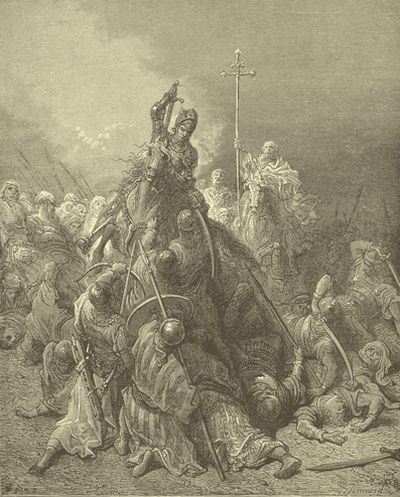
Huniades at Belgrade.
WARWICK, THE KING-MAKER (1420-1471)
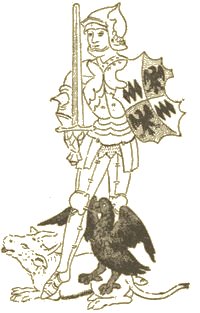
Richard Neville, Earl of Warwick, called the king-maker, eldest son of Richard, Earl of Salisbury and Alice Montacute, was born November 22, 1428. The history of this mighty peer is that of the whole of the contest between the two houses of York and Lancaster. The house of Neville had been built up by a series of wealthy marriages, and Richard made no exception to the rule. While yet a boy he was married to Anne, daughter of the Earl of Warwick, and through her, after the death of her brother and niece, he took his place at the age of twenty-one among the chief earls of the English realm. By this time the English rule in France had broken down, bringing the reigning house of Lancaster into great unpopularity, and throwing a correspondingly greater influence into the hands of the leader of the opposition, Richard Plantagenet, Duke of York. He was brother-in-law to the Earl of Salisbury, and so attached to his party the powerful influence of the Nevilles.
The Duke of York at first made no claim to the throne, demanding only that he should have his place in the councils of the king, and even when swords were drawn the Yorkists swore their allegiance to the king, Henry VI., while fighting against his advisers. Of these favorites of the king, the chief was the Earl of Somerset, whom many suspected of a design to establish himself as the successor to the throne. It was between these two factions of York and Somerset, that the white and red roses were first employed as distinguishing badges.
Plantagenet. Let him, that is a true born gentleman, And stands upon the honor of his birth, If he suppose that I have pleaded truth, From off this brier pluck a white rose with me.
Somerset. Let him that is no coward, nor no flatterer, But dare maintain the party of the truth, Pluck a red rose from off this thorn with me.
Warwick. I love no colors; and, without all color Of base insinuating flattery, I pluck this white rose with Plantagenet.
—Shakespeare: I Henry VI.
The Wars of the Roses began with the battle of St. Albans (1455), in which Somerset was killed. The victory was gained to the Yorkists chiefly by the help of Warwick. By a sudden sally into the streets of the town he routed the royal forces, and gained for himself that character of daring and courage which he maintained to the end. He was rewarded with the post of Captain of Calais, which he retained throughout the changes of the parties. In this position he was practically independent, and scoured the Channel at his pleasure.
In 1458 he attacked some vessels which were under a treaty of peace with England, and being summoned to London to answer before the king, was violently attacked by the followers of Somerset and barely escaped with his life. In 1459 the civil war finally broke out. In the first campaign the Yorkists failed, owing to their inactivity. The leaders fled to the coast of Devon, where they hired five men to carry them to Bristol. As soon as they left land, Warwick, stripped to the doublet, took the helm, and steered straight for Calais, where he arrived in a few days. When Somerset, son of the earl slain at St. Albans, came to claim the keys of the stronghold, he had the mortification to find Warwick there before him.
Warwick was next in England on June 27, 1460, when he landed at Sandwich with fifteen hundred men. In four days he was before the walls of London, having marched in that time a distance of seventy miles. According to some accounts, the common people so flocked to his standard, that in those four days his force had swelled to forty thousand. The city threw open its gates and joyfully welcomed him, while Henry fled to the north. In the beginning of July the battle of Northampton was fought. The Yorkists gained a complete victory, and took Henry prisoner. Before the fight Warwick issued the command to spare the common people but to slay the nobles, judging the quarrel to be more especially theirs; and it is significant that throughout the Wars of the Roses the proportion of leaders slain far exceeds that in any other war.
Up to this time Warwick's conception of the war was merely the natural struggle of the one party with the other for power, using as their means the rude arguments of the time. He still maintained his loyalty to King Henry, and when the Duke of York, after the battle of Northampton, presented his claim to the throne Warwick opposed him, and prevailed upon him to waive it till the death of the king. But naturally such a state of things could not long endure. Warwick, while respecting the person of the king, was fighting against his orders, and so, while professing loyalty, was actually a rebel.
Soon the struggle blazed out anew, and in December, 1460, the Duke of York was defeated and slain at Wakefield. Early in 1461 Warwick was defeated in the second battle of St. Albans, but the royalists not taking advantage of their victory, Edward, son of the Duke of York, accompanied by Warwick, marched on London, and was proclaimed king as Edward IV. Soon after the Yorkists gained a complete victory at Towton (1461), the bloodiest field of the whole war. Nearly all the Lancastrian chiefs were slain, Henry's cause was lost, and ere long he was captured by Warwick and lodged in the Tower. The credit of the crowning victory of Towton does not rest with Warwick alone, for he had the help of young Edward, perhaps as great a military genius as himself. Little is known of the details of the fighting, but we are told that wherever the Earl of Warwick was, there the fight raged hottest.
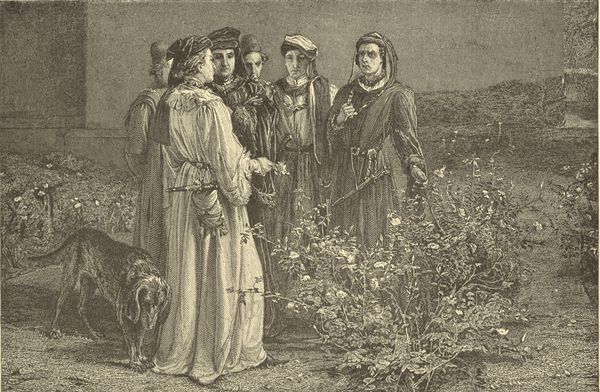
York and Lancaster—The White and Red Roses.
The earl was now the greatest man in England. His extended connections and immense possessions were joined to the most distinguished personal qualities, intrepidity, decision, and all the military virtues, eloquence and general talent, an affability and frankness of bearing that captivated equally all classes, a boundless hospitality and magnificence that enthroned him in the hearts of the commons. Wherever he resided, we are told he kept open house, and the number of people daily fed at his various mansions, when he was at the height of his prosperity, exceeded thirty thousand. "When he came to London," says Stowe in his "Chronicle," "he held such an house that six oxen were eaten at a breakfast, and every tavern was full of his meat; for who that had any acquaintance in that house he should have had as much sodden and roast as he might carry upon a long dagger."
But now, when Warwick might have expected to reap the reward of his labors, new troubles arose. King Edward began to feel jealous of his power, his unique influence, and vast popularity. It is said that Warwick was sent to France to arrange a treaty with Louis, and to propose a marriage between Edward and his wife's sister. On his return he found the king married to Elizabeth Woodville, daughter of Lord Rivers, and an alliance made with the enemy of Louis, the Duke of Burgundy. Edward now lavished all his kindness on the Woodvilles, intending to use them as a counterfoil to the Nevilles, and for this purpose he deprived the Nevilles of some of their posts. By a series of deliberate insults Warwick was driven farther and farther away from the king, till he was forced into open revolt.
In July, 1468, his forces defeated the royalists with great slaughter at Edgecote, and a few days later he made Edward his prisoner. The Lancastrians at once rose again in favor of the aged King Henry; but Warwick, maintaining his allegiance to his royal captive, suppressed all revolts with an iron hand, and, having received renewed pledges of good faith, soon after restored Edward to his throne.
Two years later the king declared Warwick a rebel; and he was compelled to flee to France. Louis XI. used his influence in bringing Warwick and Margaret, wife of King Henry, together, and they agreed to forget their differences in the face of a common enemy. Clarence, the new king's brother, had previously married Warwick's daughter, and joined his party.
Once more the king-maker landed in England and advanced on London. Edward fled to Holland and Henry was again placed upon the throne. But ere long Edward secretly landed in England, raised an army, not without difficulty, and met Warwick at Barnet. The faithless Clarence had in the meantime deserted Warwick and joined his brother's army. The army of Warwick was composed of strangely different elements—old enemies fighting side by side as friends. The battle was lost mainly through a grievous blunder. In the heavy mist which hung around, the party of the Earl of Oxford were mistaken for the enemy and were attacked by their own friends. The cry of treachery was raised, and the whole army broke into utter rout. Warwick resisted till all hope was gone. He had fought on foot throughout the battle, and his heavy armor did not suffer him to escape. He was surrounded and slain, fighting manfully, April 14, 1471.
Thus fell on the field of battle Richard, Earl of Warwick, in the prime of his life, after sixteen years of deep intrigue and desperate fighting. Had he been born in a more peaceful time he would have been a great statesman, and have done much for the good of his country, for his talents were more political than military, and almost alone among the self-seeking rivals of the time, he shows something of the instincts of patriotism. Cast as he was in the troublous times of the Wars of the Roses, he stands out in character and genius above all those of his generation. He was the best beloved man in the kingdom. When he was away from England, says Hall, the common people thought the sun had gone out of the heavens. His personality cast a charm over even Louis XI. The heart of the Yorkist party, he was true to its cause till he found that his service was no longer desired. He was not the man to sit quietly under insult, and when it came from King Edward, who owed all that he was to him, it was more than he could endure. Yet it was only when he found his every project thwarted, and especially those that were dearest to his heart, that he was driven into open warfare with the king. His treason is capable of much justification: he cannot be accused of forsaking his master. He had in him the making of a great king, and how great and useful might have been his career had fortune placed him over the councils of a Charles VII. or a Henry VI.! As it is, he stands in worth and character far above any of his time, a figure that commands not merely admiration but affection.[Back to Contents]
HERNANDO CORTES[17] By H. Rider Haggard (1485-1547)
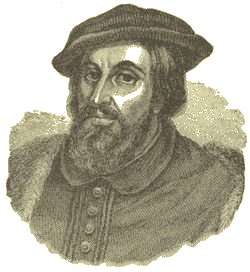
Among the millions that from age to age are born into this world there arise in every generation one or two pre-eminent men and women who are objects of the wonder and the envy, the admiration and the hatred of their contemporaries, and whose names, after their deaths, stand out as landmarks by which we shape a course across the dark and doubtful seas of history. Cæsar and Cromwell, Mahomet and Napoleon, to mention no others, were such men, and such a man was Hernando Cortes, the conqueror of Mexico. They have been called, and well called, Men of Destiny, since it is impossible in studying their lives and tracing their vast influence upon human affairs, to avoid the conclusion that they were raised up and endowed with great talents and opportunities in order that by their agency the ends of Providence might be shaped.
Hernando Cortes was born of a good family, at the town of Medellin in Spain, in 1485, and educated at the college of Salamanca. At the age of nineteen having proved himself unfit to follow the profession of the law to which his parents had destined him, he emigrated to the Indian Island of Hispaniola where he was appointed notary of the town of Acua, and in 1511 assisted in the conquest of Cuba under the command of Velasquez. Here after many curious adventures and vacillations he married a lady named Catalina Xuarez, and being created alcade of the settlement of St. Jago realized a moderate fortune by the practice of agriculture and mining. In 1518 there came to Cuba news of the discoveries made by Grijalva in Yucatan on the coast of the country now known as Mexico, and the Governor, Velasquez, determined to despatch a force to explore this new land. After much intriguing and in consideration of the payment of a considerable sum of money toward the expenses, Cortes whose ambitious spirit had already wearied of a life of peace and indolence, contrived to persuade Velasquez to appoint him Captain General of the expedition. Before the ships sailed, however, Velasquez repented him of the appointment, for in Cortes he recognized a servant who might well become his master, and made arrangements to invest some other hidalgo with the leadership of the expedition. Now it was that Cortes showed what manner of man he was. Many in his position on learning the wishes of their superior would have tamely yielded up their posts. Not so Cortes, who on the first hint that he was to be deprived of his authority, collected his men, and all unprepared as was his squadron, weighed anchor while the governor slept. At the town of Trinidad he landed to collect stores and volunteers, treating with contempt the orders that reached the commander of the town from Velasquez to depose him from his command and detain his person. Here it was that Cortes made his famous address to the volunteers, wherein he shows that although his instructions were to undertake a trading voyage and acquire information of the country, his real aim was far different, since he promises unimagined wealth to those who are true to him, and by a curious flash of prescience prophesies immortal renown to their enterprise. On February 10, 1519, he sailed to the conquest of Mexico, accompanied by some six hundred and fifty white men and a few Indians. Cortes was in his thirty-fourth year when he entered on this the greatest of his enterprises. He was pale faced and dark eyed, somewhat slender in build, but of an iron strength and constitution. In temper he was patient though liable to fits of passion, and in disposition frank, merry, and generous, but most determined. He dressed richly and was constant in his religious exercises. Such was the great captain, a man suited by circumstances and nature to the desperate undertaking which it was his destiny to bring to a successful issue.
Having touched at the island of Cozumel on the coast of Yucatan, Cortes sailed up the Tabasco River and began his work of conquest by attacking a great army of Indians in the neighborhood of that town. For a while the natives held their own notwithstanding their dismay at the sound and effects of fire-arms; but the appearance of the horsemen, whom they took to be strange animals, caused them to flee in terror leaving many hundreds of their warriors dead upon the field. On the morrow they made their submission, bringing women and other gifts as a peace-offering. Among these women was one named Malinche, or by the Spaniards Marina, whom Cortes took as a mistress and who is described by Camargo as having been "beautiful as a goddess." It was this lady, born to be the evil genius of her country, who instructed her lord and master in the habits, traditions, and history of the Aztecs, and of the land of Anahuac which they inhabited together with other tribes. She was Cortes' interpreter and confidante, whose business it was to gain information from the Indians, which he could use, and whose wit and devotion more than once saved him from disaster. So invaluable were her services to Cortes that it is doubtful if without her aid he would have succeeded in conquering Mexico, and it was from her that he acquired the name of Malinche by which he was known among the Indian races. Her reward, when she had served his purpose and he was weary of her, was to be given by him in marriage to another man.
Leaving Tabasco Cortes sailed along the coast till he reached the spot where the city of Vera Cruz now stands, whence he opened communications with Montezuma, Emperor of the Aztecs. In due course envoys arrived from the monarch laden with magnificent gifts, who delivered a civil but none the less peremptory message requesting the Spaniards to return whence they came. By this time Cortes had learned that although the Aztecs were the greatest power in Anahuac, their supremacy was not acknowledged by all the tribes; notably was it contested by the Tlascalans and their allies the Otomies. The Tlascalans were republicans having their home in the mountains almost midway between Mexico and the coast. For fifty years or more they had been at bitter enmity with the Aztecs, who again and again had vainly attempted to subjugate them. To this people Cortes despatched an embassy asking for a safe passage through their territories on his road to Mexico, for his political insight told him that they might prove valuable allies. No answer was returned by the Tlascalans who when the Spaniards advanced attacked them furiously, only to be defeated by Cortes in several engagements, till, discouraged and believing the white men to be invincible, they sued for peace, and from enemies were converted into firm allies. From Tlascala the Spaniards proceeded to the neighboring city of Cholula where Marina discovered a plot to put them to death. For this offence Cortes took a terrible vengeance. Falling on the inhabitants of the city when they were unprepared he butchered vast numbers of them, giving their houses and temples to sack. Having thus established the terror of his name he marched on to Mexico accompanied by a body of about five thousand Tlascalan allies. Meanwhile the counsels of the Aztecs were darkened with doubt. The Spaniards might easily have been kept out of Mexico by force, but the arm of Montezuma was paralyzed by superstitious fears. Prophecy foretold that the children of the white god Quetzalcoatl should rise from the sea to possess the land, and in the Spaniards he beheld the fate fulfilled. To him they were not mortal but divine and when diplomacy had failed to keep them at a distance he feared to lift a sword against them. Thus it came about that without a blow being struck to drive them back Cortes and his little band of adventurers found themselves established at the heart of the strange and rich civilization that they had discovered, not as enemies, but as the guests of the king. They were not slow to avail themselves of the opportunities of their position in order to advance their ends which were, first plunder, secondly conquest, and, thirdly the extension of the authority of Spain and of the Christian religion. In pursuit of these ends upon some slight pretext Cortes seized the person of Montezuma, the great emperor, and imprisoned him in one of his own palaces whence, however, he was still allowed to direct the government and issue his commands.
Meanwhile reports of Cortes' doings and success had reached Velasquez the Governor of Cuba, who determined to despatch an expedition to conquer or capture him as a traitor. Accordingly eighteen vessels containing nearly a thousand white men were placed under the command of Panfilo de Narvaez, and reached Vera Cruz in April, 1520. When Cortes heard of the arrival of this armament and its object which was to punish him for his supposed rebellion, he marched from Mexico, leaving the little garrison and the person of Montezuma in charge of his comrade Alvarado. Although he had with him but two hundred and fifty men in all, he did not hesitate to hazard a night attack upon Narvaez who was strongly encamped at Cempoalla. It was completely successful; Narvaez was wounded, captured, and sent in chains to Vera Cruz, while the army that had come to conquer him swore allegiance to Cortes as Captain-General and marched with him back to Mexico. Here great events were in progress. Moved to the deed by fear or by the discovery of some real or fancied plot against the Spaniards, Alvarado, the deputy of Cortes, had fallen upon the unarmed Aztec nobles while they were celebrating a feast in the courtyard of the great temple, and butchered some six hundred of them with every circumstance of brutality. Then at last the patient Aztecs rose and until the womanly Montezuma begged them to desist, attacked the palace where the Spaniards were quartered, with fury. At the intervention of their monarch the attack was turned to a blockade and Cortes arrived from his victory over Narvaez to find his companions in desperate straits. Reinforced by fresh soldiers the Spaniards carried on the war with activity. They assaulted and captured the great pyramid, putting to the sword the priests of human sacrifice and burning the blood-stained temples of the gods. Also they made several sallies into the city and repelled onslaughts upon the palace. It was in the course of one of these attacks that Montezuma received the wound that brought about his death. Mounting the central tower of the palace he implored his subjects to cease from attacking his friends the Spaniards, whereupon in their fury they overwhelmed him with a shower of darts and stones, inflicting injuries from which in course of a few days he died. Surrounded as he was on every side by thousands of fierce enemies determined to stretch every Spaniard upon the stone of sacrifice, Cortes saw the impossibility of maintaining the unequal fight and determined on retreat. Accordingly on the night of July 1, 1520, the Spaniards and their native allies sallied from the fortress, and laden with gold from Montezuma's treasury, took the route of Tlacopan. Soon their escape was detected and instantly a fierce attack was made upon them from every quarter. The bridge that they had brought with them to span the gaps in the causeway became fixed in the mud, so that their only path across the canals lay over the bodies of their comrades. At length they won through, but out of their small force there had perished, or been taken captive as victims for sacrifice, some four hundred and fifty Spaniards and four thousand native allies. It is said that when the shattered army reached a place of safety outside the city, Cortes sat down beneath an ancient cedar-tree which is still shown to travellers, and wept. Yet within a week fortune smiled on him again, for he and the few comrades who remained to him fought and won the battle of Otompan against thousands of the Indians, Cortes killing their chief Cihuaca with his own hand.
The Aztecs rejoiced at the departure of the Spaniards from their capital Mexico or Tenoctitlan, but their joy was premature. First the small-pox, introduced into the country by the white men, fell upon the city and swept away thousands, among them Cuitlahua, the emperor who succeeded to Montezuma, and then came the news that the indomitable Cortes was marching upon them with a great army of native allies and large reinforcements of Spaniards from overseas. Guatimozin, the new emperor, made every possible preparation for defence and the siege began, a siege as cruel as that of Jerusalem and perhaps more bloody. First Cortes laid waste the cities about Mexico, then he attacked the Queen of the Valley herself—attacked it again and again till at length it was a ruin and tens of thousands of its inhabitants were dead by starvation, by pestilence, and by the sword. On either side the combat was one of desperate courage, but notwithstanding occasional successes on the part of the Aztecs, such as that when they captured and sacrificed some sixty Spaniards, from the first the genius of Cortes made the end inevitable. When nothing remained of Tenoctitlan and its people save some blackened walls and a few thousand wretches reduced to skeletons by hunger, the capture of Guatimozin while attempting to escape in a canoe, made an end of the fighting in August, 1521. Cortes promised honorable treatment to the fallen king, but before long he put him and some of his companions to the torture in order to force the discovery of hidden treasure. This brutality proved ineffectual, but taken together with the subsequent hanging of Guatimozin upon an unproved charge of conspiracy against the Spaniards, it constitutes the blackest blot upon the fame of Cortes. It is fair to add, however, that he was not by nature a harsh man, and that he was driven to the commission of these cruelties by the clamor of his soldiers who were infuriated at finding so little treasure in the devastated city. With the capture of Mexico the fortunes of Cortes culminated. He was appointed Captain-General of the land of New Spain in October, 1522, and the next few years he occupied in rebuilding the city, and in bringing the surrounding territories under the rule of Spain. Wearying of these comparatively peaceful occupations, in 1524 he undertook an expedition of discovery and conquest to Honduras, upon which he was absent until May, 1526, when he returned after enduring much hardship and suffering, to find that enemies had been plotting against him in Mexico. This discovery and the desire of clearing himself with the emperor, caused him to determine to visit Spain where he arrived in May, 1528. Charles the Fifth received him with much favor creating him Marquis of the Valley of Oaxaca and military commander of New Spain, and endowing him with vast estates in the lands that he had conquered. In 1530 he returned to Mexico accompanied by his second wife, a lady of good family whom he had married while in Spain. Very soon he entered on a course of expeditions of discovery and maritime adventures which involved him in great pecuniary losses and a quarrel with the viceroy Mendoza; and in 1540 he sailed a second time for Spain to obtain redress from the emperor. But Cortes was no longer the power that he had been; his youth was gone and his work was done, therefore his prayers and remonstrances were treated with cold neglect. For nearly four years he pressed his suit and in February, 1544, we find him writing a letter to the emperor begging him to direct the Council of the Indies to come to a decision upon it. This letter in which pathetically enough, he speaks of himself as "old and poor and indebted," produced no result and once again, worn out and bitterly disappointed, its writer turned his face toward the land that he had won for Spain. But he was never to behold it more. At Seville he was seized with dysentery and passed away December 2, 1547, being then in his sixty-third year. His body was taken to Mexico for burial.
In Hernando Cortes died one of the great men of the world, though how much of his greatness was due to chance is difficult to determine. It is certain that again and again fortune stood his friend in a manner that was little short of miraculous, as in the instances of the unexpected victory over Narvaez and of the death of the general at the battle of Otampan. But if chance or fate gave him opportunities it was Cortes' own genius and unconquerable will that enabled him to avail himself of them. These qualities were the most striking characteristics of the man. He showed them when having determined on the conquest of Mexico he burnt his ships that there might be no escape from the decision; when he hit upon the expedient of using rival tribes to accomplish the overthrow of the Aztecs; when, driven from Mexico with the loss of the half of his army he returned to the attack; and in many another time and place. He had great good qualities, he was a true friend, and according to his lights, an honorable and even a religious man, and his faults were those of his time and training, or at worst such as are not inconsistent with a generous nature. His cruelties may be urged against him, but no Spaniard of his age thought it cruel to slaughter enemies of the Faith who practised human sacrifice; also having once embarked upon his colossal undertaking he and his companions must either slay or be slain. There is evidence to show that personally he was not a cruel man. Thus when called upon to sign the death-warrant of a soldier he lamented that he had ever been taught to write, and there are passages in his will which show his conscience to have been troubled by questions as to the right to enslave human beings. With a handful of followers Cortes overthrew the fabric of the Aztec Empire, broke the spirit of its people so effectually that to this day it has not recovered itself, and swept away its religion. Whether for good or evil this was a stupendous achievement and one that must make his name immortal.[Back to Contents]

FRANCISCO PIZARRO[18] By J. T. Trowbridge (1471-1541)
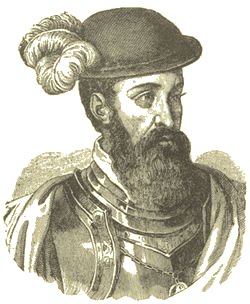
The old Spanish province of Estremadura, though distant from the sea, shut in by mountain-chains, furnished numerous adventurers for the expeditions of discovery, conquest, and plunder that followed Columbus to the New World; two of whom achieved astonishing renown. One was the conqueror of Mexico; the other, the conqueror of Peru.
Of the early life of Francisco Pizarro not much is known with certainty. He was born about the year 1471; but even that date is a matter of conjecture, so little care was had of the coming into the world of the actor who was to play so stirring a part in it. The family from which he inherited his name must have been one of some note in its day. His kinsman and great rival in fame, Cortes, was a Pizarro on his mother's side.
Francisco was the second of four brothers, all of whom were men of ability and valor, and all of whom fought in the Peruvian wars. Their father was Colonel Gonzalo Pizarro, concerning whom little is known, save that he was a soldier of Spain, and that he served creditably in Italy and Navarre.
The mother of Francisco was Francisca Gonzales, a woman of low condition, from whom he seems to have received hardly more parental care than from his father, by whom he was utterly neglected. The story told by Gomara, and quoted by Prescott, that, abandoned as a foundling, he was nursed by a sow, though as mythical as that of Romulus and the wolf, which probably suggested it, indicates nevertheless the degradation of his childhood. He grew up in ignorance and vagabondage. Of what the world calls education he had not the first rudiments; to the day of his death he could neither read nor write. The only occupation in which we hear of his being engaged in his boyhood, was that of a swineherd.
At what age he escaped from this mean employment is not known. The claim set up for him by his descendants, that he served with his father in Italy, hardly deserves consideration. He was about twenty-one years old when all Spain began to ring with the discoveries of Columbus and his companions beyond the western seas. Pizarro left his employer and his pigs, ran away to Seville, and embarked in one of the early expeditions that sailed from that port to the New World.
Of his years of apprenticeship in the stern warfare of the times we have no trustworthy details, until at Hispaniola, in 1510, he joined, as second in command, Ojeda's disastrous expedition to Uraba, on the main coast. Sanguinary fights with swarms of savages armed with poisoned arrows, marked the fortunes of the adventurers. And when Ojeda returned to the islands for assistance, which he did not bring, Pizarro remained in command of the starving colony, amid hardships and horrors from which only his resolute daring brought off a remnant alive.
He was with Balboa in his famous march across the mountains to the Pacific, which no European eyes had hitherto beheld; and shared with him the joy of that discovery, which Keats wrongly ascribes to Cortes, when the hardy band, first beholding the unknown ocean outspread before them—
"Looked at each other with a wild surmise, Silent, upon a peak in Darien."
He remained with Balboa on the isthmus until the death of that valiant commander, when he united his fortunes with those of the governor, Pedrarias, and headed various expeditions along the Pacific coast and to the islands beyond, in quest of pearls and gold. He was occupied in this way, or in cultivating with the aid of Indian slaves a malarious tract of land he had acquired near Panama, when a new career invited him.
Rumors of a rich empire far to the south, where gold was as common with the natives as iron was with the Spaniards, had long inflamed the imaginations of the colonists; then news came of the prodigious exploits of Cortes in Mexico. Pizarro burned to emulate his kinsman. Having formed a partnership with Diego de Almagro, a soldier of experience, and Hernando de Luque, a priest supplied with worldly means, he secured an old vessel that had been designed by Balboa for a similar expedition, refitted it with Luque's money, and with a hundred adventurers sailed from the port of Panama in November, 1524; leaving Almagro to follow in a smaller vessel.
Pizarro was then more than fifty years old, but still in possession of all his masterful qualities. And he had need of all, amid the perils of sea and land, the tempests, swamps, battles, sickness, and famine, which rendered his first voyage down the coast a deplorable failure. Almagro met with no better success. Both returned to the isthmus buffeted, baffled, humiliated, but too stout of heart to be cast down. They brought back but little gold, but with that little they had gathered evidence of the indubitable existence of the opulent empire they sought.
The governor was hugely dissatisfied with the results of the expedition, of which he had expected to share some of the profits; and his consent to another could hardly have been obtained, but for the persuasive eloquence of the priest, backed by the offer of a sum in ready cash. For a thousand pesos de oro Pedrarias gave his consent, and signed away his right to the spoils of an empire.
A new contract was entered into by the three partners, and an elaborate and solemn document was drawn up, in sonorous Spanish, which is curious reading at this day. Father Luque signed it with his own hand, and the two soldiers by the hands of witnesses, since neither Pizarro nor Almagro could write his name. About one hundred and sixty men were enlisted, and again the two chiefs set sail from Panama in separate ships.
They made their first landing at the mouth of the Rio San Juan, where by the plunder of a small village, they secured some ornaments of gold and a few prisoners. Almagro hastened to carry the treasure back to Panama, as a bait to other followers, while Pizarro and his pilot Ruiz remained to explore the interior and the coast. Ruiz sailed as far south as the equator, and after a memorable voyage of some weeks, returned to his chief with a cheering report. He had fallen in with what seemed at first a ship at sea, where no European ship had ever been, and found it to be an Indian balsa, a huge raft across which was stretched a sail of cotton-cloth. It had a rudder and a keel. On board were men and women clad in a curious sort of woollen stuff, skilfully woven, and beautifully dyed and embroidered. They were making a voyage of traffic along the coast. They wore ornaments of gold, and had with them, besides vessels and mirrors of burnished silver, balances for weighing the precious metals, which by signs they assured Ruiz were common in their country.
Pizarro in the meanwhile vainly endeavored to pass the yawning gorges, bottomless swamps, and dense dark forests that lay between him and the snow-covered peaks of the Cordilleras. Entangled vines and trees of a luxuriant tropical vegetation, huge boas coiling in the branches, ready to spring upon their prey, screaming parrots, chattering and grimacing monkeys, mosquitoes, alligators, prowling savages,—amid such scenes as these he and his band had once more confronted famine and death in the absence of Almagro and Ruiz.
Ruiz came opportunely with his good news, and Almagro returned with eighty recruits. The expedition re-embarked and proceeded southward. The aspect of the coast became more inviting as they advanced. There were signs of an extensive civilization; fields cultivated with maize, cacao, and potatoes; many villages; and at length a town of more than two thousand houses, laid out with streets, and thronging with inhabitants. Among the Spaniards wild enthusiasm prevailed. But it was quickly checked by the hostile demonstrations with which they were met, when they attempted to gain a foothold on the soil of the Incas. It was useless to make front against such numbers as opposed them. Divided counsels and a violent quarrel between the two captains ensued, and the expedition sailed back northward. Once more Almagro returned to Panama for more men, while Pizarro and his followers remained to starve on the barren isle of Gallo.
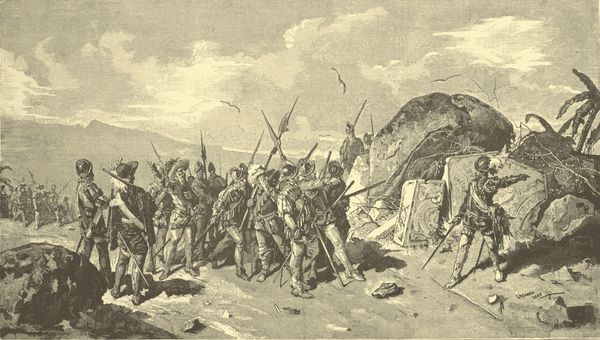
Pizarro exhorting his band at Gallo.
Instead of permitting any more of his people to depart on what seemed so foolhardy and fatal a business, Rios, the new governor of Panama, despatched to the island two vessels, under a commander named Tafur, with orders to bring away every Spaniard left alive there. Then occurred the famous episode that decided so dramatically the fortunes of Pizarro and the fate of Peru. Tafur had brought supplies of provisions to the famished and emaciated, but now jubilant soldiers; and all except Pizarro appeared eager to abandon their barren adventure and return in the ships. Pizarro alone refused obedience to the governor's agent. Drawing a line on the sand with his sword, he cried: "Comrades! on that side lie hunger and hardship; on this side, ease and safety. There lies Peru with its riches; here, Panama and poverty. Choose, every man for himself, like brave Castilians. For me, I go to the south."
He stepped across the line. There was a minute of dismay and silence. Then Ruiz followed, and after him twelve others went over, an act of as desperate and resolute courage as ever inspired a forlorn band.
They saw the ships containing their comrades sail away without them; Ruiz also returned, pledged to bring assistance to his companions left behind; while Pizarro remained with his twelve Spaniards, and three or four Indian captives whom he had made friends, on the desolate island.
Not even a ship was left them, and they had to build a raft to convey them to a less inhospitable island, that of Gorgona, farther north. There they lived seven months, subsisting on small game brought down by their cross-bows, and shell-fish found on the shores, until Ruiz, after weary delays, returned in a small vessel, bringing supplies, but not the expected reinforcement of troops.
In this frail craft the dauntless rovers put to sea. Pizarro pursued his explorations southward, beyond the point where he afterward founded Truxillo, named after his native town; visited several Peruvian ports, and learned much of the country he proposed to subjugate. He then returned to Panama, which he reached after an absence of eighteen months. The reappearance of the little group of wanderers bringing news of their discoveries, was the cause of great astonishment in the colony, and of joyful enthusiasm among their friends, who had long given them up for dead.
The governor, however, resenting Pizarro's disobedience of his orders at the isle of Gallo, refused to sanction another expedition; and Pizarro resolved upon the bold course of returning to Spain and appealing to the Crown. This was in the spring of 1528.
Arriving at Seville, he was immediately thrown into prison for a debt incurred at Darien. But he was released by order of the emperor, Charles V., who received him graciously at Toledo, heard the wondrous story of his wanderings, which Pizarro knew how to tell, and saw the vessels of gold and silver, the fine fabrics, the llamas, and other evidences of the Peruvian civilization, which were displayed before his royal eyes. He was also, no doubt influenced by the recent achievements of Cortes, who was then at court, and who perhaps spoke for his kinsman a friendly word.
The monarch turned over Pizarro and his enterprise, with his recommendation, to the Council of the Indies. Yet a year passed, and nothing was done. Pizarro was fast sinking into obscurity, and he would likewise have sunk into despair, if he had been less stout of heart. Then, as Queen Isabella had aided Columbus, so the queen of Charles V. came to the assistance of Pizarro, and caused to be executed the extraordinary instrument which bestowed on him, with the rights of discovery and conquest, the titles of Governor and Captain-General of New Castile, as Peru was then called, and a salary of 725,000 maravedis, to be drawn however from the conquered country. Almagro and Luque were also provided for, but in a more modest way, which proved the beginning of a long, bitter, and deadly feud between Almagro and his chief. Nor did the instrument fail to make the usual provision for the conversion to Christianity of the nations to be subjugated and plundered.
In mustering his recruits Pizarro had the satisfaction of revisiting his native town of Truxillo, where he had lived in degradation, and to which he now returned a renowned discoverer and soldier, and a titled magnate. There he found his three brothers, the Pizarros, all poor and proud and eager for adventure; and a fourth brother, on his mother's side. With these and other followers, hardly exceeding one hundred, he sailed from Seville, in January, 1530; and a year later, namely, in January, 1531, after a solemn consecration of his enterprise in the cathedral of Panama, he put forth from that port with one hundred and eighty men and twenty-seven horses, on his fourth, last, and finally successful expedition, to overthrow a populous empire.
That empire lay in the bosom and on both sides of the mighty ranges of the Andes, occupying thirty-seven degrees of the coast south of the equator, and extending eastward far over the valleys of the Amazon and its numerous tributaries. It was under the rule of the Incas, a parental despotism, which spread an iron network of laws over millions of subjects of different races and languages. Its mountain slopes, table-lands, sea-coasts, and plains comprised every variety of climate and almost every diversity of physical features. Its capital was Cuzco, where dwelt the adored Incas; there also was the famous Temple of the Sun, with its gorgeous decorations of gold and gems. Canals, aqueducts, complete systems of irrigation for the rainless regions; magnificent mountain roads, built to endure for centuries; fine textile fabrics, utensils of clay and copper, vessels and ornaments of silver and gold; bridges, fortresses, and edifices of a rude but massy and symmetrical architecture, well adapted to the climate and the needs of the inhabitants; armies, magistrates, courts of justice,—such were some of the tokens of a wide semi-civilized prosperity, which less than two hundred Spanish adventurers were proceeding ruthlessly to destroy.
With incredible difficulties still to overcome, Pizarro had in his favor a circumstance of immense importance. The country was at that time distracted by civil war. Two brothers, Huascar and Atahualpa, sons of the last Inca, were engaged in a fratricidal strife for the imperial power, and their armies were turned against each other.
Pizarro resolved to strike his first blow at Tumbez; but was constrained by baffling winds to put into the Bay St. Matthew. There he landed his force, and soon fell upon a peaceful village, putting the inhabitants to flight and pillaging their dwellings. A considerable treasure thus obtained was sent back to Panama, where it had the desired effect of rallying new recruits for the conquest. A most welcome reinforcement was headed by Hernando de Soto, afterwards famed as the discoverer of the Mississippi, who sailed to join Pizarro with one hundred men and a number of horses.
De Soto arrived in time to aid in extricating him from a harassing situation on the island of Puna. Pizarro had been so indiscreet as to get into a quarrel with the inhabitants, whom he had defeated in battle and slaughtered in large numbers, and from whose incessant attacks he was suffering great annoyance.
He now felt himself strong enough to invade the interior. The story of that invasion is one of the most astonishing in history. It has been many times told, but nowhere else so effectively as in the full, flowing, and lucid narrative of Prescott. It can be but briefly sketched here.
Having established near the sea-coast a settlement which he named San Miguel, to serve as a key of communication between him and his ships, Pizarro set out boldly on his march, having with him but one hundred and seventy-seven men, nine of whom showing signs of sinking courage, were soon sent back to the settlement. By pretences of a friendly mission to their Inca, he won his way among such of the surprised inhabitants as were not frightened from their villages by his approach; and penetrated the wild defiles of the Cordilleras, behind which, near Caxamalca—now Caxamarca—the Inca Atahualpa, with an immense army lay encamped. He was fresh from a great and decisive victory over his elder brother, and was resting, and enjoying the warm baths near the city,—the "baths of the Incas," as they are called to this day.
Instead of disputing the passage of the strangers in the mountain fortresses, and hurling destruction upon them from a thousand crags, the monarch sent to exchange gifts with them, and assurances of friendship; and awaited them in his camp, the pavilions of which whitened the wide hillsides for miles.
On a dull afternoon in November, 1532, Pizarro entered Caxamalca, and undismayed by the innumerable host that confronted him, went to pay a visit of courtesy to the Inca. He was gloomily received by Atahualpa, who chanced to be observing a fast, but who promised to return his visit on the following day.