"Great African Travellers" (continued 8)
Reading edition
On the high lands at the northern end, a tribe of Zulus, known as the Mazitu, make sudden swoops on the villages of the plains, and carry off the inhabitants and burn villages; and putrid bodies slain by Mazitu spears were seen in all directions. In consequence of this the land party, composed of blacks, were afraid of proceeding, and Dr Livingstone accordingly landed to accompany them. While he struck inland to go round a mountain, the boat pursued her course; but a fresh gale compelled her to run in-shore. On continuing her voyage, a number of armed Mazitu were seen on a small island, with several large canoes belonging to them. It was evident that it was a nest of lake pirates. Further on they met a still larger band, and the voyagers were ordered to come on shore. On refusing, a number of canoes chased them, one with nine paddlers persevering a considerable time, till a good breeze enabled the gig to get away from them. This circumstance caused great anxiety about Dr Livingstone.
The boat party having sailed on for fifteen miles northward, he was still nowhere to be seen, and they therefore resolved to return. Another gale, however, compelled them to put into a harbour, where a number of wretched fugitives from the slave trade, who had crossed from the opposite shore, were found; but the ordinary inhabitants had been swept off by the Mazitu. In their deserted gardens cotton of a fine quality, with staple an inch and a half long, was seen growing, some of the plants deserving to be ranked with trees.
On returning, their former pursuers tried to induce them to come on shore.
Four days passed before Dr Livingstone with two of his party discovered them. He had in the mean time fallen in with the Mazitu, who were armed with spears and shields, and their heads fantastically dressed with feathers. By his usual courage and determination he prevented them from attacking him. When they demanded presents, he told them his goods were in the boat; and when they insisted on having a coat, the Makololo enquired how many of the party they had killed, that they thus began to divide the spoil; and at last, suspecting that he had support at hand, they took to their heels.
Numerous elephants, surprisingly tame, were seen on the borders of the lake even close to the villages, and hippopotami swarmed in all the creeks and lagoons. Several were shot for food during the journey. Sometimes food was thus abundant; at others, a few sardines served for dinner.
The slave trade on the lake was being pursued with fearful activity. A dhow had been built by two Arabs, who were running her regularly, crowded with slaves, across its waters. Part of the captives are carried to the Portuguese slave-exporting town of Iboe, while others go to Kilwa.
The chiefs showed but little inclination to trade, their traffic being chiefly in human chattels.
Colonel Rigby states that nineteen thousand slaves from the Nyassa country alone pass annually through the custom-house at Zanzibar.
They, however, represent but a small portion of the sufferers. Besides those actually captured, thousands are killed and die of their wounds and famine; thousands more perish in internecine war waged for slaves with their own clansmen and neighbours. The numerous skeletons seen among rocks and woods, by the pools, and on the paths of the wilderness, attest the awful sacrifice of human life.
The doctor saw that a small armed steamer on Lake Nyassa could, by furnishing goods in exchange for ivory and other products, exercise a powerful influence in stopping the traffic in that quarter.
The expedition had spent from the 2nd of September to the 27th of October in exploring the lake, and their goods being now expended, it was necessary to return to the ship.
On their way back they fell in with a number of Manjanga families, driven from their homes by Ajawa raids, taking shelter among the papyrus growing on Lake Pamalombe, supporting themselves on the fine fish which abound in it.
The party reached the ship on the 8th of November, but in a weak condition, having latterly suffered greatly from hunger.
On the 14th they received a visit from the bishop, who appeared in excellent spirits, and believed that all promised well for future success. Many of the Manjanga had settled round Magomero to be under his protection, and it was hoped that the slave trade would soon cease in the neighbourhood. He here arranged to explore the country, from Magomero to the mouth of the river, and it was agreed that the “Pioneer,” her draught being too great for the upper part of the Shire, should on her next trip not go higher than Ruo. The bishop’s hope was to meet his sisters and Mrs Burrup, whose husband was one of his assistants.
With three hearty cheers, the “Pioneer” steamed down the river. The rain ceasing, she unfortunately ran on a shoal, and was detained in an unhealthy spot for five weeks. Here the carpenter’s mate, a fine healthy young man, was seized with fever and died. A permanent rise in the river enabled them at last to get on.
On reaching Ruo, they heard that Mariano had returned from Mozambique, and was desolating the right bank of the river. He had lived in luxury during his nominal imprisonment, and was now able to set the Portuguese at defiance. An officer sent against him, instead of capturing the rebel, was captured himself, but soon returned to Tete with a present of ivory he had received.
The Zambesi was reached on the 11th of January, 1862, when the “Pioneer” proceeded to the Great Luabo mouth of the river.
On the 30th HMS “Gorgon” arrived, towing the brig which brought out Mrs Livingstone and some ladies about to join the University mission, as well as the sections of a new iron steamer intended for the navigation of Lake Nyassa. The name of the “Lady Nyassa” was given to the new vessel.
The “Pioneer,” with as large a portion of the vessel as she could carry, accompanied by two of the “Gorgon’s” paddle-box boats, steamed off for Ruo on the 10th of February. Captain Wilson, with several of his officers and men, went on board her to render assistance. The ladies also took their passage in her. Her progress was very slow, and six months were expended before Shupanga was reached. Here the sections of the “Lady Nyassa” were landed, and preparations were made to screw her together.
Captain Wilson had kindly gone on in his boat to Ruo, taking Miss Mackenzie and Mrs Burrup and others. On reaching Ruo, greatly to their dismay the chief declared that no white man had come to his village. They thence went on to Chibisa, where the sad news was received of the death of the bishop and Mr Burrup. Leaving the ladies under care of Dr Ramsay, the “Gorgon’s” surgeon, Captain Wilson and Dr Kirk hastened up the hills to render assistance to the survivors, they themselves suffering greatly, and Captain Wilson almost losing his life.
The sad tale of the bishop’s death has often been told. He had set off in the hopes of rescuing some of his flock who had been kidnapped, and, undergoing fatigue and exposure to rain far greater than his constitution could stand, having been upset in a canoe and sleeping afterwards in his wet clothes, had succumbed to fever when returning with his companion, Mr Burrup, to Ruo.
The Free Church of Scotland had sent out the Reverend J. Stewart to form a mission. Before doing so he wisely determined to survey the country thoroughly. After doing this he returned to England. He found mere remnants of a once dense population on the banks of the Shire, now scattered and destroyed by famine and slave-hunting.
Captain Wilson returning to the “Pioneer,” she, with the ladies on board, steamed down to Kongone, when the whole of the mission party except one left the country in the “Gorgon.”
The fever now attacked the crew of the “Pioneer,” and only one man remained fit for duty. She, however, continued carrying up the portions of the “Lady Nyassa” to Shupanga.
About the middle of April Mrs Livingstone was attacked by the disease. Notwithstanding the most skilful medical aid rendered to her, her eyes were closed in a Christian’s death as the sun set on a sabbath day, the 27th of April, 1862. Her grave was placed beneath the great baobab-tree in the spot before described, and the Reverend J. Stewart read the burial service. There rested the daughter of the Missionary Moffat, that Christian lady who had exercised such beneficial influence over the rude tribes of the interior, and might, it was hoped, have renewed her labours in the country to which she had come.
The “Lady Nyassa” was now screwed together and her stores got on board; but, as she could not be taken to the cataract before the rains in December, the “Pioneer” sailed for Johanna to obtain mules and oxen to convey her by land, after she had been taken to pieces, above the falls.
To fill up the time the doctor resolved, on the return of the “Pioneer,” to explore the Rovuma in boats. She arrived at its mouth, towed by HMS “Orestes.” Captain Gardner and several of his officers accompanied them two days in the the gig and cutter. The water was now low; but when filled by the rains, in many respects the Rovuma appears superior to the Zambesi. It would probably be valuable as a highway for commerce during three-fourths of each year.
Above Kichokomane was a fertile plain, studded with a number of deserted villages. Its inhabitants were living on low sandbanks, though they had left their property behind, fearing only being stolen themselves. They showed, however, an unfriendly spirit to the white men, not understanding their objects. The blacks assembled on the shore, and evidently intended to attack the party as they passed the high bank, but a stiff breeze swept the boats by. Attempts were made to persuade the natives that the travellers had only peaceable intentions, that they wished to be their friends, and that their countrymen bought cotton and ivory. Notwithstanding this, these savages were not satisfied, and their leader was seen urging them to fire. Many of them had muskets, while others, who were armed with bows, held them with arrows ready set to shoot. Still the doctor and his companions were exceedingly unwilling to come to blows, and half an hour was spent, during which, at any moment, they might have been struck by bullets or poisoned arrows. The English assured them that they had plenty of ammunition, that they did not wish to shed the blood of the children of the same Great Father, and that if there was a fight, the guilt would be theirs. At last their leader ordered them to lay down their arms, and he came, saying that the river was theirs, and that the English must pay toll for leave to pass. As it was better to do so than fight, the payment demanded was given, and they promised to be friends ever afterwards.
The sail was then hoisted, and the boats proceeded up, when they were followed by a large party, as it was supposed merely to watch them, but without a moment’s warning the savages fired a volley of musket-balls and poisoned arrows. Providentially they were so near that six arrows passed over their heads, and four musket-balls alone went through the sail. Their assailants immediately bolted, and did not again appear till the boats had got to a considerable distance. A few shots were fired over their heads, to give them an idea of the range of the Englishmen’s rifles. They had probably expected to kill some of the party, and then in the confusion to rob the boats.
They were more hospitably treated by a Makoa chief higher up, who had been to Iboe, and once to Mozambique with slaves.
His people refused to receive gaily-coloured prints, having probably been deceived by sham ones before, preferring the plain blue stuff of which they had experience.
Another old chief, on seeing them go by, laid down his gun, and when they landed approached them.
They proceeded up to the cataracts of the Rovuma, but finding that the distance overland was far greater to Lake Nyassa than that by Murchison’s Cataracts on the Shire, they considered it best to take their steamer up by that route.
After having been away a month, they reached the “Pioneer” on the 9th of October. The ship’s company had used distilled water, and not a single case of sickness had occurred on board, while those who had been in the boats had some slight attacks.
After this they put to sea and visited Johanna, returning to the fever-haunted village of Quillimane. Here they were kindly entertained by one of the few honourable Portuguese officials they met with in that region, Colonel Nunes. He came out as a cabin-boy, and, by persevering energy, has become the richest man on the East Coast.
On the 10th of January, 1863, the “Pioneer,” with the “Lady Nyassa” in tow, steamed up the Shire.
They soon met signs of the bandit slave-hunter Mariano’s expedition. Dead bodies floated by them in great numbers, and for scores of miles the entire population had been swept away. The river banks, once so populous, were all now silent. The remains of burnt villages were everywhere seen, and oppressive silence reigned where once crowds of eager sellers had before come off with the produce of their industry. Their friend Tingane had been defeated, and his people killed, kidnapped, or forced to fly. In every direction they encountered the sight and smell of dead bodies. The skeletons of those who had fallen in their flight lay everywhere on the roads, while the ghastly forms of boys and girls in the last stage of starvation were seen crouching beside the huts.
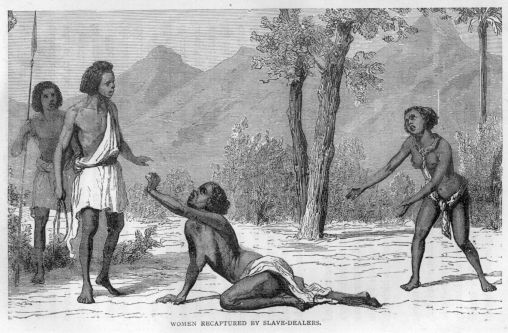
The grave of the good bishop was visited. How would his heart have bled had he lived to witness the scenes they did!
A hippopotamus was shot, and, at the end of three days after, it floated. As the boat was towing it, immense numbers of crocodiles followed, and it was necessary to fire at them to keep them off. It is said that the crocodile never eats fresh meat; indeed, the more putrid it becomes, the better he enjoys his repast, as he can thus tear the carcass more easily. The corpse of a boy was seen floating by. Several crocodiles dashed at it, fighting for their prey, and in a few seconds it disappeared. Sixty-seven of the repulsive reptiles were seen on one bank. The natives eat the animal, but few who had witnessed the horrible food on which they banquet would willingly feed on their flesh.
Their former companion, Mr Thornton, here rejoined them. Hearing that the remaining members of the bishop’s party were in want at Chibisa, he volunteered to carry over a supply of goats and sheep to them. Overcome by the fatigues of the journey, he was attacked by fever, which terminated fatally on the 21st of April, 1863.
The whole of the once pleasant Shire valley was now a scene of wide-spread desolation. Fearful famine had followed the slave raids, and the sights which met their eye in every direction were heart-rending. The ground was literally covered with human bones. “Many had ended their career under the shade of trees, others under projecting crags of the hills, while others lay in their huts with closed doors, which, when opened, disclosed the mouldering corpse with a few rags round the loins, the skull fallen off the pillow; the little skeleton of a child that had perished first, rolled up in a mat between two large skeletons.”
Hoping that the “Lady Nyassa” might be the means of putting a check on the slavers across the lake, they hurried on with their work. She was unscrewed at a spot about five hundred yards below the first cataract, and they began to make a road over the portage of forty miles, by which she was to be carried piecemeal.
Trees had to be cut down and stones removed. The first half-mile of road was formed up a gradual slope till two hundred feet above the river was reached, where a sensible difference in the climate was felt. Before much progress was made, Dr Kirk and Charles Livingstone were seized with fever, and it was deemed absolutely necessary that they should be sent home. Soon afterwards Dr Livingstone was himself attacked.
The “Pioneer” meantime was roofed over and left in charge of the trustworthy gunner, Mr Young.
One day, an empty canoe was seen floating down with a woman swimming near it. The boat put off and brought her on board, when she was found to have an arrow-head in the middle of her back. A native cut it out, and, notwithstanding the fearful character of the wound, being fed liberally by Mr Young, she recovered.
On the 16th of June the remaining members of the expedition started for the upper cataracts.
Cotton of superior quality was seen dropping off the bushes, with no one to gather it.
The huts in several villages were found entire, with mortars and stones for pounding and grinding corn, empty corn safes and kitchen utensils, water and beer-pots untouched, but the doors were shut, as if the inhabitants had gone to search for roots or fruits and had never returned; while in others, skeletons were seen of persons who died apparently while endeavouring to reach something to allay the gnawings of hunger.
Several journeys had been made over the portage, when, on returning to the ship on the 2nd of July, they received a despatch from Earl Russell, directing the return home of the expedition.
Considering the utter devastation caused by the slave-hunting, and the secret support given by the Portuguese officials to the slave-traders, notwithstanding the protestations of their government that they wished to put an end to the trade, it was impossible not to agree in the wisdom of this determination.
Arrangements therefore were made to screw the “Lady Nyassa” together again, as the “Pioneer” could not move till the floods in December. In the mean time it was determined to make another trip to the lake in a boat to be carried overland past the cataracts.
The same scenes were witnessed as before. Wild animals had taken possession of the ruins of a large village in which on their previous visit the inhabitants had been living in peace and plenty.
They had no idea, having before kept closer to the river, of the number of villages, always apparently selected with a view to shade, existing in that region, all of which were now deserted.
They at length reached a region which had hitherto escaped, where the people welcomed them with the greatest cordiality, and were willing to spare the small amount of food they had remaining for themselves. But even here news of war soon reached them, and they found that a tribe of Zulus, the Mazitu, were ravaging the country, and that the inhabitants were only safe within their stockades. They soon encountered men and women carrying grain towards these fortifications, and soon they came upon dead bodies, first one and then another, lying in postures assumed in mortal agony such as no painter can produce.
On their arrival at Chinsamba’s stockade, they were told that the Mazitu had been repulsed thence the day before, and the sad sight of the numerous bodies of the slain showed the truth of the report. The marauders had, however, carried off large numbers of women laden with corn, and, on being repulsed, cut off the ears of a male prisoner and sent him back, saying that they meant to return for the corn they had left, in a month or two.
Chinsamba urged them not to proceed to the north-west, where the Mazitu had occupied the whole region, and they accordingly remained with him till the 5th of September.
After this they visited Chia Lakelet. On their way they met men and women eagerly reaping the corn in haste, to convey it to the stockades, while so much was found scattered along the paths by the Mazitu and the fugitives that some women were winnowing it from the sand. Dead bodies and burned villages showed that they were close upon the heels of the invaders. Among the reeds on the banks of the lake was seen a continuous village of temporary huts in which the people had taken refuge from their invaders.
On visiting the village of an Arab chief, Juma, at Kota Bay, on the 10th of September, they found him engaged with his people in building a large dhow, or Arab vessel, fifty feet long and twelve broad. They offered to purchase the craft, but he refused to sell it for any amount. It was very evident that she was to be engaged for carrying slaves across the lake.
They now regretted the attempt to carry an iron vessel overland, as a wooden one might have been built at much less cost on the banks of the lake, and in a shorter time than the transit of the “Lady Nyassa” would have occupied.
Another extensive and interesting journey was taken in the neighbourhood of the lake, and, on their return along the shores, they found the reeds still, occupied by the unhappy fugitives, who were already suffering fearfully from famine. Numbers of newly-made graves showed that many had already perished, and others had more the appearance of human skeletons than living beings.
Altogether in this expedition they travelled seven hundred and sixty miles in a straight line, averaging about fifteen miles a day, and they reached the ship on the 1st of November, where all were found in good health and spirits. They were visited on board by an Ajawa chief named Kapeni, who asserted that he and his people would gladly receive the associates of Bishop Mackenzie as their teachers. It showed that he and his people had not been offended at the check which the bishop had given to their slaving, their consciences telling them that the course he had pursued was right.
About the middle of December news reached them of the arrival of the successor of Bishop Mackenzie, but that gentleman, after spending a few months on the top of a mountain as high as Ben Nevis, at the mouth of the Shire, where there were few or no people to be taught, returned home, while six of the boys who had been reared by Bishop Mackenzie had been deserted and exposed to the risk of falling back into heathenism. The poor boys, however, managed to reach the ship, expressing their sorrow that they no longer had one to look after them, remarking that Bishop Mackenzie had a loving heart, and had been more than a father to them.
On the 19th of January, 1864, the Shire suddenly rising, the “Pioneer” was once more got underway; but, her rudder being injured, she was delayed, and did not reach Morambala till the 2nd of February. Here they received on board about thirty orphan boys and girls, and a few helpless widows who had been attached to Bishop Mackenzie’s mission, and who could not be abandoned without bringing odium on the English name. The difference between shipping slaves and receiving these on board struck them greatly. The moment permission to embark was given, they all rushed into the boat, nearly swamping her in their eagerness to be safe on the “Pioneer’s” deck.
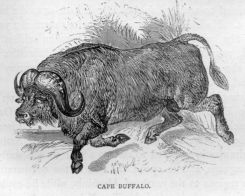
At the mouth of the Zambesi they found HM ships “Orestes” and “Ariel,” when the former took the “Pioneer” in tow, and the latter the “Lady Nyassa,” bound for Mozambique.
After encountering a heavy storm, when the little vessels behaved admirably, while the “Pioneer” was sent to the Cape, the “Lady Nyassa,” under charge of Dr Livingstone, proceeded by way of Zanzibar to Bombay, which they safely reached, though at times they thought their epitaph would be: “Left Zanzibar on the 30th of April, 1864, and never more heard of.”
Chapter Twenty Three.
Travels of Sir Samuel and Lady Baker.
Arrival in Egypt—Cross the Nubian Desert—Residence at Berber—Resolves to learn Arabic—Journey towards Abyssinia commenced—First meal on hippo-flesh.—A whirlwind—The river suddenly fills—Cause of the overflow of the Nile—Rainy season begins—Visit to camp of Abou Sinn—Residence at Son—Engage Germans—Hippopotamus hunting—Hamran elephant hunters—Mode of hunting—Abou Do a hippopotamus hunter—Exciting attack on a hippopotamus—Baker witnesses attack on an elephant by Aggageers—Rodur’s courage—The travellers reach Khartoum.
Sir Samuel, then Mr Baker, was already an experienced traveller and a practised sportsman, when in March, 1861, having resolved to devote his energies to the discovery of one of the sources of the Nile, he set forth from England to proceed up the mysterious river from its mouth, inwardly determined to accomplish the difficult task or to die in the attempt. He had, however, shortly before married a young wife. She, with a devoted love and heroism seldom surpassed, notwithstanding the dangers and difficulties she knew she must encounter, entreated to accompany her husband, in a way not to be denied.
Leaving Cairo on the 15th of April, they sailed up the Nile to Korosko, whence they crossed the Nubian Desert on camels, with the simoon in full force and the heat intense to Berber. Here Mr Baker, finding his want of Arabic a great drawback, resolved to devote a year to the study of that language, and to spend the time in the comparatively known regions to the north of Abyssinia, while he explored the various confluences of the Blue Nile.
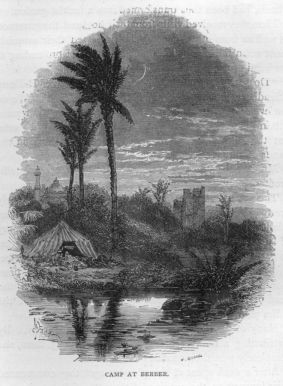
They were kindly received at Berber by Halleem Effendi, the ex-governor, who gave them permission to pitch their tents in his gardens close to the Nile. It was a lovely spot, thickly planted with lofty date-groves and shady citron and lemon-trees, in which countless birds were singing and chirruping, and innumerable ring-doves cooing in the shady palms. The once sandy spot, irrigated by numerous water-wheels, had been thus transformed into a fruitful garden.
Here they received visits from their host and the governor, as well as from other officers, who expressed their astonishment when they announced their intention of proceeding to the head of the Nile.
“Do not go on such an absurd errand,” exclaimed Halleem Effendi. “Nobody knows anything about the Nile. We do not even know the source of the Atbara. While you remain within the territory of the Pacha of Egypt you will be safe; but the moment you cross the frontier you will be in the hands of savages.”
Mr Baker, though receiving the advice cum grano salis, profited by it.
Their host sent them daily presents of fruit by a charmingly pretty slave girl, whose numerous mistresses requested permission to pay the travellers a visit. In the evening a bevy of ladies approached through the dark groves of citron-trees, so gaily dressed in silks of the brightest dyes of yellow, blue, and scarlet, that no bouquet of flowers could have been more gaudy. They were attended by numerous slaves, the head of whom requested Mr Baker to withdraw while the ladies paid his wife a visit.
Many of them she described as young and pretty. By distributing a number of small presents among them, she completely won their confidence.
After a week spent at this pleasant spot, they commenced their journey on the evening of the 10th of June, attended by a guard of Turkish soldiers, who were to act in the double capacity of escort and servants.
Their dragoman was called Mahomet, and the principal guide Achmet. The former, though almost black, declared that his colour was of a light brown. He spoke very bad English, was excessively conceited, and irascible to a degree. Accustomed to the easy-going expeditions on the Nile, he had no taste for the rough sort of work his new master had undertaken.
The journey across the desert tract was performed on donkeys, the luggage being carried on camels or dromedaries.
In two days they reached the junction of the Atbara river with the Nile. Here, crossing a broad surface of white sand, which at that season formed the dry bed of the river, they encamped near a plantation of water-melons, with which they refreshed themselves and their tired donkeys. The river was here never less than four hundred yards in width, with banks nearly thirty feet deep. Not only was it partially dry, but so clear was the sand-bed that the reflection of the sun was almost unbearable.
They travelled along the banks of the river for some days, stopping by the side of the pools which still remained. Many of these pools were full of crocodiles and hippopotami. One of these river-horses had lately killed the proprietor of a melon-garden, who had attempted to drive the creature from his plantation. Mr Baker had the satisfaction of killing one of the monsters in shallow water. It was quickly surrounded by Arabs, who hauled it on shore, and, on receiving his permission to take the meat, in an instant a hundred knives were at work, the men fighting to obtain the most delicate morsels. He and his wife breakfasted that morning on hippopotamus flesh, which was destined to be their general food during their journey among the Abyssinian tributaries of the Nile.
Game abounded, and he shot gazelles and hippopotami sufficient to keep the whole camp well supplied with meat.
On the 23rd of June they were nearly suffocated by a whirlwind that buried everything in the tents several inches in dust.
The heat was intense; the night, however, was cool and pleasant. About half-past eight, as Mr Baker lay asleep, he fancied that he heard a rumbling like distant thunder. The low uninterrupted roll increasing in volume, presently a confusion of voices arose from the Arabs’ camp, his men shouting as they rushed through the darkness: “The river! the river!”
Mahomet exclaimed that the river was coming down, and that the supposed distant roar was the approach of water. Many of the people, who had been sleeping on the clean sand of the river’s bed, were quickly awakened by the Arabs, who rushed down the steep bank to save the skulls of two hippopotami which were exposed to dry.
The sound of the torrent, as it rushed by amid the darkness, and the men, dripping with wet, dragging their heavy burdens up the bank, told that the great event had occurred. The river had arrived like a thief in the night.
The next morning, instead of the barren sheet of clear white sand with a fringe of withered bush and trees upon its borders, cutting the yellow expanse of desert, a magnificent stream, the noble Atbara river flowed by, some five hundred yards in width, and from fifteen to twenty feet in depth. Not a drop of rain, however, had fallen; but the current gave the traveller a clue to one portion of the Nile mystery. The rains were pouring down in Abyssinia—these were the sources of the Nile.
The rainy season, however, at length began, during which it was impossible to travel.
The Arabs during that period migrate to the drier regions in the north.
On their way they arrived in the neighbourhood of the camp of the great Sheikh Achmet Abou Sinn, to whom Mr Baker had a letter of introduction. Having sent it forward by Mahomet, in a short time the sheikh appeared, attended by several of his principal people. He was mounted on a beautiful snow-white hygeen, his appearance being remarkably dignified and venerable. Although upwards of eighty years old, he was as erect as a lance, and of herculean stature; a remarkably arched nose, eyes like an eagle’s, beneath large, shaggy, but perfectly white eyebrows, while a snow-white beard of great thickness descended below the middle of his breast. He wore a large white turban, and a white cashmere robe reaching from the throat to the ankles. He was indeed the perfect picture of a desert patriarch. He insisted on the travellers accompanying him to his camp, and would hear of no excuses. Ordering Mahomet to have their baggage repacked, he requested them to mount two superb hygeens with saddle-cloths of blue and purple sheep-skins, and they set out with their venerable host, followed by his wild and splendidly-mounted attendants.
As they approached the camp they were suddenly met by a crowd of mounted men, armed with swords and shields, some on horses, others on hygeens. These were Abou Sinn’s people, who had assembled to do honour to their chief’s guests. Having formed in lines parallel with the approach of their guests, they galloped singly at full speed across the line of march, flourishing their swords over their heads, and reining in their horses so as to bring them on their haunches by the sudden halt. This performance being concluded, they fell into line behind the party.
Declining the sheikh’s invitation to spend two or three months at his camp, Mr and Mrs Baker travelled on to the village of Sofi, where they proposed remaining during the rainy season.
It was situated near the banks of the Atbara, on a plateau of about twenty acres, bordered on either side by two deep ravines, while below the steep cliff in front of the village flowed the river Atbara.
Their tents were pitched on a level piece of ground just outside the village, where the grass, closely nibbled by the goats, formed a natural lawn.
Here huts were built and some weeks were pleasantly spent. Mr Baker found an abundance of sport, sometimes catching enormous fish, at others shooting birds to supply his larder, but more frequently hunting elephants, rhinoceros, giraffes, and other large game.
He here found a German named Florian, a stone-mason by trade, who had come out attached to the Austrian mission at Khartoum, but preferring a freer life than that city afforded, had become a great hunter. Mr Baker, thinking that he would prove useful, engaged him as a hunter, and he afterwards took into his service Florian’s black servant Richarn, who became his faithful attendant. A former companion of Florian’s, Johann Schmidt, soon afterwards arrived, and was also engaged by Mr Baker to act as his lieutenant in his proposed White Nile expedition. Poor Florian, however, was killed by a lion, and Schmidt and Richarn alone accompanied him.
Mr Baker’s skill as a sportsman was frequently called into play by the natives, to drive off the elephants and hippopotami which infested their plantations. One afternoon he was requested to shoot a savage old bull hippopotamus which had given chase to several people. Accompanied by Mrs Baker he rode to the spot, about two miles off, where the hippopotamus lived in a deep and broad portion of the river. The old hippopotamus was at home.
“The river, about two hundred and fifty yards wide, had formed by an acute bend a deep hole. In the centre of this was a sandbank just below the surface. Upon this shallow bed the hippopotamus was reposing. On perceiving the party he began to snort and behave himself in a most absurd manner, by shaking his head and leaping half way out of the water. Mr Baker had given Bacheet, one of his attendants, a pistol, and had ordered him to follow on the opposite bank. He now directed him to fire several shots at the hippopotamus, in order if possible to drive the animal towards him. The hippo, a wicked, solitary, old bull, returned the insult by charging towards Bacheet with a tremendous snorting, which sent him scrambling up the steep bank in a panic. This gave the brute confidence; and the sportsman, who had hitherto remained concealed, called out according to Arabic custom: ‘Hasinth! hasinth!’ the Arabic for hippopotamus. The brute, thinking no doubt that he might as well drive the intruder away, gave a loud snort, sank, and quickly reappeared about a hundred yards from him. On this Mr Baker ordered Bacheet to shoot to attract the animal’s attention. As the hippopotamus turned his head, Mr Baker took a steady shot, aiming behind the ear, and immediately the saucy old hippo turned upon his back and rolled about, lashing the still pool into waves, until at length he disappeared.”
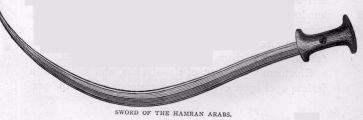
His intention of engaging a party of the Hamran Arabs, celebrated as hunters, to accompany him in his explorations of the Abyssinian rivers having become known, several of these men made their appearance at Son. They are distinguished from the other tribes of Arabs by an extra length of hair, worn parted down the centre and arranged in long curls. They are armed with swords and shields, the former having long, straight, two-edged blades, with a small cross for the handle, similar to the long, straight, cross-handled blades of the crusaders. Their shields, formed of rhinoceros, giraffe, or elephant-hide, are either round or oval. Their swords, which they prize highly, are kept as sharp as razors. The length of the blade is about three feet, and the handle six inches long. It is secured to the wrist by a leathern strap, so that the hunter cannot by any accident be disarmed.
These men go in chase of all wild animals of the desert; some are noted as expert hippopotamus slayers, but the most celebrated are the Aggageers, or elephant hunters. The latter attack the huge animal either on horseback, or on foot when they cannot afford to purchase steeds. In the latter case, two men alone hunt together. They follow the tracks of an elephant which they contrive to overtake about noon, when the animal is either asleep or extremely listless and easy to approach. Should the elephant be asleep, one of the hunters will creep towards its head, and with a single blow sever the trunk stretched on the ground, the result being its death within an hour from bleeding. Should the animal be awake, they will creep up from behind, and give a tremendous cut at the back sinew of the hind leg, immediately disabling the monster. It is followed up by a second cut on the remaining leg, when the creature becomes their easy prey.
When hunting on horseback, generally four men form a party, and they often follow the tracks of a herd from their drinking-place for upwards of twenty miles.
Mr Baker accompanied them on numerous hunting expeditions, and witnessed the wonderful courage and dexterity they displayed.
After spending three months at Son, he set out for the Settite River, he and his wife crossing the Atbara River on a raft formed of his large circular sponging bath supported by eight inflated skins secured to his bedstead.
A party of the Aggageers now joined him. Among them was Abou Do, a celebrated old hippopotamus hunter, who, with his spear of trident shape in hand, might have served as a representative of Neptune. The old Arab was equally great at elephant hunting, and had on the previous day exhibited his skill, having assisted to kill several elephants. He now divested himself of all his clothing, and set out, taking his harpoon in hand, in search of hippopotami.
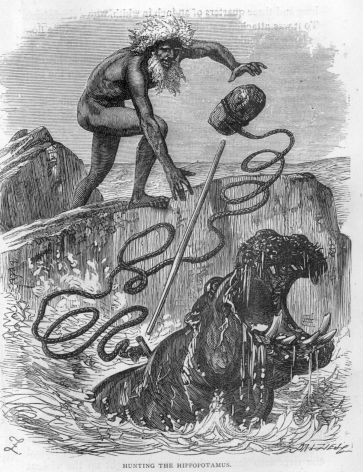
This weapon consisted of a steel blade about eleven inches long and three-quarters of an inch in width, with a single barb. To it was attached a strong rope twenty feet long, with a float as large as a child’s head at the extremity. Into the harpoon was fixed a piece of bamboo ten feet long, around which the the rope was twisted, while the buoy was carried on the hunter’s left hand.
After proceeding a couple of miles, a herd of hippopotami were seen in a pool below a rapid surrounded by rocks. He, however, remarking that they were too wide-awake to be attacked, continued his course down the stream till a smaller pool was reached. Here the immense head of a hippopotamus was seen, close to a perpendicular rock that formed a wall to the river. The old hunter, motioning the travellers to remain quiet, immediately plunged into the stream and crossed to the opposite bank, whence, keeping himself under shelter, he made his way directly towards the spot beneath which the hippopotamus was lying. “Stealthily he approached, his long thin arm raised, with the harpoon ready to strike. The hippopotamus, however, had vanished, but far from exhibiting surprise, the veteran hunter remaining standing on the sharp ledge, unchanged in attitude. No figure of bronze could be more rigid than that of the old river king, as he thus stood, his left foot advanced, his right-hand grasping the harpoon above his head, and his left the loose coil of rope attached to the buoy.”
“Three minutes thus passed, when suddenly the right arm of the statue descended like lightening, and the harpoon shot perpendicularly into the pool with the speed of an arrow. In an instant an enormous pair of open jaws appeared, followed by the ungainly head and form of a furious hippopotamus, who, springing half out of the water, lashed the river into foam as he charged straight up the violent rapids. With extraordinary power he breasted the descending stream, gaining a footing in the rapids where they were about five feet deep, thus making his way, till, landing from the river, he started at full gallop along the shingly bed, and disappeared in the thorny jungle. No one would have supposed that so unwieldy an animal could have exhibited such speed, and it was fortunate for old Neptune that he was secure on the high ledge of rock, for had he been on the path of the infuriated beast, there would have been an end of Abou Do.”
The old man rejoined his companions, when Mr Baker proposed going in search of the animal. The hunter, however, explained that the hippopotamus would certainly return after a short time to the water. In a few minutes the animal emerged from the jungle and descended at full trot into the pool where the other hippopotami had been seen, about half a mile off. Upon reaching it, the party were immediately greeted by the hippopotamus, who snorted and roared and quickly dived, and the float was seen running along the surface, showing his course as the cork of a trimmer does that of a pike when hooked. Several times the hippo appeared, but invariably faced them, and, as Mr Baker could not obtain a favourable shot, he sent the old hunter across the stream to attract the animal’s attention. The hippo, turning towards the hunter, afforded Mr Baker a good chance, and he fired a steady shot behind the ear. The crack of the ball, in the absence of any splash from the bullet, showed him that the hippopotamus was hit, while the float remained stationary upon the surface, marking the spot where the grand old bull lay dead beneath. The hunter obtaining assistance from the camp, the hippopotamus, as well as another which had been shot, were hauled on shore. The old bull measured fourteen feet two inches, and the head was three feet one inch from the front of the ear to the edge of the lip, in a straight line.
Though hippopotami are generally harmless, solitary old bulls are sometimes extremely vicious, and frequently attack canoes without provocation.
Many of the elephant hunts in which Mr Baker engaged were exciting in the highest degree, and fraught with no small amount of danger.
Among the Aggageers was a hunter, Rodur Sherrif, who, though his arm had been withered in consequence of an accident, was as daring as any of his companions.
The banks of the Royan had been reached, where, a camp having been formed, Mr Baker and his companions set out in search of elephants. A large bull elephant was discovered drinking. The country around was partly woody, and the ground strewed with fragments of rocks, ill adapted for riding. The elephant had made a desperate charge, scattering the hunters in all directions, and very nearly overtaking Mr Baker. He then retreated into a stronghold composed of rocks and uneven ground, with a few small leafless trees growing in it. The scene must be described in the traveller’s own words. “Here the elephant stood facing the party like a statue, not moving a muscle beyond the quick and restless action of the eyes, which were watching on all sides. Two of the Aggageers getting into its rear by a wide circuit, two others, one of whom was the renowned Rodur Sherrif, mounted on a thoroughly-trained bay mare, rode slowly towards the animal. Coolly the mare advanced towards her wary antagonist until within about nine yards of its head. The elephant never moved. Not a word was spoken. The perfect stillness was at length broken by a snort from the mare, who gazed intently at the elephant, as though watching for the moment of attack. Rodur coolly sat with his eyes fixed upon those of the elephant.
“With a shrill scream the enormous creature then suddenly dashed on him like an avalanche. Round went the mare as though upon a pivot, away over rocks and stones, flying like a gazelle, with the monkey-like form of Rodur Sherrif leaning forward and looking over his left shoulder as the elephant rushed after him. For a moment it appeared as if the mare must be caught. Had she stumbled, all would have been lost, but she gained in the race after a few quick bounding strides, and Rodur, still looking behind him, kept his distance, so close, however, to the creature, that its outstretched trunk was within a few feet of the mare’s tail.
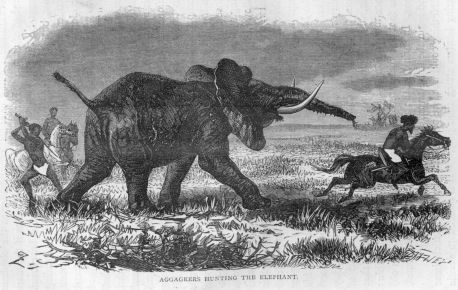
“The two Aggageers who had kept in the rear now dashed forward close to the hind quarters of the furious elephant, who, maddened with the excitement, heeded nothing but Rodur and his mare. When close to the tail of the elephant, the sword of one of the Aggageers flashed from its sheath as, grasping his trusty blade, he leaped nimbly to the ground, while his companion caught the reins of his horse. Two or three bounds on foot, with the sword clutched in both hands, and he was close behind the elephant. A bright glance shone like lightning as the sun struck on the descending steel. This was followed by a dull crack, the sword cutting through skin and sinew, and sinking deep into the bone about twelve inches above the foot. At the next stride the elephant halted dead short in the midst of his tremendous charge. The Aggageer who had struck the blow vaulted into the saddle with his naked sword in hand. At the same moment Rodur turned sharp round and, again facing the elephant, stooped quickly from the saddle to pick up from the ground a handful of dirt, which he threw into the face of the vicious animal, that once more attempted to rush upon him. It was impossible: the foot was dislocated and turned up in front like an old shoe. In an instant the other Aggageer leaped to the ground, and again the sharp sword slashed the remaining leg.”
Nothing could be more perfect than the way in which these daring hunters attack their prey. “It is difficult to decide which to admire most—whether the coolness and courage of him who led the elephant, or the extraordinary skill and activity of the Aggageer who dealt the fatal blow.”
Thus, hunting and exploring, Mr Baker, accompanied by his heroic wife, visited the numerous river-beds which carry the rains of the mountainous regions of Abyssinia into the Blue Nile, and are the cause of the periodical overflowing of the mighty stream, while its ordinary current is fed from other far-distant sources, towards one of which the traveller now prepared to direct his steps.
Speke and Grant were at this time making their way from Zanzibar, across untrodden ground, towards Gondokoro.
An expedition under Petherick, the ivory-trader, sent to assist them, had met with misfortune and been greatly delayed, and Mr Baker therefore hoped to reach the equator, and perhaps to meet the Zanzibar explorers somewhere about the sources of the Nile.
Proceeding along the banks of the Blue Nile, Mr and Mrs Baker reached Khartoum on the 11th of June, 1862. A beautiful view met their sight as they gazed across the waters of the Nile. “The morning sun was shining on this capital of the Soudan provinces; the dark green foliage of the groves of date-trees contrasted exquisitely with the numerous buildings of many colours which lined the margin of the river, while long lines of vessels with tapering spars gave light to the scene. But alas! this beauty soon vanished, both the sight and smell being outraged grievously as they entered the filthy and miserable town.”
Chapter Twenty Four.
Travels of Sir Samuel and Lady Baker, continued.
Preparations for journey to the south—Difficulties—The Shillooks—The Nuehr—Information about the slave trade—The Kytch—The sacred bullock—Arrive at Gondokoro—Attempts to shoot Baker—His escort mutiny—He meets Speke and Grant—Treachery among his servants—Encounter with slave-traders—Wins over Ibrahim, and arrives at Tarrangolle—The Latooka victory—Misbehaviour of the Turks, and threatened attack by the natives—A funeral dance—Returns to Obbo—Fever—Sets out for Karuma—Reaches Karuma Falls—Kamrasi—Proceeds to the Lake—A strange reception—Illness of Mrs Baker—Reach the village of Parkani—Arrive at the lake which Baker called Albert Nyanza—Surveys it—Reaches Magimgo—Proceeds to the Murchison Falls—Return to Magimgo—Deserted by his guide and carriers—Starvation—The guide reappears, and they arrive at Kamrasi’s camp—An invasion by Fowookas—Mr Baker prevents an attack—He at last sets off with Turkish traders, and arrives at Shooa—A march through the Bari—Reach Gondokoro—Voyage down the Nile—Welcomed at Khartoum—A dust-storm—Continuing their voyage, reach Berber, and at length arrive in England—Returns to Egypt—Organises an expedition to convey steamers up the Nile for Lake Nyanza, to oppose the slave trade.
At Khartoum Mr and Mrs Baker spent some months to recruit, occupying the house of the British Consul, who was then absent.
On the 17th of December their preparations for a fresh start were completed. Three vessels had been engaged, and were laden with large quantities of stores, with four hundred bushels of corn, and twenty-nine transport animals, including camels, horses, and donkeys. Their party consisted of ninety-six souls, including Johann Schmidt and the faithful black Richarn, and forty-nine well-armed men.
Khartoum was a nest of slave-traders, who looked with jealous eyes upon every stranger venturing within the precincts of their holy land, and, as Mr Baker observes: “sacred to slavery and to every abomination and villainy that man can commit.”
The Turkish officers pretended to discountenance slavery; at the same time every house was full of slaves, and Egyptian officers received a portion of their pay in slaves. The authorities, therefore, looked upon the proposed exploration of the White Nile by a European traveller as likely to interfere with their perquisites, and threw every obstacle in his way.
As the government of Soudan refused to supply him with properly-trained soldiers, the only men he could get for an escort were the miserable cut-throats of Khartoum, who had been accustomed all their lives to murder and pillage in the White Nile trade; yet, such as they were, he was compelled to put up with them, though he would undoubtedly have done better had he gone without such an escort.
The voyage alone to Gondokoro, the navigable limit of the Nile, was likely to occupy about fifty days, so that a large supply of provisions was necessary.
Difficulties were met with from the very beginning. The vessel’s yards were continually being carried away.
Poor Johann, who, though he had long been suffering, insisted on accompanying his employer, died a short time after the commencement of the voyage.
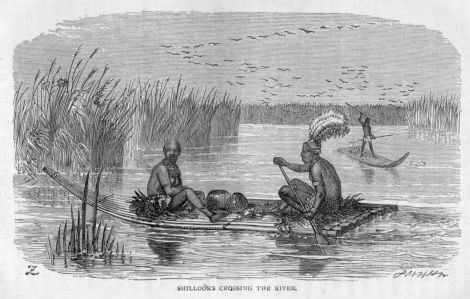
On the 2nd of January they were sailing past the country inhabited by the Shillooks, the largest and most powerful black tribe on the banks of the White Nile. They are very wealthy, and possess immense herds of cattle; are also agriculturists, fishermen, and warriors. Their huts are regularly built, looking at a distance like rows of button mushrooms. They embark boldly on the river in their raft-like canoes, formed of the excessively light ambatch-wood. The tree is of no great thickness, and tapers gradually to a point. It is thus easily cut down, and, several trunks being lashed together, a canoe is quickly formed. A war party on several occasions, embarking in a fleet of these rafts, have descended the river, and made raids on other tribes, carrying off women and children as captives, and large herds of cattle.
Nothing can be more melancholy and uninteresting than the general appearance of the banks of the river. At times vast marshes alone could be seen, at others an immense expanse of sandy desert, with huge ant-hills ten feet high rising above them. The inhabitants were naked savages. While stopping at a village on the right bank, they received a visit from the chief of the Nuehr tribe and a number of his followers. They were most unearthly-looking fellows; even the young women were destitute of clothing, though the married had a fringe made of grass round their loins. The men wore heavy coils of beads about their necks, two heavy bracelets of ivory on the upper portions of their arms, copper rings upon the wrist, and a horrible kind of bracelet of massive iron, armed with spikes about an inch in length, like leopards’ claws. The women had their upper lips perforated and wore ornaments on their heads, about four inches long, of beads, upon iron wires projecting like the horn of a rhinoceros.
The chief exhibited his wife’s arms and back, covered with jagged scars, to show the use of the spiked iron bracelet.
These were among the first blacks met with. They are almost too low in the scale of humanity to be fit for slaves. Mr Baker gained much information about the slave trade of this part of the world. Most of those engaged in this nefarious traffic are Syrians, Copts, Turks, Circassians, and some few Europeans. When a speculator has determined to enter into the trade, he engages a hundred and fifty to two hundred ruffians, and purchases guns and ammunition, and a few pounds of glass beads. With these he sails up to Gondokoro and, disembarking, marches into the interior till he arrives at the village of some negro chief, with whom he establishes an intimacy. The chief has probably an enemy to attack, and his new allies gladly assist him. Led by him, they approach some unsuspecting village about half an hour before daybreak. Surrounding it while the occupants are still sleeping, they fire the grass-huts in all directions, and pour volleys of musketry through the flaming thatch. Panic-struck, the unfortunate victims rush from their burning dwellings. The men are shot down, the women and children kidnapped and secured, while the herds of cattle are driven off. The women and children are then fastened together, the former secured by an instrument, called a sheba, made of a forked pole. The neck of the prisoner fits into the fork, secured by a cross-piece also behind, while the wrists, brought together in advance of the body, are tied to the pole. The children are then fastened by their necks with the rope attached to the women, and thus form a living chain, in which order they are marched to the head-quarters with the captured herds. Of course, all the ivory found in the place is carried off. The cattle are then exchanged with the negro chief for any tusks he may possess.
In many instances a quarrel is soon afterwards picked with him, and his village is treated in the same way as that of his foes. Should any slave attempt to escape, she is punished either by brutal flogging, or hanged as a warning to others. The slaves are then carried down the river, and landed a few days’ journey south of Khartoum, whence they are marched across the country, some to ports on the Red Sea, there to be shipped for Arabia and Persia, while others are sent to Cairo. In fact, they are disseminated throughout the slave dealing East.
Sailing on day after day, with marshes and dead flats alone in sight, mosquitos preventing rest even in the day, they at length arrived at the station of a White Nile trader, where large herds of cattle were seen on the banks.
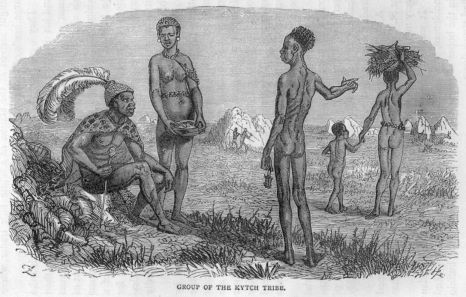
They were here visited by the chief of the Kytch tribe and his daughter, a girl of about sixteen, better looking than most of her race. The father wore a leopard-skin across his shoulder, and a skull-cap of white beads, with a crest of white ostrich feathers. But this mantle was the only garment he had on. His daughter’s clothing consisted only of a piece of dressed hide hanging over one shoulder, more for ornament than use, as the rest of her body was entirely destitute of covering. The men, though tall, were wretchedly thin, and the children mere skeletons.
While the travellers remained here, they were beset by starving crowds, bringing small gourd shells to receive the expected corn. The natives, indeed, seem to trust entirely to the productions of nature for their subsistence, and are the most pitiable set of savages that can be imagined, their long thin legs and arms giving them a peculiar gnat-like appearance. They devour both the skin and bones of dead animals. The bones are pounded between stones, and, when reduced to powder, boiled to form a kind of porridge.
It is remarkable that in every herd they have a sacred bull, who is supposed to have an influence over the prosperity of the rest. His horns are ornamented with tufts of feathers, and frequently with small bells, and he invariably leads the great herd to pasture.
A short visit was paid to the Austrian mission stationed at Saint Croix, which has proved a perfect failure—indeed, that very morning it was sold to an Egyptian for 30 pounds.
It was here the unfortunate Baron Harnier, a Prussian nobleman, was killed by a buffalo which he had attacked in the hopes of saving the life of a native whom the buffalo had struck down.
The voyage terminated at Gondokoro on the 2nd of February.
The country is a great improvement to the interminable marshes at the lower part of the river, being raised about twenty feet above the water, while distant mountains relieve the eye, and evergreen trees, scattered in all directions, shading the native villages, form an inviting landscape. A few miserable grass-huts alone, however, form the town, if it deserves that name.
A large number of men belonging to the various traders were assembled here, who looked upon the travellers with anything but friendly eyes.
As Mr Baker heard that a party were expected at Gondokoro from the interior with ivory in a few days, he determined to await their arrival, in hopes that their porters would be ready to carry his baggage.
In the mean time he rode about the neighbourhood, studying the place and people.
“The native dwellings are the perfection of cleanliness. The domicile of each family is surrounded by a hedge of euphorbia, and the interior of the enclosure generally consists of a yard neatly plastered with a cement of ashes, cow-dung, and sand. Upon this cleanly-swept surface are one or more huts, surrounded by granaries of neat wicker-work, thatched, and resting upon raised platforms. The huts have projecting roofs, in order to afford a shade, and the entrance is usually about two feet high.
“The natives are of the Bari tribe. The men are well grown, and their features are good, the woolly hair alone denoting their negro blood.
“They use poisoned arrows, but, as their bows are inferior and they are bad marksmen, they do not commit much mischief with them.”
Gondokoro was a perfect hell—a mere colony of cut-throats. The Egyptians might easily have sent a few officers and two or three hundred men from Khartoum to form a military government, and thus impede the slave trade; but a bribe from the traders to the authorities was sufficient to ensure an uninterrupted asylum for any amount of villainy. The camps were full of slaves, and the Bari natives assured Mr Baker that there was a large depot of slaves in the interior, belonging to the traders, that would be marched to Gondokoro for shipment a few hours after his departure. He was looked upon as a stumbling-block to the trade. Several attempts were made to shoot him, and a boy was killed by a shot from the shore, on board his vessel. His men were immediately tampered with by the traders, and signs of discontent soon appeared among them. They declared that they had not sufficient meat, and that they must be allowed to make a razzia upon the cattle of the natives to procure oxen. This demand being refused, they became more insolent, and accordingly Mr Baker ordered the ringleader, an Arab, to be seized and to receive twenty-five lashes. Upon his vakeel approaching to capture the fellow, most of the men laid down their guns and, seizing sticks, rushed to his rescue. Mr Baker, on this, sprang forward, sent their leader by a blow of his fist into their midst, and then, seizing him by the throat, called to Saati for a rope to bind him. The men, still intent on their object, surrounded Mr Baker, when Mrs Baker, landing from the vessel, made her way to the spot. Her sudden appearance caused the mutineers to hesitate, when Mr Baker shouted to the drummer boy to beat the drum, and then ordered the men to fall in. Two-thirds obeyed him, and formed in line, while the remainder retreated with their ringleader. At this critical moment Mrs Baker implored her husband to forgive the mutineer, if he would kiss his hand and beg his pardon. This compromise completely won the men, who now called upon their ringleader to apologise, and all would be right. This he did, and Mr Baker made them rather a bitter speech and dismissed them.
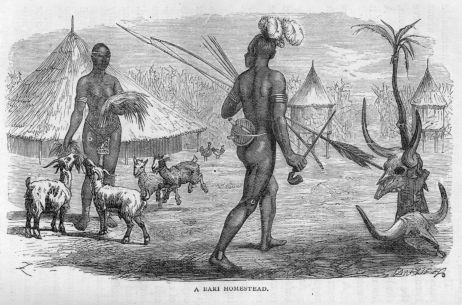
This, unhappily, was only the first exhibition of their mutinous disposition, which nearly ruined the expedition, and might have led to the destruction of the travellers.
A few days afterwards guns were heard in the distance, and news arrived that two white men had arrived from “the sea”! They proved to be Grant and Speke, who had just come from the Victoria Nyanza. Both looked travel-worn. Speke, who had walked the whole distance from Zanzibar, was excessively lean, but in reality in good tough condition. Grant’s garments were well-nigh worn-out, but both of them had that fire in the eye which showed the spirit that had led them through many dangers.
They had heard of another lake to the westward of the the Nyanza, known as the Luta Nzige, which Speke felt convinced was a second source of the Nile.
Accordingly, he and Grant having generously furnished him with as perfect a map as they could produce, Baker determined to explore the lake, while his friends, embarking in his boats, sailed down the Nile on their voyage homeward. His men, notwithstanding the lesson they had received, still exhibited a determined mutinous disposition, and in every way neglected their duties. Happily for him, he had among his attendants a little black boy, Saati, who, having been brought as a slave from the interior, had been for a time in the Austrian mission, from which, with many other slaves, he was turned out. Wandering about the streets of Khartoum, he heard of Mr and Mrs Baker, and, making his way to their house, threw himself at the lady’s feet, and implored to be allowed to follow them. Hearing at the mission that he was superior to his juvenile companions, they accepted his services, and, being thoroughly washed, and attired in trousers, blouse, and belt, he appeared a different creature. From that time he considered himself as belonging entirely to Mrs Baker, and to serve her was his greatest pride. She in return endeavoured to instruct him, and gave him anecdotes from the Bible, combined with the first principles of Christianity.
Through the means of young Saati, Mr Baker heard of a plot among the Khartoum escort, to desert him with their arms and ammunition, and to fire at him should he attempt to disarm them. The locks of their guns had, by his orders, been covered with pieces of mackintosh. Directing Mrs Baker to stand behind him, he placed outside his tent, on his travelling bedstead, five double-barrelled guns loaded with buck-shot, a revolver, and a naked sabre. A sixth rifle he kept in his own hands, while Richarn and Saati stood behind him with double-barrelled guns. He then ordered the drum to beat, and all the men to form in line of marching order, while he requested Mrs Baker to point out any man who should attempt to uncover his lock when he gave the order to lay down their arms. In the event of the attempt being made, he intended to shoot the man immediately. At the sound of the drum only fifteen assembled. He then ordered them to lay down their arms. This, with insolent looks of defiance, they refused to do.
“Down with your guns this moment!” he shouted.
At the sharp click of the locks, as he quickly capped the rifle in his hand, the cowardly mutineers widened their line and wavered; some retreated a few paces, others sat down and laid their guns on the ground, while the remainder slowly dispersed, and sat in twos or singly under the various trees about eighty paces distant. On the vakeel and Richarn advancing, they capitulated, agreeing to give up their arms and ammunition on receiving a written discharge. They were immediately disarmed. The discharge was made out, when upon each paper Mr Baker wrote the word “mutineer” above his signature. Finally, nearly the whole of the escort deserted, taking service with the traders.
Not to be defeated, Baker obtained a Bari boy as interpreter, determined at all hazards to start from Gondokoro.
A party of traders under Koorshid, who had lately arrived from Latooka and were about to return, not only refused to allow the travellers to accompany them, but declared their intention of forcibly driving them back, should they attempt to advance by their route.
This served as an excuse to the remainder of his escort for not proceeding.
Saati discovered another plot, his men having been won over by Mahomet Her, the vakeel of Chenooda, another trader.
Notwithstanding the danger he was running, Mr Baker compelled his men to march, and by a clever manoeuvre got ahead of the party led by Ibrahim, Koorshid’s vakeel.
Finally, by wonderful tact, assisted by Mrs Baker, he won over Ibrahim, and induced him to render him all the assistance in his power.
Aided by his new friend, he arrived at Tarrangolle, one of the principal places in the Latooka country, a hundred miles from Gondokoro, which, though out of his direct route, would, he hoped, enable him with greater ease finally to reach Unyoro, the territory of Kamrasi.
In the mean time, however, several of his men had deserted and joined Mahomet Her. He had warned them that they would repent of their folly. His warnings were curiously fulfilled.
News soon arrived that Mahomet Her, with a party of a hundred and ten armed men, in addition to three hundred natives, had made a razzia upon a certain village among the mountains for slaves and cattle. Having succeeded in the village and capturing a number of slaves, as they were re-ascending the mountain to obtain a herd of cattle they had heard of, they were attacked by a large body of Latookas, lying in ambush among the rocks on the mountain side.
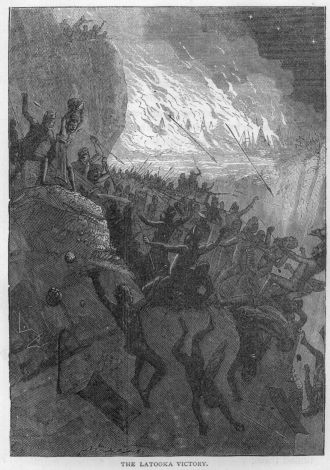
In vain the Turks fought; every bullet aimed at a Latooka struck a rock, while rocks, stones, and lances were hurled at them from all sides and from above. Compelled to retreat, they were seized with a panic, and took to flight.
Hemmed in by their foes, who showered lances and stones on their heads, they fled down the rocky and perpendicular ravines. Mistaking their road, they came to a precipice from which there was no retreat.
The screaming and yelling savages closed round them. All was useless; not an enemy could they shoot, while the savages thrust them forward with wild yells to the very verge of a precipice five hundred feet high. Over it they were driven, hurled to destruction by the mass of Latookas pressing onward. A few fought to the last; but all were at length forced over the edge of the cliff, and met the just reward of their atrocities. No quarter had been given, and upwards of two hundred of the natives who had joined the slave-hunters in the attack, had fallen with them.
Mahomet Her had not accompanied his party, and escaped, though utterly ruined.
The result of this catastrophe was highly beneficial to Mr Baker.
“Where are the men who deserted me?” he asked of those who still remained with him.
Without speaking, they brought two of his guns covered with clotted blood mixed with sand. Their owners’ names were known to him by the marks on the stocks. He mentioned them.
“Are they all dead?” he asked.
“All dead,” the men replied.
“Food for the vultures,” he observed. “Better for them had they remained with me and done their duty.”
He had before told his men that the vultures would pick the bones of the deserters.
From that moment an extraordinary change took place in the manner both of his own people and those of Ibrahim towards him. Unhappily, however, the Latookas exhibited a change for the worse. The Turks, as usual, insulted their women, and treated the natives with the greatest brutality; and had he not exercised much caution and vigilance, both his own party and Ibrahim’s would in all probability have been cut off. Ibrahim had been compelled to go back to Gondokoro for ammunition, and Mr Baker waited at Tarrangolle for his return.
On one occasion, in consequence of the misbehaviour of the Turks, the whole of the natives deserted the town, and vast numbers collected outside, threatening to attack it and destroy their guests. Mr Baker, gaining information of their intention, took command of the Turks, and with his own men showed so bold a front that the natives saw clearly that they would be the sufferers should they attempt to carry their purpose into execution.
Their chief, Comonoro, came into the town, and seeing the preparations made for its defence, agreed to persuade his people to act in a peaceable manner. The next morning they dispersed, and the inhabitants returned to the town.
The Turks, after their alarm, behaved better, though they threatened, when Ibrahim arrived with reinforcements and ammunition, that they would have their revenge.
Mr Baker after this moved his camp to a secure position some distance from the town, near a stream of water. Here he formed a garden, and lived in a far more independent way than before.
The debased state of morality prevailing among the natives was exhibited in a variety of ways. One of their chiefs, Adda by name, came to him one day and requested him to assist in attacking a village, for the purpose of procuring some iron hoes which he wanted. Mr Baker asked whether it was in an enemy’s country. “Oh, no!” was the reply; “it is close here, but the people are rather rebellious, and it will do them good to kill a few. If you are afraid, I will ask the Turks to do it.”
A funeral dance a short time after this took place in honour of those who had been killed in the late fight. The dancers were grotesquely got up, and are amusingly described by Mr Baker. “Each man had about a dozen huge ostrich feathers in his helmet, a leopard or monkey-skin hung from his shoulders, while a large iron bell was strapped to his loins like a woman’s bustle. This he rang during the dance, by jerking the hinder part of his body in the most absurd manner. All the time a hubbub was kept up by the shouting of the crowd, the blowing of horns, and the beating of seven nogaras, or drums, all of different notes, while each dancer also blew an antelope’s horn suspended round his neck, the sound partaking of the braying of a donkey and the screeching of an owl. Meantime crowds of men rushed round and round, brandishing their lances and iron-headed maces, following a leader, who headed them, dancing backwards. The women outside danced at a slower pace, screaming a wild and inharmonious chant, while beyond them a string of young girls and small children beat time with their feet, and jingled numerous iron rings which adorned their ankles. One woman attended upon the men, running through the crowd with a gourd full of wood-ashes, handfuls of which she showered over their heads, powdering them like millers. The leader among the women was immensely fat; notwithstanding this she kept up the pace to the last, quite unconscious of her general appearance.”
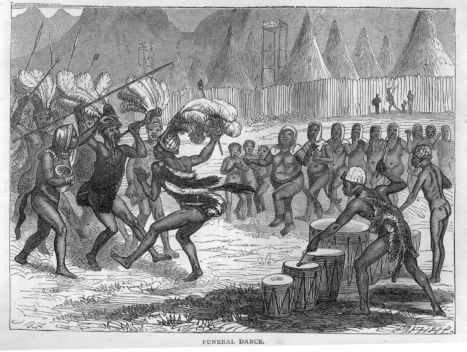
Notwithstanding the dangers of his position, Mr Baker frequently went out shooting, and, among other animals, he killed an enormous elephant, but the natives carried off the tusks and flesh. He was able, however, with his gun, to supply his camp with food, which was fortunate, as the natives would not sell him any of their cattle.
Soon after Ibrahim’s return, the Turks, at the request of Comonoro, attacked the town of Kayala, but were driven back by the natives, whose cattle, however, they carried off.
It became dangerous to remain longer in the country, in consequence of the abominable conduct of the Turks, which so irritated the natives that an attack from them was daily expected.
They were therefore compelled to return to Obbo, the chief of which, old Katchiba, had before received them in a friendly manner.
Here, in consequence of their exposure to wet, Mr and Mrs Baker were attacked with fever. By this time all their baggage animals as well as their horses had died. Mr Baker purchased from the Turks some good riding oxen for himself and his wife, and, having placed his goods under the charge of old Katchiba and two of his own men, he set out on the 8th of January, 1864, with a small number of attendants, to proceed to Karuma, the northern end of Kamrasi’s territory, which Speke and Grant had visited.
The Shooa country, through which he passed, is very beautiful, consisting of mountains covered with fine forest trees, and picturesquely dotted over with villages. Several portions presented the appearance of a park watered by numerous rivulets and ornamented with fine timber, while it was interspersed with high rocks of granite, which at a distance looked like ruined castles.
Here they found an abundance of food: fowls, butter, and goats were brought for sale.
They had obtained the services of a slave woman called Bacheeta, belonging to Unyoro, and who, having learned Arabic, was likely to prove useful as an interpreter and guide. She, however, had no desire to return to her own country, and endeavoured to mislead them, by taking them to the country of Rionga, an enemy of Kamrasi. Fortunately Mr Baker detected her treachery, and he and his Turkish allies reached the Karuma Falls, close to the village of Atada. A number of Kamrasi’s people soon crossed the river to within parleying distance, when Bacheeta, as directed, explained that Speke’s brother had arrived to pay Kamrasi a visit, and had brought him valuable presents. Kamrasi’s people, however, showed considerable suspicion on seeing so many people, till Baker appeared dressed in a suit similar to that worn by Speke, when they at once exhibited their welcome, by dancing and gesticulating with their lances and shields in the most extravagant manner. The party, however, were not allowed to cross till permission was obtained from Kamrasi. That very cautious and cowardly monarch sent his brother, who pretended to be Kamrasi himself, and for some time Baker was deceived, fully believing that he was negotiating with the king. Notwithstanding his regal pretensions, he very nearly got knocked down, on proposing that he and his guest should exchange wives, and even Bacheeta, understanding the insult which had been offered, fiercely abused the supposed king.
His Obbo porters had before this deserted him, and he was now dependent on Kamrasi for others to supply their places.
The king, however, ultimately became more friendly, and gave orders to his people to assist the stranger, granting him also permission to proceed westward to the lake he was so anxious to visit.
A few women having been supplied to carry his luggage, he and his wife, with their small party of attendants, at length set out.
On approaching a considerable village, about six hundred strangely-dressed men rushed out with lances and shields, screaming and yelling as if about to attack them. His men cried out: “Fire. There is a fight! there is a fight!”
He felt assured that it was a mere parade. The warriors were dressed either in leopard or white monkey-skins, with cows’ tails strapped on behind, and two antelope horns fixed on their heads, while their chins were ornamented with false beards made of the bushy ends of cows’ tails.
These demon-like savages came round them, gesticulating and yelling, pretending to attack them with spears and shields, and then engaged in sham fights with each other.
Mr Baker, however, soon got rid of his satanic escort. Poor Mrs Baker was naturally alarmed, fearing that it was the intention of the king to waylay them and perhaps carry her off.
Soon after this, while crossing the Kafue river, the heat being excessive, what was Mr Baker’s horror to see his wife sink from her ox as though shot dead. He, with his attendants, carried her through the yielding vegetation, up to their waists in water, above which they could just keep her head, till they reached the banks. He then laid her under a tree, and now discovered that she had received a coup de soleil. As there was nothing to eat on the spot, it was absolutely necessary to move on. A litter was procured, on which Mrs Baker was carried, her husband mechanically following by its side. For seven days continuously he thus proceeded on his journey. Her eyes at length opened, but, to his infinite grief, he found that she was attacked by a brain fever.
One evening they reached a village. She was in violent convulsions. He believed all was over, and, while he sank down insensible by her side, his men went out to seek for a spot to dig her grave. On awakening, all hope having abandoned him, as he gazed at her countenance her chest gently heaved; she was asleep. When at a sudden noise she opened her eyes, they were calm and clear: she was saved.
Having rested for a couple of days, they continued their course, Mrs Baker being carried on her litter. At length they reached the village of Parkani. To his joy, as he gazed at some lofty mountains, he was told that they formed the western side of the Luta Nzige, and that the lake was actually within a march of the village. Their guide announced that if they started early in the morning, they might wash in the lake by noon. That night Baker hardly slept.
The following morning, the 14th of March, starting before sunrise, on ox-back, he and his wife, with their attendants, following his guide, in a few hours reached a hill from the summit of which “he beheld beneath him a grand expanse of water, a boundless sea horizon on the south and south-west, glittering in the noonday sun, while on the west, at fifty or sixty miles distant, blue mountains rose from the bosom of the lake to a height of about seven thousand feet above its level.”
Hence they descended on foot, supported by stout bamboos, for two hours, to the white pebbly beach on which the waves of the lake were rolling.
Baker, in the enthusiasm of the moment, rushed into the lake, and, thirsty with heat and fatigue, with a heart full of gratitude, drank deeply from what he supposed to be one of the sources of the Nile, not dreaming of the wonderful discoveries Livingstone was making at that very time many degrees to the southward. He now bestowed upon this lake the name of the Albert Nyanza.
The dwellers on the borders of the lake are expert fishermen, and in one of their villages, named Vakovia, the travellers now established themselves.
His followers, two of whom had seen the sea at Alexandria, and who believed that they should never reach the lake, were astonished at its appearance, unhesitatingly declaring that though it was not salt, it must be the sea.
Salt, however, is the chief product of the country, numerous salt-pits existing in the neighbourhood, and in its manufacture the inhabitants are chiefly employed.
Vakovia is a miserable place, and, in consequence of its damp and hot position, the whole party suffered from fever.
Here they were detained eight days waiting for canoes, which Kamrasi had ordered his people to supply. At length several were brought, but they were merely hollowed-out trunks of trees, the largest being thirty-two feet long. Baker selected another, twenty-six feet long, but wider and deeper, for himself and his wife and their personal attendants, while the luggage and the remainder of the people embarked in the former. He raised the sides of the canoe, and fitted up a cabin for his wife, which was both rain and sun-proof.
Having purchased some provisions, he started on a voyage to survey the lake.
Vakovia is about a third of the way from the northern end of the lake. His time would not allow him to proceed further south. He directed his course northward, towards the part out of which the Nile was supposed to flow.
The difficulties of the journey were not yet over. The first day’s voyage was delightful, the lake calm, the scenery lovely. At times the mountains on the west coast were not discernible, and the lake appeared of indefinite width. Sometimes they passed directly under precipitous cliffs of fifteen hundred feet in height, rising abruptly out of the water, while from the deep clefts in the rocks evergreens of every tint appeared, and wherever a rivulet burst forth it was shaded by the graceful and feathery wild date. Numbers of hippopotami were sporting in the water, and crocodiles were numerous on every sandy beach.
Next night, however, the boatmen deserted, but, not to be defeated, Baker induced his own people to take to the paddles. He fitted a paddle to his own boat, to act as a rudder, but the men in the larger boat neglected to do as he had directed them.
A tremendous storm of rain came down while he was at work. His own canoe, however, being ready, he started. He was about to cross from one headland to another, when he saw the larger canoe spinning round and round, the crew having no notion of guiding her. Fortunately it was calm, and, on reaching the shore, he induced several natives to serve as his crew, while others went off in their own boats to assist the large canoe.
He now commenced crossing a deep bay, fully four miles wide. He had gained the centre when a tremendous storm came on, and enormous waves rolled in over the lake. The canoe laboured heavily and occasionally shipped water, which was quickly bailed out. Had this not been done, the canoe would inevitably have been swamped. Down came the rain in torrents, while the wind swept over the surface with terrific force, nothing being discernible except the high cliffs looming in the distance. The boatmen paddled energetically, and at last a beach was seen ahead. A wave struck the canoe, washing over her. Just then the men jumped out, and, though they were rolled over, they succeeded in hauling the boat up the beach.
The shore of the lake, as they paddled along it, was thinly inhabited, and the people very inhospitable, till they reached the town of Eppigoya. Even here the inhabitants refused to sell any of their goats, though they willingly parted with fowls at a small price.
At each village the voyagers changed their boatmen, none being willing to go beyond the village next them. This was provoking, as delays constantly occurred.
At length they reached Magimgo, situated inside an immense bed of reeds, at the top of a hill, above the mouth of a large river. Passing up a channel amidst a perfect wilderness of vegetation, they reached the shore below the town. Here they were met by their guide, who had brought their riding oxen from Vakovia, and reported them all well.
The chief of Magimgo and a large number of natives were also on the shore waiting for them, and brought them down a plentiful supply of goats, fowls, eggs, and fresh butter.
Proceeding on foot to the height on which Magimgo stands, they thence enjoyed a magnificent view, not only over the lake, but to the north, towards the point where its waters flow into the Nile.
Baker’s great desire was to descend the Nile in canoes, from its exit from the lake to the cataracts in the Madi country, and thence to march direct, with only guns and ammunition, to Gondokoro. This plan he found impossible to carry out.
Before their return to the canoes, Mr Baker himself was laid prostrate with fever, and most of his men were also suffering.
They had heard, however, of a magnificent waterfall up the river. They accordingly proceeded up it, and, as they got about eighteen miles above Magimgo, a slight current was perceived. The river gradually narrowed to about a hundred and eighty yards, and now, when the paddles ceased working, the roar of water could be distinctly heard. Continuing on, the noise became louder. An enormous number of crocodiles were seen, and Mr Baker counted, on one sandbank alone, twenty-seven of large size.
Reaching a deserted fishing village, the crew at first refused to proceed further, but, on Mr Baker explaining that he merely wished to see the falls, they paddled up the stream, now strong against them.
On rounding a point, a magnificent sight burst upon them. On either side of the river were beautifully-wooded cliffs, rising abruptly to a height of about three hundred feet, rocks jutting out from the intensely green foliage, while, rushing through a gap which cleft the rock exactly before them, was the river. It is here contracted from a grand stream to the width of scarcely a hundred and fifty feet. Roaring fiercely through the rock-bound pass, it plunged, in one leap of about a hundred and twenty feet, perpendicularly into the dark abyss below, the snow-white sheet of water contrasting superbly with the dark cliff that walled the river, while the graceful palms of the tropics, and wild plantains, perfected the beauty of the scene.
This was the great waterfall of the Nile, and was named the Murchison Falls, in compliment to the president of the Royal Geographical Society. To the river itself he gave the name of the Victoria Nile.
Having taken a view of the falls, and remained for some time admiring them, narrowly escaping being upset by a huge bull hippopotamus, they returned down the river to Magimgo.
Starting the next morning, both Mr and Mrs Baker suffering from fever, while all their quinine was exhausted, they found that their oxen had been bitten by the tsetse-fly, and were in a wretched condition, unlikely to live. Their guide also deserted them, and the whole of their carriers went off, leaving them on the Island of Patooam, in the Victoria River, to which they had been ferried across.
It was now the 8th of April, and within a few days the boats in which they had hoped to return down the Nile would leave Gondokoro. It was, therefore, of the greatest importance that they should set out at once, and take a direct route through the Shooa country.
The natives, not to be tempted even by bribes, positively refused to carry them. Their own men were also ill, and there was a great scarcity of provisions. War, indeed, was going on in the country to the east, Patooam being in the hands of Kamrasi’s enemies. It was on this account that no Unyoro porters could be found.
They might have starved had not an underground granary of seed been discovered, by the means of Bacheeta, in one of the villages burned down by the enemy. This, with several varieties of wild plants, enabled them to support existence.
The last of their oxen, after lingering for some time, lay down to die, affording the men a supply of beef, and Saati and Bacheeta occasionally obtained a fowl from one of the neighbouring islands, which they visited in a canoe.
At length both Mr and Mrs Baker fully believed that their last hour was come, and he wrote various instructions in his journal, directing his head man to deliver his maps and observations to the British Consul at Khartoum.
The object, it appeared, of Kamrasi in thus leaving them, was to obtain their assistance against his enemies, and at length their guide, Rehonga, made his appearance, having been ordered to carry them to Kamrasi’s camp.
The journey was performed, in spite of their weak state; and on their arrival they found ten of the Turks left as hostages with Kamrasi by Ibrahim, who had returned to Gondokoro. The Turks received them with respect and manifestations of delight and wonder at their having performed so difficult a journey.
A hut was built for their reception, and an ox, killed by the Turks, was prepared as a feast for their people.
The next day the king notified his readiness to receive the traveller, who, attiring himself in a Highland costume, was carried on the shoulders of a number of men into the presence of the monarch. The king informed him that he had made arrangements for his remaining at Kisoona.
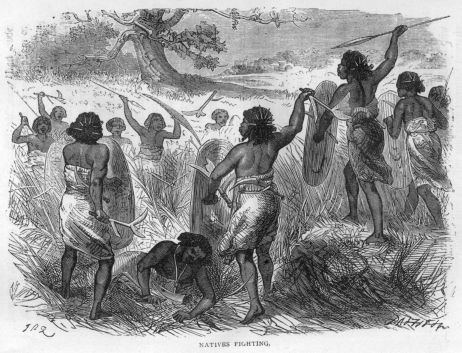
As now all hope of reaching Gondokoro in time for the boats had gone, Mr Baker, yielding to necessity, prepared to make himself at home. He had a comfortable hut built, surrounded by a court-yard with an open shed in which he and his wife could spend the hot hours of the day. Kamrasi sent him a cow which gave an abundance of milk, also amply supplying him with food.
Here the travellers were compelled to spend many months. Their stay was cut short, in consequence of the invasion of the country by Fowooka’s people, accompanied by a large band of Turks under the trader Debono. Kamrasi proposed at once taking to flight; but Baker promised to hoist the flag of England, and to place the country under British protection. He then sent a message to Mahomet, Debono’s vakeel, warning him that should a shot be fired by any of his people, he would be hung, and ordering them at once to quit the country; informing them, besides, that he had already promised all the ivory to Ibrahim, so that, contrary to the rules of the traders, they were trespassing in the territory.
This letter had its due effect. Mahomet deserted his allies, who were immediately attacked by Kamrasi’s troops, and cut to pieces, while the women and children were brought away as captives. Among them, Bacheeta, who had once been a slave in the country, recognised her former mistress, who had been captured with the wives and daughters of their chief, Rionga.
After this Ibrahim returned, bringing a variety of presents for Kamrasi, which, in addition to the defeat of his enemies, put him in excellent humour.
Mr Baker was able to save the life of an old chief, Kalloe, who had been captured; but some days afterwards the treacherous Kamrasi shot him with his own hand.
At length the Turkish traders, having collected a large supply of ivory, were ready to return to Shooa; and Mr Baker, thankful to leave the territory of the brutal Kamrasi, took his leave, and commenced the journey with his allies, who, including porters, women, and children, amounted to a thousand people.
At Shooa he spent some months more encamped among the friendly Madi.
As they were marching thence through the country inhabited by the Bari tribe, they were attacked in a gorge by the natives. The latter were, however, driven back; but the following night the camp was surrounded, and poisoned arrows shot into it. One of the natives, who had ventured nearer than the rest, was shot, when the rest, who could not be seen on account of the darkness, retired. In the morning a number of arrows were picked up.
On reaching Gondokoro, only three boats had arrived, while the trading parties were in consternation at hearing that the Egyptian authorities were about to suppress the slave trade and with four steamers had arrived at Khartoum, two of which had ascended the White Nile and had captured many slavers. Thus the three thousand slaves who were then assembled at Gondokoro would be utterly worthless.
The plague also was raging at Khartoum, and many among the crews of the boats had died on the passage. Mr Baker, however, engaged one of them, a diabiah, belonging to Koorshid Pacha.
Bidding farewell to his former opponent, Ibrahim, who had since, however, behaved faithfully, Mr Baker and his devoted wife commenced their voyage down the Nile.
Unhappily the plague, as might have been expected, broke out on board, and several of their people died among them. They chiefly regretted the loss of the faithful little boy, Saati.
At Khartoum, which they reached on the 5th of May, 1865, they were welcomed by the whole European population, and hospitably entertained.
Here they remained two months. During the time the heat was intense, and the place was visited by a dust-storm, which in a few minutes produced an actual pitchy darkness. At first there was no wind, and when it came it did not arrive with the violence that might have been expected. So intense was the darkness, that Mr Baker and his companions tried in vain to distinguish their hands placed close before their eyes: not even an outline could be seen. This lasted for upwards of twenty minutes, and then rapidly passed away. They had, however, felt such darkness as the Egyptians experienced in the time of Moses.
The plague had been introduced by the slaves landed from two vessels which had been captured, and in which the pestilence had broken out. They contained upwards of eight hundred and fifty human beings. Nothing could be more dreadful than the condition in which the unhappy beings were put on shore. The women had afterwards been distributed among the soldiers, and, in consequence, the pestilence had been disseminated throughout the place.
Mr Baker had the satisfaction of bringing Mahomet Her, who had instigated his men to mutiny at Latooka, to justice. He was seized and carried before the governor, when he received one hundred and fifty lashes. How often had the wretch flogged women to excess! What murders had he not committed! And now how he howled for mercy! Mr Baker, however, begged that the punishment might be stopped, and that it might be explained to him that he was thus punished for attempting to thwart the expedition of an English traveller by instigating his escort to mutiny.