"Great African Travellers" (continued 7)
Reading edition
It took the travellers four days to reach Kasenge, a town inhabited by about forty Portuguese traders and their servants. Though told by the doctor that he was a Protestant minister, they treated him with the greatest kindness and hospitality.
Here the Makololo sold Sekeletu’s tusks, obtaining much better prices than they would have done from the Cape traders, forgetting, however, that their value was greatly increased by the distance they had been brought.
The Makololo here expressed their fears, from what they had heard, that they were about to be led down to the sea-coast to be sold, but when Livingstone asked them if he had ever deceived them, and that he would assure them of their safety, they agreed to accompany him.
The merchants of Kasenge treated the doctor with the most disinterested kindness, and furnished him with letters to their friends at Loanda.
He was escorted by a black corporal of militia, who was carried in a hammock by his slaves. He could both read and write, and was cleanly in all his ways; he was considerate also to his young slaves, and walked most of the way, only getting into his hammock on approaching a village, for the sake of keeping up his dignity. He, however, had the usual vices in a land of slaves, and did not fail to cheat those he was sent to protect.
Sleeping-places were erected on the road about ten miles apart, as there is a constant stream of people going to and coming from the coast.
Goods are either carried on the head or on one shoulder, in a sort of basket, supported by two poles five or six feet long. When the carrier feels tired and halts, he plants them on the ground, allowing his burden to rest against a tree, so that he has not to lift it up from the ground to the level of his head.
On arriving at a sleeping-place, the sheds were immediately taken possession of by the first comers, those arriving last having to make huts with long grass for themselves. Women might then be seen coming from their villages with baskets of manioc meal, yams, garlic, and other roots for sale.
As Dr Livingstone had supplied himself with calico at Kasenge, he was able to purchase what was necessary.
The district of Ambaca, through which he now passed, was excessively fertile. Large numbers of cattle exist on its pastures, which are well-watered by flowing streams, while lofty mountains rise in the distance. It is said to contain forty thousand souls.
The doctor was delighted with Golcongo Alto, a magnificent district—the hills bedecked with trees of various hues, the graceful oil-yielding palm towering above them.
Here the commandant, Lieutenant Castro, received him in a way which won the doctor’s affectionate regard.
He calculated that this district has a population of a hundred and four thousand.
The lieutenant regretted, as does every person of intelligence, the neglect with which this magnificent country has been treated.
As they proceeded, they passed streams with cascades, on which mills might easily be formed; but here numbers of carpenters were converting the lofty trees which grew around into planks, by splitting them with wedges.
At Trombeta the commandant had his garden ornamented with rows of trees, with pineapples and flowers growing between them. A few years ago he had purchased an estate for 16 pounds, on which he had now a coffee plantation and all sorts of fruit-trees and grape-vines, besides grain and vegetables growing, as also a cotton plantation.
As they approached the sea the Makololo gazed at it, spreading out before them, with feelings of awe, having before believed that the whole world was one extended plain. They again showed their fears that they might be kidnapped, but Dr Livingstone reassured them, telling them that as they had stood by each other hitherto, so they would do to the last.
On the 31st of May they descended a declivity leading to the city of Loanda, where Dr Livingstone was warmly welcomed by Mr Gabriel, the British commissioner for the suppression of the slave trade. Seeing him so ill, he benevolently offered the doctor his bed. “Never shall I forget,” says Dr Livingstone, “the luxurious pleasure I enjoyed in feeling myself again on a good English couch, after for six months sleeping on the ground.”
It took many days, however, before the doctor recovered from the exposure and fatigue he had endured. All that time he was watched over with the most generous sympathy by his kind host. The Portuguese Bishop of Angola, and numerous other gentlemen, called on him and tendered their services.
Her Majesty’s ship “Polyphemus” coming in, the surgeon, Mr Cockin, afforded him the medical assistance he so much required, and on the 14th of June he was sufficiently recovered to call on the bishop, attended by his Makololo followers. They had all been dressed in new robes of striped cotton cloth, and red caps, presented by Mr Gabriel.
The bishop, acting as head of the provisional government, received them in form, and gave them permission to come to Loanda and trade as often as they wished, with which they were greatly pleased.
The Makololo gazed with astonishment at all they witnessed, the large stone houses and churches especially, never before having seen a building larger than a hut. The commanders of the “Pluto” and “Philomel,” which came into the harbour, invited them on board. Knowing their fears, Dr Livingstone told them that no one need go should they entertain the least suspicion of foul play. Nearly the whole party, however, went.
Pointing to the sailors, the doctor said: “Now, these are all my countrymen, sent by our queen for the purpose of putting down the trade of those that buy and sell black men.”
They replied: “Truly they are just like you,” and all their fears vanished.
Going forward amongst the men, they were received much the same as the Makololo would have received them, the jolly tars handing them a share of the bread and beef they had for dinner. They were allowed to fire off a cannon, at which they were greatly pleased, especially when the doctor observed: “That is what they put down the slave trade with.”
This visit had a most beneficial effect, as it raised Dr Livingstone still more highly than ever in the opinion of the natives.
They were not so much struck at the high mass which they witnessed at the cathedral, observing that they had seen the white men charming their demons.
During August the doctor was again attacked by a severe fit of fever.
His men, while he was unable to attend to them, employed themselves in going into the country and cutting firewood, which they sold to the inhabitants of the town. Mr Gabriel also found them employment in unloading a collier, at sixpence a day. They continued at this work for upwards of a month, astonished at the vast amount of “stones that burn” which were taken out of her. With the money thus obtained they purchased clothing, beads, and other articles to carry home with them. In selecting calicoes they were well able to judge of the best, and chose such pieces as appeared the strongest, without reference to colour.
Saint Paul de Loanda, once a considerable city, has now fallen greatly into decay. There are, however, many large stone houses, and the palace of the governor, and the government offices, are substantial structures. Trees are planted throughout the town for the sake of shade. Though the dwellings of the native inhabitants are composed merely of wattle and daub, from the sea they present an imposing appearance.
Though at first the government lost its chief revenue from the suppression of the slave trade, it has again gradually increased by the lawful commerce now carried on by its merchants. The officers are, however, so badly paid that they are compelled to engage in mercantile pursuits, and some attempt by bribes to assist the slave-dealers.
From the kind and generous treatment Dr Livingstone received from the Portuguese, they rose deservedly high in his estimation.
He now prepared for his departure. The merchants sent a present to Sekeletu, consisting of specimens of all their articles of trade and two donkeys, that the breed might be introduced into his country, as the tsetse cannot kill those beasts of burden. The doctor was also furnished with letters of recommendation to the Portuguese authorities in Eastern Africa. The bishop likewise furnished him with twenty carriers, and sent forward orders to the commandants of the districts to the east to render him every assistance. He supplied himself with ammunition, and beads, and a stock of cloth, and he gave each of his men a musket. He had also purchased a horse for Sekeletu. His friends of the “Philomel” fitted him out also with a new tent, and, on the 20th of September, 1854, he and his party left Loanda, escorted by Mr Gabriel, who, from his unwearied attentions and liberality to his men, had become endeared to all their hearts.
Passing round by the sea, he ascended the River Bengo to Icollo-i-Bengo, once the residence of a native king. While Mr Gabriel returned to Loanda, Dr Livingstone and his party proceeded to Golcongo Alto, where he left some of his men to rest, while he took an excursion to Kasenge, celebrated for its coffee plantations. On his return he found several of them suffering from fever, while one of them had gone out of his mind, but in a short time recovered.
The doctor had the satisfaction of returning the kindness he received from Mr Canto, the commandant, by attending him during a severe attack of illness.
He had thus an opportunity of watching the workings of slavery. The moment their master was ill, the slaves ate up everything on which they could lay their hands, till the doctor himself could scarcely obtain even bread and butter. Here Sekeletu’s horse was seized with inflammation, and the poor animal afterwards died on its journey.
On the 28th of February they reached the banks of the Quango, where they were again received by Cypriano.
The coloured population of Angola are sunk in the grossest superstition. They fancy themselves completely in the power of spirits, and are constantly deprecating their wrath. A chief, named Gando, had lately been accused of witchcraft, and, being killed by the ordeal, his body was thrown into the river.
Heavy payment was demanded by the ferrymen for crossing in their wretched canoes; but the cattle and donkeys had to swim across.
Avoiding their friend with the comical head-dress, they made their way to the camp of some Ambakistas, or half-caste Portuguese, who had gone across to trade in wax. They are famed for their love of learning, and are keen traders, and, writing a peculiarly fine hand, are generally employed as clerks, sometimes being called the Jews of Angola.
The travellers were now in the country of the Bashinji, possessing the lowest negro physiognomy. At a village where they halted, they were attacked by the head man, who had been struck by one of the Makololo on their previous visit, although atonement had been made. A large body of the natives now rushed upon them as they were passing through a forest, and began firing, the bullets passing amid the trees. Dr Livingstone fortunately encountered the chief, and, presenting a six-barrelled revolver, produced an instant revolution in his martial feelings. The doctor then, ordering, him and his people to sit down, rode off.
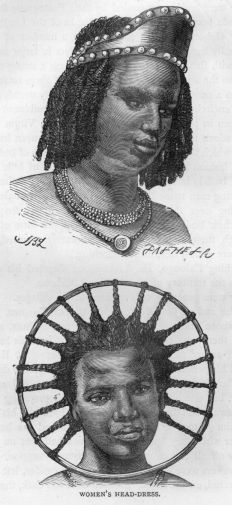
They were now accompanied by their Portuguese friends, the Londa people, who inhabit the banks of the Loajima.
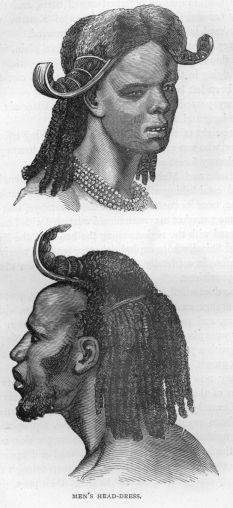
They elaborately dress their hair in a number of ways. It naturally hangs down on their shoulders in large masses, which, with their general features, give them a strong resemblance to the ancient Egyptians. Some of them twist their hair into a number of small cords, which they stretch out to a hoop encircling the head, giving it the resemblance of the glory seen in pictures round the head of the Virgin Mary. Others adorn their heads with ornaments of woven hair and hide, to which they occasionally suspend the tails of buffaloes. A third fashion is to weave the hair on pieces of hide in the form of buffalo horns, projecting on either side of the head. The young men twine their hair in the form of a single horn, projecting over their forehead in front. They frequently tattoo their bodies, producing figures in the form of stars. Although their heads are thus elaborately adorned, their bodies are almost destitute of clothing.
Reaching Calongo, Dr Livingstone directed his course towards the territory of his old friend, Katema.
They were generally well received at the villages.
On the 2nd of June they reached that of Kanawa. This chief, whose village consisted of forty or fifty huts, at first treated them very politely, but he took it into his head to demand an ox as tribute. On their refusing it, Kanawa ordered his people to arm. On this, Dr Livingstone directed his Makololo to commence the march. Some did so with alacrity, but one of them refused, and was preparing to fire at Kanawa, when the doctor, giving him a blow with his pistol, made him go too. They had already reached the banks of the river when they found that Kanawa had sent on ahead to carry off all the canoes. The ferrymen, supposing that the travellers were unable to navigate the canoes, left them, unprotected, on the bank. As soon as it was dark, therefore, the Makololo quickly obtained one of them, and the whole party crossed, greatly to the disgust of Kanawa when he discovered in the morning what had occurred.
They now took their way across the level plain, which had been flooded on their former journey. Numberless vultures were flying in the air, showing the quantity of carrion which had been left by the waters.
They passed Lake Dilolo, a sheet of water six or eight miles long and two broad.
The sight of the blue waters had a soothing effect on the doctor, who was suffering from fever, after his journey through the gloomy forest and across the wide flat.
Pitsane and Mohorisi, Livingstone’s chief men, had proposed establishing a Makololo village on the banks of the Leeba, near its confluence with the Leeambye, that it might become a market to communicate westward with Loanda, and eastward with the regions along the banks of the Zambesi.
Old Shinti, whose capital they now reached, received them as before in a friendly way, and supplied them abundantly with provisions.
The doctor left with him a number of plants, among which were orange, cashew, custard, apple, and fig-trees, with coffee, acacias, and papaws, which he had brought from Loanda. They were planted out in the enclosure of one of his principal men, with a promise that Shinti should have a share of them when grown.
They now again embarked in six small canoes on the waters of the Leeba. Paddling down it, they next entered the Leeambye. Here they found a party of hunters, who had been engaged in stalking buffaloes, hippopotami, and other animals. They use for this purpose the skin of a deer, with the horns attached, or else the head and upper part of the body of a crane, with which they creep through the grass till they can get near enough to shoot their prey.
The doctor, wishing to obtain some meat for his men, took a small canoe and paddled up a creek towards a herd of zebras seen on the shore. Firing, he broke the hind leg of one of them. His men pursued it, and, as he walked slowly after them, he observed a solitary buffalo, which had been disturbed by others of his party, galloping towards him. The only tree was a hundred yards off. The doctor cocked his rifle in the hope of striking the brute on the forehead. The thought occurred to him, but what should his gun miss fire? The animal came on at a tremendous speed, but a small bush a short distance off made it swerve and expose its shoulder. The doctor fired, and as he heard the ball crack, he fell flat on his face. The buffalo bounded past him towards the water, near which it was found dead. His Makololo blamed themselves for not having been by his side, while he returned thanks to God for his preservation.
On reaching the town of Lebouta, they were welcomed with the warmest demonstrations of joy, the women coming out, dancing and singing. Thence they were conducted to the kotlar, or house of assembly, where Pitsane delivered a long speech, describing the journey and the kind way in which they had been received at Loanda, especially by the English chief.
Next day Dr Livingstone held a service, when his Makololo braves, arrayed in their red caps and white suits of European clothing, attended, sitting with their guns over their shoulders.
As they proceeded down the Barotse Valley, they were received in the same cordial manner.
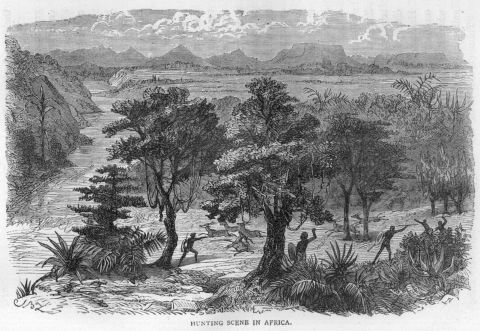
The doctor was astonished at the prodigious quantities of wild animals of all descriptions which he saw on this journey, and also when traversing the country further to the east—elephants, buffaloes, giraffes, zebras, antelopes, and pigs. Frequently the beautiful springbok appeared, covering the plain, sometimes in sprinklings and at other times in dense crowds, as far as the eye could reach.
The troops of elephants also far exceeded in numbers anything which he had ever before heard of or conceived. He and his men had often to shout to them to get out of their way, and on more than one occasion a herd rushed in upon the travellers, who not without difficulty made their escape. A number of young elephants were shot for food, their flesh being highly esteemed. To the natives the huge beasts are a great plague, as they break into their gardens and eat up their pumpkins and other produce; when disturbed they are apt to charge those interrupting their feast, and, following them, to demolish the huts in which they may have taken refuge, not unfrequently killing them in their rage.
Resting at Sesheke, they proceeded to Linyanti, where the wagon and everything that had been left in it in November, 1853, was found perfectly safe.
A grand meeting was called, when the doctor made a report of his journey and distributed the articles which had been sent by the governor and merchants of Loanda. Pitsane and others then gave an account of what they had seen, and, as may be supposed, nothing was lost in the description. The presents afforded immense satisfaction, and on Sunday Sekeletu made his appearance in church dressed in the uniform which had been brought down for him, and which attracted every man’s attention.
The Arab, Ben Habed, and Sekeletu arranged with him to conduct another party with a load of ivory down to Loanda; they also consulted him as to the proper presents to send to the governor and merchants. The Makololo generally expressed great satisfaction at the route which had been opened up, and proposed moving to the Barotse Valley, that they might be nearer the great market. The unhealthiness of the climate, however, was justly considered a great drawback to the scheme.
The doctor afterwards heard that the trading party which set out reached Loanda in safety, and it must have been a great satisfaction to him to feel that he had thus opened out a way to the enterprise of these industrious and intelligent people.
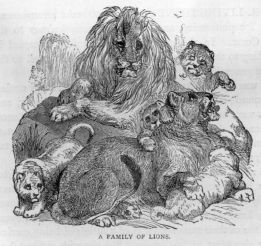
The donkeys which had been brought excited much admiration, and, as they were not affected by the bite of the tsetse, it was hoped that they might prove of great use. Their music, however, startled the inhabitants more than the roar of lions.
Chapter Twenty.
Travels of Dr Livingstone, continued.
Prepares for a journey to the East Coast—Leaves Linyanti—A storm—The Victoria and Mozioatunya Falls—From Kalai sets off for Lekone—Cross the Kafue—The Zambesi—Down its banks—Reach the confluence of the Loangwa—Mburuma’s Plot—Zumbo, a ruined Portuguese settlement—A curious reception—Arrival at Tete—A good breakfast—Tete described—Down the Quillimane—Embarks with Sekwebu on board the “Frolic”—Arrives at Mauritius—Sekwebu drowns himself—Livingstone arrives in England.
Dr Livingstone now began to make arrangements for performing another adventurous journey to the East Coast. In the mean time he was fully occupied in attending to the sick, as also in preaching the Gospel to the people generally.
He was advised to wait till the rains had fallen and cooled the ground; and as it was near the end of September, and clouds were collecting, it was expected that they would soon commence. The heat was very great: the thermometer, even in the shade of his wagon, was at 100 degrees, and, if unprotected, rose to 110 degrees; during the night it sank to 70 degrees.
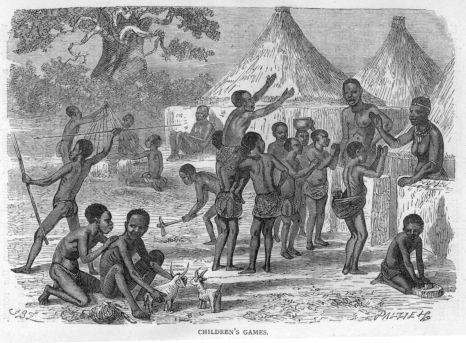
His notes made during the time abound with descriptions of the habits and customs of the people. The children strongly resemble in many respects those of other nations. “They have merry times, especially in the cool of the evening. One of their games consists of a little girl being carried on the shoulders of two others. She sits with outstretched arms as they walk about with her, and all the rest clap their hands and, stopping before each hut, sing pretty airs, some beating time on their little skirts of cow-skin, and others making a curious humming sound between the songs. Excepting this and the skipping-rope, the play of the girls consists in imitating the serious work of their mothers—building little huts, making small pots and cooking, pounding corn in miniature mortars, or hoeing tiny gardens. The boys play with small spears and shields, or bows and arrows, or make little cattle-pens and cattle in clay, often showing much ingenuity in their imitations of the animals, especially of their horns.” However, we must accompany Dr Livingstone on his journey. Among other routes which were proposed, he selected that by the north bank of the Zambesi. He would, however, thus have to pass through territories in the possession of the Matabele, who, under the powerful Chief Mozelekatse, had driven away the Makololo, its original possessors.
Notwithstanding this he had no fears for himself, as that chief looked upon Mr Moffat, his father-in-law, as his especial friend. A considerable district, also, of the country was still inhabited by the Makololo, and by them he was sure to be kindly treated. The Makololo, it must be understood, are a mixed race, composed of tribes of Bechuanas who formerly inhabited the country bordering the Kalahara Desert. Their language, the Bechuana, is spoken by the upper classes of the Makololo, and into this tongue, by the persevering labours of Mr Moffat, nearly the whole of the scriptures have been translated. Thus means already existed of making known the Gospel among them. The bulk of the people are negroes, and are an especially fine, athletic, and skilful race.
As soon as Dr Livingstone announced his intention of proceeding to the east, numerous volunteers came forward to accompany him. From among them he selected a hundred and fourteen trustworthy men, and Sekeletu appointed two, Sekwebu and Kanyata, as leaders of the company. Sekwebu had been captured, when a child, from the Matabele, and his tribe now inhabited the country near Tete; he had frequently travelled along the banks of the Zambesi, and spoke the various dialects of the people residing on them, and was, moreover, a man of sound judgment and prudence, and rendered great service to the expedition.
On the 3rd of November Dr Livingstone, bidding farewell to his friends at Linyanti, set out, accompanied by Sekeletu and two hundred followers. On reaching a patch of country infested by the tsetse it became necessary to travel at night. A fearful storm broke forth, sometimes the lightning, spreading over the sky, forming eight or ten branches like those of a gigantic tree. At times the light was so great that the whole country could be distinctly seen, and in the intervals between the flashes it was as densely dark. The horses trembled, turning round to search for each other, while the thunder crashed with tremendous roars, louder than is heard in other regions, the rain pelting down, making the party feel miserably cold after the heat of the day. At length a fire, left by some previous travellers, appeared in the distance. The doctor’s baggage having gone on before, he had to lie down on the cold ground, when Sekeletu kindly covered him with his own blanket, remaining without shelter himself. Before parting at Sesheke, the generous chief supplied the doctor with twelve oxen, three accustomed to be ridden on, hoes and beads to purchase a canoe, an abundance of fresh butter and honey; and, indeed, he did everything in his power to assist him in his journey.
Bidding farewell to Sekeletu, the doctor and his attendants sailed down the river to its confluence with the Chobe. Having reached this spot, he prepared to strike across the country to the north-east, in order to reach the northern bank of the Zambesi. Before doing so, however, he determined to visit the Victoria or Mozioatunya Falls, of which he had often heard. The meaning of the word is: “Smoke does sound there,” in reference to the vapour and noise produced by the falls. After twenty minutes’ sail from Kalai they came in sight of five columns of vapour, appropriately called “smoke,” rising at a distance of five or six miles off, and bending as they ascended before the wind, the tops appearing to mingle with the clouds. The scene was extremely beautiful. The banks and the islands which appeared here and there amid the stream, were richly adorned with trees and shrubs of various colours, many being in full blossom. High above all rose an enormous baobab-tree surrounded by groups of graceful palms.
As the water was now low, they proceeded in the canoe to an island in the centre of the river, the further end of which extended to the edge of the falls. At the spot where they landed it was impossible to discover where the vast body of water disappeared. It seemed, indeed, suddenly to sink into the earth, for the opposite lip of the fissure into which it descends was only eighty feet distant. On peering over the precipice the doctor saw the stream, a thousand yards broad, leaping down a hundred feet and then becoming suddenly compressed into a space of fifteen or twenty yards, when, instead of flowing as before, it turned directly to the right, and went boiling and rushing amid the hills.
The vapour which rushes up from this cauldron to the height of two or three hundred feet, being condensed, changes its hue to that of dark smoke, and then comes down in a constant shower. The chief portion falls on the opposite side of the fissure, where grow a number of evergreen trees, their leaves always wet. The walls of this gigantic crack are perpendicular. Altogether, Dr Livingstone considered these falls the most wonderful sight he had beheld in Africa.
Returning to Kalai the doctor and his party met Sekeletu, and, bidding him a final farewell, set off northwards to Lekone, through a beautiful country, on the 20th of November. The further they advanced the more the country swarmed with inhabitants, and great numbers came to see the white man, invariably bringing presents of maize.
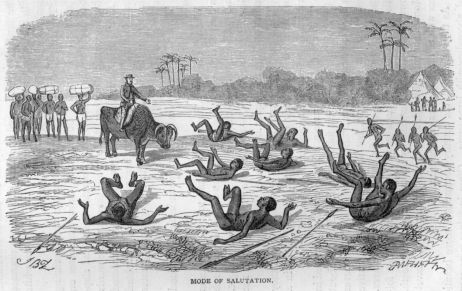
The natives of this region have a curious way of saluting a stranger. Instead of bowing they throw themselves on their backs on the ground, rolling from side to side and slapping the outsides of their thighs, while they utter the words “Kina bomba! kina bomba!” In vain the doctor implored them to stop. They, imagining him pleased, only tumbled about more fiercely and slapped their thighs with greater vehemence.
These villagers supplied the party abundantly with ground nuts, maize, and corn.
When the doctor addressed them and told them of Jesus as their Saviour—how He had come on earth to bring peace and goodwill to men—they replied: “We are tired of flight. Give us rest and sleep,”—though, of course, they could not understand the full import of the message.
These people appeared humbled by the scourgings they had received from their enemies, and seemed to be in a favourable state for the reception of the Gospel.
Their chief, Monze, came one Sunday morning, wrapped in a large cloth, when, like his followers, he rolled himself about in the dust, screaming out “Kina bomba!” He had never before seen a white man, but had met with black native traders, who came, he said, for ivory, but not for slaves. His wife would have been good-looking, had she not followed the custom of her country by knocking out her teeth. Monze soon made himself at home, and presented the travellers with as much food as they required.
As they advanced, the country became still more beautiful, abounding with large game. Often buffaloes were seen standing on eminences. One day, a buffalo was found lying down, and the doctor went to secure it for food. Though the animal received three balls they did not prove fatal, and it turned round as if to charge. The doctor and his companions ran for shelter to some rocks, but, before they gained them, they found that three elephants had cut off their retreat. The enormous brutes, however, turned off, and allowed them to gain the rocks. As the buffalo was moving rapidly away the doctor tried a long shot, and, to the satisfaction of his followers, broke the animal’s fore leg. The young men soon brought it to a stand, and another shot in its brain settled it. They had thus an abundance of food, which was shared by the villagers of the neighbourhood. Soon afterwards an elephant was killed by his men.
Leaving the Elephant Valley, they reached the residence of a chief named Semalembue, who, soon after their arrival, paid them a visit, and presented five or six baskets of meal and maize, and one of ground nuts, saying that he feared his guest would sleep the first night at his village hungry. The chief professed great joy at hearing the words of the Gospel of Peace, replying: “Now I shall cultivate largely, in the hopes of eating and sleeping in quiet.”
It is remarkable that all to whom the doctor spoke, eagerly caught up the idea of living in peace as the probable effect of the Gospel.
This region Sekwebu considered one of the best adapted for the residence of a large tribe. It was here that Sebituane formerly dwelt.
They now crossed the Kafue by a ford. Every available spot between the river and hills was under cultivation. The inhabitants select these positions to secure themselves and their gardens from their human enemies. They are also obliged to make pit-holes to protect their grounds from the hippopotami. These animals, not having been disturbed, were unusually tame, and took no notice of the travellers. A number of young ones were seen, not much larger than terrier dogs, sitting on the necks of their dams, the little saucy-looking heads cocked up between the old one’s ears; when older, they sit more on the mother’s back.
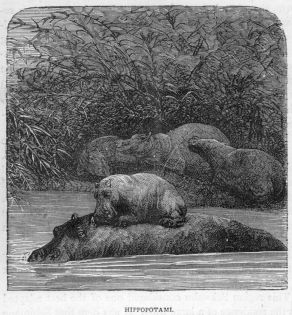
Meat being required, a full-grown cow was shot, the flesh of which resembled pork.
The party now directed their course to the Zambesi near its confluence with the Kafue. They enjoyed a magnificent view from the top of the outer range of hills. A short distance below them was the Kafue, winding its way over a forest-clad plain, while on the other side of the Zambesi lay a long range of dark hills. The plain below abounded in large game. Hundreds of buffalo and zebras grazed on the open spaces, and there stood feeding two majestic elephants, each slowly moving its proboscis. On passing amidst them the animals showed their tameness by standing beneath the trees, fanning themselves with their large ears. A number also of red-coloured pigs were seen. The people in the neighbourhood having no guns, they are never disturbed.
A night was spent in a huge baobab-tree, which would hold twenty men inside.
As they moved on, a herd of buffaloes came strutting up to look at their oxen, and only by shooting one could they be made to retreat. Shortly afterwards a female elephant, with three young ones, charged through, the centre of their extended line, when the men, throwing down their burdens, retreated in a great hurry, she receiving a spear for her temerity.
They were made aware of their approach to the great river by the vast number of waterfalls which appeared. It was found to be much broader than above the falls: a person might indeed attempt in vain to make his voice heard across it. An immense amount of animal life was seen both around and in it.
Pursuing their course down the left bank, they came opposite the island of Menyemakaba, which is about two miles long and a quarter broad. Besides its human population it supports a herd of upwards of sixty buffalo. The comparatively small space to which the animals have confined themselves shows the luxuriance of the vegetation. The only time that the natives can attack them is when the river is full and part is flooded: they then assail them from their canoes.
The inhabitants of the north side of the Zambesi are the Batonga; those on the south bank the Banyai.
Both buffalo and elephants are numerous. To kill them the natives form stages on high trees overhanging the paths by which they come to the water. From thence they dart down their spears, the blades of which are twenty inches long by two broad, when the motion of the handle, aided by knocking against the trees, makes fearful gashes which soon cause death. They form also a species of trap. A spear inserted in a beam of wood is suspended from the branch of a tree, to which a cord is attached with a latch. The cord being led along the path when struck by the animal’s foot, the beam falls, and, the spear being poisoned, death shortly ensues.
At each village they passed, two men were supplied to conduct them to the next, and lead them through the parts least covered with jungle.
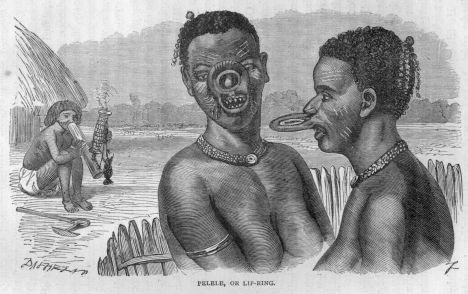
The villagers were busily employed in their gardens. Most of the men have muscular figures. Their colour varies from a dark to a light olive. The women have the extraordinary custom of piercing the upper lip, and gradually enlarging the orifice till a shell can be inserted. The lip appears drawn out beyond the nose, and gives them a very ugly appearance. As Sekwebu remarked: “These women want to make their mouths like those of ducks.” The commonest of these rings are made of bamboo, but others are of ivory or metal. When the wearer tries to smile, the contraction of the muscles turns the ring upwards, so that its upper edge comes in front of the eyes, the nose appearing through the middle, while the whole front teeth are exposed by the motion, exhibiting the way in which they have been clipped to resemble the fangs of a cat or a crocodile.
On their next halt Seole, the chief of the village, instead of receiving them in a friendly way, summoned his followers and prepared for an attack. The reason was soon discovered. It appeared that an Italian, who had married the chief’s daughter, having armed a party of fifty slaves with guns, had ascended the river in a canoe from Tete, and attacked several inhabited islands beyond Makaba, taking large numbers of prisoners and much ivory. As he descended again with his booty, his party was dispersed and he himself was killed while attempting to escape on foot. Seole imagined that the doctor was another Italian.
This was the first symptom of the abominable slave trade they met with on the east side of the continent. Had not the chief with whom they had previously stayed arrived to explain matters, Seole might have given them much trouble.
Mburuma, another chief of the same tribe, had laid a plan to plunder the party by separating them, but the doctor, suspecting treachery, kept his people together. They had on a previous occasion plundered a party of traders bringing English goods from Mozambique.
On the 14th of January they reached the confluence of the Loangwa and the Zambesi.
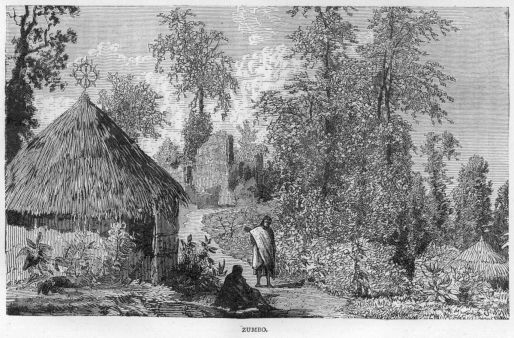
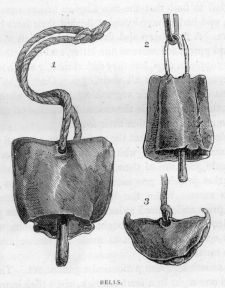
Here the doctor discovered the ruins of a town, with the remains of a church in its midst. The situation was well chosen, with lofty hills in the rear and a view of the two rivers in front. On one side of the church lay a broken bell, with the letters IHS and a cross. This he found was a Portuguese settlement called Zumbo. The conduct of Mburuma and his people gave Dr Livingstone much anxiety, as he could not help dreading that they might attack him the next morning. His chief regret was that his efforts for the welfare of the teeming population in that great region would thus be frustrated by savages, of whom it might be said: “They know not what they do.”
He felt especially anxious that the elevated and healthy district which he had now discovered, stretching towards Tete, should become known. It was such a region as he had been long in quest of as a centre from which missionary enterprise might be carried into the surrounding country.
While the party were proceeding along the banks of the river, passing through a dense bush, three buffaloes broke through their line. The doctor’s ox galloped off, and, as he turned back, he saw one of his men tossed several feet in the air. On returning, to his satisfaction he found that the poor fellow had alighted on his face, and, although he had been carried twenty yards on the animal’s horns, he had in no way suffered. On the creature’s approaching him he had thrown down his load and stabbed it in the side, when it caught him and carried him off before he could escape.
Soon after this they had evidence that they were approaching the Portuguese settlements, by meeting a person with a jacket and hat on. From this person, who was quite black, they learned that the Portuguese settlement of Tete was on the other bank of the river, and that the inhabitants had been engaged in war with the natives for some time past.
This was disagreeable news, as Livingstone wished to be at peace with both parties.
As they approached the village of Mpende, that chief sent out his people to enquire who the travellers were. The natives, on drawing near, uttered strange cries and waved some bright red substance towards them. Having lighted a fire, they threw some charms into it and hastened away, uttering frightful screams, believing that they should thus frighten the strangers and render them powerless. The Makololo, however, laughed at their threats, but the doctor, fully believing that a skirmish would take place, ordered an ox to be killed to feast his men, following the plan Sebituane employed for giving his followers courage.
At last two old men made their appearance and enquired if the doctor was a Bazunga, or Portuguese. On showing his hair and white skin, they replied: “Ah, you must be one of the tribe that loves black men.”
Finally the chief himself appeared, and expressed his regret that he had not known sooner who they were, ultimately enabling them to cross the river.
After this they were detained for some time by the rains on the south bank.
In conversation with the people they exhibited the greatest hatred of the slave-traders.
Meeting with native traders, the doctor purchased some American calico in order to clothe his men. It was marked “Lawrence Mills, Lowell,” with two small tusks, an interesting fact.
Game laws existed even in this region. His party having killed an elephant, he had to send back a considerable distance to give information to the person in charge of the district, the owner himself living near the Zambesi. Their messenger returned with a basket of corn, a fowl, and a few strings of beads, a thank-offering to them for having killed it. The tusk of the side on which the elephant fell belonged to the owner, while the upper was the prize of the sportsman. Had they begun to cut up the animal before receiving permission they would have lost the whole. The men feasted on their half of the carcass, and for two nights an immense number of hyaenas collected round, uttering their loud laughter.
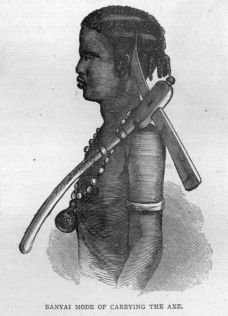
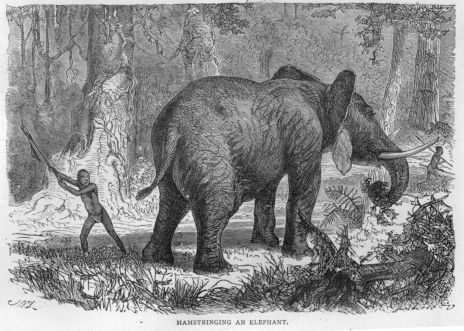
The people inhabiting the country on this side of the Zambesi are known as the Banyai. Their favourite weapon is a huge axe, which is carried over the shoulder. It is used chiefly for ham-stringing the elephant, in the same way as the Hamran Arab uses his sword. The Banyai, however, steals on the animal unawares, while the Hamran hunter attacks it when it is rushing in chase of one of his comrades, who gallops on ahead on a well-trained steed.
Those curious birds, the “honey guides,” were very attentive to them, and, by their means, the Makololo obtained an abundance of honey. Of the wax, however, in those districts no use appears to be made.
Though approaching the Portuguese settlement, abundance of game was still found. The Makololo killed six buffalo calves from among a herd which was met with.
They were warned by the natives that they ran a great risk of being attacked by lions when wandering on either side of the line of march in search of honey. One of the doctor’s head men, indeed, Monahin, having been suddenly seized with a fit of insanity during the night, left the camp, and, as he never returned, it was too probable that he had been carried off by a lion.
It was not till the 2nd of March that the neighbourhood of Tete was reached. Livingstone was then so prostrated that, though only eight miles from it, he could proceed no further. He forwarded, however, the letters of recommendation he received in Angola to the commandant. The following morning a company of soldiers with an officer arrived, bringing the materials for a civilised breakfast, and a litter in which to carry him. He felt so greatly revived by the breakfast, that he was able to walk the whole way.
He was received in the kindest way by Major Sicard, the commandant of Tete, who provided also lodging and provision for his men.
Tete is a mere village, built on a slope reaching to the water, close to which the fort is situated. There are about thirty European houses; the rest of the buildings, inhabited by the natives, are of wattle and daub.
Formerly, besides gold-dust and ivory, large quantities of grain, coffee, sugar, oil, and indigo were exported from Tete, but, on the establishment of the slave trade, the merchants found a more speedy way of becoming rich, by selling off their slaves, and the plantations and gold washings were abandoned, the labourers having been exported to the Brazils. Many of the white men then followed their slaves. After this, a native of Goa, Nyaude by name, built a stockade at the confluence of the Luenya and Zambesi, took the commandant of Tete, who attacked him, prisoner, and sent his son Bonga with a force against that town and burned it. Others followed his example, till commerce, before rendered stagnant by the slave trade, was totally obstructed.
On the north shore of the Zambesi several fine seams of coal exist, which Dr Livingstone examined. The natives only collect gold from the neighbourhood whenever they wish to purchase calico. On finding a piece or flake of gold, however, they bury it again, believing that it is the seed of the gold, and, though knowing its value, prefer losing it rather than, as they suppose, the whole future crop.
Dr Livingstone found it necessary to leave most of his men here, and Major Sicard liberally gave them a portion of land that they might cultivate it, supplying them in the mean time with corn. He also allowed the young men to go out and hunt elephants with his servants, that they might purchase goods with the ivory and dry meat, in order that they might take them back with them on returning to their own homes. He also supplied them with cloth. Sixty or seventy at once accepted his offer, delighted with the thoughts of engaging in so profitable an enterprise. He also supplied the doctor with an outfit, refusing to take the payment which was offered.
The forests in the neighbourhood abound with elephants, and the natives attack them in the boldest manner. Only two hunters sally forth together—one carrying spears, the other an axe of a peculiar shape, with a long handle. As soon as an elephant is discovered, the man with the spears creeps among the bushes in front of it, so as to attract its attention, during which time the axe-man cautiously approaches from behind, and, with a sweep of his formidable weapon, severs the tendon of the animal’s hock. The huge creature, now unable to move in spite of its strength and sagacity, falls an easy prey to the two hunters.
Among other valuable productions of the country is found a tree allied to the cinchona. The Portuguese believe that it has the same virtues as quinine.
As soon as the doctor had recovered his strength he prepared to proceed down the river to Kilimane, or Quillimane, with sixteen of his faithful Makololo as a crew. Many of the rest were out elephant hunting, while others had established a brisk trade in firewood.
Major Sicard lent him a boat, and sent Lieutenant Miranda to escort him to the coast.
On their way they touched at the stockade of the rebel, Bonga, whose son-in-law, Manoel, received them in a friendly way.
They next touched at Senna, which was found in a wretchedly ruinous condition. Here some of the Makololo accepted employment from Lieutenant Miranda to return to Tete with a load of goods. Eight accompanied the doctor, at their earnest request, to Quillimane.
He reached that village on the 20th of May, 1856, when it wanted but a few days of being four years since he started from Cape Town. He was hospitably received by Colonel Nunes. A severe famine had existed among the neighbouring population, and food was very scarce. He therefore advised his men to go back to Tete as soon as possible, and await his return from England. They still earnestly wished to accompany him, as Sekeletu had advised them not to part with him till they had reached Ma-Robert, as they called Mrs Livingstone, and brought her back with them.
With the smaller tusks he had in his possession he purchased calico and brass-wire, which he sent back to Tete for his followers, depositing the remaining twenty tusks with Colonel Nunes, in order that, should he be prevented from revisiting the country, it might not be supposed that he had made away with Sekeletu’s ivory. He requested Colonel Nunes, in case of his death, to sell the tusks and deliver the proceeds to his men, intending to purchase the goods ordered by Sekeletu in England with his own money, and, on his return, repay himself out of the price of the ivory.
He consented, somewhat unwillingly, to take Sekwebu with him to England.
After waiting about six weeks at Quillimane, HM brig “Frolic” arrived, on board which he embarked. A fearful sea broke over the bar, and the brig was rolling so much that there was great difficulty in reaching her deck. Poor Sekwebu looked at his friend, asking: “Is this the way you go?” The doctor tried to encourage him; but, though well acquainted with canoes, he had never seen anything like it.
Having been three and a half years, with the exception of a short interval in Angola, without speaking English, and for thirteen but partially using it, the doctor found the greatest difficulty in expressing himself on board the “Frolic.”
The brig sailed on the 12th of July for the Mauritius, which was reached on the 12th of August. Poor Sekwebu had become a favourite both with men and officers, and was gaining some knowledge of English, though all he saw had apparently affected his mind. The sight of a steamer, which came out to tow the brig into the harbour, so affected him that during the night he became insane and threatened to throw himself into the water. By gentle treatment he became calmer, and Dr Livingstone tried to get him on shore, but he refused to go. In the evening his malady returned; and, after attempting to spear one of the crew, he leaped overboard and, pulling himself down by the chain cable, disappeared. The body of poor Sekwebu was never found.
After remaining some time at the Mauritius, till he had recovered from the effects of the African fever, our enterprising traveller sailed by way of the Red Sea for old England, which he reached on the 12th of December, 1856.
Dr Livingstone, in the series of journeys which have been described, had already accomplished more than any previous traveller in Africa, besides having gained information of the greatest value as regards both missionary and mercantile enterprise. He had as yet, however, performed only a small portion of the great work his untiring zeal and energy have prompted him to undertake.
Chapter Twenty One.
Dr Livingstone’s second expedition to Africa, to explore the Zambesi.
Leaves England—Arrives at the East Coast—Up the Luawe—The little “Ma-Robert”—War—Commence the voyage for Tete—Senna—Arrives at Tete—The Kebrabasa Falls—Returns to Tete—Up the Shire, and return—The second trip up the Shire—Sets out for Lake Shirwa—Returns to Tete—Set out for Lake Nyassa—Treachery—Arrive at the Lake—Returns to the Kongone—Journey westward—A pondoro—Superstition—Passing Kebrabasa, arrive in Mpende’s territory—Reaches Moachemba—Sets out for Victoria Falls—Tuba, the smasher of canoes—Leave Sesheke—More Superstition—Reach Zunibo—Down the Kebrabasa Rapids—Canoes upset—Arrive at Tete—The chameleon.
After spending rather more than a year in England, Dr Livingstone again set out, on the 10th of March, 1858, on board HMS “Pearl,” at the head of a government expedition for the purpose of exploring the Zambesi and the neighbouring regions. He was accompanied by Dr Kirk, his brother Charles Livingstone, and Mr Thornton; and Mr T. Baines was appointed artist to the expedition.
A small steamer, which was called the “Ma-Robert,” in compliment to Mrs Livingstone, was provided by the government for the navigation of the river.
The East Coast was reached in May.
Running up the river Luawe, supposed to be a branch of the Zambesi, the “Pearl” came to an anchor, and the “Ma-Robert,” which had been brought out in sections, was screwed together. The two vessels then went together in search of the real mouth of the river, from which Quillimane is some sixty miles distant, the Portuguese having concealed the real entrance, if they were acquainted with it, in order to deceive the English cruisers in search of slavers.
The goods for the expedition brought out by the “Pearl” having been landed on a grassy island about forty miles from the bar, that vessel sailed for Ceylon, while the little “Ma-Robert” was left to pursue her course alone. Her crew consisted of about a dozen Krumen and a few Europeans.
At Mazaro, the mouth of a creek communicating with the Quillimane or Kilimane River, the expedition heard that the Portuguese were at war with a half-caste named Mariano, a brother of Bonga, who had built a stockade near the mouth of the Shire, and held possession of all the intermediate country. He had been in the habit of sending out his armed bands on slave-hunting expeditions among the helpless tribes to the north-west, selling his victims at Quillimane, where they were shipped as free emigrants to the French island of Bourbon. As long as his robberies and murders were restricted to the natives at a distance, the Portuguese did not interfere, but when he began to carry off and murder the people near them, they thought it time to put a stop to his proceedings. They spoke of him as a rare monster of inhumanity. He frequently killed people with his own hand in order to make his name dreaded. Having gone down to Quillimane to arrange with the governor, or, in other words, to bribe him, Colonel Da Silva put him in prison and sent him for trial to Mozambique. The war, however, was continued under his brother Bonga, and had stopped all trade on the river.
The expedition witnessed a battle at Mazaro, between Bonga and the Portuguese, when Dr Livingstone, landing, found himself in the sickening smell and among the mutilated bodies of the slain. He brought off the governor, who was in a fever, the balls whistling about his head in all directions. The Portuguese then escaped to an island opposite Shupanga, where, having exhausted their ammunition, they were compelled to remain.
There is a one-storied house at Shupanga, from which there is a magnificent view down the river. Near it is a large baobab-tree, beneath which, a few years later, the remains of the beloved wife of Dr Livingstone were to repose.
On the 17th of August the “Ma-Robert” commenced her voyage up the stream for Tete. It was soon found that her furnaces being badly constructed, and that from other causes she was ill adapted for the work before her. She quickly, in consequence, obtained the name of the “Asthmatical.”
Senna, which was visited on the way, being situated on low ground, is a fever-giving place. The steamer, of course, caused great astonishment to the people, who assembled in crowds to witness her movements, whirling round their arms to show the way the paddles revolved.
Tete was reached on the 8th of September. No sooner did Dr Livingstone go on shore, than his Makololo rushed down to the water’s edge, and manifested the greatest joy at seeing him. Six of the young men had foolishly gone off to make money by dancing before some of the neighbouring chiefs, when they fell into the hands of Bonga, who, declaring that they had brought witchcraft medicine to kill him, put them all to death.
The Portuguese at this place keep numerous slaves, whom they treat with tolerable humanity. When they can they purchase the whole of a family, thus taking away the chief inducement for running off.
The expedition having heard of the Kebrabasa Falls, steamed up the river, and on the 24th of November reached Panda Mokua, where the navigation ends, about two miles below them. Hence the party started overland, by a frightfully rough path among rocky hills, where no shade was to be found. At last their guides declared that they could go no further; indeed, the surface of the ground was so hot that the soles of the Makololos’ feet became blistered. The travellers, however, pushed on. Passing round a steep promontory, they beheld the river at their feet, the channel jammed in between two mountains with perpendicular sides, and less than fifty yards wide. There is a sloping fall of about twenty feet in height, and another at a distance of thirty yards above it. When, however, the river rises upwards of eighty feet perpendicularly, as it does in the rainy season, the cataract might be passed in boats.
After returning to Tete, the steamer went up the Shire, January, 1859. The natives, as they passed them, collected at their villages in large numbers, armed with bows and poisoned arrows, threatening to attack them. Dr Livingstone, however, went on shore, and explained to the chief, Tingane, that they had come neither to take slaves nor to fight, but wished to open up a path by which his countrymen could ascend to purchase their cotton. On this Tingane at once became friendly.
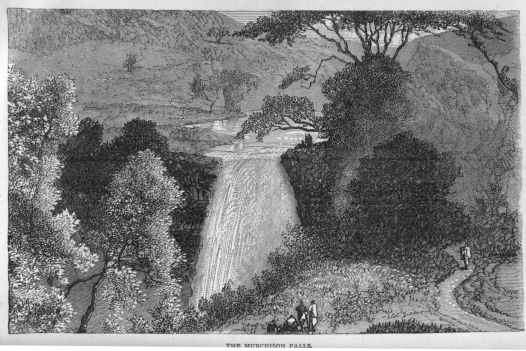
Their progress was arrested, after steaming up a hundred miles in a straight line, although, counting the windings of the river, double that distance, by magnificent cataracts known to the natives as those of the Mamvira, but called by the expedition the Murchison Falls.
Rain prevented them making observations, and they returned at a rapid rate down the river.
A second trip up it was made in March of the same year. They here gained the friendship of Chibisa, a shrewd and intelligent chief, whose village was about ten miles below the cataracts. He told the doctor that a few years before his little daughter had been kidnapped, and was now a slave to the padre at Tete, asking him, if possible, to ransom the child.
From hence Dr Livingstone and Dr Kirk proceeded on foot in a northerly direction to Lake Shirwa. The natives turned out from their villages, sounding notes of defiance on their drums; but the efforts to persuade them that their visitors came as friends were successful, and the lake was discovered on the 18th of April.
From having no outlet, the water is brackish, with hilly islands rising out of it. The country around appeared very beautiful and clothed with rich vegetation, with lofty mountains eight thousand feet high near the eastern shore.
On their return they found Quartermaster Walker, who had charge of the steamer, dangerously ill, though he ultimately recovered.
They returned to Tete on the 23rd of June, and thence, after the steamer had been repaired, proceeded to the Kongone, where they received provisions from HMS “Persian,” which also took on board their Krumen, as they were found useless for land journeys. In their stead a crew was picked out from the Makololo, who soon learned to work the ship, and who, besides being good travellers, could cut wood and required only native food.
Frequent showers fell on their return voyage up the Zambesi, and, the vessel being leaky, the cabin was constantly flooded, both from above and below.
They were visited on their way up by Paul, a relative of the rebel Mariano, who had just returned from Mozambique. He told them that the Portuguese knew nothing of the Kongone before they had discovered it, always supposing that the Zambesi entered the sea at Quillimane.
A second trip up the Shire was performed in the middle of August, when the two doctors set out in search of Lake Nyassa, about which they had heard.
The river, though narrow, is deeper than the Zambesi, and more easily navigated.
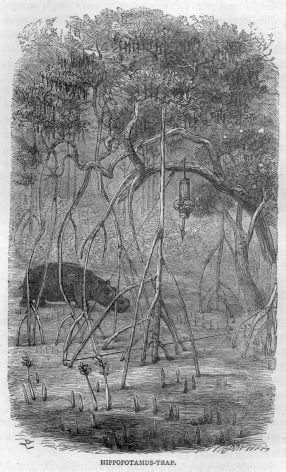
Marks of large game were seen, and one of the Makololo, who had gone on shore to cut wood, was suddenly charged at by a solitary buffalo. He took to flight, pursued by the maddened animal, and was scarcely six feet before the creature when he reached the bank and sprang into the river. On both banks a number of hippopotamus-traps were seen.
The animal feeds on grass alone, its enormous lip acting like a mowing machine, forming a path before it as it feeds. Over these paths the natives construct a trap, consisting of a heavy beam, five or six feet long, with a spear-head at one end, covered with poison. This weapon is hung to a forked pole by a rope which leads across the path, and is held by a catch, set free as the animal treads upon it. A hippopotamus was seen which, being frightened by the steamer, rushed on shore and ran immediately under one of these traps, when down came the heavy beam on its head.
The leaks in the steamer increased till the cabin became scarcely habitable.
The neighbourhood of Chibisa’s village was reached on the 25th of August.
The doctor had now to send word to the chief that his attempts to recover his child had failed, for, though he had offered twice the value of a slave, the little girl could not be found, the padre having sold her to a distant tribe of Bazizulu. Though this padre was better than the average, he appeared very indifferent about the matter.
On the 28th of August, an expedition consisting of four whites, thirty-six Makololo, and two guides left the ship in the hopes of discovering Lake Nyassa. The natives on the road were very eager to trade. As soon as they found that the strangers would pay for their provisions in cotton cloth, women and girls were set to grind and pound meal, and the men and boys were seen chasing screaming fowl over the village. A head man brought some meal and other food for sale; a fathom of blue cloth was got out, when the Makololo head man, thinking a portion was enough, was proceeding to tear it. On this the native remarked that it was a pity to cut such a nice dress for his wife, and he would rather bring more meal. “All right,” said the Makololo, “but look, the cloth is very wide, so see that the basket which carries the meal be wide too, and add a cock to make the meal taste nicely.”
The highland women of these regions all wear the pelele, or lip-ring, before described. An old chief, when asked why such things were worn, replied: “for beauty; men have beards and whiskers, women have none. What kind of creature would a woman be without whiskers and without the pelele?”
When, as they calculated, they were about a day’s march from Lake Nyassa, the chief of the village assured them positively that no lake had ever been heard of there, and that the river Shire stretched on, as they saw it, to a distance of two months, and then came out between two rocks which towered to the skies. The Makololo looked blank, and proposed returning to the ship.
“Never mind,” said the doctor, “we will go on and see these wonderful rocks.”
Their head man, Massakasa declared that there must be a lake, because it was in the white men’s books, and scolded the natives for speaking a falsehood. They then admitted that there was a lake. The chief brought them a present in the evening. Scarcely had he gone when a fearful cry arose from the river; a crocodile had carried off his principal wife. The Makololo, seizing their arms, rushed to her rescue; but it was too late.
The expedition moving forward, on the 16th of September, 1859, the long-looked-for Lake Nyassa was discovered, with hills rising on both sides of it.
Two months after this the lake was visited by Dr Roscher, who was unaware of Dr Livingstone’s and Dr Kirk’s discovery; unhappily he was murdered on his road back towards the Rovuma.
The travellers were now visited by the chief of a village near the confluence of the lake and the river, who invited them to form their camp under a magnificent banyan-tree among the roots of which, twisted into the shape of a gigantic arm-chair, four of the party slept. The chief told them that a slave party, led by Arabs, was encamped near at hand; and in the evening a villainous set of fellows, with long muskets, brought several young children for sale; but, finding that the travellers were English, they decamped, showing signs of fear. The people of the Manjanga tribe, amidst whom they were now travelling, showed much suspicion of their object, saying that parties had come before with the same sort of plausible story, and had suddenly carried off a number of their people. To allay these suspicions, Dr Livingstone thought it best at once to return to the ship.
Soon afterwards Dr Kirk and Mr Rae, the engineer, set off with guides to go across the country to Tete, the distance being about one hundred miles. From want of water they suffered greatly, while the tsetse infested the district.
Dr Livingstone had resolved to visit his old friend Sekeletu; but, finding that before the new crop came in, food could not be obtained beyond the Kebrabasa, he returned in the “Ma-Robert” once more to the Kongone.
They found Major Sicard at Mazaro, he having come there with tools and slaves to build a custom-house and fort.
After this trip, the poor “Asthmatic” broke down completely; she was therefore laid alongside the island of Kanyimbe, opposite Tete, and placed under charge of two English sailors. They were furnished with a supply of seeds to form a garden, both to afford them occupation and food.
Active preparations were now made for the intended journey westward; cloth, beads, and brass-wire were formed into packages, with the bearer’s name printed on each.
The Makololo who had been employed by the expedition received their wages. Some of those who had remained at Tete had married, and resolved to continue where they were. Others did not leave with the same good will they had before exhibited, and it was doubtful, if attacked, whether they would not run to return to their lately-formed friends.
All arrangements had been concluded by the 15th of May, 1860, and the journey was commenced.
As the Banyai, who live on the right bank, were said to levy heavy fines, the party crossed over to the left.
Dr Livingstone was stopping near the Kebrabasa village, when a man appeared, who pretended that he was a pondoro; that is, that he could change himself into a lion whenever he chose—a statement his countrymen fully believed. Sometimes the pondoro hunts for the benefit of the villagers, when his wife takes him some medicine which enables him to change himself back into a man. She then announces what game has been killed, and the villagers go into the forest to bring it home. The people believe also that the souls of the departed chiefs enter into lions. One night, a buffalo having been killed, a lion came close to the camp, when the Makololo declared that he was a pondoro, and told him that he ought to be ashamed of himself for trying to steal the meat of strangers. The lion, however, disregarding their addresses, only roared louder than ever, though he wisely kept outside the bright circle of the camp-fires. A little strychnine was placed on a piece of meat and thrown to him, after which he took his departure, and was never again seen.
Again passing Kebrabasa, the travellers enjoyed the magnificent mountain scenery in this neighbourhood, and came to the conclusion that not only it, but the Morumbwa could, when the river rises, be passed, so as to allow of a steamer being carried up to run on the upper Zambesi.
On the 20th of June they reached the territory of the chief Mpende, who had, on Dr Livingstone’s journey to the East Coast, threatened to attack him. Having in the mean time heard that he belonged to a race who love black men and did not make slaves, his conduct was now completely changed, and he showed every desire to be friendly.
Game was abundant, and lions were especially numerous.
After visiting Zumbo, Dr Kirk was taken dangerously ill. He got better on the high ground, but immediately he descended into the valley he always felt chilly. In six days, however, he was himself again, and able to march as well as the rest.
Again abundance of honey was obtained through the means of the “honey guide.” The bird never deceived them, always guiding them to a hive of bees, though sometimes there was but little honey in it.
On the 4th of August the expedition reached Moachemba, the first of the Batoka villages, which owe allegiance to Sekeletu. From thence, beyond a beautiful valley, the columns of vapour rising from the Victoria Falls, upwards of twenty miles away, could clearly be distinguished.
The Makololo here received intelligence of their families, and news of the sad termination of the attempt to plant a mission at Linyanti, under the Reverend H. Helmore. He and several white men had died, and the remainder had only a few weeks before returned, to Kuruman.
At the village opposite Kalai the Malokolo head man, Mashotlane, paid the travellers a visit. He entered the hut where they were seated, a little boy carrying a three-legged stool. In a dignified way the chief took his seat, presenting some boiled hippopotamus meat. Having then taken a piece himself, he handed the rest to his followers. He had lately been attacking the Batoka, and when the doctor represented to him the wrongfulness of the act, he defended himself by declaring that they had killed some of his companions. Here also they found Pitsane, who had been sent by Sekeletu to purchase horses from a band of Griquas.
As the new-comers were naturally anxious to see the magnificent falls, they embarked in some canoes belonging to Tuba Mokoro (“a smasher of canoes”), who alone, they were assured, possessed the medicine which would prevent shipwreck in the rapids. Tuba conducted them at a rapid rate down the river. It required considerable confidence in his skill not to feel somewhat uneasy as they navigated these roaring waters. They were advised not to speak, lest their talking might diminish the virtue of the medicine; few indeed would have thought of disobeying the orders of the canoe-smasher. One man stood at the head of the canoe, looking out for rocks and telling the steersman the course to take. Often it seemed as if they would be dashed to pieces against the dark rocks jutting out from the water, then in a moment the ready pole turned the canoe aside, and they quickly glided past the danger. As they went swiftly driving down, a black rock, with the foam flowing over it, rose before them; the pole slipped, the canoe struck and in a moment was half full of water. Tuba, however, speedily recovering himself, shoved off, and they reached a shallow place, where the water was bailed out. He asserted that it was not the medicine was at fault, but that he had started without his breakfast.
The travellers landed at the head of Garden Island, and, as the doctor had done before, peered over the giddy heights at the further end across the chasm. The measurement of the chasm was now taken; it was found to be eighty yards opposite Garden Island, while the waterfall itself was twice the depth of that of Niagara, and the river where it went over the rock fully a mile wide. Charles Livingstone, who had seen Niagara, pronounced it inferior in magnificence to the Victoria Falls.
The Batokas consider Garden Island and another further west as sacred spots, and here, in days gone by, they assembled to worship the Deity.
Dr Livingstone, on his former visit, had planted a number of orange-trees and seeds at Garden Island, but though a hedge had been placed round them, they had all been destroyed by the hippopotami. Others were now put in. They also, as was afterwards found, shared the same fate.
They now proceeded up the river, and, on the 13th, met a party from Sekeletu, who was now at Sesheke, and had sent to welcome them. On the 18th they entered his town. They were requested to take up their quarters at the old kotlar, or public meeting-place tree. During the day visitors continually called on them, all complaining of the misfortunes they had suffered. The condition of Sekeletu, however, was the most lamentable. He had been attacked by leprosy, and it was said that his fingers had become like eagles’ claws, and his face so fearfully distorted that no one could recognise him. One of their head men had been put to death, it being supposed that he had bewitched the chief. The native doctors could do nothing for him, but he was under the charge of an old doctress of the Manyeti tribe, who allowed no one to see him except his mother and uncle. He, however, sent for Dr Livingstone, who gladly went to him. He and Dr Kirk at once told him that the disease was most difficult to cure, and that he might rest assured he had not been bewitched. They applied lunar caustic externally and hydrate of potash internally, with satisfactory results; so that in the course of a short time the poor chief’s appearance greatly improved.
Although the tribe had been suffering from famine, the chief treated his visitors with all the hospitality in his power.
Some Benguela traders had come up to Sesheke, intending probably to return from the Batoka country to the east with slaves; but the Makololo, however, had secured all the ivory in that region. As the traders found that the trade in slaves without ivory did not pay, they knew it would not be profitable to obtain them, for Sekeletu would allow no slaves to be carried through his territory, and thus by his means an extensive slave-mart was closed.
Sekeletu was greatly pleased with the articles the doctor brought him from England, and enquired whether a ship could not bring up the remainder of the goods which had been left at Tete. On being told that possibly a steamer might ascend as far as Sinainanes, he enquired whether a cannon could not blow away the Victoria Falls, so as to enable her to reach Sesheke.
The Makololo, who had been sent down to Benguela, came to pay the travellers a visit, dressed in well-washed shirts, coats, and trousers, patent leather boots, and brown wideawakes on their heads. They had a long conversation with their men about the wonderful things they had all seen.
Sekeletu, who took a great fancy to Dr Kirk, offered him permission to select any part of the country he might chose for the establishment of an English colony. Indeed, there is sufficient uncultivated ground on the cool unpeopled highlands for a very large population.
The Makololo are apt to get into trouble by their propensity to lift cattle; for if their marauding is sanctioned by the chief, they do not look upon it as dishonourable. This custom must be put a stop to if any good is to be done to them, as must the gigantic evil of the slave trade among the tribes nearer the coast.
The expedition left Sesheke on the 17th of September, 1860, convoyed by Pitsane and Leshore. Pitsane was directed to form a hedge round the garden at the falls on his way.
When navigating the river the canoe-men kept close to the bank during the day for fear of being upset by the hippopotami, but at night, when those animals are found near the shore, they sailed down the middle of the stream.
The canoes were wretched, and a strong wind blew against them, but their Batoka boatmen managed them with great dexterity. Some of these men accompanied the expedition the whole way to the sea.
On their passage down the river, in approaching Kariba Rapids, they came upon a herd of upwards of thirty hippopotami. The canoe-men were afraid of venturing among them, asserting that there was sure to be an ill-tempered one who would take a malignant pleasure in upsetting the canoes. Several boys on the rocks were amusing themselves by throwing stones at the frightened animals. One was shot, its body floating down the current. A man hailed them from the bank, advising them to let him pray to the Kariba gods that they might have a safe passage down the rapids, for, without his assistance, they would certainly be drowned. Notwithstanding, having examined the falls, seeing that canoes might be carried down in safety, they continued their voyage. The natives were much astonished to see them pass in safety without the aid of the priest’s intercession.
Here they found the hippopotamus which had been shot, and, taking it in tow, told the villagers that if they would follow to their landing-place, they should have most of the meat. The crocodiles, however, tugged so hard at it, that they were compelled to cast it adrift and let the current float it down. They recovered the hippopotamus, which was cut up at the place where they landed to spend the night. As soon as it was dark, the crocodiles attacked the portion that was left in the water, tearing away at it and lashing about fiercely with their tails.
A day or two afterwards they encamped near some pitfalls, in which several buffaloes had shortly before been caught and one of the animals had been left. During the night the wind blew directly from the dead buffalo to their sleeping-place, and a hungry lion which came to feed on the carcass so stirred up the putrid mass and growled so loudly over his feast, that their slumbers were greatly disturbed.
They reached Zumbo by the 1st of November. Here their men had a scurvy trick played them by the Banyai. The Makololo had shot a hippopotamus, when a number of the natives came across, pretending to assist them in rolling it ashore, and advised them to cast off the rope, saying that it was an encumbrance. All were shouting and talking, when suddenly the carcass disappeared in a deep hole. The Makololo jumped in after it, one catching the tail, another a foot, but down it went, and they got but a lean fowl instead. It floated during the night, and was found about a mile below, on the bank. The Banyai, however, there disputed their right to it, and, rather than quarrel, the Makololo, after taking a small portion, wisely allowed them to remain with the rest.
Believing that there was sufficient depth of water, they ventured down the Kebrabasa Rapids. For several miles they continued onward till, the river narrowing, navigation became both difficult and dangerous. Two canoes passed safely down the narrow channel with an ugly whirlpool, caused by the water being divided by a rock in the centre. Dr Livingstone’s canoe came next, and while it appeared to be drifting broadside into the vortex, a crash was heard, and Dr Kirk’s canoe was seen dashed against the perpendicular rock by a sudden boiling-up of the river, which occurs at regular intervals. Dr Kirk grasped the rock and saved himself, while his steersman, holding on to the same ledge, preserved the canoe, but all its contents were lost, including the doctor’s notes of the journey, and botanical drawings of the fruit-trees of the interior. After this the party, having had enough of navigation, performed the remainder of the journey on shore.
On their march they met two large slave-trading parties on their way to Zumbo. Among them were a number of women with ropes round their necks, and all made fast to one long rope. They were to be sold for ivory.
Tete was reached on the 23rd of November, the expedition having been absent rather more than six months. They were glad to find that the two English sailors were in good health, and had behaved very well; but their farm had been a failure. A few sheep and fowls had been left with them: they had purchased more of the latter, and expected to have a good supply of eggs, but they unfortunately also bought two monkeys, who ate up all their eggs. One night a hippopotamus destroyed their vegetable garden, the sheep ate up their cotton-plants, while the crocodiles carried off the sheep, and the natives had stolen their fowls.
Having discovered that the natives have a mortal dread of the chameleon, one of which animals they had on board, they made good use of their knowledge. They had learned the market price of provisions, and determined to pay that and no more. When the traders, therefore, demanded a higher price and refused to leave the ship till it was paid, the chameleon was instantly brought out of the cabin, when the natives sprang overboard and made no further attempt to impose upon them.
The sailors had also performed a gallant act. They were aroused one night by a fearful shriek, when they immediately pushed off in their boat, supposing, as was found to be the case, that a crocodile had caught a woman and was dragging her across a shallow bank. Before they reached her, the reptile snapped off her leg. They carried her on board, bandaged up her limb, bestowed Jack’s usual remedy for all complaints, a glass of grog, on her, and carried her to a hut in the village. Next morning they found the bandages torn off and the poor creature left to die, their opinion being that it had been done by her master, to whom, as she had lost a leg, she would be of no further use, and he did not wish the expense of keeping her.
Chapter Twenty Two.
Dr Livingstone’s expedition to explore the Zambesi, continued.
Sets out again—Christmas at Chimba Island—Senna—Down the river to Congo—The “Pioneer”—Arrival of Bishop Mackenzie—Reaches the Rovuma—Back again and up the Zambesi to the Shire—Liberation of a party of slaves—News of the Ajawa Starts for Nyassa—Enters the Lake—Described—A storm on the Nyassa—Slavery—Returns to the Rovuma—Sets out with Bishop Mackenzie for Ruo—Reaches the Zambesi, and afterwards proceeds to the Great Luabo—Arrival of Mrs Livingstone and the “Lady Nyassa”—Bishop Mackenzie’s death—Explores the Rovuma—An adventure with the natives—Visits Johanna in the “Pioneer”—Steams up the Shire—Effects of the slave trade—Meets Mr Thornton—Attacked by fever—More of the slave trade—Start for the upper cataracts—Despatches from England—Visit Chia Lakelet—An Arab slave-dhow—Leaves the Zambesi, and arrives at Bombay.
Once more, on the 3rd of December, the leaky “Asthmatic” was got under way, but every day fresh misfortunes happened to her, till Rae declared: “She cannot be worse than she is, sir.”
He and his mate, Hutchings, had done their best to patch her up, but her condition was past their skill. On the morning of the 21st she grounded on a sandbank and filled. The river rising, all that was visible the next day was about six feet of her two masts. The property on board was, however, saved, and the expedition spent their Christmas of 1860 encamped on the island of Chimba.
Canoes having been procured, they reached Senna on the 27th. They here saw a large party of slaves belonging to the commandant, who had been up to trade with Mozelekatse, carrying a thousand muskets and a large quantity of gunpowder, and bringing back ivory, ostrich feathers, a thousand sheep and goats, and thirty head of fine cattle, and in addition a splendid white bull, to show that he and the traders parted friends. The adventure, however, was a losing one to the poor commandant: a fire had broken out in the camp, and the ostrich feathers had been burned; the cattle had died from the bite of the tsetse, as had the white bull, and six hundred of the sheep had been eaten by the slaves, they thinking more of their own comfort than their master’s gain.
This is one of the many proofs of the clearness of slave labour.
Proceeding down the river in boats, the expedition reached Congo on the 4th of January, 1861. Here a flagstaff and a custom-house (a floorless hut of mangrove stakes roofed with stakes) had been erected.
The garrison of the place being almost starved, the provisions of the expedition also ran short, though they obtained game in abundance.
On the 31st the “Pioneer,” the steamer which had been sent to replace the “Asthmatic,” appeared off the bar, but the bad weather prevented her entering. At the same time two men-of-war arrived, bringing Bishop Mackenzie at the head of the Oxford and Cambridge mission to the tribes of the Shire and Lake Nyassa. It consisted of six Englishmen and five coloured men from the Cape. The bishop wished at once to proceed up to Chibisa; but the “Pioneer” was under orders to explore the Rovuma, and it was ultimately arranged that the members of the mission should be carried over to Johanna in the “Lyra” man-of-war, while the bishop himself accompanied the expedition in the “Pioneer.”
They reached the mouth of the Rovuma on the 25th of February. The rainy season was already half over, and the river had fallen considerably.
The scenery was superior to that on the Zambesi.
Eight miles from the mouth the mangrove disappeared, and a beautiful range of well-wooded hills rose on either side.
Unhappily fever broke out, and the navigation of the “Pioneer” fell to the charge of Dr Livingstone and his companions.
The water falling rapidly, it was considered dangerous to run the risk of detention in the river for a year, and the ship returned down to the sea.
On their voyage back they touched at Mohilla, one of the Comoro Islands, and from thence went on to Johanna, where they received the Bishop’s followers, and proceeded back to the Kongone. Thence they at once directed their course up the Zambesi to the Shire. The “Pioneer,” it was found, drew too much water for the navigation of the river, and she in consequence frequently grounded.
Among his many duties, Charles Livingstone was engaged in collecting specimens of cotton, and upwards of three hundred pounds were thus obtained, at a price of less than a penny a pound, which showed that cotton of a superior quality could be raised by native labour alone, and that but for the slave trade a large amount might be raised in the country.
Wherever they went they gained the confidence of the people, and hitherto the expedition had been eminently successful. No sooner, however, did they come in contact with the Portuguese slave trade than sad reverses commenced. Marauding parties of the Ajawa were desolating the land, and a gang had crossed the river with slaves. Manjanga had gone away just before they got the ship up to Chibisa; but his deputy was civil, and supplied them with carriers to convey the bishop’s goods up the country.
They halted at the village of their old friend, Mpende, who supplied them with carriers, and informed them that a slave party on its way to Tete would soon pass through his village. They consulted together. Should they liberate the slaves? By a bold stroke they might possibly put a stop to the slave trade, which had followed in their footsteps. A few minutes afterwards a slave party, consisting of a long line of manacled men, women, and children, escorted by black drivers armed with muskets, adorned with articles of finery, and blowing horns, marched by them with a triumphant air. Directly, however, the rascals caught sight of the English, they darted off into the forest, with the exception of the leader, who was seized by the Makololo. He proved to be a slave of the late commandant of Tete, and was well-known to them. He declared that he had bought the slaves; but directly his hands were released he darted off. The captives now, kneeling down, expressed their thanks by clapping their hands. Knives were soon busily at work setting free the women and children. It was more difficult to liberate the men, who had each his neck in the fork of a stout stick, six or seven feet long, and kept in by an iron rod riveted at both ends across the throat. A saw, produced from the bishop’s baggage, performed the work. The men could scarcely believe what was said, when they were told to take the meal they were carrying and cook breakfast for themselves and children. Many of the latter were about five years of age and under. One of them observed to the men: “Those others tied and starved us; you cut the ropes, and tell us to eat! What sort of people are you?”
Two women had been shot the previous day for attempting to untie the thongs, and another had her infant’s brains knocked out because she could not at the same time carry her load and it. The rest were told that this was done to prevent them from attempting to escape. The bishop was not present, having gone to bathe just before; but when he returned, he approved of what had been done.
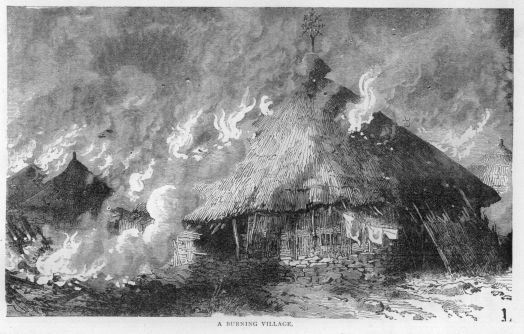
Eighty-four persons, chiefly women and children, were thus liberated; and being told that they might go where they liked, they decided on remaining with the English. The men willingly carried the bishop’s goods.
Eight others were freed in a hamlet on the road; but another party, with nearly a hundred slaves, though followed by Dr Kirk and four Makololo, escaped. Six more captives were soon afterwards liberated, and two slave-dealers were detained for the night, but being carelessly watched by two of the bishop’s black men, who had volunteered to stand guard over them, they escaped. The next day fifty more slaves were freed at another village and comfortably clothed.
At Chigunda a Manjanga chief had invited the bishop to settle in his country near Magomero, adding that there was room enough for both. This spontaneous invitation seemed to decide the bishop on the subject.
Marching forward, on the 22nd news was received that the Ajawa were near, burning villages; and at once the doctor and his companions advanced to seek an interview with these scourges of the country. On their way they met crowds of Manjangas flying, having left all their property and food behind them. Numerous fields of Indian corn were passed, but there was no one to reap them. All the villages were deserted. One, where on the previous visit a number of men had been seen peacefully weaving cloth, was burned, and the stores of grain scattered over the plain and along the paths. The smoke of burning villages was seen in front, and triumphant shouts, mingled with the wail of the Manjanga women lamenting over the slain, reached their ears. The bishop knelt and engaged in prayer, and on rising, a long line of Ajawa warriors with their captives was seen. In a short time the travellers were surrounded, the savages shooting their poisoned arrows and dancing hideously. Some had muskets, but, on shots being fired at them, they ran off. The main body in the mean time decamped with the captives, two only of whom escaped and joined their new friends. Most of the party proposed going at once to the rescue of the captive Manjanga; but this Dr Livingstone opposed, believing that it would be better for the bishop to wait the effect of the check given to the slave-hunters. It was evident that the Ajawa were instigated by the Portuguese agents from Tete. It was possible that they might by persuasion be induced to follow the better course, but, from their long habit of slaving for the Quillimane market, this appeared doubtful. The bishop consulted Dr Livingstone as to whether, should the Manjangas ask his assistance against the Ajawa, it would be his duty to give it? The reply was: “Do not interfere in native quarrels.” Leaving the members of the mission encamped on a beautiful spot, surrounded by stately trees, near the clear little stream of Magomero, the expedition returned to the ship to prepare for their journey to Lake Nyassa.
On the 6th of August, 1861, the two doctors and Charles Livingstone started in a four-oared gig, with one white sailor and twenty Makololo, for Nyassa. Carriers were easily engaged to convey the boat past the forty miles of the Murchison Cataracts. Numberless volunteers came forward, and the men of one village transported it to the next. They passed the little Lake of Pamalombe, about ten miles long and five broad, surrounded thickly by papyrus. Myriads of mosquitos showed the presence of malaria, and they hastened by it.
Again launching their boat, they proceeded up the river, and entered the lake on the 2nd of September, greatly refreshed by the cool air which came off its wide expanse of water. The centre appeared to be of a deep blue, while the shallow water along the edge was indicated by its light green colour. A little from the shore the water was from nine to fifteen fathoms in depth, but round a grand mountain promontory no bottom could be obtained with their lead-line of thirty-five fathoms. The lake was estimated to be about two hundred miles long and from twenty to sixty broad.
The lake appeared to be surrounded by mountains, but on the west they were merely the edges of high table-land.
It is visited by sudden and tremendous storms. One morning the sea suddenly rose around them, preventing them from advancing or receding, as the tremendous surf on the beach would have knocked their light boat to pieces, while the waves came rolling on in threes, their crests broken into spray. Had one of them struck the boat, nothing could have saved her from being swamped. For six hours they remained at anchor a little from the shore, thus exposed to the fury of the gale. The crew became sea-sick and unable to keep the boat’s head to the sea, while some of their party who had remained on shore watched them, the natives every moment exclaiming: “They are lost! they are all dead!”
After this, every night they hauled the boat up on the beach; and, had it not been supposed that these storms were peculiar to one season, they would have given the Nyassa the name of the “Lake of Storms.”
A dense population exists on the shores of the lake, some being a tribe of Zulus who came from the south some years ago. They own large herds of cattle, and are on the increase by uniting other people to themselves. The marshy spots are tenanted by flocks of ducks, geese, cranes, herons, and numerous other birds. The people cultivate the soil, growing large quantities of rice, sweet potatoes, maize, and millet. Those at the north end reap a curious harvest. Clouds of what appeared to be smoke rising from miles of burning grass were seen in the distance. The appearance was caused by countless millions of midges. As the voyagers’ boat passed through them, eyes and mouth had to be kept closed. The people collect these insects by night, and boil them into thick cakes, to be eaten as a relish. One of the cakes, which tasted like salted locusts, was presented to the doctor.
Abundance of fish were caught, some with nets and others with hook and line. Women were seen fishing, with babies on their backs.
Enormous crocodiles were seen, but, as they can obtain abundance of fish, they seldom attack men. When, however, its proper food is scarce, the crocodile, as is always the case, becomes very dangerous.
The lake tribes appear to be open-handed, and, whenever a net was drawn, fish was invariably offered. On one occasion the inhabitants, on their arrival, took out their seine, dragged it, and made their visitors a present of the entire haul. The chiefs treated them also with considerable kindness. One at the north of Marenga, who was living in a stockade in a forest surrounded by a wide extent of country, which he owned, made them beautiful presents. The doctor admiring an iron bracelet studded with copper which the chief wore, he took it off and presented to him, while his wife did the same with hers.
Wherever the slave trade is carried on, the people are dishonest and uncivil, and when they found that the English did not come to buy slaves, they immediately put on a supercilious air, and sometimes refused to sell them food. At one of these places a party of thieves stole into the camp and carried off most of their goods, no one awaking, though their rifles and revolvers were all ready. The cloth, having been used for pillows, escaped, but nearly all their clothing was lost, and even their note-books and specimens.