"Great African Travellers" (continued 3)
Reading edition
A lucky omen, as the natives supposed it, occurred. Among the presents offered by the king was ajar of honey; this one of the servants upset without breaking the pot. Had it been broken, the omen would have been unfortunate; as it was, the governor was highly pleased, and ordered the poor to be called in to lick up the honey. They rushed in, squabbling among themselves. One old man, having a long beard, came off with a double allowance, for he let it sweep up the honey and then sucked it clean.
Dr Oudney soon after this became too weak to sit his horse, but still he begged to be carried on. They therefore travelled forward to the town of Murmur. Here they were compelled to stop, though the doctor the next morning, after drinking a cup of coffee, with the assistance of his companions dressed. It was soon evident that he would be unable to proceed. He was carried back into his tent, where in a short time Captain Clapperton, with unspeakable grief, witnessed his death without a struggle or a groan. He was but thirty-two years of age. His friend had a deep grave dug, and enclosed it with a wall of clay to keep off the beasts of prey. He had also two sheep killed and distributed among the poor.
Ill as Captain Clapperton himself was, and now left alone among strange people, the loss to him was severe and afflicting. Still, his ardent spirit triumphing over sorrow and trouble, he pursued his journey, and on the 20th of January he entered Kano, the great emporium of the kingdom of Haussa. He dressed himself in his naval uniform to make an impression on the inhabitants of the city, which, from the description of the Arabs, he expected to see of surprising grandeur. His disappointment was therefore great, when he traversed the place. He found the houses nearly a quarter of a mile from the walls, and in many parts scattered into detached groups between large stagnant pools of water. Not an individual turned his head round to gaze at him, all being intent on their own business. The market-place was bordered to the east and west by an extensive swamp, covered with weeds and water and frequented by wild ducks, cranes, and vultures. The house which had been provided for him was close to a morass, the pestilential exhalations of which were increased by the sewers of the houses all opening into the street.
Fatigued and sick, he lay down on a mat which the owner had spread for him. His mansion had six chambers above, extremely dark, and five rooms below, with a dismal-looking entrance, a back court, draw-well, and other conveniences. Little holes, or windows, admitted a glimmering light into the apartments. Nevertheless, this was thought a handsome mansion.
All the Arab merchants, not prevented by sickness, who had travelled with him from Kouka, came to see him, looking more like ghosts than men, as almost all strangers at the time were suffering from intermittent fever.
The governor gave him a private audience, and seemed highly pleased with the presents he received, promising to forward them on to his master, the Sultan Bello, at Sackatoo, after his own return from an expedition which would occupy him fifteen days.
During the interval Captain Clapperton suffered greatly from fever.
The newspapers which he here received from Major Denham apprised him of Belzoni’s attempt to penetrate to Timbuctoo by the way of Fez.
On returning from a ride he met two large bodies of troops, who were to accompany the governor, each consisting of five hundred horse and foot. The latter were armed with bows and arrows, the cavalry with shields, swords, and spears, and sumptuously accoutred. The swords were broad, straight, and long, and were indeed the very blades formerly wielded by the knights of Malta, having been sent from that island to Tripoli, where they were exchanged for bullocks and carried across the desert to Bornou, thence to Haussa, and, at last, re-mounted at Kano for the use of the inhabitants of almost all central Africa. The shields were covered with hides of animals, and were generally round; but there were some of an oval shape, in the centre of which was scored a perfect Maltese cross. He observed crosses of other forms cut in the doors of the houses.
Several camels, loaded with quilted cotton armour, both for men and horses, were in attendance. This armour was arrow proof; but it is seldom worn, except in actual combat. The saddles had high peaks before and behind, and the stirrup-irons were in the shape of a fire-shovel.
A nephew of the Sultan Bello paid him a visit the next morning and told him, after taking a cup of tea, which he liked very much, that he had hitherto looked upon a Christian as little better than a monster, though he now confessed that he liked the traveller. Another nephew came also, a most intelligent young man, who read and spoke Arabic with fluency, and was very anxious to see everything, and to hear all about England.
He found the market well supplied with every necessary and luxury in request among the people of the interior. The sheikh, who superintended it, however, fixed the prices of all wares, for which he was entitled to a commission; and, after every bargain, the seller returned to the buyer a stated part of the price by way of a blessing, or a “luck-penny” as it would be called in England. Cowries were here used as coins, though somewhat cumbersome, as twenty were worth only a halfpenny; thus, in paying a pound sterling, nine thousand six hundred shells had to be counted out. As he remarks: “The great advantage of the use of the cowrie is that forgery is excluded, as it cannot possibly be imitated.” The natives show also great dexterity in counting out even the largest sums.
The butchers were numerous, and understood showing off animals to the best advantage. Sometimes they even stuck a little sheep’s wool on a leg of goat’s flesh, to make it pass for mutton. When a fat bull was brought to the market to be killed, its horns were dyed red with henna, the drummers attended, a mob soon collected, the news of the animal’s size and fatness spread, and all ran to buy. Near at hand were small wood fires stuck round with wooden skewers, on which small bits of fat and lean meat, the size of a penny-piece, were roasting, superintended by a woman with a mat dish placed on her knees, from which she served her guests, who were squatted round her. Indeed, the market was as busy a one as can be seen in any country. Jugglers also, like those of India, were practising their tricks with snakes, having extracted the venomous fangs.
Haussa is celebrated for its boxers, the most expert of whom are found among the butchers. Clapperton having intimated his willingness to pay for a performance, a number of combatants arrived, attended by two drummers and the whole body of butchers. A ring was soon formed, by the master of the ceremonies throwing dust on the spectators to make them stand back. The drummers entered the ring, followed by one of the boxers, who was quite naked with the exception of a skin round his middle. Placing himself in an attitude as if to oppose an antagonist, he wrought his muscles into action, and then went round the ring showing his arms to the bystanders and exclaiming: “I am a hyaena! I am a Hon! I am able to kill all that oppose me!” To which the spectators replied, “The blessing of God be upon thee!—Thou art a hyaena: thou art a lion.”
A number of fighters then came forward, when they were next ranged in pairs. If they happened to be friends, they laid their left breast together twice, and exclaimed: “We are lions! we are friends!” Then one left the ring, and another was brought forward. If the two did not recognise one another as friends, the combat immediately commenced. They parried with the left hand open, and struck as opportunity offered with the right, generally aiming at the pit of the stomach and under the ribs. Occasionally they closed with one another, when one seized the other’s head under his arm and beat it with his fist, at the same time striking with the knee between his antagonist’s thighs. Indeed, much the same brutality was exhibited as in English prize-fights. Clapperton, hearing that they sometimes gouged out each other’s eyes, and that such combats seldom terminated without one or more being killed, having satisfied his curiosity, ordered the battle to cease, and gave the promised reward.
The custom in this place is to bury the people in their own houses, which are occupied as usual by the poorer classes; but when a great man is buried, the house is for ever after abandoned. A corpse being prepared for interment, the first chapter of the Koran is read over it. The funeral takes place the same day. The bodies of slaves are dragged out of the town and left a prey to vultures and wild beasts in most places; but in Kano they are thrown into the morass or nearest pool of water.
On the 22nd of February, Clapperton commenced his journey towards Sackatoo, in company with an Arab merchant, Mahomet Jolly, having left his Jew servant, Jacob, to return in case of his death, with his effects to Bornou.
At the towns where he stopped he was generally taken for a fighi, or teacher, and was pestered to write out charms. One day his washerwoman insisted on being paid with a charm in writing, that would induce people to buy earthenware of her.
After travelling for some days he was met by an escort of one hundred and fifty horsemen with drums and trumpets, sent by Sultan Bello to conduct him to his capital, which he reached on the 16th of March. He, as usual, dressed himself in his naval uniform; and, as he approached the gates, he was met by a messenger from the sultan, to bid him welcome and to acquaint him that his master, who was out on an expedition, would return to Sackatoo in the evening.
Large crowds were out to look at him, and he entered the city amid the hearty welcomes of young and old. He was conducted to the house of the gadado, or vizier, where apartments were provided for him and his servants. The gadado himself arrived in the evening, and was excessively polite, but would not drink tea with him, as he said that he was a stranger in their land, and had not yet eaten of his bread.
Next morning the sultan sent for him. Clapperton found him seated on a small carpet, between two pillars supporting the roof a thatched house. The walls and pillars were painted blue and white in the Moorish taste. Giving him a hearty welcome, the sultan at once entered into conversation. He asked numerous questions about Europe, and seemed perfectly well acquainted with the names of the more ancient sects, inquiring whether his visitor was a Nestorian or a Socinian. Clapperton replied that he was a Protestant, but had to acknowledge that he was not sufficiently versed in religious subtleties to solve all the knotty points on which Bello wished for information. He then ordered some books belonging to Major Denham to be brought, among which was his journal, and they were all in a handsome manner returned. He spoke with great bitterness of Boo-Khaloum for making predatory inroads into his territories, next putting the puzzling question: “What was your friend doing there?” Clapperton replied that Major Denham had no other object than to make a short excursion into the country.
The sultan was a noble-looking man, somewhat portly, with short, curling, black beard, a small mouth, a fine forehead, Grecian nose, and large, black eyes. He was habited in a light-blue cotton tobe, with white muslin turban, the small end of which he wore over the nose and mouth in the Turaick fashion.
This was the first of many visits Clapperton paid him.
He was highly pleased with the various presents which the King of England had sent him. He asked what he could give in return. Clapperton replied that the most acceptable service he could render would be to assist the King of England in putting a stop to the slave trade.
“What!” he asked; “have you no slaves in England? What do you do for servants?”
He was much astonished at hearing that regular wages were paid, and that even soldiers were fed, clothed, and received pay from government.
“You are a beautiful people,” he observed.
The usual question was also put: “What are you come for?” Clapperton replied, “To see the country—its rivers, mountains, and inhabitants, etcetera. My people had hitherto supposed yours devoid of all religion, and not far removed from the condition of wild beasts, whereas I now find them to be civilised, learned, humane, and pious.”
On another occasion Clapperton exhibited a planisphere of the heavenly bodies. The sultan knew all the signs of the zodiac, some of the constellations, and many of the stars by their Arabic names. He was greatly interested with the sextant, or, as he called it, “the looking-glass of the sun.” Clapperton showed him how to obtain an observation with it.
The sultan made minute inquiries as to the conquests of the English in India, and also the reason of their attack on Algiers, evidently suspecting that they contemplated similar proceedings against his country. Clapperton explained that the King of England had a vast number of Moslems who were his willing subjects, and that their object in India was to protect the natives and to give them good laws, not to tyrannise over them; while, with regard to Algiers, the Algerines had been punished because they persisted in making slaves of Europeans.
The sultan, however, as after events proved, was far from satisfied, his fears being increased by the Arabs, who were aware that the chief object of the English was to open up a trade from the west coast with the country, and, should they succeed, they themselves would thus be deprived of their trade across the desert from the north.
At Clapperton’s request the sultan ordered a chart of the Quorra to be drawn by one of his learned men, who asserted that that river entered the sea at Fundah, near a town called Jagra, governed by one of Bello’s subjects.
This made the traveller still more anxious to proceed down that river to the coast, but the sultan, though he at first promised an escort, ultimately declined sending it, declaring that he could not sanction so rash an enterprise, and that his guest could only return home by the way he had come.
From an Arab chief residing here Clapperton obtained much information about Mungo Park and the way in which he had lost his life, which confirmed what had previously been heard.
The sultan made an especial request that an English consul and physician should be sent to reside at Sackatoo, and Clapperton promised that he would represent the matter to his own government, and he had no doubt that his request would be complied with. He also begged that guns and rockets might be sent out by way of Tripoli and Bornou, under the escort of an Arab leader, El Wordee, who had conducted the last caravan. This Clapperton had no doubt was a device of El Wordee’s, to have the opportunity of conducting another English mission and fleecing them as he had done the last. When the Arab found that his plans were opposed by the traveller, he set to work to revenge himself, and by his machinations succeeded in compelling Clapperton to abandon his intended journey to the sea-coast by way of Youri.
Frequent attempts were made to induce the traveller to turn Mahommedan, especially by a famous old maraboo; but after his failure the Moslem appeared to have given up the attempt as hopeless.
At length, on the 4th of May, he was allowed to take his departure from Sackatoo, escorted by one the sultan’s officers, with a party of merchants and their slaves. As the country was in a disturbed state, they pushed on night and day through a dense underwood, which tore their clothes and scratched the legs of the riders. Several of the poor natives on foot, who had taken advantage of the escort to pass through this part of the country, overcome with fatigue and thirst, sank down never to rise. One of Clapperton’s servants also dropped, apparently dead; but his master had him lashed on the camel, when, throwing up a quantity of bile, he soon appeared as fresh as ever. The next day many of the horses died, and all the people were overcome with fatigue and thirst. On the third day no less than nine men and six horses were found to have perished on the road.
Clapperton was taken to the town of Kashna, where an old Arab chief, who had resided there for some years, took compassion on him and sent an elderly black slave woman to nurse him, with two younger attendants. This was the first offer of the kind he had ever received from a Mussulman, and under their care and attendance he soon recovered his health and strength.
After meeting with numerous adventures and exposed to many dangers, on the 8th of July he reached Kouka, when he found that Major Denham was absent on a journey to the east side of the Chad. Hillman, the carpenter, was busily employed in finishing a covered cart, to be used as a carriage for the sheikh’s wives. The workmanship reflected the greatest credit on his ingenuity, though it was neither light nor handsome.
On the 16th of August, soon after Major Denham returned from the eastward, he and Captain Clapperton, accompanied by William Hillman the carpenter, took their departure from Kouka, with the intention of first visiting the shores of Lake Chad and then joining the kafila which was on its way from Soudan to Tripoli. On the morning of their departure they went to take leave of the sheikh, whom they found in his garden. He gave them a letter to the King of England, and a list of requests, and expressed himself very kindly. At parting he offered his hand, which excited an involuntary exclamation from his attendants.
Meeting with no event of any especial interest on their visit to the lake, they joined the caravan on the 14th of September.
Throughout the journey they found that they got on as well, if not better than their companions, who looked to them both for safety and protection, as well as for the direction of the route. They had upwards of fifty miles to cross, over a frightful waste of movable sand-hills, to Zow; many of the poor children, panting with thirst, scarcely able to creep along.
At Bilma they laid in a stock of dates for the next fourteen days, during which man and beast nearly subsisted upon them, the slaves for twenty days together mostly getting no other food.
Then came the stony desert, which the camels, already worn-out by the heavy sand-hills, had to cross for nine days. El Wahr is of surpassing dreariness, the rocks a dark sandstone of the most gloomy and barren appearance; the wind whistles through the narrow fissures, where not a blade of grass finds nourishment, and, as the traveller creeps under the lowering crags to take shelter for the night, he stumbles over the skeleton of some starved human being.
On the day they made El Wahr, and the two following, camels in great numbers dropped down and died, or were quickly killed and the meat brought in by the hungry slaves.
Such are some of the ordinary events of a journey across the desert.
On the 21st of January, 1825, they reached Tripoli, and soon after embarked for Leghorn. Before leaving, however, Major Denham obtained the freedom of a Mandara boy, whose liberation from slavery he had paid for some months before. He now got the pacha to put his seal on the necessary document, the only way in which a Christian can give freedom to a slave in a Mahommedan country.
The travellers were long detained by quarantine at Leghorn, so that the three survivors of the expedition did not teach England till the 1st of June.
Chapter Eight.
Captain Clapperton’s second journey.
Captain Clapperton’s second journey, accompanied by Richard Lander—Joined by Captain Pearce—Messrs Morrison and Dickson—Reaches Benin—Journey of Dickson and Columbus—Their disappearance—Clapperton starts from Badagarry—Joined by Mr Houtson—Expedition reaches Jannah—Attacked by fever—Well received—Fondness of people for dogs—Death of Captain Pearce and Dr Morrison—The King of Eyeo and his wives—Beautiful country—Felatah villages—Enter Youriba—The King’s Court—Entertained with a play—Mr Houtson returns and dies—Clapperton, with Lander and Pasco, proceeds alone—Reaches Wawa, near the Niger—The widow Zuma—Inquiries about Park—Visits the scene of his death—Well treated by King of Wawa—Enters kingdom of Nyffe—Lax Mahommedans—Desolated by warfare—Reaches Kano—Leaves Lander with the baggage, and proceeds to Sackatoo alone—Trying journey—Well received by Bello—Siege of Zeg-zeg—Absurd style of fighting—Bello seizes his property—Lander arrives at Sackatoo—Illness and death of Clapperton—Buried by Lander—Lander sets out with intention of exploring the Niger—Warned not to proceed south—Leaves Kano for the west—Taken to Zaria—Allowed to proceed—Continues journey alone to Badagarry, and arrives in England.
From the favourable report which Clapperton on his return home brought of the Sultan Bello of Sackatoo, and his wish to open up a commercial intercourse with the English, the Government determined at once to send out another expedition, in the hopes that that object might be carried out, and that means might be found for putting a check on the slave trade in that part of Africa.
Clapperton, now raised to the rank of commander, was placed at the head of the expedition. Captain Pearce and a Mr Morrison, a naval surgeon, were appointed to serve under him. He also engaged the services of Mr Dickson, another surgeon, and of a very intelligent young man, Richard Lander, who was to act as his servant.
As Sultan Bello stated that two large towns under his government existed near the coast, called Funda and Raka, and that he would send down messengers, whom his friends would meet on their arrival, it was settled that the expedition should proceed to the Bight of Benin, and thence make their way to Sackatoo. Losing no time, the very year after his return Clapperton sailed from Portsmouth on board HM sloop “Brazen,” and, touching at Sierra Leone, arrived at Benin on the 26th of November.
Mr Dickson, wishing to make his way alone to Sackatoo, was landed at Whidah, taking with him Columbus, Denham’s former servant, and from thence, in company with a Portuguese of the name of De Sousa, he set off for Dahomey. Here he was well received and was sent forward to a place called Shar, seventeen days’ journey from Dahomey. From thence he was known to have set forward with another escort, but from that time nothing whatever was heard of him or his attendant, Columbus.
At Benin Clapperton met an English merchant of the name of Houtson, who advised him not to ascend the river, but to take a route from Badagarry across the country to Katunga, the capital of Youriba.
Under the sanction of the King of Badagarry, the mission set out on its long and perilous journey on the 7th of December, accompanied by Mr Houtson.
At Badagarry Clapperton had engaged an old negro, who had been a sailor, named Pasco, and who, speaking English, was likely to prove useful as an interpreter.
Travelling on sixty miles, the mission entered the town of Jannah. By this time all its members were suffering greatly from the climate; Captain Pearce and Dr Morrison especially were very ill, and Richard Lander was also suffering. Those who were able had ridden on horseback, but the sick were carried in hammocks.
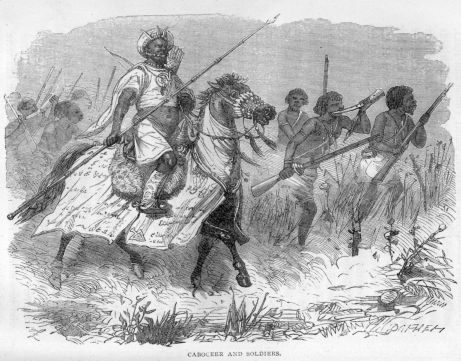
They halted in the palaver-house, an open shed, which was soon surrounded by thousands of people making a great noise. Here they waited till the caboceer, or chief man, made his appearance. He came gorgeously attired in a large yellow silk shirt and red velvet cap, with a silver-mounted whip ornamented with beads in one hand, and a stick covered with bells in the other, which he rattled whenever he spoke. He took his seat on a large leathern cushion, placed on a scarlet cloth. When Captain Clapperton was going to sit down on the cloth, the attendant ladies pulled it from under him; so he took his seat on a mat. The females then sang in chorus very beautifully. The members of the commission then shook hands with the caboceer, who said he was glad to see them, and that whatever they had to say to the King of Eyeo must first be delivered to him. Their reply was that they had nothing to say, except to request that the king would grant them a passage through his country. His answer was that he was glad, that they should see the King of Eyeo’s face, and that he would give them a good path and forward them on without trouble; but that they must ride on horseback, as his people were unaccustomed to carry hammocks. They were then shown to a house, where they remained during their stay.
As Captain Clapperton and Mr Houtson walked through the town, they were followed by an immense crowd, who rushed over the baskets in the market-place, the boys darting under the stalls, the women bawling after those who had scattered their goods; yet not a word of disrespect was uttered to the strangers. They remarked the kind way in which the dogs in this place were treated, their necks ornamented with collars of different colours, and cowries. No great man was without one, which always has a boy to take care of it.
The people, hearing that a Brazilian brig had arrived at Badagarry, were preparing to set out on a slaving expedition to a place to the eastward.
Slave-dealers as the people were, they deserve to be commended for their honesty; for during the whole journey hitherto, although the mission had had ten relays of carriers, not a single article had been stolen.
A few days after, Dr Morrison, who continued to get worse, requested to return, hoping that the sea air would restore him. Mr Houtson accompanied him back to Jannah. The next day Dawson, a seaman, who, while suffering from ague caught at Jannah, had fallen off into the water in the morning, died in the evening. Three days afterwards Captain Pearce, who, supported by his wonderful spirits, insisted upon coming on, grew much morse, and at nine in the evening he breathed his last.
The death of his friend was a serious loss to Clapperton, for he was eminently qualified by his talents and perseverance to render essential service to the mission.
Another three days passed, when Mr Houtson returned with the sad news that Dr Morrison had died at Jannah on the same day as Captain Pearce.
Mr Houtson, though unwell, still insisted on accompanying Clapperton.
Powerful as the king of Eyeo pretended to be, he employed his wives in every place to trade for him, and, like women of the common class, they were seen carrying large loads on their heads from town to town.
On the 6th of January, 1826, the travellers entered the town of Chocho, beyond which their road lay through beautiful rocky valleys, cultivated in many places, and planted with cotton, corn, yarns, and bananas, and many watered by little streams. Numbers of little huts were seen perched on the tops and in the hollows of the hills. Beautiful as the country was, it was the scene of the miserable devastating wars carried on in all parts of Africa for the purpose of obtaining slaves to be sold on the coast.
On the 8th they entered Duffo, a town containing fifteen thousand people. The crowd which came to see them in the house where they were lodged was immense. When the people were told to go away, they said: “No; if white man would not come out, they would come in to see him.”
They passed numerous other large towns, and were received in a friendly manner by the caboceers, and were well supplied with fowls, sheep, and goats. Yet the people, though kind, were exceedingly curious, and allowed them but little rest.
Further eastward they passed a number of Felatah villages, whose inhabitants live there as they do in most other parts of Africa, attending to the pasturage of their cattle, without interfering in the customs of the country, or receiving any annoyance from the natives. Some of them, as they passed, brought them milk to drink.
Further on, however, they came to a number of villages, some of which had been destroyed by the Felatahs, their walls being already covered with weeds.
As they approached Katunga, the capital of Youriba, the caboceer, with an enormous escort, came out to meet them. His musicians kept drumming, playing, dancing, and singing all night.
The country round was well-cultivated. The city, as they saw it lying below them, appeared surrounded and studded with green, shady trees, forming a belt round the base of a granite mountain.
The king was found seated under the verandah of his house, with two red and blue umbrellas, raised on large poles, held over him by slaves.
The crowd, as they advanced, had to be kept back with sticks and whips; but they were used in a good-natured manner.
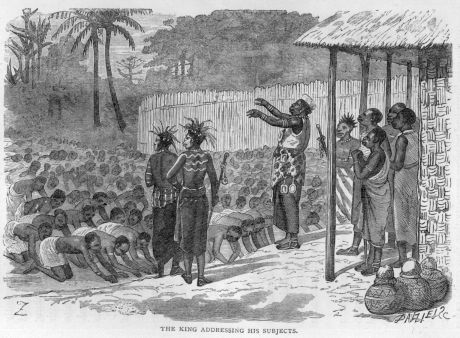
Clapperton was told that he must prostrate himself before the king; but this he declined doing, saying that he would turn back unless he was allowed to act as he would do before his own sovereign; that he would only take off his hat, and bow, and shake hands with his majesty, if he pleased. The king agreed to this, and the English were introduced in due form.
Behind the king were an immense number of ladies, so closely packed that it was impossible to count them. They stood up as the strangers approached, and cheered them, shouting “Oh, oh, oh!” equivalent to “Hurra!” while the men outside joined them.
The king had on a large white shirt, with a blue one under it, and a pasteboard crown, covered with blue cotton, made apparently by some European on the coast, and sent up to him as a present.
Comfortable apartments were provided for them, and in the evening the king himself made his appearance, plainly dressed, with a long staff in his hand, saying that he could not sleep till he had personally ascertained how they were.
They spent two very pleasant days here, resting after the fatigues of their journey. The king pressed them to remain to see the national amusements, which would begin in about two months. On this, Mr Houtson enquired whether they were such as took place at Dahomey, on which the king declared that no human beings were ever sacrificed in Youriba, and that if he ordered the King of Dahomey to desist from such a practice he must obey him.
The king had sent forward a messenger to open the way to Nyffe, and till he returned they were compelled to remain at the capital.
They were entertained here with a pantomime, the stage being the open ground before his majesty’s residences, the characters appearing in masks. One of them presented an enormous snake, which crept out of a huge bag and followed the manager round the park while he defended himself with a sword. Out of another sack came a man covered apparently with white wax, to look like a European, miserably thin and starved with cold. He went through the ceremony of taking snuff and rubbing his nose. When he walked it was with an awkward gait, treading as the most tender-footed white man would do in walking with bare soles over rough ground.
Clapperton pretended to be as much pleased with this caricature of a white man as the natives were.
Between each act the king’s women sang a number of choral songs, joined by the crowd outside.
They thankfully heard, on the 6th of March, that the messengers had returned, and that they might set out the next day, when the king presented Clapperton with a horse and bade him farewell.
Mr Houtson, who had been for some time suffering from illness, was compelled to return, and he, too, died on reaching the coast.
Clapperton, with his faithful attendant, Richard Lander, and the black, Pasco, proceeded alone. They had evidence as they advanced of the destruction caused by the Felatahs, in the number of villages which had been burnt down, while the inhabitants of others, who had taken to flight, were seen returning to their homes.
A few days after starting they overtook a large caravan belonging to Haussa, on its way from Gonga and Ashantee. It consisted of upwards of a thousand men and women, and as many beasts of burden. The head man offered to carry Clapperton’s baggage to Kano for a certain sum. He said that he had been detained in Gonga twelve months on account of the wars. Their goods were carried on bullocks, mules, asses, and also by a number of female slaves. Some of the merchants had no more property than they could carry on their own heads. The chief of the town, however, advised Clapperton not to trust the caravan leader, for, as he had no means of conveying his luggage, he would undoubtedly leave him in the lurch. He therefore proceeded as he intended, alone.
On the 20th of March Clapperton entered the village of Barakina, the inhabitants of which were noted as the best hunters in the country. As he entered, a hunter came in from the chase. He wore a leopard-skin over his shoulder, carrying a light spear in his hand, and his bow and arrows slung over his shoulder. He was followed by three cream-coloured dogs, their necks adorned with collars of different-coloured leather. He was followed by a slave carrying a dead antelope.
On leaving this village he passed through a narrow gorge, shaded by tall majestic trees. “Here,” he thought to himself, “are the gates leading to the Niger.”
Next day he arrived before the walls of Wawa, in the neighbourhood of the far-famed river.
Here he met with a most unexpected difficulty. Not only did the daughter of the governor make love to him, but a rich widow called Zuma, the daughter of an Arab, who, though brown, considered herself a white woman, insisted on marrying either him or his servant Richard. Being above twenty, she was considered past her prime; but had it not been for her stoutness, which made her look like a walking water-butt, she would really have been handsome. Finding that neither of the white strangers would accept her offers, she endeavoured to entrap them by giving a wife to Pasco, by which, according to the customs of the country, she obtained some sort of claim over his master. The governor soon became alarmed, declaring that, as the lady had a thousand slaves and enormous wealth, she would very likely drive him from the country, and, should the traveller accept her hand, raise him to the throne of Waiva. In the hopes of ending the matter, Clapperton set off for the Niger, leaving his baggage to follow him to the ferry of Comie, while he went round by Boussa. Greatly to his annoyance his baggage was, however, detained by the governor, who feared the widow Zuma’s machinations, and refused to liberate it till her return. Clapperton had great difficulty in making him believe that he had no sort of communication whatever with the lady. Next day, however, the widow Zuma made her entrance into the city, sitting astride on a fine horse, with housings of scarlet cloth trimmed with lace. She herself was habited in a red silk mantle, red trousers, and morocco boots, numerous spells enclosed in coloured leather cases being hung round her. A large train of armed attendants followed her, while she was preceded by a drummer decked in ostrich feathers.
Clapperton’s resolution, however, was not to be overcome. To settle the matter he made Pasco give back his wife again, assuring the governor that he had no intention whatever of entering into any of her designs. She, therefore, indignantly shook the dust from her feet, and allowed the hard-hearted stranger to proceed unmolested on his way.
He made inquiries of all who could give him any information about the fate of Park. They all asked him whether he intended to take up the vessel, which they said still remained at the bottom. The governor’s head man told him that the boat stuck fast between two rocks; that the people in it laid down four anchors ahead, when, the water rushing down fiercely from the rocks as the white men attempted to get on shore, they were drowned; that crowds of people went to see them, but that the white men did not shoot at them, nor did the natives at the people in the boat, as they were too much frightened either to shoot at or assist them. They said, further, that a great many things were in the boat—books and riches—which the Sultan of Boussa had possession of; that there was an abundance of beef, cut in slices and salted, and that the people of Boussa who had eaten of it had died because it was human flesh, which it was well-known white men eat. Another man, however, asserted that the natives did shoot arrows because the people in the boat had fired at them.
They all treated the affair with much seriousness, looking on the place where the boat was wrecked with awe, and telling some most marvellous stories about her and her ill-fated crew.
Boussa, Clapperton says in his journal, is a large town with extensive walls, situated on an island in the Quorra, and that to reach it he had to cross in a canoe, while his horse swam over.
After Clapperton had offered the sultan the presents he had brought for him, he inquired about the white men who had been lost in the river. He seemed very uneasy at the question, and replied that he was a little boy at the time, and had nothing belonging to them; indeed, Clapperton found that any books and papers which had been saved were in the possession of the Sultan of Youri.
Shortly afterwards a messenger arrived from that chief, inviting him to his town, and offering to send canoes to convey him up the river; but Clapperton, anxious to proceed on his journey, unfortunately declined the offer.
He was here treated in the kindest way possible, and everyone was ready to give him information on all points, with the exception of that connected with Park’s death.
The place, however, where the boat struck and the unfortunate crew perished was pointed out to him. It was in the eastern of three channels into which the river is here divided. A low flat island of about a quarter of a mile in breadth lies between the town of Boussa and the fatal spot. The banks are not more than ten feet above the level of the water, which here breaks over a grey slaty rock, extending across to the eastern shore.
The sultan made him a present of a fine young horse, and his brother, with many of the principal people, accompanied him as he set out on his journey.
As he rode towards the ford at Comie, he ascended a high rock overlooking the river. From hence he saw the stream rushing round low rocky and wood-covered islands and among several islets and rocks, when, taking a sudden bend to the westward, the water dashed on with great violence against the foot of the rock on which he sat. Below the islands the river fell three or four feet, while the rest of the channel was studded with rocks, some of which were above water. It seemed to him, that even had Park and Martyn passed Boussa, their vessel would almost to a certainty have been destroyed on these rocks, where they would probably have perished unheard of and unseen.
The traveller next entered the kingdom of Nyffe, till lately one of the best cultivated and most flourishing in Africa, but, in consequence of having been the prey of a desolating civil war, now almost ruined. A dispute had arisen between two rival princes, one of whom called in the aid of the Felatahs, who, in their usual way, had ravaged the whole country and placed the traitorous prince on the throne. Two large walled towns had, however, resisted the inroads of the invaders: one of these was Coolfu, where Clapperton and the caravan he had now joined halted for some days. Although the inhabitants were professedly Mussulmans they were exceedingly lax in their religious duties, and none of the bigotry so prevalent in other places was discernible. The women, indeed, took an active part in public matters, many of them being engaged in mercantile pursuits. They have an odd idea about imbibing the precepts of the Koran; and, to do so, they get some learned man to write texts from it with black chalk on pieces of board. These are then washed, when the water is drunk. They evidently consider it a fetish or charm of some sort.
Clapperton now entered the Felatah country of Zeg-zeg. The region, in the neighbourhood of its capital, Zaria, was the most beautiful he had seen in Africa, being variegated with hill and dale, resembling in many respects the finest parts of England. It was covered with rich pastures and fields, now blessed with plentiful crops, while the rice grown there was the finest in Africa. Zaria was said to contain fifty thousand inhabitants, a population exceeding that of Kano.
Arrived at Kano, he took up his quarters in his former residence. The city was, however, in a great state of agitation, in consequence of war raging on every side. Hostilities had broken out between the King of Bornou and the Felatahs, while other provinces were in open rebellion, so that a caravan had great difficulty in proceeding in any direction.
As Kano is midway between Sackatoo and Bornou, Clapperton, who purposed visiting the latter province, determined to leave his baggage at Kano, under charge of Richard Lander, while he himself went forward, carrying only the presents intended for Bello.
His journey towards Sackatoo was very fatiguing; his camels were worn-out, while he often suffered greatly from thirst.
At the town of Jaza he met his old friend the gadado, the sultan’s general, with a numerous train on horseback and foot. The horsemen were armed with spears, swords, and shields, the foot with bows and arrows. The women came behind him, some riding on horseback astraddle, some on camels, others on foot carrying the kitchen utensils. The gadado was preceded by a band, with four long trumpets, two drums, and a pipe. On meeting Clapperton he dismounted, and taking him by the hand, walked hand in hand with him into the house which had been prepared for his reception. He said that Bello had received no letters from Bornou appointing where his messengers were to meet the mission on the coast.
Clapperton, besides suffering from hunger and thirst, lost his horse and all his camels, which died, while his journal, ink-horn, pens, and spectacles were stolen; nor did he ever recover them—one of the greatest misfortunes that could happen to a traveller.
On the 15th of October, about noon, he arrived at Bello’s camp, and was immediately admitted to an audience.
The sultan’s residence consisted of a number of huts, screened off by cloth fixed on poles, making quite a village of itself.
He received the traveller in a kind and gratifying way. He asked after the health of the King of England, and was greatly surprised to hear that Clapperton had remained only four months at home, and had hastened back to Africa without seeing his friends.
Bello’s army was on its march to attack Coonia, the capital of the rebels of Goobur. Nothing could be more disorderly than the march, horse and foot intermingled in the greatest confusion, all rushing to get forward; sometimes the followers of one chief tumbled amongst those of another, when swords were half-drawn, but they ended in making faces at each other, or putting on a threatening aspect. This disorderly army consisted of upwards of fifty thousand fighting men, horse and foot.
As soon as they arrived before the town, they formed a dense circle of men and horses around it; the horse kept out of bowshot, while the foot, as they felt courage or inclination to do so, rushed forward and kept up a straggling fire with about thirty muskets in addition to their bows. The Zeg-zeg troops had one French fusil, and the Kano force forty-one muskets. The Kano men, as soon as they fired their pieces, ran out of bowshot to reload. The enemy seldom threw away their arrows, not shooting till they were sure of doing so with effect. Occasionally a single horseman would gallop up and brandish his spear, while he covered himself with his large leathern shield, returning as fast as he went and shouting: “Shields to the wall, you soldiers of the gadado! Why do you not hasten to the wall?” Many of the soldiers answered: “You have a large shield to cover you,” and disregarded the call. At length the troops habited in quilted armour were marched forward, having at a distance a somewhat fine appearance, as their helmets were ornamented with black and white ostrich feathers, while at the sides pieces of tin glittered in the sun, their long, quilted cloaks of gaudy colours reaching down to the horses’ tails and hanging over their flanks. The riders were armed with large spears, and they had to be assisted to mount their horses. Their quilted cloaks were so heavy that it required two men to mount a cavalier. Six of these warriors belonged to the sultan and six to each governor.
The besieged possessed one musket, and with this they did wonderful execution, for it brought down the van of the quilted cavaliers, who fell from his horse like a sack of corn, when the footmen dashed forward and dragged him and his steed out of harm’s way. He had been shot by two balls, which went through his body, one coming out and the other lodging in his quilted armour. There were three Arabs, armed at all points, one of whom was struck by the Coonia musket, but the others kept carefully behind the sultan.
The most useful and bravest person was an old female slave of the sultan, who, mounted astraddle on a long-backed horse, rode about with half a dozen gourds filled with water, and a brass basin, from which she supplied the wounded and thirsty.
In the evening this valiant army retired to their camp, when the Coonia force managed to cut off the water from the stream which supplied it, and then an alarm was raised that they were about to make an attack. On this the whole army, horse and foot, tumbled over each other pell-mell, trying who should get the soonest out of danger.
Clapperton had wisely not undressed, but, making his servant saddle his horse and load his camels, he set off in the morning with the army, which soon afterwards retreated and returned to Sackatoo.
Though his old Arab acquaintance called upon him and pretended to be very friendly, they were plotting his destruction. Bello had also received a letter from the Sultan of Bornou, warning him against the machinations of the English. He likewise took steps to thwart the traveller’s objects, though he did not treat him with any personal violence. When the chief people in the place found that their sultan was no longer on friendly terms with the stranger, they also gave up visiting him, and he was left very much alone. Bello likewise insisted on seeing the letter which Clapperton was carrying to the King of Bornou, and when his request was refused he seized it. He also by false pretences induced Lander to come on to Sackatoo with the presents, including several firearms which were intended for the King of Bornou, that he might get them into his own possession.
This news preyed greatly on Clapperton’s mind, besides which he caught a dangerous chill from lying down while hunting, when overcome with heat and fatigue, on a damp spot in the open air. He was soon afterwards seized with dysentery, which rapidly reduced his strength. During his illness he was watched over with the tenderest care by Richard Lander, who was also himself suffering much from sickness.
Old Pasco, who had been dismissed at Kano for stealing, was at Lander’s suggestion forgiven, and greatly assisted their dying master.
The heat was intense, and Lander used to carry him to a couch outside the hut, where he might enjoy the air, and return with him in the evening. He also daily read to him some portions of the New Testament, and the ninety-fifth Psalm, which he was never weary of listening to.
Twenty days he continued in this state, growing weaker and weaker. At length he called his faithful servant to his bedside. “Richard, I shall soon be no more: I feel myself dying.”
Almost choked with grief, Lander replied: “God forbid, my dear master! you will live many years yet.”
“Don’t be so much affected, my dear boy,” said Clapperton. “It is the will of the Almighty: it cannot be helped.”
He then directed Lander how to dispose of his papers and all his property, adding, as he took his faithful attendant’s hand: “My dear Richard, if you had not been with me I should have died long ago. I can only thank you with my latest breath for your kindness and attachment to me; but God will reward you.”
During their conversation Clapperton fainted from weakness, but after this appeared to rally, and for several days Lander’s hopes revived; but one morning he was alarmed by hearing a peculiar rattling sound proceeding from his master’s throat. At the same instant Clapperton called out, “Richard!” in a low and hurried tone, when going to him, Lander found him sitting upright in his bed, and staring wildly round. Placing his master’s head gently on his left shoulder, Lander gazed for a moment at his pale and altered features. Some indistinct expressions quivered on his lips, and, in the attempt to give them utterance, he expired without a struggle or a sigh.
Having done all that under the circumstances was required, he sent to the Sultan Bello for permission to bury his master; and, in return, an officer arrived with four slaves, and Lander was desired to follow them. Placing Clapperton’s body on the back of his camel, and throwing the Union Jack over it, he bade them proceed, and they conducted him to a village, situated on rising ground, about five miles to the south-east of Sackatoo—the village of Jungavie. Here a grave was dug; and the faithful attendant, opening a prayer-book, read, amid showers of tears, the funeral service over the remains of his beloved master.
Bello appeared to have regretted his treatment of the brave explorer. He furnished Lander with the means of returning home, and gave him permission either to proceed across the desert or to take any other route. Lander, not wishing to trust the Arabs, determined to take the route by which he had come, among the better-disposed negroes. He was accompanied by old Pasco, who acted as his interpreter, and Mudey, a black, who had always been faithful.
On reaching Kano he determined to proceed southward to Funda, where, from the information he received, he hoped to be able to settle the problem of the course of the Niger, to ascertain whether it from thence flowed onward to the sea, or turned eastward into the interior of the country, as by many it was supposed to do.
After travelling some distance he was warned that he would meet with a mountainous region inhabited by cannibals, who would certainly put him to death, and who were reported to have killed and eaten a whole caravan a short time before.
On his way he passed through a large place called Cuttup, which consisted of five hundred small villages clustered together. Here he was well received by the king, whose numerous wives were highly delighted when he made them a present of two or three gilt buttons from his jacket, which they, imagining to be pure gold, fastened to their ears.
He had reached the village of Dunrera near the large city of Tacoba, in the neighbourhood of which the Shary was said to flow in a continuous course between Funda and Lake Chad. This raised his spirits, and he was expecting in ten or twelve days to solve the great problem, when, to his dismay, four horsemen galloped into the town, their leader informing him that the King of Zeg-zeg had sent to conduct him to Zaria.
Finding himself compelled to obey, he repaired to the capital, where the king boasted that he had done him an essential service; for, as the people of Funda were at war with Sultan Bello, they would certainly have murdered him.
The king’s chief object, however, was, it appears, to gratify his curiosity, for, as he had been absent when Clapperton and Lander passed through his capital, he had not before seen a white man. Lander was well treated by the king’s eldest son, a remarkably handsome young man of two and twenty. As an especial mark of favour the prince introduced him to his fifty wives, who were found industriously employed in preparing cotton, making thread, and weaving it into cloth. They no sooner saw him than, dropping their work, they flew off and hid themselves. He here obtained a pack-bullock and a pony in lieu of his asses, which were worn-out; and after some delay the king gave him permission to proceed on his journey.
Leaving Zaria, he proceeded westward, along the route by which he had come into the country.
Wherever he went inquiries were made about his father, as he was supposed to be Clapperton’s son, and every one expressed great grief at hearing of his death.
The intelligence, courage, and resolution he exhibited, proved Lander to be no ordinary person. He not only made his way among the various tribes he had to pass through, but carried with him in safety a large trunk, containing Clapperton’s clothes and other property, three watches, which he had secured about his person to preserve them from the rapacity of Bello, and all his master’s papers and journals, with which, after a journey of nine months, accompanied by three blacks, he arrived in safety at Badagarry.
From thence he was conveyed in the English brig “Maria” to Cape Coast, whence he obtained a passage home in the “Esk,” and arrived in England on the 30th of April.
Chapter Nine.
Journey of the Landers, and their voyage down the Niger, 1830.
The brothers reach Badagarry—Proceed inland to Katunga—Well received by the King—Reach Boussa—The widow Zurna—Kind-hearted King—Visit Youri—Reception by the King—Obtain relics of Park—The dancing monarch—Obtain canoes—Begin voyage down the Niger—Great width of the river at Leechee—Sleet the King of the Dark Water—A roguish Arab—Detained by Mallam Dendow—Compelled to give him Park’s robe—Reach Egga—No presents remaining—Pass mouth of Binue—Threatened by Natives—Detained at Damuggoo—Attacked by piratical canoes—John Lander nearly drowned—Property seized—Rescued by an honest chief—Inhabitants side with them—Journals lost—Continue voyage—Reach Eboe—Interview with Obie, the King—Hear of English and Spanish ships in the river—Conveyed down the river by King Boy—Reach English brig—Brutal conduct of the captain—Brig escapes from the river—The Landers sail for Rio de Janeiro and reach England.
The courage, perseverance, and judgment exhibited by Richard Lander in making his way from Sackatoo to Badagarry after the death of Clapperton, and the attempt he had made of his own accord to follow the course of the Niger to the sea, pointed him out to the British Government as a fit person to lead another expedition with that object in view. He at once accepted the offer made to him, and was allowed to take his younger brother John, a well-educated and intelligent young man, as his companion. They were directed to proceed from Badagarry to Boussa on the Niger, where Mungo Park was wrecked and lost his life, and down to which he had traced the stream from the neighbourhood of Timbuctoo. Thence, after visiting Youri, the chief of which place was supposed to be in possession of Park’s papers, he was to make his way, either down the stream in canoes or along the banks by land, as he might find practicable, either to the sea, if the stream was found to flow in that direction, or eastward into Lake Chad, which at that time, it was supposed, it might possibly do. In the latter case, if found advisable, he was to return home by way of Fezzan and Tripoli; but, in either case, he was to follow its course, if possible, to its termination, wherever that might be.
Sailing from Portsmouth on the 9th of January, 1830, the Landers reached Cape Coast Castle on the 22nd. Here they were fortunate enough to engage old Pasco and his wife, with Richard’s former attendant, Jowdie, together with Ibrahim and Nimo, two Bornou men, who could speak English, as also the Haussa language. Hence they went to Badagarry, the chief of which place, Adooley, entertained them hospitably.
On the 31st of March, they commenced their journey into the interior, proceeding up the river as far as it was navigable. Reaching Bidjii they were supplied with horses, on which they continued their journey. It was here Captain Pearce and Dr Morrison fell sick when accompanying Clapperton in his last journey. Both the brothers suffered from sickness; but, undaunted, they pursued their course till they reached Katunga, the capital of Youriba.
Houses in this province were formed of badly-built clay walls, thatched roofs, and floors of mud, polished with cow-dung. The only difference between the residence of a chief and those of his subjects consisted in the number, though not in the superiority, of his court-yards. For the most part they were tenanted by women and slaves, together with flocks of sheep and goats, and abundance of pigs and poultry mixed indiscriminately. The palace of the king, however, was somewhat superior.
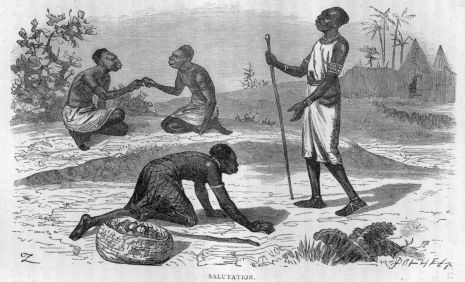
The monarch had put on his robes of state to receive them, and amused them while dinner was preparing with a concert from a number of long drums, kettledrums, and horns. He wore on his head an ornament like a bishop’s mitre, covered with strings of coral. His tobe was of green silk, crimson silk, damask, and green silk velvet, sewn together like a piece of patchwork. He wore English cotton stockings, and sandals of neat workmanship. His subjects as they approached prostrated themselves, rubbing their heads with earth, and kissing the ground repeatedly, till their faces were covered with the red soil.
The king was so amused with the very different style with which the Englishmen saluted him that he burst out in a fit of laughter, in which his wives and subjects joined him.
They parted with the worthy monarch, who forwarded them on their journey.
Avoiding Avawa, at which place the widow Zuma had laid siege to the hearts of Clapperton and his attendant, they proceeded on to Boussa, which, greatly to their surprise, they found standing on the mainland, and not on an island as Clapperton’s journal had stated.
The king asserted, when they had presented themselves, that he and his court had been weeping all the morning for the death of Clapperton; but, as no outward signs of tears were visible, the travellers rather mistrusted the monarch’s assertion.
A hut having been selected for them, they repaired to it, and were well supplied with dishes of meat, rice, and corn for supper.
What was their astonishment the next day to receive a visit from the widow Zuma! who appeared, however, woefully changed, being clad in very humble apparel of country cloth. Having quarrelled with the ruler of Wawa, she had made her escape over the city wall in the night, travelling on foot to Boussa, where she had since taken up her abode.
The king was highly pleased with the presents which the Landers had brought him, and he and his wife, his chief counsellor and only confidant, honoured them with a visit at their hut. The queen was dressed in a check shirt, with several pieces of blue cotton—one tied round her waist, another hanging over her shoulder, and one covering her head—brass rings ornamenting her great toes, and bracelets her wrists; besides which she wore a necklace of coral and beads of gold, and small pieces of coral stuck in the lobe of each ear. Coral appeared to be in great demand wherever they went, and the queen was disappointed on finding that they had brought none.
Lander, concealing the object of his journey, informed the king that his purpose was to go to Bornou by way of Youri, and requested a safe conveyance through his territories.
This permission was granted, and, sending their horses by land, they proceeded up the river in a canoe which was furnished them, towards Youri.
The scenery on the main branch of the river was interesting and picturesque: the bank literally covered with hamlets and villages, and fine trees bending under the weight of their dark foliage, and contrasting with the lively verdure of the hills and plains.
After proceeding a short distance the stream gradually widened to two miles, in some places the water being very shallow, but in others of considerable depth.
Steering directly northward they voyaged on for four days, having passed, they were told, all the dangerous rocks and sandbanks which are to be found above Youri or below Boussa.
Landing at a little village on the bank, where their horses met them, they rode a distance of eight miles to the walls of Youri. That city they entered through an amazingly long passage, at the end of which was an immense door, covered with plates of iron rudely fastened to the woodwork.
A habitation had been provided for them, to which they were conducted, excusing themselves from paying their respects to the sultan on account of the fatigues of their journey. The following evening they visited the sultan, whose palace consisted of a group of buildings enclosed by a high wall. Dismounting, they were conducted along a low, dark avenue, with pillars on either side, and, passing through which, they entered a large square yard, where a number of servants were hurrying about and others seated on the ground. They were kept waiting for some time, till, receiving a summons to advance, they were introduced into another square, which resembled a clean farm-yard. Here they found the sultan seated alone on a plain piece of carpet, with a pillow on each side of him and a neat brass pan in front. He was big-headed, corpulent, and, though of advanced age, a jolly-looking man. He expressed his annoyance that Clapperton did not visit him, and that Lander had not done so on his return, and they were not sorry to take their leave.
He here was shown a rich damask tobe, covered with gold embroidery, which had belonged to Mr Park, and was probably part of the spoil taken from the canoe, intended as a present to some native prince. They were, at first, in hopes of obtaining Park’s journals; but only an old nautical almanack was seen, and they afterwards discovered that the journals themselves, though kept for some years, had, after Clapperton’s death, been destroyed by the person into whose hands they had fallen. They, however, obtained a gun which had undoubtedly belonged to Park, and which was given up to them in exchange for one of their own fowling-pieces.
The king, though he expressed his readiness to assist them, declared that he could not forward them on their way to the eastward, as from the disturbed state of the country he would be unable to guarantee their safety, and that the best thing he could do was to send them back to Boussa. On this they immediately sent a message to the King of Boussa, saying that as they were unable to continue their journey in the direction they had proposed, they would feel deeply obliged if he would lend them a canoe, by which they might proceed down the river to the salt water, and that they would remunerate him to the best of their ability.
The disturbances of which they had heard had been created by the widow Zuma, who had instigated the people of Nouffie to make a raid into the territory of the King of Wawa. They had succeeded in carrying off some bullocks near the walls of his town. She had fled from Boussa to another town, the governor of which had, however, sent her back, and she would now probably be severely punished by the King of Boussa, or be returned to her own sovereign, who would probably cut off her head.
On the 2nd of August they set off on their road to Boussa, but here they were kept some weeks, during which either one or the other of the brothers paid visits to the King of Wawa, from whom they found they had the best chance of obtaining a canoe. The King and Queen of Boussa were the most amiable couple they met with on their travels, and treated them with uniform kindness during their stay. The king, though not equalling the King of Wawa, is proud of his skill as a dancer, and he exhibited his accomplishments at a grand festival which took place during their visit. Although advanced in life, he was as active as a boy, and indulged largely in his favourite amusement every Friday.
On the last day of the festival, while his subjects were gathered in large numbers on the racecourse, he appeared among them, followed by boys carrying calabashes full of cowries, with which he rewarded the dancers, singers, and musicians, scattering the remainder among the crowd, to be scrambled for. Then, to show his affection for his subjects, unwilling to send them to their homes without giving them another treat, he danced sideways half way up the racecourse and back again to his residence, with much stateliness, his amiable wife smiling with delight that she had such a spouse, while the people were louder than ever in their shouts of approbation.
They heard here that El Kanemy, Major Denham’s friend, had fallen into disgrace with the Sultan of Bornou, who suspected him of treasonable practices, and of the intention of usurping the sovereignty. He had been imprisoned, and would have lost his head had not the Mahommedan priests interfered and obtained his liberation.
During their last visit to the King of Wawa, he exhibited a collection of charms written on sheets of paper, glued or pasted together. Among them was a small edition of Watts’s Hymns, on one of the blank leaves of which was written, “Alexander Anderson, Royal Military Hospital, Gosport, 1804,” which of course had belonged to Mr Park’s brother-in-law, who died in that neighbourhood. They had seen also two other notes addressed to Park, one from a Mr Watson, and the other from Lady Dalkeith.
It was not before the 30th of September that at length, having obtained the long-wished-for canoes, they were able to embark from the Island of Patashie, in the neighbourhood of Boussa. Cheered by the natives, they sprang on board, and the current rapidly bore them down the stream.
Their voyage had now begun prosperously; but they were detained at several places by the chiefs, who wished to get as much as they could out of them.
At Lever a priest, attended by a number of followers, told them that they were in his power, and should not quit the town till he thought proper. They had hitherto always behaved in the mildest manner possible, but now Lander replied that if the priest or any one else attempted to hinder them from taking their departure, he should feel no hesitation in shooting him. In an instant the priest’s manner changed, and he became civil and humble. They and their people were, however, allowed to make the attempt of launching their canoe, in which, as she was long and heavy, they were unable to succeed. The priest and his followers at length, ashamed of seeing the strangers labouring so hard, came to the spot and in a few minutes carried their boats into the water. They passed numerous islands, many of them several miles in length and thickly inhabited.
At Leechee the Niger was found to be three miles in width. The inhabitants of the place had numerous canoes. The boatmen they engaged here, though they had only paddled on for about forty minutes, refused to go further, and they were compelled to wait till they could obtain a fresh crew. Indeed, at the different places at which they stopped, they were vexatiously delayed on various pretexts by the natives.
At Belee Island a messenger arrived to inform them that they would be visited in the morning by the King of the Dark Water.
They embarked at an early hour, and at about ten o’clock the sound of voices singing, which reached their ears over the surface of the stream, warned them of the approach of the monarch. A small canoe came first, and then another propelled by upwards of twenty fine young men. In this, under a decorated awning, with a piece of scarlet cloth ornamented with beads and gold lace in front, sat the King of the Dark Water. In the stern were a number of musicians—drummers and a trumpeter—and in the bow four little boys, neatly clad. The king, of coal-black hue, was a fine-looking man, well stricken in years. He was dressed in a bournous of blue cloth, under which was a variegated tobe, made of figured satin, Haussa trousers, sandals of coloured leather, and a red cloth cap on his head. He was accompanied by six fine, handsome, jet-black girls, his wives, also picturesquely dressed, their wrists ornamented with silver bracelets and their necks with coloured necklaces.
The travellers saluted him with a discharge from their muskets, and while he went on shore, Richard arrayed himself in an old naval uniform coat, and his brother in the handsomest dress he possessed; their attendants put on new, white, Mahommedan tobes, while the British flag flew from the bow of their boat, so that they might show him all the respect in their power. These arrangements being concluded, the English led the way down the river, followed by the King of the Dark Water, and a squadron of canoes, to the island of Zagozhi, on which a town of considerable size was situated. Opposite to it was the town of Rabba, said to be very large and populous.
The Niger flows at this spot in a direction south of east.
While staying at this place, Lander was surprised by receiving an over-warm and affectionate salutation from a little, ugly, old Arab, whom he recognised as having been employed by Clapperton, having afterwards acted as his own guide from Kano. He had cheated Clapperton, and had also stolen Captain Pearce’s sword and a sum of money when sent back to Kano, from which he had decamped. When reminded of his rogueries he only laughed, and then in the most impertinent manner begged for everything he saw. Lander consequently turned him out of the hut.
They found here Mallam Dendow, a cousin of Bello, very old and feeble. He was pleased with the presents he received, and through his means the King of the Dark Water promised to supply them with canoes and a guide to conduct them to the sea.
Funda, the town near which the Niger was supposed to flow, was, as far as they could learn, at a considerable distance from this neighbourhood. Mallam Dendow had lately planned an expedition against it, but it terminated by his warriors taking fright and returning to their homes without accomplishing anything.
These Arabs, throughout Africa, were the greatest curse of the country, and were the chief cause of the devastating wars which were constantly taking place, while they in no way contributed to the real civilisation of the people.
Just as the travellers were hoping to recommence their voyage, old Pasco returned from Mallam Dendow with the unpleasant information that the chief was dissatisfied with the gifts he had received, and that unless they would present him with others of more value he would take their guns and powder from them before he would permit them to leave Zagozhi. Having no articles left among their stores, they were most unwillingly compelled to present him with Mr Park’s tobe, which had been given by the King of Boussa. With this he was highly delighted, and now, declaring that he would be their friend for ever after, he not only obtained for them the restitution of their canoe, which had been seized by the King of the Dark Water, but made them a present of a number of handsome mats and a supply of cowries and provisions.
On the 16th they again launched into the river, firing two muskets and uttering three cheers as a salute to the King of the Dark Water and the hundreds of spectators gazing at them, whom they soon left out of sight.
They were now, with the exception of a few bracelets and other trifling articles, possessed of nothing with which to make presents or pay tribute to the chiefs. It was, therefore, important that they should hasten down the stream, touching at as few places as possible.
They passed a village on an island completely submerged, and were nearly upset by striking against the roof of one of the cottages, towards which a whirlpool had driven them. A number of canoes were engaged in carrying off the inhabitants.
At the island of Fofo they heard that the frontiers of Funda were three days’ journey down the Niger, and that the city itself was upwards of three days’ journey inland from the water-side, and that thus it would be impossible for them to visit it.
After they had left Zagozhi, in between three and four days they reached Egga, a large town situated behind a morass, several creeks leading out of it. A vast number of large canoes lay off the place, laden with all kinds of merchandise. The chief, a venerable man with a long, white beard, examined them from head to foot and, remarking that they were strange-looking people well worth seeing, awarded them a commodious hut.
It was a town of prodigious extent and had an immense population. The river varied in width from two to five and six miles.
They here observed Benin and Portuguese clothes worn by the inhabitants, who, being very enterprising, were engaged in trading up and down the river.
On the 22nd they once more embarked, their crew greatly alarmed with the prospect of meeting enemies ahead, who would, they said, very likely put them to death.
Had they, however, remained at Egga, they would probably have been made slaves. They heard, indeed, dreadful reports of the character of the people occupying both sides of the Niger between Kakunda and Bocqua. They, however, loaded their arms and prepared to defend themselves.
One of their men, Antonio, son of a chief on the Bonny river, who had joined them from HM brig “Clinker,” was especially alarmed—not on his own account, as he said that his life was of no consequence, but that he feared that his two white friends, whom he loved so dearly, might be killed. They, accordingly, pulled on during the night, passing a large town, from which issued a loud noise, as of a multitude quarrelling. Once they fancied they saw a light following them, but it turned out to be a will-o’-the-wisp.
On the 25th of October suddenly the river changed to the south-west, running between immensely high hills, and in the evening they passed the mouth of a considerable rivet entering the Niger from the eastward. After pulling up some little way, they found the current so strong against them that they were compelled to return. This they concluded to be the Tsadda, known, however, as the Binue.
While their men were on shore collecting firewood they came suddenly on a village, and, the people being aroused, the travellers, seated under a palm-tree, were quickly surrounded; but the chief, appearing, was persuaded that they only desired peace. Old Pasco was the only one who had stood by them during the interval, the rest having taken to their heels on the appearance of danger.
On landing at another place, a number of women hastened out of an adjacent village with muskets; but, seeing the travellers sitting down quietly without making any hostile display, they soon became friendly.
They were detained three days at Damuggoo, a very dirty town, where, however, the people were generally dressed in Manchester cottons; that is to say, they wore pieces of them round their waists, extending to the knee.
Continuing their voyage down the river, they observed the large market town of Kirree. Near it were a number of canoes of considerable size, with flags flying on long bamboos. Shortly afterwards a fleet of fifty canoes appeared ahead, with flags of all nations, among which the Union Jack was most conspicuous. All the people were dressed in European clothes, with the exception of trousers, which the chiefs alone are allowed to wear.
Lander, overjoyed by the sight, supposing that they must be friends, approached without fear, when a huge man of most forbidding countenance beckoned him to come on board his canoe. The next instant the sound of drums was heard, and several men levelled their muskets at the traveller. In addition to the muskets, each canoe had a long four or six-pounder in its bow, besides which the crews were armed with swords and boarding-pikes. In an instant their luggage was transferred to the canoes of their opponents, while some of them seized Pasco’s wife, and were dragging her out of the canoe. On this Lander, calling to his men to assist him, determined to sell his life as dearly as he could; and, having dragged back Pasco’s wife, they fought so determinedly that they were able to effect their escape. None of the other canoes had interfered, and, seeing that which had plundered them making its way to the market, Lander pulled after her as fast as he could go, in the hopes of recovering their property. On their way they encountered another canoe, in which a person, apparently of consequence, hailed them with the words: “Hilloa, white man! You French; you English?”
“English,” answered Lander. “Come here in my canoe,” was the reply. Lander accordingly got into his canoe, while the chief put three men into Lander’s that they might assist in pulling to the market. He at once treated Lander with great kindness and promised him every assistance in his power.
Soon after this, what was Richard Lander’s dismay to see the canoe of which his brother John had command followed by the villains who had attacked him, capsized, and sunk, while their luggage went to the bottom—his brother and crew being left struggling in the water. Richard was on the point of leaping in to help him, when he saw him dragged into another canoe, the other men swimming on shore. It was some time before he was able to reach him, when, with their new friend, they repaired to the market. Here they found a number of Damuggoo people and others who sided with them, and a Mahommedan from Funda urged them to keep up their spirits, and that all would be made right. Search was then commenced for their property. One of their journals and a box of books, with the medicine chest and a few articles of clothing were found, and after a palaver were restored; but the whole of Richard Lander’s journal with the exception of one note-book, Mr Park’s gun and thirty-six of their cutlasses and pistols, some elephant tusks, ostrich feathers, leopard-skins, and a variety of seeds had all been lost, as well as their remaining cowries, buttons, and needles, which were so important to enable them to purchase food.
The people who had attacked them were from Eboe, and had come this distance on a plundering expedition, intending to trade when unable to carry off property without fighting. The leading man who had attacked them was put into irons and doomed to die by the people of Kirree; and it was decided that if the king of Eboe, whose subject he was, should refuse to put him to death, no more of his canoes should be allowed to come to the country to trade.
Escorted by six war-canoes from Damuggoo, the travellers left Kirree and continued their voyage down the river, passing through a large lake-like expanse of the Niger, till on the evening of the 8th they reached the town of Eboe.
The houses were neatly built of yellow clay, plastered over and thatched with palm leaves. Yards were attached to each, in which plantations of bananas and cocoa-nut trees grew.
Here they were addressed in English by several brawny fellows with stentorian voices, who shook hands, asking them “how they did”—one calling himself Gun, though Blunderbuss or Thunder would have been as appropriate a name, then stating that his brother was King Boy and that his father was King Forday, who with King Jacket governed all the Brass country. He also informed them that a Spanish schooner and an English brig, the “Thomas,” of Liverpool, were lying in the first Brass river.
After resting for some time they were conducted to the palace of the dreaded Obie, king of the Eboe country. Instead of the savage monster they expected to see, a door opened, when a sprightly young man, with a mild countenance and an eye which indicated quickness and intelligence, appeared before them and cordially shook hands. His dress was so covered with a profusion of coral ornaments that he might appropriately have been styled the “Coral King.” On his head he wore a sugar-loaf hat, thickly adorned with strings of coloured beads and pieces of broken looking-glass, while several strings of beads were tightly fastened round his neck. He had on a short Spanish surtout of red cloth, ornamented with gold epaulettes, and a pair of trousers of the same material, while both his legs and wrists were covered with strings of beads, and to each leg, above the naked ankles and feet, was suspended a string of little brass bells, which jingled as he walked.
An account of what had happened at Kirree was narrated to him, and he declared his intention of settling the matter. Notwithstanding his protestations, however, the fair-spoken king detained the travellers, and would have kept them and their followers in slavery had not King Boy, the eldest son of the King of Brass Town, volunteered to pay their ransom on receiving a written promise that it should be repaid to him by the master of the “Thomas,” then lying in the Brass River, or by any other merchantman captain who might be found there. King Boy wished to send the document down to the brig at once; but fortunately Lander told him that he was sure the captain would not pay it till he had been received on board. On this the King of Eboe allowed them to embark in King Boy’s canoe. It was a large craft, paddled by forty men and boys, in addition to whom there were, besides the king and his wife and their own party, several slaves, so that the number on board amounted to fully sixty people. There were also cannon lashed to the bows, and a number of cutlasses and chests of spirits, silk, and cotton goods.
Thus laden, the Brass canoe took her way down the river, her unfortunate English passengers dreadfully cramped for room—John Lander one night, while suffering from fever, having the feet of the royal couple in his face.
On the 15th of November they landed at the excessively dirty town of King Forday, situated in the middle of a marsh. Here they took up their quarters at Boy’s house.
Soon after their arrival they were cheered by recognising the features of a European in the midst of a crowd of savages. He proved to be the master of a Spanish schooner lying in the Brass River for slaves. He was affable and courteous, and told them that six of his crew were ill of fever and that the rest were suffering.
Their residence, which its owner called an English house, was built close to the water, of yellow clay, but with several windows, all furnished with shutters.
Having paid his respects to King Forday, Richard Lander, leaving his brother and his men at the town, set off, in King Boy’s canoe, to go sixty miles down the river to the brig.
His feelings of delight may be imagined when he had ocular evidence that he had at length succeeded in tracing the mysterious Niger down to the ocean, by seeing before him two vessels, one the Spanish slaver, the other the English brig on board which he fully expected to receive the assistance he so greatly required.
To his utter surprise and consternation, on going on board, Captain Lake, though almost himself at death’s door from fever, flatly refused to give him a single thing. By his language and behaviour he showed himself to be a greater savage than the ignorant blacks among whom Lander had been travelling. Lander in vain expostulated with the captain; fearful oaths and flat refusals were the only answers he made. At last, when Lander suggested that he had five men, who might be useful in working his vessel out of the river, he softened a little, and gave him a change of linen and some provisions for his brother.
King Boy was ultimately induced to go back to bring John Lander and the rest of the men, on Richard’s reiterated promise that he would at some time or other obtain the goods they had promised him. He presented him also with some silver bracelets, which they had before overlooked, and a native sword. These articles Boy accepted, but when John Lander offered him his watch it was refused with disdain, the savage not knowing its value.
The captain of the brig had in the meantime loaded his guns and got his arms ready, and when Boy came up to him once more, to demand the bars which had been promised, he replied, in a voice of thunder: “I no will!”
As the pilot, to whom the captain had also refused to pay his demand, could not be trusted to take the brig out, she narrowly escaped shipwreck on the bar, but happily at length getting clear of the river, she steered a course for Fernando Po, where the travellers landed. Hence they sailed for Rio de Janeiro, which they reached on the 16th of March, and from that port obtained a passage on board the “William Harris” to England, which they reached safely on the 10th of June.
Thus, with very humble means, by the energy and courage of two unpretending men, was the long-disputed problem of the course of the Niger at length completely solved.
Besides the payment which the Government had promised to Richard Lander, he received a premium of fifty guineas, placed at the disposal of the Royal Geographical Society by the king, and his brother John obtained employment under Government suitable to his abilities.
Chapter Ten.
Travels and adventures of Dr Barth in North and Central Africa, 1849.
Leaves Tripoli with Mr Richardson and Dr Overweg—Suppression of slave trade the chief object of the expedition—Numerous ruins seen—Cross the Hammada desert—Rest at an oasis—Reach Mourzouk—Dr Barth’s adventure—Nearly perishes in the desert—Difficulties of journey—Followed by Tawarek freebooters—Preparations for an attack—Strange dancers—Tribute demanded—Camp at night—Expecting an attack—Constant firing kept up—Camels stolen—Pursued—Dangerous situation—Travellers expect death—Saved by friendly Chief—Dr Barth visits Agades—A salt-caravan—The caravan reaches Tagelel.
The British Government had, in 1849, appointed Mr Richardson, an experienced traveller in Africa, to the command of an expedition which was to start from Tripoli, on the north coast, and thence endeavour to penetrate to the central part of the continent. By the recommendation of the Chevalier Bunsen Dr Barth, who had spent three years travelling through Barbary and the desert tracts to the westward bordering the shores of the Mediterranean, was allowed, accompanied by another German, Dr Overweg, to join the expedition.
A light boat, which was divided into two portions and could be carried on the backs of camels, was provided, and a sailor to navigate her either on Lake Chad or down the Niger.
Dr Barth and his countryman at once pushed on for Tripoli, in the neighbourhood of which they made long excursions while waiting for the arrival of Mr Richardson, who had remained in Paris for despatches.
One of the principal objects of the expedition was the abolition of the slave trade, which it was known was carried on to a fearful extent in those regions. The principal employment of the Moorish tribes on the borders of the territories inhabited by blacks is still, as it was in the days of Mungo Park and Clapperton, slave-hunting. Villages are attacked for the purpose, when the prisoners captured are carried northward across the desert and sold in Morocco and the other Barbary states.
Another object was the opening up a lawful commercial intercourse with the people who might be visited, and the exploration of the country for scientific purposes, as well as to discover the course of the great river which the Landers had seen flowing into the Niger in their adventurous voyage down that stream.
On the arrival of Mr Richardson the travellers at length set out from Tripoli, on the 24th of March, 1850. They rode on camels, a considerable number of which were also required to carry their baggage. The boat had unfortunately been divided only into two pieces instead of four, thus causing much trouble.
We may picture them setting forth with their long line of camels and numerous attendants, servants, camel-drivers, and guides, and accompanied by Mr Crowe, the consul, Mr Reade, the vice-consul, and other friends who came forth to see them start; or with their tents pitched on a moonlight night, amidst a few date and olive trees, in a green meadow—a little oasis surrounded by sand.
The two doctors alone required eight camels for their luggage, besides those they rode. Dr Barth had procured an excellent one of the renowned Bû-Saef breed. The travellers were well-armed, as they had to pass through disturbed districts, and were likely to encounter open enemies, and might have to keep treacherous attendants in awe.
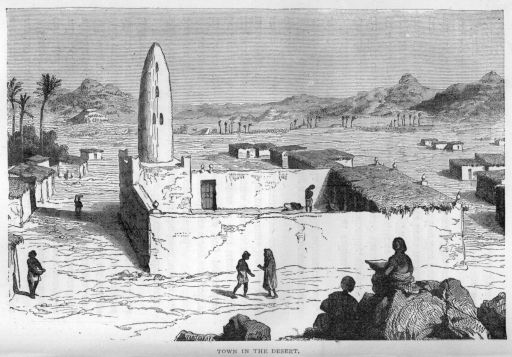
During the first part of their journey their way lay along cultivated and flourishing corn-fields in the narrow wady, or valley, of Majenin. At the further end of it Mr Richardson with his party overtook them and pitched his enormous tent. It was not till the 2nd of April that they fairly set out on their expedition. Keeping to the west of a rugged range of hills, they entered the rocky wady of Haera, where they filled their water-skins from the pools formed by the rain.
The long oars and poles of the boat caused the camels which carried them much fatigue; but the boat, which was now cut into quarters, was more easily packed.
The country over which they passed was stony and rocky, intercepted by dry water-courses, and, as they proceeded, here and there adorned with clusters of date-trees. They frequently passed the ruins of Roman temples, tombs, monuments, and other buildings, and also numerous Roman milestones: the Romans, indeed, had extensive colonies in this district.
Their chief object, when seeking a spot for encamping, was water. Sometimes it was found in pools: at others in wells, being drawn to the surface by oxen.
Travellers in Africa cannot proceed at railroad speed. Camels journey much after their own inclination, straying to the right or left—nipping here a straw, and there browsing on a bush—and, being obstinate creatures, it is difficult to urge them forward faster than they like. The doctor would have preferred a horse, but it would have been necessary to carry barley and water for it, as it cannot live like the camel without drinking when crossing the desert. The expense, too, would have been very great.
Their course was nearly due south, directed in the first place towards the town of Mourzouk, the capital of Fezzan.
Their general rate of marching was at from two to two and a half miles an hour. The heat was very great. The doctor’s Arab servant, who had gone off to see his family in the neighbourhood, on his return arrived at the encampment after they had started. He, accordingly, set off to overtake the caravan. Though he had a skin of goat’s milk, yet it became so hot that he could not drink it; and, as he was obliged to march the whole of the day without water, he suffered greatly and arrived in a very exhausted state.
Among the monuments passed was one adorned with rich carving, proving that these regions, now so poor, must have once supported a population sufficiently advanced in taste and feeling to admire works of a refined character. They also found ruins of Christian churches of a later period.
They were now travelling through a district known as the Hammada—a high, level, stony region, destitute of wells or pools. Here and there, however, small green patches of herbage were found, affording a welcome meal to the camels.
They were accompanied by a little green bird, called the “asfir,” which lives entirely upon the caravans as they pass along, by picking off the vermin from the feet of the camels.
At a green oasis, El Wueshkeh, where grew a few stunted palm-trees, their camel-drivers killed a number of a venomous lizard, called “bu-keshash.” At night a cold wind, accompanied by rain, began to blow; their tent was overturned, and they had much trouble in pitching it again. The next day a number of truffles were found, which afforded them some delicious truffle soup.
They met, soon after starting, two caravans—the largest consisting of fifteen camels laden with ivory. With the latter was a woman sitting comfortably in a little cage on the camel’s back.
Passing through a narrow ravine between gloomy cliffs, they reached a sandy waste, passing across which they at length arrived at some crumbling ruins surrounding a well, where they and their camels could quench their thirst. Though the great watering-place on this desert road, it has not a cheerful aspect; but, as the water is always bubbling up and keeps the same level, the largest caravan might be fully supplied. A day was spent here, as both camels and men required rest.