"Great African Travellers" (continued 5)
Reading edition
Returning to Bombay, Lieutenant Speke and Lieutenant Burton obtained their outfit, and set sail on the 3rd of December, 1856, for Zanzibar, on board the HEIC sloop of war, “Elphinstone.”
At Zanzibar they were warmly welcomed by the consul, Colonel Hamerton, and well received by the Sultan Majid, who, from his intelligence and good disposition, appeared likely to be a favourite with his people.
As they had arrived during the dry season, they were unable to commence their journey, and some time was spent in visiting different parts of the coast.
Their intention was to proceed to Ujiji, on the shores of Lake Tanganyika, which was then supposed to be the southern end of the great central lake. They engaged as their kafila bashi, or head of their caravan, a well-disposed man, Sheikh Said. A body of the sultan’s Belooch soldiers, under a jemadar, or officer, and a party of slaves armed with muskets, formed their escort. Besides them, they had their private servants, Valentine and Gaetano, Goa men, who spoke Hindostanee, and a clever little liberated black slave, Bombay by name, who had been captured from his native place, Uhiyou, to the east of Lake Nyanza, and sold to an Arab merchant, by whom he was taken to India. Having served this master for several years, on his death he obtained his liberation, and made his way to Zanzibar. Here he took service in the army of the sultan, and was among those engaged by Lieutenant Speke. He was a remarkably quick, clever, honest little fellow, and in most instances could thoroughly be trusted.
Crossing to Kaole, on the mainland, on the 16th of June, 1857, they were detained there collecting baggage animals. The first five hundred miles of their journey to Caze, a place in the centre of Unyamuezi, the Land of the Moon, was performed with comparative ease, and they were subjected only to annoyances from the savage people and the grasping chiefs on the way.
Caze is occupied by Arab merchants as a central trading depot, and is rapidly increasing. It was supposed that Ujiji would be found much of the same character. Here they arrived on the 7th of November, 1857. They were kindly received by the Arab merchants, especially by Sheikh Snay, and had a house appropriated to them.
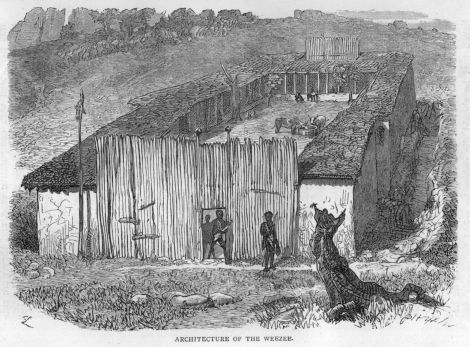
The houses of the Weezee, the people among whom they were living, are built of mud, generally with flat tops: this description is called a tembe. Others, however, are in the form of haystacks, and are constructed with great care; the door is very small, so that only one person can enter at a time. The villages are surrounded with a strong fence, having taller stakes on each side of the entrance, which are decorated either with blocks of wood or the skulls of those who have been put to death.
The flat-roofed houses are built round a large court, the outer walls serving as the walls of the villages, all the doors opening into the interior.
Some time was usefully spent in gaining information from the Arabs and others, who told them that the Nyanza was a separate lake to that of Ujiji, and that from the latter a river ran out to the northward—though, at first, they had stated that it ran into it. Besides this they heard that vessels frequented some waters to the north of the equator—a fact of which Speke had heard when travelling in the Somali country.
Their porters, who had come from this part of the country, all left them, and they found the greatest difficulty in procuring others.
Captain Burton here fell dangerously ill, and, as he believed that he should die unless he could be moved, his companion had him carried to Zimbili, where, by degrees, he recovered. At length a sufficient number of porters being obtained, they broke ground on the 10th of January, 1858.
Proceeding due west about one hundred and fifty miles, when moving over the brow of a hill, they came in sight of the lovely Tanganyika lake, which could be seen in all its glory by everybody but Lieutenant Speke, who was suffering from inflammation of the eyes, caught by sleeping on the ground while his system was reduced by fevers and the influence of the vertical sun. It had brought on almost total blindness, and every object before him appeared clouded by a misty veil.
They were now standing on the eastern horn of a large, crescent-shaped mass of mountains, overhanging the northern half of the lake. These mountains Speke supposed to be the true Mountains of the Moon.
Reaching the margin of the lake, a canoe was hired to carry them to Ujiji, the chief place on its shores, frequented by Arabs. The lake at which they now arrived was supposed to be three hundred and eighty miles long, and thirty to forty broad. Its waters are sweet and abound with fine fish. The sides of the lake are thickly inhabited by numerous negro tribes, among whom are the Wabembe cannibals, into whose territory the Arabs dare not venture.
The explorers took up their abode in the deserted house of an Arab merchant, at a small village called Kawéle; but, unfortunately, the chief of the place, Kannina, was a tyrannical extortioner, and caused them much trouble. They wished to engage an Arab dhow for navigating the lake, sufficiently large to carry provisions and to resist hostile attacks, but could only obtain a canoe. It was long and narrow, hollowed-out of the trunk of a single tree. She carried Bombay, Gaetano, two Belooch soldiers, and a captain, with twenty stark-naked savage sailors. In this Speke set out on the 3rd of March, 1858, while Burton, too sick to move, remained at Ujiji. Speke and his attendants had moved but a short distance along the shore, when a storm came on, and they had to camp till the afternoon of the 5th, when all got on board.
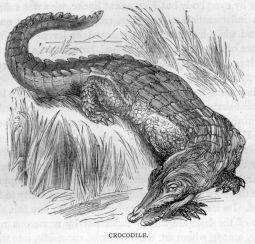
To pack so many men together was no easy matter. Speke had his bedding amidships, spread on reeds; the cook and bailsman sat facing him, and Bombay and one Belooch behind him. Beyond them, in couples, were the crew, the captain taking post in the bows. The seventeen paddles dashed off with vigour. Steering southwards, they passed the mouth of the Ruche river. They paddled on all night, and after dawn landed in a secluded nook for breakfast. All were busily occupied. Gaetano dipped his cooking-pot in the sea for water, greatly to the annoyance of the natives, who declared that the dregs from it would excite the appetites of the crocodiles, who would be sure to follow the boat. They have as great an aversion to the crocodile as English seamen have to a shark.
Suddenly there was a cry that foes were coming. All, jumping up, rushed to the boat, some seizing one thing, some another, the greater number being left on the ground. A breathless silence followed; then one jumped on shore to secure a pot, and then another, and, gaining courage, they searched around, crawling cautiously in the bush, others stealthily moving along, till at last a single man was pounced upon, with an arrow poised in hand. He was one of eight or ten men of a tribe whom they declared to be a rough, lawless set of marauders. They therefore broke his bow and arrows, and, though some of the crew proposed taking his life, he was allowed to go. The sailors, on their return, each vaunted the part he had taken in the exploit, boasting as though a mighty battle had been won.
They passed along a border of aquatic reeds, tenanted by crocodiles and hippopotami, the latter staring, grunting, and snorting, as if vexed at the intrusion on their privacy. Many parts of the shore were desolate, the result of slave-hunting and cattle-lifting parties.
“At night Speke’s tent is pitched; the men build huts for themselves with boughs, covering the top with grass, two men at the most occupying a hut. When it rains they are covered by their mats, but, as they are all stark-naked, the rain can do them no harm.
“Interesting shells, unknown to the conchological world, are picked up, numbers of which are lying on the pebbly beach.
“They are delayed again by another storm. The superstitious captain will answer no questions, for fear of offending the ugaga, or church, whilst at sea; he dreads especially to talk of places of departure and arrival, for fear ill luck should overtake them.
“Fourteen hours are occupied in crossing the lake, when they reach a group of islands belonging to Sultan Casanga. The sailors and his people fraternise, and enjoy a day of rest and idleness. At night they are attacked by a host of small black-beetles, one of which gets into Speke’s ear and causes him fearful pain, biting its way in, and by no means can he extract it. It, however, acts as a counter-irritant, and draws away the inflammation from his eyes.
“The population of the neighbouring shore is considerable, the inhabitants living in mushroom huts, and cultivating manioc, sweet potato, and maize, and various vegetables. The people dress in monkey-skins, the animals’ heads hanging in front and the tails depending below. They are very inquisitive, and, by their jabberings and pointings, incessantly, want Speke to show everything he possesses.
“He gets away the next day, and reaches a fish market, in the little island of Kabizia, in time to breakfast on a large, black-backed, scaleless monster, the singa. The sailors considering it delicious, are disinclined to move on.
“Again detained by a high wind, they cross, at noon on the 11th, to Kasenge, where Sheikh Hamer, an Arab merchant, receives Speke with warm and generous hospitality. His house is built with good, substantial walls of mud, and roofed with rafters and brushwood, the rooms being conveniently partitioned off to separate his wife and other belongings, with an ante-room for general business. His object in coming to the remote district is to purchase ivory, slaves, and other commodities. He is the owner of the dhow which Speke is anxious to obtain; but though he professes his readiness to lend it, he makes numberless excuses, and finally Speke has to continue his voyage in his small canoe.
“Slavery is the curse of this beautiful region. Here for a loin-cloth or two a mother offers eagerly to sell one of her offspring and deliver it into perpetual bondage to his Belooch soldiers. Whole villages are destroyed, in the most remorseless manner, by the slave-hunters to obtain their victims. The chiefs of the interior are as fond of gain as those on the coast, and this sets one against the other, for the sake of obtaining slaves to sell.
“From Hamed Speke learns that a large river runs from the Mountains of the Moon into the northern end of the lake.
“On the 13th the dhow comes in, laden with cows, goats, oil, and ghee; but, though Speke offers five hundred dollars for her hire, the Arab merchant still refuses to lend her.
“On the 27th Speke commences his return voyage, and arrives on the 31st at Ujiji.
“Captain Burton is somewhat recovered, and, though unfit to travel, insists on starting in the canoe to explore the head of the lake—the chief, Kannina, offering to accompany them. Their object is to examine the river which is said to fall into it. They start in two canoes, the chief and Captain Burton being in the largest. In eight days they arrive at Uvira. The chief, however, will go no further, knowing that the savages of the Warundi are his enemies. He confirms the statement that the Rusizi River runs into the lake.
“The black naked crews are never tired of testing their respective strengths. They paddle away, dashing up the water whenever they succeed in coming near each other, and delighting in drenching the travellers with the spray. Their great pleasure appears in torturing others, with impunity to themselves. They, however, wear mantles of goat-skins in dry weather, but, as soon as rain comes on, they wrap them up, and place them in their loads, standing meantime trembling like dogs which have just emerged from the water.
“In no part of Africa have they seen such splendid vegetation as covers this basin from the mountain-tops to the shores.”
On returning to Ujiji, Speke wished to make a further survey of the lake, but was overruled by Captain Burton, who considered that their means were running short; indeed, had not an Arab merchant arrived, bringing supplies, they would have been placed in an awkward position. This timely supply was one of the many pieces of good fortune which befell them on their journey. Help had always reached them when they most required it.
Captain Burton, being too ill to walk, was carried in a hammock, and, setting out, they returned safely to Caze.
They were here again received by their friend, Sheikh Snay, who gave Speke an account of his journey to the Nyanza Lake. His statements were corroborated by a Hindoo merchant called Musa, who gave him also a description of the country northward of the line, and of the rivers which flowed out of the lake.
Eager to explore the country, Speke arranged to set off, leaving Captain Burton at Caze. Sheikh Snay, however, refused to accompany him, and he had in consequence some difficulty in arranging with the Belooch guard.
On the 9th of July, 1858, he was able to start his caravan, consisting of twenty porters, ten Beloochs, and his servants. The Beloochs were, from the first, sulky and difficult to manage, while the pagazis, or porters, played all sorts of tricks, sometimes leaving their loads and running off to amuse themselves, and in the evening they would dance and sing songs composed for the occasion, introducing everybody’s name, and especially Mzimza, the wise or white man, ending with the prevailing word, among these curly-headed bipeds, of “Grub! grub! grub!”
The Weezee villages are built in the form of a large hollow square, the outer wall of which serves for the backs of the huts; another wall forms the front, and the intermediate space is partitioned off by interior earthen walls. The roofs are flat, and on them are kept firewood, grain, pumpkins, and vegetables. Each apartment contains a family, with their poultry and cooking utensils; some, however, are devoted exclusively to goats and cows.
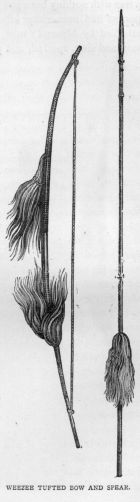
They passed through forests of considerate size; caravans from the north were also met with. At one place the country was found to be governed by a sultana, the only one they met with in their travels. She did her utmost to detain Speke, not allowing him an interview till the next day. On paying the lady a visit, he was received by an ugly, dirtily-garbed old woman, though with a smiling countenance, who, at his request, furnished him eggs and milk. At length the sultana appeared—an old dame with a short, squat figure, a nose flabby at the end, and eyes destitute of brows or lashes, but blessed with a smiling face. Her dress consisted of an old barsati, dirtier even than her maid’s. Her fingers were covered with rings of copper wire, and her legs staggered under an immense accumulation of anklets, made of brass-wire wound round an elephant’s tail or that of a zebra. On her arms were solid brass rings, and from other wire bracelets depended a variety of brazen, horn, and ivory ornaments.
Squatting by his side, the sultana, after shaking hands, felt Speke all over, wondering at his dress. She insisted on his accepting a bullock; but, anxious to be off, he declined waiting for it. She at last consented to send it after him by some of his porters, who were to remain for the purpose.
He was constantly detained by the laziness of his ftagazis, who, when getting into a rich country, preferred eating the meat, eggs, and vegetables they could obtain.
He unfortunately had only white beads with him, which which were not the fashion: with coloured beads he could have purchased provisions at a much cheaper rate. Had the people also been addicted to wearing cloth, instead of decorating themselves with beads, he would with his cloth have been able to make his purchases much more advantageously. As the country is overstocked with common beads, it is far more economical to obtain high-priced than low-priced beads when preparing to start from Zanzibar.
As warfare was going on, it was necessary to make a tortuous track to avoid the combatants.
The jemadar and two Beloochs complained of sickness and declared they could not march, and poor Gaetano fell ill and hid himself in the jungle, being thus left behind. Men were sent off to search for him, and the next day the Beloochs brought him in, looking exactly like a naughty dog going to be punished.
The sultans, however, of the different villages were generally friendly.
When a desert tract had to be passed, the men went on well enough, hoping to obtain food at the next cultivated district.
On the 30th of July Speke discerned, four miles off, a sheet of water which proved to be a creek at the most southern portion of the Nyanza, called by the Arabs the Ukerewe Sea.
Passing amidst villages and cultivated grounds, they descended to a watercourse which he called the Jordan. It is frequented by hippopotami, and rhinoceros pay frequent visits to the fields.
Iron is found in abundance in this district, and nearly all the iron tools and cutlery used in this part of Eastern Africa is manufactured here: it is, in truth, the Birmingham of the land. The porters therefore wished to remain to make purchases of hoes.
A rich country was passed through, and on the 4th of August the caravan, after leaving the village of Isamiro, ascended a hill, when the vast expanse of the pale blue waters of the Nyanza burst suddenly on the travellers’ gaze. It was early morning. The distant sea-line of the north horizon was defined in the calm atmosphere between the north and west points of the compass. An archipelago of islands intercepted the line of vision to the left. The sheet of water extended far away to the eastward, forming the south and east angle of the lake, while two large islands, distant about twenty or thirty miles, formed the visible north shore of this firth. Ukerewe is the name by which the whole lake is called by the Arabs. Below, at no great distance, was the debouchure of the creek along which he had travelled for the last three days.
This scene would anywhere have arrested the traveller by its peaceful beauty. He writes enthusiastically—
“The islands, each swelling in a gentle slope to a rounded summit clothed with wood, between the rugged, angular, closely-cropping rocks of granite, seen mirrored in the calm surface of the lake, on which is here and there detected the a small black speck—the tiny canoe of some Muanza fisherman. On the gentle-shelving plain below me blue smoke curled above the trees, which here and there partially concealed villages and hamlets, their brown thatched roofs contrasting with the emerald green of the beautiful milk-bush, the coral bunches of which clustered in such profusion round the cottages, and formed alleys and hedgerows about the villages, as ornamental as any garden shrub in England.
“But the pleasure of the mere view vanished in the presence of those more intense and exciting emotions which were called up by the consideration of the commercial and geographical importance of the prospect before me. I no longer felt any doubt that the lake at my feet gave birth to that interesting river the source of which has been the subject of so much speculation and the object of so many explorers. The Arab’s tale was proved to the letter. This is a far more extensive lake than the Tanganyika: so broad, you could not see across it, and so long that nobody knew its length.”
To this magnificent lake Speke gave the name of Victoria Nyanza.
Note. It has since been proved to be only one and the least considerable of the sources of the White Nile, by the later discoveries of Baker and Livingstone.
He now descended to Muanza, on the shores of the lake, having altogether performed a journey of two hundred and twenty-six miles from Cazé.
He was here kindly treated by Sultan Mahaya, with whom an Arab merchant, named Mansur, was residing, who gave him much valuable information.
Taking a walk of three miles along the shores of the lake, accompanied by Mansur and a native, the greatest traveller of the place, he ascended a hill whence he could obtain a good view across the expanse of water spread out before him. Several islands were seen, but some so far-off as scarcely to be distinguishable. Facing to the west-north-west was an unbroken sea horizon, and he calculated that the breadth of the lake was over a hundred miles. The native, when asked the length of the lake, faced to the north, and, nodding his head, indicated by signs that it was something immeasurable, adding that he thought it probably extended to the end of the world.
Poor Mansur had been robbed of his merchandise, by a sultan whose territory was on the shore of the lake, and he had very little chance of obtaining redress.
Sultan Mahaya was considered the best and most just ruler in those quarters; and when Speke proposed crossing the lake to the island of the Ukerewe, he urged him on no account to make the attempt. Mansur also did his best to dissuade him, and, boats not being obtainable, he was compelled to give up his design.
Speke, arguing from the fact that the source of the Nile at the highest spot which had been reached, two thousand feet above the level of the sea, is considerably lower than the surface of the lake, which is four thousand feet, is of opinion that the waters of the lake must flow into it. The lake has, however, numerous feeders which flow from the Mountains of the Moon. Indeed, from that and several other reasons, he felt convinced that the lake is the real and long-looked-for source of the Nile.
As no boats of any size were to be obtained, and having gained all the information he could, regretting that he was unable to extend his explorations, he bade the Sultan and his Arab friend adieu, and on the 6th of August commenced his return journey.
The country through which he passed abounds in game. Elephants are finer here than in any other part of the world, and some have tusks exceeding five hundred pounds the pair in weight. The people are mostly agricultural; and when a stranger comes among them, they welcome him, considering his advent as a good omen, and allow him to do what he likes.
His black attendants were in much better humour on the return journey, as they were now going home, and, as the country was well stocked with cattle, they could obtain as much meat as was required. One village through which he passed, being full of sweet springs, had a dense population possessing numerous herds of cattle.
“If they were ruled by a few score of Europeans, what a revolution a few years would bring forth! An extensive market would be opened to the world, and industry and commerce would clear the way for civilisation and enlightenment,” Speke remarks.
The country is also, he says, high, dry, and healthy, while the air is neither too hot nor too cold.
On the evening of the 25th of August he marched into Cazé, under the influence of a cool night and bright moon, his attendants firing off muskets and singing, while men, women, and children came flocking out, piercing the air with loud, shrill noises. The Arabs all came forth to meet him and escort him to their depot, where Captain Burton, who had been very anxious as to his safety, greeted him, numerous reports having been set afloat about him.
Captain Burton being now restored to health, they set off together for Zanzibar, whence they shortly afterwards returned to England.
Chapter Fourteen.
Captains Speke and Grant’s travels from the Island of Zanzibar, on the East Coast of Africa, to Lake Victoria Nyanza, and down the Nile.
Sets out with an expedition to prove that the source of the Nile is the Nyanza River—Arrives at Zanzibar—Crosses to Bagomoyo with his followers—The caravan—Squabbles among the porters—The march begun for Caze—The traveller’s routine of work—Tribute demanded by Chiefs—The Hottentot escort and the Waguana escort—The country of the Wazaramo—Their manners and customs—Kidunda—Along the Kinganni River to the country of the Usagara—Grant is ill—Ugogo—The place and people—Encamp on a clearing called Kanyenye, where some of the porters abscond—Shooting rhinoceros—New Year’s Day at Round Rock—Unyamuezi, the Country of the Moon—Caze—Received by his friend Musa—The Unyamuezi people—Set out and reach Mininga—Liberates a slave—Illness, and returns to Caze—The custom of the Weezee—Reaches Mininga again—Difficulties—Arrives at the district of the Chief, Myonga—The Pig—Difficulties again—Speke’s illness—Is attended by Lumeresi, who afterwards makes extortionate demands and causes trouble—Alarming news of Grant.
Captain Speke, who had already made two expeditions into Africa, which have been described—on the second of which he discovered the great lake, Victoria Nyanza—started, on the 20th of July, 1858, on a third expedition, in the hopes of proving that the Nile has its source in that lake. He was accompanied by an old Indian brother officer, Captain Grant.
Having reached the island of Zanzibar, where some time was spent in collecting a sufficient band of followers, they left Zanzibar on the 25th of September, in a corvette placed at their disposal by the sultan, and crossed over to Bagomoyo, on the mainland.
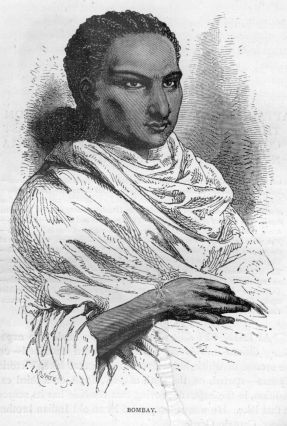
They had, as their attendants, ten men of the Cape Mounted Rifles, who were Hottentots; a native commandant, Sheikh Said; five old black sailors, who spoke Hindostanee; in addition to Bombay, Speke’s former attendant, factotum, and interpreter; a party of sixty-four Waguana blacks, emancipated from slavery; and fifteen porters of the interior. The two chief men, besides Said, were Bombay and Baraka, who commanded the Zanzibar men. Fifty carbines were distributed among the elder men of the party, and the sheikh was armed with a double-barrelled rifle, given to him by Captain Speke. The sultan also sent, as a guard of honour, twenty-five Beloochs, with an officer, to escort them as far as Uzaramo, the country of the Wazaramo. They had also eleven mules to carry ammunition, and five donkeys for the sick.
Their whole journey was to be performed on foot. As there were no roads, their luggage was carried on the backs of men.
Some time was spent among the porters in squabbling, and arranging their packs. Their captain, distinguishable by a high head-dress of ostrich plumes stuck through a strip of scarlet flannel, led the march, flag in hand, followed by his gang of woolly-haired negroes, armed with spears or bows and arrows, carrying their loads, either secured to three-pronged sticks or, when they consisted of brass or copper wire, hung at each end of sticks carried on the shoulder. The Waguana followed in helter-skelter fashion, carrying all sorts of articles, next came the Hottentots, dragging the mules with the ammunition, whilst lastly marched the sheikh and the Belooch escort, the goats and women, the sick and stragglers bringing up the rear.
One of the Hottentot privates soon died, and five others were sent back sick. About thirty Seedees deserted, as did nearly all the porters, while the sheikh also soon fell sick.
On the 2nd of October, having bid farewell to Colonel Rigby, the British consul at Zanzibar, who took deep interest in the expedition, and afforded it every assistance in his power, the march began.
They had first before them a journey of five hundred miles to Caze, the capital of the country of the Moon, in latitude 5 degrees south, longitude 33 degrees east, being due south of Lake Victoria Nyanza. This was a small portion, however, only of the distance to be performed.
Captains Speke and Grant divided the duties of the expedition between them, the first mapping the country, which is done by timing the rate of march, taking compass-bearings, noting the water-shed, etcetera. Then, on arriving in camp, it was necessary to boil the thermometer to ascertain the altitude of the station above the sea-level, and the latitude by the meridional altitude of a star; then, at intervals of sixty miles, lunar observations had to be taken to determine the longitude; and, lastly, there was the duty of keeping a diary, sketching, and making geological and zoological collections. Captain Grant made the botanical collections and had charge of the thermometer. He kept the rain-guage and sketched with water colours, for it was found that photography was too severe work for the climate.
The march was pursued before the sun was high, then came breakfast and a pipe before exploring the neighbourhood, and dinner at sunset, then tea and pipe before turning in at night.
Scarcely had they commenced the journey than the petty chiefs demanded tribute, which it was necessary to pay. The porters also struck for higher wages; but, the leaders going on, they thought better of the matter, and followed.
The poor Hottentots suffered much from the climate, and were constantly on the sick-list. The Waguana treated them with great contempt, and one day, while a little Tot was trying to lift his pack on his mule a large black grasped him, pack and all, in his muscular arms, lifting them above his head, paraded him round the camp amid much laughter, and then, putting him down, loaded his mule and patted him on the back.
“A day’s march being concluded, the sheikh and Bombay arrange the camp, issuing cloths to the porters for the purchase of rations, the tents are pitched, the Hottentots cook, some look after the mules and donkeys, others cut boughs for huts and fencing, while the Beloochs are supposed to guard the camp, but prefer gossiping and brightening their arms, while Captain Grant kills two buck antelopes to supply the larder.”
The country through which they were passing belongs to to the tribe of Wazaramo. It is covered with villages, the houses of which are mostly of a conical shape, composed of hurdle-work and plastered with clay, and thatched with grass or reeds. They profess to be the subjects of the Sultan of Zanzibar. They are arrant rogues, and rob travellers, when they can, by open violence. They always demand more tribute than they expect to get, and generally use threats as a means of extortion. One of their chiefs, the Lion-Claw, was very troublesome, sending back the presents which had been made him, and threatening dire vengeance if his demands were not complied with. Further on, Monkey’s-Tail, another chief, demanded more tribute; but Speke sent word that he should smell his powder if he came for it; and, exhibiting the marksmanship of his men, Monkey’s-Tail thought better of it, and got nothing.
The people, though somewhat short, are not bad-looking. Though their dress is limited, they adorn themselves with shells, pieces of tin, and beads, and rub their bodies with red clay and oil, till their skins appear like new copper. Their hair is woolly, and they twist it into a number of tufts, each of which is elongated by the fibres of bark. They have one good quality, not general in Africa: the men treat the women with much attention, dressing their hair for them, and escorting them to the water, lest any harm should befall them.
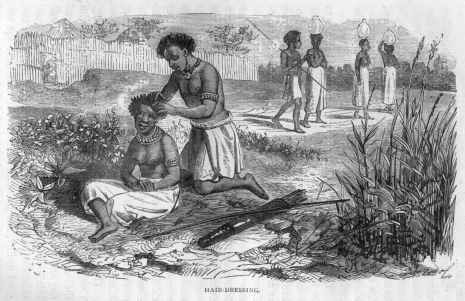
Kidunda was reached on the 14th of October. Hence the Belooch escort was sent back the next day, with the specimens of natural history which had been collected.
Proceeding along the Kinganni River they reached the country of the Usagara, a miserable race, who, to avoid the slave-hunters, build their villages on the tops of hills, and cultivate only just as much land among them as will supply their wants. Directly a caravan appears, they take to flight and hide themselves, never attempting resistance if overtaken. Their only dress consist of a strip of cloth round the waist.
Captain Grant was here seized with fever, and the sickness of the Hottentots much increased.
A long day’s march from the hilly Usagara country led the party into the comparatively level land of Ugogo. Food was scarce, the inhabitants living on the seed of the calabash to save their stores of grain.
The country has a wild aspect, well in keeping with the natives who occupy it. The men never appeared without their spears, shields, and assegais. They are fond of ornaments, the ordinary one being a tube of gourd thrust through the lower lobe of the ear. Their colour is somewhat like that of a rich plum. Impulsive and avaricious, they forced their way into the camp to obtain gifts, and thronged the road as the travellers passed by, jeering, quizzing, and pointing at them.
On the 27th, they encamped on the eastern border of the largest clearing in Ugogo, called Kanyenye, stacking their loads beneath a large gouty-limbed tree. Here eight of the Wanyamuezi porters absconded, carrying off their loads, accompanied by two Wagogo boys.
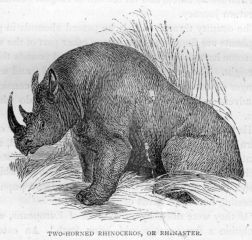
Speke set off to shoot a rhinoceros at night. Having killed one, two more approached in a stealthy, fidgetty way. Stepping out from his shelter, with the two boys carrying his second rifle, he planted a ball in the largest, which brought him round with a roar in the best position for receiving a second shot; but, on turning round to take his spare rifle, Speke found that the black boys had scrambled off like monkeys up a tree, while the rhinoceros, fortunately for him, shuffled away without charging. He hurried back to let his people know that there was food for them, that they might take possession of it before the hungry Wagogo could find it. Before, however, they had got the skin off the beast, the natives assembled like vultures, and began fighting the men. The scene, though grotesque, was savage and disgusting in the extreme; they fell to work with swords and hatchets, cutting and slashing, thumping and bawling, up to their knees in the middle of the carcass. When a tempting morsel was obtained by one, a stronger would seize it and bear off the prize—right was now might. Fortunately no fight took place between the travellers and the villagers. The latter, covered with blood, were seen scampering home, each with a part of the spoil.
The Sheikh Magomba did his utmost to detain them, sending his chief, Wazir, in an apparently friendly manner, to beg that they would live in his palace. The bait, however, did not take—Speke knew the rogue too well. Next day the sheikh was too drunk to listen to anyone, and thus day after day passed by. The time was employed in shooting, and a number of animals were killed. Magomba, however, induced nearly the whole of the porters to decamp, and there was great difficulty in obtaining others to take their places. An old acquaintance, whom they met in a caravan, urged them not to attempt to move, as he thought that it would be impossible for them to pass through the wilderness depending only on Speke’s and Grant’s guns for their support.
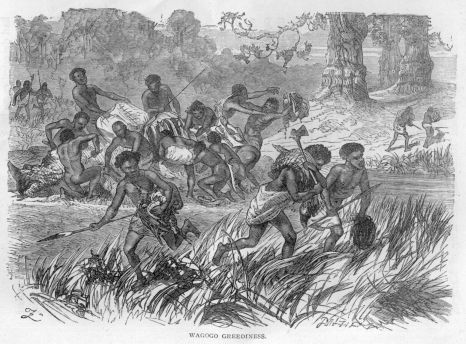
Still Speke resolved to push on, and most of the men who had deserted came back.
To keep up discipline, one of the porters, who had stolen seventy-three yards of cloth, which was found in his kit, received three dozen lashes, and, being found to be a murderer and a bad character, he was turned out of the camp.
They spent New Year’s Day at Round Rock, a village occupied by a few Wakimbu, who, by their quiet and domestic manners, made them feel that they were out of the forest. Provisions were now obtained by sending men to distant villages; but they were able to supply the camp with their guns, killing rhinoceros, wild boar, antelope and zebra.
On the 23rd of January they entered Unyamuezi, or the country of the moon, little inferior in size to England, but cut up into numerous pretty states. The name is abbreviated to Weezee.
On the 24th they reached Cazé, where Speke had remained so long on his former visit. His old friend, Musa, came out to meet them, and escorted them to his tembe, or house, where he invited them to reside till he could find porters to carry their property to Karague, promising to go there with them himself. They found here also Sheikh Snay, who, with other Arab merchants, came at once to call on them. Snay told him that he had an army of four hundred slaves prepared to march against the chief, Manua Sera, who was constantly attacking and robbing their caravans. Speke advised him not to make the attempt, as he was likely to get the worst of it. The other Arab merchant agreed that a treaty of peace would be better than fighting.
Musa gave him much information about the journey northward, and promised to supply him with sixty porters from his slave establishment, by which arrangement Speke would have a hundred armed men to form his escort.
Musa loudly praised Rumanika, the King of Karague, through whose dominions the expedition was to pass.
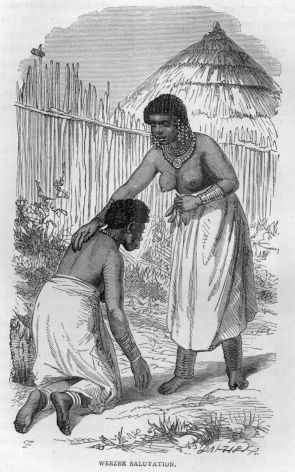
Some time, however, was of necessity spent at Caze in making preparations for the journey, the two travellers employing themselves during it in gaining information about the country.
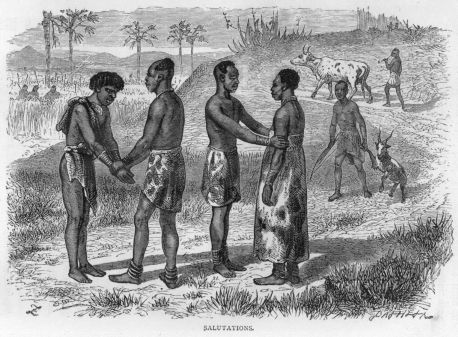
The Wanyamuezi, among whom they were residing, are a polite race, having a complete code of etiquette for receiving friends or strangers; drums are beat both on the arrival and departure of great people. When one chief receives another, he assembles the inhabitants of the village, with their drums and musical instruments, which they sound with all their might, and then dance for his amusement. The drum is used, like the bugle, on all occasions; and, when the travellers wished to move, the drums were beaten as a sign to their porters to take up their burdens. The women courtesy to their chief, and men clap their hands and bow themselves. If a woman of inferior rank meets a superior, she drops on one knee and bows her head; the superior then places her hand on the shoulder of the kneeling woman, and they remain in this attitude some moments, whispering a few words, after which they rise and talk freely.
The Wanyamuezi, or, as they are familiarly called, the Weezee, are great traders, and travel to a considerable distance in pursuit of their business.
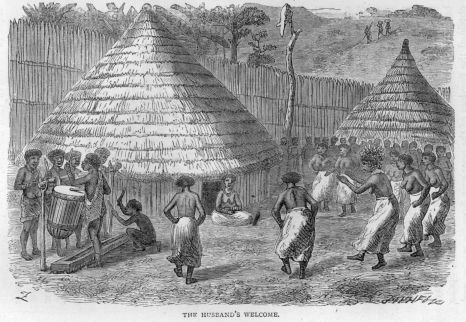
When a husband returns from a journey, his favourite wife prepares to receive him in a peculiar manner. Having put on all her ornaments, to which she adds a cap of feathers, she proceeds, with her friends, to the principal wife of the chief, when, the lady coming forth, they all dance before her, taking care to be thus occupied when the husband makes his appearance, a band of music playing away and making as much noise as possible with their instruments.
On the 7th of February news was brought that Sheikh Snay had carried out his intention of attacking Manua Sera, whom he found ensconced in a house at Tura. Manua, however, made his escape, when Snay plundered the whole district, and shot and murdered every one he fell in with, carrying off a number of slaves. The chief, in consequence, threatened to attack Cazé as soon as the merchants had gone off on their expeditions in search of ivory.
Soon after this it was reported that Snay and other Arabs had been killed, as well as a number of slaves. This proved to be true.
Finding that nothing more could be done at Caze, the travellers, assembling their caravan, commenced their march northward on the 17th of March.
On the 24th they reached Mininga, where they were received by an ivory merchant named Sirboko. Here one of Sirboko’s slaves, who had been chained up, addressed Speke, piteously exclaiming: “Oh, my lord, take pity on me! When I was a free man, I saw you on the Tanganyika lake; my people were there attacked by the Watuta, and, being badly wounded, I was left for dead, when, recovering, I was sold to the Arabs. If you will liberate me, I will never run away, but serve you faithfully.” Touched by this appeal, Speke obtained the freedom of the poor man from his master, and he was christened Farham, or Joy, and enrolled among his other freemen.
The abominable conduct of the Arabs, who persisted in attacking the natives and devastating the country, placed the travellers in an awkward position. The Hottentots, too, suffered so much from sickness that, as the only hope of saving their lives, it was necessary to send them back to Zanzibar. Speke therefore found it necessary to return to Caze, which he reached on the 2nd of May, leaving Grant, who was ill, behind at Mininga.
He here heard of a tribe of cannibals, who, when they cannot get human flesh, give a goat to their neighbours for a dying child, considering such as the best flesh. They are, however, the only cannibals known in that district.
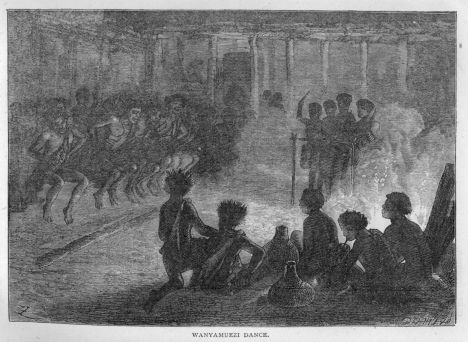
They were still in the country of the Weezee, of whose curious customs they had an opportunity of seeing more. Both sexes are inveterate smokers. They quickly manufacture their pipes of a lump of clay and a green twig, from which they extract the pith. They all grow tobacco, the leaves of which they twist up into a thick rope like a hay-band, and then coil it into a flattened spiral, shaped like a target. They are very fond of dancing. A long strip of bark or cow-skin is laid on the ground, and the Weezee arrange themselves along it, the tallest man posting himself in the centre. When they have taken their places the musicians begin playing on their instruments, while the dancers commence a strange chant, more like a howl than a song. They bow their heads, putting their hands on their hips and stamping vigorously. The men not dancing look on, encouraging their friends by joining in the chorus, while the women stand behind without speaking. Meantime, the elders sit on the ground drinking pomba. On one of these occasions the chief, who was present, drank more pomba than any of the people.
While the party were thus engaged, two lads, with zebra manes tied over their heads, and two bark tubes, formed like huge bassoons, in their hands, leaped into the centre of the dancers, twisting and turning and blowing their horns in the most extraordinary manner. The men, women, and children, inspired by the sound of the music, on this began to sing and clap their hands in time.
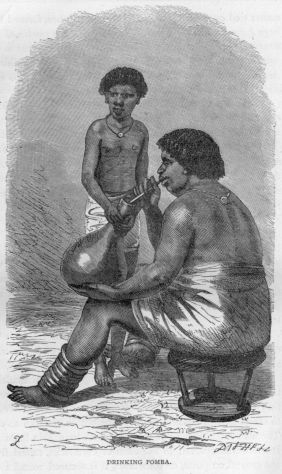
Pomba is a sort of spirituous liquor, produced from a kind of grain grown in the country, which is cultivated by women, who nearly entirely superintend the preparation of the drink.
They received a visit from Sultan Ukulima, of Unyamuezi, a fine hale old man, who was especially fond of this beverage, drinking it all day long. He was pleasant enough in manner, and rather amusing when he happened not to be tipsy. Being fond of a practical joke, he used to beg for quinine, which he would mix slyly with pomba, and then offer it to his courtiers, enjoying the wry faces they made when partaking of the bitter draught. He used to go round to the houses of his subjects, managing to arrive just as the pomba-brewing was finished, when he would take a draught, and then go on to the next. He sometimes sucked it through a reed, just as a sherry cobbler is taken, while one of his slaves held the jar before him.
The women and men do not drink it together. It is the custom of the ladies to assemble in the house of the sultana, and indulge in it in her company.
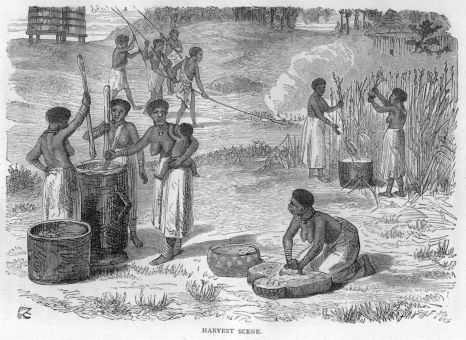
The women, as has been said, are employed in the cultivation of the grain from which it is made. When it is green, they cut off the ears with a knife. These are then conveyed to the village in baskets, and spread out in the sun to dry. The men next thrash out the grain with long, thin flails. It is afterwards stacked in the form of corn-ricks, raised from the ground on posts, or sometimes it is secured round a tall post, which is stuck upright in the ground, swelling out in the centre somewhat in the shape of a fisherman’s float. When required for use, it is pounded in wooden mortars, and afterwards ground between two stones.
Speke reached Mininga again on the 15th, where he found Grant greatly recovered. During his absence three villagers had been attacked by a couple of lions. The men took to flight, and two gained the shelter of their hut, but the third, just as he was about to enter, was seized by the monsters and devoured.
Difficulties of all sorts beset them: the chief was obtaining porters; Musa, too, who pretended to be so friendly, did not keep faith with them; but, rather than be delayed, Speke paid the beads demanded, and once more set off.
At length he obtained a kirangozi, or leader, by name Ungurue, which may be translated the Pig. He had frequently conducted caravans to Karagué, and knew the languages of the country. He proved to be what his name betokened—a remarkably obstinate and stupid fellow.
Speke was still detained by the difficulty of procuring porters, some being engaged in harvest, while others declared that they feared the Watuta and other enemies in the districts through which they would have to pass.
An Arab caravan which had followed them was in the same condition.
At length, having obtained a part of the number he required, a camp was formed at Phunzé, where Grant, with Bombay to attend on him, remained in charge of part of the baggage, while Speke, with the Pig as his guide and Baraka as his attendant, pushed on ahead.
The chiefs of every district through which they passed demanded hongo, or tribute, without which the travellers could not move forward. This caused numberless provoking delays, as the chiefs were often not content with what was offered to them.
On the 9th of June he arrived in a district governed by a chief called Myonga, famed for his extortions and infamous conduct, in consequence of which no Arabs would pass that way. On approaching his palace, war drums were heard in every surrounding village. The Pig went forward to obtain terms for the caravan to pass by. Myonga replied that he wished to see a white man, as he had never yet set eyes on one, and would have a residence prepared for him. Speke declined the favour, but sent Baraka to arrange the hongo. Baraka amused himself, as usual, for some hours, with firing off volleys of ammunition, and it was not till evening that the palace drums announced that the hongo had been settled, consisting of six yards of cloth, some beads, and other articles. On this Speke immediately gave orders to commence the march, but two cows had been stolen from the caravan, and the men declared that they would not proceed without getting them back. Speke knew that if he remained more cloths would be demanded, and as soon as the cows arrived he shot them and gave them to the villagers. This raised a mutiny among his men, and the Pig would not show the way, nor would a single porter lift his load. Speke would not enter the village, and his party remained, therefore, in the open all night. The next morning, as he expected, Myonga sent his prime minister, who declared that the ladies of his court had nothing to cover their nakedness, and that something more must be paid. This caused fresh difficulties, the drums beat, and at length, much against his inclination, Speke paid some more yards of cloth for the sake of Grant, who might otherwise have been annoyed by the scoundrel.
This is a specimen of some of the lighter difficulties which the travellers had to encounter on their journey.
Having passed a number of villages, they entered a tract of jungle in which a stream formed the boundary between the great country of the Moon and the kingdom of Uzinga.
The district Speke next entered was ruled by two chieftains descended from Abyssinians. They were as great extortioners, however, as any of the pure negro race.
The Pig continued his tricks, and the travellers were heavily taxed and robbed at every step. The porters, too, refused to advance, declaring that they should be murdered, as the Watuta, their great enemies, were out on a foray: finally, they ran away and hid themselves. These Watuta, they said, were desperate fellows, who had invaded their country and killed their wives and children, and had despoiled them of everything they held dear. Baraka also showed the white feather. Speke, however, put on a bold front, and declared that he would return to Caze and collect men who would not be afraid to accompany him to Usui. He carried his plan into execution, rejoined Grant, and obtained two fresh guides, Bui and Nasib, a steady old traveller. Still he was unable to obtain fresh porters to carry on his baggage, and he was once more obliged to part from Grant.
Having gone some way, Speke was taken seriously ill, while, again, his guides refused to proceed. This occurred while he was in the district of a chief, named Lumérési, who insisted on his coming to his village, feeling jealous that he had remained in that of another inferior chief. Lumérési was not in when Speke arrived, but on his return, at night, he beat all his drums to celebrate the event, and fired a musket; in reply to which Speke fired three shots. The chief, however, though he pretended to be very kind, soon began to beg for everything he saw. Speke, who felt that his best chance of recovering from his illness was change of air, ordered his men to prepare a hammock in which he might be conveyed. Although he had already given the chief a handsome hongo, or tribute, consisting of a red blanket, and a number of pretty common cloths for his children, no sooner did he begin to move than Lumeresi placed himself in his way and declared that he could not bear the idea of his white visitor going to die in the jungle. His true object, however, was to obtain a robe, or deole, which Speke had determined not to give him. However, at length, rather than be detained, he presented the only one which he had preserved for the great chief, Rumanika, into whose territories he was about to proceed. Scarcely had the chief received it, than he insisted on a further hongo, exactly double what had previously been given him. Again Speke yielded, and presented a number of brass-wire bracelets, sixteen cloths, and a hundred necklaces of coral beads, which were to pay for Grant as well as himself.
When about to march, however, Bui and Nasib were not to be found. On this, Speke determined to send back Bombay to Caze for fresh guides and interpreters, who were to join Grant on their return.
In the meantime, while lying in a fearfully weak condition, reduced almost to a skeleton, he was startled, at midnight, out of his sleep by hearing the hurried tramp of several men. They proved to be Grant’s porters, who, in short excited sentences, told him that they had left Grant standing under a tree with nothing but a gun in his hand; that his Wanguann porters had been either killed or driven away, having been attacked by Myonga’s men, who had fallen upon the caravan, and shot, speared, and plundered the whole of it.
Chapter Fifteen.
Speke and Grant’s travels continued.
Captain Grant—His description of a Weezee village and the customs of the people—Slavery—Sets out, and is attacked by Myonga—Grant and Speke unite—Journey to Karague—The country described—Rumanika receives them—The people and their customs—Wild animals—Speke sets out for Uganda.
We must now return to Captain Grant, who had been left in the Unyamuezi country, about which, during his stay, he made numerous observations.
“In a Weezee village,” he tells us, “there are few sounds to disturb the traveller’s night rest. The horn of the new-comers, and the reply to it from a neighbouring village, an accidental alarm, the chirping of crickets, and the cry from a sick child occasionally, however, broke the stillness. At dawn the first sounds were the crowing of cocks, the lowing of cows, the bleating of calves, and the chirruping of sparrows (which might have reminded him of Europe). Soon after would be heard the pestle and mortar shelling corn, or the cooing of wild pigeons in the neighbouring palm-grove.” The huts were shaped like corn-stacks, dark within as the hold of a ship. A few earthen jars, tattered skins, old bows and arrows, with some cups of grass, gourds, and perhaps a stool constitute the furniture.
Different tribes vary greatly in appearance. Grant describes some as very handsome. He mentions two Nyambo girls, who, in the bloom of youth, sat together with their arms affectionately twined round each other’s neck, and, when asked to separate that they might be sketched, their arms were dropped at once, exposing their necks and busts, models for Greek slaves. Their woolly hair was combed out, and raised up from the forehead and over their ears by a broad band from the skin of a milk-white, cow, which contrasted strangely with their transparent, light-copper skins. The Waha women are like them, having tall, erect, graceful figures and intelligent features.
An Arab trader, whom they had met, had sixty wives, who lived together in a double-poled tent, with which he always travelled. One of them was a Watusi, a beautiful, tall girl, with large, dark eyes, and the smallest mouth and nose, with thin lips and small hands. Her noble race will never become slaves, preferring death to slavery.
The Wanyamuezi treat the Watusi with great respect. When two people of these tribes meet, the former presses his hands together, the Watusi uttering a few words in a low voice. If a Watusi man meets a woman of his own tribe, she lets her arms fall by her side, while he gently presses them below the shoulders, looking affectionately in her face.
The class of Arabs met with were a most degraded set: instead of improving the country, they brought ruin upon it by their imperiousness and cruelty. All traded in slaves and generally treated them most harshly. Several gangs were met with in chains. Each slave was dressed in a single goat’s skin, and at night they kept themselves warm by lying near a fire. Never, by day or night, is the chain unfastened; should one of them require to move, the whole must accompany him. All ate together boiled sweet potato, or the leaves of the pumpkin plant, and were kept in poor condition to prevent their becoming troublesome.
Any meat or bones left from the travellers’ dinners were therefore given them, and accepted thankfully. One gang was watched over by a small lad, whose ears had been cut off, and who treated them with unfeeling coarseness. A sick slave having recovered, it was the boy’s duty to chain him to his gang again, and it was grievous to see the rough way he used the poor, emaciated creature.
They had not much work to do, the sole object of the owner being to keep them alive and prevent their running away till sold at the coast. They generally looked sullen and full of despair; but occasionally, at night, they danced and became even riotous, till a word from the earless imp restored them to order.
Among them was a poor fellow who had been five years in chains. The travellers took compassion on him, and released him from bondage. His chains were struck off with a hammer, and, once on his feet, a freedman, he seemed scarcely to believe the fact; when, however, attired in a clean calico shirt, he strutted about and soon came to make his new master his best bow. On his body were numerous spear-wounds. He had been captured by the Watuta, who had cut off several of his toes. This man never deserted them during the journey, accompanying them to Cairo, having gained the character of a faithful servant.
The Arab in Africa takes presents for everything he does, and it was believed that the white men would do the same. If a bullet was extracted, a gun repaired, an old sultan physicked, or the split lobe of an ear mended, a cow or cows were at hand to be paid when the task was finished.
When slaves were brought for sale and declined by the Englishmen, the natives could not understand their indifference to such traffic, but would turn from them with a significant shrug, as much as to say: “Why are you here then?” The most horrible punishments are inflicted on those who offend against the laws of the country. A woman and lad, who had been accused of bewitching the sultan’s brother, were found with their arms tied behind them, writhing in torture on their faces. No sympathy was shown them from the jeering crowd. The lad at last cried out: “Take me to the forest; I know a herb remedy.” He was allowed to go, while the woman was kept in the stocks near the sick patient. The lad was put to death, and Captain Grant suspected, tortured before a fire. Another man, for a crime in the sultan’s harem, was stripped, tied to railings, and his person smeared with grease and covered with greased rags, which were then set fire to, when he was dragged forth to a huge fire outside the village. On his way, assegais were darted at him by the son and daughter-in-law of the sultan, and when he fell he was dragged out by one leg.
Grant had the same difficulties in moving that Speke had experienced.
At length, on the 12th of September, he got away, but on the 16th, as he was passing through the territory of Sultan Myonga, his men moving in Indian file, a band of two hundred natives, armed with assegais and bows and arrows, burst upon him, springing over the ground like cats. The uplifted assegais and the shouts of the robbers frightened the porters, who gave up their loads and attempted to escape from the ruffians, who were pulling their clothes and loads from them. Grant endeavoured without bloodshed to prevent this, but, as he had only one of his gun-men and two natives by him, he could do nothing. Little Rohan the sailor, one of his Zambesi men, was found with his rifle in hand at full cock, defending two loads against five men. He had been urged to fly for his life. The property, he answered, was his life. Grant made his way, however, to Myonga, seeing as he went the natives dressed out in the stolen clothes of his men. Though honour was dear, the safety of the expedition was so likewise, and one false step would have endangered it.
Myonga pretended to be very indignant, and said that he had cut off the hand of one of his men, and promised that the property should be restored. Some of the loads were given back, but others had been broken open and rifled, and the chief demanded an enormous hongo for permitting Grant to proceed. This was the origin of the alarming intelligence Captain Speke had received.
At length the two travellers united their forces, and together they continued their journey towards Karague. To reach it they had first to pass through the province of Usui, the chief of which, Suwarora, pillaged them as usual. Here the little grass-hut villages were not fenced by a boma, but were hidden in large fields of plantains. Cattle were numerous, kept by the Wahuma, who would not sell their milk, because the Englishmen eat fowls. Their camp, night after night, was attacked by thieves. One night, as Speke was taking an observation, a party of these rascals enquired of two of the women of the camp what he was about. While the latter were explaining, the thieves whipped off their clothes and ran away with them, leaving the poor creatures in a state of absolute nudity. Speke had not taken much notice of the goats and other things which had been stolen, but, in consequence of this, he ordered his men to shoot any thieves who came near. A short time afterwards, another band approaching, one of the men was shot, who turned out to be a magician, and was till then thought invulnerable. He was tracked by his blood, and afterwards died of his wound. The next day some of Speke’s men were lured into the huts of the natives by an invitation to dinner, but, when they got them there, they stripped them stark-naked and let them go again. At night the same rascals stoned the camp. After this another thief was shot dead and two others were wounded. Bombay and Baraka gave their masters also a good deal of trouble. The former, who was looked upon as an excellent fellow, more than once got very drunk, and stole their property in order to purchase a wife for himself, besides which the two men quarrelled desperately with each other.
At length, however, the travellers got free of Usui and the native guard who had been sent to see them over the borders, and entered Karague, to their great relief and happiness.
They had now, for some distance, wild animals alone to contend with, and these they well knew how to manage. Soon after pitching their tent they were greeted by Kachuchu, an officer sent by the king, Rumanika, to escort them through his country. He informed them that the village officers were instructed to supply them with food at the king’s expense, as there were no taxes gathered from strangers in the kingdom of Karagué.
The country was hilly, wild, and picturesque, the higher slopes dotted with thick bushes of acacias, the haunts of the white and black rhinoceros, while in the valley were large herds of harte-beestes. The further they proceeded into the country, the better they liked it, as the people were all kept in good order. A beautiful lake was seen, which at first they supposed to be a portion of the Nyanza, but it proved to be a separate lake, to which the name of Windermere was given.
They now attained the delightful altitude of five thousand odd feet, the atmosphere at night feeling very cool. Away to the west some bold sky-scraping cones were observed, and, on making enquiries, Speke was convinced that those distant hills were the great turn-point of the Central African water-shed. Numerous travellers, whom he collected round him, gave him assistance in forming his map. He was surprised at the amount of information about distant places which he was able to obtain from these intelligent men.
As they approached the palace, the king, Rumanika, sent them a supply of excellent tobacco and beer manufactured by his people. On drawing near his abode, the bearers were ordered to put down their loads and fire a salute, and the two travellers at once received an invitation to visit the king. He was found sitting cross-legged with his brother Nnanaji, both men of noble appearance and size. The king was plainly dressed in an Arab black choba; he wore on his legs numerous rings of rich coloured beads, and neatly-worked wristlets of copper. Nnanaji, being a doctor of high credit, was covered with charms; he wore a checked cloth wrapped round him. Large clay pipes were at their sides, ready for use. In their rear sat the king’s sons, as quiet as mice.
The king greeted them warmly and affectionately, and in an instant both travellers felt that they were in the company of men who were totally unlike the common order of the natives of the surrounding districts. They had fine oval faces, large eyes, and high noses, denoting the best blood of Abyssinia. They shook hands in the English style, the ever-smiling king wishing to know what they thought of his country. He observed that he considered his mountains the finest in the world: “And the lake, too; did not they admire it?” He seemed a very intelligent man, and enquired how they found their way over the world, which led to a long story, describing the proportions of land and water, the way ships navigate the ocean, and convey even elephants and the rhinoceros to fill the menageries of Europe. He gave them their choice of having quarters in his palace or pitching their tents outside. They selected a spot overlooking the lake, on account of the beautiful view. The young princes were ordered to attend on them, one of whom, seeing Speke seated in an iron chair, rushed back to his father with the intelligence. Speke was accordingly requested to return, that he might exhibit the white man sitting on his throne. Rumanika burst into a fresh fit of merriment at seeing him, and afterwards made many enlightened remarks. On another visit Speke told the king that if he would send two of his children, he would have them instructed in England, for he admired his race, and believed them to have sprung from the friends of the English, the Abyssinians, who were Christians, and had not the Wahuma lost their knowledge of God, they would be so likewise. A long theological and historical discussion ensued, which so pleased the king that he said he would be delighted if Speke would take two of his sons to England. He then enquired what could induce them to leave their country and travel, when Speke replied that they had had their fill of the luxuries of life, and that their great delight was to observe and admire the beauties of creation, but especially their wish was to pay visits to the kings of Africa, and in particular his Majesty. He then promised that they should have boats to convey them over the lake, with musicians to play before them.
In the afternoon Speke, having heard that it was the custom to fatten up the wives of the king and princes to such an extent that they could not stand upright, paid a visit to the king’s eldest brother. On entering the hut, he found the old chief and his wife sitting side by side on a bench of earth strewed over with grass, while in front of them were placed numerous wooden pots of milk. Speke was received by the prince with great courtesy, and was especially struck by the extraordinary dimensions, yet pleasing beauty of the immoderately fat fair one, his wife. She could not rise. So large were her arms that between the joints the flesh hung like large loose bags. Then came in their children, all models of the Abyssinian type of beauty, and as polite in their manners as thorough-bred gentlemen. They were delighted in looking over his picture-books and making enquiries about them. The prince, pointing to his wife, observed: “This is all the product of those pots, as, from early youth upwards, we keep those pots to their mouths, being the custom of the court to have very fat wives.”
The king, having supposed that the travellers had been robbed of all their goods, was delighted with the liberal presents he received, above all that of a coat of handsome scarlet broadcloth. He told them that they might visit every part of his country, and when the time arrived for proceeding to Uganda, he would escort them to the boundary.
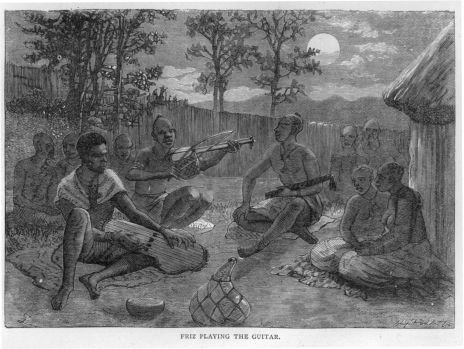
Altogether, Rumanika was the most intelligent and best-looking ruler the travellers met with in Africa. He had nothing of the African in his appearance, except that his hair was short and woolly. He was fully six feet two inches in height, and the expression of his countenance was mild and open. He was fully clothed in a robe made of small antelope-skins and another of dark cloth, always carrying, when walking, a long staff in his hand. His four sons were favourable specimens of their race, especially the eldest, named Chunderah. He was somewhat of a dandy, being more neat about his lion-skin covers and ornaments than his brothers. From the tuft of wool left unshaven on the crown of his head to his waist he was bare, except when his arms and neck were decorated with charmed horns, strips of otter-skin, shells, and bands of wool. He was fond of introducing Friz, Speke’s head man, into the palace, that he might amuse his sisters with his guitar, and in return the sisters, brothers, and followers would sing Karague music. The youngest son was the greatest favourite, and on one occasion, the travellers having presented him with a pair of white kid gloves, were much amused with the dignified way in which he walked off, having coaxed them on to his fingers.
Rumanika, contrary to the usual African custom, was singularly abstemious, living almost entirely on milk, merely sucking the juice of boiled beef. He scarcely ever touched plantain wine or beer, and had never been known to be intoxicated. The people were generally excessively fond of this wine, the peasants especially drinking large quantities of it.
Rumanika was not only king, but priest and prophet; indeed, his elevation to the throne was due, as his friends asserted, to supernatural agency. After the death of his father, his two brothers and he claimed the throne. Their pretentions were to be settled by an ordeal. They possessed a small magic drum, and, it being placed on the ground, he who could lift it was to take the crown. His brothers were unable to stir it, though exerting all their strength, but Rumanika raised it with his little finger. This test, however, not satisfying the chiefs, they insisted on Rumanika going through another trial. He was seated on the ground, and it was believed that if he was the appointed king, the portion of soil on which he sat would rise up in the air, but if not, it would collapse, and he would be dashed to pieces. According to the belief of his subjects, no sooner had Rumanika taken his seat, than he was raised into the sky, and was therefore acknowledged king.
One of the most curious customs which Rumanika holds in his character of high priest, is his new-moon levée, which takes place every month, for the purpose of ascertaining the loyalty of his subjects. On the evening of the new-moon the king adorns himself with a plume of feathers on his head, a huge white beard descending to his breast. He takes post behind a screen. Before him are arranged forty long drums on the ground, on the head of each of which is painted a white cross. The drummers stand each with a pair of sticks, and in front is their leader, who has a couple of small drums slung round his neck. The leader raises first his right arm and then his left, the performers imitating him, when he brings down both sticks on the drums with a rapid roll, they doing the same, until the noise is scarcely to be endured. This having continued for some hours, with the addition of smaller drums and other musical instruments, the chiefs advance in succession, leaping and gesticulating, and shouting expressions of devotion to their sovereign. Having finished their performance, they kneel before him, holding out their knobbed sticks that he may touch them, then, retiring, make room for others.
Civilised as the country is in some respects, marriage is a matter of barter between the father and the intended husband, the former receiving cows, slaves, sheep, etcetera, for his daughter. Should, however, a bride not approve of her husband, by returning the marriage gifts she is again at liberty. The chief ceremony at marriages consists in tying up the bride in a skin, blackened all over, and carrying her with a noisy procession to her husband.
The ladies of this country lead an easy life in many respects, their chief object, apparently, being to get as fat as possible. Many of them succeed wonderfully well, in consequence of their peculiar constitution, or from the food they eat being especially nutritious. Five of Rumanika’s wives were so enormous that they were unable to enter the door of any ordinary hut, or to move about without being supported by a person on either side. One of his sisters-in-law was of even still greater proportions. Speke measured her; round her arm was one foot eleven inches; chest, four feet four inches; thigh, two feet seven inches; calf, one foot eight inches; height, five feet eight inches. He could have obtained her height more accurately could he have had her laid on the floor; but, knowing the difficulties he would have had to contend with in such a piece of engineering, he tried to get her height by raising her up. This, after infinite exertion, was accomplished, when she sank down again, fainting, for the blood had rushed into her head. Meanwhile the daughter, a lass of sixteen, sat before them, sucking at a milk-pot, on which the father kept her at work by holding a rod in his hand; for, as fattening is one of the first duties of fashionable female life, it must be duly enforced with the rod if necessary. The features of the damsel were lovely, but her body was as round as a ball.
The women turn their obesity to good account. In exchanging food for beads it is usual to purchase a certain quantity of food, which shall be paid for by a belt of beads that will go round the waist. The women of Karague being on an average twice as large round the waist as those of other districts, food practically rises a hundred per cent, in price. Notwithstanding their fatness their features retain much beauty, the face being oval and the eyes fine and intelligent. The higher class of women are modest, not only wearing cow-skin petticoats, but a wrapper of black cloth, with which they, envelope their whole bodies, merely allowing one hand to be seen.
The travellers were allowed to move about the country as they liked, and the king sent his sons to attend on them, that they might enjoy such sport as was to be found. They heard of no elephants in that district, but harte-beestes, rhinoceros, and hippopotami were common.
One day Captain Grant saw two harte-beestes engaged in a desperate combat, halting calmly between each round to breathe. He could hear, even at a considerable distance, the force of every butt as their heads met, and, as they fell on their knees, the impetus of the attack, sending their bushy tails over their backs, till one, becoming the victor, chased the other out of the herd.
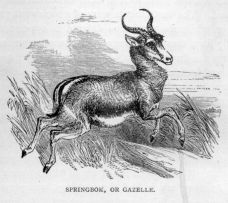
Several varieties of antelope and the mountain gazelle were seen bounding over the hills. Pigs abounded in the low grounds, and hippopotami in the lake.
Captain Speke went out in search of rhinoceros, accompanied by the prince, with a party of beaters. In a short time he discovered a fine male, when, stealing between the bushes, he gave him a shot which made him trot off, till, exhausted by loss of blood, he lay down to die. The young princes were delighted with the effect of the Englishman’s gun, and, seizing both his hands, congratulated him on his successes.
A second rhinoceros was killed after receiving two shots. While pursuing the latter, three appeared, who no sooner sighted Speke, than they all charged at him in line. His gun-bearers, however, were with him, and, taking his weapons, he shot the three animals in turn. One dropped down a little way on, but the others only pulled up when they arrived at the bottom of the hill. The fore legs of another were broken, when the natives set on him; but he kept charging with so much fury that they could not venture to approach till Speke had given him a second ball, which brought him to the ground. Every man then rushed at the creature, sending his spear, assegai, or arrow into his sides until he sank like a porcupine covered with quills. The heads were sent to the king, to show what the white man could do. Rumanika exhibited the greatest astonishment, declaring that something more potent than powder had been used; for, though the Arabs talk of their shooting powers, they could not have accomplished such a feat. “It is no wonder,” he added, “that the English are the greatest men in the world.”
Rumanika, like great men in other countries, had his private band. The instruments were of a somewhat primitive character, while the musicians differed in appearance considerably from those of Europe. The most common instruments are the drums, which vary greatly in size: one hung to the shoulder is about four feet in length, and one in width. It is played with the fingers, like the Indian tom-tom. The drums used at the new-moon levée are of the same shape, but very much larger. The war drum is beaten by women. At its sound the men rush to arms, and repair to their several quarters. There are also several stringed instruments. One of these, which Captain Grant describes, was played by an old woman; it had seven notes, six of which were a perfect scale. Another, which had three strings, was played by a man: they were a full, harmonious chord. A third instrument called “the laced nanga” formed of dark wood, in the shape of a tray, had three crosses in the bottom, and was laced with one string, seven or eight times, over bridges at either end.
The prince sent the best player to be found to entertain his guest. The man entered, dressed in the usual Wanyambo costume, looking a wild, excited creature. After resting his spear against the roof of his hut, he took a nanga from under his arm and began playing, his wild yet gentle music and words attracting a number of admirers. It was about a favourite dog, and for days afterwards the people sang that dog song.
There is another stringed instrument, called the zeze, somewhat similar to the nanga. They have two wind instruments, one resembling a flageolet, and another a bugle. The latter is composed of several pieces of gourd, fitted one into another, in telescope fashion, and is covered with cow-skin.
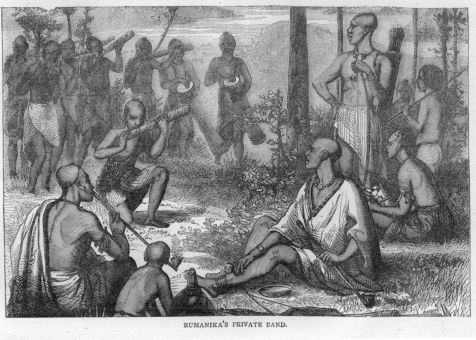
Rumanika’s band was composed of sixteen men, fourteen of whom had bugles, and the other two hand-drums. On the march they form in three ranks, the drummers being in the rear, swaying their bodies in time to the music, while the leader advances with a curiously active step, touching the ground alternately with each knee. They also, when the king rested on a march, or when out hunting, played before him, while he sat on the ground and smoked his pipe.
The Wahuma, like most Africans, have great faith in the power of charms, and believe that by their means persons can be rendered invulnerable. They also believe in the constant presence of departed souls, supposing that they exercise a good or evil influence over those whom they have known in life. When a field is blighted or a crop does not promise well, a gourd is placed in the pathway; passengers set up a wailing cry, which they intend as a prayer to the spirits to give a good crop to their mourning relatives. Rumanika, in order to propitiate the spirit of his father, was in the habit of sacrificing annually a cow on his tomb, and also of placing offerings on it of corn and wine. These and many other instances show that, though their minds are dark and misguided, the people possess religious sentiments which might afford encouragement to missionaries of the gospel.
The commencement of 1862 found the travellers still guests of the enlightened king. Hearing that it was the English custom on Christmas Day to have an especially good dinner, he sent an ox. Captain Speke in return paid him a visit. He offered him the compliments of the season, and reminded him that he was of the old stock of Abyssinians, who were among the oldest Christians on record, and that he hoped the time would come when white teachers would visit his country, to instruct him in the truths which he and his people had forgotten.
News now arrived which induced them to believe that Mr Petherick was indeed on his road up the Nile, endeavouring to reach them. Rumanika was highly delighted to hear this, as he was especially anxious to have white men visit his country from the north.
Active preparations were now made for the departure of the travellers, but unhappily Captain Grant was suffering from so severe a complaint in one of his legs, that he was compelled to remain behind, under the protection of the hospitable sovereign, while Speke set off for Uganda.
Chapter Sixteen.
Speke and Grant’s travels continued.
An escort from Mtesa, King of Uganda, arrives—The Kitangule River—The Phépo—Slaughter of the natives—Uganda described—Speke’s reception—Mtesa’s cruelty—Arrest of the Queen—A review of troops—Grant arrives—Arrangements for proceeding to Unyoro—The water-spirit’s high priest.
On the 10th of January a large escort of smartly-dressed men, women, and boys, leading their dogs and playing their reeds, under the command of Maula, arrived from Mtesa, King of Uganda, to conduct the travellers to his capital. Maula informed them that the king had ordered his officers to supply them with everything they wanted while passing through his country, and that there would be nothing to pay.
Speke set forth, in the hopes that before long he should settle the great Nile problem for ever. It was, however, not believed that he would be able to proceed north from Uganda, Rumanika especially declaring that he would be compelled to return to the southward.
Passing through a remarkably rich country, famous for its ivory and coffee productions, they descended from the Mountains of the Moon to an alluvial plain, where Rumanika keeps thousands of cows. Once elephants abounded here, but, since the increase of the ivory trade, these animals had been driven off to the distant hills.
On the 16th they reached the Kitangule River, which falls into the Victoria Nyanza. It was about eighty yards broad and so deep that it could not be poled by the canoe-men, while it runs at a velocity of from three to four knots an hour. It is fed from the high-seated springs in the Mountains of the Moon. Speke believed that the Mountains of the Moon give birth to the Congo as well as the Nile, and also the Shire branch of the Zambesi.
The country through which they passed was a perfect garden of plantations, surprisingly rich, while along the banks of the river numberless harte-beestes and antelopes were seen.
At a village, where they were compelled to stop two days, drumming, singing, screaming, yelling, and dancing went on the whole time, during the night as well as day, to drive the phépo, or devil, away. In front of a hut sat an old man and woman, smeared with white mud, and holding pots of pomba in their laps, while people came, bringing baskets full of plantain squash and more pots of pomba. Hundreds of them were collected in the court-yard, all perfectly drunk, making the most terrific uproar.
The king sent messengers expressing his desire to see the white man, and they were informed that he had caused fifty big men and four hundred small ones to be executed because he believed that his subjects were anxious to prevent them.
Speke now sent back to Grant, earnestly urging him to come on if he possibly could, as he had little doubt that they would be able to proceed across the country to the northward.
On approaching the capital, a messenger came to say that the king was so eager to meet the white man that he would not taste food until he had seen him.
The neighbourhood was reached on the 19th of February. Speke says it was a magnificent sight; the whole hill was covered with gigantic huts, such as he had never before seen in Africa. He proposed going at once to the palace; but the officers considered that such a proceeding would be indecent, and advised him to draw up his men and fire his gun off to let the king know that he had arrived. He was excessively indignant at being shown the dirty huts for his accommodation, in which the Arabs put up when they came to the place. Speke declared that, unless better quarters were found him, he would return; but the officer entreated that he would not be so hasty. Rain, coming on, prevented a levée being held that day. The presents being got ready, Speke marshalled his procession: the king’s officers and pages, with himself, marched on the flanks; the Union Jack, carried by his guide, led the way, followed by twelve of his men, as a guard of honour, dressed in red flannel cloaks, carrying their arms sloped, with fixed bayonets, while in the their rear came the rest of his attendants, each bearing some article as a present.
He was surprised at the extraordinary dimensions of the palace, and the neatness with which it was kept. The whole brow and sides of the hill were covered with gigantic grass-huts, neatly thatched and fenced all round with the tall, yellow reeds of the tiger-grass, while, within the enclosures, the lines of huts were joined together or partitioned off into courts, with the walls of the same grass.
These huts formed the residence of Mtesa’s three or four hundred wives, the rest living chiefly with his mother, the queen dowager. The ladies were seen at the doors, making their remarks and enjoying their jokes. At each gate they passed, officers opened and shut them, jingling the big bells hung upon them to prevent stealthy entrance.
As they advanced, courtiers of high dignity stepped forward to greet the white man, dressed in the most scrupulously neat fashions. Men, women, bulls, dogs, and goats were led about by strings, cocks and hens were carried in men’s arms, and little page-boys with rope turbans rushed about conveying messages, as if their lives depended on their swiftness, every one holding his skin cloak tightly round him, lest his naked legs should by accident be shown, a crime which in that kingdom, if happening in the presence of the king, meets with instant death.
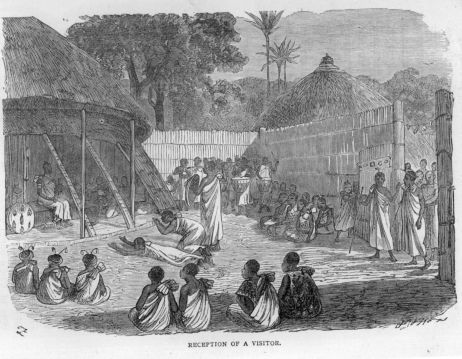
These huts are well-built of reed, which grows to a great height. They have double roofs formed of thick grass thatch, in order to exclude the heat of the sun. The outer roof comes nearly to the ground on all sides. The structure is supported by stout poles, on which are hung sacks of corn, meat, and other provisions. The interior is divided into two portions by a high screen, the inner serving as a sleeping-room, in which a bedstead formed of cane is placed. There are no windows nor chimneys, and only one door in front.
When Speke, however, was desired to sit down outside to wait the appearance of the monarch, he, considering this an act of discourtesy, refused to comply. After waiting five minutes, as the king did not appear, he thought it right to walk home again, giving Bombay directions to leave his present on the ground. He was followed soon afterwards by Bombay, who told him that he might bring his own chair, as the king was anxious to show him every respect, although no one but the monarch was allowed in Uganda to sit on an artificial seat.
On his return, he found the king, a good-looking, well-figured, tall young man of twenty-five, sitting on a red blanket, which formed his throne, in the state hut. His hair was cut short, with the exception of a ridge on the top which ran stem to stern, like a cockscomb. He wore on his neck a large ring with beautifully-worked small beads. On one arm was another bead ornament, and on the other a wooden charm, and on every finger and toe he had alternately brass and copper rings, while above the ankles, half way up to the calf, he had stockings of very pretty beads.
In front of him were his nobles, squatting on the ground, all habited in skins, mostly cow-skins, some few—the sign of royal blood—having leopard-skins girded round their waists. Speke was desired to halt and sit in the glaring sun, while he was advancing hat in hand. He donned his hat, mounted his umbrella, and quietly sat down, to observe what was going on. A white dog, spear, shield, and woman, the Uganda cognisance, were by the side of the king, as also a knot of staff-officers, with whom he kept up a brisk conversation, while he took copious draughts from neat little gourd cups, offered by his ladies-in-waiting.
The traveller could not speak his language, and his interpreter dared not address the king, it being contrary to etiquette. Conversation was therefore impossible, and he was very glad, therefore, when at length his Majesty got up and retired, with a gait which was intended to be very majestic. It was to represent the step of a lion, but the outward sweep of the legs looked only like a ludicrous waddle. The king had in reality gone to eat his breakfast, as he had not broken his fast since hearing of the traveller’s arrival. He quickly returned, and Speke was again invited in, with his men. He found the king standing on a red blanket, talking and laughing to a hundred or more of his admiring wives, who were all squatting on the ground outside, forming two groups. His men dared not advance upright, but, stooping, with lowered head and averted eyes, came cringing after him, it being a high crime to look upon the ladies of the court. It was difficult, however, to carry on conversation with him, as every answer had to be passed through the interpreter, and then delivered to the king’s chief officer, and frequently another question was asked before the first was answered. The most important questions had reference to opening up a passage across the country. Before Speke could explain his views, the king put another question.
Mtesa was a perfect despot and tyrant, the lives of all his subjects, from the highest to the lowest, being in his power. When the whim seized him, he did not hesitate to kill as many as he chose.
The king’s subjects approach in the most cringing attitudes, and, on receiving any favour, throw themselves on the ground, floundering about, shrieking out: “Nynzig! nynzig!” He is attended by a number of young pages, with rope turbans on their heads, who are seen rushing about in every direction to obey his behests, and directly a wife or courtier offends the despot, rush upon the unhappy individuals and drag them off to immediate execution.
Speke, however, won his favour by blistering and doctoring him. He managed to keep up his own dignity by refusing to submit when improperly treated. He also gained great credit with the monarch by exhibiting his skill as a sportsman; and Mtesa was delighted to find that after a little practice he himself could kill birds and animals. He did not, however, confine himself to shooting at the brute creation, but occasionally killed a man or woman who might have been found guilty of some crime.
After a considerable lapse of time Speke obtained a residence at what was looked upon as the “west end” of the city. It was in a garden, in view of the palace, so that he could hear the constant music and see the throngs of people going to and fro. Having selected the best hut for himself, and giving the other to his three officers, he ordered his men to build barracks for themselves in the form of a street from his hut to the main road. He could now visit the palace with more ease, and obtained better opportunities of seeing the king and endeavouring to gain the important ends he had in view.
The sights he witnessed were very often painful. Scarcely a day passed that he did not see one, and sometimes more, of the unhappy female inmates of the palace dragged off to execution by one of the body-guard, the poor creature shrieking out, as she went to premature death: “Oh, my lord, my king, my mother!” and yet no one dared to lift a hand to preserve her.
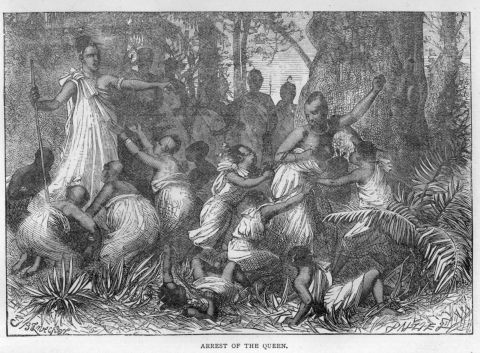
He made several sporting excursions with the king, who was always delighted when he shot a bird or an animal, jumping and leaping, and shouting: “Woh! woh! woh!” to express his delight. One of these was to the Lake Nyanza, after Speke had somewhat ingratiated himself with the sovereign. It was somewhat of a picnic party, and the king was accompanied as usual by a choice selection of his wives. Having crossed over to a woody island some distance from the shore, the party sat down to a repast, when large bowls of pomba were served out. They then took a walk among the trees, the ladies apparently enjoying themselves and picking fruit, till, unhappily, one of the most attractive of them plucked a fruit and offered it to the king, thinking, probably, to please him. He took it, however, as a dire offence, and, declaring that it was the first time a woman had had the audacity to offer him food, ordered the pages to lead her off to execution. No sooner had the words been uttered than the abominable little black imps rushed at her like a pack of beagles, slipping off their cord turbans and throwing the ropes round her limbs. She, indignant at being touched, remonstrated and attempted to beat them off, but was soon overcome and dragged away, crying out the names of “Kamraviona! Mzungu!” the title applied to Speke, for help and protection, while the other women clasped the king round the legs, imploring him to pardon their unhappy sister. His only reply was to belabour the miserable victim with a thick stick. Speke had carefully abstained heretofore from interfering with any of the king’s acts of arbitrary cruelty. On hearing, however, his own name imploringly pronounced, his English blood was up, and, rushing at the tyrant, he stayed his uplifted arm, and demanded the poor creature’s life. He, of course, ran a great risk of losing his own; but the novelty of the event seemed to tickle the capricious chief, and he at once ordered the woman to be released.