"Great African Travellers" (continued 4)
Reading edition
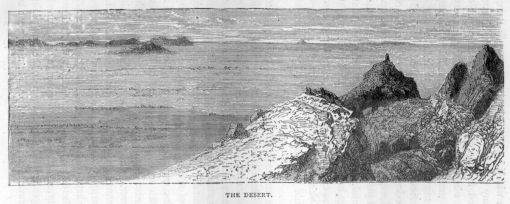
Day after day they travelled on, passing through rocky wadies and narrow defiles, out of the sides of which projected jet-black masses of sandstone, giving a wild air to the desolate region.
One day two gazelles were caught, an addition to their bill of fare.
At length in the distance appeared a town on the top of a broad, terraced rock. They took long to reach it.
It is rarely such a place is seen in that part of the world. The rock rose in the midst of a valley, occupying a position which in days of yore must have made it a place of great importance. It is called Ederi. Amidst the sand-hills which surround it are green fields of wheat and barley, and here and there groves of date-trees.
Before them now lay a series of sand-hills, intermingled with small clusters of palm-trees. Sometimes the ascent of the sand-hills was most trying for the camels. They extend for five days’ march or more, but are nothing in comparison with those in the direction of the Natron Lakes: so one of their guides told them.
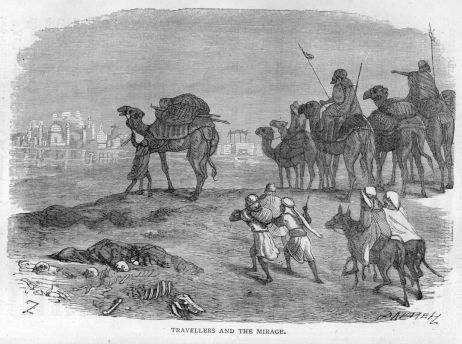
Often, while crossing this sandy waste, thirsty travellers are deceived by the effects of the curious mirage, when lakes glittering in the sun, with towers, domes, and minarets reflected on their surface, appear before their eyes, to vanish suddenly as they approach.
Their camel-drivers had led them them to the left, in order to visit their own village of Ugrefe. It consisted of about thirty light and low dwellings made of clay and palm branches. In an open space near it they encamped beneath two splendid ethel-trees, or tamarisks.
At length, on the 6th of May, they reached the plantations surrounding Mourzouk, the capital of Fezzan. The walls are built of a sort of clay glittering with saline incrustations. Going round the whole of the western and northern sides, which have no gateway wide enough for a caravan, they halted on the eastern side of the town, not far from the camp of the pilgrims who were returning from Egypt to Morocco. They were here welcomed by Mr Gagliuffi, a Greek merchant, who received them into his house.
The buildings are mostly of one story, with flat roofs and parapets, with interior courts, and broad porticoes supported by pillars in front. The town contains a bazaar and barracks for two thousand Turkish troops. It is a thoroughfare rather than the seat of a commerce.
They were here joined by a man of influence named Mahomet Boro, an elderly, respectable-looking personage, wearing a green bournous over white under-clothes. He was to act as mediator between them and the inhabitants of the countries they were to visit. He was now on his homeward journey from a pilgrimage to Mecca.
On the 13th of June they left Mourzouk by the eastern gate. Some chiefs from Ghat had arrived, to whose charge Mr Gagliuffi had committed the travellers. At this Mahomet Boro became very indignant, and threatened that he would take care that they should be attacked on the road by his countrymen, nor were these empty threats.
It is remarkable that while the Mahommedan religion in general is sinking to corruption along the coast, there are ascetic sects rising up in the interior which unite its last zealous followers by a religious bond. From some of these sects travellers receive much ill-treatment and annoyance. On the 15th of July the doctor determined to visit a remarkable mountain which appeared in the distance. Being unable to obtain any guide, he set off, taking with him as provisions only dried biscuits and dates—the worst possible food in the desert when water is scarce. Making his way over the pebbly ground, he saw a pair of beautiful antelopes, which stopped, gazing at him and wagging their tails.
The distance proved far greater than he had imagined; indeed, there was a deep valley between him and the side of the mountain. Still, eager to reach its summit, he pushed on. The sun began to put forth its power; there was not the slightest shade around. At length he reached the height at which he was aiming, but, on looking round, he in vain sought for any traces of the caravan. Having but a small supply of water in his water-skin, he could only venture to sip a few drops, while he could with difficulty eat his dry biscuit and dates.
Fearing that the caravan might push on believing him to be in advance, he immediately descended the mountain, in order to follow its course. At noon he swallowed the remainder of his water, but, taken on an empty stomach, it did not restore his strength. Believing that his party were to encamp at no great distance from the mountain, he strained his sight in hopes of seeing his friends; but no living being was visible. Having walked some distance, he ascended a mound crowned with an ethel-bush, where he fired his pistols; but a strong east wind blowing against him, he in vain waited for an answer. Crossing some sand-hills, he again fired, and, at last convinced that there could be nobody in that direction, he supposed that his party were still behind him, and unluckily kept more to the east. At last some small huts appeared in the distance. He hastened towards them, but they were empty, nor was a drop of water to be obtained. His strength being exhausted, he sat down on the bare plain, hoping that the caravan would come up. For a moment he thought he saw a string of camels passing in the distance, but it was a delusion.
He mustered strength sufficient to scramble to an ethel-tree on an elevated spot, intending to light a fire, but, unable to move about, he could gather no wood. Having rested after dark for an hour or two, he once more rose, and discovered in the south-west a large fire. Again he fired his pistols, but no answer was returned. Still the flames rose towards the sky, telling him where deliverance was to be found, but he was unable to drag his weary limbs so far. Having waited long, he fired a second time, yet no answer came. At last he resigned himself to the care of the Merciful One and tried to sleep, but in vain—he was in a high fever. The long night wore away and dawn was drawing nigh. All was repose and silence: he was sure that he could not choose a better time for trying to inform his friends by signal of his whereabouts. Collecting his remaining strength, he loaded his pistol with a heavy charge and fired once and then again. His companions seemed not to have heard his signals. The sun he had half longed for, half looked-forward to with terror, at last rose. His condition, as the heat increased, became more dreadful. He crawled round the tree, trying to enjoy the little shade afforded by the leafless branches. About noon there was only sufficient shade left to shelter his head. He suffered greatly from the pangs of thirst, till at last, becoming senseless, he fell into a sort of delirium, from which he only recovered when the sun went down behind the mountain. Crawling from beneath the shade of the tree and throwing a glance over the plain, suddenly the cry of a camel reached him. It was the most delightful music he had ever heard in his life. Raising himself a little, he saw a mounted Tarki passing at some distance and looking eagerly around. The Tarki had discovered his footprints in the sandy ground. Crying as loud as his faint strength would allow, “áman! áman!” (“Water! water!”) he was rejoiced to see the Tarki, Musa by name, approaching, and in a few moments he was at his side, washing and sprinkling his head. His throat was, however, too dry to enjoy the draught which Musa poured into it. His deliverer then placed him on his camel, mounted himself in front, and carried him to the tents.
The strength of a European is soon broken in those climes, if for a single day he is prevented from taking his usual food. Next day, however, the doctor was able to continue his journey.
Ghat, well situated in the centre of an oasis, was next reached. It is surrounded by mud walls, with flat-roofed houses, while outside are plantations of date-trees.
On the 26th of July the caravan again set out. On the 29th they commenced their ascent to the greatest elevation of the desert, four thousand feet above the sea. The path winding along through loose blocks of stone, the precipitous ascent proved very difficult. Several loads were thrown off the camels, and the boat frequently came in contact with the rocks. It is indeed the wildest and most rugged region of the whole desert. At one place the road meandered in a remarkable way, sometimes reduced to a narrow crevice between curiously-terraced buttresses of rocks. Two hours were occupied in descending.
At the bottom was a wady between steep, precipitous cliffs looking almost like walls erected by the hand of man. They were more than a thousand feet high, with a pond of rainwater at the bottom. The valley is called Aegeri.
They had now to pass a region of sand-hills. During their passage the mirage set before their eyes beautiful sheets of water, which quickly disappeared as they approached.
Desolate as the country appears, large herds of wild oxen rove over it. Though the men tried to catch some of them, they were unsuccessful, as the animal, sluggish as it seems, rapidly climbs the rocks and is soon lost to sight.
The travellers, having now entered the tropics, expected to reach pleasanter regions than they had hitherto passed through. Their guides, however, were leading them further to the west than they wished, their great desire being to reach Negroland as soon as possible.
On the 18th of August they were quietly pursuing their road, when one of their party was seen running up behind them, swinging his musket over his head and crying: “Lads, our enemy has come!” Alarm was spread through the caravan: everyone seized his arms, and those who were riding jumped from their camels. The man reported that a number of Tawarek, mounted on camels, had been seen rapidly approaching, with the evident intention of attacking the caravan. A warlike spirit prevailed, and all, the doctor thought, would fight valiantly. Freebooting parties, however, do not attack openly. They first introduce themselves in a peaceable way, when, having disturbed the little unity which exists in most caravans, they gradually throw off the mask.
After some time they came to the conclusion that it was not likely that they would be attacked by daylight. They, therefore, sent off a body of archers to gain information from a small caravan which was coming from Soudan, consisting of a few Tebus, ten camels, and about forty slaves. The unfortunate Tebus were soon afterwards attacked by a fierce tribe, the Haddanara, who, disappointed at getting nothing from the English expedition, murdered the whole of them and carried off their camels and slaves.
Soon after the party had encamped at night three strangers made their appearance; but, although they were known to be robbers, and that a number of their companions were not far off, they were allowed to lie down for the night. The experienced old Sheikh of the Kafeila warned Barth to be on his guard, and exhorted his attendants to be staunch. Everybody was crying for powder. Their clever servant, Mahomet, placed his four pieces of boat on the outside of the tents, that they might afford shelter in case of an attack. They kept watch the whole night, and the strangers, seeing them well on their guard, did not venture to assail them. In the morning they went slowly away to join their companions, who had kept behind a rocky ridge in the distance. There was indeed much cause for anxiety. Suddenly an alarm was raised that the camels had been stolen. The old chief, taking advantage of this state of things, urged Barth and Overweg to confide their property to him and another chief. This was not entirely disinterested advice; for, if anything had happened to the travellers, the chief would, of course, have been their heir.
At an early hour they started with an uneasy feeling. With the first dawn the true believers had been called together for prayer; and the bond which united the Mahommedan members of the caravan with the Christian travellers, it was seen, had been loosened in a very conspicuous manner.
Instead of, as usual, each little party starting off as soon as they were ready, they all waited till the whole caravan had loaded their camels, when they began their march in close order, to be ready in case of being attacked.
After advancing some distance they saw four men seated ahead of them, on an eminence. The doctor, being in the first line of the caravan, dismounted and led forward his camel. A party of archers had been despatched to reconnoitre. What was his surprise to see them and the unknown individuals executing a wild sort of armed dance. Suddenly two of the dancers rushed upon him and grasped the rope of the camel, asking for tribute. Barth seized his pistols, when, just in time, he was told they were friends.
The eminence is an important locality in the modern history of the country. It was here, when the Kel-owi, a pure Berber tribe, took possession of the territory of old Gober, that a covenant was entered into between the red conquerors and the black natives, that the latter should not be destroyed, and that the principal chief of the Kel-owi should only be allowed to marry a black woman. As a memorial of this transaction, when caravans pass the spot where the covenant was entered into, the slaves make merry and are authorised to levy upon their masters a small tribute.
The black man who had stopped the doctor was the chief of the slaves. As the caravan proceeded, the merry creatures executed another dance, and the incident would have been of great interest if the members of the caravan had not been depressed with the forebodings of mishap.
They now reached a small village of leathern tents, inhabited by a people of the tribe of Fade-ang, in a valley on the frontier region of Aire. The chief was respected as a person of great authority, and, it was said, was able to protect them against the freebooting parties which their guests of the other day, who had gone on before, were sure to collect against them. He had been invited to the camp; but he sent his brother instead, who, it was soon evident, could render them no assistance. The travellers were soon surrounded by the inhabitants, to whom a number of small presents were given. These men were very inferior in appearance even to the common Taki freebooter, and extremely degraded in their habits.
While resting in their tents they were alarmed by a report that a body of sixty Mehara were about to attack them, and again everybody was excited, all calling out for powder and shot. It was evident that there was an entire want of union among the members of the caravan.
The scene which followed in the bright moonlight evening, and lasting through the night, was animating and interesting in the extreme. The caravan was drawn up in line of battle, the left wing being formed by the travellers and the detachment of the Kel-owi who had posted themselves in front of their tents, while the Timylkum and the Sfaksi formed the centre, the rest of the Kel-owi with Boro the right wing, leaning upon the cliffs, the exposed left being defended by the four pieces of boat. About ten o’clock a small troop of Mehara, so-called from riding on mehara, or swift camels, made their appearance. Immediately a heavy fusillade was commenced over their heads, and was kept up with shouting during the night.
The enemy hovered around them during the whole of the next day, and prevented them from making excursions.
Leaving their camping ground on the 24th of August, they travelled on without molestation; but, soon after their tents had been pitched the next evening in a valley full of talha trees and oat-grass, the marauders again made their appearance, mounted on camels, and, dismounting within pistol-shot of the tents, discussed, with wild, ferocious laughter, their projects with their Azkar confederates in the caravan. Some of these soon afterwards came and told them that they might sleep with perfect security; others, however, warned them that they must on no account rest during the night. Preparations for an attack were therefore made, and their camels were brought close to the tents; but the Kel-owi left theirs outside.
In the morning it was found that all the camels had been carried off. On this, Boro led on the more warlike members of the caravan in pursuit. The enemy were overtaken, and, alarmed by the appearance of the bayonets, which they saw would place the Europeans on an equality even after the guns had been fired, offered to come to terms. They declared that they had only come against the white men because they were Christians, and immediately all sympathy for the travellers ceased in the caravan. The rebels were allowed to retain their booty and were treated besides with an enormous quantity of mohamsa.
They now hoped to proceed without further molestation; and the Merabet chief, who had accompanied and sanctioned the expedition against them, was allowed to join their party, as it was thought to be the best means of preventing any further molestation. Boro, who passed the evening with Mr Richardson’s interpreter, in reading the Koran, treated him hospitably.
They were expecting to reach Selufiet, where they hoped to be in safety. When about eight miles from it, the chiefs insisted on encamping, and a number of Merabetin, a fanatical tribe, insisted that they should turn Mohammedans. Their friends and servants urged them to do so, as the only means of saving their lives. They were kept seated in their tent while the fanatics discussed the subject. The travellers sat in silence. At last Mr Richardson exclaimed: “Let us talk a little. We must die. What is the use of sitting so mute?” For some minutes death seemed really to hover over their heads. Mr Richardson proposed trying to escape for their lives, when the kind-hearted Sliman rushed into the tent, exclaiming in a tone of sincere sympathy: “You are not to die.” The Merabetin were content instead to receive a heavy tribute. Unfortunately, the merchandise they carried, instead of consisting of a few valuable things, was composed of worthless, bulky objects; and, as they had also ten iron cases filled with dry biscuits, the ignorant people supposed that they carried enormous wealth. In consequence, when all the claims had been settled, the rebels threatened to fall upon the rest of the baggage. Their friendly chief on this declared that some of it was his own, and also dashed to pieces one of the iron cases, when, to the astonishment of the simple people, instead of beholding heaps of dollars, they saw a dry and tasteless sort of bread!
Meanwhile, the persecuted Christians made off under the escort of the Kel-owi, and the whole caravan was once more collected together.
On the 4th of September they encamped on the summit of a sand-hill, in a broad valley, near the village of Tintellust, the residence of the chief Amur, under whose protection they were now to proceed. The chief received them in a friendly way, and assured them that, even though Christians, the dangers and difficulties they had gone through would suffice to wash off their sins, and that they had nothing to fear but the climate and the thieves. He told them that they were welcome to proceed to Soudan at their own risk; but that if they wished for his protection, they must pay him handsomely.
While the camp remained here, Dr Barth paid a visit to the town of Agades, a place once of great importance, and still containing about seven thousand inhabitants, a large number engaged as tradesmen or in commerce. It is situated on the borders of the desert, surrounded by lawless tribes. He performed his journey on the back of a bullock, with his luggage behind him. He was received in a very friendly way by the sultan, who told him that he had never before heard of the English—not suspecting from whom the gunpowder he used was obtained. The doctor, after placing the treaty before the sultan, said that the English wished to enter into friendly relations with all the chiefs and great men of the earth, in order to establish commercial intercourse with them. He then told him that they had been deprived of nearly all the presents they were bringing for himself and the other princes of Soudan. At this he expressed the greatest indignation.
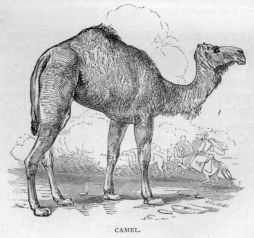
After spending two months at Agades, the doctor returned to Tintellust. Here the expedition was detained six months waiting for an escort, without which they could not proceed with any degree of safety to Soudan. At length, on the 5th of December, the first body of the salt-caravan, for which they had been waiting, arrived from Bilma, and on the 12th of December, 1850, they began to move. The caravan looked like a whole nation in motion: the men on camels or on foot; the women on bullocks or asses, with all the necessaries of the little household, as well as the houses themselves; a herd of cattle, another of milk-goats, and a number of young camels running playfully alongside, and sometimes getting between the regular lines of the laden animals. The old chief walked ahead like a young man, leading his mahary by the nose-cord.
The ground was very rocky and rugged, and looked bare and desolate in the extreme. Several high peaks, which characterise this volcanic region, rose on either side.
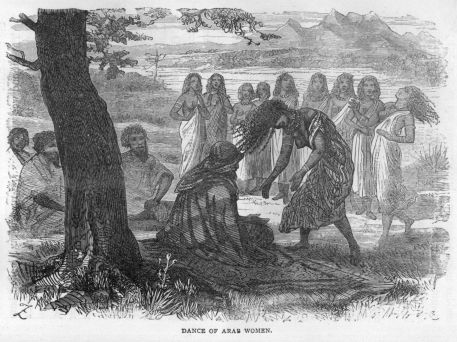
The whole caravan consisted of about two thousand camels, of whom two hundred were laden with salt. At night their camp presented many lively and merry scenes, ranging as it did over a wide district illuminated by large fires. Dancing was going forward and the drummers were vying with each other, one especially rivalling their drummer Assam, and performing his work with great skill, caused general enthusiasm among the dancing people.
On their journey on the 29th of December, they found the ground covered with had, a plant regarded by the Arabs as the most nutritious of all the herbs of the desert for the camel. Numerous footprints of the giraffe were seen, besides those of gazelles and ostriches, and also of the large and beautiful antelope (Leucoryx). Here, too, was seen the magaria, a tree which bears a fruit of the size of a cherry, of a light brown colour. When dry it is pounded and formed into little cakes, and is thus eaten.
On the 1st of January, 1851, they fell in with a tribe of the Tagana, whose morality is of the lowest order. Hunting, together with cattle-breeding, is their chief occupation, and on their little swift horses they catch the large antelope as well as the giraffe.
A steep descent of a hundred feet conducted the caravan off the high region of the Hammada to a level plain.
On the 7th they came in sight of a village, where they saw for the first time that style of architecture which extends over the whole of central Africa. The huts are composed entirely of the stalk of the Indian corn, with only a slight support from the branches of trees. They are somewhat low, curved over at the top. Amid them were seen small stacks of corn, raised on scaffolds of wood about two feet high, to protect them from the white ant and mouse, as also from the jerboa, which is so pretty an object to look at as it jumps about the fields, but is an especial foe to the natives. The people came forth from the villages to offer cheese and Indian corn. They were black pagans and slaves, meanly and scantily dressed, but far more civilised in reality than the fanatical people among whom Barth and his companions had hitherto been travelling.
On the 9th of January the travellers reached Tagelel. From this place there was little danger in their proceeding singly, and it was agreed, in consequence of the low state of their finances, that they should separate, in order to try what each might be able to accomplish single-handed and without ostentation, till new supplies should arrive from home.
Chapter Eleven.
Travels of Dr Barth, continued.
Dr Barth quits Mr Richardson—Reaches Tassawa—Arrives at Kano—Flourishing country—Kano described—Kindly treated—Manufactures and imports—Sets out with his servant Gatroni for Bornou—Hears of Mr Richardson’s death—Enters Kouka—The Vizier meets him—Reception of the Sheikh, a black—Excursion with the Sheikh to Ngornu—Visits Lake Chad—Fishermen on the lake—Journey to Adamawa—Reaches the Binue river—Compelled to return—Sets out for Kanem—Travelling with robber party—Attacked by natives—Robbers beaten—Returns to Kouka—Expedition of Vizier against Mandara—Beautiful, well-cultivated country devoted to destruction—The natives barbarously slaughtered—Slaves taken—Demmo destroyed—Musgu warriors—Natives defend themselves on an island—Returns to Kouka—Journey to Begharmi—Well treated at Loggun—Reaches the magnificent Shary—White ants—Made prisoner and put into chains—Released, and enters Mas-ena—A learned black Faki—Visit to the Sultan—His superstitious fears—Barth returns to Kouka—Death of Dr Overweg.
Parting from Mr Richardson, the two Germans continued on to Chirak, where Overweg quitted Dr Barth, who intended to proceed to Tassawa. The doctor, disposing of a favourite camel, obtained horses for the remainder of the journey and now went on alone; but, accustomed to wander by himself among strange people, he felt in no degree oppressed. His companion was a black, Gajere, a Mahommedan, and, though communicative, rather rude and unable to refrain from occasionally mocking the stranger who wanted to know everything but would not acknowledge the prophet. Mounted on an active steed, he and his attendants soon reached Tassawa, the first large place of Negroland proper which he had seen. Everywhere were unmistakable marks of the comfortable, pleasant sort of life led by the natives. The court-yards, fenced with tall reeds, closed to a certain degree the gaze of the passer-by, without securing to the interior absolute secrecy. Near the entrance was a cool shady hut for the transaction of ordinary business and the reception of strangers. The lower portions of most of the houses consisted of clay, and the upper part of wicker-work, while the roof was composed of reeds only. The dwellings were shaded with spreading trees, and enlivened with groups of children, goats, fowls, pigeons, and, where a little wealth had been accumulated, by a horse, or pack-ox. The men wore white shirts, and trowsers of dark colour, while their heads were generally covered with light caps of cotton cloth. Only the wealthier wore the shawl thrown over the shoulders like the plaid of a Highlander. The dress of the women consisted almost entirely of a large cotton cloth of dark colour, fastened round the neck with a few strings of glass beads.
On the 1st of February Dr Barth approached the important city of Kano. Almost all the people he met saluted him kindly and cheerfully, only a few haughty Fellani passing without a salute.
The villages were here scattered about in the most agreeable way, such as is only practicable in a country in a state of considerable security. Some of them were surrounded by a bush like the broom, growing to a height of ten or twelve feet. The doctor and his native companions passed through a village in which was a large market-place consisting of several rows of well-built sheds. The market women who attached themselves to their cavalcade assured them that they would be able to reach the city that day, but that they ought to arrive at the outer gate before sunset, as at that time it is shut. The party accordingly pushed on; but, after entering the gate, it took them forty minutes to reach the house of Bawu, and, as it was quite dark, they had some trouble in taking possession of the quarters assigned to them by their host.
Kano had been sounding in the traveller’s ears for more than a year; it had been one of the great objects of his journey. It is the chief central point of commerce, a great storehouse of information, and was, Barth considered, the point from whence a journey to more distant regions might be most successfully attempted. At length, after nearly a year’s exertions, he had reached it. He was, however, greatly inconvenienced by not being provided with ready cash, instead of which merchandise had been provided for the expedition, which they had been assured would not only be safer than money, but would also prove more advantageous.
Barth had now to pay away a large sum, and all the smaller articles, which had been carried for barter, having been expended by the heavy extortions to which they had been subjected on the road to Aire—he was placed in much difficulty for want of means. He soon found also that Bawu, Mr Gagliuffi’s agent, could not be implicitly relied on.
The currency of the country consists of cowrie shells, or kurdie, which are not, as in regions near the coast, fastened together in strings of one hundred each, but are separate, and must be counted one by one. The governors of towns make them up in sacks containing twenty thousand each. Private individuals will not receive them without counting them out; those even who made but a few small purchases had to count out five hundred thousand shells.
The doctor had now to borrow two thousand kurdie, which did not amount to the value of a dollar.
He was forbidden to leave his quarters until he had seen the governor, and he was thus kept within them for several days, till he was attacked by fever. At length, on the 18th of February, he received a summons to attend the great man.
Although the distances in Kano are less than those of London, they are very great, and the ceremonies to be gone through are almost as tedious as those of any European court.
Arousing himself, and putting on his warm Tunisian dress, wearing over it a white tobe and a white bournous, he mounted his poor black nag and followed his advocates, Bawu Elaiji and Sidi-Ali, the two latter of whom showed him the most disinterested friendship. It was a fine morning: before him lay the whole scenery of the town, in its great variety of clay houses, huts, sheds, green open places affording pasture for oxen, horses, camels, donkeys, and goats, in motley confusion, with many beautiful specimens of the vegetable kingdom—the slender date-palm, the spreading alleluba, and the majestic silk-cotton tree—the people in all varieties of costume, from the almost naked slave up to the most gaudily-dressed Arab, all formed a most animating and exciting scene.
Passing through the market-place, they entered the quarters of the ruling race—the Fulbe or Fellani, where conical huts of thatched work and the gonda-tree are prevalent.
They first proceeded to the house of the gadado, the lord of the treasury. It was an interesting specimen of the domestic arrangements of the Fulbe, who do not disown their original character of nomadic cattle-breeders. Its court-yard, though in the middle of the town, looked like a farm-yard, and could not be commended for its cleanliness.
The treasurer having approved of the presents and appropriated to himself a large gilt cup, the doctor and his companions were conducted to the audience-hall. It was very handsome, and even stately for this country. The rafters of the elevated ceiling were concealed by two lofty arches of clay, very neatly polished and ornamented. At the bottom of the apartment were two spacious and highly-decorated niches, in one of which the governor was reposing on the gado spread with a carpet. His dress consisted of all the mixed finery of Haussa and Barbary. He allowed his face to be seen, the white shawl hanging down far below his mouth, over his breast.
The governor was highly pleased with the handsome presents he received, and the doctor, notwithstanding the fatigue he had gone through, quickly recovered from his fever.
The next day he rode round the town. Here were a row of shops filled with articles of native and foreign produce, with buyers and sellers in every variety of figure, complexion, and dress, yet all intent upon their little gain. There a large shed full of naked half-starved slaves torn from their homes—from their wives or husbands, from their children or parents—ranged in rows like cattle, and staring desperately upon the buyers, anxiously watching into whose hands it should be their destiny to fall. In another part were to be seen all the necessaries of life; here a rich governor dressed in silk and gaudy clothes, mounted upon a spirited and richly-caparisoned steed, and followed by a host of idle, insolent slaves; there a poor blind man, groping his way through the multitude, and fearing at every step to be trodden down. There were pleasant scenes too, a snug-looking cottage with the clay walls nicely polished, beneath the shade of a wide-spreading alleluba-tree; or a papaya unfolded its large leather-like leaves above a slender, smooth and undivided stem; or the tall date-tree, waving over the whole scene; a matron, in clean black cotton gown, busy preparing the meal for her absent husband or spinning cotton, and at the same time urging the female slaves to pound the corn, and children, naked and merry, playing about in the sun, or chasing a straggling, stubborn goat; earthenware pots and wooden bowls, all cleanly washed, standing in order. In one place dyers were at work, mixing with the indigo some coloured wood in order to give it the desired tint, others drawing a shirt from the dye-pot or hanging it up on ropes fastened to the trees. Further on, a blacksmith, busy with his rude tools making a dagger, a formidable barbed spear, or some more useful instrument of husbandry. Here a caravan appears from Gonga bringing the desired kola-nut, chewed by all who have ten kurdie to spare; or another caravan laden with natron; or a troop of A’sbenawa going off with their salt to the neighbouring towns; or some Arabs leading their camels, heavily laden with the luxuries of the north and east. Everywhere human life was to be seen in its varied forms, the most cheerful and the most gloomy closely mixed together—the olive-coloured Arab, the dark Kanuri with his wide nostrils, the small-featured, light, and slender Ba-fellanchi, the broad-faced Mandingo, the stout, large-boned, and masculine Nupe female, the well-proportioned and comely Ba-háushe woman.
The doctor met with many friends, and was very kindly treated at Kano. He was again attacked with illness, but, recovering, prepared to set out for Kukawa, where he had arranged with Mr Richardson to arrive in the beginning of April. The capital of the large province of Sackatoo contains sixty thousand inhabitants during the busy time of the year, about four thousand of whom belong to the nation by whom the people were conquered. The principal commerce consists in native produce, viz., cotton cloth, woven and dyed here and in the neighbouring towns in the forms either of tobes, the oblong piece of dress of dark colour worn by the women, or plaids of various colours, and the black litham. A large portion of it is sent to Timbuctoo, amounting to three hundred camel-loads annually, thus bringing considerable wealth to the population, for both cotton and indigo are produced and prepared in the country. Leathern sandals are also made with great neatness and exported in large quantities. Tanned hides and red sheep-skins are sent even as far as Tripoli. The chief article of African produce sold in the Kano market is the kola-nut, which has become to the natives as necessary as coffee or tea to Europeans. The slave trade is an important branch of commerce, though the number annually exported from Kano does not exceed five thousand; but very many are sold into domestic slavery, either to the inhabitants of the province itself or to those of the adjoining districts.
The greatest proportion of European goods is still imported by the northern road; but the natural road by way of the great eastern branch of the so-called Niger will in the course of events be soon opened. The doctor deeply regretted that after the English had opened that noble river to the knowledge of Europe, they allowed it to fall into the hands of the American slave-dealers, who began to inundate Central Africa with American produce, receiving slaves in return. Happily an end has come to this traffic. The English did not appear to be aware of what was going on. Space will not allow us to speak further of the various articles of commerce. The principal English goods brought to the market of Kano are bleached and unbleached calicoes and cotton prints from Manchester, French silks, and red cloth from Saxony, beads from Venice and Trieste, a coarse kind of silk from Trieste, paper, looking-glasses, needles and small ware from Nuremberg, sword blades from Solingen, razors from Styria. It is remarkable that so little English merchandise is seen in this great emporium of Negroland.
On the 9th of March the doctor, with immense satisfaction, mounted on his ugly little black nag, rode out of Kano. He had but one servant, his faithful Gatroni, to load his three camels. He was, however, attended by a horseman to see him to the frontier of the Kano territory. The latter, being showily dressed and well mounted, gave himself all possible airs as they rode through the narrow streets into the open fields. Hence he took an easterly course towards Bornou proper.
After passing a number of interesting places, on the 22nd of March the doctor entered the region of Bornou proper. It is here that the dum-palm exclusively grows in Negroland.
He enjoyed an interesting and cheerful scene of African life in the open, straggling village of Calemri, amid which, divided into two distinct groups by a wide, open space, were numerous herds of cattle just being watered. How melancholy came afterwards the recollection of that busy scene, when on his return, three and a half years later, he found it an insecure wilderness, infested by robbers, the whole of the inhabitants having been swept away!
On the 24th, as he was approaching a more woody district than he had hitherto passed, a richly-dressed person rode up to him and gave him the sad intelligence of the death of Mr Richardson at Kukawa. He still could scarcely believe the news; but it was confirmed afterwards by another party of horsemen whom he met. At first he felt as if the death of Mr Richardson involved the return of the mission; but after some consideration he resolved to persevere by himself. On the 2nd of April, pushing on ahead of his camels, on horseback, he approached Kukawa, or Kouka, the capital of Bornou. Proceeding towards the white clay wall which encircles the town, he entered the gate, gazed at by a number of people, who were greatly surprised when he enquired for the residence of the sheikh. Passing the daily market, crowded with people, he rode to the palace, which bordered a large promenade on the east. It was flanked by a mosque, a building of clay with a tower on one side, while houses of grandees enclosed the place on the north and south sides.
On approaching the house of the vizier, to whom he had been directed, he found assembled before it about two hundred gorgeously-dressed horsemen. The vizier, who was just about to mount his horse in order to pay his daily visit to the sheikh, saluted him cheerfully and told him that he had already known him from the letter which had been despatched. While he rode to the sheikh he ordered one of the people to show the doctor his quarters.
Some days passed before he was introduced to the sheikh. In the meantime he had a good deal of trouble regarding the means of paying Mr Richardson’s servants. By great firmness he obtained possession of all Mr Richardson’s property, which would otherwise have been appropriated by the chiefs. He found the sheikh reclining upon a divan in a fine, airy hall. He was of a glossy black colour, with regular features, but a little too round to be expressive; dressed in a light tobe, with a bournous wrapped round his shoulder, and a dark red shawl round his head with great care.
The doctor spent a considerable time in Kukawa, devoting himself to the study of the language, and making enquiries about the surrounding country. Kukawa was not so bustling a place as Kano, but thickly inhabited, and on market-day crowded with people.
He became acquainted with many visitors to the place, among them a hadji, Ibrahim. On one occasion Ibrahim, being unwell, asked the doctor for medicine, and received in return five doses, which he was to take on successive days; but Ibrahim, being in a great hurry to get well, took the whole at once, and was very nearly dying in consequence—an event which would have placed the doctor in a very dangerous position.
His stay at Kukawa was agreeably interrupted by an excursion to Ngornu in which he accompanied the sheikh, and from thence paid a visit to the shores of Lake Chad. Attended by two horsemen and his servants, he set out for the lake. After an hour’s ride they reached swampy ground, and had to make their way through the water, often up to their knees on horseback. After the dry and dreary journey over sands, he found it very pleasant thus wading through deep water. Two boats were seen with men in them, watching evidently to carry off into slavery any of the blacks who might come to cut reeds on the banks of the lagoon. Further on they reached another creek inhabited by hippopotami, which were snorting about in every direction, and by two species of crocodile. There were no elephants seen, however, as that animal always likes to secure a dry couch on the sand, elevated above swampy ground, where it may be free from mosquitoes. On the northern part of the lake, where there are ranges of low sand-hills, immense herds are to be met with.
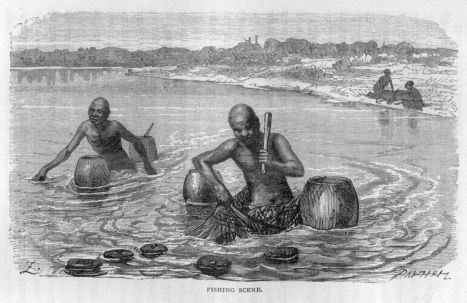
At the village of Maduwari, he made the acquaintance of a chief, Fugo Ali, who treated him with great kindness and continued his friend ever afterwards. It was at his house, a year and a half later, poor Dr Overweg was destined to expire. Accompanying Fugo Ali, he made a long excursion in the neighbourhood of the lake, which is difficult to be reached, as it is surrounded by forests of reeds and broad creeks. He, however, got to one of these, a fine, open sheet of water, now agitated by a light east wind, which sent the waves rippling on the shore. The surface was covered with water-plants, and numberless flocks of fowl of every description played about. To reach it he had to pass through very deep water which covered his saddle, though he was mounted on a tall horse; and one of his companions on a little pony was swamped altogether, his head and his gun alone being visible from time to time.
The inhabitants on the shores of the lake subsist chiefly on fish, which they catch in an ingenious way. The fisherman takes two large gourds, which he connects by a bamboo of sufficient length to allow him to sit astraddle between them. He then launches forth on the water, taking his nets. These are weighted by little leathern bags, filled with sand and supported by bits of bamboo. Having shot his net, he paddles about with his hands, driving the fish into it, and then, taking them out, kills them with a club, and throws them into the gourds. When they are full, he returns to the shore.
Returning to Kukawa, Dr Barth found encamped outside the town a large slave caravan. There were seven hundred and fifty slaves in the possession of the merchants who went with it. Slaves were at that time the principal export from Bornou.
Soon after this Dr Overweg arrived, looking greatly fatigued and much worse than when the doctor parted from him four months before.
On the 29th of May, 1851, Dr Barth and Dr Overweg set out on a journey to Adamawa, in the south. As they advanced their camels were objects of great curiosity and wonder to the natives, that animal seldom getting thus far south, as it will not bear the climate for any length of time.
The country was generally level, with high conical mountains, separated from each other, rising out of it. Though at first swampy, it became woody and well-watered, in many parts densely inhabited, with numerous villages, where even the Mahommedans have penetrated.
At last Mount Alantika appeared in sight, eight thousand feet above the plain. Near it flows the Binue, that long looked-for stream, supposed to make its way westward to the Niger, and which it had been Barth’s great object to reach. There were no signs of human industry near the river, as, during its floods, it inundates the country on both sides. His feelings may be imagined when he stood at length on the banks of the stream, which here flowed from east to west in a broad and majestic course through an entirely open country, from which only here and there detached mountains rose up in solitary grandeur. Not far-off another river, the Faro, rushed forth, not much inferior to the principal river, descending from the steep sides of the Alantika.
On reaching Yola, the capital of the province of Adamawa, he was, greatly to his disappointment, compelled by the governor to turn back.
Slavery exists on an immense scale in this province, many private individuals having more than a thousand slaves. The governor, Mohamet Lowel, is said to receive five thousand every year in tribute, besides horses and cattle.
This is one of the finest districts in Central Africa, irrigated as it is by numerous rivers besides the Binue and Faro, and being diversified with hill and dale. Elephants were exceedingly plentiful, both black and grey and yellow, and the rhinoceros is also met with in the river. Barth was told that there lives in the river an animal resembling the seal, which comes out at night and feeds on the fresh grass.
His adventurous journey obtained the doctor so much fame at Kukawa that, on his return, a party of horsemen galloped out to salute him, and led him in procession to his house. Mr Overweg, who had in the meantime been exploring Lake Chad in a boat, now rejoined him. His next excursion was to Kanem, on the east of Lake Chad, for which he set out on the 11th of September by the way of its northern shores. He had received a valuable horse from the vizier, which was his companion for the next three years. He was attended by two Arabs and a couple of Fezzan lads he had taken into his service. He soon felt revived by the fresh air of the country. The region through which he passed was usually rich, partly forest and partly cultivated.
On the 18th he was joined by Mr Overweg, who arrived accompanied by a band of horsemen. The horsemen treated the natives with the utmost cruelty, stealing their property wherever they went. One day, meeting some cattle-breeders, they plundered them of their milk and of the very vessels which contained it. On applying to Dr Barth for redress, he was enabled not only to restore to them their vessels, but to make them a few small presents.
Descending from the high ground, they continued their course between the sand-hills and a blue inlet of the lake to the south. Some way to the right they caught sight of a whole herd of elephants, ranged in regular array like an army of rational beings, slowly proceeding to the water.
It had been supposed that Lake Chad is salt. This is not the case. The natron or soda, which is procured in the neighbourhood, is found alone in the ground. When an inundation reaches a basin filled with soda, the water of course becomes impregnated. The soda, indeed, has very little effect so long as the basin is deep, and does not begin to make itself felt till the water becomes shallow.
Shortly afterwards, passing a grove of mimosa, two of the horsemen who had been in front came galloping back with loud cries. On approaching the spot they saw a large snake hanging in a threatening attitude from the branches of a tree. On seeing the strangers it tried to hide itself, but after several balls had struck it, it fell down, and its head was cut off. It measured eighteen feet seven inches in length, and five inches in diameter.
They now joined themselves to a party of Arabs, by whom they hoped to be protected on their journey. The expedition was not without danger. One night they were aroused by a terrible screaming and crying from the women, and shouts of “Mount! mount!” Another band of freebooters had attacked the camels, and, having put to flight two or three men and killed a horseman, had driven off part of the herd. The robbers were pursued and overtaken, when they gave up their booty. The lamentations of the females for a man who had been slain sounded woefully through the remainder of the night.
Two days afterwards the Arabs were in great commotion, in consequence of the most handsome among the female slaves, who composed part of the spoil that was to be taken to the vizier, having made her escape during the night. They were eagerly searching for her from dawn of day, but could not find her. At length they discovered her necklace and clothes, and the remains of her bones—evident proofs that she had fallen a prey to the wild beasts.
As they advanced eastward the situation of the Arab robbers became daily more dangerous; nothing was thought of but to retrace their steps westward.
The doctor was lying in his tent suffering from fever, when the alarm was given that the enemy had arrived within a short distance of the camp. He heard firing, when Overweg, mounting his horse, galloped off, calling on his friend to follow him. The doctor, while his servant was saddling his horse, flung his bournous over himself, and, grasping his pistols and gun, mounted and started off towards the west, ordering Mahomet to cling fast to his horse’s tail. Not a moment was to be lost, as the enemy had begun to attack the east side of the camp. Soon afterwards, however, he saw the Arab horsemen rallying to attack the enemy, who had dispersed in order to collect the spoil, and, overtaking Mr Overweg, informed him that the danger was over.
On returning to the camp they found that their luggage and even their tent had gone. The Arabs, however, pursuing the enemy, got back most of their things.
The natives again attacked the camp in the evening, but were beaten off. Hearing, however, that a large body of Wadey horsemen were to join their enemies, the Arabs retreated, and the doctor and his friends, finding a caravan on its way to Kukawa, returned with it on the 25th of November.
After a rest of ten days the persevering travellers again set forth with the sheikh and his vizier on an expedition against Mandara, the principal object of which was to replenish their coffers and slave-rooms, a secondary one to punish the prince of that small country, who, protected by its mountains, had behaved in a very refractory manner. The vizier treated the travellers with great courtesy, and desired them to ride by his side. The army, which was of considerable size, advanced in regular order. At first they amused themselves with hunting. One day a giraffe was caught. The vizier was attended by eight female slaves and horsemen, and the same number of led horses. The unfortunate natives had to provide grain for the army wherever it marched. They spent a day at a village where the troops had to lay in a supply of corn, as they were about to pass the border region, between the cities of the Mahommedans and those of the Pagan tribes, which, as is generally the case in this part of the world, have been reduced to desolation. The vizier made Mr Overweg a present of a small lion. On a previous occasion he had given him a ferocious little tiger cat, which though young was extremely fierce, and quite mastered the young lion. They, however, soon died, in consequence of the continual swinging motion they had to endure on the backs of the camels in the heat of the day.
Passing through a dense forest region, frequented by numerous elephants, they arrived at Gabari, the northernmost of the Musgu villages, surrounded by fields of native grain. The inhabitants had fled; for, though nominally under the protection of the rulers of Bornou, they had thought it prudent to take care of their own safety. Their village was completely plundered, the soldiers thrashing out their grain and loading their horses with it, while their goats, fowls, and articles of furniture fell a prey to the greedy host. The village had presented an appearance of comfort, and exhibited the industry of the inhabitants. Its dwellings were built of clay; and each court-yard contained a group of from three to six huts, according to the number of wives of the owner.
Continuing their march, on the 28th of December they reached the country devoted to destruction. The country was pleasant in the extreme; stubble-fields surrounded numerous groups of huts and wide-spreading trees, on whose branches was stored up the nutritious grass of those swampy grounds for a supply in the dry season. Broad, well-trodden paths, lined by thick fences, wound along through the fields in every direction. Near the village were regular sepulchres, covered in with large well-rounded vaults, surrounded by an earthen urn. While the doctor was contemplating this scene he found that the vizier and his party had galloped on in advance. On looking round he saw only a few Shooa horsemen. Following them, he soon found that he was entirely cut off from the main body of the army. A scene of wild disorder presented itself; single horsemen were roving about to and fro between the fences of the villages; here a poor native, pursued by sanguinary foes, running for his life in wild despair; there another dragged from his place of refuge; while a third was seen stealing by, under cover of a fence, and soon became a mark for numerous arrows and balls. A small troop of Shooa horsemen were collected under the shade of a tree, trying to keep together a drove of cattle which they had taken. Accompanying another band, the doctor at length rejoined the vizier. News had just been received that the pagans had broken through the line of march near the weakest point, and that the rear had been dispersed. Had these poor pagans been led on by experienced chieftains, they would have been able in their dense forests, where cavalry is of little use, to do an immense deal of damage to their cowardly invaders, and might easily have dispersed them altogether.
A large number of slaves had been caught, and in the evening a great many more were brought in, altogether between five hundred to a thousand. To the horror of the travellers, not less than one hundred and seventy full-grown men were mercilessly slaughtered in cold blood, the greater part of them being allowed to bleed to death, a leg having been severed from the body. The unwarlike spirit and dilatory proceedings of the army, large as it was, enabled the inhabitants of other villages to make their escape.
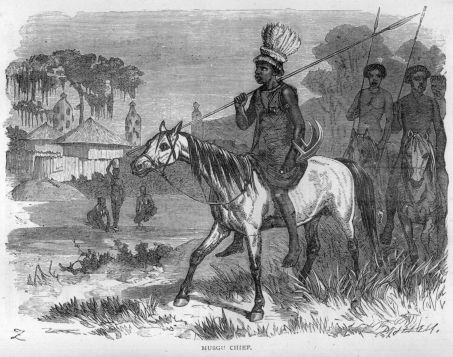
The village of Demmo was next to be attacked. On reaching it, however, a large watercourse, two miles in width, appeared before them, across which the natives made their escape. The scene on its banks was highly interesting, and characteristic of the equatorial regions of Africa. Instead of the supposed lofty range of the Moon, only a few isolated mountains had been seen, and in place of a dry desolate plateau they had found wide and extremely fertile plains, less than one thousand feet above the level of the sea, and intersected by innumerable broad water-courses.
The village, which only a few moments before had been the abode of comfort and happiness, was destroyed by fire and made desolate. Slaughtered men, with their limbs severed from their bodies, were lying about in all directions.
Led by a treacherous Musgu chief, the army attacked other places, till the river Loggun put a stop to their further advance. These unfortunate Musgus are ugly-looking fellows. Only the chiefs wear clothing, consisting merely of the skins of wild animals, thrown over their shoulders. They adorn their heads with strange-looking feather caps, and their bodies with red paint, staining their teeth of the same colour. Their weapons are long spears, and formidable knives for throwing at their foes, while they ride strong, active horses, without saddles, guiding them by halters fastened round their muzzles.
Having accomplished these mighty deeds, the army halted for two days, for the purpose of distributing the slaves taken during the expedition. The proceeding was accompanied by the most heart-rending scenes, caused by the number of young children and even infants who were distributed, many of the poor creatures being mercilessly torn from their mothers, never to see them again. There were scarcely any full-grown men.
Another expedition was undertaken by a part of the army, when, as they reached the river, a dozen courageous natives were seen occupying a small elevated island with steep banks, separated from the shore by a narrow but deep channel. Here they set at defiance the countless host of enemies, many of whom had firearms. Not one of the small band of heroes was wounded, either the balls missed their aim, or else, striking upon the wicker-work shields of the pagans, were unable to penetrate. The doctor was urged to fire, and on his refusing to do so was abused by the soldiers.
The doctor and his companion returned to Kukaka on the 1st of February, 1852.
On the 4th of March, Dr Barth again set out on a journey to Begharmi, a considerable distance to the south-east of Lake Chad. His only conveyance was his own horse and a she-camel for his luggage. The next day Ovenveg, who had resolved to explore Lake Chad in a boat, parted from him, and he proceeded on his hazardous expedition alone, his course being to the south-east, along the shores of the lake. He passed several towns in a state of decay. In that of Ngla the palace of the governor was of immense size for Negroland. It had large and towering clay walls, having the appearance of an enormous citadel.
He was hospitably treated at the large town of Loggun. Here the river of the same name, which falls into Lake Chad, is from three hundred and fifty to four hundred yards across. About forty or fifty boats of considerable size floated on the stream. He made an excursion on the river, when he excited great admiration by firing at a crocodile, though he did not kill the creature. The sultan formed so high an estimation of the traveller, that he wished him to remain to assist him in fighting his enemies, but the doctor, being anxious to proceed eastward, induced him at length to let him take his departure.
On the 16th of March he left Loggun to endeavour to penetrate into regions never before trodden by European foot. He crossed the river in a boat, while his horse and camel swam over. Passing through a dense forest, he observed the footprints of the rhinoceros, an animal unheard of in the western parts of Negroland. It is greatly feared by the inhabitants. Little further in advance he suddenly beheld through the branches of the trees the splendid sheet of a river far larger than that of Loggun. All was silence, the pellucid surface undisturbed by the slightest breeze; no vestige of human or animal life, with the exception of two hippopotami which had been basking in the sun on shore, and now plunged into the water. This was the real Shary, the great river of the Kotoko, which with the river Loggun forms a large basin, giving to this part of Negroland its characteristic feature.
After some time a ferry-boat appeared, but the ferrymen declined carrying the party over before they had informed their master. While waiting for them, a large troop of pilgrims on their way to Mecca, mostly from the western parts of Negroland, came up, and the doctor made them a present of needles. The boatmen, returning, declared that the chief of the village would not allow him to pass. He was, however, not to be defeated, and, proceeding along the banks of the river, at length found some ferrymen who did not hesitate to take him across. He was, however, soon again stopped, and, after repeated attempts to push on, was compelled to take up his residence at a place called Bakada.
Here the white ants waged relentless war against his property. Though he had placed his bed on the top of some poles, he found that they not only had reached the summit, but had eaten through both the coarse mats, finished a piece of his carpet, and destroyed other articles.
The doctor had sent a messenger to the capital, but as he did not return, he determined to set out.
He had reached Mela, on the bank of the river, when, as he was seated in his tent, the head man of the village arrived, followed by a number of others, and he found himself suddenly seized and his feet placed in irons, his property being carried off. He was conveyed to an open shed, where he was guarded by two servants of the lieutenant-governor. His servants were also seized, but ultimately set at liberty that they might attend on him. He was liberated, however, the next day by the arrival of Hacik, whose friendship he had formed at Bakada, and who promised that he should without further difficulty visit the capital.
On the 27th of April Mas-ena, the capital, appeared beyond a fine extent of verdure. He had a good house provided for him, and numbers of people came to visit him; among them was Faki Sambo, who was totally blind. He had travelled much and was well versed in Arabic literature, having read even portions of Aristotle and Plato, translated into Arabic. The doctor had many interesting conversations with this wonderfully well-informed man.
The lieutenant-governor, however, grew suspicious of the traveller, as did many of the people. He had a narrow escape by being called in to visit a sick man, when, convinced that his illness was serious, he refused to give any medicine. The man died a few days afterwards, and his death would, had he done as he was asked, have been attributed by the savage people to him.
On the 6th of July the caravan from Fezzan arrived, bringing despatches from Kukawa, sent out from England, authorising him to carry on the objects of the expedition on a more extensive scale, while means were placed at his disposal for doing so. It was hoped in England that he and his companion would be able to cross the unknown region of equatorial Africa and reach the south-east coast; but, as the state of his health made this impossible, he was glad to find that Lord Palmerston suggested he should endeavour to reach Timbuctoo. To this plan, therefore, he turned his attention. He, however, found it very difficult to leave the city. The sultan, after some time, gave him an audience; that is to say, the doctor saw him, but the great man did not allow himself to be seen. Earth presented his gifts, and received in return, at his request, a supply of the manufactures of the country, instead of a female slave and a white camel, which the sultan offered him. He heard that the sultan entertained the fear that he might poison or kill him by a charm, and that he had repeatedly consulted his learned men, or councillors, how he should protect himself against his witchcraft.
After repeated delays, on the 10th of August he was allowed to take his departure. The sultan had set his eyes on his horse, and, just as he was starting, sent to ask him to sell it; but this he positively declined doing, and no attempt was made to seize the animal.
He reached Kukawa after an interesting journey, without a mishap, on the 21st of August. He found Mr Overweg very sickly. Unhappily, he thought himself strong enough to go out shooting, and was so imprudent as to go into deep water after water-fowl, and remain all the day afterwards in his wet clothes. He was seized with a severe illness in consequence, but believed that he should get better if removed to the country home of their friend Fugo Ali. He here became much worse, and in two days died. A grave was dug for him near the borders of the lake in the exploration of which he had taken so much interest.
Dejected at his lonely situation, and unwilling any longer to stay in a place which had become intolerable to him, Barth determined to set out as soon as possible on his journey towards the Niger.
Chapter Twelve.
Travels of Dr Barth concluded.
Barth sets out for Timbuctoo—Detained at Katseena—Reaches Say, on the Niger—Crosses River—Meets an Arab, who offers to escort him—Disguised as an Arab—Enters Bambarra—Swampy country—Embarks on the Niger—Voyage up the river to Kabara—Rice to Timbuctoo—Enters the city—The Sheikh El Bakay—Compelled to remain in his house—Timbuctoo described—The fanatics threaten his life—Accompanies the Sheikh into the desert—Returns to the city—Hears about Mungo Park—The river rises—For fear of disturbances from the fanatics, goes into the desert again—Sets out with the Sheikh towards Kouka—Lions and hippopotami—Reaches Sackatoo—Hears of expedition under Dr Vogel—Dangers of journey—Reaches Bundi—Meets Dr Vogel—Repast, but no wine—Well received by Sheikh Omar at Kouka—Detained four months—Returns with a caravan to Tripoli—Discovery of Binue river most important result of journey.
On the 25th of November, 1852, all arrangements being made, Dr Barth set out on his venturesome expedition to Timbuctoo, intending to proceed first to the town of Say, on the banks of the Niger. He had parted on friendly terms with the sheikh, who sent him two fine camels as a present. He had as head servant his faithful Gatroni, who had gone to Fezzan and had lately returned, five other freemen, and two slaves, besides another personage, who acted as his broker, well accustomed to travel in Negroland; but, being an Arab, the doctor only put confidence in him as long as circumstances were propitious.
He encamped, as was his custom on commencing a journey, only two miles from the city. It was the coldest night he had experienced in Negroland, the thermometer being only nine degrees above the freezing-point.
On the 25th of December he arrived at Zinder, the frontier town of Bornou, built round and about masses of rock, which rose out of the ground, the picturesqueness of the place being increased by groups of date-palms. Water, which collects at short depths below the surface, fertilises a number of tobacco-fields, and gives to the vegetation around a very rich character.
On the 5th of February, 1853, the party entered the town of Katseena, where he laid in a supply of articles. Here they were detained for a considerable time, as an expedition was setting out against the Fulbe, and it would have been dangerous to proceed until it was known what direction the hostile army would take. By the 25th of March, however, he was ready to continue his journey, the governor himself having arranged to accompany him for some days, as the whole country was exposed to imminent danger, and, further on, a numerous escort was to attend them.
Interesting as his journey was, it is impossible to describe the various places he visited or the adventures he met with. Day after day he travelled on, sometimes detained for weeks and months together, at one town or another, though he was never idle, always employing himself in gaining information, or in studying the language of the district through which he was to pass.
On the 19th of June he was close to the Niger, and hoped that the next day he might behold with his own eyes that great river of Western Africa which has caused such immense curiosity in Europe, and the upper part of the large eastern branch of which he had himself discovered. Elated with such feelings, he set out early the next morning, and, after a march of two hours through a rocky wilderness covered with dense bushes, he obtained the first sight of the river, and in another hour reached the place of embarkation, opposite the town of Say. Here he beheld, in a noble, unbroken stream, the mighty Niger gliding along in a north-north-east and south-south-west direction, though at this spot, owing to being hemmed in by rocky banks, only about seven hundred yards broad. It had been seen by Mungo Park flowing eastward, and it was therefore, till the Landers descended it, supposed that it might possibly make its way into some vast lake in Central Africa. On the flatter shore opposite, a large town lay spread out, the low ramparts and huts of which were picturesquely overtopped by numbers of slender dum-palms.
After waiting some time the boats he had sent for, which were about forty feet in length and four to five in width, arrived. They were formed by hollowing out two trunks of trees, which were sewn together in the centre. His camels, horses, people, and luggage having crossed in safety, he followed in the afternoon, intending to survey the course of the river between the point where it has become well-known by the labours of Mungo Park, Caillie, and the Landers.
The language spoken here, the Songhay, differs materially from that with which he was acquainted, and he therefore was less able to converse with the people than he had been before.
Quitting Say, he left the Niger behind him, or rather on his right-hand side, proceeding north-west towards Timbuctoo. The country on this side of the Niger is thickly inhabited, and he passed numerous towns and villages on his way.
At the village of Namantugu he met an Arab from the west, called Wallati, who undertook to escort him safely to the town of Timbuctoo. He was a handsome fellow. His dress consisted of a long black gown, with a black shawl wound round his head, and he moved along at a solemn pace; he reminded the doctor of the servants of the Inquisition.
The inhabitants of this place were clothed in the purest white, even the little children wearing round their heads turbans composed of strips of white cotton.
They had now entered a region full of water, the soil presenting very little inclination to afford it the means of flowing off.
He was detained some time in the populous town of Dore, and on the 21st of July set out on the most dangerous stage of his journey to Timbuctoo. Many large sheets of water had to be crossed, and occasionally swamps, which greatly impeded their progress. It was the rainy season, and he was thus at times unable to proceed.
As he had now to traverse the province of Dellah, which is ruled by a governor subject to the fanatical chief of Mas-ena, who would never allow a Christian to visit his territory, the doctor was obliged to assume the character of an Arab.
At the town of Bambarra, situated among the creeks and back-waters of the Niger, he met an Arab native of Tisit, who had made the pilgrimage to Mecca. The stranger cross-questioned him very narrowly about the place from which he came, and the doctor had reason to fear he should be discovered. However, the man’s whole appearance inspired him with such confidence that he felt sure that he might be trusted.
On the 27th of August the doctor set out on his last journey by land, in order to reach Sarawano, the place where he was to embark on the river.
It is only during the rainy season that there is communication by water to Timbuctoo, which lies directly north from this place.
He here engaged a boat with two cabins of matting, one in the prow and the other in the stern. She was built of planks sewn together in a very bungling manner.
A labyrinth of creeks, back-waters, and channels spreads over the whole of this country, affording water-communication in all directions.
On the 1st of September the voyage commenced, and the doctor naturally felt in high spirits when he found himself floating on the river which was to carry him all, the way to the harbour of Timbuctoo. The water was greatly obstructed by long grass, which made rowing impossible, and the boat was therefore impelled by poles, generally moving at the rate of between two and three miles an hour. At night, a storm threatening, the boat was moored in a wide grassy creek; but the numerous swarms of mosquitoes molested them greatly during the night. The barking sounds of some animals were heard, which the doctor found proceeded from young crocodiles.
On the 2nd of September the boatmen made use of their oars, sometimes passing broad open spaces, and again getting into narrow channels.
Barth and his attendants were tolerably well supplied with fish, which they either purchased or which were caught by the boatmen with a harpoon.
They at last entered a large confluent of the Niger, and glided pleasantly along, a short distance from the northern bank, which was thickly clothed with trees, till at length, darkness approaching, they crossed, fully a thousand yards, to the opposite bank, where the vessel was moored near a village. Most of the party slept on shore, but others made themselves comfortable in the boat and on the top of the matting which formed the cabins.
The next day, they entered the mighty stream, along which they proceeded, here running from the west to the east. It was at this spot about a mile across, and its magnitude and solemn magnificence, as the new-moon rose before them, with with the summer lightning at times breaking through the evening sky, inspired his servants with awe and alarm, while he stood on the roof, looking out for the city, the great object of his journey.
Leaving the Niger and passing along a series of channels, the doctor landed at the village of Kabara on the 5th of September. Here he took up his quarters in a comfortable house while he despatched messengers to the city. On their return, accompanied by the brother of the Sheikh El Bakay, Sidi Alawate (who turned out a great rogue and cheated him in every way), with several followers, on the 7th of September his cavalcade set out for Timbuctoo.
The short distance was soon traversed, the doctor riding on ahead to avoid the questions of those who met the party, as, had they felt the slightest suspicion with regard to his character, they might have prevented his entering the town, and thus endangered his life. Unfortunately he encountered a man who addressed him in Turkish, a language he had almost forgotten, and he had some difficulty in making a reply.
Traversing the rubbish accumulated round the clay walls of the city, and leaving on one side a row of dirty reed huts which encompassed the place, he entered some narrow streets and lanes which scarcely allowed two horses to proceed abreast. He was not a little surprised at the populous and wealthy character which this quarter of the town exhibited, many of the houses rising to the height of two stories, their façades evincing even an attempt at architecture and adornment.
On passing the house of the Sheikh El Bakay, he was desired to fire a pistol to do him honour, but, as his arms were loaded with ball, he declined doing this, and soon reached the house destined for his residence, thankful to find himself safely in his new quarters.
Timbuctoo has never been the real capital of a negro empire, but, on account of its becoming the seat of Mahommedan learning and worship, it enjoyed greater respect than Gogo, which was the real capital; and, on account of its greater proximity to Morocco, the little commerce which remained in that distracted region was here concentrated. It has, however, undergone many changes during the fearful convulsions which constantly occur in that region.
During the absence of the sheikh the doctor found it prudent to remain within the walls of his house, though he received visits from numerous people. From the flat roof of his house he was, however, able to enjoy air and exercise, and at the same time obtained a view of what was going on in the city. For some time he suffered severely from fever, while rain and thunder-storms occurred nearly every day.
He here heard much about Major Laing, who, after being almost killed by the Tawarek, was kindly received in the camp of the sheikh’s father. He tried to obtain the major’s papers, but found that they had all been destroyed. He was much pleased with the Sheikh El Bakay, who treated him with real kindness, and regretted that he could not keep his troublesome brother Alawate in order. On one occasion he made the doctor fire off his six-barrelled pistol, in front of his house, before a numerous assemblage of people. This excited great astonishment, and exercised much influence upon his future safety, as it made the people believe that he had arms all over his person, and could fire as many times as he liked.
The city of Timbuctoo is about three miles in circumference. The town is laid out partly in rectangular, partly in winding streets, covered with hard sand and gravel. Besides two market-places there are few open areas. There are about nine hundred and eighty clay houses, and a couple of hundred conical huts, of matting mostly, on the outskirts. Three large mosques and three smaller ones are the only places of worship, there being no other public buildings of any size. It is divided into quarters, one of which is especially inhabited by Mahommedans, though the larger number of the people profess to have faith in the Prophet. There are about thirteen thousand settled inhabitants, and, during the time of the greatest traffic, from five to ten thousand people visit the city.
A fanatical party, hearing that a Christian had come to the place, made various attempts to destroy him. By the advice of his kind protector, the sheikh, he determined to leave the city with him, and take up his residence in the desert. As he rode forth on his white mare, the natives thronged the streets in order to get a glance at the Christian stranger. He was thankful to find himself once more in the fresh air of the desert. Here he passed several days in the most quiet and retired manner, much recovering his health.
He then paid another visit to Timbuctoo, and was able to explore the city and the great mosque, Jingere-Ber, which made a great impression on his mind by its stately appearance. He had again, however, to return to the camp of El Bakay, where the perils of his position kept increasing, and he in vain urged his dilatory protector to enable him to make his escape. His enemies were legion—fresh parties arriving constantly to seize him, dead or alive. A band of them actually made a descent on the camp, but were driven back by the bold front his friends exhibited.
He had an interesting visit from an Arab chief, who was acquainted with Mungo Park, and gave him a full account of the way in which he had been attacked by the Tawarek as he descended the great river in his boat.
On the 12th of December Barth heard that Ali, a fanatical chief of the Berabish, had arrived with a large body of followers, to take his life. Suddenly, however, Ali fell ill and died, and the people believed that it was a judgment on him, as his father had killed Major Laing, whose son it was supposed the doctor was. Many of the Berabish, indeed, came to El Bakay to beg his pardon and to obtain his blessing, saying that they would no longer impede the stranger’s departure.
The river had gradually been rising, and on the 25th of December the water entered the wells situated to the south of the town.
On the 4th of January, 1854, the first boat from Kabara reached Timbuctoo, and other boats arriving laden with corn, the supply shortly became plentiful and cheap.
The inundation attained its greatest height towards the end of January, an event possessing almost the same importance as that of the rising of the Nile.
The city depends entirely upon commerce, the only manufactures being confined to the art of the blacksmith and a little leather-work.
Another year, 1854, of the persevering traveller’s stay in Negroland, began with the fervent prayer that he might return home before the end of it. His hopes were raised that he might soon be able to set off. Numberless disappointments, however, occurred.
On the 17th of March, by the advice of his friends, he returned to the camp, such a step being deemed essential for the security of the town and their own personal interests. He was here kept till the 19th of April, and even then his friend the Sheikh El Bakay, could not overcome his habitual custom of taking matters easy, and the sun was already high in the sky and very hot before the camels were loaded and the caravan began to move.
In consequence of the progress the French were making in Algiers at this time, much suspicion was attached to the doctor, as the people could not but think that his journey to the country had some connection with them. Even after this he was detained till the 17th of May, at an encampment amidst swamps, when at last the news arrived that the sheikh, who had left them, had gone on ahead, and all was joy and excitement.
On overtaking the sheikh, who, as he awoke from his slumbers, received the doctor with a gentle smile, despatches were delivered to him from England. One from Lord John Russell expressed the warmest interest in his proceedings, and others informed him that Dr Vogel, with two sergeants, had set out to join him, and that he would probably meet them in Bornou. He was much surprised that he received no news from his friend the vizier, as the parcel had evidently come by way of Bornou—little aware, at the time, of the murder of that friendly officer.
The following day they passed through a dense forest, said to be frequented by lions. Keeping along the course of the river, which was here very shallow, crocodiles were seen in abundance, and anxiety was felt for the horses, which were pasturing on the fine rank grass at its borders.
Owing to the dilatory character of his friend the sheikh, the progress was very slow, but he was thus enabled to enter into conversation with the natives, and obtained much information.
On his way he visited Gogo, situated at the southern limits of the Great Desert, one portion on the banks of the river, and another on an island, that to the east having been inhabited by the Mahommedans, the other by idolators. He found the place, however, in a most ruinous condition, even the mosque itself being in a dilapidated state. Indeed, the once great city of Negroland now consists only of from three to four hundred huts, grouped in separate clusters and surrounded by heaps of rubbish, which indicated its former site. Here it is believed that Mungo Park was buried.
While encamped at a place called Borno, close to the banks of the river, a number of hippopotami made their appearance, snorting fiercely at being disturbed, and put their horses to flight. At times they interrupted the intercourse between the banks, and in the evening became still more noisy, when they wanted to come out for their usual feed.
He was fortunate in having so able a protector as the Sheikh El Bakay, who, in consequence of his supposed sacred character, was treated with honour whenever he went.
After visiting a number of places, both on the banks and eastward of it, he reached, on the 24th of August, Sackotoo. Here he received intelligence of the arrival of five Christians, with a train of forty camels, at Kukawa, and had little doubt that it was the expedition under Dr Vogel.
On the 14th of October he arrived in Kano, where he found everything prepared for his reception. He here received the intelligence that Sheikh Omar, of Kukawa, had been dethroned, his vizier slain, and that in a fierce battle a number of his other friends had fallen. He had made up his mind, therefore, to proceed to Aire, instead of returning to Bornou; but, subsequently hearing that Omar had been again installed, he kept to his former determination.
At length, escaping from greedy rulers, hostile populations, wild beasts, swamps, rains and fevers, he at length reached Bundi, near Kouka, on the 30th of November.
He had again left that place, when, riding through the forest with his head servant, he saw advancing towards him on horseback a young man, of fair complexion, dressed in a tobe, with a white turban, and accompanied by two or three blacks, also on horseback. The stranger was Dr Vogel, who dashed forward, when the two travellers gave each other a hearty reception on horseback. Dismounting in the forest, they unpacked their provisions and sat down to enjoy a social repast, Barth, however, being greatly disappointed that not a bottle of wine, for which he had an extraordinary longing, had been brought.
Vogel, with Corporal Church and Private Macguire, had come out to strengthen the expedition and to follow up Barth’s discoveries. Vogel succumbed to the climate about a year afterwards, on a journey to Adamawa. After his death Macguire was killed on his way home, and Church returned with Dr Barth.
While Vogel pursued his journey to Zinda, Barth proceeded on to Kukawa. He found the village of Kaleemri, which, on his outward journey, was so cheerful and industrious, now a scene of desolation—a few scattered huts being all at present to be seen. Such is, unhappily, the fate of numerous towns and villages in this distracted country.
His old friend, the Sheikh Omar, who had been reinstated, sent out a body of horsemen to give him an honourable reception on his return to Kukawa. Here he had to remain four months, greatly troubled by financial difficulties, and finding that a considerable portion of his property had been stolen by the rascality of one of his servants. His health, too, was greatly shattered.
It was not till the 4th of May that, in company with a Fezzan merchant, Kolo, he commenced his return journey, with a small caravan, towards Tripoli. At Barruwa they laid in a supply of dry, ill-smelling fish, which constitutes the most useful article of exchange in the Tebu country. The region to his right, over which he had previously passed, was now entirely covered with water from the overflowing of the Chad, which had submerged several villages.
He met with no unusual adventures during his long, tedious journey northward across the desert.
At Mourzouk he had the pleasure of meeting Mr Frederick Warrington. He here remained six days, discharging some of his servants, and among them his faithful Gatroni.
Some tribes of Arabs had here rebelled against the Turks, and he was in some danger while in their hands. Escaping, however, from them, he reached Tripoli in the middle of August, and, embarking at the end of four days, arrived safely, on the 6th of September, in London.
Although much of the country he had passed over was already known, no previous African traveller more successfully encountered and overcame the difficulties and dangers of a journey through that region.
The most important result of his adventurous journey was the discovery of a large river, hitherto unknown, falling into the Chad from the south, and of the still larger affluent of the Quorra, the mighty Binue, which, rising in the far-off centre of the continent, flows through the province of Adamawa.
The courage and perseverance of Dr Barth, while for five years travelling many thousand miles, amidst hostile and savage tribes, in an enervating climate, frequently with unwholesome or insufficient food, having ever to keep his energies on the stretch to guard himself from the attacks of open foes or the treachery of pretended friends, have gained for him the admiration of all who read his travels, and place him among the first of African travellers.
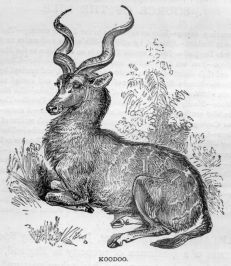
Chapter Thirteen.
Captain Speke’s discoveries of the Source of the Nile.
Speke’s previous career—Joins an expedition to the Somali country—The Somali—Arrive at Berbera—Attacked by robbers—His escape and return to Aden, and finally to England—Joins Captain Burton in an expedition to the Mountains of the Moon—Sets out for Bombay, and afterwards to Zanzibar—Engage Sheikh Said and their escort—Cross to Kaole—Arrive at Caze, and received by the Arab merchants—Porters desert—Illness of Captain Burton, and carried to Zimbili—Sets out with fresh porters—A sight of the Tanganyika Lake—The Mountains of the Moon—Nearly blind—Up the lake to Ujiji—Arrive at Kawele—Their journey on the lake continued—An alarm—Camp at night—Shells—A storm—Arrive at Sultan Casanga’s territory—The people—Arrive at the fish market of Kabizia—A singa—Cross to Kasenge—Reception—The Chief described—The results of slavery—Hears of a large river—Cannot obtain a boat—Returns to Ujiji—Sets out to explore a river that falls into the lake—Tricks of the paddlers—Returns to Ujiji—Help arrives—Returns to Cazé—Sets out to explore the country in the neighbourhood of the Nyanza Lake—Tricks of his escort—Villages described—Detained by a Sultana—The reception she gives Speke—Illness in the caravan—Inon—Leaving Isamiro, the Nyanza appears in sight—The scene—He called the lake Victoria Nyanza—Descends to Muanza—The source of the Nile!—Return journey, and arrives at Caze—Arrives with Captain Burton in England.
Captain, then Lieutenant, John Hanning Speke, the son of a gentleman of property in England, was an officer in the Indian army, and had taken part under Lord Gough in the great battles of Ramnugger, Chillianwalla, and others. He had, at intervals during leave, travelled in the Himalaya Mountains, as well as through other parts of India and in Thibet, for the purpose of collecting specimens of the fauna of those regions to form a museum in his father’s house. While thus occupied, he formed the design of traversing Africa as soon as he could obtain furlough, visiting the Mountains of the Moon and descending the Nile with the same object in view.
At the end of ten years’ service, on obtaining furlough, hearing that an expedition was to be sent by the Indian Government, under the command of Lieutenant Burton, to explore the Somali country, a large tract lying due south of Aden, and separated from the Arabian coast by the Gulf of Aden, he offered his services, and was accepted. Two other Indian officers, Lieutenants Stroyan and Heme, also joined the expedition.
The Somali are Mahommedans, descendants of Arabs who have intermarried with negroes. They are a savage, treacherous race, noted for their cheating and lying propensities; in figure tall, slender, light, and agile, scarcely darker than Arabs, with thin lips and noses, but woolly heads like negroes. Their ancestors, having taken possession of the country, drove out its former Christian inhabitants, who retreated northward.
Caravans, however, pass through their country to their only port and chief market, Berbera, which at the time of the fair is crowded with people, though entirely deserted for the rest of the year.
It was proposed that the expedition should follow the route of these caravans, or accompany one of them, and thus penetrate through the country, into the interior.
Considerable time was spent in making excursions for short distances, during which Lieutenant Speke shot a large number of wild animals; but unfortunately the abban, or petty chief, who undertook to be his protector and guide, proved to be a great rascal, and cheated and deceived him in every possible way.
The Somali are keen and cunning sportsmen, and have various methods of killing elephants, ostriches, and gazelles. They fearlessly attack an elephant, on foot, one man only being mounted on a horse, who gallops in front, and while the animal pursues him, the others rush in and hamstring him with their knives. Ostriches are caught by throwing down poison at the spots where they feed. The Somali also hunt them, on the backs of their hardy little ponies. The ostrich is a shy bird, and is so blind at night that it cannot feed. A Somali, knowing this, providing himself with provisions for two or three days, sets off in search of them; showing himself to the ostriches, he is discovered, but takes care to keep at a distance. They stalk off, and he follows at the same rate, but never approaches sufficiently near to scare them. At night the birds, unable to see, stop, but cannot feed. He, meantime, rests and feeds with his pony, resuming the chase the next day. He follows the birds in the same way as at first, they from constant fasting becoming weaker, till after the second or third day he is able to ride in among them and knock them down in succession.
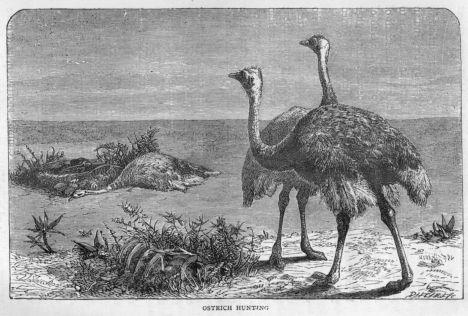
The party had at length secured, after considerable trouble, the camels and horses they required, and were encamped at Berbera, which was completely deserted by its inhabitants, when they were surprised at night by a large band of robbers. Lieutenant Stroyan was killed and Lieutenant Speke was made prisoner and desperately wounded, but, springing to his feet just as a robber was about to run him through with his spear, he knocked over his assailant with his hands, though bound together, and made his escape to the sea-shore, to which the rest of the party had already fled. They were here taken on board a vessel, which had providentially put in the day before, and in her returned to Aden.
Although his first expedition had terminated so disastrously, on his arrival in England Lieutenant Speke again volunteered to accompany Lieutenant Burton on an expedition to survey that part of the centre of Africa, in the neighbourhood of the Mountains of the Moon, where an enormous lake was supposed to exist, equal in size to the Caspian Sea.