"Great African Travellers" (continued 6)
Reading edition
This was, however, one of the only occasions on which he was successful.
Day after day both men and women were led off to execution. On one occasion a poor girl had run away from the ill-treatment of her master, and had taken refuge in the house of a decrepit old man. The two were brought up for judgment, when the king sentenced them to death, and decreed that their lives should not be taken at once, but that they should be fed and dismembered, bit by bit, as rations for his vultures every day until life was extinct. The dismayed criminals, Speke says, struggling to be heard, were dragged away to the drowning music of horns and drums.
After he had been some time in the palace, he was introduced to the queen dowager. Her majesty was fat, fair, and forty-five. He found her seated in the front part of her hut, on a carpet, her elbow resting on a pillow. An iron rod, like a spit, with a cup on the top, charged with magic powder, and other magic wands were placed before the entrance, and within the room four Mabandwa sorceresses, or devil-drivers, fantastically dressed, with a mass of other women, formed the company. They being dismissed, a band of musicians came in, when pomba was drunk by the queen, and handed to her visitor and high officers and attendants. She smoked her pipe, and bid Speke to smoke his. She required doctoring, and Speke had many opportunities of seeing her, so completely winning her regard that she insisted on presenting him with various presents, among others a couple of wives, greatly to his annoyance. She appeared to be a jovial and intelligent personage. On another occasion Speke, when introduced, found her surrounded by her ministers, when a large wooden trough was brought in and filled with pomba. The queen put her head in and drank like a pig from it, her ministers following her example. If any was spilled by her, they dabbled their noses in the ground, or grabbed it up with their hands, that not a particle might be lost, as everything that comes from royalty must be adored. Musicians and dancers were then introduced, exhibiting their long, shaggy, goat-skin jackets, sometimes dancing upright, at others bending or striking the ground with their heels like hornpipe dancers.
The plaguy little imps of pages were constantly playing tricks, and seemed to delight in mischief.
One of the great officers of the court having offended the king, they came with a message to Speke’s attendants while he himself was away, ordering them all to attend the king with their arms. Instead of being led to the palace, they were guided to the house of the refractory officer, when they were ordered to rush in and spare nothing, men, women, children, mbugus, or cowries, all alike. Speke’s men, firing their guns, did as they were ordered. One of the inmates was speared, but the rest were taken, and brought in triumph to his camp. He, of course, ordered all the seizures to be at once given up to the king’s chief officer, and shut himself up in his house, declaring that he was ashamed to show his face. In vain the king sent to him to come and shoot. The reply was: “Bana” (the name by which the king called Speke) “is praying to-day that Mtesa may be forgiven the injury he has committed by sending his soldiers on such a duty; he is very angry about it, and wishes to know if it was done by the kings orders.” The boys replied that nothing could be done without the king’s orders. Speke also insisted on sending the red cloth cloaks worn by his men, because they had defiled their uniform when plundering women and children. He took this opportunity of teaching the barbarian a lesson.
On his next visit the king told him that he had wished to see him on the previous day, and begged that whenever he came he would fire a gun at the waiting hut, that he might hear of his arrival. The king was much pleased with a portrait Speke made of him, as also with his coloured sketches of several birds he had killed, but was still more delighted with some European clothes, with which he was presented. When Speke went to visit him, he found his Majesty dressed in his new garments. The legs of the trousers, as well as the sleeves of the waistcoat, were much too short, so that his black feet and hands stuck out at the extremities as an organ-player’s monkey’s do, while the cockscomb on his head prevented a fez cap, which he wore, from sitting properly. On this visit twenty new wives, daughters of chiefs, all smeared and shining with grease, were presented, marching in a line before the king, utterly destitute of clothes, whilst the happy fathers floundered, nynzigging, on the ground, delighted to find their darling daughters appreciated by the monarch. Speke burst into a fit of laughter, which was imitated not only by the king but by the pages, his own men chuckling in sudden gusto, though afraid of looking up.
The king at last returned Speke’s visit. Having taken off his turban, as Speke was accustomed to take off his hat, he seated himself on his stool. Everything that struck his eye was admired and begged for, though nothing seemed to please him so much as the traveller’s wide-awake and mosquito curtains. The women, who were allowed to peep into Sana’s den, received a couple of sacks of beads, to commemorate the visit.
A few days afterwards he was accompanying the king when an adjutant-bird was seen in a tree. The king had a gun Speke had given him, but he had little more than one charge of powder remaining. Speke had left his gun at home. The king at the second shot killed the bird, greatly to his delight, shouting his usual “Woh! woh!” He was so delighted that he insisted upon carrying the bird to show to his mother.
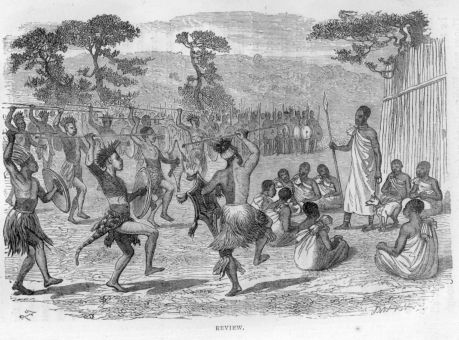
Before entering the palace, however, he changed his European clothes for a white goat-skin wrapper. Directly afterwards a battalion of his army arrived before the palace, under the command of his chief officer, whom Speke called Colonel Congou. The king came out with spear and shield in hand, preceded by the bird, and took post in front of the enclosure. His troops were divided into three companies, each containing about two hundred men. After passing in single file, they went through various evolutions. Nothing, Speke says, could be more wild or fantastic than the sight which ensued. The men, nearly naked, with goat or cat-skins depending from their girdles, and smeared with war-colours according to the taste of each individual, one half of the body red or black, the other blue, in irregular order; as, for instance, one leg would be red, the other black, whilst the upper part would be the opposite colours, and so with the chest and arms. Each man carried two spears and one shield, held as if approaching an enemy. They thus moved in three lines of single rank and file at fifteen or twenty paces asunder, with the same high action and elongated step, the ground leg only being bent to give their strides the greater force. The captains of each company followed, even more fantastically dressed. The great Colonel Congou, with his long, whitehaired goat-skins, a fiddle-shaped leather shield, tufted with white hair at all six extremities, bands of long hair tied below the knees, and the helmet covered with rich beads of several colours, surmounted with a plume of crimson feathers, from the centre of which rose a stem, tufted with goat-hair. Finally the senior officers came charging at their king, making violent protestations of faith and honesty, for which they were applauded.
Speke was now, towards the end of May, looking forward to the arrival of Grant.
To propitiate the despot he sent a compass, greatly to the delight of Mtesa, who no sooner saw it than he jumped and “wohed” with intense excitement, and said it was the greatest present Bana had ever given him, for it was the thing by which he found out all the roads and countries.
It had been arranged that Grant should come by water; but the natives, fearing to trust themselves on the lake, brought him all the distance on a litter.
At length, on the 27th, the sound of guns announced the arrival of Grant, and Speke hurried off to meet his friend, who was now able to limp about a little, and to laugh over the accounts he gave of his travels.
The travellers forthwith began to make arrangements for proceeding on to Unyoro, governed by a chief named Kamrasi, of despicable character and considered merciless and cruel, even among African potentates, scattering death and torture around at the mere whim of the moment; while he was inhospitable, covetous, and grasping, yet too cowardly to declare war against the King of the Waganda, who had deprived him of portions of his dominions. The Waganda people were, therefore, very unwilling to escort the travellers into his territory; and Colonel Congou declared that if compelled to go, he was a dead man, as he had once led an army into Unyoro.
The travellers’ great object was to reach the spot where the Nile was supposed to flow out of the Victoria Nyanza, and proceed down the stream in boats.
Speke had written to Petherick, and on the 28th of June news arrived that white men were at Gani enquiring for the travellers. Speke consequently informed the king that all he required was a large escort to accompany them through Usoga and Kidi to Gani, as further delay in communicating with Petherick might frustrate the chance of opening the Nile trade with Uganda. The king replied that he would assemble his officers, and consult them on the subject. He exhibited his folly, however, by allowing his people to make an inroad into Unyoro and carry off eighty cows belonging to Kamrasi. To their horror, Kyengo, the chief magician, informed them that the king, being anxious to pry into the future, had resolved to adopt a strong measure with that end in view. This was the sacrifice of a child. The ceremony, which it fell to the lot of Kyengo to perform, is almost too cruel to describe. The magician, having placed a large earthen pot full of water on the fire, arranges a platform on the top, and on this he binds a young child and a fowl, covering them with another pot, which he inverts over them. After the fire has burned for a given time the upper pot is removed. If both victims are dead, it is considered that war must be deferred for the present; but, if either should be alive, it may be commenced immediately. When the army is about to proceed to war, the magician flays the young child, and lays the bleeding body in the path, that the warriors may step over it, thereby believing that they will gain immunity for themselves in the approaching combat.
During the expedition, which Speke made with the king to the Nyanza, they landed on an island inhabited by a magician and his wife, who were supposed to be priests of of the water-spirit of the lake. His head was decorated with numerous mystic symbols, among them a paddle, the badge of his high office. He was dressed in a little, white, goat-skin apron, adorned by various charms, and, instead of a walking-stick to support his steps, he used a paddle. Though not an old man, he pretended to be so, walking slowly and deliberately, coughing and mumbling like one. Seating himself, he continued coughing for half an hour, when his wife came in, much in the some manner, without saying a word, and assuming the same affected style.
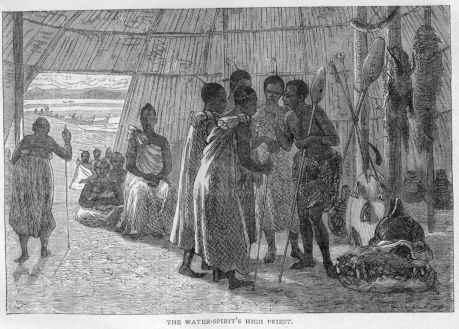
The king, who was seated near the door, with his wives behind him, asked Speke what he thought of it. No voice was heard but that of the old wife, who croaked like a frog for some water, and when some was brought, croaked again because it was not the purest of the lake’s produce, and had the first cup changed, wetted her lips with the second, and hobbled away in the same manner as she had come.
The water-spirit’s chief priest now summoned several of the king’s officers to draw round him, and then, in a low voice, gave them all the orders of the deep, and walked away. His revelations appeared to have been unpropitious, for the party immediately repaired to their boats and returned to their quarters.
During this excursion, the king went off on the lake, leaving Speke by himself on shore. He took the opportunity of visiting an hospitable old lady, who treated him and his attendants to the last drop of pomba in her house, smoking her pipe with him, and did not hesitate to speak of the horrors of the Uganda punishments. When his servant told her that he had saved the life of one of the women, she seemed astonished at the daring of the stranger and at the leniency of the monarch. The king’s servants had robbed her of nearly everything in her house.
The most barbarous orders of the despot are obeyed with the utmost alacrity by his officers, who would to a certainty, if they hesitated, be themselves put to death. His horrible little pages are his chief emissaries. At his command a dozen start off together, each striving to outrun the others, their dresses, streaming in the wind, giving them the resemblance at a distance of a flight of birds. On one occasion, Speke having given Mtesa a rifle, the king, after examining the weapon, loaded it and told a page to go out and shoot some one, to ascertain if it would kill well. In a moment a report was heard, and the urchin came back grinning with delight at his achievement, just like a schoolboy who has shot his first sparrow. Nothing was heard about the unfortunate wretch who had served as a target, the murder of a man being by far too common an incident to attract notice.
Many of the people expressed the greatest horror of the king’s cruelty; but all his subjects were abject slaves, and no union existed among them which would have afforded them any hope in rebellion or in bringing about a better state of things.
Chapter Seventeen.
Speke and Grant’s travels concluded.
Set out for Kamrasi—Attacked by the Waganda—Reach the Nile—The Isamba Rapids—The Rippon Falls—The source of the Nile—Returns to Urondogani—Threatened destruction—March for Unyoro—Kamrasi’s reception—The magician at work—Kamrasi receives a Bible—Leave Kamrasi, and proceed down the Kuffo to the Falls of Karuma—The Gani people—The Madi—Arrive at Petherick’s outposts—Speke again sets out—The Bari country—Gondokoro and Nile boats seen—Sir Samuel Baker—Voyage down the Nile to Khartoum—A banquet—Berber—Arrive at length in England.
By the 7th of July the arrangements for their journey were made. The king presented them with a herd of cows for their provisions, as well as some robes of honour and spears, and he himself came out with his wives to see them off. Speke ordered his men to turn out under arms and nynzig for the favours received. Mtesa complimented them on their goodly appearance and exhorted them to follow their leader through fire and water, saying that, with such a force, they would have no difficulty in reaching Gani.
It was arranged that Grant should go on to Kamrasi direct, with the property, cattle, etcetera, while Speke should go by the river to examine its exit from the lake, and come down again, navigating as far as practicable.
They now commenced their march down the northern slopes of Africa, escorted by a band of Waganda troops, under the command of Kasora, a young chief. They had proceeded onwards some days, when Kari, one of Speke’s men, had been induced to accompany some of the Waganda escort to a certain village of potters, to obtain pots for making plantain wine. On nearing the place, the inhabitants rushed out. The Waganda men escaped, but Kari, whose gun was unloaded, stood still, pointing his weapon, when the people, believing it to be a magic horn, speared him to death, and then fled.
On the 21st, after passing through a country covered with jungle, Speke reached the banks of the Nile. The shores on either side had the appearance of a highly-kept park. Before him was a magnificent stream, six or seven hundred yards wide, dotted with islets and rocks—the former occupied by fishermen’s huts, the latter by sterns and crocodiles, basking in the sun—flowing between fine, high, grassy banks, covered with trees and plantations. In the background herds of nsunnú and harte-beestes could be seen grazing, while the hippopotami were snorting in the water, Florican and Guinea fowl rising at their feet. Here Speke had some fine sport, killing nsunnú and other deer.
The chief of the district received them courteously, and accompanied Speke to the Isamba Rapids.
“The water ran deep between its banks, which were covered with fine grass, soft cloudy acacias, and festoons of lilac convolvuli; while here and there, where the land had slipped above the rapids, bare places of red earth could be seen like that of Devonshire. There, too, the waters, impeded by a natural dam, looked like a huge mill-pond, sullen and dark, in which two crocodiles, floating about, were looking out for prey.” From the high banks Speke looked down upon a line of sloping wooded islets lying across the stream, which, by dividing its waters, became at once both dam and rapids. “The whole scene was fairy-like, wild, and romantic in the extreme,” says Captain Speke.
Proceeding southward they reached the Rippon Falls on the 28th, by far the most interesting sight he had seen in Africa.
“Though beautiful, the scene was not exactly what I expected, for the broad surface of the lake was shut out from view by a spur of hill, and the falls, about twelve feet deep and four to five hundred feet broad, were broken by rocks; still it was a sight that attracted one to it for hours. The roar of the waters, the thousands of passenger fish leaping at the falls with all their might, the fishermen coming out in boats, and taking post on all the rocks with rod and hook, hippopotami and crocodiles lying sleepily on the water, the ferry at work above the falls, and cattle driven down to drink at the margin of the lake, made in all, with the pretty nature of the country—small grassy-topped hills, with trees in the intervening valleys and on the lower slopes—as interesting a picture as one could wish to see.”
Here, then, he had arrived at what he considered the source of the Nile—that is, the point from where it makes its exit from the Victoria Nyanza; and he calculated that the whole length of the river is, thus measuring from the south end of the lake, two thousand three hundred miles.
He and his party now returned northward, and reached Urondogani again on the 5th of August. The difficulty was next to obtain boats. The fishermen, finding that the strangers were to be supplied with fish by the king’s order, ran away, though the cows they had brought furnished the travellers with food. At length five boats, composed of five planks lashed together and caulked with rags, were forthcoming. Speke, with his attendants, Kasora, and his followers embarked, carrying goats, dogs, and kit, besides grain and dried meat. No one, however, knew how many days it would take to perform the voyage.
Tall rushes grew on either side of the broad river, which had in places a lake-like appearance. The idle crew paddled slowly, amusing themselves by sometimes dashing forward, and then resting, while Kasora had the folly to attack the boats of Wanyoro he met coming up the river.
The frontier line was crossed on the 14th, but they had not proceeded far when they saw an enormous canoe of Kamrasi’s, full of well-armed men, approaching them. The canoe turned, as if the people were afraid, and the Waganda followed. At length, however, the chased canoe turned, and the shore was soon lined with armed men, threatening them with destruction. Another canoe now appeared. It was getting dark. The only hope of escape seemed by retreating. Speke ordered his fleet to keep together, promising ammunition to his men if they would fight. The people in one boat, however, were so frightened that they allowed her to spin round and round in the current. The Wanyoro were stealing on them, as they could hear, though nothing could be seen. One of the boats kept in-shore, close to the reeds, when suddenly she was caught by grappling-hooks. The men cried out: “Help, Bana! they are killing us.” Speke roared in reply: “Go in, and the victory will be ours.” When, however, three shots were fired from the hooked boat, the Wanyoro fled, leaving one of their number killed and one wounded, and Speke and his party were allowed to retreat unmolested.
Speke, after proceeding up the river some distance, determined to continue the journey by land, following the track Grant had taken.
Grant’s camp was reached on the 20th, and the next day a messenger arrived from Kamrasi, saying that the king would be glad to see them, and the march was ordered to Unyoro.
The frontier was again passed, when the country changed much for the worse. Scanty villages, low huts, dirty-looking people clad in skins, the plantain, sweet potato, sesamum, and millet forming the chief edibles, besides goats and fowls. No hills, except a few scattered cones, broke the level surface of the land, and no pretty views cheered the eye. They were now getting to a distance from the rain-attractive influences of the Mountains of the Moon, and vegetation decreased proportionately. Their first halt was on the estate of the chief Kidjwiga. Scarcely had they been established than a messenger page from Mtesa, with a party of fifty Waganda, arrived to enquire how Bana was, and to remind him of the gun and other articles he had promised to send up from Gani.
The natives ran off as they passed through the country, believing them to be cannibals. They supposed that the iron boxes which the porters carried on their shoulders each contained a couple of white dwarfs, which were allowed to fly off to eat people. They, however, gained confidence, and soon flocked round the Englishmen’s huts.
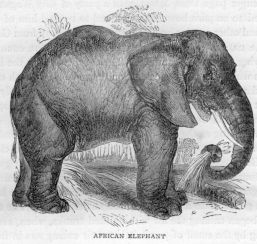
On arriving at the end of their day’s march on the 2nd of September, they were told that elephants had been seen close by. Grant and Speke, therefore, sallied forth with their guns, and found a herd of about a hundred, feeding on a plain of long grass. Speke, by stealing along under cover of the high grass, got close to a herd, and fired at the largest. The animals began sniffing the air with uplifted trunks, when, ascertaining by the smell of powder that their enemy was in front of them, they rolled up their trunks, and came close to the spot where he was lying under a mound. Suddenly they stopped, catching scent of the white man, and lifting their heads high, looked down upon him. Speke was now in a dangerous position, for, unable to get a proper front shot at any of them, he expected to be picked up or trodden to death. As he let fly at their temples, they turned round and went rushing away at a much faster pace than they came. They, however, soon stopped, and began to graze again. Though several were wounded, none were killed.
Bombay was now despatched to King Kamrasi, with a request from the travellers for an early interview. Goats, flour, and plantains were brought to them, and Kidjwiga became very indignant that the flour was not all given to him, as he, having been appointed their guide and protector, considered that it ought to have been.
At last they received an invitation from Kamrasi. As on a previous occasion, only some dirty huts were offered to Speke. He insisted on being lodged in the palace. Bombay, who had been kept there, now arrived, and they were informed that better accommodation was preparing for them. The king had been very communicative to Bombay.
The monarch, however, got tipsy, and was consequently unable to receive his guests. Next day he sent some pomba, fowls, and plantains as a present.
They were, however, after this still kept waiting several days. At last Speke sent to say that if the king did not wish to see the white men, they would proceed on their journey to Gani. This had the desired effect; and, in their usual style, with the Union Jack floating above their heads, they approached the palace.
They found the monarch seated on a wooden stool, with cow-skins below and leopards’ above, on an elevated platform of grass, looking like a pope in state, calm and motionless. His arms were adorned with brass-wire rings, and his hair was worked up into peppercorn-like knobs; his eyes were of a long shape, his face narrow, and nose prominent; yet, though a well-made man, being above six feet high, he was inferior in size to Rumanika.
Speke endeavoured to impress on the stupid-headed king that his only object was to open up a communication along the Nile, by which boats could bring up the produce and manufactures of other countries, to exchange with his ivory.
The king evidently wished to detain them, in order that they might assist him in putting down an insurrection which his two brothers had raised against him. At last they determined to send Bombay on to ascertain whether boats were really waiting for them.
Kamrasi was as eager to obtain gifts as any of the other chiefs, and, having heard of their chronometer, which they had been observed using, he was especially desirous to possess it, believing it to be some magic instrument, and the means by which the travellers guided themselves about the country. Speke told him that it was not his guide, but a time-keeper, made for the purpose of knowing at what time to eat his dinner. He told him it was the only one he possessed, but that, if he would wait with patience, he would send him up one on his arrival at Gani. He was too eager to possess the wonderful instrument to consent to delay, and at last Speke, to satisfy him, placed it on the ground and said it was his. He said he should like to buy another, and was surprised to hear that it would cost five hundred cows. This increased the surprise of the whole party, who could not believe that any person in his senses would give five hundred cows for the mere gratification of seeing at what time his dinner should be eaten.
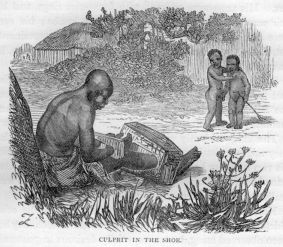
Kamrasi was a thorough tyrant, and, at the same time, an arrant coward. He kept up a perfect system of espionage, by which he knew everything going forward in the country. His guards, in order that they might be attached to his person, were allowed to plunder at will the rest of his unfortunate subjects, who, if they offended him, were put to death without mercy. If an officer failed to give him information, he was executed or placed in the shoe, an instrument of torture not unlike the stocks. It consists of a heavy log of wood, with an oblong slit through it; the feet are placed in this slit, and a peg is then driven through the log between the ankles, so as to hold them tightly. Frequently the executioner drives the peg against the ankles, when the pain is so excessive that the victim generally dies from exhaustion.
After the travellers had moved into better quarters, they were told that Kamrasi intended to pay them a visit. The room was accordingly prepared for his reception—hung around with mats, horns, and skins of animals, and a large box, covered with a red blanket, was placed as a throne for him to sit on. Speke then called out his men to form a guard of honour, and ordered them to fire as soon as he appeared. No sooner did he arrive than he wanted everything he saw: first their gauze mosquito curtains, then an iron camp bed, next the sextant and thermometer. When any books were shown him of birds and animals he wanted them, and was much surprised when Speke positively refused. The important question was put to him whether he would wish English traders to come up to his country, and, in reply, he answered that it was what he desired above all things; but, if the English would advance with guns, he would march out with his army, and that, between them, his brothers, who were now acting in rebellion, would be destroyed. He was evidently, however, very angry at receiving no presents, and, getting up, walked straight out of the hut. No pomba was sent by him next day. They, however, presented him with a gun. At first he was much afraid of firing it off, and called one of Speke’s men to do it for him.
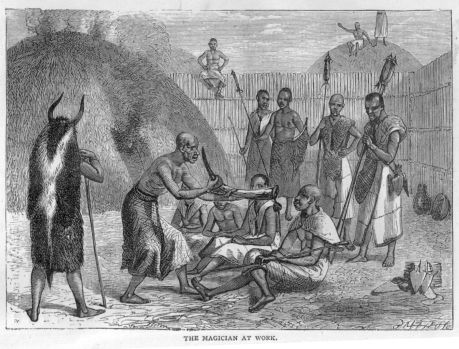
One morning they found that their rain-guage had been removed, so they sent Kidjwiga to say that they wished a magician to come at once and institute a search for it. He soon returned with the adept: “An old man, nearly blind, dressed in strips of old leather fastened to the waist, and carrying in one hand a cow’s horn primed with magic powder, carefully covered on the mouth with leather, from which dangled an iron bell. The old creature jingled the bell, entered their hut, squatted on his hams, looked first at one and then at the other, enquired what the missing things were like, grunted, moved his skinny arm round his head as if desirous to catch the air from all four sides of the hut, then dashed the accumulated air on the head of his horn, smelt it to see if all was going right, jingled the bell again close to his ear, and grunted his satisfaction. The missing article must be found. To carry out the incantation more effectually, all the men were sent for to sit in the open air before the hut, when the old doctor rose, shaking the horn and tinkling the bell close to his ear. He then, confronting one of the men, dashed the horn forward as if intending to strike him on the face, then smelt the head and dashed it at another, and so on, till he became satisfied that Speke’s men were not the thieves. He then walked into Grant’s hut, inspected that, and, finally, went to the place where the bottle had been kept. There he walked about the grass with his arm up, and jingling the bell to his ear, first on one side and then on the other, till the track of a hyaena gave him a clue, and in two or three more steps he found it. A hyaena had carried it into the grass and dropped it. Bravo for the infallible horn, and well done the king for his honesty in sending it. Speke gave the king the bottle and gauge, which delighted him amazingly, and the old doctor, who begged for pomba, got a goat for his trouble.”
News reached them soon after this of the death of Budja, one of the officers who had attended them, and who it was said had died from being bewitched by a charm put into a pot of pomba by one of Kamrasi’s frontier officers, the poor fellow having evidently been poisoned.
The travellers were now in some anxiety about Bombay, who had not returned from Gani. They received intelligence that the coronation formalities of Mtesa were taking place, when upwards of thirty of his brothers were to be burned to death.
Kamrasi had been presented with a Bible. As soon as he got hold of it, he began to count the leaves, supposing that each page or leaf represented one year of time since the beginning of creation. After getting through a quarter of the book, he shut it up, on being told that if he desired to ascertain the number more closely he had better count the words.
Six weeks had been uselessly spent, when at length Bombay returned, his attendants dressed in cotton jumpers and drawers, presents given them by Petherick’s outposts, though Petherick himself was not there. The journey to and fro had been performed in fourteen days’ actual travelling, the rest of the time being frittered away by the guides.
Two hundred Turks were stationed at Gani, who were all armed with elephant-guns, and had killed sixteen elephants.
On this, Speke sent a present to Kamrasi, and prepared for his departure. The king, however, complained that he had not received enough, and insisted on having the chronometer. He had himself sent a present of spears; but Speke refused to accept them unless permission for his departure was given. The only way indeed to treat these black potentates is to act with the greatest firmness and determination.
At last the king promised to give them a parting interview, and to send a large escort to accompany them to Petherick’s boats. Several days, however, passed before the interview took place, when the king again asked for more presents, and even begged for the rings which he saw on Grant’s fingers, but without success. Speke had wished to take two of the king’s sons to be educated in England, but instead, he sent two orphan boys, who, being both of the common negro breed, were so unattractive in appearance that Speke declined receiving them. They had been kept the whole time almost as prisoners, without being allowed by the suspicious king to move about the neighbourhood, while no one had been permitted to visit them. They were therefore thankful when at last they persuaded the savage monarch to allow them to take their departure. Canoes had been provided, and on the 9th of November they embarked in one of them on the river Kuffo. Crowds were collected on the banks to see them depart, shouting and waving adieus as they shot down the stream. Among them was the only lady of rank they had seen, dressed in yellow bark cloth, striped with black; she was flat-featured and plain. Their canoes were formed of logs bound together.
Proceeding down the Kuffo, they entered, a few miles below Kamrasi’s residence, the White Nile, down which they floated four days to the Falls of Karuma. The river had the appearance of a large lake, and without a pilot they would have found it impossible to guess what direction to take. It then assumed the appearance of a river a thousand yards wide, covered with numberless moving and stationary islands, amidst which hippopotami reared their heads. These islands were perfect thickets of thorns, creepers, and small trees. Some went rolling round and round, moved by the stream, which ran at the rate of a mile an hour. Amidst them were seen the lofty papyrus, bending to the breeze, which as they drove on, continually changing their relative positions, looked like a fleet of felucca-rigged vessels.
On the third day, a strong breeze coming on, these floating islands melted away or were driven on shore. They landed every evening to sleep, having to push their way between a wide belt of reeds, rushes, and convolvuli.
They passed some attractive scenery. In one place a hill rose eight hundred feet above the water, and on the Kidi side the ground was undulating and wild, covered with handsome trees, with flowering creepers clinging to their boughs, now in rich bloom and presenting every variety of colour.
The king having given his officers directions to supply the travellers with food, they had some exciting chases after canoes, which took to flight as soon as their object was discovered. No sooner was one overtaken than their Wanyoro escort robbed her of bark, cloth, liquor, beads, spears, and everything on board, the poor owners being utterly helpless. Their Seedees, however, seeing the injustice of this, recovered the stolen property, and restored it to the proper owners.
Their cattle and the main body of their escort had gone by land.
On the 19th of November they reached the Karuma Falls, so-called, the blacks say, because the familiar of a certain great spirit placed stones across the river to break its waters as they flow down, and, as a reward for his services, the spot was called after him.
They were here kept some days, preparing to cross the Kidi wilderness.
They were still in the territories of Kamrasi. The governor of the district, a very great man, who sits on a throne only a little inferior to the king’s, called upon them, and was provided accordingly with a box on which to rest. His idea was that his own people had been once half black and half white. He could only account for it by supposing that the country formerly belonged to white men, who had been driven out by the blacks, and that the former were now coming back to retake it. The travellers relieved his apprehensions by telling him that his ancestors were all at one time white, till they crossed the sea and took possession of the country.
Before they started, Kidjwiga sacrificed two kids, one on each side of the river, flaying them, with one long cut, each down their breasts and bellies; the animals were then spread eagle-fashion on the grass, that the travellers might step over them and obtain a prosperous journey.
A messenger arrived from the king urging them to stop, as he was afraid that his rebel brother, Rehonga, might attack them; but they, believing that he had interested motives, commenced their march. The day was rainy, and the road lay across swamps, through thick jungle and long grasses. This continued for a couple of days, when, at length, they found themselves on the borders of a high plateau. Elephants and buffaloes were seen, and the guide, to make the journey propitious, plucked a twig, stripped off the leaves and branches, and, waving it up the line of march, broke it in two, and threw portions on either side of the path.
They had, however, again quickly to plunge into the tall grass, above their heads, and to cross numerous swamps.
On the 29th they reached the habitations of men at Koki, in Gani—a collection of conical huts on the ridge of a small chain of hills. Knots of naked men were seen perched like monkeys on the granite blocks, anxiously watching their arrival. A messenger was sent to the governor, Chongi, who despatched the principal people in the place to welcome them. These people, covered with war paint—something like clowns in a fair—rushed down the hill with their spears full tilt, and, performing various evolutions, conducted them to the governor, who advanced, attended by his familiar—he holding a white hen, the latter a gourd of pomba and a little twig.
The chief, having greeted them cordially, and swinging the fowl by one leg and sprinkling the contents of the gourd over them, led them to his magic-house, which being sprinkled in the same way, he finally spread a cow-skin under a tree, bidding them sit on it, and then presented them with a bowl of pomba.
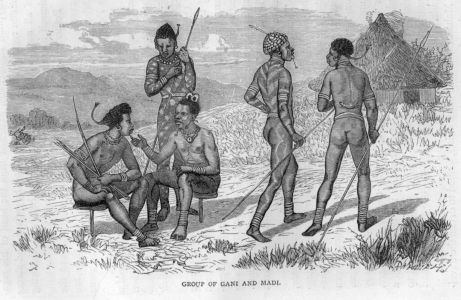
These people were entirely naked, but were covered with beads and brass ornaments, even the women having only a few fibres hanging like tails before and behind. Their hair was dressed in the most fantastic fashion. They also carried diminutive stools, on which they sat wherever they went.
The travellers had great difficulty, in getting porters, who would never agree until the king’s soldiers had seized their women and cattle, and they frequently had to zig-zag from village to village to obtain them.
These curious people might be seen sitting on the rocks or in the shade of the trees, dressing each other’s hair or forming their pigtails, which are turned up and covered with fine wire. Indeed, they seemed to have little else to do, and were generally observed standing in conceited or ridiculous attitudes. The children are carried on the backs of the women, supported by straps, and the head of the infant is shaded by a reversed gourd from the heat of the sun.
The country had assumed a more attractive appearance, with forests, undulating ground covered with grass, and clusters of habitations, frequently intercepted by running streams.
The party had now entered the country of the Madi, who are savage in their appearance, and are similar to the Gani. Their houses are cylinders of bamboo wicker-work, with steep roofs of bamboo and grass, and are plastered inside, making them very warm.
On the 3rd of December, having pushed on in spite of the attempts of the friendly chiefs to detain them, they came in sight of what they supposed to be Petherick’s outposts, in north latitude 3 degrees 10 minutes 33 seconds. The Seedees immediately began firing away their carbines. Directly afterwards bang, crack, bang! was heard from the distant camp, when, in an instant, every height was seen covered with men. The travellers and their attendants hastened on, when before them appeared three large red flags, heading a military procession which marched out of the camp, with drums and fifes playing. Speke’s party halted, when a black officer, Mahamed, in Egyptian regimentals, hastened from the head of his ragamuffin regiment, a mixture of Nubians, Egyptians, and slaves of all sorts, which he had ordered to halt, and, throwing himself into Speke’s arms, began to hug and kiss him.
Petherick was enquired for. “He is coming,” was the answer. “What colours are those?”
“Oh, they are Debono’s.”
“Who is Debono?” was asked. “The same as Petric,” answered Mahamed.
Mahamed soon had dinner for them, and they enjoyed a better repast than they had done for many a day. Then the greatest treat was to come—water with which to wash their hands, and the luxury of soap. The remains of their repast was then placed before their faithful Seedees.
On retiring to their hut at night they offered up a prayer of thankfulness to the Almighty for having preserved them through so many difficulties, and at length, by His all-protecting arm, brought them in safety to the boundary of civilisation after twenty-six months of unceasing toil and anxiety. They had still, however, a considerable distance to march before they were to meet with civilised men.
Their host, Mahamed, was little better than a land pirate, who plundered and shot down the natives without compunction. Among his troops there was not a true Turk, wool predominating on their heads. They were adventurers, born from negro stock in the most southern Egyptian dominions. Numbers of such characters are found at Khartoum, ready for any employment. The merchants engage them there, and send them into the interior under the command of a chief to collect ivory and slaves. They were all married to women of the country, whom they had dressed in cloths and beads.
Mahamed, like the black chiefs, wished to detain the travellers, that they and their party might guard his camp, while he went off on an expedition on his own account. He succeeded by depriving them of their porters, and then marched out with his army—drums and fifes playing, colours flying, guns firing, officers riding, some on donkeys, others on cows. On the 31st the army returned, after having burned down and plundered three villages, laden with ivory and driving in four slave girls and thirty head of cattle.
A few days afterwards another example of Turkish barbarity came under their notice. The head man of a village arrived with a large tusk of ivory with which to ransom his daughter. Fortunately for him it had been considered by the Turks wise to keep on terms with so influential a man; and therefore, on receiving the tusk, Mahamed gave back the damsel, adding a cow to seal their friendship.
At length, weary of Mahamed’s procrastination, on the 11th of January Speke ordered the march, telling Mahamed he might follow if he wished.
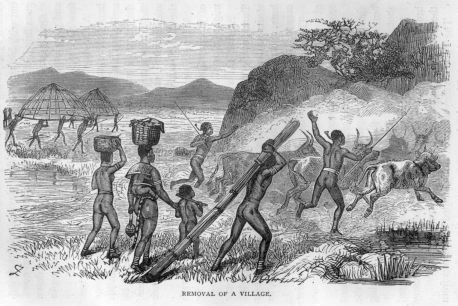
At first the villagers, supposing that the travellers were Turks, made their escape in every direction, carrying what stores and cattle they could; while others pulled down their huts, and marched off with the materials to a distant site, to escape from their persecutors.
The people do this because the Turks, when they arrive at a village, often pull down the huts and carry off the roofs to form a camp for themselves outside the enclosure.
They also without ceremony rob the corn-stores, and should the owner remonstrate, he is knocked down with the butt of a musket, and told he is fortunate to escape being shot.
Finding that Speke was determined to move, Mahamed broke up his camp, the whole party, including porters to carry the ivory tusks, amounting to nearly a thousand men.
The Turks, as they marched along, helped themselves from the half-filled bins of the unfortunate natives, who were starving, while the chiefs at the different villages were quarrelling among themselves.
One night a party of warriors from another place appeared in front of the village near which they were encamped, and the next morning the villagers turned out and killed two of them. The enemy, as they retired, cried out that as soon as the guns were gone the villagers must look out for themselves.
Speke and Grant, however, kept their own pots boiling by shooting antelopes and other game. The Turks ate anything they could get hold of. Greatly to the disgust of the Seedees, they devoured a crocodile which was killed; they also feasted off crocodiles’ eggs.
They were now passing through the Bari country. Villages were numerous, but the inhabitants fled as soon as they appeared. Whenever the Turks halted, they sacked the villages of provisions.
At Doro, which they reached on the 13th of February, the Turks having plundered the nearest villages, the natives turned out with their arms, and war drums were beaten as a sign that they intended to attack the camp. As soon as darkness set in, they attempted to steal into the camp, but, being frightened off by the patrols, hundreds collected in front and set fire to the grass, brandishing torches in their hands, howling like demons, and swearing that they would annihilate their enemies in the morning.
On the 15th of February the travellers approached Gondokoro, and to their delight saw in the distance a white speck, which marked the position of the Austrian mission-house. Soon afterwards the masts of the Nile boats could be seen.
The Toorkees halting to fire a feu de joie, the party marched in together.
While making enquiries for Petherick, they caught sight of a sturdy English figure approaching them. Uttering a hearty cheer and waving their hats, they rushed forward and, greatly to their delight, found themselves shaking hands with Mr, now Sir Samuel, Baker, the elephant hunter of Ceylon, who had bravely come out in search of them.
They had had no news from England later than April, 1860, and it was now February, 1863. It was believed in England that they never would have been able to get through the savage tribes. They had reason to be grateful for the kind sympathy of their friends and countrymen.
The long-looked-for Petherick was away on a trading expedition, and had, as yet, made no attempt to succour them.
They waited at Gondokoro till the 26th, that Speke might ascertain, by lunar observation, the longitude, which was 31 degrees 46 minutes 9 seconds east, the latitude being 4 degrees 54 minutes 5 seconds north. The thermometer ranged between 94 degrees and 100 degrees in the shade. The climate was considered better than that of Khartoum.
While Mr Baker, accompanied by his devoted wife, continued his journey southward, they proceeded down the Nile in his boats to Khartoum.
At Gondokoro an Austrian mission has been established for thirty years; but, owing to utter want of success, it was now about to be abandoned.
They here found three Dutch ladies—the Baroness Capellen, Madame Tinne, and her daughter—who had, in the most spirited way, come up the Nile in a steamer for the purpose of assisting them, intending to proceed overland to Fernando Po.
They had, while at Gondokoro, been shocked by seeing a number of slaves, attacked by small-pox, thrown overboard by the native traders. These noble and philanthropic ladies had rescued some of the unfortunate natives from slavery. Unhappily, overcome by the climate, Madame Tinne and most of her companions some time afterwards died, and their proposed expedition was arrested.
The voyage down the Nile to Khartoum took from the 26th of February to the 30th of March, and was performed in a diabeah, the usual Nile boat, the after part being covered with a deck, on which was built a comfortable poop cabin. Their Seedees followed them in two large boats. They were hospitably welcomed by Ali Bey, and by a number of European and Turkish inhabitants.
They now felt themselves in a civilised country. Fifty years ago Khartoum was a mere military post on the Egyptian frontier; it now contains quarters for fifteen thousand troops.
At a banquet, given in their honour by an Italian hunter, Monsieur Debono, upwards of twenty gentlemen and four ladies were present. They here met also Mr Aipperly, a minister of the Pilgrim Mission from the Swiss Protestant Church. He was stationed at Gallabat, and, having learned blacksmith’s work and other trades, he was able to make friends with the natives by assisting them to put up their irrigation wheels and other carpenter’s work.
Among other interesting places they visited was a Coptic church. In the centre was a desk, at which a man was reading aloud to a number of other persons wearing large turbans, their shoes placed on one side, and several children, all sitting on a carpet, listening devoutly. On the walls were draperies and pictures of the Saviour, and within a doorway was a high altar, covered with a cloth marked with the figure of the cross. The service was in Arabic. A handsome old man entered, bearing a staff surmounted by a golden cross. After kneeling at the altar, he invited the strangers to his house to have coffee. Grant says that he never saw a finer face than that of this venerable Copt, Gabriel by name, who is at the head of the Coptic Church at Khartoum.
They left Khartoum on the 15th of April, and continued their journey down to Berber by water. Here they landed, and had a fatiguing camel ride across the desert to a place called Korosko, whence they continued it by water to Cairo. Here they were to part from their faithful Seedees, of whom Bombay was appointed captain. The Seedees received three years’ pay, and an order for a freeman’s garden to be purchased for them at Zanzibar, when each man was to receive ten dollars more as soon as he could find a wife. They ultimately, after many adventures, reached their destination.
The two travellers, whose adventures we have thus far followed, embarked for England, on the 4th of June, on board the “Pera,” where they safely arrived, after an absence of eleven hundred and forty-six days.
His friends had shortly afterwards to mourn Captain Speke’s untimely death, from his gun accidentally going off while at shooting. His gallant companion, now Colonel Grant, survives.
Although not, as he supposed, the discoverer of the remotest source of the Nile, Speke was undoubtedly the first European who saw the Victoria Nyanza, while the adventurous and hazardous journey he and Grant performed together deservedly places them in the first rank of African travellers. They also opened up an extensive and rich district hitherto totally unknown, into which the blessings of Christianity and commerce may, in a few years, be introduced. It is to be hoped that King Rumanika, the most intelligent ruler with whom they came in contact, still survives, as he would afford a cordial welcome both to missionaries and legitimate traders, and his beautiful and healthy country might become the centre of civilisation in that part of Eastern Africa. Were a mission sent to him by way of Zanzibar, backed by a body of disciplined, well-armed men, he would probably greatly assist in clearing the district intervening between the north of his dominions and that lately brought under subjection by Sir Samuel Baker, and a speedy end might be put to the horrible cruelties of the barbarous Mtesa, King of Uganda. It is sad to reflect, however, that while Mahommedan Turks and Arabs are allowed to range at will over the wide regions of Africa and proselytise the heathen, so few Christian merchants or missionaries have made their way into the interior with the advantages their superior civilisation and pure faith would bestow on the hapless inhabitants.
We may yet hope with Captain Burton that, “as the remote is gradually drawn nigh, and the difficult becomes accessible, the intercourse of man—strongest instrument of civilisation in the hands of Providence—will raise Africa to that place in the great republic of nations, from which she has hitherto been unhappily excluded.”
Chapter Eighteen.
Travels of Dr Livingstone—first expedition.
His parentage and early life—Sets out for Africa as a missionary from the London Missionary Society—Arrives at Cape Town—Lepelole—Mabotsa—Sechele—Dr Livingstone finds him at Kolobeng—A missionary’s necessary accomplishments—The Kalahara Desert described—Starting—The banks of the Zouga—Lake Ngami—Return to Kolobeng—Return to Lake Ngami—Fever—Set out again and reach the Chobe—Sebituane—Banks of the Zambesi—Returns to Kolobeng—Arrives at Cape Town, where his wife and children embark for England—Reaches Kuruman—The Dutch Boers—Linyanti—Received by the Makololo—Fever.
David Livingstone comes of a race whose chief pride was that they were honest men. His great grandfather fell at the battle of Culloden. His grandfather was a small farmer in Ulva, one of the western islands of Scotland. Here his father was born, but his grandfather after that event migrated to a large cotton factory at the Blantyre Works, situated on the Clyde, above Glasgow. His uncles all entered His Majesty’s service either as soldiers or sailors, but his father remained at home, and his mother, being a thrifty housewife, in order to make the two ends meet, sent her son David, at the age of ten, to the factory as a piecer.
He was fond of study, and with part of his first week’s wages he purchased “Ruddiman’s Rudiments of Latin,” and for many years afterwards studied that language at an evening school after his work was done. He also, when promoted at the age of nineteen to cotton-spinning, took his books to the factory, and read by placing one of them on a portion of the spinning-jenny, so that he could catch sentence after sentence as he passed at his work. He was well paid, however, and having determined to prepare himself for becoming a medical missionary in China, was enabled, by working with his hands in summer, to support himself while attending medical and Greek classes in Glasgow in winter, as also the divinity lectures of Dr Wardlow. He was thus able to pass the required examinations, and was at length admitted a licentiate of the Faculty of Physicians and Surgeons.
The war in China preventing him from proceeding thither, he offered himself as a missionary to the London Missionary Society, and embarked for Africa in 1840.
After reaching Cape Town, he went round to Algoa Bay, whence he proceeded about eight hundred miles into the interior to Kuruman, the missionary station of the Reverend R. Moffat, whose daughter he afterwards married.
Thence he went to Lepelole, where, to gain a knowledge of the language and habits of the inhabitants, the Bakwains, he cut himself off from European society for six months. The Bakwains, however, being driven by another tribe from their country, he was unable, as he had intended, to form a station at that place.
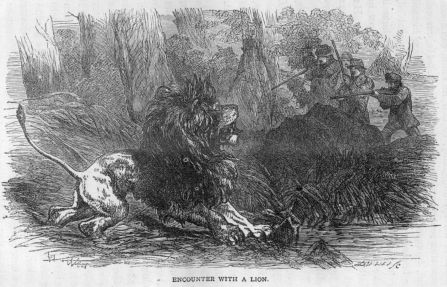
He was more successful at Mabotsa, also inhabited by the Bakwains, to which place he removed in 1843. It was here, while in chase of a lion, that he nearly lost his life. He had fired both the barrels of his gun, and was re-loading, when the lion, though desperately wounded, sprang upon him, catching his shoulder, both man and beast coming to the ground together. Growling horribly, the fierce brute shook the doctor as a terrier dog does a rat. The shock produced a stupor similar to that which seems to be felt by a mouse after the first shake of a cat. The gun of his companion, a native schoolmaster, who came to his assistance, missed fire, when the lion, leaving Dr Livingstone, attacked him. Another native came up with a spear, when the lion flew at him also, but the bullets at that moment taking effect, the fierce brute fell down dead.
The chief of the Bakwains, Sechele, became a Christian, and exerted himself for the conversion of his people, restoring his wives to their fathers, and living in every respect a thoroughly consistent life.
The Dutch Boers, who had pushed forward to the confines of the country, proved, however, most adverse to the success of the mission, by carrying off the natives and compelling them to labour as slaves.
By the advice of Dr Laidley, Sechele and his people moved to Kolobeng, a stream about two hundred miles to the north of Kuruman, where Dr Livingstone formed a station.
He here built a house with his own hands, having learned carpentering and gardening from Mr Moffat, as also blacksmith work. He had now become handy at almost any trade, in addition to doctoring and preaching, and, as his wife could make candles, soap, and clothes, they possessed what may be considered the indispensable accomplishments of a missionary family in Central Africa.
Among the gentlemen who had visited the station was Mr Oswell, in the East India Company’s service. He deserves to take rank as an African traveller. Hearing that Dr Livingstone purposed crossing the Kalahara Desert in search of the great Lake Ngami, long known to exist, he came from India on purpose to join him, accompanied by Mr Murray, volunteering to pay the entire expenses of the guides.
The Kalahara, though called a desert from being composed of soft sand and being destitute of water, supports prodigious herds of antelopes, while numbers of elephants, rhinoceros, lions, hyenas, and other animals roam over it. They find support from the astonishing quantity of grass which grows in the region, as also from a species of water-melon, and from several tuberous roots, the most curious of which is the leroshua, as large as the head of a young child, and filled with a fluid like that of a turnip. Another, the mokuri, an herbaceous creeper, the tubers of which, as large as a man’s head, it deposits in a circle of a yard or more horizontally from the stem. On the water-melons especially, the elephants and other wild animals revel luxuriously.
Such was the desert Dr Livingstone and his party proposed to cross when they set out with their wagon on the 1st of June, 1849, from Kolobeng. Instead, however, of taking a direct course across it, they determined to take a more circuitous route, which, though longer, they hoped would prove safer.
Continuing on, they traversed three hundred miles of desert, when, at the end of a month, they reached the banks of the Zouga, a large river, richly fringed with fruit-bearing and other trees, many of them of gigantic growth, running north-east towards Lake Ngami. They received a cordial welcome from the peace-loving inhabitants of its banks, the Bayeiye.
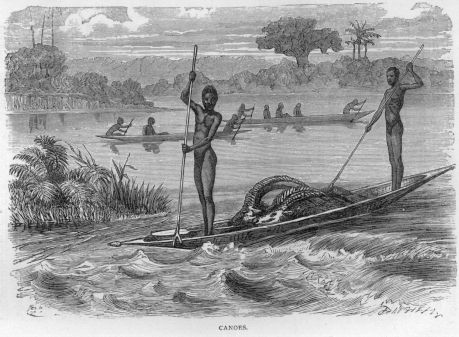
Leaving the wagons in charge of the natives, with the exception of a small one which proceeded along the bank, Dr Livingstone embarked in one of their canoes. Frail as are the canoes of the natives, they make long trips in them, and manage them with great skill, often standing up and paddling with long light poles. They thus daringly attack the hippopotami in their haunts, or pursue the swift antelope which ventures to swim across the river. After voyaging on the stream for twelve days, they reached the broad expanse of Lake Ngami. Though wide, it is excessively shallow, and brackish during the rainy season. They here heard of the Tamunacle and other large rivers flowing into the lake.
Livingstone’s main object in coming was to visit Sebituane, the great chief of the Makololo, who live about two hundred miles to the northward. The chief of the district, Sechulatebe, refused, however, either to give them goods or to allow them to cross the river. Having in vain attempted to form a raft to ferry over the wagon, they were reluctantly compelled to abandon their design. The doctor had been working at the raft in the river, not aware of the number of alligators which swarmed around him, and had reason to be thankful that he escaped their jaws.
The season being far advanced, they determined to return to Kolobeng, Mr Oswell generously volunteering to go down to the Cape and bring up a boat for the next season.
Half the royal premium for the encouragement of geographical science and discoveries was awarded by the council of the Royal Geographical Society to Dr Livingstone for the discoveries he made on this journey.
Sechele, the Christian chief of the Bakwains, who was eager to assist him in reaching Sebituane, offered his services, and with him as a guide, accompanied by Mrs Livingstone and their three children, he set out, in April, 1850, taking a more easterly course than before.
They again reached the lake, but the greater number of the party being attacked by fever, he was compelled to abandon his design of visiting Sebituane.
He here heard of the death of a young artist, Mr Rider, who had shortly before visited the lake for the purpose of making sketches.
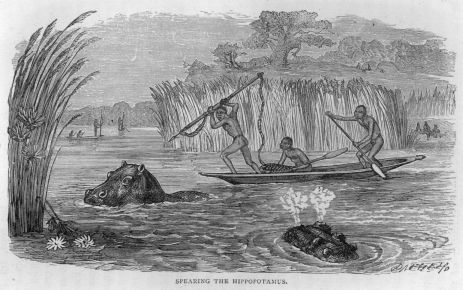
The natives inhabiting the banks of the rivers falling into Lake Ngami are famed for their skill in hunting the hippopotamus. In perfect silence they approach in their light canoes, and plunge their sharp spears, with thongs attached, into the back of one of the huge creatures, which dashes down the stream, towing the canoe at a rapid rate. Thus the animal continues its course, the hunters holding on to the rope, till its strength is exhausted, when, other canoes coming up, it is speared to death. Frequently, however, the hippopotamus turns on its assailants, bites the canoe in two, and seizes one of them in its powerful jaws. When they can manage to do so, they tow it into shallow water, and, carrying the line on shore, secure it to a tree, while they attack the infuriated animal with their spears, till, sinking exhausted with its efforts, it becomes their prey.
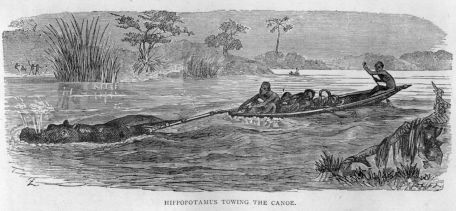
Mr Oswell, who had arrived too late for the journey, spent the remainder of the season in hunting elephants, liberally presenting Dr Livingstone with the proceeds of his sport, for the outfit of his children.
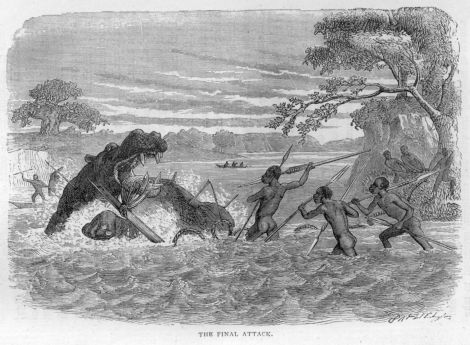
The third journey was commenced in the spring of 1851, when, rejoined by Mr Oswell, he set out once more, accompanied by Mrs Livingstone and their children.
First travelling north, and then to the north-east, through a region covered with baobab-trees, abounding with springs, and inhabited by Bushmen, they entered an arid and difficult country. Here, the supply of water being exhausted, great anxiety was felt for the children, who suffered greatly from thirst. At length a small stream, the Mababe, was reached, running into a marsh, across which they had to make their way. During the night they traversed a region infested by the tsetse, a fly not much larger than the common house-fly, the bite of which destroys cattle and horses. It is remarkable that neither man, wild animals, nor even calves as long as they continue to suck, suffer from the bite of this fearful pest. While some districts are infested by it, others in the immediate neighbourhood are free, and, as it does not bite at night, the only way the cattle of travellers can escape is by passing quickly through the infested district before the sun is up. Sometimes the natives lose the whole of their cattle by its attacks, and travellers frequently have been deprived of all means of moving with their wagons, in consequence of the death of their animals; some, indeed, have perished from being unable to proceed.
Having reached the Chobe, a large river, which falls into the Zambesi, leaving their attendants encamped with their cattle on an island, Dr Livingstone and his family, with Mr Oswell, embarked in a canoe on the former river, and proceeded down it about twenty miles to an island, where Sebituane was waiting to receive them.
The chief, pleased with the confidence the doctor had shown in bringing his wife and children, promised to take them to see his country, that they might chose a spot where they might form a missionary station. He had been engaged in warfare nearly all his life, under varying fortunes, with the neighbouring savage tribes, and had at length established himself in a secure position behind the Chobe and Leeambye, whose broad streams guarded him from the inroads of his enemies. He had now a larger number of subjects and was richer in cattle than any chief in that part of Africa.
The rivers and swamps, however, of the region produced fever, which had proved fatal to many of his people. He had long been anxious for intercourse with Europeans, and showed every wish to encourage those who now visited him to remain in his territory.
Unhappily, a few days after the arrival of his guests the chief was attacked with inflammation of the lungs, originating in an old wound, and, having listened to the gospel message delivered by the doctor, he in a short time breathed his last.
Dr Livingstone says that he was decidedly the best specimen of a native chief he had ever met. His followers expressed the hope that the English would be as friendly to his children as they intended to have been to himself.
The chieftainship devolved at his death on a daughter, who gave the visitors leave to travel through any part of the country they chose. They accordingly set out, and traversing a level district covered with wild date-trees, and here and there large patches of swamp, for a distance of a hundred and thirty miles to the north-east, they reached the banks of the Zambesi, in the centre of the continent.
From the prevalence of the tsetse, and the periodical rise of its numerous streams causing malaria, Dr Livingstone was compelled to abandon the intention he had formed of removing his own people thither that they might be out of the reach of their savage neighbours, the Dutch boers. It was, however, he at once saw, the key of Southern and Central Africa.
The magnificent stream, on the bank of which he now stood, flows hundreds of miles east to the Indian Ocean—a mighty artery supplying life to the teeming population of that part of Africa. He therefore determined to send his wife and children to England, and to return himself and spend two or three years in the new region he had discovered, in the hopes of evangelising the people and putting a stop to the trade in slaves, which had already been commenced even thus far from the coast.
He accordingly returned to Kolobeng, and then set out with his family a journey of a thousand miles, to Cape Town. Having seen them on board a homeward-bound ship, he again turned his face northward, June, 1852.
Having reached Kuruman, he was there detained by the breaking of a wagon-wheel. During that time the Dutch Boers attacked his friends, the Fakwains, carrying off a number of them into slavery, the only excuse the white men had being that Sechele was getting too saucy—in reality, because he would not prevent the English traders from passing through his territory to the northward. The Dutch plundered Dr Livingstone’s house, and carried off the wagons of the chief and that of a trader who was stopping in the place. Dr Livingstone therefore found great difficulty in obtaining guides and servants to proceed northward. Poor Sechele set out for Cape Town, intending, as he said, to lay his complaint before the Queen of England, but was compelled by want of funds to return to his own country, where he devoted himself to the evangelisation of his people.
Parting with the chief, Dr Livingstone, giving the Boers a wide berth, proceeded across the desert to Linyanti, the capital of the Makololo, where he had visited the Chief Sebituane in 1851. The whole population, amounting to nearly seven thousand souls, turned out to welcome him. He found that the princess had abdicated in favour of her brother Sekeletu, who received him with the greatest cordiality. The young king, then only nineteen, exclaimed: “I have now got another father instead of Sebituane.” The people shared this feeling, believing that by the residence of a missionary among them they would obtain some important benefits, though of the real character of the blessing they might receive they were totally ignorant.
A rival of the young king existed in the person of a cousin, Mpepe, who had been appointed by the late king chief over a portion of his subjects, but whose ambition made him aim at the command of the whole.
Half-caste Portuguese slave-traders had made their way to Linyanti, and one, who pretended to be an important person, was carried about in a hammock slung between two poles, which looking like a bag, the natives called him “the father of the bag.” Mpepe favoured these scoundrels, as he hoped by their means to succeed in his rebellion. The arrival of Dr Livingstone, however, somewhat damped their hopes.
As the chief object of the doctor was to select a spot for a settlement, he ascended, accompanied by Sekeletu, the great river Zambesi, which had been discovered in the year 1851.
The doctor had taught the Makololo to ride on their oxen, which they had never before done, though, having neither saddles nor bridles, they constantly fell off.
He and Sekeletu were riding along side by side, when they encountered Mpepe, who, as soon as he saw them, ran towards the chief with his axe uplifted; but Sekeletu, galloping on, escaped him. On their arrival at their camp, while the chief and the doctor were sitting together, Mpepe appeared, his men keeping hold of their arms. At that moment the rebel entered; but the doctor, unconsciously covering Sjkeletu’s body, saved him from the assassin’s blow. His cousin’s intention having been revealed to Sekeletu, that night Mpepe was dragged off from his fire and speared. So quietly was the deed done that Dr Livingstone heard nothing of it till the next morning.
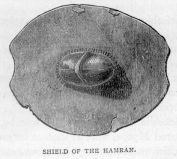
Dr Livingstone was soon after this attacked by fever, when his hosts exhibited the interest they felt for him by paying him every attention in their power. His own remedies of a wet sheet and quinine were more successful than the smoke and vapour baths employed by the natives.
It is important that the position of Linyanti should be noted, as from it Dr Livingstone set out on his journey westward to Loanda, on the West Coast, and, returning to it, commenced from thence that adventurous expedition to the East Coast, which resulted in so many interesting discoveries. Its latitude is 18 degrees 17 minutes 20 seconds south; longitude 23 degrees 50 minutes 9 seconds east.
Chapter Nineteen.
Travels of Dr Livingstone, continued.
Set out—Sesheke—Makololo architecture—Village of Katonga—Paddle up the Leeambye—Mpepe—Naliele—Visit Ma-Sekeletu—A grand dance—Return to Linyanti—Expedition to the West—On the Chobe—Gonye Falls—Up the Leeanibye—Up the Leeba—The Balonda country—Manenko—Visits Shinti—Reception of Livingstone—Proceeds northerly—Visit Katema—Reach the territory of the Chiboque—Want of food—A mutiny—The banks of the Quango—Reach Kasenge—Sleeping-places on the road—Ambaca—Trombeta—Arrive at Loanda—Livingstone, with his Makololo, goes on board the “Pluto” and “Philomel”—The city of Loanda—Departure—Ascend the river Bengo to Icollo-i-Bengo—Golcongo Alto—Excursion to Kasenge—Proceed to, and arrive on, the banks of the Quango—Bashinji country—Attacked—Reach Calongo—Kanawa’s village—Past Lake Dilolo—Shuiti’s capital—On the Leeba—The Lecambye—The town of Lebouta—Proceeding, arrives at Sesheke and afterwards at Linyanti.
Having recovered from his fever, Dr Livingstone, accompanied by Sekeletu and about one hundred and sixty attendants, mostly young men, associates of the chief, set out for Sesheke. The intermediate country was perfectly flat, except patches elevated a few feet only above the surrounding level. There were also numerous mounds, the work of termites, which are literally gigantic structures, and often wild date-trees were seen growing on them.
The party looked exceedingly picturesque as, the ostrich feathers of the men waving in the air, they wound in a long line in and out among the mounds. Some wore red tunics or variously-coloured prints, and their heads were adorned with the white ends of ox tails or caps made of lions’ manes. The nobles walked with a small club of rhinoceros horn in their hands, their servants carrying their shields; while the ordinary men bore burdens, and the battle-axe men, who had their own shields on their arms, were employed as messengers, often having to run an immense distance.
The Makololo possess numerous cattle, and the chief, having to feed his followers, either selected oxen from his own stock or received them from the head men of the villages through which they passed, as tribute.
Dr Livingstone and the chief had each a little gipsy tent in which they slept, though the Makololo huts, which are kept tolerably clean, afforded them accommodation. The best sort of huts consist of three circular walls, having small holes to serve as doors, through which it is necessary to creep on all fours. The roof resembles in shape a Chinaman’s hat, and is bound together with circular bands. The framework is first formed, and it is then lifted to the top of the circle of poles prepared for supporting it. The roof is next covered with fine grass and sewed with the same material as the lashings. Women are the chief builders of huts among the Makololo.
Reaching the village of Katonga on the banks of the Leeambye, some time was spent there in collecting canoes. During this delay Dr Livingstone visited the country to the north of the village, where he saw enormous numbers of buffaloes, zebras, elans, and a beautiful small antelope called the tinyane. He was enabled, by this hunting expedition, to supply his companions with an abundance of food.
At length, a sufficient number of canoes being collected, they commenced the ascent of the river. His own canoe had six paddlers, while that of the chief had ten. They paddled standing upright, and kept stroke with great exactness. Being flat-bottomed, they can float in very shallow water. The fleet consisted altogether of thirty-three canoes and one hundred and sixty men.
The Makololo are unable to swim, and, a canoe being upset, one of the party, an old doctor, was lost, while the Barotse canoe-men easily saved themselves by swimming.
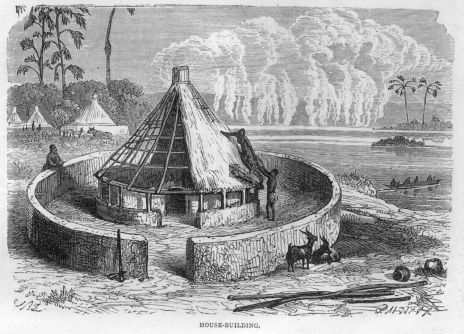
Numerous villages were seen on both banks of the river, the inhabitants of which are expert hunters of the hippopotamus, and are excellent handicraft-men. They manufacture wooden bowls with neat lids, and show much taste in carving stools. Some make neat baskets, and others excel in pottery and iron.
On their arrival at the town of the father of Mpepe, who had instigated his son to rebellion, two of his chief councillors were led forth and tossed into the river.
Mpepe had encouraged the slave-dealers to come into the country, and a large party of his supporters, the Mambari, had taken shelter in a stockade. It was proposed to attack them; but Dr Livingstone urged his friends to refrain from so doing, especially as the enemy possessed firearms. It was then agreed that they would starve them out.
“Hunger is strong enough for that,” observed a chief, “he is a very great fellow;” but here again, as the unfortunate slaves who were chained in gangs would have suffered, the doctor interceded, and they were allowed to depart.
Naliele, the capital of the Barotse, the tribe inhabiting the district in which they now were, is built on an artificially-constructed mound, as are many other villages of that region, to raise them above the overflowing of the river. From finding no trace of European names among them, Dr Livingstone was convinced that the country had not before been visited by white men; whereas, after he had come among them, great numbers of children were named after his own boy, while others were called Horse, Gun, Wagon, etcetera.
Here again numbers of large game were seen. Eighty-one buffaloes defiled in slow procession before the fire of the travellers one evening within gun-shot, and herds of splendid elans stood at two hundred yards’ distance, without showing signs of fear. Lions, too, approached and roared at them. One night, as they were sleeping on the summit of a large sandbank, a lion appeared on the opposite shore, who amused himself for hours by roaring as loudly as he could. The river was too broad for a ball to reach him, and he walked off without suffering for his impertinence. Dr Livingstone saw two as tall as common donkeys, their manes making their bodies appear of still greater size.
The doctor was visited at his camp by two Arabs, who had made their way thus far west. They professed the greatest hatred of the Portuguese because they eat pigs, and they disliked the English because they thrash them for selling slaves.
On their journey they visited the town of Ma-Sekeletu, or the mother of Sekelutu, where, as it was the first visit the king had paid to this part of his dominions, he was received with every appearance of joy. A grand dance was got up, the men standing nearly naked in a circle, with clubs or small battle-axes in their hands, roaring at the loudest pitch of their voices, while they simultaneously lifted one leg, stamped twice with it, then lifted the other and gave one stamp with that. The arms and head were thrown about in every direction, the roaring being kept up with the utmost vigour, while the dust ascended in clouds around them.
Returning down the stream at a rapid rate, they quickly reached Linyanti.
During this nine-weeks’ tour Dr Livingstone had been in closer contact with heathenism than ever before, and though, including the chief, everyone had been as attentive as possible, yet the dancing, roaring, singing, jesting, quarrelling, added to the murdering propensities of these children of nature was painful in the extreme. He took a more intense disgust of heathenism than he had ever before felt, and formed a higher opinion of the latent effects of missions in the south among tribes which were once as savage as the Makololo.
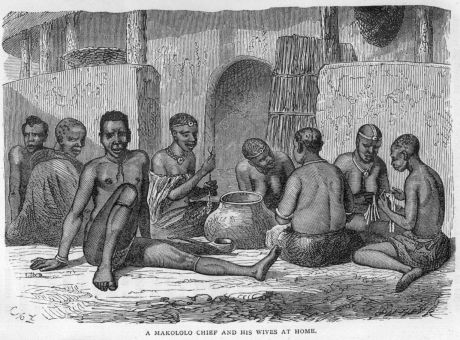
The chief and his followers, agreeing that the object of Dr Livingstone’s proposed expedition to the west was most desirable, took great pains to assist him in the undertaking. A band of twenty-seven men was appointed to accompany him by the chief’s command, whose eager desire was to obtain a free and profitable trade with the white men, and this, Dr Livingstone was convinced, was likely to lead to their ultimate elevation and improvement. Three men whom he had brought from Kuruman having suffered greatly from fever, he sent them back with Fleming, a trader, who had followed his footsteps. His new attendants he named Zambesians, for there were only two Makololo men—the rest consisting of Barotse, Batoka, and other tribes. His wagon and remaining goods he committed to the charge of the Makololo, who took all the articles into their huts. He carried only a rifle and double-barrelled smooth-bore gun for himself, and gave three muskets to his people, by means of which he hoped game might be obtained for their support. Wishing also to save his followers from having to carry loads, he took for his own support but a few biscuits and a pound of tea and sugar, about twenty of coffee, a small tin canister with some spare shirting, trousers, and shoes, another for medicines, and a third for books, while a fourth contained a magic lantern. His ammunition was distributed in portions among the whole luggage, that, should an accident occur to one, the rest might be preserved. His camp equipage consisted of a gipsy tent, a sheep-skin mantle, and a horse-rug as a bed, as he had always found that the chief art of successful travelling consisted in taking as few impediments as possible. His sextant, artificial horizon, thermometer, and compasses were carried apart.
On the 11th of November, 1853, accompanied by the chief and his principal men to see him off, he left Linyanti, and embarked on the Chobe. The chief danger in navigating this river is from the bachelor hippopotami who have been expelled their herd, and, whose tempers being soured, the canoes are frequently upset by them. One of these misanthropes chased some of his men, and ran after them on shore with considerable speed.
The banks of the river were clothed with trees, among them the ficus indica, acacias, and the evergreen motsouri, from the pink-coloured specimens of which a pleasant acid drink is obtained.
Leaving the Chobe, they entered the Leeambye, up which they proceeded at somewhat a slow rate, as they had to wait at different villages for supplies of food. Several varieties of wild fruit were presented to them.
The crews of the canoes worked admirably, being always in good humour, and, on any danger threatening, immediately leaped overboard to prevent them coming broadside to the stream, or being caught by eddies, or dashed against the rocks.
Birds, fish, iguanas, and hippopotami abounded; indeed the whole river teemed with life.
On November 30th the Gonye Falls were reached. No rain having fallen, it was excessively hot. They usually got up at dawn—about five in the morning—coffee was taken and the canoes loaded, the first two hours being the most pleasant part of the day’s sail.
The Barotse, being a tribe of boatmen, managed their canoes admirably.
At about eleven they landed to lunch. After an hour’s rest they embarked, the doctor with an umbrella overhead. Sometimes they reached a sleeping-place two hours before sunset. Coffee was again served out, with coarse bread made of maize meal, or Indian corn, unless some animal had been killed, when a potful of flesh was boiled.
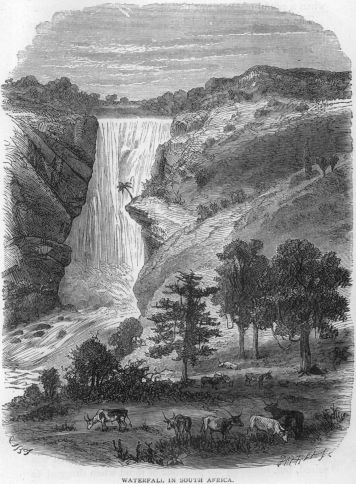
The canoes were carried beyond the falls, slung on poles placed on men’s shoulders.
Here as elsewhere the doctor exhibited his magic lantern, greatly to the delight of the people.
Nothing could be more lovely than the scenery of the falls. The water rushes through a fissure and, being confined below by a space not more than a hundred yards wide, goes rolling over and over in great masses, amid which the most expert swimmer can in vain make way.
The doctor was able to put a stop to an intended fight between the inhabitants of two villages. Several volunteers offered to join him, but his followers determined to adhere to the orders of Sekeletu, and refused all other companions.
They were treated most liberally by the inhabitants of all the villages, who presented them with more oxen, milk, and meal than they could stow away. Entering the Leeambye, Dr Livingstone proceeded up that stream in his canoe, while his oxen and a portion of his men continued their journey along its banks.
The rain had fallen, and nature put on her gayest apparel: flowers of great beauty and curious forms grew everywhere, many of the forest trees having palmated leaves, the trunks being covered with lichens, while magnificent ferns were seen in all the moister situations. In the cool morning the welkin rang with the singing of birds, and the ground swarmed with insect life.
Livingstone did not fail to preach the Gospel to his attendants, as well as to the inhabitants of the villages, ever having in mind the value of human souls.
Alligators were in prodigious numbers, children and calves being constantly carried off by them. One of his men was seized, but, retaining his presence of mind when dragged to the bottom, he struck the monster with his javelin and escaped, bearing the marks of the reptile’s teeth on his thigh.
The doctor’s men had never before used firearms, and, proving bad shots, came to him for “gun medicine” to enable them to shoot better. As he was afraid of their exhausting his supply of powder, he was compelled to act as sportsman for the party.
Leaving Leeambye, he proceeded up the Leeba. Beautiful flowers and abundance of wild honey was found on its shores, and large numbers of young alligators were seen sunning themselves on the sandbanks with their parents.
They had now reached the Balonda country, and received a visit from a chieftainess, Manenko, a tall strapping woman covered with ornaments and smeared over with fat and red ochre as a protection against the weather. She invited them to visit her uncle Shinti, the chief of the country.
They set out in the midst of a heavy drizzling mist; on, however, the lady went, in the lightest marching order. The doctor enquired why she did not clothe herself during the rain; but it appeared that she did not consider it proper for a chief to appear effeminate. The men, in admiration of her pedestrian powers, every now and then remarked: “Manenko is a soldier.” Some of the people in her train carried shields composed of reeds, of a square form, five feet long and three broad. With these, and armed with broadswords and quivers full of iron-headed arrows, they looked somewhat ferocious, but are in reality not noted for their courage.
The doctor was glad when at length the chieftainess halted on the banks of a stream and preparations were made for their night’s lodging.
After detaining them several days she accompanied them on foot to Shinti’s town. The chief’s place of audience was ornamented by two graceful banyan-trees, beneath one of which he sat on a sort of throne covered with a leopard-skin. He wore a checked shirt and a kilt of scarlet baize, edged with green, numerous ornaments covering his arms and legs, while on his head was a helmet of beads, crowned with large goose feathers. At his side sat three lads with quivers full of arrows over their shoulders.
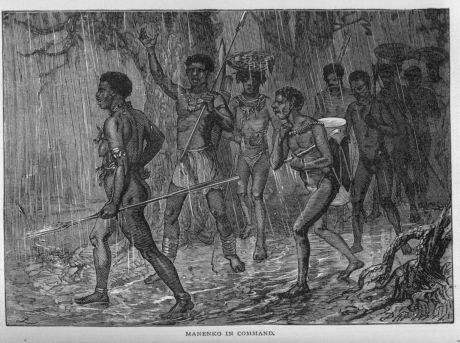
Dr Livingstone took his seat under the shade of another tree opposite to the chief, while the spokesman of the party, who had accompanied them, in a loud voice, walking backwards and forwards, gave an account of the doctor and his connection with the Makololo.
Behind the chief sat a hundred women clothed in red baize, while his wife was seated in front of him. Between the speeches the ladies burst forth into a sort of plaintive ditty. The party was entertained by a band of musicians, consisting of three drummers and four performers on the marimba, a species of piano. It consists of two bars of wood placed side by side; across these are fixed fifteen wooden keys, each two or three inches broad and about eighteen long, their thickness being regulated by the deepness of the note required. Each of the keys has a calabash below it, the upper portion of which, being cut off to hold the bars, they form hollow sounding-boards to the keys. These are also of different sizes according to the notes required. The keys are struck by small drumsticks to produce the sound. The Portuguese have imitated the marimba, and use it in their dances in Angola.
The women in this country are treated with more respect by the men than in other parts of Africa.
A party of Mambari, with two native Portuguese traders, had come up to obtain slaves, and, while Dr Livingstone was residing with Shinti, some young children were kidnapped, evidently to be sold to them.
The day before he was to recommence his journey, the doctor received a visit in his tent from Shinti, who, as a mark of his friendship, presented him with a shell on which he set the greatest value, observing: “There, now you have a proof of my affection.”
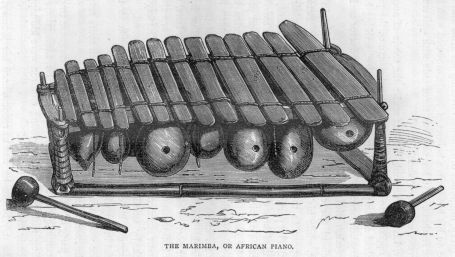
These shells, as marks of distinction, are so highly valued that for two of them a slave may be bought, and five will purchase an elephant’s tusk worth ten pounds.
The old chief had provided a guide, Intemese, to conduct them to the territory of the next chief, Katema. He also gave an abundant supply of food, and wished them a prosperous journey.
Dr Livingstone again started on the 26th of January, Shinti sending eight men to assist in carrying his luggage. He had now to quit the canoes and to proceed on ox-back, taking a northerly direction.
He and his party received the same kind treatment in the country as before, the villagers, by command of their chiefs, presenting them with an abundance of food. They found English cotton cloth more eagerly enquired after than beads and ornaments.
On arriving at a village the inhabitants lifted off the roofs of some of their huts, and brought them to the camp, to save the men the trouble of booth-making. On starting again the villagers were left to replace them at their leisure, no payment being expected.
Heavy rains now came on, and the doctor and his party were continually wet to the skin.
Polite as the people were, they were still fearful savages. Messengers arrived from the neighbouring town to announce the death of their chief, Matiamvo. That individual had been addicted to running a-muck through his capital and beheading any one he met, till he had a large heap of human heads in front of his hut. Men were also slaughtered occasionally, whenever the chief wanted part of a body to perform certain charms.
The Balonda appear to have some belief in the existence of the soul, and a greater feeling of reverence in their composition than the tribes to the eastward. Among their customs they have a remarkable one. Those who take it into their heads to become friends, cement their friendship. Taking their seats opposite one to the other, with a vessel of beer by the side of each, they clasp hands. They then make cuts on their clasped hands, the pits of their stomachs, their foreheads, and right cheeks. The point of a blade of grass is then pressed against the cuts, and afterwards each man washes it in his own pot of beer; exchanging pots, the contents are drunk, so that each man drinks the blood of the other. Thus they consider that they become blood relations and are bound in every possible way to assist each other.
These people were greatly surprised at the liberty enjoyed by the Makololo.
The travellers paid a visit to Katema, the chief of the district, who received them dressed in a snuff-brown coat, with a helmet of beads and feathers on his head, and in his hand a number of tails of gnus bound together. He also sent some of his men to accompany them on their journey.
The rains continued, and the doctor suffered much from having to sleep on the wet ground.
Having reached the latitude of Loanda, Dr Livingstone now directed his course to the westward.
On the 4th of March he reached the outskirts of the territory of the Chiboque.
As he approached the more civilised settlements, he found the habits of the people changed much for the worse: tricks of all sorts were played to detain him and obtain tribute; the guides also tried in every way to impose on him. Even his Makololo expressed their sorrow at seeing so beautiful a country ill cultivated and destitute of cattle.
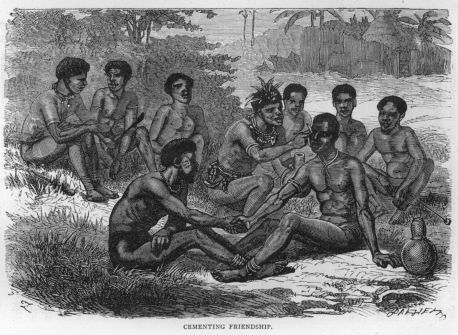
He was compelled to slaughter one of his riding oxen for food, as none could be obtained.
The Chiboque coming round in great numbers, their chief demanded tribute, and one of their number made a charge at Dr Livingstone, but quickly retreated on having the muzzle of the traveller’s gun pointed at his head. The chief and his councillors, however, consenting to sit down on the ground, the Makololo, well drilled, surrounded them and thus got them completely in their power. A mutiny, too, broke out among his own people, who complained of want of food; but it was suppressed by the appearance of the doctor with a double-barrelled pistol in his hand. They never afterwards gave him any trouble.
Similar demands for payment to allow him to pass through the country were made by other chiefs, his faithful Makololo giving up their ornaments, as he had done nearly all the beads and shirts in his possession. The most extortionate of these chiefs was Ioaga Panza, whose sons, after receiving payment for acting as guides, deserted him.
All this time Dr Livingstone was suffering daily from the attacks of fever, which rendered him excessively weak, so that he could scarcely sit his ox.
The country appeared fertile and full of small villages, and the soil is so rich that little labour is required for its cultivation. It is, however, the chief district whence slaves are obtained, and a feeling of insecurity was evident amongst the inhabitants.
A demand was now made by each chief for a man, an ox, or a tusk as tribute. The first was of course refused, but nearly all the remainder of the traveller’s property had to be thus paid away.
On the 4th of April they reached the banks of the Quango, here a hundred and fifty yards wide. The chief of the district—a young man, who wore his hair curiously formed into the shape of a cone, bound round with white thread—on their refusing to pay him an extortionate demand, ordered his people not to ferry them across, and opened fire on them. At this juncture a half-caste Portuguese, a sergeant of militia, Cypriano Di Abreu arrived, and, obtaining ferrymen, they crossed over into the territory of the Bangala, who are subject to the Portuguese. They had some time before rebelled, and troops were now stationed among them, Cypriano being in command of a party of men. Next morning he provided a delicious breakfast for his guest, and fed the Makololo with pumpkins and maize, while he supplied them with farina for their journey to Kasenge, without even hinting at payment.
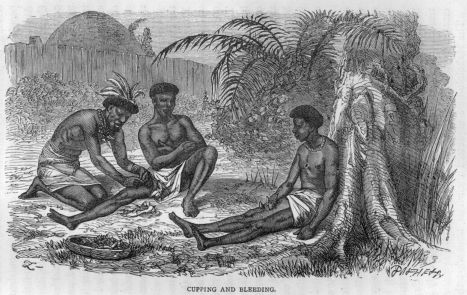
The natives, though they long have had intercourse with the Portuguese, are ignorant and superstitious in the extreme. Many parts of the country are low and marshy, and they suffer greatly from fever. Of the use of medicine they have no notion, their only remedies being charms and cupping. The latter operation is performed with a small horn, which has a little hole in the upper end. The broad end is placed on the flesh, when the operator sucks through the hole; as the flesh rises, he gashes it with a knife, then replaces the horn and sucks again, till finally he introduces a piece of wax into his mouth, to stop up the hole, when the horn is left to allow the blood to gush into it.