XV GAME-BIRDS?
Reading edition
The plea of the Meadowlark, Mourning Dove, Sandpiper, Plovers, and Bobolink, the Masquerader
“Spare us, please! We are too small for food.”
“You, children, who live with green fields about you, all know the Meadowlark by sight and sound, even if you never have had the curiosity to learn its name. It is the bird seen walking in old fields and lowlands. In size it is a little larger than a Robin, with a rather flat head and long, stout bill, its back speckled and streaked with brown and black, and a beautiful yellow throat and breast crossed by a crescent of black. When the bird is on the ground, if you came behind it, at a distance, you might think it a Flicker, but the moment it takes to the air with a whirring flight, the white feathers at the outside of the tail show plainly, and name it Meadowlark, just as the white rump names the Flicker.
“Then, you know its voice, that sometimes drops from a tree, sometimes rises from the grass, that Mr. Burroughs says calls, ‘Spring o’ the year—Spring o’ the year.’ The notes are clear as a flute, and, beautiful as our Meadowlark’s song is, that of his brother, the Prairie Lark, is still more melodious, and I shall never forget the first spring morning that I heard it from the border of one of those endless grain-fields that roll on to meet the sky like a glistening green sea with its waters stirred by the breeze.
“The Meadowlark is certainly a thing of beauty, but, at the same time, its greater service to man is its usefulness; not as a bit of meat, no matter how plump it may grow, but as the untiring guardian of the fields, where it spends its life and makes its nest home in a grass tussock. For this bird, of the eastern United States, is with us here in Southern New England, and southward, all the year, and those flocks that migrate do not leave until late fall, and are back again by the middle of March, while the Prairie Lark covers the western part of the country, as permanent warden of the meadow and hayfields. All the year they keep at work; from March to December insect food is the chief part of the diet; insects that are the farmer’s bane,—grasshoppers, cutworms, sow-bugs, ticks, weevils, plant-lice, and the click-beetle (the grown-up wire worm) being but a few of them. The remaining months, December, January, and February, insects failing, waste grain is eaten, and weed seeds, as pigeon grass, rag and smart weed, and black mustard.
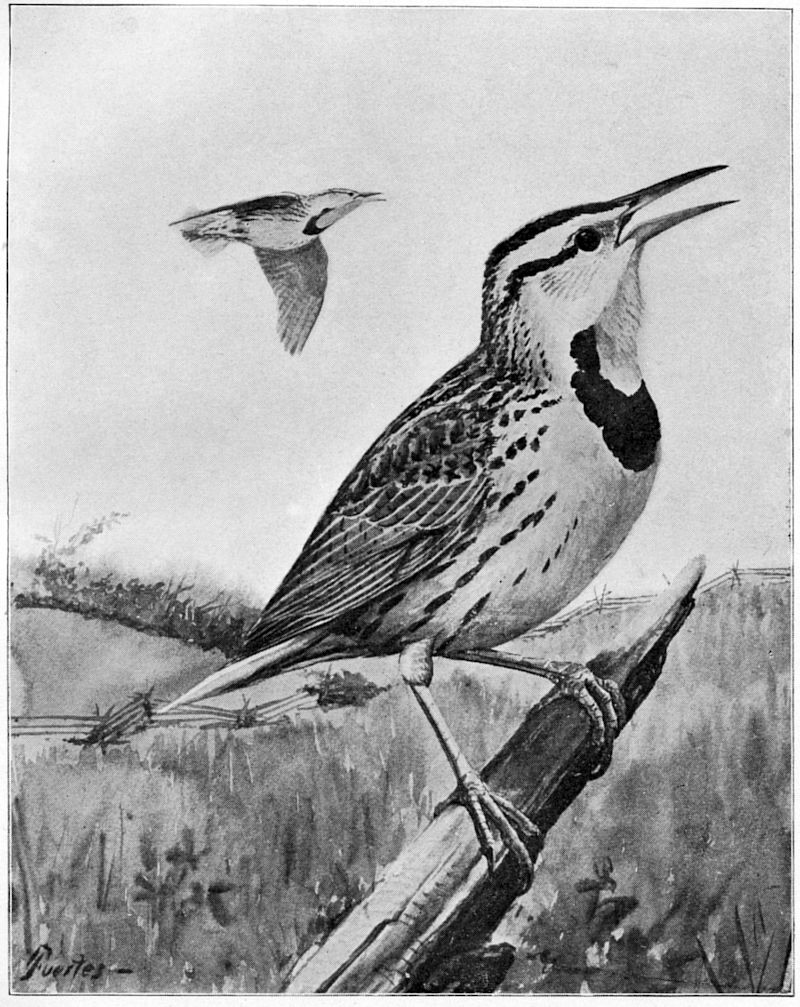
MEADOWLARK
“Happily for us, this beautiful bird is protected in all the New England and Middle States, but, if we have friends who live in Florida, North Carolina, Georgia, Alabama, Louisiana and Tennessee, Missouri and Idaho, where the Larks are only considered as food, let us beg them to tell every one of this and the Prairie Lark’s merits, so that they may be placed on the list of the protected. And when you hear any one say that the Meadowlark is by rights a game-bird, say as politely as may be, but very firmly, ‘No; it is not! At least, not in staunch, common-sensed New England!’