The Mourning Dove
Reading edition
“Soft of plumage, gentle, and almost sad of voice is the Mourning Dove, the grayish brown bird with metallic lustres, whose name is taken from its plaintive accents. Its comings and goings are silent, and, in spite of its size, for it is as large as the Meadowlark, if it was not for its cooing, heard early in the morning, we should seldom know of its presence, for its flight is noiseless, and it chooses trees in secluded places for the little loose bunch of sticks that forms its nest.
“Formerly, this Dove, together with its cousin, the Passenger Pigeon, were everywhere to be found, while the Passenger Pigeon, a bird of fine flesh, was so plentiful as to be almost a staple article of food, and wagons loaded with birds were peddled through city streets. With the wastefulness of a people coming to a new and liberal country, the birds were often shot down in their roosts, from pure wantonness, and left to decay upon the ground, so that now the Passenger Pigeon and the wild buffalo have gone to the happy animal-country, where there is no hunting, together,—two valuable animals practically extinct,—and North America is the poorer for its thoughtlessness.
“With this warning before us, the Kind Hearts’, of which there are plenty everywhere, whether they are banded into clubs or not, should strive to have this gentle, harmless life protected.
“ ‘Why?’ says the farmer, in the states that refuse protection. ‘Maybe it doesn’t do any harm, but what good can it do that can make up to me for not eating it?’ To such a man say this: The Mourning Dove is a consumer of evil weeds, and its presence in flocks will lessen his labour and give his hoe arm a rest; that the crop of a dove, examined by the Department of Agriculture in Washington, was found to hold 9200 seeds of noxious weeds! Not to have these weeds grow would give the farmer, or his boy, time for a half holiday, wherein to go clamming or berry picking!
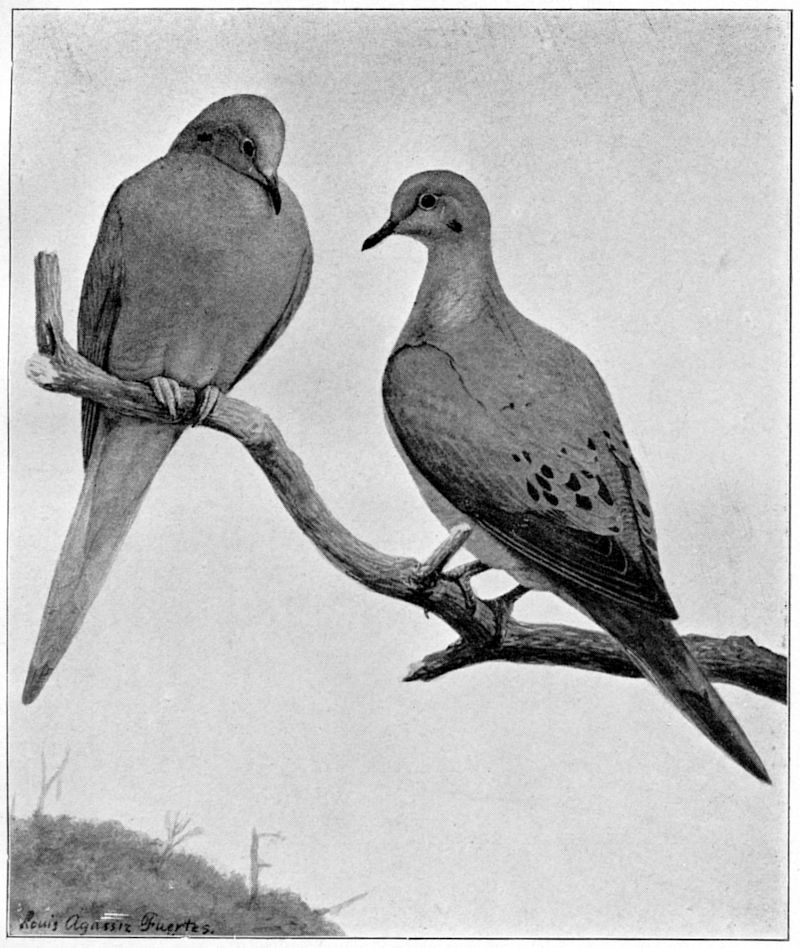
MOURNING DOVES
“Now we have some little birds whose names are still on the list of food- or game-birds, and I should like to see them wiped from it forever, or, at least, until they are once more plentiful in their haunts. These are the two cousins of the Woodcock,—Sandpipers, the Spotted and the Least, and two Plovers, also water-loving birds, the Killdeer and the Upland Plover.
“Most of you children, at some part of the season, go down to the shore of the bay yonder, perhaps it may be when your fathers gather seaweed in the spring and fall, in late summer for the snapper fishing, or all through the autumn and early winter for long-necked clams. Some of you, I know, like Tommy and Dave, have camped out there for several weeks. Have you not noticed the little prints of birds’ feet just above the edge of tide-water? Or have you not seen the little birds themselves, no bigger than Sparrows, with streaked, brown-gray backs and soft white feathers underneath, running to and fro, balancing when they feed, as if making a courtesy, all the while whispering softly among themselves?
“Or, again, others slightly larger, with ash and brown backs, and underparts spotted with round, black marks like a thrush, white spotted wings, and the outer tail-feathers white barred, showing in flight?
“These two gracious, confiding little birds are the Least and the Spotted Sandpiper. Their small size should keep them off the food list, for what are their dead bodies but a single mouthful? And what are they alive? Things of joy and mystery combined. For what is a more perfect picture of grace and happiness than these birds with a background of sand, seaweed, and shells, and all the sparkling water before?
“Of a gray day, their pleasant prattle is shut down by the fog, and sounds strange and mysterious, and when they spread their pointed wings, and vanish into the mist, that seems to pick them up as it rolls in, the picture is complete.
“The Least Sandpiper, the smallest of his tribe, is found in greater numbers on our beach than the Spotted. He comes to us in the migrations, as he nests only in the far North. I can remember, when as a girl I was fond of swiming in the bay until late in autumn, that a flock of these little birds flew over me so close that I could feel the beating of their wings. His use is to give interest to the landscape, and his plea for life his harmless littleness, his confidence, and his obedience in filling the place in nature which the great Plan has given him. Perhaps you may have heard the poem that he inspired in the heart of one woman, who lived on a sea-girt island, and, oftentimes, had only the birds for company; even if you have heard it, the verses are among those of which we never tire.