BOB-WHITE
Reading edition
“I own the country hereabout,” says Bob-white;
“At early morn I gayly shout, ‘I’m Bob-white!’
From stubble-field and stake-rail fence
You hear me call without offence,
‘I’m Bob-white! Bob-white!’
Sometimes I think I’ll nevermore say Bob-white;
It often gives me quite away, does Bob-white;
And mate and I, and our young brood,
When separate, wandering through the wood,
Are killed by sportsmen I invite
By my clear voice—‘Bob-white! Bob-white!’
Still, don’t you find I’m out of sight
While I am saying ‘Bob-white, Bob-white’?”
—Charles C. Marble.
“They rested in the orchard bushes and the edge of brush-lots, so that I was as sure of seeing broods of little Quail as of our own little barnyard chicks. In the autumn they seemed to know about the hunting as soon as a gun was fired in the distance; then they grew shy, but by Christmas the survivors, and they were many, would come about the hay-barns for food as familiarly as the tree-trunk birds come to the lunch-counter, and I have seen them eating cracked corn with the fowls in the barnyard.
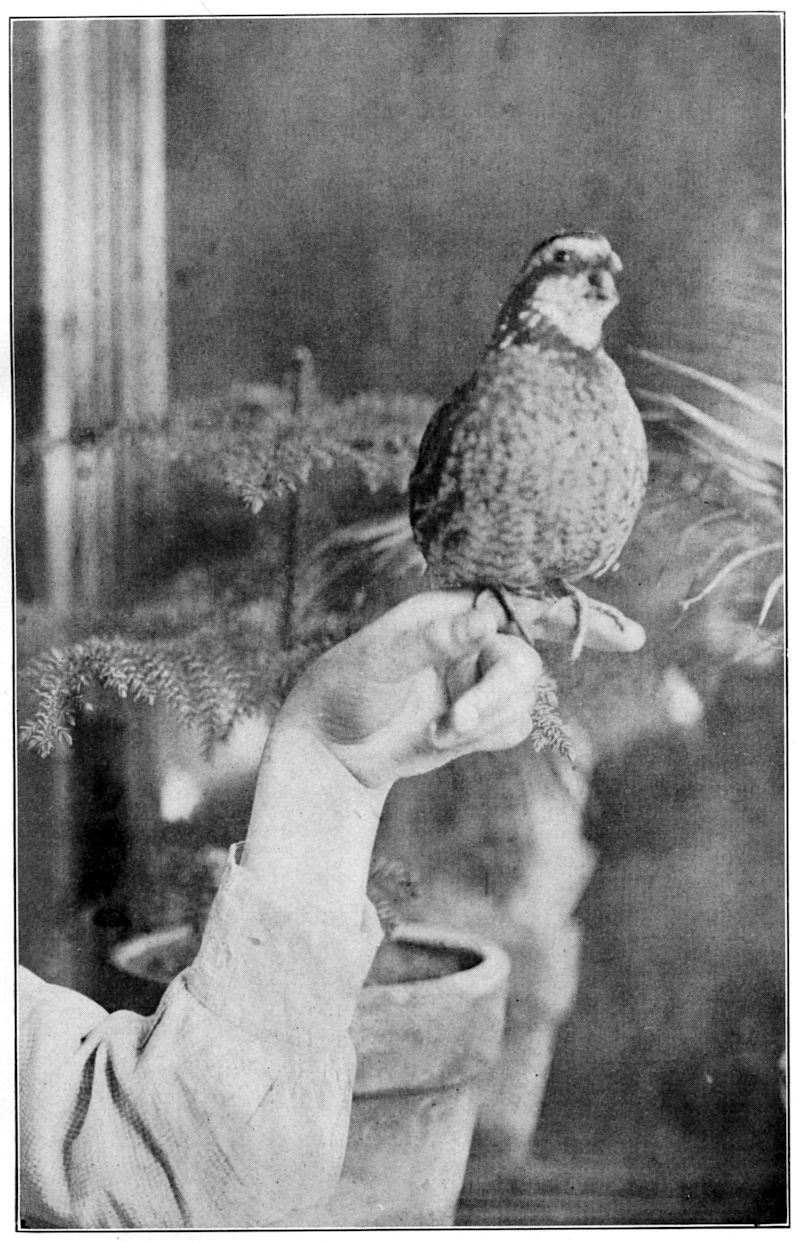
Dr. C. K. Hodge, Photo.
DOMESTICATED BOB-WHITE CALLING
“Not only is Bob-white a beautiful object in the landscape, when he sits on a fence top overlooking the fields, but his voice is a delight to the ear, when he either tells his own name, or gives the beseeching ‘covey call,’ in autumn, to gather his scattered flock for the night. Then, on the more useful or material side of the question, not only is his flesh good for food, but, all through the year, he is one of the farmer’s good friends, gleaning, day in and day out, besides the waste grain that he loves, weed seeds, harmful beetles, such as the cucumber beetle, potato and squash bugs, leaf beetles, the dreaded weevils, and the click beetles, that are wire worms in a further stage of their development.
“Ah me, but poor Bob-white, as he calls himself (bringing out the words with peculiar jerks of the head), works for his living, and when you think of the dangers he braves from foxes and snakes, rats and weasels, birds of prey with wings, and the two-legged birds of prey,—the poachers,—does it not seem that where his tribe is growing swiftly less, he should not only be fed and sheltered, but, for a term of years, there should be no open season, until this fertile and vigorous bird should again increase and be able to hold its own against even fair hunting? If the Quail needs this protection, doubly so does the Ruffed Grouse, who is larger and can with greater difficulty conceal himself.