The Moulting
Reading edition
“After the nesting season is over, and a pair of birds have raised one, two, and, as with the Wrens, sometimes three broods, the feathers of the parents become worn and broken, and not fit for winter covering, nor are the wing quills strong enough for the fall flight.
“At this time, when the young birds are able to care for themselves, the pairs no longer keep alone together, but, leaving their nesting-haunts, travel about either in a family party or in larger friendly flocks, and, although some birds, like the Song Sparrow and Meadowlark, sing throughout the season, the general morning chorus and the nesting season end together, in early or middle July.
“It is quite difficult to name the birds when young and old travel in flocks, for when a male is bright-coloured and the female dull, the first coat of the young is often such a mixture of both that it is easily mistaken for a wholly different and strange bird.
“In August or September almost all of our birds change their spring feathers. This is called moulting. And the brightly coloured birds often drop their wedding finery for dull-coloured travelling cloaks, so that they may not be seen when they fly southward through the falling leaves.
“After this season Father Tanager, of the scarlet wedding coat with black sleeves, appears in yellowish-green, like his wife, and the little Tanagers sometimes have mixed green, yellow, and red garments, for all the world like patchwork bedquilts pieced without regard to pattern.
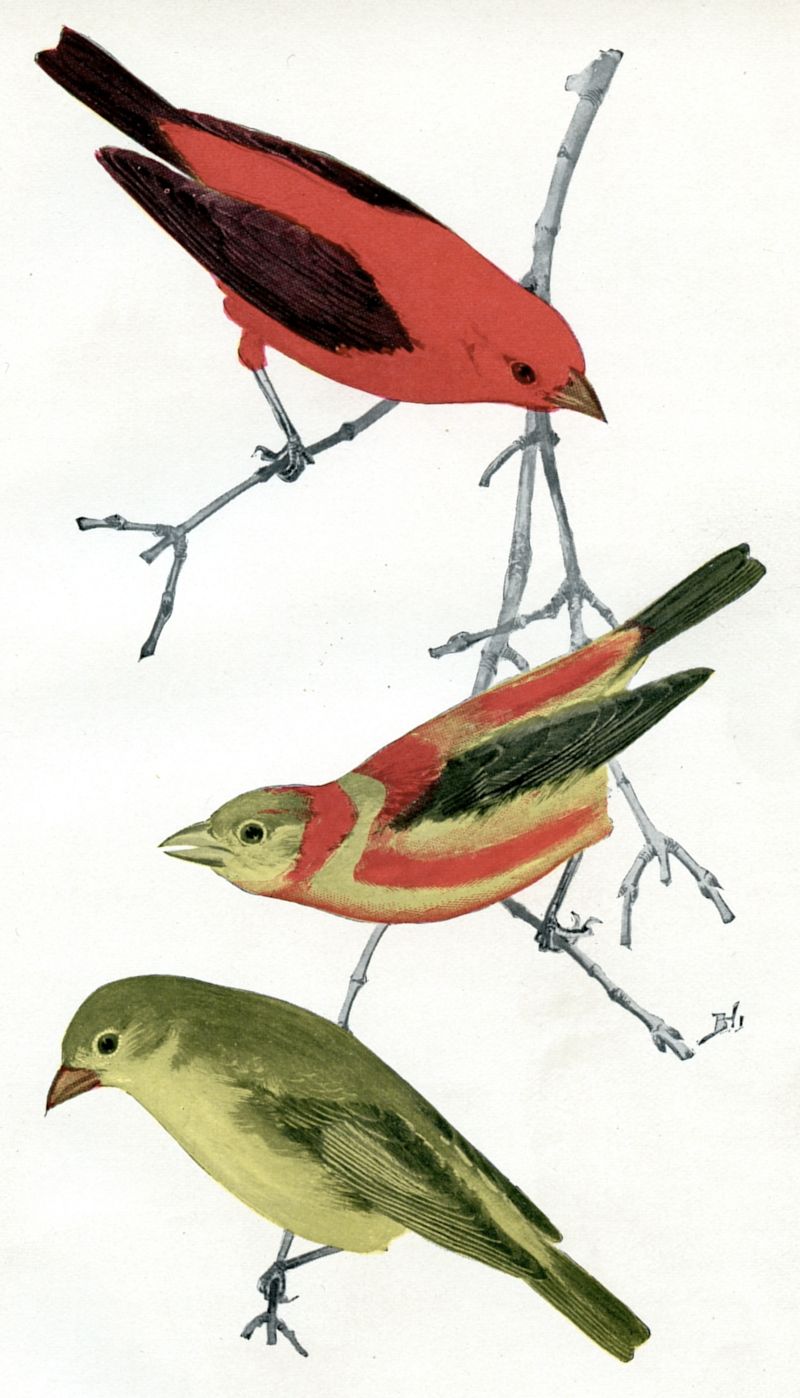
SCARLET TANAGER 1. Adult Male., 2. Adult Male, Changing to Winter Plumage., 3. Adult Female.
Order—Passeres Family—Tanagridæ
Genus—Firanga Species—Erythromelas
“The jolly Bobolink, also, who in May was the prize singer of the meadows, and disported in a coat of black, white, and buff, now wears dull brown stripes, and, having forgotten his song, he mixes with the young of the year and becomes merely the Reed Bird of the gunners. But in early spring he will change again, and, before the nesting time, reappear among us with every black feather polished free from rusty edges and glistening as of old.
“When Father Tanager comes back, he is brave and red again, though it takes little Tommy Tanager two moultings to grow an equally red coat.
“Even with the more quietly marked birds their colours are less distinct after the summer moult, so that what is known as the bird’s perfect or typical plumage is in many species that of the nesting season alone.”
“I didn’t think that there was so much to know about birds; they seem to have ways of doing things just like people. I’d love to know all about them every Friday, but I suppose that’s too nice to happen,” said Sarah Barnes, as Gray Lady paused and moved her chair back from the bright light that was now shining through the door directly in her face, for the clouds had rolled away down behind the hills, leaving one of the clear, bright, early September afternoons when the sun lends its colour to the field of early goldenrod, until sunset seems to reach to one’s very feet.
“No, it isn’t too nice to happen,” said Gray Lady, laughing; “but it would certainly be very pleasant for me, also, if Miss Wilde could give you to me for an hour or so every other Friday, then perhaps some other day you could come to the General’s house and return my call, and see all the birds and pictures and books that belonged to my Goldilocks’ father. How would you like that?”
“Bully!” cried Tommy Todd, “and there’s more kinds of birds in the General’s old orchard than anywhere else hereabout. I haven’t ever taken any eggs from there,” he added hastily, “only jest peeked and watched, an’ once I got a three-story nest from there, along late in the fall when the birds were done with it. If I brought it along, ma’am, could you tell me what sort of a bird it belongs to? I can’t find out!” he added eagerly.
“Yes, I think I can tell you,” Gray Lady answered, “and I’m very glad if you know about my orchard and its tenants, because very likely you may be able to introduce me to some that I do not know.
“Now, children, before next week is over I will see Miss Wilde and tell her my plans, but one thing I will tell you now—I have a little daughter Elizabeth, whom Sarah Barnes calls Goldilocks. She is twelve years old, but because of an accident her back is not strong, and instead of running about as you do she has had to be wheeled about in a chair. I have taken her to the best doctors, and they say that she is getting well slowly, and that now all that she needs is to live out-of-doors and be with children of her own age, who will be kind and gentle to her, yet treat her as one of themselves. She cannot bear to hear of anything being killed or hurt, and she has been loved so well all her life that she loves everything in return.
“Will you come to the General’s house and help Goldilocks to grow strong and forget all the pain she has suffered?”
“Yes, ma’am,” came the reply as with one voice.
Sarah Barnes had the honour of taking Gray Lady’s hand as she went to the carriage, and Tommy Todd closed the door without any one giving him a hint.
Then, before closing the schoolhouse for the night, his special duty, he began a hunt for the rat-trap, which he soon found in the wood-box, but instead of taking the rats home as usual for Mike, his father’s terrier, to “have fun” with, he drowned them as quickly as possible in the brook that ran below the hill, for he thought to himself as they were things that must be killed Goldilocks would think this the kindest way.