MR. FLICKER WRITES A LETTER
Reading edition
People:
Tell me where you scare up
Names for me like “Flicker,” “Yarup,”
“High-hole,” “Yucker,” “Yellowhammer”—
None of these are in my grammar—
“Piquebois jaune” (Woodpick yellow),
So the Creoles name a fellow.
Others call me “Golden-wings,”
“Clape,” and twenty other things
That I never half remember,
Any summer till September.
Many names and frequent mention
Show that I receive attention,
And the honour that is due me;
But if you would interview me
Call me any name you please,
I’m “at home” among the trees.
Yet I never cease my labours
To receive my nearest neighbours,
And ’twill be your best enjoyment
Just to view me at employment.
I’m the friend of every sower,
Useful to the orchard grower,
Helping many a plant and tree
From its enemies to free—
They are always food for me.
And I like dessert in reason,
Just a bit of fruit in season,
But my delicacy is ants,
Stump or hill inhabitants;
Thrusting in my sticky tongue,
So I take them, old and young.
Surely, we have found the best
Place wherein to make our nest
Tunnel bored within a tree,
Smooth and clean as it can be,
Smallest at the door,
Curving wider toward the floor,
Every year we make a new one,
Freshly bore another true one;
Other birds, you understand,
Use our old ones, second-hand—
Occupying free of rent,
They are very well content.
To my wife I quite defer,
I am most polite to her,
Bowing while I say, “kee-cher.”
Eggs we number five to nine,
Pearly white with finish fine.
On our nest we sit by turns,
So each one a living earns;
Though I think I sit the better,
When she wishes to, I let ’er!
Flicker.
—Garrett Newkirk, in Bird-Lore.
“Then, last and least in size, but chief in importance among the tree-trunk birds, come the little Downy Woodpeckers, only as big as the Tree-sparrow or Winter Chippy, as it is called, plump, all neatly patterned in black and white, a scarlet band on the back of the neck, while Mrs. Downy and the children lack even this bit of colour. You cannot mistake this Woodpecker for any other, for his big brother the Hairy Woodpecker, who has somewhat similar markings, is almost as big as a Robin, besides being a more timid bird of the woods that does not come about houses like the confiding and cheerful Downy. The Hairy Woodpecker has a more harsh and screaming call-note than the clear, sharp cry of the Downy. In watching birds, you should remember to keep the ears open and trained to hearing as well as the eye to seeing, as a bird that keeps too far away for the sight may oftentimes be recognized by its note.
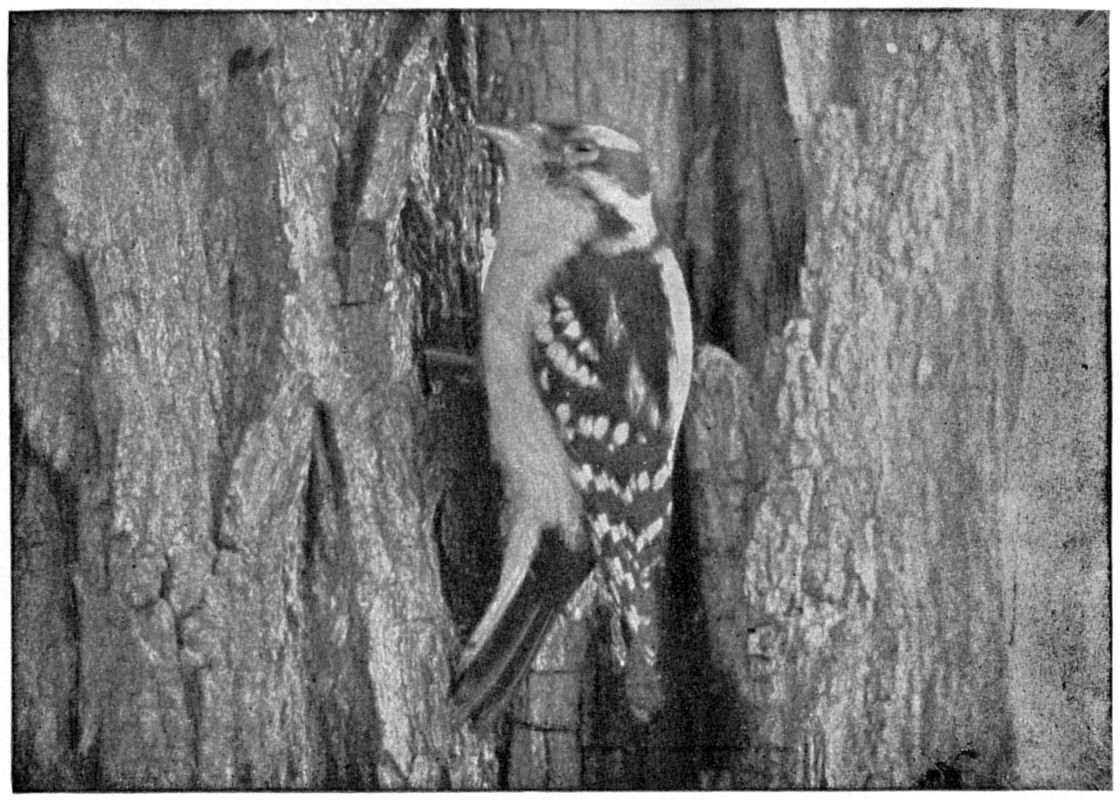
F. M. Chapman, Photo.
DOWNY WOODPECKER
“The Downy’s life is spent in the tree-trunks and hollow limbs, where he merely chisels his doorway large enough, but with not a bit to spare, and the hole within is nicely finished with a few soft chips by way of a bed for the eggs; nice white eggs like all the Woodpeckers, and this would seem to prove that thrifty Nature, knowing that the eggs would be hidden in the dark nesting-hole, did not think it necessary to decorate them for their better protection as she does the eggs laid in open nests.
“To name the injurious insects, moths, and caterpillars our little Downy eats would require a long list, but, as he is a lover of orchards in spring and summer, we may mention the apple-tree borer as one against whom he wages war, and here, by his delicate sense of touch, he locates the larvæ of the codling-moth. ‘Every stroke with which he knocks at the door of an insect’s retreat sounds the crack of doom. He pierces the bark with his beak, then with his barbed tongue drags forth an insect, and moves on to tap a last summons on the door of the next in line.’
“Boring beetles, bark beetles, weevils, caterpillars, ants, and plant-lice, the imagoes of night-moths, as well as the eggs of many insects, are also on his bill of fare. Sometimes he has been accused of boring holes for sap-sucking, but this is disproven; where a hole exists it is because insect prey, in one of its many forms, hide beneath.
“Fortunately, we have many families of the little Downy in the old orchard, and the fact that they are good patrons of Goldilocks’ lunch-counter does not seem to make them relax their vigilance about the apple trees, so that I wonder if it may not be their care, together with the other tree-trunk birds, to which we owe the keeping of the trees, during the ten long years they have been neglected by man. For, though the trees in Birdland are old, gnarled, and vine-draped, yet they are neither worm-eaten nor unsightly, but merely picturesque, and from the birds’ point of view cosy and homelike.
“Now, boys, back into the workroom, and if any one of you has not made a house for a tree-trunk bird, I am sure that he will begin one to-day.”