The Blue Jay
Reading edition
“That the Blue Jay is a handsome fellow goes without saying, as well as that he has plenty of assurance and is somewhat of a bully. We may imagine that he knows that his uniform of blue, gray, and white, with black bands and markings, is very becoming, and if any one of you should tell me that he had seen a Jay admiring his reflection in a pond or little pool, I should be ready to believe him. Certain it is that not one of our birds, not even the glowing Scarlet Tanager, presents a more neat and military appearance.
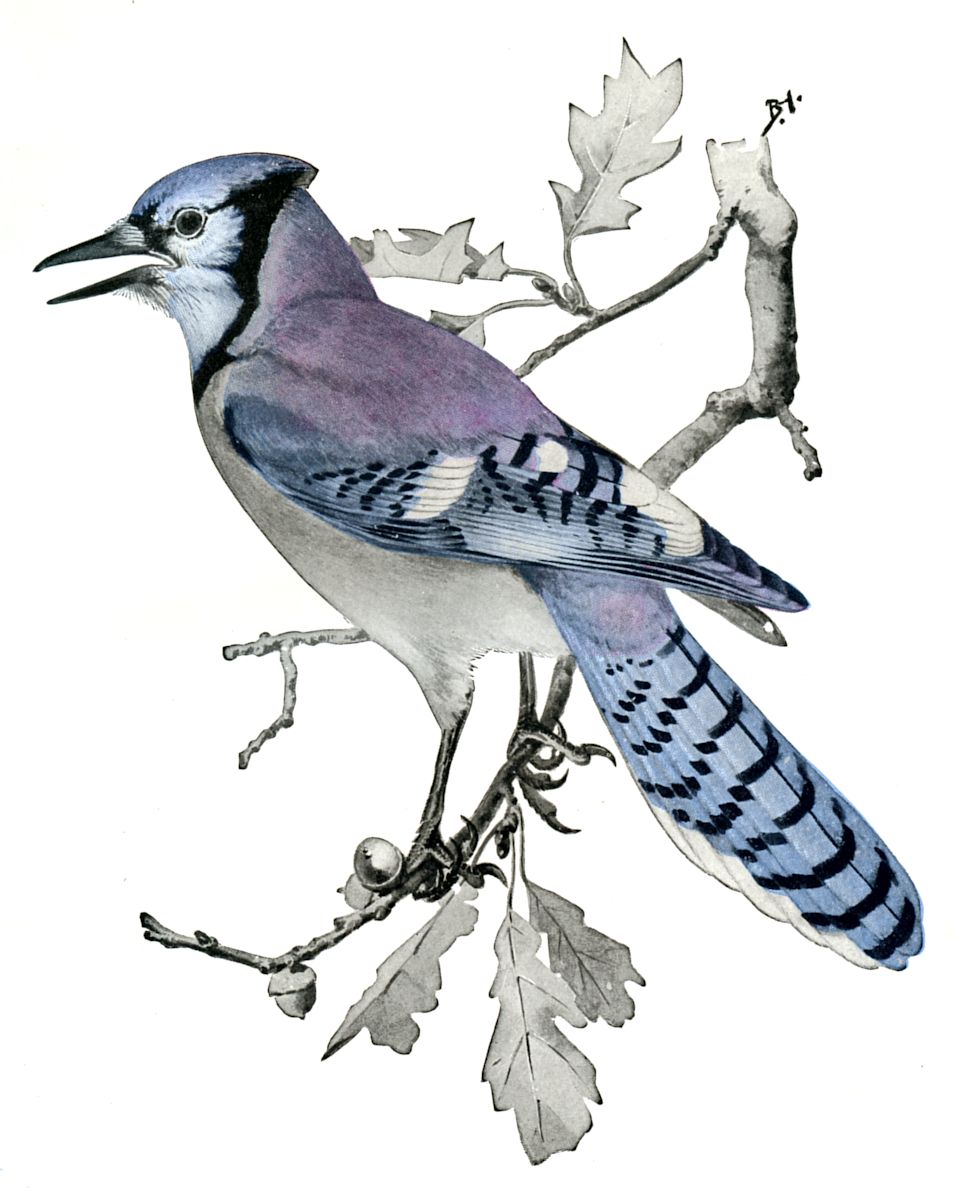
BLUE JAY
Order—Passeres Family—Corvidæ
Genus—Cyanocitta Species—Cristata
“The only awkward thing about the Blue Jay is his flight. Although alert and agile in slipping through the trees, when he takes to wing his progress seems laboured, as if either his body was too heavy for his wings, or that the wings were stiff.
“Like the Crow, his cousin, this Jay belongs to all north-eastern America, making its home from Florida to Newfoundland, and, like the Crow, we have some members of its family with us in New England all the winter, when it is certainly a pleasure to see them flying through the bare trees or gathering food on the pure white snow.
“The Jay does not annoy the farmer by pulling corn, nor trouble the chicken yard; for eight or nine months he earns an honest living, largely of vegetable food and harmful insects, snails, tree frogs, mice, small fish, and lizards, but in the breeding season, alas! he is a nest robber, and here in my own garden and orchard I have seen him this summer dodging and trying to avoid the angry birds that were pursuing him.
“Twice I heard nestling Robins twittering as they do when their parents come with food, but, like the wolf disguised as Red Riding-Hood’s Grandmother, it was a Jay who came to the nest and seized a squab, as my eyes saw and the cries of the parent birds told.
“Then I said to Jacob, ‘We will not let the Jays build in Birdland; they must be outcasts and go out and live in the far-away woods with the Crows, where there are few small birds.’
“How can we keep them out, you ask? It does take a little time and patience, to be sure, but if we watch when they begin to build and take away the sticks, you may be very sure that they will take the hint and go elsewhere, for they are quick-witted birds. So, perhaps, in time they would learn, at least in some regions, to inhabit places where mice and other harmful rodents and bugs are more plentiful than song-birds.
“Then in the winter we of the Kind Hearts’ Club can make up for this seeming unkindness, and pay them for the real good they do by feeding them through the hungry time, when nuts, berries, and even frozen apples are not to be found.”
“What is a Blue Jay’s nest like? I don’t think I’ve ever seen one,” asked Tommy Todd.
“It is not very easy to find, for they usually build rather high up, in a place where the limb is crotched and has many small branches. The nest itself is well made of fibres and roots, and is usually quite cleverly hidden, and the eggs are dull green, very thickly spotted.
“Aside from the Jay’s unaccountable cannibal habit of egg and squab hunting, he has many good qualities, both as a parent and a friend to those of his own kind, and though his call is harsh, and, like the creaking of the Grackles, a reminder of coming frosts and bare trees, in spring he has some pretty melodious notes and another call totally different from the harsh jay, jay. This cry is like the resonant striking of two bits of metal, a clink without exactly the ring that a bell has,—yet I call it the ‘bell note,’ though perhaps the double sound produced by hammer and anvil is a better comparison.
“In the fall, however, the Jay’s voice is certainly harsh, and not only lacks anything like musical quality, but is so harsh that when there are many about the noise is really annoying. The poet Lathrop describes the change so well that I will read it to you.