Front matter (continued 6)
Reading edition
Corundum. An oxide of aluminum of hexagonal crystallization, usually in six-sided prisms, capped by very steep pyramidal faces (see Figure 75n). It is next to the hardest of all known minerals (9 in the scale), the diamond only exceeding it. Specific gravity about 4. Three good cleavages making angles of nearly 90 degrees with each other. The color of corundum is usually brown, but it varies greatly. Two of the most highly prized of all precious stones—ruby (red) and sapphire (blue)—are nearly transparent varieties of corundum, colored by certain impurities. Oriental topaz (yellow), oriental emerald (green), and oriental amethyst (purple) are also clear varieties of corundum. It occurs in various igneous and metamorphic rocks, and in some stream gravels. The finest rubies, associated with some sapphires, occur in gravels in Burma, Siam, and Ceylon. Emery is a fine-grained mixture of corundum and other minerals, especially magnetite.
Diamond. This mineral is remarkable not only because it is the king of precious stones, but also because it is easily the hardest known substance (10 in the scale). Specific gravity, 3.5. Very brilliant luster. Crystals of usually octahedral habit in the isometric system. Usually colorless, but often variously tinted. Composition, pure carbon. Burns completely away at high temperature. The greatest mines in the world are in South Africa, where the diamonds occur in masses of rather soft (decomposed) igneous rock, evidently having crystallized during the cooling of the molten masses. In Brazil and India diamonds are found in stream gravels.
Feldspar Group. The feldspars are by far the most abundant of all minerals in the crust of the earth. (Figures 74c, 74d.) There are several important species or varieties of feldspar with certain features in common as follows: crystal forms, either monoclinic or triclinic (closely resembling monoclinic), in prismatic forms whose faces usually meet at or near 90 or 120 degrees; two good cleavages at or near 90 degrees, hardness at or near 6; specific gravity, a little over 2.5; color, usually white, gray, or pink; and composition, silicate of aluminum with potash, soda, or lime. The two potash feldspars are orthoclase and microcline, the former being monoclinic, with cleavages at exactly 90 degrees, and the latter triclinic, with cleavages a little less than 90 degrees. A kind of green microcline is known as Amazon stone. The soda-lime feldspars go by the general name plagioclase. They are triclinic, with cleavages meeting at approximately 86 degrees. Very commonly one of the cleavage faces exhibits characteristic, well defined striations or fine parallel lines caused by multiple twinning during crystal growth. Some of the common plagioclases are albite, a white soda feldspar, including most so-called moonstone; oligoclase, a usually greenish-white to reddish-gray soda-lime feldspar including sunstone; and labradorite, a lime-soda feldspar, usually gray to greenish-gray with a beautiful play of colors. The feldspars occur in all three great groups of rocks, but they have most commonly crystallized during the cooling of molten masses of igneous rocks. Where many sedimentary rocks have undergone great change (metamorphism) under conditions of heat, pressure, and moisture, feldspars have very commonly formed. Orthoclase and microcline feldspar are used in the manufacture of porcelain and chinaware. Some special varieties of feldspar are cut or polished for semiprecious stones or decorative purposes.
Fluorite. A common mineral whose composition is fluoride of lime. (Figure 73b.) Isometric crystals, usually cubes with edges modified, are common. Twinned cubes are also common. Easily scratched by a knife (hardness, 4), and specific gravity a little over 3. Clear and colorless when pure, but variously colored, especially green, blue, yellow, and brown, due to impurities in solution during crystallization. Remarkable because of its four good cleavages meeting at such angles as to permit good cleavage octahedrons to be broken out of crystals. Fluorite is widely distributed, most commonly in vein deposits, often associated with metallic ores. Occurs also as crystals in some limestones and igneous rocks. Some fissure veins of fluorite in limestone in southern Illinois are twenty to forty feet wide. Used mostly as a flux in the manufacture of certain steel, in glass making, and in making enamel ware.
Galena. Commonly as isometric crystals either as cubes or combinations of cubes and octahedrons. Composition, sulphide of lead. (Figure 75a.) Color, lead-gray with metallic luster. Hardness, 2.5; specific gravity high, 7.5. Very brittle. Three excellent cleavages at right angles and parallel to the crystal faces of the cube. Nearly all of the lead of commerce comes from the smelting of galena. It is mined in many parts of the world where it nearly always occurs in typical vein deposits often associated with sphalerite (see below).
Garnet Group. The members of this very interesting mineral group very commonly occur in isometric crystallized forms, mostly twelve and twenty-four faced figures or both combined, as shown by Figure 72. All the six species of garnets are silicates, mostly of aluminum usually with either lime, magnesia, or iron. Cleavage, very imperfect or absent. Hardness great, 6.5 to 7.5, and specific gravity 3.1 to 4.3, varying according to species. Color also varies with composition, but most commonly red, brown, and more rarely yellow, black, and green. Garnets are most common as crystals embedded in metamorphic rocks, especially highly altered strata. Also occurs in many igneous rocks and in some sands. Commonly used as a semiprecious stone, and also ground for use as an abrasive, especially in making a kind of sand (or garnet) paper.
Gold. Gold as such (“native gold”) is, in small amounts, really a very widely distributed mineral. It is characterized by its yellow color, softness (less than 3 in the scale), great weight (specific gravity, over 19), and extreme malleability. Most of the commercial gold occurs in river gravels (so-called “placer deposits”), and in veins associated with the very common mineral quartz.
Graphite. Commonly called “black lead,” but it is not lead at all. Its composition is pure carbon—the same as that of the diamond. We here have a very remarkable example of a single substance (carbon) which, according to circumstances, crystallizes in two distinctly different systems (diamond in isometric, and graphite in hexagonal) yielding very thin, flexible flakes; greasy in feel; and easily rubs off on paper. It weighs less than the average mineral (specific gravity, a little over 2). Good crystals of hexagonal tabular form are rare. The most natural home of graphite is in the metamorphic rocks, especially certain of the highly altered strata, where it occurs in the form of more or less abundant flakes, having originated from organic matter. Some also occurs in igneous rocks and in veins. Large quantities are made at Niagara Falls from anthracite by electricity.
Gypsum. Monoclinic crystals common, usually of simple forms, as shown by Figure 75i. Sometimes twin crystals. Composition, sulphate of lime. Colorless or white when pure. Can be scratched by the finger nail (hardness, 2). Specific gravity, 2.3. Three good cleavages, especially the prismatic, yielding cleavage plates with angles of 66 and 114 degrees. Thin cleavage layers, moderately flexible. There are several varieties: (1) selenite, which is clear, crystalline; (2) satin spar, fibrous with silky luster; (3) alabaster, fine-grained and compact crystalline; and (4) rock gypsum, massive granular or earthy. Gypsum is common and widespread especially among stratified rocks often as thick beds which have mostly resulted from evaporation of bodies of water containing it in solution, and often associated with salt beds. Also occurs as scattering crystals in shales and clays, and in some veins. In greatest quantities it is burned to make plaster of Paris. Satin spar and alabaster are often cut and polished for ornaments, etc. (See Figure 73a.)
Halite. Common salt. Composition, chloride of soda. Isometric crystals, nearly always in cubes with three good cleavages at right angles, and parallel to the faces of the cube. Hardness, 2.5; specific gravity, 2.5. Colorless to white when pure. Characteristic salty taste. Abundant and widespread, often as extensive strata in rocks of nearly all ages, having resulted from evaporation of inland bodies of salt water. Also in vast quantities in solution in salt lakes and the sea. Halite has many uses, as for example, cooking and preservative purposes, indirectly in glass making and soap making, glazing pottery, and in many ore-smelting and chemical processes.
Hematite.—One of the common and important iron oxides with less iron than magnetite and no water as has limonite. Crystallizes in hexagonal forms. Color, black, with metallic luster, when crystalline, otherwise usually dull red. Hardness, about 6; specific gravity, about 5. No cleavage. Red streak when rubbed on rough porcelain. Hematite is extremely widespread in rocks of all ages, especially in metamorphic and sedimentary rocks. Some occurs as crystals in igneous rocks, and some in vein deposits. It is the greatest ore of iron in the United States, especially in Minnesota, Michigan, Wisconsin, and Alabama.
Kaolin. Commonly called “China clay.” Composition, a hydrous silicate of aluminum. Crystallizes in scalelike monoclinic forms, but usually forms compact claylike masses. Hardness, a little over 2; specific gravity, 2.6. Color when pure, white. Usually feels smooth and plastic. Very abundant and widespread, especially forming the main body of clay and of much shale. Always of secondary origin, generally resulting from the decomposition of feldspar. It is the main constituent of chinaware, pottery, porcelain, tiles, bricks, etc.
Limonite. An important oxide of iron in composition like hematite except for its variable water content. Never crystallized. Hardness, about 5; specific gravity, nearly 4. Color, light to dark brown to nearly black. Leaves a characteristic yellowish-brown streak when rubbed on rough porcelain. Exceedingly common and widely distributed, always as a mineral of secondary origin as a product of weathering of various iron-bearing minerals. Where accumulated in considerable deposits it is an iron ore of some importance.
Magnetite. One of the three important oxides of iron containing no water, and richer in iron than hematite. (See Figure 75e.) Commonly crystallizes in isometric octahedral forms alone or combined with twelve-faced forms. Hardness, 6; specific gravity, 5. Color, black with metallic luster. Leaves black streaks on rough porcelain. Characteristically highly magnetic. Wide-spread as crystals in nearly all kinds of igneous rocks, and as large segregation masses in certain igneous rocks. Also very common in metamorphic rocks, in many cases forming lenses and beds as ore deposits. Occurs in some strata and sands. It is an important ore of iron.
Malachite. A light-green hydrous carbonate of copper. In almost every way, except difference in color and slight difference in composition, it is very much like azurite (see above).
Mica Group. The micas rank high in abundance among the most common minerals of the earth. All of the several species are silicates of aluminum combined with other chemical elements according to the species. All crystallize in monoclinic six-sided prisms whose angles are nearly 120 degrees. These prisms closely approach true hexagonal forms. All are characterized by one exceedingly good cleavage at right angles to the prismatic faces, yielding very thin elastic cleavage sheets. Hardness, 2 to 2.5; specific gravity, 2.7 to 3. The various species or varieties are not always sharply separated from each other. Most common are: muscovite, or so-called isinglass, a potash mica which is colorless and transparent in thin sheets when pure; biotite, an iron-magnesia mica, black to dark green; and phlogopite, a brown magnesia mica.
Olivine. Often called chrysolite. A silicate of iron and magnesia. Orthorhombic crystals, usually in stout prismatic form. Color, usually yellowish green. Hardness, nearly 7; specific gravity, 3.3. Transparent to translucent. No real cleavage. Its hardness, color, and crystal form generally characterize it. It is a fairly common mineral found mainly as crystalline grains in certain dark-colored igneous rocks. A clear green variety, called peridot, is used as a gem stone.
Opal. An oxide of silicon, like quartz in composition except that it is combined with a varying amount of water. It never crystallizes, probably because of its rather indefinite composition. Hardness 5.5 to 6.5 (softer than quartz); specific gravity, about 2. Varieties variously colored. Common opal, usually translucent with greasy luster. Precious opal, translucent with beautiful play of colors, used as a gem. Fire opal, with bright red to orange internal reflections. Hyalite, colorless and transparent in small rounded masses. Wood opal, wood petrified by opal. Geyserite, a white, porous, stringy variety deposited by certain hot springs like the Yellowstone geysers. Tripolite, fine-grained, chalklike in appearance, consisting of tiny siliceous shells of very simple plants called diatoms.
Platinum. This mineral occurs as an impure native metal, usually alloyed with certain other metals. Native platinum, hardness, 4.5 (exceptionally high for a metal); specific gravity as usually alloyed, 14 to 19. Pure platinum, specific gravity, over 21, or one of the very heaviest known substances. Color, light steel-gray, with metallic luster. Very malleable and ductile. A rare metal found commercially mostly in gravel or “placer” deposits mostly in the Ural Mountains, also as grains in certain dark igneous rocks. Used for many scientific instruments, in the electrical industry, as jewelry, etc.
Pyrite. Commonly called “iron pyrites.” Sometimes called “fool’s gold.” (See Figure 74m.) A sulphide of iron which commonly crystallizes in the isometric system mostly as cubes, twelve-faced pyritohedrons, octahedrons, or combinations of these. Color, light brass-yellow, with metallic luster. Cleavage, practically absent. Hardness, greater than that of steel (over 6 in the scale); specific gravity, about 5. Leaves greenish black streak when rubbed on rough porcelain. Differs from chalcopyrite by paler color and much greater hardness. It is a common and very widely disseminated mineral in rocks of all kinds and ages, but especially in metamorphic rocks as veins, and banded or lenslike deposits. Most igneous rocks contain small scattering grains of pyrite. Many deposits of commercial value are known. Great quantities are burned for the manufacture of sulphuric acid (“oil of vitriol”) which is one of the most important of all chemicals.
Pyroxene Group. Along with quartz and feldspars, the pyroxenes rank among the most common of all minerals. (See Figure 74k.) Composition, very similar to amphibole (see above). Pyroxenes crystallizing in the monoclinic system are the most important. These crystals are prismatic in habit, with prism faces making angles of nearly 45 or 90 degrees instead of about 124 degrees as in the monoclinic amphiboles which the monoclinic pyroxenes greatly resemble. Two fairly good prismatic cleavages cross at an angle of nearly 90 degrees, instead of at about 124 degrees as in the monoclinic amphiboles. Hardness, 5 to 6; specific gravity, 3.2 to 3.6. Color, variable according to species. The most common variety of pyroxene is augite, a dark-green to black silicate of aluminum, iron, lime, and magnesia. Certain pyroxenes also crystallize in the orthorhombic system. Pyroxene is most abundantly represented as crystals in many kinds of igneous and metamorphic rocks. It is practically useless except as one kind of jade.
Quartz. Next to the feldspars, quartz is probably the most common of all minerals, especially at and near the earth’s surface. (See Figures 74e, 74f, and 74g.) Composition, oxide of silicon. Often crystallizes in the trigonal system almost always as six-sided prisms capped by six-sided pyramids, which are really combined three-sided forms, often with alternate corners modified by small faces. These small modifying faces, etching figures, and microscopic tests show that quartz is really trigonal in spite of the common occurrence of simple six-sided outward forms. The pyramidal faces make different angles than those of either apatite or beryl, both of which are somewhat like quartz in crystal form. Hardness, 7 (distinctly high, cannot be scratched by the knife); specific gravity, 2.6 (about average for all minerals). Cleavage, practically absent, and breaks like glass. Colorless when pure, but varieties exhibit many colors. A few only of the many varieties will be briefly described. Among the distinctly crystalline varieties are: rock crystal, pure colorless; amethyst, purple; rose quartz, pink; milky quartz, white; and smoky quartz, dark—due to tiny inclusions of carbon. Among the fine-grained, compact more or less indistinctly crystalline or noncrystalline varieties, usually translucent with a waxy luster, are: chalcedony, bluish gray, waxy looking, usually in small rounded masses; carnelian, red; prase, green; agate, with parallel bands, usually variously colored; flint and jasper, opaque to translucent, dark to red.
Quartz is exceedingly abundant in all the great groups of rocks. It constitutes the main bulk of sandstones, is common in shales, and occurs in certain other strata. In many igneous rocks, like granite, it is a very prominent constituent. Most of the metamorphic rocks contain its crystalline forms in greater or less amounts. Quartz is the most common of all vein minerals, in many cases associated with valuable ores. Various varieties are widely used for ornamental purposes. Used in making sandpaper, glass, porcelain, mortar, concrete, and in certain ore-smelting processes. Sandstone is widely used as a building stone.
Serpentine. A hydrous silicate of magnesia never in distinct crystals as such, but shown to be monoclinic under the microscope. Hardness variable, 2.5 to 5; specific gravity, about 2.6. Mostly of variegated green or yellowish green color with waxy luster, except a fibrous variety (asbestos) which is light green to white. The fibrous variety of serpentine is the principal source of asbestos, an amphibole asbestos being less common. Ordinary serpentine (sometimes miscalled “green marble”) is widely used as a building and decorative stone. Serpentine is common and widespread, especially in igneous and metamorphic rocks, but never as a really original mineral. It always results from alteration of certain other magnesia-bearing silicate minerals, such as pyroxene, amphibole, olivine, etc.
Silver. Native silver is not a very rare mineral and it is mined in certain parts of the world, but most of the metal is obtained from certain silver-bearing minerals, especially sulphides and a chloride. Silver crystallizes rather rarely in the isometric system. More commonly it occurs as irregular masses, plates, and wirelike forms. Characterized by its color, metallic luster, softness (less than 3 in the scale), and exceptional weight (specific gravity, 10.5). Usually occurs in vein deposits, commonly associated with other metals or metal-bearing minerals, especially copper.
Sphalerite. A sulphide of zinc commonly in crystalline form belonging in the isometric system, especially in tetrahedral combination forms (see Figure 75b). Color, usually brown, yellow or nearly black with resinous luster. Hardness, nearly 4; specific gravity, 4. Several good cleavages, yielding fragments whose faces meet at 90 and 120 degrees. Sphalerite is a fairly common and widespread mineral, occurring nearly always in veins in most kinds of rocks. It is very often associated with other ores, particularly the great ore of lead (galena). Sphalerite is by far the greatest ore of zinc.
Sulphur. Native sulphur. Crystallization, orthorhombic, usually in combination pyramidal forms. (See Figure 75h.) Characterized by yellow color, resinous luster, softness (about 2 in the scale), low specific gravity (about 2), and very poor cleavages. It has most commonly resulted from alteration of certain sulphur-bearing minerals, especially gypsum, the decomposition of which has yielded vast deposits. Some also of volcanic origin. Great quantities are used in making sulphuric acid, matches, gunpowder, fireworks, and for vulcanizing and bleaching rubber goods.
Talc. Often called steatite. Monoclinic crystals rare. One perfect cleavage, yielding very thin, flexible leaves. Very soft (hardness, 1). Feels greasy, and looks waxy to pearly. Color, white, gray, to light green. Specific gravity, 2.8. Composition, a hydrous silicate of magnesia, much like that of serpentine. Talc is always of secondary origin, generally derived by chemical alteration of various common minerals rich in silicate of magnesia. Soapstone is a common variety resulting from alteration of whole rock masses. Soapstone has many practical uses as for washtubs, table tops, electrical switchboards, hearthstones, stove and furnace linings, blackboards, gas tips, etc. Talc proper is used as a lubricant, to weight paper, in soap, as dustless crayon, talcum powder, etc.
Topaz. A silicate of aluminum and fluorine. Orthorhombic crystals common, usually prisms capped at one end by pyramided faces and abruptly terminated at the other. Colorless when pure, but often variously colored due to impurities. Very exceptionally hard (8 in the scale); specific gravity, 3.5. One good cleavage across the prism zone; usually found as crystals in, and in cavities in, igneous rocks. Appears always to have formed from highly heated vapors or liquids given off by cooling molten rock masses. Topaz is one of the more highly prized of the gem stones.
Tourmaline. Composition, very complex, but chiefly a silicate of boron and several metals and semimetals. Commonly as crystals in the trigonal system in both long and short prismatic forms, as shown by Figure 75m, with opposite ends not unlike. Extra hard (7 in the scale); specific gravity, about 3. Color, widely various, but brown and black are most common. Practically no cleavage. Tourmaline probably always originated as a high temperature mineral, especially as crystals in granites and related rocks and in certain metamorphic rocks which have been subjected to high temperature and pressure. Certain transparent colored varieties of tourmaline rank high among the semiprecious stones.
Turquoise. A hydrous phosphate of aluminum. Massive noncrystalline, blue to green, waxy luster, mostly opaque, hardness of 6, and specific gravity of about 2.7. Turquoise is a high temperature mineral found in veins and cavities in certain igneous rocks. It is a rare mineral used as a gem stone.
Zircon. A silicate of zirconium usually crystallized in the tetragonal system as simple four-sided prisms capped by four-sided pyramids. (See Figure 75l.) Very poor cleavages. Color usually brown. Hardness, 7.5 (extra high); specific gravity, nearly 4.7. Brilliant luster. Zircon is very commonly present as scattering crystals of varying size in most igneous rocks. Also common as crystals in various metamorphosed stratified rocks, and less common in some sand and gravel deposits. Certain transparent varieties, especially the brown and pink ones called hyacinth, are used as gem stones. Zircon is also the source of oxide of zirconium used in making mantles for certain incandescent lights.
CHAPTER XXI
ECONOMIC GEOLOGY
I
IN this chapter it is our purpose to briefly consider geology in its direct relations to the arts and industries. When we realize that the value of strictly geologic products taken from the earth each year in the United States alone amounts to billions of dollars, we can better appreciate the practical application of geological science. Such products include coal, petroleum, natural gas, many valuable metal-bearing minerals, and many nonmetalliferous minerals and rocks. In most cases these valuable products of nature have been slowly accumulated or concentrated at many times and under widely varying conditions throughout the millions of years of known geological time. To trace the extent of, and most advantageously remove, such deposits for the use of man is always invariably impossible unless geological knowledge is brought to bear. In many cases the problems involved are intricate, and only the trained geologist is able to at all successfully cope with them. In such cases it is necessary not only to have a thorough knowledge of minerals and rocks as such, but also of their origin and structure. Much of the practical application of geology is carried out by the mining engineer who should have, above all, a thorough knowledge of the great principles of geology.
Our plan of discussion is to consider, first, coal, petroleum, and natural gas; then the most important metalliferous deposits of ores; and finally nonmetalliferous minerals and rocks of exceptional commercial importance. Underground waters have already been discussed from the practical standpoint in the chapter on “Waters Within the Earth.” Certain minerals have already been sufficiently considered from the economic standpoint in the chapter on “Mineralogy.”
COAL, PETROLEUM, AND NATURAL GAS
Coal. Most valuable of all geological products is coal. Although it is not, strictly speaking, a mineral, both because of its organic origin and lack of definite chemical composition, coal is generally classed among our mineral resources. Some idea of the national importance of coal in the United States may be gained when we realize that the energy derived from a single year’s output is equivalent to that of hundreds of millions of men working full time through the year. The uses of coal are too well known to need mention here.
Coal is, beyond question, of organic (plant) origin as shown by its very composition; perfect gradations between plant deposits like peat and true coal; and the presence of microscopic plant remains and spores in the coal. An excellent summary of just what happens during the transition of ordinary vegetable matter into coal has been given by D. White as follows: "All coal was laid down in beds analogous to the peat beds of to-day. All kinds of plants, especially such species as were adapted to the particular region where the deposit was located, in whole or in part went into the deposit.
"Plants are composed chiefly of cellulose and proteins. The former, comprising by far the larger bulk, constitute the framework, whereas the latter are concerned in the vital functions. With these are associated many other substances, among which are chiefly starch, sugars, and fats and oils, constituting reserve foodstuffs; waxes, resin waxes, resins, and higher fats, performing mainly protective functions.... These components differ widely in their resistance to various agencies. Those substances involved in the life function and the support of the plant are relatively very stable under the conditions imposed upon them.
"At the death of the plants, governed by conditions imposed in the bog, a partial decomposition, maceration, elimination, and chemical reduction begins, brought about by various agencies, chiefly organic, mainly fungi at first and bacteria later. The most labile are removed first, the more resistant next, and so on, as the conditions require, leaving the most resistant behind in a residue called peat.
“The process of decomposition, elimination, and chemical reduction begun in peat, chiefly by biochemical means, is taken up and continued by dynamochemical means into and through the various successive later stages, and results in the various grades of coal, as lignite, sub-bituminous, and cannel coal, and anthracite.”
The principal chemical elements involved in the changes which take place are carbon, oxygen, and hydrogen, as shown by the following analyses of about average samples of each member of the so-called “coal series.”
The “coal series” Carbon Oxygen Hydrogen Nitrogen
Wood (cellulose) 50 43 6 1
Peat 59 33 6 2
Lignite 69 25 5.5 0.8
Bituminous coal 82 13 5 0.8
Anthracite coal 95 2.5 2.5 trace
Graphite 100 .. .. ..
From this table it is seen that the oxygen relatively diminishes while the carbon relatively increases, though, of course, all three elements actually decrease during the chemical change from cellulose to coal. These three elements disappear mainly in the form of gases, such as water vapor, marsh gas, and carbonic acid gas. The final or graphite stage is almost reached by the graphitic anthracite of Rhode Island, which is so nearly pure carbon as to be really useless as coal.
The conditions under which successive layers of vegetable matter (later turned into coal) become embedded in the earth’s crust have been outlined in the chapter on the “Evolution of Plants.” The most perfect conditions for prolific plant growth, and accumulation as great beds in the earth’s crust, were during the Pennsylvanian period of the late Paleozoic era in many parts of the world, but especially in the United States, China, Great Britain, and Germany. Most of the world’s great supply of coal comes from rocks of Pennsylvanian Age, while next in importance are Cretaceous rocks, and some comes from strata of other ages later than the Pennsylvanian, even as late as the Tertiary.
The United States not only has the greatest known coal fields, but it also produces far more coal than any other country. In 1918 the production was 678,000,000 tons, the greatest in our history, or enough, if loaded into cars of forty tons capacity, to fill a train which would reach around the earth at the equator about six times! Equally amazing is the fact that this coal was nearly all consumed by this one nation! In 1919 the production fell to 544,000,000 tons. Is there real danger that our supply of coal will soon run out? Hardly so when we consider, first, the fact that probably not more than 1 per cent of the readily available coal has thus far been removed, and, second, the high probability that rate of increase in coal production for the last twenty years will not continue. In fact, during the last two or three years the production has fallen off considerably. But even so, coal, which is our greatest natural resource, and which can never be replaced, should be scientifically conserved. In the case of the very restricted anthracite coal fields what might be called a crisis has already been reached, because a very considerable part of the available supply has been taken out.
Something like 350,000 square miles of the United States are underlain with one or more beds of workable coal (not including lignite)—in some areas five to twenty or more beds one above the other. There are also about 150,000 square miles of country underlain with the more or less imperfect coal called lignite. It has been estimated that there are more than a trillion tons of easily accessible coal, and another trillion tons accessible with some difficulty in the principal coal fields of the United States.
The greatest production of coal by far is from the Appalachian Mountain and Allegheny Plateau districts, from the western half of Pennsylvania to Alabama, where all the coal is bituminous of Pennsylvanian Age. Here as well as elsewhere the coal beds are interstratified with various kinds of sedimentary rocks, most commonly with shales and sandstones. In the Appalachian field the strata including coal beds are more or less folded toward the east, while they are nearly horizontal toward the west. The famous Pittsburgh coal bed is probably the most extensive important single coal bed known. It covers an area of over 12,000 square miles and is workable, with a thickness of five to fifteen feet, over an area of 6,000 square miles of parts of western Pennsylvania, Ohio, and West Virginia.
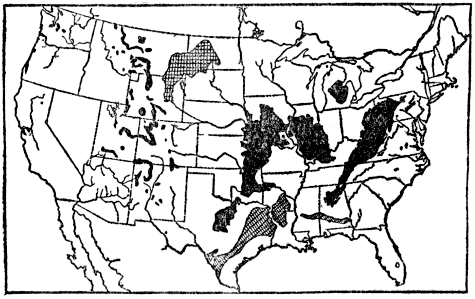
Fig. 76.—Map of the United States, showing the principal coal fields. Cross-lined areas represent lignitic coals. (After U. S. Geological Survey.)
The greatest production of anthracite coal by far is from central-eastern Pennsylvania, where strata of Pennsylvania Age, including a number of anthracite beds, are mostly highly folded. Most remarkable of all in this district is the so-called “mammoth bed” of anthracite, nearly everywhere present, with a thickness up to as much as fifty or sixty feet. Less than 500 square miles are there underlain by workable anthracite coal.
Next to the greatest production of coal in the United States is from the two large areas in the middle of the Mississippi Valley. It is all bituminous coal, associated with nearly horizontal strata of Pennsylvanian Age.
The scattering areas through the Rocky Mountains yield all types of coal—anthracite, bituminous, and lignite. In some of these areas the coal beds have been but little disturbed from their original horizontal position, but usually they are more or less folded along with the inclosing strata, the crustal disturbances affecting the coal beds having taken place late in the Mesozoic era and early in the Cenozoic era. Practically all of these coals are of Cretaceous and Tertiary Ages, the best being Cretaceous. Very little of the Rocky Mountain coal is anthracite.
On the Pacific Coast coal production is relatively very small. The coals are there bituminous to lignitic of Tertiary Age, usually folded in with the strata.
In Alaska there are widely distributed, relatively small coal fields, but they have been little developed. Alaskan coals range in age from Pennsylvanian to Tertiary, and in kind from anthracite to lignite.
Petroleum. Crude oil or petroleum is an organic substance consisting of a mixture of hydrocarbons, that is, it is made up very largely of the two chemical elements carbon and hydrogen, in rather complex and variable combinations. It is practically certain that petroleum has been derived by a sort of slow process of distillation from organic matter—animal or vegetable or both—in stratified rocks within the earth. Many strata, as for example carbonaceous shales, are more or less charged with dark-colored decomposing organic matter. The chemical composition itself, the kinds of rocks with which it is associated, and certain optical (microscopic) tests all point to the organic origin of petroleum. In southern California at least, certain of the oils have quite certainly been derived from the very tiny oily plants called diatoms which fill many of the strata.
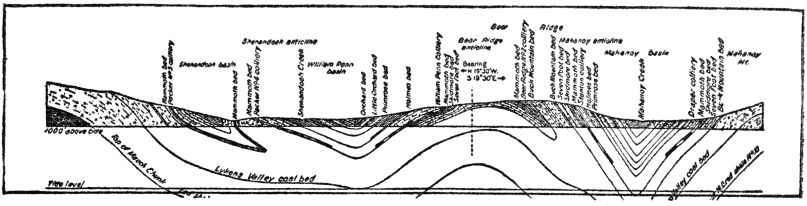
Fig. 77.—Profile and structure section showing folding of strata, with included coal beds, across one of the anthracite coal fields of eastern Pennsylvania. Length of section, a little over 2 miles. (After U. S. Geological Survey.)
During the last twenty years petroleum has come to be one of the most important and useful natural products. Among the many substances artificially derived from petroleum are kerosene, gasoline, naphtha, benzine, vaseline, and paraffine. The United States leads in the production of petroleum, while southern Russia and Mexico are very important producers. In the United States the principal areas underlain with petroleum-bearing strata are the northern Appalachian field (through western Pennsylvania to central West Virginia); the Ohio-Indiana field (central Indiana to northwestern Ohio); the mid-continental field (southeastern Kansas and northeastern Oklahoma); the southeastern Texas-Louisiana field; and the southwestern California field. The total areas underlain with oil total about 10,000 square miles. In the Appalachian, Ohio-Indiana, and mid-continental fields the strata carrying oil range in age from Ordovician to Pennsylvanian, and they are mostly but little disturbed from their original horizontal position. The Texas-Louisiana oils come mainly from Cretaceous and Tertiary strata which gently downtilt under the Coastal Plain toward the Gulf. In California the oil-bearing strata are of Tertiary Age and generally considerably disturbed and folded.
Under proper conditions below the earth’s surface the derived oil accumulates in porous or fractured rocks. There must, of course, be a source from which the petroleum is derived or distilled; a porous or fractured rock formation to take it up; a cap rock or impervious layer to hold it in; and a proper geologic structure to favor accumulation. The most common porous (containing) rock is sandstone, and the most common cap rock is shale. Oil is rarely found without gas, and saline water is likewise often present. If the containing strata are horizontal, the oil and gas are usually irregularly scattered, but if tilted or folded, and the beds porous throughout, they appear to collect at the highest point possible. It was the result of observations along this line that led I. C. White to develop what is known as the “anticlinal theory.” According to this theory, in folded areas the gas collects at the summit of the fold (anticline), with the oil immediately below, on either side, followed by the water. It is, of course, necessary that the oil-bearing stratum shall be capped by a practically impervious one.
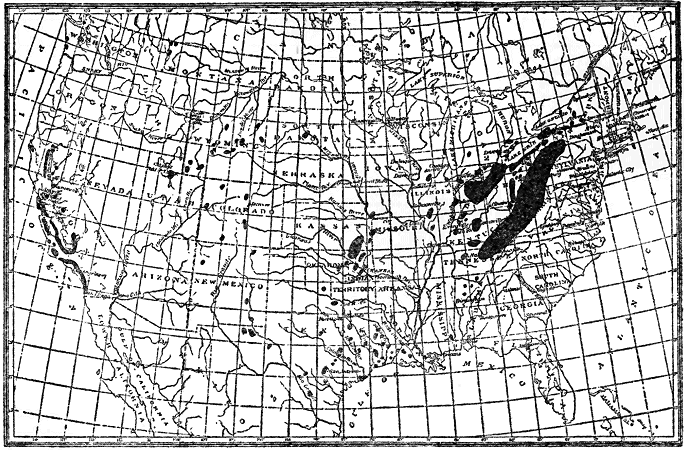
Fig. 78.—Map showing the principal petroleum and natural gas fields of the United States. (After U. S. Geological Survey.)
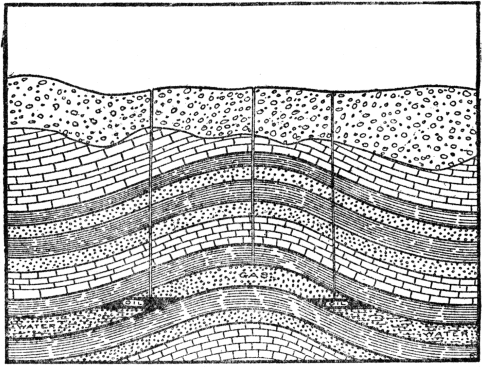
Fig. 79.—A vertical (structure) section showing a very common type of oil-bearing structure. In this anticline, water, oil, and gas arranged in order of their specific gravities. Removal of the gas would allow the oil and water to rise higher toward the apex of the porous layer. (After Indiana Geological Survey.)
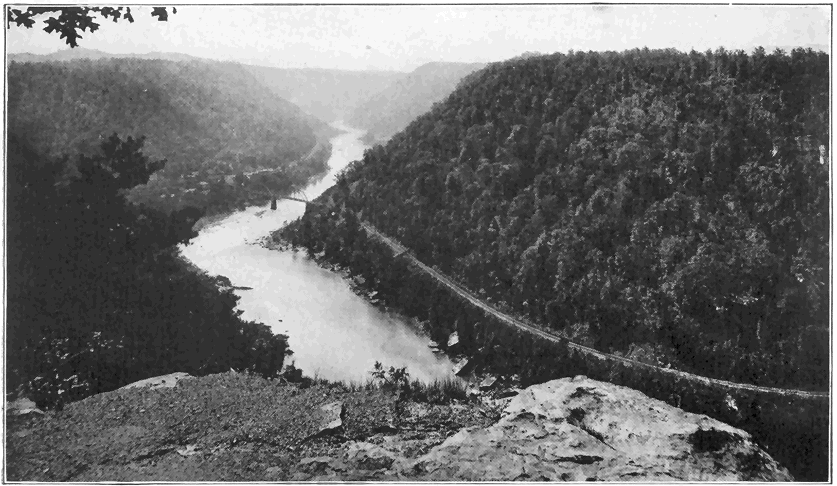
Plate 19.—General View in the Appalachian Mountains Along New River, Virginia. This is a typical portion of the great area which, during Mesozoic time, was reduced by erosion to the condition of a low-lying plain (“peneplain”). Since early Cenozoic time the peneplain has been upraised and New River has carved out its V-shaped valley to its present depth, while tributary streams have carved out a series of valleys along belts of weak rocks nearly at right angles to the main valley. The remarkably even sky line marks approximately the old peneplain surface. (Photo by Hillers, U. S. Geological Survey.)
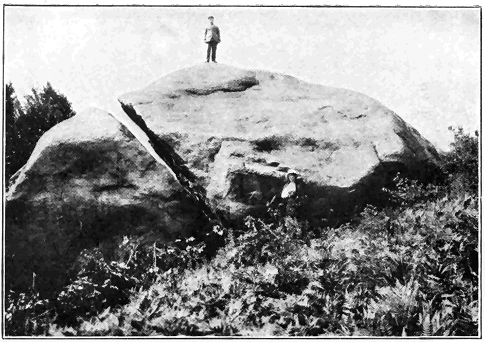
Plate 20.—(a) A Big Glacial Bowlder of Plutonic Igneous Rock Carried Miles from Its Parent Ledge by the Ice Sheet Which Passed Over the Adirondack Mountains During the Ice Age. (Photo by the author.)
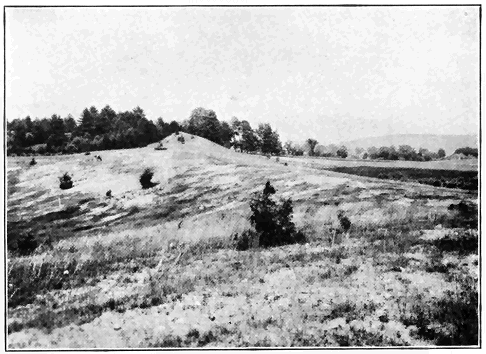
Plate 20.—(b) A Long, Winding Ridge of Sand and Gravel (Called an “Esker”) Deposited by a Stream in a Channel in the Ice Near the Margin of the Great Glacier During Its Retreat from the Adirondack Mountains. (Photo by the author.)
“If the rocks are dry, then the chief points of accumulation of the oil will be at or near the bottom of the syncline (downfold), or lowest portion of the porous bed. If the rocks are partially saturated with water, then the oil accumulates at the upper level of saturation. In a tilted bed, which is locally porous, and not so throughout, the oil, gas, and water may arrange themselves according to their gravity in this porous part.” (Ries.)
Although the term “oil pool” is commonly used, there is really no actual pool or underground lake of oil, but rather porous rock saturated with oil. It has been estimated that in an oil field of average productiveness a cubic foot of the porous rock contains from six to twelve pints of oil. The life of a well drilled into an “oil pool” varies from a few months to twenty or thirty years, or sometimes even more, but a heavy producer (especially a “gusher”) almost invariably falls off very notably in production in a few months, or at most a few years. The typical Pennsylvanian oil well is said to last about seven years. The fact that the United States is still able to increase oil output is because new fields are found and developed, the most recent being in the interior and northern parts of Texas. It is practically certain, however, that the climax of oil production in the United States will be reached before many years—long before that of bituminous coal.
It is a well-known fact that oil, as well as natural gas, is usually under more or less pressure within the earth. The pressure is so great in some cases that where, in the course of drilling, oil or gas accumulated under proper conditions, as for example those shown by Figure 79, are encountered the pressure may be hundreds of pounds per square inch, or enough to blow to pieces much of the drilling outfit. It is under such conditions that great “gushers” are struck. A wonderful case in point was the famous Lakeview gusher, struck in California in 1910. “Within a few days the well was far beyond control. It continued to flow (for a time shooting high into the air) for eighteen months, finally stopping after it had produced over 8,000,000 barrels of oil, about 6,000,000 of which had been saved. The daily production of the well varied greatly, reaching a maximum of 65,000 barrels.” (Pack.) One very common cause of oil pressure is the expansive force of the associated imprisoned gas which steadily increases as the gas is generated. Another cause which is seemingly applicable in many cases is hydrostatic pressure, where under certain structural conditions the pressure of water in a long-tilted layer is exerted against oil accumulated toward the top of an anticline (or upbend) in the strata.
The world’s output of petroleum for 1917 was nearly 559,000,000 barrels, of which the United States produced nearly 338,000,000 barrels, Mexico 87,000,000 barrels, and Russia 34,000,000 barrels of 42 gallons.
Natural Gas. The most perfect fuel with which nature has provided us is natural gas. Not only is it easily transported even long distances through pipes, but also as a fuel it is easily regulated, leaves no refuse, and is less damaging to boilers than coal. It is a colorless, odorless, free-burning gas, consisting very largely of the simple hydrocarbon called marsh gas or fire damp. Petroleum nearly always has more or less natural gas associated with it, but in some cases considerable quantities of gas may exist alone. Natural gas, like petroleum, is of organic origin—a product of slow natural distillation of vegetable or animal matter, or both, within the earth’s crust.
One of the most common modes of occurrence of gas is at the top of an anticline (upfold) in porous rock (like sandstone) between impervious layers (like shale). Figure 79 well illustrates the principle, the gas lying above the oil, and the oil above the water; that is, the three substances are arranged according to specific gravity. Gas may also exist in considerable quantities in irregular bodies of porous or fractured rocks. Natural gas is nearly always under pressure within the earth, hundreds of pounds per square inch being common, while more exceptionally, as in certain West Virginia wells, pressures of over 1,000 pounds have been registered.
The United States is by far the greatest world producer of natural gas, the output for 1918 having been 720,000,000,000 cubic feet. West Virginia easily headed the list, with Oklahoma and Pennsylvania next in order. Areas underlain with natural gas are, in the main, the same as for petroleum, and they total more than 10,000 square miles. During the last forty years the waste of natural gas in the United States has been appalling. In many cases wells in quest of oil have encountered gas and often such abandoned wells have been allowed to play millions of cubic feet of gas daily into the air for years. A striking example was the Murraysville well of western Pennsylvania, which shot 20,000,000 cubic feet of gas per day into the air for six years!
METAL-BEARING (ORE) DEPOSITS
Iron. Without question the most useful of all metals is iron. As such it is rare in nature, but in chemical combination with other substances it is extremely widespread and very common. Iron makes up about 5 per cent of the weight of the earth’s crust, but in the form of ore (i.e., a metal-bearing mineral or rock of sufficient value to be mined) it is notably restricted in occurrence. The three great ores of iron are the minerals hematite, magnetite, and limonite, whose composition and characteristic properties the reader will find stated in the preceding chapter on “Mineralogy.”
One of the worst impurities in iron ore is phosphorus, which makes iron “cold short,” i.e., brittle when cold. Ore for the manufacture of Bessemer steel must contain very little phosphorus (less than 1/1000 of the metallic iron content of the ore). Sulphur as an impurity in the ore tends to make the iron “hot short.” Silica (quartz) is bad because it necessitates the use of more lime for flux in the furnace.
Iron ores occur in rocks of most of the great geologic ages, but in the United States principally in the pre-Paleozoic and Paleozoic. The United States is by far the greatest producer of iron ore in the world, the output for 1917 having been about 75,288,000 tons, the greatest in the history of this or any other country. This one year’s output loaded into cars of 40 tons capacity would have made a train about 15,000 miles long! All but about 5,000,000 tons of this tremendous production was hematite ore. In 1919 the output of iron ore dropped to about 60,000,000 tons.
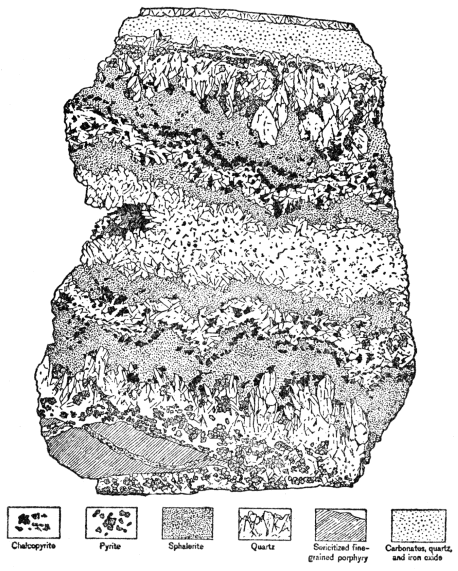
Fig. 80.—Drawing showing details of part of an ore-bearing vein at Pinos Altos, New Mexico. The chalcopyrite and sphalerite are the ores. Somewhat reduced in size. (After Paige, U. S. Geological Survey.)
We shall now very briefly consider several of the greatest iron-mining districts of the United States, giving some idea of the modes of occurrence and origin of the ores. Greatest of all is the Lake Superior region, not far west and south of the lake in Minnesota, Michigan, and Wisconsin. Considerably more than one-half the iron ore mined in the United States comes from the single State of Minnesota, and about one-fourth of it from Michigan. Most of the Minnesota ore by far is obtained from the so-called “Mesaba Range,” which in 1917 produced 41,000,000 tons of hematite ore. The ore deposits are there of irregular shape, lying at or near the surface (usually covered only by glacial deposits). None of them extend downward more than a few hundred feet. The soft, high-grade ore is removed by steam shovels in great open pits. In the several districts of northern Michigan and Wisconsin the ores (nearly all hematite) are associated with more or less highly folded rocks at considerable depths. The Lake Superior iron ores all occur in rocks of Archeozoic and Proterozoic Ages. According to the best explanation of their origin the iron of the ores was once part of a sedimentary series of rocks in the form of iron carbonate and silicate, interstratified with layers of a flintlike rock associated with slate, quartzite, etc. After these rocks were raised into land and subjected to weathering the old iron compounds were altered to oxides, mainly hematite, and somewhat concentrated. Further concentration of the ore was caused by dissolving out the flintlike layers of the old rocks.
The Birmingham, Ala., region is the second most important iron ore producer in the United States, with an output of nearly 6,000,000 tons in 1918. The ore is hematite, forming part of the famous Clinton iron ore deposits of Silurian Age. This deposit, named from Clinton, N. Y., extends through central New York and in more or less interrupted parallel bands through the Appalachian Mountains to near Birmingham where the richest deposits occur. This ore appears to be an original bed (or locally several beds) of fairly rich iron ore deposited on the shallow Silurian sea bottom and then covered by other strata. At the time of the Appalachian Mountain revolution the iron ore was more or less highly folded in with other strata throughout the Appalachians. A remarkable fact regarding the Birmingham district is that in the near vicinity of the ore there are both coal for fuel and limestone flux for smelting the ores.
The next most important mining region of the United States is the Adirondack Mountain region of northern New York, where about 1,000,000 tons of ore are obtained yearly. Magnetite is the ore, and it occurs in more or less irregular lenses and bands in granite and closely associated rocks of pre-Paleozoic Age. One view regarding the origin of this ore is that it segregated during the process of cooling of the molten granite, and another view (recently advocated by the author) is that it was derived from an older iron-rich igneous formation by either the molten granite or very hot solutions from it and concentrated into the ores. About 2,500,000 tons of magnetite were mined in the United States in 1916, nearly one-half of it in the Adirondacks.
The third important iron ore is limonite, nearly 2,000,000 tons of which were produced in the United States in 1916. Most of it came from the Appalachian Mountains. All of this limonite is of secondary origin; that is, it has been derived from certain early Paleozoic iron-bearing limestones either by weathering or solution, and concentrated into ore deposits.
Copper. This is one of the most useful of all metals. Several of its very important uses are as a conductor of electricity in the form of wire; in making alloys such as brass and bronze; in copperplate engraving; and in roofing and plumbing. Various minerals containing copper are found in many parts of the world, but only about six of them are really important as ores. These are native copper, chalcopyrite, chalcocite, azurite, malachite, and cuprite, most of which are described in the chapter on “Mineralogy.” The number of places where they may be profitably mined as ore is distinctly limited. Fifteen or twenty countries produce more or less copper, but the United States is by far the greatest producer, with an output of nearly 2,000,000,000 pounds of copper in 1916, the output having fallen off some in 1918. This was two-thirds of the world’s output and ten times as much as the nearest competitor. The other leading countries are Japan, Chile, Mexico, Spain, and Canada. In 1918 the four leading States in order were Arizona, Montana, Michigan, and Utah, with production ranging from nearly 765,000,000 pounds to about 230,000,000 pounds.
In Arizona several great copper-mining districts lie in the southeastern one-fourth of the State. Almost invariably the ores are directly associated with limestone and an igneous rock (granite), both of late Paleozoic Age. The ores are almost always near the border between the two rocks, mostly as great irregular deposits within the limestone, and less commonly as veins within the granite. The original ores were carried in solution and deposited by hot liquids (or vapors) from the cooling granite. At lower levels the ores are mainly sulphides of copper (e.g., chalcopyrite and chalcocite), while at higher levels they are mostly carbonates (malachite and azurite) and oxides (e.g. cuprite). The difference is due to the fact that the ores nearer the surface have been subjected to weathering and altered from their original condition.
The region around Butte, Mont., is next to the greatest copper producer. Nearly all the ores are sulphides of copper (mainly chalcocite) which occur with quartz in a great system of nearly parallel veins in granite of Tertiary Age. “It is supposed that in the copper veins the hot ore-bearing solutions ascended the fractures in the granite, replacing the rock by ore, and resulting in an intense alteration of the walls.” (Ries.)
Third in rank among the copper-producing States is Michigan, the mines being located on Keweenaw Peninsula, which extends into Lake Superior. For fully fifty years this district has been one of the most famous and important copper producers in the world. A unique feature is that the ore is native copper, associated with some native silver. The rocks containing the ore are steeply tilted lava sheets and conglomerate (cemented gravel) strata of Proterozoic Age. Openings in porous lava and spaces between the conglomerate pebbles have been filled by metallic copper, which was carried off in hot solutions from the cooling lavas. Certain of the mining shafts have been sunk more than 5,000 feet below the surface, these being next to the deepest in the world.
Utah ranks fourth among the copper producers, the greatest mining district being at Bingham Canyon, southwest of Salt Lake City. The rocks are late Paleozoic strata, pierced by a large body of igneous rock. Some of the sulphide ores (mainly chalcopyrite) occur in veins in the igneous rock and some in large tabular masses in the adjacent limestone. Hot solutions from lower portions of the uncooled igneous rock carried the ore in solution into the limestone and into cracks in the upper cooled igneous rock.
Lead. Lead must surely be counted among the five or six most useful metals. As in the case of nearly all the other most important natural resources, the United States is the world’s greatest producer of lead, the output of metallic lead having been 552,000 tons in 1916 and somewhat less in 1918. Most of this came from Missouri, Idaho, Utah, and Colorado. The leading other countries are in order—Spain, Germany, Mexico, and Australia. Nearly all the lead comes from the mineral galena (a sulphide of lead), which is described in the chapter on “Mineralogy.” Among the many uses of lead are the following: manufacture of certain high-grade paints from lead compounds; making alloys such as pewter, type metal, solder, babbit metal; in plumbing; in glass making; and in the manufacture of shot.
The greatest lead-mining district is in the vicinity of Joplin, Mo., where the ore (galena), associated with much zinc ore, occurs as veins and great irregular deposits in limestone of early Paleozoic Age. It is generally agreed that underground waters dissolved the ores out of the limestone in which they were disseminated as tiny particles and deposited them in concentrated form at lower levels.
In the famous Cœur d’Alene district of northern Idaho the great output of lead is really obtained from a lead-silver ore; that is, galena rich in silver. This ore is in composition a lead-silver sulphide. It occurs in great fissure veins, mostly following fault fractures in highly folded strata of Proterozoic Age. Igneous rocks cut through the strata, and it is believed that hot ore-bearing solutions given off from the highly heated igneous rocks rose in the fissures and deposited the ores.
The Park City and Tintic districts of Utah are great producers of lead. The lead ore (galena) is usually rich in silver. It occurs mainly in veins and irregular deposits in limestone of Paleozoic Age closely associated with certain igneous rocks.
One of the most famous mining districts in the world is that around Leadville, Col., where ores of four metals—gold, silver, lead, and zinc—have been extensively mined. The salient points in the rather complex geology are the following: Paleozoic strata, including much limestone, rest upon a foundation of pre-Paleozoic granite. Sheets of igneous rock are interbedded with the strata and many dikes of igneous rocks cut through the whole combination. After the last igneous activity all the rocks were somewhat folded and notably faulted in many places. The ores were dissolved out of the igneous rock and deposited in large masses mostly in the limestone and in fissure veins, especially along and near the fault zones.
Zinc. Another of the few most useful metals is zinc. It never occurs in metallic form in nature, but most of it by far is obtained from the ore mineral sphalerite (sulphide of zinc) described in the chapter on “Mineralogy.” A red oxide of zinc ore, called zincite, assumes great economic importance in New Jersey. In 1917 the United States produced 686,000 tons of metallic zinc and was easily the world’s leader. Since 1917 the production has fallen notably. The four greatest producing States are Missouri, Montana, New Jersey, and Colorado. Germany and Belgium are the greatest foreign producers.
Most important of all in the United States is the district around Joplin, Mo., where the ore is closely associated with lead ore. The mode of occurrence and origin of these ores are above referred to in the discussion of lead.
In Montana some of the great east-west fissure veins in granite are rich in silver ores in the upper levels, and in zinc ores (mainly sphalerite) at depths of from some hundreds of feet to nearly 2,000 feet, that is as far down as they have been mined. They, like the great copper veins of the same general district, were carried by hot solutions which rose from the lower still very hot granite and deposited the ores in fissures of the same cooler rock higher up.
Two great ore bodies in the general vicinity of Franklin, N. J., are of unique interest, because they are mostly the red oxide of zinc called zincite. The ore deposits occur in white limestone along or close to its contact with metamorphosed (altered) strata and granite of early Paleozoic Age. It is not definitely known how the ore originated, but it was probably derived in solution from the hot granite and deposited in the limestone by replacement of the latter.
In Colorado the principal zinc mines are around Leadville, where lead ore is nearly always directly associated with the zinc ore. This district is above described in the discussion of lead.
Among many uses of zinc are for galvanizing; for making certain high-grade paints; brass and white metal; and for roofing and plumbing.
Gold. This precious metal has been used and highly prized by man for thousands of years. The discovery of gold in California in 1848 was one of the most important events in the history of the mining world. As early as 1852 that State reached its climax of production with an output of at least $81,000,000 worth of the metal. The Transvaal region of South Africa has for two decades been the world’s greatest gold producer. Though long known, the metal has there been worked only since 1886. In 1915 the peak of gold production in the world ($468,700,000) was reached and nearly maintained in 1916, but since that time there has been a great falling off. In 1916 South Africa produced gold to the value of about $200,000,000; the United States over $90,000,000; Australia over $40,000,000; Russia over $26,000,000; and Canada over $19,000,000.
In tiny amounts gold is really very widespread. It occurs in many stream gravels where so-called “color” may be obtained by washing gravel, and it is even dissolved in sea water. Gold-mining localities are also numerous in many parts of the world, but relatively few of them only have ever paid. The total amount of money spent in actual gold-mining operations; in hopeless but honest operations; and for stock in fake gold mines has no doubt exceeded the actual value of gold produced. In many a case acceptance of a report based upon a very brief examination of the ground by a competent geologist would have saved the cost of hopeless expenditure of money. Some one in nearly every community has a so-called “gold mine.”
Most of the commercially valuable gold occurs in nature as native gold, either mixed with gravel and sand (i.e., placer deposits) along existing or ancient stream beds, or in veins mechanically held in the mineral pyrite (described in the preceding chapter) in submicroscopic form, or visibly mixed with quartz in vein deposits. Another kind of ore which assumes considerable importance, as in parts of Colorado, is in the form of telluride of gold always found in veins. In deep vein deposits it is quite the rule to find free or native gold mechanically and visibly mixed with quartz in the upper levels, while deeper down the gold is mechanically, but invisibly, held in combination usually in pyrite, which latter is associated with quartz. This difference is due to the fact that the lower level ores are now just as they were formed, while in the upper levels the ores have been weathered, and the gold set free and often more or less further concentrated by solutions. Vein deposits, including also telluride ores, are found in many kinds of rocks—igneous, sedimentary, and metamorphic—of nearly all ages generally directly associated with igneous rocks. In nearly all cases the best evidence indicates that the vein fillings were formed by hot ore-bearing solutions from the igneous rock, which solutions deposited the ore plus quartz in fissures in either the igneous or adjacent rocks. Among the many localities where fissure veins of the kind just described are of great economic importance are the “Mother Lode” belt of the Sierra Nevada Mountains of California; Cripple Creek (telluride ore), Georgetown and the San Juan region of Colorado; Goldfield, Tonopah, and Comstock Lode of Nevada; and near Juneau, Alaska.
Placer deposits, that is, free gold mixed with gravel and sand, also yield much gold. They are most prominently developed in California and Alaska. These gold-bearing “gravels represent the more resistant products of weathering, such as quartz and native gold, which have been washed down from the hills on whose slopes the gold-bearing quartz veins outcrop, and were too heavy to be carried any distance, unless the grade was steep. They have consequently settled down in the stream channels, the gold, on account of its higher specific gravity, collecting usually in the lower part of the gravel (placer) deposit.” (Ries.) Such gold occurs as grains, flakes, or nuggets. When a chunk of gold-bearing vein quartz, with crevices filled by thin plates of the metal, is carried downstream pieces are gradually broken away, and the tough, very malleable gold bends or welds together into a single mass called a “nugget.” Nuggets varying in weight up to over 2,000 ounces have been found. Many placer deposits are along existing drainage channels, while others occur in abandoned and even buried former channels.
Most of the gold of South Africa comes from Witwatersrand district where the native metal occurs in a unique manner in beds or layers of conglomerate associated with other strata, all the rocks being considerably folded and somewhat faulted. Some of the mines are more than a mile deep (vertically), the deepest in the world. The gold either accumulated in placer form with gravel which later consolidated into conglomerate, or it was introduced into spaces between the pebbles subsequently by ore-bearing solutions.
Silver. For many years the United States and Mexico have been the world’s greatest silver producers, sometimes one and sometimes the other leading, with Canada third, and Australasia fourth. In 1918 the United States produced nearly 68,000,000 ounces of silver and Mexico over 62,000,000 ounces. In the United States in 1918 the four leading States were Montana, Utah, Idaho and Nevada with outputs ranging from over 10,000,000 to over 15,000,000 ounces each.
In Montana most of the silver is in the native form, more especially in the upper portions of the great veins rich in copper and zinc ores near Butte. These ores and their origin are described above under the captions “Copper” and “Zinc.”
The two greatest silver districts of Nevada are Tonopah and Comstock Lode where silver and gold minerals are associated as ores in Tertiary igneous rocks, the ores having been deposited in veins by hot ore-bearing solutions from the igneous rocks.
In Idaho the Cœur d’Alene district produces most of the silver, the ore there being a silver-bearing lead ore (galena). The nature and origin of these deposits are described above under the caption “Lead.”
In Utah the silver is also obtained from silver-bearing galena especially in the Tintic, Cottonwood Canyon, and Bingham Canyon districts where the ores occur mainly as irregular deposits and in fissure veins in Paleozoic strata (chiefly limestone) directly associated with igneous rocks, hot ore-bearing solutions from the igneous rocks having furnished the ores.
Tin. Production of tin in the United States has never amounted to much, a little mining having been carried on from time to time in South Carolina, Black Hills of South Dakota, and southern California. About one-half of the world’s supply of tin (121,000 long tons 1918) comes from the Malay Peninsula and two small islands near by. The only other great producer is Bolivia, though a number of other countries produce from 1,000 to 9,000 tons each.
The only important ore of tin is the mineral cassiterite (oxide of tin) described above in the chapter on “Mineralogy.” In the Malay region the ore all occurs in placer deposits and is, therefore, of secondary origin, the source of the ore not being known. In Bolivia the tin ore occurs in veins in and close to granite, the ore having been carried by very hot vapors or liquids which were derived from the still highly heated granite.
Tin is used chiefly in the making of tin plate, bronze, pewter, gun metal, and bell metal.
Aluminum. The mineral called bauxite (a hydrous oxide of aluminum) is the great ore from which aluminum is obtained by an electrical process. Bauxite is noncrystalline, relatively light in weight, white to yellowish in color, and in the form of rounded grains, or earthy or claylike masses. The United States and France are the only two great producers of bauxite, most of which is treated for metallic aluminum. In 1918 the United States produced more than 100,000 tons of aluminum. In the United States the principal deposits are in Georgia, Alabama, and Arkansas. Bauxite is probably always a secondary mineral formed by decomposition of igneous rocks rich in certain aluminum silicate minerals. In some cases, as in the Georgia-Alabama region, the bauxite appears to have been formed and concentrated in deposits by hot solutions from uncooled igneous rocks.
Aluminum is most used in the manufacture of wire for electric current transmission. It is also mixed with certain other metals like copper, zinc, magnesium, and tungsten to form special types of alloys, some of which possess remarkable tensile strength up to nearly 50,000 pounds per square inch. Aluminum is used in powdered form to generate very high temperatures in certain welding processes. It is also made into many kinds of utensils and instruments.
Mercury. This metal, commonly known as “quicksilver,” is of special interest because it is the only one which exists in liquid form at ordinary temperatures. The metal occurs in only small quantities in nature, most of it by far being obtained from the red mineral cinnabar described in the chapter on “Mineralogy.” In order of importance the greatest quicksilver producing countries in 1916 were Italy, United States, Austria, and Spain. In the United States, California is by far the leading State, while Texas and Nevada are the only other important producers.
In California most of the ore occurs in veins and irregular deposits in metamorphosed strata of Mesozoic and Cenozoic ages usually closely associated with igneous rocks. There, as well as in other parts of the world, hot vapors from igneous rocks carried the volatile ore upward and deposited it in fissures.
Among the many uses of mercury are in making fulminate for explosives; making certain drugs and chemicals, pigments, electrical and physical apparatus; silvering mirrors; and in the amalgamation process of extracting gold and silver.
OTHER ECONOMIC PRODUCTS
Building Stones. Some of the principal features which should be considered in building stones are power to resist weathering, power to withstand heat, color, hardness, and density, and crushing strength. Building stones representing rocks of nearly all important geologic ages are widely distributed throughout the world.
Granite, including certain other closely related rocks, is one of the oldest and most useful building stones. The New England States are the greatest producers, while the Piedmont Plateau district (east of the Appalachians) from Philadelphia to Alabama also contains important granite quarries. In the Adirondack Mountains, in Wisconsin and Minnesota, through the Rocky Mountains, and the Sierra Nevada Mountains there are extensive areas of granite which are relatively little quarried. The granite occurs only in regions of highly disturbed rocks, usually in mountains or hills, where great volumes of the molten rock were forced into the earth’s crust, cooled, and later laid bare by erosion.
Marble, according to geological definition, is a metamorphosed limestone, that is a limestone which has been crystallized under conditions of heat, pressure, and moisture within the earth. More loosely in trade any limestone which takes a polish may be called marble. The greatest marble-producing districts of the United States are western New England (especially Vermont) and the Piedmont Plateau and Appalachian Mountains in rocks of Paleozoic age. In northern New York and the mountains of the west there are relatively few marble quarries.
Ordinary limestones are widely distributed in many States where they range in age from early Paleozoic to Tertiary. Most of the quarries supply stone for near-by markets. The so-called Bedford limestone of Indiana has, for many years, been perhaps the most widely used limestone for building purposes in the United States.
Sandstones, which are stratified rocks consisting mainly of rounded quartz grains cemented together, are widely used in building operations. Like limestones, they are very widespread in formations of all ages except the very old. There are many sandstone quarries supplying more or less local markets throughout the country. Two of the best known and most widely used sandstones are the so-called brown-stone of Triassic Age extending interruptedly from the Connecticut Valley of Massachusetts to North Carolina, and the Berea, Ohio, sandstone of light gray color and uniform texture.
Slate is mostly a metamorphosed shale, that is a shale which has been subjected to great pressure within the earth so that the stratification has been obliterated and a well defined cleavage has been developed at right angles to the direction of application of the pressure. Good slate is fine-grained, dense, and splits readily into wide thin plates. It occurs only where mountain making pressure and metamorphism have been brought to bear upon the strata. Most of our great slate quarries are located in early Paleozoic rocks from New England through the Piedmont Plateau. Some quarries are also located in Arkansas, Minnesota, and westward to California.
Clay. "Clay, which is one of the most widely distributed materials and one of the most valuable, commercially, may be defined as a fine-grained mixture of the mineral kaolinite with fragments of other minerals, such as silicates, oxides, and hydrates, and also often organic compounds, the mass possessing plasticity when wet and becoming rock-hard when burned to at least a temperature of redness." (Ries.)
Most clays originate by the weathering of rocks, particularly igneous and metamorphic rocks rich in the mineral feldspar. As a result of the decomposition of the feldspar, much clay is formed, the main substance of which is kaolin. Both feldspar and kaolin are described in the preceding chapter. When the resulting clay rests upon the rock from which it has been derived it is called residual clay. Much of the clay is, however, carried away, mainly by streams, and deposited in lakes or the sea, or on river flood plains. Some clay deposits are of wind-blown origin, and still others are formed by the grinding action of glaciers. Clays are very widespread, and they are directly associated with rocks of all geologic ages.
Among the many important uses of clay are the following: manufacture of common brick, fire brick, pottery, chinaware, porcelain ware, tiles, terra cotta, and Portland cement.
Lime and Cement. Limestone, which is one of the most common and widespread of all stratified rocks, forms the basis for the manufacture of the important substances lime (or “quicklime”) and Portland cement. Lime results when pure limestone (carbonate of lime) is “burned” or heated to a temperature high enough to drive off the carbonic acid gas. The greatest use of lime is for mixing with water and sand to make mortar. A few of its other numerous uses are in plastering; whitewashing; purifying certain steel; in making gas, paper, and soap; and as a fertilizer.
Certain limestones containing clay of the right kind and proportion are called natural cement rocks because, after being “burned,” they develop the property of “setting,” like cement when mixed with water. The “setting” of a cement is due to the fact that certain chemical compounds formed during the heating crystallize when mixed with water, and the hard, tiny interlocking crystals of the newly formed silicate minerals give rigidity to the mass. Of recent years Portland cement has largely superseded the natural rock cements. “Portland cement is the product obtained by burning a finely ground artificial mixture consisting essentially of lime, silica, alumina, and some iron oxide, these substances being present in certain definite proportions.” (Ries.) The necessary ingredients are generally obtained by grinding and burning carefully selected mixtures of limestone in some form, and clay or shale. The great and growing uses of cement need not be detailed here.
Salt. Most of the common salt (the mineral “halite”) of commercial value occurs in nature in sea or salt lake water; or in beds or strata of rock salt associated with other strata; or as natural brine in openings or pores in certain rocks. Considerable salt is obtained by evaporation of tidewater, as around San Francisco Bay, and of salt lake water, as at Great Salt Lake, Utah. It has been estimated that the Great Salt Lake, whose area is about 2,000 square miles and greatest depth 50 feet, contains several hundred million tons of common salt. This salt has been washed out of the rocks of the surrounding country and gradually accumulated in the lake because it has no outlet.
Most important of all sources of salt is the rock salt which occurs in the form of strata within the earth’s crust. Such strata are found in rocks of nearly all ages from the early Paleozoic to the present. They resulted from the evaporation of salt lakes or salty more or less cut-off arms of the sea, after which other strata accumulated on top of them. Thus in the Silurian system of strata underlying all of southwestern New York State there occur almost universally from one to seven beds of salt. The strata including the salt dip gently southward so that at Ithaca, New York, seven salt beds were struck in a well at a depth of about 2,200 feet. Northward the salt comes nearer and nearer the surface. One well penetrated a layer of solid salt 325 feet thick. Some of this salt is being mined much like coal, but most of it is obtained by running water into deep wells to dissolve the salt, the resulting brine being pumped out and evaporated.
Under portions of southern Michigan there are both salt beds and natural brines charging certain porous rock layers. Both the salt beds (of Silurian Age) and the brines (of Mississippian Age) supply great quantities of salt from brines pumped out and evaporated.
In 1918 the United States produced 51,000,000 barrels (280 lbs. each) of salt. Michigan (17,000,000 barrels) and New York were the leading States, followed by Kansas, Ohio, West Virginia, and California. Some of the uses of common salt are given in the description of halite in the preceding chapter.
Gypsum. The composition and properties of this common and useful mineral are given in the chapter on “Mineralogy.” Rock gypsum is the variety of great commercial importance. It is widespread, being quarried in many States, and occurs interstratified with rocks of many ages where it has originated by evaporation or partial evaporation of salt water lakes or more or less cut-off arms of the sea. Salt beds are often associated with gypsum.
For about ten years the average yearly production of gypsum in the United States has been approximately 2,500,000 tons, or about ten times that of the nearest foreign competitor (Canada). New York, Iowa, Michigan, and Ohio are the chief producers. In New York the rock gypsum (usually four to ten feet thick) lies between shale and limestone strata of Silurian age, and it is quarried from the central to the western part of the State. In Michigan the rock gypsum beds, commonly five to twenty feet thick, lie in Mississippian strata in the southern portion of the State. A great bed of exceptionally pure rock gypsum underlies about twenty-five square miles of Webster County, Iowa, in rocks of late Paleozoic Age. The Kansas gypsum deposits extend across the central part of the State in rocks of Permian Age.
Rock gypsum is mainly used in making “plaster of Paris,” as a retarder in cement, and as a fertilizer (so-called “land plaster”).
GLOSSARY OF COMMON GEOLOGICAL TERMS
N
NAMES of subkingdoms and important classes of fossil plants and animals, and mineral species, are not included; these being briefly and systematically discussed in chapters 17, 18, 19, and 20, respectively. By using the index the reader can quickly locate the page where any one of these names is discussed. Some definitions in this glossary are taken from U. S. Survey Bulletin No. 613.
Anticline.—A kind of folded structure in which strata have been bent upward or arched.
Archeozoic.—The earliest known era of geologic time.
Basalt.—A common lava of dark color and of great fluidity when molten. Basalt is less siliceous than granite and rhyolite, and contains much more iron, calcium, and magnesium.
Base-level.—The lowest level to which a stream can cut (erode) its channel. A whole region may be base-leveled by erosion.
Cambrian.—The first or earliest period of the Paleozoic era of geologic time.
Cenozoic.—The present era of geologic time. It began at least several million years ago.
Chalk.—A soft, fine-grained, white limestone consisting mainly of tiny shells.
Conglomerate.—A sedimentary rock consisting of consolidated or cemented gravel. Often sandy.
Cretaceous.—The last period of the Mesozoic era of geologic time.
Crystal.—A regular polyhedral form, possessing a definite internal molecular structure, which is assumed by a substance in passing from the state of a liquid or gas to that of a solid. Nearly every mineral, under proper conditions, will crystallize.
Crystalline Rock.—A rock composed of closely fitting mineral crystals that have formed in the rock substance, as contrasted with one made up of cemented grains of sand or other materials, or with a volcanic glass.
Crystallography.—The study of crystals.
Devonian.—The middle one of the seven periods of the Paleozoic era of geologic time.
Dike.—A mass of igneous rock that has solidified in a fissure or crack in the earth’s crust.
Drift.—Commonly called glacial drift. The rock fragments—soil, gravel, and silt—carried by a glacier. Drift includes the unassorted material known as till (ground moraine) and deposits made by streams flowing from a glacier.
Drowned River Valley.—When a land surface sinks enough to permit tidewater to enter the lower ends of its valleys to form estuaries, a good example being the lower Hudson Valley.
Era.—A name applied to one of the broadest subdivisions of geologic time (e.g. Paleozoic era).
Erosion.—The wearing away and transportation of materials at and near the earth’s surface by weathering and solution, and the mechanical action of running water, waves, moving ice, or winds which use rock fragments as tools or abrasives.
Exfoliation.—The splitting off of sheets of rock of various sizes and shapes due to changes of temperature. It is a process of weathering.
Fault.—A fracture in the earth’s crust accompanied by movement of the rock on one side of the break past that on the other. If the fracture is inclined and the rock on one side appears to have slid down the slope of the fracture the fault is termed a normal fault. If, on the other hand, the rock on one side appears to have been shoved up the inclined plane of the break, the fault is termed a reverse or thrust fault.
Fault-block.—A part of the earth’s crust bounded wholly or in part by faults.
Fault-scarp.—The cliff formed by a fault. Most fault scarps have been modified by erosion since the faulting.
Fissure.—A crack, break, or fracture in the earth’s crust or in a mass of rock.
Flood-plain.—The nearly level land that borders a stream and is subject to occasional overflow. Flood-plains are built up by sediment left by such overflows.
Fold.—A bend in rock layers or beds. Anticlines and synclines are the common types of folds.
Formation.—A rock layer, or a series of continuously deposited layers grouped together, regarded by the geologist as a unit for purposes of description and mapping. A formation is usually named from some place where it is exposed in its typical character.
Fossil.—The whole or any part of an animal or plant that has been preserved in the rocks or the impression left on rock by a plant or animal. Preservation is invariably accompanied by some change in substance, and from some fossils the original substance has all been removed.
Geography.—The study of the distribution of the earth’s physical features, in their relation to each other to the life of sea and land, and human life and culture.
Geology.—The science which deals with the history of the earth and its inhabitants as revealed in the rocks.
Glacier.—A body of ice which slowly spreads or moves over the land from its place of accumulation.
Gneiss (pronounced nice).—A metamorphic, crystalline rock with mineral grains arranged with long axes more or less parallel, giving the rock a banded appearance. Derived from either igneous or stratified rocks well within the earth under conditions of pressure, and usually also heat and moisture.
Igneous Rocks.—Rocks formed by the cooling and solidification of a hot liquid material, known as magma, that has originated at unknown depths within the earth. Those that have solidified beneath the surface are known as intrusive rocks, or if the cooling has taken place slowly at great depth, as plutonic rocks, e.g. granite. Those that have flowed out over the surface are known as effusive rocks, extrusive rocks, or lavas, e.g., basalt. Volcanic rocks include not only lavas, but bombs, pumice, tuff, volcanic ash, and other fragmental materials or ejecta thrown out from volcanoes.
Joints.—Nearly all rocks, except very loose surface materials, are separated into blocks of varying size and shape by a system of cracks called joints. They may be caused by earth-crust movements, contraction during solidification of molten rocks, or contraction during drying out of sediments.
Jurassic.—The middle one of the three periods of the Mesozoic era of geologic time.
Lava.—An igneous rock which in molten condition has poured out upon or close to the earth’s surface, e.g. basalt.
Limestone.—A sedimentary rock consisting essentially of carbonate of lime which generally represents accumulation of shells of organisms, but in some cases precipitates from solution. Often impure.
Loess (pronounced lurse with the r obscure).—A fine homogeneous silt or loam showing usually no division into layers and forming thick and extensive deposits in the Mississippi Valley and in China. It is generally regarded as in part at least a deposit of wind-blown dust.
Marble.—A crystalline limestone, usually a metamorphic rock, the limestone having been altered by heat, pressure, and moisture within the earth.
Meander.—To flow in serpentine curves. A loop in a stream. Most streams in flowing across plains develop meanders.
Mesa.—A flat-topped hill or mountain left isolated during the general erosion or cutting down of a region.
Mesozoic.—Next to the present era of geologic time.
Metamorphic Rock.—Any igneous or sedimentary rock which has undergone metamorphism, that is notable alteration from its original condition. (See Metamorphism.)
Metamorphism.—Any change in rocks effected in the earth by heat, pressure, solutions, or gases. A common cause of the metamorphism of rocks is the intrusion into them of igneous rocks. Rocks that have been so changed are termed metamorphic. Marble, for example, is metamorphosed limestone.
Mineral.—An inorganic substance of definite chemical composition found ready made in nature, e.g. calcite, quartz.
Mississippian.—A period of the Paleozoic era of geologic time—in order of age, the third from the last of the era.
Moraine.—Glacial drift carried on, within, or under a glacier and deposited at the end, along the sides, or under the glacier.
Oil-pool.—An accumulation or body of oil in sedimentary rock that yields petroleum on drilling. The oil occurs in the pores of the rock and is not a pool or pond in the ordinary sense of these words.
Ordovician.—Next to the earliest period of the Paleozoic era of geologic time.
Ore.—A metal-bearing mineral or rock of sufficient value to be mined.
Outcrop.—That part of a rock formation which appears at the surface. The appearance of a rock at the surface or its projection above the soil. Often called an exposure.
Paleontology.—The study of the world’s (geologically) ancient life, either plant or animal, by means of fossils.
Paleozoic.—An old era of geologic time—third back from the present.
Peneplain.—A region reduced almost to a plain by the long-continued normal erosion of a land surface. It should be distinguished from a plain produced by the attack of waves along a coast or the built-up flood plain of a river.
Pennsylvanian.—Next to the last period of the Paleozoic era of geologic time.
Period.—A name applied to one of the subdivisions of an era of geologic time, e.g. Cambrian period.
Permian.—The last period of the Paleozoic era of geologic time.
Petrology.—The study of rocks, including igneous, sedimentary, and metamorphic rocks.
Physiography.—The study of the relief features of the earth and how they were produced.
Placer Deposit.—A mass of gravel, sand, or similar material resulting from the crumbling and erosion of solid rocks and containing particles or nuggets of gold, platinum, tin, or other valuable minerals, which have been derived from rocks or veins.
Plutonic Rock.—An igneous rock solidified from a molten condition well within the earth. (See Igneous Rocks.)
Proterozoic.—Next to the earliest known era of geologic time.
Quartzite.—A metamorphic rock composed of sand grains cemented by silica into an extremely hard mass.
Quaternary.—The later of the two periods of the Cenozoic era of geologic time.
Rejuvenated.—Any region which has been subjected to erosion for a greater or less length of time and then reelevated so that the streams are renewed in activity.
Rock.—Any extensive constituent of the crust of the earth, usually consisting of a mechanical mixture of two or more minerals, e.g. granite, shale. Less commonly a rock consists of a single mineral (e.g. pure marble), or of organic matter (e.g. coal).
Sandstone.—A sedimentary rock consisting of consolidated or cemented sand. Often shaly or limy.
Schist.—A rock that by subjection to heat and pressure and usually moisture within the earth has undergone a change in the character of the particles or minerals that compose it and has these minerals arranged in such a way that the rock splits more easily in certain directions than in others. It is a metamorphic rock derived from either sedimentary or igneous rock, more commonly the former.
Sedimentary Rocks.—Rocks formed by the accumulation of sediment in water (aqueous deposits) or from air (eolian deposits). The sediment may consist of rock fragments or particles of various sizes (conglomerate, sandstone, shale); of the remains or products of animals or plants (certain limestones and coal); of the product of chemical action or of evaporation (salt, gypsum, etc.); or of mixtures of these materials. Some sedimentary deposits (tuffs) are composed of fragments blown from volcanoes and deposited on land or in water. A characteristic feature of sedimentary deposits is a layered structure known as bedding or stratification. Each layer is a bed or stratum. Sedimentary beds as deposited lie flat or nearly flat, but subsequently they have often been deformed by folding and faulting.
Shale.—A sedimentary rock consisting of hardened thin layers of fine mud.
Silurian.—A period of the Paleozoic era of geologic time—in order of age, the third from the beginning of the era.
Slate.—A rock that by subjection to pressure within the earth has acquired the property of splitting smoothly into thin plates. The cleavage is smoother and more regular than the splitting of schist along its grain. It is a metamorphic rock nearly always derived from shale.
Soil.—The mantle of loose material resting upon bedrock, either in its place of origin or transported by water, wind, or ice.
Strata (or stratified rocks).—Sedimentary rocks which, by the sorting power of water (less often by wind), are arranged in more or less definite layers or beds separated by stratification surfaces.
Stratification.—The separation of sedimentary rocks into more or less parallel layers or beds.
Stratigraphy.—The branch of geologic science that deals with the order and relations of the strata of the earth’s crust.
Structure.—In geology, the forms assumed by sedimentary beds and igneous rocks that have been moved from their original position by forces within the earth, or the forms taken by intrusive masses of igneous rock in connection with effects produced mechanically on neighboring rocks by the intrusion. Folds (anticlines and synclines) and faults are the principal mechanical effects considered under structure. Schistosity and cleavage are also structural features.
Syncline.—A kind of folded structure in which strata have been bent downward. It is an inverted arch—the opposite of an anticline.
Talus (pronounced tāy’lus).—The mass of loose rock fragments that accumulates at the base of a cliff or steep slope.
Terrace.—A steplike bench on a hillside. Most terraces along rivers are remnants of valley bottoms formed when the stream flowed at higher levels. Other terraces have been formed by waves. Some terraces have been cut in solid rock, others have been built up of sand and gravel, and still others have been partly cut and partly built up.
Tertiary.—The earlier of the two periods of the Cenozoic era of geologic time.
Triassic.—The earliest period of the Mesozoic Era of geologic time.
Unconformity.—A break in the regular succession of sedimentary rocks, indicated by the fact that one bed rests on the eroded surface of one or more beds which may have a distinctly different dip from the bed above. An unconformity may indicate that the beds below it have at some time been raised above the sea and have been eroded. In some places beds thousands of feet thick have been washed away before the land again became submerged and the first bed above the surface of unconformity was deposited. If beds of rock may be regarded as leaves in the volume of geologic history, an unconformity marks a gap in the record.
Vein.—A mass of mineral material that has been deposited in or along a fissure in the rocks. A vein differs from a dike in that the vein material was introduced gradually by deposition from solution, whereas a dike was intruded in a molten condition. Quartz and calcite are very common vein minerals.
Volcanic Rocks.—Igneous rocks erupted at or near the earth’s surface, including lavas, tuffs, volcanic ashes, and like material.
Weathering.—The group of processes, such as the chemical action of air and rain water, and of plants and bacteria, and the mechanical action of changes of temperature, whereby rocks on exposure to the weather change in character, decay, and finally crumble into soil.
Transcriber’s Note
All illustrations splitting paragraphs were moved before or after the paragraph. All simple typos were corrected (i.e., Reudemann to Ruedemann, pryoxene to pyroxene). The label “GENOZOIC” in Figure 59 is most likely a typo for "CENOZOIC".