Front matter (continued 5)
Reading edition
CHAPTER XVIII
GEOLOGICAL HISTORY OF ANIMALS (EXCLUDING VERTEBRATES)
A
A STUDY of the animals of the past is not only of great interest in itself, but also it furnishes a mainstay of the great doctrine of organic evolution. At the very outset of our discussion the reader should have already in mind at least the main subdivisions of the animal kingdom in order to reasonably well understand where the important animal types of the different geological ages fit in, and how those types bear upon the doctrine of evolution. The accompanying, very brief, general classification includes the usually recognized subkingdoms with special reference to representatives of those which are of most geological and evolutionary significance. Reading downward in this classification, the degree of complexity of organization steadily increases from single-celled animals to man himself.
I. Protozoans, e.g. foraminifers (with lime carbonate shells)
II. Cœlenterates, e.g. Sponges So-called “jellyfishes,” graptolites Corals

III. Echinoderms, e.g. So-called “sea lilies” So-called “starfishes” So-called “sea urchins”
IV. Worms,
V. Molluscoids, e.g. So-called “sea mosses” Brachiopods
VI. Mollusks, e.g. Clams, oysters

Snails { Pearly nautilus, ammonites
Cephalopods, e.g { So-called “cuttle fishes”
VII. Arthropods, e.g. Trilobites Crabs, lobsters So-called “sea scorpions” Insects

VIII. Vertebrates, e.g. Ostracoderms Fishes Amphibians Reptiles Birds Mammals (including man)
Before entering into a brief but rather systematic discussion of some of the most important types of animals which lived during geological time, it may be well for the reader to have in mind some of the most important conclusions which have been reached as a result of the study of the fossil animal records. These conclusions may be summarized as follows:
1. Animal life existed many millions of years ago.
2. Not only the animals of to-day, but also those of any given geological period, directly descended from those of preceding geological periods.
3. Animal life has undergone continuous change since its introduction upon the earth, so that each group of strata, representing a particular geological age, contains a characteristic assemblage of fossil animals.
4. Many of the changes in the history of animals have been progressive or evolutionary, so that strata of early geological time contain distinctly more primitive or lower order forms than the strata of late geological time. But, while the line of evolution has been maintained without a break, culminating in man, there have been many offshoots of a retrogressive nature.
5. Even as far along in geological time as the early Paleozoic era, the highest subkingdom—vertebrates—had no representative whatever. In other words, all the important subdivisions of animal life from a little below fishes to man have been evolved since about the close of the Ordovician period.
6. Any species of animal which ever became extinct has never been known to reappear, and literally tens of thousands of species are known to have become extinct.
7. No species like those now living are found in the more ancient strata, such being confined to the strata of relatively recent geological dates.
8. While more and more highly organized animals have continuously been evolved, many of the earlier and simpler types have persisted, a remarkable case in point being the single-celled animals called foraminifers which may be traced, without very notable change, through the tens of millions of years of geological time from the late Proterozoic era to the present day.
9. Many species have been able to maintain themselves practically without change through long stretches of geological time, while others have had only very brief existence.
When did animal life begin on the earth, and what were the first forms like? We can only partially answer the first question by saying that animals have existed for tens of millions of years, certainly as early at least as Proterozoic time. Up to the present time we are utterly in the dark as to what the earliest animal forms looked like, but we have positive knowledge that the oldest forms found as fossils in the rocks represent creatures which were far more primitive and lower in organization than many animals of to-day, and that since those oldest known forms lived, the animal kingdom has undergone various profound alterations. In view of the above statements, and also the fact that the oldest known plant forms were extremely simple or single-celled, it is more than likely that the first animal life of the earth was single-celled. In harmony with this view is the fact that fossil single-celled animals are found in the very oldest (Proterozoic) rocks which contain any definitely determinable fossil animals.
Do the most ancient known rocks show that animal life existed during Archeozoic time? In the preceding chapter we pointed out the fact that the carbon (in the form of graphite), so commonly present in those most ancient known strata, proves the existence of life of some kind during Archeozoic time. But because nothing like definitely determinable fossil forms have thus far been discovered in those rocks, we cannot be sure whether the carbon represents plant or animal life or both, though certainly plants of very low order at least must have existed. Because of the intense alteration (metamorphism) of those very old strata, all definite forms have long since been obliterated as such. We may, however, in the light of the vast evolution which took place through succeeding geological time, be very sure that any animals which may have existed during Archeozoic time were in general much simpler forms than those of even early Paleozoic time.
The early and middle Proterozoic strata throw no more light upon the early history of animal life than do the Archeozoic strata. The upper or later Proterozoic rocks, however, contain the oldest recognizable animal fossils. Very recently fossil remains of single-celled, shell-bearing Protozoans have been found in northern France, while the upper Proterozoic strata of the Rocky Mountains in Montana, and the Grand Canyon of Arizona have yielded worm tracks, a Molluscoid (brachiopod) and fragments of lower forms of Arthropods. This record, although very meager, clearly proves that animal life was so well advanced by late Proterozoic time, that next to the highest subkingdom was actually represented (see above classification), and that there must have been a long line of simpler and simpler ancestors, probably extending far back into the Archeozoic era. When we stop to consider that Archeozoic and Proterozoic time was fully as long as all succeeding geological time, it is not so surprising that fairly highly developed animals (except Vertebrates) had been evolved before the close of the Proterozoic era.
In regard to abundance of fossil animals the oldest (Cambrian) Paleozoic strata stand out in marked contrast to the Proterozoic. Many hundreds of species of animal fossils have been described from Cambrian strata, and a great many others yet remain to be discovered. Cambrian fossils are remarkably numerous, varied in species, and complex in organization (Plate 13). All subkingdoms of animals except the Vertebrates were represented, though usually only by the simpler types in each subkingdom. It is quite generally agreed that no less than 50 per cent of animal evolution had taken place before the beginning of the Cambrian period. The reader should, however, clearly bear in mind that tremendous advances in evolution have taken place since early Cambrian time when not only all forms from lower scale Arthropods to the highest mammals (including man) have evolved, but also when many thousands of species of lower subkingdom animals developed.
Why are the very early Paleozoic strata so rich in fossils, while the immediately preceding Proterozoic rocks show so few? The seemingly sudden appearance of so many highly developed animals in earliest Paleozoic (Cambrian) time is one of the most important considerations in the history of animal life, and it is by no means definitely understood. The following statements bear directly upon the problem: The early animal forms were probably soft or gelatinous without shells and lived mostly in the open sea where food (seaweeds, etc.) was abundant. Such animals were very unfavorable for preservation in fossil form. Then, late in Proterozoic time or very early in the Paleozoic, a severe struggle for existence set in, probably due to crowding along shores, and hard parts began to develop both for support and defensive purposes. Such hard parts or shells were commonly favorable for fossilization. This view is strongly supported by the fact that very thin shells only are known from late Proterozoic rocks, and mostly very thin shells from the earliest Cambrian, the heavier shells having been evolved later. A fact of importance to bear in mind in this connection is that just at the critical time (late Proterozoic) in shell development, the lands of the earth were undergoing widespread and deep erosion as pointed out early in the chapter on “Ancient Earth History.” The earliest Cambrian strata, therefore, nearly everywhere rest upon the deeply eroded surface of the Proterozoic rocks so that the transition strata—the very ones which would contain most fossils of the early shell development stage—are nearly everywhere missing. Finally, mention should be made of the fact, that all Archeozoic strata are profoundly altered (metamorphosed), and so are nearly all Proterozoic strata, except the later. Fossils once present in those rocks would of course have been obliterated by the process of metamorphism, but the fact remains that very considerable thicknesses of practically unaltered Proterozoic strata show few if any animal fossils.
We shall now proceed to a rather systematic consideration of the most interesting and significant types of creatures which have inhabited the earth since the beginning of Paleozoic time at least twenty-five million years ago. It is our purpose to bring out the salient features in the history of each subkingdom of animals, beginning with the lowest or simplest, and taking up in turn the higher and higher subkingdoms. By this method the reader may easily follow the main thread of organic evolution or progressive change which runs through most of the known history of animal life of our planet, and which is so important in the science of geology.
Protozoans, which include all the tiny single-celled animals, are known in fossil form even in late Proterozoic rocks and, as proved by the fossil records, they have been more or less abundant ever since, even now swarming in large portions of the surface sea waters. One of the most remarkable facts in the history of animal life is, that such exceedingly simple creatures persisted almost without change through the tens of millions of years when such profound and even revolutionary changes took place in the animal kingdom in general. The only fossil Protozoans are those which developed delicate shells either of carbonate of lime (the foraminifers) or silica. Special mention should be made of the Cretaceous period when foraminifers must have been exceedingly profuse in clear sea waters which spread over the Gulf Coastal Plain of the United States, parts of southern England, much of France, and other areas, as proved by their accumulated shells which make up formations of chalk hundreds of feet in thickness and many miles in extent.
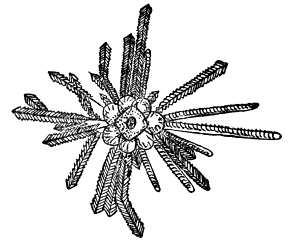
Fig. 49.—A compound colony of fossil graptolites characteristic of late Ordovician time, fully 20,000,000 years ago. Each little prong once held a tiny individual living graptolite which was a very simple type of animal belonging to the subkingdom called “Cœlenterates.” (Modified after Ruedemann.)
The Cœlenterates, which comprise the simplest of the many-celled animals, are saclike forms with mouth openings, but with few other differentiations of parts. All are marine animals. Of these the sponges are porous, and the other types (including corals) have tentacles around their mouths. Sponges have been more or less common from early Paleozoic time to the present, and they have undergone relatively little change. “Jellyfishes,” which are in truth not fishes at all, are wholly soft or gelatinous Cœlenterates which have left some very remarkable impressions and casts in strata of very early Paleozoic age, those very ancient forms evidently having been almost exactly like those of to-day. Graptolites were slender, plumelike, delicate forms consisting of colonies of tiny individuals, in many cases in branching or radiating combinations. They existed only during the first half of the Paleozoic era. Both because they floated in the open sea, thus permitting widespread distribution, and because they underwent many distinct species changes during short geologic intervals, they are among the most useful fossils for separating the various subdivisions of strata of the earlier Paleozoic.
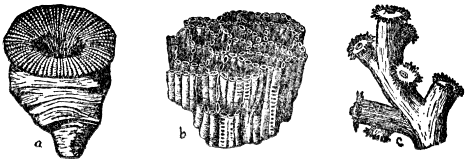
Fig. 50.—Corals, representing the very simple subkingdom of animals called “Cœlenterates”: a, fossil shell of an individual “cup coral” found only in Paleozoic strata; b, a compound or “chain coral” skeleton found only in relatively old Paleozoic strata; and c, part of a modern coral colony showing living corals.
Corals comprise another important branch of the Cœlenterates. During the Cambrian period there were corallike sponges and possibly simple corals, but from the early Ordovician to the present true corals have been common, especially in the clearer, warmer seas. Their carbonate of lime skeletons have accumulated to help build up great limestone formations representing almost every geologic age from early Paleozoic time to the present. Paleozoic corals were in general notably different from those of later time. There were three main types including the compound “honeycomb” and “chain” types, and the solitary or compound “cup” type. They all had four, or multiples of four, radiating partitions; were rarely branched; and were generally large, some individual cup corals ranging in length from half an inch to a foot or more. Modern corals (beginning with the Mesozoic) have six or eight partitions; are nearly all profusely branched; and are mostly tiny individuals.
Echinoderms are all marine animals, including the so-called “starfishes,” which are not really fishes. They have body cavity, with digestive canal, low order nervous system, and a water circulatory system. Most of them have radially segmented shells or skeletons. The oldest fossil forms are found in Cambrian strata, these being very simple or primitive types, with a bladderlike head set on the end of a segmented stem, both head and stem having been supported by carbonate of lime. Such forms lived only to middle Paleozoic time. Ordovician strata contain representatives of all the main types of Echinoderms in well-fossilized forms.
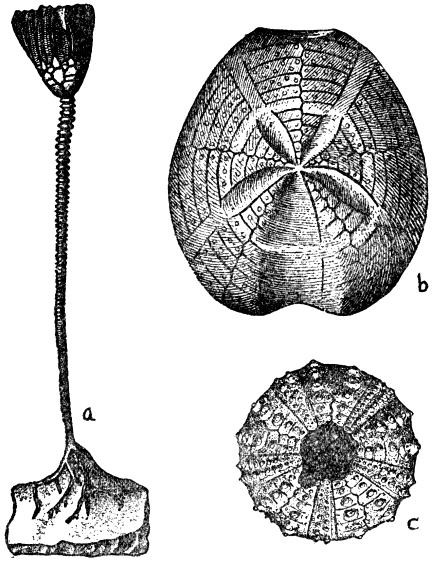
Fig. 51.—Fossil Echinoderms or so-called “starfishes”: a, simple type known as the “stone lily” with head, stem, and roots intact from Silurian strata; b and c, irregular and regular higher type Echinoderms called “sea urchins” from Cretaceous strata.
A stemmed Echinoderm of special interest, first known from the Ordovician, has persisted to the present day. It is the so-called “sea lily” or “stone lily,” consisting of a complex, headlike portion attached to the sea bottom by a long segmented stem, the whole being supported by lime carbonate. They were very numerous during the Silurian, but they seem to have culminated in variety of species and numbers of individuals during the Mississippian period when they were exceedingly profuse. Hundreds of species of “stone lilies” are known from Mississippian strata alone, and in certain localities, as at Crawfordsville, Ind., and Burlington, Ia., the “stone lily” remains are so numerous that when living they must have literally forested parts of the sea bottom. From Mississippian time to middle Mesozoic time they occupied a relatively subordinate position when they again developed in great profusion. The Mesozoic forms were distinctly more like those of to-day, and it scarcely seems credible that any creature could have contained such a multiplicity of hard parts, more than 600,000 segments having been counted in a single fossil from Jurassic strata. The “sea lilies” of to-day are relatively unimportant.
The familiar five-pointed “starfishes,” so common along our seacoasts, are first known from the Ordovician, and they persisted through the many millions of years to the present time with remarkably little change. The so-called “sea urchins” live in rounded, segmented lime-carbonate shells bristling with movable spines. “Sea urchins” are first known from the Ordovician, but they did not become abundant and diversified until Mesozoic time, when many of them took on a very modern aspect.
Worms are known to have existed ever since late Proterozoic time, as proved by the occurrence of tracks, borings and more rarely delicate impressions on rock surfaces. Because of their softness they have rarely been well fossilized and are, therefore, of no great evolutionary or geological importance.
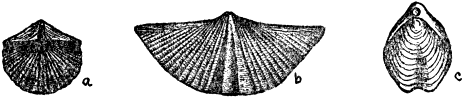
Fig. 52.—Fossil brachiopods belonging to the subkingdom of animals known as “Molluscoids”: a, b, c, forms characteristic of the Ordovician, Devonian, and Triassic periods, respectively.
The subkingdom Molluscoids has been richly represented by both the so-called “sea mosses” and brachiopods. The “sea mosses” form colonies of tiny mosslike tufts, resembling corals outwardly, though they are much more highly organized. They have been common from Ordovician time to the present, their carbonate of lime skeletons often having contributed to the building of limestone formations. Brachiopods always have two external shells or valves, in most cases working on a hinge, and also a pair of long, spiral-fringed arms associated with the soft part of the animal inside the shells. They differ from the other type of bivalve (e.g., clam, oyster) in that they are symmetrical with reference to a plane passed through the middle of the shells at right angles to the hinge line. They have rarely grown to be more than a few inches long. A few scant brachiopod remains are known from the late Proterozoic, but throughout known geologic time they reached their greatest development in the Paleozoic era, more especially in the Devonian period. Combining number of species and number of individuals, the brachiopods probably hold the record of all important groups of fossil animals, more than 7,000 species being known. Many layers of rock are filled with their shells (Plate 14). Since the close of the Paleozoic they have fallen off notably, and are now represented by relatively few small forms. From the standpoint of evolution it is interesting to note that in very early Paleozoic time the brachiopods were mostly small, of relatively simple organization, and their thin shells were not joined by hinges. Later they became larger and more complex and their thicker shells worked on hinges. Nearly all the Paleozoic forms had long, straight hinge lines, which made it difficult for their enemies to open them. Along with the change to narrower, curved hinge lines came the decline of the tribe. They have been of great value to the geologist in subdividing the geological column of strata into its many formations.
The Mollusks, which are more highly organized than the Molluscoids, have more or less distinctly developed heads and locomotive organs. Many thousands of species are now extinct, the classes of most geological importance being represented by clams, snails, and the pearly nautilus. Most of them have shells and gills for breathing. The members of the simplest group, well represented by the clam tribe, possess two similar shells working on hinges, so that in this regard they are much like brachiopods, but, unlike the latter, they are not symmetrical with reference to a plane at right angles to the hinge line. Cambrian strata contain the oldest known of the fossil forms where they are small, relatively thin-shelled, and rare. In marked contrast to the brachiopods these bivalves have rather steadily increased in numbers of species and individuals to the present time, now being represented by thousands of forms. During the Mesozoic era they greatly out-numbered the brachiopod bivalves and took on a more distinctly modern aspect, when the oyster tribe and closely related types were prominently developed. Culmination in size and thickness of shell seem to have been reached in early Cenozoic time, strata of that age in certain places, for example in Georgia and southern California, being filled with oyster shells 10 to 20 inches long and 4 to 6 inches thick! In addition to their gigantic size and thickness, many of the shells were fluted or ribbed, and so they represented an extreme type of defensive armor among the lower animals.
Snails have existed from the earliest Paleozoic era to the present time, and the outstanding fact of interest concerning them is that they furnish one of the finest illustrations of an important class of animals which has undergone practically no conspicuous change or evolution during all those millions of years of time.
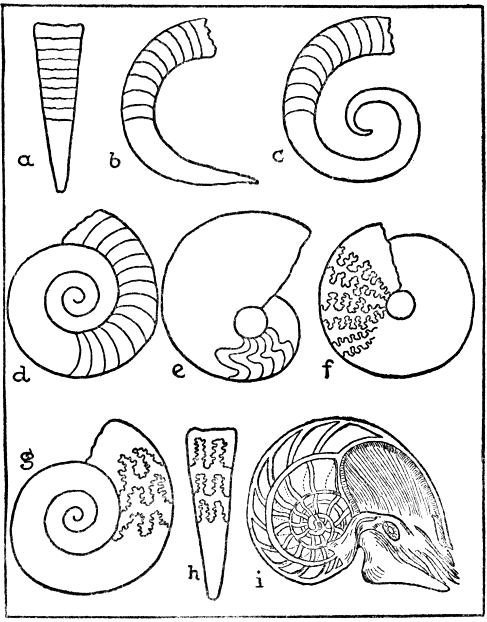
Fig. 53.—Sketches of chambered cephalopods showing the main steps in the evolution of the shell forms and compartment partitions: a, b, the only kinds in Cambrian time; c, d, forms added in the Ordovician; e, added in the Devonian; f, added in the late Paleozoic; g, h, characteristic of the Mesozoic era; and i, a living form (pearly nautilus) cut through. (Drawn by the author.)
We shall now turn our attention to the highest order of Mollusks—the cephalopods. These creatures, whose heads are armed with powerful tentacles and supplied with complex eyes, propel themselves by forcible ejection of water. One general type—the chambered cephalopod—has a shell divided into compartments (e.g., modern pearly nautilus) which are successively built up and abandoned by the animal as it grows larger. These chamber-shelled cephalopods constitute one of the most remarkable and instructive illustrations of evolutionary change within any important subgroup of invertebrate animals, ranging from early Paleozoic to the present. Both because of the abundance of fossil forms in rocks of all these periods of geological times, and because certain of the evolutionary changes are so clearly expressed in the well preserved shell portions, they are specially adapted for study. In the late Cambrian only straight and slightly curved forms with smooth, nearly straight chamber partitions existed. Notable advance took place during the next (Ordovician) period when there were straight, curved, open-coiled, and even close-coiled forms. All had simple partitions, and the straighter forms predominated. "The size attained by the Ordovician cephalopods was probably never surpassed by representatives of the class. Some of the (straight) shells were twelve to fifteen feet in length, and a foot in diameter. From this great size they ranged down to or below the size of a pipe stem." (Chamberlin and Salisbury.) They were more than likely the undisputed masters of the Ordovician seas. Silurian time marked no important change in their structures, but the coiled forms predominated for the first time. During the second half of the Paleozoic era all preceding types with simple partitions persisted, but in some forms the simple partitions gradually became angled and finally rather complexly curved. During the Mesozoic era the partition lines of the close-coiled forms evolved until a most remarkable degree of complexity was attained, comparable, indeed, to the sutures of the human skull plates. These remarkable forms called ammonites, of which more than 2,000 species are known, began with the Mesozoic, reached their climax, and passed out of existence toward the close of the same era. Certain strata of Jurassic age are literally filled with ammonites, some shells being several feet in diameter. Various eccentric changes took place in the ammonites shortly before their extinction. Some shells became uncoiled and even straight, thus outwardly at least showing reversion to the original early Paleozoic ancestors, but with retention of the complex partitions. Others assumed spiral shapes and still others became curved or coiled at each end. While these extraordinary evolutionary changes were going on among the chambers of cephalopods during Mesozoic time, some of the ancient close-coiled forms with very simple partitions managed to persist. In fact this simple type, almost exactly like its early Paleozoic ancestor, has been the only one out of this whole remarkable class of animals to persist to the present time, being now barely represented by the well-known pearly nautilus of the Indian Ocean.
During the Mesozoic era the highest type of cephalopod, represented by modern squids and so-called “cuttlefishes,” branched off and developed in great profusion. These had slender internal shells, but no external chambered shells. An inky black liquid secreted in a bag was forced out to cloud the water when the animal was escaping its enemy, thus antedating by millions of years the principle of smoke screen so effectively used by ships during the World War. Some Jurassic species got to be over two feet long, and a few specimens of that age have been found in such perfect state of preservation that drawings of the fossils have actually been made with the ink (after moistening) taken from their own ink bags.
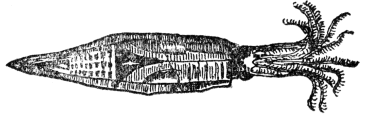
Fig. 54.—A fossil nonchambered cephalopod of Jurassic age. It was closely related to the modern squid, and its ink bag is well shown just to the left of the middle. (Modified after Mantell.)
Before concluding this chapter we shall take up the salient points in the geological history of Arthropods which constitute the highest subkingdom of all animals except the Vertebrates. They are now very abundant and varied, familiar examples being crabs and insects. A few scant remains of simpler forms are known from the Proterozoic, but since very early Paleozoic time they have been very common and have undergone great evolutionary changes. A few striking examples only will be dwelt upon. Among the most common and interesting of all Paleozoic animals were the trilobites, distantly related to modern lobsters and crabs.
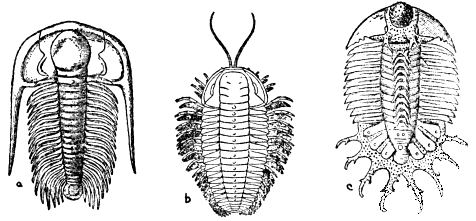
Fig. 55.—Restorations of trilobites based upon actual fossils characteristic of earlier Paleozoic time: a, Cambrian; b, Ordovician; c, Devonian; b shows the appendages.
Some of these grew to be two feet long, but usually they were only one or two inches long. First known from the earliest Paleozoic, they reached their culmination relatively early in the era and then dwindled away to utter extinction before its close. "They were characteristic of the Paleozoic era, beginning in great variety in the Lower Cambrian and dominating the seas of the Cambrian (300 species) and Ordovician (950 species). In the Silurian, though they were still common, the trilobites were nevertheless on the decline (485 species), and this ebbing of their vital force is seemingly shown in many picturesque forms replete with protuberances, spines, and exaggeration of parts. As a rule, in evolution, one finds that when an organic stock is losing its vital force there arises in it an exaggeration of parts, as if heroic efforts were being made to maintain the race. Spinosity in animals is often the prophecy of tribal death. In the Devonian, the variety and number of the trilobites were greatly reduced (105 species), at a time when the ancient types of fishes, which undoubtedly fed on these crustaceans (trilobites), began to be common in the seas. In the later Paleozoic seas, the trilobites were relics, or animals surviving from a time better suited to their needs, and one by one they vanished, until a little before the close of the Paleozoic era none were left." (Schuchert.)
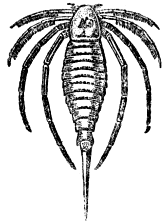
Fig. 56.—A giant, sea scorpion of Devonian time. Length nearly 3 feet. (After Clarke and Ruedemann, New York State Museum.)
An extraordinary type of Arthropod which ranged throughout Paleozoic time and became extinct at its close was the so-called “sea scorpion,” closely related to the modern scorpion. Their five or six pairs of appendages all came out from the head portion, one pair in some cases having been developed as powerful pincers. Their culmination in size was reached during the Devonian when some forms grew to the astonishing length of over eight feet! Such gigantic creatures must have been tyrants of the seas until they were subdued by the oncoming powerful fishes. True scorpions are known from rocks as old as the Silurian. Lobsters and crabs made their appearance during the Mesozoic era.
Since insects constitute the highest subdivision of Arthropods, they include the very highest forms of animal life except the Vertebrates. The oldest known fossil insects are from Pennsylvanian strata, more than 1,000 species having been described from rocks of that age. They were all simple or primitive types like cockroaches and dragon flies, and were remarkable for size. Giant cockroaches got to be four inches long. One form of dragon fly, with a spread of wing of over two feet, was probably the largest insect which ever lived (Plate 15). Development of insect life was especially favored during the great Coal Age because of the prolific vegetation, but more than likely insects originated somewhat earlier. Early in the Mesozoic era a great progressive change began to come over insect life and higher forms gradually evolved until by the close of the era many of the highest types like flies, ants, and bees were common. As might be expected, the highest insects did not develop until after the appearance of the true flowering plants in later Mesozoic time, butterflies apparently not having evolved until early in Cenozoic time. Many of the thousands of known species of fossil insects are from strata of Tertiary age during which time they may have been even more numerous than to-day, although there are about 400,000 species now living. An almost incredible case is a Tertiary stratum only a few feet thick in Switzerland from which nearly 1,000 species of insects have been unearthed. Another famous locality is Florissant, Colorado, where during early Tertiary time there was a small lake into which showers of fine volcanic dust fell and entombed vast numbers of insects, more than 2,000 species having been unearthed. Still another extraordinary occurrence is along the shores of the southern Baltic Sea where more than 2,000 species of insects have been found in a fossil resin called amber. The insects were caught in the still soft sticky resin while it was exuding from the trees, and thus we have the insects, fully two or three million years old, literally embalmed and marvelously preserved, often in beautifully transparent amber.
CHAPTER XIX
GEOLOGICAL HISTORY OF VERTEBRATE ANIMALS (INCLUDING MAN)
V
VERTEBRATES comprise the highest subkingdom of all animals with man himself at the very top. They are characterized by the possession of a vertebral column, which, in all but the very simple or primitive forms, is an ossified backbone. Their main subdivisions are given in the classification table near the beginning of the preceding chapter. The oldest known Vertebrates, found in fossil form in middle Ordovician strata, were represented by curious and bizarre creatures called ostracoderms, or more popularly “armor fishes.” They were not true fishes because they were really somewhat lower in the scale of organization than fishes. Some were distinctly fishlike in appearance, and others notably resembled certain of the Arthropods, so that some students consider them to have formed the connecting link between the highest Invertebrates (Arthropods) and low order fishes of the Vertebrates. The vertebral column always consisted of cartilage or gristle and, in most forms, it extended through tail fin. None had true side fins like fishes, but many were provided with a pair of jointed flappers or paddles. The jawlike portions of the heads moved over each other sidewise as, for example, in beetles and not up and down in true Vertebrate fashion. Two eyes were always very close together. One of the most striking features was the protection of the head and fore part of the body by an armor of bony plates, while the rest of the body had scales. They seldom grew to be more than six or seven inches long. Beginning in the Devonian, they remained rare during the Silurian, and then in the Devonian period they reached their climax of development only to become extinct at its close. Many species were abundantly represented in many parts of the world. By some the Ostracoderms are thought to have been a primitive (sharklike) fish development in the wrong direction, and hence they became extinct.
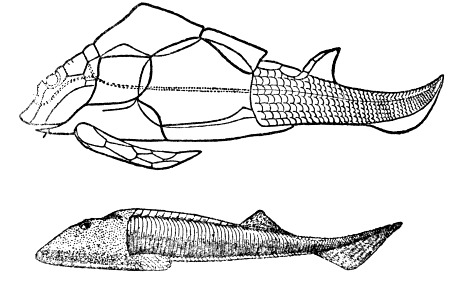
Fig. 57.—Two restored forms of very primitive and ancient (Devonian) types of Vertebrates called “ostracoderms.” They were lower in organization than true fishes. (After Dean-Woodward and British Museum, respectively.)
Fishes, represented only by very primitive sharks, are known to have existed as early as the Silurian period, but the remains are scant. During the Devonian period, however, they showed a marvelous development into many species and countless myriads of individuals. The Devonian is, therefore, commonly called the “Age of Fishes.” These very ancient (Devonian) primitive (fish) types of Vertebrate animal life are of profound significance in organic evolution because they were the direct progenitors of the great groups of still higher Vertebrates which since later Paleozoic time gradually increased in diversity and complexity of structure through amphibians, reptiles, birds, and mammals finally to man himself.
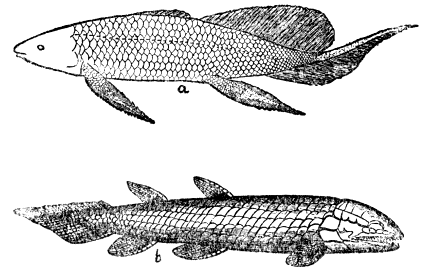
Fig. 58.—Restorations of characteristic Devonian fishes, based upon actual fossils: a, a “lung fish” with leglike fins (after Huasakof); b, a “ganoid.” (After Nicholson.)
In marked contrast to the most typical and highly organized fishes so abundant to-day, all Devonian fishes were of simple types with cartilaginous skeletons and vertebrated tails. Many of them were also generalized types, that is, associated with their clearly defined fish characters were others connecting them with certain higher Vertebrates, as, for example, amphibians and reptiles. Thus all their tail fins were vertebrated as in reptiles; their labyrinthine, internal tooth structure was to be an amphibian feature when those creatures evolved; many had protective armor or bony scales like most early amphibians and many modern reptiles; and many had paired fins which were something like jointed legs. Most abundant and highly organized of the Devonian fishes were “ganoids,” characterized by a covering of small plates or bony scales set together but not overlapping like in typical modern fishes. Their intricate tooth structure and limblike fins strongly suggest the amphibians of later Paleozoic time. The skeleton of cartilage gradually became somewhat ossified during succeeding geologic periods. From their great profusion and diversity in the Devonian period the ganoids have steadily fallen away until they now have very few descendants like the gar pike.
Another important group of remarkable fishes, now totally extinct, but common in Devonian and somewhat later time, had heavy, bony armor plates over the fore part of the body. Those which grew to be fifteen to twenty-five feet long were probably the rulers of the middle Paleozoic seas. Another remarkable Devonian fish was able to breathe in both water and air because, like their few modern descendants, they had both gills and lungs. Because of their leglike fins and lung sac, it is commonly believed that they were progenitors of the later Paleozoic amphibians. The simplest of all fishes, the sharks, began in the Silurian, underwent no important change through the millions of years since, and are now of course well represented. During early Cenozoic time the sharks seem to have reached culmination in size—sixty to eighty feet long, with teeth five or six inches long.
Among modern fishes the most abundant by far, and the most highly organized, are the true bony fishes, called the “teleosts,” which made their first appearance in the middle of the Mesozoic era. Those earliest forms clearly show their descent from the ganoids. Apparently they have not yet passed their prime.
We shall now consider the next higher group of Vertebrates, the amphibians, which breathe by gills when young and later develop lungs. Many live both on land and in water like the frogs. Unlike fishes they have legs with toes and not fins. Beginning probably in the Devonian as a branch of the fishes, amphibians showed a marvelous development during later Paleozoic and very early Mesozoic times when they reached their climax, after which they fell off remarkably, being now relatively unimportant like the frogs and salamanders. They are of special significance because they were the first of all the back-boned animals (Vertebrates) to inhabit the land which they dominated only until the great rise of reptiles of Mesozoic time. The reptiles in fact evolved from the amphibians in the late Paleozoic when many transition forms occurred. (Plate 15.) During those ancient days the numerous and very diversified amphibians were like giant salamanders, commonly five to eight feet long, with one Triassic form fifteen to twenty feet long, and with heavily armored skulls two to four feet long.
Turning now to the reptiles we find that they are much more distinctly land animals than the preceding types of Vertebrates. Reptilian life of the earth began in late Paleozoic time as an evolutionary branch of the amphibians. The earliest forms were in many ways much like the amphibians, but gradually they diversified and progressed so that before the close of the Mesozoic era, which has long been called the “Age of Reptiles,” they were the rulers of the world. “They covered the land with gigantic herbivorous and carnivorous forms; they swarmed in the sea, and, as literal dragons, they dominated the air.” (Scott.) Mesozoic reptiles are of special interest and significance not only in themselves, but also because from one of their branches the birds were evolved, and from another the mammals. “In advancing from the amphibian to the reptile the evolution of the Vertebrates was far from finished. The cold-blooded, clumsy and sluggish, small-brained and unintelligent reptile is as far inferior to the higher mammals, whose day was still to come, as it is superior to the amphibian and the fish.” (Norton.)
Since the reptiles of the Mesozoic era constitute one of the few most remarkable and diversified classes of animals which ever inhabited the earth, we shall attempt to give the reader a fair idea of the most typical groups which have been totally extinct since the close of the Mesozoic era some millions of years ago. Of the swimming reptiles which lived in the seas many types are known and only a few will be described. Among these one important type was the ichthyosaur, a fishlike form which not uncommonly grew to be twenty to even forty feet long (Plate 18). The large head, sometimes four or five feet long, contained as many as 200 big sharp teeth and enormous eyes up to a foot in diameter. The body was heavy set, and the neck very short. There were four short, stout swimming paddles, and the tail was vertebrated. Some specimens of ichthyosaurs have been so perfectly preserved in Mesozoic strata that even the unborn young are plainly seen in the bodies! In some cases it is actually possible to tell what was the last meal of a particular ichthyosaur those millions of years ago; in one specimen, for example, remains of 200 creatures of the “cuttle-fish” tribe having been found in the exact position of the stomach.
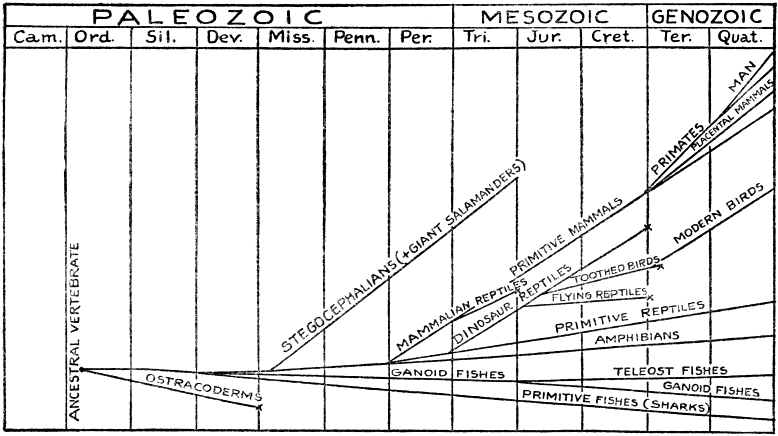
Fig. 59.—Chart showing the main branches in the history of Vertebrate (back-boned) animal life reaching its culmination in man. (By the author, in part after Cleland.)
The mosasaurs of the late Mesozoic were the only real sea serpents of the geologic ages. They were something like the ichthyosaurs, but with smaller heads and much longer, more slender, serpentlike bodies. Some grew to be thirty or forty feet long.
Plesiosaurs were perhaps the strangest of all the Mesozoic marine reptiles. They grew to be forty to fifty feet long, with stout body, very long, slender neck, small head, short tail, and four long, powerful swimming paddles which were distinctly leglike. These and the mosasaurs were both flesh eaters, as shown by the sharp teeth.
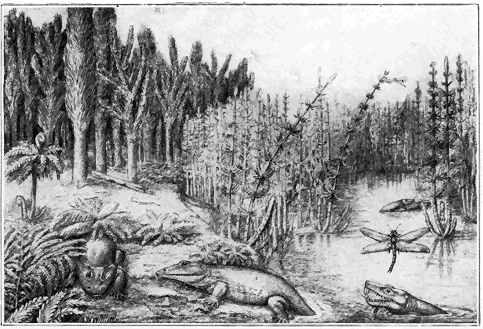
Plate 15.—(a) Restoration of a Late Paleozoic (Coal Age) Landscape. Showing the main kinds of plants which have entered into the making of most of our coal. Giant “club mosses” both with and without branches, in the left background; giant “horsetail” (or “scouring rush”) plants on the right; and seed ferns in the left foreground. A primitive reptile in the water; two large amphibians or giant salamanders, called “stegocephalians,” on the land; and a great “dragon fly,” two feet wide, in the air. (From a drawing by Prof. Williston. Courtesy of D. Van Nostrand Co.)
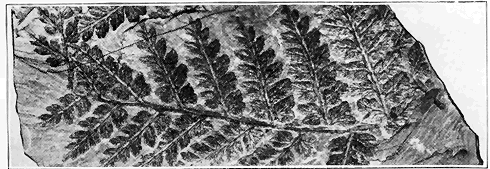
Plate 15.—(b) Photograph of a Fossil Fern or Seed Fern Frond on a Piece of Shale Millions of Years Old. The specimen is of the Pennsylvanian Age and was taken from the coal fields of Pennsylvania. (After White, U. S. Geological Survey.)
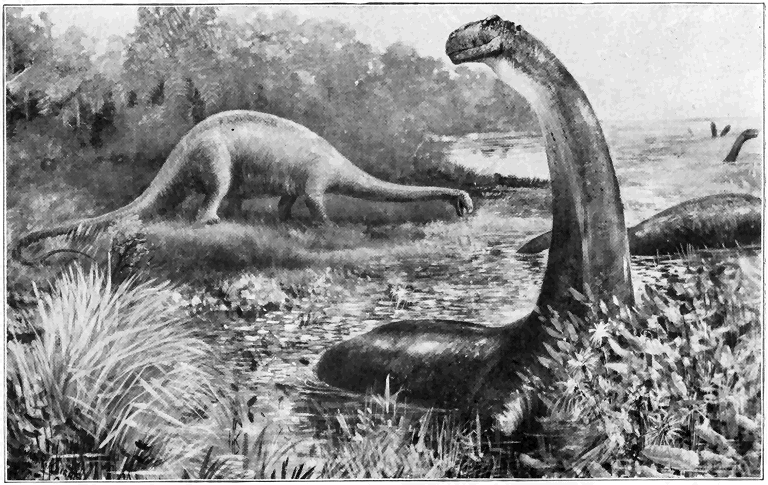
Plate 16.—Restoration Showing the General Appearance of Some of the Largest Animals Which Ever Trod the Earth. A mounted skeleton in the American Museum of Natural History is sixty-seven feet long, and the skeleton of a similar creature in the Carnegie Museum, Pittsburgh, is eighty-seven feet long. They lived millions of years ago during the middle and late Mesozoic era. (After C. R. Knight. Courtesy of the American Museum of Natural History, New York.)
The most remarkable walking reptiles of all time were the dinosaurs or “terrible lizards.” We shall describe enough types of these unique creatures to give the reader a fair idea of their appearance and habits. Most astonishing of all were the sauropods including the largest animals which ever trod the earth. They grew to be as much as sixty to ninety feet or more in length. Remarkably well preserved skeletons have been found, one from Utah, eighty-seven feet long, being mounted in the Carnegie Museum of Pittsburgh. The largest of these brutes stood fifteen to twenty feet high and they must have weighed thirty to fifty tons. The very long, serpentlike neck and tail, and very small head were grotesque features. Considering the structure of the dinosaurs, the kind of strata in which they are embedded, and the associated fossil remains, it seems clear that they mostly lived in and near fresh water and on near-by lowlands. The character of their teeth shows that they fed entirely on soft plants which they must have habitually bolted because their teeth were not well adapted to grinding food. It is difficult to believe that a single huge beast could have consumed less than a few hundred pounds of vegetable matter per day, and, on account of the very small size of the head, he must have spent most of his time eating. Also the comparatively very small size of the brain, and its simplicity of structure, render it certain that they were extremely stupid creatures. “To make up for this they had an enormous enlargement of the spinal cord in the sacral region (i.e., over the hind legs). This sacral brain—if we may so call it—was ten to twenty times bigger than the cranial brain. It was necessary in order to work the powerful hind legs and tail.” (Le Conte.)
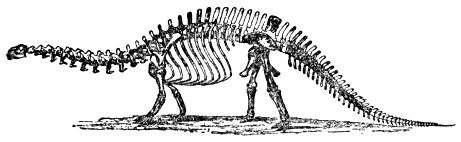
Fig. 60.—Skeleton of a great four-legged (sauropod) dinosaur. A mounted skeleton in the American Museum of Natural History, New York, is sixty-seven feet long. This creature lived millions of years ago during the Jurassic period. (After Marsh.)
Another dinosaur, in some respects like the sauropod, was the stegosaur which grew to be twenty to thirty feet long, and heavier than the elephant. Unlike the sauropod, it had a short neck and was armored with a double row of great plates over its back, and sharp spines (one to three feet long) toward the end of the tail. The excessive stupidity of the creature is proved by the fact that its very simple brain weighed less than three ounces! Stegosaurs were plant eaters as indicated by the tooth structure, and, though they looked ferocious, they were probably not fighters, certainly at least nothing like the carnivorous types of dinosaurs we shall soon describe.
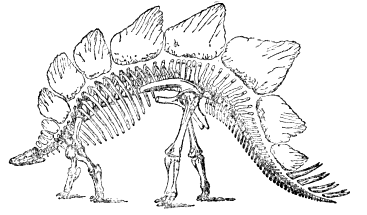
Fig. 61.—Skeleton of the curious kind of dinosaur (stegosaur) of Mesozoic Age with great bony plates over the back. Length about thirty feet. (After Marsh.)
The ferocious dinosaurs of Mesozoic time were carnivorous, or flesh eaters, as shown by their numerous sharp teeth in relatively large heads. The largest known type is the tyrannosaur, an almost perfect skeleton of which, 40 feet long and 16 feet high, is mounted in the American Museum of Natural History in New York (Plate 17). So far as known, this was the largest carnivorous animal which ever walked on the earth. It is evident from the structure that it walked on its hind legs, the front ones having been much shorter and used something like arms. There were also various other smaller forms of two-legged flesh-eating dinosaurs, many of the wonderfully preserved tracks in the Triassic sandstones of the Connecticut River Valley having been made by such creatures when they walked around over soft, sandy mud flats at least eight or ten million years ago. The sandy mud with its tracks became somewhat hardened and then deeply buried under much more sediment which, through the ages, has been eroded off, thus exposing to view certain of the layers covered with tracks. Some bones of dinosaurs have also been found in the Connecticut Valley.
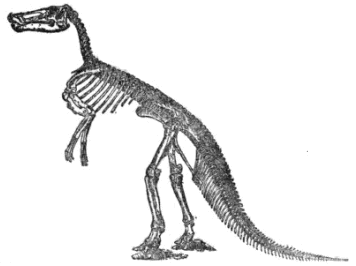
Fig. 62.—Skeleton (restored) of a great two-legged dinosaur of the Mesozoic era. This type of plant eater grew to be fully twenty-five feet long. (After Marsh.)
Another remarkable type of two-legged dinosaur was much like the flesh eaters just described, but they were plant eaters. The largest of these grew to be 30 feet long and 15 to 20 feet high, comparable, therefore, to the tyrannosaur in size. A wonderful collection of almost perfect skeletons may be seen in the museum in Brussels, Belgium. In mining coal 1,000 feet below the surface in Belgium, twenty-two complete skeletons and several partial skeletons were found in an ancient river deposit of Cretaceous Age. A marvelously preserved specimen of one of these two-legged plant eaters found in Wyoming, has been called a “dinosaur mummy” because the skin and much of the flesh of the creature had shriveled down upon its bones. The minutest details of the texture of its skin are almost perfectly preserved.
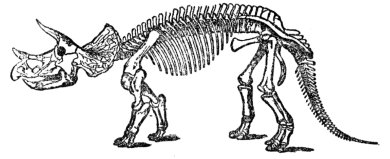
Fig. 63.—Skeleton of a dinosaur (triceratops) with a large remarkable head. This creature grew to be twenty-five feet long during Cretaceous time. (After Marsh.)
Another type of dinosaur, so different from the others, should be briefly described. This was triceratops, or the “three-horned face” beast, so named because of the three powerful horns which projected forward from the top of the very large, flattened skull. It grew to be twenty to twenty-five feet long. Skulls six to eight feet long have been unearthed. Just where the brain might have developed, the skull dished downward, and so one authority considers triceratops to have had the largest head and smallest brain of all the great reptiles.
It is well known that dinosaurs of many types lived during the great “Age of Reptiles,” though by no means all types ranged through the whole era. No dinosaurs are definitely known to have crossed the line into the Cenozoic era. One of the most astonishing facts in the history of animal life is the extinction of the mighty dinosaurs, but no very satisfactory explanation has yet been offered. Probably their great size was a contributing factor, for it is well known “that while very large animals spend nearly all their time in eating, small animals spend a small proportion of theirs, and most of it in other activities. Now, as long as food is abundant, the larger animals of a race have the better chances, but if a scarcity of food ensues, the larger animals may all be suddenly swept out of existence.” (Matthew.) Whatever may have been the real reason for dinosaur extinction we can at least be sure “that with the extensive changes in the elevation of land areas (Rocky Mountain Revolution) which mark the close of the Mesozoic, came the withdrawing of the great inland Cretaceous seas along the low-lying shores of which the dinosaurs had their home, and with the consequent restriction of old haunts, came the blotting out of a heroic race. Their career was not a brief one, for the duration of their recorded evolution was twice that of the subsequent mammalian (Cenozoic) age. They do not represent a futile attempt on the part of nature to people the world with creatures of insignificant moment, but are comparable in majestic rise, slow culmination, and dramatic fall to the greatest nations of antiquity.” (Schuchert.)
Among the most extraordinary animals not only of the Mesozoic, but also of all time, were the flying reptiles or literal dragons of the air. Some were very small, while others were the largest creatures which ever flew, with a spread of wing of twenty to twenty-five feet—twice that of any modern bird. Unlike birds they had no feathers, but the two wings consisted of large membranes (batlike) supported by one enormously elongated finger of each front limb. The other fingers were armed with sharp claws. The early Mesozoic flying reptiles had sharp teeth, while the later ones were mostly entirely toothless, but all were carnivorous. Their short bodies were supplied with tails of varying lengths, one long-tailed species having a rudder at the end. Their heads were fairly large, but of light build. The creature called “pteranodon” was not only the largest of the flying reptiles, but also probably the most highly specialized creature which ever lived, everything possible apparently having been sacrificed to facilitate flight (Plate 18). The hollow bones were so wonderfully light and strong that it has been estimated that the living animal, with twenty-five foot spread of wing, and head four feet long, could not have weighed more than twenty-five pounds! The rear portions of the body and hind limbs were very weak.
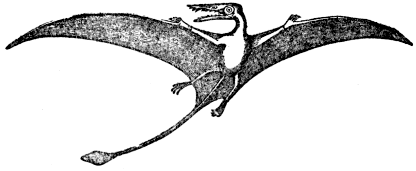
Fig. 64.—A small carnivorous flying reptile of Mesozoic time. Spread of wings about two feet. (Restored by Marsh.)
It should not be thought that the above-described groups of reptiles were the only ones which existed during Mesozoic time. There were also certain groups still living, like turtles, lizards, and crocodiles, but they were doubtless mostly completely under the dominance of certain of the now long-extinct types above described. The oldest-known fossil snakes are from very late Mesozoic rocks, where they are small and comparatively rare. More than likely they evolved from lizards by deterioration of the legs. Poisonous snakes were not evolved until early in the next (Cenozoic) era.
We shall now turn our attention to next to the highest class of Vertebrate animals—the birds. They and the mammals are the only warm-blooded animals. What is their ancestry? From what original stock did they branch off? The oldest-known bird lived during the Jurassic period, and it was so decidedly reptilian in character as to render it practically certain that birds are specialized descendants of certain Mesozoic reptiles, though not, as might be supposed, of the flying reptiles. The few known specimens of the Jurassic birds were found in the famous lithographic limestone quarries of Bavaria. At least two of the specimens are in a marvelous state of preservation, with practically the whole skeleton intact and almost perfect impressions of the feathers on the rock. That the creature was really a bird is proved not only by its feathers, but also its beak, brain, limb bones, and feet. Among the reptilian characters are its long, vertebrated tail, teeth set in sockets, and long claws on the wings. This reptilian bird was about the size of a small crow.
By late Cretaceous time the birds made notable evolutionary progress and they became diversified, more than thirty species being known from Cretaceous rocks. These were distinctly more modern in structure and appearance than the Jurassic bird. The only important reptilian characteristic still retained was the possession of teeth. The tail had become much shortened and the brain was still relatively smaller than in modern birds. One type, about nine inches high, was a powerful flier, as shown by the strong keel and wing bones. Another important Cretaceous type was almost wholly a water dweller, with powerfully developed legs used in swimming. Its teeth were set in grooves instead of in sockets, thus indicating degeneration of tooth structure. This type was notable for its size—five to six feet in length.
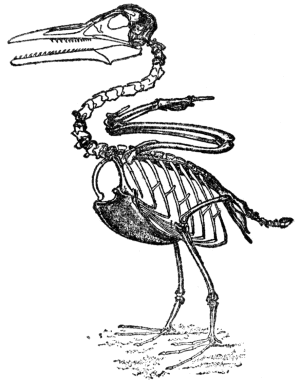
Fig. 65.—An early type of bird with teeth. This bird grew to a height of about nine inches in Cretaceous time, millions of years ago. (Restored by Marsh.)
During the early part of the Cenozoic era birds became still more advanced and numerous, with many modern groups represented. Some of the more primitive types were, however, still left over during the Tertiary, as, for example, a toothed bird, in which the teeth were merely dentations of the bill, thus being the most degenerate of all types of tooth structure.
Mammals comprise the highest class of all animals. They are, of course, all warm blooded and characterized by suckling their young. So far as known, mammal life began in the early Mesozoic era as a branch of primitive reptiles, but they made little progress throughout the era when they occupied a very subordinate position in the animal world. They were few in number, small, and primitive in structure. There is no evidence for the Mesozoic existence of any of the higher forms of mammals, that is, those which give birth to well-formed young which are prenatally attached to the mother by the so-called placentum. “During the eons of the Mesozoic, from late Triassic time until its close, the mammals (including the remote progenitors of humanity) were in existence, but held in such effective check (by reptiles) that their evolutionary progress was practically insignificant. This curb is strikingly illustrated by the wonderful series of tiny jaws and teeth of these diminutive creatures found in the Comanchian (early Cretaceous) of Wyoming, in actual association with the single tooth of a carnivorous dinosaur, many times the bulk of the largest mammalian jaw. The removal of this check resulted (in the Tertiary period) in the speedy evolution of the archaic mammals.” (Schuchert.)
The phenomenal development of mammals during the Tertiary period forms one of the most wonderful chapters in the whole evolution of organisms. Even very early in the Tertiary, many important higher (placental) types of mammals had evolved, and the simpler, more primitive Mesozoic forms became very subordinate. By the close of the Tertiary the higher types of mammals had become marvelously differentiated into most of the present-day groups or types. A very significant feature of the evolution was the steady increase in relative size of brain. The vast numbers of fossil skeletons and bones of mammals found in Tertiary strata is scarcely believable. In our brief discussion we can do no more than describe a few representative examples of the Cenozoic evolution of mammals.
The great diversity of modern placental animals may be suggested by a few examples, as the tiger, dog, horse, camel, elephant, squirrel, hedgehog, whale, monkey, and man. Forms like these, traced back through their ancestors to the very early part of the Tertiary period, gradually become less and less distinct until they cannot be at all distinguished as separate groups, but rather there are ancestral generalized forms which show combinations of features of the later groups. Those early Tertiary generalized placental mammals had four feet of primitive character, with five toes on each foot; the whole foot, which from toe to heel touched the ground, was not adapted to swift running; the teeth were simple (primitive) in type and of full original number (forty-four); the toes were supplied with nails which were about intermediate between real claws and hoofs in structure; and the brain was relatively much smaller and simpler in structure than in most modern mammals.
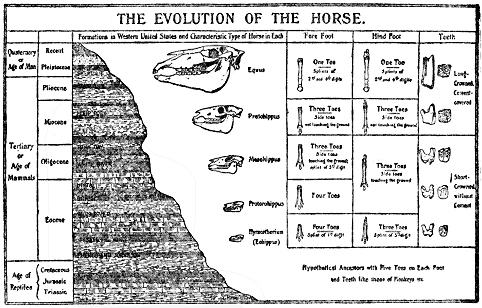
Fig. 66.—Chart showing the main features of interest in the evolution of the horse family through several million years of the present (Cenozoic) era of geologic time. (After Matthew, American Museum of Natural History.)
The history of the horse family furnishes an excellent illustration of certain evolutionary changes among mammals. Skeletons of many species, ranging from the early Tertiary to the present, have been found in remarkable state of preservation representing every important change in the history of the horse family. A study of the chart will make clear some of the most striking changes which have taken place. The oldest member of the horse family represented on the chart was about the size of a small fox, with four toes and a degenerated fifth toe (splint) on the front foot, and three toes and splint on the hind foot. Since the chart was made a still more primitive form, even more closely resembling the original five-toed ancestor, has been found. Gradually the middle toe enlarged, while the others disappeared except the two splints or very degenerate toes still left in the modern horse. Increase in size of the animal and brain capacity accompanied these changes. Also the teeth underwent notable change, and two originally separate bones (radius and ulna) of the foreleg became consolidated into a single stronger bone.
The even-toed hoofed mammals of to-day, like the deer, pig, and camel, are also the product of evolution much like that of the horse, except that two of the original five toes have been equally developed, while the others have either greatly degenerated, as in the pig, or disappeared entirely, as in the camel.
The elephants, or trunk-bearing animals, illustrate a very different kind of evolution. They seem to have reached their climax of development in the late Tertiary when they grew to be as much as 14 feet high, and were more abundant and widespread over the earth than at any other time. The modern elephant, like the horse, has been traced back through many intermediate forms to its primitive early Tertiary ancestry. Some of the most important evolutionary changes took place in the head portion. The trunk is a highly developed form of snout, the earliest form of which was much like that of the modern tapir. The tusks are highly specialized and elongated teeth. During the earlier history the chin was very long and supported short tusks, so that there were then four tusks.
Carnivorous mammals, like tigers and wolves, and gnawers, like rats and squirrels, may also be traced back to generalized early Tertiary types.
Another kind of evolution is well illustrated by certain mammals which, even in early Tertiary time, so thoroughly adapted themselves to a water environment as to become whales, porpoises, etc.
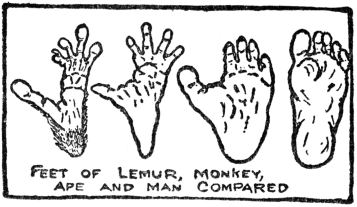
Fig. 67.—Comparison of feet of monkeys and man.
The primates include the highest group of all Vertebrates, and therefore of all animals. Monkeys, apes, and man belong to the primates. There is no evidence whatever for the appearance of even the simplest and most primitive forms before the opening of the Cenozoic era, but even very early in Tertiary time, lemurs and primitive types of monkeys existed. Later in the Tertiary true monkeys and apes were common, and by the close of the period some apes were highly enough developed to strongly resemble certain of the oldest and most primitive types of man. We have, however, no positive knowledge of the existence of man in even the latest Tertiary. In the light of much evidence in regard to the antiquity of man, it seems improbable that true human fossils will ever be found in rocks older than the Quaternary, though if we are willing to descend (far enough in the human scale toward apes) it is not unlikely that man-apes may be discovered in very late Tertiary rocks. The difficulty comes in the classification. Where are we to draw the line between the higher apes and the lowest forms of man? But this very difficulty is one of the strongest arguments in favor of the organic evolution of man because practically all intermediate forms between true man and certain other high-grade primates are known from the strata. The following tabular summary of the geological history of man is based upon the work of most of the ablest students of the subject.
3. Homo sapiens (e.g., modern man) Historic (bronze and iron) age. Modern
Neolithic (“recent stone”) age (carefully shaped and polished stone implements) Postglacial but prehistoric
2. Homo primigenius (e.g., Neanderthal man) Upper Paleolithic (“ancient stone”) age (rough bone and stone implements, cave frescoes, bone carvings, etc.) Late Glacial
Lower Paleolithic (“ancient stone”) age (rude stone implements of so-called “river man”) Middle Glacial
1. Early ancestral forms (e.g., Pithecanthropus erectus) Possibly some very crude stone implements Early Glacial and possibly late Tertiary
Of the early ancestral forms, that is, those which were rather distinctly man-apes, two will be very briefly referred to. One of these, known as Pithecanthropus erectus, was a remarkable creature whose partial skeleton, consisting of the upper part of a skull, lower jaw, several teeth, and a thigh bone, was found in early Quaternary deposits in Java in 1891. It was certainly a man-ape or possibly ape-man of low order, about 51/2 feet high. The skull has a low crown, very receding forehead, and prominent brow ridges, but the brain capacity is 850 cubic centimeters, as compared to 500 cubic centimeters in ordinary higher apes, and nearly 1,500 cubic centimeters in the average modern man. The very recently extinct very low-type aborigines of Tasmania had a skull capacity of 1,199 cubic centimeters.
In 1907 the lower jaw of an anthropoid or manlike ape set with rather human teeth was found associated with very crude stone implements seventy-five feet below the surface in river-deposited sand in Germany. It is of either early or middle Glacial time and quite certainly represents a lower order creature than the oldest Paleolithic man as described below.
Many bones and implements of Paleolithic man (see above table) have been found mainly in river gravels and caves. The relative ages of Paleolithic human bones and implements are best determined by the associated fossil animals. Thus the most ancient truly human fossils are found directly associated with bones of very old types of elephants, rhinoceroses, and hippopotamuses which are definitely known to have lived during middle or early middle Glacial (Quaternary) time corresponding to early Paleolithic time. A very conservative estimate would make the age of such very old human remains at least 150,000 to 250,000 years because the Ice Age was at least 500,000 years long. In a later human stage there are many associations with extinct animals like an older type of mammoth, cave bear, cave hyena, and others of later Glacial time estimated at 50,000 to 150,000 years ago. Last of all was the latest Paleolithic stage corresponding to the close of the Ice Age, the human remains of which are found associated with reindeer and the latest mammoths which roamed in great numbers across Europe. This was probably not more than 30,000 to 50,000 years ago.
Paleolithic man is so called because he fashioned stone weapons and implements. The structure of skull and skeleton shows him to have been a low-type savage, something over five feet high on the average, with a forward stooping carriage. The average Paleolithic brain was not greatly inferior in size to that of modern civilized man, but it was not so highly organized and occupied a thick skull with much lower forehead and heavy brow ridges. The bushmen of Australia and the recently extinct Tasmanians are the nearest modern resemblances. Many fine specimens of Paleolithic man have been found, especially in cave deposits. That he was an expert hunter is proved by the great accumulation of bones of now extinct animals found in and about his haunts or camps, bones representing at least 100,000 horses having been found around a single camp site!
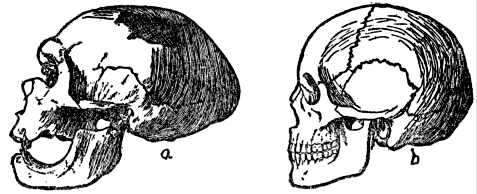
Fig. 68.—Comparison of skulls: a, Paleolithic (Neanderthal) man; b, modern man. (After Woodward, British Museum.)
Only two among the many known Paleolithic man localities will be briefly described. In the Perigord district of southwestern France a number of caves contain human relics ranging in age from early to late Paleolithic. Of special interest among these relics are fishhooks made of bone, and crude sketches of animals such as the mammoth and reindeer now extinct in that region. The Aurignac cave, also in France, was no doubt a family or tribal burial place. Seventeen Paleolithic human skeletons, associated with bones of extinct animals and crude art works, were found in the cave. Near the entrance there were ashes and charcoal mixed with burned and split bones of extinct animals. Certain of the caves occupied by late Paleolithic man have their walls decorated with sketches and even colored pictures. These are, therefore, the oldest known art galleries. An excellent example is the cave at Altamira in northern Spain. “As we glance at the pictures one of the first things to impress us is the excellence of the drawing, the proportions and postures being unusually good.... The next observation may be that, in spite of this perfection of technique, there is no perspective composition—that is, no attempt to combine or group the figures.... It is also clear that the work of many different artists is represented, covering a considerable period of time. The walls show traces of many other paintings that were erased to make way for new work.” (Wissler.)
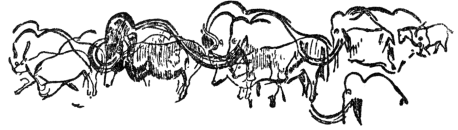
Fig. 69.—Sketch of a painting by Paleolithic man found in a cave in west-central France. Various animals, including the extinct mammoth elephant, are represented. (Courtesy of American Museum of Natural History.)
The Neolithic, or “recent stone” age was a gradual development from the late Paleolithic, and man was then more highly developed and more similar in structure to modern man. His stone implements were more perfectly made, and often more or less polished and ground at the edges. “The remains of Neolithic man are found, much as are those of the North American Indians, upon or near the surface, in burial mounds, in shell heaps (the refuse heaps of their settlements), in peat bogs, caves, recent flood-plain deposits, and in beds of lakes near shore where they sometimes built their dwellings upon piles.... Neolithic man in Europe had learned to make pottery, to spin and weave linen, to hew timber, and build boats, and to grow wheat and barley. The dog, horse, ox, sheep, goat, and hog had been domesticated.” (Norton.)
“Man is linked to the past through the system of life, of which he is the last, the completing creation. But, unlike other species of that closing system of the past, he, through his spiritual nature, is more intimately connected with the opening future.” (J. D. Dana.)
CHAPTER XX
MINERALOGY
W
WE are more or less familiar with the division of all materials of nature into the animal, vegetable, and mineral kingdoms. With slight exceptions minerals are the materials which make up the known part of the earth. In a very real sense, then, mineralogy is the most fundamental of the various branches of the great science of geology because the events of earth history, as interpreted by the geologist, are recorded in the mineral matter (including most rocks) of the earth. When we examine the rocky material or mineral matter of the earth in any region we find that it consists of various kinds of substances each of which may be recognized by certain characteristics. Each definite substance (barring those of organic origin) is called a mineral. Or, more specifically, a mineral is a natural, inorganic, homogeneous substance of definite chemical composition. According to this definition a mineral must be found ready made in nature, must not be a product of life, must be of the same nature throughout, and its composition must be so definite that it can be expressed by a chemical formula. All artificial substances, such as laboratory and furnace products, are excluded from the category of minerals. Coal is not a mineral because it is both organic and of indefinite composition. A few examples of very common substances which perfectly satisfy the definition of a mineral are quartz, feldspar, mica, calcite, and magnetite. Only two substances—water and mercury—are ordinarily liquid minerals. There are nearly a thousand distinct mineral species, and to them and their varieties several thousand names have been applied.
It is a surprising fact that of the eighty or more chemical elements, that is substances which cannot be subdivided into simpler ones, only eight make up more than 98 per cent of the weight of the crust of the earth, though, with one very slight exception, none of the eight exist as such in mineral form. The eight elements are oxygen (nearly 50 per cent), silicon (over 25 per cent), aluminum (over 7 per cent), iron (over 5 per cent), calcium (or “lime”), magnesium (or “magnesia”), sodium (or “soda”), and potassium (or “potash”).
Certain rock formations are made up essentially of but one mineral in the form of numerous grains as, for example, limestone, which consists of calcite (carbonate of lime). Most of the ordinary rocks are, however, made up of two or more minerals mechanically bound together. Thus, in a specimen of granite on the author’s desk several distinct mineral substances are distinguishable by the naked eye. These mineral grains are from one to five millimeters across. Most common among them are hard, clear, glassy grains called quartz; nearly white, hard grains, with smooth faces, called feldspar; small, silvery white plates, easily separable into very thin flakes, called mica; and small, hard, black grains, called magnetite. It is the business of the mineralogist to learn the characters of each mineral, how they may be distinguished from each other, how they may be classified, how they are found in nature, and what economic value they may have. It is an important part of the business of the geologist to learn what individual minerals combine to form the many kinds of rocks, how such rocks originate, what changes they have undergone, and what geological history they record. It is thus clear that the great science of geology is much broader in its scope than mineralogy.
One of the most remarkable facts about minerals is that most of them by far have a crystalline structure, that is they are built up of tiny particles known as molecules. Such crystalline minerals are often more or less regular solid forms bounded by plane faces and sharp angles, such forms being known as “crystals.” How do crystals develop such regularity of form? Any solid is considered to be made up of many very tiny (submicroscopic) molecules held together by an attractive force called cohesion. In liquids the molecules may more or less freely roll over each other, thus altering the shape of the mass without disrupting it. In gases the molecules are considered to be relatively long distances apart and moving rapidly. During the process of change of a substance from the condition of a liquid or gas to that of a solid, due to lowering of temperature or evaporation, the cohesive force pulls the particles (molecules) together into a rigid mass. Under favorable conditions such a solid has a regular polyhedral form. "This results from the fact that the particles or molecules of the substance which, while it was liquid or gaseous, rolled about on one another, have been in some way arranged, grouped and built up. To illustrate this, suppose a quantity of small shot to be poured into a glass: the shot will represent the molecules of a substance in the liquid state, as for example a solution of alum. If, now, we suppose these same shot to be coated with varnish or glue so that they will adhere to each other, and imagine them grouped as shown in Figure 70a, they will represent the arrangement of the molecules of the alum after it has become solid or crystallized. This arranging, grouping, and piling up of molecules is called crystallization, and the solid formed in this way is called a crystal. Figures 70b and 70c show the shot arranged to reproduce two common forms of crystals (e.g., fluorite and calcite)." (Whitlock.)
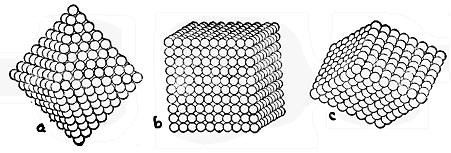
Fig. 70.—Piles of shot arranged to give some idea of the manner in which molecules are bound together in various crystal forms. (After Whitlock, New York Museum.)
A combination of certain facts regarding crystals furnish all but absolute proof of some sort of regularity of arrangement of particles within them. Among such facts are the following: (1) the wonderful regularity of arrangement of faces upon crystals is practically impossible to account for except as the outward manifestation of regularity of structure or systematic network arrangement of the interior; (2) most crystals split or cleave more or less perfectly in one or more directions presumably in accordance with certain layered structure of the constituent particles; (3) all of the many known forms of crystals can be accurately grouped in regard to their effects upon the passage of light (especially polarized light) through them, each kind or type of network structure presumably producing a different effect upon light; and (4) X-ray photographs have proved that particles, or at least groups of particles, are very systematically arranged within crystals.
It will be instructive for us to make a comparison between the growth of crystals and organisms. Both really grow, but each species of organism is rather definitely limited in size while there is no known limit to the size which may be attained by a crystal so long as material is supplied to it under proper conditions. As a matter of fact crystals vary in size from microscopic to several feet in length, those less than an inch in length being most abundant by far. Organisms mostly grow from within, while crystals grow from material externally added. It is an astonishing fact that in crystals as well as organisms growth takes most rapidly on a wound or broken place. Thus if a crystal is removed from the solution in which it is growing and put back after a corner has been broken off, the fractured surface will build up more rapidly than the rest. Finally, crystals are not necessarily limited in age like organisms. Under certain natural conditions, as, for example, weathering, crystals may decay or be broken up; but where they are protected as constituent parts of rock formations well below the earth’s surface they may remain unchanged for indefinite millions of years. Thus in a ledge of the most ancient known or Archeozoic rock only recently laid bare by erosion one may see crystals which are precisely as they were when they crystallized many millions of years ago.
One of the most remarkable properties of a crystal is its symmetry, by which is meant the greater or less degree of regularity in the arrangement of its faces, edges, and vertices. A given substance may, according to circumstances, crystallize in a variety of forms or combinations of forms, but, with very few exceptions, all crystals of a given substance exhibit the same kind or grade of symmetry. There are three kinds of crystal symmetry, namely, in respect to a plane, a line or axis, and a point or center. A plane of symmetry divides a crystal into halves in such a way that for every point on one side of the plane there is a corresponding point directly opposite on the other side. Crystals may be cut into halves along various surfaces which are not symmetry planes. An axis of symmetry is a line about which a complete rotation (or in a few cases rotation combined with reflection) brings the crystal into the same relative position two, three, four or six times, these being called two, three, four, and sixfold axes of symmetry—no others being possible. A crystal has a center of symmetry when any line passing through it encounters corresponding points at equal distances from it on opposite sides. There are just 32 classes or combinations of the symmetry elements among crystals and just 232 definite crystal forms. Not only is it demonstrable that no more can exist, but actual experience with crystals of hundreds of species of minerals has never revealed any more. Obviously, then, symmetry furnishes us with a very scientific basis of classification of crystals, all of the 232 crystal forms constituting the 32 symmetry classes being in turn referable to seven fundamental crystal systems. To bring out the relations of the faces of a crystal and further aid in classification, prominent, straight lines or directions passing through the center of a crystal are chosen as crystallographic axes. Such axes may or may not coincide with symmetry axes. Basing our definitions upon both symmetry axes and crystallographic axes, the seven systems are as follows:
1. Isometric. There must be at least four threefold axes of symmetry, while the highest grade symmetry class of the five in the system includes three fourfold, four threefold, and six twofold axes of symmetry; nine planes of symmetry; and a center of symmetry. There are three interchangeable crystallographic axes at right angles to each other.
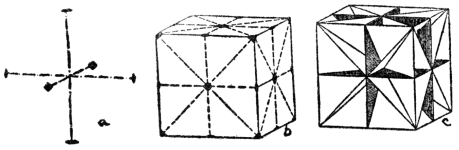
Fig. 71.—Figures showing, a, crystal axes of Isometric system; b, points of emergence of the nine axes of symmetry in a cube of the Isometric system; c, nine planes of symmetry in a cubic crystal. (After Whitlock, New York State Museum.)
2. Tetragonal. There must be one and only one fourfold symmetry axis, while the highest of its seven symmetry classes contains also four twofold axes of symmetry; five planes; and a center. Characterized by three crystallographic axes at right angles to each other, only two of them interchangeable.
3. Trigonal. Characterized by one and only one threefold symmetry axis, the highest of the five classes having also three twofold axes; four planes; and a center. Crystallographic axes as for hexagonal.
4. Hexagonal. One and only one sixfold axis of symmetry must be present, but the highest of the seven classes also has six twofold axes; seven planes; and a center. Characterized by four crystallographic axes, one vertical and three interchangeable horizontal axes making angles of 60 degrees with each other.
5. Orthorhombic. There must be no axis of symmetry higher than a twofold and three prominent directions (i.e., parallel to important faces) at right angles to each other, the highest grade of the three classes having three twofold axes; three planes; and a center. There are three noninterchangeable crystallographic axes at right angles.
6. Monoclinic. There is no axis of symmetry higher than a twofold and only two prominent directions at right angles to each other, the highest of the three classes having one twofold axis; one plane; and a center. There are three noninterchangeable crystallographic axes, only two of which are at right angles.
7. Triclinic. There is no axis of symmetry of any kind, and there are no prominent directions at right angles. One of the two classes has a center of symmetry only, and the other no symmetry at all. Characterized by three noninterchangeable crystallographic axes, none at right angles.
A fact which should be strongly emphasized is that crystals only, of all the objects of nature, can be definitely referred to the above seven systems comprising the 32 classes of symmetry, and 232 crystal forms. Since there are about 1,000 mineral species and only 232 fundamental forms, it necessarily follows that two or more species may crystallize in the same form within a class, so that it is not always possible to tell the species of mineral merely by its crystal form. It is, however, a remarkable fact that, where two or more substances crystallize in the same class (i.e., show the same grade of symmetry) each substance almost invariably exhibits “crystal habit” which is a pronounced tendency to crystallize in certain relatively few forms or combinations of forms out of the many possibilities. It is clear, then, that grade of symmetry combined with “habit” are of great practical value in determining crystallized minerals, because, on the basis of symmetry, a crystal is referred to a certain definite symmetry class in which only a limited number of substances crystallize, and then, by its characteristic “habit,” the particular substance can be told.
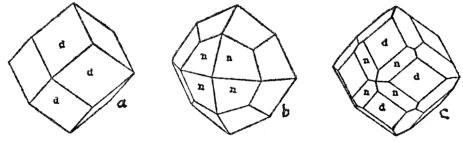
Fig. 72.—Figures illustrating three crystal forms with exactly the same symmetry elements; a and b are separate forms, and c is a combination of the two. The mineral “garnet” nearly always crystallizes in one of these forms.
From the above discussion it should not be presumed that crystals always develop with perfect geometric symmetry. As a matter of fact such is seldom the case because, due to variations of conditions or interference of surrounding crystals in liquids (ordinary or molten), a crystal usually grows more rapidly (by building out faces) in certain directions than in others. Under such conditions actual crystals are said to become distorted because they are not geometrically perfect.
Whether geometrically perfect or not, all crystals respond to the law of constancy of interfacial angles which means that on all crystals of the same substances the angles between similar (corresponding) faces are always equal. This is one of the most fundamental and remarkable laws of minerals. That it must be true follows from the fact that the crystal faces merely outwardly express in definite form the definite internal structure or arrangement of particles which have built up the crystal. In other words, the real structural symmetry of a crystal never varies no matter how much its geometric symmetry may vary. The practical application of the law of constancy of interfacial angles lies in the fact that in many cases a mineral may actually be identified merely by measuring the interfacial angles of its crystal form.
The relative lengths of the crystallographic axes is a very important feature of all crystals except those of the isometric system in which the axes are always of equal length so that the ratio is 1:1:1. In all the other systems, however, at least one axis differs in length from the others and, since the amount of difference is absolutely characteristic of each substance, the axial ratio of a crystal, when carefully determined by measurement of the angles between the different faces, affords a never-failing method of determining the mineral for all systems except the isometric. By way of illustration, the tetragonal crystal of the mineral zircon, with only one axis different in length, shows the very definite axial ratio 1:1:0.64, while the orthorhombic crystal of sulphur, with all three axes of different lengths, has an axial ratio 0.813:1:1.903. These ratios of course always hold true no matter what the size or particular outward form of the crystal.
As might be expected from the above discussion of the remarkable structure of crystals, experience has proved that the relative lengths of all intercepts (or distances from the center) of all faces upon any crystal can be expressed by whole numbers, definite fractions, or infinity. It necessarily follows that the ratios between the intercepts of the faces of any face on a crystal to those of any other face on the same crystal may always be expressed by rational numbers, and this is known as the law of definite mathematical ratio. It is a remarkable fact that very small whole numbers or fractions, or infinity or zero, will always express the intercepts of any crystal face.
Thus far our discussion has centered about crystals as individuals, but, in most cases by far, they form groups or aggregates. Most commonly crystal grouping is very irregular, but by no means rare is parallel grouping where whole crystals, or more usually parts of crystals, have all corresponding parts exactly parallel. But most remarkable of all are the twin crystals in which two or more crystals intergrown or in contact have all corresponding parts in exactly reverse order. The conditioning circumstances under which twin crystals develop are unknown.
In the light of the facts and principles above explained, the reader will more than likely agree with the author that crystals rank very high among nature’s most wonderful objects. But there are still other characteristic features of crystals naturally resulting from their marvelous structure. Some of these will now be briefly referred to.
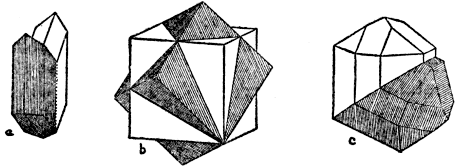
Fig. 73.—Figures illustrating twin crystals: a, gypsum (Monoclinic system); b, fluorite (Isometric system); c, cassiterite (Tetragonal system). (After New York State Museum Bulletin.)
Many crystals and crystalline substances exhibit the important property known as cleavage which is the marked tendency to break easily in certain directions yielding more or less smooth plane surfaces. As would be expected, a cleavage surface is always parallel to an actual, or at least a possible, crystal face, and it takes place along the surfaces of weaker molecular cohesion. The degree of cleavage varies from almost perfect, as in mica, to very poor or none at all, as in quartz. The number of cleavage directions exhibited by common minerals is illustrated as follows: mica, one; feldspar, two; calcite, three; and fluorite, four.
It is a striking fact that when a crystal or cleavage piece is placed in a solvent, the action proceeds with different velocities in crystallographically different directions and little pits or cavities, called etching figures, are developed on some or all of the faces. Since the symmetry of these etching figures and their arrangement upon the faces are directly related to, and natural effects of the crystal symmetry, the figures often furnish an important method of placing a doubtful crystal or even merely a cleavage fragment in its proper symmetry class.
Another marvelous property of crystals and crystalline substances is their effect upon light. Since the study of the passage of light through crystals has really become a large separate branch of mineralogical study, we can no more than state a few fundamental facts and principles in the short space at our disposal. Light is caused by vibrations of the so-called “ether,” and always travels in straight lines. The vibration directions are at right angles to the direction of transmission of the light. When a ray of light enters a crystal or crystalline mineral representing any crystal system except the isometric it is doubly refracted (i.e., broken into two rays), each of the two rays is polarized (i.e., made to vibrate in a single plane only), and one ray vibrates almost at right angles to the other. Double refraction is strikingly shown by placing a piece of clear calcite (Iceland spar) over a dot on paper when two dots instead of one are visible. The amount of double refraction varies with the substance, and in some degree according to the direction of passage of light through a crystal. Isometric crystals only are singly refracting and hence a ray of light is not affected in passing through them. Crystals of all the other six systems doubly refract and polarize light and in three systems—tetragonal, hexagonal, and trigonal—one direction (coincident with the main axis of symmetry) produces single refraction only, while in the remaining three systems—orthorhombic, monoclinic, and triclinic—there are always two directions of single refraction whose positions vary with the substance. Many crystals outside the isometric system also exhibit a remarkable tendency to absorb light differently in different crystallographic directions, thus producing two or three color tints, which vary according to the substance. After gaining a practical knowledge of the above and many other optical properties of crystals, it is possible by the aid of a specially constructed (polarizing) microscope, to recognize (with few exceptions) each one of the many mineral species. This method is of great value in determining the various minerals which are aggregated in the form of a rock, in which case a very thin slice of the rock is studied with the microscope.
An important criterion for the recognition of minerals is hardness, by which is meant the resistance of a smooth surface to abrasion or scratching. The generally adopted scale of hardness follows:
1.—Soft, greasy feel, and easily scratched by the finger nail (e.g., talc).
2.—Just scratched by the finger nail (e.g., gypsum).
3.—Just scratched by a copper coin (e.g., calcite).
4.—Easily cut by a knife, but does not cut glass (e.g., fluorite).
5.—Just scratches soft glass, and is cut by a knife (e.g., apatite).
6.—Harder than steel, and scratches glass easily (e.g., orthoclase).
7, 8, 9, and 10.—Harder than any ordinary substance and represented in order by quartz, topaz, corundum, and diamond.
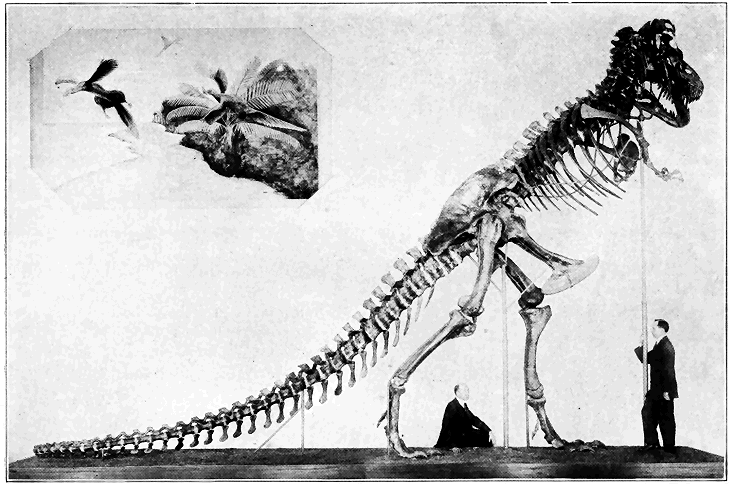
Plate 17.—Skeleton of the Great Two-Legged, Carnivorous Dinosaur Reptile, Called “Tyrannosaurus,” Which Lived During Cretaceous Time. (Courtesy American Museum of Natural History.)
Small Picture.—Restoration of the Earliest Known Bird of Which Several Nearly Perfect Skeletons Have Been Found. This feathered creature with reptilian characteristics lived at least 5,000,000 years ago. It had a long vertebrated tail, claws on the ends of the wings, and teeth. (By E. W. Berry.)
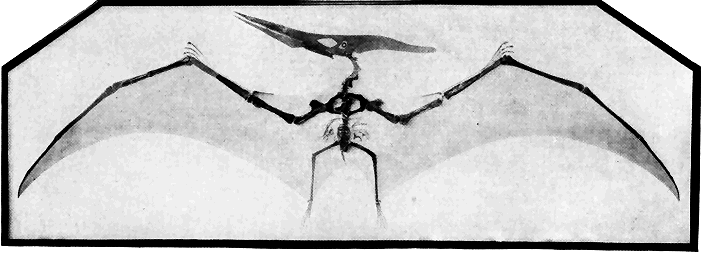
Plate 18.—(a) Skeleton of the Largest Known Creature That Ever Flew. It was a flying reptile with spread wings of nearly twenty-five feet, and lived during the Cretaceous period several million years ago. (Courtesy of the American Museum of Natural History.)
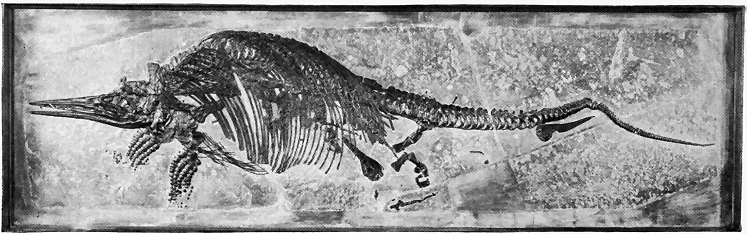
Plate 18.—(b) Skeleton of a Remarkable Swimming Reptile of the Mesozoic Era. Length about twelve feet. Parts of skeletons of unborn young are seen. (Courtesy of the American Museum of Natural History.)
Minerals also show a great variety of colors. Many of them like quartz and calcite are colorless or white, others like galena (steel-gray) and pyrite (brass-yellow) show inherently characteristic colors, while still others like amethyst (purple) and sapphire (blue) are colored by impurities.
There is also a great range in relative weights or density of minerals, commonly called the specific gravity, which range from less than one for ice to 21.5 for platinum, and even somewhat higher. The average specific gravity of all minerals of the earth is about 2.6.
In the light of the above discussion of the general properties of minerals, we shall now proceed to name and briefly describe some of the minerals which are either very common, or of special interest, or of special economic importance. Only those features are listed by which the mineral species may be recognized at sight, or by the aid of very simple nonchemical tests.
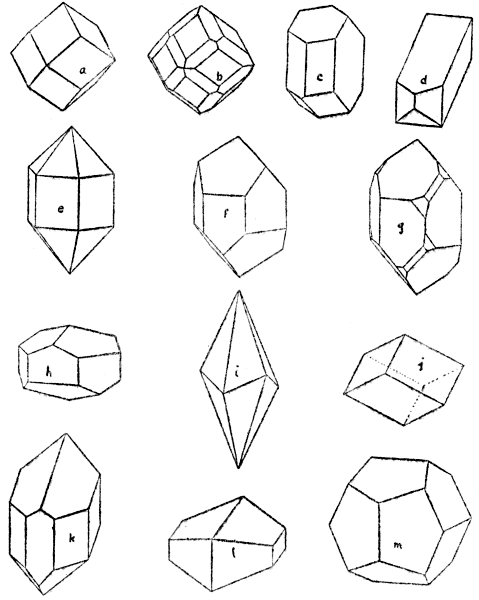
Fig. 74.—Drawings showing forms of crystals of common minerals: a and b, garnet (Isometric); c and d, feldspars (Monoclinic); e, f, and g, quartz (Trigonal); h, i, and j, calcite (Hexagonal); k, augite (Monoclinic); l. hornblende (Monoclinic); m, pyrite (Isometric).
Amphibole. A number of species closely related in composition, crystal form, and properties are here included. They are silicates of lime and magnesia usually with aluminum and iron. Most common by far are those which crystallize in the monoclinic system with prismatic faces and two good prismatic cleavages meeting at about 24 degrees. Color, commonly brown to black, but sometimes green or white. Hardness varies from 5 to 6, and specific gravity from 3 to 3.4. Hornblende, the most common species, is a dark colored silicate of lime, magnesia, aluminum, and iron. It is one of the few most common of all mineral species, especially in igneous and metamorphic rocks. Tremolite is a white to light gray silicate of lime and magnesia found especially in metamorphic limestones. Actinolite is a green silicate of lime, magnesia, and iron especially common in certain metamorphic rocks. One kind of jade is an amphibole similar to tremolite and actinolite in composition, while the other kind is a pyroxene (see below). Jade is and has been highly prized in the east (especially in China) where it has been carved into many objects of exceptional variety and beauty. Jade is probably the toughest (not hardest) of all minerals because of its wonderful microscopically fibrous structure. In color it is white, gray, and green.
Apatite. Crystallizes in the hexagonal system with a six-sided prism usually capped at each end by a six-sided pyramid (see Figure 75g). Composition, a phosphate of lime. Color variable, but mostly white, green, or brown. Hardness of 5, or just enough to scratch soft glass. Specific gravity, 3.2. No good cleavage. Tiny crystals are widely disseminated through many common rocks—igneous, metamorphic, and sedimentary. In certain metamorphic limestones excellent crystals a foot or more in length have been found. Apatite, mostly in uncrystallized form, is the source of most of our phosphate fertilizers.
Azurite. An azure-blue hydrous carbonate of copper which crystallizes commonly in small monoclinic crystals. Hardness, nearly 4, and specific gravity, nearly 4. Commonly occurs in veins deposited by underground water. One of the great ores of copper, especially in Arizona, Chile, and Australia.
Barite. A sulphate of barium crystallizing in orthorhombic prisms usually of tabular habit. White to light color shades. Hardness, 3.5; specific gravity, 4.5, which is notably higher than the average of light-colored minerals. Three good cleavages parallel to principal crystal faces. A common and widely distributed mineral, especially in many vein deposits associated with certain ores. Used in ground form to give weight to certain kinds of paper and cloth, and a barium compound used for refining sugar is made from it.
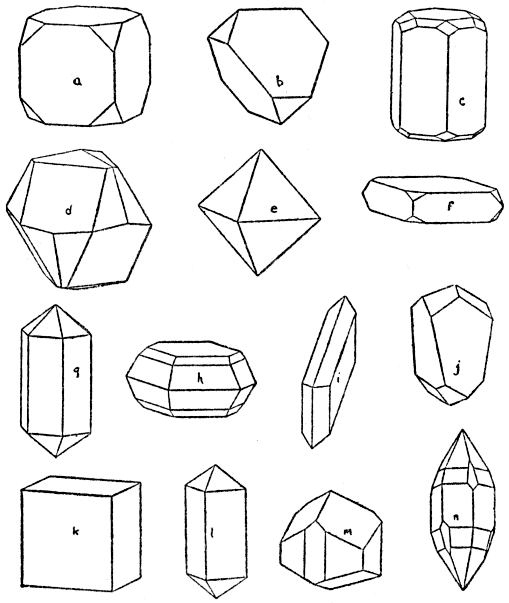
Fig. 75.—Crystal forms cf common minerals: a, galena (Isometric); b, sphalerite (Isometric); c, beryl (Hexagonal); d, hematite (Hexagonal); e, magnetite (Isometric); f, barite (Orthorhombic); g, apatite (Hexagonal); h. sulphur (Monoclinic); i, gypsum (Monoclinic); j, chalcopyrite (Tetragonal); k, fluorite (Isometric); l, zircon (Tetragonal); m, tourmaline (Trigonal); n, corundum (Hexagonal).
Beryl. A silicate of aluminum and the rare chemical element beryllium. Hexagonal crystals usually of very simple six-sided prismatic habit (see Figure 75c). Color white, green, blue, or yellow. Specific gravity, 2.8. Cleavage practically absent. It is a very exceptionally hard mineral, being 8 in the scale. Very large crystals have been found, as, for example, in New Hampshire, where single crystals several feet long weigh a ton or more. Beryl is also of special interest because two of its varieties—emerald (green) and aquamarine (blue)—are well-known gem stones, the emerald being one of the most highly prized gems. The colors are due to slight impurities. Beryl most commonly occurs in dikes of coarse granite called pegmatite, but also in certain metamorphic and sedimentary rocks.
Calcite. Commonly called “calc spar.” A carbonate of lime. Hexagonal crystals in a great variety of forms, but all with crystal faces arranged in sixes around the principal or vertical axis forming rhombohedrons, prisms, or double-pointed pyramids. The principal axis of symmetry is sixfold by a combination of rotation and reflection. Very perfect cleavages in three directions yielding fragments whose faces make angles of 75 and 105 degrees. Color, white when pure, but variously colored when impure. Hardness, 3 (very easily scratched by a knife); specific gravity, 2.7. Calcite is a very common mineral, especially in limestone (including chalk) and marble which are usually largely made up of it. Also commonly found in veins, and as spring and cave deposits (stalactites). A porous, stringy variety, called travertine, is deposited by certain hot springs, as at Mammoth Hot Springs in Yellowstone Park. A very transparent crystalline variety is called Iceland spar. Calcite is a very useful mineral. Limestone and marble are widely used as a building stone, and for decorative purposes, statuary, etc. Limestone is burned for quicklime, used as a flux in smelting certain ores, in glass making, etc.
Cassiterite. The one great ore of tin whose composition is oxide of tin. Tetragonal crystallization (Figure 73c). Hardness greater than steel, being over 6 in the scale. Specific gravity 7, which is notably high. Color, brown to nearly black. Cleavage, practically absent. Fairly widespread in small amounts, and in commercial quantities in only a few localities, usually in veins in granite or metamorphic rocks near granite, as at Cornwall, England, also in the form of rounded masses in gravel deposition as in the Malay region.
Chalcocite. Crystallizes in the orthorhombic system, usually in tabular form, but crystals not common. A black sulphide of copper with metallic luster. Hardness, nearly 3; specific gravity, nearly 6. No cleavage. Chalcocite occurs in vein deposits as one of the important copper ores, especially at Butte, Montana.
Chalcopyrite. Known as “copper pyrites,” (Figure 75j). A deep brass-yellow sulphide of iron and copper. Seldom crystallized in tetragonal forms. Hardness, 3.5; specific gravity, over 4. No cleavage. Metallic luster. Widely distributed in vein deposits associated with other metal-bearing minerals. A very important ore of copper, especially at Rio Tinto, Spain.
Chlorite. A soft, green mineral, usually in small tabular crystals, in general appearance much like mica (see below), but unlike mica, the almost perfect cleavage leaves are not elastic, though they are flexible. Composition, a silicate of aluminum and magnesia. Always of secondary origin as a result of chemical alteration of certain other minerals, such as biotite-mica, pyroxene or amphibole.
Cinnabar. A vermilion-red sulphide of mercury. An extra soft metallic mineral, only 2.5 in the scale. Specific gravity over 8, which is notably high. Completely vaporizes on being heated. Small trigonal crystals rare. Cinnabar is the one great ore of mercury, occurring in veins, especially in California and Spain.
Copper. Copper as such (so-called “native copper”) is widely distributed in veins, usually in small amounts with other copper minerals, but in the great mines of northern Michigan it occurs in immense quantities as the only important ore. It is readily recognized by its color, softness (less than 3), and notable weight (specific gravity, nearly 9). Isometric crystals uncommon.