GABRIELE ROSSETTI
William Michael Rossetti translation
As the career of Gabriele Rossetti was much mixed up with political and dynastic events in the Kingdom of Naples (or of the Two Sicilies), it may be as well at starting to give a very brief résumé of historical facts.
In the year 1734 the Kingdom of Naples, in the resettlement of Europe consequent upon the Treaty of Utrecht, was under the dominion of the Empire, or, as we should now word it, of Austria; but in that year an almost bloodless conquest brought-in a different dynasty. Charles, Duke of Parma, a son of the Bourbon King of Spain, Philip V., by his second wife Elizabeth Farnese, a spirited youth only seventeen years of age, determined to assert his ancestral claims upon the kingdom, and in a trice he was firmly seated upon the Neapolitan throne. His government, though in a sense despotic, was popular and enlightened. In 1759 he became by succession King of Spain; and, under the obligation of existing treaties, he relinquished the Kingdom of Naples to his third son, Ferdinand, aged only eight. In 1768 Ferdinand married Maria Caroline, daughter of the Emperor Francis and of Maria Theresa, and sister of Marie Antoinette.
Ferdinand IV., as he was then termed (afterwards Ferdinand I.) was a man of no great ability, but of vigorous physique, and sufficiently well-disposed as a sovereign; his wife, strong-minded and domineering, was the more active governor of the two, and promoted various innovations, some of which fairly counted as reforms. Things went on well enough for the rulers and the subjects until the outbreak of the French Revolution in 1789, when Neapolitan opposition to France and all things French became pronounced. Queen Caroline naturally did not relish the decapitation of her sister in 1793, and hostilities against the Republic ensued. In 1798 the king decamped to Sicily, and in the following year his continental dominions became the “Parthenopean Republic.” This was of short duration, January to June 1799. The Southern provinces rose in arms, under the leadership of Cardinal Ruffo; the French army departed, and Ferdinand was re-installed in Naples—Lord Nelson, victorious from the Battle of the Nile, playing a large part, and a much-debated one, in this transaction. Ferdinand now ruled with great rigour, and committed some barbaric acts of repression and retaliation, for which his consort was regarded as gravely responsible. The great Napoleon, Consul, Emperor, and King of Italy, was not likely to tolerate for long the anti-French severities, demonstrations, and intrigues, of “il Rè Nasone,” as Ferdinand was nicknamed in virtue of his portentously long and prominent nose. Early in 1806 Ferdinand and Caroline disappeared once more into Sicily, under British protection, and Joseph Bonaparte was enthroned in Naples. Joseph, in 1808, was transferred to the Spanish kingdom; and Joachim Murat, brother-in-law of Napoleon and of Joseph by his marriage with their sister Caroline, reigned in Naples in his stead. Ferdinand, with the other Caroline, remained meanwhile unattackable in Sicily, and was turned into a constitutional king there by British predominance. In 1815, on the final collapse of the Napoleonic régime, and very shortly after the death of his Queen, he returned to Naples.
These particulars, meagre as they are, seem to be sufficient to show what was the historical background to the fortunes of Gabriele Rossetti, with whom alone I am directly concerned. He was born under a recently-established dynasty, in a kingdom of despotic rule and many relics of feudalism; from the age of twenty-three to thirty-two he was the subject of a new and intrusive dynasty, not less despotic, but free from all trammels inherited from the past. Then in 1815 he again came under the old system, but in a state of public feeling and aspiration which rapidly led to a constitutional government, sworn to by the sovereign, and abolished by him at the first opportunity.
I propose to relate my father’s life in his own verse as translated by me, supplemented by a little of my prose. It was towards the year 1850, when his general health and strength had grievously decayed, and he was conscious of the imminent approaches of death, that he composed a versified autobiography, of which the great majority is here embodied. He wrote it in rhymed sextets; but I, for ease and literality, have rendered it into blank verse. His own verse is, as he himself acknowledges, here pitched in a very subdued key, with little endeavour after poetic elevation; though there are some passages in a higher strain. My translation makes still less pretension as poetry; it conveys the sense with strict accuracy, and that is all it affects. My father retained in his old age some of the habits of “poetic diction” which had been customary in the Italy of his youth; and one finds here more than one quite wants of Phœbus, Neptune, Minerva’s fane, and other “rattle-traps of mythology” (to borrow a phrase from William Blake); in all this I follow my original. The versification of the Italian text is often ingenious, and even masterly; abounding in dactylic line-endings, or rime sdrucciole, as the Italians call them—a difficult feat, at which Rossetti was uncommonly deft. I have given the great bulk of the production—which, indeed, I had in the first instance translated in full; but eventually I thought some passages here and there, and also some amplifications of phrase, useless for the purposes of the British reader, and have therefore excluded them. The whole of the expressly biographical matter is preserved. Those notes which are not marked by an initial are my father’s own; those to which “W.” is appended are mine—there being several points which seemed to need some explanation.
My material does not call for much division or subdivision. I shall therefore simply separate it into the Life of Gabriele Rossetti (his full Christian names were Gabriele Pasquale Giuseppe) in Italy, and his Life in Exile, Malta and England; and, plunging at once into the versified autobiography, I commence the
LIFE IN ITALY
I know my fame will have but scanty flight, Readers to whom I speak of Italy. Yet, if in any of you there rose a wish To know me who I am, I’ll meet it here. Ovid’s own native soil is mine as well: He spoke about himself, and so will I. In verses Ovid wrote, but I in prose— Prose of eleven syllables with rhymes; But, be they verses, I shall not contest. And, without more preamble, hear me now.
Along the beach of the Frentani lies On teeming hills, the Adriatic near, A small municipality of Rome— Histonium once and Vasto now ’tis called. There, with no waft of Fortune, I received A humble cradle from a worthy pair.[1]
The brief statement of my father, in his verses and his note, may be slightly extended. Nicola Rossetti was a blacksmith and locksmith; his wife, Maria Francesca Pietrocola, was the daughter of a shoemaker. Both families seem to have held a creditable, though certainly a by no means distinguished, position in the small Vastese community. The original name of the Rossetti race (as I have heard my father more than once affirm) was not Rossetti but Della Guardia. Some babies in the Della Guardia family were born with red or reddish hair (I presume, four or five generations before my father’s birth); and the Vastese—who, like other Italians, never lose a chance of calling people by nicknames—termed them “the Rossetti”—i.e. “The Little Reds,” and this continued to serve as surname for their progeny. Thus the surname Rossetti may be regarded as equivalent to the English surname Reddish, or Rudkins (if Rudkins is an abbreviation of Ruddykins). The family of Della Guardia still exists in Vasto. It appears to have been entitled to bear a crest—which is a sturdy-looking tree, with the motto “Frangas non flectas”; for a seal (still in my possession), showing this crest and motto, was delivered to Gabriele Rossetti, on his quitting Vasto in youth, by his elder brother the Canon Andrea, who told him that it was the family-device. This was often used, I may add, by Dante Gabriel Rossetti. It appears that in the Rossetti line, or else in the Della Guardia line, there must have been some degree of literary eminence prior to the date of the blacksmith Nicola; as I find, in a letter addressed by Gabriele Rossetti, towards 1807, to his elder brother Domenico, the phrase: “You know that our stock has always abounded in great men of letters.” One cannot suppose that this statement is a mere fib: I have not, however, found any confirmation of it in books about Vasto, nor do I remember that my father ever referred to such a matter by word of mouth.
I believe that Nicola Rossetti came to his end in a distressing way. When the French Republican army invaded the Neapolitan territory in 1798, the troops required Nicola to render some service, such as horseshoeing, provisioning, transport, or what not. He showed no inclination to comply, and was beaten or otherwise ill-treated; and this so preyed on his mind that his health suffered, and death ensued. His decease may, I presume, have occurred towards 1800; his widow survived till 1822 or some such date. Gabriele Rossetti used to speak with much affection of his mother, who (like so many Italian women of the lower middle class in those days) could neither write nor read. He remembered his father as a somewhat harsh man, but upright and worthy of respect. The Rossetti family is now wholly extinct, save in the persons of myself and my four children; the line of my father’s married sisters is also extinct.
The precise date of my father’s birth was 28th February 1783 (not 1st March, as has at times been written and printed). He was born in a lofty brown building, which, in a water-colour with which I was favoured towards the date of the Vastese centenary celebration of his birth, wears a somewhat stately though wholly unadorned aspect. It looks like an edifice which has stood for some centuries, solid but uncared for. It is now, I understand, a dilapidated structure, let out in tenements to a poor class of people. The question of buying it for the city of Vasto, in memory of Gabriele Rossetti, has often been mooted, but not carried into effect. There are prophets who have no honour in their own country; and others who, rather profusely honoured there by word of mouth, are left in the lurch when deeds and subscriptions are in demand.
In the first opening years of joyousness I showed clear sign of studious aptitude; And, following my brothers, three in count, Whose lively parts had been in evidence, I was escorted by this goodly three Into Apollo’s and Minerva’s fane.[2]
Thrilled by the first Phœbean impulses, Rough versicles I traced with facile hand: And yet, to my surprise, those lines of mine Almost took wing into a distant flight. A hope of Pindus did I hear me named: But praise increased my ardour, not my pride. And yet some vanity there came and mixed With the fair issue of my preluding: But, all the more I heard the applause increase, With equal force did study grow in me. Not surely that I tried to load my page With pomp abstruse extraneous to my drift; But counterwise each image and each rhyme, The more spontaneous, so meseemed more fair. In trump of gold and in the oaten pipe Let some seek the sublime, I seek for ease. I shunned those verses which sprawl forth untuned Even from my days of schoolboy tutelage: I know they please some people, but not me: Admiring Dante, Metastasio I laud; and hold—a true Italian ear Must not admit one inharmonious verse. Some lines require a very surgeon’s hand To make them upon crutches stand afoot. So be they! But, to set them musical, They must, by Heaven, be in themselves a song. This seems a truthful, not a jibing, rule— Music and lyric are a twinborn thing. Yet think not that I deem me satisfied With upblown empty sound without ideas:— Then will a harmony be beautiful When great emotions and great thoughts it stirs.
To painting with an equal ardency An almost sudden impulse led me on; And with the pen I drew in such a mode That all my work would look as if engraved. To question what I say would nothing serve, For on my hands more than one proof remains.[3] A plaining ditty which describes my state, And wherein I deplore my fate perverse, And whose adorning is two pen-designs, Is still preserved among my earliest scraps: And many more, for him who disbelieves, Can thoroughly attest what I aver.
Not every magnate takes to banqueting, Or lust of Cyprus and Pentapolis. The Marchese di Vasto, a high-placed lord, The King of Naples’ Majordomo in Chief (Whatever face he show in history, By me his memory must be always blest), Being once in company with men of mark Whom he was wont to invite from time to time,— My verses read by him, and drawings seen— Felt pleased that I was of his vassalage; He wrote to his agent telling him of this And bidding him to send me on to Naples.[4] There I was patronized, without parade, By him, who from the first received me well: But little did that firm support endure, For a political whirlwind cut it short. Poor I—how fare in a vast capital? I had to bow before my destinies. For scarcely had a year and month elapsed, In which new studies occupied my mind, When the French army of invasion came In the sixth year of this our century,— And, seeking Sicily in urgent flight, The Marquis vanished with the perjured King. Then for the kingdom rose an altered time, And all the people vied to give it hail, For they abhorred that Bourbon void of faith, With executions and with treasons smirched,— And more his wife, a type unparagoned, Megæra, Alecto, and Tisiphone. I will not paint that husband and his wife— Thank Heaven, the tomb has swallowed them ere now. Their grandson—this suffices—pairs them both, Re-named King Bomba, monster in human form.
On saddened brows a few, and many glad, I read the souls of men enslaved or free: And, mixed myself ’mid such conflicting minds, Judge you if I was joyful or was grieved. The festive thundering of the martial forts Responded to by frequent trumpet-call, Cheers that were uttered by a thousand mouths As the tricoloured banner came in view, And hurly-burly weltering all around, Opposed enormous joy to enormous grief. Yet thoughts, more than enough, ominous and black, Whispered me somewhile ’mid those shouts of joy: “My hapless country, what dost thou acclaim, Now that one despot goes and one arrives? Ah on thy shoulders still I find the yoke: They doff the old one and they don the new.” And from my heart the words leapt to my lips: “To call this liberty were sure a jibe! As Ferdinand in Naples stifled her, So Bonaparte butchered her in France. But tremble, tremble, impious man! Thy crime On all the nations’ hearts stands written deep.”
I was a prophet here. Germany in arms, A nation of great hearts and thought as great, Avenging Freedom foully done to death, Against him let whole populations loose. Behold him fallen on field, captive at sea: By Liberty he rose, by her he fell. France in my youthful fervency I loved, I loved the awful warrior guiding her: But, when I heard, “He’s made an Emperor now, Nor that alone, but despot autocrat,” The hate I felt extinguished all that fire.
For many ’twas a cause of deepest grief To contemplate with golden diadem A brother of that despot on our throne. His praise was—having turned the Bourbon out; Whence, setting every other thought at rest, They all applauded him, and so did I. A chosen band of daring souls and brave Encircled the incoming Frenchman round,[5] And of two evils they acclaimed the less, Awaiting a true good to come one day. Round the new sceptre flocking now I marked A crowd of shining minds, and joyed herein; And, taking up the lyre resolvedly, Inly I said: “A poet I was born, And such I will be in my future course!”[6] The use of reason scarce had I attained When France’s thundercloud I heard that pealed—Which next diffused around and far-afar Terror to Kings, to nations hopefulness. At dawning of my lifetime I resolved To follow in that movement—and alas! From the successive shiftings of the chance, I, loving good, saw evil that ensued. Across the Red Sea, sea of blood and war, Must then the Promised Land be still approached? That fatal whirlwind, with alternate shock, In Naples’ kingdom all-deplorable Full ten times made a change of government, Alternating with serfdom liberty: And, with the flight of that demented court, I saw it for the fourth time altering: And the ninth change and tenth, which now I see, Are the most miserable of them all.
Many gave homage to the new-built throne; And I, while scorning any cringing phrase, Struck on my lyre, and spread abroad its sound, Saluting that forthcoming period: And what I said thereof in varying style, If not free-toned, is not subservient. Soon do the accents of my lyre recall Men’s eyes and praises to the youthful gift, And I diffuse the firstlings of my fame About the kingdom’s mighty capital; But, by attracting blear-eyed rivals too, Envy first made me a target for her darts. And so much did this trouble my repose, And raised hobgoblins such a swarm at home, That, freed from them, my dolorous exile Has almost seemed to me beatitude. How often have I cried—“I am exiled now, And pardon all the rancour of my foes.”
Ah when I think it o’er I shudder still, Though past the sixtieth limit of my years. One Boccanera, livid in his rage, Tempted a bravo to cut short my life; Watchful I had to be for several months: Can then insensate envy reach to this? But who can tell all the contorted roads Which rancour led my rivals to pursue? Charges unjust, anonymous calumnies,— But yet my innocence o’erthrew them all: Intrepid I outfaced such keen attacks, And became known and cherished by the young. In public halls, where it behoved me at times To speak the verses I had written down, The popular applause served to prelude My song, as soon as I appeared in sight.
That my first volume, as it issued forth, Earned me the friendship of distinguished men, And I was made, without soliciting, The Poet for San Carlo’s Theatre. I wrote some dramas there, and every one Of my attempts was followed by success: First Julius Sabinus’ mournful fate, Then Hannibal’s light loves in Capua, And finally the Birth of Hercules,[7] Were greeted with unanimous applause. How much I joyed that on that stately stage My mind was thus allowed to spatiate! “In this arena of glory,” I would say, “If I have genius, I can show it forth”; And dreamed of mingling in one dulcet draught Alfieri’s style with Metastasio’s. But my illusions waned; for various thwarts, And fetters both direct and indirect, And the composers and the Managers, And Prime Donne, plots, and etiquettes, And then protectors and aught stranger still, Frequently shuffled all my hand of cards. Incensed I cried: “I’ll leave the Theatre, For here I’m nothing but a slave of slaves.”
To Monsignor Capecelatro I sped, Our Minister at the time for Home-affairs, And meekly spoke, expounding first the facts, “The Madhouse is not where I want to go.” Could vanity from sovereign patronage Dazzle a free Parnassian intellect? I was content with a subordinate post[8] Then vacant in the King’s Museum; here Propitious did the Muses nurture me With vivid genius of the antique arts. Here I could pasture in the selfsame hour My craving mind, and shelter it from vice, For an immense choice library is joined To the Museum, in one building’s span: And thus a double discipline exalts My soul in beauty’s pathways and in truth’s. ’Mid living bronze and marble animate, Which constantly held converse with my thoughts, I something wrote in prose and much in verse, Evolving grace upon the fair and true.
Staying amid those admirable hoards, A treasure-house of arts and industries, I met with Kings and met with Emperors, Conspicuous artists, men of lettered fame.[9] And thus three lustres of my term of life Wore in that unperturbed abode along; And I beheld two Kings arrive and go, Made and unmade by force of destiny. But, though my work was converse with the dead, I scanned both courts, their virtues and their vice. Of the two kings, one bad, and one was good, And in this sentence all is summarized; And both their fates depended, and their thrones, Upon the man who dreamed omnipotence; But by the Spanish and the Northern storm The star of Bonaparte turned to pale. Odious to many, Joseph went his way,— That silence followed him which speaks for much; Wasteful and lustful and vainglorious, He by his courtiers only was deplored. Better than Ferdinand he was for sure, But that was merit (merit!) none could miss. Later when Joachim of a sudden fled, I heard a general chorus of concern— “If but his mind were equal to his heart, Who worthier than he to fill a throne?” Ferdinand matched with him produces that Which in a picture gives the shades and lights. O epoch memorable for wretchedness! Oh the caprice of barbarous destiny Which sent us back that faithless Ferdinand, Bereaving us of kindly Joachim! And soon the craven to the valiant gave, By the same destiny, a barbarous death.
O Bonaparte, thou the object deemed Of worship? Ah he lies who calls thee great![10] For thee the world claims lofty intellect, For thee, with an enormous error fooled. Thou wast, in wresting from the nations hope, At once liberticide and suicide. That day when thou didst will thee Emperor, Thou in St Helena dugg’st out thy grave: That day thou gav’st back Austria all her strength, To Russia daring, potency to Kings. That edict which the applauding Senate brought To thee, ’twas that the edict of thy death. Well do I know how scheming sycophants Proclaimed the day auspicious and of joy; But that day sowed the mournfulness of years For thee and thine, for nations, for the world. And thou, of piercing sight, thou saw’st it not? By God, a mole would not have failed to see! For thee I weep not, who in long-drawn throes Didst reach convulsive to thy latest hour; But for the innocent nations weep I fain, Who, by thy hand betrayed, are moaning still. Ever have I been prone to pardoning thee Thy proper anguish, but not that of man. But for that crime by which thou didst indue Thee with vast shame and us with sorrows vast, How long ago would Europe have beheld, One after other, low her tyrants sunk! When I the effect contemplate of thy crime, I am tempted to exclaim—Be thou accurst! Receive the judgment of the centuries— I seem to hear it sounding o’er thy grave— “Thou couldst have been the tyrants’ death-dealer, And chosest for thyself a despot’s name. As the keen-cutting vengeful sword of God, Let wrong thou didst to others fall on thee!”
Now the Queen-city, Joachim being gone, Remained uncertain of her future fate; And, like death’s messenger, the cry arose— “Ferdinand hastens back, and Caroline”: And on a thousand gloomy brows one read More horror than for earthquake or the plague. And of those two the most terrific things I heard a hundred hundred tongues narrate. Some travelled, some escaped, some hid themselves, And one was known to have gone mad with fear: But hope, I saw, had halfway been revived When it was published—“Caroline is dead.” Yes, more than halfway; for they all averred: “This Bourbon, in himself, is weak and null; And, if he did become so black a wretch, ’Twas that she-Fury who impelled him on: Now that she’s foundered in the realms of night, A human being he may be once more.” And so it proved. The first-imagined fears Were cleared away from the most troubled minds, And all perceived that on a better plan That richly-gifted Kingdom would be ruled, And would attain, under a milder curb, If not prosperity, at least repose. The Aonian chorus revelled in the peace, And chaunted amid others’ songs my own. Our Ferdinand the Fourth was just a fiend, But, dubbed the First, he wears an angel’s grace. And I beheld that festive ardour grow, The less expected, all the livelier. ’Tis true so much rejoicing was perturbed, In almost every confine of the realm, By feverish epidemic, Noja’s plague, And, worst of all, a longsome year of dearth: But still the King dictated remedies, And, if he could no more, he sympathized.
Then, when he sickened, weighted now with years, And the severe disease seemed past a cure, So great the sorrow everywhere appeared That all the civil orders shared in it; And, when fair daylight followed on the cloud, The joy was equal to the genuine grief. In style now classic or romantic now Native Academies acclaim the event; And I, in verse extemporized almost (And Fame still guerdons it with some applause), Saluted, in the name of Italy, The Bourbon Sovereign restored to health.[11] One Gallo (maybe Corvo?), of Sicily, Who thought himself a swan of Hippocrene— Or Gallo or Corvo, acrid and malign— Trying to do me an ill turn, did a good. And this affair I’m minded to narrate,— A curious little story as it is. He spread on all sides a censorious croak That my address was outrage ’gainst the King: And yet that ode contains such flatteries That, when I now reflect on it, I blush; And he discerned therein, and clamoured loud, An actual insult in the seeming praise.[12] Against my verses such a cackle-cry Was raised by him on one and other hand That in the end our arbitrary Police Prohibited their printing in the book; And many said that I should find myself Dismissed my employ, or sent to jail perchance. The selfsame calumnies against my song, From quarters more than one, arrived in court. The King called for a copy, and, reading it, He was affected, and was moved to tears. The Duke of Ascoli was on the spot, Who with minuteness told me of the facts. Indeed the King so highly prized my lines That he directed the Home-Minister To have me summoned, and to give me thanks In a dispatch sent by the government: And, paper in hand, he added—“Tell him too, I wept at it, and feel indebted to him.” Further to crush that shameless calumny Which he remarked some people still believed, He made the Minister Tommasi read The poem aloud, in Council at the full,— And oh what plaudits did my lines secure! And at some parts the King shed tears anew. I, then at the Museum, saw arrive A Halberdier with grave and serious mien. Ah what uncertainties assailed my heart! Here comes the announcement that will strip me bare! I read, in doubt and wavering, the dispatch: “His Majesty requires you—come at once.” Anxious I sped, and pondered on the way What answer I could offer to the charge. I entered with that sinister forecast, And General Naselli, a Minister, Came forward and encountered me, all smiles. He said “Be seated”—pointing with his hand To a gilded sofa, face to face with him. He, turning with an affable regard Toward me, my eyebrows arching with surprise, Repeats, with manifest complacency, The kindly words used by the Sovereign: And on my countenance he could observe, Mingled with pleasure, some astonishment. I answered—after a simple preluding With which I need not here concern myself— “This moment compensates for studious years,— I’m thankful for the kindness of our King. But, Sir, is any power above his own? What he so much approves others reject.” He answered me with an offended air— “Have you your senses? This I can’t excuse.” And I: “The whole collection is in print, And my one poem only turned adrift; My senses serve me well, your Excellency: The Censorship has over-ruled the King.” He smiled, and then, in a laconic tone, Dictated to his secretary thus: “The poems all must pass the censorship, Except the one by Gabriel Rossetti. From his the printing cannot be withheld, Because the King has passed it and approved.” I showed about all this no great conceit, But it was greeted warmly by the young, And that Sicilian Gallo, envious man, Remained a laughing-stock, and drooped his comb.[13] Then, when my lyric came to public light, It won in Naples universal praise. The fame of it went forth to Rome itself, Where I am proud of being amply known, For there I left a band of well-wishers When the Provisional Government dissolved In which I unobtrusively had held In the Fine Arts a post of eminence.[14] And the Sebezia Academy with pride Noted my victory, which involved its own, And which was viewed with so much bitterness By Gallo that he fled that very night. This Gallo against me, an exile now, Perhaps is crowing still—which I forgive.
In that Parthenopean Company I sang the Threnody for several dead, And for the saintly Bruno d’Amantea, The noble surgeon and philanthropist;[15] And good Valletta, on coming back from Rome, And fair Paloma, did I celebrate.[16] And in the presence of the royal court, Which had erected a majestic tomb, I sang the glory and deplored the death Of the renowned Giovanni Paisiello,[17] Who, the harmonic Siren’s progeny, Bore sway o’er Europe’s music on the stage. Torquato Tasso’s golden trumpet next Blew with my breath, to magnify himself,[18] He mine inspirer from the living stone Which near the sea the King had raised for him; And on that evening the Sebezia Brought from all Europe choicest guests to meet. There the good King of Denmark’s worthy heir Came to embrace me ’mid a crushing throng;[19] And with my daring images I struck French, Russians, Germans, Spaniards, Englishmen.
And now in Sapphic now in Theban mood, I sang beside the urn, with laurel wreathed, Wherein Luigi Quattromani sleeps,[20] A casket from the Bible’s treasure-stores: In him I greeted, and I bless him now, The kindly master in the social friend. Truly a poet—I seem to see him still— Inspired himself, inspiring others too: When blind and old, he in his mind preserved Acutest sight and lively youthfulness.
I interrupt the verse-narrative for a moment, to point out that Rossetti here recounts—what was of leading importance in his Neapolitan career—how he came to be an improvising poet. Luigi Quattromani was a renowned improvisatore, and (so far as I infer) little or not at all an author of verse written and published. The date when Rossetti first knew him, and soon afterwards began improvising, is not here defined; I suppose it may have been towards 1810. When my father came to London in 1824 he resolved not to prolong the practice; thinking, and no doubt rightly, that, although he might excite some surprise and attention by improvising, it would on the whole lower his position as a serious professional man in the teaching and literary vocation. Yet he did occasionally give a specimen of his prowess as an extempore poet; the latest notice I find of such a performance was in his family-circle, in 1840. If I myself ever heard him improvise, I have forgotten it. The observations which he here makes on the dangers of the habit, both to health and to purity of poetic style, are worth noting. He first proceeds with a description of Quattromani’s doings.
Whenso I heard him touch on David’s harp, All fervid with extemporaneous power, Upon his face shone out the impassioned soul Which spread around spontaneous bursts of light. And that same flame I saw a-shine in him On mine own spirit did I feel descend. Yes, what I heard meseemed not possible; ’Twas ecstasy to me, enchantment, dream. But what appeared incredible almost Was coming to be realized in myself. On my way home I tried to do the like, And oh astonishment! I also sang Line after line: so strange the upshot seemed That I renewed the essay for several days. By daytime and by night assiduously Did I repeat that same experiment. Often with Quattromani I conferred, Who gave my verses not a little praise; And once the blind old man exclaimed to me— “Alternate with me in an improvise.” And, after a few trials and demands, He took me up with so much ardent zest That ’mid the pomp of images produced He gave me many a “viva” from his heart. He closed by saying: “For poetic strifes Nature has given you athletic power.” “Persist,” he often said to me, “persist, And let no sloth impede you on your road. A poet you were born, and those who seek To change your course—believe this—envy you. What you at your commencement do with me Might seem the fruit of lengthy studying.” And often did our verses alternate In choice assemblies with co-equal praise, So much men’s judgments wavered in the scales That ’twixt us victory remained in doubt. But this impressed on me the stamp of worth— What honour to contend with such a man! He, like a living mirror, faces me, And, seeing myself in him, I can but grieve. He old and blind, and I too blind and old: And he died poor, and I am dying poor. But which of us the more deplorable? He in his country, I exiled by fate!
Oft on this foreign shore I’ve asked myself, Did my addiction to extempore song Harm me, or profit? I remain in doubt. But this, without nice solving, I’ll affirm— I was becoming palsied and in spasms. A Galen’s rigour ought to cry it down, And thus prevent so miserable an end. ’Twas so my Brother Dominick expired,[21] Who in such efforts was expert and apt. I never heard that brother of mine recite— He left me a child, but I remember him; And well I know that he at Parma’s bar Was greeted as a re-born Cicero. Youthful he died, far from his family— And wherefore died? Because he improvised. More than one symptom has convinced me clear That, through my leaving off that exercise, Exile, in that alone, has been my friend: And so, from much reflection I can say, That mental strain leads to paralysis. Nor only with regard to healthful life Makes it the nerves uncertain and unstrung, But as to writing with correctness too I fear at last it worsens toward neglect. Yes, that it harms the style I can but think: To work a-sudden is not working well. Thou who wouldst merit the Phœbean wreath, O youth, take caution ’gainst this same abuse; For these my verses, written slipshod-like, Perhaps derive from that ill-wont of mine; For now I hurry verse to follow verse, And reel them off as ’twere a kind of talk. Good composition craves a needful space, Not emulous capricious fantasy.
Though such a practice I cannot defend, Still I become renowned because of that. Full many a noted passage from my muse Was quoted, serious and facetious both; And oft-times at the tables of the great, Invited guest and poet, I had my place. What precious days I wasted on good cheer, Whence, save keen penitence, I’ve nothing now! Amid our Princes, Dukes, and Marquises,— Cassero, Campochiaro, Berio— Phœbus joined Bacchus with a joyous note, Doubly to drench the mind’s ebriety. Inflamed and reckless ’mid the toasts and praise, I saw my youthful Muse more daring grown; And, when I went from Naples to the Tiber, I found my fame there copiously diffused. Among the poets whom I cherished there, I give but Biondi’s and Ferretti’s names.[22]
As one of the Provisional Government King Joachim had summoned me to Rome:[23] Monte Citorio there, seven months and more, Saw me employed at morning and at eve; And I was present at the Pope’s return In year thirteen of this our century. And there was likewise put in exercise My Muse, by urgencies a thousandfold; And I again aroused enthusiasm, For poetry in Rome is greatly loved.— Of this no more, for I can hear a voice— “To enlarge hereon were obvious self-conceit.”
Nor does Rome stint herself to mere applause, But gives me titles and diplomas too. The Arcadia, and Tiberine Academy, The Ardenti of Viterbo, and others more, Inscribed my own ’mid many goodly names. In Naples not of the Sebezia alone But the Pontanian Society, And even the Orezia from Palermo, I hold diplomas in this distant land; And, now that I am at my day’s extreme, One also I receive from Lyons in France. I was, not am. The past is all a school Where clear I see the nothingness of man. For me has vanished all: only the grave Awaits me, and thither willingly I go. Life is a lengthened dream, and, when it ends, All lettered glory is a dream as well; And vanity of vanities I mark, Yea even in that which crowns the highest of men Had I the golden trump and deathless name Of Homer, or of Virgil or Torquato, What would the guerdon of my verses be? Just a dissyllable I should not hear. Sad fate!
But I return to Ferdinand,
Auspicious planet to his realm restored. He, by endowing the Sebezia, Seemed patron of our country’s intellect; So that I frequently heard men proclaim— “Demon he went, and angel he returned.” But who can ever change the human soul? He in reverting saw us evermore As liegemen to himself or to Murat: The first he greeted with a cheerful mien, And for the second nursed a secret grudge. Brothers with brothers he did not unite, As should have been effected from the first All the best posts were given away to these, Though oftentimes unjust and ignorant; Those others were neglected and depressed, However honourable and well-informed. A victim I of such partiality, Of which the proofs could day by day be seen; What was my due he gave to some one else. When Naples to their palace had beheld From Sicily return the unrighteous court, In her most famous University The chair of Eloquence was left unfilled; And in the ardour of a youthful hope I too competed ’mid a lettered band.[24] We numbered thirty-six. Before me I saw Conspicuous talents, each more strong than I; And we were set to pass a triple test, Three different subjects taken out by lot: Two, writ in the Professors’ presence there, Who had to be the censors of the themes. The first was in the language of that Rome Who gave her laws and usage to the world; The second, in the tongue of Italy, Classic in style, and resonant and terse; Lastly, the third one had to be pronounced To the assembled public from the chair. For the two writings, Gatti, Oliva, and I, Issued with equal credit from the strife: But in the third and arduous exercise I gained the victory over all the rest. Amid the surging and applauding throng, The Faculty cried many times “Well done!”— Who got the chair? A certain Bianchi did, Who had salient merits as a loyalist. And mice were cutting capers on the forms Deserted by our youth indignantly. I vamp up no fantastic notions here: All Naples can declare it to be true.
The young men, nettled by a noble scorn, Called me Professor—not the other man; And I at home opened a private class, Where I was trainer of some vivid minds: And, if I thither could return one day, How many a pupil should I see around! Ah fervid youth, liege to the beautiful, Who so did sorrow for mine adverse fate, Durso, Malpica, Curci, Caccavon,[25] And others to whose names my bosom beats, In you I glory; and you, choice grateful souls, Glory that I your master was erewhile. The army, by the royal ordinance, Saw heroes now supplanted by poltroons; From the tribunals upright judges banned, And greedy vultures were installed on them; And, what is worse, the Kingdom’s treasury By vultures in like manner was devoured. Likewise a matter so terrific happed As to fill all the Kingdom with dismay. Wicked Canosa, back from Sicily,[26] Invested as the Minister of Police, Conceived a project truculent and vile, Enough for Satan’s self to shudder at. This monster stands by various writers drawn, And I can be excused from limning him: Yet, always by the King’s approval graced, The man’s foul shame reflected on the King. In every crime he out-did every wretch, And now he laboured to out-do himself. He, pondering an atrocious butchery Which for whole weeks he set to ruminate, Filled with the loathliest scum the capital, Offscouring of the gibbets and the hulks; And at a signal these men were to pounce On any whom they saw unlike their crew. That felon was a new Friar Alberic.[27] Oh the hard fate and outrage of our time! The Austrian General fathomed this intrigue, And forced the King to turn the monster out; Inept Italian princes were and are The Austrian Sultan’s underling Bashaws. Escaped from this portentous massacre, We all denounced it with stentorian lungs. And what a sort of crime must that have been Which very Austria spurned!—and truth it is. ’Twas even said the King——But this I scout.
While from the foulness of despotic power Such nauseous effluvia were diffused, A patriotic flame wound everywhere, And a Vesuvius all the Kingdom seemed; And from the augmented crackling underground At last erupted many external peals. Like gushing blood from several arteries Toward the treasury all the money flowed; And with our straits our hardihood increased, So that the government was undermined; Already many free-souled squadrons thrilled, Like winds unloosed to agitate the main. The Carbonari, an unvanquished sect,[28] A vast re-union of audacious souls, Spread with a progress irresistible, As in a wood by winds a tameless fire: Opening I saw a gulf without confine, And on the shelving marge the governors slept. The politicians’ atrabilious brains Called that great movement faction—shame be theirs! For, being Carbonari almost all, The movement may be termed the Kingdom’s own.
The King, who did us wrong with insolence, Might have avoided it, had he been wise. Insensate! His commands are ridiculed Amid the increasing cries which stun the realm. Besides, the Vardarelli slain by fraud,[29] Slain Capobianco,[30] all men recollect. And what the outcome of the treacheries? “Freedom” was sounded, “Freedom” everywhere. Not that which, ever hungering for blood, Like to a Fury rioted in France; But sacred Freedom, of angelic form, Who tells the king “Be just,” and harms him not; Who at the shrine of the metropolis Soon saw the nation prostrated around. O Freedom, girdled by the Italian light, Never did man kneel unto thee so fair: In vain Vandalic outrage hurled thee down, For still in thousand hearts thou bear’st the sway. I for six lustres vow to thee my life, And, thine apostle, thee announce and preach. Thou shalt return, return—no frenzy this!
Our century has seen no brighter year, That year beheld not a more radiant day, Than that when the symbolic furnaces Diffused around the burning and the flash: Those vivid flashes and those fiery heats Spread light on minds and flame upon the heart. And now a lofty hope bestows on all Blest harmony which universal seems, Because that flame and light can permeate Through every member of the social frame. And one could hear a new alliance preached Of two great forces in a single sway: Popular liberty and kingly power Conjoined in amity by a lasting link; Each one in this serves to ennoble each,— Itself the nation honours in the king.[31] Of such mixed government, which Europe seems To tend to by an impulse from on high, England possesses much that’s genuine, But France has only seen its counterfeit.[32]
At that time, to the sound of thousand cheers, Spain made it simpler, giving it the throne. With friendly breeze from that re-fashioned scheme Nations felt joy and princes troublousness; And Naples, from of old the liege of Spain, Revelled in rapture inexpressible: In launching flames on this side and on that More than volcano seemed the fiery forge. That selfsame ardour all through Italy Hurled curses on the shameful Austrian yoke, When the year twenty, past its midway course, Felt all the parching of the Syrian Dog: That heat still swelled the Carbonaro heat,— The Ausonian Genius blew his trumpet-call.
And to those memorable clangours soon More than one note replied with sound of joy. Silvati and Morelli, noble souls,[33] Hoisted aloft the Italian battle-flag; And Minichini,[34] of the Nolan church, Joining them, sanctified the enterprise. From Nola’s city on to Monteforte The band of heroes goes determinate: Their Country guides them, and Humanity, And twixt these Freedom who salutes the two. With vast applause the kingdom echoes round: Only the palace in dismay is dumb. Terror and rage distract it hour by hour: Yet troops are sent—but only raise a laugh; For squadron after squadron joins with those So as to number a resistless host: Despotic sway now comes to such a pass As to appear a corpse mouldering in worms.
O Monteforte, oh the glorious slope O’er which shone forth the star of liberty! Like Sinai and Horeb thou’lt be famed, For on thee the new age was brought to birth.[35]
That hour supreme is present to my soul, Whereby I live again in youthful prime. Naples is wavering between hope and fear, But outside of her walls ’tis only hope. She for the towns and cities joyously Assembles troops and arms, and sends them on. Guglielmo Pepe—and our fear is sped— Mounts to be captain of the daring hosts. Hero, all hail! History shall celebrate, Not thy good fortune, but thy just renown. And, more than in thy land, in hard exile Constant wast thou, strong son of Italy. Proud am I of thy friendship with myself,— It is the noblest honour of my life.
And I from far cry at the mountain’s base To that day’s dawn as prompted by a god, “Lovely indeed art thou with stars in hair Which like to vivid sapphires scintillate!”[36] Dawn thou of brightest day!—and that salute Soon through the whole of Italy re-rings.
But wherefore must I moan, remembering this? My land, I saw thee throned, thou’rt now i’ the dust: For thee, my land, these tears,—no tears for me! And yet Hope comes dictating to my heart: “From the new mourning shall new joy result; That which was then achieved is but a seed,— The goodly seed shall bear a goodly fruit.” Yes, O ye nations, courage! and expect From sterile winter lavish summertime.
July’s ninth day is blazing in the heaven, And to the people’s will the King accedes. How could I ever fully represent The immense delight which I beheld around?
The Bourbon King, throned in his gilded seat, Object of love in such a festival, With rage in bosom and with joy in face, Feigns to applaud the good he so detests: Then on the gospel swears ... ah crime-stained King! Thou stamp’st the kiss of Judas on the Christ!
O realm betrayed, to which I wailing speak, Remember that Alfieri has pronounced— “To make a blameless king, unmake him first”— And, if a greedy foreigner, all the more. The deed then wrought was done in righteousness, ’Twas reason’s revolution: all the same, As if it were the greatest of all crimes ’Twas punished by the Bourbon’s perfidy. No, such a sacred movement cost to none A drop of blood, not even a drop of tears. Ah I remember those nine hurrying months As though they had been blessed years of fame! August the Parliament was opened, where Some Cato, Tully, or Hortensius, pealed. Activity is witnessed in the fleet,— Ancient Amalfi seems therein revived. The manning of the army starts anew, But with no mixture of a foreign stock; And warlike squadrons are adjoined to it Of civic legions and militia-bands. The strenuous presses creak, and everywhere The country’s intellect displays its fruits. My own blood like a burning lava coursed: Not I, not I, then sang, but Patriot Love! And, to encourage that heroic race Which from ancestral ashes came to birth, Re-echoed did I hark to those his strains Which he was pleased to utter through my lips: From women and from children and from all, Here, there, and up and down, on every hand.[37] With dulcet and with martial harmony By the Musician’s skill invested, these, Sung in all houses and in every street, Were even quoted in the Parliament; To their Tyrtæus all the provinces, As chorus to the coryphee, replied. All, all was active: Usages and laws Progressed in union with the newborn rights. But many of the law-courts had to shut, For rivalry in virtue lessened crime.
I must here make a little digression, to illustrate this matter of “Tyrtæus.” It need scarcely be said that Tyrtæus, who flourished about 650 B.C., was a Greek elegiac poet, born in Attica, lame and misshapen, and totally ignorant of military matters. In the second Messenian war the Lacedæmonians were directed by the oracle to apply to the Athenians for a general; and the Athenians (such at least is the legend, which may be largely discounted without undue scepticism) sent them Tyrtæus. This looked very like a mauvaise plaisanterie, and was so regarded by the Lacedæmonians; yet the result justified the oracle, and the Athenians as well. The poet poured forth his strains with such splendid impulse and vigour that he animated the troops; they abandoned the idea of raising the siege of Ithome, and thoroughly defeated the Messenians. “The popularity of these elegies in the Spartan army was such that it became the custom to sing them round the camp-fires at night, the polemarch rewarding the best singer with a piece of flesh.”
The term “Tyrtæus of Italy” (Tirteo d’Italia) has been constantly applied by his countrymen to Gabriele Rossetti. I am not clear when this practice began, whether before or only after 1846, when Rossetti, in his Veggente in Solitudine, applied the term to himself. At any rate, I had until recently assumed that the phrase had only a lax application, as indicating that Rossetti, by his declaimed and published patriotic lyrics, had incited, and would continue to incite, Italians to combat for liberty and independence. But of late I have come to the almost confident conclusion that he must have taken a personal part in the sole military expedition in which the Neapolitan army sought to maintain the constitution of 1820. This conclusion is founded upon a letter (in my possession) which a certain Dr Costanza—to me not otherwise known—addressed to my father on 10th November 1847. I first read the letter with attention towards 1896, and I here give a translation of it.
“Gibraltar.
“10th November 1847.
“Honoured Compatriot,
“Twenty-six years have now passed since we bade one another a last adieu in the Island of Malta, at the fatal period of ’21. You must recollect Dr Costanza, then a young physician and surgeon, now turned of fifty years of age. You had known him in the capital of the kingdom, and you afterwards met him at Montecassino, when you were returning from the gorges of Antrodoca after the hapless result of that first passage of arms upon which depended the fate of our country. That Costanza is now writing to you, and warmly recommends to you three fellow-countrymen of ours, recently saved by miracle from the blood-red hands of the agents of the tyrant of Naples and Sicily....
“Your Compatriot, and erewhile Companion
in misfortune,
Dr Costanza.”
In this letter the mention of Antrodoca (or Antrodoco) is the essential thing. The mountains of Antrodoco are near Rieti, which was the scene of an engagement, on 7th March 1821, between the Neapolitan and the Austrian troops. The actual feat of arms was not discreditable to the Italians; but—perceiving that they were the weaker party, and that the final issue was hopeless for them—they immediately afterwards disbanded, and all was over. I cannot indeed, recollect having ever heard from my father that he was along with the army on that occasion, nor does he affirm it in his versified Autobiography; yet I now see that he must have been so. I do not infer that he was in the fighting ranks; but I do infer that two passages which are to be found in his Veggente in Solitudine have a more positive meaning than I used to attribute to them. The passages are as follows:—
1. “Fratelli, all’armi, all’armi!” etc.
“Brothers, to arms, to arms! Our country has summoned us. I, with my stimulating songs, will also go among you.”
2. (As already referred to) “Tirteo d’Italia,” etc.
“Who will be the Tyrtæus of Italy in the camp? ’Tis I, ’tis I! Such I have been, such I am.”
The first of these passages comes from a song composed by Rossetti towards the date of the soldiering in 1821. The second may have been written about 1845.
I have found one other paper which seems to bear upon this semi-military act of Gabriele Rossetti. An excellent friend of his, Ferdinando Ciciloni, wrote to him from Naples on 24th November 1825, saying: “Three days ago I went to San Sebastiano, which, from the seat of the Parliament, has become a College of Music. As I crossed the courtyard, I had a mental vision of Rossetti in uniform, and with two very black moustaches.” As we have seen (note on p. 36), Rossetti, though not at all a man of a soldiering turn, had belonged, in 1814, to the Guard of Internal Security under King Joachim, and once again, in 1821, he donned a uniform—a British one this time. But Ciciloni’s remark does not seem very likely to refer to either of these incidents; rather to something in which the Parliament-building was concerned, and a muster immediately before the departure of the army to Rieti appears the most probable occurrence.
Freedom immaculate, O thou who hadst Such sacred worship on Sebeto’s banks, Iniquitous plots ’gainst thee, without and in, The Royal Princes’ visible ill-faith, Ambition nursed by some few senators, And envious grudge of many generals, Engirt thee with the trackless labyrinth When in thee Heaven was overcome by Hell.
Nor have I in repentance struck my brow Because my worship of thee wrought me scathe. Were I in that same case a thousand times, A thousand I’d return to do the same. Thee from Christianity I ne’er disjoined,— I feel my heart-strings quivering to both. The Bourbon perjury, the Austrian force, On thee, O sacred Liberty, made war: And, seeing thy holy worship thus destroyed, I bade a farewell to the soil profaned, And so the thundering ship conducted me Where Christ and Freedom can be both adored.
Name to the world, O sacred Gratitude, The Scotch-born hero who on British deck Rescued the singer of Italian hopes Out of the Bourbon despot’s slaughter-fangs. Sir Graham Moore,[38] inured to combating In a great nation’s thundrous lightning-flash, I bear with an indelible imprint Thy cherished name written upon my heart. Those soul-inspired and freedom-loving strains Intoned by me upon my native soil On the four winds already had dispread, O’er mountains and o’er seas, a tireless flight; And the Britannic Genius, when they reached His shores, bade Italy’s Tyrtæus hail. Now my propitious fate had willed it so That by a lady were my verses read— A British Admiral’s well-honoured wife, Whether more fair or gracious who could say? But this I know—I saw in her combined Penelope’s heart and Helen’s countenance. She, worthy partner of the British chief, Honours in others’ mental gifts her own; And those who know her know how highly trained She is, and she alone discerns it not.
To Naples came the lady at the time When flames burned there of patriotic love, And she expressed the wish she had conceived To know the Italian poet face to face; And with such ardour she admired his work That numerous verses she could quote by heart. An English officer, of cultured mind, Who had always shown me marks of courtesy, And who in the Museum saw me at whiles, Made me acquainted with the lady’s wish. I to the invitation gave response, And so a day was settled for my call.
She—as a sister might a brother greet Returning—greeted me in amity; Yet day by day this kindliness increased. Fair Angel of God’s presence sent on earth, Ah not so soon return to Paradise! Many there circle his eternal throne, But angels are not plenteous here below. In all that effervescent period She, whose good wishes were for our success, Remained a witness of my innocence, And an approver of my patriot zeal.
When by the foul effect of treacheries Our government had perished, she was grieved, And for unfortunate Rossetti’s fate She felt concern, and to her husband spoke: “Save from the axe that guiltless man; if love Of country is a crime, you are guilty too!”
Alas how hard did exile seem to me, And leaving in such woes my native land! Three times he offered refuge on his ship, And all the three times I rejected it. But my continuing was so foolhardy That wiser I accepted it the fourth.
Lamenting night and day my country’s lot, And as to my own life not caring much, From March to June I kept myself concealed, ’Mid traps laid by a sleepless-eyed police.[39] One night I was in that terrific plight, When a voice called upon my name, and said: “Fly—I discern your scaffold plain to see!” I look, and find ’tis General Fardella, Who was just then the Minister of War; But, while I am rousing from my wonderment, The dark receives him—moveless I remain. Meseems I see him still, the while I write. He, who so often gave my lines applause, Had entered furtive in my hiding-place: But how he found it out I cannot say. How could I sleep, or hope again for calm? Within my soul I heard the word—“Fly, fly!” In perturbations having passed the night, I to the lady wrote at earliest dawn; And towards the eve two English subalterns[40] Most willingly responded to my wish; And they, to make my move less perilous, Gave me red uniform resembling theirs. I on the moment, be it luck or thought To pass more safely before others’ eyes, Packed a few clothes and papers many a one In a small trunk, and was in readiness: And I exclaimed, twixt joyful heart and grieved, “I bear with me my all—Ready—let’s go.” Between the gallant pair I took the coach, Which drove us forth on our clandestine path[41] To where a skiff was in await for us, With six athletic oarsmen on the beach. O Rochfort,[42] thou to which the naval forts All paid salute as they before thee passed, And thundering thou through hundred-fourscore mouths Didst spread afar thy nautical command, Thee sinuous the Mediterranean, And thee vast Ocean’s sheer immensity, Saw dominating the unstable wave, And christened thee the Formidable Fort. Thee from the skiff I see, and feed my glance, As on artilleried walls, upon thy bows.
The mighty ship gave symptoms of good-will, Expressed in divers modes by the ample crew; And I—I kissed that wooden Albion Amid the naval group who smiled thereat. To the saloon bright-shining in the dusk I sped, to give Thetis and Neptune thanks. “Here is a pair of gods not fabulous,” I said, when greeted by their noble smiles. The grace which can forestall a modest wish I always found on either countenance.
Then in the night I went with saddened soul To contemplate the shore which met my view. All are reposing in the silent hour, Except some watch that paces vigilant; And I alone and pensive on the prow Stand communing with this my land betrayed; And a few happy days and many dire Are passing in review before mine eyes. Ever ferocious Tyranny I saw Becoming stronger by flagitious means; And Freedom, tasted for a few poor days, Begetting, like the fruit of Eden, death; And Treason, like a snake pestiferous, From two great goblets sipping tears and blood. And, while my fantasy on every side Ran riot, struck by miserable ideas, The scenes of sanguinary Ninety-nine Offered themselves to my dejected soul; And o’er the regal lair meseemed I saw A host funereal of threat’ning ghosts. “Unhappy country, adieu!”—And that adieu Over all Italy I diffused in song.[43]
LIFE IN EXILE—MALTA AND ENGLAND
To thee the first the British prow was turned, Flourishing Malta, small but beautiful, A quiet refuge ’mid the unquiet sea, Of an Italian mind and Arab speech. I, sifting out of fallacies the truth, Full half a lustre passed within thy bounds; And, but for patriotic sorrowings, Out there I should have led a placid life,— For I encountered courteous, cultured minds,— Culture in some, in many courtesy.
But both of these—they have my homage here— I amply in one person found conjoined, John Hookham Frere, a learned man and wise, A Privy Councillor of the British Crown. Himself he shone, not through extraneous aids, And how I knew him I shall gladly tell. Fame, so propitious to poetic gifts, In Malta made a magnified report— That Italy’s Tyrtæus had arrived, And rescued by the British Admiral. And I by many people was informed That in the higher class the wish prevailed That in some noted house I should display My fervour of poetic improvise; And I, now so suspicious of my powers, Unhesitating answered—“Yes, at once.”
Ah me unhappy! I’m no more the man! But such must be the course of human fate. Too true, I, then a river, am now a rill— A rill which comes anear to drying up. In vain I stir my fancy, which is tired,— I cannot even command poetic phrase. These verses—let me say this prose in rhyme— As I dictate them, others write them down,[44] And, as they all gush out extempore, Some of them will be good, and others bad: Nor do I blot the bad to keep the best, But pass them current as they chance to come. To get the whole expressed without constraint, And without labouring after phrase and word, I pitched on purpose on that sextal rhyme In which one easily words the thing one wants.
On my assent, a spacious hall prepares For ladies, men of letters, diplomats. There that distinguished man enraptured heard My burst of song ’mid plaudits many and full;[45] And, being unused to such demonstrances, He deemed the thing almost a prodigy. I sang six themes, and my excited mind Poured copiously divergent styles and rhythms. Persons of eminence, the following day, Graced me by visits of civility. But one beneficent and reverend mien In which I read exalted characters, A diction which, arising from the soul, Goes to the heart, and fixes what it says— This ’mid the throng I noted. He being gone, I asked his name—and it astonished me; For all that I had heard rumoured around About his talents settled on my thought: An ample treasure-house of classic lore,[46] Such did Fame publish him by hundred mouths: Toward him desire resistless drew me on, Nor did his presence lessen his repute. Unconscious of his fame he singly seemed,— To hear it named was what he could not brook; Courtesy generous and without display, Learning immense, and greater modesty;— Ah who could paint that noble-natured man? One day when he accorded praise anew To chaunts of mine which wakened his surprise, I answered him: “In you I seem to see The imperial eagle by a sparrow charmed. I know my verse has earned me banishment; But I, excelling some, bend low to you.” And later, when I saw how plenteously He dealt his succours to the sick and poor, I in John Hookham Frere discerned the type Of the sublime Christian philosopher. None but an angel could pourtray him true,— I feel my eyes grow moist to speak of him. He called me friend, and that has been my pride, And in myself I reverenced the name. Having that store of virtues in my gaze, Sanctified in him by Christianity,— ’Tis sacred duty to confess as much— I felt myself grow better by so great A pattern. Nevermore he left my thoughts, And even in death within my heart he lives.
To him, after I reached the English shores (All distant from him though I then had passed), I dedicated Dante’s Comedy, With Analytic Comment from my pen. That Psaltery to him too I inscribed Which praises freedom and ennobles man, And he with kindliness received the wish I showed that it be dedicate to him. Of him with lively gratitude anew I chaunted in my “Seer in Solitude.” Those lines while I was writing, thou, blest soul, Wast winging forth thy way to Paradise, There to embrace the sister and the spouse From whom thou languishing wast parted here.
O all of you elected spirits and pure, Look down on desolate Rossetti’s grief. He in himself holds that same constancy Which every one of you applauded oft. Still exiled, but now old, infirm, and blind, How different alas from other-while! Different? Ah no! Although oppressed by years, He for his country always is the same. And he, on hearing how that freedom’s tree Has there re-budded, full of sapfulness,[47] Blesses his every sweat of brow poured out To irrigate its high ancestral germ; And, now when all men sweat to nurture it He hopes before he dies to taste its fruits. Now Scythian cold, ’tis true, reigns everywhere, But none can think it will last on for aye: To the political winter now endured A more propitious season must succeed; And all by various signs can estimate That flowers and fruits we yet shall see in bloom.
As Rossetti has here mentioned his edition of Dante’s Comedy, and his own Psaltery, and as references occur later on to other publications of his, I may as well enter at once into some details in elucidation. After his arrival in England he printed the following works:—
1. 1826-7. Dante’s Inferno, with a “Comento Analitico.” The intention was to publish the whole of the Divina Commedia: but, the expense proving too great, the Inferno alone came out. The great majority of the comment on the Purgatorio was written—not any (I think) of that on the Paradiso. The MS. comment on the Purgatorio was presented by me in 1883 to the Municipality of Vasto, under a stipulation (volunteered by the Municipality itself) that they would print it; but this has not been done, and indeed the MS. volume was treated in a highly neglectful style. My father, when in Italy, was of course very well acquainted with Dante’s poem; but he had not studied it with any keenness of scrutiny until he settled in London. When he did that, he soon reached the conclusion that the surface of Dante’s Commedia is very different from its inner core of meaning. At first he considered the inner core to be political: the Empire and Ghibellinism, as against the Papacy and Guelfism. As he progressed his conceptions expanded, and he regarded Dante as a member, both in politics and in religion, of an occult society having a close relation to what we now call Freemasonry; and he opined that the Commedia and other writings of Dante, and also the books of many other famous authors in various languages and epochs, are of similar internal significance. It is not my purpose here to discuss whether he was right or wrong: I hold that he was highly ingenious, that some of his reasonings deserve very careful attention, and that in several instances he pushed things too far. His comment on Dante, and subsequent writings in the same direction, excited some notice in Italy, and at least as much in England. Coleridge thought well of his speculations up to, but not beyond, a certain point; Isaac Disraeli was fully convinced by them; Arthur Hallam, and afterwards Panizzi and Schlegel, wrote in opposition. A learned German, Joseph Mendelssohn, lectured in Berlin on Rossetti’s system, and published his discourses, which are more expository than critical, in 1843. A remarkable book (later than my No. 2) was brought out at Naples by Vecchioni, embodying a course of interpretation and argument closely resembling that of Rossetti, who never quite understood whether the conclusions of Vecchioni had been formed independently or not.
2. 1832. Lo Spirito Antipapale che produsse la Riforma (The Anti-papal Spirit which produced the Reformation) develops and extends the ideas, which Rossetti had conceived during his study of Dante, as to a secret society to which that poet and many other writers belonged, and as to the essentially anti-Christian as well as anti-papal opinions covertly expressed in their writings. An English translation of this work was published.
3. 1833. The work to which the Autobiography has applied the name Psaltery is entitled Iddio e l’Uomo, Salterio (God and Man, a Psaltery). The majority of it was written in Malta: in London considerable additions and changes were made. Leaving some of his individual lyrics out of account, this may be regarded as the completest and best poetic work produced by Rossetti. In 1843 it was republished under a new title, Il Tempo (Time), and with some substantial modifications of plan. This book, and our No. 2, are down in the Pontifical Index Librorum Prohibitorum.
4. 1840. Il Mistero dell’ Amor Platonico del Medio Evo derivato dai Misteri Antichi (The Mystery of the Platonic Love of the Middle Ages derived from the Ancient Mysteries). This extensive and rather discursive work, in five volumes, follows up the line of speculation and argument shown in Nos. 1 and 2. Rossetti wrote it with a consciousness that the themes of religion or irreligion which it discusses were volcanic matter for readers to handle, as well as perilous to his own professional position in England. He therefore exhibited his subject with some amount of reticence, meandering through thickets of very audacious thought—the thought of great writers of the past as interpreted (but also to a great extent deprecated) by himself. This book was printed; but, as Mr Frere, partially seconded by Mr Charles Lyell, pronounced it to be foolhardy, it was withheld from publication in England, and was only put on sale on the Continent with precaution and in small numbers.
5. 1842. La Beatrice di Dante—an argument that Dante’s Beatrice was not in any sense a real woman, but an embodiment of Philosophy. The reasoning extends a good deal beyond this limit, into regions explored in Nos. 1, 2, and 4. Rossetti completed the work in three disquisitions—or indeed, according to the final arrangement, in nine disquisitions. Only the first of these was published. The others were entrusted to a French writer, M. E. Aroux. He studied them, and published a book named Dante Hérétique, Révolutionnaire, et Socialiste—a book which my father, on seeing it in print, did not acknowledge as by any means faithful to his own views. The MS. was returned to Rossetti: somehow it could never be found in our household until the close of 1900, when I discovered it, more or less complete, in an old portfolio.
6. 1846. Il Veggente in Solitudine (The Seer in Solitude) is a long poem of patriotic aim, in several books and all sorts of metres. Its main object is to denounce the then political and religious condition of Italy, and to forecast a better future. This is mixed up with a good deal of autobiographical matter, and with many lyrics of old time (some of them evincing Rossetti’s very best work) interpolated into the context. As a rounded achievement of poetry, this book cannot be eulogized; it had, however, a great though clandestine circulation in Italy, roused enthusiastic feelings, and was so much prized that an honorary medallion of Rossetti, the work of Signor Cerbara, was struck.
7. 1847. Versi, published at Lausanne. This volume has not a directly patriotic or political complexion: it consists of many of Rossetti’s best poems of early date, along with some of recent years.
8. 1852. L’Arpa Evangelica (The Evangelic Harp). Although printed in 1852, this volume only reached Rossetti’s hands at an advanced date in 1853. It consists of hymns and lyrics of a distinctly Christian, combined with an enlarged humanitarian, character. Several of the poems in this volume are now used in the Evangelical churches of Italy. I find twenty-one in a volume entitled Inni e Cantici ad uso delle Chiese, Famiglie, Scuole, ed Associazioni Cristiane d’ Italia. Roma, 1897.
It may be as well to say here something as to my father’s religious opinions. His parents were religious Catholics of the ordinary Italian type. His bringing-up was religious; and I suppose that, until manhood was well advanced, he acquiesced, without special zeal, in the established views and practices of Catholicism. As his political opinions progressed into active opposition to despotism and the foreign yoke, so did his religious opinions progress into active, and indeed very fierce, opposition to Papal dogma and pretensions, and to all that side of Roman Catholicism which pertains more to sacerdotal and hierarchical system than to the personality and the gospel utterances of Jesus Christ. On the other hand, he never ceased to cherish and reverence this original basis of Evangelical faith and practice. As I knew him from my earliest years (say from 1834), he adhered to no ecclesiastical sect whatever; and—allowing for the primitive-Christian sympathy just referred to—he was certainly far more a free-thinker than definitely a Christian. As his writings were never of a personally anti-Christian tone (though they often developed the anti-Christian views of other authors), and were of an anti-papal tone, he became mixed up in his later years with Italian anti-papal Protestantizing religionists, to an extent greater than in his prime he would have tolerated. Towards 1849 disfrocked priests and semi-Waldensian semi-simpletons got a good deal about him, when broken health and precarious eyesight had to some extent enfeebled his mental along with his bodily powers; and association with these people and their publications did certainly not tend to promote a vigorous presentment of his essentially undogmatic but not essentially unspiritual mind. He came to write about Christian matters in terms suited to an absolute Christian believer; whereas, in fact, he was a devotional adherent to the moral and spiritual utterances of Jesus, but was not a practising member of any Christian denomination, nor a disciple in any theological school. It should be understood that, though a fervent and outspoken anti-papalist, he never expressly renounced the Roman Catholic faith. In the earlier years of his London sojourn it might have been to his advantage (as Professor of Italian in King’s College and elsewhere) to join the Anglican rather than the Roman communion; but this he considered unworthy of an Italian, and he never took any step in that direction. Neither did he naturalize himself as an Englishman.
The means of Gabriele Rossetti were never equal to paying the cost of expensive publications. My No. 1 was brought out by subscription; Nos. 2 and 4 by the spontaneous liberality of Mr Lyell, and, as far as No. 4 is concerned, Mr Frere came forward, as well, at the close. It is only fair to say that Rossetti was a laborious worker, of independent spirit; and, though he accepted with grateful satisfaction the volunteered bounty of Mr Lyell in these instances, and of Mr Frere in some others likewise, he was the least likely of men to go about to “ask, and ye shall receive.”
As I have been speaking—with the distaste which I learned to feel for them as a class—of Protestantizing Italians, I will add that one excellent man I have known among them was my cousin Teodorico Pietrocola-Rossetti. He was in London in the later years of my father’s life, but was not then taking an active part in the Evangelical propaganda to which he devoted all the closing part of his career. In 1883 he died in Florence, while conducting a service for his congregation. A great number of his hymns are in the collection Inni e Cantici before mentioned.
Back to my tale. And I should here premise That, turning lengthened studies to account, I undertook in Malta first to spread A taste for our Italian literature; And in distinguished houses not a few To witness others’ progress was my joy. A Massic or Falernian wine no more I drank, as oft in Naples I had done, But quaffed the spirit of the classics now Alone, and none could say “Why gorge thyself?” But, even in study laudable howe’er, Intemperance is still condemnable. Many, I know, find teaching wearisome, Whereas to me ’twas profit and repute; And I could all repeat from memory The Comedy of Dante, mystical, Tasso, Ariosto, drama, satirists, Petrarch, Chiabrera, and some lyrists more. Become the foremost of professors there, I knew the most distinguished travellers And highest officers of government: Indeed, from titled man to boatman, all Bore me affection—saving only one.
The Consul there from Naples was Gerardi, Who constantly molested refugees. One day that upon me he fixed his glance, I cried: “You hangman’s face, what see you in me?” Confused he drooped his far from pleasant eyes, And put the tail of him between his legs. This serf of tyrant power endeavoured then To get me turned adrift out of the isle, When Albion’s Sejanus, Castlereagh, Was ordering to expel the fugitives: But this Gerardi (he might cry with rage) Had read my face “Noli me tangere.” As long as there I lived, I felt assured That all the world contained no baser man; But, when I saw in London a Minasi,[48] I found that I had made a great mistake. But such a name, by God, pollutes my lips. No, let my mouth be nevermore befouled To speak a most opprobrious brigand’s name! Go, galleys’ rot, or rather gallows’ rot, Go, Ruffo’s bravo[49] and worse knave than he!
Through that Gerardi, under-strapper of Kings, I saw from Malta hounded Rossaroll,[50] And Carrascosa[51] and Abatemarchi,[52] Capecelatro,[53] Florio, and many more; And a Poerio,[54] in his rage convulsed, Was first imprisoned, afterwards expelled. And Pier de Luca (I record with tears Thy fate, the flower of courteous learned men) And Pier de Luca lost his reason hence, And was in frenzy for some days and nights: He trembled at Gerardi’s very name, And later on, to escape, he drowned himself. O Castlereagh! Thy country rightly deems That thy best service was thy suicide; But why no suicide a year before?
Indignant I returned to England’s masts, For Malta grew to me insufferable. A nest of corsairs Malta now meseemed, Where, save that single man, all things I abhorred; So to the seat imperial of the main Thetis and Neptune re-conveyed my steps. Nor shall I paint that lengthy voyaging, Which in another poem[55] I described.
The curst Gerardi, in insulting terms, Had written to the Bourbon Council-board How that Rossetti, that incendiary, Was to be found upon the British ship; And cried the King: “Upon a sovereign’s faith, I’ll do my utmost to get hold of him.” Well had that General Fardella said, Who gave me secret pledge of friendliness, That a malignant star detained me there, Since o’er me impended a tremendous ire. And I had stayed, at hazard of my life, For full three months exposed to all the risk! Following routine, the British Admiral Was bidding farewell to the Sovereign; And he perceived astonished that for rage The King, like a hyæna, bit his lips. Treating him almost as a menial, he Said with an angry and imperious tone: “Surrender that rebellious subject whom You saved, and now to England would conduct.” And he with firmset aspect made reply: “An English Admiral will not be base.” Menaces and entreaties he contemned, And turned his back on him resolvedly; And, when that evening he returned aboard, He told what was demanded and refused. And such a fact cannot be called in doubt, For all o’er Naples did its rumour run.
I felt myself so moved by that account That, in the presence of his noble wife, I with emotion kissed his saving hand. Thee may God guerdon, mounted soul in heaven! Twice over did I owe my life to thee,— And gracious lady, God bless thee alike!
And I reflected: “Why in Ferdinand Boils up against me such a fierce despite That, not appeased by lifelong banishment, He would inflict on me a barbarous death? So much of rage against my civic song, In which as father I so lauded him! And how has he forgotten those my lines Which drew the very tear-drops from his eyes?”
The savage spirit! When he heard me named, His knees would jog beneath his body’s weight, And he against me, the poor exiled bard, Was all a-tremble, furiously convulsed. And thence a truthful penman wrote to me He had himself from the fierce Bourbon heard— “If even the court declares him innocent, I’ll make him die under the bastinade: On public scaffold or in darkest crypt Die he infallibly shall—and that I swear.”[56] Thus for a long while I remained in doubt Of the true motive for such senseless rage: But then the pen of a most worthy man Gave me a light amid the obscurity. What time the King of Naples had decamped, And I had turned my course to another goal, Some praise of me was heard by Gaspare Mollo Duke of Lusciano, who was reckoned then An able poet; and my fate so willed That he desired to meet me face to face. Of voluntary good-will he gave me proofs, Which I responded to with modesty: But, when he heard me improvise in verse, Mollo became as jealous as a beast: He in my presence spoke in jest alone, But poured his insults forth behind my back. He piqued himself the most on improvise: He saw his primacy endangered much, And tried his best to make me ludicrous. And I upon his dramas and his rhymes (For who can damp a youthful poet’s fire?) Launched a good ten or dozen epigrams,[57] Which many men rehearsed with loud guffaws. For one he gave me, I returned him ten: This was ill done, I know—but so I did. Mollo kept brooding o’er his inward grudge, Which well I read upon his pallid cheek. Now, when the liberal Government had fall’n, He was installed as President of a Board To overhaul the writings then produced. The President, and Censors in his wake, From that explosion of anonymous print Chose hundreds of inflammatory attacks, And called them all my own—no fable this— And showed me like a devil to the King. And how that monumental lie disprove? If even I had been Briareus, Writing by night and day with hundred pens, It would have been a thing impossible To achieve that quantity of verse and prose. A shameless slander! Yet my enemy Mouths it against me, and the King believes.
This statement about the Duke of Lusciano may be quite true—a point as to which I am not competent to express an opinion. I have always understood, however, that one main professed grievance of the King against Rossetti was as follows (and in candour I state it here, as I did in my Memoir of Dante Rossetti):—At the time when an Austrian invasion of the Neapolitan territory, connived at by King Ferdinand, was imminent, Rossetti wrote a lyric expressive of the patriotic rage natural at the time, containing this quatrain addressed to the King—
“I vindici coltelli
Sapran passarvi il cor:
I Sandi ed i Luvelli
Non son finiti ancor.”
(Avenging knives will be apt to pierce[58] your heart: the Sands and the Louvels are not yet done with). These lines clearly say that King Ferdinand, if he were to persist in a certain course, would be very liable to be assassinated; and, although they do not add that he ought to be assassinated, the Rè Nasone cannot have been solitary in scenting out that implication. There was also the affair (referred to on p. 50 as more than probable) that Rossetti had accompanied the Neapolitan troops, animating them by his verses to fight against the Austrians in defence of a constitution which the King, by a gross act of perjury, had then abolished.
We in the harbour of Naples made a stay Two weeks almost—it gave me many a thrill. The very aspect of the city enslaved Became for me a melancholy scene. The vigilant Police, who day and night Laid scores of snares if they might catch me so, Set full a hundred spies around the ship To learn who might be come to visit me— But no one came; and yet by means unknown Earnest of friendship did not fail to reach.
But now the breeze is favouring, waves a-calm, And the much longed-for moment is at hand. How many mothers o’er their slaughtered sons Wept on the shore because of that wild beast Who for a five years’ term had sheathed his claws, And now unsheathed them in the lust of rage!
Joyful I turned my back on servitude, And full of ardour sped toward Liberty.
Hail and thrice hail, O puissant Albion, Who, ceaseless in diffusing trades and arts, Thine irresistible trident dost extend Over the immense four quarters of the world. If thou, devout to rightful liberty, Impart’st to others its inspiring rays, Thou, arbiter of warfare and of peace, Wilt become mightier than antique Rome. Will it, and thou redeem’st a world oppressed, For thy determined will ensures result. America, thy rival and thy child, If thou dost fail, will do it later on: She in her nascent empire will become The foremost nation of the rounded world. She’ll be thy rival, truly glorious, For still in her gigantic state she grows; But not vociferous conceited France, Free and enslaved at once, as if by Fate. In you two all is diverse—customs, tongues; Her mark is impetus, and reason thine. Since my arrival, England, much thou hast done, Yet much remains to do—do it thou wilt.
Hardly had I set foot upon the land But I around me felt a freer air: ’Mid grand activity which knows no pause I found my own increasing day by day; And by the influences which wove my web After the poet’s came the scholar’s turn. Accounting precious every instant’s time In high conceptions I was all immersed: Dante, with Analytic Commentary, Was the first outcome of my new pursuits: And, spite of all disparagement, the work Earns me the sympathy of distinguished men. Charles Lyell, having read it, to me wrote, Giving clear pledge of unsolicited Regard—a Scotchman he, of lofty mind, And Allighieri’s signal devotee: He on my heart, which honours his deserts, Is still impressed, after the unequalled Frere. And now him also doth the urn enclose,[59] And bitter tears he leaves me to outpour. I say it again; no longer in the heat Of Massic or Falernian, nor indeed Of politics, I set to tracing out Our classic writers’ anti-papal spirit, With critical mind—confuting carping tongues; To Lyell did I dedicate the book.
Stately an University had risen In this enormous capital of the realm:[60] And now the Council, from whose midst emerged Such ample learning sacred and profane, Offered me of its own accord the chair Allotted to Italian literature.
To Italy, to flout three Kings, I sped My fame, and triumphed over lies with truth. Let Tyranny hate me, while my country loves,— Her exiled son has never wrought her shame; And this I know—despite all senseless rage, My books have made their way from hand to hand. And not those hymns alone where I forecast The Ausonian Genius’ future rapt in thought;[61] But that Arcanum of Platonic Love Which offers in five tomes broad scrutinies, Where pondering I analyse the myths Of every country, every faith and age; And that in which I showed symbolic all Our Allighieri’s mystic Beatrice, Delineated by the schemes occult Of most remote gymnosophistic times, Which schools of magians had inherited, And through the Mysteries bequeathed to us; Also that other noted by its name, Rome toward the Middle of our Century. In each my work, to freedom dedicate, I demonstrate the iniquities of priests: In all that I expounded nought I feigned, But drew my facts from pages thousandfold.
Immoderate study always is unwise, But, if ’tis noxious, it amounts to guilt. No, that which I have published, much though it be, Is but the half of what I’ve written down. Ah for my blindness whom have I to blame, When by myself my eyes were done to death?
Having in England stayed my roaming course, And seeing my future less ambiguously, Like Dante’s, “Vita Nuova!”[62] was my word: He wrote but I resolved to practise it. “Let warm affections in my novel lot Arise,” I said, “to populate my breast.
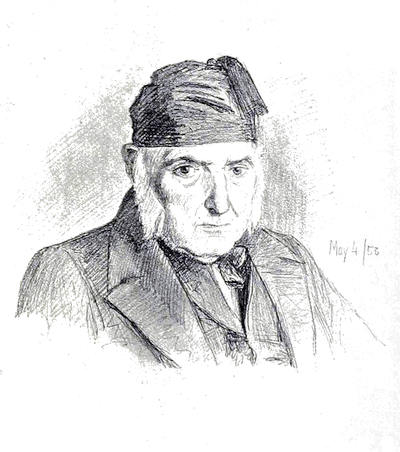
GAETANO POLIDORI From a Pencil-Drawing by Dante Gabriel Rossetti 1853
Within the hotbed of our vicious times Love proffered me its frenzies and remorse: But, never a seducer, still seduced, Quicksand to quicksand, angry seas I ploughed: Now let a holier love possess my soul,— May he who churned it up restore its calm.” And prudent reason here will not disclose What and how many tempests I endured. Upon my canvas be concealed, concealed, The flush upon my brow in others’ shame.[63] And on those quicksands while I fix my gaze A dreadful shudder creeps along my veins, And in that shudder I my visage smite, Uttering a curse against my weaknesses. The quicksands are afar, the harbour’s here.
Settled in London, all my travels past, Among the men I most was pleased to meet, Gaetano Polidori, learned, wise, Who had been Count Alfieri’s secretary, ’Mid all the Italians whom I had known as yet Appeared to merit honour and esteem. Teaching was his profession. He had done No small translating-work, had much composed. Tuscan by birth, by accent all the more, An elegant writer both in prose and verse, He showed me, joined with candid character, The strictest morals and a cultured mind. Upon the day when I returned his call, And saw him ’mid his well-bred family, I twice and thrice fixed my admiring eyes Upon the second daughter’s comeliness. A single moment regulates a life: My heart became the lodestone, she the pole. And every hour my love became more keen When hundred virtues and no self-conceit ... I know that what I’m writing she dislikes,[64] But, hiding it from her, I speak it still: Knowing her fully, I have often said— Angel in soul, and angel in her looks. Feeling within me glow the lighted flame, I wrote to Polidori, and ’twas thus: “If to the gracious name of friend you please To add the loving name of son as well (Pray Heaven that so it may be!) be not loth To give the enclosed into your Frances’ hands. If this displease you, little though it were, If so it haps you disapprove my suit, Throw the two letters both into the fire, And speak of this no more; but pray concede Our friendship be not sundered, yours and mine,— You so would punish my straightforwardness.” A day being past, the maid to me so dear Gave me a most affectionate response; And at the altar after four months more We vowed between us two a mutual faith.[65] In marriage-knot at summit of my hopes, My days went by in cheerful industry. As sweet reward of honourable zeal, My credit made advance from day to day. Four only children Heaven conceded me, And all the four I see around me still, The issue of affections tender and true In the four opening matrimonial years.
To speak about my wife I shall not pause,— Others would think it overcharged, inept: This I may tell—she is a blooming graft Of English mother and of Tuscan sire; Through mother and through sire in her one sees Two nations tempering the mind and heart. Let me but say that in her is evinced Frankness of manner unpremeditate; That she both speaks and writes three high-prized tongues, Which rank ’mong Europe’s choicest and most rich; And, when their authors she was studying, She culled the flower of the three literatures. That firm-fixed character which she displays Founded, by means of Jesus’ gospel-book, Upon religion pure morality, Upon morality the purest life; Thus she presents, perfect on every side, The steadfast woman of the sacred page. From living pattern oh what strength the love Of ethical instructions must receive! Wherefore to her more than myself is due Our children’s educating discipline; For of each rule she utters with her lips They see in her the breathing prototype. I never had occasion for a school, Too apt to vitiate a guileless heart; For she in her two daughters had betimes Transfused a taste for music;[66] in all four (Presenting now this model and now that) The taste for letters and the beautiful. In theory and in practice, both alike, Her life is a fine treatise on the good: Always a Christian, not a fanatic, Always devout, but not ecstatical: Heavens, what a woman! her Anglo-Italian soul Has never trespassed over duty’s bound. ’Tis now five lustres I have made her mine, And in five lustres I still see her the more An angel harmony of deeds and words, And in five lustres her all-blameless life Has not one moment, one, belied itself. I thank my God that, when he addressed my heart To new affections, he made these be high: And you, beloved children, thank you me That such a mother I chose to give you breath.
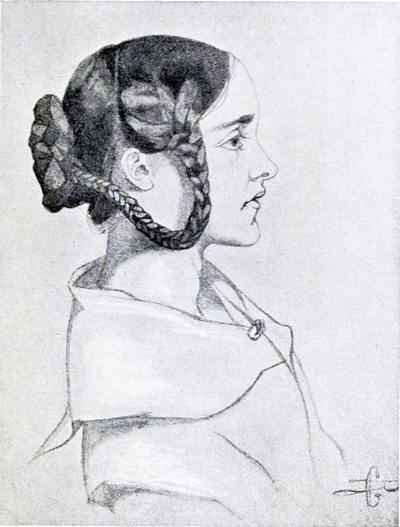
CHRISTINA ROSSETTI From a Pencil-Drawing by Dante Gabriel Rossetti C. 1846
Others perhaps will say that every bird (An ancient saw) approves his proper nest. Maria, Christina, William, Gabriel, My children, you’ll reply, and that’s enough.
My loving girls, in whom my soul descries A heavenly mind in virgin modesty, Of intellect and ethics you have given Already a shining proof in prose and verse:[67] You from a double looking-glass, it seems, Reflect upon us all your mother’s soul.
As from a twin-branched fountain-source there spurt Rills of fresh lymph to inundate a mead— So sometimes sister-like do poetry And painting beautify the selfsame mind: And both unite in you, my Gabriel, And fertilize your soul, and give it fire. These like two fountains both in you upflow, Both in you like two torches are alight; And, while you make them brightly manifest, They both prepare in you exalted work. Run and attain the duplicated goal, Though yours is the most early dawn of life: As able poet I hear you already hailed, Already as able painter see you admired.[68] Now onward, and the double race-course win! You will be doing what I could not do.