Part 2 — VII THE SOUTH POLAR REGIONS
Reading edition
It is barely a hundred years since European mariners began to approach the coasts of the mysterious mainland which extends around the southern pole of the earth. Ross, who in 1831 discovered the north magnetic pole, sailed ten years later in two ships, the Erebus and the Terror (afterwards to become so famous with Franklin), along the coast of the most southern of all seas, a sea which still bears his name. He discovered an active volcano, not much less than 13,000 feet high, and named it Erebus, while to another extinct volcano he gave the name of Terror. And he saw the lofty ice barrier, which in some places is as much as 300 feet high.
At a much later time there was great rivalry among European nations to contribute to the knowledge of the world's sixth continent. In the year 1901 an English expedition under Captain Scott was despatched to the sea and coasts first visited by Ross. Captain Scott made great and important discoveries on the coast of the sixth continent, and advanced nearer to the South Pole than any of his predecessors. One of the members of the expedition followed his example some years later. His name is Shackleton, and his journey is famous far and wide.
Shackleton resolved to advance from his winter quarters as far as possible towards the South Pole, and with only three other men he set out at the end of October, 1908. His sledges were drawn by strong, plump ponies obtained from Manchuria. They were fed with maize, compressed fodder, and concentrated food, but when during the journey they had to be put on short commons they ate up straps, rope ends, and one another's tails. The four men had provisions for fully three months.
While the smoke rose from the crater of Erebus, Shackleton marched southwards over snow-covered ice. Sometimes the snow was soft and troublesome, sometimes covered with a hard crust hiding dangerous crevasses in the mass of ice. At the camps the adventurers set up their two tents and crept into their sleeping-bags, while the ponies, covered with horse-cloths, stood and slept outside. Sometimes they had to remain stationary for a day or two when snowstorms stopped their progress.
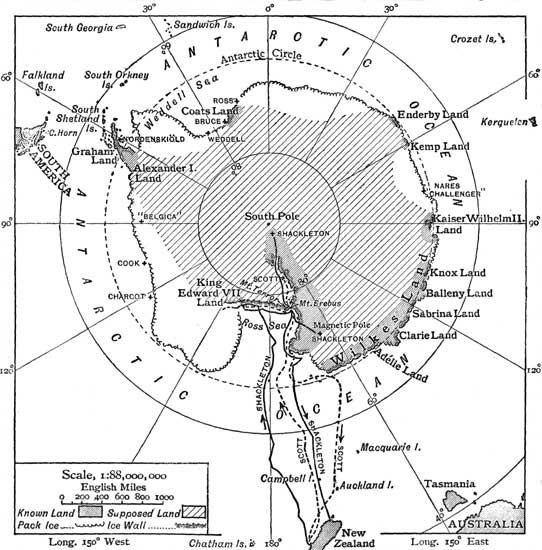
THE SOUTH POLAR REGIONS.
When the sun was hidden by clouds the illumination was perplexing. No shadows revealed the unevenness of the snowfield, all was of the purest white, and where the men thought they were walking over level ground, they might quite unexpectedly come down on their noses down a small slope. Once they heard a thundering noise far away to the east. It sounded like a cannon shot, but probably was only the immense inland ice "calving." When the ice during its constant but slow motion towards the coast slides out into the sea, it is lifted up by the water and is broken up into huge, heavy blocks and icebergs which float about independently. When these pieces break away the inland ice is said to "calve."
Shackleton advanced towards the pole at the rate of twelve to eighteen miles a day. His small party was lost like small specks in the endless desert of ice and snow. Only to the west was visible a succession of mountain summits like towers and pinnacles. The men seemed to be marching towards a white wall which they could never reach.
On November 31 one of the ponies was shot, and its flesh was kept to be used as food. The sledge he had drawn was set up on end and propped up as a mark for the return journey. Five days later Shackleton came to Scott's farthest south, and the lofty mountains with dark, steep, rocky flanks which he afterwards had by the side of his route had never before been seen by man.
A couple of days later a second pony was shot, and shortly afterwards a third, which could go no farther, had to be put out of his misery. The last pony seemed to miss his comrades, but he still struggled on with his sledge, while the four men dragged another.
The mountain range which they had hitherto had on their right curved too much to the east, but fortunately it was cut through by a huge glacier, the great highway to the Pole. They ascended the glacier and crossed a small pass between great pillars of granite. Now they were surrounded by lofty mountains. The ice was intersected by dangerous crevasses, and only with the greatest caution and loss of time could they go round them. A bird flew over their heads, probably a gull. What could he be looking for here in the midst of the eternal ice?
One day three of the explorers were drawing their sledge while the fourth was guiding the one drawn by the pony. Suddenly they saw the animal disappear, actually swallowed up by the ice. A snow bridge had given way under the weight of the pony, and the animal had fallen into a crevasse 1000 feet deep. When they bent over the edge of the dark chasm they could not hear a sound below. Fortunately the front cross-piece of the sledge had come away, so that the sledge and man were left on the brink of the chasm. If the precious provisions had gone down with the horse into the bowels of the ice, Shackleton would have been obliged to turn back.
Now left without assistance in dragging the sledges, they had to struggle up the glacier between rocks and slates in which coal was imbedded. On Christmas Day the temperature was down to-47°—a fine midsummer!
At length the four men had left all mountains behind, and now a plateau country of nothing but snow-covered ice stretched before them. But still the surface of the ice rose towards the heart of the South Polar continent, and the singing headaches from which they suffered were a consequence of the elevation. A flag on a bamboo pole was set up as a landmark.
On January 7 and 8, 1909, they had to lie still in a hard snowstorm, and the temperature fell to-69°. When such is the summer of the South Pole, what must the winter be like? January 9 was the last day on their march southwards. Without loads or sledges they hurried on and halted at 88° 23' south latitude.
They were only 100 miles from the South Pole when they had to turn back from want of provisions. They might have gone on and might have reached the Pole, but they would never have come back.
The height was more than 10,000 feet above sea-level, and before them, in the direction of the Pole, extended a boundless flat plateau of inland ice. The Union Jack was hoisted and a record of their journey deposited in a cylinder. Shackleton cast a last glance over the ice towards the Pole, and, sore at heart, gave the order to retreat.
Happily he was able to follow his trail back and succeeded in reaching his winter quarters, whence his vessel carried him home again in safety.
THE END
Printed by R. & R. Clark, Limited, Edinburgh.