Part 2 — II AFRICA (continued 2)
Reading edition
This spectacle made Livingstone ill and depressed. The description of the scene which afterwards appeared in all the English journals awakened such a feeling of horror that a commission was appointed and sent out to Zanzibar to inquire into the slave-trade on the spot, and with the Sultan's help devise means of suppressing it. But we know that in Gordon's time the slave-trade still flourished in the Sudan, and several decades more passed before the power of the slave-dealers was broken. As for Livingstone, it was fortunate that he did not accompany Dugumbé, for the natives combined for defence, attacked the chiefs party and slew 200 of the slave-dealing rabble.
Thus the question of the Lualaba remained unsolved, but Livingstone began to suspect that his theory of the Nile sources was wrong. He heard a doubtful tale of the Lualaba bending off to the west, but he still hoped that it flowed northwards, and that therefore the ultimate source of the Nile was to be found among the feeders of Lake Bangweolo. When difficulties sprang up around him, his determination not to give in was only strengthened. But he could do nothing without a large and well-ordered caravan, and therefore he had to return to Ujiji, whither fresh supplies ought to have arrived from the coast. And amidst a thousand dangers and lurking treachery he effected his return through the disturbed country. Half dead of fever and in great destitution he arrived at Ujiji in October.
There a fresh disappointment awaited him. His supplies had indeed come, but the Arabian scoundrel to whose care the goods had been consigned had sold them, including 2000 yards of cloth and several sacks of glass beads, the only current medium of exchange. The Arab coolly said that he thought the missionary was dead.
We read in Livingstone's journal that in his helplessness he felt like the man who went down to Jericho and fell among thieves. Five days after his arrival at Ujiji he writes as follows: "But when my spirits were at their lowest ebb, the good Samaritan was close at hand, for one morning Susi came running at the top of his speed and gasped out 'An Englishman! I see him!' and off he darted to meet him. The American flag at the head of a caravan told of the nationality of the stranger. Bales of goods, baths of tin, huge kettles, cooking pots, tents, etc., made me think 'This must be a luxurious traveller, and not one at his wits' end like me!'"
How Stanley found Livingstone
Now we must go back a little and turn to another story.
Henry Stanley was a young journalist, who in October happened to be in Madrid. He was on the staff of the great newspaper, the New York Herald, which was owned by the wealthy Gordon Bennett. One morning Stanley was awakened by his servant with a telegram containing only the words: "Come to Paris on important business." Stanley travelled to Paris by the first train, and at once went to Bennett's hotel. Bennett asked him, "Where do you think Livingstone is?"
"I really do not know, sir."
"Do you think he is alive?"
"He may be, and he may not be."
"Well, I think he is alive," said Bennett, "and I am going to send you to find him."
"What!" cried Stanley. "Do you mean me to go to Central Africa?"
"Yes; I mean that you shall go and find him. The old man may be in want; take enough with you to help him, should he require it. Do what you think best—but find Livingstone."
In great surprise Stanley suggested that such a journey would be very expensive, but Bennett answered, "Draw a thousand pounds now; and when you have gone through that, draw another thousand, and when that is spent, draw another thousand, and when you have finished that, draw another thousand, and so on; but find Livingstone."
"Well," thought Stanley, "I will do my best, God helping me." And so he went off to Africa.
He had, however, been charged by his employer to fulfil other missions on the way. He made a journey up the Nile, visited Jerusalem, travelled to Trebizond and Teheran and right through Persia to Bushire, and consequently did not arrive at Zanzibar until the beginning of January, 1871.
Here he made thorough preparations. He had never been before in the Africa of the Blacks, but he was a clever, energetic man, with a genius for organisation. He bought cloth enough for a hundred men for two years, glass beads, brass wire and other goods in request among the natives. He bought saddles and tents, guns and cartridges, boats, medicine, tools, provisions and asses. Two English sailors volunteered for the expedition, and he took them into his service, but both died in the fever country. Black porters were engaged, and twenty men he called his soldiers carried guns. After he had crossed over from Zanzibar to the African mainland, the equipment of the expedition was completed at Bagamoyo, and Stanley made haste to get away before the rainy season commenced.
The great and well-found caravan of 192 men in all trooped westwards in five detachments. Stanley himself led the last detachment, and before them lay the wilderness, the interior of Africa with its dark recesses. At the first camping-ground tall maize was growing and manioc plants were cultivated in extensive fields. The latter is a plant with large root bulbs chiefly composed of starch, but also containing a poisonous milky juice which is deadly if the roots be eaten without preparation. When the sap has been removed by proper treatment, however, the roots are crushed into flour, from which a kind of bread is made. Round a swamp in the neighbourhood grew low fan-palms and acacias among luxuriant grass and reeds.
Next day they marched under ebony and calabash trees, from the shells of which the natives make vessels of various shapes, for while they are growing the fruits can be forced by outward pressure into almost any desired form. Pheasants and quails, water-hens and pigeons flew up screaming when the black porters tramped along the path, winding in single file through the grass as high as a man. Hippopotami lay snorting unconcernedly in a stream that was crossed.
Then came the forerunners of the rainy season, splashing and pelting over the country, and pouring showers pattered on the grass. Both the horses of the caravan succumbed, one or two fellows who found Bagamoyo more comfortable ran away, and a dozen porters fell ill of fever. Stanley was still full of energy, and beat the reveille in the morning himself with an iron ladle on an empty tin. On they went through dense jungle. Now a gang of slaves toils along, their chains clanking at every weary step. Here again is a river, and there the road runs up a hill. Here the country is barren, but soon after crops wave again round villages. Maize fields in a valley are agitated like the swell of the sea, and gentle breezes rustle through rain-bedewed sugar-cane. Bananas hang down like golden cucumbers, and in barren places tamarisks and mimosas perfume the air. Sometimes a halt is made in villages of well-built grass huts.
Over swampy grasslands soaked by the continuous rains Stanley led his troop deeper and deeper into Africa. After having lasted forty days, the rainy season came to an end on the last day of April. The men marched through a forest of fine Palmyra palms, a tree which grows over almost all tropical Africa, in India, and on the Sunda Islands, and which is extolled in an old Indian poem because its fruits, leaves, and wood can be applied to eight hundred and one various uses. Afterwards the country became more hilly, and to the west one ridge and crest rose behind another. The porters and soldiers were glad to leave the damp coast-land behind and get into drier country, but the ridges made travelling harder. They encamped in villages of beehive-shaped huts covered with bamboos and bast, and surrounded by mud walls. Some tracts were so barren that only cactus, thistles, and thorny bushes could find support in the dry soil, and near a small lake were seen the tracks of wild animals, buffaloes, zebras, giraffes, wild boars, and antelopes, which came there to drink.
Then the route ran through thickets of tamarisk, and under a canopy of monkey bread-fruit trees, till eventually at a village Stanley fell in with a large Arab caravan, with which he travelled through the dreaded warlike land of Ugogo. When they set out together the whole party numbered 400 men, who marched in Indian file along the narrow paths.
"How are you, White Man?" called out a man at Ugogo in a thundering voice when Stanley arrived, and when he had set up his quarters in the chief's village the natives flocked around to gaze at the first white man they had ever seen. They were friendly and offered milk, honey, beans, maize, nuts, and water-melons in exchange for cloth and glass beads, but also demanded a heavy toll from the caravan for the privilege of passing through their country.
The caravan proceeded through the avenues of the jungle, from time immemorial frequented by elephants and rhinoceroses. In one district the huts were of the same form as Kirghiz tents, and in another rocks rose up in the forest like ruins of a fairy palace. The porters were not always easy to manage, and on some occasions were refractory. But if they were given a young ox to feast on, they quickly calmed down and sat round the fire while strips of fresh meat frizzled over the embers.
Now it was only one day's march to Tabora, the principal village in Unyamwezi, and the chief settlement of the Arabs in East Africa. The caravan set out with loud blasts of trumpets and horns, and on arrival discharged a salvo of guns, and Arabs in white dresses and turbans came out to welcome the explorer. Here Stanley found all his caravans, and the Arabs showed him every attention. They regaled him with wheaten loaves, chickens and rice, and presented him with five fat oxen, eight sheep, and ten goats. Round about they had cultivated ground and large herds, and it was difficult to believe that the stately well-grown men were base slave-traders.
Just at this time the country of Unyamwezi was disturbed by a war which was raging with Mirambo, a great chief in the north-west, and consequently when Stanley left Tabora, now with only fifty-four men, he had to make a detour to the south to avoid the seat of war. At every step he took, his excitement and uncertainty increased. Where was this wonderful Livingstone, whom all the world talked about? Was he dead long ago, or was he still wandering about the forests as he had done for nearly thirty years?
A bale or two of cloth had frequently to be left with a chief as toll. In return one chief sent provisions to last the whole caravan for four days, and came himself to Stanley's tent with a troop of black warriors. Here they were invited to sit down, and they remained silent for a while, closely examining the white man; then they touched his clothes, said something to one another, and burst out into unrestrained laughter. Then they must see the rifles and medicine chest. Stanley took out a bottle of ammonia, and told them that it was good for headaches and snake-bites. His black majesty at once complained of headache and wanted to try the bottle. Stanley held it under the chiefs nose, and of course it was so strong that he fell backwards, pulling a face. His warriors roared with laughter, clapped their hands, snapped their fingers, pinched one another, and behaved like clowns. When the king had recovered, he said, as the tears ran from his eyes, that he was quite cured and needed no more of the strong remedy.
A river ran among hills, through a magnificent country abounding in game, and lotus leaves floated on the smooth water. The sun sinks and the moon soars above the mimosa trees, the river shines like a silver mirror, antelopes are on the watch for the dangers of the night. Within the enclosure of the camp the black men sit gnawing at the bones of a newly-shot zebra. But when it is time to set out again from the comfortable camp, the porters would rather remain where they are and enjoy themselves, and when the horn sounds they go sullenly and slowly to their loads. After half an hour's march they halt, throw down their loads, and begin to whisper in threatening groups. Two insubordinate ruffians lie in wait with their rifles aimed at Stanley, who at once raises his gun and threatens to shoot them on the spot if they do not immediately drop their rifles. The mutiny ends without bloodshed, and the men promise again to go on steadily to Lake Tanganyika, according to their agreement.
Now Stanley is in a forest tract where cattle of all kinds are pestered by the tsetse fly, and where the small honey bird flies busily about among the trees. It is like the common grey sparrow, but somewhat larger, and has a yellow spot on each shoulder. It receives its name from its habit of flying in short flights just in front of the natives to guide them to the nests of wild bees, in order to get its share of the honey. When a man follows it, he must not make a noise to frighten it, but only whistle gently, that the bird may know that its intention is understood. As it comes nearer to the wild bees' nest, it takes shorter flights, and when it is come to the spot, it sits on a branch and waits. Stanley says that the honey bird is a great friend of the natives, and that they follow it at once when it calls them.
Stanley now turned northwards to a river which flows into Lake Tanganyika. The caravan was carried over in small frail boats, and the asses which still survived had to swim. When the foremost of them came to the middle of the river he was seen to stop a moment, apparently struggling, and then he went down, a whirlpool forming above his head. He had been seized by a crocodile.
A caravan which came from Ujiji reported that there was a white man in that country. "Hurrah, it is Livingstone! It must be Livingstone!" thought Stanley. His eagerness and zeal were stimulated to the uttermost, and he offered his porters extra pay to induce them to make longer marches. Eventually the last camp before Tanganyika was reached in safety, and here Stanley took out a new suit of clothes, had his helmet chalked, and made himself spruce, for the reports of a white man's presence at the lake became more definite.
The 28th of October, 1871, was a beautiful day, and Stanley and his men marched for six hours south-westwards. The path ran through dense beds of bamboo, the glittering, silvery surface of Tanganyika was seen from a height, and blue, hazy mountains appeared afar off on the western shore. The whole caravan raised shouts of delight. At the last ridge the village of Ujiji came into sight, with its huts and palms and large canoes on the beach. Stanley gazed at it with eager eyes. Where was the white man's hut? Was Livingstone still alive, or was he a mere dream figure which vanished when approached?
The villagers come streaming out to meet the caravan, and there is a deafening noise of greeting, enquiries, and shouts.
From the midst of the crowd a black man in a white shirt and a turban calls out, "Good morning, sir!"
"Who the mischief are you?" asks Stanley.
"I am Susi, Dr. Livingstone's servant," replied the man.
"What! Is Dr. Livingstone here?"
"Yes, sir."
"In this village? Run at once and tell the Doctor I am coming."
When Livingstone heard the news he came out from his verandah and went into the courtyard, where all the Arabs of Ujiji had collected. Stanley made his way through the crush, and saw a small man before him, grey and pale, dressed in a bluish cap with a faded gold band round it, a red-sleeved waistcoat, and grey trousers. Stanley would have run up to embrace him, but he felt ashamed in the presence of the crowd, so he simply took off his hat and said, "Dr. Livingstone, I presume?"
"Yes," said he, with a kind smile, lifting his cap slightly.
"I thank God, Doctor, I have been permitted to see you."
"I feel thankful that I am here to welcome you."
They sat down on the verandah, and all the astonished natives stood round, looking on. The missionary related his experiences in the heart of Africa, and then Stanley gave him the general news of the world, for of course he knew nothing of what had taken place for years past. Africa had been separated from Asia by the Suez Canal. The Pacific Railway through North America had been completed. Prussia had taken Schleswig-Holstein from Denmark, the German armies were besieging Paris, and Napoleon the Third was a prisoner. France was bleeding from wounds which would never be healed. What news for a man who had just come out of the forests of Manyuema!
Evening drew on and still they sat talking. The shades of night spread their curtain over the palms, and darkness fell over the mountains where Stanley had marched, still in uncertainty, on this remarkable day. A heavy surf beat on the shore of Lake Tanganyika. The night had travelled far over Africa before at last they went to rest.
The two men were four months together. They hired two large canoes and rowed to the northern end of Tanganyika, and ascertained that the lake had no outlet there. Only two years later Lieutenant Cameron succeeded in finding the outlet of Tanganyika, the Lukuga, which discharges into the Lualaba; and when he found that Nyangwé on the Lualaba lies 160 feet lower than the Nile where it flows out of the Albert Nyanza, he had proof that the Lualaba could not belong to the Nile, and that Livingstone's idea that the farthest sources of the Nile must be looked for at Lake Bangweolo was only an idle dream. The Lualaba therefore must make its way to the Atlantic, and in fact this river is nothing but the Upper Congo. Lieutenant Cameron was also the first European to cross Central Africa from east to west.
On the shores of the great lake the two travellers beheld a series of beautiful landscapes. There lay villages and fishing-stations in the shade of palms and mimosas, and round the villages grew maize and durra, manioc, yams, and sweet potatoes. In the glens round the lake grew tall trees from which the natives dig out their canoes. Baboons roared in the forests and dwelt in the hollow trunks. Elephants and rhinoceroses, giraffes and zebras, hippopotami and wild boars, buffaloes and antelopes occurred in large numbers, and the northern extremity of the lake swarmed with crocodiles. Sometimes the strangers were inhospitably received when they landed, and once when they were off their guard the natives plundered their canoes. Among other things they took a case of cartridges and bullets, and the travellers thought it would be bad for the thieves if the case exploded at some camp fire.
It soon became time, however, for Stanley to return to Zanzibar and inform the world through the press that Livingstone was alive. They went to Tabora, for Livingstone expected fresh supplies, and in addition Stanley gave him forty men's loads of cloth, glass beads and brass-wire, a canvas boat, a waterproof tent, two breech-loaders and other weapons, ammunition, tools, and cooking utensils. All these things were invaluable to Livingstone, who was determined to remain in Africa at any cost until his task was accomplished.
The day of parting came—March 14, 1872. Stanley was very depressed, believing that the parting was for ever. Livingstone went with him a little way and then bade him a hearty farewell, and while Stanley made haste towards the coast the Doctor turned back to Tabora and was again alone in the immense wilds of Africa. But he had still his faithful servants Susi and Chuma with him.
The Death of Livingstone
At Zanzibar Stanley was to engage a troop of stout, reliable porters and send them to Tabora, where Livingstone was to await their arrival. He had entrusted his journals, letters, and maps to Stanley's care, and that was fortunate, for when Stanley first arrived in England his narrative was doubted, and he was coldly received. Subsequently a revulsion of feeling set in, and it was generally recognised that he had performed a brilliant feat.
In due time the new supply of porters turned up at Tabora, fifty-seven men. They were excellent and trustworthy, and in a letter to Stanley, Livingstone says that he did not know how to thank him sufficiently for this new service. At the end of August the indefatigable Doctor set off on his last journey. He made for Tanganyika, and on New Year's Day, 1873, he was near Lake Bangweolo. It rained harder than ever, pouring down as if the flood-gates of heaven were opened. The caravan struggled slowly on through the wet, sometimes marching for hours through sheets of water, where only the eddies of the current distinguished the river from the adjoining swamps and flooded lands. The natives were unfriendly, refused to supply provisions, and led the strangers astray. Livingstone had never had such a difficult journey.
His plan was to go round the south of Lake Bangweolo to the Luapula, which flows out of the lake and runs to the Lualaba. Then he meant to follow the water in its course to the north, and ascertain its direction and destination.
But whichever way the mysterious river made its way to the ocean, the journey was long, and Livingstone's days were numbered. He had long been ill, and his condition was aggravated by the hardships of the journey. His body was worn out, and undermined by constant fever and insufficient nourishment. Yet he did not abandon hope of success and conscientiously wrote down his observations, and no Sunday passed without a service with his people.
Month after month he dragged himself along, but his strength was no longer what it had been. On April 21 he wrote with trembling hand only the words, "Tried to ride, but was forced to lie down and they carried me back to vil. exhausted." A comfortable litter was made, and Susi and Chuma were always with him. Livingstone asked the chief of the village for a guide for the next day, and the chief answered, "Stay as long as you wish, and when you want guides to Kalunganjovu's you shall have them."
The day after he was carried for two hours through marshy, grassy flats. During the next four days he was unable to write a line in his diary, but was carried by short stages from village to village along the southern shore of Lake Bangweolo. On April 27 he wrote in his diary, "Knocked up quite, and remain—recover—sent to buy milch goats. We are on the banks of the Molilamo." With these words his diary, which he had kept for thirty years, concluded. Milch goats were not to be had, but the chief of the place sent a present of food.
Four days later the journey was resumed. The chief provided canoes for crossing the Molilamo, a stream which flows into the lake. The invalid was transferred from the litter to a canoe, and ferried over the swollen stream. On the farther bank Susi went on in advance to the village of Chitambo to get a hut ready. The other men followed slowly with the litter. Time after time the sick man begged his men to put the litter down on the ground and let him rest. A drowsiness seemed to come over him which alarmed his servants. At a bend of the path he begged them to stop again, for he could go no farther. But after an hour they went on to the village. Leaning on their bows, the natives flocked round the litter on which lay the man whose fame and reputation had reached them in previous years. A hut was made ready, and a bed of grass and sticks was set up against the wall, while his boxes were deposited along the other walls, and a large chest served as a table. A fire was lighted outside the entrance, and the boy Majwara kept watch.
Early on April 20 the chief Chitambo came to pay a visit, but Livingstone was too weak to talk to him. The day passed, and at night the men sat round their fires and went to sleep when all was quiet. About eleven o'clock Susi was told to go to his master. Loud shouts were heard in the distance, and Livingstone asked Susi if it was their men who were making the noise. As the men were quiet in their huts, Susi replied, "I can hear from the cries that the people are scaring away a buffalo from their durra fields." A few minutes later he asked, "Is this the Luapula?" "No," answered Susi, "we are in Chitambo's village." Then again, "How many days is it to the Luapula?" "I think it is three days, master," answered Susi. Shortly after he murmured, "O dear, dear!" and dozed off again.
At midnight Majwara came again to Susi's hut and called him to the sick man. Livingstone wished to take some medicine, and Susi helped him, and then he said, "All right, you can go now."
About four o'clock on the morning of May 1 Majwara went to Susi again and said, "Come to Bwana, I am afraid; I don't know if he is alive." Susi waked Chuma and some of the other men, and they went to Livingstone's hut. Their master was kneeling beside the bed, leaning forward with his head buried in his hands. They had often seen him at prayer, and now drew back in reverential silence. But they felt ill at ease, for he did not move; and on going nearer they could not hear him breathe. One of them touched his cheek and found it was cold. The apostle of Africa was dead.
In deep sorrow his servants laid him on the bed and went out into the damp night air to consult together. The cocks of the village had just begun to crow, and a new day was dawning over Africa. Then they went in to open his boxes and pack up everything. All the men were present so that all might be jointly responsible that nothing was lost. They carefully placed his diaries and letters, his Bible and instruments, in tin boxes so that they might be safe from wet and from white ants, which are very destructive.
The men knew that they would have great difficulties to encounter. They knew that the natives had a horror of the dead, believing that spirits in the dark land of the departed thought of nothing but revenge and mischief. Therefore they perform ceremonies to propitiate departed spirits and dissuade them from plaguing the living with war, famine, or sickness.
Susi and Chuma, who had been with their master for seven years, felt their responsibility. They spoke with the men whom Stanley had sent from the coast and asked their opinion. They answered, "You are old men in travelling and hardships; you must act as our chiefs, and we will promise to obey whatever you order us to do." Susi and Chuma accordingly took the command, and carried out an exploit which is unique in all the history of exploration.
First of all a hut was erected at some little distance from the village, and in this they placed the body to prepare it for the long journey. The heart and viscera were removed, placed in a tin box, and reverently buried in the ground, one of Livingstone's Christian servants reading the Funeral Service. The body was then filled with salt and exposed for fourteen days to the sun in order to dry and thus be preserved from decay. The legs were bent back to make the package shorter, and the body was sewed up tightly in cotton. A cylinder of bark was cut from a tree and in this the body was enclosed. Round the whole a piece of canvas was bound, and the package was tied to a pole for convenience of carrying. On a tree near, Livingstone's name was cut and the date of his death, and Chitambo was asked to have the grass rooted up round the tree so that it should not at any time be destroyed by a bush fire.
When all was ready two men lifted the precious burden from the ground, the others took their loads on their backs, and a journey was commenced which was to last nine months, a funeral procession the like of which the world had never seen before. The route ran sometimes through friendly, sometimes through hostile tribes. Once they had to fight in order to force their way through. News of the great missionary's death had preceded them. Like a grass fire on the prairie it spread over Africa from coast to coast, creeping silently through the forests. In some districts the people ran away from fear of the sad procession, while in others they came up to see it. Bread-fruit trees stretched their boughs over the road like a canopy over a victor returning home, and palms, the emblems of peace and resurrection, stood as sentinels by the way, which was left clear by the wild animals of the forest. And mile after mile the party marched eastwards under the green arches.
In Tabora they met an English expedition sent out too late for the relief of Livingstone, and its members listened with emotion to the tale of the men. They wished to bury the corpse at Tabora, but Livingstone's servants would not hear of it. A few days later they met with serious opposition. A tribe refused to let them pass with a corpse. Then they made up a load resembling that containing the body, and gave out that they had decided to return to Tabora to bury their master there. Some of the men marched back with the false package, which they took to pieces at night and scattered among the bush. Then they returned to their comrades, who meanwhile had altered the real package so as to look like a bale of cloth. The natives were then satisfied and let them move on unmolested.
In February, 1874, they arrived at Bagamoyo, and the remains were carried in a cruiser to Zanzibar and afterwards conveyed to England. In London there was a question whether the body was really Livingstone's, but his broken and reunited arm, which was crushed by the lion at Mabotsa, set all doubts at rest. He was interred in Westminster Abbey in the middle of the nave. The temple of honour was filled to overflowing, and among those who bore the pall was Henry Stanley. The grave was covered with a black stone slab, in which was cut the following inscription:—
"Brought by faithful hands Over land and sea, Here Rests DAVID LIVINGSTONE, Missionary, Traveller, Philanthropist. Born March 19, 1813, Blantyre, Lanarkshire. Died May 4th, 1873, At Chitambo's Village, Ilala. For thirty years his life was spent in an unwearied effort to evangelise the native races, to explore the undiscovered secrets, And abolish the desolating slave-trade of Central Africa...."
The memory of the "Wise Heart" or the "Helper of Men," as they called Livingstone, is still handed down from father to son among the natives of Africa, and they are glad that his heart remains in African soil under the tree in Chitambo's village. His dream of finding the sources of the Nile, and of throwing light on the destination of the Lualaba, was not fulfilled, but he discovered Ngami and Nyassa and other lakes, the Victoria Falls and the upper course of the Zambesi, and mapped an enormous extent of unknown country.
Stanley's Great Journey
In the autumn of 1874 Stanley was back in Zanzibar to try his fortune once more in Darkest Africa. He organised a caravan of three hundred porters, provided himself with cloth, beads, brass-wire, arms, boats which could be taken to pieces, tents, and everything else necessary for a journey of several years.
He made first for the Victoria Nyanza, and circumnavigated the whole lake. He visited Uganda, came again to Ujiji, where Livingstone's hut had long been razed to the ground, and sailed all round Lake Tanganyika.
Two years after he started he was at Nyangwé on the Lualaba. Livingstone and Cameron had been there before, and we can imagine Stanley's feelings when he at last found himself at this, the most westerly point ever reached by a European from the coast of the Indian Ocean. Behind him lay the known country and the great lakes; before him lay a land as large as Europe, completely unknown and appearing as a blank on maps. Travellers had come to its outskirts from all sides, but none knew what the interior was like. It was not even known whither the Lualaba ran. Livingstone had vainly questioned the natives and Arabs about it, and vainly Stanley also tried to obtain information. At Nyangwé the Arab slave-traders held their most western market. Thither corn, fruit, and vegetables were brought for sale; there were sold animals, fish, grass mats, brass-wire, bows, arrows, and spears; and thither were brought ivory and slaves from the interior. But though routes from all directions met at Nyangwé, the Arabs were as ignorant of the country as any one.
The black continent, "Darkest Africa," lay before Stanley. He was a bold man, to whom difficulties were nothing. He had a will of iron. All opposition, all obstacles placed in his way, must go down before him. He had determined not to return eastwards, whence he had come, but to march straight westwards to the Atlantic coast, or die in the attempt. Accordingly, early on the morning of November 5, 1876, Stanley left Nyangwé in company with the rich and powerful Arab chief, Tippu Tib, and directed his way northwards towards the great forest. Tippu Tib's party consisted of 700 men, women, and children, while Stanley had 154 followers armed with rifles, revolvers, and axes. "Bismillah—in the name of God!" cried the Mohammedan leaders of the company, as they took the first step on the dangerous road.
The huge caravan, an interminable file of black men, entered the forest. There majestic trees stood like pillars in a colonnade; there palms struggled for room with wild vines and canes; there flourished ferns, spear-grass, and reeds, and there bushes in tropical profusion formed impenetrable brushwood; while through the whole was entangled a network of climbing plants, which ran up the trunks and hung down from the branches. Everything was damp and wet. Dew dropped from all the branches and leaves in a continuous trickle. The air was close and sultry, and heavy with the odour of plants and mould. It was deadly still, and seldom was the slightest breeze perceptible; storms might rage above the tree-tops, but no wind reached the ground, sheltered in the dimness of the undergrowth.
The men struggle along over the slippery ground. Balancing their loads on their heads with their hands, they stoop under boughs, push saplings aside with their elbows, thrust their feet firmly into the mud in order not to slip. Those who are clothed have their clothes torn, while the naked black men graze their skins. Very slowly the caravan forces its way through the forest, and a passage has frequently to be cut for those who carry the sections of the boats.
All who, after Stanley, have travelled through the great primeval forest in the heart of Africa have likewise described its suffocating hot-house air, the peaceful silence, only broken by the cries of monkeys and parrots, its deep, depressing gloom. If the journey is of long duration men get wearied, experiencing a feeling of confinement, and long for air, freedom, sun, and wind. It is like going through a tunnel, no country being visible on either side. The illumination is uniform, without shadows, without gleams, and the perpetual gloom, only interrupted by pitch-dark night, is exceedingly wearisome. Like polar explorers in the long winter night, the traveller longs for the sun and the return of light.
The party travelled northwards at some distance east of the Lualaba. Stanley climbed up a tree which grew somewhat apart on a hillock. Here he found himself above the tree-tops, and saw the sunlit surface of the primeval forest of closely growing trees below him. A continuous sea of boughs and foliage fell like a swell down to the bank of the Lualaba. Up here there was a breeze and the leaves fluttered in the wind; but down below reigned darkness and silence and the exuberant life of the tropics.
Even for such a man as Stanley this primeval forest was a hard nut to crack. Sickness, weariness, and insubordination prevailed in his troop. The great Tippu Tib considered it impossible to advance through such a country, and wished to turn back with all his black rabble, but after much hesitation he was at last persuaded to accompany Stanley for twenty days longer. So on they went once more, and after innumerable difficulties came again to the bank of the Lualaba.
The huge volumes of water glided along silently and majestically. Brown and thick with decaying vegetation, the Lualaba flowed between dense woods to the unknown region inhabited by negro tribes never heard of by Europeans, and where no white man had ever set his foot. Here Stanley decided to leave the terrible forest and to make use of the waterway of the Lualaba. There were the boats in sections, and a whole fleet of canoes could soon be made from the splendid trees growing at hand. The whole caravan was accordingly assembled, and Stanley explained his purpose. At first the men grumbled loudly, but Stanley declared that he would make the voyage even if no one went with him but Frank Pocock, the only survivor of the three white men who had started with him from Zanzibar. He turned to his boat's crew and called out, "You have followed me and sailed round the great lakes with me. Shall I and my white brother go alone? Speak and show me those who dare follow me!" On this a few stepped forward, and then a few more, and in the end thirty-eight men declared themselves willing to take part in the voyage.
At this juncture many canoes full of natives were observed at the opposite side of the river, so Stanley and Tippu Tib and some other Arabs entered the boat and rowed up to a small island in mid-stream.
Here the black warriors were in swarms, and thirty canoes lay at the water's edge. At a safe distance, Stanley's interpreter called out that the white man only wished to see their country, that nothing belonging to them should be touched, and that they themselves should not be disturbed. They answered that if the white man would row out to the island in the morning with ten servants, their own chief would meet him with ten men, and would enter into blood-brotherhood with him. After that the strangers might cross the river and visit their villages.
Suspecting treachery, however, Stanley sent twenty armed men by night to the island to hide themselves in the brushwood. Then in the morning Pocock and ten men rowed out to the meeting-place, near which Stanley waited in his boat. A swarm of canoes put out from the western bank, and when they came to the island the rowers raised their wild war-whoop, Ooh-hu! Ooh-hu-hu! and rushed ashore with bows bent and raised spears. Then Stanley's twenty men came out of their hiding-place, the fight was short, and the savages dashed headlong into their boats and rowed away for their lives.
The next morning, with thirty men on board his boat, Stanley began his journey down the river, while Tippu Tib and Pocock marched with all the rest of the troop along the bank. The natives had retired, but their cry of Ooh-hu-hu! was still heard in the distance. On an island between the main river and a tributary Stanley's party landed to wait for the caravan and help it over the affluent. In the meantime Stanley made a short excursion up the tributary, the water of which was inky-black owing to the dark tree roots which wound about its bottom. On his return he found the camp island surrounded by hostile canoes and heard random shots, but when his boat drew near, the savages were frightened and rowed away.
At length Tippu Tib straggled up with his party, and the journey could be continued. The boat was rowed near the bank, and the two divisions were kept in touch with each other by means of drums. All the villages they came to were deserted, but the natives were evidently keeping a close watch on these wonderful strangers, for one day when some of Stanley's men were out scouting on two captured canoes, they were attacked, and when they tried to escape they came among eddies and rapids, where their boats capsized and four rifles were lost. The men climbed up and sat astride the upturned canoes until they were rescued by their comrades.
Then the expedition went on again. The river was usually half a mile broad or more, and frequently divided by long rows of islands and holms. The large village of Ikondu consisted of cage-like reed huts built in two long rows. All the inhabitants had fled, but pitchers full of wine were suspended from the palms, melons and bananas emitted their fragrance, and there was plenty of manioc plantations, ground-nuts, and sugar-cane. Near the place was found a large old canoe, cracked, leaky, and dilapidated, but it was patched up, put in the river, and used as a hospital. Smallpox and dysentery raged in the caravan, and two or three corpses were thrown daily into the river.
Once, as the small flotilla was rowing quietly along not far from the bank, a man in the hospital canoe cried out. He had been hit in the chest by a poisoned barb, and this was followed by a whole shower of arrows. The boats were rowed out from the dangerous bank, and a camp was afterwards pitched on an old market-place. The usual fence was set up round the tents, and sentinels were posted in the bush. Then were heard shots, cries, and noise. The watchman ran in calling out, "Look out, they are coming," and immediately arrows and javelins rattled against the stockade, and the savages rushed on, singing their dreadful war-songs. But their arrows and javelins were little use against powder and ball, and they soon had to retire. They were reinforced, however, and returned again and again to the attack, and did not desist till the fight had lasted two hours and twilight had come on.
After other combats, Stanley and Tippu Tib came to a country on the western bank densely peopled with hostile natives, where they had to fight again. The savages were repulsed, and rowed out to a long island, where they moored their canoes by ropes fastened round posts. They would certainly renew the attack next day. But this time they were to be thoroughly checkmated. Rain pelted down on the river, the night was pitch dark, and there was a fresh breeze. Stanley rowed to the island, and his boat stole silently and cautiously under the high tree-covered bank. He cut the ropes of every canoe he got hold of, and in a short time thirty canoes were sent adrift down the river, many of them being caught by boatmen posted farther down stream. Before dawn the men were back at the camp with their looted boats.
The savages, who lay crouching in their grass hovels on the island, must certainly have felt foolish in the morning when they found that they had lost their canoes and were left helpless. Then an interpreter rowed out to them to put before them the conditions exacted by the white man. They had treacherously attacked his troop, killing four and wounding thirteen. Now they must furnish provisions, and then they would be paid for the captured canoes and peace would be established.
It was important that the expedition should have a few days' rest at this place, for Tippu Tib had had enough, and refused to advance a step farther down the river with its warlike natives. Accordingly, he was to turn back with his black retinue, while Stanley was to continue the journey with a selected party, many of whom had their wives and children with them. The troop consisted of a hundred and fifty souls. Provisions were collected for twenty days. The canoes were fastened together in pairs by poles, that they might not capsize, and the flotilla consisted of twenty-three boats.
It was one of the last days in December. A thick mist hung over the river and the nearest palms were scarcely visible, but a breeze sprang up and thinned the haze. Then the trumpets and drums sounded the signal for starting, and Stanley gave the order to get into the boats. The parting song of the sons of Unyamwezi was answered by Tippu Tib's returning troop, and the flotilla of canoes glided down the dark river towards unknown lands and destiny.
Stanley believed that this mighty river, which he named after Livingstone, was none other than the Congo, the mouth of which had been known for more than four hundred years; but he did not reject the possibility that it might also unite with the Nile or be connected with the Niger far away to the north-west. The journey which was now to solve this problem will be famous for all time for its boldness and daring, for the dangers overcome and adventures experienced, and is quite comparable with the boat journeys of the Spaniards who discovered the Amazons and Mississippi rivers in America.
Fourteen villages lie buried in the dense bush, and Stanley's flotilla makes for the bank to encamp for the first time after parting from Tippu Tib. Here the natives are friendly, but there is trouble a little farther on, where the woods echo with the noise of war-drums and the savages are drawn up with shield and spear. The drum signals are repeated from village to village, from the one bank to the other. Canoes are manned and put out from both banks and Stanley's flotilla is surrounded. The interpreters call out "Peace! Peace!" but the savages answer peremptorily, "Turn back or fight." Consultations and negotiations are held, while the river sweeps down the whole assemblage of friends and foes. More villages peep out from the trees where dwell enemies of the attacking savages, so the latter dip their oars in the water and row back without coming to blows.
But soon there was a different scene. Javelins were thrown from other canoes and the dreadful poisoned arrows were discharged, so the death-dealing European firearms had to be used in self-defence. On this occasion Stanley's men succeeded in capturing a number of shields, of which indeed they had need.
Again the war-drum is heard, just as the flotilla is passing a small island. Stanley orders his boats to keep in the middle of the river ready for action. Swarms of canoes shoot out from the bank like wild ducks, and the black warriors beat their spears against their shields. The interpreter gets up in the bow and shouts out "Peace! Take care or we strike!" Then the savages hesitate, and retire quietly under promontories and overhanging wooded banks. By the single word "Peace!" the interpreter could often check parties of warriors, but others answered the offer of peace with a scornful laugh, and their showers of arrows and assegais had to be met with a volley of rifle bullets.
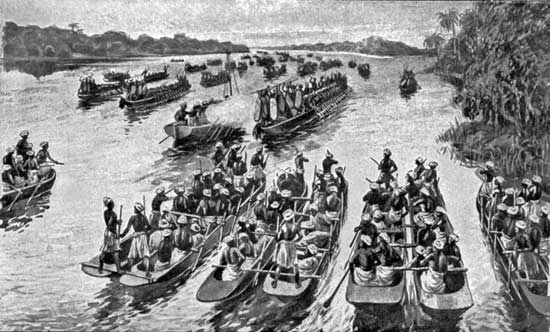
PLATE XXX. THE FIGHT ON THE CONGO. From Stanley's Through the Dark Continent.
The New Year (1877) had already come, when a friendly tribe warned the travellers of dangerous falls and rapids, the roar of which they would shortly hear. The flotilla glided along the right bank, and all listened for the expected thunder. Suddenly savages appeared on the bank and hurled their assegais; then the war-drums were heard again, and a large number of long canoes approached (Plate XXX.). The warriors had painted one half of their bodies white and the other red, with broad black stripes, and looked hideous. Their howls and horn blasts betokened a serious attack. By this time Stanley's boats were out in the middle of the stream in order of battle, with the shields placed along the gunwales to protect the non-combatants. A canoe 80 feet long rowed straight for Stanley's boat, but was received by a rattling volley. Then it was Stanley's turn to attack, for the great canoe could not turn in time. Warriors and oarsmen jumped overboard to save themselves by swimming to land, and as the other boats vanished the expedition could go on towards the falls.
Now was heard the roar of the water as it tumbled in wild commotion over the barriers in its bed. The natives thought that this was just the place to catch the strangers, and Stanley had to fight his way step by step, sometimes on land and sometimes on the river. In quiet water between the various falls the men could row, but in other places paths had to be cut through the brushwood on the bank and the canoes hauled over land. Often they had to fight from tree to tree. Once the savages tried to surround Stanley's whole party in a large net, and lost eight of their own men for their trouble. These captives were tattooed on the forehead and had their front teeth filed to a point. Like all the other people in the country, they were cannibals, and were eager for human flesh.
One day at the end of January Stanley's boats crossed the equator, and the great river turned more and more towards the west, so that it evidently could not belong to the Nile. Here the party passed the seventh and last fall, where the brown water hurled itself in mad fury over the barrier. Thus the series of cascades afterwards known as the Stanley Falls was discovered and passed.
Below the falls the river expands, sometimes to as much as two miles in breadth. The opposite bank could hardly be seen, and the boats came into a labyrinth of channels between islands. The rowers sang to the swing of their oars, and a sharp look-out had always to be kept. Sometimes canoes followed them, and occasionally ventured to attack. Wild warriors were seen with loathsome features, and red and grey parrots' feathers on their heads, and bangles of ivory round their arms.
In one village was found a temple with a round roof supported on thirty-three elephants' tusks. In the middle was set up an idol carved in wood and painted red, with black eyes, hair, and beard. Knives, spears, and battle-axes were wrought with great skill, and were ornamented with bands of copper, iron, and bone. Among the refuse heaps were seen remains of horrible feasts, and human skulls were set up on posts round the huts.
Interminable forests grew on the banks and islands, with the many-rooted mangrove-tree, tall, snake-like canes with drooping tufts of leaves, the dragon's-blood tree, the india-rubber, and many others.
Danger and treachery lurked behind every promontory, and the men had to look out for currents, falls, rapids, and whirlpools. Hippopotami and crocodiles were plentiful. But the savages were the worst danger. Stanley and his men were worn out with running the gauntlet month after month.
At the village of Rubunga, where the natives were friendly, Stanley heard for the first time that the river actually was the Congo. Here the traveller was able to replenish his stock of provisions, and when the drums of Rubunga were sounded it was not for battle but to summon the inhabitants to market, and from the surrounding villages the people came to offer for sale fish, snails, oysters, dried dog-flesh, goats, bananas, meal, and bread. As a rule, however, no trust could be placed in the natives. In their hideous tattooing, with strings of human teeth round their necks and their own teeth filed to a point like a wolf's, with a small belt of grass round their loins and spears and bows in their hands, they did not inspire confidence, and frequently the boats had barely put out from the bank where the people seemed friendly before the natives manned their canoes and pursued them. In this region they were armed with muskets procured from the coast. Once Stanley's small flotilla was surrounded by sixty-three canoes, and there was a hard fight with firearms on both sides. In the foremost canoe stood a young chief, handsome, calm, and dignified, directing the attack. He wore a head-covering and a mantle of goatskin, and on his arms, legs, and neck he had large rings of brass wire. A bullet struck him in the thigh. He quietly wound a rag round the wound and signed to his oarsmen to make for the bank. Then the others lost courage and followed their leader's canoe.
They struggled southwards from one combat to another. The passage of the great curve of the Congo had cost thirty-two fights. Now remained a difficult stretch, where the mighty river breaks in foaming falls and rapids through the escarpment which follows the line of the west coast of Africa. These falls Stanley named after Livingstone; he was well aware that the river could never be called by any other name than the Congo, but the falls would preserve the great missionary's name. Innumerable difficulties awaited him here. On one occasion half a dozen men were drowned and several canoes were lost, and the party had to wait while others were cut out in the forest. One day Pocock drifted towards a fall, and was not aware of the danger until it was too late and he was swept over the barrier. Thus perished the last of Stanley's white companions.
At another fall the coxswain and the carpenter went adrift in a newly excavated canoe. They had no oars. "Jump, man," called out the former, but the other answered, "I cannot swim." "Well, then, good-bye, my brother," said the quartermaster, and swam ashore. The other went over the fall. The canoe disappeared in the seething whirlpool, came up again with the man clinging fast to it, was sucked under once more, and rose again still with the carpenter. But when it reappeared for the third time in another whirlpool the man was gone.
At last all the boats were abandoned and the men travelled by land. The party was entirely destitute, all were emaciated, miserable, and hungry. A black chief demanded toll for their passage through his country, and they had nothing to give. He would be satisfied with a bottle of rum he said. Rum, indeed, when they had been three years in the depths of Africa! Stanley was reasoning with the chief when the coxswain came and asked what was the matter. "There's rum for him," he said, and gave the chief a buffet which knocked him over and put his whole retinue to flight.
Now it was only a couple of days' journey to Boma, near the mouth of the Congo, where there were trade factories and Europeans. Stanley wrote a letter to them, and was soon supplied with all necessaries; and after a short rest at Boma the party made the voyage round the south of Africa to Zanzibar, where Stanley dismissed his men.
He then travelled home, and was, of course, fêted everywhere. For a thousand years the Arabs had travelled into the interior of Africa, but they did not know the course of the Congo. European explorers had for centuries striven to penetrate the darkness. The natives themselves did not know whither the Lualaba ran. All at once Stanley had filled up the blank and knit together the scattered meshes of the net; and now a railway runs beside the falls, and busy steamboats fly up and down the Congo. Well did Stanley deserve his native name of Bula Matadi, or "the breaker of stones," for no difficulty was too great for him to overcome.
After a life of restless activity—including another great African journey to find Emin Pasha, the Governor of the Equatorial Province after Gordon's death—Stanley was gathered to his fathers in 1904. He was buried in a village churchyard outside London, and a block of rough granite was placed above the grave. Here may be read beneath a cross, "Henry Morton Stanley—Bula Matadi—1841-1904," and lastly the word that sums up all the work of his life, "Africa."
Timbuktu and the Sahara
In the middle of north-western Africa, where the continent shoots a gigantic tongue out into the Atlantic, lies one of the world's most famous towns, Timbuktu.
Compared with Cairo or Algiers, Timbuktu is a small town. Its three poor mosques cannot vie with the grand temples which under French, Turkish, or English dominion raise their graceful minarets on the Mediterranean shores of Africa. Not a building attracts the eye of the stranger amidst a confusion of greyish-yellow mud houses with flat roofs and without windows, and neglect and decay stare out from heaps of ruins. There is hardly a tottering caravanserai to invite the desert wanderer to rest. Some streets are abandoned, while in others the foot sinks over the ankle in blown sand from the Sahara.
Timbuktu is not so famous as the sparkling jewels in the diadem of Asia—Jerusalem and Mecca, Benares and Lhasa. The very name of each of these is, as it were, a vital portion of a great religion, and indeed almost stands for the religion itself. Timbuktu has scarcely any religion, or, more correctly, too many. And yet this town has borne a proud name during its eight hundred years of existence—the great, the learned, the mysterious city. No pilgrims flock thither to fall down in prayer before a redeemer's grave or be blessed by a high priest. No pyramids, no marble temples, make Timbuktu one of the world's wonders. No wealth, no luxuriant vegetation exist to make it an outer court to Paradise.
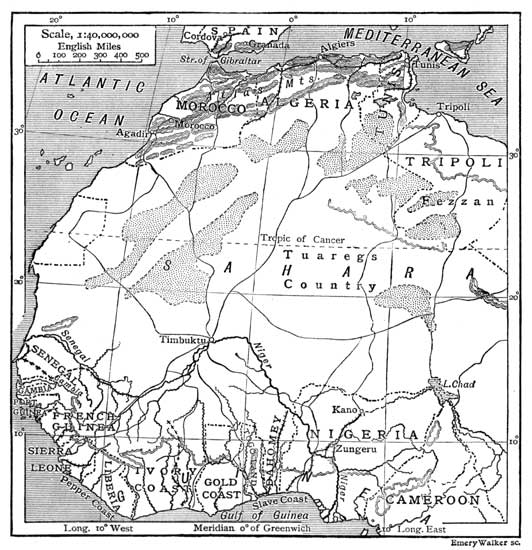
NORTH-WEST AFRICA.
And yet Timbuktu is an object of desire. Millions long to go there, and when they have been, long to get away again. Caravan men who have wandered for months through the desert long for the tones of the flute and the cithern, and the light swayings of the troops of dancers. Palms and mimosa grow sparsely round Timbuktu, but after the dangers of the desert the monotonous, dilapidated town with its dusty, dreary streets seems really like an entrance to Paradise. Travelling merchants who have risked their wealth in the Sahara among savage robbers, and have been fortunate to escape all dangers, are glad at the sight of Timbuktu, and think its grey walls more lovely than anything they can imagine.
The remarkable features of Timbuktu are, then, its situation and its trade. We have only to take a look at the map to perceive that this town stands like a spider in its web. The web is composed of all the routes which start from the coast and converge on Timbuktu. They come from Tripoli and Tunis, from Algeria and Morocco, from Senegal and Sierra Leone, from the Pepper Coast, the Ivory Coast, and Slave Coast, the Gold Coast, and from the countries round the Gulf of Guinea, which have been annexed by France, England, and Germany. They come also from the heart of the Sahara, where savage and warlike nomad tribes still to this day maintain their freedom against foreign interference.
In Timbuktu meet Arabs and negroes, Mohammedans and heathens from the deserts and fruitful lands of the Sahara and Sudan. Timbuktu stands on the threshold of the great wastes, and at the same time on the third in rank of the rivers of Africa. At the town the Niger is two and a half miles broad, and from its mouth it discharges more water than the Nile, but much less than the Congo. Like the Congo, the Niger makes a curve to the north, bidding defiance to the Sahara; but the desert wins in the end, and the river turns off towards the south.
It is a struggle between life and death. The life-giving water washes the choking sand, and just where the strife is fiercest lies Timbuktu. From the north goods come on dromedaries to be transported farther in canoes or long, narrow boats with arched awnings of matting, or, where the river is not navigable, on oxen and asses or the backs of men. Dromedaries cannot endure the damp climate near the Niger, which especially in winter overflows its banks for a long distance. Therefore they are led back through the Sahara. They thrive on the dry deserts. The constantly blowing north-east trade-wind dries up the Sahara, and in certain regions years may pass without a drop of rain.
The name Timbuktu has a singular sound. It stands for all the mystery and fascination connected with the Sahara It leads the thoughts to the greatest expanse of desert in the world, to long and lonely roads, to bloody feuds and treacherous ambushes, to the ring of caravan bells and the clank of the stirrups of the Beduins (Plate XXXI.). There seems to be a ring in the name itself, and we seem to hear the splash of the turbid waters of the Niger in its vowels. We seem to hear the plaintive howl of the jackal, the moan of the desert wind, the squealing of dromedaries outside the northern gateway, and the boatmen splashing with oars and poles in the creeks of the river.
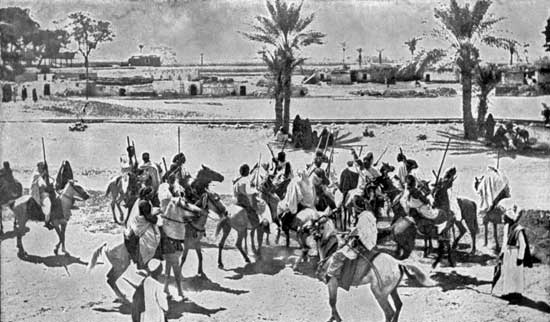
PLATE XXXI. A GROUP OF BEDUINS.
Caravans from the northern coast bring cloth, arms, powder, paper, tools, hardware, sugar, tea, coffee, tobacco, and a quantity of other articles to Timbuktu. But when they begin their journey through the Sahara, only half the camels are laden. The other half are loaded with blocks of salt on the way, for salt is in great demand at Timbuktu. Caravans may be glad if they come safely through the country of the Tuaregs, and at best they can only obtain an unmolested passage by the payment of a heavy toll. On the return journey northwards the dromedaries are laden with wares from the Sudan, rice, manioc, honey, nuts, monkey breadfruit, dried fish, ivory, ostrich feathers, india-rubber, leather, and many other things. A small number of black slaves also accompany them. The largest caravans contain five hundred or a thousand dromedaries and five hundred men at most. The goods they can transport may be worth twenty-eight thousand pounds or more. Five great caravan roads cross the Sahara from north to south.
Let us set out on a journey from Timbuktu, and let us go first eastwards to the singular Lake Chad, which is half filled with islands, is shallow and swampy, choked with reeds, rises and falls with the discharge of the great rivers which flow into it, and has a certain similarity to Lop-nor in Central Asia. Nearly 17 cubic miles of water are estimated to enter Lake Chad in the year, and when we know that the lake on the whole remains much about the same size, we can conceive how great the evaporation must be.
We have our own dromedaries and our own Arab guide on whom we can rely. We can therefore go where we like, and we steer our course from Lake Chad towards the eastern Sudan, where we have already been in the company of General Gordon. But before we come to the Nile we turn off northwards to cross the Libyan desert, the most inaccessible and desolate, and therefore the least known, part of the Sahara. On our way northwards we notice that animal and vegetation life becomes more scanty. Even in the Sudan the grasslands are more thinly clothed and the steppes more desert-like the farther we travel, and at last blown sand predominates. We must follow a well-known road which has been used for thousands of years by Arabs and Egyptians.
We are in the midst of the sea of sand. Here lie at certain places dunes of reddish-yellow drift sand as high as the tower of St. Paul's Cathedral. We see no path, for it has been swept away by the last storm; but the guide has his landmarks and does not lose his way. The sand becomes lower and the country more open. Then the guide points to a bare and barren ridge which rises out of the sand like a rock out of the sea, and says that he can find his way by this landmark, which remains in sight for several days, and is then replaced by another elevation.
We encamp at a deep well, drink and water our camels. Next day we are out in the sandy sea again. The sky has assumed an unusual hue. It is yellow, and soon changes into bluish grey. The sun is a red disc. It is calm and sultry. The guide looks serious, and says in a low tone "samum." The hot, devastating desert storm which is the scourge of Arabia and Egypt is approaching.
The guide stops and turns round. He is uncertain. But he goes on again when he sees that we cannot get back to the well before the storm is upon us. It is useless to look for shelter, for the dunes are too flat to protect us from the wind. And now the storm sweeps down, and it becomes suffocatingly close and hot. The dromedaries seem uneasy, halt, and turn away from the wind. We dismount. The dromedaries lie down and bury their muzzles in the sand. We wrap up our heads in cloths and lie on our faces beside our animals to get some shelter between them and the ground. And so we may lie by the hour panting for breath, and we may be glad if we get off with our lives from a samum when we are out in the desert. Even in the oases it causes a feeling of anxiety and trouble, for the burning heat is most harmful to palms and crops. The temperature may rise to 120° in this dangerous storm, which justifies its name of "poison wind."
The storm passes off, the air becomes clear and is quiet and calm, and the sun has again its golden yellow brilliance. It is warm, but not suffocating as it was. The heated air vibrates above the sand. Beside our road appears a row of palms and before them a silver streak of water. The guide, however, goes on in quite a different direction, and when we ask him why, he answers that what we see is a mirage, and that there is no oasis for many days' journey in the direction in which we see the palms.
In the evening we come to a real oasis, and there we are glad to rest a couple of days. Here are a hundred wells, here the ground is cultivated in the shade of the palms, here we can enjoy to the full the moist coolness above the swards of juicy grass. The oasis is like an island in the desert sea, and between the palm trunks is seen the yellow level horizon, the dry, heated desert with its boundless sun-bathed wastes.
If we now turn off towards the north-west, Fezzan is the next country which our route touches. It is a paradise of date palms. They occur in such profusion that even dromedaries, horses, and dogs are fed with the fruits. The surface of the ground also has undergone a great change, and is not so sterile and choked with sand as in the Libyan desert. Here and farther to the west the country becomes more hilly. Ridges and bosses of granite and sandstone, weathered and scorched by the sun, stand up here and there. Extensive plateaus covered with gravel are called hammada; they are ruins of former mountains which have burst asunder. In the Sahara the differences of temperature between day and night are very great. The dark, bare hill-slopes may be heated up to 140° or more when the sun bathes them, while during the night the radiation out to space is so intense that the temperature sinks to freezing-point. Through these continual alternations the rocks expand and contract repeatedly, fissures are formed and fragments are detached and fall down. The hardest rocks resist longest, and therefore they stand up like strange walls and towers amidst the great desolation.
If we go another step westwards we come to the land of the Tuaregs. There, too, we find hilly tracts and hammadas, sandy deserts and oases, and in favourable spots excellent pastures. We have already noticed in Timbuktu this small, sturdy desert people, easily recognised by the veil which hides the lower part of the face. All Tuaregs wear such a veil, and call those who do not "fly-mouths." They are powerfully built, and of dark complexion, being of mixed negro blood from all the slaves they have kidnapped in the Sudan. They are as dry and lean as the ground on which they live, and nature in their country obliges them to lead a nomad life. Wide, simple, and dreary is the desert, and simple and free is the nomad's life. The hard struggle for existence has sharpened their senses. They are acute observers, clever, crafty, and artful. Distance is of no account to them, for they do not know what it is to be tired. They fly on their swift dromedaries over half the Sahara, and are a terror to their settled neighbours and to caravans. On their raids they cover immense distances in a short time. To ride from the heart of their country to the Sudan after booty is child's play to them. They have made existence in many oases quite unendurable. What use is it to till fields and rear palms when the Tuaregs always reap the harvest? The French have had many fights with the Tuaregs, and the railway which was to pass through their country and connect Algiers with Timbuktu is still only a cherished project. Yet this tribe which has so bravely defended its freedom against the stranger does not number more than half a million people. The Tuaregs are not born to be slaves, and we cannot but admire their thirst for freedom, their pride, and their courage.
The desert here exhibits the difficult art of living. Even animals and plants which are assigned to the desert are provided with special faculties. Some of the animals, snakes and lizards for instance, can live without water. Dromedaries can go for many days without drinking. Ostriches cover great distances to reach water before it is too late. Plants are provided with huge roots that they may suck up as much moisture as possible, and many of them bear thorns and spikes instead of leaves so that the evaporation may be insignificant. Many of them are called to life by a single fall of rain, develop in a few weeks, and die when long drought sets in again. Then the seeds are left, waiting patiently for the next rain. Some desert plants seem quite dead, grey, dried-up, and buried in dust, but when rain comes they send out green shoots again.
Every river bed is called in the Sahara a wadi. Very seldom does a trickle of water run down it after rain, but in these beds the vegetation is richer than elsewhere, for here moisture lingers longer than in other spots. Many caravans march along them, and gazelles and antelopes find pasture here.
A European leaves Algeria to make his way into the Sahara with an incomprehensible feeling of fascination. In the French towns on the Mediterranean coast he has lived just as in Europe. He has been able to cross by train the forest-clad heights of the Atlas Mountains, where clear brooks murmur among the trees. He leaves the railway behind, and finds the hills barer the farther he travels south. At last the monotonous, slightly undulating desert stretches before him, and he feels the magical attraction of the Sahara drawing him deeper and deeper into its great silence and solitude. All the colours become subdued and greyish-yellow, like the lion's hide. Everything is yellow and grey, even the dromedaries which carry him, his tent and baggage, from well to well. He can hardly tell why he finds this country pleasanter than the forests and streams on the slopes of the Atlas Mountains; perhaps owing to the immense distances, the mysterious horizon afar off, the blood-red sunsets, the grand silence which prevails everywhere so that he hardly dares speak aloud. It is the magic of the desert that has got hold of him.
Thirty years ago a large French expedition, under the command of Colonel Flatters, marched along this route from Algeria southwards through the Sahara. It consisted of a hundred men, including seven French officers and some non-commissioned officers, and its equipment and provisions were carried by three hundred dromedaries. The French Government had sent out the expedition to examine the Tuaregs' country, and to mark out a suitable route for a railway through the Sahara to connect the French possessions in the north and south. It was not the first time that the Colonel had travelled in the Sahara, and he knew the Tuaregs well. Therefore he was on his guard. Everything seemed most promising. The Frenchmen mapped parts of the Sahara which no European had ever succeeded in reaching before—even the great German traveller, who had crossed the Sahara in all directions, had not been there. The most dangerous tracts were left behind, and the Tuaregs had offered no resistance: indeed some of their chiefs had been friendly. In the last letters which reached France, Flatters expressed a hope that he would be able to complete his task without further trouble, and to advance even to the Sudan.
Then the blow fell. The expedition was suddenly attacked at a well, and succumbed after a heroic defence against superior numbers. Most of the Frenchmen were cut down. Part of the caravan attempted to reach safety by hurrying northwards on forced marches, but was overtaken and annihilated. Many brave Frenchmen have met the same fate as Flatters in the struggle for dominion over the Sahara.
If we travelled, as we have lately imagined, on swift-footed dromedaries in a huge circuit from Timbuktu through the Sudan, the Libyan desert, and the land of the Tuaregs, we should at last come to Morocco, "The Uttermost West," as this last independent Sultanate in Africa is called. Morocco is the restless corner of Africa, as the Balkan Peninsula is of Europe, Manchuria of Asia, and Mexico of North America—in South America all parts are unsettled.