Part 2 — II AFRICA
Reading edition
General Gordon
Seldom has the whole civilised world been so convulsed, so overwhelmed with sorrow, at the death of one man as it was when in January, 1885, the news flashed along the telegraph wires that Khartum had fallen, and that Gordon was dead.
Gordon was of Scottish extraction, but was born in one of the suburbs of London in the year 1833, and as a young lieutenant of engineers heard the thunders of war below the walls of Sebastopol. As a major of thirty years of age he commanded the Imperial army in China, and suppressed the furious insurrection which raged in the provinces around the Blue River. "The Ever-Victorious Army" would have come to grief without a strong and practical leader, but in Gordon's hands it soon deserved its name. He made his plans quickly and clearly, brought his troops with wonderful rapidity to the most vulnerable points in the enemy's position, and dealt his blows with crushing force. In a year and a half he had cleared China of insurgents and restored peace.
After several years of service at home and other wanderings in Eastern lands, Gordon accepted in 1874 an invitation to enter into the service of the Khedive of Egypt. The Khedive Ismail was a strong man with far-reaching projects. He wished to extend his dominion as far as the great lakes where the Nile takes its rise, and Gordon was to rule over a province named after the equator.
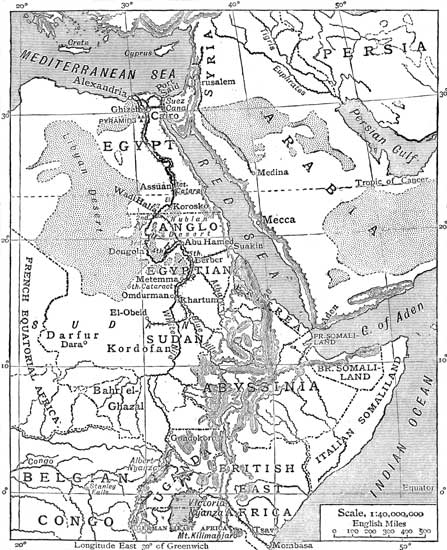
MAP OF NORTH-EASTERN AFRICA, SHOWING EGYPT AND THE SUDAN.
Immediately to the south of Cairo begins a plateau which stretches from north to south through almost the whole continent. In Abyssinia it attains to a considerable height, and near the equator rises into the loftiest summits of Africa. These mountains screen off the rain from Egypt and large areas of the Sudan. The masses of vapour which are carried over Abyssinia in summer by the monsoon are precipitated as rain in these mountain tracts, and consequently the wind is dry when it reaches Nubia and Egypt; while the moisture which rises from the warm ocean on the east, and is borne north-westwards by the constant trade-wind, is converted into water during eight months of the year among the mountains on the equator.
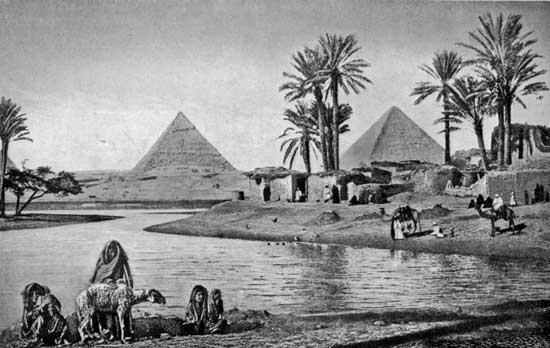
PLATE XXVIII. THE GREAT PYRAMIDS AT GHIZEH.
The rain which falls on the mountains of Abyssinia gives rise to the Atbara and Blue Nile, which produce abundant floods in the Nile during autumn; and during the rest of the year the White Nile, which comes from the great lakes on the equator, provides for the irrigation of Egypt. Thus the country is able to dispense with rain, and innumerable canals convey water to all parts of the Nile valley. Many kinds of grain are cultivated—wheat, maize, barley, rice, and durra (a kind of millet); vegetables, beans, and peas thrive, numerous date palms suck up their sap from the heavy, sodden silt on the river's banks, and sugar-cane and cotton are spreading more and more. Seen at a height from a balloon, the fields, palms, and fruit-trees would appear as a green belt along the river, while the rest of the country would look yellow and grey, for it is nothing but a dry, sandy desert.
The Nile, then, is everything to Egypt, the condition of its existence, its father and mother, the source of the wealth by which the country has subsisted since the most remote antiquity. Now that we are about to follow Gordon along the Nile to the equator, we must not forget that we are passing through an ancient land. The first king of which there are records lived 3200 years before the Christian era, and the largest of the Great Pyramids at Ghizeh is 4600 years old (Plate XXVIII.). Its funeral crypt is cut out of the solid rock, and in it still stands the red granite sarcophagus of Cheops. Two million three hundred thousand dressed blocks, each measuring 40 cubic feet, were used in the construction of this memorial over a perishable king, and the pyramid is reckoned to be the largest edifice ever built by human hands. The buildings and works of the present time are nothing compared to it. Only the Great Wall of China can vie with it, and this is ruined and to a large extent obliterated, while the pyramid of Cheops still stands, scorched by the sun, or sharply defined in the moonlight, or dimly visible as a mysterious apparition in the dark, warm night.
Twelve hundred miles south of the capital of modern Egypt the desert comes to an end, and the surface is covered by vast marshes and beds of waving reeds. This is the Sudan, "the Land of the Blacks." At the point where the White and Blue Niles mingle their waters lay the only town in the Sudan, Khartum, whither trade-routes converged from all directions, and where goods changed hands. Here were brought wares which never failed to find purchasers. The valuable feathers plucked from the swift-footed ostrich were needed to decorate the hats of European ladies; the wild elephants, larger and more powerful than their Indian congeners, were shot or caught in pitfalls in the woods for the sake of their precious ivory. But the most esteemed of all the wares that passed through Khartum were slaves—"black ivory," as they were called by their heartless Arab torturers. Elephants' tusks are heavy, and cannot be transported on horses or oxen from the depths of the forest, for draught animals are killed by the sting of the poisonous tsetse fly. Therefore the tusks had to be carried by men, and when these had finished their task they were themselves sold into Egypt, Syria, and Turkey. The forests and deserts were not inexhaustible; ivory and ostrich feathers might be worked out, but there would always be negroes.
When the Khedive Ismail invited Gordon to enter his service as governor of the new province not far from the sources of the Nile, Gordon accepted the post in the hope that he would be able to suppress slave-trading, or at least to check the hunting of black men and women. He left Cairo and travelled by the Red Sea to Suakin, rode to Berber on the Nile, and was received with much pomp and ceremony by the Governor-General at Khartum. Here he heard that the Nile was navigable for 900 miles southwards, and therefore he could continue his journey without delay.
The Nile afforded an excellent passage for Gordon's small steamboat. But the Nile can also place an insurmountable obstacle in the traveller's way. After the rainy season the White Nile overflows its banks, forming an inextricable labyrinth of side branches, lakes, and marshes. The country lies under water for miles around. The waterway between impenetrable beds of reeds and papyrus is often as narrow as a lane. The roots of large plants are loosened from the mud at the bottom, and are compacted with stems and mud into large sheets which are driven northwards by the rushing water. They are caught fast in small openings and sudden bends, and other islets of vegetation are piled up against them. Thus the river course is blocked, and above these natural dams the water forms lakes. Such banks of drifting or arrested and decaying vegetation are called sudd, and the more it rains the greater are the quantities that come down. At length the sudd becomes soft and yields to the pressure of the water, and then the Nile is navigable again.
Gordon's small steamer glides gently up the river. He advances deeper and deeper into a world unknown to him, and around him seethes tropical Africa. On the banks papyrus stems wave their plumes above the reeds. It was from the pith of papyrus stems that the old Egyptians made a kind of paper on which they wrote their chronicles. Here and there swarthy natives are seen between the reed beds, and sometimes noisy troops of wandering monkeys gaze at the boat. The hippopotami look like floating islands, but show themselves only at night, wallowing in the shallow water. A little beyond the luxuriant vegetation of the banks extends the boundless grassland with its abundant animal life and thin scattered clumps of trees.
After a journey of four days the steamer glided past an island. There dwelt in a grotto a dervish or mendicant monk named Mohamed Ahmed, who ten years later was to be Gordon's murderer.
In the middle of April Gordon and his companions were in Gondokoro, a small place which now stands on the boundary between the Sudan and British East Africa, and here he took charge of his Equatorial Province. He forced the Egyptian soldiers, who garrisoned this and one or two other posts on the Nile and robbed on their own account, to plough and plant; he arrested all slave-hunters within reach and freed the slaves; he succoured the poor, protected the helpless, and sent durra to the hungry.
The heat was excessive, and Gordon and his staff were pestered by crowds of gnats. It was still worse in September when the rain poured down and large tracts were converted into swamp, from which dangerous miasma was exhaled. In a month seven of Gordon's eight officers had died of fever, but he himself continued his work undismayed, and wrote in his diary: "God willing, I shall do much in this country."
He soon perceived that the best districts of his province lay around the large lakes in the south. But the Equatorial Province was too far away from Egypt. It hung as it were on a long string, the Nile, and from the largest lake, the Victoria Nyanza, the distance to Cairo in a straight line was nearly 2200 miles. Much shorter was the route to Mombasa on the east coast, so Gordon advised the Khedive to occupy Mombasa and open a road to the Victoria Nyanza. Then it would be easier to contend against the slave-trade. He described the condition of the Sudan in forcible letters, and into the Khedive's ears were dinned truths such as he never heard from his servile pashas. He would first establish steam communication with the lakes, and a number of boats which could be taken to pieces were on the way to his province.
The boats came up at the time when the Nile began to rise after rain, and then his plan was to advance farther southwards. The natives were opposed to this progress and feared the supremacy of Egypt, and therefore they tried to prevent the advance of the "White Pasha," who was loath to employ arms against them. All they wanted was to be left in peace in their grasslands and forests; and when now an intruder, whose aims they did not understand, penetrated into their country, they endeavoured whenever they could to bar his way, so that he was obliged, much against his will, to resort to force.
After all kinds of troubles and difficulties he reached at last the northernmost of the Nile lakes, the Albert Nyanza, and it was a great feat to have brought a steamer even thus far. He did not succeed in reaching the Victoria Nyanza, for the ruler of the country between the lakes had resolved to oppose with all his power any intruder, were he white man or Arab.
For three years Gordon was at work on the Upper Nile in the neighbourhood of the equator. During the next three years we find him in the deserts of the Sudan farther north. He was Governor-General of the whole of the Egyptian Sudan, and Khartum was his capital. His province was 1200 miles broad, from the Red Sea to the Sahara, and as long from north to south. The whole country was in a state of unrest. The Khedive had carried on an unsuccessful war against the Christian King of Abyssinia, and the Mohammedan states of Kordofan and Darfur were in revolt against Egypt. There half-savage Beduin tribes were scattered about over the deserts, and there some of the worst slave-dealers had their haunts.
In May, 1877, Gordon mounted his swift dromedary to set out on a journey of 2000 miles. He wished to visit the villages and camps of the slave-dealers in distant Darfur. The hot season had set in. When the sun stood at its meridian altitude the shadow of the dromedary disappeared beneath the animal. A dreary desert extended on all sides, greyish-yellow, dusty, and dry.
The White Pasha skims over the desert mile after mile. He has the finest dromedary in all the land, an animal that became famous throughout the Sudan. Some hundreds of Egyptian troopers follow him, but he leaves them all far behind and only a guide keeps up with him. He rushes over the desert like the wind, and suddenly and unexpectedly draws rein at the gates of an oasis before the guard can shoulder their arms. After giving his orders in the name of the Khedive, he disappears as mysteriously, no one knows whither. At another oasis, perhaps 300 miles away, the chief has been warned of his coming and has therefore posted watchmen to look out for him. Round about lies the desert, sandy and yellow, with a surface as level as a sea, where the approach of the White Pasha can be seen from a long distance. The watchman announces that two black specks are visible in the distance, which, it is supposed, are the Pasha's outriders, and some hours must pass before he arrives with his troops. The two specks grow larger and come rapidly nearer. The dromedaries swing their long legs over the ground, seeming to fly on invisible wings. Now the men have come to the margin of the oasis. The watchers can hardly believe their eyes. One of the riders wears the gold-embroidered uniform of an Egyptian pasha. Never had the Sudan seen a Governor-General travelling in this way—without flags and noisy music, and stripped of all the display appropriate to his rank.
And as he came so he flew away again, mysteriously and incomprehensibly. Again and again he lost his armed force. In some districts he closed the paths leading to wells in order to bring the refractory tribes to submission. With inflexible severity he broke the power of the chiefs who still carried on trade in slaves. He freed numbers of black captives and drilled them as soldiers, for his own fighting men were the scum of Egypt and Syria. With a handful of men he dealt his blows at the weakest points of the enemy's defence and thus always gained the victory. In four months he suppressed the revolt and checked the power of the slave-dealers.
Gordon had now cleared all the west of the Sudan, and only Dara in southern Darfur remained to be dealt with. There the most powerful slave-dealers had collected to offer resistance. He came down one day like lightning into their camp. They might easily have killed him—it was he who had ruined their trade in black ivory. He went unconcernedly among the tents, and they did not dare to touch him. And when his own troops arrived, he summoned all the chiefs to his tent and laid his conditions before them. They were to lay down their arms and be off each to his own home; and one by one they obeyed and went away without a word.
But the slave-trade was a weed too deeply rooted in the soil to be eradicated in a single day, and the revolt and troubles which constantly arose out of this horrible traffic gave Gordon no peace. He left the Sudan at the end of 1879, and the next two years were occupied with work in India, China, Mauritius, and South Africa. Meanwhile remarkable events had occurred in Egypt. Great Britain had sent vessels and troops to the land of the Khedive, and had taken over the command and the responsibility. The chief of the dervishes, Mohamed Ahmed, whom we remember on the small island in the Nile, proclaimed that he was chosen by God to relieve the oppressed, that he was the Mahdi or Messiah of Islam. Discontent prevailed among the Mohammedans throughout the Sudan, for Egypt had at length prohibited the slave-trade, and the Mahdi collected all the discontented people and tribes under his banner. His aim was to throw off the yoke of Egypt. Proud and arrogant, he sent despatches through the whole of the Sudan, and his summons to a holy war flew like a prairie fire over North Africa.
The British Government, which was now responsible for Egypt, was in a difficulty. The Sudan must either be conquered or evacuated, for the Egyptian garrisons were still at Khartum and at several places even down to the equator. The Government decided on evacuation, and Gordon was sent to perform the task of withdrawing all the garrisons. He accepted the mission and set out immediately for Cairo.
Thus Gordon began his last journey up the Nile. At Korosko, just at the northern end of the great S-shaped bend of the Nile, he mounted his dromedary and followed the narrow winding path which has been worn out during thousands of years through the dry hollows of the Nubian desert, over scorched and weathered volcanic knolls and through dunes of suffocating sand.
On February 18, 1884, Gordon, for the second time Governor-General of the Sudan, made his entry into Khartum, where he took up his quarters in his old palace. Cruelty and injustice had again sprung up during the years he had been absent. He opened the gates of the overcrowded gaols, and the prisoners were released and their fetters removed. All accounts of unpaid taxes were burned in front of the palace. All implements of punishment and torture were broken to pieces and thrown into the Nile.
Then began the evacuation of the town. As many as 3000 women and children were sent to Abu Hamed and through the desert to Korosko. They got through without danger and were saved. Where women and children could travel, it would have been easy to lead troops from Egypt. Instead of this, however, England despatched an expedition to Suakin to secure an outlet on the Red Sea, whereupon the rebellious tribes of the Sudan were roused to fury, believing that the white men intended to come and take their country. Consequently they rallied all the more resolutely round the Mahdi, and their hatred extended to the dreaded Gordon and the few Europeans with him in Khartum.
As long as the telegraph line was still available to Cairo, Gordon kept the authorities informed of the state of affairs and pointed out what should be done to ensure success. He asked especially that the road from Berber to Suakin should be held, for from this line also the Sudan could be controlled, but his advice was not attended to and Berber was eventually surrounded by the Mahdi's troops and captured. Several chiefs north and north-east of Khartum, who had previously been friendly disposed, now joined the Mahdi. News of fresh desertions came constantly to Khartum, and even in the town itself Gordon was surrounded by traitors. On March 10 the telegraph line was cut and then followed six months of silence, during which the world learned little or nothing of the brave soldier in the heart of Africa. On March 11 Arab war parties appeared on the bank of the Blue Nile, for the Mahdi was drawing his net ever closer round the unfortunate town.
During the preceding years the Egyptian Government had caused Khartum to be fortified after a fashion, and during the earlier months of the siege Gordon worked day and night to strengthen the defences. His soldiers threw up earthern ramparts round the town, a network of wire entanglements was set up, and mines were laid at places where an assault might be expected. At the end of April the town was entirely blockaded, and only the river route to the north was still open. At the beginning of May the Arabs crossed the Blue Nile, suffering great losses from exploding mines and the guns of the town. In the early part of September there were still provisions for three months, and the Arabs, perceiving that they could not take the town by storm from the White Pasha, resolved to starve it out.
The Nile was now at its highest, and huge grey turbid volumes of water hurried northwards. Now was the only chance for a small steamer to try to get to Dongola, where it would be in safety. On the night of September 9 a small steamer was made ready for starting, and Gordon's only English comrades, Colonel Stewart and Mr. Power, went on board, together with the French Consul, a number of Greeks, and fifty soldiers. They took with them accounts of the siege, correspondence, lists and details about provisions, ammunition, arms, men, and plans of defence, and everything else of particular value. Silently the steamer moved off from the bank, and when day dawned Gordon was alone. Alas, the little steamer never reached Dongola, for it was wrecked immediately below Abu Hamed. Every soul on board was murdered, and all papers of value fell into the hands of the Mahdi. On the other hand, Gordon's diary from September 10 to December 14, 1884, is still extant, and is wonderful reading.
By this time the British Government had at last decided to send an expedition to relieve Khartum. River boats were built in great numbers, troops were equipped for the field, the famous general, Lord Wolseley, was in command, and by the middle of September the first infantry battalion was up at Dongola on the northern half of the great S of the Nile. But then the steamers had only just arrived at Alexandria, and had to be taken up the Nile and tediously dragged through the cataracts, while the desert column which was to make the final advance on Khartum had not yet left England. A long time would be required to get everything ready.
In Khartum comparative quiet as yet prevailed. The dervishes bided their time patiently, encamping barely six miles from the outworks. Shots were exchanged only at a distance. On September 21 Gordon learned by a messenger that the relief expedition was on the way, and ten days later he sent his steamboats northwards to meet it and to hasten the forwarding of troops. But thereby he lost half of his own power of resistance.
On October 21 the Mahdi himself arrived in the camp outside Khartum, and on the following day sent Gordon convincing proofs that Stewart's steamboat had sunk and that all on board had been slain. He added a list of all the journals and documents found on board. From these the Mahdi had learned almost to a day how long Khartum could hold out, the strength of the garrison, the scheme of defence, where the batteries stood and how long the ammunition would last. This was a terrible blow to the lonely soldier, but it did not break down his courage. The death of Stewart and his companions grieved him inexpressibly, but he sent an answer to the Mahdi that if 20,000 boats had been taken it would be all the same to him—"I am here like iron."
In the relief expedition was a major named Kitchener, who was afterwards to become very famous. He tried to get into Khartum in disguise to carry information to Gordon, and he did succeed in sending him a letter with the news that the relieving force would set out from Dongola on November 1. When the letter reached Gordon the corps had been two days on the march, but the distance from Dongola to Khartum is 280 miles in a straight line.
By November 22 Gordon had lost nearly 1900 of his fighting men, but his diary shows that he was still hopeful. On December 10 there were still provisions for fifteen days. The entries in the diary now become shorter, and repeatedly speak of fugitives and deserters, and of the diminishing store of provisions. On December 14 Gordon had a last opportunity of sending news from Khartum, and the diary which the messenger took with him closes with these words: "I have done the best for the honour of our country. Good-bye."
After the sending-off of the diary impenetrable darkness hides the occurrences of the last weeks in Khartum. One or two circumstances, however, were made known by deserters. During the forty days during which the town held out after December 14, 15,000 townspeople were sent over to the Mahdi's camp, and only 14,000 civilians and soldiers were left in the doomed city. Omdurman fell, and the Mahdi's troops pressed every day more closely on all sides. Actual starvation began, and rats and mice, hides and leather were eaten, and palms stripped to obtain the soft fibres inside. But the White Pasha rejected all proposals to surrender.
Meanwhile the relief columns struggled southwards and on January 20, 1885, reached Metemma, only a hundred miles from Khartum. There they fell in with Gordon's boats, which had lain waiting in vain for four months, and four days later two of the boats started for Khartum.
Halfway they had to pass up the sixth cataract, there losing two days more, and not till the 28th had they left the rapids behind them. The noonday sun was shining brightly when the English soldiers and their officers saw Khartum straight in front of them on the point between the White and Blue Niles. All glasses were turned on the tall palace; every one was in the greatest excitement and dared hardly breathe, much less speak. There stood Gordon's palace, but no flag waved from the roof.
The boats go on, but no shouts of gladness greet their crews as long-looked-for rescuers. When they are within range the dervishes open fire, and wild troops intoxicated with victory gather on the bank. Khartum is in the hands of the Mahdi, and help has come 48 hours too late.
Two days before, January 26, the dervishes, furious at their continual losses and the obstinate resistance of the town, had flocked together for a final assault. The attack was made during the darkest hour of the night, after the moon had set. The defenders were worn out and rendered indifferent by the pangs of hunger. The dervishes rushed into the town, filling the streets and lanes with their savage howling. It was then that Gordon gathered together his twenty remaining faithful soldiers and servants, and dashed sword in hand out of the palace. It was growing light in the east, and the outlines of bushes and thickets on the Blue Nile were becoming clear. The small party took their way across an open square to the Austrian Mission church, which had previously been put in order for a last refuge. On the way they were met by a crowd of dervishes and were killed to the last man. Foremost among the slain was Gordon.
The Conquest of the Sudan
The Mahdi did not long enjoy the fruits of his victory, for he died five months to the day after the fall of Khartum. His successor, Abdullah, bore the title of Khalifa, and for thirteen years was a scourge to the unfortunate land. The tribes of the Sudan, tired of the oppression of Egypt, had welcomed the Mahdi as a deliverer, but they had only exchanged Turkish pashas for a tyrant unmatched in cruelty and shamelessness. Abdullah plundered and exhausted the country, but with the money and agricultural produce he extorted from the people he was able to maintain a splendid army always ready for the field. His capital was Omdurman, where the Mahdi was buried under a dome; but he did not fortify the town, for long before any Christian dogs could advance so far their bones would whiten in the sands of Nubia.
Yet after many years the hour of vengeance was at hand. The British Government had taken the pacification of the Sudan in hand, and in 1898 an army composed of British and Egyptian troops was advancing quietly and surely up the Nile. There was no need to hurry, and every step was made with prudence and consideration. The leader, General Kitchener, the last man to send a letter to Gordon, made his plans with such foresight and skill that he could calculate two years in advance almost the very day when Khartum and Omdurman would be in his hands.
At the Atbara, the great tributary of the Nile which flows down from the mountains of Abyssinia, Kitchener inflicted his first great defeat on the Khalifa's army in a bloody battle. From Atbara the troops pushed on to Metemma without further fighting, and on August 28 they were only four days' march from Khartum.
The green of acacia and mimosa is now conspicuous on the banks of the river, which is very high. The grey gunboats pass slowly up the Nile in the blazing sun, and the troops push on as steadily and as surely as they have from the start of the expedition. Small parties of mounted dervishes are seen in the far distance. The country becomes more diversified, and the route runs through clumps of bushes and between hillocks. A short distance in front are seen white tents, flags, and horsemen, and the roll of drums is heard. It is the Khalifa calling his men to the fight; but at the last moment the position is abandoned, the dervishes retire, and Kitchener's army continues its march.
At length the vaulted dome over the Mahdi's grave beside the Nile bank rises above the southern horizon, and round about it are perceived the mud houses and walls of Omdurman. Between the town and the attacking army stretches a level sandy plain scantily clothed with yellow grass; and here took place a battle which will not be forgotten for centuries throughout the Sudan.
On the morning of September 2, Kitchener's forces are drawn up in order of battle. Single horsemen emerge from the dust on the hillocks, increase in number, and then come in clouds like locusts—an army of 50,000 dervishes. Their fanatical war-cry rises up to heaven, gathers strength, grows louder, and rolls along like a storm wind coming in from the sea. They charge at a furious pace in an unbroken line, and it looks as though they would ride like a crushing avalanche right over the enemy. But the moment they come within range fire issues from thousands of rifles, and the dervishes find themselves in a perfect hail of bullets. Their ranks are thinned, but they check their course only for a moment, and ride on in blind fury and with a bravery which only religious conviction can inspire. The English machine guns scatter their death-bolts so rapidly that a continuous roll of thunder is heard, and the dervishes fall in heaps like ripe corn before the scythe. The fallen ranks are constantly replaced by fresh reinforcements, but at last the dervishes have had enough and beat a retreat. At once Kitchener pressed on to Omdurman, but the bloody day is not yet at an end. The dervish horsemen rally yet once more. The Khalifa's standard is planted in the ground on a mound, and beside it the Prophet's green banner calls the faithful together for a last desperate struggle. The English and their Egyptian allies fight with admirable courage, and the dervishes strike with a bravery and contempt of death to which no words can do justice. Under the holy banner a detachment advances into the fire, wavers, is mown down, and falls, and almost before the smoke of the powder has cleared away, another presses forward on the track of the slain, only to meet the same fate and join their comrades in the happy hunting-grounds of eternity.
At length the day was ended and the Khalifa's army annihilated—11,000 killed, 16,000 wounded, and 4000 prisoners! The Khalifa himself escaped. His harem and servants deserted him, and he who in the morning had been absolute ruler over an immense kingdom, wandered about in the woods like an outlaw. He fled to the south-west and succeeded in collecting another army, which was completely cut to pieces the following year in a battle in which he himself also perished.
When all was quiet in Omdurman, the victors had a solemn duty to fulfil. Thirteen and a half years had passed since the death of Gordon, and at last the obsequies of the hero were to be celebrated in a fitting manner. In the court in front of Gordon's palace the troops are drawn up on three sides of a square, and on the fourth stands the victor, surrounded by generals of divisions and brigades and by his staff. Kitchener raises his hand, and in a moment the Union Jack rises to the top of the flagstaff on the palace, while a thundering salute from the gunboats greets the new colours and the Guards' band plays the National Anthem. Another sign, and the flag of Egypt goes up beside the Union Jack and the Khedive's hymn is played. Then the belated funeral service is impressively conducted by four clergymen of different Christian denominations, the Sudanese band plays a hymn which Gordon loved, and lastly Kitchener is saluted with the greatest enthusiasm by the officers and men under his command.
Ostriches
Now all is changed in the Sudan. A railway runs from the Nile delta up to Khartum, and another connects Berber with the Red Sea. In Khartum there are schools, hospitals, churches, and other public buildings, and one can travel safely by steamboat up to the great lakes. Gordon's scheme to connect the Victoria Nyanza with Mombasa on the coast has been carried out, and a railway has been constructed through British East Africa. White men have advanced from all sides deeper and deeper into the Black Continent, and have made themselves masters of almost all Africa. Wild animals have suffered by this intrusion into their formerly peaceful domain, and their numbers have been diminished by the chase. In some districts game has quite disappeared, the animals having sought remoter regions where they can live undisturbed.
In the Sahara, in the Libyan desert, on the open grasslands along the Upper Nile, on the veldt of South Africa, wherever the country is open and free, lives the ostrich; but it does not occur in the worst desert tracts, which it crosses only in case of necessity, for it likes to have water always near at hand.
The appearance of the ostrich is no doubt familiar. It is powerfully built; its long bare neck supports a small flattened head with large bright eyes; the long legs rest on two toes; and the wings are so small that the animal is always restricted to the surface of the ground, where, however, it can move with remarkable swiftness. The valuable feathers grow on the wings. The ostrich attains a height of eight feet, and when full grown may weigh as much as 165 pounds.
Ostriches live in small flocks of only five or six birds. They feed in the morning, chiefly on plants, but they also devour small animals and reptiles. By midday their stomachs are full, and they rest or play, leaping in circles over the sand, regardless of the blazing sun or the heated ground. Then they drink and wander about eating in the afternoon. In the evening they seek their roosting-places.
Sight is the ostrich's acutest sense, but its scent and hearing are also sharp. When it is pursued, it darts off with fluttering wings, taking steps ten or twelve feet long. It is always on the look-out for danger, and the zebra likes to keep near it to avail itself of the bird's watchfulness. In North Africa the Arabs hunt the ostrich on swift horses or running dromedaries. Two or three horsemen follow a male, which after an hour's course is tired out, and gradually relaxes its pace. The horses also are tired after such a chase, but one of the riders urges on his steed to a last spurt, rushes past the ostrich, and hits it on the head so that it falls to the ground. The bird is then skinned, the skin being turned inside out so as to form a bag for the feathers. The feathers of the wild ostrich are much finer and more valuable than those of the tame. A full-grown ostrich has only fourteen of the largest white feathers.
The hens lay their eggs in a shallow hollow in loamy or sandy soil, and it is the male bird which sits on the eggs. In the daytime the nest may be left for hours, but then the ostriches cover the eggs with sand. The young ones leave their shells after six weeks and go out into the desert. They are already as large as fowls, but then an ostrich egg weighs as much as twenty-four hen's eggs, and measures six inches along its greatest diameter.
The ostrich is remarkably greedy, and turns away from nothing. The great zoologist, Brehm, who had tame ostriches under his care, reports that they ate rats and chickens and swallowed small stones and potsherds, and once or twice his bunch of keys disappeared down the stomach of an ostrich. In one ostrich's stomach was found nine pounds of "ballast"—stones, rags, buttons, bits of metal, coins, keys, etc.
Some say that the ostrich is inconceivably stupid, but others will not accept such a severe condemnation. The traveller Schillings, who is noted for his photographs of big game in Africa taken at night by flashlight, once followed the spoor of some lions for several hours. Suddenly he came upon an ostrich's nest with newly hatched chickens, and he wondered where the parents were. To his astonishment, he found that the lion had not touched the defenceless creatures, and he soon discovered the reason. In the moonlight night the ostriches had perceived the danger in time and sprang up to lure the lion away from the nest. Their stratagem succeeded, for it was evident from the spoor that the lion had pursued the flying ostriches farther and farther from the nest. And when the pair of ostriches thought that they had enticed the king of animals far enough off, they returned home.
Baboons
Baboons are monkeys which resemble dogs rather than human beings, and almost always remain on the ground, seldom climbing trees. They are cruel, malicious, and cunning, their expression is fierce and savage, and their eyes wicked. Among their allies they are surpassed in strength only by the gorilla; and they are bold and spirited, and do not shun a deadly struggle with the leopard. They have sharp and powerful teeth with which to defend themselves, and their tusks are very formidable.
The old Egyptians paid deep homage to the sacred apes, which belong to the baboon tribe, and had them represented on their monuments as judges in the kingdom of death. They live in large companies among the cliffs of the Red Sea coast of Nubia and Abyssinia, but they also occur in the interior on high mountains. Roots, fruits, worms, and snails are their chief food. They are afraid of snakes, but they catch scorpions, carefully pinching off the poison gland before eating the reptiles. When durra fields are in the neighbourhood of the baboons' haunts, watchmen must be posted, or the animals work great havoc among the grain. And when they are out on a raid, they, too, have sentinels on the lookout in every direction.
During the night and when it rains they sit huddled up among inaccessible rocks, whither they climb with wonderful activity. They sally forth in the morning to satisfy their hunger, returning to the high rocks at noon. Afterwards they go to the nearest brook or spring to drink, and after another meal retire for the night.
If a party of such baboons, consisting perhaps of a hundred individuals, is sitting in a row near the edge of a cliff and suddenly becomes aware of a threatening danger—as, for instance, a prowling leopard—they all utter the most singular noises, grunting, shrieking, barking, and growling. The old males go to the edge and look down into the valley, fuss about and show their ugly tusks and strike their forepaws against the sides of the rock with a loud smack. The young ones seek their mother's protection and keep behind them.
Brehm once surprised such a party huddled together on the margin of a cliff. The first shot that echoed through the valley roused the greatest commotion and displeasure, and the monkeys howled and bellowed in chorus. Then they began to move with astonishing activity and surefootedness. Two more shots thundered through the valley, doing no damage but increasing their panic and fury. At every fresh shot they halted a moment, beat their paws against the rocks and yelled abuse at their disturbers. The front of the cliff seemed in some places to be vertical, but the baboons climbed about everywhere. At the next bend of the road the whole troop came down into the valley, intending to continue their flight among the rocks on the opposite side. Two sporting dogs in Brehm's caravan flew off like arrows after the troop of baboons, but before they could come up with it, the old baboons halted, turned round and presented such a terrible front to the dogs that these quickly turned back. When the dogs were hounded on to the baboons a second time, most of the latter were already safe among the rocks, only a few remaining in the valley, among them a small young one. Frightened at the onslaught of the dogs, the little creature fled shrieking up a boulder, while the dogs stood round its base. Brehm wished to catch the young one alive, but just then an old male came calmly to the boulder, taking no heed of the danger. He turned his fierce eyes on the dogs, controlling them with his gaze, jumped up on to the block, whispered some calming sound into the ear of the young one, and set out on his return with his protégé. The dogs were so cowed that they never attacked, and both the young baboon and his rescuer were able to retire unmolested to their friends.
The Hippopotamus
In the lakes and rivers of all central Africa lives the large, clumsy, and ugly hippopotamus. In former times it occurred also in Lower Egypt, where it was called the river hog, but at the present day it is necessary to go a good distance south of Nubia in order to find it. In many rivers it migrates with the seasons. It descends the river as this falls in the dry season, and moves up again when the bed is filled by rain.
The body of the hippopotamus is round and clumsy, and is supported by four short shapeless legs with four hoofed toes on each foot. The singular head is nearly quadrangular, the eyes and ears are small, the snout enormously broad and the nostrils wide (Plate XXIX.). The hairless hide, three-quarters of an inch thick, changes from grey to dark brown and dirty red according as it is dry or wet. The animal is thirteen feet long, without the small short tail, and weighs as much as thirty full-grown men.
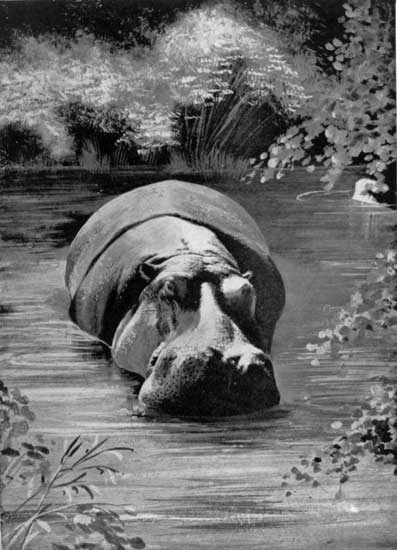
PLATE XXIX. A HIPPOPOTAMUS.
The hippopotamus spends most of his time in the water, but goes on land at night, especially in those districts where the rivers do not afford much food. Stealing carefully along a quiet river the traveller may often take him by surprise, and see two small jets of water rise from his nostrils when he comes up to breathe, snorting and puffing noisily. Then he dives again, and can remain under water three or four minutes. When he lies near the surface only six small knobs are seen above the water, the ears, eyes, and nostrils. If he is not quite sure of the neighbourhood, he thrusts only his nostrils above water and breathes as noiselessly as possible.
Hippopotami often lie splashing in shallow water, or climb up on to the bank to sun themselves and have a quiet lazy time. Very frequently they are heard to make a grunting noise of satisfaction. When evening comes they seek the deeper parts of the river, where they swim up and down, chase one another, and roll about in the water with great nimbleness and activity. They swim with great speed, throwing themselves forward in jerks, and filling the air with their gurgling bellowing cry; yet if they like they can swim so quietly that not the least ripple is heard. A wounded hippopotamus stirs up the water so that a small canoe may capsize in the swell from his forequarters.
When several old males are bellowing together, the din is heard for miles through the forest and rolls like thunder over the water. No other animal can make such a noise. Even the lion stops to listen.
On the Upper Nile, above Khartum, where the most luxuriant vegetation struggles for room on the banks, and the river often loses itself in lakes and swamps, the hippopotamus, like the crocodile, seldom goes ashore. Here he lives under lotus plants and papyrus leaves, soft reeds and all the other juicy vegetation that thrives in water-logged ground. He dives and rummages for a couple of minutes, stirring up the water far around. When he has his huge mouth full of stems and leaves, he comes up to the surface again, and the water streams in cataracts off his rounded body.
In districts where he goes on land to graze, he often works great damage among the corn and green crops, and may even attack the villagers. And he is not always to be trifled with if a canoe disturbs his repose. The most dangerous is a mother when her young ones are small. She carries them on her back as she swims and dives, sometimes to the bottom of the river. A gun must be heavily loaded if the shot is to have any effect on such a monster, and penetrate such a cuirass of hide. If the animal puffs and dives, he is lost to the hunter; but if he raises himself high out of the water and then falls again with a heavy thud, the wound is mortal and the hippopotamus sinks to the bottom. After an hour or two the body rises to the surface again.
Some negro tribes on the White Nile dig pitfalls for hippopotami, and on the rivers which enter Lake Ngami (see map, p. 262) on its northern shore the natives hunt for them with harpoons, much in the same way as whales are killed in the northern and southern oceans. The harpoons have a sharp barbed blade of iron, and this point is secured by strong string to a stout shaft of wood, the end of which is attached by a line to a float. Two canoes are dragged on to a raft of bundles of reed tied together, and between them the black hunters crouch with harpoons and light javelins in their hands. When all is ready, the raft is pushed out into the current and drifts noiselessly down the river. The huge animals can be heard rolling and splashing in the water in the distance, but they are still hidden behind a bed of reeds. The raft glides gently past the point, but the hippopotami suspect no danger. One of them comes up close beside the raft. The harpooner stands up like a flash of lightning and drives his sharp weapon with all his strength into the animal's flank. The wounded hippopotamus dives immediately to the bottom, and the line runs out. The float follows the hippopotamus wherever he takes his flight, and the canoes, now in the water, follow. When the brute comes up again, he is received with a shower of javelins, and dives again, leaving a blood-red streak behind him. He may be irritated when he is attacked time after time by spears, and it may happen that he turns on his persecutors and crushes a too venturesome canoe with his great tusks, or gives it a blow underneath with his head. Sometimes the animal is not content with the canoes, but attacks the men, and many too daring hunters have lost their lives in this way. When the hippopotamus has been sufficiently tired out, the hunters pick up the float, and take the line ashore to wind it round a tree, and then they pull with all their might to draw the creature up out of the water.
The flesh is eaten everywhere, especially that of the young animals, and the tongue and the fat of the older ones are considered delicacies. Riding-whips, shields, and many other articles are made out of the hide, and the large tusks are valuable. Hippopotami may be seen in some of the zoological gardens in Europe, but they do not thrive well in the care of man.
Man-eating Lions
A terrible tale of man-eating lions is told by Colonel Patterson in his book The Man-Eaters of Tsavo.
Colonel Patterson had been ordered for service on the Uganda Railway, which runs from Mombasa north-westwards through British East Africa to the great lake Victoria Nyanza, the largest source-lake of the Nile. But in 1898, when the Colonel arrived, the railway had not been carried farther than the Tsavo, a tributary of the Sabaki, which enters the sea north of Mombasa. Here at Tsavo (see map, p. 237) the Colonel had his headquarters, and in the neighbourhood were camped some thousands of railway coolies from India. A temporary wooden bridge crossed the Tsavo, and the Colonel was to build a permanent iron bridge over the river, and had besides the supervision of the railway works for thirty miles in each direction.
Some days after his arrival at Tsavo the Colonel heard of two lions which made the country unsafe. He paid little heed to these reports until a couple of weeks later, when one of his own servants was carried off by a lion. A comrade, who had a bed in the same tent, had seen the lion steal noiselessly into the camp in the middle of the night, go straight to the tent, and seize the man by the throat. The poor fellow cried out "Let go," and threw his arms round the beast's neck, and then the silence of night again fell over the surroundings. Next morning the Colonel was able to follow the lion's spoor easily, for the victim's heels had scraped along the sand all the way. At the place where the lion had stopped to make his meal, only the clothes and head of the unfortunate man were found, with the eyes fixed in a stare of terror.
Disturbed by this sight and the sorrowful occurrence, the Colonel made a solemn oath that he would give himself no rest until both the lions were dead. Gun in hand, he climbed up into a tree close by his servants' tent and waited. The night was quiet and dark. In the distance was heard a roar, which came nearer as the two man-eaters stole up in search of another victim. Then there was silence again, for lions always attack in silence, though when they start on their night prowl they utter their hoarse, awful cry, as though to give warning to the men and animals in the neighbourhood. The Colonel waited. Then he heard a cry of terror and despair from another camp a hundred yards away, and after that all was still again. A man had been seized and dragged away.
Now the Colonel chose a waiting-place where the last man had been carried off, but here, too, he was disappointed. A heart-rending shriek rang through the night at still another part of the camp, and another workman was missing.
The Indian workmen lay in several scattered camps, and evidently the lions chose a fresh camp every night to mislead the men. When they found that they could carry off a man with impunity every night or every other night, they grew bolder, and showed not the least fear of the camp fires, which were always kept alight. They paid no heed to the noise and tumult they caused, or even to gunshots fired at them in the darkness. A tall, thick fence of tough, thorny bushes was erected round each camp as a protection, but the lions always jumped over or broke through it when they wanted a man. In the daytime the Colonel followed their tracks, which were plainly visible through the thickets, but of course could not be perceived on stony ground.
Things became still worse when the rails were laid farther up the country, and only a few hundred workmen remained with Colonel Patterson at the Tsavo bridge. He had unusually high and strong fences built up round his camp, and the fires were enlarged to blazing pyres, watchmen kept guard, guns were always ready, and within the enclosure empty oil tins were banged together to scare the beasts if possible. But it was all no use. Still more victims disappeared. The Indian workmen became so panic-stricken that they could not shoot, though the lion was often just in front of them. A patient was taken from the hospital tent, and the next victim was a water-carrier from another part of the camp. He had been lying with his head towards the middle of the tent and his legs outwards. The lion had sprung over the fence, seized the man by the foot, and dragged him out. In his despair he had grabbed at a box standing by the tent canvas, and instead had caught hold of a tent rope, which gave way. Then the lion, with his prey in his mouth, had run along the fence looking for a weak spot, and when he had found one, he dashed right through the fence. Next morning fragments of clothing and flesh were found on the paths. The other lion had waited outside, and they had consumed their prey together.
Then followed an interval of quiet, during which the lions were engaged elsewhere. It was hoped that the tranquillity would continue, and the workmen began to sleep outside because of the heat. One night they were sitting round a fire, when a lion suddenly jumped noiselessly over the fence and stood gazing at them. They started up and threw stones, pieces of wood, and firebrands at the beast, but the lion sprang forward, seized his man, and dashed through the fence. His companion was waiting outside, and they were so impudent that they ate their victim only thirty yards off.
The Colonel sat up at night for a whole week at the camp where a visit was expected. He says that nothing can be more trying to the nerves than such a watch, time after time in vain. He always heard the warning roar in the distance, and knew that it meant, "Look out; we are coming." The hungry cry sounded hoarser and stronger, and the Colonel knew that one of his men, or perhaps he himself, would never again see the sun rise over the jungle in the east, and there was always silence when the brutes were near. Then the watchmen in the various camps would call out, "Look out, brothers, the devil is coming." And shortly afterwards a wild scream of distress and the groans of a victim would proclaim that the lion's stratagem had been successful again. At last the lions became so daring that both cleared the fence at once, to seize a man apiece. Once one lion did not succeed in dragging his man through the fence, and had to leave him and content himself with a share of his comrade's booty. The man left behind was so badly mauled that he died before he could be carried to the hospital tent.
No wonder that the poor workmen, wearied and worn by sleeplessness, excitement, and fear of death, decided that this state of affairs must come to an end. They struck. They said that they had come to Africa to work at the railway, and not to supply food for lions. One fine day they took a train by storm, put all their belongings into the carriages, took their seats themselves, and went off to the coast. The courageous men who remained with the Colonel passed the night in trees, in the station water-tank, or in covered holes digged down within their tents.
On one occasion the Colonel had invited a friend to come up to Tsavo and help him against the lions. The train was late, and it was dark when the guest followed the path through the wood to the camp. He had a servant with him, who carried a lantern. Half-way a lion rushed down on them from a rise, tore four deep gashes in the Englishman's back, and would have carried him off if he had not fired his carbine. Dazed with the report, the lion loosed his hold and pounced on the servant. Next moment he had vanished in the darkness with his prey.
A few days later a Suaheli came and said that the lion had seized an ass, and was engaged in his meal not far away. Guided by the Suaheli, the Colonel hastened up and could see from a distance the back of the lion above the bushes. Unfortunately the guide stepped on a twig, and the lion immediately vanished into impenetrable brushwood. Then the Colonel ran back and called out all his men. Provided with drums, sheets of metal and tin cans, they surrounded the thicket, and closed in with a great noise, while the Colonel kept watch at the place where the animal would probably come out. Quite right—there he came, huge and fierce, angry at being disturbed. He came forward slowly, halting frequently, and looking around. His attention was so taken up by the noise that he did not notice the sportsman. When he was about thirteen yards off the Colonel raised his double-barrelled rifle. The lion heard the movement, struck his front claws into the ground, drew back on to his hind paws as though to gather himself up for a spring, and snarled wickedly, showing his murderous fangs. Then the Colonel took aim at the head, pressed the trigger, and—the rifle missed fire!
Fortunately the lion turned at that moment to go back into the thicket, and the other shot had no effect but to call forth a furious roar and hasten his flight. The untrustworthy gun had been borrowed for the occasion, and after this the Colonel determined to rely on his own weapon.
The ass lay still untouched. A platform twelve feet high was erected on poles close to the carcase, and on this the Colonel took up his position at sunset. The twilight is very short on the equator, and the night soon grows dark when there is no moon. The nights in Africa's jungles are silent with an evil-foreboding and awesome silence, which conceals so many ambushes and costs so many lives. The inhabitants of the jungle may expect an ambush at any moment. The lonely Colonel waited, gripping his rifle hard. He relates himself that he felt more and more anxious as time went on. He knew that the lion would come to feed on the ass, for no cry of distress was heard from the adjacent camps.
Hist! that sounds like a small twig breaking under a weight. Now it sounds like a large body crushing through the bushes. Then all is quiet again. No, a deep breath, a sure sign of hunger, betrays the proximity of the monster. A terrible roar breaks the stillness of the night. The lion has perceived the presence of a man. Will he fly? No, far from it, he scorns the ass and makes for the Colonel. For two hours he prowls about the platform in gradually diminishing circles. Now the lion has matured his plan of attack, and goes straight towards the platform for the decisive spring. The animal is just perceptible against the sandy ground. When he is quite close the first shot thunders through the night, the lion utters a frightened roar and plunges into the nearest bushes. He writhes, and bellows, and moans, but the sounds grow weaker, till after a few long-drawn breaths all is quiet again. The first man-eater has met his fate.
Before the dawn of day the workmen came out with trumpets and drums, and, with shouts of rejoicing, carried the lion-killer round the dead animal. The other lion continued his visits, and when he too bit the dust a short time after, the men could quietly resume their work on the railway, and the Colonel, who had freed the neighbourhood from a scourge that had troubled it for nine months, became a general hero. The foreman composed a grand song in his honour, and presented a valuable testimonial from all the men.
One day he dined with the postmaster Ryall in a railway carriage, little suspecting the fate that was to befall the latter in the same carriage a few months later. A man-eating lion had chosen a small station for his hunting-ground, and had carried off one man after another without distinction of rank and worth. Ryall travelled with two other Europeans up to the place to try and rid it of the lion. On their arrival they were told that the animal could not be far away, for it had been quite recently in the neighbourhood of the station. The three Europeans resolved to watch all night. Ryall's carriage was taken off the train and drawn on to a siding. Here the ground had not been levelled, so the carriage was tilted a little to one side. After dinner they were to keep watch in turns, and Ryall took the first watch. There was a sofa on either side of the carriage, one of them higher above the floor than the other. Ryall offered these to his guests, but one of them preferred to lie on the floor between the sofas. And when Ryall thought he had watched long enough without seeing the lion, he lay down to rest on the lower sofa.
The carriage had a sliding door which slipped easily in its grooves, and was unfastened. When all was quiet the lion crept out of the bush, jumped on to the rear platform of the carriage, opened the door with his paws, and slipped in. But scarcely had he entered, when the door, in consequence of the slope of the carriage, slid to again and latched itself. And thus the man-eater was shut in with the three sleeping men.
The sleeper on the higher sofa, awakened by a sharp cry of distress, saw the lion, which filled up most of the small space, standing with his hind legs on the man lying on the floor, and his forepaws on Ryall, on the lower sofa on the opposite side. He jumped down in a fright to try and reach the opposite door, but could not get past without putting his foot on the back of the lion. To his horror, he found that the servant, who had been alarmed by the noise, was leaning against the door outside; but, putting forth all his strength, he burst open the door and slipped out, whereupon it banged to again. At the same moment a loud crash was heard. The lion had sprung through the window with Ryall in his mouth, and as the aperture was too small, he had splintered the woodwork like paper. The remains of the man were found next day and buried. Shortly after the lion was caught in a trap, and was exhibited for several days before being shot.
David Livingstone
In a poor but respectable workman's home in Blantyre, near Glasgow, was born a hundred years ago a little lad named David Livingstone, who was to make himself a great and famous name, not only as the discoverer of lakes and rivers, but also as one of the noblest men who ever offered their lives for the welfare of mankind.
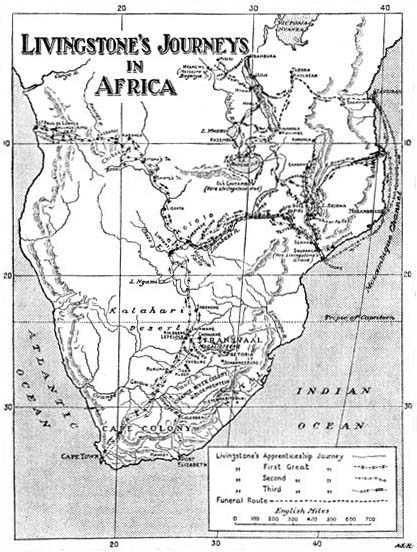
LIVINGSTONE'S JOURNEYS IN AFRICA
In the national school of the town he quickly learned to read and write. His parents could not afford to let him continue his studies, but sent him at ten years of age to a cotton mill, where he had to work from six o'clock in the morning till eight in the evening. The hard work did not break his spirit, but while the machines hummed around him and the thread jumped on the bobbins, his thoughts and his desires flew far beyond the close walls of the factory to life and nature outside. He did his work so well that his wages were raised, and he spent his gains in buying books, which kept him awake far into the night. To add to his knowledge he attended a night-school, and on holidays he made long excursions with his brothers.
Years fled and the boy David grew up to manhood. One day he told his parents that he wished to be a medical missionary, and go to the people in the east and south, tend the sick, and preach to any who would listen. In order to procure means for his studies he had to save up his earnings at the factory, and when the time was come he went with his father to Glasgow, hired a room for half-a-crown a week, and read medicine. At the end of the session he went back to the factory to obtain money for the next winter course. Finally he passed his examination with distinction, and then came the last evening in the old home and the last morning dawned. His father went with him to Glasgow, took a long farewell of his son, and returned home sad and lonely.
Livingstone sailed from England to the Cape, and betook himself to the northernmost mission-station, Kuruman in Bechuanaland. Even at this time he heard of a fresh-water lake far to the north. It was called Ngami, and he hoped to see it one day.
From Kuruman he made several journeys in different directions to gain a knowledge of the tribes and their languages, to minister to their sick and win their confidence. Once when he was returning home from a journey and had still 150 miles to trek, a little black girl was found crouching under his waggon. She had run away from her owner because she knew that he intended to sell her as a slave as soon as she was full-grown, and as she did not wish to be sold she determined to follow the missionary's waggon on foot to Kuruman. The good doctor took up the frightened little creature and provided her with food and drink. Suddenly he heard her cry out. She had caught sight of a man with a gun who had been sent out to fetch her and who now came angrily to the waggon. It never occurred to Livingstone to leave the defenceless child in the hands of the wretch. He took the girl under his protection and told her that no danger would befall her henceforth. She was a symbol of Africa, the home of the slave-trade. And Africa's slaves needed the help of a great and strong man. Livingstone understood the call and worked to his last hour for the liberation of the slaves, as Gordon did many years later. He strove against the cruel and barbarous customs of the natives and their dark superstitions, and hoped in time to be able to train pupils who would be sent out to preach all over the country. In one tribe the medicine-men were also rainmakers. Livingstone pointed out to the people of the tribe that the rainmakers' jugglery was only a fraud and of no use, but offered, if they liked, himself to procure water for the irrigation of their fields, not by witchcraft but by conducting it along a canal from the neighbouring river. Some rough tools were first hewn out, and he had soon the whole tribe at work, and the canal and conduits were laid out among the crops. And there stood the witch-doctors put to shame, as they heard the water purling and filtering into the soil.
In 1843 Livingstone started off to found a new mission-station, named Mabotsa. The chief of the place was quite willing to sell land, and he received glass beads and other choice wares in payment. Mabotsa lay not far from the present Mafeking, but seventy years ago the whole region was a wild. On one occasion a lion broke into the village and worried the sheep. The natives turned out with their weapons, and Livingstone took the lead. The disturber of the peace was badly wounded and retired to the bush. But suddenly he rushed out again, threw himself on Livingstone, buried his teeth in his shoulder, and crushed his left arm. The lion had his paw already on the missionary's head, when a Christian native ran up and struck and slashed at the brute. The lion loosed his hold in order to fly at his new assailant, who was badly hurt. Fortunately the animal was so sorely wounded that its strength was now exhausted, and it fell dead on the ground. Livingstone felt the effects of the lion's bite for thirty years after, and could never lift his arm higher than the shoulder; and when his course was run his body was identified by the broken and reunited arm bone. He had to keep quiet for a long time until his wound was healed. Then he built the new station-house with his own hands, and when all was ready he brought to it his young bride, the daughter of a missionary at Kuruman.
Another missionary lived at Mabotsa and did all he could to render Livingstone's life miserable. The good doctor hated all quarrelling, and did not wish that white men should set a bad example to the blacks, so he gladly gave way and moved with his wife forty miles northwards. The house in Mabotsa had been built with his own savings, and as the London Missionary Society gave him a salary of only a hundred pounds a year, there could not be much over to build a house. When he left, the natives round Mabotsa were in despair. Even when the oxen were yoked to the waggon, they begged him to remain and promised to build him another house. It was in vain, however; they lost their friend and saw him drive off to the village of Chonuane, which was subject to the chief Sechele.
From the new station Livingstone made a missionary journey eastwards to the country whither the Dutch Boers had trekked from the Cape. They had left the Cape because they were dissatisfied with the English administration of the country, for the English would not allow slavery and proclaimed the freedom of the Hottentots. The Boers, then, founded a republic of their own, the Transvaal, so named because it lay on the other side of the Vaal, a tributary of the Orange River. Here they thought they could compel the blacks to work as bondmen in their service without being interfered with. They took possession of all the springs, and the natives lived on sufferance in their own country. The Boers hated Livingstone because they knew that he was an enemy to the slave trade and a friend to the natives.
Livingstone had plenty of work at the station. He built his house, he cultivated his garden, visited the sick, looked after his guns and waggons, made mats and shoes, preached, taught in his children's school, lectured on medicine, and instructed the natives who wished to become missionaries. In his leisure hours he collected natural history specimens, which he sent home, studied the poisonous tsetse fly and the deadly fever, and was always searching for remedies. He was never idle.
His new place of abode had one serious defect—it was badly situated as regarded rain and irrigation, and therefore Livingstone decided to move again forty miles farther to the north, to Kolobeng, where for the third time he built himself a house. As before, his black friends were much disturbed at his departure, and when they could not induce him to remain, the whole tribe packed up their belongings and went with him. Then clearing, building, and planting went on again. At Kolobeng Livingstone had a fixed abode for quite five years, but this was his longest and last sojourn in one place, for his after-life was a continuous pilgrimage without rest and repose. As usual, he gained the confidence and friendship of the natives.
The worst trouble was the vicinity of the Boers. They accused him of providing Sechele's tribe with weapons and exciting them against the Boers. They threatened to kill all black missionaries who ventured into the Transvaal, and devised plans for getting rid of Livingstone. Under such conditions his work could not be successful, and he longed to go farther north to countries where he could labour in peace without hindrance from white men who were nominally Christians, but treated the natives like beasts. Besides, hard times and famine now came to Kolobeng. The crops suffered from severe drought, and even the river failed. The natives went off to hunt, and the women gathered locusts for food. No child came to school, and the church was empty on Sunday.
Then Livingstone resolved to move still farther northwards, and on June 1, 1849, the party set out. An Englishman named Oswell, who was Livingstone's friend, went with them and bore all the expenses of the journey. He was a man of means, and so several waggons, eighty oxen, twenty horses, and twenty-five servants were provided.
After two months' march they came to the shore of Lake Ngami, which was now seen for the first time by Europeans. The king, Lechulatebe, proved less friendly than was expected. When he heard that Livingstone intended to continue his journey northwards to the great chief Sebituane, he feared that the latter would obtain firearms from the white men and would come down slaying and pillaging to the country round the lake. Finally the expedition was obliged to turn back to Kolobeng. Livingstone, however, was not the man to give in, and he went twice more to the lake, taking his wife and children with him.
On one of these journeys he came to the kingdom of the great and powerful Sebituane, and was received with the most generous hospitality. The chief gave him all the information he wished, and promised to help him in every way. A few days later, however, Sebituane fell ill of inflammation of the lungs and died.
Livingstone then continued his journey north-eastward with Oswell to the large village of Linyanti, and shortly after discovered a river so large and mighty that it resembled one of the firths of Scotland. The river was called the Zambesi. Its lower course had long been known to Europeans, but no one knew whence it came. The climate was unhealthy, and was not suitable for the new mission-station that Livingstone intended to establish. The Makololo people, the tribe of the deceased chief, promised to give him land, huts, and oxen if he would stay with them, but his mind was now occupied with great schemes and he gave up all thoughts of a station. Honest, legitimate trade must first be made to flourish. The Makololo had begun to sell slaves simply to be able to buy firearms and other coveted wares from Europe. If they could be induced to sell ivory and ostrich feathers instead, they would be able to procure by barter all they wanted from European traders and need not sell any more human beings. But to start such a trade a convenient route must first be found to the coast of either the Atlantic or Indian Ocean. A country in which the black tribes were in continual war with one another simply for the purpose of obtaining slaves was not ripe for Christianity. Accordingly Livingstone's plan was clear: first to find a way to the coast, and then to foster an honest trade which would make the slave-trade unnecessary.
Having sent his wife and children to England, Livingstone made his preparations, and in the year 1853 he was at Linyanti, in the country of the Makololo. Here began his remarkable journey to Loanda on the west coast, not far south of the mouth of the Congo. No European had ever travelled this way. His companions were twenty-seven Makololos, and his baggage was as light as possible, chiefly cloth and glass beads, which serve as currency in Africa. He took no provisions, as he thought he could live on what the country afforded.
The journey was difficult and troublesome, through a multitude of savage tribes. First the Zambesi was followed upwards, and then the route ran along other rivers. In consequence of heavy rain, swollen watercourses and treacherous swamps had to be crossed continually. Livingstone rode an ox which carried him through the water after a small portable boat had been wrecked and abandoned. Swarms of mosquitoes buzzed over the moist ground, and Livingstone repeatedly caught fever from the damp, close exhalations, and was often so ill that he could not even sit on his ox. But amidst all these difficulties and hardships he never omitted to observe the natural objects around him and to work at his map of the route. His diary was a big volume in stout boards with lock and key, and he wrote as small and as neatly as print.
Step by step he came nearer the sea. Most opportunely they met a Portuguese, and in his company the small troop entered the Portuguese territory on the west coast. The Portuguese received Livingstone with great hospitality, supplied him with everything he wanted, and rigged him out from top to toe.
Some English cruisers were lying off Loanda, having come to try to put down the slave-trade, and Livingstone enjoyed a delightful rest with his countrymen and slept in a proper bed after having lain for half a year on wet ground. It would have been pleasant to have had a thorough holiday on a comfortable vessel on the voyage to England after so many years' wanderings in Africa, but Livingstone resisted the temptation. He could not send his faithful Makololos adrift; besides, he had found that the route to the west coast was not suitable for trade, and was now wondering whether the Zambesi might serve as a channel of communication between the interior and the east coast. So he decided to turn back in spite of fever and danger, bade good-bye to the English and Portuguese, and again entered the great solitude.
Before Livingstone left Loanda he put together a large mass of correspondence, notes, maps, and descriptions of the newly discovered countries, but the English vessel which carried his letters sank at Madeira with all on board, and only one passenger was saved. News of the misfortune reached Livingstone when he was still near the coast, and he had to write and draw all his work again, a task that took him months. If he had left the Makololo men to their fate he would have travelled in the unfortunate vessel.
Rain and sickness often delayed him, but on the whole his return journey was easier. He took with him from Loanda a large stock of presents for the chiefs, and they were no longer strangers. And when he came among the villages of the Makololo, the whole tribe turned out to welcome him, and the good missionary held a thanksgiving service in the presence of all the people. Oxen were killed round the fires at night, drums were beaten, and with dance and song the people filled the air far above the crowns of the bread-fruit trees with sounds of gladness. Sekeletu was still friendly, and was given a discarded colonel's uniform from Loanda. In this he appeared at church on Sunday, and attracted more attention than the preacher and the service. His gratitude was so great that when Livingstone set out to the east coast he presented his white friend with ten slaughter oxen, three of his best riding oxen, and provisions for the way. And more than that, he ordered a hundred and twenty warriors to escort him, and gave directions that, as far as his power extended over the forests and fields, all hunters and tillers of the ground should provide the white man and his retinue with everything they wanted. Not the least remarkable circumstance connected with Livingstone's travels was that he was able to carry them out without any material help from home. He was the friend of the natives, and travelled for long distances as their guest.
Now his route ran along the bank of the Zambesi, an unknown road. During his earlier visit to Linyanti he had heard of a mighty waterfall on the river, and now he discovered this African Niagara, which he named the Victoria Falls. Above the falls the river is 1800 yards broad, and the huge volumes of water dash down foaming and roaring over a barrier of basalt 390 feet high to the depth beneath. The water boils and bubbles as in a kettle, and is confined in a rocky chasm in some places barely 50 yards broad. Clouds of spray and vapour hover constantly above the fall, and the natives call it "the smoking water." Among the general public in Europe, Livingstone's description of the Victoria Falls made a deeper impression than any of his other discoveries, so thoroughly unexpected was the discovery in Africa of a waterfall which could match, nay in many respects surpass, Niagara in wild beauty and imposing power. Now a railway passes over the Falls, and a place has grown up which bears the name of Livingstone.
The deafening roar of the water died away in the distance, and the party followed the forest paths from the territory of one tribe to that of the next. Steadfast as always, Livingstone met all danger and treachery with courage and contempt of death, a Titan among geographical explorers as well as among Christian missionaries. He drew the main outlines of this southern part of Darkest Africa and laid down the course of the Zambesi on his map. For a year he had been an explorer rather than a missionary. But the dominating thought in his dream of the future was always that the end of geographical exploration was only the beginning of missionary enterprise.
At the first Portuguese station he left his Makololo men, promising to return and lead them back to their own villages. Then he travelled down the Zambesi to Quilimane on the sea. He had, therefore, crossed Africa from coast to coast, and was the first scientifically educated European to do so.
After fifteen years in Africa he had earned a right to go home. An English ship carried him to Mauritius, and at the end of 1856 he reached England. He was received everywhere with boundless enthusiasm, and never was an explorer fêted as he was. He travelled from town to town, always welcomed as a hero. He always spoke of the slave-trade and the responsibility that rested on the white men to rescue the blacks. Africa, lying forgotten and misty beneath its moving rain-belts, became at once the object of attention of all the educated world.
Detraction was not silent at the home-coming of the victor. The Missionary Society gave him to understand that he had not laboured sufficiently for the spread of the Gospel, and that he had been too much of an explorer and too little of a missionary. He therefore left the Society; and when, after a sojourn of more than a year at home, he returned to Africa, it was in the capacity of English Consul in Quilimane, and leader of an expedition for the exploration of the interior of Africa.
We have no time to accompany Livingstone on his six years' journeys in East Africa. Among the most important discoveries he made was that of the great Lake Nyassa, from the neighbourhood of which 19,000 slaves were carried annually to Zanzibar, to say nothing of the far greater numbers who died on the way to the coast. One day Livingstone went down to the mouth of the Zambesi to meet an English ship. On board were his wife and a small specially built steamer called the Lady Nyassa, designed for voyages on rivers and lakes. Shortly afterwards his wife fell ill and died, and was buried under the leafy branches of a bread-fruit tree. In spite of his grief he went on with his work as diligently as before, and when the time came for him to sail home, he thought of selling the Lady Nyassa to the Portuguese. But when he heard that the boat was to be used to transport slaves, he kept it, steered a course for Zanzibar, and then resolved to cross the Indian Ocean in the small open boat by the use of both sails and steam. This was one of Livingstone's most daring exploits, for the distance to Bombay was 2500 miles across the open sea, and in the beginning of January the south-west monsoon might be expected with its rough, stormy seas. He hoped, however, to reach Bombay before the monsoon broke, so with three white sailors and nine Africans, and only fourteen tons of coal, he steamed out of the harbour of Zanzibar, saw the coast of Africa fade away and the dreary waste of water close round him on all sides.
Two of the white sailors fell ill and were unfit for work, and the bold missionary had to depend almost entirely on himself. Ocean currents hindered the progress of the Lady Nyassa, and for twenty-five days she was becalmed, for the coal had to be used sparingly, and when the sails hung limp from the mast there was nothing to be done but to exercise patience. Fortunately there was sufficient food and drinking water, and Livingstone was accustomed to opposition and useless waiting. He had to ride out two violent storms, and the Lady Nyassa was within a hair's breadth of turning broadside to the high seas. In view of the immense watery waste that still lay before him he meditated making for the Arabian coast, but as a favourable wind got up and the sailing was good he kept on his course. At length the coast of India rose up out of the sea, and after a voyage of six weeks the Lady Nyassa glided into the grand harbour of Bombay. The air was hazy and no one noticed the small boat, but when it was known that Livingstone was in the city, every one made haste to pay him homage.
In the year 1866 Livingstone was again in Africa. We find him at the mouth of the Rovuma, a river which enters the sea to the east of Lake Nyassa. He had thirty-seven servants, many of them from India, and one of his men, Musa, had been with him before. He crossed the country to Lake Nyassa, but when he wished to pass over to the eastern shore in native boats, he was stopped by the Arabs, who knew that he was the most formidable opponent of the slave-trade. He had no choice but to go round the lake on foot, and little by little he made contributions to human knowledge, drew maps, and made notes and collections. He came to districts he already knew, where black women were carried off by crocodiles on the bank of the Shiré River, where he had lost his wife, and where all the missionaries sent out on his recommendation had died of fever.
His staff of servants soon proved to be a worthless lot. The Indians were dismissed, and few of the others could be depended on. The best were Susi and Chuma, who by their faithfulness gained a great reputation both in Africa and Europe. Musa, on the contrary, was a scoundrel. He heard from an Arab slave-dealer that all the country through which Livingstone was about to travel was inhabited by a war-like tribe, who had lately fallen upon a party of forty-four Arabs and killed all but the narrator himself. Musa and most of his comrades were so frightened that they ran away. On his arrival at Zanzibar, Musa informed the British Consul that Livingstone had been attacked and murdered and all his goods plundered. The false account was so cleverly concocted and so thoroughly rehearsed that Musa could not be convicted of deceit. Every one believed him, and the English newspapers contained whole columns of reminiscences of the deceased. Only one friend of Livingstone, who had accompanied him on one of his journeys and knew Musa, had any doubts. He went himself to Africa, followed Livingstone's trail, and learned from the natives that the missionary had never been attacked as reported, but that he was on his way to Lake Tanganyika.
The road thither was long and troublesome, and the great explorer suffered severe losses. Provisions ran short, and a hired porter ran away with the medicine chest. From this time Livingstone had no drugs to allay fever, and his health broke down. But he came to the southern extremity of Tanganyika, and the following year discovered Lake Bangweolo. He rowed out to the islands in the lake, and very much astonished the natives, who had never seen a white man before. Extensive swamps lay round the lake, and Livingstone believed that the southernmost sources of the Nile must be looked for in this region. This problem of the watershed of the Nile so fascinated him that he tarried year after year in Africa; but he never succeeded in solving it, and never knew that the river running out of Bangweolo is a tributary of the Lualaba or Upper Congo.
Most of his men mutinied on the shore of Bangweolo. They complained of the hardships they endured and were tired of munching ears of maize, and demanded that their master should lead them to country where they could get sufficient food. Mild and gentle as always, Livingstone spoke to them kindly. He admitted that they were right, and confessed that he was himself tired of struggling on in want and hardship. They were so astonished at his gentleness that they begged to remain with him.
Livingstone was dangerously ill on this journey and had to be carried on a litter. There he lay unconscious and delirious with fever, and lost entirely his count of time. The troop moved again towards Tanganyika, and was to cross the lake in canoes to the Ujiji country on the eastern shore. If he could only get so far, he could rest there, and receive new supplies and letters from home.
Worn out and exhausted he at length reached Ujiji, a rendezvous for the Arab slave-dealers. But his fresh supplies had disappeared entirely. He wrote for more from the coast, and urged the Sultan of Zanzibar to see that nothing went astray. He wrote heaps of letters which never reached their destination. A packet of forty-two were sent off at one time, not one of which arrived, for at that time the tribes to the east of the lake were at war with one another.
Livingstone did not allow his courage to fail. No difficulties were great enough to crush this man. With Susi and Chuma and a party of newly enlisted porters, he set out westwards across the lake, his aim being to visit the Manyuema country, through the outskirts of which flows the Lualaba. If Livingstone could prove in which direction this mighty river ran, whether to the Mediterranean or the Atlantic, he could then return home with a good conscience. He had determined in his own mind that he would not leave the Dark Continent until he had solved the problem, and for this he sacrificed his life without result. The canoes sped over the lake, and on the western shore he continued his journey on foot to the land of the Manyuemas. He marched on westwards. When the rainy season came on he lost several months, and when he set out again on his next march he had only three companions, two of them being the faithful Susi and Chuma. In the dark thickets of the tropical forests he wounded his feet, dragged himself over fallen trunks and decaying rubbish, and waded across swollen rivers; and among the crowns of the lofty trees and in the dense undergrowth lurked malaria, an invisible miasma. He fell ill again and had to rest a long time in his miserable hut, where he lay on his bed of grass reading his tattered Bible, or listening to the native's tales of combats with men and apes, for gorillas lived in the forests.
Thus year after year passed by, and not the faintest whisper from the noisy world reached his ears. The only thing that retained him was the Lualaba. Did its waters run in an inexhaustible stream to the western ocean, or did they flow gently through forests, swamps, and deserts to Egypt? If he could only answer that question, he would go by the nearest way to Zanzibar and thence home. He had heard nothing of his children and friends for years. The soil of Africa held him prisoner in a network of forests and lianas.
In February 1871 he left Manyuema and came to Nyangwé on the bank of the Lualaba, one of the principal resorts of slave-dealers. The natives were hostile, believing that he was a slave-trader; and the slave-traders who knew him by sight hated him. He tried in vain to procure canoes for a voyage down the great river. He offered a chief, Dugumbé, a liberal reward if he would help him to prepare for this expedition. While Dugumbé was considering the offer, Livingstone witnessed an episode which surpassed in horror all that he had previously met with in Africa. It was a fine day in July on the bank of the Lualaba, and 1500 natives, mostly women, had flocked to market at a village on the bank. Livingstone was out for a stroll, when he saw two small cannon pointed at the crowd and fired. Many of the unfortunate people, doomed to death or the fetters of slavery, rushed to their canoes, but were met by a band of slave-hunters and surprised by a shower of arrows. Fifty canoes lay at the bank, but they were so closely packed that they could not be put out. The wounded shrieked and threw themselves on one another in wild despair. A number of black heads on the surface of the water showed that many swimmers were trying to reach an island about a mile away. The current was against them and their case was hopeless. Shot after shot was fired at them. Some sank quietly without a struggle, while others uttered cries of terror and raised their arms to heaven before they went down to the dark crystal halls of the crocodiles. Fugitives who succeeded in getting their canoes afloat forgot their paddles and had to paddle with their hands. Three canoes, the crews of which tried to rescue their unfortunate friends, filled and sank, and all on board were drowned. The heads in the water became gradually fewer, and only a few men were still struggling for life when Dugumbé took pity on them and allowed twenty-one to be saved. One brave woman refused to receive help, preferring the mercy of the crocodiles to that of the slave-king. The Arabs themselves estimated the dead at 400.