Part 1 — X INDIA
Reading edition
From Tibet to Simla
Right up in Tibet lie the sources of the Sutlej, the largest affluent of the Indus. With irresistible force it breaks through the Himalayas in order to get down to the sea, and its valley affords us an excellent road from the highlands of Tibet to the burning lowlands of India. On this journey we pass through a succession of belts of elevation, and find that various animals and plants are peculiar to different heights. The tiger does not go very high up on the southern flanks of the Himalayas, but the snow leopard is not afraid of cold. The tame yak would die if he were brought down to denser strata of air, and Marco Polo's sheep would waste away on the forest-clothed heights; but wolves, foxes and hares occur as frequently in India as in Tibet.
The boundaries of the flora are more sharply defined. Below the limit of eternal snow (13,000 feet) ranunculus and anemones, pedicularis and primulas are found just as they are in our higher latitudes with corresponding conditions of temperature. At 12,000 feet lies the limit of forest, beyond which the birch does not go, but where pine-trees still thrive. Between 10,000 and 6000 feet are woods of the beautiful and charming conifer called the Himalayan cedar, which is allied to the cedar of Lebanon. At 7000 feet the limit of subtropical woods is crossed, and the oak and the climbing rose are seen. Just below 3500 feet the tropical forest is entered, with acacias, palms, bamboos, and all the floral wealth of the Indian jungle.
The Sutlej grows bigger and bigger the further we descend, and we ride on shaking bridges across innumerable tributaries. The atmosphere becomes denser, and breathing easier. We no longer have a singing in the ears, or palpitations or headache as on the great heights, and the cold has been left behind. Even in the early morning the air is warm, and soon come days when we look back with regret to the cool freshness up in Tibet. One of my dogs, a great shaggy Tibetan, suffered severely from the increasing heat, and one fine day he turned right about and went back to Tibet.
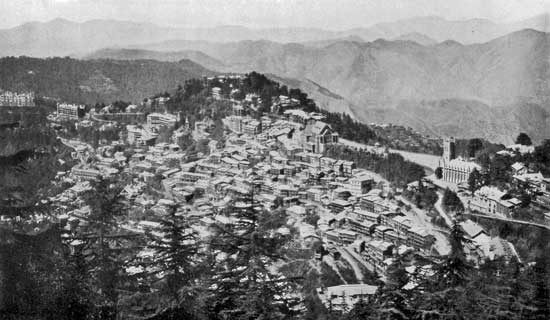
PLATE XII. SIMLA.
The first town that we come to is called Simla (Plate XII.). It is not large, having barely 15,000 inhabitants, but it is one of the most beautiful towns in the world, and one of the most powerful, for in its cedar groves stands a palace, and in the palace an Imperial throne. The Emperor is the King of England, whose power over India is entrusted to a Viceroy. In summer enervating heat prevails over the lowlands of India, and all Europeans who are not absolutely tied to their posts move up to the hills. The Viceroy and his staff, the government officials, the chief officers of the army, civil servants and military men all fly with their wives up to Simla, where the leaders of society live as gaily as in London. During this season the number of inhabitants rises to 30,000.
The houses of Simla are built like swallows' nests on steep slopes. The streets, or rather roads, lie terraced one above another. The whole town is built on hills surrounded by dizzy precipices. Round about stand forests dark and dense; but between the cedars are seen far off to the southwest the plains of the Punjab and the winding course of the Sutlej, and to the north the masses of the Himalayas with their eternal snowfields. It is delightful to go up to Simla from the sultriness of India, and perhaps still more delightful to come down to Simla from the piercing cold of Tibet.
Delhi and Agra
From Simla we go down by train through hundreds of tunnels and round the sharpest curves, over countless bridges and along dizzy precipices, to the lowlands of the Punjab. It is exceedingly hot, and we long for a little breeze from Tibet's snowy mountains.
Time flies by till we reach Delhi, situated on the Jumna, one of the affluents of the Ganges. Delhi was the capital of the empire of the Great Moguls,[11] and in the seventeenth century it was the most magnificent city in the world.
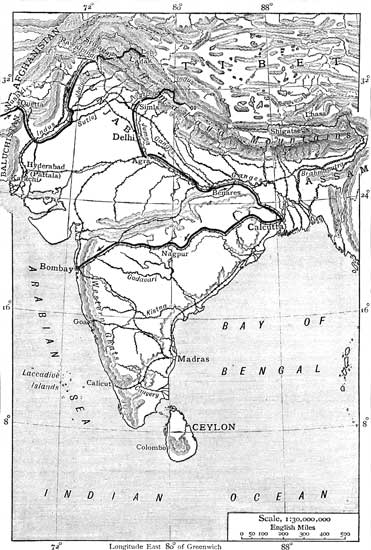
MAP OF INDIA, SHOWING JOURNEY FROM NUSHKI TO LEH (pp. 82-88), AND THE JOURNEY FROM TIBET THROUGH SIMLA, ETC., TO BOMBAY (pp. 130-142).
Many proud monuments of this grandeur still remain, notably the splendid building of pure white marble called the Hall of Private Audience, where in the open space surrounded by a double colonnade the Great Mogul was wont to dispense justice and receive envoys. In the sunshine the marble columns seem to be translucent, and light-blue shadows fall on the marble floor. The walls and pillars are inlaid with costly stones of various shapes: lapis-lazuli and malachite, nephrite and agate. In the throne-room used to stand the famous "Peacock Throne" of the Great Mogul. The whole throne was covered with thick plates of gold and studded all over with diamonds. In the year 1749 the Persian king, Nadir Shah, came to Delhi, defeated the Great Mogul and carried off treasures to the value of fifty-six million pounds. Among other valuables he seized was the famous diamond called the "Koh-i-noor," or "Mountain of Light," now among the British crown jewels. He also carried off the Peacock Throne, which alone was worth eleven million pounds. It is to this day in the possession of the Shahs of Persia, but all the diamonds have been taken out one after another by the successors of Nadir Shah when they happened to be in difficulties. The gold plates are left, however, and on the back still glitter the golden peacocks which give the throne its name.
If we stroll for some hours through the narrow streets and interesting bazaars of Delhi and push our way among bustling Hindus and Mohammedans, we can better appreciate the vaulted arches of the Hall of Private Audience and can also understand the Persian inscription to be read above the entrance: "If there be an Elysium on earth, it is here."
Farther down the Jumna stands Agra, and here we make another break in our railway journey eastwards. Agra also was for a time the capital of the Great Mogul empire, and in the seventeenth century the emperor who bore the name of Shah Jehan erected here an edifice which is still regarded as one of the most beautiful in the world (Plate XIII.). It is called the "Taj Mahal," or "royal palace," and is a mausoleum in memory of Shah Jehan's favourite wife, Mumtaz, by whose side he himself reposes in the crypt of the mosque. It is constructed entirely of blocks of white marble, and took twenty-seven years to build and cost nearly two million pounds of our money.
The garden which surrounds the sanctuary is entered through a large gate of red sandstone. In a long pool goldfish dart about under floating lotus blossoms, and all around is luxuriant verdure, the dwelling-place of countless singing birds; the air is filled with the odour of jasmine and roses, and tall, slender cypresses point to heaven.
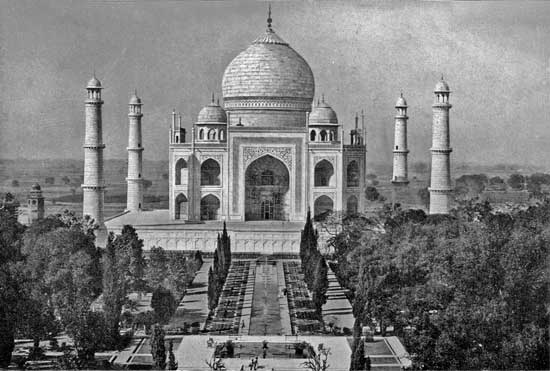
PLATE XIII. THE TAJ MAHAL.
Straight in front the marble Taj Mahal rises from a terrace, dazzling white in the sunshine—a summer dream of white clouds turned to stone, a work of art which only love could conjure out of the rubbish of earth. The airy cupola, the arched portals, and bright white walls are reflected in the pool. At each of the four corners of the terrace stands a tall slender minaret, also of white marble, and in the centre the huge dome rises to a height of 240 feet. In the great octagonal hall below the dome, within an enclosure of marble filigree work, stand the monuments over Shah Jehan and his queen Mumtaz. The actual sarcophagi are preserved in the vault beneath.
The four façades of this wonderful building are all alike, but the background of green vegetation and the changes of light seem always to be producing new effects. Sometimes a faint green reflection from the foliage can be seen in the white marble; in the full sunshine it is like snow; in shadow, light blue. When the sun sinks in the red glow of evening, the whole edifice is bathed in orange light; and later comes the moonlight, which is perhaps the most appropriate of all. Steamy and close, hot and silent, now lies the garden; the illumination is icy cold, the shadows deep black, the dome silvery white. The mysterious sounds of the jungle are heard around, and the Jumna rolls down its turbid waters to meet the sacred Ganges.
Benares and Brahminism
In the drainage basin of the Ganges, through which the train is again carrying us south-eastwards, 100 million human beings, mostly Hindus, have their home. The soil is exceedingly fertile, and supports many large towns, several of them two or three thousand years old, besides innumerable villages. Here the Hindu peasants have their huts of bamboo-canes and straw-matting, and here they cultivate their wheat, rice, and fruits.
Our next stay is at Benares—the holiest city in the world, if holiness be measured by the reverence shown by the children of men. Long before Jerusalem and Rome, Mecca and Lhasa, Benares was the home and heart of the ancient religion of India, and it still is the centre of Brahminism and Hinduism. There are more than 200 millions of Hindus in the world, and the thoughts of all of them turn to Benares. All Hindus long to make a pilgrimage to their holy city. The sick come to recover health in the waters of the sacred Ganges, the old travel hither to die, and the ashes of those who die in distant places are sent to Benares to be scattered over the waters of salvation. In Benares, moreover, Buddha preached 500 years before Christ, and at the present day he has more than 400 million followers; so to Buddhists also Benares is a holy place.
The Hindus have three principal gods: Brahma, the creator; Vishnu, the preserver; and Siva, the destroyer. From these all the others are derived: thus, for example, Kali represents only one of the attributes of Siva. To this goddess children were formerly sacrificed, and when this was forbidden by the British Government goats were substituted. But we have not yet done with divinities. The worship of the Hindus is not confined to their gods. Nearly all nature is divine, but above all, cows and bulls, apes and crocodiles, snakes and turtles, eagles, peacocks and doves. It is not forbidden to kill, steal and lie, but if a Hindu eats flesh, nay, if he by chance happens to swallow the hair of a cow, he is doomed to the hell of boiling oil. He becomes an object of horror to all, but above all to himself. For thousands of years this superstitution has been implanted in the race, and it remains as strong as ever.
Ever since India, or, as the country is called in Persia, Hindustan, was conquered by the invading Aryans from the north-west—and this was quite 4000 years ago—the Hindus have been divided into castes. The differences between the different castes are greater than that between the barons and the serfs in Europe during the Middle Ages. The two highest castes were the Brahmins (or priests) and the warriors. Now there are a thousand castes, for every occupation constitutes an especial caste: all goldsmiths, for example, are of the same caste, all sandal-makers of another, and men of different castes cannot eat together, or they become unclean.
Early in the morning, just before the day has begun to dawn in the east, let us hire a boat and have ourselves rowed up and down the Ganges. In this way we obtain an excellent view of this wonderful town as it stretches in front of us along the left bank of the river—a great heap of closely packed buildings, houses, walls and balconies, and an endless succession of pagodas with lofty towers (Plate XIV.). From the top of the bank, which is about 100 feet high, a broad flight of steps runs down to the river, and stone piers jut out like jetties into the water. Between these are wooden stages built over the surface of the river and covered with straw thatch and large parasols or awnings. This is the gathering place of the faithful. They come from every furthest corner of the city to the sacred river to greet the sun when it rises—brown, half-naked figures, with light clothing, often only a loincloth, of the gaudiest colours. The whole bank of the river teems with men.
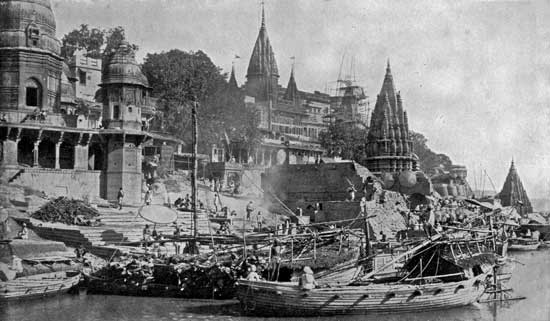
PLATE XIV. BENARES.
An elderly Brahmin comes down to a jetty and squats on his heels. His head is shaved, with the exception of a tuft on the crown. He dips his head in the river, scoops some water up and rinses his mouth with it. He calls on Ganges, daughter of Vishnu, and prays her to take away his sins, the impurity of his birth, and to protect him throughout his life. Then, after repeating the twenty-four names of Vishnu, he stands up and calls out the sacred syllable "Om," which includes Brahma, Vishnu, and Siva. Lastly he invokes the earth, air, sky, sun, moon, and stars, and pours water over his head.
The rim of the rising sun is seen above the jungle on the right bank of the Ganges. Its appearance is saluted by all the thousands of pious pilgrims, who sprinkle water with their hands in the direction of the sun, wading out into the long shallow margin of the river. The old Brahmin has squatted down again and performs the most incomprehensible movements with his hands and fingers. He holds them in different positions, puts them up to the top of his head, his eyes, forehead, nose, and breast, to indicate the 108 different manifestations of Vishnu. If he forgets a single one of these gestures, all his worship is in vain. The same ceremony has to be repeated in the afternoon and evening, and in the intervals the devout Brahmin has other religious duties to perform in the temples.
Here an old man lies stretched out on a bed of rags. He is so thin that his skin hangs loosely over his ribs, and though his body is brown, his beard is snow-white. He has come to Benares to die beside the holy Ganges, which flows from the foot of Vishnu. There stands a man in the prime of life, but a leper, eaten away with sores. He has come to Benares to seek healing in the waters of life. Here, again, is a young woman, who trips gracefully down the stone steps bearing a water jug on her head. She wades into the river until the water comes up to her waist; then she drinks from her hand, sprinkles water towards the sun, pours water over her hair, fills her pitcher, and goes slowly up again, while the holy Ganges water drips from the red wrap which is wound round her body. And all the other thousands who greet the sun with oblation of water from the sacred river are convinced that he who makes a pilgrimage to Benares and dies within the city walls obtains forgiveness for all his sins.
Like the Buddhists, the Hindus believe in the transmigration of souls. A Hindu's soul must pass through more than eight million animal forms, and for all the sins he has committed in the earlier forms of his existence, he must suffer in the later. Therefore he makes offerings to the gods that he may soon be released from this eternal wandering and attain the heaven of the faithful. In the endless chain of existence this short morning hour of prayer on the banks of the Ganges is but a second compared to eternity.
In the evening, when the hottest hours of the day are past, let us again take a boat and drift down slowly past the stone steps and jetties of Benares. Noiseless, muddy, and grey the sacred river streams along its bed. What quantities of reeking impurities there are in this water of salvation! Whole bundles of crushed and evil-smelling marigolds, refuse, rags and bits, bubbles and scum, float on its surface.
Down a steep lane a funeral procession approaches the bank at a quick pace. The strains of anything but melodious music disturb the quiet of the evening, and the noise of drums is echoed from the walls of the pagodas. The corpse is borne on a bier covered with a white sheet, and men of the caste of body-burners arrange it on the pyre, a pile of wood stacked up by the waterside. Then they set fire to the dry shavings, and the wood pile crackles. Thick clouds of smoke rise up and the smell of burned flesh is borne on the breeze.
The body-burners have been sparing of fuel, however, and when the heap of wood has burned down to ashes, the half-consumed and blackened corpse still remains among the embers, and is then thrown out into the river.
The Light of Asia
In the sixth century before Christ, an Aryan tribe named Sakya dwelt in Kapilavastu, 120 miles north of Benares. The king of the country had a son, Siddharta, gifted with supernatural powers both of body and mind. When the prince had reached his eighteenth year he was allowed to choose his bride, and his choice fell on the beautiful Yasodara; but in order to obtain her hand he had to vanquish in open contest those of his people who were most proficient in manly exercises. First came the bowmen, who shot at a copper drum. Siddharta had the mark moved to double the distance, but the bow that was given him broke. Another was sent for from the temple—of unpolished steel, so stiff that no one could bend it to get the loop of the string into the groove. To Siddharta, however, this was child's play, and his arrow not only pierced the drum, but afterwards continued its flight over the plain.
The second trial was with the sword. With a single stroke each of the other competitors cut through the trunk of a fine tree, but with lightning rapidity Siddharta's blade cut clean through two trunks standing side by side. As the trees remained unmoved, the other competitors were jubilant and scoffed at the prince's blunt sword, but a light puff of wind rustled through the tops of the trees and both fell to the ground.
The last trial was to subdue a wild horse which no one could ride. Under Siddharta's powerful hand it became gentle and obedient as a lamb.
Then the prince led his bride to the splendid palace of Kapilavastu. The king feared that the wickedness, poverty, and misfortune which prevailed in the world without might trouble the prince's mind, and he therefore had a high wall built round the palace, and guards posted at the gates. The prince was never to pass out through them.
For some time the prince lived happily in his paradise, but one day he was seized with a desire to see the condition of men out in the world. The king gave him permission to leave the palace grounds, but issued orders that the town should be decorated as for a festival, and that all the poor, crippled, and sick people should be kept out of sight. The prince drove through the streets in his carriage drawn by bulls. There he saw an old man, worn and bent, who held out his withered hand, crying, "Give me an alms, to-morrow or the next day I shall die." The prince asked whether this hideous creature, so unlike all the others he had seen, was really a man, and his attendant replied that all men must grow old, feeble, and miserable like the one in front of them. Troubled and thoughtful Siddharta returned home.
After some time he begged his father to let him see the town in its everyday state. Disguised as a merchant, and accompanied by the same attendant who was with him on the first occasion, he went through the streets on foot. Everywhere he saw prosperity and industry, but suddenly he heard a whining cry beside him: "I am suffering, help me home before I die." Siddharta stopped and found a plague-stricken man, unable to stir, his body covered with blotches. He asked his attendant what was the matter, and was told that the man was ill.
"Can illness afflict all men?"
"Yes, Sire, it comes sneaking like a tiger through the thicket, we know not when or wherefore, but all may be stricken down by it."
"Can this unfortunate man live long in such misery, and what is the end?"
"Death."
"What is death?"
"Look! here comes a funeral. The man who lies on the bamboo bier has ceased to live. Those who follow him are his mourning relations. See how he is now laid on a pyre, down there on the bank, and how he is burnt; soon all that is left of him will be a little heap of ashes."
"Must all men die?"
"Yes, Sire."
"Myself also?"
"Yes."
More sorrowful than ever he returned home, and in his soul a longing ripened to save mankind from suffering, care, and death. He heard a voice, "Choose between a royal crown and the beggar's staff, between worldly power and the lonely desolate paths which lead to the redemption of mankind."
His resolution was soon taken. In the night he stole gently to Yasodara's couch, and looked his last on his young wife sleeping on a bed of roses, with her new-born son in her arms. Then he left behind all he loved, bade his groom saddle his horse, and rode to the copper gates, now watched by a treble guard. A magic wind passed over the watchmen, and they fell into a deep sleep, while the massive gates opened noiselessly of themselves.
When he was far away from Kapilavastu, he sent his servant back with the horse and its royal trappings, changed clothes with a tattered beggar, and went on alone. Then he met the odious tempter, the power of evil, who offered him dominion over the four great continents if he would only abandon his purpose. He overcame the tempter, and continued his journey until he came to another kingdom, where he settled in a cave and attempted to convince the Brahmins that Brahma could not be a god, since he had created a wretched world. The Brahmins, however, received him with suspicion, so he retired to a lonely country where, with five disciples, he devoted himself to deep meditation and self-mortification.
In time he came to see that it was no use to torture and enfeeble the body, which is after all the abode of the soul, and accordingly began to take food again. Then his disciples abandoned him, for at that time self-mortification was regarded as the only path to salvation. Siddharta was then alone, and under the sacred fig-tree still shown in India he gained wisdom and enlightenment, and became Buddha.
Then he came to Benares, and won back his first disciples; and his society, the brotherhood of the yellow mendicant monks, spread ever more and more. In the rainy season, from June to October, he taught in Benares, and in the fine weather he wandered from village to village. "To abstain from all evil, to acquire virtue, to purify the heart—that is the religion of Buddha"; so he preached. At the age of eighty years he died in 480 B.C.
Buddha was a reformer who wished to instil new life into the religious faith of the Hindus. Many of the leading brothers of his order were Brahmins. He rejected the Vedic books, self-mortification, and differences of caste, preached philanthropy, and taught that the way to Nirvana, the paradise of peace and perfection, is open to all. He left no writings behind, but his doctrines were preserved in the memory of his disciples, who long after wrote them down. The five chief precepts are, "Thou shalt not kill, thou shalt not steal, thou shalt not commit adultery, thou shalt not lie, and thou shalt not drink strong drinks."
To-day, 2500 years after his death, the doctrine of Buddha has spread over immense regions of eastern Asia—over Japan, China, Korea, Mongolia, Tibet, Further India, and Ceylon—and the country north of the Caspian Sea. Innumerable are the images of Buddha to be found in the temples of eastern Asia, and he himself has been called the "Light of Asia."
Bombay
After we leave Benares the railway turns south-eastwards to the wide delta country where the Ganges and the Brahmaputra meet, and where Calcutta, the capital of India,[12] stands on one of the arms of the river. The town itself is flat and monotonous, but it is large and wealthy and contains more than a million inhabitants. The climate is very damp and hot, the temperature even in winter being about 95° in the shade. Accordingly in the summer the Viceroy and his government move up to Simla in the cool of the hills.
From Calcutta we travel by train right across to the western coast of the Indian Peninsula, to a more beautiful and more pleasant city—indeed one of the most beautiful cities of the world. Bombay is the gate to India, for here the traveller ends his voyage from Europe through the Suez Canal and begins his railway journey to his destination. It is a great and wealthy commercial town, having about 800,000 inhabitants, and innumerable vessels lie loading or unloading in the splendid harbour.
Here we find the last remnant of a people formerly great and powerful. About six or seven hundred years before the birth of Christ lived a man named Zoroaster. He founded a religion which spread over all Persia and the neighbouring lands, and under its auspices Xerxes led his immense armies against Greece. When the martial missionaries of Islam overwhelmed Persia in 650 A.D. many thousands of the followers of Zoroaster fled to India, and a remnant of this people still live in Bombay and are called Parsees.
They are clever and prosperous merchants, many of them being multi-millionaires, and they own Bombay and control its trade. Their faith involves a boundless reverence for fire, earth, and water. As the earth would be polluted if corpses were buried in it, and as fire would be dishonoured by burning bodies, they deposit their dead within low round towers, called the Towers of Silence. There are five of these towers in Bombay. They all stand together on a high hill, rising from a peninsula which runs out into the sea. The body is laid naked within the walls of the tower. In the trees around large vultures perch, and in a few minutes nothing but the skeleton is left of the corpse. Under the cypresses and the fine foliage trees in the park round the Towers of Silence the family of the deceased may abandon themselves to their grief.
The Useful Plants of India
In India we find a flora nearly allied to that which flourishes in tropical Africa, a soil which freely affords nourishment to both wild and cultivated plants, an irrigation either supplied directly by the monsoon rains or artificially conducted from the rivers. It is true that we travel for long distances, especially in north-western India, through true desert tracts, but other districts produce vegetation so dense and luxuriant that the air is filled with reeking, choking vapour as in a huge hothouse.
First there are bananas, the cucumber-shaped fruits which are the food of millions of human beings. From India and the Sunda Islands this beneficent tree has spread to Africa and the Mediterranean coasts, to Mexico and Central America. Its floury-white flesh, juicy and saccharine, fragrant and well-flavoured, is an excellent article of food. The large leaves of the banana are useful for various purposes—sunshades, roof thatch, etc.
When the hot season comes, how pleasant it is to dream in the shadow of the mango-tree! The tree is about sixty feet high, and the shadow beneath its bluish-grey leathery leaves is close and dense. The pulp of the fruit is golden yellow and juicy, rich in sugar and citric acid. It is difficult to describe the taste, for it is very peculiar; but it is certainly delicious.
From their home in China and Cochin China the orange and its smaller brother, the mandarin, have spread over India and far around. Amongst the many other fruits which abound in India are grapes, melons, apples and pears, walnuts and figs. Figs are green before they ripen, and then they turn yellow. The fig-tree is distributed over the whole world wherever the heat is sufficient. It is mentioned both in the Old and the New Testament. Under a kind of fig-tree Buddha acquired wisdom in the paths of religion, and therefore the tree is called Ficus religiosa. Nymphæa stellaris, the lotus flower, which, like the water-lily, floats on water, is another plant of great renown among Buddhists. The lotus is an emblem of their religion, as the Cross is of Christianity.
In India a large quantity of rice is cultivated. In the north-eastern angle of the Indian triangle, Bengal and Assam, in Burma, on the peninsula of Further India (the Malay Peninsula), as well as in the Deccan, the southern extremity of the triangle, rice cultivation is extensively developed. Wheat is grown in the north-west, and cotton in the inland parts of the country. The cotton bush has large yellow flowers, and when the fruit, which is as large as a walnut, opens, the inside shows a quantity of seeds closely covered with soft woolly hairs. The fruit capsules are plucked off and dried in the sun. The fibre is removed from the seeds by a machine, and is cleaned and packed in bales which are pressed together and confined by iron bands, and then the article is ready for shipping to the manufacturing towns, of which Manchester is the most important. In India and Arabia the cotton bush has been cultivated for more than 2000 years, and Alexander the Great introduced it into Greece. Now there are plantations all over the world, but nowhere has the cultivation reached such perfection as in the United States of America.
Crops which during recent decades have shown enormous development are those known as india-rubber and gutta-percha, so much being demanded by the bicycle and motor industries. In the year 1830, 230 tons of rubber were imported into Europe; in 1896, 315,500 tons. The demand became so great that a reckless and barbarous exploitation took place of the trees, the inspissated and dried sap of which is rubber, this tough resisting and elastic gum which renders such valuable services to man. In Borneo ten trees were felled for every kilogramme of gutta-percha. Now more prudent and sensible methods have been introduced. In Ceylon, Java, and the Malay Peninsula there are large plantations which make their owners rich men. In India the Brazilian tree (Hevea) is the most productive of all the rubber-yielding varieties. A cross cut is made in the trunk of the tree, and the milky juice runs out and is collected into receptacles. Then it is boiled, stirred, compressed, and spread on tinned plates, rolled up and sent in balls into the market. At present Brazil supplies two-thirds of all the rubber used.
Then we have all the various spices—cinnamon, which is the bark on the twigs of the cinnamon-tree; pepper, carried into Europe by Alexander; ginger, and cardamoms. There is sesamum, from the seeds of which a fine edible oil is pressed out, and then tea, coffee, and tobacco. A plant which is at once a blessing and a curse, and which is extensively cultivated in India, is the poppy. When the outer skin of the fruit capsule is slit with a knife, a milky juice oozes out which turns brown and coagulates in the air, and is called opium. The opium which Europe requires for medicinal purposes comes from Macedonia and Asia Minor. But the opium grown in Persia and India goes mostly to China, into which country it was introduced by the Tatars at the end of the seventeenth century. The Chinese smoke opium in specially-made pipes. A small pea of opium is pressed into the bowl of the pipe and held over the flame of a lamp. The smoke is inhaled in a couple of deep breaths. Another pellet is treated in the same way. Soon the opium-smoker falls into a trance full of dreams and beautiful visions. He forgets himself, his cares and his surroundings, and enjoys perfect bliss. He then sleeps soundly, but when he awakes the reality seems more gloomy and dreary than ever, and he suffers from excruciating headache. All he cares for is the opium pipe. Men who fall a victim to this vice are lost; they can only be cured when confined in homes. In Persia opium is usually smoked in secret dens, for there the habit is considered shameful, but in China both men and women smoke openly.
The sugar-cane is also grown over immense fields in India. The juice contains 20 per cent of sugar. In Sanscrit, the old language of India, it is called sakhara. The Arabs, who introduced it to the Mediterranean coasts, called it sukhar. And thus it is called, with slight modifications, in all the languages of Europe and many of those of Asia.
We must also not forget the countless palms which wave their crowns in the tepid winds of the monsoons. There are the date palms, the coconut palms, the sago palm, and a multitude of others. The sago palm, from the pith of which sago grains are prepared, is a remarkable plant. It flowers only once and then dies. This occurs at an age of twenty years at most.
The soil of India supports many kinds of useful trees—sandalwood, which is employed in the construction of the finer kinds of furniture; ebony, with its dark wood; the teak-tree, which grows to a height of 130 feet, and forms immense forests in both the Indian peninsulas and in the Sunda Islands. It is hard and strong, like oak, and nails do not rust in it. It is therefore used in shipbuilding, and also frequently in the inside of modern warships. The sleeping and refreshment carriages of railway trains are usually built of teak.
Lastly, there is the blue vegetable substance called indigo, which is obtained from small bushes or plants by a simple process of fermentation. It is mostly used to dye clothing, and has been known in Europe since the Indian campaign of Alexander.
Wild Elephants
The home of the wild elephant is the forests of India, the Malay Peninsula, Ceylon, Sumatra, and Borneo, while another species is found in Africa. They live in herds of thirty or forty, and every herd forms a separate community. The leader of the herd is a full-grown bull with large, strong tusks, whom all the others obey with the greatest docility. When they wander through the forest, however, or fly before danger, the females go in front and set the pace, for they alone know how fast their young ones can travel. Their senses of smell and hearing are remarkably acute; they are of a good-tempered and peaceable disposition, and do not care to expose themselves to unnecessary risks. They are therefore not very dangerous to man, unless when attacked; but man is their worst enemy.
In India wild elephants are caught to be tamed and employed in labour. They are captured in various ways, but usually tame elephants are used to decoy the wild ones. Expert elephant-catchers hide themselves as well as they can on the backs of tame animals and drive them into a herd of their wild relations. When a full-grown male has been separated from the herd, he is beset on all sides by his pursuers and prevented from sharing in the flight of his companions. They do him no injury, but only try to tire him out. It may be two whole days before he is so exhausted that, come what may, he must lie down to sleep. Then the men drop down from the tame animals and wind ropes round his hind legs, and if there is a tree at hand they tie him to it.
In Ceylon there are wonderfully smart and expert elephant-catchers who hunt their game in couples without the help of tame decoys. They search through the woods and thickets and follow a spoor when they come across it, being able to judge from the footprints how long ago the trail was tramped out, how many elephants there were, and whether they were going fast or slowly. The smallest mark or indication on the way, which a stranger would not notice, serves as a guide to them. When they have found the troop they follow it silently as shadows; they creep and crawl and sneak along the woodland paths as cautiously as leopards. They never tread on a twig which might crack, they never brush against a leaf which might rustle. The elephants, for all their fine scent and sharp hearing, have no suspicion of their proximity. The men lie in wait in a close thicket where the elephants can only move slowly, throw a noose of ox hide before the animal's hind leg, and draw it tight at the right moment. Then the elephant finds out his danger, and, trumpeting wildly, advances to attack, but the men scurry like rats through the brushwood and strengthen the snares time after time until the animal is fast.
In India whole herds are also captured at once, and this is the most wonderful sight it is possible to conceive. A place is known in the forest where a herd of perhaps a hundred animals has made its home. Natives who are experienced in elephant-catching are called out, and all the tame elephants procurable are assembled. A chain of sentinels is posted round the herd, making a circle of several miles. The men construct a fence of bamboos as quickly and quietly as possible, and keep to their posts for nearly ten days. The elephants become restless and try to break through, but wherever they turn they are met with cries and shouts, blank gunshots and waving torches. They retire again to the middle of the enclosure. If they make an attempt in another direction, they are met in the same way, and at last, submitting to their fate, they stand in the middle where they are least disturbed.
Meanwhile within the circle a very strong enclosure has been erected of poles, trunks, and sticks 12 feet high, with a diameter of 160 feet at most. The entrance, which is 12 feet broad, can be closed in a moment by a huge falling wicket or gate. Now it stands open, and from the two sideposts run out two long palisades of stakes, forming an open passage to the entrance. The two fences diverge outwards and are nearest to each other at the entrance.
When all is ready the great ring of beaters closes up round the herd, and scares and chases them with shouts and noise towards the opening between the palings. Fresh parties of beaters rush up, and when the elephants can find no other way free they dash in between the fences and into the pen, whereupon the entrance is closed with the heavy gate. They are caught as in a trap. They may, indeed, gather up their strength and try to break through the fence of poles, but it is too stoutly built and the beaters outside scare them away.
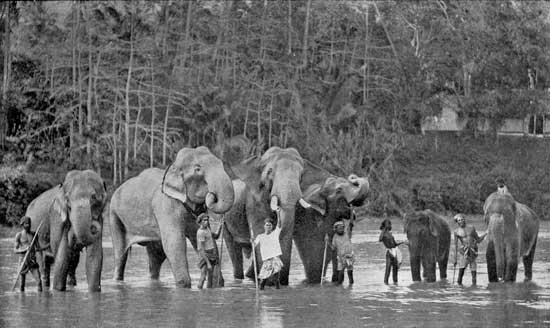
PLATE XV. TAME ELEPHANTS AND THEIR DRIVERS.
The imprisoned animals are left in peace for forty-eight hours, and when they have become quiet the most difficult and dangerous part of the exploit begins. Mounted on well-trained tame elephants, the most expert and experienced elephant-catchers enter the enclosure. They are active as cats, quick in their movements, bold, courageous, and watchful. Ropes are hung round the tame elephants so that their riders may have something to hold on by in case they are attacked and have to lower themselves down the flanks of their animals. These know by the signs given to them by the riders what they have to do, and the rider holds in his hand a small iron spike which he presses against the elephant's neck to make him move forwards, backwards, to right or left. A rider approaches a selected victim. If he turns to attack, another tame elephant comes up and gives him a thrust with his tusks. Choosing his time, the rider throws a noose round the head of the wild animal. The tame one helps with his trunk to place the noose right. The other end is made fast round the trunk of a tree. When the animal is thus secured the rider slips down to the ground and throws another noose round his hind legs, and the end of this rope is also fastened to a tree. Thus he is rendered harmless, and he struggles and tugs in vain to get loose. Meanwhile the other tame elephants with their riders help to catch and fetter their wild relations.
Then the captives, well and securely bound, are led one after another out of the enclosure and are fastened to trees in the forest. Here they have for a long time to accustom themselves to man and the society of tame elephants, and when they have lost all fear, spitefulness, and wildness they are led into the villages to be regularly broken in and trained to work in the service of their capturers.
It is pleasant to see tame elephants at work, or bathing in the rivers with their drivers (Plate XV.). They carry timber, they carry goods along the high-roads, they are useful in many ways where great strength is needed. The Maharajas of India always keep a well-filled elephant stable, but employ the animals mostly for tiger-hunting and riding. The elephant is to them a show animal which is never absent on occasions of ceremony. Old well-trained animals which carry themselves with royal dignity fetch, therefore, a very high price.
The Cobra
The cobra, or spectacled snake, is the most poisonous snake in India. It is very general in all parts of India, in Further India, in southern China, in the Sunda Islands, and Ceylon. Its colour is sometimes yellowish, shading into blue, sometimes brown, and dirty white on the under side. It is about five feet long. When it is irritated it raises up the front part of its body like a swan's neck, spreads out the eight foremost pairs of ribs at the sides, so that a hat or shield-shaped hood is formed below the head. The rest of the body is curled round, and gives the creature firm support when it balances the upper part of its body ready to inflict its poisonous bite with lightning speed. On the back of its hood are yellow markings like a pair of spectacles.
The cobra lives in old walls or heaps of stone and timber, under roots, or in dead trunks in the forest, in fact anywhere where he can find a sheltered hole. He does not avoid human dwellings, and he may often be seen, heavy and motionless, rolled up before his hole. But as soon as a man approaches he glides quickly and noiselessly into his hole, and if attacked defends himself with a weapon which is as dangerous as a revolver.
He is a day snake, but avoids sunshine and heat and prefers to seek his food after sunset. He should more properly be described as a snake of the twilight. He glides under the close brushwood of the jungle in pursuit of lizards and frogs, birds, eggs, and rats or other small animals that come in his way. On his roamings he also climbs up trees and creeping plants, and swims across large streams. It might be thought that a vessel anchored off the coast would be safe from cobras, but cases have been known of these snakes swimming out, crawling up the anchor chains, and creeping on board.
The female lays a score of long eggs as large as a pigeon's, but with a soft shell. The male and female are believed to entertain a great affection for each other, for it has been noticed that when one of them is killed, the other is shortly seen at the same spot.
The Hindus regard the cobra as a god, and are loath to kill him. Many cannot bring themselves to do so. If a cobra comes into a hut, the owner sets out milk for him and protects him in every way, and when the reptile becomes practically tame and finds that he is left undisturbed, he does his host no harm. But if the snake kills any one in the hut, he is caught, carried to a distance, and let loose. If he bites a man and then is killed, the bitten man must also die. If he meets with an unfriendly reception in a hut, he brings ruin to the inmates; but if he is hospitably entertained, he brings good fortune and prosperity. If a serpent-charmer kills a cobra, he loses for ever his power over snakes. It is natural that a creature which is treated with such reverence must multiply excessively. About twenty thousand men are killed annually in India by snakes.
The cobra's poison is secreted in glands, and is forced out through the poison teeth when these pierce through the skin of a man or animal. Its effect is virulent when it enters the blood. If the bite pierces a large artery, death follows surely and rapidly. Otherwise the victim does not die for several hours, and may be saved by suitable remedies applied immediately. A dog when bitten begins to bark and howl, vomits, and jumps about in the greatest uneasiness and despair. In a short time he becomes weak and helpless and dies. If the same cobra bites several victims one after the other within a couple of hours, the first dies, the second becomes violently ill, while the third is less affected. This is, of course, due to the fact that the contents of the poison glands become gradually exhausted; but they soon collect again.
When a man is bitten, his body becomes deadly cold, and every sign of life disappears. His breathing and pulse cannot be perceived at all. He loses consciousness and feeling and cannot even swallow. With judicious treatment the small spark of life still left may be preserved. For about ten days, however, the invalid remains very feeble, and then a slow improvement sets in. But as a rule the man dies, for in the Indian jungle help is seldom at hand, and the end soon comes. If the victim lies for two whole days as though dead, and yet does not actually die, it may be hoped that his body is throwing off the effect of the poison.
There are many extraordinary men in India. In Benares especially, but also in any other town, the shrivelled self-torturers called "fakirs" may be seen in the streets. They are stark naked save for a small loin-cloth. They are miserable and thin as skeletons, and their whole bodies are smeared with ashes. They sit motionless at the street corners of Benares, always in the same posture. One sits cross-legged with his arms stretched up. Try to hold your arms straight up only for five minutes, and you will feel that they gradually grow numb. But this man always sits thus. His arms seem to become fixed in this unnatural position. As he never uses them they wither away in time. Compared with his large head they might belong to a child. Another purposely extinguishes the light of his eyes by staring day after day straight at the sun with wide-open eyes.
Among the curiosities of India are also the snake-charmers. There are several varieties of them, and it seems difficult to distinguish exactly between them. Some appear to be themselves afraid of the snakes they exhibit, while others handle them with a remarkable contempt of danger. Some pull out the snake's poison fangs so that they may always be safe, while others leave them in, and then everything depends on the charmer's skill and dexterity and the quickness with which he avoids the bite of the snake. It frequently happens that the charmer is bitten and killed by his own snakes.
It is not true, as was formerly believed, that the snake-charmer can entice snakes out of their holes by the soothing tones of his flute and make them dance to his piping. The dancing is a much simpler affair. When the captured snake rears up and sways the upper part of his body to and fro, the charmer holds out some hard object, perhaps a fragment of brick. The snake bites, but hurts himself, and after a while gives up biting. Then the charmer can put his hand in front of the snake's head without being bitten. But when the snake is irritated he still assumes the same attitude of defence, swaying to and fro, and thus he seems to be dancing to the sound of the flute.
There are, however, some daring charmers who, by the strains of their instrument and the movements of their hands, seem to exercise a certain power over the cobra. They seem to throw the snake into a short faint or stupor, a kind of hypnotic sleep. The charmer takes his place in a courtyard, and the spectators gather round him at a safe distance. He has his cobra in a round, flat basket. The basket he places on the ground and raises the cover. Then he rouses and provokes the snake to make it lift up the upper part of its body and expand its hood with the spectacles. All the time he plays his flute with one hand. With the other he makes waving, mesmeric passes. The snake gradually becomes quiet and calm, and the charmer can press his lips against the scales of its forehead. Then the charmer throws it on one side with a sudden movement, for the snake may have waked up again and be just on the point of biting.
All depends on the charmer's quickness and his knowledge of the snake's disposition. The slightest movement of its muscles and the expression of its eyes is sufficient to indicate the snake's intentions to the charmer. It is said that an expert charmer can play with a freshly caught snake as easily as with an old one. The art consists in lulling the snake to sleep and perceiving when the dangerous moment is coming. During the whole exhibition the monotonous squeak of the flute never ceases. Courage and presence of mind are necessary for such a dangerous game.
Europeans who have seen these snake-men catch cobras say that their skilfulness and boldness are remarkable. They seize the snake with bare hands as it glides through the grass. This is a trick of legerdemain in which everything depends on the dexterity of the fingers and a quickness greater than that of the snake itself. The snake-catcher seizes the tail with his left hand and passes the right with lightning rapidity along the body up to the head, which he grips with the thumb and forefinger so that the snake is held as in a vice. Probably the trick consists in depriving the snake of support to its body with the left hand and producing undulations which annul those of the reptile itself.
When charmers go out to catch snakes they are always in parties of two or three. Some of them take with them antidotes to snake bites. If a man is bitten, a bandage is wound tightly above the wound and the poison is sucked out. Then a small black stone, as large as an almond, is laid on the wound. This absorbs blood and some at least of the poison. Adhering fast to the wound, it does not fall off until it has finished its work. That so many men die of snake bites is, of course, because assistance comes too late.
When the charmer begins to play with a cobra he fixes his eyes on it and never removes them for a second. And the same is true of the cobra, which keeps its eyes constantly on the charmer. It is like a duel in which one of the combatants is liable to be killed if he does not parry at the right moment. Still more watchful is a cobra when he fights with a mongoose. The mongoose is a small beast of prey of the Viverridæ family. It is barely as large as a cat, has a long body and short legs, and is the deadly enemy of the cobra. There is a splendid story in Mr. Kipling's Jungle Book of how a pet mongoose—"Rikki-tikki-tavi"—killed two large cobras.