Part 2 — III NORTH AMERICA
Reading edition
The Discovery of the New World
Now we must say farewell to Africa. We have in front of us the Straits of Gibraltar, little more than six miles broad, the blue belt that connects the Mediterranean with the Atlantic, the sharply defined boundary which separates the black continent from the white.
We have but a step to take and we are in Spain. Here, also, a dying echo from the splendid period of Arab rule reaches our ears. We are reminded that twelve centuries have passed away since the Prophet's chosen people conquered the Iberian Peninsula. The sons of Islam were a thorn in the sides of the Christians. Little by little they were forced back southwards. Only Cordova and Granada still remained in the possession of the Arabs, or Moors as they were called, and when Ferdinand the Catholic married Queen Isabella of Castile in the year 1469, only Granada was left in the hands of the Moors. Their last king lived in his splendid palace, the Alhambra in Granada. In 1491 the Spanish army besieged the Moorish city. Barely forty years earlier the Mohammedans had taken Constantinople. Now other Mohammedans were to be turned out of western Europe. New Year's Day 1492 came and Granada fell. The Moorish king had to bend humbly on his knees before the victor ere he went on his way, and the Castilian flag waved from the towers and pinnacles of the Alhambra.
This remarkable incident was witnessed by a mariner from Genoa, forty-six years old. His name was Christopher Columbus.
At the time of the fall of Granada there was no one among the learned men of Europe who had any suspicion of the existence of a continent in the western ocean, and the Portuguese sought only a sea route to India—the rich land of spices, gold, pearls, and coral. But there was a learned mathematician, Toscanelli of Florence, who perceived that, as the world was round, a mariner must necessarily reach Japan, China, and India by sailing westwards from Europe, and as early as 1474 he produced maps and other proofs of the correctness of his theory. It was Columbus, by his boldness and ability, who converted this theory into fact.
Christopher Columbus was the eldest of five children of a weaver in Genoa. He and his brothers also engaged in the weaving industry, but as their father's affairs were anything but flourishing, the sons decided to seek a living in foreign countries. Christopher became a sailor, and acquired all the qualifications necessary to handle a ship. He gained great experience and a thorough knowledge of his new profession. He once sailed on an English vessel to Thule or Iceland, the longest voyage which mariners of that time dared attempt. Then he tried his fortune in Portugal, earning a living by drawing sea-charts and serving as skipper on Portuguese vessels sailing to the eastern shores of the Mediterranean and to Guinea. In the Portuguese school he learned much which was to be of great importance in his future career. He made his home in Lisbon, where he married a lady of rank.
It was at this time that he entered into correspondence with Toscanelli, who sent him a map of the route over the Atlantic to Japan, and gave him much information drawn from Marco Polo's descriptions. These letters made a deep impression on Columbus. He wrote back to Toscanelli that he thought of sailing westwards to Marco Polo's countries according to his instructions, and Toscanelli replied that he was glad to find his ideas were so well understood, and that such a voyage would bring great gain to Columbus, and an extraordinary reputation among all Christian peoples.
Columbus tried in vain to obtain the support he needed for carrying out his plan. The King of Portugal and the learned men of the country listened to him, but treated him as a presumptuous dreamer. There were a few, however, who thought that he might be right, and on their advice the King sent a vessel over the ocean without telling Columbus. It soon returned without having seen land. When Columbus heard of this underhanded proceeding, he left Lisbon in disgust and travelled alone to Spain. His wife and children never saw him again, except his son Diego, who afterwards joined his father.
For two years he travelled from town to town in that part of southern Spain which is called Andalusia, selling charts, which he drew with his own hand. At last he was received at Court, and was able to set forth his plan before an assembly of courtiers and ecclesiastics. But Castile was too much occupied with the war against the Moors in Granada and Malaga to venture on such a great enterprise, and Columbus had to wait for better times.
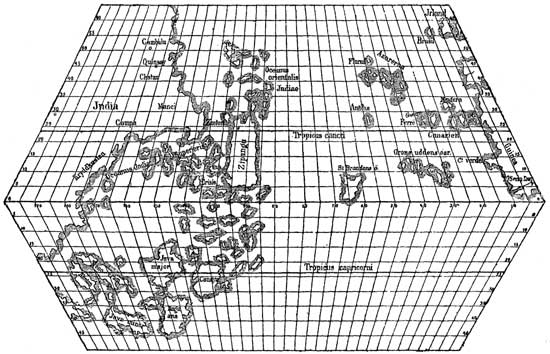
TOSCANELLI'S MAP.
Two years more passed by and Columbus was again summoned to the Court, then in Cordova on the bank of the Guadalquivir. His eloquence and enthusiasm had little effect, however, and after two more years of useless waiting he resolved to turn his back on Spain and try his fortune in France.
Sad and depressed, he followed the great highroad from Cordova. Being destitute he went up to a monastery beside the road, knocked at the gate, and begged for a piece of bread for his little son Diego, whom he held by the hand. While he was talking to the porter the prior came by, listened to his words, perceived by his accent that he came from Italy, and enquired into his story and his aims. The prior was a learned and benevolent man, and entered warmly into the plans of the Italian mariner, perceiving that such an opportunity of acquiring lands in eastern Asia should not be lost to Spain. He accordingly wrote to Queen Isabella, and at the end of 1491 Columbus spoke again before the learned men of the realm. Some of them treated him as an impostor, but others believed his words; and when, after the fall of Granada, the Court had a free hand, it was decided to equip Columbus for his first voyage over the Atlantic.
All the negotiations nearly fell through at the last moment, owing to the demands of Columbus. He wished to be appointed High Admiral of the Ocean and Viceroy over all the savage countries he discovered, and he demanded for himself and his descendants an eighth part of all the revenues of the new lands. But when he declared that he intended to devote his gains to the recovery of Jerusalem from the Turks, his wishes were granted and funds were assigned for the equipment of three ships in the harbour of Palos.
These vessels each had three masts, but they were far too small for such an adventurous enterprise. Only the Admiral's ship, the Santa Maria, was completely decked over. The other two, the Pinta and Niña, had only decks fore and aft. The two brothers Pinzon, of noble extraction, at once volunteered for the voyage, but it was far from easy to enlist crews. Had it been a voyage along the coasts of Europe and Africa, there would have been no difficulty in finding men, but for a voyage straight out into the unknown ocean—with that the sailors would have nothing to do. At last it was necessary to open the prisons in order to procure ninety men, for only that number was needed for the whole three vessels. The lists of the crews are still extant, and show that most of the men were Castilians.
Two doctors were taken, as well as a baptized Jew, who spoke Hebrew and Arabic, and might be useful as an interpreter when the expedition came over the ocean to India. Curiously enough, Columbus had no chaplain on board, but before he set sail his friend the prior administered the sacrament to all his men, who in the opinion of most were doomed to a watery death.
Armed with a royal despatch to the Great Khan of Mongolia, Columbus stepped on board the Santa Maria, the moorings were cast off, and on August 3, 1492, the three ships steered under full sail out into the open sea.
They kept on a south-westerly course, and in six days reached the Canary Islands, where the little fleet stayed a month to repair some damages and patch up the Pinta's broken rudder.
On September 8 a definite start was made, and when the lovely Canary Islands and the Peak of Teneriffe sank beneath the horizon, the sailors wept, believing that wind and sails would carry them from the world for ever, and that nothing but water and waves awaited them in the west.
From the first day Columbus kept a very exact diary, which shows how thoroughly he embraced Toscanelli's theory and how implicitly he relied on his fellow-countryman's calculations. To his crews, however, he represented the distance as short, so that their fears should not be increased by the thought of the great interval that separated them from the Old World. They became more anxious as days came and went, and still nothing but boundless deserts of water spread in every direction.
After a week's sail their keels ploughed through whole fields of floating seaweed, and Columbus pacified his men by the suggestion that this was the first indication of their approach to land.
The Santa Maria was a broad and clumsy vessel, really intended to carry cargo. She was, therefore, a slow sailer, and the other two ships usually took the lead. They were of more graceful build and had large square sails, but were of barely half the tonnage of the flagship. But all three kept together and were often so close that shouts could be heard from one ship to the other. One day Pinzon, captain of the Pinta, called out to Columbus that he had seen birds flying westwards and expected to sight land before night. They therefore sailed cautiously lest they should run aground, but all their apprehension ceased when a sounding-line two hundred fathoms long, lowered through the floating sea-wrack, failed to reach the bottom.
Their progress was stopped by several days of calm, and it was September 22 before the sea-weed came to an end and the vessels rolled again out to the open bluish-green water.
Through hissing surge the Santa Maria and her two consorts cut their way due west. A more favourable breeze could not be wished. It was the trade wind which filled their sails. The sailors were afraid of the constant east wind, and when at length it veered round for a time, Columbus wrote in his journal: "This head-wind was very welcome, for my men were mightily afraid that winds never blew in these seas which would take them back to Spain."
Toscanelli's map was sent backwards and forwards between Columbus and Pinzon, and they wondered where they really were, and how far it was to the islands of eastern Asia. On September 25, Pinzon ascended the poop of the Pinta and called out to Columbus, "I see land." Then he fell on his knees with all his crew, and, with voices trembling with excitement and gratitude, the Castilian mariners sang "Glory to God in the Highest." This was the first time a Christian hymn had sounded over the waves of the Atlantic. The sailors of the Santa Maria and Niña climbed up into the rigging, and also saw the land and raised the same song of praise as their comrades. But next day the longed-for land had vanished. It was only a mist which lay over the sea to leeward, a mirage in the boundless desert of water.
At the beginning of October, Columbus began to suspect that he had already passed the islands laid down on Toscanelli's map, and he was glad that he had not been detained by them but could sail straight on to the mainland of India. By India was meant at that time the whole of eastern Asia.
On October 7 the men on all the three vessels were sure that they saw land. Every sail was set. Each vessel thought it an honour to reach it first. The Niña took the lead. At sunrise the flag of Castile was hoisted to the topmast and a shot thundered from its poop. During the day the land vanished again. But now flocks of birds were seen, all making south-westwards, and Columbus gave orders to follow in the same direction. He wrote in his diary: "The sea, thank God, lay like the river at Seville, the temperature was as mild as in April at Seville, and the air was so balmy that it was delightful to breathe it."
But they sailed day after day and through the nights, and still there was nothing to be seen but water. The men had several times given vent to their discontent, and now began to grumble again. Columbus soothed them and reminded them of the reward that awaited them when they had attained their goal. "Besides, their complaints were useless, for I have sailed out to reach India, and intend to prolong my voyage until, with God's help, I have found it."
On October 11 a log was seen floating in the sea with marks on it apparently cut by human hands; and shortly after, a branch with clusters of berries. Then the sailors became content, and the Admiral promised a reward to the man who first sighted land. All kept their eyes open and watched eagerly.
In the evening Columbus thought he saw a flash of light as though a man were carrying a torch along a low shore, and later in the night one of the Pinta's men swore that land was visible in front. Then all sails were taken in and they waited for the dawn.
When the sun rose on October 12, 1492, its rays illumined, before the eyes of the Spaniards, a flat grass-covered island which Columbus called San Salvador or St. Saviour, after Him who had rescued them from the perils of the sea. This island evidently lay north of Japan—at any rate, it would appear so from Toscanelli's map. Little did Columbus and his men suspect that a whole unknown continent and the world's greatest ocean, the Pacific, still separated them from Japan. The small island was one of the Bahama group, and is now known as Watling Island. If the voyages of the Northmen five hundred years earlier be left out of account, this island was the first point of the New World reached by Europeans.
The great day was begun with the Te Deum. The officers congratulated the Admiral, the sailors threw themselves at his feet and begged forgiveness for their insubordination. A boat was lowered, into which stepped Columbus with the flag of Castile in his hand, followed by the Pinzon brothers with the Banner of the Cross, and a few others. Without knowing it, Columbus stepped on to the soil of America. Solemnly he took possession of San Salvador on behalf of the crown of Castile. A cross was erected on an elevation on the shore in token that the island was in Christian hands.
The natives must have been astonished when they saw the three wonderful ships arrive off their coast and white men come ashore. At first they held aloof, but with beads and other gifts the Spaniards soon gained their confidence. They had only wooden javelins for weapons, did not know iron, had long lanky hair, not woolly like the negroes, were naked, and painted their bodies red and white. They knew gold, and that was well, for it was gold, and gold above everything, that Columbus needed to free the Holy Sepulchre from the Turks. These savages had gold rings in their noses, and when the Spaniards inquired by signs where the gold came from, they pointed towards the south-west.
Columbus, of course, called them Indians. Seven of them were taken on board. They were to go to Spain and "learn to talk," so that they might act as interpreters on subsequent voyages.
Then the voyage of discovery was resumed. The ships had to be sailed with great caution, for dangerous reefs lay round the islands. According to the signs made by the savages two large islands lay to the south. One must be Japan, and when Columbus landed on the coast of Cuba and heard of a prince named Kami, he thought that this man must be the Great Khan, and that he was really on the mainland of eastern Asia. Accordingly he sent his Jew and two of his savages ashore to look for the Great Khan. They were four days away and searched as well as they could among the tent-like huts of the natives, but never saw a glimpse of any Mongolian Great Khan in Cuba.
Exceedingly beautiful was this strange coast, reminding them of Sicily. Sweet song of birds was heard, there was an odour of fruits, and green foliage and palms waved like plumes in the breeze. The Spaniards were astonished to see the natives walking about smoking rolled-up leaves which they called tobacco, and had no notion what a source of wealth these leaves in the form of cigars would become in the future. Pinzon on the Pinta must have been bewitched by all the wonders he saw, for he ran off with his vessel to seek the land of gold on his own account. Columbus himself sailed across to the large island of Haiti, which as usual he took possession of in the name of Castile. The natives received him everywhere with amazement and submission, believing that he was an emissary from the abode of the gods.
On the northern coast of the island a great misfortune occurred on Christmas Eve. An inexperienced steersman was at the Santa Maria's rudder, and let the vessel run on a sandbank, where it became a wreck. The crew had to take refuge on the Niña. The natives helped to save all that was on board, and not even a pin was stolen.
But the Niña could not hold them all, and how were they to get back to Spain? Columbus found a way out of the difficulty. He decided to found a colony on the coast. Forty men were to be left behind to search for gold, and by the time Columbus returned from Spain they would no doubt have a tun full of the precious metal, and that would be enough for the conquest of Jerusalem. The sailors were only too glad to remain, for they found the natives accommodating and the climate good. It was in all respects much pleasanter than to endure hardship on the Niña, and perhaps founder with the wretched little ship.
Accordingly, a blockhouse was built of wreckage from the Santa Maria, was surrounded by a wall and moat and provisioned, and after presenting the chief of the Indians with a shirt and a pair of gloves, Columbus weighed anchor and steered for home.
He had not sailed far before he fell in with the Pinta, and took the independent Pinzon into favour again. Then they sailed eastwards across the Atlantic.
On February 12 a storm arose. All the sails were furled and the two ships lost sight of one another for good. The Niña pitched horribly and threatened to sink. All made ready for death. Columbus, fearing that his discoveries would perish with him, wrote a narrative on parchment, covered it with wax and placed it in a cask, which was entrusted to the angry waves. The sailors thought that it was an offering with which Columbus sought to allay the storm.
A few days later the Niña arrived safely at the southernmost island of the Azores, and thence continued her voyage to the mouth of the Tagus and Lisbon.
On March 15 the inhabitants of Palos saw the most famous of all the ships of the world come into the harbour. The people streamed down with the wildest jubilation and all the church bells were rung. The same evening the Pinta also sailed in, but was very differently received, for it was already known that Pinzon wished to usurp the honour of the discovery, being convinced that Columbus's vessel had been lost in the storm. No one took any notice of him, and he died a few days later, probably of chagrin and sorrow.
In Seville Columbus received a summons from the King and Queen, who were staying in Barcelona. His journey through Spain was one great triumphal progress. He was feted as a conqueror in every town. He was conducted in a brilliant procession through the streets, six copper-brown "Indians" marching at the head with coloured feathers in their head-dresses. This was Christopher Columbus, who had given new lands to Spain, who had discovered a convenient sea route to India just at the time when the Portuguese were looking for a route thither round the coast of Africa. In Barcelona all his titles and privileges were solemnly confirmed. Now he was actually the Admiral of the Ocean and Viceroy of India. Now he had attained the height of worldly honour.
Then began the time of adversity.
On his second voyage, when he set out with seventeen ships, he discovered the northern Antilles as far as Porto Rico and came in contact with cannibals. At Haiti he found that the forty men whom he had left behind on his first voyage had been killed by the natives. He took it for granted that Cuba was the mainland of Asia, and that thence the journey to Spain might be made dryshod by following Marco Polo's footsteps. Discontent was rife among his men, the natives rose up against the intruders, rivals sprang up around him like mushrooms, and in the home country he was abused by high and low.
He returned to Spain to put everything right; but this time he was no longer received with rejoicing, and found that he had now a formidable rival in Portugal. In the year 1497 Vasco da Gama discovered the real sea route to the real India by sailing round the south of Africa, an event which, in the eyes of that generation, quite eclipsed the discoveries of Columbus. In India inexhaustible riches were to be found, whereas the poor islands of Columbus had simply cost money, ships, and men.
But the strong will of Columbus overcame all obstacles, and for the third time he sailed for his fictitious India. Now he held a more southerly course, and discovered the island Trinidad, and found that the water between it and the coast of Venezuela was fresh. There must then be a large river near. This river was the Orinoco.
Disturbances broke out again in Haiti, and Columbus's opponents sent home complaints against him. A Royal Commission was sent out to hold an enquiry, and in the end arrested the Admiral and sent him in chains to Spain. The captain of the vessel wished to remove his fetters and leave him free as long as he was on board, but Columbus would not consent, for he wished to retain them as a "reminder of the reward he had got for his services."
But when he was led in chains through the streets of Cadiz, the scene of his former triumph, the displeasure of the people was aroused, and at the Court Columbus met with a friendly reception. He even succeeded in fitting out a fourth expedition and crossed the Atlantic in nineteen days. The new Governor forbade him to land, and Columbus expressed his indignation that he, the discoverer, should not be allowed to set foot on his own islands. He then steered westwards and came to the coast of Honduras, and thence followed the coast of Nicaragua southwards. He fully and firmly believed that this was Malacca, and that farther south would be found a passage to India proper. He sailed back towards Cuba, but was driven by bad weather to Jamaica, where in great extremity he had to run his ship ashore. One of his trusty men rowed for four days in a canoe over the open sea to Haiti to beg for help. Meanwhile the shipwrecked men were in hard case. The natives threatened them, and refused them all help. Columbus knew that an eclipse of the moon would shortly occur, and told the natives that if they would not help them, the God of the Spaniards would for ever deprive them of the light of the moon. And when the shadow of the earth began to move over the moon's disc, the natives were terrified, fell at the feet of Columbus, and promised him everything. He pretended to consider the matter, but at last allowed himself to be persuaded and promised that they should keep their moon. And then the shadow moved off quietly into space, leaving the moon as bright as a silver shield.
At last he received assistance, and in 1504 was back in Spain. No one now paid any attention to him. His property was confiscated, his titles were not restored to him, and even the outstanding pay of his followers was kept back. Ill with gout and vexation, he stayed at first in Seville. His former friends did not know him. Lonely and crushed down by grief and disappointment, he died in 1506 at Valladolid. No one took any notice of his decease, and not a chronicle of the time contains a word about his death. Even in the grave he seemed to find no rest. He was first interred quietly in Valladolid; then his remains were transferred to a monastery church in Seville; half a lifetime later his body was carried to San Domingo in Haiti, where it rested for 250 years until it was deposited in the cathedral of Havana in Cuba; and finally, when Cuba was lost to the United States, the remains of the great discoverer were again brought back to Spain.
Columbus was a tall, powerfully built man, with an aquiline nose, a pink and freckled complexion, light-blue eyes and red hair, which early became white in consequence of much thought and great sorrows. During four centuries of admiration and detraction his life and character have been dissected and torn to bits. Some have seen in him a saint, a prophet; others have called him a crafty adventurer, who stole Toscanelli's plan in order to gain power, honour, and wealth for himself. But when, about twenty years ago, the fourth century since his discovery was completed, full amends were made to his memory and his achievements were celebrated throughout the world. He opened new fields for unborn generations, he extended the bounds of the earth, and guided the world's history into new channels.
Four years before the death of Columbus, Amerigo Vespucci of Florence, who made four voyages across the ocean, suggested that the new lands had nothing to do with Asia, but were a "New World" in distinction to the Old; and a German schoolmaster, who wrote a geographical text-book, suggested in the introduction that as the fourth continent had been discovered by Amerigo Vespucci (Americus Vesputius), there was no reason why it should not be called Amerigo or America after its discoverer. The proposal was accepted, and only too late was it realised that Columbia would have been the proper name.
One discovery followed after another, and the coasts of America gradually assumed on charts and maps the form with which we are familiar. Let us for a moment dwell on another of the most striking voyages in the history of the world. In the year 1519 the Portuguese Magelhaens sailed along the east coast of South America and discovered the strait which still bears his name; and what is more, he found at last, through this strait, the western passage to India. He sailed over an immense ocean, where the weather was good and no storms threatened his ships; and accordingly he called it the Pacific Ocean. Other dangers, however, awaited him. The mariners sailed for four months over unbroken sea, suffering from hunger and disease. At last three of the vessels reached the Philippines. There Magelhaens landed with a small party, and was overpowered and slain by the natives. Only one of the ships, the Victoria, came home, but this was the first vessel which sailed round the world.
During the succeeding centuries white men struck their claws ever firmer into America. The Indians were forced back into the backwoods, and in North America they have been almost exterminated. Under French, and later, under English rule, those parts of North America have developed an unexpected power and wealth which were despised by the Spaniards, who in their boundless greed of gain thought of nothing but gold.
New York
In a house in a Swedish countryside sit an old man and woman talking seriously.
"It is a great pity," says the old woman, "that Gunnar is beginning to think of America again."
"Yes, he will never rest," replies the old man, "till we have given our consent and let him go. To-day he says that an emigration 'touter' has promised him gold and green forests if he will take a ticket for one of the Bremen line steamers. I reminded him that the farm is unencumbered, but he answered that it could not provide for both his brothers and himself. 'It was a very different thing for you, father,' he said, 'but there are three of us to divide the produce.' He thinks it is a hopeless task to grub in our poor stony hills, when boundless plains in the western states of North America are only waiting to be ploughed, and in any factory he can be earning wages so large as to yield a small income for several years."
"Yes, indeed, I know, it is his cousins who have put this fancy in his head with their glowing letters. But I suppose we cannot prevent him going if his heart is set on it?"
"What can we do? He is a free man and must go his own way."
"Well, perhaps it is best. When he is home-sick he will come back again."
"I am afraid it will be long enough before that happens. At starting all seems so fine. 'I shall soon come home with a small pile.' In reality all his memories will grow faint within a year, and the distance to the red cottage will seem to grow longer as time flies. I mourn for him as dead already; he will never come back."
A few days after this our emigrant Gunnar breaks all ties and tears up all the roots which since his birth have held him bound to the soil of Sweden. He travels by the shortest route to Bremen and steps on board an emigrant steamer for New York. During the long hours of the voyage the people sit on deck and talk of the great country to which they are all bound. Before the last lighthouse on the coast of Europe is lost to sight, Gunnar seems to have all America at his finger-ends. The same names are always ringing in his ears—New York, Philadelphia, Chicago, and San Francisco have become quite familiar, and he has only to insert between them a number of smaller towns, a few rivers, mountains, and lakes, to draw in a few railway lines, to remember the great country of Canada to the north and mountainous Mexico in the south, to place at three of the corners of the continent the peninsulas of Alaska, California, and Florida, and at the fourth the large island of Newfoundland, and then his map of North America is complete.
The voyage over the Atlantic draws to an end. One day a growing restlessness and excitement is perceptible, and the travellers cast inquiring glances ahead. It is said that the American coast will be visible in an hour. And so it is. An irregular line appears to starboard. That is Long Island. Two hours more, and the boat glides into the mouth of the Hudson River and comes alongside at Ellis Island in the harbour of New York. A row of other vessels lie moored at the quays. These also have brought immigrants to America and will soon return to fetch more. They must go backwards and forwards year out and year in to carry three thousand persons daily to the United States.
Gunnar has packed his things in good time and takes up a favourable position from which he can observe his fellow-travellers. He has never heard such a noise and never seen such bustle. The people throng the gangways, call to one another, haul out their discoloured portmanteaus and their roped bundles. There are seen Swedes and Germans, Polish and Russian Jews, Galicians and Croats mingled together, some well dressed and with overcoats, others in tattered clothes and with a coarse handkerchief in place of a collar.
Yonder, overlooking New York harbour, stands the colossal statue of Liberty, a female figure holding a torch in her right hand. When darkness lies over the earth she throws a dazzling beam of electric light out over the water, the quays, houses, and ships. But Gunnar experiences no feeling of freedom as he sets his foot on American soil. He and all his fellow-travellers are provided with numbered tickets and marshalled into long compartments in a huge hall. Then they are called out one after another to be questioned, and a doctor comes and examines them. Those who suffer from lung disease or other complaint, or being old and feeble have no prospect of gaining a livelihood, receive a peremptory order of exclusion on grey paper and must return by the next vessel to their fatherland. The others who pass the examination proceed in small steamers to the great city, where, among the four millions of New York, they vanish like chaff before the wind.
From whatever land they may come they always find fellow-countrymen in New York, for this city is a conglomeration of all the peoples of the world, and seventy different languages are spoken in it. A third of its inhabitants have been born in foreign countries. In Brooklyn, the quarter on Long Island, there are whole streets where only Swedes live. In the "Little Italy" quarter live more Italians than there are in Naples, in the "Chinese Town" there are five thousand Chinese, and even Jews from Russia and Poland have their own quarter. Gunnar soon finds that New York is more complicated than he supposed when he was rolling out on the Atlantic.
Meanwhile he decides to take it easy at first, and to learn his way about before plunging into the struggle for existence. In Brooklyn he soon meets with a fellow-countryman and gets a roof over his head. A pleasant, well-to-do railway employé from Stockholm takes pleasure in showing him about and impressing him with his knowledge of America.
"This town must be old," says Gunnar, "or it could not have grown so large."
"Old! No, certainly not. Compared to Stockholm it is a mere child. It is barely three hundred years old, and at the time of Gustavus Adolphus it did not contain a thousand inhabitants. But now it is second only to London."
"That is wonderful. How can you account for New York becoming so large? Stockholm and Bremen are pigmies beside it. I have never seen the like in my life. There are forests of masts and steamboat funnels in all directions, and at the quays vessels are loaded and unloaded with the most startling speed."
"Yes, but you must remember that the population of the United States increases at an extraordinary rate. During last century it doubled every twenty years. And remember also that nearly half the foreign trade of the Union passes through New York. Hence are exported grain, meat, tobacco, cotton, petroleum, manufactured goods, and many other things. It is, therefore, not remarkable that New York needs 36 miles of quays with warehouses, and that more than seventy steamboat lines sail to and from the port. And, besides, it is a great industrial town. Think of its position and its fine harbour! Eastward lies the Atlantic with routes to Europe; westwards run innumerable railway lines, five of which stretch right through to the Pacific coast."
"Tell me something about the railways," exclaims Gunnar, who wants to go out west at the first favourable opportunity.
"Yes, I can give you information about them, for I have been working on several lines. As far back as 1840 the United States had 2800 miles of railway, and twenty years later 30,000 miles. Now it has nearly two hundred and forty thousand miles of rails, a strip which would reach to the moon or ten times round the equator. The United States have more railways than all Europe, though the population is only a fifth that of Europe; but the area is about the same."
"How do you explain this rapid development of railway enterprise?"
"Well, the fact is that at first the aim was to fill up the gaps between the waterways. Rivers were relied on as long as possible, and the first railways were built in districts where there were no large rivers. Then in course of time various lines converged together, new railways were constructed, and now the forty-nine States are covered with a connected network of lines. Moreover, the country roads are so bad that they must be supplemented by railways."
"A large number of bridges must be necessary across all the large rivers?"
"Yes, certainly. The Americans are adepts in bridge-building, and the railway bridges over the Mississippi and Missouri and other rivers are masterpieces of the boldest art. Where lines cross deeply eroded valleys, bridges of timber were formerly built, like sky-scraping parapets with rails laid along the top; but such bridges are now fast disappearing and iron bridges are built, and the trains run at full speed over elegant erections which from a distance look just like a spider's web. Just look to your left. There you have one of the world's strongest bridges, the suspension bridge between New York and Brooklyn. It is of colossal dimensions, and yet it looks so fine and delicate as it hangs between its two mighty piers. You see that vessels with the tallest masts can pass clear below, for it is poised 135 feet above high water. The length is nearly a mile and a quarter. It is wonderful that men have been able to stretch this huge span of iron above the water. Wait a little and you will see a kind of aerial railway."
Then the Stockholm man takes his new friend to a station to travel on the elevated railway through New York. Gunnar's astonishment is beyond bounds as he rushes along on a framework, supported by innumerable iron pillars, over streets and squares, and sees the seething crowd moving in carriages and on foot below his feet.
"Here is the Central Park. Is it not delightful with its leafy trees and cool pools? In summer it is burning hot in the town, and it is refreshing to rest an hour or two in the shade of the trees. The winters are equally cold, and raw, biting winds blow from the east coast. Here is Fifth Avenue, the finest street of New York. In the row of palaces you see here live millionaires, railway kings, steel kings, petroleum kings, corn kings, a whole crop of kings. But I would rather we went to look at the rows of houses facing the Hudson River."
"New York lies, then, on the Hudson River?"
"That is so, but more properly speaking New York stands on the island of Manhattan in the mouth of the river. We are standing, then, on Manhattan, and it is interesting to recall the fact that this island was sold three hundred years ago by Indians to Dutchmen for the sum of four pounds. It is rather more valuable now! Just look at the hideous sky-scrapers with their twenty and thirty storeys" (Plate XXXII.).
"I was just wondering why houses are built so enormously high."
"That is owing to the tremendous value of the ground. When there is not space enough to build out laterally, the buildings are piled up heavenwards, where there is plenty of room. They are certainly not handsome. Look at this row of houses, some of moderate height, others as tall as chimneys. Are they not like a row of keys moved by invisible gigantic fingers?"
"I should not like to live in such a building, I am sure. On the top floor I should be giddy with the height, and on the first I should expect the whole mass to tumble down on me."
"We are better off in Brooklyn, where the houses are of moderate height. To-morrow I will show you something not less remarkable than the wealthy quarter of the city. I will take you to the Chinese town. There Chinese swarm in the dirty lanes; there the whole place reeks of onions and tobacco and spirits from the public-houses; there are vile gambling hells and opium dens; and there paper lanterns on fishing rods hang outside the tea-houses. Then we can take a look at 'Little Italy,' a purely Italian town in the midst of the New York of the Americans. There you will see only Italian books in the book-shops, there Italian newspapers are read, there wax candles burn round images of the Madonna in the churches, and black-haired, brown-eyed children from sunny Italy play in the gutters. And we must not forget 'Little Russia,' the Jews' quarter. The Jews are a remarkable people; you never see them drunk, and you never hear of any crime or felony committed by them. They live poorly, cheaply, and sparingly, and seem cheerful in their booths beside the streets."
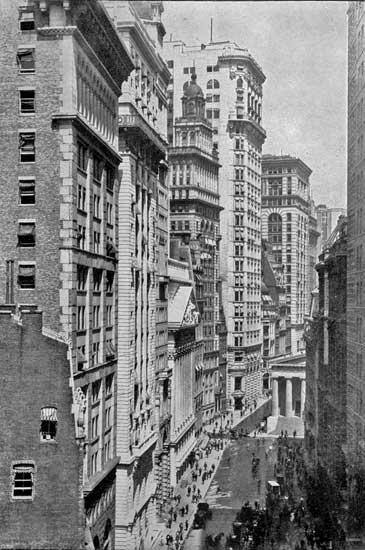
PLATE XXXII. "SKY-SCRAPERS" IN NEW YORK.
"All this is very well, but I do not understand where all the immigrants go. I am told that as many as three thousand persons land daily on Ellis Island. At this rate New York receives yearly an addition of a million souls."
"Yes, but how many do you think remain in New York? Most of them go up country and out westwards. Some improve their position and then repair to other fields of work. But many also stay here and increase the slum population. The immigrants who are destitute on landing take work in factories at any wage they can get. The wages they receive seem very high compared to those in their own country, but they are low for America. Accordingly the immigrant Europeans thrust out the Americans, and therefore there are two millions out of work in the United States. And so there are failures, human wrecks, who are a burden to others. If you like we will try this evening to get to a midnight mission and see the poor wretches waiting in crowds for the doors to open. They have a worn, listless expression, but when the doors are open they wake up and rush in, fill all the benches in the large hall, and go to sleep in all imaginable positions."
"What do they do there?"
"A missionary preaches to them, but they are hungry and weary, and sleep soundly on their benches. Among them you will find tramps and vagabonds, professional beggars and thieves, idlers and men out of work. In the daytime they beg and steal, and now at night they take their sleep in the mission. When the preacher finishes, they file out and go to the bread stalls to get food. Such is their life day after day, and they sink ever deeper into misery."
"They are the slag that remains after the precious metal has run off, of course. It is curious to think of a people that is increased by a never-failing stream of immigrants. What will be the end of it?"
"No one can answer that question. Everything is possible with Americans. They are a mixture of English, Scandinavian, German, Dutch, Italian, and Russian blood, to name only the principal constituents of this complex blend, this huge incorporation. Out of all these elements one day an American race will emerge, when Ellis Island has closed its gates to emigrants from Europe."
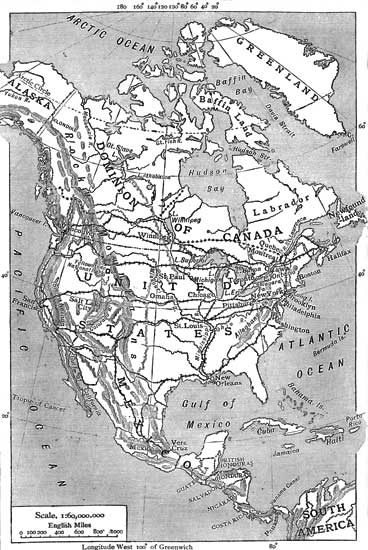
NORTH AMERICA.
"Tell me another thing, now. Why is not New York, the most important city, also the capital of the country?"
"It was thought that the city which bears the name of the great Washington had a more convenient and more central position with regard to the States of the original federation. The population of Washington is only about 330,000, and there are fifteen larger cities in the United States, but it is the centre of government. There the President lives in White House, there Congress assembles in the Capitol, there stands the Washington monument surrounded by large national buildings, and there three universities are established."
Chicago and the Great Lakes
After our friend Gunnar has seen as much as he wants of New York, he obtains a good post in a large factory, but he stays there only two months, for with other Swedes he receives an offer from Philadelphia which he does not hesitate to accept. His idea is to work his way gradually westward. If he can only get as far as Chicago he thinks it will not be difficult to go on to San Francisco.
Now he works in a yard where more than a thousand locomotives are made annually. This yard seems to him quite a town in itself. Here the iron is made white hot in immense furnaces, there it is hammered and rolled, and with irresistible power human hands convert the hard steel into steam boilers, wheels, axles, and parts of machines which are put together to form engines. The workshop is traversed in all directions by rails, and the completed steam-horses are sent out all over the railway systems of the United States.
Gunnar learns from his mates that Philadelphia is one of the largest cities of the world, with nearly a million and a half inhabitants, and that in America only New York and Chicago are larger.
After a while, however, Gunnar has had enough of Philadelphia, and takes a ticket for Pittsburg, the steel and iron capital, where immigrants never need be in want of a post. He travels without a change of carriages between the two towns, traversing the whole of Pennsylvania. Innumerable branch lines diverge in all directions, for towns and villages are everywhere. Here a railway runs to a mine, there another to a district rich in maize and tobacco, and here again a third to a timber yard. At the station stand long trains laden with grain, planks, petroleum, cotton, reaping machines, coal—in fact all the wares that the earth can produce by its fertility, and men by the labour of their hands.
The country becomes hilly, and the train winds about through the northernmost part of the Alleghany Mountains. Gunnar lets his eyes rove with strained attention over the dark woods, the waving fields, and the smoke rising from villages and farmhouses, when an American comes and sits down on the seat just in front of him.
"I see that you are a newcomer in America," says the stranger. "It may then interest you to know that the crest of the Alleghany Mountains, composed of granite, gneiss, and slates, is the watershed between the Atlantic and the Mississippi. You must not suppose that these mountains are everywhere as low as here; far down south-west, in North Carolina, there are summits more than six thousand feet high. Maize and fruit are grown in the valleys, and there are fine forests of pines and foliage trees. And there are places where you lose yourself in dense clumps of rhododendrons and climbing plants. And there are wild recesses where men never go, but where bears and wolves have their haunts among broken branches and twigs, fallen trunks and moss-grown granite boulders, and where nothing is changed since the time when the Indian tribes went on the war-path. But where are you bound for?"
"I am going to Pittsburg to look for work, for I was a smith at home."
"Oh, Pittsburg! I was foreman in some steel works there for two years, and I have never seen anything more wonderful. You know that this town has sprung up out of the earth as if by magic. When petroleum springs were discovered, it increased at double the rate, and now it is one of the world's largest industrial towns, and, as regards iron and steel, the first in America. Here materials are manufactured to the value of more than nineteen million pounds annually. Almost inexhaustible deposits of coal are found in the neighbourhood. More than twenty railway lines converge to Pittsburg, which also has the advantage of three navigable rivers, and a network of canals. And round about the town are suburbs full of machine factories, steel works, and glass works. The neighbourhood has a million of inhabitants, a third of them foreigners, mostly Slavs, Italians, and Hungarians. You have a kind of feeling of oppression when you see from a height this forest of reeking factory chimneys, and when you think of the unfortunate men that slave under this cloud of coal smoke. There is a hammering and beating everywhere, and a rumble of trains rolling over the rails. Overheated furnaces bubble and boil, and sparks fly out under the steam hammers. At night you might think you were in the bottom of a volcano, where lava boils under the ashes ready to roll out and destroy everything. A weird reddish-yellow light flames forth from thousands of fires, lighting up the under side of the thick smoke cloud. I am sorry for you if you are going to Pittsburg. You had much better travel straight on to Chicago. Not that Chicago is a paradise, but there are better openings there, and you will be nearer the great West with its inexhaustible resources."
"Thanks for your advice. I am the more ready to follow it because I always intended to get to Chicago sometime."
"From Pittsburg," continues the American, "a line runs direct to the large town of St. Louis on the Mississippi. St. Louis is a junction of great importance, for not only do a whole series of great railway lines meet there, but also innumerable steamboats ply from there up the Mississippi and Missouri, and to all the large towns on their tributaries. St. Louis is the centre of all the winding waterways which intersect all parts of the United States. And there you can travel on comfortable flat-bottomed steamers along the main river to New Orleans, a great harbour for the export of cotton. You can well conceive what a blessing and source of wealth this river is to our country. It is of immense extent, for it is the longest river in the world, if we take its length from the sources of the Missouri in the Rocky Mountains, and in the area of its basin it is second only to the Amazons. Its plain is exceedingly fruitful, and far around its banks grain shoots up out of the soil to feed many millions of human beings. And its waterways, ramifying like the nerves of a leaf, facilitate communication and the transport of goods between the different States.
"You should just see how the great river rises in spring. You might think you were sailing on a large lake, and, as a matter of fact, it floods an area as large as Lake Superior. If the Mississippi is a blessing to men, on the other hand in spring it exacts a heavy tax from them. The vast volumes of brown, muddy water often cut off sharp bends from the river-bed and take short cuts through narrow promontories. By such tricks the length of the river is not infrequently shortened by ten or twelve miles here and there. But you can imagine the trouble this causes. A town standing on such a bend may one fine day find itself six miles from the bank. In another the inhabitants are in danger of being at any time drowned like cats. A railway bridge may suddenly be suspended over dry land, while the river has swept away rails and embankment a little farther off. Our engineers have great difficulty in protecting constructions from the capricious river in spring. Not a year passes without the Mississippi causing terrible destruction and inflicting great loss on those who dwell near its banks, especially in cattle.
"You have only to see this water to comprehend what immense quantities of earth, sand, and mud are yearly carried down by it. And all this silt is deposited in the flat delta below New Orleans. Therefore the delta extends from year to year farther out into the Gulf of Mexico. This is an easy way of increasing our territory, but we would willingly sacrifice the gain if we could get rid of the terrible floods in spring."
The train with our two travellers on board has now crossed the boundary of Pennsylvania, and is making its way westwards through the states of Ohio and Indiana. Boundless plains extend to north and south, planted with maize, wheat, oats, and tobacco. Maize fields, however, are the most frequent, and the harvest is just beginning. Gigantic reaping machines, drawn by troops of horses, mow down the grain and bind it into sheaves, while other machines throw it into waggons. The reapers have only to drive the horses; all the rest is done by the machines. Certainly men's hands could never be able to deal with all this grain; whole armies could be hidden under the ears of maize.
Now the train skirts the shore of Lake Michigan, which stretches its blue surface northwards, and a little later halts at Chicago.
Gunnar has been directed to an agency for Swedish workmen, and the first thing he does is to call there. In a day or two he obtains work in the timber business, and goes up to Canada in a large cargo steamer which carries timber from the forests of Canada to Chicago. Here the timber supplies seem to him inexhaustible when he sees the dark coniferous woods on the shores and hills, and when he notices that hundreds of steamboats are carrying the same freight. The workman beside him, an Englishman, boasts of the immense territory which occupies almost all the northern half of North America.
"Canada is the most precious jewel in the crown of Great Britain, next to the mother-country and India."
"Why is Canada so valuable? I always thought that its population was very small."
"It has not many people; you are right there. Canada has only seven million inhabitants."
"Oh, not more! That is just about as many as Greater London."
"Yes; and yet Canada is as large as all Europe and as the United States of America. It stretches so far to east and west that it occupies a fourth part of the circuit of the earth, and if you travel from Montreal to Vancouver you have a journey of 2906 miles. But you can well understand that such an extensive country, even though it is thinly peopled, especially in its cold, northern parts, must yield much that is valuable to its owners."
"Yes, certainly; so it is in Siberia, where the population is also scanty."
"Just so. In Canada fields, mountains, forests, and water yield an immense revenue. Think only of all the agricultural produce which is shipped from here, not to speak of gold, fish, and furs. The wheat produced in Canada is alone worth over 22 million pounds sterling a year. There are also huge areas which are worthless. We get little advantage from the northern coasts, where the Eskimos live."
"You are quite at home on these lakes?"
"Oh yes. When a man has sailed to and fro over them for ten years, he knows all about the roadsteads and channels, and about when the ice forms and breaks up, and when there is a prospect of a storm."
"But the storms cannot be very dangerous?"
"Ah, you do not believe in them. All the same they may be just as dangerous as in the Atlantic, and when a real hurricane comes, the skipper will do well to seek shelter, or at the best he will lose his cargo. You will soon have opportunities of seeing, hearing, and feeling how the surge beats just as on the coast of the ocean. But then, all these lakes have an aggregate area more than half as large as the Baltic, and if we take the depth into account we shall find that the volume of water is the same as in the Baltic. Lake Superior is the largest lake in the world. Beyond the point yonder lies Lake Huron. You must acknowledge that this scenery is beautiful. Have you ever seen anything to equal this sheet of dark-blue water, the dark-green woods, and the grand peaceful shores? It is a pity that we do not go to Lake Erie, for at its eastern extremity is one of the wonders of the world and the most famous spectacle in North America."
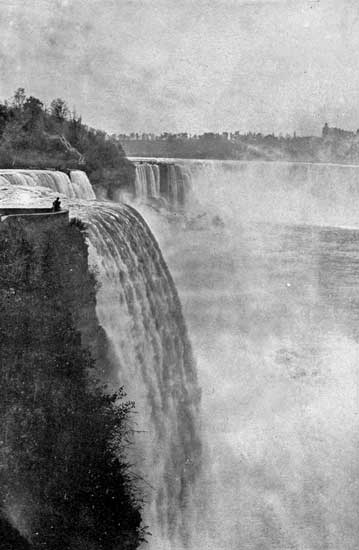
PLATE XXXIII. NIAGARA FALLS.
"You mean the Falls of Niagara, which I have heard described so many times?"
"Yes. Think of a steamboat on Lake Erie sucked along by the stream that flows to Ontario. This lake lies 300 feet lower than Erie, and about half-way between the two lakes the water passes over a sharp bar and plunges with a thundering roar into the depth below (Plate XXXIII.). The barrier itself, which is a thousand yards broad, is formed of a huge stratum of sandstone, and the rocks under it are loose slates. Erosion proceeds more rapidly in the slates than in the hard limestone, which, therefore, overhangs like the projecting leaf of a table, and the collected volumes of water hurl themselves over it. But when the limestone is so far undermined that it is no longer able to bear the weight of the water, fragments break off from time to time from its edge and fall into the abyss with a deafening noise. Thus in time the fall wears away the barrier and Niagara is moving back in the direction of Lake Erie."
"Moving, do you say? The movement can surely not be rapid."
"Oh no; Niagara needs about seventeen thousand years to move half a mile nearer to Lake Erie."
"That's all right, for now I can be sure it will be there when I visit it at some future opportunity."
"Yes, and you would find it even if a crowd of railway lines did not run to it. You hear the roar of the 'thunder water' forty miles away, and when you come closer you see dense clouds of foam and spray rising from the ravine 150 feet below the threshold of the Fall. Yes, Niagara is the most wonderful thing I have seen. In all the world it is surpassed only by the Victoria Falls of the Zambesi, discovered by Livingstone. One feels small and overawed when one ventures on the bridges above and below the Fall, and sees its 280,000 cubic feet of water gliding one moment smooth as oil over the barrier, and the next dashing into foam and spray below with a thundering noise."
"It would not be pleasant to be sucked over the edge."
"And yet a reckless fellow once made the journey. For safety he crept into a large, stout barrel, well padded inside with cushions. Packed in this way, he let the barrel drift with the stream, tip over the edge of the barrier, and fall perpendicularly into the pool below. As long as he floated in the quiet drift, and even when he fell with the column of water, he ran no danger. It was when he plumped down on to the water below and span round in the whirlpools, bumped against rocks rising up from the bottom, and was carried at a furious pace down under the watery vault. But the traveller got through and was picked up in quiet water."
"I suppose that there are bridges over the Niagara River as over all the others in the country?"
"Certainly. Among them is an arched bridge of steel below the Falls which has a single span of 270 yards, and is the most rigid bridge in the world."
"Tell me, where does all this water go to below Niagara?"
"Well, it flows out into Lake Ontario, opposite Toronto, the largest town in Canada. Then it runs out of the lake's north-eastern corner, forming winding channels among a number of islands, which are called The Thousand Islands. Then the river, which is called the St. Lawrence, is sometimes narrow and rapid and sometimes expands into lake-like reaches. At the large town of Montreal begins the quiet course, and below Quebec the St. Lawrence opens out like a huntsman's horn. The river is frozen over every year, and in some places the ice is so thick that rails can be laid on it and heavy goods trains run over it. In spring, when the ice begins to break up, the neighbourhood of the river is dangerous, and sometimes mountains of ice thrust themselves over the lower parts of Montreal. It can be cold in Montreal—down to-30°. It is still worse in northern Canada. And the summer is short in this country."
"You have just mentioned Toronto, Montreal, and Quebec. Which is the capital?"
"Oh, none of these is the capital of the Colony. That honour belongs to the small town of Ottawa. And now I will tell you something extraordinary. The Dominion of Canada is situated between two goldfields. In the extreme east is Newfoundland, in the extreme west Klondike. I shall never forget the gold fever which seized adventurers in nearly all countries when it was known that the precious metal occurred in large quantities in the gravel and sand-beds on the banks of the Yukon River. I was one of them myself. Men rushed wildly off to get there in time and stake out small claims in the auriferous soil. What a wild life! How we suffered! We had to pay a shilling for a biscuit and a dollar for a box of sardines. We were glad when a hunter shot elk and reindeer, and sold the meat for an exorbitant price in gold dust. We lived huddled up in wretched tents and were perished with cold. Furious snowstorms swept during winter over the dreary country and the temperature fell to-67°. And what a toil to get hold of the miserable gold! The ground is always frozen up there. To work in it you must first thaw the soil with fire. By degrees the situation improved and a small town grew up on the goldfield, and in a few years the gold won attained to the value of five millions sterling."
"And the other gold mine, then?"
"Newfoundland. A cold polar current brings yearly quantities of seal, cod, salmon, herring, and lobster down to the banks of Newfoundland, where more than fifty thousand fishermen are engaged in catching them. As the fish brings in yearly a revenue of several millions, this easternmost island of North America may well be called a gold mine too."
Through the Great West
After a few profitable voyages on Lakes Michigan and Huron, Gunnar has saved so much that he can carry out his plan of travelling to the extreme West. He intends to let his dollars fly in railway fares, and, after he has seen enough of the great cities of America, to settle down in the most attractive district. There he will stay and work until he has saved up enough to buy a farm of his own in his native country.
He sets off from Chicago and leaves St. Louis behind him, and is carried by a train on the Pacific Railway through Missouri and Kansas westwards. In the latter State he flies over boundless prairies.
Eventually a German naturalist enters Gunnar's carriage when the train stops at a large station. He is dusty and out of breath, and is glad to rest when he has seen his boxes and chests stowed away in the luggage van. Like all Germans he is alert and observant, agreeable and talkative, and the train has not crossed the boundary between Kansas and Colorado before he has learned all about Gunnar's experiences and plans.
Soon the German on his part explains the business which has brought him out to the Far West.
"I have received a grant from the University of Heidelberg to collect plants and animals in the western States, and I travel as cheaply as I can so that the money may last longer. I love this great America. Have you noticed how colossal everything is in this country, whether the good God or wicked man be the master-builder? If you cross a mountain range like the Rocky Mountains, or its South American continuation, the Andes, it is the longest in the world. If you roll over a river, as the Mississippi-Missouri, you hear that this also is the longest that exists. If you travel by steamboat over the Canadian lakes, you are told that no sheets of fresh water in the world surpass them. And think of all these innumerable large towns that have sprung up within a century or two. And these railways, these astonishing bridges, these inexhaustible natural resources, and this world-embracing commerce. How alert and industrious is this people, how quickly everything develops, how much more bustle and feverish haste there is than in the Old World!"
"It is charming to see the Rocky Mountains become more and more distinct, and the different chains and ridges stand out more sharply as we approach."
"Yes, indeed. You notice by the speed of the train that we are already mounting upwards. You see the prairies pass into the foot of the hills. We shall soon come into the zone of dwarf oaks and mahogany trees. Higher up are slopes covered with fine pine woods, and willows and alders grow along the banks of the streams."
"You speak of trees. Is it true, as a skipper on Lake Michigan told me, that there are trees here in the west which are over three hundred feet high?"
"Quite true. Your informant meant, of course, the two species of the coniferous family which are called mammoth trees, because they are the giants of the vegetable kingdom, as the mammoths were of the animal kingdom. They grow on the western flanks of the Sierra Nevada in California. When one sees these heaven-aspiring trees one is tempted to believe that their only aim in life is to rise so high that they may look over the crest of the coast range and have a free view of the Pacific Ocean. One of these giants which fell long ago had a height of 435 feet and a girth of 110 feet at the base. It was called the 'Father of the Forest.' The trunk is hollow. There is also another fallen mammoth called the 'Riding School,' because a man on horseback can ride some way into the inside. These trees are supposed to be several thousand years old. The place in the Sierra Nevada where the last giants stand on their ancient roots is protected and is the property of the whole people. If the law did not protect the trees, they would go the same way as the bisons and Indians."
"Is there not also a reserved area in the Rocky Mountains?"
"Yes; the Yellowstone National Park in the state of Wyoming. It is a wonderful place, and whole books have been written about it. There are as many as four thousand hot springs and a hundred geysers in the lower part of the valley between the crests of the Rocky Mountains. The Giant Geyser shoots up to a height of 250 feet, and 'Old Faithful' spouts up once an hour. The Park contains many other natural wonders, and there are preserved herds of wild animals, such as elks, antelopes, and stags. Even beavers have found a refuge in its streams."
"Are there dangerous beasts of prey in these mountains?" asks Gunnar while the train puffs and rolls heavily up a dark valley.
"Yes; the grizzly bear is the largest of them. He is not so particularly dangerous, and at any rate is better than his reputation. If he is only left in peace he will not come near a man, and if he is attacked he almost always takes to flight. But if he is wounded at close quarters he may take a terrible revenge, and he is the strongest of all the animals in his native haunts. It was formerly considered a great honour to wear a necklace of a grizzly bear's teeth and claws.
"It is a fine sight to see a grizzly bear roaming through the woods and thickets, where he considers himself absolute master of all the animals of the region. He is sometimes brownish, sometimes grey, and a grey bear is supposed to be more dangerous than a brown. He lives like all other bears, hibernates, eats berries, fruit, nuts, and roots, but he also kills animals and is said to be very expert in fishing. I will tell you a little hunting story.
"A white hunter was once eager for an opportunity of killing a grizzly bear, and a young Indian undertook to lead him to a spot where he would not have to wait long. The two marksmen hid behind a small knoll, after having laid out a newly-killed deer as bait. The Indian, who knew the habits of bears, was not mistaken. Soon a huge bear came waddling out of the wood with such a ridiculous gait that the white hunter could hardly control his laughter, though the Indian remained silent and serious. The old fellow stopped frequently, lifted his nose in the air, and looked about to convince himself that no danger lurked around. Once he began to scratch in the ground, and then smelled his forepaws and lay down on his back and rolled. He wanted probably to rub his coat in some strongly smelling plant.
"Then he went on again. After a time he sat and clawed his fur, looked at his paws, and licked his pads. Then he scratched himself behind the ears with his hind paws. And when his toilet was finished he trotted straight towards the place where the deer lay. When he saw the animal he was surprised, reared up on his hind legs to his full height, cocked his ears, wrinkled his forehead, and seemed perplexed. When he was sure that the stag was dead he went up to it and smelt it. Then he went round and nosed about on the other side to see if the animal were dead on that side also.
"His meditations were here interrupted, for the white hunter fired and the bear fell, but raised himself again on his hind legs. The hunter followed his example, but the Indian, who saw that the bear was in an angry and revengeful mood, advised him to hide himself again quickly. Too late! The furious bear had seen his enemy, and rushed in a rolling gallop towards his hiding-place. The hunter found it best to run, and in a minute was with the Indian perched on the bough of an oak. Here they loaded their guns again, while the bear, limping on three legs, made for the tree. Hit by two bullets he fell down, tore up the earth and grass with his claws, and at last became still."
"It is a shame," said Gunnar, "to kill these kings of the Rocky Mountains for amusement or to gain a name as a hunter. Probably they are fated to pass away like the bisons and Indians."
"Oh no, not yet. They will long survive in inaccessible regions of the mountains and in the uninhabited parts of Canada. But certainly it is a shame to destroy them unnecessarily, particularly when we hear of such a deed of chivalry as the following.
"A traveller took a young grizzly bear with him to Europe, and on board he was a general favourite. He drank and ate and played with the sailors, and, curiously enough, conceived a great friendship for a small antelope which travelled with him. When the vessel came into port and the antelope was being led along a street, a large bulldog fell on the defenceless animal. The bear, which was led behind the antelope by a chain, perceived his friend's danger, tore himself away from his keeper with a single jerk, threw himself on the bulldog, and mauled him so badly that he ran away howling with pain."
"You may well declare," says Gunnar, "that everything in America is on a large scale, but all the same lions and tigers are not found here."
"No, but there are jaguars and pumas instead. Both are more common in South than in North America, where the jaguar only comes as far north as the south-western States and Mexico. They are found in the outskirts of forests and in the tall grass of the pampas, where wild horsemen track them down, catch them in lassoes, and drag them after their horses till they are strangled. The jaguar also frequents thickets on the river-banks and marshes. He keeps to the ground, whereas the bold and agile puma even pursues monkeys in the trees. With shrill screams and cries of warning the monkeys fly from tree to tree, but the puma is after them, crawls out along a swaying branch and jumps over to another on the next tree. Both are bloodthirsty robbers, but the jaguar is the larger, stronger, and more savage. He can never be properly tamed, and never loses his innate treacherousness, but the puma becomes as tame as a dog.
"The puma never attacks a man, but you must be on your guard against a jaguar. Both are enemies of flocks and herds, but while the puma never worries tame animals larger than sheep, the jaguar will often attack horses, mules, and young cattle. The jaguar hunts only at daybreak and twilight, or when the moon shines brightly; the puma only in the evening and at night. The puma is dark reddish-yellow, the jaguar orange with black spots and rings on his fur, a marking which reminds one of the colour of certain poisonous snakes. The puma's cubs are charming little creatures, like kittens, but larger. Their eyes do not open until they are ten days old; then they begin to crawl about very awkwardly, tumbling down at every other step, and climb up on their mother's back. They soon become sure on their feet and, like kittens, play with their mother's tail.
"The jaguar is a keen and patient hunter. He crawls along on his belly like a cat, and from the recesses of the thicket watches his victim without moving an eye. He creeps nearer with wonderful agility and noiselessness, and when he is sure of success he makes his spring, tears open the throat of the antelope, sheep, or waterhog, and drags his booty into the thicket. Small animals he swallows hair and all. Of a horse he eats as much as he can, and then goes off to sleep in some concealed spot. When he awakes he goes back to his meal.
"On one road in South America twenty Indians were killed by jaguars within a lifetime. If a man has presence of mind enough to shout and make a noise and go towards the brute, the latter withdraws. Otherwise he is lost, for even if he escapes with his life, the wounds inflicted by the jaguar's blunt claws and teeth are terrible and dangerous. There are Indians in South America who are said to hunt the jaguar in the following manner. They wrap a sheepskin round the left arm and in the right hand hold a sharp two-edged knife. Then they beat up the jaguar and set dogs at him. He gets up on his hind legs like a bear, and attacks one of the Indians. The man puts out his left arm for him to bite, and at the same time runs his knife into the beast's heart.
"A traveller relates a very good jaguar tale. Some sailors from Europe had landed on the bank of a river in South America. Suddenly they saw a jaguar swimming over from the farther bank. They hurriedly seized their guns, manned their boat, and rowed out to meet the animal. A shot was fired and the jaguar was wounded, but instead of making off, he came straight for the boat. The sailors belaboured him with the oars, but he paid no attention and managed to drag himself on to the boat, when the crew all jumped out and swam to the bank. The jaguar remained, and drifted comfortably down the river. A little farther down came a boat of other sailors, and this time it was the jaguar who jumped out and disappeared among the thickets on the bank. It was a great feat to make his escape after tackling two boats' crews."
The train continues on its noisy course through the mountains. Dark, wild glens open on either side. The monotonous rumble of the wheels on the rails has a soothing effect, and the German, following the example of many other travellers, goes to sleep in his corner.
But when the tireless locomotive draws its row of heavy carriages out on to a giddy bridge and the waves of sound sing in brighter tones than in the enclosed valleys, the compartment wakes to life again. People look out of the windows and gaze at the yawning depth beneath them. The train seems to be rolling out into space on the way to heaven.
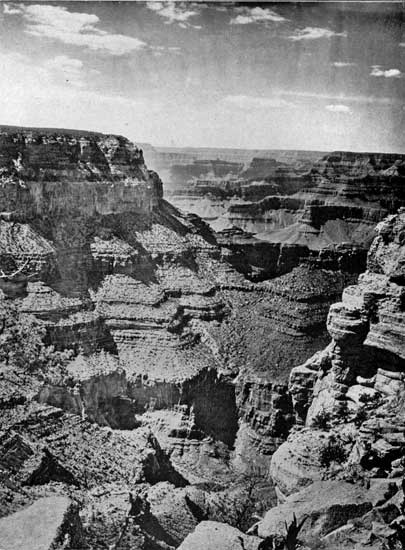
PLATE XXXIV. CAÑONS ON THE COLORADO RIVER.
The German lights a cigar and begins another lecture to his fellow-traveller.
"Here we are passing over one of the source streams of the Colorado River. You seem disinclined to admit that everything is grand in America, but I maintain that nothing in the world can compare with the great cañon of the Colorado. You may believe me or not. You may talk of fire-vomiting mountains and coral reefs, of the peak of Mount Everest and the great abysses of the ocean, of our light blue Alps in Europe and of the dark forests of Africa, nay, you may take me where you will in the world, but I shall still maintain that there is no stupendous overpowering beauty comparable to the cañons of the Colorado River (Plate XXXIV.).
"Listen! This river which discharges its waters into the Gulf of California is fed by numerous streams in the rainy, elevated regions of the Rocky Mountains. But where the united river leaves Utah and passes into Arizona, it traverses a dry plateau country with little rain, where its waters have cut their way down through mountain limestone to a depth of 6000 feet. The strata are horizontal, and the whole series has been cleared away by the continued erosive power of water, aided by gravel and boulders. This work has been going on from the commencement of the period in the world's history known as the Pliocene Age, and it is reckoned that the interval which must have elapsed since then must have amounted to millions of years. And yet this space of time, from the Pliocene Age to our own, must, geologically speaking, be extremely insignificant compared to the length of the great geological periods. The six thousand years which we call the historical period is but the beat of a second on the clock of eternity, and what the historian calls primeval times is the latest and most recent period in the last of all the geologist's ages. For while the historian deals with revolutions of the sun of only 365 days, the geologist is only satisfied with thousands and millions of years. The Colorado River has presented him with one of the standards by which he is able to calculate lapse of time. You will acknowledge that it is no small feat for running water to cut its way down through solid rock to a depth of 6500 feet; and these cañons are more than 180 miles long and four to eleven miles broad.
"By its work here the river has sculptured in the face of the earth a landscape which awes and astonishes the spectator. It is like nothing he has ever seen before. When he stood at the foot of the Alps he gazed up at the snow-clad wastes of the mighty mountain masses. When he stands at the edge of the cañons of the Colorado he looks down and sees a yawning chasm, and on the other side of the giddy ravine the walls rise perpendicular or sloping. He seems to stand before the artistically decorated facade of a gigantic house or palace in an immense town. He sees in the walls of the valley, niches and excavations like a Roman theatre, with benches rising in tiers. At their sides stand gables and projections of rock, like turrets and buttresses. Under huge cornices rise columns standing out or attached at the back, all planned on the same gigantic scale. The precipitous cliffs are dark, and the whole country is coloured in pink, yellow, red, and warm brown tones. The sun pours its gold over the majestic desolation. No grassy sward, no vegetation carpets the horizontal or vertical surfaces with green. Here and there a pine leans its crown over the chasm, and when the cones fall they go right down to the bottom.
"In the early morning, when the air is still pure and clear after the coolness of the night, and when the sun is low, the cañon lies in deep gloom, and behind the brightly lighted tops of the columns the shadows lie as black as soot. Then the bold sculpturing stands out in all its glory. On a quiet night, when the moon holds its crescent above the earth, an oppressive silence prevails over this region. The roar of the river is not heard, for the distance is too great. A feeling of romance takes hold of the visitor. He fancies himself in a fairy world. Only a step over the edge and he would soar on invisible wings to a bright wonderland."
At Salt Lake City the German leaves the train to begin his investigations round the Great Salt Lake and the Mormon capital. Gunnar travels on through the mountainous districts of Nevada and California, and when the train at last pulls up at San Francisco he has reached the goal of his hopes.
Here is one of the finest cities in the world, situated on a peninsula in a deep and spacious inlet surrounded by mountains. Almost all traces of the terrible earthquake which a few years ago destroyed the city have disappeared, and splendid new buildings of iron and stone have sprung up from the rubbish heaps, for as a commercial emporium San Francisco has the same importance with relation to the great routes across the Pacific as New York has on the Atlantic side.