Part 1 — XII CHINA[14]
Reading edition
To Shanghai
From Hong Kong the Delhi ploughs her way along the Chinese coast, and next day (October 31) we are right out in the track of the north-east monsoon. The sea is high and dead against us, and the wind is so strong that we can hardly go up on deck. It becomes steadily cooler as we advance northwards.
To the east we have now the large island of Formosa, which was annexed by Japan sixteen years ago. It is about twice the size of Wales, and marks the boundary between the China Sea and the Eastern Sea, which farther north passes into the Yellow Sea. The coast and its hills are sometimes seen close at hand, sometimes far off, and sometimes they disappear in the distance. With a glass we can distinguish the lighthouses, always erected on small islands off the mainland. The Chinese coast is dangerous, being full of reefs, holms, and shallows.
Hong Kong and the adjoining seas are visited from the middle of July to the middle of September by the destructive whirlwinds called typhoons. The vortices, spinning round with tremendous rapidity, are usually formed far out in the Pacific Ocean, and gradually advance towards the mainland. They move at a rate of nine miles an hour, and therefore the weather stations on the Philippines, and other islands lying in the track of the typhoons, can send warnings by telegraph to the Chinese coast. Then the black triangle is hoisted on a tall mast in the harbour of Hong Kong, for instance, and is visible for a long distance. Every one knows what it means: a typhoon is on the way. The Chinese junks make in towards land, where they find shelter under the high coast, and all other vessels strengthen their moorings.
On November 2 we know by the yellowish-brown colour of the water that we are off the mouth of the Blue River, as the Yang-tse-kiang is called by Europeans. A pilot comes on board to take us through the dangerous, uncertain fairway, and a little later we have flat land on both sides of us, and are in the estuary of the river.
Shanghai is situated on a small affluent which runs into the Yang-tse-kiang close to its mouth, and large ocean steamers cannot go up to the town. After the Delhi has dropped its anchor we proceed up the river in a steam tender. The low banks soon become more animated, the houses stand closer together, factories appear amongst them, and Chinese vessels lie moored on both sides, including two sorry warships of wood, relics of a time gone by. They are high in the bow and stern, and from the mast floats the blue dragon on its yellow field.[15] At length the stately "bund" of Shanghai comes into sight with a row of fine, tall houses. This is not China, but a bit of Europe, the white town in the yellow land, the great and wealthy Shanghai with its 12,000 Europeans, beside the Chinese town inhabited by 650,000 natives.
Next day, November 3, occurred two noted birthdays, those of the Dowager Empress of China and of the Emperor of Japan. They were both remarkable for their powerful minds and wisdom, and have made their names immortal in the extreme East. The Consul-General of Japan held a reception, and the Governor of Shanghai a brilliant dinner.
We saw much that was curious and interesting, and our time was fully occupied during our short stay in the largest shipping and commercial port of China. From the European streets with electric light and tramways, churches, clubs, merchants' offices, and public buildings, tidal docks and wharves, we reach in a few minutes the Chinese town, pure, unadulterated Asia. It swarms with yellow men in blue coats and black vests with small brass buttons, white stockings, black shoes with thick, flat soles, a small black skull-cap with a red button on the head, and a long pigtail behind. There dealers sit in their open shops, smoking long, small pipes while waiting for customers. The tea-houses are full. A noise and tumult beyond description, a constant going and coming, a continual exchange of coin and goods.
The religion of the Chinese is a mixture of different doctrines and rules of wisdom. China has had more wise men than any other old country in the world. Foremost among them is Confucius, a contemporary of Buddha and Socrates. He wrote a book of three hundred odes, and called it Purity of Thought. Twelve disciples gathered round him, and a larger circle of three thousand. "Do not to others what you would not that they should do to you" was one of his precepts. When Confucius was asked how he had contrived to acquire deep knowledge of so many things, he replied, "Because I was born poor and had to learn." He considered wealth a misfortune and knowledge power. The Chinese reverence his memory, and regard him not as a god but as the wisest man of all ages.
Along with Confucianism, Taoism exists in China. The sublime teaching of the founder has, however, been corrupted and degraded to jugglery and superstition. At the commencement of our era Buddhism was introduced into China, and now is spread over almost all the country. There is, however, no clearness in the religious conceptions of the Chinese. A Taoist may perform his devotions in the morning in a Buddhist temple and in the evening be deeply interested in the writings of Confucius. Many therefore have an equal respect for all three systems.
The basis, however, of Chinese religious thought is ancestor worship. Whether they are Confucians, like most of the mandarins, or Taoists or Buddhists, like the common people, Chinamen always cherish the same reverence for the souls of their forefathers. An altar in their honour is raised in even the simplest house. The graves may not be disturbed, and nothing but respect is cherished for the memory of the departed. In the seventeenth century the Manchu emperor, Kang Hi, ruled China for sixty-one years with a power and wisdom which made him one of the greatest monarchs of any age. His grandson, Kien Lung, inherited all his excellent qualities, and when he had ruled China for nearly sixty-one years he abdicated simply in order that, out of respect to his ancestor, the years of his reign might not exceed his grandfather's.
One consequence of this ancestor worship is that enormous areas of China are covered with graves. The Mongol emperor, Kublai Khan, who reigned at the end of the thirteenth century, roused furious opposition by ordering that all the burial-grounds should be broken up and turned into fields. At the present time, when new railways are spreading mile after mile through China, the sanctity of the graveyards is one of the greatest obstacles to engineers. The Chinese will not disturb the slumbers of their forefathers, and therefore the railway has often to pass round a hallowed place or avoid it by means of a bridge. The Emperor himself travels to Mukden simply to make offerings at the graves of his ancestors. Kang Hi and Kien Lung are buried in Mukden, and their dynasty, the Manchu, still rules over the country.
The Chinese feel this association with a past life more strongly than with the future, and the worship of their ancestors almost takes the place of affection for their fatherland. They certainly love their own homes, but what goes on in other parts of the country is a matter of indifference to them. To the Cantonese it matters not whether the Russians take Manchuria or the Japanese Korea, provided only that Canton is left in peace. Ancestor worship may be said, indeed, to be the true religion of the Chinese. For the rest they are filled with an unreasoning fear of spirits, and have recourse to many different gods who, they believe, can control these influences for good and evil. They are very superstitious. If any one falls sick of fever and becomes delirious, his relations believe that his soul has gone astray. They carry his clothes round the spot where he lost consciousness in order to bring his soul into the right track again; and at night they go up to the roof and wave a lantern to guide the soul home.
"The Middle Kingdom"
The first things a Chinese schoolboy is taught are that the sky is round, the earth quadrangular, and that China is situated in the middle of the earth, and on that account is called the "Middle Kingdom." All other countries lie around China and are its vassals.
The Emperor is called the "Son of Heaven," and holds the supreme spiritual and temporal power in his hands. On his accession he gives an arbitrary name to his reign, which also becomes his own. He chooses his successor himself from among his sons. If he is childless he chooses one of his nearest relations, but then he adopts his future successor that the latter may make offerings to the souls of himself and his ancestors. The yellow robe and the five-clawed dragon are the emblems of the imperial house. The Emperor is immeasurably superior to his people, and the mortals who may speak to him are easily counted. A few years ago the European ambassadors in Peking exacted the right to see the Emperor every New Year's Day. This they did, but had no talk with him.
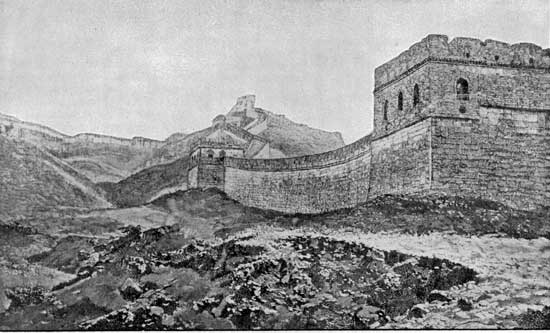
PLATE XVII. THE GREAT WALL OF CHINA.
China is the oldest, the most populous, and the most conservative kingdom in the world. In the time of Nineveh and Babylon it had attained to a high civilization, and has remained the same through 4000 years. Of Nineveh and Babylon only rubbish heaps are left, but China still shows no sign of decay. Western Asia is like a vast graveyard with innumerable monuments of bygone times. There devastating migrations of peoples took place, and races and dynasties contended and succeeded one another. But China is still the same as ever. The isolated position of the country and the objection of the people to contact with foreigners have contributed to this. The reverence for the old state of things and for the memory of their forefathers makes a new generation similar to the preceding.
During the twenty-two centuries before the birth of Christ three imperial families ruled in China in succession. Two and a half centuries before our era a powerful and far-sighted emperor built the Great Wall, the mightiest erection ever completed by human hands (Plate XVII.). This wall is 1500 miles long, 50 feet high, and 26 thick at the bottom and 16 at the top. Towers stand at certain intervals, and there are gates here and there. It is constructed of stone, brick, and earth. It is in parts much ruined, especially in the west, and in some places only heaps of earth are left.
Why was this immense wall erected? The Chinese are a peaceful people, and they surrounded themselves with walls to prevent intrusion from outside. In China there are 1553 towns enclosed in massive stone walls, and the great emperor in the third century B.C. naturally thought of building a wall in the same way all round his extensive kingdom. It was principally from the north that danger threatened. There lived the nomads of Eastern Turkestan and Mongolia, savage, brave, and warlike horsemen. To them the Chinese wall was an insurmountable obstacle. But precisely on that account this wall has also affected the destiny of Europe, for the wild mounted hordes, finding the way southwards to China barred, advanced westwards instead, and in the fourth century, in conjunction with the Alans, overran extensive areas of Europe.
The Great Wall, however, could not protect China for ever. In the year 1280 the country was conquered by Jenghis Khan's grandson, Kublai Khan, Marco Polo's friend and patron. He, too, was a great builder. He constructed the Grand Canal (see map, p. 174) between Peking and Hang-chau, immediately to the south-west of Shanghai. His idea was that the rice harvest of the southern provinces should also benefit the northern parts of the country. Previously the rice had been freighted on junks and carried along the coast, where it was exposed to the attacks of Japanese pirates. Now the junks could pass safely through the country by the new canal. The imperial canal is 840 miles long, crosses the Yellow and Blue rivers, and is still in use. It is a memorial of the hundred years' rule of the Mongols.
In 1644 China was conquered by the Manchu dynasty, which still reigns. Exactly a hundred years earlier the Portuguese had seized Macao, not far from Hong Kong. Since then, and particularly during recent decades, Europeans have encroached on Chinese soil. The French possessions on the peninsula of Further India were formerly under Chinese protection. The Great Powers have made themselves masters of some of the best harbours in China. On two occasions, the latter during the Boxer insurrection in 1900, Peking has been entered by the combined troops of European nations.
The "Middle Kingdom" is China proper, but the "Son of Heaven" also rules over four dependencies, Eastern Turkestan, Mongolia, Manchuria, and Tibet. The area of the Chinese Empire altogether is thirty-five times that of the British Isles, and its population is ten times as numerous, being about 433 millions; indeed, every third or fourth man in the world is a Chinaman.
Owing to the situation of the country the climate is good and healthy. The differences of temperature between winter and summer are large; in the south reigns almost tropical heat; in the north, in the districts round Peking, the winter is bitterly cold. The soil is exceedingly fruitful. Tea, rice, millet, maize, oats, barley, beans, peas, vegetables, and many other crops are grown. In the southern provinces the fields are full of sugar-cane and cotton bushes. The whole country is intersected by large rivers, which serve for irrigation and the transport of goods. In the west rise lofty mountains, forming continuations of the Tibetan ranges. Eastwards they become lower. The greater part of China is a mountainous country, but lowlands extend along the coast. Six of the eighteen provinces border on the coast, which abounds in excellent harbours.
The "Middle Kingdom" is, then, a fortunate country, one richly endowed by nature in every respect. In the mountains lies inexhaustible wealth of minerals, and China possesses larger coal-fields than any other land in the world. Its future is, therefore, secured, and China's development may some time surpass that of America.
It is well known that a country which has deeply indented coasts gains an early and extensive development. Thus Greece was in old times the home of learning and art; and thus Europe now dominates the rest of the world. For a people which dwells within such coasts comes sooner and more easily than others into contact with its neighbours, and by commercial intercourse can avail itself of their resources and inventions. But in this, as in so many other respects, China is an exception. The Chinese have never made use of their coast. They have, on the contrary, avoided all contact with foreigners, and their development within their own boundaries has therefore been exceedingly peculiar. Their culture is different from anything else, and yet it is most estimable and refined.
Two thousand years before Christ the Chinese had written characters. Later they invented the hair pencil, which is in use to this day. They grind down a jet-black ink, in which they dip the brush, and hold it vertically when they write. The manufacture of the ink is their secret, and the "Indian ink" which we use in Europe is obtained from them. A hundred years after Christ paper was made in China. In an ancient town at Lop-nor, where wild camels now roam, I found a collection of Chinese letters and documents on paper which had remained buried in the desert since A.D. 265. In A.D. 600 the Chinese had invented the art of printing, which in Europe was not invented until 850 years later. The Chinese were acquainted with the magnetic needle 1100 years before Christ, and made compasses, and they knew of gunpowder long before Europeans. Three thousand years ago the Chinese were proficient in the art of casting bronze. In the interior of the country are still to be found most beautiful objects in bronze—round bowls on feet decorated with lions and dragons, vases, dishes, cups, and jugs, all of dark, heavy bronze executed with the finest and most artistic detail. The porcelain manufacture attained its greatest excellence in the time of Kang Hi and Kien Lung. Then were made vases, bowls, and dishes of such exceeding perfection that neither the Chinese themselves nor any other people at the present time can produce their match. The arrangement of colours and the glaze excite the admiration of all connoisseurs. Porcelain articles of this period are now extremely rare, and fetch enormous prices. In Japan I saw a small green Chinese bowl on three feet, with a cover, which had cost eleven hundred pounds. Compared to the Kang Hi vases, the finest porcelain that can be produced nowadays is mere rubbish.
The Chinese language is as singular as everything else in the great kingdom. Every word is unchangeable. While we say "go, went, gone, will go, should go, going," the Chinese always say simply "go." The precise meaning is shown by the position of the word in a sentence or by the help of certain auxiliary words, as, for example, "I morning go," "We yesterday go," where the future or past tense is indicated by the words "morning" and "yesterday." A single word, li, for instance, may have a number of different significations, and what it denotes in any particular case depends on the tone and pronunciation, on its position in the sentence, and on the word which comes before or after. The language is divided into many different dialects, of which the principal is the mandarin or the dialect of the educated. Every word has its particular written sign, and the Chinese language accordingly possesses 24,000 different written characters; only one man in twenty and one woman in a hundred can read and write it.
Chinese literature is exceedingly rich, almost inexhaustible. At a time when the bronze age still reigned in northern Europe, the Chinese had a highly cultivated literature. From the fifth century B.C. down to our own day it has run an uninterrupted course through centuries and ages. When the northern vikings were executing their plundering raids by sea and setting up their runic stones, a geographical hand-book was published in China called a "Description of all the Provinces" and abundantly illustrated by maps. Thanks to their chronicles we can follow the history of the Chinese for 4000 years back. And the most remarkable feature of these annals is that they are distinguished by the strictest accuracy and reliability. All kinds of subjects are alluded to, even the most insignificant events. Chinese books are very cheap, and every one who can read can provide himself with quite a large library. Of the numbers of books we can have some conception when we hear that the Emperor Kieng Lung had a library so large that the catalogue of his books filled 122 volumes.
The Blue River
The Blue River, or Yang-tse-kiang, the Mekong, and the Salwin all rise in eastern Tibet and flow quite close to one another southwards through deeply excavated parallel valleys. But while the first two continue their southerly course all the way to the sea, the Blue River turns off sharply eastwards in western China and divides the Middle Kingdom in two.
It is only Europeans who sometimes call the largest river of China the "Blue" River. The Chinese themselves call it the "Great" River, or the "Long" River, or, far up the country to the west, the "River of Golden Sand." Only three rivers in the world are longer, namely, the Nile, the Mississippi, and the Amazon. The Obi and Yenisei are about the same length, 3200 miles. The Blue River discharges 244 times the volume of water of the Thames.
In one respect the Blue River is far superior to all the waterways of the world, for on this river and its tributaries, or, in short, in the area of its drainage basin, live not less than 180 millions of human beings, or an eighth of the total population of the world. The parts of China proper situated on the Blue River are called the River Provinces. The viceroy of two of these, namely Hupeh and Hunan, has more subjects than any country in Europe, except Russia. The most westerly province of China, Sze-chuan, traversed by the Blue River, is in area and population equal to France. Europe shrinks up to nothing before such comparisons.
On the Blue River stands a series of famous old towns. Chungking is the capital of Sze-chuan, and thus far European steamers ascend the river. Hankow is the largest commercial town in the interior of China. Nanking, near the mouth, was formerly the capital of China. South-west of Hankow a large lake lies on the southern bank of the Blue River. Hu means lake in Chinese, king is a capital city, pe signifies north, and nan south. Peking, therefore, means the "northern capital," and Nanking the "southern capital"; Hupeh signifies "north of the lake," and Hunan "south of the lake."
The province of Hunan, south of the lake, is one of the most noteworthy in all China. Its people are a vigorous and independent race, and make the best soldiers in China. They are more hostile to foreigners than other Chinese, and the capital of Hunan, Chang-sha, has been of old a centre of opposition to foreigners and of revolutionary agitations.
Even large ocean liners ascend to Hankow, and smaller steamboats to the capital of Sze-chuan. The latter are formidable competitors to the junks, many thousands of which have from time immemorial provided for the transport and traffic on the great river. There are many different kinds of junk. Some are large, others small; some are built for the lower, quieter waters of the river, others for the rapids in Hupeh and Sze-chuan. But they are all well suited to their purpose, and are an ornament to the grand beauty of the constantly changing landscape through which the river has cut its valley.
In some districts the junks are built of cypress wood, in others of oaken planks. This is to make the boats more elastic and supple, and to diminish the risk of springing a leak among the rapids. Where the danger is unusually great a pilot is taken on board, but still it is reckoned that one junk in ten runs aground, and one in twenty is totally wrecked. To go from Hankow to Chungking takes thirty-five days, and to come down in the opposite direction with the stream only nine days. The voyage down the river is much more dangerous, and on this voyage most of the shipwrecks occur.
Every large junk has a small dinghy to convey passengers and goods to and from the shore. A large junk is 40 feet long. It is high at the stern, and here stands a kind of cabin roofed with plaited straw or grass matting. A junk going upstream carries a cargo of two and a half tons, one going down six tons. The vessel is propelled by oars, some of which are so large that they require eight men each. These are needed most in drifting with the current, when the boat must be controlled by the steering oars. The junk has also a mast and sail which is used in going upstream with a favourable wind, and is lowered when coming down with the current. Only the bow is decked.
It may well be asked how it is possible to get such a large heavily laden boat up against the strong river current, for it is evident that however favourable the wind might be, the vessel would be carried down the rapids. A long rope of twisted bamboo a hundred yards long is fastened to the bow of the junk, and with this the vessel is dragged up by some sixty men who run along the bank. The bank, however, is usually steep, with dangerous rocks projecting out into the river, and over these the men have to scramble like monkeys, still pulling at their rope. Often neither the boat nor the river is visible from the rocky path, but the skipper of the boat is in constant communication with the towing men by means of drums on board. Six men are always ready to clear the rope if it catches against any projection, and others, who are stark naked, do the same work in the water. On the cliffs along the river, grooves and marks have been worn out by the ropes, for towing has here been practised for thousands of years. There is always a score of men on board to steer and fend off the boat with poles. They have also bamboo poles with hooks at the end to help in dragging the boat up against the current.
These men work like galley-slaves, and their work is both dangerous and exhausting. Week after week they walk with bent backs struggling under the towing rope. They are covered with bruises, which scarcely heal up before they are torn open again, and especially on the shoulders the marks of the rope are visible. They have a hard life, and yet they are cheerful. They are treated like dogs, and yet they sing. And what wages do they receive for a journey of thirty-five days up the river? Three shillings, besides three meals of rice a day, and meat three times during the journey! For the down journey, when the work is much easier and the time only one-fourth, they receive only a shilling. These labourers earn about 1-1/4d. for ten hours' work.
In February the river is lowest and the water clearest. Then the towns and villages stand 160 feet above the surface of the river. Their walls, staircases, gates, and pagodas stand up in the flat triangles of the valley openings. Every inch of hill and valley is covered with fields or woods. Later in the spring the river begins to rise, and in summer is a huge rolling volume of chocolate-brown or greyish water. At certain places where the valley is narrow the water may rise a hundred feet higher than in February. A voyage on it is then more dangerous, for banks, boulders, and reefs are covered with water and form whirlpools and seething eddies.
Below the towns and villages shoals of junks lie moored waiting for work. Every cliff, every bend has its name—Yellow Hat, Sleeping Swine, Double Dragon, etc. Nor are pirates wanting. They have their haunts among the mountains, and fall upon the junks at convenient points. Sometimes large white notices are seen on projecting rocks. They may be "The waterway is not clear," or "Small junks should anchor here." Thus the boatowners are warned of danger.
The earnings of a boatowner are not large, and he is glad enough if he can bring his boat back to Hankow in safety after a voyage up and down the river. With anything but pleasure he sees the large Russian vessels lying at Hankow and taking in tea. Hankow is the greatest tea port of China, and China is the home of the tea plant. It is not more than 250 years since tea was first known in Europe, where it is now in general use, as also in many other parts of the world. In England and Russia it is a national drink, and the Russians used formerly to transport their tea to Europe by caravans through Mongolia and Siberia. Now the export of tea from China has declined, and the Middle Kingdom has been outstripped by India and Ceylon.
In Northern China
In the north-westernmost province of the kingdom, Kansu, is a famous old town, named Si-ning, surrounded with a fine stone wall. I had completed my first journey through Tibet and came to Si-ning on November 23, 1896, accompanied by my servant, Islam Bay.
When we left Si-ning we had a riding horse each, and six mules with their three drivers. They accompanied us for some days as far as a small town, where we exchanged them for two large, heavy carts on two wheels and covered with a tilt of straw matting. In one we packed all our things, in the other I took my seat, while Islam rode. Each cart was drawn by a mule and two horses, driven by a pleasant Chinaman. I had no interpreter, and had to get along with the few words I had managed to pick up.
For six days we travelled northwards through the Kansu mountains, going up and down all the way over stony passes and over frozen rivers with or without neck-breaking bridges. The carts creaked and rocked through narrow hollow roads where it would have been impossible to pass a cart coming from the opposite direction. In such places, therefore, one of our drivers went on in front shouting to keep the road clear. Fortunately we were in the company of other carts. When two carts meet where the road is narrow, it is customary for the smaller one to back and leave the road open for the larger.
We set out just after midnight, and drove on till noon. In spite of furs and rugs I was almost frozen through. Islam preferred to go on foot, and the drivers who ran beside the wagons also managed to keep themselves warm.
At break of day on December 10 we came to the bank of a stream which falls into the Yellow River (Hwang-ho). It was frozen quite across, and a path of sand showed where the route crossed the river. Our companions were to go over first in one of their carts with a team of three horses. They dashed at full gallop out on to the ice, but had not gone far before a wheel cut through the ice and the cart was held fast as in a vice. The whole load had to be taken out and carried over to the farther bank, and after much trouble the empty cart was hoisted up.
At a broader place the men cut up the thin ice in the middle of the bed where the water was three feet deep, and when another cart tried its luck it pitched suddenly down into the opening and remained fast. Two additional horses were attached, and all the men shouted and cracked their whips. The horses reared, fell, were nearly drowned under the ice, threw themselves about and jumped up on to the ice, only to drop back again into the hole. A young Chinaman then threw off every stitch of clothing and went into the water, 18° below freezing-point, to pull away the pieces of ice and stones which held back the wheels. I cannot tell how it was that he was not frozen to death. He afterwards warmed himself at a fire made by Islam Bay. We struggled for four hours before at last the irritating river was behind us.
In Liang-chau, a town of 100,000 inhabitants, with a quadrangular wall, handsome gates, and broad, busy streets, we stayed with some missionaries. Here we had to wait twelve whole days before we could procure nine camels and two men who were willing to take us to the town Ning-hsia on the Yellow River, nearly 300 miles off. The missionaries had no other guest-room than their chapel, which was rather cold; on Christmas Eve the temperature inside was 3°.
For twenty days we travelled through a country called Ala-shan, which for the most part is inhabited by Mongols. We followed a desert track and encamped at wells. Certain belts were buried in drift sand which formed wave-like dunes. Here we were outside China proper and the Great Wall, but we frequently met Chinese caravans. Two horsemen had been assigned to me as an escort by the last Chinese governor, for the country is unsafe owing to robbers. All, however, went well, and we came safely to Ning-hsia on the Yellow River.
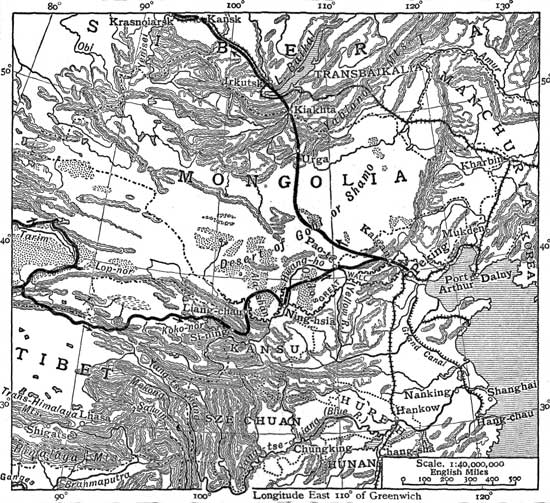
MAP OF NORTHERN CHINA AND MONGOLIA, SHOWING JOURNEY FROM TIBET THROUGH SI-NING TO PEKING, AND FROM PEKING TO KANSK (pp. 172-179). At the time of Dr. Hedin's journey through Mongolia, the Trans-Siberian Railway did not extend east of Kansk.
From Ning-hsia we had 267 miles to the town Pao-te, and now we had to cross the Mongolian district of Ordos, between the Great Wall and the northern bend of the Yellow River. In summer it is better to travel by boat down the river, which rises in north-eastern Tibet and falls into the northern bay of the Yellow Sea after a course of 2500 miles. The river owes its name to its turbid yellow water, which makes the sea also yellow for some distance from the coast. Elsewhere the Yellow Sea is no yellower than any other.
At that time, in January, the Yellow River was covered with thick ice, and where we crossed it with our nine camels its breadth was 380 yards. Then we made long days' marches through the desert, and had a very hard and troublesome journey. We had indeed with us enough mutton, bread, and rice, and there were wells along the road. One of them was 130 feet deep and was walled round. But we suffered from cold. Sometimes the temperature was only 1.5° at noon,-27° at night, and 16.5° in the tent. Besides, it blew steadily and with the velocity of a hurricane. Fortunately I had bought a small Chinese portable stove, which kept me from freezing. It is not larger than an ordinary teapot and has a perforated cover. A few pieces of glowing charcoal are embedded in ashes in the tin, which is thus kept warm all day. Up on the camel I had this little comforting contrivance on my knees, and at night I laid it among my rugs when I crept into bed. One day there was such a furious storm over the level and exposed country that we could not move from the spot. We sat wrapped up in our furs and rugs and simply froze.
On arrival at Pao-te I had still 430 miles to travel to the capital of the kingdom, Peking. I was eager to be there, and resolved to hurry forward by forced marches. I hired a small two-wheeled cart, and had no servant with me but the Chinese driver. Islam with an interpreter was to follow slowly after with our baggage.
On this route no fewer than sixty-one Swedish missionaries were at work, and I often stayed in their hospitable houses. At other times I put up in the country inns. They are incredibly dirty, full of noisy travellers, smoke, and vermin. The guest room where you sleep at night must be shared with others. Along the inner wall stands a raised ledge of bricks. It is built like an oven and is heated with cattle-dung beneath; and on the platform the sleeper, if not half suffocated, is at any rate half roasted.
In Kalgan (Chang-kia-kau), where the Great Wall is passed, I exchanged my cart for a carrying chair on two long poles. It was borne by two mules which trotted along over the narrow mountain road leading to Peking. Sometimes we were high above the valley bottom, and met whole rows of caravans, carts, riders, and foot passengers, chairs with mules, and every one was in constant danger of being pushed over the edge.
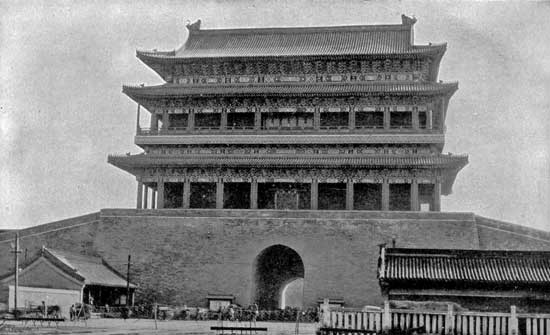
PLATE XVIII. GATE IN THE WALLS OF PEKING.
At last, on March 2, I arrived at Peking, after 1237 days of travelling through Asia, and passed through one of the fine gates in the city walls (Plate XVIII.).
Mongolia
Between China in the south and Eastern Siberia on the north, stretches the immense region of inner Asia which is called Mongolia. The Chinese call it the "grass country," but very large parts of it are waterless desert, where drift-sand is piled up into dunes, and caravan routes and wells are far apart. The belt of desert, one of the largest in the world, is called by the Mongols Gobi, a word which in their language denotes desert. The Chinese call it Shamo, which signifies sandy desert.
Mongolia is subject to China, and the Mongols' spiritual superior or pope is the Dalai Lama. They have also a number of Lama monasteries, and make yearly pilgrimages in large parties to Lhasa. An extraordinary proportion of the male population of the country devote themselves to a religious life and become monks. The Chinese are glad of it, for the peaceful cloister life causes the formerly savage and warlike Mongol hordes to forget their own strength. Services before the image of Buddha in the temple halls lead their thoughts in other directions, and they forget that their people once held the sceptre over almost all Asia and half Europe. They do not remember that their forefathers, the Golden Horde, forced their way seven hundred years ago through the Caucasus, levied tribute throughout Russia, and alarmed all the rest of the West. They have forgotten that their fathers conquered all the Middle Kingdom and digged in yellow earth the Grand Canal on which the junks of the Chinese still ply. The sword has rusted fast in its sheath, and the Mongolian chiefs, whom the Chinese call vassals or dependent princes, encamp peacefully on the steppes under their eight bans.
The Mongols are nomads. They own large flocks of sheep and goats, and live on mutton, milk, butter, and cheese. Among their domestic animals are also the two-humped camel and a small, hardy, strongly built horse. Their life is a perpetual wandering. They move with their flocks from one steppe to another. If the herbage is dried up in a district, or all the pasture is eaten up, they put their tents on camels and set out to find better grazing. Their tents are exactly the same as those of the Kirghizes of the Pamir and the Kirghiz Steppe. They are shaped like haycocks, and consist of a framework of tough ribs covered with black felt.
The Mongols are a good-tempered and amiable people. I made acquaintance with them on the outskirts of their wide domain, and once I travelled right through Mongolia. My starting-point was Peking, and my direction due north-west. It was in the end of March and the beginning of April, 1897. At that time the Trans-Siberian Railway was not completed farther than to Kansk, a small town east of the Yenisei. That was the longest drive I ever took in my life, for from Peking to Kansk the distance is 1800 miles, and I only rested a day on the whole journey, namely at Irkutsk, the capital of Eastern Siberia.
In Peking I provided myself with all that was necessary for a journey to the Russian frontier. First and foremost a Chinese passport, which authorised me to call out Mongols and their horses, and, if I wished, to put up in their tents. Then provisions had to be bought—tinned meats, bread, tea, sugar, etc. From the Russian Legation I obtained an escort of two Cossacks, who were very delighted to have this chance of returning to their homes in Siberia after completing their time of service in Peking.
In Mongolia the traveller does not drive in the usual way. There is no driver on the box, and you do not lean back comfortably in a four-wheeled carriage on springs. To begin with, there is no road at all and no rest-houses; but horses must be changed frequently, and this is done in the Mongolian villages. The Mongols, however, are nomads, and their villages are always on the move. Therefore you must know first of all where the villages happen to be, and in the second place must give the people notice to have a certain number of horses ready. A mounted messenger is sent on in advance for this purpose and then the horses are never wanting. Only the Mongols themselves know where the next villages are situated, and so at every village a fresh retinue of Mongols is provided. And because the villages are being constantly moved you can only travel in a straight line between them, and cannot follow any determined route. You drive along over desert and steppe, and usually see no vestige of an old wheel rut.
The vehicle in which you travel is a very simple contrivance. It is a cart on two medium-sized wheels, closed all over with a rounded tilt covered with blue cloth. A small window in front and two side windows allow you to see over the steppe; the window glass is fixed into the stretched cloth so that it cannot be cracked by the jolting. The cart has no springs, and its bottom rests directly on the axles. There is no seat, and the traveller sits on cushions, furs, and rugs, and there is only room for one person. The cart is of the usual Chinese pattern with shafts for a mule or horse. In China the driver sits on one of the shafts or runs alongside. I had my bags strapped on to the base of the shafts. My large baggage was forwarded on camels, and it reached Stockholm six months after I did.
The style of harnessing is the most curious of all. A loop of rope is fastened to the extreme end of each shaft, and a long, rounded cross-bar is passed through the two loops. Two mounted Mongols lay the bar across their knees in the saddle, but no draught animal is put between the shafts. A rope is fastened to each end of the cross-bar and two other riders wind these ropes twice round their bodies. They have all riding whips, and when all is ready the four riders dash at full speed over the steppe, dragging the cart after them.
Twenty other Mongols ride on each side, half hidden in clouds of dust. Suddenly two of them ride up beside the men who hold the cross-bar on their knees. Of their own accord the two fresh horses slip their heads under the bar, letting it fall on to the riders' knees, while the men who are relieved hold in their horses and let the cart roll on. These then join the rest of the troop. The cart does not stop during this change of horses, which is accomplished in a couple of seconds, and a furious pace is always kept up. In the same way the two front riders and their horses are relieved without stopping. When one of them is tired, a fresh rider comes forward and winds the rope round his waist.
After two or three hours a village of several tents is seen on the steppe ahead of us. About thirty horses are held in readiness by the headman of the village, who has been warned the day before by the messenger. At every stage a few roubles[16] are paid to the Mongol attendants. This payment has always to be made in silver roubles, for the Mongols will not take paper money or small coins.
Thus we go on and on, it would seem interminably, over the boundless steppe—each day the same bumping and jolting, each day the same monotonous landscape. In northern Mongolia, however, snow lay deep on the ground, and here the cart was drawn by men on camels. By this time I was so bruised and worn out with the continual jolting that it was a pleasure to drive on the soft snow.
Marco Polo
In 1162 was born in Mongolia a chief of the savage mounted hordes who bore the name of Jenghiz Khan. He subdued all the surrounding tribes, and the whole Mongol race was collected under his banner. The more his power increased, the more extensive regions he desired to conquer, and he did not rest till practically all Asia was reduced under his rule. His motto was "One God in heaven and one Great Khan on earth." He was not content with a kingdom as large as that of Alexander or Cæsar, but wished to reign over all the known world, and with this aim before his eyes he rode with his horsemen from country to country over the great continent. Everywhere he left sorrow and mourning, burnt and pillaged towns in his track. He was the greatest and most savage conqueror known in history. When he was at the height of his power he collected treasure from innumerable different peoples, from the peninsula of Further India to Novgorod, from Japan to Silesia. To his court came ambassadors from the French kings and the Turkish sultans, from the Russian Grand Dukes and the Khalifs and Popes of the time. No man before or since has caused such a stir among the sons of men, and brought such different peoples into involuntary communication with one another. Jenghiz Khan ruled over more than half the human race, and even in many of the countries which he pillaged and destroyed his memory is feared even to this day.
At his death Jenghiz Khan was sixty-five years old, and he bequeathed his immense kingdom to his four sons. One of these was the father of Kublai Khan, who conquered China in 1280 and established the Mongolian dynasty in the Middle Kingdom. His court was even more brilliant than that of his grandfather, and an exact description both of the great Khan and his empire was given by the great traveller Marco Polo.
In the year 1260 two merchants from Venice were dwelling in Constantinople. They were named Nicolo and Maffeo Polo. Their desire to open trade relations with Asia induced them to travel to the Crimea, and thence across the Volga and through Bukhara to the court of the Great Khan, Kublai. Up to that time only vague rumours of the great civilized empire far in the East had been spread by Catholic missionaries.
The Great Khan, who had never seen Europeans, was pleased at the arrival of the Venetians, received them kindly, and made them tell of all the wonderful things in their own country. Finally he decided to send them back with a letter to the Pope, in which he begged him to send a hundred wise and learned missionaries out to the East. He wished to employ them in training and enlightening the rude tribes of the steppe.
After nine years' absence the travellers returned to Venice. The Pope was dead, and they waited two years fruitlessly for a successor to be elected. As, then, they did not wish the Great Khan to believe them untrustworthy, they decided to return to the Far East, and on this journey they took with them Nicolo's son, Marco Polo, aged fifteen years.
Our three travellers betook themselves from Syria to Mosul, quite close to the ruins of Nineveh on the Tigris, and thence to Baghdad and Hormuz, a town situated on the small strait between the Persian Gulf and the Arabian Sea. Then they proceeded northwards through the whole of Persia and northern Afghanistan, and along the Amu-darya to the Pamir, following routes which had to wait 600 years for new travellers from Europe. Past Yarkand, Khotan, and Lop-nor, and through the whole of the Gobi desert, they finally made their way to China.
It was in the year 1275 that, after several years' wanderings, they came to the court of the Great Khan in eastern Mongolia. The potentate was so delighted with Marco Polo, who learned to read and write several Eastern languages, that he took him into his service. The first commission he entrusted to the young Venetian was an official journey to northern and western China. Polo had noticed that Kublai Khan liked to hear curious and extraordinary accounts from foreign countries, and he therefore treasured up in his memory all he saw and experienced in order to relate it to the Emperor on his return. Accordingly he steadily rose higher in the estimation of Kublai Khan, and was sent out on other official journeys, even as far as India and the borders of Tibet, was for three years governor of a large town, and was also employed at the capital, Peking.
Marco Polo relates how the Emperor goes hunting. He sits in a palanquin like a small room, with a roof, and carried by four elephants. The outside of the palanquin is overlaid with plates of beaten gold and the inside is draped with tiger skins. A dozen of his best gerfalcons are beside him, and near at hand ride several of his attendant lords. Presently one of them will exclaim, "Look, Sire, there are some cranes." Then the Emperor has the roof opened and throws out one of the falcons to strike down the game; this sport gives him great satisfaction. Then he comes to his camp, which is composed of 10,000 tents. His own audience tent is so large that it can easily hold 1000 persons, and he has another for private interviews, and a third for sleeping. They are supported by three tent-poles, are covered outside with tiger skins, and inside with ermine and sable. Marco Polo says that the tents are so fine and costly that it is not every king who could pay for them.
Only the most illustrious noblemen can wait on the Emperor at table. They have cloths of silk and gold wound over their mouths and noses that their breath may not pollute the dishes and cups presented to His Majesty. And every time the Emperor drinks, a powerful band of music strikes up, and all who are present fall on their knees.
All merchants who come to the capital, and especially those who bring gold and silver, precious stones and pearls, must sell their valuables to the Emperor alone. Marco Polo thinks it quite natural that Kublai Khan should have greater treasures than all the kings of the world, for he pays only with paper money, which he makes as he likes, for notes were current at that time in China.
So Marco Polo and his father and uncle lived for many long years in the Middle Kingdom, and by their cleverness and patient industry accumulated much property. But the Emperor, their protector, was old, and they feared that their position would be very different after his death. They longed, too, to go home to Venice, but whenever they spoke of setting out, Kublai Khan bade them stay a little longer.
However, an event occurred which facilitated their departure. Persia also stood under the supremacy of the Mongols, and its prince or Khan was a close connection of Kublai Khan. The Persian Khan had lost his favourite wife, and now desired to carry out the wish she had expressed on her deathbed that he should marry a princess of her own race. Therefore he despatched an embassy to Kublai Khan. It was well received, and a young, beautiful princess was selected for the Khan of Persia. But the land journey of over 4000 miles from Peking to Tabriz was considered too trying for a young woman, so the ambassadors decided to return by sea.
They had conceived a great friendship and respect for the three Venetians, and they requested Kublai Khan to send them with them, for they were skilful mariners, and Marco Polo had lately been in India, and could give them much valuable information about the sea route thither. At last Kublai Khan yielded, and equipped the whole party with great liberality. In the year 1292 they sailed southwards from the coast of China.
Many misfortunes, storms, shipwreck, and fever befell them on the voyage. They tarried long on the coasts of Sumatra and India, a large part of the crew perished and two of the three ambassadors died, but the young lady and her Venetian cavaliers at last reached Persia safe and sound. As the Khan had died, the princess had to put up with his nephew, and she was much distressed when the Polos took leave of her to return home to Venice by way of Tabriz, Trebizond, the Bosporus, and Constantinople. There they arrived in the year 1295, having been absent for twenty-four years.
Their relatives and friends had supposed them to be dead long before. They had almost forgotten their mother tongue, and appeared in their native city in shabby Asiatic clothes. The first thing they did was to go to the old house of their fathers and knock at the door; but their relations did not recognize them, would not believe their romantic story, and sent them about their business.
The three Polos accordingly took another house and here made a great feast for all their family. When the guests were all seated round the table and the banquet was about to commence, the three hosts entered, dressed down to the feet in garments of costly crimson silk. And as water was taken round for the guests to wash their hands, they exchanged their dresses for Asiatic mantles of the finest texture, the silken dresses being cut into pieces and distributed among their retainers. Then they appeared in robes of the most valuable velvet, while the mantles were divided among the servants, and lastly the velvet went the same way.
All the guests were astonished at what they saw. When the board was cleared and the servants were gone, Marco Polo brought in the shabby, tattered clothes the three travellers had worn when their relatives would not acknowledge them. The seams of these garments were ripped up with sharp knives, and out poured heaps of jewels on to the table—rubies, sapphires, carbuncles, diamonds, and emeralds. When Kublai Khan gave them leave to depart they exchanged all their wealth for precious stones, because they knew that they could not carry a heavy weight of gold such a long way. They had sewed the stones in their clothes that no one might suspect that they had them.
When the guests saw these treasures scattered over the table their astonishment knew no bounds. And now all had to acknowledge that these three gentlemen were really the missing members of the Polo house. So they became the object of the greatest reverence and respect. When news about them spread through Venice the good citizens crowded to their house, all eager to embrace and welcome the far-travelled men and to pay them homage. "The young men came daily to visit and converse with the ever polite and gracious Messer Marco, and to ask him questions about Cathay and the Great Can, all which he answered with such kindly courtesy that every man felt himself in a manner his debtor." But when he talked of the Great Khan's immense wealth, and of other treasures accumulated in Eastern lands, he continually spoke of millions and millions, and therefore he was nicknamed by his countrymen Messer Marco Millioni.
At that time, and for long afterwards, great envy and jealousy raged between the three great commercial republics, Venice, Genoa, and Pisa. In the year 1298 the Genoese equipped a mighty fleet which ravaged the Venetian territory on the Dalmatian coast of the Adriatic Sea. Here it was met by the Venetian fleet, in which Marco Polo commanded a galley. After a hot fight the Genoese gained the victory, and with 7000 prisoners sailed home to Genoa, where they made a grand procession through the city amidst the jubilation of the people. The prisoners were put in chains and cast into prison, and among them was Marco Polo.
In the prison Marco had a companion in misfortune, the author Rusticiano from Pisa. It was he who recorded Marco Polo's remarkable adventures in Asia from his dictation, and therefore there is cause of satisfaction at the result of the battle, for otherwise the name of Marco Polo might perhaps have been unknown to posterity.
After a year prisoners were exchanged and Marco Polo returned to Venice, where he married and had three daughters. In the year 1324 he died, and was buried in the Church of San Lorenzo in Venice.
On his deathbed he was admonished to retract his extraordinary narrative. No reliance was placed on his words, and even at the beginning of the eighteenth century there were learned men who maintained that his whole story was an excellently planned romance. The narrative taken down in prison was, however, distributed in an innumerable number of manuscript copies. The great Christopher Columbus, discoverer of America, found in it a support to his conviction that by sailing west a man would at length come to India.
There are many curious statements in Marco Polo's book. He speaks of the "Land of Darkness" in the north, and of islands in the northern sea which lie so far north that if a man travels thither he leaves the pole-star behind him. We miss also much that we should expect to find. Thus, for example, Marco Polo does not once mention the Great Wall, though he must have passed through it several times. Still his book is a treasure of geographical information, and most of his discoveries and reports were confirmed five hundred years later. His life was a long romance, and he occupies one of the most foremost places among discoverers of all ages.