A KEY TO THE FAMILIES.
Reading edition
PAGE
A. Parts of the flower nearly always in threes; leaves almost always parallel-veined.
a. Ovary superior.
b. Leaves often arrow-shaped; pistils many, in a head. Alismaceae 2
b. Leaves not arrow-shaped; pistil one. Liliaceae 4
a. Ovary inferior.
b. Flowers regular; stamens three. Iridaceae 66
b. Flowers irregular; stamens one or two. Orchidaceae 72
A. Parts of the flower mostly in fours or fives; leaves mostly netted-veined.
B. Corolla absent; calyx mostly present, sometimes showy.
a. Ovary superior.
b. Pistils several to many, distinct. Ranunculaceae 126
b. Pistil one, one to several-celled.
c. Flowers in long spikes with a white involucre at base. Saururaceae 80
c. Flowers not in long spikes.
d. Stipules if present sheathing the stem; sepals three to six. Polygonaceae 86
d. Stipules absent; sepals mostly five. Chenopodiaceae 96
a. Ovary inferior or appearing so by the closely fitting calyx.
b. Ovary six-celled; stamens six to twelve. Aristolochiaceae 84
b. Ovary one-celled; stamens three to five.
c. Leaves opposite; flowers often showy. Nyctaginaceae 100
c. Leaves alternate; flowers not showy. Santalaceae 82
B. Both corolla and calyx present.
C. Corolla of separate petals.
D. Ovary superior.
a. Stamens more than ten in number.
b. Pistils several to many, separate or united below.
c. Pistils separate and distinct.
d. Pistils enclosed in a hollow receptacle.
e. Leaves opposite; petals numerous. Calycanthaceae 158
e. Leaves alternate; petals mostly five. Rosaceae 218
d. Pistils not enclosed in a receptacle.
e. Stamens attached to the calyx. Rosaceae 218
e. Stamens not attached to the calyx. Ranunculaceae 126
c. Pistils united below into a lobed or beaked ovary.
d. Water plants with floating leaves. Nymphaceae 156
d. Terrestrial or land plants.
e. Pistils forming a ring; filaments united. Malvaceae 284
e. Pistils not forming a ring.
f. Pistils inserted on a convex receptacle; stamens attached to the calyx. Rosaceae 218
f. Receptacle not convex; stamens not attached to the calyx. Papaveraceae 160
b. Pistil one, the styles and stigmas often several.
c. Ovary one-celled.
d. Style and stigma one.
e. Fruit a drupe (stone-fruit.) Drupaceae 216
e. Fruit an akene tipped with a tail. Rosaceae 218
d. Styles or stigmas more than one.
e. Sepals falling as the flowers expand.
f. Sepals two or three; fruit a capsule. Papaveraceae 160
f. Sepals four or six; fruit a berry. Ranunculaceae 126
e. Sepals persistent; low shrubs. Cistaceae 304
c. Ovary more than one-celled.
d. Water plants with floating leaves. Nymphaceae 156
d. Plants not growing in water.
e. Leaves with smooth margins and with transparent dots. Hypericaceae 292
e. Leaves neither smooth-edged, nor with transparent dots. Malvaceae 284
a. Stamens ten or fewer in number.
b. Stamens of the same number as the petals and opposite them.
c. Ovary more than one-celled; calyx four- to five-cleft. Rhamnaceae 282
c. Ovary one-celled.
d. Anthers opening by uplifted valves. Berberidaceae 152
d. Anthers opening by longitudinal slits. Portulacaceae 120
b. Stamens not of the same number as the petals, or if of the same number, alternate with them.
c. Ovaries two or more, separate or partly united.
d. Stamens united with each other and with the large thick stigma. Asclepiadaceae 374
d. Stamens free from each other and from the pistils.
e. Stamens inserted on the receptacle.
f. Leaves and stems fleshy. Crassulaceae 192
f. Leaves and stems not noticeably fleshy.
g. Lobes of ovary two to five, with a common style.
h. Ovary two- to three-lobed. Limnanthaceae 278
h. Ovary five-lobed. Geraniaceae 274
g. Ovaries with separate styles. Ranunculaceae 126
e. Stamens inserted on the calyx.
f. Stamens twice as many as the pistils. Crassulaceae 192
f. Stamens not twice as many as the pistils.
g. Stipules present. Rosaceae 218
g. g. Stipules absent. Saxifragaceae 196
c. Ovary one, the styles and stigmas one to several.
d. Ovary with one cell and one placenta.
e. Corolla forming standard, wings and keel; filaments mostly united. Fabaceae 242
e. Corolla not of standard, wings and keel; filaments mostly not united.
f. Stamens ten or five; fruit smooth, slender. Cassiaceae 264
f. Stamens three or four; fruit spiny, globose. Krameriaceae 268
d. Ovary with one or more cells and styles, and two or more placentae and stigmas.
e. Ovary one-celled.
f. Corolla irregular; petals and sepals five. Violaceae 296
f. Corolla regular or nearly so.
g. Ovules attached at the center or bottom of the ovary. Caryophyllaceae 112
g. Ovules attached on two placentae.
h. Stamens equal; pod on a stalk. Capparidaceae 186
h. Stamens unequal; pod without a stalk. Cruciferae 174
e. Ovary more than one-celled.
f. Ovary three-celled; trees with palmate leaves. Hippocastanaceae 280
f. Ovary more than three-celled.
g. Cells of ovary as many as the sepals.
h. Anthers opening by terminal pores; dwarf evergreen shrubby plants. Pyrolaceae 354
h. Anthers opening by longitudinal slits.
i. Ovules and seeds one or two in each cell.
i. Herbs with lobed or cut leaves. Geraniaceae 274
i. Evergreen shrubs with varnished leaves. Zygophyllaceae 268
i. Ovules and seeds several in each cell; leaflets three. Oxalidaceae 272
g. Cells of ovary twice as many as the sepals. Linaceae 270
D. Ovary inferior or more or less so.
a. Stamens more than ten in number.
b. Plant spiny; leaves absent or soon deciduous. Cactaceae 304
b. Plant not spiny; leaves persisting for the season.
c. Leaves three-sided, fleshy. Aizoaceae 108
c. Leaves neither three-sided nor fleshy.
d. Herbs; leaves rough-hairy. Loasaceae 300
d. Shrubs or trees.
e. Leaves opposite; stipules none. Hydrangeaceae 206
e. Leaves alternate; stipules present. Pomaceae 214
a. Stamens ten or fewer in number.
b. Ovules and seeds more than one in each cell.
c. Ovary one-celled; fruit a berry. Grossulariaceae 210
c. Ovary with two or more cells.
d. Stamens four or eight.
e. Shrubs; filaments two-forked at the apex. Hydrangeaceae 206
e. Herbs; filaments not two-forked at the apex. Onagraceae 312
d. Stamens five or ten; styles two or three. Saxifragaceae 196
b. Ovules and seeds only one in each cell.
c. Stamens mostly ten; ovary partly inferior. Hydrangeaceae 206
c. Stamens less than ten; ovary wholly inferior.
d. Stamens five; fruit dry. Umbelliferae 332
d. Stamens four; fruit fleshy. Cornaceae 338
C. Corolla with petals more or less united.
E. Ovary superior.
a. Stamens more than five in number.
b. Ovary one-celled.
c. Placenta one.
d. Corolla very irregular; stamens not protruding from the corolla. Fabaceae 242
d. Corolla nearly regular; stamens Mimosaceae 266
c. Placentae two; corolla irregular. Fumariaceae 168
b. Ovary two to several-celled.
c. Ovary two-celled; corolla irregular. Polygalaceae 278
c. Ovary three or more-celled; corolla regular or nearly so.
d. Stamens not attached to the corolla.
e. Style one; leaves simple. Ericaceae 340
e. Styles more than one.
f. Styles three; erect spiny shrub. Fouquieriaceae 294
f. Styles five; low herbs. Oxalidaceae 272
d. Stamens attached to the corolla, plants without green foliage. Monotropaceae 356
a. Stamens five or fewer in number.
b. Corolla regular.
c. Stamens free from the corolla. Ericaceae 340
c. Stamens attached to the corolla.
d. Pistil one.
e. Stamens of the same number as the corolla lobes and opposite them. Primulaceae 362
e. Stamens alternate with the corolla lobes or fewer.
f. Ovary one- or two-celled.
g. Styles two or occasionally one.
h. Capsule usually many-seeded; sepals united. Hydrophyllaceae 402
h. Capsule few-seeded; sepals separate. Convolvulaceae 380
g. Styles one or none.
h. leaves opposite.
i. Trees with pinnate leaves. Oleaceae 366
i. Herbs with simple smooth-edged leaves. Gentianaceae 368
h. Leaves alternate.
i. Ovary one-celled; leaves with three leaflets. Menyanthaceae 380
i. Ovary two-celled; leaves various. Solanaceae 458
f. Ovary three- or four-celled.
g. Style one; ovary three-celled. Polemoniaceae 384
g. Styles two; ovary four-celled. Boraginaceae 422
d. Pistils two.
e. Stamens and stigmas united; flowers with hood-like appendages. Asclepiadaceae 374
e. Stamens and stigmas not united; flowers without hood-like appendages. Apocynaceae 378
b. Corolla more or less irregular.
c. Fruit a many-seeded capsule.
d. Ovary two-celled. Scrophulariaceae 466
d. Ovary one-celled; plants without green foliage. Orobanchaceae 504
c. Fruit of two or four seed-like nutlets.
d. Ovary four-lobed; plants mostly aromatic. Labiatae 434
d. Ovary not lobed; plants rarely aromatic. Verbenaceae 434
E. Ovary inferior.
a. Stamens eight or ten; evergreen shrubs. Ericaceae 340
a. Stamens five or fewer in number.
b. Plants tendril-bearing. Cucurbitaceae 518
b. Plants not tendril-bearing.
c. Stamens free, not united.
d. Leaves alternate; stamens free from the corolla. Campanulaceae 520
d. Leaves opposite or whorled; stamens inserted on the corolla.
e. Stamens one to three. Valerianaceae 508
e. Stamens four to five.
f. Leaves opposite, never in whorls nor with stipules. Caprifoliaceae 512
f. Leaves opposite and with stipules, or in whorls and without stipules. Rubiaceae 506
c. Stamens united by their anthers.
d. Corollas all strap-shaped and perfect; juice milky. Cichoriaceae 570
d. Marginal corollas strap-shaped, never perfect; disk corollas perfect; juice not milky. Compositae 522
FIELD BOOK OF WESTERN WILD FLOWERS

WATER-PLANTAIN FAMILY. Alismaceae.
A rather small family, widely distributed, growing in fresh-water swamps and streams. The leaves are all from the root, with long sheathing leaf-stalks, and the flowers are regular and perfect, or with only pistils or only stamens; the sepals three; the petals three; the stamens six or more; the ovaries numerous, superior, developing into dry, one-seeded nutlets.
There are a good many kinds of Sagittaria, with fibrous roots and milky juice; the leaves are usually arrow-shaped; the lower flowers usually pistillate and the upper ones usually staminate; the stamens are numerous and the numerous ovaries are closely crowded and form roundish heads. The name is from the Latin for "arrow," referring to the shape of the leaves.
Arrowhead Sagittària latifòlia White Summer North America
An attractive and very decorative plant, with stout, smooth, hollow flower-stems, from eight inches to four feet tall, with very handsome, smooth, olive-green leaves and papery bracts. The flowers are about an inch across, with delicately crumpled, white petals and yellow anthers, forming a bright golden center, and the plants look very pretty standing along the edges of ponds. The leaves are exceedingly variable both in size and shape. This is found throughout North America. The tubers are edible and hence the plant is often called Tule Potato, and they are much eaten by the Chinese in California. The Indian name is Wapato.
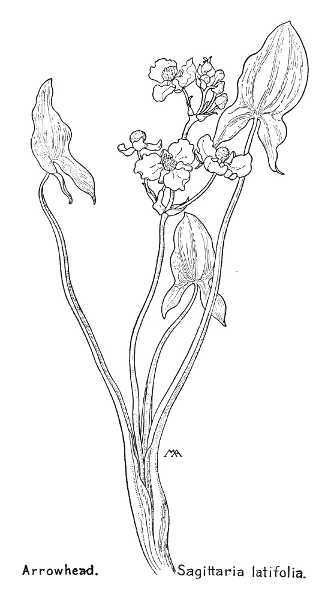
Arrowhead—Sagittaria latifolia.
LILY FAMILY. Liliaceae.
A wonderfully beautiful family, large and widely distributed, mostly perennial herbs, growing from bulbs or root-stocks, with perfect, regular, symmetrical flowers and toothless leaves. The flower-cup almost always has six divisions, the outer often called sepals and the inner petals. The six stamens are opposite the divisions and sometimes three of them are without anthers. The styles or stigmas are three and the ovary is superior, developing into a three-celled capsule or berry, containing few or many seeds.
There are several kinds of Anthericum, rather small, lily-like plants, with grasslike leaves, springing from the base and surrounded by the fibrous remnants of older leaves. The slender stems are leafless, or have one, very small, dry leaf; the roots thick and fleshy-fibrous; the flowers yellow, on pedicels jointed near the middle; the style long and slender; the pod oblong, containing several flattened, angular seeds in each cell. They are common in rocky soil, at altitudes of six thousand to nine thousand feet, from western Texas to Arizona.
Amber Lily Anthéricum Tórreyi Yellow Summer Arizona
A beautiful little plant, with delicate flowers, unusual and pretty in coloring. It grows from eight to fifteen inches tall and has a slender, pale-green stem, springing from a clump of graceful, pale bluish-green, grasslike leaves. The flowers are about three quarters of an inch long, pale orange or corn-color, with a narrow stripe on each division; the pistil green, with an orange stigma; the anthers yellow. The flowers fade almost as soon as they bloom. This grows in open woods.
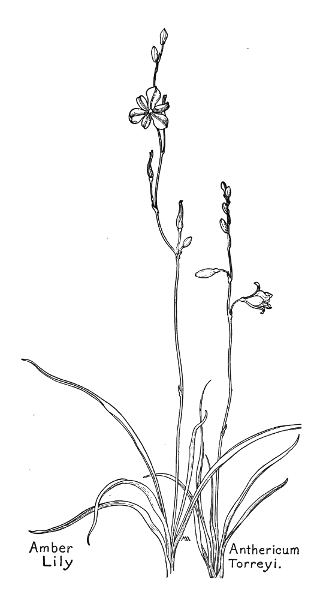
Amber Lily—Anthericum Torreyi.
There are several kinds of Zygadene, natives of North America and Siberia. They mostly have coated bulbs, resembling onions, and white or greenish flowers, in clusters, the leaves long, smooth, folded lengthwise and springing mostly from the root. The flowers are perfect or polygamous, the six divisions alike, with one or two, greenish, glandular spots at the base of each; the styles three, distinct; the fruit a three-lobed capsule, with several or many seeds in each compartment. The name is from the Greek for "yoke" and "gland," because some kinds have a couple of glands on each division of the flower.
Poison Sego Zygadènus paniculàtus Cream-white Spring, summer Utah, Nev., Idaho
A handsome, rather stout plant, about a foot tall, with bright light-green, smooth, graceful leaves sheathing the stem, which has a papery bract around its base. The flowers are in clusters varying in shape, sometimes growing in a long, loose raceme and sometimes in a closer, pointed cluster. The divisions of the rather small, cream-white flowers have short claws, with a yellow gland and a stamen at the base of each. The stamens are conspicuous, with swinging, yellow, shield-shaped anthers, and are at first longer than the three styles, which gradually lengthen and, together with the stamens, give a delicate, feathery appearance to the whole flower cluster. This grows on dry hillsides and in meadows. The bulb is very poisonous.
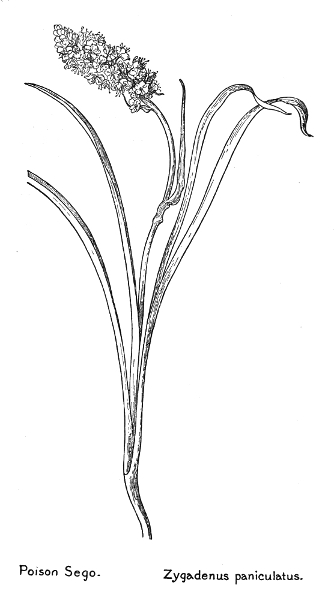
Poison Sego—Zygadenus paniculatus.
Zygadene Zygadènus élegans White Summer U. S.
A handsome graceful plant, with one or more stiff stems, from six inches to three feet tall, springing from a large clump of rather stiff, bluish-green leaves, covered with a pale "bloom," and bearing fine clusters of cream-white flowers, less than an inch across, their divisions united below and adhering to the base of the ovary and each with a sticky, bright-green, heart-shaped gland. This grows in moist places in the mountains, across the continent.
Star Zygadene Zygadènus Fremóntii White Spring, summer California
Much like the last, but the foliage with less "bloom" and the flowers handsomer and rather larger. Their divisions are free from the ovary, only the inner divisions have claws, and the glands are greenish-yellow and toothed. This grows among bushes, on hillsides and sea-cliffs along the coast.
Death Camass Zygadènus venenòsus White Spring Wash., Oreg., Cal.
Not nearly so handsome as the two last, but a pretty plant, from one to two feet tall, with dull-green leaves, folded lengthwise, with rough edges. The cream-colored flowers are less than half an inch across, striped with green on the outside, their divisions free from the ovary and all with claws, with roundish, greenish-yellow glands, not toothed, and with long stamens. This grows in meadows and the bulb is very poisonous except to hogs, so it is often called Hog's Potato.
There are several kinds of Veratrum, natives of the north temperate zone; tall, perennial herbs, with thick, short, poisonous rootstocks; stems tall and leafy, more or less hairy; leaves broad, plaited, with conspicuous veins; flowers more or less downy, polygamous, whitish or greenish, in a cluster, their six, separate divisions colored alike, adhering to the base of the ovary, without glands, or nearly so, and without claws; stamens opposite the divisions, with heart-shaped anthers; styles three; capsule three-lobed, with several flat, broadly-winged seeds in each compartment. Veratrum is the ancient name for Hellebore.
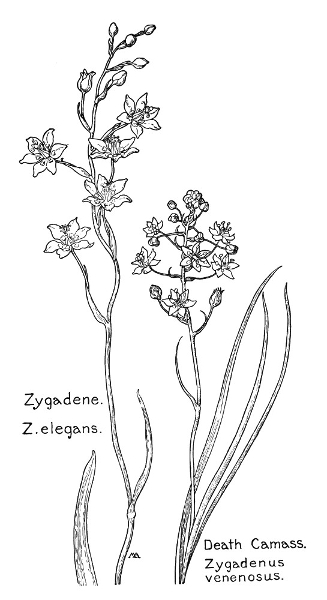
Zygadene—Z. elegans. Death Camass—Zygadenus venenosus.
False Hellebore Veràtrum Califórnicum Greenish-white Spring West
The leaves of this plant are its conspicuous feature. A few near the top are long and narrow, but most of them are boat-shaped, with heavy ribs, and from six to twelve inches long. They are bright yellowish-green and, although somewhat coarse, the general effect is distinctly handsome, as we see masses of them growing luxuriantly in rich, moist meadows and marshes in the mountains. When they first come up in the spring, the shoots are packed into green rosettes, in which the leaves are intricately folded, but they soon grow to a height of three to six feet. The flowers are beautiful, in fine contrast to the coarse foliage. They measure about half an inch across and are cream-white, streaked with green, and form a fine cluster about a foot long. The flowers are far prettier and the plants handsomer than their eastern relations and they flourish at an altitude of six to nine thousand feet. The plants are supposed to be poisonous to cattle, but in a recent bulletin of the Agricultural Experiment Station of the State of Washington, it is reported as being a popular food with horses and sheep, particularly the latter, which eat it greedily and without ill effects.
There are several kinds of Hastingsia, perennials, with bulbs or rootstocks; the stamens on the base of the perianth, with swinging anthers; the ovary with a very short stalk and short style.
Reed-lily Hastíngsia álba (Schoenolirion) White Summer Oreg., Cal., Nev.
An attractive marsh plant, with a smooth, stiff, bluish stem, over three feet tall, springing from a cluster of long, narrow, sword-like leaves. The slightly sweet-scented flowers are white, about half an inch across, forming a long, graceful, fuzzy wand of bloom, which has a pretty silvery effect and looks interesting at a distance, but is not very striking close by, as the flowers are too colorless. The seeds are black and shiny.
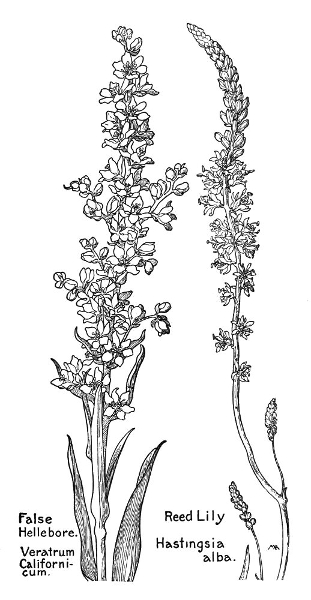
False Hellebore—Veratrum Californicum. Reed Lily—Hastingsia alba.
Amole Soap Plant Chlorógalum pomeridiànum Silvery-white Summer California
There are several kinds of Chlorogalum. This odd plant springs from a big bulb, which is covered with coarse brown fiber and often shows above the ground. The leaves are sometimes over two feet long, with rippled margins, look like very coarse grass, and usually spread out flat on the ground. The plants are conspicuous and look interesting and we wonder what sort of flower is to come from them. Then some day in late summer we find that a rather ugly, branching stalk, four or five feet tall, has shot up from the center of the tuft of leaves. The branches are covered with bluish-green buds, and we watch with interest for the bloom, but we may easily miss it, for the flowers are very short-lived and come out only for a little while in the afternoons. In the lowlands the flowers are rather scattered and straggling, but in Yosemite they are lovely, close by. Each flower is an inch or more across and looks like an airy little lily, with six spreading divisions, white, delicately veined with dull-blue, and they are clustered along the branches, towards the top of the stalk, and bloom in successive bunches, beginning at the bottom. When they commence to bloom, the tips of the petals remain caught together until the last minute, when suddenly they let go and spring apart and all at once the dull stalk, like Aaron's rod, is adorned with several delicate clusters of feathery silver flowers. The thread-like style is slightly three-cleft at the tip and the capsule has one or two blackish seeds in each cell. The bulbs form a lather in water and are used as a substitute for soap by the Indians and Spanish-Californians, and as food by the Pomo Indians, who cook them in great pits in the ground. Pomeridianum means "in the afternoon."
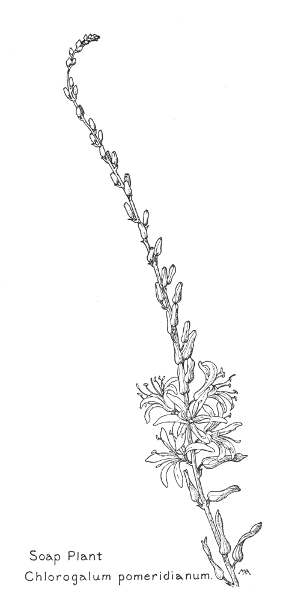
Soap Plant—Chlorogalum pomeridianum.
Wild Onions are easily recognized by their characteristic taste and odor. They mostly have coated bulbs; their leaves are long and narrow, from the base; the flower-stalk bears a roundish, bracted cluster of rather small, white, pink, or magenta flowers, on slender pedicels, their six divisions nearly alike and each with a stamen attached to its base. The bracts enclose the buds, before blooming, in a case and the capsule contains six, black, wrinkled seeds. There are numerous kinds, very widely distributed, not easily distinguished, some resembling Brodiaea, but the latter never smell of onion. Allium is the Latin for "garlic."
Pink Wild Onion Állium acuminàtum Pink Spring, summer Northwest
From four to ten inches high, with a few leaves. Before blooming, the flower cluster is enveloped in two papery bracts, forming a beautiful pink and white, iridescent case, the shape of a turnip, at the tip of the stalk. Later these bracts split apart and disclose a cluster of pretty flowers, usually very deep pink in color, the divisions each with a darker line on the outside, the anthers pale-yellow. This is very gay and attractive, often growing in patches on dry hillsides and fields. The flowers last a long time in water, gradually becoming paler in color and papery in texture. The bulb is marked with veins.
Wild Onion Állium biscéptrum Pink, white Spring Utah, Nev., Cal.
Six to ten inches tall, with two slightly thickish leaves, and usually two slender flower stalks, each bearing a graceful cluster of starry, white, pink or pinkish-purple flowers, each petal delicately striped with pinkish-brown, the anthers pink, the ovary green, with three, tiny, double crests. These flowers are exceedingly delicate and pretty, growing among rocks in shady canyons. The bulb is usually red-coated.
The flower cluster of Allium serràtum is much more compact than the last and the pink flowers change to deep purplish-pink as they fade, making a pretty, round, papery head, about an inch and a half across. Common on low hills in California.
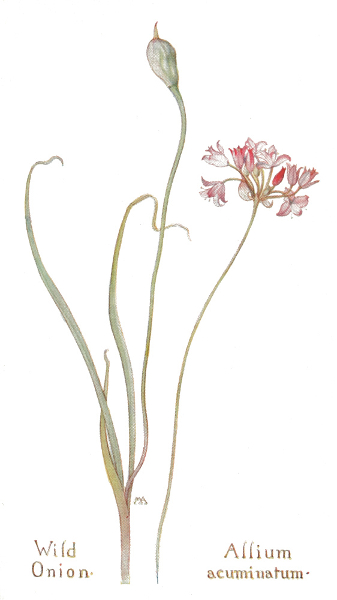
Wild Onion—Allium acuminatum.
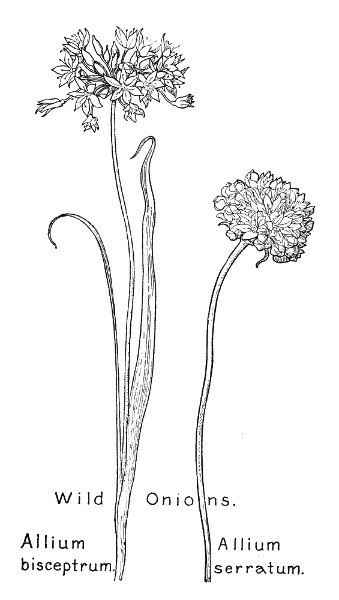
Wild Onions. Allium bisceptrum. Allium serratum.
There are many kinds of Brodiaea, among the prettiest western flowers. They have a small, solid bulb, coated with brownish fibers. The stem bears a bracted, roundish head of flowers at the top, the pedicels varying in length. Their leaves, all from the root, are grasslike and soon wither and the flowers dry up, become papery, and remain on the stalk, sometimes keeping form and color for some time. The stamens are in two sets and are attached to the flower-tube, their filaments often winged. Sometimes three of the stamens are without anthers and their filaments are broadened, so that they look like small petals alternating with the ordinary stamens.
Grass Nuts. Blue Dicks. Covena. Brodiaèa capitàta Blue, violet Spring California
All through the spring these lovely flowers grow abundantly all over the hills and fields of California. The slender stalks vary from a few inches to two feet tall. The flowers are usually purplish-blue, but vary from deep-violet to white and are rather translucent in texture. They measure over half an inch across and grow in a cluster of seven or eight flowers, with several membranous, purplish bracts at the base. There are six anthers. The three inner stamens are winged and form a crown in the throat of the flower-tube. These Brodiaeas last a long time in water and are great favorites everywhere. The little bulbs are edible and give the name of Grass Nuts. There are several other names, such as Cluster Lily and Hog-onion. The name Wild Hyacinth is poor, as it does not resemble a hyacinth in character. B. capitàta var. pauciflòra of Arizona is similar, except that the bracts are white. Covena is the Arizona name.
Ookow Brodiaèa congésta Blue, violet Spring, summer Wash., Oreg., Cal.
Much like the last, except that only three of the stamens have anthers and the stem is sometimes as much as five feet tall. This grows on open hills in the Coast Ranges.
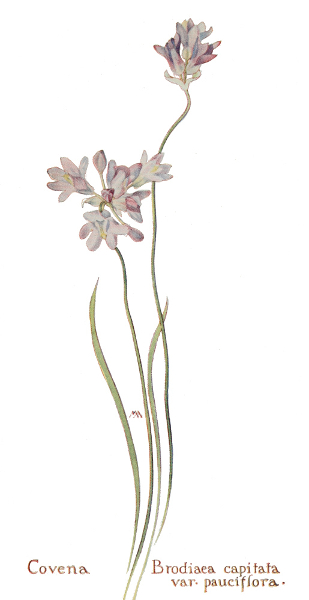
Covena—Brodiaea capitata var. pauciflora.
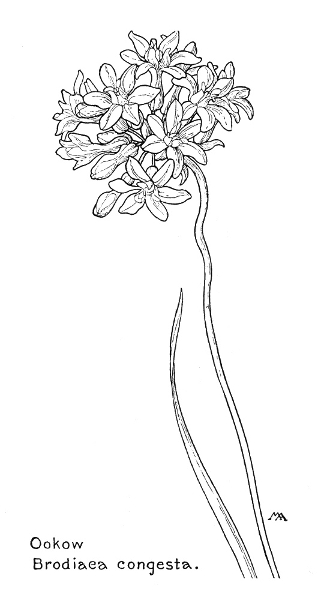
Ookow—Brodiaea congesta.
Harvest Brodiaea Brodiaèa grandiflòra (Hookera coronaria) Blue Summer Cal., Oreg., Wash.
In early June, at the time of the hay harvest, these handsome flowers, which look like clusters of little blue lilies, begin to appear among the dried grass of the hillsides and in open places in the woods. They vary in height from a few inches to over a foot and the number of flowers in a cluster also varies very much. Sometimes there are as many as ten of the beautiful blossoms, an inch or more long, with pedicels unequal in length and from one to four inches long, in a large cluster at the top of the stalk, with several, whitish, papery bracts at the base of the cluster. The color of the flowers is usually a deep bright blue shading to violet and the six divisions grow paler toward the base and have a brown stripe on the outside; the buds are greenish, striped with brown. The stamens are translucent white, three ordinary stamens, with long erect anthers, alternating with three without anthers, the latter tongue-shaped and petal-like. The leaves, which are thickish and about the same length as the stalk, have withered away before the flowers bloom. This plant very much resembles Ithuriel's Spear, Triteleia laxa, but three of the stamens are without anthers and the ovary is not on a long stalk. It is the commonest kind around San Francisco. B. minor is much the same, but a smaller plant with fewer and smaller flowers. The three outer divisions are narrow, with pointed tips, and the inner blunt and broad, and the sterile stamens are notched and longer than the fertile ones. This grows on dry hills and plains in middle and southern California.
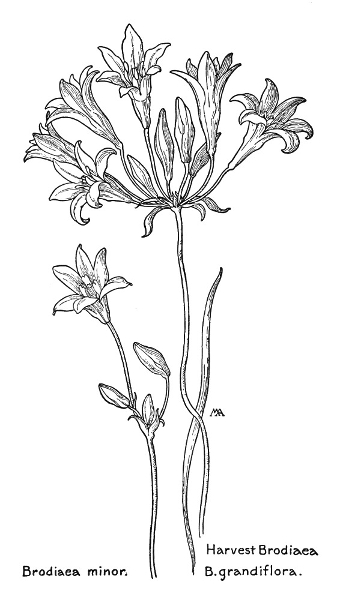
Brodiaea minor. Harvest Brodiaea—B. grandiflora.
Twining Brodiaea Brodiaèa volùbilis. (Stropholirion Californicum) Pink Summer California
This is a strange, rather grotesque-looking plant, with its slightly roughish, leafless, reddish stem contorted into curious curves, occasionally quite short but usually enormously long, sometimes as much as eight feet, and twining awkwardly in a snake-like way around and over the bushes in its neighborhood. There are sometimes a few long narrow leaves lying on the ground, but when the flower blooms they usually seem to have withered away. The flower-cluster is quite compact, sometimes six inches across, comprising from eighteen to twenty flowers, with several, large, pink, papery bracts. The flowers are rather pretty, dull pink outside but paler inside, the buds are deeper and more purplish pink, both of dry papery texture. The flowers are over half an inch across, their tubes and buds are six-angled, and they have three stamens with anthers and wings, alternating with three, notched, petal-like stamens, without anthers. In the spring the stem grows rapidly for several weeks and then the flower cluster begins to come out at the tip. If the stem is broken off the flower comes out just the same and the stem keeps on growing, even if it is brought into the house. These curious plants are found in the foothills of the Coast Ranges and the Sierra Nevada Mountains and may be seen in open sunny places along the stage route from Yosemite to Wawona. In the woods near Wawona I saw it twining around a very tall white larkspur and the combination was exceedingly pretty. The capsule is egg-shaped and pointed, the seeds black and angled.
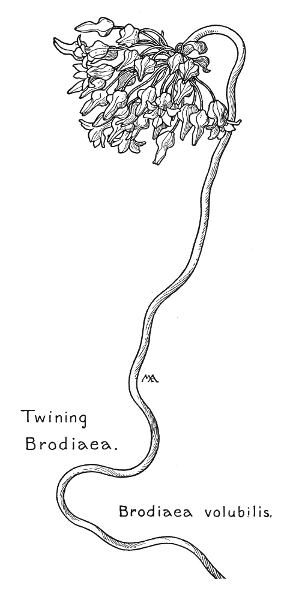
Twining Brodiaea—Brodiaea volubilis.
There are four kinds of Bloomeria, all Californian, resembling Brodiaea, but the stamens unlike. They have a fibrous-coated, solid bulb, long narrow leaves, and a bracted cluster of many flowers, at the top of a tall flower-stalk. The flowers are yellow, with six, nearly equal, spreading divisions, the six stamens on the base of the divisions, with slender filaments, which with a microscope are seen to have a short, two-toothed, hairy appendage at base. These are united and form a little cup surrounding the base of the stamens. The style is club-shaped, with a three-lobed stigma. The roundish capsule, beaked with the style, contains several, angular, wrinkled seeds in each cell.
Golden Stars Bloomèria aùrea Yellow Spring, summer California
In late spring the meadows around Pasadena and other places in the Coast Range are bright with pretty clusters of Golden Stars. The plant is from six to eighteen inches tall, springing from a small bulb, covered with brown fibers, with a long, narrow, grasslike leaf, and a large flower-cluster, sometimes comprising as many as fifty blossoms, at the top of the stalk. The flowers, about an inch across, with pedicels from one and a half to two inches long, are orange-yellow, the spreading divisions each striped with two dark lines, and the anthers are bright green. This looks very much like Golden Brodiaea, but the latter has no cup at the base of the stamens. It grows in the southern part of California and is abundant wherever it is found. B. Clevelandi is much the same, but the flowers are striped with green and the numerous buds are green, so that it is less golden and the general effect is not so good. It has numerous narrow leaves.
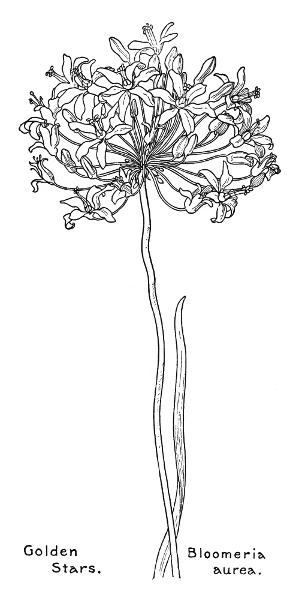
Golden Stars—Bloomeria aurea.
Triteleias resemble Brodiaeas, but they have six, swinging anthers and the ovary has a stalk.
Indian Hyacinth Triteleìa grandiflòra (Brodiaea Douglasii) Blue Spring, summer Northwest and Utah
Though the general appearance of the plant is very different, the individual flowers of this beautiful plant very much resemble the bells of a Hyacinth, for they have the same waxy, semi-translucent texture. The bluish-green leaves, folded lengthwise and withering before the flower, are sometimes a foot long and the flower-stalk often reaches a height of two feet and bends beneath the weight of its lovely crown of blossoms. The cluster has four papery bracts at the base and is from three to four inches across, comprising about a dozen flowers, each nearly an inch long. They are pale-violet, with a bright-blue mid-vein on each division, the general effect being blue, with a white pistil and six stamens in two rows, all with blue anthers and the outer ones with broad, white filaments. It is wonderful to find these lovely and exotic-looking flowers, delicately scented, gleaming in the shadow of a dusky oak thicket or a deep canyon. They last a long time in water, becoming papery as they wither.
White Brodiaea Triteleìa hyacinthìna (Brodiaea lactea) White Spring Cal., Oreg., Wash.
From one to two feet high, with very pretty flowers, about half an inch long, delicately striped with green on the outside, with six equal stamens, their filaments broad, triangular and slightly united at base, with yellow or purple anthers, and a green pistil. The leaf is grasslike, but thickish, and as long as the flower-stalk. These flowers are quite common and last a long time in water.
Ithuriel's Spear Triteleìa láxa (Brodiaea) Blue, purple Spring Cal., Oreg.
Very much like Harvest Brodiaea but rather taller, with more flowers in the cluster, and less waxy in texture, varying in color from blue to violet and occasionally white. This is common on hillsides and in adobe fields. The rather fanciful name was suggested by the spear carried by Milton's angel Ithuriel.
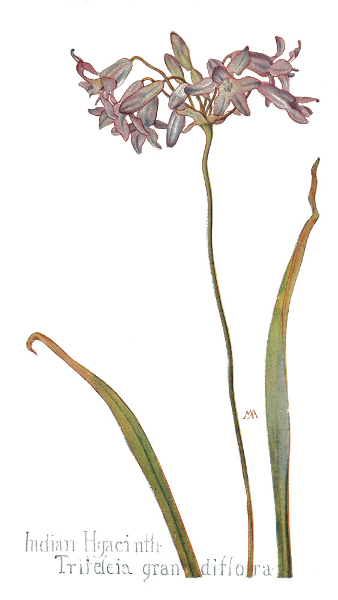
Indian Hyacinth—Triteleia grandiflora.
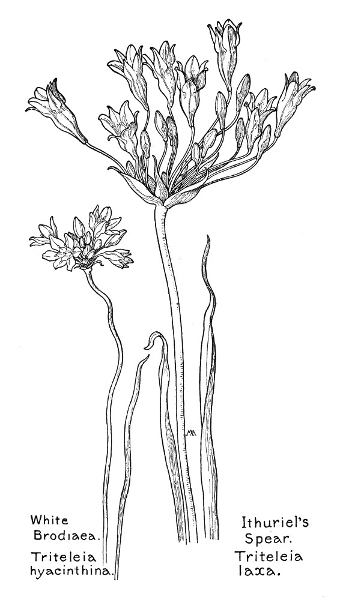
White Brodiaea—Triteleia hyacinthina. Ithuriel's Spear—Triteleia laxa.
There are one or two kinds of Brevoortia.
Fire-cracker Flower Brevoòrtia Ida-Màia (Brodiaea coccinea) Red and green Spring Cal., Oreg.
A handsome plant, most extraordinary both in form and color. The stem is from one to three feet tall, with a few grasslike leaves, and bears a large cluster of six to thirteen flowers, one or two inches long, hanging on slender, reddish pedicels. They have bright-crimson tubes and apple-green lobes, sometimes turned back, showing the tips of the three pale-yellow anthers. There are also three stamens without anthers and broadened so that they look like three white or yellowish petals. The buds are also crimson, tipped with green, and the whole color scheme is wonderfully brilliant and striking. This grows in mountain canyons and on wooded hillsides, blooming in late spring.
There are several kinds of Muilla, much like Brodiaea and very much like Allium, but with no onion taste or smell.
Muilla Muílla marítima White Spring Cal., Nev.
A slender little plant, sometimes rather pretty, from three to nine inches tall, with sweet-scented flowers, about three-eighths of an inch or less across, white or greenish, striped with green outside, with six, bluish, swinging anthers. This grows in alkaline fields, on sea cliffs and mesas.
There are a good many kinds of Erythronium, all but one from North America, and, East and West, they are among our prettiest flowers. They have deep, membranous-coated, solid bulbs; a pair of netted-veined, unequal leaves, sometimes mottled with brown; flowers without bracts, large, nodding and bell-shaped, with usually six divisions, all colored alike, the tips turning back, each with a nectar-groove, and each with two or four little scales at base, or only the three inner divisions with scales; stamens on the receptacle, anthers not swinging; style more or less three-lobed; capsule more or less oblong and three-angled. The younger plants are often flowerless, with only one broad leaf, with a long leaf-stalk. The name is from a Greek word meaning "red," though these flowers are mostly yellow. The common name, Dog-tooth Violet, is old, and suggested by the little, white, toothlike offshoot often found on the bulb, but of course they are not in the least like Violets. In California they are often called Chamise Lily, and sometimes Adam and Eve, because the plant often bears a large and a small flower at the same time. Mr. Burroughs would like to call it Fawn Lily, on account of the mottled leaves of some kinds, which slightly suggest the ears of a fawn. Adder's-tongue, probably suggested by the long forked pistil, is also an old and usual name.
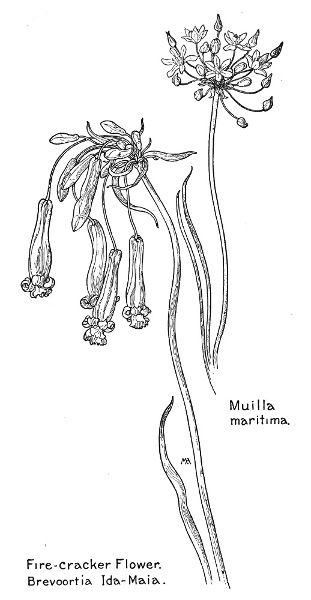
Muilla maritima. Fire-cracker Flower—Brevoortia Ida-Maia.
Avalanche Lily Dog-tooth Violet Erythrònium montànum White Summer Northwest
An exquisite kind, peculiarly graceful in form, with from one to nine, pure-white flowers, nearly three inches across, each petal prettily ornamented at the base with some orange-colored markings, arranged in a symmetrical scalloped pattern. The anthers are orange-yellow, the pistil white, the buds are pinkish and the leaves are very bright green and not mottled. This is very common around Mt. Rainier.
Glacier Lily Dog-tooth Violet Erythrònium parviflòrum Yellow Summer Northwest
A lovely flower, much like E. grandiflorum, but the anthers are white or pale yellow. Around Mt. Rainier these beautiful plants often grow in large patches at the edge of the snow, alongside of the Avalanche Lily, E. montanum, but the two kinds do not seem to mingle.
Easter Bells Dog-tooth Violet Erythrònium grandiflòrum Yellow Spring, summer Northwest and Utah
One of the loveliest of a charming group, growing in rich northern woods. The delicately-scented flowers, from one to six on a stalk, are about two inches across, clear yellow shading to white at the base, with purplish-red anthers, turning brown. A patch of these flowers bordering the edge of a glacier, as if planted in a garden-bed, is a sight never to be forgotten. Pushing their bright leaves right through the snow they gayly swing their golden censers in the face of winter and seem the very incarnation of spring. There are several similar kinds. In the Utah canyons these flowers in early spring are a wonderful sight, covering the wooded slopes with sheets of gold, and they seem to me to be the largest and handsomest of their clan, growing at an altitude of six thousand to eleven thousand five hundred feet, and blooming from March to July according to height. Easter Bells is a Utah name.
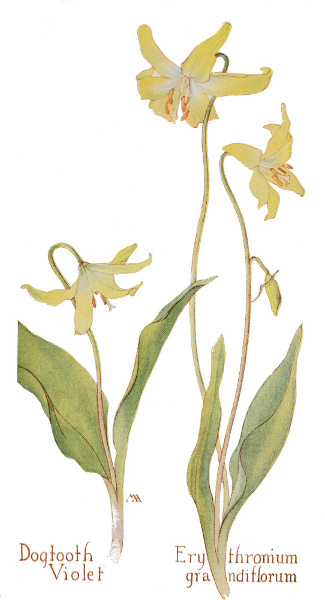
Dogtooth Violet—Erythronium grandiflorum.
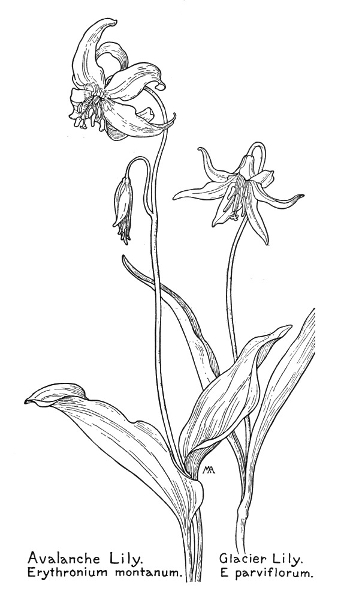
Avalanche Lily—Erythronium montanum. Glacier Lily—E. parviflorum.
Desert Lily Hesperocállis undulàta White Spring Cal., Ariz.
This is the only one of its kind, a wonderfully beautiful desert plant, much like an Easter Lily. The stout, pale, bluish stem, from six inches to two feet tall, has a delicate "bloom" and springs from a graceful cluster of narrow leaves, which are a foot and a half long, spreading widely, but not lying quite flat on the ground. They are pale bluish-green, with a narrow, crinkled, white border and folded lengthwise. The buds are bluish and the lovely flowers are about three inches long and pure-white, delicately striped with pale-green and blue on the outside, with yellow anthers and a white stigma, and with a papery bract at the base of each pedicel. The flowers are slightly fragrant and become papery and curiously transparent as they wither. In dry seasons these plants do not bloom at all, but the slightest moisture will cause them to send up a stout stem and crown it with exquisite blossoms, which look extraordinarily out of place on the arid desert sand around Yuma and Ft. Mohave. The bulb is eaten by the Indians.
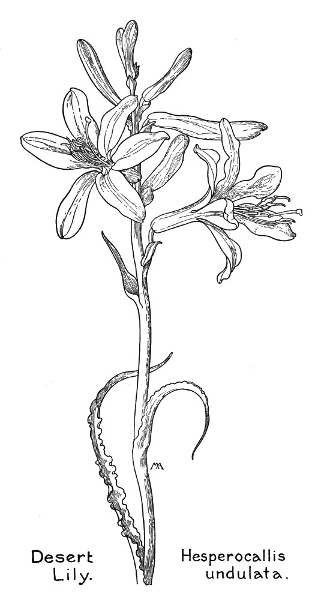
Desert Lily—Hesperocallis undulata.
Lilies, the "lords of gardens," are perhaps the most beautiful and popular flowers everywhere and there are some wonderful ones in the West. They have tall, smooth, leafy stems, springing from scaly bulbs; large showy flowers, solitary or in terminal clusters; smooth, netted-veined leaves, often in whorls, and leaflike bracts. The flower-cup is funnel-formed, or bell-shaped, and has six, equal, spreading divisions, with a honey-bearing groove at the base of each; the stamens, with long anthers, swinging from the tips of long filaments; a long pistil, with a three-lobed stigma and the capsule oblong, with two rows of flat seeds in each of its cells. There are no true Lilies in Utah.
Small Tiger Lily Lílium párvum Orange-red Summer Cal., Oreg.
These tall plants carry a brilliant crown of small lilies, glowing like jewels in the dark moist woods they love. The stem is from one and a half to six feet high, covered with a slight down that rubs off, and springs from a small bulb with short, thick scales. The long, pointed, rich-green leaves are in whorls of five or six below, more scattered towards the top of the stalk. The flowers are rather more than an inch long, yellow at the base of the petals, shading through orange to vermilion at the tips and dotted with crimson in the throat. Usually there are six or seven in a cluster, but they have been found with many more in favorable situations and single plants in Yosemite have been seen with as many as thirty blossoms. The capsule is roundish and less than an inch long. These little Lilies are among the most attractive of their kind and grow somewhat freely in the high Sierras to an altitude of seven thousand feet and as far north as Oregon.
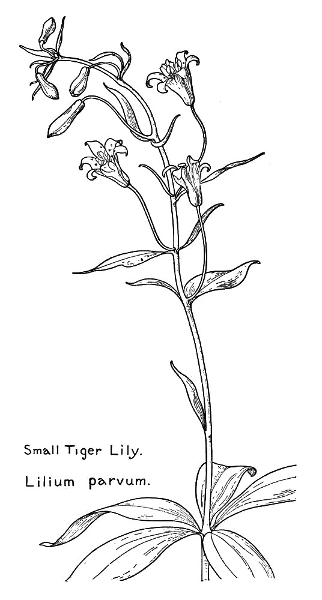
Small Tiger Lily—Lilium parvum.
Washington Lily Shasta Lily Lílium Washingtoniànum White Summer Cal., Oreg.
In the Sierras, at an altitude of from three to over seven thousand feet, and as far north as the Columbia River, we may be fortunate enough to find this glorious Lily, growing in the forest in moderate shade and protected by the chaparral. It is not rare but nowhere very abundant. I shall never forget finding a group of three or four, growing near a huge fallen tree, in the woods at Wawona near Yosemite, where it is very fine. Their raiment is even more "white and glistering" than the cultivated Easter Lilies. The smooth, stout, purplish stem is from two to five feet high, adorned all the way up with successive whorls of handsome dark-green leaves, three or four inches long, thin in texture, with rippling margins, and shining as if they had been varnished. There are from two to twenty blossoms of shining white, each one from three to four inches long and as much across. The petals are cleft to the base, spreading wide apart when the flower is fully open, sometimes finely dotted with purple, and becoming purplish in fading. The anthers are yellow and the pistil green, and the bulb is large, with thin scales. The scent is delicious, having a whiff of spicy carnation added to the usual lily fragrance. This is never found in the Coast Range and is the only pure white American Lily. Shasta Lily is a variety with a small bulb. L. Párryi, the Lemon Lily, of southern California and Arizona, is similar in the form of its flowers, which are large and clear yellow, dotted lightly with deeper yellow. It grows in shady, moist spots in cool canyons and is very beautiful.
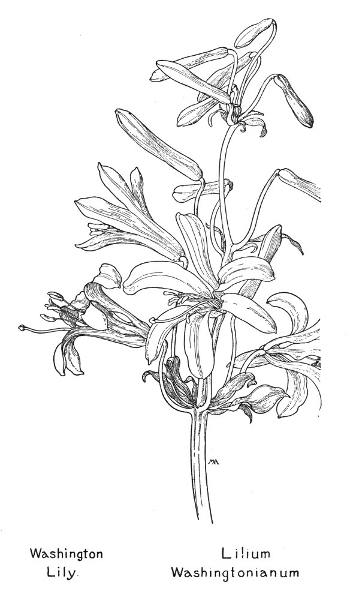
Washington Lily—Lilium Washingtonianum.
Leopard Lily Lílium pardalìnum Orange Summer Wash., Oreg., Cal.
A magnificent plant, from three to six feet tall, with bright-green leaves, thin in texture, smooth but not shiny, and mostly in whorls. The stem is crowned by a splendid cluster of flowers, usually about half a dozen together, but sometimes as many as thirty on one stalk. They measure three or four inches across and are pale-orange outside and deep-orange inside, spotted with maroon, often blotched with orange-yellow in the throat and tipped with scarlet. The anthers are purplish, changing to reddish-brown, and the pistil is bright-green. These plants often grow in large companies, in moist spots in the mountains, and are unrivaled in decorative beauty and brilliancy of coloring.
Tiger Lily Lílium Columbiànum Orange Summer Wash., Oreg.
A good deal like the last, but not so large. The petals are more turned back and they are orange-color all over, dotted with dark-red, and the anthers are pale orange-color, ripening to golden-brown. This is common in the Hood River Valley.
Ruby Lily Chaparral Lily Lílium rubéscens White, pink Summer Cal., Oreg.
A glorious plant, from two to five feet tall, with leaves mostly in whorls, with rippled edges. The stem bears a magnificent cluster of blossoms, most wonderful in coloring, for the buds and young flowers are white, dotted with purple inside, with yellow anthers and a pale-green pistil, but they gradually change to pink, and deepen to ruby-purple as they fade, and the anthers and pistil also darken in color. The effect of the whole cluster is therefore white at the top, shading through pink to almost crimson below. The flowers are even more deliciously fragrant than the Washington Lily, which they resemble, except that they are not quite so large as the latter and stand more erect and the petals are not so spreading. This usually grows among chaparral in the Coast Ranges.
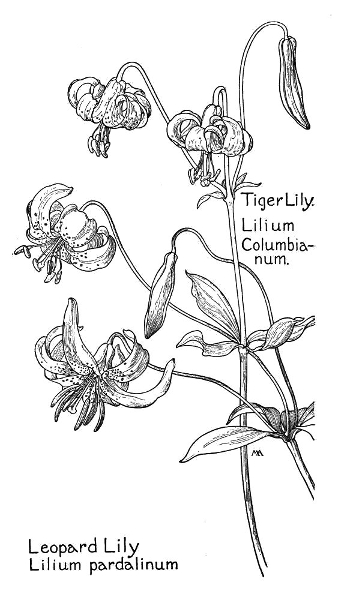
Tiger Lily—Lilium Columbianum. Leopard Lily—Lilium pardalinum.
There are many kinds of Fritillaria, natives of the north temperate zone. In the East there are only cultivated ones, such as the familiar Crown Imperial, but we have a number growing wild in the West. They have bulbs with round, thick scales, developing into bulblets and sometimes resembling grains of rice. The flowers are bell-shaped, and nodding, with separate and nearly equal divisions, each with a nectar-spot at its base. They resemble Lilies, but the style is three-cleft, the honey-gland is a shallow pit and the flowers are smaller. The capsule is roundish and six-angled, containing numerous flat seeds. It is conspicuous and perhaps suggested the Latin name, meaning "dice-box."
Bronze Bells Brown Fritillary Fritillària atropurpùrea Brown Spring, summer West
This plant is beautiful and decorative, and yet there is something weird about it. The flowers, an inch or more across, grow four or five in a cluster, on a smooth stalk about a foot tall, the long, narrow leaves scattered or in whorls. The bells, nodding on slender flower-stalks, are very unusual in coloring. They are greenish-yellow, streaked and spotted with maroon, and the long curling tips of the three-pronged pistil project like the forked tongue of an adder, so that somehow we feel that, in a previous existence, beautiful as it is now, it may have been a toad or some reptile. When we found this flower growing in the Grand Canyon, halfway down Bright Angel trail, it seemed entirely suitable to the mysterious spirit of the place. The general effect is bronze-color and the attractive name of Bronze Bells, or Mission Bells, is very appropriate. It has a small bulb of numerous, roundish scales. The pistils are often rudimentary.
Yellow Fritillary Fritillària pùdica Yellow Spring West, except Ariz.
A pretty little flower, a favorite with children, growing on grassy plains, with a smooth stem about six inches tall, and smooth, somewhat thickish, alternate or whorled leaves. The nodding flowers, about an inch long, are usually single, but sometimes as many as six on a stalk, various shades of yellow and orange, tinged with crimson and fading to dull-red. The smooth bulb is pure white, and made up of a number of rounded, thickish scales not resembling grains of rice, so the name Rice Root is not appropriate and the local Utah names, Crocus, Snowdrop, and Buttercup are absurd.
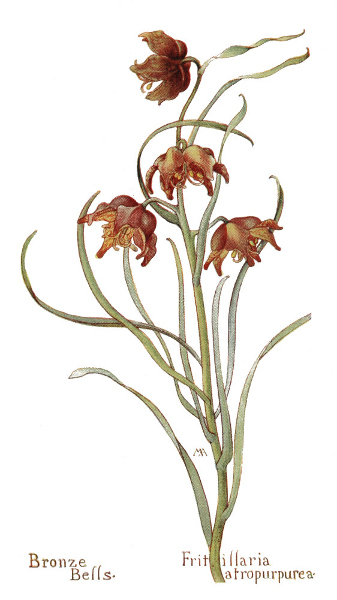
Bronze Bells—Fritillaria atropurpurea.
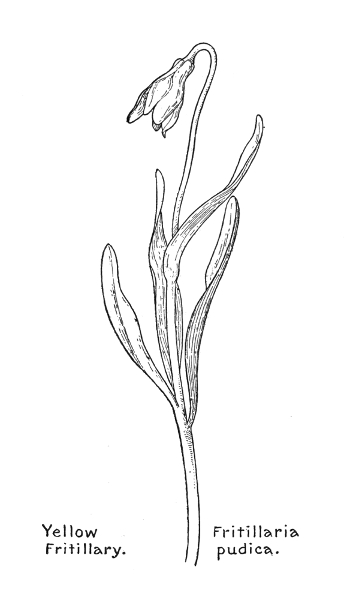
Yellow Fritillary—Fritillaria pudica.
There are several kinds of Yucca, natives of North and Central America; large plants, with dagger-like leaves, usually with long, thread-like fibers along the margins; flowers with bracts, nodding in a terminal cluster, somewhat bell-shaped, with six, thickish, white divisions; stamens short, with thickened filaments and small anthers; ovary with three united stigmas; capsule containing many, flat, black seeds. The flowers are pollinated by a little white moth, which lays its eggs in the ovary, but previously gathers pollen from many flowers and pushes it against the stigma after the eggs have been laid.
Our Lord's Candle Spanish Bayonet Yúcca Whípplei White Spring, summer Cal., Ariz.
A noble plant, with no trunk, but sending up a magnificent shaft of flowers, from five to fifteen feet tall, springing from a huge, symmetrical bunch of dagger-like, bluish-green leaves. The cluster is composed of hundreds of waxy, cream-colored blossoms, sometimes tinged with purple, two inches across, crowded so closely together along the upper part of the stalk that the effect is a great, solid mass of bloom, three feet long. The white filaments are swollen, tipped with pale-yellow anthers; the pistil cream-color, with green stigmas. The large, white bracts are stiff and coarse, something like parchment, folded back so that the pinkish stalk is ornamented with a series of white triangles, symmetrically arranged. A hillside covered with hundreds of these magnificent spires of bloom, towering above the chaparral, is a wonderful sight. After they have blossomed, the tall, white stalks remain standing for some time, so that the hills look as if they had been planted with numbers of white wands.
The genus Cleistoyucca resembles Yucca, but the divisions of the flower are very thick and there is no style.
Joshua Tree Tree Yucca Cleistoyúcca arboréscens (Yucca) Greenish-white Spring, summer Cal., Ariz., Utah
A tree, grotesque and forbidding in aspect, but with a weird sort of beauty, looming black against the pale desert landscape, with a great, thick, rough trunk, fifteen to thirty feet high, and a few thick, contorted branches, stretching out like a giant's arms and pointing ominously across the sandy waste. The branches are thatched with the shaggy husks of dead leaves and from their tips they thrust out a great bunch of dagger-like leaves and a big, ponderous cluster of pallid, greenish flowers or heavy, yellowish fruits. The coarse flowers are about two inches across, with a clammy smell like toadstools, and the bracts are dead white. This grows in the Mohave Desert and is at its best around Hesperia, where one may see the most fantastic forest that it is possible to imagine. Elsewhere it is smaller and more like other Yuccas in shape. It was called Joshua Tree by the early settlers, it is said because they fancied that its branches pointed towards the Promised Land. The fruits are relished by the Indians, who utilize the fibers from the leaves for weaving baskets, ropes, hats, horse-blankets, etc., and make a pulp from the stems, used for soap.
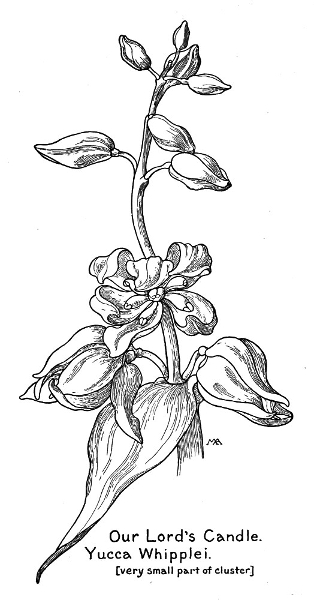
Our Lord's Candle—Yucca Whipplei. [very small part of cluster]
There are several kinds of Trillium, of North America and Asia; with tuberous root-stocks; three, netted-veined leaves, in a whorl at the top of the stem; a single flower with three, green sepals, three petals, six, short stamens, and three styles; capsule berry-like and reddish, containing many seeds. The Latin name means "triple."
Wake-robin Birthroot Tríllium ovàtum White Spring, summer Northwest
A charming plant, about a foot tall, with a single beautiful blossom, set off to perfection by its large, rich green leaves. The flower is two or three inches across, with lovely white petals, which gradually change to deep pink. It is a pleasure to find a company of these attractive plants in the heart of the forest, where their pure blossoms gleam in the cool shade along some mountain brook. They resemble the eastern Large-flowered Trillium and grow in the Coast Ranges.
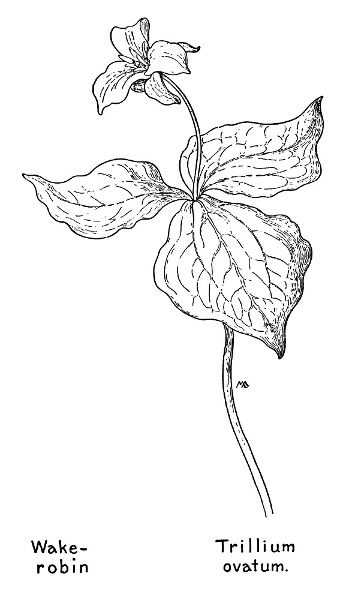
Wake-robin—Trillium ovatum.
There are three kinds of Xerophyllum.
Squaw-grass Bear Grass Xerophýllum tènax White Summer Northwest
This is a magnificent plant, from two to six feet high, with a very stout, leafy stem, springing from a very large tuft of wiry, grass-like leaves, which spread out gracefully like a fountain. They are from one to two and a half feet long, dark-green on the upper side and pale-gray on the under, with rough edges. The imposing flower cluster is borne at the top of the stalk and is about a foot long, broad at the base and tapering to a blunt point, and composed of hundreds of fragrant, cream-white flowers, each about half an inch across, with slender, white pedicels, and so closely crowded together that the effect is very solid, yet made feathery by the long stamens. It is a fine sight to come across a company of these noble plants in a mountain meadow, rearing their great shafts of bloom far above their neighbors. They are very handsome around Mt. Rainier. They are said to blossom only once in five or seven years and then to die. The leaves are used by Indians in making their finest baskets. Unfortunately the size of this book does not admit of an illustration.
There are two kinds of Maianthemum, an eastern one and the following, which also grows in Europe and Asia.
Wild Lily-of-the-valley Maiánthemum bifòlium White Spring, summer Wash., Oreg., Cal.
This is a very attractive, woodland plant, from four to fourteen inches tall, with handsome, glossy, rich green leaves, and a rather stout stem, bearing a pretty cluster, two or three inches long, of many, small, waxy-white flowers, with four divisions. They have four stamens, with thread-like filaments and small, yellowish anthers, the stigma has two lobes and the berry is red. This grows in rich soil in the mountains and is much handsomer than its eastern relation and strongly sweet-scented. The Latin name means "blooming in May."
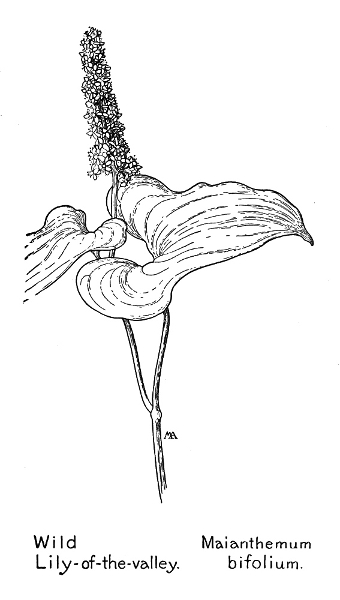
Wild Lily-of-the-valley—Maianthemum bifolium.
There are several kinds of Streptopus, much like Disporum, but the pedicels of the flowers are twisted or bent.
White Twisted Stalk Stréptopus amplexifòlius Whitish Spring, summer U. S. except Southwest
This is a fine plant, two or three feet tall, with a smooth, branching, bending stem and handsome leaves, thin in texture, with strongly marked veins and pale with whitish "bloom" on the under side. The greenish-white flowers are about half an inch long and hang on very slender, crooked pedicels, from under the leaves, and the oval berries are red and contain many seeds. This grows in moist soil, in cold mountain woods, up to an altitude of ten thousand feet and across the continent. The Greek name means "twisted stalk."
Pink Twisted Stalk Stréptopus ròseus Pink Spring, summer U. S. except Southwest
A smaller plant, from one to two and a half feet tall, with a slightly hairy stem, ornamented with pretty leaves, green on both sides and hairy along the edges, and hung with pretty, little, dull purplish-pink flowers, more or less streaked with deeper color and less than half an inch long. This grows in the same sort of places as the last and is also found across the continent.
There are two kinds of Stenanthella; smooth herbs, with bulbs and small nodding flowers, in bracted clusters, the divisions of the perianth separate, without glands or distinct claws; the short stamens inserted at the base of the divisions; the styles three; the capsule with three beaks and containing oblong, winged seeds.
Stenanthella Stenanthélla occidentàlis Brownish Spring, summer Northwest
This is a graceful plant, from ten to twenty inches tall, with long, rather narrow leaves and a slender stem, terminating in a long spray of about ten, rather pretty, little brownish-green or purplish flowers, each less than half an inch long. This grows in shady places.
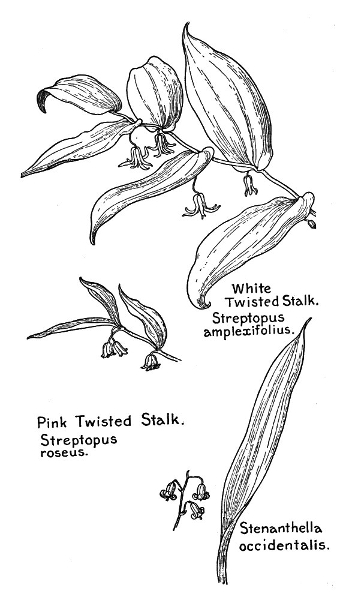
White Twisted Stalk—Streptopus amplexifolius. Pink Twisted Stalk—Streptopus roseus. Stenanthella occidentalis.
There are several kinds of Camassia, one eastern; herbs with onion-like bulbs, long, narrow leaves and thin, dry bracts. The flowers are blue of various shades, with six, separate, somewhat spreading divisions, each with a stamen on its base, the anthers swinging, the style threadlike, with a three-cleft tip; the capsule three-lobed, with several seeds in each compartment. Varieties of Camassia have long been cultivated in European gardens. The name is derived from Quamash, the Indian name for these plants.
Camass, Quamash Camássia quámash Blue Summer Northwest and Utah
Looking across the vivid green of wet meadows and marshes, the deep blue patches of this flower are often conspicuous and beautiful. They grow from one to over two feet high, taller than the grasslike leaves, forming a loose cluster, with papery bracts. The flowers are from an inch and a half to over two inches across, the six divisions spreading out into a star. The buds are tinged with turquoise-blue and striped with purple, giving a fine iridescent effect, and the flowers, which fade very quickly, are often exceedingly handsome, varying in color from dark-blue to white, but usually deep, bright purplish-blue, with a green ovary, a long purple style and yellow anthers, with purple filaments. They are larger and handsomer in northern California than in Yosemite. Grizzly bears are fond of the bulbs and the Indians of the Northwest prized them as a delicacy, indeed the Nez Percé war in Idaho was caused by encroachments on a territory where they were abundant. They were cooked elaborately in pits, care being taken to avoid the poisonous bulbs of the Death Camass, which resemble them. The Indians also boil the bulbs in water and make good molasses from them, which they use on festive occasions. This is sometimes called Wild Hyacinth, but the name is poor, as it does not resemble a hyacinth in character.
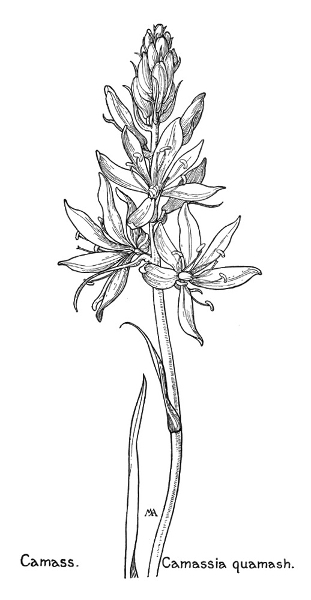
Camass—Camassia quamash.
There are six kinds of Clintonia, of North America and Asia; with creeping rootstocks and a few, broad root-leaves; flowers without bracts, their divisions separate, equal or nearly so, each with a stamen at its base; style with two or three, inconspicuous lobes; fruit a berry. These plants were named in honor of De Witt Clinton, Governor of New York, a naturalist, interested in botany, so Thoreau need not have been so annoyed at their having been given this name.
Red Clintonia Clintònia Andrewsiàna Red, pink Spring, summer Oreg., Cal.
A magnificent plant, one or two feet high, with five or six, exceedingly handsome, glossy, rich green leaves, very conspicuous and sometimes a foot long, and a tall, slightly downy flower-stalk, usually with a few flowers scattered along it, and crowned with a large, roundish cluster of beautiful flowers. They are about three-quarters of an inch long, very rich in color, a deep shade of warm reddish-pink, or crimson, not common in flowers. The form of the cluster varies a good deal; sometimes the flowers are not mostly at the top, but clustered quite thickly along all the upper part of the stalk. The large, deep-blue berries are very handsome and, altogether, this is one of our most conspicuous and attractive woodland plants, especially when growing in the deep shade of redwood forests.
Queen-cup White Clintonia Clintònia uniflòra White Spring Northwest
In rich moist soil, in shady woods, we find this lovely flower, with a white chalice and heart of pale gold, surrounded by two or three, beautiful, large, glossy leaves, resembling those of Lily-of-the-valley, and fairly carpeting the ground in favorable situations. The slender flower-stalk is hairy, six to ten inches tall, and usually bears a single flower, an inch or more across, with pure-white petals that soon drop off. The fruit is a handsome blue berry.
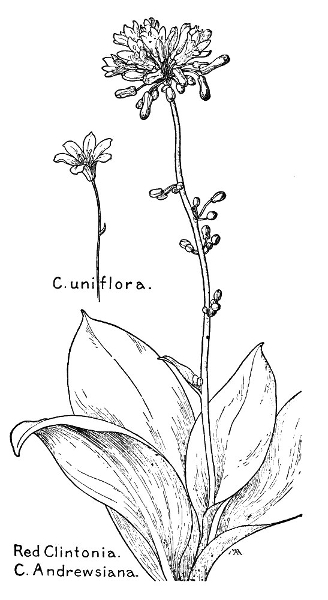
C. uniflora. Red Clintonia—C. Andrewsiana.
There are a good many kinds of Vagnera, natives of America and Asia, with a single stem, scaly below and leafy above; the leaves alternate, with short leaf-stalks or none; the flowers small, the divisions equal and spreading, white or greenish, in a cluster; the berry round, usually with one or two seeds.
False Solomon's Seal. Wild Spikenard Vágnera amplexicàulis (Smilacina) White Spring West
It is a pity that all flowers cannot have really individual names. "False" is especially unattractive and "Solomon's Seal" is confusing, as the flowers are not alike, but this is the old name used all over the world, so it will have to stand, though unworthy of this pleasing plant. It is from one to three feet high, with large, light-green leaves, usually slightly downy on the under side. The flower-cluster is sweet-scented and composed of numerous, very small, cream-white flowers, the conspicuous parts of which are the stamens, white and larger than the petals, giving a feathery appearance to the whole cluster. The fruit is a light-red berry, very finely sprinkled with dark-red dots. This fine tall plant is very decorative and is common in rich moist woods. The name was given in honor of Wagner.
Star-flowered Solomon's Seal Vágnera sessilifòlia (Smilacina) White Spring West
A gracefully bending plant, from one to two feet high, springing from a slender root-stock. The bright light-green leaves, without leaf-stalks and clasping at base, have a slight "bloom" like some lily leaves and are handsome and conspicuous, but not at all coarse, and are usually very smooth, but sometimes minutely downy. The small, delicate, cream-white flowers, on a very slender, angled flower-stalk, grow in a loose cluster and the berries are reddish-purple or nearly black. This charming plant sometimes forms large patches in moist, rich soil in shady places and its pretty foliage is often very noticeable beside the railroad tracks in Utah.
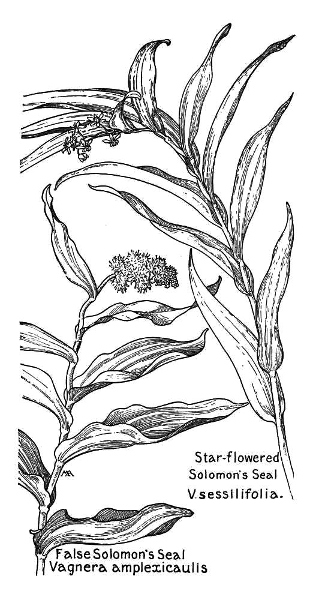
Star-flowered Solomon's Seal—V. sessilifolia. False Solomon's Seal—Vagnera amplexicaulis.
Fairy Bells are graceful plants, growing in rich, moist, mountain woods, with smoothish, or slightly hairy, branching stems, leafy above and with scaly bracts below, springing from slender root-stocks; leaves netted-veined, alternate, without leaf-stalks, smooth and thin in texture and often clasping the stem; rather small, bell-shaped flowers, hanging from under the leaves, with six stamens and a slender style, with one or three stigmas; the fruit a yellow or red berry. Disporum is from the Greek meaning "double-seed," as in some kinds there are two seeds in each cell of the ovary.
Fairy Bells Drops of Gold Dísporum trachycàrpum (Prosartes) Yellowish-white Spring, summer West
A very attractive mountain plant, growing near streams. It is from nine to twenty-four inches tall, with an angled stem, pale green above and reddish below. The delicate flowers, about half an inch long, with a three-lobed green stigma and yellow anthers, grow singly or in clusters of two or three, nodding shyly under the pretty leaves, which are dull above and very shiny on the under side, with oddly crumpled edges and set obliquely on the stem. The berry when unripe is orange color and suggested the name Drops of Gold, but becomes bright red when it matures in June. D. Hookeri is similar, but the style is not three-lobed and the leaves are slightly rough to the touch and are not so thin or crumpled. They spread out so flat that they make a green roof over the flowers, completely screening them from the passer-by. This grows in shady woods, but not near streams.
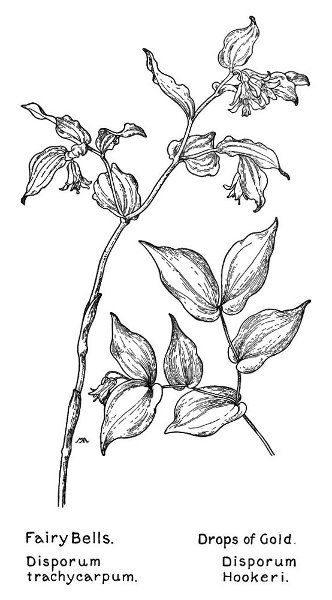
Fairy Bells—Disporum trachycarpum. Drops of Gold—Disporum Hookeri.
Perhaps the most characteristic western flowers are the members of the genus Calochortus. They grow freely all through the West, as far north as British America, and down into Mexico, but they never get east of Nebraska, so these gay and graceful flowers may be considered the peculiar property of the West. Calochortus means "beautiful grass" and the leaves are usually grasslike, the stems slender and the flowers bright in color, decorative and interesting in form. They have three sepals, often greenish, and three large, colored petals, with a honey-gland, usually covered with hairs, at the base of each. They are allied to true Tulips, so the popular name is suitable, and they fall into three groups: Globe Tulips, with nodding, globular flowers, and nodding capsules; Star Tulips, with erect, star-like flowers and nodding capsules; and Mariposa Tulips, with large, somewhat cup-shaped flowers and erect capsules. Mariposa means "butterfly" in Spanish and is appropriate, for the brilliant hairy spots on the petals are wonderfully like the markings of a butterfly's wing and the airy blossoms seem to have but just alighted on the tips of their slender stalks. They usually grow on dry open hillsides and their leaves have often withered away before the flowers bloom. The various forms run into each other, so that it is impossible to determine all the different species. They have solid bulbs, some of which are edible, considered a delicacy by the Indians and called Noonas.
Golden Lily Bell Yellow Globe Tulip Calochórtus amàbilis Yellow Spring California
A charming plant, with pale bluish-green foliage, with a beautiful "bloom," which sets off the clear-yellow blossoms to perfection. There are from two to twenty flowers on each stem and the petals are smooth, except for a neat, stiff fringe of hairs along the margins and the matted hairs on the glands, which are often reddish. These lovely flowers, common in northern California, are peculiarly fresh in color and when growing among the grass in the shade of oak trees they have the springlike charm of Daffodils in English woods.
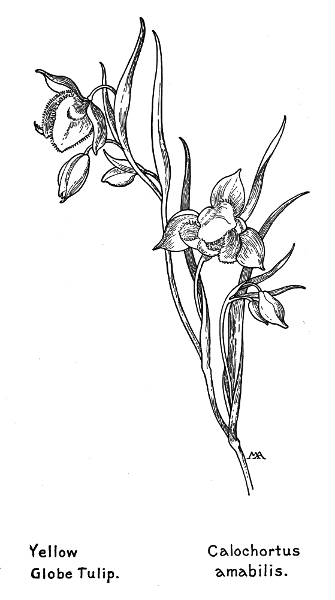
Yellow Globe Tulip—Calochortus amabilis.
Satin-bell. White Globe Tulip Calochórtus álbus White Spring California
Beautiful and popular flowers, with a great deal of individuality and quite Japanese in the decorative arrangement of the graceful stems and glossy, rich green foliage. The narrow root-leaf is over a foot long and spreads on the ground and other smaller leaves are disposed along the bending stem, which is from one to two feet tall and hung with pretty light-green buds and beautiful drooping blossoms, over an inch long, pearly white, sometimes tinged with lilac, with a satiny sheen and delicate yet crisp in texture. The papery sepals are greenish-white and the petals are sometimes tinged with purple at the base and are prettily fringed with hairs along the edges and often cross their tips in a very engaging way. They are covered inside with long, silky, white or yellow hairs and the glands are crescent-shaped, with close, short, sticky, white or yellow hairs, and form pale-green humps on the outside of the petals; the anthers are cream-color and the pistil whitish. The capsule is one or two inches long, with a short beak and brown seeds. These plants grow on shady banks in the Coast Ranges and have several pretty common names, such as Lantern of the Fairies and Alabaster Tulip, as well as the misleading name Hairbell, which causes this flower to be confused with the Harebell or Campanula.
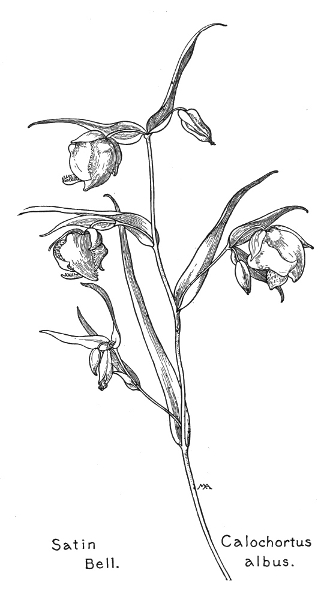
Satin Bell—Calochortus albus.
White Star Tulip Calochórtus nùdus White Summer California
This is a delicate and charming little flower, growing best in meadowy places in the woods of the Sierra Nevada Mountains at moderate altitudes, sometimes to a height of over seven thousand feet. The single, ribbonlike leaf is much taller than the flower-stalk, which is only a few inches high and bears several pretty flowers, measuring over an inch across, with pale-green sepals and three pure-white or pale-lilac, fan-shaped petals, with a little notch in the edge, almost without hairs and marked with a lilac crescent at the base; the honey-gland is divided crosswise by a toothed scale and the anthers are light blue. The nodding capsule is pointed at both ends.
White Pussy's Ears Calochórtus Maweànus White, gray Spring Cal., Oreg.
A charming little plant, with lovely little flowers, about an inch across, with white or pale-lilac sepals and white petals, hairy all over inside, often lilac at the base, the crescent-shaped gland covered with violet hairs and the anthers and pistil lilac. Usually the general effect is of a most delicate shade of gray and the little blossoms do not droop, but look straight up at one from among the grass. This is common in northern California.
Yellow Pussy's Ears. Yellow Star Tulip. Calochórtus Bénthami Yellow Spring California
Much like the last in character, from three to seven inches tall, with bluish-green, stiffish leaves and a few quaintly pretty flowers. They are about an inch across, clear light-yellow, with smooth sepals and the petals thickly covered with yellow hairs and sometimes brown at the base. This is common in the Sierra foothills.
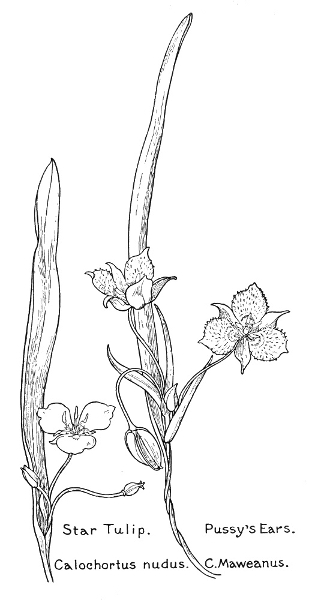
Star Tulip—Calochortus nudus. Pussy's Ears—C. Maweanus.
Butterfly Tulip Mariposa Tulip Calochórtus lùteus var. oculàtus Many colors Spring, summer California
The commonest kind in northern California, found in both the Sierra Nevada and Coast Mountains, and one of the most beautiful of all the Mariposas. The broad petals, each about an inch and a half long, are usually white, lilac, or yellowish, with an "eye" like that on a peacock's feather, giving the name oculatus. Occasionally they are deep rose-color, as in the colored picture, though this is not typical, and have a vivid blotch of shaded maroon and crimson and an orange spot on each petal, with some maroon-colored hairs at the base. The sepals are striped with pink and maroon and twist into spirals as they fade; the pistil and the blunt anthers are mauve; the honey-gland narrowly crescent-shaped; the leaves pale-green and the delicate stem over a foot tall. This Mariposa is extremely variable and seems sometimes to merge into C. venústus, a similar kind, and gorgeous varieties of both may be seen along the Yosemite road on the down grade to Wawona. There are many similar Mariposas, but the casual flower-lover who finds any of these beautiful flowers will probably be satisfied to know that they are Butterfly Tulips, without going into the technical peculiarities which differentiate them.
Yellow Mariposa Tulip Calochórtus lùteus var. citrìnus Yellow Spring California
A fine robust plant, about a foot tall, with a stout stem, light, bright green leaves, and exceedingly handsome flowers, over two inches across. The sepals are yellowish, with a black spot and streaks of brown, and the petals are deep lemon-yellow, each with a rich maroon spot near the center and a hairy, brown, crescent-shaped gland below, often flecked with maroon at the margins and base, with cream-colored anthers and a yellowish pistil. This is very much like a Tulip in character and looks very gay and cheerful growing in green fields. The typical C. luteus is similar, but smaller and duller in color.
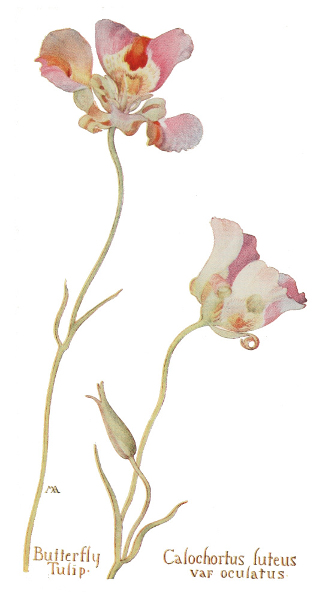
Butterfly Tulip—Calochortus luteus. var. oculatus.
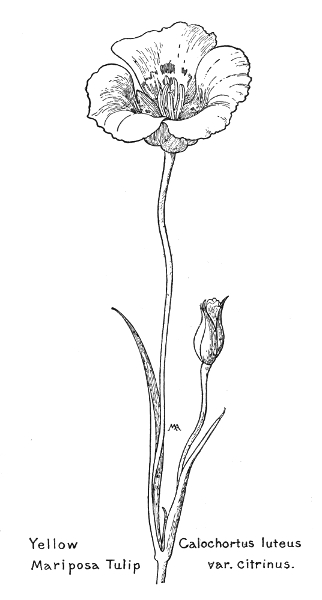
Yellow Mariposa Tulip—Calochortus luteus var. citrinus.
Orange Mariposa Tulip Calochórtus Kénnedyi Orange-red Spring Cal., Ariz.
A wonderful flower, exceedingly brilliant and unusual in color, not quite like anything else in nature. The stout, firm stem is from two inches to over a foot tall and the leaves are dark-green, with a delicate bluish "bloom." The flowers are about two inches across, with pale-green sepals, bordered with pale-pink and orange inside, and beautiful petals, thick in texture and easily bruised, delicate peach-color outside and bright orange-vermilion within, each petal ornamented with a purplish gland, covered with matted hairs and crossed with a band of long vermilion hairs. When the stems are very short the flaming flowers look like Crocuses, sprouting out of the barren desert soil, but when they are tall they have the gorgeous effect of Tulips. These plants grow in the Mohave Desert, but are rather rare in California. They are very abundant in the foothills and on the mountain slopes of Arizona, giving a beautiful orange-red color to the landscape for miles in spring, there being literally thousands in a small area.
Sego Lily Mariposa Tulip Calochórtus Nuttállii White, pale lilac Early summer Ariz., Cal., Utah
These pretty flowers are about two inches across, their white petals tinged with yellowish-green or lilac, and often delicately fluted at the edges, often with hairy spots inside the petals at their base, the whole flower very variable in coloring. These Mariposas grow all through the Southwest. In the Grand Canyon they begin to come out early in May, among the dry grasses halfway down the Bright Angel trail, and are a lovely shade of clear lilac. The slender stem, about a foot tall, often bears a small bulb near the base. It is called Sego Lily (pronounced Sègo) in Utah and is the "State flower." Its bulbs formed a substantial part of the food of the early Mormon pioneers when they crossed the desert and the flower is therefore held in great esteem in Utah.
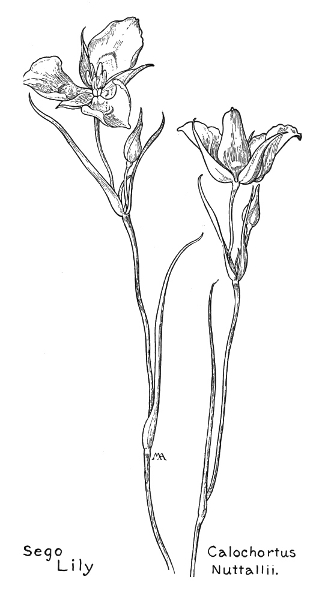
Sego Lily—Calochortus Nuttallii.
IRIS FAMILY. Iridaceae.
A large family, widely distributed and found throughout our continent. Perennial herbs, with bracts; the leaves long, narrow, toothless, and sheathing; the flowers showy, perfect and regular, twisted in the bud, not falling off in withering, of three and six parts; the three stamens on the base of the sepals, their anthers turning outward; the single style with three branches; the ovary inferior, becoming a three-celled, usually three-angled, many-seeded capsule. This family is noticeably distinguished from the Lily family by the inferior ovary, and from the Amaryllis family by the three stamens.
There are many kinds of Iris. To the casual observer the flowers appear to have nine petals of different sizes, but in reality there are three sepals, three petals, and three petal-like branches of the style. The three outer divisions, or sepals, are large and spread or turn down; the three inner divisions, or petals, are usually narrower and are erect; the style branches arch over and under each is a stamen. The sepals and petals have claws, which are united below and form a tube; the capsule is large and contains many, flat, black seeds, in one or two rows in each cell; the large rootstock is usually fleshy. Iris is from the Greek for "rainbow," in allusion to the variegated tints, and Flower-de-luce from the French "fleur-de-lis," or "lily-flower." Many odd and beautiful kinds are cultivated from the Old World. Orris-root is made from the roots of a Florentine species.
Western Blue Flag Ìris Missouriénsis Violet, blue Spring, summer West, except Wash, and Oreg.
A very handsome and decorative plant, growing in large clumps, in damp situations, from stout, creeping rootstocks. The stiff, sword-shaped leaves, mostly shorter than the stems, are smooth and light bluish-green and the stout stems, from one to two feet high, bear usually two, pale-violet flowers, about three inches long, emerging from thin, papery bracts. The sepals are white, or pale blue, delicately veined with violet, with a yellow-veined rib down the middle, the petals are pale blue or pale violet, veined with purple, and the buds are yellowish, veined with brown. This grows in profusion in the Yosemite meadows, at the foot of El Capitan, and is delicately beautiful, but would be more effective if the coloring were a little stronger.
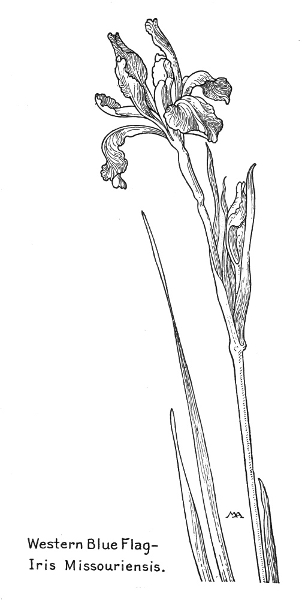
Western Blue Flag—Iris Missouriensis.
Douglas Iris Ìris Douglasiàna Purple, lilac, cream Spring, summer Cal., Oreg.
A beautiful kind, very common in the Coast Ranges. It grows in patches, or singly, and has rather dark green leaves, longer than the flower-stalks, and lovely flowers, which vary exceedingly in color. Near the coast they are usually bluish-purple, but in mountain woods they run from violet and mauve to pink, yellow, and white. They are often striped with white and yellow, delicately veined with purple, and measure three or four inches across. In the redwood forests, in northern California, they are peculiarly large and beautiful, their delicate tints of cream and straw-color, tinged with mauve and marked with reddish-purple, and wonderfully set off by their dark forest background. This kind often blooms throughout the rainy season, but chiefly in early spring.
Hartweg's Iris Ìris Hartwégi Yellow and violet Summer California
This odd and pretty little Iris grows in half-dry, open forests, in the Sierra Nevada Mountains. The many flower-stems, from six to twelve inches tall, are overtopped by some of the long, narrow leaves and the flowers are from one and a half to two inches long, either yellow, veined with violet, or pale-violet, veined with purple. The two color forms often grow together and attract much attention from tourists. They look very pretty, springing from a carpet of fallen pine-needles, in the forests along the Wawona road near Yosemite.
Ground Iris Ìris macrosìphon Blue, purple Spring, winter California
A beautiful kind, forming low clumps of many, very narrow leaves, from five to twenty inches long and much taller than the flower-stalks. The handsome flowers are over three inches across, bright purplish-blue, the sepals veined with darker color and marked with a white stripe. This is common on grassy hills near the coast and farther inland becomes taller and paler in color. The flowers are slightly sweet-scented and begin to bloom in January. The Hupa Indians used the leaves for making twine and rope for their nets and snares. There are many other beautiful western Irises.
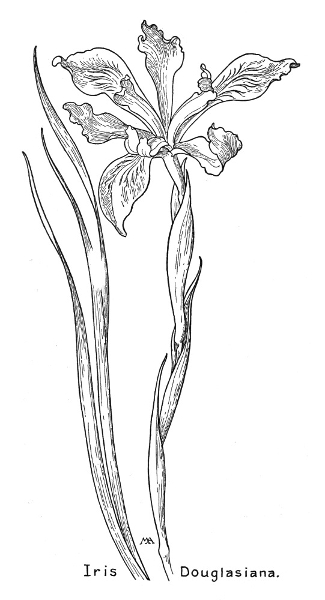
Iris Douglasiana.
There are numerous kinds of Sisyrinchium, attractive little plants, all American, many from South America; with fibrous roots; grasslike leaves; slender, flat stems, sometimes branching; papery and green bracts and pretty flowers, that soon wither, on very slender pedicels, the six spreading divisions all alike; the filaments of the stamens united; the style branches slender, the capsule roundish, containing round seeds.
Blue-Eyed Grass Sisyrínchium béllum Blue Summer Cal., Oreg.
The deep blue stars of this pretty plant are a beautiful feature of the fields near Santa Barbara, and in other parts of California, in summer; in fact they are so plentiful in some places that they are a menace to the farmers. They grow in clumps, about a foot tall, among the grass. The stems are somewhat branching, the leaves are shorter than the stem, and the bracts are about an inch long, green and sheathing. There are about seven flowers on each stem, in a loose cluster, each about an inch across and handsomer than their relations in the East. They vary in tint from bright blue to purple, with a yellow "eye," and their divisions are prettily notched at the tips, with a little prong. The anthers are arrow-shaped, the style short, with three very small stigmas, and the small, oddly-shaped, little capsule is dark-brown when ripe, and perhaps suggested one of the common names, Nigger-babies. It is called Azulea and Villela by Spanish-Californians.
Golden-Eyed Grass Sisyrínchium Califórnicum Yellow Spring, summer Cal., Oreg.
This is very much like Blue-eyed Grass, but the flowers are bright yellow, the stems are about a foot tall, broadly winged and not branching, and the leaves are somewhat broader. The pretty flowers are nearly an inch across and there are from three to seven in a cluster. The filaments are united at the base only, the style is cleft to below the middle, and the small capsule is rather oblong. This grows in swampy places near the ocean. S. Arizònicum has yellow flowers and branching stems and grows in Arizona. S. Élmeri also has yellow flowers, with purple lines, and is found in wet places in the Sierras. When pressed and dried the yellow-flowered Sisyrinchiums stain the paper reddish-purple.
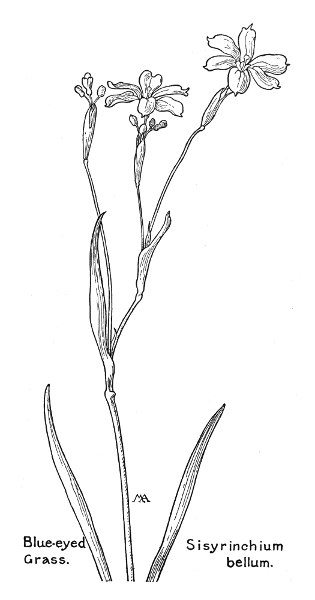
Blue-eyed Grass—Sisyrinchium bellum.
ORCHID FAMILY. Orchidaceae.
A very large family, most abundant in the tropics; curious plants, with oddly beautiful flowers. Perhaps because they are also rather rare they seem to have a peculiar fascination for the public; in fact almost any strangely-shaped flower is apt to be dubbed an orchid by the passer-by. They are perennial herbs, with various kinds of roots, some of them parasitic, usually with alternate, toothless leaves, the lower ones sheathing the stem. In some kinds the leaves have dwindled to scales. The flowers are perfect, irregular, with six divisions; the three sepals are alike and colored like petals; two of the three petals are alike, but the central one differs in size and shape and is called the lip. This is conspicuously colored, often spurred, and contains nectar for the attraction of "long-tongued" insects, on which these plants depend mostly for cross-pollination. The mechanism for this purpose is curious and interesting. The stigma is usually a broad sticky surface and its style is united with the filaments and forms, in front of the lip, a column which is usually capped by a single two-celled anther, containing two clusters of pollen, one in each cell. Each cluster consists of a few waxy grains, held together by cobweb-like threads, which run together and terminate in a sticky disk. These disks adhere to the insects, which push in to get the nectar, and are transported to the gummy stigma of another flower. The inferior ovary develops into a three-valved capsule, containing numerous minute seeds. Orchis is the ancient Greek name.
There is only one kind of Cephalanthera in North America; with creeping rootstocks; flowers in terminal spikes, with bracts; sepals and petals nearly equal; petals somewhat united and hooded; lip more or less pouched.
Phantom Orchis Cephalanthèra Austínae White Summer Northwest
In dense mountain forests these strange plants shimmer like pallid ghosts among the dark trees. They are pure translucent white throughout, stem and all, and the leaves have shrunk to white sheaths, an inch or two long. The stems are one to two feet tall and bear spikes of numerous flowers, each over half an inch long, with the lip shorter than the sepals and petals, which are alike. They are beautiful and yet not quite pleasing, for we feel instinctively that there is something unnatural about them and, indeed, the strange absence of any green coloring matter in their make-up indicates that they are incapable of making their own food from the elements and draw their nourishment from decaying vegetation, or are parasitic on other plants. They range northward from Yosemite but are nowhere very abundant. I found several growing near the trail from Little Yosemite Valley to Cloud's Rest and a good many in the woods near the foot of Mt. Shasta, where they seem to be quite common.
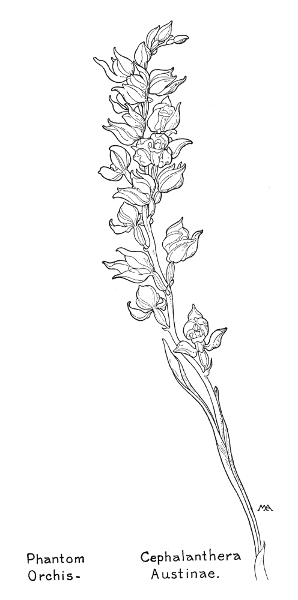
Phantom Orchis—Cephalanthera Austinae.
There are several kinds of Serapias, widely distributed; tall, stout herbs, with creeping rootstocks and leafy stems; the leaves plaited lengthwise and clasping at base; the flowers with leafy bracts, in terminal racemes. The flowers have no spur; the sepals and petals are separate and nearly equal; the lip broad, free, concave below, constricted near the middle.
Stream Orchis Chatter-box Seràpias gigantèa (Epipactis) Reddish and greenish-yellow Summer West, etc.
A handsome plant, decorative and curious in form and unusual in coloring. It is from one to four feet tall, with a stout, leafy stem bearing three to ten flowers and smoothish leaves, with prominent veins. The sepals are reddish or greenish-yellow and the petals pinkish, veined with maroon. The lip is pouched at the base, with a winged margin and a pendulous tip, which swings freely as if on a hinge, so that it quivers when the plant is shaken. Although the flowers are very handsome this curious tremulous motion, which makes them seem almost alive, gives them a quaint likeness to an old woman in a sunbonnet, with a hooked nose and chattering jaw. They have a slight scent and the plant is quite common along streams and in wet places, in the West and in Colorado and Texas. Some botanists think it is identical with a variety which grows in the Himalaya Mountains. It was named for the Egyptian deity, Serapis.
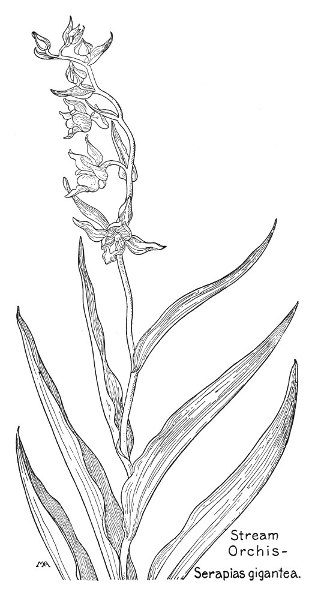
Stream Orchis—Serapias gigantea.
There are several kinds of Corallorrhiza, widely distributed in the north temperate zone and growing in dense woods; pinkish or straw-colored plants, more or less parasitic, with large roots resembling branches of coral; the leaves all reduced to sheathing, papery scales; the flowers in terminal racemes, without bracts, on short pedicels, which turn down in fruit, mostly with a short spur, the sepals and petals about equal, the upper ones curving in.
Coral-root Corallorrhìza multiflòra Reddish-yellow Summer Wash., Oreg., Cal., Utah
The curious knobby rootstock, shaped like a bit of coral, gives the name to this strange and rather unwholesome looking plant. From living on decayed vegetation it has lost its green leaves, and has only a few papery sheaths in their place, and the thick, translucent stem is pale and smooth, from one to two feet tall, pink at the base, shading to golden-brown towards the top. The flowers, less than half an inch across, are usually yellow, with reddish-brown tips, and the white, three-lobed lip is spotted with purple. The buds are yellow and brown and the whole color effect is very pretty, as if the plant were trying to match the russet tints of the floor of the forest. The flowers vary from several to many and grow in a long cluster, hanging down when their seeds begin to ripen. This is widely distributed, growing also in the East, but nowhere common.
Coral-root Corallorrhìza Bigelòwii Reddish-yellow Summer Wash., Oreg., Cal., Utah
This is a similar plant, but handsomer, with much larger flowers, duller in coloring and striped not spotted. Instead of a spur the base of the sepals is swollen over the ovary, which develops gradually into an oblong fruit to which the flower still clings, so that the older flowers, on the lower part of the stalk, give an odd effect of having long, swollen necks. The seeds are small and numerous. There are other kinds, similar in general effect.
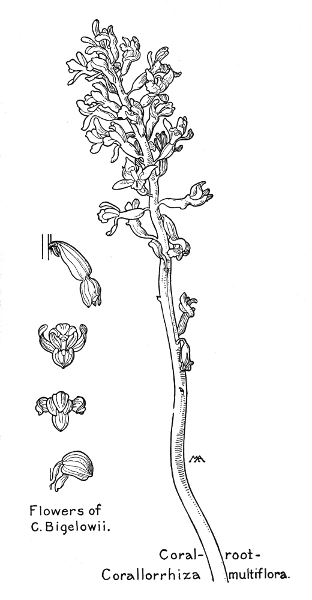
Flowers of C. Bigelowii. Coral-root—Corallorrhiza multiflora.
There are numerous kinds of Limnorchis; the lower leaves clasping or sheathing the stem; the flowers mostly in spikes or racemes; sepals nearly equal, petals mostly smaller than the sepals; lip spreading or drooping, not toothed or lobed, with a spur. The Latin name means "marsh-dweller."
Sierra Rein Orchis Limnórchis leucostàchys (Habenaria) White Summer Cal., Oreg., Wash.
Often in some favorable corner of a marsh, near the woods, we may see a dozen of these lovely plants, their robust leafy stalks sometimes as much as four feet tall, rearing their delicate spires of bloom above the lush grass. The long narrow leaves are bright-green and smooth and the numerous, small, delicate blossoms, sprinkled thickly along the stem, are pure white, each with a very long spur like a little tail, each with a green bract at the base of its little pedicel, and deliciously fragrant. There are several similar kinds, mostly with green flowers; this is the handsomest and least rare.
There are many kinds of Cypripedium, with large, broad leaves and one or several, large, drooping flowers, with two fertile anthers, with short filaments, one on each side of the column below the stigma, and a conspicuous, petal-like, sterile anther, arching over the stigma. They are easily known by the curious lip, which is a large inflated sac, suggesting both the common names, Lady's Slipper and Indian Moccasin, and the Greek, meaning "foot of Venus."
Mountain Lady's Slipper Cypripèdium montànum Brown and white Summer Northwest
Beautiful and decorative, with a stout, hairy stem, one to two feet tall and a few handsome flowers, rich and harmonious though not brilliant in coloring, with a lip about an inch long, dull-white, veined with purple, and brownish or purplish sepals and petals, very long, narrow, and twisted. This grows in mountain woods and is found around Yosemite. There is a picture in Miss Parsons's Wild Flowers of California. C. Califórnicum is similar, but with more flowers, the sepals and petals greenish-yellow, the lip pinkish. C. parviflòrum has a yellow lip and purplish sepals and grows in northern woods, across the continent. None of these plants is common.
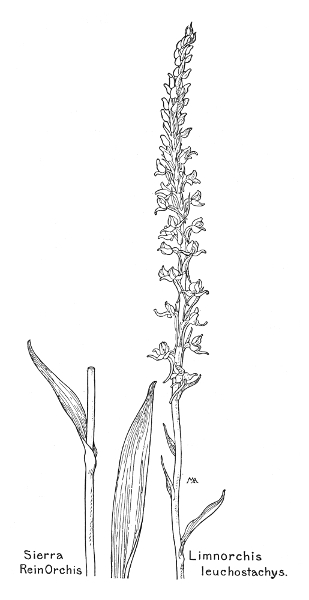
Sierra Rein Orchis—Limnorchis leucostachys.
LIZARD-TAIL. Saururaceae.
A small family; ours are perennial astringent herbs, with alternate, toothless leaves, with leaf-stalks; flowers perfect, with bracts, in a dense, terminal spike, without calyx or corolla; stamens generally three or six; ovary with one to five stigmas; fruit a capsule or berry.
There are two kinds of Anemopsis.
Yerba Mansa Anemópsis Califórnica White Spring Cal., Ariz.
This plant bears several, large, cream-white flowers, which at the first glance appear to have from five to eight petals and a long, projecting knob in the center, but what appears to be a corolla is in reality an involucre, about an inch and a half across, and surrounding the base of a long, conical spike of numerous, small, greenish flowers. These are half-sunk in the fleshy substance of the spike and have no sepals or petals, but each has a small, white bract at its base, so that the spike appears to be covered with scales symmetrically arranged. The flower has from six to eight stamens on the base of the ovary and from three to four stigmas. The ovaries, which are superior, form small pods, opening at the top when ripe, so that in the end the spike is neatly pitted with holes. The rather thick, hollow, reddish stems are from six inches to two feet tall, covered with hair, and the smooth, light-green leaves, from two to ten inches long, are mostly from the root, with leaf-stalks which broaden at the base and partly sheathe the stem. The creeping rootstocks are peppery and acrid, used medicinally, and considered exceedingly valuable by Spanish-Californians. These pretty, odd-looking plants grow in alkaline or salty swamps in the south. The name is from the Greek meaning "anemone" and "appearance," but the flowers do not look very much like Anemones.
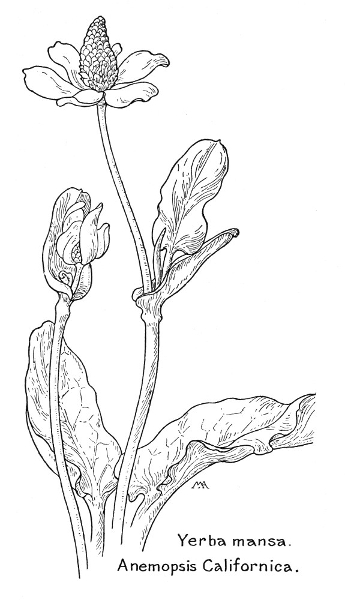
Yerba mansa—Anemopsis Californica.
SANDALWOOD FAMILY. Santalaceae.
This is a very small family in this country, for they prefer the tropics, and in those regions some are trees. Ours are usually parasitic on the roots of their neighbors. They have toothless, mostly alternate leaves, mostly without leaf-stalks or stipules, and small flowers, with a four- or five-lobed calyx and no corolla. The four or five stamens are opposite the calyx lobes, at the edge of a fleshy disk, and the ovary is one-celled and inferior, with one style, developing into a one-seeded fruit.
There are four kinds of Comandra, one of them European; smooth, perennial herbs, with alternate leaves, and flowers in clusters, without bracts. The calyx is more or less bell-shaped, usually with five lobes, its tube lined with a disk, the stamens inserted at base of the lobes and the anthers attached to the lobes by tufts of hairs.
Pale Comandra Comándra pállida Flesh-color, greenish, purplish Spring, summer Northwest, Nev., Utah, Ariz.
This is a rather pretty plant, growing from a few inches to about a foot tall, branching and rather woody below, with pale-green, smooth, slightly thickish, rather stiff leaves, which are reduced to pinkish scales on the lower stem. The flowers are small, usually flesh-color, thickish in texture, with slender pedicels, and form terminal, rather flat-topped clusters. The fruit, which is about the size of a small pea, is crowned by the remains of the calyx, like a rose-hip. This is common on dry plains and hillsides and is noticeable because of its pale and somewhat peculiar coloring.
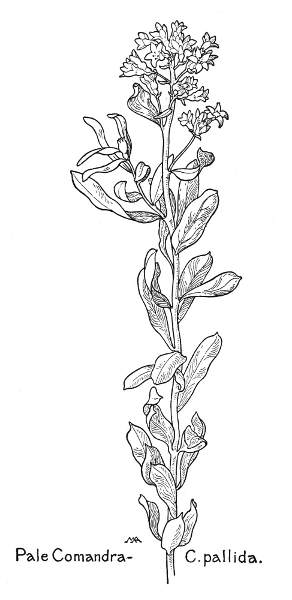
Pale Comandra—C. pallida.
BIRTHWORT FAMILY. Aristolochiaceae
A rather small family, chiefly of warm countries, but widely distributed; herbs or shrubs; the leaves alternate or from the root, with leaf-stalks, more or less heart-shaped, without stipules; the flowers perfect, mostly large, symmetrical or irregular in form, with or without a corolla; the calyx with three or six lobes, or irregular; the stamens six to many, inserted on the pistil; the ovary wholly or partly inferior; the fruit a mostly six-celled capsule, containing many seeds.
There are several kinds of Asarum.
Wild Ginger Ásarum Hartwégi Brown Spring Cal., Oreg.
The handsome leaves of this perennial are its conspicuous feature. They have long, hairy leaf-stalks and are heart-shaped and toothless, from three to five inches broad, dark rich green, prettily veined and often also beautifully mottled with white, smooth on the upper surface and hairy on the under. We notice them immediately in the damp, dark woods they live in, but unless we look carefully we miss the single, large, strange, purplish-brown flower, the color of dead leaves, which nestles close to the ground as if trying to hide itself. This has twelve stamens, with stout filaments, and six styles, united at the base. There are no petals, but the hairy calyx has three lobes, which are sometimes an inch and a half long, and have long points like tails. The seed-vessel is roundish, crowned by the withered calyx and stamens. The rootstock cannot be used as a substitute for ginger, but smells and tastes very aromatic and pungent. This resembles the Wild Ginger of the East, but is handsomer.
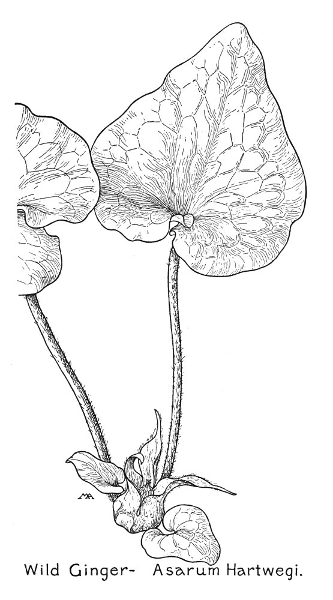
Wild Ginger—Asarum Hartwegi.
BUCKWHEAT FAMILY. Polygonaceae.
A large family, widely distributed, mostly herbs or low shrubs, with toothless leaves, often with stipules sheathing the swollen joints of the stem. The small flowers have no petals, the calyx usually resembles a corolla and has from three to six divisions. There are from four to nine stamens and a superior, mostly triangular, ovary, with two or three styles or stigmas, becoming a dry, one-seeded fruit, generally brown or black. The kind from which flour is made is cultivated from northern Asia, and the name Buckwheat, from the German, means "beech-wheat," because the grain resembles minute beech-nuts. There are several common "weeds" belonging to this family, such as Dock, Sorrel, and Smartweed.
Chorizanthes are low herbs, with branching stems, without stipules, the leaves forming a rosette at the base and withering early. The small flowers have six sepals and are clustered in small heads, usually one flower in each papery involucre, which has from two to six teeth, with bristles at the tips; stamens usually nine, on the base of the perianth; styles three, with round-top stigmas.
Turkish Rugging Chorizánthe fimbriàta Pink Spring California
An odd, dry-looking plant, making pretty patches of purplish color on dry mesas. The stiff, roughish, purplish stem is a few inches tall, springing from a few dull-green or reddish root-leaves, branching abruptly and widely towards the top and bearing many small flowers. The involucres are deep-red or purple, with very prickly teeth, the sepals bright-pink, prettily fringed with white and striped with deeper color, and the filaments are long and threadlike, with purple anthers. The flowers are exceedingly pretty when closely examined, though too small to be very effective, but the plant as a whole is conspicuous both in color and form. C. staticoìdes is similar, but the sepals are not fringed.
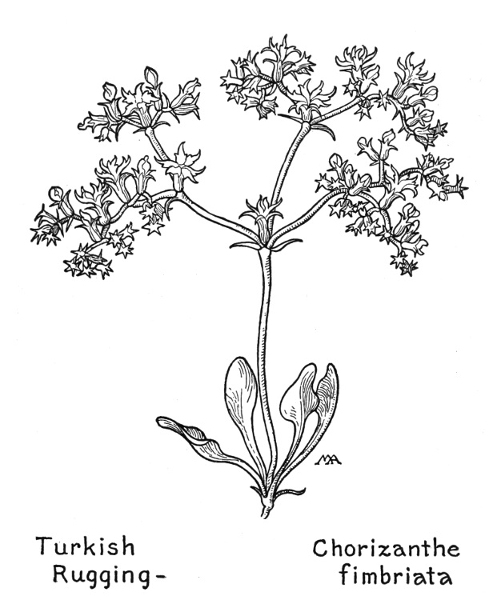
Turkish Rugging—Chorizanthe fimbriata.
There are many kinds of Rumex, or Dock, coarse herbs, with leafy, branching, grooved stems, sheathed with conspicuous, papery stipules, strong tap-roots and acid or bitter juice. The large leaves are alternate, with smooth or wavy edges; the flowers small, greenish or reddish, on jointed pedicels, in branching clusters; the stamens six; the styles three, the stigmas shield-shaped, with a tuft of hairs at the tip. The six divisions of the flower are in two sets, the three outer small and green, the inner ones larger, colored and becoming veiny and larger in fruit, forming valves or wings, (often with a grain on the back of one or all of them,) which closely cover the three-sided fruit. These wings make the fruits of Docks more conspicuous than the flower. The Latin name comes from a word meaning "to suck," because the Romans sucked the leaves to allay thirst.
Sand Dock Rùmex venòsus Greenish Spring, summer West
In favorable situations this is a very handsome member of a rather plain genus, about a foot tall, with a smooth, stout reddish stem and smooth, pale, blue-green leaves, that feel like thin rubber, with a prominent mid-vein front and back. The small inconspicuous flowers develop into clusters of showy valves or wings, wonderfully odd and beautiful in coloring, resembling Begonia flowers. At first these wings are pale green, but they gradually brighten until they are all shades of salmon, rose-color, and red, fading to brown, and forming lovely combinations of vivid color, particularly against the arid background of the sand hills they frequent, and they last a long time in water and are exceedingly decorative. If these wings, which are nearly an inch across, are pulled apart, a three-sided akene, like a little nut, will be found inside them.
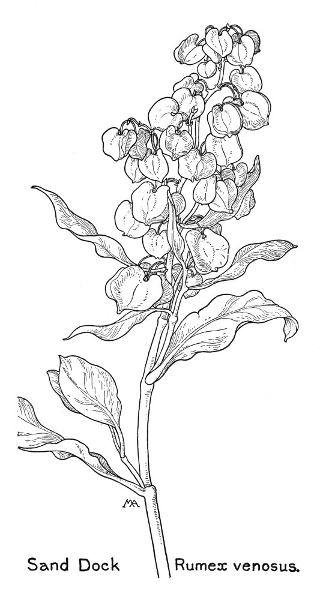
Sand Dock—Rumex venosus.
There are many kinds of Eriogonum, herbs or shrubs, natives of America, mostly western, growing in dry places, very numerous and difficult to distinguish. The leaves, without sheaths or stipules, are often covered with white down and usually grow in a spreading cluster at the base of the stem. The numerous small flowers, on very slender little pedicels, have six sepals, thin in texture and usually colored, and form clusters of various shapes, which emerge from more or less bell-shaped or top-shaped involucres, with six teeth. There are nine stamens, with threadlike filaments, often hairy, and a three-parted style with round-top stigmas. The name is from the Greek meaning "wooly knees," in allusion to the wooly joints of the stem.
Bottle-plant Eriógonum inflàtum Yellow Spring Southwest
This is a most extraordinary looking plant, with queer inflated, hollow stalks, about two feet high, swelling larger towards the top, and the branches, which are also swollen, sticking out awkwardly in all directions and bearing a few minute, yellow flowers. The stalks, which are pale bluish-green, suggest some strange sort of reed, but the dark-green leaves, growing in a rosette at the base, are something like the leaves of cultivated violets and seem entirely out of keeping with the rest of the plant. This grows on the plateau in the Grand Canyon and in similar places.
Swollen-stalk Eriógonum elàtum White, pink Summer Northwest
This is about a foot and a half tall and the stem is swollen, but not so much so as the last, and the flowers are more conspicuous, forming rather flat-topped clusters, about three-quarters of an inch across. The tiny flowers are cream-white or pinkish, the buds are deep-pink, and the stamens are long, with tiny, pinkish anthers. The leaves are dull-green on the upper side and pale with close down on the under and grow in a cluster at the base.
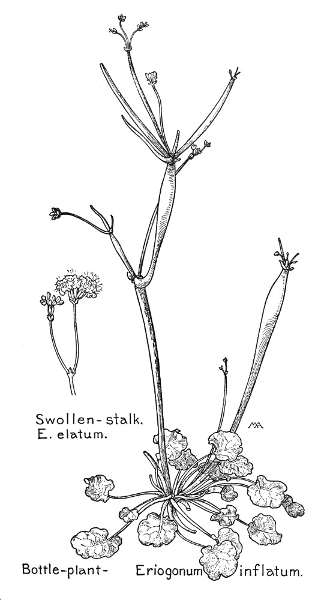
Swollen-stalk—E. elatum. Bottle-plant—Eriogonum inflatum.
Butter Balls, Snow Balls Eriógonum orthocàulon Yellow, white Spring, summer Northwest
These are attractive plants, with pretty odd little balls of flowers, and are very conspicuous on dry, rocky mesas. They have a number of slender, pale, downy stems, about ten inches tall, springing from a close clump of small, dull-green leaves, pale with down on both sides and the smaller ones almost white, and bearing at the tip a dense flower-cluster, about an inch and a half across, which is very fuzzy and pretty. The little flowers have cream-color, downy involucres, the outer sepals are broader than the inner, and the pedicels, stamens, and pistil are all the same color as the sepals, either very bright sulphur-yellow or cream-white, but not mixed on the same plant, and sometimes tinged with red. These flowers are very popular with children in Idaho and they make necklaces of the fuzzy balls, something like "daisy chains."
Eriógonum compósitum White, yellow Summer Northwest
This is a big handsome plant, with a thick, smooth stem, one or two feet tall and woody at base, and with thickish leaves, slightly downy, dark green in color on the upper side and white with close down on the under. The flowers form feathery, cream-white or yellow clusters, often more than six inches across, with red buds, and are beautiful and conspicuous on bare mountainsides, smelling of honey.
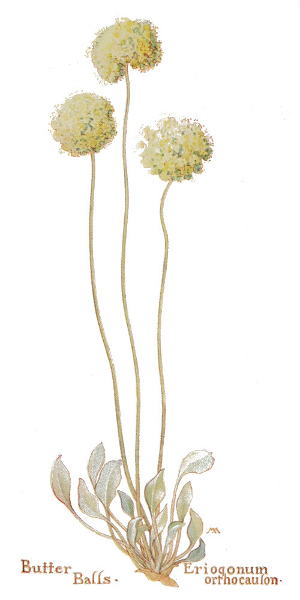
Butter Balls—Eriogonum orthocaulon.
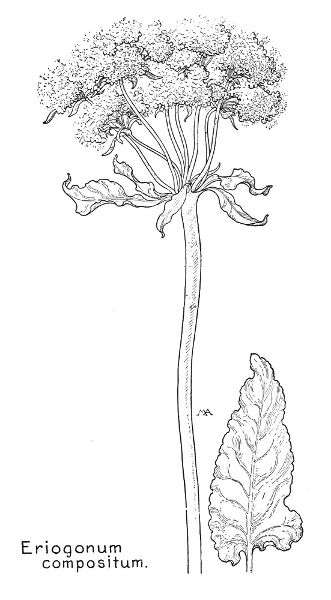
Eriogonum compositum.
Buckwheat Bush, Flat-top Eriógonum fasciculàtum White Spring, summer Southwest
In favorable situations this is an attractive shrub, from two to four feet high, with shreddy, reddish bark and long, straight branches, standing stiffly up and crowded with small, thickish, stiffish leaves, dark olive-green on the upper side and pale with down on the under, with rolled-back margins. The flowers are about three-eighths of an inch across, dull-white or pinkish, with pink buds, forming large, feathery, flat-topped clusters, on long, stiff, bare, reddish flower-stalks, standing up stiffly all over the bush. This is a very valuable bee-plant and grows on mesas and mountain slopes.
Sulphur Flower Eriógonum Bàkeri Yellow Summer Ariz., Utah, New Mex., Col., Wyo.
This plant is quite pretty and conspicuous, as the flowers are bright in color and a peculiar shade of sulphur yellow. The stem is downy and often reddish, about a foot tall, with two or three branches at the top, each bearing a cluster of numerous small sweet-scented flowers with pretty stamens. The gray-green leaves grow mostly in a rosette on the ground and are covered with close white down on the under side. Their soft tints tone in well with the bright color of the flowers and the pale sandy soil in which they grow. E. flàvum is similar and widely distributed. E. incànum is the same color but much smaller, often tinged with red, the gray leaves forming a dense velvety mat, and it grows at high altitudes, in sandy spots on rocks, and is found around the Yosemite Valley. The alpine form is very small. There are several other kinds of Sulphur Flower.