A KEY TO THE FAMILIES. (continued 3)
Reading edition
Yosemite Stonecrop Sèdum Yosemiténse Yellow Summer California
On moss-covered rocks, moistened by the glistening spray blowing from the Yosemite waterfalls, we find these beautiful plants, covering the stones with a brilliant, many-colored carpet. The flowers are stars of brightest gold, about half an inch across and delicately scented, and form flat-topped clusters, three or four inches across. The upper part of the stalk, which is about six inches tall, and the upper leaves are delicate bluish-green, but both stem and leaves shade to vivid scarlet at the base. Spreading out on the ground from the base of the stem in all directions are numerous little runners, each bearing at the end a small rosette of thick, blue-green leaves, forming a beautiful contrast to the vivid color of flowers and stems. The leaves and runners are very brittle and break off at a touch.
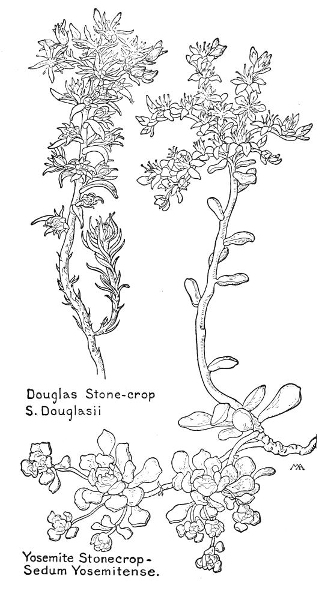
Douglas Stone-crop—S. Douglasii. Yosemite Stonecrop—Sedum Yosemitense.
There are several kinds of Dudleya; perennials, very thick and fleshy; root-leaves in a conspicuous rosette, stem-leaves mostly bract-like, usually with a broad, clasping base; flowers mostly yellow or reddish; calyx conspicuous, with five lobes; petals united at base; stamens ten. Most of these plants grow in the South, often on rocks, in such shallow soil, that they would die in dry weather, except that the juicy leaves retain their moisture for a long time and nourish the plant. They resemble Sedum in appearance, but as the petals are more or less united the flowers are not starlike. The Indians make poultices out of the leaves.
Hen-and-Chickens Dúdleya Nevadénsis (Cotyledon) Orange-red Summer California
The succulent, reddish flower-stalks of this handsome plant bear large, loose, rather flat-topped clusters of orange-red flowers, on coiling branches, and are about a foot tall, with scaly bracts, springing from a large handsome rosette on the ground of very thick, pale-green leaves, often tinged with pink. Other smaller rosettes form a circle around it, hence its nice little common name. D. pulverulénta (Echeveria) is beautiful but weird-looking. It has red flowers, and the rosette, resembling a small Century-plant, is covered all over with a white powder which, among ordinary herbage, gives an exceedingly striking and ghostlike effect. This plant is sometimes a foot and a half across, with as many as eight, tall stalks, and is found from San Diego to Santa Barbara.
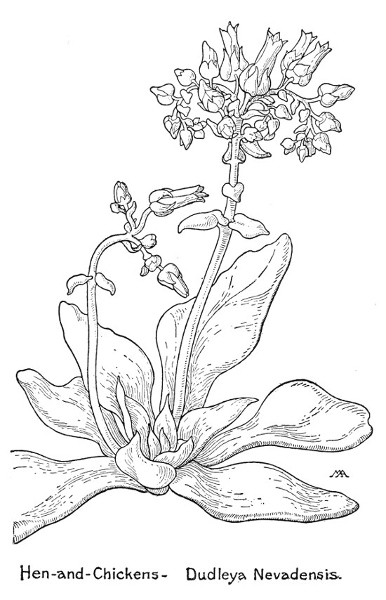
Hen-and-Chickens—Dudleya Nevadensis.
SAXIFRAGE FAMILY. Saxifragaceae.
A large family, almost all herbs, living usually in temperate regions. They have no very peculiar characteristics and resemble the Rose Family, but sometimes their leaves are opposite, usually they have no stipules and have fewer stamens than Roses, not more than twice as many as the sepals, and usually the pistils, from two to five in number, with distinct styles, are united to form a compound ovary, which is superior or partly inferior; sepals usually five; petals four, five, or rarely none, alternate with the sepals; petals and stamens borne on the calyx; fruit a dry pod or berry, containing numerous seeds. The Latin name means "rock breaker," as many grow among rocks.
There are several kinds of Parnassia, of north temperate and arctic regions; smooth perennials; leaves toothless, almost all from the root; flowers single; sepals five; petals five, each with a cluster of sterile filaments, tipped with glands, at the base; fertile stamens five, alternate with the petals; ovary superior, or partly inferior, with a very short style, or none, usually with four stigmas; fruit a capsule, containing numerous winged seeds. These plants were called Grass of Parnassus by Dioscorides, but are not grasslike. They resemble the other members of this family so little that they have been made into a separate family by some botanists.
Grass of Parnassus Parnássia fimbriàta White Summer Northwest
A charming plant, with several slender stems, about a foot tall, springing from a large cluster of handsome, very smooth, glossy leaves. The flowers are about an inch across and have cream-white petals, delicately veined with green and prettily fringed towards the base, and pale yellow anthers. At the base of each petal there is a queer little stiff cluster of sterile filaments, like a tiny green hand. This grows on banks of streams and in moist places, reaching an altitude of eleven thousand feet. P. Californica is similar, but the petals not fringed.
There are several kinds of Leptasea, perennials, with alternate, thick or stiffish leaves; flowers white or yellow, single or in terminal clusters; sepals five; petals five, with claws or claw-like bases; stamens ten; ovary mostly superior.
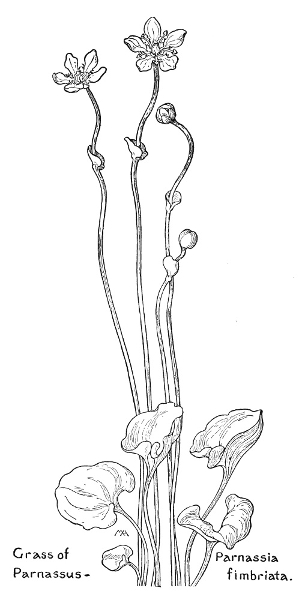
Grass of Parnassus—Parnassia fimbriata.
Dotted Saxifrage Leptàsea austromontàna. (Saxifraga bronchialis) White Summer Northwest
Pretty little plants, about six inches tall, forming matted clumps of stiff, rather dark green foliage, the twigs crowded with leathery, toothless leaves, bristly along the edges and tipped with a little stiff point. The pretty flowers are about half an inch across, their white petals dotted with dark red or purple towards the tips, sometimes dotted with yellow near the center, with yellow anthers and a pale green ovary, partly inferior. These little plants sometimes cover rocky slopes for long distances with their leafy mats and are common in the mountains at moderate altitudes.
There are several kinds of Muscaria, perennial, matted herbs; leaves alternate, usually three-lobed, mostly from the root; flowers white, single, or a few in terminal clusters; sepals five; petals five, without claws; stamens ten; ovary about one-half inferior.
Tufted Saxifrage Muscària caespitòsa (Saxifraga) White Summer Northwest, etc.
Pretty little plants, from two to six inches tall, with small leaves, with from three to five lobes or teeth, forming matted patches of pretty foliage, from which spring many slender, slightly hairy flower-stems, with a few bracts or leaves, and bearing one or more pretty flowers, less than half an inch across, with white petals, yellow anthers, and a greenish-yellow ovary. This grows in rocky crevices in the mountains, across the continent, also in arctic and alpine Europe and Siberia.
There are a good many kinds of Lithophragma, perennials, bearing bulblets on their slender rootstocks and sometimes also on the stems; leaves more or less divided, mostly from the root; stipules small; flowers few, in a loose, terminal cluster; sepals five; petals five, white or pink, with claws; stamens ten, short; ovary superior or partly inferior, with three short styles.
Woodland Star Lithophrágma heterophýlla White Spring, summer California
A little woodland plant, delicate and pretty, with a slender, hairy stem, from nine inches to two feet tall, springing from a pretty cluster of hairy leaves, variable in shape, but usually with three or five lobes. The starry flowers are three-quarters of an inch across, with white petals, prettily slashed. This is sometimes called Star of Bethlehem, but that name belongs to an Ornithogalum, grown in gardens.
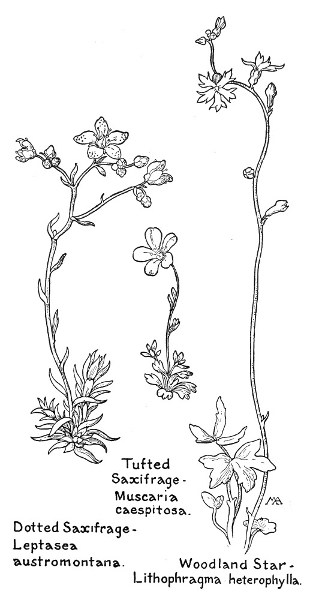
Dotted Saxifrage—Leptasea austromontana. Tufted Saxifrage—Muscaria caespitosa. Woodland Star—Lithophragma heterophylla.
Youth-on-age Leptáxis Menzièsii. (Tolmiea) Purplish Summer Wash., Oreg., Cal.
The only kind, a perennial, over a foot tall, with a hairy stem bearing a graceful wand of small flowers, springing from a cluster of root-leaves, bright green and thin in texture, but roughish and sparsely hairy. The flowers are about a third of an inch long, the calyx, which is the conspicuous part, dark-purple or pinkish-red and slightly irregular, with three large and two small sepals, and the petals of the same color, but so narrow that they look like long curling filaments. The three stamens are opposite the three upper sepals, the ovary is superior and the capsule has two long beaks. Young plants often spring from the base of the leaf, where it joins the leaf-stalk, and this habit gives the common name. This grows in mountain woods and is attractive, for though the flowers are dull in color they are unusual in form and the leaves are pretty.
There are a good many kinds of Heuchera, North American, difficult to distinguish; perennials, with stout rootstocks; leaves mostly from the root; flowers small, in clusters; calyx-tube bell-shaped, with five lobes; petals small, sometimes lacking, on the throat of the calyx, with claws; stamens five, inserted with the petals; ovary partly inferior, with two slender styles, becoming two beaks on the capsule.
Alumroot Heuchèra micrántha Pink and white Summer Cal., Oreg., Wash.
These feathery sprays are so airy and delicate that they might almost be made of mingled mist and moonshine, blown from the waterfalls they love to haunt, but are not so fragile as they look, for the clusters of tiny pink and white flowers last a long time in water. The stem is very slender, rather hairy, from one to three feet tall, springing from a cluster of roundish leaves, prettily lobed and scalloped, bright green, with some white hairs on the backs and on the long leaf-stems, often with red veins. The handsome leaves and lovely feathery spires are conspicuous, decorative and quite common, among mossy rocks in dark, rich mountain woods, up to six thousand feet.
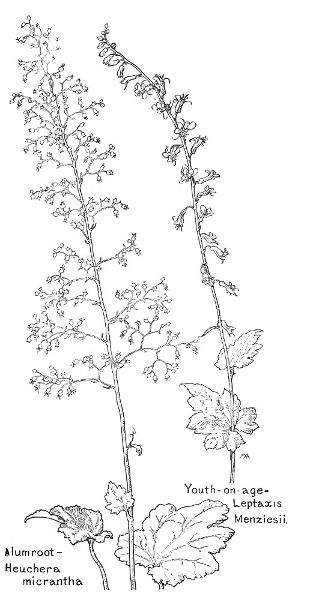
Alumroot—Heuchera micrantha. Youth-on-age—Leptaxis Menziesii.
Alumroot Heuchèra rubéscens Pink and white Summer Southwest, Utah, Nev.
This is not so tall and the leaves, with blunt teeth and sometimes slightly lobed, are smaller. In Utah they are dark green and shining on the upper side, smooth or slightly downy, with a bristle at the tip of each lobe, often reddish on the under side, and in Yosemite quite rough, with hairs on the edges and veins. The flowers are about a quarter of an inch across, the calyx deep-pink, with blunt, green teeth, the petals long, narrow and white, the general effect of the flower being pink. The clusters are not nearly so airy as those of H. micrantha and in the high Sierras the stems are shorter and the clusters still more compact. This was first found on one of the islands in Great Salt Lake. There are other similar kinds, some with greenish flowers.
There are several kinds of Micranthes, perennials, sometimes with bulblets at the base of the stem; leaves thickish, from the root; flowers white, in terminal clusters; petals five, mostly without claws; stamens ten; ovary slightly inferior.
Tall Swamp Saxifrage Micránthes Oregàna (Saxifraga) White Summer Northwest
This is conspicuous on account of its height, with a stout, stiff, leafless, hairy flower-stalk, three feet or more tall, springing from a loose rosette of smooth, thickish, bright-green leaves, not standing up stiffly but spreading, sometimes nearly a foot long, paler on the under side and obscurely toothed at the ends, with some minute hairs along the lower margins. The flowers are small, with cream-white petals, orange-red anthers and a green ovary, and form a long branching cluster towards the top of the stalk. This grows in swamps in the mountains.
Saxifrage Micránthes rhomboídea (Saxifraga) White Spring, summer Southwest, Idaho, Utah, Col.
A little alpine plant, growing in moist soil, or on mossy rocks. The sticky-hairy flower-stem is from two to twelve inches tall, springing from a cluster of dull-green root-leaves, toothless, or toothed towards the ends, slightly thickish and very slightly downy and the flowers are small, and form a compact cluster.
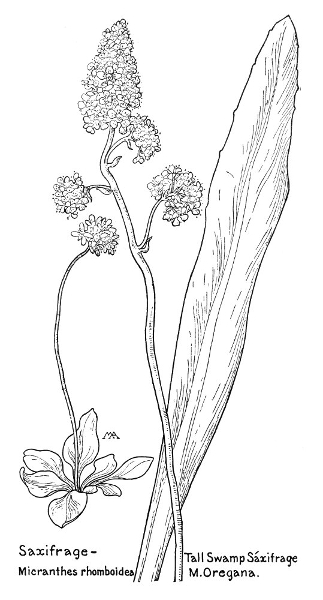
Saxifrage—Micranthes rhomboidea. Tall Swamp Sáxifrage—M. Oregana.
Modesty Whípplea modésta White Spring Wash., Oreg., Cal.
The only kind, a pretty little under-shrub, with many woody stems, spreading and trailing on the ground, the branches clothed with more or less hairy leaves, with three veins, and bearing clusters of very small flowers, with a pleasant honey-like fragrance. They usually have ten stamens, the ovary is partially inferior, with from three to five styles; sepals whitish; petals white, becoming greenish. The low masses of green foliage, spotted with white flower clusters, are a pretty feature of the Coast Range forests and thickets, especially among redwoods.
There are several kinds of Mitella, perennials, of North America and Asia.
Bishop's Cap, Mitrewort Mitélla ovális White Summer Northwest and Utah
An inconspicuous little plant, of mountain woods, with pretty leaves and tiny flowers. The slender, hairy, leafless stem, about ten inches tall, springs from a cluster of root-leaves, smooth on the upper side, except for a few bristly hairs, with bristly hairs on the under veins and on the long, slender leaf-stalks. The flowers grow in a graceful, one-sided spray and have a five-lobed, green calyx, five minute petals, five stamens with short filaments, and a roundish ovary, almost wholly inferior. The petals have pretty little bits of feathery fringe between them, which make the little flowers look like tiny snow crystals in shape, when we examine them closely.
There are several kinds of Spatularia, perennials, sometimes with bulblets; leaves from the root, mostly toothed; flowers white, in open clusters; sepals five; petals all clawed, the three upper differing from the two lower; ovary chiefly superior.
Spatulària Brunoniàna (Saxifraga Nutkana) (Saxifraga Bongardi) White Summer Northwest
A beautiful plant, with such slender stems and branches that, at a distance, the little white flowers look like specks of foam. The hairy, reddish stems, from a few inches to over a foot tall and very branching, spring from clusters of thickish, stiffish, hairy root-leaves and bear dozens of flowers, about three-eighths of an inch across, with white petals, spotted with yellow or red at the base and slightly irregular, the three upper petals being narrower than the two lower. The anthers are orange; ovary white or pinkish; calyxes and buds purplish-red. This grows among rocks in mountains.
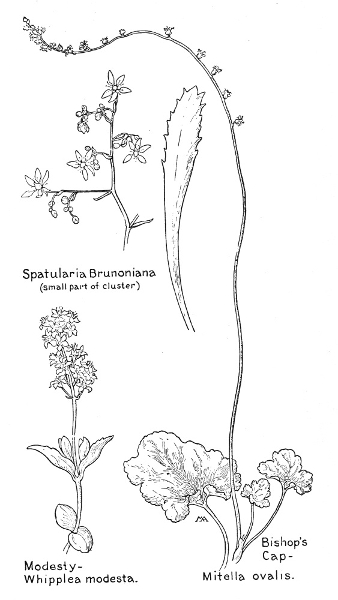
Spatularia Brunoniana (small part of cluster). Modesty—Whipplea modesta. Bishop's Cap—Mitella ovalis.
HYDRANGEA FAMILY. Hydrangeaceae.
Shrubs or trees, with opposite leaves and no stipules. The flowers are in clusters and usually perfect, but sometimes those at the margins of the clusters are without pistils or stamens and larger than those in the middle; the calyx usually with four to ten sepals, and in sterile flowers often conspicuously enlarged; the petals four to ten; the stamens eight to many; the ovary wholly or partly inferior; the styles separate or united, sometimes lacking; the fruit a capsule. Many very ornamental garden shrubs, such as Deutzia and Hydrangea, are included in this family.
There are several kinds of Fendlera, natives of North America; shrubs, with white or pink flowers, with four sepals and four petals, the latter with claws. The eight stamens have two-forked filaments and the ovary is partly inferior, with four styles.
Féndlera rupícola White, pink Spring Ariz., Utah, Nev.
Among the many beautiful plants to be found in the Grand Canyon one of the most conspicuous is the Fendlera. It is a tall, handsome shrub, growing along the upper part of Bright Angel trail, and in May it is covered with charming white blossoms. These flowers measure an inch across, and have cream-white or pale pink petals, narrowing to a claw at the base, and purplish sepals, and they grow in clusters of three or four, mixed with pink buds, on the ends of short branches. The small oblong leaves have three nerves and the wood is tough and gray, with deeply furrowed bark. Though their scent is rather unpleasant, the flowers are lovely and look just like some novel variety of fruit-blossom, but this resemblance is deceptive for they produce nothing but dry pods.
There are a good many kinds of Philadelphus, natives of North America, Asia, and Europe; shrubs, with large, white or cream-colored flowers; the calyx top-shaped, with four or five lobes; the petals four or five; the stamens twenty to forty, inserted on a disk; the ovary inferior, with three to five styles; the capsule top-shaped, containing many oblong seeds. These plants were named in honor of King Ptolemy Philadelphus. They are often called Mock-Orange, because the flowers often resemble orange-blossoms. The commonest name, Syringa, is confusing, because that is the generic name of the Lilac.
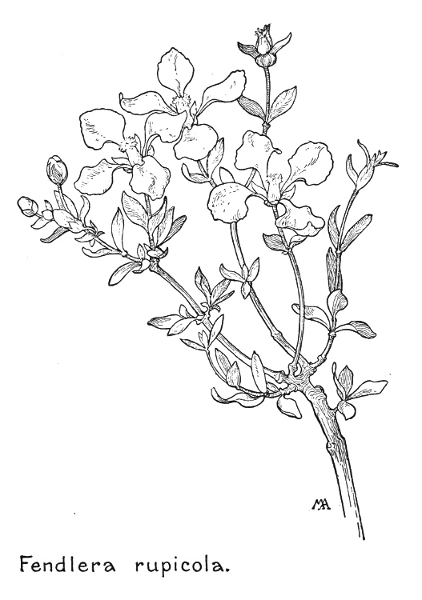
Fendlera rupicola.

Syringa Philadélphus Califórnicus White Summer Cal., Oreg., Wash.
In June and July, in the high Sierras, up to an altitude of four thousand feet, this lovely shrub forms fragrant thickets of bloom. It looks very much like the familiar garden Syringa and the smell is just as delicious. The bush is from four to twelve feet high, with smooth, pale, woody stems, dark-green leaves, sometimes slightly toothed, very smooth and shiny, and pretty flowers, in clusters at the ends of the branches. They are each about an inch across, with four or five, cream-white petals, rolled in the bud, and a golden center, composed of numerous, bright-yellow stamens.
Small Syringa Philadélphus microphýllus White Summer Ariz., Cal., New Mex.
A small shrub, not nearly so handsome as the last, from two to three feet high, with slender, pale-gray, woody stems, branching very abruptly. The small leaves are smooth and very bright green on the upper side, but the under side is very pale and covered with close white down. The flowers are much smaller than the garden Syringa, with white petals and numerous yellow stamens, the calyx reddish outside and downy within, and have a delicious smell, like lemon-blossoms. This pretty little shrub may be found growing in small shady canyons, in northern Arizona and elsewhere in the Southwest.
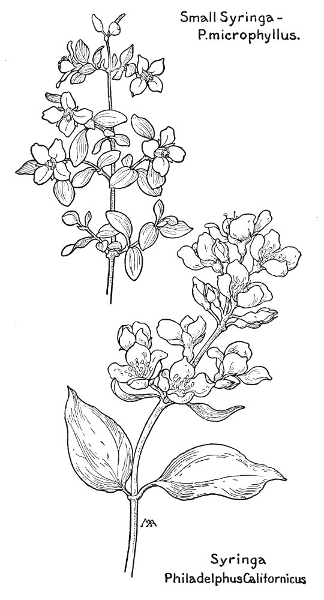
Small Syringa—P. microphyllus. Syringa Philadelphus Californicus.
GOOSEBERRY FAMILY. Grossulariaceae.
A small family, shrubs, with alternate, palmately-lobed leaves, often sticky or resinous; the flowers almost always in clusters; the pedicels with a bract at the base and usually with two bractlets halfway up; petals five, or rarely four, usually smaller than the calyx-lobes; stamens of the same number as the petals and alternate with them; ovary inferior, with two styles, more or less united; fruit a berry, crowned with the withered remains of the flower.
There are several kinds of Grossularia, or Gooseberry; shrubs, sometimes with trailing branches, almost always spiny; flowers with bracts; ovary often spiny.
Wild Gooseberry Grossulària Roèzli (Ribes) Maroon and white Spring California
This is a stout shrub, one to four feet high, with thick, short, rigid little branches, the knobby joints more or less spiny. The roundish leaves, less than an inch across, are lobed and scalloped, rather dull green and slightly downy, and the flowers are about half an inch long, with maroon-colored sepals and white petals, the base of the calyx-tube downy. The purple berry is half an inch in diameter and covered with stout prickles. This Gooseberry is common at moderate altitudes. The drooping, red and white flowers resemble tiny Fuchsias, both in color and form. G. Menzièsii, the Canyon Gooseberry, also has pretty fuchsia-like flowers and grows in the Coast Ranges of California and Oregon, blooming in the winter.
Fuchsia-flowered Gooseberry Grossulària speciòsa Red Spring California
In spite of its name, the flowers of this handsome shrub do not look as much like Fuchsias as the two last. The stems are armed with long thorns and the leaves are thick, dark green, and glossy. The flowers have four sepals, four petals, and four stamens and are about an inch long and beautiful bright-red in color. The berry is dry and very prickly. This is common in the southern part of California.
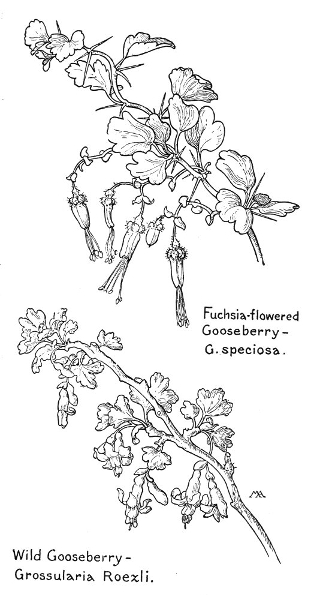
Fuchsia-flowered Gooseberry—G. speciosa. Wild Gooseberry—Grossularia Roezli.
There are many kinds of Ribes, or Currant, of temperate regions; shrubs, almost always smooth; flowers sometimes blooming before the leaves, with five petals, smaller than the five calyx-lobes, which are often colored; stamens five; ovary inferior, fruit a smooth, many-seeded berry. In general the low shrubs, with their pretty foliage, may be recognized by their resemblance to cultivated kinds. Ribes is the ancient Arabic name.
Black Currant Rìbes Hudsoniànum White Spring, summer Utah, Wash., Idaho, etc.
Except that its foliage has a strong disagreeable smell, this is an attractive shrub, three to six feet high, with pale gray, woody stems, without thorns, and smooth, bright green leaves, five-lobed and thin in texture, paler on the under side, with resinous dots and broad, papery stipules, in clusters, with reddish bracts at the base. The flowers form close, erect clusters, less than two inches long, springing from the same bud as the leaves; the calyx, which is the conspicuous part, cream-white, greenish in the center; the petals very small and white. The berry is smooth or hairy, round and black, without "bloom," and possibly edible, but so bad-smelling as to be avoided. This grows beside mountain streams and is found as far north as British Columbia.
Sierra Currant Rìbes Nevadénse Pink Summer Cal., Oreg., Wash., Nev.
A thrifty, mountain bush, from three to six feet high, the upper stems pale gray and the lower ones reddish; the leaves thin and smooth, prettily scalloped and lobed, often with a few white hairs at the base of the leaf-stalks. The flowers are fragrant and pink, over half an inch long, and form a close cluster, of eight or more. The berry is black, with a white "bloom," and tastes sweet and insipid. This reaches an altitude of eight thousand feet. Rìbes glutinòsum is called Incense-shrub, because of its strong fragrance. It is a large handsome shrub, sometimes fifteen feet high, with beautiful drooping clusters of gay pink flowers. The leaves are sticky when they first come out and the berry is blue, with a dense "bloom," bristly, dry and bitter, or insipid. This blooms in winter or early spring and is common in canyons near the coast.
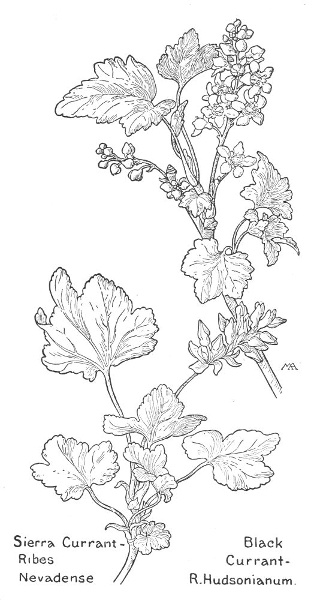
Sierra Currant—Ribes Nevadense. Black Currant—R. Hudsonianum.
Golden, Missouri or Buffalo Currant Rìbes àureum Yellow Spring, summer West, etc.
A very handsome bush, from five to twelve feet high, with pretty foliage and smooth, pinkish-gray, woody stems. The bright green leaves, with three or five lobes, are thin in texture, with a few hairs on the leaf-stalks, fresh and glossy-looking, and setting off the bright clusters of clear yellow flowers, of which the calyx, half an inch across, with a long greenish-yellow tube, is the conspicuous part. The small petals are sometimes yellow, but often bright red and the fruit is smooth, yellow, red, or black, and edible. This is deliciously fragrant and spicy, very handsome and attractive, growing beside brooks and in moist canyons, where sometimes, in masses, it has at a distance the effect of Forsythia, but purer in color. It grows as far east as Missouri and is often cultivated.
APPLE FAMILY. Pomaceae.
A rather large family, widely distributed, including many attractive trees and shrubs, such as Mountain Ash and Hawthorn, as well as Pears and Apples, with pretty blossoms and conspicuous, often edible fruits; leaves alternate; stipules small; flowers regular, perfect, single or in clusters; calyx usually five-toothed or five-lobed; petals mostly five, usually with claws; stamens numerous, or rarely few, separate, with small anthers; ovary inferior and compound; styles one to five. The calyx-tube gradually thickens and becomes a "pome," or apple-like fruit, in which the core is the ovary.
There are several kinds of Amelanchier, of the north temperate zone; shrubs or trees, with thornless branches and white flowers, usually in clusters; calyx-tube bell-shaped, with five narrow sepals; petals five; stamens numerous, on the throat of the calyx; styles two to five in number, united and hairy at base; ovary wholly or partly inferior; fruit small and berry-like. The name is from the French for the Medlar. These shrubs are called Shadbush in the East, because they bloom just when the shad are beginning to run in the rivers.
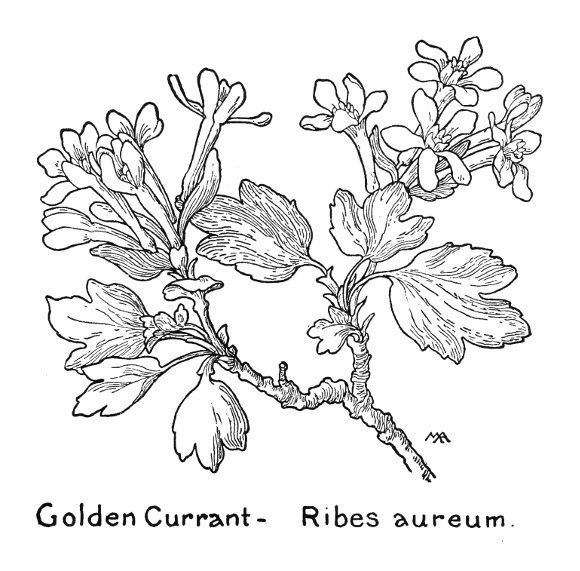
Golden Currant—Ribes aureum.
Service-berry, June-berry Amelánchier alnifòlia White Spring, summer West, etc.
A pretty shrub with woody, branching stems, reddish twigs and smooth, bright green leaves, sometimes downy on the under side, toothed only at the ends. The flowers, less than an inch across, have long, narrow, straggling petals, and are so mixed with leaves, and crowded so irregularly on the branches, that the effect is rather ragged. The roundish, pulpy, black fruit is liked by the Indians, but though sweet is insipid. When thickets of this shrub are in bloom on mountainsides the effect is very pretty, especially in Utah, where the shrubs are more compact and the flowers less straggling than in Yosemite, giving at a distance much the effect of Hawthorn. It grows as far east as Nebraska and in British Columbia.
PLUM FAMILY. Drupaceae.
A rather small family, widely distributed, trees or shrubs, the bark exuding gum, the foliage, bark, and seeds bitter, containing prussic acid; leaves alternate, toothed, with leaf-stalks; stipules small; flowers mostly perfect, regular, single or in clusters; calyx five-lobed, dropping off after flowering; petals five, inserted on the calyx; stamens numerous, inserted with the petals; pistil one in our genera; ovary superior, developing into a stone-fruit.
There are many kinds of Prunus, including Cherry as well as Plum, with white or pink flowers and usually edible fruits. Prunus is the ancient Latin name for plum.
Holly-leaved Cherry, Islay Prùnus ilicifòlia White Summer California
Mountain slopes near Santa Barbara are beautiful in June with the creamy flowers of this very ornamental evergreen shrub, from five to twenty-five feet high, with shiny, leathery, dark green leaves, with prickly edges, looking much like Holly. The small flowers form close but feathery clusters, from one to three inches long, and smell pleasantly of honey. The sweetish fruit, not particularly good to eat, is a dark red cherry, about half an inch in diameter. In dry places these shrubs are small, but in favorable situations, such as the old mission gardens, where they have been growing for perhaps a hundred years, they develop into small trees.
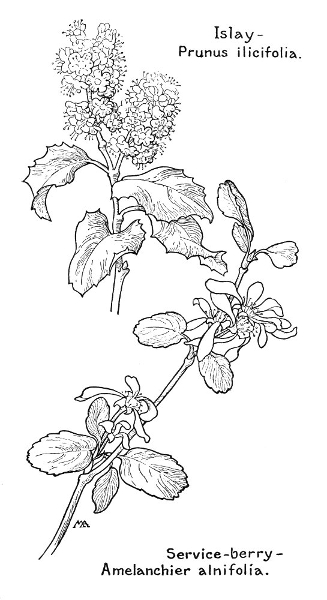
Islay—Prunus ilicifolia. Service-berry—Amelanchier alnifolia.
ROSE FAMILY. Rosaceae.
A large and important family, widely distributed and including some of our loveliest flowers and most delicious fruits; herbs, shrubs, or trees; generally with stipules and usually with alternate leaves; the flowers rich in pollen and honey and usually perfect. The calyx usually five-lobed, often with bracts, with a disk adhering to its base; the petals of the same number as the calyx-lobes, separate or none; the stamens usually numerous, separate, with small anthers; the ovary superior, or partly inferior; the pistils few or many, separate or adhering to the calyx, sometimes, as in the true Rose, enclosed and concealed in a hollow receptacle; the fruit of various kinds and shapes.
There are several kinds of Opulaster, branching shrubs, with clusters of white flowers and grayish or reddish, shreddy bark.
Ninebark Opuláster malvàceus (Physocarpus) White Summer Northwest, Utah, Ariz.
This is a handsome bush, from three to six feet high, with pretty, almost smooth, bright green leaves, with large stipules. The flowers are sweet-smelling, about half an inch across, with cream-white petals, and form very beautiful and conspicuous rounded clusters, about three inches across, the long stamens giving a very feathery appearance. At a distance this shrub has the effect of Hawthorn in the landscape. It grows on mountainsides in rich soil.
Apache Plume Fallùgia paradóxa White Spring Ariz., New Mex.
There are two kinds of Fallugia. This is usually a low undershrub, but in the Grand Canyon, on the plateau, it is a fine bush, four or five feet high, with pale woody, branching stems; the small, somewhat downy, evergreen leaves, resembling those of the Cliff Rose, but the flowers larger. They are white, two inches across, like a Wild Rose in shape, with beautiful golden centers, and grow on long, slender, downy flower-stalks, at the ends of the branches. Individually, they are handsomer than the flowers of the Cliff Rose, but not nearly so effective, as the bloom is much more scattered. The calyx-tube is downy inside and the five sepals alternate with five, small, long, narrow bractlets. The hairy pistils are on a small conical receptacle, surrounded by a triple row of very numerous stamens on the margin of the calyx-tube.
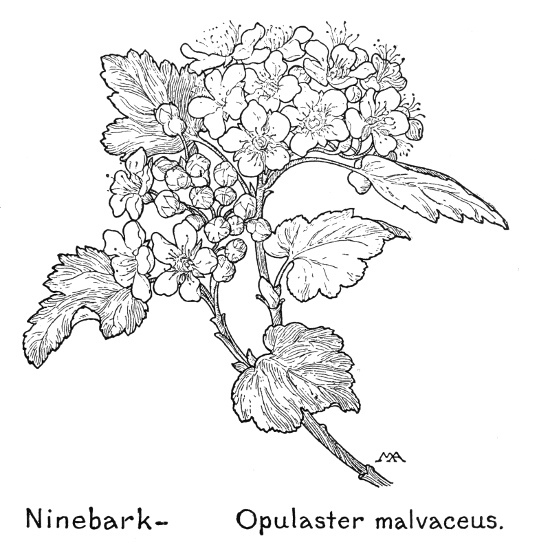
Ninebark—Opulaster malvaceus.
Wild Roses are widely distributed in the northern hemisphere and are too familiar to need much description. There are numerous kinds; some are climbing, all are prickly and thorny, with handsome, often fragrant, flowers and compound leaves, with toothed edges. The numerous yellow stamens are on the thick margin of a silky disk, which nearly closes the mouth of the calyx. The numerous pistils develop into akenes, or small, dry, one-seeded fruits. These look like seeds and we find them inside the calyx-tube, which in ripening enlarges and becomes round or urn-shaped. These swollen calyx-tubes are the "hips," which turn scarlet and add so much to the beauty of the rose-bush when the flowers are gone. Rosa is the ancient Latin name.
Fendler's Rose Ròsa Féndleri Pink Spring, summer Idaho, Utah, Ariz.
This is a very handsome thrifty bush, about four feet high, with smooth, or slightly downy, bright green leaves, and thorny stems, with slightly curved thorns. The flowers are more or less fragrant and about two inches across, with bright pink petals, which gradually become paler as they fade, and pretty crimson-tipped buds. This has smooth "hips" and is a beautiful and conspicuous kind, growing in valleys and along streams, up to an altitude of nine thousand feet. It is widely distributed and variable, probably including several forms.
California Wild Rose Ròsa Califórnica Pink Spring, summer, autumn Cal., Oreg.
A large bush, three to six feet high, with erect, branching stems, armed with a few, stout thorns, which turn back. The leaves are more or less downy, especially on the under side, with from three to seven leaflets, and the flowers usually form a cluster of few or many and are each from one to nearly two inches across, with pale pink petals. They are lovely flowers, with a delicious fragrance, and are common at low and moderate altitudes in California, usually growing near streams.
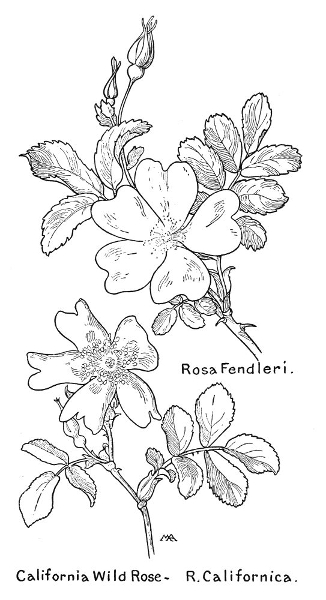
Rosa Fendleri. California Wild Rose—R. Californíca.
Redwood Rose Ròsa gymnocàrpa Pink Spring, summer Northwest
A charming kind, delicate both in foliage and flower, usually growing in shady, mountain woods. The slender bush is from one to three feet high, with dark brown stems, armed with some straight, slender thorns, and light green leaves, usually with quite a number of neat little leaflets, smooth and thin in texture. The flowers are an inch or less across, usually single, with light yellow centers and bright pink petals, very clean and fresh in tone, usually deeper towards the margins. The sepals are not leafy at the tips, the flower-stalks, and sometimes the leaf-stalks also, are covered with small, dark, sticky hairs and the buds are tipped with carmine. Neither leaves nor flowers are fragrant.
Mountain Misery Chamaebàtia foliolòsa White Summer California
This is the only kind. In open places, in the Sierra forests, the ground is often carpeted for acres with the feathery foliage of this charming shrub, sprinkled all over with pretty white flowers. Mountain Misery does not at first seem an appropriate name for so attractive a plant, but when we walk through the low, green thickets we find not only that the tangled branches catch our feet but that the whole plant is covered with a strong-smelling, resinous substance, which comes off on our clothes in a most disagreeable manner. On a warm day the forest is filled with the peculiar, medicinal fragrance and when, later in the season, we unpack our camping outfit we are apt to be puzzled by the smell of "Pond's Extract" which our clothes exhale. The shrub is usually less than two feet high, with downy, evergreen foliage, the numerous small leaflets so minutely subdivided and scalloped that they have the appearance of soft ferns. The flowers resemble large strawberry-blossoms, and have a top-shaped, five-lobed calyx, many yellow stamens and one pistil, becoming a large, leathery akene. The smell and foliage attract attention and the shrub has many names, such as Bear-mat and Kittikit, or Kit-kit-dizze, so-called by the Indians. Bears do not eat it, so the name Bear-clover is poor, and Tarweed belongs to another plant. It is used medicinally.
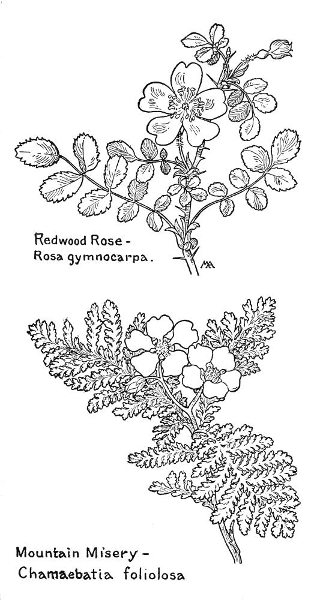
Redwood Rose—Rosa gymnocarpa. Mountain Misery—Chamaebatia foliolosa.
This is the only kind of Stellariopsis; perennial herbs; the leaves with many, minute, crowded, overlapping leaflets; the flowers white, in open clusters; bractlets, sepals, and petals five; stamens fifteen; pistil one, surrounded by bristles.
Pussy-tails Stellariópsis santolinoìdes (Ivesia) White Summer California
The leaves of this odd little plant look like catkins, or the sleek, gray tails of some little animal. They are cylindrical in form, three or four inches long, composed of many minute leaflets, crowded closely around a long, central stem. These little leaflets, hardly more than green scales, are smothered with soft, white down, which gives the whole "tail" a silky, silvery-gray appearance. From the midst of a bunch of these curious leaves, which are mostly from the root, spring several very slender stems, widely branching above, from six to twelve inches tall, and at the ends of the branches are airy clusters of pretty little flowers, like tiny strawberry-blossoms. These little plants grow in sandy soil, at high altitudes, and are plentiful on the gravelly "domes" around Yosemite.
There are a good many kinds of Horkelia; perennial herbs, with compound leaves, usually with many leaflets, and flowers in clusters; calyx cup-shaped, or saucer-shaped, with five teeth and five bractlets; stamens ten; pistils two or many, with long slender styles, and borne on a receptacle like that of Potentilla, which these plants resemble, though the flowers are usually smaller, in closer clusters.
Horkèlia fúsca White Summer Cal., Oreg., Nev.
A rather attractive plant, for the foliage is pretty, though the flowers are not very conspicuous. The rather stout, roughish stem, often purplish, is from one to two feet tall and the leaves are rather dark green, slightly sticky and sometimes downy. The flowers are about half an inch across, with white petals, tinged with pink, and are well set off by the dark reddish or purplish calyxes and buds, but the petals are too far apart, and there are not enough flowers out at one time, for the effect to be good. This varies a good deal in hairiness and there are several varieties. It is common in Yosemite.
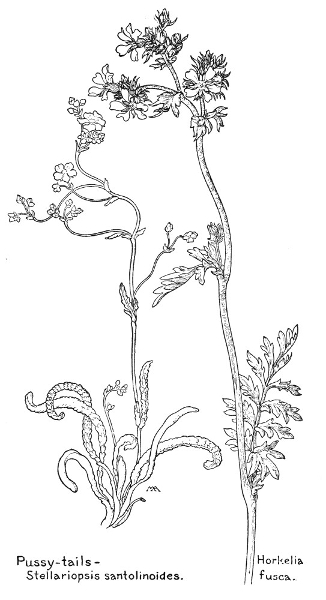
Pussy-tails—Stellariopsis santolinoides. Horkelia fusca.
There are several kinds of Cowania.
Cliff Rose Cowània Stansburiàna Yellow Spring, summer Southwest
Altitude and soil make a great difference in the beauty of this shrub. On the rocky rim of the Grand Canyon it is from four to eight feet high, picturesquely gnarled and twisted, but stunted looking, the gray bark hanging off the crooked branches and thick, distorted trunk in untidy shreds, the flowers pale, scanty, and but faintly scented. Halfway down Bright Angel trail it is a glorious thing, full of color and fragrance, about twelve feet high, luxuriant and healthy-looking. The small, leathery, evergreen leaves, crowded in bunches along the branches, are glossy and rich in color, setting off the light yellow flowers, with golden centers, which form long wands of bloom. The upper branches are clustered closely their whole length with blossoms, and when the wind sways the flowering branches to and fro they exhale an exquisite fragrance like orange flowers. The bloom is at its best in the Canyon in May, but there are still some lingering flowers in August. The calyx is top-shaped, with the petals and the two rows of numerous stamens on the throat of the tube. The pistils, from five to twelve, are densely woolly. The akenes have pale, silky-hairy tails, two inches or more in length, suggesting gone-to-seed Clematis. For some occult reason this shrub is called Quinine Bush at the Grand Canyon.
There are two kinds of Aruncus, resembling Spiraea; with small white flowers, the stamens and pistils in separate flowers on different plants. Aruncus is a word used by Pliny to designate a goat's beard.
Goat's Beard Arúncus sylvéster (Spiraea aruncus) White Summer Northwest, etc.
A pretty plant, from three to seven feet high, with somewhat branching stems and smooth leaves, thin in texture. The minute, cream-white flowers are crowded closely along the many sprays which make up the very loose cluster, which is about a foot long, the effect of the whole being exceedingly airy and graceful and in fine contrast to the handsome foliage. This grows in mountain woods, across the continent and in Europe and Asia.
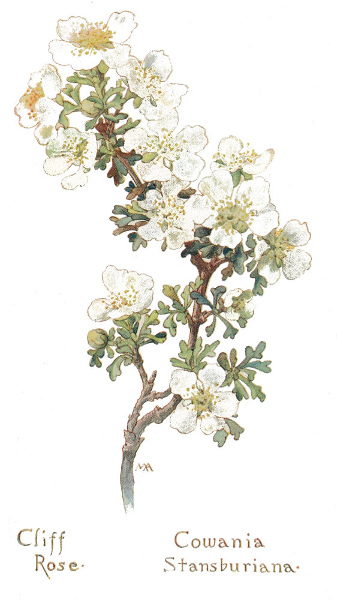
Cliff Rose—Cowania Stansburiana.
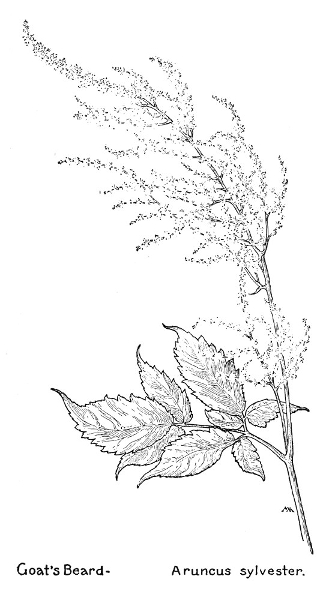
Goat's Beard—Aruncus sylvester.
There are only a few kinds of Adenostoma, evergreen shrubs, with small, narrow, resinous leaves and clusters of small, white flowers.
Chamise, Greasewood Adenóstoma fasciculàtum White Spring California
This is a very attractive shrub, from two to ten feet high, with long, slender branches, clothed with close bunches of leaves and bearing large clusters of tiny flowers, something like Spiraea. They have a feathery, creamy appearance, owing to the pale yellow stamens, and the olive-green foliage sets them off to perfection, the effect of the whole being very graceful, as the slender, flower-tipped branches sway to and fro in the wind. This is the most abundant and characteristic shrub of the higher Coast Ranges and Sierra Nevada Mountains and sometimes covers miles of mountain slopes, looking a good deal like heather when it is not in bloom. When the chaparral is composed entirely of this shrub it is called chamisal. A. sparsifòlium of southern California, has scattered leaves and larger flowers. It is very fragrant and used medicinally by Spanish Californians and Indians, who call it Yerba del Pasmo, or "convulsion herb."
There are many kinds of Spiraea, natives of the north temperate zone; shrubs, without stipules and with clusters of white or pink flowers.
Flat-top Meadowsweet Spiraèa corymbòsa White Spring, summer Northwest, etc.
This is an attractive plant, from one to three feet tall, with slender, reddish-brown stems, with but few branches, and smooth, bright green leaves, paler on the under side. The small flowers are cream-white, with pinkish buds, and form very pretty, feathery, flat-topped clusters, about three inches across. This is found on banks and rocky places, in the mountains, and grows also in the East.
Pyramid Bush Spiraèa pyramidàta (S. betulaefolia in part) Pink, white Spring, summer Northwest
An attractive plant, but not so pretty as the last. It is about the same height, but more branching, with dark bluish-green leaves, somewhat pale on the under side. The flowers are white or pale pink, with deep pink buds, and form long clusters, not so feathery as the last, because the stamens are not so long. This grows in the mountains.
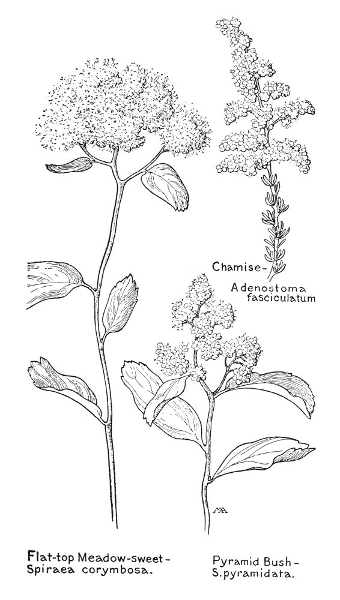
Chamise—Adenostoma fasciculatum. Flat-top Meadow-sweet—Spiraea corymbosa. Pyramid Bush—S. pyramidata.
Hardhack, Steeple-bush Spiraèa Doúglasii Pink Spring, summer Wash., Oreg., Cal.
A handsome shrub, from three to five feet high, with rather coarse leaves, smooth, but with a dull surface, and pale with close down on the under side, and bearing many beautiful, compact spires of small, pink flowers, warm in tone and deeper in color towards the center, with numerous, long, pink stamens, which give a very feathery appearance. The flowers are slightly sweet-smelling and bloom first at the top of the cluster, so that the effect of the whole spire, which is six or eight inches long, is light pink and fuzzy at the top, deepening below to the raspberry-pink of the buds. This grows along the edges of meadows and near brooks.
There are two kinds of Chamaebatiaria, both western; low shrubs; the flowers with five sepals, five petals, and about sixty stamens; the pistils five, more or less united.
Fern-bush Chamaebatiària millefòlium (Spiraea) White Summer Arizona
A pretty and unusual-looking shrub, about three feet high, with reddish stems and shreddy bark, the downy leaves, pale yellowish-green in color, arranged at intervals along the branches in soft feathery bunches. The flowers are like small strawberry blossoms, slightly fragrant, and form pretty clusters. This grows on rocks, along the rim of the Grand Canyon, clinging to the edge and overhanging the depths.
There is only one kind of Coleogyne.
Coleógyne ramosíssima Yellow Spring Southwest
The plateau in the Grand Canyon is covered for miles with this low shrub, which gives the landscape its characteristic pale desert coloring. The flowers, over half an inch across, with one or two pairs of three-lobed bracts at base, grow singly at the tips of the twigs and, unlike most of this family, have no petals and only four, spreading sepals, bright yellow inside, two of them pointed and the alternate two more round in shape. The ovary is enclosed in a yellow, hollow, urn-shaped receptacle, surrounded by numerous stamens inserted on its base, the yellow anthers with threadlike filaments. The very small, narrow, toothless leaves are evergreen, leathery and stiff, opposite, grayish in color and imperceptibly downy, clustered in small separate bunches along the rigid twigs, which are set almost at right angles to the reddish-gray branches and rather swollen at the joints. The whole shrub is from two feet to four feet high, stiff, almost thorny, and rather forbidding in appearance, but the odd little flowers are pretty.
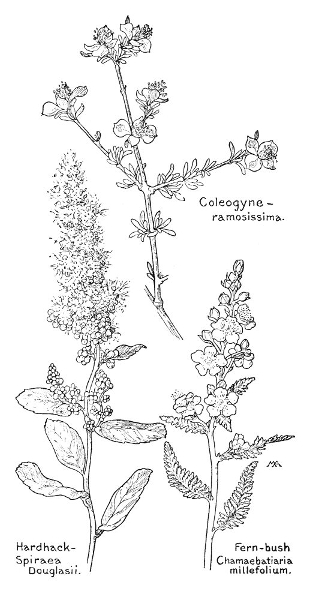
Coleogyne—ramosissima. Hardhack—Spiraea Douglasii. Fern-bush—Chamaebatiaria millefolium.
There are several kinds of Argentina, differing from Potentilla in the leaflets and the style.
Silver-weed Argentìna Anserìna (Potentilla) Yellow Spring, summer, autumn North America, etc.
This forms large straggling clumps of many, pale, downy stems, lying on the ground and rooting at the joints, like strawberry runners, with handsome foliage and pretty flowers. The leaves are rich green on the upper side and covered with silky white down on the under, giving a silvery appearance, and the flowers are an inch or more across, bright yellow, with centers of the same shade, and have long flower-stalks, sometimes as much as a foot tall. This is common and conspicuous in wet meadows and also grows in Europe and Asia.
There are only a few kinds of Dryas, shrubby plants, living in cold and arctic regions. The Latin name means "wood-nymph."
Alpine Avens Drýas octopétala White Summer Northwest, etc.
This is a charming little plant, from two to five inches tall, forming low, matted clumps of many branching stems, lying on the ground and woody at the base, and many stiffish leaves, with prominent veins, dark green and smooth on the upper side and white with close down on the under, their dark tones setting off the pure-white flowers, which have downy flower-stalks and are about an inch across, with about eight petals, a golden center and the calyx covered with sticky hairs. The seed-vessels are large and feathery. This grows in alpine places, across the continent, reaching an altitude of fourteen thousand feet, and in Europe and Asia.
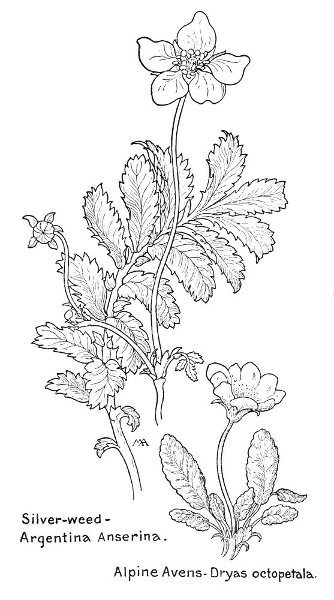
Silver-weed—Argentina Anserina. Alpine Avens—Dryas octopetala.
There are many kinds of Cinquefoils, mostly natives of the north temperate zone, usually herbs, with compound leaves and yellow, white or purple flowers, always with pedicels; the flat or cup-shaped calyx, with five, main teeth, alternating with five, tooth-like bractlets; petals five, broad, often notched; stamens numerous, with threadlike filaments and small anthers, near the base of the calyx-cup; pistils numerous, on the conical, hairy receptacle, which does not become fleshy or juicy, each pistil maturing into a dry, seed-like akene. Potentilla means "powerful," as some sorts are medicinal. They often resemble Buttercups, but never have shiny petals, and Buttercups do not have bractlets between the calyx-lobes.
Arctic Cinquefoil Potentílla emarginàta Yellow Summer Northwest
A dear little plant, forming low tufts, two or three inches high, with thin, brownish stipules, bright green leaves, more or less hairy, and bright yellow flowers, deeper in color towards the center and about half an inch across. This grows in high northern mountains across the continent and in Siberia.
Silky Cinquefoil Potentílla pectinisécta Yellow Spring, summer Utah, Ariz., Wyo.
The foliage of this plant is a lovely shade of silvery gray, which suits the yellow flowers. It has several stoutish, reddish, stems, a foot to a foot and a half tall, springing from clumps of leaves, with long leaf-stalks and five to seven leaflets. The bright-yellow flowers are each three-quarters of an inch across and the whole plant is conspicuously covered with long, thick, white, silky down, particularly on the under side of the leaves.
Shrubby Cinquefoil Dasíphora fruticòsa (Potentilla) Yellow Spring, summer West, etc.
This is the only kind of Dasiphora, a pretty shrub, very branching and leafy, one to four feet high, dotted all over with charming flowers. The bark is shreddy and the gray-green leaves are covered with silky down, with rolled back margins, and paler on the under side. The flowers, single or in clusters, are over an inch across, with clear yellow petals and deeper yellow anthers. This is common in the mountains, across the continent, up to an altitude of ten thousand feet, and is a troublesome weed in northern New England. It is also found in Europe and Asia.
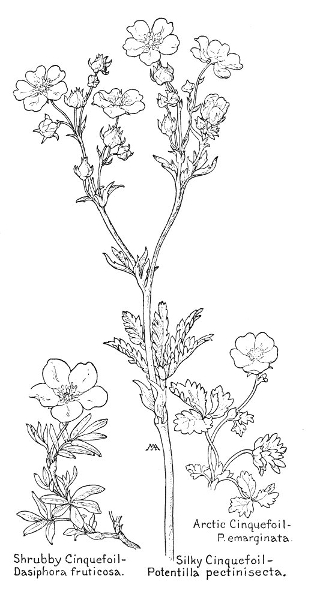
Arctic Cinquefoil—P. emarginata. Shrubby Cinquefoil—Dasiphora fruticosa. Silky Cinquefoil—Potentilla pectinisecta.
There are several kinds of Sericotheca, much like Spiraea, except the fruits.
Ocean Spray Sericothèca discolor (Spiraea) (Holodiscus) White Summer Northwest and Southwest
A handsome conspicuous shrub, from three to eight feet high, without stipules, with roughish, dull-green leaves, toothed or lobed, but not with leaflets, and pale and woolly on the under side. The tiny flowers form beautiful, plumy, branching clusters, eight inches or more in length and almost as much across, cream-white and fuzzy, drooping and turning brownish as the flowers fade. This is common in the mountains.
There are numerous kinds of Rubus, in temperate regions, with white, pink, or purple flowers, and red, black, or yellowish "berries." The fruit is not really a berry, but a collection of many, tiny, round stone-fruits, crowded on a pulpy, conical receptacle. That of the Raspberry has a "bloom," and falls off the receptacle when ripe, but the Blackberry has shining, black fruit, which clings to the receptacle. Rubus, meaning "red," is the ancient Latin name for the bramble. Raspberries were cultivated by the Romans in the fourth century.
Salmon-berry Rùbus spectàbilis Red Summer Northwest
A handsome bush, not at all trailing, from three to nine feet high, with dark-brown, prickly stems, fine foliage and flowers, and conspicuously beautiful fruit. The leaves are nearly smooth, with three leaflets, and the flowers, about two inches across, are a brilliant shade of deep pink, not purplish in tone, with yellow centers, and grow singly, or two or three together. The fruit is a firm, smooth raspberry, over an inch long, bright orange-color, more or less tinted with red, with a rather pleasant but insipid taste and not very sweet. This grows in woods. It is rather confusing that this should be called Salmon-berry in the West, for in the East that is the common name of Rubus parviflorus.
Common Blackberry Rùbus vitifòlius White Spring, summer California, etc.
An evergreen bush, a few feet high and more or less erect; or the prickly stems trailing on the ground, or climbing over other shrubs, and sometimes eighteen feet long. The leaves are downy, or almost smooth, usually rather coarse in texture, and all but a few of the upper ones have from three to seven leaflets. The flowers are about an inch across and the petals vary a good deal, being sometimes broad and sometimes rather long and narrow. This is common from southern California to British Columbia.
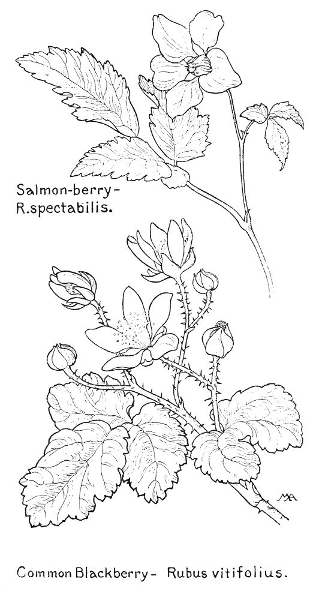
Salmon-berry—R. spectabilis. Common Blackberry—Rubus vitifolius.
Thimble-berry Rùbus parviflòrus White Spring, summer West, etc.
In shady mountain woods we find this attractive plant, which is called Salmon-berry farther east. It also resembles the eastern Thimble-berry, but its flowers are prettier, for they are white instead of purplish-pink. It has several branching stems, from two to six feet high, the lower ones woody, with shreddy bark and the upper stems pale green, slightly rough and hairy, but with no thorns. The large maple-like leaves are thin in texture, but almost velvety, with hairs on the veins of the under side and on the leaf-stalks, and are bright green, with three or four, toothed lobes. The flowers are occasionally pinkish and measure about two inches across, and grow, a few together, at the ends of long flower-stalks. The petals are slightly crumpled and there are usually five of them, but both sepals and petals vary a good deal in number; the green sepals are velvety, pale inside and tipped with tails, and the pale yellow center is composed of a roundish disk, covered with pistils and surrounded by a fringe of numerous yellow stamens. The fruit is a flattish, red raspberry, disappointing to the taste, for it is mostly seeds. This is found as far east as Michigan.
Creeping Raspberry Rùbus pedàtus White Summer Northwest
A charming little vine, without prickles, the stems from one to three feet long and rooting at the joints, trailing over rocks and moss and creeping along the ground, ornamented with pretty leaves, with from three to five leaflets, and sprinkled with white flowers, half an inch or more across, and often also with juicy, red raspberries. This grows in rich soil, in mountain woods.
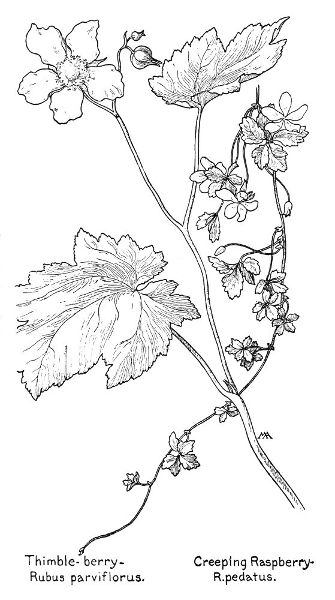
Thimble-berry—Rubus parviflorus. Creeping Raspberry—R. pedatus.
There are a good many kinds of Strawberry, natives of the north temperate zone and the Andes. They are perennials, with running stems, rooting at the joints; the flowers white, or rarely pink, with slender, often drooping pedicels, forming loose clusters; the flower-stalks springing from tufts of root-leaves, which have three, toothed leaflets and a pair of sheathing stipules at the base of the long leaf-stalk; the sepals five, alternating with sepal-like bractlets; the petals five, with short claws and not notched; the stamens numerous, with slender filaments; the receptacle roundish or cone-shaped, becoming enlarged, red and juicy, in fruit, bearing minute, dry akenes, scattered over its surface, or set in pits. Fragum is the Latin name for strawberry, meaning "fragrant."
Wood Strawberry Fragària bracteàta White Spring, summer West
A slender little plant, growing in light shade, in rich soil, along streams, in rocky woods and producing runners very freely. The stipules are papery and reddish, the thin, dull-green leaves are slightly silky on the upper side, when young, and the leaflets are sharply and coarsely toothed, somewhat wedge-shaped, broad at the tips, the two side ones uneven at base. There is usually a little bract, halfway up, on both the flower-stalk and the leaf-stalk. The flowers are nearly an inch across, with fuzzy, bright yellow centers, and the fruit is light red, with a good flavor, somewhat cone-shaped, the akenes scattered over its smooth, shining, even surface and but slightly attached to it.
Sand Strawberry Fragària Chiloénsis White Spring, summer Wash., Oreg., Cal.
A charming plant, a few inches tall, with thick, glossy, dark green leaves, paler and hairy on the under side, and pure-white flowers, with bright yellow centers. They are about an inch across and are well set off by the masses of dark foliage. This has large, delicious berries and grows abundantly on beaches and sand dunes near the sea, from San Francisco to Alaska. It is often cultivated.
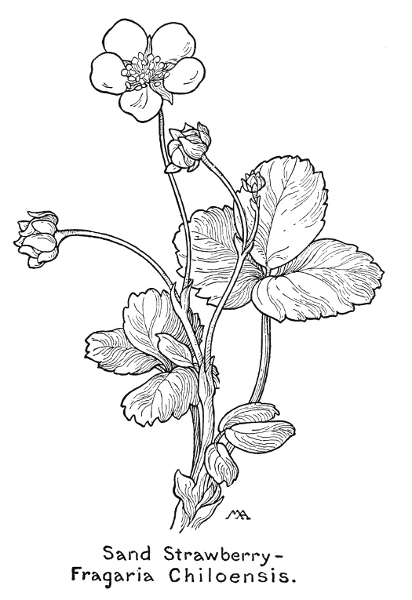
Sand Strawberry—Fragaria Chiloensis.
PEA FAMILY. Fabaceae.
A very large family, including many important plants, such as Clover, Alfalfa, Peas, and Beans; herbs, shrubs, vines, and trees, distinguished principally by the flower and fruit, resembling the butterfly-like corolla and simple pod of the common Pea; leaves alternate, usually compound, with leaflets and stipules; calyx five-toothed or five-cleft; petals five. The upper petal, or "standard," large, covering the others in the bud, the two at the sides standing out like "wings," the two lower ones united by their edges to form a "keel," enclosing the stamens, usually ten, and the single pistil with a curved style; the ovary superior.
There are numerous kinds of Anisolotus, widely distributed, common, difficult to distinguish; mostly herbs, some slightly shrubby; leaves with two or many, toothless leaflets; calyx-teeth nearly equal; petals with claws, free from the stamens, wings adhering to the keel, incurved, blunt or beaked; stamens joined by their filaments, in two sets of one and nine, anthers all alike; style incurved; pods two-valved, often compressed between the seeds, never inflated. These plants have several common names, such as Bird-foot, Trefoil, Cat's-clover, etc., and are called Crowtoes by Milton.
Pretty Bird-foot Anisolòtus formosíssimus (Lotus) (Hosackia) Pink and yellow Spring Wash., Oreg., Cal.
A gay and charming kind, with smooth stems, spreading on the ground, light green leaves, with five or more leaflets, and flowers about half an inch long, with a golden-yellow standard, pink or magenta wings and wine-colored keel, forming a flattish cluster, the contrasting colors giving a vivid effect. This grows in damp places along the sea-coast.
Bird-foot Anisolòtus argyraèus (Lotus) (Hosackia) Yellow Spring California
A shrubby, branching plant, a foot and a half high, forming a pretty clump, two or three feet across, with downy, gray-green stems and foliage, sprinkled with clover-like heads of yellow flowers. The leaflets are slightly thickish, covered with silky down, the twigs and young leaves silvery-white. The small flowers are a soft shade of warm-yellow, and the buds form neat, fuzzy, silvery balls. This grows on dry hillsides in the Catalina Islands.
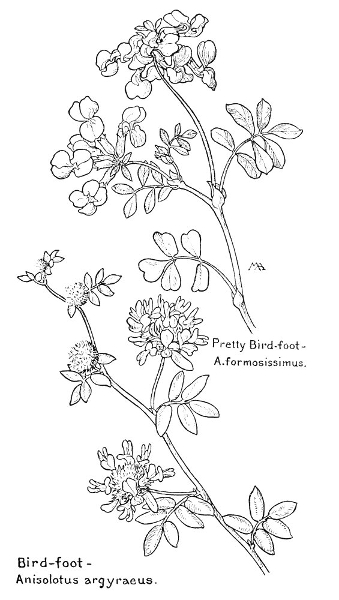
Pretty Bird-foot—A. formosissimus. Bird-foot—Anisolotus argyraeus.
Anisolòtus strigòsus (Lotus) (Hosackia) Yellow Spring, summer, autumn California
This is only a few inches high, with slender, slightly downy stems, branching and spreading, and bright green leaves, with seven or more, small, narrow leaflets, slightly thickish, with some minute, bristly hairs. The few flowers are about a quarter of an inch long, mostly single, bright yellow, tinged with red, fading to orange, and have a sort of miniature prettiness. This grows in the south.
Bird-foot Anisolòtus decúmbens (Lotus) (Hosackia) Yellow Summer Northwest
An attractive little perennial, forming low clumps, harmonious in coloring, of pale gray-green, downy foliage, sprinkled with small clusters of charming little flowers, each less than half an inch long, various shades of yellow, and arranged in a circle. The pods are hairy and it grows on sunny, sandy slopes.
Deer-weed Anisolòtus glàber (Lotus) (Hosackia) Yellow and orange All seasons California
Though the flowers are small and the foliage scanty, the shaded effect of mingled yellow and orange of these plants is rather pretty, as we see them by the wayside. The many, long, smooth, reed-like stems grow from two to five feet high, branching from the root, somewhat woody below, loosely spreading, or sometimes half lying on the ground. The leaves are almost smooth, very small and far apart, with from three to six, oblong leaflets, and the flowers, from a quarter to half an inch long, are clustered in close little bunches along the stem, forming long wands, tipped with green buds, and shading downward through the bright yellow of the larger buds to the orange of the open flowers and the dull red of the faded ones. The pod is incurved, tipped with the long style. This is common and widely distributed, a perennial, but said to live only two or three years. In the south it often makes symmetrical little bushes, pleasing in appearance. It is a valuable bee-plant. A. Wrìghtii of Arizona, Utah, New Mexico, and Colorado, is quite leafy, with erect stems and branches, bushy and woody at base, the small leaflets from three to five in number. The flowers, without pedicles, are much like the last, but over half an inch long, yellow becoming reddish, with a blunt keel, and scattered all over the plant.
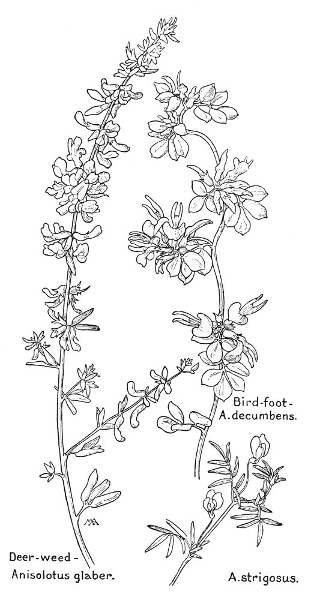
Bird-foot—A. decumbens. Deer-weed—Anisolotus glaber. A. strigosus.
There are several kinds of Thermopsis, of North America and Asia; stout, perennial herbs, with woody rootstocks; leaflets three; stipules conspicuous, leaf-like; flowers large, yellow, with short, bracted flower-stalks; calyx bell-shaped, five-cleft; standard broad, in the western species, shorter than the oblong wings, keel nearly straight, blunt, the same length as the wings; stamens ten, separate, curving in; style slightly curving in, stigma small; pod flat, long or oblong, straight or curved, with a very short stalk and several seeds. Thermopsis, sometimes called False Lupine, is distinguished from Lupinus by its stamens, which are separate, instead of united into a sheath. The Greek name means "lupine-like."
Golden Pea Buck-bean Thermópsis montànà Yellow Spring, summer Northwest, Utah, Ariz.
A very handsome, thrifty-looking plant, about two feet high, the smooth, bright green foliage contrasting finely with the clusters of clear yellow flowers, each about three-quarters of an inch long. The erect, straight pods, two or three inches long, are silky and also the calyxes and buds. This thrives in the mountains, up to an altitude of nine thousand feet, in somewhat moist spots, and its fresh coloring is most attractive. The foliage seems to me to be especially handsome in northern Arizona, but these plants are also beautiful in the Utah canyons. The flowers are scentless and last a long time in water. T. Califórnica has silvery, silky foliage and is common in California, in damp ground in the hills.
There are many kinds of Parosela, of western North America, Mexico, and the Andes, no one sort common; generally shrubs; leaves almost always compound; leaflets odd in number, small, toothless, with minute stipules, often with glandular dots; flowers small, in terminal clusters; calyx with nearly equal, long, occasionally feathery teeth; corolla with wings and keel longer than the standard, their claws adhering to the lower part of the stamen-tube, but the claw of the small, heart-shaped standard free; stamens nine or ten, filaments united, anthers alike; ovary with a short stalk, or none, style awl-shaped; pod small, membranous, included in the calyx, usually with one seed. P. spinòsa, the Smoke Tree, or Ghost Tree, of western Arizona, is almost leafless, with grayish or whitish branches.
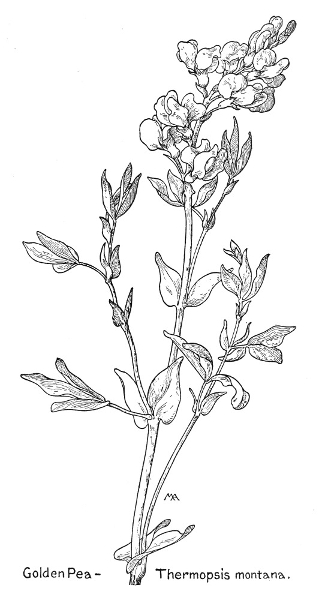
Golden Pea—Thermopsis montana.
Parosèla Califórnica (Dalea) Blue Spring California
This little spiny desert shrub grows two or three feet high and is conspicuous on account of the odd contrast in color between its foliage and flowers. The woody stems and branches are very pale in color and the very small leaflets, so narrow and stiff that they look like evergreen needles, are covered with pale down and have glandular dots. All over this colorless foliage are sprinkled small spikes of indigo-blue flowers, so dark in color that the effect, against a background of desert sand, is of pale gray, speckled with black. It has a pleasant smell like balsam.
Parosèla Émoryi (Dalea) Magenta Spring, summer Southwest
A low, desert shrub, with slender, abruptly branching stems and small, soft, thickish leaves, usually with three leaflets, obscurely toothed, the stems and leaves all thickly covered with white down. The flower-clusters are about three-quarters of an inch across, like a small clover-head, the woolly calyxes giving a yellowish-gray effect to the whole cluster, which is ornamented with a circle of tiny purple flowers. The effect of these specks of dark color on the pale bush is odd; the plant smells like balsam and grows in sandy soil.
Chaparral Pea Xylothérmia montàna (Pickeringia) Crimson Spring, summer California
This is the only kind, an evergreen shrub, flourishing on dry hills in the Coast Ranges, with tough, crooked branches and stout spines, forming chaparral so dense that it is impossible to penetrate. It grows from three to eight feet high, the gnarled, knotty, black branches terminating in long spines, which are often clothed with small leaves nearly to the end, the leaves with one to three, small leaflets and without stipules. The bush is often covered with quantities of pretty, bright, deep purplish-pink flowers, three-quarters of an inch long, forming a fine mass of color. The calyx has four, short, broad teeth; the petals are equal, the standard roundish, with the sides turned back and a paler spot at base, the wings oblong, the keel straight; the filaments of the ten stamens not united; the pod is two inches long, flat, straight, sickle-shaped when young. This very rarely produces fruit. Stevenson was probably describing this shrub when he wrote, "Even the low thorny chaparral was thick with pea-like blossoms."
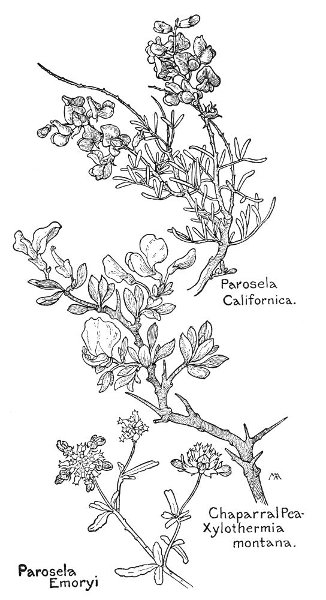
Parosela Californica. Chaparral Pea—Xylothermia montana. Parosela Emoryi.
There are so many western kinds of Lupinus that it is hopeless for the amateur to distinguish them; herbs, sometimes shrubs; leaves palmately-compound, stipules adhering to the base of the leaf-stalk, leaflets, more than three in number, usually closing at mid-day; flowers showy, in terminal racemes; calyx deeply toothed, two-lipped; standard broad, the edges rolling back, wings lightly adhering above, enclosing the incurved, pointed keel, sometimes beaked; style incurved, stigma bearded; stamens united by their filaments, alternate anthers shorter; pod two-valved, leathery, flat, oblong; seeds two to twelve. Lupines always have palmately-divided leaves, and are never trailing, twining, or tendril-bearing and thus may be superficially distinguished from Vetches and Peas, and from Thermopsis, by the united stamens.
River Lupine Lupìnus rivulàris Blue and white and purple Summer Northwest
A stately perennial, about three feet high, with stout, branching reddish, slightly downy stems, bearing several tall spires of flowers. The handsome leaves are bright green, smooth on the upper side, slightly downy, but not silvery, on the under, with from seven to thirteen leaflets, and the flower-cluster is very erect and compact, eight or ten inches long, beautifully shaded in color, from the pale, silky buds at the tip, to the blue and purple of the open flowers, which are about five-eighths of an inch long, with a lilac standard, tipped with purple. The upper flowers have white wings, veined with blue, and a green calyx, with reddish teeth, and the lower flowers have bright blue wings, veined with purple, and a reddish-purple calyx. This grows in wet places.
Tree Lupine Lupìnus arbòreus Yellow Spring California
A conspicuous shrub, four to eight feet high, with a thick trunk, gnarled and twisted below, with purplish, downy branches, silvery twigs and dull bluish-green leaves, downy on the under side, with about nine leaflets. The fine flower clusters are sometimes a foot long, composed of beautiful canary-yellow flowers, deliciously sweet-scented. This is easily recognized by its size and fragrance and is common in sandy soil near the sea, where it has been found very useful, as its very long roots keep the sand dunes from shifting.
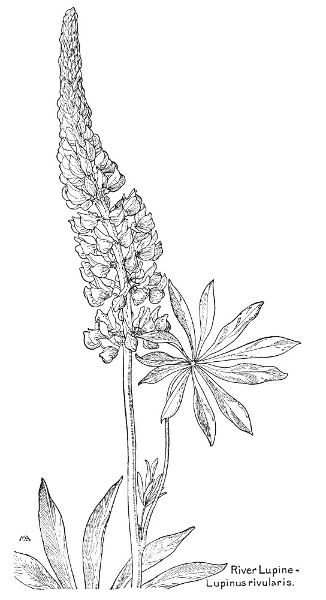
River Lupine—Lupinus rivularis.
Parti-colored Lupine Lupìnus Stìversii Pink and yellow Summer California
One of the prettiest and most conspicuous kinds, for its coloring is unusual, with branching, downy, leafy stems, about a foot high, thickish leaflets, pale bluish-green in color and rather hairy, and fragrant flowers, over half an inch long, with rose-colored wings and a yellow standard, changing to orange in fading. The combination of pink, orange, and yellow is very striking. This grows in warm, dry spots in Yosemite, and other places in the Sierras and Coast Ranges. L. citrìnus, of similar situations, has all yellow flowers.
Quaker Bonnets Lupìnus laxiflòrus Blue Spring, summer West
A handsome perennial, forming fine clumps on dry, gravelly hillsides, with several, slender, rather downy stems, from one to two feet tall, the leaflets six to nine in number, rather bluish-green, downy on the upper side, paler and silkier on the under. The younger leaves and calyxes are silvery with down, the flower buds form long, pretty, silvery clusters, resembling ears of wheat in form, and the flowers are in handsome loose racemes, from five to six inches long, of various shades of blue, mostly bright and somewhat purplish, the standard with a little white at its base and the keel purplish. The pod is covered with silky hairs and contains from three to five seeds. This is very common in Utah, handsome and conspicuous, and when growing in quantities, among Balsam-roots, Forget-me-nots, and Wild Geraniums, makes a combination unequaled in any flower-garden.
Milk-white Lupine Lupìnus lactèus White Spring California
A handsome plant, with a very stout, branching stem and soft, bluish-green leaves, with silky hairs on the edges and under sides, forming a fine clump of foliage, from which the flower-stalks stand up very stiff and straight. The cluster is most symmetrical in form and the flowers, which are nearly three-quarters of an inch long, are a beautiful, pearly white, tinged with yellow at the base of the standard and with creamy buds. The lower lobe of the calyx is large and very dark green, the stems have a pale, satiny surface, sprinkled with hairs and the leaflets are ten or eleven in number. This grows in the grass along the roadsides and is common around San Bernardino.
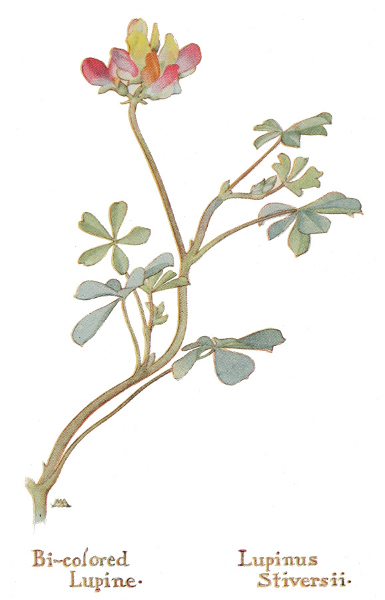
Bi-colored Lupine—Lupinus Stiversii.
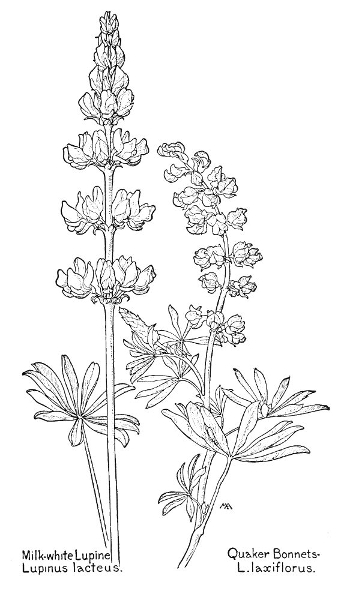
Milk-white Lupine—Lupinus lacteus. Quaker Bonnets—L. laxiflorus.
There are numerous kinds of Lathyrus, widely distributed and difficult to distinguish. In technical character and habit they very much resemble Vetches, but sometimes have no tendrils and the flowers are larger, the leaflets are broader, and the style is flattened and hairy, not only at the tip, but also along the upper side. The leaflets are equal in number, the leaf-stalk usually terminating in a branching tendril; the flowers are in clusters; the calyx with five teeth, the upper commonly shorter; the style flattened and usually twisted; the pod flat or cylindrical, with no partitions between the seeds. Lathyrus is the old Greek name of the Pea.
Narrow-leaved Sweet Pea Láthyrus graminifòlius Pink and violet Spring Arizona
This has flowers resembling the cultivated Sweet Pea, but the whole effect is more airy and graceful. It is a loosely-trailing vine, with slender, angled stems, long, narrow leaflets, eight in number, and three-cleft tendrils. The flowers are about three-quarters of an inch long, brightly yet delicately tinted with shaded pink and violet, and are so lightly poised on the long slender stalks that they look like a row of butterflies about to take flight. This grows on the plateau in the Grand Canyon and all through Arizona in the mountains.
Utah Sweet Pea Láthyrus Utahénsis Lilac Spring, summer Utah, Col.
A smooth, trailing perennial, very graceful, with beautifully tinted flowers and bright green foliage. The stipules are large, broad and leafy, and the leaflets are usually ten in number, veined and thin in texture, one or two inches long, with tendrils. The flowers are nearly an inch long, from four to eight in a cluster, on a long flower-stalk; the standard pinkish-lilac, delicately veined with purple, the wings pale lilac and the keel cream-color. The flowers, as they fade, although keeping their form, gradually change in color to all shades of blue, turquoise, and sea-green, finally becoming buff, so that the effect of the whole cluster is iridescent and very lovely. This grows on mountain slopes, often in oak-thickets, clambering over the bushes to a height of several feet and clinging to everything with its tendrils.
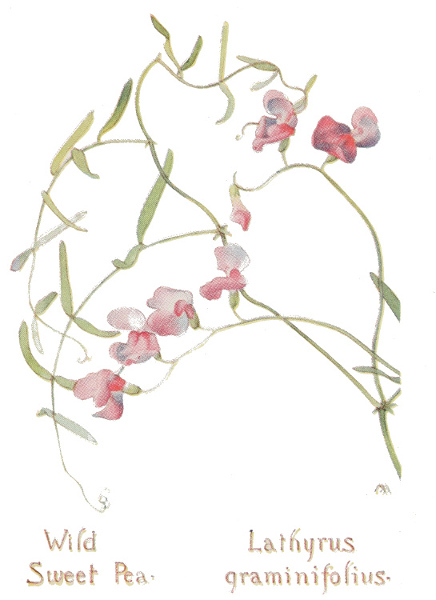
Wild Sweet Pea—Lathyrus graminifolius.
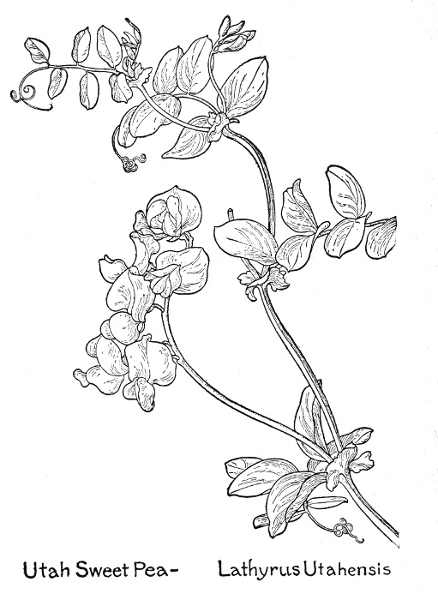
Utah Sweet Pea—Lathyrus Utahensis.
Pride of California Láthyrus spléndens Crimson Spring California
This has such glorious flowers, so superb in color and form, that it is by far the handsomest of its kind and not to be mistaken for any other. The stout, smooth, stems are dark green, the stipules small, and the leaves are smooth, slightly thickish and stiffish, rather dark bluish-green, with about ten leaflets. The flowers are over two inches long, from the tip of the standard to the end of the keel, and form a massive cluster of eight or ten blossoms, hanging on drooping pedicels and shading in color from the pale-salmon of the buds to the brilliant rose, carmine, and wine-color of the open flowers, the older flowers being very dark and rich. Only a small part of the flower-cluster is given in the picture. These plants, which are found around San Diego and farther south, clamber over the neighboring bushes to a height of several feet and adorn them with wonderful color, giving an effect of tropical splendor.
There are innumerable kinds of Astragalus; most abundant in Asia, usually perennial herbs, sometimes woody; leaves usually with numerous leaflets, flowers narrow, in spikes, with long flower-stalks; calyx tube-shaped, with nearly equal teeth; petals usually narrow, with slender claws, standard erect and somewhat oblong, wings oblong, keel with blunt tip, about the same length as the wings; stamens ten, in two sets of nine and one; pods numerous, more or less two-celled, often inflated, so the wind can distribute the small seeds, therefore these plants are often called Rattleweed. Another name is Milk Vetch and many kinds are called Loco-weed, from the word "loco," or crazy, because they are poisonous to horses and cattle. I was told by a cow-boy in Arizona that "horses eat this because it tastes sweet, but it gives them water on the brain and they die, unless the skull is split with an axe and the water is let out!"
Astrágalus Menzièsii White Spring, summer California
A decorative plant, its pale flowers contrasting well with the dark foliage, with stout, branching stems, from two to three feet tall, hairy above, and many leaflets, dark-green on the upper side, hairy and paler on the under. The flowers are half an inch or more long, with a pale, yellowish-green, downy calyx and cream-white corolla, and form a fine cluster, from four to ten inches long. The egg-shaped pods are much inflated and almost papery, an inch or more long. This grows on sea-cliffs and in sandy soil near the coast.
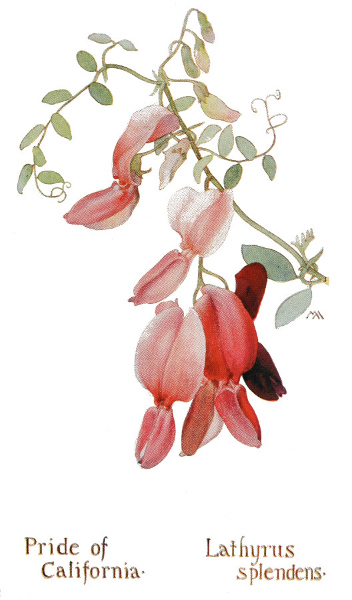
Pride of California—Lathyrus splendens.
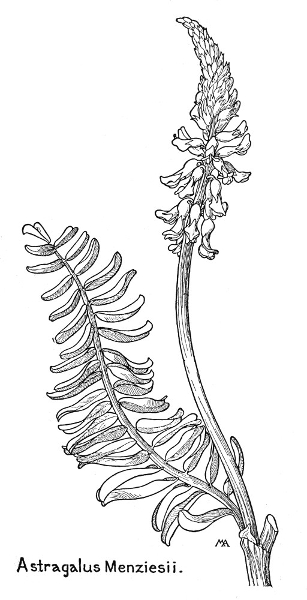
Astragalus Menziesii.
Pink Lady-fingers, Sheep-pod Astrágalus Utahénsis Pink Spring, summer, autumn Utah, Nev.
A pretty plant, unusual in coloring, the short stems spreading on the ground and springing from a short, perennial root; the foliage all very pale bluish-gray, covered with silvery down, the thickish leaflets from eleven to seventeen in number, the younger leaves and flower buds almost white. The flowers are about an inch long, in loose clusters, with flower-stalks from three to four inches long; the calyx long, pinkish-gray and downy, the standard pale pink, the wings deeper purplish-pink, the keel yellowish-pink. The pod is short, leathery, woolly, and stemless. This grows in dry, gravelly soil and in favorable situations makes low, circular clumps of foliage, suggesting the old-fashioned crochet lamp-mats that we used to see in New England farmhouses, for the pale leaves are symmetrically arranged in neat clusters and ornamented at intervals with pink flowers. Unlike, however, the worsted ornament, its coloring is delicately harmonious and beautiful.
Astrágalus nothóxys Purple Spring Arizona
A very slender plant, with trailing stems, one or two feet long, the leaflets odd in number and downy on the under side. The flowers are about half an inch long, with a whitish, downy calyx and a bright purple corolla, shading to white at the base. This grows in mountain canyons and looks a good deal like a Vetch, except that it has no tendrils.
Rattle-weed, Loco-weed Astrágalus pomonénsis White Spring California
This is a straggling plant, a foot and a half tall, smooth all over, with stout stems and many bluish-green leaflets. The flowers are over half an inch long, with a very pale calyx and yellowish-white corolla, forming a rather pretty cluster, about three inches long. The pods are each over an inch long and much inflated, forming a large bunch, odd and very conspicuous in appearance.
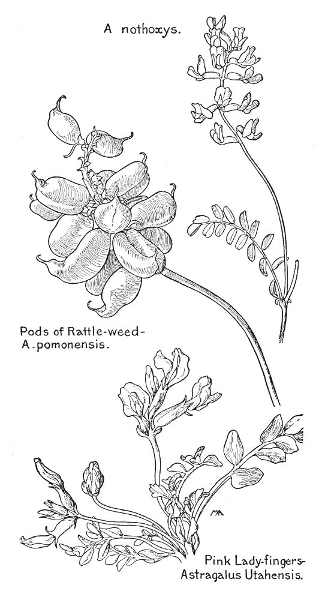
A. nothoxys. Pods of Rattle-weed—A. pomonensis. Pink Lady-fingers—Astragalus Utahensis.
Loco-weed Astrágalus MacDoùgali White, lilac Spring Arizona
An attractive plant, about a foot high, with straggling, reddish stems and delicate foliage. The flowers are over half an inch long, with a hairy calyx and pale lilac and white corolla, and form pretty clusters about two inches long.
There are many kinds of Hedysarum, some from Africa and only a few in this country; perennial herbs, sometimes shrubby; the leaflets toothless, odd in number; the flowers in handsome racemes, with bracts, on stalks from the angles of the stem; the calyx with five, nearly equal teeth; the standard rather large, round, or inverted heart-shaped, narrow at base, the wings oblong, shorter than the standard; the keel blunt, nearly straight, longer than the wings; the stamens in two sets of nine and one, not adhering to the corolla; the pod long, flat, and oddly jointed into several, strongly-veined, one-seeded, roundish divisions, which separate when ripe. The name is from the Greek, meaning "sweet-broom."
Hedýsarum pabulàre Pink Spring, summer Utah
A very handsome and decorative plant, with large brilliant flower-clusters, contrasting well with the foliage and making spots of vivid color on dry plains and hillsides. It has many stems, springing from a rootstock, which are from eight to fifteen inches long, yellowish-green, ridged, and covered with inconspicuous down, the leaflets are light bluish-green, thickish, nine to seventeen in number, and the bracts are thin and dry. The flowers are about three-quarters of an inch long, with a pinkish-green and downy calyx, and the corolla all bright deep pink, fading to blue, with a veined standard. The pod has from three to five divisions. This flourishes at rather high altitudes, up to seven thousand feet, and is conspicuously beautiful near the entrance to Ogden Canyon in Utah.
There are a great many kinds of Trifolium, or Clover, difficult to distinguish; low herbs; leaves usually with three leaflets, usually toothed; stipules adhering to the leaf-stalks; flowers in heads or spikes; stamens usually in two sets of nine and one; pods small, mostly enclosed in the calyx, usually with one to six seeds.
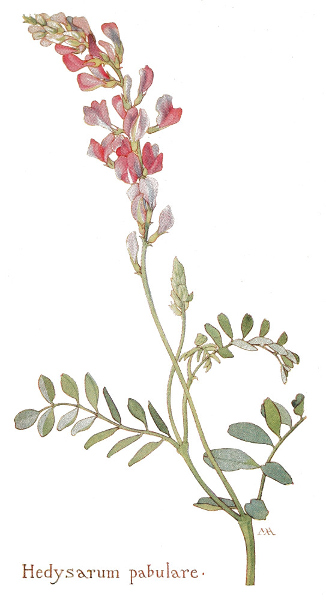
Hedysarum pabulare.
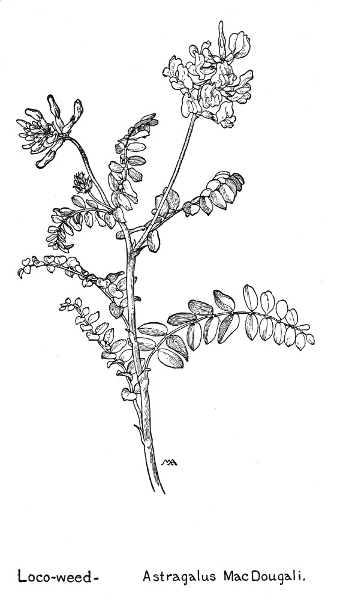
Loco-weed—Astragalus MacDougali.
Clover Trifòlium tridentàtum Purple Spring, summer Cal., Oreg., Wash.
This is very common from the coast to the Sierra foothills, but there are many named varieties. It is smooth all over and grows from eight inches to two feet high, with spreading stems and narrow leaflets, which are toothless, or have teeth and bristles on the edges. The pinkish-purple flowers form a broad head, over an inch across, with an involucre.
Sour Clover Trifòlium fucàtum Cream-color Spring, summer Wash., Oreg., Cal.
This has queer-looking flowers and is conspicuous on that account. The branching stems are a foot or more tall, the stipules are large, with papery margins, and the leaves are bright green, with a paler spot near the middle of each of the leaflets, which are toothed, or sometimes only bristly on the edges, and the flowers form a head about an inch and a quarter across, with a broad involucre. The calyx is very small and the corolla is cream-color, becoming much inflated and changing to deep pink as the flower withers. The effect of the cluster is curiously puffy and odd in color. This grows rankly in low alkaline and brackish places.
There are many kinds of Psoralea, widely distributed; ours are perennial herbs, without tendrils, the leaves with three or five leaflets, with glandular dots on them and usually bad-smelling. The flowers are white or purplish, and the pod is short, with only one seed.
Native California Tea Psoràlea physòdes White Spring, summer Cal., Oreg., Wash.
This is a rather pleasing plant, for the foliage is pretty, though the flowers are too dull in color to be effective. It is almost smooth all over, a foot or more tall, with several spreading stems and rich green leaves, thin in texture and giving out a rather pleasant aromatic smell when crushed. The flowers are less than half an inch long, with a somewhat hairy calyx, covered with dots and becoming inflated in fruit, and a yellowish-white corolla, more or less tinged with purple. This is common in the woods of the Coast Ranges. The foliage was used as tea by the early settlers.
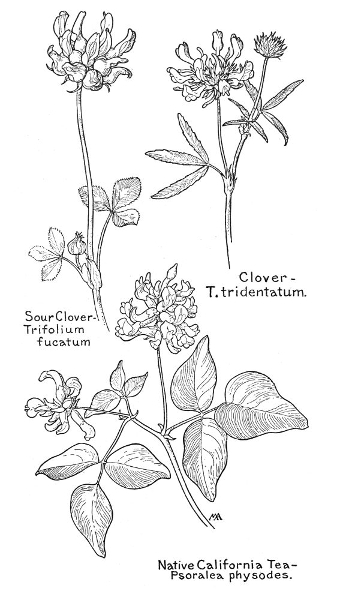
Sour Clover—Trifolium fucatum. Clover—T. tridentatum. Native California Tea—Psoralea physodes.
There are many kinds of Cytisus, natives of Europe, Asia, and Africa, named for Cythrus, one of the Cyclades, where the first species was found.
Scotch Broom Cýtisus scopàrius Yellow Spring, summer West, etc., except Ariz.
A handsome branching shrub, about five feet high, with almost smooth or quite hairy leaves, with three, toothless leaflets, and fine clusters of flowers, each an inch or more long, with a yellow two-lipped calyx and a golden-yellow corolla, deeper in color at the base of the standard and at the tips of the wings; the stamens ten, in one set; the style curved in. The pod is flat, smooth on the sides, but hairy along the edges, one or two inches long and curling when ripe. This is said to have been brought to California by Cornish miners.
SENNA FAMILY. Cassiaceae.
A large family, most of them tropical; trees, shrubs, and herbs, with flowers more or less irregular in form, but not like the flowers of the true Pea, though sometimes resembling them; calyx usually with five sepals; corolla with five petals, overlapping in the bud, the petal which corresponds to the standard folded within the two side petals, instead of covering them, as in the Pea flower; stamens, ten, or fewer, in number, usually not united; ovar superior; fruit a pod, mostly splitting into two halves, containing one to many seeds. To this family belong the handsome Red-bud, or Judas Tree, of our woodlands, both East and West; the spiny Honey-locust; the Kentucky Coffee-tree, with its fine foliage, of the central and eastern states; the interesting Palo Verde, with greatly reduced leaves, of the Southwest, and the fine Bird-of-paradise flowers, of the tropics and Mexico, one or two of which are just beginning to grow wild in southern Arizona and California.
There are many kinds of Cassia, abundant in tropical America; herbs, shrubs, or trees; leaflets even in number; flowers usually yellow; calyx-teeth nearly equal; corolla almost regular, with five, nearly equal, spreading petals, with claws; stamens usually ten, sometimes five, often unequal, some of the anthers often imperfect, or lacking; pod flat or cylindrical, often curved, sometimes with partitions between the numerous seeds.
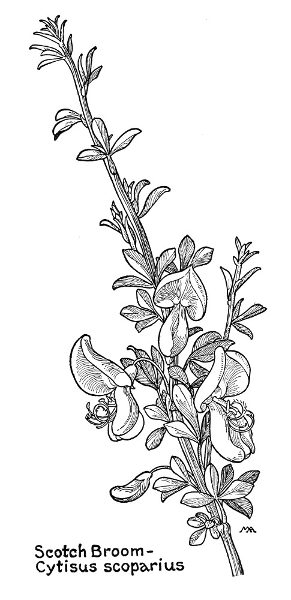
Scotch Broom—Cytisus scoparius.
Desert Senna, Golden Cassia Cássia armàta Yellow Spring Southwest
The peculiar orange-yellow of these handsome flowers at once attracts our attention, for their tint is quite different from the greenish-yellow, which is so much more common. They grow in the desert, forming big clumps, two feet high and two or three feet across, but have almost no foliage. The numerous, smooth stems are very pale in color, often bluish or gray, with a few dark-green leaves, with six, very small, stiff leaflets, and bearing clusters of numerous, sweet-smelling flowers, almost regular and about three-quarters of an inch across, with a downy calyx and the small, flat pod also downy.
MIMOSA FAMILY. Mimosaceae.
A large family, most of them tropical; herbs, shrubs, or trees; leaves alternate, generally compound, usually with two or three leaflets; flowers small, regular and perfect, in clusters; calyx with three to six lobes or teeth; petals of the same number, separate, or more or less united, neither sepals nor petals overlapping in the bud; stamens as many as the petals, or twice as many, or numerous, separate or united; ovary superior; fruit a pod.
There are several kinds of Calliandra, low shrubs or herbs.
Fairy Dusters Calliándra eriophýlla Pink Spring Arizona
An odd little shrub, pretty and very Japanese in character, about a foot tall, with a few, pale-gray, spreading branches and very scanty foliage. The small leaves are cut into many tiny leaflets and look like those of a Mimosa, the buds are deep pink and the flowers are in clusters towards the ends of the branches and slightly sweet-scented. They are very queer-looking, but exceedingly pretty, for the purplish calyx and corolla are so small that the flower appears to be merely a tuft of many stamens, about an inch long, with threadlike filaments, white at base and shading to bright pink at the tips. The pistil is also long and pink, so the whole effect is a bunch of pink fuzz, airy in form and delicately shaded in color. These little shrubs sometimes bloom when they are only a few inches high, looking very quaint, like dwarf plants in a toy garden, and are among the earliest spring flowers.
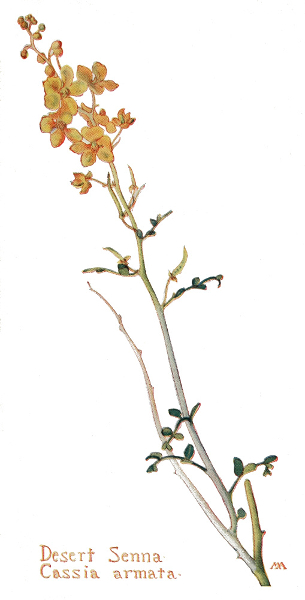
Desert Senna—Cassia armata.
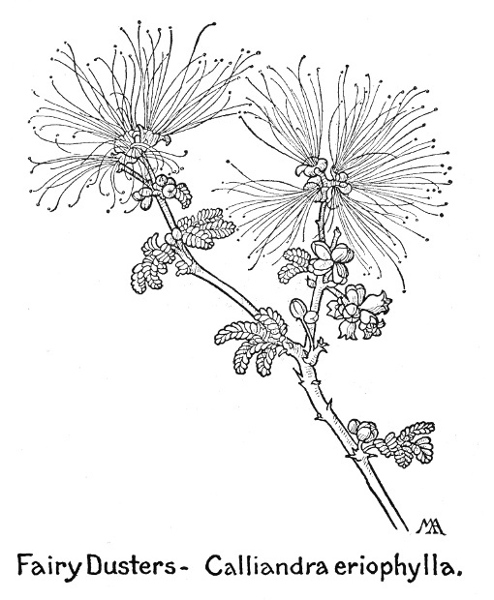
Fairy Dusters—Calliandra eriophylla.
KRAMERIA FAMILY. Krameriaceae.
A small family, distributed from the southern United States to Chili; hairy herbs or low shrubs, without stipules; leaves alternate; two bracts on the flower-stalk; flowers purplish, irregular, perfect; sepals four or five, usually large, the outer one commonly wider than the others; petals usually five, smaller than the sepals, the three upper ones with long claws, often united by their claws, sometimes the middle one of the three lacking, the two lower ones reduced to mere fleshy glands and not resembling petals; stamens three or four, united at least at base; ovary superior, with a slender style; fruit spiny, seed one.
Crimson-beak Kramèria Gràyi Purplish-pink Spring Arizona
A desert shrub, with a pleasant smell like balsam, two to four feet high, with gray, woody stems, abruptly branching, armed with long, brown and gray thorns, and clothed with very small, silvery-gray leaves, downy and thickish. The flowers are curious in shape and color, with five, large, purplish-pink sepals and five, small petals, the two lower ones minute and reduced to glands. The pistil is dark red, the three stamens have green filaments and red anthers, the ovary is downy and prickly, and the downy buds are pale pink.
CALTROP FAMILY. Zygophyllaceae.
Not a large family, widely distributed in warm and tropical regions; ours are herbs or shrubs, with opposite or alternate, compound leaves, with stipules and toothless leaflets; flowers complete, usually with five sepals and five petals, and usually twice the number of stamens, with swinging anthers, alternate stamens sometimes longer, filaments often with a small scale near the middle; ovary superior, usually surrounded at the base by a disk; style one, with a five- to ten-lobed stigma; fruit dry.
There are several kinds of Covillea.
Creosote-bush, Hediondilla Covíllea glutinòsa (Larrea Mexicana) Yellow All seasons Southwest
A graceful, evergreen shrub, common in arid regions and a characteristic feature of the desert landscape, filling the air with its very strong, peculiar odor. It is from three to ten feet high, with many little branches, with blackish knots at the joints, clothed with sticky, dull yellowish-green foliage, the thickish, resinous leaflets very small, in pairs, with almost no leaf-stalk, and uneven at base. The pretty flowers are nearly an inch across, with bright yellow petals, with claws, and silky, greenish-yellow sepals which soon drop off. The filaments are broadened below into wings and have a scale on the inner side. The ovary is covered with pale, silky hairs, so that the older flowers have a silky tuft in the center, and becomes a round, densely hairy fruit, with a short stalk, tipped with the slender style. These little white, silky balls of down are very conspicuous and, as they are mingled with yellow flowers, the bush has an odd and pretty effect of being spotted all over with yellow and white.
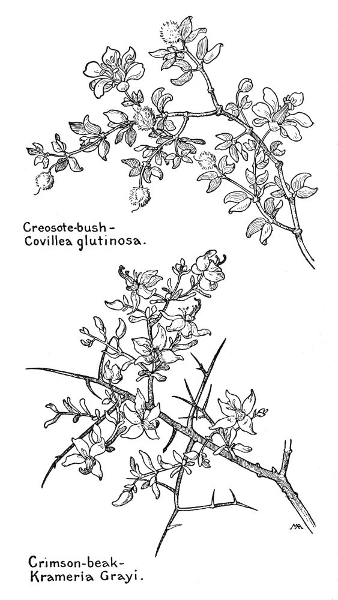
Creosote-bush—Covillea glutinosa. Crimson-beak—Krameria Grayi.
FLAX FAMILY. Linaceae.
A small family, widely distributed in temperate and tropical regions. Ours are smooth herbs, with loosely clustered, complete flowers, having five sepals; five petals, alternating with the sepals; five stamens, alternating with the petals, with swinging anthers and filaments united at the base; ovary superior; fruit a capsule, containing eight or ten, oily seeds.
There are many kinds of Flax, sometimes shrubby at base; with tough fibers in the bark; leaves without stipules, sometimes with glands at base in place of real stipules; flowers mostly blue or yellow. There are numerous, small-flowered, annual kinds, difficult to distinguish and usually somewhat local. L. usitatíssimum, an annual, with deep blue flowers, is the variety which, from time immemorial, has furnished the world with linen from its fiber and oil from its seeds. Linum is the ancient Latin name.
Blue Flax Lìnum Lewísii Blue Spring, summer West, etc.
An attractive plant, from one to two feet tall, with several, erect stems, springing from a woody, perennial root, with numerous, small, narrow, bluish-green leaves and loose clusters of pretty flowers, each about an inch across. The petals, delicately veined with blue, vary in tint from sky-blue to almost white, with a little yellow at the base. This is common and widely distributed, from Manitoba to Texas and westward, but the fiber is not strong enough to be used commercially.
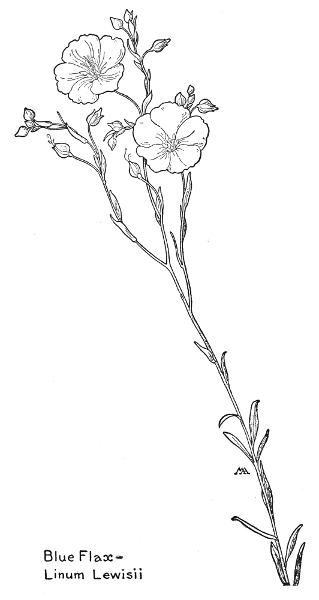
Blue Flax—Linum Lewisii.
WOOD-SORREL FAMILY. Oxalidaceae.
Not a large family, mostly tropical. Ours are low herbs, with sour juice, often with rootstocks or scaly bulbs; leaves with three or several leaflets; flowers perfect; sepals five, often unequal; petals five, stamens ten to fifteen; ovary superior, five-celled, the five styles usually separate; fruit a capsule, containing several or many seeds. By some botanists this is merged in the Geranium Family.
There are many kinds of Oxalis. The Greek name means "sour," in allusion to the sour taste of these plants, which contain oxalic acid. The leaves are alternate, at nightfall the leaflets droop and fold together; the stamens are ten, five long and five short, all with anthers, with filaments broadened and united at base.
Yellow Wood-sorrel Óxalis corniculàta Yellow Spring, summer, autumn Southwest
A pretty little plant, a few inches tall, more or less downy all over, with very slender, reddish, branching stems and light green leaves, about an inch across and thin in texture. The flowers are over half an inch across, with clear yellow petals, often tinged with pale red on the outside, yellow anthers and a green pistil. The capsules are long and downy.
Redwood Sorrel Óxalis Oregàna White, pink Spring Cal., Oreg., Wash.
One of the most attractive of our woodland plants. The succulent, hairy, reddish flower-stalks, about six inches tall, with two small bracts near the top, spring from a clump of root-leaves. The larger leaves are three inches across, with long leaf-stalks, pale and hairy on the under side, rich green on the upper, each leaflet marked with an irregular blotch of pale green. The younger leaves are lighter green than the older ones and in the bud are neatly folded together, the middle leaflet inside the other two. The leaflets fold back, when it is either too hot or too cold to suit the plant. The delicate flowers are about an inch and a half across, white, pale pink, or rose-color, often veined with deeper color and with a spot of yellow at the base of each petal, and well set off by the foliage, which makes patches of rich and variegated green in dense forest shade.
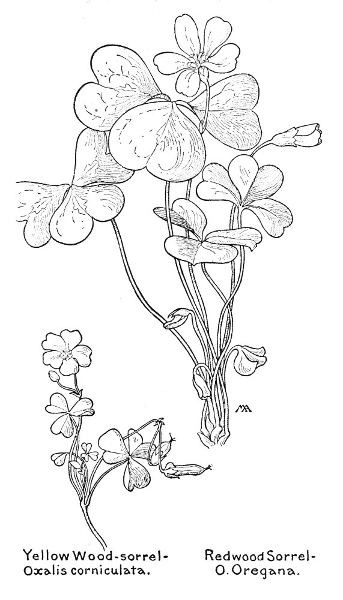
Yellow Wood-sorrel—Oxalis corniculata. Redwood Sorrel—O. Oregana.
GERANIUM FAMILY. Geraniaceae.
Not a large family, herbs, of temperate regions; leaves lobed or compound, usually with stipules; flowers perfect; sepals and petals usually five and stamens five or ten; ovary superior; fruit a capsule.
There are many kinds of Geranium; stems with swollen joints; stipules papery; five glands on the receptacle, alternating with the petals; stamens ten, five long and five short, filaments united at base; ovary with a beak formed by the five-cleft style, and becoming a capsule, which splits open elastically, the style-divisions becoming tails on the seeds. The Greek name means "crane," in allusion to the long beak of the capsule, and these plants are often called Crane's-bill. Cultivated Geraniums are Pelargoniums, from South Africa.
Wild Geranium Gerànium incìsum Pink Spring, summer West
In the Sierra woods, and along Yosemite roadsides, in summer we see the purplish-pink blossoms and nodding buds of this attractive plant, resembling the Wild Geranium of the East, growing from thick, perennial roots, with hairy, branching stems, from one to two feet high. The hairy leaves, with three or five, toothed lobes, are fragrant like cultivated geraniums; the flowers, over an inch across, are hairy inside, the petals veined with magenta. They are occasionally white and the plants vary in size and hairiness. G. furcàtum, of the Grand Canyon, has magenta petals, which turn back more.
Wild Geranium Gerànium Fremóntii Pink Spring, summer Southwest, and Utah, Ida., Col., New Mex.
This has similar flowers, but is a finer plant, forming large, thrifty-looking clumps, one or two feet across, of slightly thickish leaves, dark green on the upper side and paler, with prominent veins, on the under, the root-leaves with about seven, main divisions, the stem-leaves three- to five-cleft, each clump of leaves with several tall, slightly downy flower-stalks springing from it. The calyxes and buds are downy and the flowers bright pink or rose-purple, delicately veined. This grows in somewhat moist ground, at the edges of fields and woody roadsides and on mountain slopes, and is perhaps the handsomest of its clan.
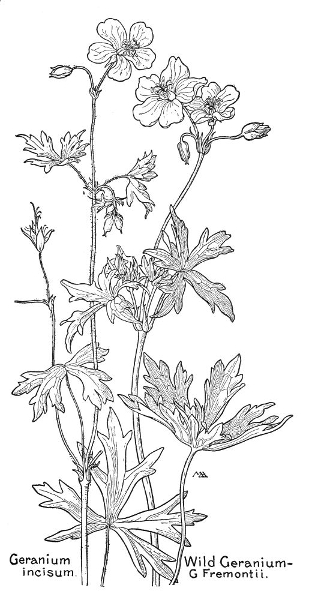
Geranium incisum. Wild Geranium—Fremontii.
Long-stalked Crane's-bill Gerànium columbìnum Purple Spring, summer California, etc.
A slender plant, about a foot tall, with pinkish, hairy stems and pretty leaves, thin in texture, with a dull surface; the seed-vessels erect, with bristly beaks. The flowers grow in pairs and are less than half an inch across, with hairy calyxes and notched, purple or magenta petals. This is naturalized from Europe, and common in the East and grows along roadsides, at the edges of fields and woods.
There are many kinds of Erodium, three native in the Southwest and several more introduced, weeds in the Old World and important forage plants in the West; leaves often unequal, with one stipule on one side and two on the other. They resemble Geranium, flower and fruit being nearly the same, but only five of the stamens have anthers, the alternate ones being scale-like, without anthers; styles hairy inside. The Greek name means "heron," in allusion to the long beak of the capsule.
Red-stem Filaree Eròdium cicutàrium Pink All seasons West, etc.
Though not native, this is the commonest kind, in the interior and semi-arid regions, and most valued for forage. When young it forms rosettes close to the ground, but grows taller and more straggling. The stems are often reddish; the leaves somewhat hairy; the flowers small, in clusters of four to eight, with four bracts at the base; the petals purplish-pink, with darker veins, and hairy at the base, the two upper petals slightly smaller; the sepals tipped with one or two bristles. The ovary is beaked by the united styles, the beak, when the seeds ripen, separating into five, long tails, which twist spirally when dry and untwist when moistened. This is common west of the Rockies, blooming more or less all the year round, varying in size in different soils. Filaree is a corruption of the Spanish Alfilerilla, from "alfiler," a "pin." Other names are Pinkets, Pinclover, Storksbill, and Clocks, so-called by children because they amuse themselves by watching the tails twist about like the hands of a clock. White-stem Filaree, E. moschàtum, common in rich soil, has larger, coarser leaves and a faint scent.
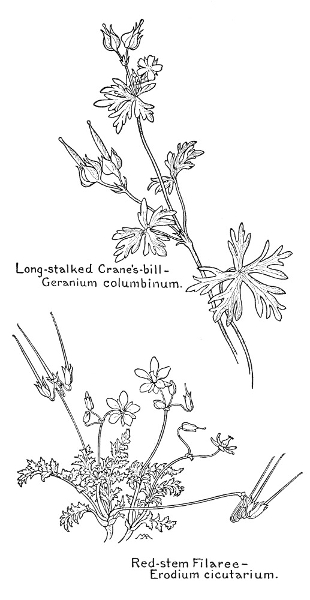
Long-stalked Crane's-bill—Geranium columbinum. Red-stem Filaree—Erodium cicutarium.
MILKWORT FAMILY. Polygalaceae.
Not a very large family, widely distributed; ours are herbs, sometimes shrubby, with no stipules; flowers perfect, irregular, resembling those of the Pea Family, but not like them in structure; sepals five, the two at the sides large and colored, like "wings," the upper sepal forming a "keel"; petals three, more or less united into a tube; stamens usually eight and united; ovary superior, two-celled, with a broad, curved stigma.
There are many kinds of Polygala.
California Milkwort Polýgala Califórnica Pink Spring, summer Cal., Oreg.
A rather attractive little plant, three to eight inches tall, with smooth leaves and many slender, smooth, woody, stems, springing from slender rootstocks. The purplish-pink flowers become deeper in color as they fade and are quaint in form, over half an inch long, with pink "wings" and yellowish "keel," the petals downy inside and the middle one curving over to form a hood, in which the stamens and style are concealed. This plant has the odd habit of bearing another sort of flower near the root, maturing most of the seed, but without petals, and grows on dry, shady hillsides in the Coast Ranges.
MEADOW FOAM FAMILY. Limnanthaceae.
A very small family, all North American, included in the Geranium Family by some botanists; smooth herbs, of wet places, with bitter juice; leaves alternate, lobed and cut, without stipules; flowers perfect; sepals and petals two to five; stamens twice as many as the petals; ovary superior, the five lobes becoming five nutlets; style one.
There are several kinds of Floerkea; sepals and petals three to five; five, small glands on the receptacle, alternating with the sepals; style two- to five-cleft.
Meadow Foam Floérkea Douglásii (Limnanthes) White, yellow Spring Cal., Oreg.
A charming plant, often covering the meadows with drifts of creamy bloom. The stems are smooth, succulent, brittle and branching, from six to twelve inches tall; the delicate flowers over an inch across, the petals hairy at base, sometimes pinkish, but usually white and yellow.
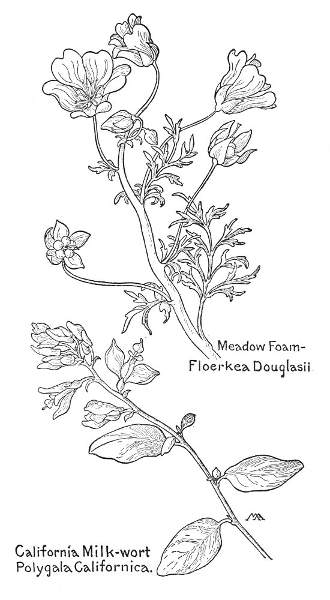
Meadow Foam—Floerkea Douglasii. California Milk-wort—Polygala Californica.
BUCKEYE FAMILY. Hippocastanaceae.
A small family, widely distributed; trees or shrubs, with opposite, compound leaves, no stipules and terminal clusters of irregular flowers, some perfect and some with only pistils or only stamens; the calyx tubular or bell-shaped, with five, unequal lobes or teeth; the petals four or five, unequal, with claws; the stamens five to eight, with long filaments; the ovary superior, with no stalk, three-celled, with a slender style; the capsule leathery, roundish or slightly three-lobed, smooth or spiny, with one to three, large, polished seeds.
There are a good many kinds of Aesculus, or Horse Chestnut, natives of America and Asia; the leaves palmately compound, with toothed leaflets; the flowers of two sorts, the fertile ones few in number, near the top of the cluster, with long, thick styles, and the sterile flowers with short styles.
California Buckeye Aésculus Califórnica White Spring, summer California
One of our handsomest western shrubs, usually from ten to fifteen feet tall, with gray bark, and dark bluish-green foliage, the leaflets from five to seven in number, glossy on the upper side, pale and dull on the under, and firm in texture. The flowers have a rather heavy scent and are about an inch across, with four or five, slightly irregular, white petals, which become pink in fading, a pinkish ovary and long stamens with curling, white filaments, unequal in length, with buff anthers. They are crowded in a magnificent, pyramidal cluster, about a foot long, which has a pinkish-red, downy stem, and the buds are also downy and pinkish, so that the color effect is warm-pink above, merging into cream-white below, the whole made feathery by the long stamens. The shrub has a rounded top of rich green foliage, symmetrically ornamented with spires of bloom, standing up quite stiffly all over it. The large, leathery pod contains a big, golden-brown nut, supposed to be poisonous to cattle. The leaves fall off very early in the season, leaving the pods hanging on the bare branches. This is at its best in the mountain valleys of middle California, sometimes becoming a good-sized tree.
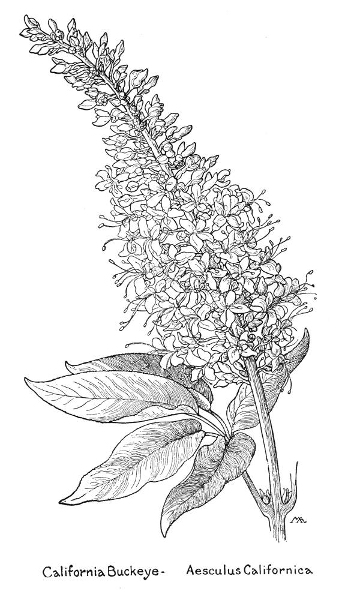
California Buckeye—Aesculus Californica.
BUCKTHORN FAMILY. Rhamnaceae.
A large family; shrubs, or small trees, of temperate and warm regions, some with bitter, astringent properties, often thorny; leaves mostly alternate; stipules minute; flowers often in showy clusters, small, regular; calyx-lobes and stamens four or five; petals usually four or five, sometimes lacking, with claws. The short calyx-tube is lined with a fleshy disk and on this are borne the petals and the stamens, alternate with the sepals and opposite the petals, with swinging anthers. In some cases, some of the flowers have only pistils or only stamens. The ovary superior or partly inferior; the fruit a berry or capsule.
There are many kinds of Ceanothus, largely western; flowers small, blue or white, in clusters; calyx bell-shaped, five-lobed, with a colored, petal-like border; petals five, the tips arching to form a tiny hood, with long claws; stamens five, long, protruding, with threadlike filaments; ovary partly inferior; style three-cleft; capsule splitting open elastically so as to scatter the three, hard nutlets. The flowers make a soapy lather when rubbed in water, hence the name Soap-bush, and the kinds with rigid branches are called Buckbrush. Red-root is another name. Mountain Lilac is the commonest name, but misleading. Lilacs belong to another family.
Squaw Carpets, Mahala Mats Ceanòthus prostràtus Blue Spring, summer Cal., Oreg.
This decorative shrub is common in the Sierras and carpets the forest floor with a rich green, leafy mat, sprinkled with small, feathery clusters of blue flowers. The trailing stems are clothed with leathery leaves, opposite and very glossy, and the little flowers are deep purplish-blue, with yellow stamens, and slightly scented. These plants are equally attractive late in the season when the flowers are replaced by scarlet seed-vessels, with three horns.
Snow Brush, Mountain Lilac Ceanòthus velùtinus White West, except Ariz.
A fine shrub, two to twelve feet high, with stout trunk and branches, easily recognized by its leaves, which are rich green, thick and resinous, shiny as if varnished on the upper side and sometimes rich chocolate-brown in color, but pale on the under side, with three, conspicuous nerves. The small, sweet-scented flowers are crowded in compact, creamy clusters, sometimes four or five inches long, very handsome, but not so delicate as Deer-brush. This is common on hillsides and in the mountains, up to seven thousand feet.